War. Inflation. Recession. Pandemic. The pursuit of economic stability is increasingly unrealisable, with the volatility of recent years challenging leaders and companies to find new ways to create value as they navigate the changing business landscape.
When turmoil hits, business leaders and investors face notoriously unreliable macroeconomic forecasts, whipsawing data, and contradictory opinions. Are disruptions transient and ephemeral—or permanent and structural? False alarms are costly traps, but so are true structural changes that go undetected. Leaders must also assess the doom-laden public macroeconomic discourse, which habitually presents worst-case scenarios as foregone conclusions.
How can business leaders avoid these traps and make better strategic decisions?
Shocks, Crises, and False Alarms
In his new book, Shocks, Crises, and False Alarms, BCG Global Chief Economist Philipp Carlsson-Szlezak and Senior Economist Paul Swartz provide a fresh and accessible way to analyse and understand the macroeconomy, or what they call “regime analysis”, that pushes beyond conventional model-based prediction to emphasise structural context and judgment.
Focusing on what it takes for macroeconomic regimes to break, they apply their approach to key risks in the real economy, financial structures, and geopolitical arrangements to help senior executives and investors assess the true risks of their economic context and to build their capacity to respond to changing conditions more effectively.
With dose of rational optimism, the book explores the key macro debates and controversies that shape our time, and it empowers leaders with the analytical skills to assess and judge macroeconomic risks for themselves, with a new way of thinking that will continue to apply as risks change over time.
- New: 8 CEO Priorities for 2024 by McKinsey
- New: Leadership Agenda in 2024 by PwC
- New: CEO Outlook 2024by EY
- New: Tech Trends 2024 by FTI
- New: Big Ideas 2024 by ARK
- New: Global 50 by DFF
Trend Kaleidoscope 2024 is a compilation of over 50 reports about economic and industry outlooks, market and consumer trends, emerging technologies and new possibilities, and much more. We all recognise the uncertainty driven by conflicts, climate and economics, and the spluttering growth of today’s environment – but two big, closely related, trends stand out:
- AI hype and being human … 12 months of ChatGPT has certainly sparked enthusiasm for AI startups, investment and innovation … but at the same time (a legacy of pandemic, and antidote to digitalisation) is the desire to be more human – more personal, empathic, and in search of real experiences, from in-store immersions to meditative moments and travel adventures.
- Sustainable and synthetic reality … technological innovation is taking us in two directions – to address the problems of the past (most significantly, the huge and difficult effort to decarbonise old industries – although energy transition has stalled because of the greed of higher oil prices) – and also a huge rise in new synthetic innovations, from gene-editing and mRNA in healthcare, to alternative foods and VR gaming.
Also take a look at who I see as some of the most innovative businesses who are likely to deliver rapid progress in 2024, just some of the 250 inspiring companies which I track for their innovation and performance:
- Authentic Brands, from Ali to Elvis, Reebok to Ted Baker
- BYD, Chinese EV maker, now the world’s #3 automotive business
- Holcim, Swiss cement, building progress for people and planet
- Lilium, former Airbus and BMW leaders, innovating the future of flight
- MercadoLibre, the Amazon of Argentina, from retail to finance
- Northvolt, pioneering a sustainable battery industry, key to future energy
- Rains, concept meets function in Nordic outerwear from Aarhus
- SSAB, zero carbon steel from Sweden, stronger, lighter and more sustainable
- Twelve, capturing carbon, to make more sustainable plastics and fuels
- Vuori, soft and stylish Californian fashion, ready for IPO in 2024
While looking ahead, it’s also interesting to see how the last year has unfolded – as predicted by Trend Kaleidoscope 2023 – from ChatGPT to $3 trillion Apple thriving on financial services, BYD’s rapid acceleration to lead the auto market, AI-generated influencer Noonoouri’s chart-topping hit with Warner Music, and India joining the space race.
Slower, greener growth
As polycrisis consumes agendas around the world – conflicts, climate and more – the IMF Economic Outlook 2024 sees a continued stagnation of growth in western markets next year (1.2% in Europe, 1.5% in USA) but higher in Asia (4.4% in China, 6.1% in India), and 2.9% average globally.
The EIU’s Industry Outlook 2024 reflects on the turbulence of recent years for most companies as the pandemic, soaring commodity prices, high interest rates and political disruption resulted in profits for many and bankruptcy for some. It produces a weather forecast by industry:
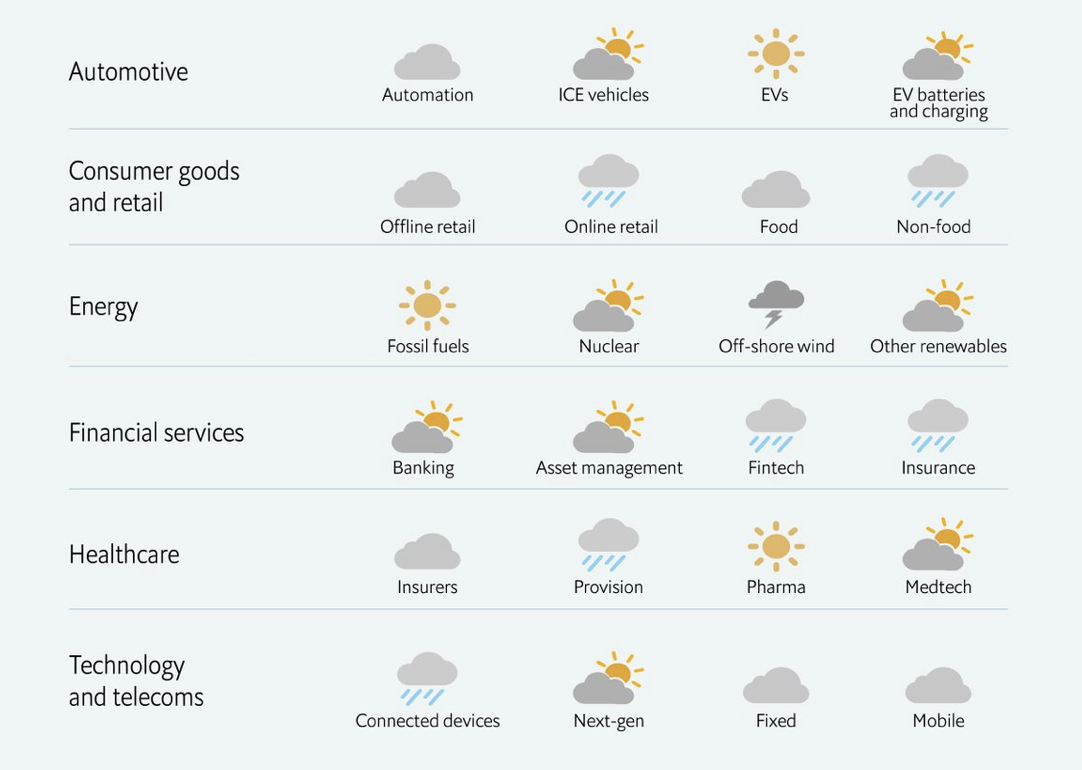
EIU also considers the next agendas on each continent
- Europe 2024: Subdued growth, political fragmentation and the green transition.
- North America 2024: US elections will dominate the year, while the economy will struggle with higher borrowing costs.
- Latin America 2024: substantial political change has led to democratic retreat and social risks.
- Asia 2024: Strong growth despite China’s slowing economy and geopolitical tensions.
Ipsos’ Global predictions for 2024: Optimism is on the rise as more think next year will be better
- 53% say 2023 was a bad year for them and 70% say it was a bad year for their country. This is the lowest level since before the Covid-19 pandemic.
- Seventy per cent think next year will be a better year than this one. This is an increase of 5pp on last year’s figure.
- More people think AI will lead to more jobs being lost than being created in 2024.
- After 2023 being the hottest year on record, 81% expect average global temperatures to go even higher in 2024.
- A majority (59%) think we’ll spend more time working in the office in 2024 than working at home.
The Economist focuses on 10 business trends:
- Central banks including America’s Federal Reserve start to reduce interest rates as price rises slow. With global inflation still at 5%, however, consumers remain thrifty.
- Amid efforts to slow climate change, renewable-energy consumption climbs by 11% to a new high. But fossil fuels still meet over four-fifths of energy demand
- IT spending picks up, rising by about 9%. Artificial intelligence generates remarkable hype but produces precious little revenue and plenty of scrutiny.
- The gap between the infrastructure the world needs and what it gets amounts to $3trn. To plug its infrastructure hole, Asia’s gross fixed investment expands by 4%.
- Revenue in the advertising industry increases by 5%, thanks to America’s presidential election and big sporting events such as the Paris Olympics.
- International tourism rises above geopolitical and economic uncertainty to create record revenue of $1.5trn, fuelled by high prices and post-pandemic wanderlust.
- A greying world spends vigorously on health. With about one in ten people aged 65 or older, health care makes up one-tenth of global gdp.
- America shells out $886bn on defence, supporting Ukraine and countering China—whose neighbours, including Japan, Taiwan and the Philippines, also bolster their defences.
- Electric vehicles speed forth, driven by strong government support. One in four new cars is a plug-in, with more than half of these sold in China.
- With 60% of America’s firms allowing working from home, a fifth of American offices lie empty. The eu’s less relaxed employers will keep its vacancy rate at just 8%.
Being Human
Mintel’s Global Consumer Trends is summarised by these 5 themes:
- Being Human: In a world increasingly dominated by algorithms, we will need human skills and emotion to make the most of this technological revolution. A new ‘human-as-premium’ label will emerge, giving greater influence to artisans who can take on the creative spirit that exists outside of an algorithm
- More Than Money: Consumers will reassess what matters most to them, affecting not only what they want and need, but their perception of what constitutes value. The social and emotional value of a brand will grow in importance as consumers look more towards what a brand means to them personally, rather than what it stands for societally.
- Relationship Renaissance: Consumers who find comfort through screens at the cost of meaningful, real-life relationships, will seek new forms of intimacy for the sake of their physical and mental health. Consumers don’t just want to be cared for; they want to care for others too, including their pets and plants.
- New Green Reality: Incorporating sustainability into the day-to-day is not enough; consumers and brands will be faced with the reality that survival within a new climate context has to be the priority. Anxious consumers may be reluctant to adopt necessary lifestyle changes, which will drive brands to do more to help smooth these transitions.
- Positive Perspectives: Brands and consumers will work together in new ways to deal with uncertainty. To counter the feeling of always waiting for something to happen, consumers are waiting for a clear sense of direction, or profound statements from voices of authority, including brands.
These trends are illustrated by innovations that have emerged in recent months around the world:
- US biotech company Nix launched a wearable hydration biosensor that calculates fluid and electrolyte loss and informs the user about their hydration levels.
- Danish tech start-up Be My Eyes has incorporated OpenAI’s GPT-4 into its eponymous mobile app to create a virtual visual assistant for blind and partially-sighted people that can generate spoken words from images.
- Artists and illustrators in the US are using the hashtag #artbyhumans as a form of silent protest and a rallying cry against the abundance of AI-generated images/art.
- Digital bank Brubank Argentina invited entrepreneurs to use AI and the Mi Negocio app to submit visualisations of their dream store and the bank produced the digital designs for free.
- French cooperative Ethikis has developed the Longtime label, a quality mark to help consumers identify durable products.
- Chinese baijiu brand Wuliangye has launched ‘W Planet’, a metaverse-based virtual space, aimed at encouraging young consumers to experience its brand culture.
- US food processing company Heinz has created a collectable sauce packet for all 50 US states, each one highlighting a regional delicacy from the state to bring Americans together rather than highlight what divides them.
- Chinese fragrance brand Documents has opened a community-based store in Shanghai—‘Yuyuan Bookspace’ (愚园书室)—where consumers can read themed books (eg trees) for free while experiencing Documents’ fragrance products.
- ‘Body doubling’—the practice of using livestreams to replicate the feeling of working alongside others to boost productivity—is becoming increasingly popular among remote workers and students in the US, with virtual platforms like Flow Club matching members in small accountability groups.
- The staff at Tokyo’s Tomodachi ga Yatteru Café (‘Café Run By Friends’) are actors who pretend to know every customer who walks in to make them feel like long-time friends.
- Australian start-up Immersion Group harvests and supplies red seaweed, which produces a compound called bromoform. When fed to cattle and sheep, bromoform blocks an enzyme in the gut that produces methane, thereby, reducing methane levels in livestock farming.
- Coffee and espresso machine maker Nespresso partners with small organic farmers in Taiwan, supplying them with coffee grounds to enrich their soil. Local Italian, vegetarian restaurant Miacucina created a special menu centred around cabbages harvested from farms using these coffee grounds.
- For April Fool’s Day 2023, US-based women’s clothing brand Cuyana launched a fictional clothing line, ‘Made With Air’, stating it had no negative impact on the environment, as a tongue-in-cheek way of drawing attention to brands that greenwash through various environmental claims.
- Indian instant delivery service, Blinkit’s, ‘Recipe Rover’ utilises ChatGPT technology to enable users to explore different recipes and add suggested ingredients to their Blinkit shopping carts.
- The 2023 Faal Festival (‘Failure Festival’) in the Netherlands encouraged young people to embrace failure through talks and activities to improve their mental health.
- Inception is a US-based mental health gym that helps members take a holistic approach to health by achieving ‘inner fitness’ through mindfulness and relaxation.
- Chinese Buddhist temples are launching new offerings, like blessed objects, coffee drinks and mental health counselling, to attract younger generations, making them the latest trendy destination for Gen Z which seeks pleasure and slowness in their hectic lifestyles.
Ethical Zen
Statista’s “Must Watch” Consumer Trends 2024 are strongly driven by the economic context of inflation, rising living costs, and unpredictable demands which are reshaping consumer spending habits and needs.
- Quest for quality: the search for a new quality-value equation in tough economic times. Despite tightened consumer budgets they prefer to buy better, not simply cheaper – better quality, more sustainable – forget disposable consumption and fast fashion. This is leading to a rise in premium products, selectively purchased, but also a thrift economy.
- Ethical spenders: Sustainability and ethics at the forefront of decision-making. Sustainability is no longer just a buzzword. Ethical Spenders will buy from eco-friendly brands, even during challenging times. Ethical Spenders are willing to pay a premium for essential goods that align with their values – especially food and drink, beauty, homeware and fashion.
- Zenthusiasts: The hunt for respite from stress and anxiety is surging. Spearheaded by Gen Z and Millennials, these generations are acknowledging the mounting stressors in their lives. Zenthusiasts are actively seeking solace through online health gurus who promote self-care and alternative therapies like cannabis.
- Data Ad-vocates: Say goodbye to one-size-fits-all advertising. Consumers aren’t as concerned about data privacy if it means they get personalized content and experiences in return. Data Ad-vocates want ads catered to their interests, location, and lifestyle preferences. Personalization can be a powerful way to attract new as well as retain customers.
Where’s the love?
Accenture’s Life Trends 2024 report is a refreshingly human view of emerging behaviours, but from a tech expert company. largely thanks to its acquisition of Fjord which did great work on trends.
The report starts by asking “Where’s the love?”
“For years, the correlation between customer experience and revenue growth inspired organizations to hold the customer at the center of every decision. Now, economic considerations are forcing cuts throughout enterprises, driving friction between customers and brands across channels—in the form of price increases, quality cuts, illogical subscriptions, and poor customer service. Customers are noticing, and some feel hard done by. The key question: How do brands keep their product in the basket in the long term?”
Businesses are scrambling to cut costs and protect profits against a strained economic backdrop.
They’ve made tough decisions to survive, with one major consequence: the erosion of customer experiences. Like it or loathe it, consumerism is a socio-economic fact of life for billions of people, with much of their day-to-day experience influenced or mediated by consumer culture. The changes described in this trend are having a significant impact across multiple aspects of life, affecting how people feel every day.
Until recently, the direct link between profit and customer experience made the latter top priority, often at the expense of other factors.2 Widespread digital adoption in the 1990s—particularly the internet and, later, smartphones—pushed focus onto experience, which hadn’t previously been emphasized by many businesses outside hospitality. Screen-driven interaction expanded design’s scope beyond physical and graphic design to include usability and desirability.
Barbie, brands and beyond
Barbie smashed box office records in 2023, the movie earning $1.44 billion, but the pink-themed brand spread far beyond the big screen.
Over 160 brands had Barbie collaborations during the year, from Barbie cosmetics to scented candles, Barbie sofas to kitchen appliances.
You could feast on Burger King Barbie burgers, followed by Pinkberry Barbie frozen yoghurt and wash it all down with Barbie x Swoon pink lemonade. They could even pack their cutest outfits in Béis x Barbie luggage and jet off to a Malibu Airbnb decked out as a veritable Dreamhouse.
Contagious magazine’s Most Contagious Report 2023 makes Barbie its brand of the year.
The report also profiles the best ad campaigns of the last year:
- Warner Bros/Mattel’s “The Barbie Movie” … the marketing campaign was so extensive that it transcended the film it was promoting, unleashing a Barbie movement months before it hit cinemas.
- Ikea “Proudly Second Best” … In a series of ads, Ikea in the Middle East presented heartwarming parenting situations, like a baby snoozing on its mother’s chest instead of in its fully kitted Ikea cot, where the brand was happy for its furniture to be ‘second best’.
- Apple “Relax, it’s iPhone” … The ads captured relatable moments of interaction between humans and their iPhones, like sending a text you immediately regret or shakily recording a video of your kid playing sports, to promote features like ‘Unsend iMessage’ and the motion-smoothing Action Mode.
- Fiat “Operation No Grey” … Fiat dunked its CEO into a giant vat of orange paint. The epic stunt was shot for real at a suitably vibrant Italian piazza and symbolised the manufacturer’s promise to live up to its dolce vita values by no longer selling its cars in grey (despite it being the most popular colour in many markets).
- Carrefour “Shrinkflation” … By affixing labels on products that had shrunk in size but increased in price, French supermarket Carrefour provided shoppers with useful information and showed it was on their side during a difficult economic time.
- Romania “the Most Beautiful Dental Clinic in the World” … Romanian travel agents and dentists teamed up to promote local dental tourism, offering packages that combined excursions to Romania’s cultural sites with a trip to the dentist, targeting countries like the UK with long waiting lists, while also promoting the country.
In WARC’s annual Marketer’s Toolkit survey 61% of CMOs have higher business expectations for 2024 than the year just gone. This is probably because consumer spend- ing has remained surprisingly high. It has kept the US economy out of recession, and helped coin the term “YOLO economy” (you only live once), an economy driven by consumers prioritising today over the future.
Thanks also to events such as the Paris 2024 Olympics and US election spending, WARC expects global advertising spend to grow 8.2% in 2024.
Gen Y and Z
Australia-based Soon Futures have some greatFuture Forecasts 2024, focusing on Gen Y and Z, with 7 themes:
- Life Wellbeing: An eruption of destabilising societal ills and issues is guiding a new holistic and collective approach to feeling and healing. This chapter features six emerging trends including emotional hygiene, financial wellbeing, super-natural, faith reformed, community wellness, and audio healing.
- Meta-Worlds: Touted as the next internet, the opportunity value the Metaverse unlocks is well into the trillions. In the last year, as society moved online, we were offered a glimpse into what the next digital future will look like. This chapter features six emerging trends including experience enhanced, digital citizens, omniverse, the metro-verse, blockchain boom, and NFT rush.
- Age of Awareness: Today’s structures, constructs, and labels don’t reflect the changing values of Gen Z. In 2024, alternative voices will challenge the status quo while the call to action for inclusivity and equality will pose a non-negotiable for brands and businesses. This chapter features six emerging trends including pop culture push, inclusive by design, corporate accountability, art-tivism, intimacy introspection, and psychonaut subculture.
- Reworking Work: With the Great Resignation under way, and a fundamental shift in how we view the traditional 9-5, young people are redesigning their relationship with labour, hierarchy, and hustle culture. This chapter features five emerging trends including polywork, be your own boss (BYOB), micropreneurship, 4-day work week, and the screen surge.
- Revenge Travel: Despite the present home-centric mindset people are experiencing, 2024 brings with it a new appetite for immersive, transformative, and regenerative experiences. This chapter features five emerging trends including the bleisure boom, extended voyages, regenerative travel, transformative travel, and next-level luxury.
- Retail Revival: E-commerce was the focal point during the pandemic but in 2024, physical stores will become important hubs for convenience, community, and curated ease. This chapter features 10 retail strategies to invest in, centred around convenience, curation, and community.
- Post-Growth Paradigm: The growth imperative is under a critical review, as discerning Gen Z challenge (and blame) the current economic system for its harmful impact on the environment. This chapter features six emerging trends including questioning capitalism, the recycle boom, climate tech, meatless majority, material innovation, and farming futures.
Drivers of change
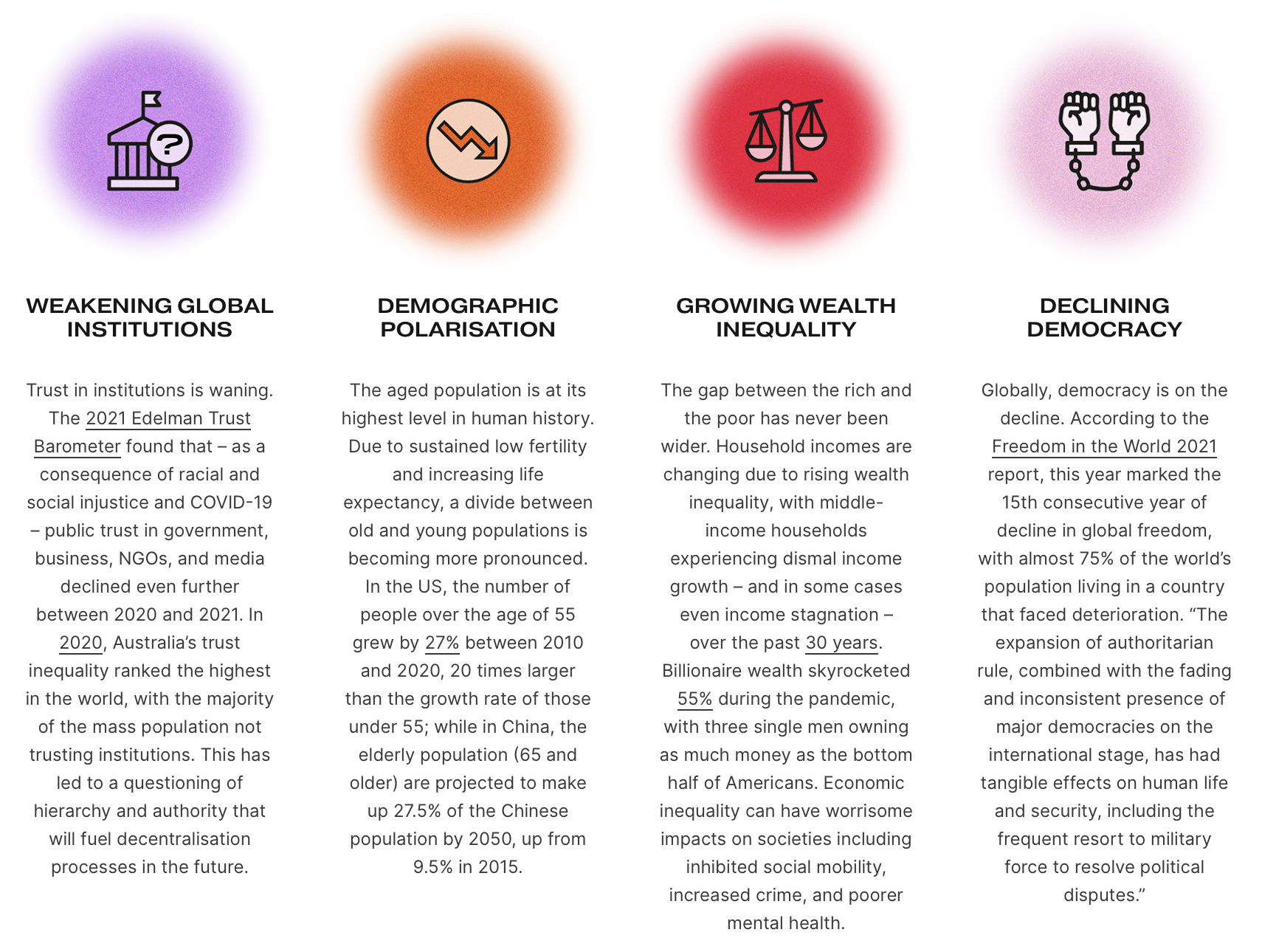
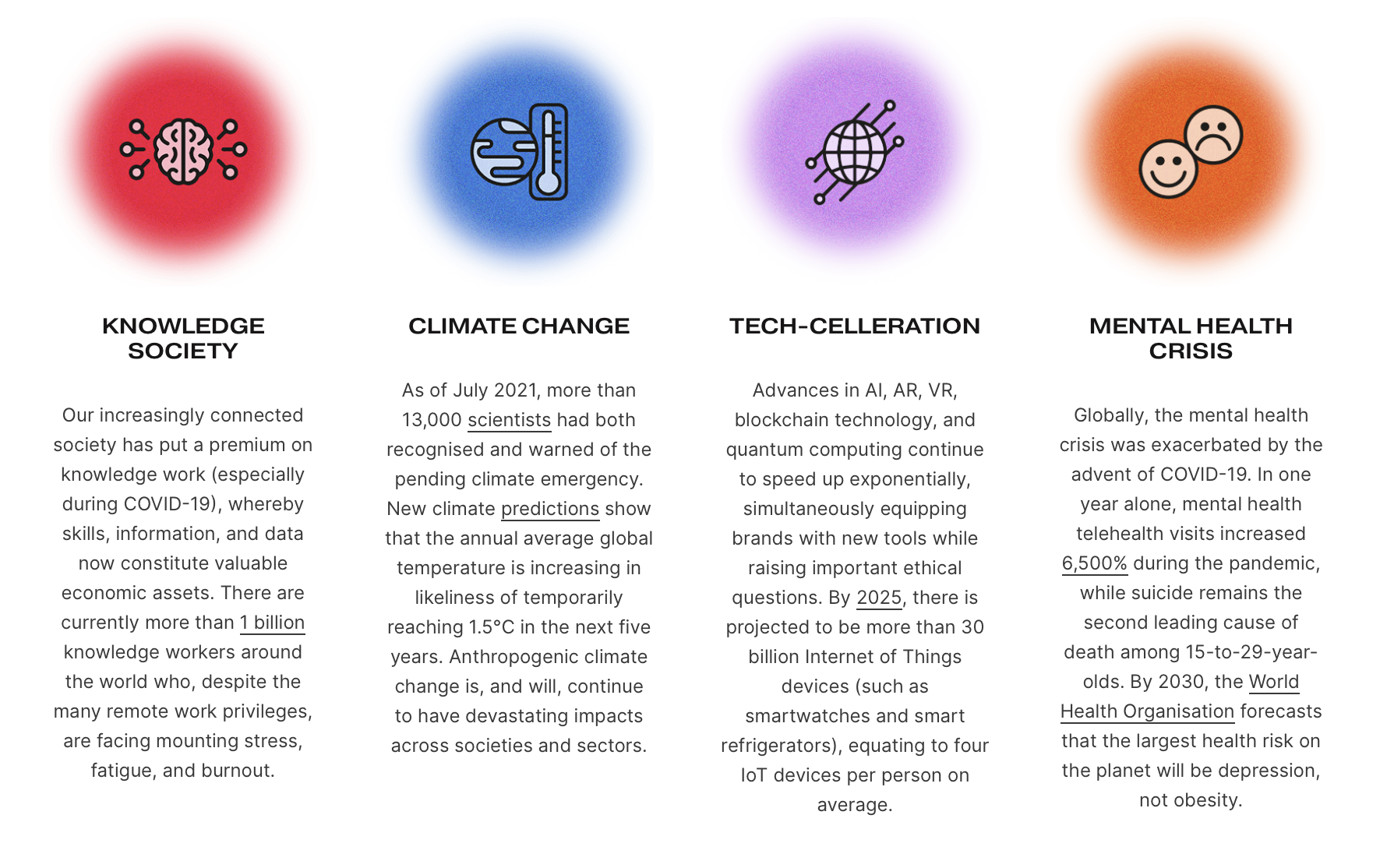
GenZ get real
Instagram Trend Talk 2024 explores Gen Z’s take on trends that will drive global culture in the year ahead. It starts by saying 2023 was a year on socials to remember. From Barbie-core painting the world pink, to the rise of the ‘girl dinner’, viral moments and trends on Instagram and beyond have been driving global culture and influencing Gen Z’s next move.
- Gen Z is all about prioritizing meaningful connections in 2024, with the generation planning to use social media to keep up with their friends and family. A close second was to stay on top of trends (Fashion, Music, Tech)
- When asked how they use their Instagram to get closer to someone, the top ways were: liking someone’s story, sending reels or memes in DMs, and liking a post on their feed.
2024 is going to be defined as Gen Z’s growth era, with many honing in on self improvement and development. Gen Z’s top eras for 2024:
- #1 Self Improvement or Development
- #2 Lucky
- #3 Unapologetically Myself

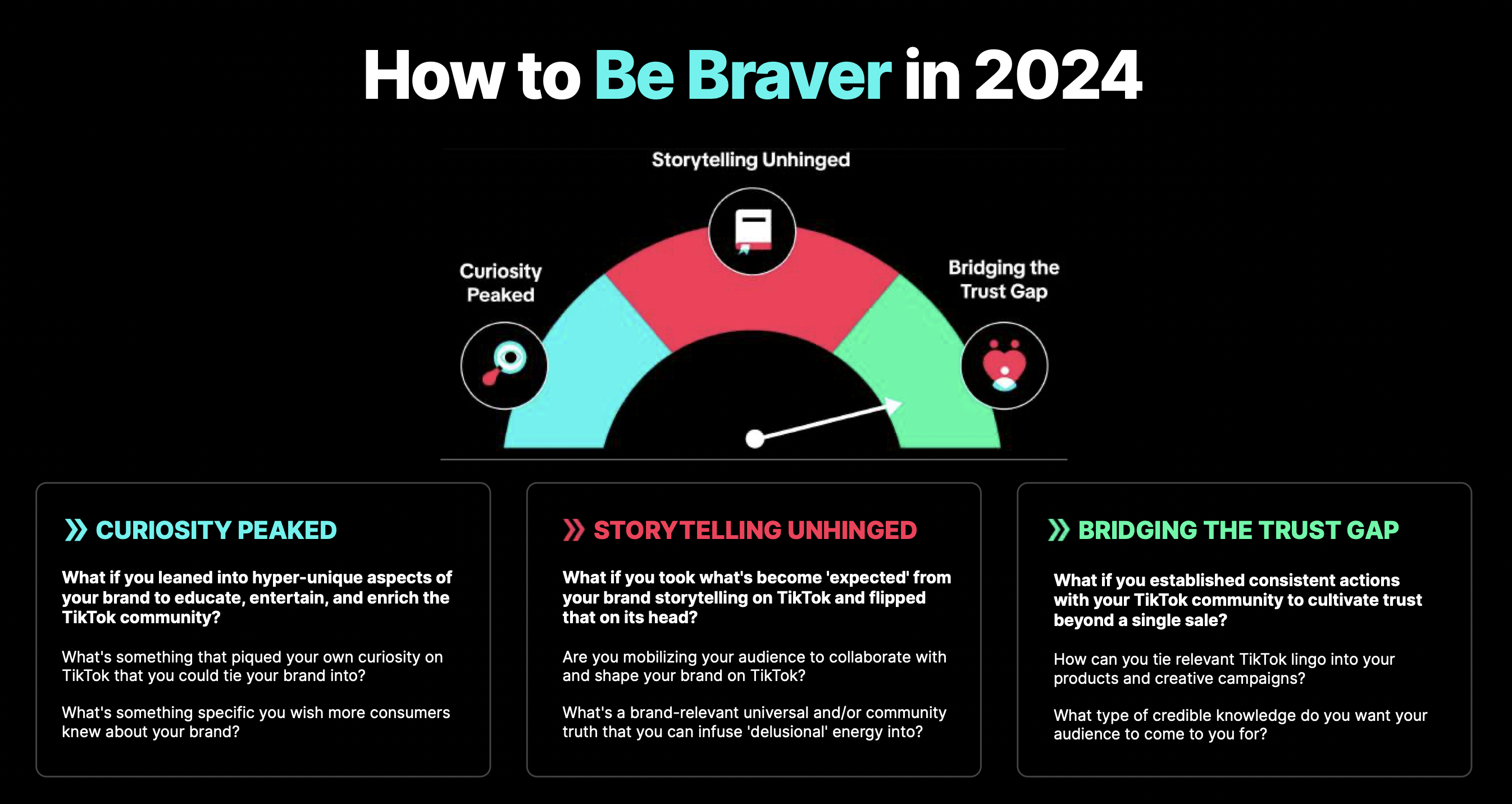
TikTok’s “What’s Next” 2024 Trend Report for brand owners says that in 2024, the TikTok community will ignite a transformative mindset: Creative Bravery. Fueled by a blend of curiosity, imagination, vulnerability and courage, brands demonstrating Creative Bravery on TikTok will build deeper community connections. Breaking through on TikTok means shifting from occasional displays of Creative Bravery to infusing it into their daily behavior and strategies. Brands that will see most success will regularly pique global curiosities, flip traditional story arcs, and deepen trust with their audiences.
- Curiosity Peaked: Users come to TikTok looking for far more than a single ‘right answer.’ Here, your every curiosity reaches its ‘peak’ with new interests leading to relevant perspectives, uncharted rabbit holes, and IRL action thanks to the perfect blend of passive discovery and an active mindset.
- Storytelling Unhinged: Ends of stories are starting first. Multiple story arcs can happen at once. Communities are making up fictional celebrities and narratives. On TikTok, the shift where everyone can have a voice has unleashed creativity for all, where diverse voices, collaborative formats, and subject matters are flipping everything we know about traditional storytelling on its head.
- Bridging the Trust Gap: There continues to be a growing trust gap between consumers and brands igniting audiences to seek beyond the engagement of a one-time sale. They’re also looking for brands to lead positive societal change and transparency. Establishing clear brand trust and values are non-negotiables. On TikTok, brands have an open line of communication with their consumers and community, and can leverage creators as shortcuts. Each campaign and organic piece of content is an opportunity to share, listen, and learn, building brand trust and values together to generate deeper loyalty on and off-platform.
Tech hype and AI, phages and omics
Generative AI has stolen all of the air space in technology over the last year.
Future Today Institute led by Amy Webb always produces great insights into the emerging tech world, although her Tech Trends 2024 report tends to arrive mid year. Following a year, 2023, of breakneck innovation and global upheaval, she sees 10 key themes for 2024:
- Concept-to-concrete AI unleashes a wave of innovation.
- The crypto winter begins.
- Making sustainability sustainable.
- Algorithms are our labor force, and they may need professional licenses.
- Wearables are back. They will usher in a new era of visual and voice answers.
- Organiod intelligence will shape both computing and geopolitics.
- Legal challenges are coming for big tech again––and could succeed this time.
- Biotech accidentally creates a new genetic caste system.
- A world of new materials.
- Elections and unintentional misinformation.
Gartner is a tech advisor who maps what is hot, and what actually works. Their Top 10 Strategic Technology Trendsfor 2024 have a strong AI focus, with:
- Democratised generative AI
- AI trust, risk and security management.
- AI-augmented development.
- Intelligent applications.
- Augmented-connected workforce.
- Machine customers.
- Continuous threat exposure management.
- Sustainable technology.
- Platform engineering.
- Industry cloud platforms.
World Economic Forum has a more interesting report, the Top 10 Emerging Technologies, based on a huge global network of tech experts. The 10 technologies go far beyond AI hype, and are
- Flexible batteries: powering wearable technologies for healthcare and e-textiles.
- Generative artificial intelligence: expanding the boundaries of human endeavour.
- Sustainable aviation fuel: moving the aviation industry towards net-zero carbon emissions
- Designer phages: engineering viruses to augment human, animal and plant health
- Metaverse for mental health: shared virtual spaces to improve mental health
- Wearable plant sensors: revolutionising agricultural data collection to feed the world
- Spatial omics: molecular-level mapping of biological processes to unlock life’s mysteries.
- Flexible neural electronics: better engineered circuits to interface with the nervous system
- Sustainable computing: designing and implementing net-zero-energy data centres.
- AI-facilitated healthcare: new technologies to improve the efficiency of healthcare systems
Expectation Economy
TrendWatching’s Trend Check 2024explores how the Expectation Economy is giving way to the Exchange Economy, an age requiring brands to work together to tackle the world’s toughest and most urgent problems. Over the last decade or so, this has been driven by two financial crises, a pandemic, countless climate-related disasters and deepening geopolitical tensions have, and will continue to, fundamentally alter the landscape. Trends include:
- Sustainability on display: As the beauty sector’s not-so-pretty eco-reality — from deforestation to growing emissions — is uncovered, 50% of millennials globally and 45% of gen Z are prepared to drop personal care brands that fall short of their responsibility to the Earth. Example: Asket’s receipts itemize the environmental cost of every clothing purchase.
- Code it yourself: Ever since the generative AI boom, conversations about tech have dominated public discourse. The adoption of LLMs and text-to-anything software created a newfound willingness to play and experiment, giving rise to a code it yourself mindset, with new tools enable consumer-led personalization. Example: BlueSky is a social media platform that lets users choose their own algorithm
- Common Tongue: Reconnecting a divided world through entertainment. For entertainment brands who want to captivate diverse audiences, taking a definitive stance risks alienating audiences and inadvertently deepening polarized societies. Example: SOS AMAZÔNIA is a Fortnite game teaches gamers to protect Indigenous land.
- BrandCare: Fashion brands take a more active role in caring for consumers’ health. Across the globe, pandemic-struck healthcare services still remain under pressure. As a result, care demands outweigh supply, pushing consumers to look elsewhere for ways to optimize their wellbeing. Example: Morrisons and NHS: UK supermarket puts cancer awareness messaging on underwear labels.
- Future Proofed: Building financial literacy in a complex economic context. As the world grapples with widening economic disparities, record debt and a lack of affordable housing, there’s a clamour for financial literacy. Example: Brazil-based financial platform Nubank has introduced its version of the classic board game Game of Life.
- Eco-Boosters: Sustenance that gives back to nature. A new wave of food and beverage consumers don’t want to just ‘cause less harm’, they want to go further, returning more to nature than they take. Example: London brewery Gipsy Hill release an offset-free, carbon-negative beer.
Future Shock
WGSN’s Future Consumer 2024 report starts with Alvin Toffler, author of Future Shock, who said “In the past, you made a decision and that was it. Now, you make a decision and you say, ‘What happens next?’ There’s always a next”.
Coined by futurist Alvin Toffler and Adelaide Farrell in their 1970 book of the same name, Future Shock refers to the social and emotional paralysis induced by the “shattering stress and disorientation” at the magnitude and velocity of the changes we are experiencing.
In 2024 we will see the dawn of the Everything Net – a circular existence where lines between physical and digital worlds are blurred. There is great promise in the meta-economies that will arise from this, but rapid technological change that affects daily life always induces a sense of anxiety. This uneasiness has a name: Future Shock.
The pandemic exacerbated these sentiments, and the subsequent war in Ukraine and cost-of-living crisis are only likely to compound these feelings. Disruption to routines, isolation from loved ones and conflation of home and work life all gave rise to chronic multitasking, particularly for those working remotely. A 2021 Microsoft study found that people multitask more frequently in larger and longer video meetings, and in recurring meetings rather than ad hoc ones.
To perform a task, several brain networks dealing with attention and cognitive control are involved. Kevin Madore, a neuroscientist at Stanford University in the US, has proven that attempts to multitask can create interference among these networks and this can lead to slower processing as well as mistakes, creating a chronic circle of stress. Research shows that only 2.5% of people are able to multitask effectively. When we think we are multitasking, we are actually performing individual actions in rapid succession.
Synthetic reality
Canvas8’s Expert Outlookis always one of the most considered sources of new insight, but unfortunately is not published in an easily accessible format. It identifies eight critical challenges that will shape consumer behaviour and brand-consumer relationships in the coming year:
- Global Boiling Point: Living with extreme heat sparks a new climate, culture, or war.
- Economic Polarization: People struggle to maintain control over their finances
- Cultural Detachment: An overload of information makes consumers less committed to products and places.
- Rogue Leaders: Volatile leadership creates a sense of anarchy.
- Anti-human: A sense of human devaluation drives unrest.
- Diversity, Equity, and Inclusion (DE&I): The failure of DE&I initiatives erodes trust.
- Synthetic Reality: Artificial intelligence intensifies cognitive stress and challenges perceptions of truth.
- Cyber Vigilantism: Digital security concerns foster technophobia.
AI excitement
GWI’s Connecting the Dots is another, in an interactive format rather than a report. Some of their big themes to dive into include:
- The media’s got a trust problem: How to rewrite consumers’ relationship with the news. Media organizations should prioritize rebuilding public trust, highlighting the transparency, accuracy, and authenticity of their work.
- AI excitement is rising, but so is concern: Navigating the tension between AI fears and opportunities. AI is set to become a core part of life for humans and businesses. To make the transition as smooth as possible, brands need to address consumers’ red flags.
- Boomers are doing more scrolling and shopping: Why they offer brands bang for their buck. Boomers represent a lucrative and increasingly accessible market, as well as an untapped opportunity for many brands.
- Short-form video is changing sports: How social media’s rewriting the sports playbook. Short-form video is key to drawing in new audiences, and major sports should get in on the action.
- Veganism ain’t so hot anymore: How to make plant-based diets tasty again. Plant-based food’s addressable market is evolving. Food brands should target flexitarians and those interested in reducing their meat consumption, not just vegans.
Greenwashed out
Euromonitor also explores how consumer preferences are closely linked to the sustainability agenda, technological progress and the impact of sociopolitical issues.
- Ask AI: New tools are evolving into co-creators for consumers, influencing their decisions and reshaping their expectations of brand engagement. These platforms will become increasingly integrated into consumers’ daily lives. Businesses should utilise generative AI to enhance personalisation and improve the overall customer experience.
- Delightful Distractions: Consumers seek an escape from daily stress and anxieties to break away from the mundane. Some 29% of consumers would be comfortable with brands tracking their emotions and personalising experiences to their moods.
- Greenwashed Out: While consumers are attempting to live more sustainably, they question whether companies and governments are fully utilising available resources to create a meaningful impact. They want organisations to step up and show proof of their eco pledges.
- Progressively Polarised: Political and social issues are at the core of personal identities. These belief systems influence perspectives, values and attitudes. Consumers will not refrain from expressing their convictions. Social responsibility, political affiliation and sustainability initiatives will motivate spending.
- Value Hackers: With the ongoing cost-of-living crisis consumers are adjusting their financial mindset and 44% of consumers planned to save more money in 2023. They are employing increasingly clever strategies to get the very best deals.
- Wellness Pragmatists: Consumers are seeking fast and effective solutions to improve both their physical and mental wellbeing. Demonstrated effectiveness will play a significant role in their purchasing decisions.
Social is retail, retail is social
CapGemini‘s “What Matters to Today’s Consumer” Report 2024 finds that consumers are feeling a bit more optimistic than last year, despite the continued higher cost of living, and economic uncertainty. The report also explores attitudes to AI saying that consumers are generally positive about the benefits it can bring to their experiences.
- 66% of users welcome product recommendations from generative AI
- 60% trust services and products suggested by generative
- 55% seek advice in areas such as diet plans, make-up suggestions, and fashion combinations from a generative AI tool.
- 58% say generative AI should be able to identify their brand and product loyalty, thereby recommending similar products.
The reports main focus is on social commerce – or live commerce – with the increasing fusion of social to retail, and retail to social.
Social commerce refers to shopping experiences that occur directly on a social media platform, including clicking a link on a social network that leads to a retailer’s product page with an immediate purchase option.
- 25% of consumers have bought a product via a social media platform: 41% of consumers from Spain; 30% from the US; and 28% from Sweden. More purchases are made by households with children (36%) than households without children (17%).
- 46% of Gen Z consumers surveyed have made a purchase on a social media platform in the past year. Almost 48% of US Gen Z (aged 18‒29) say they will do at least some of their year-end shopping on social media platforms such as TikTok or Instagram.
- Instagram (62%) and YouTube (62%) are the preferred purchasing platforms across generations of consumers, followed by Facebook (55%) and TikTok (44%). Gen Z consumers show a strong preference for Instagram (70%), TikTok (63%), and YouTube (58%) for their purchases, whereas Millennials primarily prefer to use Instagram (67%) and YouTube (63%)
- The most strongly preferred platforms for Gen X and Boomer consumers are YouTube,Instagram, and Facebook.
Never Normal
Nexxworks “Look Up!” 2024 Trends Report starts with “We have arrived in the Never Normal, an era of accelerated change and enhanced complexity where companies will need to behave differently if they want to survive.
A beautiful example of our times was the OpenAI saga where Sam Altman was ousted from his own company. Then a lot of things happened, after which he came back triumphantly, and ironically with more power than ever. Fun fact: I was in the process of editing this document when I changed Sam’s title to ex-CEO only to undo that change the very next day. That was peak 2023 behavior.”
Conway’s Law states that organizations will design systems that copy their (communication) structure. This OpenAI soap seems to prove that it works the other way around, too: that a system – in this case, the fast and furious LLMs which are overconfident, have limited context understanding and lack explainability and common sense – can apparently also influence how an organization handles situations.
The only real recurring themes they see are the drivers of this enhanced unpredictability:
- The Great Depression 2.0: people are struggling financially and mentally, and companies are adapting to that, some better than others.
- Climate change: (people and) companies no longer have the luxury of ignoring the harsh truth of climate change, because they are starting to feel its direct impact.
- The Age Of Generative AI: rarely have I experienced such an acceleration of technology as with generative AI and we’re probably just at the very beginning.
- A Quantum World: on a perhaps more philosophical level, the real world is increasingly demonstrating quantum characteristics like entanglement and superposition and that is making it even more complex and unpredictable. It’s like having our own personal never- ending feedback loop but make it quantum.
“So basically, it’s we, humans of planet earth, who are creating this Never Normal. We have created a geopolitical, capitalist and resource environment that is so entangled and volatile that wars on one end of the world fuel energy and food crises in the other.”
Moments of Joy
Dentsu’s Creative Trends Report 2024 explores the power of hope in a volatile world. At a time where the future has perhaps never felt so uncertain, “The Futures Less Travelled’ urges brands and business to seize the moment to design, innovate and strive for the future they want to see.
Yasuharu Sasaki, Global Chief Creative Officer at Dentsu Creative, said: “Against the backdrop of this uncertain world our report turns to hope as a deliberate choice, to empower us to take control and design our own futures. Through creativity, armed with the powers of technology and storytelling, we hold potential to pave ways for many exciting ‘Futures Less Travelled’, borne of core principles of optimism and ambition”.
The report unpacks five macro trends for 2024 and beyond, each with a number of sub trends to explore. Each trend uncovers unexpected possibilities, such as the power of joy in the face of anxiety, the potency of storytelling as a force for change or the potential of deep local insight to connect diverse communities around the world.
- Ode to Joy: In a world where joy can seem in short supply, it becomes more important than ever. As we look around at the close of 2023, we see joy, softness and play emerging as protection against a chaotic and volatile world.
- Joyful Resistance Moments of joyful surrealism emerge in response to a world in chaos, while advertising rediscovers the transformative power of humour.
- Self-Care as Subversion Be it the refuge of an “Everything Shower”, or the rise of the “soft life” and “lazy girl jobs” in rejection of hustle culture, a quiet rebellion against the fast-paced, high pressure, lifestyle is underway.
- Unadulterated Play Adult responsibilities are unattainable or being deferred in favour of play, as seen in the boom in “Kidult” toys, the popularity of a basic #GirlDinner or a new wave of experiences that merge art galleries and soft play.
- The Memes of Production: In a related trend, we see creators reclaiming genres and formats easily underestimated as soft, superficial or trivial as forces for change.
- From world-building to building better worlds A generation raised on world-building and co-creation are taking those skills and expectations with them into adulthood, with heightened expectations of agency and empowerment.
- Change the story, change the future Broadcasters and curators are embracing storytelling over factual content to help audiences digest the complexity of our times, recognising the power of new narratives to unlock new possibilities.
- The meme-ing of life Like parables or cartoons before them, memes and reels have emerged as a way of distilling complex ideas or scathing commentary into brilliantly bite-sized, shareable and endlessly repeatable formats. Be it #Fintok, #Cleantok or social justice, no topic is too complex to go viral.
- Here we are now: Perhaps in response to a world that can feel overwhelming, perhaps in response to a cost of living crisis, we see a powerful engagement with all things local and homegrown
- Empathy in Action Personal truth is a new imperative, seen in the rising popularity of neighbourhood media and the growing importance of indigenous populations in shaping a new and more equitable travel industry.
- Local Luxury The post-pandemic world relies less on international networks, with an increased appreciation for goods and services closer to home that draw on local traditions and iconography.
- The Cosy Web A desire for a more rooted sense of place in the world is also being reinforced in the digital space. The idea of the ‘cozy web’ is replacing vast social platforms as a safe space for more intimate online conversations.
- The Magic in the Machine: As AI both impresses and perturbs, perhaps in equal measure, we ask ourselves, what is the role of technology in augmenting our humanity? How can technology unlock imagination and shape new experiences that bridge physical and virtual world?
- AImagination With ChatGPT emerging as the fastest growing app in history, we will see not only unfettered imagination but more practical and scaleable use cases designed to enhance the customer experience.
- In Touch with Humanity Despite exponential leaps forward in artificial intelligence, we see enduring power in experiences that connect technology and humanity through touch, haptics, voice, gesture and beyond.
- Borderless Commerce Technologies such as Augmented Reality, Image Recognition and virtual worlds are blurring the boundaries between online and offline commerce beyond all recognition.
- Me, Myself, and Us: Changing demographics prompt us to re-evaluate our relationship with the communities and collectives that define us, while the emergence of “digital twins” poses fascinating questions about identty and autonomy.
- The “I” in Collective Traditionally individualist Western culture is opening up to a more collective existence, while in contrast, traditionally more collective cultures are exploring a new sense of individuality.
- My (Inter)generations An increase in intergenerational living is giving rise to a reappraisal and appreciation of the older generation, demonstrated through an increase in fashion brands engaging mature ambassadors and the enduring popularity of the #grandmillennial trend.
- Digital Doppelgangers The rise and rise of AI also prompts us to explore the nature of our own identity, as artists, gamers and time poor individuals explore the potential of digital doppelgangers to act on their behalf.
Finding hope
Finally Marian Salzman entitles her latest report “Trends for 2024: On Hope’s Edge.” In a world that can seem oppressively bleak, I hope it sparks a bit of optimism, and renewed resolve:
Dear future,
Hope you are well; you aren’t what you used to be.
There is no doubt we are standing on a precipice.
Living in a time of poly-crisis.
Climate change. Culture wars. Paralyzing polarization.
Info wars. Authoritarianism. Military conflict. Economic fragility. Inequity. Disinformation. Disconnection. Bubbles. Hate. And now, with AI, the future is coming so fast that it’s impossible to take in.
Like lampposts that light up a path, trends have helped me make sense of what the future could look like. Throughout my career, I’ve laid out scenarios of probable, predictable, and preferable futures and looked at the data of human behavior and culture to make connections where others had not. But now, I find myself wondering: Are humans still in charge? Or will the unseen hand of AI erode our free will, leading us to do things, buy things, think things without us even detecting any external influence?
With AI, the future is coming faster or, to quote futurist Ray Kurzweil, is “nearer than near.”
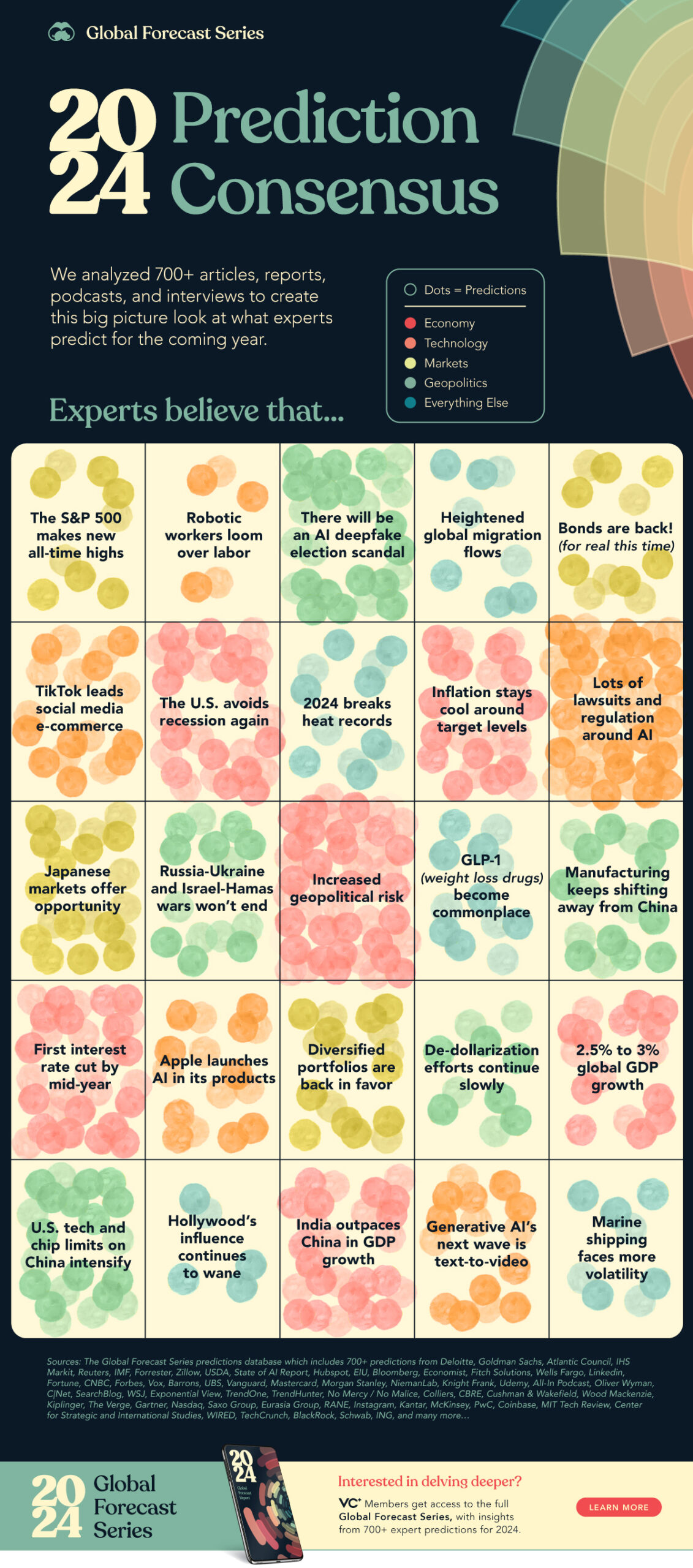
Prediction consensus
Bringing this all together, based on over 700 reports, Visual Capitalist summarised what it saw as the major moments and trends for 2024:
- The S&P 500 makes new all-time highs
- Robotic workers loom over labor
- There will be an Al deepfake election scandal
- Heightened global migration flows
- Bonds are back! (for real this time)
- TikTok leads social media e-commerce
- The U.S. avoids recession again
- 2024 breaks heat records
- Inflation stays cool around target levels
- Lots of lawsuits and regulation around Al
- Japanese markets offer opportunity
- Russia-Ukraine and Israel-Hamas wars won’t end
- Increased geopolitical risk
- GLP-1 (weight loss drugs)become commonplace
- Manufacturing keeps shifting away from China
- First interest rate cut by mid-year
- Apple launches Al in its products
- Diversified portfolios are back in favor
- De-dollarization efforts continue slowly
- 2.5% to 3% global GDP growth
- U.S. tech and chip limits on China intensify
- Hollywood’s influence continues to wane
- India outpaces China in GDP growth
- Generative Al’s next wave is text-to-video
- Marine shipping faces more volatility
Explore more from Peter Fisk …
- Next Agenda of best ideas and priorities for business
- Business Futures Project collating all the best ideas
- Megatrends 2030 in a world accelerated by pandemic
- 49 Codes to help you develop a better business future
- 250 companies innovators shaking up the world
- 100 leaders with the courage to shape a better future
- Education that is innovative, issue-driven, action-driving
- Consulting that is collaborative, strategic and innovative
- Speaking that is inspiring, topical, engaging and actionable

Davos 2024. Trust was on the lips of every participant.
Three years of increasing division, heightened hostility and a surge in conflicts have created a challenging global landscape. Humanity is grappling with a converging multitude of crisis and change, the need to reinvigorate economies, respond to the threat of climate change, and ensure AI is used as a force for good.
Trust comes in many forms. Trust in authority – from global institutions to governments, scientists and technologists, businesses and brands. Trust in each other. Ultimately we trust in people. Do we accept them? Do we believe them? Do we follow them? Are they authentic? Are they worthy? Are they right?
The World Economic Forum’s theme was in particular focused on our trust in the future.
“After an era that lifted a billion people out of poverty and improved living standards everywhere, the anxiety about losing control over what lies ahead is pushing people towards embracing extreme ideologies and the leaders who champion them.”
Rebuilding trust in our future is paramount. We can only trust in the future, if we trust in people. In institutions. And from an economic perspective, in business.
The Trust Paradox
Rapid innovation offers the promise of a new era of prosperity, but instead risks exacerbating trust issues, leading to further societal instability and political polarisation.
This is the paradox explored in the 2024 Edelman Trust Barometer.
“In a year where half the global population can vote in new leaders, the acceptance of innovation is essential to the success of our society. While people agree that scientists are essential to the acceptance of innovation, many are concerned that politics has too much influence on science. This perception is contributing to the decline of trust in the institutions responsible for steering us through change and towards a more prosperous future.”
Only one third of consumers trust most of the brands they buy or use, according to an Edelman special report.
According to the survey of 16,000 people in eight countries, 81% of consumers see brand trust is a deal breaker or a deciding factor when they consider a purchase. Trust is becoming more important because of growing concerns about the fast pace of innovation and automation, the use of personal data in tracking and targeting, and the impact of products and productions on society and the environment.
“Trust has always played an important role in brand purchase” says Richard Edelman, CEO of Edelman. “But consumers now have much larger expectations of brands, and their trust is predicated on how well a brand can pass through the three gates of trust – product, customer experience and impact on society.”
When brands build trust, consumers reward them. Consumers who trust a brand are more than twice as likely to be the first to buy the brand’s new products, to stay loyal in the face of new competition, to recommend it, and defend it when things go wrong. Also, a brand trusted because of its broader role in society, is almost twice as likely to gain such support, than if it’s trust is due to product aspects only.
Despite all of this evidence, brands are increasingly untrusted.
Most consumers believe that a brand has a responsibility to get involved in at least one social issue that does not directly impact its business, yet few see brands doing so. Indeed, most people think brands are using social good as a marketing tool, “trustwashing” if you like. This exasperates their loss of trust.
However people’s trust in governments and other institutions is far less than in business, meaning that whilst many are unsure, they do see business as a better platform for addressing social and environmental issues than politicians and their agencies. Interestingly, people believe they have more influence on business than governments and can persuade them to take these issues more seriously.
“It’s time for brands to take the next giant step,” says Edelman. “They must accept the responsibility consumers have given them to effect change and welcome greater accountability and measurement of their impact.”
Building trust with authenticity
We engage more emotionally, human and empathetic, than every before. In fact people trust each other more than any business, they influence and are loyal to each other.
25 years ago, Ray Davis arrived in the small Oregon town of Roseburg, where nothing much changed for the lumberjacks of the huge surrounding forests. His task was to transform the sleepy old South Umpqua State Bank with its 40 employees before it died.
Initially people poked fun at his insistence that employees, or colleagues as he called them, answer the phone with a cheery “Welcome to the World’s Greatest Bank.” However, over time, it became true. The bank was transformed, firstly by learning from other great customer service businesses, not banks. Banks become community hubs, interiors were opened up and modernised, products and language humanised. They served coffee, played music, and showcased great local businesses. Staff smiled, and customers loved it. Nowadays, Umpqua Bank, with over $25 billion assets and 350 branches across America, is one of the best banks.
However, Davis, now enjoying his retirement, or in “cruise” mode, as Umpqua calls it for customers who wanted to slow down and enjoy life, has a warning about change. “When we arrived in Roseburg, change was exciting, people loved progress. Today change is different, it has become relentless and dominated by technology. It scares the hell out of a lot of people” he warns. As change accelerates, and technology dominates, many people lose faith in progress. The bond of trust can be lost.
Being real, authentic and transparent
In her book Who Can You Trust? Rachel Botsman asks “If you can’t trust those in charge, who can you trust? From government to business, banks to media, trust in institutions is at an all-time low.” However, she argues that technology can enable trust in new forms, and that our main problem is a mismatch, saying “institutional trust was not designed for the digital age.”
Originally trust was built locally between people, in local communities. Then as cities and business grew, we deferred to institutions as curators of trust – governments and corporations – trusting them to act on our behalf. Trust went from people, to being built around hierarchies. Today, trust is built in networks, and flows between people enabled by technology. For a business there are three layers of trust:
- Trust in the organisation: the reputation of the business and brand, particularly in terms of ethics and responsibilities, openness and transparency.
- Trust in the concept: the relevance to customers, authentic and reliable, a positive way to solve a problem, and delivers on every promise.
- Trust in the people: the respect for people who lead the business, and deliver the concept, who are real and authentic, empathetic and caring.
Authenticity is closely associated with provenance, which is now a source of transparency for many manufacturers utilising the potential of IOT sensors and blockchain certification. Cult Beauty uses a transparency app to help users of its cosmetics to understand the sources of all products, from oils to colourings. Canada’s Bridgehead Coffee was one of the first to set benchmarks for other in fairtrade and organic certification. Fishpeople can tell you the which boat caught your fish and when. Tiffany & Co. can do the same with diamonds.
Whilst all of these matter, the most important is that people trust people. For most customers, they see two faces of the organisation – the leader who typically appears as the company spokesperson in times of challenge, and the everyday frontline employees who sell and serve customers in stores, on phones, or one to one.
As Botsman says “Most businesses that we interact with are built around money, and money only goes so far. Money is the currency of transactions. Trust is the currency of interactions.”
Trusted leaders
Another clue might lie in the new Brand Guardianship Index 2024 produced by Brand Finance. This takes a numeric perspective on the impact which leaders have made to their organisations over time. Not just financially, although this is one useful metric as a proxy for customer and employee engagement, but through a host of other ESG and related metrics too.
Huateng “Pony” Ma, CEO of Tencent, recognised as world’s leading CEO – or at least “brand guardian”, in the report – for his guardianship of WeChat brand. “His leadership, marked by a steadfast commitment to innovation, user engagement, and trust, has not only propelled Tencent to remarkable heights in the technology sector but has also set a gold standard for CEOs worldwide.”
Under Ma’s leadership, WeChat has become the world’s strongest brand, as measured in the Brand Finance Global 500 Index of brands. Ma has led WeChat to build exceptional brand strength, underpinned by its essential, familiar, and trusted status in China, its dominant market.
People trust people
Satya Nadella, Microsoft’s CEO, provides a model for business engagement with society when he gave his views on corporate responsibility, the pressing need for human oversight of artificial intelligence systems and a succinct description of how Microsoft has earned its social license to operate in many countries around the world.
Nadella says every company is now a technology company and that brings with it a range of responsibilities, particularly in areas such as the ethics of AI, which he seeks to proactively take a lead in. “Technology is going to be so pervasive in our lives, and across all industries, that we’d better have one core currency around it which is trust. Without trust, we are not going to have a long-term business” he said at a recent Envision event.
Indeed, Microsoft has positioned itself as the world’s “good tech” company, whilst Facebook and Alphabet are often seen by regulators and politicians as “bad tech”, given their reluctance to address issues like privacy and fake news.
Leadership of trust, and trust in leaders, drives everything else.
We know that any form of change sparks fear in the human psyche. If not addressed early, proactively and directly, fear of job losses due to automation or globalisation can quickly take hold. In times of crisis, a leader brings urgency and compassion, but if there is not also direction and hope, then people lose confidence, and courage in their own actions.
Employees trust leaders who do what they expect them to do.
This requires an openness of leaders, so that people know what to expect. It means engaging people in the future direction, being honest about the need and implications of change, asking for ideas, and equally challenge, being visible and accessible, and being human.
Externally, there was a time when business leaders would never say anything controversial, when businesses were agnostic to the debates of society. Today, as people trust business more than politicians to show them a way forwards, they seek business leaders to take a stand, to have a point of view.
This can be controversial, a viewpoint means that not everybody will agree, that some of your customers might feel alienated or even reject you. Apple is a strong advocate of diversity and human rights; Starbucks challenged the state on their actions against migrants. Leaders need to step up, to express their view, to fight what they believe is right.
In this way, brands develop a more authentic personality, business adopts a more meaningful role in society, and you gain the respect – and trust – of people.
Cradled in your skull, immersed in protective fluid, your brain is your body’s mission control. It changes radically throughout a human’s life, starting work not long after they’re conceived and continuing even beyond your final breath.
As a business leader you are asked to step up, to see business and markets from new perspectives – and in particular to make sense of fast, complex and dynamic futures. As a leader, rather than functional expert, your challenge is to connect the organisation, to ask the big questions rather than having all the answers.
This is a huge mindset shift, and particularly for leaders who are also probably getting older, and could easily fall into old habits, as their brain starts to fall into standard ways of behaving, and naturally diminishes with age, and without stimulus.
As a leader, now is the time for peak performance, to dream of new possibilities, to drive innovation and change, and to act in ways that are different from what got you here. Now is the time to recharge, and even reshape, your brain.
How your brain changes
We used to assume that we each have our established ways of thinking and behaving, and as we get older the capability of our brain to learn and adapt declines. Medical science suggests that the volume of the brain and/or its weight declines with age at a rate of around 5% per decade after age 40 with the actual rate of decline possibly increasing with age particularly over age 70.
Yet our brain can grow new neurons at any age.
Each neuron can transmit up to 1,000 nerve signals a second and make as many as 10,000 connections with other neurons. Our thoughts come from the chemical signals that pass across the synaptic gaps between neurons: the more connections we make, the more powerful and adaptive our brain can be.
Tara Swart is a neuroscientist, practising medical doctor, and executive coach, with a background in psychiatry. I first met her on stage in Bratislava, where we both were delivering our “Big Idea” for Europe. Her first book, “Neuroscience for Leadership” was more of an academic text, while her new book is “The Source” is more populist, and claims most of the things we want from life – health, happiness, wealth, love – are governed by our ability to think, feel and act. In other words, by our brain.
Keeping the brain fit through exercise, continual learning and rich experiences, enhances your mental agility. In the past leaders relied more upon experience and procedure, in today’s world we need leaders who can make sense of new patterns, imagine new possibilities, thrive on diversity of thought and complexity of action. Leaders need to have a mind that is always ahead, seeing and anticipating what next.
“Think of the brain as the hardware of a computer” says Swart. “Your mind is the software. You’re the coder who upgrades the software to transform the data (your thoughts). You also control the power supply that fuels the computer — the food and drink you consume, when and how to exercise and meditate, who to interact with… You have the power to maintain or destroy your neural connections.”
Mindful activities such as yoga or meditation reduce levels of cortisol and increase the fold of the outer cortex of the brain, allowing the pre-frontal cortex to better regulate our emotional responses. Swart says just 12 minutes a day, most days of the week, will make a noticeable difference. New experiences such as travel, learning a skill, such as a foreign language, and meeting new people can stimulate the growth of new neurons.
How to change your brain
Brain plasticity allows you to learn new skills, gather and use new information, and recover from brain injury. How can you rewire your brain?
There are some obvious ways to improve your brain function, such as drink more water, get more exercise, and don’t read from electronic screens in the last hour before bed. But there is much more besides. Some are obvious, some less so. Some are just good healthy tips for everyone, some require deliberate focus in order to achieve your goals.
For starters here are 10 simple ways to start changing your brain:
1. Run
Physical activity can improve your brain’s plasticity, a cerebral quality that affects memory, motor skills, and the ability to learn – according to a study conducted at the University of Adelaide in Australia. A small group of adults in their late 20s and early 30s participated in a 30-minute session of vigorous activity. Immediately after the session, their brains showed a significant increase in neuroplasticity. If that’s not enough motivation to get out for run, research shows that exercise also release chemicals in the brain that make us feel happy. Endorphins and a protein called Brain-Derived Neurotrophic Factor (BDNF) are released in the brain as you do physical exercise, two chemicals which help fight stress and promote happiness.
2. Sleep more
Sleep is an essential activity that not even science can fully explain. You feel better with it, but really bad without it. Going without sleep can make you irritable, lead to memory loss and false memories, and, in extreme cases, cause slurred speech and even brain damage. So what happens when you sleep? Your brain gets to work archiving memories, making creative connections, and cleaning out toxins. Even a short afternoon nap can provide you with a boost of energy equivalent to roughly one or two cups of coffee, as well as increased retention of facts and greater creativity.
3. Meditate
Meditation doesn’t just help you find emotional balance in your life – it actually changes your brain. Before beginning a regular meditation habit, people tend to have strong neural connections with the ventromedial prefrontal cortex, what is often called the “Me Center” of the brain. As a result, they are more likely to interpret physical sensations of anxiety or fear as a personal problem, something directly-related to themselves. As a result, they are more likely to experience repeated thoughts about their lives, mistakes they’ve made, what people think about them. In contrast, people who meditate regularly show weaker connections with the “Me Center” of the brain and stronger connections with the lateral prefrontal cortex, or the “Assessment Center” of the brain. This helps meditators to take problems less personally and approach them more logically. This means that, through meditation, we can become better at managing anxiety, stress, and potentially dangerous situations. In addition, the neural connections which grow stronger through meditation help promote empathy and compassion.
4. Drink coffee
From the time you wake up until you lay down to sleep, neurons in your brain produce a curious chemical called adenosine. As adenosine is produced, it binds with adenosine receptors in the brain, causing you to feel tired and eventually fall asleep. When caffeine enters the bloodstream and makes its way to the brain, it blocks the adenosine receptors. That’s what gives you the boost of energy and alertness, improved memory and cognitive performance, increased focus, and even increased accuracy of reactions. Over time, however, your brain will begin to build up a tolerance to the drug, and you may experience withdrawal symptoms, such as headaches, increased sleepiness, lack of concentration, and irritability. Coffee (or more precisely, caffeine) changes your brain chemistry, providing you with that boost of energy and focus you need in the morning.
5. Read
Brain scans of the most avid readers typically show heightened connectivity in the left temporal cortex, the area of the brain associated with receptivity for language. Readers also often experience something called “embodied semantics.” That’s the technical way of saying that the “brain connectivity during a thought-about action actually mirrors the connectivity that occurs during the actual action. For example, thinking about swimming can trigger some of the same neural connections as physical swimming.” That means that imagining actions as you read about them can physically alter the connections in your brain.
6. Listen to music
When some people want to truly focus, they seek total silence, but many turn on their music. When you graph the electrical activity of your brain using EEG, you generate what is called a brainwave pattern, which is called a “wave” pattern because of its cyclic, wave-like nature…When we lower the brain wave frequency…we can put ourselves in an ideal condition to learn new information, perform more elaborate tasks, learn languages, analyze complex situations and even be in what sports psychologists call “The Zone”, which is a state of improved focus and performance in athletic competitions or exercise. Part of this is because being the slightly decreased electrical activity in the brain can lead to significant increases in feel-good brain chemicals like endorphins, noroepinephrine and dopamine. So you can actually “force” your brain into this ideal “alpha brain wave relaxation” with the right frequency of music.
7. Wander
Spending time in outdoor green spaces has been linked to improvements in mood, concentration, and creativity. Brooding, which is known among cognitive scientists as morbid rumination, is a mental state familiar to most of us, in which we can’t seem to stop chewing over the ways in which things are wrong with ourselves and our lives. This broken-record fretting is not healthy or helpful. It can be a precursor to depression and is disproportionately common among city dwellers compared with people living outside urban areas, studies show. Going for a 90-minute walk in a quiet, tree-lined neighbourhood can have the effect less morbid rumination and showed less blood flow to the subgenual prefrontal cortex than those who had walked along a busy highway for the same amount of time.
8. Don’t multitask
Research suggests that humans are physically incapable of multitasking. Instead, the human brain merely single-tasks very quickly, switching back and forth between multiple tasks at a rate that makes you feel and believe you’re actually doing two things at once. If you think you spend much of your time “multitasking”, you could actually be rewiring your brain – and not in a good way. Your attention span is considerably shortened and your emotional intelligence is stunted. At the same time, you become worse at sorting through information and completing creative tasks.
9. Eat less sugar
Overconsumption of sugar may impair neurological functioning, according to a study at UCLA. Heavy sugar intake caused the rats to develop a resistance to insulin — a hormone that controls blood sugar levels and also regulates the function of brain cells. Insulin strengthens the synaptic connections between brain cells, helping them to communicate better and thereby form stronger memories. So when insulin levels in the brain are lowered as the result of excess sugar consumption, cognition can be impaired. Too much sugar can impair memory and learning skills, and may even contribute to diseases like dementia. It can also make you depressed. Sugar activates the mood-enhancing neurotransmitter serotonin in our brain. When continuously overstimulated, our serotonin levels begin to deplete, making it more difficult for us to regulate our mood.
10. Believe
Believing you can change, that you can be better, and you can achieve more, is the starting point. Open your mind to the possibility. Rather than going in to the rationale, let’s take the inspiring story of Tan Le, as I described in my recent book Business Recoded. She is the Vietnamese boat refugee who became one of the world’s leading neuroscientists.
Tan Le’s inspired mind
Tan Le was only 4 years old when she fled Vietnam with her mother and sister, crowded on board a fishing boat with 162 other people, in search of a better life. It was a difficult choice, leaving her father behind and heading out to the uncertain seas.
For 5 days they sailed, and then after losing power, drifted across the South China Sea. She remembers the long dark nights and rough seas, and everyone becoming desperate once food and water ran out.
Fortune came in the shape of a British oil tanker, which offered to rescue them. After three months in a refugee camp, the family were offered a flight to Australia. As the plane flew across the unknown country, she was struck by the huge emptiness of the land, and later reflected on it as symbolising the new opportunities which she could never have imagined.
At 8 years old, her mum says she was a dreamer, and particularly liked to pretend she had the power of telepathy, as inspired by a movie she had seen. In reality, she called herself a curious nerd, desperate to work hard and seize her opportunity. At the same time, she was very conscious about being different – her looks, her accent, her background.
Then, when she was 20, she won Young Australian of the Year for her work in helping other immigrants to settle locally, to learn the English language, and to find jobs. She was astonished that somebody like her could win such an award. It was the moment that really opened her mind.
She started to look beyond her mum’s dream of her becoming a doctor or lawyer. She qualified as a lawyer, but quickly turned her attention to software engineering, exploring how brainwaves can control digital devices. It was all about understanding the brain in context, and how it could be directed to do more productive work, to engage consumers more deeply with brands, to help people with disabilities. Her early work included the development of EEG (electroencephalography) headsets enabling people to control a car, or drone, or game, with your mind.
“When the neurons in your brain interact, they emit electrical impulses, which we can then translate into patterns that become commands, by using machine learning” she explained.
She founded Emotiv, a bio-informatics company focused on understanding the brain in context, and how it could be directed to do more productive work, to engage consumers more deeply with brands, to help people with disabilities.
Chosen to be part of the World Economic Forum’s Young Business Leaders in 2009, she sat at a dinner held in Buenos Aires with fellow participants. Opposite her sat a wheelchair-bound Brazilian called Rodrigo Hübner Mendes. He introduced himself as a Formula One racing car driver, who used a specially developed brain interface to control the vehicle.
Mendes explained how he would turn left by imagining eating tasty food, turn right by imagining he was riding a bike, and accelerate by imagining he had just scored a World Cup goal for Brazil. He explained how the technology for the car was developed by a small innovative company called Emotiv. She smiled, deeply moved by his story.
Today Emotiv is a world-leader in brain interface software, with technology that is cheaper than a gaming console, but has the ability to fundamentally disrupt and improve our lives. With offices around the world, She spends much of her time in Hanoi, where her ground-breaking technology is being developed by young Vietnamese technologists.
Lee reflects on her personal journey saying, “Like my mum, I took a leap of faith into the world of technology, and particularly into a completely new area for which I had no qualifications or experience.”
She freely admits that she doesn’t have all the answers, with “I try to make the right choices, but you never know exactly where you are going, or if doing your best” but is also an infectious optimism “The future is not hear yet. We have the chance to create it, to co-create it.”
As for Mendes, he recently found himself at a conference in Dubai listening to world champion F1 driver Lewis Hamilton. When it came to questions at the end, Mendes’ hand immediately sprung up. He challenged the world champion to a race, using brainwave-controlled cars. Hamilton, a lover of new technologies, accepted. The race awaits.
Change happens fast … the dramatic progress of AI is challenging our minds, a new disruptive generation of brands are shaking up markets, multiple destructive conflicts rage across the globe, ever more extreme weather driven by our reluctance to really address the carbon crisis, and millennial consumers growing up quickly … from the adoption of electric vehicles to gene-edited healthcare, the world looks very different from even a few years ago.
- 2023 was a nexus of change, a year of innovating and transforming everything
- Ideas drive the world forwards, the coming wave, and achieving great things
2024 is Olympic year, and the Stade de France is ready to witness a host of world records, as super shoes transform the performance of human beings. Adidas’s Noah Lyles and Nike’s Faith Kipyegon will battle for superstardom on the athletics track. Meanwhile 4.2 billion people will vote in over 70 national elections this year, the most in history, with technology likely to play a key role in targeting and influencing outcomes.
- Future Radar: Exploring the emerging trends and opportunities, and making them happen
- Trend Kaleidoscope 2024: Curating all the best trend reports, What should you do next?
Western economies did better than expected in 2023 but significant challenges persist, and higher interest rates will be painful for companies and consumers alike. China’s growth has slowed, tensions rise over Taiwan, but companies will find it hard to reduce their supply chains’ dependency of old. East and West will increasingly turn to the “middle powers” of the global south, and the imagineering states of the Middle East, shifting from oil to culture, knowledge and tourism.
- Generative AI: from Anthropic to Inflection, Gemini to Perplexity, do you “grok” it?
- Think like a futurist, to make sense of change, find new opportunities, make smarter decisions
The exponential progress of AI will continue, in some ways a race to shape the future of AGI, by a reenergised OpenAI and many others like Anthropic and Perplexity. Businesses will prioritise initiatives to embrace it, initially for efficiency but increasingly for competitive advantage, Quantum computing will accelerate progress, while regulators struggle to cope. Unexpected uses and abuses will become frequent, from its disruption of jobs to potential for election meddling.
- Achieving Peak Performance: find your future flow, play to your strengths, build endurance and agility
- Imagineering = Imagination + Engineering … How Disney keeps the magic alive
The clean-energy transition is creating new green superpowers and redrawing the energy-resources map. Lithium, copper and nickel matter much more, while oil and gas, and the regions that dominate their supply, matter less. Competition for green resources is reshaping geopolitics and trade, and creating some unexpected winners and losers. As the recent Earthshot prize winners demonstrate, there is a shift to regenerative economies, doing more with what we already have.

“In the past, you made a decision and that was it. Now, you make a decision and you say, ‘What happens next?’ There’s always a next”. That was Alvin Toffler in Future Shock.
Much of my work – from keynotes and workshops to strategies and transformations – is with companies like Adidas in sportswear and Airbus in aerospace, Saudi Arabia’s STC in technology to Japan’s Sompo in financial services. In the past, boards and executive teams would seek my help on optimising performance – today they seek help to make sense of emerging futures, how to shape new visions and strategies, how to transform, while also delivering today.
IMF, another of my ongoing clients this year, see in their IMF Economic Outlook 2024 a continued stagnation of growth in western markets (1.2% in Europe, 1.5% in USA) but higher in Asia (4.4% in China, 6.1% in India), and 2.9% average globally in 2024. The EIU’s Industry Outlook 2024 reflects on the turbulence of recent years for most companies from the pandemic to soaring commodity prices, high interest rates and political disruption.
The last 12 months has certainly sparked enthusiasm for AI startups, investment and innovation – from the launch of ChatGPT to the implosion of OpenAI, and the rise of a host of new rivals like but at the same time (a legacy of pandemic, and antidote to digitalisation) is the desire to be more human – more personal, empathic, and in search of real experiences, from in-store immersions to meditative moments and travel adventures.
- What every executive needs to know about AI by Bain
- The CEO’s Guide to the Generative AI Revolution by BCG
- The state of AI, generative AI’s breakout year by McKinsey
Technological innovation is taking us in two directions – sustainable improvement and synthetic reality – to address the problems of the past (most significantly, the huge and difficult effort to decarbonise old industries – although energy transition has stalled because of the greed of higher oil prices) – and also a huge rise in new synthetic innovations, from gene-editing and mRNA in healthcare, to alternative foods and VR gaming.
You can read all the trend reports in my Trend Kaleidoscope 2024, but the point is not the clever ideas and catchy phrases, it’s knowing which trends to embrace, and how they catalyse, guide and accelerate a transformation towards the future you seek. See the bigger picture, the Future Megatrends, and align your growth trajectory with purpose and innovation.
That’s the real skill of the most innovative companies, typically emerging from the margins to the mainstream. Their ideas, business models and leaders are inspirations to all of us. I call them the Trailblazers.

In the last quarter of 2023, BYD became the world’s top selling electric vehicles company, outperforming the hype of Tesla and its most recent launch, the Cybertruck.
“Build Your Dreams” was founded in 1995 by Wang Chuanfu, a Chinese chemist, who has became a billionaire entrepreneur. After more than 27 years of high-speed growth, BYD has established over 30 industrial parks across 6 continents and played a significant role in industries related to electronics, auto, renewable energy and rail transit. Like Tesla, it does not define itself as an auto company, but an energy business. With a focus on energy acquisition, storage, and application, it offers comprehensive new energy solutions with zero-emission.
BYD is one of my 250 Innovative Companies to learn from, alongside 100 Inspiring Leaders.
Here are some of the most innovative businesses who are likely to deliver rapid progress in 2024, some of them established market leaders rapidly reinventing themselves, while others are start-ups and growing disruptors. All of them are distinguished in some way by their innovative business models, which are engaging audiences and reenergising markets in their own ways:
- Authentic Brands, (ABG) is a brand development and licensing company headquartered in New York City. The company was founded by Jamie Salter, a seasoned entrepreneur and brand strategist. Salter has a background in acquiring, managing, and licensing consumer brands – from Mohammad Ali to Elvis, Reebok to Ted Baker.
- Crispr Therapeutics is a Swiss–American biotechnology company headquartered in Zug, founded by Nobel Prize winner Emannuelle Charpentier. It was one of the first companies formed to utilize the CRISPR gene editing platform to develop medicines for the treatment of various rare and common diseases.
- Holcim is a multinational building materials company that specialises in the production and distribution of cement, aggregates, and ready-mix concrete. The company was originally founded in Switzerland in 1912 and has since grown to become one of the largest cement producers in the world, and a leader in green cement and urban regeneration.
- Lanzatech is turning carbon crisis into feedstock opportunity with the potential to displace 30% of crude oil use today and reduce global CO2 emissions by 10%. Its carbon recycling technology is like retrofitting a brewery onto an emission source like a steel mill, but instead of using sugars and yeast to make beer, pollution is converted by bacteria to fuels and chemicals.
- Lilium, is a disruptive aviation start-up based in Munich, founded in 2015, dedicated to develop and build the world’s first fully electric vertical take-off and landing (VTOL) jet. An estimated range of up to 300 km and a top speed of 300 km/h, along with zero emissions make it the most efficient and eco-friendly individual means of transportation of our time.
- MercadoLibre, the Amazon of Argentina, seeks to democratize commerce and financial services to transform the lives of millions of people in Latin America. One of the principles of the Mercado Libre culture is “in continuous beta”; permanently focused on innovating to bring the best experience to our users, and to extend our competitive advantages.
- Northvolt was founded to enable the transition to a decarbonised future by establishing a sustainable battery industry. To do this, the Swedish company is pioneering a new approach to battery manufacturing rooted in a commitment to fossil-free energy, sustainable sourcing of raw materials and recycling.
- Nubank from Brazil is the largest independent “neobank” in the world, with more than 40 million customers. Its first product, launched in 2014, was a no-fee credit card fully managed by a mobile app. Recently, Nubank was ranked as the most innovative company in Latin America.
- PingAn, the world’s largest insurance company, provides products and services through its five ecosystems in financial services, healthcare, auto services, real estate services and smart city solutions. With JEssica Tan as its co-CEO it is a model for how to create the future while also delivering today, unbounded by sector boundaries or old thinking.
- Rains, concept meets function in Nordic outerwear from Aarhus. Its collections blend a conceptual-meets-functional design approach, a strong urban inspiration, and a signature fabric identity. A coated waterproof fabric palette inspired by Rains’ first design – a contemporary reinterpretation of the classic rubber raincoat.
- Roblox is a digital platform where people come together virtually to share experiences – gaming, music, and much more. Every day, tens of millions of people from around the world come to Roblox to play, learn, work, and socialize in immersive digital experiences all built by a global community of creators.
- Schneider Electric purpose is “to empower all to make the most of our energy and resources, bridging progress and sustainability for all”. They call this “Life Is On”. The French company’s mission is to be your digital partner for sustainability and efficiency.
- SSAB, zero carbon steel from Sweden, stronger, lighter and more sustainable. Working with partners, SSAB has developed fossil-free steel and plans to create a carbon-zero value chain from the mine to the end customer. it will largely eliminate carbon dioxide emissions from operations in around 2030.
- Twelve the carbon transformation company, is a new kind of chemical company built for a world battling against climate change. Its breakthrough technology eliminates emissions by turning CO2 into essential products that today are made from fossil fuels. They call it carbon transformation.
- Vuori makes premium performance apparel inspired by the active Coastal California lifestyle; an integration of fitness, surf, sport, and art. Breaking down the boundaries of traditional activewear, we are a new perspective on performance apparel. Founded by Joe Kudla in 2013, it is based in San Diego.
These companies don’t process by hard work, alone. But by thinking differently. Dreaming and daring to challenge conventions and explore new futures. It requires new mindsets, new skills, and new organisations. Out this future mind emerges new opportunities, new market spaces, and innovative growth.
It requires a business brain, ready and willing to embrace new ideas and action.

Imagine that you are in Stade de France, Paris, on the 1st August 2024. You’re an Olympic athlete in the midst of competition. As you prepare for the greatest race of your life, you imagine the moments ahead, anticipate what might happen, consider alternative strategies. And maybe just dare to dream.
In reality, you need to be ready for anything. It’s no use overthinking. You are in the best condition of your life, and you have run many races before. In reality you are simply consumed by the moment, at one with your body, focused on the race.
When you are at your “peak”, your body and mind flow in unison, you know what to do.
Finding your future flow
Mihaly Csikszentmihalyi believes that peak performance comes from inside, and that people have the unique ability to create environments that facilitate the development of a state of mind which he calls “flow”, or what some might call “in the zone”.
Flow is the experience I get when I’m working intensely on a project, the challenge is significant, the team around me are great people, the timeframes are tight, and the ambition is very high. Once I am into the project, I find I can work at great pace, there is a stream of consciousness, ideas emerge rapidly.
Under the stress and stretch of high octane situations, we can often do our best work. Csikszentmihalyi says “the best moments usually occur when a person’s body or mind is stretched to its limits in a voluntary effort to accomplish something difficult and worthwhile. Optimal experience is thus something we make happen”
It is a feeling of immersion, focus and concentration, removed from the repetition and distractions of everyday, you feel like you have more purpose, with heightened awareness of the situation and possibilities. Complexity seems less intimidating, and uncertainty less daunting. You are energised, you are empowered, you can achieve so much more.
Flow is achieved through an intensity of concentration and effort as you apply yourself to the task. You are energised by possibility, and released from the fear of failure. You rise above yourself, above the distractions of today. The experience of this flow is as good as the outcomes.
5 ways for business leaders to find their “flow” state every day are:
- Select tasks that are stimulating and engaging, they challenge you to the point of excitement. They are problems you would love to solve.
- Assemble a great team, people you love and trust, who you know that together you can do great things (or you, on occasions, you can also do this alone).
- Define audacious goals, that go beyond the accepted norms, 10x not 10% targets, and also a sense of what the rewards could be, personal or organisational.
- Focus your mind, a stream of consciousness towards the goal, eliminating the daily trivia, the distractions of the normal workspace
- Immerse yourself in the moment, active not passive, thinking ideas, doing tasks, making progress, building momentum, going for the goal.
The “flow” state of mind becomes the everyday state of business leaders. It becomes normal. Every day, working towards the future, whilst also delivering today. Your mind working overtime, connecting ideas, searching for progress, focused on the actions which will create a better tomorrow. Indeed, you can only ever do things today, even it is focused on a better future.
Playing to your strengths
We have grown used to exploring the “strengths and weaknesses” of human character, or in this case of leadership behaviour. The problem is that this kind of diagnostic encourages us to focus on our weaknesses, to make them better, to be “good enough” at everything.
An alternative is focus on your strengths and how to make them better.
Yet few business leaders say they get to use their strengths in most of their work. The challenge in any team is to bring a diverse group of people together, where their combined strengths are irresistible. This means that as long as all the important attributes are covered, then the team will be strong in all areas, and amplify its impact far beyond that of any individual.
Psychologist Martin Seligman studied cultures around the world to understand what they regarded as “strengths” in leaders. The research explored major religions and philosophical traditions and found that the same six virtues were shared in almost all cultures. Gallup’s StrengthFinder assessment model is one of the most useful tool for exploring the practical component of these virtues as 24 character strengths:
- Virtue of Wisdom: the more curious and creative we become, the more we gain perspective, knowledge and wisdom. Component strengths are creativity, curiosity, open-mindedness, love of learning, and perspective.
- Virtue of Courage: the braver and more persistent we become, the more confident we feel, and more courageous we act. Component strengths are bravery, perseverance, honesty and vitality.
- Virtue of Humanity: the more we approach people with respect, appreciation, and interest, the more engaged they become. Component strengths are love, kindness and social intelligence.
- Virtue of Justice: the more responsible we are, embracing fairness and justice, the more stable community we can build for mutual benefit. Component strengths are teamwork, fairness and leadership.
- Virtue of Temperance: being forgiving, humble, prudent, and in control of our behaviours, helps us to avoid being arrogant, selfish, and unbalanced. Component strengths are forgiveness, humility, prudence and self-control.
- Virtue of Transcendence: never losing hope in humanity’s potential, appreciating nature and people, enables us to connect with a higher purpose. Component strengths are appreciation of beauty, gratitude, hope, humour and spirituality.
Additional studies have shown that women typically score higher in interpersonal strengths, such as love and kindness, honesty and gratitude. Men tend to score higher on cognitive strengths, creativity and curiosity, hope and humour, but also highly on honesty. Whilst these differences are interesting, and largely conform to stereotypes suggesting that they might be shaped by culture, there are also many shared strengths.
Playing to your strengths not only enables you to perform better, and contribute more to a team, it can also result in feeling more engaged and confident, and enable you to progress faster.
The leader’s plastic brain
We used to assume that we each have our established ways of thinking and behaving, and as we get older the capability of our brain to learn and adapt declines. Yet our brain can grow new neurons at any age. Each neuron can transmit up to 1,000 nerve signals a second and make as many as 10,000 connections with other neurons. Our thoughts come from the chemical signals that pass across the synaptic gaps between neurons: the more connections we make, the more powerful and adaptive our brain can be.
Tara Swart is a neuroscientist, practising medical doctor, and executive coach, with a background in psychiatry. I first met her on stage in Bratislava, where we both were delivering our “Big Idea” for Europe. Her first book, “Neuroscience for Leadership” was more of an academic text, while her new book is “The Source” is more populist, and claims most of the things we want from life – health, happiness, wealth, love – are governed by our ability to think, feel and act. In other words, by our brain.
Keeping the brain fit through exercise, continual learning and rich experiences, enhances your mental agility. In the past leaders relied more upon experience and procedure, in today’s world we need leaders who can make sense of new patterns, imagine new possibilities, thrive on diversity of thought and complexity of action. Leaders need to have a mind that is always ahead, seeing and anticipating what next.
“Think of the brain as the hardware of a computer” says Swart. “Your mind is the software. You’re the coder who upgrades the software to transform the data (your thoughts). You also control the power supply that fuels the computer — the food and drink you consume, when and how to exercise and meditate, who to interact with… You have the power to maintain or destroy your neural connections.”
Mindful activities such as yoga or meditation reduce levels of cortisol and increase the fold of the outer cortex of the brain, allowing the pre-frontal cortex to better regulate our emotional responses. Swart says just 12 minutes a day, most days of the week, will make a noticeable difference. New experiences such as travel, learning a skill, such as a foreign language, and meeting new people can stimulate the growth of new neurons.
There are some obvious ways to improve your brain function, such as drink more water, get more exercise, and don’t read from electronic screens in the last hour before bed. Sleeping less than seven to eight hours a night isn’t sustainable for most people, because that’s how long it takes to clear out toxins. Sleeping on your left side helps the brain to flush out toxins more efficiently, and downing a spoonful of coconut oil before a big meeting boosts brain power for about 20 minutes.
The journey ahead will have high and lows. Endurance demands physical fitness and emotional agility, but also taking moments to pause, and celebrate progress.
James Dyson took 15 years and 5127 attempts to perfect his bagless vacuum. When he succeeded, he created a revolution, but it required incredible persistence to get there. Not only is the future difficult to create, but everything keeps changing on the journey towards it.
The mental toughness, the grit to persist, is not just about keeping going, but the resilience to overcome challenges and obstacles. Sometimes, just the sheer volume of information – emails, analysis, reports, ideas, articles, books, meetings – will become overbearing. As a leader it’s easy to feel overloaded.
It’s also easy to feel you need to know everything, which you don’t, although you do need to prioritise what matters most. The biggest challenge for any visionary leader is not how to make ideas happen, but how to overcome all the people who say that they won’t. Critics and pessimists can be frustrating, and a motivational drain.
There will also be moments of great success, people might even call you a hero. It will feel good, even to the humblest, and you will inevitably remind everyone that it was a team effort. Yet the euphoria can quickly disappear, with the next challenge.
Leaders need endurance, resilience, and gratitude, to cope with relentless change; to be able to change your own mind, to stay on the rollercoaster of progress, to keep teams engaged, and to thrive at both work and in your life.
The endurance of leaders
Endurance is as much about mind as muscle power.
Like an athlete – runner, cyclist, rower – there are many physiological elements at play, from core body temperature to oxygen intake, plus psychological factors, such as perceived effort and pain tolerance. Each of these factors is significant in the level of athletic performance humans which any person is capable of, especially when testing the perceived limits of performance, such as setting new world records.
Almost every athlete will attest to faster recovery if they jump into an ice bath after a competition. Yet studies show that this practice doesn’t actually decrease inflammation levels, the thing the baths are intended to reduce. However most physiologists will still say that if there’s a method that helps you recover, even if it’s purely psychological, then it is useful because sometimes belief is just as influential as science.
In “Endure” Alex Hutchinson starts by retelling the race to break 4 minutes for one mile. For years, men across the globe had raced to within a second or two of the barrier, but never quite breaking the iconic time. When Britain’s Roger Bannister finally ran 3.59.4 in 1954, Australian John Landy who had been trying to run the time for years, went on to improve Banister’s time by another second, only weeks later.
A number of important factors can help people, including business leaders, to endure more:
- We always have a little more to give. Watch how athletes pace themselves so that they always have one final effort at the end of a long distance event. And somehow an Olympic champion, despite a punishing race, can always rise to celebrate victory
- We can endure more than we think. Athletes have a higher than normal pain tolerance enabling them to push harder. They learn to cope with this by training at a “threshold” pace, learning to sustain oxygen debt, despite its searing pain.
- Fitness enables us to perform better. Athletic performance greatly relies on oxygen intake, which is enhanced through heightened fitness. Business leaders also need oxygen, and the physical fitness to sustain leadership performance.
- Fatigue reduces our performance.Having a tired brain can affect how much we can endure physically. A tired brain is one that doesn’t have a break, isn’t refuelled, doesn’t have variety, doesn’t keep learning, doesn’t get enough sleep.
- Stress stops us performing. Of the many factors, stress can be the killer. However stress comes in two forms – stress from outside, eg timescales, and stress we put on ourselves. External stress can stimulate us, internal stress we can control.
Hutchinson’s research led him to South Africa to work with Tim Noakes, the controversial sports scientist who first proposed the “central governor theory,” which argues that the brain limits performance well before the body has reached its maximum output. He also explores the research of another pioneering scientist, Samuele Marcora, who has developed a series of brain-training exercises to push that governor.
He also recalls talking to Eliud Kipchoge just before he ran the world’s first sub-2 hour marathon, when the Kenyan said he hadn’t really changed anything in his training. What then, he asked, would make the difference? “My mind will be different” replied the runner. People he says, have a curiously elastic limit to what they can achieve, driven mainly be their mental toughness.
The resilience of leaders
Resilience is our ability to bounce back from adversity. It’s what allows us to recover quickly from change or setbacks, trauma or failure, whether at work or in life. It is the ability to maintain a sense if purpose, a positive attitude, a belief in better, throughout times of challenge. Resilience sustains progress, whilst others might give up.
Angela Duckworth calls it grit. “Grit is passion and perseverance for long-term goals” she says. She compares it not to a marathon, but to a series of sprints combined with a boxing match. In business you are not just running but also getting hit along the way. As you seek to deliver on your strategy, to make new ideas happen, to transform the business, it’s not just about coping with the time and effort. It’s also about overcoming many challenges.
Grit keeps you moving forward through the sting of rejection, pain of failure, and struggle with adversity. “When things knock you down, you may want to stay down and give up, but grit won’t let you quit” says Duckworth.
Most entrepreneurs have tremendous resilience, because they’ve had to fight for the business through some of the most difficult times. The search for seed funding when every VC dismissed them with a laugh or smile, the long days in a bedroom or garage trying to make the first prototype or win the first contract, the growing pains of scale-up as they have to adapt to survive and thrive. Letting go of control as investors take over, making you wealthy but taking away your baby. Most entrepreneurs know about grit.
But then so do corporate leaders. If not from starting up, then from surviving the challenges of internal politics, of learning how to engage and influence people in a positive way, of progressing as a star individual whilst keeping colleagues and teams on side. Of balancing personal ambition with collective progress. Resilience demands that we:
- Have ambition:Knowing what you truly want, and are prepared to work hard and persevere in order to achieve it. Vision isn’t just a milestone, it becomes a pursuit. Whilst not everybody will know your ambition, you will, and it will keep you striving.
- Have purpose: This is why you want to achieve more, it’s about what will be better when you achieve your ambition, not just for you, but your business, your family, your world. Purpose is how you contribute, what you fight for, why you get up in the morning.
- Have passion: You need to love it, to be great at it. Otherwise it’s not worth the sacrifices, the long hours, and the pain. Aligning your purpose and ambition allows you to find love, for your work, your team, your business, and the world you seek to impact.
- Have persistence: You will sometimes fail. Few things change without challenges. Failure doesn’t define you, it refines you. If you didn’t fail, you wouldn’t learn. There is always another way. Stay confident and stay strong.
Nelson Mandela was a great example of resilience. He was sent to prison as a young firebrand who believed in taking up violent resistance when the justice system failed him in apartheid South Africa. 27 years later, he walked out of Robben Island prison advocating peace and reconciliation. During his long confinement, Mandela mastered what he later called self-leadership. He took great inspiration in the poem “Invictus,” written by William Ernest Henley, which ends with the lines “I am the master of my fate. I am the captain of my soul.”
- Future Makers: accelerated leadership development, issue-driven, action-driving
- Innolab Workshops: strategic consulting, insightful, creative and collaborative
- Keynote Speaking inspiring, topical, engaging, customised and actionable
Happy new year!
2023 was a year of many turning points. Polycrisis, maybe. Uncertainty, certainly. A nexus of change.
The year started a few weeks early for me. I was in the film studio in late December, recording a series of new videos for business leaders. Actually it was a full-on brain download of short (120 x 10 minute) clips about changing markets, the new challenges for business, a new breed of disruptors, and new inspirations for business leaders.
One mega-program is called WaveRiders, on strategic rethinking and building your future-ready business. The other, Better World, is about sustainable innovation. They’re also available as inspiring keynotes and practical workshops.
And then everything changed.
In a filming break, I glanced at the news headlines. OpenAI, a previously low-key think tank driven by Elon Musk and now by Sam Altman, had launched ChatGPT. Within weeks, every business headline was about Generative AI. Within two months, it had 100 million weekly users (Instagram took 2 years). It really was a gamechanger. As the year progressed, AI developed exponentially.
For many people in business, 2023 has felt like a perfect storm—battling inflation, the impact of global conflicts, supply chain breakdowns, and how to get to grips and embrace the new tech.
Every leader I met said that not just change, but accelerated transformation, was top of their agenda. Dynamic markets. Relentless change. Certain uncertainty. Crisis meets opportunity, and innovation is the only way forwards. In a survey by PwC, 39% of CEOs said they do not think that their companies will be economically viable within a decade if they continue on their current path.
Seize control of your destiny, shape the future you envision, now.
January 2023 : Circular innovation in Istanbul
I started the year in Istanbul, Turkey, in the snow. I was back working with the board and executive team of Aster Group, an innovative textiles and fashion business, reviewing the strategy we developed 5 years ago, and rethinking the future, again. This time with a greater focus on premium brands, intelligent fabrics, sustainable processes, and profitable growth in fashion and beyond.
Sustainability is now a given (fashion drives 5% of carbon emissions, consumes 98 million tonnes of non-renewable resources every year, and uses 93 billion cubic metres of water annually). We explored everything from Bolt Thread’s mushroom-based fabrics to regenerative subscription models, new global suppliers and consumer personalisation. The Kocali family (Ali and Ismael, below) remain ambitious and intrepid. Family businesses have much more agility to innovate and grow in new ways.
Nvidia’s Jensen Huang ranked as the world’s best CEO, in the Brand Guardian Index 2023, taking into account business reputation and sustainability, alongside growth and value creation. Netflix “No Rules, Rules” CEO, Reed Hastings, having grown and transformed the business from DVDs by mail to streaming content, seemed to run out of steam, and stepped down. A milestone for female leaders was achieved, with 10% of Fortune 500 leaders now women. Maybe, the future is female.
Innovations continued at pace. Liquid Death stood out as one of the most distinctive brand launches, a punk rock attitude, to promoting fresh, bottled water from the Austrian Alps. In Spain, the Kings League, broke the rules of soccer, with a crazy 7-a-side league concept developed by former Barcelona star Gerard Piqué. In Sweden, a revolution in sustainable battery technology is being led by Northvolt, and in Switzerland a subscription to On running shoes enables you to get a new (regenerated) pair of Cloudneos as often as you want.
February 2023 : Pioneering the future of Airbus
It was even colder in Malmo, Sweden. “Friends of Executive” is a fabulous CEO network created by Jimmy Olden a decade ago. All the top Swedish business leaders want to be part of the FoE community, learning from and collaborating with each other to think smarter and innovate faster. I was their provocateur – exploring how to “Recode your Business“. There is no shortage of inspiration nearby, my ranking of Swedish Innovators included ABB to Doconomy, Essity to Klarna, Oatly to Polestar.
Flying south to Toulouse, France, I was impressed by the Airbus 320 Neo. I was working with the corporate strategy team at Airbus. Bringing together all of their strategic thinkers, we explored what it meant to be “Pioneers and Transformers” in today’s world, and in a large organisation with intimidatingly huge challenges to decarbonise. Airbus, now the market leader, wants to lead the aviation world to green hydrogen by 2035. To do that, it might just have to become the world’s largest hydrogen company too.
Onwards to Washington DC. I love how the Europe to USA time difference makes it easy to get up before sunrise, for a fabulous 10km run around the National Mall (photo above), in particular to watch the sun rising over the Capitol towards the Lincoln Monument. Alone with Abraham Lincoln at 5am, bathed in golden spring light. Wow!
Innovations continued at pace. Patagonia, maker of those wonderful fleeces, realised it had a problem in micro-plastics, and collaborated with Samsung to eliminate them, 35% of the world’s plastic waste. Sustainable innovation comes in many forms, including the Allbirds MO.ONSHOT, the world’s first zero-carbon shoe. Meanwhile, Temu, the online discount store owned by the e-commerce giant Pinduoduo, is rapidly disrupting fashion retail, and now more popular than Shein, just 4 months after launchin
March 2023 : Arabic Pearl Divers and French Viagra
The Middle East is one of the most vibrant markets today, with glittering futuristic innovations, but also reinventing its heritage. Al Ghurair is a diversified family-owned conglomerate based in Dubai, UAE. The group’s origins trace back to the 1930s when Ahmad Al Ghurair and his son Saif were pearl divers in Dubai, going on to create the UAE’s first cement factory, flour mill, and sugar refinery. Today, with new purpose, we explored strategies to develop in finance, real estate, and manufacturing.
Viagra is one of the best pharma brand stories, an accidental discovery in South Wales, when trials for Sildenafil a new angina drug by Pfizer produced an unexpected side effect. Pfizer boldly rebranded the little blue pill as Viagra, focused on erectile disfunction, and more positively on a happy sex life. Yet most healthcare brands are still obsessed about their molecules and medical applications. In Paris, France, I worked with Biocodex exploring his to build more positive brands in healthcare.
Each year’s Most Innovative Companies ranking by Fast Company is a treasure trove of inspiring stories. Top of the rankings this year was Open AI, mostly for its collaborative development with Microsoft. Brazilian neobank for the unbanked, Nubank, was ranked in 5th, while new running shoe brands On and Hoka raced to make the top 10.
Innovations continued at pace.Neuzeller Klosterbräu, a German brewery, created a powder to which you just add water to create a great authentic beer, reducing carbon emissions by 90%. Nokia rebranded after 157 years, and ChatGPT gained an MBA, plus law and medical qualifications. Meanwhile, last year’s overhyped metaverse proved the undoing of Meta Platforms, with a dramatic 55% plunge in market value, as it refocused on AI.
April 2023 : Transformational Leaders in Segovia
Every year I take a group of around 30 senior executives a a week in the stunning world heritage site of Segovia, Spain. In the converted monastery where Queen Isabella asked Christopher Columbus to explore the new world, we consider new possibilities for innovation. and growth. The Global AMP, which I created for IE Business School, is a 9 month transformational journey – personal and business, bringing many of the world’s top thought leaders, educators and business leaders.
As the Academic Director, I seek to inspire, disrupt and transform participants – to set them on course for a new future. In the film studio Life Talks about “a moment that shaped my life” bring tears and exhilaration in equal measure. Joining me, global thought leader Tendayi Viki flies in from Zimbabwe to explore innovative business models, while Norwegian venturer Christian Rangen embarks on Transform! a 10 week simulated transformation of the mobility sector, with participants working in C-suite teams. All the ideas, insights and academic theory is brought together in Gamechanger Projects, ready to transform their future businesses.
If Segovia, with Roman aqueduct and towering Alcazar, isn’t enough history, next stop I find myself in Pompei, Italy, the ultimate immersion into living archeology. Exploring the almost intact streets, from luxurious villas to fast-food stores, the sun shines bright, the cypress trees sway, and Mount Vesuvius looms. Change can happen quickly, even when things seem to be going well. So how will your business move before you have to?
On Earth Day, I gave away free copies of my book “People Planet Profit“.Rampant wildfires and destructive flooding were all too familiar this year. 7 billion trees lost annually, 1 million species at risk, 10% of people have 76% of wealth, 9% live in extreme poverty. We need to accelerate action, from reduced emissions to more radical ideas. I particularly like the RSA’s regenerative business concept, including the 10Cs life-centric business model and 7 principles for Regenerative Leadership.
May 2023 : Reinventing cement, reinventing healthcare
The Holzbrücke at Rapperswil is an 800m timber bridge across Lake Zurich in Switzerland. Made of original wood piles dating back to 1523BC, it was rebuilt by Romans and then by Rudolf IV in 1360. Building techniques have come a long way since then, today most depending on concrete.
Swiss cement company Holcim is the world leader of an industry that emits 8% of carbon emissions. At the Holcim Future Builders Forum I challenged leaders to accelerate change, decarbonisation through product and process innovation, and industry transformation. Brimstone is one innovator making carbon-negative cement by replacing limestone with silicate rock, which doesn’t produce CO2 when heated, and also creating silica instead of fly-ash. It featured in Fast Company’s World Changing Ideas of 2023.
Switzerland is also a global hub of healthcare innovation. At Novartis I met up with my Global AMP “student” and chief medical officer Antonio Martin to explore the role of pioneers in health, but also in transforming business. In “Pioneers of a Better World” we explored innovators like Ultima Genomics who is revolutionising DNA sequencing, and Crispr Therapeutics leading the way in gene editing. Global life expectancy has gained 30 years thanks to advances in medicine and public health. People are living longer, healthier lives and the global population of over 60s is growing 5x faster than others. The “longevity economy” is worth more than $22 trillion.
“Air“ was one of my favourite movies of the year, Ben Affleck and Matt Damon telling the story of how Nike signed rookie star Michael Jordan, and created the Air Jordan brand that continues to deliver $5 billion revenue annually, 5% of which continues to go to the retired basketball player.
June 2023 : Saudi innovators and French retailers
Saudi Arabia is transforming rapidly, not through oil but technology. 20 years ago I first worked with STC, the state telecoms operator. Today STC is a vibrant international tech player. In the STC Bootcamp I worked with the organisation’s leaders to explore “Gamechanging” – the next megatrends, and how to shift from telecom and tech to become a truly transformational player in every aspect of society – from retail and mobility, to education and government. Also in Riyadh this year, I worked with a premium airline, exploring the future of luxury travel and service.
Carrefour’s “food transition for all” is a combination of innovation in brands, consumer experiences, and business models. Through a series of workshops we explored what this could really mean. Take Buc-ee’s gas stations in Texas, for examples, recently ranked by Forbes as the world’s best customer experience. Or Femsa, the Mexican drinks and retail multinational from Monterrey. Founded in 1890 as Cuauhtémoc Brewery, it is now the largest Coca-Cola bottler in the world, but also with a portfolio of supermarkets, restaurants, drinks and more.
“Reinventing Everything” was my theme for Cisco’s Marketing Velocity Summit, at the beautiful Asia Garden Hotel, just outside Alicante, Spain. Cisco and its global partners are a great example of succeeding through a network model, with all the multiplying benefits that can bring beyond traditional organisations – not least the speed and agility to change, to be global and local at the same time. Cisco was ranked #1 in “Best Companies to Work For 2023”.
Less than 700 humans have ever travelled to space. That’s about to change, as Virgin Galactic launched regular monthly sub-orbital flights, with its 73 year old founder onboard the first. Some years ago, when I interviewed Richard Branson, this was his biggest ambition. It’s been a slow and painful journey to get here, but the shimmering Spaceport in New Mexico was a suitable venue for a dream come true.
July 2023 : Concordia, Integritas, Industria and the OECD
“Changing World and Leading Change” was my theme with leaders of the OECD, IMF, EBRD, and international organisations. In the fabulous Parisian château of Baron Henri de Rothschild, and former hunting lodge of French kings, we explored the future strategy of these inter-governmental organisations. Lots of initiatives, funding, meetings, reports, words. But also the need for clear focused and futuristic thinking to cut through the safe compromises more normally associated with such organisations.
In contrast, we had X. Elon Musk’s rebranded Twitter was not afraid to challenge the status quo. The $44 billion acquisition (in November, the company estimated its value had fallen to less than $20 billion) brought Musk closer to his dream of a “superapp”. X was initially his online bank, founded in 1999, merged with Confinity, rebranded as PayPal, sold to eBay for $1.5 billion in 2002, who spun it off in 2015. Now we have X.com
Joe Tsai, the new chairman of Alibaba. The billionaire Taiwan-born lawyer, who is a crypto enthusiast, and owner the NBA’s Brooklyn Nets, was one of Alibaba’s 17 co-founders. Shou Chew is a Singaporean who started out at Goldman Sachs where he led investment in Alibaba, and then Bytedance. In 2021 he joined Bytedance, the Chinese AI-based media business that owns TikTok. Now, amid huge political challenges and future uncertainty, he became CEO of TikTok.
Innovations continued at pace, including Modelo Especial, the new king of beers. The Mexican brand, first brewed in the northwestern town of Tacuba in 1925, is now outselling Bud Light across North America, thanks to the rising power of Latino consumers. “Breakthrough Brands” were all around. Interbrand’s 2023 report also showcased Betterhalf and Bilt, Cake and Caraway, Fishwife and Fisker, Open AI to Zepeto.
August 2023 : Canvanauts and Messimania
Australia’s Canva is ranked the “world’s best workplace for innovators“. In just over a decade, Melanie Perkins‘ has grown to more than 125 million worldwide users supported by a team of 3,500 Canvanauts is united in their passion for creativity and collaboration. Work benefits include an annual Vibe & Thrive allowance for employees to spend on whatever wellbeing and development support they seek. Siemens, Dealmaker, Adobe, AB InBev, Holcim and Genentech were also ranked highly by Fast Company’s annual report.
When Lionel Messi lifted the World Cup for Argentina last year, it felt like a fitting end to a glorious career. The football star had done it all, with a record seven Ballon d’Or awards as the world’s best player. Then he announced his shock move to underachieving US soccer team Inter Miami, in a novel business model that saw him take a share of the club’s ownership, Apple TV rights, and Adidas merchandise sales. His flamingo pink club jersey became ubiquitous. Beach bars are serving Messi Mojitos, the Hard Rock Cafe offers the Messi Burger, and a local brewery sells pale pink cans of GOAT 10 beer.
Innovations continued at pace. AI supermodel Noonoouri released her debut single which topped music charts around the world. The avatar influencer, created by Munich agency Opium Effect, has over 400,000 followers on Instagram, and signed with Warner Music to launch Dominoes about how “we can all make a difference to the world”.
I also got to run around an island – Lindisfarne, or Holy Island, is only 10km around – but it is one of the most spectacular places, and with an incredible history. Famous as the birthplace of Christianity in England, it was also the first landing point of Vikings. I grew up not far from here, and indeed my surname Fisk probably comes from those Nordic invaders. Today though, I ran the whole island, including the sandy causeway that is covered by sea for most hours of the day.
September 2023 : Azerbeijan, the land of fire
I was back in Baku, Azerbaijan for another week of “Future Makers” a strategic acceleration program for the C-suite team of Azercell, the region’s leading telecoms business. Almost every telecoms company today wants to be a tech company (consider Etisalat’s transforming to e&, for example), while others want to be truly customer-centric. The latter probably means leaving tech to others, and thinking about how to help people live better lives, and businesses to grow their businesses. That’s a big choice, but worth making in a world of rapid change, collaboration and expectation.
Azerbaijan is known as the land of fire because fire can spontaneously burst from the earth, today reflected in the ultra-modern architecture of its capital city. Washington DC seems quite slow and sleepy by contrast. However there was real urgency in bringing together the CEOs of each of Holcim’s businesses. The challenge to decarbonise the old world of cement, and reinvent the new future of construction, was our mission.
Radius Recycling is the World’s Most Sustainable Company 2023, ranked by Corporate Knights. It’s the story of how a one-man Seattle-based scrap metal recycler reinvented itself with a circular business model for precious metals. The steel industry is setting the standard in decarbonisation, inspired by the two standout pioneers of green steel, H2 Green Steel (from Sweden) and Boston Metal (USA).
Innovations continued at pace. I had a great 5 days in Copenhagen, Denmark exploring some of Denmark’s (and the world’s most innovative and sustainable companies) – including Arla (from dairy to planet-based foods), Lego, Maersk, Novo Nordisk (with its new obesity-busting drug, Ozempic), Ørsted, Too Good, and Vestas – while chilling on the Kalvebod Brygge, and running around Freetown Christiana!

October 2023 : Handprints in Tuscany
Flying into Pisa, Italy, the tower seemed to be leaning even more than normal. But today’s destination was 50km north, the fabulous old walled-town of Lucca. The 3S Sustainability Awards, sponsored by Sofidel, Europe’s second largest tissue paper company), is a prestigious event. My keynote focused on “Handprints not Footprints” – time to focus on increasing the positives rather than just reducing negatives – to consider the social and environmental impacts and opportunities of brands and business.
NTT is a fascinating company, one of BCG’s World’s 50 Most Innovative Companies, although much less well known than peers like Sony and Lenova. The breadth of intelligent technologies, data analytics and hardware installation, means it can do so much more for client organisations. Dallas, Texas was a long flight for an 8 hour executive workshop, but worth it for one that can be the “Future Makers“.
Schroders, meanwhile, is one of those more traditional investment management companies that is still not sure about tech, or tech companies. While the company’s website talks up sustainable investments, it feels like all money is good. Endesa, the Spanish energy giant is much more sustainability focused. NBK, the leading bank from Kuwait is keen to embrace innovation more dramatically. And Hungerstation, another Saudi Arabian business, now part of DeliveryHero group, is keen to look far and wide for new ideas.
Innovations continued at pace. This year’s Earthshot Prize winners for sustainable innovation included Acción Andina (Peru) protecting the Andes, Colourifix (UK) sustainable dyes for clothing, Freetown Treetown (Sierra Leone) saving trees, and Sea Forest (Australia) seaweed animal food. Meanwhile Amazon introduces Digit, a humanoid bipedal robot with a turquoise torso and smiley eyes, created by Agility Robotics. The e-commerce giant has “750,000 robots working collaboratively with our employees.”
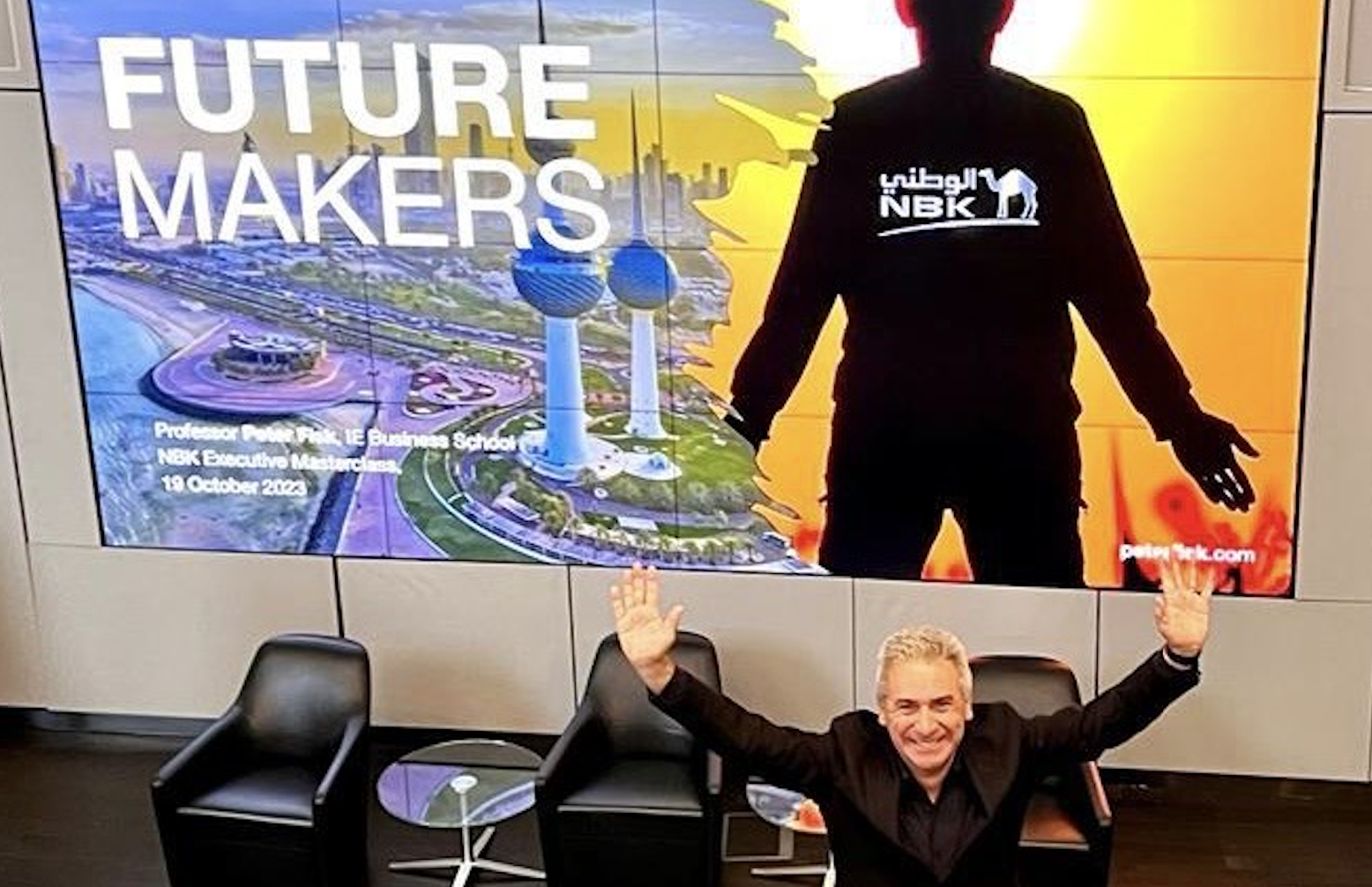
November 2023 : Future Radar in Montenegro
Kotor, Montenegro is a beautiful old Mediterranean port, built during Venetian times, at the head of a fjord-like bay on the Adriatic coast. Dramatic and beautiful, even in a thunderstorm. The winding streets and squares of the fortified old town is overrun by tourists in summer, but in November it was deserted. I was here to help another investment company explore the future – in particular of clean energy and real estate. “Future Radar” is my powerful technique that combines qualitative foresight and quantitative insights, through analysis and workshops, to understand the trends and companies that are shaping the future of markets.
In Munich, I was hosting the Future Book Forum for the 10th consecutive year. Back in 2014, Canon’s Joerg Engelstadter sat down to explore how we could shake up the book publishing world. It’s a slow, conservative, and low-profit business, but also with great emotional attachment and social benefits. This year my theme was Liquid Design – how digital and physical media come together innovatively, in order to reimagine the way in which content is created, produced, distributed and consumed – how book publishing becomes liquid. A great example is U2’s “greatest show on Earth” launching the new Las Vegas Sphere, and setting new standards in customer experience.
It was great to explore the future of content with Manuel Lucania and Julio Covacho, founders of Spanish AI business Quantic Brains. They helped me create a new 300 page book in 3 minutes, a soundtrack in 15 minutes, and animated movie of the book in 30 minutes. Meanwhile Norwegian entrepreneur Eirik Wahlstrøm, founder of Ludenso, the world’s leading AR platform for publishers, added virtual reality to augment the reader experience. The world was in my hands as I held up the future of books.
December 2023 : Kaleidoscopes and Trailblazers
It’s been another frantic and fantastic year of interesting projects, intrepid travel, and all the new ideas and insights that are gained along the way. I love exploring the future of tech-enabled business, the exponential, social, gamified impact of brands like Bolt and Temu, reinventions like Fujifilm and Jio, strategies like PingAn, influencers like Noonouri, and nextgen AI chatbots like Grok and Pi.
I was particularly inspired by new ventures like Lilium, the Munich-based “flying taxi”with vertical take off and landing, 300km range at 300kph, zero carbon fuelled, developed by former CEOs of Airbus and BMW. Best Inventions of 2023 included Adidas’ Adios world-record breaking shoes to Bond’s heartbeat necklace, CisionVision’s cancer scanner to Dyson’s Airstrait, Lego’s Braille Bricks to Leqembi Alzheimer drug, Nike’s Aerogami and “revolutionary hypercard” Czinger 21C.
I realise that few people get to see the business world like I do – to explore all the latest ideas, bring together new insights and practices, and actually work with business leaders to develop and implement them. That combination of new thinking and practical action is critical, particularly in markets of relentless change. As I look forwards to the new year ahead, I’d like to share my foresight, and optimism for the future. And hope that I can help you too to shape a better future in 2024.
- Trailblazers: Innovators to watch in 2024 … from Authentic Brands to Crispr Therapeutics, Lanzatech to Temu, who are the companies shaking up markets, emerging from margins into the mainstream, and likely to make the most transformational impact?
- Kaleidoscope: Trends to explore in 2024 … from Accelerating AI to Synthetic Realities, Greenwashed Out to Physical is Digital, which are the trends that will shape your customers and markets most in the year ahead, and create new platforms to innovate and grow?
- Business Brain: Ideas to embrace in 2024 … from Beautiful Questions to The Long View, Hidden Potential and Impromptu, what are the new concepts that are shaping the way we work, think and win in business, connecting the best ideas of thought leaders and bestselling books?
Contact me at peterfisk@peterfisk.com if you would like to explore ideas for 2024. Happy new year!
Trailblazers by Peter Fisk also includes
- 250 companies innovators shaking up the world
- 100 leaders with the courage to shape a better future
- Future Now the new OS of business, the next CX of brands

Kaleidoscope by Peter Fisk also includes
- Megatrends 2030 as pathways to future opportunities
- Trend Kaleidoscope 2024 curating all the current trends
- Future Radar accelerating your next business strategies

Business Brain by Peter Fisk also includes
- Next Agenda curating the best new ideas for business
- Business Futures Project research, reports, and toolkits
- Recoded 49 codes to help you develop a better business future
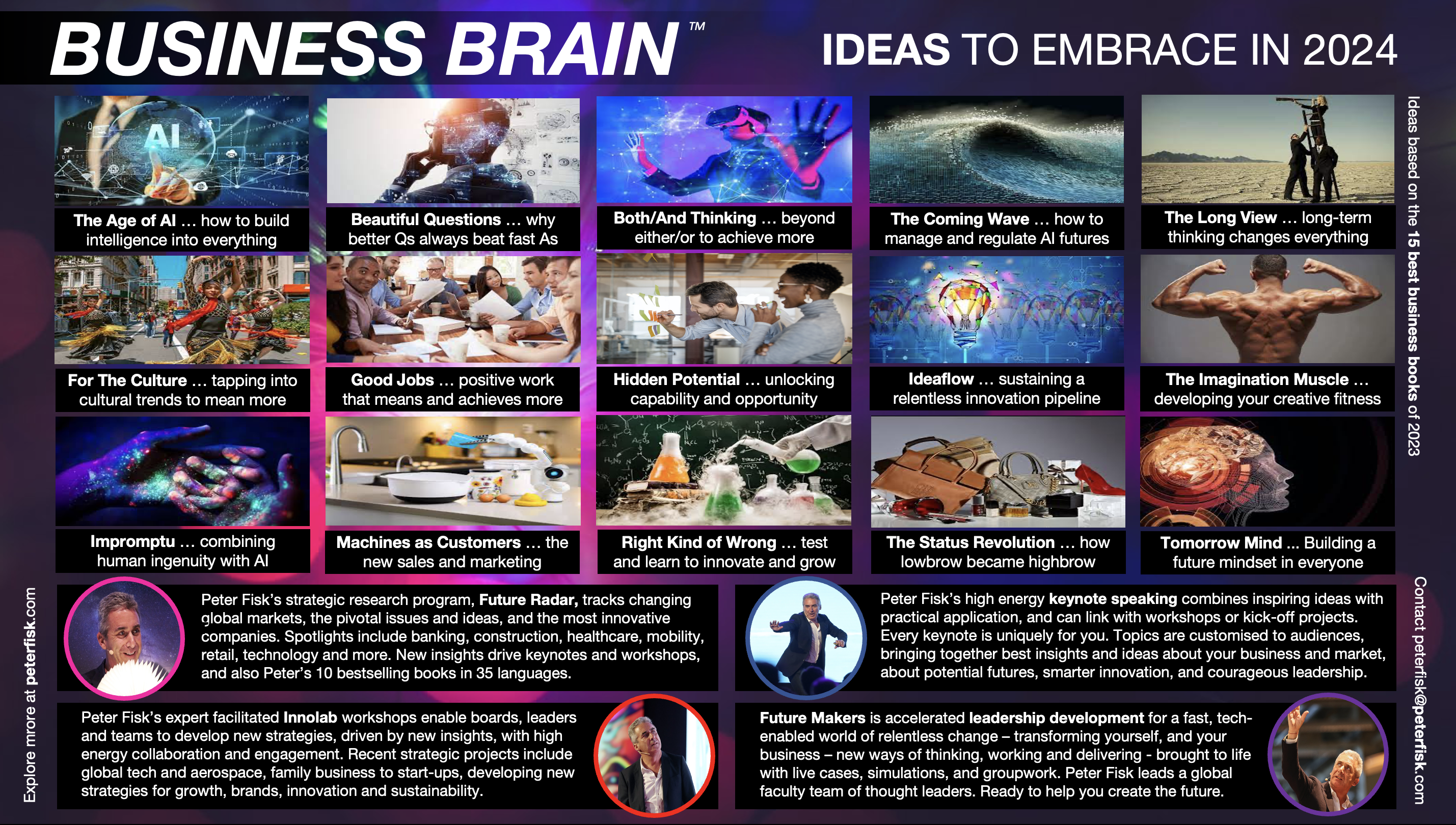
Explore more from Peter Fisk …
- Future Makers: accelerated leadership development, that is innovative, issue-driven, action-driving
- Innolab Workshops: strategic consulting that is insight-driven, creative and collaborative
- Keynote Speaking that is inspiring, topical, engaging, customised and actionable
Happy new year!
“Germany” used to mean industrial excellence, technology, reliability and quality of life.
Whilst German industry is still packed full of industrial giants – BASF to Bayer, BMW to Bosch – Germany is now also becoming a nation of entrepreneurs, harnessing the academic excellence and commercial infrastructures to create a new generation of business.
However the bigger, legacy companies, who used to be admired around the world, are struggling to embrace the new zeitgeist.
The problem with success.
Germany has been so successful in industrial engineering and production, that is has perversely been slow to look beyond product and process for new types of innovation. The academic discipline and rigorous application of proven methodologies has created a stubbornness, and stifled the free-thinking (more imaginative, more intuitive, more irreverent thinking) that is so common to many of the world’s innovation hotspots.
Having lived for a short time in southern Germany (I studied high temperature superconductivity physics at the Albert Ludwig Universitat in Freiburg im Breisgau), I became acutely aware of this “engineer” mindset. Whilst I hate stereotypes, there is something in the German psyche, that seeks logic and precision, detail and structure. It doesn’t like ambiguity, or too much change.
Having spent the last 30 years working across the world with many different companies, including German brands (such as Adidas and Allianz, Bayer and Bosch, Henkel and Lufthansa, T-Mobile and Volkswagen), I notice a difference to other countries in both West and East. Most German business people seek academic doctorates for example, becoming technical experts rather than evolving as business leaders, and continuous professional development is rare. Most German businesses are family owned, with strong influence from owners and also from unions. Most businesses are incredibly product-centric, with a services and service culture slow to take hold.
Of course German businesses have been incredibly successful – they have been the engine of European growth for the last 50 years. But their innovation has largely been incremental – making existing business, products and processes, better.
Prof Khairy Tourk, of the Stuart School of Business in Chicago, says that Germany’s strong position in fields such as automotive engineering, chemicals and factory machines has given the country a “resilience” in the face of economic adversity that made it stand out compared with other countries such as the USA and United Kingdom.
“Germany has performed brilliantly when it comes to adding new ideas to products and processes in the kinds of sectors in which it has traditionally excelled,” says Marco Annuziata, GE’s chief economist. “If you look at a BMW car you will find it packed full of the kind of incremental innovation that the Germans are good at and which gives the country a reasonable amount of self-confidence for the future” adds Tourk.
Therefore this is certainly not a criticism. But it does provoke a question, about how this approach to innovation will be sufficient in a world of more dramatic changes.
Like any successful business, it is hard to let go of the model that made you successful, and tempting to keep squeezing more out of what has worked before. However the success models of the past are unlikely to create future success.
What’s the challenge for German business?
Do German businesses have the imagination to adapt to a changing world?
Where factories are displaced by 3D printers, where robots and AI can replicate the know-how of a highly skilled worker, and where emerging markets can replicate the quality of production at much lower costs … can German leaders develop new ideas, alternative strategies and business models, innovative products and services, to compete in this new world?
The answer has to be yes … And the more enlightened German business leaders are waking up to the new challenges, and to the new challengers.
In fact, walk around the streets of Berlin, for example, and you will see a start-up culture every bit as vibrant as Silicon Valley, Stockholm or Shanghai. The youth culture, the irreverence and collaboration, of “hippy” Berlin is actually driving a new mindset in business. Gone are the suits who only see process diagrams and quality assurance, in come the punks (ok, millennials, hipsters, creatives) who have passion and vision to disrupt the status quo.
Large organisations are desperate to innovate differently too. A few companies like Siemens have truly seized the innovation challenge, but still have to work against an engrained culture of inertness. Smaller companies like Biontech who championed the mRNA vaccine development during the pandemic are a new generation, as are startups like Lilium, the flying taxi business.
Whilst some business leaders struggle to grasp the new world, others are embracing it rapidly. Design thinking, for example has become one of the most sought-after business disciplines, because its more intuitive approach is so needed. Similarly Business Model Innovation, has given the technocrats a new context for their structural thinking.
Germany’s future business vision
A new report by FTI with Handelsblatt and Pulse says “Today, Germany stands at a crossroads: it can either maintain its current course, and risk a gradual economic and societal decline, or it can choose to reinvigorate its legacy of innovation by investing in digitalization, modernization, education, and new technologies. The path of innovation is not merely a choice; Germany must assert its leadership in the 21st century. The world is being reordered, and as geopolitical tensions rise and new alliances form, a stable public and private sector leader is needed.”
And offers hope, with “The Mittelstand—the core of Germany’s economy —will play a vital role in this transformation. Together with universities, innovation hubs, government agencies, and Germany’s largest companies, the more than 1,300 “hidden champions” are poised to become global leaders in a wide range of fields. Our analysis reveals that Germany’s opportunity to lead once again is not just possible but necessary for the future prosperity of Europe and the global economy. This leadership will require a significant shift in mindset and strategy, moving away from traditional comforts towards a future-oriented, risk-embracing approach.”
In simple terms there are too scenarios for Germany over the next 10 years – somewhat akin to the fixed or growth mindset – to embrace the opportunities of a changing world, or to stagnate and decline as it seeks to retain the status quo:
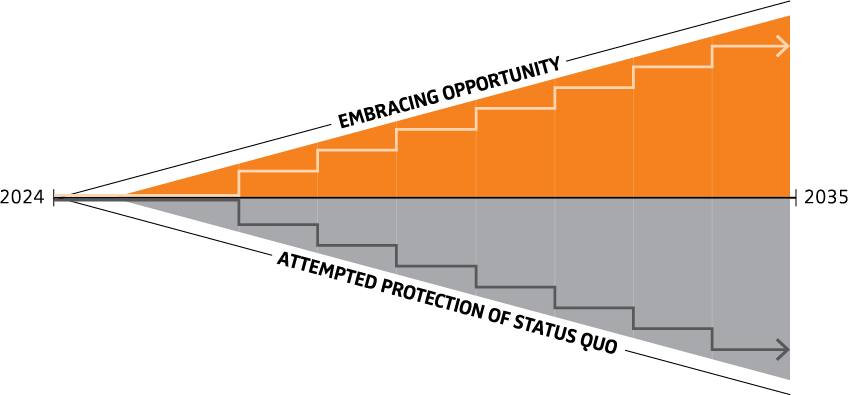
A new vision for German business in 2035 emerges … “if leaders take focused, decisive action today to embrace opportunities and fully leverage the country’s strengths, Germany will continue to be a global leader in innovation” … and is built on five pillars:
- Germany as a dynamic economy fuelled by technological innovation and sectoral diversity … The strategic application of AI across sectors streamlines operations and dramatically speeds up research and development, futureproofing Germany’s economic leadership and diversity.
- Germany as the architect of advanced manufacturing … Germany’s manufacturing landscape is powered by the strategic implementation of automation. The nation excels in designing new materials at scale by leveraging synthetic biology, and additive manufacturing enables rapid, cost-effective production, minimizing reliance on imports and maximizing manufacturing flexibility.
- Germany as leader in ecological integrity and renewable innovations … Germany is on the forefront of climate innovation. Investments in renewable energy research, collaboration with leading scientific institutions, and supportive policies encourage the adoption of ecofriendly practices across all sectors. This holistic approach enables Germany to drive international standards in sustainability and climate resilience.
- Germany as global epicenter of innovation … Corporate governance incentivizes performance, risk-taking, and trial-and-error processes, fostering a culture of continuous improvement. Collaboration happens within companies, across departments, and externally with other private, public, and academic stakeholders in the numerous innovation clusters. The elaborate startup ecosystem makes Germany a desirable hub for global talent.
- Germany as an inclusive and unified society … Germany’s strategic focus on education and health care has fostered an inclusive society. AI-enhanced learning supports a diverse student population, and educational reforms promote social cohesion. The integration of migrants and the provision of new technologies reflect a commitment to building a unified society that values diversity, inclusion, and the well-being of all its members.
However this demands significant change, in mindsets and practical action:
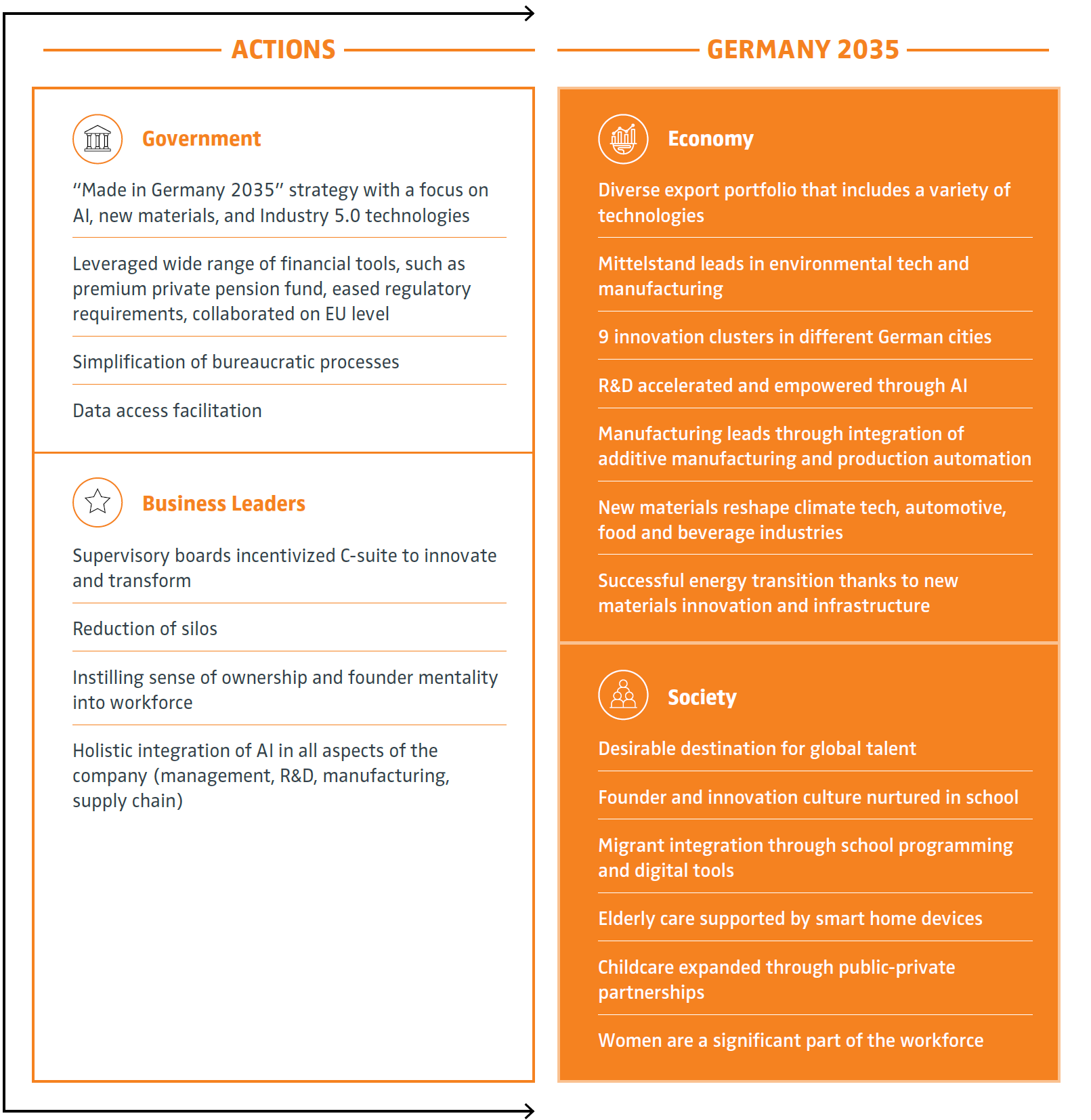
Inspired by German innovators
As inspiration to think positive, explore how Germany can leverage its uncompromising engineering mindset, for a rapidly evolving digital world, here are some of Germany’s most disruptive innovators.What can you learn from these companies, which you could apply your own business?
Biontech … mRNA vaccines from covid to cancer
As Covid-19 raged across the world, Turkish-born Uğur Şahin and his wife Özlem Türeci, transitioned their development of mRNA-based cancer therapies to create an innovative vaccine. Building an ecosystem of experts and partners around their Mainz lab, they were able to achieve in 9 months what had previously take decades. They now believe their approach could transform the future of medicine.
Blinkist … information in a blink
Sebastian Klein and his friends found it hard to continue learning after leaving university. In 2012, they launched Blinkist, an app that summarises non-fiction books in 15 minute “blinks” that can be consumed in audio or video formats. More than 1,500 books in 16 categories are available for the platform’s one million users, from corporate culture to parenting.
Delivery Hero … from restaurant to home
Delivery Hero seeks to be the world’s leading online food ordering platform. Niclas Östberg and colleagues started the business in Berlin in 2011, and the company operates in 53 countries internationally in Europe, Asia, Latin America and the Middle East and partners with 300,000 restaurants. Users can find local restaurants, filter by cuisine, browse menus, read reviews and other information like the restaurant operating times and order takeaway food online. In the UK it uses the brand name Hungry House.
ElektroCouture … the next thing in smart fashion
Lisa Lang, a former engineer, couldn’t find clothes to “express her nerdiness”, she says. In 2014, she founded and fully financed her own fashion technology house, focusing on light wearables. ElektroCouture sells LED jewellery and clothes that glow in the dark – including a jacket that changes colour based on texts it receives. Lang has produced clothing for Lufthansa, IBM and Intel and sells her collection on ASOS and Amazon.
Hello Fresh … great recipes, great cooking, great food
HelloFresh offers meal-kits including ingredients sourced from local suppliers and step-by-step recipes created on a weekly basis by their in-house culinary teams. The company delivers over 7.4 million meals a month to over 800,000 regular subscribers across the world. All countries offer omnivore (Classic Box) and vegetarian (Veggie Box) box options. Celebrity chef Jamie Oliver creates recipes for HelloFresh, whilst a partnership with Vorwerk and their multi-function kitchen appliance Thermomix was launched in Germany and Austria. HelloFresh delivers custom recipes made for cooking with a Thermomix machine.
Lilium … flying taxis from Munich
Lilium is a disruptive aviation start-up based in Munich, founded in 2015. It is currently delivering on its vision of a completely new type of individual transportation and is dedicated to develop and build the world’s first fully electric vertical take-off and landing (VTOL) jet. An estimated range of up to 300 km and a top speed of 300 km/h, along with zero emissions make it the most efficient and eco-friendly individual means of transportation of our time.
N26 … the bank that wants to be different
Berlin-based startup Number26 (or now simply, N26) is trying to reinvent the bank. This might sound crazy, and that’s why the startup has processed step by step. After partnering with Wirecard for the banking back end, attracting 200,000 users the company now has a full license to operate in Europe. “At N26, we obsess every day about great product design and blazing-fast technology. Our goal is always to make banking easy, intuitive, fast, and maybe even a little fun for you along the way.”
Siemens … the exploit and explore mindset
Siemens, the German technology business, seeks to combine the real and the digital worlds to meet the great challenges of our time. It’s diverse portfolio of industrial businesses enjoy the entrepreneurial freedom to serve their customers and markets in the best way possible, the structure is geared toward creating value for customers, creating technology with purpose and thus changing the lives for better.
Zalando … bringing happiness to Europe
Zalando is a European online retailer based in Berlin. The company’s cross-platform online store that sells shoes, clothing and other fashion items. The company was founded in Germany in 2008, and since has begun operating in fourteen European countries and worldwide with spin-offs and subsidiary companies. Zalando was created in 2008 by Rocket Internet (the start-up incubator behind many of Germany’s entrepreneurial brands), Robert Gentz and David Schneider, initially under the name Ifansho. Inspired by US online retailer Zappos, Zalando initially specialised in the sale of footwear before diversifying.
It’s time for you to change the game!
- Learn more about the Gamechangers book, and download a free extract in German
- Read my article exploring more of Germany’s favourite brands
- Read my article exploring banking innovation in Berlin
- Read my case study of Biontech CEO Uğur Şahin
- Read my case study of Lilium’s flying taxis
AI is the biggest thing since the steam engine, and will change our world. AI is hype, AI is real.
In my 33 years in marketing, I’ve seen plenty of change, but also much that endures. The AI hype of 2023, sparked by the launch of ChatGPT in late 2022, is akin to the “dotcom” moment in 1999, when the Internet really captured every business leader and marketer’s imagination.
Yes it was transformational, yes it was full of hype, and ultimately yes, it changed the future of every market and organisation. But at the same time, you still needed lots of conventional logic too. Who’s the customer, the proposition, the business model, and much more? And you still needed investors, employees, and society to be in support.
- What every executive needs to know about AI by Bain
- The CEO’s Guide to the Generative AI Revolution by BCG
- The state of AI, generative AI’s breakout year by McKinsey
Of course, AI is just part of the technosphere which is likely to enable more change in the next 10 years, than the last 250 years. Its intelligence will drive to converge and accelerate other tech adaption – from blockchain and robotics, to genomics and quantum computing.
But ultimately, it’s not about the tech, it’s how you use the tech.
- AI Trends for Marketers 2023 by HubSpot
- The Impact of AI on Marketing by Ogilvy
- State of Marketing AI Report 2023 by MAII
Real world, right now
So how do I see organisations changing right now? I have the fortunate to work with some of the world’s leading companies – across geographies and sectors. Here are some of the real projects that I have worked on recently:
- Microsoft’s shift to AI, alongside Cloud, as their predominant proposition to corporate clients. This means their sales and marketing people take a much more bespoke, consultative approach to selling, rather than product focused as previously with selling standardised versions of software.
- Carrefour using AI to engage consumers through digital marketing and personalised shopping, using predictive analytics for recommendations, and chatbots for digital customer support. Instore, using AI for dynamic pricing, offers to mobile devices. As well as broad use of AI in supply chain and inventory management.
- Holcim using AI to enhance client solutions with a broader range of remote diagnostic tools – digital twins to simulate physical building, energy efficiency diagnostics, predictive maintenance. Such services offer new revenue streams and ongoing relationships with construction clients, and building owners.
- Inditex’s use of AI for intelligent consumer behaviour analytics, from segmentation to range selection, store locations to online and instore merchandising, pricing and inventory management. It also uses AI in communication to personalise messaging, social media engagement, graphical imagery, and chatbots.
Any strategic decision, marketing or business generally, would take into account technology drivers. AI has become a significant component within the understanding of business drivers. So to understand AI alone, and marketing specifically, is not always obvious.
In general the majority of marketing-related AI is currently being used in
- Customer analytics, trend prediction, audience segmentation etc
- Inventory management, maintaining stocks, optimising supply etc
- Communication optimisation, personalised offers, social engagement
Increasingly it will start to take a much larger role in
- Dynamic pricing, by individual, by location, by time, by promotion
- Product development, made on demand, personalised colours etc
- Liquid engagement, across media platforms, and distribution channels
- Addressing critical issues, eg climate change, society benefits, and ethics.
AI applications in marketing
Here some of the significant ways I see AI shaping marketing right now:
- Content Creation:
- Generative AI tools like Jasper for text generation and Midjourney for image creation support content creation. They produce text, craft images, and even generate music or code based on input and requirements.
- For instance, if you’re working on a campaign, AI can generate custom content, saving time and effort1.
- Data Analytics:
- AI tools automate complex data analysis and transform insights into easy-to-understand reports and compelling visualizations.
- Previously, creating quarterly reports was a marathon task. Now, AI sifts through data, spots trends, and presents it in sleek formats, streamlining decision-making1.
- Chatbots Service:
- AI-powered chatbots provide instant responses, handle routine inquiries, and enhance customer experiences.
- They can engage users on websites, social media, and messaging apps, improving overall customer satisfaction2.
- Personalisation:
- AI analyzes user behaviour, preferences, and historical data to deliver personalised recommendations.
- Netflix, for example, uses AI algorithms to suggest movies and shows based on viewing history2.
- Predictive Analytics:
- AI predicts customer behavior, helping marketers tailor campaigns and offers.
- Amazon’s recommendation engine is a prime example, suggesting products based on browsing and purchase history2.
- Dynamic Pricing:
- AI adjusts prices dynamically based on demand, competitor pricing, and other factors.
- Airlines and e-commerce platforms use AI to optimize pricing in real time2.
- Email Marketing Optimisation:
- AI analyzes email open rates, click-through rates, and user engagement.
- It suggests optimal send times, subject lines, and content variations to improve email campaign performance3.
- Social Media Insights:
- AI tools analyze social media data to understand sentiment, trends, and audience behavior.
- Brands can refine their social media strategies based on these insights2.
- Segmentation and Targeting:
- AI segments audiences based on demographics, behavior, and preferences.
- Marketers can create hyper-targeted campaigns for specific customer groups2.
- Voice Search Optimization:
- As voice search grows, AI helps optimize content for voice-based queries.
- Brands can adapt their SEO strategies to capture voice search traffic2.
In November 2022, Generative AI grabbed the global conscience, with a deceptively simple new platform, ChatGPT, from Sam Altman and his team at OpenAI. It reached 100 million weekly users in two months. Instagram took more than two years.
AI, of course, has been around for some time – in 1950 Alan Turing considered how machines could out-think humanity, in 1956 John McCarthy coined the term “artificial intelligence”, in 1997 a chess playing computer Deep Blue beat world champion Garry Kasparov, in 1999 Sony launched the first robo-pet AiBO who developed a personality over time.
Apple’s Siri, an AI-enabled virtual assistant, was added to iPhones in 2011, while IBM’s Watson won quiz show Jeopardy, and Amazon’s Alexa made shopping smarter in 2014. Add Google Maps, Alibaba’s Citybrain, medical diagnostics, weather forecasting and driverless cars. Since releasing ChatGPT via API in March, over 2 million developers are now working on it.
Generative AI goes beyond most of the existing forms of artificial intelligence in order to create new content including text, videos, images, and more. Just as an example, last month I used AI to write a 300 page book in 6 minutes, and also turn it into an animated movie in 3 hours!
- AI is about to completely change how you use computers by Bill Gates
- What every executive needs to know about AI by Bain
- The CEO’s Guide to the Generative AI Revolution by BCG
- The state of AI, generative AI’s breakout year by McKinsey
- OpenAI and Jony Ive seek to create an AI-based device by FT
Progress as been rapid – in terms of technologies, business models, and commercial adoption. OpenAI’s GPT4 arrived in March with a subscription model, while Anthropic launched Claude, by a team of ex OpenAI-ers with a safety first mindset. In the same month Microsoft launched CoPilot, and Google introduced Bard.
Microsoft is becoming one of the most influential players in AI, not just investing $10 billion in Open AI, but also linking with Meta to launch Llama. Perplexity AI is seen as one of the most advanced interfaces. It was launched by another ex OpenAI-er Aravin Srinivas and his team in 2022, and has proved perhaps the most user-friendly so far.
In November 2023, OpenAI imploded. The board dismissing Altman and CEO, and then when almost all 700 employees protested, dismissing itself for Altman to return. The rapid progress towards Artificial General Intelligence, AGI, beyond the so-called singularity, when AI takes on a life of its own, has raised huge alarm bells, how to balance progress with caution.
DeepMind, the AI brain of Google, co-founder Mustafa Suleyman left the company this year to start Inflection AI, a personalised chatbot called PI, and also publish a book The Coming Wave, warning of the rapidly approaching dangers of powerful AI (watch his video below).
Sergei Brin says Google has been an “AI-first company” for at least a decade, but realised it was facing an existential crisis with this year’s rise of new chatbots. The end of the ubiquitous Google search, and its $225 billion ad revenue seemed night, and Brin launched a “code red”. He took personal control, fusing DeepMind and GoogleBrain, to launch Gemini, its AI to beat all others.
And Elon Musk, one of the co-founders of Open AI, who then fell out with Altman and left the organisation, because he felt its commercial race for profits was ignoring its responsibility to humanity, launched xAI and a chatbot called Grok. According to the dictionary, Grok means “to understand profoundly and intuitively”.
So how well do we understand Generative AI? Hyped as, and quite possibly, likely to create the most significant transformation of business in our lifetimes, most business leaders are still watching developments rather bemused, rather than asking how will it transform their futures.
A useful starting point is the Generative AI Bible free to download from CB Insights.
Amazon’s AI
Let’s take Amazon as an example of a company which has been using AI to revolutionise its business for more than 25 years from targeted advertising to Alexa, doorbells and drones, Prime to pharmacy. Most recent is Amazon Rufus, the new generative AI-powered conversational shopping experience. Consider:
- A more conversational Alexa with generative AI: Conversations with Alexa should be as natural as talking to a friend. With a new large language model (LLM) custom-built and optimized for voice interactions, Alexa is more intuitive than ever. The new LLM will also help Alexa understand context, so you can have back and forth conversations without having to repeat yourself, and conversations can flow more smoothly.
- Generative AI improves product listings: Product detail pages are a key source of information for Amazon shoppers. But creating compelling product titles and descriptions can take a lot of sellers’ time and effort. As a result, some detail pages are more comprehensive and useful than others. Generative AI helps sellers provide richer information with less work. It reduces the need to enter multiple pieces of specific product data, combining it into just one step. This saves time for sellers, produces more thorough product listings, and helps customers make more confident purchase decisions.
- Generative AI creates more engaging advertisements: Generative AI helps advertisers make their ads more engaging and visually rich, and delivers a better advertising experience for customers. Using the Amazon Ad Console, advertisers simply select their product and click “Generate.” In just seconds, the tool delivers a series of lifestyle and brand-themed images. For example, a toaster that was previously shown with a white background might now be on a kitchen counter next to some fruit and muffins. Short text prompts then help refine the image, and users can quickly create and test multiple versions to optimize performance.
- Thanks to generative AI, customers can pay with their palm: No wallet? No problem. Amazon used generative AI to develop Amazon One, a fast and convenient contactless identity service that enables customers to use their palm to make payments, verify their ages, or enter locations. To train the AI model, Amazon scientists used generative AI to create millions of synthetically generated images of the palm and the subcutaneous vein structure. Amazon One delivers an accuracy rate of 99.9999%, which exceeds the accuracy of other biometric alternatives—it’s even more accurate than scanning two irises. You can use Amazon One at all of the more than 500 Whole Foods Market stores in the U.S. and at over 100 customer locations across the country, including Crunch Fitness, Hudson stores at airports, and multiple stadiums and entertainment venues.
- Generative AI helped Amazon eliminate checkout lines: How often do you want to grab a snack at a sporting event, but the line is too long? Using a combination of computer vision, object recognition, advanced sensors, deep learning, and generative AI, Amazon’s Just Walk Out technology allows fans to enter a concession stand, grab whatever they want, and quickly get back to their seats—without waiting in a checkout line. Amazon used generative AI to create photorealistic synthetic images and video clips that mimick realistic and sometimes rare shopping scenarios. Those include variations in store format, lighting conditions, and even crowds of shoppers—all information about situations that can be hard to find in real life and difficult to teach a computer. Just Walk Out technology is now available as a service to retailers. So far, the technology has been implemented at over 100 third-party locations at airports, stadiums, universities, convenience stores, theme parks, and other locations.
10 books on AI
Here are some more ways to catch up:
Impromptu: Amplifying Our Humanity Through AI
Reid Hoffman is a LinkedIn cofounder, investor at venture firm Greylock Partners, and former board member of OpenAI. As a former board member of OpenAI, Hoffman has seen up close how the large language models behind generative AI tools like ChatGPT work. His book, available as a free pdf, was written with GPT-4, the newer, more powerful version of ChatGPT. The book is the first to be written by GPT-4, Hoffman said in a LinkedIn post announcing his work earlier this month. “With GPT-4, I traveled through light bulb jokes, epic poems, original sci fi plots, arguments about human nature, musings on how AI might strengthen democracy, society and industries,” he wrote. “The goal, like in any good trip, was to learn as much about my traveling partner as the place I was exploring.”
Amir Husain is CEO of SparkCognitio. The book covers what Generative AI is, the benefits of Generative AI (including increased productivity and new product development) and the challenges of Generative AI (including bias, security, and regulation). In then gets practical with how to develop a Generative AI strategy to help you stand out in the marketplace, how to build the right team and when to seek outside help, and best practice methods for training employees on Generative AI. It concludes with a deeper look into sequences, word embeddings, and LLMs, the progress and challenges of detecting Generative AI, and the future of Generative AI.
Generative AI: The Future of Everything
Sharad Gandhi and Christian Ehl say that Generative AI is creating one of the most significant transformations in human society. For the first time in history, we have created machines that exhibit intelligence, a quality we only associate with humans, a machine intelligence greater than most humans in many areas. We believe it will transform almost all jobs, professions and industries. Generative AI is a very powerful tool with the potential to enhance the way we live, work, make almost all decisions and develop solutions. Its power also creates significant concerns and risks for our society and humanity.
The Age of AI: And Our Human Future
Henry Kissinger, former US secretary of state, ex Google CEO Eric Schmidt, and MIT researcher Daniel Huttenlocher are an unlikely tech trio, but explore how AI is set to reshape society. “AI’s promise of epoch-making transformations—in society, economics, politics, and foreign policy—portends effects beyond the scope of any single author’s or field’s traditional focuses,” they say. In the time since the book was published, generative AI has made the discussion of how society will change as machines increasingly perform human tasks all the more relevant.
Companies seek to engage investors in their vision and potential. They spend many hours crafting strategies and presentations that seek to convince stockmarket analysts and investors that their company’s vision, strategies, innovations, brands and creativity will ensure that they deliver a better future, and better return on investment.
Yet most annual reports, financial statements, investor presentations are incredibly boring. They are standardised, number intensive, lack creativity, and certainly lack passion and inspiration. They are largely undifferentiated, despite that being their purpose. And while they have serious messages, and must adhere to financial regulation, this is no excuse to be dull.
Marvel Comics were different.
Back in the 1990s, the content business was a separate company, before being acquired by Disney in 2009. Marvel released their quarterly and annual financial reports to shareholders in the form of comic books.
Marvel experienced great success during the early 1990s, highlighted by the sale of 2.5 million copies of Spider-Man #1. This success paved the way for its IPO in 1991 under the leadership of Ronald Pearlman, raising over $63 million. Being a public company however, means totally different reporting requirements, and Marvel was looking for ways to communicate the Marvel Comics Universe in an engaging way; within a typically dry shareholder report.
Luckily, Gary Fishman reached out with a solution. As a lifelong comic book fan and the founder of an investor and public relations firm on Wall Street, he offered to assist the then Marvel CEO Bill Bevins in preparing Marvels upcoming quarterly report.

Fishman, along with Marvel executives including President Terry Stewart and CFO Robert Riscica, brainstormed how to effectively convey the unique Marvel Comics Universe within the conventional format of a shareholder report. The groundbreaking solution they arrived at was to convert the report into a comic book featuring Marvel superheroes. This project was a collaborative effort, with editor Glenn Herdling leading the creative process.
Utilizing the Marvel method, which involves developing the story, then the art, and finally the dialogue, Fishman crafted the Plot and made sure to write the copy in such a way that it compiled with all legal and SEC requirements. Herdling on his end, coordinated with some of Marvel’s best artists to bring the visuals to life.
This completely new way of reporting finally took form as a four-page comic book, with the Marvel characters discussing financial aspects like publishing revenues, gross profit, and revenue mix.

The next step was the annual report, and it’s safe to say that Marvel really broke new ground. They crafted a 36-page comic book, combining comics-form information introduced by Uatu the Watcher, updating us on licensing revenues, advertising, and more, along with other traditional financial tables and text.
This innovative approach quickly became a sensation, and was extensively covered by leading publications such as The New York Times, USA Today, The Wall Street Journal, Financial Times, and Institutional Investor. They were recognized not only for their creativeness but also for their artistic and qualitative design, winning awards from organizations like the International Academy of Communications Arts & Sciences.


