In today’s world, customers no longer just buy products—they buy solutions, experiences, and outcomes. The most successful brands are realizing that to stay relevant and grow, they must think beyond the narrow scope of their products or services. Instead, they need to focus on the broader problems their customers face and leverage partnerships to deliver end-to-end solutions. Mercedes-Benz offers a compelling example of how a brand can make this shift, moving from a traditional product manufacturer to an ecosystem orchestrator, providing value far beyond the car itself.
Understanding the Customer Problem
The first step is to see the world through the customer’s eyes. For Mercedes-Benz, the shift to electric vehicles (EVs) revealed a fundamental insight: owning an EV is not just about having a luxury car—it’s about access to reliable, sustainable energy. Customers want to charge their vehicles efficiently, reduce energy costs, and ideally do so using renewable sources. The problem is no longer only about driving; it’s about mobility and energy management at home, on the road, and within the larger environment of the city.
Brands that excel at solving customer problems start by identifying unmet needs in the broader context of their product. Apple didn’t just sell an iPhone; it addressed how people communicate, work, entertain themselves, and stay healthy in an increasingly connected life. Peloton didn’t just sell a stationary bike; it addressed how people find time-efficient, social, and motivating ways to exercise at home. The lesson is clear: products are entry points, but problems are opportunities.
Building an Ecosystem of Partners
Once a brand understands the broader problem, it often cannot solve it alone. Here is where ecosystems come into play. An ecosystem is a network of partners, technologies, and services that collectively deliver value to the customer. Mercedes-Benz exemplifies this approach through its partnerships with companies like Bosch, a global leader in energy and IoT solutions.
Together, Mercedes and Bosch provide home energy solutions linked directly to EV ownership. Through this partnership:
-
Customers can install solar panels and home energy storage systems, allowing them to charge vehicles using renewable energy.
-
Bosch’s expertise in smart-home technology ensures that energy consumption is optimized, balancing household needs with vehicle charging schedules.
-
Mercedes integrates these services into its digital platform, Mercedes me, which enables customers to manage cars, energy, and mobility services from a single interface.
The key insight here is that Mercedes didn’t limit itself to cars. By orchestrating a network of partners, the company can deliver a complete mobility and energy experience, turning a one-dimensional product into a multi-dimensional solution.
Shifting From Products to Services
Ecosystems unlock new business models by transforming products into services and experiences. Mercedes-Benz is experimenting with subscription models that combine vehicles, charging infrastructure, and home energy solutions. This approach creates recurring revenue streams while deepening customer engagement.
Consider how this approach can be applied in other industries:
-
A fitness brand could partner with nutrition, wellness, and technology companies to provide personalized health ecosystems.
-
A financial services company could collaborate with utilities, mobility providers, and tech platforms to offer integrated life planning solutions, beyond insurance or banking products.
-
A consumer electronics company could partner with home automation, content, and service providers to deliver a seamless smart-living ecosystem.
The principle is the same: focus on the customer’s broader journey and orchestrate a network to meet those needs holistically.
Digital Platforms as the Glue
Ecosystems thrive when there is a central hub that connects partners, collects insights, and delivers a seamless customer experience. Mercedes me acts as this hub for Mercedes-Benz, linking cars, energy solutions, and mobility services. Through the platform, Mercedes can:
-
Track energy usage patterns and recommend optimal charging times.
-
Offer predictive maintenance and vehicle updates, enhancing reliability.
-
Provide personalized offers and services based on user behavior and preferences.
Digital platforms turn ecosystems from a loose network into a coordinated, intelligent system, enabling brands to act on data insights while keeping the customer experience smooth and integrated.
Benefits for Brands
Brands that adopt ecosystem thinking gain multiple advantages:
-
Customer loyalty and engagement: Customers become embedded in a broader network of solutions that are hard to replicate.
-
New revenue streams: Ecosystems open doors to services, subscriptions, and value-added offerings beyond the original product.
-
Innovation acceleration: Partnering with other experts allows brands to innovate faster and address complex problems they could not solve alone.
-
Sustainability and purpose alignment: Solutions that integrate energy, mobility, and technology enhance social and environmental impact, which increasingly matters to consumers.
Lessons for Any Brand
Mercedes-Benz demonstrates a few universal lessons for brands seeking to move beyond products:
-
Start with the problem, not the product: Understand what customers truly need in the context of their lives.
-
Collaborate strategically: Partner with companies that have complementary strengths to expand the value proposition.
-
Invest in platforms: Use digital systems to orchestrate partners, manage services, and personalize experiences.
-
Think in terms of services, not products: Explore subscriptions, bundled offerings, and integrated experiences to deepen engagement.
-
Measure broader impact: Evaluate success not only in sales but also in the outcomes delivered for customers, such as convenience, cost savings, or sustainability.
The future of business lies in moving beyond products to solving broader customer problems through ecosystems. Mercedes-Benz exemplifies this shift by combining cars, home energy, digital platforms, and strategic partnerships into a unified mobility experience. Brands that adopt this mindset can unlock new growth, stronger customer relationships, and meaningful impact, while transforming themselves from product sellers into problem-solvers and ecosystem orchestrators.
In a world where products are increasingly commoditized, the real competitive advantage belongs to those who see the bigger picture, collaborate effectively, and deliver holistic solutions. The Mercedes-Benz model is not just a blueprint for the automotive industry—it is a lesson for any brand seeking relevance and growth in the 21st century.
Who are the most inspiring business leaders today?
- Request the free e-book “A-Z of Inspiring Business Leaders 2025” at peterfisk@peterfisk.com
How do they lead in a world of uncertainty, complexity and relentless change, to deliver today and also create tomorrow? How do they engage stakeholders, see a bigger picture, have a focus on the future, drive innovation and transformation? And how do they succeed as people, in their relationships with their colleagues, and in their personal drive and resilience?
I’ve had the privilege to meet some of the world’s great business leaders. I remember sitting down with Virgin founder Richard Branson, telling me about is love of big crazy ideas and taking personal risks like hot-air ballooning and more recently space travel, but after 50 years a lingering fear of meeting with his finance team and deciphering a balance sheet.
Last year I interviewed Spanish business leader Pablo Isla, ranked by HBR as the world’s best CEO, who said he is only human, and can only be expected what most humans can do. But in the smartest way possible. Equally humble was Jim Snabe, chairman of Siemens, who talked about how he is always curious, always learning, constantly inspired by other leaders and their companies around the world.
Satya Nadella was truly inspiring. Watching him talk to his Microsoft leadership team, he was a body of passion, entrancing with his vision of the possibilities of technology, and the confidence to transform their business. Melanie Perkins, the young Australian founder of Canva, was equally compelling, but in a far more practical and down to earth way.
One of my most thought-provoking (and complex) conversations was with Haier’s chairman Zhang Ruimin. Once I told him that I also had a scientific background, he wanted to talk quantum physics, as an analogy for organisation design. He was fascinating, talking about how his “rendanheyi” approach to living organisations, was about freedom and innovation, but also how different operating models could create more potential, and then kinetic, energy.
So, who are the most inspiring business leaders today – and what can we learn from them?
Who are the most inspiring business leaders today?
How do they lead in a world of uncertainty, complexity and relentless change, to deliver today and also create tomorrow? How do they engage stakeholders, see a bigger picture, have a focus on the future, drive innovation and transformation? And how do they succeed as people, in their relationships with their colleagues, and in their personal drive and resilience?
I’ve had the privilege to meet some of the world’s great business leaders. I remember sitting down with Virgin founder Richard Branson, telling me about is love of big crazy ideas and taking personal risks like hot-air ballooning and more recently space travel, but after 50 years a lingering fear of meeting with his finance team and deciphering a balance sheet.
Last year I interviewed Spanish business leader Pablo Isla, ranked by HBR as the world’s best CEO, who said he is only human, and can only be expected what most humans can do. But in the smartest way possible. Equally humble was Jim Snabe, chairman of Siemens, who talked about how he is always curious, always learning, constantly inspired by other leaders and their companies around the world.
Satya Nadella was truly inspiring. Watching him talk to his Microsoft leadership team, he was a body of passion, entrancing with his vision of the possibilities of technology, and the confidence to transform their business. Melanie Perkins, the young Australian founder of Canva, was equally compelling, but in a far more practical and down to earth way.
One of my most thought-provoking (and complex) conversations was with Haier’s chairman Zhang Ruimin. Once I told him that I also had a scientific background, he wanted to talk quantum physics, as an analogy for organisation design. He was fascinating, talking about how his “rendanheyi” approach to living organisations, was about freedom and innovation, but also how different operating models could create more potential, and then kinetic, energy.
As I travel around the world – working with diverse companies, meeting incredible business leaders, and sharing the best ideas from across sectors and geographies in keynotes and workshops – I mused on who are the most inspiring business leaders today – how do they succeed into today’s very different world – and what can we learn from them?
The best leaders aren’t just good at managing. They explore, envision and elevate their personal possibilities and business potential. They connect, transform, and enable their organisations to achieve more. They are future makers.
Here are some of the attributes which, for me, make them inspiring. Collectively these attributes create a New Leadership DNA:
-
They lead with vision and purpose. They see the big picture and help others see it too. They’re not just reacting to the present — they’re creating the future. Their vision is rooted in a strong sense of purpose that goes beyond profit: social impact, sustainability, human empowerment, or systemic change. Nadella’s growth mindset has been transformational.
-
They embrace complexity and uncertainty. Instead of fearing change, they lean into ambiguity. They use it as a catalyst for innovation. They build organisations that are agile, resilient, and adaptive — capable of pivoting quickly without losing direction. Jensen Huang has been at Nvidia’s helm since its founding in 1995, a constant source of direction and stability.
-
They drive innovation and reinvention. They foster a culture of experimentation, learning, and continuous reinvention. They don’t cling to legacy models — they challenge assumptions, embrace bold thinking, and ask: What’s next? Jim Hagemann Snabe, chairman of Siemens, is a passionate advocate of continuous reinvention.
-
They connect deeply with stakeholders. They actively listen, collaborate, and co-create with customers, employees, partners, and communities. They build trust through transparency and consistent values — which is essential in a noisy, polarised world. Yvon Chouinard, founder of Patagonia is one of my business heroes.
-
They are human-centered and emotionally intelligent. They lead with empathy, humility, and authenticity. They show vulnerability, care for their teams, and encourage psychological safety. They’re focused not just on what gets done but how — creating healthy, high-performing cultures. Perkins loves to say, “we’re a family, and we’re here to do good”.
-
They invest in their own growth and resilience. They cultivate mental clarity, self-awareness, and inner strength — practices like reflection, coaching, mindfulness, and lifelong learning. They’re passionate, driven — but also grounded and emotionally regulated, even under pressure. Jacinda Ardern, former PM now leadership coach, is a great example.
-
They build teams, not empires. They create leadership ecosystems, not command-and-control hierarchies. They empower others, distribute decision-making, and build collective intelligence. They know that innovation and impact come from collaboration, not heroism. Erin Meyer told me this one, learnt from Reed Hastings, while writing No Rules Rules together.
Collectively these attributes create a New Leadership DNA.
Sam Altman, Open AI
Sam Altman is a visionary entrepreneur and investor who has become one of the most influential figures in artificial intelligence. Born in 1985, Altman studied computer science at Stanford University before dropping out to launch the location-based app Loopt. Though Loopt was not a major commercial success, it marked Altman as a rising star in tech. He went on to lead Y Combinator, one of Silicon Valley’s top startup accelerators, where he helped launch and support companies like Airbnb, Dropbox, and Stripe.
In 2015, Altman co-founded OpenAI alongside Elon Musk and others with the mission of ensuring that artificial general intelligence (AGI) benefits all of humanity. Under his leadership, OpenAI has developed some of the most advanced AI systems in the world, including ChatGPT. Altman has championed a unique capped-profit model to align AI development with broad societal benefit. His tenure has seen OpenAI grow from a nonprofit research lab into a global force, forging major partnerships—including a multibillion-dollar collaboration with Microsoft.
He has been at the forefront of AI safety debates and calls for global AI governance. Altman’s impact lies not only in advancing cutting-edge AI, but in reframing how tech companies balance innovation, ethics, and profit.
Mary Barra, GM
Mary Barra made history in 2014 when she became the first female CEO of a major global automaker, General Motors. Born in Michigan in 1961, Barra holds a degree in electrical engineering and an MBA from Stanford. Her career at GM spans over four decades, beginning as a co-op student inspecting fender panels. She steadily rose through the ranks with roles in engineering, HR, and manufacturing.
As CEO, Barra has spearheaded GM’s transformation from a traditional automaker to a forward-looking mobility company. She led the company through a massive cultural and operational shift, emphasizing transparency and accountability after the ignition switch crisis. Barra’s vision has centered on an all-electric future: she committed GM to producing only zero-emissions vehicles by 2035, and has significantly invested in EVs and autonomous technology, including the development of the Chevrolet Bolt and the Cruise AV platform.
Barra has also been a leading advocate for diversity and inclusion, setting ambitious DEI goals and increasing female representation across leadership. Under her guidance, GM returned to profitability after bankruptcy, streamlined its global operations, and began to redefine American automotive innovation. She is widely regarded as one of the most powerful and transformative leaders in the global auto industry.
Tim Cook, Apple
Tim Cook took over as CEO of Apple in 2011, following the death of Steve Jobs. Born in Alabama in 1960, Cook holds a degree in industrial engineering from Auburn University and an MBA from Duke University. He joined Apple in 1998 after roles at IBM, Compaq, and Intelligent Electronics. Initially brought in to streamline Apple’s supply chain, Cook’s operational brilliance helped turn Apple into a global logistics powerhouse.
As CEO, Cook has overseen Apple’s transformation into the world’s most valuable company, pushing its market cap past $3 trillion. Under his leadership, Apple has expanded its product line with innovations like the Apple Watch, AirPods, and Apple Silicon chips. He has also pivoted Apple toward services—such as Apple Music, iCloud, and Apple TV+—which now form a major growth engine. While Jobs was known for visionary product design, Cook is recognized for his steady hand, global scaling, and quiet but firm leadership style.
Cook has brought a values-based approach to Apple’s leadership, championing privacy as a human right, committing to carbon neutrality, and supporting social justice causes. Openly gay and a strong advocate for LGBTQ+ rights, Cook has modernized Apple’s culture while maintaining its core design ethos. His legacy is one of sustainable, disciplined innovation and values-driven business leadership.
Axel Dumas, Hermès
Axel Dumas is the CEO of Hermès International and a sixth-generation member of the founding Hermès family. Born in 1970, Dumas studied philosophy and political science before training at Sciences Po and the École Nationale d’Administration (ENA), a prestigious French school for civil servants. Before joining Hermès in 2003, he worked in banking at Paribas.
Dumas became CEO in 2013 and has since guided the French luxury house through a period of exceptional growth and resilience. Unlike many luxury conglomerates, Hermès has stayed independent and family-controlled, maintaining its artisanal heritage and commitment to craftsmanship. Dumas has upheld this legacy while subtly modernizing the brand—expanding into new markets, accelerating digital capabilities, and opening flagship stores in key global cities.
Under his leadership, Hermès has remained one of the most exclusive and admired luxury brands in the world. Its iconic Birkin and Kelly bags continue to be symbols of prestige, and the brand has enjoyed soaring demand in Asia and among younger luxury consumers. Dumas has been praised for balancing tradition with innovation, preserving Hermès’ scarcity-driven model while building a highly profitable and sustainable global business.
Daniel Ek, Spotify
Daniel Ek is the co-founder and CEO of Spotify, the world’s leading music streaming platform. Born in Sweden in 1983, Ek showed early entrepreneurial instincts, starting tech ventures in his teens and becoming a millionaire by age 23. In 2006, he co-founded Spotify with Martin Lorentzon, aiming to combat music piracy and offer a better way to access music legally.
Launched in 2008, Spotify revolutionized how people consume music, introducing freemium streaming supported by ads or subscriptions. Ek’s data-driven, user-focused approach turned Spotify into a global platform with over 500 million users and 200+ million paying subscribers. Under his leadership, Spotify has continually innovated—through algorithmic playlists, podcast acquisitions (like Joe Rogan and Gimlet Media), and tools for creators.
Ek has championed the idea that tech can democratize the music industry, giving artists more direct access to fans. He’s also had to navigate complex relationships with record labels, creators, and regulators, while fending off growing competition from Apple, Amazon, and YouTube. His vision and persistence have made Spotify one of the most transformative companies in digital media, reshaping the business model of an entire industry.
Jane Fraser, Citigroup
Jane Fraser made history in 2021 as the first woman to lead a major U.S. bank when she became CEO of Citigroup. Born in Scotland in 1967, Fraser earned degrees from Cambridge University and Harvard Business School. She began her career at Goldman Sachs and McKinsey & Company, where she became a partner, before joining Citi in 2004.
Over nearly two decades at Citigroup, Fraser held multiple leadership roles, including CEO of Citi’s Latin America operations and head of its global consumer bank. Her appointment as CEO marked a turning point for the institution, which has long trailed rivals JPMorgan Chase and Bank of America in profitability and efficiency. As CEO, she quickly launched a major strategic overhaul—streamlining global operations by exiting consumer banking in multiple markets, refocusing on wealth management, and investing in technology and compliance.
Fraser has also prioritized culture change and operational transparency. She is leading Citi through a long-needed transformation of its risk management infrastructure, driven by regulatory demands and a goal of making the bank leaner, safer, and more client-focused. In a traditionally male-dominated field, Fraser has emerged as a symbol of inclusive leadership and a thoughtful, steady hand in an era of financial transformation.
Marcos Galperin, Mercado Libre
Marcos Galperin is the founder and CEO of Mercado Libre, Latin America’s largest e-commerce and fintech company. Born in Argentina in 1971, he studied economics at Wharton and earned his MBA at Stanford, where the idea for Mercado Libre was born. Launched in 1999, the company is often referred to as the “Amazon of Latin America,” though its model also blends features of eBay, PayPal, and Shopify.
Galperin has been instrumental in shaping Latin America’s digital economy, bringing e-commerce and digital payments to markets historically underserved by traditional infrastructure. Under his leadership, Mercado Libre built its own logistics network and digital wallet system (Mercado Pago), which has become a critical tool for financial inclusion in the region. The company weathered multiple economic and political crises by remaining agile and relentlessly user-focused.
Galperin’s vision was not only technological but also social—empowering millions of small businesses and consumers across Latin America to access digital commerce, payments, and credit. Today, Mercado Libre is one of the most valuable companies in the region, a rare tech success story from the Global South. Galperin is seen as a pioneer in emerging market innovation, combining entrepreneurial resilience with scalable impact.
Jensen Huang, Nvidia
Jensen Huang is the co-founder and CEO of Nvidia, the company that pioneered graphics processing units (GPUs) and transformed them into essential tools for AI, gaming, and data science. Born in Taiwan in 1963, Huang moved to the USA as a child and studied electrical engineering at Oregon State and Stanford. In 1993, he co-founded Nvidia with a focus on high-performance graphics cards for gaming—a niche that would evolve into one of the most powerful computing platforms in the world.
Under Huang’s visionary leadership, Nvidia expanded beyond gaming to become a leader in AI and high-performance computing. The company’s CUDA platform and GPU architecture are now central to deep learning, powering everything from self-driving cars to large language models. Huang has masterfully steered Nvidia into new verticals—healthcare, automotive, data centres—while maintaining its edge in graphics.
In recent years, Nvidia has become one of the most valuable chipmakers globally, particularly due to the AI boom. Huang is known for his charismatic public speaking, black leather jacket, and long-term thinking. He’s often described as one of the most influential figures in the future of computing. His greatest achievement may be transforming a gaming company into the engine room of the AI revolution.
Hisayuki Idekoba, Recruit
Hisayuki “Deko” Idekoba is the CEO of Recruit Holdings, the Japanese conglomerate behind major global platforms like Indeed and Glassdoor. Born in 1974, Idekoba studied at the University of Texas at Austin and joined Recruit in 1999. He quickly became known for his entrepreneurial mindset and global outlook within a traditionally domestic-focused company.
Idekoba rose through the ranks by spearheading Recruit’s digital transformation. He was instrumental in the 2012 acquisition of Indeed, a bold move that positioned Recruit as a global leader in online job search. Under his guidance, Indeed grew exponentially, dominating the recruitment market in the U.S. and expanding into dozens of countries. When he became CEO of Recruit Holdings in 2021, Idekoba brought a vision of decentralized, innovation-driven management, shifting the culture toward agility and international expansion.
He has led the company’s charge into AI-powered job matching and remote work solutions, pushing Recruit beyond its roots in print media and domestic staffing. His approach—described as collaborative and product-centric—has made the company one of the few Japanese firms to build a dominant presence in global tech. Idekoba represents a new breed of Japanese executive blending Silicon Valley-style innovation with Japan’s attention to quality and long-term thinking.
Jessica Jackley, Kiva
Jessica Jackley is an entrepreneur and social innovator best known as the co-founder of Kiva, the first person-to-person micro-lending platform. Born in 1977, Jackley studied philosophy and political science at Bucknell University and earned an MBA from Stanford. Her early work at Village Enterprise and the Stanford Center for Social Innovation inspired her belief in the power of entrepreneurship to fight poverty.
In 2005, Jackley co-founded Kiva alongside Matt Flannery. The platform allowed individuals to lend small amounts of money to entrepreneurs in developing countries, giving rise to a global microfinance movement. By enabling direct connections between lenders and borrowers, Kiva revolutionized philanthropy and demonstrated that ordinary people could play an active role in global development. To date, Kiva has facilitated over $1.8 billion in loans across more than 80 countries.
Jackley’s work emphasized dignity, trust, and the human story behind business. She has since founded other ventures focused on mission-driven entrepreneurship and taught at universities including USC and Stanford. A frequent speaker and author, her impact lies not only in financial innovation but in changing the narrative around aid—from one of charity to one of empowerment. Jackley remains a pioneer in socially conscious technology and inclusive finance.
Dara Khosrowshahi, Uber
Dara Khosrowshahi became CEO of Uber in 2017, brought in to stabilize the embattled ride-hailing company after a series of scandals and leadership turmoil under co-founder Travis Kalanick. Born in Iran in 1969, Khosrowshahi fled the country with his family during the Iranian Revolution and eventually settled in the U.S. He earned a degree in engineering from Brown University and began his career in finance.
Before Uber, he served for 12 years as CEO of Expedia, transforming it into one of the world’s largest online travel companies through smart acquisitions and global expansion. At Uber, he was tasked with restoring the company’s reputation, improving regulatory relations, and achieving financial sustainability. He prioritized cultural reform, launched safety features, and emphasized compliance and transparency.
Under Khosrowshahi’s leadership, Uber expanded beyond ride-hailing into delivery (Uber Eats), freight logistics, and autonomous vehicle partnerships. He led the company through its 2019 IPO and into profitability. While managing backlash from gig worker policies and navigating pandemic challenges, Khosrowshahi has helped reshape Uber into a multi-modal platform, broadening its services and geographical footprint.
His style – calm, thoughtful, and values-driven – contrasts sharply with Uber’s previous leadership. Khosrowshahi’s steady hand has been key in turning the company from a volatile startup into a more mature, globally integrated business.
Lei Jun, Xiaomi
Lei Jun is the founder and CEO of Xiaomi, one of the world’s leading smartphone and consumer electronics brands. Born in China in 1969, Lei studied computer science at Wuhan University and became a successful tech executive early in his career, notably serving as CEO of software company Kingsoft and founding the e-commerce platform Joyo.com, which was later acquired by Amazon.
In 2010, Lei founded Xiaomi with the vision of delivering high-quality, affordable smartphones and smart devices. His approach, inspired by Apple but tailored for the Chinese market, emphasized sleek design, community-driven product development, and lean operations. Xiaomi quickly gained market share by offering premium features at competitive prices and bypassing traditional retail channels with a direct-to-consumer model.
Lei is known for his charismatic leadership and close engagement with users through social media. Under his guidance, Xiaomi grew into a global powerhouse—not just in smartphones, but in a broad range of IoT and lifestyle products. The company’s ecosystem now includes everything from smart TVs to electric scooters, and its MIUI operating system has created a sticky user base.
Lei’s impact lies in democratizing access to smart technology and proving that a Chinese company could compete on design, brand, and innovation globally. He has been compared to both Steve Jobs and Jeff Bezos for his hybrid of product obsession and platform thinking.
Phuti Mahanyele-Dabengwa, Naspers
Phuti Mahanyele-Dabengwa is a trailblazing South African business leader and the CEO of Naspers South Africa. She became the first black woman to hold this role in 2019. With degrees from Rutgers University and De Montfort University, and executive training from Harvard, Mahanyele has built a career at the intersection of finance, development, and digital innovation.
Before joining Naspers, she served as CEO of Shanduka Group, a leading investment firm founded by Cyril Ramaphosa, and later founded Sigma Capital, a private investment group focused on infrastructure and growth-stage businesses. At Naspers, one of Africa’s largest tech investors and parent company of Prosus, Mahanyele is leading efforts to grow South Africa’s digital economy and support homegrown startups in sectors like education, fintech, and e-commerce.
She has championed inclusive innovation and worked to close the gap between global capital and African entrepreneurship. Her leadership at Naspers includes managing major investments in companies like Takealot and Mr D Food, while also building programs to empower small businesses and create jobs.
Mahanyele-Dabengwa’s influence extends beyond boardrooms—she’s a vocal advocate for women in leadership and economic transformation in South Africa. Her career reflects a commitment to using capital for social change and technological empowerment across the continent.
Satya Nadella, Microsoft
Satya Nadella is the CEO and Chairman of Microsoft, widely credited with reviving the company’s innovation culture and positioning it at the forefront of cloud computing and AI. Born in India in 1967, Nadella studied electrical engineering before moving to the U.S. to earn degrees from the University of Wisconsin and the University of Chicago. He joined Microsoft in 1992, initially working on Windows NT.
Nadella rose through the ranks by leading transformative projects, including the successful development of Microsoft’s cloud platform, Azure. Appointed CEO in 2014, he replaced Steve Ballmer at a time when Microsoft was perceived as stagnating. Nadella reoriented the company’s strategy around cloud computing, AI, and cross-platform openness, shedding the insular approach of earlier years.
Under his leadership, Microsoft acquired LinkedIn, GitHub, and Activision Blizzard (pending final regulatory approvals), and launched transformative products like Microsoft Teams and Copilot AI. He has driven record-breaking financial performance and pushed Microsoft’s valuation beyond $3 trillion.
Equally important has been Nadella’s cultural reset—fostering empathy, learning, and collaboration. His leadership style is deeply humanistic, shaped by personal experiences and a belief in technology as a tool for empowerment. He’s often hailed as one of the most effective and values-driven CEOs of the 21st century.
Makiko Ono, Suntory
Makiko Ono made headlines in 2023 when she became the first female CEO of Suntory Beverage & Food, a major Japanese drinks company known for brands like Orangina, Ribena, and Boss Coffee. A trailblazer in Japan’s male-dominated corporate landscape, Ono joined Suntory in 1982 and built a career across marketing, global operations, and corporate planning.
With over four decades at the company, Ono’s ascent to CEO reflects both her deep institutional knowledge and her forward-looking leadership. She previously led international business units in Europe and Asia, bringing a global mindset and a focus on local innovation. Her appointment signaled Suntory’s commitment to diversity, inclusion, and breaking traditional hierarchies.
As CEO, Ono is focused on expanding global market share, increasing health-conscious product lines, and embedding sustainability across operations. She has championed initiatives to reduce plastic waste, promote ethical sourcing, and adapt to changing consumer trends. She’s also emphasized internal reform—encouraging flexible work styles and nurturing the next generation of leaders, particularly women.
Makiko Ono’s leadership is symbolic of a larger cultural shift in Japanese business. She combines deep tradition with an appetite for reinvention, bringing a unique voice to both corporate Japan and the global beverage industry.
Melanie Perkins, Canva
Melanie Perkins is the co-founder and CEO of Canva, a graphic design platform that has revolutionized the way people create visual content. Born in Perth, Australia, in 1987, Perkins studied communications and commerce at the University of Western Australia. She came up with the idea for Canva while teaching students how to use complex design software. Frustrated by the steep learning curve, she envisioned a tool that made design simple and accessible to everyone.
In 2013, Perkins launched Canva with co-founders Cliff Obrecht and Cameron Adams. The platform offered a drag-and-drop interface and templates that allowed anyone—from students to small businesses—to design professional-looking graphics, presentations, and social media posts. Canva quickly gained traction, growing into one of the world’s fastest-growing software companies. As of 2024, it boasts over 135 million users and a valuation of $40 billion.
Perkins’ leadership is marked by purpose-driven values. She built Canva with a commitment to inclusivity, simplicity, and social impact, offering free access to nonprofits, educators, and students. She also made headlines by pledging to give away most of her wealth through the Canva Foundation.
As one of the youngest female tech CEOs globally, Perkins has not only disrupted the design industry but has also become a role model for women in tech and entrepreneurship. Her achievements represent the power of mission-led innovation on a global scale.
James Quincey, Coca-Cola
James Quincey is the Chairman and CEO of The Coca-Cola Company, where he has led a sweeping transformation of the 137-year-old beverage giant. Born in London in 1965, Quincey studied engineering at the University of Liverpool before joining Coca-Cola in 1996. He worked his way up through leadership roles across Latin America and Europe, eventually becoming COO in 2015 and CEO in 2017.
Quincey’s tenure as CEO has been defined by bold change. He moved Coca-Cola beyond its core soda business, accelerating its shift toward a “total beverage company” with a portfolio that now includes coffee, water, tea, plant-based drinks, and alcohol. He has overseen acquisitions like Costa Coffee and Topo Chico, while also divesting underperforming brands to streamline the company’s focus.
Crucially, Quincey has pushed Coca-Cola toward more sustainable and digitally enabled operations. He’s introduced ambitious goals for reducing sugar content, improving packaging sustainability, and increasing transparency. Internally, he has fostered a more agile, data-driven culture, embracing e-commerce and global innovation.
Quincey’s leadership has revitalized one of the world’s most iconic brands, making it more relevant in a changing world. His strategic clarity and appetite for reinvention have ensured Coca-Cola’s continued dominance while future-proofing it for a new generation of consumers.
Hana Al Rostamani, First Abu Dhabi Bank
Hana Al Rostamani is the Group CEO of First Abu Dhabi Bank (FAB), the UAE’s largest bank and one of the most influential financial institutions in the Middle East. Appointed CEO in 2021, she became the first woman to lead a major bank in the UAE, breaking new ground in a traditionally male-dominated industry.
Al Rostamani holds a degree in business from George Washington University and an MBA from the American University in Washington, D.C. Prior to joining FAB, she held leadership positions at Emirates NBD and in the telecom sector. At FAB, she previously served as Deputy CEO and Group Head of Personal Banking, where she drove innovation in digital banking and customer experience.
As CEO, Al Rostamani has led a major digital and strategic transformation. She’s focused on expanding FAB’s regional and international presence, enhancing sustainability practices, and investing in fintech partnerships. Under her leadership, the bank has grown its global footprint while supporting the UAE’s economic diversification agenda and sustainability goals.
Her style blends visionary strategy with inclusive leadership, and she’s widely recognized as a trailblazer for women in finance. Al Rostamani represents a new generation of Middle Eastern leaders—globally minded, tech-savvy, and values-driven—who are redefining the region’s role in the global financial system.
Nik Storonsky, Revolut
Nik Storonsky is the co-founder and CEO of Revolut, the UK-based fintech company that has disrupted traditional banking with its digital-first, app-based model. Born in Russia in 1984, Storonsky moved to the UK and began his career in investment banking at Lehman Brothers and Credit Suisse. With a background in physics and economics, he combined technical acumen with financial insight to launch a new kind of bank.
Frustrated by the inefficiencies and high fees in traditional finance, Storonsky co-founded Revolut in 2015 with developer Vlad Yatsenko. What began as a low-fee currency exchange card evolved into a global financial super app offering banking, stock trading, crypto, budgeting, and more—all through a sleek mobile interface.
Storonsky’s leadership has been aggressive, fast-paced, and results-driven. He scaled Revolut from a London startup to one of Europe’s most valuable fintechs, with over 30 million users across more than 35 countries. His focus on lean operations and rapid product development has made Revolut a case study in fintech disruption.
However, his style has also drawn scrutiny for its intensity and workplace culture. Despite controversies, Storonsky remains one of the most influential figures in modern finance, pushing the boundaries of digital banking and challenging legacy institutions to innovate or fall behind.
Jessica Tan, Ping An
Jessica Tan is Co-CEO and Executive Director of Ping An Group, one of China’s largest financial and healthcare conglomerates. With degrees from MIT in electrical engineering, economics, and computer science, Tan worked at McKinsey & Company before joining Ping An in 2013. Her mandate: lead digital transformation across the sprawling insurance and banking empire.
Tan has been instrumental in reinventing Ping An from a traditional insurer into a tech-powered ecosystem. Under her guidance, the company has launched innovative platforms in healthcare (Good Doctor), smart city services, wealth management, and AI-driven underwriting. She helped establish Ping An as a pioneer in the integration of finance, health, and technology—often described as “tech-fin” rather than “fintech.”
Her leadership has led to Ping An being consistently ranked among the world’s most innovative companies. Tan is known for her systems thinking and cross-disciplinary leadership—fusing data, design, and digital strategy in one of the world’s most complex markets. She has also been a strong advocate for female leadership in tech and finance.
Tan’s role at Ping An shows how legacy institutions can leapfrog into the future with the right strategic vision and tech capabilities. Her work offers a roadmap for large-scale innovation in highly regulated industries.
Hamdi Ulukaya, Chobani
Hamdi Ulukaya is the founder and CEO of Chobani, the brand that brought Greek yogurt into the American mainstream. Born in Turkey in 1972 into a Kurdish dairy farming family, Ulukaya immigrated to the U.S. in the 1990s and started a feta cheese business before acquiring a defunct yogurt plant in upstate New York in 2005. With no outside investment, he launched Chobani in 2007.
Ulukaya’s approach was simple: better ingredients, better taste, and better values. He built Chobani into the top-selling yogurt brand in the U.S. within five years, disrupting a category long dominated by legacy players. His strategy combined product innovation, bold branding, and tight control of manufacturing and distribution.
But Ulukaya is known as much for his values as his business acumen. He implemented generous employee benefits, including profit sharing and paid parental leave, and hired hundreds of refugees to work in Chobani factories. In 2016, he signed the Giving Pledge and has spoken globally about the need for CEOs to put humanity before profit.
Through Chobani, Ulukaya has shown that food entrepreneurship can be both scalable and socially responsible. His leadership blends immigrant grit, product excellence, and a deep belief in business as a force for good.
David Vélez, Nubank
David Vélez is the founder and CEO of Nubank, Latin America’s largest digital bank and one of the most disruptive fintech companies globally. Born in Medellín, Colombia, in 1981, Vélez earned degrees in engineering and management science from Stanford University. His early career included roles at Morgan Stanley, General Atlantic, and Sequoia Capital, where he was tasked with expanding the firm’s presence in Brazil.
The idea for Nubank emerged from Vélez’s personal frustration with Brazil’s traditional banking system, characterized by high fees and poor customer service. In 2013, alongside co-founders Cristina Junqueira and Edward Wible, he launched Nubank with the goal of leveraging technology to offer a more customer-centric banking experience. Starting with a no-fee credit card managed entirely through a mobile app, Nubank rapidly expanded its product offerings to include digital accounts, personal loans, and investment services.
Under Vélez’s leadership, Nubank has experienced exponential growth. By 2024, the company surpassed 100 million customers across Brazil, Mexico, and Colombia, making it one of the world’s largest digital banks Nu International. This growth has been driven by a commitment to simplifying banking and reducing costs for consumers. Nubank’s impact is evident in the reduction of banking concentration in Brazil, with the market share of the top five banks decreasing from 70% in 2014 to 58% by the end of 2022 Nu International.
Vélez’s vision extends beyond Latin America. In 2025, he announced plans to consider relocating Nubank’s legal domicile to the UK as part of a broader global expansion strategy, including potential entry into the U.S. market Reuters. His leadership has been recognized internationally; in 2023, he was named one of the top five CEOs in the world by The Economist and received numerous accolades for innovation and influence Nu International.
David Vélez’s journey from a frustrated banking customer to the helm of a fintech giant underscores his commitment to financial inclusion and innovation. By challenging traditional banking norms, he has not only transformed the financial landscape in Latin America but also set a precedent for digital banking worldwide.
Emily Weiss, Glossier
Emily Weiss is an American entrepreneur renowned for founding Glossier, a beauty brand that redefined the industry with its digital-first approach and emphasis on community engagement. Born in 1985, Weiss studied studio art at New York University and began her career with internships at Teen Vogue and positions at W magazine and Vogue. In 2010, she launched the beauty blog “Into the Gloss,” which featured interviews and insights into beauty routines, quickly amassing a dedicated following.
Recognizing a gap in the market for beauty products that resonated with the modern consumer, Weiss founded Glossier in 2014. Starting with just four products, the brand emphasized a “skin first, makeup second” philosophy, promoting natural beauty and simplicity. Glossier’s success was fueled by its direct-to-consumer model, leveraging social media and customer feedback to drive product development. By 2019, the company had achieved a valuation of $1.2 billion, solidifying its status as a major player in the beauty industry.
Weiss’s leadership style was characterized by a deep understanding of her audience and a commitment to authenticity.However, the company faced challenges, including critiques about workplace inclusivity and the need for broader representation. In May 2022, Weiss stepped down as CEO, transitioning to the role of executive chairwoman to focus on strategic initiatives and motherhood. Her journey from blogger to beauty mogul underscores the power of community-driven branding and the evolving landscape of consumer engagement.
Zhang Xin, SOHO China
Zhang Xin is a renowned Chinese entrepreneur and co-founder of SOHO China, one of the country’s leading real estate developers. Born in Beijing in 1965, she moved to Hong Kong at the age of 14, where she worked in factories for five years to save money for her education. Her determination led her to the UK, where she earned a Bachelor’s degree in Economics from the University of Sussex (where she studied at the same time as me!) and a Master’s in Development Economics from Cambridge University.
After a stint in investment banking with Goldman Sachs, Zhang returned to Beijing and, alongside her husband Pan Shiyi, founded SOHO China in 1995. Under her leadership, the company became a major force in China’s urban development, completing over 5.5 million square meters (approximately 60 million square feet) of projects in Beijing and Shanghai.Zhang’s vision brought innovative architectural designs to China’s skylines through collaborations with world-renowned architects. In 2014, recognizing the shift in real estate dynamics, Zhang spearheaded the launch of SOHO 3Q, pioneering the coworking space concept in China. This move reflected her adaptability and foresight in addressing the evolving needs of urban professionals.
Beyond her business ventures, Zhang is deeply committed to philanthropy. In 2005, she and her husband established the SOHO China Foundation, focusing on education initiatives to alleviate poverty. The foundation’s notable SOHO China Scholarships have supported approximately 50 Chinese students pursuing undergraduate degrees at prestigious institutions like Harvard, Yale, and the University of Chicago.
Zhang’s contributions have earned her international recognition. In 2014, Forbes listed her among the world’s most powerful women, and she has been acknowledged for her influence in both business and philanthropy. In 2022, she stepped down as CEO of SOHO China to focus on supporting the arts and philanthropic pursuits. She has since taken on the role of Founder of Closer Media, a New York City-based film production company and financier.
Zhang Xin’s journey from factory worker to influential entrepreneur exemplifies resilience, innovation, and a commitment to societal betterment.
Tadashi Yanai, Uniqlo
Tadashi Yanai is a prominent Japanese businessman, best known as the founder and CEO of Fast Retailing Co., Ltd., the parent company of Uniqlo. Born in 1949 in Ube, Yamaguchi Prefecture, Japan, Yanai graduated from Waseda University with a degree in economics and political science. He began his career in his father’s tailoring business, which he transformed into a global retail empire.
Under Yanai’s leadership, Uniqlo evolved from a single store in Hiroshima to an international brand known for its high-quality, affordable, and functional clothing. His innovative approach to retail, emphasizing simplicity, efficiency, and customer satisfaction, set Uniqlo apart in the competitive fashion industry. Yanai’s commitment to continuous improvement and adaptability has been instrumental in Fast Retailing’s global expansion, including significant markets in Asia, Europe, and North America.
Beyond business, Yanai is recognized for his philanthropic efforts and contributions to education. He has donated substantial sums to various causes, including disaster relief and academic institutions. His leadership philosophy, centered on ambition, innovation, and social responsibility, has earned him accolades and positioned him as one of Japan’s most influential business figures.
Zhang Yiming, ByteDance
Zhang Yiming is a Chinese entrepreneur who founded ByteDance, the technology company behind the globally popular app TikTok. Born in 1983 in Longyan, Fujian Province, China, Zhang graduated from Nankai University with a degree in software engineering. He began his career at various tech companies, including Microsoft, before venturing into entrepreneurship.
In 2012, Zhang established ByteDance with the vision of leveraging artificial intelligence to deliver personalized content.The company’s first product, Toutiao, became a leading news aggregation platform in China. However, it was the launch of TikTok (known as Douyin in China) in 2016 that catapulted ByteDance to international prominence. TikTok’s innovative algorithm and user-friendly interface attracted a massive global user base, particularly among younger demographics.
Zhang’s emphasis on a flat organizational structure and data-driven decision-making fostered a culture of rapid innovation at ByteDance. Despite facing regulatory challenges and scrutiny over data privacy, Zhang maintained a focus on global expansion and technological advancement. In 2021, he stepped down as CEO, citing a desire to focus on long-term strategy and innovation. Zhang’s impact on the digital media landscape is profound, having reshaped content consumption and social media engagement worldwide.
Accelerating profitable business growth has become not just a challenge of execution, but one of vision, agility, and strategic leadership. Today’s business environment is shaped by rapid technological change, shifting consumer expectations, geopolitical instability, climate imperatives, and economic volatility. Against this backdrop, leaders are under immense pressure to deliver sustained growth while navigating a landscape that is uncertain, complex, and frequently unpredictable.
At the heart of the challenge is the tension between speed and sustainability. Growing quickly often requires aggressive investments—in marketing, talent, product development, or global expansion. These investments can erode short-term profits and introduce strategic risk. Conversely, focusing too heavily on cost control and profit margins can lead to stagnation, missed opportunities, and underinvestment in innovation. Striking the right balance is especially difficult in rapidly changing markets, where customer needs, technologies, and business models evolve constantly.
Leaders need to become adept at making the right growth bets in an increasingly fragmented world. Traditional markets are saturated, while emerging ones are volatile. New technologies emerge faster than many companies can adapt. In this environment, identifying which opportunities to pursue—and which to avoid—requires leaders to rethink conventional strategy. Long-term planning cycles are being replaced by more adaptive, scenario-based approaches. Yet even as they move quickly, leaders must ensure that every growth initiative is aligned with core capabilities, customer needs, and long-term brand equity. Overextension, or chasing growth at any cost, can undermine profitability and erode strategic focus.
Leaders also face the challenge of balancing innovation with operational discipline. Profitable growth depends not only on breakthrough ideas but on executional excellence—scaling efficiently, managing costs, and maintaining quality. This tension is particularly acute in periods of uncertainty, where resource allocation decisions must be made with incomplete information. The best leaders create organizations that can innovate at the edges while staying grounded in strong business fundamentals.
At the same time, the leadership challenge is increasingly about building cultures that can thrive in ambiguity. Organizational agility, speed, and resilience have become competitive differentiators. This requires more than adopting agile methods or digital tools; it demands a fundamental shift in mindset. Leaders must empower teams to take initiative, embrace experimentation, and learn quickly from failure. Hierarchical, risk-averse cultures that once protected profits may now inhibit growth. Shaping a more entrepreneurial, adaptive culture is one of the most difficult—and essential—tasks for today’s executives.
The people dimension of leadership is equally critical. Amid a generational shift in workforce expectations, businesses must align growth ambitions with purpose, inclusivity, and sustainability. Employees want to work for companies that stand for more than just shareholder value. Customers expect brands to take a stand. Growth strategies that fail to address these shifts risk backlash, disengagement, or irrelevance. Strategic growth in today’s world must be both profitable and responsible.
Moreover, the external environment adds layers of complexity. Trade tensions, inflation, regulatory changes, and geopolitical risks can rapidly reshape market dynamics. Leaders must be fluent in macroeconomics and geopolitics, not just balance sheets. They must also develop organizations that are capable of sensing change early and responding decisively. This requires robust data systems, scenario thinking, and a strong leadership bench that can navigate through turbulence.
In this context, accelerating profitable growth is not just about scaling up—it’s about building organizations that are bold, resilient, and adaptable. Strategic clarity, cultural alignment, and visionary leadership have become the new cornerstones of sustainable success in an age of relentless change.

Growth champions
Here are real-world examples of larger companies (not just startups) from around the world that have achieved exponential, supercharged, and profitable growth—along with what they did and the results they achieved.

AWS … the power of cloud
Growth strategy:
-
Transformed Amazon’s internal infrastructure into a cloud services platform for the world.
-
Scaled a highly profitable, usage-based SaaS business while others still sold physical servers.
-
Offered APIs and tools that enabled startups and enterprises to build rapidly.
Growth impact:
-
Became the profit engine for Amazon: ~$90B revenue (2023), ~30% operating margin.
-
Powers a massive portion of the global internet economy.
-
Enabled Amazon to subsidize retail operations and expand into healthcare, devices, and AI.
Apple … ecosystem growth engines
Growth strategy:
-
Shifted from being a hardware innovator to building a services ecosystem (App Store, iCloud, Music, Pay).
-
Designed a closed ecosystem with high customer lock-in and premium branding.
-
Invested heavily in proprietary chips and vertical integration.
Growth impact:
-
Gross margins regularly exceed 42%.
-
Apple Services segment alone generates $80B+ annually, with higher margins than devices.
-
Became the world’s first $3 trillion company (2022).
BYD … from batteries to automobiles
Growth strategy:
-
Transitioned from battery maker to EV and hybrid vehicle giant.
-
Developed a closed-loop model with internal batteries, chips, and semiconductors.
-
Benefited from Chinese government incentives and global demand for affordable EVs.
Growth impact:
-
Surpassed Tesla in EV sales (2023) in certain quarters.
-
Revenue grew to $75B+, with strong profitability.
-
Expanded to global markets (Europe, Asia, LATAM), becoming a key global EV player.
Shopify … enabling every store to be global
Growth strategy:
-
Democratized e-commerce with an intuitive platform for SMBs and creators.
-
Avoided competing with Amazon directly; instead built tools and an app marketplace.
-
Integrated payments, logistics, and marketing into its platform.
Growth impact:
-
Revenue grew from $205M (2015) to over $7B (2023).
-
Reached profitability in key quarters while maintaining strong reinvestment.
-
Became one of Canada’s most valuable companies, with a global merchant base.
Netflix … making and streaming movies
Growth strategy:
-
Moved from DVD rentals to a streaming-first, content-producing tech platform.
-
Leveraged data analytics and AI to drive content investments and personalization.
-
Scaled globally fast with local content in multiple markets.
Growth impact:
-
From 22M subscribers (2011) to 260M+ globally (2024).
-
High user retention and average revenue per user (ARPU).
-
Operating margins grew from single digits to over 20% in recent years.
Nvidia … chips to power the future
Growth strategy:
-
Pivoted from graphics chips to powering AI, data centers, and deep learning.
-
Developed CUDA, a platform that made GPUs essential for modern AI work.
-
Benefited massively from the generative AI and LLM boom.
Growth impact:
-
Stock price rose over 20x between 2016 and 2024.
-
Became a $2 trillion company and one of the most profitable chipmakers globally.
-
Gross margins regularly exceed 65%, with exponential revenue growth.
Reliance Jio … from petrochemicals to super apps
Growth strategy:
-
Launched ultra-low-cost mobile data and telecom services to underserved masses.
-
Bundled services like streaming, messaging, and payments.
-
Funded through Reliance Industries’ oil & gas business, and then spun into a digital platform.
Growth impact:
-
Gained 400M+ subscribers in under 5 years.
-
Drove India’s digital transformation and increased data consumption 10x.
-
Raised billions from global investors (Facebook, Google), valuing Jio at over $65B.
LVMH … unlocking the brand portfolio
Growth strategy:
-
Consolidated luxury brands across fashion, jewelry, wines, and cosmetics.
-
Preserved brand exclusivity while digitally modernizing marketing and direct-to-consumer.
-
Expanded aggressively into Asia, especially China.
Growth impact:
-
Became the world’s most valuable luxury company ($500B+ market cap).
-
Operating margin over 25%, with strong pricing power and global brand dominance.
-
Acquisitions like Tiffany & Co. strengthened portfolio and cross-brand synergy.
MercadoLibre … the digital backbone of Latin America
Growth strategy:
-
Built the “Amazon + PayPal of Latin America” with e-commerce, logistics, and fintech.
-
Created MercadoPago to solve payments for the unbanked.
-
Scaled across 18+ countries, solving local infrastructure challenges.
Growth impact:
-
Market cap surged from ~$5B (2015) to $80B+ (2024).
-
Maintained profitability with strong user growth and low CAC.
-
MercadoPago is now a major fintech player across LATAM.
Tesla … not just cars, but an energy business
Growth strategy:
-
Redefined the electric vehicle market with a vertically integrated, software-first business model.
-
Built its own battery tech, charging infrastructure, and AI-based self-driving system.
-
Positioned itself not just as a carmaker but as an energy + tech company.
Growth impact:
-
Market cap surged from ~$50B in 2017 to over $750B by 2024.
-
Delivered profitability across multiple years, despite high capital investment.
-
Created one of the most profitable vehicle businesses globally (per unit gross margin).

Growth leaders
Accelerating business growth is a top priority for leaders across industries and geographies. Yet, their approaches often reflect a combination of bold vision, customer obsession, innovation, and adaptability.
Satya Nadella, CEO of Microsoft, emphasizes the power of continuous transformation:
“Our industry does not respect tradition—it only respects innovation. You have to be willing to be in a constant state of renewal to drive growth.”
Nadella’s strategy has centered on reinventing Microsoft’s core business through cloud computing, AI, and enterprise services—leading to a dramatic turnaround and more than tripling of its market value since 2014.
Melanie Perkins, CEO of Canva, focuses on simplicity and scale:
“We set out to solve a real problem for people. If you truly democratize access to a tool, growth becomes exponential.”
Canva’s easy-to-use design platform now serves over 150 million users, largely driven by word-of-mouth and product-led growth.
Dara Khosrowshahi, CEO of Uber, stresses customer-centric agility:
“Growth is not just about more—it’s about better. We grow when we serve more people more effectively, not just when we expand our footprint.”
Under his leadership, Uber has diversified into delivery, freight, and new mobility formats, driving both expansion and efficiency.
Reed Hastings, co-founder of Netflix, ties growth to culture and speed:
“Don’t tolerate brilliant jerks. The cost to teamwork is too high. And don’t wait—speed is the number one thing we focus on.”
Netflix’s willingness to pivot—from DVDs to streaming, then to content production—has powered global subscriber growth and brand dominance.
From digital disruptors to legacy turnarounds, today’s most effective leaders understand that growth is less about scale for its own sake—and more about evolving with purpose, speed, and clarity.

Growth frameworks
Here are some of the most powerful concepts, models, and frameworks for accelerating business growth today.
1. The Flywheel Model
Popularized by Jim Collins and adopted by companies like Amazon and HubSpot, the flywheel model redefines how businesses think about growth. Unlike the traditional sales funnel, which ends after conversion, the flywheel emphasizes momentum and continuous customer engagement.
The flywheel has three key phases:
- Attract: Draw in prospects through valuable content, branding, and thought leadership.
- Engage: Nurture leads through meaningful interactions, personalized experiences, and exceptional service.
- Delight: Turn customers into promoters through consistent value and support, creating referrals and repeat business.
What makes the flywheel powerful is its self-reinforcing nature—each delighted customer adds energy to the system, generating exponential growth through loyalty and word-of-mouth.
2. The Growth Loops Framework
Growth loops are another evolution beyond funnels. Instead of a linear model where leads go in and customers come out, growth loops are systems where the output of one cycle becomes the input of the next. For example:
- Content Loop: Users create content → more content attracts users → those users create more content (e.g., YouTube, Reddit).
- Referral Loop: A user refers a friend → the friend signs up and refers others → loop continues (e.g., Dropbox, Uber).
- Product Loop: Usage of the product drives value that attracts new users (e.g., Figma’s collaboration features).
Unlike one-off marketing tactics, growth loops embed growth into the product experience itself, enabling compounding returns over time.
3. The Jobs to Be Done (JTBD) Theory
Developed by Clayton Christensen, JTBD helps businesses understand the true motivations behind customer decisions. Instead of focusing on demographics or product features, JTBD asks: “What job is the customer hiring this product to do?”
For example, a person buying a drill doesn’t really want a drill—they want a hole in the wall. Or deeper still, they want to hang a family photo, which may be about creating a feeling of home. Understanding these emotional and functional jobs unlocks innovation, differentiation, and more targeted growth strategies.
JTBD encourages:
- Customer-centric product development
- Better marketing messages
- Disruption of entrenched competitors by meeting overlooked needs
4. Blue Ocean Strategy
Developed by W. Chan Kim and Renée Mauborgne, this framework helps companies escape the bloody waters of “red ocean” competition by creating entirely new markets or “blue oceans.”
Key tools within the strategy include:
- The Strategy Canvas: Visualize how competitors compete and where to differentiate.
- The Four Actions Framework: Ask what to Eliminate, Reduce, Raise, and Create to deliver a unique offering.
Companies like Cirque du Soleil and Tesla used blue ocean thinking to create entirely new customer value propositions, achieving rapid and defensible growth. It’s a powerful framework for innovation-led growth rather than price-led battles.
5. The Ansoff Matrix
A classic model still relevant today, the Ansoff Matrix outlines four main strategies for growth:
- Market Penetration: Sell more of the same product in the same market (e.g., promotions, loyalty programs).
- Market Development: Enter new markets with existing products (e.g., international expansion).
- Product Development: Develop new products for the current market (e.g., upsells, feature enhancements).
- Diversification: Enter new markets with new products (e.g., launching a new business unit).
Each strategy comes with its own risks and rewards. The matrix helps leaders weigh those tradeoffs and decide where to place their bets.
6. The Lean Startup Methodology
Ideal for both startups and established businesses launching new initiatives, Lean Startup encourages fast, iterative growth based on customer feedback.
Key principles include:
- Build-Measure-Learn loop: Quickly build a Minimum Viable Product (MVP), measure user response, and learn what works.
- Validated learning: Use experiments and real-world data to guide decisions rather than assumptions.
- Pivot or persevere: Adjust course quickly based on what you learn.
Companies like Dropbox and Airbnb used lean principles to accelerate early growth by reducing time to market and adapting rapidly to customer needs.
7. Moonshot Thinking
Coined by Google and championed by Moonshot thinkers, 10x Thinking is the idea of aiming for 10 times improvement rather than incremental gains.
This forces radical creativity: Instead of asking “How can we increase revenue by 10%?” ask “How can we grow it 10x?” This approach unlocks:
- Bold innovation
- Systems redesign
- Disruption of legacy models
Companies like SpaceX, Google X, and OpenAI thrive on 10x thinking. It reframes limitations as creative constraints and can spark revolutionary growth strategies.
8. OKRs (Objectives and Key Results)
OKRs, popularized by Intel and adopted by Google, are a goal-setting framework that aligns teams around ambitious objectives with measurable results.
Each OKR consists of:
- Objective: A clear, qualitative goal (e.g., “Become the market leader in AI-enabled design tools”)
- Key Results: Quantifiable outcomes that measure progress (e.g., “Acquire 1M users by Q4,” “Increase NPS to 75+”)
OKRs keep teams focused, aligned, and accountable, while encouraging stretch goals. Growth-driven companies use them to track what truly matters.
9. The Business Model Canvas
Developed by Alexander Osterwalder, the Business Model Canvas offers a one-page visual representation of how a business creates, delivers, and captures value.
It breaks a business down into nine essential building blocks, including:
- Value Propositions
- Customer Segments
- Channels
- Revenue Streams
- Key Partnerships
The canvas helps leaders identify growth levers, spot weaknesses, and quickly prototype new business models—especially helpful when adapting to market shifts or launching new offerings.
10. Pirate Metrics (AARRR Framework)
Developed by Dave McClure, the AARRR framework breaks down the customer lifecycle into five key stages:
- Acquisition – How do users find you?
- Activation – Do they have a great first experience?
- Retention – Do they come back?
- Referral – Do they tell others?
- Revenue – Do they generate income?
This metric-driven framework helps businesses optimize each stage of the funnel with data, enabling sustainable growth. It’s especially popular in SaaS and digital startups, but adaptable to most industries.
What’s the best tool for you?
There’s no one-size-fits-all approach to growth. The best businesses combine these frameworks based on their industry, maturity, goals, and culture. Some will focus on product-led growth, others on ecosystem expansion. But all successful growth strategies share a few things in common: a deep understanding of customer needs, the ability to adapt fast, and the discipline to measure what matters.
To accelerate business growth, don’t just chase tactics. Build a system. Use models like the Flywheel, JTBD, Lean Startup, and OKRs not just as tools—but as ways of thinking. In an era where change is constant, the ability to reinvent, test, and scale is the ultimate growth engine.

Growth Accelerators
The best growth accelerators are strategies, tactics, and capabilities that businesses use to supercharge their growth trajectory—not just by increasing revenue, but by doing so profitably, efficiently, and sustainably. These accelerators span technology, strategy, innovation, marketing, operations, and leadership—and the most successful companies often combine multiple levers simultaneously.
Here’s a breakdown of some of the most powerful and widely adopted growth accelerators, with real-world examples from companies around the world.
1. Platform & Ecosystem Models
Turn your business into a platform where others create value with you.
-
What it does: Creates network effects, reduces cost of growth, expands customer reach.
-
Examples:
-
Apple (App Store): Developers build apps → more users → more device sales.
-
Shopify: Built an e-commerce platform enabling millions of merchants; ecosystem partners do the selling, development, and services.
-
-
Impact: High-margin, scalable growth with minimal cost per new transaction.
2. Digital Transformation & Automation
Use data, AI, and automation to scale faster and smarter.
-
What it does: Increases efficiency, improves decision-making, enables hyper-personalization, lowers customer acquisition and retention costs.
-
Examples:
-
Unilever: Uses AI to optimize marketing ROI and demand forecasting.
-
Schneider Electric: Built smart energy platforms using IoT and AI.
-
-
Impact: Boosts profit margins while accelerating innovation cycles.
3. Customer-Centric Innovation
Design around what customers truly need—not what you want to sell.
-
What it does: Drives product-market fit, reduces churn, increases CLV.
-
Examples:
-
Netflix: Shifted from DVD rental to streaming, then to original content based on viewing behavior.
-
L’Oréal: Uses AI and AR to personalize beauty products and recommendations.
-
-
Impact: Faster uptake, stronger brand loyalty, more repeat business.
4. Subscription & Recurring Revenue Models
Switch from one-time transactions to ongoing relationships.
-
What it does: Provides predictable, scalable, and higher-margin revenue.
-
Examples:
-
Adobe: Moved from boxed software to Creative Cloud subscription—tripled revenue and boosted margins.
-
BMW & Porsche: Testing subscription-based access to car fleets (mobility-as-a-service).
-
-
Impact: Higher customer lifetime value and stable cash flow to reinvest in growth.
5. Brand-Led Growth & Community Building
Build brand equity and emotional connection to fuel organic expansion.
-
What it does: Reduces CAC, increases retention and referrals, builds pricing power.
-
Examples:
-
Nike: Fuses community, lifestyle content, and digital experiences (Nike Run Club, SNKRS app).
-
Patagonia: Purpose-driven branding created a loyal, activist customer base.
-
-
Impact: Stronger differentiation and long-term customer value.
6. Data Monetization & AI-Driven Insights
Turn data into new products, services, and predictive capabilities.
-
What it does: Opens new revenue streams and drives smarter decisions.
-
Examples:
-
Amazon Web Services (AWS): Built tools for companies to monetize their own data.
-
Uber: Uses ride data to optimize pricing, routes, and driver incentives.
-
-
Impact: Data becomes an asset that multiplies value creation.
7. Aggressive Global or Adjacent Market Expansion
Enter new geographies or verticals with tailored offerings.
-
What it does: Unlocks scale quickly, diversifies risk, leverages brand and IP.
-
Examples:
-
Starbucks: Used hyper-local store design and product menus to expand globally.
-
Tesla: Expanded from luxury EVs to energy storage and grid solutions.
-
-
Impact: Large revenue boosts with relatively low R&D cost if done strategically.
8. Strategic M&A and Venture Investments
Buy, invest in, or partner with innovative companies to accelerate capabilities.
-
What it does: Provides instant access to new tech, markets, or teams.
-
Examples:
-
Facebook (Meta): Acquired Instagram, WhatsApp, and Oculus to dominate social and VR.
-
Google (Alphabet): Acquired YouTube and DeepMind to become AI-first.
-
-
Impact: Rapid acceleration beyond organic growth capacity.
9. Agile Operating Models
Adopt lean, cross-functional teams that can adapt fast and iterate quickly.
-
What it does: Shortens innovation cycles, improves responsiveness to market shifts.
-
Examples:
-
Spotify: Scaled its engineering culture through “squads” and “tribes.”
-
Amazon: “Two-pizza teams” enable autonomy and innovation across the company.
-
-
Impact: Speed becomes a competitive advantage.
10. Sustainability as a Growth Driver
Turn climate action and ESG into strategic growth opportunities.
-
What it does: Attracts talent, opens new markets, aligns with regulatory trends.
-
Examples:
-
Ørsted: Pivoted from fossil fuels to renewable energy and became a global leader.
-
IKEA: Committed to climate-positive operations and circular product design.
-
-
Impact: Growth aligned with future-proof, planet-positive business models.
- Megatrends 2035: the 6 dramatic forces shaking up every market
- Accelerating Growth: leading in a world of uncertainty, change, and opportunity
- Next Generation Business Models: redefining value, reinvented with AI
- Vodafone CEO Accelerator: preparing today’s business leaders to shape tomorrow’s opportunities
The global telecommunications industry is undergoing a profound transformation. As connectivity becomes ubiquitous and commoditized, telcos face an existential choice: evolve beyond the traditional “dumb pipe” model or risk irrelevance. The telco of the future must become an intelligent, human-centric platform that embeds itself into everyday life and business operations. By embracing AI, edge computing, digital services, and platform thinking, telcos can move from infrastructure providers to orchestrators of integrated, personalized, and predictive services.
The end of the dumb pipe
For decades, telcos have focused on infrastructure: building networks, acquiring spectrum, and competing on coverage and pricing. But this model is collapsing under the weight of commoditization. Over-the-top (OTT) services capture most of the value, while telcos bear the cost of bandwidth. The result is shrinking margins, rising churn, and diminished customer relevance.
To remain competitive, telcos must transition from connectivity providers to value creators. This means offering services that are intelligent, anticipatory, and integrated into the user’s life. The pipe is a utility, the connectivity is a commodity. The goal is not just to connect people, but to enhance how they live, work, and interact with the world.
Reinventing telcos for consumers: platforms to enable life
The future telco will be a personal operating system for life. Services will expand far beyond voice and data to include:
- Digital Identity: Secure and portable ID across platforms
- Financial Services: Wallets, insurance, credit, advice, and savings
- Entertainment & Content: Streaming, gaming, news, books, communities
- Health & Wellness: Telemedicine, mental health, wearables, diagnostics
- Smart Living: Home automation, energy management, family life
- Work: Work and life integration, home working, productivity, education
These services will be delivered via seamless, AI-powered interfaces that personalize experiences based on behavior, context, and need. Telcos must transition from passive service providers to active experience curators.
Reinventing telcos for business: ecosystems for digital growth
In B2B markets, telcos will shift from connectivity vendors to digital transformation partners. Future-facing services include:
- 5G & Private Networks: Industry-grade latency and reliability
- Edge Computing: Real-time processing for critical applications
- IoT Platforms: Connected devices for agriculture, logistics, health
- AI-as-a-Service: Predictive analytics, automation, decision support
- Cybersecurity: Embedded, adaptive protection, crisis management
- Business services: accounting, legal, consulting, start-ups,
Telcos can also deliver industry-specific platforms for manufacturing, education, healthcare, finance, and smart cities. This evolution unlocks new revenue streams and deeper enterprise relationships.
Global innovators leading the way
Several telcos are already redefining the sector:
- Jio (India): A digital superplatform offering telecom, e-commerce, cloud, payments, and media
- Rakuten (Japan): A cloud-native telco exporting virtualized network platforms globally
- Circles (Singapore): 100% digital experience with white-labeled platforms for other telcos
- STC (Saudi Arabia): Diversifying into fintech, data centers, and enterprise AI
- Safaricom (Kenya): Pioneer in mobile money, health, and agriculture services
- Elisa (Finland): Leader in carbon-neutral networks and AI-driven operations
- Tigo (Latam): Part of Luxembourg’s Millicom, from finance to education
A New Operating Model for the Digital Age
To realize this future, telcos must overhaul their operating models:
- Cloud-Native Infrastructure: Agile, scalable, and software-defined
- Open APIs: Enable innovation and third-party services
- AI Integration: Predictive, personalized, and automated services
- Zero-Touch Operations: Self-service onboarding, billing, and support
- Customer-Centric Design: From product features to entire experiences
This transformation also demands a cultural shift: from engineering-centric to experience-driven, from hierarchical to agile, and from siloed to ecosystem-focused.
The telco of the future must also lead on social and environmental impact, collectively adding more net positive impact:
- Digital inclusion: Affordable access and devices for all
- Sustainable networks: Renewable energy, energy-efficient operations
- Ethical AI: Transparent, secure, and responsible data use
- Social impact: Telcos as enablers of education, health, and community
Becoming Indispensable, Not Invisible
Telcos have a unique opportunity to reinvent their role in society. No longer just connectors, they can become essential companions in daily life and growth engines for business. The telco of the future will be intelligent, adaptive, and deeply embedded in how people and organizations function.
This transformation is not optional. It is strategic, urgent, and full of opportunity for those bold enough to lead. The future belongs to the telcos who choose to be more than pipes — those who choose to power possibility.
Appendix: More on the innovators
Jio (India): Digital Ecosystem Disruptor
Jio revolutionized India’s telecom landscape by launching in 2016 with ultra-low pricing, free voice calls, and high-speed 4G data. Its rapid user acquisition strategy—adding over 100 million users in six months—was underpinned by massive investment in pan-India infrastructure. What sets Jio apart is its ambition to be more than a telco: it’s building a digital ecosystem. Through platforms like JioMart, JioCinema, and JioSaavn, it integrates content, commerce, and cloud. Jio Platforms has attracted strategic investments from Google and Facebook, highlighting its tech-centric growth model. Its latest push into 5G and AI-powered services aims to power smart cities, digital healthcare, and education, making it a national digital champion.
Rakuten Mobile (Japan): Cloud-Native Pioneer
Rakuten’s growth strategy stands out for its bold, software-centric approach. It became Japan’s fourth major operator by launching a fully virtualized, cloud-native mobile network—eliminating traditional hardware dependencies. This enabled massive cost reductions and unprecedented agility in scaling services. Rakuten uses its telecom arm to complement its broader digital ecosystem—spanning e-commerce, fintech, and digital content. The company is also licensing its network model globally via Rakuten Symphony, aiming to disrupt telecom infrastructure. While network rollout challenges persist, Rakuten’s innovation-led strategy offers a blueprint for cloud-based, data-driven telecoms worldwide.
Circles (Singapore): Digital-Only Challenger
Circles is a born-digital MVNO (Mobile Virtual Network Operator) redefining customer experience through technology. Its Circles-X operating system automates everything from onboarding to billing, offering a seamless, app-based user journey. The company focuses on asset-light expansion, partnering with telcos in new markets (e.g., Australia, Taiwan, Japan) to offer branded digital services without building infrastructure. Its user-centric design, agile product updates, and AI-driven customer support allow Circles to scale efficiently and differentiate in crowded markets. It positions itself as a tech company first, telco second—making it one of the most innovative global challengers.
STC (Saudi Arabia): National Digital Transformer
Saudi Telecom Company (STC) plays a central role in Saudi Arabia’s Vision 2030. Beyond connectivity, STC is investing in digital services, cloud computing, cybersecurity, and IoT through its subsidiary, STC Solutions. It is expanding data centers across the region, aiming to make Saudi Arabia a regional digital hub. STC Pay, its digital wallet, is among the most used fintech services in the Kingdom. The launch of DARE, its innovation and entrepreneurship platform, supports startups and accelerates homegrown tech solutions. STC’s strategy aligns national transformation with global competitiveness.
Safaricom (Kenya): Inclusive Innovation Leader
Safaricom pioneered mobile money with M-PESA, a world-leading financial inclusion platform serving millions without bank accounts. The platform has expanded into credit, insurance, and merchant payments, making Safaricom a fintech powerhouse. Its innovation extends to health (M-Tiba), agriculture (DigiFarm), and education (Shupavu291). Safaricom partners with government and NGOs to scale impact, showing how telcos can drive social as well as economic value. Its recent expansion into Ethiopia opens a vast new market, leveraging its unique model to promote digital inclusion across Africa.
Elisa (Finland): AI-Driven Operational Leader
Elisa is a global leader in network automation and AI-powered efficiency. It was among the first to deploy 5G commercially and leads in self-healing networks—using AI to preempt and fix network issues automatically. Elisa Viihde, its content platform, and Elisa IndustrIQ, which applies AI to manufacturing, show its diversification beyond traditional telco services. By turning internal tools into exportable software, Elisa creates high-margin digital services. Its strategy focuses on sustainability, innovation, and profitable growth through automation and data intelligence.
Tigo (Latam): Connectivity with Purpose
Operating in Central and South America, Tigo (Millicom) focuses on bridging the digital divide through mobile and broadband services. It invests in rural coverage, affordable smartphones, and digital literacy programs. Its Tigo Money platform provides mobile financial services to millions in underserved communities. Tigo Business offers cloud and cybersecurity solutions for SMEs, driving digital transformation across emerging economies. The company aligns profit with purpose, blending infrastructure investment with social impact to build inclusive, resilient digital societies.
In an era of relentless technological change and shifting market dynamics, organizations face a fundamental paradox: the very strategies and processes that enable them to excel today often undermine their ability to succeed tomorrow. Charles O’Reilly and Michael Tushman’s Lead and Disrupt provides a blueprint for resolving this paradox, showing how companies can simultaneously exploit existing capabilities while exploring new opportunities—a challenge famously captured in Clayton Christensen’s innovator’s dilemma.
The book does more than revisit Christensen’s framework; it extends the theory into actionable organizational design, leadership, and cultural practices. Its central thesis is that companies must achieve organizational ambidexterity—the capacity to manage and integrate two complementary yet often conflicting activities: performing the core business efficiently and exploring disruptive innovation for future growth.
The Innovator’s Dilemma Revisited
The “innovator’s dilemma,” as first articulated by Christensen, describes the conundrum that many successful companies face. Market leaders often fail to adopt disruptive innovations not because they lack foresight or intelligence, but because their current success makes it irrational to divert attention, resources, and energy to unproven technologies or business models. Firms are incentivized to serve their most profitable customers and optimize existing processes, which creates structural and cultural barriers to innovation.
O’Reilly and Tushman recognize that this dilemma is not merely a matter of individual decision-making—it is systemic. Existing organizational structures, processes, incentives, and cultures are optimized for exploitation of current competencies. Any attempt to invest in disruptive technologies is often viewed as a distraction, a risk to performance metrics, and a threat to established power structures.
Organizational Ambidexterity: Exploit and Explore
The solution offered by O’Reilly and Tushman is organizational ambidexterity, a concept that balances exploitation—maximizing efficiency and profits in existing operations—with exploration—investing in innovation and experimentation for future growth. The key insight is that these activities require fundamentally different structures, processes, and cultures. Attempting to conduct both within a single unit without differentiation often leads to failure.
Exploitation focuses on:
-
Streamlined operations.
-
Predictable processes.
-
Customer satisfaction in existing markets.
-
Incremental innovation that improves current offerings.
Exploration requires:
-
Autonomy from existing hierarchies.
-
Flexibility and tolerance for failure.
-
Experimentation and iteration.
-
Strategic foresight for emerging markets and technologies.
Ambidexterity involves structural separation—creating distinct units for performance and innovation—while ensuring strategic integration through shared purpose, leadership oversight, and communication channels. This allows each unit to operate under the conditions that maximize its success, without undermining the other.
The Architecture of Ambidextrous Organizations
O’Reilly and Tushman emphasize that ambidextrous organizations are not simply dual-purpose; they are deliberately designed to balance tension. Core operational units maintain traditional hierarchies, metrics, and processes. Innovation units operate with independence and flexibility.
Yet separation alone is insufficient. Leadership must integrate the two:
-
Senior executives articulate a unifying vision to align both units toward overarching strategic goals.
-
Resources flow dynamically between exploration and exploitation as opportunities and risks evolve.
-
Knowledge, insights, and cultural values traverse the boundary between units, fostering learning and adaptation.
The authors provide numerous case studies illustrating this model. IBM, for instance, successfully maintained its mainframe business while creating new ventures in software and services, carefully separating innovation teams from core operations while preserving executive integration and resource allocation. Similarly, Procter & Gamble fosters exploration through its “Connect + Develop” program, leveraging internal R&D alongside external partnerships, while maintaining rigorous operational discipline in its established product lines.
Leadership in Ambidexterity
One of the book’s key contributions is its focus on leadership as the lynchpin of ambidexterity. Leaders must embrace a paradoxical mindset: they must ensure operational performance while actively cultivating disruptive innovation. This requires:
-
Strategic Visioning: Leaders articulate the long-term purpose and potential of the organization, creating a North Star that guides both core and exploratory activities.
-
Dual Capability: Executives must understand and value both operational excellence and innovation, resisting the tendency to favor short-term metrics.
-
Boundary-Spanning: Leaders facilitate communication, learning, and resource sharing across the structural divide.
-
Cultural Stewardship: Leaders nurture cultures that tolerate risk and failure in innovation units while maintaining high standards in operational units.
The book emphasizes that ambidexterity is a leadership challenge more than a procedural one. Without leaders capable of holding the tension, structural separation can lead to silos, misalignment, or conflict.
Culture as a Driver of Performance and Innovation
Culture is another critical lever for ambidexterity. O’Reilly and Tushman highlight that traditional performance-oriented cultures—emphasizing efficiency, predictability, and risk avoidance—are ill-suited to support disruptive innovation. Conversely, innovation cultures that prioritize experimentation, rapid iteration, and autonomy may struggle to scale or deliver consistent results.
Ambidextrous organizations cultivate dual cultural norms:
-
Core Culture: Emphasizes discipline, accountability, and operational rigor.
-
Innovation Culture: Promotes experimentation, risk tolerance, and creative problem-solving.
Crucially, leaders actively manage interactions between these cultures. For example, in Intel’s history, core microprocessor teams executed with extreme precision while separate exploratory teams investigated new architectures, such as RISC processors. Executive integration ensured that breakthroughs could be scaled and embedded into the core business at the right moment.
Processes and Metrics for Ambidexterity
O’Reilly and Tushman argue that traditional performance metrics are inadequate for innovation. While operational units are measured by efficiency, profitability, and customer satisfaction, innovation units require different indicators, such as:
-
Number of experiments conducted.
-
Learning outcomes from prototypes and pilot programs.
-
Adoption of new products or services.
-
Strategic options created for future growth.
The authors stress that metrics must align with purpose. Evaluating innovation units by traditional performance metrics often stifles creativity, while neglecting operational performance undermines resources for exploration. Ambidextrous organizations design dual metrics and incentive systems that respect the distinct objectives of each domain.
Processes must also support feedback loops and learning. The book emphasizes iterative experimentation: rapid cycles of testing, measurement, and adaptation. In successful companies, knowledge from innovation units flows into operational units, informing product improvements, customer insights, and strategic decisions. Similarly, insights from core operations can guide innovation priorities, helping new ventures focus on high-impact opportunities.
Innovation Portfolios and Strategic Choices
A central theme in Lead and Disrupt is portfolio management for innovation. Companies must consciously balance investments across the spectrum:
-
Core Exploitation Projects: Incremental improvements in existing products or processes.
-
Adjacent Opportunities: Extensions of core capabilities into new markets or segments.
-
Breakthrough Innovations: Disruptive bets that create entirely new markets or redefine existing ones.
The authors caution against overcommitting to any single type. Too much emphasis on the core can lead to stagnation; overemphasis on breakthrough innovation can jeopardize current performance. Portfolio management enables companies to allocate resources dynamically, hedge risks, and capture growth opportunities across horizons.
Case Studies: Ambidexterity in Action
-
IBM: Maintained mainframe excellence while investing in software and services. Structural separation allowed exploratory teams to innovate without threatening core operations. Executive oversight ensured alignment and knowledge transfer.
-
Procter & Gamble: Through “Connect + Develop,” P&G combines internal R&D with external partnerships. The company maintains operational excellence in consumer products while exploring new technologies and product categories.
-
Intel: Core microprocessor teams executed with precision while separate teams explored emerging architectures. Leadership integration enabled scaling of successful innovations into the core business.
-
Cisco Systems: Through acquisitions and internal innovation programs, Cisco explored new networking technologies while sustaining disciplined core operations. Structural separation and integration mechanisms ensured agility and coherence.
Overcoming Barriers to Ambidexterity
Despite the advantages, achieving ambidexterity is difficult. O’Reilly and Tushman identify common obstacles:
-
Cultural Resistance: Core units may resist new initiatives that threaten established hierarchies or routines.
-
Resource Contention: Innovation units may struggle to secure funding if short-term performance dominates executive attention.
-
Leadership Bias: Leaders often default to operational metrics, undervaluing long-term growth opportunities.
-
Integration Challenges: Structural separation can lead to silos if mechanisms for knowledge transfer and coordination are weak.
The solution is deliberate design and active leadership. Ambidexterity is not emergent; it must be purposefully embedded through governance, cultural alignment, talent rotation, and feedback systems.
The Role of Leadership in Continuous Renewal
O’Reilly and Tushman emphasize that organizational design alone is insufficient. Leaders play a central role in sustaining ambidexterity. They must:
-
Articulate a clear vision that unites core and innovation efforts.
-
Promote psychological safety, allowing employees to experiment without fear of failure.
-
Allocate resources strategically, balancing short-term performance and long-term options.
-
Maintain communication channels across units, ensuring knowledge transfer and coherence.
-
Cultivate learning agility, continually adjusting structures and processes as markets evolve.
Leaders are thus the connective tissue that binds exploration and exploitation into a coherent, high-performing enterprise.
Lessons for Modern Organizations
Lead and Disrupt provides actionable insights for today’s leaders and organizations navigating rapid technological change:
-
Embrace duality consciously: Recognize the need for both performance and transformation; separate units if necessary, but integrate purposefully.
-
Invest in leadership capability: Leaders must hold paradox, foster learning, and align cultures.
-
Design appropriate metrics: Use dual performance systems for core operations and innovation.
-
Create feedback-rich processes: Encourage experimentation, capture learning, and transfer insights between units.
-
Balance the innovation portfolio: Allocate resources across core, adjacent, and breakthrough opportunities.
-
Align culture and incentives: Reinforce exploration where needed, without undermining operational discipline.
These lessons extend beyond the classic innovator’s dilemma. They provide a playbook for continuous renewal, enabling organizations not only to survive disruption but to lead it.
The Strategic Imperative
The central message of Lead and Disrupt is that ambidexterity is no longer optional. In an age where technology cycles are short, customer preferences shift rapidly, and competitive advantage is fleeting, companies must master the dual tasks of leading today and creating tomorrow. Those that succeed develop capabilities, leadership, and culture that sustain performance while enabling transformation. Those that fail often do so not because they are incapable, but because their systems, metrics, and mindsets lock them into the comfort of the present.
In other words, the innovator’s dilemma is not a failure of imagination—it is a failure of organizational design and leadership discipline. By intentionally embedding ambidexterity, companies can thrive in both the present and the future.
Lead and Disrupt
Lead and Disrupt is a roadmap for organizational resilience and strategic renewal. O’Reilly and Tushman provide a compelling synthesis of theory and practice, showing that companies can resolve the paradox of innovation versus performance through structural separation, leadership integration, cultural duality, and portfolio management.
The book’s enduring value lies in its recognition that innovation is not a side project—it is a core strategic capability. By building ambidexterity into their organizations, leaders can ensure that their companies deliver today while inventing tomorrow, transforming the innovator’s dilemma into a competitive advantage.
In a world of relentless change, the best companies do more than perform — they transform. They meet quarterly targets and keep promises to customers, investors, and employees. Yet they also imagine, invent, and invest in what comes next. Their leaders build organisations that execute with excellence while reinventing with imagination.
These are the “Performer Transformers” — businesses and leaders that thrive by balancing two opposing forces: focus and agility, discipline and discovery, performance and transformation.
They reject the false choice between managing for today or preparing for tomorrow. Instead, they build the capacity to do both — simultaneously, continuously, and coherently.
The central tension of leadership
Every organisation faces a fundamental tension: On one hand, it must perform — operate efficiently, delight customers, and deliver results. On the other, it must transform — evolve its strategy, products, and capabilities to stay relevant.
The problem is that what drives short-term success often undermines long-term renewal. The systems that deliver reliability — planning, budgeting, control — can stifle experimentation and learning. Meanwhile, the freedom and risk-taking needed for innovation can erode the discipline that performance demands.
Most organizations oscillate between these poles: periods of stability punctuated by crisis-driven reinvention. Performer Transformers learn to do both at once. They operate with dual capability — exploiting existing strengths while exploring new possibilities.
The two engines of a Performer Transformer
Think of every organization as powered by two engines:
-
The Performance Engine – optimized for efficiency, predictability, and scale.
It focuses on executing known business models, delivering financial results, and meeting customer promises. -
The Transformation Engine – designed for experimentation, learning, and discovery.
It explores new technologies, business models, markets, and ways of creating value.
In most companies, these engines pull against each other — one demands stability, the other embraces change. Performer Transformers design their systems, culture, and leadership to connect and synchronize both. They are not two companies under one roof, but a single organism with two rhythms.
Amazon is perhaps the clearest example. Its logistics operations embody precision and reliability — the ultimate performance machine — while its innovation pipeline (AWS, Alexa, Prime Video) continually creates new growth horizons. Its mantra — “It’s always Day 1” — captures the Performer Transformer mindset: operational excellence combined with perpetual renewal.
Performance without transformation is obsolescence
The world changes faster than most companies can. Technologies, customer expectations, and competitive boundaries evolve continuously. A business that performs superbly today may find its advantage evaporating tomorrow.
Kodak, Nokia, and BlackBerry were once paragons of performance — disciplined, profitable, and admired. But they failed to adapt their models to new realities. They were efficient at the wrong things.
Transformation without performance is equally dangerous. Many “innovation labs” and “digital ventures” burn cash and distract focus because they are disconnected from the core, lacking strategic discipline or commercial traction.
The Performer Transformer integrates both — using today’s success to fund tomorrow’s growth, and tomorrow’s ideas to reinvigorate today’s business.
Organizational Duality: The architecture of ambidexterity
Organizations that master this duality often adopt what could be called a dual operating model.
They maintain a core engine built for scale and reliability, and an innovation system optimized for exploration and learning — both connected by shared leadership, purpose, and culture.
This dual design often takes three forms:
-
Structural separation: Distinct units for innovation, with different processes and incentives but common leadership alignment.
Example: IBM’s creation of “emerging business opportunities” alongside its core businesses. -
Cultural integration: A shared mindset where every team is empowered to improve existing operations while imagining new ones.
Example: Haier’s network of micro-enterprises where every unit is both accountable and entrepreneurial. -
Temporal rhythm: Periods of focus alternating with bursts of exploration — a deliberate, time-based rhythm for renewal.
Example: Toyota’s product cycles integrate continuous improvement (kaizen) with breakthrough redesigns (kaikaku).
Whichever form it takes, the principle is the same: exploration and exploitation coexist, but not by accident. They are designed to reinforce each other.
The culture of the Performer Transformer
Structure provides the scaffolding, but culture provides the energy. Performer Transformers nurture cultural traits that make duality sustainable:
-
Curiosity and learning: A restless desire to understand what’s changing and why.
Employees are encouraged to question, test, and learn — even from failure. -
Purpose and alignment: A unifying sense of why the company exists and what it stands for.
Purpose provides coherence across short- and long-term goals. -
Speed and empowerment: Decision-making pushed close to customers and data.
Bureaucracy slows both performance and innovation; empowerment accelerates both. -
Adaptability and resilience: Setbacks are not punished; they’re analyzed.
What matters is the ability to recover, adapt, and learn faster than competitors.
This culture transforms the organization from a static hierarchy into a living system — one that continually senses, responds, and evolves.
The Leadership Imperative: Being a Performer Transformer
Ambidextrous organizations need ambidextrous leaders. The Performer Transformer mindset begins at the top — in how leaders think, decide, and behave.
In traditional leadership, performance and transformation are delegated to different people. Some lead the “core business”; others lead “innovation.” Performer Transformer leaders integrate both. They are not just CEOs — they are Chief Evolution Officers.
They combine two complementary forms of intelligence:
-
Operational Intelligence – mastery of systems, execution, and metrics.
-
Transformational Intelligence – imagination, foresight, and the courage to experiment.
They live in two time horizons simultaneously — delivering quarterly results while shaping the company that will win in the next decade.
The Performer Transformer Mindset
At its core, the Performer Transformer mindset is about living in the positive tension between today and tomorrow — and turning that tension into creative energy rather than organizational paralysis.
Such leaders demonstrate five recurring mindsets:
-
Dual focus: They hold performance and transformation as equally vital, not sequential. They understand that today’s excellence funds tomorrow’s innovation.
-
Dynamic balance: They are comfortable with ambiguity — steering between stability and change without losing direction.
-
Curiosity over certainty: They ask questions even when they have answers. They read weak signals in markets, technologies, and culture.
-
Empowerment and trust: They decentralize initiative, believing that innovation happens at the edges, not just the top.
-
Purpose-led clarity: They anchor constant change in a stable core of purpose and values — the “why” that makes transformation coherent.
Leaders like Satya Nadella (Microsoft), Mary Barra (General Motors), and Piyush Gupta (DBS Bank) embody this mindset. They blend empathy with discipline, vision with pragmatism, and humility with boldness.
Leadership in Action: Performer Transformers at work
Microsoft: From Knowing to Learning
When Satya Nadella became CEO in 2014, Microsoft was efficient but stagnant — a master of exploitation but poor at exploration. Nadella reframed its culture from “know-it-all” to “learn-it-all.”
He built a growth mindset culture that reconnected the company’s performance engine (Windows, Office) to its transformation engine (Cloud, AI, sustainability). Today Microsoft is both profitable and progressive — proof that high performance and reinvention are compatible.
DBS Bank: Performing Like a Bank, Thinking Like a Startup
Under Piyush Gupta, DBS Bank transformed from a bureaucratic institution into one of the world’s most innovative banks.
Its strategy was to “make banking joyful” — a purpose that bridged customer experience with digital transformation. Gupta encouraged experimentation through hackathons, agile teams, and partnerships with startups, all while maintaining the strict governance expected of a major bank.
DBS became The World’s Best Bank not by choosing between reliability and innovation, but by combining them.
Schneider Electric: Electrifying the Future
Jean-Pascal Tricoire’s leadership of Schneider Electric is a case study in Performer Transformer strategy. The company evolved from an industrial equipment manufacturer into a global leader in digital energy management and automation.
Tricoire’s mantra — “Digitize to decarbonize” — fused purpose with profit. Schneider didn’t abandon its core; it reinvented it with new digital capabilities. Today, it delivers record financial results while advancing sustainability at scale.
Amazon: The Power of ‘Day One’
Jeff Bezos institutionalized a Performer Transformer culture through one simple phrase: “It’s always Day 1.” This ethos keeps the company paranoid, experimental, and customer-obsessed, even as it scales globally.
Every operational improvement funds new innovation; every innovation informs operational improvement. It’s a self-reinforcing flywheel that keeps Amazon performing and transforming without pause.
The systems that enable Performer Transformation
While mindset and culture are vital, systems make them actionable. Performer Transformers embed dynamic balance into their organizational DNA through several mechanisms:
-
Dual governance: Distinct but connected processes for managing core operations and new ventures — each with tailored metrics, timelines, and talent.
-
Resource fluidity: The ability to shift capital and people quickly between businesses and projects.
-
Strategic rhythm: Continuous strategy review cycles that combine performance data with future scanning. Strategy is not an annual event but a living process.
-
Talent rotation: Moving leaders between the performance engine and transformation engine to build shared understanding.
-
Portfolio logic: Viewing innovation as a portfolio of bets with different time horizons — some incremental, some breakthrough — managed with discipline and patience.
These systems transform ambidexterity from theory into operational reality.
How Performer Transformers think about strategy
Traditional strategy is linear: analyze, decide, execute, review. Performer Transformers treat strategy as a continuous process of learning and adaptation — what might be called strategyzing.
They continually ask:
-
What has changed in our environment?
-
What strengths still differentiate us?
-
What future options are emerging?
-
How can we reallocate attention and resources accordingly?
This rhythm of sensing, deciding, and acting replaces the rigidity of the annual planning cycle. The result is a strategy that breathes — alive to change yet anchored in purpose.
From plans to possibilities
Performer Transformers also redefine success. Instead of chasing static goals, they manage trajectories — the direction and momentum of progress. They see the company not as a machine, but as an ecosystem that evolves through interaction with its environment.
This means:
-
Long-term vision replaces long-range prediction.
-
Experimentation replaces certainty.
-
Learning velocity becomes the new competitive advantage.
As environments grow more volatile, the ability to continually recombine strategy, innovation, and execution becomes the ultimate form of resilience.
The human side of ambidexterity
Behind every transformation are human tensions — between comfort and curiosity, control and freedom, old metrics and new possibilities. Performer Transformer leaders recognize these tensions and create psychological safety for people to operate within them.
They encourage teams to:
-
Celebrate short-term wins while experimenting with long-term ideas.
-
Learn from failure without fear.
-
Collaborate across silos.
-
See innovation not as a department but as a behavior.
At companies like Pixar, Spotify, or Patagonia, this spirit permeates daily work. Experimentation is not an exception — it’s the norm.
The flywheel of continuous reinvention
Performer Transformers create self-reinforcing momentum — a flywheel — where performance and transformation fuel each other:
-
Strong performance creates trust, resources, and confidence.
-
Those resources fund innovation and transformation.
-
Successful transformation renews relevance and growth.
-
Renewed growth powers further performance.
This flywheel dynamic turns the organization into a perpetual motion system of improvement and renewal.
Becoming a Performer Transformer: a leadership agenda
For leaders seeking to build Performer Transformer capability, the journey involves five disciplines:
-
See the whole system.
Diagnose how your organization creates value today and where that model is becoming brittle. -
Define the dual ambition.
Clarify the balance between performing and transforming — and the long-term vision that connects them. -
Design for duality.
Create separate but linked systems for delivery and discovery, with leaders accountable for both. -
Develop dynamic capabilities.
Build the muscles of sensing, learning, reallocating, and scaling. Make change habitual, not heroic. -
Lead through purpose.
Anchor every shift in a purpose that transcends financial targets — a “north star” that aligns short-term performance with long-term progress.
The Payoff: Enduring performance in an age of flux
Performer Transformers outperform peers because they don’t choose between efficiency and adaptability — they integrate them. They achieve better financial results in the short term and greater relevance in the long term.
Their real advantage, however, lies in resilience: the capacity to thrive amid disruption. They don’t fear change; they metabolize it.
As one CEO put it: “Our job is to keep today’s engine running while building tomorrow’s — without turning off either.”
That is the Performer Transformer mindset. It is the art of delivering today and creating tomorrow — not as a sequence, but as a symphony.
In a world of change and disruption, the world of luxury finds itself at a turning point. No longer is heritage and craftsmanship alone enough to ensure relevance, let alone leadership.
As global shifts reshape the cultural, economic, and environmental landscapes, the very meaning of luxury is being redefined—no longer simply an object of desire, but an expression of values, identity, and future-consciousness.
For the world’s leading luxury houses—Hermès, LVMH, Richemont—the challenge is profound: to embrace not just incremental change, but a radical rethinking of what they are, how they operate, and why they matter.
The cracks beneath the shine
Global luxury sales remain resilient—estimated at €363 billion in 2024—but the momentum is softening. Growth is slowing, from nearly 10% annually in recent years to closer to 4% projected for 2025. Much of this fragility stems from macroeconomic pressures: inflationary strain, uneven post-pandemic recovery, geopolitical uncertainty, and most notably, the cooling of Chinese consumer demand. China, once the unshakeable engine of luxury growth, is showing signs of wear under the weight of economic stagnation and shifting domestic priorities.
At the same time, the market itself is fragmenting. Traditional conceptions of luxury—defined by logos, material excess, and exclusivity—are being challenged by a new generation of consumers who value experience over possession, ethics over opulence, identity over inheritance. Luxury’s next era will not be defined by more, but by meaning.
A new consumer mindset
Younger consumers, especially Gen Z and Millennials, are reshaping the dynamics of aspiration. For them, luxury is not only about status—it’s about self-expression, alignment with values, and cultural relevance. The rise of “quiet luxury,” the understated aesthetic stripped of overt branding, is one expression of this. Yet even that is facing criticism for being too easily mimicked and lacking the audacity that once defined the industry’s creative edge.
More deeply, what consumers desire is changing. Ownership is giving way to access. Materialism is yielding to minimalism. A luxury handbag may still signal prestige, but increasingly it must also embody purpose—crafted responsibly, sourced ethically, and tell a story worth believing in.
Digital transformation has also raised expectations for intimacy and immediacy. From immersive online experiences to personalized product design, luxury must now operate across both physical and digital realms. The bar is high: seamless omnichannel journeys, emotionally resonant storytelling, and tech-enabled exclusivity are not add-ons—they are core to the modern luxury experience.
The weight of the world
Beyond market forces and shifting tastes, luxury is contending with deeper, systemic challenges—environmental degradation, social inequality, and the expectations of global citizenship. The industry, historically built on scarcity and extravagance, now faces scrutiny for the waste, opacity, and exploitation embedded in its supply chains.
This has triggered a wave of sustainability pledges, but progress has been uneven. Consumers, especially younger ones, are no longer content with glossy commitments. They want evidence. They want brands to be regenerative, not just less harmful. And they want systemic innovation—circular production, fair labor practices, biodiversity protection, and radical transparency.
Luxury brands must not only respond—they must lead. Their influence, reach, and cultural capital position them to shape new norms and standards. But this requires more than greenwashing. It demands a shift in mindset—from preservation to reinvention.
Radical transformation from within
Some of the world’s top luxury groups have begun to evolve—though each in distinct ways.
LVMH, the world’s largest luxury conglomerate, has embraced innovation at scale. Its collaboration with Google Cloud has resulted in a centralized data platform supporting advanced personalization and AI capabilities across its maisons. The company’s generative AI assistant, MaIA, now supports 40,000 employees with tasks ranging from content creation to customer insight analysis.
At the operational level, LVMH is embedding technology into the very making of luxury. At Moët & Chandon, AI is used to monitor vineyard health. At Loro Piana, storytelling meets traceability as customers can follow the journey of their garments from raw fiber to finished piece. Its LIFE 360 environmental program targets a 50% reduction in Scope 3 emissions and incorporates circular services, sustainable sourcing, and responsible retail—already visible in the group’s growing investment in product repairs, resale platforms, and renewable energy adoption.
Meanwhile, Hermès offers a striking contrast. Renowned for its restraint and precision, the house has been slower to digitize, adopting a philosophy of “governed innovation.” For Hermès, the sanctity of craftsmanship is non-negotiable. Technology is introduced carefully—only where it enhances the artistry or elevates the customer experience. Rather than chasing the digital frontier, Hermès doubles down on scarcity, emotional resonance, and the timeless joy of beautifully made objects. And yet, even here, change is quietly brewing. Discreet VIP technologies in flagship stores, digital storytelling experiments, and careful engagement with regenerative materials are opening the door to a more modern, conscious Hermès.
Richemont, home to brands like Cartier, IWC, and Van Cleef & Arpels, is placing increasing emphasis on traceability and responsible sourcing. Blockchain-based systems are being piloted to guarantee the ethical origins of precious materials, while long-standing commitments to craftsmanship are being extended to include sustainability training and innovation labs.
A broader cultural reset
The transformation of luxury is not just strategic—it is philosophical. The very idea of desire is changing. In a world of climate crisis, rising inequality, and mass displacement, traditional luxury risks appearing out of touch—an anachronism rather than an aspiration. The challenge is to reimagine luxury not as a symbol of exclusion, but as a platform for inclusion, regeneration, and culture-making.
Luxury brands are uniquely positioned to lead this reimagining. Their stories are long. Their reach is global. Their products are few but powerful. When luxury shifts, culture notices.
This reimagining also requires companies to think beyond products. The future of luxury is not an object—it’s an experience, a belief system, a relationship. What if a handbag is not just made to last, but designed to evolve with you? What if a boutique is not just a place to buy, but a portal to a brand’s world of craftsmanship, ethics, and imagination? What if sustainability is not a concession, but the ultimate expression of beauty?
From incremental to transformative
To navigate this shift, luxury businesses must evolve beyond cautious adaptation to bold transformation. That begins with mindset:
-
From legacy to leadership: Heritage is not a museum piece—it’s a foundation to build upon. Luxury houses must move from protectiveness to progressiveness.
-
From exclusivity to empathy: The language of luxury must be more human, more connected to the world and its concerns, more emotionally intelligent.
-
From product to platform: Luxury must transcend physical goods and become a canvas for meaning—curated experiences, cultural influence, community-building.
-
From control to co-creation: The next generation of consumers wants to participate. Smart brands are opening their creative processes, letting customers in on the story.
-
From sustainability to regeneration: It’s not enough to “do less harm.” Tomorrow’s luxury brands will actively restore, replenish, and reconnect.
Disrupting the luxury mindset
Let’s explore some of the innovative luxury brand disruptors emerging or niche players who are redefining what luxury means, how it’s made, who it’s for, and how it’s experienced. These brands often challenge traditional luxury values around exclusivity, heritage, and materialism, favouring purpose, personalisation, cultural resonance, sustainability, and digital intimacy.
Gabriela Hearst: Sustainable Craft as the New Couture
-
Founder: Gabriela Hearst (Uruguay/USA)
-
What’s different: Regenerative materials (e.g., wool from her own family’s farm), zero-waste runway shows, and deep storytelling about environmental responsibility.
-
Consumer engagement: Conscious luxury buyers—especially women—seeking beauty with integrity.
-
Disruptive angle: Climate-forward fashion that doesn’t compromise on craftsmanship.
Another Tomorrow: Traceable, Circular, Ethical Luxury
-
Founder: Vanessa Barboni Hallik (USA)
-
What’s different: Every piece has a digital ID for transparency. Customers can scan QR codes to trace supply chains and resell garments through the brand.
-
Consumer engagement: Tech-savvy, values-driven consumers.
-
Disruptive angle: Radical transparency + resale built into the luxury experience.
Pangaia: Science-Led Everyday Luxury
-
Founded: Collective of scientists, designers, technologists
-
What’s different: Biodegradable fabrics, botanical dyes, recycled cotton, and carbon-negative practices. Products are elevated basics, but positioned as “science fashion.”
-
Consumer engagement: Young, progressive consumers who align with environmental innovation and cultural cool.
-
Disruptive angle: Luxury reframed as earth-positive innovation, not elitism.
Telfar: Luxury for All
-
Founder: Telfar Clemens (Liberia/USA)
-
What’s different: Gender-neutral, democratic fashion with a cult following (especially the Telfar Shopping Bag, dubbed the “Bushwick Birkin”).
-
Consumer engagement: Direct-to-community. Uses “Bag Security Program” to let people pre-order instead of competing for drops.
-
Disruptive angle: Queer, Black-owned, radically inclusive luxury.
Bode: Storytelling and Craft Revival
-
Founder: Emily Bode (USA)
-
What’s different: One-of-a-kind garments made from antique textiles, each with its own story and cultural lineage.
-
Consumer engagement: Niche cultural aesthetes and collectors.
-
Disruptive angle: Emotional, nostalgic, and artisanal—luxury defined by history, not novelty.
Loro Piana (Reinvented): Natural Material Luxury with Quiet Sustainability
-
Part of: LVMH but operating with a startup ethos
-
What’s different: Known for baby cashmere and vicuña, but increasingly innovating with traceability tech, local partnerships, and minimalist design.
-
Disruptive angle: A heritage brand repositioned for bio-luxury and wellness-aligned lifestyles.
Vollebak: Luxury as Futuristic Utility
-
Founders: Nick and Steve Tidball (UK)
-
What’s different: High-end outerwear made with NASA-grade materials, algae-based T-shirts, copper jackets, graphene-infused hoodies.
-
Consumer engagement: Technophiles, adventurers, and early adopters of future materials.
-
Disruptive angle: Luxury = frontier exploration + innovation, not tradition.
The Row: Luxury as Quiet Minimalism and Timeless Craft
-
Founders: Mary-Kate and Ashley Olsen (USA)
-
What’s different: No logos. No noise. Just exceptional materials, tailoring, and timeless silhouettes.
-
Consumer engagement: The brand appeals to those seeking stealth wealth and refined restraint, speaking through product rather than advertising.
-
Disruptive angle: Luxury defined by form, function, and absence of signal, not price tag.
Vrai: Lab-Grown Diamonds, Transparent Pricing
-
Backed by: Leonardo DiCaprio
-
What’s different: Jewellery with sustainably produced diamonds (no mining) and full price transparency—no mystery markups.
-
Consumer engagement: Young luxury buyers rethinking ethics and value in fine jewellery.
-
Disruptive angle: Eco-luxury, powered by renewable energy and values-first messaging.
Sease: Outdoor Lifestyle Meets Sartorial Luxury
-
Founder: Franco Loro Piana (Italy)
-
What’s different: Technical outerwear and activewear for sailing, skiing, and city life, using high-performance natural fabrics.
-
Consumer engagement: Affluent adventurers seeking elegance in motion.
-
Disruptive angle: Luxury rooted in function, nature, and movement.
Reinventing the future of luxury
The road ahead for luxury is both daunting and full of possibility. Those who resist change risk becoming irrelevant. But those who embrace transformation—holistically, authentically, and boldly—can help shape a future in which luxury is not merely desirable, but meaningful.
Already, the contours of this new world are emerging. A Chanel jacket made from regenerative wool. A Cartier diamond traced from mine to wrist. A Dior salon blending physical couture with immersive storytelling. A Hermès bag reborn through circular craftsmanship.
This is not the end of luxury. It is its reinvention.
The future belongs to those who can hold the best of the past in one hand, and the possibilities of the future in the other. It will be led by those who see not just the shine of gold, but the glow of purpose.
B2B companies are worth 5 times more than B2C companies ($20.9 trillion, 70% of GDP globally), and typically with higher margins, more innovative, and faster growth … And yet often seen as the dull, industrial laggards of the business world … So who are the most inspiring B2B players, and how are they reinventing themselves?
B2B companies typically receive less attention than their B2C counterparts, but they possess distinctive “superpowers” that make them exceptionally well-positioned to lead innovation, sustainability, and business transformation.
One of their key strengths lies in the depth of their customer relationships. Unlike B2C companies that typically address large volumes of individual customers, B2B companies work closely with fewer, strategic clients, fostering long-term partnerships that enable co-creation and faster innovation cycles. This collaborative approach allows B2B companies to respond rapidly to evolving needs and develop tailored solutions that create significant value.
Additionally, B2B companies tend to have deep domain expertise in complex technologies or specialized industries, such as industrial automation, biotechnology, or finance. This knowledge enables them to solve critical business problems and become indispensable partners in their ecosystems.
Their position within extensive value chains gives them the power to drive sustainability improvements not only within their own operations but also upstream and downstream, influencing suppliers and customers alike.
B2B offerings are often highly customizable, providing the flexibility needed to adapt quickly to regulatory changes or shifting market demands. Financially, stable, long-term contracts provide predictable revenue streams that support bold investments in innovation and sustainability initiatives without the pressure of constant sales volatility.
Who are the most inspiring B2B companies?
So who are some of the most inspiring B2B companies today? Here are some of my favourites, who particularly showcase how innovation and sustainability are not separate agendas but deeply intertwined drivers of business growth and market leadership. From digital transformation and biotech breakthroughs to renewable energy and carbon removal, these B2B leaders are shaping a resilient, inclusive, and sustainable future on a global scale:
ABB is a global leader in electrification, robotics, and industrial automation, driving innovation in smart grids, electric vehicle infrastructure, and AI-powered solutions. The Swiss company prioritizes sustainability by aiming for carbon neutrality by 2030 and helps industries improve efficiency and reduce emissions. ABB’s digital platforms enable clients to optimise resource use and embrace Industry 4.0, positioning it as a key partner in building resilient, future-ready infrastructure worldwide.
ASML creates the photolithography systems that power the production of the world’s most advanced semiconductors. Its extreme ultraviolet (EUV) lithography machines are essential to creating the tiny, powerful chips that enable AI, cloud computing, and smart devices. Netherlands-based ASML is a future-ready industrial leader, combining nanotechnology, precision engineering, and data-driven manufacturing. It partners closely with customers like TSMC, Intel, and Samsung to push the limits of Moore’s Law.
Biontech is a pioneering biotech firm from Germany best known for developing one of the first effective mRNA COVID-19 vaccines. It focuses on immunotherapies for infectious diseases and cancer, using innovative genetic engineering and personalized medicine. Biontech embraces sustainability by advancing healthcare solutions that reduce treatment burdens and improve global health outcomes. Its agile research and development processes, combined with strategic partnerships, make it a leader in future-ready biotech innovation, accelerating drug discovery and delivery worldwide.
Climeworks develops direct air capture technology that removes CO2 from the atmosphere, addressing climate change at its source. The company’s innovative approach enables scalable carbon removal solutions, partnering with industries and governments to achieve net-zero goals. Swiss-based Climeworks focuses on sustainable impact by advancing carbon capture as a critical tool for climate mitigation. Its commitment to innovation and collaboration positions it at the forefront of the emerging carbon removal industry, helping to shape a cleaner, more sustainable future.
DBS Bank is a leading financial institution in Asia, renowned for its digital transformation and sustainability leadership. DBS integrates technology to enhance customer experience and operational efficiency while embedding ESG principles into its lending and investment decisions. The Singapore-based bank supports green finance, social impact initiatives, and innovation ecosystems, driving inclusive growth. With a forward-looking strategy, DBS is recognized for building resilience and agility in a dynamic financial landscape, enabling businesses and communities to thrive sustainably.
DSM is a global science-based company focused on health, nutrition, and sustainable living. It drives innovation by developing advanced materials, bio-based products, and nutritional solutions that improve human and animal health while reducing environmental impact. DSM integrates circular economy principles and carbon reduction targets into its operations and product development. With strong investments in biotechnology and renewable resources, DSM helps customers across food, pharmaceuticals, and industrial sectors innovate sustainably. Its commitment to purpose-driven innovation and collaboration positions DSM as a future-ready leader addressing global challenges like climate change, food security, and health.
e& (formerly Etisalat Group) is a multinational telecommunications conglomerate based in the UAE, driving digital transformation across the Middle East, Africa, and Asia. e& invests in 5G, cloud computing, AI, and IoT to empower enterprises and consumers with advanced connectivity and smart solutions. The company integrates sustainability by enhancing energy efficiency and promoting digital inclusion. With a strategic focus on innovation and regional development, e& supports economic growth and social progress, positioning itself as a future-ready digital leader in emerging markets.
Eli Lilly is a global pharmaceutical leader dedicated to discovering and delivering innovative medicines that improve patient outcomes. The company focuses on research and development in areas such as oncology, diabetes, immunology, and neuroscience. Eli Lilly embraces sustainability by reducing its environmental footprint and enhancing access to medicines worldwide. With a strong commitment to ethical practices and collaboration, it advances cutting-edge therapies through biotechnology and data-driven approaches. Eli Lilly’s focus on innovation, patient-centric solutions, and corporate responsibility positions it as a future-ready company driving health and societal progress globally.
FedEx is a global logistics and delivery powerhouse, innovating through advanced technology, automation, and sustainable fleet management. The company invests in electric vehicles, alternative fuels, and carbon-reduction programs to achieve carbon-neutral operations by 2040. FedEx uses data analytics and AI to optimize delivery routes, improve customer service, and reduce environmental impact. By integrating sustainability into its core business, FedEx is transforming logistics to be more efficient, resilient, and responsible, aligning growth with societal and environmental goals.
Hilti is a global leader in construction technology, renowned for its power tools, fastening systems, and digital jobsite solutions. Moving beyond products, Hilti delivers integrated services—tool fleet management, predictive maintenance, and on-site engineering—built around customer workflows. Its “tools-as-a-service” model transforms capex into opex, driving customer efficiency and loyalty. Hilti invests heavily in R&D and sustainability, aiming for circularity and carbon neutrality. With a strong focus on culture, learning, and inclusive leadership, Hilti exemplifies how industrial B2B companies can innovate through digitalization, service, and purpose, making construction safer, smarter, and more productive.
Holcim is a global leader in building materials, driving innovation in sustainable construction products and solutions. The company pioneers low-carbon cements, circular economy practices, and digital tools that reduce environmental impact while improving construction efficiency. Holcim’s commitment to decarbonization and resource efficiency supports global infrastructure development aligned with climate goals. Through R&D and strategic partnerships, Holcim is shaping the future of sustainable building, enabling customers to deliver greener, smarter, and more resilient projects worldwide.
Huawei is a major global provider of telecommunications equipment, consumer electronics, and cloud services. The company invests heavily in 5G, AI, and IoT technologies to enable smarter, more connected industries and cities. Huawei focuses on innovation-led growth while addressing sustainability through energy-efficient products and green manufacturing. Despite geopolitical challenges, Huawei continues to push digital transformation in Asia and beyond, empowering businesses with advanced infrastructure and digital capabilities to thrive in a rapidly evolving technological landscape.
Iberdrola is a Spanish multinational energy company and a global leader in renewable energy generation, particularly wind and hydroelectric power. Iberdrola invests heavily in clean energy infrastructure, smart grids, and energy storage technologies to accelerate decarbonization. Its sustainability agenda includes ambitious carbon neutrality targets and community engagement. Iberdrola’s innovation-driven approach combines advanced digital technologies with a commitment to social responsibility, making it a key player in the global energy transition and a model for future-ready utility companies.
Illumina leads the genomics revolution by developing advanced DNA sequencing technologies that accelerate medical research and personalized healthcare. Its innovations enable faster, cheaper, and more accurate genetic analysis, supporting breakthroughs in diagnostics and treatments. Illumina emphasizes sustainability by improving healthcare outcomes and reducing resource-intensive processes in labs. The company’s integration of cutting-edge technology with scalable platforms positions it as a future-ready biotech leader driving transformative impacts across healthcare and life sciences.
JPMorgan Chase is a global financial services leader, advancing innovation through technology, data analytics, and sustainable finance. The firm invests in fintech, blockchain, and AI to enhance customer experiences and operational efficiency. JPMorgan integrates ESG principles into its lending and investment strategies, supporting the transition to a low-carbon economy. The company’s commitment to diversity, inclusion, and community development complements its innovation efforts, enabling it to deliver long-term value for shareholders while addressing social and environmental challenges worldwide.
Lendlease is a global property and infrastructure group renowned for its focus on sustainable urban development. The company integrates environmental, social, and governance (ESG) principles into all aspects of its projects, emphasizing green building, community engagement, and resilient infrastructure. Lendlease leverages innovation and technology to create smart, sustainable cities that improve quality of life while minimizing environmental impact. Its commitment to net-zero carbon targets and circular economy practices positions Lendlease as a future-ready leader in real estate development and infrastructure, delivering long-term value to investors, communities, and stakeholders worldwide.
Microsoft is a technology giant shaping the future through cloud computing, AI, and enterprise software solutions. The company leads in sustainability with ambitious carbon reduction targets, aiming to be carbon negative by 2030. Microsoft’s platforms empower organizations to innovate, scale digital transformation, and improve operational sustainability. By embedding ethical AI and inclusive design, Microsoft promotes responsible innovation. Its ecosystem approach, global reach, and focus on societal impact make it a key driver of future-ready business across sectors.
Nvidia is a global leader in graphics processing units (GPUs) and AI computing. Its technologies power advancements in gaming, data centers, autonomous vehicles, and scientific research. Nvidia’s focus on AI acceleration drives innovation in industries ranging from healthcare to automotive. The company also prioritizes sustainability by improving energy efficiency in its products and data centers. Nvidia’s leadership in cutting-edge hardware and software solutions positions it at the core of the AI-driven digital transformation reshaping business and society.
NextEra Energy is the world’s largest producer of renewable energy from wind and solar. The company invests heavily in clean energy infrastructure and innovative grid technologies to accelerate the transition to a low-carbon economy. NextEra emphasizes sustainability through aggressive emissions reductions and integration of energy storage solutions. Its commitment to innovation and scale enables it to deliver reliable, affordable clean power while generating strong financial returns, positioning NextEra as a leading force in the global energy transformation.
Novozymes specializes in industrial enzymes and microbes that improve sustainability across agriculture, bioenergy, and food industries. By enabling more efficient processes and reducing waste, Novozymes drives circular economy solutions. The company invests in biotechnology innovation and partnerships to tackle global challenges such as climate change and food security. Novozymes’ focus on sustainable biology and scalable solutions positions it as a future-ready leader in industrial biotech, delivering both environmental and commercial value.
OpenAI is an AI research and deployment company committed to ensuring artificial general intelligence benefits all of humanity. OpenAI develops advanced machine learning models that drive innovation across industries including healthcare, education, and energy. The organization emphasizes ethical AI development and broad accessibility. By pioneering foundational AI technologies and collaborating with global partners, OpenAI shapes the future of intelligent systems, helping businesses and society harness AI responsibly for transformative impact.
Orsted is a global leader in offshore wind power and renewable energy solutions. The company transitioned from fossil fuels to focus almost entirely on green energy, driving decarbonization worldwide. Orsted invests in innovative wind farm technology, energy storage, and green hydrogen. Its sustainability strategy integrates environmental stewardship with community engagement. Through scale, technology, and strong governance, Orsted enables a just energy transition, delivering reliable clean power and setting benchmarks for corporate sustainability leadership.
Ping An is a leading Chinese financial services and technology conglomerate known for its digital innovation in insurance, banking, and asset management. Ping An leverages AI, big data, and blockchain to enhance customer experience and operational efficiency. The company integrates ESG principles into its business model, promoting financial inclusion and sustainable investments. With a strong focus on technology-driven transformation, Ping An is a future-ready leader advancing digital finance and social impact across Asia.
Pfizer is a global pharmaceutical leader known for innovative drug development and vaccine breakthroughs, including its COVID-19 vaccine. Pfizer invests heavily in R&D, biotechnology, and precision medicine to address unmet medical needs. The company promotes sustainability through responsible manufacturing, access initiatives, and climate action goals. Pfizer’s focus on scientific innovation and global health equity positions it to deliver transformative medicines and vaccines that improve lives while advancing corporate responsibility.
Schneider Electric is a global energy management and automation leader, enabling digital transformation for sustainability and efficiency. Its EcoStruxure platform integrates IoT, AI, and energy analytics to help clients decarbonize, electrify, and digitize buildings, factories, and infrastructure. Schneider’s solutions span power distribution, smart grids, and industrial automation. Committed to net-zero operations and helping partners reduce emissions, it is widely recognized for ESG leadership. With deep client partnerships, a robust ecosystem approach, and open innovation, Schneider Electric demonstrates how B2B companies can lead in technology, sustainability, and inclusive business transformation.
Shopify is a leading e-commerce platform enabling businesses worldwide to create online stores and scale digital sales. Shopify empowers merchants with tools for marketing, payments, and logistics while fostering innovation through APIs and apps. The company embraces sustainability by supporting small businesses, promoting carbon-neutral shipping, and investing in clean energy. Canada-based Shopify’s scalable platform and entrepreneurial ecosystem make it a future-ready enabler of digital commerce and economic inclusion.
Skanska is a global construction and development company prioritizing sustainable building practices and green infrastructure. Skanska integrates innovative construction technologies, circular economy principles, and energy-efficient designs to reduce environmental impact. The company collaborates with clients and communities to deliver safe, resilient projects that support climate goals. Skanska’s leadership in sustainable construction and digitalization positions it as a key player in building the low-carbon cities and infrastructure of tomorrow.
Stripe is a technology company that builds economic infrastructure for online payments and commerce. Its platform supports businesses of all sizes with seamless payment processing, fraud prevention, and financial tools. Stripe invests in sustainability through carbon-neutral initiatives and funding climate-focused startups. By simplifying complex financial operations, Stripe enables faster innovation and global commerce growth. Its commitment to developer-friendly solutions and sustainability makes it a future-ready leader in fintech.
Tetra Pak is a global leader in food processing and packaging solutions, known for its commitment to innovation, safety, and sustainability. The company pioneered aseptic packaging, enabling safe, long-life food without refrigeration—a breakthrough that revolutionized food distribution. Today, Tetra Pak is leading the way in sustainable packaging with plant-based materials, recyclable cartons, and circular economy initiatives. It integrates digital technologies such as smart packaging and connected supply chains to enhance traceability and efficiency. Partnering with food and beverage producers worldwide, Tetra Pak supports safer, more sustainable food systems, making it a future-ready player at the intersection of health, tech, and the environment.
Ubiquitous Energy develops transparent solar technology that integrates seamlessly into windows and surfaces, enabling buildings to generate clean energy without altering aesthetics. The company’s innovative photovoltaic solutions contribute to building decarbonization and energy efficiency. Ubiquitous Energy focuses on scalable, sustainable products that reduce reliance on fossil fuels and support green building standards. Its pioneering technology positions the company as a future-ready innovator in clean energy and sustainable architecture.
Vestas is a global leader in wind turbine manufacturing and renewable energy solutions. The company drives the clean energy transition by developing highly efficient, reliable wind technologies and service solutions. Vestas emphasizes sustainability throughout its supply chain and operations while investing in digitalization and predictive maintenance. Its global footprint and technology leadership make it a key player in achieving net-zero goals and expanding access to renewable power worldwide.
Waymo is a pioneer in autonomous vehicle technology, developing self-driving systems to transform mobility and transportation. The company leverages AI, machine learning, and sensor technology to improve safety, accessibility, and efficiency. Waymo’s innovations aim to reduce traffic emissions and congestion, contributing to smarter, more sustainable cities. Through strategic partnerships and pilot programs, Waymo is advancing the future of mobility and reshaping urban transportation ecosystems.
How are B2B reinventing themselves for the future?
Though less visible, B2B companies have unique superpowers—from deep customer intimacy and technical expertise to value chain influence and financial stability—that empower them to be fast, effective innovators and sustainability leaders. By embracing digital and sustainable transformation, reimagining business models, and sometimes going direct to end users, they can deliver superior shareholder returns and meaningful positive impact on society and the planet.
- Digitally Enabled Ecosystems: B2B companies have a unique opportunity to build and orchestrate powerful digital ecosystems. Leveraging AI, IoT, cloud platforms, and data integration, they can connect suppliers, customers, and partners in real time. This enables smarter supply chains, predictive maintenance, dynamic pricing, and embedded intelligence across products and services. Digital platforms not only drive efficiency but also open up new value streams and customer engagement models.
- Net Positive Business Models: Sustainability is no longer a compliance issue—it’s a business imperative. B2B firms are ideally positioned to lead in net positive strategies, designing circular systems, offering low-carbon products, and embedding ESG metrics into their value propositions. From regenerative materials to decarbonized logistics and sustainable infrastructure, they can create measurable environmental and social value while generating long-term economic returns.
- Service and Solution Innovation: The shift from product to service is revolutionizing B2B markets. Companies are moving to “outcome-as-a-service” models—such as uptime guarantees, energy efficiency contracts, or subscription-based equipment. This builds recurring revenue, deeper customer loyalty, and competitive advantage. Leaders like Hilti and Schneider Electric exemplify how bundling hardware, software, and service delivers integrated, higher-margin solutions.
- Deep Client Partnerships: B2B companies thrive on long-term relationships. The opportunity now lies in deepening these partnerships through co-innovation, tailored offerings, and integrated services. By embedding themselves in their clients’ operations and strategy, B2B firms can become indispensable problem solvers—advisors, not just vendors. This leads to greater resilience, trust, and joint value creation.
- Global and Niche Market Expansion: Rapid industrial growth in emerging markets, especially in Asia, Africa, and Latin America, creates enormous potential for B2B expansion. At the same time, specialized B2B firms can dominate niche markets with deep expertise and tailored solutions. Whether scaling globally or owning a category, the key is agile models that adapt to regional needs and opportunities.
- Industrial AI and Data Monetization: B2B companies sit on vast, underutilized data. With industrial AI, they can optimize operations, enhance product performance, and offer predictive insights as a value-added service. Leaders like GE and Honeywell are creating entirely new revenue streams by turning operational data into monetizable intelligence—shifting from machines to insights, from assets to outcomes.
- Leadership Transformation: To seize these opportunities, B2B leaders must evolve. Future-ready leadership demands agility, cross-disciplinary thinking, purpose-driven decision-making, and the ability to lead innovation and change. Building cultures of collaboration, entrepreneurship, and digital fluency is essential. Companies that invest in their people and foster empowered, diverse teams will be the ones shaping the future.
These capabilities enable B2B companies to deliver superior returns to shareholders while driving positive societal and environmental impact. By leading with innovation and sustainability, they command pricing power and customer loyalty, reduce risks associated with regulatory or environmental challenges, and create shared value that benefits multiple stakeholders.
Purpose-driven B2B firms also attract top talent and ESG-conscious investors, further accelerating growth and enhancing their reputation. In sum, B2B companies’ unique strengths—such as deep customer intimacy, technical expertise, value chain influence, and financial resilience—empower them to innovate quickly and effectively, reimagine business models, and lead the way toward a sustainable, future-ready economy.
Every industry is being reinvented.
A perfect storm of technological breakthroughs, shifting consumer expectations, environmental imperatives, and economic uncertainty is driving radical transformation across every sector. The boundaries between industries are blurring, value is migrating to new models and ecosystems, and the winners of tomorrow are being shaped today.
From automotive to insurance, banking to retail, energy to healthcare, established players face existential pressure to change. Legacy systems, slow-moving cultures, and risk-averse mindsets are being outpaced by fast, bold innovators—companies that use data, AI, and platform thinking to deliver better, smarter, more sustainable solutions. Tesla isn’t just a car company. Amazon isn’t just a retailer. They’re both operating systems for the future.
Disruptors are emerging from every corner of the globe—scaling faster, experimenting more aggressively, and harnessing the power of technology to solve meaningful problems.
These next generation leaders are obsessed with what’s next. They blend purpose and profit, long-term impact and short-term agility. But incumbents aren’t out of the race. The most forward-looking are reinventing themselves, acquiring new capabilities, and unlocking value from their intangible assets—brand, trust, ecosystems, and intelligence.
The next five years will be decisive. Growth will come not from doing more of the same, but from reimagining what’s possible—through smart automation, regenerative design, AI-powered personalization, and bold new business models. The winners will be those who stretch their vision, embrace uncertainty, and build for the future—not the past.
- The Reinvention Playbook: Lamborghini was a tractor company, Samsung was a grocery store
- Future Junkies: Why the best leaders are obsessed about what’s next
- What will they do next?: Anticipating the progress (and performance) of some of leading companies 2025 to 2030
- Music Reinvented: How an industry was reinvented through ecosystem thinking
- Reinventing Business with AI: the best of tech to radically reinvent organisations, and accelerategrowth
- The Net Positive Playbook. Allbirds to Climeworks, reinventing organisations for sustainable growth
- Pioneers and Transformers. Leading Airbus towards a better future, today and tomorrow
- The “Performer Transformer” Leader. Thriving in a world of relentless change
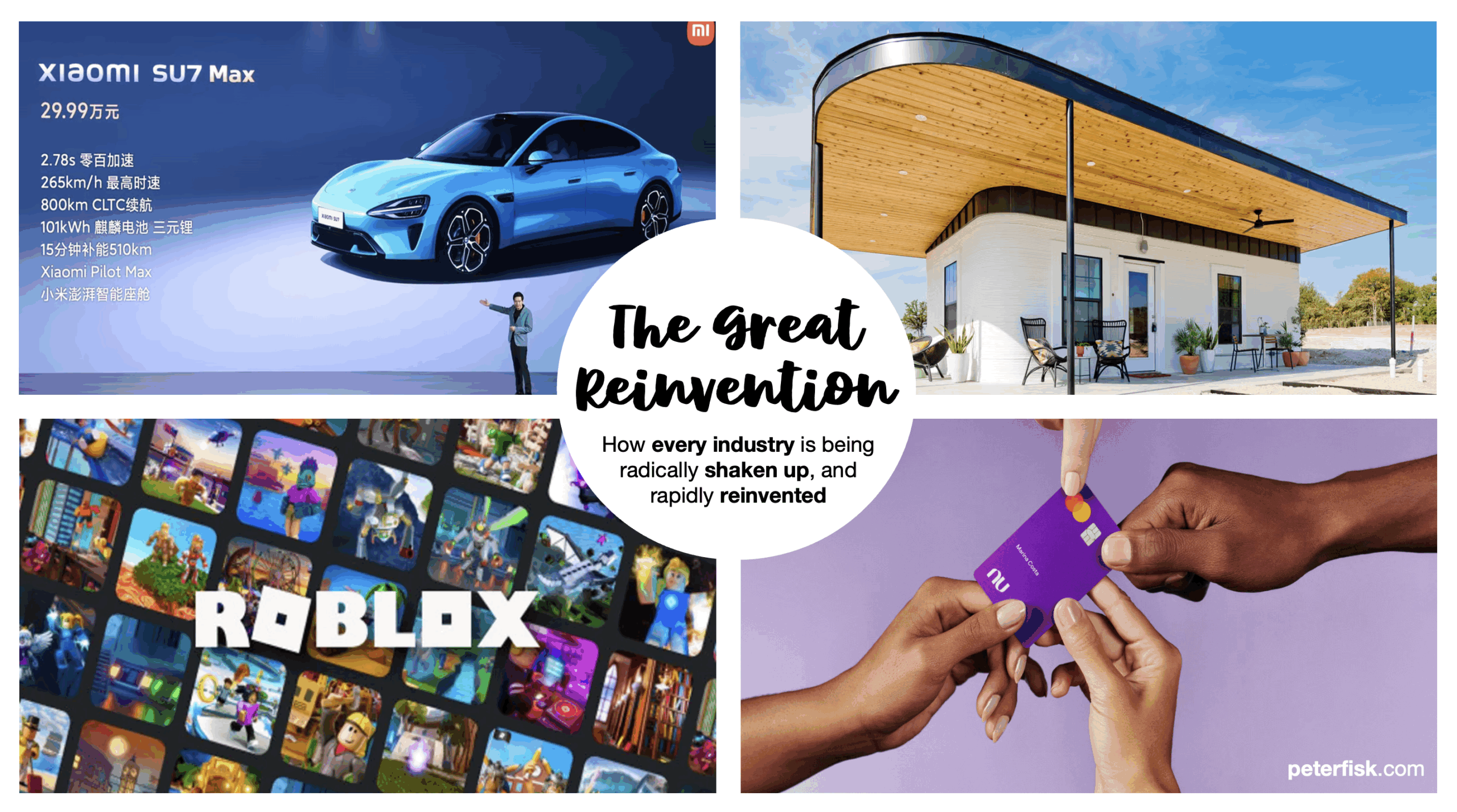
Automotive
When Lei Jun unveiled the SU7 electric supercar from his smartphone maker Xiaomi, with comparable features but over 90% cheaper than a Porsche Taycan, we knew the industry was not just being disrupted, but fundamentally reinvented. No longer just about horsepower and design, the future of cars became about software, autonomy, and energy ecosystems. Disruptors like Tesla, BYD, and Rivian are redefining mobility, while incumbents like GM and VW scramble to catch up. The future belongs to firms that can merge electric drivetrains with data-driven intelligence, build direct customer relationships, and plug into renewable grids.
- Key Drivers: EV revolution, autonomy, mobility-as-a-service
- Disruptors: Tesla, BYD, Rivian, Waymo, Nio, Xiaomi
- Incumbents: VW and Hyundai invest heavily in EVs and batteries; GM pivots toward all-electric by 2035
- Future Winners: Tesla remains dominant due to its integrated energy + mobility model; Chinese EV players like BYD are poised to lead on affordability and scale; Apple and Sony may emerge through software-first approaches
- Growth Areas: EVs, autonomous fleets, in-car software, subscription mobility
- Outlook: $5T transformation underway; platforms and ecosystems will define winners
Banking
In Brazil, David Vélez launched Nubank to free people from bureaucratic, fee-heavy traditional banks. With nothing more than a smartphone and a smile, customers signed up for accounts in minutes. Nubank now serves over 90 million users. Fintechs are rewriting the rules with embedded finance, AI risk models, and crypto rails. Traditional banks must become platforms, not fortresses. Future leaders will be those who turn trust, data, and user experience into intelligent financial ecosystems.
- Key Drivers: Fintech, AI, blockchain, real-time services
- Disruptors: Nubank, Revolut, Stripe, Square, DeFi
- Incumbents: JPMorgan and DBS investing in AI, APIs, and sustainability-linked finance
- Future Winners: Digital-first, customer-centric, embedded finance providers that turn financial services into frictionless tools
- Growth Areas: AI-enabled wealth tools, crypto custody, sustainable lending
- Outlook: Banking becomes invisible, embedded in lifestyle
Construction
Using 3D printing, Icon built a house in 24 hours using a giant robotic arm and a special concrete blend—radically reducing time, cost, and environmental impact. This illustrates the kind of breakthrough needed in a notoriously slow-moving industry. Innovation now means modular, smart, and zero-carbon construction. Giants like Skanska are investing in digital twins and low-carbon cement. Winners will combine automation, green design, and tech-savvy talent to transform how we build the future.
- Key Drivers: Green buildings, modular methods, robotics
- Disruptors: Icon (3D printing), Katerra (prefab), CarbonCure (CO2 tech)
- Incumbents: Skanska, Bouygues, Holcim, and Turner adopting digital twins and zero-carbon materials
- Future Winners: Tech-integrated construction firms that deliver faster, cleaner, cheaper buildings; smart infrastructure providers
- Growth Areas: Smart cities, digital twins, sustainable housing
- Outlook: $1T green retrofit and smart build opportunity
Energy
Octopus Energy is disrupting utilities by putting customers at the heart of a clean energy revolution—offering dynamic pricing, transparency, and rapid green energy switching. In an industry long dominated by giant incumbents, it proved agility can win. The transition to net zero, powered by solar, wind, hydrogen, and AI-managed grids, is accelerating. Winners will not just produce energy, but orchestrate energy flows, storage, and demand across intelligent, decentralised networks.
- Key Drivers: Decarbonization, decentralization, storage
- Disruptors: Tesla Energy, Octopus Energy, Vestas, Climeworks
- Incumbents: Shell, TotalEnergies, and BP redefining themselves as energy transition companies
- Future Winners: Companies that integrate solar, wind, storage, and smart grids into unified platforms
- Growth Areas: Renewables, green hydrogen, carbon capture, virtual power plants
- Outlook: Clean energy to dominate mix by 2030; trillion-dollar opportunity
Entertainment
When Roblox went public, it revealed that kids were spending more time building and playing in virtual worlds than watching TV. Entertainment is no longer passive—it’s immersive, participatory, and social. New models powered by creators, fans, and algorithms are dominating, as traditional studios play catch-up. Netflix disrupted distribution; now AI and generative content are the new frontiers. Winners will build platforms that blend content, community, and co-creation.
- Key Drivers: Streaming, gaming, AI content, creator economy
- Disruptors: Netflix, Epic Games, Roblox, TikTok
- Incumbents: Disney+ reinvention; Warner Bros. bets on streaming + IP
- Future Winners: Firms that merge entertainment, social engagement, and immersive tech; those who own IP and fan relationships
- Growth Areas: AI-generated content, gamified storytelling, AR/VR
- Outlook: Creator platforms to become dominant media forces
Fashion
Pangaia isn’t just a fashion brand—it’s a material science company using seaweed fibers and bacteria-based dyes to reinvent sustainable clothing. Fashion is being reshaped by digital identities, circular design, and transparent supply chains. Fast fashion disruptors like Shein use real-time data and micro-inventory, while luxury players are experimenting with resale and digital fashion. Future winners will merge purpose with personalization, creating garments that are smart, sustainable, and story-driven.
- Key Drivers: Sustainability, digital fashion, circularity
- Disruptors: Shein, ThredUp, Pangaia, DressX
- Incumbents: LVMH and Zara building closed-loop supply chains and digital experiences
- Future Winners: Brands that mix identity, impact, and innovation; digital-native and circular-first businesses
- Growth Areas: Resale, AI design, bio-materials, virtual clothing
- Outlook: Fashion shifts from volume to value, driven by tech + conscience
Food and Drink
At NotCo, AI named Giuseppe creates plant-based versions of animal products by analyzing molecular similarities. It made mayo, milk, and meat that taste like the real thing—but aren’t. This signals a shift toward food as software: designed, personalized, and planetary. The food revolution is being driven by sustainability, health, and technology. Giants like Nestlé are investing in alt-proteins. Winners will feed the future with science, values, and delicious innovation.
- Key Drivers: Health, sustainability, transparency
- Disruptors: Beyond Meat, Oatly, NotCo, Upside Foods
- Incumbents: Nestlé and Unilever invest in plant-based and direct-to-consumer (DTC) platforms
- Future Winners: Brands that align with planetary and personal health; those who digitize the food chain
- Growth Areas: Alt protein, fermentation tech, personalized nutrition
- Outlook: $300B alt-protein industry by 2030; data becomes the key ingredient
Healthcare
During the COVID-19 pandemic, BioNTech—once a little-known biotech firm—partnered with Pfizer to deliver a vaccine in record time using mRNA technology. It was a moonshot moment. Healthcare is being reinvented through genomics, AI, and patient-centric platforms. Startups like Tempus and Babylon offer predictive care and digital diagnoses, while incumbents digitize clinical pathways. Future leaders will move from treating illness to preventing it—personalized, predictive, and precision-driven.
- Key Drivers: AI, genomics, personalized medicine
- Disruptors: Tempus, BioNTech, 23andMe, Babylon Health
- Incumbents: Pfizer, Novartis and Roche embed AI across drug discovery and diagnostics
- Future Winners: Companies delivering preventive, digital, and personalized care at scale
- Growth Areas: AI drug discovery, wearable diagnostics, gene therapies
- Outlook: From reactive to proactive care; multi-trillion-dollar ecosystem
Insurance
Lemonade turned heads by settling some claims in under 3 seconds, using AI and behavioral economics. It proved insurance doesn’t have to be slow, opaque, or distrusted. Climate volatility and shifting lifestyles demand real-time, proactive coverage. Incumbents like Munich Re are adapting with prevention-as-a-service. The winners will anticipate, not just insure—embedding risk reduction, AI insights, and customer trust into everything.
- Key Drivers: Risk prevention, personalization, AI pricing
- Disruptors: Lemonade, Zego, FloodFlash, Trōv
- Incumbents: AXA and Munich Re building smart risk platforms and climate resilience tools
- Future Winners: Insurers who evolve into risk-reduction partners powered by real-time data
- Growth Areas: Parametric insurance, embedded models, prevention-as-a-service
- Outlook: Reinvention from safety net to proactive value provider
Manufacturing
Relativity Space is using 3D printing to make rockets—95% fewer parts, far faster iterations. It’s a symbol of manufacturing’s new age: flexible, intelligent, and software-defined. Automation, IoT, and AI are transforming everything from design to delivery. Legacy players like Siemens and GE are embracing digital twins. The factories of the future will be smart, sustainable, and continuously learning.
- Key Drivers: Industry 4.0, robotics, sustainability
- Disruptors: Relativity Space, Xometry, Vention
- Incumbents: Siemens, GE, and Bosch digitizing supply chains and factory floors
- Future Winners: Agile, hyper-automated, sustainable manufacturers with digital cores
- Growth Areas: Smart factories, additive manufacturing, nearshoring
- Outlook: $1T+ productivity gains from intelligent manufacturing
Retail
Shopify gave small businesses global reach with a few clicks—and now powers millions of storefronts. Retail is shifting from stores to ecosystems, driven by social commerce, AI curation, and instant fulfillment. Amazon, Temu, and ThredUp are reshaping expectations. Incumbents must combine digital agility with deep human insight. The next winners will create seamless, personalized, and values-based retail experiences.
- Key Drivers: Omnichannel, AI personalization, circularity
- Disruptors: Amazon, Shopify, Temu, ThredUp
- Incumbents: Walmart and Target investing in AI, last-mile, experiential retail
- Future Winners: Ecosystem retailers blending physical, digital, and sustainable offerings
- Growth Areas: Social commerce, live shopping, AI recommendation engines
- Outlook: Retail = technology; brand trust + data + delivery = competitive edge
Technology
When OpenAI released ChatGPT, it stunned the world—and ignited an AI arms race. Technology is the force multiplier of every transformation. AI, quantum, chips, and decentralised platforms are reshaping what’s possible. Disruptors like DeepMind and Anthropic push the frontiers, while incumbents like Microsoft integrate AI into everything. The winners will be ecosystem architects, building the foundations of a superintelligent, secure, and inclusive digital world.
- Key Drivers: AI, cloud, quantum, cybersecurity
- Disruptors: OpenAI, DeepMind, Anthropic, Nvidia
- Incumbents: Microsoft and Google integrating GenAI across platforms
- Future Winners: Platform-native firms owning data, chips, and AI layers
- Growth Areas: GenAI, autonomous agents, AI operating systems
- Outlook: Tech drives all other industries; $10T+ value shift imminent
Telecoms
Starlink launched satellites fast enough to beam high-speed internet to war zones and remote villages alike. It showed how agile, hardware-software integrated telecom can leapfrog legacy infrastructure. With 5G, edge computing, and AI, telecom is evolving into a platform for everything—especially B2B. The leaders will connect not just people, but machines, data, and intelligence.
- Key Drivers: 5G, private networks, AI-managed ops
- Disruptors: Starlink, Rakuten Mobile, Helium Network
- Incumbents: AT&T, BT, and Orange reposition as digital service providers
- Future Winners: Providers offering integrated connectivity, intelligence, and cloud-edge infrastructure
- Growth Areas: Satellite internet, B2B 5G, telecom-as-a-platform
- Outlook: Telcos reinvent as enablers of digital society
Travel
Airbnb changed not just where we stay—but how we experience the world. It made travel more local, personal, and flexible. Now, the rise of conscious travelers, nomadic workers, and immersive tech is redefining journeys. EcoHotels and digital nomad platforms are growing fast. Future winners will offer sustainable, seamless, and soul-nourishing travel—with data-driven personalisation and low-impact design.
- Key Drivers: Sustainable tourism, remote work, personalization
- Disruptors: Airbnb, Boom, Hopper, Nomadic, EcoHotels
- Incumbents: Marriott and Accor push eco-design, digital concierge, loyalty platforms
- Future Winners: Brands offering flexible, immersive, low-impact experiences
- Growth Areas: Bleisure (business + leisure), digital nomad services, green destinations
- Outlook: Travel reimagined around purpose, data, and experience.

Winners and losers
Of all the industries listed, technology, energy, and healthcare are likely to be transformed the most dramatically and the fastest in the next five years. However, the strategic stakes are high across all industries — and the value impact of getting it right vs wrong can mean survival vs extinction, or exponential growth vs stagnation.
Technology is the enabler of disruption across every other sector. Its pace is exponential due to AI, quantum computing, chips, and software-defined everything. Winners will become AI-native platforms, building ecosystems not just products. Losers will underestimate AI’s impact or failing to adapt legacy business models. Companies that win, like Microsoft and Nvidia, are adding hundreds of billions in market cap. Losers risk obsolescence in 3–5 years.
In energy – accelerating due to climate pressure, policy shifts, and clean tech investment – the transition from fossil fuels to renewables is reshaping everything from national security to consumer choices. Winners will be joining the shift to decentralised, customer-centric energy platforms, like Octopus Energy. Losers cling to fossil-heavy models or slow-moving asset bases. This is a $100+ trillion transition opportunity globally, where winners gain access to premium markets and long-term capital.
And in healthcare – changing rapidly due to genomics, AI diagnostics, digital therapeutics, and aging populations – the reinvention is black and white: from reactive to predictive, from generic to personalised. Winners will invest in AI, data infrastructure, and consumer-led models. Losers fail to reinvent legacy systems or ignoring preventive platforms. Personalized medicine and digital health could unlock over $3 trillion in new value globally.
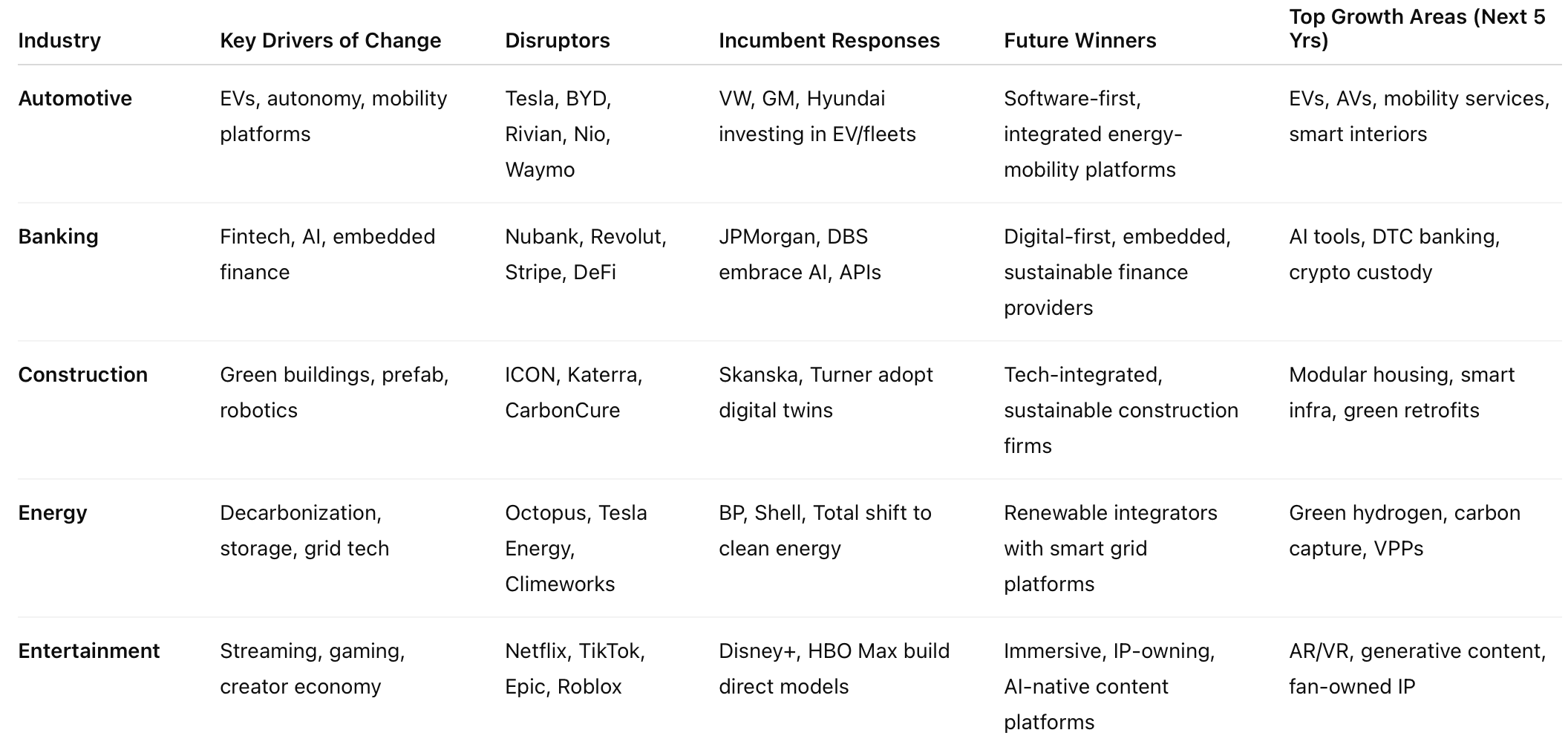
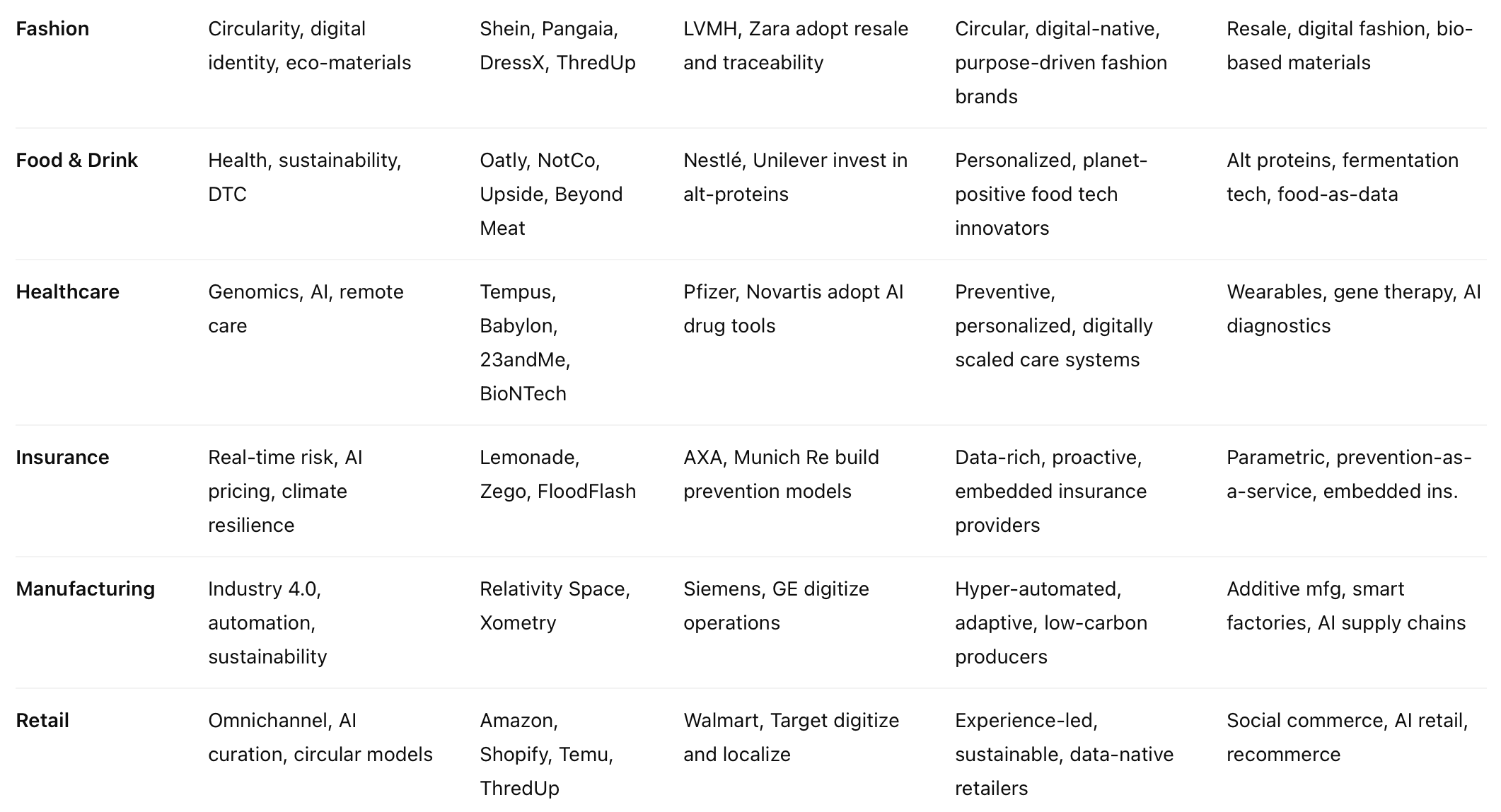
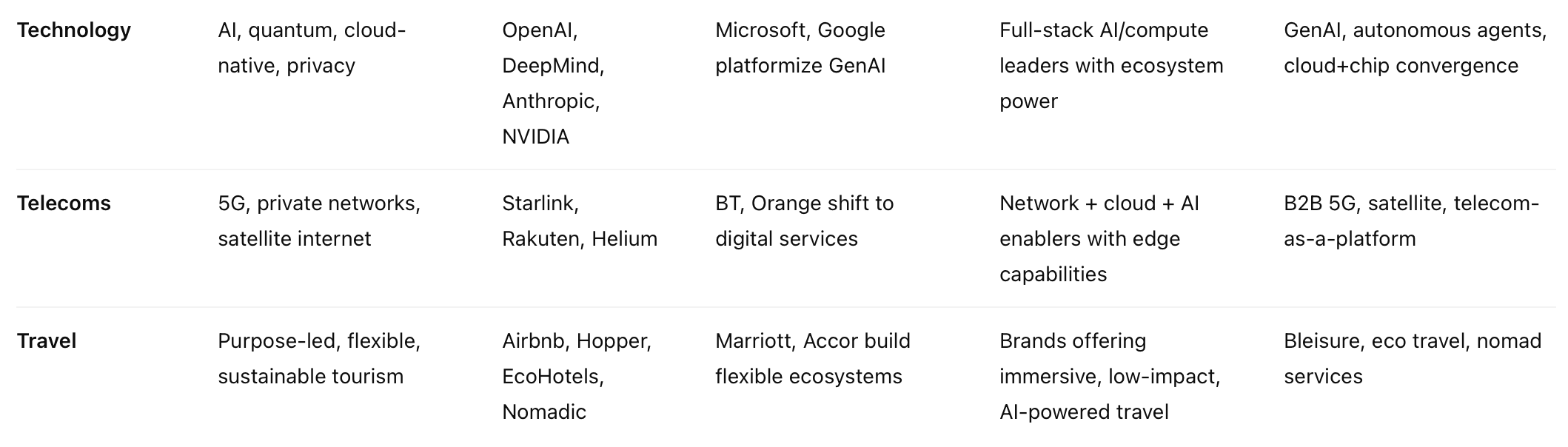

Time to reinvent everything
Across every industry, reinvention is no longer optional—it’s the new normal.
Forces such as AI, climate imperatives, digital-native consumers, and global competition are disrupting traditional business models and reshaping value chains. From energy to entertainment, food to finance, every sector is being redefined by new technologies, agile entrants, and escalating stakeholder expectations. The next five years will see more industry change than the last 50 years.
Future winners won’t simply digitize what they’ve always done. They will reimagine what’s possible. They will move faster, scale smarter, and act bolder—blending innovation, purpose, and resilience into every part of their business. They will be led by visionaries who see around corners and build adaptive, AI-powered organizations that learn and evolve in real-time.
The playbook for future winners includes:
-
Adopt a platform mindset: Build ecosystems, not empires. Share data, integrate services, and create value with partners.
-
Embed intelligence everywhere: Use AI to automate, personalize, and optimize—from supply chains to customer journeys.
-
Design for impact: Prioritize sustainability, health, and wellbeing. Turn climate and social challenges into innovation opportunities.
-
Act with agility: Use modular structures, empowered teams, and rapid iteration to adapt at speed.
-
Monetize intangibles: Build brands, trust, data, and communities—not just products.
-
Think globally, execute locally: Scale ideas fast, but tailor them to people and places with cultural insight.
The companies that win will create not just better businesses, but better futures—where growth and good are inseparable. The race is on to lead, to learn, and to leap.
Explore more, with Peter Fisk:
- The Reinvention Playbook: Lamborghini was a tractor company, Samsung was a grocery store
- Future Junkies: Why the best leaders are obsessed about what’s next
- What will they do next?: Anticipating the progress (and performance) of some of leading companies 2025 to 2030
- Music Reinvented: How an industry was reinvented through ecosystem thinking
- Reinventing Business with AI: the best of tech to radically reinvent organisations, and accelerategrowth
- The Net Positive Playbook. Allbirds to Climeworks, reinventing organisations for sustainable growth
- Pioneers and Transformers. Leading Airbus towards a better future, today and tomorrow
- The “Performer Transformer” Leader. Thriving in a world of relentless change
In a fast-changing global economy, the ability to grow, adapt, and innovate is no longer optional—it’s existential. Yet how companies pursue growth and innovation varies dramatically around the world. The business mindsets that shape these efforts are deeply rooted in regional histories, cultures, economies, and institutions.
Nowhere is this contrast more evident than between the three major economic blocs: America, Europe, and Asia. Each has developed a distinct approach to growth and innovation—reflecting differing attitudes toward risk, regulation, competition, social responsibility, and the role of the state. Understanding these differences is crucial for any global business leader looking to scale ideas or navigate new markets.
America … Bold, Fast, and Founder-Driven
America has long been the epicenter of disruptive innovation. From Silicon Valley tech giants to biotech startups in Boston and clean energy hubs in Texas, the US ecosystem rewards ambition, speed, and scale.
At the heart of the American mindset is the cult of the entrepreneur. Founders are celebrated as visionaries and risk-takers. Venture capital flows freely to big ideas with even bigger potential returns. The prevailing ethos is: “Move fast and break things”—a willingness to experiment, fail, and iterate quickly. Companies like Tesla, Amazon, and OpenAIexemplify this mindset—prioritising first-mover advantage, hypergrowth, and massive bets on the future.
This drive is underpinned by a strong private sector, deep capital markets, and a relatively light-touch regulatory environment. In many industries, competition is fierce but welcomed. Success is measured in market capture, valuation, and growth curves, often at the expense of short-term profit or social consensus.
In this environment, innovation is often radical and high-risk. Startups aim to “disrupt” incumbents. Companies pivot rapidly. Failures are seen as a rite of passage. And platforms, not products, increasingly dominate—designed to scale globally from day one.
But the American model is not without drawbacks. Its focus on speed and dominance can lead to backlash—regulatory (as with Big Tech), social (as with gig economy labor practices), or ethical (as seen in AI and data privacy concerns). Its innovation engine is powerful but often individualistic and capital-centric, sometimes prioritising shareholder returns over broader social value.
Europe … Cautious, Collaborative, and Responsible
Europe takes a different approach. Its innovation mindset is shaped by stability, regulation, inclusivity, and sustainability. European companies often innovate incrementally rather than disruptively, and growth is usually slower but more deliberate and long-term.
Many European business cultures value consensus, quality, and risk management. Innovation is typically tied to social goals, such as environmental responsibility, worker rights, and long-term societal benefit. This is evident in the European Union’s push for the Green Deal, data sovereignty rules like GDPR, and a wave of regulation around AI and digital markets.
Rather than creating monopolistic platforms, Europe tends to foster ecosystems of collaboration—between companies, governments, universities, and civil society. Companies like Siemens, Schneider Electric, Novo Nordisk, and Vestasinnovate in deeply technical, highly regulated sectors such as clean energy, healthcare, and infrastructure. Their innovations are less about market blitzing and more about resilience, compliance, and systems thinking.
The European Union supports this mindset with robust public funding for research (like Horizon Europe), strong worker protections, and frameworks for ethical innovation. The rise of B Corps, social enterprises, and circular economy models shows how innovation and purpose increasingly go hand in hand.
However, Europe’s strengths can also be its constraints. Risk aversion, bureaucratic inertia, and fragmented marketscan stifle ambition and delay digital transformation. There are fewer unicorns and less venture capital than in the U.S. Talent can be conservative, and scaling across borders is slowed by linguistic and legal complexity.
Yet Europe’s values-led approach positions it well for the next wave of innovation, especially in climate tech, digital trust, and responsible AI—areas where regulation and ethics are not barriers but competitive advantages.
Asia … Adaptive, Ambitious, and Systemic
Asia represents a third model—marked by adaptive pragmatism, national ambition, and technology-driven scale. In markets from China and India to Southeast Asia and South Korea, growth and innovation are often intertwined with nation-building, infrastructure development, and leapfrogging legacy systems.
Asian companies thrive in fast-growing, often chaotic markets, where customer needs are diverse and infrastructure is uneven. This has led to the rise of super apps, AI-based services, and platform-based business models that solve multiple problems at once. Think of Tencent’s WeChat, Grab in Southeast Asia, or Jio in India—each reimagining what a business can do by bundling services around digital lifestyles.
In China, companies like Bytedance, Alibaba, and Ping An have used data, AI, and ecosystems to create new forms of digital infrastructure—combining finance, commerce, healthcare, and entertainment. Innovation here is not just product-focused but systemic—built around whole-of-society digital platforms.
The role of government is critical. Unlike in the US, where the state often steps back, or Europe, where it regulates from the side, many Asian governments actively shape markets—setting industrial policies, funding tech R&D, building smart cities, and partnering with private companies. This creates rapid feedback loops between regulation, demand, and innovation.
Culturally, the Asian mindset is often collectivist, resilient, and entrepreneurial. There’s a strong bias for execution and iteration, often in highly competitive markets. While Western companies debate strategy, Asian startups tend to move quickly and adjust on the fly. Innovation is driven less by ideology and more by necessity and pragmatism.
Yet Asia’s innovation model also faces challenges. In China, state influence can lead to unpredictability, especially around data and regulation. In India, infrastructure gaps and bureaucracy can slow transformation. In many Asian countries, protecting intellectual property remains an ongoing issue.
Still, the continent’s speed, scale, and systems thinking have made it the most dynamic innovation region of the 21st century.