“AI is the defining technology of our time. It will transform how we live and work, and every organisation will need to adopt it to remain competitive” says Microsoft’s Satya Nadella. “Just as electricity transformed almost everything 100 years ago, today I have a hard time thinking of an industry that I don’t think AI will transform in the next several years” adds Andrew Ng of Coursera.
Nvidia’s Jensen Huang says simply “We’re at the iPhone moment of AI. Every company is becoming an AI company.”
- AI Strategy Playbook by BOI
- 15 Big Ideas with AI by Peter Fisk
- The Top 10 AI Stories of 2024 by IEEE Spectrum
- Superagency in the Workplace by McKinsey
- 2025 AI Index Report by Stanford
- AI Ready collection of articles by Thinkers50
“AI is the new electricity”
AI is not new. It’s been shaping our lives almost invisibly for some years – from Google’s search to Apple’s navigation, curated Instagram feeds and Netflix recommendations.
But now AI is more fundamentally, radically and rapidly, reshaping the business landscape. It offers transformative possibilities across strategy, innovation, branding, marketing, business models, supply chains, ecosystems, teams, organizations, and leadership.
-
Amazon uses AI to automate its entire supply chain—from demand forecasting and warehouse robotics to last-mile delivery. AI-driven systems predict what products you’ll want, where to store them geographically, and how to price them dynamically, boosting efficiency and reducing delivery times to hours. Reinvention results in higher margins, reduced inventory costs, and unrivalled customer satisfaction.
-
Stitch Fix reimagined retail by using AI algorithms to personalise fashion choices for customers, blending data science with human stylists. Every customer gets a “Fix” tailored specifically to them, based on deep learning from style preferences, body shape, weather, and return behaviour. The impact of this reinvention is reduced returns, higher customer loyalty, and scalable personalisation without physical stores.
-
Ping An, the Chinese financial giant infused AI across insurance, banking, and healthcare. AI bots now handle 90% of customer service inquiries. Facial recognition, AI medical diagnostics, robo-advisors, and smart underwriting transform how services are delivered. Reinvention has resulted in dramatic cost savings, reduced fraud, and new revenue streams through AI-powered health tech.
These examples showcase the transformative potential of AI across every type of business, energy and entertainment, food and finance, to manufacturing and mobility. And the economic impact will be incredible, as explained by top investment analyst from Ark Invest, Cathie Wood:
Every business is now an AI business
“The real opportunity with AI is not in doing the same things more efficiently, it’s doing completely new things. Reinventing business models, reinventing processes, and reinventing products” challenges Stanford’s Erik Brynjolfsson. Few-Fei Li, his colleague adds “We’re not just creating tools, we’re shaping a new business and social infrastructure. AI will redefine how we create value.”
IBM’s former CEO Ginni Rommerty reflects “AI will change 100% of jobs, 100% of industries, and 100% of workflows. Not just automate, but augment and reinvent.”
So how will AI practically transform every aspect of business?
1. AI-driven Strategy
AI enables businesses to make data-driven decisions with unprecedented accuracy. Predictive analytics, powered by machine learning, can forecast market trends, customer behavior, and operational risks. For example, AI tools like IBM Watson can analyze vast datasets to provide actionable insights, helping companies anticipate challenges and opportunities.AI also supports scenario planning by simulating various business outcomes based on different strategies. This allows leaders to test and refine their approaches before implementation, reducing risks and maximizing efficiency.
2. AI-driven Innovation … hours to develop new ideas to market
AI accelerates innovation by identifying market gaps and customer needs. For instance, AI-powered platforms like Salesforce Einstein analyze customer feedback and social media trends to uncover unmet demands. This enables businesses to develop products and services that resonate with their target audience. Generative AI, such as OpenAI’s GPT models, can assist in brainstorming and prototyping. Companies use these tools to generate ideas for new products, marketing campaigns, and even software development, fostering creativity and reducing time-to-market.
3. AI-driven Brands … building personal and relevant brands
AI enhances brand management by enabling hyper-personalization. Tools like Adobe Sensei analyze customer data to create tailored experiences, ensuring that brands connect with their audience on a deeper level. AI also helps monitor brand reputation. Sentiment analysis tools can track online mentions and reviews, allowing companies to address issues proactively and maintain a positive image.
4. AI-driven Marketing … anticipating every customer need
AI revolutionizes marketing through automation and personalization. Platforms like HubSpot use AI to optimize email campaigns, social media posts, and advertisements, ensuring maximum engagement. Predictive analytics in marketing helps identify the most effective strategies for reaching target audiences. For example, Netflix uses AI to recommend content based on user preferences, driving customer retention and satisfaction.
5. AI-driven Business Models … reinventing customer experiences
AI enables the creation of innovative business models. Subscription-based services, powered by AI, offer personalized experiences that adapt to user behavior. Spotify and Amazon Prime are examples of companies leveraging AI to enhance their offerings. AI also supports the gig economy by matching freelancers with projects that align with their skills and preferences. Platforms like Upwork use AI algorithms to streamline this process, benefiting both workers and employers.
6. AI-driven Supply Chains … transforming sourcing and production
AI optimizes supply chain management by predicting demand, reducing waste, and improving efficiency. For instance, Amazon uses AI to forecast inventory needs and automate warehouse operations. Predictive maintenance, powered by AI, ensures that equipment operates smoothly, minimizing downtime and reducing costs. This is particularly valuable in industries like manufacturing and logistics.
7. AI-driven Ecosystems …. transforming the whole system
AI fosters collaboration within business ecosystems by connecting stakeholders and streamlining processes. Platforms like Microsoft Azure enable companies to integrate AI solutions across their operations, enhancing productivity and innovation. AI also supports ecosystem mapping, helping businesses identify key players, opportunities, and risks within their industry. This enables strategic partnerships and informed decision-making.
8. AI-driven Teams … teams that can achieve more
AI enhances team dynamics by automating repetitive tasks and freeing employees to focus on creative and strategic work. Tools like Slack integrate AI to improve communication and collaboration within teams. AI-powered analytics can also assess team performance and provide recommendations for improvement. This fosters a culture of continuous learning and development.
9. AI-driven Organizations … faster and more intelligent
AI transforms organizational structures by enabling agile and data-driven decision-making. Companies like Google use AI to analyze employee feedback and optimise workplace policies. AI also supports diversity and inclusion initiatives by identifying biases in hiring and promotion processes. This ensures that organizations build equitable and inclusive environments.
10. AI-driven Leadership … smart leaders
AI empowers leaders with real-time insights and predictive analytics, enabling them to make informed decisions. Tools like Tableau provide visualisations that help leaders understand complex data and identify trends. AI also supports leadership development by offering personalised training programs. Platforms like LinkedIn Learning use AI to recommend courses based on individual goals and career paths.
AI is transforming every industry
AI is revolutionizing business across multiple dimensions, from strategy and innovation to leadership and organizational dynamics. By embracing AI, companies can unlock new possibilities, drive growth, and stay ahead in an increasingly competitive landscape. The examples highlighted above demonstrate the transformative potential of AI, making it an indispensable tool for businesses in the modern era. Let me know if you’d like me to expand on any of these areas!
AI at Amazon
Amazon is a trailblazer in leveraging AI to revolutionize its operations and customer experiences.
Amazon, a global leader in e-commerce and cloud computing, has integrated AI into nearly every aspect of its business. From personalized shopping experiences to supply chain optimization, AI plays a pivotal role in Amazon’s success.
- Personalized Recommendations: Amazon’s recommendation engine is powered by AI algorithms that analyze user behavior, purchase history, and browsing patterns. This system suggests products tailored to individual preferences, significantly boosting sales and customer satisfaction.
- Supply Chain Optimization: AI helps Amazon manage its vast supply chain efficiently. Predictive analytics forecast demand, ensuring optimal inventory levels. Additionally, AI-powered robots in warehouses streamline order fulfillment, reducing costs and delivery times.
- Voice-Activated Technology: Amazon’s Alexa, an AI-driven virtual assistant, has transformed how customers interact with technology. Alexa uses natural language processing (NLP) to understand and respond to voice commands, enabling tasks like shopping, controlling smart home devices, and accessing information.
- Fraud Detection: AI algorithms monitor transactions to detect and prevent fraudulent activities. This ensures a secure shopping experience for customers and protects Amazon’s platform from potential threats.
- Dynamic Pricing: Amazon uses AI to adjust product prices in real-time based on factors like demand, competition, and inventory levels. This strategy maximizes revenue while offering competitive prices to customers.
Amazon’s AI-driven strategies have revolutionized the e-commerce industry. The company’s ability to personalize experiences, optimize operations, and innovate continuously has set a benchmark for businesses worldwide. This case study highlights the transformative power of AI in driving growth and efficiency.
AI at Lemonade
Lemonade Insurance is a standout example of how AI can transform the insurance industry.
Founded in 2015, Lemonade Insurance is an insurtech company that aims to simplify the insurance experience through technology. It offers home, renters, and pet insurance, among other products, and has gained recognition for its customer-centric approach.
- Claims Processing: Lemonade’s AI chatbot, “AI Jim,” handles claims autonomously. Using natural language processing (NLP) and machine learning, AI Jim analyzes claims submissions, checks policy conditions, and executes anti-fraud algorithms. In some cases, claims are processed and paid within seconds.
- Customer Interaction: Lemonade uses AI to provide instant quotes and policy recommendations. Customers can obtain insurance coverage in as little as 90 seconds, enhancing convenience and satisfaction.
- Fraud Detection: AI algorithms monitor claims for potential fraud, ensuring accuracy and protecting the company from financial losses.
- Behavioral Economics: Lemonade incorporates behavioral economics principles into its AI systems to improve customer engagement and trust. For example, its “Giveback” program donates unclaimed premiums to charities chosen by customers.
Lemonade’s AI-driven strategies have significantly reduced operational costs and improved efficiency. The company reported that AI Jim processed over 30% of claims without human intervention, with an average settlement time of just three seconds. This rapid processing has set a new standard in the insurance industry.
Lemonade’s innovative use of AI demonstrates the transformative potential of technology in insurance. By automating processes, enhancing customer experiences, and promoting transparency, Lemonade has disrupted traditional insurance models and set a benchmark for others in the industry.
AI at Spotify
Spotify uses AI in several innovative ways to enhance user experience and music discovery:
- Personalized Playlists: Features like “Discover Weekly” and “Daily Mix” use AI and machine learning to analyze your listening habits and recommend songs tailored to your preferences.
- AI DJ: Spotify has introduced an AI DJ that curates and presents music in a way that feels like a personalized radio show.
- AI Playlist Creation: Premium users can now create playlists using AI by simply typing prompts like “relaxing music for a rainy day” or “upbeat tracks for a workout.” The AI generates a playlist based on the mood, genre, or theme described.
- Content Recommendations: AI helps design the Home and Search interfaces to suggest content that aligns with your tastes, making it easier to discover new music and podcasts.
Spotify’s use of AI ensures that every user has a unique and engaging experience, connecting them with the music and content they love.
Scientific and technology companies are typically obsessed about their science and tech. And as a result, they obsess about their products, their capabilities and specifications. And yet, it means and matters little to most people. Can you remember the name of that drug prescribed by your GP? Do you actually understand the technology of your cool new phone?
For too long, the world’s most technical companies have spoken in a language few people understand. Whether in pharmaceuticals, automotive, or deep tech, the focus has been on precision, process, and performance—often at the cost of empathy, emotion, and relevance. But in today’s world, where trust is fragile and attention is fleeting, even the most science-driven brands must learn to speak in a more human voice.
This isn’t about dumbing down. It’s about smartening up—about making complexity accessible, solutions relatable, and brands lovable. Because when people understand you, they engage with you. When they feel something, they believe in you.
Product to Person … the shift to human-centered thinking
It starts with a mindset shift—from inside-out to outside-in. Instead of asking, “What do we make?” the best brands ask, “What do people need? What do they care about? How do we become meaningful in their lives?”
This shift transforms the way technical businesses innovate, communicate, and grow. It encourages them to move from product features to human outcomes, from compliance to compassion, from spec sheets to stories.
Pharma: Making care personal
Pharma has long wrestled with the tension between regulatory caution and emotional connection. But brands that find the right balance can shift the conversation—and the culture.
Think of Viagra. Pfizer didn’t market it as a molecule. It became a symbol of confidence, intimacy, and vitality. It tapped into human emotion, not just biology.
Or Dove’s Real Beauty campaign (Unilever), which despite being a personal care brand, offered a lesson to all science-led companies: the product is only one part of the value; the emotional meaning is what people remember.
Even OTC brands are finding their voice. P&G’s “Like a Girl” campaign—while promoting Always sanitary products—turned a technical product into a movement for self-worth and gender empowerment. This reframed the brand as a platform for conversation, not just consumption.
Automotive: Engineering emotions
Car companies used to sell torque and horsepower. Now they sell freedom, sustainability, and joy. Tesla didn’t win the EV race by talking about batteries. It spoke about a better future—and then made you want to drive it.
Volvo, historically the safety champion, reinvented safety as emotional security—“For Life”—and used storytelling to show how its technology protects what matters most. Meanwhile, BMW shifted from “The Ultimate Driving Machine” to “Sheer Driving Pleasure,” aligning performance with feeling.
Even suppliers are taking cues. Bosch’s “Invented for Life” campaign links precision engineering with everyday human benefit—from kitchen appliances to smart mobility—demonstrating that technical excellence is only valuable when it touches people’s lives.
Technology: Speaking like a friend
Tech companies are fluent in specs. But increasingly, the most successful ones speak in stories. Apple’s mastery lies not just in design, but in its ability to translate innovation into aspiration. It doesn’t sell you an iPhone—it sells you creativity, connection, self-expression.
Google builds trust not with algorithms, but with simple interfaces and reassuring brand language (“Don’t be evil” may be gone, but the intent lives on in its design philosophy).
Even B2B brands are shifting. Salesforce, a CRM platform, uses bold human language like “Customer 360” and “Trailblazer” to make abstract tech relatable. Its “Ohana” culture language brings emotional depth to enterprise software.
Startups like NotCo, using AI to recreate animal products from plants, don’t just explain the science—they make it deliciously fun. Their brand voice is cheeky, warm, and unmistakably human, helping them build trust with curious but cautious consumers.
Engineering: From R&D to relevance
Traditional manufacturing has often hidden behind complexity. But a new wave of industrial brands are finding more engaging ways to talk—and think.
Schneider Electric moved from technical infrastructure to positioning itself as an enabler of sustainable living. “Life Is On” is more than a tagline—it reframes electrical systems as lifelines to energy equity and climate action.
GE, once focused on industrial might, evolved into a brand of “Imagination at Work,” combining high science with human stories—like a mother who built jet engines telling her daughter she too can change the world.
DSM, a science-based company in health, nutrition, and materials, rebranded with an emotionally resonant promise: “Bright Science. Brighter Living.” The shift helped position its deep R&D as a force for good—not just efficiency.
Building a consumer mindset
When technical businesses adopt a consumer mindset, they don’t just communicate better—they innovate better. They uncover unmet needs, create richer experiences, and build loyalty around meaning, not just function.
-
They add services that make life easier: Pharma brands are exploring companion apps, adherence tools, and education platforms. Auto companies offer subscription models and connected car services. Industrial firms offer predictive maintenance platforms and remote diagnostics.
-
They humanize their brand architecture: Unilever and P&G use their corporate names as trust marks, while giving space for emotionally resonant consumer brands (like Dove, Pampers, or Vicks) to shine. The parent brand provides trust and ethics; the product brand delivers experience and relevance.
-
They co-create with communities: From tech forums to health influencers, companies are inviting people into their innovation process. It’s not just about launching better products—it’s about building a sense of belonging.
-
They embrace storytelling: Whether it’s case studies, patient journeys, or behind-the-scenes documentaries, stories cut through where specs cannot. They give technology a human face.
Building human brands
The age of cold, technical superiority is over. In its place rises a new era—where credibility meets empathy, and expertise meets imagination. Where deep science and advanced engineering must still be rigorous—but now must also be relatable.
To win in this world, companies must stop thinking only about what they build—and start thinking about how people feel when they use it, when they hear about it, and when they invite it into their lives.
It’s not enough to be right. You have to resonate.
So whether you make medicines, microchips, or machines—remember: speak human.
That’s how the future listens.
Strategy gets adaptive
For most of the twentieth century, strategy was built on a simple premise: the world moved slowly enough for leaders to analyse it, anticipate it, and plan their response in advance. Annual cycles of planning and budgeting were deemed not only adequate but sophisticated. Large organisations took pride in their ability to predict, control, and optimise. Business schools taught frameworks that assumed relative stability. Consultants helped refine plans and allocate capital. Boards looked for steady hands and long-term clarity.
All of this worked, until it didn’t.
From the mid-1990s onwards, a series of structural shifts—globalisation, digitisation, the internet, and the early rise of China—began to compress competitive cycles. What used to change slowly now began to change annually. Then quarterly. Then continuously. The 2010s brought artificial intelligence, mobile-first economies, new business models, platforms, ecosystems, and a wave of disruptive entrants operating with levels of speed and flexibility that traditional organisations simply could not match. Consumer expectations soared. Technologies converged. Regulatory pressures intensified. And the arrival of the COVID-19 pandemic made volatility not an anomaly, but a baseline expectation.
It became painfully clear that the old model of strategy—predict, plan, execute—was no longer enough. The world had become too complex, too interconnected, and too fast-moving for static plans to survive contact with reality.
In response, a different idea began to emerge—one that has roots in ecology, organisational learning, systems thinking, and modern innovation practice. It is the idea that strategy itself must become adaptive: a living, learning process rather than a rigid plan; a way of thinking rather than a document; a continuous flow of sensing, interpreting, acting, and adjusting rather than a single moment of grand design.
Adaptive strategy is not a buzzword. It is the consequence of a world where certainty has collapsed. It is what happens when organisations learn to breathe with the environment rather than stand apart from it. It blends direction with iteration, ambition with humility, foresight with experimentation. It is the recognition that strategy must guide but never constrain; must set intent but allow freedom; must define priorities but leave space for discovery.
This article explores where the idea came from, what it means, how it works in practice, what tools make it possible, how leading organisations around the world apply it, and why it reshapes not only performance but culture, leadership, and organisational identity.
Understanding nature
Although “adaptive strategy” has become a staple of contemporary business vocabulary, it did not begin in business at all. Its earliest roots lie in environmental science and systems ecology.
The Ecological Foundations
In the 1970s, the Canadian ecologist C.S. “Buzz” Holling and his colleagues at the International Institute for Applied Systems Analysis (IIASA) developed the idea of adaptive management. Their concern was not competition or markets but ecosystems—complex, dynamic, interdependent environments that defied prediction. Holling observed that ecosystems behave in non-linear ways: small events could trigger large consequences; feedback loops caused surprising behaviours; shocks were inevitable; and rigid management approaches often failed disastrously.
Adaptive management offered an alternative: treat every action as an experiment; monitor the system continuously; learn as you go; adapt tactics as conditions change; and treat knowledge as provisional rather than final. The goal was resilience, not optimisation.
What Holling pioneered for forests, fisheries, and river basins would, decades later, become a crucial insight for businesses dealing with unpredictable markets.
Organisational Learning
In the 1980s and 1990s, scholars such as Chris Argyris, Donald Schön, and Peter Senge reframed organisational decision-making as a learning system. They argued that organisations fail not because they lack intelligence, but because they fail to learn—particularly in the face of disconfirming evidence. They introduced concepts such as:
-
single-loop and double-loop learning
-
mental models
-
systems thinking
-
feedback structures
Their work challenged the notion of strategy as a one-off exercise. Instead, they suggested that real performance comes from continuous reflection, reframing, and redesigning of organisational assumptions. In other words, adaptation.
Adaptive and agile
By the early 2000s, consultancies and business schools began integrating these ideas into strategic thinking:
-
McKinsey wrote about “adaptive advantage”, noting that competitive advantage was shifting from assets to agility.
-
BCG framed the “adaptive organisation” as one capable of thriving in complex environments.
-
Bain linked strategy with agile methods, emphasising learning cycles, decentralised decision-making, and fast feedback.
-
MIT Sloan School explored adaptive execution and the use of digital information flows to enable strategic flexibility.
By the 2010s, the concept had become widespread. Annual plans were increasingly viewed as obsolete. Leaders recognised that strategy must move at the speed of markets, not the rhythm of corporate calendars.
But even as it gained mainstream traction, the essence remained the same as Holling’s original insight: when environments become unpredictable, the only viable response is to learn and adapt continuously.
McKinsey captured some of the key mindset shifts to be more adaptive:
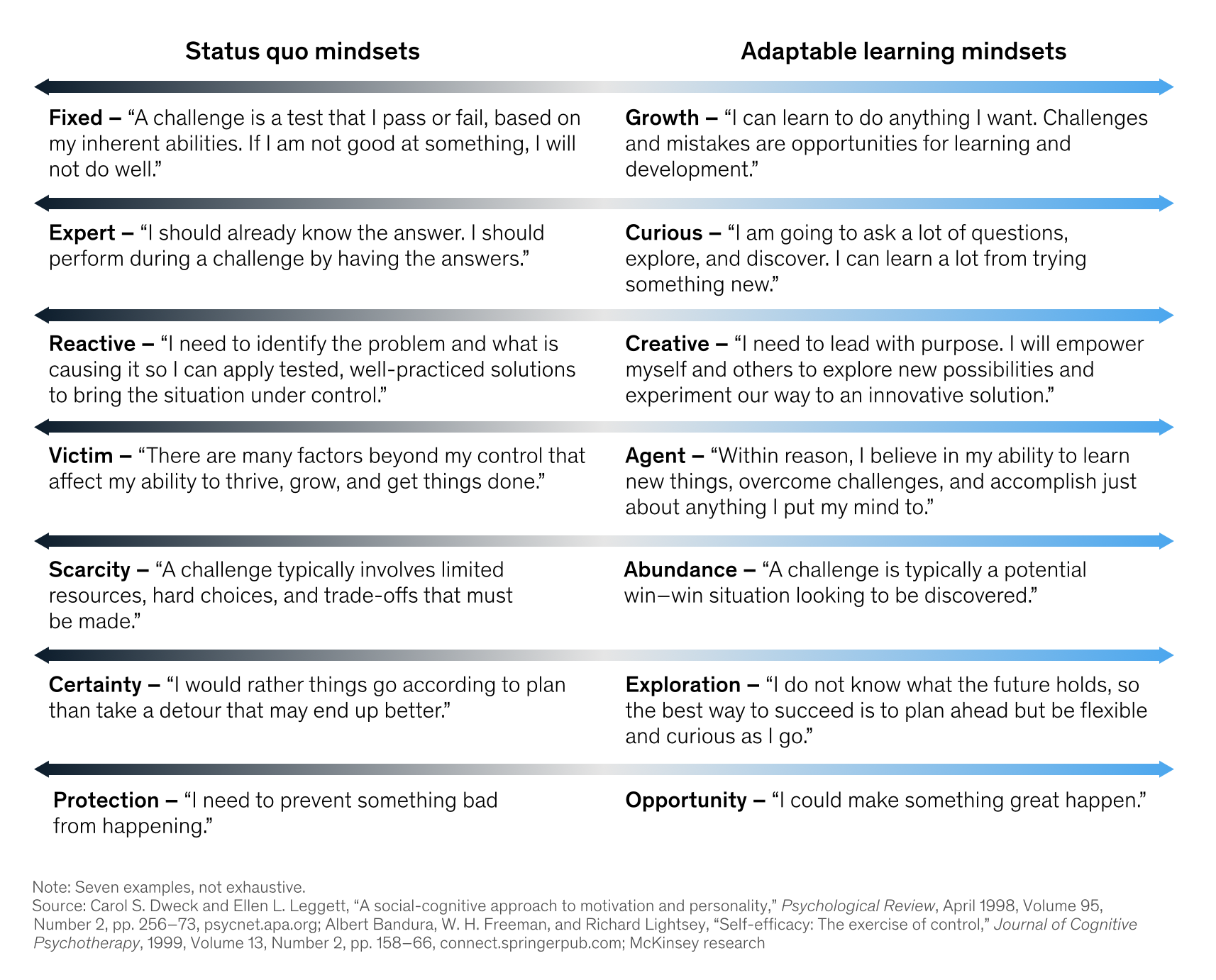
What “adaptive strategy” really means
Adaptive strategy is often misunderstood. It is not simply being flexible or agile. It is not improvisation. And it is not abandoning long-term thinking.
Adaptive strategy combines clear strategic intent with rapid, continual adjustment based on real-world feedback.
It rests on five principles:
-
Direction, not detailed prediction.
Organisations set a north star, strategic guardrails, and high-level priorities—but leave space for discovery and iteration. -
Short decision cycles.
Rather than annual plans, strategy is revisited monthly or quarterly in structured, evidence-driven conversations. -
Sense-and-respond behaviour.
Organisations invest in data, signals, and sensing systems to detect change early. -
Decentralised action.
Teams closest to the customer have authority to act, experiment, and reallocate resources within boundaries. -
Learning loops.
Every initiative becomes a source of insight, feeding back into strategy.
Crucially, adaptive strategy is neither top-down nor bottom-up. It relies on continuous interplay between the two. Leaders define ambition and guardrails; teams explore solutions and learn what works.
In this sense, adaptive strategy is less a document and more a living conversation—driven by evidence, shaped by learning, and updated in real time.
The Process
Although every organisation implements it differently, a common process has emerged across industries. It consists of five interlocking cycles.
1. Setting Strategic Intent
Adaptive strategy begins with clarity of direction. This includes:
-
Purpose: the organisation’s fundamental reason for being.
-
Ambition: where it seeks to create future value.
-
Strategic guardrails: what the organisation will and will not do.
-
High-level priorities: the big bets and areas of focus.
Unlike traditional strategy, intent is deliberately broad enough to guide yet open enough to permit iteration.
2. Sensing: Staying Connected to the World
Sensing is the continuous process of gathering signals from customers, markets, technology, competitors, and regulatory environments. It uses:
-
real-time dashboards
-
customer feedback loops
-
ethnographic research
-
horizon scanning
-
competitor radar
-
early-warning systems
-
cross-functional listening posts
The aim is not to predict the future but to detect shifts early enough to act—whether those are emerging customer needs, new digital behaviours, geopolitical risks, or competitor innovations.
3. Generating Options and Experiments
Based on insights from sensing, organisations generate options. Instead of committing to one grand plan, they explore multiple possible approaches via:
-
strategy sprints
-
horizon portfolios
-
hypothesis-driven initiatives
-
rapid prototyping
-
assumption testing
Each option is treated as an experiment designed to answer a question, reduce uncertainty, or validate an opportunity.
4. Execution Through Decentralised Teams
Rather than rigid program management, adaptive strategy relies on empowered teams who can:
-
act quickly without escalation
-
iterate solutions based on live feedback
-
adjust scope, resources, and timelines
-
collaborate across functions
-
kill or pivot ideas early
OKRs, agile methods, and autonomous teams become mechanisms for rapid learning.
5. Learning, Review, and Reallocation
Every cycle ends with reflection:
-
What have we learned?
-
What assumptions proved wrong?
-
Where do we double down?
-
What must we stop doing?
-
How should resources shift?
This creates a rhythm of strategic learning that replaces annual planning with a rolling, constantly refreshed approach.
The Tools
Adaptive strategy is enabled by a set of well-established tools and techniques. These include:
Tools for Strategic Intent
-
North Star Frameworks
-
Scenario Planning (future-back)
-
Strategic Guardrails
-
Portfolio Maps
-
Value Agendas
Tools for Sensing
-
Real-Time Customer Insight Platforms
-
Jobs-to-Be-Done Interviews
-
Market Trend Radars
-
Competitor Early-Warning Systems
-
Predictive Analytics
Tools for Exploration
-
Design Thinking
-
Strategy Sprints
-
Opportunity Portfolios
-
Hypothesis Mapping
-
Minimum Viable Business Models
Tools for Execution
-
OKRs with short cycles
-
Scrum, Kanban, or hybrid agile
-
Rapid decision protocols
-
Cross-functional squads and tribes
-
Continuous deployment in digital environments
Tools for Learning
-
Retrospectives
-
Experiment logs
-
Kill/continue/pivot gates
-
Business reviews every 4–6 weeks
-
Feedback dashboards
These tools matter not because they are fashionable, but because they enable organisations to move information, decisions, and resources at the speed required by modern markets.
Examples
Across the world, the organisations that outperform their peers are those that have embraced adaptive strategy not as a technique but as a way of operating. Here are some of the strongest examples.
Ping An: Adaptive Strategy at Ecosystem Scale
Ping An’s transformation from a traditional insurer into a digital-first, ecosystem-driven conglomerate is one of the most ambitious strategic evolutions of the past decade. Its model is built on continual sensing, experimentation, and rapid reallocation of resources.
How it works:
-
Strategy operates in 90-day cycles, with roadmaps refreshed quarterly.
-
Hundreds of micro-experiments run across health, smart cities, finance, and AI.
-
Real-time data from millions of users feeds directly into decisions.
-
New ventures such as Good Doctor, One Connect, and Autohome were created through iterative testing rather than long-term planning.
Impact:
-
Creation of multiple multibillion-dollar business lines outside core insurance.
-
Industry-leading return on equity.
-
A reputation as one of the world’s most innovative financial groups.
Ping An demonstrates adaptive strategy at scale: a continuously evolving ecosystem guided by data and learning.
DBS Bank: A Living, Learning Strategy Engine
DBS is widely regarded as the most advanced example of adaptive strategy in the global banking sector.
Approach:
- Defined a clear intent—“to make banking joyful”—but allowed teams to interpret it through local insights.
- Encouraged more than 10,000 experiments per year across the organisation.
- Used customer journeys as live strategic documents updated monthly.
- Replaced bureaucratic governance with light, fast learning loops.
- Integrated AI and data analytics into decision-making.
Impact:
- Became “World’s Best Bank” multiple times.
- Reduced cost-to-income ratio dramatically.
- Accelerated product innovation in wealth, SME, and retail banking.
- Created a culture where change is normal and experimentation is celebrated.
DBS turned strategy from a document into an engine—constantly in motion, learning, adjusting, improving.
BYD: The Masterclass in Fast-Cycle Strategic Allocation
China’s BYD is the fastest-moving large automobile and battery company in the world, and its strategy is inherently adaptive.
How BYD adapts:
-
Weekly technical reviews guide rapid product adjustments.
-
Vertical integration enables fast pivots—e.g., creating in-house chips during supply shortages.
-
Product cycles run much faster than Western competitors.
-
Frequent model updates respond immediately to real-time sales and feedback data.
Impact:
-
Became the world’s largest EV manufacturer.
-
Outpaced Tesla in China.
-
Entered new markets at record speed.
BYD thrives because it treats strategy as a continuous process, not a planning cycle.
Amazon: Strategy as Continuous Reinvention
Amazon has long rejected traditional planning. Jeff Bezos famously argued that most decisions should be “two-way doors”—reversible, temporary, and therefore not worthy of long analysis.
Adaptive mechanisms:
-
The “Working Backwards” process begins with the customer and leaves space for discovery.
-
Teams act autonomously within strategic guardrails.
-
Real-time metrics guide decisions.
-
Dozens of experiments happen simultaneously across devices, retail, cloud, logistics, and AI.
Outcomes:
-
AWS, Marketplace, Prime, Logistics, and Alexa were all outcomes of iterative exploration rather than top-down planning.
-
Amazon continually enters new categories before rivals can react.
Amazon shows that adaptive strategy is not a reaction to volatility—it is a generator of new growth.
Mercado Libre: Adaptive Scaling Across Latin America
Mercado Libre operates in one of the world’s most volatile regions. It succeeds because it adapts faster than its environment.
Key characteristics:
-
Rapid experimentation in payments, credit, shipping, and insurance.
-
Real-time adjustment to regulatory changes.
-
Decentralised teams customised to different national contexts.
-
Fast rollout of features based on user data.
Impact:
-
Largest technology company in Latin America.
-
Outperforms Amazon and local incumbents in multiple markets.
-
Created an integrated ecosystem of commerce, finance, logistics, and advertising.
Adaptive strategy allows Mercado Libre to flourish in conditions where slower organisations struggle.
Philips: Reinventing from Electronics to Health Tech
Philips’ transformation from a diversified electronics company into a focused health technology leader is an example of adaptive portfolio strategy.
How Philips adapts:
-
Uses scenario planning and strategic guardrails to steer long-term direction.
-
Runs continuous reviews to identify businesses to prune or scale.
-
Adjusts priorities based on technological, regulatory, and clinical trends.
-
Invests in digital health, imaging, connected care, and wearables based on real-time evidence.
Impact:
-
Exited more than 60% of its historical portfolio.
-
Created a coherent and competitive position in health systems.
-
Improved focus, margins, and long-term value creation.
Philips shows that adaptive strategy applies not only to innovation but to corporate restructuring and reinvention.
Schneider Electric: A Learning Loop for Climate and Energy Tech
Schneider Electric has evolved from a traditional industrial company into a digital-first energy management and automation leader.
Adaptive practices:
-
Uses strategy sprints to explore new sustainability and energy-tech opportunities.
-
Employs IoT and digital twins to sense performance in real time.
-
Allows cross-functional teams to adjust products continuously.
-
Uses agile governance to scale successful initiatives.
Results:
-
One of Europe’s most valuable industrial companies.
-
Rapid growth in software, services, and sustainability consulting.
-
Strong brand positioning in climate transition markets.
Schneider’s success demonstrates the power of adaptive strategy in large, complex industrial environments.
Spotify: The Cultural Expression of Adaptive Strategy
Spotify’s “squads and tribes” structure is famous, but it is only the visible surface of a deeper adaptive system.
How it operates:
-
Decentralised teams own problems end-to-end.
-
Data from millions of users drives weekly adjustments.
-
Features are tested continuously.
-
Organisational structure evolves as fast as the product.
Impact:
-
Constant innovation in personalisation, UI, podcasts, and audio learning.
-
Ability to outmanoeuvre larger competitors.
-
Rapid diversification into new audio categories.
Spotify shows that adaptive strategy is inseparable from culture. Empowered teams are not a technique; they are the philosophy in action.
The Difference
Adaptive strategy is not a marginal improvement. It reshapes the organisation at every level.
1. Adaptive strategy increases speed
Traditional strategy operates on annual cycles. Adaptive strategy operates on monthly or even weekly cycles. Decisions happen faster. Products evolve faster. Organisations respond to customers before competitors know what has changed.
2. Adaptive strategy enhances resource allocation
Resources move dynamically:
-
Away from declining areas.
-
Toward validated opportunities.
-
Into experiments with high potential.
-
Out of initiatives that no longer deserve support.
The organisation becomes more like a portfolio manager than a planner.
3. Adaptive strategy improves innovation
Because experimentation is continuous, the number of ideas tested grows dramatically. And because failures are cheap and early, more successful ideas reach scale.
4. Adaptive strategy reduces risks
Paradoxically, the more an organisation experiments, the safer it becomes. Early tests reveal weaknesses before money is wasted. Sensing detects threats before they become crises. Adaptive loops lower the cost of being wrong.
5. Adaptive strategy builds resilience
Adaptive organisations absorb shocks better. They are less rigid, less exposed to single points of failure, and less dependent on prediction. They treat uncertainty as normal and learn to thrive within it.
6. Adaptive strategy strengthens culture
Perhaps the most powerful difference is cultural. Adaptive strategy creates:
-
empowered teams
-
openness to learning
-
comfort with ambiguity
-
willingness to challenge assumptions
-
collaborative problem-solving
-
a bias for action
People feel ownership, autonomy, and pride. Organisations feel alive.
7. Adaptive strategy improves financial performance
Although the benefits are often cultural and organisational, they ultimately translate into commercial outcomes:
-
faster growth
-
better margins
-
stronger customer loyalty
-
improved return on capital
-
higher innovation revenue
-
sustained competitive advantage
Adaptive strategy is not a soft idea; it is a financial engine.
Strategy for a world in motion
The world has entered an era where traditional strategy cannot cope. Markets evolve too quickly. Technologies converge too unpredictably. Customer behaviour shifts too fast. Regulatory and geopolitical pressures emerge too suddenly. Competitive advantage comes less from size and assets, and more from speed of learning, willingness to adjust, and ability to act before rivals see what is happening.
In such a world, adaptive strategy is not optional. It is the new foundation for leadership and organisational excellence.
It is rooted in a deep understanding of how complex systems work. It draws from ecology, organisational learning, design thinking, agile methods, and modern digital practice. It replaces rigid planning with continuous sensing, experimentation, and learning. It balances ambition with humility, direction with discovery, judgement with evidence.
Most importantly, it restores strategy to what it truly should be: not a document, not a once-a-year ritual, but a continuous conversation about how to create value in a world that keeps moving.
Organisations that embrace adaptive strategy will not simply cope with change—they will shape it. They will grow faster, innovate more, and attract the best talent. They will be more resilient, more relevant, and more future-ready. They will develop a culture of curiosity, courage, and creativity.
And above all, they will rediscover that strategy is not about predicting the future but winning in the only world that exists: the one that changes every day.
Retail is undergoing one of the most dramatic reinventions in its history. Traditional boundaries between physical and digital retail have blurred, while customer expectations have become more personalized, immersive, and purpose-driven. Technology, data, sustainability, and experience design are converging to reshape how people shop—and how companies sell.
The seamless blend of physical and digital (phygital) will dominate. Shoppers will expect to move effortlessly between online browsing and in-store experiences, with data and personalisation syncing across all channels. AI and machine learning will power deeply personalised experiences—recommendations, dynamic pricing, styling, and even store layouts tailored to individual shoppers based on real-time data.
Physical stores will shift from transaction points to immersive brand hubs—offering AR/VR try-ons, sensory experiences, and interactive storytelling that turn shopping into entertainment. Retail will increasingly happen on social platforms, with influencers, livestream shopping, and short-form video turning content into commerce—especially among Gen Z and Gen Alpha.
Eco-conscious shopping will move from niche to mainstream. Circular models (resale, rental, repair), ethical sourcing, and carbon transparency will be expected, not optional. Retail logistics will be transformed by robotics, drones, and autonomous vehicles—enabling faster, cheaper, and more sustainable delivery of goods.
Retailers will expand into full ecosystems, offering shopping, finance, media, health, and more—similar to Alibaba or Reliance Jio in Asia—keeping customers within a single platform.
In this evolving landscape, winners aren’t just selling products. They’re building ecosystems, designing experiences, and creating emotional connections with customers. From smart stores to social commerce, autonomous delivery to generative AI, the reinvention of retail is global, fast-moving, and transformative.

1. Liquid Retail: The Hybrid Store Experience
The idea that physical and digital retail are separate is quickly becoming obsolete. Today’s consumers move seamlessly between devices and physical locations, expecting a consistent, connected experience. “Liquid” retail— more than integrating physical and digital touchpoints but getting the best of both together —is now the norm.
Nike is a standout example. Its “Nike Live” stores are smaller, digitally enabled spaces tailored to local communities. These stores use data from the Nike app to stock products that reflect local customer preferences. Customers can scan products, get personalized recommendations, and check out via mobile. This model merges data, community, and convenience.
Meanwhile, Amazon Go and Amazon Fresh are pioneering checkout-free retail. Using computer vision, sensors, and AI, these stores let customers grab items and walk out—automatically billing their accounts. This redefines in-store convenience while collecting valuable behavioral data.
2. Personalization Powered by Data and AI
One of the most powerful trends in retail is personalization—offering the right product, at the right time, to the right person. AI, machine learning, and customer data are enabling hyper-personal experiences both online and offline.
Stitch Fix, an online personal styling service, uses data science and human stylists to curate clothing selections for individual users. Its algorithm factors in personal style, fit, budget, and feedback to continually improve recommendations.
In physical stores, Sephora combines loyalty data with in-store experiences. Customers can use AI-powered tools like the Color iQ system to find personalized products, then receive app-based recommendations synced with their past purchases.
3. Immersive Shopping: AR, VR, and Mixed Reality
Retailers are embracing immersive technologies to create engaging shopping journeys. Augmented reality (AR), virtual reality (VR), and mixed reality (MR) enable customers to visualize, try on, or experience products in new ways.
IKEA’s AR app “IKEA Place” allows users to virtually place furniture in their homes before buying, helping reduce returns and boost confidence in large purchases. Similarly, Warby Parker’s Virtual Try-On lets customers see how glasses look on their face using AR.
Fashion brand Gucci has experimented with virtual fashion drops and AR try-ons on Snapchat, while Ralph Lauren has partnered with Roblox to create virtual stores and exclusive digital fashion collections, tapping into younger, gaming-savvy audiences.
4. Retail as Experience and Entertainment
With the rise of e-commerce, physical retail is no longer just about transactions—it’s about creating memorable experiences. Stores are being redesigned as immersive brand environments that educate, entertain, and build emotional connections.
Samsung 837 in New York is a prime example: it’s not a store in the traditional sense, but a tech playground with art installations, digital experiences, and a café—all designed to let visitors explore Samsung’s ecosystem.
Canada Goose created “cold rooms” in some of its stores, letting customers test jackets in sub-zero simulated environments. These sensory experiences drive word-of-mouth and deepen brand loyalty.
5. Social Commerce and Influencer-Led Shopping
Social media is becoming a direct shopping channel, transforming platforms like Instagram, TikTok, and YouTube into retail storefronts. Influencers, live shopping events, and short-form video content are driving sales in new and powerful ways.
Douyin (TikTok’s Chinese version) and Pinduoduo in China have pioneered social commerce, enabling brands and individuals to sell through livestreams, group buying, and gamified experiences. In the West, TikTok Shop and Instagram Checkout are gaining traction, especially among Gen Z.
Beauty brand Glossier grew largely through influencer and user-generated content, building a cult-like following and community-powered product development.
6. Sustainability and Ethical Commerce
Modern consumers—especially younger ones—expect retailers to be transparent, ethical, and environmentally conscious. Brands that integrate sustainability into their operations and storytelling are winning trust and loyalty.
Patagonia has long been a sustainability leader, encouraging consumers to repair rather than replace, and even running campaigns urging customers not to buy new gear. Its Worn Wear initiative promotes buying used products.
ThredUp and Depop are reinventing resale and circular fashion, offering digital thrift stores that appeal to environmentally conscious consumers. Luxury brands are entering the space too, with Gucci partnering with secondhand platform The RealReal.
7. Autonomous Delivery and Next-Gen Logistics
Convenience is king, and innovations in fulfillment, delivery, and last-mile logistics are critical to meeting consumer expectations. Automation and robotics are reshaping how goods move from warehouse to doorstep.
Ocado, a UK-based online grocer, operates highly automated fulfillment centers powered by AI and robotics. It licenses this tech to retailers globally, including Kroger in the U.S.
Nuro and Starship Technologies are developing autonomous delivery vehicles and robots that bring groceries and meals directly to consumers in urban neighborhoods and college campuses.
8. AI-Driven Merchandising and Demand Forecasting
AI isn’t just powering customer experiences—it’s optimizing behind-the-scenes operations too. Predictive analytics help retailers manage inventory, forecast demand, and reduce waste.
Zara, owned by Inditex, uses real-time sales data and short production cycles to adjust its collections rapidly. Its just-in-time model allows new designs to hit stores within weeks, matching changing trends and minimizing overstock.
Walmart uses AI across its supply chain to forecast product demand, automate replenishment, and improve in-store stocking—keeping shelves full while reducing excess inventory.
9. Retail Ecosystems and Super Apps
Retailers are expanding beyond single-product categories to become platforms or ecosystems that serve multiple needs. In Asia, this trend is especially strong.
Alibaba’s ecosystem integrates e-commerce (Taobao, Tmall), logistics (Cainiao), cloud computing, and even physical supermarkets (Freshippo). Customers can shop online, visit stores, pay via Alipay, and get same-day delivery—within one platform.
Reliance Retail in India is building a similar empire, merging e-commerce, grocery, fashion, and digital services under its JioMart platform.
10. Startups and Global Disruptors
Innovation isn’t limited to giants. Startups around the world are rethinking retail models:
-
Caper (acquired by Instacart) builds AI-powered smart shopping carts that let users check out without waiting in line.
-
Zapp and Gopuff offer 10–15-minute delivery of everyday essentials in urban areas, using micro-fulfillment centers.
-
Faire and Ankorstore are helping small retailers discover and order products from independent brands, creating a wholesale marketplace revolution.
Next is Now
Retail is no longer about selling things—it’s about curating experiences, building trust, leveraging data, and designing for a constantly connected consumer. The most successful retailers are those who experiment fearlessly, adapt quickly, and integrate technology with a deep understanding of human behavior.
As technology continues to evolve, so will the expectations of shoppers. Reinventing retail isn’t a one-time change—it’s an ongoing process. Those who embrace change, connect with purpose, and design for agility will shape the future of commerce.
When Reliance Jio launched in 2016, few could have predicted the scale and speed with which it would transform India’s digital landscape. What began as a low-cost mobile network offering free voice calls and dirt-cheap data quickly evolved into a national phenomenon—democratizing internet access, reshaping the telecom industry, and paving the way for a digital lifestyle revolution. Today, Jio is no longer just a telecom company; it is India’s most ambitious attempt at creating a super app and a lifestyle ecosystem that rivals global tech giants.
Jio Phone … imagining a digital life
Jio was born out of a vision by Mukesh Ambani, Chairman of Reliance Industries, to build a “digital lifeline” for India. With billions invested in laying fibre optic cables across the country, constructing cell towers, and building infrastructure from scratch, Jio launched with unprecedented scale and ambition. It entered the market with a game-changing strategy: six months of free data and voice calls for users. This was not just a promotional offer—it was a calculated play to acquire users, disrupt incumbents, and build a digital-first user base.
Within the first year, Jio had acquired over 100 million users. It forced competitors like Airtel, Vodafone, and Idea to lower prices or merge to survive. Jio’s entry marked the beginning of the end of the old telecom order in India and the birth of a digital economy.

Jio as a platform … beyond connectivity
Jio’s core strength lies in its ability to turn users into participants in a broader ecosystem. Recognizing that telecom margins alone wouldn’t sustain its hypergrowth ambitions, Jio quickly began developing a portfolio of digital services.
The MyJio app became the nerve centre of the ecosystem—bundling together mobile recharges, account services, entertainment, news, shopping, payments, and cloud storage. The app’s design echoed global super apps like WeChat or Alipay in China, aiming to become the primary interface for a digital lifestyle.
Services like JioCinema, JioTV, JioSaavn (music streaming), and JioNews turned the platform into a content hub. JioFiber extended its reach into homes, offering broadband, set-top boxes, and smart home features. JioMeet entered video conferencing to rival Zoom. And with JioMart, Reliance stepped into e-commerce, connecting millions of small retailers and kirana stores into a digital retail network.
Each new service reinforced the others—creating lock-in through convenience, affordability, and cross-platform integration.

Driving growth … strategic partners and expertise
Jio’s rise did not go unnoticed by global tech giants. In 2020, during the pandemic, Reliance attracted over $20 billion in investments into Jio Platforms Ltd., including stakes from Facebook (now Meta), Google, Qualcomm, Intel, and Silver Lake. These investments weren’t just capital injections—they were strategic bets on Jio’s ability to become India’s digital gateway.
Facebook’s investment included deep integration between WhatsApp and JioMart, enabling conversational commerce and social retail. Google’s investment focused on building affordable Android smartphones and digital infrastructure for the next billion users.
These alliances validated Jio’s ambitions and gave it a war chest to expand into fintech, edtech, healthtech, and enterprise solutions.
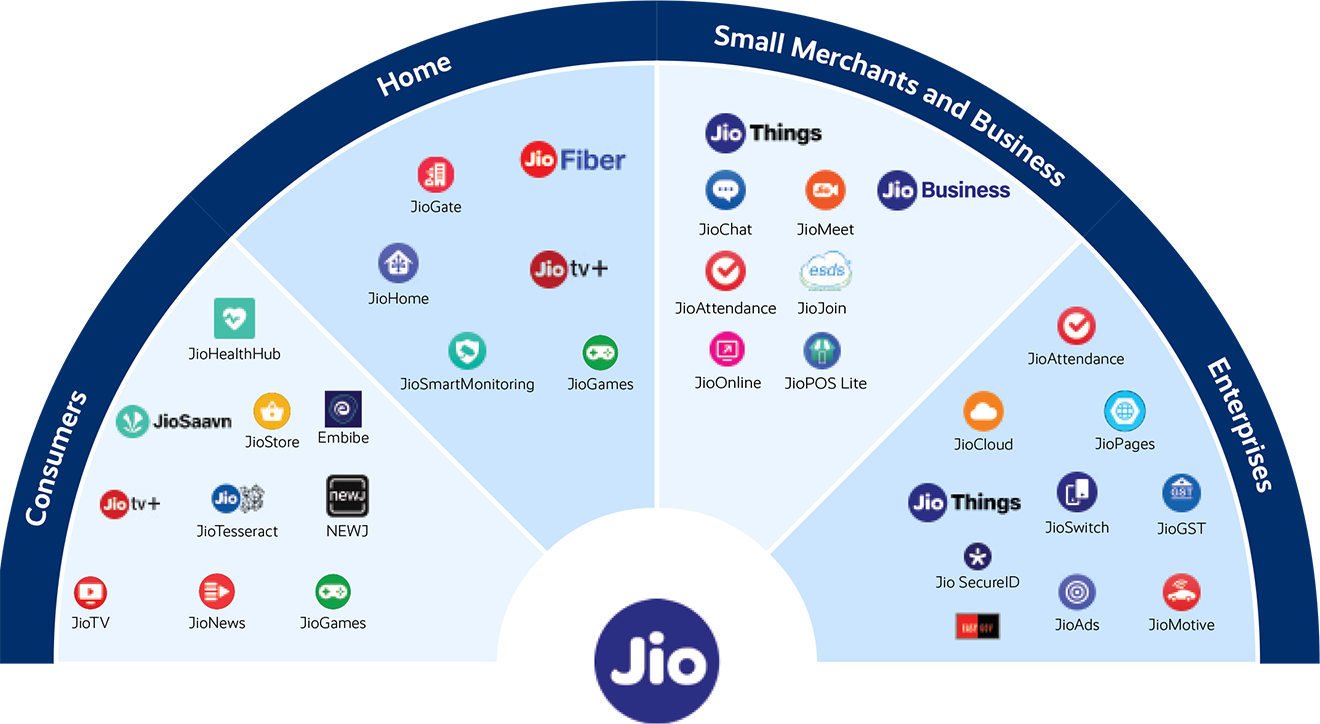
Jio’s Super App … the strategy for growth
Unlike global super apps that often begin with a dominant function (e.g. messaging in WeChat or payments in Alipay), Jio’s super app strategy is more horizontal—aiming to offer a unified digital lifestyle through multiple core services bundled under the MyJio umbrella. These include:
-
JioCinema and JioTV for streaming entertainment
-
JioSaavn for music
-
JioMart for grocery and e-commerce
-
JioPay for digital payments and UPI
-
JioMeet for communication and collaboration
-
JioHealthHub for telemedicine and health records
-
JioCloud for storage and backup
-
JioGames for mobile and cloud gaming
-
JioFinance for loans, insurance, and digital banking
Each of these services is deeply embedded into a single app, with a single sign-in, unified wallet, and seamless navigation, aiming to replicate the convenience of an operating system.
Jio as lifestyle brand … with a national identity
Jio’s brand resonates far beyond technology—it has become a symbol of national digital aspiration. The brand name “Jio” means “to live” in Hindi, and the company has positioned itself as an enabler of a better life for every Indian. Its low-cost plans brought millions online for the first time—farmers, small businesses, women, students—fueling not just consumption but education, financial inclusion, and social mobility.
As Jio expanded into smart devices—feature phones (JioPhone), smartphones (JioPhone Next), routers, and IoT devices—it deepened its position as a lifestyle brand. These devices are priced aggressively and designed specifically for the Indian context: dual SIMs, multilingual support, voice navigation, and UPI readiness.
Jio’s foray into fashion and entertainment partnerships (like with IPL, Bollywood releases, and celebrity endorsements) has added a layer of cultural capital—bridging rural and urban audiences under a single digital brand.
Data as currency … building the digital economy
Jio’s business model revolves around data as currency. Every click, payment, search, and video view generates insights that feed its personalization engines. This data-centric approach allows Jio to create targeted bundles, cross-sell services, and tailor content for hyperlocal audiences.
The super app model reinforces this loop—giving Jio a 360-degree view of user behavior. It’s not just selling internet or products; it’s selling convenience, trust, and identity.
Importantly, Jio is also building the infrastructure for India’s digital economy—through Jio Platforms, which offers cloud, edge computing, AI, and 5G capabilities for startups, enterprises, and government services. Jio is thus positioning itself as both the consumer interface and the backend enabler of India’s digital transformation.
Challenges … disruption is not easy
Despite its meteoric rise, Jio faces serious challenges:
-
Competition from nimble startups (PhonePe, Paytm, Cred) and global giants (Amazon, Flipkart, Google Pay) is intensifying.
-
Integration complexity—Jio’s vast ecosystem must deliver seamless UX across dozens of services.
-
Regulatory scrutiny—as a dominant player in many sectors, Jio will increasingly face antitrust and privacy concerns.
-
Data privacy and trust—as Jio collects more data, it must ensure user trust through transparency and ethical use.
-
Rural infrastructure—expanding 5G and broadband in remote areas still requires significant investment.
What’s next? … Jio as India’s Digital Operating System
What makes Jio unique is not just its business model but its systemic vision. While most companies target a segment or a sector, Jio is building an entire digital civilization—from connectivity and commerce to education, health, media, and governance.
Its ambitions are not unlike those of Tencent or Alibaba in China, but tailored to India’s diversity, language complexity, income distribution, and socio-economic dynamics. The recent launch of Jio Financial Services, its move into AI and cloud, and plans for 5G-enabled edge solutions all point to a company shaping India’s digital infrastructure for decades to come.
Jio is more than a company—it is the infrastructure, interface, and identity of a new India.
So what Makes Jio Unique
| Strategy | Description |
| Zero-price market entry | Free data and phones created massive adoption |
| Ecosystem-first approach | Every service linked through MyJio app |
| Rural-first design | Designed for low-literacy, low-income markets |
| Platform + Partner strategy | Invested in and integrated with global tech giants |
| Lifestyle branding | Built digital services into everyday Indian life |
Jio is not just a telecom operator — it is redefining what a company can be in emerging markets: an integrated platform combining connectivity, content, commerce, and community.
$100 billion business for 1.1 billion people
Reliance Jio is now heading towards a blockbuster IPO
Owners & Major Investors
- Parent company: Reliance Jio Infocomm is a wholly owned subsidiary of Jio Platforms, which is in turn controlled by Reliance Industries Ltd (RIL) — chaired by Mukesh Ambani .
- Equity partners: Starting mid-2020, global tech and capital firms acquired minority stakes (~33% total in Jio Platforms), including:
- Meta (Facebook) – ~9.99%
- Google – 7.7%
- Silver Lake – ~1.15%
- Intel, Qualcomm, KKR, General Atlantic, ADIA, Vista, Mubadala, TPG, others .
Subscribers
- Wireless users: ~479 million as of late 2024, up ~4% YoY .
- 5G subscribers: ~148 million by September 2024 .
- Fixed wireless broadband (JioAirFiber): ~2.8 million by Sept 2024 .
- Wired broadband (JioFiber): ~10.4 million subscribers as of Dec 2023 .
- Combined broadband: ~470 million users across wired + wireless by Dec 2023 .
Performance
Q2 FY 2025 (quarter ending Sept 2024)
- Revenue: US $4.43 billion (~₹36 000 crore) — up ~17.7% YoY .
- EBITDA: US $1.9 billion — +17.8% YoY .
- Net profit: US $780 million — +23.4% YoY .
Q4 FY 2025 (quarter ending March 2025)
- Net profit: ₹7,022 crore — a 25.7% increase YoY (from ₹5,587 cr) .
- Group digital services EBITDA growth: +18%, driven by telecom tariff hikes .
- Jio Infocomm ARPU: ₹206.2 — +13.5% YoY .
- Subscriber additions: +6.1 million in Q4, supported by tariff revisions .
Overall as a group
- Reliance Industries recorded a total consolidated profit of ₹19,407 crore (~US $2.27 billion), significantly bolstered by its retail and digital arms .
Valuation and IPO
- Valuation at 2020 fundraising: Pre-money valuation of $58 billion; proceeds totaled ~$13.7 billion .
- Analysts’ estimates (2024): Valuation pegged between $100–112 billion .
- Planned 2025 IPO: Expected to be one of India’s largest, targeting ₹10 lakh crore (~$120 billion) valuation .
| Metric | Latest Figures |
| Wireless subscribers | ≈ 479 million |
| 5G subscribers | ≈ 148 million |
| Total broadband users | ≈ 470 million |
| Q2 FY25 Revenue | US $4.43 billion |
| Q2 FY25 Net Profit | US $780 million |
| Q4 FY25 Net Profit | ₹7,022 crore (+25.7% YoY) |
| ARPU | ₹206/mo |
| Raised from investors | ~$13.7–20 billion |
| Current valuation | $100–112 billion |
| IPO target valuation | ₹10 lakh crore (~$120 billion) |
The $100 bn SuperApp for India’s billion people
Jio has scaled its ecosystem through aggressive subscriber growth, surging revenue and profit performance, and high-profile global investment—setting the stage for a blockbuster IPO. Its valuation now rivals global tech giants, highlighting its evolution from telecom disruptor to India’s digital infrastructure powerhouse.
Apple has long held the mantle of one of the world’s most innovative companies. It reinvented music with the iPod, reshaped phones with the iPhone, and further back redefined computing with the iPad and MacBook. But in recent years, many people have asked “Has Apple become more or less innovative?”
This isn’t just a question of whether Apple still makes exciting products. It’s also about how innovation evolves within a mature company, what role leadership plays, and how success is measured—through products, performance, or impact.
A shift in leadership and innovation philosophy
To assess Apple’s innovation today, an obvious place to start is to compare the company’s two iconic leaders: Steve Jobs and Tim Cook.
Under Steve Jobs (CEO 1977–1985, and 1997 to 2011), Apple was a company built on bold, disruptive leaps. Jobs spearheaded revolutionary products that created entirely new categories—the iPhone, iPad, iPod, iTunes Store, and MacBook Air. His leadership was marked by risk-taking, an obsession with design and user experience, and a relentless pursuit of perfection. Innovation was emotional, intuitive, and often theatrical.
Tim Cook (CEO 2011-today), by contrast, has adopted a more strategic, systems-oriented approach. Since becoming CEO in 2011, Cook has transformed Apple from a product-centric innovator into a platform and ecosystem powerhouse. He has scaled operations globally, leaned into services, emphasized integration and privacy, and quietly built new engines of growth—often without the fanfare that defined Jobs’ era.
The result is a company whose innovation feels less radical but more sustainable, focused on depth, scale, and strategic refinement.

Recent innovations in products and technology
Though critics argue Apple has become more conservative, the company has introduced significant innovations across hardware, software, and services. These include:
1. Apple Silicon (M1, M2, M3 chips)
One of the most important technical achievements in Apple’s history is the shift to Apple-designed processors, replacing Intel chips in Macs. The M1 chip, launched in 2020, delivered massive gains in performance and battery life. This gave Apple unmatched control over its hardware–software integration and set new industry benchmarks.
2. Apple Watch and Health Tech
Launched in 2015, the Apple Watch has become the most popular smartwatch in the world and a leader in wearable health technology. With ECG, blood oxygen monitoring, fall detection, and fitness tracking, it’s positioned Apple at the intersection of technology and preventative healthcare—a growing global priority.
3. AirPods and Audio Ecosystem
AirPods have become a cultural and commercial phenomenon, blending design, utility, and deep integration into Apple’s ecosystem. With innovations like spatial audio and seamless device switching, they’ve reshaped expectations in wireless audio.
4. Apple Services
Perhaps the most strategic innovation under Cook has been Apple’s expansion into services. With offerings like iCloud, Apple Music, Apple TV+, News+, Fitness+, and Apple Pay, services revenue now exceeds $100 billion annually. This shift has transformed Apple from a hardware company into a recurring-revenue platform.
5. Apple Vision Pro and Spatial Computing
In 2024, Apple entered the mixed reality space with the Apple Vision Pro, a spatial computing headset that represents a long-term bet on immersive computing. While early adoption is niche, the Vision Pro introduces groundbreaking UI concepts—like eye tracking and hand gestures—and could evolve into a mainstream product like the Apple Watch.
6. Privacy and On-Device AI
Apple has innovated in privacy-preserving artificial intelligence, embedding machine learning into features like photo curation, voice recognition, and handwriting. Its approach contrasts with cloud-based AI models by focusing on on-device intelligence, efficiency, and security—especially relevant in today’s data-conscious world.
Why has Apple appeared less innovative?
Despite these achievements, Apple has also drawn criticism for what seems like innovation inertia in some core areas:
-
iPhone updates have become iterative, with new versions offering modest improvements in camera quality, chip speed, and battery life.
-
Apple has been slow to adopt generative AI compared to competitors like Microsoft, Google, and OpenAI. While deeper integration is expected in iOS 18, the company is playing catch-up in the AI arms race.
-
Apple has resisted trends like foldable screens, ultra-fast charging, and open-source experimentation.
-
Critics argue that Apple’s tight control over the App Store and developer ecosystem stifles external innovation and reflects a more defensive posture.
This perceived conservatism leads some to say that Apple, while still refining brilliantly, is no longer leading the way in defining the next wave of consumer tech.

Apple’s culture of innovation
Apple’s evolving culture has also evolved. Under Jobs, the company prized secrecy, intuition, and design-led decision-making. Innovation was centralized, visionary, and often top-down.
Under Cook, Apple has embraced collaboration, scalability, and operational excellence. The company now manages a far more complex global supply chain, fosters an integrated ecosystem of services and devices, and builds long-term initiatives in sustainability, accessibility, and health.
The cultural shift means Apple’s innovation today is often invisible—embedded in chips, ecosystems, or cross-device experiences rather than single, show-stopping product launches.
This is a broader trend among mature tech companies: as firms scale, innovation becomes systemic, not just spectacular.
Apple’s incredible growth financially
Under Cook, Apple has grown 10 times more valuable than under Jobs. Apple’s innovation may be less sensational, but it has been incredibly effective. Consider these milestones:
-
In 2011, Apple’s market capitalization was around $350 billion.
-
In 2024, it surpassed $3 trillion, making it the most valuable publicly traded company in the world.
-
Apple now has over 2 billion active devices globally, with customer satisfaction and loyalty rates among the highest in tech.
-
It has become a global leader in privacy, supply chain transparency, and sustainability—all increasingly important to modern consumers and regulators.
By focusing on experience-driven innovation and platform resilience, Apple has built a defensible competitive moat that few companies can match.
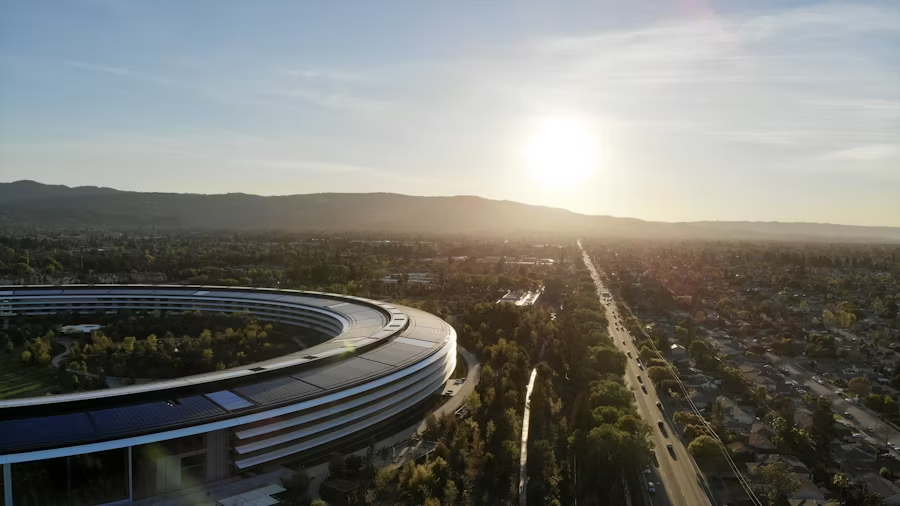
A different kind of innovation
So, has Apple become more or less innovative?
It depends on how you think about innovation. If you’re focused on new ideas and invention, then “less”, but if you’re focused on turned ideas into impact, then “more”.
Apple is less explosive but more strategic. It has shifted from a disruptor to a platform steward – from dazzling the world with new categories to deepening value through integration, privacy, and ecosystem design. Its innovation today is less about spectacle and more about substance.
Steve Jobs’ Apple was about changing the world with each keynote. Tim Cook’s Apple is about quietly embedding innovation into every corner of your life—from your pocket to your wrist, your home, your health, and even your financial transactions.
If innovation means radical, category-defining hardware every few years, then Apple may appear less innovative. But if innovation includes chip architecture, ecosystem design, health technology, privacy, and business model transformation, then Apple is more innovative than ever—just in more nuanced, sustainable, and often invisible ways.
Tim Cook’s Apple may lack the theatrical flair of Steve Jobs’ era, but it has arguably broadened the scope of innovation, turning Apple into a platform that touches nearly every part of a user’s digital life.
As Apple prepares to move deeper into AI, health tech, and spatial computing, the next chapter could blend both worlds: bold vision and stable execution. If that happens, Apple might not only reclaim its reputation as the world’s most innovative company, it may redefine what innovation means for the 21st century.
We live in a time of great change. Complexity and uncertainty, extreme climate and fragmenting society, technological breakthroughs and new opportunities. For mostly better, and occasionally worse, 2024 was a year of great acceleration. Looking back we reflect on the emerging themes and momentous moments that will shape the year ahead, and our emerging futures.
It was a year when AI captured our imagination, but also made us question what is real and true. It was a year when most of the world expressed their political views, with increasing polarisation. It was a year of soaring stock markets, with three $3 trillion companies. It was a year when GenZ and GenX faced off in the workplace. It was a year of CRISPR-regenerated hairy mammoths from Colossal, and 3D printed runnings shoes from On. It was a year of business failures, from Boeing to Crowdstrike and 23andMe. It was a year of Olympic heroes, from Noah Lyles to Léon Marchand.
But these are just some of the more memorable headlines. Behind the highlights were the real changes, the transformational shifts in social attitudes, the rapid progress of technologies like quantum computing, the rebalancing of global economics from west to east and large to small, and a new generation of leaders with fresh vision, new priorities and different styles.
This is how I saw it – what I did, what I thought – and how it shaped my view of what lies ahead.

January: Climbing aboard Nvidia’s rocket ship
Nvidia started 2024 worth $1.5 trillion, phenomenal for a business that had tripled its value in the previous 12 months. By the end of 2024, Nvidia’s market value had doubled again to beyond $3 trillion, vying with Apple and Microsoft to shape the future of tech, and much more.
Yet it was way back in 2003 that I remember sitting in the same Denny’s diner in Sunnyvale (I was in Silicon Valley working on a strategy for Philips Semiconductor, which later evolved into ASML) where Jensen Huang and friends founded Nvidia a few months earlier. They were gamers, obsessed with creating high powered chips for a better UX, and for almost 20 years had the be patient as AMD, Intel and others soared ahead.
But then the AI revolution of 2023 meant their time had arrived. Not only gamers, but now data centres needed Nvidia’s super powerful chips, and the company’s market cap was soon soaring like no other. On 18 June 2024, it dethroned Microsoft to become the world’s most valuable company.
Now every company is curious, often desperate, to understand how AI can transform its business. Apart from a play around with ChatGPT, few have any idea where to start. This month I kicked off a new program for the leaders and managers of Schindler, one of the world’s leading elevator companies (or lifts, if you come from England!). They’re great engineers at what they know, but exploring new possibilities, and adapting to change is much harder. This is a particular challenge in Germany, with companies like Volkswagen for example (4 times larger than Tesla, but 20 times less valuable), where managers aspire to technology-based doctorate education, but then find it difficult to embrace change.
On a positive note, I came across a great report 100 Reasons to Love the Future, by AXA, the French insurance company. “Life may be full of risks but the future shouldn’t be one of them. Everyone should have the right to be hopeful about the future” it began … “what we need today are new narratives that give hope” … “connecting science with humanity, logic and emotion” … “imagining utopia rather than retreating to dystopia” … “the future is the past with new possibilities”.
- Growth Champions … Amazon to Authentic, Coca-Cola and Crocs, Nubank to Nvidia, Tencent and Tesla … How the most successful companies drive and accelerate profitable growth.
- Shocks, Crises, and False Alarms … War. Inflation. Recession. Pandemic … The pursuit of economic stability is increasingly unrealisable … how to plan and act for a turbulent future
- The neuroscience of leadership … how your brain changes as you age … and how you can actively change your brain to achieve more as a leader.

February: Shaping the future in the footsteps of Christopher Columbus
Each year I spend a week in Segovia, a world heritage site in the heart of Spain, with a group of business leaders. The Roman aqueduct with its 166 arches is stunning and a marvel of engineering. The medieval Alcazar sits atop the city, from where you can see a 15-20km circular running route that is my absolute favourite, particularly at sun rise, with hot air balloons on the horizon.
Sitting in the very place where the Spanish queen asked Columbus to set sail for the Americas in 1492, we explore new voyages of discovery in the business world. This year’s group included leaders of German consulting firm, Polish strawberry farm, Mexican supermarket chain, American insurer, Spanish pharma business, Arabic airline, Canadian oil company, and Saudi shipyard. Typically they are emerging market leaders who have bolder ambitions and entrepreneurial ideas. Think of BYD from China, Zipline in Africa, or Mercado Libre from Argentina.
It’s also a fabulous time to collaborate with some great business thinkers – not least Tendayi Viki who is based in his homeland of Zimbabwe, while also being a leader of Strategyzer, alongside Alex Osterwalder. Tendayi has a passion for innovation, and how it can be practical and profitable in organisations. Check out his book Pirates in the Navy. Another good friend is Christian Rangen, a Norwegian entrepreneur. Together we deliver an incredibly engaging business simulation, breaking participants into exec teams of competing fictional EV companies – over 6 weeks, the first team to create $50 billion wins. Building the Transformational Company is the accompanying CEO Handbook.
ARK Invest’s Big Ideas report focuses on the convergence of 4 technologies – digital networks, genetics, energy storage, robotics – accelerated by AI – causing a “supercycle” economic impact 3x greater in relative terms than the Industrial Revolution. Genetics is perhaps one of the most exciting, able to transform human life. However the pioneering companies are not always the most enduring. They challenge boundaries, and create breakthroughs, but often lack the robust business models. Quantum computing is another exiting tech development right now. This month researchers at Google announced a significant breakthrough in achieving quantum supremacy with their new quantum processor, which promises to revolutionise everything from drug discovery to financial modelling, battery storage to cybersecurity.
Having a powerful brand is still a major asset when seeking to drive breakthrough innovations. Each year Brand Finance produce their Global 500, the world’s most detailed report on brand performance, seeking to value a brand (the amount of additional economic value a trademark adds to a business), and evaluate its strength (in engaging stakeholders, standing out from the competition. Apple is predictably the world’s most valuable brand, worth $517 billion, around 20% of its business value, while WeChat is the strongest brand. In a world where complexity is rife and trust is rare, where any company can be in any sector, then building meaningful brands matters more than ever.
- Read Write Own … What will the internet of the future look like? …. Web3, and how blockchain networks have begun to democratise ownership, returning power and economic benefit to all who use the internet
- “Disrupting the Norm, Defining the Future” … 15 big ideas for how AI, and its impact on technological convergence, will revolutionise industries and economies, faster than we anticipated
- The New Robots … the race to create the most advanced humanoid robots, accelerated by AI, enabling humans to be more human … Agility’s Digit vs Boston’s Atlas vs Tesla’s Optimus vs Figure’s 01

March: from Holcim’s regenerated cities to Tesla’s sci-fi cybertruck
Holcim is one of my favourite clients. Maybe cement might not seem that sexy, but Holcim is much more than a commodity business. Today they are leading the world in developing sustainable building materials, and also in reimagining how buildings are designed, used and maintained over time. Don’t just think product or task, think project and impact.
I’ve been working with the Swiss company for almost two decades, and in recent years have helped their executive team including new CEO Miljan Gutovic to develop new strategies, to tell their more inspiring story to investors, to drive innovation across every aspect of their business, and even help their finance and supply chain teams to think differently about their roles.
Construction is one of the largest carbon emitters, but it can also make one of the biggest differences. Holcim takes an ecosystem view, from the supply chain, to regeneration of cities – for example, by using waste materials as the main ingredient when building, and by embedding climate-friendly heating and maintenance models within building structures, and urban design that optimises for sustainable living, mobility, and social wellness. Thinking bigger to solve a more significant problem, and create more value economically and for society.
Tesla launched its new business strategy recently – building on its mission “to accelerate the world towards sustainable energy” – which includes its new Cybertruck and Semi launched this month, and designed to reduce carbon emissions and improve efficiency in the logistics industry. But the ambition is much greater. Tesla’s battery activities are already its most profitable business – from consumer batteries to Supercharger networks – but its latest strategy is to become the world’s leading clean energy company, making Musk’s Masterplan Part 3 a reality.
Fast Company’s ranking of the World’s Most Innovative Companies is something I look forwards to each year. While BCG ranks companies on R&D spend, FC tells inspiring stories about innovation in companies large and small. #1 in 2024 is Nvidia. Other interesting top ranked innovators include Novo Nordisk, the Danish diabetes company that has been transformed by it creation of obesity-busting drugs Ozempic and Wegovy. Other interesting companies at the top of the rankings include Vertex Pharma for bringing CRISPR, the gene editing capability, to market, and Taylor Swift Productions, for rethinking entertainment business models.
- Next is Now … the future is unfolding at incredible speed, driven by radical innovations, enabling new possibilities … from superfast chips to fat-busting drugs, and hairy mammoths
- Reinventing the book publishing industry … while every other kind of content, media and retail business is transformed, books just don’t change … time to reinvent the business models
- The Movies of Business … from Nike’s Air to Google’s Billion Dollar Code, The Social Network and Super Pumped, Elizabeth Holmes to Steve Jobs, and how WeWork became WeCrashed

April: Xiaomi disrupts every market, while Illumina accelerates personalised healthcare
Back in 2010, I remember watching a livestream as Lei Jun launched a new company called Xiaomi. Dressed in blue jeans and black sweater, the Chinese entrepreneur looked like Steve Jobs in his prime. Then he introduced his new product, the MiPhone, undercutting the price of Apple’s smartphone around 10 times, but with similar functionality. The MiPad, the MiWatch, followed, as he targeted growth within emerging markets (where the most people are) rather than western markets (where the competition is).
Xiaomi is a fascinating business, like many Chinese companies playing by its own rules, not being limited by heritage or legacy, it looks to the future with a clean sheet of paper. It can leap frog old paradigms and transform markets. That “moonshot” style thinking was much in evidence this month as Xiaomi reached beyond its core markets to launch its first car – an EV, of course. The SU7 looked remarkably like the Porsche Taycan. And drove like it. The only difference was the price. Instead of an around $250,000 it’s price tag was 10 times cheaper.
The transformational impact of technology is everywhere. This month Amazon completed its acquisition of MGM Studios, aiming to expand its content library and strengthen its position in the streaming market. A retailer becomes an entertainment business, a marketplace model becomes a content creation model. Meta acquired Reality Labs, a leading virtual reality company, to strengthen its position in the VR and AR market. Google completed its acquisition of Fitbit, aiming to integrate health and fitness tracking into its ecosystem and expand its wearable technology offerings.
As I worked with some of the leaders of Roche, the large Swiss pharma business this month, we explored how tech is transforming the discovery, development and delivery of drugs. We examined how Biontech succeeded developing its mRNA covid vaccine in just 6 months rather than 15 years. Some of the challenge is about overcoming conventions, including traditional approaches to regulation and process. But its also about harness tech.
Researchers at IBM this month announced a breakthrough in AI-powered medical diagnostics, which can accurately detect diseases from medical images with unprecedented speed and accuracy. Even more exciting is Illumina, the genetics company, which debuted its most powerful gene sequencer. The San Diego company has now replaced early pioneers like 23andMe in leading the world in DNA sequencing, towards a future of precision drugs and personalised healthcare.
And Larry Fink wrote his annual letter to the world’s business leaders. Fink is CEO of the world’s largest asset manager, BlackRock, with over $10 trillion in assets under management, and his annual letters set the tone for investors and companies. In recent years he has focused on the climate crisis, memorably saying that he will only invest in companies who put purpose before profit (and at the same time saying the focus on ESG was not enough). This year he warns of a coming global retirement crisis unless we prepare for the economic reality of an aging population
- Xiaomi, the Chinese tech disruptor, known for its Apple-like devices, enters the EV market … with the all-electric SU7, similar to a Porsche Taycan, but for $30,000 rather than $150,000
- Amazon to Buc-ee’s, Eataly and Edeka … Pinduoduo and Rappi, Wegmans and Zingerman’s … What do grocery consumers want, and what’s the future of grocery retailing?
- Future Health … today’s healthcare system is essentially a sickcare system … now is the time for radical reimagination using the power of technology and ecosystems to rethink who, what and how it works.

May: The wisdom of Pablo Isla, the world’s best CEO, and lessons for OECD governments
“I am a humble guy, I like to get things done, but I’m also very proud to have been ranked the world’s best CEO for two consecutive years”. Pablo Isla is best known for his 17 year role as the Chairman and CEO of Inditex, the Spanish multinational clothing company that owns Zara, Pull & Bear, Massimo Dutti, Bershka, and many other brands. During that time he increased the market value of the business from around $15 to $85 billion.
This month at IE Business School in Madrid (currently ranked in the top 10 globally for executive education), where I lead their Global AMP flagship program for business leaders stepping up to shape the future, I talked to him about his career, and in particular his approach to leadership, change and innovation.Isla has just turned 60, and is a native of Madrid.
In 2017, Harvard Business Review recognized Pablo Isla as the world’s best-performing CEO. And again in 2018. HBR said that what stands out is the single word description employees use to convey Isla’s management style. Humble. He is known for rejecting a meeting culture and the use of hierarchy to command, control, and ego-feed, instead favouring making decisions informally in partnership with his people as he “manages by walking around”.
And his view on leading in a world of relentless change? “Keep your eyes and ears open. Learn from everyone, not just in formal ways, but mostly informally. Read interesting articles, books. Meet new people, learn from other sectors”.
A few days later I was in Paris, working with many of the international government organisations brought together by the OECD. We explored a world a world of rapid change, driven by the megatrends from ageing populations to social inquality, urbanisation and climate crisis, cognitive technologies and more. We looked at how the best companies are responding to this change – reinventing themselves, transforming how they work, where they focus, what they do, who they are for. And we compared this to governments, and organisations like the UN, IMF, and OECD itself. It’s not easy to let go of the old ways of working, it’s normal to feel powerless to change, but leaders are in the change business. They reinvent everything, seeking to create a better future.
Also this month, CNBC published its 2024 Disruptor 50 list, which is a great curation of the world’s most disruptive companies, this year dominated by companies unlocking the potential of AI in many sectors. While OpenAI comes out top, Anduril Industries follows, creating “a future fighting force” of drones, followed by Stripe, the payment system founded by Ireland’s Collison brothers, with over a trillion dollars of transactions. Lots more ideas in there stories for governments to learn from too!
- Leading Leaders … a conversation with Pablo Isla, CEO of Inditex from 2005 to 2022, the Spanish fashion retailer with brands like Zara and Massimo Dutti … on leadership and innovation, lawyers and movies … and why he was ranked as the world’s best CEO
- Estonia’s E-Government and Singapore’s Smart Nation … the innovative strategies by which governments seek to build future societies and deliver better services.
- Here’s to the transformative ones … the gamechangers, the future-back thinkers, the megatrend surfers, the self-disruptors and growth finders … who won’t be told it can’t be done.

June: Japanese theme parks, and the need for a more strategic approach to innovation
Japan was my focus in June, working with Sompo, one of the country’s top insurance companies, which has a vision to be a “Theme Park for Security, Health & Wellbeing”. Kengo Sakurada, the Group CEO explains that it is mainly engaged in the four businesses of domestic P&C insurance, overseas insurance, domestic life insurance, and nursing care & healthcare.“To prevail in an age of VUCA we have embraced a philosophy that calls on us “to contribute to the security, health, and wellbeing of our customers and society as a whole by providing insurance and related services of the highest quality possible,” and thereby contribute to society.
It’s a great example of purpose and vision – but also about thinking bigger, about what you’re really trying to do for customers – to prevent failures, rather than just insuring against them. So if you can help customers to live a healthier life, guided by Sompo’s range (theme park) of health and fitness services, then there’s less to pay out on their insurance policies too. Same for home, car, and business insurance too.
NTT Data is another Japanese company who I continue to work with over the years, particularly helping to bring together their previously separate European and American businesses. They’re relatively unknown – despite being one of the world’s top 10 IT services firms, and ranked as one of the world’s top 50 most innovative companies – with a focus on solving the bigger business problem not just implementing tech, and parenting to help companies transform and reinvent.
BCG’s Most Innovative Companies 2024 ranked Apple, Google and Samsung top, but also said “companies have never placed a higher priority on innovation (83% make it a top 3 priority), yet they have never been as unready to deliver on their innovation aspirations”. While innovation leaders’ biggest stated challenge is an unclear or overly broad strategy, the vast majority are focusing on process optimisation, not strategy. Companies who get it right typically show a 5 percentage point growth advantage. Microsoft is definitely a strategic innovator. Gaming is a key part of Satya Nadella’s strategy to make tech relevant and applied, while AI is the fuel. He finally agreed to acquire Activision Blizzard for $68.7 bn, marking the largest acquisition in the gaming industry’s history. Microsoft also, of course, acquired a majority stake in OpenAI this year.
- Future Bank … why DBS’s brand purpose to “live more, bank less” is probably the best idea in banking … time to embrace AI and cloud … and most importantly, to fundamentally reinvent the business model
- Lemonade introduces dating insurance … “It all started with a cheeseburger. Dinner and a movie. Classic combo! What could go wrong?” … Lemonade, led by Daniel Schreiber, shows how insurance can innovate
- The Movies of Business … from Nike’s Air to Google’s Billion Dollar Code, The Social Network and Super Pumped, Elizabeth Holmes to Steve Jobs, and how WeWork became WeCrashed

July: Crowdstrike brings down the internet, while Confused seeks to be more.
$85 billion cybersecurity experts Crowdstrike caused chaos for the world’s tech systems on 19 July, a faulty software update causing the largest IT outage in history, and locking an estimated 8.5 million Windows devices into a so-called “blue screen of death”. The outage grounded flights, froze online banking systems and disrupted emergency service providers. According to one insurer, the incident cost Fortune 500 companies roughly $5.4bn. It served as a timely reminder of the internet’s fragile infrastructure for the many businesses and services that rely on it.
Meanwhile this month I was working with RVU, which owns brands like Confused.com, and is one of the UK’s largest online brokers for everything from car insurance to loans and mortgages. Seeking to be more than a comparison site, it adds value through helping guide people through the maze of choices, but also to adopt better behaviours over time. So what does it really mean to be “customer-centric” in my keynote?
This has been a question I’ve played with for 35 years now, since managing service brands like Concorde in my earlier career. I even wrote a book about it, Customer Genius. Yes, it requires a great proposition, easy to do business with, and genuine service. But it’s still not easy. And it means more – how can you enable people to achieve their goals, not just buy products. Think of Nike – it’s not just selling running shoes, it’s helping them run faster. Think IBM – it’s not just selling consulting services, it’s helping companies to grow in economic value.
Fast Company’s World Changing Ideas list takes a deep dive into the best organisations, public and private, seeking to make the world a better place. Sustainability challenges, most simply codified by the 17 SDGs are great catalysts for better (even more profitable) innovation. Holcim’s Recygénie is the world’s first building to use 100% recycled concrete, and one of the WCI winners. The sleek Paris housing complex was made from the rubble of a 1960s building.
- Be me, be more … What do the world’s most customer-centric companies really do, beyond having deep insights and delivering great service?
- DoorDash All the Ads … how the food delivery company’s Super Bowl ad became a marketing sensation, winning the Titanium Grand Prix in Cannes … and repositioned the brand as a platform to deliver anything
- Customer Genius: How to become a customer-centric business … bringing together customer strategy, customer insights, customer propositions, customer experiences and customer relationships.

August: Adidas was the real winner at this year’s spectacular Paris Olympics
The Olympics are the pinnacle of sport, and walking into the Stade de France on 17 August I felt lucky, excited and tense. The mens 1500m final is still the blue riband moment for me, and this year Britain’s world champion Josh Kerr clashed with world record holder Jacob Ingebrigtsen of Norway.
Arriving 3 hours before the start, I sat in the baking Paris sunshine chatting to a 70 year old America fan who had flown in from LA, just for one day, just for this race. When it came, it was run at a furious pace. The Norwegian went out in front, the Brit hung on to him. But then phenomenally, USA’s Cole Hocker, running out of his skin, sprinted past in the last 30 metres. Wow. Hocker is a Nike athlete, who lives in Eugene, and is a former Duck, from the University of Oregon. My old friend from LA must have been ecstatic.
But this Olympic Games arguably belonged to Adidas. Wearing the 3 stripes, Noah Lyles became the Olympic champion at 100m, Quincy Hall at 400m, Emmanuel Wanyonyi at 800m, Grant Holloway at 110m hurdles, and Tamirat Tola at the marathon.
You might think that running is the purest of sports, and has not changed much since the Olympic Games were revived by Baron de Coubertin in 1896. However, even the relative simplicity of racing from gun to tape has radically altered in recent years due to the rise of advanced running footwear, often called “supershoes”. Athletics is in the midst of a high-tech innovation battle between all the leading brands, for who can create the most technically advanced shoes.
Adidas was born from the dream, the motivation and the obsession of making the athletes the most successful they can be. This year it celebrates the brand’s 75th anniversary with its most successful Olympics of recent decades with a huge medal haul. 27 track and field medals (excluding relays), 11 more than last Olympic Games. Alberto Uncini Manganelli, Adidas Global GM for Running, who I have worked with over the years since his days at P&G, and his team back at their Herzogenaurach head office must have enjoyed Paris 2024.
- Noah Lyles to Tamirat Tola … Adidas was behind the success of many of this year’s Olympic champions, from 100 metres to the Marathon … Paris 2024 was a story of radical innovation and human performance
- LVMH x Paris 2024 … this year’s Olympic champions will celebrate with Moët Hennessy champagne as they receive their gold medals made by Parisian jeweller Chaumet … old wealth meets new ambition
- “The Frugal Economy: Building a Better World With Less” … Navi Radjou is a joyful guy, an uplifter, and a catalyst for positive change

September: from Danish Castles to Dallas Skycrapers, inspired by the space race
Hindsgavl Castle is an amazing place. The historic Danish estate overlooks the picturesque Fænø Sound and Little Belt Strait, in the heart of Denmark. I was here to meet the technology leaders of Denmark’s top companies. But first I needed to explore. Running around the shoreline, I ran a 20km circuit without meeting a single person. A few deer. A snake. But that was it. In the evening, the Hindsgavl restaurant served an incredible meal, all made from local foraged ingredients.
“Next is Now” was my theme for my keynote the next day. Exploring a world of rapid and relentless change, where that great William Gibson phrase “the future is already here, it’s just not evenly distributed” has never been more true. Now is the time to leap forwards, to let go of the past and reinvent everything. Now, more than ever, innovation and transformation are priorities for every business.
Superfast-gaming chips and fat-busting superdrugs, asteroid-chasing rockets and carbon-capturing technologies, 4 day working weeks and chess reinvented as a reality TV game, health-enhancing fashions and the rebirth of the hairy mammoth. Nvidia is transforming tech, while Novo Nordisk innovates healthcare, KinetX changes the space race, while Climeworks eliminates carbon.
Technology of course is at the heart of this transformation. The total global e-commerce transaction value reached approximately $6.3 trillion in 2024, a 17% increase compared to 2023. This growth highlighted the increasing importance of online shopping in the global economy.
Later in September in Dallas Texas, we explored how this tech transformation enables business to transform. Indeed, as we discussed at NTT Data Americas, it not enough to just sell the tech, its about collaboratively developing a vision of the future, to create new business models, and reinvent markets.
- Next is Now … the future is unfolding at incredible speed, driven by radical innovations, enabling new possibilities, from superfast chips to fat-busting drugs, and hairy mammoths
- Papyrus to Pyramids, Politics and Pythagoras … to modern innovators like Elmenus and Halan, Jumai and Vezeeta … Egypt is a land of innovation
- Future Work … How do you future proof your business for a world where work is no longer defined by jobs, the workplace is not a specific location, many workers are not employed, and HR is no longer a function?

October: Climeworks, the world’s largest carbon capture and storage facility in Iceland
Iceland is a dramatic land of fire and ice. Driving the one hour from Keflavik airport to the capital Reykjavik is like driving through a moonscape of black rocks, and smoking volcanos on the horizon. As darkness fell, the Northern Lights started to magically dance across the landscape. I was here to work with TUV Nord, a German technological inspection business, with over 10,000 people across the world. Supported by St Gallen business school, we explored how they could grow their business in exciting new ways, with new services and business models.
However the best inspiration came when we went to visit Climeworks, the Swiss carbon capture business, that has just opened its new Mammoth facility across the island. Looking more like the world’s largest air conditioning unit, it sucks in air and extracts carbon (the chemical reaction uses huge amounts of energy, hence Iceland, and its unlimited geothermal power) which it then buries deep underground. Climeworks’ income is largely the carbon offset fees paid by companies like Microsoft, and many others. It’s a remarkable facility, set to be replicated around the world.
Also this month, I was in Belgrade, Serbia, working with DFG, a Central European venture capital business, specialising in sustainable investments. My “Future Radar” process is not science fiction, or even futurology. It is about exploring and learning from the new businesses, and behaviours, emerging on the edges of markets right now. How will your marketspaces evolve over the next 5-10 years? Where are your best opportunities? Which companies will shape this future? What can you learn from them and their strategies? What are the next agendas for customers and investors? How can you shape and lead them now?
McKinsey’s Future Arenas research creates a usefulpicture about how future markets will evolve. 18 future arenas could reshape the global economy and generate $29 trillion to $48 trillion in revenues by 2040. These new arenas include batteries and robotics, cloud and space, shared mobility and modular construction. Additionally, 12 arenas of today showed outsize growth and dynamism from 2005 to 2020.
- Visiting Mammoth … the world’s largest carbon direct air capture and storage facility near Reykjavik in Iceland … operated by Swiss company Climeworks.
- Seaweed as abundant energy … the most available, scalable and productive source of sustainable biofuel lies in our oceans … and it absorbs carbon dioxide too
- Can the company that invented Aspirin reinvent itself? … How Bayer, 160 years old with 100,000 people, is creating a new operating model for future business called “Dynamic Shared Ownership”
November: Sailing to Istanbul’s Princes’ Islands, as AI accelerates and pioneers stutter
24 months ago – in November of 2022 – a webpage was posted online with a simple text box. It was an AI chatbot called ChatGPT, and was unlike any app people had used before. It was more human than a customer service agent, more convenient than a Google search.
Behind the scenes, battles for control and prestige between the world’s two leading AI firms, OpenAI and DeepMind, who now steers Google’s AI efforts, has remained elusive. Until now, thanks to a fascinating new book called Supremacy by Parmy Olsen which was the FT/Schroders Business Book of the Year. “The real threat of artificial intelligence that its top creators are ignoring: the profit-driven spread of flawed and biased technology into industries, education, media and more”.
Time Magazine recently published its second Time 100 AI list, recognising the 100 most influential people in artificial intelligence. It includes 40 CEOs and founders, alongside scientists and influencers: Mark Zuckerberg of Meta, Sundar Pichai of Google, Satya Nadella of Microsoft, Daphne Koller of Insitro, Sam Altman of OpenAI, Chris Olah and Dario Amodei of Anthropic, Jensen Huang of Nvidia, Aravind Srinivas of Perplexity, and Masayoshi Son of Softbank.
Three years ago, Ann Wojcicki’s DNA-testing firm 23andMe was a massive success, with a share price higher than Apple’s. But, from those heady days of millions of people rushing to send it saliva samples in return for detailed reports about their ancestry, family connections and genetic make-up, it now finds itself fighting for its survival.Its share price has plummeted and this month it narrowly avoided being delisted, external from the stock market.
Sailing across the Bosphorus from Istanbul to the Princes’ Island of Buyukada, the tech revolutions from Silicon Valley to Shenzhen seem like a different world. The small boat chugs past fishermen and a few late-season tourists. Arriving on the island, which still doesn’t allow cars, is like stepping back even further in time. And the old wooden Splendid Hotel is an antidote to modern travel. Creaking floors, and faltering water supply, food if you’re nice, and no wifi.
But I was here to think. Or more specifically, to help the exec team of Enerjisa to think about their future. While they are already a leading clean energy company, they could be so much more. from powering homes, to enabling life. By the end of our workshop, the team was full of ideas – to be a mobility business, real estate business, lifestyle concierge and much more. There are no limits, once you let go of your old limiting mindsets! Now we need to structure the ideas – what to exploit, what to explore – and how it works as a roadmap for sustained, profitable growth.
- The New Marketing DNA … AI with authenticity, vision in real time, collaborative yet personal … building brands with more ingenuity, and more impact
- Gamechangers Turkey 2024 … from Appsilon diamonds created in the lab, to Biolive plastics made from olive stones … Oleatex’s plant-based vegan leather, and WeWalk’s smart canes for visually impaired
- “The Future, Made in China” … China has become the world’s technology innovator … from AI to semiconductors, clean energy to electric mobility … from BYD and Nio to CATL and LONGi

December: How can you be invincible, riding the waves of change, the relentless reinventor?
Stepping on stage at the Global Marketing Summit 2024 organised by KREA in Istanbul to deliver the opening keynote, you might be forgiven for thinking I’d talk about tech. But my theme was actually how to be invincible, or more precisely, how to relentlessly reinvent yourself. Not just over centuries, but sometimes every few years. We explored the “S curves” which map the journeys of Lamborghini from tractors to supercars, DSM from coal mines to life sciences, or Fujifilm from camera film to cosmetics. The challenge is to reinvent yourself before you have to, which requires vision and courage, to ride the waves of change with foresight and ingenuity, and never stop. In a world of uncertainty and change, relentless reinvention is the secret to being invincible.
I’ve done a number of projects in Saudi Arabia this year. Cities like Riyadh and Jeddah are transforming at incredible speed – far faster, even, than Dubai. While some might question the ethics, I feel it’s far better to educate and support new values and new aspirations. The nation’s Vision 2030 has certainly had a transformative impact on sparking big ideas and action. Lucid, the EV maker is now based here, catalysing new industries. Q commerce is everywhere, championed by innovators like Hungerstation. And the Ministry of Culture is more focused on the future than past.
Some of the business leaders at Emdad, a Riyadh-based talent accelerator, asked me what has sparked my imagination this year. Well everything above. I’m also incredibly curious. I love new ideas, reports, books. Some more great books this year have included Growth by David Susskind exploring sustainable growth, The Whole Story by John Mackey who is founder of Whole Foods, The Algebra of Wealth by maverick podcaster Scott Galloway, The Upside of Disruption from my friend Terence Mauri, Proximity on transformative tech by Robert Walcott, Red Helicopter on leading change with kindness by James Rhee, Make your Own Rules by YouTuber and music misfit Andrew Huang. And I have a new book on its way too. About dreams, reinvention, transformation, and being you.
The year ended with Jaguar, that iconic heritage brand of old British luxury, but now owned by India’s Tata Group. At the Miami Art Week, the company took inspiration from Jaguar’s founder Sir William Lyons to “Copy Nothing“. This started with the launch of a new brand identity and ad campaign, which shocked the world’s brand guru’s for ditching its jaguar cat logo for modern typography, and flowed rapidly into conceptual pinkness. And then came the future, in the shape of the Jaguar Type 00, a new all-electric range of dramatic supercars. Powerful, daring, exciting.
Which companies around the world inspire you?
In Amsterdam, ASML makes some of the most incredible machines, that themselves make the world’s semiconductors, that power most of our lives today. In Shenzhen, BYD has gone beyond many people’s dreams to become the world’s largest EV manufacturer. In Reykjavik, a Swiss company, Climeworks has built the world’s largest carbon direct air capture facility.
These are the companies, embracing the drivers of change, delivering highly profitable growth, who are shaping our futures. Their innovative visions and strategies, products and services, operations and business models, create new blueprints for how to work and win. More than any business school or case study, they are the best places to explore, to learn, and to be inspired.
Each year I work in total with around 100 companies, I visit at least 30 different countries, and talk to many of their people. Whether it be a keynote speech, a strategy workshop, executive coaching, an educational program, or research for my next book, I am fortunate to have the opportunities to meet so many incredible leaders, entrepreneurs and innovators.
- What will you do next? … AI rocket ships and quantum speed, hairy mammoths and Olympic champions … What I learnt from last year, about what matters this year.
- 100 Leaders … profiles of audacious leaders, from Anne Wojcicki to Bernard Arnault, Cristina Junqueira to Ben Francis, Zhang Ruimin to Zhang Yimin, and many more.
- 250 Companies … stories of innovative companies and challenger brands, from 1Atelier to 77 Diamonds to A Boring Life, Aerofarms to Alibaba, Babylon to Boom Supersonic and many more.
From AI-driven technologies to the challenges of climate change, from the dreams of Gen Z consumers to the threats of polycrisis, every industry and every company has to think and act differently. By connecting the visions, strategies and innovations of real companies who are shaking up the world right now, I can help your business to innovate, transform and succeed.
As I travel around the world, here’s my A to Z of some of the companies who have inspired me:
 ASML: The Invisible Giant Powering the Digital Age
ASML is one of the world’s most critical yet least well-known companies. Founded in 1984 as a joint venture between Dutch electronics giant Philips and chip machinery maker Advanced Semiconductor Materials International (ASMI), the company was born in a small building next to a Philips factory in Veldhoven, the Netherlands. Its mission was ambitious from the start: to develop photolithography systems — the machines that etch the minuscule patterns on silicon wafers that form the basis of every computer chip. What began as a niche spin-off has grown into the world’s largest supplier of lithography equipment, a linchpin in the global semiconductor industry, and a company without which modern life would be unimaginable.
ASML’s innovation story is as much about culture as it is about technology. From its earliest days, the company embraced deep collaboration with customers and research institutions, recognizing that the scale and complexity of its challenges could not be solved in isolation. Unlike many competitors, ASML never tried to do everything itself. Instead, it built an ecosystem of partners — optical specialists like Zeiss, materials innovators, and universities — each contributing expertise to tackle the seemingly impossible engineering problems of shrinking transistors to the nanoscale. This collaborative, boundary-crossing mindset remains central to ASML’s culture today.
The hallmark of ASML’s innovation is its work in extreme ultraviolet lithography (EUV), a technology that many in the industry once believed was unachievable. EUV uses light with an incredibly short wavelength (13.5 nanometers, compared to 193 nanometers in conventional deep ultraviolet systems) to print features just a few atoms wide on silicon wafers. Developing EUV required decades of research, billions of euros in investment, and breakthroughs in physics, optics, and materials science. For example, no natural source of EUV light exists, so ASML had to invent a plasma-based light source — firing lasers at tiny droplets of molten tin to generate bursts of EUV light.
The result is a machine the size of a bus, weighing 180 tons, containing over 100,000 components, and costing more than $200 million each. Yet without these machines, the semiconductor industry would have hit a wall, unable to keep pace with Moore’s Law. ASML’s EUV tools are now used by leading chipmakers like TSMC, Samsung, and Intel to manufacture the most advanced processors powering AI, smartphones, cloud computing, and cutting-edge medical devices.
Recent innovations push even further. ASML is now developing high numerical aperture (High-NA) EUV, which will enable even smaller transistors and extend chip miniaturization into the next decade. At the same time, it is working on holistic lithography solutions — integrating AI and computational modeling into chip design and manufacturing to maximize yield and performance.
ASML’s importance transcends technology: it has become strategically vital to geopolitics. The company sits at the center of U.S.–China tech tensions, as its EUV machines are so advanced that governments now treat them as strategic assets.
Yet despite its global significance, ASML retains a distinctly Dutch culture — understated, engineering-led, collaborative, and relentlessly focused on solving the hardest problems in technology. In an era when digital progress depends on ever more powerful chips, ASML quietly powers the future, one atom at a time.
BYD: Building Dreams of a Green Future
BYD, short for Build Your Dreams, is one of the most remarkable stories in modern industrial reinvention. Founded in 1995 in Shenzhen, China, by entrepreneur and chemist Wang Chuanfu, the company began not as a carmaker but as a manufacturer of rechargeable batteries. At the time, China was rapidly industrializing and global demand for batteries for mobile phones and laptops was soaring. BYD’s early advantage lay in its ability to produce batteries at scale with lower costs than Japanese rivals, thanks to a frugal, vertically integrated approach that relied on local supply chains and in-house engineering talent.
The company’s leap into automobiles in 2003 surprised many. BYD acquired a struggling state-owned automaker, Qinchuan, giving it a foothold in vehicle production. Skeptics doubted whether a battery maker could compete in the brutally competitive car industry. But Wang Chuanfu saw further: he believed that the future of transportation would be electric, and BYD’s expertise in batteries could provide the crucial edge. This foresight would eventually propel BYD to become one of the world’s largest electric vehicle (EV) makers and a key player in renewable energy solutions.
Innovation at BYD is driven by a culture of pragmatism, vertical integration, and a mission to create sustainable solutions. Unlike many competitors, BYD insists on controlling the entire value chain — from raw materials to finished vehicles. It develops its own batteries, semiconductors, electric motors, and vehicle platforms, reducing dependence on external suppliers. This vertical model has allowed BYD to move quickly, cut costs, and scale innovations rapidly — a critical advantage in industries where technology shifts can be disruptive.
One of BYD’s most striking recent innovations is the Blade Battery, unveiled in 2020. This lithium iron phosphate (LFP) battery is designed to be safer, more durable, and cheaper than conventional lithium-ion batteries. Its unique elongated cell design improves space utilization, increasing energy density while reducing the risk of overheating and fire. The Blade Battery not only powers BYD’s own EVs but is also being adopted by other manufacturers, including Tesla in its China-produced vehicles. This innovation highlights BYD’s dual role as both a vehicle maker and a supplier of critical green technologies.
BYD’s product innovations extend beyond passenger cars. It has developed fleets of electric buses, which are now used in more than 70 countries, making it a global leader in electrified public transport. These buses have become a symbol of sustainable urban mobility, helping cities reduce air pollution and carbon emissions. The company has also expanded into energy storage systems and solar power solutions, positioning itself as a holistic clean energy company rather than merely an automaker.
Culturally, BYD blends Chinese pragmatism with a sense of mission. Its workforce is vast — more than 600,000 employees — but organized around the principle of solving practical problems that matter for society. Wang Chuanfu often emphasizes that BYD is not just chasing profits but is driven by a vision to reduce humanity’s reliance on fossil fuels. This sense of purpose resonates with younger generations of consumers and policymakers alike.
Today, BYD has surpassed Tesla in global EV sales, cementing its position as a pioneer of green mobility. From batteries to buses, solar panels to storage, its influence stretches across the entire energy ecosystem. Few companies illustrate as vividly how industrial ambition, long-term vision, and innovation rooted in sustainability can transform not just a business, but the future of transport and energy.
Climeworks: Capturing the Future of Climate Action
Climeworks is a company that embodies the idea that some of the most urgent global problems require radical innovation. Founded in 2009 by Christoph Gebald and Jan Wurzbacher, two engineering students from ETH Zurich, the Swiss startup emerged from an academic project with an audacious vision: to pull carbon dioxide directly out of the air and lock it away permanently. At the time, the idea of direct air capture (DAC) was more science fiction than business. Yet, in little more than a decade, Climeworks has positioned itself at the forefront of a nascent but potentially transformative industry: engineered carbon removal.
What makes Climeworks innovative is not just its technology but its insistence on turning a theoretical concept into an operational, scalable business. The company specializes in modular DAC systems that use giant fans to draw in ambient air. The air is then passed through a filter material that selectively captures CO₂ molecules. Once saturated, the filter is heated with renewable energy, releasing the pure CO₂, which can either be reused for industrial purposes or stored permanently underground. This approach is simple in concept but extraordinarily difficult to execute at scale. Climeworks has tackled these challenges with a culture of relentless experimentation, precision engineering, and partnerships across disciplines.
A hallmark of the company’s culture is its commitment to transparency and mission. Unlike many carbon-offset businesses that rely on vague accounting, Climeworks emphasizes measurable, permanent removal of CO₂, offering customers clear documentation of their climate impact. Its subscription-based business model allows individuals and companies — from small startups to tech giants like Microsoft and Stripe — to pay for the removal of specific amounts of carbon. This creates a new type of climate service, one rooted not in vague promises but in tangible engineering solutions.
One of Climeworks’ most striking innovations is the development of Orca and Mammoth, the world’s largest operational DAC plants, located in Iceland. Orca, launched in 2021, can remove 4,000 tons of CO₂ annually. Mammoth, launched in 2023, has ten times the capacity, designed to capture 36,000 tons of CO₂ per year. Crucially, Climeworks works with its Icelandic partner Carbfix, which injects the captured CO₂ into underground basalt rock formations, where it mineralizes into stone within a few years — creating permanent storage for thousands of years. This integration of capture and geological sequestration is considered the “gold standard” of carbon removal.
Beyond technology, Climeworks is innovative in shaping a new climate economy. It was one of the first companies to sell DAC-based carbon removal to businesses, setting the standard for a transparent and verifiable carbon removal market. Its partnerships with global corporations are not just about offsetting emissions but about investing in the future of climate solutions. In this way, Climeworks has become both a technology provider and a catalyst for systemic change.
The company is clear-eyed about the scale of the challenge: billions of tons of CO₂ must be removed from the atmosphere to meet climate goals, and current DAC capacity is only a drop in the ocean. But Climeworks’ philosophy is that scaling must start somewhere — and that proving feasibility, then growing relentlessly, is the only path forward.
From a student project to a pioneer of engineered climate solutions, Climeworks is demonstrating that removing CO₂ from the air is no longer an impossible dream but a growing reality. It shows how engineering ingenuity, patient persistence, and purpose-driven business models can push the boundaries of climate action and create entirely new industries.
DeepSeek: Redefining AI with Radical Efficiency
DeepSeek is one of the most intriguing and disruptive players to emerge from the rapidly evolving artificial intelligence landscape. Founded by Chinese entrepreneur Liang Wenfeng (often referred to as Jiang), the company’s origins lie in a journey that began well before the recent AI boom. Jiang first experimented with machine learning in 2008, building models to trade financial markets. His early work culminated in the co-founding of the High-Flyer hedge fund in 2016, a firm that used AI-driven strategies to outperform traditional financial analysis. Out of this experience, DeepSeek was born — initially as a subsidiary, but now as a standalone AI company determined to challenge the status quo of AI development.
The company’s bold claim to fame is its ability to deliver AI model training and deployment at up to 95% lower cost than OpenAI and other Western peers. This is not just a marginal improvement; it is a redefinition of the economics of AI. DeepSeek achieves this through a combination of technical and cultural innovations. Technically, the company has developed proprietary methods for compressing large language models, optimizing hardware utilization, and running AI workloads with extraordinary efficiency. This allows it to train state-of-the-art models on significantly less computational power, making AI more accessible and scalable.
Culturally, DeepSeek is built around the principle of pragmatism and frugality in innovation. Rather than chasing prestige projects or flashy demonstrations, the company focuses on solving the bottlenecks that make AI prohibitively expensive for most organizations. This mindset stems from its financial roots: in trading, efficiency and cost discipline are everything. At DeepSeek, this discipline translates into lean engineering teams, iterative experimentation, and a relentless pursuit of eliminating waste in algorithms and infrastructure.
What makes DeepSeek especially innovative is not just what it builds, but what it enables. By dramatically lowering the cost of advanced AI, the company opens the door for smaller businesses, startups, and institutions in emerging markets to deploy cutting-edge AI systems that would otherwise be out of reach. This democratization of access could reshape the competitive landscape of AI globally, reducing reliance on a handful of U.S. and European giants.
One of DeepSeek’s most striking innovations is its enterprise AI platform, which integrates data ingestion, analysis, and visualization into a seamless system powered by large language models. Unlike many generic AI products, DeepSeek’s platform is tailored for domain-specific intelligence: finance, logistics, healthcare, and government services. In finance, for example, its AI can analyze vast datasets of market activity, detect subtle patterns, and generate actionable trading insights in real time. In healthcare, its models are being adapted to sift through medical records and research papers, helping doctors make better clinical decisions.
The company is also deeply embedded in China’s broader AI ambitions. As U.S.–China tensions increasingly shape access to advanced semiconductors and cloud infrastructure, DeepSeek’s efficiency-oriented model is strategically significant. It requires fewer cutting-edge chips to achieve competitive performance, making it less vulnerable to export restrictions. This makes DeepSeek not just an innovative business but a potential geopolitical player in the race for AI leadership.
Looking ahead, DeepSeek is positioning itself as an “AI for the many, not just the few” company. Its vision is to bring powerful, affordable AI tools to industries and regions that have historically been priced out of the AI revolution. By combining roots in financial engineering with a culture of frugal innovation, DeepSeek is showing that the future of AI may not be defined by who builds the biggest models, but by who builds the most efficient ones.
EssilorLuxottica: The Visionary Giant of Eyewear
EssilorLuxottica is one of the most influential yet often underappreciated companies in the consumer landscape. Formed in 2018 through the merger of France’s Essilor, the global leader in ophthalmic lenses, and Italy’s Luxottica, the dominant player in eyewear frames and distribution, the group has become the world’s undisputed powerhouse in vision care and fashion eyewear. It combines scientific precision with cultural style, health innovation with brand storytelling — an unusual but highly effective fusion.
The roots of the two companies stretch back more than a century. Luxottica was founded in 1961 by Leonardo Del Vecchio in Agordo, a small Italian mountain town. Del Vecchio, raised in an orphanage and trained as a metalworker, began making spectacle parts before expanding into full frames. His breakthrough came with the decision to integrate vertically — controlling everything from design and manufacturing to wholesale distribution and eventually retail. Luxottica acquired leading brands such as Ray-Ban and Oakley, while also producing frames under license for luxury houses like Prada, Chanel, and Armani. By the 2000s, it had built an empire of retail chains, including Sunglass Hut, Pearle Vision, and LensCrafters, giving it unparalleled reach.
Essilor’s story is rooted in science and public health. Founded in 1849 in Paris as a small optical cooperative, the company evolved into a global leader in corrective lenses, pioneering innovations such as Varilux, the world’s first progressive lens, which provided a seamless alternative to bifocals. Essilor positioned itself not only as a business but as a mission-driven organization — committed to reducing the enormous global burden of poor vision, which affects billions of people worldwide.
The 2018 merger was transformative, creating a company that integrates both sides of the eyewear equation: lenses for vision correction and frames for fashion and distribution. Today, EssilorLuxottica designs, manufactures, and sells everything from affordable corrective glasses in emerging markets to luxury sunglasses on the high streets of Milan and New York. Its portfolio includes proprietary brands like Ray-Ban, Oakley, and Persol, alongside licensed lines for luxury fashion houses.
What makes EssilorLuxottica innovative is not just its scale but its ability to blend medical technology with consumer lifestyle. On the medical side, the company continues to push boundaries in lens technology, including blue-light filtering solutions, adaptive photochromic lenses, and AI-driven personalized lens fitting. It has also launched inclusive programs like Eye-Ris to provide affordable eyewear to underserved populations, aligning with its mission to eliminate “poor vision as a barrier to human achievement.”
On the fashion and brand side, Luxottica’s heritage shines through. One striking example is the transformation of Ray-Ban from a utilitarian military product into a global lifestyle brand. Recent innovations include Ray-Ban Stories, developed with Meta (formerly Facebook), which integrates smart technology into iconic frames — offering built-in cameras, speakers, and voice assistants. This fusion of style and wearable tech illustrates the company’s capacity to reinvent categories at the intersection of fashion and technology.
Culturally, EssilorLuxottica’s innovation stems from its dual heritage. It combines French scientific rigor and a health-driven mission with Italian creativity, design flair, and entrepreneurial spirit. This balance allows the company to operate not just as a manufacturer, but as a cultural force shaping how billions of people see — and how they are seen.
In a world where vision correction is both a healthcare necessity and a style statement, EssilorLuxottica occupies a unique nexus. It is both an industry consolidator and a restless innovator, ensuring that vision care keeps pace with both medical needs and cultural desires. With a global reach that touches consumers in every market and a pipeline of innovations that span science, fashion, and digital technology, EssilorLuxottica is truly the visionary giant of eyewear.
Ferrari: Engineering Passion, Performance, and Purpose
Ferrari is more than a car company; it is a symbol of speed, precision engineering, and aspirational luxury. Founded in 1939 by Enzo Ferrari as Auto Avio Costruzioni in Maranello, Italy, the company initially focused on producing racing cars. Ferrari’s first car to bear its name debuted in 1947, marking the beginning of a legacy that would combine performance, design, and branding into an iconic formula. From the start, Ferrari was not only about building cars but about creating experiences — both on the racetrack and on the road.
Innovation has always been at the heart of Ferrari’s ethos. Technically, the company is known for pushing the boundaries of engine performance, aerodynamics, and materials science. Ferrari’s culture prizes excellence, craftsmanship, and obsessive attention to detail, instilling a mindset where engineers and designers constantly challenge conventional limits. This culture extends to racing, where Ferrari’s Formula 1 program has served as both a testbed for technology and a global marketing engine, blending competitive innovation with brand prestige.
Recent years have seen Ferrari extend its innovation focus to sustainability without compromising performance. The SF90 Stradale, a plug-in hybrid supercar, represents a major step forward, integrating electric motors with a twin-turbo V8 engine to deliver over 1,000 horsepower while improving fuel efficiency. This is not merely an engineering achievement; it reflects Ferrari’s strategic understanding that the future of high-performance mobility must balance speed with environmental responsibility. Hybridization is complemented by advanced aerodynamics, lightweight carbon-fiber components, and sophisticated digital systems that enhance both safety and driver engagement.
Beyond the car itself, Ferrari has innovated in the user experience and brand ecosystem. The company has expanded into lifestyle products, theme parks, and even culinary experiences, leveraging its brand IP to create a universe where the Ferrari identity transcends automobiles. Ferrari’s digital interfaces in vehicles — from driver-assistance systems to infotainment and telemetry apps — showcase how the company integrates cutting-edge technology to enhance both performance and customer engagement.
Ferrari also exemplifies strategic innovation in business models. Its approach to exclusivity — limited production runs, bespoke customization, and client-focused programs like Ferrari Tailor Made — strengthens the brand while generating premium margins. This careful curation of scarcity enhances desirability, turning each car into both a performance marvel and a collectible asset.
Culturally, Ferrari fosters a dual commitment to technical excellence and emotional connection. Engineers and designers are encouraged to experiment, iterate, and refine endlessly, while brand managers ensure that every product conveys the passion, heritage, and glamour associated with Ferrari. This integration of craft, technology, and narrative is a key source of the company’s enduring innovation.
Ferrari’s influence is global. Its cars, racing legacy, and brand ecosystem continue to inspire automotive engineering, design, and luxury marketing worldwide. By embracing hybrid technology, exploring sustainability, and leveraging brand extensions, Ferrari demonstrates how a century-old company can remain at the forefront of innovation while staying true to its DNA: performance, excellence, and passion.
In essence, Ferrari is a company that innovates across multiple dimensions — engineering, sustainability, customer experience, and brand management — proving that the pursuit of perfection can fuel both commercial success and cultural iconography.
Guayaki: Brewing Social Impact with Sustainable Energy
Guayaki is a California-based company that has redefined how a beverage business can drive environmental and social change. Founded in 1996 by David Karr and Alex Pryor as a student project at Cal Poly, the company began by importing yerba mate, a traditional South American leaf known for its natural caffeine content. From the start, Guayaki set itself apart by intertwining profit with purpose: every product sold would contribute to environmental restoration and economic development.
The company’s innovation lies in its mission-driven business model. Guayaki pioneered the concept of “regenerative capitalism,” sourcing yerba mate directly from small-scale farmers in South America through agroforestry systems. These systems restore rainforest ecosystems, enhance biodiversity, and provide fair wages to producers. By embedding sustainability into the supply chain, Guayaki ensures that every can or bag of yerba mate supports both environmental health and community well-being.
On the product side, Guayaki has continuously innovated, expanding beyond traditional loose-leaf mate to ready-to-drink beverages, energy shots, and sparkling yerba mate cans. The company leverages natural ingredients and avoids artificial additives, appealing to a growing market of health-conscious and environmentally aware consumers. Marketing strategies emphasize storytelling and transparency, sharing the journeys of farmers and ecosystems behind each product.
Culturally, Guayaki fosters a values-driven workforce that integrates sustainability into every aspect of the business. The company invests in employee education and encourages innovation at all levels, allowing new ideas for product lines, partnerships, and regenerative programs to emerge organically.
Recent expansions include collaborations with major retailers and initiatives to scale agroforestry in South America, proving that environmental stewardship and commercial growth are not mutually exclusive. Guayaki demonstrates that a company can thrive economically while actively contributing to a better planet.
Hermès: Crafting Timeless Luxury
Hermès International S.A., founded in 1837 in Paris by Thierry Hermès, began as a harness workshop serving European nobility. Over nearly two centuries, the company evolved into a global luxury powerhouse, renowned for leather goods, fashion, accessories, and lifestyle products. Hermès’ success is rooted in its commitment to artisanal craftsmanship, quality, and heritage, setting a standard in the luxury sector.
Hermès’ innovation is not about radical disruption but about elevating tradition through meticulous design and quality control. Each product, from the iconic Birkin bag to silk scarves, involves extensive handcrafting, a focus on rare materials, and precision that ensures longevity. The company invests in training and apprenticeships to preserve artisanal skills, fostering a culture of excellence.
Recent innovations include Hermès’ approach to digital engagement and sustainability. While maintaining exclusivity, the company integrates e-commerce and digital storytelling, allowing new audiences to experience the Hermès world. Hermès also invests in sustainable sourcing of leather and silk, and in environmentally conscious manufacturing processes.
By blending heritage with careful modernization, Hermès demonstrates how luxury brands can innovate without compromising identity, combining craftsmanship, culture, and contemporary consumer engagement.
Illumina: Sequencing the Future of Genomics
Illumina, founded in 1998 in San Diego by David Walt, John Stuelpnagel, and Anthony Czarnik, transformed DNA sequencing from a specialized scientific tool into a widely accessible platform. The company specializes in high-throughput sequencing technologies, enabling detailed genomic analysis at unprecedented speed and decreasing costs dramatically.
Innovation at Illumina is technologically and process-driven. By automating sequencing, miniaturizing reactions, and integrating software analytics, Illumina reduced the cost of sequencing a human genome from $150,000 to around $200 in just 14 years. Its platforms support research in personalized medicine, oncology, and rare disease diagnosis, facilitating faster, more accurate treatment decisions.
Recent innovations include NextSeq and NovaSeq platforms, enabling larger-scale and faster sequencing projects, and partnerships in population genomics initiatives to improve public health insights. Illumina’s combination of engineering, software, and biotech expertise continues to set industry standards.
Joby Aviation: Electrifying Urban Mobility
Joby Aviation, founded in 2009 in California by JoeBen Bevirt, is developing electric vertical takeoff and landing (eVTOL) aircraft, aiming to revolutionize urban transportation. The company’s innovation lies in sustainable air mobility, reducing urban congestion and carbon emissions while creating new mobility solutions.
Culturally, Joby embraces aerospace engineering rigor with startup agility, rapidly iterating on prototypes while maintaining safety and regulatory compliance. Its recent pivot to hydrogen fuel cell models and strategic partnership with Delta Airlines, including a $60 million investment, demonstrates both technological and business model innovation — combining sustainability with commercial feasibility.
Kweichow Moutai: Distilling Culture and Value
Kweichow Moutai, founded in 1951 in Guizhou province, China, is the world’s most valuable drinks company, known for its baijiu spirit, Moutai. The company merges heritage, quality, and cultural identity, producing liquor with unique fermentation methods that have remained largely unchanged for centuries.
Innovation at Moutai is subtle yet strategic: its strict quality control, limited production to maintain exclusivity, and branding as a national and cultural symbol allow it to command prices exceeding global competitors. Recent efforts include product diversification and premium offerings for international markets, ensuring that tradition meets modern consumer appeal.
L’Oréal: Beauty Driven by Science and Innovation
L’Oréal, founded in 1909 by Eugène Schueller in Paris, began as a small hair dye company. Schueller, a chemist, developed formulas that were safer and more effective than existing products, establishing a culture of scientific rigor and innovation that still defines L’Oréal today. Over more than a century, L’Oréal has grown into the world’s largest cosmetics company, spanning skincare, haircare, color cosmetics, and fragrances.
Innovation at L’Oréal is multi-dimensional. The company invests heavily in research and development, operating over 20 research centers worldwide. It combines chemistry, biology, and material science to create products that meet evolving consumer needs while staying safe and sustainable. A distinctive feature is the integration of digital and AI technologies. Tools like Skin Genius analyze skin conditions to recommend personalized cosmetic solutions, while augmented reality (AR) apps allow virtual try-ons for makeup and hair color, enhancing consumer engagement.
L’Oréal’s business model is also innovative. The company emphasizes open innovation, partnering with startups, tech companies, and academic institutions to accelerate product development and bring new solutions to market. Sustainability is a core focus, reflected in initiatives like the Sharing Beauty With All program, which commits to environmentally responsible products and packaging.
By combining science, digital technology, and sustainability with global branding, L’Oréal has created a model for modern, innovation-driven consumer products, demonstrating that beauty and technology can coexist seamlessly.
Mercado Libre: Latin America’s E-Commerce and Fintech Leader
Mercado Libre, founded in 1999 by Marcos Galperin in Argentina, started as an online marketplace inspired by eBay. Galperin’s vision was to leverage technology to enable economic growth and financial inclusion in Latin America, a region traditionally underserved by digital commerce. Mercado Libre has since expanded into fintech, logistics, and payments, becoming the largest e-commerce and financial services company in the region.
Innovation at Mercado Libre is both technological and operational. The company developed Mercado Pago, a payment platform that integrates e-commerce, in-store payments, and digital wallets. Its logistics arm, Mercado Envios, addresses the challenge of delivering goods across vast and often difficult geographies, ensuring fast, reliable service. Mercado Libre also leverages AI and data analytics to personalize recommendations, detect fraud, and optimize supply chains.
The company’s ability to combine commerce and fintech is particularly striking. By offering credit solutions, digital wallets, and installment payment options, Mercado Libre fosters economic participation for consumers and small businesses, driving both growth and inclusion. This integrated ecosystem — marketplace, logistics, and financial services — has become a model for emerging markets worldwide.
Nvidia: Accelerating the Age of AI
Nvidia, founded in 1993 by Jensen Huang, began as a graphics chip company focused on gaming. Over time, the company pivoted to high-performance computing, driven by the demands of AI, deep learning, and accelerated computing. Nvidia’s GPUs have become foundational to AI research, data centers, autonomous vehicles, and scientific computing.
Innovation at Nvidia is technology-centric and ecosystem-driven. Its CUDA programming platform allows developers to leverage GPU parallel processing for AI tasks, while hardware-software co-design ensures maximum efficiency. Recent innovations include GPUs optimized for generative AI and AI-driven enterprise solutions. Nvidia’s AI Enterprise software suite enables companies to deploy large-scale AI workloads efficiently.
The company’s impact is profound: it powers industries from healthcare to automotive and became the world’s most valuable semiconductor company in 2024, illustrating how focused innovation in both hardware and software can transform entire sectors.
On: Revolutionizing Performance Footwear
On, founded in 2010 in Zurich by Olivier Bernhard, a former triathlete, has transformed the running shoe industry with its proprietary CloudTec cushioning technology. The company’s mission is to create shoes that combine performance, comfort, and design. Early endorsements by athletes, including Roger Federer, helped propel On from a niche technical running shoe to a broader premium lifestyle brand.
On’s innovation lies in material science, design, and production techniques. The company uses 3D printing, spray-on midsoles, and digital customization to provide personalized performance footwear. On’s products are also designed for sustainability, with recyclable components and eco-friendly materials. Its approach demonstrates how performance, design, and ethical responsibility can coalesce into a globally recognized brand.
Ping An: China’s Technology-Driven Insurance Giant
Ping An, founded in 1988 in Shenzhen, China, is the world’s largest insurance company. Initially a traditional life insurance provider, Ping An has transformed itself through digital innovation, expanding into healthcare, real estate, and mobility. Its mission is to leverage technology to improve access, efficiency, and value across its services.
Innovation at Ping An is AI and platform-driven. The company developed Good Doctor, the world’s largest digital healthcare platform, offering telemedicine, diagnostics, and health management tools. Ping An integrates data analytics and AI into underwriting, claims processing, and customer service, drastically improving efficiency and personalization. Its ecosystem approach — connecting insurance, banking, healthcare, and lifestyle services — demonstrates a forward-looking model of a financial and health services conglomerate that extends far beyond traditional insurance.
QuantumScape: Powering the Electric Vehicle Revolution
QuantumScape, founded in 2010 in San Jose, California, by Jagdeep Singh, Tim Holme, and Fritz Prinz, is pioneering solid-state lithium-metal batteries designed to transform the electric vehicle (EV) industry. Traditional lithium-ion batteries face limitations in energy density, charging speed, and safety. QuantumScape’s technology addresses these constraints by using a solid electrolyte, enabling higher energy storage, faster charging, and improved thermal stability.
Innovation at QuantumScape is scientific and process-driven, emphasizing breakthroughs in materials science, engineering, and manufacturing. The company has invested heavily in prototyping and scaling production methods, working with automotive partners like Volkswagen to integrate solid-state batteries into next-generation EVs. By tackling one of the most critical bottlenecks in clean transportation, QuantumScape aims to accelerate the global transition to electric mobility.
The company’s cultural ethos blends long-term vision with rigorous experimentation. It is willing to take risks in unproven technologies, understanding that high-reward breakthroughs often require persistent iteration and precision engineering. Recent prototypes demonstrate charging from 10% to 80% in under 15 minutes while maintaining superior range, signaling a potential game-changer for consumer adoption of EVs.
QuantumScape exemplifies how deep technological innovation, strategic partnerships, and bold thinking can redefine an industry while addressing urgent sustainability challenges.
Revolut: Redefining Banking Through Technology
Revolut, founded in 2015 in London by Nikolay Storonsky and Vlad Yatsenko, has transformed digital banking by offering an integrated platform for personal and business financial services. Starting with multi-currency accounts and low-cost currency exchange, Revolut quickly expanded into savings, investment, insurance, and crypto services, catering to a generation seeking fast, flexible, and transparent banking solutions.
Innovation at Revolut is technology-centric and customer-driven. Its app uses AI and data analytics to personalize services, detect fraud, and provide instant insights into spending habits. The company’s modular, cloud-native architecture enables rapid deployment of new features and geographic expansion, often outpacing traditional banks.
Revolut’s most striking innovation is its approach to financial inclusion and accessibility. By integrating payments, currency exchange, and investment tools into a single platform, Revolut empowers individuals and small businesses globally, particularly in markets underserved by traditional banking. Its subscription and tiered services, coupled with a focus on user experience, demonstrate how fintech can disrupt and democratize finance.
Schneider Electric: Leading Energy Management and Automation
Schneider Electric, founded in 1836 in Rueil-Malmaison, France, is a global leader in energy management and automation technologies. Initially a steel and electrical company, Schneider transformed into a technology-driven enterprise focusing on efficiency, sustainability, and resilience in energy and infrastructure systems.
Innovation at Schneider Electric is both technological and strategic. Its solutions range from industrial automation to smart grids and microgrid management, integrating IoT, AI, and analytics. The company’s approach emphasizes decentralized energy systems, where consumers become “prosumers,” generating, storing, and managing energy locally.
Notable innovations include EcoStruxure, an IoT-enabled platform for buildings, data centers, and industrial sites that optimizes energy usage and reduces carbon footprints. Schneider’s sustainability-focused business model positions it as a key partner in global energy transition, marrying efficiency with environmental stewardship.
Tony’s Chocolonely: Ethical Chocolate That Makes a Difference
Tony’s Chocolonely, founded in 2005 in Amsterdam by Teun van de Keuken, is dedicated to creating 100% slave-free chocolate. The company emerged from van de Keuken’s investigative journalism into the cocoa industry, exposing widespread child labor and exploitation in West Africa. Tony’s mission is to create an ethical, transparent supply chain while maintaining high-quality chocolate products.
Innovation at Tony’s is mission-driven and systemic. The company works directly with cocoa farmers, offering fair wages, long-term contracts, and cooperative structures. Its unique chocolate bars, deliberately uneven in shape, are a visual metaphor for inequality in the cocoa supply chain. Tony’s combines social impact with marketing ingenuity, demonstrating that ethical business can be commercially successful.
Ubiquitous Energy: Transparent Solar Power for Everyday Surfaces
Ubiquitous Energy, based in Silicon Valley, is developing transparent solar technology, allowing windows and other surfaces to generate electricity without altering visibility. Founded in the 2010s by a team of materials scientists and engineers, the company’s ClearView Power technology uses a selective coating to harvest solar energy while remaining fully transparent.
Innovation at Ubiquitous Energy is scientific and integrative, merging nanomaterials, optics, and energy engineering. The technology enables buildings to generate renewable energy without additional space requirements or aesthetic compromises. Its vision is to embed energy generation into everyday infrastructure, promoting sustainability at scale. By combining clean energy with seamless integration, Ubiquitous Energy exemplifies a new frontier in renewable technology.
Veja: Sneakers with a Conscience
Veja, founded in 2004 by Sébastien Kopp and François-Ghislain Morillion in France, is a sneaker brand that challenges conventional fashion by emphasizing sustainability and transparency. From the beginning, Veja set out to create high-quality footwear while addressing social and environmental issues in the supply chain, particularly in Brazil’s Amazon region.
Innovation at Veja is both material-driven and ethical. The company uses organic cotton, wild rubber from Amazonian cooperatives, and recycled materials in its shoes. It also ensures fair trade practices with small-scale producers, demonstrating that luxury and ethical production can coexist. Veja’s marketing strategy is disruptive in its simplicity: it does not spend on traditional advertising, relying instead on storytelling, word-of-mouth, and social media to highlight its mission.
The brand’s impact is significant, proving that consumers will pay a premium for transparency and sustainability. Veja has set a benchmark for ethical fashion, inspiring other companies to reconsider sourcing, production, and branding strategies.
Webtoon: Revolutionizing Digital Comics
Webtoon, founded in 2004 in South Korea by Kim Jung-ju, has transformed the way comics are created and consumed. Initially a platform for amateur artists, Webtoon expanded to become a global digital comics ecosystem, offering free, serialized webcomics across genres with vertical scrolling optimized for mobile devices.
Innovation at Webtoon is platform-driven and community-centric. Its model democratizes content creation, allowing creators to publish and monetize directly while readers enjoy easy access and interactive features. AI and recommendation algorithms personalize content, increasing engagement and discovery. Webtoon also develops partnerships for adaptation into TV series, films, and games, creating cross-media opportunities for artists.
The platform’s success demonstrates how technology can disrupt traditional publishing, empowering creators globally while building a scalable, profitable entertainment ecosystem.
Xiaomi: Disrupting Consumer Electronics
Xiaomi, founded in 2010 by Lei Jun in Beijing, China, began as a smartphone company with a vision to deliver high-quality, affordable technology. The company quickly expanded into smart home devices, wearables, and IoT ecosystems, creating a connected lifestyle brand that competes globally.
Xiaomi’s innovation is business model-driven and technology-enabled. The company combines online-first sales with direct-to-consumer marketing, reducing costs and creating strong community engagement through fan-driven feedback loops. Its product strategy focuses on offering feature-rich devices at competitive prices, using modular designs and open software ecosystems.
Recent innovations include Mi Electric Vehicles, smart home integration, and IoT platforms that connect multiple devices, demonstrating Xiaomi’s commitment to building a comprehensive, affordable technology ecosystem. The company’s agility in both hardware and software, coupled with a cost-conscious strategy, allows it to disrupt established global electronics brands.
Yeti: Outdoor Gear Engineered for Performance
Yeti, founded in 2006 in Austin, Texas, is renowned for its high-performance coolers, drinkware, and outdoor equipment. The company caters to outdoor enthusiasts, hunters, and adventurers seeking durable, reliable gear that performs under extreme conditions.
Innovation at Yeti is engineering-focused and brand-driven. Its products use proprietary materials and insulation technologies, ensuring superior durability and thermal performance. Beyond product design, Yeti has created a lifestyle brand that connects deeply with its community through storytelling, events, and content marketing, elevating outdoor gear into a premium, aspirational category.
Yeti demonstrates how meticulous product innovation combined with brand storytelling can create a devoted consumer base willing to pay a premium for reliability and identity.
Zipline: Drone Delivery for Life-Saving Medicine
Zipline, founded in 2014 by Keesee and Keller Rinaudo in California, is a company that uses autonomous drones to deliver medical supplies to remote or hard-to-reach areas. The technology addresses logistical challenges in healthcare, providing timely access to blood, vaccines, and medications.
Innovation at Zipline is both technological and humanitarian. Its drones operate reliably under adverse conditions, navigating complex terrains, while the company integrates supply chain software and partnerships with governments to scale operations. Zipline’s model reduces delivery times from hours or days to minutes, saving lives in rural and underserved regions.
The company exemplifies how engineering ingenuity combined with purpose-driven business models can deliver transformative social impact, setting a standard for tech-enabled humanitarian solutions worldwide.
I asked Richard Branson to describe his typical day. He turned to me, his face more alive and interested than when we had talked about any aspect of his business empire. “The early morning is the best part of my day. I wake early, around 5 am, and begin every day with a swim in the ocean, or bike ride, while everything is quiet, and the sun slowly rises”.
The hyper-active 74 year old founder and chairman of the Virgin Group – who started out with a student newspaper and then moved on to establish businesses in music, airlines, drinks, banking, beauty, trains and much more – is a big believer that a high quality workout in the morning sets the tone to perform throughout the day.
He often swims for an hour or more around the shoreline of Neckar, his private island in the Caribbean. Later in the day he loves a bit of kite surfing too. When staying at his boutique hotel in Morocco, he is known to cycle for 100km in the Atlas Mountains.
His greatest love, however, is tennis – challenging guests on his island, business partners and even the odd adversary. He prefers to play against people a little better than him, so that he can improve himself. “Tennis is an excellent form of aerobic exercise that improves cardiovascular health, agility, and coordination. It also helps me unwind and destress”.
As we talked more, he emphasised the importance of maintaining mental health and balance in his life. This includes taking time for mindfulness, relaxation, and reflection, which are all integral parts of his overall fitness approach. He practices gratitude and enjoys moments of peace, which he believes contribute to his mental clarity and productivity.
He also maintains a balanced diet that includes nutritious foods like fruits, vegetables, and lean proteins. When we first met, he immediately requested a green tea, although he was still recovering from a late night party. He is conscious of his health and talked about the importance of sleep, staying hydrated, and managing stress to maintain energy levels throughout the day.

What can business leader learn from elite athletes?
In search of the secrets of high performance, there is nowhere better to look than sports, and in particular what it takes to become an elite athlete. Roger Federer, Serena Williams, Lionel Messi are perfect role models for any CEO, seeking to reach the pinnacle of their profession, to sustain performance year after year, and to achieve the highest honours.
Having been involved in sports for the last 45 years, as a successful and then slower runner, I have immersed myself in athlete stories, training methods, sports science, and the latest research. Yet one of my best learnings came from listening to double Olympic marathon champion Eliud Kipchoge. The Kenyan is a humble superstar, describing his daily life, the normal routines of cooking and cleaning, playing with his kids, but also with an absolute dedication to sporting excellence, every day, year after year.
Kipchoge is a meticulous athlete, leaving no stone unturned to be the very best ever at his game. That might include regular physiological testing, daily blood lactate analysis, carefully structured training sessions, personally optimised nutrition, and plenty of sleep. He also loves to read business books – particularly Stephen Covey’s books on personal habits, and John Maxwell’s on strategy. So athletes seek to learn from business too!
- The Race of Your Life by Peter Fisk
- Achieving Peak Performance by Peter Fisk
- Eliud Kipchoge, No Human is Limited by Peter Fisk
So what can business leaders learn from athletes?
Peak performance doesn’t just happen. It takes years of development, conditioning, planning, and optimisation. It also can’t be sustained indefinitely. Kipchoge needs to be at his peak for just a few days every year. Messi, for a few hours, once or twice a week. They think in performance cycles, short and longer term, seeking to build in a carefully structured program, and deliver when it really matters with maximum impact.
Here, below, are my 12 attributes of high performance – some familiar to the business world, but others completely neglected. When harnessed effectively, they can significantly enhance decision-making, performance, and long-term sustainability. They include physical fitness, mental toughness, and personal balance, through which leaders can optimise their performance and lead their organisations with clarity and resilience.
Just as athletes like Michael Phelps, Usain Bolt, and Simone Biles, dedicate themselves to continuous improvement, business leaders must do the same. With the right mindset and habits, they can overcome challenges, lead by example, and achieve extraordinary success.

1. Personal Fitness
Just like elite athletes, business leaders must maintain a high level of physical and mental fitness to handle the demands of their roles. Fitness for business leaders isn’t just about physical health, but about mental agility, energy levels, and emotional resilience—all qualities that are cultivated through regular exercise and maintaining overall wellness.
One of the best examples of this is Serena Williams, one of the most decorated athletes of all time. Serena attributes much of her success to her dedication to fitness. Beyond the hours she spends on the tennis court, she incorporates a rigorous training regimen that includes strength training, yoga, and cardiovascular exercises. These activities keep her in top shape, enabling her to withstand the physical and mental toll of elite competition. Her commitment to fitness not only enhances her athletic performance but also supports her ability to focus, stay calm under pressure, and recover quickly—traits that are invaluable in the business world.
Business leaders who follow a similar fitness-oriented approach experience higher energy levels, better decision-making, and improved focus. Arianna Huffington has been a strong advocate for the importance of sleep and work-life balance. As the founder of The Huffington Post and CEO of Thrive Global, Huffington often discusses how the hustle culture that prioritizes productivity at the cost of rest is unsustainable. She emphasizes the need for business leaders to prioritize their wellbeing to avoid burnout and ensure that they remain effective over the long term.

2. Strategic Planning
Strategic planning in the world of sports can often be just as complex and meticulous as it is in business. Elite athletes are often required to plan years in advance, setting goals, preparing for competitions, and adjusting their tactics as necessary. These strategies are not only about preparation but also about adaptability, responding to unexpected challenges, and constantly refining the approach for maximum effectiveness.
Michael Phelps, the most decorated Olympian in history, exemplifies the importance of strategic planning. Leading up to each Olympic Games, Phelps and his coach, Bob Bowman, would develop a detailed plan for training, nutrition, and mental preparation. This meticulous attention to detail allowed Phelps to peak at the right time—at the Games themselves. His ability to break down large, long-term goals (winning multiple gold medals across different Olympics) into smaller, measurable milestones is a perfect example of the type of strategic planning that business leaders can adopt.
In the business world, leaders must similarly break down long-term objectives into achievable short-term goals. Jeff Bezos of Amazon is an example of a leader who has successfully employed long-term strategic planning to build Amazon from a small online bookstore into a global empire. His ability to focus on long-term results while navigating short-term challenges mirrors the strategic thinking of top athletes. Bezos has often spoken about focusing on the things that don’t change, such as the customer’s need for fast delivery or a great product, much like an athlete who focuses on the fundamentals of their sport, no matter how the landscape evolves.

3. Delivering Results
At the core of both elite athletes and business leaders is the ability to perform under pressure. Whether it’s hitting a game-winning shot in basketball or making a multimillion-dollar business decision, peak performance requires focus, resilience, and the ability to manage pressure.
Consider Usain Bolt, the fastest man in the world, who set the world record in the 100-meter dash during the 2009 World Championships. What made Bolt’s performance stand out wasn’t just his speed, but his calmness under pressure. During his races, Bolt exhibited a level of composure that allowed him to execute flawlessly when everything was on the line. This ability to perform under intense pressure is a key trait that business leaders can emulate. In high-pressure business situations—whether it’s managing a crisis or negotiating a high-stakes deal—being able to remain calm, focus on the task at hand, and execute strategy is critical to success.
Similarly, LeBron James is often hailed for his performance in clutch moments, particularly in the NBA Finals. His ability to make split-second decisions and execute flawless plays under immense pressure is a direct result of his mental training. LeBron has spoken extensively about the importance of mental preparation, including visualization and mindfulness exercises, which help him stay sharp during crucial moments of games.
For business leaders, cultivating a mindset that remains calm under pressure is equally important. Leaders who can think clearly, delegate tasks effectively, and communicate decisively during high-stakes moments inspire confidence in their teams. This kind of clarity of thought under pressure is what separates elite performers from others, whether in sport or business.

4. Mental Freshness
Mental freshness is crucial for sustained high performance, whether in sports or business. It refers to the ability to maintain mental clarity, creativity, and focus, even under intense pressure. For elite athletes, staying mentally fresh means having the ability to stay calm, make quick decisions, and adjust tactics mid-game without losing composure.
Roger Federer, one of the greatest tennis players of all time, is known for his mental freshness on the court. Despite being in his late 30s and competing against younger, physically superior players, Federer’s mental game is often cited as one of his greatest strengths. He has a calm demeanor and a focus that allows him to perform at a high level even in the most stressful situations. His ability to mentally reset between points, stay patient, and not let mistakes affect his next move speaks volumes about how business leaders can benefit from staying mentally fresh. When business leaders are mentally fresh, they’re able to approach challenges with new perspectives, solve problems creatively, and remain focused on their long-term goals.
In the corporate world, mental freshness can be maintained by prioritizing rest, taking breaks, and avoiding mental burnout. Bill Gates, for instance, is known to take “think weeks,” where he isolates himself in a cabin with no distractions to think, read, and reflect. These mental resets allow him to stay fresh and come up with innovative ideas that help shape the future of Microsoft.

5. Having Resilience
Resilience is the ability to recover from challenges, setbacks, and failures. For elite athletes, resilience is key to overcoming injuries, defeats, or disappointments and continuing to pursue their goals with determination.
Kobe Bryant, the late NBA legend, epitomized resilience throughout his career. After suffering a devastating Achilles injury in 2013, many speculated that his career might be over. However, Bryant refused to let the injury define him. He worked relentlessly to recover and ultimately returned to play at a high level. His resilience in the face of adversity—both physical and mental—allowed him to continue competing at an elite level for years after the injury.
Business leaders also face setbacks, whether it’s a failed product launch, a financial crisis, or a significant market shift. Leaders who demonstrate resilience in the face of these challenges inspire their teams to keep pushing forward, adapting to new circumstances, and learning from failures. Howard Schultz, the former CEO of Starbucks, exemplifies resilience in his story of turning the company around after it faced financial struggles in the early 2000s. Despite criticisms and setbacks, Schultz’s ability to persist, rethink strategies, and pivot helped revive Starbucks and make it one of the most successful global brands.

6. Self Confidence
Confidence is the belief in one’s abilities and the conviction that success is achievable. It’s a trait that helps athletes perform at their best under pressure, knowing they have the skills and preparation to succeed. Confidence doesn’t mean arrogance; it’s about trusting your training, preparation, and instincts.
Cristiano Ronaldo, one of the most famous footballers in the world, has long been known for his supreme confidence. He is constantly working on his skills, fitness, and mindset, believing in his ability to lead his team to victory. This self-belief allows him to take risks, be bold in his approach, and deliver under the brightest of lights—whether it’s a penalty kick in the final minutes or a decisive game-changing moment. Ronaldo’s confidence is contagious, motivating his teammates to perform at their highest level.
In business, confidence is equally important. A confident leader can make tough decisions, take calculated risks, and inspire trust in their team. Indra Nooyi, the former CEO of PepsiCo, was known for her confident leadership style. Despite facing challenges in a male-dominated industry, Nooyi stood firm in her convictions, making bold decisions that reshaped the company’s portfolio. Her confidence in herself, her vision, and her team was instrumental in PepsiCo’s success during her tenure.

7. Being Courageous
Courage is about stepping outside of your comfort zone, taking risks, and facing challenges head-on, even when the outcome is uncertain. Elite athletes frequently put themselves in high-pressure situations where the risk of failure is always present. Yet, it’s their courage to step up to the plate that separates them from the rest.
Simone Biles, for example, displayed tremendous courage during the Tokyo Olympics in 2021 when she made the difficult decision to withdraw from several events to focus on her mental health. In doing so, she chose to prioritize her well-being over the fear of judgment or letting down her team. This act of courage showed the world that sometimes, the most courageous thing a person can do is to take a step back and prioritize self-care when needed.
In the business world, courage is also required to make difficult decisions, whether it’s challenging the status quo, entering new markets, or making the hard choice to pivot when necessary. Elon Musk, for instance, has shown great courage throughout his career by taking risks with ventures like SpaceX and Tesla, often with no certainty of success. His willingness to take bold risks, despite the high stakes, has positioned him as one of the most innovative and influential leaders of the modern era.

8. Team Playing
While individual performance is crucial in sports and business, the ability to work as part of a team is just as important. In team sports, athletes must trust and support one another to achieve collective success. The same applies in the corporate world, where collaboration, trust, and shared goals are necessary for organizations to thrive.
Michael Jordan is one of the most famous examples of how teamwork can lead to incredible success. While he was undoubtedly an individual talent, Jordan’s leadership and ability to elevate his teammates were key factors in his six NBA championships with the Chicago Bulls. He was able to make his teammates better by challenging them, motivating them, and trusting them in crucial moments.
In the business world, teamwork is often the key to overcoming obstacles and achieving ambitious goals. Sheryl Sandberg, former COO of Facebook, emphasized the importance of collaboration and building strong, supportive teams throughout her career. Sandberg’s leadership style revolved around empowering others, building trust, and encouraging open communication, all of which are essential components of effective teamwork.

9. Having Support
Finally, athletes rely heavily on support networks, from coaches and trainers to teammates and family. This support system helps them stay focused, recover from setbacks, and maintain motivation throughout their careers. Business leaders, too, must cultivate support systems within their organizations and beyond.
Serena Williams has often spoken about the importance of her support system, including her family, coaches, and teammates. She credits her success to the unwavering support she has received, which has allowed her to overcome challenges and stay motivated through the ups and downs of her career.
Similarly, business leaders like Satya Nadella, CEO of Microsoft, emphasize the importance of having a strong team around them. Nadella’s leadership at Microsoft has focused on creating an inclusive, supportive environment where people feel empowered to take risks, ask for help, and collaborate freely.

10. Staying Agile
Adaptability is the ability to adjust to new conditions, overcome unexpected challenges, and modify strategies to remain competitive. Elite athletes must constantly adapt to changing circumstances—whether it’s a shift in their opponent’s strategy, a change in playing conditions, or even recovering from injury. Similarly, business leaders must be ready to adjust their strategies in response to market dynamics, technological advancements, and shifts in consumer behavior.
Novak Djokovic, one of the “Big Three” in men’s tennis, has exemplified adaptability throughout his career. His ability to adjust his playing style based on his opponent’s strengths and weaknesses has been key to his success. Djokovic’s flexibility in adapting his approach—from aggressive play to patient rallies—has allowed him to win against a wide range of players, on different surfaces, and in various conditions. This adaptability has kept him at the top of his game for over a decade, adjusting to the evolving nature of tennis and the fierce competition.
In the corporate world, adaptability is equally important. Tim Cook, the CEO of Apple, is a prime example of a business leader who has demonstrated adaptability. Under Cook’s leadership, Apple successfully transitioned from a focus on hardware products to a broader emphasis on services and software. This pivot became crucial as the market for smartphones began to mature. Apple’s shift towards services such as iCloud, Apple Music, and the App Store was a result of understanding changing market needs and adapting to those shifts.
Similarly, Netflix’s transition from a DVD rental service to a streaming giant was driven by its ability to adapt to technological advancements. Reed Hastings, Netflix’s co-founder and CEO, embraced the shift from physical media to digital streaming when the internet infrastructure allowed it, ultimately transforming the entertainment industry.

11. Embracing Technology
The use of data and technology in sports has revolutionized performance analysis, helping athletes refine their skills and understand their bodies better. In business, data and technology have become indispensable tools for leaders seeking to stay competitive, make data-driven decisions, and innovate within their industries.
Data analytics in sports has become a game-changer, especially in sports like basketball and soccer, where player statistics, team strategies, and performance metrics are analyzed to the smallest detail. Steph Curry, known for revolutionizing the three-point shot in basketball, utilizes data to inform his training regimen. His shooting accuracy and range have been greatly enhanced by understanding patterns and refining his technique based on statistical analysis. Teams also use advanced technology to track players’ movements on the court, evaluate shot quality, and improve overall performance. The integration of these technologies allows athletes to optimize their training, anticipate opponents’ moves, and enhance recovery strategies.
In business, the use of data has been just as transformative. Amazon has harnessed massive amounts of data to refine its customer experience, optimize its supply chain, and improve product recommendations. The company’s recommendation engine is one of the most successful examples of using data to drive business success. Jeff Bezos famously stated that “you can be more competitive by using data to your advantage,” a sentiment that resonates across industries, from e-commerce to finance to healthcare.
Moreover, technology in business allows leaders to forecast trends, personalize marketing, track performance metrics, and automate processes. Google, for instance, uses vast amounts of data to improve its algorithms and deliver better search results, while businesses can use customer data to improve products and services.
Another great example is Wearable Technology. In sports, devices like Fitbit, Whoop, and the WHOOP Strap track athletes’ heart rate, sleep patterns, and physical activity to optimize training regimens. These devices give athletes a real-time picture of their body’s needs and help them avoid overtraining. Business leaders, too, can use similar wearable technology to monitor their own health metrics, ensuring they stay physically and mentally sharp.

12. Rest and Recharge
Recovery is often overlooked in both sports and business, but it’s one of the most important factors contributing to sustained performance over time. For elite athletes, proper recovery strategies are essential for maintaining peak performance, avoiding injuries, and extending careers. This includes sleep, physical therapy, nutrition, and mindfulness practices. Business leaders also need to prioritize recovery to maintain focus, creativity, and long-term productivity.
Tom Brady, the legendary NFL quarterback, is a perfect example of an athlete who has prioritized recovery to extend his career. He has been open about his “TB12 Method,” which focuses on pliability, hydration, and a holistic approach to wellness. Brady’s recovery regimen includes an emphasis on stretching, physical therapy, and sleep, all of which have contributed to his ability to continue playing at a high level well into his 40s—an age when most quarterbacks have already retired.
Similarly, LeBron James invests a significant portion of his time and resources into recovery. Known for his intense training and commitment to fitness, LeBron also emphasizes the importance of rest and recovery. He spends over a million dollars annually on his body, including personal chefs, trainers, and cutting-edge recovery technologies such as cryotherapy and hyperbaric chambers. These efforts help him recover quickly after games and maintain his elite performance throughout the season.
In the business world, recovery also plays a crucial role in the productivity and decision-making abilities of leaders. Bill Gates has long been an advocate for maintaining balance in work and life. He is known for taking time off to read, travel, and disconnect from his daily business routine. These breaks allow him to recharge, gain new perspectives, and return to work with a refreshed mindset.

Time for a morning swim, lunchtime run, or early night?
Elite athletes offer valuable insights into how adaptability, the use of data and technology, and recovery can be leveraged for sustained performance. Business leaders who embrace these principles—by staying adaptable in a constantly changing environment, utilizing technology to enhance decision-making, and ensuring proper recovery and wellbeing—will be better equipped to navigate challenges, foster innovation, and lead their organizations toward long-term success. Whether it’s through adapting to new strategies, using cutting-edge technology to gain a competitive edge, or recognizing the importance of recovery and mental freshness, both athletes and business leaders must view these elements as integral parts of their journey toward greatness.
Superfast-gaming chips and fat-busting superdrugs, asteroid-chasing rockets and carbon-capturing technologies, 4 day working weeks and chess reinvented as a reality TV game, health-enhancing fashions and the rebirth of the hairy mammoth. Nvidia is transforming tech, while Novo Nordisk innovates healthcare, KinetX changes the space race, while Climeworks eliminates carbon.
- Next is Now: The future, unfolding right now
- Megatrends: Riding the superhighways to the future
- Lead the future: Leading with curiosity, creativity and courage
What does 2025 have in store for you, and your business?
Trends are the patterns of change shaping every aspect of culture and society, brands and business. They start as weak signals, often deviant behaviours on the edges of markets, and then embraced and amplified by the mainstream. Of course there are short-term fads, but trends are the more enduring ideas. And megatrends are the seismic shifts, illuminating your strategic pathways to the future.
As a business leader, CEO or project manager, marketer or innovator, finance or technologist, trends help you to navigate a world of relentless change. Indeed as change accelerates – not just because of incredible new technologies but also because of new agendas like climate change, and evolving social attitudes of young and old – so we need to look forwards, more than ever.
Each year there’s an avalanche of so-called trend reports. Some are decidedly flaky, full of superficial hyperbole, while some are built on profound insight.
Different trends will have more significance depending on your purpose, industry and location. That’s why I try to bring the best reports together, as a “kaleidoscope” of change. I then work with companies to make sense of what matters most, building vision and strategy, and how to embrace change as your best opportunities to innovate and grow.

Let’s start with a summary. Here’s my A to Z of the most significant trends for global business in 2025. These trends are provocative and powerful disruptors of every business, and your strategies for success. You can explore more about each of these trends in my articles, and in my new keynote and workshop to explore the implications for you:
- A is for AI, of course. Growing exponentially, generative and agentic, infused into everything, and a $826.70 billion market by 2030. A is also for Algorithms, loved and hated by humans, and for Authenticity which we all increasingly seek.
- B is for Biotech. CRISPR-based gene editing is driving a revolution in medicine, as are new areas like bioprinting, brain-machine interfaces and remote diagnostics. B is also for Batteries, transforming energy, and BarBell economy, everything polarises to premium or low cost.
- C is for Creators. Artists to bloggers, homecrafters to podcasters are building a $528 billion market by 2030, enabled by individuality and social media. C is also for Content, dominating in the digital world, enabled by Curation and Community.
- D is for Deglobalisation. After decades of increasing global connectedness, we now see a fragmenting through geopolitics, nationalism, supply fragility and localism. D is also for Digital twins and accelerating Decarbonisation.
- E is for Energy transition. As climate change becomes more obvious and urgent, so is the shift from fossil to sustainable energy. Solar and wind, but also hydrogen, geothermal, waste, and more. E is also for Ecosystem innovation and growth.
- F is for Frictionless. Digital interactions have transformed expectations of simplicity and speed, both online and in the physical world. However there’s also friction positive, the need to sometimes slow down, be human. F is also for Filter focus.
- G is for Guochao. Chinese luxury brands are increasingly preferred by Chinese consumers. Brands like NIO, Li Auto, and Xpeng combine high-tech innovation with local luxury. G is also for Gamification of engagements, and Green proofing.
- H is for Humanicity. In a tech world, the best moments, the most valued and memorable experiences are human ones. H is also for Hybridisation, the fusion of physical and digital, and Hyperconnectedness of technologies, markets, people.
- I is for India. Growing GDP at around 7% in 2025, India is the only significant high growth market, compared to 2-3% in most other large economies. I is also for Intelligence, a word captured by Apple, and for Individuality and Intuition.
- J is for Joy. Kamala Harris appropriated the word in her campaign, because it was shown by psychologists to register as one of the most positive triggers in a world of chaos and change. J is also for Just in time logistics, speed and efficiency.
- K is for Kidult. Adults embracing their inner child, playful activities and hobbies, fun and nostalgic, escaping from a crazy world, including crafting and board games. K is also for K-commerce, anything Korean from beauty to music.
- L is for Luxury². While some brands like Hermes have risen to new heights, others like Gucci have fallen. Luxury is not simply about glitz, it is about heritage, meaning, exclusivity and taste. L is also Live-streaming and Local-first shopping.
- M is for Microgrids. This might seem a technical one, but microgrids are the decentralised, digitalised future of energy. Where consumers, or prosumers can generate energy locally. M is also for Migration, Microinfluencer and Multisensation.
- N is for Net positive. Net zero is not enough. Creating a circular business model is a good start, but better is for business to create more than it started with, a net positive impact on the world. N is also for Nature based solutions and Nostalgia.
- O is for Older people. We will see a global 40% increase in Over 60s by 2030. Still active and aspirational, with time and money. But few brands focus on them. Have you seen an ad for older people recently? O is also for Open source, and Optimism.
- P is for Personalised. Digital technologies, with huge amounts of data and now AI, can truly personalise anything, from food to fashion, education to insurance. Which is now the expectation of consumers too. P is also for Playful, and Padel.
- Q is for Quantum speed. This will revolutionise the power and speed of computing processes over the next decade – from AI to drug discoveries, financial modelling to cybersecurity. Q is also for Qcommerce, home delivery to super apps.
- R is for Regeneration. Beyond circular thinking, to reinvent business models and processes that restore, renew, and revitalise the environment with positive impact. R is also for Reinvention of every industry, and Retro fashion and living.
- S is for Slops. Too much marketing has become mediocre spam – or slops – clogging up our inboxes. It’s lazy, inefficient and unwanted. S is also for Social innovation that has more resonance emotionally, and for Security, and Simplicity.
- T is for Tech anxiety. People are increasingly switching off from an over-digitalised world – uncertain about AI, breaking free from algorithms, driven crazy by automated call handling. T is at the same time for TikTok and Trust and Taylor Swift.
- U is for Urban design. 55% of the world’s 8.2 billion people now live in cities, and rapidly growing, transforming how we build, live, work, shop, learn, socialise, travel and much more. U is also for UGC, user generated content, and Upcycling.
- V is for Visual and Voice. Alexa and Siri, HoloLens and Oculus – XR devices are transforming how consumers engage with brands and knowledge – in fast, personal, and immersive ways. V is also for Vigilantes, stepping up where systems fail.
- W of for Wellness. The pursuit of health, positivity, and wellbeing is now a key factor in any service – food and fashion, tech and travel, banking and buildings. W is also for the evolving Web 3 beyond metaverse, and for Women’s sports.
- X is for Xenogenesis. 65% of CEOs say their business will need to be reinvented or die within the next 10 years. This reinvention is unlimited by sector, geography or capability. It could be anything. X is also for XaaS, anything as a service.
- Y is for YinYang. In a crazy, fast and uncertain world, sense and stability comes from balance. By finding connectedness and coexistence, we can better embrace the familiar and unknown, continuity with change, challenge and opportunity.
- Z is for Zalpha. In 2030, 75% of growth market consumers will be 15 to 34. Gen Z are digital natives, Gen Alpha are social natives. They have new aspirations, behaviours, priorities, language. Time to get with it. Slay, as they say, or be slain.
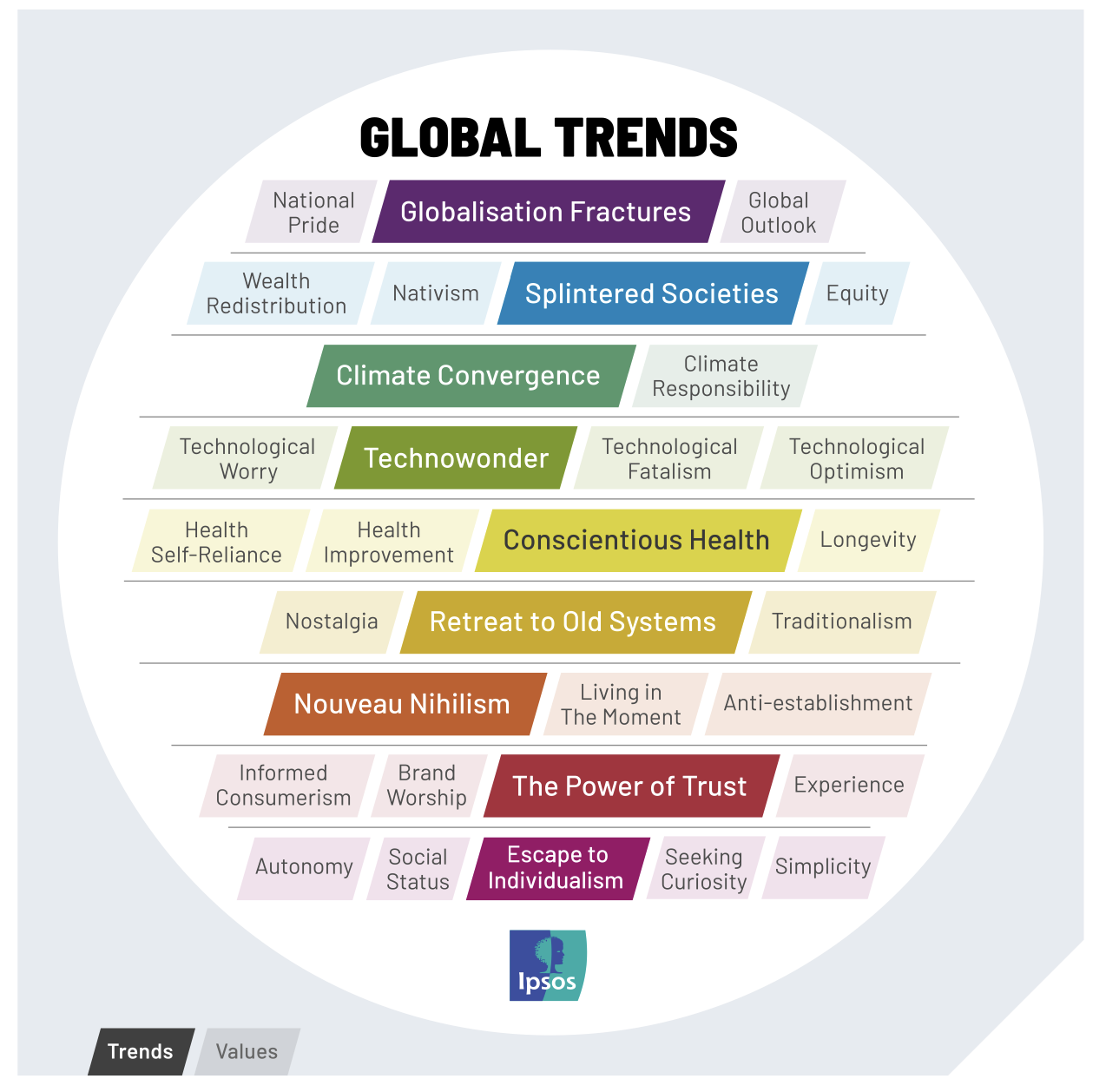
Digging a little deeper, here are some of the best trend reports for 2025. My favourites include Foresight Factory’s thoughtful view of humanity in a digital world, and OK Cool’s provocative view of what matters to Gen Z and Alpha, and how Boomers don’t get it”:
- EIU Economic Outlook 2025 … “Geopolitics will drive most significant change in the global economy. Global real GDP will expand by 2.6% a year on average over the next five years, below the 3% of the 2010s. US economic growth is slowing, Europe will build gradually from a low base, and China’s growth will be lifted slightly in 2025 by more vigorous stimulus. Emerging markets will benefit from a rebound in global trade while India’s expansion will be the fastest of any major economy in 2025-29.”
- Ipsos Global Trends … “As the world gets more complex, people focus on what they think they can control: themselves. People think they are doing all they can to solve climate change, but most feel overwhelmed by the complexity of the world around them. Even if feeling overwhelmed is part of being human, it’s still a powerful emotion that brands should be aware of and look to alleviate. One way: help people express themselves however they and their surrounding culture can.”
- Accenture Life Trends 2025 … As tech intensifies, and AI multiplies, reshaping our everyday lives ever more profoundly … people question what and who they trust, and seek new balances in how they live physically in a digital world. “Cost of hesitations details how it’s now incredibly easy to create all kinds of digital content, and a flood of scams is blurring the lines between the authentic and the deceptive. Even on once-trustworthy platforms, it’s harder for people to tell what’s real, seeding hesitation into their digital interactions.”
- Mintel Global Consumer Trends 2025 … “In 2025 and beyond, we’ll witness that the human mind, nature and technology aim to find harmony, but the puzzle is not always a perfect fit. As global consumer trends evolve, both consumers and brands will live in a pendulum that constantly swings between a sense of control and a loss of control. Three trends represent the layers of interaction that consumers and brands exist within: our home, our community and our globe.”
- Foresight Factory Trending 2025 … “Consumers want to break free from the monotony of over-programmed lives. The ability of an algorithm to curate personalised content was once its most distinctive feature. Now, its ubiquity contributes to a feeling of soullessness and blanding of content. The once fun internet is inundated with “slops” – spam content that screams of mediocrity. The advancement of AI further contributes to this, with much AI- generated content lacking in originality and producing oddly similar outputs.”
- GWI Consumer Trends 2025 … “How podcasts are shaking up the ad game. How the buzz around women’s sports can drive lasting growth. How the future workforce is changing before our eyes. Over 1 in 10 business professionals have a side hustle now. But get this – who they are might surprise you. The number of US teens who say college is important has dropped 21% since 2021”.
- Nielsen IQ Consumer Outlook 2025 … “The global outlook for consumers is improving. Consumers are determined in their resilience to stay ahead, vigilant against further disruption, and intentional about every aspect of their daily spending. The report anticipates that global consumers will spend $3.2 trillion more in 2025, representing nearly 6% growth compared with 2024, according to World Data Lab.”
- Publicis Sapient Consumer Trends 2025 … “We’re on the cusp of significant transformation as we enter 2025. A confluence of technological advancements, evolving consumer behaviours and economic shifts is reshaping the landscape. Economic pressures, including inflation, have reduced disposable income for many, creating distinct customer segments with a growing emphasis on value.”
- Euromonitor Global Consumer Trends 2025: “Healthspan Plans” focuses on the growing consumer desire for longevity and better health over time. 52% of consumers believe they will be healthier in the next five years than they are now. “Wiser Wallets” highlights a move towards financial conservatism, saving and mindful spending. “AI Ambivalent” balances scepticism for new tech with pragmatic evaluation. Despite concerns about AI outputs, 43% of consumers considered generative AI a reliable information source.
- WGSN Future Consumer 2025 … “We see seismic shifts across our industries, our communities and our planet. We’ll travel to new physical and digital cities, but won’t forget the power of local. We’ll focus on regenerative finance and business ecosystems, while understanding that growth isn’t a dirty word. The Great Restructure is among us.”
- Innova Global Consumer Trends 2025 … “Consumers are facing many external stresses, especially in terms of health, the environment, the changing global political landscape and personal financial constraints. As a result, they are choosing to take more control for themselves and are evaluating brands more carefully.”
- OK Cool Gen ZAlpha Trend Report 2025 … “Social media continues to shape culture, creating new communities and niches from Brat Summer, to the cult of Reesa Teesa and the earworm I’m looking for a guy in finance. TikTok has become the new Google for Gen Z and Gen Alpha, and young people are getting sick of ‘basic’ branded content online.”
- Gartner Strategic Technology Trends 2025 … “The trends fall into three buckets: the rise of AI agents will require advancements in AI governance and new technologies to combat disinformation; Quantum computing demanding new cryptographic methods, while low-cost sensors will enable innovative business models; and enhanced interactions between physical and virtual experiences, robots integrating into daily life, and tech that directly influences cognition and performance.”
- Startus Technology Trends 2025 … “Emerging technology trends will present unparalleled opportunities for growth, efficiency, and transformation. We categorized it into 10 clusters such as AI, automation, advanced computing, biotech, extended reality (XR), and more. Each category features specific technologies, including generative AI (genAI), predictive maintenance, and brain-computer interfaces (BCIs).”
- CBInsights Tech Gamechangers 2025 … “New breakthroughs are altering the future direction of tech and its influence on the world at large. While AI has captured headlines, it’s just one part of a broader technological surge. Startups and tech giants alike are making strides in fields as diverse as clean energy, space exploration, and human longevity.”
- Kantar Marketing Trends 2025 … “More than two in five consumers don’t trust AI-generated ads, making data provenance a big theme for 2025. Other trends include slowing global population growth, diversity and inclusion, sustainability, creator communities, coalescence of broadcast and online video platforms, livestreaming, Retail Media Networks (RMNs), and a decline in social media ad effectiveness”.
- Statista Must Watch Consumer Trends 2025 … “From AI-driven shopping to the rise of wellness, In 2025, AI isn’t just a buzzword, it’s the driving force behind smarter shopping decisions. Online influencers have reshaped consumer habits, but their growth is slowing, seen as less real and less trusted. Wellness is no longer confined to one category, from food to beauty, fashion and travel. Loyalty programs are the new tool to grow not just retain customers”.
- CMS Social Media Trends 2025 … “More than 5 billion people worldwide currently use social media, around 65% of the global population. AI-driven content creation becomes essential for crafting what users want to see. Niche influencers become crucial, driving deep engagement with specialized communities. Social commerce evolves, providing seamless experiences within the customer journey.”
- Webby Trend Report 2025 … “Brainrot is a condition that describes the impact of being ‘terminally online’ and a genre of nonsensical or absurdist internet humour. Today, the chronically online reign supreme. “Brat summer” can cannibalize pop culture and media, a baby hippo can become the next IT girl, and being “rizzed up” or “Costco guys” are terms expected to be widely understood.”
- Dentsu, Media Trends 2025 … “Media is increasingly driven by sophisticated algorithms, becoming 100% addressable, 100% shoppable, and 100% accountable. For 15 years, dentsu’s annual media trends report has been the industry’s most sought-after trend forecast. Download the 2025 edition to prepare for the many opportunities to drive impact in the algorithmic era.”
- Hilton Travel Trends 2025 … “From the awe-inspiring skies of the total eclipse to sold out sports stadiums, concerts and conferences, travel fuels memorable and important cultural conversations. We travel to discover new cultures, make connections, to recover and recharge.”
- Korn Ferry’s Talent Trends 2025 … “After last year’s AI boom and the shift to skills-based hiring, many global enterprises were caught in endless planning. Now’s the time to stop overthinking and start acting with purpose. The takeaway for 2025? Be intentional and brave.”
- JP Morgan Outlook 2025 … “Easing global monetary policy and increasing capital investment have the potential to drive growth in 2025. The key question for 2025 is how low rates will go. AI is poised to revolutionise productivity across the economy, from pharmaceutical development to white-collar labor. With political power shifts perpetuating uncertainty, investors should consider how they are diversifying exposures to bolster portfolio resilience.”
- UK MOD Global Strategic Trends to 2055 … “6 global drivers of change will redefine societies, economies, governance, security and defence, as well the natural world itself: global power competition, demographic pressures, climate change and pressure on the environment, technological advances and connectivity, economic transformation and energy transition, inequality and pressure on governance”.
- Roland Berger Trend Compendium 2050 … “People are naturally the focus of megatrends. They are the drivers of every trend but at the same time they are exposed to their effects. Thus, the focus here is not merely on data concerning demographic development of countries and regions, but also on training and work opportunities, and – equally – on societal values and human rights.”
- PMI Global Megatrends: People Planet Innovation … “Rather than predetermining anything in the future, we need to provide a culture centered on learning to increase the outcomes you are accountable for rather than only being accountable for an outcome with the resources you are given.”
- Frog Futurescape Report … “In the ebb and flow of human habits, renewed preferences and lifestyles emerge. What is currently receding? What might take its place? Whether in our relationships with people, planet or technology, there is a constant tension in how to respond to the dynamic shifts in human behavior “
- VML Future 100 … “2025 will be a year of paradoxes, where advanced technology meets digital disconnection, where the dawn of the trillionaire collides with cost-cutting and the prolonged challenges of the “cost-of-living”, and where brands must find that delicate balance between resonance with restraint. Gravy in a beer can. Tampons in an ice cream tub. Coffee in a tube. AI creators are experimenting with the possibilities of how the next iteration of beauty could look.”
More to come soon!
Maybe it’s also interesting to look back and see what was predicted in previous years …
What will you do in 2025?