The high octane world of corporate boardrooms making billion-dollar decisions, and entrepreneurial start-ups obsessed with getting there, is rife for movie-making. And indeed some of the most thrilling movies of recent years are also stories of business, how they soared and sometimes fell, and the personalities behind them.
Here’s my pick of the best business movies, each worthy of an MBA class:
Air … the story of Nike’s Air Jordan
Exploring the partnership between a then rookie Michael Jordan and Nike’s fledgling basketball division which revolutionised the world of sports and contemporary culture with the Air Jordan brand. This moving story follows the career-defining gamble of an unconventional team with everything on the line, the uncompromising vision of a mother who knows the worth of her son’s immense talent, and the basketball phenom who would become the greatest of all time (Warner Bros, 2023).
The Aviator … the story of TWA
The Aviator tells the story of Howard Hughes, a wily industrialist, glamorous movie producer and unstoppable American innovator – but thought of himself first and foremost as an aviator. In this spectacular epic, director Martin Scorsese focuses on the most prolific period in the life of Hughes: the mid-1920s through the 1940s. It was a time of brilliant aeronautical invention, turbulent love affairs and savage corporate battles. (2004)
The Billion Dollar Code … the story of Google Earth
Two German computer pioneers who go to court in the fight against an apparently invincible opponent in order to be recognized as the inventor of the Google Earth algorithm. The series illuminates both the hacker scene in post-reunification Berlin in the 90s, as well as the idealistic world of early Silicon Valley and the harsh reality of a multi-million dollar process. (2021).
The Big Short … the story of investment banking
“You smell that? What is that?… “Your cologne? … No … Opportunity … No. Money” … When four outsiders saw what the big banks, media and government refused to, the global collapse of the economy, they had an idea: The Big Short. Their bold investment leads them into the dark underbelly of modern banking where they must question everyone and everything. Based on the true story and best-selling book by Michael Lewis. (Paramount, 2016)
The Founder … the story of McDonald’s
Starring Michael Keaton as businessman Ray Kroc, the film depicts the story of his creation of the McDonald’s fast-food restaurant chain, which eventually involved forcing out the company’s original founders to take control with conniving ruthlessness (2016).
An Inconvenient Sequel … the story of climate change
A decade after An Inconvenient Truth brought climate change into the heart of popular culture, comes the follow-up that shows just how close we are to a real energy revolution. Al Gore continues his tireless fight traveling around the world training an army of climate champions and influencing international climate policy. Cameras follow him behind the scenes, in moments both private and public, funny and poignant, as he pursues the inspirational idea that while the stakes have never been higher, the perils of climate change can be overcome with human ingenuity and passion. (Paramount, 2017)
The Inventor … the story of Theranos
The Inventor chronicles the rise and fall of Theranos, interspersed with footage of Holmes and her COO Sunny Balwani making grandiose proclamations about Theranos and the value it was providing. It also includes visual flashbacks to the era of Thomas Edison, the titular Inventor who famously failed repeatedly before finally succeeding; Theranos’s miniature blood testing labs were called “Edisons”. In 2022 Holmes was convicted of defrauding investors, and sentenced to serve 11 years in prison. (HBO, 2019).
Moneyball … the story of Oakland Athletic
The story of Oakland Athletic, based on book Moneyball: The Art of Winning an Unfair Game by Michael Lewis. It is the baseball team’s 2002 season and their general manager Billy Beane’s attempts to assemble a competitive team. In the film, Beane, played by Brand Pitt, is faced with the franchise’s limited budget for players, build a team of undervalued talent by taking a sophisticated analytical approach to scouting for the best talent.
The Playlist … the story of Spotify
At the height of piracy, established heavy-hitters were fighting against where the turbulent music industry was heading. The series centers around young Swedish tech entrepreneur, Daniel Ek, and his partners, who revolutionized a whole industry by offering free and legal streamed music around the world. (Netflix 2022)
Seaspiracy … the story of unsustainable fishing
11,000 to 30,000 sharks are killed by humans every hour of every day, totally around 4.5 million a year. Almost half are killed as bycatch and discarded back into the ocean. Seaspiracy examines the global fishing industry, challenging notions of sustainable fishing and showing how human actions cause widespread environmental destruction. (Netflix, 2021)
The film examines the 2001 collapse of the Enron Corporation, which resulted in criminal trials for several of the company’s top executives; it also shows the involvement of the Enron traders in the California electricity crisis. The film features interviews with McLean and Elkind, as well as former Enron executives and employees, stock analysts, reporters and the former Governor of California Gray Davis. (2005)
The Social Network … the story of Facebook
The tale of a new breed of cultural insurgent: a punk genius who sparked a revolution and changed the face of human interaction for a generation, and perhaps forever. Shot through with emotional brutality and unexpected humour, this superbly crafted film chronicles the formation of Facebook and the battles over ownership that followed upon the website’s unfathomable success. (Sony, 2010)
Steve Jobs … the story of Apple
Set backstage at three iconic product launches and ending in 1998 with the unveiling of the iMac, Steve Jobs takes us behind the scenes of the digital revolution to paint an intimate portrait of the brilliant man at its epicenter. Michael Fassbender plays Steve Jobs, the pioneering founder of Apple, with Kate Winslet starring as Joanna Hoffman, former marketing chief of Macintosh.
Super Pumped … the story of Uber
The ambitious CEO Travis Kalanick of ride-hailing app Uber tries to turn a struggling startup into a tech titan amid massive scandals, and is ultimately ousted in a boardroom coup. The series embodies the highs and lows of a Silicon Valley start-up. (2022).
WeCrashed ... the story of WeWork
Inspired by actual events, and the love story at the centre of it all. WeWork grew from a single co-working space into a global brand worth $47 billion in under a decade. Then, in less than a year, its valuation dropped $40 billion. What happened? Starring Jared Leto as Adam Neumann, Anne Hathaway as Rebekah Neumann and Kyle Marvin as Miguel McKelvey.
And a few great videos …
The Joy of Stats … by Hans Rosling
The late Hans Rosling’s famous lectures combined enormous quantities of public data with a sport’s commentator’s style to reveal the story of the world’s past, present and future development. He explored stats in a way he has never done before – using augmented reality animation. In this spectacular section of ‘The Joy of Stats’ he tells the story of the world in 200 countries over 200 years using 120,000 numbers – in just four minutes. Plotting life expectancy against income for every country since 1810, he shows how the world we live in is radically different from the world most of us imagine. (BBC, 2011)
Brené Brown studies human connection, our ability to empathise, belong, love. She is an American professor, social worker, author, and podcast host, known for her work on shame, vulnerability, and leadership, In a poignant, funny talk at TEDxHouston, she shares a deep insight from her research, one that sent her on a personal quest to know herself as well as to understand humanity. (TED, 2011)
Is this how our story is due to end?” … by Sir David Attenborough
In an electrifying speech delivered at the opening of the World Leaders Summit on Climate Change (COP26) in Glasgow, Attenborough gave a message of hope on behalf of the world that through action, we will witness the recovery of the natural world. But his warning of what will follow should we fail to act was also clear and stark. His speech was illustrated with stunning, cinematic pictures shown on giant screens behind him, produced by Silverback Films.
Looks Aren’t Everything … by Cameron Russell
The supermodel admits she won “a genetic lottery”: she’s tall, pretty and an underwear model. A Victoria’s Secret favorite, she has appeared in multiple international editions of Vogue as well as in ads for brands like Ralph Lauren and Benetton. But she feels at her core that image isn’t everything. But don’t judge her by her looks. In this fearless talk, she takes a wry look at the industry that had her looking highly seductive at barely 16-years-old.
Grit: The power of passion and perseverance … by Angela Duckworth
Leaving a high-flying job in consulting, Angela Duckworth took a job teaching math to seventh graders in a New York public school. She quickly realized that IQ wasn’t the only thing separating the successful students from those who struggled. Here, she explains her theory of “grit” as a predictor of success.
The Puzzle of Motivation … by Dan Pink
Dan Pink examines the puzzle of motivation, starting with a fact that social scientists know but most managers don’t: Traditional rewards aren’t always as effective as we think. Listen for illuminating stories, and maybe, a way forward. Dan Pink is the former speechwriter to Al Gore. His books include A Whole New Mind on why right-brainers will rule the future, and Drive exploring the surprising truth about what motivates us.
Dare to Disagree … by Margaret Heffernan
Most people instinctively avoid conflict, but as Margaret Heffernan shows us, good disagreement is central to progress. She illustrates (sometimes counterintuitively) how the best partners aren’t echo chambers — and how great research teams, relationships and businesses allow people to deeply disagree. (TED, 2012)
As the human population continues to grow, so does our impact on the environment. In fact, recent research has shown that three-quarters of Earth’s land surface is under pressure from human activity. In this short film, spoken word artist Prince Ea makes a powerful case for protecting the planet and challenges the human race to create a sustainable future. (National Geographical, 2017).
The book publishing industry is in a bind.
While the world changes – as digital platforms transform every other industry, as new generations engage in new ways, as the sources of value are rapidly upturned – the world of books continues to dismiss the need for real change.
Maybe technology can automate some of the slowest processes, maybe AI can improve production efficiency, maybe tweaks can reduce waste and improve sustainability, but most publishers still like books – ideally 300 pages, black and white, standardised format, hard back.
Of course there is a cultural love of printed books, the antiquated romance of literature, the refuge of an old book shop, the comfort of a physical tome. And, in fact, more books were sold across the world than ever before.
But it’s a pure fantasy to assume this can be the future.
All around, every industry has changed. 25 years ago, platforms like Amazon and Netflix challenged the old world of retail and entertainment. Now they are the establishment.
In a world of smartphone primacy … where payments are a digital click, retail is gamified entertainment, pizzas are delivered in minutes, events are personal and immersive, relationships are social, and influence is communal … isn’t it time for books to innovate?
The publishing world, more generally, woke up long ago.
News is live across multiple channels, movies are on demand, advertising is programatic. Time Magazine to Rolling Stone are delivered by monthly download, with daily updates. Many young people have never even watched a scheduled TV program, or read a newspaper.
Book publishing requires more than tweaks to its old model. Tweaks to reduce costs, increase speed, embrace social, are just tweaks. Diminishing returns in an outdated world.
Publishers need new business models
New business models are the most effective way to transform organisations, to innovate the whole way in which the business works. Inspired by a new generation of businesses – Airbnb to Uber, Revolut to Netflix – we see dramatically new business models in every market, through collaborative platforms, data analytics and personal recommendations, or subscription-based payments.
Airbnb makes money by helping you to make money out of your spare room, connecting host and guest, then taking a small fee from each. Nespresso makes great coffee, selling discounted machines, and then getting you to sign up to an everlasting and incredibly profitable direct revenue steam of coffee pods.
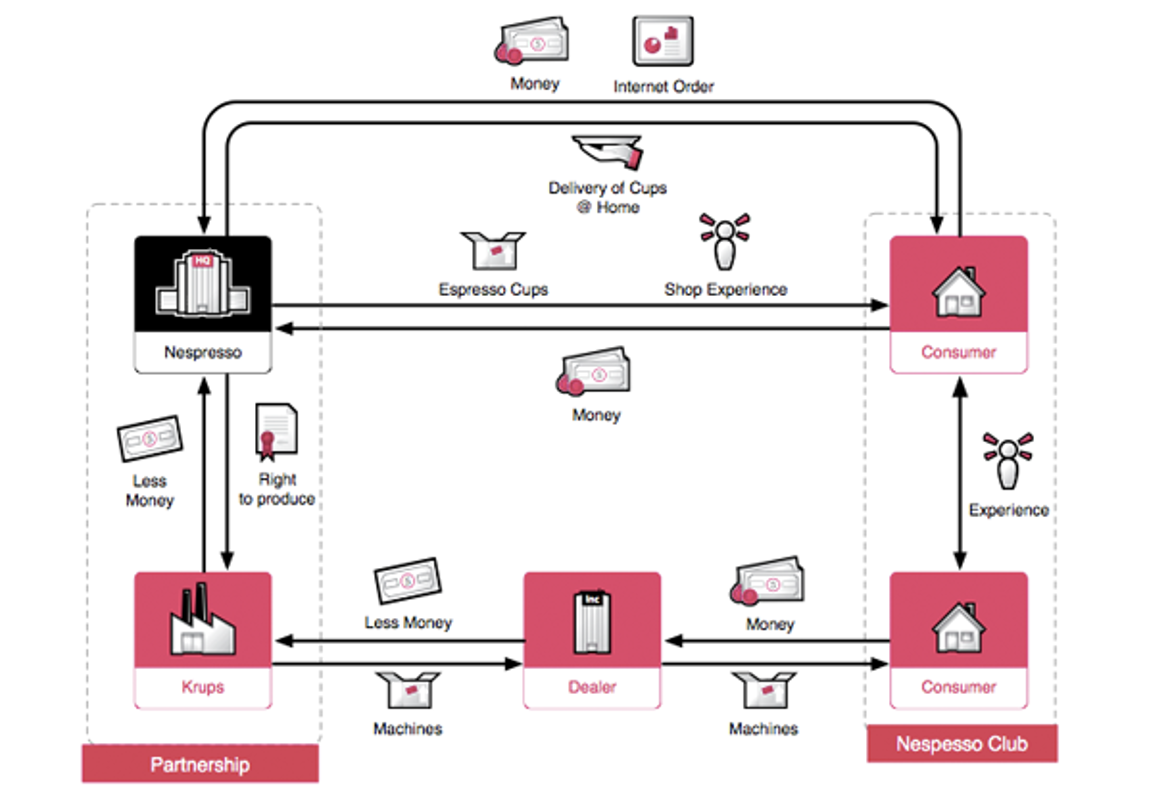
What if your business started leasing rather than selling, became part of the sharing economy? What if you simply facilitated an exchange between buyers and sellers and took a cut? How about moving to a subscription model, or a freemium model, or a referral model, or an advertising model?
The term “Business Model” is over used and under defined. Business models explain how organisations work – how do they create value for customers, and in doing so how they create value for all other stakeholders. They can map the current business, or explore options for the future.
The approach originates from mapping “value networks” in the 1990s, understanding the systems across business and its partners through which value (both financial and non-financial) is created and exchanged – by who, how and for whom. I remember working with Pugh Roberts to create a multi-million dollar dynamic model for Mastercard which showed varying any one driver – such as interest rates, or branding – affected everything else. And thereby being able to test new ideas and optimise the model.
Business models represent the dynamic system through which a business creates and captures value, and how this can changed or optimised. They are a configuration of the building blocks of business, and their creative reconfiguration can be a significant innovation.
Business models became fundamental to business strategy, driven by them but often driving them. Hambrick and Fredrickson’s Strategy Diamond is all about aligning the organisation, achieving an economic logic between strategic choices. They help to align the business, matching the right strategies for outside and inside, using the proposition as the fulcrum, and profitability as the measure of success.
Business models can often appear very mechanical, lacking emotion and easy to imitate. In 2001 Patrick Staehler, in particular seeking to explain the new breed of digital businesses, created a business model “map” driven by the value proposition, enabled by the value architecture, creating economic value and sustained by cultural values. The last point here is most interesting, in that it captured the distinctive personality of a business, its leadership styles and ways of doing business. This is much harder to copy, and also sustains the other aspects.
Alex Osterwalder’s subsequent Business Model Canvas emerged as the most common template on which to map a business model. He popularised the approach so much so that his supersized canvas now features in workshops throughout the world, always with an array of multi coloured sticky notes as teams debate the best combination of solutions for each box. Whilst the canvas lacks the sophistication of value driver analysis and dynamic modelling, it is about testing hypothesise in each aspect, and how they could work together, and that respect works as a thinking model.
Business models have become a practical tool for rethinking the whole business, seeing the connections and then innovating the business. In fact they offer a great platform to facilitate new strategy and innovation thinking. That’s why we’ve created the Business Innovation Program, which combines design thinking, new business models and strategic implementation – a great way to engage your team, to think about new ways to grow, and to create the future, practically.
We explore at least 50 different business model templates which could transform your business. We start with the customer, to explore emergent needs and behaviours, shaping better propositions and solutions, then exploring how to deliver them commercially, and as engaging customer experiences.
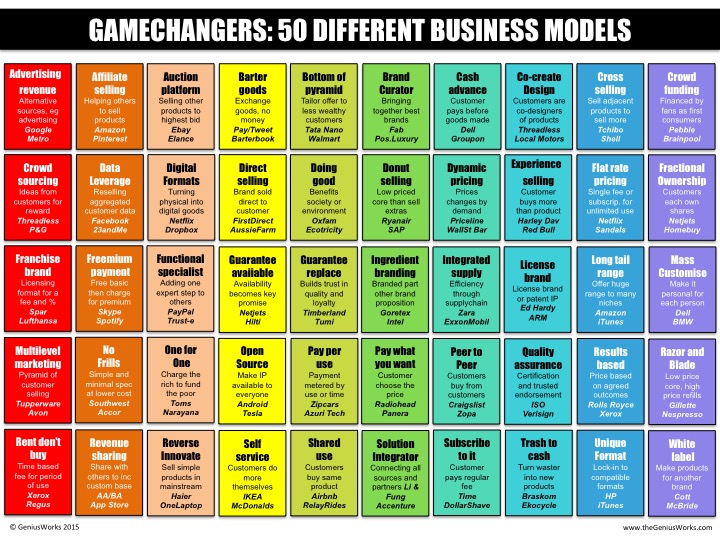
Here are some examples from other areas of publishing. This is by no means an exhaustive list, as the variations are infinite, and may involve components of multiple examples:
The Paid Content Publisher: Subscriptions or micropayments
- Targets the loyal, demanding consumer who values the objective and relevant content that top news outlets produce
- Examples: The Economist in media publishing, Blinklist in digital book summaries.
- They are clearly the world leaders with the highest credibility, coverage and loyalty from their audiences. Through various forms of payment for content they have been able to sustain their business model. Only those with good quality journalism and community engagement are able to survive with this model.
The People’s Publisher: Crowdfunding
- Targets the consumer who is willing to fund media companies with negative balances, supporting their clear independence and good quality, credible content.
- Examples: Unbound in book publishing, The Guardian in media publishing.
- This business model is recommended for kick-starting a business or a specific
project, with a goal of then achieving sustainability through another model such as advertising or subscriptions. Only in very well developed economies will this model be able to grow. Regulatory restrictions still limit the use of crowdfunding.
The Self Publisher: Author published
- Targets consumers who are highly segmented, and in a database built up by the author already, without the need for publisher brand endorsement
- Examples: Amazon Kindle, Apple Books
- These platforms have a a DIY platform to enable authors to develop, format, prepare, and produce their books for significantly lower fees. It may include hybrid models which can involve freelance designers, copywriters, being part of the process. The platform may then also distribute the book to its audience, for a relatively minimal fee.
The Custom Publisher: On demand, asset based
- Targets specialist audiences who only want to buy specific content (eg individual chapter, or entity), or want it customised in some way specific to them (eg personal name inserted, corporate branded etc)
- Examples: Publishers House,
- These platforms are often linked to self publishing, but could work for any book. The concept of buying a book by a chapter, or selection of chapters unto the full price of the book can work well in technical subjects. Print on demand technologies in general, allow publishers to access their huge back catalogues of content and titles, without having them preprinted and stored. Also to print on location, to avoid shipping.
The Retailer Publisher: Vertical, ecommerce
- Targets consumers who are highly segmented due to their needs and profile and who are willing to satisfy their purchase needs with the portfolio of products / services offered.
- Examples: Monocle in media publishing, Net-a-Porter in fashion publishing
- These companies have clearly focused on a niche audience with both content
and exclusive and attractive offers, which has increased the purchase intent for their products and captured the advertisers’ interest. With the gradual increase of e-commerce in the retail market, more companies will have to develop this model, independently or through partnerships. A deep understanding of their audiences is a must to survive with this model.
The Events Publisher: Events, experiences
- Targets consumers attracted by the quality and credibility of the brand and their resulting events
- Examples: Ascential in events publishing (Cannes Lions etc), Live Nation in music
- These companies have consolidated the development of events of all their brands into a single area for the sale of tickets and sponsorships or have opted to create independent business units aligned with the growing interest of the consumer in actively participating in new experiences. These events also generate new content, data that feeds databases and become positive influencers for their brands. This model could represent 20 per cent of total revenues with good brand partnerships and with the right management team.
The Community Publisher: Clubs, membership
- Targets consumers who, through subscription packages, not only access editorial products, but attractive discounts in a broad portfolio of products and services. The annual subscription could be recovered through accessing these discounts.
- Examples: The Atlantic in sports publishing, Future in media publishing (eg Americas Test Kitchen)
- All these companies have generated a robust list of benefits so that subscribers have preferential access to relevant events, premieres and discounts across a wide range of services. It requires a proactive telemarketing strategy to make sure that the club members are satisfied and loyalty prevails.
The Advertising Publisher: Advertising, branded content
- Targeting interested advertisers to build and distribute relevant messages associated with their brands and the needs of the audiences
- Examples: Quartz, British Airways High Life
- These companies are among the few that still survive with robust models dependent on advertising, due to their high segmentation and profiling of their audiences which capture sophisticated audiences.
The Agency Publisher: Selling brand content
- Targeting advertisers who do not have the capacity to contract creative agencies to create advertising pieces for their audiences.
- Examples: 23stories by Condé Nast, CNBC Catalyst
- Taking advantage of their content creation potential, these companies have built creative and editorial teams to design 360 marketing campaigns and branded content production for advertisers, that can be disseminated through their media portfolio. It requires leveraging the competency of the marketing team to be able to compete against traditional ad agencies with cost-effective strategies and excellent service level agreements.
The Database Publisher: Data broker
- Targeting advertisers who want to increase their effectiveness in advertising campaigns with databases generated from the media companies’ audiences.
- Examples: ProPublica (US), Schibsted (Norway)
- With the emergence of programmatic advertising, it becomes increasingly important to have your own data, to be able to take advantage of them internally but also to offer them to third parties to increase the effectiveness of your marketing campaigns. Classified ads and verticals are also an excellent vehicle to enlarge databases with more relevant audience information.
The Licensing Publisher: Innovating services
- When the intangible value of the brand is high, it is worth taking advantage of this to license the brand in other related products or services, and thus obtain other related sources of income
- Examples: Disney, National Geographic
- All these brands enjoy great recognition, credibility and acceptance by their audiences. By developing new products and services with this seal of quality, they can generate additional income. In most countries, media companies have a good brand awareness and acceptance; an intangible asset that can be wisely used to enlarge revenue sources with complementary businesses.
The IT Publisher: Selling software
- When internal IT development has proved to be effective, media companies can offer consulting and IT licensing services to their industry peers to increase their operational efficiency.
- Examples: The Washington Post with ARC
- Unfortunately, not many media companies have the capability to offer these types of services. This model requires developing a business-oriented and a consultative selling and consulting culture in the IT team to provide these services to internal and external customers.
The Investor Publisher: Launching a fund
- When you want to invest in other promising and emerging businesses in exchange for advertising
- Examples: Thomson Reuters
- Through alliances with other companies in the same sector, these companies
have created specialized funds to invest in emerging media businesses. It is crucial to have a well developed private equity fund community that can serve as partner for media companies to correctly assess the deal flow and make the right choices.
I love running workshops for all kinds of business challenges – from design sprints to innovation summits, boardroom visioning to strategic decision making, leadership development and team building – or sometimes a mixture of all these together. I’ve run them across the world, from Singapore to Seattle, Jeddah to Jo’burg, from 10-person board meetings to 1000-person events.
While the content and format needs to be tuned to the audience and objectives, there are some factors which are essential in every kind of workshop:
- human ingenuity … people, at every level, need to be engaged, inspired, and encouraged to participate, creating a space and energy to share fragile ideas with confidence, and to build on them positively.
- practical resources … brainstorms are probably the least effective technique to generate new thinking, and there are 100s more tools to drive useful, meaningful outcomes.
- effective structure … workshops are journeys, they need context and purpose, a starting point, to open up and then stretch, to build momentum, and to close down, to have a conclusion and deliverables.
- intelligent facilitation … while everyone brings their ideas and opinions, they need stimulus and challenge, connection and interpretation, which requires intelligent facilitation, not just a flipchart scribe.
What I’ve found is that workshops need all these factors. And if you combine a learning and delivering experience – be driven by real issues, add new research and education, add new tools which people can use themselves, add expertise and challenge, and ensure that the delivery will have a real impact for the organisation – then workshops can be turning points in the progress and impact of organisations, teams and people.
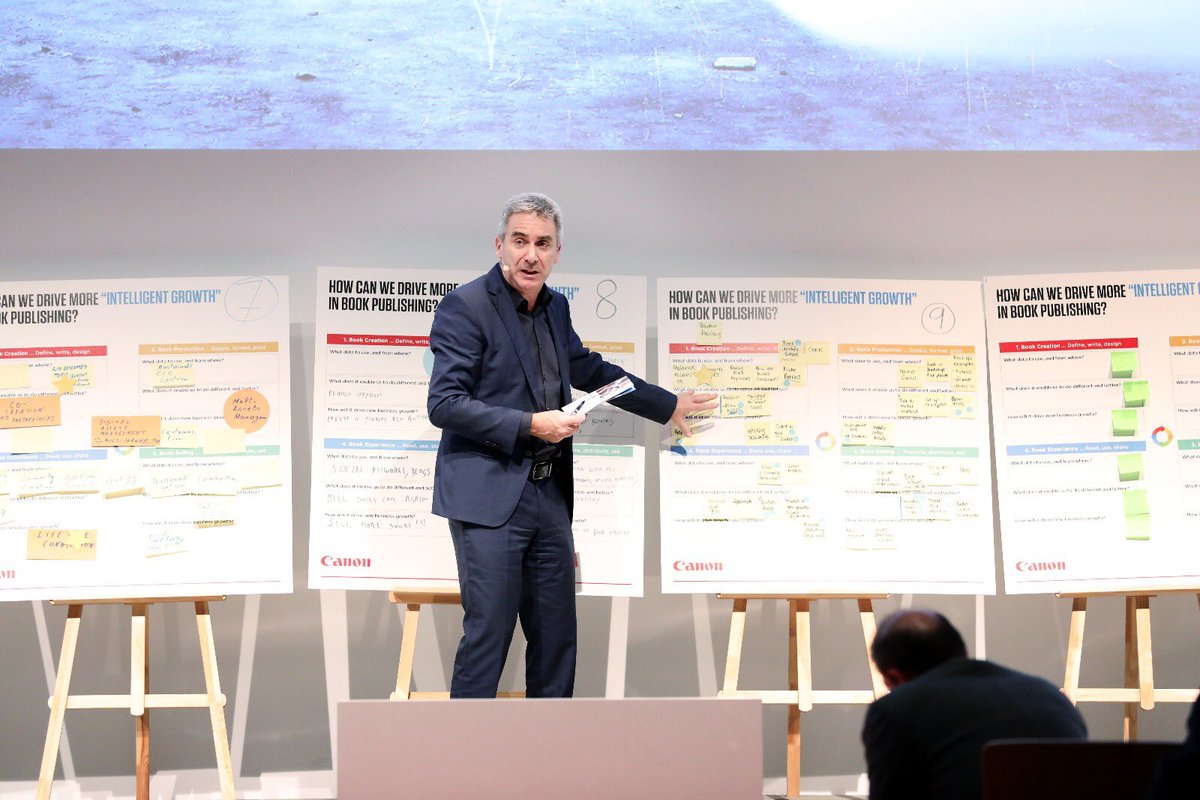
Below are some of the most useful resources which I use, both developed myself over the last 30 years running workshops with teams all over the world, and from a wide range of expert partners:
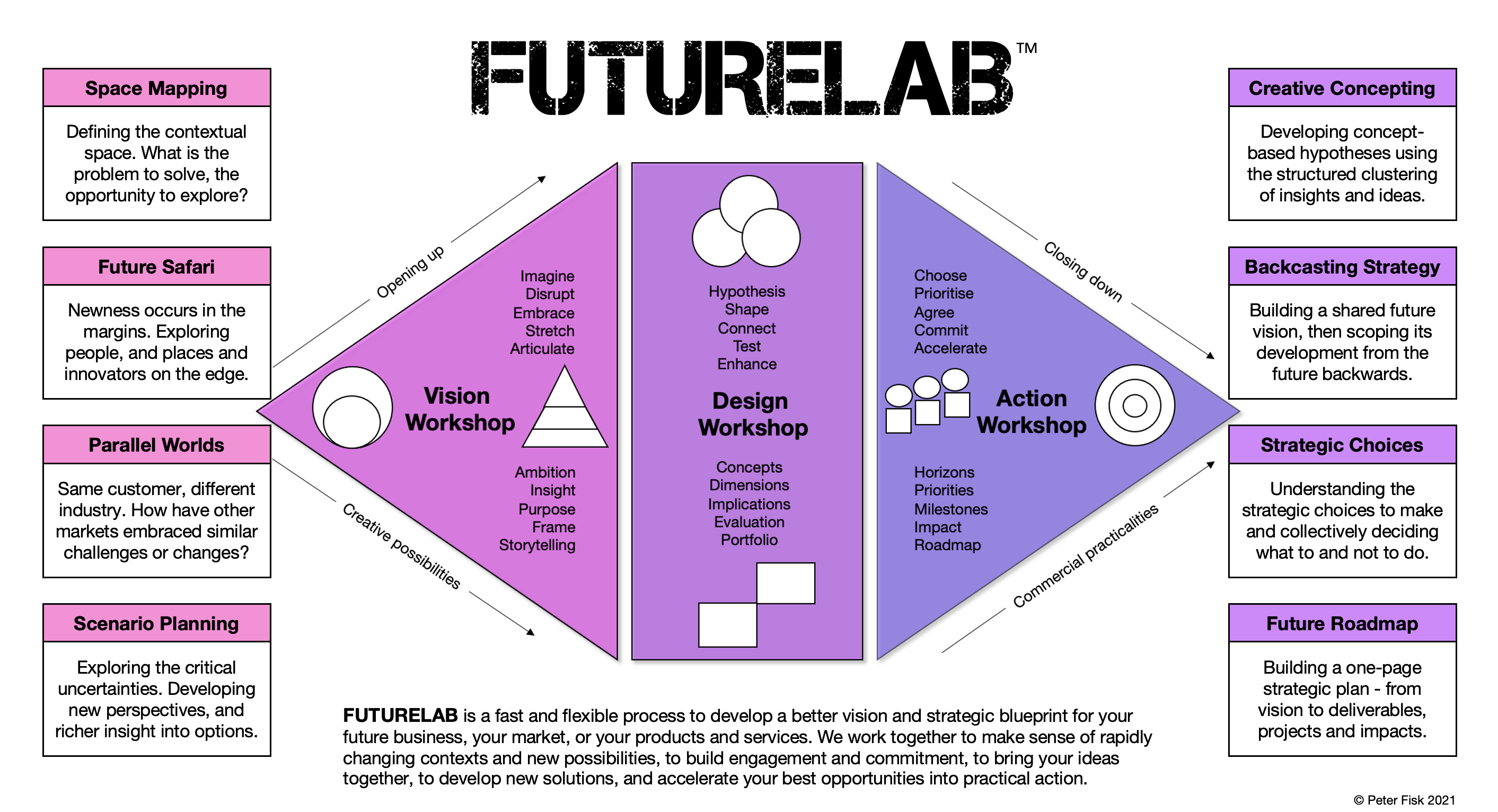
Future Lab is a structured facilitation process for workshops, or sometimes a series of workshops to develop new ideas, strategies, innovation and more, combining clear structure with embedded tools.
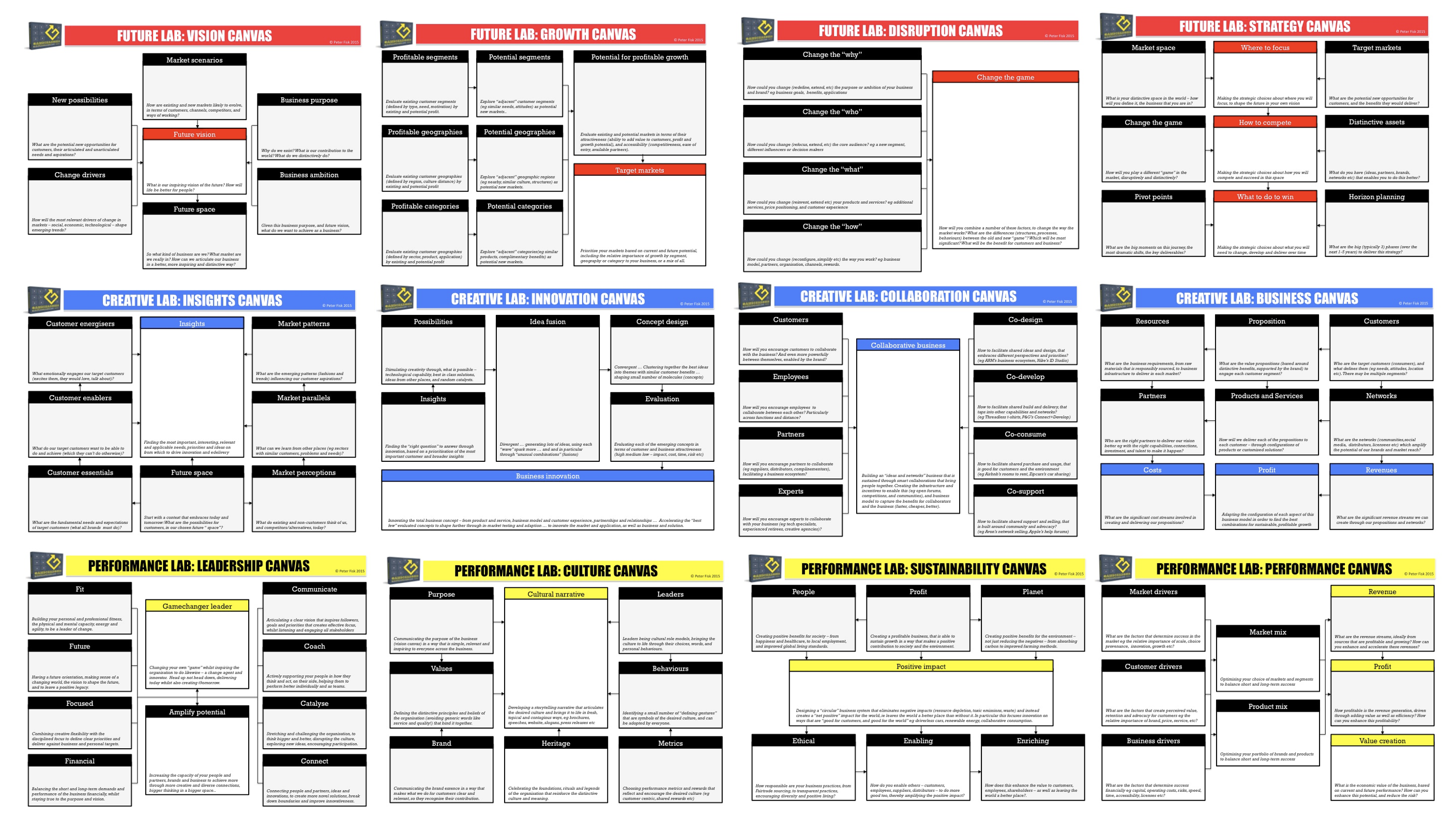
Gamechanger Labs are a portfolio of 16 business canvases, or templates, to explore the future of your business – from vision and strategy to insights and innovation, to leadership and culture, based on Peter Fisk’s best-selling “Gamechangers”.
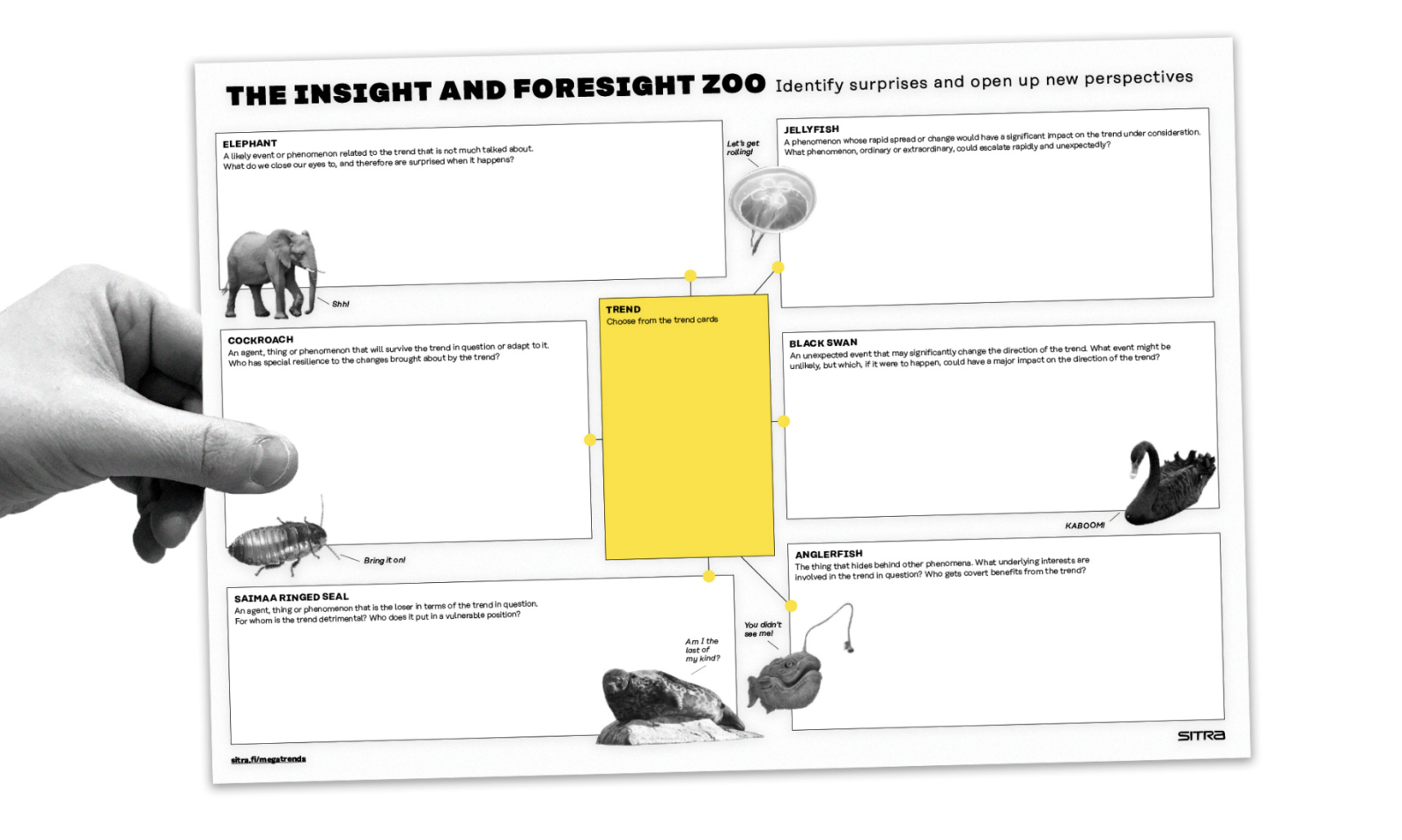
Sitra Futuremakers Toolbox from the Finnish government innovation fund, helps you recognise trends and emerging phenomena, imagine alternative futures and link your future-oriented thinking to change-making.
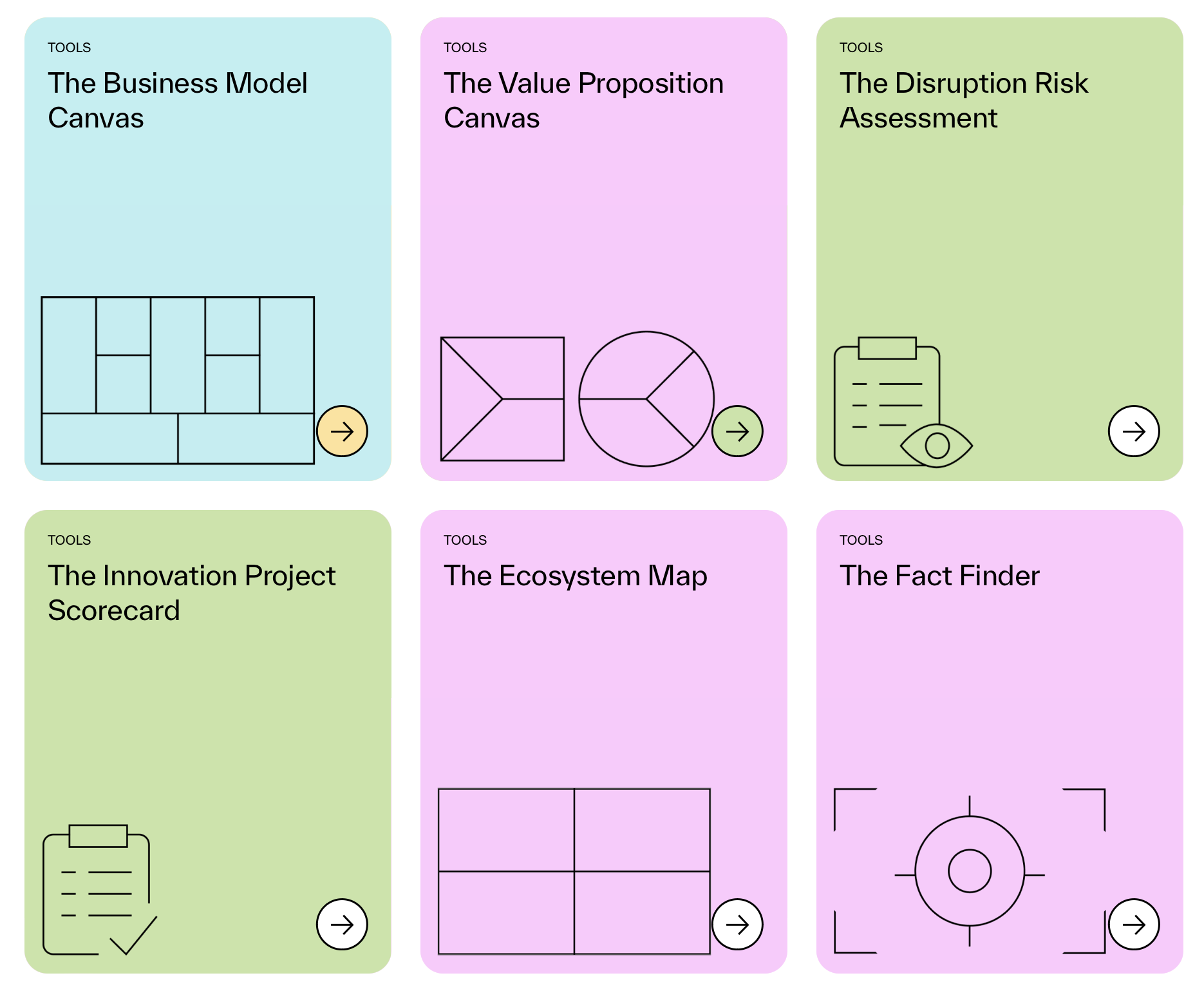
Strategyzer Toolkit with some of the best ideas, learnings and methods from Alex Osterwalder and his team, most famous for the business model canvas, to help you further your understanding and practice of innovation.
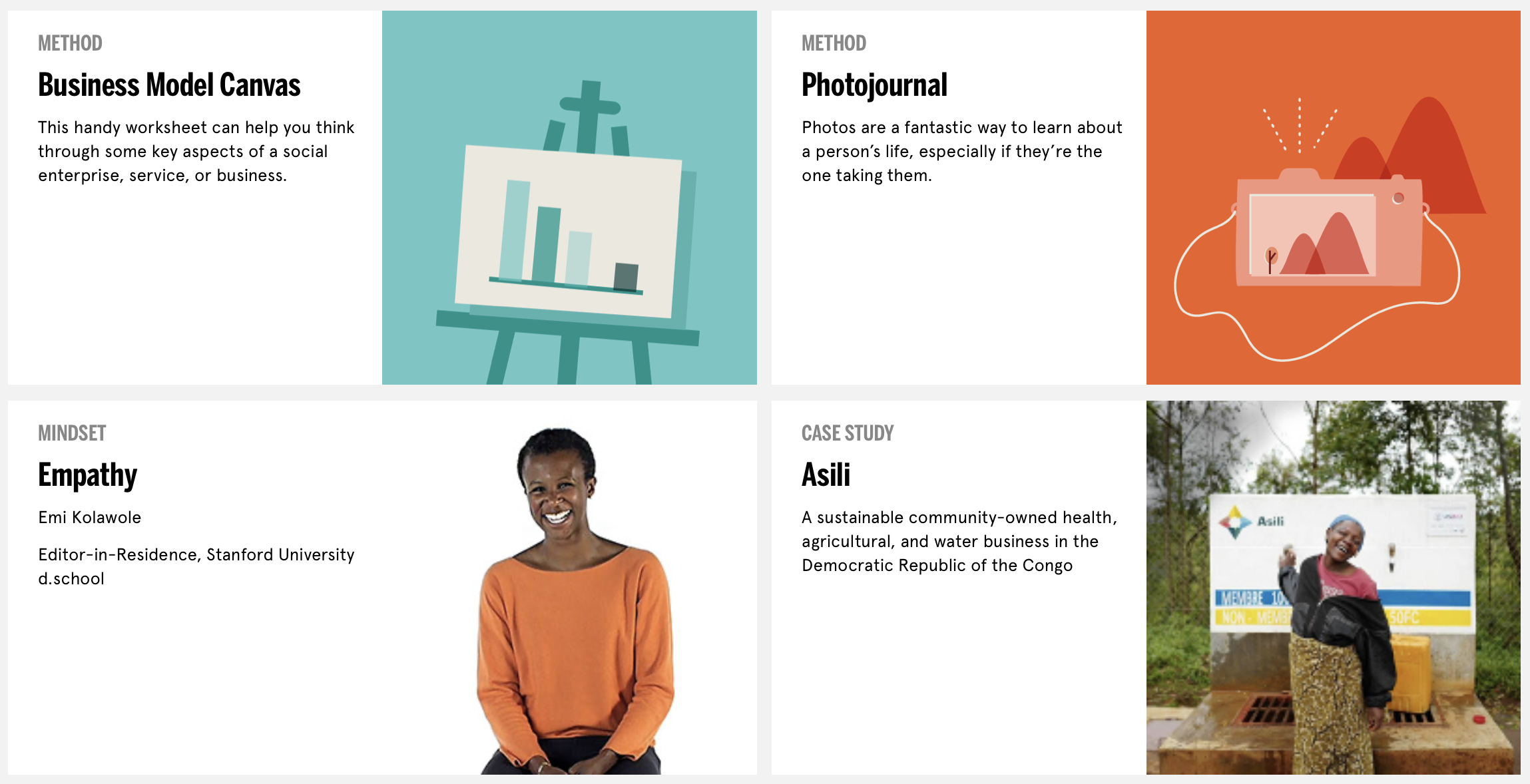
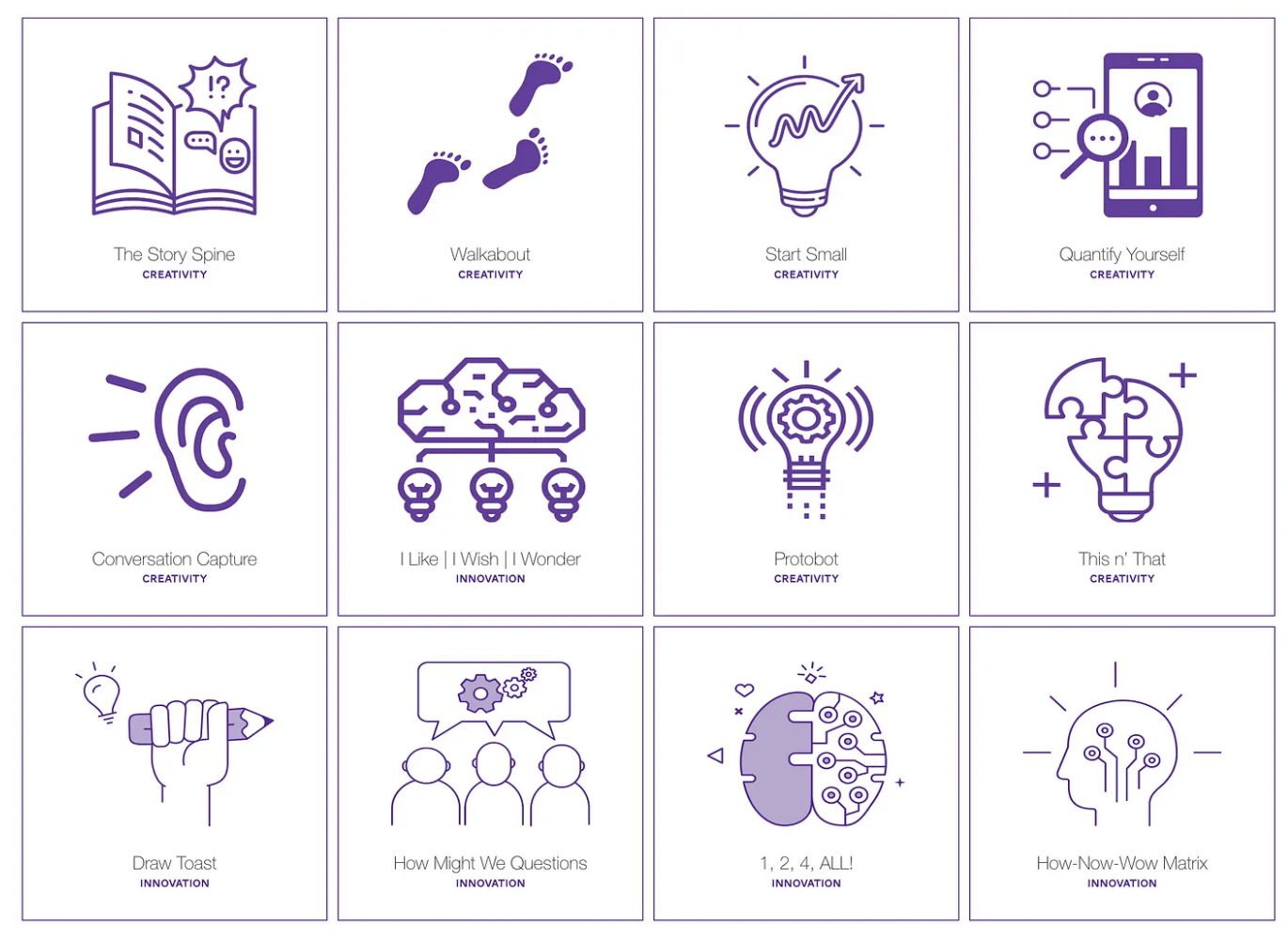
IDEO Design Kit. Human-centered design is a step-by-step guide from David Kelley and the IDEO team to unleashing your creativity, putting the people you serve at the center of your design process to come up with new answers to difficult problems.
Design Method Toolkit is a comprehensive resource for designers of all levels, providing a well-organised and easy-to-use overview of the human-centred design process, from research to creation.
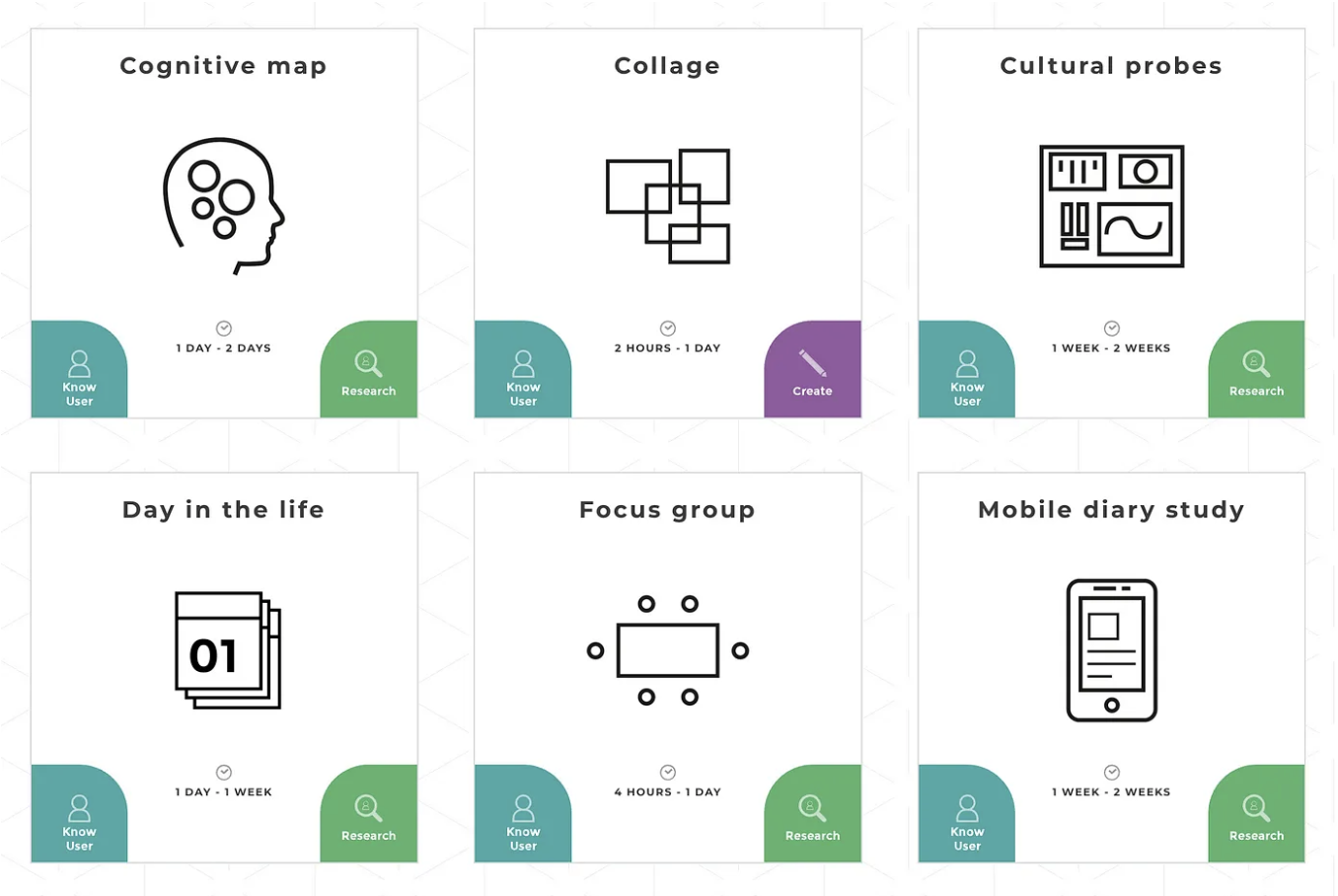
The Hyper Island Toolbox is a collection of methods and activities that focus on experiential learning, collaboration, and real-world problem-solving.
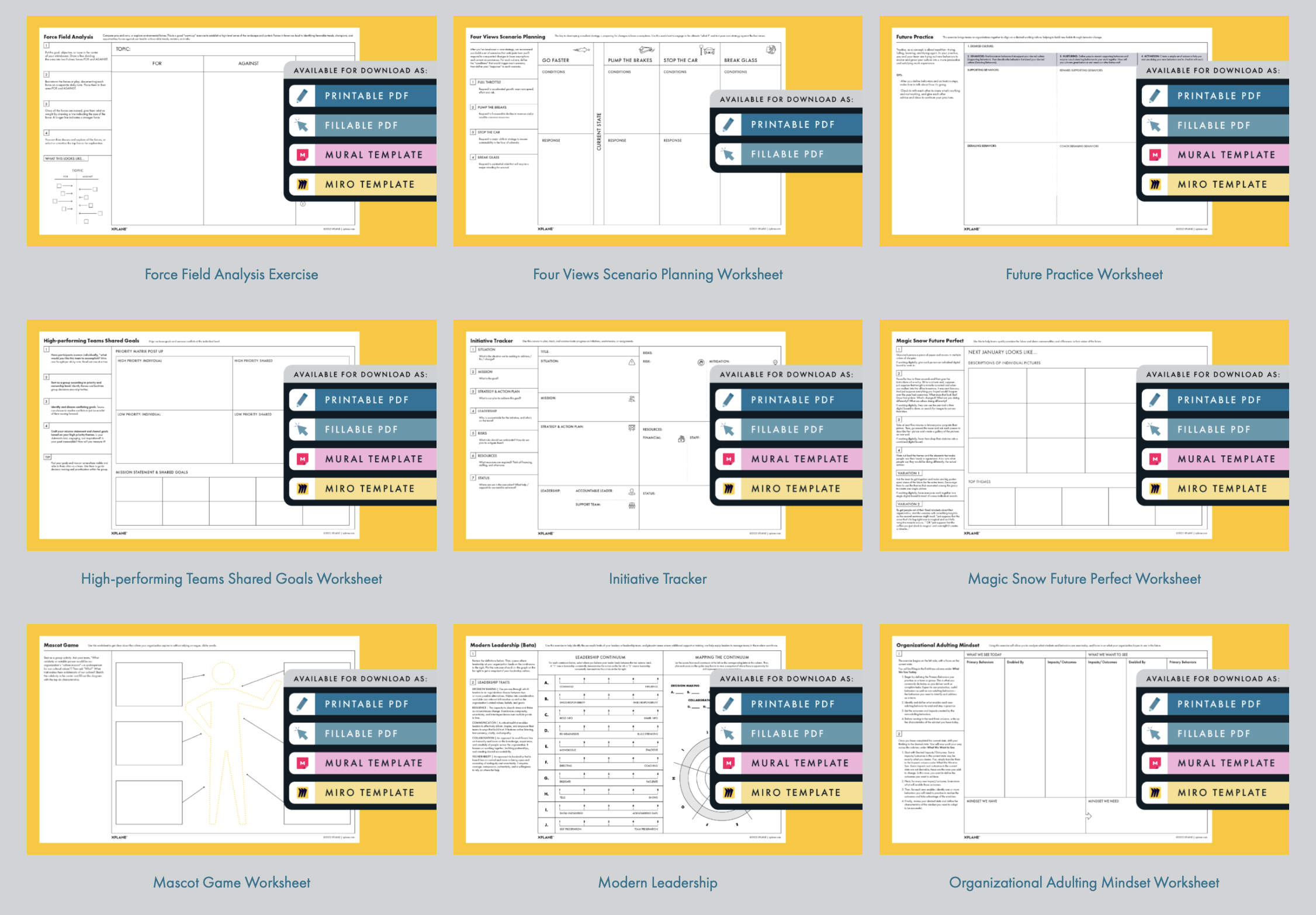
XPlane Change Toolkit, the visual sense-making company established by Dave Grey is known for producing fabulous infographics that interpret complexity in smart and simple ways, and now offers a wide range of worksheets
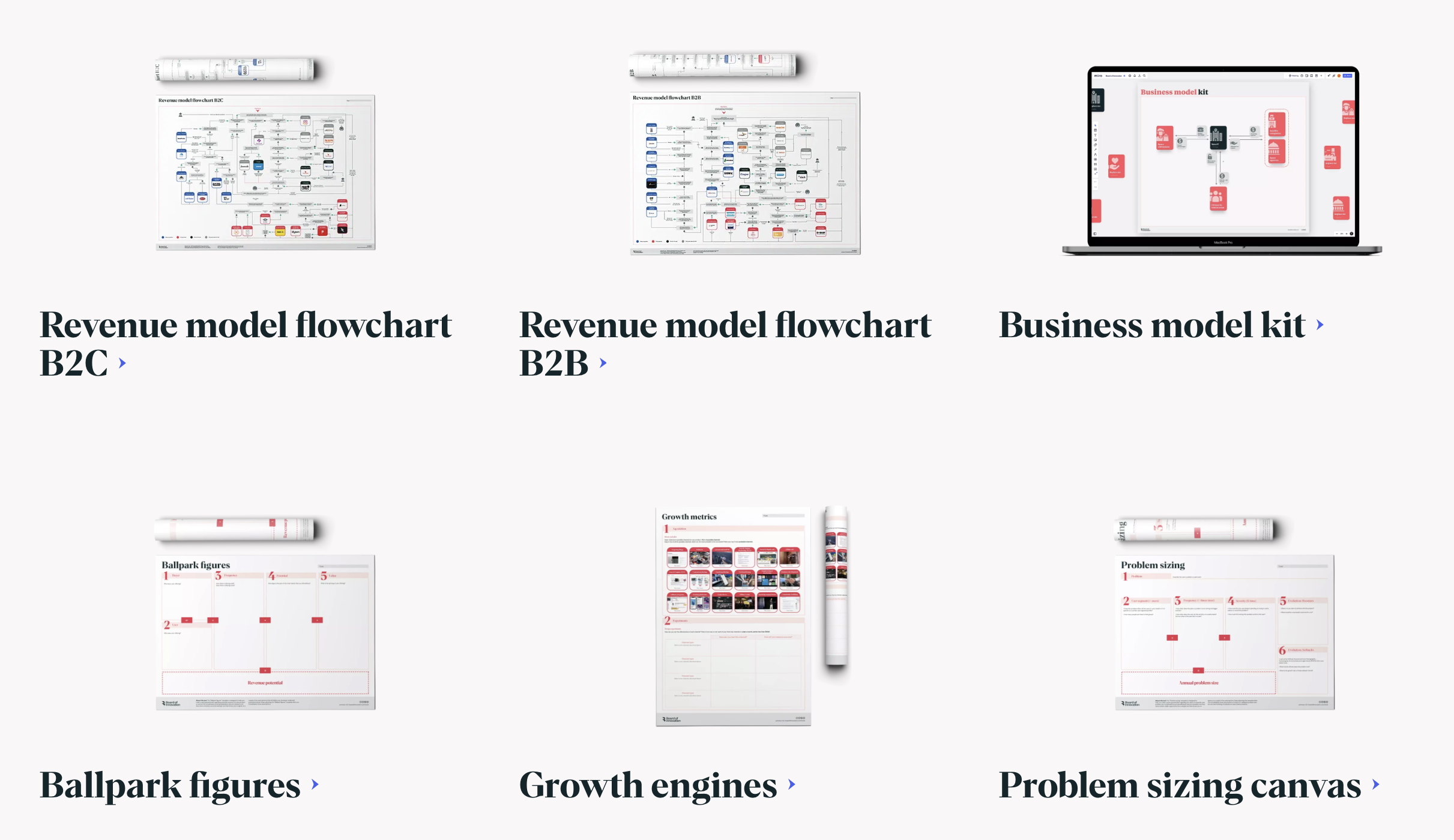
BOI Innovation Toolkit brings together more perspectives on business innovation, including some great case studies, and also a range of tools to make the case for radical change.
Circular Business Design Guide helps business leaders identify circular opportunities and design business models that create, deliver and capture value in ways that also benefit society and the environment.
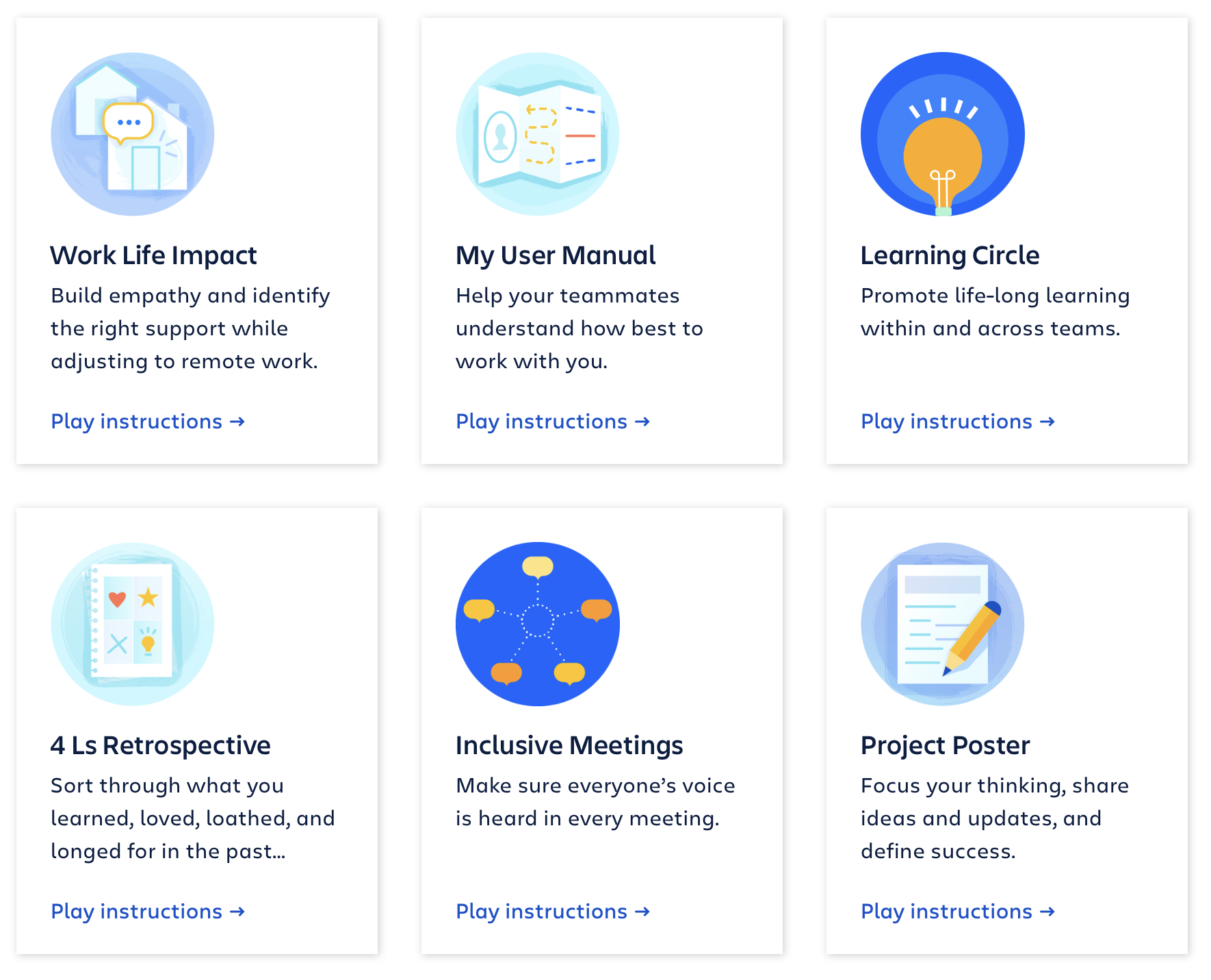
The Atlassian Team Playbook is a collection of workshop resources that help teams work better together. It includes a variety of tools and activities to improve communication, collaboration, and problem-solving.
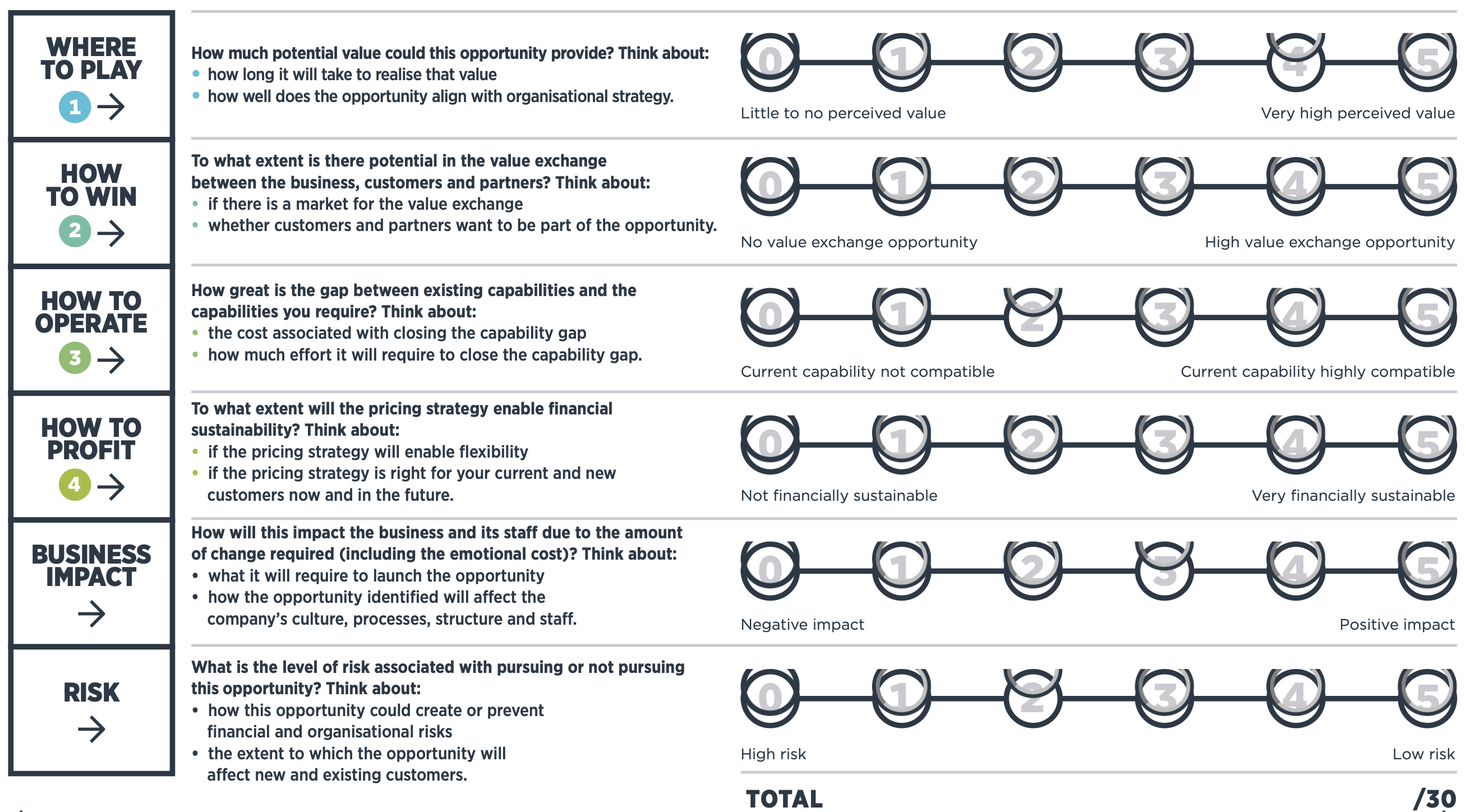
Nesta DIY Toolkit is more specifically for public-sector organisations, governments and agencies, starting with a flowchart to show how the many tools fit together. It’s designed for public-sector, but actually works for any kind of organisation.
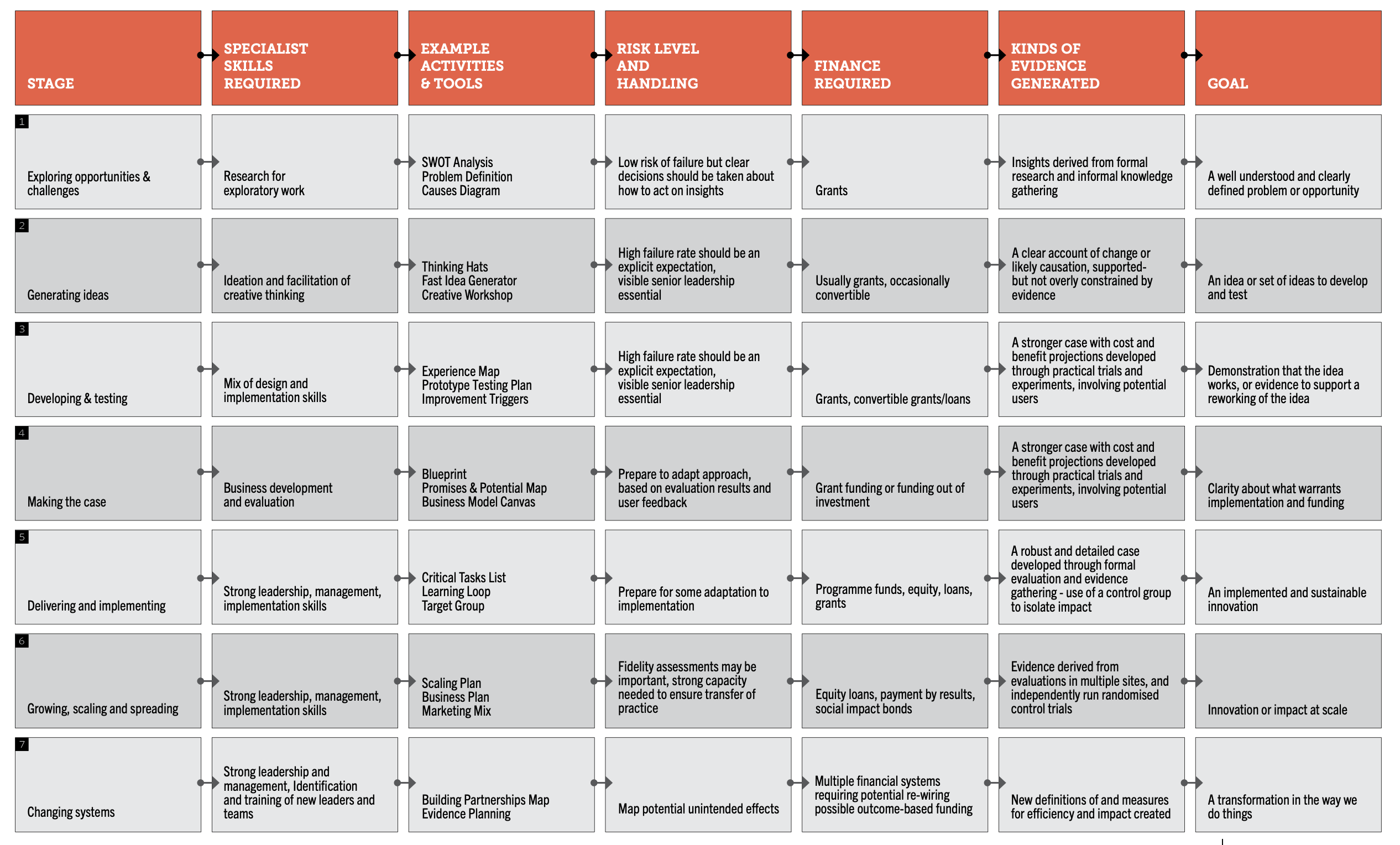 Business Futures Project brings over 300 resources together to help you build a better future, from the best books and articles to case studies and reports, tools and templates, videos and much more.

AI will have a fundamental impact on every industry, and every economy, over the next decade, says a new report from ARK Invest
ARK’s Big Ideas 2024 report is entitled “Disrupting the Norm, Defining the Future” and it highlights 15 big ideas:
- Technological Convergence – The global equity market value associated with disruptive innovation could increase to 60% by 2030.
- Artificial Intelligence – Scaling global intelligence and redefining work: AI training costs should continue to fall 75% per year.
- Smart Contracts – Powering the internet-native financial system, smart contract networks could generate fees of $450bn in 2030.
- Digital Wallets – Digital wallets could grow select vertical software platforms’ revenues to $27-$50bn in 2030.
- Robotics – Generalizing automation, thanks to the convergence of AI software and hardware. Generalizable robotics represent a $24 trillion-plus global revenue opportunity.
- Digital Consumers – Transitioning toward digital leisure, where spending could teach $23 trillion in 2030.
- Electric Vehicles – Lower battery costs powering adoption mean EV sales could reach 74 million in 2030.
- Robotaxis – Robotaxi platforms could create $28 trillion in enterprise value in 2030.
- Multiomic Tools & Technology – Translating biological insights into economic value: R&D spending could decline by more than 25%, thanks to multiomic tools and technology.
- Reusable Rockets – Satellite connectivity revenues could exceed $130bn per year in 2030.
- Autonomous Logistics – Global autonomous delivery revenue could reach $900bn by 2030.
- Bitcoin Allocation – Growing the role of bitcoin in investment portfolios. During the last seven years, bitcoin’s annualized return has averaged around 44%.
- Bitcoin in 2023 – After challenges in 2022, bitcoin’s price surged 155% last year, reaching $827 billion in market cap.
- Precision Therapies – Curing disease more efficiently and less expensively. The enterprise value of companies focused on precision therapies could reach $4.5 trillion by 2030.
- 3D Printing – Revenues could grow 40% at an annual rate to $180bn by 2030.
The report believes that convergence among disruptive technologies will define this decade. Five major technology platforms—Artificial Intelligence, Public Blockchains, Multiomic Sequencing, Energy Storage, and Robotics—are coalescing and should transform global economic activity.

Technological convergence could create tectonic macroeconomic shifts more impactful than the first and second industrial revolutions. Globally, real economic growth could accelerate from 3% on average during the past 125 years to more than 7% during the next 7 years as robots reinvigorate manufacturing, robotaxis transform transportation, and artificial intelligence amplifies knowledge worker productivity.
Catalyzed by breakthroughs in artificial intelligence, the global equity market value associated with disruptive innovation could increase from 16% of the total* to more than 60% by 2030. As a result, the annualized equity return associated with disruptive innovation could exceed 40% during the next seven years, increasing its market capitalization from ~$19 trillion today to roughly $220 trillion by 2030.
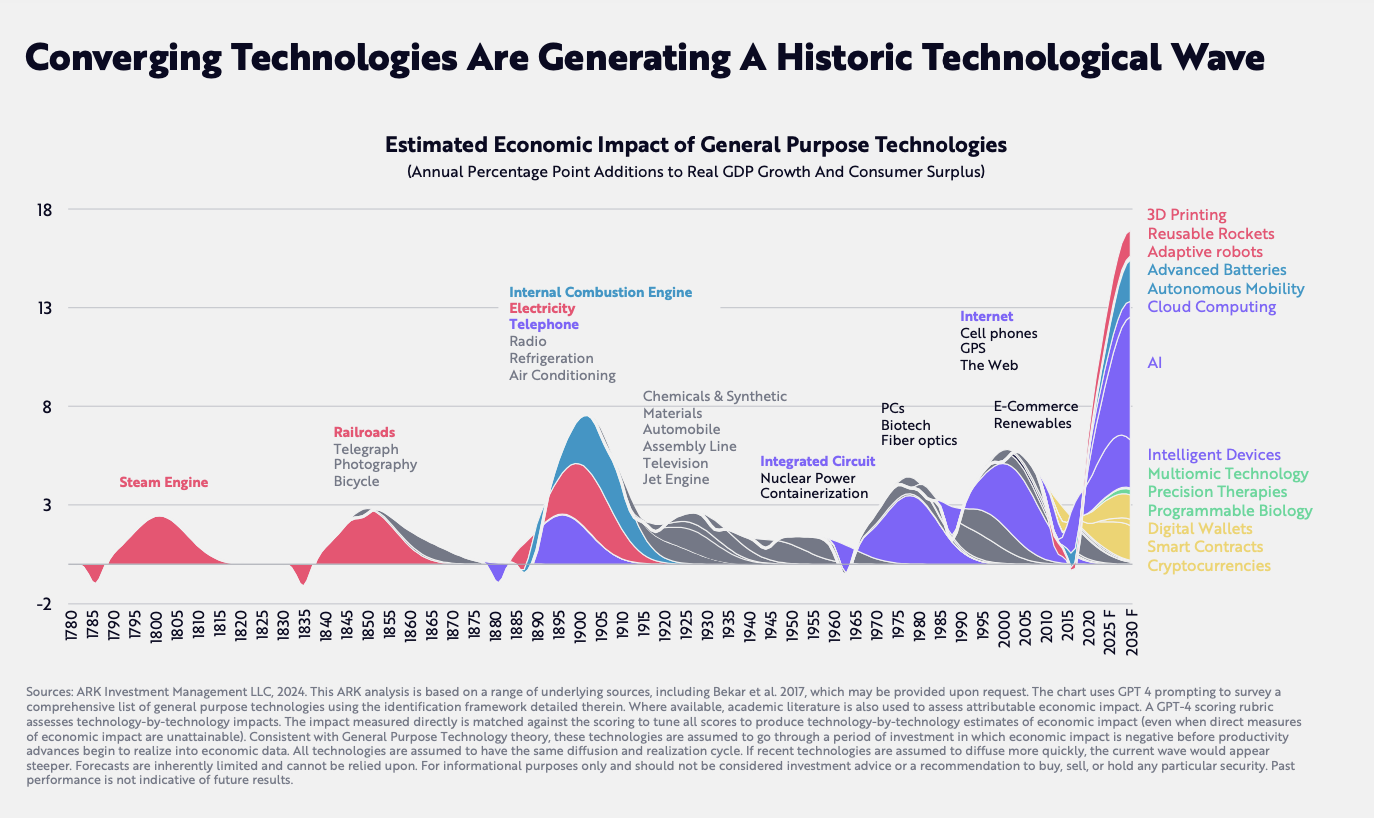
With superhuman performance on a wide range of tests, AI models like GPT-4 should catalyze an unprecedented boom in productivity. Jolted by ChatGPT’s “iPhone” like moment, enterprises are scrambling to harness the potential of artificial intelligence.
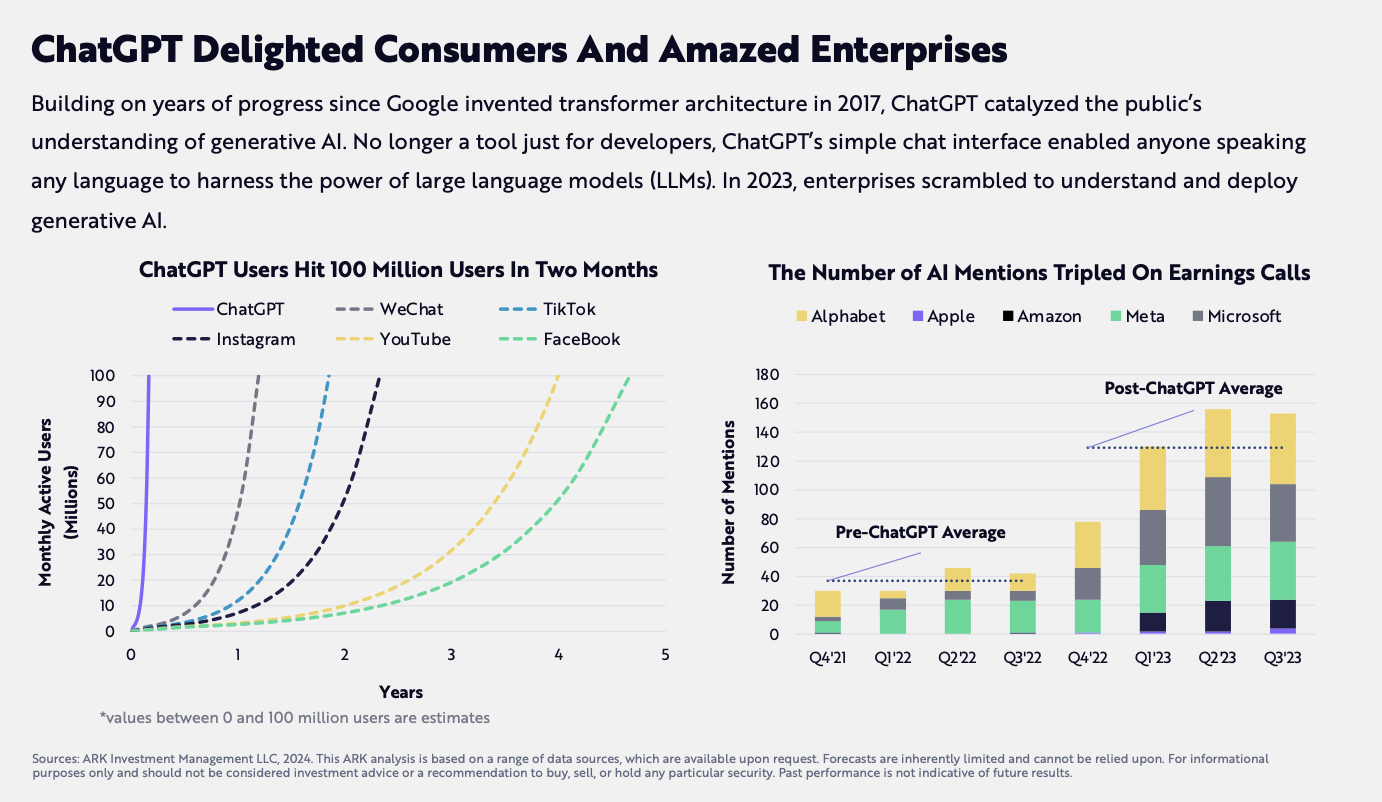
AI promises more than efficiency gains, thanks to rapidly falling costs and open- source models. If knowledge worker productivity were to quadruple by 2030, as we believe is likely, growth in real GDP could accelerate and break records during the next five to ten years.
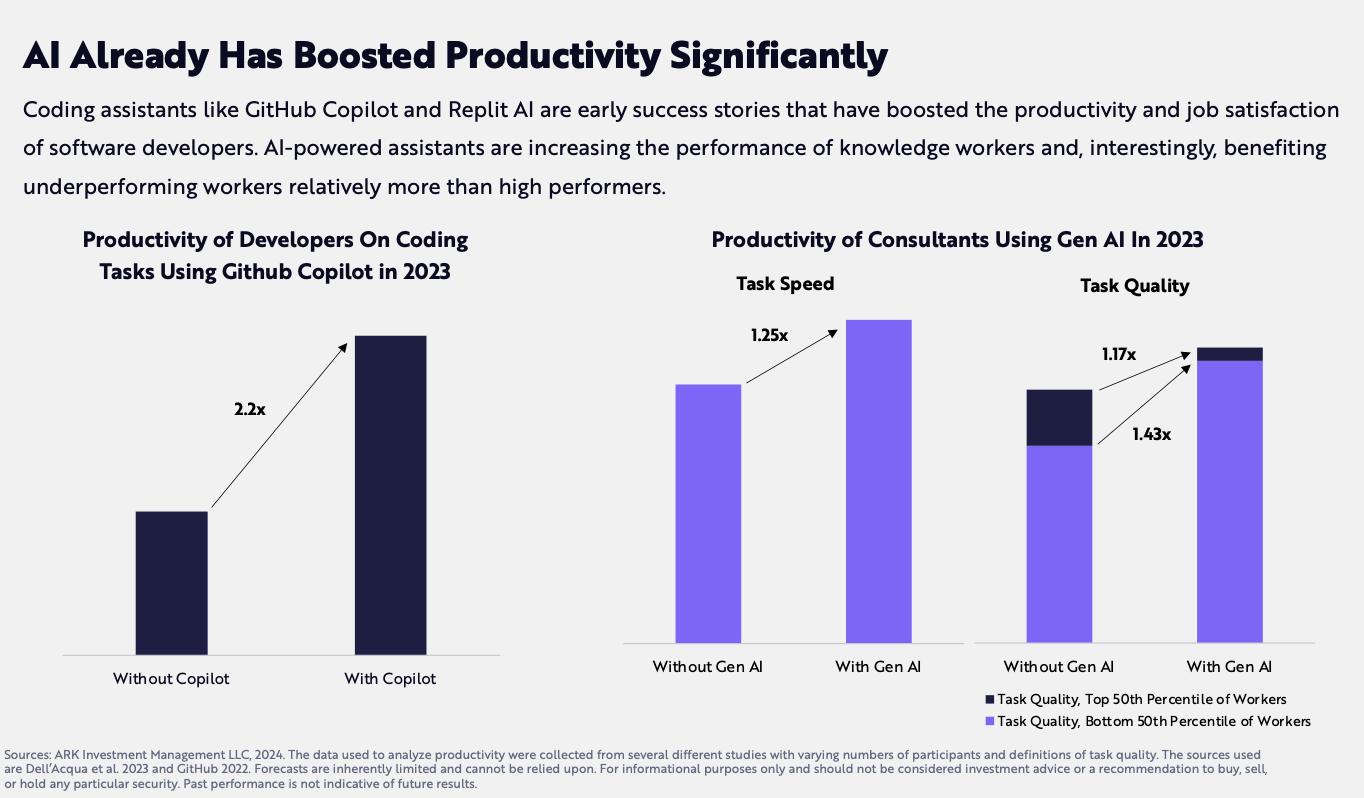
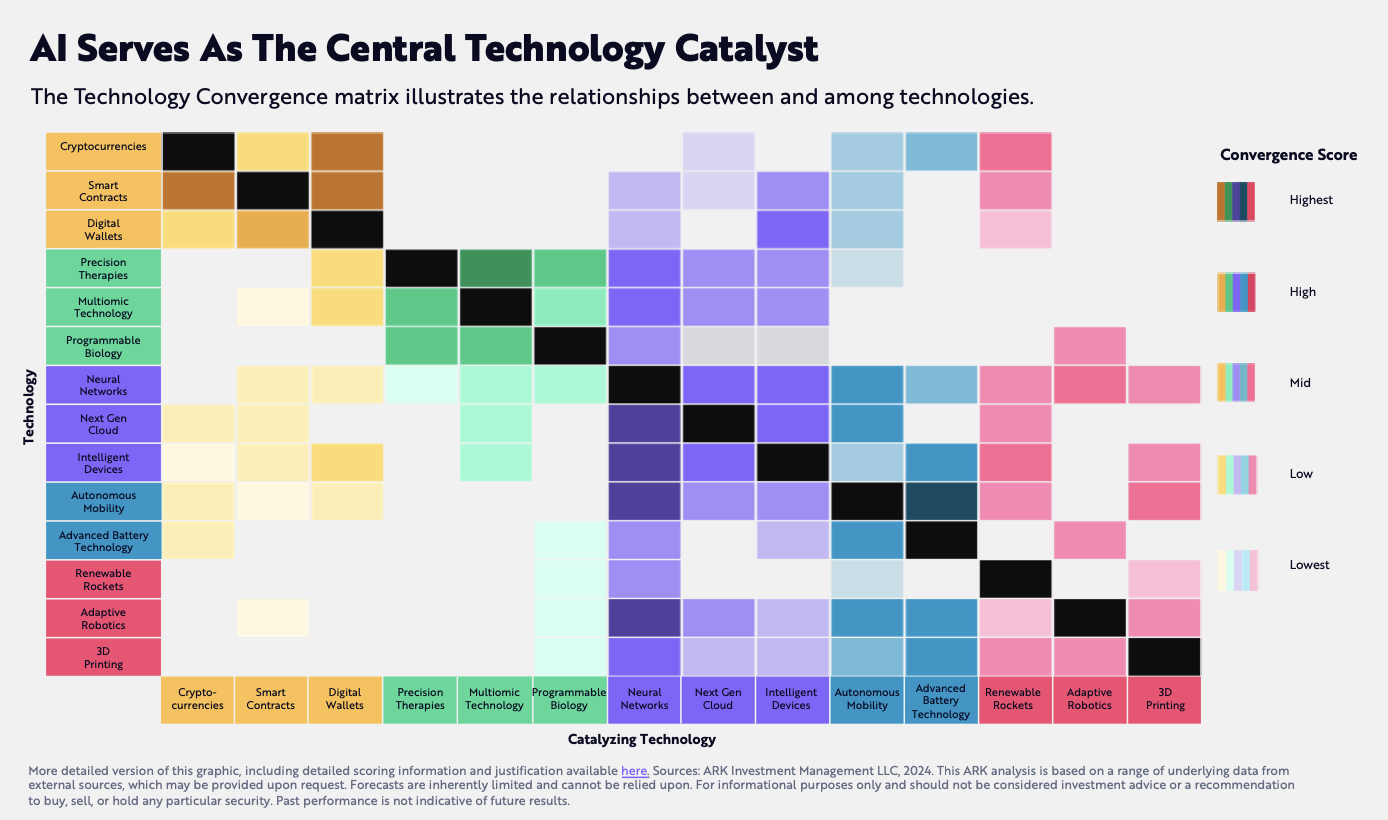
However the real impact of AI will be how it converges with other technologies to solve more fundamental challenges, and reinvent entire ways of operating. It becomes, as ARK calls it, the central technology catalyst:
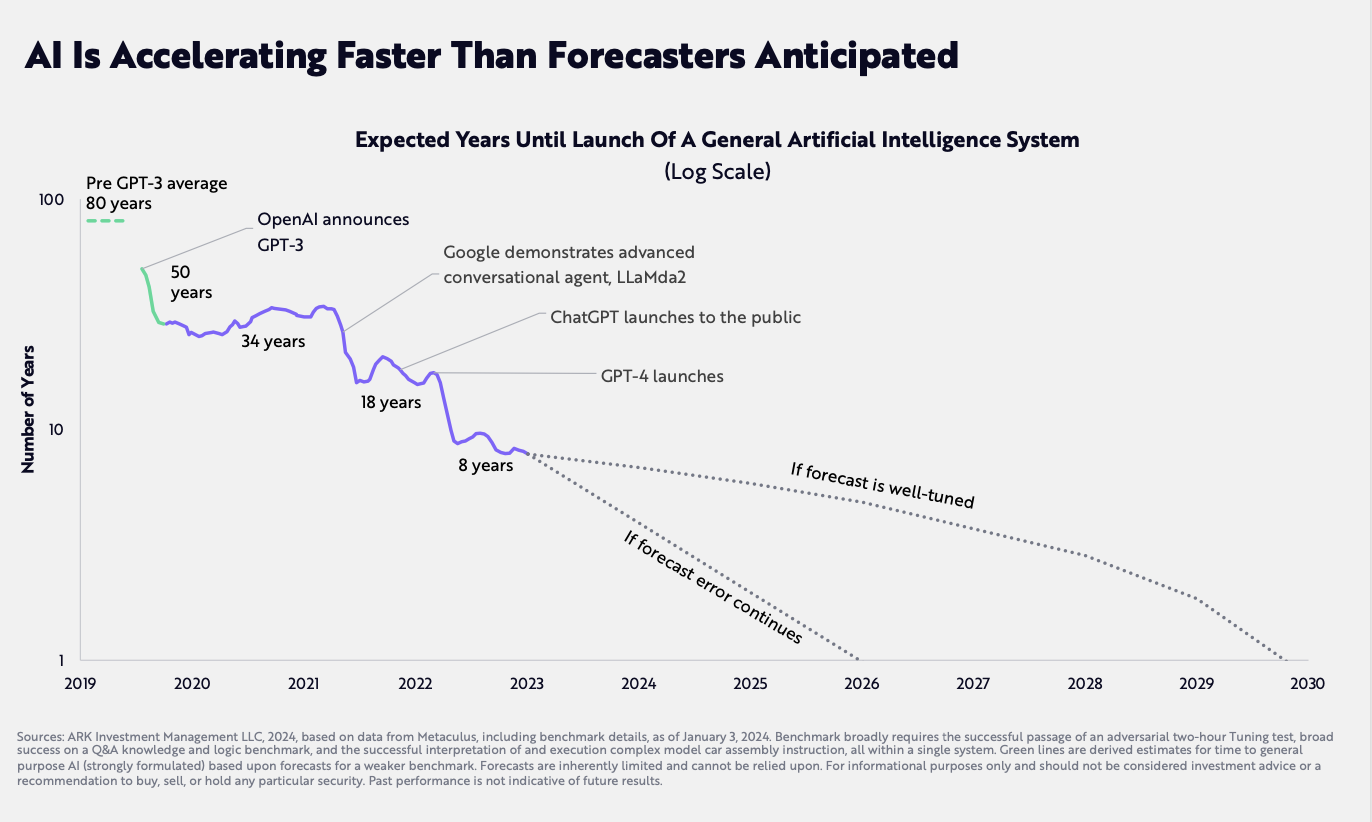
All this enthusiasm, adoption and investment is also accelerating the speed of development of AI, far faster than previously imagined. In particular ARK estimates that the advent of AGI, or general AI, where machines outsmart humans, is much closer than previously anticipated:
ARK is a Florida-based investment management company founded by Cathie Wood, who left her job as chief investment officer of Alliance Bernstein, because it felt her idea to build a fund based on disruptive innovation was too risky.
- 100 inspiring leaders by Peter Fisk
- Leadership trends 2024 by DDI
- Leadership assessment by Korn Ferry
- Strengths-based leadership by Gallup
- More on leadership from Peter Fisk
“What it Takes” is the memoir of Steve Schwarzman, cofounder and CEO of Blackstone, one of the world’s largest investment firms.
He talks about why leaders need clarity of purpose, to dare to think big, and realise the profound impact of AI. One of his favourite sayings is that “it is just as easy to do something big as it is to do something small”.
Schwarzman grew up in an entrepreneurial family selling curtains in Philadelphia. His father was content with owning one store, but Steve was not. He had more ambition. At high school he wanted to bring the best bands to play. At college he started a dance society to meet more girls. He joined Lehman as a trainee, where he learned about finance and discovered his real strength. In 1985 he co-founded Blackstone with friend Pete Peterson, and grew it to hold over $500 billion in assets under management.
He believes that leaders in today’s complex and uncertain world need clarity of purpose, to dare to think big, and realise the profound impact of AI, saying “it is just as easy to do something big as it is to do something small”.
He believes that successful leaders must have the confidence and courage to act when the moment seems right. They accept risk when others are cautious and take action when everyone else is frozen, but they do so smartly. This trait is the mark of a leader. “To be successful you have to put yourself in situations you have no right being in. You shake your head at your stupidity, but eventually it gives you what you want.”
Stepping up to lead
- “Leadership is lifting your vision to higher sights, raising your performance to a higher standard, building your personality beyond normal limitations” said Peter Drucker
- “Change will not come if we wait for somebody else, or some other time. We are the ones we’ve been waiting for. We are the change that we seek” said Barack Obama
- “Don’t be intimidated by what you don’t know. That can be your greatest strength and ensure that you do things differently from everyone else”said Sara Blakely
- “Great entrepreneurial DNA is comprised of leadership, technological vision, frugality, and the desire to succeed” said Steve Blank
- “Courage is not the absence of fear, but the triumph over it. The brave man is not he who does not feel afraid, but he who conquers that fear” said Nelson Mandela
- “People will forget what you said, people will forget what you did, but people will never forget how you made them feel” said Maya Angelou
- “Your time is limited, so don’t waste it living someone else’s life … Have the courage to follow your heart and intuition” said Steve Jobs
- “Never give up. Today is hard, tomorrow will be worse, but the day after tomorrow will be sunshine” said Jack Ma
What is leadership?
3.5 billion people will make up the global workforce by 2030, around half of who are likely to be self-employed. If we assume that in organisations people typically work in teams of around 10 people, then there will be around 220 million leaders in organisations over the next decade, plus many more who lead in virtual and collaborative ways.
However most surveys say that leaders are struggling. The majority of employees believe that they can do their jobs as well, or if not better, without their supervisors and managers (80% in one Gallup study). Only 15% of people feel truly engaged in their work, and many say that managers are one of their main reasons for leaving jobs.
“Managing”, of course, is not the same thing as “leading”. Managing is typically described as using controls to achieve a task. Leading is about influencing, motivating and enabling people to contribute, and achieve more. Managers do things right, leaders do the right things. Managers focus on methods to achieve efficiency, leaders focus on purpose to achieve effectiveness. Or managers have their heads down, leaders have their heads up.
Anyone in the organisation can be a leader. Not everyone in the business is a manager, although managers need to be leaders.
Not everyone is born a leader, but anyone can become one.
Leadership is your choice, not something which is given to you. Leadership is not a job title, a position of authority, or a magical gift. It starts with having confidence. Having a vision that you believe in. Having the courage to step forwards. Engaging other people. And yourself, being the change you want to see in others.
- “I think the fundamental role of a leader is to look for ways to shape the decades ahead, not just react to the present, and to help others accept the discomfort of disruptions to the status quo” says Indra Nooyi, former chairman and CEO of PepsiCo
- “Leaders of other enterprises often define themselves as captains of the ship, but I think I’m more the ship’s architect or designer. That’s different from a captain’s role, in which the route is often fixed and the destination defined” reflects Zhang Ruimin, founder and former CEO of Haier
- “The single most important thing I have to do as CEO is ensure that our brand continues to be relevant.” adds Chris Kempczinski, CEO of McDonald’s
- “I think my leadership style can be called ‘collaborative command.’ You bring different opinions into the room, you allow for a really great debate, but you understand that, at the end of the day, a decision has to be made quickly” says Adena Friedman, CEO of Nasdaq
- “We need an urgent refoundation of business and capitalism around purpose and humanity. To find new ways for all of us to lead so that we can create a better future, a more sustainable future” concludes Hubert Joly, former chairman and CEO of Best Buy.
Leaders shape the future
When writing “The Complete CEO” we found that very few CEOs could actually define leadership. They were comfortable describing their positions in organisation hierarchies, and the defined responsibilities of their roles, but few were able to say what it meant “to lead”. Eventually I got words about inspiration and influence, vision and direction, followership and alignment, but quite inconsistently.
Marissa Mayer, the previous CEO of Yahoo!, defines leadership as “helping believe in a better tomorrow, with a better outcome than you have today”.
DDI’s “Global Leadership Forecast” report says that only 42% of leaders felt that the overall quality of leadership inside their organisations was high, and only 14% of leaders felt they had a strong “bench” of next generation leaders ready to step up. Most sports teams have at least double their first team squad, as reserves ready to step up if required. Another DDI report on leadership development in 2015 said that 71% of organisations said their leaders are not ready to lead their organisations into the future.
Dave Ulrich sought to bring together all the best leadership theories, models and competencies in “The Leadership Code” and summarising leadership as five overarching roles:
- Strategist: Leaders shape the future
- Executor: Leaders make things happen
- Talent manager: Leaders engage today’s talent
- Human capital developer: Leaders build the next generation
- Personal proficiency: Leaders invest in their own development
I know Ulrich quite well. He even took off his tie and gave it to me, whilst we were once on stage together in Istanbul. He is probably one of the most business-oriented leadership experts around, and much of his personal work is in connecting leaders to strategy, and their impact to value creation. Yet he says himself, too many leadership ideas, and the development of leaders, is done in a vacuum, as a separate skill.
So whilst most leadership thinking tends to focus on the leadership role in the context of leading people, teams and organisation – which of course, matters – Ulrich rightly argues that the most important question a leader needs to answer is “Where are we going?”
In today’s world, organisations need leaders, more than ever, to look forwards.
Leaders don’t have to be strategists in the traditional sense of spending many hours analysing markets, developing rigorous plans supported by lots of commentary and financial projections. The strategic contribution of a leaders needs to be context setting – defining a clear purpose, envisioning what the future will look like, stretching mindsets of what is possible, articulating the ambitions, the big choices, and horizons to aim for.
Business performance is the measure of how well leaders do this. Warren Buffett will of course remind us that a CEO of a public company is legally responsible to deliver a return to shareholders, but he would also agree that this is more an outcome. Value creation is the framework to engage all stakeholders in progress. The challenge for leaders is not to become obsessed by financials, but to define purpose and be the moral compass of the organisation, to achieve more, in a better way.
Leaders earn their power from how they inspire people with ideas, influence people about what’s right, and the impact they have through their actions. This is quite different from the old power of leaders, which came through position, experience and expertise. Instead of leadership based on command and control, I see a leaders as a
- Catalyst: the leader stimulates and stretches the organisation, asking the important questions, adding energy and urgency, focusing on insights and goals.
- Communicator: the leader articulates purpose, vision and direction, listening and engaging with people, building empathy and trust, creating a better future together.
- Connectors: the leader connects ideas, people, activities and partners; encouraging learning and collaboration; facilitating new capacity for innovation.
- Coaches: the leader supports rather than commands; to think, act and deliver better; and encouraging them have the confidence to rise up.
I also love the definition of leaders as “amplifiers” – they amplify the potential of people. And equally of organisations and all their stakeholders. They open up new spaces to go for, and through inspiration and influence, they create a belief and confidence that it is attainable. Amplifying is about increasing the capacity to succeed, and therefore about transforming your potential, personally and organisationally.
Leaders with purpose
Danone is an organisation driven by a sense of purpose to create a healthier society, a responsibility to all stakeholders and a “B Corporation” priority for sustainability. As a result, the “how” matters as much as the “what” in what the business does, but also how its leaders lead, saying that breakthrough results can only be achieved when people dare to express and demonstrate their leadership potential.
Danone describes its unique style of leadership using “CODES”, the behaviours which bring its values and beliefs to life. These five behaviours shape everything in its culture, from recruitment to development, performance and rewards:
- C … Create a meaningful future: challenge the status quo and generate breakthrough ideas, every day can be a fresh adventure, full of new possibilities and real excitement, demanding a sense of purpose for yourself, team and colleagues.
- O … Open connections inside and out: open to new thinking and fresh perspective, developing networks inside and outside, interacting at all levels and building trust to understand all stakeholders, and design products of the future.
- D … Drive for sustainable results: a culture of speed and agility, where individuals are free and express their talents, anticipating and driving progress in a way that sustains value creation for the business, consumers and the community.
- E … Empower yourself and diverse teams: leadership not micromanagement, releasing the power of the team with the right mix of support and freedom, enabling people to express their uniqueness and foster collective performance.
- S … Self-aware: being aware of your own strengths and development needs is essential to learn and grow, maintaining self-balance at work by recognising when to step back and when to reach out to others.
Quiet leaders, inspiring leaders
Pablo Isla, CEO of Inditex, is the humble Spanish king of fast fashion. Quiet and unassuming, like a sports coach he sees the power in his team, and his job is to make them the stars.
On first meeting, Isla might not strike you as one of the world’s leading CEOs. He is quiet and unassuming, but as leader of Spanish fashion monolith, Inditex, that is his strength. During his 12 years at Inditex, with brands from Zara to Mango, he has increased enterprise value seven times over, engaged in global expansion at a rate of on average one new store opening a day, and has made Inditex Spain’s most valuable company.
Isla’s priorities have been about achieving greater integration and efficiency. Firstly, creating an omnichannel shopping experience, that combines the best of aspects of technology and stores. Secondly, an integrated supply chain, able to quickly react to changing fashion.
The single word which most employees use to describe his style is humble. He seeks to avoid any form of hierarchy, he hates meetings, and despises ego. Instead he likes to make decisions informally as he walks around. He even avoids his own store openings, wanting the focus to be on the store and his teams.
“The strength of our company is the combination of everybody, much more than of any single person. We try to be a low-profile company, being humble, of course being very ambitious, but being humble” he told Harvard Business Review
“The core shopper dreaming of a $50 pair of affordable but high-fashion high heels from Zara wants to hear about the new store in her neighbourhood, not about how in control some privileged executive is.” Of all his staff, he highlights the role of front-line store managers who are empowered to make product selections and who he sees as the people who he is there to serve
Growing as a leader
As leaders progress in the organisation their roles changes, from technical to functional, tactical to strategic, management and leadership. With these role come changing perspectives and responsibilities:
- Short term to long term
- Transactional to transformational
- Functional expert to organisational
- Managing tasks to managing porfolios
- Limited stakeholders to multiple stakeholders
- Getting the job done to optimising value creation
Whilst we might think of leadership as one approach, the styles of leadership are different as we progress in an organisation. The “six passages” of leadership was developed by Walter Mahler in the 1970s, based on leadership behaviours and successions in GE, and focuses on the “critical crossroads” that leaders face during their career.
Here are the 7 “levels” of leadership, and the 6 “passages” or transitions from one stage to the next, and the change in skills and mindsets which the transition demands:
- Leading self: individual contributors, professional staff, driven by tasks and expertise, establishing credibility, delivering results.
>>> Transition 1: from skills to collaboration, from doing work to getting it done
- Leading others: leaders of small teams or projects, recruiting and developing, resolving conflicts, delegating, adapting to cultural differences.
>>> Transition 2: from personal to team agendas, from organising to coaching
- Leading managers: leaders integrate teams, managing trade-offs and politics, problem solving, negotiating and risk taking, engaging people.
>>> Transition 3: from activities to functional strategies, from tasks to complexity
- Functional leaders: aligning resources, developing leading practices, driving and implementing change and innovation, managing dispersed teams.
>>> Transition 4: from current to future thinking, from costs centres to profit centres
- Business leaders: developing vision, balancing short and long-term, aligning with organisation, working across functions, exploring new business models.
>>> Transition 5: from managing business, to a strategic portfolio of businesses
- Group leaders: managing performance across businesses, for today and tomorrow, catalysts of change and innovation, exploring new ventures and renewal.
>>> Transition 6: from internal to external stakeholders, managing whole systems
- Enterprise leaders: top executives, engage all stakeholders, set direction and build leadership team for today and future, shape culture and reputation.
In time, leaders assume greater responsibility, and leadership roles increase in their challenge, breadth, and complexity. As leaders advance, they reallocate their focus to help others to perform effectively. They learn to value the work of leadership and believe that making time for others, planning, coordinating, and coaching are imperative in their new responsibility.
One way to consider the evolution is as a “T” shape, moving up the vertical when roles are largely built around function, to the horizontal where are role are much broader and cross-functional. As the leader moves from an area of expertise to general management, they shift from needing to have all the answers, to being able to ask the right questions.
Of course, many leadership attributes, such as accountability, engagement and delivery – are common at all stages although executed in different ways. Also as organisations shift from tall hierarchies to flatter networks, then there are less stages of leadership, from seven to maybe only three.
What’s your best leadership style?
We all tend to have a preferred or “natural style” of leadership.
Leading in a way that feels right and natural to you, is both easier for you, and more consistent and authentic for others. Whatever your style, people will engage with and trust you more, if they know that you are genuine.
At times though you may need to adapt your style, or embrace aspects of other styles for a specific purpose. Daniel Ek, CEO of Spotify, for example, found that he was too laid back for his teams when they were looking for direction and focus. He worked on making the most of his own style, while strengthening aspects that met the needs of his teams.
There are many theoretical models of leadership to take ideas from.
Kurt Lewin classified leadership styles into autocratic, participative and laissez-faire. Tannenbaum and Schmidt saw leadership as a continuum of styles, ranging from autocratic to freed, but said that the best style at any time depended upon a variety of factors, such as the leader’s personality and the situation they faced. Daniel Goleman, who coined the phrase “emotional intelligence” developed a framework of six different styles built on a leaders ability to emotionally engage with people in different ways – visionary, coaching, democratic, pacesetting, affiliative and commanding.
Here are some of the different approaches, grouped by their objectives:
Leading in an inspiring style … when you want to encourage people to work with you in creating a better future, providing energy and direction to move forwards:
- Transformational … “Imagine if “… opportunity to grow, yourself and business
- Visionary … “Come with me” … a new direction, empathetic, builds confidence
- Pacesetting … “We can do this” … driven to achieve, energising but exhausting
Leading in an nurturing style … when you want to support people to be their best, although not necessarily about thinking about being creative or moving forwards:
- Servant … “Here for you” … secures resources so that people can act as see fit
- Coaching … “Try this” … empathy, supports individual needs, but less directive
- Affiliative … “People come first” … empathy, reassures and builds the team
Leading in a more engaged style … when you want to let people get on with their work, trusting that they have capabilities and desire to do the task:
- Laissez-faire … “Do what you think” … entrusting people to deliver, giving space
- Transactional … “You know what to do” … clear tasks, intervene if not delivered
- Bureaucratic … “Follow the process” … clearly defined technical steps to follow
Leading in a commanding style … when you want to be in charge and make the decisions, often when you believe people don’t have the capabilities to decide:
- Consultative … “Tell me what you think” … you listen and then decide yourself
- Persuasive … “This is what, and why” … you decide then seek to persuade them
- Autocratic … “Do what I tell you” … demotivating but can work in crisis
Knowing when and how to adapt your leadership style to different situations can have a huge impact on how your team will respond. For example if you are trying to build capabilities within your team you may find that the coaching leadership style works best. If you have urgent deadlines, then pacesetting. If you need to be highly structured and compliant, the bureaucratic. If you want people to work together to create a better future for all, then transformational.
Evaluating leaders
Korn Ferry, the search firm, developed a particularly useful assessment model for leadership development, in order to identify how ready and able individuals are to move to the next levels of leadership. They organise the qualities required in leaders into four distinct categories. Each dimension plays a distinct role in performance, engagement, potential, and personal career development:
- Drivers and Traits, which describe “who you are” … drivers are the values and interests that motivate a person, traits are the natural tendencies of a person, influenced by personality and intelligence.
- Experiences and Competencies, which describe “what you do” … experiences are projects or roles that can prepare a person for a future role, competences are the observable skills and behaviours.
Most organisations regard an individual’s “drive” as a key predictor of high potential, meaning their level of personal energy and engagement they have for their tasks. At the same time, people are more energised by roles that have a good fit with them. Leaders typically want to be leaders, they find the role of a leader interesting and the work of leading motivating. This is particularly tested as they have to allocate more time to leadership aspects of roles as they progress.
Traits also play a large role in how people develop, defining what is more natural for them and what is more of an effort. Traits endure over time, and exert a strong influence on a person’s outlook, attitudes and behaviours. Traditionally personality inventories, based on traits, have been the primary diagnostic tool for leaders.
Korn Ferry’s leadership potential model embraces these factors, and evaluates how a person will progress through the different levels of leadership, and the transitions required:
- Drivers
- Advancement drive: through collaboration, ambition, challenge.
- Career planning: how narrowly or broadly focused are career goals
- Role preferences: achieving through others vs. through self.
- Experience
- Core experience: what they’ve learned through day-to-day leadership.
- Perspective: diversity of experience in many different areas.
- Key challenges: their experience in addressing developmental challenges.
- Awareness
- Self-awareness: of their strengths and development needs.
- Situational self-awareness: how events impact their performance.
- Learning agility
- Mental agility: to be inquisitive and mentally quick.
- People agility: to read others and use this to enable change.
- Change agility: to explore new possibilities, take ideas from vision to reality.
- Results agility: to deliver outstanding results in new and tough situations.
- Leadership traits
- Focus: the balance between details and the big picture.
- Persistence: the passionate pursuit of personally valued long-term goals.
- Tolerance of ambiguity: to deal with uncertainty or confusing situations.
- Assertiveness: willingness to assume a leader role and comfort with it.
- Optimism: to have a positive outlook.
- Capacity
- Problem solving: spot trends and patterns and draw correct conclusions from confusing or ambiguous data.
- Derailment risks
- Volatile: a risk toward being mercurial, erratic, or unpredictable.
- Micromanaging: a risk toward controlling the work of direct reports.
- Closed: a risk of being closed to alternative perspectives and opportunities.
Ultimately your leadership is not measured by what you do, but the impact you have. The way you can positively effect your people, the way in which they drive the activities of organisation, and what it achieves.
IE Business School, based in Madrid, is just down the road from the Santiago Bernebéu stadium, the home of Real Madrid, the Spanish football club who are Europe’s all-time most successful soccer team.
I always take the business leaders who I teach at IE, to the stadium as part of my programs. We walk past the showcases of trophies, the photos of past successes, through the changing rooms, and out into the cauldron of competition where 80,000 fanatical spectators usually look down on the game.
I beckon them to sit down on the bench, the seats reserved for the coach and his staff, at the side of the pitch. For a few minutes they can be Zinadine Zidane, or whoever the coach is. He has spent hours on the training field with his players, sharpening fitness and skills, talking strategies and tactics, preparing for the competition. But once the match begins, his players are on their own. he entrusts all to his players. They now need to respond to whatever happens, to make their own decisions in the heat of competition. His own success is 100% entrusted in his team.
Whilst the coach can perfect his own leadership skills, how he uses them to influence others is what matters. His own success is entrusted in his people.
© Peter Fisk 2024. Excerpt from Business Recoded by Peter Fisk
Green cement, upcycled fashion, clean energy, plant-based food, electric vehicles … the challenge of decarbonisation is the catalyst to innovate solutions, and reinvent organisations.
Across industries and geographies, the urgency to achieve “net zero” is dominating corporate strategies, as we as sustainability agendas. It has become a key factor in driving competitive advantage (customers choosing suppliers who can help them reduce their own emissions), as well as employee engagement, investor perceptions, government and social goodwill, and ultimately value creation.
Sustainable businesses do better – overall they typically outperform average performers by 42% in market value. But they also attract the best talent, customers are likely to pay a premium of 10-25% depending on sector, investors take a more positive view of future potential, and government and social support are much greater.
While the focus is on carbon emissions, there is much more to achieving success:
- Sustainably Better is much more than ESG, as strategies are much than metrics, and environmental issues are just part of the story. Environmental protection, social improvement and economic growth need to work together. Otherwise the emerging economies will never support it, and generally we will have unsustainable compromise rather than sustainable growth, value creation and a better future.
- Net Positive rather than just net zero, because ultimately an organisation exists to make a contribution, to make some net positive benefit to the world. And in many cases the best strategies combine reduced environmental impacts, with positive social impacts. Or indeed, the environmental impacts could be positive too through closed loop solutions, replenishing resources, and regenerating the planet, and local environments, to better than before.
- Sustainable Innovation is the real key to solving the problem, or more precisely sustainable innovation – using the problem, for example, carbon emissions, as the catalyst to create something better, cheaper, faster. There is no coincidence that electric vehicles tend to be the most stylish, and increasingly highest performing, too. New technologies will play a dramatic, exponential role in unlocking this innovativeness.
- Business Transformation is required to address these challenges and opportunities. Circular, net positive, organisations are only achievable with the support of new business models, new organisation processes and new market structures of today. Transformation is the leadership superpower of the 21st century, but it is complex, and takes time. It needs clarity of vision, discipline in delivery, and persistence to realise its full value.
Which are the critical industries for decarbonisation?
- Energy: Over the past decade, the costs of renewables have dropped substantially—solar power by as much as 80% and wind power by about 40% —making them economically competitive with conventional fuels, such as coal and natural gas. A successful transition to net zero will require meeting increased demand for electricity by scaling up renewable, low-carbon power generation and building enough flexibility in power systems to match supply and demand.
- Cars and Planes: Sales and planned production of low-emissions cars have surged. By 2035, we project that new passenger-vehicle sales in the largest automotive markets (China, EU, and USA) will be close to 100 percent electric. To make low-emissions vehicles the new norm, new supply chains and manufacturing capabilities are needed, as well as corresponding infrastructure, such as charging stations and hydrogen fuelling stations.
- Cement and Steel: Some cement companies have used advanced analytics and other operational tactics to optimise for energy efficiency, while others have experimented with emissions-reducing production methods. A circular model starts with existing materials, creating new buildings from old waste. Going forward, the industry could explore alternative energy sources (such as biomass), carbon capture, and digitisation of manufacturing.
- Agriculture and Food: Promising technologies in animal feeding, soil carbon sequestration, and crop fertilisation are in development or are already in use. The market for cultivated meats—those grown in bioreactors from animal cells—could become a $25 billion global industry by 2030. Uptake of zero-emissions farm equipment and machinery—including tractors, harvesters, and dryers—is behind that of electric vehicles, but cost reductions and supportive financing could accelerate adoption.
What does the Paris Agreement demand?
The UN Climate Change “Paris Agreement” is a shared commitment by 196 nations at COP21, head in Paris in 2015. It sets the stage for global climate action, emphasizing the urgency of reducing emissions and transitioning toward a sustainable, low-carbon future. Key points are:
- Limiting global warming by holding “the increase in the global average temperature to well below 2°C above pre-industrial levels” and pursuing efforts to limit it to 1.5°C above, which is the point beyond which significant climate impacts are caused, including droughts, heatwaves, and extreme rainfall.
- Reducing greenhouse gas emissions by 43% by 2030, after a projected peak in 2025, to achieve the 1.5°C goal, with each country developing their own Nationally Determined Contributions (NDCs) defining their actions to reduce emissions and build resilience to climate change.
- Achieving net-zero emissions by 2050, where “net zero” means balancing emissions by absorbing an equivalent amount from the atmosphere. The agreement recognises that this is a shared commitment, and will require cooperation between nations to achieve it, sharing knowledge and practices, and collaboration on new the transformations required.
That’s the absolute minimum, to retain our world as we know it, which is the focus of politicians and environmentalists. But as business we need to achieve much more. Delivering the Paris Agreement in a way that also creates a better business, with a more prosperous future – which is why sustainably better, net positive, sustainable innovation and business transformation, are key.
So what are the practical strategies?
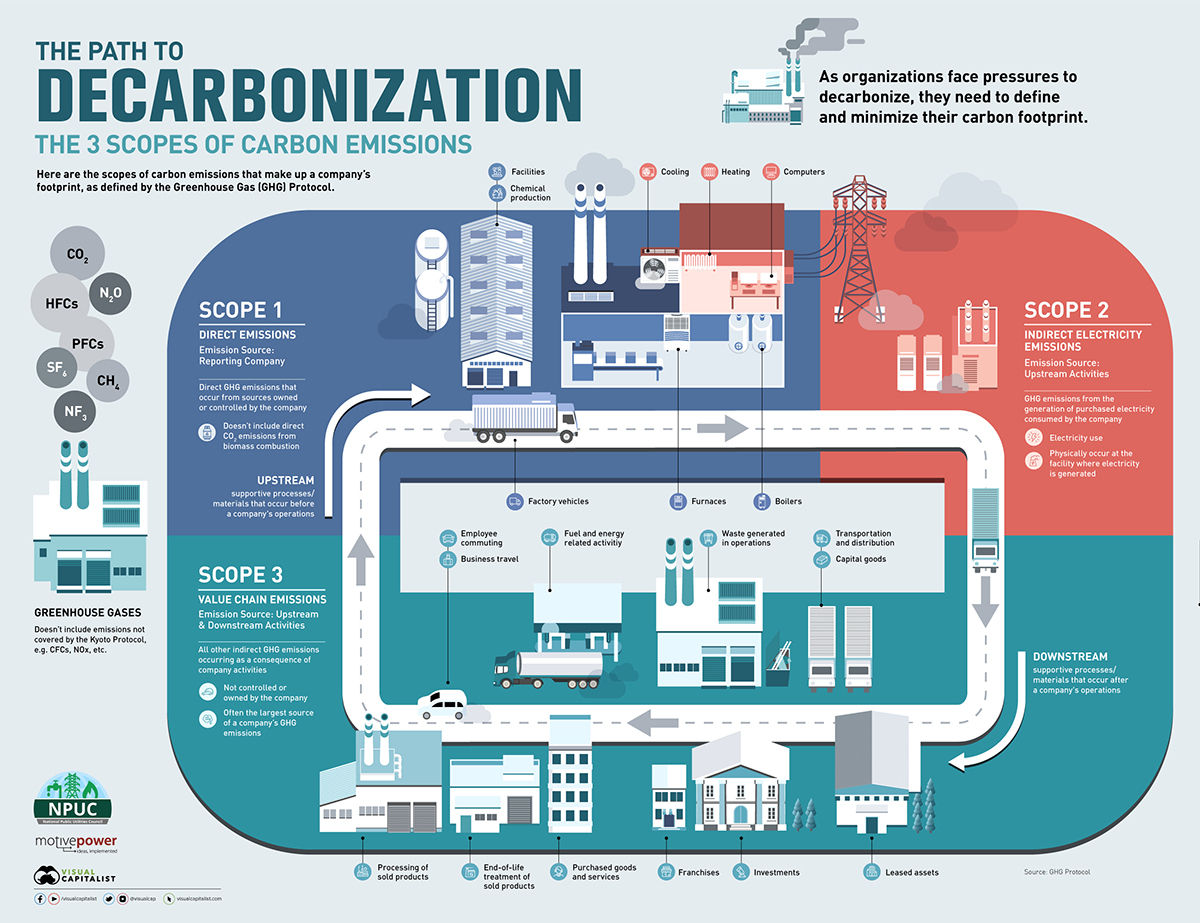
The most commonly used breakdown of a company’s carbon emissions are the three scopes defined by the Greenhouse Gas Protocol, a partnership between the World Resources Institute and World Business Council for Sustainable Development.
The GHG Protocol separates carbon emissions into three buckets: emissions caused directly by the company, emissions caused by the company’s consumption of electricity, and emissions caused by activities in a company’s value chain.
- Scope 1: Direct emissions: these emissions are direct GHG emissions that occur from sources owned or controlled by the company, and are generally the easiest to track and change. Scope 1 emissions include factories, offices, vehicles, production.
- Scope 2: Indirect electricity emissions: These emissions are indirect GHG emissions from the generation of purchased electricity consumed by the company, which requires tracking both your company’s energy consumption and the relevant electrical output type and emissions from the supplying utility. They include electricity use (e.g. lights, computers, machinery, heating, steam, cooling) and emissions occur at the facility where electricity is generated.
- Scope 3: Value chain emissions: These emissions include all other indirect GHG emissions occurring as a consequence of a company’s activities both upstream and downstream. They aren’t controlled or owned by the company, and many reporting bodies consider them optional to track, but they are often the largest source of a company’s carbon footprint and can be impacted in many different ways. This include supplies, investments, employee travel, company waste.
Most uses of the GHG Protocol by companies includes many of the most common and impactful greenhouse gases that were covered by the UN’s 1997 Kyoto Protocol. These include carbon dioxide, methane, and nitrous oxide, as well as other gases and carbon-based compounds.But the standard doesn’t include other emissions that either act as minor greenhouse gases or are harmful to other aspects of life, such as general pollutants or ozone depletion.
There are many different types of carbon emissions for companies (and governments) to consider, measure, and reduce on the path to decarbonisation. But that means there are also many places to start.
Practical examples
Cities are a major arena in the race to net zero. They consume over two-thirds of global energy resources and account for more than 70% of CO2 emissions worldwide.1More than half (56%) of the global population currently lives in an urban area. The UN expects that number to reach 68% by 2050.
New research by Economist Impact, supported by Osborne Clarke, identifies some of the technologies that can help cities achieve their carbon-emission targets while also creating jobs, lowering energy costs for residents, and improving overall quality of life. It considers three categories of technologies – support building, infrastructure and mobility.
The UN Environment Programme (2017) reported that buildings and construction are responsible for over 36% of global energy consumed, and as much as 40% of energy-related CO2 emissions. Technologies in this sector help increase the energy efficiency of existing buildings, while also reducing the carbon footprint of the construction sector as a whole.
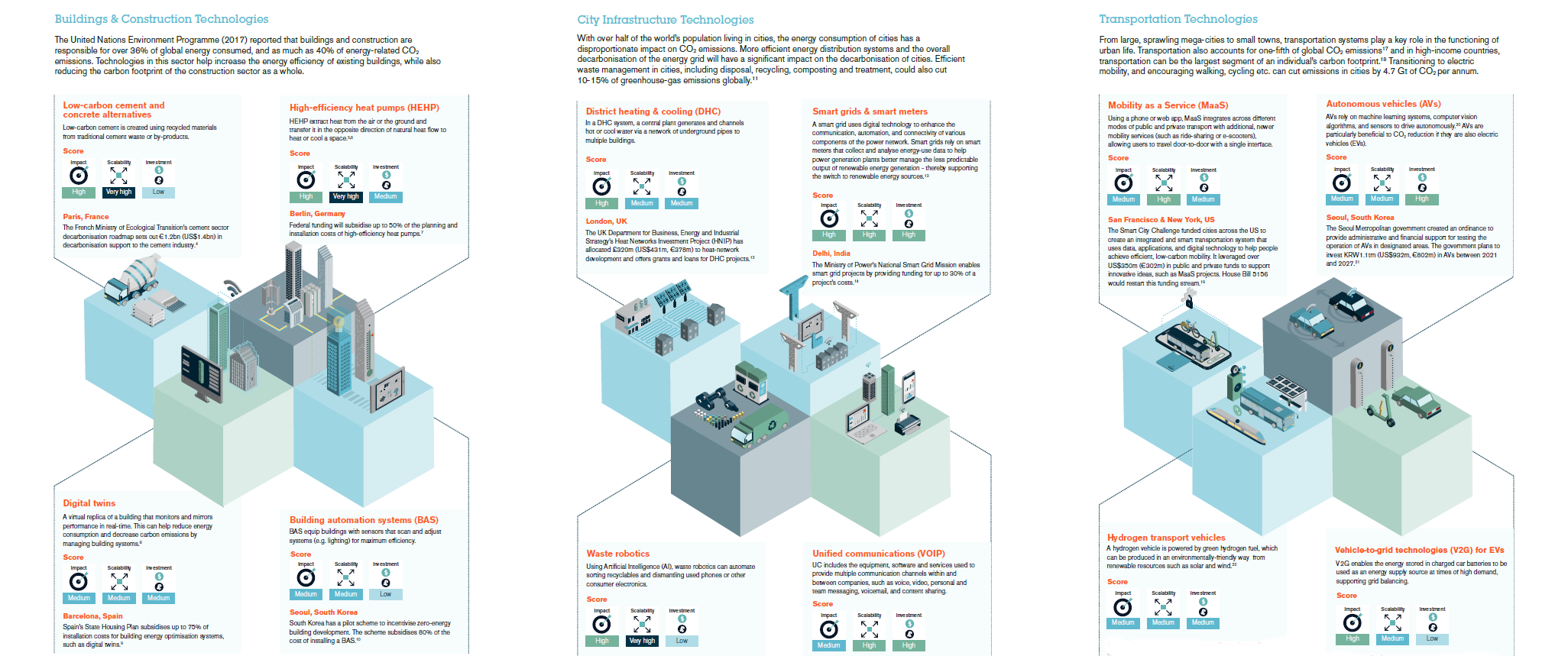
The energy consumption of cities has a disproportionate impact on CO2 emissions. More efficient energy distribution systems and the overall decarbonisation of the energy grid will have a significant impact on the decarbonisation of cities. Efficient waste management in cities, including disposal, recycling, composting and treatment, could also cut 10-15% of greenhouse-gas emissions globally.
From large, sprawling mega-cities to small towns, transportation systems play a key role in the functioning of urban life. Transportation also accounts for one-fifth of global CO2 emissions17 and in high-income countries, transportation can be the largest segment of an individual’s carbon footprint.18 Transitioning to electric mobility, and encouraging walking, cycling etc. can cut emissions in cities by 4.7 Gt of CO2 per annum.
In the 1400s, Leonardo da Vinci designed a complex mechanical robot clad in a suit of armour, capable of sitting, standing, and independently moving its arms. The entire robot was operated by a system of pulleys and cables. In the 17th to 19th centuries, the Japanese built humanoid automata called karakuri puppets. These puppets resembled dolls and were used for entertainment in theatre, homes, and religious festivals.
Sci-fi movies have captured our imaginations with the cute human-like possibilities of machines – from the tin woodman in 1930’s The Wizard of Oz, to droid friends C-3PO and R2-D2 in Star Wars of 1977.
Real world examples of humanoid robots have included Honda’s Asimo, which was launched in 2000 to demonstrate new technological advancements of intelligent machines. And in 2016 Sophia, a humanoid robot developed by Hanson Robotics in Hong Kong was physically modelled on Audrey Hepburn, adding artificial intelligence, visual data processing and facial recognition.
AI-enabled robots
The prospects for machines that help with everything from serving coffee to folding laundry, carrying boxes in warehouses to handling hazardous waste, caring for the elderly to fighting on the battlefield, have improved as progress in AI accelerates and investment in humanoid robots grows faster than anticipated.
“Humanoids” are advanced robotic machines capable of emulating human actions, reasoning, and operations. They represent the convergence of technologies like AI, biomechanics, machine learning, and sensor connectivity with learning, cognitive development, and behavioral studies. Humanoids are crafted to mimic the human shape, aligning with the human-centric design of our world, from tools to building to homes.
The worldwide market for humanoid robots is forecast to be bigger than analysts in Goldman Sachs Research expected even a year ago, are currently having most impact logistics, manufacturing, healthcare and hospitality, but their use is still limited, and development costs are high. The total addressable market is projected to reach $38 billion by 2035.
Supporting this accelerated growth, the manufacturing cost of humanoid robots has dropped from a range that ran between an estimated $50,000 (for lower-end models) and $250,000 (for state-of-the art versions) per unit last year, to a range of between $30,000 and $150,000 now.
Robot Makers
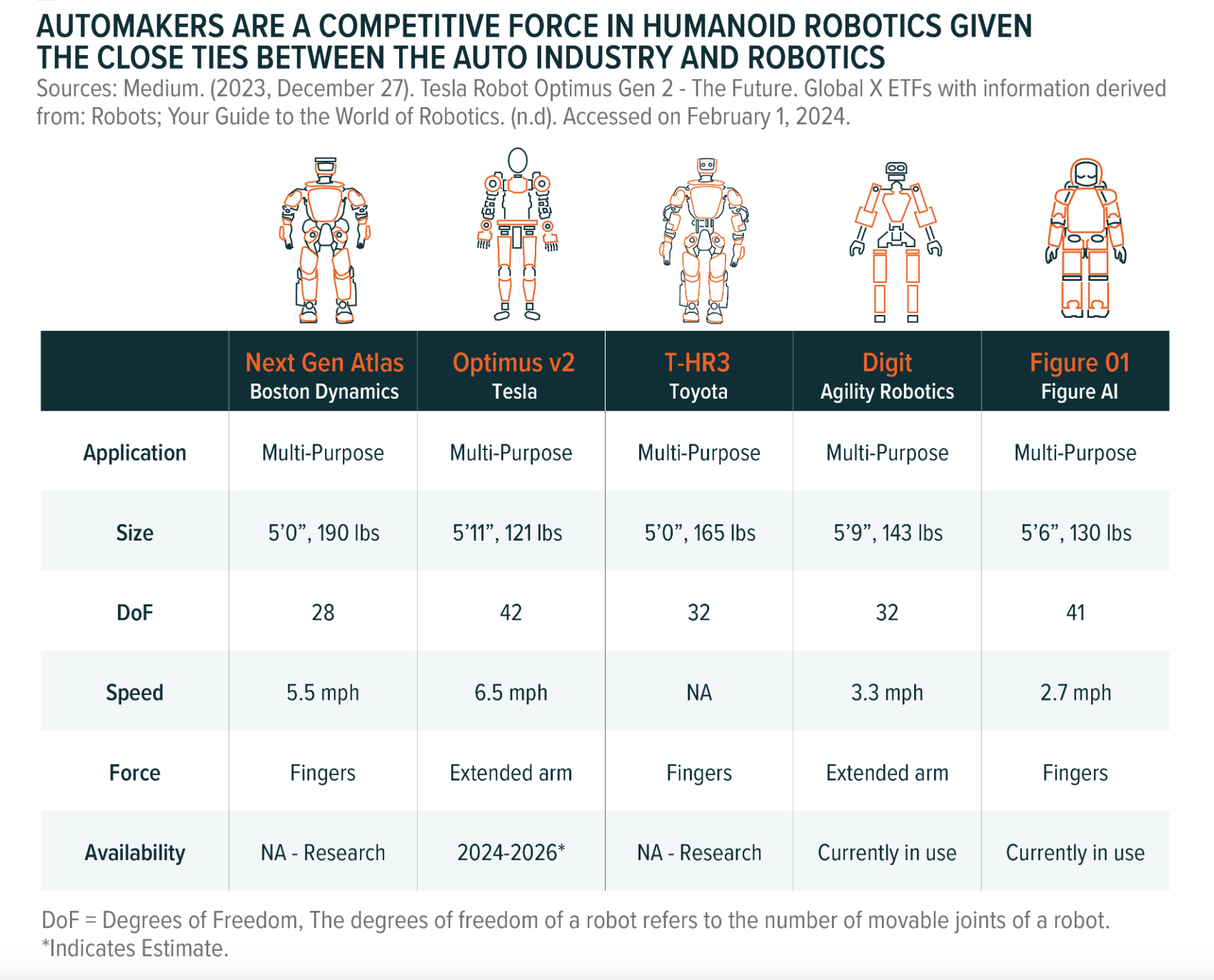
Prominent companies driving the humanoid robotics field include established players like Boston Dynamics, Tesla, and Toyota, and startups like Agility Robotics and Figure, with each company bringing a distinct focus.

Boston Dynamics’s Atlas, its most advanced humanoid robot, launched in 2013 as part of the DARPA Robotics Challenge, has recently been updated it with an all-electric version. With its bipedal agility, human-like movement, autonomous navigation, and robust learning abilities, Atlas has gained widespread industry acclaim and has become an internet sensation. Atlas features whole-body skills for swift, dynamic movements, allowing it to lift and carry objects, perform complex exercises like jumping and backflips, and participate in disaster response and industrial tasks that demand dexterity and adaptability.
Tesla’s Optimus Gen 2, is in development for commercial purposes. It is a versatile, general-purpose machine capable of assisting in multiple domains, including manufacturing, construction, healthcare, and entertainment. The robot offers precise, flexible movement capabilities, and its hands, equipped with 11 degrees of freedom, feature tactile sensors and high-speed actuators, enhancing its object manipulation skills. Optimus runs on the same neural networks powering Tesla’s cars, and the company’s expertise in battery technology, sensing, and computing is expected to allow it to operate more cost-effectively than competitors. CEO Elon Musk stated that the prototype could cost only $20,000 upon launch.
Agility Robotics’s Digit the first human-centric, multi-purpose robot made for logistics work has been adopted by Amazon. Digit is designed from the ground up to go where people go and do useful work safely in spaces designed for people, starting with bulk material handling within warehouses and distribution centers. Digit’s “backward” legs unlock the ability to maneuver in tight spaces and get closer to shelves, conveyors, and other infrastructure. The unique design also allows Digit to reach deeper and maintain an operational pick range from the floor all the way up to nearly 6 feet.
Figure AI’s 01 has demonstrated the first fruit of its collaboration with OpenAI to enhance the capabilities of humanoid robots, conversing in real-time. Figure AI raised $675 million from investors including Jeff Bezos, Nvidia, Microsoft and OpenAI. Founded in 2022, it has developed a general-purpose robot, called Figure 01, that looks and moves like a human. The robot, attached to a tether, walks on two legs, and uses its five-fingered hands to pick up a plastic crate, then walks several more steps before placing the box on a conveyor belt.
Engineered Arts’s Ameca, has a silicon face and is equipped with sensors that can track a person or object’s movement. It’s able to express astonishment and surprise, and can recognise faces and voices. Ameca also yawns and shrugs, and can discern emotions and even age. It can also shush you if you’re being too loud. Engineered Arts is based in Cornwall, southwest England. Ameca is currently associated with UAE’s Museum of the Future’s robotic family in Dubai, where it can interact with visitors.
Nvidia’s Project GROOT has developed an innovative general-purpose foundation model specifically designed for humanoid robots, aiming to revolutionize robot learning both in simulation and the real world . By supporting leading humanoid robot makers like 1X Technologies, Agility Robotics, and Boston Dynamics, Nvidia’s Project GROOT stands as a pivotal AI platform that promises to enhance how robots understand natural language and emulate human movements.
Top 22 Humanoid Robots Right Now, according to BuiltIn
The internet of today is a far cry from its early promise of a democratic network of unbridled innovation. In the last decade, it has fallen under the control of a small number of monopolistic companies like Apple, Google and Facebook; companies that limit the creative potential of the internet while seizing its proceeds for themselves.
There is an alternative. Chris Dixon, a General Partner at Andreessen Horowitz, has long advocated for a technology that can revive the dream of an open, entrepreneurial internet: blockchain networks. Often dismissed, sometimes vilified, these networks have until recently been dominated by amoral speculators and get-rich-quick schemes. But, more quietly, a group of visionaries have been using them to build the future.
In Read Write Own, Dixon draws on 25 years at the vanguard of tech innovation to explore how blockchains will change the internet. He starts by introducing the three eras of the web. First came the ‘read’ era, in which the earliest networks democratized information – creating an anarchic playground for bloggers, coders and artists. Next came the ‘read-write’ era, in which sprawling corporations democratized publishing – turning us all into small-time content creators but offering us few of the rewards.
We are now entering the ‘read-write-own’ era, sometimes called web3, in which blockchain networks have begun to democratize ownership – returning power and economic benefit to all who use the internet. And it is an internet we can all help create. Lucid and practical, Read Write Own offers both a vision of a better internet and a playbook for how to realise it.
Excerpts from the book
1. The nature of permission
In business, permission seeking is not like asking your parents or teachers for permission, where you get a simple yes or no answer. Nor is it like traffic lights setting the rules of the road. In business, permission becomes a pretense for tyranny. Dominant tech businesses leverage the power of permission to thwart competition, desolate markets, and extract rents. (p. xvi)
2. Software as art
Software is so expressive that it is better thought of not as engineering but as an art form. The plasticity and flexibility of code offer an immensely rich design space, far closer in the breadth of possibilities to creative activities like sculpting and fiction writing than engineering activities like bridge building. As with other art forms, practitioners regularly develop new genres and movements that fundamentally shift what’s possible. (p. xx)
3. The problems blockchains solve
The ability for blockchains to make strong commitments about how they will behave in the future allows new networks to be created. Blockchain networks solve problems that plague earlier network architectures. They can connect people in social networks while empowering users over corporate interests. They can underpin marketplaces and payment networks that facilitate commerce, but with persistently lower take rates. They can enable new forms of monetizable media, interoperable and immersive digital worlds, and artificial intelligence products that compensate — rather than cannibalize — creators…. Asking “What problems do blockchains solve?” is like asking “What problems does steel solve over, say, wood?” You can make a building or railway out of either. But steel gave us taller buildings, stronger railways, and more ambitious public works at the outset of the Industrial Revolution. With blockchains we can create networks that are fairer, more durable, and more resilient than the networks of today. (pp. xxiii–xxiv)
4. A new internet era
The decisions we make now will determine the internet’s future: who builds, owns, and uses it; where innovation happens; and what the experience will be for everyone. Blockchains, and the networks they enable, unlock the extraordinary power of software as an art form, with the internet as its canvas. The movement has an opportunity to change the course of history, to remake humanity’s relationship to the digital, to reimagine what’s possible…. This is a chance to create the internet you want, not the internet you inherited. (p. xxviii)
5. The supremacy of networks
Network design is destiny.Networks are the organizing framework that enables billions of people to intelligibly interact. They decide the world’s winners and losers. Their algorithms decide where money and attention will flow. The structure of a network guides how that network will evolve and where wealth and power accumulate. Given the scale of the internet today, software design decisions up front, regardless of how seemingly small, can have cascading downstream consequences. Who controls a given network is the central question when analyzing power on the internet. (p. 3)
6. Protocols vs. corporations
The difference between a protocol network like email and a corporate network like Twitter is that email’s network effect accrues to a community instead of a company. No company owns or controls email and anyone can access it through software created by independent developers that supports the underlying protocol. It’s up to developers and consumers to decide what to build and use. Decisions that affect the community are made by the community. (p. 18)
7. The impact of new technologies
People use new technologies in one of two ways: (1) to do something they could already do but can now do faster, cheaper, easier, or higher quality; or (2) to do something brand-new that they simply couldn’t do before. Early in the development of new technologies, the first category of activities tends to be more popular, but it’s the second set that has more lasting effects on the world. (p. 27)
8. The corporate-controlled internet
Corporate networks have a simple structure. In the middle, a company controls centralized services that power the network. This company has complete control. It can rewrite its terms of service, determine who has access, and redirect how money flows, at any time, for any reason. Corporate networks are centralized because there is ultimately one person, usually the chief executive officer, who makes all the rules. (p. 31)
9. Blockchains as non-consensus bet
Blockchains are different. They’re a non-consensus bet. While plenty of people recognize their potential — including me — much of the establishment disregards them. In fact, a prevailing view in the tech industry assumes that the only vectors of technological improvement that matter are the ones incumbents are already focused on: bigger databases, faster processors, larger neural networks, smaller devices. The view is myopic. (p. 52)
10. How hobbies fuel future industries
Outside-in technologies arrive, in contrast, on the fringes. Hobbyists, enthusiasts, open-source developers, and startup founders hatch them outside the mainstream. The work usually involves less capital and formal training, which helps level the playing field with insiders. A lower bar also causes insiders to take these technologies and their proponents less seriously…. Hobbies fuel future industries…. Hobbies are what the smartest people spend time on when they aren’t constrained by near-term financial goals. I like to say that what the smartest people do on the weekends is what everyone else will do during the week in ten years. (pp. 53–54)
11. The simplicity of tokens
What tokens are matters less than what they do.Tokens can represent the ownership of anything digital, including money, art, photos, music, text, code, game items, voting power, access, or whatever people come up with next. Using some additional building blocks, they can also represent real-world things, like physical goods, real estate, or dollars in a bank account. Anything that can be represented in code can be wrapped inside a token to be bought, sold, used, stored, embedded, transferred, or whatever else a person might want to do with it. If that sounds so simple as to seem trivial, that’s by design. Simplicity is a virtue. (p. 72)
12. Owners vs. users
The concept of ownership is so deeply embedded in our lives that it’s difficult to imagine how the world would look if that were taken away. Imagine if the clothes you bought could be worn only in the venue you bought them in. What if you couldn’t resell or reinvest in your house or car? Or what if you had to change your name wherever you went? This is the digital world of corporate networks. (p. 80)
13. Blockchains as cities
Blockchain functions have neat analogues in urban planning. Starting a blockchain network is like building a new city on undeveloped land. The city designer constructs some initial buildings and then designs a system of land grants and tax incentives for residents and developers. Property rights — ownership — play a key role, providing strong commitments that property owners will get to keep what they own and can feel comfortable investing in it. As the city grows, so does the tax base. Taxes are reinvested into public projects like streets and parks, more land is given away, and the city grows. (p. 97)
14. Restoring community through tokens
Blockchain networks bake community ownership into their core design. It’s in their DNA. While memecoin mutations, like Dogecoin, may seem like a joke, they show how users are embracing all sorts of tokens — some silly, some serious — in search of community, to fill the void left by corporate networks. The internet was originally envisioned as a decentralized network owned and controlled by its participants. Tokens restore that vision. (p. 140)
15. Blockchains as network constitutions
Network designers can use blockchains to create formal rules that are enforced by code. These rules are like constitutions for networks. What these constitutions say is subject to debate, contention, and experimentation, but their very existence, the ability to enshrine rules in immutable software, is a meaningful advance that was not possible in previous network designs. (p. 167)
16. Crypto’s two cultures
Two distinct cultures are interested in blockchains. The first sees blockchains as a way to build new networks…. I call this culture the computer because, at its core, it’s about blockchains powering a new computing movement. … The other culture is mainly interested in speculation and money-making. Those of this mindset see blockchains solely as a way to create new tokens for trading. I call this culture the casino because, at its core, it’s really just about gambling. … The casino should not hold the computer down. (pp. 171, 181)
17. The good old days
Blockchains are at the computing frontier, as PCs were in the 1980s, the internet was in the 1990s, and mobile phones were in the 2010s. People look back today on classic moments in computing and wonder what it was like to be there. Noyce and Moore. Jobs and Wozniak. Page and Brin. Hobbyists dabbling, debating, driving forward. Tinkerers hacking away on nights and weekends.What seems late is actually early. Now is the time to reimagine what networks can be and what they can do. Software is an un- beatable playground for ingenuity. You don’t have to accept the internet as you found it. You can make something better . . . as a builder, as a creator, as a user, and, most important, as an owner.You are here now. These are the good old days. (p. 230)
Driving out of Athens this week, away from the awe of the Acropolis, the majesty of the Panathenaic Stadium, and long lunches of Plaka, I headed down the coastal road. On my right was the beautiful, glimmering Aegean Sea. On my left was mile after mile of construction site.
After Greece’s economic crisis of the last decade, it is firmly now on an upwards economic trajectory. And this, place – variously described as a smart, sustainable megacity, and a coastal park – is the largest redevelopment project in Europe, and a great example of returning Greek confidence.
Lamda Development’s ambitious $8 billion Ellinikon project rises from the Mediterranean coastline, on land which once served as an international airport and the site of the 2004 Olympics.
The Ellinikon project boasts impressive features, including a 1-km-long public beach and one of the world’s largest coastal parks—effectively doubling the green space available to Athens residents.
Among its offerings are thousands of luxury apartments, shopping centres, hotels, offices, entertainment venues, and even a university. Additionally, the development incorporates forward-looking infrastructure, such as electric vehicle stations and rainwater capture systems.
Privately financed by Lamda, this monumental project is expected to generate thousands of jobs, attract tourists, and contribute approximately 2.4% to Greece’s GDP—an economic boost that aligns with Greek Prime Minister Kyriakos Mitsotakis’ focus on growth.
Lamda Development’s CEO, Odisseas Athanasiou, aptly describes it as a venture that puts Greece on the global map for all the right reasons.
Growth is the oxygen of business. It is a relentless journey towards better. It doesn’t necessarily mean being the biggest, but it does mean driving progress. Doing more, achieving more. Yes, over time, it needs to be profitable. And yes it needs to be sustainable, enduring and with positive impact.
So what drives, sustains, and accelerates, profitable growth?
Here we explore some of the most interesting growth companies, with links to their latest performance – selected to demonstrate the different approaches to growth, as well as their performance:

Growth Champion: Amazon
“Earth’s most customer-centric company” has been a relentless growth business for over more than 25 years, from online bookstore to everything store, since Jeff Bezos started out in his garage, back in 1994. Critical to growth has been a long-term perspective, driven initially by private ownership, extension to a marketplace platform, the broader partner ecosystem, the flywheel model, Prime customer membership, and its most profitable business, AWS.
- Amazon
- Amazon Case Study (Strategos Institute)
- Amazon Strategy Teardown (CB Insights)
- How Amazon built a Growth Ecosystem (Growth Hackers)
- Amazon Profile and Jeff Bezos Profile (Peter Fisk)
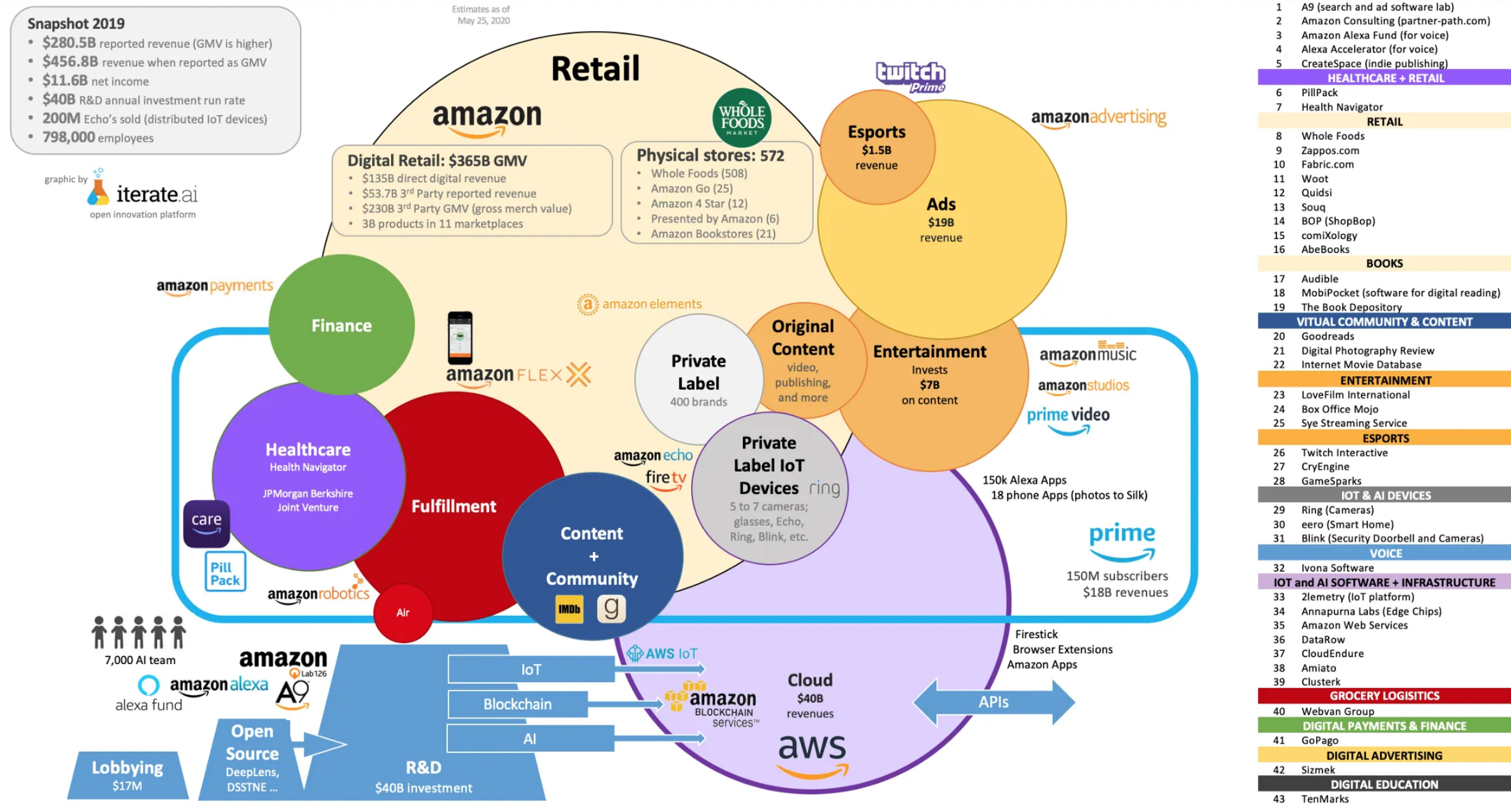
Growth Champion: Authentic Brands
Jamie Salter leads Authentic, experts in taking tired old brands and finding new growth. Authentic started with celebrity brands – like Marilyn Monroe and Elvis Presley, and more recently David Beckham. Since then it has rejuvenated brands including Reebok, Forever 21, Juicy Couture, Nine West, and Ted Baker. The business model is to take charge of the brand and business strategy, while leaving partners to operate, and create synergies between brands.
- Authentic Brands Group
- Authentic Brands Investor Presentation 2022
- Adidas sells Reebok to Authentic Brands for $2.3bn
- Jamie Salter Interview (Drapers, 2024)
- Authentic Brands Profile (Peter Fisk)
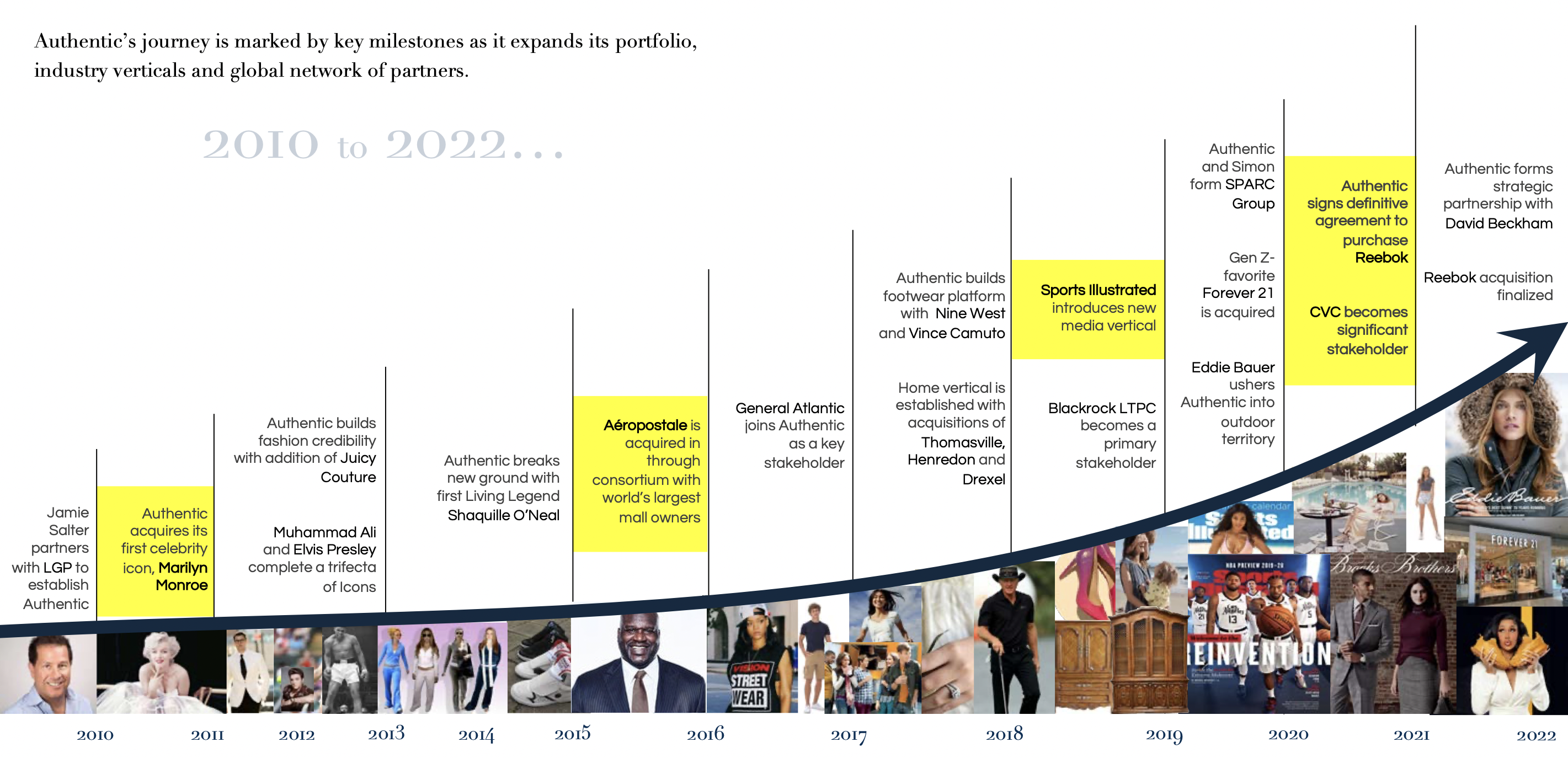
Growth Champion: Coca-Cola
Growth becomes harder as a business matures. Coca-Cola has learnt to keep evolving as markets, consumer tastes and cultures change. Key has been to retain a “human-centric” approach to brand experience, with deep insight into consumers, and the broader cultural context, leading to identifying new niches, new products, new channels, new engagement, and an ever-shifting portfolio. Innovation examples include AI-driven Coca Cola Creations, and Project Shaken, a cocktail mixer.
- The Coca-Cola Company
- Coca Cola Investor Overview Q3 2023
- Raising the Bar: Marketing and Innovation Q3 2023
- Coca Cola HBC Investor Day 2023
- Coke y3000 future magic (Peter Fisk)
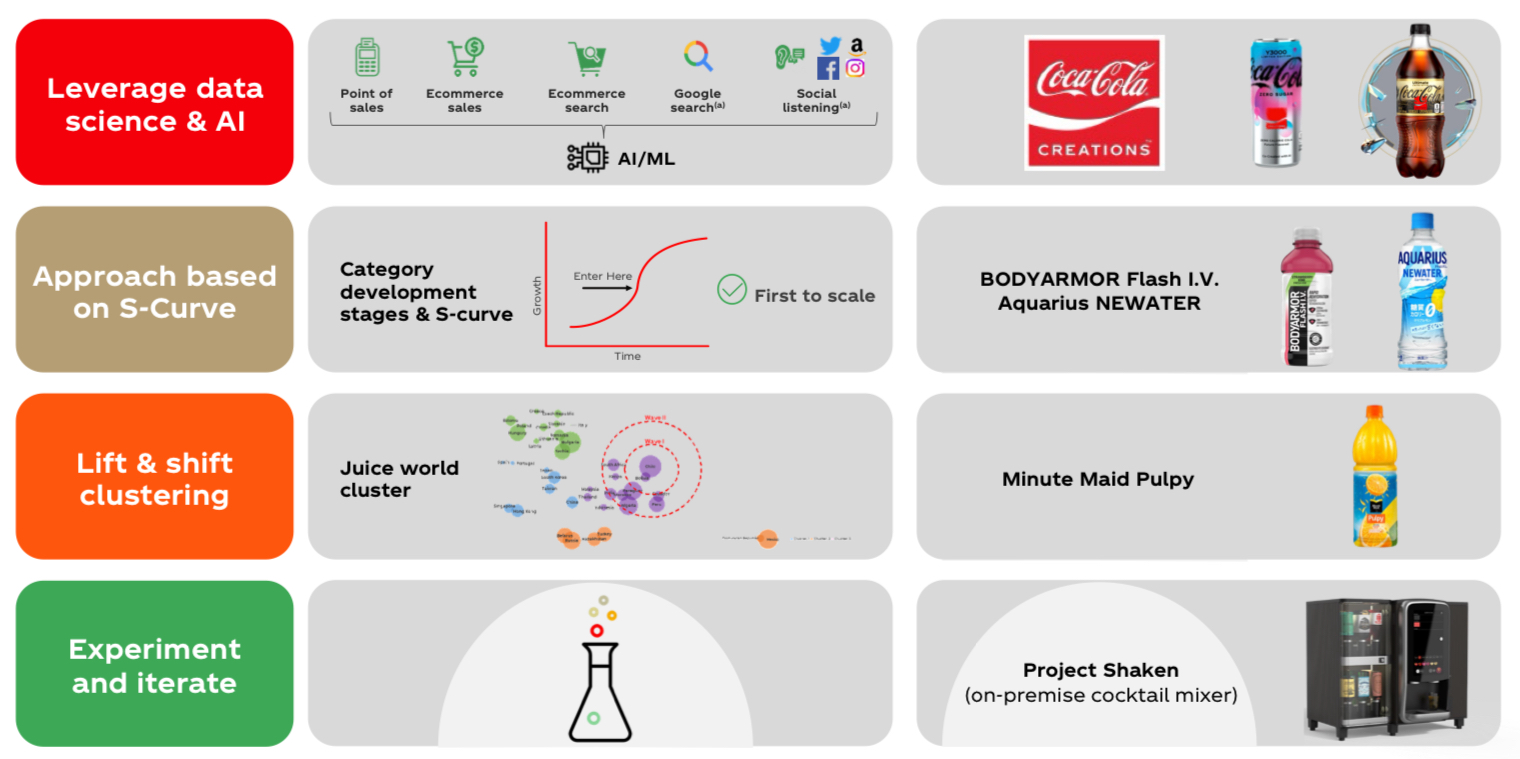
Growth Champion: Crocs
People who love to hate Crocs had cause to celebrate in 2008, when investors were writing the company off as a passing fad. Crocs lost over $185 million that year and stock plunged to just over $1 a share from a high of about $69 a year earlier. But now they are back from the dead, sold 700 million pairs in the last decade, and have become a cultural icon. Crocs are a top brand among Gen Z. And limited edition Crocs are selling for up to $1,000 on the resale market.
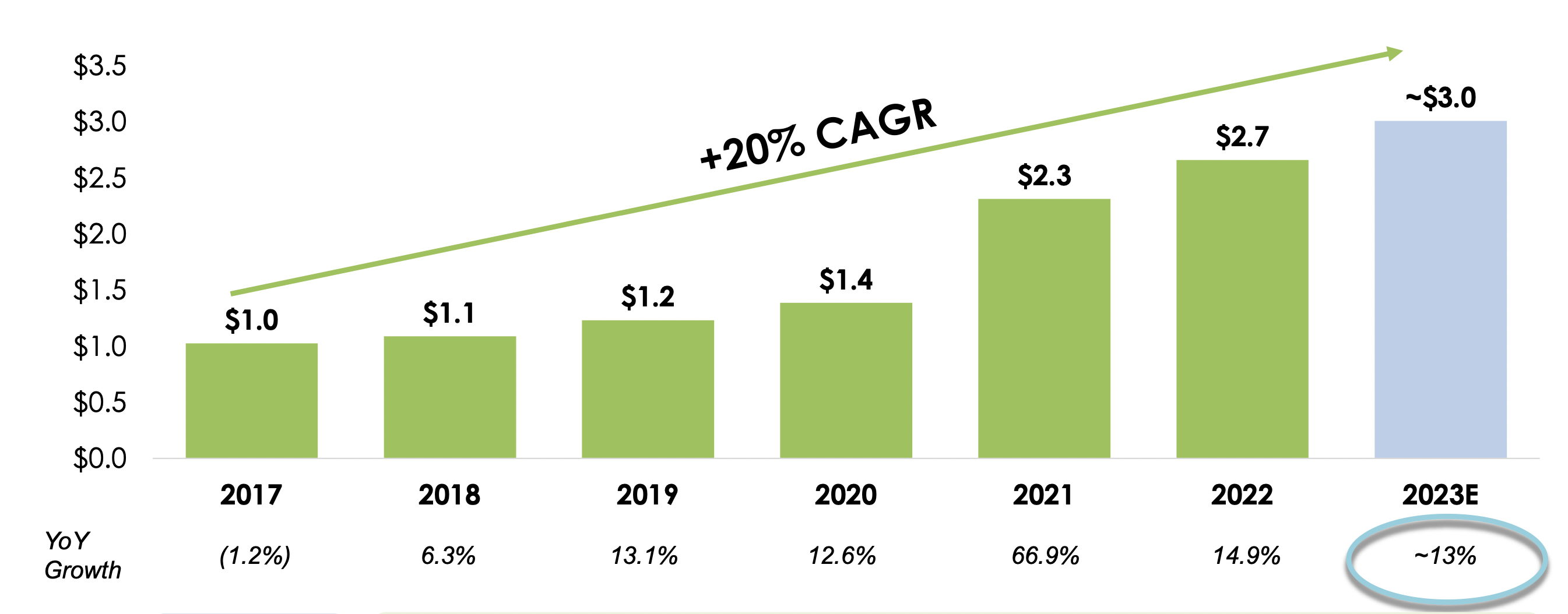
Growth Champion: Essilor Luxottica
The Italian French company is the global leader in the design, manufacture and distribution of eyewear. It licenses many leading brands to develop premium eyewear including Ray-Ban, Oakley, Costa, Vogue Eyewear and Persol. It offers superior shopping and patient experiences with a network of 18,000 stores including world-class retail brands like Sunglass Hut, LensCrafters, Salmoiraghi & Viganò and GrandVision.
- Essilor Luxottica
- Essilor Luxottica at a glance
- Capital Markets Day 2022
- Results Presentation Q3 2023
- Essilor Luxottica Profile (Peter Fisk)
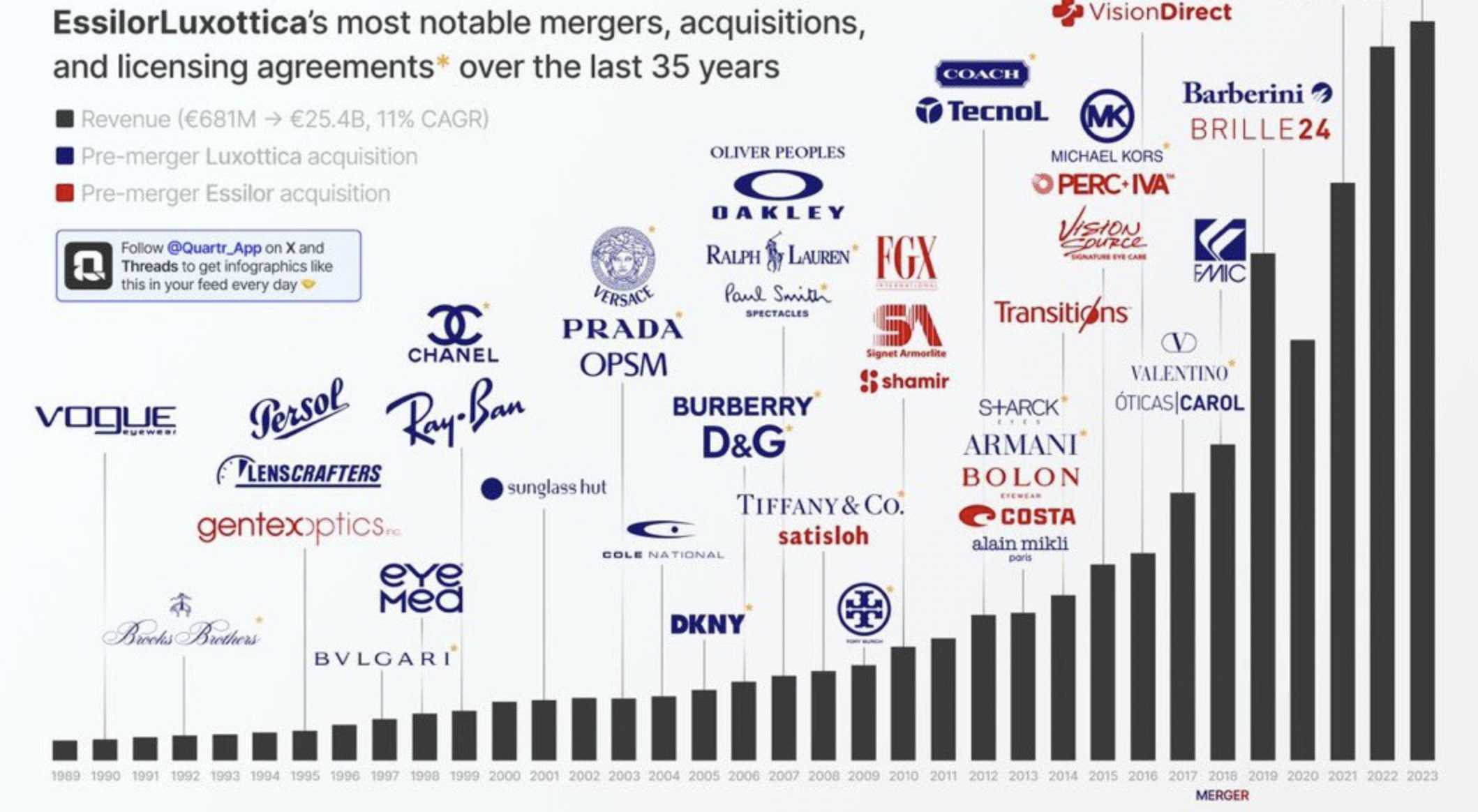
Growth Champion: LVMH
LVMH, from Christian Dior to over 70 luxury brands, including Louis Vuitton and Givenchy, Sephora and Tiffany, has multiplied 20 times in market value under the leadership of Bernard Arnault. In 1984 he spotted an opportunity to acquire a finance company that had lost its way, but still owned some interesting assets including Christian Dior, and department store Le Bon Marche. He quickly set about refocusing the business and reenergising its best assets for a changing world.
- LVMH
- LVMH Snapshot 2024
- LVMH Group Presentation 2023
- LVMH Annual Report 2023
- Bernard Arnault Profile (Peter Fisk)

Growth Champion: Mercado Libre
Mercado Libre is on a mission “to democratize commerce and financial services to transform the lives of millions of people in Latin America”. It hosts the largest online commerce and payments ecosystem in Latin America, and operates in 18 countries, although Brazil alone accounts for 65% of its revenue, growing to 96% when including Argentina and Mexico. MELI was founded in 1999 by Marcos Galperin and two colleagues while at Stanford.
- Mercado Libre
- Mercado Libre Institutional Presentation 2023
- Six Stories of Mercado Libre (The Generalist)
- Marcos Galperin Profile (Peter Fisk)
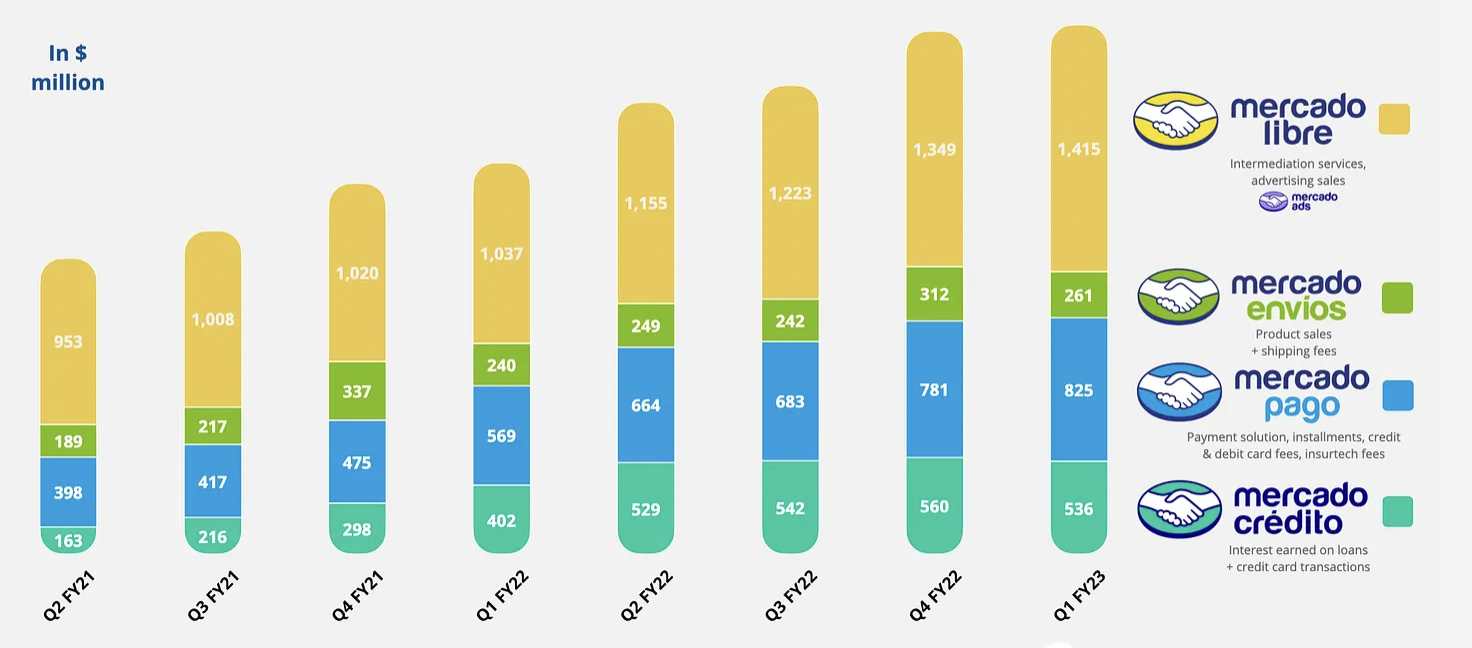
Growth Champion: Monster Beverage
Monster Beverage is the top-performing US business of the past 30 years – a $1,000 investment in 1994 would be worth $2,000,000 today (+200,000% gain). It produces a range of energy drinks including Monster Energy, Relentless and Burn, but was originally founded as Hansen’s in 1935 in Southern California, selling juice products. Monster is 20% owned by Coca-Cola and benefits from distribution through its global network.
- Monster Investor Presentation 2024
- Monster Annual Report 2022
- Monster Design Case Study
- Monster Profile by Peter Fisk
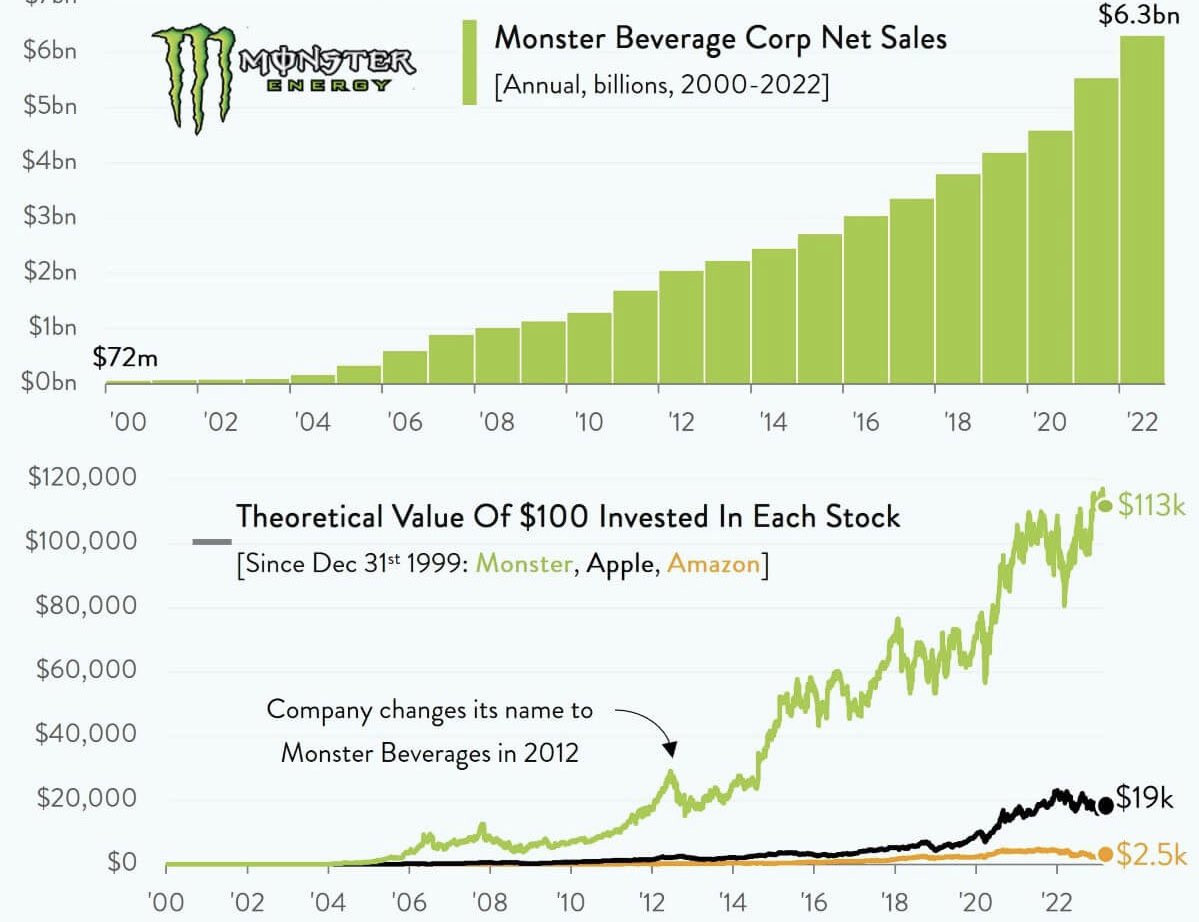
Growth Champion: Novo Nordisk
Novo Nordisk is a global healthcare company, based in Denmark, with more than 90 years of innovation and leadership with a clear focus on diabetes care. It’s innovation is patient-centric, focused on what it can be best at, and delivered by one of the world’s most sustainable companies. Most recently, a new diabetes drug Ozempic was found to have remarkable side effects, creating significant weight loss in patients. It has now become the world’s most in-demand obesity drug.
- Novo Nordisk
- Novo Nordisk Investor Presentation Q3 2023
- Novo Nordisk Corporate Strategy, Capital Markets Day 2022
- Ozempic makes NN Europe’s most valuable company (Peter Fisk)
- Novo Nordisk Profile (Peter Fisk)

Growth Champion: Nubank
Nubank launched in 2013 with the mission to fight complexity to empower people in their daily lives by reinventing financial services. Its first product was a credit card that differentiated itself by not charging traditional fees, such as annual fees or over-limit fees, and all based in a digital app. It is now one of the world’s largest digital banking platforms, serving more than 80 million customers across Brazil, Mexico, and Colombia.
- Nubank
- Nubank Earnings Presentation Q3 2023
- How Nubank became a $30 billion fintech (FT)
- Nubank Profile and Cristina Junqueira Profile (Peter Fisk)
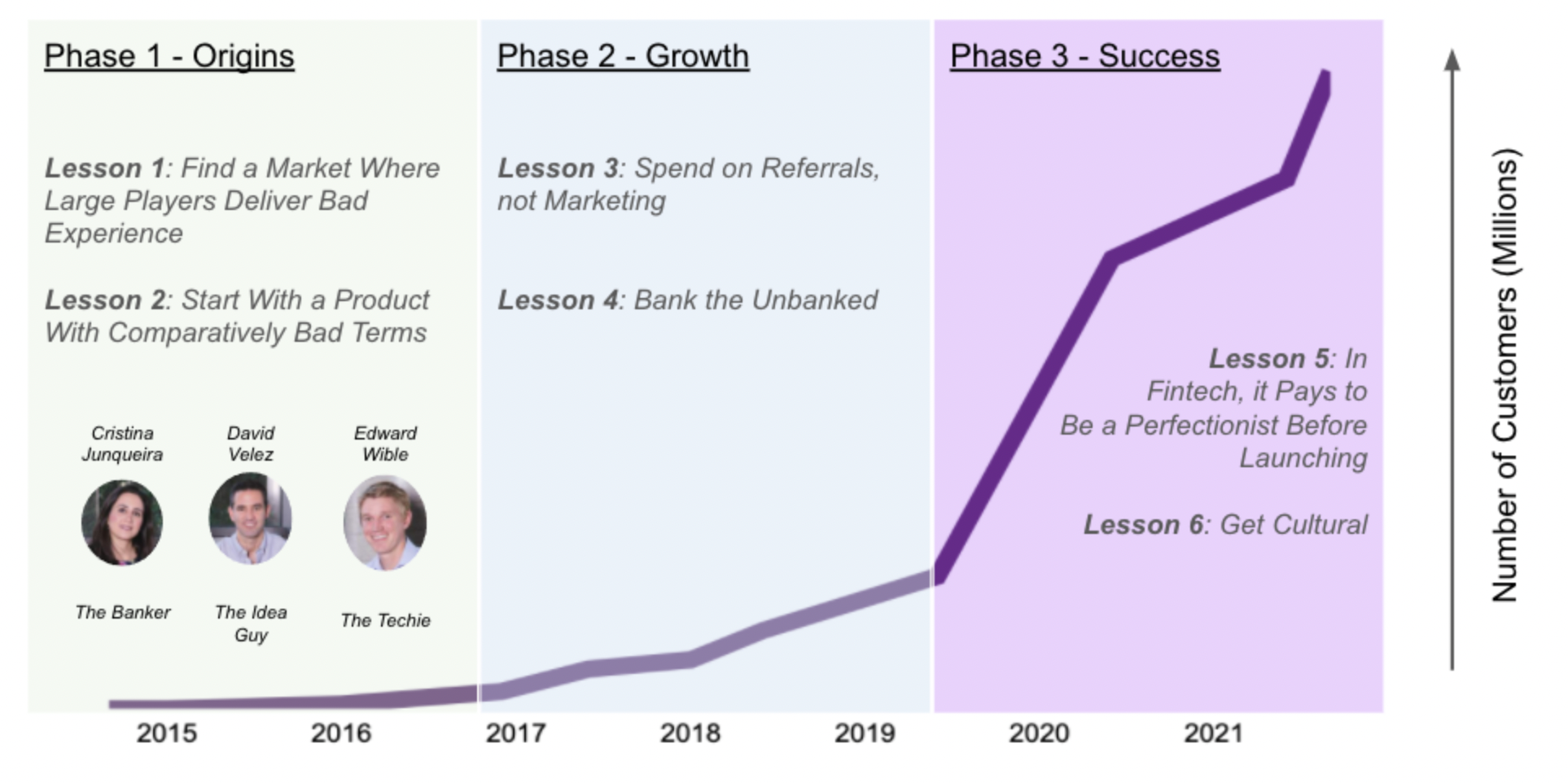
Growth Champion: Nvidia
AI is transforming our world. The software that enables computers to do things that once required human perception and judgment depends largely on hardware made possible by Jensen Huang who cofounded Nvidia in 1993. In 2024, Nvidia’s earnings are forecast to increase at a compound annual growth rate of 103% over the next five years. That would be more than double the 48% CAGR Nvidia’s bottom line has clocked in the past five years.
- Nvidia Story
- Nvidia Investor Presentation Oct 2023
- Nvidia Investor Presentation Nov 2023
- Nvidia growth forecasts (Yahoo Finance)
- Jensen Huang Profile (Peter Fisk)
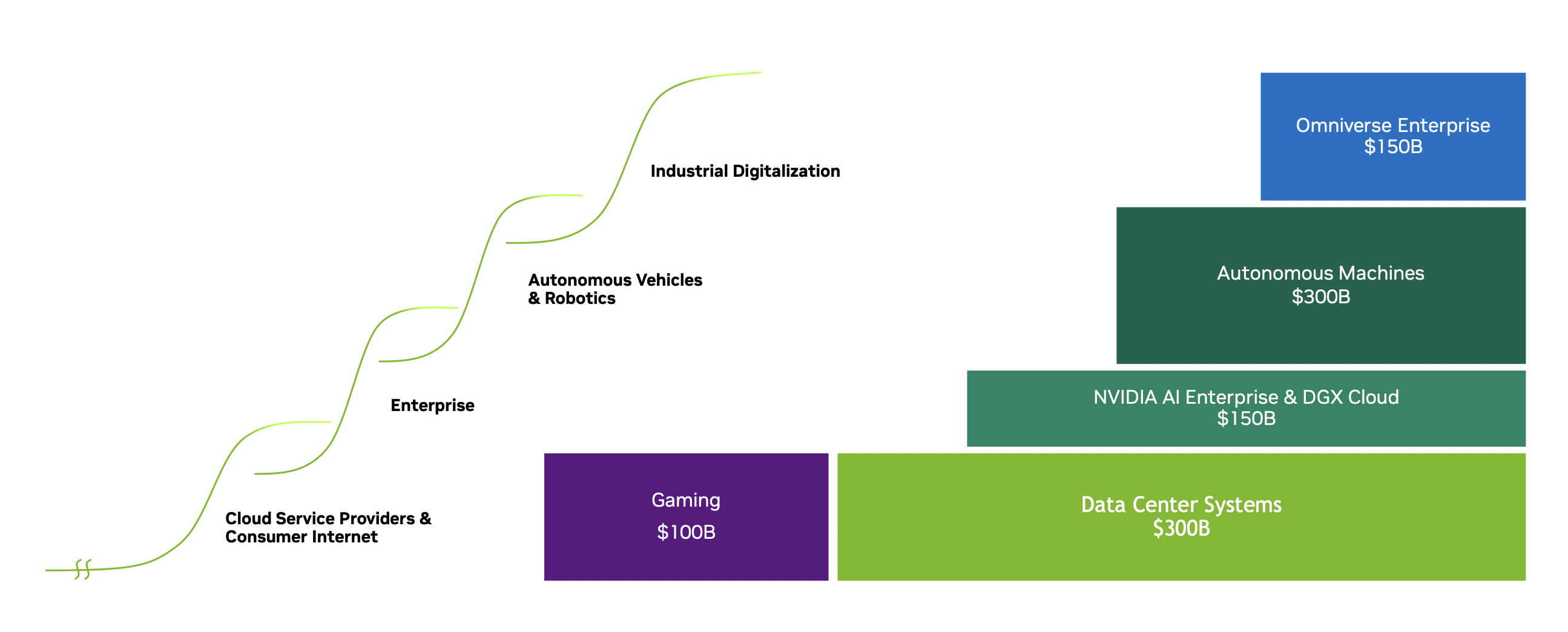
Growth Champion: On
Olivier Bernhard is on a mission to “ignite the human spirit through movement” and to make Swiss brand On “the most premium global sportswear brand”. The former triathlete devoted himself to finding a running shoe that would give him the perfect running sensation. In doing so he crossed paths with a like-minded Swiss engineer who had an idea for a new kind of running shoe. In 2010 he got together with two friends to develop a product range fully engineered in Switzerland.
- On
- On Investor Day 2023
- On Annual Report 2022
- Circular Running (Peter Fisk)
- On Profile (Peter Fisk)
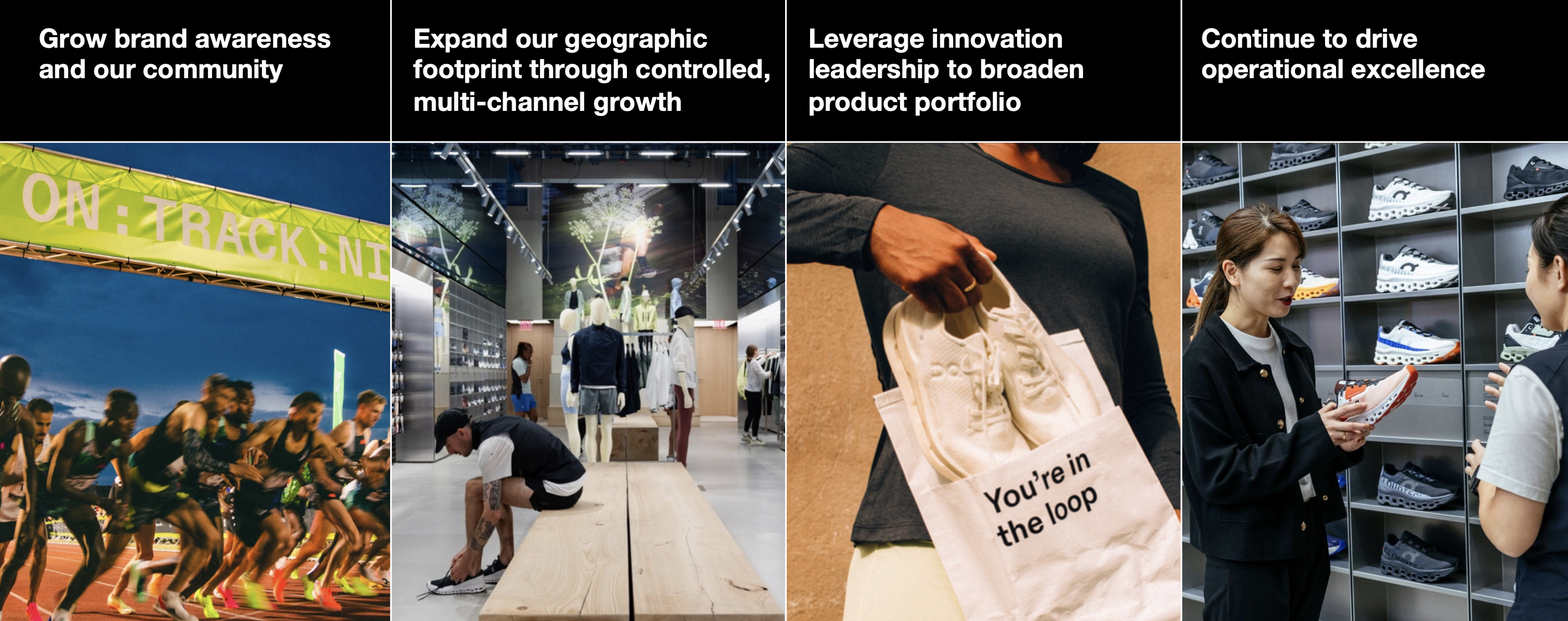
Growth Champion: Ping An
Ping An is the world’s largest insurance business, and more generally provides products and services through its five ecosystems in financial services, healthcare, auto services, real estate services and smart city solutions. The company’s first steps beyond finance started in 2012. Co-CEO Jessica Tan has developed a vision of “technology plus finance” as key to Ping An’s ongoing growth, most notably with Good Doctor as the world’s leading digital healthcare platform.
- Ping An
- Ping An Investor Day 2023
- Ping An Results Presentation Oct 2023
- Ping An Healthcare’s “Good Doctor” (Peter Fisk)
- Ping An Profile and Jessica Tan Profile (Peter Fisk)
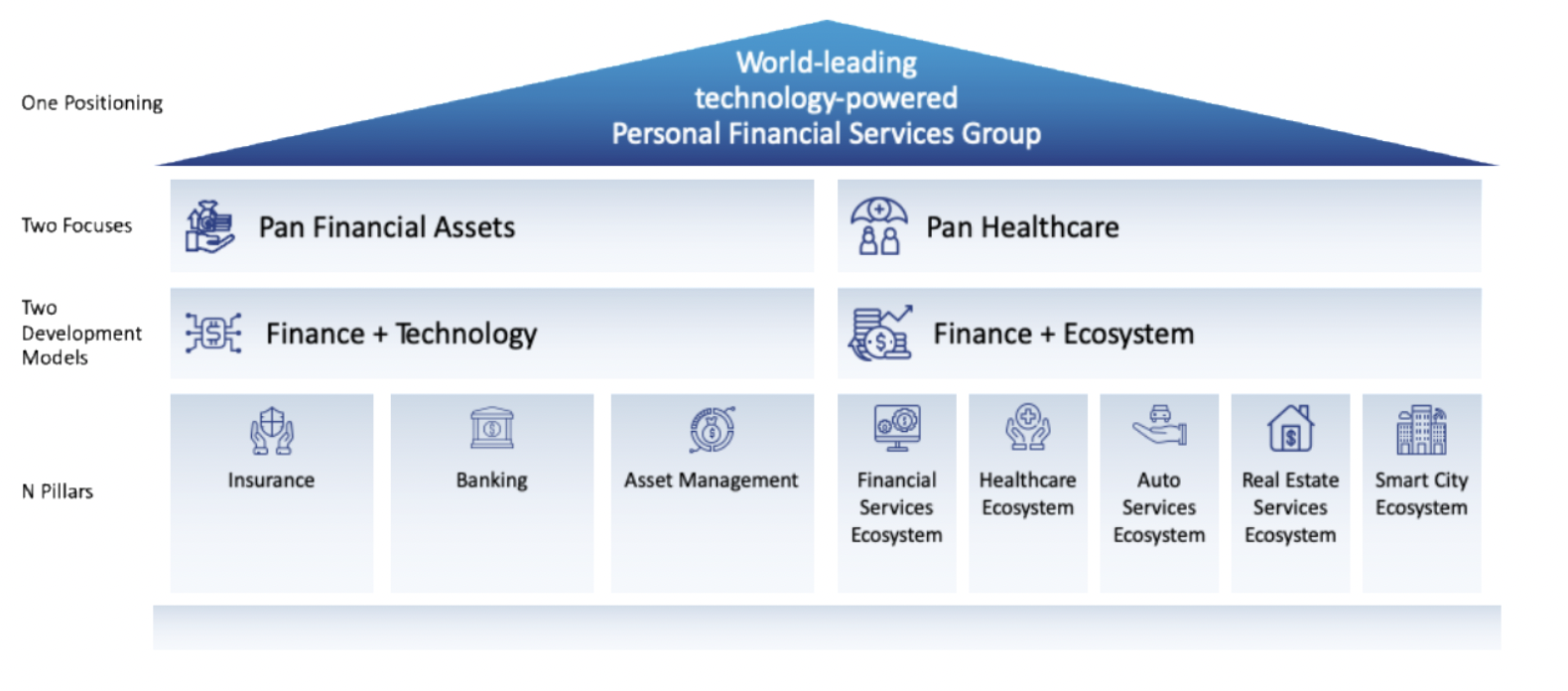
Growth Champion: Temu
The Pinduoduo-owned online fashion. retail platform burst into western markets in September 2022, and immediately outperformed the similar Shein business, and has continued to gain more visitors than Amazon. While Chinese owned, Temu is a US registered company, based in Boston USA. It’s focus is on super-cheap, super-fast, medium-quality fashion, using an on-demand super-fast business model. Sales are driven by social media, live-streaming, relentless offers, and gamification.
- Pinduoduo Overview 2022
- Is Temu the future of buying things? (New Yorker)
- How Temu works (EJet Sourcing)
- Temu Profile and Pinduoduo Profile (Peter Fisk)
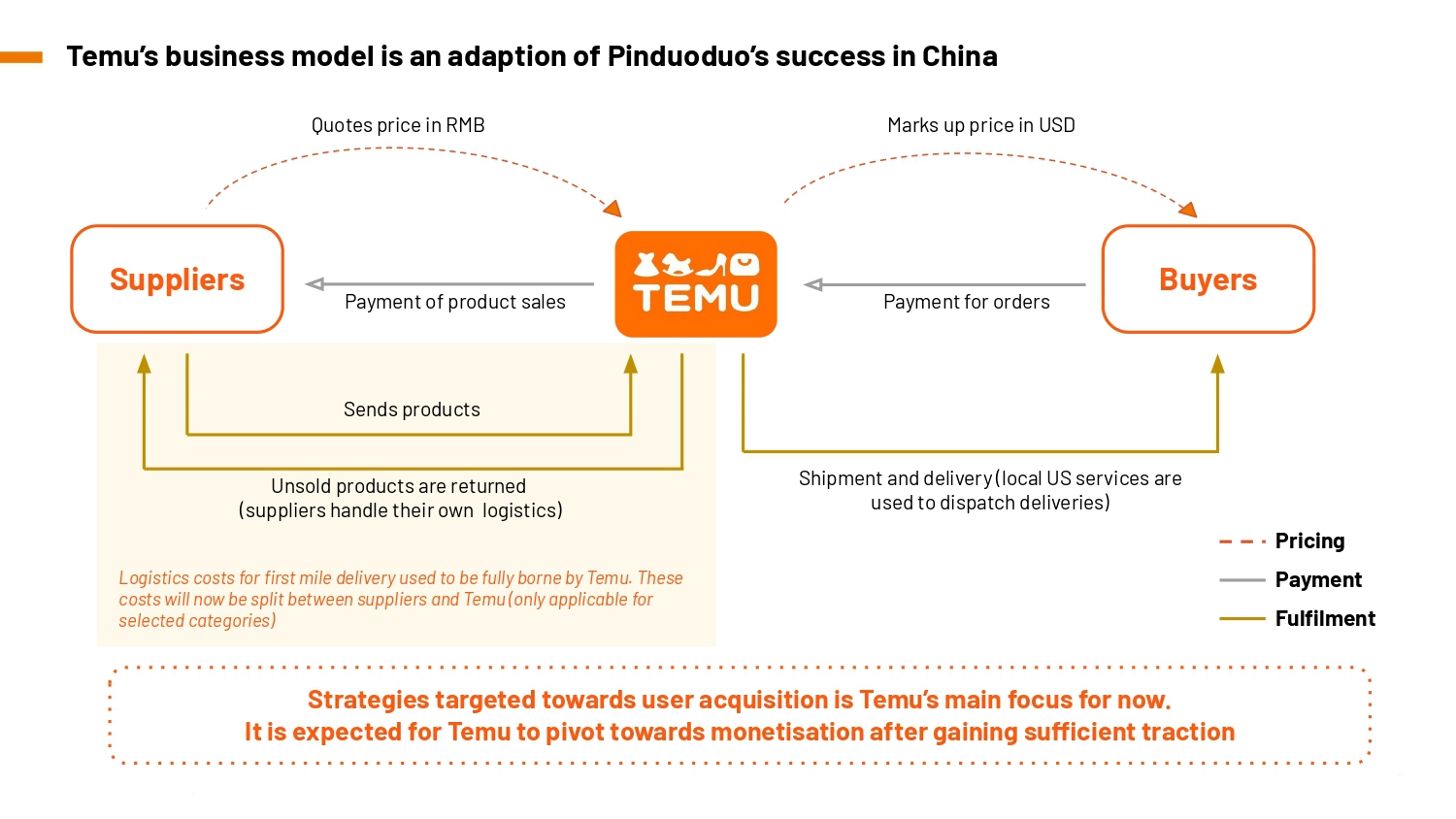
Growth Champion: Tencent
Tencent is a tech ecosystem, with a purpose “Value for Users, Tech for Good”. It’s social platforms WeChat (known as Weixin in China) and QQ connect users with each other, with digital content and daily life services in just a few clicks. It was founded in 1998 by Ma Huateng, known as Pony Ma, in Shenzhen. Launched in 2011, WeChat has grown into the most popular and widely used mobile app globally, and serves as a central part of daily life for its many users in China and beyond.
- Tencent
- Tencent Corporate Overview 2023
- Tencent Results Presentation Q3 2023
- Tencent Profile (Peter Fisk)
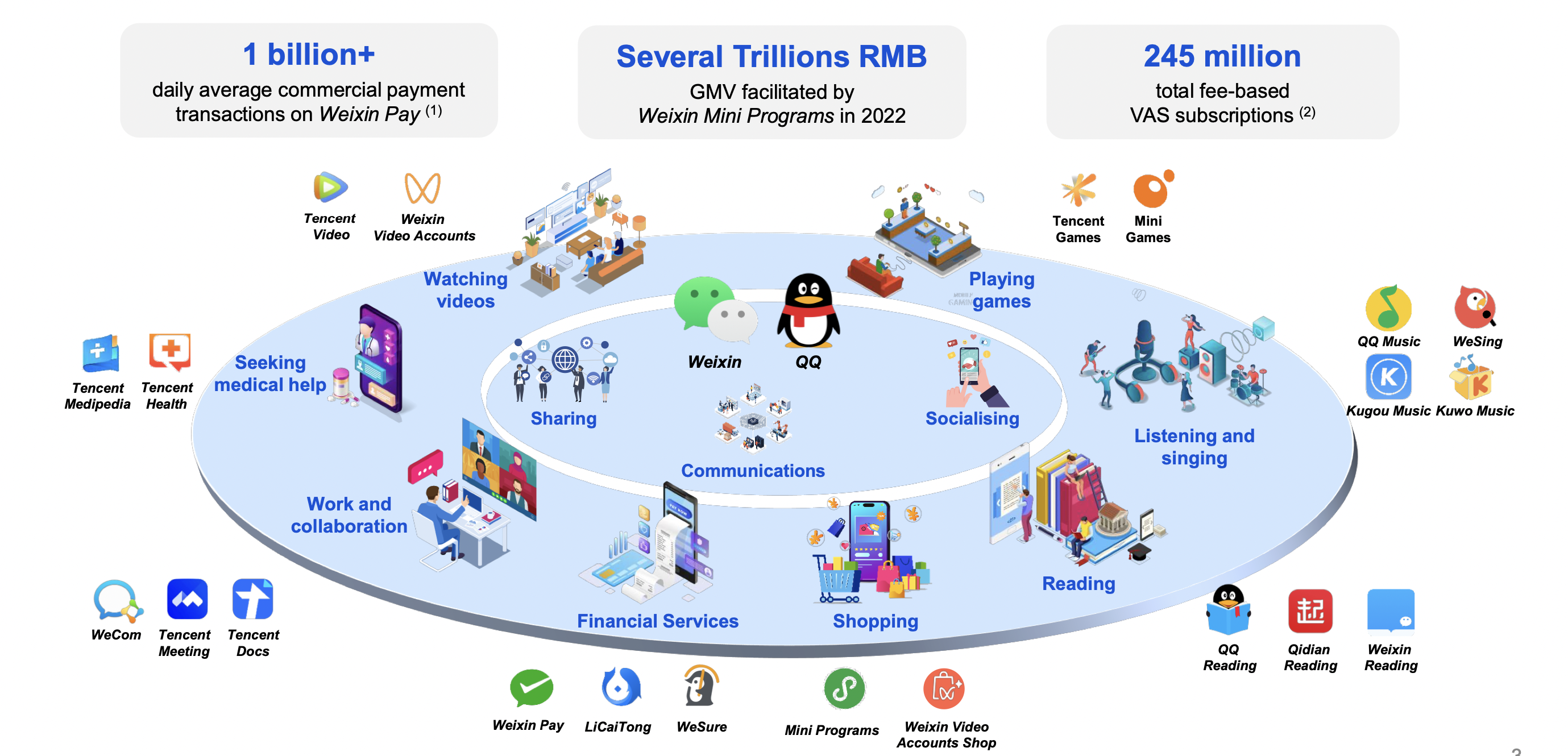
Growth Champion: Tesla
Faster than a Ferrari, powered by the sun. Tesla was founded in 2004 “to accelerate the world’s transition to sustainable energy”. Elon Musk took over as CEO in 2008, and achieved profitability in 2013. Tesla is by far the world’s most valuable automotive company (more valuable than the next 9 companies together), but it is much more than that. Tesla’s latest strategy “Master Plan Part 3” describes how it plans to transform the future of energy.
- Tesla Investor Day 2023
- Tesla Investor Update Q3 2023
- Tesla Master Plan Part 3
- Tesla Profile and Elon Musk Profile (Peter Fisk)
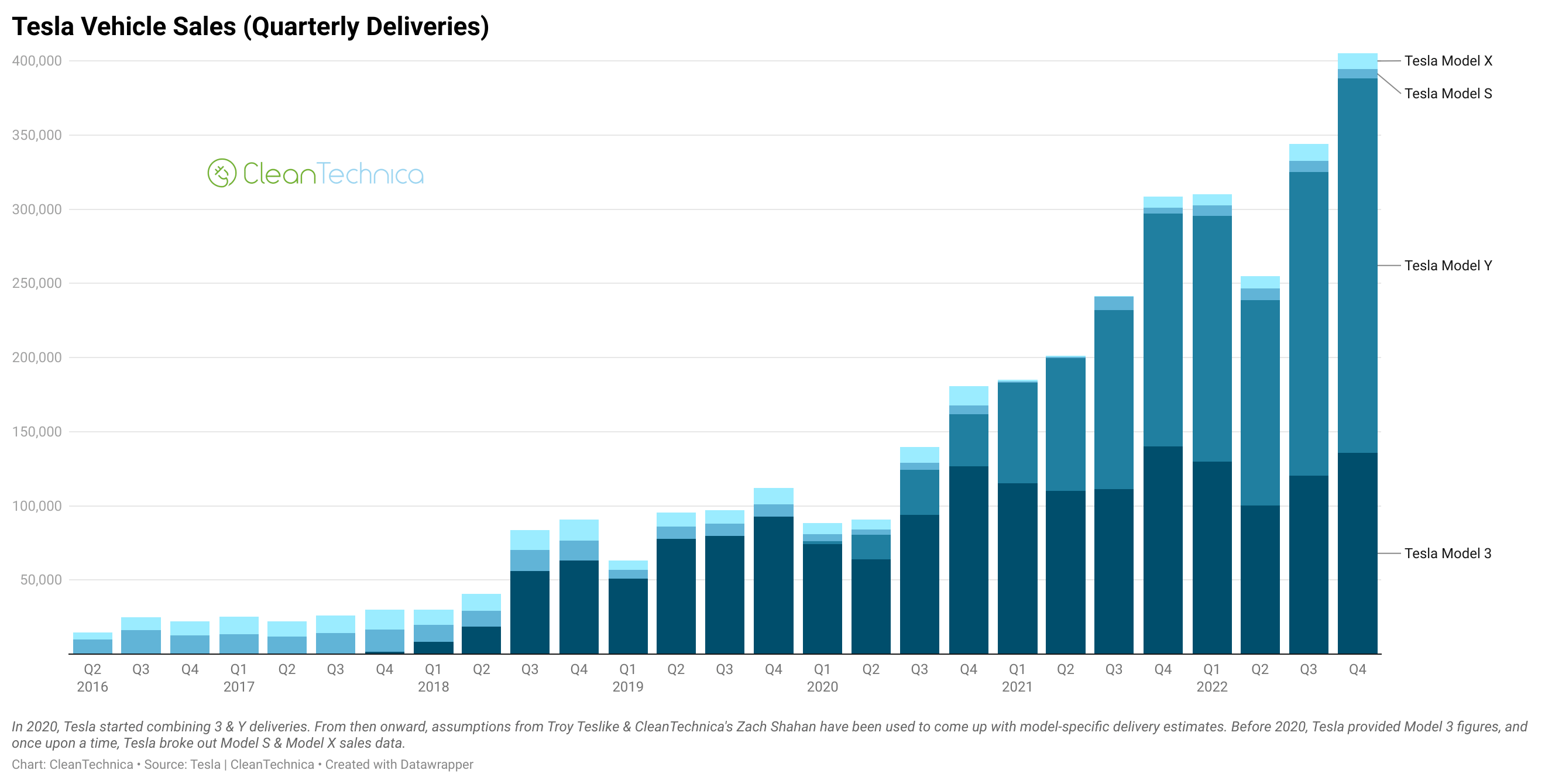
Growth Champion: Tony’s Chocolonely
Dutch journalist, Teun van de Keuken, founded the chocolate company in 2005 to fight against modern slavery on cocoa farms. Over 10 years it grew 10x, 24% a year, and a gross margin of 46%, and is the leading chocolate brand in Netherlands. It’s latest “fair” report starts with “Another choc-tastic year, proving that social impact and economic growth can soar together.”
- Tony’s Chocolonely Annual Fair Report 2022/23
- 10X+ growth from €1m to €100m in 10 years (SOM)
- Tony’s Chocolonely Profile (Peter Fisk)

So what drives growth?
Growth might seem obvious, but it is often confused. Profitable growth is the key driver of value creation.
Consider the automotive market. Tesla has the highest growth rate (around 35% CAGR over 5 years). And while Volkswagen sells 4 times more cars than Tesla ($335 billion to $95 billion revenue in 2023), Tesla is almost 10 times more valuable than Volkswagen ($650 billion vs $65 billion in terms of market cap). Ferrari is the most profitable (25% operating margin to Tesla’s 14%), but is even less valuable than VW, with almost no growth. Tesla, of course, is also the most sustainable.
- How do you drive and sustain profitable growth?
- Does it mean doing more? Or less, by doing the best things better?
- Is it all about smarter selling, or more about innovating?
- To existing markets and customers, or looking beyond to new opportunities?
- How does growth fit with sustainability, and using less natural resources?
- Can inorganic growth replace the need for real, organic growth?
- Is growth still the primary way to drive long-term value creation financially?
- Does growth need a strategy, and active leadership, or is it just a result?
- What inspires growth, sustains growth, and accelerates growth?
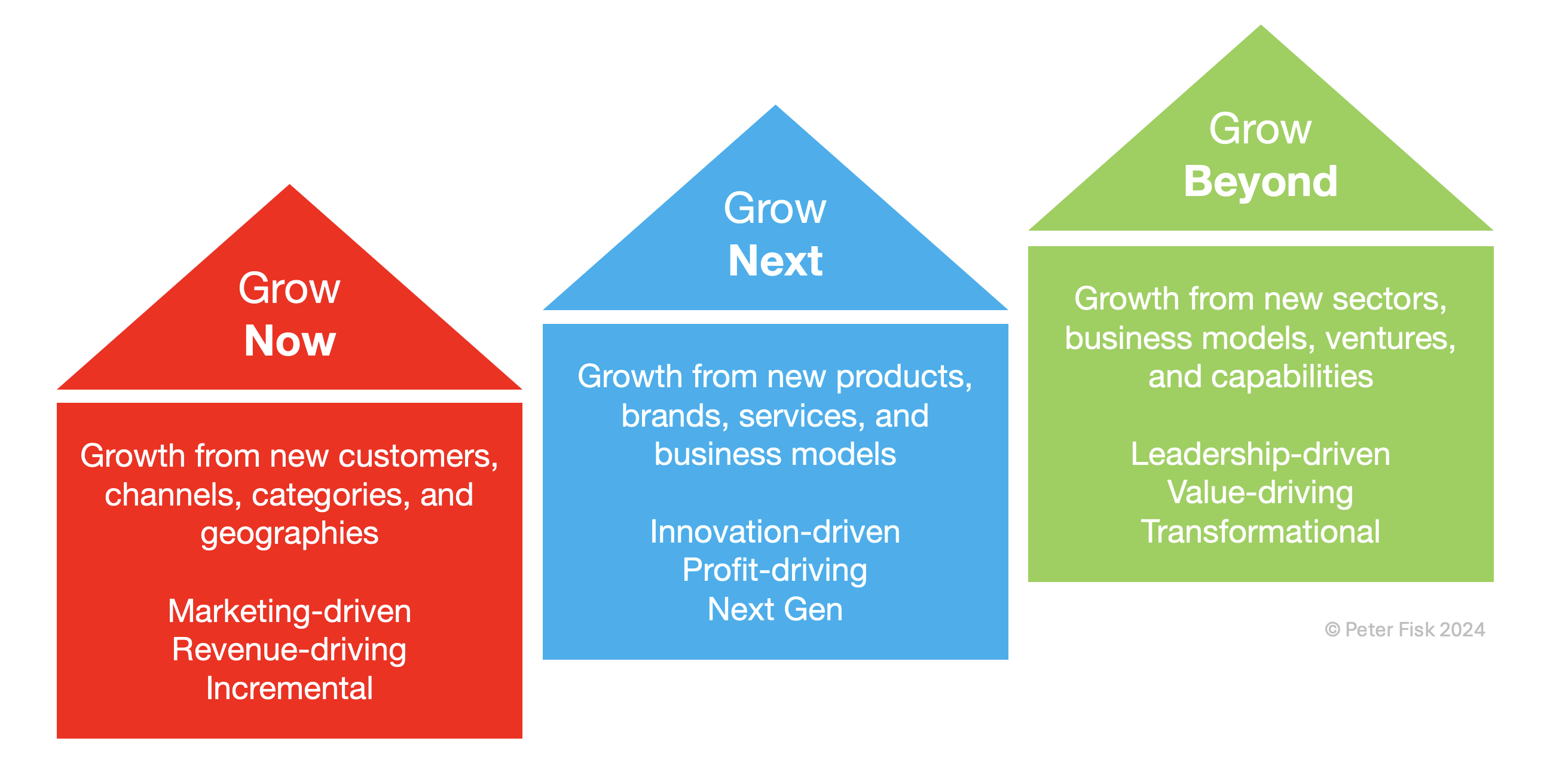
Explore more about growth
- Growth Recoded (video) by Peter Fisk
- Finding and accelerating better growth by Peter Fisk
-
Growth in an uncertain world by Deloitte
- 4 Stages of Growth: Start-up, Grow-up, Scale-up
-
Video: AG Lafley on Growth Strategy
- Video: Inside P&G’s Growth Factory
- Now New Next: Growth Champions by Mckinsey
- Leading for Growth by McKinsey
- Growth Triple Play by McKinsey
- 6 Strategies for Growth by McKinsey
-
10 Rules of Growth by McKinsey
- Summary of Growth IQ by Tiffani Bova
- Growth IQ Workbook by Tiffani Bova
- Life Centricity Playbook by Accenture
- 11 Secrets for Exponential Growth by Salim Ismael
And also
- New topics for inspiring growth keynotes by Peter Fisk
- Practical strategic growth workshops by Peter Fisk
- Accelerated executive development by Peter Fisk