The Reinvention of Healthcare … how Ada and Amazon, Hims & Hers and Good Doctor are using AI, digital platforms and connected ecosystems to create more intelligent, personal and human healthcare experiences
July 1, 2026

Healthcare is entering a period of reinvention more profound than the arrival of telemedicine or electronic medical records. For decades, digital technology largely improved individual parts of an established system: information became searchable, records became electronic, appointments moved online, prescriptions became digital and consultations appeared on screens. The underlying architecture, however, remained much the same. When people became ill, they still had to navigate a fragmented world of GPs, specialists, hospitals, laboratories, pharmacies and insurers.
That architecture is now starting to change.
The forces identified in my Healthcare Megatrends 2036 framework (below) are converging. Intelligent healthcare is moving care from reactive towards predictive and personalised models; ageing and chronic disease are creating new populations with more complex, continuous needs; value is shifting from activity and treatment towards outcomes, prevention and experience; virtual and at-home care are moving healthcare beyond traditional institutions; and data interoperability is becoming essential to connecting the journey. At the same time, health geopolitics, data sovereignty and proliferating AI regulation make trust and compliance increasingly important.
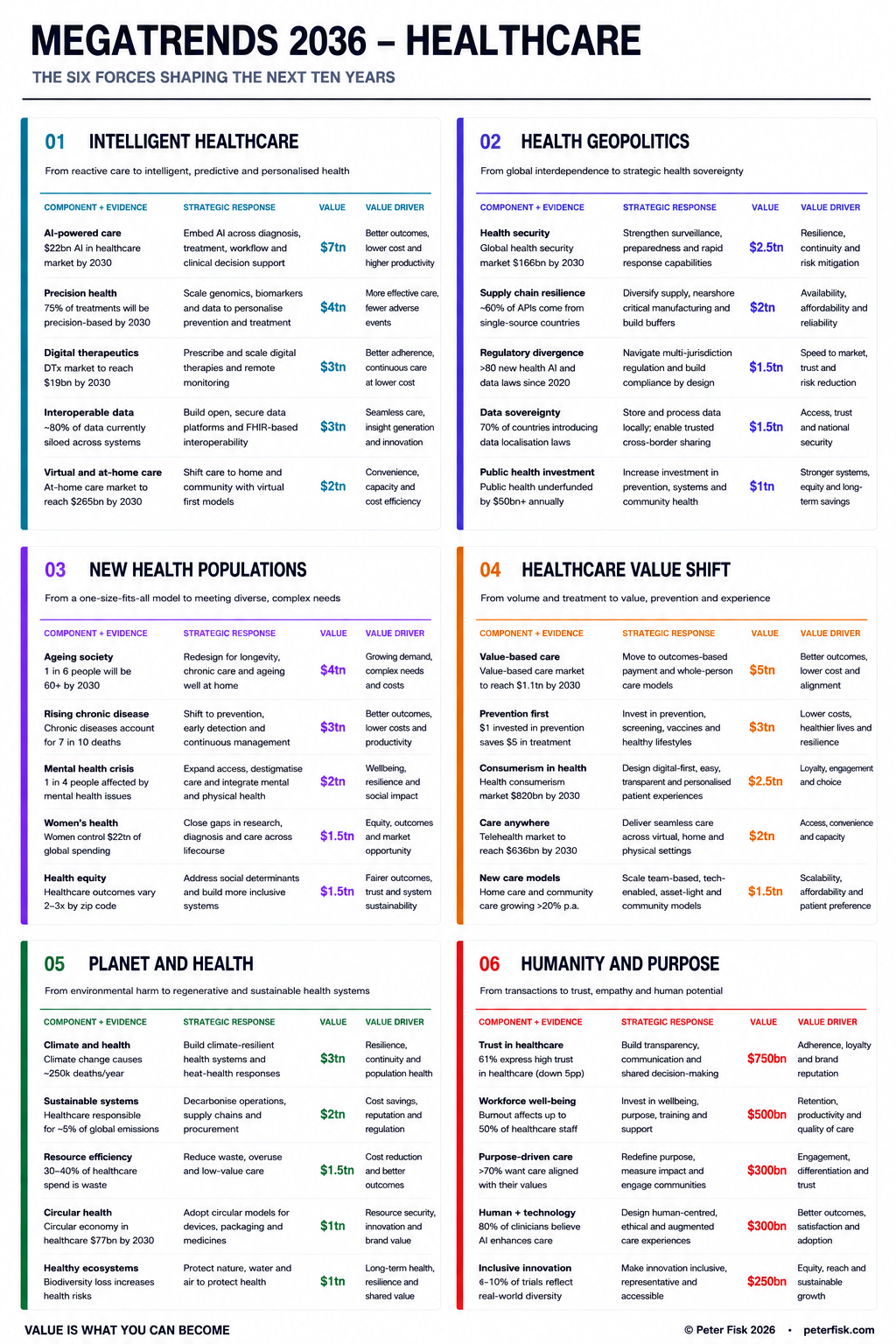
AI accelerates all of these shifts. But the important story is not simply that AI will make diagnosis faster or automate some of the doctor’s work. It is that AI, digital platforms and connected ecosystems can reorganise healthcare around the individual.
The emerging model can help understand what is happening, determine what should happen next, connect the person to appropriate expertise, coordinate the services required and increasingly take action on their behalf.
We are moving from the digital doctor as an app towards the personal health agent as an orchestrator of an ecosystem.
The first digital-health revolution was harder than it looked
The ambition is not new. The last decade is littered with businesses that promised to reinvent healthcare by making it digital.
Babylon Health was perhaps the most spectacular example. Founded in London by Ali Parsa in 2013, Babylon combined video consultations with an increasingly ambitious AI symptom-checking proposition. Its goal was essentially to put accessible healthcare into everyone’s pocket. It secured NHS relationships, expanded internationally and went public in New York in 2021 at a valuation of $4.2 billion. Less than two years later, the business collapsed into insolvency. Its UK operations were ultimately sold for around £500,000.
Babylon’s failure was not evidence that digital healthcare did not work. It demonstrated how difficult it is to make its economics, clinical governance and operating model work simultaneously. Rapid expansion created enormous costs; some contracts proved economically unattractive; clinical claims around its technology attracted controversy; and access to abundant capital encouraged scale before a sustainable model had been established.
Carbon Health followed a different trajectory. Founded in 2015 by Eren Bali and others, it sought to combine an elegant digital experience with real physical primary- and urgent-care clinics. That hybrid insight remains compelling and Carbon continues operating today. But its extraordinary pandemic-era expansion proved difficult to sustain. The company reached a reported valuation of around $3 billion, expanded rapidly and generated substantial COVID-related revenues, before repeatedly reducing staff and pulling back from areas such as remote patient monitoring and standalone chronic-care programmes to refocus on primary and urgent care.
The broader sector experienced the same reality check. Telemedicine usage surged during the pandemic, venture capital flooded into digital health and valuations assumed that changed behaviour would continue indefinitely. When physical healthcare reopened and capital became more expensive, the limitations of many models became apparent. Digital access alone was useful, but not necessarily differentiated; acquiring patients could be expensive; healthcare delivery remained labour-intensive; regulation constrained rapid scaling; and virtual care still had to connect with physical healthcare when diagnosis, testing or treatment demanded it.
Yet some simpler models proved remarkably resilient.
- Doctolib, founded in France in 2013, initially concentrated on a very specific frustration: finding and booking healthcare. Instead of trying to replace doctors, it made accessing them easier. It subsequently expanded into teleconsultation, communication, medical documents and software for healthcare professionals. Today it reports around 90 million people and 570,000 health professionals using its technologies across Europe.
- Zocdoc pursued a similar access problem in the United States. Launched in 2007 as something akin to an OpenTable for doctors, it progressively built a marketplace connecting available appointments, patients, providers, specialties and insurance networks. By 2026 it said it had helped more than 20 million people access care and was valued at about $2.3 billion in a secondary transaction. More interestingly, it is now turning its scheduling infrastructure into something AI agents can use: in August 2026, Zocdoc became a connected healthcare-booking partner for Google’s Gemini, allowing users to find and book from a network of more than 200,000 providers through an AI conversation.
There is an important lesson in these mixed fortunes. Digitising healthcare is not the same as reinventing it. Successful models solve a genuine consumer problem, fit into rather than ignore the realities of clinical care, establish sustainable economics, and progressively absorb more of the complexity surrounding the patient.
That evolution is now accelerating.
Reinventing healthcare with increasingly sophisticated models
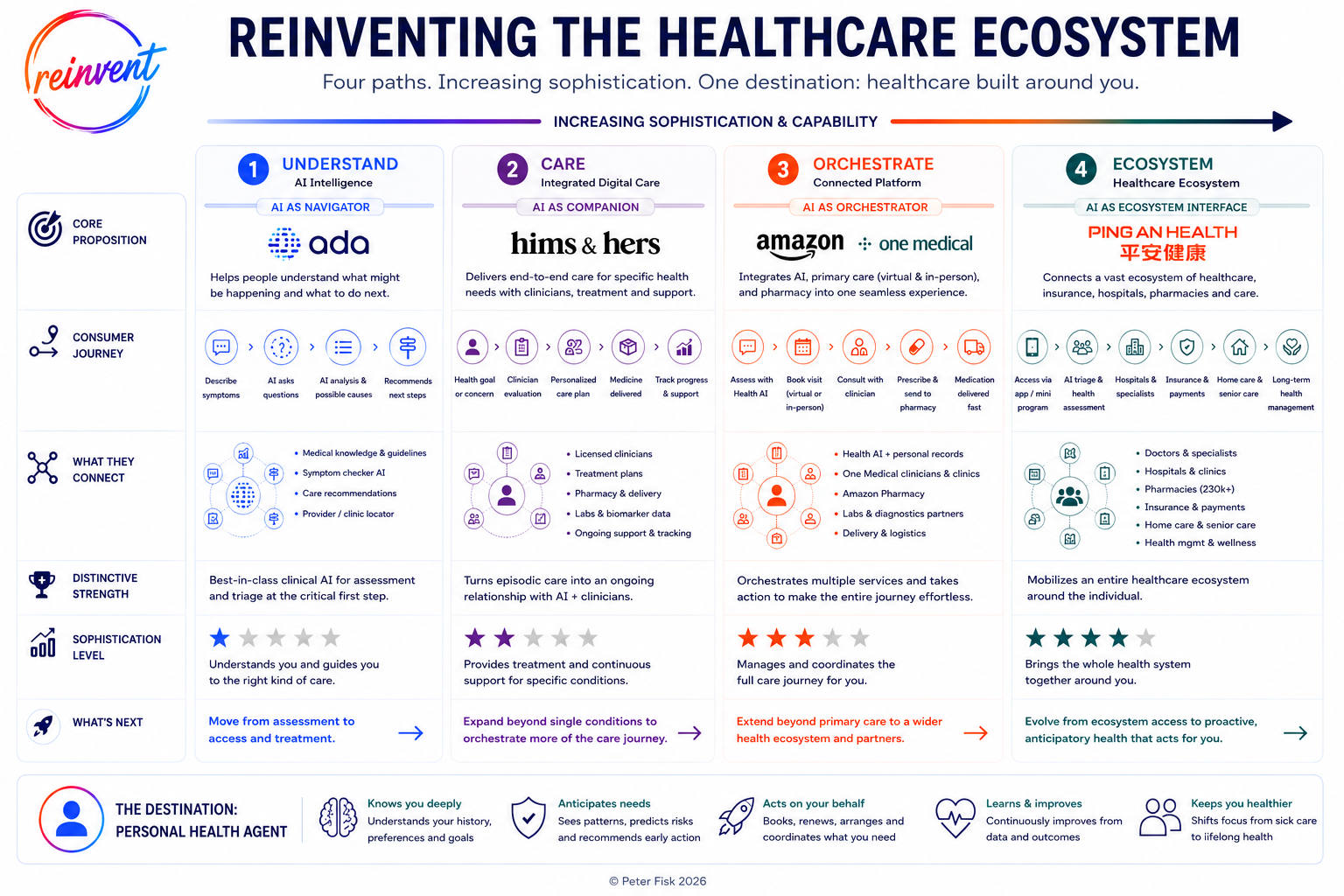
Four businesses reveal the emerging architecture particularly well. They should not be regarded as direct competitors or ranked simply as better and worse. Instead, they demonstrate increasing sophistication in how much of the healthcare journey technology can understand, integrate and orchestrate:
- Ada Health (Germany): AI as intelligent navigator, helping determine what might be wrong and what to do next.
- Hims & Hers (USA): integrated digital care connecting consumer, clinician, treatment, medicine and continuous support.
- Amazon One Medical (USA): a connected platform bringing AI, records, virtual and physical primary care, pharmacy and fulfilment into one journey.
- Ping An Health (China): a broad healthcare ecosystem connecting AI, doctors, hospitals, pharmacies, insurance, payments and care.
Lets explore each business in turn:
1. Ada Health: making the front door intelligent
Ada Health began in Berlin in 2011, founded by physician-scientists Martin Hirsch and Claire Novorol with entrepreneur Daniel Nathrath. Interestingly, Ada did not originally begin as a consumer symptom checker. The founders spent years developing clinical decision-support technology for doctors before adapting that knowledge into a consumer app.
Ada focuses on one deceptively simple question: “Something doesn’t feel right. What should I do?”
That uncertainty is one of healthcare’s biggest sources of friction and inefficiency. People rarely know whether a symptom requires monitoring at home, speaking to a pharmacist, seeing a GP, consulting a specialist or seeking urgent medical attention. Consequently, some people consume scarce clinical resources unnecessarily while others delay seeking care when they should not.
Ada uses AI to conduct an adaptive health assessment. A person describes symptoms; the system asks follow-up questions; its clinical reasoning engine considers possible causes and severity; and it recommends appropriate next steps. The experience does not claim to eliminate the doctor. It helps determine when and what kind of doctor may be required.
That distinction has helped Ada navigate one of the central regulatory challenges of healthcare AI. The more an AI system claims autonomous diagnosis and treatment, the greater its clinical and regulatory exposure. Ada’s core proposition is centred on assessment, navigation and decision support, with its technology also embedded into healthcare organisations.
Scale has followed. Ada currently reports more than 14 million users and 34 million symptom assessments. A 2026 real-world study with Portuguese healthcare group CUF, published in NEJM AI, found that use of Ada changed the care-seeking behaviour of three in five participants and more than doubled the proportion receiving clinically appropriate care.
Its strategic importance is therefore greater than that of a sophisticated symptom checker. Ada demonstrates the potential for AI to become the intelligence layer at healthcare’s front door.
Its current journey is essentially: “Describe symptoms, AI questions, assessment, possible causes, recommended next step.”
The next opportunity is to connect that intelligence more deeply into treatment: moving from “here is what you should consider doing” towards “here is the appropriate care, and I can help you access it.”
2. Hims & Hers: from consultation to continuous care
Hims & Hers started from a very different insight. Founded in San Francisco in 2017 by Andrew Dudum, Hilary Coles, Jack Abraham and Joe Spector, it recognised that many healthcare experiences were not simply inconvenient; they were uncomfortable. Hair loss, sexual health and other conditions could be embarrassing to discuss and cumbersome to treat through traditional channels.
The company wrapped healthcare in a consumer proposition.
Instead of asking people to find a doctor, obtain a prescription and locate treatment themselves, Hims & Hers brought digital intake, licensed clinicians, personalised treatment, prescription and fulfilment into one branded experience. It subsequently expanded into areas including dermatology, mental health and weight management.
Its innovation was partly technological but equally about consumerisation: accessible language, transparent journeys, discreet delivery and strong brands designed around needs rather than healthcare institutions.
This has required careful navigation of healthcare regulation. Hims & Hers is not simply an ecommerce company selling prescription drugs. Clinical decisions must be made by licensed providers, prescribing must comply with medical requirements, and the boundary between consumer marketing and clinical judgement matters enormously. Recent controversy around compounded weight-loss medicines has demonstrated how commercially attractive but regulatorily sensitive this territory can become.
The model nevertheless has considerable momentum. Hims & Hers reported approximately 2.9 million subscribers and $753 million of quarterly revenue in Q2 2026, up 19% and 38% respectively year on year. It now forecasts 2026 revenue of $3.1–3.3 billion.
More important than the numbers is how the model is changing.
In August 2026, Hims & Hers introduced a doctor-led, AI-native experience initially for Hers weight-loss customers. Rather than providing a generic AI chatbot outside the clinical relationship, the system places the consumer, provider, care team and AI into a continuous conversation. With consent, it can retain context about goals, treatment and progress, while clinicians remain responsible for clinical decisions.
That begins to fill one of healthcare’s biggest gaps: the time between consultations.
Traditional healthcare is episodic. A person might spend fifteen minutes with a doctor and then manage a condition alone for months. Health, however, is continuous. People take medicines, eat, exercise, sleep, improve, deteriorate and change behaviour every day.
The Hims & Hers model increasingly becomes: Understand need, clinician, personalised plan, treatment, medicine, monitor, support, adapt.
Ada helps navigate you towards healthcare. Hims & Hers starts to stay with you through it.
3. Amazon One Medical: orchestrating the journey
Amazon represents another increase in sophistication: moving from an integrated care proposition towards orchestration of multiple healthcare capabilities.
One Medical itself predates Amazon. Physician Tom Lee founded the company in 2007 around a simple frustration with traditional primary care. It combined attractive physical clinics, easier appointment access and digital services with a membership model. Amazon announced its acquisition in 2022 and completed the approximately $3.9 billion transaction in February 2023.
The strategic logic becomes clearer when One Medical is considered alongside Amazon Pharmacy and Amazon’s growing AI capabilities.
Amazon Health Services now possesses three important layers: clinical delivery through One Medical, fulfilment through Amazon Pharmacy, and intelligence through Health AI.
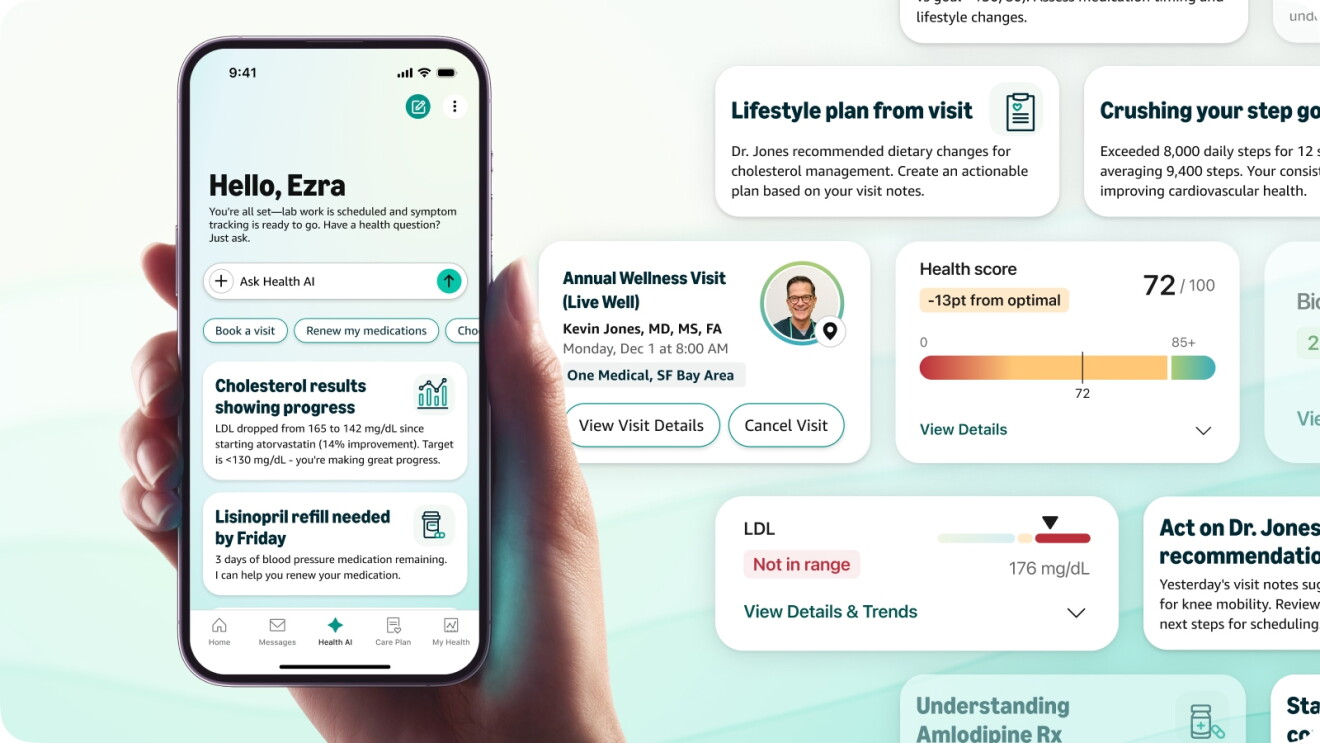
Health AI is particularly significant. Launched more broadly in 2026, it provides personalised health information and, with permission, can take actions such as initiating messaging-based care, booking appointments and helping manage prescriptions. Amazon reported that One Medical virtual-care visits had nearly tripled year on year, with a majority being initiated through Health AI.
Consider how different this feels from a traditional health app.
You develop a problem and describe it conversationally. AI helps assess what is happening using appropriate context. If clinical judgement is required, it can connect you to One Medical virtually or physically. The clinician can prescribe treatment. Amazon Pharmacy can fulfil it. The system can subsequently help manage the prescription and future care.
The journey becomes: Assess → book → consult → prescribe → fulfil → follow up.
Amazon’s distinctive competence is therefore not necessarily medicine. It is orchestration.
The company transformed retail by hiding extraordinary complexity behind a simple interface. Search, recommendation, transaction, payment, inventory, logistics and delivery became one consumer journey. Healthcare contains an analogous problem: the individual currently has to assemble the journey from separate organisations.
Amazon potentially makes the connections invisible.
This also explains why regulation and trust are so important to its model. Healthcare data combined with Amazon’s enormous consumer reach naturally creates privacy and competition concerns; the Federal Trade Commission scrutinised the One Medical acquisition. Clinical decisions also cannot simply become another recommendation algorithm. The platform must maintain clear boundaries between AI assistance, healthcare data and professional medical judgement.
If Amazon can establish that trust, however, its opportunity is formidable: AI + personal context + primary care + physical clinics + pharmacy + logistics.
Hims & Hers integrates a defined care experience. Amazon seeks to manage the journey for you.
4. Ping An Health: mobilising the ecosystem
The fourth model extends beyond orchestration towards the healthcare ecosystem itself.
Ping An Health / Good Doctor was established in China in 2014 as part of the much larger Ping An group and listed in Hong Kong in 2018. At IPO it was already operating China’s largest online healthcare platform, with more than 190 million registered users. By mid-2022 registered users had exceeded 440 million and cumulative consultations approached 1.3 billion.
But describing Ping An as a very large telemedicine app misses what makes it distinctive.
Its advantage comes from sitting within a group spanning insurance, financial services, healthcare and senior care. Ping An Health has consequently developed around a model combining managed care, family-doctor membership and online-to-offline healthcare services.
The consumer can enter digitally, but behind the interface sits a vast physical and financial network.
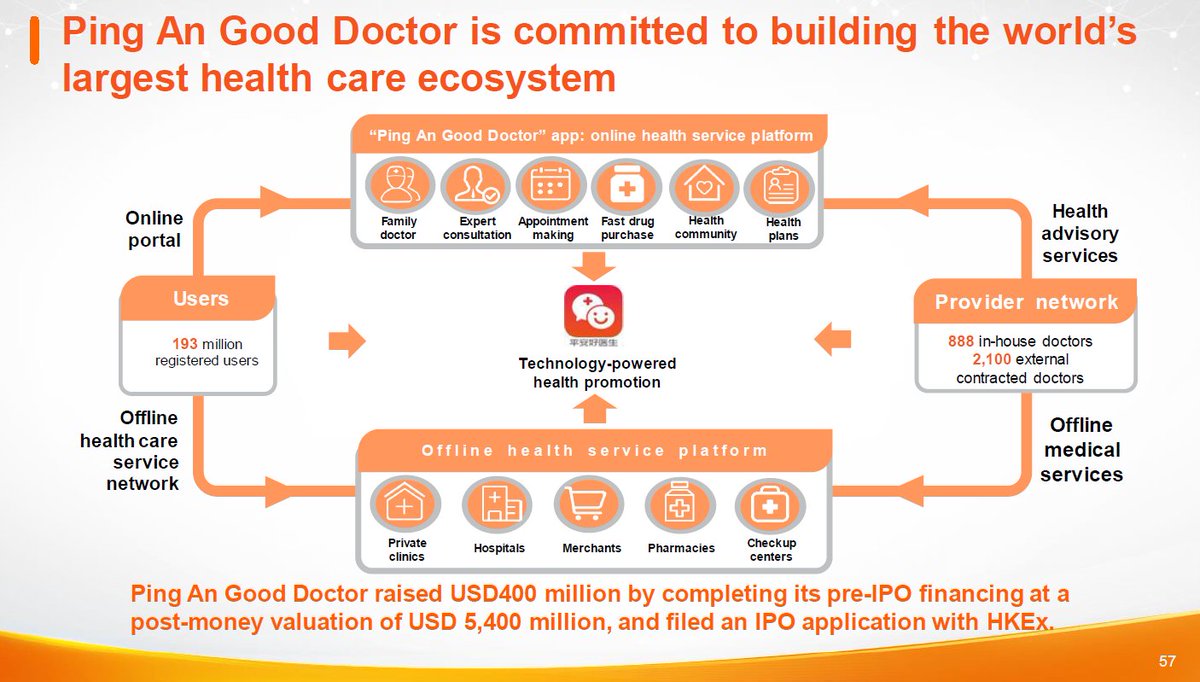
By June 2026, Ping An reported relationships with more than 38,000 hospitals, including China’s top 100 and all 3A hospitals, and nearly 245,000 pharmacies, representing more than 35% of the country’s pharmacies. Its broader health and senior-care services were being used by 11.5 million Ping An Life customers.
AI is becoming the intelligence layer across this network. In 2025 Ping An launched an AI Family Doctor, digital doctor avatars and an AI Senior Care Concierge. In the first half of 2026 its AI Doctor was used by more than 9.7 million people, while the group continued developing AI-assisted diagnosis and multidisciplinary support. Ping An Health itself generated RMB2.48 billion of revenue in the first half of 2026, following RMB5.47 billion revenue and RMB380 million net profit in 2025.
The consumer journey can therefore stretch much further: AI assessment → doctor → specialist → hospital → diagnostics → pharmacy → insurance/payment → home care → ongoing health management.
This is where the model becomes qualitatively different.
Ping An does not have to replace hospitals, doctors, pharmacies or insurers. Its opportunity is to make them behave more like one connected system around the individual.
There is also a powerful economic logic. An insurer benefits when customers receive appropriate care earlier and expensive interventions can be avoided. Healthcare services make the insurance proposition more valuable and frequent. Health data can support more personalised services. Home and senior care extend the relationship across life stages.
Ping An describes this as acting for payers while integrating providers. Strategically, it means moving from financing healthcare transactions towards orchestrating health outcomes.
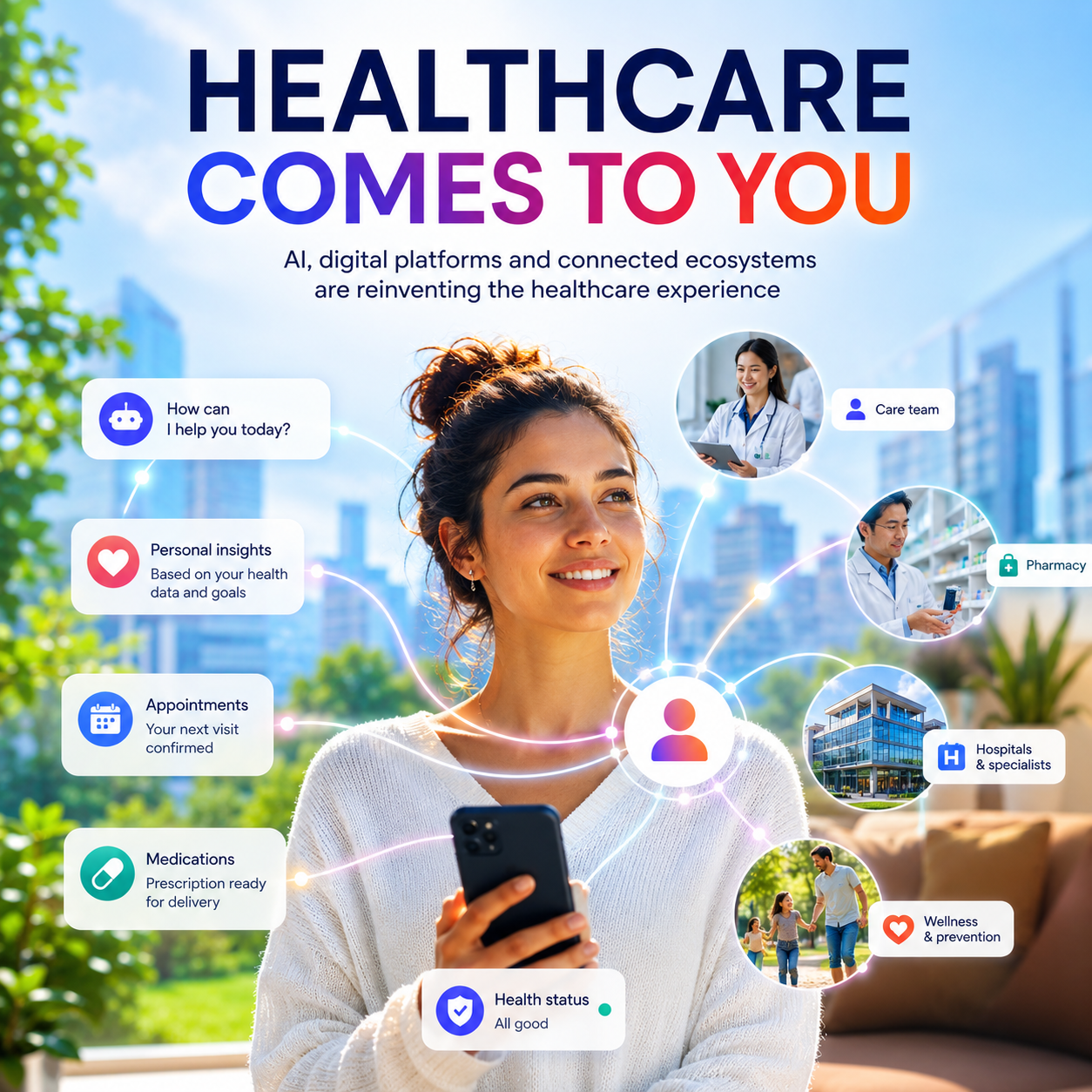
From digital doctor to personal health agent
The four cases reveal a clear progression.
Ada understands. Hims & Hers cares. Amazon orchestrates. Ping An mobilises an ecosystem.
The next leap is to combine these capabilities.
Imagine a personal health agent with Ada’s clinical intelligence, Hims & Hers’ continuous relationship, Amazon’s orchestration capability and Ping An’s ecosystem reach. It would not merely respond when you became ill. With explicit permission, it could understand your medical history, prescriptions, diagnostic results, wearable data, sleep, activity, preferences and goals.
It could begin to recognise patterns before you do.
A change in resting heart rate means little by itself. So might several poor nights of sleep or declining exercise recovery. But an intelligent system that knows your normal baseline might recognise that the combination merits investigation. It could start a conversation, recommend an appropriate test and connect a clinician when human judgement is required.
This changes the role of AI. The objective is not necessarily AI replacing the doctor. It is AI knowing when the doctor is needed — and mobilising the right healthcare around you.
We can expect five capabilities to converge rapidly over the next few years:
- Know me deeply. Longitudinal health information, preferences, behaviour and goals create context rather than treating every interaction as a new episode.
- Anticipate my needs. AI recognises patterns, changing risks and potential interventions earlier.
- Act on my behalf. Agents book appointments, arrange tests, renew prescriptions and coordinate services within agreed boundaries.
- Learn continuously. Outcomes and new data make recommendations increasingly personalised over time.
- Keep me healthier. The objective progressively shifts from responding to sickness towards prevention, healthspan and lifelong wellbeing.
This is also why the interface will change. Today’s healthcare apps still resemble websites: appointments, results, records, prescriptions and messages sit behind menus. Agentic healthcare increasingly begins with conversation: Why has this blood result changed? My knee still hurts when I run, should I see someone? I’m nearly out of medication. I’m travelling to Thailand next month, what health precautions do I need?
The agent interprets the intent and mobilises the system.
Healthcare comes to you
The strategic implication reaches far beyond health-tech companies.
Pharmaceutical companies traditionally make medicines. Hospitals provide treatment. pharmacies dispense drugs. insurers finance care. laboratories provide diagnostics. Technology businesses provide software. But consumers do not experience healthcare through these industry definitions.
They experience a need.
The organisation that can understand that need and connect it to information, diagnosis, professional expertise, treatment, fulfilment and ongoing support can establish an entirely different relationship with the individual.
That makes the emerging competitive question increasingly important:
Who will understand the individual, own the relationship and orchestrate the health journey?
The failures of the first digital-health boom provide an important warning. Technology alone is insufficient. Healthcare cannot simply be “disrupted” as though it were taxis or food delivery. Clinical evidence matters. Human judgement matters. Regulation matters. Privacy matters. Sustainable economics matter. Above all, trust matters.
But the successes point towards something equally important. Doctolib and Zocdoc demonstrated that digital platforms can dramatically simplify access. Ada is making access intelligent. Hims & Hers is connecting intelligence to continuous care. Amazon is connecting care to fulfilment. Ping An is connecting an entire ecosystem.
The direction is increasingly clear.
Healthcare is moving
- from access to intelligence
- from transactions to relationships
- from isolated services to connected journeys
- from platforms to ecosystems
- from reactive assistance towards intelligent agency.
For centuries, people have had to find healthcare and navigate its institutions. The most profound possibility created by AI is not simply a smarter digital doctor.
It is a healthcare system that increasingly knows you, anticipates you, organises itself around you … and comes to you.
More from the blog