Reinventing Onward Travel
September 9, 2026 at Rome, Italy
The flight was excellent.
I arrived rested. I had slept. The crew were great. The food was good. Everything worked. For eight hours, somebody had thought about almost every detail of my experience.
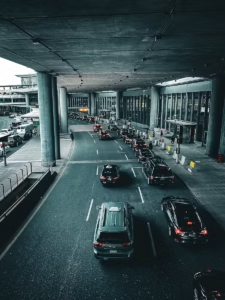
Then I walked out of the airport. Suddenly, I was on my own.
Where are the taxis? Is that the right queue? Do I need an app? Will my Uber find this terminal? Is the train faster? Where do I buy a ticket? Is this taxi legitimate? How much should it cost? Will my credit card work? Which hotel did I book? How far away is it? What happens if there is traffic? And why, after travelling thousands of kilometres with extraordinary precision, are the final 15 kilometres so difficult?
Welcome to ground transportation.
Even the name exposes the problem. It is an industry description, organised around modes and providers. Travellers don’t think about ground transportation. They think “just get me there”.
This is why the next great opportunity in travel may not be another better flight, hotel or taxi. It may be reinventing what happens between them. Call it Onward Travel.
The missing layer of the travel experience
Travel has become remarkably sophisticated and strangely fragmented at the same time.
We can compare thousands of hotels in seconds, check into flights on our phones and navigate unfamiliar cities with extraordinary precision. Yet the journey is still assembled from disconnected pieces: airline, airport, immigration, baggage, train, taxi, parking, hotel, payment and local transport.
Each provider optimises its piece. Nobody necessarily optimises my journey.
That gap matters. IATA’s latest research found record overall passenger satisfaction, yet baggage, border control and transfers remain among the weakest parts of the journey. Travellers increasingly expect digital experiences that are seamless across touchpoints, not merely excellent within each one.
The direction is unmistakable. Some 78% of passengers now want one smartphone application combining digital wallet, passport and loyalty credentials, while 88% say real-time baggage tracking would increase their confidence.
This creates a potentially enormous opportunity for travel companies like Booking.com. It already knows where millions of travellers are going, where they are staying, when they should arrive and much about what they value.
The strategic question is therefore bigger than “How can we sell more taxis?” It is “How could we become the intelligence that keeps the traveller moving?”
Opportunities start to emerge …
1. Create the Onward Travel OS
Don’t sell individual rides. Orchestrate movement.
Imagine landing and seeing one screen: Your bag will arrive in six minutes. Your hotel is 37 minutes away. Train: €14 and 42 minutes. Taxi: €38 and 31 minutes. Shared EV: €19 and 34 minutes. Your pre-booked driver is waiting at Zone B.
The system understands the flight, baggage, traffic, weather, hotel check-in and traveller preferences, then continuously recalculates the best route.
The breakthrough is moving from booking transport to managing mobility in real time.
2. Invent the Booking Pass
Why purchase every component separately?
Create a universal Booking Pass covering airport transfers, trains, metros, buses, taxis, bike hire, parking and potentially lounges and other mobility services.
A traveller might buy a £99 Barcelona weekend pass or subscribe to Booking One for a year of preferred mobility benefits.
This turns transportation from intermittent transactions into mobility-as-a-membership — generating recurring revenue while making Booking.com the default starting point for movement.
3. Guarantee the Connection
The most valuable product may not be transport at all. It could be certainty.
Booking.com could guarantee the traveller’s journey from arrival to destination. Flight delayed? The car automatically moves. Train cancelled? An alternative is booked. Connection missed? Hotel and transport adapt together.
Think of it as Onward Guarantee: Whatever happens, we’ll get you there.
This changes the product from a reservation into an outcome.
4. Make the Journey Predictive
Today’s apps respond when travellers ask. Tomorrow’s mobility platform should act before they need to ask.
Booking.com knows my flight is landing 40 minutes late, immigration queues are building and heavy rain has disrupted trains.
Instead of presenting options, it says: “We’ve changed your transfer. Your new driver will meet you at 19:20. No action required.”
AI transforms transportation from search → prediction → anticipation → autonomous action.
That is a much more profound innovation than another chatbot.
5. Reinvent the Arrival
Airports treat arrival largely as a logistics process. Yet psychologically it is one of travel’s most important moments.
Create a Booking Arrival experience.
A digital welcome recognises that I have landed, guides me through the terminal, tells me when my luggage will arrive, directs me to the correct exit and leads me visually to my transport.
For families, elderly travellers, people with disabilities or visitors arriving somewhere completely unfamiliar, add a human Arrival Angel who meets them and takes responsibility for the handover.
The opportunity is to transform the most anxious part of the journey into the most reassuring.
6. Separate People From Luggage
Why are travellers still dragging 20kg suitcases through railway stations and city centres?
Booking.com could offer BagFree: leave your luggage at the airport and find it waiting securely in your hotel room.
Or reverse the process on departure: leave the bag at the hotel and don’t see it again until your destination airport.
Real-time tracking would make luggage visible throughout. The opportunity is bigger than baggage delivery. It is to decouple the movement of people from the movement of their possessions.
7. Turn Waiting Into Something Valuable
Travel contains enormous quantities of dead time: waiting for cars, connections, check-in, charging or delayed trains.
Booking.com could turn that time into Journey+.
Twenty-eight minutes before your train? Here is a nearby café where your coffee is already ordered. Ninety minutes between connections? Here is a lounge, shower, workspace or meal. EV needs 35 minutes of charging? Here is somewhere worthwhile to spend it.
Instead of merely minimising waiting, monetise and improve it.
8. Create One Identity, One Payment, Everywhere
The traveller should not need another ticket, wallet, local transport account or payment decision.
A Booking identity could become the passport for onward movement: authenticate once, then tap, ride and go.
Taxi, metro, parking, toll, bike, train and tip are automatically recognised and settled, in the appropriate currency, with one consolidated journey statement.
This direction aligns with a broader traveller appetite for integrated digital identity and payments. IATA reports rapid growth in digital wallets and strong demand for unified mobile travel tools.
The ambition is deceptively simple:
One traveller. One identity. One journey.
9. Create the Personal Mobility Twin
Every traveller is different.
I might prefer walking for anything under 20 minutes, trains over taxis, aisle seats, low-carbon options and never renting a car. A family with three children has completely different priorities. So does a business traveller arriving at midnight.
Booking.com could build a persistent Mobility Twin that learns how I move.
It knows my tolerance for walking, price, waiting, transfers, risk and carbon. It knows when I prioritise speed and when I prefer experience.
Instead of giving everyone the same list of transport options, Booking.com creates my best journey.
10. Make Movement Itself Part of the Destination
The most radical opportunity is to stop treating transportation as the inconvenient bit between experiences.
Make movement the experience.
The transfer from Naples airport becomes a coastal drive with a local storyteller. A connection in Tokyo becomes a curated neighbourhood walk. The journey from Zurich to the Alps becomes panoramic rail, luggage transfer and lunch. A family transfer becomes a child-friendly vehicle with everything already configured.
Suddenly, the question isn’t simply “What’s the fastest way to my hotel?” It becomes “What’s the best way to begin my trip?”
That is a fundamentally different category.
From transportation provider to movement platform
These ideas point towards a bigger strategic shift.
The traditional transportation model is about inventory: cars, trains, transfers and tickets.
The emerging model is about orchestration: understanding context, connecting providers, predicting problems and taking responsibility for outcomes.
And the ultimate model is about flow: making movement so intuitive that the traveller barely needs to think about it.
The technology is increasingly possible. Digital identity, biometrics, AI agents, wallets, real-time location, predictive analytics and connected mobility networks are converging. IATA itself describes today’s fragmented digital services as a source of complexity and friction, while pursuing infrastructure designed to enable more seamless journeys across multiple organisations.
The strategic prize is therefore much larger than a bigger share of airport taxis. It is the space between the bookings.
Hotels know where you stay. Airlines know how you fly. Uber knows about an individual ride. Rail companies know their networks. Airports know their terminals.
Companies have the potential to understand the whole traveller journey — destination, accommodation, timing, companions, preferences, activities and movement.
That creates the possibility of something much harder for any individual transport provider to replicate: an intelligent orchestration layer for travel.
So perhaps we should retire the phrase ground transportation altogether.Because nobody wakes up excited about buying ground transportation. They want to arrive. Explore. Connect. Discover. Keep moving.
The opportunity is not to build a better taxi-booking business.
It is to reinvent Onward Travel — transforming the stressful gaps between the great moments of travel into one continuous, intelligent and effortless journey.
The future of transportation isn’t getting from A to B. It’s making everything in between simply flow.