Megatrends 2036 … the 6 forces reshaping every market … intelligence accelerates, power reorders, populations diverge, markets shift, pressures intensify and humanity rises … $50 trillion of opportunities
August 26, 2026

The next decade will be defined not by a single disruptive technology, geopolitical event or environmental crisis, but by six powerful forces interacting with one another. Intelligence will accelerate. Global power will be reordered. Populations will diverge. Markets will shift. Planetary pressures will intensify. And people will demand a more human definition of progress.
These are more than trends. They are structural changes operating across societies, economies and industries over a ten-year horizon. Their individual trajectories matter, but their intersections will matter even more. Artificial intelligence will reshape ageing societies; geopolitical competition will redirect markets and supply chains; climate pressures will accelerate technological innovation; and declining trust will increase the value of distinctly human leadership.
This is an update on my previous megatrends work over the last decade, built on working with leading clients and research bodies around the world:
- Megatrends 2035: Eyes on Tomorrow, What Leaders See First
- Megatrends 2035: Download the Report by Peter Fisk
Each megatrend contains five significant components. Each creates risks, but also substantial opportunities for organisations prepared to respond. The economic estimates below represent indicative cumulative global value pools between 2027 and 2036. They combine potential revenues, investment, productivity improvements and avoided losses. Because many opportunities overlap, the figures should not be added together or treated as precise forecasts.
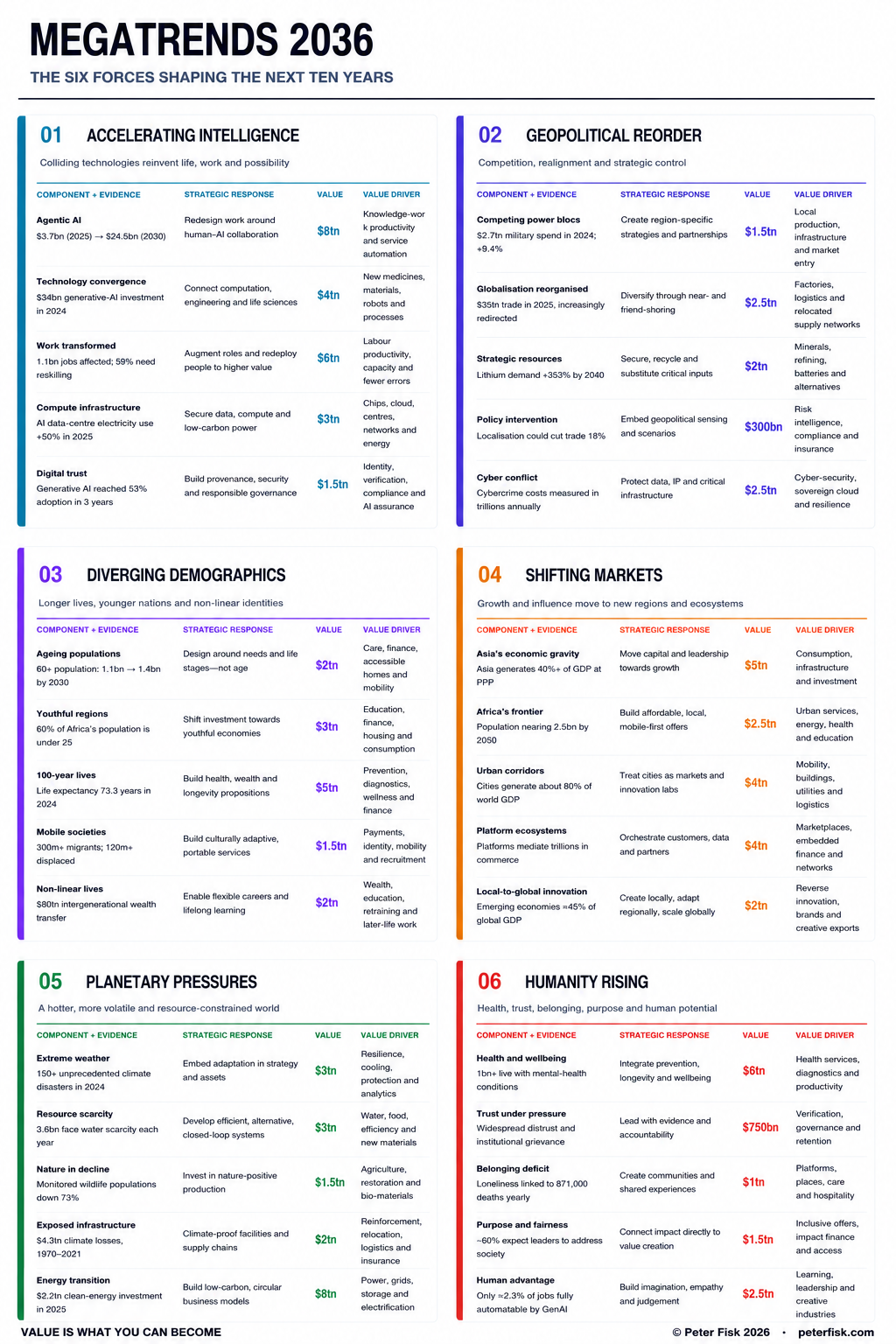
Megatrends help business leaders see further, think bigger and act earlier. They build a future mindset by shifting attention from today’s assumptions to tomorrow’s possibilities.
Leaders can explore how different forces intersect, build scenarios around alternative futures, and stress-test existing strategies against them. Megatrends stretch ambition beyond incremental improvement, revealing emerging needs, markets, technologies and business models that can spark breakthrough innovation.
Most importantly, they create first-mover advantage: identifying where future value is likely to emerge and acting before it becomes obvious. The goal is not simply to be ready for the future, but to shape it in your vision.
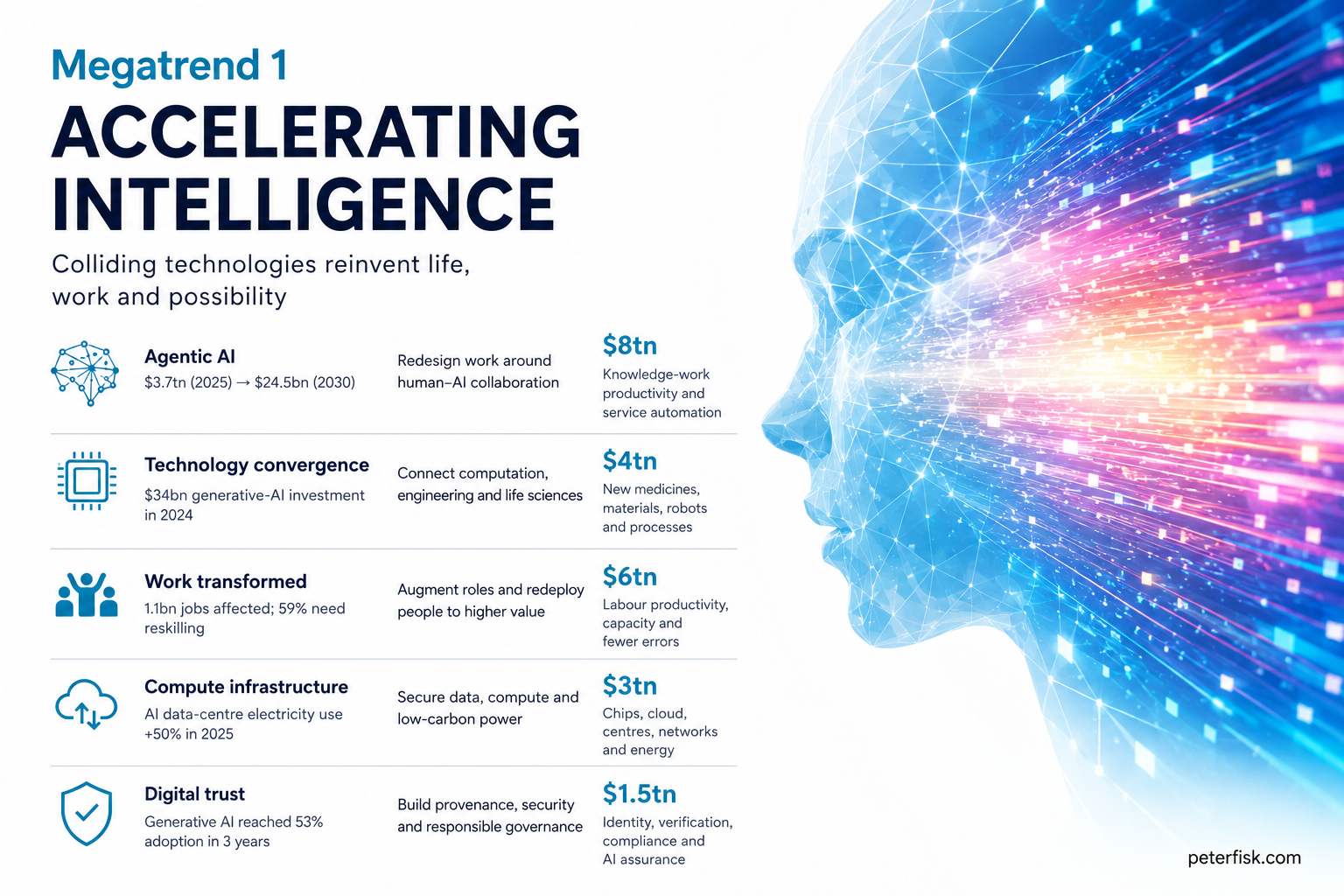
Megatrend 1. Accelerating Intelligence
Colliding technologies reinventing life, work and possibility
The technology story of the next decade will not simply be that artificial intelligence becomes faster or more capable. The more profound shift will be the convergence of AI with quantum computing, robotics, biotechnology, advanced materials and connected infrastructure.
Innovation is moving from linear acceleration towards combinatorial expansion: technologies amplify one another, creating possibilities that none could produce independently.
Component trends:
1. Agentic AI … AI is evolving from a system that answers questions into agents capable of planning, deciding and acting with limited supervision. The enterprise agentic-AI market has been estimated at approximately $3.7bn in 2025 and could reach $24.5bn by 2030. The real opportunity, however, is much larger than software sales. Agents will increasingly perform customer service, financial administration, supply-chain coordination, coding, research and decision support.
2. Technology convergence … Generative-AI investment reached approximately $34bn in 2024, but the next wave will come from AI combining with quantum computing, robotics and synthetic biology. These intersections could transform drug discovery, personalised medicine, material science, manufacturing and energy systems.
3. Intelligent work … Technology could transform around 1.1bn jobs over the next decade, while 59% of workers may require some form of reskilling by 2030. Most jobs will not disappear completely. Instead, their tasks, economics and required capabilities will change.
4. Intelligent infrastructure … AI depends on data, semiconductors, cloud platforms, networks and enormous quantities of electricity. Electricity consumption by AI-focused data centres rose by approximately 50% in 2025. Compute capacity and reliable low-carbon power are becoming strategic resources.
5. Digital trust … Generative AI reached an estimated 53% population adoption within three years. The same technology that democratises intelligence also increases fraud, manipulation, surveillance and synthetic content. Verifying what is real—and who can be trusted—will become an essential economic activity.
Responses:
- Redesign complete workflows around human–AI collaboration instead of adding AI to inefficient processes.
- Connect expertise from computing, engineering, design and life sciences to exploit technology convergence.
- Automate tasks while augmenting roles and redeploying people into higher-value work.
- Secure distinctive data, compute capacity, infrastructure and low-carbon energy.
- Build provenance, cyber-security, responsible-AI governance and accountable human oversight.
Impact:
- Human–AI workflow transformation: $8tn
- Convergent technology innovation: $4tn
- Intelligent automation and workforce augmentation: $6tn
- Data, compute and energy infrastructure: $3tn
- Digital trust, verification and AI governance: $1.5tn
These opportunities will be driven by productivity gains, increased organisational capacity, new scientific discoveries and rising investment in chips, cloud infrastructure, energy, cyber-security and identity.
The defining question is no longer how can we use AI, but how should we reinvent our organisation when intelligence becomes abundant, distributed and increasingly autonomous.
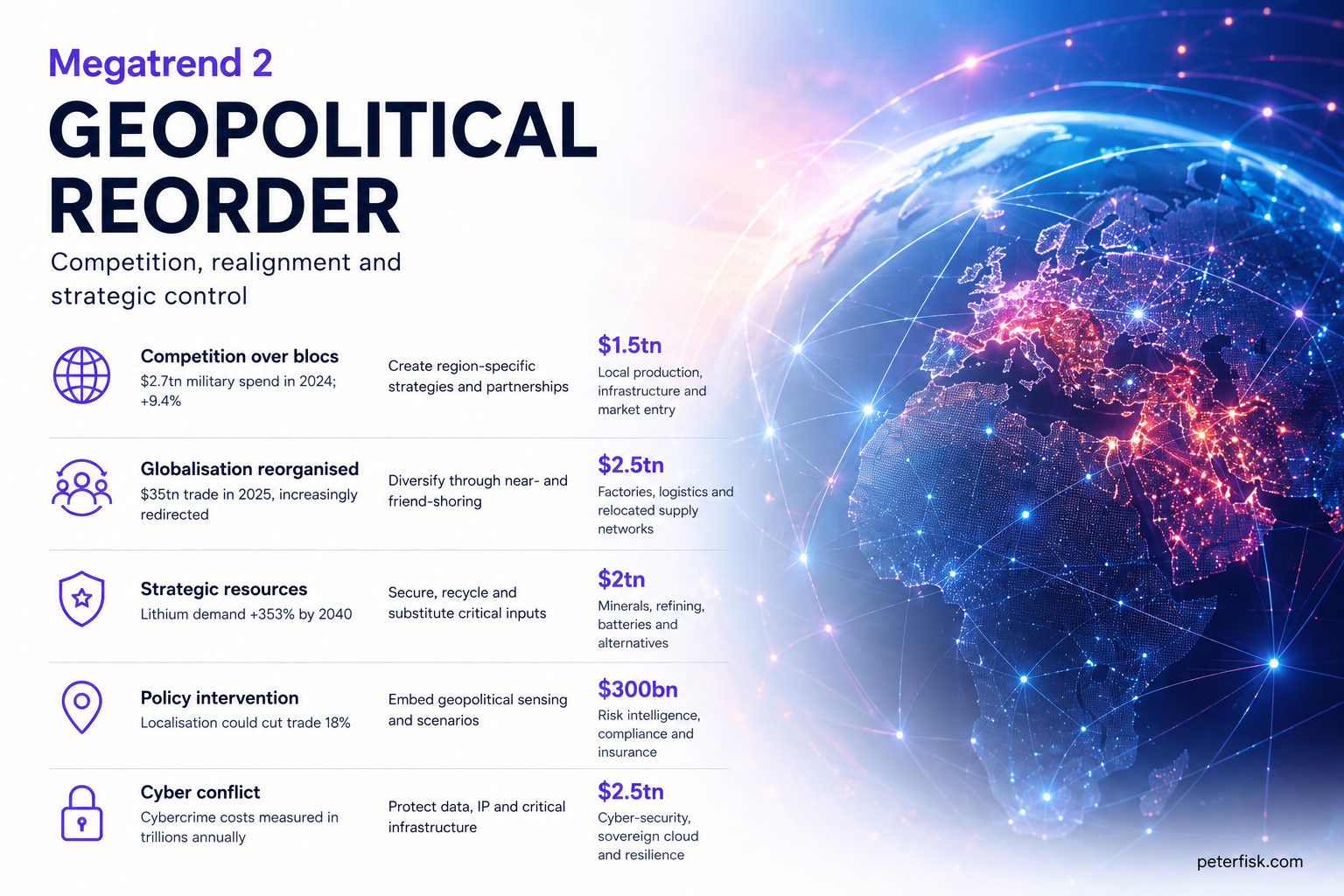
Megatrend 2. Geopolitical Reorder
A multipolar world of competition, realignment and strategic control
The relatively open, Western-led global order is giving way to a more contested and multipolar system. Globalisation is not ending: global trade exceeded $35tn in 2025. But its architecture is being reorganised around security, resilience, political alignment and control of strategic resources.
Efficiency is no longer the only objective. Nations and companies must now consider sovereignty, exposure and strategic dependence.
Component trends:
1. Competing power blocs … Global military expenditure reached approximately $2.7tn in 2024, rising 9.4% in a single year. The US and China remain central, but India, the Gulf states, Brazil, Turkey and other middle powers are gaining influence.
2. Globalisation reorganised … Advanced economies and China are redirecting trade towards geopolitically closer partners. Friend-shoring, near-shoring and regionalisation are reshaping production without eliminating global interdependence.
3. Strategic resources … Competition is intensifying for semiconductors, energy, data, water and critical minerals. Lithium demand could rise by 353% between 2024 and 2040. Restrictions on rare-earth exports could expose trillions of dollars of downstream production.
4. Economic intervention … Tariffs, subsidies, sanctions, investment controls and national industrial policies are becoming standard strategic instruments. OECD modelling suggests aggressive localisation could reduce global trade by 18% and substantially damage GDP without necessarily increasing resilience.
5. Cyber conflict … Digital networks, communications systems and critical infrastructure are becoming geopolitical battlegrounds. Cybercrime costs are already measured in trillions of dollars annually, while state-backed attacks increase the strategic importance of resilient infrastructure.
Responses:
- Create region-specific strategies, propositions and operating models.
- Diversify supply networks through near-shoring, friend-shoring and selective global sourcing.
- Secure strategic materials through long-term agreements, recycling, substitution and investment.
- Embed geopolitical intelligence and scenario planning into executive decision-making.
- Protect data, intellectual property, infrastructure and ecosystem connections.
Impact:
- Regional strategies and local partnerships: $1.5tn
- Diversified and relocated supply networks: $2.5tn
- Critical minerals and strategic resources: $2tn
- Geopolitical intelligence and compliance: $300bn
- Cyber-security and sovereign infrastructure: $2.5tn
The value will be generated through new factories, industrial zones, logistics networks, resource processing, cyber-security, sovereign cloud infrastructure and political-risk services.
The strategic challenge is to remain internationally connected without becoming dangerously dependent.
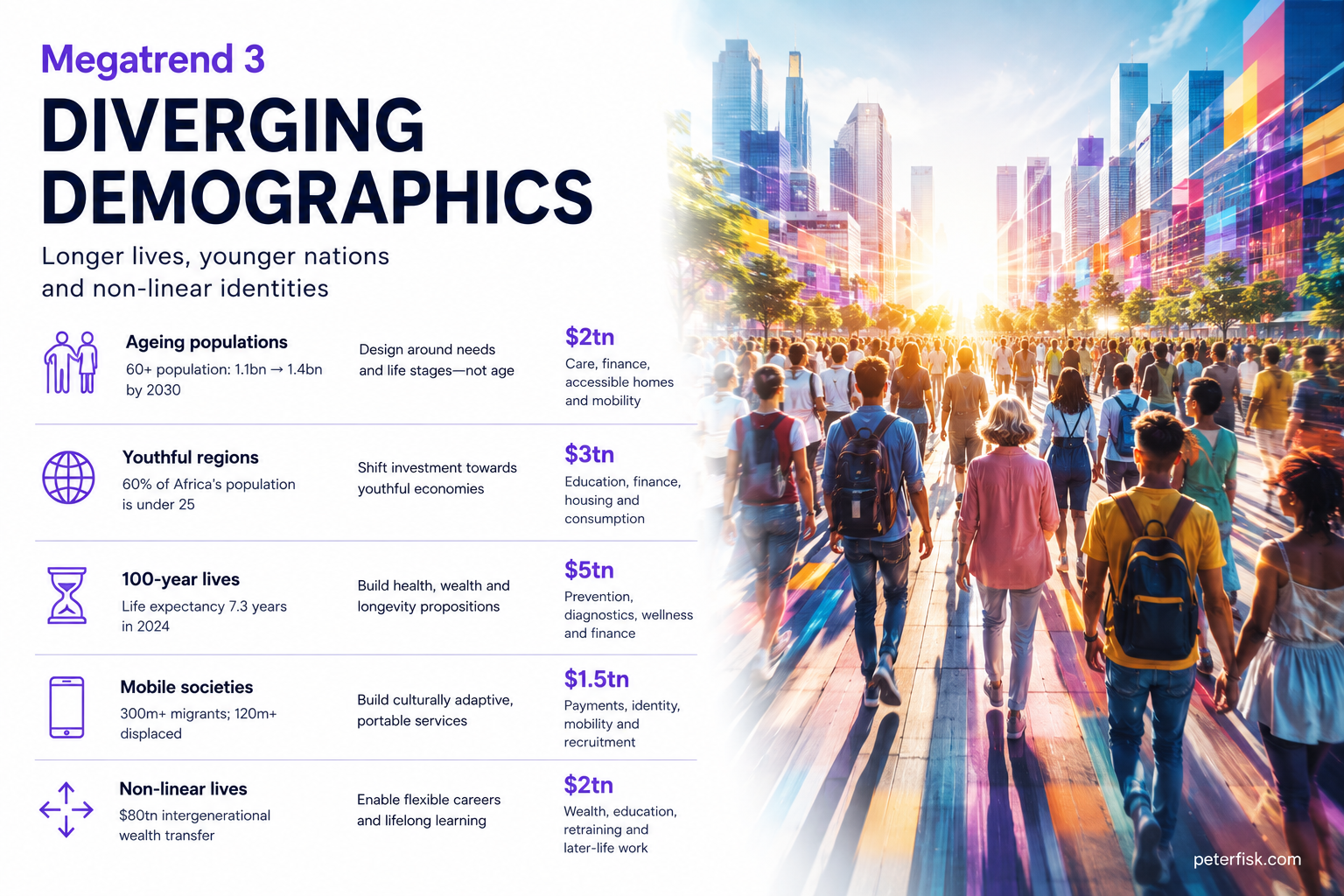
Megatrend 3. Diverging Demographics
Longer lives, younger nations and increasingly non-linear identities
The traditional population pyramid is fracturing. Some countries are ageing and shrinking while others are expanding through extraordinarily youthful populations. Longer lives, migration, changing identities and less predictable life stages are making conventional generational categories increasingly inadequate.
The future will not be uniformly older or younger. It will be demographically divergent.
Component trends:
1. Ageing populations … The global population aged over 60 is projected to rise from approximately 1.1bn in 2023 to 1.4bn by 2030. Ageing will reshape healthcare, employment, financial services, housing and consumption.
2. Youthful regions … Around 60% of Africa’s population is under 25. Africa and South Asia will supply increasing proportions of the world’s workers, consumers and entrepreneurs, even as workforces contract elsewhere.
3. The 100-year life … Global life expectancy reached 73.3 years in 2024 and could reach 77.4 by 2054. Centenarians are becoming a distinct demographic category, while conventional assumptions about education, work and retirement lose relevance.
4. Mobile societies … There are more than 300m international migrants, while forced displacement exceeds 120m. Migration will shape cities, labour markets, identities, political debate and consumer cultures.
5. Non-linear lives … An estimated $80tn could transfer from older generations to Millennials and Gen Z over the next two decades. At the same time, people will study, work, care, start businesses and retire in less predictable sequences.
Responses:
- Segment customers by needs, attitudes and life stages rather than chronological age.
- Redirect investment and capability towards youthful, fast-growing economies.
- Create longevity propositions spanning health, wealth, housing, work and participation.
- Build culturally adaptive organisations and portable services for mobile populations.
- Enable flexible careers, lifelong learning and intergenerational knowledge transfer.
Impact:
- Age-inclusive products and services: $2tn
- Youthful growth economies: $3tn
- Longevity and the 100-year life: $5tn
- Migration and portable services: $1.5tn
- Wealth transfer, learning and non-linear careers: $2tn
Opportunity will emerge in preventative health, diagnostics, wealth management, accessible housing, mobility, education, mobile finance and later-life employment.
The critical shift is from designing for standardised generations to designing for diverse and evolving lives.
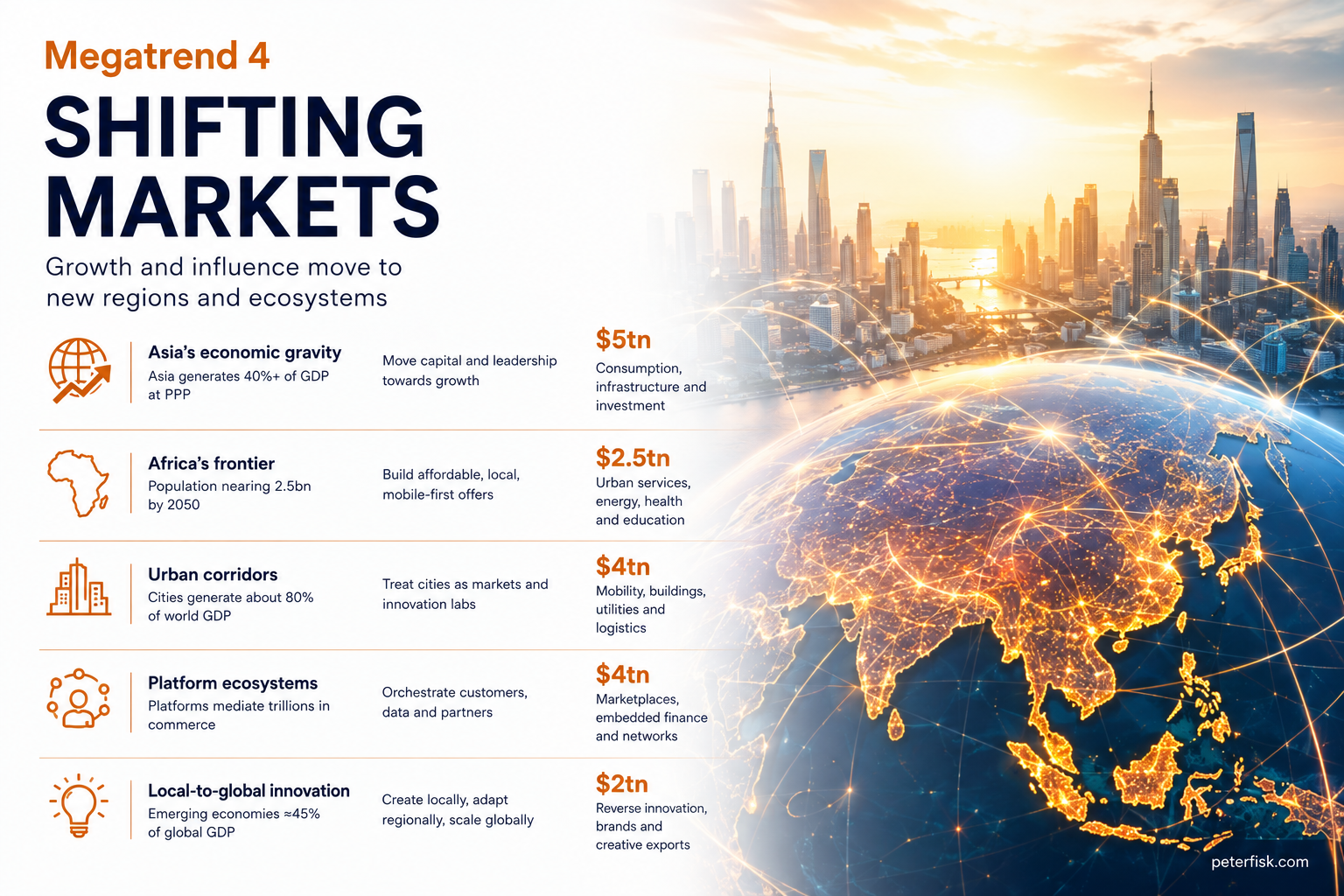
Megatrend 4. Shifting Markets
Growth, innovation and influence moving towards new regions and ecosystems
The geography and organisation of economic opportunity are changing. Growth is moving towards Asia, Africa and new urban corridors. At the same time, industry boundaries are dissolving as platforms and ecosystems connect previously separate products and services.
Markets are shifting both geographically and structurally.
Component trends:
1. Asia’s economic gravity … Asia produces more than 40% of global GDP at purchasing-power parity and contributes the majority of global growth. China remains important, but India, Indonesia, Vietnam and other Asian economies are expanding their influence.
2. Africa’s growth frontier … Africa’s population could approach 2.5bn by 2050, while its urban population may reach almost 1bn by 2035. This will generate enormous needs for housing, energy, finance, health, education and mobility.
3. Urban corridors … More than four billion people live in cities, which generate approximately 80% of global GDP. Growth will increasingly concentrate in megacities, secondary cities and connected economic corridors.
4. Platform ecosystems … Digital platforms already mediate trillions of dollars in commerce. Ecosystems are dissolving boundaries between finance, retail, healthcare, mobility, media and technology.
5. Local-to-global innovation … Emerging economies generate approximately 45% of global GDP at market exchange rates and considerably more at purchasing-power parity. Their companies, brands and business models are increasingly influencing global markets.
Responses:
- Reallocate capital, innovation and leadership towards future growth markets.
- Build affordable, locally relevant and mobile-first propositions with local partners.
- Treat cities and economic corridors—not only countries—as strategic markets.
- Orchestrate ecosystems connecting customers, data and complementary capabilities.
- Create innovations locally, adapt them regionally and scale them globally.
Impact:
- Asia’s expanding markets: $5tn
- Africa’s growth frontier: $2.5tn
- Cities and economic corridors: $4tn
- Platform ecosystems: $4tn
- Local-to-global innovation: $2tn
The opportunity will be driven by consumption, infrastructure, embedded finance, marketplaces, urban services and innovations developed around emerging-market needs.
The old model was to create in the West and export to the rest. The emerging model is to innovate everywhere—and scale the best ideas anywhere.
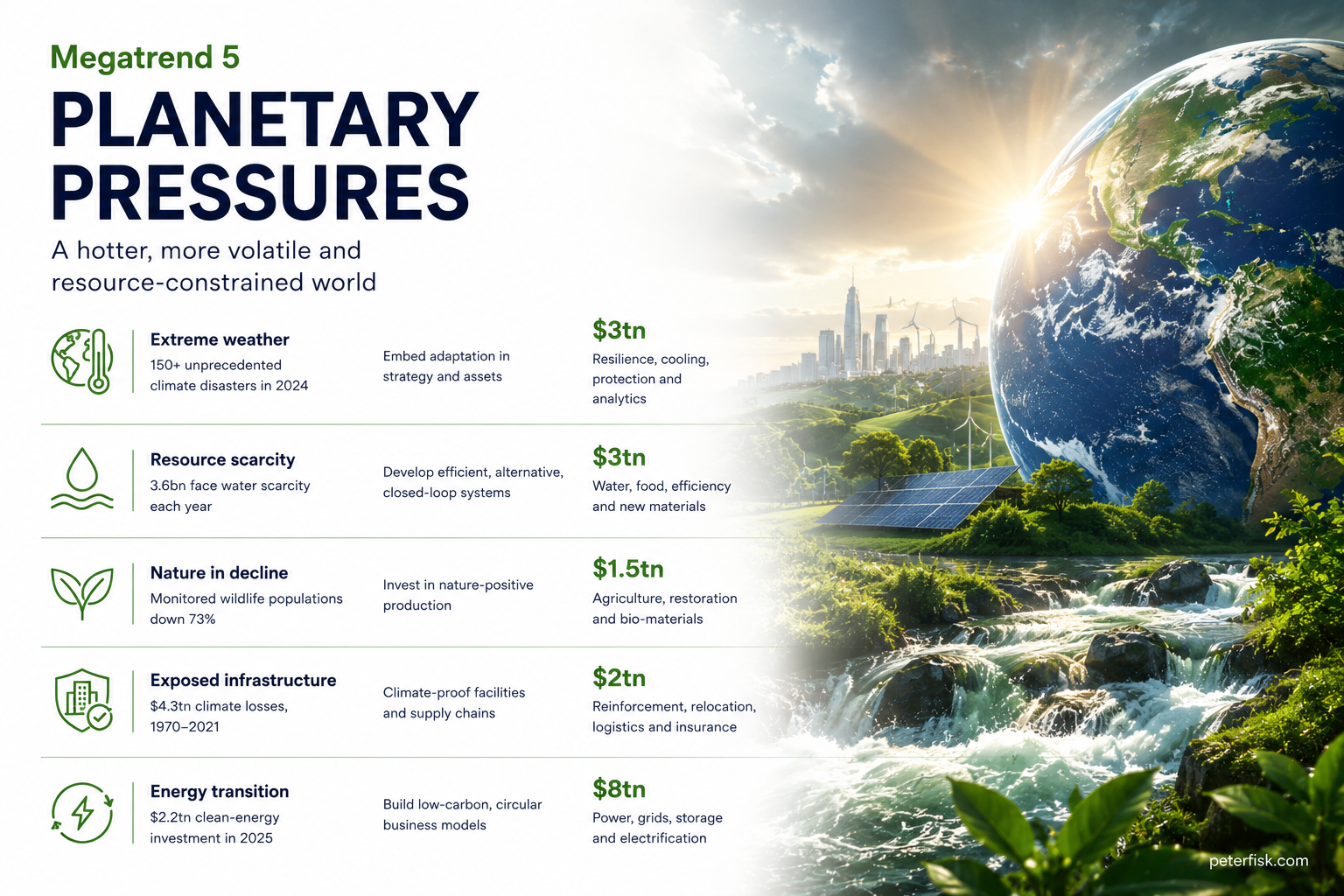
Megatrend 5. Planetary Pressures
A hotter, more volatile and resource-constrained world
“Regenerative futures” describes an important response, but it is not the underlying megatrend. The larger structural force is the intensification of climate disruption, ecological degradation and resource scarcity. Planetary pressures are the megatrend. Adaptation, resilience, circularity and regeneration are the strategic responses.
Component trends:
1. Extreme weather … More than 150 unprecedented climate disasters were recorded during 2024. Extreme heat, storms, flooding, drought and wildfire increasingly affect productivity, infrastructure, insurance and habitability.
2. Resource scarcity … Approximately 3.6bn people experience water scarcity for at least one month annually. Competition will intensify for water, food, energy and critical materials.
3. Nature in decline … Monitored wildlife populations declined by an average of approximately 73% between 1970 and 2020. Deteriorating ecosystems threaten agriculture, water systems, health and economic resilience.
4. Exposed infrastructure … Weather-, climate- and water-related disasters caused $4.3tn of reported economic losses between 1970 and 2021. Many facilities and supply networks were designed for a climate that no longer exists.
5. Energy transition … Global clean-energy investment reached approximately $2.2tn in 2025. Renewable power, storage, grids and electrification are becoming central to industrial competitiveness and energy security.
Responses:
- Embed adaptation into strategy, asset design, insurance and capital allocation.
- Develop efficient, alternative and closed-loop resource systems.
- Invest in nature-positive agriculture, production and ecosystem restoration.
- Climate-proof facilities, logistics and supply networks.
- Build low-carbon, circular and regenerative business models.
Impact:
- Climate adaptation and resilience: $3tn
- Resource-efficiency and alternatives: $3tn
- Nature-positive systems: $1.5tn
- Climate-resilient infrastructure: $2tn
- Energy and industrial transition: $8tn
Value will come from renewable energy, grids, storage, water treatment, precision agriculture, resilient buildings, circular materials and avoided climate losses.
Scarcity should not be treated only as a constraint. It can become a powerful catalyst for reinvention.
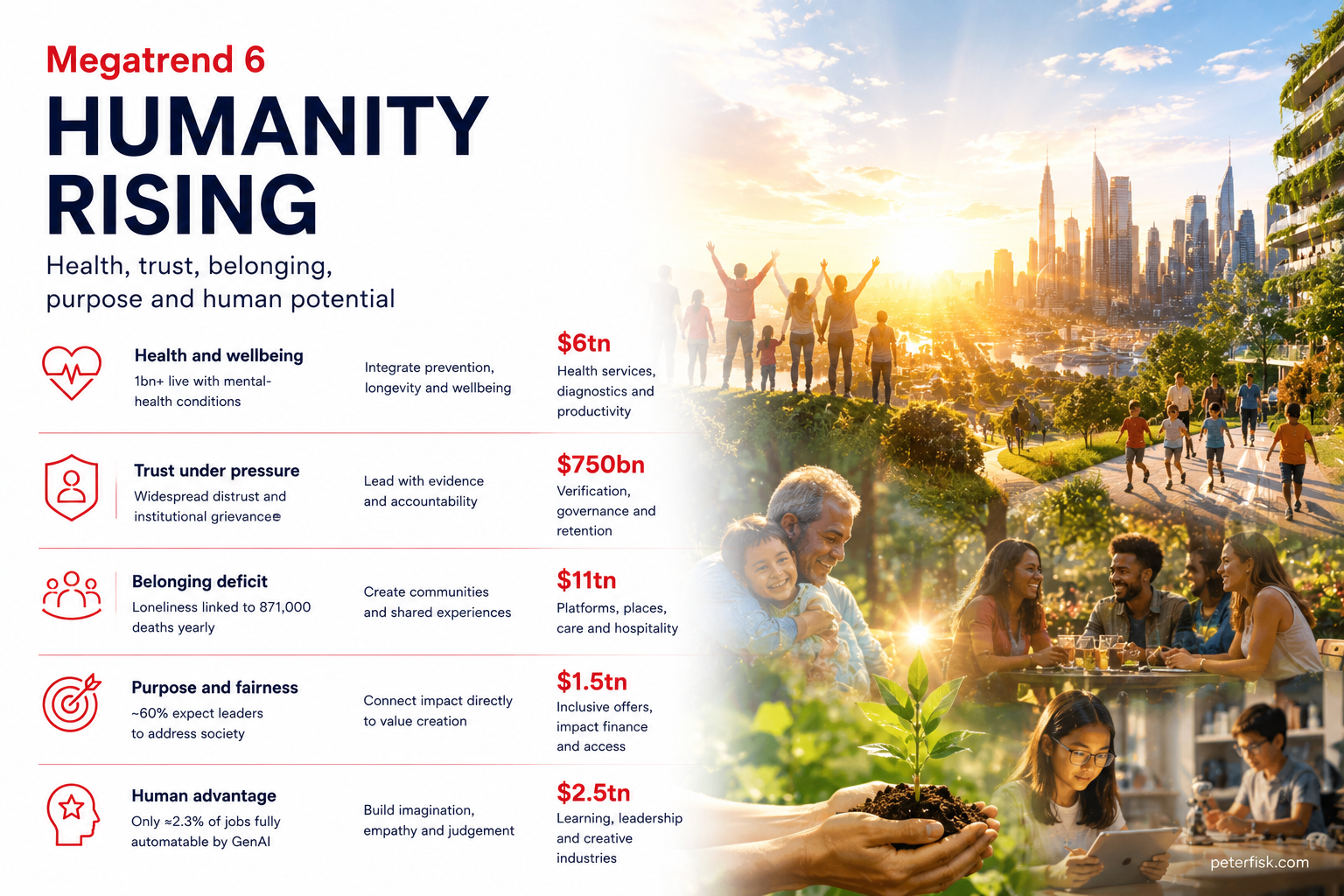
Megatrend 6. Humanity Rising
A growing search for health, trust, belonging, purpose and human potential
Humanity Rising is the counterforce to social fragmentation. As technology accelerates and institutions weaken, people place greater value on health, trust, belonging, fairness and agency.
This does not suggest that humanity will automatically triumph. It describes the growing demand for progress to serve people rather than simply increase efficiency.
Component trends:
1. Health and wellbeing … More than one billion people live with mental-health conditions, while non-communicable diseases cause approximately three-quarters of global deaths. Prevention, longevity and everyday wellbeing will become increasingly important.
2. Trust under pressure … Political polarisation, misinformation and institutional grievance are weakening confidence in governments, media and business. Trust is becoming a scarce and economically valuable asset.
3. Belonging deficit … Loneliness is associated with approximately 871,000 deaths annually. Digital connectivity has not necessarily produced meaningful human connection.
4. Purpose and fairness … Around six in ten people expect business leaders to address societal challenges. Employees and customers increasingly scrutinise whether corporate purpose translates into meaningful action.
5. Human advantage … Only around 2.3% of global employment may be fully automatable by generative AI, although far more work will be transformed. Imagination, empathy, judgement and collaboration become more—not less—valuable.
Responses:
- Integrate prevention, mental health, longevity and wellbeing into propositions and workplaces.
- Build trust through evidence, transparency, accountability and consistency.
- Create communities and experiences that enable participation and belonging.
- Connect social and environmental impact directly to value creation.
- Invest in imagination, empathy, critical thinking, judgement and leadership.
Impact:
- Health, longevity and wellbeing: $6tn
- Trust, transparency and verification: $750bn
- Community and belonging: $1tn
- Purpose-led and inclusive growth: $1.5tn
- Human capability and learning: $2.5tn
The opportunity spans healthcare, diagnostics, learning, leadership development, community platforms, hospitality, trusted intermediaries and inclusive financial services.
The most valuable organisations will combine machine intelligence with deeper human intelligence.
Leading the future
Leadership in this fast-emerging future requires a fundamentally different approach. It is more strategic — guiding organisations forwards rather than managing their stability.
Leaders need to look beyond today’s performance to understand what is changing, imagine what could be possible, and make choices before the answers are obvious. They must navigate uncertainty rather than eliminate it, exploring alternative scenarios, creating portfolios of options and experimenting their way forwards.
Leadership becomes less about control and more about direction, curiosity and courage — connecting long-term ambition with short-term action, mobilising people around possibility, and continually adapting the organisation as the future unfolds.
Strategy: building a dynamic portfolio of options
Strategy therefore becomes more exploratory, adaptive and future-back. Instead of extrapolating a single plan from today, leaders use the megatrends to identify structural shifts, build alternative scenarios and explore how different intersections could reshape customers, markets and sources of value.
They translate these possibilities into a portfolio of strategic options—some strengthening today’s business, some opening adjacent growth spaces and others testing more transformational futures. Investment is staged as evidence emerges, allowing the organisation to learn, adapt and accelerate without committing prematurely to one forecast.
Strategy becomes less about predicting the future correctly and more about remaining relevant across multiple plausible futures, while using the megatrends to guide where to explore, what capabilities to build and which opportunities to pursue.
Intersections: opportunities where megatrends collide
The greatest disruption, and the most valuable opportunities, will emerge where two or more forces collide.
A company looking only at artificial intelligence might invest in automation. A company looking at AI alongside ageing, healthcare costs and demand for longer, healthier lives might create an entirely new preventative-health platform. One improves the existing business; the other creates a new market.
This is the difference between responding to trends and exploiting their intersections.
Example 1. Accelerating intelligence × diverging demographics
Reinventing health, care and longevity
AI combined with ageing populations, longer lives, sensors and preventative medicine is shifting healthcare from periodic intervention towards continuous anticipation.
Neko Health demonstrates the opportunity. Its one-hour health scan combines imaging, cardiovascular assessment, blood biomarkers and metabolic data, capturing millions of data points and presenting the findings through a clinician. It is now integrating body-composition measures and Apple Health wearable data to create a more continuous view of the individual. Neko raised $700m in 2026 to support its international expansion, reportedly reaching a valuation close to $7bn. Neko Health, Neko’s 2026 health-platform expansion
Oura is making a similar move from wearable hardware towards a personal health-intelligence platform. The ring is merely the point of entry; the longer-term value comes from interpreting sleep, stress, activity, cardiovascular and hormonal signals over time.
The intersection extends beyond healthcare. AI-enabled homes can support independent living; robotic systems can address care-worker shortages; financial platforms can help people fund longer lives; and employers can redesign work for multigenerational teams.
The opportunity is not simply to sell more medical devices. It is to build the operating systems for a 100-year life—connecting prevention, personalisation, care, finance, housing and continued participation.
Example 2. Accelerating intelligence × geopolitical reorder
Turning technology infrastructure into strategic power
AI requires chips, data, compute, energy and communications infrastructure. Geopolitical competition is turning each of these into a strategic national resource.
TSMC’s international expansion illustrates the intersection. The company plans to increase its US investment to $165bn, including additional fabrication plants, advanced packaging facilities and an R&D centre in Arizona. It is also expanding in Japan and Germany. These investments are not based purely on production efficiency: they reflect governments’ and customers’ desire to reduce exposure to the concentration of advanced semiconductor manufacturing in Taiwan. TSMC’s US expansion
Microsoft and other cloud providers are simultaneously developing sovereign-cloud propositions that allow governments and regulated industries to retain greater control over where data is stored, how systems are operated and which jurisdictions govern them.
This intersection creates opportunities in:
- advanced semiconductor manufacturing;
- sovereign cloud and nationally controlled AI;
- regional data centres and energy infrastructure;
- cyber-security and quantum-resistant encryption;
- critical-mineral processing and recycling;
- trusted cross-border data systems.
Companies can no longer treat digital infrastructure as a globally interchangeable utility. Where intelligence is trained, hosted and governed will become part of competitive strategy.
Example 3. Diverging demographics × shifting markets
Building for the world’s next consumers and cities
The world’s fastest-growing consumer markets will increasingly be found where youthful populations, rapid urbanisation and digital leapfrogging intersect.
Reliance Jio offers one model. It did not approach India simply as another telecommunications market. It used affordable connectivity as the foundation for an ecosystem spanning entertainment, commerce, education, cloud services and digital applications. Jio reached more than 488m users by 2025, demonstrating how infrastructure can become a platform for an expanding range of services. Reliance Industries’ digital-services report
Similar opportunities are emerging across Africa. Mobile money, distributed energy, digital education, telemedicine and technology-enabled logistics can leapfrog physical infrastructures that were never fully developed. The most successful propositions will not be simplified Western products. They will be designed around local realities: mobile-first access, informal employment, intermittent infrastructure, affordability and community-based distribution.
The opportunity lies at the intersection of population growth, urban density and technological accessibility. By 2035, Africa’s urban population could approach one billion. The resulting need for housing, mobility, energy, water, food, education, finance and healthcare represents one of the largest market-creation opportunities of the coming decades.
The strategic unit is also changing. Companies should look beyond countries to cities and economic corridors, where population, infrastructure, talent and demand concentrate.
Example 4. Planetary pressures × geopolitical reorder
Converting scarcity into resilience and growth
Climate disruption and geopolitical competition increasingly reinforce each other. Water, energy, food and critical minerals are becoming matters of national security as well as sustainability.
Xylem is turning water scarcity into a growth platform. The company combines pumps, treatment systems, sensors, analytics and digital network management to help utilities and industrial customers reduce losses, reuse water and operate more resilient infrastructure. Xylem generated approximately $9bn of revenue in 2025, demonstrating that planetary pressure is already creating substantial commercial markets. Xylem’s 2025 results
Schneider Electric sits at the intersection of electrification, automation, AI infrastructure and decarbonisation. Demand for data centres creates greater electricity and cooling requirements; pressure to decarbonise creates demand for efficiency, renewable energy and intelligent management. Schneider can therefore benefit from the AI boom while helping address the energy pressures the boom produces.
Redwood Materials offers another intersectional model by recovering lithium, nickel, cobalt and copper from batteries. Recycling becomes simultaneously a circular-economy proposition, a source of lower-carbon materials and a way of reducing geopolitical dependence on concentrated mineral supply chains.
The opportunity is broader than “green business”. It includes:
- distributed and renewable energy;
- grids, storage and energy intelligence;
- water reuse and precision agriculture;
- resilient infrastructure and climate analytics;
- alternative and recycled materials;
- supply-chain traceability and resource security.
Planetary constraints will destroy value in exposed systems while creating value for companies that make adaptation, resilience and resource productivity possible.
Example 5. Accelerating intelligence × humanity rising
Making trust the essential layer of the AI economy
As synthetic media becomes indistinguishable from captured reality, trust moves from an abstract brand quality to a form of infrastructure.
Adobe’s Content Credentials provide an early example. They attach verifiable metadata to digital content, recording its origin, creator and editing history, including whether AI was involved. The underlying C2PA standard is supported by a coalition of more than 500 organisations, including Adobe, Microsoft, Google, Meta, Amazon, Sony, the BBC and OpenAI.
The larger opportunity is to build a trust layer for the intelligent economy:
- verified identity for people and agents;
- provenance for content and data;
- auditable algorithms and decisions;
- fraud detection and transaction security;
- privacy-preserving personalisation;
- accountable human oversight.
Trust will affect whether people accept AI-generated advice, autonomous financial decisions, algorithmic healthcare and machine-created information. Organisations able to demonstrate not only what their systems decide, but how and why they decide it, will gain an increasingly valuable advantage.
The best response is not to slow technological progress. It is to combine machine capability with transparency, consent and human accountability.
Example 6. Longevity × accelerating intelligence × humanity rising
Rewriting education, work and retirement
Longer lives are making the conventional sequence of education, employment and retirement obsolete. At the same time, AI is shortening the useful life of skills.
Coursera reached 191m registered learners in 2025 and recorded 5.4m enrolments in generative-AI courses—almost twice the previous year’s total. This reflects the growing demand for continuous, modular and employment-relevant learning. See Coursera’s 2025 learning trends
BMW addresses another aspect through its Senior Experts programme, which enables retired employees to return for temporary projects and transfer specialist knowledge to younger colleagues. It turns retirement from a permanent exit into a more flexible stage of contribution. See BMW Senior Experts programme
The emerging opportunity includes:
- modular learning subscriptions;
- AI-enabled personal tutors and career agents;
- skills credentials that travel between employers;
- flexible work for older professionals;
- intergenerational mentoring and knowledge platforms;
- financial products designed for less predictable working lives.
Education can no longer be understood as preparation for a first career. It becomes infrastructure for repeated reinvention throughout a longer life.
The overall scale of opportunity
The six megatrend value pools developed in this analysis are:
- Accelerating Intelligence: $22.5tn
- Geopolitical Reorder: $8.8tn
- Diverging Demographics: $13.5tn
- Shifting Markets: $17.5tn
- Planetary Pressures: $17.5tn
- Humanity Rising: $11.75tn
Arithmetically, these amount to $91.55tn of gross opportunity over 2027–2036. But this should not be presented as a single additive market forecast. AI-enabled longevity, for example, appears within both Accelerating Intelligence and Diverging Demographics. Smart, resilient cities sit within Shifting Markets and Planetary Pressures.
Allowing for these overlaps, a reasonable strategic estimate is that the six forces could create, redirect or protect approximately $50–70tn of distinct economic value over the next decade. This is an indicative scenario range rather than a prediction.
The value arises through four mechanisms:
- New market revenues
Longevity services, clean energy, cyber-security, digital identity, water technology and new urban services. - Capital investment
Data centres, semiconductor plants, grids, resilient infrastructure, mineral processing and regionalised production. - Productivity value
AI-enabled work, intelligent automation, healthier populations and more effective workforce development. - Avoided economic losses
Reduced cybercrime, climate damage, resource waste, supply-chain disruption and institutional distrust.
The crucial distinction is between markets that are merely growing and value that is being structurally redirected. Some industries will expand; others will be rebuilt around new technologies, locations, constraints and expectations.
What it will take
The central barrier is unlikely to be awareness. Most leaders already recognise AI, climate change, ageing and geopolitical instability. The challenge is translating these forces into distinctive strategic choices.
Capturing the opportunity will require six shifts.
1. Move from trend watching to intersection mapping
Instead of maintaining separate AI, sustainability and demographic reports, organisations should identify where those forces collide around specific customers, markets and capabilities. Increasingly solving the world’s biggest problems opens up the biggest opportunities for new growth. And the way to solve those problems is often rooted in the innovative adoption of new technologies and AI.
2. Work future-back
Traditional strategy extrapolates from present products, customers and competencies. Megatrend-led strategy begins with the emerging world and works backwards. It asks key questions: Where will future demand form? What will customers value differently? Which resources and capabilities will become scarce? Which assumptions behind the current business will become obsolete? What new value pools could the organisation credibly shape?
This is the foundation of my new Dynamic Strategy Playbook
3. Build portfolios of options
No organisation can predict precisely how the six forces will develop. Leaders need a portfolio spanning immediate performance, adjacent growth and more transformational opportunities. Small experiments create learning; staged investment preserves flexibility; explicit choices concentrate resources as evidence strengthens.
4. Orchestrate ecosystems
Most intersectional opportunities exceed the capabilities of any one company. Preventative health requires devices, clinicians, data platforms and insurers. Resilient cities require governments, utilities, financiers and technology providers. Advantage increasingly comes from orchestrating the system, not owning every component.
5. Reallocate capital before certainty arrives
Strategy only becomes real when resources move. Leaders must redirect investment from historically successful businesses towards future value pools before the financial evidence is complete. Waiting for certainty usually means entering after the most attractive positions have been captured.
6. Measure longterm value
Value creation is defined as the sum of future cashflows. These come from existing businesses and strategies, but also future businesses and strategies. Traditional measures favour mature businesses with predictable short-term returns. New metrics should track learning, options created, ecosystem strength, future customer relevance, capability development and the potential value of emerging businesses.
Are you ready?
Megatrends are your guide to a better future. As leaders, how will you embrace them, shape them, and seize the opportunities they offer?
The 6 forces can be expressed in one connected narrative: Intelligence accelerates. Power is reordered. Populations diverge. Markets shift. Planetary pressures intensify. Humanity rises.
The leadership challenge is not merely to predict these forces. It is to connect them, decide what they make possible and mobilise the organisation to build that future before somebody else does.
I work with boards, executive teams, strategists and innovators to translate megatrends into what they mean for their markets, customers and businesses.
Together, we look beyond forecasts to explore the possibilities ahead: how industries could evolve, where new value might emerge, and what choices leaders can make today. We use these insights to rethink purpose and vision, identify new strategic opportunities, design transformational roadmaps, and build innovation portfolios that balance performance today with potential tomorrow. The ambition is not simply to anticipate change, but to develop the confidence, choices and capabilities to shape the future rather than follow it.
Appendix
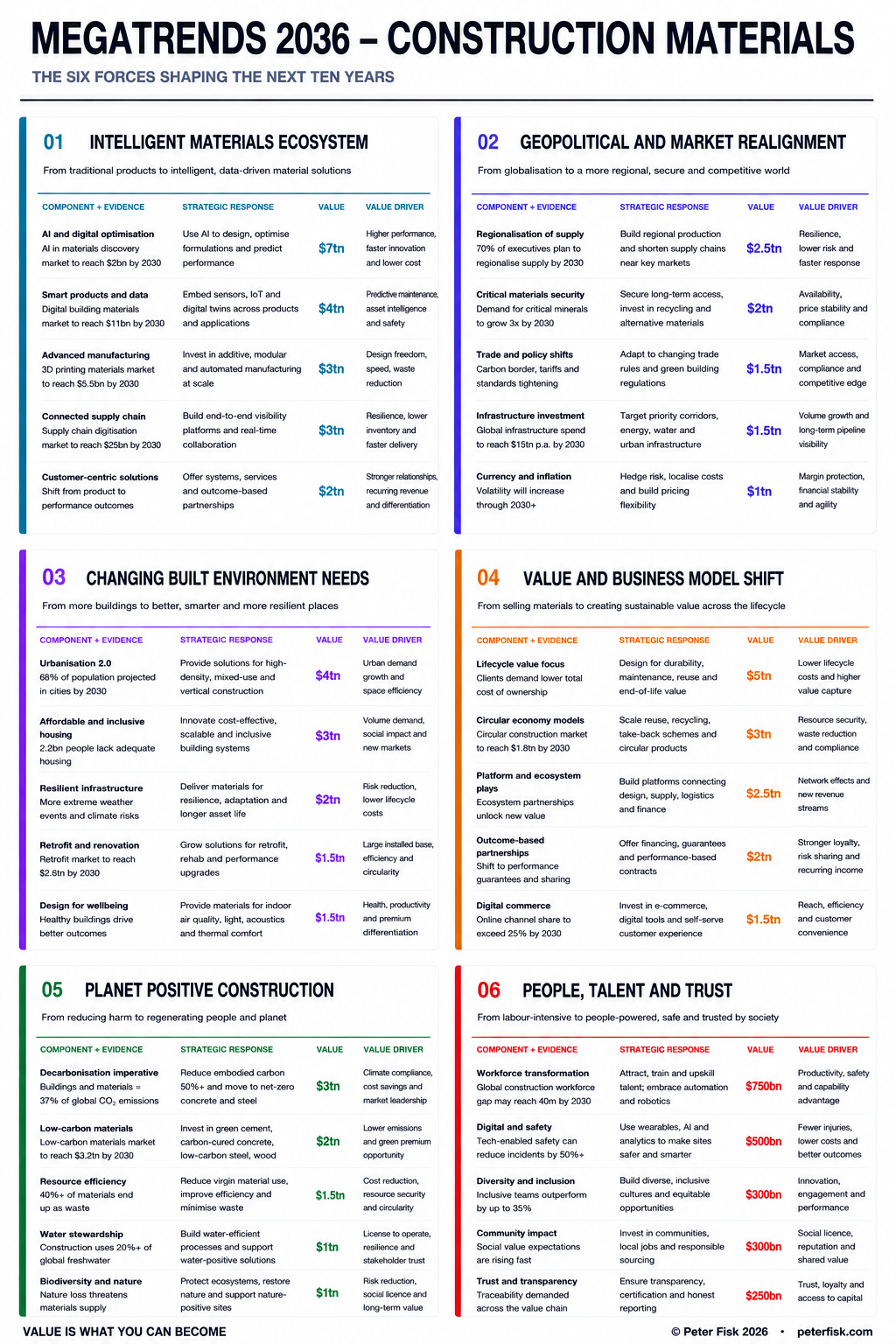
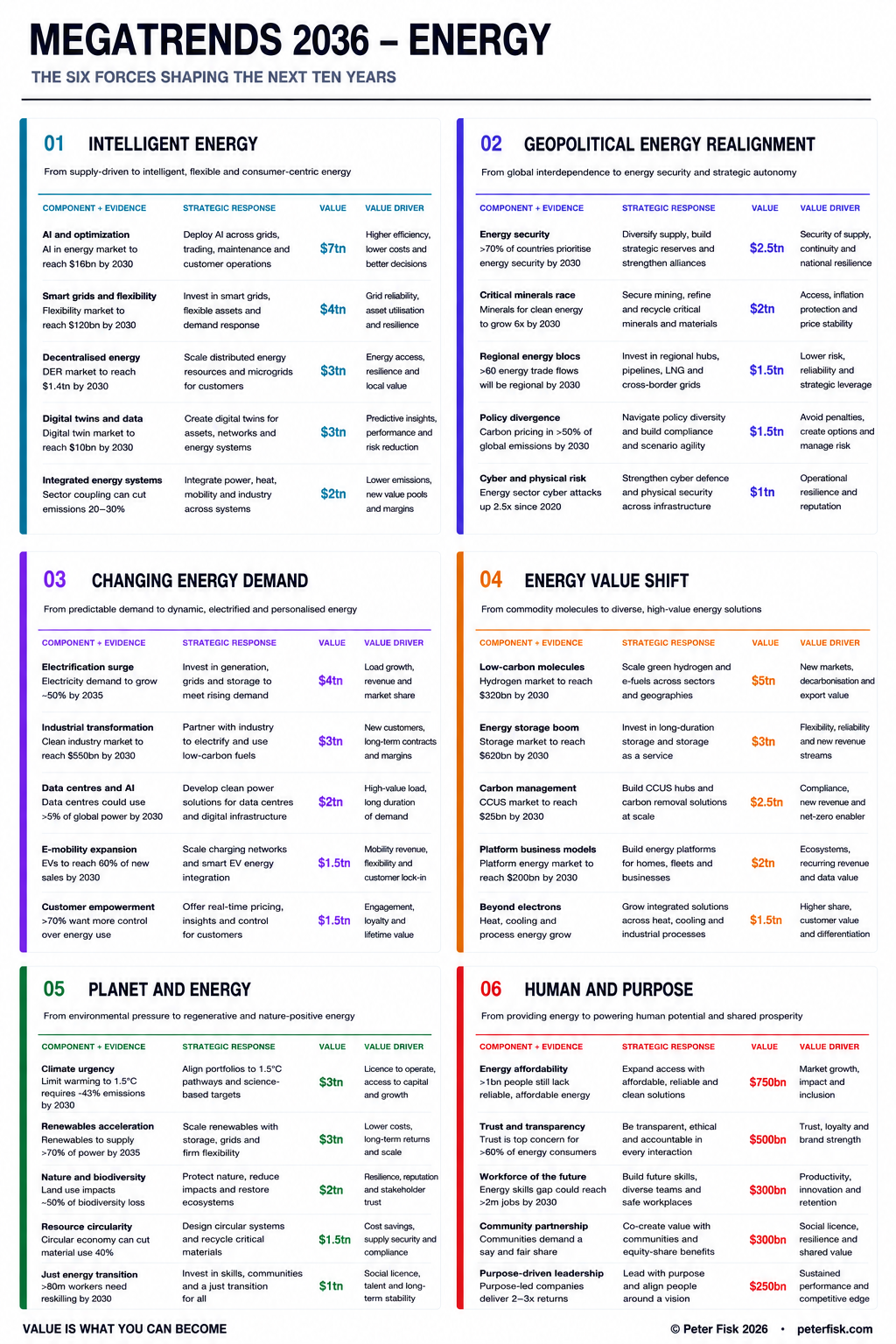
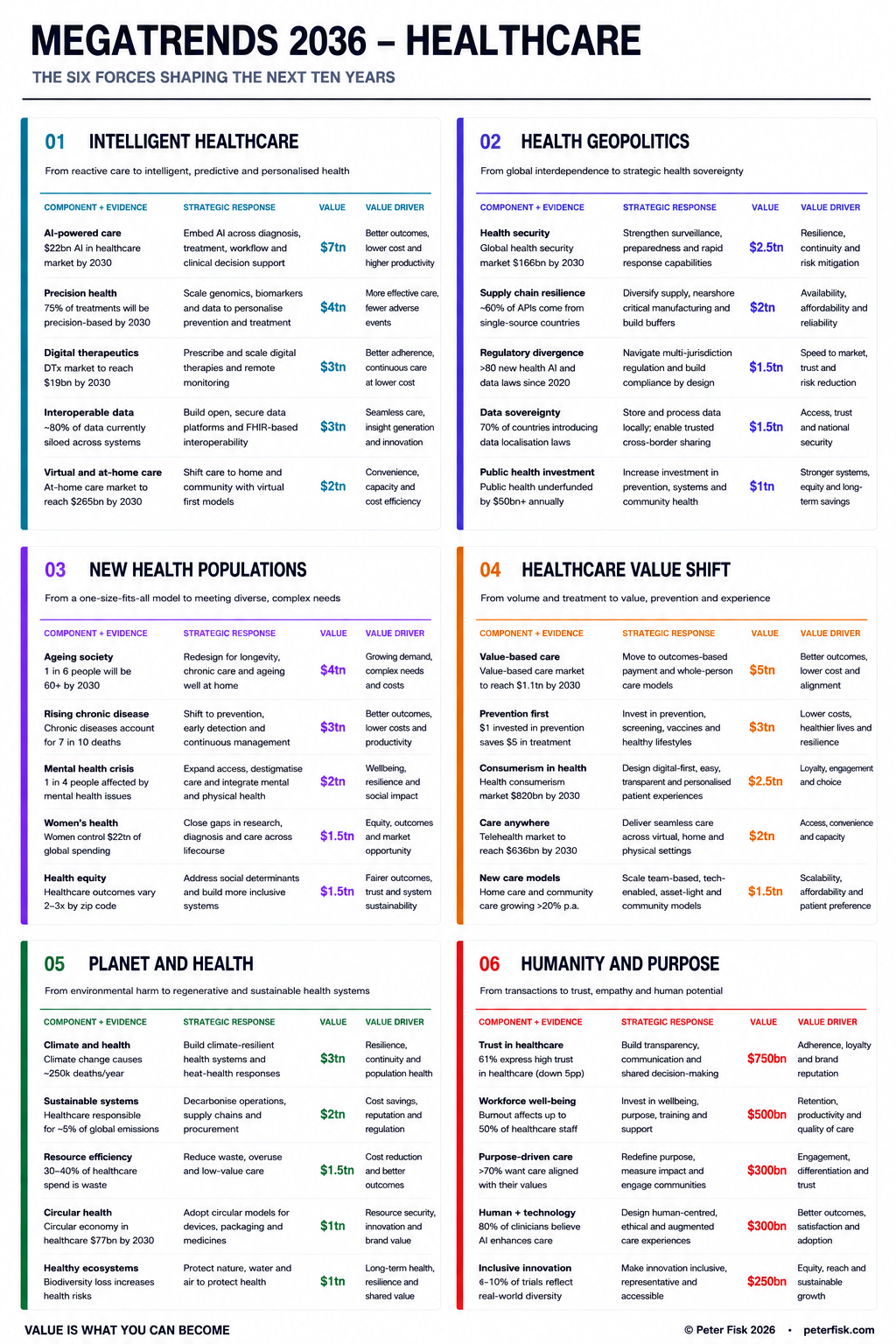
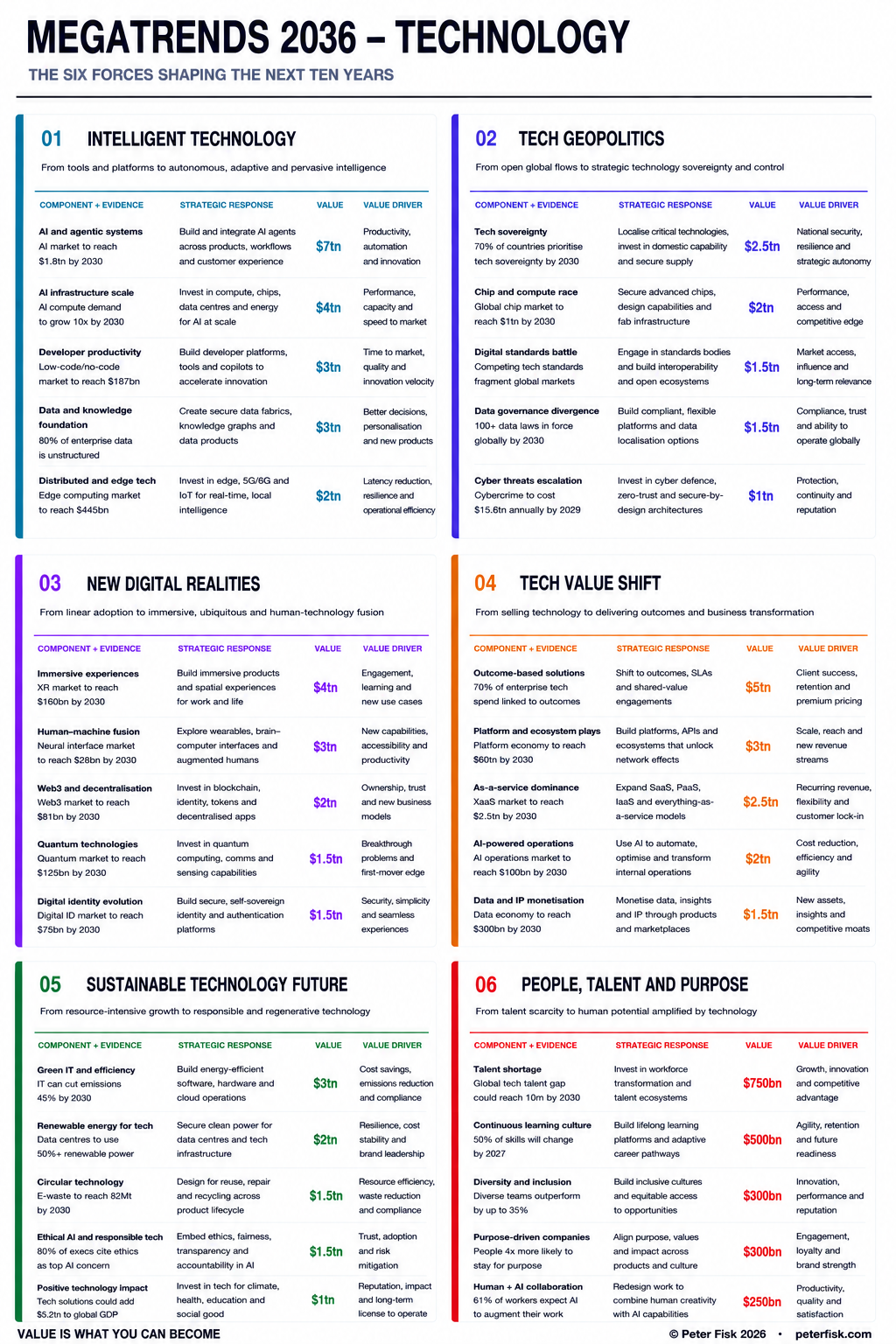
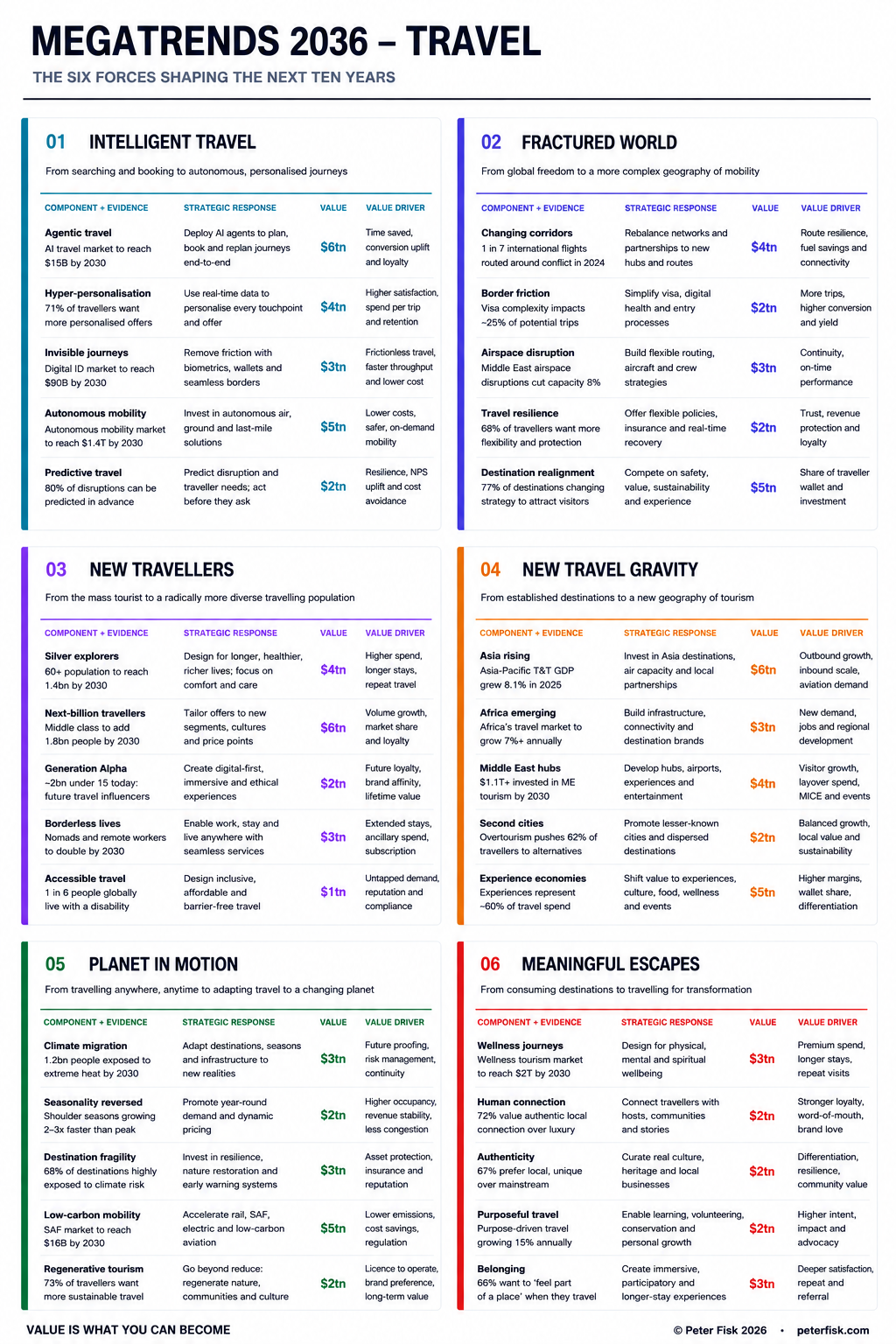
Below are a series of additional resources, diving into megatrends at a sector level, for use with clients in my workshops:
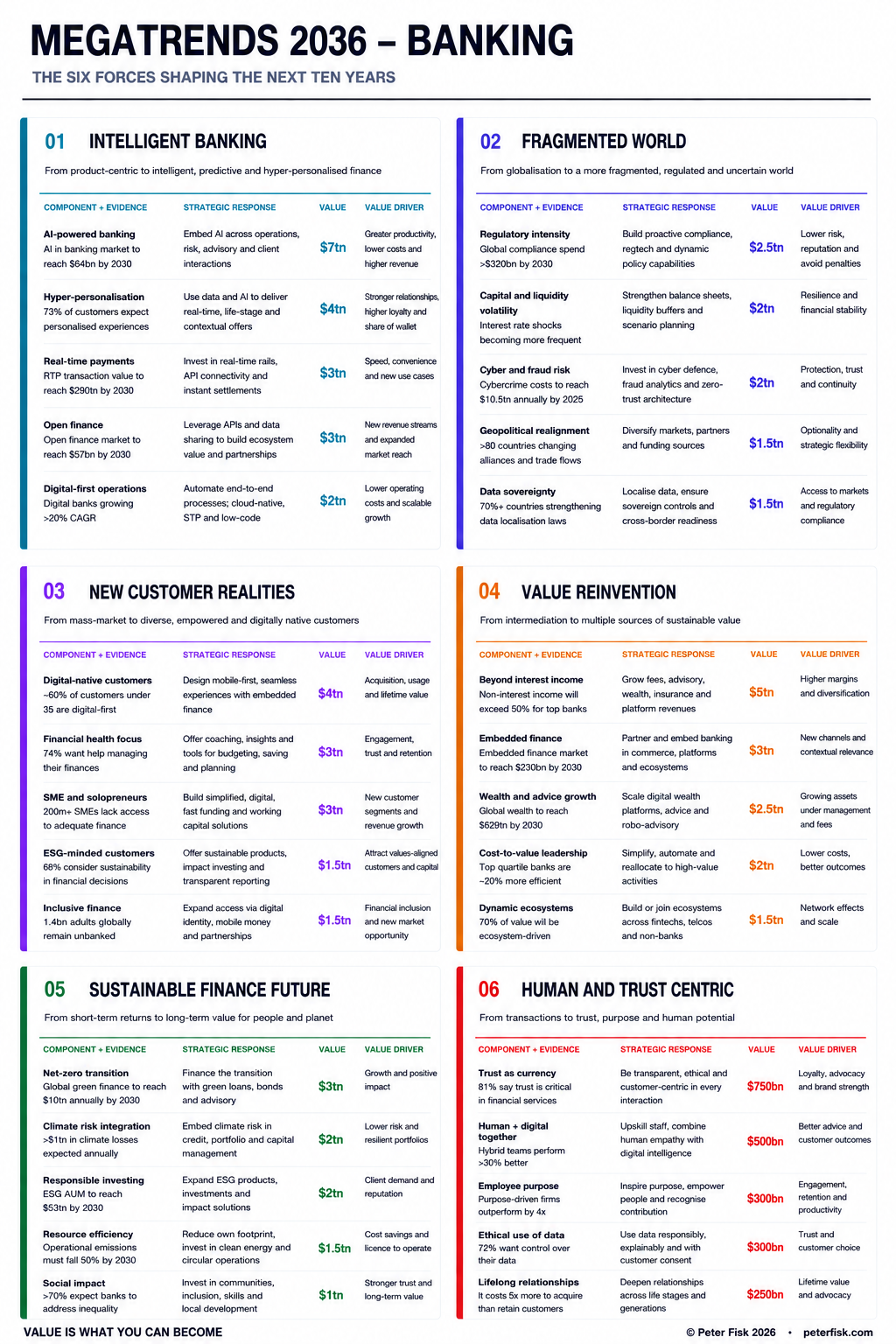
More from the blog