In a world of frenetic change, many companies find it difficult to find new growth.
Global markets are typically growing at around 2-3% (according to IMF for 2025-26). Most developed markets are largely stagnant. India tops the developing markets, with 7% growth. But these are averages. Go inside most companies, and they have ambitions to grow at 10% even 20%. So they have to think differently.
The companies shaping tomorrow are those unafraid to stretch, to reimagine strategy itself, and to embrace emerging models of growth that transcend boundaries and industries.
Instead of trying to sell more of the same – seeking to scale conventional markets, and get more from tired audiences – they look at future growth differently, new spaces, and new approaches.
- Nubank in Brazil reinventing finance to target the unbanked with simplicity and accessibility.
- On Running leveraging culture, design, and community to grow into a global sports brand.
- DeepMind applying AI to protein folding, unlocking trillion-dollar opportunities in medicine.
- Rocket Lab lowering the cost of access to space, redefining an entire industry.
These signals are not isolated—they’re fragments of the next economy taking shape. These companies don’t just compete harder, they create new markets, and play a different game.
What are the best growth strategies?
The world’s fastest growing bank, Nubank from Brazil, uses social inclusion as a growth engine, targeting the unbanked. LVMH demonstrates the power of orchestrated ecosystems. Shopify shows how empowering others creates compounding growth. Crocs shows the value of cultural resonance. BYD exemplifies bold reinvention. Unilever anchors growth in purpose, On in circularity, DBS in ecosystems, and IKEA in localisation.
Growth strategies used to be simple and predictable – inspired by Igor Ansoff’s simple matrix of options – expand geographically, capture market share, and acquire rivals – sell more.
But in today’s volatile world, defined by digital disruption, shifting consumer values, climate imperatives, and geopolitical uncertainty, growth has become less about scale at all costs and more about reinvention.
The next generation of growth is built on agility, purpose, and innovation. Companies are not just selling more products to more people; they are creating self-reinforcing growth systems, tailoring experiences to micro-markets, leveraging ecosystems, and aligning with deeper human aspirations.
It’s also about value creation. Look across every sector – the biggest selling brands are rarely the most valuable – Volkswagen generates 4 times more revenue than Tesla, but Tesla’s market cap is 20 times bigger. Pepsico is twice as big as Coca Cola, but Coca Cola twice as valuable as Pepsico.
Growth is not simply about selling more, or being bigger. It needs to deliver economic value. Which it means to be growth that is profitable, progressive and will proliferate into the future.
So what are the best next-generation ideas for strategy and growth? Here are 10 ideas. These are not yet perfect frameworks; they are stretching visions of how the most innovative business may evolve in the decade ahead.
1. Growth loops, self-perpetuating growth
Traditional business models imagined growth as linear: invest in marketing, capture customers, sell more, and scale. But the most dynamic companies today are embracing growth loops.
In these models, every new customer contributes to further growth—through data, referrals, or network effects. Shopify, for example, has built a flywheel where each new merchant not only brings revenue but also strengthens its ecosystem of apps, payments, and logistics. That, in turn, attracts more developers and partners, creating a compounding cycle of growth.
Similarly, Nubank, the Brazilian digital bank, thrives on referrals. Its low-cost, mobile-first offering appeals to millions excluded by traditional banks. Every satisfied customer brings in others, creating viral momentum. Within a decade, Nubank became one of the world’s largest fintechs, serving over 100 million customers across Latin America. These growth loops are less about linear expansion and more about building self-perpetuating systems.
Spotify thrives on loops: more listeners attract more artists, creating better playlists, which attract more listeners. Revolut applies this logic to fintech: each product (cards, crypto, savings) feeds data into better recommendations and higher cross-sell.
Quantum growth loops take this further, creating self-reinforcing flywheels across industries. Imagine healthcare ecosystems where patient data fuels AI diagnostics, improving treatments, which attract more patients, generating more data. The loop compounds, accelerating both growth and innovation.
Strategy in this model is less about planning and more about accelerating loops.
2. Market making, not market sharing
Instead of competing for slices of existing demand, leaders create entirely new market spaces. BYD moved from batteries into electric vehicles, then into SkyRail, inventing new categories of urban mobility. Strategy shifts from positioning against rivals to naming and shaping whole industries.
Traditional strategy begins with industry analysis; next-generation strategy begins with customer worlds. Companies now create markets that previously did not exist, building categories shaped more by aspirations and experiences than by product lines.
Red Bull exemplified this with energy drinks, crafting a lifestyle category defined by extreme sports and adrenaline culture. More recently, Grab in Southeast Asia created the “super-app” category, integrating ride-hailing, payments, food, and finance into a daily-life platform. In Africa, M-Pesa pioneered mobile money, not by competing with banks but by creating an entirely new financial infrastructure. The lesson: growth comes from market-making, not market share.
Looking ahead, speculative opportunities abound: healthcare may blend into wellness and performance, powered by AI coaches; urban mobility may fuse housing, micro-mobility, and entertainment into seamless living systems. Companies that see life-activities, not industries, will shape the growth markets of tomorrow.
3. Culture coding, tapping into emerging ideas
The next advantage may not come from technology but from decoding culture—tapping into emerging values, aesthetics, and identities. Strategy is less about product-market fit than movement-market fit — scaling by mobilising tribes around ideas, memes, and values.
Liquid Death turned canned water into a $1B lifestyle brand by hacking into metal culture, absurd humor, and sustainability. Netflix scales globally by producing hyper-local cultural content—from Korean dramas to Spanish thrillers—that resonate far beyond their origins. In India, Byju’s educational platform grew by blending global tech with local parental aspirations.
Future growth may come from breaking hidden codes: designing products for neurodiverse communities; embedding indigenous knowledge into climate solutions; crafting services that speak to generational shifts in identity and belonging. Strategy becomes cultural semiotics as much as economics.
4. Regenerative growth, not extractive growth
The growth frontier is not consuming more resources but restoring and regenerating them. Growth strategies will focus on adding back more than they take.
Sustainability is no longer sufficient. The next step is regenerative growth, where businesses actively restore ecosystems, communities, and trust. This is not CSR or offsetting; it is strategy that aligns value creation with planetary renewal.
NextEra Energy in the USA reinvented itself from fossil-heavy Florida Power & Light into the world’s largest producer of wind and solar energy, scaling renewables profitably while reshaping its growth logic. Interface, the flooring company, moved from reducing impact to regenerative design, creating carpets that clean the air and contribute to biodiversity.
The emerging frontier lies in regenerative supply chains: Hermès experimenting with mushroom-based leather; Nestlé investing in regenerative agriculture; and startups like Climeworks scaling carbon removal. The companies that integrate regeneration into their core models will earn advantage not just in reputation but in resource resilience and regulatory alignment.
5. Orchestrating ecosystems, not going alone
The most valuable companies of the last decade—Apple, No company can do everything itself. Growth increasingly comes from ecosystem orchestration—building platforms and partnerships that multiply value creation.
The most valuable companies of the last decade—Apple, Amazon, Alibaba—are not single businesses but ecosystems. Yet the next generation of ecosystems will be more fluid, decentralized, and participatory.
LVMH, for example, has turned its portfolio of luxury maisons into a growth engine that’s greater than the sum of its parts. Each brand, from Louis Vuitton to Dior to Sephora, benefits from shared knowledge, cross-brand collaborations, and group-level investments in sustainability and digital innovation. By curating an ecosystem rather than simply owning brands, LVMH ensures that success in one area fuels momentum in others.
In Asia, DBS Bank has gone beyond financial services to create an ecosystem around daily life. From digital health tools to travel platforms to sustainable living guides, DBS positions itself as a trusted partner in broader life journeys, not just banking. This ecosystem approach deepens relationships and opens new revenue streams in unexpected places.
Revolut used partnerships and APIs to expand rapidly across banking, trading, insurance, and travel without owning traditional infrastructure.
Future ecosystems may look more like biological systems—open, adaptive, with porous boundaries. Imagine city-level ecosystems where transport, healthcare, food, and finance are interconnected through shared data platforms, with citizens co-creating value. Strategy shifts from “owning the customer” to orchestrating flows of trust, data, and participation.
Future growth will come from hijacking underutilized networks — from logistics to identity systems — and redirecting them to new markets. Instead of building everything themselves, companies hack into existing ecosystems and reverse-expand.
6. Micro localization, being different for everyone
Globalization once meant scale and standardization; the new frontier is hyper-local relevance delivered globally. Micro-localization is the ability to adapt products, services, and strategies to the nuances of neighbourhoods, cultures, and individuals—while retaining the advantages of global scale.
Take IKEA. Once famous for its one-size-fits-all flat-pack furniture, IKEA is reinventing itself as a brand that flexes to local contexts. In Tokyo, it sells compact furniture tailored to tiny apartments. In India, it offers traditional Indian meals alongside Swedish meatballs in its in-store restaurants. And increasingly, it’s experimenting with small-format city stores and digital-first models to meet urban consumers where they are.
Crocs offers another surprising example. Written off as a fad a decade ago, the brand has rebounded by leaning into local subcultures and social media trends. Its limited-edition collaborations—from K-pop bands in Korea to luxury designers in Paris—speak directly to niche communities, creating demand spikes that ripple globally. Growth is no longer about mass standardisation but about intimacy at scale.
Coca-Cola has long practiced this, adjusting flavors and marketing to local tastes. But new players are pushing further. TikTok’s algorithm personalizes content not only to countries but to micro-communities and even individuals. Jumia in Africa adapts e-commerce to local infrastructure gaps, offering pay-on-delivery and motorbike logistics.
Speculatively, AI-powered manufacturing could enable “glocal factories” producing customized goods for each city block, while retail experiences could morph daily based on real-time community data. Growth will not come from one-size-fits-all but from billions of micro-fits scaled intelligently.
7. Experience multiverses, immersive brands and communities
Products and services are no longer enough; companies now compete in experience universes. The next step is multi-layered experiences blending physical, digital, and virtual dimensions.
Disney reinvented itself multiple times—from animation to theme parks to streaming—each time amplifying its storytelling ecosystem. Nike’s digital platforms like SNKRS and Run Club transform the brand from a product company into a participatory culture. Hermès thrives not just on luxury goods but on immersive experiences that embody scarcity, craftsmanship, and cultural symbolism.
Tomorrow’s growth may come from “experience multiverses”—a luxury fashion brand offering physical goods, virtual garments for avatars, and AI-personalized design experiences. Companies that orchestrate these multiverses, blending identity, status, and emotion across realities, will define the next growth frontier.
8. Invisible multipliers, unlocking intangible assets
The most valuable assets in business today are no longer factories, fleets, or physical inventories. Instead, they are intangible and often invisible—brands, data, trust, and partnerships. These forces now account for the majority of corporate value creation, shaping how companies grow, compete, and endure.
A strong brand is more than a logo or slogan; it is a living promise that commands loyalty and price premiums. Apple and Nike are worth far more than the sum of their products because their brands embody meaning, aspiration, and belonging. Hermès’ value lies less in bags and more in the aura of scarcity, heritage, and cultural capital.
Data is the new capital of the digital age. The ability to capture, analyze, and act on information enables companies like Alibaba, Netflix, and Moderna to anticipate needs, personalize experiences, and accelerate discovery. Yet data only becomes valuable when translated into insight and action.
Trust is the ultimate currency. In a world of information overload and rising skepticism, organizations that demonstrate authenticity, responsibility, and fairness win enduring advantage. Tesla’s volatility shows how fragile trust can be, while Patagonia’s long-term commitment to environmental integrity shows how powerful it can become.
Partnerships enable ecosystems that extend growth beyond the boundaries of one company. Amazon, Tencent, and Reliance are not just businesses; they are platforms that orchestrate networks of partners, developers, and customers, multiplying value through shared creation. ASML, the Dutch semiconductor company, thrives not on physical machines alone but on an irreplaceable ecosystem of patents, know-how, and collaborative trust.
The next growth frontier lies in mastering these invisible drivers—cultivating brands that inspire, data that empowers, trust that endures, and ecosystems that scale. Those who do will define the economy of the future.
Speculatively, companies may trade in new intangibles: “trust tokens” for AI systems, data sovereignty as a service, or cultural capital as measurable value on balance sheets. Strategy in this age is less about factories and more about curating, scaling, and protecting the invisible.
9. Temporal strategies, competing at different speeds
Companies can accelerate growth by exploiting differences in time horizons — moving faster or slower than competitors and markets expect. Strategy becomes time design — mastering how value unfolds across seconds, years, and generations.
Growth strategies have traditionally been linear—quarterly targets, five-year plans. Next-gen strategies manipulate time itself: accelerating, slowing, or bending growth trajectories to shape competitive advantage.
Amazon is a master of long-term patience, sacrificing near-term profits to build infrastructures like AWS or Prime that compound over decades. Conversely, fast-fashion brands like Temu and Shein compress design-to-delivery cycles to mere days, weaponizing speed as a strategic advantage.
Speculatively, companies may offer “time as a service”: insurance models that protect not just assets but lifespans; education platforms that accelerate or extend learning windows. Growth becomes not just about market share but about controlling the tempo of industries.
10. Real-time strategy, enabled by AI
Strategy becomes less about annual plans and more about real-time algorithmic adaptation. Alibaba’s “City Brain” dynamically optimizes traffic flows in Hangzhou with AI — imagine the same principle applied to corporate strategy. The company’s strategy evolves autonomously, recombining assets as markets change, like a biological system.
Where companies once used AI as a tool, the next wave builds AI into the strategy-making process itself. “AI-native” strategy means dynamic, self-learning models of decision-making where foresight, simulation, and adaptation are embedded in real time.
Ping An in China is an early mover: it uses AI across health, finance, and insurance ecosystems, not only to improve customer service but to decide where to expand next. Mercado Libre in Latin America deploys AI to optimize logistics, credit scoring, and product recommendations at planetary scale. These companies do not bolt AI onto existing strategies; their strategies evolve through AI.
Imagine a future boardroom where strategy sessions run as human-AI collaborations: executives asking questions, AI generating multiple possible scenarios, simulating competitor moves, even stress-testing supply chains under climate shocks. Strategy becomes less about annual reviews and more about living, evolving code.
From strategy to imagination
These 10 ideas signal a shift: from strategy as analysis to strategy as imagination.
Companies that win will be those that reinvent not only what they do but how they think about growth itself—market-making, AI-native decision-making, regenerative advantage, living ecosystems, micro-localization, experience multiverses, temporal play, quantum loops, cultural decoding, and unlocking new assets.
The signals are already here – from DBS in Singapore to Hermès in Paris, from Mercado Libre in São Paulo to NextEra in Florida. Yet the most exciting frontier is still speculative: how these logics will collide, recombine, and accelerate in ways.
The next generation of growth is not about bigger, faster, cheaper. It’s about different.
It is about organisations that reinvent perpetually, design for exponential technologies, and embrace regenerative principles. It is about orchestrating ecosystems, shaping cultural currents, and inventing markets that never existed. It is about moving across time horizons with agility and, above all, growing humanity and the planet alongside profit.
If the 20th century was the era of scale, the 21st is the era of reinvention and imagination. Tomorrow’s growth will not come to those who plan the best—it will come to those who see the furthest, adapt the fastest, and dare the boldest.
Footnote: Growth inspirations
Here are 9 mini cases of brands driving growth:
Shopify … Powering the Entrepreneur Economy
Shopify has become the backbone of a new generation of entrepreneurs and small businesses by making e-commerce simple, scalable, and global. Rather than competing as a retailer itself, Shopify built a platform model that gives millions of merchants the tools to sell online, manage payments, ship products, and market to customers. Its strategy has been to constantly expand the ecosystem—adding integrations with social platforms like TikTok, partnerships with logistics providers, and AI-driven marketing tools. By enabling others to grow, Shopify grows too, capturing value as digital commerce expands across geographies and categories. During the pandemic, Shopify accelerated adoption as small retailers rushed online, but its growth engine is longer term: empowering entrepreneurship, tapping into the long tail of niche markets, and expanding into financial services. Its model shows how a company can scale by democratizing access to technology and capturing the collective growth of its customers.
Nubank … Redefining Banking in Latin America
Brazil-based Nubank has grown into one of the world’s largest digital banks by challenging the inefficiencies and high fees of traditional Latin American banks. Starting with a simple no-fee credit card managed through a sleek app, Nubank attracted millions of young, underserved customers frustrated with legacy banking. Its growth strategy is built on simplicity, transparency, and customer trust. By expanding into savings, personal loans, and small business services, Nubank has created a financial super-app that addresses the unmet needs of over 100 million people across Brazil, Mexico, and Colombia. Crucially, it uses data and AI to underwrite credit for populations often excluded from banking. Its low-cost, digital-only model allows scale without physical branches, while network effects drive customer acquisition through referrals. Nubank’s growth proves that reinventing business models for emerging markets can unlock both social impact and extraordinary commercial opportunity.
LVMH … Reinventing Luxury for a New Era
LVMH, the world’s largest luxury group, accelerates growth not by chasing trends but by shaping them. Its strategy blends heritage with reinvention, using its maisons—from Louis Vuitton to Dior to Tiffany—to continually refresh desirability. Under Bernard Arnault, LVMH has invested heavily in experiences, from flagship stores that serve as cultural spaces to immersive brand activations with artists and designers. It has expanded into high-growth categories like beauty and hospitality, while also betting on technology—acquiring digital-native brands, experimenting with NFTs, and driving e-commerce through platforms like Sephora. LVMH has also leaned into sustainability, repositioning luxury as timeless and regenerative, appealing to new generations of consumers who equate value with responsibility. By managing a portfolio of brands with creative independence but shared resources, LVMH captures both scale and scarcity. Its growth comes from a powerful cycle: cultural relevance creates desire, and desire creates long-term pricing power.
Crocs … From Ugly Duckling to Fashion Phenomenon
Once mocked as unfashionable, Crocs has staged one of the most remarkable brand turnarounds of recent years. Its growth strategy is built on radical reinvention—turning its clunky foam clogs into a canvas for self-expression and cultural play. Through collaborations with fashion houses like Balenciaga, musicians like Post Malone, and influencers across TikTok, Crocs repositioned its brand as cool, ironic, and endlessly customizable. The introduction of Jibbitz charms transformed shoes into personal statements, driving repeat purchases and community engagement. Operationally, Crocs has streamlined its product line, focused on direct-to-consumer sales, and used social listening to anticipate trends in real time. The result: a brand once written off has become a global growth engine, doubling revenues and capturing a new generation of fans. Crocs shows how even the most unfashionable company can accelerate growth by leaning into cultural currents, embracing partnerships, and making its brand a platform for creativity.
BYD … Driving the Global EV Transition
China’s BYD (Build Your Dreams) has grown from a battery maker into one of the world’s largest electric vehicle producers, rivaling Tesla. Its growth strategy is rooted in vertical integration—BYD makes its own batteries, chips, and key components, giving it cost and supply chain advantages. This allows it to offer a wide range of affordable EVs and hybrids, making clean mobility accessible to the mass market, not just premium buyers. BYD is also expanding aggressively into buses, trucks, and global markets, from Europe to Southeast Asia. Backed by Warren Buffett’s Berkshire Hathaway, BYD has leveraged scale and technology to accelerate adoption of EVs worldwide. By focusing on affordability, range, and reliability, BYD captures segments often ignored by Western competitors. Its growth demonstrates how emerging-market champions can leapfrog by aligning with megatrends like electrification, while rethinking value chains to gain speed, resilience, and market dominance.
On … Making Sportswear Cool
Swiss sports brand On has accelerated growth by reinventing running shoes with its distinctive “CloudTec” cushioning technology, making performance both functional and stylish. Its early adoption by elite athletes, combined with partnerships with fashion retailers, positioned On at the intersection of sport and lifestyle. Growth has been fueled by a strong direct-to-consumer model, global expansion, and a community-driven marketing strategy that emphasizes storytelling around innovation and sustainability. On has also pioneered circular business models, such as a subscription service for recyclable running shoes, appealing to environmentally conscious consumers. Its IPO in New York validated its status as a global challenger to Nike and Adidas, with revenues soaring. By blending Swiss engineering, design flair, and digital-first engagement, On demonstrates how a challenger brand can accelerate growth by creating a differentiated product experience and expanding into adjacent markets like apparel and outdoor gear.
DBS Bank … From Traditional to Digital Powerhouse
Singapore’s DBS has transformed itself from a bureaucratic state bank into one of the world’s most innovative financial institutions. Its growth strategy is built on digital transformation—not as a bolt-on, but as a complete cultural reinvention. DBS embraced agile methods, customer journey redesign, and AI-driven services, branding itself as the “Digital Bank of Singapore.” It launched digibank, a mobile-only offering in India and Indonesia, acquiring millions of new customers at low cost. The bank also integrated sustainability into its growth, financing renewable energy projects and helping clients transition to greener operations. By rethinking itself as a tech company with a banking license, DBS boosted profitability, customer satisfaction, and international reach. Its story illustrates how even incumbents in highly regulated industries can accelerate growth by reimagining their culture, customer experience, and business model around digital-first principles.
IKEA … Democratising Sustainable Living
IKEA has accelerated growth by making sustainable living affordable and aspirational. The Swedish retailer is rethinking its entire model—from using renewable materials and circular design to offering services like furniture rental and buyback. It has invested in renewable energy, owning wind and solar farms to power its stores and supply chain. At the same time, IKEA has doubled down on digital, expanding e-commerce, experimenting with virtual showrooms, and partnering with platforms like Alibaba. Its growth is also geographic, with rapid expansion into India and Southeast Asia. IKEA’s strength lies in its ability to democratize design and now sustainability, positioning itself as the brand that helps millions of households live better within planetary boundaries. By aligning growth with purpose, and innovating across product, service, and market models, IKEA shows how legacy retailers can accelerate into the future without losing their core identity.
Unilever … Purpose and Performance at Scale
Unilever has pursued growth by embedding sustainability into its business model. Its “Sustainable Living Brands”—such as Dove, Hellmann’s, and Ben & Jerry’s—grow faster than the rest of its portfolio, proving that purpose can drive performance. Unilever has focused on reducing plastic, cutting carbon, and reshaping food portfolios around plant-based products, while also leading in social issues from diversity to hygiene access. Its growth strategy is to meet shifting consumer values while using its global scale to accelerate systemic change. Investments in AI-driven marketing, direct-to-consumer platforms, and partnerships with startups also keep it relevant with new generations of shoppers. By aligning profit with positive impact, Unilever has repositioned itself as a growth company fit for the 21st century—winning not only consumers but also employees, investors, and regulators. The company’s example shows how legacy players can accelerate growth by making purpose inseparable from their brand and innovation strategy.
Ads inspire, ads engage, ads become iconic.
While the marketing world has hugely shifted over the last 35 years since I worked on my first ad (a spot for British Airways creating a global image of people around the world, which became quite iconic), ads still have an important place in building brands, connecting with people emotionally and aspirationally, and becoming reflections of culture and creativity.
Today’s marketing world is driven by a much more individual, intelligent and interactive focus on consumers. From AI and data analytics, to digital platforms and mobile apps, personalisation and gamification, social influencers and live events. The marketing mix has become more science than art, but there is still a place for ads … Here are my favourites of 2024:
“Introducing Icons” by Airbnb
I love Airbnb, for its unusual, interesting places to stay. Its Icons series of experiences includes the opportunity to stay at Prince’s Purple Rain house, the Clock Room at Musée d’Orsay in Paris, and the Ferrari Museum in Italy, as well as the Up House, created in meticulous detail by Verb to celebrate 15 years since the Pixar film Up was released.
“Is it even a city?” by Visit Oslo
I love Oslo, and in particular the Bislett Stadium, the spiritual home of distance running. It’s a great city, with a designer waterfront including its spectacular Opera House. An antidote to holiday ads that are all smiles, this deadpan ad from Visit Oslo delivers the city’s charms in a left-field way via one very bored resident.
“All the Ads” by DoorDash
DoorDash’s 2024 Super Bowl campaign, offering a prize from every brand that advertised during this year’s big game to the first person who figured out its ridiculously long promo code, took a lot of legal wrangling and constant revisions. It was big and fun, and served as an effective product demo of the brand’s promise to now deliver anything and everything, and not just food.
“The Co-Worker” by Ikea
Ikea opened its game The Co-Worker on Roblox, offering players a chance to experience the working world of Ikea (kinda) on the platform. A genuine recruitment drive, the campaign gave audiences the opportunity to apply for one of ten paid roles in the virtual store. The open call to become a virtual Ikea co-worker amassed over 178,000 applications over the two-week application window.
“If you’re into it, it’s in the V&A” by V&A Museum
Museums can seem old, boring, stuffy and irrelevant. But they don’t have to be that way, as London’s V&A has demonstrated through many innovative exhibitions. This ad campaign for the V&A planted its message in dozens of objects hidden across the UK, particularly shone for its unusual approach to promoting a venerated institution and its commitment to craft.
World Cup Delivery by PedidosYa
Argentina’s passion for football reached new heights as Lionel Messi, after enduring numerous lost finals over 36 years, finally clinched the World Cup victory. Breaking a spell that had loomed over the nation for more than three decades, Argentina erupted in unprecedented jubilation. Amidst the euphoria, everyone wanted to know when the team would arrive home?
“Spreadbeats” by Spotify
Spotify’s B2B campaign “Spreadbeats” featured a music video created and distributed entirely within a media plan spreadsheet. Aiming to make media plans as vibrant and energetic as Spotify’s brand and platform, the campaign follows a single cell—E7—and its evolution into a colourful 3D character, a metaphor for the creative ways brands can reach audiences through both audio and visual formats.
“Handshake Hunt” by Mercado Libre
Mercado Libre, the leading online shopping platform in Latin America, executed a unique campaign named “Handshake Hunt” during Black Friday. Partnering with TV channel Globo, the campaign displayed QR codes for discounts whenever a handshake appeared on-screen. Targeting the online retail market in Brazil, the campaign utilised various media channels including product placement, outdoor, out-of-home, and sales promotions.
“We are Ayenda” by WhatsApp
WhatsApp released a documentary “We Are Ayenda” telling the extraordinary story of the Afghan Youth Women’s National Football Team and their remarkable escape from Afghanistan after the Taliban took power in 2021. The documentary debuted during the Women’s World Cup and is now available on Prime Video.
“A British Original” by British Airways
Finally, back to British Airways, who unveiled a pioneering multi-channel initiative named “A British Original,” celebrating the airline’s staff, passengers, and the essence of the nation itself. The campaign delves into the diverse motivations behind travel, whether it’s for reconnecting with loved ones, seeking solace, or immersing oneself in a new culture. It comprised more than 500 distinctive print, digital, and outdoor executions, along with over 32 short films.
“Gamechangers” are individuals, companies, innovations, or events that significantly alter the status quo in their respective fields. They often introduce new ideas, technologies, or practices that disrupt existing norms and pave the way for new opportunities, improved efficiencies, or entirely new markets.
Almost 10 years ago I wrote the book “Gamechangers” which won awards and was translated into over 30 languages. It featured disruptive companies like Airbnb, shaking up the world of hospitality, cryptocurrencies, harnessing the power of network technologies, and even Elon Musk, with a mindset for disrupting any industry.
- Be the Gamechanger … 10 ways to change your game, from strategic purpose to target audiences, unusual products to unexpected services, customer experiences to new business models
- 100 Leaders … profiles of game changing leaders, from Anne Wojcicki to Bernard Arnault, Cristina Junqueira to Ben Francis, Zhang Ruimin to Zhang Yimin, and many more.
- 250 Companies … case studies of gamechanging companies, from 1Atelier to 77 Diamonds to A Boring Life, Aerofarms to Alibaba, Babylon to Boom Supersonic and many more.
- Gamechangers Latin America … from Camposol to Cariuma, NotCo to Nubank … Learning from brands thriving in adverse and volatile markets
- Gamechangers Turkey … from Appsilon diamonds created in the lab, to Biolive plastics made from olive stones … Oleatex’s plant-based vegan leather, and WeWalk’s smart canes.
So who are the Gamechangers of 2025?
I’m looking for companies who are disrupting markets, challenging the conventions, shaping the new behaviours, and succeeding. They might do this by reimagining products and services, channels and pricing, business models or ecosystems.
Take the purest spring water, for example, and think how you can make it more engaging to young people. Liquid Death has become a cult brand, and highly profitable business. Or consider Athletic Brewing, a great tasting beer, perfect after a workout. And with zero alcohol.
Here’s my shortlist:
- Abridge: Using AI to transcribe doctor-patient interactions and generate medical notes, improving healthcare documentation and patient care.
- Adyen has transformed the payment industry by providing a single platform for businesses to accept payments anywhere in the world, both online and in-store.
- Agility Robotics: Developing humanoid robots that can walk, grasp, and carry objects, revolutionizing logistics and manufacturing.
- Arabica: Coffee shops with Asian minimalism, African coffee roastery, and Arabic meeting place. Founded by Japanese entrepreneur seeking to “See the World Through Coffee”.
- Athletic Brewing:Whether you’re looking to cut out alcohol for life or just for a night, you shouldn’t have to sacrifice your ability to be healthy, active and at your best, to enjoy great beer.
- Agua Bendita produces super-luxury handmade bikinis, inspired by their Colombian roots, and made by a team of 700 single mothers from off-cuts of fabric.
- Beauty Pie: Subscription based platform
- allowing members to purchase products directly from top-tier labs at a reduced price.
- Bumble: A social discovery app empowering women to make the first move in dating, friendships, and professional networking
- Canva: An online design tool making graphic design accessible to everyone with easy-to-use templates and collaboration features.
- Colossal Biosciences seeks to reawaken the past, to bring back extinct species using CRISPR technology, through genetic rescue, to support biodiversity
- Duolingo, the language learning app has transformed the way people learn new languages by making the process fun, accessible, and gamified.
- EcoSpirits: Introduces new pricing models that incentivize consumers to return bottles for recycling, promoting a circular economy.
- Ecovative uses mycelium, from mushrooms, to grow category defining products ranging from leather like textiles to sustainable packaging.
- Elf: A beauty and skincare brand known for its affordable, clean, and effective products. 100% vegan, no animal testingand made without the nasty bad-for-you stuff.
- FanDual. Online fantasy sports and sports betting platform, transforming the way fans engage with sports, providing an immersive and interactive experience.
- Fenty: Known for its inclusive beauty products, Fenty continues to disrupt the beauty industry with its wide range of shades and innovative formulations.
- Fervo Energy: Innovating in geothermal energy to provide a sustainable and reliable source of clean energy.
- Gorilla Glass. Known for its durable and damage-resistant glass used in smart phones and other electronic devices
- Halo Top Creamery is attracting more ice cream lovers with a promise of lower calories and less guilt.
- Helsing: Specializing in AI-powered defence solutions, Helsing is transforming how military operations are conducted.
- Impossible Foods has revolutionized the food industry by offering sustainable and delicious options that closely mimic the taste and texture of traditional meat.
- Impulse Space: Working on space propulsion technology to make space travel more efficient and cost-effective.
- Ipsy: Personalized makeup and beauty products by monthly subscription, exclusive offers, and how-to video tutorials from the brand’s stylists.
- Iqos. Heats tobacco instead of burning it, producing a vapor that contains nicotine but has less ash, smoke, and odour compared to conventional cigarettes
- Jio: An Indian telecommunications company providing affordable internet services and revolutionizing digital connectivity in India.
- Klarna. Known for its “buy now, pay later” financial services, Klarna has revolutionized the way consumers shop online by offering flexible payment options
- Liquid Death: Known for its bold branding and canned water, Liquid Death has disrupted the beverage industry.
- Meati: This company produces high-protein, sustainable meat alternatives made from mushroom roots.
- Miniso: “It isn’t just a store; it’s a playground of endless fun and excitement” with 6,000 stores worldwide in 100 countries.
- Mirror: This reflective screen offers personalized workouts with top trainers, providing a virtual fitness studio experience.
- Nextdoor: Transformed the way neighbourhoods connect and communicate by providing a platform to share news, events, recommendations, and services.
- Niyara India: This brand has quickly become a go-to for modern Indian women, blending elegance, comfort, and affordability.
- NotCo: Using artificial intelligence to create plant-based alternatives to animal products, NotCo is revolutionizing the food industry.
- Oatly: This plant-based milk brand has gained significant market share by appealing to consumers looking for sustainable and healthy alternatives to dairy.
- Octopus Energy: A renewable energy supplier in the UK, committed to providing affordable and sustainable energy solutions.
- OpenAI: Continues to lead the AI revolution with its generative AI models, impacting various industries from cybersecurity to agriculture.
- Parkrun: A global initiative that organizes free weekly 5km events in local parks, promoting community and fitness.
- Peloton: Known for its interactive fitness equipment and online classes, Peloton has revolutionized home workouts.
- Quibi. Known for its short-form mobile streaming platform, quick, engaging content designed for mobile devices, catering to the modern, on-the-go consumer.
- Reformation: This brand focuses on sustainable fashion and has a strong online presence, making it a leader in digital marketing and e-commerce.
- Revolut. The money superapp, or neobank, enabling everyday banking, currency exchange, stock trading and more. With a particular focus on travellers.
- Seedlip: Partners with bars and restaurants to offer non-alcoholic cocktail options, promoting the idea of “mindful drinking.
- Skims: Sells underwear, loungewear and shapewear, and focuses on body positivity and sizing inclusivity.
- Smarter: This company brought the Internet of Things (IoT) to consumers with products like Wi-Fi-connected kettles and fridge cameras.
- Surreal Cereal: Disrupting the breakfast scene with their delectably nutritious, zero-sugar, high-protein cereals,
- Sway: A beverage brand that has made waves with its innovative flavors and sustainable packaging.
- Tony’s Chocolonely wants to make all chocolate 100% slave free. Not just our chocolate, but all chocolate worldwide.
- Too Good To Go is a mobile app that connects customers to restaurants and stores that have unsold, surplus food
- Tru Earth: A laundry detergent brand that offers eco-friendly and waste-free packaging, appealing to environmentally conscious consumers.
- Unmind. Provides a digital platform offering tools and resources for employees to manage their mental well-being,
- Varda Space Systems: Developing space infrastructure to support the growing space economy, including satellite manufacturing and space logistics.
- Waabi: Focused on autonomous driving technology, Waabi is making strides in making self-driving cars safer and more reliable.
- Who Gives a Crap: A toilet paper brand that donates 50% of its profits to build toilets for those in need around the world.
- Whoop: A wearable tech company that provides detailed insights into athletes’ performance and recovery.
- Xero. Transformed how medium-sized businesses manage their finances by offering user-friendly and efficient tools that streamline accounting processes.
- Youfoodz. Revolutionized the convenience food market in Australia by offering fresh, healthy, gourmet meal options that are delivered directly to your door.
- Zepto: A rapid delivery startup that promises delivery within 10 minutes, disrupting the food delivery market.
- Zipline: A company using drones to deliver medical supplies to remote and hard-to-reach areas.
Decarbonisation is the priority for many business leaders.
While value creation, making sense of changing markets, exploring new growth markets and unlocking emerging technologies, rethinking business models, reducing costs, and driving growth all matter, decarbonisation is the obvious, urgent agenda that stands out for many of the leaders I meet.
From airlines to automotive, construction and energy, fashion and food, there is a huge priority placed on reducing carbon emissions through new materials, processes, and ways of working.
Look at the investor presentations of companies from British Airways to Volkswagen, Holcim and Shell, Inditex to Nestle, in each case “decarbonisation” is the keyword. How to reduce the emissions of existing ways of working, how to transition to new business models. And for investors, how to reduce risk, tap into growth markets, and deliver growth.
Energy companies are obviously at the forefront of this. Some of my clients like Enel and Iberdrola are leading the energy transition, and others like Siemens are finding ways to accelerate it. In construction, Holcim is regenerating cities out of existing waste materials, rebuilt with green cement, and with more sustainable designs for ongoing use.
Volkswagen in a desperate situation, unable to transition from ICE to EV world. In fashion, brands like H&M to Patagonia embrace reuse and up cycling, recycled fabrics, while new fibre emerge that can do more. In food, companies like Danone and Nestle are actively changing how we farm, and what we eat, while Too Good to Go ensures our food doesn’t go to waste.
So what does it take? And who are the companies accelerating a better future, with less carbon, and sometimes more positive impact too?
Low Carbon Energy: Renewables and Hydrogen
Most CO2 emissions arise from burning fossil fuels such as coal, natural gas, and petroleum, for energy sourcing. As a result, utilities and energy providers are promoting energy transition. Some of the renewable energy systems include advanced photovoltaics (PV) that capture solar energy more efficiently and wind turbines that eliminate the need for huge installations or high-low wind speeds. Additionally, companies are making significant innovations in the areas of hydroelectricity, geothermal energy, and biofuels.
- Geothermal: Celsius Energy is a French startup that uses geothermal energy for heating and air conditioning buildings. It uses a heat transfer fluid that circulates in a 200-meter-deep heat exchanger. A heat pump then exchanges the calories with the basement to supply heat to the building during winter and extract them in summer. Additionally, a digital control system minimizes electricity consumption by optimising subsurface operations and heat pumps in real time. Thus, Celsius Energy allows commercial buildings to reduce their dependence on fossil fuels by utilising a local renewable source of energy.
- Green Hydrogen: Versogen is a US-based startup that creates an electrolyzer for low-cost green hydrogen production. Its proprietary platform technology, PiperION, applies advanced anion exchange membranes that enable the use of low-cost construction materials in electrolyzers, fuel cells, and other electrochemical devices. This makes them more economical than conventional proton exchange membranes (PEMs). Hence, Versogen solves the main challenge in large-scale green hydrogen production and accelerates the global transition toward net zero.
Carbon Capture
While low carbon energy sources are critical in the fight climate change, they alone are not enough to reverse the effects of global warming. Hence, startups are working on carbon capture, utilization, and storage (CCUS) technologies, driving decarbonization across industries. Top priority is direct air capture, i.e., capturing CO2 directly from ambient air instead of point sources such as power plants or factories. This opens up concentrated opportunities for carbon sequestration and utilization.
- Direct Air Capture: US-based startup Heirloom develops a cost-effective direct air capture solution. It deploys carbon mineralization technology with widely available, low-cost minerals to produce oxides that naturally bind to CO. The process doesn’t rely on energy-intensive and high-cost air contractors. Heirloom injects the captured carbon underground into geological structures. There, it remains permanently trapped away from the atmosphere.
- Vehicle Emissions: Remora is another US-based startup that develops a retrofit carbon capture unit for semi-trucks. The device attaches to the vehicle exhaust pipe and captures up to 80% of total emissions. It uses carbon scrubbing technology to strip greenhouse gases from the tailpipe and release clean air. The solution automatically compresses the CO2 and stores it in onboard tanks. Once the offload tanks fill up, the startup picks up the CO2 with a tanker truck and delivers it to concrete producers or other end-users who store it away for a long time.
Low Carbon Materials: Construction and Fashion
There is a huge scope for decarbonisation in changing the type of materials used. For the construction industry this includes cement, asbestos, vinyl flooring, and polystyrene insulations that are highly toxic to the environment. Low carbon construction materials such as self-healing concrete, 3D graphene, aerographite, modular bamboo, and wool bricks are gaining popularity as sustainable alternatives.
- Alternative Cement: Betolar is a Finnish startup that makes Geoprime, a sustainable cement alternative. It is a geopolymer-based low carbon material that the startup uses to create cement-free construction materials. To further sustainability, Betolar utilizes side streams of energy, steel, paper, pulp, and mining industries to produce these construction materials including stabilization, precast, and ready-mix concrete. By providing low carbon materials, Betolar enables the construction industry’s transition to carbon neutrality.
- Sustainable Fibres: Indian startup Canvaloop produces a carbon-negative textile fibre for slow fashion. The startup’s proprietary technology converts hard barks of Himalayan hemp into a soft cotton-like form. It is then processed into sustainable fibre, HempLoop+. Besides selling fiber and yarns, the startup uses its fibre to make sustainable jeans, yoga mats, and masks that are plastic-free and prevent the release of microplastics in the wastewater stream. Hence, by using a crop that naturally captures CO2, Canvaloop enables decarbonization in the fashion industry.
Low Carbon Travel: Airlines and Automotive
Trains, planes and automobiles are one of the largest carbon-emitting sectors and the most efficient way to decarbonise the industry is electrification. While battery electric vehicles (BEVs) have been here for some time, fuel cell electric vehicles (FCEVs) are emerging to be more effective. This is because they are powered by hydrogen and emit only water vapor and warm air. However, even with BEVs, widespread usage is still a challenge due to the non-availability of EV charging stations and range anxiety. To resolve this, startups are developing EV charging station networks as well as modular charging solutions.
- Charging Stations: Indian startup Charzer provides Kirana Charzer, a low-cost, compact, IoT-powered EV charging station. It is installable in shops, restaurants, houses, and offices, among others. The startup also offers a mobile app that allows riders to locate the nearest charging point and book slots from a network of 300+ charging stations across India. By converting local groceries, malls, and even small tea shops into EV charging stations, Charzer creates a vast charging network for EV riders, accelerating EV adoption.
- Green Hydrogen: Danish startup Everfuel offers green hydrogen supply and fuelling solutions. The system produces hydrogen using renewable electricity only during the availability of surplus energy to reduce energy costs. This approach also provides the power grid with efficient energy storage and enhances the efficiency of renewable energy production. Everfuel connects vehicle manufacturers to the complete hydrogen value chain, ensuring a supply of clean hydrogen fuel to their customers.
Low Carbon Nutrition: Food and Drink
Meat accounts for the majority of the CO2 emissions in the food production industry. But, the demand for meat is only going upward. This is why food tech startups are constantly looking for alternative protein sources including plant products like soybean, pea, chickpea, and nuts, as well as fungi and insects. Some startups are genetically modifying plants to mimic the taste and texture of animal meat while retaining the original nutritional qualities. Others are taking it a step forward by leveraging food ingredients like spirulina, which naturally captures CO2.
- Plant-Based Foods: UK-based startup Moolec creates plant-based alternative proteins through molecular farming. The startup’s process induces animal proteins’ gene DNA codes inside the genome of plants to produce proteins the way animals do. Each protein is selected to add value in terms of targeted functionality like taste, texture, and nutritional values. Thus, Moolec is enabling the food sector to reduce its reliance on animal-based meat and, thereby, decrease its carbon footprint.
- Positive Drinks: Dutch startup FUL offers climate positive drinks with spirulina, nutritious blue-green algae. This superfood is climate-friendly as it captures atmospheric CO2 and converts it into oxygen and nitrogen. Moreover, the startup enables CO2 recycling by using carbon dioxide to grow spirulina. FUL is thus decarbonizing the food and beverage industry by flipping the tradition of emitting CO2 in the production process.
Walking into Starbucks is more than asking for a tall skinny latte. It’s an immersive lesson in brand psychology.
From the size of cups (why is Tall the smallest size?), to the structure of its pricing menu (which size seems best value?), to the handwritten name and emoji written on your cup. There is fascinating science to each of these seemingly unimportant factors.
Behavioural sciences explores the psychological, emotional, and cognitive factors that influence human behaviour, and these principles have found wide applications in marketing, customer experience, and business strategy. Below is a summary of 25 of the most impactful behavioral science concepts, particularly in relation to customer behavior, along with examples of how brands have successfully applied them.
1. Loss Aversion
Loss aversion, a principle from Prospect Theory, suggests that people are more motivated by the fear of losing something than by the desire to gain something of equivalent value. In a marketing context, this is used to push customers toward action by emphasizing what they stand to lose.
- Example: Airlines and hotels often use limited-time offers and emphasize the idea that a price or discount is “disappearing soon” to encourage customers to book immediately, highlighting the potential loss of the deal.
2. Scarcity
Scarcity occurs when something is perceived as limited in availability, which increases its value and desirability. This taps into the human tendency to want things we can’t easily get.
- Example: Fashion brands like Supreme and Nike use limited-edition products and “drops” to create urgency and increase demand.
3. Anchoring
Anchoring refers to the human tendency to rely heavily on the first piece of information offered (the “anchor”) when making decisions. In sales, the initial price or offer can dramatically influence how customers perceive the value of a product.
- Example: Many retailers display a high-priced item first, followed by a mid-range price. The high price serves as an anchor, making the second item seem like a better deal.
4. Framing Effect
The framing effect refers to how information is presented, which can significantly influence decision-making and judgment. Positive framing tends to produce more favorable outcomes.
- Example: A restaurant might describe a dish as “80% lean” rather than “20% fat” to make it sound healthier and more appealing.
5. Social Proof
Social proof refers to the idea that people are more likely to engage in a behavior if they see others doing it. This is often used in marketing to increase credibility and desirability.
- Example: Amazon uses customer reviews and ratings to provide social proof. Consumers are more likely to purchase items that have high ratings and positive feedback from others.
6. Reciprocity
The reciprocity principle states that people feel a psychological obligation to return favors. Brands leverage this by offering free gifts, samples, or services with the expectation that customers will reciprocate by making a purchase.
- Example: Online retailers often offer free samples or discounts on the next purchase to encourage return business.
7. Commitment and Consistency
Once a person commits to something, they are more likely to stick to it due to a desire for consistency. Brands can use this principle by getting customers to make small commitments that lead to larger actions.
- Example: Subscription services like Netflix or Spotify offer free trials to get customers to commit to a service, which increases the likelihood of them continuing the service once they’ve already made a commitment.
8. Endowment Effect
The endowment effect suggests that people tend to assign more value to things they own compared to things they don’t. This can be leveraged by brands offering free trials or samples.
- Example: Apple’s free trial of its ecosystem (iCloud, Apple Music) makes customers more attached to the products, increasing the likelihood of continued use or purchasing.
9. Default Bias
People tend to stick with pre-set options rather than making a choice. Marketers often exploit this by setting beneficial defaults, leading customers to make decisions that they might not otherwise.
- Example: Many subscription services set auto-renewal as the default, leading customers to continue the service without actively opting out.
10. Overchoice (Paradox of Choice)
The paradox of choice suggests that offering too many options can overwhelm customers and result in decision paralysis. Brands can use this insight by limiting options or simplifying choices.
- Example: Apple offers a limited selection of products, which makes decision-making easier for customers compared to tech companies with a wide range of options.
11. Urgency
Creating a sense of urgency by highlighting time-sensitive deals or limited-time offers motivates customers to act quickly rather than delay their purchase.
- Example: Websites often use countdown timers for flash sales or “only X items left in stock” to prompt customers to make immediate decisions.
12. The Power of ‘Free’
Offering something for free taps into a deep-seated psychological response. Free items, even if of low value, can spur higher conversion rates or engagement.
- Example: Dropbox’s free storage offer significantly contributed to its growth by encouraging users to try the service and refer friends.
13. Trust and Authority
People are more likely to follow advice or recommendations from perceived authorities or experts. Brands use endorsements, certifications, or influential figures to leverage this bias.
- Example: Brands like L’Oréal use dermatologist endorsements or celebrity influencers to gain trust and increase sales.
14. Cognitive Dissonance
Cognitive dissonance occurs when people experience discomfort from holding conflicting beliefs or behaviors. Brands can reduce this discomfort by providing reassurance or confirming customers’ decisions.
- Example: After a purchase, brands like Apple often send thank-you notes and customer satisfaction surveys, reinforcing the consumer’s decision.
15. Paradox of Familiarity
Humans tend to gravitate toward what’s familiar, even if it’s not necessarily the best option. Brands use this to make customers more comfortable and increase repeat business.
- Example: Coca-Cola and McDonald’s maintain consistent branding and messaging, which creates familiarity and comfort for their consumers.
16. Emotional Appeal
Emotional connection is a powerful motivator. Brands often tap into emotions like happiness, fear, or nostalgia to build strong relationships with customers.
- Example: Coca-Cola’s “Share a Coke” campaign tapped into personal connections and happiness by using customer names on bottles.
17. Visual Cues
Humans are highly influenced by visual stimuli. Brands use design, color, and imagery to guide customers’ decisions.
- Example: Companies like McDonald’s use red and yellow in their branding, as these colors are associated with energy and hunger.
18. Frugality Bias
People tend to value things that seem like a good deal. The perception of getting value for money can be a strong motivator.
- Example: Costco’s bulk-buying model creates the illusion of getting more for less, which appeals to customers’ desire for savings.
19. The Mere Exposure Effect
This principle suggests that people tend to develop a preference for things simply because they are familiar with them.
- Example: Advertising heavily, like Nike’s continuous brand exposure, leads to greater consumer familiarity, which in turn boosts brand preference.
20. Nudging
Nudging is subtly guiding people toward a desired behavior without restricting their choices. It’s an ethical way of influencing behavior.
- Example: Supermarkets often place healthier foods at eye level to nudge customers toward healthier choices.
21. Conformity
People often align their behavior with that of others in order to fit in. Brands can use group-based appeals to encourage customers to act a certain way.
- Example: Social media platforms like Instagram use likes, shares, and comments to encourage conformity to trends and behaviors.
22. Intermittent Reinforcement
Intermittent reinforcement occurs when rewards are given at unpredictable intervals. This unpredictability can increase the likelihood of a behavior being repeated.
- Example: Loyalty programs that offer occasional unexpected rewards (such as a surprise discount) motivate customers to keep returning.
23. Time Discounting
People tend to devalue rewards the further away they are in time. Brands can exploit this by offering immediate rewards or discounts.
- Example: Credit card companies often offer immediate cashback or sign-up bonuses to encourage consumers to choose their cards over others.
24. Self-Perception Theory
People form their attitudes and beliefs based on their own behavior. If a customer behaves in a certain way, they may justify it by changing their attitudes or beliefs to align with their actions.
- Example: After purchasing an eco-friendly product, customers may develop more pro-environmental attitudes, reinforcing their purchase decision.
25. Priming
Priming occurs when exposure to a certain stimulus influences how a person responds to a subsequent stimulus. Brands can prime consumers’ minds to think positively about their products.
- Example: Luxury brands like Rolex prime consumers by showcasing high-end, aspirational imagery in their marketing materials, leading to increased desire for their products.
Behavioral sciences provide critical insights into customer behavior, and brands that apply these principles effectively can create more engaging, persuasive, and successful marketing strategies. By understanding and leveraging concepts like loss aversion, scarcity, social proof, and reciprocity, companies can better influence consumer decisions, enhance customer satisfaction, and drive loyalty. Whether through framing choices, nudging behavior, or creating emotional connections, these psychological insights allow brands to craft experiences that resonate deeply with customers and improve long-term business performance.
Seeing the Unseen
A century ago, the world’s most valuable companies were measured by how much land they owned, how many tons of steel they produced, or how many barrels of oil they extracted from the ground. Today, the most valuable companies own few factories and carry little inventory. Their value lies not in what you can touch—but in what you cannot.
Apple, Alphabet, Amazon, Microsoft, and Nvidia are trillion-dollar businesses not because of their physical assets, but because of the brands they’ve built, the ecosystems they’ve cultivated, the trust they’ve earned, the data they control, and the software they deploy at planetary scale. What makes these businesses so valuable is largely invisible—intangible assets that never show up fully on a balance sheet, yet define competitive advantage in the modern age.
We are living through a silent revolution. According to Ocean Tomo, intangible assets made up just 17% of the market value of S&P 500 companies in 1975. By 2020, that number had soared to over 90%. The traditional accounting lens—designed in the industrial era—struggles to capture this shift. In boardrooms and spreadsheets, what matters most is often missing. Leaders trained to manage physical assets and short-term profits are now navigating a world where value lives in code, content, relationships, creativity, culture, and algorithms.
This book is about that unseen world. It is about the hidden engines of exponential growth, the value drivers that define market leadership today, and the reasons so many companies still overlook them.
The Intangible Economy Is Already Here
The signs are everywhere. A shoe company like On Running can IPO with billion-dollar valuations thanks to its cult brand and community before turning a profit. A firm like OpenAI can become one of the most watched organizations on earth while giving away its most valuable product for free. A cosmetics company like LVMH can dominate not by owning raw materials, but by commanding desire, loyalty, and prestige.
These examples point to a profound truth: in an age of abundance, what’s scarce is trust, attention, belief, identity, and insight. Intangible assets are the levers that create this scarcity—and therefore, value.
What makes this shift difficult for many leaders to grasp is that intangible assets don’t behave like physical ones. A factory depreciates over time. A brand, when nurtured, can appreciate. A machine wears out. A great culture compounds. A physical product scales linearly. A software product scales exponentially, at zero marginal cost. In the industrial economy, more capital meant more capacity. In the intangible economy, more creativity, trust, and data mean more leverage.
What We Fail to See, We Fail to Manage
For all their importance, intangible assets remain poorly understood. Many leaders default to thinking of them as “soft,” “fluffy,” or hard to quantify. They focus on what they can measure—plant, property, and equipment—while ignoring what truly drives performance.
The consequence is a profound misalignment. Businesses underinvest in brand, culture, design, and systems thinking because they don’t appear as “assets.” They overlook customer data as a strategic asset. They treat software as an expense, not an investment. They outsource creativity while trying to own factories.
Meanwhile, the companies that win today—from Tesla to TikTok, from Figma to Ferrari—build their entire business models around intangible leverage. They invest in creating ecosystems, not just products. They design brands with emotional resonance. They use culture as a strategic weapon. They understand that what people feel, believe, share, and remember matters as much as what they buy.
From Value Chains to Value Loops
Industrial-era thinking treated businesses like linear machines: input goes in, value is added, and output goes out. But the intangible age favours loops—feedback systems, compounding advantages, and reinforcing dynamics.
A strong brand attracts customers, which improves data, which improves products, which deepens loyalty, which strengthens the brand. A thriving culture attracts talent, which builds better software, which drives customer satisfaction, which attracts more talent. These loops don’t just create value—they accelerate it.
That’s why intangible assets matter more than ever: they don’t just create one-time benefits; they create flywheels. The most successful businesses build, protect, and invest in these flywheels. The least successful ones treat them as “nice to haves.”
The Blind Spots of Traditional Management
There is a paradox at the heart of modern capitalism. What creates long-term value—brand equity, trust, culture, intellectual property, proprietary data—is largely ignored in quarterly earnings calls. Analysts ask about costs and margins, not community or design. Boards evaluate risk in terms of financial compliance, not reputational fragility.
This isn’t just a gap—it’s a governance crisis. When leaders don’t understand what’s driving 90% of their company’s value, bad decisions follow. Cost-cutting initiatives gut creative teams. Rebrands miss the cultural moment. Technological capabilities are treated as IT problems, not core strategy. Culture is seen as HR’s domain, rather than the foundation of execution.
To succeed in the era of intangible value, we need to upgrade our models—not just our metrics, but our mental models.
The New Literacy of Leadership
What’s needed is a new literacy for leadership—an ability to see, value, and build the invisible. This includes:
- Understanding how brand equity compounds and how to measure it
- Treating data not just as a byproduct, but as a core asset
- Investing in software and design as growth multipliers
- Leading culture not through slogans but through systems
- Designing ecosystems that scale beyond the firm
The most successful modern leaders—from Satya Nadella to Melanie Perkins—have embraced this shift. They’ve moved beyond managing inputs and outputs to curating experiences, enabling ecosystems, and empowering cultures of innovation.
This is not about softening business. It’s about sharpening it for the realities of the new economy.
Welcome to the Invisible Business
The age of tangible advantage is over. We’ve entered a new era—one where unseen forces determine success. If we can learn to see what others ignore, we can unlock extraordinary value.
This is your guide to the future of value creation. Welcome to the invisible business.

From Steel to Stories, How Value Has Shifted
In 1911, U.S. Steel became the world’s first billion-dollar corporation. Its value was measured in iron ore, blast furnaces, railway lines, and rolling mills. Capital investment meant physical scale, and industrial power meant control over supply chains and manufacturing capacity. Business success was made of concrete, steel, and sweat.
Fast forward to today, and the world’s most valuable companies look entirely different. Apple, Alphabet, Amazon, Microsoft, and Meta sit at the top of the list—not because they produce more physical goods than their rivals, but because they dominate in software, platforms, ecosystems, brand trust, user data, and design. Their true value lives not in things, but in intangibles: code, ideas, relationships, culture, and networks.
We have undergone a profound shift in the way economic value is created, measured, and understood. The industrial economy rewarded those who built the biggest factories and shipped the most units. The post-industrial economy—our economy—rewards those who build the strongest brands, harness the most useful data, and design the most engaging experiences.
We have moved from steel to stories—from atoms to bits, from scale to networks, from ownership to access, from extraction to attention.
The Age of Tangibles
For most of the 20th century, economic success was synonymous with industrial prowess. Oil giants, car manufacturers, mining conglomerates, and heavy engineering firms defined global capitalism. Value creation was linear and physical: extract raw materials, transform them through machinery, and distribute them through logistics networks.
Business models were built on vertical integration and economies of scale. The goal was efficiency, the metric was output, and the advantage was size. This was the age of assembly lines, smokestacks, and scale economics. Companies built value by owning more—more factories, more assets, more inventory, more people.
Accounting standards were designed to measure this world. Balance sheets captured physical plant and equipment. Profit and loss statements tracked input costs and unit margins. Depreciation schedules mirrored asset wear and tear. Tangible assets dominated both corporate strategies and financial reports.
But as the century wore on, something began to change.
The Rise of Intangibles
In 1975, the average S&P 500 company derived 83% of its value from tangible assets. By 2020, that number had reversed: more than 90% of corporate value came from intangibles. Brands, patents, software, algorithms, relationships, customer lists, organizational know-how, and proprietary data now drive the lion’s share of enterprise value.
This shift wasn’t just a feature of tech companies. It was everywhere. A luxury goods firm like Hermès generates value through scarcity, craftsmanship, and storytelling. A media platform like Netflix wins on user experience, original content, and engagement data. A company like Tesla builds not just electric vehicles but a cult-like brand, proprietary AI systems, and a massive software-defined platform.
What these companies have in common is that their most valuable assets are not visible on a factory tour—and in many cases, not fully captured on a balance sheet.
Why This Shift Matters
Intangible assets behave differently than tangible ones. They scale faster, last longer, and interact in more complex ways.
- Brands compound emotional trust, allowing premium pricing and customer loyalty.
- Software can be duplicated at near-zero marginal cost, enabling exponential scaling.
- Data gets more valuable the more it is used, especially in machine learning.
- Culture drives internal performance and external perception.
- Networks grow stronger with every new node, creating winner-take-most dynamics.
[I know these are not the right ISO categories, you can correct the details]
These properties create new kinds of competitive advantage. While tangible assets depreciate, intangible assets—when well managed—often appreciate. A factory may produce a million units a year. But a viral app, a trusted brand, or a magnetic story can reach billions—instantly.
The best companies build intangible flywheels. For example, Amazon collects customer data to improve recommendations, which increases engagement, which attracts more sellers, which improves selection, which brings more customers—who then provide more data. This self-reinforcing loop creates momentum that is hard to replicate with physical assets alone.
The Industrial Mindset vs. the Intangible Reality
Despite this profound shift, many leaders and organizations still operate with industrial-era mental models. They view value creation through the lens of control, ownership, and output. They prioritize efficiency over emotion, scale over meaning, and cost-cutting over trust-building.
This creates strategic blind spots. For example:
- A company cuts its marketing budget to protect margins, eroding brand equity that took decades to build.
- A business outsources its software development, losing control over its core platform.
- A team undervalues culture as a “soft” issue, only to suffer high turnover and low innovation.
- A firm treats its customer data as a compliance risk rather than a strategic asset.
These are not minor missteps—they are existential risks in an era where intangibles define market leadership.
The iPhone Moment
The story of Apple and Nokia offers a stark illustration of this shift. In the early 2000s, Nokia was the world’s leading phone manufacturer. It had factories across the globe and a dominant market share. Apple, on the other hand, had no experience in phones—but it had a powerful brand, a design philosophy, and an ecosystem mindset.
When the iPhone launched in 2007, it didn’t just introduce a new product—it redefined the value equation. Apple focused on the user experience, the emotional connection, the app ecosystem, and the seamless integration between hardware and software. Nokia, focused on cost-efficient manufacturing and feature lists, couldn’t keep up.
Within a few years, Apple became the most valuable company in the world. Nokia exited the phone business. Tangibles lost to intangibles.
The Intangible Economy
Today, value doesn’t reside on the factory floor. It lives in the minds of customers, the relationships between users, the algorithms inside platforms, and the ideas embedded in design. The most important assets are often invisible—until they’re gone.
To lead in this world, businesses must learn to see, measure, and manage these new value drivers. That requires letting go of outdated assumptions and building new capabilities. It means investing in creativity, culture, brand, and systems. It means designing business models that harness flywheels, data loops, and network effects.
Most importantly, it means telling better stories—not just to customers, but internally, to guide strategy, mobilize teams, and shape identity.
Because in the age of intangibles, stories scale better than steel.
Airbnb: Unlocking Trust
Airbnb has built a global hospitality empire without owning a single hotel. Its core asset isn’t real estate—it’s trust. From its early days, Airbnb recognized that enabling strangers to stay in one another’s homes required more than a clever platform. It needed to create a global sense of safety, community, and emotional connection. By investing heavily in design, reputation systems, host standards, and a narrative around “belonging,” Airbnb turned trust into its most valuable currency.
Its brand identity—rooted in local experiences and authentic connections—differentiates it from traditional hotel chains. Features like verified ID, guest reviews, and Super host status create reputational capital. Meanwhile, data from millions of stays feeds into pricing algorithms, fraud detection, and personalized recommendations. Airbnb’s flywheel is intangible: more trust leads to more listings, more guests, better data, and greater network effects.
During the COVID-19 pandemic, Airbnb doubled down on community. While travel plummeted, it nurtured its brand and experience design, supporting hosts and pivoting to long-term stays and online experiences. This intangible focus allowed Airbnb to emerge stronger, culminating in one of the most successful tech IPOs of the decade. Its physical footprint may be light, but its intangible ecosystem—trust, brand, and community—is enormous.
BYD: Unlocking Ideas
BYD (Build Your Dreams), China’s electric vehicle and battery giant, has quietly become one of the most valuable and innovative manufacturers in the world. While its competitors emphasize scale and hardware, BYD’s real strength lies in mission, culture, and intellectual property.
Founded in 1995, BYD began with rechargeable batteries, later expanding into EVs and energy storage. Today, it produces not just cars, but entire clean energy ecosystems. Its success is rooted in deep in-house R&D, holding more than 40,000 patents globally. But beyond patents, BYD’s innovation edge comes from cultural alignment. It operates under a clear mission: to “cool the earth by 1°C.” This shared purpose fosters internal cohesion and long-term thinking.
BYD has vertically integrated most of its operations, but not to control supply chains—instead, to protect its core intangible capabilities in software, powertrain design, and battery tech. It is now exporting vehicles and tech worldwide, surpassing Tesla in EV unit sales in 2023.
Its intangible strength lies not just in technical knowledge, but in how that knowledge is embedded in its culture and purpose—a model for mission-driven innovation at scale.
Canva: Unlocking Community
Australia’s Canva is a breakout SaaS success story built entirely on design simplicity, user experience, and community. Founded in 2013, Canva set out to democratize design for non-designers. It didn’t compete with Adobe on technical depth—instead, it focused on intuitive UX, brand templates, and cloud collaboration. This user-first design became its key intangible asset.
Canva’s growth has been driven by viral loops: users invite collaborators, share designs, and embed Canva content across the web. It has also built an emotional connection through a mission of empowerment—making everyone feel like a creator. Canva now supports 170+ languages, with over 175 million users worldwide.
Beyond product simplicity, Canva has nurtured an internal culture that emphasizes humility, learning, and impact. Co-founder Melanie Perkins often credits the company’s success to a relentless focus on culture and purpose.
Its valuation—exceeding $25 billion—reflects the value of its intangible ecosystem: loyal users, a trusted brand, design templates, cloud-based collaboration, and a culture that attracts top talent.
LVMH: Unlocking Brands
LVMH Moët Hennessy Louis Vuitton is the world’s leading luxury group, and a case study in how brand equity, storytelling, cultural capital, and craftsmanship can drive enduring value. While its physical products—watches, handbags, wine—are beautifully made, the real value lies in perception, status, identity, and heritage.
LVMH owns over 75 brands across fashion, jewellery, cosmetics, and spirits—including Louis Vuitton, Dior, Tiffany & Co., Fendi, and Dom Pérignon. These brands trade on their legacy, exclusivity, and cultural resonance. LVMH carefully nurtures the intangible magic of each brand while using centralized platforms for digital, data, and retail operations.
CEO Bernard Arnault describes luxury as “the business of selling dreams.” This requires controlling not just design and distribution, but also intangible experience design: exclusive events, influencer partnerships, artistic collaborations, and storytelling that taps into desire and meaning.
LVMH invests heavily in human capital—artisans, designers, brand curators—recognizing that its value lies in symbolic power as much as physical product. Its pricing power, margins, and customer loyalty are grounded in decades (often centuries) of carefully cultivated emotional capital.
NVIDIA: Unlocking Technology
NVIDIA started as a GPU manufacturer, but has become a foundational company in the AI economy. Its rise is driven by a rare blend of technological imagination, ecosystem thinking, and platform innovation—a masterclass in unlocking and layering intangible assets.
Originally known for gaming graphics cards, NVIDIA saw early the potential of GPUs in parallel computing. It built CUDA, a proprietary platform that allowed developers to write software for its chips. This transformed NVIDIA from a component vendor into a core enabler of AI, autonomous driving, robotics, and the metaverse.
Today, NVIDIA’s value comes not just from chip performance, but from the developer ecosystems, AI models, research partnerships, and software platforms it supports. It owns key layers in the AI stack, from hardware to simulation to neural network training.
NVIDIA’s brand is synonymous with innovation—trusted by startups, academics, and tech giants alike. It has built a flywheel of technical leadership, community engagement, and platform lock-in. Its market value now rivals legacy hardware firms many times its size.
NVIDIA doesn’t just build chips. It builds the future’s imagination infrastructure—intangible, invisible, yet incredibly powerful.
Ping An: Unlocking Platforms
Ping An, one of China’s largest financial services companies, has transformed from a traditional insurer into a tech-driven ecosystem by investing in data, AI, platforms, and digital trust. Ping An has evolved from an insurance provider into a platform-powered technology and health ecosystem, redefining financial services through intangibles like data, algorithms, trust, and cross-sector integration.
The company’s core strategy hinges on “finance + technology” and “finance + ecosystem.” With over 220 million retail customers, Ping An uses AI and cloud infrastructure to personalize risk assessment, predict customer needs, and optimize lifetime value. The firm holds over 100,000 patents, most related to fintech, AI, and health tech.
Ping An Good Doctor, its AI-powered health platform, serves hundreds of millions of users. Its smart city solutions manage traffic, identity, and urban services in real time. These platforms generate intangible capital in the form of proprietary datasets, behavioural insight, and public trust.
Unlike many insurers that outsource tech or treat digital as a channel, Ping An has vertically integrated its data infrastructure and built a culture of digital-first thinking. Its value proposition is not just better insurance—but smarter, more holistic life solutions.
By reimagining itself as an AI-powered, ecosystem-based enterprise, Ping An has become one of the most forward-looking financial institutions in the world. Its real assets are invisible: platforms, people, and predictive intelligence.
Spotify: Unlocking Data
Spotify redefined music not by owning content, but by owning data, algorithms, and user experience. With over 600 million users and 200 million subscribers, Spotify’s power lies in how well it understands what people want to hear—and when.
Its algorithmic playlists like “Discover Weekly” and “Release Radar” generate intense engagement. Spotify collects listening data, mood, location, time of day, and device usage to personalize the experience in real time. This data flywheel is a potent intangible asset: more engagement means better data, which improves personalization, which boosts retention.
Spotify has also invested in audio storytelling—from podcasts to original content—shaping the future of sound and attention. It builds emotional bonds through shared playlists, artist fan experiences, and cultural relevance.
What makes Spotify unique is how it translates data into emotion and identity. In doing so, it’s not just streaming songs—it’s curating culture. Its intangible edge lies in combining data science, emotional resonance, and creative expression.
Tencent: Unlocking Ecosystems
Tencent is one of the world’s most successful digital ecosystems, with value creation built not on products, but on platforms, data, networks, and trust. Best known for WeChat, China’s “everything app,” Tencent has created a digital operating system for everyday life—messaging, payments, gaming, commerce, content, and public services—within one unified interface.
What makes Tencent extraordinary is how it turns intangible relationships into exponential value. WeChat isn’t just a messaging app—it’s infrastructure. The platform handles over a billion daily users and connects families, businesses, governments, and brands. By embedding payment and service layers into chat, Tencent unlocked new business models powered by convenience, loyalty, and data.
Tencent also runs the world’s largest video game business through a network of internal studios and strategic investments (including Riot Games, Epic Games, and Supercell). It applies data-driven insights to iterate game features, optimize engagement, and drive in-game monetization.
At its core, Tencent’s strength lies in intangible assets: network effects, behavioural data, content IP, user habits, and ecosystem orchestration. Rather than controlling everything directly, it enables partners, startups, and developers to build inside its environment, turning scale into stickiness. Tencent doesn’t just create value—it multiplies it across networks.
I grew up in Northumberland, actually born on the banks of the Tyne.
Sting, perhaps, not surprisingly, has been a fixture in my musical life. In fact, when I was at school, he was still a teacher at another nearby school, while playing evenings in local pubs. Then he found his way to London, and the Police.
Born Gordon Matthew Thomas Sumner on October 2, 1951, in Wallsend, on the banks of the River Tyne, Sting is a globally renowned musician, songwriter, and activist. Rising to fame as the frontman of The Police in the late 1970s and early ’80s, Sting helped define an era with hits like Roxanne, Every Breath You Take, and Message in a Bottle. The band blended rock, punk, and reggae influences, earning multiple Grammy Awards and international acclaim.
After The Police disbanded, Sting launched a highly successful solo career, showcasing his versatility across genres like jazz, classical, and world music. Albums such as The Dream of the Blue Turtles and Ten Summoner’s Tales further cemented his reputation as a thoughtful lyricist and skilled musician.
Beyond music, Sting is known for his activism, supporting human rights, environmental causes, and indigenous communities, notably through the Rainforest Foundation he co-founded. His intellectual curiosity, distinctive voice, and cross-genre appeal have made him an enduring figure in popular culture.
With a career spanning over four decades, Sting has sold over 100 million records worldwide and continues to tour, record, and engage in philanthropy. His impact on music and social issues has made him both a cultural icon and a committed global citizen.
Queen was my first ever live concert. It’s a Kinda Magic, at St James Park in 1986. It was a year after their global iconic moment at Live Aid a year earlier. While Freddie Mercury grabbed the limelight, it was Brian May’s guitar riffs which got me most.
Queen were a British rock band formed in 1970 in London, consisting of Freddie Mercury (vocals, piano), Brian May (guitar), Roger Taylor (drums), and John Deacon (bass). Known for their elaborate sound, theatrical performances, and fusion of rock, opera, and pop, Queen became one of the most iconic and successful bands in history.
Their breakthrough came with Bohemian Rhapsody (1975), a groundbreaking song that combined operatic and rock elements, becoming one of the most beloved tracks in music history. Queen’s ability to blend diverse genres, coupled with Mercury’s powerful voice and flamboyant stage presence, defined their sound. Hits like We Will Rock You, We Are the Champions, Somebody to Love, and Don’t Stop Me Now are still anthems of rock music.
Throughout the 1970s and 1980s, Queen continued to release successful albums, with A Night at the Opera (1975), News of the World (1977), and The Game (1980) further cementing their legendary status. After Mercury’s death in 1991, the band’s legacy endured, with subsequent tours and collaborations, including the partnership with Adam Lambert as their frontman.
Queen’s influence on music, fashion, and popular culture is immeasurable, and their timeless hits continue to resonate with audiences worldwide.
The Beautiful South was the soundtrack of my student years. Paul Heaton is such a master songwriter, but with a gentle Northern lilt. I loved the lyrics, the melodies, and the memories of those carefree years.
They were a British pop-rock band formed in 1988 by Paul Heaton and Dave Hemingway, both former members of the Housemartins. Known for their melodic tunes paired with often darkly witty, ironic, or melancholic lyrics, the band carved a unique space in the UK music scene. Their debut album, Welcome to the Beautiful South, featured the hit single Song for Whoever, showcasing their clever songwriting style and instantly recognizable sound.
Throughout the 1990s, the band released a string of successful albums, including Choke, Blue Is the Colour, and Quench, which spawned major hits like A Little Time (a UK number one), Rotterdam, and Perfect 10. Their music blended pop, soul, and alternative elements, often featuring lush arrangements and dual male-female vocals, with Jacqui Abbott joining as a key voice during their most commercially successful period.
The Beautiful South earned a reputation for intelligent, often satirical lyrics exploring relationships, politics, and British life, wrapped in deceptively cheerful melodies. Despite their mainstream appeal, they maintained a subversive edge.
The band disbanded in 2007, citing “musical similarities,” but their legacy endures through their timeless songs and the continued work of its former members, particularly in The South and Paul Heaton’s solo projects.
Crowded House were also my favourites at the time. Neil Finn’s band had a similar gift for a great tune. My abiding memory is driving a rental car from Wellington to Auckland in 1990 and listening to their latest album (cassette) non-stop.
They are a rock band formed in Melbourne, Australia, in 1985 by New Zealand singer-songwriter Neil Finn, along with Paul Hester and Nick Seymour. The band quickly gained international recognition for their melodic, emotionally resonant songs and tight musicianship. Their self-titled debut album, released in 1986, featured the global hit Don’t Dream It’s Over, which became an enduring anthem and remains one of their most iconic tracks.
Blending elements of pop, rock, and folk, Crowded House became known for their poignant lyrics, strong harmonies, and memorable melodies. Their follow-up albums, Temple of Low Men and Woodface, included beloved songs like Better Be Home Soon, Weather With You, and Fall at Your Feet. Tim Finn, Neil’s brother and fellow Split Enz alumnus, briefly joined the band during this period, contributing to their rich sound.
Despite internal changes and the tragic death of drummer Paul Hester in 2005, the band has continued to evolve. They reformed in 2007 and released several new albums, including Time on Earth and Dreamers Are Waiting (2021), with Neil’s sons Liam and Elroy joining the lineup.
Crowded House’s legacy is built on timeless songwriting, emotional depth, and a loyal global fanbase that spans generations.
One of the best concerts I ever went to was Prince, at Wembley Arena. I still remember the epic 30 minute version of The Gold Experience which he played towards the end of his show. He was wired, brilliant, enigmatic, and just loved his music.
Prince, born Prince Rogers Nelson on June 7, 1958, in Minneapolis, Minnesota, was a groundbreaking American singer, songwriter, producer, and multi-instrumentalist. Known for his flamboyant stage presence, incredible musicianship, and genre-defying sound, Prince became one of the most influential and innovative artists in music history. His work blended funk, rock, R&B, soul, pop, and new wave, creating a unique sonic identity that defied categorization.
His 1984 album Purple Rain, and the film of the same name, catapulted him to global superstardom, with hits like When Doves Cry, Let’s Go Crazy, and the iconic title track. Prince was a prolific artist, releasing over 30 albums during his lifetime, often playing most or all instruments on his recordings. He was also known for his fierce independence and battles over creative control and artist rights, famously changing his name to an unpronounceable symbol in protest of his record label.
Beyond his own music, Prince wrote hits for other artists, including Nothing Compares 2 U and Manic Monday. He passed away in 2016, but his legacy endures through his vast catalog, electrifying live performances, and lasting influence on artists across genres. Prince remains a symbol of artistic freedom, creativity, and fearless originality.
Eurythmics created a series of stunning songs. Annie Lennox carried on for years as solo artist. But it was Dave Stewart, songwriter and brilliant guitarist, who I loved most. Even creating the soundtrack for my first ever business presentation.
Eurythmics is a British musical duo formed in 1980 by singer Annie Lennox and musician Dave Stewart. Known for their innovative fusion of pop, synth, and new wave, the duo became pioneers of the 1980s electronic music scene. Eurythmics gained global fame with their 1983 album Sweet Dreams (Are Made of This), which featured the iconic title track, a synth-driven anthem that became one of their biggest hits. The song’s haunting melody, coupled with Lennox’s distinctive, androgynous look and powerful voice, defined the band’s unique style.
Eurythmics continued to release successful albums throughout the 1980s and 1990s, including Touch (1983), Be Yourself Tonight (1985), and Savage (1987), blending electronic, rock, and soul influences. Hits like Here Comes the Rain Again, Would I Lie to You?, and There Must Be an Angel (Playing with My Heart) further solidified their reputation as one of the most innovative acts of their era.
Beyond their music, Eurythmics was known for their striking visuals and bold, often politically charged messages. Annie Lennox’s powerful vocals and Stewart’s creative production made them one of the most influential and enduring acts in pop music. After disbanding in the 1990s, they occasionally reunited for special projects, leaving a lasting legacy in music.
Madonna was a supreme artist, constantly reinventing her music and herself. When I bought my first house, well flat, I could play music to my hearts content. It was the time of Vogue, Erotic, and Roy of Light.
Born Madonna Louise Ciccone on August 16, 1958, in Bay City, Michigan, she became a global pop icon, singer, songwriter, actress, and cultural trailblazer. Rising to fame in the early 1980s with hits like Holiday, Like a Virgin, and Material Girl, she quickly established herself as the “Queen of Pop.” Known for constantly reinventing her image and sound, Madonna pushed the boundaries of music, fashion, and social norms.
Her 1989 album Like a Prayer marked a turning point, blending pop with deeper themes of religion, sexuality, and personal empowerment. Over the decades, she has released numerous chart-topping albums, including Ray of Light, Confessions on a Dance Floor, and Madame X, showcasing her ability to evolve with the times while staying creatively relevant.
Madonna has also made a mark in film, fashion, and business, and is recognized for her boldness and influence on generations of artists. She’s a trailblazer for women in music, openly confronting sexism, ageism, and cultural taboos. With over 300 million records sold worldwide and countless awards, Madonna is not just a music legend—she’s a symbol of reinvention, resilience, and fearless self-expression. Her legacy continues to shape pop culture and challenge the status quo.
U2, for the sheer power and presence of their anthems, is my go to music on stage. For 20 years I hosted a huge conference each year in Istanbul, each year starting with a U2 blockbuster, and ending with a U2 finale to a thousand lighter flames held high.
The Irish rock band formed in Dublin in 1976, featuring Bono (Paul Hewson) on vocals, The Edge (David Evans) on guitar and keyboards, Adam Clayton on bass, and Larry Mullen Jr. on drums. Known for their anthemic sound, spiritual themes, and political engagement, U2 rose to global fame in the 1980s with their breakthrough album The Joshua Tree(1987), which included iconic tracks like With or Without You, Where the Streets Have No Name, and I Still Haven’t Found What I’m Looking For.
Blending post-punk roots with expansive soundscapes, the band became known for their emotionally charged performances and thought-provoking lyrics. Albums like Achtung Baby (1991) and All That You Can’t Leave Behind(2000) showcased their ability to reinvent themselves while maintaining their core identity.
Beyond music, U2 has been deeply involved in activism, particularly through Bono’s efforts to combat poverty, disease, and social injustice, including initiatives like DATA and the ONE Campaign. The band has sold over 170 million records worldwide and won more than 20 Grammy Awards.
U2 remains one of the world’s most enduring and influential bands, continually pushing creative boundaries while using their platform to inspire change and connect people globally.
Dido was prolific in her far to short career. Maybe it’s a little uncool to mention her, but each song was fabulous, and her voice haunting. Jump into a taxi in New York or Berlin, and you’re sure to hear her even today.
Dido, born Dido Florian Cloud de Bounevialle O’Malley Armstrong on December 25, 1971, in London, is a British singer-songwriter known for her ethereal voice, introspective lyrics, and genre-blending sound that mixes pop, electronica, and folk influences. She rose to international fame with her debut album No Angel (1999), which became one of the best-selling albums of the early 2000s, fueled by hits like Here with Me and Thank You. The latter gained additional fame after being sampled in Eminem’s Stan, introducing Dido to a wider global audience.
Her second album, Life for Rent (2003), was equally successful, featuring tracks like White Flag and Life for Rent, which showcased her signature melancholy melodies and emotional depth. Dido’s music is characterized by its understated elegance, soothing vocals, and honest storytelling, often exploring themes of love, loss, and resilience.
Despite stepping back from the spotlight for periods to focus on family, Dido continued to release critically acclaimed music, including Safe Trip Home (2008), Girl Who Got Away (2013), and Still on My Mind (2019). With millions of albums sold worldwide, Dido remains a quietly influential figure in contemporary music, admired for her authenticity and timeless sound.
Moby‘s electronica has been a soundtrack to my travels in recent years. I travel a lot – every week for work, around the globe. There’s nothing like plugging in a few familiar tunes to escape the boredom of departure lounges and long flights.
Moby, born Richard Melville Hall on September 11, 1965, in Harlem, New York City, is an American musician, producer, DJ, and activist best known for his pioneering role in bringing electronic music to mainstream audiences. Emerging from the underground rave and dance scene in the early 1990s, Moby gained early recognition with tracks like Go, blending house, techno, and ambient sounds.
His breakthrough came with the 1999 album Play, a landmark release that fused electronic beats with vintage blues and gospel samples. Despite initial skepticism, the album became a massive global success, with all of its tracks licensed for film, TV, and commercials—an unprecedented feat at the time. Hits like Porcelain, Natural Blues, and Why Does My Heart Feel So Bad? showcased Moby’s talent for emotional, genre-defying music.
Throughout his career, Moby has released numerous albums spanning styles from punk to downtempo to orchestral. Beyond music, he is a passionate advocate for animal rights, veganism, and environmental causes, often using his platform for activism.
Known for his introspective nature and DIY approach, Moby remains an influential figure in electronic music. His work continues to resonate for its emotional depth, innovation, and message of compassion and social awareness.
Snow Patrol came to fame with their haunting Chasing Cars track. But the best album for me was their Reworked which remixed all of their best songs in hauntingly beautiful ways. They then played Reworked at an incredible Albert Hall concert.
Snow Patrol is a Northern Irish-Scottish alternative rock band formed in 1994 in Dundee, Scotland. The group is best known for their emotionally charged lyrics, atmospheric sound, and anthemic melodies. The core lineup consists of Gary Lightbody (vocals, guitar), Johnny McDaid (guitar, piano), Paul Wilson (bass), and Jonny Quinn (drums). Snow Patrol initially garnered attention with their debut album Songs for Polarbears (1998), but it was their third album, Final Straw(2003), that brought them international success.
Final Straw included hits like Run and Chocolate, both of which became radio staples and propelled the band into the mainstream. Their signature sound, blending indie rock with orchestral arrangements and introspective lyrics, struck a chord with listeners, earning them a dedicated fanbase.
The band continued their success with albums like Eyes Open (2006), which featured the global hit Chasing Cars. The song became one of their most iconic tracks, earning widespread recognition and becoming a staple of TV soundtracks.
Snow Patrol’s music explores themes of love, longing, and loss, often drawing on Lightbody’s introspective and poetic lyricism. With over 16 million albums sold worldwide, Snow Patrol remains one of the defining bands of the 2000s indie rock scene.
Coldplay is, perhaps inevitably, one of my favourite bands today. I love how three student friends can become such a global music writing force. Glastonbury was a highlight, and in particular, that slightly bohemian wonderful song, We Pray.
Coldplay is a British rock band formed in London in 1996, consisting of Chris Martin (vocals, piano), Jonny Buckland (guitar), Guy Berryman (bass), and Will Champion (drums). Known for their soaring melodies, heartfelt lyrics, and stadium-filling sound, Coldplay rose to fame with their debut album Parachutes (2000), featuring the breakthrough single Yellow. The album’s emotional sincerity and atmospheric style quickly won them a devoted global following.
Their follow-up albums, A Rush of Blood to the Head (2002) and X&Y (2005), solidified their status as one of the world’s biggest bands, with hits like Clocks, The Scientist, and Fix You. Over time, Coldplay evolved their sound to incorporate elements of electronic music, pop, and world music, as seen in albums like Viva la Vida or Death and All His Friends(2008), Mylo Xyloto (2011), and Everyday Life (2019).
Coldplay is known for visually stunning, emotionally uplifting live shows, as well as their commitment to sustainability and global issues. Their 2021 album Music of the Spheres continued their exploration of cosmic themes and collaborations, including a hit with BTS. With over 100 million records sold, Coldplay remains one of the most successful and influential bands of the 21st century.
Of course there were so many more. David Bowie is one of them. Another great innovator. Life on Mars was probably my favourite, an opera in 4 minutes. I still remember the way Lourde sang that song after his death as a tribute to him.
Bowie, born David Robert Jones on January 8, 1947, in London, was one of the most influential and innovative artists in modern music history. Known for his constant reinvention, Bowie pushed boundaries in music, fashion, and performance. His career spanned more than five decades, with a chameleonic ability to evolve with the times while maintaining an unmistakable artistic vision.
Bowie’s breakthrough came in 1969 with Space Oddity, but it was his 1972 persona as Ziggy Stardust, an androgynous rock star from outer space, that solidified his place in music history. Over the years, he ventured into genres ranging from glam rock and soul to electronic and industrial, creating landmark albums like The Rise and Fall of Ziggy Stardust and the Spiders from Mars, Young Americans, Low, and Heroes.
Known for his thought-provoking lyrics, experimental soundscapes, and boundary-pushing performances, Bowie influenced countless artists across genres. His iconic tracks, like Life on Mars?, Heroes, Let’s Dance, and Rebel Rebel, remain timeless.
Bowie also ventured into acting, starring in films like The Man Who Fell to Earth and Labyrinth. His final album, Blackstar (2016), released just days before his death, was a haunting and poetic farewell, further cementing his legacy as a true cultural icon.
A century ago, the world’s most valuable companies were measured by how much land they owned, how many tons of steel they produced, or how many barrels of oil they extracted from the ground. Today, the most valuable companies own few factories and carry little inventory. Their value lies not in what you can touch—but in what you cannot.
Apple, Alphabet, Amazon, Microsoft, and Nvidia are trillion-dollar businesses not because of their physical assets, but because of the brands they’ve built, the ecosystems they’ve cultivated, the trust they’ve earned, the data they control, and the software they deploy at planetary scale. What makes these businesses so valuable is largely invisible—intangible assets that never show up fully on a balance sheet, yet define competitive advantage in the modern age.
We are living through a silent revolution. According to Ocean Tomo, intangible assets made up just 17% of the market value of S&P 500 companies in 1975. By 2020, that number had soared to over 90%. The traditional accounting lens— designed in the industrial era—struggles to capture this shift. In boardrooms and spreadsheets, what matters most is often missing. Leaders trained to manage physical assets and short-term profits are now navigating a world where value lives in code, content, relationships, creativity, culture, and algorithms.
This book is about that unseen world. It is about the hidden engines of exponential growth, the value drivers that define market leadership today, and the reasons so many companies still overlook them.
The Intangible Economy
The signs are everywhere. A shoe company like On Running can IPO with billion- dollar valuations thanks to its cult brand and community before turning a profit. A firm like OpenAI can become one of the most watched organizations on earth while giving away its most valuable product for free. A cosmetics company like LVMH can dominate not by owning raw materials, but by commanding desire, loyalty, and prestige.
These examples point to a profound truth: in an age of abundance, what’s scarce is trust, attention, belief, identity, and insight. Intangible assets are the levers that create this scarcity—and therefore, value.
What makes this shift difficult for many leaders to grasp is that intangible assets don’t behave like physical ones. A factory depreciates over time. A brand, when nurtured, can appreciate. A machine wears out. A great culture compounds. A physical product scales linearly. A software product scales exponentially, at zero marginal cost. In the industrial economy, more capital meant more capacity. In the intangible economy, more creativity, trust, and data mean more leverage.
What We Fail to See, We Fail to Manage
For all their importance, intangible assets remain poorly understood. Many leaders default to thinking of them as “soft,” “fluffy,” or hard to quantify. They focus on what they can measure—plant, property, and equipment—while ignoring what truly drives performance.
The consequence is a profound misalignment. Businesses underinvest in brand, culture, design, and systems thinking because they don’t appear as “assets.” They overlook customer data as a strategic asset. They treat software as an expense, not an investment. They outsource creativity while trying to own factories.
Meanwhile, the companies that win today—from Tesla to TikTok, from Figma to Ferrari—build their entire business models around intangible leverage. They invest in creating ecosystems, not just products. They design brands with emotional resonance. They use culture as a strategic weapon. They understand that what people feel, believe, share, and remember matters as much as what they buy.
From Value Chains to Value Loops
Industrial-era thinking treated businesses like linear machines: input goes in, value is added, and output goes out. But the intangible age favours loops—feedback systems, compounding advantages, and reinforcing dynamics.
A strong brand attracts customers, which improves data, which improves products, which deepens loyalty, which strengthens the brand. A thriving culture attracts talent, which builds better software, which drives customer satisfaction, which attracts more talent. These loops don’t just create value—they accelerate it.
That’s why intangible assets matter more than ever: they don’t just create one-time benefits; they create flywheels. The most successful businesses build, protect, and invest in these flywheels. The least successful ones treat them as “nice to haves.”
Blind Spots of Traditional Management
There is a paradox at the heart of modern capitalism. What creates long-term value—brand equity, trust, culture, intellectual property, proprietary data—is largely ignored in quarterly earnings calls. Analysts ask about costs and margins, not community or design. Boards evaluate risk in terms of financial compliance, not reputational fragility.
This isn’t just a gap—it’s a governance crisis. When leaders don’t understand what’s driving 90% of their company’s value, bad decisions follow. Cost-cutting initiatives gut creative teams. Rebrands miss the cultural moment. Technological capabilities are treated as IT problems, not core strategy. Culture is seen as HR’s domain, rather than the foundation of execution.
To succeed in the era of intangible value, we need to upgrade our models—not just our metrics, but our mental models.
The New Literacy of Leadership
What’s needed is a new literacy for leadership—an ability to see, value, and build the invisible. This includes:
- Understanding how brand equity compounds and how to measure it
- Treating data not just as a byproduct, but as a core asset
- Investing in software and design as growth multipliers
- Leading culture not through slogans but through systems
- Designing ecosystems that scale beyond the firm
The most successful modern leaders—from Satya Nadella to Melanie Perkins— have embraced this shift. They’ve moved beyond managing inputs and outputs to curating experiences, enabling ecosystems, and empowering cultures of innovation.
This is not about softening business. It’s about sharpening it for the realities of the new economy.
I’m currently writing a new book, The Invisible Business
We are at a moment of radical economic and technological change. AI, Web3, platform economies, remote work, and creative tools are altering how value is created, measured, and captured. At the same time, trust is eroding in institutions, misinformation spreads rapidly, and customers demand more meaning and transparency from the brands they engage with.
In this environment, the businesses that understand their intangible advantage will lead. Those that don’t will struggle to compete—even if their factories are full and their financials look strong.
This book will explore how to recognize, build, and invest in these invisible assets. It will offer a roadmap for leaders who want to reimagine their business for a world where the most powerful assets can’t be seen—but shape everything we do.
We’ll look at companies reinventing their business models around brand, data, and community. We’ll explore how trust, culture, and creativity are becoming strategic differentiators. And we’ll provide tools to help you measure, manage, and multiply your own intangible advantage.

Welcome to the Invisible Business
The age of tangible advantage is over. We’ve entered a new era, one where unseen forces determine success. If we can learn to see what others ignore, we can unlock extraordinary value.
This is your guide to the future of value creation. Welcome to the invisible business.
Chapter 1: From Steel to Stories, How Value Has Shifted
In 1911, U.S. Steel became the world’s first billion-dollar corporation. Its value was measured in iron ore, blast furnaces, railway lines, and rolling mills. Capital investment meant physical scale, and industrial power meant control over supply chains and manufacturing capacity. Business success was made of concrete, steel, and sweat.
Fast forward to today, and the world’s most valuable companies look entirely different. Apple, Alphabet, Amazon, Microsoft, and Meta sit at the top of the list— not because they produce more physical goods than their rivals, but because they dominate in software, platforms, ecosystems, brand trust, user data, and design. Their true value lives not in things, but in intangibles: code, ideas, relationships, culture, and networks.
We have undergone a profound shift in the way economic value is created, measured, and understood. The industrial economy rewarded those who built the biggest factories and shipped the most units. The post-industrial economy—our economy—rewards those who build the strongest brands, harness the most useful data, and design the most engaging experiences.
We have moved from steel to stories—from atoms to bits, from scale to networks, from ownership to access, from extraction to attention.
The Age of Tangibles
For most of the 20th century, economic success was synonymous with industrial prowess. Oil giants, car manufacturers, mining conglomerates, and heavy engineering firms defined global capitalism. Value creation was linear and physical: extract raw materials, transform them through machinery, and distribute them through logistics networks.
Business models were built on vertical integration and economies of scale. The goal was efficiency, the metric was output, and the advantage was size. This was the age of assembly lines, smokestacks, and scale economics. Companies built value by owning more—more factories, more assets, more inventory, more people.
Accounting standards were designed to measure this world. Balance sheets captured physical plant and equipment. Profit and loss statements tracked input costs and unit margins. Depreciation schedules mirrored asset wear and tear. Tangible assets dominated both corporate strategies and financial reports.
But as the century wore on, something began to change.
The Rise of Intangibles
In 1975, the average S&P 500 company derived 83% of its value from tangible assets. By 2020, that number had reversed: more than 90% of corporate value came from intangibles. Brands, patents, software, algorithms, relationships, customer lists, organizational know-how, and proprietary data now drive the lion’s share of enterprise value.
This shift wasn’t just a feature of tech companies. It was everywhere. A luxury goods firm like Hermès generates value through scarcity, craftsmanship, and storytelling. A media platform like Netflix wins on user experience, original content, and engagement data. A company like Tesla builds not just electric vehicles but a cult-like brand, proprietary AI systems, and a massive software-defined platform.
What these companies have in common is that their most valuable assets are not visible on a factory tour—and in many cases, not fully captured on a balance sheet.
Why This Shift Matters
Intangible assets behave differently than tangible ones. They scale faster, last longer, and interact in more complex ways.
- Brands compound emotional trust, allowing premium pricing and customer loyalty.
- Software can be duplicated at near-zero marginal cost, enabling exponential scaling.
- Data gets more valuable the more it is used, especially in machine learning.
- Culture drives internal performance and external perception.
- Networks grow stronger with every new node, creating winner-take-most dynamics.
These properties create new kinds of competitive advantage. While tangible assets depreciate, intangible assets—when well managed—often appreciate. A factory may produce a million units a year. But a viral app, a trusted brand, or a magnetic story can reach billions—instantly.
The best companies build intangible flywheels. For example, Amazon collects customer data to improve recommendations, which increases engagement, which attracts more sellers, which improves selection, which brings more customers— who then provide more data. This self-reinforcing loop creates momentum that is hard to replicate with physical assets alone.
The Industrial Mindset vs. the Intangible Reality
Despite this profound shift, many leaders and organizations still operate with industrial-era mental models. They view value creation through the lens of control, ownership, and output. They prioritize efficiency over emotion, scale over meaning, and cost-cutting over trust-building.
This creates strategic blind spots. For example:
- A company cuts its marketing budget to protect margins, eroding brand equity that took decades to build.
- A business outsources its software development, losing control over its core platform.
- A team undervalues culture as a “soft” issue, only to suffer high turnover and low innovation.
- A firm treats its customer data as a compliance risk rather than a strategic asset.
The iPhone Moment
The story of Apple and Nokia offers a stark illustration of this shift. In the early 2000s, Nokia was the world’s leading phone manufacturer. It had factories across the globe and a dominant market share. Apple, on the other hand, had no experience in phones—but it had a powerful brand, a design philosophy, and an ecosystem mindset.
When the iPhone launched in 2007, it didn’t just introduce a new product—it redefined the value equation. Apple focused on the user experience, the emotional connection, the app ecosystem, and the seamless integration between hardware and software. Nokia, focused on cost-efficient manufacturing and feature lists, couldn’t keep up.
Within a few years, Apple became the most valuable company in the world. Nokia exited the phone business. Tangibles lost to intangibles.
Today’s Real Economy is Intangible
Today, value doesn’t reside on the factory floor. It lives in the minds of customers, the relationships between users, the algorithms inside platforms, and the ideas embedded in design. The most important assets are often invisible—until they’re gone.
To lead in this world, businesses must learn to see, measure, and manage these new value drivers. That requires letting go of outdated assumptions and building new capabilities. It means investing in creativity, culture, brand, and systems. It means designing business models that harness flywheels, data loops, and network effects.
Most importantly, it means telling better stories—not just to customers, but internally, to guide strategy, mobilize teams, and shape identity.
Because in the age of intangibles, stories scale better than steel.
The Intangible Building Blocks
Let’s unpack some of the most critical intangible assets shaping today’s organisations:
1. Data and Algorithms
Data is the new oil, but unlike oil, it doesn’t get used up. It gets more valuable with use. Businesses that can gather, analyse, and deploy data effectively create powerful feedback loops—improving products, anticipating demand, targeting customers, and optimising operations.
Example: Palantir, the US-based analytics firm, doesn’t manufacture anything. Its entire business is about helping organisations—from governments to corporations—unlock value from their data. The company’s value lies in its algorithms, analytics tools, and ability to turn invisible streams of data into insight and impact.
2. Brands and Reputation
A strong brand is a trust signal, an emotional connection, and a multiplier of value. Brands encapsulate the values, voice, and promise of a company—turning a commodity into a preference.
Example: Patagonia’s brand is a beacon of environmental integrity and purpose-driven capitalism. Its tangible products—jackets and backpacks—could be made by others. But its brand is a magnetic asset, built on trust, activism, and community.
3. Intellectual Property and Software
Software eats the world, and IP defines defensibility. Patents, proprietary code, algorithms, and design rights create sustainable moats for many companies.
Example: ASML, the Dutch semiconductor equipment maker, derives its strategic power from its extreme ultraviolet lithography technology. It holds patents so complex and advanced that it effectively monopolises the machinery needed for cutting-edge chips. The machines are real, but the crown jewels are the ideas and knowledge embedded within them.
4. Relationships and Ecosystems
In the platform economy, value isn’t just in what you control but in who you connect. Ecosystem thinking means value is co-created across networks of users, partners, and developers.
Example: Shopify, the Canadian ecommerce platform, is successful not just because of its technology but because of its ecosystem of app developers, agencies, and online sellers. It doesn’t own the products being sold—but it owns the relationship with sellers and buyers.
5. Culture, Purpose, and Talent
Culture and values shape how work gets done, how people collaborate, and how organisations adapt. In the knowledge economy, the ability to attract and retain the best minds is itself a strategic asset.
Example: GitLab, the remote-first DevOps company, has no physical headquarters. Its most prized asset is its culture—transparency, asynchronous collaboration, and radical documentation. This invisible infrastructure enables it to operate across 60+ countries with no loss in speed or coherence.
Invisible business are different
Traditional companies were built on control of physical resources, economies of scale, and linear supply chains. The organisation’s success was a function of capital intensity, operational efficiency, and asset utilisation. Value was something you could weigh, ship, or store.
Invisible businesses flip that logic. They are:
-
Light on physical assets but rich in intellectual property.
-
Customer-centric, with deep insights derived from real-time data.
-
Platform-based, co-creating value through users and partners.
-
Agile and adaptive, driven by ideas, innovation, and culture.
-
Valued more by future potential than by current physical output.
They are also harder to measure using traditional metrics. GDP still doesn’t count intangible investments like R&D or brand development very well. Accounting standards often force software development costs to be expensed rather than capitalised. As a result, intangible-rich firms may appear asset-light or low-margin on paper—while being extraordinarily valuable in reality.
Reimagining Value Creation
Invisible businesses are not just tech companies. They are businesses that reimagine how value is created—by investing in the intangible, the relational, the experiential.
These companies:
-
Prioritise customer experience over production capacity.
-
See code as capital and culture as infrastructure.
-
Use ecosystem leverage rather than vertical integration.
-
Scale exponentially, not incrementally.
They may not show up in the traditional rankings of asset size or headcount, but they dominate the rankings of brand value, venture capital funding, or customer growth.
The contrast between intangible asset-based (invisible) companies and tangible asset-based (traditional) companies is stark when viewed through the lens of market capitalisation—a reflection of perceived value, future growth potential, and economic relevance.
As examples (with current valuations, June 2025), Apple has a market value $3.3 trillion, driven by intangible assets like brand, software ecosystem (iOS), design IP, customer loyalty, developer platform, proprietary silicon design (e.g. M-series chips). Visa is valued at $560 billion, driven by global network effects, brand trust, secure payment IP, relationships with financial institutions.
Compare this to ExxonMobil with market cap $500 billion driven tangible assets like refineries, oil fields, pipelines. Or Toyota with $320 billion driven largely by manufacturing plants, global supply chain, physical inventory.
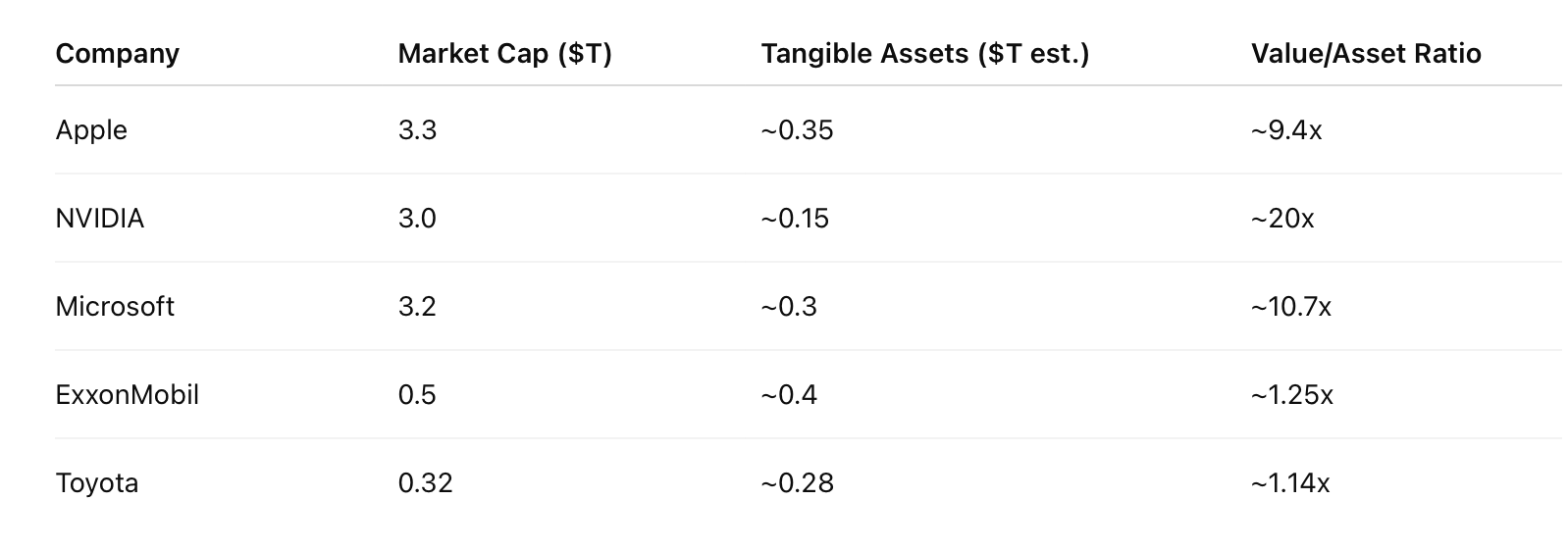
The world’s most valuable companies today are those whose worth is built on invisible assets: networks, platforms, data, software, and trust. While traditional companies still generate significant cash flows, their capital intensity reduces scalability, and they often lack the exponential upside of intangible-driven businesses.
This comparison clearly shows that the market now rewards scalable ideas over physical scale, ecosystem control over asset ownership, and innovation capacity over industrial capacity.
The Invisible Advantage
In this world, competitive advantage doesn’t come from owning the factory—it comes from owning the idea. The data. The interface. The standard. The narrative.
For business leaders, this demands a shift in mindset:
-
Invest in the invisible: Brand, culture, community, and IP need the same strategic focus as factories once did.
-
Measure what matters: New metrics are needed to assess intangibles—from innovation velocity to brand trust to ecosystem health.
-
Build ecosystems, not empires: Collaboration becomes more powerful than control.
-
Adapt relentlessly: In a fast-changing world, intangible businesses are more fluid, experimental, and resilient.
The most valuable businesses of our age don’t look like businesses of the past. They are invisible businesses—defined by what you can’t see but can feel, experience, and benefit from. Their value lies in relationships and data, in trust and creativity, in community and code.
As the intangible economy continues to grow, companies that understand and embrace this invisible logic will lead the way—not just in valuation, but in relevance, resilience, and reinvention.
Examples of Invisible Companies
- ByteDance: The Chinese parent of TikTok has no physical products but has built a global empire on attention, algorithms, and user engagement. Its true asset is its recommendation engine—an invisible force that keeps users hooked, informed, and entertained.
- Klarna: This Swedish fintech firm enables “buy now, pay later” services. Its value lies in its software, consumer trust, and partnerships with retailers—not in any bricks-and-mortar footprint.
- Canva: The Australian design platform makes design accessible to anyone, anywhere. It owns no creative agencies, but its intuitive interface, templates, and brand assets make it indispensable to millions of users. It’s real assets? Usability, community, and vision.
- Arm Holdings: Arm doesn’t make chips—it designs them. Its intellectual property is licensed to nearly every chipmaker in the world, from Apple to Qualcomm. The company’s value is entirely based on IP, talent, and standards.
- Nubank: This Brazilian digital-first bank has scaled rapidly without branches. Its key assets? A user-friendly app, an iconic brand, and trust among young Latin Americans underserved by traditional banks.
- Stripe: The payments infrastructure firm simplifies online transactions for millions of businesses. It owns no physical point-of-sale systems—but it owns the trust of the digital economy.
Profiles of Invisible Companies
Airbnb, Unlocking Trust
Airbnb has built a global hospitality empire without owning a single hotel. Its core asset isn’t real estate—it’s trust. From its early days, Airbnb recognized that enabling strangers to stay in one another’s homes required more than a clever platform. It needed to create a global sense of safety, community, and emotional connection. By investing heavily in design, reputation systems, host standards, and a narrative around “belonging,” Airbnb turned trust into its most valuable currency.
Its brand identity—rooted in local experiences and authentic connections— differentiates it from traditional hotel chains. Features like verified ID, guest reviews, and Super host status create reputational capital. Meanwhile, data from millions of stays feeds into pricing algorithms, fraud detection, and personalized recommendations. Airbnb’s flywheel is intangible: more trust leads to more listings, more guests, better data, and greater network effects.
During the COVID-19 pandemic, Airbnb doubled down on community. While travel plummeted, it nurtured its brand and experience design, supporting hosts and pivoting to long-term stays and online experiences. This intangible focus allowed Airbnb to emerge stronger, culminating in one of the most successful tech IPOs of the decade. Its physical footprint may be light, but its intangible ecosystem—trust, brand, and community—is enormous.
BYD, Building Ideas
BYD (Build Your Dreams), China’s electric vehicle and battery giant, has quietly become one of the most valuable and innovative manufacturers in the world. While its competitors emphasize scale and hardware, BYD’s real strength lies in mission, culture, and intellectual property.
Founded in 1995, BYD began with rechargeable batteries, later expanding into EVs and energy storage. Today, it produces not just cars, but entire clean energy ecosystems. Its success is rooted in deep in-house R&D, holding more than 40,000 patents globally. But beyond patents, BYD’s innovation edge comes from cultural alignment. It operates under a clear mission: to “cool the earth by 1°C.” This shared purpose fosters internal cohesion and long-term thinking.
BYD has vertically integrated most of its operations, but not to control supply chains—instead, to protect its core intangible capabilities in software, powertrain design, and battery tech. It is now exporting vehicles and tech worldwide, surpassing Tesla in EV unit sales in 2023.
Its intangible strength lies not just in technical knowledge, but in how that knowledge is embedded in its culture and purpose—a model for mission-driven innovation at scale.
Canva, Embracing Community
Australia’s Canva is a breakout SaaS success story built entirely on design simplicity, user experience, and community. Founded in 2013, Canva set out to democratize design for non-designers. It didn’t compete with Adobe on technical depth—instead, it focused on intuitive UX, brand templates, and cloud collaboration. This user-first design became its key intangible asset.
Canva’s growth has been driven by viral loops: users invite collaborators, share designs, and embed Canva content across the web. It has also built an emotional connection through a mission of empowerment—making everyone feel like a creator. Canva now supports 170+ languages, with over 175 million users worldwide.
Beyond product simplicity, Canva has nurtured an internal culture that emphasizes humility, learning, and impact. Co-founder Melanie Perkins often credits the company’s success to a relentless focus on culture and purpose.
Its valuation—exceeding $25 billion—reflects the value of its intangible ecosystem: loyal users, a trusted brand, design templates, cloud-based collaboration, and a culture that attracts top talent.
LVMH, Powered by Brands
LVMH Moët Hennessy Louis Vuitton is the world’s leading luxury group, and a case study in how brand equity, storytelling, cultural capital, and craftsmanship can drive enduring value. While its physical products—watches, handbags, wine—are beautifully made, the real value lies in perception, status, identity, and heritage.
LVMH owns over 75 brands across fashion, jewellery, cosmetics, and spirits— including Louis Vuitton, Dior, Tiffany & Co., Fendi, and Dom Pérignon. These brands trade on their legacy, exclusivity, and cultural resonance. LVMH carefully nurtures the intangible magic of each brand while using centralized platforms for digital, data, and retail operations.
CEO Bernard Arnault describes luxury as “the business of selling dreams.” This requires controlling not just design and distribution, but also intangible experience design: exclusive events, influencer partnerships, artistic collaborations, and storytelling that taps into desire and meaning.
LVMH invests heavily in human capital—artisans, designers, brand curators— recognizing that its value lies in symbolic power as much as physical product. Its pricing power, margins, and customer loyalty are grounded in decades (often centuries) of carefully cultivated emotional capital.
Nvidia, Accelerating Technology
Nvidia started as a GPU manufacturer, but has become a foundational company in the AI economy. Its rise is driven by a rare blend of technological imagination, ecosystem thinking, and platform innovation—a masterclass in unlocking and layering intangible assets.
Originally known for gaming graphics cards, Nvidia saw early the potential of GPUs in parallel computing. It built CUDA, a proprietary platform that allowed developers to write software for its chips. This transformed Nvidia from a component vendor into a core enabler of AI, autonomous driving, robotics, and the metaverse.
Today, Nvidia’s value comes not just from chip performance, but from the developer ecosystems, AI models, research partnerships, and software platforms it supports. It owns key layers in the AI stack, from hardware to simulation to neural network training.
Nvidia’s brand is synonymous with innovation—trusted by startups, academics, and tech giants alike. It has built a flywheel of technical leadership, community engagement, and platform lock-in. Its market value now rivals legacy hardware firms many times its size.
Nvidia doesn’t just build chips. It builds the future’s imagination infrastructure— intangible, invisible, yet incredibly powerful.
Ping An, Transforming Platforms
Ping An, one of China’s largest financial services companies, has transformed from a traditional insurer into a tech-driven ecosystem by investing in data, AI, platforms, and digital trust. Ping An has evolved from an insurance provider into a platform- powered technology and health ecosystem, redefining financial services through intangibles like data, algorithms, trust, and cross-sector integration.
The company’s core strategy hinges on “finance + technology” and “finance + ecosystem.” With over 220 million retail customers, Ping An uses AI and cloud infrastructure to personalize risk assessment, predict customer needs, and optimize lifetime value. The firm holds over 100,000 patents, most related to fintech, AI, and health tech.
Ping An Good Doctor, its AI-powered health platform, serves hundreds of millions of users. Its smart city solutions manage traffic, identity, and urban services in real time. These platforms generate intangible capital in the form of proprietary datasets, behavioural insight, and public trust.
Unlike many insurers that outsource tech or treat digital as a channel, Ping An has vertically integrated its data infrastructure and built a culture of digital-first thinking. Its value proposition is not just better insurance—but smarter, more holistic life solutions.
By reimagining itself as an AI-powered, ecosystem-based enterprise, Ping An has become one of the most forward-looking financial institutions in the world. Its real assets are invisible: platforms, people, and predictive intelligence.
Spotify, Unlocking Data
Spotify redefined music not by owning content, but by owning data, algorithms, and user experience. With over 600 million users and 200 million subscribers, Spotify’s power lies in how well it understands what people want to hear—and when.
Its algorithmic playlists like “Discover Weekly” and “Release Radar” generate intense engagement. Spotify collects listening data, mood, location, time of day, and device usage to personalize the experience in real time. This data flywheel is a potent intangible asset: more engagement means better data, which improves personalization, which boosts retention.
Spotify has also invested in audio storytelling—from podcasts to original content— shaping the future of sound and attention. It builds emotional bonds through shared playlists, artist fan experiences, and cultural relevance.
What makes Spotify unique is how it translates data into emotion and identity. In doing so, it’s not just streaming songs—it’s curating culture. Its intangible edge lies in combining data science, emotional resonance, and creative expression.
Tencent, Growing as Ecosystems
Tencent is one of the world’s most successful digital ecosystems, with value creation built not on products, but on platforms, data, networks, and trust. Best known for WeChat, China’s “everything app,” Tencent has created a digital operating system for everyday life—messaging, payments, gaming, commerce, content, and public services—within one unified interface.
What makes Tencent extraordinary is how it turns intangible relationships into exponential value. WeChat isn’t just a messaging app—it’s infrastructure. The platform handles over a billion daily users and connects families, businesses, governments, and brands. By embedding payment and service layers into chat, Tencent unlocked new business models powered by convenience, loyalty, and data.
Tencent also runs the world’s largest video game business through a network of internal studios and strategic investments (including Riot Games, Epic Games, and Supercell). It applies data-driven insights to iterate game features, optimize engagement, and drive in-game monetization.
At its core, Tencent’s strength lies in intangible assets: network effects, behavioural data, content IP, user habits, and ecosystem orchestration. Rather than controlling everything directly, it enables partners, startups, and developers to build inside its environment, turning scale into stickiness. Tencent doesn’t just create value—it multiplies it across networks.
Lamborghini was a tractor company. Samsung was a grocery store. Lego was a wooden toyshop. Nintendo made playing cards. LG was a facial cream. IKEA was a pen company.
In today’s fast-changing markets, the ability to reinvent yourself can often make the difference between thriving and fading into irrelevance. Reinvention isn’t just a buzzword—it’s a crucial survival strategy that allows companies to evolve in response to shifting market dynamics, changing consumer expectations, and disruptive technologies.
This reinvention can take many forms, from overhauling business models to reimagining a company’s purpose and vision. By embracing reinvention, organisations can chart new courses, seize emerging opportunities, and secure long-term success.
The need for reinvention
Most organisations are unlikely to survive the next 10 years, unless they reinvent themselves. Rapidly emerging technologies, evolving consumer attitudes and behaviours, and increasing competition all drive the need for businesses to adapt.
The average lifespan of companies in the S&P 500 has decreased from 67 years in 1920 to about 15 years today. This trend is expected to continue, with half of the companies in the S&P 500 predicted to be replaced within the next 10 years if current trends continue.
Traditional business models that once guaranteed success may now be insufficient in the face of new challenges. Companies that fail to reinvent themselves risk becoming obsolete. Conversely, those that embrace change can find new growth avenues, strengthen their competitive edge, and build deeper relationships with customers.
Reinvention is a response to this dynamic environment. It goes beyond mere improvement or iteration; it involves rethinking how a company operates, how it connects with customers, and how it delivers value. Reinvention can be intentional and strategic, or it can be a reaction to external pressures—economic shifts, technological advances, or shifts in consumer behaviour—that demand immediate change.
Great examples of reinvention
The business world abounds with stories of reinvention – both start-ups who quickly realise they need to adapt their initial dreams, to well established companies who ride with changing nature of consumers and markets. Instagram was originally called Burbn, enabling users to share their location, typically bars and restaurants. Youtube started as a video dating site called Tune In Hook Up.
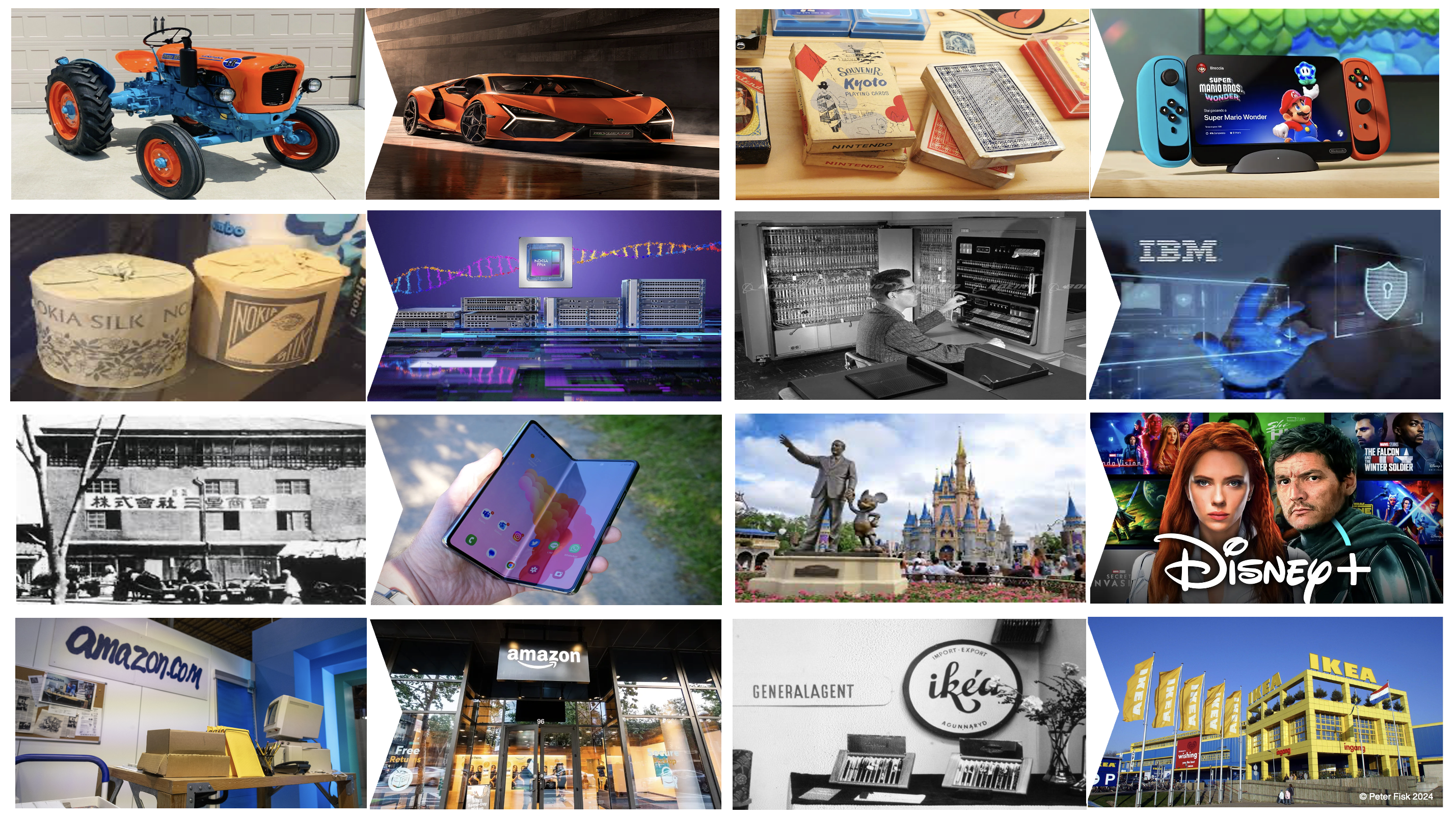
The best stories of reinvention are in larger companies. This is where a profound change in thinking is demanded to sustain long-term success. These companies realised that as the world changes, they have to change. Not just in creating new products and services, but in their fundamental purpose, sector, business model, strategy, organisation and culture:
- Nokia: from paper mill to a rubber company to a ship builder, to a telecoms business known for mobile phones and now focuses on network infrastructure.
- IBM: from hardware manufacturer to IT services and consulting firm, including cloud computing, and AI innovations like IBM Watson.
- Alibaba: from B2B e-commerce platform called China Pages into a consumer platform (AliExpress) to entertainment, online grocery (Hema), and healthcare.
- Disney: from animation and film production, into television, theme parks, and streaming platform with brands like Marvel and Star Wars.
- Samsung: from textiles and groceries into consumer electronics like the Galaxy mobile phone series, and one of the largest producers of semiconductors.
- Nintendo: from playing card manufacturer, into an iconic video game company behind franchises like Super Mario and Zelda.
- Grupo Bimbo: from a small Mexican bakery, to the world’s largest bakery products company (incl. Sara Lee and Entenmann’s) and health foods.
- Amazon: from online bookstore into an e-commerce “everything store”, to cloud services (AWS), streaming (Prime Video), and AI-driven logistics.
- Siemens: from electrical engineering and telegraphs, to digital infrastructure healthcare tech (Siemens Healthineers), and energy efficiency solutions.
- Natura: from cosmetics made from natural ingredients in Brazil, to a global portfolio of sustainable brands including Aesop and The Body Shop.
- Slack: from video game company called Tiny Speck with a game called Glitch to become a leading workplace collaboration and productivity tool.
- Tata: from steel and heavy industry, into automotive (eg acquiring Land Rover Jaguar), to hospitality, food and beverage, and a global technology provider.
- Netflix: from DVD rental by mail, into a streaming service and became a major content producer with award-winning original productions, and now gaming.
- Paypal: from online payments for eBay transactions, to a global digital payment platform, including peer-to-peer transfers (via Venmo), credit, and crypto.
- Shopify: from online store for snowboarding equipment, to become an e-commerce platform powering retail businesses worldwide.
Reinventing every aspect of business
Reinvention touches every facet of business: from strategy and business models to culture, leadership and performance. Below, we explore how each of these dimensions is being reimagined by forward-thinking organisations around the world:
Reinventing strategy … from predictive planning to adaptive platforms
Traditional strategic planning—anchored in stability, annual reviews, and five-year roadmaps—has given way to fluid, real-time strategy. In a world of relentless change, strategy must be a living process, where organisations continuously sense shifts in the market and respond fast.
DBS Bank in Singapore exemplifies this shift. Once a staid local bank, DBS has reinvented itself as a tech company with a banking license. Its “GANDALF” strategy (inspired by global tech giants) enables it to evolve its digital platforms, experiment with new ventures, and lead Asia’s fintech revolution. Strategic agility is now central, with teams empowered to pilot and scale ideas rapidly, aligned to customer needs and ecosystem opportunities.
Reinventing innovation … from R&D Labs to open ecosystems
Innovation can no longer be a siloed department—it must be embedded across the organisation and expanded into networks and ecosystems. The best innovators now blend human creativity with AI-powered insights, internal capabilities with external partnerships.
GitLab, a DevOps company born remotely, thrives by enabling distributed, transparent, and continuous innovation. Meanwhile, DeepMind, based in the UK, reimagines innovation through AI to solve complex problems—from protein folding to energy optimisation. The key is dynamic learning and collective intelligence.
Reinventing business models … from pipelines to platforms
The shift from ownership to access, products to services, and control to collaboration is redefining business models. Traditional linear value chains are giving way to ecosystem thinking and platform dynamics.
Shopify, a Canadian e-commerce company, didn’t just build a tool for online stores—it built a global platform where millions of merchants, developers, and partners co-create value. Its business model scales through network effects, embedded services, and third-party integrations. Similarly, Tesla disrupted the auto industry by integrating energy, software, and services into a vertically integrated platform model.
Reinventing brands … from identity to activism
A brand today is no longer just a logo or marketing message—it’s a vehicle for values, a social actor, and a lived experience. Customers expect brands to take a stand on societal and environmental issues, and deliver authentic value in every interaction.
Patagonia has redefined what it means to be a purpose-driven brand. From suing the US government over public lands to giving away ownership to fight climate change, the brand leads with bold actions. In South Korea, Amorepacificrepositions beauty as wellness and sustainability, aligning product innovation and brand storytelling with ecological responsibility.
Reinventing experiences … from transactions to transformations
Customers today don’t just buy products—they buy experiences, outcomes, and shared identities. Experience is the new differentiator. Reinvention means designing every touchpoint around the customer’s life—not the company’s processes.
Disney has masterfully reinvented its customer experience through Disney+, blending content, data, and personalization across digital and physical worlds. On Running, the Swiss sportswear brand, combines tech-infused shoes, sustainability stories, and community experiences to offer more than athletic gear—it sells a performance lifestyle with purpose.
Reinventing organisations … from hierarchies to networks
Rigid hierarchies and departmental silos stifle agility and innovation. The new organisation is a living system—flat, cross-functional, self-organising. It thrives on speed, fluidity, and empowered teams.
Haier in China has dismantled its traditional corporate hierarchy to become a “microenterprise” ecosystem—over 4,000 autonomous teams run as mini start-ups within the larger group. This radical decentralisation fosters entrepreneurship, responsiveness, and accountability at scale. In Europe, Spotify introduced “squads” and “tribes” to scale agile work structures globally.
Reinventing culture … from control to creativity
Culture is no longer a background issue—it’s the front line of transformation. Today’s high-performing cultures value experimentation, inclusivity, resilience, and purpose. Reinventing culture means building psychological safety, growth mindsets, and the freedom to challenge.
Netflix famously champions a culture of “freedom and responsibility.” Employees are trusted to act in the company’s best interest and empowered to make bold decisions. Unilever, meanwhile, embeds purpose at the core of its culture, training thousands of “purpose ambassadors” and linking employee engagement to social impact.
Reinventing leadership … from command to co-creation
The role of the leader is evolving—from visionary and controller to coach and catalyst. In volatile times, the most effective leaders are those who inspire, listen, learn fast, and lead through shared purpose.
Satya Nadella’s transformation of Microsoft is one of the clearest examples of leadership reinvention. He shifted the culture from know-it-all to learn-it-all, prioritised empathy and curiosity, and opened the company to partnerships and openness. In Africa, Phuthi Mahanyele-Dabengwa, CEO of Naspers South Africa, champions inclusive leadership, digital empowerment, and long-term innovation for impact.
Reinventing performance … from profit to progress
Finally, the definition of business success is shifting. Performance is no longer measured solely by short-term financial results, but by broader metrics of long-term value—social, environmental, and economic. The shift to stakeholder capitalism is redefining what great looks like.
Danone became the first listed company to adopt “Entreprise à Mission” status in France, embedding social and environmental goals into its legal structure. It tracks health, sustainability, and trust alongside revenue and margins. Meanwhile, Schneider Electric ranks as one of the world’s most sustainable companies, linking executive compensation to ESG outcomes.
Reinvention … as a Continuous Capability
What unites these examples is not a one-time pivot, but an ongoing capacity to reinvent. Reinvention is not a project—it’s a mindset, a muscle, and a method. It requires ambidexterity: the ability to exploit today while exploring tomorrow. It means building systems that sense and respond to change, and cultures that embrace uncertainty as a source of opportunity.
From Indian tech giants like Reliance Jio, creating a digital lifestyle ecosystem, to Nordic innovators like IKEA, rethinking circularity and low-carbon living, the future belongs to the reinventors—those willing to challenge themselves before the market does.
As Peter Drucker once said, “The greatest danger in times of turbulence is not the turbulence—it is to act with yesterday’s logic.” Reinvention is the antidote to irrelevance. In a world of relentless change, the only sustainable strategy is to stay in motion.
Business impact of reinvention
Reinventing a company can initially be about survival, but it is also about profitable growth, and also having a broader net positive impact on the environment and society. The impact of reinvention varies depending on the company, the industry, and the strategies adopted, but several studies and real-world examples show that companies can see significant benefits from transformation efforts. Below are some key statistics and examples of how reinvention can impact financial performance:
Companies that have successfully executed digital transformations can experience up to a 20% improvement in cash flow and 10-15% revenue growth on average. Additionally, they report a 30-50% reduction in costs due to efficiency improvements and better customer experiences. (McKinsey, 2022). Since embracing the Azure cloud platform, Microsoft’s cloud revenue surged. In Q2 2021, Azure grew by 50% year-over-year, helping Microsoft’s total revenue increase by 17%, and net income grew by 33%. By focusing on cloud computing, Microsoft transformed from a traditional software company into a dominant player in cloud services, with Azure contributing nearly 30% of its total revenue.
Companies that complete successful transformations outperform the market by 3x over a period of five years. Bain also found that about 70% of transformations fail, meaning that successful reinvention can produce outsized returns for companies that get it right. (Bain 2018). Between 2012 and 2022, Netflix’s market value increased from $8.5 billion to over $200 billion, reflecting a 25x increase in value. Its subscriber base grew from 23 million in 2011 to over 230 million in 2022. Revenue grew from $3.2 billion in 2012 to $31.6 billion in 2022, with net income growing from $226 million to $4.5 billion in that time.
Companies that embrace sustainability found that those with a focus on environmental, social, and governance (ESG) goals have outperformed the market by 3-6% annually over a 10-year period. These companies also see higher employee satisfaction and brand loyalty (HBR 2019). After acquiring The Body Shop in 2017 and Aesop in 2012, Natura’s revenue grew by 45% between 2017 and 2020, and the company became a leader in eco-friendly products. Natura’s focus on sustainability and natural ingredients has also led to higher customer loyalty and brand equity, resulting in strong market share in Latin America and globally.
Companies using data analytics to improve operations and customer experience are 5x more likely to make faster decisions and 3x more likely to achieve above-average profitability compared to their peers. Inditex, revolutionized the retail fashion industry by using real-time data analytics to quickly adjust inventory and respond to customer preferences. By integrating big data into its supply chain and production processes, Zara reduced inventory waste, shortened lead times, and improved profit margins. As a result, Zara has maintained high same-store sales growth and profitability. The company has grown from $10 billion in revenue in 2002 to over $32 billion in 2022, with operating profit margins consistently above 10%.
Leading the revolution
While reinvention can yield enormous rewards, it is not without its challenges. Companies must be willing to take risks, confront failure, and often make tough decisions about the direction of their business. Reinvention may require major investments in research and development, technology, or talent acquisition. Additionally, the need to balance short-term performance with long-term vision can be a difficult tightrope to walk.
One of the biggest challenges of reinvention is overcoming internal resistance to change. Employees and leaders alike may be attached to the company’s legacy practices and products. For successful reinvention, a company must foster a culture of innovation and openness to new ideas, even if they challenge the status quo.
Reinvention is a complex, multifaceted process that requires bold thinking, creativity, and leadership. Companies that successfully reinvent themselves are able to navigate changing market conditions, anticipate future trends, and build deeper connections with their customers. Whether it’s through redefining a business model, refreshing a brand, or embracing new technologies, reinvention is a key to enduring success in today’s fast-paced, ever-evolving business environment.
As we look to the future, businesses that are committed to reinvention will continue to be the ones that thrive—those that can reinvent their products, their organizations, and their leadership will set the stage for the next era of innovation and growth. Reinvention is not a one-time event; it is an ongoing process that requires continuous adaptation, learning, and forward thinking. It is the hallmark of resilient, forward-thinking companies that refuse to rest on their laurels and instead embrace the constant change that defines the modern business world.
Building a faster and more entrepreneurial organization to succeed in fast-changing markets is a multifaceted challenge that requires a comprehensive approach. Here’s a guide that draws from academic models and lessons learned from successful companies to help you on this journey:
10 ways to think and act like an entrepreneur
The pace of change in today’s markets is unprecedented. Technology advancements, globalization, and shifting consumer preferences mean that businesses must be agile and innovative to stay competitive. As a business leader, fostering an entrepreneurial mindset within your organization can drive creativity, quick decision-making, and resilience.
1. Customer inspiration
Start with a customer-centric approach that ensures that the organisation remains aligned with rapidly changing markets. It also embraces a problem solving approach, rather than just selling products. This involves:
- Understanding Customers: Continuous deep, formal and informal ways to gain more insight.
- Delivering Value: Creating products and services that meet customer needs and exceed their expectations.
- Building Relationships: Developing strong relationships with customers to enhance loyalty and retention.
Apple’s customer-centric approach is evident in its product design, retail experience, and customer support. By prioritising customer needs and delivering exceptional value, Apple has built a loyal customer base and a strong brand.
2. Founder spirit
Have a founder mindset, even in a large corporation. Not just the boss, everyone. An entrepreneurial culture encourages employees to take risks, think creatively, and act like owners. This culture can be cultivated through:
- Empowerment and Autonomy: Giving employees the freedom to make decisions and pursue innovative ideas.
- Rewarding Innovation: Implementing incentive systems that reward creativity and successful risk-taking.
- Learning from Failure: Encouraging a mindset that views failures as opportunities for learning and growth.
Google’s “20% time” policy, which allows employees to spend 20% of their time on projects of their choosing, has led to the development of successful products like Gmail and Google News. This policy fosters a culture of innovation and entrepreneurial thinking.
3. Technology enablers
Technology plays a crucial role in enabling agility and fostering an entrepreneurial spirit. By embracing digital transformation, organizations can streamline processes, enhance decision-making, and create new value propositions.
- Cloud Computing: Facilitates scalability and flexibility.
- Data Analytics: Provides insights for informed decision-making.
- Automation: Streamlines repetitive tasks, freeing up employees to focus on higher-value activities.
Netflix’s transition from a DVD rental service to a streaming giant was driven by its ability to leverage technology. By harnessing data analytics, Netflix offers personalized content recommendations, enhancing customer satisfaction and retention.
4. Work agility
Agility refers to the ability of an organisation to rapidly adapt to market changes. Anticipating change with more foresight, responding to change with speed. This concept is supported by various academic models:
- The Dynamic Capabilities Framework (Teece, Pisano, and Shuen, 1997) emphasizes the importance of an organization’s ability to integrate, build, and reconfigure internal and external competencies to address rapidly changing environments.
- The Lean Startup Methodology (Ries, 2011) advocates for a build-measure-learn approach, emphasizing continuous innovation and customer feedback loops.
Amazon’s ability to constantly innovate and adapt to market changes is a testament to its agility. By fostering a culture that encourages experimentation and rapid iteration, Amazon has successfully entered and dominated multiple markets, from e-commerce to cloud computing.
5. Fast teaming
Agile methodologies, originally developed for software development, can be applied across the organisation to enhance responsiveness and collaboration. But the real point is teams – small, fast, cross-functional, experimental teams:
- Iterative Development: Breaking projects into small, manageable iterations.
- Cross-Functional Teams: Encouraging collaboration among employees with diverse skill sets.
- Continuous Feedback: Regularly soliciting feedback to make improvements.
Spotify uses the “Spotify Model,” a framework that emphasizes squad autonomy, tribes, and chapters. This approach enables Spotify to innovate rapidly and respond to market changes efficiently.
6. Flat structure
An organization’s structure significantly impacts its ability to be agile and entrepreneurial. Consider the following strategies:
- Flat org: Reducing layers of management to speed up decision-making.
- Fluid work: Forming small, cross-functional teams focused on specific projects.
- Work together: Promoting open communication and collaboration across departments.
Zappos adopted a holacracy, a decentralized management system that replaces traditional hierarchies with self-organizing teams. This approach has empowered employees and fostered a more agile and innovative culture.
7. Growth mindset
Successfully navigating fast-changing markets requires effective change management. This involves:
- Communicating Vision and Strategy: Clearly articulating the organization’s vision and strategy to all employees.
- Engaging Employees: Involving employees in the change process to gain their buy-in and commitment.
- Providing Training and Support: Offering training and resources to help employees adapt to new ways of working.
Under CEO Satya Nadella’s leadership, Microsoft underwent a significant cultural transformation. By fostering a growth mindset, emphasizing collaboration, and embracing change, Microsoft revitalized its innovation capabilities and market position.
8. Ecosystem building
Collaborating with external partners can enhance an organization’s agility and entrepreneurial capabilities. Strategic partnerships and ecosystem building can provide access to new technologies, markets, and expertise.
- Partners: Let go of the all mindset that you need to own or do everything yourself.
- Open Innovation: Collaborating with external partners to drive innovation.
- Ecosystem Building: Creating a network of partners to co-create value, win-win.
Apple’s success is partly due to its extensive ecosystem of partners, including app developers, hardware suppliers, and service providers. This ecosystem enables Apple to innovate continuously and deliver integrated solutions.
9. Inspiring leadership
Effective leadership is crucial for building a faster and more entrepreneurial organization. Leaders should:
- Inspire and Motivate: Articulate a compelling vision that inspires and motivates employees.
- Lead by Example: Demonstrate the desired behaviors and values.
- Encourage Risk-Taking: Support employees in taking calculated risks and experimenting with new ideas.
Elon Musk’s visionary leadership has been instrumental in Tesla’s success. By setting ambitious goals and fostering a culture of innovation, Musk has driven Tesla to become a leader in electric vehicles and renewable energy.
10. Energising progress
Investing in employee learning and development is essential for fostering an entrepreneurial culture and staying competitive in fast-changing markets. Key strategies include:
- Continuous Learning: Encouraging employees to continuously acquire new skills and knowledge.
- Mentorship Programs: Pairing employees with mentors to provide guidance and support.
- Innovation Training: Offering training programs focused on creativity, problem-solving, and innovation.
Adobe’s “Kickbox” program provides employees with a toolkit for innovation, including a prepaid credit card to fund their projects. This program encourages employees to experiment and develop new ideas, fostering a culture of innovation.
Building a faster, more entrepreneurial organization to succeed in fast-changing markets requires a comprehensive and multifaceted approach. By embracing agility, fostering an entrepreneurial culture, leveraging technology, implementing agile methodologies, enhancing organizational structure, embracing change management, forming strategic partnerships, providing effective leadership, investing in learning and development, and prioritizing customer-centricity, business leaders can position their organizations for long-term success.
Incorporating lessons from academic models and successful companies, these strategies can help you navigate the complexities of today’s markets and drive sustainable growth. Remember, the journey towards building an agile and entrepreneurial organization is ongoing, requiring continuous learning, adaptation, and innovation.