Business futurist. Innovative strategist. Leadership advisor. Bestselling author. Inspiring speaker.
2026 is likely to be the moment when the “great experimentation” of the early 2020s matures into a period of deep structural accountability.
For business leaders, the coming year represents a shift from a world of boundless digital possibility to one of hard choices, where the divide between the winners and the laggards is defined not just by who has the best technology, but by who has the discipline to make it profitable.
As we move past the peak hype of generative AI and navigate a global economy characterized by persistent volatility, 2026 demands a strategy that balances radical innovation with operational ruthlessness.
Several powerful forces are converging to rewrite the corporate playbook.We are seeing the rise of agentic AI—autonomous systems that don’t just suggest content but execute complex business processes. At the same time, geopolitical tensions are forcing a transition toward “sovereign infrastructure,” where companies must prioritize regional resilience over global efficiency. Consumers, meanwhile, are retreating into a “two-speed” reality: a premium tier that values authenticity and human connection, and a value-conscious majority exhausted by years of inflationary pressure.
Why do these predictions matter to leaders planning for the months ahead? Because the margin for error has vanished. In a high-interest-rate environment, capital is expensive, and “growth at all costs” has been replaced by an urgent mandate for efficiency-led growth. Strategic planning for 2026 is no longer a top-down, annual ritual; it is a living, agile process. Leaders who fail to anticipate the “entry-level gap” created by automation, or who overlook the mandatory compliance of the circular economy, risk finding their business models obsolete before the year is out.
The following analysis explores the trends that will define 2026. These are not just “new technologies,” but applied solutions to the most pressing commercial problems of our time. For the modern executive, understanding these shifts is the difference between reacting to a crisis and orchestrating a transformation.
My Top 10 Business Agendas for 2026
Here are my top 10 business predictions for 2026, specifically considering the strategic business issues and agendas of leaders. Silver tech will see a big boom this year, and GenZ will get the hang of portfolio working, and we’ll see the death of bland AI content:
1. The “Agentic” Productivity Surge
The “pilot phase” of AI is over. By 2026, leading enterprises will have moved from simple chatbots to Agentic AI—autonomous systems capable of executing complex, multi-step workflows in finance, HR, and supply chain management. This shift moves AI from a “tool” to a “teammate,” necessitating a total redesign of corporate organizational structures.
2. The Great Efficiency Mandate
As the “AI bubble” faces scrutiny, 2026 is the year of ROI or Bust. Investors and boards will stop rewarding AI “potential” and start demanding measurable gains in margin and cycle times. Technology leaders (CIOs) will be tasked with bailing out failed business-led AI projects and proving that tech spend is directly linked to business value.
3. Divergent Consumer Markets
Consumer behavior will reflect a deep “K-shaped” split. While high-income tiers benefit from “wealth effects” of a resilient stock market, the broader global population is “volatility numb”—exhausted by years of inflation. Leaders must balance a “premiumization” strategy for the top end with “extreme value” and private-label offerings for the middle and bottom.
4. Sovereignty-by-Design Supply Chains
Geopolitical fragmentation is no longer a risk to manage; it is the new baseline. Companies are shifting toward “technology sovereignty,” prioritizing regional data centers and domestic chip supply. “Friend-shoring” is evolving into “Sovereign Infrastructure” as businesses insulate themselves from US-China trade tensions and potential tariff shocks.
5. The “Human Premium”
With AI-generated social media personas and content becoming indistinguishable from reality, authenticity is the new luxury. Brands that can guarantee human-led customer service, “verified human” creative work, and radical transparency will command a significant price premium in an increasingly “synthetic” digital world.
6. Clinical and High-Tech Wellness
The “wellness” trend is shedding its “woo-woo” image and becoming medically validated. Consumers in 2026 are demanding clinical-level, data-driven health solutions—from GLP-1 integrations in food/fitness to wearable tech that provides real-time, professional-grade diagnostic insights.
7. New Trade Hubs
While traditional markets like the US and China face “shaky” expansion, new strategic hubs are maturing. Saudi Arabia, the UAE (GCC), India, and ASEAN will emerge as the primary priority for global expansion, fueled by massive government-backed digital transformation agendas and “Vision 2030” style investments.
8. The “Entry-Level Gap” in Talent
AI’s ability to perform junior-level tasks (coding, research, basic analysis) has created a leadership pipeline crisis. Businesses will struggle to train future executives because the “grunt work” that traditionally served as a training ground is now automated. Leading firms will have to intentionally “manufacture” experience for junior talent.
9. Circular Economy beyond ESG
Sustainability is moving from “optional ESG” to hard-coded compliance, particularly with the EU Circular Economy Act taking effect. Forward-thinking leaders are turning this into a strategy, shifting from “selling products” to “Product-as-a-Service” models that maximize material reuse and reduce exposure to commodity price volatility.
10. The Rise of “Sanaenomics”
While the US remains an outperformer, 2026 will see divergent global growth. Japan is expected to see a “renaissance” driven by corporate reforms and “Sanaenomics” (policies of PM Sanae Takaichi), while European equities may become more attractive as they catch up on the credit cycle and fiscal stimulus.
My Top 10 Inspiring Companies for 2026
There are so many bold and brave, innovative and transforming companies to be inspired by. Last year I visited Climeworks, the Swiss carbon capture business, with its huge Mammoth facility in Iceland. Other inspiring companies including Polestar, often called the iPhone of EVs for its design-led approach to the EV revolution. And then there are companies like PingAn, the Chinese insurance giant, who has created the world’s largest digital healthcare platform, plus equally impressive businesses in mobility and real estate. Here are 10 who I think will inspire us this year:
1. BYD (China) … Clean Energy Transition at Scale
BYD is building a vertically integrated clean-energy ecosystem, spanning electric vehicles, batteries, energy storage, solar, and charging infrastructure. It is electrifying public transport and urban mobility in emerging markets while driving down costs across the energy system.
dLocal enables global brands to accept local payments in emerging markets, providing settlement in local currency. By solving fragmented payment systems, it unlocks massive new consumer markets and bridges local demand with international commerce.
3. Figure (USA) … General-Purpose Robotics
Figure is developing humanoid robots capable of performing multiple tasks in industrial and commercial environments. Its goal is to introduce general-purpose physical intelligence at scale, potentially transforming warehouses, factories, and logistics operations.
4. Insilico (China) … AI-Powered Drug Discovery
Insilico uses generative AI and automated lab platforms to discover, design, and optimise new drug candidates. With AI-designed compounds already entering clinical trials, it is proving that artificial intelligence can deliver real-world therapeutic breakthroughs.
5. M-Kopa (Kenya) … Inclusive Energy & Credit Identity
M-Kopa provides pay-as-you-go solar energy, mobile payments, and credit-building services for underserved populations. Its model combines affordability with financial inclusion, creating scalable solutions for energy access in emerging markets. It builds on earlier mobile-based innovations like M-Pesa the first app for money transfers.
6. Nvidia (USA) … Foundational AI Compute Platform
Nvidia powers the AI revolution with GPUs, software frameworks, and developer ecosystems. Its platforms are becoming the foundation for AI in industries ranging from healthcare to robotics, logistics, and autonomous systems.
Palantir helps organisations integrate complex, fragmented data and transform it into actionable insights. Its AI-driven platforms are used in defence, finance, healthcare, and logistics to improve operational decisions at scale.
8. Spiro (UAE) … EV and Battery-Swap Mobility Ecosystem
Spiro is deploying electric motorcycles with a battery-swapping network for African cities. Its system tackles emissions, reduces fuel costs, and provides scalable urban mobility solutions for emerging markets.
9. SpaceX (USA) … Space Infrastructure & Global Connectivity
SpaceX is building space-based infrastructure through Starship launches and the Starlink satellite constellation. It is redefining global connectivity, satellite deployment, and commercial space access. This year’s likely IPO promises to supercharge progress.
10. Withings (France) … Continuous Health Optimisation
Withings develops connected health devices that monitor vitals and provide actionable insights. Its ecosystem supports preventative healthcare, enabling consumers to manage wellness in daily life rather than relying solely on episodic medical care.
My Top 10 Consumer Trends for 2026
There’s a huge number of trend reports produced every new year, and I curate them all in my Trend Kaleidoscope 2026. What I do, is take the longer-term signals, or megatrends, then look at what will be most pronounced over the shorter term, and thereby avoiding some of the fads and hype of other reports.
1. Life optimisation as a daily habit
Wellness evolves from occasional interventions into continuous optimisation. Consumers track sleep, energy, stress, metabolism, and mental wellbeing, expecting brands to help them improve everyday performance and long-term health, not just treat problems.
Example: Withings (France) is building a connected health ecosystem — smart scales, blood pressure monitors, and wearables — that turns daily data into actionable health guidance via subscriptions.
2. Simplicity turns into a status symbol
In a world of endless choice and digital noise, clarity and restraint signal quality. Consumers increasingly trust brands that curate, edit, and remove friction rather than overwhelm them with options.
Example: Aesop (Australia) limits product ranges, uses clear functional language, and designs calm retail environments, turning simplicity into a premium brand asset.
3. Identity-first brands replace mass appeal
Consumers no longer expect to fit into brands; they expect brands to reflect their identity, culture, and values. Loyalty is built through belonging, not scale.
Example: Telfar (USA) has built a global following by positioning itself as inclusive and community-led, with scarcity and cultural relevance replacing traditional luxury cues.
4. Socialising without overindulgence
Drinking culture and nightlife are being redefined. Consumers, especially younger generations, prefer moderation, alcohol-free options, and daytime social rituals that support physical and mental wellbeing.
Example: Seedlip (UK) created a premium non-alcoholic spirits category, reshaping social occasions without framing abstinence as sacrifice.
5. Food as a daily health intervention
Food and drink are expected to deliver measurable functional benefits — from gut health and immunity to cognition and energy — while still providing pleasure and familiarity.
Example: Yakult (Japan) continues to grow globally by positioning probiotics as a simple, science-backed daily habit rather than a specialist supplement.
6. Retail and hospitality become human spaces, again
After years of digital acceleration, consumers value physical experiences that offer learning, repair, community, and presence, not just transactions.
Example: Ikea (Sweden) is transforming stores into community hubs with workshops, repair services, and circular economy initiatives that encourage participation.
7. AI becomes an invisible consumer partner
AI shifts from novelty to infrastructure, quietly supporting consumers by anticipating needs, simplifying choices, and personalising experiences without demanding attention.
Example: Alibaba (China) uses AI across commerce, logistics, and content to personalise discovery, pricing, and recommendations at massive scale.
8. Trust demands radical transparency
Sustainability and ethics are no longer about claims; they are about proof, traceability, and accountability. Consumers expect evidence they can see and verify.
Example: Everlane (USA) built its brand on radical transparency, openly sharing product costs, factory conditions, and sourcing decisions.
9. Emerging-market brands redefine global leadership
Innovation is no longer dominated by Western brands. Consumers increasingly adopt Asian, African, and Middle Eastern brands that combine speed, value, and cultural relevance.
Example: BYD (China) is becoming a global consumer brand by making electric vehicles affordable, reliable, and accessible at scale.
10. Brands compete on sensory and emotional depth
In a saturated market, differentiation comes from emotion, storytelling, and sensory richness, not just functional superiority.
Example: Rituals (Netherlands) transforms everyday products into meaningful routines through scent, narrative, and immersive store design.
My Top 10 Innovation Trends for 2026
In 2026, the global business landscape has shifted from “what is the new technology?” to “how do we apply it to solve specific, high-stakes problems?” Innovation is no longer about the labs; it is about the strategic redesign of business to survive volatility and capture new types of value. Here are the top 10 strategic business innovation trends for 2026:
1. Agent-First Operations
The primary strategic shift is moving from “people using tools” to “people orchestrating agents.” Businesses are moving beyond simple automation to agentic AI systems that plan and execute entire workflows (like complex tax reconciliation or supply chain rerouting) with minimal oversight.
Problem Solved: Breaking the “hiring-to-growth” link where scaling revenue used to require scaling headcount.
Example: HPE (Global) has moved from solving single pain points to an “end-to-end” transformation where agentic workflows handle procurement and finance, freeing humans for high-level negotiation.
2. Radical Sourcing Resilience
Due to geopolitical volatility and tariff pressures, the “lowest cost” supply chain is dead. Strategic innovation now focuses on “Sovereign Infrastructure”—building redundancy through a mix of hyperlocal microfactories and localized data centers.
Problem Solved: Reducing exposure to cross-border trade shocks and energy grid failures.
Example: Unilever (Global) uses AI-driven scenario planning to stress-test their supply chain against climate and political disruptions, shifting sourcing to regional “safety nets.”
3. Circular “Product-as-a-Service” Models
Driven by the EU Circular Economy Act, companies are innovating by retaining ownership of products and selling the service instead of the physical good. This turns “waste” from a liability into a high-margin raw material for the next cycle.
Problem Solved: Mitigating commodity price spikes and meeting mandatory sustainability disclosures (Scope 3 emissions).
Example: H&M and IKEA (Europe/Global) have scaled “recommerce” and repair-as-a-service, turning used furniture and clothing into a $1B+ revenue stream rather than a landfill cost.
4. The “Human Premium” Branding
In a world saturated with AI-generated content, businesses are strategically innovating by doubling down on human authenticity. This involves “Verified Human” labels and artisanal, non-automated customer tiers.
Problem Solved: Declining trust and “digital fatigue” among high-net-worth consumers.
Example: Premium retail brands (Japan/Italy) are implementing “Human-Only” support tiers where customers are guaranteed a high-EQ, expert human interaction without any AI intervention.
5. Hyper-Frequency Pricing
Innovators are moving from quarterly or monthly pricing reviews to granular, real-time margin management. Using high-frequency data, companies adjust prices daily based on specific “tariff drift” and local demand spikes.
Problem Solved: Protecting margins in an environment where trade costs (tariffs) and inflation are erratic.
Example: Large Electronics Wholesalers (US) now link real-time tariff data directly to their pricing dashboards to prevent “margin bleed” from upstream cost shocks.
6. Bio-Fused “Clean-Tech” Materials
Innovation is shifting from “software fixes” to biological solutions. Companies are using synthetic biology to grow packaging, fabrics, and even construction materials that are carbon-negative and perform better than plastic.
Problem Solved: Decoupling manufacturing from petroleum-based supply chains.
Example: Mistral AI and Recursion (Global) are partnering to use AI to discover new sustainable materials and drugs, slashing the R&D timeline for new physical products by 70%.
7. The “Tribal” Expansion Model
In emerging markets, businesses are abandoning top-down Western management for “Tribal Networking.” This involves partnering with small, powerful local collectives to navigate regional complexities.
Problem Solved: High failure rates of global brands attempting to enter fragmented markets like Africa and Southeast Asia.
Example: Female-led “Tribes” (Africa/Middle East) are being used as a new networking and empowerment model by global firms to consolidate local market shares through community-led trust.
8. Augmented Talent Yield (The “10x Employee”)
Innovation in HR has moved from “hiring talent” to “multiplying talent.” Companies are redesigning roles so that one senior expert, aided by an AI “shadow team,” can output what an entire department used to produce.
Problem Solved: The “Entry-Level Gap” where AI has replaced the junior roles that traditionally fed the talent pipeline.
Example: SoftBank (Japan/LatAm) reported cutting $24M in costs by reskilling their existing workforce as “AI-augmented architects,” increasing individual output tenfold.
9. Embedded and Invisible Finance
Companies that were not “banks” are now integrating finance into the core user journey. By 2026, invisible finance(lending, insurance, and payments embedded in a product) has become the primary driver of customer loyalty.
Problem Solved: High customer acquisition costs and friction at the point of sale.
Example: MercadoLibre (Latin America) has evolved its “Mercado Pago” from a payment tool into the primary banking rail for the continent, solving the “unbanked” problem with an all-in-one ecosystem.
10. AI Sovereignty and Data Localism
Strategic leaders are moving away from “The Public Cloud” toward Localized AI Safety Nets. This involves owning the physical infrastructure where AI models reside to ensure data privacy and regulatory compliance (like the EU AI Act).
Problem Solved: Legal and ethical risks of “black box” AI making biased or illegal decisions with proprietary data.
Example: IBM and Deloitte (Global) are helping enterprises build “AI Studios”—centralized hubs that govern every AI interaction, ensuring agents “show their work” for regulatory audits.
My Top 10 Leadership Priorities for 2026
In a world defined by AI acceleration, geopolitical volatility, climate pressure, and continuous business reinvention, business leaders need to move from being decision-makers of continuity, managing and optimising the status quo, to leaders as architects of adaptive systems. They need to be able to sense change early, act courageously, mobilise others, and continuously reinvent themselves and their organisations. These are not soft traits, just a mindset, but demand new leadership capabilities.
1. Strategic foresight as a core leadership discipline
Leaders must move beyond annual planning to continuous sensing and sense-making. This means scanning weak signals, tracking exponential technologies, anticipating second- and third-order effects, and using scenarios to guide decisions. Foresight becomes less about prediction and more about preparedness and optionality. Leaders need to be futurists and visionaries, but also practical implementers. They need to be “performer transformers/”
Development focus: Futures thinking, scenario design, strategic storytelling, portfolio thinking.
2. Courageous leadership in an age of uncertainty
2026 will reward leaders who can make bold, asymmetric bets without complete data—whether exiting legacy businesses, investing ahead of demand, or challenging entrenched power structures. Courage is increasingly about acting early, not waiting for certainty. Stop using uncertainty as an excuse for indecision or inaction.
Development focus: Decision-making under uncertainty, ethical courage, constructive conflict, conviction-building.
3. Personal agility and continuous reinvention
Leadership advantage will come from those who can unlearn, relearn, and reinvent themselves faster than the context changes. Static leadership identities are becoming liabilities. Leaders must treat their own skills, mindsets, and roles as dynamic assets.
Development focus: Learning agility, adaptive leadership, identity flexibility, energy and resilience management.
4. Embracing complexity, positively
Many leaders still try to “simplify” complexity. In 2026, effective leaders will embrace ambiguity, manage paradoxes (short vs long term, exploit vs explore, global vs local), and design systems that can evolve rather than be controlled.
Development focus: Systems thinking, complexity leadership, paradox management, ecosystem orchestration.
5. Curiosity as a strategic advantage
Curiosity shifts from a personality trait to a competitive capability. Leaders must ask better questions, explore adjacent possibilities, and actively seek perspectives from outside their industry, geography, and generation.
Development focus: Question-led leadership, ethnographic listening, cross-industry exploration, beginner’s mindset.
6. Innovative thinking beyond products
Innovation in 2026 is less about “ideas” and more about reimagining business models, experiences, ecosystems, and value creation. Ecosystems give organisations the ability to go further, faster. No longer are they limited by their own capabilities. Similarly value-based thinking (thinking long-term economic value creation, rather than just short-term profitability) creates a larger, richer frame to innovate. Leaders must foster environments where experimentation is safe, fast, and connected to strategy.
Development focus: Design thinking, experimentation, portfolio innovation, scaling innovation across the core.
7. Leading AI-enabled organizations
Leaders do not need to be technologists—but they must understand how AI reshapes decision-making, power, productivity, and ethics. The key leadership challenge is integrating human judgment with machine intelligence. This also means leaders embracing AI in how they manage performance and organisations, for example in building foresight, addressing complexity, unlocking realtime analytics and agility.
Development focus: AI literacy, human–machine collaboration, data-informed leadership, responsible AI governance.
8. Orchestrating transformation, not managing change
Transformation is no longer a one-off program. Leaders must continuously orchestrate multiple, overlapping transformations—digital, cultural, sustainability, organisational—while keeping the business performing. “Change management” practices largely belong to an incremental, occasional, improvement world, rather than one that requires significant reinvention and transformational progress.
Development focus: Transformation architecture, change velocity, narrative leadership, execution through ecosystems.
9. Mobilising purpose into performance
Purpose in 2026 must move from aspiration to operating system. Leaders need to translate purpose into strategy, incentives, innovation priorities, and daily decisions, especially as employees and customers demand authenticity. Purpose is partly about sustainability, but also more. The bigger direction and impact of the organisation. Similarly sustainability is about more, moving beyond CSR and ESG to develop regenerative strategies for a better world, as a core business model.
Development focus: Purpose-driven strategy, values-based trade-offs, impact measurement, trust-building.
10. Developing the next generation of leaders, faster
The leadership pipeline must accelerate. Tomorrow’s leaders will emerge from unexpected places, with different motivations and expectations. Senior leaders must shift from being controllers to talent catalysts. In fact, we shouldn’t think of it as a heirarchical or even time-based progression. Next gen leaders bring new mindsets, capabilities and attitudes, which you need now.
Development focus: Coaching capability, inclusive leadership, apprenticeship models, distributed leadership.
My Top 10 Product Launches for 2026
In 2026, product launches are moving away from incremental updates and toward category-defining innovations. Following a year of heavy AI investment in 2025, the market is ready for hardware that natively integrates these capabilities.
Here are the top 10 most exciting product launches predicted for 2026:
1. Apple “iPhone Fold”
After years of speculation, 2026 is widely anticipated as the debut year for Apple’s first foldable device. Reports suggest a tablet-style fold with a 7.8-inch inner display, aimed at bridging the gap between the iPhone and iPad mini. Apple’s entry into this market is expected to standardize the “creaseless” display technology that competitors have struggled to perfect.
2. Nintendo Switch 2
While the hardware may debut in late 2025, 2026 will be the year of its “true” launch with a blockbuster software lineup. Expect titles like Grand Theft Auto VI (widely rumored for a 2026 release window) and the next 3D Super Mario to showcase the console’s reported 4K DLSS capabilities, making it the must-have entertainment device of the year.
3. Sony Honda Mobility “Afeela” EV
The joint venture between Sony and Honda is scheduled to deliver its first production vehicles to customers in 2026. This “Software-Defined Vehicle” features a massive panoramic screen, Epic Games’ Unreal Engine 5 for the UI, and Level 3 autonomous driving. It represents the first serious attempt by a tech giant to redefine the car as a “moving entertainment space.”
4. Meta “Orion” AR Glasses
Meta is expected to seed its first true Augmented Reality glasses, codenamed Orion, to developers and early adopters in 2026. Unlike the current “Smart Glasses” that only have cameras and audio, Orion features high-field-of-view holographic displays, allowing users to see digital objects anchored in the real world without a bulky headset.
5. OpenAI “Agentic” OS & Jobs Platform
OpenAI is projected to launch a dedicated “Operating System” for AI agents in mid-2026. This isn’t just a chatbot; it is a platform where autonomous agents can execute professional workflows—managing your taxes, booking travel, or even applying for roles on a new OpenAI Jobs Platform designed to match AI-skilled talent with verified enterprises.
6. BMW “Neue Klasse” iX3
2026 marks the arrival of BMW’s most important vehicle in decades. The iX3 will be the first to use the “Neue Klasse” platform, featuring 6th-generation battery tech that promises 30% more range and 30% faster charging. It includes “Panoramic Vision,” a head-up display that spans the entire width of the windshield.
7. Rivian R2 SUV
The R2 is Rivian’s “Model 3 moment.” Launching in the first half of 2026 with a starting price around $45,000, this compact SUV is designed to bring the brand’s rugged, high-tech aesthetic to the mass market. With over 300 miles of range and a focus on “adventure-ready” interior modularity, it is the most anticipated EV of the year for North America.
8. Apple Home Hub
Apple is reportedly readying a new category for the home: a smart display (potentially called HomePad) featuring a 7-inch screen and a new homeOS. Powered by an A18 chip, it will serve as the command center for Apple Intelligence in the household, using a robotic arm or swivel base to follow the user during FaceTime calls.
9. Samsung “Galaxy Z Tri-Fold”
To compete with Huawei’s Mate XT, Samsung is expected to launch its first triple-folding phone in 2026. This device would unfold into a 10-inch workspace, effectively replacing the need for a laptop or tablet for mobile professionals, and solidifying Samsung’s lead in high-end display engineering.
10. Tesla “Optimus” Gen 2
While still in development, 2026 is the target year for Tesla to begin low-volume commercial shipments of its Optimus humanoid robot to external industrial partners. These robots will likely be deployed in specialized logistics and assembly roles, marking the first time humanoid robotics moves from a “lab demo” to a “shippable product.”
My Top 10 Business Events for 2026
In 2026, the global business calendar shifts from “innovation for its own sake” to “innovation for survival.” Strategic events are no longer just networking opportunities; they are the arenas where new economic systems—shaped by AI agents, regional trade blocs, and climate mandates—are being formalized. Here is my take on the top 10 strategic business events of 2026:
1. The World Economic Forum (Davos) – The “Sovereign AI” Summit
Location: Davos, Switzerland (January 2026)
Strategic Focus: 2026 marks the year Davos shifts from discussing AI as a tool to AI as National Infrastructure. Expect major announcements regarding “Sovereign AI” funds, where nations (led by the Middle East and EU) partner with tech giants to build domestic data centers to ensure data and technological autonomy.
2. MWC Barcelona & 4YFN – The “Infinite AI” Launch
Location: Barcelona, Spain (March 2-5, 2026)
Strategic Focus: The theme “Infinite AI” dominates. This event will see the transition from Large Language Models (LLMs) to Agentic Systems that can act on behalf of businesses. It is a critical milestone for telecom and hardware leaders to showcase the “Edge AI” infrastructure required to run these agents locally on devices.
3. TiE Global Summit – The “Indo-Pacific Expansion” Gate
Location: Jaipur, India (January 4–6, 2026)
Strategic Focus: As the 10th anniversary of one of Asia’s largest entrepreneurship gatherings, this event serves as the primary gateway for Western firms looking to de-risk from China. The focus is on Cross-Border Scaling and how India’s “Digital Stack” can be exported to other emerging markets.
4. GITEX Africa – The “Leapfrog Tech” Milestone
Location: Marrakech, Morocco (April 7–9, 2026)
Strategic Focus: This has become the most influential business event for the MENA and African regions. In 2026, the strategy shifts toward Energy-Agnostic Tech—innovations that allow AI and digital banking to scale in regions with unstable power grids, showcasing a new “low-energy” blueprint for global business.
5. Responsible Business USA – The “Post-Hype” ESG Reset
Location: New York/Online (May 2026)
Strategic Focus: Following 2025’s regulatory tightening (like the EU’s CBAM), this event will focus on Mandatory Transparency. Strategic leaders will move away from “marketing-led sustainability” toward AI-powered, real-time ESG auditing that proves ROI to skeptical investors.
6. Money20/20 Europe – The “Invisible Finance” Convergence
Location: Amsterdam, Netherlands (June 2–4, 2026)
Strategic Focus: The central theme is Embedded Finance. Strategy leaders from retail, auto, and logistics attend to learn how to integrate “invisible” banking into their products. 2026 will specifically focus on the commercialization of Central Bank Digital Currencies (CBDCs) and their impact on B2B settlement speeds.
7. RAISE Summit – The AI Governance Accord
Location: Paris, France (July 8–9, 2026)
Strategic Focus: While other events focus on using AI, RAISE is where the Rules of the Game are set. Strategic leaders meet here to align on AI ethics, safety protocols, and “Verified Human” labeling standards, which will become a major competitive differentiator for brands in late 2026.
8. The G20 Summit – The “New Trade Hubs” Negotiation
Location: South Africa (Late 2026)
Strategic Focus: South Africa’s presidency will prioritize Global South Value Chains. For business leaders, the strategic event is the “Business 20” (B20) meeting, where new agreements on critical mineral processing (lithium, cobalt) are expected to bypass traditional US-China routes.
9. Web Summit Lisbon – The “Agentic OS” Reveal
Location: Lisbon, Portugal (November 2026)
Strategic Focus: Traditionally a startup fest, 2026 will see Web Summit evolve into a platform for Enterprise Re-Architecture. Major players are expected to debut “Agentic Operating Systems” that allow non-technical CEOs to manage their entire corporate “digital twin” from a single interface.
10. Slush – The “Founder-to-Agent” Shift
Location: Helsinki, Finland (November 19–20, 2026)
Strategic Focus: Known as the most founder-focused event, Slush 2026 will tackle the “Solo-Unicorn” phenomenon. Strategies will center on how small, highly-leveraged teams using autonomous AI agents are outperforming traditional mid-sized corporations in speed-to-market.
My Top 10 Business Failures for 2026
In 2026, the global business landscape is shifting from a period of high-interest rates and AI hype into a phase of brutal accountability. Business failures in this year are rarely about a lack of technology; they are about failed monetization, regulatory traps, and the inability to service debt in a “higher-for-longer” interest rate environment. Here are the top 10 predicted business failure archetypes for 2026:
1. The “AI ROI” Burnouts
The Failure: Mid-sized software-as-a-service (SaaS) companies that pivoted entirely to AI in 2024 but failed to prove tangible productivity gains to customers.
Why: Enterprise clients in 2026 are cutting “experimental” AI budgets. Companies that spent their cash reserves on expensive GPU clusters without a clear revenue model are facing “death by Capex.”
Example: Generic “AI wrapper” startups that added a chat interface to existing data but provided no proprietary value.
2. High-Debt Retailers (The Refinancing Wall)
The Failure: Legacy brick-and-mortar retailers with variable-rate debt or major bonds maturing in 2026.
Why: With interest rates remaining “sticky” around 3–4%, the cost of refinancing debt is 3x higher than when it was issued. Those with thin margins cannot absorb the interest expense.
Example: Global department store chains and furniture retailers struggling with high-cost physical footprints.
3. “Synthetic” Media Platforms
The Failure: Content platforms that relied 100% on AI-generated articles and videos to drive ad revenue.
Why: In 2026, Google and Meta’s algorithms have pivoted to favor “Verified Human” content. Synthetic sites are being “shadowbanned” or de-indexed, leading to a total collapse in traffic and ad spend.
Example: Mass-produced SEO “content farms” that were once profitable but lost 90% of their visibility overnight.
4. Fossil-Fuel Dependent Logistics
The Failure: Regional shipping and trucking firms that ignored the transition to green fuels or “Product-as-a-Service” models.
Why: The EU’s Carbon Border Adjustment Mechanism (CBAM) and similar global mandates in 2026 have made carbon-heavy logistics too expensive to be competitive in international trade.
Example: Smaller shipping lines in Southeast Asia and Eastern Europe that cannot afford the “Green Premium” for cleaner fuels.
5. Junior-Heavy Professional Services
The Failure: Law firms and accounting agencies that relied on billing high hourly rates for “junior” work (research, data entry, basic drafting).
Why: Clients in 2026 refuse to pay for work that AI agents now do in seconds. Firms that failed to move to “outcome-based pricing” are seeing their revenue pipelines evaporate.
Example: Mid-tier corporate law firms that haven’t restructured their partner-to-associate ratios.
6. The “Cyber-Insolvent” (Security Failures)
The Failure: Companies that suffer massive data breaches and lack the specialized “Cyber-Resilience” insurance required to survive.
Why: In 2026, a single breach doesn’t just result in a fine; it triggers a “Death by Litigation” scenario due to stricter global data privacy laws (like the evolved GDPR and US state laws).
Example: Fintech startups or health-tech apps that under-invested in encryption and lost consumer trust permanently after a hack.
7. Over-Leveraged “Green-Washing” Projects
The Failure: Sustainability startups that relied on selling low-quality carbon credits to stay afloat.
Why: The market for “avoidance” credits (saving trees) has collapsed in favor of “removal” credits (direct air capture). Companies with business models built on the old, unregulated carbon market are going bust.
Example: Carbon-offset brokers that failed to adapt to the new 2026 Global Carbon Standards.
8. The “Entry-Level Gap” Manufacturers
The Failure: Factories that failed to automate and are now facing a total lack of skilled human labor.
Why: As the workforce ages, the “Blue-Collar Renaissance” has driven wages so high that non-automated factories are no longer profitable.
Example: Traditional textile or garment manufacturers in developing nations that didn’t invest in “Cobotics” (human-robot collaboration).
9. Neo-Banks Without a Path to Profit
The Failure: Digital-only banks that focused solely on user growth rather than net interest margins.
Why: Investors in 2026 have zero patience for “growth at all costs.” Neo-banks that haven’t diversified into lending or high-margin insurance products are being swallowed by legacy banks for pennies on the dollar.
Example: High-profile European and Brazilian fintechs that failed to secure a full banking license.
10. Direct-to-Consumer (DTC) “Boutique” Brands
The Failure: Small-scale DTC brands that built their business on cheap social media ads.
Why: Advertising costs on platforms like Instagram and TikTok have tripled due to AI-driven competition. Without a physical retail presence or a massive “community” moat, these brands can no longer acquire customers profitably.
Example: Subscription box services and niche apparel brands with no physical “omnichannel” strategy.
My Top 10 Value Creators for 2026
Based on current market trajectories, earnings forecasts, and the shift from AI experimentation to full-scale monetization, these are the top my 10 companies predicted to lead worldwide market value creation in 2026 (with all the usual caveats that this is not investment advice, and market can go down as well as up) …
1. Nvidia
Est. Market Cap (Jan 2026): $4.60 T
Est. Market Cap (Dec 2026): $5.30 T
As the “picks and shovels” provider of the AI era, Nvidia enters 2026 with a massive order backlog for its Blackwell architecture. While the triple-digit growth of previous years may moderate, Nvidia remains the primary beneficiary of “Sovereign AI”—the trend of nations building their own domestic data centers. Their expansion into software and networking services provides a high-margin cushion that will likely sustain their lead in the race to the first-ever $5 trillion valuation.
2. Microsoft
Est. Market Cap (Jan 2026): $3.95 T
Est. Market Cap (Dec 2026): $4.85 T
Microsoft is positioned to be the primary “monetizer” of AI in 2026. After years of heavy capital expenditure, its Azure cloud platform and Copilot software suite are expected to show significant margin expansion as “Agentic AI” (autonomous systems) becomes a standard corporate requirement. With a diversified revenue stream spanning gaming, enterprise software, and cloud, Microsoft serves as the most stable “AI mega-cap” for global investors.
3. Alphabet
Est. Market Cap (Jan 2026): $3.75 T
Est. Market Cap (Dec 2026): $4.70 T
Alphabet is expected to outperform in 2026 due to its vertical integration. By using its own custom TPU chips to run Gemini 3.0, it can deliver AI services more cost-effectively than rivals relying on third-party hardware. Furthermore, 2026 is projected as a breakout year for Waymo, as the autonomous driving unit scales toward one million trips per week across 20+ cities, finally contributing a “valuation kicker” beyond search and ads.
4. Apple
Est. Market Cap (Jan 2026): $4.05 T
Est. Market Cap (Dec 2026): $4.65 T
Apple’s value creation in 2026 will be driven by the “AI Replacement Cycle.” As Siri 2.0 and “Apple Intelligence” become mature, hundreds of millions of users on older hardware will be forced to upgrade to AI-capable iPhones and Macs. This “supercycle,” combined with a high-margin Services business that continues to grow at double digits, ensures Apple remains a top-tier value creator despite slower growth in China.
5. Amazon
Est. Market Cap (Jan 2026): $2.45 T
Est. Market Cap (Dec 2026): $3.10 T
Amazon enters 2026 as a “high-quality compounder.” Its cloud division, AWS, has regained its growth crown by outperforming rivals in AI-native applications. Simultaneously, Amazon’s logistics network is yielding record profits through AI-driven regionalization. With newer catalysts like the Project Kuiper satellite program and medical pharmacy services reaching scale, Amazon is the strongest candidate to firmly enter the $3 trillion club.
6. Meta Platforms
Est. Market Cap (Jan 2026): $1.75 T
Est. Market Cap (Dec 2026): $2.30 T
Meta has successfully pivoted from a “social media company” to an “AI-recommendation engine.” In 2026, its investment in the Llama open-source model will pay dividends as it becomes the industry standard for developers. With advertising efficiency at an all-time high and new revenue streams coming from WhatsApp Business and Threads monetization, Meta is expected to see a significant “multiple rerating” by the market.
7. Broadcom
Est. Market Cap (Jan 2026): $1.65 T
Est. Market Cap (Dec 2026): $2.15 T
Broadcom is the “quiet giant” of the semiconductor world. As big tech firms like Meta, Google, and OpenAI seek to reduce their dependence on Nvidia, they are partnering with Broadcom to design custom AI chips (ASICs). In 2026, these custom silicon deals—including a massive multi-year partnership with OpenAI—are expected to propel Broadcom toward a $2 trillion valuation.
8. Eli Lilly
Est. Market Cap (Jan 2026): $1.05 T
Est. Market Cap (Dec 2026): $1.55 T
The pharmaceutical leader is expected to dominate 2026 through its GLP-1 franchise (Zepbound/Mounjaro). As supply constraints vanish and the drug is approved for new uses like sleep apnea and liver disease, Lilly’s revenue is projected to skyrocket. The anticipated launch of Orforglipron (an oral weight-loss pill) in late 2026 could be the final catalyst that makes Lilly the most valuable healthcare company in history.
9. TSMC
Est. Market Cap (Jan 2026): $1.50 T
Est. Market Cap (Dec 2026): $1.95 T
As the world’s indispensable foundry, TSMC is the ultimate bottleneck for global tech. By 2026, its 2nm (nanometer) mass production will be fully operational and reportedly already “sold out.” With the ability to hike prices on its most advanced nodes by 10%–20%, TSMC possesses unmatched pricing power that will translate into record earnings and a near-$2 trillion market cap.
10. MercadoLibre
Est. Market Cap (Jan 2026): $115 B
Est. Market Cap (Dec 2026): $165 B
While its total cap is smaller than the others, MercadoLibre is predicted to be a top percentage value creator. By 2026, its “Mercado Pago” fintech ecosystem will have moved beyond just payments to becoming a full-service digital bank for Latin America. Its 30%+ Return on Equity (ROE) and dominance in the region’s e-commerce make it the premier emerging market growth play for 2026.
If you’re a business leader reading this at the start of a new year, you are probably feeling two things at once: the tired refrain of “we must do more with less” and the electric promise that something genuinely different is arriving.
The paradox of our age is that constraint and possibility co-exist more intensely than ever. For leaders in 2026 the task is not simply to endure the level of uncertainty — it is to make a decisive, humane, strategic response: to shape a clear manifesto of what you will stop, start and double down on in the months ahead.
Below is my practical, optimistic and slightly provocative playbook of new year resolutions for leaders who want to thrive — not just survive — in 2026 and the years beyond.
Of course you’ll find lots more big ideas, bite-sized actions, and deep dives into leaders and companies getting it right — brought together through inspiring keynotes, practical workshops and leadership support at peterfisk.com.
The context … why 2026 demands a manifesto
We are not moving into a “new normal” so much as a world of ongoing re-definition. The engines of change — generative AI, new supply-chain architectures, climate pressures, demographic shifts, geopolitical competition and rapidly changing customer expectations — are accelerating. For leaders this means two simultaneous realities:
Technology is embedding itself everywhere. AI and machine learning are already present across core business functions: product, customer service, operations, HR and strategy. A large and growing share of organisations now report AI use in at least one function; but the jump from experimentation to scaled, enduring value is still work in progress. The use of AI is widespread, even if transformation at scale is rarer.
Innovation is not optional. The companies that lead their markets are not merely faster at iteration; they re-write the rules of how value is created. Lists of the world’s most innovative companies show that leadership in 2025-26 comes from combining technological depth with business model creativity. If you do not invest in purposeful innovation now, competitors will.
These two realities give us a simple leadership rule for 2026: be more human in your intent and more machine-smart in your execution.
A manifesto: 12 resolutions every leader should make for 2026
Below are twelve concrete, behavioural resolutions — a manifesto you can adapt for your organisation. Each comes with a short practical action and an example of how a leader might live it.
1. Resolve to make clarity your advantage
Why: In complexity, clarity is a compass. Without it, you are lost in change, and energy leaks into peripheral debates. Action: Publish a single-page strategic charter by end of Q1 that states your “where to play” and “how to win” for 2026, and cascade it into three measurable outcomes per team. Big choices give direction, while retaining agility. Leader example: A CEO announces three public outcomes (customer retention %, NPS and net new revenue from a new product) and links all Q1 OKRs to these metrics. The result: faster decision-making and 20% improvement in time-to-market.
Why: AI is an operational lever — powerful, but only when tied to human judgements. Action: Create a “value-first AI” map: list five business problems where AI could reduce cost, increase revenue or unlock strategic insight; pilot two, measure ROI in 90 days. Leader example: A retail COO uses AI to cut supply-chain waste and reduce stockouts. Early pilots show a 6–8% inventory efficiency gain — a clear financial justification for scale. (Remember: many organisations use AI; only some have it at scale).
Why: Speed without rhythm leads to exhaustion; rhythm without flexibility creates irrelevance. Action: Move to a tri-modal cadence — a weekly tactical check, a monthly strategic review, and a quarterly re-vision day dedicated to trends and bets. Leader example: An executive team swaps a bimonthly board update for a quarterly “future day” where external experts and customers brief the team; the board begins to fund two experimental bets every quarter.
4. Resolve to invest in human capital as a product
Why: Talent mobility and skill obsolescence mean roles — and careers — are becoming products you must design. Action: Create “skill pathways” for key roles (AI literacy, ecosystem partnerships, experience design), and allocate 3–5% of payroll to micro-learning and rotation programmes. Leader example: A services firm offers rotations that pair consultants with data scientists for six-week sprints. Retention and cross-selling increase.
5. Resolve to put purpose in your business model, not on your press release
Why: Sustainability and social licence are now business imperatives, not marketing decorations. Action: Translate one purpose objective into revenue terms (e.g. circular design reduces raw material spend by X) and report it publicly alongside financial KPIs. Leader example: A food manufacturer redesigns packaging for recyclability, reducing material cost and unlocking new retailer listings.
6. Resolve to redesign customer value as a continuous journey
Why: Customers prize flexibility, speed and human care; lifetime value comes from repeated delight. Action: Map customer journeys end-to-end, identify three “moments of truth” and apply design experiments to each. Leader example: A bank eliminates a 10-step mortgage process and replaces it with a two-hour “approval lane” supported by AI triage and human underwriters.
Why: Products increasingly live in networks of partners; the ability to orchestrate ecosystems creates defensibility. Action: Identify two partner categories (tech, distribution) and design a partner playbook that aligns incentives for customer outcomes. Leader example: A SaaS vendor launches a marketplace for integrations, turning the product into a platform and adding new recurring revenue streams.
Why: Incremental change won’t survive structural shifts; new models create optionality. Action: Dedicate a seed fund (1–2% of revenue) to test subscription services, “as-a-service” transformations, or outcome-based pricing. Leader example: A manufacturing firm pilots “machines-as-a-service” and discovers a 25% uplift in lifetime customer value.
9. Resolve to remove friction from the organisation
Why: Bureaucracy is expensive and slows adaptation. Action: Run a “friction audit” — a two-week process to map approvals, handoffs and decision delays; eliminate or automate the top three. Leader example: A company automates compliance checks with an AI agent, cutting approval times by half.
10. Resolve to make ethical design a board conversation
Why: Ethics and regulation will be strategic issues for AI, data use and customer trust. Action: Add an ethical risk score to all major initiatives and brief the board quarterly on ethical and regulatory posture. Leader example: A firm establishes an ethics committee that signs off on generative-AI use cases; this reduces reputational incidents and eases regulator discussions.
11. Resolve to reimagine performance for hybrid futures
Why: Output, not occupancy, must define performance in distributed organisations. Action: Replace time-based KPIs with outcome-based objectives; tie a portion of variable pay to cross-functional outcomes. Leader example: An insurer shifts underwriting KPIs from “cases processed” to “loss ratio improvements” and improves underwriting quality.
12. Resolve to take the courageous leap
Why: Many leaders will iterate; a few will leap. A courageous leap is a deliberate decision to commit resources to a future that is not yet visible. Action: Identify one transformative bet (new market, new capability) and create a six-month launch plan with committed funding and a rapid measurement cadence. Leader example: A European retailer commits to a full experiential overhaul of its flagship stores, integrating digital and physical experiences; footfall and conversion rates rise materially.
How to convert resolutions into a practical operating plan
Resolutions become meaningful when translated into the language of budgets, people and timelines. Use this simple three-part framework to operationalise your manifesto:
Signal (what you will be measured on) — Choose three organisation-level KPIs for 2026 (e.g. X% revenue from new offerings, Y% reduction in customer churn, Z% of decisions powered by AI).
Structure (who is responsible) — Assign an owner and a cross-functional delivery squad for each KPI; give them a light governance process and a fixed runway.
Speed (how you learn) — Adopt a 90-day sprint model with weekly learning check-ins and a hard stop for either scale or kill.
Two practical tools to adopt immediately:
A Strategy One-Pager for the whole company.
A Value-First AI Roadmap that links each pilot to a tangible business metric.
Data helps ground ambition in reality. Here are a few load-bearing statistics you should know as you plan for 2026:
AI usage is widespread but scaling remains work in progress. Recent industry surveys report that a very high share of organisations now use AI in at least one function, with many firms experimenting with AI agents and generative tools — but only a minority have scaled AI to capture full enterprise value. This dichotomy means leaders must focus on measurable pilots with the intent to scale.
Investment and hype outpace enterprise scaling. Private investment into AI ventures remains immense, and chip-makers and cloud providers are doubling down; yet some surveys note that only a modest proportion of companies have AI implemented at scale, underscoring the need for clear ROI and governance.
Innovation leaders are diverse and sector-spanning. Independent rankings of the most innovative companies show that leading firms combine deep technical capability with new business models and ecosystems — from Waymo in mobility to healthcare and consumer champions across many industries. If you want to learn how to lead in 2026, study the ways these firms combine focus with ecosystem play.
These are not theoretical points. They inform the choices in your manifesto: prioritise clear use cases for AI, insist on measurable pilots, and treat innovation as a repeatable operating competency.
Leaders to learn from, and what they will do in 2026
For leaders seeking practical illustration, it helps to look at people who are translating strategy into results today. Below are short, contemporary profiles of leaders — male and female, global in scope — and the kinds of moves they are likely to double down on in 2026.
Satya Nadella … the builder of platforms and productivity
Satya Nadella has steered Microsoft from a legacy software vendor to a platform leader where cloud and AI are central. Nadella’s consistent emphasis has been on empowering people and organisations through platforms that combine cloud scale with productivity tools. He frames AI as a productivity multiplier and stresses the need for responsible, measured adoption. In 2026, expect leaders like Nadella to press on with integrating AI across productivity stacks while investing heavily in security, customers and ecosystem partnerships.
Lesson: Invest in platform thinking: make your product the core of an ecosystem rather than a standalone point solution.
Jensen Huang … the energy behind AI infrastructure
Jensen Huang at Nvidia has made accelerated computing the backbone of the AI era. His public messages treat AI as infrastructure — as fundamental as electricity — and that framing has shaped investment and partnerships in 2024–25. In 2026, leaders attuned to Huang’s thinking will treat compute strategy and partnerships as strategic assets and will design products that anticipate rising compute needs.
Lesson: View technology infrastructure as strategic capital. Secure partnerships and invest early in capabilities that future use cases will demand.
Jane Fraser … the architect of disciplined global banking
Jane Fraser has reshaped Citigroup by confronting complexity head-on. As the first woman to lead a major U.S. bank, she has driven a multi-year simplification agenda — exiting non-core markets, tightening strategic focus, and reorganising Citi around a smaller number of global businesses where it can genuinely win. Fraser combines strategic toughness with cultural renewal, modernising risk, technology and talent while reinforcing client trust. In 2026, expect Fraser to double down on operational excellence, AI-enabled risk and compliance, and scalable wealth and institutional services that play to Citi’s global strengths.
Lesson: Simplification is a growth strategy. Focus your organisation on where it can lead — and execute relentlessly.
Debra Crew … the operator bringing discipline to iconic brands
Debra Crew brought deep operational rigour to Diageo, applying decades of experience from PepsiCo, Mars and consumer multinationals to one of the world’s most powerful brand portfolios. Her leadership emphasised execution, productivity and commercial performance at a time when global consumer companies faced inflation, shifting demand and supply-chain volatility. Crew’s tenure underscored how brand power alone is not enough without disciplined delivery. In 2026, leaders shaped by this approach will focus on portfolio optimisation, premiumisation with restraint, and data-driven route-to-market strategies that protect margins while sustaining brand equity.
Lesson: Even the strongest brands need operational discipline; execution is the multiplier of strategy.
Tan Su Shan … the scaler of digital banking and AI at work
Tan Su Shan represents the next generation of Asian banking leadership — pragmatic, technology-fluent and commercially focused. Having played a central role in DBS’s decade-long transformation into one of the world’s most digital banks, she now leads with a clear mandate: scale what works. DBS has embedded AI deeply across credit, risk, operations and customer engagement, delivering measurable financial impact rather than isolated experiments. In 2026, Tan will push further into AI-driven productivity, ecosystem partnerships and sustainable finance, reinforcing DBS’s reputation as a technology company with a banking licence.
Lesson: Digital transformation only matters when it delivers real economic value — scale proven use cases fast.
Elliott Hill … the restorer of sport, culture and brand energy
Elliott Hill returned to Nike with one defining advantage: deep institutional memory combined with a clear-eyed view of what had drifted. Having grown up inside Nike over decades, he understands that the brand’s power lies at the intersection of sport, performance and culture. His early moves signal a reset — refocusing on athletes, product innovation and emotional connection, while simplifying organisational layers and strengthening partnerships. In 2026, expect Hill to prioritise fewer, better innovations, sharper storytelling, and a more balanced approach between direct-to-consumer and wholesale channels.
Lesson: When brands lose momentum, return to first principles — purpose, product and the people you exist for.
Practical tools and rituals to embed the manifesto
Words without rituals slip away. Here are workshop formats and leadership rituals that embed change:
1. The 90-Day Value Sprint (two days to scope, eight weeks to pilot, two weeks to measure)
Kick-off with a cross-functional team and clear success metrics.
Use rapid MVE (minimum viable experiment) thinking: small, measurable, reversible.
Demo results to the leadership board and decide scale/stop.
2. The Future Day (quarterly)
Invite external provocateurs and customer panels.
Top three activities: scenario mapping, competitor micro-briefs, the bold bet review.
Use the day to shift course or amplify investment.
3. Ethical Risk Table (monthly)
A short, structured review of any AI, data or reputational risks arising from live projects.
Create a simple red/amber/green score and assign fixes.
4. The Talent Swap (micro-rotation)
Six-week rotations pairing business leaders with technologists.
Builds empathy and cross-functional capability.
These rituals transform manifesto words into managerial muscle.
The reinvention playbook … time to put it into practice
“Reinvention” can sound like marketing candy. In practice, reinvention is an engineered process. Here is a condensed playbook you can use:
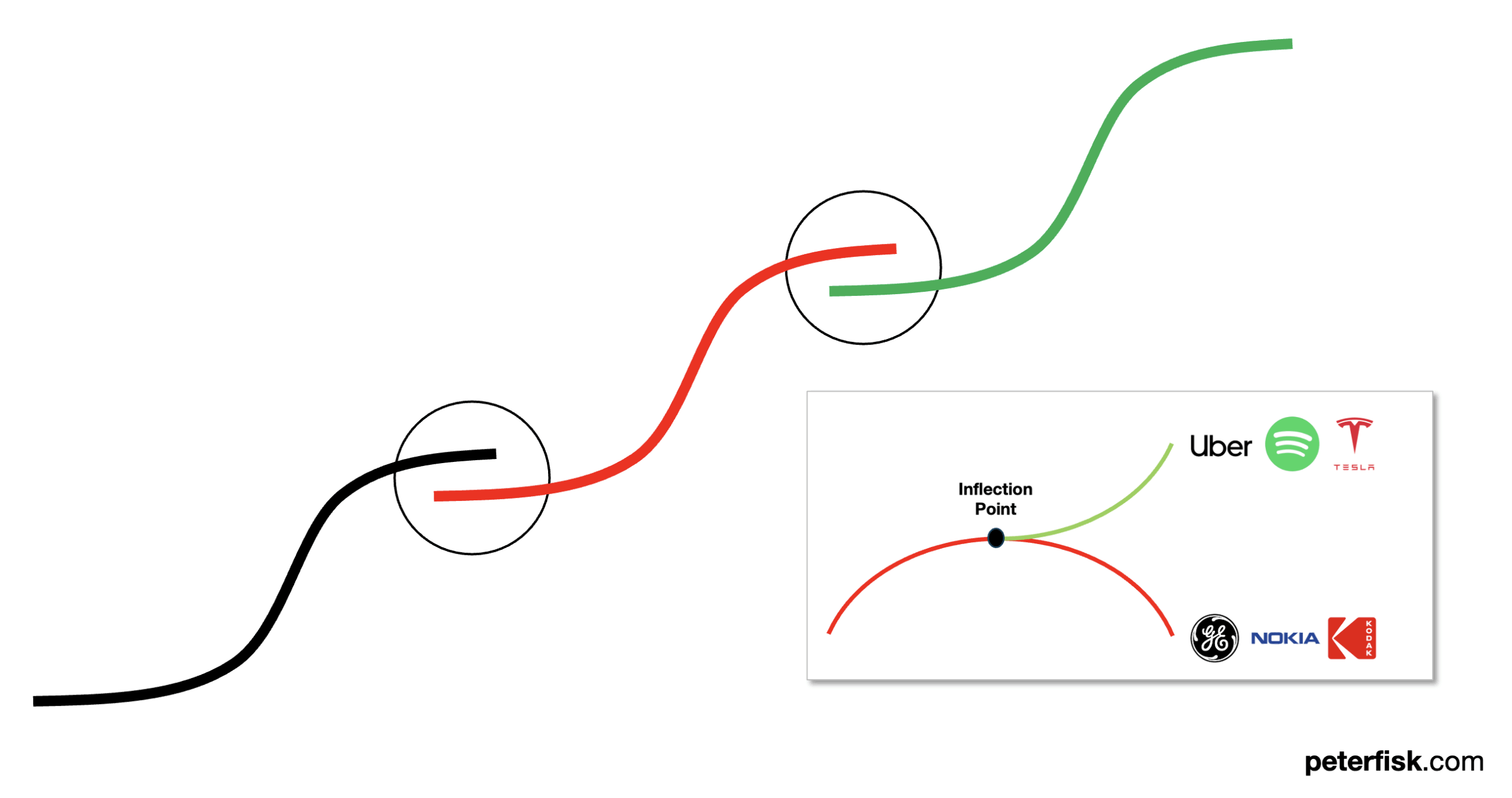
Diagnosis — Map where your business sits on S-curves: which products are maturing, which are emerging.
Signal — Articulate a bold, measurable future state (three outcomes).
Scaffold — Build a dual-structure: core business teams and a small, empowered reinvention unit with separate funding and freedom.
Experiment — Run a portfolio of fast experiments that test assumptions (price, model, distribution).
Scale — Double down on what works and kill quickly what doesn’t.
Institutionalise — Bake new capabilities into the core: new partnerships, skills, and leadership metrics.
This is not an academic exercise; it is how companies move from incrementalism to structural change.
Measuring progress … what good looks like in 12 months
Choose a small set of leading indicators — the things you measure daily or weekly — in addition to lagging financial KPIs. Examples:
Percentage of revenue from new products or channels (target: 20%+ in 12 months for ambitious reinvention).
Number of AI pilots with validated ROI (target: 4 pilots with positive ROI).
Employee skill readiness score for priority skills (target: 70% of target cohort certified).
Partner ecosystem NPS (target: improvement of 10 points).
Tie incentives to a mix of short-term delivery and medium-term capability building.
What the courageous leap looks like
Imagine a mid-sized European manufacturer with a strong brand but slowing growth. The CEO commits to a courageous leap: transform from selling components to delivering “performance as a service” (outcomes, not parts). Steps taken:
A one-page strategy signed by the board.
A seed fund of 1% revenue for experiments.
A cross-functional team to pilot a subscription plan for a key client segment.
Two AI pilots to predict downtime and optimise maintenance.
Quarterly customer co-creation sessions.
Within 12 months the company has a marketable subscription, two paying pilot customers and a measurable reduction in churn among top clients. This is not hypergrowth; it is structural reinvention that creates optionality and scales as the market accepts the model.
Your leadership checklist for the first 100 days of 2026
Publish your one-page strategic charter.
Run a friction audit and remove the top three blockers.
Launch two AI pilots tied to clear financial metrics.
Create a talent pathway for two critical skills.
Convene the first Future Day and publish three public outcomes.
Set up an ethics oversight process for AI and data.
Do these six things and you will have moved from aspiration to disciplined action.
How I can help … keynotes, workshops and strategic facilitation
If you want inspiration, structure and hands-on execution support, that’s precisely what I offer through keynotes, strategy work and workshops — practical sessions that convert trends into tangible business options. Here’s how I work with leaders and teams:
Inspiring keynote: A vivid, evidence-rich talk that frames the question (megatrends, 26 trends for 2026), mobilises the team and sets the agenda for change. The goal is to accelerate alignment and create urgency with a clear call to action.
Practical strategy workshops: Tailored, interactive sessions that produce a one-page strategy, a 90-day implementation plan and a risk-calibrated portfolio of experiments. These workshops are designed for leadership teams and the top 50–100 change agents in your organisation.
Leadership advisory: Ongoing support to accelerate the “reinvention playbook” — from designing new business models and ecosystem strategies to building AI literacy and ethical governance.
Custom masterclasses: Deep dives on topics such as “AI for commercial impact”, “Designing new business models” and “Leading through disruption”.
If you want to explore how we can work together, you can find practical resources, case studies and booking details at peterfisk.com. My work blends inspirational framing with practical, measurable plans that leaders can deploy immediately.
Final thought … be a leader who chooses the future
Leaders in 2026 will be judged not by how closely they cling to the past but by how intelligently they choose future possibilities. Choosing the future means three things:
You must be a steward of both present value and future value. Balance today’s cash flows with capacity to pivot.
You must design experiments as organisational routines. Reinvention is not a project; it is a muscle.
You must lead with human purpose and machine speed. Technology amplifies what leaders already care about; it does not replace that compass.
In the words of one modern CEO: “AI is the defining technology of our generation.” Use that claim as a challenge. Let it sharpen your purpose and your practice. Bookend your year with a manifesto and an outcomes sheet, and hold your leadership team to it.
If you would like, I can help you draft a bespoke one-page manifesto for your organisation, a 90-day sprint plan for two value-first AI pilots, or a tailored keynote to align your executive team around the resolutions above. Visit peterfisk.com to see examples and get in touch — or, if you prefer, tell me here which three resolutions you want to start with and I’ll draft a ready-to-use one-page strategy and sprint plan for you.
2026 is the year the future gets real. Not just in terms of the ever -ccelerating technological possibilities, but in the practical, commercial, human reshaping of economies, cultures, consumption, work, and leadership.
The turbulence of the past decade — pandemic, inflation, supply chain shocks, climate chaos, geopolitical fragmentation, demographic disruption, and AI’s sudden ignition — converges into a moment where every business must rethink what it does, how it creates value, and what it stands for.
We are witnessing not merely incremental shifts but the remapping of human priorities, the redesign of market systems, and the reinvention of business models.
Consumers are more intentional, selective, contradictory, and experimental. Technology is more ambient, embedded, personalised and intelligent than ever before. Brands are increasingly porous, community-driven, and culturally entangled. Economies are shifting north, south, east and west. Work is becoming more fluid. Talent is becoming borderless. And companies are being judged not only on what they make, but on the ecosystems, behaviours, and impact they generate.
I spend my working life searching the world for new ideas, opportunities and innovations; working with some of the most interesting business leaders from each continent, scanning the latest trends and reports. My projects in 2025 have taken me from banking in Brazil to retail in Mexico, insurance in Japan to fertiliser in Morocco, tech in Germany to food in Saudi Arabia, construction in Egypt and luxury goods in Switzerland.
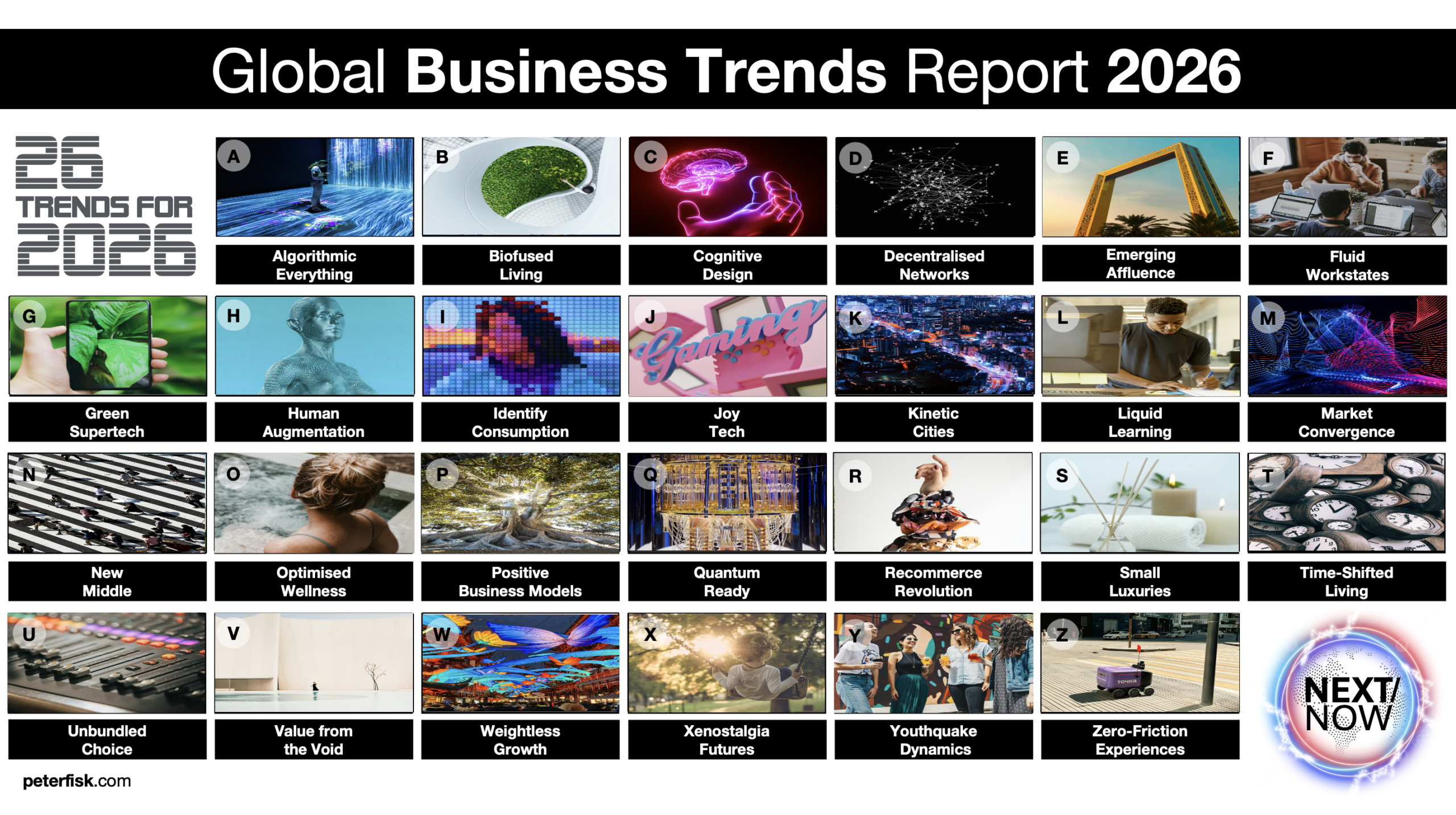
So here is my curation of the 26 most impactful business trends for 2026 — those that will shape markets, define industries, influence customers, and accelerate or threaten growth. They span consumer culture, technology, business models, leadership, economics, marketing and brand behaviour. Together, they provide a strategic lens for leaders preparing to navigate the most opportunity-rich — and risk-filled — commercial landscape in decades.
Trend 1: Algorithmic Everything
AI and algorithmic systems are the operational backbone across industries. Algorithms anticipate needs, optimise supply chains, orchestrate workflows, and personalise services. From healthcare to fashion, logistics to marketing, organisations embedding AI as a strategic foundation transform operations and decision-making. Algorithmic mastery accelerates innovation, reduces human error, and generates predictive insights that redefine competitive advantage. Businesses converting AI into an enterprise-wide platform gain continuous improvement loops, operational resilience, and new business models.
Leadership actions: Executives must prioritise AI literacy, integrate predictive intelligence into strategy, and align teams around human-machine collaboration. Decision-making increasingly relies on algorithmic insight.
Example: Relativity Space (USA) Relativity Space uses AI-driven generative design and autonomous 3D printing to produce rockets. Each print cycle informs material science and engineering improvements, compressing timelines from years to months. Predictive maintenance, rapid prototyping, and scalable production illustrate how algorithmic intelligence transforms manufacturing and strategy.
Trend 2: Biofused Living
Biotechnology, materials science, and computation converge to create regenerative, circular systems. Products self-heal, biodegrade, or convert waste into resources, transforming production in food, fashion, construction, and energy. Bio-design enables sustainable, resilient operations and functional, ethical, ecological products that resonate with conscious consumers. Living systems shift sustainability from marketing claim to operational strategy, driving circularity, efficiency, and long-term resilience. Companies embedding biofused processes unlock value while reducing environmental impact, bridging science, design, and consumer engagement.
Leadership actions: Leaders should foster cross-disciplinary innovation, invest in R&D, and integrate sustainability into strategy as a source of growth and differentiation.
Example: Bolt Threads (USA) Bolt Threads creates sustainable textiles using engineered proteins, including spider silk and mycelium leather. These materials are biodegradable, high-performance, and reduce environmental impact. By integrating bio-design into fashion, Bolt Threads demonstrates regenerative production while delivering premium, innovative products.
Trend 3: Cognitive Experiences
Consumer experiences increasingly combine neuroscience, behavioural design, AI, and sensory engagement. Experiences adapt dynamically to attention, emotion, and context, enhancing memory, engagement, and satisfaction. Retail, hospitality, entertainment, and digital platforms optimise cognition while creating emotional resonance. Functional utility and experience blur, making experiences as valuable as products. Organisations mastering cognitive design improve loyalty, retention, and cultural impact. Adaptive experiences turn routine interactions into personalised, emotionally meaningful journeys, providing differentiation in attention-fragmented markets.
Leadership actions: Leaders should integrate behavioural science into product and service design, invest in adaptive experience technology, and track emotional engagement as a KPI.
Example: Calm (USA) Calm delivers AI-driven, personalised meditation and wellbeing experiences. The platform adapts content to users’ stress levels, moods, and goals, blending neuroscience, behavioural design, and digital interface. This demonstrates cognitive experiences enhancing emotional and mental engagement while fostering loyalty.
Trend 4: Decentralised Networks
Power, commerce, and value creation shift from hierarchies to distributed digital, physical, and hybrid networks. Peer-to-peer marketplaces, community platforms, and decentralised governance enable scalability, resilience, and co-creation. Organisations acting as ecosystem orchestrators gain influence through network effects rather than command-and-control structures. Distributed systems empower smaller players, enhance participation, and foster innovation. Businesses leveraging networks can access diverse talent, engage consumers directly, and unlock scalable growth. Distributed networks are reshaping commerce, work, and content creation.
Leadership actions: Executives should embrace platform thinking, facilitate community engagement, and enable value creation through network orchestration rather than direct control.
Example: Aragon (Spain) Aragon builds decentralised governance platforms using blockchain, enabling organisations and communities to manage resources and decision-making without centralised control. This empowers distributed collaboration, autonomy, and scalable ecosystems, illustrating how decentralised digital worlds redefine organisational structures.
Trend 5: Emerging Affluence
Rapidly growing middle and affluent classes in Africa, Asia, and Latin America redefine global consumption. Digitally connected, aspirational, and culturally influential, these consumers drive demand for accessible luxury, wellness, mobility, and fintech solutions. Businesses must design offerings that respect local context while meeting aspirational expectations. Emerging affluence often leapfrogs Western models, creating opportunities for innovation in pricing, service, and digital infrastructure. Companies that understand cultural nuance and income elasticity unlock sustainable growth while engaging diverse consumer identities.
Leadership actions: Leaders should prioritise local market insight, cultural relevance, and scalable digital infrastructure to capture emerging middle-class demand.
Example: Mercado Libre (Argentina) Mercado Libre provides e-commerce, payments, and logistics infrastructure across Latin America. By addressing middle-class needs for convenience, trust, and cultural relevance, it enables participation in modern digital economies. Starting as a marketplace like eBay, it now dominates fintech and e-commerce, illustrating how understanding local contexts drives growth.
Trend 6: Fluid Workforces
Workforces are increasingly modular, global, and hybrid. Talent flows between projects, companies, and platforms, supported by AI augmentation. Hybrid human-machine teams, freelancers, fractional executives, and automated agents provide agility, scalability, and resilience. Organisations must manage dynamic teams across geographies while fostering purpose, autonomy, and culture. Flexible workforces allow rapid response to market changes, cross-disciplinary problem-solving, and operational efficiency, redefining talent as a strategic, movable asset.
Leadership actions: Leaders need to focus on culture, engagement, and ecosystem orchestration rather than direct oversight. Recruitment, retention, and upskilling strategies must embrace flexibility and autonomy.
Example: Upwork (USA) Upwork connects freelancers with companies worldwide, enabling flexible, project-based work. The platform supports distributed teams and adaptive talent allocation, demonstrating how fluid workforce models drive agility, scalability, and market responsiveness.
Trend 7: Green Supertech
Climate innovation now relies on advanced engineering and science rather than incremental sustainability. Fusion energy, carbon capture, precision agriculture, renewable energy, and battery breakthroughs drive decarbonisation at scale. Companies integrate technology, infrastructure, and industrial capacity to deliver profitable environmental solutions. Green supertech turns sustainability from narrative to operational imperative, creating measurable environmental impact while generating new business models. Organisations mastering these technologies achieve competitive advantage, system-wide transformation, and long-term resilience in climate-conscious markets.
Leadership actions: Executives must invest in frontier climate technologies, integrate sustainability into core strategy, and measure impact rigorously. Strategic adoption of green supertech defines market leadership.
Example: Climeworks (Switzerland) Climeworks captures CO₂ directly from air and provides carbon removal services for businesses. Its modular technology delivers measurable impact while creating scalable climate solutions. Climeworks demonstrates how advanced environmental technology can combine profit with purpose, setting a benchmark for green innovation.
Trend 8: Human Augmentation
Technology increasingly enhances physical, cognitive, and emotional capabilities. Wearables, exoskeletons, neurotech, and AI-enabled interfaces improve productivity, performance, wellness, and decision-making. Human+ solutions extend lifespan, enhance skill sets, and transform work structures. Companies embedding augmentation into products and services unlock new markets while improving quality of life. Ethical considerations—privacy, accessibility, autonomy—are central as augmented humans redefine societal norms, job expectations, and personal capabilities.
Leadership actions: Leaders must balance innovation with ethics, invest in workforce augmentation, and prepare teams for hybrid human-machine collaboration.
Example: Mizuno (Japan) Mizuno’s Well-Aging programs combine wearable technology, mobility support, and social engagement for older adults. This initiative extends independence, resilience, and quality of life while creating a market for human-centric performance solutions.
Trend 9: Identity Consumption
Consumers increasingly make choices reflecting personal, social, and ethical identity. Purchases convey values, lifestyle, and cultural affiliation. Identity-driven markets shape fashion, wellness, digital products, and sustainability. Brands that authentically align with identity codes cultivate loyalty, advocacy, and emotional resonance. Social media amplifies expression, making identity a strategic asset. Understanding fluid, multi-layered identities enables companies to co-create products, services, and experiences that deeply engage consumers.
Leadership actions: Leaders should prioritise authenticity, culture alignment, and personalised engagement strategies to capture identity-conscious markets.
Example: NewJeans (South Korea) NewJeans blends fashion, gaming, and lifestyle collaborations to create identity-rich consumer experiences. Fans adopt products as self-expression, merging digital-native aesthetics with cultural relevance. The brand exemplifies how identity-driven engagement drives loyalty, advocacy, and market influence.
Trend 10: JoyTech
Technology increasingly provides emotional, sensory, and lifestyle benefits beyond productivity. Smart devices, entertainment platforms, and services are designed for delight, engagement, and wellbeing. JoyTech integrates play, creativity, and emotional resonance into daily life. Companies embedding joy into design capture attention, loyalty, and cultural influence. Emotional technology turns small, interactive moments into memorable experiences, differentiating brands in saturated markets and establishing long-term preference.
Leadership actions: Leaders should integrate joy into product design, measure emotional engagement, and explore playful, sensory experiences as a differentiator.
Example: Beat Saber (Slovakia) Beat Saber combines VR, music, and motion-based gameplay to deliver immersive, joyful experiences. Users interact physically and socially, blending entertainment with exercise. The platform illustrates how emotional, playful technology drives engagement and global cultural impact.
Trend 11: Kinetic Cities
Urban environments are becoming adaptive systems integrating mobility, energy, climate resilience, and digital infrastructure. Smart grids, autonomous transport, real-time optimisation, and responsive buildings redefine urban living. Kinetic cities address congestion, pollution, extreme weather, and social equity while creating livable, resilient spaces. Urban systems operate as continuous feedback loops, merging physical space with digital intelligence, unlocking new service and business ecosystems.
Leadership actions: City leaders and businesses must invest in integrated infrastructure, coordinate across sectors, and leverage data for urban resilience and efficiency.
Example: Uber Elevate (USA) Uber Elevate pilots electric VTOL aerial mobility integrated with smart traffic networks. By combining infrastructure, technology, and analytics, it demonstrates how kinetic systems can transform urban transport, accessibility, and sustainability.
Trend 12: Liquid Learning
Learning is continuous, adaptive, and embedded in daily work. AI personalises education, simulations replicate real-world scenarios, and micro-credentials create stackable skills. Learning flows across careers, devices, and contexts, enabling lifelong adaptability. Organisations embedding liquid learning into culture and operations gain agility, resilience, and innovation capacity. Employees continuously upskill while performing work, turning knowledge into a strategic asset and preparing for rapidly changing markets.
Leadership actions: Leaders should integrate learning into workflow, provide AI-enabled personalisation, and foster a culture of continuous skill development.
Example: Degreed (USA) Degreed provides a platform that aggregates courses, articles, videos, and on-the-job experiences into personalised learning journeys. AI recommends skills to acquire based on role, career goals, and performance data, enabling continuous, just-in-time upskilling. Companies using Degreed embed learning into daily work, creating agile, future-ready teams.
Trend 13: Market Convergence
Market Convergence describes how once-separate industries, categories, and value chains increasingly overlap, collide, and merge. Boundaries between technology, finance, retail, healthcare, mobility, media, and energy are dissolving as platforms, data, and ecosystems connect multiple needs into unified experiences.
Consumers no longer think in categories; they expect solutions that combine services, products, and experiences seamlessly.
Growth comes from recombining capabilities—payments embedded in commerce, health integrated into insurance, mobility bundled with energy. The winners are those who redefine markets instead of protecting them.
Leadership actions:
Map where your industry is converging with others and identify adjacent capabilities to integrate or partner with. Shift strategy from category defence to ecosystem design. Build collaboration muscle, platform thinking, and flexible governance to compete across blurred market boundaries.
Example: Ant Group (China)
Ant Group exemplifies Market Convergence by integrating payments, finance, commerce, credit, insurance, and lifestyle services into a single digital ecosystem. Originating in fintech, it expanded across retail, mobility, and everyday services, reshaping consumer expectations. Ant demonstrates how convergence creates powerful new markets by unifying fragmented needs into seamless platforms.
Trend 14: New Middle
Urban middle classes in Southeast Asia, India, and Latin America are reshaping purchasing patterns. These consumers value quality, affordability, convenience, and digital access. Emerging middle markets drive innovation in financial inclusion, mobility, healthcare, and retail. Brands must combine local insight with scalable digital infrastructure to win loyalty and growth. Understanding income elasticity, aspirational consumption, and digital adoption is key for early market leadership.
Leadership actions: Leaders should design culturally relevant products and services, leverage digital channels, and scale infrastructure to reach rapidly growing middle-class segments.
Example: Jumia (Nigeria) Jumia provides online shopping, payments, and logistics solutions tailored to African middle-class consumers. By improving accessibility and affordability, it enables participation in digital commerce while building scalable infrastructure and market trust.
Trend 15: Optimised Wellness
Wellbeing is evolving into integrated systems combining mental, physical, emotional, and social health. Digital platforms, AI diagnostics, and personalised wellness services make holistic health accessible and measurable. Consumers and organisations expect proactive interventions and continuous monitoring. Optimised wellness integrates performance, longevity, and emotional satisfaction, turning health into a strategic differentiator. Companies providing seamless, data-driven wellness ecosystems increase loyalty, engagement, and brand relevance.
Leadership actions: Leaders should embed wellness into products, workplace culture, and digital services, measuring impact and engagement as part of strategic priorities.
Example: Cerebral (USA) Cerebral provides mental health services via digital therapy, medication management, and continuous care. By reducing stigma and improving accessibility, it makes wellness habitual, personalised, and measurable, exemplifying scalable holistic health solutions.
Trend 16: Positive Business Models
Businesses are embedding ecological and social impact into core strategy. Operations, products, and supply chains are designed to restore ecosystems, enrich communities, and enhance planetary resilience. Circular design, biomimicry, renewable inputs, and ethical sourcing become standard. Net positive business models balance profitability with stewardship, creating shared value for stakeholders, and enable companies to become platforms for good. Companies adopting regenerative strategies redefine competitive advantage, aligning environmental and societal contributions with long-term business success.
Leadership actions: Leaders should integrate regenerative practices into strategy, measure environmental and social impact, and communicate authenticity to stakeholders.
Example: Interface (USA) Interface pioneers regenerative flooring, combining recycled materials, modular design, and biomimicry. Its operations achieve net-positive impact while maintaining profitability, showing how sustainability can drive competitive advantage and commercial success.
Trend 17: Quantum Ready
Quantum computing is moving from experimental labs to strategic applications. Early use focuses on optimisation, cryptography, simulation, and materials discovery. Organisations develop quantum-literate teams, hybrid workflows, and experimental algorithms to prepare for disruption. Quantum-readiness accelerates innovation, reduces complexity, and provides first-mover advantages in logistics, energy, pharmaceuticals, and manufacturing. Early strategic exploration enables problem-solving capabilities beyond classical computing, creating competitive differentiation and future-ready infrastructure.
Leadership actions: Leaders should invest in quantum R&D, train teams in quantum literacy, and explore hybrid algorithms for operational advantage.
Example: D-Wave (Canada) D-Wave provides quantum annealing systems for optimisation problems in logistics, energy, and finance. Companies use D-Wave’s platforms to experiment with quantum algorithms, accelerating problem-solving and operational efficiency. This highlights practical enterprise applications of quantum computing beyond theoretical research.
Trend 18: Recommerce Revolution
Resale, rental, and refurbishment are mainstream, driven by circular economy principles. Consumers demand convenience, trust, and quality when engaging with pre-owned goods. Recommerce spans fashion, electronics, furniture, and luxury, growing faster than conventional retail. Platforms, peer-to-peer marketplaces, and authentication services facilitate engagement while reducing waste. Companies integrating recommerce unlock revenue streams, build community, and enhance credibility. Circular consumption becomes strategic rather than niche.
Leadership actions: Leaders should design recommerce options, build trust through verification, and integrate circular principles into business models for growth and loyalty.
Example:The RealReal (USA) The RealReal is a luxury consignment platform that authenticates and sells pre-owned designer goods. It provides trust, verification, and convenience, making high-end resale mainstream. This example shows recommerce can scale globally, combine sustainability with premium brands, and generate new revenue streams.
Trend 19: Small Luxury
Consumers seek small, emotionally resonant indulgences that deliver status, pleasure, or wellbeing without extreme cost. Small (or “soft”) luxury spans boutique experiences, skincare, fashion, speciality foods, and personalised services. These products offer authenticity, sensory delight, and storytelling, turning everyday indulgences into identity statements. Micro-luxuries satisfy aspirational desires while remaining accessible, amplified by social media visibility. Emotional resonance and narrative depth are essential for brand success.
Leadership actions: Leaders should focus on craft, storytelling, and emotional design to create premium-feel experiences that engage aspirational consumers.
Example: Sulwhasoo (South Korea) Sulwhasoo combines traditional herbal expertise with premium packaging and ritualised use. Its products create accessible luxury experiences, blending heritage, craftsmanship, and emotional satisfaction, appealing to aspirational global consumers.
Trend 20: Time-Shifted Living
Time-Shifted Living reflects how people reorganise life around flexibility rather than fixed schedules. Work, consumption, entertainment, learning, and wellness increasingly happen asynchronously—on demand, remotely, and across time zones.
Technology enables people to reclaim control over when and how they engage, breaking traditional boundaries between work and life. This shift reshapes cities, offices, retail, education, and media, rewarding organisations that design for flexibility, availability, and responsiveness.
Leadership actions:
Redesign systems around flexibility and outcomes, not fixed schedules. Enable asynchronous collaboration, on-demand services, and modular engagement. Rethink performance metrics, customer access, and employee wellbeing to align with time sovereignty rather than traditional nine-to-five models.
Example: Netflix (USA)
Netflix epitomises Time-Shifted Living by enabling global audiences to watch content anytime, anywhere. Its on-demand model breaks linear scheduling, empowering users to control when and how they engage. This flexibility reshaped entertainment consumption worldwide and set new expectations for convenience, personalisation, and autonomy across digital services.
Trend 21: Unbundled Choice
Unbundled Choice describes the disaggregation of traditional products and services into modular components that consumers can mix, match, and pay for selectively. Rather than buying bundled offerings, people choose exactly what they need—features, access, time, or outcomes.
This trend reflects demand for transparency, control, and fairness. Digital platforms accelerate unbundling by reducing distribution costs and enabling customisation at scale. Industries from finance and education to media and mobility are being reshaped as value is atomised and reassembled around individual needs. For organisations, unbundling creates new revenue streams, sharper value propositions, and opportunities to serve niche segments. However, it requires clear articulation of what truly creates value.
Leadership actions:
Audit where value is bundled unnecessarily. Break offerings into clear, modular components and price transparently. Use data to understand which elements customers truly value, and design flexible models that allow recombination without eroding trust or coherence.
Example: Revolut (UK)
Revolut delivers Unbundled Choice by offering modular financial services—payments, savings, crypto, insurance, and subscriptions—allowing users to choose what they need. This flexibility challenges traditional banking bundles and gives customers control, transparency, and personalised value within a single digital
Trend 22: Value from the Void
Value from the Void captures how scarcity, absence, and minimalism become sources of meaning and economic value. In an always-on world, emptiness—silence, space, simplicity, and restraint—becomes desirable. Brands create value by removing noise, features, or excess, offering clarity, calm, and focus instead.
This trend applies to design, digital products, wellness, luxury, and leadership itself. Less becomes more when it restores attention, energy, and purpose. Value from the Void challenges growth-through-addition models, replacing them with intentional subtraction. Companies that understand this create differentiation by knowing what not to do, not say, or not sell—transforming restraint into strategic advantage.
Leadership actions:
Practice strategic subtraction. Identify complexity that no longer adds value and remove it. Design for clarity, calm, and focus. Reward teams for simplification and discipline, and measure success not only by growth, but by reduction of friction and noise.
Example: B&O (Denmark)
Bang & Olufsen turns simplicity and emptiness into value through elegant, minimalist audio products. By reducing visual and functional clutter, it creates emotional and sensory impact, positioning luxury as both restraint and experience.
Trend 23: Weightless Growth
Growth increasingly comes from intangible assets such as brand, data, IP, and networks. Organisations focus on digital platforms, ecosystems, and content rather than physical expansion. Weightless growth reduces capital intensity while increasing speed and scalability. Intellectual property, community influence, and software-as-infrastructure are primary levers. Companies mastering weightless growth capture value through relational and informational assets, enabling high-margin, networked expansion.
Leadership actions: Leaders should prioritise intangible asset development, platform strategy, and network effects over physical scale to drive sustainable growth.
Example: Spotify (Sweden) Spotify scales globally via curated playlists, algorithms, and community networks rather than physical assets. Its value derives from data, brand, and network effects, exemplifying weightless growth at scale.
Trend 24: Xenostalgia Futures
Xenostalgia merges nostalgia with forward-looking innovation. Products and experiences evoke past eras—retro interfaces, analog warmth—while integrating modern technology. This emotional anchoring provides comfort and cultural resonance, balancing novelty with familiarity. Companies leverage xenostalgia to engage multiple generations, create storytelling depth, and differentiate products. Applied across fashion, tech, and media, xenostalgia strengthens brand identity while embracing innovation.
Leadership actions: Leaders should combine heritage design cues with modern innovation to evoke emotional resonance while appealing to forward-looking markets.
Example: Nothing (UK) Nothing blends retro-futurist aesthetics with modern tech through transparent hardware and minimalist design. Its products feel familiar yet innovative, exemplifying xenostalgia-driven design for engagement and differentiation.
Trend 25: Youthquake Cultures
Younger generations disrupt industries with digital fluency, creativity, and social activism. Sustainability, inclusivity, and identity fluidity shape aesthetics, behaviour, and products. Youth-driven networks accelerate trend adoption, influence markets, and redefine brand relevance globally. Authentic engagement enables co-creation, virality, and long-term cultural resonance. Organisations tapping into youth movements gain energy, creativity, and advocacy while embedding themselves in cultural zeitgeist.
Leadership actions: Leaders must authentically engage youth, foster co-creation, and embrace cultural experimentation to remain relevant and innovative.
Example: TikTok (China) TikTok empowers young creators to produce, remix, and share content worldwide. Its algorithm amplifies creativity, cultural trends, and activism, illustrating youth-driven platforms’ global influence on markets and culture.
Trend 26: Zero-Friction Experiences
Experiences are designed to eliminate effort, delay, and complexity. Seamless integration of payments, mobility, smart homes, and services creates anticipatory, intuitive interactions. Ambient intelligence reduces cognitive load while enhancing convenience, speed, and trust. Zero-friction design reshapes retail, finance, healthcare, mobility, and home ecosystems. Automation, AI, and connectivity allow services to feel immediate, personalised, and effortless, enabling people to focus on meaningful activities.
Leadership actions: Leaders should integrate automation, AI, and service design to remove friction and enhance convenience, satisfaction, and loyalty.
Example: Nuro (USA) Nuro uses autonomous vehicles to deliver groceries and essentials directly to consumers. Its AI-driven logistics remove barriers of time, transport, and human interaction, creating seamless, frictionless experiences that redefine service delivery.
Connecting the dots … the 5 metashifts that matter
Across the 26 trends, five structural meta-shifts emerge. These are the deep undercurrents — the forces that weave through industries, geographies, and consumer cultures, giving shape to the new global economy. They explain why the trends are happening, and where markets will move next.
Together, they define the new rules of competition, value creation and leadership.
Metashift 1: Consumption becomes cultural rather than transactional
The old logic of buying as a functional exchange based on price, convenience, or availability, is being replaced by a cultural logic built on identity, emotion, aspiration and belonging. People don’t simply “purchase”; they perform who they are through what they choose.
Consumers increasingly seek:
Narratives that reflect their values
Products that express identity
Brands with emotional resonance
Experiences that feel meaningful, connective or status-enhancing
It’s not just Gen Z; this shift spans generations. Consumption becomes a form of cultural participation. Fashion, food, finance, travel, mobility, even utilities are reframed through the lens of lifestyle, symbolism and self-construction.
This accelerates:
The micro-culture explosion
The rise of “meaningful premium”
Purpose-led demand
Local cultural fusion in global markets
The revival of craft, personalisation and story-driven commerce
In this world, companies win by designing for identity, not just demand.
Metashift 2: Technology becomes invisible, ambient and intelligent
AI no longer sits inside tools — it dissolves into the environment.
Intelligence becomes:
Secure-by-design — trusted, governed and accountable
Consumers stop thinking about “using AI”. They simply experience smarter journeys, anticipatory interfaces, seamless automation and personalised worlds. Business becomes algorithmically tuned, from supply chains and pricing to creativity and customer dialogue.
This shift enables:
Mass personalisation at affordable cost
Dynamic business models
Zero-friction services
Predictive operations
Hyper-resilient systems
More imaginative human roles
Technology fades from sight but strengthens everything it touches.
Metashift 3: Work becomes fluid, borderless and machine-augmented
The workplace of 2026 looks more like an ecosystem than a company. Talent moves fluidly between projects, platforms and geographies. The best work blends:
Human imagination, ethics, empathy and creativity
Machine intelligence, speed, pattern detection and simulation
Employees expect autonomy, meaning, growth and wellbeing. AI becomes a partner rather than a tool. Organisations that resist this shift suffer talent drain and creative stagnation.
This shift fuels:
The rise of talent marketplaces
Poly-skilled careers
Exponential productivity for small teams
Human-only work becoming more valuable
Continuous reskilling becoming cultural rather than remedial
The companies that thrive are those that build high-human organisations augmented by high-intelligence systems.
Metashift 4: Business models shift from products to ecosystems
The world is moving from discrete offerings to interconnected value networks.
A business is no longer defined by what it sells, but by the ecosystem it enables.
This means:
Evolution from linear to circular systems
Data-rich, multi-sided platforms
Modular value chains
Network economics replacing unit economics
Partnerships replacing ownership
Ecosystems expanding into adjacent sectors
Ecosystems enable faster innovation, greater customer lifetime value, richer insight cycles and defensible competitive advantage. They are the architecture of tomorrow’s global winners.
Metashift 5: Brands become communities, citizens and cultural participants
Brands can no longer rely on messaging alone. They must act their values, contribute to society and participate in culture. The power centre shifts from companies to communities.
Winning brands in 2026:
Build belonging, not just awareness
Represent movements, not markets
Create participation, not passive consumption
Signal values, not just benefits
Contribute to social, cultural or planetary progress
From global giants to niche collectives, the brands shaping 2026 are cultural engines — shaping identity, supporting creativity, enabling self-expression and fostering shared experience.
What should business leaders do now?
To win in this new landscape, leaders must rethink what value means, how organisations create it, and how they amplify it in the market. These are the urgent moves that determine who thrives, and who falls behind.
Here are my 7 practical imperatives for business leaders to build advantage in 2026 and beyond:
1. Reinvent value around meaning, wellness, identity and joy
People are buying experiences that enrich their lives emotionally, mentally and socially. Define your value proposition not around features, but around how it helps people feel, express, belong and grow. Shift from utility to significance.
2. Build ambient AI into products, processes and experience design
Move beyond AI tools to AI infrastructure. Make intelligence a default setting: powering personalisation, predicting demand, accelerating creativity, enhancing service and reducing friction. Invisible AI is the new competitive baseline.
3. Transition from linear businesses to ecosystems and platforms
Ask: what can we enable, not just what can we sell? Identify partners, data layers, communities and complements. Build multi-sided growth engines that unlock new revenues, reduce risk and scale faster than standalone offerings.
4. Design for fragmentation — micro-audiences, micro-cultures, micro-moments
Mass markets are dissolving. Segment by culture, not by demographics. Build portfolios of tailored propositions, dynamic content, adaptive pricing, location-specific formats and culturally attuned storytelling. Relevance now lives at the edges.
As AI automates more knowledge work, the human differentiators become more valuable. Build organisations where imagination thrives, ethics guide decisions, creativity is systemic, and empathy shapes product design. Human value becomes brand value.
6. Champion climate adaptation and resilience as economic opportunity
This is no longer CSR — it is strategy. Climate volatility is reshaping supply chains, insurance, energy, real estate and consumer priorities. Invest in resilience systems, low-carbon models, and climate-positive innovation. Profit lies in prevention and regeneration.
7. Make your brand a community engine, not a communications function
Shift from broadcasting to belonging. Build platforms for participation, spaces for conversation, and rituals that unite people. Act less like a corporation and more like a cultural catalyst. Brands that create connection will dominate the decade.
Make your 2026 a great year!
2026 is not the destination — it is the inflection point. A moment when technology, humanity, culture, nature, and ambition collide to create entirely new possibilities for value, impact and growth. The businesses that thrive will be those that embrace reinvention, act boldly, learn fast, collaborate widely, and place human potential at the heart of their strategy.
How was your 2025? For me, it felt like a year of economic recalibration, and tech acceleration.
After the inflationary shocks of recent years, uncertainty and complexity became the normal, and global markets transitioned to a new era of AI-enabled productivity and innovative possibilities.
From Campari in Italy to Cartier in Switzerland, Mercedes Benz in Germany to Minibea Mitsui in Japen, Orascom in Egypt to Oxxo in Mexico, “reinvention” was on the mind of every business leader I worked with.
It’s only when you look back that it’s really possible to see what a pivotal year 2025 has been. The $5 trillion valuations and thinking machines, agentic workflows and premium humanity, regenerative business models and hyper-personalisation, China’s EV revolutionaries and Dyson’s incredible Airstrait.
So here is what I learnt in 2025, as I travelled around the world, working with incredible companies and impressive business leaders. What did you learn from 2025, and are you ready to go further, even faster, in 2026?
January 2025 … Building brands with more spritz
My year started with a Spritz, or more correctly, with a project exploring the future of Campari, where Aperol Spritz has dominated their portfolio for the last two decades. What next, in a world of shifting tastes, social behaviours and aspirational wellness? Campari is still a Milan-based family business, and I worked with the Italian company’s leaders around the world to explore new innovative ideas in drinks concepts, brand experiences and business models. Key will be to take a more consumer-centric approach, recognising different audiences and cultures, then driving occasions and experiences, then products.
What will you do next? … AI rocket ships and quantum speed, hairy mammoths and Olympic champions. Now is a time of great acceleration. My take on the biggest ideas shaking up markets, and the minds of business leaders.
The Rise of Jio … from free phone to super app, and now India’s lifestyle brand, created by the petrochemical giant Reliance … How to reimagine your future with new audiences, in new sectors, with new brands and business models
Be More Human … How technical brands are finding their voice: how auto brands look beyond the car, pharma brands look beyond the pill, tech brands look beyond the spec, to engage and inspire, build empathy and desire.
Across the Alps in Switzerland, I explored the future of commodity trading with Holcim, and the changing nature of supply chains and commercial strategies for the world’s leading cement business. I also helped their finance teams to step up in their role from reporting the past to envisioning the future, to help leaders focus on the best innovation opportunities for value creation, rather than just revenue or profit, and how to engage shareholders in their “NextGen Growth” strategy. While cement has been a major carbon emitter, this is a great example of putting sustainability at the core of strategy, innovation and growth.
Also in January …
AI as industrial agent … The Economist’s The World Ahead 2025 gave us a deep dive into the “Trump Effect” on global trade when his planned tariffs were just bluster, and the transition of AI from “creative toy” to “industrial agent.”
Sovereign tech … BlackRock’s 2025 Global Outlook introduced its mega forces framework, urging investors to pivot toward AI infrastructure and “Sovereign Tech” as traditional business cycles break down.
$4 trillion business … Nvidia became the first company to achieve a $4 trillion market valuation, driven by the announcement at CES 2025 of its massive rollout of its “Blackwell” chips
Geopolitical tech … France and the UAE announced national “AI sovereignty” funds to build localised infrastructure, moving away from US-based clouds.
February 2025 … Das Beste oder Nichts
Adidas stepped up in 2025 with more world marathon majors medals than any other running shoe brand, and in Nuremberg, I worked with their Global Runningteam to explore what’s next. Led by SVP Alberto Uncini Manganelli, they recognised that the real challenge is not just to create great products, but to enable consumers to achieve more. One example was their launch of the world’s first dedicated treadmill shoe, the Treadwell, months in advance of the announcement by World Athletics a few months later of the first World Treadmill Running Championships in 2026, where anybody can compete against the world’s best asynchronously, on a treadmill.
Coaching Champions … Emmanuel Wanyonyi, the young Kenyan 800m runner, was one step away from an Olympic gold medal at Paris 2024. Claudio Berardelli, his coach, thought about what to say to him.
The Fender Guitar Experience … Transforming guitar culture through digital ecosystem-based innovation, from online learning to community building, new business models and enhanced brand experience.
The AI Pioneers… 10 pioneering companies redefining business through AI and technology … ASML, Deepseek, GitLab, Illumina, KlimaDAO, Rocket Lab, Shopify, Slack, 37 Signals, and Waymo.
A little further north in Germany I worked with the leaders of Mercedes Benz, in partnership with St Gallen Business School, to explore automotive futures, in a market increasingly dominated by Chinese EVs. We explored new strategies and innovations, looking for inspiration into sectors like consumer electronics, retail and entertainment. For the German business, this meant a focus on AI-driven driving experiences beyond the powertrain.
Also in February …
Organisational stagility … Deloitte’s 2025 Global Human Capital Trends coined the term “stagility” meaning the need for companies to balance structural stability with extreme agility as AI eliminates traditional entry-level roles.
Delivering agentic AI … Gartner’s Top Strategic Tech Trends for 2025 highlighted “Agentic AI” and “Spatial Computing” as the two technologies that will define corporate spending for the next 36 months.
Unilever splits … the UK/Dutch consumer giant announced the spin-off of its ice cream business (to be know as the Magnum Ice Cream Company, including Ben & Jerry’s) pivoting entirely towards beauty and well-being and home care
Super Bowl economy … a record $20 billion was spent on Super Bowl-related commerce, with Temu and TikTok Shop dominating the ad slots.
March 2025 … “Future Junkies” in Manhattan
“Future Junkies”launched in New York in March, my new project to explore how the world’s best leaders are reimagining the future. Junkies are obsessives, and these leaders (think of Nvidia’s Jensen Huang who started 30 years ago dreaming of his superpowered chips, or OpenAI’s Sam Altman obsessed with what’s next). The project explores the diversity of emerging trends, and how leaders can build a forward-looking mindset that flows into strategies, innovations and action. It’s a research platform for new keynote events and workshops, and also a living futures book, constantly updated with the latest ideas and trends, insight and foresight.
The Great Reinvention … How every industry is being radically shaken up, and rapidly reinvented. Who will be the winners and losers, what will matter most, and what comes next?
The B2B Superpowers… ABB to Biontech, Climeworks and DSM, Fedex to Holcim, Illumina and Nvidia, Open AI to Stripe, Vestas and Waymo. Who are the most inspiring B2B companies, and how are they reinventing themselves?
Iberdrola has seen dramatic growth in market value over the last year, as one of the leaders in the clean energy revolution. Partnering with Headspring, I worked with their leaders from around the world to explore how to accelerate decarbonisation, and their own business. We dived deep into the strategies of peers like Next Era Energy and Schneider Electric to explore the changing business models, and what’s working and what’s not. We explored my model of the 4Ds of the energy transition – decarbonised, digitalised, deregulated and decentralised – and what they mean together.
Also in March …
BYD’s international surge … the Chinese EV giant officially opened its first major factory in Hungary, radically undercutting European automakers on price.
Accelerating clean energy … IEA’s Global Energy Investment 2025 reported that for the first time, investment in “Grid Modernization” and “AI Data Center Cooling” surpassed investment in new solar capacity.
Simpler sustainability … a global trend of deregulation saw the US and UK slash ESG reporting requirements for small businesses to stimulate startup growth.
Tech billionaires … Forbes’ World’s Billionaires List 2025 highlighted a massive shift in wealth toward “compute barons”, meaning individuals whose net worth is tied to semiconductor supply chains and datacenter ownership.
April 2025 … Megatrends accelerated by tech convergence
Megatrends 2035 is my new report defining the 6 dynamic forces shaking up every industry. While AI dominates, its impacts is as much in accelerates the convergence of other technologies, like genomics, robotics, networks and batteries. And also in offering new ways to address other megatrend challenges like climate change, ageing populations, dense urbanisation, and geopolitical fragmentation.
Megatrends 2035: The 6 dramatic forces shaking up every market and driving every business to reinvent itself, from demographic revolution to exponential intelligence, regenerative systems and humanity rising.
The New Leadership DNA … How do the world’s most inspiring business leaders thrive in a world of relentless change? Inspired by Satya Nadella and Sam Altman, Jessica Jackley and Mary Barra, Melania Perkins and Nik Storonsky.
Performer Transformers … the art of delivering today and creating tomorrow. How today’s best leaders need to have a dual mindset, connecting short and long-term focus in a world of continual change and reinvention
NTT Data is consistently ranked as one of the world’s most innovative companies, but the Japanese tech business is less well known than most innovators. Its transformation seeks to align its global capabilities to deliver mega client projects. For me, the real challenge is to help corporate clients themselves to see the opportunities of AI and convergent tech, positioning NTT Data as a strategic partner in business transformation rather than just a very smart IT supplier.
Also in April …
Liberation day … Trump introduced sweeping new import tariffs, based on bilateral trade “imbalances” and therefore penalising countries with strong exports to the US, and causing the worst stock market falls since Covid-19.
Spatial first … Apple’s iPhone 17 Pro launched as a “spatial-first” device, featuring a 3D-capture camera as the new industry standard, and yet many consumers still wonder whether Apple’s launches are getting ever-more incremental.
Waymo innovative … Fast Company’s Most Innovative Companies 2025report awarded top honours to Waymo and Nvidia. OpenAI and Mistral AI, followed, emphasising the rise of “Sovereign AI” startups in Europe and Asia.
Smarter growth … IMF’s latest World Economic Outlook still shows global growth at around 2-3% (1% or less in Europe), but with more optimism, driven by AI-driven productivity gains in the service sectors of developed economies.
May 2025 … Leading in the footsteps of Columbus
Every year I work with a small group of global executives to explore their futures, transform their organisations, and themselves. This year’s 6 month Global AMPprogram, organised with IE Business School, came to a climax in beautiful Segovia, in northern Spain. In a historic room, where Christopher Columbus was asked by the Spanish Queen, Isabella, to explore the Americas in 1492, we mapped out new strategies for the reinvention of businesses from Argentina to Sweden, energy to retail.
Space Thinking… reframing markets as spaces not sectors … talking in the customer’s language, anticipating unmet needs, designing propositions that resonate, and driving innovation and profitable growth
A Guided Tour of Europe’s Innovators … 15 Inspiring Cities and 15 Innovative Companies: from Adyen in Amsterdam to DeepMind in London, Too Good to Go in Copenhagen and GoodAI in Prague
The Net Positive Playbook … building a new generation of businesses that give more than they take, reinventing organisations for sustainable growth
Transformationis the new business leaders’ superpower. So it was great to continue my great partnership with StrategyTools to deliver the “Transform!” business simulation where business leaders, as competing exec teams of leading companies, race to reinvent themselves, and create $60 billion of market value. Simulating 10 years in 10 weeks, they rapidly learn how to master P&Ls and DCFs, acquisitions and mergers, changing regulation and employee strikes, to create a business fit for the future.
Also in May …
AI literacy … LinkedIn’s Workplace Learning Report 2025 revealed that “AI Literacy” has officially replaced “Digital Literacy” as the most requested skill in global job postings.
Fortune 500 … Walmart retained the #1 spot (still generating more revenue than Amazon, but Amazon is three times more valuable), while 15% of the list’s total profit now comes from companies that didn’t exist 30 years ago.
June 2025 … Futures inspired by the past
Orascom is one of Egypt’s most interesting companies, a construction business that has focused on creating entirely new towns and cities, designing an entire infrastructure, from homes to infrastructure, shopping malls to entertainment. Back in 2018 I first worked with them at their ready-made La Gounatown, on the Red Sea, and subsequently in other locations like Montenegro. Now, thinking far beyond being a construction company, they are ready to explore even more ambitious ideas for urban development in an accelerating digitally-enabled world.
Next Generation Business Models… redefining value, ownership, scale, and trust; powered by AI and data, decentralised and human, plus sustainability; Bytedance and Earthchain, KlimaDAO and On, Ping An and Soul Machines.
Ecosystems Inc… How the music industry was reinvented through ecosystems, from Napster and Spotify, to TikTok and Fortnite, and what this means for every industry.
“There’s nothing like this” … how Taylor Swift embraced anti-fragility, blue oceans, socialised branding, analytics and AI, and platform reinvention, and some of my other favourite business books to read.
I was also inspired by Mitsis, the largest privately-owned hospitality business in Greece. It started in 1954 as a family textiles business in Athens, until its sweaters gave way to swimwear in the 1970s, with the development of an impressive all-inclusive hotel chain, plus other business in publishing and winemaking. Mitsis resorts, with my favourites in Crete and Rhodes, are distinctive for their “filoxenia”, combining local cultures, modern architecture and genuine Greek hospitality.
Also in June …
The 3:2 worklife … a new global survey confirmed that 85% of Fortune 500 companies have settled on the “3 days in, 2 days out” hybrid work model
Future jobs … World Economic Forum’s Future of Jobs Report 2025 predicted that 22% of current total jobs will be “transformed” by structural labour-market shifts, primarily AI and green transitions, by 2030.
Creative leaders … Cannes Lions used to be an ad agency blast, but the annual Festival of Creativity is increasingly a meeting place for CEOs who seek to fuse creativity and technology to reinvent business, not just to create ads.
Product authenticity … the new EU Digital Product Passport became mandatory for textiles sold in Europe, forcing a massive supply chain audit.
July 2025 … Businesses as platforms for change
At the OECD in Paris, I worked the some of the world’s leading international organisations seeking to enable change in our world, bringing together governments and companies to address the challenges and opportunities of those six megatrends. I particularly focused on projects in emerging markets, from Asia to Latin America, where a little organisation and investment nudge can connect private and public sectors to make a huge difference to local societies, driving new entrepreneurial action.
The Leader’s Leap… stepping up from being a manager to leader is more significant and difficult than most people imagine; navigating chaos, innovative problem-solving, driving growth.
Customer Psychology … from neuroscience to nudges, 95% of consumer decisions are subconscious, most in less than 2 seconds, and 80% of product launches fail. So how can business know people better than they know themselves?
Reinventing business with a future mindset … anticipatory living and shapeshifting organisations, meta systems and fractal growth loops … 10 radical pathways to more enlightened business transformation
CEOs have a huge challenge in today’s dynamic markets, addressing a diversity of competing forces, while also seizing the best new opportunities. Working with the new country-based CEOs of Vodafone, we sought to make sense of their dynamic markets, and how to align investment and resources to survive today and thrive tomorrow. Not easy, but an exciting journey to map out and lead their teams forwards with new visions and approaches.
CEO fear mass extinction … PwC’s Global CEO Survey said that 45% of CEOs believe their current business model will not be viable in 10 years without a total AI pivot.
The “sovereign search” breakout … Perplexity AI reached 100 million monthly users, marking the first real threat to Google’s search dominance in 25 years.
US tariff impact … reports showed 32% of trading businesses were already seeing 18% cost increases due to the newly implemented, and constantly renegotiated, US trade barriers.
Global 500 … Walmart is #1 for the 12th year (still generating more revenue than Amazon, although Amazon is 3 times more valuable). Aramco is the world’s most profitable company ($105 billion), but 3 times less valuable than Nvidia.
August 2025 … Reinventing everything, everywhere
Japan’s Minebea Mitsuistarted out 75 years ago as one of the world’s leading ball bearing manufacturer. After multiple reinventions – enabled through acquisitions, integrations and transformations – it is now precision electronic components business supporting the future of AI and energy, EVs and robotics. I helped MM explore how to fuse these capabilities with new sustainable models which enable companies to go beyond net zero.
The Curious Leader’s Guide to the Future … 250 forces shaping tomorrow, from AI and ageing to batteries and brains, climate and crypto to DAOs and DNA; the ideas and innovations driving every business future
Reinventing Business with AI… the 5 big shifts enabled by AI that can reinvent every business, inspired by TikTok and L’Oreal, Insilico to PingAn, Enel and Inditex, Amazon and Coke
The Hire-Wire Act of Leadership… Leading in a world of intense competition and relentless change; being visionary and innovative, learning to adapt and endure; inspired by Taylor Swift, Roger Federer, Beyoncé, Lionel Messi and more
“Reinvention” has become my keyword this year. And so I’ve spent much time over recent months researching and writing my next book, The Reinvention Playbook. Over my previous 10 titles, I’ve developed a model that combines deep insight and interviews into what’s actually happening in companies, with the practical frameworks to apply them to your business. Of course, reinvention is not new – Lamborghini went from world’s leading tractor company to supercars, Samsung went from grocery stores to smartphones – but it has become the new superpower of business leaders in a world of relentless change.
Also in August …
Humanoid robotics pilot … Tesla deployed the first 1,000 “Optimus” robots into its Texas Gigafactory for assembly line testing. 2026 will see a significant pivot to physical AI, fusing intelligence with robotics.
BlackRock’s tokenization fund … the “BUIDL” fund reached $5 billion in assets, proving that “Real-World Asset” (RWA) tokenization is now institutional grade.
Nvidia brand … in Interbrand’s Best Global Brands 2025 reported Apple and Microsoft continued to lead, but Nvidia saw the largest leap in brand value in the history of the report.
Algorithmic advertising … AdAge’s World’s Largest Advertisers 2025 highlighted the shift from “broadcast spending” to “algorithmic placement” with retail media networks (Amazo and Walmart) taking the lead.
September 2025 … Finding new growth and innovation
Insurancemight seem like an industry immune to change, but with a dramatic increase in risks and payouts due to climate change – think of the floods in Europe, and wildfires in LA, earlier this year – it is embracing the latest AI-enabled predictive technologies to transform its business models from paying claims to helping clients reduce risks.
The New Growth Playbook… Unlocking the new growth engines that enable businesses to thrive … accelerating growth in a world of relentless change and incredible opportunity.
The Super Innovators … 10 radical ways to disrupt conventions, embrace deeper insights, unlock valuable assets, and stretch innovation for more dramatic impact.
Leading in the Age of Paradox… “There’s never been a better time, but there’s never been a worse time.” Thriving in a world of challenge and uncertainty, change and opportunity.
In Berlin, in the street that once had the wall running down it, I worked with Eurapcoto explore how companies like Allianz and Swiss Re are reinventing insurance by embracing AI to anticipate risks and build new parametric and inclusive business models. In Austria, Uniqa has become an innovator in healthcare services from hospitals and well-being, across Central and Eastern Europe. Meanwhile in Japan, I worked with their leading insurer, Sompo, on its growing portfolio of services for better living, with less risk.
Also in September …
Lawyers against AI … Pentarc is a major new IP law firm based in Munich, and the largest spin-off in European history, occurred as legal firms restructured to handle the “AI patent wars.”
Starlink global coverage … SpaceX announced that Starlink now covers 99.9% of the Earth’s surface, fundamentally enabling the “Remote Everything” economy.
Mistral AI’s $10B valuation … the French AI startup became the “European champion” of AI securing a valuation that rivals Silicon Valley’s heavyweights.
Wealth transfer … UBS’ Global Wealth Report 2025 analyzed the “Great Wealth Transfer” noting that $84 trillion is currently moving to GenZ and Millennials, who prioritise impact investing.
October 2025 … Data, networks and the “Nexus Effect”
“The Nexus Effect” is an idea that I have worked on for sometime, how organisations can embrace the idea of network thinking to create more integrated and personalised services for consumers, through platform and community-based models. Nestle Purina, one of the world’s leading petcare companies, embraced the concept as their new strategy, and in Barcelona I worked with their European leaders to explore how it can transform their business, from product to consumer, services and experiences, over the coming years.
The Nexus Effect … How brands and business can multiply their impact by unlocking the power of connections; today’s economy is no longer defined by the simple transaction of product for price, but by networks of value, communities to ecosystems, enabled by data and networks, that bind customers and companies together in ongoing relationships.
The AI-Enabled Leader… how AI is rapidly transforming the way leaders think, decide and act; a new leadership mindset, with inspiration from Apple and Inditex, LVMH and Kering, Ferrari and Nvidia
Breakthrough Ideas for Business Leaders … reshuffle and regenerate, courage and the hive mind, from paradoxes and polarities, to proximity and spaciousness, with net positive impact
In Zurich, I worked with the leaders of Richemont, one of the world’s leading luxury businesses, with brands like Cartier and Jaeger-LeCoultre. How will AI transform their world, from artisan craftsmanship to personal relationships? Rather than AI automation, it will be a story of human augmentation, from digital-twinned design to blockchain authenticity, ultra-niche marketing to price optimisation. Like every industry, AI will be transformative, but in relevant and valuable ways.
Fat jabs … Novo Nordisk, the Danish pharma giant, won a landmark patent battle for Wegovy, securing its dominance in a market now estimated at $100 billion.
Reglobalisation … WTO’s World Trade Report 2025 explored “re-globalisation” where trade is growing between “politically aligned” nations (aka friend-shoring) rather than the cheapest providers.
End of the MBA … FT’s Executive Education Rankings 2025 showed a surge in demand for short-form “AI Leadership” courses over traditional two-year MBAs. Indeed, MBAs have become increasingly commoditised and first degree-like.
November 2025 … How to build a future megacity
12 years ago I created the annual Future Book Forum with my client, Canon Europe. They wanted to sell next generation printing machines to printers, but I argued that they should really be selling the benefits of digital printing to the decision-makers, the publishers. Imagine a world where every book can be personalised, printed locally on demand, with zero waste. It’s taken a decade, but as I opened this year’s event, it became clear that the publishing world is being rapidly transformed, from stackable content to enriched experiences.
The Dual OS of Business … How the best organisations reinvent themselves to perform and transform, simultaneously and continuously, to exploit today and explore tomorrow. This new operating system challenges and transforms how a business approaches strategy, investment, leadership, prioritisation, and delivery.
The Regenerative Revolution … Reinventing business for people, planet and profit; from Acciona and Arket, to Greiner and Interface, Veja and Vestre; going beyond sustainability to create net positive futures
How to be Future Ready … from strategic foresight to dynamic strategy, agile organisations and cultural plasticity: the best ways to shape your future, and shift before you have to
KAEC, or the King Abdullah Economic City, is one of the most ambitious megacity construction projects in the world, located just north of Jeddah, Saudi Arabia, on the Red Sea. With a super-port ready to connect Asia and Europe, and a perfectly located manufacturing hub it has huge potential. We explored alternative commercial Smart City models, from the classic city designs of Amsterdam and Copenhagen, to vibrant new cities like Songdo, the South Korean port city, and Tangier, as a gateway to Africa.
Also in November …
Personal Shopping … 70% of Black Friday purchases were driven by “hyper-personalized” AI ads, with conversion rates doubling compared to 2024.
TexMex Business … Trump’s “Border Commerce” Plan included new announcements regarding North American trade routes and led to a 15% surge in Mexican logistics stocks.
Green Compute … UNEP’s Emissions Gap Report 2025, released ahead of COP30, highlighted that “Green Compute” (low-energy AI) is now a critical component of national carbon targets.
COP30 “green surge” … The climate summit in Brazil led to $1 trillion in new “regenerative finance” commitments from global banks.
December 2025 … Changing world, leading change
Azerbaijan is often described as the land of fire, symbolised by huge flaming oil fields visible on your arriving flight, to the vast digitally-flaming modern tower blocks in the heart of Baku. It is a small country with big ambitions, and Pasha Holding is one of its largest businesses. From banking and insurance to real estate and hospitality, I worked with Pasha’s leaders to understand the convergent opportunities of AI and human talent, and how to reinvent business models and operations in a world of new capability and expectation.
Strategic Jazz… My new article “from Sting’s improvisation to strategy’s adaptiveness” explored dynamic strategy, combining direction/focus and agility/change with a strategy process.
Trend Kaleidoscope 2026 … curating and connecting all the trend reports for business leaders; from I acceleration and consumer ambivalence, lifestyle fluidity and global slowbalisation
26 Trends for 2026 … my A-Z of how 2026 will be a pivotal year of big shifts for business: remapping of human priorities, redesign of market systems, reinvention of business models.
I ended my year in Morocco, including a road trip in torrential rain from Marrakesh to Rabat. Morocco has the world’s largest reserves of phosphate rock, around 50 billion tonnes, 70% of the world’s total. As a result, OCP has become a global leader in fertiliser, and potentially much more. In Ben Guerir, I visited the stunning UM6P, a vast new campus focused on applied sciences and entrepreneurship – from coding labs, to startup accelerators, test farms and solar energy park. Meanwhile the Jorf Lasfar industrial complex near Casablanca is an impressive example of a sustainable, closed loop industrial ecosystem, including 100% clean energy, water desalination and hydrogen production. A rapidly changing business, with a dynamic strategy.
Also in December …
Nvidia’s unstoppable year … Nvidia ended 2025 as the world’s most valuable company (having hit $5 trillion market cap in October, then falling back slightly)
TikTok survives in USA … US authorities finally allowed TikTok, the Chinese subsidiary of Bytedance, to continue operating in the US under new “localised data” laws.
Global business health … Global GDP grew at a resilient 2.9% at end of 2025, defying “recession” predictions as AI-driven productivity gains began to show in national data.
More change ahead … WEF’s review of 2025 summarised how regenerative business and sovereign AI reshaped the corporate world, while The Economist’s predictions for 2026 included a “robotics inflection point”.
Top 10 Business Concepts of 2025
Business has evolved from experimenting with “future tech” to institutionalising it as a core economic pillar. Here are my top 10 business concepts of 2025:
1. Sovereign AI
Sovereign AI is the strategic movement by nations and corporations to build, host, and control their own artificial intelligence infrastructure, models, and datasets. Unlike the early 2020s, which relied on US-based “Big Tech” clouds, 2025 is defined by “digital borders.” Countries are prioritizing AI systems that reflect their local languages, cultural nuances, and legal frameworks (like GDPR) to avoid foreign dependency. This ensures that sensitive data never leaves national or corporate jurisdiction, protecting against geopolitical shifts and ensuring that the “brain” of a nation’s economy remains under its own control.
Example: Iliad (France) … Through its “Kyutai” nonprofit lab, it has built Europe’s first open-source AI models to ensure European data sovereignty.
The era of “chatting” with AI is over; 2025 is the year of “AI Agents.” Agentic Workflows involve multiple specialized AI agents working together autonomously to complete complex, multi-step business objectives without constant human prompting. For instance, an “Agentic Sales Team” might include one agent to research leads, another to draft personalized emails, and a third to manage the calendar, all collaborating in the background. This shift moves AI from a passive assistant to an active participant in the workforce, focusing on goal-oriented execution rather than just answering questions.
Example: Microsoft … Their “Copilot Studio” allows enterprises to build autonomous agents that manage end-to-end supply chain logistics.
As AI-generated content and services become the “commodity” standard, businesses have begun charging a “Humanity Premium” for products and services guaranteed to be human-led. This marketing concept flips the script on automation: human empathy, artisanal craft, and physical presence are now marketed as luxury status symbols. Whether it is a “Hand-Knitted” garment or “Human-Only” customer support, brands are using certification labels to prove no AI was used in the process. This has created a bifurcated market where automation is cheap and “Human-Made” is the new high-end.
Example: Brunello Cucinelli … The Italian luxury brand maintains its ultra-high valuation by emphasising “Humanist Capitalism” and artisanal hand-crafting.
Driven by EU regulation, the Digital Product Passport is a mandatory “digital twin” for physical goods. By scanning a QR code or RFID tag, consumers and recyclers can access a product’s entire history—including raw material sourcing, carbon footprint, repair instructions, and recycling protocols. This concept has transformed global supply chains from a “take-make-waste” model to a circular one. Companies no longer just sell a product; they manage its lifecycle. In 2025, the DPP has become the global standard for transparency, forcing even non-EU companies to comply to maintain market access.
Example: H&M Group … Now provides “Digital IDs” for garments to facilitate their “Re-wear” and recycling programs.
The “meeting-first” corporate culture collapsed in 2025, replaced by Asynchronous Mastery. This concept prioritizes “deep work” by making live meetings the exception rather than the rule. Employees communicate via recorded video memos (Loom), threaded documentation (Notion), and shared project boards (Monday). This allows global, distributed teams to collaborate across time zones without the “Zoom fatigue” that defined the early 2020s. Mastery in this context means a company’s ability to move projects forward without every stakeholder needing to be online at the same time, significantly boosting productivity and employee satisfaction.
Example: GitLab … An “all-remote” pioneer that operates almost entirely through public documentation and asynchronous workflows.
RWA Tokenization is the process of bringing “off-chain” assets—such as real estate, gold, fine art, or government bonds—onto the blockchain as digital tokens. This allows for fractional ownership, where a retail investor can buy 1% of a commercial skyscraper or a rare painting. In 2025, this has moved from a crypto-niche to a $30 billion institutional standard. By automating the legal and financial layers through “smart contracts,” RWA tokenization reduces transaction costs, increases market liquidity, and allows for 24/7 global trading of assets that were previously locked in slow, paper-based systems.
Example: BlackRock … Their “BUIDL” fund tokenizes US Treasury bills, allowing for instant settlement on the Ethereum blockchain.
Moving beyond “Sustainability” (which aims to do less harm), Regenerative Business Models aim to leave the environment and society better than they were found. This involves “Net Positive” goals, such as sequestering more carbon than emitted or returning cleaner water to the ecosystem than was taken. In 2025, companies are rewarded by investors for “restorative” supply chains. This concept treats nature not as a resource to be extracted, but as a stakeholder to be nurtured. It is the evolution of ESG into a more proactive, biology-integrated form of capitalism.
Example: Patagonia … Their “Worn Wear” and “Regenerative Organic” initiatives actively restore soil health and reduce textile waste.
As AI began managing human workflows—scheduling shifts, tracking productivity, and even assisting in hiring/firing—the concept of Algorithmic Transparency became a legal necessity in 2025. This ensures that employees have the “Right to Explanation” regarding how an automated system made a decision affecting their livelihood. Businesses must now maintain “human-in-the-loop” oversight, preventing “death by algorithm.” This concept balances efficiency with worker rights, requiring companies to publish “Algorithm Registers” that detail what data is collected and how it is used to monitor or reward staff.
Example: Uber … Under new EU “Platform Work” directives, they have implemented features explaining fare and route logic to drivers.
In 2025, marketing has moved from “Segmenting” (targeting groups) to “Individualizing” (targeting the person). Hyper-Personalization at Scale uses generative AI to create unique websites, ads, and product recommendations for every single user in real-time based on their current mood, biometric data, and past behavior. A website might change its layout, colors, and tone of voice instantly to match the person viewing it. This concept has vastly increased conversion rates, as consumers no longer see “generalized” ads, but rather products that appear to be custom-tailored to their specific needs at that exact moment.
Example: Coca-Cola … Their 2025 “Create Real Magic” platform uses AI to generate individualized digital ads for millions of fans simultaneously.
Compute-Standard Valuation is a new economic theory used to value tech-heavy companies not just by revenue, but by their “Compute Reserves”—the amount of GPU power and high-quality proprietary data they own. In 2025, “Compute” is considered the new “Oil.” Investors look at a company’s ability to process AI models as a leading indicator of future growth. This has led to “Compute Hoarding,” where firms like Meta or Tesla are valued higher because of their massive H100/Blackwell chip clusters, which are seen as the “hard assets” of the digital age.
Example: Nvidia … Their valuation reflects their role as the sole supplier of the “compute currency” that powers the entire 2025 global economy.
Amidst all the focus on technologies, changing markets and profitability, it’s easy for companies to stop growing. Growth remains the key driver of value creation, and the growth engines available to a company are more diverse and powerful than ever:
1. OpenAI (USA): Transitioned from a research lab to an enterprise powerhouse. In 2025, their “GPT-5” enterprise integration led to a 300% revenue surge as corporations replaced legacy software with agentic AI systems.
2. BYD (China): Surpassed Tesla in global EV sales by dominating the “affordable luxury” segment in Europe and Southeast Asia, growing their export volume by 150% this year alone.
3. Perplexity AI (USA): The “search disruptor” saw exponential user growth as people abandoned traditional ad-cluttered search engines for direct, AI-cited answers, achieving a 400% increase in daily active users.
4. Eli Lilly (USA): Driven by the global rollout of “Zepbound,” their growth is fueled by the metabolic health revolution, making them the fastest-growing pharmaceutical giant in history by market cap.
5. Scale AI (USA): As every company rushed to build “Sovereign AI,” Scale AI became the essential provider of “RLHF” (Reinforcement Learning from Human Feedback), doubling their workforce to meet data-labeling demands.
6. Mistral AI (France): The “European AI Champion” achieved massive growth by offering lightweight, open-source models that appeal to privacy-conscious EU governments and industrial giants.
7. Arm Holdings (UK): Their energy-efficient architecture became the standard for AI-capable PCs and smartphones, leading to a record-breaking year for license royalties as the “Edge AI” era began.
8. Grab (Singapore): Successfully pivoted to a “Super-App for Finance,” seeing 80% growth in its digital banking division across Southeast Asia, moving far beyond its ride-hailing roots.
9. Databricks (USA): Profited from the “Data Maturity” phase of 2025, helping companies organize messy internal data to make it “AI-ready,” leading to a highly anticipated and record-breaking IPO.
10. NuBank (Brazil): Now the most valuable financial institution in Latin America, they grew by 60% by expanding into Mexico and Colombia with frictionless, mobile-first credit products.
From Apple’s intelligence to Dyson’s hair straighteners, Samsung’s ring and Sony’s EV, product innovations were straight out of sci-fi movie of a decade ago. AI is now embedded in almost every walk of life, often without us realising:
1. Apple Intelligence (Vision Pro 2): The first wearable to replace the laptop for many professionals, featuring “Eyes-Free” AI navigation and ultra-high-definition spatial multitasking.
2. Dyson Airstrait 2.0: A masterclass in “hard-tech” engineering that uses high-pressure air to style hair without heat damage, becoming the fastest-selling beauty tool in history.
3. The “Humanoid” Optimus (Gen 3): Tesla’s first commercially available robot for light industrial work, marking the beginning of the “Robotics-as-a-Service” (RaaS) business model.
4. Meta Orion Glasses: The first true AR glasses that look like standard frames, allowing users to see digital “holograms” over their real-world environment during business meetings.
5. Google Gemini 2.0 Ultra: The first “Omni-Model” that can see, hear, and speak in real-time with zero latency, effectively acting as a personal chief of staff for millions.
6. Rivian R2: The “Electric Jeep” for the masses; its launch was the most successful automotive debut of 2025, proving that affordable EVs can still be “cool.”
7. Samsung Galaxy Ring: The product that took “Health-Tech” mainstream by providing hospital-grade sleep and stress tracking in a device that never needs to be taken off.
8. Sony “Afeela” EV: A collaboration with Honda, this car is the first “Computer on Wheels,” designed for autonomous transit where the interior serves as a mobile cinema/office.
9. Starlink Mini: A backpack-sized satellite dish that brought high-speed internet to the most remote “Digital Nomad” locations on earth, fundamentally changing the “Work from Anywhere” concept.
10. Adobe GenStudio: A specialized “AI-First” creative suite that allows brands to generate 1,000 unique, brand-safe ad variations in seconds, revolutionizing the marketing agency model.
Top 10 Ad Campaigns of 2025
While ads are no longer the powerful marketing tool they were, they are still cultural icons narrating brand stories. They reflect changing attitudes and expectations of consumers, and the roles of business in people’s lives:
1. Dove: “Keep Beauty Real” — A global pledge not to use AI-generated women in their ads. It sparked a worldwide conversation about the “Humanity Premium” in marketing.
2. Duolingo: “The Duo Layoff” — A viral prank where the mascot “Duo” was supposedly replaced by AI, only to return and prove that “Human Motivation” is irreplaceable for learning.
3. Nike: “Winning Isn’t for Everyone” — A gritty, elite-focused campaign for the 2025 World Games that abandoned “lifestyle” vibes to return to Nike’s high-performance roots.
4. Spotify: “Your 2025 AI-Ears” — An evolution of “Wrapped” that used AI to generate a podcast summarizing your year in music, narrated by a voice clone of your favorite artist.
5. Coke: “Masterpiece 2.0” — A seamless integration of classical art and modern AI, where museum paintings come to life to share a Coke, showcasing the “Human-AI Synergy.”
6. Lego: “Adults Welcome” — A series of high-design ads targeting “Kidults” (adult collectors), turning Lego sets into home décor status symbols for the millennial generation.
7. Airbnb: “Live Like a Legend” — A campaign offering stays in famous fictional locations (like the Up house), focusing on “Experiential Luxury” over mere accommodation.
8. IKEA: “The Circular Sofa” — A campaign promoting their new “Buy Back” program, where they showed sofas from 1980 still in use, emphasizing durability over fast furniture.
9. Cadbury: “Generosity Maps” — An AI-powered app that allowed users to find and support local “mom-and-pop” shops in their neighborhood, positioning the brand as a community builder.
10. Patagonia: “Don’t Buy This AI” — A bold campaign criticizing the carbon footprint of large AI models, urging tech companies to use “Regenerative Compute” infrastructure.
Top 10 Business Transformations of 2025
Business transformation is my leadership superpower. The ability to fundamentally transform the core of your business in some significant way. Not all of these are entire journeys, but they are key pivotal moments as some of the most venerable companies seek to reinvent themselves in a changing world:
1. Walmart: Transformed from a “Big Box Retailer” into a “Logistics and Data Company” using its 4,000 stores as automated “Micro-Fulfillment Centers” for 30-minute drone delivery.
2. Siemens: Pivoted to “Industrial Metaverse” solutions, allowing factories to be designed and tested entirely in digital twins before a single brick is laid.
3. Mercedes-Benz: Shifted from “Selling Cars” to “Software-as-a-Service,” where vehicle features (like extra horsepower or AR-HUD) are unlocked via monthly subscriptions.
4. Philips: Completed its 10-year transformation from a lighting company to a “Health-Tech” leader, focusing entirely on AI-driven diagnostic imaging and patient monitoring.
5. Disney: Transformed “Disney+” into a “Spatial Media” platform, allowing users to “step into” scenes of movies using VR/AR, blurring the line between cinema and theme parks.
6. Maersk: The shipping giant integrated “Blockchain and AI” to create a paperless global supply chain, reducing administrative time for cross-border shipping by 90%.
7. Accenture: Re-trained 700,000 employees in AI literacy, transforming from a traditional “Consultancy” into an “AI Implementation Partner” for the Fortune 500.
8. Goldman Sachs: Replaced 20% of its entry-level analyst tasks with “Automated Financial Agents,” shifting their talent strategy toward “AI Prompt Engineering” and high-level strategy.
9. L’Oréal: Transformed into a “Beauty-Tech” company, using AI to provide personalized “Biometric Skincare” formulas delivered via 3D-printing devices in the home.
10. Standard Chartered: Successfully pivoted to “RWA Tokenization” becoming the leading bank for digital assets and blockchain-based trade finance in Asia and Africa.
Top 10 Business Leaders of 2025
Leadership is more about the future than ever before – making sense of a changing world, seeing the best opportunities, envisioning new business models, and leading the transformational journey to get there. Here were my top 10 leaders, who were also influential across their industries:
1. Jensen Huang (Nvidia): The “General of the AI Revolution.” His vision for accelerated computing has made him the most watched leader in the world, influencing every sector from healthcare to heavy industry.
2. Lisa Su (AMD): Credited with breaking the Nvidia monopoly by providing the “open alternative” to AI chips, ensuring the global market remains competitive and innovative.
3. Sam Altman (OpenAI): Continues to navigate the complex intersection of global policy, AI ethics, and product deployment, effectively setting the pace for how society interacts with artificial intelligence.
4. Fei-Fei Li (World Labs): The “Godmother of AI” launched World Labs in 2025, pioneering “Spatial Intelligence”—the ability for AI to understand the 3D physical world, a breakthrough for robotics.
5. Bernard Arnault (LVMH): Proved that luxury can survive the AI era by doubling down on “Human-Only” experiences and artisanal scarcity, maintaining LVMH’s status as Europe’s cultural and economic anchor.
6. Satya Nadella (Microsoft): Successfully integrated AI across the world’s most used software suite, turning Microsoft into the “Operating System of the AI Economy” without losing market share to agile startups.
7. Elon Musk (Tesla/xAI/SpaceX): Remains influential through the “Grok” AI ecosystem and the successful commercialization of the “Optimus” humanoid robot, which began pilot testing in factories in late 2025.
8. Shemara Wikramanayake (Macquarie): Emerged as the leading global voice on “Green Infrastructure Finance,” directing billions into the renewable energy grids required to power massive AI data centers.
9. Mira Murati (Former OpenAI/New Venture): After her high-profile departure, her new venture into “Safe Robotics” has become the most anticipated startup launch of 2025, influencing the future of human-robot interaction.
10. Gwynne Shotwell (SpaceX): While Musk focuses on AI, Shotwell has turned Starlink into a global telecommunications juggernaut, providing the connectivity backbone for 2025’s “Remote-Everything” business models.
Top 10 Business Books of 2025
And finally books. Yes, we’re still reading, and books create platforms for new ideas, provocations and progress. They capture the aspirations and insights about what comes next, and how we can thrive in a world we perhaps haven’t yet decoded:
1. The Thinking Machine by Stephen Witt: The definitive biography of Nvidia and the 30-year journey to the AI revolution.
2. House of Huawei by Eva Dou: An investigative look at how the Chinese giant navigated the “Tech Cold War” to remain a global leader.
3. The Agentic Era by Andrew Ng: A strategic guide for CEOs on how to transition from “Software-First” to “Agent-First” business models.
4. Abundance Thinking by Peter Diamandis: A 2025 update on how AI and robotics are solving the world’s “Scarcity” problems (energy, water, and food).
5. The Circular Economy Handbook by Catherine Weetman: The essential guide for complying with 2025’s new “Digital Product Passport” regulations.
6. Asynchronous Mastery by Jason Fried: The co-founder of Basecamp details how to build a billion-dollar company without a single “status meeting.”
7. The Humanity Premium by Scott Galloway: An analysis of why human-led services will become the ultimate luxury in a world of 5-cent AI content.
8. Sovereign Tech by Marietje Schaake: A deep dive into why nations are reclaiming their digital borders and what it means for global trade.
9. Tokenizing the World by Larry Fink: The BlackRock CEO explains why every financial asset will eventually exist as a digital token on a blockchain.
10. Regenerative Leadership by Laura Storm: A roadmap for moving beyond “Sustainability” to “Net-Positive” corporate governance.
Here’s saluting a great year of learning and progress in 2025. Onwards to an accelerating future … with thanks and best wishes to everyone I worked with in 2025!
The business world in 2026 will be defined by accelerating change across technology, society, and the economy.
Business leaders must navigate a fractured trust environment, evolving consumer behaviours, and geopolitical complexity while harnessing AI, digital platforms, and data-driven insights. Sustainability, purpose, and social impact are now central to strategy and brand relevance. They must address hybrid workforces, skills gaps, and organisational reinvention, while ecosystems, platform models, and experience-led commerce create new growth pathways.
Success will favour organisations that combine agility, cultural intelligence, technological fluency, and purpose-driven innovation to anticipate shifts, engage communities, and deliver resilient, profitable outcomes in a rapidly evolving global landscape.
Each year, there is a huge array of trend report produced by business commentators, research agencies, consulting firms, and others. They are full of anecdotes, insights and ideas. Collectively – combining consumer and technology, economic and geopolitical perspectives – they create a directional map of the future, and the emerging trends, the most significant challenges and opportunities for business. That’s why the Trend Kaleidoscope is so valuable.
Just to get you started, here are a few examples:
AI ambivalence: excitement vs fear People both embrace and fear AI, creating opportunities for brands to lead responsibly and educate consumers. Examples: IKEA designs responsible AI applications for home use; Samsung launches “AI for All” consumer education; Google’s AI Principles guide ethical deployment.
AI-personalisation at scale Hyper-personalised products, services, and marketing are powered by AI, going beyond basic recommendations to anticipate needs. Examples: Spotify generates ultra-tailored playlists; Sephora uses AI for personalised beauty try-ons; Netflix adapts content thumbnails for individual viewing preferences
Boundaryless ecosystems Companies collaborate across sectors to co-create value, breaking traditional industry boundaries. Examples: Tesla partners with energy providers for solar + EV integration; Apple collaborates with Hermès for luxury wearables; Salesforce builds partner networks across finance, retail, and healthcare.
Below you will find my summaries of all the major trend reports for 2026, indicating the challenges and opportunities most relevant to business leaders:
Economics and global trends
Global business in 2026 is shaped by slowbalisation, geopolitical tensions, and structural economic shifts. US–China competition, regionalisation, and demographic pressures influence strategy, investment, and supply chains. Inflation, interest-rate stability, and capital allocation challenge executives to balance cost control with growth. Climate, migration, and future jobs further shape societal expectations and workforce availability. Companies adopting resilient, flexible supply chains, scenario-based planning, and regionally adaptive strategies are better positioned to manage risk. Leaders who integrate macroeconomic insight, technological trends, and cultural intelligence can capitalise on emerging opportunities while navigating volatility in increasingly complex global markets.
The Economist The World Ahead 2026
Geopolitics, slowbalisation and structural economic shifts define the macro landscape; strategic resilience matters more than short‑term gains. Businesses must align with demographic and techno‑geopolitical currents to stay competitive.
Slowbalisation and regionalisation — Toyota near‑shore production; Samsung local fabs; Siemens European supply hubs.
Interest rate equilibrium, AI productivity debates and supply chain rewiring shape capital and operational strategies. Executives must balance structural cost pressures with growth ambitions.
AI productivity imperative — Microsoft AI workplace tools; Google AI workflows; SAP AI enterprise modules.
Cyber and regulatory risk focus — JPMorgan cybersecurity spend; Deloitte risk frameworks; BAE Systems defence tech.
Corporate balance sheet health — Unilever capital discipline; Toyota conservative cash positions; Apple treasury management.
BBC Global Economy and Society 2026
Climate impacts, migration and future jobs frame macro narratives; social context matters as much as economic data. Understanding cultural and human shifts unlocks new opportunity mappings.
Migration and labour shifts — Salesforce global teams; Accenture distributed workforce; McKinsey international talent flows.
Future jobs and skills — Coursera workforce reskilling; IBM tech training; Amazon upskilling programmes.
Digital inequality spotlight — Telstra rural connectivity; Google digital skills push; Microsoft broadband initiatives.
Cultural economy growth — Spotify global creator community; Warner Bros integrated franchises; Tencent entertainment diversification.
Fortune Future of Business CEO Survey 2026
CEO priorities cluster around AI investment, talent strategy and risk navigation; confidence varies by region and sector. Leadership shifts from cost‑cutting to strategic growth bets.
AI investment surge — Nvidia enterprise uptake; Adobe AI creative suites; Siemens factory automation AI.
In 2026, consumer behaviour is shaped by trust erosion, economic pressures, and evolving cultural identities. Cost-of-living concerns drive value-oriented, tiered, and purpose-driven purchases, while AI generates both excitement and caution. Identity segmentation and polarised values mean brands must engage communities based on beliefs, interests, and digital habits. Multipolar global markets influence localisation and supply strategies. Attention is fragmented across platforms, creating opportunities in micro-moments, creator-driven content, and short-form experiences. Hybrid lifestyles and Gen Z/Alpha micro-communities shape product adoption. Brands that integrate emotional design, authenticity, and purpose into experiences achieve deeper relevance, loyalty, and growth across diverse global markets.
Ipsos Global Trends 2025/26
Consumers face fractured trust in institutions and shifting cultural identities; brands must navigate value pressures and technology ambivalence. Understanding underlying societal sentiments is key to resilient strategy and authentic engagement.
Trust recession across institutions — Patagonia building radical transparency; DBS Bank using trust-by-design digital governance; Estée Lauder authenticity initiatives.
Cost-of-living psychology reshaping behaviour — Aldi’s value-first strategy; Temu’s ultra-value model; On Running tiered pricing for new markets.
AI ambivalence: excitement vs fear — Google’s AI Principles; IKEA’s responsible AI design; Samsung’s “AI for All” consumer education.
Identity segmentation and polarised values — Nike’s community segmentation; TikTok vertical communities shaping product offers; Unilever’s diverse brand portfolios.
Multipolar world affecting consumer choices — BYD’s dominance in emerging markets; Heineken’s tailored regional portfolios; Carrefour’s local sourcing models.
Mintel Consumer Trends 2026
Consumers redefine value, authenticity, and life stages; brands must deliver emotional connection, purposeful innovation, and transparent experiences. Strategies grounded in cultural truth and emotional relevance outperform generic value propositions.
Emotional value over price alone — Starbucks offering personalised experiences; Sephora community events; Nike member perks.
Identity as currency — LEGO fan communities shaping creation; Glossier creator collaborations; Adidas customised lines.
Human connection demand — Peloton community building; Lululemon ambassador programmes; REI co‑op events.
Anti‑algorithm preference — Spotify personalised playlists with opt‑out controls; Netflix mindful recommendation features; Apple focusing on privacy signals.
Life‑stage fluidity — H&M “all‑age” collections; Marriott flex travel packages; Apple devices for multi‑generational use.
GWI Global Consumer Trends 2026
Deep behavioural data shows consumers calibrating spending, attention, and identity in a digital world; brands must map behaviours rather than demographics. Understanding micro‑moments and intentional engagement delivers strategic advantage.
Consumers want convenience, comfort, authenticity, and smart choices; traditional assumptions about luxury and mass markets are shifting. Brands that blend pragmatism with emotional resonance lead category growth.
Smart frugality — Lidl value innovation; Muji minimalist essentials; Target curated value lines.
Youth culture transcends authenticity to emotional design and micro‑community codes; Gen Z and Alpha define cultural capital. Brands that decode emotional aesthetics and niche communities unlock cultural relevance.
Short‑form entertainment and micro‑interests define attention; communities organise around shared interests rather than demographics. Brands succeed by embedding in platform culture and co‑creating with niche storytellers.
Micro‑influencer impact — Local fashion brands via micro‑creators; regional food influencers boosting new restaurants; indie beauty via TikTok creators.
Entertainment‑led discovery — Netflix trailers as cultural events; Spotify editorial playlists; Red Bull extreme content.
Sustainable aspiration — Nike Move to Zero; Tesla EV leadership; IKEA renewable targets.
Experience fusion — Disney Genie integrated experiences; Starbucks Reserve immersive spaces; Apple experiential stores.
Purpose‑led innovation — Ben & Jerry’s social missions; Patagonia activism; The Body Shop ethical sourcing.
Technology, digital and AI transformation
In 2026, technology and AI are central to business transformation, driving operational efficiency, innovation, and customer experience. Organisations are adopting AI ecosystems, autonomous systems, and real-time decision architectures to enhance productivity and resilience. Digital trust, cyber-security, and composable enterprise architectures are essential to safeguard data and maintain credibility. Cloud operating models, connected commerce, and AI-powered experiences redefine customer interactions. Companies that integrate human-AI collaboration, leverage multi-agent systems, and adopt platform-based approaches outperform peers. Successful transformation requires aligning technology, talent, and organisational design, enabling businesses to capitalise on digital opportunities while managing risks across global operations.
Deloitte Tech Trends 2026
AI at enterprise scale, autonomous operations and cyber resilience define digital leadership; data is the strategic asset. Transformations are holistic — technology, operating models and talent combined.
AI ecosystems adoption — Siemens smart factories; Amazon AI ops; Google Cloud enterprise stacks.
Autonomous business operations — Tesla manufacturing AI; Amazon fulfilment automation; JD Logistics robotics.
Data‑driven organisations — SAP data platforms; Snowflake analytics; Netflix data culture.
Cyber and digital trust — Palo Alto Networks security; CrowdStrike cloud defence; IBM Zero Trust frameworks.
Tech for sustainability — Microsoft carbon tools; Google clean energy AI; Dell lifecycle programmes.
Gartner Top Strategic Technology Trends 2026
Strategic priorities span AI agents, digital trust, industry cloud platforms and composable architectures; CIOs reshape roadmaps. Technology becomes both a growth engine and risk frontier.
AI agents and multi‑agent systems — OpenAI assistants; Amazon Alexa enterprise skills; IBM Watson orchestration.
Industry cloud platforms — Salesforce industry clouds; AWS vertical stacks; Oracle sector suites.
Experience‑driven products — Apple seamless devices; Nike member experiences; Peloton community features.
Agile organisational design — Spotify squads; ING tribe model; Atlassian team autonomy.
IBM Business & Tech Trends for 2026
Business resilience and AI‑enabled decision making are strategic essentials; leaders must treat uncertainty as opportunity. AI needs trust, transparency and real‑time orchestration for enterprise impact.
Uncertainty as strategic advantage — Agile planning at Deloitte; Amazon iterative product cycles; Google venture products.
AI‑empowered workforce — Salesforce AI tools; Microsoft copilot at work; Adobe creative AI support.
AI accountability frameworks — IBM ethical AI guidance; SAP transparency logs; Microsoft responsible AI.
AI sovereignty models — Regional AI governance experiments; Alibaba local AI customisation; Tencent ethics boards.
Real‑time decision architecture — Snowflake streams; Databricks real‑time; SAP live data.
Brands, culture, marketing and experience
Brands in 2026 compete through purpose, culture, and experience rather than traditional marketing alone. Micro-influencers, vertical communities, and short-form content shape attention and engagement. Consumers demand authenticity, social impact, and culturally relevant storytelling. Experience-driven products, immersive retail, and participatory brand initiatives differentiate leaders. Generational and aesthetic insights, alongside digital cultural codes, inform product design and messaging. Companies integrating AI, data-driven personalisation, and cross-platform engagement strengthen loyalty and relevance. Collaboration across sectors and embedding social, environmental, and emotional value into offerings is central. Brands that fuse cultural understanding, technology, and purpose deliver growth, resilience, and lasting consumer connection.
TikTok What’s Next Report 2026
Attention and consumption are defined by micro‑content cultures and entertainment‑first experiences. Brands that embed in cultural flows outperform top‑down campaigns.
Entertainment discovery channels — Netflix trailers as culture events; Spotify editorial sessions; Twitch brand activations.
Micro‑influencer power — Indie beauty creators; local restaurant champions; fashion micro‑trend setters.
Vertical community engagement — BeautyTok, FitTok, BookTok shaping trends; Lego fan Tok clubs.
Participatory brand storytelling — GoPro user films; Canon photo challenges; Red Bull challenge series.
WGSN Future Consumer Forecast 2026
Design, aesthetics and cultural codes drive consumer tastes; generational nuances matter more than ever. Brands that translate cultural codes into product and experience gain traction.
Neo‑functional fashion — Uniqlo utilitarian range; Nike performance wear; Carhartt Work In Progress.
Generational aesthetic leadership — Gen Z colour palettes (Shein); Gen Alpha future play (LEGO); cross‑gen design hubs.
Cross‑category partnerships — Spotify x Hulu bundles; Samsung x fashion collabs; Toyota mobility services.
BBC Culture and Future Series
Culture shapes consumption and meaning; brands that decode global cultural flows unlock relevance. Creative industries and identity movements are economic drivers.
Narrative‑driven brands — LEGO story worlds; Disney franchise narratives; Marvel cultural ecosystems.
Fortune and Fast Company Most Innovative Companies 2026
Innovation leaders outpace peers by integrating tech, experience and purpose into growth; brand dynamism correlates with market resilience. Real innovation blends bold experimentation with strategic core stability.
AI‑enhanced innovation culture — Nvidia AI at scale; Adobe generative tools; Siemens R&D AI labs.
Customer‑centric business models — Amazon Prime ecosystem; Netflix viewer‑first UX; Spotify playlist personalisation.
Sustainability in 2026 is a strategic imperative, not a compliance exercise. Climate fragility, resource scarcity, and ESG expectations shape business models and investment priorities. Companies are adopting net-zero pathways, circular systems, and carbon-conscious operations to meet regulatory, investor, and consumer demands. Transparency, traceable supply chains, and regenerative business models enhance credibility and loyalty. Climate tech, energy transition initiatives, and socially responsible practices create new market opportunities. Businesses integrating purpose into products, operations, and experiences differentiate themselves while contributing to global sustainability goals. Success depends on embedding ESG into strategy, culture, and innovation to balance impact with profitability.
World Economic Forum Global Risks Report 2026
Climate fragility, resource scarcity and governance risks dominate the leadership risk agenda; multi‑stakeholder collaboration is essential. Risk management must integrate climate, tech and geopolitical pressures.
Climate risk economics — Munich Re climate pricing; Swiss Re adaptation portfolios; Ørsted wind scaling.
AI governance concerns — Responsible AI boards; Meta safety councils; Google ethics reviews.
Geopolitical risk fragmentation — Supply diversification at Bosch; Intel wafer fab spread; Siemens localisation.
Social and health risks — Johnson & Johnson public health initiatives; Pfizer global outreach; Unilever hygiene campaigns.
UNEP/McKinsey Climate & Energy Transition
Net‑zero pathways, carbon markets and circular systems reshape industrial strategy; capital flows to climate solutions. Businesses shift from compliance to competitive sustainability.
Net‑zero pathways mainstreaming — Tesla EV adoption; Ørsted renewables; BP transition portfolios.
Climate tech innovation — Climeworks direct air capture; CarbonCure concrete; Form Energy storage.
Green capital allocation — BlackRock green funds; Amundi sustainable ETFs; ING sustainable lending.
Euromonitor Sustainability and ESG Trends 2026
Sustainability becomes consumer and investor expectation; brands must operationalise ESG into products, messaging and value chains. Transparency and accountability define leader vs laggard.
Brand‑as‑environment partner — Nike Move to Zero; Adidas Parley ocean waste; Levi’s water reuse.
Traceable supply chains — Walmart transparency tech; Target responsible sourcing; Zara Material Trace.
Ecosystems, platforms and new business models
Business models in 2026 are increasingly ecosystem-driven, platform-based, and collaborative. Startups and emerging technologies signal market shifts, while AI orchestration, embedded finance, and autonomous systems enable new value creation. Companies are adopting boundaryless partnerships, regenerative business models, and digital-physical integration to enhance competitiveness. Post-linear commerce, hybrid offerings, and experience-driven strategies redefine customer engagement. Sector-specific S-curve transitions and platformisation accelerate disruption. Organisations that leverage cross-industry collaborations, data-enabled insights, and agile operating models can anticipate market needs, scale innovation, and capture new opportunities. Success requires strategic alignment of technology, networks, and business design to navigate rapid, global change.
McKinsey Industry‑Specific 2026 Outlooks
Sector playbooks show digital‑physical fusion, S‑curve transitions and platformisation as common accelerators. Connected ecosystems generate compounding advantages.
S‑curve technology transitions — EV adoption (Tesla); biotech scaling (Illumina); AI adoption (Nvidia).
Platform‑first industry models — Amazon AWS; Google Ads; Salesforce CRM.
Startup signals reveal cross‑industry disruption; AI orchestration, embedded finance and autonomous systems accelerate ecosystems. Innovation is networked, not siloed.
AI orchestration platforms — UiPath enterprise pipelines; IBM AI stacks; AWS AI services.
Leadership and workforce dynamics in 2026 revolve around agility, digital fluency, and purpose-driven culture. Organisations must adapt structures, reskill employees, and integrate AI into workflows to remain competitive. Skills gaps, hybrid work, and conflict navigation challenge leaders to cultivate engagement and performance. C-suite executives prioritise scenario planning, data-driven decision-making, and workforce reinvention to manage volatility. Purpose alignment, organisational flexibility, and adaptive leadership capabilities underpin talent retention and productivity. Companies that successfully balance human insight with AI augmentation, foster collaborative cultures, and anticipate market shifts position themselves to thrive in complex, rapidly evolving global environments.
IBM C‑Suite Study and CEO Outlook 2026
CEOs face a productivity imperative, data gaps, workforce redesign and strategic reinvention pressures. Data fluency and scenario planning are core leadership competencies.
Productivity over cost cutting — Google workplace AI; Salesforce automation; SAP efficiency modules.
Data‑driven decision making — Netflix metrics culture; Amazon data lakes; Dell analytics.
Organisational reinvention — Microsoft structural agility; SAP networked teams; Oracle cross‑functional units.
Purpose and retention — Unilever mission alignment; Patagonia retention ethos; Salesforce value culture.
London Business School Business Trends for 2026
Leadership success hinges on agility, psychological skills, conflict navigation and human‑AI collaboration. Organisational design must adapt quickly to external shocks and internal complexity.
On a softly lit stage, Sting is rehearsing a new arrangement of “Englishman in New York.”
The familiar chords remain, the melody recognisable, yet everything else is fluid. The drummer subtly shifts the groove into a reggae-infused rhythm, the keyboardist introduces harmonic flourishes, and Sting responds, weaving his performance around the evolving texture. The song takes on a new shape with every repetition — structured yet improvisational, disciplined yet inventive. Every member of the ensemble listens, adapts, and contributes, producing a live experience that is never the same twice.
Sting has been doing this for decades. For me personally, he grew up only a few miles from my childhood home, just outside of Newcastle upon Tyne. In his twenties he was a teacher at a nearby school, while I was a decade younger. As he rose to musical stardom, I followed his career through the mega moments of The Police, to his maturing as an incredible solo artist.
Today he tours with a world-class ensemble of jazz musicians, constantly reinterpreting his repertoire, and treating each concert as both a performance and an experiment. His genius lies in balancing a clearly defined structure with creative freedom: the melody, the chord progression, and the rhythm section form the strategic backbone, while improvisation creates new possibilities in real time.
This interplay of structure and improvisation, of direction and discovery, is exactly the mindset today’s businesses need.
In an era defined by rapid technological acceleration, unpredictable markets, and heightened competition, companies can no longer rely solely on long-term, linear planning.
Strategy cannot be a static document; it must be a living, evolving practice. It must combine short-term execution with long-term vision, exploitative optimisation with exploratory experimentation, discipline with creativity. This is what we call Strategic Jazz: a model for navigating uncertainty by embracing the dualities that drive innovation and resilience.
Jazz is often dismissed as a purely spontaneous art, but nothing could be further from the truth. Underneath the free-flowing solos lies a bedrock of structure. Every performance is grounded in a chord progression, a rhythmic pulse, and an agreed key. These constraints are not limitations — they are the canvas on which musicians improvise.
Musicians spend years mastering scales, rhythm, harmony, and ensemble interplay. That discipline allows them to diverge confidently from the expected path. They listen intently to one another, sense where the performance is going, and make decisions in real time — sometimes trading stability for risk, sometimes descending into gentle dissonance, always returning to a shared theme.
In today’s business world, companies and their leaders face a similarly paradoxical challenge. They need:
a clear sense of direction, so that everyone is aligned
but also the freedom to experiment and learn, because the future is uncertain
to deliver in the short term, even as they invest for the long term
to exploit current advantages, while exploring entirely new opportunities
and to innovate rapidly, without losing cohesion
This is the essence of what I have called “Strategic Jazz” … a strategy model that holds structure and improvisation in creative tension, enabling organisations to remain coherent and ahead of the curve even when the tune keeps changing.
Business principles of “Strategic Jazz”
Before diving into concrete business examples, it helps to lay out the foundational principles that define Strategic Jazz. These principles are not abstract ideals — they are practical, actionable, and relevant in the most turbulent of environments.
Purposeful Direction Every organisation needs a strong, long-term directional melody — a core mission, values, and strategic priorities. This is the backbone that gives meaning and coherence. Without it, improvisation becomes aimless.
Exploratory Discovery Structure without exploration stifles innovation. Strategic Jazz encourages deliberate experimentation: rapid prototyping, micro‑bets, feedback loops, and iterative learning.
Simultaneous Horizons Short-term execution and long-term transformation are not sequential; they must happen together. Profits and performance today fund the experiments of tomorrow.
Dual Focus on Exploitation and Exploration Organisations must scale what already works (exploit) while also probing for new advantages (explore). Getting both wrong or over-weighting one leads to stagnation or chaos.
Rhythmic Learning Cycles Just as jazz musicians listen and react in real time, companies should build regular feedback rhythms. These might be monthly, quarterly, or even faster, depending on domain and scale.
Distributed, Collaborative Leadership Leadership in Strategic Jazz is like bandleading. It’s not about dictating every note: leaders set the framework, then create space for teams to improvise, experiment, and co‑create.
Cultural Safety and Mastery The capacity to improvise comes from deep competence plus psychological safety. Teams must be skilled and well trained, but also confident to take risks, fail, and learn.
Momentum Through Interplay Progress comes not just from individual brilliance, but from the interaction between structure and spontaneity. Direction supports discovery, and discovery sharpens direction. That interplay becomes a virtuous flywheel.
The best companies play jazz
Let’s examine how four very different companies — Spotify, Nvidia, Anthropic, and Revolut — are practising Strategic Jazz in real-world ways, and how their recent activity illustrates the power of this model.
Spotify: Innovation in Rhythm
Spotify is often cited as a pioneer of agile, team-based structure — but it is perhaps more accurate to describe its strategy as jazz-like. The company organises around squads, tribes, and chapters, loosely coupled teams that share a mission yet operate with high autonomy. These units are free to test, iterate, and pivot, but they remain aligned around a shared vision: deepening engagement, expanding content, and building creator ecosystems.
Purposeful direction: Spotify’s mission to democratise audio, support creators, and personalise experiences gives the company its strategic spine.
Exploratory discovery: Squads run experiments on recommendation algorithms, monetisation, and creator tools.
Rhythmic cycles: Feedback from listeners, data on usage, and rapid iteration inform product decisions.
Collaboration: Cross-functional teams improvise together, making strategic decisions on the fly.
Momentum through interplay: Successful experiments (e.g., personalised mixes or video podcasts) reshape the core product direction — and scale.
Nvidia: The Architect of AI Infrastructure
Nvidia’s journey from a graphics chip company to the backbone of AI infrastructure is a striking example of Strategic Jazz at massive scale. The company’s long-standing competence in parallel processing and GPU technology provided the “score”: powerful compute engines that could be adapted. But Nvidia didn’t simply stick to gaming — it improvised its way into the future of AI.
Purposeful direction: Nvidia’s long-term vision centres on accelerating computing to power intelligent systems.
Exploratory discovery: It experiments with new architectures, cloud partnerships, and AI platforms (e.g., microservices, inference, simulation).
Short and long horizons: While gaming remains, data‑centre growth funds R&D for next-gen AI and physical systems.
Collaboration: Nvidia works closely with cloud providers, researchers, start-ups, and governments.
Interplay momentum: As AI adoption grows, Nvidia scales both its infrastructure business and its platform offerings, reinforcing its strategic core.
Anthropic: Purpose-Driven Exploration
Anthropic, the AI company behind the Claude model, operates with a singular purpose: building safe, aligned, and powerful AI. But its route to scale is far from rigid. The company actively experiments with model architectures, enterprise use cases, and responsible AI mechanisms, all while staying anchored in its mission.
Purposeful direction: Anthropic’s commitment to safety, alignment, and accessible AI acts as its melodic core.
Exploratory discovery: Through Claude, Claude Code, governance tools, and alignment research, the team experiments with the shape and safety of AI.
Dual horizons: It pursues enterprise adoption now (run-rate revenue) while investing heavily in long-term infrastructure and responsible AI.
Collaboration: Partnerships with cloud providers, major enterprises, and research institutions amplify its reach.
Learning cycles: Frequent model releases, safety audits, and feedback loops feed back into strategy.
Momentum: Capital, growth, and experimentation reinforce each other in a virtuous cycle — direction sharpens as discovery yields results.
Revolut: Fintech in Constant Improv
Revolut’s rise from a digital payments startup to a global financial app is a story of disciplined ambition and relentless innovation. While it has clear north stars — banking, global expansion, and super-app functionality — it adapts quickly, adding new services, experimenting with crypto, wealth, and deposit products, and redefining what a fintech challenger can be.
Purposeful direction: Revolut’s mission to build a global, interconnected financial super-app gives its long-term strategy clarity.
Exploratory discovery: It innovates in payments, wealth, crypto, and banking, pushing into new geographies and use cases.
Short and long horizons: While scaling its core banking features, it experiments with crypto and other verticals to diversify.
Collaboration: It partners with regulators, financial institutions, and technology platforms to test new models.
Rhythmic cycles: Product teams iterate rapidly based on user feedback, regulatory shifts, and market demand.
Interplay momentum: Profits from established services help fund innovation; innovations, in turn, attract more users, building scale.
Strategic lessons from playing jazz
From Sting’s stage to Spotify’s squads, Nvidia’s AI factories, Anthropic’s mission-driven build, and Revolut’s financial innovation, a pattern emerges. Organisations that thrive in uncertainty don’t just strategise — they improvise within a frame. Here are the core lessons of Strategic Jazz, distilled:
Set a strong but flexible architectural backbone. Without a clear mission, values, and strategic priorities, improvisation risks becoming random noise. But with structure, teams can push the envelope without losing coherence.
Balance execution and exploration. Delivering results today funds tomorrow’s experiments. Strategic Jazz encourages organisations to do both, not choose one.
Create fast feedback loops. Frequent cycles of testing, learning, and adapting keep the strategy alive. These loops accelerate learning and prevent momentum from stagnating.
Empower distributed leadership. Great ideas come from everywhere. Leaders must cultivate autonomy while maintaining alignment, allowing teams to improvise intelligently.
Build a culture of mastery and safety. Improvisation works best when people are deeply skilled — and confident enough to risk failing. Psychological safety and talent development are non-negotiable.
Scale the virtuous interaction between direction and discovery. As companies experiment, they generate insights that refine strategy. As strategy refines, it provides a sharper frame for future experiments. This interplay fuels sustained growth.
Accept and even lean into tension. Structure vs. freedom, short-term vs. long-term, exploitation vs. exploration — these tensions are not problems to solve but productive spaces to inhabit.
Ready for what’s next
Sting’s performance offers more than a metaphor. It provides a blueprint for modern leadership: a way to hold firm on what matters while letting creativity and discovery flow freely. In a world where disruption is constant, the most powerful organisations are those that don’t just survive change — they play with it, they riff on it, and they build new harmonies as they go.
Spotify, Nvidia, Anthropic, and Revolut show us how Strategic Jazz can be more than a concept — it can be a way of operating, innovating, and scaling. They demonstrate that clear purpose, disciplined capability, and improvisational freedom can coexist. And in doing so, they are orchestrating strategic masterpieces.
As business leaders, the challenge is yours: how do you write your own score? How do you create a rhythm of experimentation? How do you cultivate teams that listen as much as they play? If you can do that, you won’t just set direction — you’ll spark discovery. You won’t just plan — you’ll perform.
And your organisation, like the best jazz ensemble, will be ready for whatever tune the world plays next.
In today’s world of relentless change, disruption and transformation are constants. Companies face a stark paradox: they must deliver the results of today while inventing the business of tomorrow.
The conventional operating model of business is no longer fit for purpose. It prioritises the short-term, it seeks efficiency and scale, simplified focus and predictable growth. It is designed for linear markets, stable customer behaviour, and slow-moving technologies. Today, these become the obstacles to reinvention, creating inertia, misalignment, and vulnerability to disruption.
The best companies embrace a new model, which I call “the Dual Operating System” (Dual OS) of business.
It creates a strategic, organisational and cultural framework which allows organisations to exploit their current capabilities while exploring new growth opportunities simultaneously, ensuring that the business of today and the business of tomorrow are managed in parallel under a single strategic umbrella. In markets of relentless change, this becomes a continuous activity.
Unlike older ambidextrous concepts, which often remains conceptual, the Dual OS is practical, embedded, and operationalised, offering a blueprint for organisations to climb successive S-curves of growth without compromising current performance.
Leading examples – from Amazon and BYD to DBS Bank and Ping An – illustrate the power of the Dual OS model. They combine operational excellence with continuous innovation, embedding exploration as a structural capability rather than a peripheral activity. This approach enables them to thrive across multiple S-curves, creating growth, resilience, and long-term value.
The new “Dual OS”
The core challenge for modern organisations is the tension between exploitation and exploration. Exploitation focuses on maximising efficiency, scale, and profitability from the existing business. Exploration focuses on discovering new products, services, markets, and business models that will drive future growth. Historically, companies have prioritised one at the expense of the other, often to their detriment.
The Dual OS resolves this tension structurally. It embeds two operating systems within the same organisation, each with distinct processes, metrics, and culture, but aligned through a strategic nexus. The exploit system delivers predictable performance, sustaining revenues and cash flow. The explore system drives experimentation, prototyping, and learning, ensuring the organisation identifies and climbs the next S-curve before competitors.
Importantly, the Dual OS is not simply about innovation teams or R&D labs. It is about making duality a structural capability. It recognises that exploration and exploitation are inherently different: they operate on different timescales, with different metrics, rhythms, and organisational behaviours. Yet they are integrated under one strategy, ensuring insights from exploration can influence the core, and resources from the core can fuel experimentation.
Why the “Single OS” fails
Traditional organisational structures are optimised for stability and efficiency. They reward execution, predictability, and risk management. These qualities are essential for operational success but can stifle innovation and strategic flexibility. Past success often becomes a liability. Processes, systems, and routines that generated growth yesterday can constrain responses to emerging opportunities. But they hand on to the success formulae of yesterday, hoping it still works tomorrow.
This is not hypothetical. Even global leaders, one hero companies, are vulnerable.
WPP, once the world’s largest marketing group, exemplifies this. Its strength lay in creativity, brand management, and global scale. Yet these same capabilities delayed the adoption of AI-driven, data-enabled marketing platforms. By the time WPP attempted to pivot, tech-savvy competitors had already redefined the industry.
GE faced similar challenges. Its operational excellence in industrial machinery and energy systems became insufficient as markets shifted toward software, digital services, and platform-based solutions. Despite attempts to transform, GE struggled to reinvent fast enough to maintain market leadership.
Nokia missed the smartphone revolution. Its hardware expertise and global market share were formidable, yet the company failed to adapt to new ecosystem-based competition from Apple and Android, illustrating the danger of focusing solely on exploitation without structural exploration.
These cases demonstrate a critical lesson: delivering today is necessary but not sufficient. Organisations must also invent tomorrow structurally, deliberately, and continuously.
Riding the S-Curves … how business reinvents
To understand why structural reinvention is critical, it is useful to consider S-curves. Every product, service, or business follows a lifecycle:
Emergence: Growth is slow as capabilities, markets, and customer adoption develop.
Acceleration: Growth accelerates rapidly as market fit, distribution, and scale converge.
Maturity: Growth slows as markets saturate and competition intensifies.
Decline: Without new S-curves, revenues, profitability, and relevance erode.
The S-curve framework highlights why exploitation alone is insufficient. Even high-performing organisations eventually reach the plateau of their current curve. Riding the next S-curve is essential for continued growth and market relevance.
What’s even more significant is that companies need to change before they have to – while things are going well, but also while they have profit and power.
Companies that fail to anticipate or pursue new S-curves often succumb to disruption: they are slow to innovate, clinging to mature business models while new entrants disrupt and redefine markets.
The Dual OS … Exploit and Explore, and Connect
The Dual OS creates two distinct but interconnected systems inside the organisation. This builds on work by the likes of Scott Anthony’s Dual Transformation, and Alex Osterwalder’s Invincible Business, regarding the two dimensions not just as portfolios but as systems, with a connecting bridge :
1. The Exploit System
This system manages the core business. It delivers the performance, profitability, and scale required for short- and medium-term success. It is optimised for reliability and efficiency. Its strengths include:
Repeatable processes
Clear roles and responsibilities
Well-understood metrics
Risk minimisation
Robust governance
The exploit system is essential. Without it, there is no foundation for growth.
2. The Explore System
This system creates the future. It focuses on discovering emerging opportunities, experimenting with new business models, and testing ideas that could become tomorrow’s sources of revenue. Its strengths include:
Speed and agility
Iteration and learning
Cross-functional collaboration
Customer-driven experimentation
Comfort with ambiguity
Unlike traditional “innovation labs,” the explore system is not a peripheral activity—it is a structural component of the organisation, of teams, or sometimes a dual mindset within the same role and person.
3. The Nexus
The nexus is the connective tissue between exploit and explore. It ensures both systems are aligned, mutually supportive, and strategically coordinated. The nexus includes:
Shared leadership oversight
Common purpose and ambition
Governance and resource allocation mechanisms
Digital platforms that share data, insights, and learning
Transition pathways to scale new ideas into the core business
Without the nexus, companies risk fragmentation: core teams ignore innovation, innovation teams lose credibility, and promising ideas struggle to scale.
Dual OS in Action
There are many models of Dual OS in action, sometimes creating separate organisation structures, sometimes aligning within teams, and holding the duality in their mindsets. What is clear is that it is more that creating a separate team to explore the future, it requires an alignment of both perspectives so that the business thrives today and tomorrow, together.
Here are some examples:
Amazon … Dual OS to experiment at scale
Amazon integrates operational excellence with a rigorous exploration engine.
Explore system: Alexa, cashierless stores, drone delivery, and AWS expansions.
Tools and approaches: Leadership principles guiding experiments, controlled pilots, real-time telemetry, and clear scaling criteria.
Impact: Amazon converts experimental ideas into billion-dollar businesses without disrupting core operations.
BYD … Dual OS to simultaneously grow in multiple industries
BYD started as an automative manufacturer, then added battery manufacturing, the combined its expertise in both to become a leader in electric vehicles, renewable energy, and integrated mobility solutions.
Exploit system: Battery and automotive manufacturing operations deliver scale and reliability.
Explore system: Electric vehicles, energy storage solutions, and international market expansion.
Tools and approaches: Cross-functional project teams, rapid prototyping, vertical integration for experimentation, and agile supply-chain innovations.
Impact: BYD has scaled multiple business models in parallel, positioning itself as a global leader in both mobility and clean energy.
DBS Bank … Dual OS for digital reinvention
DBS evolved from a traditional banking model into a digitally-driven financial institution. This wasn’t just about automation but strategic reinvention – creating the invisible bank, transforming purpose and ways of working – helping people “live more, bank less” with an ecosystem model of embedded finance
Explore system: Agile squads use design thinking to prototype mobile banking solutions, AI-driven advisory, and integrated customer experiences.
Tools and approaches: Innovation labs, sandbox environments for rapid testing, iterative user research, and transition pathways to scale successful experiments.
Impact: DBS increased digital adoption dramatically, reduced operational costs, and launched new customer-centric services without compromising traditional banking performance.
Mercado Libre … Dual OS for continuous adaptation in emerging markets
Mercado Libre is Latin America’s largest e-commerce and fintech company. Marcos Galperin’s idea started on a Stanford exec education program, a project to create an eBay-type marketplace in Latin America. This then evolved into a full e-commerce platform and logistics business, and now into a leading financial services platform.
Exploit system: Marketplace and payment operations maintain scale and reliability.
Tools and approaches: Agile squads, data-driven decision-making, continuous experimentation, and localised market adaptation.
Impact: Mercado Libre thrives in volatile markets, rapidly iterating solutions that competitors struggle to match.
Philips … Dual OS to reinvent the business, from electronics to healthcare
Philips has continuously repositioned itself over decades. Once best known as a lighting business, it diversified into many sectors, and now has a refocus through divestment and innovation, as a health tech business.
Exploit system: Lighting, imaging, and patient-monitoring operations.
Explore system: AI-driven diagnostic tools, connected health platforms, and telemedicine services.
Tools and approaches: Customer co-creation, agile design teams, real-time market feedback, and strategic divestment of non-core businesses.
Impact: Philips became a health technology leader while reducing dependence on commoditised electronics.
Ping An … Dual OS to create a portfolio of new businesses beyond the core
Ping A shifted from a traditional insurer into a digital-first platform spanning insurance, banking, health, and mobility. Good Doctor, for example, is now the world’s leading healthcare platform, an ecosystem of many partners, where PingAn leverages it IP and network or relationships to thrive and grow:
Explore system: AI-powered health diagnostics, telemedicine platforms, fintech innovations, and mobility services.
Tools and approaches: Shared data platforms, advanced analytics, cross-unit innovation councils, and leadership forums.
Impact: Ping An now generates multiple new revenue streams while sustaining insurance profits, climbing several S-curves simultaneously. Its organisational culture embraces digital-first experimentation, with clear integration into operational decision-making.
Schneider Electric … Dual OS to shift from products to services
Schneider Electric moved from traditional electrical equipment to digital energy management solutions. The French company is repeatedly ranked as the world’s most sustainable company, accelerating the transition to clean energy:
Exploit system: Operationally excellent power and automation equipment production.
Explore system: IoT-enabled building management, AI-driven energy optimisation, and renewable energy solutions.
Tools and approaches: Digital twins, predictive analytics, agile development teams, and cross-market experimentation labs.
Impact: Schneider now captures digital revenue streams, improves operational efficiency, and accelerates adoption of sustainable solutions across markets.
Tata Group … Dual OS to orchestrate multiple horizons
India’s Tata Group operates across diverse industries, from automotive and power to digital platforms and consumer services – with brands as diverse as Range Rover and Tetley Tea.
Exploit system: Core industrial operations maintain global efficiency and scale.
Explore system: Tata Digital, Tata EVs, renewable energy, and AI-driven service platforms.
Tools and approaches: Strategic portfolio management, innovation hubs, and cross-company intrapreneurship programs.
Impact: Tata balances legacy operations with emerging ventures, continuously reshaping its portfolio for long-term relevance.
Spotify … Dual OS to drive agility and continuous innovation.
Spotify has been a genuine disruptor of the music industry, challenging the traditional dominance of record labels and fixed formats. It continues to innovate around artists and communities, curating its music content in innovative and dynamic ways. It has reimagined product development through the squad-tribe model.
Exploit system: Core music streaming service continues reliable delivery.
Explore system: New features, creator tools, podcast and audio innovation.
Tools and approaches: Distributed cross-functional squads, continuous A/B testing, metrics for engagement and adoption, rapid iteration cycles.
Impact: Spotify maintains a dominant music platform while rapidly launching new services and features aligned with customer trends.
How to implement a Dual OS
1. Define a Purposeful Ambition
Every Dual OS begins with a long-term ambition—a “north star” that clarifies why the organisation exists and what it aims to achieve in the next decade. This ambition anchors both exploitation and exploration. It ensures operational teams understand how their work contributes to the future and gives innovation teams direction and boundaries.
Purpose must shape strategic choices: which markets to enter, which capabilities to build, and which risks to embrace. It must also guide resource allocation, ensuring that exploration receives meaningful investment without undermining operational priorities.
2. Build Distinct Operating Models
Exploitation and exploration cannot operate with the same metrics, culture, time horizon, or governance. They require distinct operating models that reflect their fundamentally different purposes.
The exploit system prioritises operational excellence: predictable delivery, process discipline, and performance against established KPIs. The explore system prioritises learning, speed, and iteration. Success for exploration is not measured by revenue but by validated insights, customer adoption signals, technical feasibility, and strategic potential.
Companies must create autonomous teams for exploration—free from the constraints of core operational metrics—while ensuring alignment through shared ambition and governance.
3. Design Nexus Mechanisms
The nexus is where most organisations succeed or fail. It must include intentional structures that bring exploitation and exploration together. These might include:
Leadership councils that review both core business performance and innovation portfolio progress
Shared data and analytics platforms that enable a common understanding of customer behaviour
Governance processes that decide which experiments to scale
Cultural rituals that reinforce shared values and strategic alignment
The nexus ensures that exploration isn’t marginalised and that the core business doesn’t become ossified.
4. Create Transition Pathways
The transition from explore to exploit is where most innovation dies. To avoid this, companies must create clear, repeatable pathways for scaling new ideas.
They must define criteria for what constitutes a scalable innovation, use pilot programs to test assumptions, and assign cross-functional managers to oversee integration. They must document learnings, create playbooks, and build capabilities that allow successful transitions to become routine rather than exceptional.
5. Adopt a Portfolio Mindset
Organisations must manage multiple horizons simultaneously:
Horizon 1: the core business
Horizon 2: adjacent growth
Horizon 3: future bets
Capital, talent, and leadership attention must be allocated intentionally across horizons. A portfolio mindset ensures balance, resilience, and ongoing strategic renewal.
6. Embed Culture and Leadership for Duality
Culture is the foundation of the Dual OS. Leaders must create psychological safety, encourage experimentation, reward learning, and embrace iteration. They must model curiosity, openness, and humility.
Leadership in a Dual OS requires the ability to operate in two modes: disciplined execution and creative exploration. Leaders must encourage both, navigate tensions, and orchestrate collaboration across systems.
7. Use Technology as an Enabler
Technology underpins the Dual OS. AI, analytics, and digital platforms accelerate experimentation, improve decision-making, and enable real-time feedback. They connect teams, distribute insights, and reduce barriers between exploitation and exploration.
But technology is only effective when supported by culture and governance. It is the combination of all three—technology, culture, and structure—that unleashes the full power of duality.
Growth, Reinvention, and Sustained Value
The Dual OS is not simply a model for innovation; it is a platform for sustained growth and value creation. Companies that adopt it effectively rise above disruption. They ride multiple S-curves, turning uncertainty into opportunity, and reinvent themselves continuously.
Nvidia offers a powerful illustration. Its original GPU business represents the exploit system: a highly efficient, globally scaled operation. But its explore system enabled Nvidia to venture into artificial intelligence, autonomous vehicles, data-centre platforms, and generative models. These explorations created entirely new markets and catapulted the company to extraordinary heights. Between 2016 and 2025, Nvidia’s market cap grew from around £30 billion to more than £5 trillion. This was not luck; it was structural reinvention.
Similarly, the experiences of Ping An, DBS, Amazon, and BYD demonstrate that continuous exploration—aligned with operational excellence—is not only possible but essential. These companies deliver today while inventing tomorrow. They build resilience, unlock new value, and shape markets instead of reacting to them.
Dual OS … The Blueprint for the Future
The Dual OS represents a fundamental shift in how organisations think about strategy, structure, and leadership. It acknowledges that performance and innovation are not competing priorities but mutually reinforcing capabilities. It recognises that exploration and exploitation require different mindsets, metrics, and mechanisms—but can be orchestrated within one organisation. And it makes reinvention not a crisis response but a continuous, structural capability.
In a world of relentless change, companies must become masters of duality. They must be both disciplined and creative, efficient and adaptive, confident and curious. The Dual OS is the blueprint for organisations that want to thrive in this world—those that seek not just to survive disruption but to harness it as a source of enduring growth and value.
The organisations that embrace this model will outperform, out-innovate, and outlast those that do not. They will deliver today while creating tomorrow. And they will define the future of business.
There comes a moment in every ambitious career when the familiar contours of the job begin to dissolve. The inbox is still full, the meetings still arrive with unrelenting regularity, but something feels subtly different. People look to you less for answers and more for direction. You begin to sense that decisions are no longer confined to the boundaries of your function; they ripple across teams, products, countries, and markets. The horizon, once comfortably contained within your remit, stretches disconcertingly far.
This is the moment where a person stands on the precipice of one of the most important transformations in professional life: the leap from manager to leader. For many, it arrives quietly. It is not heralded by grand announcements or new business cards. Rather, it is noticed in the sudden shift of weight on your shoulders, in the questions that now carry wider consequences, and in the dawning realisation that the skills that made you successful may no longer be enough.
The transition is often romanticised in leadership books and HR presentations, yet those who experience it know it as a deeply human pivot. It requires courage, not simply because the responsibilities multiply, but because the identity must evolve. A manager’s excellence lies in competence. A leader’s excellence lies in perspective, poise, purpose, and the ability to bring out the best in others. It is a profound change of role, mindset, and capability.
This article explores that change: the practical shift in responsibilities, the inner journey of mindset, the new capabilities demanded, and examples of European business leaders who have made this transition and articulated its impact.
From technical specialist to strategic generalist
Managers grow up through functional mastery. They become the best engineer in the department, the sharpest financial analyst, the most dependable operations supervisor. Their reputations are built on answers, speed, accuracy, and a deep familiarity with their craft.
But leadership does not reward expertise alone. Rather, it rewards the ability to mobilise many experts, to balance competing interests, and to build a view of the organisation that transcends any one part of it.
One of the clearest illustrations of this shift comes from Carsten Spohr, who moved from a technical and operational background to become the Chief Executive of Lufthansa. He has spoken often about the moment he realised that the airline could no longer be managed merely as an operationally excellent transport business; it had to be shaped as an interconnected ecosystem of brands, services, partnerships, talent, and long-term capability. His expertise in flying and operations was no longer the centre of his value. Instead, his value became the ability to interpret the future of aviation, navigate labour relations, digitalise the airline, and rebuild trust after crises.
The transition from functional to holistic thinking is not a simple widening of responsibility. It is a reconfiguration of identity. Leaders must become strategic generalists who think in systems rather than silos. This requires an ability to connect dots across markets, people, technology, and culture. It requires the humility to know what you do not know, and the willingness to surround yourself with those who complement your blind spots.
In many European organisations—often older, more complex, and more decentralised than their American counterparts—this shift is particularly pronounced. Leadership means orchestrating diversity: of countries, languages, regulatory regimes, and cultural expectations. The leader becomes not only a strategist, but a translator, mediator, and integrator.
From functional advocate to organisation champion
Managers understand success as the performance of their team. Leaders understand success as the strengthening of the entire enterprise.
This is one of the most difficult shifts to master, because it requires a loosening of emotional attachment to one’s own function. Where once you might have lobbied fiercely for more budget for your area, leadership requires recognising that the greater priority might lie elsewhere. The leader does not win by defending their territory, but by allocating resources where they create the greatest overall value.
Few have articulated this better than Emma Walmsley, Chief Executive of GSK, who stepped from managing a consumer-health division to leading one of Europe’s most complex pharmaceutical groups. She has described leadership as the discipline of thinking in decades rather than quarters, and the responsibility of making decisions not only for the areas she once knew intimately, but for the enterprise as a whole. Leading GSK meant breaking down silos between research, manufacturing, commercial teams, and external partners, and creating alignment across a company whose value rests not only in products but in science, talent, and reputation.
Enterprise leadership also requires wrestling with trade-offs. Sustainability versus profitability. Investment versus efficiency. Innovation versus risk. Leaders navigate these tensions by elevating their thinking beyond departmental performance, examining how the different parts of the business interplay, and shaping the organisational architecture needed for long-term success.
This shift is particularly visible in companies that are reimagining themselves for new realities. Nils Andersen, who rose through the ranks to become the leader of A.P. Moller–Maersk, speaks of the moment he recognised that the company’s future was not in managing ships, but in orchestrating global supply chains. The enterprise view transformed every decision: from digital strategy to capital allocation to the carbon transition.
From short-term deliverer to long-term value creator
Managers excel at delivering results. Leaders excel at creating value. The difference may seem subtle, but it is profound.
Short-term performance depends on control, efficiency, and meeting targets. Long-term value creation depends on building capabilities, cultures, platforms, and partnerships that allow an organisation to endure and evolve.
This shift demands patience and perspective. It requires the courage to invest in innovation, digital transformation, talent development, and sustainability even when the immediate financial returns are uncertain. It requires holding a steady course in the face of quarterly pressure, crisis, or ambiguity.
A compelling example comes from Hélène Rey, Chair of the Board at BNP Paribas, who has emphasised that leadership in modern organisations means stewarding the institution not merely for shareholders, but for society and future generations. In large European banks—often more regulated, more scrutinised, and more embedded in national ecosystems—the long-term view is not a luxury but a necessity.
Similarly, Frans van Houten, former CEO of Philips, led one of Europe’s most significant corporate transformations, shifting the company from diversified industrial conglomerate to focused health-technology leader. He has spoken about the discipline required to resist the gravitational pull of short-term earnings, instead investing in digital health, connected care, and organisational renewal. The leader became an architect of future value, not a caretaker of today’s results.
The Inner Shift: Leadership as a way of being
If the practical changes are visible, the psychological ones are far more subtle. Many new leaders describe the transition as an emotional unravelling, followed by a reconstruction of self.
A manager’s identity is often built around expertise, certainty, and action. A leader’s identity must be grounded in curiosity, humility, and influence.
Where managers gain confidence from knowing, leaders gain confidence from navigating the unknown. They must be comfortable being uncomfortable. They must be willing to ask questions rather than provide answers, to invite challenge rather than suppress dissent, to trust rather than direct.
Ilham Kadri, CEO of Syensqo and former CEO of Solvay, has spoken eloquently about this internal transition. Coming from a scientific and operational background, she realised that leadership meant shifting from problem-solving to possibility-shaping, from managing complexity to inspiring clarity, from proving her competence to amplifying the competence of everyone around her.
The psychological journey is not simply an expansion of responsibility; it is a reorientation of how one sees oneself in the world. The leader becomes a sense-maker, storyteller, and catalyst. They operate with a steadiness that others rely upon. They hold paradoxes without being paralysed by them. They create confidence not by providing certainty, but by offering direction and meaning.
The New Capabilities: What modern leaders must develop
The modern European leader requires a set of capabilities that are broader, deeper, and more multifaceted than ever before.
One is strategic acumen. This is not merely understanding strategy documents or market analysis; it is the ability to see patterns, connect ideas, and articulate a forward-looking narrative that gives the organisation coherence and purpose.
Another is enterprise thinking, the capacity to balance competing priorities, allocate resources wisely, and make decisions that strengthen the organisation as a whole.
A third is talent orchestration. Leadership today is less about managing people and more about mobilising them—connecting individuals with missions that energise them, building teams that blend skills and perspectives, and nurturing cultures where creativity and performance thrive.
A fourth is storytelling. In large, complex organisations spanning multiple markets and cultures, the leader’s narrative becomes the thread that aligns and inspires. It is through storytelling that leaders communicate priorities, express values, and create energy for change.
And, perhaps above all, leadership requires courage. Courage to confront uncomfortable truths. Courage to choose the long term over the expedient. Courage to take risks when the rewards are unclear. Courage to speak, to act, and to stand still when necessary.
This is not theatrical bravery. It is the everyday courage of staying true to a vision, of holding steady through criticism, of leading in ambiguity, and of trusting others.
What the transition feels like
Leaders often speak of a disconcerting period where the old certainties dissolve but the new ones have not yet appeared. This is a natural part of the evolution.
You lose the comfort of expertise, because leadership demands that you make decisions far outside your technical domain.
You become more visible, because people read every gesture, tone, and comment.
You become the integrator, resolving tensions between teams that once sat comfortably outside your remit.
You slow down your thinking, because leaders must rise above the swirl of daily operations to focus on longer-term direction.
And you begin to see the world differently, recognising that your influence lies not in doing more, but in enabling others to thrive.
European leaders often speak about this with striking candour. Jean-Dominique Senard, Chairman of Renault, once explained that the most disorienting part of leadership was not the scale of responsibility, but the shift from having a narrow field of control to guiding an organisation through persuasion, coherence, and integrity.
Leadership, he said, is not an assertion of power, but an expression of stewardship.
Leaders who have made the leap
Many of Europe’s contemporary business leaders exemplify the transformation from manager to leader.
Ana Botín, Executive Chair of Santander, moved from leading country operations to reshaping one of Europe’s largest banking groups. She has spoken of how leadership required not only strategic renewal but cultural renewal—building a more innovative, open, and internationally connected bank.
Bjørn Gulden, who led Puma before becoming CEO of Adidas, made the leap from operational manager to brand builder, cultural architect, and enterprise leader. His tenure emphasised the importance of purpose, team dynamics, and long-term brand equity over short-term performance.
Carlo Messina, leader of Intesa Sanpaolo, transitioned from finance professional to enterprise strategist, balancing profitability with social programmes, regional development, and digital transformation—an example of leadership attuned to the broader societal role of European institutions.
Ilham Kadri, Emma Walmsley, Carsten Spohr, and Frans van Houten similarly show that leadership in modern European organisations is not merely about commercial success but about shaping long-term value, building trust, and steering complex enterprises with vision and humanity.
The courageous leap forward
Stepping from manager to leader is one of the most courageous transitions in professional life, not because the tasks become harder, but because the expectations become deeper. Leadership demands a broader view, a longer horizon, and a willingness to transcend the very expertise that once defined you.
To lead is to see the enterprise as an interconnected system, to create value that endures, to elevate the performance and potential of others, and to hold steady in uncertainty.
It requires humility, curiosity, courage, and a commitment to something larger than oneself.
The world today—volatile, interconnected, opportunity-rich, and uncertain—needs leaders who are equal parts strategist, architect, and steward. Leaders who embrace possibilities, unite people, build platforms for progress, and imagine futures that others cannot yet see.
The leap from manager to leader is not simply a step upward. It is a step forward—into a future that you have the opportunity, and the responsibility, to shape.
The entire concept of a business is being reimagined before our eyes. And the ways of leading it too. The pace of change is staggering, fuelled by exponential technologies, generational shifts, and a deeper search for meaning. But beneath the surface, something more profound is happening: a revolution in the way we think about organisations, leadership, and value itself.
Over the last 12 months I have worked with inspiring business leaders across the world – from Campari to Cartier, Mercedes and Microsoft, Nestlé to NTT Data – with projects in places as diverse as Argentina and Azerbaijan, Denmark and Dubai, Mexico and Japan.
I’ve seen first-hand how the best companies are not just adapting, but reconceptualising what business can be. They are guided not by legacy or orthodoxy, but by bold, creative minds who dare to think differently.
Today’s breakthroughs in business thinking are not about tools or frameworks; they are about philosophy and possibility. They question our deepest assumptions about what it means to work, lead, and thrive. They ask how organisations can be more human, more adaptive, more purposeful — and ultimately more effective.
Meta-shifts in business thinking
The meta-shift in business thinking is the transition from control to creativity, from efficiency to evolution, and from hierarchy to ecosystem:
From control to creativity: Leadership moves from commanding people to mobilising imagination and collective intelligence.
From efficiency to evolution: Organisations focus less on optimising for today and more on adapting, learning, and reinventing continuously.
From hierarchy to ecosystem: Value is co-created across networks, partners, and communities, not dictated from the top down.
In essence, business is shifting from being a machine to being a living system … adaptive, regenerative, and purpose-driven.
In this new logic, the best leaders no longer manage resources; they mobilise imagination. Strategy is no longer about beating competitors, but orchestrating networks of value. Innovation is not a department, but a continuous conversation with the future. Transformation is less about restructuring and more about regeneration — enabling people, ideas, and organisations to adapt and grow together.
Strategy: from planning to sensemaking Strategy is no longer a fixed blueprint; it’s the ability to sense, interpret, and act in complex, uncertain environments.
Leadership: from control to consciousness Leaders move beyond authority and oversight, cultivating awareness, energy, and purpose to guide people and systems.
Innovation: from invention to intelligent imagination Innovation transcends products or technology, combining human creativity with data, AI, and insight to create meaningful impact.
Transformation: from change project to perpetual reinvention Change is no longer episodic; organisations evolve continuously, learning, adapting, and reinventing themselves in real time.
Value: From profit to purposeful profitability Financial results remain important, but purpose drives decisions, inspires teams, and aligns organisations with broader societal impact.
This shift reflects a deeper recognition: business is not separate from society or the planet — it is an agent of evolution, shaping how we live, work, and thrive.
I remember exploring this with Amy Edmundson a few years ago at the Thinkers50 Global Summit (pictured with me below). She argued it was time for a more radical reimagination of how organisations work, how leaders think, and the impact which they have. Her book, about the Fearless Organisation, made her the world’s top business thinker, and enabled her to demand $250k for a keynote. Maybe that demonstrates the value of “ideas”.
The most powerful ideas change minds. They change choices. They change futures.
Breakthrough ideas in action
Here are some more detail on the ideas, some of them new, some of them less so, which I have seen on my travels and work with business leaders in every corner of the globe – shaping the next generation of management thinking:
Leadership … conscious, collective, and regenerative
1. Conscious Leadership
Leaders such as John Mackey (Whole Foods) and Fiona Hill (Conscious Business Institute) advocate a shift from ego-driven to eco-driven leadership — self-aware, empathetic, and systemic. Conscious leaders manage energy, not people; purpose, not profit; progress, not perfection.
2. Collective Intelligence
The old heroic model of leadership is dead. The future lies in collective intelligence — systems where teams think together, adapt in real time, and self-organise around purpose. Laloux’s teal organisations and McHale’s hive mind both point toward decentralised, evolutionary leadership.
3. Regenerative Leadership
Beyond sustainability lies regeneration — designing organisations as living systems that restore and renew. And ultimately create “net positive” impact. Regenerative leaders ask: how can our business make life thrive? This thinking is influencing Unilever, Interface, and Danone.
4. Energy Leadership
A new frontier is emotional climate design — how leaders create psychological and energetic resonance across hybrid organisations. The next differentiator in leadership is not IQ or EQ, but AQ — adaptive and affective intelligence.
5. Minimalist Leadership
Leaders as sense-makers, not saviours. Minimalist leadership focuses on clarity, curiosity, and humility. Berger calls it “simple habits for complex times” — letting go of control and creating space for collective sense-making.
Strategy … from planning to sensemaking
1. Sensemaking
Strategy now begins with sensemaking — decoding ambiguity before deciding. In complex systems, there are no best practices — only next practices. Leaders must continuously interpret weak signals and reframe assumptions.
2. Optionality
The future is a portfolio, not a prediction. Strategic optionality — building small, low-cost bets in emerging spaces — replaces the old monolithic plan. Think Amazon’s “Day 1” mindset or Netflix’s perpetual beta culture.
3. Ecosystem Strategy and Platform Dynamics
Competitive advantage has moved from ownership to orchestration. Ecosystem strategy designs interconnected systems of value creation — blending collaboration, co-creation, and competition (“coopetition”).
4. Strategic Narrative
In uncertain times, strategy must be told as well as planned. A strategic narrative connects purpose, possibility, and performance — shaping belief and coherence. Great leaders now see storytelling as a core strategic tool.
5. Antifragility and Strategic Resilience
Beyond resilience lies antifragility — systems that strengthen under stress. The best strategies now embrace volatility as fuel for innovation, using scenario stress-testing, real options, and modular organisation design.
6. Using AI to Redefine Economic Systems
AI is still largely embraced by companies as a tool for efficiency. This just reduces the cost of the old paradigms. The real opportunity is to reinvent how businesses work, how markets work, how economies work – a coordination challenge of people, resources and decisions.
Innovation … intelligence, imagination, and impact
1. AI-Augmented Innovation
AI is becoming a creative partner — from design generation to predictive insight. The most advanced companies (like Nestlé, Microsoft, and NTT Data) are now building hybrid human–machine innovation loops — where data augments imagination.
2. Proximity Innovation
Technology is dissolving distance — enabling “just-in-time everything.” Proximity means hyper-local, personalised, instantly fulfilled solutions. It’s the fusion of automation, local fabrication, and digital intimacy.
3. Ecosystem Innovation
Beyond open innovation, we see open orchestration: building adaptive systems of partners who innovate together at speed. Think of Apple’s ecosystem, Alibaba’s platform economy, or IKEA’s circular collaboration networks.
4. Minimal Viable Transformation
Evolving from MVP (minimum viable product), MVT focuses on rapid, modular transformation. Instead of massive programmes, organisations now build small-scale pilots that create cultural and systemic change at pace.
5. Polarity Thinking & Paradox Innovation
Instead of solving trade-offs, innovators embrace paradox. Profit and purpose, exploration and execution, humans and machines — the most innovative leaders are ambidextrous thinkers who integrate apparent opposites into creative tension.
6. Fractal Innovation Systems
Inspired by nature and network theory, fractal organisations innovate at every level — small units that mirror the whole. Haier’s “microenterprise” model and 37signals’ “shape-up” approach exemplify this — innovation through self-similarity and autonomy.
Transformation … from change management to perpetual reinvention
1. Continuous Reinvention
Transformation is no longer an event — it’s a capability. The new currency of competitiveness is the ability to reinvent faster and smarter than others. Organisations must institutionalise curiosity, learning, and courage.
2. The Transformation Flywheel
Transformation builds momentum through iterative cycles — small wins compound into cultural and strategic acceleration. Microsoft’s cultural reinvention around growth mindset shows how learning drives exponential renewal.
3. Organisational Biomimicry
Businesses are evolving into living systems — decentralised, adaptive, and self-healing. Borrowing from nature, they grow like mycelium networks: distributed, responsive, and regenerative.
4. Psychological Adaptability
Transformation depends not on systems but on mindsets. The Growth Mindset, and more. Organisations that normalise learning, role-shifting, and experimentation turn uncertainty into advantage.
5. Digital–Human Integration
The frontier is not digital transformation, but digital-human fusion — combining algorithmic precision with human creativity. The next advantage lies in designing organisations where machines think and humans imagine.
6. Institutional Courage
Transformational cultures cultivate bravery at scale — where truth can be spoken to power, and curiosity replaces conformity. “Spaciousness” — creating room for new thinking — underpins transformation readiness.
Thinkers’ thinkers
Every two years, Thinkers50 profile the best new ideas, and the best thinkers, around the business world. Here are some of their picks for the important, and provocative, ideas that are likely to shape the C-suites and organisations of the coming years:
Net Positive: How Courageous Companies Thrive by Giving More Than They Take … Andrew Winston & Paul Polman
Former Unilever CEO Polman and coauthor Winston are perhaps the world’s leading thinkers right now, and while their book is a few years old, it has never mattered more. They redefine corporate purpose around net positive impact. They argue that companies must create value for all — people, planet, and profit alike. Using Unilever’s transformation as proof, they show how doing good drives growth. It’s both a moral and strategic manifesto for regenerative capitalism. Their message: the future belongs to those who give back more than they extract.
Reshuffle: Who Wins When AI Restacks the Knowledge Economy … Sangeet Paul Choudary
Choudary argues that AI isn’t just automating work — it’s reorganising economic coordination. The new winners will be those who control data flows, system architectures, and network logic. He reframes firms as nodes in intelligent ecosystems rather than static entities. The “reshuffle” is about how value creation and capture shift in an AI-driven economy. It’s a playbook for navigating the deep restructuring of capitalism itself.
Regeneration: Ending the Climate Crisis in One Generation & Carbon: The Book of Life ... Paul Hawken
Hawken reframes climate action as regeneration — restoring the systems that sustain life. He presents a positive, actionable framework for reversing global warming at speed and scale. In Carbon, he deepens the science, showing carbon as the element of connection, not pollution. His approach links ecology, economy, and equity into one regenerative paradigm. Together, the books are a hopeful blueprint for planetary renewal and human prosperity.
Artificial Integrity: The Paths to Leading AI Toward a Human-Centered Future … Hamilton Mann
Mann argues that AI’s greatest risk isn’t malfunction — it’s moral misalignment. He outlines pathways to ensure integrity, transparency, and accountability in AI systems. Leaders, he says, must embed ethics into every layer of design and deployment. The goal is not just trustworthy AI, but trustworthy institutions behind it. It’s a blueprint for aligning technology with human purpose and shared progress.
The Vested Business Model: Win-Win Partnerships … Kate Vitasek
Kate Vitasek’s Vested model is a quiet revolution in how companies collaborate. Her research at the University of Tennessee shows that the most successful partnerships — from Microsoft to McDonald’s — are not built on contracts that divide risk, but on shared value creation.
The Vested approach reframes outsourcing and alliances as co-ventures — where both sides win by aligning incentives, innovating together, and focusing on long-term outcomes. In an age of complexity, Vitasek’s model offers a pragmatic blueprint for trust-based ecosystems that scale impact, not bureaucracy.
Pioneers: 8 Principles of Business Longevity from Immigrant Entrepreneurs … Neri Karra Sillaman
Immigrant entrepreneurs embody resilience, reinvention, and cross-cultural agility. Karra Sillaman distils lessons from global founders who build lasting enterprises amid uncertainty. Longevity, she argues, stems from adaptability — the ability to navigate borders, markets, and identities. Her eight principles focus on vision, relationships, and the creative tension between belonging and difference. The result is a manifesto for entrepreneurial endurance in a restless, globalised world.
The Canary Code: A Guide to Neurodiversity, Dignity, and Intersectional Belonging at Work … Ludmila Praslova
Praslova reframes neurodiversity as a strategic advantage, not a deficit. Like canaries in a coal mine, neurodivergent people signal systemic workplace problems early. The book maps out how inclusive design and psychological safety unlock innovation and empathy. It calls for moving beyond tokenism to genuine structural inclusion. Her vision: workplaces that thrive through difference, dignity, and deep belonging.
How to Be Bold: The Surprising Science of Everyday Courage … Ranjay Gulati
Gulati explores how courage fuels leadership, creativity, and change. Boldness, he shows, isn’t recklessness but a cultivated muscle built through purpose and practice. Drawing on psychology and real-world leaders, he reveals how small acts of bravery create momentum. He challenges organisations to design cultures that reward intelligent risk-taking. It’s a science-backed call to replace fear of failure with curiosity and conviction.
The Science of Leadership: Nine Ways to Expand Your Impact … Margaret Moore & Jeffrey Hull
Moore and Hull fuse neuroscience, systems thinking, and coaching psychology. They identify nine evidence-based capacities that define modern leadership. From emotional agility to cognitive range, they show how to expand personal impact. The focus is on inner mastery as the foundation for outer influence. It’s a practical, research-grounded guide to thriving as a 21st-century leader.
Move Fast & Fix Things: The Trusted Leader’s Guide to Solving Hard Problems … Francis Frei and Anne Morris
Frei reclaims the startup mantra “move fast” (as Google said, “and break things”) but now for leaders with integrity. She argues that speed and trust are not opposites — they amplify each other. Through case studies, she shows how clarity, alignment, and accountability drive progress. The method: diagnose deeply, decide boldly, deliver transparently. It’s a leadership guide for decisive action without moral compromise.
The 4-Day Week: Productivity Reimagined … Andrew Barnes
Andrew Barnes, the New Zealand entrepreneur behind the global 4-Day Week movement, has sparked a quiet revolution in how we understand productivity. His central insight is elegantly radical: when people work less, they perform better. By redesigning the working week around outcomes, not hours, Barnes found that employees were more engaged, creative, and loyal.
It’s not about squeezing five days into four; it’s about working smarter. The model has now been tested in thousands of companies across 60 countries, and the results are clear — higher productivity, lower burnout, and better wellbeing. In a world obsessed with hustle, Barnes reminds us that focus, rest, and trust are the true engines of performance.
Don’t Be Yourself: The Case Against Authenticity … Dr Tomas Chamorro-Premuzic
Tomas Chamorro-Premuzic is a psychologist who delights in challenging business orthodoxy. His book Don’t Be Yourselfargues that the cult of authenticity has gone too far. Leaders who “just be themselves” risk mistaking comfort for growth, or self-expression for effectiveness.
Instead, Chamorro-Premuzic calls for intelligent self-management — knowing when to adapt, when to stretch, when to fake confidence until you’ve earned it. Leadership, he argues, is not about being rawly authentic but about being responsibly intentional. In a world that celebrates transparency, he offers a timely counterpoint: we don’t need more authenticity; we need more maturity.
The Caring Company … Isaac Getz and Laurent Marbacher
Isaac Getz and Laurent Marbacher’s The Caring Company is perhaps the most human business book of our time. Their vision is of organisations built on trust, empathy, and freedom — where people are not “resources” to be managed but individuals to be supported.
They argue that capitalism itself is evolving — from an extractive system to a caring economy. Companies like Michelin and Decathlon are already proving that when you give people purpose and autonomy, extraordinary things happen. Their message resonates deeply in a post-pandemic world hungry for meaning: the best businesses care — about people, community, and planet — and profit follows.
Proximity: The Next Frontier of Innovation … Kaihan Krippendorff and Robert Wolcott
Kaihan Krippendorff and Robert Wolcott’s Proximity explores one of the most transformative shifts in modern business: the end of distance. As technology brings production, service, and personalisation ever closer to the customer, we are entering an era of just-in-time everything.
From 3D-printed shoes to hyper-local manufacturing and digital twin ecosystems, proximity redefines the economics of scale and scope. It is not just an operational model; it’s a mindset — one that rewards responsiveness, intimacy, and innovation. For leaders, the challenge is to design systems that are close enough to matter, yet flexible enough to scale.
Minimalist Leadership … Frank Martela
In a world addicted to busyness, Frank Martela’s concept of Minimalist Leadership feels almost spiritual. Drawing on his background in philosophy and psychology, Martela argues that the essence of leadership is not in doing more, but in doing less — better.
Minimalist leaders strip away the noise. They focus on what truly matters: meaning, relationships, clarity. They create space for others to shine. This is not about laziness or detachment, but about deliberate simplicity — a discipline that frees leaders from ego and helps organisations focus their energy on what really counts.
The Hive Mind at Work … Siobhán McHale
Culture expert Siobhán McHale reframes the organisation as a living, thinking organism. In The Hive Mind at Work, she explores how collective intelligence — the shared, dynamic capacity of groups to think and act together — can unlock extraordinary performance.
Her metaphor of the hive is powerful: when teams align around shared purpose and mutual respect, they self-organise with agility and creativity. It’s not about command and control, but about collective flow. The future of work, McHale argues, is not individual brilliance but cooperative genius.
Spaciousness: Creating Time to Think … Megan Reitz and John Higgins
Reitz and Higgins invite leaders to rediscover the lost art of spaciousness. In a world of endless meetings and micro-decisions, they remind us that thinking — deep, reflective, imaginative thinking — is the ultimate competitive advantage.
Their concept of “spacious leadership” is about creating the mental, emotional, and organisational room for insight to emerge. It’s the pause that makes progress possible. The leaders who succeed in turbulent times are those who can step back, breathe, and see the whole system — not just the next task.
Connecting the dots
What unites all these thinkers is a shift from control to connection, from ego to ecosystem, from efficiency to meaning. The next era of management will be defined not by mechanistic structures but by human systems thinking — organisations designed for curiosity, collaboration, and care.
Across the companies I’ve worked with — from the boardrooms of Zurich to the creative labs of Seoul — I see the same hunger: to make business not just faster or leaner, but better. To combine performance with purpose, scale with soul. To rediscover that the greatest breakthroughs in business are not technological — they are conceptual.
We stand on the brink of a new management renaissance. One defined not by rigid hierarchies or old-school playbooks, but by breakthrough ideas that reimagine what’s possible. The question is no longer how to manage work, but how to inspire progress.
And as these thinkers remind us — the future of business will not be built by those who play it safe, but by those who dare to think again.
More from Peter Fisk
Eyes on Tomorrow: What Leaders Must See before Everyone Else … exploring the most important megatrends that are transforming markets, and leadership mindsets, and how the best companies embrace them as opportunities … based on the new Megatrends 2035 report by Peter Fisk, and its implications for every business.
The Reinvention Playbook: Thriving in a World of Relentless Change… the best organisations seek to continually reinvent themselves in a world of constant, uncertain and dynamic change. They rethink, refocus, and reinvent everything – embracing new agendas from AI to GenZ, climate change and social inequality.
Consumer of the Future … “Aisha blinked twice, the smart lenses in her eyes had already scanned her biometric mood, cross-checked her carbon budget, and pulled up items her climate-positive friends were buying this week”
The Sustainable Consumer: Go on, do the Right Thing … how brands can accelerate the consumer shift to sustainable products and practices … from food and fashion, to energy and electric cars, making sustainability desirable and better.
Becoming a Future-Ready Business … in a world of relentless change, organisations need to anticipate change, embrace innovation, empower talent, and align deeply with the evolving needs of society and the planet
Change accelerates. Technology disrupts. Expectations rise. Futures emerge. The only certainty is uncertainty. To survive, let alone thrive, organisations, leaders, and entire societies must shift from reactive resilience to proactive readiness. That shift is at the heart of what is increasingly known as being “future ready”.
It is not simply about contingency planning or crisis management; it is about cultivating the foresight, agility, and creative courage to shape your own trajectory amidst flux.
In my new research Megatrends 2035, I explore six overarching forces — technological acceleration, social transformation, decarbonisation and resource limits, shifting global power centres, urban–ecosystem evolution, and the rise of humanity as a conscious actor — that will fundamentally reshape markets, ecosystems, and societal expectations. These forces are interconnected, often compounding, and rarely linear. They demand a type of strategic imagination that goes beyond scenario mapping to a deep understanding of emergent possibilities and the interplay between technology, society, and human purpose.
From these patterns, my forthcoming book The Reinvention Playbook introduces a set of strategies and disciplines that help leaders translate insight into action. These range from narrative architecture, which enables organisations to frame compelling futures, to platform thinking, which orchestrates ecosystems of partners, to capability regeneration, which ensures skills, structures, and mindsets remain perpetually relevant. The goal is to embed adaptability, foresight, and a regenerative orientation into the organisation’s very DNA, allowing it not only to withstand disruption but to flourish through it.
Being “future ready” is not about merely coping; it is about turning anticipation into strategic reinvention. It is the capacity to sense weak signals before they become crises, to shift orientation before disruption forces a reaction, to experiment forward, and to continuously redesign both systems and organisational identity. Achieving this requires leaders to operate across four interdependent domains:
Strategic foresight – the discipline of mapping plausible futures, challenging dominant assumptions, detecting weak signals, and identifying the inflection points where markets, technologies, and societal expectations will pivot. This is the skill of seeing the horizon with both rigor and imagination, recognising patterns that others overlook, and cultivating an early-warning radar for opportunity and risk alike.
Dynamic strategy – the ability to fuse purpose-driven clarity with agile, real-time adaptation. Leaders must maintain a north star while simultaneously improvising the path to it, translating foresight into flexible roadmaps, options, and experiments. Strategy becomes less a document and more a living, responsive practice that blends ambition with continuous sensing.
Adaptive organisations – the structures and systems that allow for rapid adjustment. This includes modularity, optioned capabilities rather than fixed assets, regenerative supply chains, and organisational architectures designed for movement rather than rigidity. It is the recognition that the most sustainable advantage is adaptability itself, not temporary efficiency or scale.
Cultural plasticity – the mindsets, behaviours, and social norms that enable perpetual learning and reinvention. Psychological safety, tolerance for failure, and the ability to reframe problems and “reimagine from within” are essential. Leaders must cultivate curiosity, empathy, and courage throughout the organisation, embedding an ethic of experimentation and reflective growth.
In short, future readiness is not a programme or a framework; it is a way of thinking and being. It demands that leaders move from responding to disruption to orchestrating it, from predicting change to creating it, and from optimising the present to designing the emergent future.
The organisations that succeed will be those that can combine foresight, strategic dexterity, organisational adaptability, and cultural plasticity into an enduring capability to reinvent themselves continuously — long before the next wave arrives.
Here, I explore some of today’s contemporary business thinkers whose work offers complementary lenses on future readiness. Each helps illuminate one dimension of the readiness journey: how to sense, how to act, how to build capacities, and perhaps most importantly, how to reinvent purpose, identity, and systems in the face of constant flux.
My focus is on curating and connecting their best ideas into a more actionable map for what it means to be future ready — not someday in the future, but right now:
Machine, Platform, Crowd
MIT’s Erik Brynjolfsson and Andrew McAfee are recognised for their rigorous, empirically grounded explorations of how digital technologies — AI, robotics, platforms, data — reshape the economy, work, and society. Their core insight: we are entering an era in which digital technologies increasingly serve not just as tools but as co-creators and agents, fundamentally altering which tasks humans perform, what work means, and how value is captured.
What are their best ideas?
Complementarity and augmentation Rather than see technology purely as a replacement for human labor, Brynjolfsson & McAfee emphasize designing systems in which humans and machines complement each other. In a future-ready organization, you don’t merely automate; you reweave work around human judgment, curiosity, empathy, and creative synthesis — with AI as a kind of collaborator.
Platform thinking, digital twins, feedback loops They show how digital platforms and networked infrastructures create new competitive advantage via scale, data feedback, and ecosystem dynamics. Future readiness demands mindset shifts from linear value chains to platform ecosystems, enabling continuous sensing, iteration, and recombination of assets.
The “productivity puzzle” and lag effects They carefully study why, despite rapid advances in AI and automation, productivity gains have lagged. Their insight: adoption is uneven, often slow, hindered by organizational, cultural, institutional frictions. That reinforces a core tenet of readiness: having the internal absorptive capacity, culture, and leadership agility to translate technology potential into realized performance.
Inequality, dislocation, and reskilling Brynjolfsson & McAfee highlight how technology can exacerbate wage polarization and job displacement — but also how policies, education, and redesign of systems can help channel the gains widely. Future readiness is not just about “winning” — it’s about regenerative inclusion. Leaders must think in terms of reinvesting digital dividends into human capital, redeployment, and fairness.
Megatrends 2035 emphasises technological acceleration and the shifting economic centre of gravity. Brynjolfsson & McAfee provide the micro-mechanics of that acceleration at work, showing how pattern recognition, algorithms, and scale reshape industries. Their work underscores the urgency of embedding digital literacy, experimentation, and platform fluency as non-negotiable core capabilities in the Reinvention Playbook.
In a future-ready organisation, you must not wait for a fully formed AI strategy to emerge, but begin weaving human–machine experiments now — small pilots, internal platforms, algorithmic augmentation in R&D, finance, logistics — to shift the cultural and organizational DNA before disruption forces radical change. Their work is a practical touchstone: the digital frontier is not optional; it’s the terrain in which future readiness will be won or lost.
Undisrupted
Ian Khan has pivoted from his earlier metaverse obsession to now focus on transformation, leadership, and future readiness. This time with real foresight, rather than following fads. His new book, Undisrupted: Leadership Essentials on Business, Transformation, Profitability, and Future Readiness, introduces a practical orientation to how leaders and organizations can anticipate and respond before disruption hits. Alongside that, Khan is associated with the Future Readiness Score, a diagnostic and action tool to measure organisational adaptability.
What are his best ideas?
Seven Pillars of Future Readiness In Undisrupted, Khan outlines seven foundational domains (such as strategic foresight, transformational agility, business model elasticity, resource orchestration, culture of continuous learning, resilience, and stakeholder inclusion) that feed into an organization’s readiness spine. Rather than treat transformation as episodic, he sees it as an enduring, integrated practice.
Score as compass, not scoreboard Khan’s Future Readiness Score enables leaders to scan their organization’s maturity across these pillars, to spot weak zones, and to calibrate investments. But he stresses that the score is not merely evaluative — it becomes a guide for which levers to pull, where to experiment, and what capacity to rebuild.
From resilience to opportunism Whereas many change programs aim at resilience (bouncing back), Khan pushes toward opportunism (bouncing beyond). In readiness logic, you’re not just inoculating against downside risk; you are structuring to harvest upside optionality. His frameworks encourage leaders to treat uncertainty as a source of strategic optionality — scanning for early signals, preserving slack, maintaining modularity.
Leadership discipline in ambiguity One of Khan’s strengths is his emphasis on the human side — the psychological, behavioral, and narrative disciplines leaders need in volatile contexts: how to hold paradox, communicate ambiguity, generate hope even amid uncertainty, and mobilize teams without full clarity.
The Reinvention Playbook is, in its essence, a design manual for embedding agility, renewal, and systemic resonance into organizations. Khan’s pillars map well onto my levers: for example, his “business model elasticity” mirrors your push for experimental platforms; his “resource orchestration” aligns with your modularity and ecosystem thinking. The Future Readiness Score can be a companion metric to my own reinvention maturity index — a diagnostic scaffolding to prioritize where in the playbook to begin.
Khan’s focus on treating readiness as a continuous practice (not a one-off project) echoes your insistence that reinvention is not episodic but perpetual. His contribution is especially valuable at the level of translation — giving busy leaders a digestible, scaffolded pathway into future readiness — and thus a practical complement to your strategic and systemic framing.
Imaginable
Jane McGonigal is a game designer, and thought leader on how imagination, narrative, and funneling collective intelligence can help us prepare for uncertain futures. Her recent book Imaginable: How to See the Future Coming and Be Ready for Anything (2022) underscores how cultivating a “future imagination muscle” is not whimsical but foundational for foresight and resilience.
What are her best ideas?
Futures thinking as a training ground McGonigal argues that we can — and should — train ourselves to anticipate emergent futures by constructing alternate narratives, running simulations, and “gaming” weak signals. She sees scenario planning not as a boardroom exercise but as a deeply creative, psychological process of expanding what we feel to be possible. In her view, those who can more richly imagine futures are better prepared to pivot when those plausible worlds begin to converge.
Collective sensemaking and participatory futures A powerful idea in Imaginable is that future readiness is not an elite function but a distributed capacity. By engaging communities, customers, employees, even entire ecosystems in “future games,” organizations can surface hidden insights, latent anxieties, and emergent signals that no executive horizon scanner would catch alone.
Emotional anchoring and anticipatory habits McGonigal emphasizes that it’s not enough to know “what might happen” — one must rehearse the emotional, cognitive, and social dimensions of those futures. Through structured “pre-mortems,” future diaries, and immersive prototypes, she helps leaders sensitize their imaginations to the felt logic of future worlds — making leaps more credible and less jarring.
Optimistic yet rigorous posture While many futurists veer toward doom or hype, McGonigal holds to a disciplined optimism: she sees uncertainty as generative, not only threatening. Her creative approach helps rehearse positive futures as incentive scaffolds, rather than as fantasy. That aligns well with the idea of readiness not as defense but as expansive agency.
Megatrends 2035 map the structural contours of coming disruptions; McGonigal helps leaders inhabit those contours psychologically and emotionally. Her methods can be folded into the Reinvention Playbook as “future immersion routines” — periodic rehearsals, narrative labs, cross-stakeholder futures games, weak signal sprints — that keep your organisation attuned to shifts and open to pivot.
In practice, embedding her mindset means scheduling time and space for unbounded exploration — not as a side hobby, but as a formalized discipline (e.g. quarterly “future jams”) — so that when inflection points accelerate, your leadership team is already fluent in multiple futures. In this sense, McGonigal helps you humanize the foresight dimension of readiness.
Seeing Around Corners
Rita McGrath is a leading thinker in strategy, known particularly for her concept of discovery-driven planning and her work on transient advantage. When I sat down with her on stage at the European Business Forum, she talked about the need to challenge and shake-up our linear mindsets. She has a focus on unlearning strategic complacency, spotting weak signals, and building optionality into strategic portfolios.
What are his best ideas?
Transient advantage vs sustainable advantage McGrath argues that the era of durable, long-lasting competitive advantage is fading. Instead, organizations must become experts in harvesting advantages, letting them expire, and then pivoting to new growth spaces. Future readiness means treating your core not as sacred, but as an evolving portfolio of options.
Signal assessment and strategic discovery Her “Seeing Around Corners” methodology trains executives to scan beyond their industry boundaries, cluster weak signals, and convert them into plausible inflection narratives. She encourages mapping competitive vulnerabilities and reading discontinuities not as external threats but as opportunity spaces.
Small bets and real options McGrath emphasizes structuring investments not around massive commitments, but small bets that preserve downside optionality. The idea is to cultivate a bias toward experimentation, staged scaling, and failure-safe pivots — a posture that aligns directly with the DNA of reinvention.
Portfolio mindset and resource reallocation To stay future ready, McGrath recommends that companies continuously reallocate resources — not just in red vs green projects, but across waves, domains, and horizon spaces. The core must always subsidize the new, and innovation must be in conversation with the core, not operating wholly apart.
The Reinvention Playbook’s emphasis on modular restructuring, experimentation scaffolding, and cross-domain recombination resonates deeply with McGrath’s portfolio logic and optionality approach. Her methods of signal scanning and pivoting are natural complements to foresight disciplines. Indeed, “Seeing Around Corners” could be formalised as a recurring practice, a method for refreshing the radar of disruption and steering the next adaptive move.
In future readiness terms, McGrath reminds us: it’s not about being “safe,” it’s about being nimble, about embracing the inevitability of change and designing your organization to surf waves of obsolescence. The readiness challenge is not to resist disruption, but to ride it — to define where you will lead, and when you will let go.
Future Fit
René Rohrbeck is known for his work on how firms can develop “future fitness” by integrating foresight into strategic management. One of his notable contributions is the Future FITness Model, which aims to assess and strengthen an organization’s readiness to adapt, learn, and innovate in future contexts.
Rohrbeck’s Future FITness framework is built around three interlocking dimensions:
Future Orientation — how proactive, open, and forward-looking an organization is in its scanning, signal processing, and scenario practices. This is about mindset, governance, time horizon orientation, and the capacity to reframe core assumptions.
Integration Capability — the ability to absorb foresight into decision-making, strategy, innovation, and resource allocation. That means bridging the gap between futures horizons and day-to-day business operations, ensuring that foresight outcomes are actionable.
Transformation Readiness — how ready the organization is to evolve, pivot, reorganize, reallocate, and redirect when new futures begin to crystallize. This includes structural flexibility, portfolio governance, and cultural comfort with ambiguity.
Rohrbeck emphasizes that fitness is not a point-in-time achievement but a continual state of renewal: you strengthen your future intelligence, integration muscle, and transformation agility over time.
So why does this matter for readiness?
Diagnostic clarity The model gives leaders a lens to evaluate not just whether they do scenario planning but whether those futures permeate strategy, structures, and investments. Many organizations have foresight units that operate in isolation; Rohrbeck’s model insists the foresight must be integrated and dynamically applicable.
Bridging “thinking” and “doing” A recurring challenge is that many foresight practices remain conceptual, not acting as catalysts for organizational change. Rohrbeck’s insistence on integration ensures that future intelligence is not decorative, but catalytic.
Readiness as continuous renewal The FITness metaphor helps leaders see readiness not as a checklist to “complete,” but as a muscle to train. It encourages iterative cycles of scanning, prototyping, integrating, and pivoting.
In the Reinvention Playbook, I prescribe discrete levers and phases for renewal — while Rohrbeck’s Future FITness model helps embed a continuous meta-cycle: how often should scanning regenerate, when should integration happen, how and when should transformation pulses be triggered. His model deepens the architecture by linking foresight, strategy, and reconfiguration as a seamless loop.
Combining your Megatrends 2035 lenses (which map structural forces) with Rohrbeck’s model offers a two-level conversation: while Megatrends articulate the macro context, Future FITness ensures your internal architecture remains plastic and tuned to those shifts. Embedding Rohrbeck’s practices — regular scanning sprints, integration forums, transformation pulses — is a way to operationalize readiness as living discipline, not ad hoc project.
Emerging Tech
Amy Webb is founder of the Future Today Institute, which is really a platform for her annual mega-report, Emerging Tech Trends and her books (The Big Nine, The Signals Are Talking). Her practice synthesizes rigorous trend spotting, horizon scanning, and scenario modeling — making her a go-to voice for executives seeking to navigate the tech frontier.
What’s her approach?
Trend triangulation and cross-sector synthesis Webb’s signature method is to cluster signals across industries, geographies, and domains (e.g. biotech + AI + climate + policy) to surface conjunctions — emergent phenomena that straddle traditional silos. This approach fits the readiness imperative: you must see pattern interactions, not siloed trends.
Time horizons and layering In her reports she typically stratifies near-term (1–3 years), midterm (3–7), and long-term (10+), helping executives allocate attention, investment, and risk accordingly. Readiness requires not just scanning but time discipline — when to act fast vs when to hedge.
Signal archetypes and “weakest signal hotspots” Webb constantly identifies “signal archetypes” — patterns that recur across contexts (e.g. convergence of AI + biotech, novel energy systems, emergent regulation). She helps organizations build “future lenses” to filter noise and elevate emergent energies.
Transparency, narrative, and engagement Webb publishes her trends not as esoteric projections but as accessible narratives, toolkits, prompting archives, and scenario kits. Her strength is in making foresight actionable and grounded for practitioners, helping them internalize futures thinking rather than relegate it to the margins.
Megatrends 2035 provides a structural backbone of shifts; Webb’s reports help to populate them with signals, subtrends, and scenario vectors. Her forecasts feed into the radar modules, scenario backdrops, and optional strategy layers in The Reinvention Playbook. Embedding her triangulation and time layering methods within foresight routines ensures your readiness horizon is not blind to the rapid tech frontier.
Future Readiness
Howard Yu is Lego professor at IMD Business School and director of its Centre for Future Readiness. He’s also a really nice guy. I remember a boxing match which I created between him and Scott Anthony – 6 rounds of future thinking, strategy driving, hard punching ideas into action. (Despite this!) Howard is best known for developing the Future Readiness Indicator, a rigorous, quantified tool to evaluate how well publicly listed companies are positioned to harness future trends.
What’s his approach?
Composite scoring across seven dimensions Yu’s indicator integrates metrics such as R&D investment, innovation outcomes, business diversification, growth trajectory, financial resilience, liquidity, and workforce/ESG signals to give a composite readiness score. It is not hypothetical — it benchmarks real firms and tracks change over time.
Comparative diagnosis and benchmarking The indicator allows firms to see where they stand not only in absolute terms, but relative to industry peers. It highlights which dimensions are lagging (e.g. ESG, innovation, liquidity) and thus where to concentrate effort.
From indicator to strategy conversations Yu advocates using the metric as a strategic conversation starter — not a static scorecard, but a “what if” lens to explore scenario paths and rebalancing moves. He uses it to identify which business units or geographies to accelerate or rethink.
Leaps, not just incremental change In his earlier thought leadership (e.g. Leap: How to Thrive in a World Where Everything Can be Copied), Yu encourages firms to seek leap transformations rather than incremental improvement — a theme that resonates powerfully with readiness: sometimes the necessary move is a discontinuous shift, not a tweak.
The Reinvention Playbook is about activating strategic levers to transform; Yu’s Future Readiness Indicator gives you a quantitative dashboard of where your organization is — and where the gaps in your reinvention architecture lie. It can help prioritize which dimensions (eg R&D, diversity, liquidity) merit urgent attention as you build readiness.
His emphasis on leaps (from his earlier book) – moving the identity, architecture, or business model – complements the idea that reinvention often requires non-incremental play. In a world shaped by your Megatrends 2035, his indicator helps anchor the playbook in measurable, accountable moves. The smart play is not to treat readiness as aspiration but to structure it into your performance infrastructure — with metrics, feedback loops, and strategic pulses.
How to be “future ready”
The journey to future readiness is neither linear nor optional. It demands scaffolding your foresight, experimentation, and identity renewal in ways that align with the structural forces of the coming decades. These thinkers profiled here offer distinct but complementary perspectives:
Brynjolfsson and McAfee bring the frontier of human–machine reimagination.
Khan translates readiness into discrete, actionable levers for transformation.
McGonigal equips us with imaginative rigor to sense futures before they emerge.
McGrath teaches how to treat advantage as fluid and build portfolios of optionality.
Rohrbeck defines a meta architecture for embedding fitness and transformation.
Webb amplifies signal triangulation and real-world foresight practices.
Yu grounds readiness in quantitative metrics and strategic leaps.
The challenge for today’s leaders — whether in the C-suite, strategy teams, or boardrooms — is not simply to survive disruption, but to harness it to create new value, strengthen resilience, and embed purpose. So what does that mean in practical terms? How can leaders make their organizations truly future ready?
1. Map the future drives shaping your markets
The first step is disciplined foresight. Leaders need to cultivate the ability to detect signals before they become shocks. This goes beyond traditional market research; it is about scanning for weak signals, convergent trends, and cross-sector innovations. Tools like scenario planning, environmental scanning, and trend triangulation are essential. Amy Webb’s work on emerging technologies, Rita McGrath’s “Seeing Around Corners” approach, and René Rohrbeck’s Future FITness model offer practical methodologies to map potential disruptions and opportunities.
Forward-looking companies such as Microsoft under Satya Nadella have institutionalized this discipline. By continuously mapping technology and societal trends, they pivoted from a Windows-centric model to a cloud-first, AI-driven ecosystem, anticipating shifts in enterprise computing before competitors could respond.
2. Build an adaptive architecture
Once leaders have sightlines on the future, the next step is organizational adaptability. Traditional hierarchies and rigid business models often struggle under fast change. Future-ready organizations design flexibility into their operations: modular business units, scalable digital platforms, and cross-functional teams that can reconfigure rapidly. Brynjolfsson & McAfee’s work highlights the importance of pairing humans and machines to amplify innovation and productivity.
Tesla exemplifies adaptive architecture. Its vertically integrated production model, combined with flexible software-driven vehicles and rapid iteration cycles, enables it to respond quickly to market shifts, new energy policies, and emerging technologies in ways legacy automakers cannot match.
3. Embed a culture of experimentation
At the heart of readiness lies culture. A company can have all the foresight and architecture in the world, but if its people are risk-averse or fixed in their thinking, change will stall. Leaders must foster psychological safety, encourage experimentation, and reward curiosity. Jane McGonigal’s work reminds us that imagination and simulation are not luxuries but essential capacities: rehearsing multiple futures equips teams to act decisively when disruption arrives.
Amazon’s “Day 1” philosophy is a powerful example. Its culture celebrates small, iterative experiments, and tolerates failure as a necessary part of learning. Teams are empowered to pilot new services or technologies rapidly, from AWS innovations to delivery models, ensuring that the organization constantly tests the edges of possibility.
4. Strategically prioritize what to reinvent
Not all elements of a business need radical reinvention at once. Future-ready leaders apply deliberate focus, targeting areas where disruption is imminent or value creation is largest. Rita McGrath’s transient advantage framework emphasizes viewing competitive edge as dynamic rather than static — the core must fund exploration, and leaders must be prepared to let go of assets or models that are no longer strategic.
Schneider Electric illustrates this principle. Recognizing that energy and resource management were becoming increasingly digital and decentralized, it transformed its portfolio to focus on smart energy solutions and sustainability services, while divesting from legacy hardware businesses. The outcome: a stronger, future-ready position aligned with global decarbonization trends.
5. Mobilise for Transformation
Future readiness is not a one-off initiative; it requires continuous measurement and accountability. Howard Yu’s Future Readiness Indicator and Ian Khan’s Future Readiness Score provide leaders with actionable metrics to track their organization’s agility, innovation capacity, and transformation progress. These tools allow boards and executives to move beyond gut feeling, identifying gaps, monitoring momentum, and triggering interventions in real time.
DBS Bank in Singapore has leveraged similar approaches. By embedding metrics for digital adoption, customer experience, and innovation outcomes, it ensured that its large-scale digital transformation — from traditional banking to a platform-based ecosystem — remained on track and responsive to emerging trends.
6. Lead with purpose and vision
Finally, future readiness is inseparable from purpose. Leaders must define a vision that transcends short-term profits and galvanizes action across their ecosystem. This is where your Reinvention Playbook aligns perfectly: readiness is not just about survival; it is about creating regenerative value that benefits customers, society, and the environment.
Patagonia demonstrates how purpose drives resilience. By embedding environmental stewardship into every part of the business — from supply chain to brand narrative — it has maintained relevance and trust while navigating industry changes and societal expectations.
7. Act Now, iterate continuously
The final call to action is urgency coupled with iteration. Future readiness is not achieved in a single boardroom session or strategy report; it is built over time through repeated cycles of sensing, acting, learning, and scaling. Leaders who wait for perfect clarity or “final trends” risk being blindsided. The message is clear: start small, experiment broadly, integrate insights, and scale what works.
Are you ready?
Future readiness is not a checklist; it is a mindset, a discipline, and a strategic imperative. It requires foresight, adaptive structures, cultural plasticity, strategic prioritization, and purpose-driven leadership. Across industries, leaders who are embracing these principles — from Microsoft to Tesla, Amazon to Schneider Electric — demonstrate that readiness is a competitive advantage, a form of resilience, and a generator of opportunity.
For boards, executives, and strategists, the practical takeaway is simple yet profound: scan, sense, experiment, integrate, measure, and lead with purpose. The future is not a distant horizon — it is already shaping the choices you make today. The organizations that will thrive are those that treat disruption as a canvas for reinvention, embedding readiness into the very DNA of their business.
Future readiness is not a destination. It is a perpetual practice — the defining competence of leaders in the era of megatrends. Start now. Your business, your people, and your society will thank you.
More from Peter Fisk
Eyes on Tomorrow: What Leaders Must See before Everyone Else … exploring the most important megatrends that are transforming markets, and leadership mindsets, and how the best companies embrace them as opportunities … based on the new Megatrends 2035 report by Peter Fisk, and its implications for every business.
The Reinvention Playbook: Thriving in a World of Relentless Change… the best organisations seek to continually reinvent themselves in a world of constant, uncertain and dynamic change. They rethink, refocus, and reinvent everything – embracing new agendas from AI to GenZ, climate change and social inequality.
Consumer of the Future … “Aisha blinked twice, the smart lenses in her eyes had already scanned her biometric mood, cross-checked her carbon budget, and pulled up items her climate-positive friends were buying this week”
The Sustainable Consumer: Go on, do the Right Thing … how brands can accelerate the consumer shift to sustainable products and practices … from food and fashion, to energy and electric cars, making sustainability desirable and better.