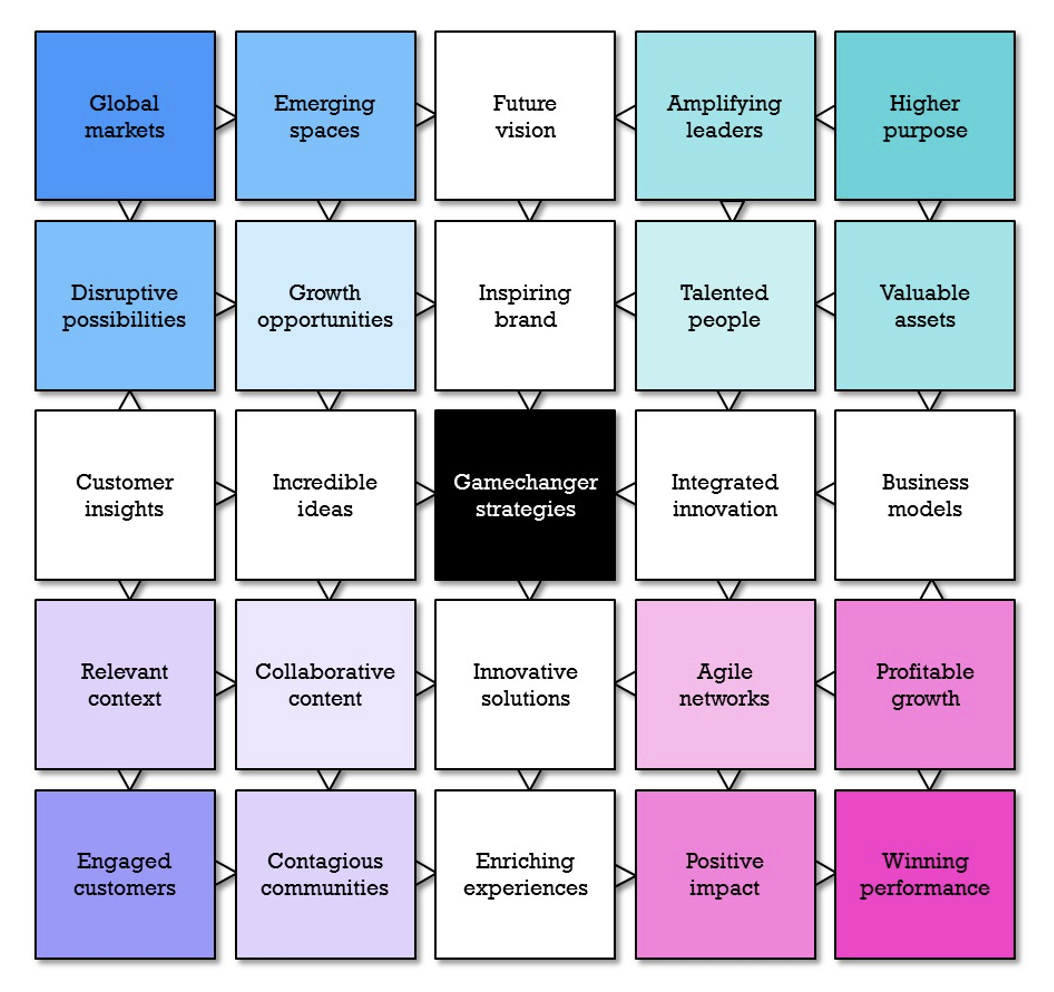
Business needs a new code for success!
Change is dramatic, pervasive and relentless. The challenges are numerous. The opportunities are greater.
Incredible technologies and geopolitical shifts, complex markets and stagnating growth, demanding customers and disruptive entrepreneurs, environmental crisis and social distrust, unexpected shocks and uncertain futures.
The old codes that got us here don’t work anymore. Moving forwards needs a new mindset.
Business Recoded is for business leaders who seek to progress in today’s rapidly changing world, and to create the organisations that will thrive in tomorrow’s world. It explores how to lead a better future, to reimagine your business, to reinvent markets, to energise your people. It describes how to combine profit with more purpose, intelligent technologies with creative people, radical innovation with sustainable impact.
It dives deep into the minds of some of today’s most inspiring business leaders – people like Anne Wojcicki and Jeff Bezos, Emily Weiss and Devi Shetty, Daniel Ek and Tan Le, Mary Barra and Masayoshi Son, Satya Nadella and Zhang Ruimin.
Learn from the innovative strategies of incredible companies – Alibaba and Amazon, Babylon and BlackRock, Meituan Dianping and Microsoft, Narayana Health and Netflix, Patagonia and PingAn, Spotify and Supercell, and many more.
The book is built on 7 seismic shifts driving a more enlightened future of business, unlocking 49 codes that collectively define a new DNA for organisations and their leadership. It’s about you – realising your future potential – by developing your own codes for more enlightened progress, personal and business success.
Do you have the courage to create a better future, for you and your business?
Reviews
“Business Recoded is a great source of inspiration for leaders who want to prepare themselves for the future.”
Alex Osterwalder, author of Business Model Generation and The Invincible Company.
“A brilliant collection of practical guidelines intended to refresh and reinvent our mindsets, from a global thoughtful leader with vast experience in management development”
Santiago Iniguez, President of IE University.
“Peter Fisk’s excellent new book, Business Recoded, will help ‘recode’ your business by tapping into the minds of some of the world’s most brilliant business leaders. It’s a must-read for anyone in need of a quick fix of inspiration and tried-and-tested advice.”
Martin Lindstrom, author of Buyology.
“With energy, enthusiasm and a deep reservoir of fantastic examples, Peter Fisk maps out what each of us needs to do in order to re-calibrate our selves and our organizations to create the future. Business Recoded is persuasive and compelling.”
Stuart Crainer, co-founder, Thinkers50.
“Two characteristics that make Peter Fisk one of my favorites thought leaders in the strategy field are his ability to make complex matters simple and his positive views about the future, focusing, through real case studies, on the opportunities laid ahead, rather than the hurdles. His new book, Business Recoded, is definitely a must-read for leaders that want to succeed with their organizations in our fast-changing world”.
Antonio Nieto-Rodriguez, author of “The Project Revolution” and “The Focused Organization”.
“It is not often that we have moments of magic in any business. What Peter has given us is more than just ideas and inspiration, but a whole way of thinking about how we could reinvent our future, and start making it happen tomorrow”
Alberto Uncini Manganelli, GM and SVP, Adidas.
Contents
Introduction
Business needs a new code for success
- Why do we need to recode?
- What are the new codes?
- The new DNA of business
- The new DNA of leadership
- Have the courage to lead the future
- Inspiration 1: Eliud Kipchoge
- Inspiration 2: DeepMind
- Inspiration 3: Tan Le
- Inspiration 4: Satya Nadella
- Inspiration 5: Mary Barra
- Inspiration 6: Jack Ma
- Inspiration 7: JK Rowling
Part 1: Aurora … Recode your future
How will you reinvent your business for a better future?
- Code 1: Explore your future potential
- Code 2: Have a future mindset
- Code 3: Imagine a better business
- Code 4: Find your inspiring purpose
- Code 5: Create your future story
- Code 6: Deliver more positive impact
- Code 7: Be the radical optimist
- Leader 1: Anne Wojcicki, 23andMe
- Leader 2: Elon Musk, SpaceX
- Leader 3: Patrick Brown, Impossible Foods
- Leader 4: Larry Fink, BlackRock
- Leader 5: Yves Chouinard, Patagonia
Part 2: Komorebi … Recode your growth
Where are the best opportunities to grow further and faster?
- Code 8: Ride with the megatrends
- Code 9: Find new sources of growth
- Code 10: Embrace the Asian century
- Code 11: Harness technology and humanity
- Code 12: Start from the future back
- Code 13: Accelerate through networks
- Code 14: Build a growth portfolio
- Leader 6: Masayoshi Son, Softbank
- Leader 7: Emily Weiss, Glossier
- Leader 8: Wang Xing, Meituan Dianping
- Leader 9: Danae Ringelmann, Indiegogo
- Leader 10: Mukesh Ambani, Reliance
Part 3: Transcendent … Recode your market
How will you reshape your market to your advantage?
- Code 15: Explore the market matrix
- Code 16: Disrupt the disruptors
- Code 17: Capture the customer agenda
- Code 18: Create new market spaces
- Code 19: Build trust with authenticity
- Code 20: Develop brands with purpose
- Code 21: Enable people to achieve more
- Leader 11: Bernard Arnault, LVMH
- Leader 12: Maria Raga, Depop
- Leader 13: Ali Parsa, Babylon Health
- Leader 14: Hooi Ling Tan, Grab
- Leader 15: Mikkel Bjergso, Mikkeller
Part 4: Ingenuity … Recode your innovation
What does it take to drive more radical innovation?
- Code 22: Be ingenious
- Code 23: Search for better ideas
- Code 24: Embrace a designer mindset
- Code 25: Create unusual connections
- Code 26: Develop new business models
- Code 27: Experiment with speed and agility
- Code 28: Dream crazy
- Leader 16: Rene Renzepi, Noma
- Leader 17: James Watt, BrewDog
- Leader 18: Jensen Huang, Nvidia
- Leader 19: Devi Shetty, Narayana Health
- Leader 20: Katrina Lake, Stitch Fix
Part 5: Ubuntu … Recode your organisation
How can people achieve more together?
- Code 29: Build a butterfly ecosystem
- Code 30: Work as a living organisation
- Code 31: Collaborate in fast projects
- Code 32: Do human, inspiring work
- Code 33: Align individuals and organisations
- Code 34: Create energy and rhythm
- Code 35: Be an extreme team
- Leader 21: Reed Hastings, Netflix
- Leader 22: Zhang Ruimin, Haier
- Leader 23: Cristina Junqueira, Nubank
- Leader 24: Jos de Blok, Buurtzorg
- Leader 25: Ari Weinzweig, Zingerman’s
Part 6: Syzygy … Recode your transformation
What does it take to transform your business effectively?
- Code 36: Transform your business
- Code 37: Exploit the core, explore the edge
- Code 38: Start outside in, and inside out
- Code 39: Engage people in change
- Code 40: Build rocket ships to the future
- Code 41: Create a circular ecosystem
- Code 42: Have the strategic agility to never stop
- Leader 26: Jeff Bezos, Amazon
- Leader 27: Bob Iger, Disney
- Leader 28: Jessica Tan, Ping An
- Leader 29: Piyush Gupta, DBS
- Leader 30: Javier Goyeneche, Ecoalf
Part 7: Awestruck … Recode your leadership
Do you have the courage to create a better future?
- Code 43: Step up to lead the future
- Code 44: Have the courage to do more
- Code 45: Develop your own leadership style
- Code 46: Achieve your peak performance
- Code 47: Stay resilient, stay strong
- Code 48: Create a better legacy
- Code 49: Be extraordinary
- Leader 31: Jim Snabe, Maersk
- Leader 32: Daniel Ek, Spotify
- Leader 33: Hamdi Ulukaya, Chobani
- Leader 34: Zhang Xin, Soho China
- Leader 35: Ilkka Paananen, Supercell
Business Recoded is supported by a useful portfolio of resources including online profiles of the 50 business leaders and 100 innovative companies on which the book is built. There is also a directory of useful websites and books for further reading, and an online program. Peter Fisk also delivers a wide range of keynote speeches, workshops and seminars for leaders and teams.
50 personal letters from the world’s leading business thinkers.
Peter Fisk’s letter “The 10x Leader” features in this Thinkers50 book in which each business guru writes a letter to the world’s CEOs describing the most important challenge for them. “This collection of specially-commissioned letters offers clear, calming and concise advice from across the spectrum of current leadership thinking. Written by respected business thinkers around the world, these 50 letters provide guidance, wisdom and personal insight into the particular challenges facing the business world today and anyone in a senior position.”
Other contributors include Tom Peters, who stresses the importance of focussing on the people within an organization; Liz Mellon, who writes to her CEO about gender equality in the workplace; Erin Meyer on cultural differences; Scott Anthony on optimising your old business whilst creating your new; Don Tapscott on the power of new technologies like Blockchain; Alex Osterwalder on the business model canvas; Chris Zook, explaining how a change of mentality can lead to exponential growth; and Linda Brimm, who discusses managing global cosmopolitans and a modern workforce. Dear CEO also features a foreword by Zhang Ruimin, Chairman and CEO of Haier Group.
- Open Letter to CEOs on Amplified Leadership by Peter Fisk
- Open Letter to CEOs on Business Models by Alex Osterwalder
- Open Letter to CEOs on Understanding Big Data by Roger Martin
- Open Letter to CEOs on Understanding Technology by Enrique Dons
- Open Letter to CEOs on The Second Internet Era by Don Tapscott
Becoming a customer-centric business
“Hello, I am your customer. Do you see the world like I do? It’s simple really. Start with me and everything else follows. Together we can do extraordinary things … “
Customers are now in control of our markets, demanding that we do business on their terms. Their expectations are high, and loyalty is rare. They are individual and emotional, well-informed and highly organized. They know what they want, and only accept the best.
“Customer Genius” introduces a 10 step blueprint for building a customer-centric business; proving that the right customer strategies, based on deeper customer insight, driving more compelling propositions and distinctive experiences, can engage those ‘wonderful people’ we call customers.
- Outside in. Power has shifted to customers, and business must learn to think and act from the outside in.
- Bigger picture. Customers see their challenges and solutions more holistically, without sectors or categories.
- Less is more. Better to attract and retain fewer, more profitable customers than to try to serve everyone.
- Deep diving. Use more personal immersion to discover what factors really drive attitudes and behaviours.
- Get personal. People are more irrational and emotional. Focus on the energisers, not just the essentials.
- Pull don’t push. Don’t sell products, engage people on what matters to them – where, when and how they want.
- Work together. Collaborative, help people to solve problems and achieve more with co-created solutions.
- Intuition rules. Throw away the rule book, and enable customer service people to be human and responsive.
- Word of mouth. Customers are more loyal to each other than any business, so harness the power of advocacy.
- Future results. Customer metrics are lead indicators, whilst financials only tell you about the past.
Customer Genius is the ultimate “customer” book … bringing together customer strategy, customer insights, customer propositions, customer experiences and customer relationships. It includes 30 practical tools ranging from market strategy to brand building, value propositions and social networks, plus 50 case studies including
Air Asia … It symbolises the new entrepreneurial spirit of south-east Asia. CK Pralahad describes the “bottom of the pyramid” as a $5 trillion opportunity. In 2001 Tony Fernandez promptly cashed in his AOL stock options and bought the Kuala Lumpar-based airline. Today it is one of the world’s fastest growing and most profitable airlines, connecting the bustling capitals of the region. Air Asia succeeds by targeting some of the most populous markets in the world with a low-cost business model that also delivering service to match that of nearby Singapore Airlines. In 2008 it became the first long-haul low-cost airline, and Richard Branson was so impressed he took a 20% stake.
Amazon … seeks to be “the most customer-centric business on Earth”. Jeff Bezos believes that focus on customers rather than competitors leads to more certain and sustainable growth. However since 1995 his focus was not just selling books but on providing customers with “convenience and speed” in buying almost anything – from toys and music to travel and groceries. In 12 years, revenues have grown from $12million to $12 billion. Innovations such as “look inside” sampling and “one-click” purchases, delivering tracking and self publishing, stayed focused on the customer benefits. As did the radical decision to allow competitive retailers to sell through the site, enabling customers to compare prices and ensure that they get the very best deal.
Zipcars … thinks and works from the outside in, developing an innovative business model that focuses on cost and convenience first, congestion and carbon emissions second. It targets students and young people as early adopters. Not only Zipcars making people rethink the need for car ownership, but you can instantly have the coolest car to impress your friends. Becoming a “zipster” is easy, register your details online with a membership fee of $50 a year, and then whenever you need a car – for 20 minutes or a month – just spot a Z-space, zap the door with your phone, turn the key, and off you go. From San Francisco to Berlin you will find Zipcars positioned around the streets, located by GPS on your phone, waiting to be driven.
Zopa … is an online money exchange, enabling people to lend and borrow money from others around the world. Peer-to-peer lending is simple and direct. The two parties find an interest rate which they agree upon, ensure each others credit worthiness through peer reviews, and then click to transact. Banks used to thrive on an antiquated model of taking people’s savings and lending it to others. Banks were intermediaries who eventually becoming too greedy, with its sub-prime loans and exotic derivatives running out of control. Zopa, founded in 2005, recognised that there was a different way – that networked technologies could connect people directly with people.

“Customer Genius” Contents:
Track 1: Hello!
“I am your customer … “
Track 2: My world
Wonderful People, Global Village, Customer Tribes
Facebook , Air Asia, Banyan Tree
Track 3: My agenda
Emotional World, Customer Kaleidoscopes, The Customer Agenda
Baidu, Stenders Soap Factory, Camper Shoes
Track 4: My terms
Customer Power, Pull not Push, Outside in, Inside out
Livestrong, Progressive Insurance, Zipcars
Track 5: My business
The Customer-centric Business, Customer value, 10 Dimensions of the Customer Business
Amazon, Best Buy
Part 2: The Customer Business
Dimension 1: Customer Vision
Customer Purpose, Customer Brand, Customer Alignment
Lego, Aveda, Cemex
Dimension 2: Customer Strategy
Customer Profitability, Customer Segmentation, Customer Management
Nike Women, Club Med, Tata Motors
Dimension 3: Customer Insights
Customer Intelligence, Customer Immersion, Customer Insights
Dove Campaign for Real Beauty , H&M, Harrahs Casinos
Dimension 4: Customer Propositions
Customer Context, Customer Propositions, Customer Conversations
Whole Food Markets, Oxfam Unwrapped, Jimmy Choo
Dimension 5: Customer Solutions
Customer Collaboration, Customer Innovation, Customer Solutions
Heinz Tomato Ketchup, Smart USA , Boeing 787 Dreamliner
Dimension 6: Customer Connections
Customer Communication, Customer Networks, Customer Gateways
Wumart China, Zopa, Quintessentially
Dimension 7: Customer Experiences
Customer Journey, Customer Theatre, Customer Experiences
Nintendo Wii, Vom Fass, Build a Bear Workshop
Dimension 8: Customer Service
Customer Delivery , Individualised Service , Service Recovery
Disneyland , Singapore Airlines , Ritz Carlton
Dimension 9: Customer Relationships
Customer Partnerships, Customer Communities , Customer Advocates
Harley Davidson , The Co-operative , New Balance
Dimension 10: Customer Performance
Value Drivers , Customer Metrics , Business Impact
Enterprise Car Rental , First Direct , GE
Part 3: The Customer Champions
Track 6: Leadership
Inspiring People , New Business Leaders , Customer Champions
Eczacibasi , P&G , MAC Cosmetics
Track 7: Culture
Engaging your people , Aligning people and customers , Structures, symbols and stories
Pret a Manger , Innocent Drinks , Toyota
Track 8: Transformation
Creating a customer revolution , Making change happen , Inspiration
Avon , Skoda , Virgin
Appendix: The Genius Lab
Creating a Customer Business
10 dimensions, 30 essential tools, 150 practical actions
“Customer Genius” Extract:
“Hello! I am your customer.
Yes, a real person, a human being.
I have my needs and wants, to get through the day, and to achieve what I must.
But I also have my hopes, dreams and ambitions.
For too long you have treated me as a name or number.
You group me into what you call a segment, or sometimes just a mass market.
But I’m not prepared to tolerate that anymore.
I am me. Don’t treat me like somebody else.
Sometimes I might be very similar to others,
but I can also be very different and discerning.
In the old world, I realise I didn’t have much choice.
I needed you more than your needed me.
But things have changed.
Now I have the power. Now I’m in control.
You need me, more than I need you.
It’s time you started doing business on my terms.
In fact, why are you actually in business?
Just to make as much money as you can, from whatever you can?
Or to make a difference, to make my life better?
I don’t mind if you make money.
If you can do something more for me, I want you to succeed too.
You’ll be able to invest in creating an even better business
With more rewards for both of us.
Why don’t you learn a bit more about me? Come and listen to what I really want.
I’d love to tell you what I’m really trying to achieve.
Not just whether or not I want your latest gadget, gizmo or gumption.
Why don’t we get together and find a way to really solve my problem?
I’d even be happy to pay more if you can really help me find the right solution.
And what about that brand of yours?
Your name, your logo, and all those pretentious advertising slogans?
They’re all about you, and how great you are.
Actually, Im more interested in me, and what you can do for me.
Start thinking about my world.
Don’t sell me travel tickets, help me explore the world.
Don’t sell me running shoes, help me to run a personal best.
Don’t sell me potted plants, help me to create a magical garden.
Stop bombarding me with your smug (but highly creative, you tell me) campaigns.
Telling me what you want to sell, when and how you want to tell me.
I’m not here just to prop up your sales targets.
I have got a life you know. I will buy things, but in my own time, on my terms.
Worst of all are all those unsolicited mail shots and phone calls.
They interrupt me and frustrate me. And eventually make me hate you.
When I do want something, I expect it to be easy.
Come to me, or to places convenient for me.
Rather than making me go to places convenient for you.
And at times to suit me.
I expect what I’ve seen online to be in your stores, or to be available by phone.
And to be able to take it back to any of your places, if I don’t like it.
But I want you to be open and honest about what the deal is.
None of those hidden clauses or additional costs.
Sometimes I wonder if you’re trying to trick me, and whether I can really trust you.
And when I do decide to buy something from you, please don’t call me Sir or Madam.
I’m me.
Don’t just follow a process or a script. Try and learn something about me.
And whilst we’re on the subject of stereotypes, please don’t say goodbye
with one of those fake “have a nice day” smiles,
which I know you have already done a thousand times today already.
If I can get any book or music delivered to my door in 24 hours
Then why shouldn’t I expect a new car, a new washing machine, and new home to be just as quick?
And if you treat me with you the best service when I’m a big cheese at work
Then I don’t expect to come back later and be treated like trash as an individual.
Treat me well as an individual and I will tell all my friends how good you are
And I might even switch to you as a corporate customer too.
Treat me as a human being. And be a yourself, not a corporate clone.
I know you get rewarded for satisfying me. But frankly I expect much more than that.
I demand 100% satisfaction, and 100% of that so-called delight too.
Every time I talk to your people. Every time I experience anything to do with you.
It should be right, it should be excellent, it should be perfect.
However I don’t want the same every time. Life’s too short and a bit boring.
To be honest, I’d sometimes like you to surprise me!
Which brings me to something that a friend of mine tells me that you care about a lot…
Loyalty.
Whether I really want to come back again. And do. And buy more. And tell others.
So you give me a plastic card. With something like a 1% discount.
Hmmm. To be honest I think loyalty is something that has to work both ways.
If you trust me, care for and do more for me. I might just do likewise.
But a relationship is perhaps asking too much of me.
Do I really want a relationship with a big anonymous company? I think not.
I know you invested millions in those customer relationship management systems.
But all I get is yet more pieces of direct mail. About what and when you want.
I’d much prefer to get to know other people who share my passions.
For travelling. Or running. Or gardening. Real people like me.
The best thing you could do is help me build relationships with other people in my world.
Help us to share our experience and opinions, even about you.
Help us to share our ideas and interests, and to do what we love most.
I’m then happy to buy your products. And delighted to be part of your community.
And you might even find the things I say and share, are valuable to you too.
Surely measuring how strongly I feel about you, and intend to do more with you
Are much better, forward-looking indicators of your success, than your financial history.
And one final thing about people – the real people, the human beings who work for you.
I know they work incredibly hard, but I wonder what life is like for them
So what makes them tick? Want to do more? To even surprise me?
I want to support a company that cares about its own people too. It cares about who makes its products, and the impact it has on people all around the world. Because I bet they care a lot more about me as a person, than me as a product.
If you give them time, and encourage them to know me, maybe they can create a much better solution to my needs, which I’d be happy to pay more for, and therefore better results for your business too.
When you think about it. I know you’re a real person just like me.
But when you go to work you put your blinkers on. You restrict yourself to some artificially defined sector.
Whilst I see a bigger, more exciting, more connected world. You become a slave to short-term, transactional thinking. Whilst I think without limits.
You follow conventions and prejudices of your own making. Whilst for me, everything is possible.
It’s simple really. You’ve just got to see my world.
Do business from the outside in. Not the inside out.
Start with me, and everything else follows. We can be real people together. Happy supporting each other. With so much more opportunity. And more fun.
Together we can do extraordinary things”
“Customer Genius” Masterclass:
The two-day masterclass, issue-driven and action-driving will define what it takes in your business. It is guided by the customer blueprint, inspired by lessons from 50 great companies around the world, and supported by 30 practical tools for implementation.
Day 1, Part 1 : Customer Genius … introduction
- Your business issues and personal objectives
- Why it matters, and what it can be like
- Developing your personal blueprint
- Power shifts and doing business from the outside in
- Making it holistic – from insight to propositions, service to relationships
- Defining the 10 dimensions of a customer-centric business
Day 1, Part 2 : Customer Imperative … the business case for customer-centricity
- What is the business case for customer-centricity?
- Assets and investments, revenue and costs, risks and rewards
- Retaining customers, doing more for them, helping them survive too
- Balancing cost reduction with customer excellence
New insights from leading companies:
- Amazon’s relentless rise by focusing on customers
- Cemex’s mission to create a better world
- Umpqua’s bank designed for customers
- Quintessentially’s focus on individual service
Practical tools for implementation:
- Customer vision, that defines a purpose around customers
- Customer “power profilers” to evaluate your customer-centricity
- Business case for customers, based on key ratios
- Blueprint for a customer-centric business
Day 1, Part 3 : Customer Strategy … doing more to retain your best customers
- Attracting, serving and retaining the best customers
- How to identify and target your most profitable customers
- The difference between an acquisition and retention-focused business
- Implementing and managing a customer strategy for different customers
New insights from leading companies:
- Club Med’s strategic rethink based on segmentation
- Nike’s customer alignment that led to Nike Women
- Best Buy’s focus on the angel not devil customers
- Tata’s strategy on cheap cars for the emerging markets
Practical tools for implementation:
- Customer profitability analysis to identify your “best” customers
- Needs and value-based segmentation to focus on priorities
- Customer strategy to align the organisation behind it
- Customer portfolio and management to deliver profitable results
Day 1, Part 4 : Customer Insights … deep diving to understand new priorities
- Customer drivers in an economic downturn
- Profiling customers and defining the customer agenda
- How to integrate all your customer information for better action
- Deep diving for better insights and ideas in a fast changing world
New insights from leading companies:
- Dove’s campaign for real beauty, the next phase
- H&M’s immersion to stay on the fashion curve
- Coca Cola’s customer needs analysis and need states
- Zipcar’s new market for cars based on changing motivations
Practical tools for implementation:
- Customer canvas to bring together all your information
- Research techniques including conjoint analysis
- Customer immersion and deep diving to get real insights
- Energiser pyramids to define what matters most
Day 2, Part 1 : Customers as Competitive Advantage
- Customers as your source of advantage in an uncertain world
- Developing propositions that engage customers in what matters most
- Collaborating with customers to develop innovation solutions
- Building connections through networked media, channels and partners
New insights from leading companies:
- Avon and the power of personal retailing in emerging markets
- Heinz Tomata Ketchup, nothing taste’s better
- Smart USA finding new ways to sell and serve customers
- Innocent Drinks, pure fruit, Fruitstock and woolly hats
Practical tools for implementation:
- Customer value propositions based on customer priorities
- Collaborative development of products and services
- Pull communications, concierges and social networks
- Customer inversion – doing what, when and how customers want
Day 2, Part 2 : Customer Service … delivering more compelling experiences
- Delivering the promise in consistent, relevant and human ways
- How to deliver great service more efficiently and more personally
- Service recovery and the power of feedback and responsiveness
- Delivering customer experiences that enable people to do more
New insights from leading companies:
- Pret a Manger’s passion for food, and passion for people
- Ritz Carlton delivering excellence as it says on its credo card
- Progressive Insurance’s mobile service agents do more for customers
- Singapore Airlines, and the culture that creates an exceptional experience
Practical tools for implementation:
- CARER service excellence framework
- Individualised service and the ability to “do, know and be”
- Service recovery, streamlining and elaboration
- Customer experience, customer heartbeat, customer theatre
Day 2, Part 3 : Customer Performance… From satisfaction to loyalty to revenue to profits
- Turning great service into profitable business results
- Building relationships that do more for customers and business
- Harnessing word of mouth as your driver of future business performance
- Customer metrics and the real value and ROI of customer investments
New insights from leading companies:
- Enterprise car rental’s customer service measurement
- First Direct and the potential of customer advocacy
- O2 and customer-centric scorecards across the business
- Virgin, a business where customers are ultimate performance
Practical tools for implementation:
- Loyalty ladders and relationship development strategies
- Net promoter score, potentially the ultimate question
- Customer-centric scorecards, incentives and rewards
- Value drivers, asset valuation and economic value creation
Day 2, Part 4 : Lights, Cameras, Action … Ready to make it happen in your business
- Personal action planning and prioritisation for implementation
- Customer Toolkit with 30 tools and 150 actions
- Q&A, summary and conclusions
“Customer Genius Live” masterclasses are open programmes, or customised for your business. All attendees receive a personal blueprint and toolkit, together a copy of the new book. Contact peterfisk@peterfisk.com if you would like to attend, or to host a similar events.
More about “Customer Genius”:
Download Creating an Extraordinary Customer Experience introducing the 10 phases
Download the Customer Genius Toolkit with 30 essential tools for making it happen.
A more inspired approach to strategy, leadership and change
How do you lead a business in turbulent times, when change is essential but the destination is uncertain? What kind of strategy provides focus and agility, to create extraordinary value to all stakeholders in the long-term, whilst still succeeding in the short-term.
Ultimately a business is about growth – sustainable, profitable growth. As the organisation evolves how does it drive and accelerate this growth? In the past we focused on core capabilities, today we are driven by opportunities which we address through partnerships across continents and sectors.
“Business Genius“ is about strategy and leadership, change and performance. It describes how to get the right balance personally and organisationally – left and right brain, outside in and inside out, future back and now forward, radical ideas and practical action … A more inspired approach to businessHow to drive profitable growth in more intelligent and imaginative ways … combining the entreprenuerial passion of start-ups with the commercial rigour of large enterprises … for everyone who seeks the inspiration to think and act differently.
- Accelerating growth. Driven by market opportunities not capabilities, doing more for customers not more products.
- Business lifestages. From entrepreneur to corporation, seven phases in the evolution of business and leadership
- Economic value. Value is what matters most, based on future expectations of profitability, growth and risk.
- Purpose not profit. Business needs a purpose beyond profit, the way in which it ultimately makes people lives better.
- Smarter strategies. Strategy is about choices – deciding where in the world, how and what will maximise value
- Business innovation. Every aspect of business can improve – from products and processes to business models.
- Energy and passion. Fast workplaces and creative workstyles transform attitudes more than rules or rewards.
- Leaders and managers. Managers control processes, whilst leaders inspire people. You need to do both. Heads up and heads down.
- Managing change. Change with a purpose in mind. Make it matter, make it focused, make it happen, and make it stick.
- Delivering results. Value creation is driven short and long-term, combining business, market and personal impacts.
Business Genius offers a more inspired approach to strategy and leadership for large and small companies. It includes 40 practical tools ranging from strategic planning to business models, leadership development and change management, plus 40 case studies including
Google … “Googol”, the mathematical term for 1 followed by 100 zeros, symbolises the scale of the ambition of Larry Page and Sergey Brin to “organise the world’s information and make it universally accessible and useful”. “The perfect Q&A machine” says Page. Yet with email and shopping, software and YouTube, Google sees itself as much more than a search engine. The secret, however, is not in the algorithms but in the people. “Googlers” love working at Googleplex, now officially one of the world’s “best places to work”. The environment is exhilarating and the perks are extraordinary. From virtual reality to gourmet restaurants, free bikes and weekly t-shirts, crazy ideas time and professional development, it really is an inspiring place.
Li & Fung … London, Paris, New York. Walk through the fashion malls, and around 35% of the retailers and brand names will have a shared secret – Li & Fung, the world’s leading virtual supply chain. Dream up a new collection, and the Chinese company will find companies to design, source, manufacture, distribute, advertise, merchandise, and even run your back office for you. Founded in 1906 in Guangzhou, and now headquartered in Hong Kong, Li & Fung is not an enormous Asian factory churning out cheap clothes. Its a smart “invisible” business that has the networks to help you do every aspect of business faster, cheaper and better. With $7 billion revenues and offices in 70 countries, it offers a new business model for a “flat world”.
Proctor & Gamble … “The consumer is boss” proclaimed AJ Lafley as introducing himself as the new CEO. It sounded, he admitted, “a little like Sesame Street” but sometimes you need simple message to have an impact. For the Cincinnati business, famous for brands like Crest, Tide and Pampers, it was revolutionary. For the last 165 years, P&G scientists drove innovations, and products were king. Lafley started about transforming the business, reorganising around customers, collaborating with them in new “sense and respond” innovation processes. Office walls were torn down, and half his senior managers were replaced, then acquisitions followed, including $54 billion for Gillette … turning P&G into a virtual brand-owning company, with consumers at its core.
Umpqua Bank … Umpqua is a bank like no other. For 43 years its 6 branches served the lumberjacks of Oregon state. Until its CEO died. Then Ray Davis arrived, and decided that Umpqua had to change or die too. Instead of looking to big banks, he looked to Starbucks for new store designs, Gap for product design, Ritz Carlton for customer service training. And he recruited their people too. “Welcome to the world’s greatest bank” says the sign as you enter its boutique stores. Funky music, leather sofas and espresso bar, free wifi and magazines. Bring your friends, stay as long as you like. This is banking designed around customers, and one that Davis has grown from $140m to $6bn in 10 years.
The full list of case studies:
Apple transforming markets with iPods and iPhones • Bang & Olufsen Danish electronics designed around customers • FC Barcelona capturing the sporting passion of the Catalans •Berkshire Hathaway unlocking the human spirit of value creation • Chupa Chups the Spanish lollipops inspired by Picasso • Cirque du Soleil reinventing traditional markets with creative flair • Crocs the craze started by three men in a fishing boat • Current TV user generated content revolutionises media • Diesel staying cool by being a step ahead of the crowd • Disneyconnecting digital and physical worlds together • FedEx aligning the organisation to deliver every time • Ferrari creatively building a new high-speed business • GE “ecomagination” transforms a business giant • Green & Blacks the little green company with a luxurious taste • Google new ways to work and have a great lifestyle too • Gucci Italians reject sex for a more sophisticated style • Haier the Chinese worker who created a revolution • Kikkoman ancient Japanese secrets of a long-life business • Li & Fung anything is possible in the flat business world • 3Mcreative disruption at the innovation company • Marks & Spencer bringing a retailing giant back from the dead • Natura selling the secrets of the girls from Brazil • Net a Porter the fashion business that fuses retail and content • News Corporation ready to create a global media revolution • Nike constantly transforming markets in your own vision • Porsche the little car maker with the big impact • Proctor & Gamble real leadership that transformed a market leader • Red Bull the Austrian who turned a tonic into liquid cocaine • Second Life virtual reality that reflect customer aspirations • Shanghai Tang the rise of China’s first luxury fashion brand •Stella Artois Belgian beer that is reassuringly expensive • Tate Modern an art gallery designed to fit your mood • Tchibo the Germans who changed the retail model • Umpqua Bankwelcome to “the greatest bank in the world” • Zara Spanish fashion that is always a step ahead.

Download Inspired Business … a more inspired approach to leadership and growth
Download Winning in a Digital World on the opportunities for business (part 1 of 4)
Download Reset .. Rethink … Refocus … Restart on new directions in a post-crisis world
Executive Summary
What do the most successful businesses do differently than mediocre ones? They see the big picture. They see things differently and do different things. They connect the unconnected, challenge the conventions, look for new opportunities, and are not afraid to try new ideas. They are inspired businesses, with a sense of “genius” about them.
What is “genius”?
Geniuses have given the world everything from Theory of Relativity to penicillin to the World Wide Web. But what is genius? Academics and philosophers have long tried to define the answer.
Based on the latest research, it is clear that while genius is often thought to equate purely to intelligence, it is not necessary to have an extraordinarily high IQ, to speak 15 languages by the age of 8, or to master the intricacies of quantum mechanics. Genius is less about how intelligent you are, and more about how you apply that intelligence in creative ways.
From Aristotle to Mozart to Einstein to Picasso to Warren Buffet, every genius throughout history has displayed the following nine characteristics of genius:
1. Original, or open-minded, free from conventions, and able to take new perspectives and deconstruct problems;
2. Conscious, or aware of what’s going on, what changes are taking place, what patterns are unfolding;
3. Analytical, or able to work through problems logically;
4. Creative, or open to possibilities, taking mental leaps, and using hypotheses to solve problems;
5. Synergistic, or prone to think in parallel, tolerate ambiguities, and connect the previously unconnected;
6. Prolific, or able to generate many ideas or solutions;
7. Pragmatic, or mindful of the need to turn theories and concepts into practical realities;
8. Visionary, or able to communicate more holistically and without words; and
9. Self-confident, or filled with the courage to hold firmly to his or her convictions.
The combination of intelligence and imagination, the connection of opposites, is the source of new insights, of unusual ideas, and of extraordinary results.
Applying the ideas of “genius” to business requires us to start from a new perspective: from the future rather than today, and from the outside rather than the inside. It also requires us to interpret and apply these new perspectives more powerfully, seeing the bigger picture and making new connections, and making sure that the radical part of ideas are not lost as they are put into practice.
Genius is therefore about fusion: connecting opposites that together are more than the component parts.
In the rest of this summary, we will explore the four fusions that together deliver a more inspired business:
• The first fusion is between right brain and left brain. This requires you to take a more creative approach to your challenges, and to focus your imagination on what matters most.
• The second fusion is between future back and now forward. This means seeing opportunities and creating tomorrow while also delivering today.
• The third fusion is between outside in and inside out. This requires you to do business based on the customers’ needs, rather than on your own needs or on what you have always done. And
• The fourth fusion is between radical ideas and practical action. This means making every action count, ensuring that radical ideas deliver more significant impact.
To create these four fusions, you must also focus on 12 elements that are essential to business excellence.
1. Fast growth;
2. Business bubbles;
3. Leadership;
4. Growth markets;
5. Smarter strategies;
6. Business innovation;
7. Customer power;
8. Brand propositions;
9. Market networks;
10. Energizing people;
11. Inspiring change; and
12. Delivering results.
We’ll discuss each of these 12 elements in the context of the four fusions. Now, let’s explore the first fusion that leads to business genius.

Fusion 1: Right brain, left brain
Business geniuses use their left brain, the analytical side, to lead and grow their businesses intelligently with thinking that is objective and focused. At the same time, they also use their right brain, the creative side, to lead and grow their businesses imaginatively with thinking that is intuitive and holistic.
Unfortunately, many businesspeople approach the future of their companies and markets with only their left brains. Clearly, we need both – left and right brain, intelligence and imagination — but it is the connections between the two that make the difference.
To succeed in business today, to make sense of our changing, even chaotic, world, to be effective entrepreneurs and business leaders, we have to function with our whole brain, not just part of it.
There are three concepts to consider in the left-brain, right-brain fusion:
1. Fast growth;
2. Business bubbles; and
3. Entrepreneurial leaders.
Fast growth means more than just expanding your sales or market share. You want to create sustainable, profitable growth.
So how does a business, large or small, create and sustain profitable growth? The answer is already in our heads. As human beings, we have an enormous capacity to think, to sense and respond, to innovate and to change. We each have 100 trillion brain cells, and probably use about 1 percent of them at any time.
A genius is someone who uses more of his or her potential brainpower simply by forming more connections between the brain cells on the left, analytical side, and the right, imaginative side.
The same is true of businesses. A successful growth business is first an imaginative business. It then intelligently focuses on the best opportunities. While most of today’s businesses are dominated by left-brain thinking, the right-brain thoughts are what enable companies to imagine new products and new markets.
Growth businesses succeed by thinking more broadly, and by doing so they see more opportunities to exploit, more ways to be different than competitors, and more sources of future profit.
But growing a business is rarely easy. There are always growing pains, and it can be difficult to recognize and deal with the challenges.
Typically, during the lifetime of an organization there are seven stages. They are:
1. Creation;
2. Launch;
3. Stabilization;
4. Extension;
5. Maturity;
6. Evolution; and
7. Exit.
The seven stages will differ somewhat from company to company. Some enterprises will evolve rapidly and some slowly – while a few will appear to leap ahead with great agility through a long life span.
Certain evolving companies remain relatively small – and may have to be highly imaginative to generate enough cash to survive and thrive. Some large companies will have equally tough challenges, struggling to remain innovative and find new markets.
However, the bottom line is that customers will pay more for great products. They will purchase, at a premium, brands they trust and solutions that truly meet their needs.
Similarly, shareholders will invest in businesses that consistently provide them good returns. It’s that simple to comprehend – and that difficult to achieve.
A good example of amazing product growth is Red Bull, the energy drink. The drink originated in Thailand. The man who primarily marketed it in the West – Dietrich Mateschitz – had previously been head marketer at a German toothpaste company.
In the 1980s, product sales struggled in the West. Red Bull’s brown color was unappetizing, and some consumers described its taste as downright disgusting.
It also contained twice the caffeine of a regular soft drink. However, that turned out to be a positive with consumers who wanted a non-alcoholic pick-me-up.
Mateschitz and his Thai partner who invented the drink, Chaleo Yoovidhya, persevered. They added some sugar, and marketed the product as a legal stimulant that was “cool.”
The marketers priced Red Bull much higher than soft drinks. They also used radical new techniques – such as advertising it on PlayStation and sponsoring a Formula 1 car – to pitch the product.
Eventually, in a world where people habitually see themselves as energy-deprived, it caught fire – first in Australia, then in Europe, and finally in America.
With a low cost of production and a high retail price, the product became a money tree.
By 2006, sales of Red Bull had totaled three billion cans in 130 countries.
As for Meteschitz, he accumulated a fortune of $5 billion. His partner made even more,
Red Bull proves a fascinating point: People will drink something with a high price and odd taste if they believe it provides benefits.
Thus, if you have a product that looks unappealing at first, don’t give up hope. Make it “cool” and trendy, and customers will beat a path to your door.
In business, there are three growth platforms:
The first is operational growth, which means doing more of what you do. A company can grow operationally through developing:
• New customers;
• New channels;
• New products;
• New communication; and
• New pricing.
For example, Starbucks coaxes customers to spend more money at its coffee shops by offering a broader range of beverages, plus food, music CDs, and gift items.
The second growth platform is innovative growth, which means doing what you do differently. This type of growth relies on developing:
• New concepts;
• New applications;
• New markets;
• New partners;
• New processes; and
• New structures.
For example, HSBC constantly seeks to develop new financial services for its many audiences.
Finally, the third growth platform is strategic growth. That means doing different things. This can be done through developing:
• New ventures;
• New categories;
• New businesses;
• New acquisitions;
• New capabilities; and
• New business models.
For example, Apple fundamentally rethinks markets, such as the music industry, and reshapes them to its own vision.
Now let’s consider the second element: business bubbles. Bubbles in this sense are short-lived opportunities. Of course, bubbles burst, so you need to move quickly, or avoid them altogether.
History is filled with examples of bubbles, from the Dutch tulip mania of the 16tth century that sent the price of a single bulb soaring to the cost of a house, to the dot-com frenzy of the early 21st century that created outrageous market capitalizations for Internet firms that never turned a profit.
The point to remember is that not every great business idea is sustainable. Some of them will turn out to be fads. By using a combination of right- and left-brain thinking, executives and entrepreneurs can both imagine opportunities, and analyze those opportunities for risks.
For example, while many Internet companies went bankrupt, the ones that combined both imagination and intelligence, such as Amazon and Google, have survived and emerged as powerful businesses.
It’s critical to stay alert to both threats and opportunities. Businesses face many challenges now and in the coming decade. They include:
• Worldwide concerns about the environment and climate change;
• Increasing constraints on the supply and use of natural resources;
• Geopolitical instability;
• An aging population in developed countries;
• Social backlash against corporate activity; and
• Growth of the public sector – often at the expense of the private sector.
However, there are tremendous opportunities for creative and courageous businesspeople, including:
• The growing number of consumers in emerging nations;
• The increasing availability of knowledge and our ability to exploit it;
• The development of technologies that empower consumers and on-line communities; and
• The ever-faster pace of technological innovation.
This leads to the third element of business excellence: leadership.
Results-oriented leaders must understand that different types and styles of leadership will be necessary during the various stages of the business life cycle.
The entrepreneur, with a relentless focus on turning a concept into a new business, is one kind of leader. In contrast, large organizations invariably demand a leader who can deal with politics and etiquette.
In the seven stages of a business, the creation and launch phases lead toward the next stage: stabilization. That’s where many companies begin to start treading water – and where some small businesses cease growing.
The stabilization phase is where the typical entrepreneur fails to move ahead. However, the more flexible leader – using both sides of his or her brain – sees new and better opportunities.
As businesses move into later phases – such as extension and maturity – more companies begin to stand still. They will start to optimize their existing portfolios, making the most of their existing brands.
Only companies with bold leaders will reach the evolution stage. It demands that leaders fundamentally challenge strategies and assumptions.
That often means considering entry into entirely new categories, or engaging in new partnerships, or refocusing a business model to concentrate on emerging markets.
There are at least seven common styles of leadership, and each type has its own strengths and weaknesses:
1. Charismatic leaders are strong at inspiring change, but weak at maintaining the status quo, which quickly bores them.
2. Directive leaders are strong at making quick decisions, but weak at engaging senior people.
3. Commanding leaders are good in a crisis, but bad at longer-term thinking.
4. Aristocratic leaders are strong on traditional, formal leadership, but weak on driving innovation or change.
5. Guardian leaders excel at maintaining a steady state, but tend to avoid necessary change.
6. Intellectual leaders are strategic and visionary, but poor at understanding normal people who lack their high levels of intelligence. And
7. Relaxed leaders are skilled at listening and facilitation, but often avoid difficult decisions.
There are no rights or wrongs, although a person who seeks to be anybody but himself is inevitably going to be found out as a fake, and will end up personally frustrated. Leaders of organizations today will need to embrace a number of these traits, even changing their styles from time to time.
However, the successful business leaders of the 21st century, in big companies and small, share five common characteristics that combine the passion of the entrepreneur with the discipline of the corporate executive. These five characters are the “five Cs” of the new business leader:
1. Catalyst of change: The leader constantly seeks new possibilities, challenging the business to think differently, to be more innovative and effective, faster and with more impact.
2. Communicator of vision: The leader articulates a clear and inspiring direction for the business, living the values and personality of the brand, and engaging all stakeholders in active dialogues.
3. Connector of people: The leader brings the best people and best ideas together, internally as well as from outside the organization, to generate bigger and better ideas and solutions.
4. Conscience of the business: The leader champions business ethics and corporate responsibility, cultural diversity, equal opportunities, and staying true to the business purpose and brand values. And
5. Coach of high performance: The leader works with and supports all levels across the organization, from the boardroom to the shop floor.
Fusion 2: Future back, now forward
You move your business ahead not by looking backward at the past – or even by fixating on the present. Rather, you gaze creatively into the future and then begin working backward toward the present.
That approach gives you an advantage over competitors, who often get mired in a perpetual present. So, don’t get stuck in the conventions of today, but rather pull off the creative trick of looking at what tomorrow’s demands mean for your business today.
This fusion relies on three elements of genius, including:
• Growth markets;
• Smarter strategies; and
• Business innovation.
Of course, to succeed in the future, an organization must find new sources of growth. Markets are constantly changing, and the needs and tastes of today’s customers are likely to be much different even a few years from now. In addition, new markets are constantly opening up to businesses that are alert to opportunities.
For example, according to Michael White, the chairman and CEO of PepsiCo, “Ninety-seven percent of growth in the next 25 years will come from emerging markets.”
So where should leaders look for tomorrow’s growth markets today? Here are nine areas to explore:
1. Green markets are made up of conscience consumers, those who believe passionately in preserving the planet;
2. Silver markets consist of silver-haired Baby Boomers who are healthy and wealthy – and yearn to start new careers and travel the world;
3. Pink markets are made up of the large and affluent gay and lesbian communities, which buy more premium technology products than other consumers, yet are largely ignored by mainstream brands;
4. Red markets are remnants of the former Soviet countries that now have booming, entrepreneurial economies and consumers who crave the latest fashions;
5. Blue markets are located in the southern region countries, ranging from South Africa to Brazil, and from India to Dubai; these nations are moving rapidly up the economic ladder;
6. Grey markets contain the high-tech enthusiasts sometimes called early adopters, who have a passion for the newest gadgets;
7. Brown markets consist of people fascinated by older, “retro” products, ranging from early digital watches to antique furniture;
8. White markets are the low-cost markets, served by such businesses as Aldi supermarkets and Virgin Blue air travel, that reflect everyone’s love for a “bargain”; and,
9. Gold markets are the luxury goods markets, driven by strong demand in Asia and the U.S., that are perhaps the world’s fastest growing category.
These aren’t mere niche opportunities. Instead, they’re huge markets. For example, according to research by Bain & Company, the luxury goods segment is worth $168 billion annually – and it’s growing at 7 percent each year.
It’s not like the past, when markets tended to be stable, predictable, and usually dominated by the same handful of companies. Now, business success depends less on making new products than on making smart choices.
This brings us to the fifth element of business excellence: smarter strategies. As Peter Drucker once put it, “Wherever you see a successful business, someone once made a courageous decision.”
Shaping your own future is about strategy, and strategy is about making tough choices. Businesses must look beyond their mission and vision statements to find a “higher purpose” that gives them meaning and personality.
For example, Disney’s higher purpose is “to make people happy.” Nike’s is “to enable people to achieve their personal best.” Sony’s is “to innovate in a useful way.” And Wal-Mart’s higher purpose is “to give the customer a good deal.”
More generally, companies tend to align around one of the following seven types of purposes:
1. Explorer companies, such as IBM, seek to go where nobody has gone before or to enable people to do something new.
2. Challenger companies, such as Virgin, play the underdog, taking the customer’s side and challenging bigger or more established brands.
3. Servant companies, such as Google, believe in putting customers first and in treating everyone equally.
4. Quality companies, such as BMW, strive for perfection and place the highest priority on product excellence.
5. Hero companies, such as Microsoft, seek to change the world, and to deliver a better way of life for everyone.
6. Conscience companies, such as outdoor equipment retailer REI, put principles ahead of profits, believing that business must be a force for good and that ethical and environmental responsibilities are high priorities. And
7. People companies, such as Starbucks, put people first, caring for their employees, their customers, and the communities in which they operate.
The sixth element, business innovation, is the driving force of competitiveness, differentiation, profitability, and growth. There are three types of innovation:
1. Business innovation;
2. Market innovation; and
3. Value innovation.
Business innovation addresses an enterprise holistically – in terms of products and services, channels and relationships, processes and supply chains, as well as business models and organizational culture.
Market innovation focuses on potential markets. It explores how to transform structures and practices, challenge rules and conventions, as well as change behaviors and expectations.
Value innovation captures elements of both business and market innovation. Its goal is to create win-win situations and produce value for all stakeholders.
Innovation is about the commercial implementation of the best ideas, whether those ideas focus on new products or services, new ways of working, or even the fundamental business model of the company.
Innovation might take one of the following forms:
• At the level of concepts, companies innovate new business ideas that address customers’ aspirations in new ways, that redefine the way things are done and the business model that supports them. Consider the way IKEA has transformed the world of home furnishings with its flat-packed furniture, or how Nike has created brand experiences at its flagship Niketown stores.
• At the level of solutions, companies innovate product and service ideas that are more functional and tangible, that individually or collectively serve customers better. Examples include Dyson’s bagless vacuum cleaner, the iPod as a digital photo album, and Ritz Carlton hotels developing a more personal style of service. And
• At the level of markets, companies create new ideas that reshape markets, change people’s behaviors, and drive new aspirations. Starbucks essentially created the modern coffee shop, with its diversity of offerings and a premium experience. Similarly, Apple’s iTunes has revolutionized the ways in which people buy, listen to, and store music.
The next section – outside in, inside out – deals with seeing your business not only from the inside, but also from the outside, the customer’s perspective.
Fusion 3: Outside in, inside out
To achieve the third fusion that leads to business genius, you must accomplish two things:
• First, engage your customers intelligently from the inside out – the business perspective – to be more distinctive, focused, and effective. And
• Second, engage your customers imaginatively from the outside in to be more responsive, appropriate, and personal.
Looking inside out is the traditional way of operating, with people in the business looking out – and the customers on the outside looking in.
It’s harder to use our imaginations to put ourselves fully in the customers’ shoes, to see things from their point of view. But it’s essential to escape from our self-centered perspective.
The three elements we will explore in this section are:
• Customer power;
• Brand propositions; and
• Market networks.
Customer power, the seventh element, refers to using your intelligence and imagination to do business in ways that truly serve your customers — not on your terms – what, when, where, and how you want — but on their terms – what, when, where, and how they want it done.
Today’s customers are more demanding – and discerning – than yesterday’s. Also, they may state their conscious needs in a truthful way, but their unstated needs – and wants – often matter even more.
Get to know your customers by talking to them and constructing “energizer pyramids” based on what matters most, rationally and emotionally, to real customers. For each customer you meet, try to identify the following three levels of the pyramid:
1. Essentials;
2. Enablers; and
3. Energizers.
• Essentials are “must dos.” These are the absolute prerequisites that the customer expects any brand to deliver, such as safety and security, as well as basic expectations. For example, even a low-cost flight is expected to serve drinks on board, although they may come at a price.
• Enablers are “differentiators.” These are product or service features that help the customer to do more, and that might be offered by some brands but not by others. Enablers become part of a rational trade-off between brands and prices. For example, some customers are willing to pay a higher price for brands that offer a wider range of colors, faster delivery, or 24-hour technical support. And
• Energizers are “distinguishers.” These might seem small and trivial, but they can make a big difference to the customer emotionally. For example, a free copy of the customer’s favorite newspaper under the hotel room door, or a free toy that comes with a child’s fast-food meal, can deliver emotional value to the customer that is much greater than the economic value of the item.
The pyramid can be completed from the brand perspective: the product and services that address the customer at each level. But it is a much more powerful tool when it is constructed from the customer perspective, showing what the customer needs, wants, and would love to have.
Then you must make choices, deciding which of the customer’s needs, wants and desires you will address and how they will combine to create your competitive advantage.
Keep in mind that customers don’t think in terms of business sectors. One person’s car is a status symbol; for another, it’s part of a family vacation. One person’s phone is a device for staying in touch with friends; for another, it’s a business tool.
In other words, the product isn’t as important as what customers do with it. BMW doesn’t sell cars; it sells driving experiences. IKEA doesn’t sell furniture; it sells living solutions.
Whatever you do as a business, the customer typically has a broader agenda. Seeking to solve their problems or help them achieve their ambitions enables you to sell much broader solutions from your own product line. This gives you an opportunity to do more, to better meet needs and wants, and at the same time to sell more, charge more, sell other things, and drive profitable growth.
“Outside in” rather than “inside out” thinking starts with opportunities, rather than capabilities – finding the best markets, then developing the capabilities to win in them; finding the best customers, then bringing together the right products and solutions that enable them to achieve their goals.
This brings us to the eighth element, brand propositions. Also known as customer value propositions, brand propositions describe the value of a brand for the customer, the combination of distinctive benefits accompanying a specific price. The idea is to create net value superior to the competitors’ brands.
A brand proposition has five dimensions:
1. Who? The target audience, as well as their issues and motivations.
2. What? The primary benefits that you offer, supported by the key features of some of the products and services that can deliver these benefits.
3. Why? The competitive difference in what you offer, and how it is better or different from what others offer.
4. How much? The price position relative to alternatives, given the superior benefits offered. And
5. What not? The trade-offs that the customer makes in choosing your brand compared to someone else’s.
Brands were originally developed as labels of ownership. Now, what a brand does for people is all that matters: how it engages them, defines their aspirations, and enables them to do more than they could without it.
Truly powerful brands can cut through the noise and competition, and engage and retain the best customers in a way that delivers superior financial results in both the short and long term. A powerful brand is one that:
• Defines for customers a compelling purpose, a truly meaningful big idea that goes beyond the product or industry and really matters to people;
• Reflects customers and builds in their minds an image and reputation that has personal relevance, even if it alienates others;
• Engages customers in working with the company to realize the big idea;
• Enables customers to do more than they could otherwise;
• Anchors customers around something familiar and important, while everything else continues to change;
• Evolves as customers and markets evolve, with the flexibility to move easily into new markets;
• Attracts the target customers, building their preferences and sustaining a premium price;
• Retains the best customers, building their loyalty and encouraging their advocacy; and,
• Drives shareholder value by increasing profits, building investor confidence, and reducing the cost of capital.
In addition, all powerful brands have three simple components:
1. They are functional;
2. They are comparative; and
3. They are emotional.
Therefore, you can articulate the essence of a brand proposition by answering the following three questions:
1. What is the core activity that you enable people to do?
2. How do you help people to do it differently or better? And
3. How do people feel about being able to do this?
The best brands enable people to do what they couldn’t otherwise do. Sony is about helping people “go create.” Nike helps people to “just do it.” And Microsoft helps people to “realize your potential.”
Brands can typically help people to do more in four different ways, by allowing customers to:
1. Do what they want to achieve, through better functionality or support;
2. Be how they want to be perceived, through a strong identity that gives recognition and is admired by others;
3. Belong to a community that they seek to be part of, through improved connections; and
4. Become somebody more than they are, adding the capabilities or confidence to do what they couldn’t otherwise achieve.
Once a brand creates such a strong attachment with people, one that they find essential to their lives, then the brand becomes an “anchor” that is trusted and desired.
The ninth element, market networks, involves moving a business to a networked approach – one that’s similar to the wildly popular social networks such as Facebook and MySpace. Networked markets are unlimited in reach, richness, and relationships.
It’s been observed that each person on Earth is separated from every other person by only six other individuals. In other words, we’re all more closely connected than we might imagine.
Consider the words of Robert Metcalfe, founder of 3Com, who proposed what’s now called “Metcalfe’s Law.” It states that, “The value of a network is proportional to the square of the nodes.”
Metcalfe’s point is that a network’s value lies not in its sheer size, but rather in the connections between the nodes, or people. The number of connections clearly grows much faster than the number of nodes. For example, if one extra person joins a group of seven people, that creates not a single additional connection – but rather 15 more.
When there were seven people, there were 49 connections – or seven squared. Now, with eight people, the connections jump to 64 – or eight squared.
Networks offer new opportunities to reach new audiences across physical boundaries, to target specific segments accurately, to collaborate with them more personally, and to deliver a richer brand experience for each customer.
Some of the implications are:
1. Ideas spread virally among target audiences, particularly trendsetters and other “hyper-connectors.”
2. Communication becomes instant and interactive, customized and collaborative. Rather than push expensive ads or mail millions of brochures in pursuit of a 1 percent response rate, you can target people more personally.
3. Distribution channels are no longer stovepipe structures that push products and services at customers. They create a multi-channel, multi-media environment where channels interact together and complement each other. Syndication of content, for example, through RSS, is free and easy.
4. Affinity partners offer tremendous opportunities to access whole communities of target audiences, attaching the values and loyalties of people to the partner brand to your brand.
5. Solutions are broader and customized. You work with partners to really solve problems rather than sell products.
6. Experiences are richer and ongoing. Networks enable experiences to be personal, shared, collaborative, and global.
7. Relationships are collaborative and between users. People become loyal to networks, not to brands. And
8. Reputation is driven by customers. One bad experience can spread quickly. Reputations can take years to build, but can be destroyed in seconds.
The next section deals with the final fusion, between radical ideas and practical action.
Fusion 4: Radical ideas, practical action
It is one thing to have great ideas. But unless those ideas get turned into practical realities that make a profit, they won’t succeed.
The final three elements of business genius are:
• Energizing people;
• Inspiring change; and
• Delivering results.
Energizing people, the tenth element, focuses on creating a superb place to work.
Getting the most out of people, applying their talents, and growing their potential requires us to think of each employee as an individual. As leaders, our challenge is to engage, enable, and energize people with unique ideas and talents, who build reputations and relationships, and share their energy and passion with others.
However, a Gallup survey found that only 29 percent of U.S. workers feel actively engaged and committed at work. Yet, according to research by the Corporate Leadership Council, if people are committed to the organization they work for, they try 57 percent harder, perform 20 percent better, and are 87 percent less likely to leave.
So what really energizes people? There are five simple steps to building the organizational energy that drives engagement and performance. These five steps are:
1. Be open: Share the big strategic challenges with everyone.
2. Open up: Seek suggestions from all stakeholders.
3. Let go: Give local teams the freedom to contribute.
4. Be supportive: Show continuous and consistent interest. And
5. Maintain focus: Monitor progress and hold on to the big picture.
The eleventh element is inspiring change. Change is about transforming the way the business works, both in terms of its “harder” structures and processes, and its “softer” attitudes and behaviors.
Business leaders need to be change agents, sensing the need to change, then galvanizing, leading, and managing the process of change in their organizations because it is essential to survival today and to growth tomorrow.
There are four phases to the change process:
Phase 1 is engaging in change. This means you must:
• Evaluate the current business;
• Define a compelling vision;
• Make the case for change; and
• Engage stakeholders.
Phase 2 is preparing for change. This requires you to:
• Establish governance;
• Map out the change;
• Secure the resources; and
• Prepare people for change.
Phase 3 is delivering the change. This means you must:
• Develop pilot projects;
• Create symbols of change, such as giving up your corner office and moving to an open workspace;
• Take people with you by addressing their concerns and sharing your own; and
• Keep the business working while the change is underway.
Phase 4 is sustaining the change. This requires you to:
• Manage the change with a dedicated change team;
• Establish new metrics that measure the success of the change;
• Reward new behaviors by restructuring people’s incentives; and
• Deliver the benefits by communicating how the successful change has resulted in a better customer experience and a more profitable business.
Finally, the twelfth element is delivering results, or achieving high performance today and tomorrow.
The purpose of a business is to create economic value – that is, to generate a return on investment beyond the cost of capital. It produces that value by working with a range of stakeholders – shareholders, customers, employees, and many others. And when the enterprise is successful, it shares its value with those stakeholders.
The value of a business reflects its potential to generate cash in the future. This potential is influenced by how likely it is to grow, and how quickly. A fast-growing, reliable business will be very valuable.
In the past, companies were largely tangible; they were manufacturing businesses that owned factories and equipment, making and selling products. The future potential was simple to estimate, based on how many products could be sold and the value of the plant.
Today’s business is based on its brains. The most valuable assets in a business are no longer the hard things but the softer attributes that are hard to copy, such as ideas, knowledge, brands, relationships, design, and patents. Non-core activities such as manufacturing, systems, and logistics can be outsourced to others and are therefore less valuable.
In terms of intellectual capital, there are three building blocks that represent a company’s intangible assets:
1. Human capital is the talent – the knowledge, skills, and ideas – possessed by your people;
2. Customer capital refers to the relationships with customers and the positive connections and word-of-mouth support you have from them; and
3. Structural capital is the organization’s retained knowledge – both in its people and its databases.
Intangible assets now account for around $22 trillion, or 61 percent of the $36 trillion overall value of the world’s publicly traded companies, according to the Global Intangibles Tracker published each year by Brand Finance.
And the intangible proportion of the value of a business is increasing. In the past five years, these companies have grown by $9.4 trillion, with 64 percent of that growth due to intangibles. In some sectors, such as media and pharmaceuticals, 90 percent of a company’s value is intangible.
A business in which the majority of assets is intangible requires a different form of management from traditional organizations. Investment should be focused on these intangible assets, rather than traditional buildings or stock. Each organization must find its own ways to unlock and apply these assets, relevant to their goals, and distinct from others.
Conclusion
Business geniuses are made, not born. This means that you can learn how to think and act like a genius by understanding the four fusions and the 12 elements we’ve explored.
The first fusion is between right brain, left brain and it has three elements: fast growth, business bubbles, and entrepreneurial leaders. A genius uses both the intelligence of the left brain and the imagination of the right brain.
The second fusion is between future back, now forward, and the elements are: growth markets, smarter strategies, and business innovation. A genius constantly seeks out opportunities to make tomorrow’s profits greater than today’s.
The third fusion is between outside in, inside out, and its elements are: customer power, brand propositions, and market networks. A genius focuses on giving customers what they need, want, and would love to have, rather than on what the company currently does. And
The fourth fusion is between radical ideas, practical actions, with the following elements: energizing people, inspiring change, and delivering results. A genius creates brilliant ideas and motivates people to use their intangible assets to create lasting value.
The left and right-brain of marketing for business success
Marketing injects the customer insight and creative thinking that gives business its edge. However it must combine this with the analytical and commercial rigour that drives strategy, innovation and profitable growth.
The genius of marketing lies in the ability to connect outside and inside, markets and business, customers and shareholders, creativity and analysis, promises and reality, today and tomorrow. From Apple to Agent Provocateur, Jet Blue and Jones Soda, marketing is a living, evolving practice.
Genius marketers, like Einstein and Picasso, apply intelligence in more imaginative ways. They use their left and right brains to seize the best opportunities, to stand out from the crowd and to lead the business.
- Be original. Spreadsheets help you focus and optimise, but you need creativity to stand out and move forwards.
- Redefine markets. Think in terms of customer solutions rather than being blinkered by traditional boundaries.
- Value not volume. Don’t be a slave to market share, there is often more value in niches than mass markets.
- Be different. Advantage starts with your value discipline – do you offer best products, best relationships or best price.
- About you not us. Redefine brands in terms of what you do for customers, reflecting their aspirations, rather than what you do.
- Propositions not products. Sell propositions based around customer benefits rather than products and their features.
- Stories not slogans. Engage people in more relevant narratives that establish context and meaning, engage them in stories.
- Networks not channels. Connect with physical and virtual communities, collaborating and enabling them to do more.
- Value-based marketing focuses on markets, segments and products that create the most economic value long-term
- New marketers work across the business as customer champions, business innovators and growth drivers
Marketing Genius is one of the bestselling marketing books of the last decade, and has been translated into 35 languages. It includes 30 practical tools ranging from market strategy to brand building, value propositions and social networks, plus 30 case studies including
Crocs … Three friends decide to go sailing. They take off from the r stressful jobs, and head for a week in the Caribbean. Unpacking their bags, one shows off his new foam clogs he had bought in Canada. As the days, waves and beers go by, they imagine setting up their own business – how about making those shoes, comfortable, lightweight, non-slip and very strong. Crocs were an instant hit – the ultimate boat shoe, but also for nurses, chefs and kids too. Brad Pitt and Britney Speers adopted them, and they were suddenly fashionable as well as functional. Sales were phenomenal, selling 20 million pairs worldwide in the first three years. Loved by many, hated by others, a billion dollar IPO in 2006 also gave the guys more time to go sailing again too.
Diesel … “Diesel is not my company – it is my life” proclaims Renzo Rosso, founder of the hippest jeans brand on the planet. Up in Italy’s Marostica Hills, at Diesel Farm, he sips his espresso whilst considering the latest designs for “successful living”, be it in the form of clothing or footwear, jewellery or fragrances. There is even Diesel wines and olive oils, from Rosso’s own vineyard. Diesel makes cool look easy, but its a constant process of evolution, spotting and setting the trends. The brand has evolved from “greasy rockability” in the eighties to “conscious hedonism”, shifting audiences and adjusting its proposition over time. With 320 stores in 80 countries delivering over Euro 1.5 billion sales, then the Italian entrepreneur is really enjoying his life.
Jones Soda … If you want to take on market leaders like Coca-Cola then imitation is unlikely to work. “Run with the little guy” says the tagline, yet Jones Soda has become a big story for much more than its drinks. “Nobody needs my s**t, nobody even wants it, but they love my s**t” says maverick founder Peter van Stolk. He emotionally connects with customers my letting them choose the flavours – “turkey and gravy” being a favourite – by making every single label an uploaded customer photo, and by targeting distribution channels that are anything but ordinary – music stores, surf shacks and tattoo parlours. Jones is shaking up the American soda market on a shoestring, and customers love it.
Diageo … “Every adult adores at least one of our brands” is the single-minded goals of the world’s leading drinks business. As well as Guinness, Diageo ‘s portfolio includes Smirnoff and Johnnie Walker, Baileys and Jose Cervo. However Diageo seeks more than market leadership, publicly ranking itself against a cross-sector peer group in terms of its total shareholder returns (it lies just ahead of Unilever, but still well behind P&G and Yum!) “100% marketing” is the brand teams way of achieving this, recognising that Lord Leverhulme’s “half of marketing is wasted” is no longer acceptable. It takes a disciplined, value-based approach to managing its portfolio, focusing its proposition, and integrating its media mix, making marketing the value engine of the whole business.
Learn more about the book, events and training at www.MarketingGeniusLive.com or buy it now at 35% discount from Amazon
Download Marketing Genius an introduction to the key concepts
Download So you want to be a genius? extract from the book
Preface: Why did I write this book?
I want to inspire you to think differently, and to do great marketing.
In recent years I have experienced some great marketing, alongside much mediocrity. I have met many stimulating and ambitious marketers, but also many others who lack the confidence to challenge the status quo, to make their great ideas happen, to seize the opportunity to lead their organizations.
I want marketing to succeed, to be the driving force of business, and to have the influence and respect as a profession that it deserves.
Marketing creates more economic value for business than any other activity, yet it is too often seen as a marginal activity, a support function and a tactical cost line. Marketing has an unmatchable power base from which to drive the business – understanding the market, championing the customer, leading innovation, building the brand, driving profitable growth. This requires an approach that is more strategic and commercial, innovative and engaging.
Marketers must embrace the analytical rigour to connect passions with profits, but they must not lose their creative spark to reach out for what is new and different. Too many businesses, and their marketers, have become blinkered servants to process and numbers, which alone are
increasingly commoditized and outsourced capabilities.
In today’s incredibly complicated world, every business faces enormous change, uncertainty and opportunity. The best ideas will make companies great. Customers, rather than capital, are increasingly the scarcest resources. Concept rather than knowledge management will matter more in the future.
I believe marketers are best positioned to address these challenges and others like them:
• People are more different – kids, for example, can typically do 5.4 things at once, while adults struggle to do 1.7 (and men even less).
• Traditional marketing approaches are under fire – 54% of US consumers have ‘banned’ telemarketing.
• Purchase decisions are made in an instant – the average decision about which brand to buy is made in 2.6 seconds.
• Markets are much more competitive than ever before – intensity has on average tripled in the last 10 years.
• Products are quickly imitated and outdated – life cycles have on average reduced by 70% in the same time.
• Customers face a confusing barrage of noise – the average person comes across approximately 300 messages every day.
• Technology has become central to our buying behaviours – the Internet is used by 42% of consumers before buying a new car.
• Yet people rely on people more than ever – 75% of consumers say they trust personal recommendation most.
• Proving the value of marketing has focused our minds on metrics – yet 60% of brand investments impact on future years, not this year.
• Businesses are still incredibly short term – yet major investors look at the potential of the business beyond the next 4 years.
• The majority of a business’ value is now based on intangible assets – accounting for 78% of Fortune 500’s market value.
• Marketing talent is essential to business leadership – 21% of FTSE CEOs are marketers, and deliver 5.9% greater TSR than others.
Marketers have the unique talents to address today’s intelligent and demanding customer, to bring direction and focus to their organization, and to drive the future profits that sustain business success.
The Innovation Handbook for Business Leaders
Time and space. Genetics and robotics. Education and fashion. Possibilities limited only by our imaginations. The future is yours to create. Could you be the Leonardo de Vinci of our times? Most ideas are incremental, quickly copied and suffocated by conventions. “Future back” thinking starts with stretching possibilities then makes them a reality “now forward”.
The best ideas emerge by seeing what everyone has seen, and thinking like nobody else. Newness occurs in the margins not the mainstream. Solutions emerge through powerful fusions of the best ideas into practical, useful concepts.
We now live in a creative economy, where ideas are the most valuable assets, and creative people rise up. Visionaries, border crossers and game changers. Engage your right brain, open your eyes, think more holistically … intuition rules.
- Future back. Escape the limitations of existing markets by designing the future then working backwards to today.
- World views. Creativity is about perspective, seeing your world through new eyes – children, space, art.
- Rule breaking. First define all the rules and conventions and then imagine how you could break or invert them.
- Open and close. Creativity is divergent whilst innovation is also convergent, ensuring creative ideas have impact.
- Creative fusions. The best solutions often emerge from combinations – atomic ideas into molecular concepts.
- Open innovation. Customers are collaborative partners in innovation, turning new insights into useful applications.
- Trickling up. Ideas flow from margins to mainstream, from extreme users, other sectors and emerging markets.
- Aesthetic design. Memorable design is like nature. It has beauty and purpose, form that follows function.
- Market vortex. Market entry is just the start, it how you influence and reshape markets that define your destiny
- Social entrepreneurs. Sustainability is our biggest catalyst, finding new ways to make peoples’ lives better.
Creative Genius is inspired by the imagination and perspective of Leonardo da Vinci, in order to drive creativity, design and innovation in more radical and powerful ways. It includes 20 practical tools ranging from scenario planning and context reframing to accelerated innovation and market entry, plus 50 case studies including
3M … In 1969 Neil Armstrong took man’s first steps on the moon wearing space boots with soles made by 3M. Now, an $18bn market leader, 3M describes itself as “the innovation company”. Not only does it focus on “practical and ingenious solutions that help customers succeed”, but also on transforming markets and customer behaviour itself. 3M’s innovation techniques are legendary. These include the insights that spark new products – the choirboy that inspired the Post-It note, and 10% of every week’s hours dedicated to “bootlegging” – working on crazy ideas from which 30% of new revenues emerge. It’s innovation process consists of parallel approaches to concept, product and market innovation.
Nintendo … “Leave luck to Heaven” is the English translation of Nintendo. The keiretsu’s first idea was handmade hanfuda cards, followed by a taxi service and love hotel. Eventually, this evolved into playing cards and today a $85 billion video game company like no other. From the double-screen, hand-held Nintendo DS to the all-conquering collaborative action of the Nintendo Wii, the Kyoto innovator continues to reshape its industry. However it is not just about electronics, but about the aesthetics of design and human interaction that sets Nintendo apart. Japanese culture Shibui means unobtrusive beauty. Wabi sabi is the reflection of inner perfection and simplicity.
Pixar … When it comes to producing breakthroughs, both technological and artistic, Pixar’s track record is unique. Toy Story in 1995 was the world’s first computer-animated feature film and was followed by blockbusters likes of Monsters, Inc., The Incredibles and WALL·E. Every story and characters is created internally by a closely-knit community of artists and engineers. Pixar started in 1979 as the Graphics Group, a part of Lucasfilm until it was bought by Steve Jobs in1986. He shaped the company into what it is today, and continues to oversee its development since being acquired by Disney in 2006. Pixar and Disney Animation Studios now collaborate constantly pushing the technological possibilities of animation.
Virgin Galactic … Richard Branson’s Virgin Group needs little introduction – from his early pioneering music business he leapt into the aviation world without any idea about running airlines. But quickly found people to help. Championing the customer, challenging existing markets, became a Virgin speciality – and succeeded in everything from finance to cosmetics, mobile phones and TV. What is there left to do, mused Branson to first side-kick. “Go to space” replied Will Whitehorn, who set about building Spaceport America, testing SpaceShipOne,. With the help of rocket scientist Burt Rutan, Virgin is launching space travel for the masses, at a fraction of the cost, and carbon emissions, of NASA.
+ Future Back
Track 1: Leonardo da Vinci
Inspired by his relentless curiosity and perspective, what are the creative talents that enable you to think differently, better and deeper, to create a better future?
Track 2: Time and space
Exploring the future world, through time travel and whitespaces to find the best opportunities … with the spaceships and stardust of Virgin Galactic
Track 3: Creative minds
New thinking for work and life, where ideas are the new currency of success … as demonstrated by Nintendo’s ultimate game designer, Shigeru Miyamoto
Track 4: World changing
Seismic shifts that are transforming your markets, invisible but with immense implications … like the new vision for India of Aravind Eye Care
Track 5: Whitespaces
Women and the elderly, genetics and water, networks and 50 billion devices … the big opportunities that demand the creative animation of Pixar
Track 6: Future back
Start with the impossible, then work out how to make it possible with more dramatic results … like Nobel prize-winning entrepreneur Mohammad Yunus
Track 7: Creativity
The extraordinary power of ideas, inspired by jesters and sages to make new connections and possibilities … with the elegance of Donna Karan
Track 8: Design
The fusion of function and form to give new ideas structure and style … learning from the “tae kuk” of new the new technology star, Samsung
Track 9: Innovation
Making the best ideas happen successfully, and ultimately make life better for people … with sand dune-running, cyclone powered James Dyson
Track 10: Genius
Welcome to “the Genius Lab”, where inspiration meets perspiration, and how this book can help … plus the reality distortion field of Steve Jobs.
+ The Ideas Factory
Track 11: Getting started
The “fuzzy front-end” of problems and opportunities, dreams and napkin diagrams … and the “grande fromage” of the creative world, Philippe Starck
Track 12: Seeing things differently
Ideas and imagination achieved through different worldviews, and by simply getting out there … seeing the bigger picture like Tim Berners-Lee
Track 13: Patterns and paradox
Making sense of the uncertain futures, through pattern recognition and paradox resolution … where the future is a little robot, the Honda Asimo
Track 14: Future scenarios
Building visions of alternative futures that stretch your vision and sharpen your decision-making … with rocket scientist to the stars, Burt Rutan
Track 15: Deep diving
Immersing yourself in the customer world, through intuition and deep diving to understand more … like a day in Mumbai with Ratan Tata
Track 16: Crowdsourcing
Harnessing the power of people, because many are smarter than few … creating the wonderful user-generated t-shirts of Threadless
Track 17: Extremes and parallels
Finding the deviants and border-crossers, in the margins not the mainstream, and even the Masai Mara … with the distinctive twist of Paul Smith
Track 18: Rule Breakers
Seizing discontinuity and disruption, breaking rules and conventions to do things differently … oh, and the sheep, sharks and skull of Damian Hirst
Track 19: Ideation
Igniting the power of ideas and hypothesises to stretch, challenge and imagine better solutions … with the enlightened teamwork of IDEO
Track 20: The Ideas Toolkit
5 essential tools to generate better ideas – to stretch thinking from the future back, and bring together ideas from different perspectives.
+ The Design Studio
Track 21: Design Thinking
Design as a mindset for the creative business, one that creates, shapes and communicates ideas … like the real man of Apple, Jonathan Ive
Track 22: Context reframing
Finding your bigger idea by changing the frame of reference by which ideas are perceived … like when graffiti becomes artwork with Banksy
Track 23: Co-creation
Creativity that unlocks the power of customer “ubuntu” to develop more relevant solutions … with the push to pull of Proctor & Gamble
Track 24: Creative partners
Collaboration that exploits open innovation and ideas exchanges with the spirit of “Koinonia” … and the enduring magic of Disney
Track 25: Experimentation
Prototypes and simulations, accelerating time to market with “test learn test” … and the molecular gastronomy of the world’s best restaurant, El Bulli
Track 26: Concept fusions
Connecting ideas to create better solutions, and articulating the concepts that will make life better … inspired by the huge sculptures of Anish Kapoor
Track 27: Simplicity
Beauty, say the scientists, is in the simplicity of complexity. And so it is in the real world … with the eight laws of digital artist John Maeda
Track 28: Experience design
Experiences add theatre and passion to products and services, they do more for people … as Frank Gehry did for the Guggenheim Bilbao
Track 29: Evaluating concepts
Which are the winning designs? How to evaluate ideas that have no history and so numbers are not enough … and the winning formula of Alessi
Track 30: The Design Toolkit
5 essential tools to design better concepts – the practical steps to turn creative ideas into winning concepts
+ The Impact Zone
Track 31: Launch Pads
Accelerating new ideas to market, using the diffusion of innovation, whilst ensuring you cross the chasm … and taste the amazing chocolate pots of Gü
Track 32: Creative scripts
Selling ideas through storytelling, learning from the hype and hysteria of Apple launches … and the “just do it” advertising of Wieden+Kennedy
Track 33: Profit models
Making sure ideas make money through innovative business models and effective pricing strategies … with the commercial flair of Giorgio Armani
Track 34: Brand propositions
Making ideas relevant and distinctive through propositions that focus on the key benefits to customers … like the sports cars that care, from Tesla
Track 35: Contagious ideas
Capturing the memes and viruses that make ideas spread, whilst overcoming the “hype curve” … like rockstar with more ideas, Dave Stewart
Track 36: Market shaping
Winning in the vortex of fast-changing markets through continuous in-market innovation … with the relentless persistence of Zaha Hadid
Track 37: Protecting ideas
Copyrights, trademarks and patents that become your most valuable assets in a creative world … and the new entertainment world of Live Nation
Track 38: Going further
Reaching out to adjacent markets though licensing and franchising to do more with your creative assets … like Ed Hardy revolutionary Christian Audigier
Track 39: Delivering results
Harnessing the value drivers and performance metrics to ensure that innovation delivers profitable growth … with the creative rigour of Whirlpool
Track 40: The Impact Toolkit
5 essential tools to ensure that the best ideas have the most impact in their markets … and to sustain their success over time 
+ Now Forward
Track 41: Creative leaders
Recreating the Medici effect, the ability to support and connect people and partners for extraordinary results … and the Oriental fashion of Shanghai Tang
Track 42: Innovation strategy
Ensuring that ideas drive profitable growth through alignment of business and innovation … as demonstrated by “design for business” at Lego
Track 43: Creative Culture
Hotspots and happiness in the innovative organisation that embraces change and imagination every day … recreating “the spirit of Enzo” at Ferrari
Track 44: Innovative processes
New product development that learns from the stage gates of NASA to become open and networked … and reinventing innovation at 3M
Track 45: Creative people
Visionaries, border crossers and game changers. How to ignite the power of creative people … and create fireworks like Cai Guo-Qiang
Track 46: Innovation ventures
Ventures and incubators that make ideas happen faster inside and outside your business … and Silicon Valley’s most connected entrepreneur, Reid Hoffman
Track 47: Creative networks
The creativity of people and places and how creative companies come together to create better ideas … like the Innovation Jams of IBM
Track 48: Managing innovation
Managing the people, projects and portfolios that make the best innovations happen time after time … and life in the Googleplex with Google
Track 49: Game changing
Creative revolutions and the “X Prizes” that deliver breakthroughs that normal processes can’t … and the relentless innovator, Niklas Zennström
Track 50: Now forward
So what will you do today? How to make your own ideas happen and find your edge in the changing world … Here’s to the crazy ones
Learn more about the book:
- Download Creative Genius Contents with short summary of all 50 chapters
How to embrace sustainability for smarter innovation and business growth
Sustainability is the best opportunity for business to drive smarter innovation and profitable growth.
Peter Fisk’s bestselling book explores how to address social and environmental challenges through customers and brands in a way that has more impact than politicians or environmentalists ever could. It introduces a more inspired, more balanced approach to business. Full of case studies and practical tools, it is the essential guide for managers.
People do not trust business. They increasingly see companies as irresponsible, greedy and inhuman. Climate change and economic downturn have accelerated new expectations. Businesses need to reengage people, to understand their new priorities, rethink their role and propositions, work in new ways, and enable people to do more themselves. Resolving the many paradoxes faced by customers who want the best things but also to do “the right thing” and business leaders who want to grow but in more responsible ways.
There are many books about sustainability – mostly around the worthy themes of “reduce, recycle, reuse”. However this goes beyond that initial phases to “rethink” business.
It is positive not negative, about opportunities not problems, driven by creativity not compliance, a whole business challenge, not left to a few people. It is about connecting social, environment and economic challenges, to achieve a new balance, that is more different from competitors and inspiring your people. And its about building brands in way that builds capacity rather than just making sales, enabling people to do more for themselves and their worlds, rather than just buy your product or service.

People Planet Profit is about that these three agendas. But more importantly, about how they connect. How doing more for the Planet can create more for People and more for Profit. Innovation is about making new connections, and that is what this book is about, and why sustainability is the biggest catalyst, for more enlightened innovation, and more enduring growth.
- Purpose beyond Profits : Business should be about making people’s lives better, defining an inspiring purpose and turning promises into reality.
- Strategies for Growth : Business strategy must focus on finding markets with sustainable growth, creating differentiation by doing good and new business models for a new world.
- Inspiring Leadership : Leaders of the new business world are the catalysts of change, the conscience of a better business, and facilitators of rethinking and innovation.
- Conscience Consumers : There is a new consumer agenda, based around me, my world, and the world. Business must create more capacity, enabling people to do more.
- Sustainable Innovation : Resolving the paradox between what people dream of, and what is good for all of us, between what makes most money and what is the right thing to do.
- Engaging consumers : People are engaged through enlightened dialogue, building networks to enable collaborative actions, and delivering a more authentic consumer experience
- Sustainable Operations : Businesses must learn to work better together – good sourcing, transporting and producing, embracing the power of sustainable energy and technology.
- Delivering Performance : Certification, labels and sustainable impacts, linking sustainability to business results, managing business performance and reputation
- Transforming Business : Making sustainable change happen, starting by articulating a better case for change, commercial and caring, and managing the implementation
- Sustainable Futures : Leading in the new business world is about sustainable innovation and lifestyles, where business and brands are the new force for positive change
The book begins with a manifesto for business leaders … “Leaders of business. This is your wake-up call. You’ve been living on borrowed time. Raping the natural world of its resources, and leaving a toxic mess in its place. These weather patterns are not freaks, they are the world you have created. Blinding the man on the street with your superficial innovations and image. What about the sweatshops, the emissions, the packaging, the greed? It doesn’t look good”
The book ends with a vision of the future business leader, Joachim Cruz, the CEO of BlueSky, an innovative travel business based in Copenhagen. He embraces the new agendas, the new technologies, the new capital markets. But he also has time to smile, to pick up his kids from school, and sit back and enjoy his home-grown glass of Tempranillo.
Download People Planet Profit : The Manifesto
Download People Planet Profit : The 7 Transformations
Download People Planet Profit : The Business Case
Download People Planet Profit : The Executive Development Programme
Creating Innovative Strategies for Business and Brands
Across the world, new ideas, new businesses and new solutions are transforming every market. “Gamechangers” think and act differently. They innovate every aspect of their strategy and business model, brand and marketing, process and leadership.
From Alibaba to Zipcars, Ashmei to Zidisha, Azuri and Zynga, a new generation of businesses are rising out of the maelstrom of economic and technological change across our world. These are just a few of the companies shaking up our world.
Gamechangers are disruptive and innovative, start-ups and corporates, in every sector and region, reshaping our world. They are more ambitious, with stretching vision and enlightened purpose. They see markets as kaleidoscopes of infinite possibilities, assembling and defining them to their advantage. They find their own space, then shape it in their own vision. Most of all they have great ideas. They outthink their competition, thinking bigger and different. They don’t believe in being slightly cheaper or slightly better. That is a short-term game of diminishing returns.
 The book is based on deep insights to 100 of the world’s most disruptive innovators today. I started by asking 1000 business leaders to nominate the companies who they believe were “shaking things up” and creating the future in each different sector. The top 100 to emerge were a mix of big and small, spread across every sector and continent, from Asia to the Americas, finance to fashion. And then we wanted to understand what they did differently.
They range from well known innovators like Amazon and Apple – the magic Dash buttons creating a direct link between consumer and brands, the ecosystems that go beyond devices – to new brands like Brazil’s Beauty’in fusing the world of food and cosmetics, or even Zespri redefining the obscure Chinese gooseberry as the superfood Kiwi fruit.
They capture their higher purpose in more inspiring brands that resonate with their target audiences at the right time and place, enabled by data and technology, but more through empathetic design and rich human experiences. They fuse digital and physical, global and local, ideas and networks. Social media drives reach and richness, whilst new business models make the possible profitable. They collaborate with customers, and partner with other business, connecting ideas and utilising their capabilities. They look beyond the sale to enable customers to achieve more, they care about their impact on people and the world, whilst being commercially successful too.
As they say in the GoogleX moonshot factory, in seeking to reinvent everything from cars to healthcare, “Why be 10% better, when you could be 10 times better?”
How will you change the game?
You can download a full copy of the book now, for a limited time
- “Gamechangers” by Peter Fisk
- “Gamechangers” by Peter Fisk (in Danish)