Future Architects in Cairo
November 16, 2026 at Cairo, Egypt

From Human Resources to Future Architects
For decades, human resources has been trying to earn its seat at the top table. The future demands something more ambitious. HR should not merely have a seat at the table. It should help decide what the table looks like, who needs to sit around it, what capabilities they bring, and how the organisation itself must change.
This is because the biggest challenge facing organisations today is no longer simply finding and retaining good people. It is building an organisation capable of continuously reinventing itself.
Artificial intelligence is transforming almost every activity. Skills are becoming obsolete faster. Traditional career paths are fragmenting. Employees expect greater autonomy and meaning. Companies increasingly need capabilities that sit beyond their organisational boundaries. Meanwhile, strategy itself has become more dynamic: organisations must simultaneously perform today and create tomorrow.
All of this puts people, organisation and capability at the centre of competitive advantage. And therefore HR should be moving from the margins of strategy to its heart.
The question for the CHRO is no longer simply “How do we support the business?” It is “What kind of organisation will we need to become?”
That is a profoundly different mandate.
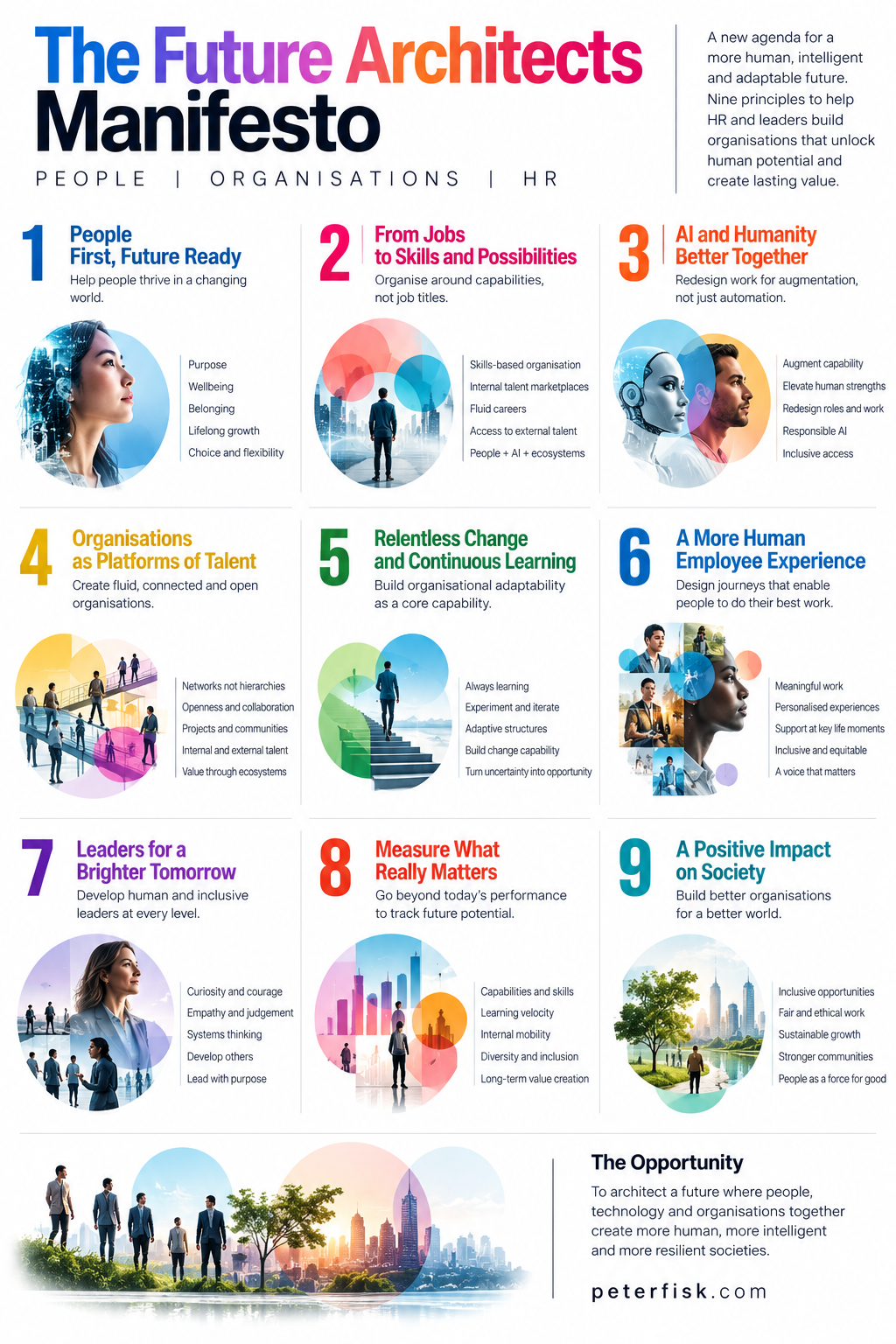
The organisation is becoming a platform
The traditional organisation was designed for stability. It divided work into jobs, grouped jobs into functions, connected functions through hierarchies and controlled them through processes, budgets and reporting lines. People were recruited into positions and typically progressed upwards through increasingly senior versions of broadly similar roles.
That architecture made sense when markets changed relatively slowly and knowledge resided predominantly inside organisations.
Neither assumption holds anymore.
Increasingly, the most valuable capability of an organisation is its ability to assemble the right combination of people, technology, knowledge and partners around an opportunity — and then reassemble them when the opportunity changes.
The organisation therefore starts to resemble a platform for talent rather than a container of jobs.
Instead of asking, “Who has this job?”, leaders ask, “What capability does this opportunity require, and where can we find it?”
Instead of employees belonging exclusively to departments, people can contribute to projects across functions and geographies. Instead of careers being defined by promotions, they increasingly become portfolios of experiences, skills, projects and relationships. Instead of organisations assuming they must own every capability, they can access expertise from employees, freelancers, partners, universities, start-ups and increasingly intelligent machines.
Unilever was an early pioneer of this model. Its FLEX Experiences platform uses AI to connect employees with projects and opportunities around the company, based on their capabilities and aspirations rather than simply their current job titles. An early trial involving more than 20,000 employees across over 90 countries unlocked more than 60,000 hours of talent in just two months.
The principle behind it was more important than the technology: people are more than their jobs.
Unilever subsequently extended this philosophy through U-Work, an employment model sitting between conventional employment and freelance work. Participants remain connected to Unilever, retaining elements of security and benefits, while working more flexibly on assignments. The company’s Future of Work programme explicitly explored the idea of accessing talent rather than assuming every capability must be permanently owned.
That is a glimpse of a different organisational architecture.
Schneider Electric has pursued a similar idea through its Open Talent Market. The AI-enabled platform connects employees with full-time positions, part-time projects, mentors and learning opportunities based on their capabilities and ambitions. By the end of 2023, more than 85% of its employees were participating, with 34,000 development opportunities generated since the programme began.
The significance goes beyond internal mobility. Talent becomes visible. Opportunities become visible. Skills become fluid. Organisational boundaries become more permeable.
The company becomes a marketplace of human potential.
From workforce planning to capability orchestration
This changes one of HR’s most fundamental responsibilities.
Traditional workforce planning asks how many people the organisation needs. Future workforce strategy asks what capabilities the organisation needs, where they can come from, and how rapidly they can be redeployed.
Headcount becomes less useful as a strategic metric.
Imagine two organisations employing 50,000 people. One knows their job titles, grades, locations and salaries. The other understands thousands of underlying skills, experiences, relationships, aspirations and learning trajectories — and can use AI to connect those capabilities dynamically with emerging opportunities.
They might have identical headcounts, yet radically different organisational potential.
HR therefore needs to develop something closer to a real-time capability map.
What capabilities do we possess today? Which will become more valuable? Which are declining? What do emerging technologies make possible? Where are the hidden capabilities within our people? What expertise could we access externally? Which combinations of human and machine intelligence could deliver something neither could achieve independently?
This is why the emerging skills-based organisation matters.
Jobs are bundles of activities. AI is beginning to unbundle them.
Some tasks can be automated. Others can be augmented. Some become more important precisely because machines cannot perform them well. Entirely new activities emerge because AI makes them possible.
The unit of organisation consequently shifts progressively from the job towards the task, skill and outcome.
HR’s opportunity is to orchestrate these components dynamically.
AI should reinvent work, not just automate HR
There is an irony in much current discussion about AI in human resources.
HR departments enthusiastically explore AI for recruitment, employee queries, performance management, learning recommendations and workforce analytics. These applications can be useful. But they risk missing the much bigger opportunity.
The strategic question is not “How can HR use AI?”
It is “How will AI change work, organisations and human potential?”
That question belongs at CEO and board level — and HR should be leading the answer.
Every function needs to rethink its work. Marketing teams can use intelligent agents to research markets, create content and personalise interactions. Finance can automate analysis and scenario modelling. Software developers can work alongside coding agents. Scientists can use AI to explore enormous possibility spaces. Customer-service employees can have real-time intelligence alongside every conversation.
This does not simply create productivity.
It changes what people are capable of achieving.
The old automation question was: What can machines do instead of people?
The more interesting augmentation question is: What can people now do that they could never do before?
That distinction should become central to the future HR agenda.
The goal is not a human organisation with some AI added to it, nor an AI organisation with fewer humans left inside it. It is to create what we might call an intelligent organisation — one that deliberately combines machine intelligence with distinctly human capabilities.
Machines bring extraordinary processing power, pattern recognition, memory, prediction, simulation and increasingly autonomous execution.
Humans bring curiosity, imagination, empathy, judgement, purpose, moral responsibility, social intelligence and the ability to make sense of ambiguity.
Competitive advantage increasingly comes from designing the interface between them.
Humanity becomes more important, not less
Paradoxically, the more intelligent machines become, the more important the distinctive qualities of humanity become.
When information is abundant, judgement becomes valuable.
When content is easy to generate, originality matters more.
When algorithms optimise what already exists, imagination becomes essential for creating what does not.
When machines can imitate communication, genuine empathy and trust become more distinctive.
This changes the development agenda dramatically.
For years, organisations separated technical skills from “soft skills”. The terminology itself reveals an outdated hierarchy. Analytical and technical capabilities were considered hard and economically valuable; curiosity, empathy, creativity, collaboration and courage were somehow softer.
In an AI-rich world, many supposedly hard capabilities become increasingly accessible through technology. The deeply human ones can become harder to replicate and therefore more valuable.
HR should consequently become the guardian and accelerator of human advantage.
Learning should move beyond courses and catalogues towards experiences, experimentation, coaching, projects and communities. Leaders should be evaluated not simply on the results they personally deliver but on how much capability they unlock in others. Organisations should measure not merely employee engagement but energy, adaptability, learning velocity and the movement of talent towards opportunity.
The goal is no longer simply skilled employees.
It is endlessly evolving people.
Stop managing change
There is another legacy that HR needs to leave behind: change management.
The concept assumes that change is an event.
Management decides on a transformation. Consultants create a programme. HR communicates it. Employees move through familiar curves of denial, resistance, acceptance and adoption. Eventually the organisation reaches its new state and stability returns.
Except stability no longer returns.
AI evolves continuously. Customer expectations shift continuously. Competitors emerge continuously. Technologies converge continuously. Geopolitical conditions change. Business models evolve. Organisations restructure, partner, acquire and divest.
Change is no longer something organisations occasionally do.
Change is the environment in which organisations exist.
The challenge therefore shifts from managing individual transformations towards creating organisational plasticity — the ability to continually reshape structures, capabilities, behaviours and resource allocation without requiring a corporate trauma every time.
This is where HR can have enormous strategic impact.
Microsoft offers an interesting example.
Kathleen Hogan became Microsoft’s Chief People Officer in 2015 and played a central role in the cultural transformation associated with Satya Nadella’s leadership, particularly the shift from a “know-it-all” towards a “learn-it-all” culture based around growth mindset. In 2025, Microsoft moved Hogan into the newly created role of Executive Vice President, Office of Strategy and Transformation. Nadella described her mandate as helping accelerate change across Microsoft’s people, processes and portfolio — effectively connecting organisational transformation directly with corporate strategy.
The symbolism matters.
One of the world’s most valuable technology companies took the executive who had led its people and cultural transformation and moved her into enterprise strategy and continuous transformation.
That is one possible future of the CHRO.
The CHRO becomes a Chief Reinvention Officer
The best HR leaders have already demonstrated that the role can extend far beyond traditional HR.
Leena Nair’s career at Unilever is instructive. She joined the company as a management trainee, became its first female, first Asian and youngest-ever CHRO, and helped drive a people agenda combining purpose, flexibility, reskilling and new models of employment. Her philosophy explicitly connected care for people with competitiveness and future readiness. She subsequently moved from HR into enterprise leadership as CEO of Chanel.
Kathleen Hogan demonstrates another pathway: from Chief People Officer into enterprise strategy and transformation.
Schneider Electric’s talent-marketplace approach demonstrates a third: HR becoming the architect of an internal economy in which talent, learning and opportunity can flow dynamically around the enterprise.
These leaders challenge the assumption that HR’s ultimate destination is better HR.
The destination can be better business.
Tomorrow’s outstanding CHRO should therefore understand technology, economics, strategy, customers and business models as deeply as organisational psychology and talent.
They should be able to sit with the CEO and ask not merely, “What people do we need to deliver the strategy?” but “How should our organisation change what strategies are possible?”
That is a much more powerful question.
From employee experience to human possibility
Over the last decade, many HR teams embraced “employee experience”. This was useful because it encouraged organisations to view work from the employee’s perspective rather than through administrative processes.
But experience is no longer enough.
Great consumer brands do not merely make existing journeys frictionless. They enable people to achieve things they could not previously achieve.
The same principle should apply inside organisations.
HR should move from designing employee experience towards expanding human possibility.
Can people discover opportunities they did not know existed?
Can an engineer contribute to a sustainability challenge in another country?
Can a marketer join an AI innovation sprint?
Can a 55-year-old employee reinvent their career rather than seeing their capabilities depreciate?
Can somebody work three days for the organisation, one day on a start-up and another developing entirely new expertise?
Can intelligent agents give every employee capabilities that previously belonged only to specialists?
Can careers move sideways, diagonally, temporarily outside the organisation and eventually back inside?
The organisation becomes less like a ladder and more like a landscape.
HR’s job is to make that landscape navigable.
Measure potential, not just performance
This also demands a different scorecard.
Most organisations are extraordinarily sophisticated at measuring current performance and surprisingly primitive at measuring future capability.
They know revenue per employee, labour costs, attrition, engagement, absence and productivity.
But can they measure learning velocity? Skills liquidity? Internal mobility? Human-AI augmentation? Leadership adaptability? Organisational network strength? The percentage of strategic capabilities that can be redeployed within weeks rather than years?
Most importantly, can they measure potential?
Businesses create value not simply through what they produce today but through what they are capable of becoming tomorrow. The same is true of people.
An employee’s value is not simply their current output. It includes their capacity to learn, connect, imagine, adapt and create future value.
An enlightened HR function therefore invests simultaneously in performance and potential.
Performance asks: How good are we today?
Potential asks: What could we become tomorrow?
Both matter. But organisations obsessed with the first can systematically destroy the second.
HR needs a bigger voice
For too long, HR has frequently arrived after the strategic decisions have been made.
The company decides to enter a market, adopt AI, restructure a business, make an acquisition or launch a transformation — and HR is subsequently asked to provide the people plan.
That sequence needs reversing.
Every significant strategic decision is ultimately an organisational decision.
Entering a new market requires capabilities. AI changes tasks and roles. Acquisitions succeed or fail through people and cultures. Innovation requires different behaviours and incentives. Ecosystems require people capable of collaborating beyond organisational boundaries. Reinvention requires leaders willing to move resources away from yesterday’s success towards tomorrow’s possibilities.
HR therefore needs a stronger voice not simply on the people implications of strategy, but on the strategy itself.
The CHRO should become one of the organisation’s principal interpreters of the future.
What is changing outside? What does AI make possible? How are employee expectations evolving? Which capabilities will differentiate us? What will the next generation expect from work? Which assumptions about jobs, careers, workplaces and organisations are becoming obsolete?
And then the most important question:
What should we do about it now?
From human resources to human reinvention
Perhaps even the name Human Resources has outlived its usefulness.
People are not resources in the same sense as capital, factories or raw materials. They have ambitions, identities, imagination and agency. Their potential can expand rather than depreciate through use.
The great HR function of the future will therefore be less concerned with administering human resources and more concerned with enabling human reinvention.
It will build organisations as talent platforms rather than hierarchies of jobs.
It will orchestrate capability rather than simply plan headcount.
It will combine AI and humanity rather than pitching one against the other.
It will build adaptability rather than manage episodic change.
It will develop potential rather than merely evaluate performance.
And its leaders will help shape business strategy rather than simply implement its organisational consequences.
This is ultimately HR’s opportunity.
Technology may be transforming business, but organisations remain profoundly human systems. Strategies need people to imagine them. Innovation needs curiosity. Transformation needs belief. Customers need empathy. Difficult choices need judgement. Communities need trust. Futures need people willing to create them.
AI does not diminish that responsibility. It amplifies it.
The future of HR therefore isn’t really about HR.
It is about building organisations capable of becoming more than they are today — organisations in which intelligence flows more freely, talent moves towards opportunity, machines amplify human capability, and people continually learn, adapt and reinvent themselves.
For HR leaders, that requires a fundamental shift in ambition.
Don’t just manage the people of today’s organisation. Architect the organisation of tomorrow.