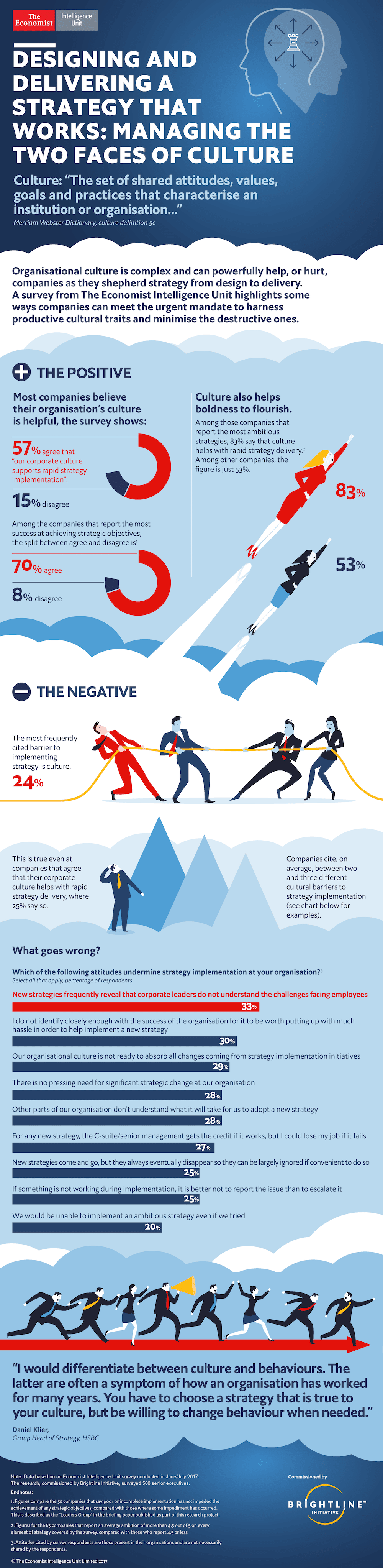
To understand why many organizations fail to bridge the gap between strategy design and delivery, The Economist Intelligence Unit (EIU), sponsored by the Brightline Initiative, undertook a global multi-sector survey of 500 senior executives from companies with annual revenues of $1 billion or more. Their responses confirm that implementation shortfalls are widespread and corrosive: 90% of respondents admit that they fail to reach all their strategic goals because they don’t implement well, and 53% agree that inadequate delivery capability leaves them unnecessarily exposed to competitor.
Organisational culture is complex and can powerfully help, or hurt, companies as they shepherd strategy from design to delivery. The EIU highlights some ways companies can meet the urgent mandate to harness productive cultural traits and minimise the destructive ones.
Elon Musk has become the Thomas Edison of our times. Whilst his part role in the success of PayPal may not have transformed our lives, it funded his imagination, and the possibilities to change our futures in ways that science fiction writers could not even dream of.
Go to his SpaceX headquarters in Hawthorne, California, and every employee has a very clear sense of purpose. “We’re going to Mars” is the unanimous first words. Within the next 7 years.
I often say that the next 10 years will see more change than the last 250 years. Anyone who wants to get a sense of how real that could be, should read Elon Musk’s occasional letters to the world. His most recent letter, in July 2016, captures his bold ambition and life-changing plans.
On the future, he says:
Of course, many of his projects including travelling to Mars sound like fantasies. He disagrees, saying “If something is important enough, even if the odds are against you, you should still do it.”
Last week he took another step forwards, unveiling plans for a new spacecraft that he says would allow his company SpaceX to colonise Mars, build a base on the moon, and allow commercial travel to anywhere on Earth in under an hour.
https://www.youtube.com/watch?v=XcVpMJp9Th4
The spacecraft is currently still codenamed the BFR (Big Fucking Rocket – not sure why he feels he needs the F word?!). He says the company hopes to have the first launch by 2022, and then have four flying to Mars by 2024.
Speaking at the International Astronautical Congress in Adelaide Australia on Friday, he said the company had figured out a way to pay for the project. The key, he said, was to “cannibalise” all of SpaceX’s other products. Instead of operating a number of smaller spacecrafts to deliver satellites into orbit and supply the International Space Station, he said the BFR would eventually be used to complete all of its missions.
SpaceX has been working feverishly on reusable spacecraft designs, now completing 16 successful landings in a row of its Falcon9 rocket. That was the key to allowing the ambitious design to be economic, he said. “It’s really crazy that we build these sophisticated rockets and then crash them every time we fly,” he said. “This is mad.”
Musk said the cost of fuel is low, and so if the crafts were fully reusable, the costs of flights drop dramatically. He said the company had already started building the system, with construction of the first ship to begin next year. “I feel fairly confident that we can complete the ship and be ready for a launch in five years,” he said.
By 2024, Musk said he wanted to fly four ships to Mars, two of which would have crew in them. By that stage, they planned to be able to build a plant on the surface of Mars that would be able to synthesise fuel for return journeys back from Mars.
For a trip to Mars, he said the craft would be able to hold about 100 people in 40 cabins. But he said once the ship is built, it could be used to travel on Earth too. He did not estimate the cost of such flights, but said that most long-distance flights could be completed in 30 minutes, and you could get anywhere on Earth in under an hour.
“If we’re building this thing to go to the Moon and Mars then why not go to other places on earth as well,” he said. He said the size of the payload – which would allow items with a diameter of just under 9m – means larger satellites could be delivered to orbit in a single mission.
At a presentation at last years IAC conference in Mexico, Musk described the earlier iteration of the system with more details about the costs. For that earlier version, he said the cost of sending a person on the SpaceX Interplanetary Transport System would be around $200,000. Musk suggested that multiple space rockets could take 100 people each over 40 to 100 years until a million people lived there.
“It was much too big and fantastical,” said Robert Zubrin, president and founder of Mars Society, a non-profit that promotes human settlement of Mars.
Musk’s proposal for getting a million people to Mars as quickly as possible was, Zubrin said, “like a D-Day landing”. Instead, Musk should be thinking of sending just ten people to set up an agricultural base, Zubrin said.
“Then send 20 more people and so forth to develop capabilities to make steel and eventually create institutions like schools.”
“He typically goes into something with over-reach,” Zubrin added, referring to Musk’s tendency to overpromise with many of his projects, including delivery dates of Teslas and the Hyperloop. “But he’s able to take criticism and adjust things to become achievable,” said Zubrin. “If he reduces his launch system from 500 tons to 150 tons or less, that would show he’s serious and would move him from the realm of vision to the realm of engineering.”
Lockheed Martin also presented an idea for a manned Mars mission at the Adelaide event. The aerospace company outlined a six-person space station called Mars Base Camp that it thinks could be orbiting the red planet by 2028 along with a lander that could descend to the surface. Astronauts on the space station could carry out scientific research and exploration work, including operating rovers and identifying landing spots on the surface of the planet for larger vehicles.
The bigger picture of Musk’s world is dominated by Tesla, as well as SpaceX and Hyperloop. In a recent interview (TED, May 2017) he talked about the many projects, and what drives him:
Hyperloop One first test runs on the SFO-LAX loop:
SpaceX Falcon 9 landing, launching and relanding:
Tesla 3, sustainable driving becomes mainstream:
Neuralink, his latest venture, fusing the human brain and AI:
And a fun Late Show interview asks is he a super villain?
Are managers really necessary? In 2002, Google set out to find out, and experimented by removing bosses from its hierarchy. The answer was a resounding yes. Managers were critical not only for structure and clarity, but also for team performance. After Google discovered that its teams needed great managers, it wanted to know the characteristics that made some bosses more effective than others.
In 2008, Project Oxygen (an initiative to uncover the traits of Google’s best managers)gathered 10,000 manager observations including performance reviews, surveys, and nominations for top-manager awards and recognition. After analyzing the data, Google stumbled upon a realization that surprised many–even its former senior vice president of people operations, Laszlo Bock.
In a New York Times article that revealed the findings, Bock acknowledged that the company had historically hired managers or promoted people who exhibited a higher level of technical expertise than others. “It turns out that that’s absolutely the least important thing,” Bock says. “It’s important but pales in comparison. Much more important is just making that connection and being accessible.”
Here is an extract from Google ReWork describing the project:
Google set out to determine what makes a manager great at Google. But first, a research team tried to prove the opposite: that managers actually don’t matter, that the quality of a manager didn’timpact a team’s performance. This hypothesis was based on an early belief held by some of Google’s leaders and engineers that managers are, at best, a necessary evil, and at worst, a layer of bureaucracy.
The team defined manager quality based on two quantitative measures: manager performance ratings and manager feedback from Google’s annual employee survey. This data quickly revealed that managers did matter: teams with great managers were happier and more productive.
But knowing that managers mattered didn’t explain what made managers great. So the team asked employees about their managers. By going through the comments from the annual employee survey and performance evaluations, the team found ten common behaviors across high-scoring managers. The researchers also conducted double blind interviews with a group of the best and worst managers to find illustrative examples of what these two groups were doing differently.
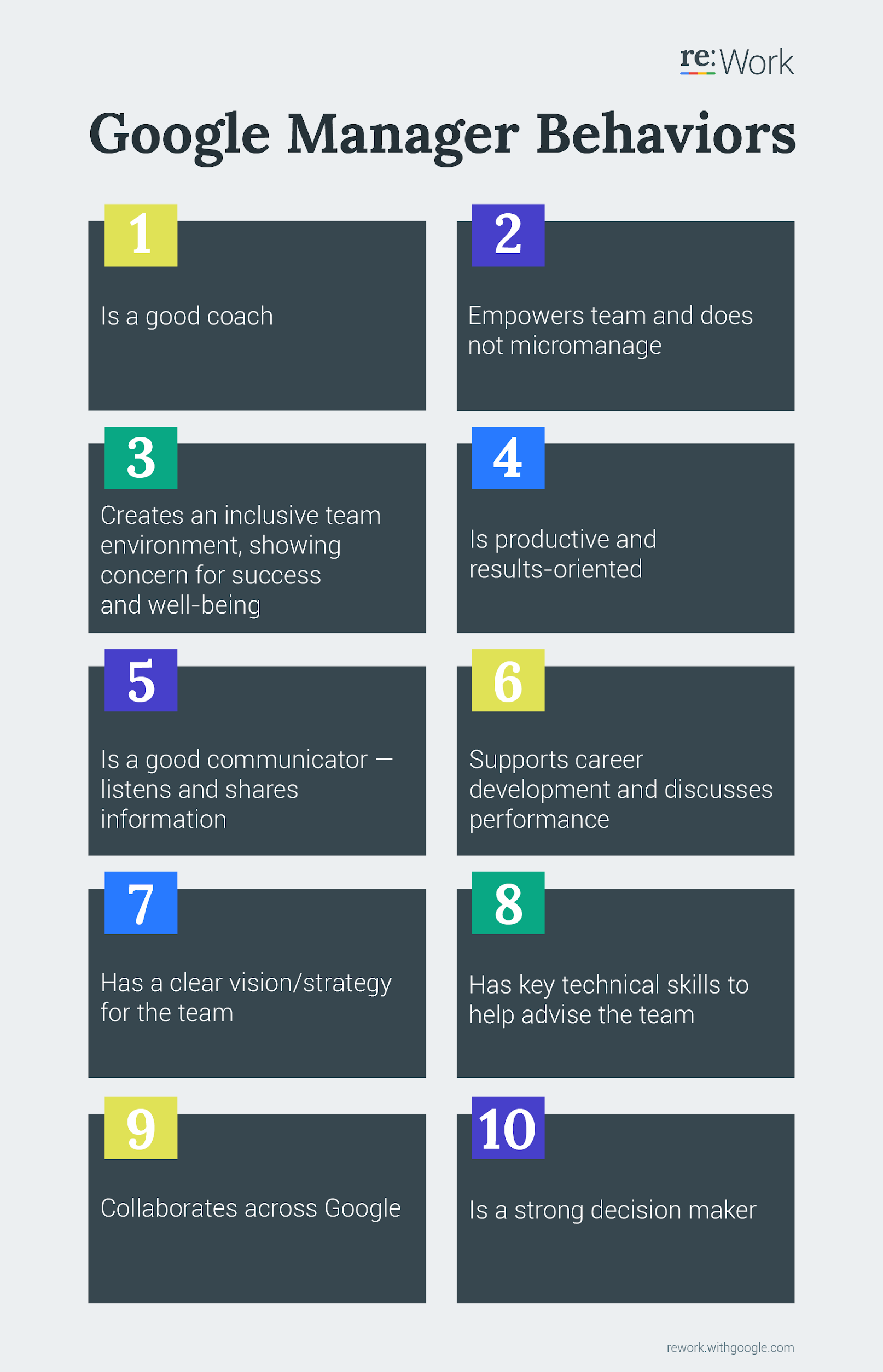
Google uncovered what makes a great manager at Google, but that doesn’t mean what works for Google managers will work for any organization.
To determine what makes managers great in your organization, consider these questions:
- Do managers matter at your organization? Explore external research (e.g., Gallup research highlights five important manager talents) and internal input like surveys or interviews to find out if people managers matter to your team members’ performance and happiness.
- If managers matter, whom do you need to convince and how? Google used internal data to convince engineers and leaders that managers matter. How will you convince your organization?
- What makes a great manager at your organization? Google found ten behaviors of successful managers – you might find you have two, three, or twelve. Internal data, like employee survey results and interviews, can help uncover the elements of good management at your organization. You can also explore external research (below) to get started.
- Manager Research Shortlist:
- HBR 2005 | What Great Managers Do
- McKinsey 2015 | Decoding Leadership, What Really Matters
Growth is shifting, innovation is relentless, disruption is accelerating, expectations are high, and social tensions are rising. Making sense, and making use, of these dramatic forces of change will help you to make better strategic choices, shape markets to your advantage, and create a brighter future.
Everyone talks about “megatrends” … so what are the most significant forces of change?
I spent some time comparing the many different approaches to tracking and articulating these patterns of change, to find out which trends are the most common, and the most significant.
Isn’t it obvious? Technology is shaping everything? Yes, but its the implications of that, which matter.
As McKinsey says “the trend is your friend” … It’s the oldest adage in investing, and it applies to projecting future business performance too. Their analysis shows that capturing the waves of change, created by industry and geographic trends, is the most important contributor to business results … a company benefiting from such waves of change is 4-8 times more likely to rise to the top of future performers.

So what is a “megatrend“? Trends are an emerging pattern of change likely to impact how we live and work. Megatrends are large, social, economic, political, environmental or technological change that are slow to form, but once in place can influence a wide range of activities, processes and perceptions, possibly for decades. They are the underlying forces that drive trends.
World Economic Forum, working with pwc, simplify the “megatrends” as 5 global shifts changing the way we live and do business:
- Rapid urbanisation … most growth is in lesser-known, medium-size, emerging-market cities
- Climate change and resource scarcity … urbanisation drives demand for energy, food, water
- Shift in global economic power … commodity prices driving some emerging markets into recession
- Democratic and social change … more people living longer with more aspiration and fewer children
- Technological breakthroughs … digital has no boundaries, changing behaviours and expectations
https://www.youtube.com/watch?v=8wx3YxFYWtM
Arthur D Little, who focus on strategic innovation, looked for the trends in the megatrends and talk about 12 trends in 4 clusters. The danger of combining lots of studies, of course, is that we lose insight, so their list is more to ensure completeness than find a new angle:
Technology:
- Disruptive technologies … smart, connected, ubiquitous … digital and data, 3D printing and machine learning, AI and robotics, genetics and nanotech, and much more
Energy and environment:
- Changing energy mix … more renewable, more secure, more expensive
- Shortage of resources … water and food, rare earths and key commodities
- Climate change … preventation and adaptation, even in the face of Trump’s blinkeredness
Economics and politics:
- Knowledge and information … personal education, automation, highly skilled workforce
- Economic shifts … emerging markets, new middle classes, and growing wealth
- Globalisation … connected economies – markets, competitors, customers and owners
- New normal … low interest rates, higher debt, more government intervention
- Multi-polar … diffusion of power, rising nationalism, rise of networks and coalitions
Social and health:
- Demographic shifts … population growth, ageing population, needing more support
- Urbanisation and mobility … mega-cities, smart cities, fast and responsible transport
- Health and wellness … growing expectations, fear of pandemics, burden of ageing
McKinsey & Co has perhaps the most insightful view of the future, identifying 9 global forces inspiring a new narrative of progress which they clustered into three groups.
Shifts in global growth:
- Growth beyond globalisation … as social tensions rise, localism becomes more important
- ICASA (India, China, Africa, SE Asia) … tapping into the new billion-person markets
- Resource un/limited … circular thinking will address resource constraint in creative ways
Accelerators of industry disruption:
- Combinatorial-technology explosion … connectivity of next tech, networks and devices
- C2B, customers in the driving seat …digitisation has empowered customers, and together
- Ecosystem revolution … from linear value-chains to platforms that can asset heavy or light
New societal deal:
- The dark side … working together to outwit cybercriminals and terrorists in a digital world
- Middle class progress … rising inequalities, social fragmentation, and declining trust
- Economic growth experiments … exploring new ways to harness tech and finance effectively
Of course every technology, every consulting, every accounting firm claims to help you understand the future better than anyone else. Sometimes their insights are profound, sometimes not. But they make great conversations:
I will leave the final thoughts to a few of the individuals whose perspectives I admire most.
Richard Watson is famous for his trend maps, and has now developed a new Mega Trends and Technologies 2017-2050 map (as at top of this page!) that seeks to capture the next 33 years in one diagram:
.png)
Mark Esposito, a Canadian strategy professor from Harvard defines the megatrends using DRIVE (demographic/social, resource scarcity, inequalities, volatility and enterprise dynamics):
Peter Diamandis, cofounder of Singularity University, on the biggest change of all, the next evolutionary step into what he calls a “meta-intelligence, where we are all connected brain to brain:
Alec Ross is bestselling author of The Industries of the Future, exploring how the megatrends will fundamentally reshape the markets and businesses in which we work:
So where will all this take us? This BBC documentary explores possible scenarios for the way we will work and live by 2050. How will you get there?
https://www.youtube.com/watch?v=XeEYaX82jSE
More insights and ideas on future trends, and leading for innovation and growth:
- Growth: Finding and accelerating a more profitable future
- Gamechangers: Creating innovative strategies for future growth
- Keynote speaking: Leading for innovation and growth and other videos
This weekend I’m in Madrid celebrating my 50th birthday, but somehow Rihanna gatecrashed the party.
My route to my favourite Plaza Mayor restaurant was barred by enormous crowds and security staff. Was it a surprise birthday party laid on by my colleagues at IE Business School? Were U2 playing another impromptu street concert to prelaunch their new album? Or was Christian Ronaldo just out going out to his local tapas bar? No it was Rihanna on the latest stop of her global tour.
This was like a branding case study in real time:
- Fenty Beauty is much more than another celebrity endorsement. The motivation behind the new brand, and every detail of the product range have become a passion of the singer.
- Sephora’s link up with the new brand ensures exclusive promotion and distribution rights in every city as part of the tour, helping the retailer in its quest for a more edgy, exciting brand image.
- Fenty’s design in every sense, from launch communications to identity graphics, product designs and merchandising have all been distinctive and bold, in a beauty world of sameness.
- Rihanna’s whirlwind global launch tour, a different capital city each evening means that she maximises the few moments in each location, and builds rapid global amplification.
- The authenticity of a personal appearance, whipping up local crowds and media into a frenzy, keeping the details secret to the last moment, is far more real than any TV ads or posters
Every day, yet more new brands and products are launched into the $445 billion beauty marketplace, with the vast majority of their products are designed for young, white women. The beauty mainstream. While the whole concept of mainstream in beauty just feels contradictory – isn’t the idea of enhancing your beauty, not to be “average”? – gradually more diverse options are emerging, in styles, in business models, and for the vast majority of non-average consumers.
Rihanna is more than a celebrity – she cares about people too. The superstar is using her star power to send the message that the fashion and beauty industries need to pay closer attention to women of every colour – black, Asian, white and everything in between.
https://www.youtube.com/watch?v=jjEcxeJfk3M
This year, she launched Fenty Beauty, a makeup line designed to make women everywhere feel included. The brand formulates foundations to suit a wide range of skin tones and contouring makeup sticks that can be customised to specific complexions. It also develops products, such as the Stunna Lip Paint, that are designed to work on all faces. At $24 for a lipstick and $34 for foundation, the collection is not outrageously priced. And with instant brand appeal, it looks like being a winner.
Fenty Beauty is a “gamechanger” for the beauty world.
https://www.youtube.com/watch?v=Ga7dKKle774
https://www.youtube.com/watch?time_continue=3&v=4eQ5BGw0Dc8
Over 150 people, from entrepreneurs to designers to philosophers, have signed The Copenhagen Letter this week calling for better practices in technology and design.
The letter, which was published by Copenhagen’s Techfestival, calls for a “new Renaissance” in the future design of technology to put the human, and not just the “user”, ahead of business.
The manifesto, which is now published in full online, has been signed by authors from Europe and the US, including The Pirate Bay and Flattr founder Peter Sunde and Kickstarter founder Charles Adler, among other analysts, experts, and founders in technology, artificial intelligence, and design.
“The bottom line is that we feel tech is dissociating from social progress and it’s more and more in its own bubble,” said Aydogan Ali Schosswald, co-organizer of Techfestival.
“It’s a good time for Europeans to wake up and say ‘hey this is our idea of tech’ and it’s a little bit more aligned with what we want to get out of tech on a human level, it’s not all about business, it’s not all about growth.”
He added that he hopes the letter will be a conversation starter among tech communities.
“It’s not very difficult to see the options people have, they can sign it, they can respond to it. They can ignore it of course but we want to make it difficult for people to ignore it,” he said.
“The idea here is to really start a conversation and put critical thinking back on the agenda. Why are we doing this? What for?”
The Copenhagen Letter
To everyone
who shapes technology today
We live in a world where technology is consuming society, ethics, and our core existence.
It is time to take responsibility for the world we are creating. Time to put humans before business. Time to replace the empty rhetoric of “building a better world” with a commitment to real action. It is time to organize, and to hold each other accountable.
Tech is not above us. It should be governed by all of us, by our democratic institutions. It should play by the rules of our societies. It should serve our needs, both individual and collective, as much as our wants.
Progress is more than innovation. We are builders at heart. Let us create a new Renaissance. We will open and nourish honest public conversation about the power of technology. We are ready to serve our societies. We will apply the means at our disposal to move our societies and their institutions forward.
Let us build from trust. Let us build for true transparency. We need digital citizens, not mere consumers. We all depend on transparency to understand how technology shapes us, which data we share, and who has access to it. Treating each other as commodities from which to extract maximum economic value is bad, not only for society as a complex, interconnected whole but for each and every one of us.
Design open to scrutiny. We must encourage a continuous, public, and critical reflection on our definition of success as it defines how we build and design for others. We must seek to design with those for whom we are designing. We will not tolerate design for addiction, deception, or control. We must design tools that we would love our loved ones to use. We must question our intent and listen to our hearts.
Let us move from human-centered design to humanity-centered design.
We are a community that exerts great influence. We must protect and nurture the potential to do good with it. We must do this with attention to inequality, with humility, and with love. In the end, our reward will be to know that we have done everything in our power to leave our garden patch a little greener than we found it.
We who have signed this letter will hold ourselves and each other accountable for putting these ideas into practice. That is our commitment.
Through positive wellness and personalised pharma, robotics and genetics, digital applications and patient-centric business models … the future of health is about specialisation and innovation, patient-centric solutions that are faster and more efficient. The fast-changing science is one factor, however far more significant is the convergence of pharma and biotech, insurance and hospitals, physicians and pharmacists … working together to make life better.
Personal, predictive and positive
For just $99 we can see our life before us, with a DNA profile from 23 and Me, and as a result we go to PatientsLikeMe to find out how others have responded. We eat the best foods from GSK, and check our daily fitness with Nike+, maybe with a little help from Avumio’s diagnostic apps and online advice from Dr Koop.
If we need help, we turn to ZocDoc where a local nurse with Epocrates at his fingertips, who prescribes a standard drug from Wuxi, or a custom prescription from Genentech. A night in W Hotel’s clinic, or a surgical trip to Antalya is unlikely. Instead we spray on our L’Oreal skin protection, sip on our super-vitamin Zespri kiwi juice, and smile.
The future of healthcare is personal, predictive and proactive, using advanced diagnostics so that people can themselves understand their likely conditions, and take better actions now to reduce risks or avoid illnesses. In this sense it is about positive wellbeing, rather than caring or curing. However when misfortune does strike, then care is about patients and personalisation, putting people at the heart of the medical process, supported by physicians and pharmaceuticals which are right for individuals.
Today we live in hope that we will stay healthy. Improved diets and active lifestyles intuitively reduce our concerns, but when something does go wrong we put our faith in a system that is largely designed around medical science and operational efficiencies. We wait in line for a hospital bed, for a standard procedure, for a generic drug. And once we get the all clear, we disappear until the next problem. When was the last time when you talked to a doctor whilst feeling good, and staying fit?
The future is different. It sees a convergence of sectors, enabled by an integration of technologies, the personalisation of science, and business models that are more human and commercial.
We recognise that prevention is better, and cheaper, than cure: cholesterol-reducing margarines, UV protection built into cosmetics, anti-statins to every over 50 in order to reduce the risk of heart disease, regular scans for people with family histories, blood pressure monitored daily by your smart watch, fitness parks designed for middle aged retirees, compression socks for long-haul flights. Drug companies make functional foods, sports companies create wellbeing devices, hospitals offer fitness programs, medical centres offer beauty treatments, cosmetics brands help you look good and live better.
From biotechnology to pharmaceuticals, governments to surgeons, sports clinics to supermarket pharmacies, cosmetics to functional foods, mobile technologies and online communities, many different partners and services will come together to keep us alive and well.
Digital and mobile, catalysts of change
Big data for fast and remote diagnostics, wearable sensors for body management, sit alongside more innovative solutions like 3D organ printing and robotic surgery. Advances in technology are allowing for the provision of affordable, decentralised healthcare for the masses and are lowering the barriers to entry in less developed markets.
Of all the advances, mobile technology is the catalyst for change. The phone and tablet enable distribution of a broad range of medical and support services in hospitals, and particularly in countries with little or no healthcare infrastructure and areas in which there are few trained healthcare professionals. These technologies also allow trained professionals to perform quality control remotely.
Amongst the many significant developments is a shift towards one-on-one, in-field diagnostics and monitoring. Services that were once only available at a doctor’s office or hospital are now available on-demand through low-tech, affordable solutions. Personal systems allow for “good enough” diagnostics that would have been difficult, expensive, and timely to attain previously.
Building patient-centric brands
“Patient-centric” healthcare is nothing new.
Whilst every healthcare company – from drug manufacturer to health insurer, pharmacy to hospital, GP to dentist -it is dramatically different from most of what happens today. Whether “science for a better life” (Bayer), creating a healthier world (Pfizer); “do more, feel better, live longer” (GSK); “inspired by patients, driven by science” (UCB); “science and patients … the heart of everything we do” (AstraZeneca); or being “a global integrated healthcare leader focused on patients’ needs” (Sanofi), the industry has enthusiastically grasped the idea of patient-centricity. At least at a corporate level.
Of course, its how they behave, not just what they say that matters. And also how the purpose of corporate brands translates into “product” brands, which tend to become preoccupied by their product functionality. Medicine and science kick in, and they become product-centric and largely inhuman. Brands are more than products.
But an orientation around patients is a good starting point, to thinking and behaving in a more human, relevant and outcomes-driven way.
“Human-centric” is perhaps a better term anyway, as the purpose is really to stay healthy, and thereby avoid ever becoming a patient, and save huge amounts of money in the process.
In simple terms, patient-centricity means placing the patient at the centre of business activity and to consider how decisions about business will affect the patient. This seems far-fetched but there are in fact many aspects of a pharma company’s operation that can be re-imagined to be more aligned with the interest of the patient. They include:
- Drug Discovery
- Formulation
- Drug Delivery Device Development
- Clinical Trial Design
- Marketing
- Communications
- Sales
- Supply-Chain Management.
What is most significant is in how patient-centric thinking truly permeates leadership and decision making, and in particular
- Leadership that drives the culture in every one of its words and actions
- Business innovation that embraces it in business models and strategic development
- Strategic planning that reformats future plans around patients not sales first
- Payment models built around outcomes not traditional reimbursements
- Performance incentives likewise built around patients
Fortunately for patients in need of better therapies and experiences, the vast majority of pharma companies have started a journey towards more patient-centricity. While no hard metrics exist that can track success of such initiatives, annual patient-centricity ranking and awards published by industry organizations nevertheless attempt to provide a degree of feedback to the industry.
In a 2013 survey on patient-centricity by research firm Patient-View, for example, ViiV Healthcare (the GSK & Pfizer joint venture focussed on HIV therapies), Gilead, AbbVie, Menarini and Janssen occupied the top 5 spots. Fast forward to 2016 and a review of the eyeforpharma Barcelona Awards 2016 shows not a single one of these companies won in the “Most Valuable Patient Initiative or Service” category, arguably the award most focussed on patient-centricity. Instead, Sanofi took the top spot, and Merck, Roche, Novartis and TEVA were the remaining nominees. UCB, with its renewed focus on the patient, did particularly well that year with 3 nominations and 1 award across categories.
It is noteworthy that even generic pharma companies are focusing more on the patient. The behemoth of the category, TEVA, has a number of initiatives in this space, and the CEO of Dr. Reddy’s Laboratories, India’s largest maker of generic pharmaceuticals, recently shared in an interview that all innovation at his company has to be patient focussed.
Patient-centricity in pharma is not a fad – it is decidedly here to stay. The reason for this is very simple: Being patient-centric is good for the bottom line. In a 2015 survey by Pharma Marketing News, an impressive 86% of pharma executives either agreed or strongly agreed that “a focus on patient-centricity is the best route to future profitability”.
It is about starting with real people, their needs and hopes and fears. It is about looking beyond disease, beyond product, beyond treatment. It is human-centric, and integrated in its response. It is about knowing people as individuals, through data or simply listening, to responding in more personal and relevant ways, and focusing on the right outcome for them.
In my keynotes, workshops and consulting process I help many companies to rethink what matters, to gain new insight, and shape new strategies, by truly thinking in a different way.
Here are some inspirations:
UCB … “Patients are at the heart of what we do … It is really about seeing the person as a whole, including emotional well-being, when trying to find solutions that improve their quality of life.”
Novo Nordisk … Through the Changing Diabetes® program the pharma company works to address the needs of people living with diabetes.
https://www.youtube.com/watch?v=_awkqWH79pg
Atos Medical … global leaders in laryngectomy products and care, the Swedish business has transformed itself to engage directly with consumers
Leo Pharma … Gitte Aabo, CEO of LEO Pharma discusses what she sees are the biggest barriers to patient centricity
AstraZeneca … Guy Yeoman, VP of Patient Centricity, explores the definition of patient centricity in the context of medicine development from the viewpoint of pharmaceutical companies. “There are 3 principles: openness, respect and compassion, improving patient experience and outcome.”
Takeda … Marc Princen, President, Europe and Canada share’s why being patient centric is the core business goal for Takeda … “Everything we do starts with the patient … products, diagnostics, treatment, care, services, the whole ecosystem.”
Almirall … Eduardo Sanchiz. CEO talks about why the industry needs to come together to drive change and patient value.
More:
Developing a patient-led brand strategy, white paper by Couch
2017 the year of patient-centric creativity, 6 steps to get started, article by ZineOne
Humanising the patient-centric brand experience with social media, ebook by Aspire
Download a summary of my keynote:
https://www.slideshare.net/geniusworks/the-power-of-patient-focus-in-healthcare/edit?src=slideview&type=privacy
Strategy is all about making choices.
Where to compete? How to be different? What to do, and not?
Today’s business leaders face more choices than ever. You could be in any market, segment or geography, or any sector for that matter. Leaders like Bezos to Branson will argue that you are limited only by your imagination, finding the capabilities for implementation consequentially through acquisition or partnership. Similarly in terms of your intent, why you exist, and how you share the value you create, then that is your choice. The biggest challenge for leaders is to make the right choices.
New book
A book about making better choices is therefore both timely and essential. Canadian academic Roger Martin’s new book on “Creating Great Choices” is all about moving beyond trade off thinking.
When it comes to our hardest choices, it can seem as though making trade-offs is inevitable. But what about those crucial times when accepting the obvious trade-off just isn’t good enough? What do we do when the choices in front of us don’t get us what we need? In those cases, rather than choosing the least worst option, we can use the models in front of us to create a new and superior answer.
This is integrative thinking. Martin coined this phrase in an earlier book “The Opposable Mind,” where he described integrative thinking as an approach to problem solving that uses opposing ideas as the basis for innovation.
Now, he and Jennifer Riel focus on how integrative thinking works, and how to do it. The book includes fresh stories of successful integrative thinkers that will demystify the process of creative problem solving, as well as practical tools and exercises to help readers engage with the ideas. And it lays out a four-step methodology for creating great choices, which can be applied in virtually any context. The result is a replicable, thoughtful approach to finding a “third and better way” to make important choices in the face of unacceptable trade‐offs.
Q&A
Here’s an extract from a recent interview:
What are the big challenges that CEOs face today?
One is the rampant short-termism i the modern corporate world. This i particularly a problem for the CEOs of publicly traded companies because the capital markets are so driven by short-term results.
Investors claim to be interested in companies prospering in the long run but they act in exactly the opposite fashion. This makes it very difficult for CEOs to balance the short-term and the long-term.
Most of them sacrifice the long-term in order to keep investors happy in the short-term. But that catches up with them when investors ask: “What is wrong with you; why aren’t you growing faster?” The answer: “We sacrificed investing for the long run years ago.”
The other is the management of talent. In the last couple of decades of the 20th century, talent woke up to the fact that it had overtaken capital as the most important asset in the economic equation.
Ever since, talent has been extracting more and more of the rents, leaving shareholders ever more frustrated.
CEOs have a tricky management challenge and balancing act. Part of their job is to ensure that they collect, nurture and motivate talent. But another part is to make sure that the very same talent does not appropriate all the value and leave shareholders with nothing. The irony is that CEOs are card-carrying members of the talent class and are extracting ever more value themselves. So for them, self-control is a difficult challenge.
What techniques and strategies do these leaders take to navigate these challenges successfully?
In general, they are not faring particularly well in the face of these challenges.
Many CEOs give up fighting the capital markets and just give them the short-term results that they want and then leave their posts before the consequences of their short-term focus manifest themselves.
And I haven’t found many CEOs yet who have figured out how to handle modern talent particularly effectively. Most complain about how tough it is to manage Millennials.
But I think their focus on Millennials obscures the fact that all talent is getting trickier to manage – regardless of their birth era. I never like to be dour but on these two fronts, CEOs are going to need to do better in the coming years.
How can CEOs win the respect of the people they are leading?
The key to steering boardroom strategy is to engage in a dialogue with the board. Very few CEOs do that. Most prefer to go to the board with a finished product and hope for approval. This approach tends to be unfulfilling for board members who didn’t join the board to rubber stamp the company’s strategy. The best approach is to go to the board with thoughts but be open to members adding value and insight. The mindset can be best characterised as: “I have a view worth hearing but I might be missing something.”
The same mindset is the one that garners the most respect from those the CEO seeks to lead.
What kind of leadership capability will be needed by future leaders?
It will be leadership that balances the need to exploit what the company is great at now with the need to explore to find the next competitive advantage.
It will be leadership that nurtures and motivates talent without letting talent make demands that are so excessive that they damage
the company.
It will be leadership that balances advocacy (“I have a view worth hearing”) and inquiry (“but I might be missing something that you may see”).
How can current leaders develop capabilities in their successors?
By far and away, the best thing a leader can do is model the behaviours that they wish to see emerging talent develop.
Everybody watches the leader of his or her organisation. If the leader is successful, everybody will attempt to mimic them.
So it’s largely impossible to develop talent in a direction that is different from what you do as a leader, unless of course you are an unsuccessful leader, in which case you have a bigger problem on your hands than people development.
What are your expectations for the future of work?
It is bifurcating into two distinct kinds in a way that is really problematic. One kind is jobs that need meaningful levels of independent judgment and decision-making. The other is jobs that involve following a superior’s direction – and not exercising meaningful judgment.
In the modern economy, the former types of jobs are getting better paid, and offer relatively high security and benefits, while the latter are getting worse paid, and provide little if any security or benefits. Even in the most advanced of economies – the US, for
example – the former jobs make up just over one third of the workforce. So the majority of jobs are structurally mired in low wages, security and benefits while a minority of jobs are the opposite. This is a key driver of rising inequality across virtually all advanced economies.
It represents the modern economic challenge – how to transform those ‘routine-oriented jobs’ into ‘creativityintensive posts’ that actually use the minds of the workers rather than treat them like low-end machines.
Playing to Win
Roger Martin is most well known for his simple approach to strategy – about where and how to play – and co-authored a great book “Playing to Win” with AG Lafley, the former CEO of Proctor and Gamble.
https://www.youtube.com/watch?v=CT50AHg1vno
In his Learning Lab he puts a strong focus on strategy for implementation, ensuring that the choices you make convert into practical and winning action
https://www.youtube.com/watch?v=grGUlP-Uvxc
Thinkers50
He has featured on the Thinkers50 ranking of top business gurus for a number of years, ranked as one of the top thinkers, and also winning awards for his books:
https://www.youtube.com/watch?v=4DDNPHDuHhw
You can meet Roger Martin at the next Thinkers50 European Business Forum which will focus on the challenge for leaders in making better choices, particularly in terms of harnessing the potential of new technologies, having a broader impact on society as well as customers, whilst also delivering financial results which enable the business to innovate and grow:
Roger Martin is the Institute Director of the Martin Prosperity Institute and the Michael Lee-Chin Family Institute for Corporate Citizenship at the Rotman School of Management and the Premier’s Chair in Productivity & Competitiveness. From 1998 to 2013, he served as Dean. In 2013, he was named global Dean of the Year by the leading business school website, Poets & Quants.
He has published 10 books the most recent of which are Getting Beyond Better written with Sally Osberg (Harvard Business Review Press, 2015) and Playing to Win written with A.G. Lafley (Harvard Business Review Press (HBRP), 2013), which won the award for Best Book of 2012-13 by the Thinkers50. He has written 24 Harvard Business Review articles.
In 2013, Roger placed 3rd on the Thinkers50 list, a biannual ranking of the most influential global business thinkers. In 2010, he was named one of the 27 most influential designers in the world by Business Week. In 2005, Business Week also named him one of seven global ‘Innovation Gurus.’
Roger is a trusted strategy advisor to the CEOs of companies worldwide including Procter & Gamble, Lego, IDEO and Verizon.
A Canadian from Wallenstein, Ontario, Roger received his AB from Harvard College, with a concentration in Economics, in 1979 and his MBA from the Harvard Business School in 1981.
Jack Ma, from former English teacher to China’s richest man, and CEO of Alibaba Group, donned his dancing shoes last week to perform a Michael Jackson routine in front of 40,000 employees at the Alibaba 18th anniversary party.
Sitting on a motorcycle and wearing an outfit that closely resembles that worn by Jackson during his Dangerous World Tour, the Alibaba CEO danced along to a medley of Billie Jean and Dangerous.
Jack Ma is the richest person in Asia with a net worth of $38.8bn according to Forbes. Thanks to his success and philanthropy, he is hugely popular in China and was ranked at number two in Fortune’s 2017 “World’s 50 Greatest Leaders” list.
Jack Ma is no stranger to performing at Alibaba’s annual parties. In 2009 the business tycoon wore a long blonde wig and sang along to the The Lion King soundtrack.
The CEO has much to celebrate, with the e-commerce site now the largest retailer in the world, surpassing Walmart in April 2016. The company now handles more transactions than Amazon and eBay combined and has more than 529 million monthly active mobile users across its platforms. In the quarter to March 31 2017, the company’s revenue was $5.61bn, an increase of 60pc year on year.
Ma gave a brilliant speech recently on what he believed to matter most as a leader, focusing on three messages:
1. You have to have love
Ma spoke about the three types of IQ you need as a leader – IQ and EQ, which are well known, but also LQ, which is the love quotient. You have to genuinely love your team and what you’re working towards together, because as you grow and the world gets more intense, there needs to be a larger purpose than just what’s happening in your office day to day.
And on a really practical level, you have to love your team because their lives are in your hands. I’m writing this from a snowstorm on a day when I’m responsible for making sure my entire staff is safe. On many occasions over the last eight years, I’ve had people say, “Aren’t you in charge? Why can’t you make your own schedule?” And I’ve always joked that being a leader is the exact opposite of that. It’s actually being the humble servant to the talent, to make sure they get what they need and you understand where they need to go.
2. Being the chairman is not the fun job.
He is the chairman of tens of thousands of employees. Though he makes it look easy, his life is not. He said it simply: “If you want your life to be simple, you shouldn’t be a leader.” My scale is much smaller, but the pressure is still there. The second anything goes wrong, I have to fix it, whether it’s 6 a.m. on a Wednesday, a Sunday, or during my best friend’s birthday party.
In the early days of LearnVest, I was the one who cleaned up our office when it was messy. I didn’t want to be embarrassed when people came over. One investor arrived and saw me scrubbing the bathroom with Clorox wipes. She laughed and said, “That is someone who literally rolls up her sleeves to get things done.” No one ever wrote that up in my leadership plan.
3. You must push people.
When it comes to solving really hard problems, Ma has a famous quote that I love: “Today is hard. Tomorrow will be worse. But the day after that will be beautiful. Most of your talent won’t make it past tomorrow.” But as a leader, you must inspire people through those hardest times: to stick with it, to move through it, and to see past it, so they can make it to the day where things are beautiful. That’s when you’re really innovating. You have get your team there.
I remember former Ford CEO Alan Mulally being interviewed by Fortune magazine back in 2009. The interviewer caught a glimpse of his notebook and was intrigued. He asked if he could publish one page as a way of demonstrating the “systems thinking” of a leader, addressing the complexities and potential connectivity of a large corporation.
When Mulally took over as CEO in 2006, Ford was in tough shape. It had lost a whopping 25% of its market share since 1990. The company held a huge portfolio of brands including Jaguar, Land Rover, Aston Martin, and Volvo. But none of these brands was faring well, and each required major capital infusions to compete. Ford’s cycle time for the development of new automobiles lagged Japanese automakers by months. Adding to Mulally’s woes were labor costs as high as $76/hour within Ford’s unionized workforce, making the company’s operating margins uncompetitive at home and overseas.
Mulally’s Innovation Plan: One Ford
Mulally’s solution to restore a leadership position to the company was laid out in a plan he called ‘One Ford.’ While on its face the title may not scream ‘innovation,’ One Ford integrated all the components that are necessary in any major enterprise-wide innovation effort. This type of integration is sometimes called a ‘sponsor spine.’ It depends not only on visionary thinking and new products, but the ability of an entire enterprise to propel new thinking from team to team, function to function, and partner to partner.
Mulally’s One Ford innovation platform consisted of four main points: 1) bring all Ford employees together as a global team; 2) leverage Ford’s unique automotive knowledge and assets; 3) build cars and trucks that people wanted and valued; and 4) arrange the significant financing necessary to pay for it all. From any angle, this was a plan that required the company to fire on all cylinders – strategic vision, financial health, workforce competitiveness, and product development. No small task.
