Today Jeff Bezos published his annual letter to Amazon shareholders. This is how it went:
To our shareowners:
The American Customer Satisfaction Index recently announced the results of its annual survey, and for the 8th year in a row customers ranked Amazon #1. The United Kingdom has a similar index, The U.K. Customer Satisfaction Index, put out by the Institute of Customer Service. For the 5th time in a row Amazon U.K. ranked #1 in that survey. Amazon was also just named the #1 business on LinkedIn’s 2018 Top Companies list, which ranks the most sought after places to work for professionals in the United States. And just a few weeks ago, Harris Poll released its annual Reputation Quotient, which surveys over 25,000 consumers on a broad range of topics from workplace environment to social responsibility to products and services, and for the 3rd year in a row Amazon ranked #1.
Congratulations and thank you to the now over 560,000 Amazonians who come to work every day with unrelenting customer obsession, ingenuity, and commitment to operational excellence. And on behalf of Amazonians everywhere, I want to extend a huge thank you to customers. It’s incredibly energizing for us to see your responses to these surveys.
One thing I love about customers is that they are divinely discontent. Their expectations are never static – they go up. It’s human nature. We didn’t ascend from our hunter-gatherer days by being satisfied. People have a voracious appetite for a better way, and yesterday’s ‘wow’ quickly becomes today’s ‘ordinary’. I see that cycle of improvement happening at a faster rate than ever before. It may be because customers have such easy access to more information than ever before – in only a few seconds and with a couple taps on their phones, customers can read reviews, compare prices from multiple retailers, see whether something’s in stock, find out how fast it will ship or be available for pick-up, and more. These examples are from retail, but I sense that the same customer empowerment phenomenon is happening broadly across everything we do at Amazon and most other industries as well. You cannot rest on your laurels in this world. Customers won’t have it.
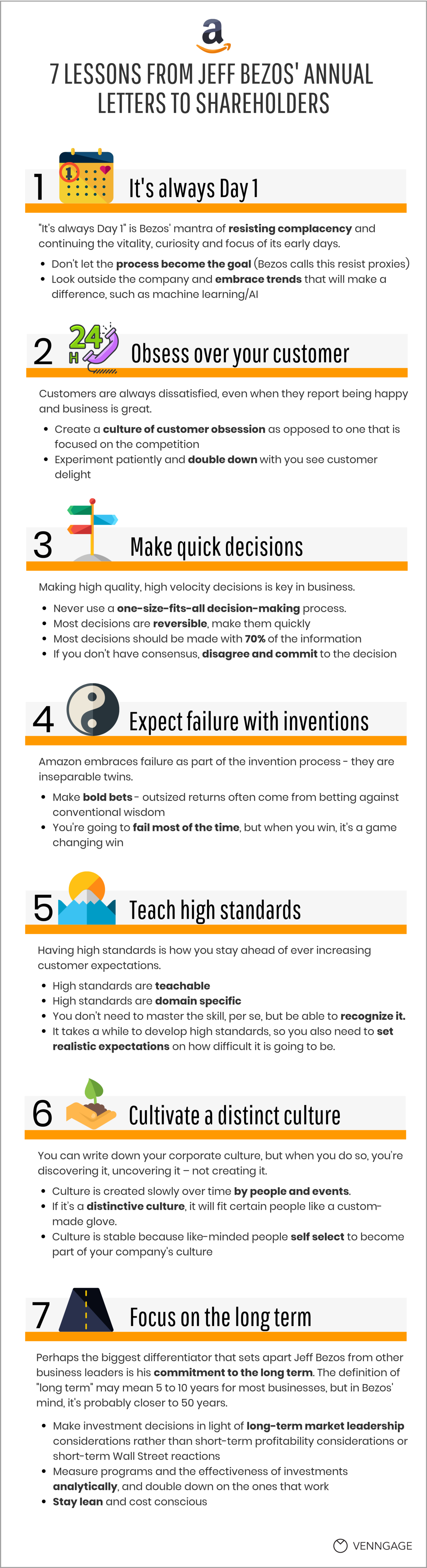
How do you stay ahead of ever-rising customer expectations? There’s no single way to do it – it’s a combination of many things. But high standards (widely deployed and at all levels of detail) are certainly a big part of it. We’ve had some successes over the years in our quest to meet the high expectations of customers. We’ve also had billions of dollars’ worth of failures along the way. With those experiences as backdrop, I’d like to share with you the essentials of what we’ve learned (so far) about high standards inside an organization.
Intrinsic or Teachable?
First, there’s a foundational question: are high standards intrinsic or teachable? If you take me on your basketball team, you can teach me many things, but you can’t teach me to be taller. Do we first and foremost need to select for “high standards” people? If so, this letter would need to be mostly about hiring practices, but I don’t think so. I believe high standards are teachable. In fact, people are pretty good at learning high standards simply through exposure. High standards are contagious. Bring a new person onto a high standards team, and they’ll quickly adapt. The opposite is also true. If low standards prevail, those too will quickly spread. And though exposure works well to teach high standards, I believe you can accelerate that rate of learning by articulating a few core principles of high standards, which I hope to share in this letter.
Universal or Domain Specific?
Another important question is whether high standards are universal or domain specific. In other words, if you have high standards in one area, do you automatically have high standards elsewhere? I believe high standards are domain specific, and that you have to learn high standards separately in every arena of interest. When I started Amazon, I had high standards on inventing, on customer care, and (thankfully) on hiring. But I didn’t have high standards on operational process: how to keep fixed problems fixed, how to eliminate defects at the root, how to inspect processes, and much more. I had to learn and develop high standards on all of that (my colleagues were my tutors).
Understanding this point is important because it keeps you humble. You can consider yourself a person of high standards in general and still have debilitating blind spots. There can be whole arenas of endeavor where you may not even know that your standards are low or non-existent, and certainly not world class. It’s critical to be open to that likelihood.
Recognition and Scope
What do you need to achieve high standards in a particular domain area? First, you have to be able to recognize what good looks like in that domain. Second, you must have realistic expectations for how hard it should be (how much work it will take) to achieve that result – the scope.
Let me give you two examples. One is a sort of toy illustration but it makes the point clearly, and another is a real one that comes up at Amazon all the time.
Perfect Handstands
A close friend recently decided to learn to do a perfect free-standing handstand. No leaning against a wall. Not for just a few seconds. Instagram good. She decided to start her journey by taking a handstand workshop at her yoga studio. She then practiced for a while but wasn’t getting the results she wanted. So, she hired a handstand coach. Yes, I know what you’re thinking, but evidently this is an actual thing that exists. In the very first lesson, the coach gave her some wonderful advice. “Most people,” he said, “think that if they work hard, they should be able to master a handstand in about two weeks. The reality is that it takes about six months of daily practice. If you think you should be able to do it in two weeks, you’re just going to end up quitting.” Unrealistic beliefs on scope – often hidden and undiscussed – kill high standards. To achieve high standards yourself or as part of a team, you need to form and proactively communicate realistic beliefs about how hard something is going to be – something this coach understood well.
Six-Page Narratives
We don’t do PowerPoint (or any other slide-oriented) presentations at Amazon. Instead, we write narratively structured six-page memos. We silently read one at the beginning of each meeting in a kind of “study hall.” Not surprisingly, the quality of these memos varies widely. Some have the clarity of angels singing. They are brilliant and thoughtful and set up the meeting for high-quality discussion. Sometimes they come in at the other end of the spectrum.
In the handstand example, it’s pretty straightforward to recognize high standards. It wouldn’t be difficult to lay out in detail the requirements of a well-executed handstand, and then you’re either doing it or you’re not. The writing example is very different. The difference between a great memo and an average one is much squishier. It would be extremely hard to write down the detailed requirements that make up a great memo. Nevertheless, I find that much of the time, readers react to great memos very similarly. They know it when they see it. The standard is there, and it is real, even if it’s not easily describable.
Here’s what we’ve figured out. Often, when a memo isn’t great, it’s not the writer’s inability to recognize the high standard, but instead a wrong expectation on scope: they mistakenly believe a high-standards, six-page memo can be written in one or two days or even a few hours, when really it might take a week or more! They’re trying to perfect a handstand in just two weeks, and we’re not coaching them right. The great memos are written and re-written, shared with colleagues who are asked to improve the work, set aside for a couple of days, and then edited again with a fresh mind. They simply can’t be done in a day or two. The key point here is that you can improve results through the simple act of teaching scope – that a great memo probably should take a week or more.
Skill
Beyond recognizing the standard and having realistic expectations on scope, how about skill? Surely to write a world class memo, you have to be an extremely skilled writer? Is it another required element? In my view, not so much, at least not for the individual in the context of teams. The football coach doesn’t need to be able to throw, and a film director doesn’t need to be able to act. But they both do need to recognize high standards for those things and teach realistic expectations on scope. Even in the example of writing a six-page memo, that’s teamwork. Someone on the team needs to have the skill, but it doesn’t have to be you. (As a side note, by tradition at Amazon, authors’ names never appear on the memos – the memo is from the whole team.)
Benefits of High Standards
Building a culture of high standards is well worth the effort, and there are many benefits. Naturally and most obviously, you’re going to build better products and services for customers – this would be reason enough! Perhaps a little less obvious: people are drawn to high standards – they help with recruiting and retention. More subtle: a culture of high standards is protective of all the “invisible” but crucial work that goes on in every company. I’m talking about the work that no one sees. The work that gets done when no one is watching. In a high standards culture, doing that work well is its own reward – it’s part of what it means to be a professional.
And finally, high standards are fun! Once you’ve tasted high standards, there’s no going back.
So, the four elements of high standards as we see it: they are teachable, they are domain specific, you must recognize them, and you must explicitly coach realistic scope. For us, these work at all levels of detail. Everything from writing memos to whole new, clean-sheet business initiatives. We hope they help you too.
The high standards our leaders strive for have served us well. And while I certainly can’t do a handstand myself, I’m extremely proud to share some of the milestones we hit last year, each of which represents the fruition of many years of collective effort. We take none of them for granted.
- Prime – 13 years post-launch, we have exceeded 100 million paid Prime members globally. In 2017 Amazon shipped more than five billion items with Prime worldwide, and more new members joined Prime than in any previous year – both worldwide and in the U.S. Members in the U.S. now receive unlimited free two-day shipping on over 100 million different items. We expanded Prime to Mexico, Singapore, the Netherlands, and Luxembourg, and introduced Business Prime Shipping in the U.S. and Germany. We keep making Prime shipping faster as well, with Prime Free Same-Day and Prime Free One-Day delivery now in more than 8,000 cities and towns. Prime Now is available in more than 50 cities worldwide across nine countries. Prime Day 2017 was our biggest global shopping event ever (until surpassed by Cyber Monday), with more new Prime members joining Prime than any other day in our history.
- AWS – It’s exciting to see Amazon Web Services, a $20 billion revenue run rate business, accelerate its already healthy growth. AWS has also accelerated its pace of innovation – especially in new areas such as machine learning and artificial intelligence, Internet of Things, and serverless computing. In 2017, AWS announced more than 1,400 significant services and features, including Amazon SageMaker, which radically changes the accessibility and ease of use for everyday developers to build sophisticated machine learning models. Tens of thousands of customers are also using a broad range of AWS machine learning services, with active users increasing more than 250 percent in the last year, spurred by the broad adoption of Amazon SageMaker. And in November, we held our sixth re:Invent conference with more than 40,000 attendees and over 60,000 streaming participants.
- Marketplace – In 2017, for the first time in our history, more than half of the units sold on Amazon worldwide were from our third-party sellers, including small and medium-sized businesses (SMBs). Over 300,000 U.S.-based SMBs started selling on Amazon in 2017, and Fulfillment by Amazon shipped billions of items for SMBs worldwide. Customers ordered more than 40 million items from SMBs worldwide during Prime Day 2017, growing their sales by more than 60 percent over Prime Day 2016. Our Global Selling program (enabling SMBs to sell products across national borders) grew by over 50% in 2017 and cross-border ecommerce by SMBs now represents more than 25% of total third- party sales.
- Alexa – Customer embrace of Alexa continues, with Alexa-enabled devices among the best-selling items across all of Amazon. We’re seeing extremely strong adoption by other companies and developers that want to create their own experiences with Alexa. There are now more than 30,000 skills for Alexa from outside developers, and customers can control more than 4,000 smart home devices from 1,200 unique brands with Alexa. The foundations of Alexa continue to get smarter every day too. We’ve developed and implemented an on-device fingerprinting technique, which keeps your device from waking up when it hears an Alexa commercial on TV. (This technology ensured that our Alexa Super Bowl commercial didn’t wake up millions of devices.) Far-field speech recognition (already very good) has improved by 15% over the last year; and in the U.S., U.K., and Germany, we’ve improved Alexa’s spoken language understanding by more than 25% over the last 12 months through enhancements in Alexa’s machine learning components and the use of semi-supervised learning techniques. (These semi-supervised learning techniques reduced the amount of labeled data needed to achieve the same accuracy improvement by 40 times!) Finally, we’ve dramatically reduced the amount of time required to teach Alexa new languages by using machine translation and transfer learning techniques, which allows us to serve customers in more countries (like India and Japan).
- Amazon devices – 2017 was our best year yet for hardware sales. Customers bought tens of millions of Echo devices, and Echo Dot and Fire TV Stick with Alexa were the best-selling products across all of Amazon – across all categories and all manufacturers. Customers bought twice as many Fire TV Sticks and Kids Edition Fire Tablets this holiday season versus last year. 2017 marked the release of our all-new Echo with an improved design, better sound, and a lower price; Echo Plus with a built-in smart home hub; and Echo Spot, which is compact and beautiful with a circular screen. We released our next generation Fire TV, featuring 4K Ultra HD and HDR; and the Fire HD 10 Tablet, with 1080p Full HD display. And we celebrated the 10th anniversary of Kindle by releasing the all-new Kindle Oasis, our most advanced reader ever. It’s waterproof – take it in the bathtub – with a bigger 7” high-resolution 300 ppi display and has built-in audio so you can also listen to your books with Audible.
- Prime Video – Prime Video continues to drive Prime member adoption and retention. In the last year we made Prime Video even better for customers by adding new, award-winning Prime Originals to the service, like The Marvelous Mrs. Maisel, winner of two Critics’ Choice Awards and two Golden Globes, and the Oscar-nominated movie The Big Sick. We’ve expanded our slate of programming across the globe, launching new seasons of Bosch and Sneaky Pete from the U.S., The Grand Tour from the U.K., and You Are Wanted from Germany, while adding new Sentosha shows from Japan, along with Breathe and the award-winning Inside Edge from India. Also this year, we expanded our Prime Channels offerings, adding CBS All Access in the U.S. and launching Channels in the U.K. and Germany. We debuted NFL Thursday Night Football on Prime Video, with more than 18 million total viewers over 11 games. In 2017, Prime Video Direct secured subscription video rights for more than 3,000 feature films and committed over $18 million in royalties to independent filmmakers and other rights holders. Looking forward, we’re also excited about our upcoming Prime Original series pipeline, which includes Tom Clancy’s Jack Ryanstarring John Krasinski; King Lear, starring Anthony Hopkins and Emma Thompson; The Romanoffs, executive produced by Matt Weiner; Carnival Row starring Orlando Bloom and Cara Delevingne; Good Omens starring Jon Hamm; and Homecoming, executive produced by Sam Esmail and starring Julia Roberts in her first television series. We acquired the global television rights for a multi-season production of The Lord of the Rings, as well as Cortés, a miniseries based on the epic saga of Hernán Cortés from executive producer Steven Spielberg, starring Javier Bardem, and we look forward to beginning work on those shows this year.
- Amazon Music – Amazon Music continues to grow fast and now has tens of millions of paid customers. Amazon Music Unlimited, our on-demand, ad-free offering, expanded to more than 30 new countries in 2017, and membership has more than doubled over the past six months.
- Fashion – Amazon has become the destination for tens of millions of customers to shop for fashion. In 2017, we introduced our first fashion-oriented Prime benefit, Prime Wardrobe – a new service that brings the fitting room directly to the homes of Prime members so they can try on the latest styles before they buy. We introduced Nike and UGG on Amazon along with new celebrity collections by Drew Barrymore and Dwyane Wade, as well as dozens of new private brands, like Goodthreads and Core10. We’re also continuing to enable thousands of designers and artists to offer their exclusive designs and prints on demand through Merch by Amazon. We finished 2017 with the launch of our interactive shopping experience with Calvin Klein, including pop-up shops, on-site product customization, and fitting rooms with Alexa-controlled lighting, music, and more.
- Whole Foods – When we closed our acquisition of Whole Foods Market last year, we announced our commitment to making high-quality, natural and organic food available for everyone, then immediately lowered prices on a selection of best-selling grocery staples, including avocados, organic brown eggs, and responsibly-farmed salmon. We followed this with a second round of price reductions in November, and our Prime member exclusive promotion broke Whole Foods’ all-time record for turkeys sold during the Thanksgiving season. In February, we introduced free two-hour delivery on orders over $35 for Prime members in select cities, followed by additional cities in March and April, and plan continued expansion across the U.S. throughout this year. We also expanded the benefits of the Amazon Prime Rewards Visa Card, enabling Prime members to get 5% back when shopping at Whole Foods Market. Beyond that, customers can purchase Whole Foods’ private label products like 365 Everyday Value on Amazon, purchase Echo and other Amazon devices in over a hundred Whole Foods stores, and pick-up or return Amazon packages at Amazon Lockers in hundreds of Whole Foods stores. We’ve also begun the technical work needed to recognize Prime members at the point of sale and look forward to offering more Prime benefits to Whole Foods shoppers once that work is completed.
- Amazon Go – Amazon Go, a new kind of store with no checkout required, opened to the public in January in Seattle. Since opening, we’ve been thrilled to hear many customers refer to their shopping experience as “magical.” What makes the magic possible is a custom-built combination of computer vision, sensor fusion, and deep learning, which come together to create Just Walk Out shopping. With JWO, customers are able to grab their favorite breakfast, lunch, dinner, snack, and grocery essentials more conveniently than ever before. Some of our top-selling items are not surprising – caffeinated beverages and water are popular – but our customers also love the Chicken Banh Mi sandwich, chocolate chip cookies, cut fruit, gummy bears, and our Amazon Meal Kits.
- Treasure Truck – Treasure Truck expanded from a single truck in Seattle to a fleet of 35 trucks across 25 U.S. cities and 12 U.K. cities. Our bubble-blowing, music-pumping trucks fulfilled hundreds of thousands of orders, from porterhouse steaks to the latest Nintendo releases. Throughout the year, Treasure Truck also partnered with local communities to lift spirits and help those in need, including donating and delivering hundreds of car seats, thousands of toys, tens of thousands of socks, and many other essentials to community members needing relief, from those displaced by Hurricane Harvey, to the homeless, to kids needing holiday cheer.
- India – Amazon.in is the fastest growing marketplace in India, and the most visited site on both desktop and mobile, according to comScore and SimilarWeb. The Amazon.in mobile shopping app was also the most downloaded shopping app in India in 2017, according to App Annie. Prime added more members in India in its first year than any previous geography in Amazon’s history. Prime selection in India now includes more than 40 million local products from third-party sellers, and Prime Video is investing in India original video content in a big way, including two recent premiers and over a dozen new shows in production.
- Sustainability – We are committed to minimizing carbon emissions by optimizing our transportation network, improving product packaging, and enhancing energy efficiency in our operations, and we have a long-term goal to power our global infrastructure using 100% renewable energy. We recently launched Amazon Wind Farm Texas, our largest wind farm yet, which generates more than 1,000,000 megawatt hours of clean energy annually from over 100 turbines. We have plans to host solar energy systems at 50 fulfillment centers by 2020, and have launched 24 wind and solar projects across the U.S. with more than 29 additional projects to come. Together, Amazon’s renewable energy projects now produce enough clean energy to power over 330,000 homes annually. In 2017 we celebrated the 10-year anniversary of Frustration-Free Packaging, the first of a suite of sustainable packaging initiatives that have eliminated more than 244,000 tons of packaging materials over the past 10 years. In addition, in 2017 alone our programs significantly reduced packaging waste, eliminating the equivalent of 305 million shipping boxes. And across the world, Amazon is contracting with our service providers to launch our first low-pollution last-mile fleet. Already today, a portion of our European delivery fleet is comprised of low-pollution electric and natural gas vans and cars, and we have over 40 electric scooters and e-cargo bikes that complete local urban deliveries.
- Empowering Small Business – Millions of small and medium-sized businesses worldwide now sell their products through Amazon to reach new customers around the globe. SMBs selling on Amazon come from every state in the U.S., and from more than 130 different countries around the world. More than 140,000 SMBs surpassed $100,000 in sales on Amazon in 2017, and over a thousand independent authors surpassed $100,000 in royalties in 2017 through Kindle Direct Publishing.
- Investment & Job Creation – Since 2011, we have invested over $150 billion worldwide in our fulfillment networks, transportation capabilities, and technology infrastructure, including AWS data centers. Amazon has created over 1.7 million direct and indirect jobs around the world. In 2017 alone, we directly created more than 130,000 new Amazon jobs, not including acquisitions, bringing our global employee base to over 560,000. Our new jobs cover a wide range of professions, from artificial intelligence scientists to packaging specialists to fulfillment center associates. In addition to these direct hires, we estimate that Amazon Marketplace has created 900,000 more jobs worldwide, and that Amazon’s investments have created an additional 260,000 jobs in areas like construction, logistics, and other professional services.
- Career Choice – One employee program we’re particularly proud of is Amazon Career Choice. For hourly associates with more than one year of tenure, we pre-pay 95% of tuition, fees, and textbooks (up to $12,000) for certificates and associate degrees in high-demand occupations such as aircraft mechanics, computer-aided design, machine tool technologies, medical lab technologies, and nursing. We fund education in areas that are in high demand and do so regardless of whether those skills are relevant to a career at Amazon. Globally more than 16,000 associates (including more than 12,000 in the U.S.) have joined Career Choice since the program launched in 2012. Career Choice is live in ten countries and expanding to South Africa, Costa Rica, and Slovakia later this year. Commercial truck driving, healthcare, and information technology are the program’s most popular fields of study. We’ve built 39 Career Choice classrooms so far, and we locate them behind glass walls in high traffic areas inside our fulfillment centers so associates can be inspired by seeing their peers pursue new skills.
The credit for these milestones is deserved by many. Amazon is 560,000 employees. It’s also 2 million sellers, hundreds of thousands of authors, millions of AWS developers, and hundreds of millions of divinely discontent customers around the world who push to make us better each and every day.
Path Ahead
This year marks the 20th anniversary of our first shareholder letter, and our core values and approach remain unchanged. We continue to aspire to be Earth’s most customer-centric company, and we recognize this to be no small or easy challenge. We know there is much we can do better, and we find tremendous energy in the many challenges and opportunities that lie ahead.
A huge thank you to each and every customer for allowing us to serve you, to our shareowners for your support, and to Amazonians everywhere for your ingenuity, your passion, and your high standards.
As always, I attach a copy of our original 1997 letter. It remains Day 1.
Sincerely,
Jeffrey P. Bezos
Founder and Chief Executive Officer
Amazon.com, Inc.
—————————————————————————————————————————–
Amazon.com passed many milestones in 1997: by year-end, we had served more than 1.5 million customers, yielding 838% revenue growth to $147.8 million, and extended our market leadership despite aggressive competitive entry.
But this is Day 1 for the Internet and, if we execute well, for Amazon.com. Today, online commerce saves customers money and precious time. Tomorrow, through personalization, online commerce will accelerate the very process of discovery. Amazon.com uses the Internet to create real value for its customers and, by doing so, hopes to create an enduring franchise, even in established and large markets.
We have a window of opportunity as larger players marshal the resources to pursue the online opportunity and as customers, new to purchasing online, are receptive to forming new relationships. The competitive landscape has continued to evolve at a fast pace. Many large players have moved online with credible offerings and have devoted substantial energy and resources to building awareness, traffic, and sales. Our goal is to move quickly to solidify and extend our current position while we begin to pursue the online commerce opportunities in other areas. We see substantial opportunity in the large markets we are targeting. This strategy is not without risk: it requires serious investment and crisp execution against established franchise leaders.
It’s All About the Long Term
We believe that a fundamental measure of our success will be the shareholder value we create over the long term. This value will be a direct result of our ability to extend and solidify our current market leadership position. The stronger our market leadership, the more powerful our economic model. Market leadership can translate directly to higher revenue, higher profitability, greater capital velocity, and correspondingly stronger returns on invested capital.
Our decisions have consistently reflected this focus. We first measure ourselves in terms of the metrics most indicative of our market leadership: customer and revenue growth, the degree to which our customers continue to purchase from us on a repeat basis, and the strength of our brand. We have invested and will continue to invest aggressively to expand and leverage our customer base, brand, and infrastructure as we move to establish an enduring franchise.
Because of our emphasis on the long term, we may make decisions and weigh tradeoffs differently than some companies. Accordingly, we want to share with you our fundamental management and decision-making approach so that you, our shareholders, may confirm that it is consistent with your investment philosophy:
- We will continue to focus relentlessly on our customers.
- We will continue to make investment decisions in light of long-term market leadership considerations rather than short-term profitability considerations or short-term Wall Street reactions.
- We will continue to measure our programs and the effectiveness of our investments analytically, to jettison those that do not provide acceptable returns, and to step up our investment in those that work best. We will continue to learn from both our successes and our failures.
- We will make bold rather than timid investment decisions where we see a sufficient probability of gaining market leadership advantages. Some of these investments will pay off, others will not, and we will have learned another valuable lesson in either case.
- When forced to choose between optimizing the appearance of our GAAP accounting and maximizing the present value of future cash flows, we’ll take the cash flows.
- We will share our strategic thought processes with you when we make bold choices (to the extent competitive pressures allow), so that you may evaluate for yourselves whether we are making rational long-term leadership investments.
- We will work hard to spend wisely and maintain our lean culture. We understand the importance of continually reinforcing a cost-conscious culture, particularly in a business incurring net losses.
- We will balance our focus on growth with emphasis on long-term profitability and capital management. At this stage, we choose to prioritize growth because we believe that scale is central to achieving the potential of our business model.
- We will continue to focus on hiring and retaining versatile and talented employees, and continue to weight their compensation to stock options rather than cash. We know our success will be largely affected by our ability to attract and retain a motivated employee base, each of whom must think like, and therefore must actually be, an owner.
We aren’t so bold as to claim that the above is the “right” investment philosophy, but it’s ours, and we would be remiss if we weren’t clear in the approach we have taken and will continue to take.
With this foundation, we would like to turn to a review of our business focus, our progress in 1997, and our outlook for the future.
Obsess Over Customers
From the beginning, our focus has been on offering our customers compelling value. We realized that the Web was, and still is, the World Wide Wait. Therefore, we set out to offer customers something they simply could not get any other way, and began serving them with books. We brought them much more selection than was possible in a physical store (our store would now occupy 6 football fields), and presented it in a useful, easy- to-search, and easy-to-browse format in a store open 365 days a year, 24 hours a day. We maintained a dogged focus on improving the shopping experience, and in 1997 substantially enhanced our store. We now offer customers gift certificates, 1-Click shopping℠, and vastly more reviews, content, browsing options, and recommendation features. We dramatically lowered prices, further increasing customer value. Word of mouth remains the most powerful customer acquisition tool we have, and we are grateful for the trust our customers have placed in us. Repeat purchases and word of mouth have combined to make Amazon.com the market leader in online bookselling.
By many measures, Amazon.com came a long way in 1997:
- Sales grew from $15.7 million in 1996 to $147.8 million – an 838% increase.
- Cumulative customer accounts grew from 180,000 to 1,510,000 – a 738% increase.
- The percentage of orders from repeat customers grew from over 46% in the fourth quarter of 1996 to over 58% in the same period in 1997.
- In terms of audience reach, per Media Metrix, our Web site went from a rank of 90th to within the top 20.
- We established long-term relationships with many important strategic partners, including America Online, Yahoo!, Excite, Netscape, GeoCities, AltaVista, @Home, and Prodigy.
Infrastructure
During 1997, we worked hard to expand our business infrastructure to support these greatly increased traffic, sales, and service levels:
- Amazon.com’s employee base grew from 158 to 614, and we significantly strengthened our management team.
- Distribution center capacity grew from 50,000 to 285,000 square feet, including a 70% expansion of our Seattle facilities and the launch of our second distribution center in Delaware in November.
- Inventories rose to over 200,000 titles at year-end, enabling us to improve availability for our customers.
- Our cash and investment balances at year-end were $125 million, thanks to our initial public offering in May 1997 and our $75 million loan, affording us substantial strategic flexibility.
Our Employees
The past year’s success is the product of a talented, smart, hard-working group, and I take great pride in being a part of this team. Setting the bar high in our approach to hiring has been, and will continue to be, the single most important element of Amazon.com’s success.
It’s not easy to work here (when I interview people I tell them, “You can work long, hard, or smart, but at Amazon.com you can’t choose two out of three”), but we are working to build something important, something that matters to our customers, something that we can all tell our grandchildren about. Such things aren’t meant to be easy. We are incredibly fortunate to have this group of dedicated employees whose sacrifices and passion build Amazon.com.
Goals for 1998
We are still in the early stages of learning how to bring new value to our customers through Internet commerce and merchandising. Our goal remains to continue to solidify and extend our brand and customer base. This requires sustained investment in systems and infrastructure to support outstanding customer convenience, selection, and service while we grow. We are planning to add music to our product offering, and over time we believe that other products may be prudent investments. We also believe there are significant opportunities to better serve our customers overseas, such as reducing delivery times and better tailoring the customer experience. To be certain, a big part of the challenge for us will lie not in finding new ways to expand our business, but in prioritizing our investments.
We now know vastly more about online commerce than when Amazon.com was founded, but we still have so much to learn. Though we are optimistic, we must remain vigilant and maintain a sense of urgency. The challenges and hurdles we will face to make our long-term vision for Amazon.com a reality are several: aggressive, capable, well-funded competition; considerable growth challenges and execution risk; the risks of product and geographic expansion; and the need for large continuing investments to meet an expanding market opportunity. However, as we’ve long said, online bookselling, and online commerce in general, should prove to be a very large market, and it’s likely that a number of companies will see significant benefit. We feel good about what we’ve done, and even more excited about what we want to do.
1997 was indeed an incredible year. We at Amazon.com are grateful to our customers for their business and trust, to each other for our hard work, and to our shareholders for their support and encouragement.
Jeffrey P. Bezos
Founder and Chief Executive Officer
Amazon.com, Inc.
Which are the most disruptive technologies?
Richard Watson is the guy behind those amazing trend maps, that look a little like subway maps but 10 times more complicated. Through his graphical synopsis of our changing worlds, he has a gift for connecting ideas, which of course is how Leonardo da Vinci always said, we move forwards. His latest effort, seeks to bring together all these amazing technologies, to understand their relative impacts.
The idea for the table, developed in partnership with Imperial College London, initially came from Richard stumbling upon a list of emerging technologies on Wikipedia. This felt fairly accurate to him, but also rather lifeless. It wasn’t especially contextual either. Other lists from MIT Tech Review and McKinsey were better, but somehow these weren’t showing the bigger picture either.
The tricky part was then deciding how to rank both the disruptive potential of each technology and time (an iterative process using small post-it notes that could be moved around easily). What results is far from perfect, he admits, but it’s better than anything else I’ve seen and it’s hopefully a foundation for people being wrong in really useful and interesting ways.

You can download a high resolution PDF here: 100 Disruptive Technologies
Here’s how it works.
The table consists of 100 potentially disruptive technologies, which the team have defined as new technologies capable of significant social, economic or political upheaval.
One axis (Y Axis) ranks potential for disruption from high to low, while the other (X Axis) is time ranked from sooner to later. Importantly, time relates to common usage or ubiquity, not initial invention. All very subjective, I know, but it has been thought about quite a bit.
The 100 technologies (99 really) are then divided into four groups. Horizon one technologies (green on the table) are new technologies that are happening right now. Companies should be integrating and executing these technologies right now if they are appropriate.
Horizon two technologies (yellow) are probable near future technologies (10-20 years hence). Companies should be experimenting and discussing these technologies now.
Horizon three technologies (red) are things that are likely to emerge in the more distant future (20 years plus). Companies should keep an eye on developments in these areas and explore when appropriate.
The outer edge of the table (grey) contains what we’ve termed Ghost Technologies. This is the really good bit! This is fringe thinking territory with some ideas bordering on complete lunacy. However, while each example is highly improbable, very few, if any, are totally impossible.
Each of the 100 technologies has then been given an abbreviation, followed by a very brief and hopefully self-explanatory description. Each technology is then categorized according to one of five subjective themes (Data Ecosystems, Smart Planet, Extreme Automation, Human Augmentation and Human-Machine interactions).
On the far right of the table are examples of companies active in each of the technology areas. These examples are not comprehensive. However note the number of US companies on this list and also the strength of Apple, Google and Musk. A couple of things worth pointing out are what’s missing from the table, especially the impact of human psychology (users) and the way in which two or more technology elements might interact (see the small print at the bottom of the chart).
Here is the list of 100 disruptive technologies:
Smart nappies
Deep ocean wind farms
Vertical agriculture
Wireless energy transfer
Cryptocurrencies
Concentrated solar power
Predictive policing
Micro-scale ambient energy harvesting
Robotic care companions
Smart control of appliances
Cultured meat
Delivery robots and passenger drones
Distributed ledgers
Precision agriculture
Autonomous vehicles
Intention decoding algorithms
Balloon-powered internet
Powered exoskeletons
Computerised shoes and clothing
Airborne wind turbines (high altitude)
Avatar companions
Metallic hydrogen energy storage
Autonomous ships and submarines
Resource gamification
Water harvesting from air
Drone freight delivery
Autonomous passenger aircraft
3D-printing of food and pharmaceuticals
Medical tricorders
Smart flooring and carpets
Diagnostic toilets
Smart energy grids
Algal bio-fuels
Human organ printing
Artificial human blood substitute
Mega-scale desalination
Self-writing software
Public mood monitoring machines
Programmable bacteria
Peer-to-peer energy trading and transmission
Lifelong personal avatar assistants
Smart dust
Predictive gene-based healthcare
Automated knowledge discovery
Autonomous robotic surgery
Emotionally aware machines
Humanoid sex-robots
Human bio hacking
Internet of DNA
Vacuum-tube transport
Scram jets
Smart glasses and contact lenses
Pollution-eating buildings
Broadcasting of electricity
Bio-plastics
Swarm robotics
4-dimenional materials (and printing)
New (Nano) materials
Fusion power
Low-cost space travel
Colonisation of another planet
Thought control machine interfaces
Dream reading and recording
Planetary-scale spectroscopy
Implantable phones
e-tagging of new-borns
Male pregnancy and artificial wombs
DNA data storage
Genomic vaccines
Quantum safe cryptography
Cognitive prosthetics
Data uploading to the brain
Conversational machine interfaces
Life-expectancy algorithms
Stratospheric aerosols
Battlefield robots
AI advisors and decision-making machines
AI board members and politicians
Invisibility shields
Factory photosynthesis
Trans human technologies
Digital footprint eraser
Personal digital shields
Human head transplants
Human cloning and de-extinction
Distributed autonomous corporations
Space solar power
Space elevators
Fully immersive VR
Artificial consciousness
Telepathy
Reactionless drive
Whole Earth virtualisation
Shape shifting matter
Self-reconfiguring robots
Zero-point energy
Beam-powered propulsion
Force fields
Asteroid mining
More on disruptive technologies:
McKinsey & Company article of disruptive technologies
https://www.mckinsey.com/business-functions/digital-mckinsey/our-insights/disruptive-technologies
Accenture 5 disruptive technologies
https://www.accenture.com/gb-en/insight-disruptive-technology-trends-2017
EY 4 disruptive themes
http://www.ey.com/Publication/vwLUAssets/EY-four-themes-describe-historic-change-in-the-technology-sector/$FILE/EY-four-themes-describe-historic-change-in-the-technology-sector.pdf
List of emerging technologies – Wikipedia
https://en.wikipedia.org/wiki/List_of_emerging_technologies
Disruptive Technologies by Paul Armstrong
https://www.amazon.co.uk/Disruptive-Technologies-Understand-Evaluate-Respond/dp/0749477288
Disruption hub
https://disruptionhub.com/2018-disruptive-trends/
MIT Tech Review
https://www.technologyreview.com/lists/technologies/2018/
Julie Ferland is GM of the Shell TechWorks innovation lab. Here she offers an inside look at how the space is designed; the types of projects it works on; and the team Shell has assembled in Cambridge, Massachusetts.
“Our team here is comprised of people from all different industries — consumer products, Department of Defense, aerospace — the vast majority are coming from outside the oil and gas industry,” Ferland explains.
“We’re bringing people in who aren’t necessarily fresh out of school. They have years of experience in their industries. They’ve learned lessons from those other industries. They can bring those lessons learned into Shell’s industry and Shell’s tough problems. It also allows them to have a perspective on where technology has gone in those other industries.”
TechWorks includes open workspace for about 50 employees; a games area; a communal kitchen and café; phone booths; and prototyping workshops on the same level as the open workspace.
“Engineers are going back and forth all day. They can build things, they can go back and test them, they can bring them out to end users and see how they work and then come back and build something else — on a really short cycle. People are churning out five or six prototypes a week, and being able to interact with their stakeholders to see what works.”
Given that TechWorks takes on many exploratory projects, both on its own and in partnership with Shell’s business units, Ferland says, “We are allowed that freedom to fail and to succeed, and it allows some really great opportunities.”
Why do some people succeed at change while others fail? It’s the way they think … Liminal thinking is the art of creating change by understanding, shaping, and reframing beliefs. What beliefs are stopping you right now?
You have a choice, says David Gray, author of the book Liminal Thinking. You can create the world you want or live in a world created by others.
6 Principles
These six principles constitute a theory of beliefs: how they come into being, why they are necessary, how they are reinforced over time, and why people cling to their beliefs, even when they are incomplete, obsolete, or invalid. They are beliefs about beliefs.
1. Beliefs are models. Beliefs seem like perfect representations of the world, but in fact they are imperfect models for navigating a complex, multidimensional, unknowable reality.
2. Beliefs are created. Beliefs are constructed hierarchically, using theories and judgments, which are based on selected facts and personal, subjective experiences.
3. Beliefs create a shared world. Beliefs are the psychological material we use to co-create a shared world, so we can live, work, and do things together. Changing a shared world requires changing its underlying beliefs.
4. Beliefs create blind spots. Beliefs are tools for thinking and provide rules for action, but they can also create artificial constraints that blind you to valid possibilities.
5. Beliefs defend themselves. Beliefs are unconsciously defended by a bubble of self-sealing logic, which maintains them even when they are invalid, to protect personal identity and self-worth.
6. Beliefs are tied to identity. Governing beliefs, which form the basis for other beliefs, are the most difficult to change, because they are tied to personal identity and feelings of self-worth. You can’t change your governing beliefs without changing yourself.
9 Practices
Nine practices to help you minimize reality distortion, envision possibilities, and create positive change.
1. Assume that you are not objective. If you’re part of the system you want to change, you’re part of the problem.
2. Empty your cup. You can’t learn new things without letting go of old things. Stop, look, and listen. Suspend judgment. What’s going on?
3. Create safe space. If you don’t understand the underlying need, nothing else matters. People will not share their innermost needs unless they feel safe, respected, and accepted for who they are.
4. Triangulate and validate. Look at situations from as many points of view as possible. Consider the possibility that seemingly different or contradictory beliefs may be valid. If something doesn’t make sense to you, then you’re missing something.
5. Ask questions, make connections. Try to understand people’s hopes, dreams and frustrations. Explore the social system and make connections to create new opportunities.
6. Disrupt routines. Many beliefs are embedded in habitual routines that run on autopilot. If a routine is a problem, disrupt the routine to create new possibilities.
7. Act as-if in the here-and-now. You can test beliefs even if you don’t believe they are true. All you need to do is act as if they were true and see what happens. If you find something that works, do more of it.
8. Make sense with stories. If you give people facts without a story, they will explain it within their existing belief system. The best way to promote a new or different belief is not with facts, but with a story.
9. Evolve yourself. If you can be open about how change affects you personally, you have a better chance of achieving your aims. To change the world, you must be willing to change yourself.
Frederic Laloux’s Reinventing Organizations is considered by many to be the most influential management book of this decade. It has inspired hundreds, probably thousands, of organizations throughout the world to take a radical leap and adopt a whole different set of management principles and practices.
- Download a summary of the book
Most books on organizations are written for people hoping to find the secret key to gaining market share, beating competition and increasing profits. They offer advice on how to better play the game of success within the current management paradigm. “Reinventing Organizations” comes from a different place. It is written for people (founders of organizations, leaders, coaches, and advisors) who sense that something is broken in the way we run organizations today and who feel that something entirely different is called for… but wonder what that might be.
- Reinventing Organisations by Change Factory
- Bursting the Bubble, Teal Ain’t Real by Corporate Rebels
Here the Belgian thinker describes exemplary success stories, explains why the future belongs to self-managing organisations, and describes what he means by ‘wholeness’ and ‘evolutionary purpose’ – and why they represent important breakthroughs.
Part 1 of Frederic Laloux’s Reinventing Organizations takes a sweeping evolutionary and historical view. It explains how every time humanity has shifted to a new stage of consciousness, it has also invented a radically more productive organizational model. Could we be facing another critical juncture today? Could we be about to make such a leap again?
Part 2 serves as a practical handbook. Using stories from real-life case examples (businesses and nonprofits, schools and hospitals), this section describes in detail how this new, soulful way to run an organization works. How are these organizations structured and how do they operate on a day-to-day basis? (Spoiler alert: it’s not the pyramid we know. There are no job descriptions, no targets, hardly any budgets. In their place come many new and soulful practices that make for extraordinarily productive and purposeful organizations.)
Part 3 examines the conditions for these new organizations to thrive. What is needed to start an organization on this new model? Is it possible to transform existing organizations? What results can you expect at the end of the day?
Evolution, Purpose and Wholeness … aka “Teal” Organisations
In a recent article for S+B magazine, The Future of Management is Teal, Laloux describes how organisations are moving forward along an evolutionary spectrum, toward self-management, wholeness, and a deeper sense of purpose.
Here is an extract from his article:
Many people sense that the way organisations are run today has been stretched to its limits. In survey after survey, businesspeople make it clear that in their view, companies are places of dread and drudgery, not passion or purpose. Organizational disillusionment afflicts government agencies, nonprofits, schools, and hospitals just as much. Further, it applies not just to the powerless at the bottom of the hierarchy. Behind a facade of success, many top leaders are tired of the power games and infighting; despite their desperately overloaded schedules, they feel a vague sense of emptiness. All of us yearn for better ways to work together — for more soulful workplaces where our talents are nurtured and our deepest aspirations are honored.
The premise of this article is that humanity is at a threshold; a new form of organization is emerging into public view. Anthropological research suggests that this is a natural next step in a process that began more than 100,000 years ago. There have been, according to this view, at least five distinct organizational paradigms in human history. Could the current organizational disillusionment be a sign that civilization is outgrowing the current model and getting ready for the next?
A number of pioneering organizations in a wide variety of sectors — profit and nonprofit — are already operating with significantly new structures and management practices. They tend to be successful and purposeful, showing the promise of this emerging organizational model. They show how we can deal with the complexity of our times in wholly new ways, and how work can become a place of personal fulfillment and growth. By contrast, they make most of today’s organizations look painfully outdated.
A History of Organizational Paradigms
In describing the pattern of organizational evolution, I draw on the work of a number of thinkers in a field known as “developmental theory.” One of its basic concepts is the idea that human societies, like individuals, don’t grow in linear fashion, but in stages of increasing maturity, consciousness, and complexity. Various scholars have assigned different names to these stages; philosopher Ken Wilber uses colors to identify them, in a sequence that evokes the light spectrum, from infrared to ultraviolet. I borrow his colour scheme as a convenient way to name the successive stages of management evolution.

Around 10,000 years ago, humanity started organizing itself in chiefdoms and proto-empires. With this shift away from small tribes, the meaningful division of labor came into being — a breakthrough invention for its time. With it came the first real organizations, in the form of small conquering armies. These organizations, which in integral theory are labeled Red, are crude, often violent groups. People at this stage of development tend to regard the world as a tough place where only the powerful (or those they protect) get their needs met. This was the origin of command authority. The chief, like the alpha male in a wolf pack, needs to constantly inspire fear to keep underlings in line, and often relies on family members in hopes that they can be trusted. Today’s street gangs, terrorist groups, and crime syndicates are often organized along these lines.
Starting around 4000 BC in Mesopotamia, humanity entered the Amber age of agriculture, state bureaucracies, and organized religion. Psychologically, this leap was enormous: People learned to exercise self-discipline and self-control, internalizing the strong group norms of all agricultural societies. Do what’s right and you will be rewarded, in this life or the next. Do or say the wrong things, and you will be excommunicated from the group.
All agrarian societies are divided into clearly delineated castes. They thrive on order, control, and hierarchy. In organizations, the same principles characterize the Amber stage. The fluid, scheming wolf pack–like Red organizations give way to static, stratified pyramids. The Catholic Church is an archetypal Amber organization, complete with a static organization chart linking all levels of activity in lines and boxes, from the pope at the top to the cardinals below and down to the archbishops, bishops, and priests. Historically, the invention of formal roles and hierarchies was a major breakthrough. It allowed organizations to scale beyond anything Red society could have contemplated. Amber organizations produced the pyramids, irrigation systems, cathedrals, the Great Wall of China, and other structures and feats that were previously unthinkable. They also considerably reduced violence; a priest whose role is defined by a box in an organization chart doesn’t scheme to backstab a bishop who shows a sign of weakness. A second breakthrough was the invention of stable, replicable processes, such as the yearly cycle of planting, growing, and harvest in agriculture.
Today, this hierarchical and process-driven model is visible in large bureaucratic enterprises, many government agencies, and most education and military organizations. In Amber organizations, thinking and execution are strictly separated. People at the bottom must be instructed through command and control. In today’s fast-changing, knowledge-based economy, this static, top-down conception of management has proven to be inefficient; it wastes the talent, creativity, and energy of most people in these organizations.
Starting with the Renaissance, and gaining steam with the Enlightenment and the early Industrial Revolution, a new management concept emerged that challenged its agrarian predecessor. In the Orange paradigm, the world is no longer governed by absolute, God-given rules; it is a complex mechanism that can be understood and exploited through scientific and empirical investigation. Effectiveness replaces morality as the yardstick for decision making: The best decision is the one that begets the highest reward. The goal in an Orange organization is to get ahead, to succeed in socially acceptable ways, and to best play the cards one is dealt. This is arguably the predominant perspective of most leaders in business and politics today.
The leap to Orange coincided with three significant management breakthroughs that gave us the modern corporation. First was the concept of innovation, which brought with it new departments such as R&D, product management, and marketing, as well as project teams and cross-functional initiatives. Second was accountability, which provided leaders with an alternative to commanding people: Give people targets to reach, using freedom and rewards to motivate them. This breakthrough, sometimes called management by objectives, led to the creation of modern HR practices, budgets, KPIs, yearly evaluations, bonus systems, and stock options. Third was meritocracy, the idea that anyone could rise to any position based on his or her qualifications and skills — a radical concept when it appeared.
The transition to Orange brought a new prevailing metaphor. A good organization is not a wolf pack or army, but a machine. Corporate leaders adopted engineering terms to describe their work: they designed the company, using inputs and outputs, information flows, and bottlenecks; they downsized the staff and reengineered their companies. Most large, mainstream publicly listed companies operate with Orange management practices.
In just two and a half centuries, these breakthroughs have generated unprecedented levels of prosperity, added decades to human life expectancy, and dramatically reduced famine and plague in the industrialized world. But as the Orange paradigm grew dominant, it also encouraged short-term thinking, corporate greed, overconsumption, and the reckless exploitation of the planet’s resources and ecosystems. Increasingly, whether we are powerful leaders or low-ranking employees, we feel that this paradigm isn’t sustainable. The heartless and soulless rat race of Orange organizations has us yearning for more.
Postmodernity brought us another world view. The Green stage stresses cooperation over competition and strives for equality, solidarity, and tolerance. Historically, this perspective inspired the fights for the abolition of slavery, and for gender equality, and today it helps combat racism, homophobia, and other forms of discrimination. Green organizations, which include many nonprofits as well as companies such as Southwest Airlines, Starbucks, and the Container Store, consider social responsibility the core of their mission. They serve not just shareholders but all stakeholders, knowing that this often results in higher costs in the short term, but better returns in the end.
Green leaders have championed the soft aspects of business — investing in organizational culture and values, coaching, mentoring, and teamwork — over the hard aspects of strategy and budgeting so prized in Orange. Family is their metaphor; everyone’s voice should be heard and respected. You can’t treat knowledge workers like cogs in a machine. Empowerment and egalitarian management are among the breakthroughs they introduced.
Practice shows, alas, that empowerment and egalitarian management are hard to sustain. Efforts to make everyone equal often lead to hidden power struggles, dominant actors who coopt the system, and organizational gridlock. Green companies, universities, and organizations that take egalitarianism too far have tended to bog down in debate and factionalism. Successful Green companies maintain a careful balance: taming the traditional hierarchy through constant investment in training and culture; reminding leaders and managers to wield their power carefully; and raising the skills of people on the front lines.
All of these organizational paradigms coexist today. In any major city one can find Red organizations (entities at the fringes of the law), Amber organizations (public schools and other government entities), Orange organizations (Wall Street and Main Street companies), and Green organizations (values-driven businesses and many nonprofits). Look closely at how an organization operates — its structure, leadership style, or any core management process — and you can quickly guess the dominant paradigm. Take compensation, for example: How are people rewarded? In a Red company, the boss shares the spoils as he or she pleases, buying allegiance through reward and punishment. In Amber organizations, salaries are tightly linked to a person’s level in the hierarchy (“same rank, same pay”) and there are no incentives or bonuses. Orange companies offer individual incentives to reward star performers, while Green companies generally award team bonuses to encourage cooperation.
Today, in small but increasing numbers, leaders are growing into the next stage of consciousness, beyond Green. They are mindful, taming the needs and impulses of their ego. They are suspicious of their own desires — to control their environment, to be successful, to look good, or even to accomplish good works. Rejecting fear, they listen to the wisdom of other, deeper parts of themselves. They develop an ethic of mutual trust and assumed abundance. They ground their decision making in an inner measure of integrity. They are ready for the next organizational paradigm. Its color is Teal.
The Nature of Teal
In 2012, I set out to find some examples of Teal organizations and describe the factors that set them apart. To qualify, an organization had to employ a minimum of 100 people and had to have been operating for a minimum of five years in ways that were consistent with the characteristics of a Teal stage of human development.
After screening a great number of organizations, I focused on 12, selecting those that were most advanced in reinventing management structures and practices. (See “Examples of Teal Management,” where ten are listed; the other two, AES and BSO/Origin, reverted back to more traditional management practices after a change of CEO or ownership). I was struck by the diversity of these organizations. They include publicly held and privately held for-profit corporations along with nonprofits in the consumer products, industrial, healthcare, retail, and education industries. Typically, the leaders of these companies didn’t know about one another. They often thought they were the only ones to be so foolhardy as to rethink their management practices in fundamental ways. Yet, after much trial and error, they came up with strikingly similar approaches to management. It seems that a coherent new organizational model is emerging.
Like previous leaps to new stages of management, the new model comes with a number of important breakthroughs:
• Self-management. Teal organizations operate effectively, even at a large scale, with a system based on peer relationships. They set up structures and practices in which people have high autonomy in their domain, and are accountable for coordinating with others. Power and control are deeply embedded throughout the organizations, no longer tied to the specific positions of a few top leaders.
• Wholeness. Whereas Orange and Green organizations encourage people to show only their narrow “professional” selves, Teal organizations invite people to reclaim their inner wholeness. They create an environment wherein people feel free to fully express themselves, bringing unprecedented levels of energy, passion, and creativity to work.
• Evolutionary purpose. Teal organizations base their strategies on what they sense the world is asking from them. Agile practices that sense and respond replace the machinery of plans, budgets, targets, and incentives. Paradoxically, by focusing less on the bottom line and shareholder value, they generate financial results that outpace those of competitors.
Self-Management
One common misconception about self-management is that everyone is equal and decisions are made by consensus, which requires endless meetings. The truth is very different. Self-management requires a whole set of interlocking structures and practices, so that decision rights and power flow to any individual who has the expertise, interest, or willingness to step in to oversee a situation. Fluid, natural hierarchies replace the fixed power hierarchies of the pyramid. This requires explicit training. At Buurtzorg, all new team members take a course called Solution-Driven Methods of Interaction, learning sophisticated listening and communication skills, techniques for running meetings and making decisions, and methods of coaching one another and providing perspective.
You might assume that all this is managed through staff functions — the source of capability and power in many Orange and Green organizations. But Buurtzorg’s 9,000 nurses are supported by fewer than 50 staff people. The nurses do their own recruiting and purchasing, contracting for specialized medical or legal expertise when needed. They align with the larger organization not through rules and procedures, but through the collaboration methods they learned. A powerful internal social network allows them to draw on guidance and medical expertise from fellow nurses in other parts of the country, many of whom they’ve never met.
Wholeness
In Amber, Orange, and Green organizations, people typically show up wearing a mask: the bishop’s robe, the doctor’s white coat, and the executive’s suit all embody subtle, but real, expectations. Leaders fear that if people brought all of themselves to work — their moods, quirks, deepest aspirations, and uncertainties — things would quickly fall into disorder. Most people adopt an air of resolution and determination, favoring their masculine, rational selves. It feels unsafe to reveal the caring, inquiring, intuitive, and spiritual aspects of the self, or to express a desire for meaning. Many of us end up disowning some fundamental aspects of our selves. When an organization feels lifeless, is it because we bring so little life to work?
Teal organizations start from the premise, resonant with many wisdom traditions, that a person’s deepest calling is to achieve wholeness. These organizations engender vibrant workspaces and practices where trust flourishes. People feel they can truly be themselves. Simple management practices foster a sense of personal connection. At Patagonia’s headquarters in Ventura, Calif., for example, the company maintains a child development center for employees’ preschoolers. Children’s laughter and chatter are regularly heard; kids visit their parents’ desks, join adults for lunch at the cafeteria, and run around in the playground outside. One sometimes sees a mother nursing her child during a meeting. At another Teal company, Sounds True, people regularly bring their dogs to work. Meetings often take place with two or three dogs lying at people’s feet. Having children and animals present tends to reconnect people with deeper parts of themselves; they see one another not only as colleagues, but as part of a common humanity.
One harbinger of the rise of consciousness in the business world is the support given to contemplative practices. It’s becoming fashionable, even in Wall Street banks, to offer meditation classes. But these are often treated as add-ons, separate from the real work. At the Heiligenfeld hospital chain inner work is woven deeply into daily life. Every week, colleagues from their five hospitals come together for 75 minutes of intensive, reflective dialogue about a theme such as dealing with risks or learning from mistakes. Heiligenfeld also devotes four days per year to silence. The staff speaks only when needed, in whispers; patients engage in forms of therapy that require no words, such as walks in the woods or painting sessions. People learn to interact from a deep place when words are not at hand.
FAVI also has an in-depth onboarding process that ends with new teammates writing an open letter to the colleagues they have joined. The letters often describe how, perhaps for the first time in their career as a machine operator, their voice counts at work and they are considered worthy of trust and appreciation.
Evolutionary Purpose
Most organizations define a purpose for themselves in the form of a mission statement, which is typically engraved on a plaque in the headquarters lobby. Most of these statements, of course, sound hollow. The espoused purpose can’t compete with the pursuit of profits or competitive advantage.
Buurtzorg’s purpose, as discussed above, is to help sick and elderly patients live a rich and autonomous life. Its competitive advantage is the way it fulfills that purpose, with self-organization and wholeness. If it were a more traditional organization, it would try to keep this competitive advantage secret, and gain market share accordingly. Founder de Blok did the opposite. He wrote a book (Buurtzorg: Menselijkheid Boven Bureaucratie, [Boom Lemma uitgevers, 2010], coauthored with Aart Pool, whose title translates as “Humanity above Bureaucracy”) in which he documented Buurtzorg’s revolutionary ways of operating in great detail. He accepts all invitations from competitors to explain his methods, and acts as an advisor for two direct competitors without compensation.
“The whole notion of competition makes no sense,” says de Blok. “If you share knowledge and information, things will change more quickly.”
Making purpose the cornerstone of an organization has profound consequences for leadership. In today’s dominant management paradigm (Orange), leaders are supposed to define a winning strategy and then marshal the organization to execute it, like the human programmer of a machine who controls what it will do. In the Teal paradigm, founders and leaders view the organization as a living entity, with its own energy, sense of direction, and calling to manifest something in the world. They don’t force a course of action; they try to listen to where the organization is naturally called to go. None of the organizations I researched has a strategy document. Gone are the often dreaded strategy formulation exercises, and much of the machinery of midterm plans, yearly budgets, cascaded KPIs, and individual targets. Instead of trying to predict and control, they aim to sense and respond.
FAVI uses a metaphor to explain this. Other companies look five years ahead and make plans for the next year. They prefer to think like farmers: Look 20 years ahead, and plan only for the next day. A farmer must look far out when deciding which fruit trees to plant or which crops to grow. But it makes no sense to plan a precise date for the harvest. One cannot control the weather, the crops, the soil; they all have a life of their own. Sticking rigidly to plan, instead of sensing and adjusting to reality, leads to having the harvest go to waste, which too often happens in organizations.
Practices based on sensing and responding, combined with self-management, lead to high levels of innovation. Two nurses on a Buurtzorg team found themselves pondering the fact that elderly people, when they fall, often break their hips. Could Buurtzorg help prevent this? Their team created a partnership with a physiotherapist and an occupational therapist from their neighborhood. They advised patients on small changes they could bring to their home interiors, and changes of habit that would minimize the risk of falling. Happy with their success, they approached de Blok to suggest turning “Buurtzorg+” (Buurtzorg + prevention) into a national program.
Had de Blok been a traditional CEO, he might have analyzed the idea and, if he approved it, assigned a team in headquarters to develop a comprehensive implementation plan. His actual answer was much humbler: Why should he, rather than the system itself, decide if this was a wise thing to do? He suggested that the same team of nurses package their approach and disseminate the idea on the company’s internal social network. Hundreds of teams showed interest and the idea quickly caught on. Within a year, almost all teams had incorporated prevention into their work using that model.
In a self-managing, purpose-driven organization, change can come from any person who senses that change is needed. This is how change has occurred in nature for millions of years. Innovation doesn’t happen centrally, according to plan, but at the edges, when some organism senses a change in the environment and experiments to find an appropriate response. Some attempts fail to catch on; others rapidly spread to all corners of the ecosystem.
Becoming a Teal Organization
Some companies are advanced on all three Teal breakthroughs: self-management, wholeness, and evolutionary purpose. Others are more advanced in one area than others — FAVI in self-management, Heiligenfeld in wholeness. None of the Teal companies I have identified have the scale of the largest Orange companies (such as Walmart) or Green ones (such as Southwest Airlines). This is still the dawn of the Teal paradigm. However, its promise is suggested by the success these organizations are having.
Every stage of organizational evolution is more mature and effective than the previous stage, because of the inherent attitude toward power. A Red leader asks, How can I use my power to dominate? An Amber leader asks, How can I use it to enforce the status quo? An Orange leader asks, How can we win? A Green leader asks, How can we empower more people? A Teal leader asks, How can everyone most powerfully pursue a purpose that transcends us all?
Research suggests that there are two — and only two — necessary conditions for developing a Teal organization.
1. Top leadership. The chief executive must have an integrated world view and psychological development consistent with the Teal paradigm. It is helpful if a few close colleagues share this perspective.
2. Ownership. Owners of the organization must also understand and embrace Teal world views. Board members who don’t get it, experience shows, can temporarily give a Teal leader free rein. But when the organization hits a rough patch or faces a critical choice, owners will want to regain control in the only way that makes sense to them: appointing a CEO who exerts top-down, hierarchical authority.
What about businesses, nonprofits, schools, hospitals, government agencies, and other institutions where these conditions are not in place? Can a middle manager hope to influence an entire enterprise by showcasing Teal practices locally? As much as I would like to believe this is possible, my hopes are not high. Experience shows that it takes more than a successful local example to catalyze this sort of system-wide change.
However, as a middle or senior manager, you can introduce some elements of the new paradigm for your own benefit and that of your colleagues. Practices that encourage people to show more of their true selves might come across as unusual, but are unlikely to raise red flags with top leadership. Some elements of self-management can be introduced; for example, instead of imposing new targets, ask team members to determine, in a peer-based process, which targets could be changed. If the team functions well, don’t attend the meeting. Let them come up with the best solution on their own so the targets will be theirs. Or when it’s time to appoint someone to report to you, don’t do it yourself. Let the team one level below write up the job description, interview candidates, and select their boss. Executives who have tried this find that subordinates take choosing their boss very seriously, and the process gives the boss a much stronger working relationship with the team.
The full benefit, of course, accrues to those organizations that fully embrace the new paradigm. When I spent a day with de Blok in the small headquarters of Buurtzorg, I was struck by how much simpler work life could be. Buurtzorg is a 9,000-person organization growing at breakneck speed. But after several hours of conversation, I realized we hadn’t been interrupted once. No urgent phone calls; no assistant coming in to whisper in the CEO’s ear that something had come up. Work in Teal organizations seems to unfold so easily it sometimes verges on the magical. Control and self-correction is embedded in the system, and no longer requires leaders to be on top of everything at all times.
In the past, with every change in consciousness (from Red to Amber to Orange and to Green), more powerful and life-enhancing forms of management have emerged. After the full emergence of the Teal paradigm, we will probably look back and find the organizational forms and practices of the late 20th and early 21st century alienating and unfulfilling. Already, it’s clear that we can create radically more productive, soulful, and purposeful businesses and nonprofits, schools, and hospitals. We are at an inflection point: a moment in history where it’s time to stop trying to fix the old model and instead make the leap to the next one. It will be better suited to the complexity and challenges of our times, and to the yearning in our hearts.
Strategic opportunities for new ventures can be categorised along two dimensions, according to new work by Erin Scott and Scott Stern as featured in HBR:
- attitude toward incumbents (collaborate or compete?)
- attitude toward the innovation (build a moat or storm a hill?)
This compass produces four distinct strategies that will guide a venture’s decisions regarding customers, technologies, identity, and competitive space.
In the HBR article they give an example and the strategic options for a case study business RapidSOS:

Athlete-data driven design. Radical accelerated footwear production. Open Source co-creation. Hyper flexible and localized manufacturing. 3d-printing and intelligent robotics. Sustainable and minimal waste. Personalised and on demand … Welcome to the Speedfactory … located in Ansbach, Germany and a second one has just opened in Atlanta, USA.
Wired magazine takes up the story … Sportswear giant Adidas recently opened a pop-up store inside a Berlin shopping mall. The boutique was part of a corporate experiment called Storefactory—a name as flatly self- explanatory as it is consistent with the convention of German compound nouns. It offered a single product: machine- knit merino wool sweaters, made to order on the spot. Customers stepped up for body scans inside the showroom and then worked with an employee to design their own bespoke pullovers. The sweaters, which cost the equivalent of about $250 apiece, then materialized behind a glass wall in a matter of hours.
The miniature factory behind the glass, which consisted mainly of three industrial knitting machines spitting forth sweaters like dot-matrix printouts, could reportedly produce only 10 garments a day. But the point of the experiment wasn’t to rack up sales numbers. It was to gauge customer enthusiasm for a set of concepts that the company has lately become invested in: digital design; localized, automated manufacturing; and personalized products.
Storefactory was just a small test of these ideas; much bigger experiments were already under way. In late 2015, Adidas had opened a brand-new, heavily automated manufacturing facility in Ansbach, Germany, about 35 miles from its corporate headquarters. Called Speedfactory, the facility would pair a small human workforce with technologies including 3-D printing, robotic arms, and computerized knitting to make running shoes—items that are more typically mass-produced by workers in far-off countries like China, Indonesia, and Vietnam. The factory would cater directly to the European market, with digital designs that could be tweaked ad infinitum and robots that could seamlessly transmute them into footwear customized to the shifting preferences of Continental sneakerheads. By placing factories closer to consumers, Adidas could ostensibly leapfrog over shipping delays and expenses. “What we enable is speed,” said Gerd Manz, vice president of Adidas’ innovation group. “We can react to consumer needs within days.
https://www.youtube.com/watch?v=kyum6GZp3r4
Speedfactory, Adidas claimed, was “reinventing manufacturing.” Media reports were no less grand. “By bringing production home,” wrote The Economist, “this factory is out to reinvent an industry.”
In September 2016, the first pair of Speedfactory sneakers came off the line: a very-limited- edition running shoe called Futurecraft M.F.G. (Made for Germany). To hype its release, the company put out a 3- minute teaser video highlighting not just the shoe but its manufacturing process. A suspenseful, intense electronic soundtrack set the mood for a series of futuristic close-ups: dusty white residue on a computer keyboard, various digital control panels, an orange robotic arm sliding into action. When Adidas released 500 pairs of the Futurecraft M.F.G. in Berlin, people camped out on the street to buy them, and the sneakers sold out almost instantly.
In October 2017, the company announced a project called AM4—Adidas Made For—a series of sneakers that would be designed with input from various “running influencers,” ostensibly tailored to the needs of specific cities. The shoes are said to be designed around the unique local challenges runners face: in London, apparently, many runners commute by foot; they need sneakers with high visibility for dark nights and rainy days. New York City is constantly under construction and is organized in a grid, so runners need a shoe that can deftly handle multiple 90-degree corners. Los Angeles is hot and by the ocean. In Shanghai, preliminary research suggested that people primarily exercise indoors. All AM4 shoes would be made in the company’s two Speedfactories and released in limited editions.
At some point I became a bit mystified by all of this. It struck me that most decent running shoes on the market could probably handle Manhattan’s grid. And if a selling point of the Speedfactory was expedited time to market, why use it to manufacture shoes that would have to travel from Germany to China? (The ultimate aspiration is to open Speedfactories in many more regions, but not right away.)
It seemed clear that the Speedfactory concept fit into a larger economic narrative; I just wasn’t sure which one. Adidas was not alone in betting on the importance of customization; practically every major consulting company—McKinsey, Bain & Company, Deloitte—has issued a do-or-die report in recent years about how “mass personalization” is the wave of the future. And in glancing ways, Speedfactory simultaneously delivered on the dream of distributed manufacturing that the era of 3-D printing was supposed to usher in, and on Donald Trump’s seemingly hallucinatory campaign promise that factory jobs would return to America. Stories about the factory’s reliance on robots also fed into the jittery discourse around automation replacing human work.
The cynical side of me wondered if perhaps the Speedfactory was an elaborate, expensive branding exercise. As with so many new ideas in our current age of innovation, I couldn’t determine whether the rhetoric surrounding the Speedfactory was deeply optimistic or deeply cynical. I was especially curious about what it might mean for America. But the Atlanta factory had not yet opened. So I went to visit the ur-Speedfactory in Ansbach—effectively its twin. To learn about the future of manufacturing in the American South, I needed to travel approximately 5,800 miles to a cornfield in the middle of Bavaria.
https://www.youtube.com/watch?v=2KKqoEaYGro
Adidas HQ is in Herzogen aurach, a town of 22,000 just outside of Nuremberg whose claim to fame is that it is home to both Adidas and Puma. The competing sportswear companies were founded by brothers Adolf (Adi) and Rudolf Dassler, rumored to have had a falling out while taking cover in a bunker during World War II. For a time, their rivalry supposedly divided residents; Herzogen aurach was nicknamed “the town of bent necks,” due to the local habit of entering conversation by peering at the feet of one’s interlocutor in order to identify their corporate and social affiliations.
This was not a problem on Adidas’ campus, where affiliation was unambiguous: Everyone in sight was wearing sneakers made by their employer. The campus, dubbed the World of Sports, occupies a sprawling 146-acre former Nazi air base that corporate communications understandably prefers to describe as an old US military station. (After being commandeered by the US Army in 1945, the base was returned to the German government in 1992 and was acquired by Adidas five years later.) Some of the original barracks still stand and have been repurposed as office space. They cut an odd silhouette next to a glass-enclosed cafeteria named Stripes and a mirrored, angular office building named Laces that looks like a high-design airport terminal. Inside Laces, glass walkways crisscross elegantly from side to side, as if pulled through the eyes of a shoe.
The campus holds a full-size soccer pitch, a track, a boxing room, and an outdoor climbing wall. There are multiple outdoor courts for beach volleyball, basketball, and tennis, and employees actually use them. When I visited in early July, small packs of well-shod workers trotted diligently across the campus, threading through sidewalks and toward forest trails. Nearly everyone, on and off the courts, was wearing Adidas apparel along with their sneakers. Disc-like robotic lawnmowers rolled through the grass, munching slowly. Though I am predisposed, as an American Jew descended from Holocaust survivors, to be slightly uneasy at a former Luftwaffe base populated by several thousand well-behaved young people with unifying insignias, the campus had an energetic, spirited vibe. The employees, who hail from all over the world, seemed healthy and happy. It all felt a bit like what you’d imagine if The Nutcracker had been set in a Foot Locker.
Compared with the World of Sports, the Speedfactory—an hour-long bus ride from headquarters—is a relatively featureless box. It is housed in a white office building in the middle of the aforementioned cornfield; the exterior is marked with Adidas flags and the logo of Oechsler Motion, a longtime manufacturing partner, which operates the facility. I went there with a small group of other visitors for a tour. In a carpeted foyer, we pulled on heavy rubber toe caps, a protective measure. Liability thus limited, we traveled down the hallway toward the back of the building and shuffled inside.
The factory was white and bright, about the size of a Home Depot, with high ceilings and no windows. There weren’t many people, though there weren’t that many machines either. Along an assembly line made of three segments, an engineered knit fabric was laser-cut (by robots), shaped and sewn (by humans), and fused into soles (a collaborative, multistep, human-and-machine process). At the far end of the room, an orange robotic arm, perched high on a pedestal atop a particle foam machine, moved in a majestic, elegant, preprogram med sweep.
The raw components of the sneakers being produced inside the Speedfactory were minimal: rolls of engineered knit fabric; finger-wide strips of semi-rigid thermoplastic polyurethane, which fuse to the exterior of a shoe to give it structure; white granules of thermoplastic polyurethane for Adidas’ signature Boost soles; an orange neon liner imported from Italy; and a “floating torsion bar,” purportedly for increased support, that looked like a double-headed intrauterine device.
A worker whistled as he placed oddly shaped, laser-cut flaps of the knit fabric onto a conveyor belt. They looked a bit like Darth Vader’s helmet in silhouette. The conveyor belt glided them through white, cubelike cases with tinted glass, where a machine heat-fused the strips of thermoplastic polyurethane onto the fabric in a precise pattern. A factory worker riding a white forklift rolled slowly past.
Update: Adidas just opened a futuristic new factory — and it will dramatically change how shoes are sold
From Amazon Dash to Aussie Farmers, … through branded boutiques and online marketplaces, digital walls and mobile marketing, big data and personalised promotions … what is the future of retailing?
Online retail has grown rapidly over the last decade, from a marginal bolt-on, to major revenue stream in a multi-channel model. In the US, it has grown by around 18% per year, and now accounts for 8% of all sales. But digital is more that this, it is not just another way, but a fundamental capability that can enhance every channel. Search on your phone, buy online, pick up in store. Go to store, use your phone to buy, delivered to your home. Retail innovation is about hybrids, combing physical and digital activities and options in a more experiential and valuable way.
Retail purpose, formats and incentives all change – whilst loyalty cards originally drove behaviour through points, people soon became wise that the rewards were trivial compared to special offers in store. Whilst stores have enhanced their shopper experiences, markets have fragmented with more space for discounters. In Turkey for example, BIM has taken around 40% of the food market with low price, small outlets across cities. At the same time, online players have morphed into credible alternatives, where Amazon sells wines and eBay replaces physical outlet stores. More emotionally, technologies such as Synqera from Russia can “mind-read” a shoppers emotions, judging how to best engage them as they shop, and how to make them smile.
Big data, the huge quantitites of transacational data, mashed with other sources of personal and behavioural data through complex algorithms, means that marketing is highly personalised. Around 35% of all Amazon purchases and 75% of Netflix movie choices are based on recommendations. Of course these suggestions compete with the much more trusted recommmendations of friends and peers on social media, often valued around 10 times more highly than anything from a brand. A brand therefore needs to think laterally, about how to influence communities, and give them the abilities and incentives to influence each other. Consumers also become much less tolerant of failures, unavailable products or poor service, they expect free and easy returns, and they immediately tweet their feelings, particularly the negative ones, to thousands of people like them.

You can explore more of the retailers driving innovative experiences online and physically (and most often in an integrated way) at FutureStore and also innovators in other sectors who are embracing retail as part of their changing business models and consumer experiences at Gamechangers. Also, here are the top retailers as featured in the 2018 World’s Most Innovative Companies rankings by Fast Company magazine:
Amazon … from clicks to bricks
24 years old, and now worth $940 billion, Amazon was initially known for selling books through its website (and later digital versions via its Kindle e-reader), Amazon has built up a customer service, inventory, and shipping empire that allows the site to offer everything from clothes to lawn furniture to janitorial supplies. It also sells digital content like movies, music, and apps. Its Amazon Web Services arm is a multibillion-dollar provider of cloud-based services for millions of business customers around the world, including government agencies and universities. And it’s a major player in consumer electronics–not only by offering devices such as Fire tablets and TV boxes, but also via its Alexa AI assistant service, which made news at the CES 2017 gadget show by being built into everything from LG refrigerators to Ford cars. In an interesting twist, Amazon has made significant investments in brick and mortar, opening its first bookstore in Seattle in late 2015 and since then expanding to 13 locations. In 2017, the company completed its acquisition of Whole Foods and in early 2018 opened an Amazon Go grocery store to the public at the company’s headquarters in Seattle.
Sephora … beauty studios get personal
Premium cosmetics retailer Sephora was founded in France in 1969, acquired by luxury conglomerate LVMH in 1996, and has evolved into one of the world’s most powerful beauty chains. While women had been accustomed to sampling products at department store beauty counters with the help of brand representatives, Sephora allowed women to test products on their own along the aisles of the store. This alternative model of product discovery has been very popular and has allowed the brand to scale globally. Sephora has invested heavily in its website that contains educational videos that teach customers how to use different products. The brand also has a popular loyalty program and a monthly subscription box that allows women to discover new products at home. In 2017, Sephora started rolling out small format boutiques that offer a more intimate shopping experience in neighborhoods. These will exist alongside its larger format stores in malls.
Brandless … the unbranded branding concept
Brandless launched in 2017 with a simple concept: An online retailer, selling its own line of nonperishable food and other household items, where every single product costs $3. Much like other direct to consumer startups such as Everlane and Warby Parker, Brandless wants to cut out the hidden middleman markups from many national brands found in grocery stores. Brandless also abides by its own set of values when manufacturing products. All food products are non-GMO and preservative free, for instance, while all beauty products are devoid of more than 400 harmful ingredients like parabens, phthalates, and sulfates. Founded by serial entrepreneurs Tina Sharkey and Ido Leffler, Brandless has so far garnered $50 million in funding and is set to grow quickly, providing consumers an alternative to Amazon.
Everlane … next generation clothing brand
Everlane launched in 2010 with a concept that was, until then, unheard of in the fashion industry. It would offer the customer a full breakdown of how much it cost to make each product, from the price of the raw materials and transportation to exactly how much of a markup Everlane would take. Millennial shoppers were very attracted to Everlane’s vision of radical transparency, and the brand has grown exponentially over the years. Founder and CEO Michael Preysman has taken the concept of transparency beyond price to offering customers a glimpse into the company’s supply chain, which is both ethical and environmentally sound. On the brand’s website, customers can get a glimpse into the factories where products are made and see photos of the workers making the garments. In 2017, five years after saying he would rather shut down Everlane than open a physical store, Preysman launched the brand’s first permanent brick and mortar location in New York. The brand will continue to roll out new locations around the country over the next few years, each equipped with a proprietary new point of sale system that will make the transition from shopping online to in-store more seamless for the customer.
Sugarfina … vodka-infused artisan treats
Sugarfina’s founders, couple Rosie O’Neill and Josh Resnick, have built a multimillion-dollar business on selling artisanal, high quality candies–often infused with alcohol like vodka and champagne–presented in clear, Instagrammable boxes, perfect for gifting. Founded in 2012, the store now has more than two dozen stores across the U.S. with more opening soon, with the infusion of $35 million in growth financing it received in late 2017. These stores, much like the candy boxes, are minimalistic and encourage customers to sample and savor the products, much like they would wine. The brand now frequently collaborates with artists like Gray Malin and brands like MeUndies to create “Candy Bento Boxes” with sweets and products.
https://www.youtube.com/watch?v=217HFLzlo_s
Alfred … AI-enabled personal concierge service
Founded in 2014, New York-based personal-concierge service company Alfred combines artificial intelligence with human assistants to create experiences that go beyond just picking up laundry or ordering groceries (though Alfred does that too). The Alfred platform works in conjunction with an app to provide customers with next-level services such as putting groceries away in the refrigerator and auto-ordering and restocking toilet paper. Alfred assistants also learn about customers’ usage habits, using that info to better inform the AI work. Meanwhile, Alfred has partnered with brands such as Diageo, Nestlé, and P&G to allow Alfred’s customers to test new products (and have the brands receive helpful feedback on beta goods). Available at various price points, Alfred is now focused on incorporating itself into more and more apartment buildings. In 2017, it signed a deal with major real estate company Related Companies, which added Alfred services to an additional 11,000 units while helping Related’s luxury buildings retain tenants.
Find out more
“FutureStore” is part of the Gamechangers project, exploring the future of retail, the fast-changing needs of consumers and the best new ideas from retailers across the world. You can explore FutureStore online with in-depth case studies, downloadable tools and videos, but also through keynotes, workshops and practical fast consulting support for your business. To think of new possibilities. To learn from the best ideas around the world, and even from other sectors. And by applying new approaches from design thinking to gamechanger strategies, new business models to lean innovation, consider how you can innovate and grow.
Here is an example of Peter Fisk’s retail keynote, which is always updated and customised to the audience and event:
http://www.slideshare.net/geniusworks/gamechangers-retail-growth-through-consumercentric-innovation
More about Gamechangers
More about FutureStore
Michael Porter’s “What Is Strategy”takes issue with the views that strategy is a matter of:
- Seeking a single ideal competitive position in an industry (as the dot-com wannabes were apparently doing at the time he was writing).
- Benchmarking and adopting best practices (a veiled reference to everyone’s favorite punching bag, In Search of Excellence).
- Aggressive outsourcing and partnering to improve efficiencies (perhaps a reference to “The Origins of Strategy, published in 1989 by the granddaddy of strategy consulting, BCG founder Bruce Henderson).
- Focusing on a few key success factors, critical resources, and core competencies (maybe a reference to C. K. Prahalad and Gary Hamel’s 1990 article, “The Core Competence of the Organization”).
- Rapidly responding to ever-evolving competitive and market changes (perhaps a reference to Rita McGrath and Ian McMillan’s 1995 article on innovation strategy “Discovery Driven Planning”).
Porter believes all strategy reduces to two things: Do what everyone else is doing (but spend less money doing it), or do something no one else can do. Competing by doing what everyone else is doing means, he says, competing on price (that is, learning to be more efficient than your rivals). But that just shrinks the pie and profitability declines for the entire industry.
Alternatively, you could expand the pie by staking out some sustainable position based on a unique advantage you create with a clever, preferably complicated and interdependent set of activities (which some thinkers also call a value chain or a business model).
Another way to think about it is that strategies typically focus on
- Doing something new.
- Building on what you already do.
- Reacting opportunistically to emerging possibilities.
In the do something new camp, then, would be found Chan Kim and Renée Mauborgne’s work on finding or creating uncontested new markets, first articulated in 1999 in “Creating New Market Space,” and further fleshed out in 2004 in the now-classic “Blue Ocean Strategy,” as well Alvin Roth’s seminal 2007 work on “The Art of Designing Markets,“ and Clay Christensen, Henning Kagermann, and Mark Johnson’s “Reinventing Your Business Model.” So too would transformation strategies based on reconsidering your company or your industry’s value chain. These include not only much of Porter’s work but Ian MacMillan and Rita McGrath’s “Discovering New Points of Differentiation.”
In the building on what you already do well camp are “Finding Your Next Core Business,” by Bain consultant Chris Zook and “Growth Outside the Core,” (about adjacency moves) by Zook and colleague James Allen, as well as the classic “Competing on Resources,” by David Collis and Cynthia Montgomery. Also in this category are the myriad of articles on competitive responses, which include Rob Lachenauer and George Stalk’s “Hardball: Five Killer Strategies for Trouncing the Competition,” and its companion “Curveball: Strategies to Fool the Competition.” And here too can be found articles on how to defend yourself against disruptors, like Richard D’Aveni’s “The Empire Strikes Back: Counterrevolutionary Strategies for Industry Leaders,” and “Surviving Disruption,” in which Clay Christensen and Max Wessel detail a systematic way to determine when it’s too soon to abandon your business to a disruptor.
It’s tempting to think the third camp — reacting opportunistically to emerging possibilities — represents the field’s most recent thinking. But in fact McGrath and McMillan’s work on discovery-driven planning was first introduced 20 years ago, and this camp includes other classic flexibility-as-strategy pieces that date from the 1990s, including Tim Luehrman’s “Strategy as a Portfolio of Real Options,” and David Yoffie and Michael Cusomano’s “Judo Strategy.” It also includes Michael Mankins and Richard Steel’s more recent “Stop Making Plans: Start Making Decisions,” which made the case for continuous strategic planning cycles. And finally it includes various approaches to running established companies as if they were start-ups, such as Steven Blank’s “Why the Lean Start-Up Changes Everything” from last year.
What percent of effective leadership theory is essentially the same? 60-70%, based on research and experience, which authors Dave Ullrich, Norm Smallwood and Kate Sweetman call The Leadership Code, the name of their book. Other parts they call Differentiators.
So if there are common rules that all leaders must master, what are they? Leaders must focus their attention across two dimensions: time (short/long term) and level (individuals vs organization), creating 4 quadrants + one personal focus, ie 5 leadership rules:

Rule 1: Shape the Future
Where is your company headed? What is the direction of your career? Leaders are strategists, they answer the questions ‘where are we going?’ As practical futurists, they figure out what the organization needs to succeed and map the direction they must go based on current and planned resources. They work effectively with others to figure out how to get from the present to the desired future.
Rule 2: Make Things Happen
How will you make sure you get to where you’re going? If you are a leader that makes things happen you are an executor (as in, one who executes). Executors translate strategy into action. They put systems in place that help others do the same. They focus on getting things done.
Rule 3: Engage Today’s Talent
Who are the right people for your organization? Leaders that optimize today’s talent are referred to as talent managers. They understand what skills are required to carry out their mission, and they know how to attract the right talent to their organization.
Rule 4: Build the Next Generation
Who stays and sustains the next generation? Leaders with this focus are human capital developers. They ensure long-term leadership development and focus on assuring the growth and progress of their organization. They can spot future talent and understand how to develop those who possess it.
Rule 5: Invest in Yourself
This rule is the centre of The Leadership Code and promotes personal proficiency. Leaders are learners: they learn from their successes and from failures, they read books, take classes and learn from life itself. “Effective leaders inspire loyalty and goodwill in others because they themselves act with integrity and trust.” They are decisive and have a passion for making bold and courageous moves.
Links
- Extract Chapter 1, Defining the Leadership Code
- Blog Dave Ullrich and Norm Smallwood’s Journey
- Summary of best ideas and models in the book