The world seems chaotic. Polls failed to predict that Trump would win. Airbnb is worth more than Hilton. #MeToo is taking down powerful, previously untouchable heads of industry. But when you step back from the chaos, you can notice there’s an underlying force at work: “new power.”
By understanding new power you can reshape the world around you. The future is a battle for mobilization. Those who flourish will be those best able to channel participatory energy — for the good, the bad, and the trivial. And this battle will have big implications for people, organizations, and for the world at large.
The rules have changed.
In the book New Power Jeremy Heimans and Henry Timms offer a new roadmap to building movements, spreading ideas, growing organizations, and leading differently.
It is a guide to navigating the 21st century, exploring the unexpected ways power is changing— and how new power is reshaping politics, business, and life. It explores on the cultural phenomena of our day, from #BlackLivesMatter to the Ice Bucket Challenge to Airbnb, uncovering the new power forces that made them huge.
Drawing on examples from business, activism and pop culture, the book explains how to build new power and channel it successfully. They also explore the dark side of these forces: the way ISIS has co-opted new power to monstrous ends, and the rise of the alt-right’s “intensity machine.”
Here is an extract from The New York Times’ review of the book:
Once upon a time, power was held in the hands of a small elite. This elite occupied the commanding heights of society and controlled big, top-down organizations. It dropped products and messages from on high, and the rest of us passively consumed them.
Then along came the internet. Suddenly, information was dispersed across self-organizing, open-source networks of citizens who had the ability to collaborate, share and shape their world. Hierarchies were smashed, the wisdom of crowd was applied and transparency reigned.
Ok, that didn’t really happen. The first dreams of the tech revolution didn’t come true. Sometimes it seems power was just redistributed from one set of massive organizations to others — Amazon, Facebook, Spotify.
But something has changed. We have seen an explosion of new social organisms that don’t look like the old ones: Airbnb, Etsy, Black Lives Matter, #MeToo, Blockchain. If power in the “greatest generation” looked like organisation men running big institutions, and power for the boomers looked like mass movements organized by charismatic leaders like Steve Jobs and Barack Obama, power these days looks like decentralised networks in which everyone is a leader and there’s no dominating idol.
Power structures are in serious flux. The best window I’ve seen into this new world is a New Power by Jeremy Heimans and Henry Timms. Heimans is CEO of Purpose, which supports social movements around the world. Timms is executive director at New York’s 92nd Street Y, a 144-year-old institution; he also helped create Giving Tuesday, a classic new power movement.
Timms thought that after the consumerism of Black Friday and Cyber Monday, there should be a day to give back. The normal thing would have been to put the 92nd Street Y logo on the effort and organize charities and other organizations around a consortium. Instead, he and his team established the meme Giving Tuesday, created a web page and some tools for people who wanted to organize, and they let the crowd take over. There are now Giving Tuesday or Giving something organizations in over 100 countries. Local organizers talk directly to one another and reshape the movement as they wish.
“Uber, the world’s largest taxi company, owns no vehicles. Facebook, the world’s most popular media owner, creates no content. Alibaba, the most valuable retailer, has no inventory. And Airbnb, the world’s largest accommodation provider, owns no real estate. Something interesting is happening.”
Who said that? Tom Goodwin.
Tom is the Executive Vice President and Head of Innovation at Zenith Media USA. He has been voted a top 10 voice in Marketing by LinkedIn, one of 30 people to follow on Twitter by Business Insider, and a “must follow” by Fast Company.
He’s actually a very normal guy. Sat in a bar in Istanbul he quizzed me on the changing world of business. He has a knack of asking questions rather than giving answers. Which is good. He’s curious and interested, and he’s certainly not afraid to challenge, provoke and rethink what matters.
How did he gain his “must follow” status? By being incredibly normal. Look at his posts. They are human, questioning, challenging, observing, reflecting. He comes up with some great one-liners too. Like the one above, which you’ve probably come across.
Tom’s a breath of fresh air to the marketing world. Despite his New York base, and agency background, he’s incredibly down to Earth. Thoughtful and engaging. He’s young, cheeky and doesn’t care about formalities. Maybe there is something of Chipping Norton about him too. Having grown up in the small English Cotswold town, he seems immune to the hype and hysteria of most other digital commentators.
All of which makes his new book, Digital Darwinism, much more compelling.
https://www.youtube.com/watch?v=8CaVhL9iVjg&t=20s
Digital Darwinism is your wake-up call that incremental change is not enough: adding technology at the edges and wrapping it in “innovation” just won’t work.
We live in a world where thin interface companies like Uber, Airbnb, Alibaba, Amazon, Spotify, and Facebook have achieved unprecedented growth by exploiting gaps in the market left by large legacy corporations.
Companies like Netflix and Dyson reinvented themselves by tapping into the power of self-disruption and setting out on bold new paths. Upstarts like Tesla and Tencent have challenged conventional thinking in ways that go beyond existing theories of digital transformation. They are doing what has never been possible before, but is it despite—or because of—their lack of experience?
In this provocative book, Tom explores change in the larger context of society, and how, throughout history, each time a new technology emerged, its power was entirely misunderstood.
He proves that every assumption the business world made about “digital” has been wrong, maps out specific strategies to drive real transformation right now, and outlines ideas and solutions for ambitious companies who want to prepare for the future and unleash what’s next.
In short, Digital Darwinism is a deep dive into what business leaders can do to thrive in the modern age. It lights a fire under complacency and offers a challenging new perspective on not only how to think about change—but how to actually do something about it.
Spain is a land of diverse cultures that drives incredible creativity. From the humanistic forms of Antoni Gaudi and cubist renaissance of Picasso, to great cities like the rejuvenated Bilbao, the ready-baked clothes of Amancio Ortega to the cork-popping of Friexenet, the Spanish are natural lovers of innovation, and of life.
After a deep recession, triggered by the global financial crisis in 2008 and lasted until 2014, Spain is expected to soon become one of the fastest growing economies of the 28 countries in the Eurozone. Whilst this healthy economic outlook may come as a surprise to many of Spain’s so-called “mileuristas” (young, well-educated Spaniards who earn less than 1000 euros a month), and an unemployment rate of about one in four, there is definitely a mood of confidence, investment and innovation.
Madrid has become my second home in recent years, having taken on the role of professor of strategy and innovation at the IE Business School (recently voted Europe’s top business school by FT and Bloomberg). I lead the business school’s flagship program for senior executives – the Global Advanced Management Program – a 4 week accelerated preparation for the future business leaders. I also get to work with some of Spain’s most interesting companies, and their leaders.
This week I will be delivering the keynote at MABS Business Summit 2018, which has become Spain’s premier business event. I’ll be exploring what it takes to be a real “Gamechanger” in today’s hyperconnected, digitally-enabled world., inspired by some of the world’s most disruptive innovators, and also by more local ones too.
Bilbao … the city brand reinvented with a little help from Guggenheim
Camper … quirky shoes inspired by the peasant farmers of Majorca
Carto … enabling you to explore the insights underlying location data
Chupa Chups … Picasso branded lollipops sold in local bakeries
Desigual … bright distinctive clothing, but with naked days
EcoAlf … fabulous fashion made from recycled plastics … Case study
eDreams … the online travel agency with a high destination
Ferrovial … managing complex projects and customer experiences
Gïk Live! … blue wine for Instagram and cocktails … Case Study
Iberdrola … the world’s leading sustainable energy business
Inditex … fast fashion in multiple brands, Mango to Zara
LA Organic … Philippe Starck helps to rejuvenate Spanish olive oil
Lolea … fabulously branded, sangria packaged for wherever you are
Loewe … luxury clothing and accessories, party of LMVH
Moritz Factory … gourmet tapas and beer at affordable prices
Privalia … online fashion outlet with flash sales for members only
Wallapop … the mobile flea market, a Craigslist for millennials
Find out more about my programs at IE Business School in Madrid on strategy, innovation and marketing in Spain – inspired by local and global insights and ideas to lead your business for more profitable growth.
More of my recent blogs, insights and ideas:
Exponential Business … how to grow faster with ideas, accelerators and multipliers
The Pivot … the agility to change direction, from mediocrity to magic
And a bit more from me:
Explore my 7 books, including my new book Gamechangers.
Watch my latest videos, keynote speeches and interviews.
Get inspired by 100 case studies, shaking up markets right now.
Download 16 practical canvases, to help you make stuff happen.
Book me as a keynote speaker, with insightful and inspiring talks..
Download my recent presentations, leading innovation to being superhuman.
Join one of the workshops, executive programs, or customised for your team.
Hire me as a consultant, to stretch your thinking and facilitate your team.
Read my latest blog updates, insights and ideas to inspire your thinking.
Check out my next events, keynotes and workshops around the world
Or simply contact me directly with any questions or to book me, right now!
We are familiar with the world’s largest companies, on our streets and in our homes … And whilst most industries are spread across the world, technology is still polarised between USA and China.
Look at car production, for example. Ford (USA), Toyota (Japan), Volkswagen (Germany), Hyundai (South Korea), Volvo (Sweden), and Tata (India) are just some of the biggest companies involved in the production of vehicles or parts. Banking, pharma, energy, and retail industries have similar geographic spread, but the same cannot be said for the rapidly-growing tech industry.
American v Chinese tech giants
The most recent edition of Mary Meeker’s famous Internet Trends 2018 report highlighted the top internet companies in the world by valuation, with an interesting and perhaps unintended outcome.
Of the 20 largest tech giants globally, none are located outside of the United States and China.
Here are the latest rankings of internet companies, using updated market caps for all public companies:
Company
Valuation ($b)
Type
Country
#1
Apple
$915
Public
USA
#2
Amazon
$828
Public
USA
#3
Alphabet
$781
Public
USA
#4
Microsoft
$771
Public
USA
#5
Facebook
$556
Public
USA
#6
Alibaba
$484
Public
China
#7
Tencent
$477
Public
China
#8
Netflix
$173
Public
USA
#9
Ant Financial
$150
Private
China
#10
Salesforce
$102
Public
USA
#11
Booking Holdings
$100
Public
USA
#12
Paypal*
$100
Public
USA
#13
Baidu
$89
Public
China
#14
Uber
$72
Private
USA
#15
JD.com
$56
Public
China
#16
Didi Chuxing
$56
Private
China
#17
Xiaomi
$54
Private**
China
#18
eBay*
$37
Public
USA
#19
Airbnb
$31
Private
USA
#20
Meituan-Dianping
$30
Private
China
#21
Toutiao
$30
Private
China
*In Meeker’s chart, she kept eBay-Paypal together as one entity. We’ve separated them based on the 2015 spinoff.
**Xiaomi’s valuation has been in question ahead of its July 9 IPO in Hong Kong, and we’ve used the most recent valuation estimate of $54 billion here.
In total, the above list of companies is worth $5.9 trillion, with a 75%-25% split in terms of USA/China.
It’s also worth noting that the list excludes Samsung, likely because the South Korean company is quite diversified in its manufacturing activities (TVs, refrigerators, air conditioners, batteries, microwave ovens, etc.).
Aside from the USA-China duality, the other major noticeable aspect of the list of the world’s largest tech giants is that it clearly shows a divide between top-tier companies and those further down the ladder. In fact, there is not a single company with a valuation between $200 billion and $450 billion.
The top seven companies on the list account for 81% of the total value of the list, and they are all above the $450B mark. These include behemoths like Apple, Alphabet, Amazon and Microsoft, but also two big Chinese companies as well (Tencent, Alibaba).
Meanwhile, the bottom 14 companies muster up just 19% of the value – a fact that underlines how hard it is to vault a tech company into the upper echelon of the market.
Disruption is everywhere – in every industry, threatening to unseat leading incumbents, even those that consider themselves “safe.” Research shows that corporate lifespans are shrinking, and that half of today’s S&P 500 will be replaced over the next 10 years.
But disruptive change can also present the biggest opportunity of a lifetime, all depending on how a company responds. It is not taking a “wait-and-see” approach. Nor is it doubling down on the traditional business.
Rather, the right response is a two-track process to make today’s business more resilient while creating tomorrow’s new growth business.
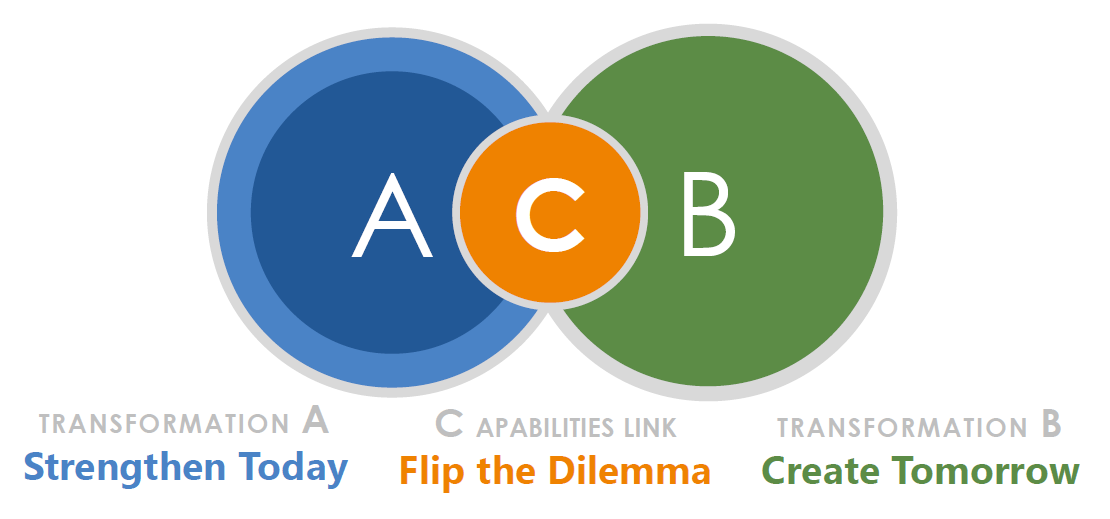
This is Dual Transformation, the theme of a fabulous book by Scott Anthony at Innosight, and in many ways it is the leadership challenge of our time.
Disruption unfolding right now, today, even if many of us cannotsee it:
Insurance. Driverless cars could be as revolutionary to the insurance business as they are to automakers. Companies like Geico and Progressive make most of their money from auto insurance. What happens to their business models when there are no more car accidents?
Shipping. 3D printers make local, small-scale manufacturing much more cost effective. If you are in the business of ship- ping millions of tons of finished, manufactured goods over long distances, what happens to your business model?
Medical Testing. Implantable medical devices could one day monitor bodily systems and help stop disease processes in their tracks. If you are in the business of testing, imaging, or delivering drug cures, will you still have a market?
Consumer Banking. Telecom companies are offering mobile payments. E-commerce companies are offering escrow-type services. Even Starbucks held more than $1 billion in prepaid card assets as of 2016. How soon before consumers cut the cord with banks, like they are doing with cable TV companies?
Holding onto your lead in a fast-changing market, and building a brand new growth engine for the company, requires foresight, courage and commitment. Many a leader has missed the signals, reacted too late, and succumbed to market-changing competition.
No matter where disruption comes from, or what forces are driving it, the best way to fend off challengers and dominate new growth markets is through Dual Transformation:
Transformation A = Find new possibilities for addressing existing markets
Many successful businesses face a growth challenge in the core markets they currently dominate. At the same time, upstart challengers may be nipping at their heels with cheaper, easier, more accessible solutions. What’s the answer? Preserve your leadership position by:
Identifying the unique job to be done you can continue to solve for your current customers—and what no longer matters as much.
Innovating your business model to deliver against the job.
Determining and monitoring new metrics.
Implementing aggressively.
Transformation B = Creating a powerful new growth engine
For successful companies, future growth often has to be found outside their core markets. But looking to new markets, new customers, and new business models is a big strategic challenge that requires new approaches and capabilities. The new business will look very different from today’s. Here’s how:
Identify constrained markets, a new problem that a signif- icant group of customers wants to solve but can’t, because of a lack of specialized skills, insufficient wealth, or having to travel to inconvenient/inaccessible locations.
Break down the “consumption barriers” that keep cheaper, more convenient solutions out of reach.
Iteratively develop the new business model required to serve the new market and power the future.
Use partnerships, acquisitions, and new hires to succeed against a new competitive set.
C = Capabilities. Combine unique, difficult-to-replicate assets with internal entrepreneurial energy
The most difficult part of a Dual Transformation is the wise use of the company’s skills and resources: leveraging valuable assets like brand, distribution, and accumulated know-how to build the new growth engine the company needs. This “capabil- ities link” is a bridge from the company of today to the growth leader of tomorrow. The most helpful principles in managing your capabilities link:
Stock selectively. Most core capabilities won’t help the new growth initiative. Use only those that truly bring a competitive advantage to the new venture.
Manage strategically. Develop systems, create formal exchange teams, and institute transfer pricing to ward off the “innovator’s dilemma” (privileging today’s business over creating the future).
Arbitrate actively. Top leadership needs to actively arbitrate the interface between A and B, with a bias to protecting transformation B.
Example: Adobe’s A+B+C “Dual Transformation”
Between 1982 and 2007, Adobe’s Photoshop and Illustrator programs grew to dominate creative businesses like advertising and marketing. And its “PDF” software was ubiquitous the world over. But in its core markets, Adobe lacked a path to significant growth, and disruption was already well underway.
Cloud-based “software-as-a-service” (SaaS) was accelerating rapidly as early as 2004, as Salesforce.com pioneered the business model. SaaS models offered customers greater flexibility and affordability. Then came a catalyst. In 2008 the Great Recession pushed corporate customers toward less expensive “asset light” solutions.
Adobe’s A:
Adobe launched Photoshop Express in 2008 to test the SaaS market.
In 2011, it introduced the Creative Cloud, a new subscrip- tion-based business model that offered greater revenue predictability, with lower production cost.
Adobe stopped shipping physical media in 2013; cloud-based products comprised roughly one-third of revenue by 2014; company profitability was 20% above pre-recession levels.
Adobe’s B:
Little growth remained in Adobe’s core (ie mature) creative markets.
Its software played a key role in content creation, but no role in the rest of the marketing value chain.
Adobe launched a targeted suite of digital marketing solutions—breaking an under-served market wide open.
Adobe acquired several leading web analytics businesses—e.g., Omniture, Day Software and Efficient Frontier.
Adobe’s C:
Leveraged brand, talent and distribution.
Example: Netflix … adding the leadership courage to change
The Netflix of today bears little resemblance to the company Reed Hastings cofounded 20 years ago. Today’s Emmy- winning and Oscar-nominated content creator and distributor was a simple DVD-by-mail company. But Hastings refused to get comfortable with the company’s leadership position and had the courage to choose new paths, transforming the company even when it looked like he didn’t need to.
Blockbuster declined to purchase the company in 2000. In the subsequent 15 years Netflix made a series of bold moves…
Developed a “recommendation engine” that predicted customer preferences—now a key element of the Netflix experience.
In 2008, launched a streaming business that added to its advantage over brick-and-mortar stores.
Split the streaming and mail offerings, charging separate fees for each.
Added original content in 2013 with a long-term goal of delivering 50% original content on its platform—spending nearly $6 billion in 2017.
Within five years of launching the streaming service, revenues hit $6 billion—ten times the revenues of the DVD-by-mail business. But competition is intensifying, with Amazon expected to spend $7 billion on original content in 2017. Hastings and his team need to continue their track record of courageous choices if they want to remain on top.
It was at a time when the topic had entered everyone’s consciousness. We were slowly emerging from a global economic crisis, largely caused by unregulated excesses of capitalism. We were watching polar bears floating on melting ice caps. We were seeing every more extreme temperatures causing huge migration in Africa. And ever great inequality in our world, despite the rising wealth and escape from poverty of many.
The UN subsequently launched their 18 Global Goals for sustainability, the world’s leaders signed the Paris Climate agreement to reduce carbon emissions, we all started recycling and reducing plastics, and living healthier too.
But then it became less fashionable. Although many aspects became more normal. Less of a competitive differentiator, more of a basic expectation. However at the same time we got lazy, and less our zeal for reduction at a time when carbon emissions and global temperatures continue to rise. The ridiculous withdrawal by Trump from the global climate agreement was shocking and irresponsible, but he was also playing to the blinkered priorities of his voters.
But challenges live on … as does the need for sustainability, and responsibility.
This is the credo of “Conscious Capitalism”, a network of experts and companies that continue to embrace to promote the essential cause:
“We believe that business is good because it creates value, it is ethical because it is based on voluntary exchange, it is noble because it can elevate our existence and it is heroic because it lifts people out of poverty and creates prosperity. Free enterprise capitalism is the most powerful system for social cooperation and human progress ever conceived. It is one of the most compelling ideas we humans have ever had. But we can aspire to even more.”
Conscious Capitalism identifies 4 components to being “conscious” in the way you do business. None of them are new, however by seeing them as a bigger picture, we can potential do more:
Higher Purpose
In the words of University of Virginia Darden School of Business professor and Conscious Capitalism, Inc. trustee R. Edward Freeman,
“We need red blood cells to live (the same way a business needs profits to live), but the purpose of life is more than to make red blood cells (the same way the purpose of business is more than simply to generate profits).”
While making money is essential for the vitality and sustainability of a business, it is not the only or even the most important reason a business exists. Conscious businesses focus on their purpose beyond profit.
We all need meaning and purpose in our lives. It is one of the things that separates us from other animals. Purpose activates us and motivates us. It moves us to get up in the morning, sustains us when times get tough and serves as a guiding star when we stray off course. Conscious Businesses provide us with this sense of meaning and purpose.
By focusing on its deeper Purpose, a conscious business inspires, engages and energizes its stakeholders. Employees, customers and others trust and even love companies that have an inspiring purpose.
Stakeholder Orientation
Pioneering naturalist John Muir observed that, “When you tug at a single thing in nature, you find it attached to the rest of the world.” Such is the case with business, which is an intricate and interconnected web of relationships.
Unlike some businesses that believe they only exist to maximize return on investment for their shareholders, Conscious Businesses focus on their whole business ecosystem, creating and optimizing value for all of their stakeholders, understanding that strong and engaged stakeholders lead to a healthy, sustainable, resilient business.
They recognize that, without employees, customers, suppliers, funders, supportive communities and a life-sustaining ecosystem, there is no business. Conscious Business is a win-win-win proposition, which includes a healthy return to shareholders.
Conscious Leadership
Robert Greenleaf, author of Servant Leadership observed that “Good leaders must first become good servants.”
Conscious Leaders focus on “we,” rather than “me.” They inspire, foster transformation and bring out the best in those around them.
They understand that their role is to serve the purpose of the organization, to support the people within the organization and to create value for the all of the organization’s stakeholders. They recognize the integral role of culture and purposefully cultivate a Conscious Culture of trust and care.
Conscious Culture
“Culture eats strategy for lunch.” Famed management guru Peter Drucker didn’t mince words, and he knew how to identify and articulate the keys to success in business.
Culture is the embodied values, principles and practices underlying the social fabric of a business, which permeate its actions and connects the stakeholders to each other and to the company’s purpose, people and processes.
A Conscious Culture fosters love, care, and inclusiveness and builds trust amongst the company’s team members and all its other stakeholders. Conscious Culture is an energizing and unifying force, that truly brings a Conscious Business to life.
Most people have heard of the iconic Lucky Strike cigarettes, which were made by The American Tobacco Company (ATC), founded in 1890. But by 1969, ATC decided to diversify from controversial tobacco products. It rebranded itself as American Brands, under the holding company Fortune Brands, and sold off its tobacco business. The resulting conglomerate had a number of smaller divisions that included insurance, office supplies, golf clubs and even Jim Beam whiskey. After numerous sell-offs and splits, Fortune Brands has added “Home & Security” to its name and makes home fixtures and hardware. It’s a far cry from its original conception.
Hasbro
In the 1920s, brothers Hillel, Herman, and Henry Hassenfeld founded Hassenfeld Brothers and sold textile remnants. Over the next 20 years the company expanded into school supplies and pencil cases as well as pencils. By the 1940s they sold “educational” toys, including doctor and nurse kits and clay modelling sets. In 1952 they bought the rights to Mr Potato Head, and had their first toy hit. Then in 1964, Hassenfeld Brothers produced the GI Joe “action figure” for boys who didn’t want to play with dolls, a move which would underpin its success. In 1968 the company changed its name to Hasbro Industries. The business now owns the Spirograph, Monopoly, Tonka, Parker Brothers and Playskool brands, and many more iconic toys and board games.
LG
LG Corp, one of South Korea’s biggest conglomerates, didn’t start off as an electronics giant. Conceived in 1947 as Lak-Hui Chemical Industrial Corp, it expanded its growing plastics business in 1958 with the establishment of GoldStar Co. Lak-Hui and GoldStar eventually merged to become Lucky GoldStar, which was the beginning of what is now known as LG. In the 1950s the company produced the very first radio in Korea, sold under the GoldStar name, and it would go on to manufacture telephones, refrigerators and TV sets. The Lucky brand was associated with bathroom soap, toothpaste and laundry powder. But in 1997 Lucky GoldStar was rebadged as “LG” to better compete in Western markets. LG Electronics is now the flagship company of LG Corp, and one of the biggest players in the world market for mobile phones and high-definition television sets.
Nintendo
Nintendo was originally a Kyoto-based producer of handmade playing cards, formed in 1889. Card sales began to falter in the 1960s, and the company went into instant noodles, plastic building blocks, a taxi service and a chain of short-stay “love” hotels. But toys and entertainment proved more fruitful. One of the company’s engineers, Gunpei Yokoi, invented an extendable grabbing hand in 1966, which Nintendo turned into the Ultra Hand toy. Yokoi later put together the first home video game machine and, most famously, created the Nintendo Game Boy console released in 1989. In the 1970s a young designer named Shigeru Miyamoto joined the company and created the characters that became Donkey Kong and Mario. Nintendo’s engineers worked with Miyamoto on the Donkey Kong arcade game, released in 1981, and a gaming legend was born. In 2004 the company released the Nintendo DS, and in 2006 the Wii. Nintendo now has a market capitalisation of about US$17 billion, but back in 2007 it was worth US$73 billion.
Samsung
The Korean electronics and mobile phone giant started by Byung-Chull Lee in 1938 used to export dried Korean fish, vegetables and fruit to Manchuria and Beijing. It then moved into flour mills and confectionery machines, followed by textiles and life insurance. Samsung didn’t get into electronics until the late 1960s, producing its first black-and-white television set in 1970. The high-tech side did not become highly profitable until the 1980s, when the company began to export computers, VCRs and tape recorders globally. By the 1990s, Samsung was focusing on memory and hard drives for computers. Nowadays it is most famous for its Android phones and tablets, and digital televisions.
Virgin
In 1970, a 20-year-old Richard Branson was selling vinyl records by mail-order as a way to undercut high-street record shop prices. The company’s motto was: “We’re complete virgins at business.” A postal strike nearly derailed the venture, so Branson set up his own record shop in 1971, and then a record label which signed acts including Mike Oldfield and the Sex Pistols. Virgin Atlantic airlines was born in 1984, Virgin Radio in 1993 and Virgin Mobile in 1999. In 2004, Branson announced the beginning of a luxury space travel service – Virgin Galactic. Branson sold off the record label that started it all for a rumoured US$1 billion in 1992, but the Virgin Group now reaches across the fitness industry, telecommunications, cola, bridal wear, travel and financial services. There have been around 400 Virgin companies. No doubt more will follow.
Wrigley
The world’s most famous chewing gum brand sold scouring soap and baking powder in 1891. But the free chewing gum it offered its customers along with the baking powder proved a stronger enticement. The man behind the company, William Wrigley, quickly redirected the business to produce a line of gums and just two years later introduced Wrigley’s Spearmint and Juicy Fruit, brands that still thrive today.
We are in the midst of a new revolution. The internet, social media, and mobile technologies have transformed how customers interact with brands and how companies market their products and services. It has transformed products themselves, customer experiences, business models, and organisation structures. It has transformed markets, customer aspirations and how value is created.
Most significantly it is a mental shift. From marketing organisations built around brand managers, campaign schedules, paid-for advertising and distribution channels – to a world where the only limit is imagination and time – tweets are unlimited, Facebook pages are free, social influence is done by customers. Whilst the technologies are fascinating – VR helmets and data analytics – it is the mindset that makes the difference.
Consider the journey of marketing from a world before digital (the old paradigm of product-push, advertising enabled, mass-marketing) to a world where digital came to the for (today’s world of websites and mobile apps, social and interactive, more connected, more customer-centric). Now consider what the next phase looks like, going above and beyond digital (to embrace intelligence, fuelled and inspired by the new generation of technologies, but only limited by our imagination).
Digital has transformed every market, as well as the very essence of marketing. Marketing beyond digital takes your brand further and faster:
Bigger ideas … Marketing is about big ideas, that connect with people in more relevant and realtime ways. Ideas about their lives, enabling them to achieve more. These ideas come from deep insight, building brands with more meaning, and then solving real problems for mutual benefit. Ideas spread through word of mouth, or tweets and likes, accelerated by social influencers and shared passions.
Smarter innovation … Marketing is been shaken up in a digital world, no longer centred around products and campaigns, advertising and selling … it is about engaging people in new ways, with new channels, and new incentives, creating business models that generate revenues in new ways. All marketing is digital, it is how it harnesses the power of data and technology to succeed more creatively.
Personal identity … Marketing gives people a richer identity, about who they are, what they believe and aspire to be. Brands are a reflection of customers not companies, communities and causes. Markets are increasingly fragmented, tribal and turbulent. Millennials add a new wave expectation and desire. Customer-centric marketing is all about you – on your terms, what and how, when and where you want it.
Radical imagination … Marketing brings new solutions to life through new technologies, co-created or customised with customers, brought to life through virtual and augmented reality, delivered in anticipation of needs by using big data to surprise and inspire people. Marketing can sometimes be accused of selling you what you don’t need, but it is also the platform for exploring possibilities, and a better life.
Business impact … Marketing is the driving force of profitable growth, turning ideas into innovation, solutions into sales, futures into financial success. In a world where customers trust each other more than companies, it is networks that drive success – networks of partners, networks of customers, networks of participants. Time to market is accelerated, old decision processes are disrupted, impact can be instant.
Unleashing technology … Marketing is digital in everything it does. Digital is more than an app, a website, a fan page or a headset. Digital is about harnessing the power of data and networks to transform markets, and the relationship with and between customers. Whilst routine activities are automated and accelerated, technology gives marketers the opportunity to dream, to dare and to of further than ever before.
Digital is transforming every market, as well as the very essence of marketing. But marketing is now more than digital, it moves to the next generation of technologies, but also to realise its humanity, and potential to transform business and beyond.
Bill Gates’ favorite Swedish doctor and statistician, Hans Rosling, died of pancreatic cancer last year at the age of 68. Rosling’s new book, published posthumously, is now here to tell you life on Earth isn’t as bad as it might seem.
“Factfulness” was published with the help of his son and daughter-in-law, who finished up the final chapters of the book. Bill Gates called it “one of the most important books I’ve ever read ― an indispensable guide to thinking clearly about the world.”
Like any good statistician, Rosling uses the tools of his trade (namely, graphs, charts and lots of questionnaires) to argue we’re doing too much feeling and not enough thinking when it comes to assessing the world.
He says our highly-emotional take is making us see the world in inaccurate and dire ways that don’t reflect all the progress that’s been made by modern improvements like vaccines, family planning, and widespread income and education gains for some of the world’s poorest people. His global surveys show that we tend to see the world in fatalistic ways, overestimating how many people are in poverty, assuming violent crime rates are skyrocketing, and thinking that many more people are dying in natural disasters than is actually the case.
Rosling thinks there’s one simple reason this is true: we’re operating under perspective-distorting, emotion-fueled “instincts” about how the world works, causing us to pretty much always assume the worst.
His goal is to change the way we see the world, by arming us with what he calls a “set of simple thinking tools.”
Here are a few of the reasons that the Roslings say we’re not actually barreling towards a terrible, horrible, apocalyptic future:
We’ve already reached peak baby-making levels, and the health of the world is on the up-and-up.
Rosling says what he calls our “negativity instinct” often makes us notice more of the bad than the good in the world.
But when it comes to procreating, he says we’re doing OK. The United Nations estimates that the number of children in the world between the ages of zero and 15 will be exactly the same in 2100 as it is today: two billion. It’s a promising sign that birth rates around the world are stabilizing, after centuries of exponential growth.
But just because we’ll be popping out fewer (and likely also healthier) kids in the future doesn’t mean there will be fewer mouths to feed.
There will be billions more adults in the world between the ages of 16 and 74 by 2100, and feeding them all could still be a challenge. Even though we technically have enough food to feed the world, more than 815 million go to bed hungry and under-nourished every night, according to the UN.
Globally, we’re living a lot longer than most people assume.
Average global life expectancy is around 70 years (though it’s a bit higher for women and a bit lower for men).
That number is a lot better than what most people think, but it’s important to remember the longevity numbers aren’t universal.
Here in the US, where we spend more that double on health care than any other rich country per capita, we don’t do nearly as well as most of them. At least 30 other countries around the world outlive Americans, and life expectancy in the US for both men and women is just shy of 80 years.
And there are new signs that US life expectancy is getting worse. Death rates for white working-class men between the ages of 25 and 64 are on the rise in the US, even as more life-saving treatments become available. Scientists think the big killers here could be more deadly overdoses, suicides and liver problems from drinking alcohol.
Rosling says there’s another critically flawed fallacy at work here in the US health care system: the “single perspective instinct,” or the idea that problems tend to stem from one single root cause and can likewise be solved with a single solution. He argues that Americans are ignoring key preventative measures while running up expensive and unnecessary hospital bills.
Over the past hundred years, deaths per year from natural disasters have plummeted to less than half of what they were.
Rosling says even though we’re more protected than ever before, we still tend to rely on our primal “fear instinct” more than we need to.
The gender gap in education has been virtually erased around the globe.
Worldwide, by the time people turn 30, men have on average 10 years of education while women have nine, Rosling says. That’s just a one year gap.
While it’s true that the developing world as a whole has essentially erased the schooling gap between boys and girls in primary, secondary and tertiary schooling, the UN still points out that women generally have a tougher time finding paid work than men.
Everyone is better off than they were 20 years ago. Again, that’s true, but it misses one critical wrinkle in the data.
In Factfulness, Rosling says that the proportion of people living in extreme poverty is nearly half of what it was two decades ago.
Of course, that’s not mentioning the fact that while extreme poverty may be taking a dive, extreme wealth among an elite corps of top global earners is racing even higher, with the richest 10% of the world’s households now owning 88% of its wealth.
Rosling said the data presented in “Factfulness” shows that on the whole, we’re all much better off than we once were. But that doesn’t mean everyone is doing OK. Of course, Rosling might argue that’s just a “negativity instinct” at work.
Beauty is one of the most exciting, disrupted and innovative sectors right now – harnessing the power of technology to reengage consumers both online and instore.
I’ve been working with Coty for a number of years now, originally the traditional French business, then as they acquired Arizona’s Philosophy brand, and most recently as they acquired P&G’s huge beauty portfolio – from CK fragrances to Philosophy skincare, Wella haircare and OPI colour.
The business, now based in London and owned by venture business JBI, has just unveiled a smart augmented reality ‘magic mirror’ in its Bourjois boutique in Paris which lets users try on products virtually when they physically pick them up.
Coty describes the tech innovation as “blended reality”. It’s been designed to promote Bourjous’ new ‘Velvet’ lipstick range and to activate it users stand in front of a giant selfie style camera which then changes their lip colour on-screen whenever they pick up a new lipstick from the adjacent display.
They are investing in the frictionless experience because putting the physical product in shoppers’ hands has been found to increase attitudes and purchase intentions.
Users are able to take a snap and print their mirror images in-store, or email them to themselves.
The Bourjois Magic Mirror is powered by products — and activated by shopper-product interaction. The revolutionary technology integrates physical products with digital content, and represents a first-of-a-kind augmented reality (AR) makeup try-on experience.
Elodie Levy, Coty’s global digital innovation senior director explains, “As part of our desire to reinvent the retail experience through purposeful and personalized innovation, the Bourjois Magic Mirror represents the most extensive integration of physical products and digital content in the beauty industry.”
Levy continues, “Most women intuitively prefer to play with a lipstick rather than touch a screen, as there is an inherent sensual aspect in cosmetics packaging that no technology can replace, and our new Magic Mirror provides this desired experience to shoppers.”
How It Works
Bourjois Boutique in Paris is the first to offer this unusual shopping experience. A shopper picks up a lipstick — and the chosen color instantly appears on their lips.
Putting the physical product in shoppers’ hands has been found to increase attitudes and purchase intentions of the product, propelling a more seamless path to purchase, Coty states. At the same time virtual product try-on solves the issue of testers not always being available, hygiene concerns and shoppers’ lips becoming stained after only a few lipstick try-ons.
An in-store connected shelf features the Bourjois Rouge Velvet Lipstick collection, and shoppers can complete their digital looks with onscreen eye makeup and blush, which is matched to each shopper’s individual skin tone. The experience is tailored to offer both individual products and bespoke beauty combinations.
In addition to product discovery, the Magic Mirror has a selfie function which is equipped with three playful filter effects and provides all the details of the products shoppers try on. The image can be printed in-store or emailed, with links for purchase on the Bourjois e-commerce site.
Putting the physical product in shoppers’ hands has been found to increase attitudes and purchase intentions of the product, propelling a more seamless path to purchase, Coty states. At the same time virtual product try-on solves the issue of testers not always being available, hygiene concerns and shoppers’ lips becoming stained after only a few lipstick try-ons.
Developing the Magic Mirror
The Magic Mirror was developed by Coty in collaboration with Holition and PERCH.
Behind the form and function of the mirror is a composite of PERCH Interactive’s technology, and Holition’s augmented reality SDK, FACE by Holition. Holition harnessed Perch’s smart camera, which monitors a defined area for activity, as a trigger for the virtual makeup experience.
Jonathan Chippindale, Holition CEO, said, “Approaching this collaboration research first, design second and technology third, we’ve partnered with Coty to create the next generation of the Magic Mirror, blending consumer insight and strategic UX to facilitate a bespoke, personalized experience.”
Trevor Sumner, PERCH Interactive CEO, said, “The next generation of in-store marketing is about blending digital experiences naturally into the shopper journey. The Bourjois Magic Mirror uses computer vision to sense the most important indication of interest in physical retail – when a shopper touches a product – unlocking an experience that encourages natural pathways of discovery, education and engagement.”
More innovation
The launch from Coty comes just days after it was one of the first brands, along with Adidas, to invest in Snapchat’s shoppable-AR experience.
The personal care group, which owns nail polish company OPI and Rimmel London among others, is also having to keep pace with rivals like L’Oreal when it comes to providing digital experiences for consumers. Less than a month ago, the latter snapped up AR beauty platform Modiface to “support the reinvention of its beauty experience”.
In February, Coty launched a tech startup scheme which is offering up $100,000 in cash prizes to young companies who bring the 124-year-old brand AI solutions.
Coty with Microsoft
Another of my clients, Microsoft is working with Coty to implement their future business platform.
Microsoft 365 plays a part in the vision, providing technology that amplifies our strengths and helps drive innovation. In an increasingly complex multichannel environment, Coty saw moving to the cloud as a means to stay ahead of the curve. We use Microsoft Cloud services to focus our energy on creating engaging and innovative products that drive authentic beauty experiences, rather than spending time on supporting IT infrastructure. We were searching for a scalable, agile solution for our business, and we realized that Microsoft 365 allows us to add resources quickly. It also decreases our reliance on local hardware because our users can easily access the rich tools they need to be productive anywhere, anytime.
A recent acquisition of the Procter & Gamble Specialty Beauty business presented us with a unique opportunity: we had six months to deliver an environment for 12,000 employees who would join our company. It was the perfect time to move to the cloud as the new foundation for our growing enterprise. We achieved a global migration to Office 365 in four months, first moving Coty employees’ mailboxes to the cloud and then creating new accounts in Office 365 for the Procter & Gamble employees who became part of the Coty global team. We mapped out the global geographies of employee groups and reporting hierarchies and considered the legislation around privacy in different countries—something that Microsoft is addressing today with the Multi-Geo Capabilities in Office 365.
Enabling highly secure modern work environments is part of our overall vision to create an effortless end-user experience for our employees. The interoperability and similar look and feel across Office 365 creates a sense of familiarity, so we can work productively in all the apps and services. Today, 65 percent of Coty employees enjoy a new laptop provisioned with Windows 10. We are updating the rest of our employees’ laptops as part of our ongoing hardware refresh. We are using Office 365 Advanced Threat Protection and Microsoft Advanced Threat Analytics to improve the depth and breadth of our security capabilities, and we will use Microsoft Azure Multi-Factor Authentication for all Office apps and services.
As the organization grows, standardizing branding across all 150 countries where we operate is essential. One way Coty are doing this is via an app that uses OneDrive to distribute presentation material to our entire Wella sales force. These presentations are available in close to 60 languages. The goal was to make it easy and intuitive for sales reps to give the same powerful presentations to customers and win business in China, the United States, and Germany. Global sales teams also use SharePoint Online to access sales and marketing materials they need quickly, so they can focus on engaging with the customer.
After more than a century in the beauty business, Coty knows that industry-changing ideas come from a collaborative, creative workforce. Our employees are embracing the power of Microsoft Cloud technologies and other compatible tools to ensure our total suite can help us keep the iconic brands in the Coty portfolio on the leading edge of beauty.