The world is changing faster than ever before.
With billions of people hyper-connected to each other in an unprecedented global network, it allows for an almost instantaneous and frictionless spread of new ideas and innovations.
Combine this connectedness with rapidly changing demographics, shifting values and attitudes, growing political uncertainty, and exponential advances in technology, and it’s clear the next decade is setting up to be one of historic transformation.
Here are just a few anecdotes:
- Global population will be 10 billion people by 2050, 70% living in urban areas
- By 2100, the world’s largest city is likely to be Lagos in Nigeria with 88.3 million inhabitants
- Over 800 million Chinese people have been lifted out of extreme poverty since 1990
- By 2029 there will be more people in China’s middle class than the total population of USA
- China will account for 35.2% of global real GDP growth between 2017-19
- 15 companies dominate the world’s stock markets, with about $29.8 billion of stocks and bonds
- 12 of the world’s top 50 richest billionaires are in tech, and on average 18 years younger than the others
- 80% of millennial investors are interested in sustainable investing, and put 2x more money into it
- 60 cents of every dollar spent on online advertising goes directly to Google or Facebook
- AI is expected to generate $15.7 trillion of economic impact by 2030
- Amazon is now worth more than every physical retailer in the USA combined
- 680 new cryptocurrencies had a market cap worth over $1 million at the end of 2017, now more
- Total human debt is $247 trillion, owed by governments, corporations and individuals
- Hyperinflation in Venezuela is running at over 1 million $ per year
- $10.2 trillion will be invested in new power generation capacity around the world by 2040
- Wind and solar will make up almost half of the global installed electrical capacity within 20 years
- Over 1 billion electric vehicles will be on our roads by 2047, and the vast majority will be driving themselves
But where do all of these big picture trends intersect, and how can we make sense of a world engulfed in complexity and nuance? And how do we set our sails to take advantage of the opportunities presented by this sea of change?
A new book called “Visualising Change” helps to make sense of the rapid and dramatic transformation of the world’s business landscape in support of the 8 megatrends:
1. Tech Invasion
For most of the history of business, the world’s leading companies have been industrially-focused.
Pioneers like Henry Ford and Thomas Edison innovated in the physical realm using atoms – they came up with novel ways to re-organize these atoms to create things like the assembly line and the incandescent lightbulb. Then, companies invested massive amounts of capital to build physical factories, pay thousands of workers, and build these things.
The majority of the great blue chip companies were built this way: IBM, U.S. Steel, General Electric, Walmart, and Ford are just some examples.
But today’s business reality is very different. We live in a world of bytes – and for the first time technology and commerce have collided in a way that makes data far more valuable than physical, tangible objects.
The best place to see this is in how the market values businesses.
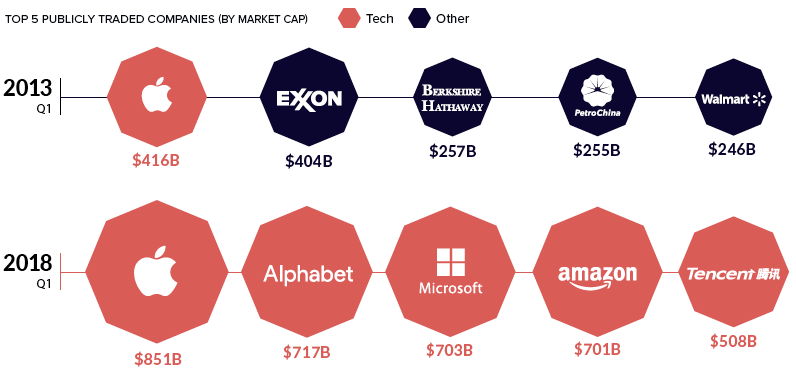
As you can see above, companies like Apple, Amazon, and Microsoft have supplanted traditional blue chip companies that build physical things.
The tech invasion is leveraging connectivity, network effects, artificial intelligence, and unprecedented scale to create global platforms that are almost impossible to compete with. The tech invasion has already taken over retail and advertising – and now invading forces have their eyes set on healthcare, finance, manufacturing, and education.
Will atoms ever be more valuable than bytes again?
2. Evolving money
Money is arguably one of humanity’s most important inventions. From beaver pelts to gold bars, the form and function of money has constantly fluctuated throughout history.
In the modern world, the definition of money is blurrier than ever. Central banks have opted to create trillions of dollars of currency out of thin air since the financial crisis – and on the flipside, you can actually use blockchain technology to create your own competing cryptocurrency in just a few clicks.
Regardless of what is money and what is not, people are borrowing record amounts of it.
The world has now amassed $247 trillion in debt, including $63 trillion borrowed by central governments:
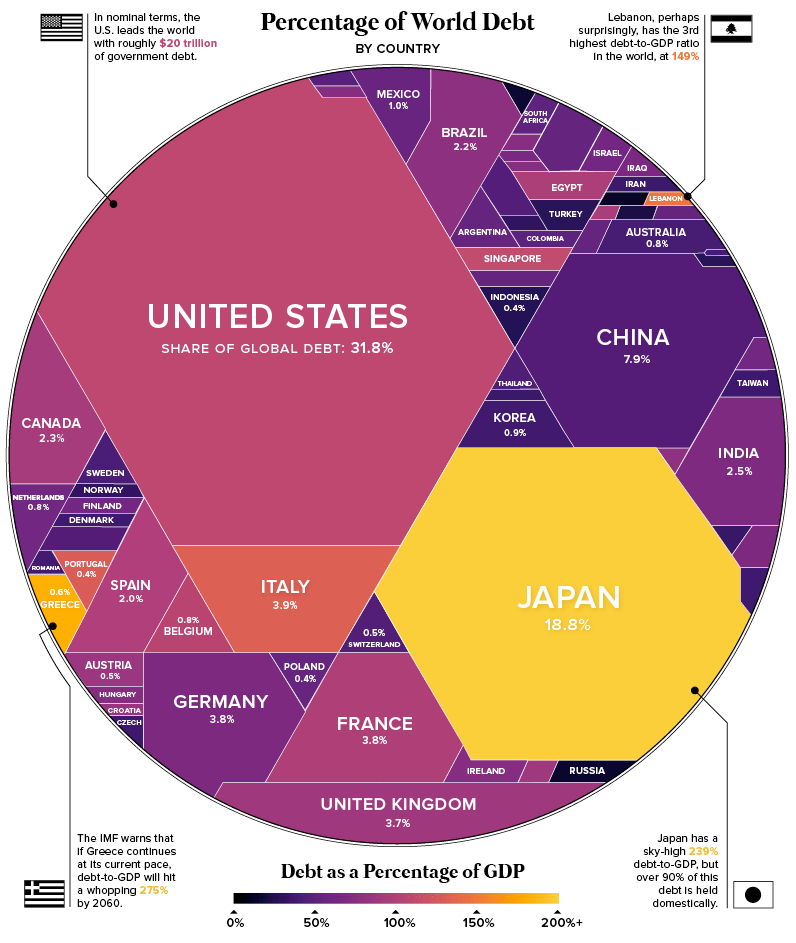
In today’s unusual monetary circumstances, massive debt loads are just one anomaly.
Here are other examples that illustrate the evolution of money: Venezuela has hyperinflated away almost all of its currency’s value, the “War on Cash” is raging on around the world, central banks are lending out money at negative interest rates (Sweden, Japan, Switzerland, etc.), and cryptocurrencies like Bitcoin are collectively worth over $200 billion.
How we view money – and how that perception evolves over time – is an underlying factor that influences our future.
3. The new wealth
Wealth is not stagnant – and so for those looking to make the most out of global opportunities, it’s imperative to get a sense of how the wealth landscape is changing.
The modern view is either extremely healthy or bubbly, depending on how you look at it: Amazon and Apple are worth over $1 trillion, Jeff Bezos has a $100+ billion fortune, and the current bull market is the longest in modern history at 10 years.
Will this growth continue, and where will it come from?
Here’s one look based on projections from the World Bank:

Despite these estimates, there is a laundry list of items that the ultra-wealthy are concerned about – everything from the expected comeback of inflation to a world where geopolitical black swans seem to be growing more common.
Here’s why those building and protecting wealth are rightly concerned about such events:
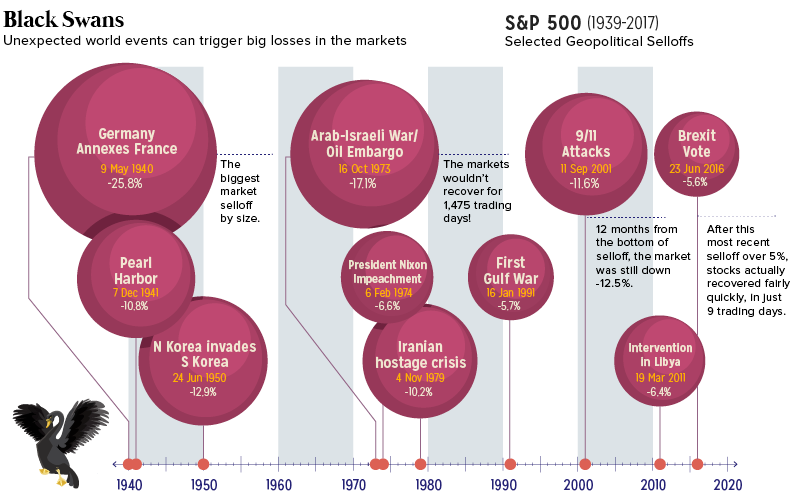
But the wealth landscape is not all just about billionaires and massive companies – it is changing in other interesting ways as well. For example, the definition of wealth itself is taking on a new meaning, with millennials leading a charge towards sustainable investing rather than being entirely focused on monetary return.
How will the wealth landscape look a decade from now?
4. Rising tigers
The economic rise of China has been a compelling story for decades.
Up until recently, we’ve only been able to get a preview of what the Eastern superpower is capable of – and in the coming years, these promises will come to fruition at a scale that will still be baffling to many.
Understandably, the scope of China’s population and economy can still be quite difficult to put into perspective.
The following map may help, as it combines both elements together to show that China has countless cities each with a higher economic productivity than entire countries.
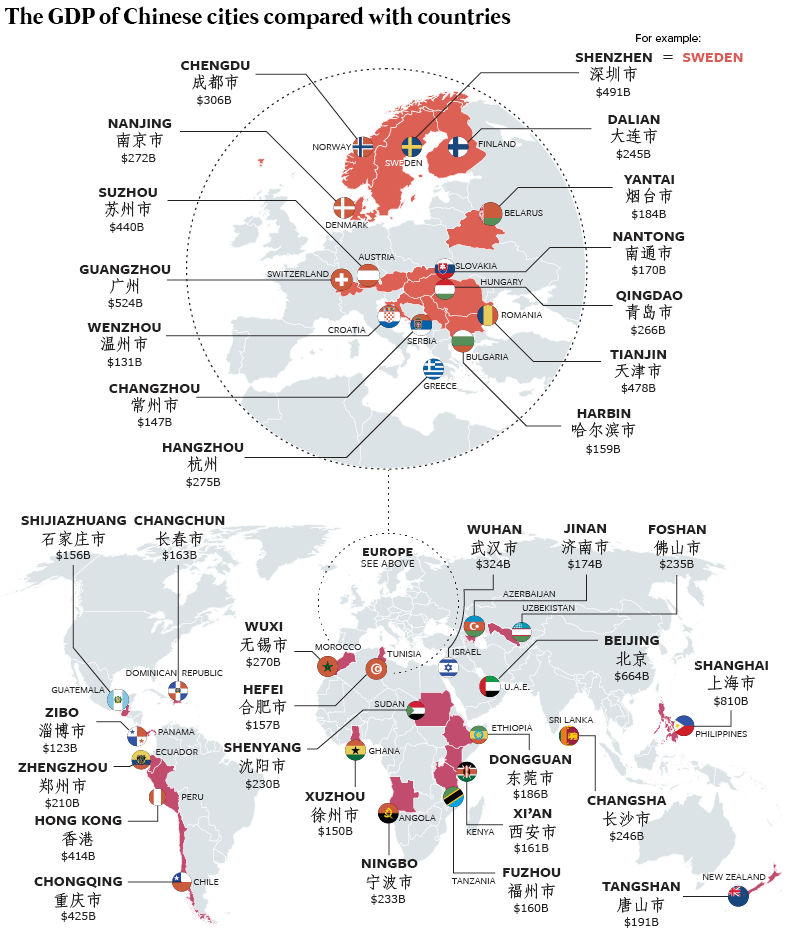
In fact, China has over 100 cities with more than 1,000,000 inhabitants. These cities, many of which fly below the radar on the global stage, each have impressive economies – whether they are built upon factories, natural resource production, or the information economy.
As one impressive example, the Yangtze River Delta – a single region which contains Shanghai, Suzhou, Hangzhou, Wuxi, Nantong, Ningbo, Nanjing, and Changzhou – has a GDP (PPP) of $2.6 trillion, which is more than Italy.
5. Accelerating progress
As we’ve already seen, there are many facets of change that will impact our shared future.
But here’s the kicker: when it comes to technological progress, the rate of change itself is actually getting faster and faster. Each year brings more technological advancements than the last, and once the exponential “hockey stick” kicks into overdrive, innovations could happen at a blindsiding pace.
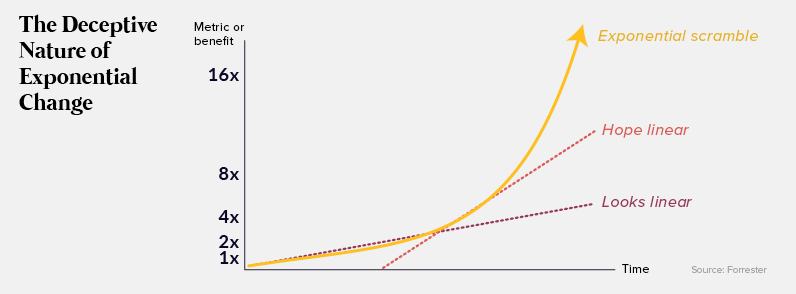
This could be described as a function of Moore’s Law, and the law of accelerating returns is also something that futurists like Ray Kurzweil have talked about for decades.
Interestingly, there is another offshoot of accelerating change that applies more to the business and economic world. Not only is the speed of change getting faster, but for various reasons, markets are able to adopt new technologies faster:
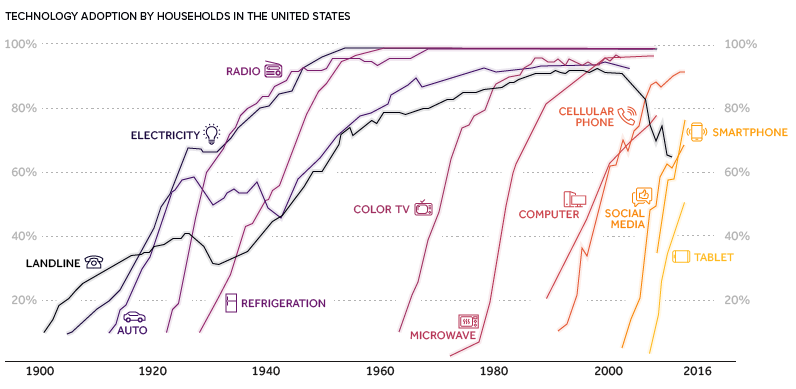
New products can achieve millions of users in just months, and the game Pokémon Go serves as an interesting case study of this potential. The game amassed 50 million users in just 19 days, which is a blink of an eye in comparison to automobiles (62 years), the telephone (50 years), or credit cards (28 years).
As new technologies are created at a faster and faster pace – and as they are adopted at record speeds by markets – it’s fair to say that future could be coming at a breakneck speed.
Interesting Facts:

6. The need to be green
It’s no secret that our civilization is in the middle of a seismic shift to more sustainable energy sources.
But to fully appreciate the significance of this change, you need to look at the big picture of energy over time. Below is a chart of U.S. energy consumption from 1776 until today, showing that the energy we use to power development is not permanent or static throughout history.
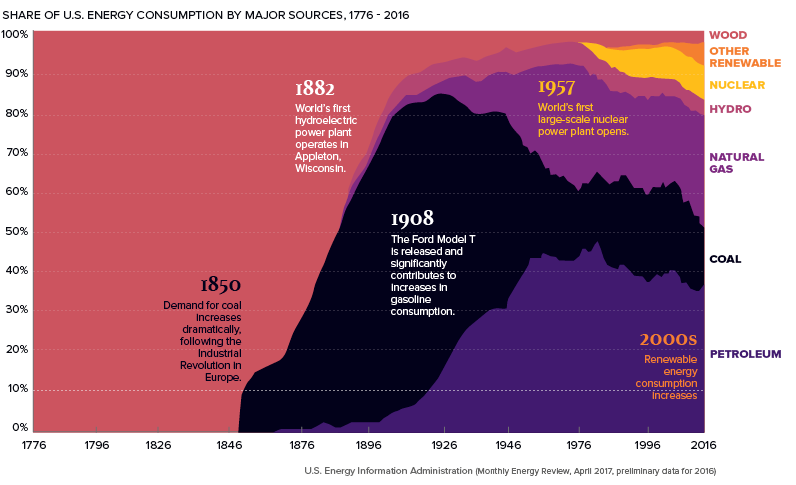
And with the speed at which technology now moves, expect our energy infrastructure and delivery systems to evolve at an even more blistering pace than we’ve experienced before.
7. Shifting humanity
Global demographics are always shifting, but the population tidal wave in the coming decades will completely reshape the global economy.
In Western countries and China, populations will stabilize due to fertility rates and demographic makeups. Meanwhile, on the African continent and across the rest of Asia, booming populations combined with rapid urbanization will translate into the growth of megacities, holding upwards of 50 million people.
By the end of the 21st century, this animation shows that Africa alone could contain at least 13 megacities that are bigger than New York:
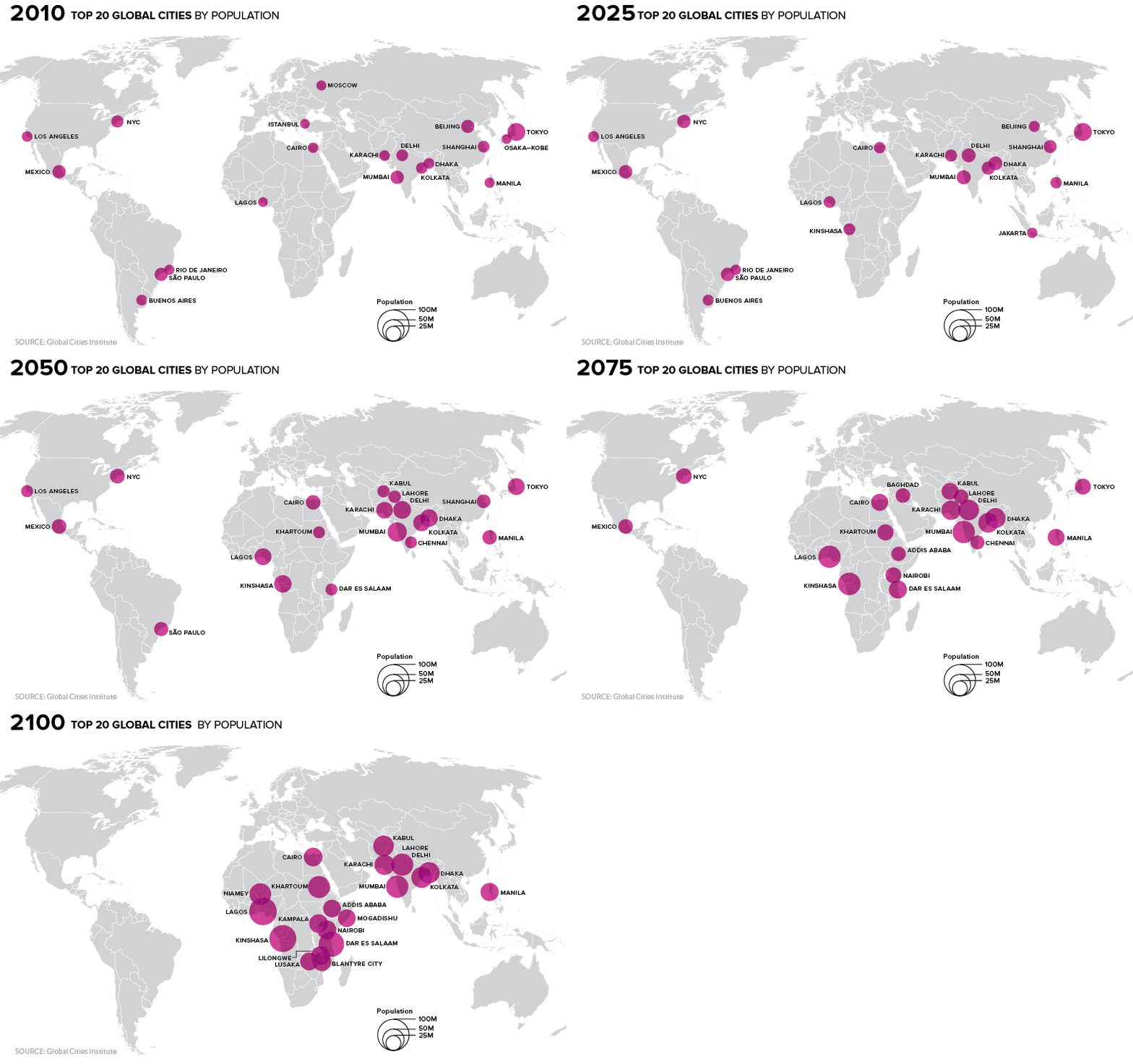
By this time, it’s projected that North America, Europe, South America, and China will combine to hold zero of the world’s 20 most populous cities. What other game-changing shifts to human geography will occur during this stretch?
8. Paradox of trade
By definition, a consensual and rational trade between two parties is one that makes both parties better off.
Based on this microeconomic principle, and also on the consensus by economists that free trade is ultimately beneficial, countries around the world have consistently been working to remove trade barriers since World War II with great success.
But nothing is ever straightforward, and these long-held truths are now being challenged in both societal and political contexts. We now seem to be trapped in a trade paradox in which politicians give lip service to free trade, but often take action in the opposite direction.
To get a sense of how important trade can be between two nations, we previously documented the ongoing relationship between the U.S. and Canada, in which each country is the best customer of the other:
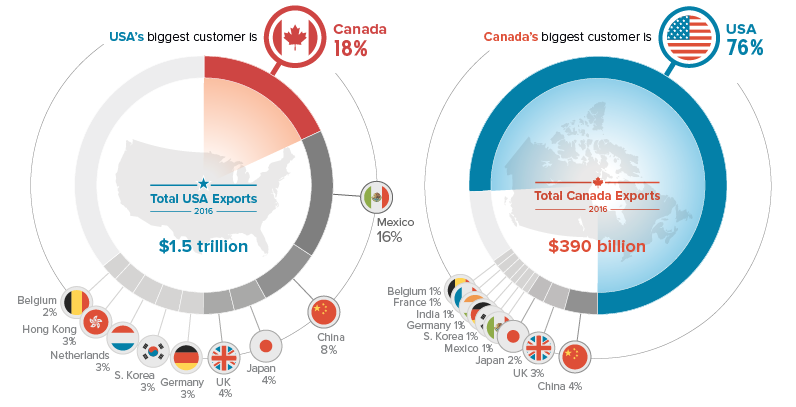
With the recent USMCA agreement, the two countries seem to have sorted their differences for now – but the trade paradox will continue to be an ongoing theme in economics and investing at a global level for many years to come, especially as the trade war against China rages on.
We all love a rule breaker.
The number one question I usually get asked when working with the leaders of companies in financial services, pharmaceuticals, or most other industries for that matter, is how to overcome regulation. I always think that the current rules of an industry or market, are those which somebody could best come up with at the time when they were created, to in a responsible way create some order and good practice in whatever it might be. Whilst some rules might seem petty and inhibiting, in most cases I still think regulations are there for our overall good.
And of course they may not keep pace with the changing world, they may no longer be fit for purpose, particularly in the technologically-driven environments of today. In which case it’s time to break the rules. But the responsible way to break, or seek to influence the breaking of, a rule – is to create a better one. Therefore disruptive rule breakers, should also be enlightened rule makers.
In the new book Rule Makers, Rule Breakers celebrated cultural psychologist Michele Gelfand takes us on an epic journey through human cultures, offering a startling new view of the world and ourselves.
With a mix of brilliantly conceived studies and surprising on-the-ground discoveries, she shows that much of the diversity in the way we think and act derives from a key difference—how tightly or loosely we adhere to social norms.
- Why are clocks in Germany so accurate while those in Brazil are frequently wrong?
- Why do New Zealand’s women have the highest number of sexual partners?
- Why are “Red” and “Blue” States really so divided?
- Why was the Daimler-Chrysler merger ill-fated from the start?
- Why is the driver of a Jaguar more likely to run a red light than the driver of a plumber’s van?
- Why does one spouse prize running a “tight ship” while the other refuses to “sweat the small stuff?”
In search of a common answer, Gelfand has spent two decades conducting research in more than fifty countries. Across all age groups, family variations, social classes, businesses, states and nationalities, she’s identified a primal pattern that can trigger cooperation or conflict. Her fascinating conclusion: behavior is highly influenced by the perception of threat.
Adam Grant says of the book “Completely fascinating . . . [Gelfand] reveals how political divides, happiness and suicide rates, and the coexistence of crime and creativity can all be traced to a fundamental but neglected dimension of social norms. You’ll never look at a workplace, a country, or a family the same way again.”
Tien Tzuo, author of Subscribed: Why the Subscription Model Will Be Your Company’s Future, and What to Do About It, says: “I think everyone would agree that brands are still very important, but today you communicate your brand through experiences, not ads.” In this model, marketing isn’t an appendage to each enterprise’s business model — it’s at the heart of it.
Tzuo is the founder and CEO of Zuora, which creates software that companies use to manage subscriptions. And to a degree, the book is an effective pitch for the company’s services. Yet Subscribed resonates so deeply because if you look closely, you’ll notice the subscription model has been building momentum in surprising places.
Until recently, subscriptions were limited to magazines, newspapers, and the book- or wine-of-the-month club. But now, consumers can — and do — subscribe to makeup (Birchbox), razors (Dollar Shave Club), clothes (Stitch Fix), food (HelloFresh), socks (Sock Panda), and flights (Surf Air), along with any number of digital services, such as software (Adobe) and video entertainment (Netflix).
The benefit for the consumer is obvious. The convenience of having razors, or carefully curated recipe items, or Drake’s latest release simply arrive on your doorstep or in your Spotify app is hard for today’s harried masses to resist.
However, it could be argued the benefits that consumers reap from subscriptions pale in comparison with what companies gain: vital data that helps them constantly iterate offerings and deepen relationships with their customers, along with a recurring revenue stream that can be transformative for businesses. Subscriptions also enable companies to evolve from the 20th-century business of selling products to the modern model of providing services.
Take the snack box company Graze, which sends its subscribers boxes of healthy snacks every few weeks and asks them to fill out a simple online form about what they liked and didn’t like. Because of the insights the company has gained through this continual feedback, it saw no reason to immediately switch up its offerings when it launched in the US. “We just took our existing product line and dumped it on the U.S. market, because the system adjusts itself,” the company’s CEO, Anthony Fletcher, told Tzuo.
Graze had no success in turning U.S. customers on to Marmite, a yeast extract spread — they soon made clear their preference for spicy barbecue snacks — but the CEO emphasized that expensive market research efforts made prior to entering a market had very often failed. With the market research “baked into the service,” as Tzuo notes, the feedback is immediate and comparatively cheap.
Companies like Netflix, Spotify, and Salesforce are just the tip of the iceberg for the subscription model. The real transformation–and the real opportunity–is just beginning.
Subscription companies are growing nine times faster than the S&P 500. Why? Because unlike product companies, subscription companies know their customers. A happy subscriber base is the ultimate economic moat.
Today’s consumers prefer the advantages of access over the hassles of maintenance, from transportation (Uber, Surf Air), to clothing (Stitch Fix, Eleven James), to razor blades and makeup (Dollar Shave Club, Birchbox). Companies are similarly demanding easier, long-term solutions, trading their server rooms for cloud storage solutions like Box. Simply put, the world is shifting from products to services.
But how do you turn customers into subscribers? As the CEO of the world’s largest subscription management platform, Tien Tzuo has helped hundreds of companies transition from relying on individual sales to building customer-centric, recurring-revenue businesses. His core message in Subscribed is simple: Ready or not, excited or terrified, you need to adapt to the Subscription Economy — or risk being left behind.
Tzuo shows how to use subscriptions to build lucrative, ongoing one-on-one relationships with your customers. This may require reinventing substantial parts of your company, from your accounting practices to your entire IT architecture, but the payoff can be enormous. Just look at the case studies:
* Adobe transitions from selling enterprise software licenses to offering cloud-based solutions for a flat monthly fee, and quadruples its valuation.
* Fender evolves from selling guitars one at a time to creating lifelong musicians by teaching beginners to play, and keeping them inspired for life.
* Caterpillar uses subscriptions to help solve problems — it’s not about how many tractors you can rent, but how much dirt you need to move.
In Subscribed, you’ll learn how these companies made the shift, and how you can transform your own product into a valuable service with a practical, step-by-step framework. Find out how how you can prepare and prosper now, rather than trying to catch up later.
The European Business Forum is the premier meeting place for business leaders in Europe. It brings together the continent’s top business people with the world’s leading management gurus in “the Davos of business thinking”.
The forum is hosted by Thinkers50, the world’s leading network of business thinkers, and located in Odense, Denmark. The home of Hans Christian Andersen, and now one of Europe’s leading robotics hub, is the perfect place to write the story of the future.
In this year’s European Business Lecture, Roger Martin called for a “scientific revolution” in business thinking … with a dramatic shift to organisations as systems, strategy as execution, and projects as the norm.
Roger Martin is the world’s #1 business thinker, as ranked globally by Thinkers50, and argued the need for three “scientific revolutions” in business thinking.
https://www.youtube.com/watch?v=gPkR9C6keCY
He started from Thomas Kuhn’s view that in all fields, the majority of people in the field converge over time on a dominant way of conceptualizing the field. When that happens, all the thinking and research in the field works away at honing and refining the dominant model, what he called “normal science.” But over time, application of the model in the real world results in anomalies – things that you wouldn’t expect based on the dominant model, often the opposite of what the model would predict. When enough of those anomalies occur, someone in the field breaks rank and comes up with a very different model that addresses the anomalies.
The three scientific models are:
- The Organization as a Machine
- Strategy vs. Execution
- Flat Jobs as the Organizing Principle for work
Martin believes that this is a ‘scientific revolution’ that produces a ‘paradigm shift’ or a step-function improvement in the results that the new model produces in comparison to the old dominant model. It tends to be a bloody war around the time of the ‘scientific revolution’ as the practitioners of the dominant model attempt to defend it against the paradigm shift.
He argued that we need to switch to:
- The Organization as a Complex Adaptive System
- Strategy and Execution are the same task
- Projects as the Organizing Principle for work
He said in business, we are seeing the degradation of effectiveness and the production of deeply problematic anomalies with respect to three dominantly-held business models. He showed the model and illustrated the anomalies that they are producing. And be argued for a different model to replace each. Of course this is controversial because most business people inevitably leap to the defense of the dominant model – and argue as they always do that the dominant model just isn’t being applied properly or intensively enough.
The speech marked the climax to two days of active and stretch thinking by many of the world’s top business academics – including Canada’s blockchain guru Don Tapscott, to Switzerland’s business model champion, Alex Osterwalder – and Europe’s business leaders – such as Google’s President in Europe, Matt Britten, and Siemens and Maersk’s chairman Jim Hagemann Snabe.
Here’s a short recap:
https://www.youtube.com/watch?v=CzksDkQBB0g&t=6s
Roger serves as the Institute Director of the Martin Prosperity Institute and the Michael Lee-Chin Family Institute for Corporate Citizenship at the Rotman School of Management and the Premier’s Chair in Productivity & Competitiveness. From 1998 to 2013, he served as Dean. In 2013, he was named global Dean of the Year by the leading business school website, Poets & Quants. He has published 11 books the most recent of which is Creating Great Choices (2017). Roger is a trusted strategy advisor to the CEOs of companies worldwide including Procter & Gamble, Lego and Verizon.
Other speakers at this year’s European Business Forum included:
- Don Tapscott, author of Blockchain Revolution, the world’s #2 business guru
- Alex Osterwalder, co-author of Business Model Generation, and #7 business guru
- Matt Brittin,President of Google EMEA, one of Europe’s top business leaders
- Jim Hagemann Snabe, Chairman of AP Moller-Maersk, and Siemens AG
- Mikael Trolle, CEO of Volleyball Denmark, co-author of Dreams & Details with Jim Snabe.
- Martin Lindstrøm, Brand futurist, one of TIME’s 100 most influential people in the word
- Whitney Johnson, Harvard expert on personal disruption, author of Build an A-team.
- Chris Zook, Bain & Co partner, author of The Founders Mentality
- Johanna Mair, Social innovation expert, editor of the Stanford Social Innovation Review
- Alexandra Christina, co-author of the The Sincerity Edgeat Stanford University Press
- Tania de Jong, Founder and CEO Creative Universe
- Jimmy Maymann-Holler, Previously CEO of Huff Post and EVP of AOL, chairman of TV2
- Javier Goyeneche, President & Founder of EcoAlf
- Sasja Beslik, Head of Sustainable Finance at Nordea
- Andrew Shipilov, INSEAD professor, author of Network Advantage
- Esben Østergaard, founder and CTO of Universal Robots
- Andrew McCarthy, IE Business school, expert in Design, Creativity & Innovation
- Tanyer Sonmezer, CEO at Management Centre Türkiye (MCT)
- Peter Fisk, forum host, innovation and growth expert, author ofGamechangers
- Stuart Crainer and Des Dearlove, Thinkers50 founders, curating the bestideas
The European Business Forum is the premier meeting place for business leaders in Europe. It brings together the continent’s top business people with the world’s leading management gurus in “the Davos of business thinking”.
The forum is hosted by Thinkers50, the world’s leading network of business thinkers, and located in Odense, Denmark. The home of Hans Christian Andersen, and now one of Europe’s leading robotics hub, is the perfect place to write the story of the future.
Don Tapscott called for “A declaration of interdependence” and a “new social contract for the digital society” in the opening session of this year’s European Business Forum.
Tapscott, author of Wikinomics and Blockchain Revolution, said “Technology is breaking down our the agreements that grew from the industrial age – about employment, economic opportunity, public discourse, the integrity of democracy and other profound issues.” He went on “The Digital Age has revolutionized the media industry by changing it from a centralized, one-way flow of information to a free-flowing system where multiple people, regardless of status, can participate. While this is a great change caused by technology, this is not the case with youth employment. Social inequality is growing larger in many countries across the globe, and technology is a factor in this divide.”
https://www.youtube.com/watch?v=Rlb6NPCac4g&t=1s
You can download his exclusive white paper: A Declaration of Interdependence: Towards a new social contract for the digital society
The speech, called “the Odense Moonshot”, kicked off two days of fast and stretching thinking by many of the world’s top business academics – including the world’s #1 business thinker, Roger Martin, to Switzerland’s business model champion, Alex Osterwalder – and Europe’s business leaders – such as Google’s President in Europe, Matt Britten, and Siemens and Maersk’s chairman Jim Hagemann Snabe.
Tapscott is a colourful Canadian. The Hammond B3 organist in the band Men in Suits, he also happens to be one of the world’s leading authorities on the economic and social impacts of technology. He regularly advises business and government leaders around the world. His latest book, entitled Blockchain Revolution: How the Technology Behind Bitcoin Is Changing Money, Business, and the Worldis, according to Harvard Business School’s Clay Christensen, “the book, literally, on how to survive and thrive in this next wave of technology-driven disruption.”
Other speakers at this year’s European Business Forum included:
- Roger Martin, author of Creating Great Choices, the world’s #1 business guru
- Alex Osterwalder, co-author of Business Model Generation, and #7 business guru
- Matt Brittin,President of Google EMEA, one of Europe’s top business leaders
- Jim Hagemann Snabe, Chairman of AP Moller-Maersk, and Siemens AG
- Mikael Trolle, CEO of Volleyball Denmark, co-author of Dreams & Details with Jim Snabe.
- Martin Lindstrøm, Brand futurist, one of TIME’s 100 most influential people in the word
- Whitney Johnson, Harvard expert on personal disruption, author of Build an A-team.
- Chris Zook, Bain & Co partner, author of The Founders Mentality
- Johanna Mair, Social innovation expert, editor of the Stanford Social Innovation Review
- Alexandra Christina, co-author of the The Sincerity Edgeat Stanford University Press
- Tania de Jong, Founder and CEO Creative Universe
- Jimmy Maymann-Holler, Previously CEO of Huff Post and EVP of AOL, chairman of TV2
- Javier Goyeneche, President & Founder of EcoAlf
- Sasja Beslik, Head of Sustainable Finance at Nordea
- Andrew Shipilov, INSEAD professor, author of Network Advantage
- Esben Østergaard, founder and CTO of Universal Robots
- Andrew McCarthy, IE Business school, expert in Design, Creativity & Innovation
- Tanyer Sonmezer, CEO at Management Centre Türkiye (MCT)
- Peter Fisk, forum host, innovation and growth expert, author of Gamechangers
- Stuart Crainer and Des Dearlove, Thinkers50 founders, curating the best ideas
We read many stories of business success, but you can often learn from the failures. The rush for digital transformations has increasingly become a tougher challenge than many expected. Most frequently because of
- the bright shiny glitz of new technologies which often turn out to be less spectacular than their hype
- over enthusiastic project management, trying to do too much, or go too far, too quickly
- companies trying to “transform” though automation without really changing their strategies.
Here are 4 examples:
General Electric: Transforming everything at once can spread resources too thin
Like other large multinational corporations, American conglomerate General Electric (GE) struggled with bringing about a digital transformation. Then-GE chief executive Jeff Immelt decided against focusing on individual digital initiatives or projects in different parts of the company and in 2015 created a separate business unit called GE Digital. It was hoped this new endeavour would not only allow GE’s in-house operations to make better use of their data, but also turn GE into a more technologically focused enterprise.
Despite GE pumping billions of dollars into GE Digital, the fledgling business has failed to stop the collapse of GE’s stock price and the organisation looks on course for continued losses. Predix, GE’s industrial internet platform, faced delays and technological issues, which meant it was unable to compete effectively with rival services.
Current chief executive John Flannery now plans to refine GE’s digital operations, telling investors last year: “We are still deeply committed to it, but we want a much more focused strategy.” As part of this new strategy, implemented after the digital transformation failure, GE is selling GE Digital and ditching plans to become a major player in the software space.
Modernising business operations and opening up new revenue streams through digital transformation is a laudable goal, but by failing to concentrate on a single area of improvement, large companies like GE will find it almost impossible to succeed in implementing a widespread transformation strategy.
Tasking GE Digital with this overwhelming undertaking spread the unit too thin and ultimately led to its sale. A further issue with GE Digital was its need to provide quarterly performance updates and a profit-and-loss statement, which restricted its ability to commit to long-term value creation and pushed the digital arm to focus on short-term goals.
Nike: Digital transformation failure taught brand importance of planning
Sportswear giant Nike is now a leader in digital business, but the retailer faced digital transformation failure. Nike launched a new business unit called Nike Digital Sport in 2010 to take the lead on digital initiatives and create new technological capabilities across the company.
Two years after the development of Nike Digital Sport, the firm released its innovative wearable FuelBand, which initially proved popular with customers. Thanks partly to the work of Digital Sport, the activity tracker could provide wearers with detailed statistics and made Nike a leader in wearable devices.
However, by 2014, it was reported Nike would be cutting the Digital Sport workforce by 70 to 80 per cent and discontinuing FuelBand after being unable to exploit data generated, alongside poor margins and difficulty finding enough skilled engineers.
Nike clearly learnt lessons from this setback and moved away from manufacturing hardware in-house to focus on its software offering, further building on the Nike Plus digital brand.
Companies considering undergoing a digital transformation should ensure they don’t repeat Nike’s misstep, by having a well-defined transformation plan in place and not launching a digitally enabled service or product, like FuelBand, without an adequate data analytics platform to support its rollout.
With research from database developer Couchbase finding 90 per cent of digital projects fail to meet expectations, it’s important to have a realistic and achievable target outcome for transformation or there is a strong possibility that enterprises will end up unhappy with the final result.
Ford: Avoid digital transformation failure through alignment behind clear goal
American multinational Ford has a long and successful history of selling vehicles around the world, but this 115-year old company had trouble bringing about a digital transformation that was able to change its prospects fundamentally.
In 2014, then-chief executive Mark Fields announced grand plans for the company to become a “personal mobility” business and put innovation at its centre. But rather than fully implementing digital solutions in its core business, Mr Fields opted to develop new digitally enabled cars and innovative mobility solutions in a new segment called Ford Smart Mobility, located thousands of miles away from Ford headquarters
The siloed Smart Mobility spin-off was too slow in driving forward digital transformation, with Ford seeing its share price fall by almost 40 per cent. Mr Fields stepped down as chief executive in 2017, with executive chairman Bill Ford Jr saying he wanted to focus on how digital innovation can be applied at all levels of the company.
“Should we sharpen our message? Absolutely,” Mr Ford Jr told a press conference after Mr Fields left the company. “To be able to sharpen your message, you need to have clarity of strategy and a clear sense of alignment behind that message.”
When digital transformation goes wrong, it’s vital companies seek to not just understand the reasons for the failure, but also ensure future digital initiatives are not doomed to repeat mistakes. The digital transformation failure at Ford shows the importance of a unified approach, especially at companies with diverse business segments, as well as the need to embrace transformative strategies in every part of the organisation.
Co-operative Bank: Throwing everything out and starting from scratch not always the best way
Few digital transformation failures damage the bottom line as much as the Co-operative Bank’s £300-million IT fiasco. The bank made the decision to embark on a transformation of its legacy technology infrastructure in 2006 and began to consider how to rebuild systems from the ground up. New regulatory requirements in 2010 pushed for a single view of customers, necessitating a major digital transformation.
Instead of improving on current systems, the bank wanted to do away with antiquated solutions and set about replacing core banking infrastructure. If successful, this project would have been the first time a full-service UK bank replaced its core banking systems.
Unfortunately for the bank, the transformation was too complex and it simply didn’t have the required capacity to orchestrate such a major project, especially as prominent members of the IT leadership team changed during the initiative and other senior staff didn’t engage fully.
As a result of these challenges, the programme was abandoned in 2013. Sir Christopher Kelly was tasked with chairing an independent review into the events leading to the bank’s £1.5-billion capital shortfall and he placed part of the blame on the digital transformation failure.
Sir Christopher writes that the transformation was beset by “poor co-ordination, over-complexity, underdeveloped plans in continual flux and poor budgeting. It is not easy to believe that the programme was in a position to deliver successfully.”
It’s clear that the bank needed to improve its aged banking systems, but the decision to rebuild from scratch was too ambitious and proved to be unachievable. Managing large-scale change also requires constant scrutiny of progress to ensure goals are reached, which proved difficult as chief information officer Gerry Pennell, who played a key role in the decision to undertake the transformation, left the bank in 2008.
Microsoft is a huge organisation. Not just in terms of revenues, products or employees, but in the brand’s vast reach across the planet. It’s almost 40 years since Bill Gates set out a vision of “a computer on every desk and in every home.” Today, computing permeates every aspect of our lives, and Microsoft’s software touches almost every one of us as individuals, but also as the intelligence behind so many of the brands we buy, and the organisations who serve us every day.
Satya Nadella is the inspiring driving force of a new Microsoft. Not one of those dinosaurs of the early computer age (remember companies like Atari, Compuserve, HP, wang and many more) but as a thought-leading business of the next technological age. Yes Microsoft still takes huge sums in license fees for Windows, Cloud, Azure, Dynamics and much more. But it is the next generation of tech that Microsoft really leads in terms of thinking.
Artificial intelligence is everywhere in Microsoft’s narrative. Not just as a sales priority, but as a genuine way in which it can enable businesses to transform themselves and their markets in dramatic, even unimaginable ways.
In Orlando today, Nadella brought 30,000 of his followers together, mostly business customers as well as key staff, for their annual look at the future. Microsoft Envision is for business leaders, talking business growth and “digital” transformation, whilst Microsoft Ignite is for technologists, talking tech. It’s a hugely impressive event, and investment, in its customers. Indeed Microsoft has become a truly open business in recent years, for example today announcing a big collaboration with Adobe and SAP (unimaginable a few years ago) to “give customers back the ownership of their data”.
Nadella has also brought a real humanity to the technology-minded business. A focus on ethics, on privacy and equality, is clearly a passion. Today in Orlando he went even further announcing a new initiative “AI for Humanitarian Action” which works with governments and NGOs to track and predict likely events such as hurricanes and famines.
Tech Intensity
At the heart of Nadella’s keynote was his new concept, a new buzzword for today’s world … “tech intensity” … He described it as a fusion of cultural mindset and business processes that rewards the development and propagation of digital capabilities that create end-to-end digital feedback loops, tear down data silos and unleash information flows to trigger insights and predictions, automated workflows and intelligent services.
Microsoft’s new strategic narrative brings together some key themes that it has been shaping over the past 12-18 months, centered around a calling that in a world where computing is rapidly becoming ubiquitous, industry leaders must rethink every aspect of their business, for how digital can enable it better.
- Each year, about 10 billion new microcontroller-equipped devices are plugged into the global economy—which companies will lead the way in weaving all those intelligent devices into highly intelligent and optimized feedback loops?
- Nadella says the world is becoming one giant computer—which businesses will be best positioned to take full advantage of that massive scale and connectedness?
- More than 2 billion “first-line workers” can become active users of this ubiquitous computing in untraditional ways that new technologies are now making possible, unlocking new opportunities for innovation and productivity;
- Nadella recently said that data from its LinkedIn subsidiary shows that as fast as tech companies are pursuing and recruiting developers, non-tech companies are hiring developers at an even faster rate and in larger numbers; and
- Microsoft believes it’s ideally positioned to take a leading role in this emerging world of “tech intensity” and ubiquitous computing by offering a complete fabric supporting this new model: hybrid architecture, Azure, Azure Stack, Azure IoT Edge, Azure Sphere and more.
At today’s conference, Nadella used his keynote address to highlight some fantastic stories of innovation from companies (mostly, interestingly in Europe, where the Microsoft brand seems strongest), ranging across multiple industries, with the common denominator being their radical embracement of digital technology, digital processes and business models to create entirely new types of competitive advantage.
The customer innovations—in food processing, oil exploration, smart buildings, mixed-reality retail experiences and more — highlighted by Nadella are built around AI, IoT, blockchain, Dynamics 365, mixed reality, Azure Digital Twins, Azure Sphere, and insights gleaned from quantum-computing research.
Here’s an overview of the nine digital innovations showcased:
- BMW: AI, Azure, Cortana, Office 365 to help create personalized and digital brand experiences. BMW’s Intelligent Personal Assistant (IPA) is built on top of Microsoft’s Azure cloud and conversational technologies, and the company expects to add more assistants with specific functionality for drivers. The BMW assistant feature will be available starting in March of 2019 in 23 languages and markets.
- Buhler: AI, blockchain and Azure to to cut food waste and boost safety.Buhler, which processes almost two-thirds of the world’s grain and maize, has created an AI-enabled digital-sorting machine connected with an IoT platform to identify harmful toxins on grains and remove those grains from the food flow. The recent addition of blockchain technology allows companies up and down the food chain to ensure the grains entering the market are safe “from field to fork.”
- CBRE: IoT and Azure Digital Twins to improve utility and energy-efficiency of office buildings. The largest commercial real estate services firm in the world, CBRE is pairing IoT sensors with Azure Digital Twins technology to optimize energy usage and offer real-time views into the availability of specialized office space and equipment.
- Coca-Cola: heavy emphasis on security and threat protection as cornerstones of digital transformation.With 770,000 employees in more than 200 countries, Coca-Cola’s ongoing efforts to engage customers more intimately and drive new revenue growth include the deployment of sweeping new security initiatives as the company simplifies its IT operations and looks to move 100 percent of IT operations to the cloud.
- Eli Lilly: Microsoft 365 Enterprise to accelerate global collaboration and innovation. With the development of new pharmaceuticals now decentralized across not only Eli Lilly’s research team but also a global network of physicians, medical researchers and healthcare organizations, Lilly created a new set of collaborative tools to support that new innovation network.
- E.ON: Azure Sphere and intelligent edge to offer personalized home-energy management. One of the world’s largest suppliers of electricity, E.ON is developing new ways to engage with consumers and offer them digital tools to manage a wide range of connected devices—from intelligent refrigerators to solar panels and thermostats.
- H&M: AI and Dynamics 365 to help re-imagine the shopping experience. The world’s second-largest fashion retailer—with almost 5,000 stores—is using a range of intelligent technologies such as an AI-based “Magic Mirror” that can identify people who gaze into the mirror and then offer those consumers style advice and discounts within H&M’s flagship store in New York City.
- Royal Dutch Shell: AI and Azure upstream at drilling sites all the way downstream to gas stations. “Digital technologies are core to our strategy to strengthen our position as a leading energy company,” said Royal Dutch Shell executive vice president for technology and CTO Yuri Sebregts in a press release late last week. “Our collaboration with Microsoft gives us a solid digital platform to make our core business more effective and efficient and supports our ambition to provide more and cleaner energy solutions through technology.”
- ZF: mixed reality via Dynamics 365 to push digital insights to first-line workers. German car-parts maker ZF is an early adopter of mixed-reality tools to help its workers gain critical new insights to boost productivity and safety among a category of workers that Microsoft believes holds enormous potential for harnessing digital technology in untraditional ways.
Download Peter Fisk’s keynote today at Microsoft Envision : Be the Gamechanger
Read about Satya Nadella’s vision for the future of Microsoft: Hit Refresh
Listen and learn from influential global business thought leader, Peter Fisk, as he shares “gamechanger” stories of disrupters who are reinventing their businesses.
Peter has worked with over 250 companies in 50 markets helping them to think bigger and to think differently.
Author of several business books, including “Gamechangers,” Peter is also the Professor of Strategy, Innovation, and Marketing at IE Business School in Spain.
During this session, be inspired by his fresh insights, provocative ideas, and tools to prepare you for taking practical actions towards being a gamechanger in your industry.
Click here to listen to the keynote “Be the Gamechanger”
Click here to download the presentation “Be the Gamechanger“

We live in an incredible time. More change in the next 10 years than in the last 250 years.
New technologies are transforming the ways in which we live and work. Technologies enable incredible change. It is how we unlock their potential that matters.
The most innovative businesses see the world differently.
They don’t just seek to imitate the success of others, to compete in the markets of today, to frame themselves by their relative differences to competitors. Instead they play their own game.
I call them “gamechangers”, and have spent the last 24 months running competitions around the world, to find and rank the world’s most innovative companies by sector and geography.
So what’s the “game”? Well, in simple terms, it’s the market.
These companies go beyond innovating their products and services, their customer experienes and business models. They seek to innovate how their markets work.
Think of it like a sports game. How could you change the game? It could be anything from the pitch dimensions to rules of play, the team composition to the measures of success, the role of the referee to the participation of fans. Even the name of the game.
Now look at today’s most disruptive innovators – 23andMe to Airbnb, Brewdog to Buzzfeed, Casper to Coursera – they reframe, reimagine and redefine the market on their terms – who is it for, why people buy, what they pay and get, and how they work.
I’ve met and profiled over 250 “gamechanger” companies on my travels, in almost every sector, and in every part of the world. Corporate giants and start-ups, from Abu Dhabi to Berlin, Colombo to Qingdao.
There is no one way to change the game, but there are definitely some common traits:
- Audacious – Gamechangers are visionary and innovative, but also daring and original; they seek to shape the future to their advantage.
- Purposeful – They seek to make life better, in some relevant and inspiring way; they have a higher motive than just making money.
- Networked – Gamechangers harness the power of networks, digital and physical, both business and customer networks, to exponentially reach further faster.
- Intelligent – They use big data analytics and algorithms, machine learning and AI, to be smart and efficient, personal and predictive.
- Collaborative – Gamechangers work with others, from ecosystems to platforms, social networks and co-creation, to achieve more together.
- Enabling – They focus not on what they do, but what they enable people to do; and thereby redefine their marketspace, find new opportunities and redefine value.
- Commercial – Gamechangers take a longer-term perspective, adopting new business models, and recalibrating the measures of progress and success.
Do you have a future mindset?
Today’s business leaders need a future mindset. That sounds obvious, but isn’t.
Most leaders have a “fixed mindset”. They keep stretching the old models of success. They stay loyal to the model that made them great, seeking to squeeze and tweak it for as long as possible. They seek perfection – to optimise what they currently do – which leads to efficiency and incremental gains.
Instead a “future mindset” is prepared to let go of the past. To explore the future, to experiment with new ways of working and winning. Failure is a way to learn, and innovation becomes the norm. Change is relentless inside, as it is outside. Innovation is their lifeblood. Like Jeff Bezos loves to say “it is always day one”.

With a future mindset, the CEO needs new attributes:
- Sense maker – to interpret a fast and confusing world, to see new patterns and opportunities, what is relevant and not, to shape your own vision.
- Radical optimist – to inspire people with a stretching ambition, positive and distinctive, to be audacious, to see the possibilities when others only see risk.
- Future hacker – they start from the “future back”, with clarity of purpose and intent, encouraging ideas and experiments, leveraging resource and scale.
- Ideas connector – da Vinci said innovation is about making unusual connections; connecting new people, new partners, new capabilities and new ideas.
- Emotionally agile – whilst organisational agility is essential, emotional agility matters even more; to cope with change, to be intuitive in making sense, and making choices.
- Entrepreneur at large – keeping the founders mentality alive, hands-on working with project teams to infuse the mindset, to be the catalyst and coach.
- Having grit – “gamechanger” leaders need to go against the grain, to persist but know when to move on, to have self belief and confidence, guts and resilience.
The future is a better place to start
Start from the “future back”.
Trying to evolve in today’s complex and confused world is unlikely to lead you towards a bright and distinctive future. It will extend your life a little longer, but it will be tough and uninspiring, with diminishing returns.

Instead jump to the future. I tend to start with five years ahead, although it may differ by company. 5 years is long enough to change the world, but close enough to be real. Start by creating a positive, collective and inspiring vision of the future market. What will it be like? What will people want? Why? How? Where? Then consider how to win in this new world.
This is where “moonshot thinking” can be really useful. “Why be 10% better, when you could be 10 times better?” 10 times more profits, more customers, more quality, reduced cost, reduced time. Whatever. By giving yourself a “How could we do it 10x better” challenge you take a new perspective, solve problems in different ways.
Be inspired by ideas from other places.
Explore how ARM or GE, Inditex or Netflix, Glossier or Novo Nordisk have changed their markets. Choose any of my 100+ “gamechanger” companies! How did they do it? How did customers respond? (Remember, they often serve the same customers as you!). You can’t learn much from competitors, but you can learn a lot from relevant parallels.
Copy. Adapt. Paste.
Customer insight also matters. Deep dives and design thinking, exploring the emerging trends and deviant behaviours. This can enhance and validate your ideas, but the problem with most customer insight is that it is filtered by our current world. You need something to disrupt your thinking.
I have a great box of disruptive techniques. Some are really simple – like break then remake the rules, like imagine its free then find a way to make money, like reverse polarities and many more. The point is to disrupt your conventional thinking.
From this, ideas rapidly emerge. You need lots of ideas about the future. But these are fragments of the real answer. The real creativity comes in fusing together into bigger “concepts”. These could be customer solutions, or new ways of working, new revenue streams, or new business models, and new market scenarios.
Once you have a clear and collective ambition for the future, it’s time to work backwards. “If this is how we want to be in 5 years, where do we need to get to in 3 years, and then in 1 year? Therefore what do we need to start doing now?” You develop a “horizon plan” for your business; a strategy roadmap if you like, but developed backwards.
The important thing is that by working backwards, you have jumped out of the morass of today. You’ve avoided the assumptions, limitations, problems and priorities of today’s thinking. You have a more inspiring “gamechanging” future, and have started to map out the steps to get there. Most likely with different priorities in the short-term too.
Of course the steps on this journey might change, but it’s going to be an exciting adventure.
Change the way we think, resolve the conflicts
In today’s busineses, we have created artificial divides in how we think and operate. Digital and physical seem like two different worlds, global and local seem like alternative strategies that cannot combine, many still struggle to align value to customers and shareholders in a mutually reinforcing way, and short and long-termism continues to confuse our priorities.
Our thinking within business, has created separate and apparently conflicting approaches. The opportunity is to make the combination of both approaches world – “fusions” if you like – to be innovative in the way you combine apparent opposites.
Digital and physical are two sides of the same coin.
There is only one world, unless you believe Ray Kurzweil, and it is the real one. It’s human and physical. Digital technologies are incredibly powerful, enabling people to connect, to work, to learn, to play in new ways. From mobile phones to blockchains, 3D printing and augmented reality, digital allows us to do more, do it faster, do things we could never do before. But it’s still about humanity.
Start with people. How can you enable them to achieve more? To live better, to have more fun, to do better for the world. Whatever matters. I work closely with Richard Branson and his Virgin teams. Their mindset is to “start from the outside, and then work in”. Design a better customer experience. Built on your ambition and insight, and then explore how you could deliver it with new and existing capabilities.
Global and local are opportunities for every business.
I love Amazon’s “Treasure Truck” … Most of us have never connected with Amazon beyond the website and the delivery guy. Amazon is huge, global and anonymous. But the Treasure Truck is real. It travels around the country, bringing its pop-up store to local neighbourhoods, fun and games, bargains and demos. For Amazon, it’s a chance to make real connections, listen to people, and to be local.
We can all see a backlash in society against relentless globalisation, huge corporations, and social inequality. We see a lack of trust in brands, and know that authenticity matters. Etsy shows us that even the smallest and most local artisan businesses can also be global. For every business, local and global markets are within reach, however it’s also about combining scale and standardisation, with relevance and individuality.
Ideas and networks should be the core of your business.
Gamechanger businesses need a compelling idea, a core purpose, an inspiring proposition, that can spread fast and contagiously. In a digitally-fuelled world, the most innovative businesses embrace “ideas and networks” to drive exponential impact – like WhatsApp creating $19bn in three years, Airbnb $40bn in 9 years, Alibaba $476bn in 18 years, Amazon $740bn in 23 years.
Think about that concept of “exponential” … The power of networks – be it franchisees, or distributors, or customers and users – lies not in the number of members, but in the connections between them. Networks have a multiplying effect. Exponential. Consider, for example, Rapha, the sportwear brand that brings together people with a passion for cycling, who conveniently meet at their “Cycle Club” stores, and buy their premium gear. A fantastic “ideas and networks” business.
Finally this idea of short-term and long-term being in conflict with each other.
Jeff Bezos never has this problem, nor Elon Musk, nor Richard Branson. They focus on the long-term, recognising it will require some years of investment to get there. They all of course lead privately-owned companies. But every public company has the same ambition to innovate and grow. And so do most of their investors, actually.
The reality is that any company’s stock market performance is based on its future earnings potential, not its past. The better you can engage with equity analysts, journalists and investors themselves to explain why you will deliver a better future worth waiting for, then you get their support. If you don’t engage them in your future vision, plans and innovations, then they will default to looking for short-term evidence. It’s really in our hands, to work together to create a future we want to invest in. And to share the greater risk and rewards.

Time to embrace your Musk mindset
We live in an incredible time … More change in the next 10 years than in the last 250 years … remember? I know that sounds a little crazy, but think about Hyperloop in 3 years, a tipping point to electric cars in 5 years, Mars missions in 8 years. They are all real, and possible.
Digital platforms connecting buyers and sellers in new ways, blockchain having the potential to transform relationships and trust, 3d printing having the potential to transform value chains to deliver anything personalised and on-demand, AI and robotics giving us the capabilities to be superhuman in our minds and bodies.
These are just some of the fantastic new capabilities that enable us to innovate beyond what we can even imagine today. The future isn’t like the future used to be. We cannot just evolve or extrapolate the past. Today’s future is discontinuous, disruptive, different.
It is imagination that will move us forwards … unlocking the technological possibilities, applying them to real problems and opportunities, to drive innovation and growth in every industry, in every part of our lives.
Imagine a world where you press “print” to get the dress of your dreams, the food of your fantasies, or the spare parts for your car. Instantly, personalised and on demand. Think then what does that mean if we don’t need the huge scale of manufacturing plants, warehousing and transportation. Maybe we will even subscribe to the IP catalogues of brands, rather than buy standard products, in the ways we currently subscribe to Netflix.
Time to embrace your Musk mindset … Unlock your Einstein dreams and Picasso passion … Embrace your Mandela courage and Ghandi spirit. Be more curious, be more intuitive, be more human. Ask more questions. Don’t be afraid to have audacious ideas, to challenge the old models of success, and turn future ambitions into practical profitable reality.
How else did Zespri reinvent the Chinese gooseberry as the kiwi fruit? How else will SpaceX reach Mars by 2025? How else did Netflix came to be, or NuTonomy, or Nespresso, or Nyx?
This is why 23andMe’s Anne Wojicki wont give up in her quest to make DNA analysis available to everyone, and to ultimately find a cure for cancer. And it’s why Jack Ma didn’t give up as he rose from $1000-per year English teacher to technological royalty.
The secret is the future mindset.
To realise that the future is malleable. So we need to grab hold of it, and shape it in our own vision. To our advantage.
This is what “gamechangers” do.
Are you ready?
Download the article: Winning with a Musk Mindset
Download a summary of Peter Fisk’s keynote “Be the Gamechanger” at Microsoft Envision.
We live in an incredible time. More change in the next 10 years than in the last 250 years.
New technologies are transforming the ways in which we live and work. Technologies enable incredible change. It is how we unlock their potential that matters.
The most innovative businesses see the world differently.
They don’t just seek to imitate the success of others, to compete in the markets of today, to frame themselves by their relative differences to competitors. Instead they play their own game.
I call them “gamechangers”, and have spent the last 24 months running competitions around the world, to find and rank the world’s most innovative companies by sector and geography.
So what’s the “game”? Well, in simple terms, it’s the market.
These companies go beyond innovating their products and services, their customer experienes and business models. They seek to innovate how their markets work.
Think of it like a sports game. How could you change the game? It could be anything from the pitch dimensions to rules of play, the team composition to the measures of success, the role of the referee to the participation of fans. Even the name of the game.
Now look at today’s most disruptive innovators – 23andMe to Airbnb, Brewdog to Buzzfeed, Casper to Coursera – they reframe, reimagine and redefine the market on their terms – who is it for, why people buy, what they pay and get, and how they work.
I’ve met and profiled over 250 “gamechanger” companies on my travels, in almost every sector, and in every part of the world. Corporate giants and start-ups, from Abu Dhabi to Berlin, Colombo to Qingdao.
There is no one way to change the game, but there are definitely some common traits:
- Audacious – Gamechangers are visionary and innovative, but also daring and original; they seek to shape the future to their advantage.
- Purposeful – They seek to make life better, in some relevant and inspiring way; they have a higher motive than just making money.
- Networked – Gamechangers harness the power of networks, digital and physical, both business and customer networks, to exponentially reach further faster.
- Intelligent – They use big data analytics and algorithms, machine learning and AI, to be smart and efficient, personal and predictive.
- Collaborative – Gamechangers work with others, from ecosystems to platforms, social networks and co-creation, to achieve more together.
- Enabling – They focus not on what they do, but what they enable people to do; and thereby redefine their marketspace, find new opportunities and redefine value.
- Commercial – Gamechangers take a longer-term perspective, adopting new business models, and recalibrating the measures of progress and success.
Do you have a future mindset?
Today’s business leaders need a future mindset. That sounds obvious, but isn’t.
Most leaders have a “fixed mindset”. They keep stretching the old models of success. They stay loyal to the model that made them great, seeking to squeeze and tweak it for as long as possible. They seek perfection – to optimise what they currently do – which leads to efficiency and incremental gains.
Instead a “future mindset” is prepared to let go of the past. To explore the future, to experiment with new ways of working and winning. Failure is a way to learn, and innovation becomes the norm. Change is relentless inside, as it is outside. Innovation is their lifeblood. Like Jeff Bezos loves to say “it is always day one”.
With a future mindset, the CEO needs new attributes:
- Sense maker – to interpret a fast and confusing world, to see new patterns and opportunities, what is relevant and not, to shape your own vision.
- Radical optimist – to inspire people with a stretching ambition, positive and distinctive, to be audacious, to see the possibilities when others only see risk.
- Future hacker – they start from the “future back”, with clarity of purpose and intent, encouraging ideas and experiments, leveraging resource and scale.
- Ideas connector – da Vinci said innovation is about making unusual connections; connecting new people, new partners, new capabilities and new ideas.
- Emotionally agile – whilst organisational agility is essential, emotional agility matters even more; to cope with change, to be intuitive in making sense, and making choices.
- Entrepreneur at large – keeping the founders mentality alive, hands-on working with project teams to infuse the mindset, to be the catalyst and coach.
- Having grit – “gamechanger” leaders need to go against the grain, to persist but know when to move on, to have self belief and confidence, guts and resilience.
The future is a better place to start
Start from the “future back”.
Trying to evolve in today’s complex and confused world is unlikely to lead you towards a bright and distinctive future. It will extend your life a little longer, but it will be tough and uninspiring, with diminishing returns.
Instead jump to the future. I tend to start with five years ahead, although it may differ by company. 5 years is long enough to change the world, but close enough to be real. Start by creating a positive, collective and inspiring vision of the future market. What will it be like? What will people want? Why? How? Where? Then consider how to win in this new world.
This is where “moonshot thinking” can be really useful. “Why be 10% better, when you could be 10 times better?” 10 times more profits, more customers, more quality, reduced cost, reduced time. Whatever. By giving yourself a “How could we do it 10x better” challenge you take a new perspective, solve problems in different ways.
Be inspired by ideas from other places.
Explore how ARM or GE, Inditex or Netflix, Glossier or Novo Nordisk have changed their markets. Choose any of my 100+ “gamechanger” companies! How did they do it? How did customers respond? (Remember, they often serve the same customers as you!). You can’t learn much from competitors, but you can learn a lot from relevant parallels.
Copy. Adapt. Paste.
Customer insight also matters. Deep dives and design thinking, exploring the emerging trends and deviant behaviours. This can enhance and validate your ideas, but the problem with most customer insight is that it is filtered by our current world. You need something to disrupt your thinking.
I have a great box of disruptive techniques. Some are really simple – like break then remake the rules, like imagine its free then find a way to make money, like reverse polarities and many more. The point is to disrupt your conventional thinking.
From this, ideas rapidly emerge. You need lots of ideas about the future. But these are fragments of the real answer. The real creativity comes in fusing together into bigger “concepts”. These could be customer solutions, or new ways of working, new revenue streams, or new business models, and new market scenarios.
Once you have a clear and collective ambition for the future, it’s time to work backwards. “If this is how we want to be in 5 years, where do we need to get to in 3 years, and then in 1 year? Therefore what do we need to start doing now?” You develop a “horizon plan” for your business; a strategy roadmap if you like, but developed backwards.
The important thing is that by working backwards, you have jumped out of the morass of today. You’ve avoided the assumptions, limitations, problems and priorities of today’s thinking. You have a more inspiring “gamechanging” future, and have started to map out the steps to get there. Most likely with different priorities in the short-term too.
Of course the steps on this journey might change, but it’s going to be an exciting adventure.
Change the way we think, resolve the conflicts
In today’s busineses, we have created artificial divides in how we think and operate. Digital and physical seem like two different worlds, global and local seem like alternative strategies that cannot combine, many still struggle to align value to customers and shareholders in a mutually reinforcing way, and short and long-termism continues to confuse our priorities.
Our thinking within business, has created separate and apparently conflicting approaches. The opportunity is to make the combination of both approaches world – “fusions” if you like – to be innovative in the way you combine apparent opposites.
Digital and physical are two sides of the same coin.
There is only one world, unless you believe Ray Kurzweil, and it is the real one. It’s human and physical. Digital technologies are incredibly powerful, enabling people to connect, to work, to learn, to play in new ways. From mobile phones to blockchains, 3D printing and augmented reality, digital allows us to do more, do it faster, do things we could never do before. But it’s still about humanity.
Start with people. How can you enable them to achieve more? To live better, to have more fun, to do better for the world. Whatever matters. I work closely with Richard Branson and his Virgin teams. Their mindset is to “start from the outside, and then work in”. Design a better customer experience. Built on your ambition and insight, and then explore how you could deliver it with new and existing capabilities.
Global and local are opportunities for every business.
I love Amazon’s “Treasure Truck” … Most of us have never connected with Amazon beyond the website and the delivery guy. Amazon is huge, global and anonymous. But the Treasure Truck is real. It travels around the country, bringing its pop-up store to local neighbourhoods, fun and games, bargains and demos. For Amazon, it’s a chance to make real connections, listen to people, and to be local.
We can all see a backlash in society against relentless globalisation, huge corporations, and social inequality. We see a lack of trust in brands, and know that authenticity matters. Etsy shows us that even the smallest and most local artisan businesses can also be global. For every business, local and global markets are within reach, however it’s also about combining scale and standardisation, with relevance and individuality.
Ideas and networks should be the core of your business.
Gamechanger businesses need a compelling idea, a core purpose, an inspiring proposition, that can spread fast and contagiously. In a digitally-fuelled world, the most innovative businesses embrace “ideas and networks” to drive exponential impact – like WhatsApp creating $19bn in three years, Airbnb $40bn in 9 years, Alibaba $476bn in 18 years, Amazon $740bn in 23 years.
Think about that concept of “exponential” … The power of networks – be it franchisees, or distributors, or customers and users – lies not in the number of members, but in the connections between them. Networks have a multiplying effect. Exponential. Consider, for example, Rapha, the sportwear brand that brings together people with a passion for cycling, who conveniently meet at their “Cycle Club” stores, and buy their premium gear. A fantastic “ideas and networks” business.
Finally this idea of short-term and long-term being in conflict with each other.
Jeff Bezos never has this problem, nor Elon Musk, nor Richard Branson. They focus on the long-term, recognising it will require some years of investment to get there. They all of course lead privately-owned companies. But every public company has the same ambition to innovate and grow. And so do most of their investors, actually.
The reality is that any company’s stock market performance is based on its future earnings potential, not its past. The better you can engage with equity analysts, journalists and investors themselves to explain why you will deliver a better future worth waiting for, then you get their support. If you don’t engage them in your future vision, plans and innovations, then they will default to looking for short-term evidence. It’s really in our hands, to work together to create a future we want to invest in. And to share the greater risk and rewards.
Time to embrace your Musk mindset
We live in an incredible time … More change in the next 10 years than in the last 250 years … remember? I know that sounds a little crazy, but think about Hyperloop in 3 years, a tipping point to electric cars in 5 years, Mars missions in 8 years. They are all real, and possible.
Digital platforms connecting buyers and sellers in new ways, blockchain having the potential to transform relationships and trust, 3d printing having the potential to transform value chains to deliver anything personalised and on-demand, AI and robotics giving us the capabilities to be superhuman in our minds and bodies.
These are just some of the fantastic new capabilities that enable us to innovate beyond what we can even imagine today. The future isn’t like the future used to be. We cannot just evolve or extrapolate the past. Today’s future is discontinuous, disruptive, different.
It is imagination that will move us forwards … unlocking the technological possibilities, applying them to real problems and opportunities, to drive innovation and growth in every industry, in every part of our lives.
Imagine a world where you press “print” to get the dress of your dreams, the food of your fantasies, or the spare parts for your car. Instantly, personalised and on demand. Think then what does that mean if we don’t need the huge scale of manufacturing plants, warehousing and transportation. Maybe we will even subscribe to the IP catalogues of brands, rather than buy standard products, in the ways we currently subscribe to Netflix.
Time to embrace your Musk mindset … Unlock your Einstein dreams and Picasso passion … Embrace your Mandela courage and Ghandi spirit. Be more curious, be more intuitive, be more human. Ask more questions. Don’t be afraid to have audacious ideas, to challenge the old models of success, and turn future ambitions into practical profitable reality.
How else did Zespri reinvent the Chinese gooseberry as the kiwi fruit? How else will SpaceX reach Mars by 2025? How else did Netflix came to be, or NuTonomy, or Nespresso, or Nyx?
This is why 23andMe’s Anne Wojicki wont give up in her quest to make DNA analysis available to everyone, and to ultimately find a cure for cancer. And it’s why Jack Ma didn’t give up as he rose from $1000-per year English teacher to technological royalty.
The secret is the future mindset.
To realise that the future is malleable. So we need to grab hold of it, and shape it in our own vision. To our advantage.
This is what “gamechangers” do.
Are you ready?
Download the article: Winning with a Musk Mindset
This year’s Thinkers50 European Business Forum focus on “Making Better Choices”. I will be hosting the event, Europe’s leading meeting of leaders and thinkers, and getting them to explore one of the big issues of our times. How can business do better for the world?
At last year’s EBF Michael Porter stood up and delivered the European Business Lecture about “shared value”, the need for business to look beyond profits and shareholders as their holy grail. To create value for society too, and potential by doing this to be more successful overall. The 400 leaders gathered had also challenged the prevalent obsession with tech and data, analytics and performance. To be more human, to open our eyes to a changing world, that is more than AI and robotics, but also about ethics and responsibility, diversity and equality, environment and climate, and much more.
New research by Ipsos/Mori shows that
- 47% of consumers believe that ethically run businesses are better for the economy
- 48% prefer to use or purchase from businesses that act ethically
- 37% believe businesses should put social purpose ahead of making profits
Earlier this year BlackRock’s Larry Fink wrote a letter to all CEOs. The basic message of his landmark open letter was simple: if you want your firm to prosper, it needs a “social purpose” and it needs one fast. He even suggested that his company, one of the world’s largest investment firms, would only continue to invest in companies who could demonstrate they did good beyond profit.
Waking up to the profitability of doing good
As a new Raconteur report on Responsible Business puts it, this was groundbreaking stuff. Not so much the message itself. For the best part of two decades now, management gurus and business theorists have been arguing that corporations have to focus on more than just profit maximisation.
What’s remarkable about the letter is that it was written by the head of a multinational investment management corporation. This is no environmentalist fretting about saving the world’s forests. No, this is a man in charge of managing assets worth more than $6 trillion: a titan of hard-nosed finance, in other words.
The slow awakening of the financial mainstream to sustainability issues is as welcome as it is overdue. To quote the old adage, it proves that responsible business is as much about doing well as it is doing good.
Part of the argument for taking seriously non-financial issues centres around risk. Mega-trends such as climate change and population growth present huge threats to business as usual. Think of food manufacturers in a world of increasing droughts. Or transport firms in cities paralysed by gridlock.
But, as always with finance, there’s also the scent of juicy profits in the offing. Imagine the billions of dollars awaiting the company that works out how to tap methane from livestock, a major contributor to the greenhouse gas count. Or the fortunes in store for the firm that cracks global obesity?
Shifting the focus from shareholders to stakeholders
So far, so logical. But is the business world buying it? And, even if companies are genuinely trying to embrace sustainability, how are they getting on?
The verdict on both counts is mixed. On the upside, almost every chief executive these days is conversant on the importance of responsible business. Less positive is the gap between words and action, as events like the Volkswagen emissions scandal reveal only too clearly.
Stakeholder theory means putting employees, customers, communities, suppliers and the planet at the centre of business, rather than just shareholders. And this requires a total rethink, says Charmian Love, co-founder of B Lab UK, a pro-sustainability charity.
But it’s a rethink that more and more companies are seeking to make. “Around the world, we’re seeing the purpose of business being rethought so that it operates for people and planet as well as for profit,” she says.
Take Danone. With more than 100,000 employees and a market value of almost €70 billion, the French food giant is a business stalwart. Yet that didn’t stop its North American subsidiary recently qualifying as a B Corp, a certification issued by B Lab for companies practising stakeholder theory.
Other large-scale B Corps include the Brazilian cosmetics company Natura, which now owns Body Shop, and the iconic ice cream brand Ben & Jerry’s, part of Anglo-Dutch consumer conglomerate Unilever.
Moving businesses to stakeholder model not straightforward
Gaining a reputation for sustainability can help firms edge ahead with consumers. Survey after survey points to the growing importance that shoppers place on social and environmental issues.
But there are other business benefits to be had as well. Lower interest rates on loans, greater operational efficiencies and a more motivated workforce are just some of the positive outcomes cited by Danone’s chief executive Emmanuel Faber.
Of course, shifting to a model based on stakeholder theory is not without its challenges. Business strategists aren’t stupid. If the economic case for operating sustainably was so clear cut, every company would already be doing it. When the payback isn’t immediate or obvious, it’s often hard for internal change agents to get a hearing.
That’s where leadership comes in. Without exception, the corporations leading the sustainability charge have people on their boards who, whether for reasons of head or heart, are fully behind this new way of doing business.
Stepping out so boldly takes guts, especially for a listed company with fiduciary duties to its shareholders. The sheer size of most publicly traded companies also adds additional complexities. Like ponderous oil tankers, global corporations built on shareholder primacy often find it hard to change course.
Smaller firms ahead of the curve with stakeholder theory implementation
For both reasons, the stakeholder theory trailblazers tend to be smaller firms under private ownership. As well as being more organisationally nimble, many are specifically founded to meet societal challenges. Unlike traditional companies, therefore, social purpose doesn’t have to be retrofitted, it’s there from the get-go.
The UK fairtrade chocolate brand Divine Chocolate provides just such an example. Established 20 years ago, the business was set up to better the lives of African farmers. Today, it pays a premium to its cocoa suppliers as well as reinvesting 2 per cent of its revenue in community projects.
Giving stakeholders a voice is critical to keeping Divine true to its mission, says Sophi Tranchell, the firm’s chief executive. As such, its board includes representatives from the Kuapa Kokoo co-operative in Ghana, which owns 44 per cent of the company and supplies the bulk of the cocoa for Divine’s chocolate bars.
“With representatives of Kuapa Kokoo on our board, we are supported and encouraged to do business differently with more long-term objectives,” says Ms Tranchell.
Let’s not kid ourselves, shareholders remain king. But the rise of stakeholder theory is eating into their rule. That’s good news for society at large. And, if Mr Fink is to be believed, it’s in shareholders’ economic interests too.
BlackRock CEO Larry Fink’s Letter to CEOs
“A Sense of Purpose”
Dear CEO,
As BlackRock approaches its 30th anniversary this year, I have had the opportunity to reflect on the most pressing issues facing investors today and how BlackRock must adapt to serve our clients more effectively. It is a great privilege and responsibility to manage the assets clients have entrusted to us, most of which are invested for long-term goals such as retirement. As a fiduciary, BlackRock engages with companies to drive the sustainable, long-term growth that our clients need to meet their goals.
In 2017, equities enjoyed an extraordinary run – with record highs across a wide range of sectors – and yet popular frustration and apprehension about the future simultaneously reached new heights. We are seeing a paradox of high returns and high anxiety. Since the financial crisis, those with capital have reaped enormous benefits. At the same time, many individuals across the world are facing a combination of low rates, low wage growth, and inadequate retirement systems. Many don’t have the financial capacity, the resources, or the tools to save effectively; those who are invested are too often over-allocated to cash. For millions, the prospect of a secure retirement is slipping further and further away – especially among workers with less education, whose job security is increasingly tenuous. I believe these trends are a major source of the anxiety and polarization that we see across the world today.
We also see many governments failing to prepare for the future, on issues ranging from retirement and infrastructure to automation and worker retraining. As a result, society increasingly is turning to the private sector and asking that companies respond to broader societal challenges. Indeed, the public expectations of your company have never been greater. Society is demanding that companies, both public and private, serve a social purpose. To prosper over time, every company must not only deliver financial performance, but also show how it makes a positive contribution to society. Companies must benefit all of their stakeholders, including shareholders, employees, customers, and the communities in which they operate.
Without a sense of purpose, no company, either public or private, can achieve its full potential. It will ultimately lose the license to operate from key stakeholders. It will succumb to short-term pressures to distribute earnings, and, in the process, sacrifice investments in employee development, innovation, and capital expenditures that are necessary for long-term growth. It will remain exposed to activist campaigns that articulate a clearer goal, even if that goal serves only the shortest and narrowest of objectives. And ultimately, that company will provide subpar returns to the investors who depend on it to finance their retirement, home purchases, or higher education.
A new model for
corporate governance
Globally, investors’ increasing use of index funds is driving a transformation in BlackRock’s fiduciary responsibility and the wider landscape of corporate governance. In the $1.7 trillion in active funds we manage, BlackRock can choose to sell the securities of a company if we are doubtful about its strategic direction or long-term growth. In managing our index funds, however, BlackRock cannot express its disapproval by selling the company’s securities as long as that company remains in the relevant index. As a result, our responsibility to engage and vote is more important than ever. In this sense, index investors are the ultimate long-term investors – providing patient capital for companies to grow and prosper.
Just as the responsibilities your company faces have grown, so too have the responsibilities of asset managers. We must be active, engaged agents on behalf of the clients invested with BlackRock, who are the true owners of your company. This responsibility goes beyond casting proxy votes at annual meetings – it means investing the time and resources necessary to foster long-term value.
The time has come for a new model of shareholder engagement – one that strengthens and deepens communication between shareholders and the companies that they own. I have written before that companies have been too focused on quarterly results; similarly, shareholder engagement has been too focused on annual meetings and proxy votes. If engagement is to be meaningful and productive – if we collectively are going to focus on benefitting shareholders instead of wasting time and money in proxy fights – then engagement needs to be a year-round conversation about improving long-term value.
BlackRock recognizes and embraces our responsibility to help drive this change. Over the past several years, we have undertaken a concentrated effort to evolve our approach, led by Michelle Edkins, our global head of investment stewardship. Since 2011, Michelle has helped transform our practice from one predominantly focused on proxy voting towards an approach based on engagement with companies.
The growth of indexing demands that we now take this function to a new level. Reflecting the growing importance of investment stewardship, I have asked Barbara Novick, Vice Chairman and a co-founder of BlackRock, to oversee the firm’s efforts. Michelle will continue to lead the global investment stewardship group day-to-day. We also intend to double the size of the investment stewardship team over the next three years. The growth of our team will help foster even more effective engagement with your company by building a framework for deeper, more frequent, and more productive conversations.
Your strategy, your board, and
your purpose
In order to make engagement with shareholders as productive as possible, companies must be able to describe their strategy for long-term growth. I want to reiterate our request, outlined in past letters, that you publicly articulate your company’s strategic framework for long-term value creation and explicitly affirm that it has been reviewed by your board of directors. This demonstrates to investors that your board is engaged with the strategic direction of the company. When we meet with directors, we also expect them to describe the Board process for overseeing your strategy.
The statement of long-term strategy is essential to understanding a company’s actions and policies, its preparation for potential challenges, and the context of its shorter-term decisions. Your company’s strategy must articulate a path to achieve financial performance. To sustain that performance, however, you must also understand the societal impact of your business as well as the ways that broad, structural trends – from slow wage growth to rising automation to climate change – affect your potential for growth.
These strategy statements are not meant to be set in stone – rather, they should continue to evolve along with the business environment and explicitly recognize possible areas of investor dissatisfaction. Of course, we recognize that the market is far more comfortable with 10Qs and colored proxy cards than complex strategy discussions. But a central reason for the rise of activism – and wasteful proxy fights – is that companies have not been explicit enough about their long-term strategies.
In the United States, for example, companies should explain to investors how the significant changes to tax law fit into their long-term strategy. What will you do with increased after-tax cash flow, and how will you use it to create long-term value? This is a particularly critical moment for companies to explain their long-term plans to investors. Tax changes will embolden those activists with a short-term focus to demand answers on the use of increased cash flows, and companies who have not already developed and explained their plans will find it difficult to defend against these campaigns. The U.S. tax bill is only one such example – regardless of a company’s jurisdiction, it is your responsibility to explain to shareholders how major legislative or regulatory changes will impact not just next year’s balance sheet, but also your long-term strategy for growth.
Where activists do offer valuable ideas – which is more often than some detractors suggest – we encourage companies to begin discussions early, to engage with shareholders like BlackRock, and to bring other critical stakeholders to the table. But when a company waits until a proxy proposal to engage or fails to express its long-term strategy in a compelling manner, we believe the opportunity for meaningful dialogue has often already been missed.
The board’s engagement in developing your long-term strategy is essential because an engaged board and a long-term approach are valuable indicators of a company’s ability to create long-term value for shareholders. Just as we seek deeper conversation between companies and shareholders, we also ask that directors assume deeper involvement with a firm’s long-term strategy. Boards meet only periodically, but their responsibility is continuous. Directors whose knowledge is derived only from sporadic meetings are not fulfilling their duty to shareholders. Likewise, executives who view boards as a nuisance only undermine themselves and the company’s prospects for long-term growth.
We also will continue to emphasize the importance of a diverse board. Boards with a diverse mix of genders, ethnicities, career experiences, and ways of thinking have, as a result, a more diverse and aware mindset. They are less likely to succumb to groupthink or miss new threats to a company’s business model. And they are better able to identify opportunities that promote long-term growth.
Furthermore, the board is essential to helping a company articulate and pursue its purpose, as well as respond to the questions that are increasingly important to its investors, its consumers, and the communities in which it operates. In the current environment, these stakeholders are demanding that companies exercise leadership on a broader range of issues. And they are right to: a company’s ability to manage environmental, social, and governance matters demonstrates the leadership and good governance that is so essential to sustainable growth, which is why we are increasingly integrating these issues into our investment process.
Companies must ask themselves: What role do we play in the community? How are we managing our impact on the environment? Are we working to create a diverse workforce? Are we adapting to technological change? Are we providing the retraining and opportunities that our employees and our business will need to adjust to an increasingly automated world? Are we using behavioral finance and other tools to prepare workers for retirement, so that they invest in a way that will help them achieve their goals?
As we enter 2018, BlackRock is eager to participate in discussions about long-term value creation and work to build a better framework for serving all your stakeholders. Today, our clients – who are your company’s owners – are asking you to demonstrate the leadership and clarity that will drive not only their own investment returns, but also the prosperity and security of their fellow citizens. We look forward to engaging with you on these issues.
Sincerely,

