Teamwork is key to how most organisations get things done. Teams are where innovative ideas are conceived and tested, and where employees experience most of their work. But it’s also where the biggest problems can arise in limiting the effectiveness of organisations.
Google recently set about investigating what makes a great team, in what they called Project Aristotle – a tribute to Aristotle’s quote, “the whole is greater than the sum of its parts” (as the Google researchers believed employees can do more working together than alone) – the goal was to answer the question: “What makes a team effective at Google?”
Here is an extract from Google’s project findings:
What makes a team?
The first step in answering this question of “what makes an effective team?” is to ask “what is a team?” More than an existential thought exercise, actually figuring out the memberships, relationships, and responsibilities of individuals all working together is tough but critical to cracking team effectiveness.
The term team can take on a wide array of meanings. Many definitions and frameworks exist, depending on task interdependence, organizational status, and team tenure. At the most fundamental level, the researchers sought to distinguish a “work group” from a “team:”
Work groups are characterized by the least amount of interdependence. They are based on organizational or managerial hierarchy. Work groups may meet periodically to hear and share information.
Teams are highly interdependent – they plan work, solve problems, make decisions, and review progress in service of a specific project. Team members need one another to get work done.
Organizational charts only tell part of the story, so the Google research team focused on groups with truly interdependent working relationships, as determined by the teams themselves. The teams studied in Project Aristotle ranged from three to fifty individuals (with a median of nine members).
What creates team effectiveness?
Once they understood what constituted a team at Google, the researchers had to determine how to quantitatively measure effectiveness. They looked at lines of code written, bugs fixed, customer satisfaction, and more. But Google’s leaders, who had initially pushed for objective effectiveness measures, realized that every suggested measure could be inherently flawed – more lines of code aren’t necessarily a good thing and more bugs fixed means more bugs were initially created.
Instead, the team decided to use a combination of qualitative assessments and quantitative measures. For qualitative assessments, the researchers captured input from three different perspectives – executives, team leads, and team members. While they all were asked to rate teams on similar scales, when asked to explain their ratings, their answers showed that each was focused on different aspects when assessing team effectiveness.
Executives were most concerned with results (e.g., sales numbers or product launches), but team members said that team culture was the most important measure of team effectiveness. Fittingly, the team lead’s concept of effectiveness spanned both the big picture and the individuals’ concerns saying that ownership, vision, and goals were the most important measures.
So the researchers measured team effectiveness in four different ways:
Executive evaluation of the team
Team leader evaluation of the team
Team member evaluation of the team
Sales performance against quarterly quota
The qualitative evaluations helped capture a nuanced look at results and culture, but had inherent subjectivity. On the other hand, the quantitative metrics provided concrete team measures, but lacked situational considerations. These four measures in combination, however, allowed researchers to home in on the comprehensive definition of team effectiveness.
How to measure effectiveness?
Using input from executives across the globe, the research team identified 180 teams to study (115 project teams in engineering and 65 pods in sales) which included a mix of high- and low-performing teams. The study tested how both team composition (e.g., personality traits, sales skills, demographics on the team) and team dynamics (e.g., what it was like to work with teammates) impact team effectiveness. Ideas were pulled from existing research as well as Google’s own experience with what makes an effective team.
They conducted hundreds of double-blind interviews with leaders to get a sense of what they thought drove team effectiveness. The researchers then looked at existing survey data, including over 250 items from the annual employee engagement survey and gDNA, Google’s longitudinal study on work and life, to see what variables might be related to effectiveness. Here are some sample items used in the study that participants were asked to agree or disagree with:
Group dynamics: I feel safe expressing divergent opinions to the team.
Skill sets: I am good at navigating roadblocks and barriers.
Demographic variables like tenure, level, and location were also collected.
What are the dynamics of effective teams?
With all of this data, the team ran statistical models to understand which of the many inputs collected actually impacted team effectiveness. Using over 35 different statistical models on hundreds of variables, they sought to identify factors that:
impacted multiple outcome metrics, both qualitative and quantitative
surfaced for different kinds of teams across the organization
The researchers found that what really mattered was less about who is on the team, and more about how the team worked together. In order of importance:
Psychological safety:Psychological safety refers to an individual’s perception of the consequences of taking an interpersonal risk or a belief that a team is safe for risk taking in the face of being seen as ignorant, incompetent, negative, or disruptive. In a team with high psychological safety, teammates feel safe to take risks around their team members. They feel confident that no one on the team will embarrass or punish anyone else for admitting a mistake, asking a question, or offering a new idea.
Meaning: Finding a sense of purpose in either the work itself or the output is important for team effectiveness. The meaning of work is personal and can vary: financial security, supporting family, helping the team succeed, or self-expression for each individual, for example.
Organizational behavioural scientist Amy Edmondson of Harvard first introduced the construct of “team psychological safety” and defined it as “a shared belief held by members of a team that the team is safe for interpersonal risk taking.” Taking a risk around your team members may sound simple. But asking a basic question like “what’s the goal of this project?” may make you sound like you’re out of the loop. It might feel easier to continue without getting clarification in order to avoid being perceived as ignorant.
To measure a team’s level of psychological safety, Edmondson asked team members how strongly they agreed or disagreed with these statements:
If you make a mistake on this team, it is often held against you.
Members of this team are able to bring up problems and tough issues.
People on this team sometimes reject others for being different.
It is safe to take a risk on this team.
It is difficult to ask other members of this team for help.
No one on this team would deliberately act in a way that undermines my efforts.
Working with members of this team, my unique skills and talents are valued and utilized.
In her TEDx talk, Edmondson offers three simple things individuals can do to foster team psychological safety:
Frame the work as a learning problem, not an execution problem.
Acknowledge your own fallibility.
Model curiosity and ask lots of questions.
Blockchain technology has now been around for over a decade, with Satoshi Nakamoto’s whitepaper that started it all having celebrated its tenth anniversary on October 31 2018.
There have been numerous twists in the tale during this time, with much hype around its potential, particularly associated with overhyped crytocurrencies like Bitcoin.
Blockchain is the digital ledger that enables applications like Bitcoin to work. It tracks and validates every transaction. Blockchain technology has enormous potential automate every type of online transaction that requires a degree of trust. From tracking the provenance of food, to proving the authenticity of diamonds, bring together patient data in healthcare systems to enabling people to do business with each other.
Whilst the technology explanations may be a little intimidating, the applications are immense.
Blockchain technology can be used to launch companies that are entirely run by algorithms, make self-driving cars safer, help people manage and protect their online identities, and track the billions of devices on the Internet of Things.
Here, with the help of CB Insights, are some of the latest innovative ways companies are harnessing the power of global blockchain.
1. BANKING
Banking is just the beginning. But from a macro perspective, banks serve as the critical storehouses and transfer hubs of value. As a digitized, secure, and tamper-proof ledger, blockchain could serve the same function, injecting enhanced accuracy and information-sharing into the financial services ecosystem.
Swiss bank UBS and UK-based Barclays are both experimenting with blockchain as a way to expedite back office functions and settlement, which some in the banking industry say could cut up to $20B in middleman costs.
Banks are among the growing number of financial services giants investing in blockchain startups such as R3 CEV, which is working with an 80+ member consortium of banks, regulators, and technology partners to develop Corda, a blockchain platform designed to be the “new operating system” for financial markets.
2. MESSAGING APPS
Encrypted messaging app Telegram raised $1.7B from private sale investors before canceling the public sale piece of its much discussed initial coin offering (ICO), which was supposed to break records at $1.2B. Telegram is still developing its blockchain-based platform called the TON (Telegram Open Network) that extends Telegram’s services into payments, file storage, and censorship-proof browsing for its 200M users.
Chat platform Kik has raised over $100M via an ICO for its in-app currency. And Line, Japan’s most popular message service, is allegedly planning to expand into cryptocurrency trading.
3. HEDGE FUNDS
Backed by names including First Round Capital and Union Square Ventures, Numeraiis taking the hedge fund model — employing a bunch of traders and quants — and decentralizing it. Numerai sends its thousands of disparately located quants encrypted datasets and asks them to build predictive models, and the best contributors are rewarded with Numerai’s token called Numeraire. Then, Numerai takes the strategy and creates a meta-model to make trades. In some ways it’s a blockchain-based spin on Quantopian‘s model for rewarding data scientists, except it’s less a competition and more an invisible collaboration.
4. VOTING
Elections require authentication of voters’ identity, secure record keeping to track votes, and trusted tallies to determine the winner. In the future, blockchain tools could serve as a foundational infrastructure for casting, tracking, and counting votes — potentially eliminating the need for recounts by taking voter fraud and foul play off the table.
By capturing votes as transactions through blockchain, governments and voters would have a verifiable audit trail, ensuring no votes are changed or removed and no illegitimate votes are added. One blockchain voting startup, Follow My Vote, has released the alpha version of its stake-weighted end-to-end blockchain voting solution.
5. INTERNET IDENTITY & DNS
In the current web, it’s difficult to establish your true identity, and your personal information lives on company servers for apps you use with little inter-operability (even using Facebook as a log-in only gets you so far). Platforms like Blockstack and uPort think there’s a future where your identity can be easily carried with you around the internet. On Blockstack, for instance, a user will access apps atop decentralized networks, and have perfect portability of their data.
6. CRITICAL INFRASTRUCTURE SECURITY
The current internet architecture has proven easy to hack, especially when it comes to IoT devices. As critical infrastructure like power plants and transportation all become equipped with connected sensors, the risks to civil society as we know it are great. Companies like Xage, for example, are employing blockchain’s tamperproof ledgers to sharing security data across industrial device networks.
Though blockchain’s ledger is public, its data communications are sent and verified using advanced cryptographic techniques — ensuring that data is coming from correct sources and that nothing is intercepted in the interim. Thus, if blockchain is more widely adopted, the probability of hacking could go down, as the cyberprotections of the technology are more robust than legacy systems.
Other potential applications include using blockchain to provide massive scale data authentication. For example, using its blockchain-enabled KSI (Keyless Signature Infrastructure), cybersecurity startup Guardtime tags and verifies data transactions.
7. RIDE SHARING
Ride apps like Uber and Lyft represent the opposite of decentralization, since they essentially operate as dispatching hubs and use algorithms to control their fleets of drivers (and dictate what they charge). Blockchain could inject new options into that dynamic: with a distributed ledger, drivers and riders could create a more user-driven, value-oriented marketplace.
Startup Arcade City, for example, facilitates all transactions through a blockchain system. Arcade City operates similarly to other ride-sharing companies but allows drivers to establish their rates (taking a percentage of rider fares) with the blockchain logging all interactions.
This allows Arcade City to appeal to professional drivers, who would rather build up their own transportation businesses than be controlled from a corporate headquarters: drivers on Arcade City are free to set their own rates, build their own recurring customer base, and offer additional services like deliveries or roadside assistance.
8. INTERNET ADVERTISING
The internet as we know it emerged with ad hoc solutions for advertising. In aggregate, ads add tons of mobile data usage to loading web pages, and both advertisers and consumers suffer from any lack of protocols.
Brave recently ICOed its Basic Attention Token (BAT) to compensate advertisers and users. Instead of a middleman like Google or Facebook’s ad arm, advertisers will list directly onto Brave’s blockchain-based browser. Users who opt in receive fewer, but better targeted ads without the malware. And advertisers get better data on their spending.
9. CRYPTO EXCHANGES
One way blockchain reduces conventional cybersecurity risk is by simply removing the need for human intermediaries — thus lessening the threat of hacking, corruption, or human error.
Ironically, some of blockchain’s most successful companies are fairly centralized middlemen, and many new projects are “dogfooding” the buying and selling of blockchain-based currency by putting the whole exchange on a blockchain.
One high profile project here is Enigma, which claims MIT and Flybridge Capital as supporters. Enigma is the developer of Catalyst, an off-chain decentralized exchange and investment platform that works without the need of a third party to act as clearing house.
Another high-profile decentralized exchange is Ethererum-based 0x.
10. EDUCATION AND ACADEMIA
By nature, academic credentials must be universally recognized and verifiable. In both the primary/secondary schooling and university environments, verifying academic credentials remains largely a manual process (heavy on paper documentation and case-by-case checking).
Deploying blockchain solutions in education could streamline verification procedures, thereby reducing fraudulent claims of un-earned educational credits.
Sony Global Education, for example, has developed a new educational platform in partnership with IBM that uses blockchain to secure and share student records.
Learning Machine, a 10-year-old software startup, has collaborated with MIT Media Lab to launch of the Blockcerts toolset, which provides an open infrastructure for academic credentials on the blockchain.
11. CAR LEASING AND SALES
The experience of leasing, buying, or selling a vehicle is a notoriously fragmented process for stakeholders on all sides of a transaction, but the blockchain could change that.
In 2015, Visa partnered with transaction management startup DocuSign on a proof-of-concept project that used blockchain to streamline car leasing — transforming it into a “click, sign, and drive” process.
With the Visa-DocuSign tool, prospective customers choose the car they want to lease and the transaction is entered on the blockchain’s public ledger. Then, from the driver’s seat, the customer signs a lease agreement and an insurance policy, and the blockchain is updated with that information.
If the technology were to be implemented in practice, it’s not a stretch to imagine that a process of this sort might be developed for car sales and registration as well.
12. INDUSTRIAL IOT & MESH NETWORKING
IBM and Samsung have been working on a concept known as ADEPT (Autonomous Decentralized Peer-to-Peer Telemetry), which uses blockchain-type technology to form the backbone of a decentralized network of IoT devices. With ADEPT, a blockchain would serve as a public ledger for a massive amount of devices, which would no longer need a central hub to mediate communication between them.
Without a central control system to identify one another, the devices would be able to communicate with one another autonomously to manage software updates, bugs, or energy management.
Some startups are looking to build blockchain technology into an IoT platform as well. For example, Filament (formerly Pinocchio) provides a decentralized network for IoT sensors to communicate with each other.
By encrypting down to the hardware level and leveraging blockchain technology, Filament’s decentralized network stack allows any device to connect, interact, and transact independent of a central authority.
13. CLOUD STORAGE
Enterprises that offer cloud storage often secure customers’ data in a centralized server, which can mean increased network vulnerability from attacks by hackers. Blockchain cloud storage solutions allow storage to be decentralized — and therefore less prone to attacks that can cause systemic damage and widespread data loss.
Dubbed the “Airbnb for file storage,” Filecoin is a high-profile crypto project that rewards the hosting of files. This could help create a decentralized version of S3 from Amazon Web Services.
The company behind it, Protocol Labs, has garnered investment from Union Square Ventures, Naval Ravikant, and The Winklevosses, among a number of prominent names. But Filecoin is just one of many projects in this area, and other token names in storage include Storj and Siacoin.
Storjoffers a blockchain-enabled cloud storage network to improve security and lower the transaction costs of storing information in the cloud. Storj users can also rent out their unused digital storage space in a peer-to-peer manner, potentially creating a new market for crowdsourced cloud storage capacity.
14. CLOUD COMPUTING
Blockchain-based processing projects like Golem are allowing users to rent out their CPU capacity and be rewarded with tokens. Similarly, Ethereum itself has been informally called the “world’s supercomputer” because of its ability to execute smart contracts and its mining is ASIC resistant (allowing everyday PC owners to compete proportionally with big mining operations).
15. FORECASTING
As more industries embrace blockchain in a holistic way, the research, analysis, consulting, and forecasting industries could also be shaken up by the technology: with an unshakably accurate transaction record supporting their data analysis, forecasting operations will have a stronger foundation for using machine learning algorithms to cultivate targeted predictions and insights.
Even now, blockchain is creating new a new “predictions market.” Augur, built on the Ethereum blockchain, allows users to forecast events and be rewarded for predicting them correctly.
The service remains in beta, but the company says the entire process will be decentralized and will enable users to place bets not only on sports and stocks, but on other topics such as elections and natural disasters.
16. MUSIC/ENTERTAINMENT RIGHTS AND IP
Entertainment entrepreneurs are turning to the blockchain to make content sharing fairer for creators using smart contracts, whereby the revenue on purchases of creative work can be automatically disseminated according to pre-determined licensing agreements.
Before pivoting into an entertainment think tank, Mycelia was launched with a focus on producing “intelligent songs” supported by blockchain technology and cryptocurrencies. Ascribe.io, a product of BigchainDB, also works to provide a trackable, verifiable record of ownership between artists and their work.
British blockchain startup JAAK also has plans to work with music rights holders and other entertainment-industry stakeholders. JAAK, which provides an operating system for content, is developing a platform that allows media owners to convert their repository of media, metadata, and rights into “smart content” that can self-execute licensing transactions on the Ethereum blockchain.
17. STOCK TRADING
For years companies have worked to ease the process of buying, selling, and trading stocks, and now new blockchain-focused startups are looking to automate and secure the process more efficiently than any past solution.
For example, TØ.com, a subsidiary of Overstock, wants to enable stock transactions online using blockchain tech. The “t zero” platform integrates cryptographically secure distributed ledgers with existing trading processes to reduce settlement time and costs and increase transparency and auditability.
Partnerships with existing trading networks and exchanges will help blockchain take off in the space. Blockchain startup Chain (which is also mentioned below) is a leader on that front: the company helped orchestrate a live blockchain integrationthat successfully connected Nasdaq’s stock exchange and Citi’s banking infrastructure.
18. REAL ESTATE
Pain points for buying and selling property include a lack of transparency during and after transactions, copious amounts of paperwork, possible fraud, and errors in public records. Blockchain offers a way to reduce the need for paper-based record keeping and speed up transactions — helping stakeholders improve efficiency and reduce transaction costs on all sides of the transaction.
Real estate blockchain applications can help record, track, and transfer land titles, property deeds, liens, and more, and can help ensure that all documents are accurate and verifiable.
Tech startup Ubitquity offers a Software-as-a-Service (SaaS) blockchain platform for financial, title, and mortgage companies. The company is currently working with Land Records Bureau in Brazil, among other stealth clients, to input property information and record documents through the blockchain.
19. INSURANCE
Companies like AirBnB, Tujia, Wimdu, and others provide a way for people to temporarily exchange assets — including private homes — for monetary value. The problem is that in the absence of a public record, it has been nearly impossible to insure assets on these platforms.
Together with blockchain startup Stratumn, which helps developers build trustworthy applications enabled by Blockchain features, professional services firm Deloitte and payment services provider Lemon Way recently unveiled a blockchain-enabled solution called LenderBot.
LenderBot is a micro-insurance proof of concept for the sharing economy that demonstrates the potential for blockchain applications and services in the industry. LenderBot, which allows people to enroll in customized micro-insurance by chatting through Facebook Messenger, enables blockchain to serve as the third-party in the contract between individuals as they exchange high-value items through the sharing economy.
20. HEALTHCARE
Healthcare institutions suffer from an inability to securely share data across platforms. Better data collaboration between providers could ultimately mean higher probability of accurate diagnoses, higher likelihood of effective treatments, and the overall increased ability of healthcare systems to deliver cost-effective care.
Use of blockchain technology could allow hospitals, payers, and other parties in the healthcare value chain to share access to their networks without compromising data security and integrity.
To that end, startup Gem has launched the Gem Health Network, a blockchain network for the global companies across the continuum of healthcare. (Gem is using Ethereum blockchain-enabled technology to create a secure, universal data-sharing infrastructure for the space.)
Tierion is another blockchain startup that has built a platform for data storage and verification in healthcare; both Gem and Tierion recently partnered with Philips Healthcare in the Philips Blockchain Lab.
21. SUPPLY CHAIN MANAGEMENT
One of the most universally applicable aspects of blockchain is that it enables more secure, transparent monitoring of transactions. Supply chains are basically a series of transaction nodes that link to move products from point A to the point-of-sale or final deployment.
With blockchain, as products change hands across a supply chain from manufacture to sale, the transactions can be documented in a permanent decentralized record — reducing time delays, added costs, and human errors.
Several blockchain startups are innovating into this sector: Provenance, for one, is building a traceability system for materials and products, enabling businesses to engage consumers at the point of sale with information gathered collaboratively from suppliers all along the supply chain (and thus substantiate product claims with trustworthy, real-time data).
Others include Hijro (formerly Fluent), which offers an alternative platform for lending into global supply chains, and Skuchain, which builds blockchain-based products for the business-to-business trade and supply chain finance market.
22. ENERGY MANAGEMENT
Energy management is another industry that has historically been highly centralized. In the US and UK, to transact in energy one must go through an established power holding company like Duke Energy or National Grid, or deal with a re-seller that buys from a big electricity company.
As with other industries, the distributed ledger could minimize (or eliminate) the need for intermediaries. Startups like Transactive Grid — a joint venture between LO3 Energy and Brooklyn-based Ethereum outfit Consensys — are rethinking the traditional energy-exchange process.
Transactive Grid uses Ethereum blockchain technology to enable customers to transact in “decentralized energy generation schemes,” effectively allowing people to generate, buy, and sell energy to their neighbors. LO3 Energy also has projects that include Brooklyn Microgrid and Project Exergy, the latter being a proof-of-concept for harnessing excess heat expelled by computers.
23. SPORTS MANAGEMENT
Investing in athletes has generally been the purview of sports management agencies and corporations, but blockchain could decentralize the process of funding athletes by democratizing fans’ ability to have a financial stake in the future of tomorrow’s sports stars.
The concept of using the blockchain to invest in athletes (and earn returns) has not been tried on any significant scale. Yet at least one organization, The Jetcoin Institute, has promoted the idea of fans using cybercurrency — in this case, “Jetcoins” — to invest in their favorite athletes and receive small a portion of the athlete’s future earnings (as well as VIP events, seat upgrades, and so on).
Jetcoin has experimented with this approach in a partnership with the Hellas Verona soccer team in Italy, among others.
24. GIFT CARDS AND LOYALTY PROGRAMS
Blockchains can help retailers offering gift cards and loyalty programs to make those systems cheaper and more secure. With fewer middlemen needed to process the issuing of cards and sales transactions, the process of acquiring and using blockchain-reliant gift cards is more efficient and cost effective.
Similarly, increased levels of fraud prevention enabled by the blockchain’s unique verification capability also save costs and help prohibit illegitimate users from obtaining stolen accounts.
Gyft, a First Data-owned online platform for buying, sending, and redeeming gift cards, partnered with blockchain infrastructure provider Chain to run gift cards for thousands of small businesses on the blockchain, in a program called Gyft Block.
Another startup, Loyyal, is innovating to make loyalty incentives more easily exchangeable across different sectors (think multi-branded “Airline/Retailer/Consumer” rewards) by using blockchain to support and verify their value.
25. GOVERNMENT AND PUBLIC RECORDS
The management of public services is yet another area where blockchain can help lessen paper-based processes, minimize fraud, and increase accountability between authorities and those they serve.
Some US states are taking it upon themselves to realize the benefits of blockchain: the Delaware Blockchain Initiative, launched in 2016, aims to create an appropriate legal infrastructure for distributed ledger shares, to increase efficiency and speed of incorporation services.
Illinois, Vermont, and other states have since announced similar initiatives. Startups are assisting in the effort as well: in Eastern Europe, the BitFury Group is currently working with the Georgian government to secure and track government records.
26. GUN TRACKING
Blockchain’s distributed ledger offers several opportunities around gun ownership and usage. If gun possession-related information were logged and connected through blockchain, it could provide a connected infrastructure for tracking where weapons came from in the event of unlawful use.
A startup called Blocksafe is focusing on creating a blockchain-based system for weapons tracking and accountability, which would enable gun owners to track their guns’ locations and stay informed as to whether lost weapons had been fired.
Long-term, other opportunities exist in creating public-private partnerships around such information, such as linking existing No Fly List information to blockchain transaction records to more effectively prevent unlawful gun purchases.
27. WILLS AND INHERITANCES
Wills are a highly specific kind of contract, providing an ideal use case for a blockchain smart-contracts solution. In addition to the challenge of verifying the deceased’s actual death, will-related litigation often involves challenges to the “genuineness” of a will — that is, whether the legal interpretation aligns with the deceased’s intentions.
While the application of blockchain would not completely remove these challenges, it would make it easier to identify factual information, provide verifiable transaction data, and dismiss claims that are without merit.
Through its Blockchain Apparatus initiative, Blockchain Technologies Corp. is developing a self-executing will system with a blockchain that will automatically check the government’s “Death Master File,” maintained by the U.S. Social Security Office, to verify that a person did in fact pass. Then, pre-programmed rules setup by the person will automatically distribute their assets to beneficiaries, eliminating the need for executors and court battles regarding the integrity of the will.
28. RETAIL
Currently, consumers’ sense of trust in the retail system is mainly linked to their trust in the marketplace where their purchases are being made. (As an example, trust is a key element of Amazon’s success with customers.) Blockchain could decentralize that trust, attaching it more to the sellers on various marketplaces and platforms than to the sites themselves.
Startups like OpenBazaar are developing decentralized blockchain utilities to connect buyers and sellers, without a middleman and the associated charges. OpenBazaar operates as an open-source, peer-to-peer network offering merchants no fees and no restrictions on what can be sold.
Customers purchase goods using any of 50 cryptocurrencies, and sellers are paid in Bitcoin — with all associated data distributed across the global network instead of stored in a central database.
29. CHARITY
For those making charitable donations, blockchain provides the ability to precisely track where your donations are going, when they arrived, and whose hands they ended up in.
From there, blockchain can deliver the accountability and transparency to address the perennial complaints around charitable donations — including the organizational inefficiency (or even financial misconduct) that can prevent money from reaching those it was meant for.
Bitcoin-based charities like the BitGive Foundation use blockchain’s secure and transparent distributed ledger to give donors greater visibility into fund receipt and use.
The company has launched a beta version of GiveTrack, a blockchain-based multidimensional donation platform that provides the ability to transfer, track, and provide a permanent record of charitable financial transactions across the globe. By leveraging GiveTrack, charities can drive stronger trust with donors.
30. LAW ENFORCEMENT
In police investigations, maintaining the integrity of the chain of evidence is paramount, so a distributed, hard-to-falsify record kept via blockchain could provide an added layer of security to the evidence-handling process. In addition, blockchain can be leveraged for flagging certain kinds of transaction patterns — giving police a heads up when an individual engages in suspicious financial activity.
Startups are innovating to bring these benefits to law enforcement. Chronicled is developing sealable, tamper-proof containers with near-field communications chips that register container contents through a blockchain system — creating an ideal solution for evidence management in law enforcement.
Elliptic, meanwhile, is developing a system to continually scan bitcoin registries, uncovers complex relationships within the transactions, and flag suspicious transactions/histories for potentially alerting law enforcement.
31. HUMAN RESOURCES
Conducting background checks and verifying employment histories can be time-consuming, highly manual tasks for human resources professionals.
If employment and criminal records were stored in a blockchain ledger (and thus free from the possibility of falsification), HR professionals could streamline the vetting process and move hiring processes forward more quickly.
Chronobank is one blockchain project aimed at disrupting the HR/recruitment industry, with a specific focus on improving short-term recruitment for on-demand jobs (in cleaning, warehousing, e-commerce, and so on).
The startup aims to use blockchain to make it easier for individuals to find work on the fly and be rewarded for their labor through a decentralized framework via cryptocurrency, without the involvement of traditional financial institutions.
32. BUSINESS AND CORPORATE GOVERNANCE
The benefits of using blockchain for smart contracts and verifiable transactions can also be applied toward making business accounting more transparent. The Boardroom app, for example, provides a governance framework and app enabling companies to manage smart contracts on the public and permissioned Ethereum blockchains.
The app provides an administrative system for organizations to ensure smart contracts are executed according to rules encoded on the blockchain (or to update the rules themselves). Boards can also use the app for shareholder voting by proxy and collaborative proposal management.
Aragon is going even further, using blockchain to “disintermediate the creation and maintenance of companies and other organizational structures.” Believing that decentralized organizations can solve the world’s worst problems, Aragon is developing tools to help companies use blockchain to manage their entire global workforce.
The company sees blockchain as a tool to welcome more employees and contractors from developing countries into North American and European businesses.
33. CREDIT HISTORIES
Lenders minimize the risk posed by loans or lines of credit to small businesses by evaluating their histories using business credit reports. These third-party reports — issued companies such as Dun & Bradstreet — are inaccessible to the small business owners (beyond the basic profile information they provide to the credit bureau).
This can make business owners feel like credit bureaus have all the power over loan terms, even though the credit bureau may be assessing outdated or inaccurate information to determine their reports.
Lumeno.us is one startup using blockchain technology to make business credit reports more accurate, transparent, and shareable. Lumeno.us normalizes semi-structured financial data using a proprietary application of collaborative tagging and advanced analytics.
From there, it provides business owners the tools to share their data in order to get a loan, find trusted partners, or manage a portfolio or network.
34. 3D PRINTING/MANUFACTURING
3D printing and “additive manufacturing” (aka building 3D objects by adding layer-upon-layer of material) are highly technology-driven processes, whereby the digital files involved can be easily transmitted with the click of a mouse. Consequently, parts and products are easier to share and track — leading to smarter digital supply networks and supply chains.
Using blockchain to support these evolving infrastructures can eliminate security vulnerabilities, protect intellectual property from theft, and streamline project management, ultimately helping the 3D printing and additive manufacturing sectors to grow and scale.
Stealth startup in this area isGenesis of Things, which is working to combine 3D printing, blockchain, and IoT-sensor technologies to create more advanced manufacturing processes.
In doing so, they hope to lower the costs of 3D printing custom items (using airline parts as a case study on their website) and automate more aspects of production and transactions.
35. CROWDFUNDING
The crowdfunding industry emerged to “disintermediate” capital formation by giving backers (aka “pledgers”) or individual investors the ability to directly fund creators and entrepreneurs, providing a natural alignment with blockchain capabilities.
For example, the movie BRAID became the first major feature film to be financed through a token “crowdsale” on the Ethereum blockchain through its $1.7M campaign on Weifund.
Initial Coin Offerings (ICOs), in which companies sell cryptocurrency-backed tokens in their companies in the same manner as a publicly-traded company sells stock, are another example of blockchain-powered crowdfunding. Startups such as OpenLedger make that possible.
Individuals may soon invest in real estate using “crypto crowdfunding,” as well: Singapore-based Real Estate Asset Ledger (REAL) intends to use blockchain technology to inject greater liquidity and transparency into real estate investing.
36. COMMODITY-BACKED CURRENCY
Some real-world currencies are backed by underlying physical commodities that have intrinsic value, and for a long time the US Dollar had an equivalent in gold.
In a pioneering experiment, Venezuela’s president Nicolas Maduro planned to create a national cryptocurrency called “Petro” that will be backed by the country’s ample oil reserves. And Vladimir Putin has commisioned his team to make a blockchain-based version of the russian currency rouble.
Many saw it as a ruse for both countries to circumvent US sanctions. However, it could be the beginning of nation-backed cryptocurrencies that are tied to commodities, especially for resource-rich countries.
Another project called BananaCoin offers tokens that can be bought with Ethereum or Bitcoin and the price is tied to the price of 1 kilogram of bananas on the international market. In a commodity-backed spin on crowdfunding, tokenholders would indirectly be supporting an organic banana farm in Laos that plans to export to China, where bananas are in high demand.
37. LIBRARIES
In December 2017, San José State University’s School of Information received a $100K grant from the Institute of Museum and Library Services to fund a year-long project exploring the potential of blockchain technology for information services.
The researchers report their findings on a dedicated blog, and SJSU faculty members Sandra Hirsh and Sue Alman will lead a national forum in 2018 with technical experts in library science, blockchain technology, and urban planning.
So far, the potential uses for blockchain in libraries include helping libraries expand their services by building an enhanced metadata archive, developing a protocol for supporting community-based collections, and facilitating more effective management of digital rights.
Hirsh and Alman’s work has caught the attention of the American Library Association’s Center for the Future of Libraries. They will work with the ALA on a book project involving case studies of how blockchain is affecting libraries and what they project will be accomplished in the future.
Currently, the industry is controlled by a small group of publishers, which makes it difficult for new and unrecognized writers to break in. New platforms are emerging to level the playing field for writers and encourage collaboration among authors, editors, translators, and publishers.
Authorship allows writers to publish their work on the platform. Readers can purchase the books from the platform using Authorship Tokens (ATS), an Ethereum-based cryptocurrency, and writers get 90% of royalties in ATS. They can work with translators — who are also paid in ATS — to publish their work in multiple languages.
Authors own the copyright to their work, so they have the freedom to publish and distribute it elsewhere. Publishers can also use the Authorship platform to discover writers and print their books.
PageMajik is a workflow management system designed to streamline the publishing process. The system provides a secure, centralized catalog of all files, which can be easily accessed by teams of writers, editors, and publishers. Each person’s roles, rights, and duties can be specified before they actually start using the platform to minimize errors. PageMajik is in the process of adding blockchain technology to the next version of its workflow system.
39. FISHING
Between 20-30% of the fish sold in the US are caught illegally. Fishing is also one of the largest industries in the world using forced labor, according to the Wall Street Journal. Blockchain-based systems could help make the industry more sustainable, eco-friendly, and legally compliant.
Registering types and quantities of fishing nets on a blockchain would allow authorities to track whether boats return to port with the number of nets they left with. Blockchain can also be used to identify and track the fish themselves.
In 2018, WWF partnered with ConsenSys and SeaQuest Fiji to implement a blockchain system that verifies where, when, and how tuna fish was caught. Eventually, consumers will be able to scan a QR code with their smartphone to trace the fish “from bait to plate” and confirm that they’re buying legally caught, sustainable tuna with no slave labor or oppressive working conditions involved.
40. PHOTOGRAPHY
In our digital world where image theft is often a two-click process, photographers can have a difficult time getting paid royalties for their work.
At CES 2018, Kodak unveiled its plan to launch its own cryptocurrency, KODAKCoin, to ensure that photographers are paid appropriately for usage. KODAKCoin will be backed up by a blockchain ledger and image rights platform called KODAKOne, which will allow photographers to securely register new and old work.
41. PUBLIC ASSISTANCE
Blockchain could help streamline the public assistance system, which is often bogged down by bureaucracy. The UK began working with startup GovCoin Systems in 2016 to conduct trials for developing a blockchain-based solution for welfare payments.
GovCoin virtually mimics the “jam-jar method” — dividing money into separate stashes for different expenses. It gives welfare recipients instant access to their benefits — which are paid in cryptocurrency — through its app. Recipients can create their own digital jam jars for rent, utilities, etc. and distribute money among them in the app.
42. VIDEO STREAMING
Video is predicted to account for 82% of all internet traffic by 2021. Blockchain could help dramatically reduce the cost of video traffic by decentralizing video encoding, storage, and content distribution. This could disrupt Netflix, YouTube, and other players in the video distribution ecosystem.
The VideoCoin Network is already working towards freeing up this capital. The decentralized network provides cloud video infrastructure — encoding, storage, and distribution — in the form of a peer-to-peer algorithmic market. It runs on a new blockchain where clients spend VideoCoins to rent these services.
Livepeer is another decentralized network that allows users to share live video directly with their peers. Users can earn Livepeer Tokens by performing video transcoding. Stream is a similar blockchain-based platform that aims to “put content creators back in power” by allowing its broadcasters to accept Stream Tokens directly from their fans.
43. GAMING
Online gaming continues to see expansive growth and is now considered a competitive sport, with coveted titles to win, major cash prizes, and even a black market.
Blockchain technology enables gamers to have a more even playing field for competing, getting rewarded, and exchanging assets across digital universes. Through blockchain, digital tokens can be securely exchanged for cryptocurrency without third-party investment.
Through blockchain’s distributed ledger, gamers can use one perfected character or set of skills and items across digital worlds. This means they can earn rewards more quickly, then exchange them through one decentralized source.
These opportunities are already popping up. The Huntercoin project is a gaming ecosystem in which players earn in-house cryptocurrency rewards (in this case, HUC coin). For eSports and sports betting, there’s Unikoin Gold. With a decentralized blockchain base, gaming platforms can facilitate more secure and transparent money exchanges.
44. FOOD & BEVERAGE
E. Coli, salmonella, accidental horse meat — there have been a lot of disturbing slip ups in the food and beverage industry recently. Blockchain technology could help manufacturers and distributors avoid these mishaps.
As a decentralized ledger that records, stores, and tracks data, blockchain provides a way to monitor the food supply chain and trace contamination issues to their root. It benefits the food processor, which can avoid sending harmful items to distributors; the retailer, which can cut down on or respond more quickly and effectively to recalls; and the consumer, who can trust that what they buy is safe to eat.
So long as each party agrees, blockchain serves as an accountability platform that can help cut down on food recalls, mislabeled products, and confusion over where an issue arose. For example, blockchain-based tracking can easily be applied as a QR Code that, when scanned, shows a product’s full journey to a customer’s cart.
45. AIR TRAVEL
Think of the data that goes into booking a flight: names, birthdays, credit card numbers, immigration details, destinations, and sometimes even hotel or rental car information, depending on how flights are booked.
Implementing blockchain technology to secure and reconcile this data can make for a safer journey — and one that’s more convenient for the traveler. Transforming a material ticket into a digital token provides a new layer of security. Using a smart contract as part of the ticket token can help airlines control the sale and use of tickets to provide verified experiences for customers. It can also be used to create more accurate logs of aircraft maintenance, prevent overbooking, and more.
Airline loyalty is an area where blockchain is already being executed. Singapore Airlines recently started using KrisPay, a digital wallet built on a blockchain that securely turns miles into cryptocurrency that can be used with merchant partners. This program rewards frequent fliers instantly and lets them securely use their points on a variety of purchases, not just additional flights.
46. CROPS & AGRICULTURE
Beyond the safety and traceability aspects discussed in the context of the food and beverage industry, blockchain has potential to help the agriculture space evolve. A decentralized blockchain system could improve transactions, market expansions, and product-specific logistics throughout the agriculture supply chain.
In agriculture, a blockchain record establishes a level of trust between merchants who otherwise might not have experience with one another. It allows the market to expand and encourages healthy competition between sellers.
One company, AgriDigital, is already using blockchain technology to digitize the buying, selling, and storing of grain, with plans to add other commodities. It makes managing relationships, from farmers to stock traders, centralized and secure.
47. GAMBLING
Online gambling has seen significant growth over the past few years. But some of its core issues — namely a huge gap in transparency — haven’t yet been solved.
Introducing blockchain technology can help establish transparency and build trust between a business and its consumers. The technology helps ensure fair games: records can’t be manipulated on the ledger, so there’s no such thing as “the house always wins.” Sites like Wagerr play on the idea of “trustless betting,” meaning that the system is so decentralized, you don’t need trust.
Decentralization makes gambling more universally accessible and reliably balances costs for online casinos. Plus, it enables anonymity, which is important for many gamblers. Sites that require too much documentation and verification hinder people from playing, and could be seen as good targets for hackers.
48. PHARMA
Pharma isn’t known for being a fast-moving industry. Despite the sector’s focus on innovation and problem solving, there’s a lot of red tape around clinical testing, FDA approvals, and more.
Using a blockchain ledger can create a more efficient system, opening the door for faster innovation, better regulated production, and smarter medical data security. For instance, research can be published earlier, without scientists worrying about their intellectual property. If a report is published through a blockchain-enabled system, there will be permanent record of its existence, preventing others from claiming it as their own.
Blockchain can also enforce safer drug production. If errors are made, they can be caught and traced to the source. This helps prevent recalls, or at least allows manufacturers to quickly contact retailers to lessen the impact of unsafe drugs on patients’ health and businesses’ finances.
49. TRUCKING
The assets that can be tracked and recorded using blockchain aren’t just digital transactions — they also include physical items, like shipping trucks. And while many of the other industries discussed involve public records, private blockchain networks offer their own possibilities.
The Blockchain in Transit Alliance (BiTA) has already been formed to develop industry standards and educate its network of members. It’s the largest commercial blockchain alliance in existence, and its members are developing the frameworks that will change the trucking and transport industries.
Blockchain can improve transactions, shipment tracking, and fleet management, as well as protect assets and increase fleet efficiency. It can help track contamination in food, for example, by tracking a truck that carries ingredients and noting if safe storage conditions were maintained during any delays. Additionally, it can help optimize routes by matching truckers and items to be delivered with trucks in a certain region.
But for a decentralized ledger to work in this industry, there needs to be buy-in from every side: small and large businesses, last-mile shippers, and mega trucking companies. Without total buy in, the system won’t optimize fully.
50. WASTE MANAGEMENT
Recycling is one of the best ways to reduce landfill waste — but it can be a confusing and laborious practice that doesn’t have much reward. A blockchain-based solution could help optimize recycling systems that are already in place.
Many companies are popping up to incentivize recycling. The Plastic Bank offers money or digital tokens in exchange for used plastic, and is working with IBM to expand its recycling solution globally. Recereum is a more localized platform that allows communities to reward people who properly sort their recycling with coins.
Eileen Fisher is a womenswear clothing brand that focuses on simple dressing through timeless designs and sustainable practices.
Amy Hall is Eileen Fisher’s Director of Social Consciousness. She sits at a desk with an amazing view, overlooking the Hudson River, but she spends a lot of her time in what she calls “the grey zone.” It’s a place between yes and no, between good and bad. A place that shouldn’t have Uzbek cotton, but might possibly.
Recently she received a letter from a nonprofit asking if we use cotton from Uzbekistan, where child and forced labor is common and where the Aral Sea is being drained to irrigate cotton fields.
“We think the answer is no,” says Amy. “We have a policy against using Uzbek cotton. But can we be absolutely certain that a bale hasn’t been mixed in by some middleman in our supply chain? Verification of fiber sourcing is extremely tricky.”
Back in 1997, when sweatshops were in the headlines and labour standards such as SA8000 were just being written, Amy took on the task of shaping Eileen Fisher’s “Social Consciousness” department. She chose the word “consciousness” to reflect a desire to raise awareness about these three values:
Practicing business responsibly with absolute regard for human rights.
Guiding our product and practice toward sustaining our environment.
Supporting women to be full participants in society.
Over the years, the Social Consciousness team has grown in size and scope, integrating its work into the warp and weft of the company. Today Social Consciousness extends across the company, from marketing to manufacturing, from design to finance.
Human rights are key, with a program to provide people with dignified work that will enhance their livelihood, empowering them socially and economically. “We want to ensure that workers have a voice and are treated fairly in the workplace,” says Luna Lee, Human Rights Leader. We start by choosing manufacturing partners who agree to follow our labor standards and follow up by conducting audits. We also empower workers by offering training sessions that help them understand their rights.”
Other social and environmental themes are equally important. “Our environmental vision is holistic,” says Shona Quinn, Sustainability Leader. “We believe in paying attention to what happens in the field, the dyehouse and our customers’ washing machines. Our goal is to design out negative impacts—and design in positive change.”
https://www.youtube.com/watch?v=OO0-Fsh_35c
Eileen Fisher’s Vision 2020
Fibres: We pledge to use the most sustainable fibres we can lay our hands on. All our cotton and linen will be organic by 2020. And our core merinos will get an ethical makeover: We’ll use wool from sheep that are responsibly raised—on land that is managed with deep concern for the environment. We’re determined to wean ourselves off rayon—Tencel Lyocell has much better chemistry. And we’re taking a new look at polyester. If it’s recycled, we’re in.
Colour: At most dyehouses, hazardous chemicals go into your clothes—and out with the wastewater for treatment. What if we didn’t use toxins in the first place? Since 2009, we’ve been working with Bluesign technologies to shift our global dyehouses toward responsible chemical, water and energy usage. We’re making progress: By 2020, roughly 40% of our product will be either Bluesign certified or using exclusively Bluesign-approved chemicals. But frankly that’s not good enough. We are continuing to reach out to other brands and work together to create demand for responsible dyes. It’s our bid for collaboration as the new industry norm.
Resources:By 2050, the global economy is projected to consume three planets’ worth of resources annually. To change that trajectory, we’re committing to less. Leaving less fabric waste on the cutting room floor. Using less water, emitting less carbon. We’re investing in alternative energy and cutting our reliance on air shipping. By 2020, our US retail and office spaces won’t just be climate neutral. They’ll be climate positive.
People: Our clothes are not made by machine alone. They require the deft hands of thousands of workers, whom we value for their part in our brand. For more than 15 years, we’ve trained workers at our key suppliers in China to voice their rights. Since 2005, we’ve invested in an alternative supply chain in Peru that pays fair trade wages. In India, we’ve launched The Handloom Project, a six-year investment program designed to empower weavers in rural communities. And we’ve joined the Better Buying program to more fully understand how our purchasing practices impact our suppliers. These are some examples of how we’re committed to improving the livelihoods of the workers in our supply chain.
Mapping:It’s no small feat to map a global supply chain, but it’s a matter of integrity. We need to verify how every last fiber is grown and every last garment is dyed. We need to know that every factory, spinner and mill is following strict labor standards. When we began this project in 2014, we didn’t think that would be too hard. After all, we’ve visited a lot of organic cotton fields and talked with workers at countless factories. But going deeper means getting our suppliers to reveal their suppliers. That takes trust. And time.
Resue: At the end of the day, we make stuff. Where it ends up is our responsibility. We start by designing our clothes to last, so they’ll stay in your closet longer. And when you’re done with them we take them back to resell. To date, over one million garments have been collected and sorted. As for the pieces we can’t sell? They’re tomorrow’s raw material, to be reborn as new textiles or refashioned as new clothes. It may take longer than 5 years, but we imagine a future in which waste is a thing of the past.
On this last point, “Renew” is a great initiative from Eileen Fisher.
“We believe in clothes that stand the test of time. But nothing, not even your favorite sweater, lasts forever. That’s why we’ve created Renew, a take-back and reuse program that preserves the value of our clothes at every stage, in any condition. It’s part of our commitment to being circular by design.
Here’s how it works: you bring back your old Eileen Fisher clothes, and we find them another home. When your clothes can no longer be worn, we remake them into one-of-a-kind designs—and we save the scraps, because they’re tomorrow’s raw materials.
By taking responsibility for the lifecycle of our clothes, we’re patching up the holes in a flawed apparel industry and setting a new standard for sustainability. But we can’t do it alone. Every time you choose to bring your clothes back or shop Renew, you’re helping us design a future without waste.”
More on sustainable fashion
Stella McCartney was one of the first designers in the fashion business to embrace a sustainable attitude in her business model – from the production to the final collections. “I design clothes that are meant to last. I believe in creating pieces that are not going to get burnt, that are not going to landfills and that are not going to damage the environment. For every piece in every collection, I am always asking what have we done to make this garment more sustainable and what else can we do.”
Reformationfounder and CEO Yael Aflalo shares how a ‘depressing’ trip to China sparked her company idea – and shares what other companies can learn from her journey. “We put sustainability at the core of everything we do. We invest in green building infrastructure to minimize our waste, water, and energy footprints. By providing on-the-job training and opportunities for growth, we also invest in the people who make this revolution possible.”
Patagonia, the outdoor clothing brand with an environmental focus, was founded in 1973 by Yvon Chouinard, who since 1964 had been manufacturing pitons (metal anchors used in rock climbing) that would not damage the rock. While insisting on offering the best quality, the brand has contributed toa sustainable society and natural environment by developing eco-friendly materials and returning 1% of its sales backto society. Patagonia has redefined the role of a company and it continues to inspire the outdoor industry and the world.
https://www.youtube.com/watch?v=yA9wmg8vrWg
Everlane has gone further than most to bring transparency to the fashion world, highlighting the real costs of making clothing. “At Everlane, we want the right choice to be as easy as putting on a great T-shirt. That’s why we partner with the best, ethical factories around the world. Source only the finest materials. And share those stories with you—down to the true cost of every product we make. It’s a new way of doing things. We call it Radical Transparency.”
Positive Luxury’s mission is to inspire people to buy better and influence brands to do better. We award the Butterfly Mark to luxury brands that are committed to sustainability, helping consumers shop with confidence. Created by Diana Verde Nieto, it is a platform driving positive change in the luxury business, and a curation of the most positive brands for consumers. The Butterfly Mark is an interactive trust mark that identifies the brands in the Positive Luxury community of #brandstotrust. It offers brand transparency at the point-of-sale in a consumer-friendly way.
“The Next Black” is a documentary film that explores the future of clothing. Watch as we meet with some of the most innovative companies on the planet to get their opinion on clothing and its future, including: heroes of sustainability, Patagonia; tech-clothing giants, Studio XO; sportswear icon, adidas; and Biocouture, a consultancy exploring living organisms to grow clothing and accessories.
The old idea of marketing was that you develop a product, you launch, and promote it to mass markets with mass advertising. And hope the sales will come.
The problem, of course, is that markets are much more complex. They are noisy and competitive, so brands need context and relevance. And consumers are definitely not average, but rather individuals with a diversity of situations, needs and aspirations.
Digital technologies, and the huge amount of realtime data which they enable, have transformed markets and the way we market.
Today’s marketing starts with the consumer. Having one to one conversations at scale. Influenced by friends and communities. In context, in realtime. Powered by the mobile phone, facilitated by social media, competing for attention and relevance.
When Tom Cruise worked into The Gap and was greeted by a a hologram, we thought this was science fiction. The Minority Report movie from 2002 was set in the year 2054.
But Nestle’s Digital Acceleration Team is a great example of how 2054 is already becoming a reality.
DAT is a project that has evolved over the last 8 years from a social media dashboard, to a fully-function global brand control room, from which marketing programs are managed interactively.
The old notion of mass-market, blanket-coverage, hope-for-the-best “campaigns” are replaced by constant monitoring of brand chatter across all types of platforms – from Instagram and Facebook to physical media, Google searches, and TV channels.
From the chatter emerges patterns of behaviour – who is buying what, where, when, how – overlay the current promotional activity, overlay current sports or music events, overlay weather and temperatures, overlay stock and retail footprints.
Marketers quickly learn what is working and what is not, how to take the best ideas from one place and apply elsewhere, how to respond to events, how to move stock, how to price dynamically, how to engage with audiences directly, and individuals personally.
This is just one example of brands reimagining how they connect with consumers. The point is not the data itself, but firstly how consumers are changing – who they trust, how they are influenced, where they buy, and why. And how brands are changing.
It’s also about how businesses can innovate – services beyond products, direct to consumer channels, consumer-driven conversation, building richer experiences, engaging with communities, context partners such as sport, entertainment, locality.
And ultimately how sales and marketing is reinvented in a consumer-driven, personal-knowing, value-enabling, relationship-building way. Data is then the fuel to enable this new vision for business models, marketing approaches, and brand experiences.
A new generation of brands and retail platforms are enabling this transformation in even more imaginative ways – take Glossier, the world’s fast growing beauty brand with a C2C ethos, or Pinduoduo, fusing social media with gamification, retail and entertainment.
Walk through the streets of Medellin and your phone navigates you to stores, with personalised offers, maybe already part of your brand subscription. Pick up your L’Oreal magic mirror, and cosmetics are custom-made to match your complexion and dreams.
Brands become participative, immersed within their consumers’ lives. Music is downloaded in a gym, not in a sterile vacuum with perfect wifi and rational choice, or on a gaming platform like Fortnite.
Too many brands are still slaves to their advertising, or even their agencies. Creativity is focused on the message rather than the medium, the product not the experience. Time for marketers to accelerate the future, and bring Tom Cruise’s vision to life.
I recently came across a great article Hacking into your Happy Chemicals by Thai Nguyen on his inspirational blog The Utopian Life. Now based in Florida USA, and studying for a doctorate in law, Thai also writes for the likes of Huff Post and Entrepreneur magazine. I enjoyed his article so much, I wanted to share the best bits with you too, (thanks Thai). But before we explore the happy chemicals, Thai’s own story, as featured in The Asian Entrepreneur, is pretty inspiring too:
Utopian Life
Born in Vietnam, Thai Nguyen’s family fled the country after the war to a refugee camp in Indonesia. They made it to Australia where he grew up. Like many entrepreneurs, Thai struggled to fit into the mould and figure out what he wanted to do with life. As soon as he finished high-school, Thai spent a year travelling and playing Rugby for Nova Scotia, Canada, and also working in a bakery in San Francisco.
When Thai returned to Australia, he completed an apprenticeship as a Chef for the Hilton Hotel, later owning a small cafe with his parents. At the same time, Thai was training in Muay Thai (kickboxing), and after a couple of amateur fights in Australia, he had the opportunity to move to Thailand with one of Australia’s best fighters and pursue a professional career.
While in Thailand Thai met a professor from Texas and he invited him to complete a BA degree as his school. Thai then moved over to the States and completed my Bachelor of Humanities degree there. During that time, he went through what he calls an “early mid-life crises.”
For some strange reason, Thai began to think deeply about death—asking himself the question, “If I were to die today, would I be happy with what I was doing in life?” The answer was “No.” The reason being deep down inside, Thai always dreamt of being his own boss, to take something he was passionate about and build a lifestyle around that. Thai got himself a Macbook, a backpack, and moved to Cusco, Peru—living his dream of being a location-independent writer/entrepreneur.
Happy Chemicals
“Dopamine, Serotonin, Oxytocin, and Endorphins are the quartet of chemicals responsible for your happiness. Many situations can trigger these neurotransmitters, but instead of being in the passenger seat, there are ways you can intentionally cause them to flow.
Being in a positive state has significant impact on your motivation, productivity, and wellbeing. Here are some simple ways to hack into your positive neurochemicals:
Dopamine
Dopamine motivates you to take action toward your goals and gives you a surge of reinforcing pleasure when achieving them. Procrastination, self-doubt, and lack of enthusiasm are linked with low levels of dopamine. Studies on rats showed those with low levels of dopamine always opted for an easier option, and less reward/food; those with higher levels of dopamine exerted the effort needed to receive double the amount of food.
Break big goals down into little pieces. Rather than only allowing your brain to celebrate when you’ve hit the big finish line, you can create a series of little finish-lines for frequent dopamine release. And it’s crucial to actually celebrate—buy a bottle of wine, or head to your favorite restaurant whenever you meet a small goal.
And avoid the dopamine hangover — when you slump after a massive high. Create new goals before achieving your current one. That ensures a consistent pattern for experiencing dopamine. As an employer and leader, recognize the accomplishments of your team. Sending your team an encouraging email or giving a small bonus is a “dopamine-hit” that will increase future motivation and productivity.
Serotonin
Serotonin flows when you feel significant or important. Loneliness and depression are present when serotonin is absent. It’s why people fall into gangs and criminal activity—the culture and ‘community’ facilitate serotonin release. Unhealthy attention-seeking behaviors are also a cry for what serotonin provides. Princeton neuroscientist Barry Jacobs explains that most antidepressants focus on the production of serotonin.
Reflecting on your past achievements allows your brain to re-live the experience. Your brain has trouble telling the difference between what is real and what is imagined, so it produces serotonin in both cases. Gratitude practices are popular for this reason, they are reminders and mental pictures of all the good things you’ve experienced. If you need a serotonin boost during a stressful day, take a few moments to reflect on your past achievements and victories.
Another way to boost your serotonin levels is to have lunch or coffee outside and expose yourself to the sun for twenty minutes; your skin absorbs UV rays which promotes Vitamin-D and serotonin production. Although too much ultraviolet light isn’t good, some daily exposure is healthy for boosting your serotonin levels.
Oxytocin
The release of oxytocin creates intimacy, trust, and strengthens relationships. It’s released by men and women during orgasm, and by mothers during childbirth and breastfeeding. Animals will reject their offspring when the release of oxytocin is blocked. Oxytocin increases fidelity; men in monogamous relationships who were given a boost of oxytocin interacted with single women at a greater physical distance than men who weren’t given any oxytocin. Oxytocin is the glue that binds together healthy relationships.
Often referred to as “the cuddle hormone,” a simple way to keep oxytocin flowing is to give someone a hug. Dr. Paul Zak explains that inter-personal touch not only raises oxytocin, but reduces cardiovascular stress and improves the immune system. Rather than just a hand-shake, go in for the hug. Dr. Zak recommends eight hugs each day.
Giving someone a gift, will also cause their oxytocin levels rise. You can strengthen work and personal relationships through a simple birthday or anniversary gift.
Endorphins
Endorphins are released in response to pain and stress, and helps to alleviate anxiety. The surging “second wind” and euphoric “runners high” when running are a result of endorphins. Similar to morphine, it acts as an analgesic and sedative, diminishing your perception of pain.
Along with exercise, laughter is one of the easiest ways to induce endorphin release. Even the anticipation and expectation of laugher e.g. attending a comedy show, increases levels of endorphins. Taking your sense of humor to work, forwarding that funny email, and finding several things to laugh at during the day is a great way to keep your endorphins flowing.
Aromatherapies: the smell of vanilla and lavender has been linked with the production of endorphins. Studies have shown that dark chocolate and spicy foods will cause your brain to release endorphins. Keep some scented oils and dark chocolate at your desk for a quick endorphin boost.”
In recent years the notion of innovation ecosystems has largely become commonplace. This can be explained in particular by the rapid emergence of the notion of open innovation. Large companies want to interact with startups and vice versa. “Innovation Labs” are flourishing in many companies and leading to the development of collaborative links with external innovation players, including startup incubators, or directly with them.
We also see the emerging concept of “excubators”: large companies are starting to outsource entrepreneurship projects in environments that are considered more open and more agile. Proof of this enthusiasm: a new function appears even in some companies, that of IEO (Innovation Ecosystem Officer).
Let’s rewind back to the basics of innovation networks to understand the intrinsic characteristics of an ecosystem. This term was coined by Tansley in 1935 to designate the basic ecological unit of the environment and the organisms that live there. The term was later taken up by Moore (1993) to designate systems of actors with coopetition relationships (which we could call “Ecosystems 2.0”). This notion assumed that business clusters could optimize the flow of talent and knowledge if they shared geographic proximity.
An example of such a system are Technology Parks such as Sophia Antipolis in France or the Research Triangle Park in North Carolina. The biology metaphor was useful to designate these networks, in spite of some limits. Pushing the metaphor would allow for more organic, extra-territorial collaborations enabled by virtual, online learning networks (what might be called Innovation Ecosystems 3.0).
XPLANE, the San Francisco-based visual design company, taught to map out all the different aspects of a corporate innovation ecosystem in one big map, which certainly makes good reading:
Thinking of this in terms of phases of development, they linked up with Innovation Leader to consider how to move forwards from a limited to structured to scaled and integrated approach to innovation across the corporation.
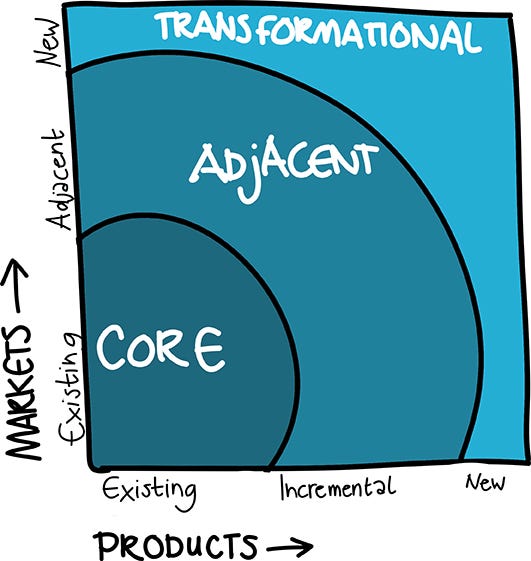
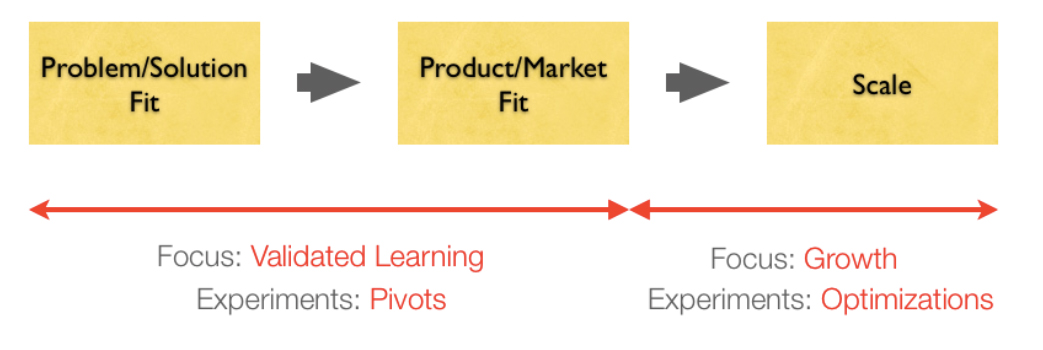
Tendayi Viki, a friend of mine who is based at the University of Kent, and was this year added to the Thinkers50 Radar, wrote in his recent book The Corporate Startup that every company has to be a balanced mix of established products and new products that are searching for profitable business models.
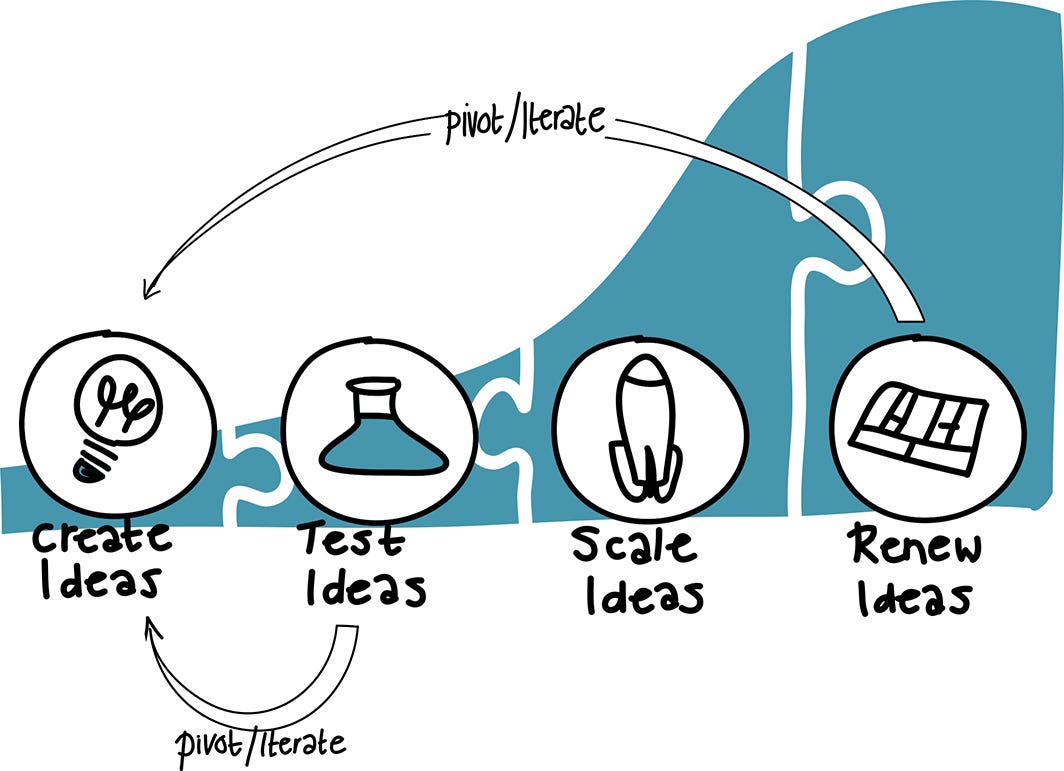
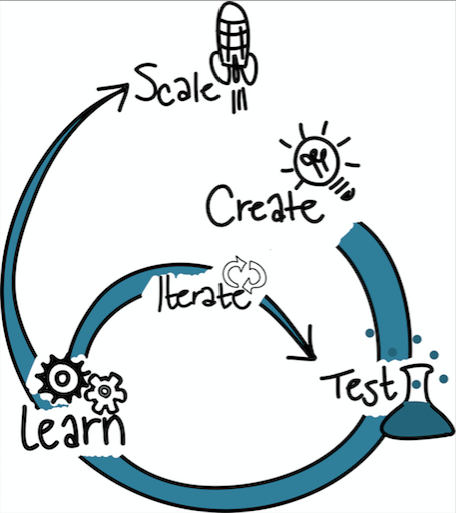
The innovation ecosystem and the products within it have to be managed appropriately depending on where they are on their innovation journey (i.e. searching vs. executing).
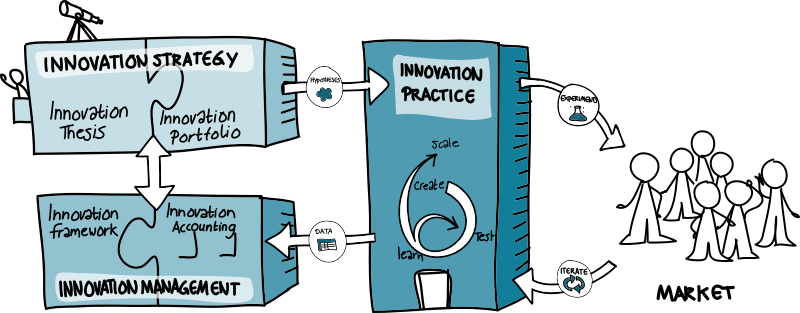
Viki goes on in his book to consider some of the many components of an integrated approach to innovation within a corporate.
Innovation Thesis
Innovation should not be conducted as a guerilla movement, hidden and protected from the main business. It must be part of and aligned with the overall strategic goals of the organization. This is important when it comes to later transitioning innovation projects into the core product portfolio.
Just like venture capitalist investors have investment theses, every large company must have an innovation thesis. An innovation thesis clearly sets out a company’s view of the future and the strategic objectives of innovation. A thesis also sets the boundaries or guard rails for which innovation projects the company will or will not consider investing in. In addition to deliberate strategy, the company must also use its innovation process as a source of emergent strategy that is responsive to changes in the market.
Just like venture capitalist investors have investment theses, every large company must have an innovation thesis. An innovation thesis clearly sets out a company’s view of the future and the strategic objectives of innovation. A thesis also sets the boundaries or guard rails for which innovation projects the company will or will not consider investing in. In addition to deliberate strategy, the company must also use its innovation process as a source of emergent strategy that is responsive to changes in the market.
Innovation Portfolio
To achieve its innovation thesis and strategic goals, an established company should set itself up as a portfolio of products and services. This portfolio should contain products that cover the whole spectrum of innovation; i.e. core, adjacent and transformational. A portfolio should have early stage products, as well as mature and established products. A company may also consider having in its portfolio disruptive products that are aimed at the lower-end or emerging markets.
The goal is to have a balanced portfolio in which the company is managing various business models that are at different stages of their life. The balance of the product portfolio should be an expression of the company’s overall strategy and innovation thesis.
Innovation Framework
In order to execute on its thesis and manage its portfolio of products and services, the company needs a framework for managing the journey from searching to execution. There are several great innovation frameworks out there; for example Ash Maurya’s Running Lean framework and Steve Blank’s Investment Readiness model. All these frameworks can be synthesized into the three simple steps for innovation; creating ideas, testing ideas and scaling ideas.
Every now and again, a company may decide to refresh the business models of it existing products through renewing ideas. Having an innovation framework provides a unifying language for the business. Everybody knows what phase each product or business model is in. This then provides the basis of how a company can manage its investment decisions and product development practices.
Innovation Accounting
With an innovation framework in place, the company now needs to make sure they are using the right investment practices and metrics to measure success. Traditional accounting methods are great for managing core products.
However, when managing innovation a different set of tools are needed. We propose that companies should use incremental investing based on the innovation stage of their products. This philosophy is based on Dave McClure’s Moneyball for Startups.
We also propose three sets of innovation KPIs that companies should be tracking. Reporting KPIs are designed to track the activity and work being done on new ventures as they move from idea through to scale (e.g. validation velocity). Governance KPIs help paint a better picture for the company as to whether or not to continue investing in particular ideas (e.g. how close are the teams to finding product-market fit). Global KPIs examine the overall performance of innovation within the context of the larger business (e.g. percent of revenue in the last 3 years).
Innovation Practice
In addition to managing investments in innovation the right way, the way product teams develop products has to be aligned to the innovation framework. Pearson’s Lean Product Lifecycle is accompanied by great playbook that provides guidance to product teams as to the right behaviors to engage in during searching versus executing. Adobe’s Kickbox provides similar guidance, tools and resources. The core principle for innovation practice is simply that no product can be taken to scale until it has a validated business model.
As such, during the search phase the job of innovators is to validated their value hypotheses (i.e. does our product meet customer needs) and their growth hypotheses (i.e. how will we grow revenues and customer numbers). This process requires that teams validate both the attractiveness of the product to customers and the potential profitability of the business model. This is product-market fit and our definition of lean innovation.
These five principles combine to help create an innovation ecosystem.
The first two principles (i.e. thesis and portfolio) focus on innovation strategy, the next two principles (i.e. framework and accounting) focus on innovation management and the last principle is where rubber meets the road and the company begins interacting with customers and validating business models. Most innovation labs tend to just focus on this last part (i.e. innovation practice). However, without a supportive ecosystem in place, products coming out of innovation labs have high mortality rates. This is why applying all five principles is important.
As you can see from the graphic above , these elements are interconnected; each representing a build-measure-learn loop of its own. To the extent that strategy informs investment decisions, the success of these decisions in turn inform strategy. To the extent that investment decisions impact innovation practice, innovation practice produces learnings that inform investment decisions and in-turn inform strategy.
This is an innovation ecosystem at work. Each interconnected piece responding to data from the other pieces. Such a holistic approach allows companies to innovate like startups, without having to act like startups.
Explore more insights from GeniusWorks:
Inside Daimler’s Lab1886 … the Stuttgart innovation hub focused on creating the future of mobility
A rabbit out of a hat, a card trick, the mystery of something appearing that wasn’t there before. Can you recall the first magic trick you saw? No matter what the trick was, the feeling it left behind is what stayed with you–the awe, the wonder and the excitement, the idea of greater possibilities.
I have worked with Turkish business leader Tanyer Sonmezer for almost 20 years. Whenever I arrive in Istanbul, he greets me in his office overlooking the Bosphorus with a big smile, often a hug.
Having trained as a mechanical engineering at the Middle East Technical University, he instead chose a business career, spending a decade as a general manager at Michelin. Since 2002 he has been the leader of Management Centre Turkey (MCT), taking the organisation from a small training company to the most trusted education and networking platform for business in Turkey today. To most business leaders, MCT is Tanyer Sonmezer.
He is ubiquitous in the boardrooms of Istanbul, but he has also led change programs in Greece, Ukraine, Belarus, Macedonia, Moldova and Dubai. Along the way he gained a masters in marketing, an MBA, and then constantly topping up his toolkit with programs at Harvard, Oxford, Stanford and beyond. And he’s written two books, with two more on the way – look out for The Fourth Manager. Growth strategies and innovation workshops, design thinking or 6 thinking hats. He’s your man.
Asked what his role actually is he says “chef, magician, pilot, photographer, and keynote speaker aside, I prefer to be an ordinary hero for those who love making ideas happen”.
In September he joined me on stage in Odense, for this year’s Thinkers50 European Business Forum. Whilst the great names of business education were here talking about the future of blockchain, sustainable innovation and revolutions in management thinking, I asked Tanyer to talk about his passion for magic. As a child he grew up working in an amusement park, and quickly acquired the fast hand of a fairground entertainer.
Today, he embraces over 100 magic tricks to explain the realities of business, the opportunities of creativity, and engaging people to think differently, to change their minds, and look deeper at what they see. Here’s an interview with Tanyer Sonmezer just after walking off the stage:
https://www.youtube.com/watch?v=ty6zEDiz9nc
In many ways, running a company requires knowing a little bit of magic. Here are five simple lessons in using a magician’s approach to help navigate today’s challenging business environment:
Trick 1. Know your audience.
You cannot forget who you’re performing for–the audience is the most essential part of an act. Different performances will resonate with different audiences.
Years of adapting and adjusting my performance as a magician has helped me today to shift my message depending on who I’m meeting: a customer, a partner, a venture capitalist, or even an employee. It is important that I go into each meeting understanding what will be mutually beneficial to both parties and perform accordingly.
Our customers want to hear the magic of how our technology will solve their problem–how do we increase mobile application testing efficiency by running hundreds and thousands of test cases on multiple cell phones and tablets, making sure their app works on each and every one?
Our investors want to understand the strategy for growth and what that means for their return on investment.
And our employees want to hear the optimistic future of the company and where he or she can help drive the momentum. Each audience needs a message that caters to them.
Trick 2. Show them what they want to see.
How do you convince the audience that the seemingly impossible is, in fact, possible? This is the core role of a magician. We all know that people don’t step into a box, get sawed in half, and walk away completely unharmed. Similar to performing an illusion that requires the magician to push the limits of the human mind, leaders need to persuade others to trust and follow and believe in their vision, strategy, and product.
The best magician in business was Steve Jobs, who was quoted as saying “people don’t know what they want until you show it to them.” Remember when the iPod first came to market? No one realized they needed (or wanted) music in their pocket. But Apple sold 600,000 iPods in its first year.
Successful companies provide a solution to a problem or challenge that the market may not yet be experiencing. A true leader and visionary must convince customers to make a purchase before they know they need it or can implement it.
Trick 3. Add a little mystery.
The most important element in magic, mystery, is the idea of not knowing how something is done but somehow seeing it happen right before your eyes. In business this mystery is referred to as a company’s value proposition or key differentiators.
A successful magician never discloses how a trick was performed and will continuously evolve by adding new tricks into his or her repertoire to keep the act from getting stale or mundane. Companies must do the same: constantly improve, innovate, and push the envelope to create new barriers to entry in the market and further distance themselves from competitors.
Trick 4. Make it personal.
As important as change and evolution are to success, personalization is equally as imperative. Performing magic taught me that the value of a personal touch is immeasurable and invaluable.
Capturing a look of amazement in an audience member or making eye contact with someone at that moment when the impossible occurs is priceless. There isn’t a one-size-fits-all solution for every problem; and to best serve my customers, make them happy, and solve their complex problems, I need to work closely with them to offer a unique solution tailored to their specific needs.
Trick 5. Build up to the magical moment.
That moment when the tiger appears in the empty cage or when the magician disappears into thin air in flames is the kind of magic that everyone reacts to.
The business environment is very similar. There is nothing like that moment when the customer suddenly “gets it” and gives you the nod, signaling you have managed to impress him, or the investor suddenly seeing the light: the business potential in your idea, your dream, your technology, or your execution. And there is nothing like that feeling where you realize your audience just had that magical moment.
Blake Mycoskie was travelling in Argentina, learning to play polo, in 2006.
It was here he started his shoe business, Toms by accident. He met some women in a bar who were in the country to donate shoes to children and he offered to help distribute them. When he returned to the polo ranch, his teacher Alejo Nitti asked him a fundamental question: “Who’s going to give them the next pair?” Kids’ feet grow fast. “What do we have to do to continue doing this?” Nitti said
In a document from CNBC the story continues: “I recognised in that question that was the problem with this kind of nonprofit charitable giving model, at least… these women had to spend weeks getting enough shoes that would last these kids for a few months,” Mycoskie says.
Then he had an idea. “What if I sold these really cool shoes that I had only seen in Argentina to my friends back in California, and every time I sold a pair, I would also make another pair to give to one of these kids? It just seemed like the simplest idea in the world,” he said.
The two worked with a local manufacturer to produce the espadrille-style shoes, which Mycoskie called Toms, because “Tomorrow’s Shoes” wouldn’t fit on a label. He took a few pairs back to his California home to ask women what they thought, knowing little about fashion, before designer store American Rag agreed to sell them. On its first “shoe drop,” the company gave 10,000 pairs away to children in Argentina.
Now, more than 60 million pairs of shoes have been donated to children, and the company has also applied its one-for-one model to eyewear and water. In 2014, Mycoskie sold a 50 percent stake in the business to Bain Capital, valuing the company at an estimated $625 million, and likely making him more than $300 million. But his original aim was more about doing good.
“We literally had created karma, if you will, by, you know, really setting out to do something to help people versus just trying to make money,” Mycoskie said.
He has since launched a social entrepreneurship fund, investing in purpose-driven, for-profit companies.
Fashion retailers are under pressure. Many physical retailers, such as H&M and Zara have seen their sales decimated by the growth of online competitors like Asos and Zalando, who themselves are struggling to reach the expectations of investors. The fast fashion retail models pioneered by the likes of Inditex, has now created a new normal in terms of consumer expectations and behaviours that are difficult to meet.
Innovation has largely not kept pace with consumer behaviour, in a world of mobile-centric millennial consumers, where their aspirations are global, their choice is diverse, their influence is communal, and their patience is zero. Amazon has launched many private labels, H&M tried celebrity-designed ranges, Uniqlo invested in vending machines, Nike went for vast indoor experiences, Supreme became the ultra-hyped drop brand, and Depop is the new normal for reselling and vintage hunting.
Of all the trends influencing retail, personalisation – in the forms of customised products, personalised service, local engagement, personal shoppers and predicted curation – is perhaps the biggest trend for fashion retailers right now. In order to achieve that some retailers are using technologies such as AI and 3d printing, some are using expert staff and local kiosking, some are using data to build more sophisticated interplay between different channels.
Here are some of the most recent examples of fashion retail innovations:
Alibaba’s FashionAI with Guess
Alibaba’s New Retail concept seeks to rethink the entire retail experience, physical and digital, enabled by next generation technologies. This week the Chinese tech giant launched its first “FashionAI” concept store enabled by artificial intelligence. The Hong Kong store showcases Guess apparel through innovations such as smart mirrors, which display product information on a nearby screen when shoppers are touching or picking up a garment. The smart mirror also makes mix-and-match recommendations and points to where the suggested items can be found in the store. It also uses machine learning to computer vision to “learn” from consumers, designers and fashion aficionados within the e-commerce giant’s ecosystem. These insights include images of more than 500,000 outfits put together by stylists on its Taobao platform.
https://www.youtube.com/watch?v=ypX7TkOoLUY
Adidas Berlin travel pass
Berlin transit authority BVG’s unusual collaboration with Adidas Originals – limited edition sneakers with a built-in BVG season travel pass. As such the wearer (as long as they are wearing the pair of sneakers at the time) will get free travel around the entire city on trams, buses, ferries and subways for the year. Although the shoes were quite highly priced at €180, the value of the annual travel pass is €728 which means they offer the owner a significant saving. Limited to 500 pairs, the shoes continue the BVG link in their design by mimicking the seat upholstery design used on the company’s train seats.
Amazon Echo Look gets stylish
Amazon Echo Look’s screen and camera functionality is being put to good use by fashion publications Vogue and GQ. Customers can use the device’s AI stylist to get style suggestions from the magazines by uploading photos from their smartphone. The magazines will also host weekly content on the Echo Look app’s home screen with the ability for customers to click through and buy items. Although Amazon says Vogue and GQ don’t get a cut from any purchases made, it’s the sort of collaboration that you could add such an element to.
https://www.youtube.com/watch?v=Jch5SOW5ZLs
Columbia Sportswear’s Azure cloud
Columbia Sportswear has collaborated with Microsoft to offer a better customer experience. The company uses Microsoft’s Dynamics 365 and Azure cloud services to get insights into how customers respond to products – regardless of the channel used. This then helps Columbia Sportswear to personalise the experience. The technology is also used to improve merchandise management by offering better reporting and analysis.
H&M’s Afound discount marketplace
H&M is extending to discount fashion with its new marketplace Afound. Significantly, H&M will allow other fashion labels to be sold on Afound. And of course H&M will use it sell its own unsold inventory. The marketplace will be accessible online and through a physical store in Sweden. The aim is to present a mix of brands at different price points. Similarly, Inditex’s remainder products are sold through a separate brand Lefties in which own brand labels are changed from Zara or Mango to Lefties.
https://www.youtube.com/watch?v=pkKbdmDwcVc
LVMH 24sevres multi-brand store
LVMH’s first ecommerce project is 24servres.com, which is a digital realisation of the Le Bon Marche store in Paris. The idea is to extend the physical experience to customers all around the world, including recreating the store’s famous window displays. LVMH also believes that its curated experience is what sets it apart with the brand taking an editorial approach to merchandising the site’s inventory.
Miquela, the digital influencer
Miquela Sousa is a 19 year old LA-based model and influencer. So far, so normal. But Sousa is actually a computer-generated figure – and no-one knows who is actually behind her. Still, she has more than 899,000 Instagram followers and fills her feed with images of outfits from brands such as Chanel, Supreme and Vans.
Net a Porter’s intelligent shopper
Luxury online retailer Net a Porter has invested £442 million in technology and personalisation. A robot selects clothes for customers based on their future plans, for example a planned vacation. The system uses AI to offer the personalised service. Net a Porter has also developed another tool that uses AI to put together outfits based on other items a customer has selected.
Nike’s superfast customisation
The Nike By You studio in New York lets customers customise a pair of trainers in less than 90 minutes. Known as the Nike Makers’ Experience, the process involves a series of graphic options and patterns, plus colour and size options, to create a design that’s unique to the customer. The experience uses a special model of trainer, the Nike Presto X, which was specifically created for it. Currently the Nike Makers’ Experience is invitation only.
Nordstrom’s local advisory stores
US department store Nordstrom’s new retail model is very different to its existing store proposition. The new concept deconstructs the department store into smaller, targeted spaces. The first of these is Nordstrom Local, which is a clothing store that stocks no clothes. Instead the small space has a stylish suite and dressing room with personal stylists ordering in products for customers to try. If they want to buy anything it will be shipped to their home. The space also offers alterations and tailoring.
Orchard Mile’s personalised ‘shopping street’
It’s been a slow process but more and more luxury brands are online, whether via their own initiatives or platforms like Net-a-Porter and Farfetch. One company changing how customers shop for these brands is Orchard Mile which lets customers create their own ‘shopping street’. The customer pick their favourite brands to populate the street, They can then click on them and go to a customised website featuring the designer’s entire collection. The goal is to make the experience akin to walking into the brand’s shop.
Start Today’s ZOZOsuit
The US subsidiary of Japanese fashion brand Start Today is aiming to change the way we buy online with its new at-home measurement device. The ZOZOsuit is an enhanced suit that uses sensor technology to capture 15,000 measurements from all over the wearer’s body. The data is then sent by bluetooth to the accompanying ZOZO app. Customers can then shop Start Today’s products and get recommendations on what will fit based on their exact measurements.
https://www.youtube.com/watch?v=32rbuLFbVWk
Stitch Fix intelligent box
Stitch Fix is using artificial intelligence to take the effort out of finding new clothes. Rather than the customer going from store-to-store browsing, the company uses a mix of human personal styling and AI to find and send products directly to customers. It uses customer data to find the products it thinks the individual will like. The AI is constantly learning based on what the customer returns and keeps, which means its recommendation get better and more personalised over time.
Tie Bar’s data-gathering stores
Menswear brand The Tie Bar started as an online store, but has since moved into physical retail. Notably the company started with pop–up stores, but found they were turning a profit so converted them into permanent stores. However they don’t operate in isolation. The Tie Bar uses the stores to improve its online offering by testing out new products and uses learnings from customers’ in-store stylist sessions to improve its online equivalent. The Tie Bar also uses online data about where its customers live and what they buy to decide where to open new stores.
Untuckit’s RFID merchandise
Casual men’s apparel retailer Untuckit is piloting the use of RFID in its Fifth Avenue store. The company will use the tech to track inventory and see which items are selling best. They can then use this to optimise inventory in real-time. Just as importantly the RFID will show which sizes and styles have low demand enabling Untuckit to remove or improve them. The store can also track staff and shoppers around the store to better understand journeys.
Viktor & Rolf and Zalando’s recycled collection
Zalando has linked up with fashion designers Viktor & Rolf to create a collection focused around using recycled materials to make handcrafted garments. Called RE:CYCLE, the new collection consists of 17 pieces of womenswear. The materials come from Zalando’s overstock fabrics, while Viktor & Rolf manage the design. The collection is deliberately priced to be accessible with the idea being that it’s a viable alternative to a customer’s usual purchases.
https://www.youtube.com/watch?v=Qq2Gg4heMuY
Wardrobe’s direct-to-consumer luxury
Wardrobe.nyc is a luxury direct-to-consumer fashion label from designers Josh Goot and Christine Centenera. The brand sells clothes as ‘wardrobes’ with customers having the choice or four or eight seasonal essentials costing £1,104 and £2,208 respectively. Catering for both men and women it’s an interesting look at where luxury fashion could go in the future by offering high quality products, curated into capsule wardrobes at a lower price.
Zara self-service kiosks
With click-and-collect a well-established part of the retail mix some brands are looking at ways to improve the process. Zara is one of these. It’s testing self-service ‘pickup towers’ in-store which can hold up to 4,000 packages. Customers can use them to retrieve their online orders by scanning a barcode on their phone. The machine then locates and retrieves the package in just a few seconds. Given that most retailers’ click-and-collect services requires customers to queue up at a desk or till to get their items, this technology is a win-win. It makes the process faster for customers and frees up staff to do more important tasks.
Is the high street dead? Of course not. It’s just being reinvented. Whilst everyone talks about the rise of online shopping, it’s easy to forget that 75% of goods are still bought in physical stores.
Shops will not die out any time soon, but they must evolve with consumer habits if they are to stay relevant.
Physical retail needs to reinvent itself, with the help of technology, to play to its strengths – to be a real space, local and human, to enable participation and collaboration.
Physical stores become places to spend time, to socialise, to play, to create, and share
They become community hubs, places for local people to meet and host events
Human, intuitive, emotional personalisation is only possible when people meet people
Enjoy the trying before the buying, and when you do buy, its instant gratification
Local stores understand local conditions, from specific needs to festivals and the weather
Innovative physical retailers are trialling experience-led formats where customers can lose themselves in virtual reality (VR) experiences, watch content on ultra-high-definition digital displays, or receive tailored advice from expert staff.
This is reflective of a growing trend towards using a brand’s physical footprint to entertain, inform and visually impress customers, rather than to purely sell a product.
Enabling this transition to experiential retail is in-store technology.
From digital, interactive signage in a shop window to virtually trying on clothes with a magic mirror, technology is driving innovation in physical stores and allowing retailers to create unique brand experiences.
The digitalisation of the retail store
By 2030, it is estimated that 90% of the global developed population will own smartphones that are running on increasingly ubiquitous internet access, according to Deloitte.
Although challenging to retailers, online interaction can also act as a hook to bring customers into a store, whether to pick up click-and-collect orders, experience personalised customer service or in response to a location-based notification.
The increasing use of artificial intelligence (AI) processing such as virtual assistants within smart devices will challenge retailers to improve their performance to deliver a seamless online and offline experience.
New technologies including VR and augmented reality (AR) will enable retailers to meet consumers’ growing expectations of experiences that are more intimate and interactive, worthy of sharing on social media.
And retailers will benefit from the estimated 1 trillion internet of things (IoT) sensors by 2025, providing a real-time view of how their stores are running, and how customers are interacting with in-store technology and products.
Retail Week and Samsung recently got together to explore the best in-store technology innovations that will contribute to customer experience – how consumers will behave, what will drive footfall and sales in store, and how retailers can prepare their teams for this changing retail landscape.
The “me age” will have a big impact on retail
Gen Z like anonymity in store, preferring self-service over human interactions
By 2030, the over-50s will contribute £220bn to the UK high street
Shifts in global demographic trends, as well as consumer behaviour in the next two to three decades, present new opportunities and challenges to how retailers operate.
Brands will be selling to a bigger, richer global middle class, who by 2030 will be spending three times the £5.4trn per year they do now, according to consultancy firm McKinsey.
And according to the UN, by 2025 there will be an estimated 68% of the world’s population living in urban areas compared with 55% now – increasing the need and interest in retail and leisure facilities.
Retail futurologists predict that the customer of the future will want to be actively involved in the in-store experience, whether they are interacting with a touchscreen or participating in an event in store.
Lowering the cost of particular types of in-store technology will also allow retailers to create physical stores that are more experiential.
The shift in digital signage to all-in-one smart displays, for example, means fewer hardware costs for the retailer. The displays prompt customers to make a purchase based on curated content that changes in response to real-time data.
Meanwhile, low-cost sensors embedded within products such as radio frequency identification tag (RFID) systems can enhance the in-store experience by offering real-time stock information for both customers and staff.
Retailers that ignore the grey pound do so at their peril. By 2030, it is estimated that the over-50s in the UK will account for nearly half of all consumer spending at £368bn, according to a study by UK consultancy firm Centre for Future Studies.
Technology advances in mobility will help to overcome the physical restrictions on senior customers accessing stores.
Driver-assistance systems – which have features such as collision-avoidance sensors, automatic lane centring and driverless vehicles – will come to the fore as governments look for more ways to improve road safety.
Shopping in store also offers this age group the social interactions that Gen Z want to avoid, as staff become less transactional and more focused on offering high levels of customer service.
Retailers can also develop applications that deploy the types of technologies that will be increasingly aimed at seniors – from robotic and voice-activated helpers in the home to VR headsets that will become more commonplace and be used to stay connected to family and friends.
Sports stores allocate more floor space to experience and less for product
In-store AR in the beauty sector from L’Oreal, Mac and Sephora
Technologies that show the benefit of in-store automation
There will be a shift in a store’s function from a “distributor of products” to a “distributor of experience”, according to US retail futurologist Doug Stephens.
Instigating these in-store experiences are high-definition display screens alongside the emerging applications of VR, AR, AI-enabled voice and facial-recognition technology.
https://www.youtube.com/watch?v=R60rAQCqkeM
Leading retailers and brands are trialling these types of technologies in stores to see which applications will maximise customer engagement and brand loyalty.
Smarter ways to try before you buy
Few retailers and brands currently have the in-house expertise to create amazing tech-driven experiences, so L’Oreal decided to acquire this knowledge by buying beauty technology firm ModiFace this year for an undisclosed amount.
he buyout will allow the owner of Kiehl’s, Maybelline and Lancôme to develop AI- and AR-enabled apps and in-store services.
Customers interact with a digital display to virtually try on make-up, visualise hair colours or have skin issues diagnosed.
MAC Cosmetics has the technology to hint at what L’Oreal could do next. In 2017, MAC Cosmetics partnered with ModiFace to create a mirror in store that uses facial tracking and 3D video makeup-rendering technology to enable shoppers to try on a curated set of MAC shades.
Sephora is another beauty giant that is experimenting with AR using an interplay of mobile and in-store interaction.
The Sephora to Go app allows brands such as Laura Mercier to launch digital storytelling. In this case, customers can hover their smartphones over images of the brand founders displayed in store or in shop windows, which gives access to multimedia content on that brand – including products that can be added to their basket within the app.
The retailer is also offering a personalised makeup service with Pocket Contour Class, where customers upload a selfie and receive product recommendations.
Innovators of in-store technology have been using AR magic mirrors for a few years now in fitting rooms to provide a service that is more customised, as well as to reduce queues.
The mirrors typically work by using built-in cameras to track the customer’s body and reflect it on a digital display. The choice of clothes is then superimposed onto the customer’s reflection using AR.
Topshop and Timberland have both trialled magic mirrors using Kinect motion sensing technology.
Topshop tested it in its Moscow store to show customers how they could try on many different styles virtually, without actually getting undressed.
Timberland tested the power of a large interactive display in a shop window to drive footfall in a trial in Poland.
By positioning a magic mirror at the front of the store, shoppers became part of the retail theatre, showcasing the retailer’s product range to passersby as they tried on different styles ‘virtually’.
Uniqlo’s magic mirror, which featured in its Tokyo and San Francisco stores, is another example of customers virtually trying on a garment in different colours without having to take a large number of items into a changing room.
The end to end digitalised experience
Sports retailers are a sector to watch when it comes to experimenting with using in-store technology. Nike’s flagship in New York City is a five-story, 55,000 sq ft space with a strong emphasis on experience.
With minimal space allocated to actual products, the store instead offers a range of services, from personal shopping with a Nike expert to testing basketball shoes in a trial zone.
In an area that measures nearly half a basketball court, shoppers can try out products by shooting hoops and follow custom exercise drills guided by certified athletes in store.
As part of the retail theatre, high-definition digital displays play what can be seen and heard on basketball courts to ensure the experience becomes more immersive.
The retailer is due to open a second flagship store in New York City within the next year which, alongside a similar suite of services, will feature the Nike Live concept that was launched in Los Angeles this year.
The idea behind Nike Live is to create a small format retail space that reflects the local area’s favourite products. Nike uses data from local online purchases to guide which products appear in store.
Other sports retailers are also investing in experiential retail. Foot Locker opened a new flagship on London’s Oxford Street in July 2018 designed to mix premium products with novelty and community-led interactions.
Set over two storeys near Marble Arch, the store deploys a mix of large LED digital displays featuring slogans such as ‘London – We’ve Got You Covered’ and a culture wall featuring local photography.
For a three-month period, the store will also feature an Xbox Experience Zone where customers can test their skills or create a personalised controller through the Xbox design lab.
Digital displays
Samsung’s network of flagship stores is an example of how in-store tech helps a retail space shift to selling experience over product.
Transferring a concept developed in New York City with Samsung 837, the tech company opened a two-storey flagship on Avenue des Champs-Elysées in Paris this summer.
The Samsung Paris store reflects the brand’s product strengths – from ultra-definition digital display screens for messaging, content and interaction to VR headsets and smart-home devices.
The soft-sell environment is focused on entertainment and information.
The store is split into different zones. A customer visit could involve wearing a VR headset to try out 4D alpine skiing, finding out how Samsung’s connected devices work in a smart home or going to the Customer Service Zone, which offers one-hour phone repairs.
Samsung plans to open a London counterpart store following an agreement in June 2018 to lease a 20,000 sq ft showcase space at Coal Drops Yard, King’s Cross.
Automated stores
Retail is a sector that will be turned on its head by automation and robotics, but what does automation offer the customer in terms of in-store experience?
Amazon is banking on the convenience of checkout-less shopping in its Amazon Go store concept. The world’s largest retailer by market capitalisation has again shown its knack for customer-centric services.
The proprietary technology behind the cashier-less shop is called Just Walk Out, which works by a customer scanning a QR code at the entrance to the store, which is read by the Amazon Go app.
As the customer adds items to their basket, a network of cameras in store detects each item and determines what it is based on AI’s deep learning ability to draw conclusions from large data sets.
Amazon executives have indicated that its inaugural Amazon Go store in Seattle is serving repeat shoppers, and the giant plans to open a further Seattle site and two other Amazon Go stores in Chicago and San Francisco.
Interestingly, sales data analysts have revealed that the Seattle store’s most popular item is chicken sandwiches, which Amazon has deduced is due to office workers in the local area buying their lunch.
The retailer now knows to stock more of that product to meet local demand, demonstrating the value of real-time customer data.
Grocery retailers in the UK are trialling scan, pay and go smartphone apps which allow customers to pay while shopping in the aisles.
While Tesco and Co-op are experimenting internally with the technology, Sainsbury’s has launched a pilot for checkout-free shopping in its convenience store in Clapham, London.
Next tech
Tech start-up DeepMagic is working on its own mixture of robotics and is implementing AI to use in unattended physical stores.
The Qick Kiosk is billed as an unmanned robotic pop-up store for use in apartment buildings, airports or hotel lobbies, the company says.
In a similar surveillance method to Amazon, AI is harnessed to recognise stock on shelves and tracks a customer’s moves with cameras. If the customer leaves the store with a product, then their credit card is automatically billed.
Walmart is also utilising in-store automation by trialling 50 shelf-scanning robots to track inventory as well as replenish stock.
Moby Mart is using technology that could transform the business model of a bricks-and-mortar retailer by launching mobile stores on wheels that are all unmanned.
The brainchild of Swedish start-up Wheelys and China’s Hefei University of Technology, the so-called “robogrocery” offers fresh products for immediate consumption such as milk or ready-prepared lunches.
Customers using the Moby Mart vehicle scan items using their smartphone, which is connected to a bank account. The creator’s vision for Moby Mart is to bring “world-class retail to a million tiny villages around the world”.
The retail sector will create new job functions to meet demand for new skillsets
Staff move from transactional expertise to product knowledge and one-to-one service
Retailers should upskill teams to understand value and the application of new technology
In-store teams will be central to the digital transformation efforts of retailers as they reshape their shops to become more efficient and focused on customer experience.
This isn’t a far-flung future trend – it is already evidenced on our high streets through consumer technology and sports brands offering a service-oriented approach and non-transactional environment where the staff aren’t stuck behind a till point.
In fact, it might not just be the till points that are removed in future stores, but the majority of products too, putting a greater focus on service and experience.
Look no further than Nordstrom Local, an offshoot of the Seattle-based department store group. The second of its two LA-based stores opened this year, and with the exception of a limited amount of fashion stock – none of which can be taken away – the space is focused on value-added services such as shoe repairs, a dry cleaner and a café.
Essentially, it is a customer experience-led click-and-collect destination where online orders can be picked up.
Meanwhile, Decathlon has released a video of its future customer journey in 2026 and provides insight into how the sports retailer views the role of the store and staff within it.
Vision 2026 is a corporate roadmap for the company, which involves adopting advanced technologies to make the in-store experience a seamless extension of online transactions.
Decathlon envisages that customers would research and pay online for products such as bicycles.
However, when a customer goes inside a store to collect their items, sales assistants are still central to delivering quality customer service, which will be reassuring to consumers who fear a human connection, along with sales assistants who are valued, will be lost.
Although Gen Z would prefer not to encounter store staff, other consumer segments consider attentive, informative customer service just as integral as tech-related in-store experiences.
Experiential stores are looking for staff who will bring energy and personality.
Samsung noted that associates at its New York City 837 store were hired not for their ability to push products, but to get shoppers excited about the Samsung experience.
At the high street level, the role of sales assistants will be less transactional. In-store teams will need to shift their focus to help customers either navigate the purchase process or to explore the options available to customise products.
This could be done by VR, AR, or through a physical 3D printed model.
As a result, store staff will need to be well trained to get the most out of the in-store technology available and via a customer’s personal mobile technology.
This is an area where technology will play an important role in the future, in the form of remote learning and development.
Despite many headlines to the contrary, the store isn’t going anywhere, it is simply evolving.
Store teams are already evolving in tandem, and the future of the store will be about recruiting the right individuals and supporting them with the best training to succeed.
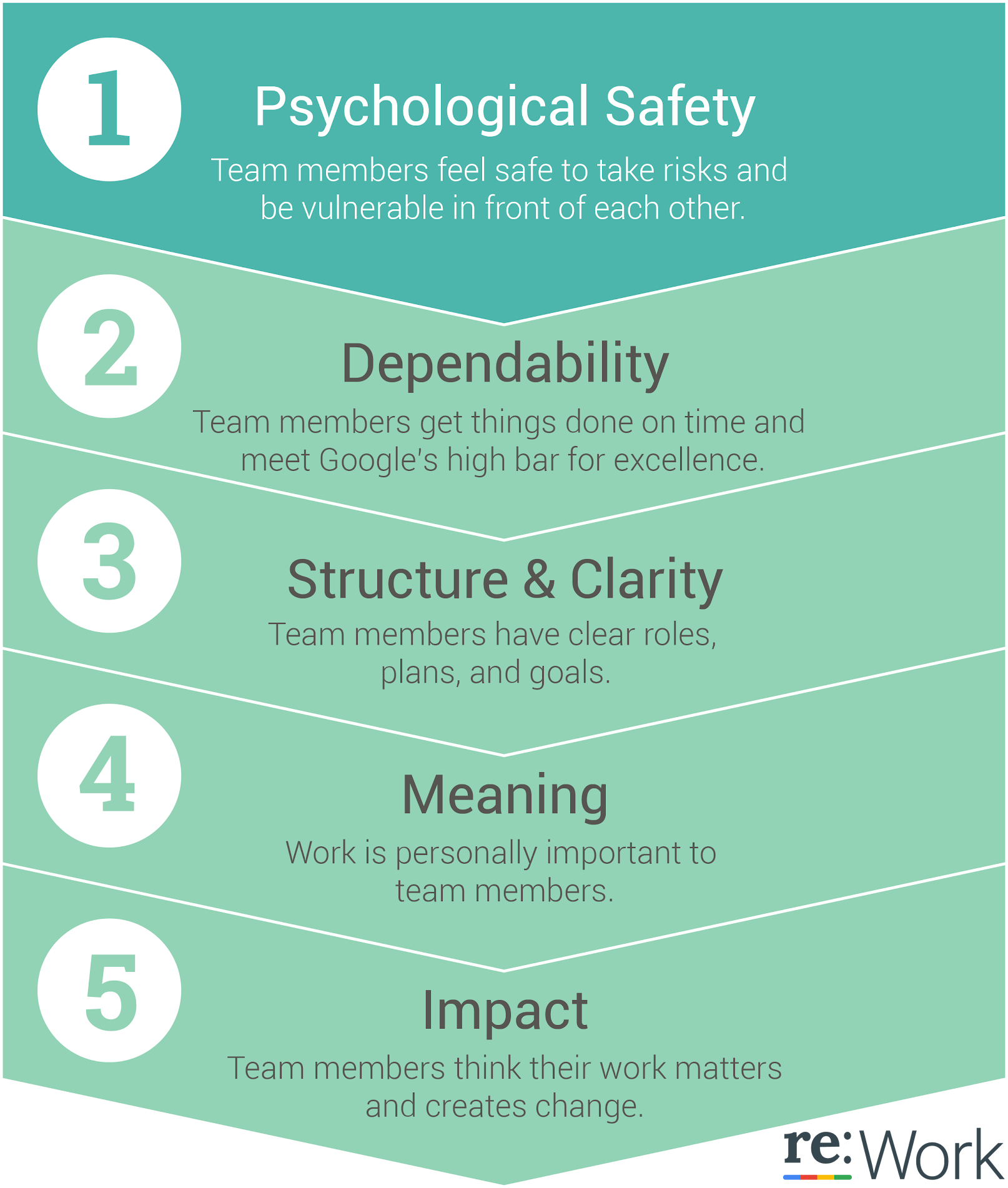


 Backed by names including First Round Capital and Union Square Ventures,


 One of the most universally applicable aspects of blockchain is that it enables more secure, transparent monitoring of transactions. Supply chains are basically a series of transaction nodes that link to move products from point A to the point-of-sale or final deployment.
 Investing in athletes has generally been the purview of sports management agencies and corporations, but blockchain could decentralize the process of funding athletes by democratizing fans’ ability to have a financial stake in the future of tomorrow’s sports stars.
 The management of public services is yet another area where blockchain can help lessen paper-based processes, minimize fraud, and increase accountability between authorities and those they serve.


 For those making charitable donations, blockchain provides the ability to precisely track where your donations are going, when they arrived, and whose hands they ended up in.


 E. Coli, salmonella, accidental horse meat — there have been a lot of disturbing slip ups in the food and beverage industry recently. Blockchain technology could help manufacturers and distributors avoid these mishaps.