The world’s business leaders face a diversity of challenges – demanding customers, relentless competition, profit-hungry investors, political and economic headwinds. Yet their companies have shown a remarkable ability to sustain momentum.
In this year’s ranking by HBR of “The World’s Best Performing CEOs” 70 of the 100 leaders in last year’s ranking performed well enough to achieve the distinction again this year—including 54 year old Spaniard, Pablo Isla, of the Spanish fast-retailing giant Inditex, who is once again the number-one-ranked CEO.
In the global top 5, he is followed by Nvidia’s CEO Jensen Huang, LVMH’s Bernard Arnault, Francoise-Henri Pinault of Kering, and Elmar Degenhardt of Continental. Familiar names such as Nike’s Mark Parker ranks 14th, Microsoft’s Satya Nadella is at 46, and Netflix’s Reed Hastings at 83
The HBR ranking takes a long-term view of performance, based primarily on financial returns over each CEO’s entire tenure. It also considers environmental, social, and governance issues.
20 of the CEOs lead companies based outside their countries of birth. 32 have an MBA, up from 29 last year. 34 have an engineering degree, up from 32 last year.On average, they became CEO at age 44 and have been in office 16 years. 3 are women, up from 2 last year. 87 are insiders, up from 81 last year.
https://www.youtube.com/watch?v=RAgsf6eaJLI
Pablo Isla
During Isla’s 12-year tenure at Inditex, with brands from Zara to Mango, his company has increased in market value seven times over, engaged in global expansion at a rate of on average one new store opening a day, and has become Spain’s most valuable company. Impressive by anyone’s standards.
Isla has chosen winning strategies like integrating the online and in-store shopping experience to feel seamless and focusing on the ability to quickly react to fashion trends with an integrated supply chain.
But what stands out is the single word description employees use to convey Isla’s management style. Humble. It’s how his employees talk about him and how he talks of his approach that’s the most telling.
He is known for rejecting a meeting culture and the use of hierarchy to command, control, and ego-feed, instead favouring making decisions informally in partnership with his people as he “manages by walking around”.
In fact Isla is so notoriously shy of being in the spotlight that he doesn’t go to his own store openings. Isla described his approach to HBR:
“What we want to be relevant is the company or the store opening, and everything always is the result of the work of a team of people. The strength of our company is the combination of everybody, much more than of any single person. And I can tell you that as a company, we try to be a low-profile company, being humble, of course being very ambitious, but being humble. And if we have a big store opening, we want the store to be the relevant thing, and not any particular person.”
Smartly, Isla focuses on putting the spotlight on what is most relevant to the consumer. The core shopper lusting for a $50 pair of affordable but high-fashion high heels from Zara wants to hear about the new store in her neighbourhood, not about how in control some privileged executive is. And he puts the spotlight on the most relevant employees – the front line store managers who are empowered to make product selections and whom he supports via a robust promote from within policy.
Running shoes used to be a fairly simple choice – Adidas or Nike – with a bit of Asics and New Balance thrown in.
My first running shoes were Adidas, back in 1978, although I was soon inspired by the Olympic exploits of Coe and Ovett, to try the swoosh. Innovations from Bowerman’s waffles and Air soles were met by Torsion bars and Dellinger web midsoles, as the two brands battled for market leadership. Indeed reading Phil Knight’s biography over the summer, he was obsessed with beating his German rival from the earliest days.
More recently science has taken different directions, tales of the Tarahumara Indians and their minimal shoes drove a barefoot trend, from Vibram socks to Nike Frees. And then Hoka One One flipped the other way, maximising the midsole cushion, and others followed. Adidas has focused on sustainable innovations, like the Parley collaborations to save the oceans, with a more campaigning approach, whilst Nike have been equally considered, its Flyknit technology seeking to eliminate waste and maximise fit.
Of course, comparing brands has become more difficult as product ranges have diversified across multiple sports, and into the world of leisure, or athleisure as we should call it. This has required choices but also dedicated teams within each brand to keep pace with changing sports, consumers and competitors. Multisport brands have the challenge of staying relevant to each sport, under one monolithic brand, whilst new entrants can focus on niche segments and become experts in their chosen fields. And its not just about shoes anymore. Indeed, apparel is often far more emotionally relevant to consumers in their choice of brands, although shoes still count for technical performance.
In the last couple of years, the market has really exploded with many new brands targeting niches and changing consumer behaviour. Sketchers for example recognises trainers as the walk to work shoe, and developed some fantastic models that even won the New York marathon. Meanwhile brands like On Running from Switzerland with its cloud running device is more geared to trail and mountain runners. For the gym user, brands like Under Armour have become a serious mass market rival, whilst specialist brands like Gymshark have targeted millennial audiences.
Some brands, like Ashmei, have refused to compromise on the mass market design approaches that seek to achieve specific price points, at the expense of the best fabrics and production techniques. Instead Ashmei seeks to target the discerning running, willing to pay twice as much for the best they can get. At the same time, there is a spartan instinct in many runners, seeking our the retro designs of the 1950s and 1960s when cotton was best, and clothing was simple. Consider Boston’s Tracksmith or Richmond’s Iffley Road. Some are fashion-centred like Satisfy, whilst other’s have a higher purpose, like Janji run in pursuit of clean drinking water.
However the real innovation, and profit margin, is likely to be developing more holistic relationships with consumers. Nike have done this best. It’s fitful but eventually fruitful collaboration with Apple, has seen it take technologies seriously, and the Nike+ Fitness Club has become a killer app on the Apple Watch. The fact that membership then links directly to Nike’s online store, enhances the relationship and benefits. Nike’s Breaking 2 project, seeking to create the first sub 2 hour marathon, was much more than a promotional event.
The concept of putting sensors into running shoes isn’t new. Back in 2012, Nike launched a smart shoe – the Nike+ Training Shoe – that was capable of reading a range of foot-based data including how many times your feet hit the ground, how long each foot was off the ground and where the contact was made. Since then we’ve seen the Under Armour Speedform Gemini 2 & 3 and the Altra Running IQ follow suit, attempting to popularise form and performance-tracking running shoes.
Under Armour the launched its latest chip-laden shoes the HOVR Phantom and the HOVR Sonic. Each of these shoes comes with a lightweight chip, complete with accelerometer, built into the thickest part of the right-shoe midsole. This can automatically detect when you start running and records a number of key running metrics, including distance, stride length and cadence, without the need for a phone. The data will also be synced to Under Armour’s MapMyRun app via Bluetooth when you get home.
Then there’s Sensoria, which up until now offered real-time tracking technology in the form of sock-worn sensors. In 2018, it’s moving this technology on a step, releasing its own smart shoes and pairing three textile sensors built into the sole, which can detect data about the way a runner’s foot makes contact with the ground, with a removable, reusable Sensoria Core sensor.
Garmin released a new form-tracking footpod and there is also Shft IQ and Runscribe. There is also the rise of arguably the most compelling new run tracker since Lumo Run in the shape of Stryd, another pod that clips to the outside of your shoe to deliver a huge range of form data and finally give runners access to the power output number that cyclists have enjoyed for ages.
Right now sensors worn outside our shoes are more popular with runners than shoes that have them built in. And that’s not going to change anytime soon according to Angus Nelson, cofounder at Stryd. When it comes to chips in shoes, he says there are a few challenges that need to be conquered.
However there is still plenty of space to innovate, and ideas from adjacent categories – such as cycling (think of Rapha’s cycle clubs), yoga (consider Lululemon’s values-driven mantra), skateboarding (learning from cult brand Supreme) – could spark new ideas and directions for new growth.
Adidas … reinventing the shoe with 3D scanning, 3D printing and the Speedfactory
Asics … inspired by the Zen mantra of healthy body and healthy mind
https://www.youtube.com/watch?v=F-vBlUKIM-o
Salomon … S/Lab Mesh, inspired by Kilian Jornet, customised to your biomechanics
New Balance … width fittings are still a simple differentiator
Hoka One One … the extreme cushioned midsoles
On Running … cloud running from the Swiss Alps
Brooks … happiness for the real runner
Saucony … “America runs on … ” collaboration with Dunkin Donuts
Under Armour … HOVR’s zero gravity feel and energy return
Altra … your technical running coach
Senoria … smart socks with pressure sensors and wifi, to track how you run
Stryd … running power meter
Ashmei … no compromise on quality for price
Tracksmith … finding the soul of the runner
Iffley Road … heritage inspired, premium fashion
Satisfy … mental toughness
Janji … feeling good and doing good
Sketchers … walking shoes for running too
Under Armour … gym wear trying to be serious
Pixar is arguably one of the greatest storytellers of our generation. They’ve won 13 Academy Awards, 9 Golden Globes, and 11 Grammys.
In the business world we use stories for everything from building brands to selling products, articulating purpose and strategies through to engaging people more deeply in a shared and meaningful culture. Jack Ma is a big fan. The fast acting founder of Alibaba far prefers storytelling to presentations, bringing issues and ideas to life in more distinctive and engaging ways.
Effective storytelling involves a deep understanding of human emotions, motivations, and psychology in order to truly move an audience. Luckily, storytelling is something we all do naturally, starting at a very young age. But there’s a difference between good storytelling and great storytelling.
“Storytelling is the greatest technology that humans have ever created.” said Jon Westenberg
Rule 1. Great stories are universal
Great storytelling is about taking a piece of the human condition (like birth, growth, emotionality, aspiration, conflict) and conveying it in a unique situation.
Acclaimed Pixar director Pete Docter puts it perfectly: “What you’re trying to do, when you tell a story, is to write about an event in your life that made you feel some particular way. And what you’re trying to do, when you tell a story, is to get the audience to have that same feeling.”
One way you can do this is to pull apart the stories you like. Break down every little element about what you love about them. Those are real feelings you’re having and you have to recognize them in detail in order to tell a great story yourself. In other words, self knowledge and awareness are at the the root of all great storytelling. You are part of the human condition and people will relate to that.
2. Great stories have a clear structure and purpose
Part A (Structure)
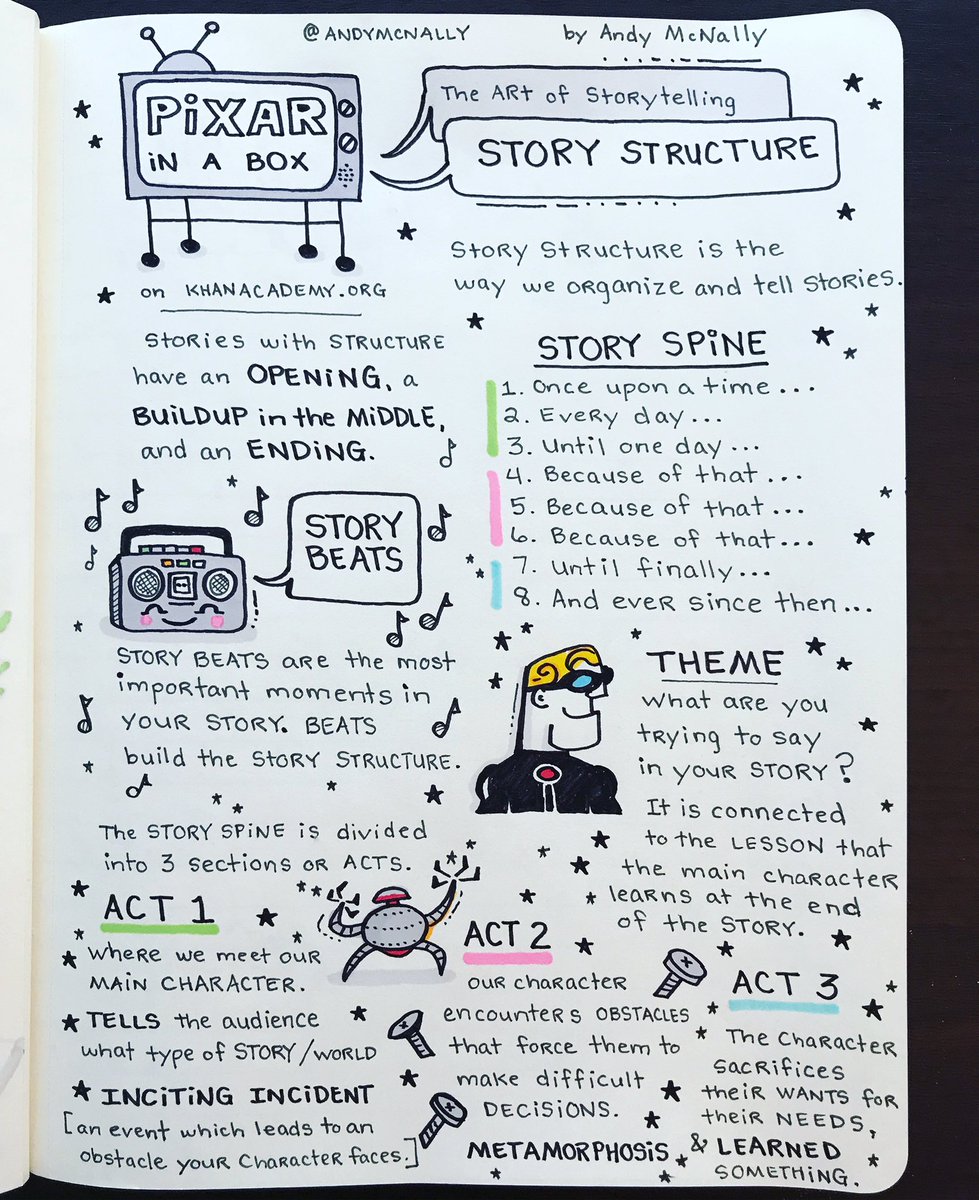
One of my favourite ways to develop a compelling story is to use “The Story Spine” formula created by professional playwright and improvisor Kenn Adams. Pixar has used this story structure to create so many films we know and love today. It goes:
- Once upon a time there was [blank].
- Every day, [blank].
- One day [blank].
- Because of that, [blank].
- Until finally [blank].
Try the Story Spine to help develop a truly unique story to tell.
Part B (Purpose)
As Pixar writes:
- Why must you tell THIS story?
- What’s the belief burning within you that your story feeds off?
- What greater purpose does this serve? What does it teach?
That’s the heart of really great storytelling.
By crafting a story that you are passionate to tell because it serves a real purpose, your stories will have bigger impact on the world.
3. Great stories have a character to root for (an underdog)
Believe it or not, people want to root for you (the main character). AND they love a good underdog.
This might seem straightforward but it’s worth keeping in mind anytime you’re creating a story.Pixar explains that we as the audience admire a character for trying more than for their success. In other words, it’s more about the character’s journey than it is their actual destination.
When your character is battling against all odds, facing adversity, or their back is against the wall, well then, you have yourself the makings of great story.
In our modern society, for example, everyone loves a good “rags to riches” story. How many times has Forbes published an article about the fearless entreprenuer that dropped everything, almost failed dozens of times along the way, yet still managed to create a multi-million dollar business?
Give the people an unexpected hero to root for.
4. Great stories appeal to our deepest emotions
Psychologists generally agree that there are six basic emotions: anger, disgust, fear, happiness, sadness, and surprise.
If you ever watched the Pixar move Inside Out, you’ll recognize these emotions as characters in the movie.
The more you understand how/when your own emotional levers are pulled, the more you’ll appreciate how that works in other people (and the more you’ll be able to hone those emotions in your stories). Consciously being to recognize these various emotions in yourself —and think about the “why”.
Why are you feeling a certain way? How might you be able to take the “why” behind your emotions and tell a story?
Continuously question yourself in order to understand your own emotional reactions to stories so that you can learn to tell more authentic stories that reach and move people where it counts.
5. Great stories are surprising and unexpected
We’ve all seen the classic “fairytale” storyline: a helpless princess in need and a charming prince swooping in to save the day.
… Boring (and totally outdated)!
What makes modern stories compelling are when our perceptions of reality are challenged or changed in some way.
Creators like Pixar and Walt Disney use animated movies as vehicles to address real-life phenomenons, issues, stereotypes, and norms. Movies such as Brave, Coco, Tangled, and Moana help us to understand and reflect on big, human-centered topics that we might not otherwise take time out of our day to think about.
Many times those topics or themes are surprising and unexpected, leaving the audience thinking about the story well after it is over. If you’re stuck on coming up with something truly unique, Pixar recommends to get rid of the 1st thing that comes to mind — and then the 2nd, 3rd, 4th, and 5th. Challenge yourself to dig deep.
6. Great stories are simple and focused
We as audiences know a good story when we see or hear one. Have you ever watched a movie or read a book where you had to keep asking yourself (or someone else) what was happening in the plot? Not a great experience.
As creators, we naturally want to include as much information as possible in our stories. We want to pack the story full of characters and plot twists and dialogue.
And often times we might not even realize that we’re adding layers that don’t need to be there.
Pixar’s advice here is to “combine characters and hop over detours.”
While you as the creator may feel like you’re losing lots of valuable stuff, it’ll set you free in the end and will allow your audience to get lost in the narrative.
One way to find out if your story is easy to follow is to tell it to a friend or family member who has never heard it before. Watch their face as you read it and try to see where they pause and what questions they might have.
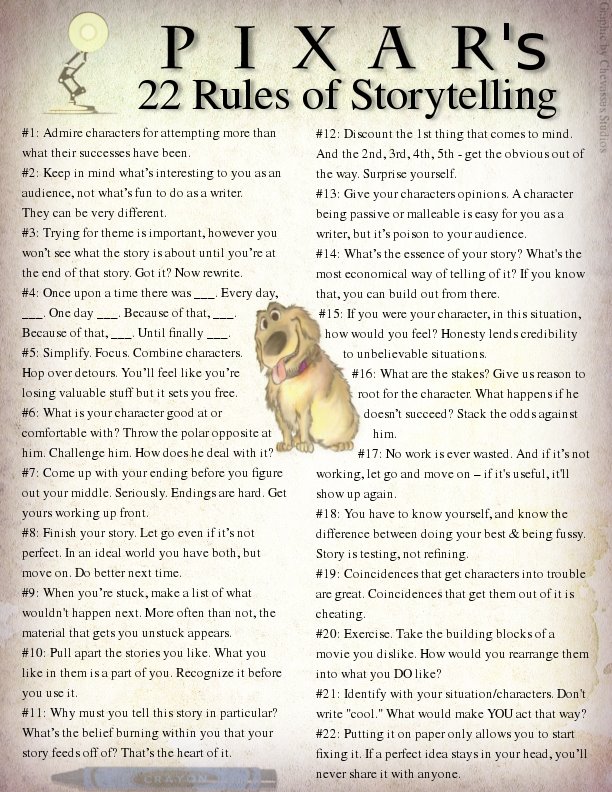
Emma Coates, a former story artist at Pixar, put together 22 “rules” for storytelling based on her deep experience of the Pixar storytelling process:
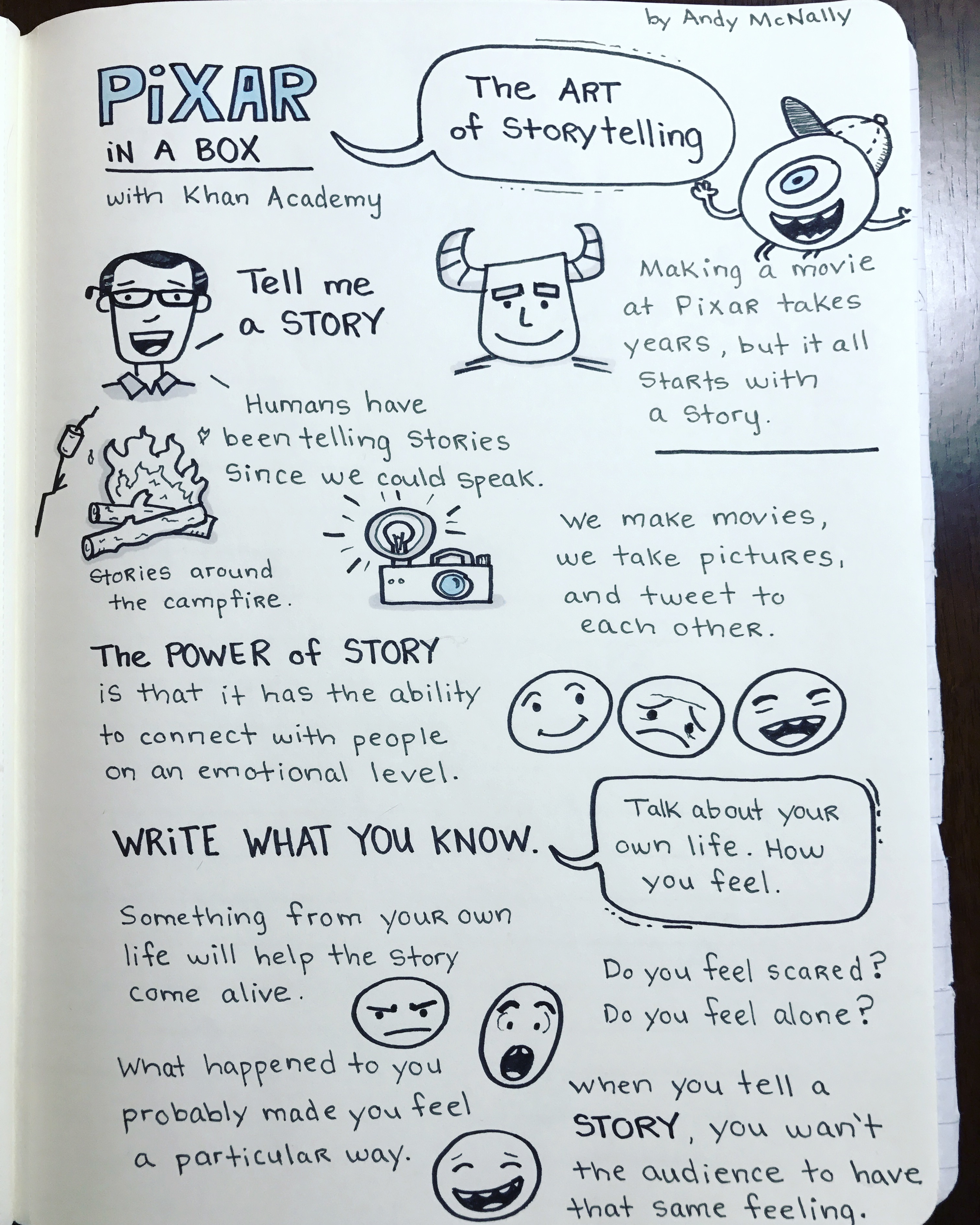
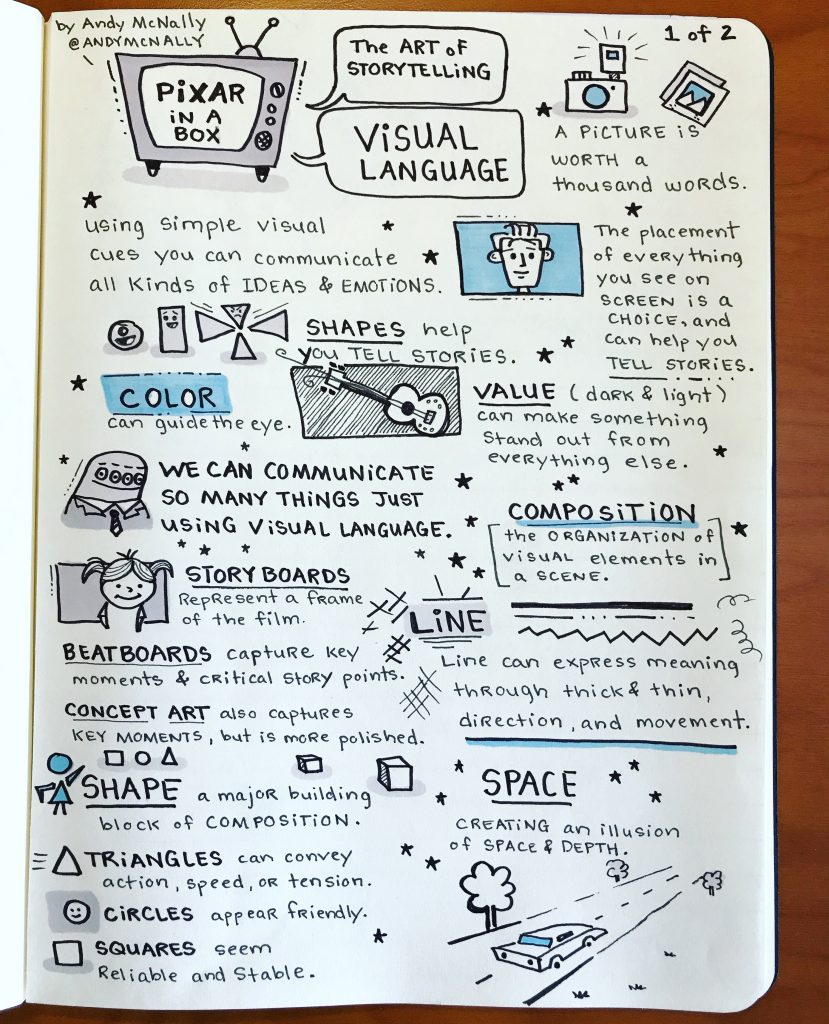
I also like Andy McNally‘s sketch book anecdotes from the Pixar process, which he then turned into an educational program working with Khan Academy:
Blitzscaling is the new book from LinkedIn co-founder
Blitzscaling is about growing at a rate that is so much faster than your competitors that makes you feel uncomfortable. In short, Blitzscaling is prioritizing speed over efficiency in the face of uncertainty.
The name Blitzscaling comes from a World War II association with the term “blitzkrieg” or lightning war, where the attacker risks it all to either win or lose the battle.
Understanding Blitzscaling might means having a framework that can help your small organization to scale up or your large company to also benefit from a new and reinvigorated acceleration, which is critical to survival in a market that changes at a faster pace.
Fast growth
Blitzscaling looks at massive growth which is also accompanied by high uncertainty. Hoffman in an HBR interview said “Blitzscaling is what you do when you need to grow really, really quickly. It’s the science and art of rapidly building out a company to serve a large and usually global market, with the goal of becoming the first mover at scale.”
Importantly, therefore, it is not growth hacking.
Three features of Blitzscaling are
- grow really quickly
- usually at a global scale
- gain the first mover of scale advantage
So rather than a process of experimentation with the aim of testing what works and what doesn’t efficiently, Blitzscaling is about being all in!
Strategic framework
Rather than a magic formula that works in each scenario, Blitzscaling follows a framework that revolves around three key ingredients:
- business model innovation
- strategic innovation
- growth strategy
Speed above efficiency
This is a critical difference between scale up and Blitzscale. The former happens in a scenario of certainty and efficiency. You allocated the resources necessary to test what works and what doesn’t with fewer assumptions as possible. You have wider margins to test those things up to focus on what works. In a way instead, Blitzscaling is about survival. Thus, max speed is everything, because if you don’t reach the scale, you might be dead any time soon. That is why efficiency takes a back seat.
Uncertain
As Blitzscaling is an uncertain process, it might also require massive resources as it is a sort of calculated gamble where many mistakes will be made. Capital will be a crucial element to recover from those mistakes. Making a mistake, also big ones are part of Blitzscaling. In short, those who take the risks of Blitzscaling are able to also amass the rewards by building multi-billion companies at a global scale.
First-scaler advantage
One key reward of Blitzscaling is the first-scaler advantage. The first who succeed at Blitzscaling take all or most of the market which gives them a lasting advantage hard to overcome.
5 stages
The main stages of Blitzscaling usually are:
- Family-scale, up to 9 employees
- Tribe, defined in 10s employees
- Village in 100s of employees
- City in 1000s of employees
- Nation in 10,000s employees
While this is a simplification, it is crucial to understand that a company which is Blitzscaling will go through several stages, each of which has differentiating features. For instance, in some stages financing might be the most important aspect, while in others building the winning team is.
How can a business break free of its incrementalism, to dream bigger, to reinvent, to excite its people and customers?
The fundamental problem we face say the authors of Leading Transformation—Nathan Furr, Kyle Nel, and Thomas Zoega Ramsoy—is our tendency toward incremental thinking. That is “to see and act on what is nearby, easy to access, and familiar than what is possible.”
We can’t eliminate our biases, but the authors suggest that to minimize them we take a three-step approach to behavioral transformation in your organization (and life). First, create a strategic narrative about a possible future, second break the decision bottlenecks, and third use key performance indicators—an artifact trail—to create signposts for the road ahead. The authors have a section devoted to each of these, but we’ll touch on them briefly:
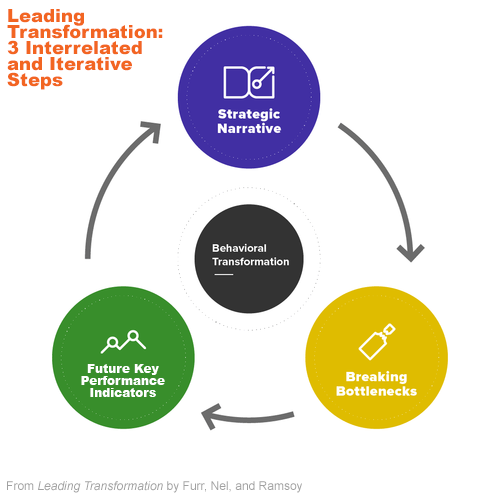
Strategic Narrative
We all know stories engage people, but most companies don’t have a meaningful story or if they do, they don’t use it well. The stories you create must be true narratives through the eyes of one person: a story with a narrative arc, characters a conflict, and a resolution. “Narrative works, in part, because it helps us suspend our disbelief and because it creates emotion, belief, and change.”
When it comes to seeing possibilities, science fiction writers have an edge. They urge us to use science fiction writers to write stories of possible futures in your industry. And then present them in comic book format. “Science fiction can be a tool to break the bonds of incrementalism and to imagine other possibilities. The creative genre can help us dream bigger. They provide examples of how science fiction stories help companies do just that.
(Science Fiction: This 1975 video interview with Gerald O’Neill and Isaac Asimov about a manufactured habitat in space inspired Jeff Bezos’ Blue Origin company.)
Breaking Bottlenecks
Creating the story, finding science fiction writers and graphic artists may be the easy part. “Navigating the rat’s nest of motivations, politics., and routines in any big company may be the hardest part.” Applying tools rooted in behavioral science like decision maps and archetypes can help to break bottlenecks. Archetypes can help you understand how to approach the decision makers in your organization. In one example, the legal team was holding up progress out of a desire to protect the company. In the example, Natalie reframed the proposal in a way that the caretaker archetype could appreciate. She suggested the moving forward would help to protect the company in the long run by keeping it relevant.
Navigating the Unknown
When we are entering new territory we have few markers to guide us. Most of the ongoing metrics we use are design to access past performance and are little help in judging an uncertain future. So it’s important to create key performance indicators to demonstrate that you are heading in the right direction. “Specifically, we start be identifying the end goal, then work backward to define an artifact trail—the series of small, observable activities and prototypes than can act as small wins to keep enthusiasm high.” Approach the project as an experiment.
There is a brief discussion of the need for negative capability. It is being able to press on while not knowing. The term was coined by poet John Keats who said that “The concept of Negative Capability is the ability to contemplate the world without the desire to try and reconcile contradictory aspects or fit it into closed and rational systems.” We need to be comfortable with uncertainty. “To be a visionary—to take leaps—you need to develop this negative capability. Whereas many people cannot stand the fuzziness of uncertainty, leaders of innovation and transformation frequently demonstrate negative capabilities. The negative capabilities facilitate the exploration of new terrain and the discovery of the adjacent possible.”
The most important step in taking charge of your company’s future is to begin. Take action to create the future you desire. “Creating a narrative to set a vision, identifying a small experiment you could run to build confidence, or seeking out uncommon partners for your next project are all rich areas to being this way of working.”
As an author and speaker, I love the power of an unusual, distinctive or inspiring word.
In particular words that are unique to a certain language, a concept that is deeply embedded in a culture, and cannot be simply translated into another language, because there is nothing like it.
Living in a world of relentless chatter, fast and complex, overloaded with content, it’s easy for words to diminish in value. And impact. Therefore finding better words is a great way to say more, to explore something a little more interesting, and memorable.
In the last year or two words like hygge have become popular. It captures the Nordic spirit of cosyness, with a visual image of huge blazing fires in a wooden chalet home, with hot wine to beat the deep snow and Arctic winds whistling around outside. Or in ikigai we explore the Japanese concept of meaning, combining both personal and collective purpose, doing what you love, and being more successful because you find coherence in your passion and actions.
Here are some more distinctive words, and their stories:
- Duende (Spanish) … While originally used to describe a mythical, spirit-like entity that possesses humans and creates the feeling of awe of one’s surroundings in nature, its meaning has transitioned into referring to “the mysterious power that a work of art has to deeply move a person.”
- Saudade(Portuguese) … One of the most beautiful of all words, translatable or not, this word “refers to the feeling of longing for something or someone that you love and which/who is lost.” Fado music, a type of mournful singing, relates to saudade.
- Wabi-Sabi (Japanese) … Much has been written on this concept, but in a sentence, one might be able to understand it as “a way of living that focuses on finding beauty within the imperfections of life and accepting peacefully the natural cycle of growth and decay.”
- Litost (Czech) … Milan Kundera, author of The Unbearable Lightness of Being, remarked that, “As for the meaning of this word, I have looked in vain in other languages for an equivalent, though I find it difficult to imagine how anyone can understand the human soul without it.” The closest definition is a state of agony and torment created by the sudden sight of one’s own misery.
- Toska (Russian) … Vladmir Nabokov describes it best: “No single word in English renders all the shades of toska. At its deepest and most painful, it is a sensation of great spiritual anguish, often without any specific cause. At less morbid levels it is a dull ache of the soul, a longing with nothing to long for, a sick pining, a vague restlessness, mental throes, yearning. In particular cases it may be the desire for somebody or something specific, nostalgia, love-sickness. At the lowest level it grades into ennui, boredom.”
- Mamihlapinatapei (Yagan, the indigenous language of Tierra del Fuego) … “The wordless, yet meaningful look shared by two people who both desire to initiate something but are both reluctant to start.”
We could go on … Do you have a friend who’s a bit of an extrawurst (someone who slows things down by being fussy)? Perhaps you suffer from tsundoku (leaving a book unread) because of your neighbour’s tingo (gradually stealing possessions and not returning them). Even though we English-speaking millennials call it something along the lines of, “What am I doing with my life?!” we certainly all know what it’s like to feel torschlusspanik (the fear of diminishing opportunities as one ages).
Here are 50 great words brought together from around the world:

I spend my working life travelling … as a keynote speaker I travel the world, to the most interesting – sometimes incredibly glamorous and occasionally quite dangerous – places. Usually it’s for a one hour keynote, so my time to see the location is quite limited, although I always pack my running shoes for a quick 10km before breakfast each morning. But mostly I see airports, aeroplanes, taxis, hotel rooms, backstages, and a brief glimpse of a thousand smiling faces as I deliver my keynote.
The life of a business traveller.
So today I’m in Berlin … I need to check, as the last 10 days have taken me from London (home) to Riyadh (healthcare) to Dubai (women) to Munich (publishing) to Moscow (railways) to London (technology) to here. I’m in Berlin for GBTA’s annual gathering of thousands of business travel managers – the agencies who organise it, and people in companies who buy it. Having started my business life in travel, in corporate sales (and then in marketing and brands) for British Airways, I understand this world pretty well.
I also think it needs to change.
You can watch my keynote here:
You can download my keynote here: Travel Gamechangers with GBTA
For the traveller. I’m sure that there could be fabulous innovations to the health and well-being, the effectiveness and productivity, of a business traveller. For the company, it enables more decentralised structures, more collaborative ecosystems, and access to new markets.
In a world where global organisations are the norm, where technology can connect us in realtime, and the speed of everything is exponentially accelerating. But business travel, and its management, doesn’t seem to have changed much. So my keynote says that the rest of the world has innovated in the most fantastic, now GBTA members, its your turn.
But just to capture some of the anxieties, the frustrations, but also the opportunities and innovations of the business travel world … here are a few of my favourite videos, some a little off-beat and fun, but others thought-provoking and innovative:
https://www.youtube.com/watch?v=QdShxgj6MSc
https://www.youtube.com/watch?v=NVUwPHYZxqo
https://www.youtube.com/watch?v=4gYy1tfkD6s
Be the Gamechanger
We live in an incredible time. More change in the next 10 years than in the last 250 years.
New technologies are transforming the ways in which we live and work. Technologies enable incredible change. It is how we unlock their potential that matters.
The most innovative businesses see the world differently.
They don’t just seek to imitate the success of others, to compete in the markets of today, to frame themselves by their relative differences to competitors. Instead they play their own game.
I call them “gamechangers”, and have spent the last 24 months running competitions around the world, to find and rank the world’s most innovative companies by sector and geography.
So what’s the “game”? Well, in simple terms, it’s the market.
These companies go beyond innovating their products and services, their customer experienes and business models. They seek to innovate how their markets work.
Think of it like a sports game. How could you change the game? It could be anything from the pitch dimensions to rules of play, the team composition to the measures of success, the role of the referee to the participation of fans. Even the name of the game.
Now look at today’s most disruptive innovators – 23andMe to Airbnb, Brewdog to Buzzfeed, Casper to Coursera – they reframe, reimagine and redefine the market on their terms – who is it for, why people buy, what they pay and get, and how they work.
I’ve met and profiled over 250 “gamechanger” companies on my travels, in almost every sector, and in every part of the world. Corporate giants and start-ups, from Abu Dhabi to Berlin, Colombo to Qingdao.
There is no one way to change the game, but there are definitely some common traits:
- Audacious – Gamechangers are visionary and innovative, but also daring and original; they seek to shape the future to their advantage.
- Purposeful – They seek to make life better, in some relevant and inspiring way; they have a higher motive than just making money.
- Networked – Gamechangers harness the power of networks, digital and physical, both business and customer networks, to exponentially reach further faster.
- Intelligent – They use big data analytics and algorithms, machine learning and AI, to be smart and efficient, personal and predictive.
- Collaborative – Gamechangers work with others, from ecosystems to platforms, social networks and co-creation, to achieve more together.
- Enabling – They focus not on what they do, but what they enable people to do; and thereby redefine their marketspace, find new opportunities and redefine value.
- Commercial – Gamechangers take a longer-term perspective, adopting new business models, and recalibrating the measures of progress and success.
Do you have a future mindset?
Today’s business leaders need a future mindset. That sounds obvious, but isn’t.
Most leaders have a “fixed mindset”. They keep stretching the old models of success. They stay loyal to the model that made them great, seeking to squeeze and tweak it for as long as possible. They seek perfection – to optimise what they currently do – which leads to efficiency and incremental gains.
Instead a “future mindset” is prepared to let go of the past. To explore the future, to experiment with new ways of working and winning. Failure is a way to learn, and innovation becomes the norm. Change is relentless inside, as it is outside. Innovation is their lifeblood. Like Jeff Bezos loves to say “it is always day one”.

With a future mindset, the CEO needs new attributes:
- Sense maker – to interpret a fast and confusing world, to see new patterns and opportunities, what is relevant and not, to shape your own vision.
- Radical optimist – to inspire people with a stretching ambition, positive and distinctive, to be audacious, to see the possibilities when others only see risk.
- Future hacker – they start from the “future back”, with clarity of purpose and intent, encouraging ideas and experiments, leveraging resource and scale.
- Ideas connector – da Vinci said innovation is about making unusual connections; connecting new people, new partners, new capabilities and new ideas.
- Emotionally agile – whilst organisational agility is essential, emotional agility matters even more; to cope with change, to be intuitive in making sense, and making choices.
- Entrepreneur at large – keeping the founders mentality alive, hands-on working with project teams to infuse the mindset, to be the catalyst and coach.
- Having grit – “gamechanger” leaders need to go against the grain, to persist but know when to move on, to have self belief and confidence, guts and resilience.
The future is a better place to start
Start from the “future back”.
Trying to evolve in today’s complex and confused world is unlikely to lead you towards a bright and distinctive future. It will extend your life a little longer, but it will be tough and uninspiring, with diminishing returns.

Instead jump to the future. I tend to start with five years ahead, although it may differ by company. 5 years is long enough to change the world, but close enough to be real. Start by creating a positive, collective and inspiring vision of the future market. What will it be like? What will people want? Why? How? Where? Then consider how to win in this new world.
This is where “moonshot thinking” can be really useful. “Why be 10% better, when you could be 10 times better?” 10 times more profits, more customers, more quality, reduced cost, reduced time. Whatever. By giving yourself a “How could we do it 10x better” challenge you take a new perspective, solve problems in different ways.
Be inspired by ideas from other places.
Explore how ARM or GE, Inditex or Netflix, Glossier or Novo Nordisk have changed their markets. Choose any of my 100+ “gamechanger” companies! How did they do it? How did customers respond? (Remember, they often serve the same customers as you!). You can’t learn much from competitors, but you can learn a lot from relevant parallels.
Copy. Adapt. Paste.
Customer insight also matters. Deep dives and design thinking, exploring the emerging trends and deviant behaviours. This can enhance and validate your ideas, but the problem with most customer insight is that it is filtered by our current world. You need something to disrupt your thinking.
I have a great box of disruptive techniques. Some are really simple – like break then remake the rules, like imagine its free then find a way to make money, like reverse polarities and many more. The point is to disrupt your conventional thinking.
From this, ideas rapidly emerge. You need lots of ideas about the future. But these are fragments of the real answer. The real creativity comes in fusing together into bigger “concepts”. These could be customer solutions, or new ways of working, new revenue streams, or new business models, and new market scenarios.
Once you have a clear and collective ambition for the future, it’s time to work backwards. “If this is how we want to be in 5 years, where do we need to get to in 3 years, and then in 1 year? Therefore what do we need to start doing now?” You develop a “horizon plan” for your business; a strategy roadmap if you like, but developed backwards.
The important thing is that by working backwards, you have jumped out of the morass of today. You’ve avoided the assumptions, limitations, problems and priorities of today’s thinking. You have a more inspiring “gamechanging” future, and have started to map out the steps to get there. Most likely with different priorities in the short-term too.
Of course the steps on this journey might change, but it’s going to be an exciting adventure.
Change the way we think, resolve the conflicts
In today’s busineses, we have created artificial divides in how we think and operate. Digital and physical seem like two different worlds, global and local seem like alternative strategies that cannot combine, many still struggle to align value to customers and shareholders in a mutually reinforcing way, and short and long-termism continues to confuse our priorities.
Our thinking within business, has created separate and apparently conflicting approaches. The opportunity is to make the combination of both approaches world – “fusions” if you like – to be innovative in the way you combine apparent opposites.
Digital and physical are two sides of the same coin.
There is only one world, unless you believe Ray Kurzweil, and it is the real one. It’s human and physical. Digital technologies are incredibly powerful, enabling people to connect, to work, to learn, to play in new ways. From mobile phones to blockchains, 3D printing and augmented reality, digital allows us to do more, do it faster, do things we could never do before. But it’s still about humanity.
Start with people. How can you enable them to achieve more? To live better, to have more fun, to do better for the world. Whatever matters. I work closely with Richard Branson and his Virgin teams. Their mindset is to “start from the outside, and then work in”. Design a better customer experience. Built on your ambition and insight, and then explore how you could deliver it with new and existing capabilities.
Global and local are opportunities for every business.
I love Amazon’s “Treasure Truck” … Most of us have never connected with Amazon beyond the website and the delivery guy. Amazon is huge, global and anonymous. But the Treasure Truck is real. It travels around the country, bringing its pop-up store to local neighbourhoods, fun and games, bargains and demos. For Amazon, it’s a chance to make real connections, listen to people, and to be local.
We can all see a backlash in society against relentless globalisation, huge corporations, and social inequality. We see a lack of trust in brands, and know that authenticity matters. Etsy shows us that even the smallest and most local artisan businesses can also be global. For every business, local and global markets are within reach, however it’s also about combining scale and standardisation, with relevance and individuality.
Ideas and networks should be the core of your business.
Gamechanger businesses need a compelling idea, a core purpose, an inspiring proposition, that can spread fast and contagiously. In a digitally-fuelled world, the most innovative businesses embrace “ideas and networks” to drive exponential impact – like WhatsApp creating $19bn in three years, Airbnb $40bn in 9 years, Alibaba $476bn in 18 years, Amazon $740bn in 23 years.
Think about that concept of “exponential” … The power of networks – be it franchisees, or distributors, or customers and users – lies not in the number of members, but in the connections between them. Networks have a multiplying effect. Exponential. Consider, for example, Rapha, the sportwear brand that brings together people with a passion for cycling, who conveniently meet at their “Cycle Club” stores, and buy their premium gear. A fantastic “ideas and networks” business.
Finally this idea of short-term and long-term being in conflict with each other.
Jeff Bezos never has this problem, nor Elon Musk, nor Richard Branson. They focus on the long-term, recognising it will require some years of investment to get there. They all of course lead privately-owned companies. But every public company has the same ambition to innovate and grow. And so do most of their investors, actually.
The reality is that any company’s stock market performance is based on its future earnings potential, not its past. The better you can engage with equity analysts, journalists and investors themselves to explain why you will deliver a better future worth waiting for, then you get their support. If you don’t engage them in your future vision, plans and innovations, then they will default to looking for short-term evidence. It’s really in our hands, to work together to create a future we want to invest in. And to share the greater risk and rewards.

Time to embrace your future mindset
We live in an incredible time … More change in the next 10 years than in the last 250 years … remember? I know that sounds a little crazy, but think about Hyperloop in 3 years, a tipping point to electric cars in 5 years, Mars missions in 8 years. They are all real, and possible.
Digital platforms connecting buyers and sellers in new ways, blockchain having the potential to transform relationships and trust, 3d printing having the potential to transform value chains to deliver anything personalised and on-demand, AI and robotics giving us the capabilities to be superhuman in our minds and bodies.
These are just some of the fantastic new capabilities that enable us to innovate beyond what we can even imagine today. The future isn’t like the future used to be. We cannot just evolve or extrapolate the past. Today’s future is discontinuous, disruptive, different.
It is imagination that will move us forwards … unlocking the technological possibilities, applying them to real problems and opportunities, to drive innovation and growth in every industry, in every part of our lives.
Imagine a world where you press “print” to get the dress of your dreams, the food of your fantasies, or the spare parts for your car. Instantly, personalised and on demand. Think then what does that mean if we don’t need the huge scale of manufacturing plants, warehousing and transportation. Maybe we will even subscribe to the IP catalogues of brands, rather than buy standard products, in the ways we currently subscribe to Netflix.
Time to embrace your Musk mindset … Unlock your Einstein dreams and Picasso passion … Embrace your Mandela courage and Ghandi spirit. Be more curious, be more intuitive, be more human. Ask more questions. Don’t be afraid to have audacious ideas, to challenge the old models of success, and turn future ambitions into practical profitable reality.
How else did Zespri reinvent the Chinese gooseberry as the kiwi fruit? How else will SpaceX reach Mars by 2025? How else did Netflix came to be, or NuTonomy, or Nespresso, or Nyx?
This is why 23andMe’s Anne Wojicki wont give up in her quest to make DNA analysis available to everyone, and to ultimately find a cure for cancer. And it’s why Jack Ma didn’t give up as he rose from $1000-per year English teacher to technological royalty.
The secret is the future mindset.
To realise that the future is malleable. So we need to grab hold of it, and shape it in our own vision. To our advantage.
This is what “gamechangers” do.
- Article: The 10x Leader
- Article: Amplifying Potential
- Book: “Gamechangers: Are you ready to change the world?“
- Workshop: “Gamechangers Program: Leading for smarter innovation and profitable growth”
- Workshop: “Inspiring Leadership … future, people and change”
- Download a summary of Peter Fisk’s keynote “Gamechangers”
“Upcycling” was a new word to me. Spanish entrepreneur Javier Guyeneche, the founder of a wonderful sustainable fashion brand called EcoAlf, used in almost every sentence. He has a passion for the world around us, and in particular to find ways in which we can avoid environmental destruction, whilst creating something better. And money too.
Upcycling at EcoAlf takes the form of fishing nets and plastic bottles, reclaiming them from the oceans in order to reinvent their polymers as strong but soft fashions from which to create wonderful shoes and clothes. As I have worked around the fashion industry, I found many more examples. Like Agua Bendita, the beautiful swimwear brand from Colombia, made out of the left over scraps of other production. Handmade by a women’s charity, they combine vibrant offcuts into unique pieces. Better, different and better than the typical mass-produced lines of mainstream fashion.
And then it spread further. Eileen Fisher, the premium American womenswear brand, has made Reuse a core to its proposition. Reclaiming old and used clothes, then mending, altering or enhancing them into quirky, unusual but far more interesting pieces. Major fashion brands like H&M are now jumping into upcycling too. Not just because its good for the world, but because it looks good, and is more engaging to consumers too.
The UN recently declared fashion to be the third most polluting industry on the planet, after energy and transport. Think of the huge amounts of forests cleared for forest production, the water and chemicals involved in dying, the energy required to produce and transport around the world. And then our human desire for fast fashion, buy it incredibly cheap, at prices which quest the ability to pay manufacturing employees a human wage, and and then dispose of it within a few weeks.
Of course many of us are trying to buy less and less new stuff. After all, buying new only creates demand for a whole supply chain of destruction, from planting heavily sprayed monoculture crops like cotton to pouring toxic dyes into rivers. Yet there is a conundrum: if we buy less, that’s great for the planet but bad for not only the economy overall, but the millions of people who rely on the manufacturing industries for their livelihoods. So how can we maintain economic growth without being destructive?
There are ways – and buying upcycled fashion is one of them.
Upcycling involves using pre-existing clothing, accessories or other items and restructuring them into new garments. Think of old sweaters being unravelled and the yarn being refashioned into new ones, or scraps of fabric waste from car interiors being used to make handbags. Deadstock, otherwise known as fabric that’s leftover from the fashion industry, can also be used to make new clothing.
The benefits of upcycling are
- Sustainability – Upcycling reduces clothing and textile waste by reusing deadstock or gently used fabric to create new garments and products. Making a single cotton T-shirt requires over 700 gallons of water, whereas using a pre-existing T-shirt to make something new requires nearly no water. In addition, upcycling can divert some of the 85% of textile waste that ends up in landfills.
- A Cheaper Wardrobe – Upcycling can be less expensive since used or pre-existing materials are typically a fraction of the cost of newly-made materials and textiles.
- Uniqueness – Upcycling requires creativity to envision the potential of existing materials to create something new and beautiful.
Don’t think for one minute that upcycled fashion compromises style. Of course there are some ‘crafty’ looking brands out there, but here are 7 great fashion brands that have truly embraced the approach to be distinctive and better:
1. Elvis & Kresse
Decommissioned fire hoses, boat sails, Air Traffic Control flight strips, coffee sacks, cardboard and parachutes are all refashioned into bags, belts and accessories by this innovative brand that hails from Dorset, England.
Beyond being eco-friendly by upcycling old materials into new sturdy and quirky accessories, Elvis & Kresse are also socially responsible: a whopping 50% of profits from the Elvis & Kresse fire hose line go to the Fire Fighters Charity, which is a non-profit organization that aims to enhance the quality of life for former firefighters–many of whom suffer physical injuries while on duty. Elvis & Kresse also employs workers from Poole’s Remploy factory, an organization that helps people with disabilities find work. Sweet!



2. Reformation
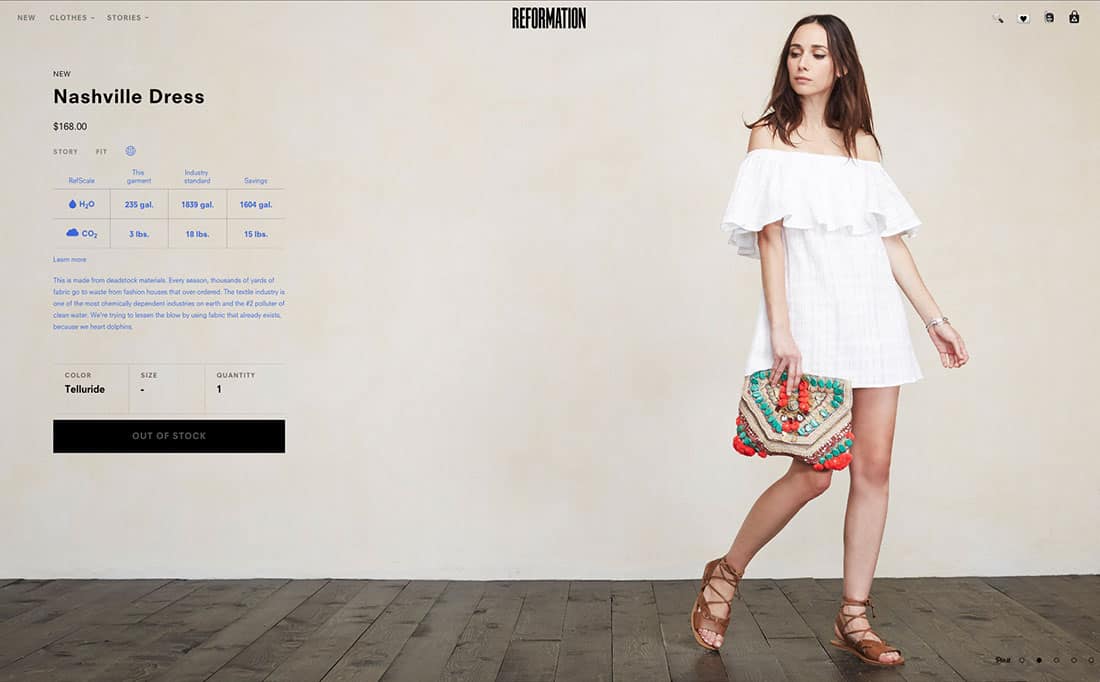
This hip L.A.-based fashion company repurposes vintage clothing, rescues deadstock fabric from fashion houses that over-ordered and also simply uses eco-friendly fabrics to create sexy, sophisticated styles – they even make wedding dresses. The brand has recently launched an app that lets you know just how much water and energy you’ll be saving by buying their goods – making your glam purchase a feel-good one, too. And it gets even better: Reformation is sustainable in their own business operations, too – whether using recycled paper to non-toxic cleaning supplies to energy-efficient lighting, there can be little doubt that Reformation is committed to sustainability from top to bottom.


3. TRMTAB
A lot of people aren’t sure if leather is eco-friendly, but any brand that uses leather scraps from factories around the globe is ok in our books. Founded by friends Mansi and Cassandra who named their label after their favorite systems theorist, Buckminster Fuller (who once said, “Call me trimtab”, in case you’re wondering) TRMTAB aims to reduce the amount of leather scraps that typically find their way into landfill by cleverly using these scraps to create beautifully woven bags and electronics cases. We’d like to see them become the new Bottega Veneta!



3. ASOS Reclaimed Vintage
Ok, so ASOS may not be a full-on ‘luxury’ brand, but we have our reasons for putting them here. Forget about Raf Simons or Marc Jacobs – the true design stars are those at the high street stores! Their clothing is worn by far more people, and is far more popular. Using Levi’s denim, pre-loved leather and vintage fabrics that may or may not come from fashion houses like Dior, Lanvin or Chloe, Reclaimed Vintage reworks and upcycles the old into new limited-edition collections. Upgrade your boho swag with its uniquely printed co-ords, festival-ready cover-ups and cool military details.



4. Triarchy Atelier
It’s a fact that jeans use the most water consumption of anything in your wardrobe. And given that there are potable water shortages increasing around the globe, it’s pretty hard to justify wearing denim. Unless it’s upcycled, that is.
Triarchy Atelier is a fashion line owned by two brothers and a sister who create new denim designs made from vintage stock sourced from their base in Los Angeles. Since the launch of the brand, over 1,000,000 gallons of water have been saved by their upcycled denim productions.
But not only is Triarchy Atelier eco-friendly; they’re also ethical, since they focus on giving back through through their charity partner, Isla Urbana, an NGO that provides people in Mexico who lack fresh drinking water with rainwater catchment systems.


5. Bottletop Fashion
It seems a shame that those aluminium ring pulls on drink cans get thrown into the bin. Especially when they can be upcycled into glamorous clothing and accessories like those made by Bottletop Fashion! The ethical fashion brand is based in the UK, Africa and Brazil, where it helps to create a sustainable livelihood for the highly skilled craftsmen as well as supporting young people through their foundation, which is focused on educational projects. The label created by Cameron Saul son of the founder of Mulberry (Roger Saul) which explains why these beautiful bags are aimed at the luxury/ designer market.



6. Charlotte Bialas
Every single item in this Paris based designer’s collections are made from vintage textilesdating back to the 50’s. All her fabrics have been handpicked for their exceptional quality, print technique and origin, ensuring that each piece is a numbered limited edition or unique. It’s not easy to find these: such textiles are rare and need to be expertly sourced from antique fairs, auctions, vintage stock and mills from around the globe, but Bialas talent for hunting these down and creating chic, feminine fashion from them, have made her a favourite sustainable designer with fashionistas from Japan to New Jersey.



7. Boom Shankar
Australian based free spirit Dui Cameron was travelling through Asia and India when she was struck by a great idea. After admiring the elaborate colour, movement and style of women in the places she visited, she wanted to capture a bit of that elegance, and sought to do that by sourcing second-hand wedding saris and transforming them into unique garments. And that’s how Boom Shankar was born.
Today, the brand still uses Indian sourced fabrics, but its ethical production and sales are focused on Australia’s sunshine coast. Boom Shankar creates everything from casual trousers and blouses to Boho dresses and pajamas, whose patterns clash thanks wonderfully, thanks to a meshing of upcycled fabrics.


8. Will and Pop
Streetwear doesn’t get much cooler than Will and Pop! The brand creatively recreates casual wear by up-cycling pre-loved clothing. The team selects from responsible suppliers to create limited editions and one-of-a-kind bespoke pieces in their design studio in London.
Individuality is fundamental to the brand, with no more than twenty five pieces forming their limited edition collections. The brand also provides personal customisation services, allowing customers to discover their individual style and create unique pieces for any occasion.


All images courtesy of the brands
Today I had the privilege to work with one of the Middle East’s really great business leaders, Osman Sultan. The CEO of mobile phone brand Du, he joined me to talk at the WIL Economic Forum in Dubai, organised by Naseba.
As the founding CEO of Emirates Integrated Telecommunications Company (du) since 2005 in the UAE, and the founding CEO of Egyptian Company for Mobile Services (Mobinil) in Egypt from 1998 to 2005, Osman Sultan set during the course of his career several strategies translating the profound transformations that the telecom and information sectors have been creating in our lives.
As an influential figure and a mentor in the telecommunications sector, he is proud to have groomed close to 20 talented individuals who became CEOs of various operations across all continents.
Sultan has been ranked as one of the most powerful executives in the telecoms industry in the world twice on “GTBPower100 List” in both 2010 and 2011.
He brings 35 years of leadership, rich with achievements in the telecom business. His vast knowledge and expertise in the field as early as the pre-internet period, placed him as one of the pioneers in France, Europe, the USA, Japan and the entire MENA region.
As an industry veteran, he witnessed the birth of the “Minitel” ecosystem in France since late 1983; a stage that a lot consider the precursor and the incubator of the internet universe. This is when he had the certainty that connectivity will disrupt profoundly the lives of individuals and corporations allowing much more than the traditional status of talking or sending/ receiving messages.
The impact of mobility saw a paradigm shift in his journey when he launched “a mobile in the hand of everyone” slogan in 1998 in Egypt, as the founding CEO of Egypt’s first mobile operator “MobiNil;” a subsidiary of France Telecom/Orange.
In 2006, Osman Sultan established, as founding CEO, the UAE’s second integrated telecom operator EITC, operating the very innovative brand “du,” where he was driven by his profound belief that “being connected” was becoming a “basic human right.”
Since then, Emirates Integrated Telecommunications Company has grown beyond connectivity offering all fronts of the digital transformations, end to end ICT solutions for enterprises, comprehensive platforms for smart cities (as a strategic partner for Smart Dubai Office) to realize Dubai’s ambition to be the smartest and happiest city in the world. The most recent endeavor was EITC’s launch of the Virgin Mobile in the UAE, as the fully digital B brand. In addition, EITC offers services catered for consumers embracing various aspects of their digital lifestyle of today.
Sultan was, along his career and still is, a board member of various institutions in the telecom industry, technology space, and academic world. This includes board memberships of Tunisie Telecom, Malta Telecom (currently GO) in Malta, the National Telecommunications Institute (NTI) in Egypt, The Supreme Committee for Corporate Governance in the Egyptian Stock Exchange (back in 2000), the advisory board of the Mohammed bin Rashid School of
Communications (MBRSC), the Global Blockchain advisory Council of the WEF, The Board of Endeavor UAE and many others.
All industries are currently going through a profound transformation, one that is enabled by the acceleration of capabilities offered by technology. The astonishing disruption induced by social networks and is driven by the quest of finding economically viable ecosystems.
He is currently focusing on establishing the right platforms to allow the emergence of the new conversations needed for these ecosystems tackling the intersections between the technological, economical and societal dimensions to make way for a more technologically efficient and humanly rewarding future in the midst of all these rapid changes.
Heis a father of five children. He doesn’t believe that our current world and social interactions allow boundaries between personal and professional lives. He is fond of Cinema, Arabic literature and poetry, and a passionate reader of the architecture of the new ecosystems in the brave new world of today.
This year’s Future Book Forum, now in its 6th year and hosted by Canon at their Experience Centre near Munich in Germany, brought together over 400 international publishers, book printers, book distributors and industry influencers to explore the topic of intelligent growth and how to accelerate growth in their businesses in a digital world.
Dan Kearon, co-founder of Unbound said “I think it’s incredibly important that you have something like The Future Book Forum where people can be honest. It’s the honestly that’s always missing. Everybody is terrified of the future, but publishers need to accept the feeling of discomfort, because that is how you change.”
Bringing together the book publishing community, the event focused on the industry’s potential to leverage data to transform the future of publishing and open up new revenue streams.
I hosted the event over two packed and inspiring days of presentations and workshops, where attendees discussed the power of data, the value in building direct relationships with readers and why establishing a community is a publisher’s most important asset. They also explored how to sustain a continuous omni-channel experience, using industry examples to show how businesses have used data to enhance content to drive growth. A key discussion point was how book producers can implement a print-on-demand business model using the latest digital print solutions, to optimise stock management and streamline automated workflows for further production efficiencies.
The Future Book Forum is an exciting collaborative event that drives innovation across the whole publishing industry. Creating new relationships between businesses in our community helps to deliver better omni-channel content experiences for consumers. When publishers work together in new ways, our partnerships become just as powerful as our innovations.
Intelligent growth in publishing relies on us looking more holistically at individuals, not just as readers, but as consumers. It’s about putting the customer first and creating valuable consumer experiences that enhance the value of the physical book. Big data and artificial intelligence can help to deliver better digitally-enabled content experiences. What we’ve learnt from this year’s Future Book Forum is that now is the time to take the leap and access the new opportunities that arise from using insight and data. It’s not how you collect the data that leads to success but how you intelligently use it.
https://www.youtube.com/watch?v=Qm9lfIqpyyM
The event featured a host of prominent influencers from the publishing, marketing and technology industries discussing the power of data and community in driving the publishing industry forward, including:
- Peter Fisk, Professor of Strategy and Innovation, IE Business School
- Nick Morris, Founding Partner, Canvas8
- Mark Allin, former CEO, John Wiley
- Rainer Kellerhals, Industry Lead Media & Cable EMEA, Microsoft
- Tom Betts, Chief Data Officer, Financial Times
- Sven Fund, Founder & Managing Director, Fullstop
- Dan Kieran, CEO, Unbound
- Marie Chassot, Head of Baume, Baume & Mercier
- Leanne McNulty, Corporate and Trusts Associate, Room to Read
Nick Morris, Founding Partner at Canvas8, explored how publishers can use consumer insights and behaviours to their advantage. He explained, “Today’s publishers do not face competition with other publishers – the competition is for people’s time. A recent survey among publishers showed that product and data were their top priorities. Understanding audiences is the master key to unlocking their potential. Publishers need to do more to deliver considered products and reader experiences, but they will only be able to do so by first understanding their audience through consumer insights. Get this right and you’ve got an opportunity for intelligent growth, but get it wrong, and you could end up damaging your brand.”
Mark Allin, former CEO of global publishing company John Wiley, discussed why publishers need to be more radical with their strategies and business models, saying, “Publishers need to have the confidence to try new ideas and get rid of old ways of working. But this requires a cultural change within the industry and dedicated resources to successfully innovate. Publishers must use the tools and technology available to them to get closer to their reader community to foster innovation and drive growth. Niche communities drive content, but building a strong network is just as important as providing relevant content.”
Tom Betts, Chief Data Officer at the Financial Times, used the example of the Financial Times to show how a data-driven approach can turn customer insight into profitable growth, saying: “Data should play a central role in any business strategy. There’s lots of data to be gathered on consumers outside of their reading interests and it’s not only about how it’s gathered, but how it is used. Data can help publishers develop a deep understanding of their customers – to make recommendations or predict consumers’ next steps and to better understand their future content journey so as to be able to create a more tailored, richer and more valuable experience. No publisher should be without a data capability – it’s the extent to which you use it that will determine how successful you are.”
Sven Fund, Founder & Managing Director of Fullstop and the popular keynote speaker at the 2017 event, returned to discuss the need for systematic innovation management in established publishing houses. Fund explained, “Some areas of publishing are becoming more data driven. For example, analytics and algorithms can now be used to examine reader behaviour, such as when and how quickly a book was read, and evaluate whether it will be a bestseller. As a result, one of the trends we are noticing is how the reader is being rediscovered as a partner in the publishing process. Authors can now use data to craft their content based on understanding consumer behaviours. For publishers, it’s not about producing more titles, it’s about targeting readers in a more precise way.”
Peter Wolff, Senior Director, Customer Group Commercial Print and Production CRD, Canon Europe comments: “Future Book Forum provides an opportunity for the whole publishing community to come together, sharing their experiences on how the market is changing, inspiring other delegates with real-world examples, and demonstrating how to embrace change with digital technologies. Over the past six years, participation has grown year on year, proving that the event has become an effective platform for exploring innovations and how these drive new business opportunities. As in other business sectors, leveraging customer data will help publishers to turn a new page, driving customer-orientated innovation that will stimulate commercial growth.”