Do you know the best way to drive your company’s growth?
If not, it’s time to boost your Growth IQ.
That’s the message of a new book by Salesforce’s Tiffany Bova.
Seth Godin calls her “a worthy successor to Michael Porter” whilst Nancy Duarte (author of that great book Illuminate) said “I have not had a book impact me like this one since Collins’ Good to Great.” Praise indeed.
Trying to find the one right move that will improve your business’s performance can feel overwhelming.
But, as Bova describes in Growth IQ, there are just ten simple, but easily misunderstood, paths to growth, and every successful growth strategy can be boiled down to picking the right combination and sequence of these paths for your current context.
Customer Experience: Inspire additional purchases and advocacy
Customer Base Penetration:Sell more existing products to existing customers
Market Acceleration:Expand into new markets with existing products
Product Expansion:Sell new products to existing markets
Customer and Product Diversification: Sell new products to new customers
Optimize Sales:Streamline sales efforts to increase productivity
Churn (Minimize Defection):Retain more customers
Partnerships:Leverage third-party alliances, channels, and ecosystems (Sales, Go-to-Market)
Co-opetition:Cooperate with market or industry competitor (Product Development, IP Sharing)
Unconventional Strategies: Disrupt current thinking
But it isn’t enough to have the right new growth strategy. Companies must fully understand what the current market context is prior to making any moves. Otherwise, even the right decision, or the right growth path can backfire – putting you in the wrong place at the wrong time.
Choosing the right growth path should always start with understanding the circumstances or events that form the environment within which your company competes. You have to understand the threat or opportunity the context brings, along with the combination and sequence necessary to support the chosen growth paths.
Context includes current social and economic conditions, the existing product portfolio, the competitive landscape, and corporate culture. Combination is the act of selecting key actions that can positively impact outcomes, when done together, and sequence is the act of establishing a priority, order, and timing to these actions.
Creating a multiplier effect is far more powerful than just focusing on one or two efforts in isolation.
So how do companies measure growth?
Company health – measure orders, shipments, returns, product repairs, market share, employee turnover, profit margins, cost of goods sold, salaries, etc.
Measure the metrics specific to the growth paths you have chosen to execute
The second means each path has its own metrics. Here’s a quick rundown:
Customer Experience: Net Promoter Score (NPS)
Customer Base Penetration:RFM (recency, frequency, monetary)
Market Acceleration:New logos acquired
Product Expansion: New product usage, mix against current portfolio
Customer and Product Diversification: Adoption rates in new customer/categories pursued
Optimize Sales:Quota attainment
Churn (Minimize Defection):Churn rate and customer defection rates
Partnerships:Joint sales/revenues
Co-opetition:New joint product development and market launches
Unconventional Strategies: volunteer hours of employees
Bova also uses thirty fascinating, in-depth business stories to demonstrate the opportunities and pitfalls of each of the ten growth paths, how they work together, and how they apply to business today. You’ll see how, for instance:
* Red Bull broke Coca-Cola and PepsiCo’s stranglehold on the soft drink market by taking the Customer Base Penetration path to establish a foothold with adventure sports junkies and expand into the mainstream.
* Marvel transformed itself from a struggling comic book publisher into a global entertainment behemoth by using a Customer and Product Diversification strategy and shifting their focus from comic books to comic book characters in movies.
* Starbucks suffered a brand crisis when they overwhelmed their customers with a Product Expansion strategy, and brought back CEO Howard Schultz to course-correct by returning to the Customer Experience path.
One final thought she leaves us with.
The best leaders know that growth needs to be countercyclical. That is, the best time to create the next big opportunity is when things are going well, not when you are struggling. So many companies have failed because they worked on yesterday’s context for tomorrow’s business. Also: the most important resource you have when embarking on growth is preparing your people. The most successful companies in the world regularly change direction and do it with such confidence and coordination that it looks effortless. We know it is anything but.
Innovation was and is one of the main drivers of the sustainable success of Daimler. Established in 2007, Lab1886 is supporting the company with innovative models to master the challenges of the future.
Innovation is the venture of turning the visions on their heads, questioning existing principles and knocking them down if needed. This requires courage, perseverance and a place to tinker – a garage, for example. When Gottlieb Daimler left Gasmotorenfabrik Deutz, nobody had any idea that he would reinvent mobility in a garage in 1886.
Lab1886 continues the tradition of this culture of innovation. It is the nucleus of a global innovation ecosystem where new business models are conceived, tested and made fit for the market. The incubator works along the four basic pillars of the corporate strategy CASE, at whose center is the mobility of the future. We define it based on four focal topics: Connected, Autonomous, Shared & Service and Electric Drive. Many of the business models that are firmly rooted in the company today were created here – for example, car2go, moovel or Mercedes me. It is therefore no wonder that Lab1886 is in first place among the leading innovation labs in Germany.
The lab has locations in Stuttgart, Germany; Berlin; Beijing; Sunnyvale, Calif., and Atlanta, Georgia. Atlanta is the newest of the bunch, having opened earlier this year.
The goal of Daimler’s corporate incubator is to move faster from an idea to a product or business model. Lab1886 thus supports Daimler AG in transforming itself from an automobile manufacturer into a mobility provider by exploring new fields outside the core business – focusing on the digital sphere.
To symbolize this new approach, Lab1886 has reinvented the four-pointed star – an emblem patented by Gottlieb Daimler’s two sons in 1909, when the fourth spike was interpreted as “space”. About 100 years later Lab1886 proudly present its new logo. With narrower prongs, the star has been rotated and now looks like an X, symbolizing the secret, the next level or unknown future – to signify the upcoming changes.
Ideate, incubate, commercialise
Susanne Hahn, Director of Lab1886 Global at Daimler AG says Lab1886’s innovation approach comprises three phases: Ideation, incubation, and commercialization.
“Lab1886 is an integrated company built with an end‑to‑end innovation process and hub,” says Hahn. “We ideate, incubate, and commercialize all the new business.”
The ideation process happens in a number of different ways, but it always starts by considering trends in the industry.
“Today, we are facing a lot of mega-trends like digitalization and globalization, to name but a few,” says Hahn. “All these technological and social regulatory movements will change the automotive industry in the next 10 years significantly, either if it’s…electrification or autonomous driving cars. We already have, within the Lab1886, a bunch of products and growth checks in place to find solutions in this challenging time to just get prepared for the future to come.”
Employees can submit ideas based on these trends and challenges to the company’s internal crowdsourcing platform. They are then vetted on the platform by fellow employees, with the best ideas and suggestions being forwarded to the company’s “shark tank” panel of experts. If an idea is selected by the panel, it is sent on to the incubation phase.
“When one of our nearly 290,000 employees has got a great idea, which finally made it through a really tough selection process, the finalists are relieved from their normal line function, and are able to work 100 percent focused, with all the help they need and a perfect fitting team,” says Hahn.
This “tough selection process” in the incubation phase puts ideas and the teams behind them through various feasibility and scalability tests. During this phase, the teams are also given coaching, co-working space, and funding to develop prototypes and pilots.
The final phase is commercialization, where ideas that have made it through the incubation phase are either transferred into the appropriate line of business or spun off into their own companies. Hahn says that the original ideator also has the potential to become the CEO of the new company.
“For those who don’t make it to the CEO [role], it is just a great learning as they [now have] a full‑packed backpack of entrepreneurial spirit, and act like, hopefully, an ambassador in their line function to also bring that pioneering spirit into the corporate world,” says Hahn.
Incentives
Hahn says that although they do offer cash bonuses for individuals and teams that make it through the incubation phase (tied to various KPI’s and measurements), money is not the main motivator.
“Just to work with 100 percent focus, with all the support they need within our lab, not getting disrupted or distracted by the cost‑efficient programs, or political issues, which you normally have in a corporate environment,” says Hahn. “You just can work with 100 percent focus on your idea. That should motivate the right people.”
https://www.youtube.com/watch?v=FkI1d-zcFv0
Metrics
One of the campaigns Lab1886 ran on their internal crowdsourcing platform was called the “100 Million Challenge.” Hahn says the name aimed to give a glimpse into the the size of idea they were looking for.
“It could be a hundred million in revenue, a hundred million new customers, a hundred million clicks… just to give them a hint to think beyond several borders,” says Hahn.
The challenge targeted 160,000 employees and attracted more than 900 ideas from individuals and teams across the organization. After allowing employees to vote for their favorite ideas on the platform, three employee-chosen projects were moved into the incubation phase, along with three others selected by Hahn’s team. She said that there are currently 30 projects running in parallel in the lab.
How does her team measure the success of these projects? Hahn says they have a list of more than 77 measures that fall into four categories:
“This first one is to show the economic potential, the business case, market economics, funding requirements…” such as “When should [venture] capitalists also assess the projects?” and “Is it valuable?”
“The second is, is it really feasible? Is there a draft of product? Do we have a road map? Are there potential prototypes to come up with in a few months?”
“The third thing is, is it desirable? This reflects our customer’s needs. For example, the value proposition, customer friction, and also the question, ‘Why should we enter this new market segment?’ In this part, we check the competition side. Is there a startup that is much further in the process, and maybe [working with them] is better than building it on our own?”
“The fourth part is the right to play. This reflects strategic questions. For example, ‘Is the idea somehow linked to the strategic agenda [and] timeline? Does it really fit into our environment? Does the concept, for example, allow us to tap into desirable customer segments or markets and so on?’”
Using these measurements, Lab1886 is able to determine whether an idea is best integrated into a business unit, spun out as its own company, or if a partnership or joint ventures is the ideal route.
For example, one company that has spun out of Lab1886 is Car2Go, a peer-to-peer car sharing platform. The platform became its own legal entity in 2008, and now has more than 2.5 million customers. Another project, a travel optimization app called Moovel, was also spun hatched at Lab1886 and spun out.
One external partnership Hahn mentioned was with the German startup Volocopter, which is helping Lab1886 explore the world of urban air taxis and vertical takeoff vehicles.
“This is a completely new market segment and, of course, we do not have that technology within Daimler,” says Hahn. “The partners, the team, and also the technical points convinced us to go in much closer collaboration together with [Volocopter].”
In terms of projects that are integrated back into the business, Hahn mentioned an idea regarding the way auto parts are reconditioned and resold, which is environmentally and economically beneficial for the organization. This idea was integrated into the global sales business, and Hahn says it’s been profitable.
Atlanta
With the newest addition to the Lab1886 network, Hahn said Atlanta was a natural choice.
“Atlanta is one of the major hubs,” says Hahn. “It’s just a perfect location for us to connect to different regions, persons, and trends.” It’s also the location of Mercedes-Benz’s USA headquarters.
“The city is packed with talent,” says Hahn. “It’s absolutely a rising star for tech talent. …It has a thriving startup culture… Over 230 new companies were produced alone out of the pipeline of Georgia Tech, for example. That’s very impressive. It’s rising. It’s growing. On the other hand, it’s also very international and [a] corporate‑friendly environment.”
With organizations like Coca-Cola, Delta Airlines, Home Depot, and others located in Atlanta, Lab1886 is in good company.
“The pioneering spirits of the startup world and the established resources [and] infrastructure of the corporate side makes it really so perfect. It reflects, also, our motto at Lab1886 that we want to utilize and develop the best of both worlds,” says Hahn.
Hahn also described how the different labs across the globe interact and share insights. She said it’s useful to have these labs in different markets, as each location can move forward with locally-relevant projects.
“We globally bounce ideas [around], and exchange knowledge and learnings,” says Hahn. “We also do people development. Our motto is to act like a family in giving a helping hand. When tech talent is needed, for example, in Atlanta, we can maybe help with tech talent which we send over from Berlin, or the other way around. This creates a highly-effective innovation network.” But in addition to attracting new talent and creating connectivity between the labs, Hahn says that it’s important to stay“really strongly focused on results.”
The Corporate Innovation Ecosystem … understanding the components, processes, activities and tensions which make innovation thrive in large companies
Customers love personalisation.
Brands that excel at personalisation deliver five to eight times the marketing ROI and boost their sales by more than 10% over companies that don’t personalise, according to McKinsey. 73% of consumers prefer to do business with brands that take their personal preferences into account.
Yet personalisation can seem a complex and costly initiative to implement. AI is changing all that. It’s never been easier to understand consumers and create personalise their experiences.
Levi’s … using AI to create the Virtual Stylist
Finding the perfect pair of jeans can be a frustrating experience, but Levi’s recently introduced an AI-enabled chatbot to help find the perfect fit. Virtual Stylist uses natural language processing to find out what each customer is looking for in a pair of jeans. The bot learns about each customer’s lifestyle and fit preferences. That information is combined with actual training that human stylists receive to provide accurate recommendations. After the chatbot recommends a pair of jeans, customers can share it with friends to get their opinions.
https://www.youtube.com/watch?v=Pq55s3q0z_c
Hilton … using AI robots to greet hotel guests
Hilton Hotels uses a robot concierge named Connie to make guests’ experiences as personal and enjoyable as possible. The two-foot-tall robot stands in the lobby to greet guests and answer questions. With its natural language processing ability, Connie can learn about guests and provide personalized recommendations of places to visit and restaurants to try. The robot can also point guests in the right direction for various hotel amenities to meet their needs.
Rare Carat … using AI to sell jewellery
Customers looking to buy a diamond can now turn to Rocky, the world’s first AI-powered jeweller. Diamond website Rare Carat uses AI to compare prices of diamonds across numerous retailers to find the best deal for each customer. Rocky walks customers through the entire process to provide a similar online experience to what customers would get in a brick-and-mortar jewellery store. The AI algorithm takes many diamond factors into account and shows customers the trade off for different factors, such as sacrificing clarity for a lower price. With Rocky, customers can feel confident they’re getting the right diamond for their needs at the best price.
Thread … using AI To tailor fashion
Most customers would love a personal stylist, especially one that comes at no charge. But staffing enough stylists for 650,000 customers would be expensive. Instead, UK-based fashion company Thread uses AI to provide personalized clothing recommendations for each customer. Customers take style quizzes to provide data about their personal style. Each week, customers receive personalized recommendations that they can vote up or down. Thread’s AI algorithm uses that data to find patterns in what each customer likes and tailor its recommendations. The more data the company receives from a customer, the better the recommendations.
Under Armour … using AI to personalise fitness plans
Under Armour is about more than clothes—it’s about helping customers be active and healthy. Its Record app uses AI to collect health information on physical activity, sleep, and diet to make personalized recommendations on workouts and health goals. The app also serves as a personal trainer and can analyze workouts to make sure they are as effective as possible. Under Armour’s use of AI helps customers get the personalized health recommendations they crave.
Sesame Street … using AI to personalise kids learning
Personalization can also extend to kids. Most parents have felt the overwhelming feeling of wanting to teach their young children but not knowing where to start. Sesame Street created the first AI-powered vocabulary learning app, which starts by observing a child’s vocabulary and reading level. It uses that data to recommend personalized learning exercises. As the child progresses, the app updates its recommendations to keep up with their pace. Schools that have adopted the technology report that their students saw large jumps in their vocabulary and reading ability.
Over the past few generations, Western ideas about family have shifted dramatically. People wait longer to have kids and many “boomerang” back to their parents’ homes before finally setting out on their own. When they do finally leave, they often scatter far away from their hometowns. The elderly, meanwhile, are sent off into old age homes instead of staying at home with their communities.
As more people move into cities, natural resources decline, climate change heats up, and the sharing economy continues to pick up steam, our notions of family will continue to shift. Dragon Rouge, a design and innovation firm in London, has come up with a vision of what family will look like in 2030, and how brands can respond to these future changes.
Dragon Rouge imagines five different types of families of the future: the Multi-Gens, the Silver Linings, Ruralites, the Tandem Tribe, and Modular Movers. They also work out how different brands might service each family type:
https://www.youtube.com/watch?v=z0IC1n1N48Y
Dragon Rouge has most recently been working with Travis Perkins to understand the social, technological, environmental and economic forces that will shape the built environment in the UK over the coming decades.
They identified six long-term themes – from the rise of the circular economy to the advent of the intelligent environment – that we are now using as the basis of long-term innovation planning across the Group’s brand portfolio, from Wickes to City Plumbing, including new business model and proposition development.
They’ve turned the most exciting of these ideas into a video that Travis Perkins is sharing both internally and externally to excite people about the future of their business – a vision means nothing unless it sets an inspiring direction and results in tangible change.
The nonalcoholic beer, going for $7.95 per 10-ounce bottle, will deliver 5 milligrams of THC to the drinker’s system, about half the amount of many standard edible servings. The aim is to provide a high that is pleasant, relaxing and mellow enough to be enjoyed socially as well as recreationally.
“You should feel good but you won’t get too stoned,” Ceria co-founder and brewmaster Keith Villa said. “What better way to enjoy a Broncos game, especially when they’re losing, than to have a couple of these and feel good?”
Villa is known for making a different Belgian white ale. He created Blue Moon, which put him on the brewing map in 1995. The brewmaster retired from Molson Coors earlier this year, and a short time later he and his wife, Jodi Villa, founded Ceria in their hometown of Arvada.
“We want to remove the stigma around cannabis,” Villa said. “There are still a lot of people who won’t go into a dispensary. This breaks down stigma. We truly believe it will change the industry.”
Grainwave is brewed as a normal beer, and then the alcohol is removed. That’s why its label calls it “de-alcoholized cannabis beer.” Villa formulated his beer with help from Evergreen-based hemp research firm ebbu. The folks at ebbu helped Ceria connect with Keef Brands, makers of Keef Cola, Bubba Kush Root Beer and other infused sodas.
Its products have been available on dispensary shelves since before legalized sales began in 2014. Keef is providing the cannabis extract that spikes Villa’s beer, as well as bottling and distributing the product.
Ceria’s profile as something to be shared in a social setting appealed to Keef CEO Erik Knutson.
“Where you’re looking for a social experience, you don’t sit down and break up a brownie into 20 pieces,” Knutson said. “It’s definitely a cool alternative for people who are maybe at a point in their life where they don’t want to drink alcohol anymore.”
The Green Solution prides itself on carrying new and unique products, said Casey Efting, the chain’s retail manager for Colorado. He files Ceria under “revolutionary.”
Colorado has long been home to a vibrant brewing culture, as Villa can attest. And it was the first state to allow recreational marijuana sales. It seems only natural the two should meet. But federal law prohibits infusing alcoholic products with THC, leaving two options: Infuse beer with another nonpsychoactive component of cannabis, or make a nonalcoholic beer.
“This is something that even we have looked at in the past. How do we crack that code? How do we bring something to market that doesn’t have alcohol in it?” Efting said. “I think it’s going to be very popular.”
Ceria has two other beers on deck: an American light lager and an India Pale Ale. The lager will pack less of a THC punch, 2.5 milligrams per bottle. The IPA will be more potent, with 10 milligrams in each.
On the opposite side of the metro, in Aurora, there is a brewery making an infused beer on the other end of the spectrum.
Dad and Dude’s Breweria this summer relaunched its cannabidiol, or CBD, infused beer. CBD, lauded in holistic circles for its relaxing and anti-inflammatory effects, is available in a variety of products these days, but when Dad and Dude’s started selling beer made with it in 2017 the feds cracked down.
This July, the Breweria started up again, calling the beer George Washington’s Secret Stash in honor of the first U.S. president’s practice of growing hemp. It was a gamble, company president and co-founder Mason Hembree admits, but no federal agencies have come knocking. And with a farm bill that legalizes hemp awaiting President Donald Trump’s signature, he doesn’t expect they will. The IPA is available in six packs and on tap when Dad and Dude can keep it in stock.
“There are a lot of people going for it,” Hembree said.
Yvon Chouinard, Patagonia’s 80-year old founder started climbing in 1953 as a 14-year-old member of the Southern California Falconry Club, which trained hawks and falcons for hunting. He scrambled up and down the cliffs to the falcon aeries he moved on to a love of the big rocks of Yosemite national park. He invented a new type of steel piton to help, which soon became a business. His move into clothing was sparked by a visit to Scotland, where he bought a strong, colourful rugby shirt which he judged perfect for climbing. He started producing them in collaboration with the English company Umbro, and soon started to diversify and grow his range.
For the past 45 years, Patagonia has been a business at the cutting edge of environmental activism, sustainable supply chains, and advocacy for public lands and the outdoors. Its mission has long been “Build the best product, cause no unnecessary harm, use business to inspire and implement solutions to the environmental crisis.”
In just the last few years alone, the company has expanded its used clothing program, amped up its investment in sustainable startups, launched an activist hub to connect its customer base directly with grassroots environmental organizations, and taken the Trump administration to court over its public lands policy. And just last month, CEO Rose Marcario announced it was giving back $10 million in tax cuts to grassroots environmental organizations.
But for Yvon Chouinard, that’s not enough. So this week, the 80-year-old company founder and Marcario informed employees that the company’s mission statement has changed to something more direct, urgent, and crystal clear: “Patagonia is in business to save our home planet.”
https://www.youtube.com/watch?v=0iigK_Y8WrQ&t=41s
In an interview with Fast Company, Chouinard says the shift in mission may sound trivial obviously those ubiquitous fleeces aren’t going anywhere, but it’s actually fundamental to almost every aspect of the company. The key is in its expression of urgency, to signal to everyone inside the company and out, that this isn’t just about climate change, it’s a climate crisis.
“We’re losing the planet because of climate change, that’s the elephant in the room. Society is basically working on symptoms. Save the polar bear? If you want to save the polar bear, you got to save the planet,” Chouinard says. “Forget about the polar bear, they’re toast anyway. So I decided to make a very simple statement, because in reality, if we want to save the planet, every single company in the world has to do the same thing. And I thought, well, let’s be the first.”While months in the works, Patagonia’s announcement comes as major scientific reports have detailed the consequences of unchecked climate change. The Fourth National Climate Assessment by the White House released just a few weeks ago outlined the potential societal and economic impact, which includes annual losses in some economic sectors projected to reach hundreds of billions of dollars by the end of the century.
Chouinard is blunt in his own assessment of the level of urgency. “This is Pearl Harbor. The whole country, and whole world, has to mobilize to do this,” he says. “It’s triage. I remember when I was a kid during World War II, we didn’t have any meat to eat. There was no beef, there was no sugar, people had to grow their own gardens. The whole country mobilized. That’s what has to happen now. So I didn’t think we were taking climate change seriously enough. We were supporting too many causes that were working on symptoms and not actual causes and solutions.”
The new mission statement impacts every single job in the company. About six months ago, Chouinard gave the HR department some new marching orders. “Whenever we have a job opening, all things being equal, hire the person who’s committed to saving the planet no matter what the job is,” he says. “And that’s made a huge difference in the people coming into the company.”
It’s also influencing who Patagonia works with as brand ambassadors–being a great surfer is cool, for example, but they also have to be committed to being strong and vocal environmental advocates–and the grassroots activist organizations it funds. “We give out about 900 grants a year to different activist organizations,” says Chouinard. “We’ve given money to an organization that repairs people’s bicycles. Well, they’re not going to get any money any more.”
To figure out the best way the company could have the most effective impact, Chouinard and Marcario had to ask themselves questions like, what are Patagonia’s resources? Where does the company have influence? And what should it be putting money into? They came up with three key answers: agriculture, politics, and protected lands.
Regenerative agriculture has long been a company priority, both in its R&D for clothing and apparel materials and its line of food products, Patagonia Provisions. Before it was a nice-to-have, now it’s a need-to-have. “We’re not going to get rid of our cars; we can’t even get carbon taxes going,” says Chouinard. “But with regenerative agriculture, there’s been studies that have shown that if we did our agriculture the right way, we could capture more carbon than we’re emitting. Period.”Right now the company is working with about 100 small farmers who grow cotton regeneratively in India, which is being expanded to 450 next year. They control the pests with traps, they weed and gather the cotton by hand. “That’s what you have to do, replace all the chemicals with knowledge and labor,” says Chouinard.
And they can also sell the cover crops planted to help protect the cotton, “So they get another 10% from us for growing regeneratively, they can sell their cover crops, and they’re happy,” Chouinard says. “We’re going to be making regeneratively grown cotton stand-up shorts, not only employing people, but from a crop that actually captures carbon. That’s a win-win for everybody.”
Orascom Development Holding (ODH) creates fully integrated towns, like the one here in La Gouna, a purpose-built location on Egypt’s Red Sea. Escape from the hustle and bustle, the noise and crowds, the density and pollution of big cities, to live a better life.
That’s how billionaire Egyptian Samih Sawaris started out. He loved fishing. He found the perfect spot on the coast line – peace and tranquility, limitless space and sunshine – at a site 40 minutes north of Hurghada. He built a house here. Then started building more homes for his friends.
But they were isolated, with not much to do when the fishing ended. They wanted a community, so he set about creating one. Add everything from a marina to restaurants, cinema to fitness clubs, school and hospital, library and social clubs, horse stables to golf courses. Soon more people wanted to be part of the community too. Even for a more temporary visit, so hotels started to emerge alongside second home, then first homes. It even became a great place to locate your new business, and all your staff too.
ODH now has a diverse portfolio of worldwide “integrated town” destinations from Egypt (the latest one O-West opens soon in Cairo), the United Arab Emirates, Oman, Morocco, Montenegro, Switzerland and the United Kingdom (an eco-town in Cornwall). The group operates a total of 35 hotels with 8,016 rooms and controls approximately 100.3 million sqm of land. Only a third of it developed so far.
The opportunities for growth are immense. Also the ability to realise a vision of a truly integrated town. A place where people can love, laugh and live together. How life should be.
As for Samih, he has now stepped back from ODH to enable a new generation of professional management to lead the business. He is the second of three sons of Onsi Sawiris, the other two being Naguib Sawiris and Nassef Sawiris. He remains executive Chairman of the Board of Directors. As of 2011 his net worth was estimated at $1.4 billion, making him the 879th richest person in the world. He became a Montenegrin citizen in 2011, the location of one of his latest towns.
This week Iim here in El Gouna with the ODH leadership team, exploring new strategies for their future growth – how to go further, do it better, and grow faster. What really is a perfect “integrated” town, and who is it really for? What’s the right business models to use? What additional types of services could be useful? What really builds a community? And how could the concept spread further and faster?
The Sawiris family is the wealthiest in Egypt, running a multi-activity business with global interests that stretch from mobile phones in North Korea a new hotel resort in Switzerland.
One of the Sawiris brothers is also an investor in a highly influential Egyptian newspaper and the owner of TV interests. Father figure Onsi, was born in 1930, the son of a lawyer in southern Egypt. He started out in agriculture, before switching to construction and becoming one of the country’s largest contractors. But his early business career was frustrated by the socialist government of Gamal Abdel Nasser, which prevented him from leaving the country for six years in the 1960s.
After a spell in Libya, he returned to Egypt during the more business-friendly regime of the next Egyptian president, Anwar Sadat. The Sawiris family have continued to prosper over the past three decades under Hosni Mubarak’s government. With Osni Sawiris now effectively retired, his three sons – all educated in western universities – each run different arms of the family empire, Orascom.
Eldest son Naguib, who was educated in Zurich, is executive chairman of Orascom Telecom and a media owner in Egypt. Nassef, a graduate of Chicago University, is chief executive of Orascom Construction Industries. Naguib is said to be the intellectual guru of the family, with strong connections in the Cairo political elite and liberal sympathies.
The Guardian suggests that he is close to Mubarak’s son and heir apparent, Gamal, who has advanced some of the country’s neoliberal economic reforms. Observers of the Egyptian political scene say he is an advocate of a progressive, liberal future for Egypt. He is an investor in the newspaper al-Masry al-Youm, which was launched in 2004 and has earned a strong reputation for pioneering an independent editorial agenda. He also launched the satellite TV network OTV, which he describes on its website as a service “for young people, without religious or loud content”.
“We want to report on the good and bad qualities of Egyptian society but without being neither vulgar nor superficial. The aim is to attract the public’s attention onto itself and to make people reflect on who they are. Recently, television in Egypt has enjoyed more freedom and, though it’s not enough, it’s better than nothing.”
The Sawiris family’s wealth has made them a visible symbol of the huge gulf between Egypt’s rich elite and its impoverished millions. They are drawn from Egypt’s Coptic Christian minority, who form roughly 10% of the population, and Naguib has spoken of the importance of faith in his life. “What gives me strength and confidence is my belief in God,” he told US interviewer Charlie Rose. “I’m a very strong believer and this has been always the source of my strength, not the money.” Like his father and brothers, Naguib is undoubtedly a rich man: his wealth was estimated at $3bn, putting him just outside Forbes magazine’s list of the world’s top 200 billionaires in November.
Orascom Telecom runs Egypt’s leading mobile network, Mobinil, and has expanded into Algeria, Tunisia, Pakistan, Bangladesh and even North Korea, where it became the secretive communist state’s first mobile phone operator. But global expansion can be difficult: after Algeria defeated Egypt in a World Cup playoff in November, sparking violence in both countries, rioters in Algeria attacked Orascom’s offices at a time when the Algerian government had slapped the company with a huge tax bill.
And Naguib sold the company’s mobile business in Iraq over concerns about the need for fresh investment amid the country’s instability, while he has also spoken of the difficulties of doing business in China and India. He has also entered the European mobile market, with his Weather Investments vehicle, buying mobile operators in Italy and Greece.
Samih Sawiris has been active abroad too. Responsible for holiday resorts in the Middle East such as El Couna and Taba Heights, he has turned his attention to an eye-catching development in Switzerland, where he is turning a disused barracks at Andermatt into a resort with an artificial beach and a golf course.
5 years ago, I spent most of a year writing my book “Gamechangers“.
I searched the world for 100 fantastic examples of companies, large and small, from every sector and continent, who were shaking up their sectors, changing their game. I learnt about what they did differently, interviewing their leaders, talking to their customers and competitors.
I then drew one of those big pseudo-scientific matrices to try to work out the attributes that defined them. I resolved upon 10, and so in my 10×100 matrix, started to map out the DNA of a Gamechanger. Since the book was published, I’ve constantly updated the lists, using regional competitions and innovation scanning. We share these at events around the world.
What kind of annoys me is when another comes along and chooses to use the same name. How many words are there in the English language? Whilst I know its a catchy word, that captures the dramatic intent and impact of these companies, surely they have the creativity to come up with their own book title? Actually its happened at least 5 times know (not just authors, but consulting firms using it for their reports, TV channels for their awards and ranking, and so on).
Of course you can’t trademark a descriptive name. And I should remember that imitation is the sincerest form of flattery and all that … but I just thought they could do a bit better! So anyway, here is the latest book to use my name. His previous books Head Strong and Bulletproof were great names, so there is clearly some creativity in their somewhere …
“How can I kick more ass at life?” by culling the wisdom of world-class thought leaders, maverick scientists, and disruptive entrepreneurs to provide proven techniques for becoming happier, healthier, and smarter.
When Dave Asprey, founder and CEO of Bulletproof, started his Bulletproof Radio podcast more than five years ago, he sought out influencers in an array of disciplines, from biochemists toiling in unknown laboratories to business leaders changing the world to mediation masters discovering inner peace. His guests were some of the top performing humans in the world, people who had changed their areas of study or even pioneered entirely new fields. Dave wanted to know: What did they have in common? What mattered most to them? What made them so successful—and what made them tick? At the end of each interview, Dave asked the same question: “What are your top three recommendations for people who want to perform better at being human?”
After performing a statistical analysis of the answers, he found that the wisdom gleaned from these highly successful people could be distilled into three main objectives: finding ways to become smarter, faster, and happier. Game Changers is the culmination of Dave’s years-long immersion in these conversations, offering 46 science-backed, high performance “laws” that are a virtual playbook for how to get better at life.
With anecdotes from game changers like Dr. Daniel Amen, Gabby Bernstein, Dr. David Perlmutter, Arianna Huffington, Esther Perel, and Tim Ferris as well as examples from Dave’s own life, Game Changers offers readers practical advice they can put into action to reap immediate rewards. From taming fear and anxiety to making better decisions, establishing high-performance habits, and practicing gratitude and mindfulness, Dave brings together the wisdom of today’s game-changers to help everyone kick more ass at life.
Asprey is considered by many to be the father of modern-day biohacking. Fast Company writer John Converse Townsend recently traveled to Asprey’s home lab on Vancouver Island, in Canada, for a crash course in the Bulletproof lifestyle – complete with high-tech, sci-fi-like machines like an infrared light bed and atmospheric cell trainer. And, of course, there was plenty of Bulletproof Coffee made by the cult hero of biohacking himself.
Here’s how Inc Magazine reviewed the book:
Dave Asprey is the founder of Bulletproof, a fast-growth nutrition startup that has quickly altered much of pop culture around food. For example, Dave is the guy who popularized the idea of putting butter in your coffee. He’s a bio-hacker who lost over 100 pounds on a question to better leverage his brain and body. He has documented much of his learning in his prior books, which have been New York Times Bestsellers.
However, I was lucky enough to bump into Dave at the Genius Network Annual Event last weekend and he told me I could get an advanced copy of his upcoming book, Game Changers: What Leaders, Innovators, and Mavericks Do to Win at Life. I was thrilled and stoked to get a head-start on the ideas and science in Asprey’s research.
Similar to Tim Ferriss’ recent books which detail the key insights gleaned from hundreds of podcast interviews, Game Changers is a very powerful reporting of the key insights from Dave Asprey’s award-winning podcast, which has hundreds of millions of downloads and is one of the top podcasts in the world.
Asprey had his 450 interviews statistically analyzed and found several compelling themes. The book is broken up into 3 parts: Smarter, Faster, Happier.
According to Asprey:
Smarter comes first because everything else is easier when your brain reaches peak performance. Just a decade ago, most people believed that you couldn’t actually get smarter. If you’d talked about taking nootropics–aka “smart drugs”–or upgrading your memory, people would have thought you were crazy. Trust me, I know. I included my use of smart drugs in my LinkedIn profile starting in 2000, and people literally laughed at me.
What’s fascinating about Asprey is that he, like many others, is truly experimental. He toys with lots of supplements and ideas and is really intense about ensuring his ideas are based on the latest science.
Regarding the second section of the book, Asprey says:
Next up is faster, a goal that humans have been striving for since the beginning of time. Hundreds of thousands of years ago, if you could light a fire in your cave faster, you won because you survived, and we haven’t stopped working to be faster ever since. The laws in this part of the book will help you make your body more efficient so that you have as much mental and physical energy as possible for the things you want to do.
Finally, the third section of the book covers happiness, wherein Asprey explains:
It is only after you gain some control over your mind and body that you can become happier, and that’s why this section comes last. It was amazing to learn how many game changers had some sort of practice to help them become more aware, centered, and grounded and how those practices led to a higher level of happiness. In huge numbers, they talked about meditating and using breathing techniques to find a state of peace and calm.
I will be digging deep into this book and writing a few articles detailing things I liked, disliked, agreed, and disagreed about this book. The great part about Dave Asprey, from what I’ve seen in his interviews and how he approaches his life and company, is that he’s always searching deeper and deeper for the truth.
Welcome to Hangzhou.
Home to Asia’s most valuable company Alibaba, and its enormous headquarters campus.
The eastern Chinese city, capital of Zhejiang Province, is a modern and also home to 9.1 million people, with building work everywhere. It is fiercely proud of its innovative reputation and the fact it is well on the way to becoming a completely cashless society.
Alibaba is a huge part of this transformation and its vast campus symbolises the direction in which the city is heading. Its nine buildings are set over a campus measuring 300,000 square metres, with a large wetland park situated in the centre – a far cry from the gridlocked traffic just a few hundred metres away.
A recent article by GBTimes demonstrates that Alibaba is a company that likes to look after its employees. It currently has 70,000 full-time workers on its books, with another 60,000 outsourced. Part of the recruitment process involves having to perform a handstand, either by yourself or with the help of a team. This idea originates from the company’s early days when staff would wake themselves up after a long session writing code by performing the move.
Once in employment, an individual must choose an ‘Alibaba name’ which they feel best represents them as a person – a moniker which stays with them throughout their career at the firm.
The main building’s corridors are dotted with tea and coffee facilities set among sofas and well-lit, relaxation areas. Signs remind staff to “relax and have a cup of tea”, while a large family room that represents an airport lounge lets employees entertain their children and spend time with loved ones.
Both Starbucks and Costa, two of the world’s largest coffee chains, are also in situ on campus. Indeed, the former’s outlet is its busiest in China due to the sheer volume of Alibaba staff who work at the site.
Perpendicular to the caffeine shrine is an expansive, state-of-the-art 24-hour gym that encourages workers to stay in shape. While it is expected that long hours are a part of working at Alibaba, owner Jack Ma is keen to emphasise that they needn’t all be spent working.
‘Alibaba bikes’ can be found across the entire campus. The firm was the first to introduce this concept, which has gone on to become a global phenomenon. Employees no longer need to run the large distances between buildings for meetings – instead they can ride there with ease.
Back in the main building, a massive cafeteria offers a huge range of different, freshly-cooked food at a very reasonable price, as well as an entire wall of vending machines stocked with a variety of interesting and brightly coloured snacks and drinks.
On the first floor, outside yet another coffee establishment, is a large sign with the number ‘102’ emblazoned across it. This number is highly symbolic to Alibaba and everyone who works there knows exactly why.
The company was established in 1999 by Jack Ma and 18 other co-founders. When they began, Ma stated that he hoped the firm would live for 102 years as this would carry them into the 21st century and the next, meaning that Alibaba had existed through three centuries.
Located at the far end of the headquarters is a residential block that offers accommodation for nearly 2,000 staff. People can apply to be part of a lottery, with the winners given the keys to an apartment along with a rent rate that is much, much cheaper than in other parts of the city.
As well as employees, the environment plays a big part in the ethos of Alibaba. Prominent between the reception area and the wetlands garden is a placard that reads ‘Three Hours for a Better World’. This idea was dreamt up by Ma to ensure that each employee gives three hours of their time per year to others. Only a maximum of thirty minutes can be donated in wages, meaning each worker has to think of a more physical way to give back to the community – such as picking litter up off the streets or helping the elderly.
Venue 9 is a mysterious building, set back from the main offices and built in a different manner to its neighbours. Normally only ever opened for dignitaries and national leaders, gbtimes.com was afforded a rare glimpse at this high-tech museum, which offers a glance not only at Alibaba’s humble beginnings atop the Great Wall of China, but at its plans to become a deeply modern and global behemoth.
Inside, guests are initially greeted by a rather stark room which offers a beautiful vista of the wetland garden, with various gifts from visiting foreign officials dotted around in glass cases. However, what dominates this area is the vast digital screen on the left-hand side.
The display is an interactive, real-time map of Hangzhou, showing the exact location of every purchase being made using Alibaba and how much is being bought at that exact moment. It is a fascinating glimpse into the sheer volume of trade the company is doing at any one time and the uber-modern way in which it can be showcased.
What follows seems like a glimpse into the future. Concepts such as Hema Xiansheng, or Mr Hippo, are as astounding as they are innovative. There are currently 50 Hema shops in China, with five of them based in Hangzhou and another 50 planned by 2019 across the country.
They specialise in seafood, meat, fresh fruit and berries. The promise is that if you live within a 3 km radius of one of these shops, personnel can kill the seafood and have it delivered, prepared or raw, to your door within 30 minutes, along with any ingredients or sides you may wish to purchase – all free of charge.
Other ideas include a rival to Amazon’s Echo, which can turn on your vacuum cleaner, read your children a bedtime story and order your food, a smart fridge, smart hotels and Dingtalk which seeks to combine social media and business into one, unique service.
Over the past 16 years, Alex Osterwalder and Yves Pigneur have been dedicated to a single mission: how to help companies continuously reinvent themselves. They created some incredibly useful tools and methods to deal with this challenge, most famously The Business Model Canvas.
The crucial question they are trying to answer is this: How can C-Suite leadership teams harmonise the demands of public markets and activist investors to cut costs; buy back shares and simultaneously reinvent their organisation; unleash entrepreneurial talent, and position it for future growth?
Alex and Yves joined me at this year’s Thinkers50 European Business Forum to explore these challenges in a highly entertaining and interactive innovation lab with the 500-strong audience of business leaders. They make an interesting duo. Alex is the performer, whilst Yves is the impresario – an evolution of their earlier days when Alex was the student, and Yves his teacher.
Our theme in Odense was “how to build an invincible company” which combined the classic business model canvas with their new approach to innovation portfolios, which are key to the long-term success of any business. It becomes invincible because it builds a whole series of great ideas, innovations and business models that ensure its success today, and into the future.
https://www.youtube.com/watch?v=3YBOMqSMoEE
https://www.youtube.com/watch?v=TeJb1SfB49o
In an extract from a recent article, let’s take a look at what it takes in more detail.
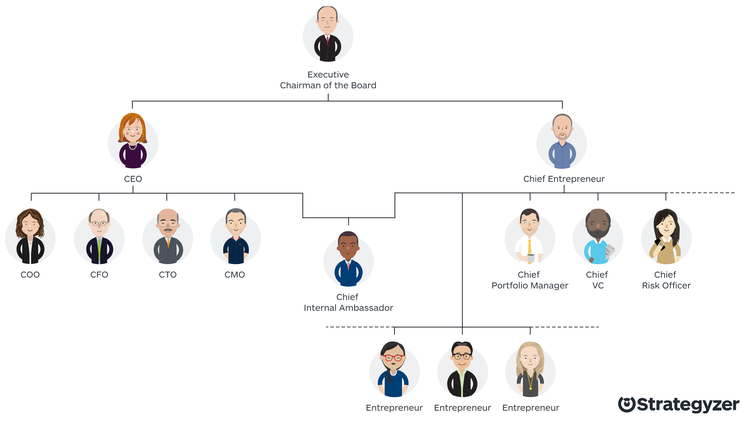
Alex and Yves believe there are three crucial areas that every company needs to consider in order to remain relevant and prosperous. Firstly, companies have to develop truly ambidextrous organizational structures where the innovation arm is given equal power alongside the existing business. Secondly, this innovation arm needs its very own culture, processes, skills, metrics, and incentives to explore potentially new business models and value propositions. Thirdly, companies need to better manage their portfolio of existing businesses and new opportunities–some that maintain and protect the current business, while cultivating the business models of tomorrow.
Let’s explore deeper into each area, and why it matters to companies today.
1. Every organization needs a Chief Entrepreneur equipped with power.
This doesn’t discredit the success corporations and CEOs have generated from finding a successful business model and improving it over time. They are where they are because they successfully scaled and continuously improved a proven business model. However, to achieve substantial and continued growth in the 21st century, companies will have to look beyond improving the existing business model or simply launching new products. These actions just won’t generate enough growth anymore.
You would have to be schizophrenic, and have more than twenty-four hours in the day, to be world-class at both jobs. In order to excel at both, you need a powerful person skilled at execution who focuses on the present, and a powerful person skilled at entrepreneurship who focuses on inventing the future. You need to create an innovation engine that will function alongside your current business. This “ambidextrous culture” is how you will survive in the 21st century.
Over a decade ago O’Reilly and Tushman described why companies need to be ambidextrous (executing existing business models while creating new ones). Yet in spite of facing continuous disruption, only a few companies (like Amazon) have truly ambidextrous strategies that focus on world class execution, operational excellence, and strategic growth innovation simultaneously. In fact, Amazon’s entire organization and organizational culture is designed to be ambidextrous.
Rare are companies that deal with the rapid shifts in channels, customer aggregation, pricing, technology, etc, by creating new business models (Amazon Web Services, Netflix Studios, etc.). Most continue to execute their existing business model or make small extensions to them. In the U.S. in particular, existing companies are afraid of a proxy fight with activist investors who focus on traditional cost cutting and share buy-back programs to please their investors.
The organizational structures that characterize established companies today are unlikely to produce new growth. At most companies “the core” still dominates innovation. Business units with established business models and value propositions tend to dictate the innovation agenda. They favour short term gains through incremental and sustaining innovation over growth and transformative innovation where new value propositions or business models are uncovered, especially if it undercuts the core business.
We like to say that business models and value propositions expire like a yoghurt in the fridge. The reality is that business models are expiring faster than ever before. The likelihood of a CEO managing a single business model through his or her tenure no longer exists. You have to also invent the future, which will require systematically and continuously inventing new business models. You not only have to be world class at executing and improving your current business model, but you also have to be world class at searching and inventing new business models for the future.
2. Innovation culture: different metrics, skills, processes, and incentives.
Although an innovation culture is difficult to achieve, we do believe that companies can intentionally design an innovation culture that unearths and builds new growth engines, reduces the risk of experimentation, and increases ROI on R&D. To make that happen you have to recognize that your innovation culture requires very different skills, processes, and incentives than your execution culture. Again, we developed a tool with XPLANE founder Dave Gray called the Culture Map to help companies capture, discuss, and manage company culture.
The tool allows teams and leadership to ask: what are the concrete results we want to create? Let’s say you want your company to reduce innovation risk; get a higher return on any R&D being performed; and build new growth engines. On a managerial level, you’ll probably want to retain your talented teams, and build a company that’s designed for the future.
Think about the impact leadership, culture and processes, and organizational design has on your company. Ask the team: what causes and influences our behaviors? What are you as a leader saying or doing to enable these behaviors? How are people rewarded for their behaviors (both positive and negative)? What are the unwritten rules? It could be the requirement of business plans well before you’re ready to execute; a lack of knowledge or training when designing, running, and managing business experiments; and it could be that your process is linear rather than agile.
Another example: leadership can provide support throughout the company to give legitimacy and power to intrapreneurs responsible for managing the search for new value propositions and business models; and they can allocate sought after resources. By championing methodologies like design thinking, or tools like the Business Model Canvas and Value Proposition Canvas, leadership can enable the right process and skills development for teams to design, run, and manage agile business experiments.
Traditional R&D is what large organizations believe to be a remedy for disruption. But like we pointed out above, simply creating new products and technologies won’t save your company from being disrupted. When you look at the greatest companies around today, how much do you think they spend on R&D? Big sums. Now, how much of that money goes into figuring out the right value propositions or business models and bringing them to market the right way? Probably very little or none.
In fact, good innovation doesn’t necessarily have to be tied to a product or technology if the value proposition creates value for your customers, and your business model creates value for the company. Good business model innovation starts with your culture.
3. Manage a portfolio of mature and emerging businesses.
Finally, companies need a new and integrated approach to managing a dynamic portfolio of established and emerging businesses. They have to protect established business models from disruption as long as possible, while simultaneously cultivating the business models of tomorrow.
Yves Pigneur and I have also prototyped a tool here called the Business Portfolio Map to help organizations measure and assess if the existing portfolio is healthy; if the business is prone to disruption; and ultimately, to help companies make better investment decisions.
Every portfolio starts with a look at managing and improving the businesses you already have. Here you assess two areas:
Profitability: How much profit do the existing business models generate?
Disruption risk: How protected is your business model, and how likely is it to be disrupted? Models at risk may be very established businesses, but prone to disruption for technology, market, or regulatory changes.
As you manage the present, you also look toward the future for new areas of growth. Here you assess two different areas:
Expected profitability: How big can an idea for a new business become? What’s the potential? How big is the size of the new market, revenue potential, pricing, etc. Equally important here is to judge how robust a business model is: e.g. in terms of recurring revenues, long term growth, scalability, protection from competition, etc.
Innovation risk: Here you evaluate how much you de-risked a good looking business initiative. These ideas may have no evidence, and may be very risky to invest in. The more you are confident an initiative will work based on tests and the resulting evidence, the more you may choose to invest time and resources into it. This is where the Lean Startup–founded and conceived by Steve Blank, then popularized by Eric Ries–has great potential to help large companies tackle the challenges that come with de-risking innovation. We have been involved with the process from the beginning.
It is important to point out that the invention of new businesses is a search process. Finding and validating a new growth engine is a very iterative process, contrary to the managing of an existing business.
Amazon is an example we frequently cite of a company that intentionally manages a diverse portfolio of existing and promising new business models. The company continues to produce growth with its existing businesses (e-commerce, AWS, logistics, etc.), while juggling a portfolio of potential future growth engines that may become big profit generators one day (e.g. Alexa, Echo, Dash Button, Prime Air, Amazon Fresh, Mayday Button, etc.).
Building an invincible organization with the traits we’ve listed above is something investors should be demanding: it helps companies better allocate capital and put people with the right skills at the right stage of development. But of course, it also means you have to keep investing in new ideas and businesses. This is going to be a difficult journey. The truth is, there’s never going to be a right time to start. If you don’t want to end up like Kodak, Nokia, or Blackberry, then you have to start now.