Brands inspire us beyond business.
They are the icons of a cultural zeitgeist, they are the labels of our imagination and energy, and they are then labels by which we define ourself and our tribes.
Japanese publishing house JOH & Company’s B Magazine has brought together a series of short documentaries which are entirely their own perspective on brands around the world, turned into beautiful videos.
With sincerity in attitude, they will inspire you to think about some of the great brands and businesses of today’s markets – some old, some new, big or small, local or global.
Here are some of the beautiful brands:
Airbnb … In 2008, three young entrepreneurs founded Airbnb, a community marketplace for people to monetize their extra space. With more than 2 million listings in myriad cities across the world, the Airbnb of today has grown into a multibillion-dollar company that is shaking up the hotel industry. With a firm belief in the idea of living like local, Airbnb is now seeking to go beyond the home and revamp the ordinary traveling experience.
Canada Goose … A family business that has been continued by its third generation, Canada Goose has originally started as metro sportswear LTD in 1957 and grown to one of the leading down parka brand in the world. Under the simple cause of freeing humans from coldness, the down parka company adheres to its policy of ensuring that all products are manufactured in Canada.
Diptyque … is a French fragrance brand founded in 1961 by three artists – Yves Coueslant, Desmond Knox-Leet and Christiane Gautrot. Both its fragrances and its designs are original and evocative, making Diptyque one of the most recognizable brands stradding the niche and luxury markets.
Haagen Dazs … Founded in 1961 in Bronx, New York, Häagen-Dazs has generated a lot of ink over the years with its Northern European-inspired naming strategy. Its creamy texture and deep flavours catapulted Häagen-Dazs to the ice cream of choice for leading restaurants and cafes as well as airlines and hotels. Hooking its marketing strategies into the sensuous and hedonistic qualities of ice cream, Häagen-Dazs has been successful in making a name for itself as a guilty pleasure for adults.
Havaianas … the name Havaianas came from a Portuguese word meaning “Hawaiians” and the design idea was inspired by zori, typical Japanese sandals. Yet the Brazilian sandal brand has evolved to deftly infuse culture and inspiration of its home, Brazil. Havaianas is filled with fascinating stories behind a dramatic transformation it has made – from a sandal maker targeting working class to a go-to brand for fashionistas today.
Hwayo … Started in 2005, Hwayo is a soju (distilled Korean spirits) maker. It is part of Kwangjuyo group, which owns Kwangjuyo, a traditional high-end Korean pottery maker and Gaon society, a business that introduces high-end Korean cuisine. Under the leadership of the president, Taekwon Cho who aspires to promote high-end Korean culture, Kwangjuyo group’s businesses are growing into brand names that offer their original values. Harmony of sophisticated dishware, cuisine and matching Korean spirits, “Hwayo” create unparalleled, multiple layers of aura.
IKEA … is the Swedish-founded multinational group that designs and sells ready-to-assemble furniture, kitchen appliances and home accessories, among other useful goods and occasionally home services. It has been the world’s largest furniture retailer since at least 2008.
L’Occitane … The history of L’Occitane dates back to 1976 in the vibrant city of Marseille, wherein the young Olivier Baussan began producing soaps that were inspired by folk medicine from the French Provence. Under Baussan’s vision, the company continued to build its business up by offering high-quality beauty products concocted with essential oils extracted from the verdant fields of Provence. L’Occitane has always believed in speaking the language of the land, as well as that of the farmers, and is putting its beliefs into practice by releasing products in tandem with the harvesting season of each ingredient and defending the skills and well-being of its farmers.
Lamy … German fountain pen maker Lamy started as a pen manufacturer in 1930, which then established its own brand in 1948. In 1966, Lamy introduced its signature product, Lamy 2000, which was back then motivated from bauhaus. The product bears the fountain pen manufacturer’s initial impetus for its design. The writing instrument maker has continuously been collaborating with designers outside of its organization and operating its in-house manufacturing facility in Heidelberg, where the company is headquartered. Lamy offers wide range of products which are “designed to be easy to use for anyone,” by introducing its high-quality products at reasonable price.
Leica … From its origins as a microscope maker, Leica made photography a part of everyday life by introducing the first 35mm camera in 1914. Based on this century-old heritage of quality cameras and lenses, the Leica brand highlights the true essence of what a camera is, setting the company apart from powerful Japanese DSLR brands.
Maison Margiela … Recognizable by the signature four white stitches and blank tag, celebrated French fashion brand Maison Margiela made its debut in Paris in 1988. Founder Martin Margiela shied away from the spotlight, choosing anonymity over celebrity and ‘we’ over ‘I’. An avant garde at heart, he challenged the idea of traditional garments by experimenting with deconstruction and reconstruction, exaggerated silhouettes and trompel’oeil(optical illusion). Margiela’s spirit lives on in the Maison Margiela brand, even after his resignation in 2009, and continues to inspire new generations of designers.
Monocle … Monocle is a global affairs and lifestyle magazine, 24-hour radio station, website, retailer and media brand, all produced by Winkontent Ltd. It was founded by Tyler Brûlé, a Canadian entrepreneur, Financial Times columnist, and founder of Wallpaper* magazine.
Muji … Intended to be a generic line for the Seiyu Supermarket Group, Muji was launched in Japan in 1980, as Mujirushi Ryohin, which means “no-brand quality goods.” Having initially started out with just 40 products, Muji now sells more than 7,000 different items and has successfully expanded into the housing business, proving that a brand can indeed sell a lifestyle aesthetic.
Netflix … Started in 1997 in Silicon Valley, Netflix was dubbed the icon of American popular culture following the success of its DVD-by-mail operation. 10 years after the DVD-era, during which the Netflix-logo-emblazoned red envelopes reigned supreme, Netflix introduced its movie and TV show streaming service and burgeoned into an online entertainment powerhouse. By releasing entire seasons of original programming such as and all at once, Netflix was able to bring ‘binge-watching’ to the forefront of our culture and is now viewed by many as the future of entertainment.
Patagonia … the outdoor clothing brand with an environmental focus, was founded in 1973 by Yvon Chouinard, who since 1964 had been manufacturing pitons (metal anchors used in rock climbing) that would not damage the rock. While insisting on offering the best quality, the brand has contributed to a sustainable society and natural environment by developing eco-friendly materials and returning 1% of its sales back to society. Patagonia has redefined the role of a company and it continues to inspire the outdoor industry and the world.
https://www.youtube.com/watch?v=0iigK_Y8WrQ&t=29s
Penguin … Since its start in 1935, Penguin has been spearheading in suggesting ideas of what a modern day publisher should pursue by offering paperbacks with affordability and portability, formulating ideas to meet the needs of the times and establishing brand identity through book design ideas. Even when sold for affordable price, Penguin ensured quality of contents between the covers by finding the best-qualified authors. All of these were made possible by the founder, Allen Lane’s simple belief that “Books are for reading.”
Repetto … a flat shoe brand in France, was born in 1947 when Rose Repetto first made ballet shoes for her son, Roland Petit. Repetto’s original technique and Petit’s advice as a brilliant ballet dancer helped enhance the shoe’s quality, which later led to incorporating its benefits into lines of Repetto’s everyday shoes. In the mid-1980s, the new CEO Jean-Marc Gaucher has combined the shoes with fashion on top of the brand’s identity, “Dancing,” and has infused the brand with vigor.
Suunto … a Finnish maker of sports precision watches, got its start in 1936 when orienteer Tuomas Vohlonen invented a liquid-filled compass. the company has developed a range of devices, from underwater and nautical compasses to industrial hypsometers, and also created the world’s first underwater dive computer. Suunto has expanded its horizons to cover outdoor and lifestyle products, and it continues to reinvent itself as an authentic premium sports brand.
Tsutaya … In 1983, conceived as a lifestyle store by Muneaki Masuda, Tsutaya began as a shop renting and sellingbooks, videos, and music. Since then, it has become an all-encompassing Japanese pop culture platform. In 2011, the company behind the Tsutaya project, CCC, introduced an evolved form of the Tsutaya bookstorein Daikanyama. Based on its “T Point” membership program, the brand continues to suggest a new lifestyle concept.
Vans … Recognized today by its iconic checkerboard slip-ons and ‘Off the Wall’ slogan, Vans was able to separate its path from that of other sneaker brands by spending the last several decades building up a unique brand identity. In the early 1970s, Vans created skate shoes for now-legendary skateboarders Tony Alva and Stacy Peralta — the so-called “pioneers” of modern skateboarding. The shoes were a huge commercial success, and the rest, as they say, was history. With its feet firmly rooted in this rich legacy, Vans went on to become the ultimate supporter and embodiment of youth culture through its myriad of involvements in the action sports, music, art, and street fashion world.
WeWork … Founded in New York in 2010, workspace and community company WeWork was built on the business model of taking out a lease on an office building, splitting it up and renting it out to startups and small companies. Now, with more than 80,000 members in 39 cities across the world, WeWork has become an icon of the shared office business, proposing a new way of working that is built on community. In 2016, WeWork recently launched WeLive, a co-living spin-off of WeWork, leaving the world eager to see what comes next.
What is the benefit of having a purpose beyond profit?
Whilst for some people the notion of having an “inspiring purpose” is morally and commercially a no-brainer, for other people, a purpose can still seem like an irrelevant tagline.
You might argue that businesses have an ethical responsibility to contribute to the societies in which they exist, or that it simply makes economic sense because they can attract more customers and maybe even charge them more, but having purpose is still not obvious.
Back in 2010 I wrote the book People Planet Profit which explored the drive and desire for more purpose in business, and the benefits it can deliver. A decade later, it still seems a new concept to many people.
The Business Case
79% of business leaders recently surveyed by PwC believe that an organisation’s purpose is central to business success, yet 68% shared that purpose is not used as a guidepost in leadership decision making processes within their organisation. Millennials who have a strong connection to the purpose of their organization are 5.3 times more likely to stay.
Add to this, the Edelman Trust Barometer 2019, just released shows that people are more trusting of the employer they work for, than almost any other kind of organisation – from NGOs to governments, well-known brands or social influencers.
Yet the vast majority of employees remain disengaged from work, and only 33% draw real meaning from their employer’s purpose. So there is still much to be done.
Customers view purpose-driven brands as being more caring and, as a result, are more loyal to them. Cone and Porter Novelli consumer research showed that 67% of people feel companies with a purpose care more about them and their families. 79% said they’re more loyal to purpose brands, and 73% said they would defend them. Another 67% said they are more willing to forgive such a company for a mistake.
Recent analysis of “purposeful” companies by the Corporate Board/EY Global Leadership Forecast has the most compelling financial evidence – suggesting that purposeful companies outperform the stock market by 42%. It goes on to compare those who have a purpose statement but no more, who deliver average performance, and those who embed it in everything they do. Companies without a sense of purpose within their vision/mission, underperform the market by 40% it says.

Yet, there is a gap between what business leaders believe their purpose to be and what their behaviours suggest their purpose truly is. The windfalls of purpose may be severely capped by actual business practices, and while it’s only natural to leverage your organisation’s purpose to appeal to job candidates, current employees, customers and prospects, that approach might be underselling the true power of purpose.
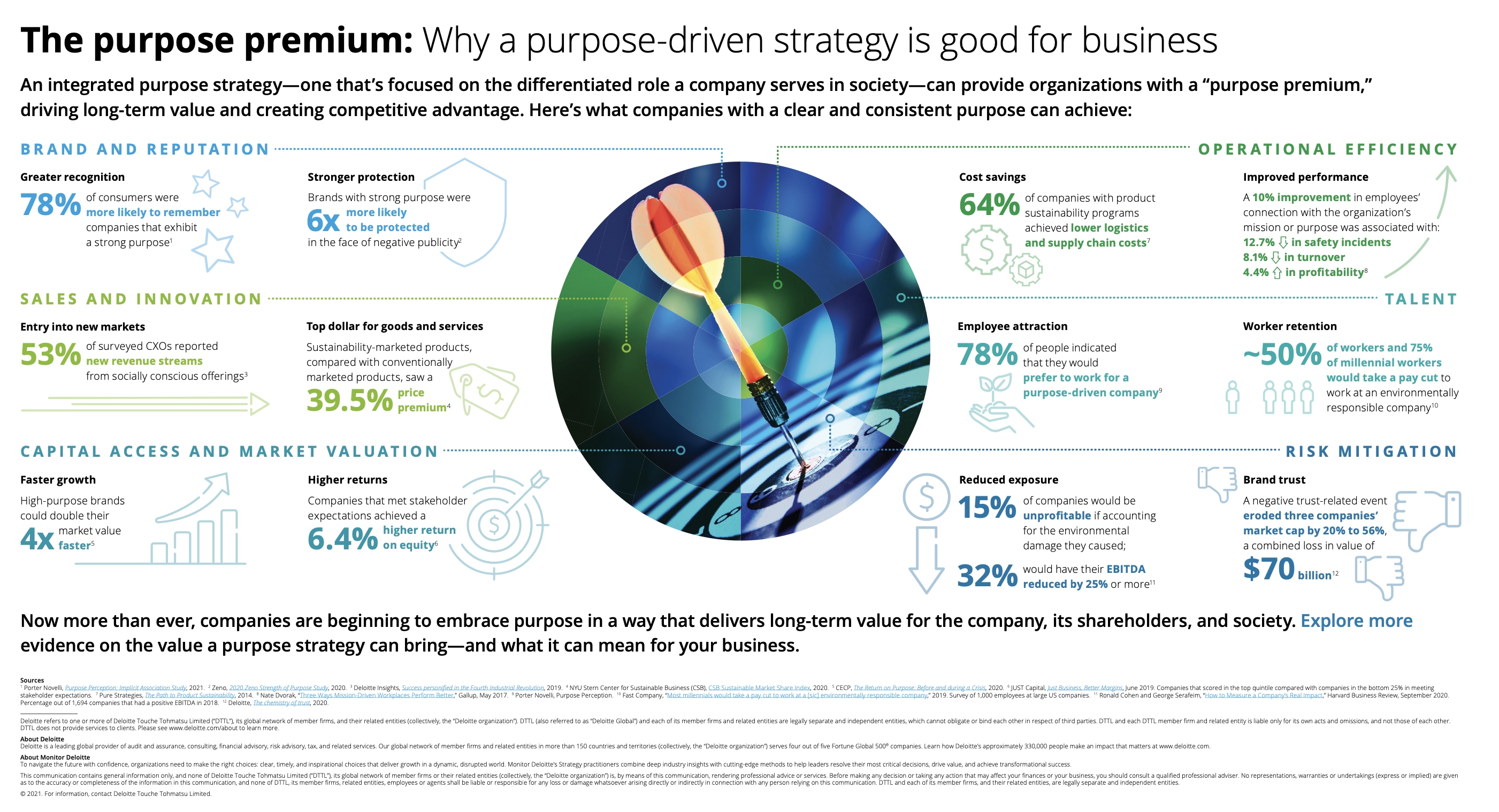
Here are some great sources of more detailed insight, including some of the companies who I have worked with on this challenge, like Coca Cola and DSM, who have cracked the code of how purpose and sustainability directly influence business results:
- The Purpose Premium by Deloitte
- The Business Case for Purpose by EY and HBR
- Purpose Driven Leadership by Leaders on Purpose
- Purpose Beyond Profit: The Value of Value by CGMA
- The Future of Business? Purpose not just Profit by WEF
- Sustainable Consumption Facts and Trends by WBCSD
- Know The Difference Between Mission And Purpose by Fast Company
- From Me to We: The Rise of the Purpose-led Brand by Accenture
- Purpose and Performance: A Blueprint for Better Business by BBB
- Inspiring Business To Improve Society through Purpose-Driven Brands by BITC
- DSM Case Study: Purpose Led, Performance Driven
- Coca Cola Case Study: Combining Profit and Purpose
- Unilever Case Study: Making Purpose Pay: Inspiring Sustainable Living
Purpose does more than make a brand unique. It can highlight a business’ evolutionary path. At a basic level, purpose can simply express what an organization aspires to be and do. But at a more advanced one, it becomes a conscious expression of how an organisation intends to evolve and transform itself. The best type of purpose is not passive, or even linear, it is transformational. It is ambitious, a cause, something which the organisation and its customers can strive for together. This drives more direction, more innovation and is more energising.
The Purpose Wheel
Inspired by Maslow’s hierarchy of needs and what motivates human satisfaction, IDEO created a purpose framework called the Purpose Wheel. The development of a sense of purpose starts by imagining various ways an organisation might have impact on the world.
The Purpose Wheel drives conversations about future goals, and ultimately create a foundation that the organisation’s leadership can align on before sitting down to write out the statement that answers “the why.”
The center of the wheel proposes five ways a company or organisation might have an impact on the world. Each slice answers the “Why do we exist beyond profit?” question in a different way.
- We exist to Enable Potential … Creating impact by inspiring greater possibilities. (Tesla, Nike)
- We exist to Reduce Friction … Creating impact by simplifying and eliminating barriers. (Google, Spotify)
- We exist to Foster Prosperity … Creating impact by supporting the success of others. (Pampers, Warby Parker)
- We exist to Encourage Exploration … Creating impact by championing discovery. (Airbnb, Adobe)
- We exist to Kindle Happiness … Creating impact by inciting joy. (Dove, Zappos)
The outer wheel is there to push your imagination and force you to consider how your company might make an impact. With it, you continue to engineer your purpose statement: We exist to (inner wheel) through (outer wheel) to impact society for the better.

Consider some familiar examples of companies with purpose:
The Body Shop
The Body Shop’s motto is “Enrich, Not Exploit.” It is committed to enriching its people, products, and planet. The company has several lofty objectives: To help 40,000 economically vulnerable people access work around the world. To ensure 100 percent of our natural ingredients are traceable and sustainable sourced, protecting 10,000 hectares of forest and other habitat. To build bio-bridges, protecting and regenerating 75 million square meters of habitat helping communities to live more sustainably.
Icelandic Glacial
Icelandic Glacial became the world’s first certified carbon-neutral manufacturer of natural spring water, using green energy to deliver a premium product with a completely offset carbon footprint. Available in 24 countries around the world, the company also provides plenty of water to those in need, from US flood victims to aspiring musicians in Cuba. The water itself is also a winner, according to culinary experts, having won the Superior Taste Award.
Novo Nordisk is a global leader within diabetes care. The Danish pharma company’s key contribution is “to discover, develop and manufacture better biological medicines and make them accessible to people with diabetes throughout the world.”
Patagonia
A commitment to sustainability is sewn into the very fabric of clothing company Patagonia. In addition to supporting numerous environmental initiatives and remaining transparent about their sourcing and production processes, the company has gone so far as to tell its customers not to buy its products, launching the Common Threads Partnership program to encourage people to repair, reuse or recycle instead.
Salesforce
The company’s commitment to social change is reflected in it’s 1-1-1 model – called Pledge 1% – whereby Salesforce contributes one percent of product, one percent of equity, and one percent of employee hours back to the communities it serves globally.
Unilever
In the 1890s, Unilever founder William Lever set the company’s purpose as “making cleanliness commonplace”. In 2010, the consumer goods giant further honed this purpose to better respond to a world that is “starting to exceed its capacity”. Under this revised purpose of “making sustainable living commonplace”, Unilever has three targets to measure its progress against: improving the health and wellbeing of one billion people, reducing negative environmental impact and sourcing raw materials in a sustainable way while enhancing livelihood. Brands like Dove have taken this mission much further.
Whole Foods
“With great courage, integrity and love,” reads the higher purpose statement of Whole Foods, the Amazon-owned organic grocer, “we embrace our responsibility to co-create a world where each of us, our communities and our planet can flourish.” To this end, the multibillion dollar business donates over 5 per cent of its annual net profits to charitable causes and is involved in efforts to safeguard the environment, foster fair trade in its supply chains, improve food safety and ensure the humane treatment of animals.
There is often a misconception that companies must be either purpose-driven or profit-driven, but cannot be both. Which of course is wrong.
Also the words purpose and passion are often used together. This leads to an interesting thought from Ha Nguyen from Omidyar Networks, who distinguished the two
- Passion is about finding yourself. It is about following our interests. Sometimes, we fulfill that part of our lives with hobbies. In other cases, we end up doing what we love for work, and it can lead to very successful careers. While many of us may find our passions and build successful careers that we enjoy, not all of us find purpose in the work.
- Purpose is about losing yourself— in something bigger than you. It is about wanting to make a difference and do for others—to help, to give, to serve. It is the legacy you are going to leave behind.
Fulfillment, says Nguyen, comes not only from doing what you enjoy, but also serving a bigger mission. When you find your purpose, you will have a more far-reaching impact by touching the lives of others in meaningful ways. When you find your purpose, you can also be part of a successful company that makes the world a better place.
In general, purpose-driven companies are more likely perform better because they have:
1. More motivated and energized employees
Currently, 71% of millennials report feeling not engaged or actively disengaged at work. But if you are able to create a situation where employees derive meaning from their work, then everything changes. A recent Harvard Business Review study found that employees who derive meaning from their work report almost twice the job satisfaction and are three times more likely to stay with their organization to fuel business success. The Global Leadership Forecast found that in purposeful organizations engagement levels are 12% higher and employees’ intent to stay is 14% higher.
2. More delighted, loyal and satisfied customers
In this crazy competitive world for talent, having a company with purpose allows you to stand out and becomes a secret weapon. According to New York Times bestselling author Simon Mainwaring, 91% of consumers would switch brands if a different one was purpose-driven and had similar price and quality. Not only does having a strong purpose engage employees, it also helps attract customers and make them more loyal. Product folks know that connecting with customers and putting customers first is critical.
3. More agile and resilient organisations
Purposeful companies deal with volatility much better. They have a strong “North Star” that keeps them focused and aligned even when markets are turbulent. Having employee and stakeholder buy-in enables a purposeful organization to respond more quickly and effectively when opportunities arise or danger threatens (50% higher than non-purposeful organizations). Purposeful companies enjoy higher levels of trust and loyalty, making them more resilient when the going gets tough.
4. Better business outcomes
Given that companies with purpose better motivate employees and satisfy customers, it is not surprising that these companies also have higher business success. In Corporate Culture And Performance, HBS professors John Kotter and James Heskett show that over a decade-long period, purposeful, value-driven companies outperform their counterparts in stock price by a factor of twelve.
Simon Sinek who has given one of the most watched Ted Talks of all time states in a 2017 HBR article, “Profit isn’t a purpose. It’s a result. To have purpose means the things we do are of real value to others.”
Purpose-driven companies attract the best minds, have the most passionate customers, achieve wild success and change the world. When purpose and passion are combined, the impact is powerful not only for individuals, but also on the public they serve to help create a brighter future for everyone.
Imagine Jack Ma in a room with Jeff Bezos talking about the future of retail. Or Elon Musk setting out to map the future alongside Masayoshi Son. They may have similar dreams and strategies, but their styles of thinking are likely to be quite different.
So do leadership styles from the East and West differ?
A variety of studies point to significant cultural differences. While the predominant leadership traits –such as personal integrity, confidence, future mindset, clear communication, and ability to inspire people – are almost typical everywhere, there are two areas of big difference: creativity and intuition.
- 90% of Asian leaders believe creativity is important, compared with just 57% in Europe.
- 85% of Asian leaders think intuition is important, compared to only 54% in Europe.
More generally, emerging market leaders could typically be described as “modernist” with an emphasis on intuition and creativity, and also on coaching, compared to more “traditionalist” leaders.
Of course, Asian leaders are mostly operating in high growth markets, with young consumers and immature competition, which will evolve over time. It is is therefore possible that styles will converge as Asian markets mature.
However given the much faster growth rates of their economies, it might be that leaders in emerging markets are gaining the confidence to stick with their own management approaches, what has been working for them – or that they have the agility to adapt to approaches that prove best suited to their fast-evolving local markets. A Grant Thornton study on Asian leadership finds that leaders of companies in the region are deliberately blending imported and home-grown management techniques and approaches to create a new “Asian Way” of leading, rather than copying and replacing.
Women are still on a long journey towards equality. Today, just 24% of senior business roles around the world are held by women, but the proportion of female CEOs is on the rise. Awareness is growing that diversity, of all sorts and in any walk of life, leads to better decisions and outcomes. There is increasing evidence that a more diverse workforce correlates with higher sales, business growth, return on invested capital, and return on equity. One recent study from China even finds that having more women on company boards reduces the incidence of fraud. Meanwhile, uniformity of background often yields uniformity of opinion and worse decisions. The pressure is on to make boardrooms and management ranks less “male and pale.”
It has often been claimed that a key way in which business women differ from business men is in their leadership styles, typically more democratic and participative. Studies also show that, as investors, women are more risk-averse and, at the household level, tend to invest a higher proportion of their earnings in their families and communities than men.
Looking across the world, women are more common in senior roles in companies in emerging markets – Eastern Europe, for example, as well as Southeast Asia. More female leaders typically correlates with more openness to using creativity and intuition – and also a higher value placed on the ability to delegate. In any case, these parts of the world, with their higher proportions of women in leadership, have a fair claim to be arriving sooner at the well-blended leadership style of the future.
Decision-making based on analytics may still denominate in big corporate Western markets, and certainly represents progress in many areas where managerial decisions have been made in the past on “gut feel.” But there are still many decisions in business that, either because they relate to future possibilities or because they involve softer trade-offs, can’t be reduced to data and calculations. One could argue that those are the very decisions – the ones requiring creativity and intuition – where leadership is most called for and tested. In a fast-moving, digitally-powered world, creativity and intuition could be the difference between getting ahead, and getting left behind.
We live in an incredible time. More change in the next 10 years than in the last 250 years.
New technologies are transforming the ways in which we live and work. Technologies enable incredible change. It is how we unlock their potential that matters.
The most innovative businesses see the world differently.
They don’t just seek to imitate the success of others, to compete in the markets of today, to frame themselves by their relative differences to competitors. Instead they play their own game. And that means they need to be sense makers – able to make sense of change.
Trying to evolve in today’s complex and confused world is unlikely to lead you towards a bright and distinctive future. It will extend your life a little longer, but it will be tough and uninspiring, with diminishing returns.
Instead jump to the future. I tend to start with five years ahead, although it may differ by company. 5 years is long enough to change the world, but close enough to be real. Start by creating a positive, collective and inspiring vision of the future market. What will it be like? What will people want? Why? How? Where? Then consider how to win in this new world.
Below I have tried to bring together a collection of many anecdotes from multiple sources (including Accenture, Economist, EY, Forbes, Futurism, Gartner, IDC Futurescape, Institute for the Future, SAP, Singularity, World Bank, World Economic Forum and more) to get a sense of the challenges and opportunities, and the enormous scale of change now and ahead.
Changing Markets
- Global urban populations will add 2.5 billion people by 2050. This massive urban expansion will require as much as $70 trillion in infrastructure spending. Source: “In a fast-changing world, can cities be built with long-term perspective?” EY
- The spending power of baby boomers is predicted to be $15 trillion worldwide by the end of 2019. Source: “5 Key Customer Experience Trends for 2017,” The Huffington Post
- Chinese consumers took nearly 3 billion trips and spent over $110 billion during the Chinese New Year celebration. Source: “3 reasons why Chinese New Year is a global phenomenon to heed,” Juwai.com
- Over the next 15 years, consumer spending in China will grow by more than the total EU consumer spending today. Source: “The Chinese consumer in 2030,” The Economist Intelligence Unit
Customer Expectations
- By 2020, 85% of a customer’s brand experience will occur without any human interaction. Source: “How Omni-Channel Customer Experiences Drive Brand Transformation,” Centric Digital
- Only 37% of consumers say their favorite retailer understands them. Source: “Omnichannel: 5 Roadblocks to Avoid on the Journey to Omnichannel Retail Success,”FitforCommerce
- Businesses that adopt omnichannel strategies achieve 91% greater year-over-year customer retention rates. Source: “25 Amazing Omnichannel Statistics Every Marketer Should Know,” DataMentors
- 65% of B2B customers say their B2B experience does not match their consumer experiences on Amazon.com and similar sites. Source: “How will you change buyers into stakeholders?,” EY
- 72% of customers expect a response to their complaints on social media within one hour. Source: “The Top 14 Customer Experience (CX) Stats of 2016,” Clarabridge
- 87% of Millennials say that they base their purchasing decisions on whether or not a company makes positive social efforts. Source: “Why Millennials Care About Purpose-Driven Business,” Digitalist Magazine
Brands and Experiences
- Since 2009, a stock portfolio comprising the brands that provide the simplest customer experiences outperformed the major indexes. The Simplicity portfolio grew +433%, S&P +135%, DAX +116%, and FTSE +52%. Source: “Global Brand Simplicity Index 2017,” Siegel+Gale
- Companies with best-in-class customer experience management achieve year-over-year customer profit margin improvement 527% higher than their peers, and 359% greater company revenue growth. Source: SAP Center for Business Insight 2017 calculation based on “CEM Executive’s Agenda 2016: Aligning the Business Around the Customer,” Aberdeen Group
- 86% of consumers are willing to pay more for an upgraded experience, and 55% are willing to pay for a guaranteed good experience. Source: “50 Important Customer Experience Stats for Business Leaders,” The Huffington Post
- By 2020, 50% of digital transformation initiatives will fail due to the lack of an end to-end customer experience operating system. Source: “IDC FutureScape: Worldwide Chief Marketing Officer 2017 Predictions,” IDC Research, Inc.
Marketing and Engagement
- 84% of B2B buyers rate word of mouth the biggest influence on their purchasing decisions. Source: “What is Advocate Marketing?” CustomerAdvocacy.com
- 92% of consumers trust word of mouth, and 70% trust online reviews. Source: “How will you change buyers into stakeholders?” EY.
- By 2020, the average person will have more conversations with bots than with their spouse. Source: “Top Strategic Predictions for 2017 and Beyond: Surviving the Storm Winds of Digital Disruption,”Gartner
- In 2016, global use of ad blocking apps grew 102% year over year. Source: “2016 Mobile Adblocking Report,” PageFair.
- User-generated videos about a brand get 10x more views on YouTube than content created by the brand, and user-generated content-based ads get 4x higher click-through rates. Source: “38 Mind-Blowing Stats About User Generated Content,” TINT
- 71% of B2B customers are actively disengaged or indifferent. Source: “B2B Customers Are Indifferent,” Gallup
- But only 1% of B2B marketers manage after-sales experiences with customer relationship programs. Source: “Forrester B-to-B Marketing Predictions: Customer Focus to Sharpen,” AdvertisingAge
- By 2019, more than 50% of all industries will price and package their offerings as services with flexible subscription or consumption-based pricing models. Source: “IDC FutureScape: Worldwide Software Business Models and Monetization 2017 Predictions,” IDC Research, Inc.
- By 2020, approximately 70% of online purchases in China will be made via a mobile phone. This is significantly higher adoption than estimates for other countries: U.S. 46%, UK 40%, Japan 40%, and India 30%. Source: “The New Connected Consumer Code: Unlocking Digital Commerce Opportunities,” Euromonitor International
Channels and Social Media
- Every day, Facebook videos are viewed 8 billion times, a dramatic increase from the 1 billion daily views average a year ago. Source: “Top 10: Video Marketing Trends 2016/2017,”Doubleshot
- Each month, as many as 93% of all Internet-connected millennials visit YouTube. Source: “93% of Millennials Visiting YouTube,” GlobalWebIndex
- By 2020, eSports – competitive video gaming – will reach nearly 500 million fans worldwide, more than popular sports such as basketball. Source: “Think Again: Tech & Media Outlook 2017,” Activate
- Airbnb usage is projected to grow 1,165% by 2025, reaching one billion “room nights.” Key growth factors include Airbnb’s high levels of repeat customers, and significant word of mouth, as more than 80% of customers are likely to recommend Airbnb to friends. Source: “One Wall Street Firm Expects Airbnb to Book a Billion Nights a Year Within a Decade,” Bloomberg
- Live sports accounts for 50% of the Twitter conversations linked to TV programs, even though it accounts for only 1.4% of total TV programming. Source: “Why Live Sports and Social Media are just at the beginning of a fabulous love story,” SportsPro
- By 2020, 100 million consumers will shop in augmented reality. Source: “Top Strategic Predictions for 2017 and Beyond: Surviving the Storm Winds of Digital Disruption,”Gartner
- Within just two months, the augmented reality video game Pokémon Go was downloaded 500 million times globally, and after 90 days, the app had generated $600 million in revenue. Source: “75 Incredible Pokemon Go Statistics,” DMR
AI and Machine Learning
- By 2020, the average person will have more conversations with bots than with their spouse. Source: “Top Strategic Predictions for 2017 and Beyond: Surviving the Storm Winds of Digital Disruption,” Gartner.
- In initial tests, a machine-learning algorithm created at Carnegie Mellon was able to predict heart attacks four hours in advance with 80% accuracy. Source: “Of Prediction and Policy,” The Economist.
- Artificial intelligence can predict where epidemics will happen. AIME developed a platform with 87% accuracy in predicting dengue fever outbreaks three months in advance. Now they hope to similarly target other diseases such as Ebola and Zika. Source: “Artificial Intelligence Innovation Report,” Deloitte.
- After watching 5,000 hours of TV, Google’s DeepMind AI was able to lip read 34% more accurately than a professional lip reader. Source: “Google’s DeepMind AI Can Lip-Read TV Shows Better than a Pro,” New Scientist.
- After watching just 600 hours of TV, an MIT deep-learning AI algorithm was able to predict future human interactions after two people met 60.5% as accurately as human subjects. Source: “Teaching Machines to Predict the Future,” MIT News.
- By 2019, 75% of workers who use enterprise applications will have access to intelligent personal assistants to augment their skills and expertise. Source: “IDC FutureScape: Worldwide Big Data, Business Analytics, and Cognitive Software 2017 Predictions,” IDC Research Inc.
- By 2030, the largest company on the Internet is going to be an education-based company, with smart-bot instructors able to personalize lessons for each individual student. Source: “A Top Futurist Predicts the Largest Internet Company of 2030 Will Be an Online School,” South China Morning Post.
- Problem: In the last two decades, 9.6% of the earth’s total wilderness areas has been lost, equaling an estimated 3.3 million square kilometers. Source: “Catastrophic Declines in Wilderness Areas Undermine Global Environment Targets,” Current Biology.
- Solution: Many Latin American governments are turning to artificial intelligence to aid in their forest conservation efforts. Source: “10 Innovations That Are Changing Conservation,” Cool Green Science.
The Internet of Things
- IoT car safety technology already reduces crashes significantly and will save insurance companies $45 billion over the next five years in the United States alone. Source: “IoT Insurance: Trends in Home, Life, and Auto Insurance Industries,” Business Insider.
- Self-driving vehicles have the potential to save millions of lives, given that 1.25 million people die and 50 million are injured each year in auto accidents, nearly 95% of which are caused by human error. Source: “Will Self-Driving Vehicles Save Lives?” Together for Safer Roads.
- Self-driving trucks are hauling iron ore in Australia, convoying across Europe, and appearing on roadways across the globe. And because they offer business savings, self-driving trucks are expected to be more rapidly adopted than self-driving cars. Source: “Self-Driving Trucks: What’s the Future for America’s 3.5 Million Truckers?” The Guardian.
- Barcelona uses the IoT to optimize urban systems and enhance citizen services. To date, it has saved $95 million annually from reduced water and electricity consumption, increased parking revenues by $50 million a year, and generated 47,000 new jobs. Source: “How Smart City Barcelona Brought the Internet of Things to Life,” Data-Smart City Solutions, Ash Center for Democratic Governance and Innovation at Harvard Kennedy School.
- By 2019, 40% of local and regional governments will use the IoT to turn infrastructure such as roads, streetlights, and traffic signals into assets instead of liabilities. Source: “IDC FutureScape: Worldwide Internet of Things (IoT) 2017 Predictions,” IDC Research Inc.
- Usage-based auto insurance enabled by the Internet of Things will grow nearly 1,200% by 2023. This insurance uses real-time information about a driver’s actual driving to assess actuarial risk. Source: “Usage-Based Insurance Expected to Grow to 142 Million Subscribers Globally by 2023, IHS Says,” IHS Markit.
- The Internet of Everything could be worth $19 trillion over the next decade thanks to cost savings and profits for businesses and increased revenues for the public sector. Source: “The Internet of Everything Is Closer than You Think,” EY.
- Problem: With the coming and going of ice ages over the last 400,000+ years, CO2 in the Earth’s atmosphere fluctuated between 180 ppm and 300 ppm. However, CO2 levels have skyrocketed and now exceed 400 ppm for the first time in recorded history. Source: “The Relentless Rise of Carbon Dioxide,” NASA Global Climate Change: Vital Signs of the Planet.
- Solution: New digital technologies can enable a 20% reduction in global carbon emissions by 2030. This is equivalent to eliminating 100% of China’s CO2 emissions, plus another 1.5 billion tons. Source: “SMARTer2030: Australian Opportunity for ICT Enabled Emission Reductions,” Telstra Corporation.
Augmented reality and virtual reality
- By 2020, 100 million consumers will shop in augmented reality. Source: “Top Strategic Predictions for 2017 and Beyond: Surviving the Storm Winds of Digital Disruption,” Gartner.
- And by 2021, over 1 billion people worldwide will regularly use an AR/VR platform (augmented reality/virtual reality) to access apps, content, and data. Source: “IDC FutureScape: Worldwide IT Industry 2017 Predictions,” IDC Research Inc.
- Within just two months, the augmented reality video game Pokémon Go was downloaded 500 million times globally, and after 90 days, the app had generated $600 million in revenue. Source: “75 Incredible Pokemon Go Statistics,” DMR.
- Renault uses virtual reality and immersive simulation technologies to allow its design team, partners, and suppliers to experience, interact with, and test drive new car designs without any physical prototypes. Source: “Designing the Workplace of the Future: Virtual Reality and 3D Panoramas,” CNN.
Mobile
- Two billion individuals and 200 million small businesses in emerging economies lack access to basic financial services and credit. Broad adoption of mobile banking in developing nations could create 95 million new jobs and increase GDP by $3.7 trillion by 2025. Source: “How Digital Finance Could Boost Growth in Emerging Economies,” McKinsey Global Institute.
- Once fully available, 5G data speeds will be 1,000-times faster than today. This revolutionary leap will enable ubiquitous connections across the Internet of Things, engagement across virtual environments with only millisecond latency, and whole new Big Data applications and services. Source: “2017 Predictions: Behind the Scenes with 5G – 2017 Lays Groundwork for Telecom Revolution,” Canadian Wireless Trade Show.
- By 2020, approximately 70% of online purchases in China will be made via a mobile phone. This is significantly higher adoption than estimates for other countries: United States, 46%; United Kingdom, 40%; Japan, 40%; and India, 30%. Source: “The New Connected Consumer Code: Unlocking Digital Commerce Opportunities,” Euromonitor International
Robots and drones
- Amazon uses 30,000 Kiva robots in its global warehouses, which reduce operating expenses by approximately 20%. Bringing robots to its distribution centers that have not yet implemented them would save Amazon a further $2.5 billion. Source: “How Amazon Triggered a Robot Arms Race,” Bloomberg Technology.
- The European Union is proposing new laws that require robots to be equipped with emergency “kill switches” and to be programmed in accordance to Isaac Asimov’s “laws of robotics” stipulating that robots must never harm a human. Source: “Europe Calls for Mandatory ‘Kill Switches’ on Robots,” CNN.
- Only 13% of U.S. and Canadian manufacturing jobs recently lost were due to international trade. Fully 85% of the job losses stemmed from productivity growth – another way of saying machines replaced human workers. Source: “Industrial Robots Will Replace Manufacturing Jobs – and That’s a Good Thing,” TechCrunch.
- Fully 88% of U.S. consumers say free shipping makes them more likely to shop online, and 79% would select drones as a delivery option if it meant they could receive packages within an hour. Source: “Reinventing Retail: What Businesses Need to Know for 2016,” Walker Sands Communications.
- Taxi drones will start flying passengers in Dubai in July 2017. Passengers will select destinations on a touch screen and will be able to travel up to 30 minutes at a top speed of around 100 kph. Source: “Taxi Drones Set for July Launch of Passenger Service Over Dubai,” RT News.
Platforms and networks
- Car sharing could reduce the number of cars needed by 90% by 2035, resulting in only 17% as many cars as there are today. Source: “Self-Driving Cars Are a Disaster for the Car Industry, But Great for the Rest of Us,” Seeking Alpha.
- Millennials are more than twice as willing to car share as Generation X, and five times more likely than baby boomers. Source: “Cars 2025,” Goldman Sachs.
- A large majority – 82% – of executives believe platforms will be the glue that brings organizations together in the digital economy. The top 15 public platforms already have a market capitalization of $2.6 trillion. Source: “Accenture Technology Vision 2016,” Accenture.
- By 2020, over 80% of the G500 will be digital services suppliers through Industry Collaborative Cloud (ICC) platforms. Source: “IDC FutureScape: Worldwide IT Industry 2017 Predictions,” IDC Research Inc.
- The world’s biggest banks have taken the first steps to move onto blockchain, the technology introduced to the world by the virtual currency Bitcoin. Source: “Wall Street Clearinghouse to Adopt Bitcoin Technology,” The New York Times.
- By 2027, blockchains could store as much as 10% of global GDP. Source: “Making The Next Moves With Blockchain,” D!gitalist Magazine.
- Africa is leapfrogging the developed world’s traditional banking systems through fast adoption of mobile and Internet-based technology and is poised to take advantage of the disruptive opportunity that blockchains offer. Source: “The Blockchain Opportunity, How Cryptocurrencies and Tokens Could Scale Disruptive Solutions Across Africa,” BitHub.Africa.
- Problem: To combat corruption and tax evasion in its cash economy (only 2.6% of its citizens pay taxes), the Indian government devalued 80% of its currency in three hours. Source: “Demonetization: This Is a New Indian Sunrise,” DNA India.
- Solution: India could eliminate the need for credit cards, debit cards, and ATMs in three years by switching to biometric payments, as nearly 1.1 billion citizens have already registered their biometric data. Source: “First Cash, Now India Could Ditch Card Payments by 2020,” CNN.
Big Data and analytics
- In-memory computing speeds are 1,000 to 1 million times faster than the previous most advanced computing techniques, enabling Big Data analytics processing to be reduced from hours or days to real time. Source: “Global In-Memory Computing Market – Growth, Trends & Forecasts (2016 – 2021),” Research and Markets.
- Among executives, 80.7% characterize their Big Data investments as successful, while only 1.6% deemed them failures. In spite of the successes, executives see lingering cultural barriers hindering full adoption and value realization. Source: “Big Data Executive Survey 2017,” New Vantage Partners.
- Problem: An estimated 45.8 million people are trapped in some form of slavery in 167 countries. Source: “Global Findings,” Walk Free Foundation: The Global Slavery Index.
- Solution: Advanced analytics and Big Data are enabling coordinated efforts to combat human trafficking networks and engage rapid responses when victims are located. Source: “Tracing a Web of Destruction: Can Big Data Fight Human Trafficking?” HBS Digital Initiative.
Cloud
- By 2018, 90% of the population will have unlimited and free data storage in the cloud that will ultimately be supported by ads. Source: “21 Technology Tipping Points We Will Reach by 2030,” Business Insider.
- By 2018, 60% of enterprise IT will be off-premises and in the cloud, driven in large part by the shift to public cloud services. Source: “IDC FutureScape: Worldwide IT Industry 2017 Predictions,” IDC Research Inc.
- In 2020, the top five cloud IaaS/PaaS providers will control 75% of the market, up from 50% in 2016. Source: “IDC FutureScape: Worldwide IT Industry 2017 Predictions,” IDC Research Inc
Employee Engagement
- Only 13% of employees worldwide are engaged, meaning that the other 87% are not involved in, enthusiastic about, or committed to their work and company. Source: “The Worldwide Employee Engagement Crisis,” Gallup
- Companies with engaged employees outperform their peers by up to 202%. Source: “The Importance of Employee Engagement,” Dale Carnegie Training
- In a study of 100 variables, seeing purpose and value in work was the single most important factor that motivated employees. Yes, more than compensation. Source: “Purpose Trumps Cash + Other New Research Findings,” LinkedIn
- 75% of millennials would take a pay cut to work for a socially and environmentally responsible company. Source: “2016 Cone Communications Millennial Employee Engagement Study,” Cone Communications
- How millennials want to work and live is a problem leaders need to take seriously. Just 40% of millennials feel strongly connected to their company’s mission. Source: “Millennials Not Connecting With Their Company’s Mission,” Gallup
- In the next year, one in four millennials plans to leave his or her current employer, and by 2020, two in three millennials expect to have found a new employer. Source: “The 2016 Deloitte Millennial Survey – Winning Over the Next Generation of Leaders,” Deloitte
- Organizations in which employees perceive meaning at work are 21% more profitable. Source: “Meaning@Work, Leadership in Times of Digitization,” Future of Leadership Initiative
Diversity and Inclusion
- The 43 public companies in the DiversityInc Top 50 were 24% more profitable than the S&P 500 average. Source: “Cultural Diversity in the Work Place: How Diversity at Work Makes More Money for You,” The Balance
- A McKinsey & Company study found companies in the top quartile for racial and ethnic diversity were 35% more likely to have financial returns above national industry medians. Source: “The Inclusive Leader,” Korn Ferry Institute
- Companies where women make up at least 15% of senior managers had more than 50% higher profitability than those where female representation was less than 10%. Source: “The CS Gender 3000: The Reward for Change,” Credit Suisse Research Institute
Humans and Machines
- By 2020, the average person will have more conversations with bots than with their spouse. Source: “Top Strategic Predictions for 2017 and Beyond: Surviving the Storm Winds of Digital Disruption,” Gartner
- A new McKinsey report finds that although 51% of job activities can be automated, less than 5% of jobs are entirely replaceable by machines. Many more occupations will evolve as jobs are partially automated than will disappear. Source: “51% of All Job Tasks Could Be Automated by Today’s Technology,” Yahoo Finance
- Only 13% of U.S. and Canadian manufacturing jobs recently lost were due to international trade. 85% of the job losses stemmed from productivity growth — another way of saying machines replaced human workers. Source: “Industrial Robots Will Replace Manufacturing Jobs — and That’s a Good Thing,” TechCrunch
- By 2019, 75% of workers who use enterprise applications will have access to intelligent personal assistants to augment their skills and expertise. Source: “IDC FutureScape: Worldwide Big Data, Business Analytics, and Cognitive Software 2017 Predictions,” IDC Research Inc.
Developing People
- 90% of companies that helped employees identify and develop their natural strengths achieved 10% to 19% increased sales, 14% to 29% increased profit, 9% to 15% increase in employee engagement, and 22% to 59% fewer safety incidents. Source: “Global Study: ROI for Strengths-Based Development,” Gallup
- 91% of engineering firms agree that to improve the supply of engineers and technicians, more employers need to provide work experience for students in the education system. Source: “2016 IET Skills Survey,” The Institution of Engineering and Technology
- Of the children entering primary school today, 65% will end up working in job categories that do not yet exist. Source: “The Future of Jobs,” World Economic Forum
Agile Working
- The most innovative employees are twice as likely to have the flexibility to choose when and where they work, and they also have greater access to amenities such as gyms and childcare facilities. Source: “The Gensler 2016 Workplace Survey Reveals Workplace Secrets of the Most Creative and Innovative Companies,” Gensler
- 75% of millennials want to work from home or from another location where they feel more productive. Source: “The 2016 Deloitte Millennial Survey – Winning Over the Next Generation of Leaders,” Deloitte
- By 2020, 43% of the U.S. workforce is expected to consist of freelance workers, and within 10 years, there will be a new Global 2000 company with no full-time employees outside of the C-suite. Source: “Accenture Technology Vision 2016,” Accenture
- By 2021, more than 1 billion people worldwide will regularly use an AR/VR platform (augmented reality/virtual reality) to access apps, content, and data. Source: “IDC FutureScape: Worldwide IT Industry 2017 Predictions,” IDC Research Inc.
- Renault uses virtual reality and immersive simulation technologies to allow its design team, partners, and suppliers to experience, interact with, and test-drive new car designs without any physical prototypes. Source: “Designing the Workplace of the Future: Virtual Reality and 3D Panoramas,” CNN
Environmental Impact
- With the coming and going of ice ages over the last 400,000+ years, CO2 in the earth’s atmosphere fluctuated between 180 ppm and 300 ppm. However, CO2 levels have skyrocketed and now exceed 400 ppm for the first time in recorded history. Source: “The Relentless Rise of Carbon Dioxide,” NASA Global Climate Change: Vital Signs of the Planet.
- New digital technologies can enable a 20% reduction in global carbon emissions by 2030. This is equivalent to eliminating 100% of China’s CO2 emissions, plus another 1.5 billion tons. Source: “SMARTer2030: Australian Opportunity for ICT Enabled Emission Reductions,” Telstra Corporation.
- In the last two decades, 9.6% of the earth’s total wilderness areas has been lost, an estimated 3.3 million square km. Source: “Catastrophic Declines in Wilderness Areas Undermine Global Environment Targets,” Current Biology.
- Many Latin American governments are turning to artificial intelligence to aid in their forest conservation efforts. Source: “10 Innovations That Are Changing Conservation,” Cool Green Science.
- Air pollution continues to rise at an alarming rate, and now 92% of the world population is exposed to air pollution above WHO air quality guidelines. Source: “Ambient Air Pollution: A Global Assessment of Exposure and Burden of Disease,” World Health Organization.
- Every year, nearly 600,000 children under the age of five die from diseases caused or exacerbated by the effects of air pollution. Source: “Clear the Air for Children,” United Nations Children’s Fund (UNICEF).
Social Impact
- GDP per capita has increased roughly 1,000% since the 1970s. Source: “GDP Per Capita,” The World Bank.
- CEO pay has risen 1,000% over the past 40-plus years. Source: “World Economic Forum Annual Meeting 2017: Responsive and Responsible Leadership,” World Economic Forum.
- But average worker pay has increased just 11% since the 1970s, essentially stagnating over the past 40-plus years. Source: “The Productivity–Pay Gap,” Economic Policy Institute.
- If ordinary citizens don’t have incomes to buy products made by corporations, how can those corporations prosper? The IMF found countries with less inequality perform better. Source: “Nobel Economist: One-Percenters, Pay Your Taxes,” CNN.
- Although GDP growth is an indicator of progress, it has concealed growing inequality. Economies need a balanced scorecard that also assesses and prioritizes quality of life across the population. Source: “An Economy for the 99%,” Oxfam International.
- By broadly addressing gender equity at work and in society, the world could add $12 trillion to annual gross domestic product in 2025. Source: “Realizing Gender Equality’s $12 Trillion Economic Opportunity,” McKinsey Global Institute.
- The 43 public companies in the DiversityInc Top 50 were 24% more profitable than the S&P 500 average. Source: “Cultural Diversity in the Workplace: How Diversity at Work Makes More Money for You,” The Balance.
- Migrants make up just 3.4% of the world’s population, but they contribute nearly 10% of global GDP. Today, immigrants earn 20% to 30% less than native workers, but if countries narrow this wage gap by just five to 10%, they could generate an additional $1 trillion in global economic output. Source: “Global Migration’s Impact and Opportunity,” McKinsey Global Institute.
Improving lives
- In initial tests, a machine-learning algorithm created at Carnegie Mellon was able to predict heart attacks four hours in advance, with 80% accuracy. Source: “Of Prediction and Policy,” The Economist.
- Artificial intelligence can predict where epidemics will happen. AIME developed a platform with 87% accuracy in predicting dengue fever outbreaks three months in advance. Now they hope to similarly target other diseases, such as Ebola and Zika. Source: “Artificial Intelligence Innovation Report,” Deloitte.
- An estimated 45.8 million people are trapped in some form of slavery in 167 countries. Source: “Global Findings,” Walk Free Foundation: The Global Slavery Index.
- Advanced analytics and Big Data are enabling coordinated efforts to combat human trafficking networks and rapid responses when victims are located. Source: “Tracing a Web of Destruction: Can Big Data Fight Human Trafficking?” HBS Digital Initiative.
- Two billion individuals and 200 million small businesses in emerging economies lack access to basic financial services and credit. Broad adoption of mobile banking in developing nations could create 95 million new jobs and increase GDP by $3.7 trillion by 2025. Source: “How Digital Finance Could Boost Growth in Emerging Economies,” McKinsey Global Institute.
- Patients dying while waiting for an organ donor could soon be a thing of the past. By 2030, organs will be biologically 3D-printed on demand. Source: “Healthcare in 2030: Goodbye Hospital, Hello Home-Spital,” World Economic Forum.
Energy and Resources
- On the edge of the Sahara, Morocco is building what will be the world’s largest solar power plant, capable of providing energy even after the sun sets. Source: “Morocco Unveils A Massive Solar Power Plant in the Sahara,” NPR.
- Morocco plans to generate 14% of its energy from solar by 2020, and hopes to eventually export solar energy to Europe. Source: “The Colossal African Solar Farm That Could Power Europe,” BBC.
- An extremely large city can lose as much as 500 billion liters of drinking water each year through leakage. Source: “Water and Cities – Facts and Figures,” United Nations.
- More than 300,000 billion liters of water could be saved globally by using new information and communications technologies to increase resource management efficiencies. Source: “Quantifying the Opportunity,” Global e-Sustainability Initiative (GeSI).
- Barcelona uses the IoT to optimize urban systems and enhance citizen services. To date, it has saved $95 million annually from reduced water and electricity consumption, increased parking revenues by $50 million a year, and generated 47,000 new jobs. Source: “How Smart City Barcelona Brought the Internet of Things to Life,” Data-Smart City Solutions, Ash Center for Democratic Governance and Innovation at Harvard Kennedy School.
- By 2019, 40% of local and regional governments will use the IoT to turn infrastructure such as roads, streetlights, and traffic signals into assets instead of liabilities. Source: “IDC FutureScape: Worldwide Internet of Things (IoT) 2017 Predictions,” IDC Research Inc.
- Global urban populations will add 2.5 billion people by 2050. This massive urban expansion will require as much as $70 trillion in infrastructure spending. Source: “In a Fast-Changing World, Can Cities Be Built with Long-Term Perspective?” EY.
- Global debt has more than doubled since the turn of the century to $152 trillion and now represents a record high 225% of global GDP. This creates a vicious feedback loop in which the debt overhang exacerbates the economic slowdown and lower economic growth hampers deleveraging. Source: “The IMF Is Worried About the World’s $152 Trillion Debt Pile,” Bloomberg.
Trust and Corruption
- 93% of CEOs believe it’s important to engender trust that their company “will do the right thing.” Source: “Connecting the Dots: How Purpose Can Join Up Your Business,” PwC.
- 72% of people feel that companies have become more dishonest. Source: “The State of the Debate on Purpose in Business,” EY Beacon Institute.
- There is a growing level of distrust: only 15% of people believe that society’s institutional pillars (government, businesses, media) are working for the common person. Source: “2017 Edelman Trust Barometer,” Edelman.
- Leading up to the U.S. election, the top fake news stories on Facebook generated 20% more engagement than factual stories. Source: “This Analysis Shows How Fake Election News Stories Outperformed Real News on Facebook,” BuzzFeed News.
- Bribery reduces global GDP by $1.5 trillion to $2 trillion each year, as it drives suboptimal business decision making, corrupting economic performance. Source: “Corruption: Costs and Mitigating Strategies,” International Monetary Fund.
- To combat corruption and tax evasion in its cash economy (only 2.6% of its citizens pay taxes), the Indian government devalued 80% of its currency in three hours. Source: “Demonetization | This Is a New Indian Sunrise,” DNA India.
- India could eliminate the need for credit cards, debit cards, and ATMs in three years by switching to biometric payments, as nearly 1.1 billion citizens have already registered their biometric data. Source: “First Cash, Now India Could Ditch Card Payments by 2020,” CNN.
Finding Purpose
- In a study of 100 variables, seeing purpose and value in work was the single most important factor that motivated employees. Yes, more than compensation. Source: “Purpose Trumps Cash + Other New Research Findings,” LinkedIn.
- 75% of millennials would take a pay cut to work for a socially and environmentally responsible company. Source: “2016 Cone Communications Millennial Employee Engagement Study,” Cone Communications.
- Only 13% of employees worldwide are engaged, meaning that the other 87% are not involved in, enthusiastic about, and committed to their work and company. Source: “The Worldwide Employee Engagement Crisis,” Gallup.
- Companies with engaged employees outperform their peers by up to 202%. Source: “The Importance of Employee Engagement,” Dale Carnegie Training.
- How millennials want to work and live is a problem leaders need to take seriously. Just 40% of millennials feel strongly connected to their company’s mission. Source: “Millennials Not Connecting With Their Company’s Mission,” Gallup.
- During the next year, one in four millennials plans to leave his or her current employer, and by 2020, two in three millennials expect to have found a new employer. Source: “The 2016 Deloitte Millennial Survey – Winning over the next generation of leaders,” Deloitte.
- Organizations in which employees perceive meaning at work are 21% more profitable. Source: “Meaning@Work, Leadership in times of digitization,” Future of Leadership Initiative.
- 87% of millennials say that they base their purchasing decisions on whether or not a company makes positive social efforts. Source: “Why Millennials Care About Purpose-Driven Business,” Digitalist Magazine.
Storytelling has always been a powerful way for brands to establish and maintain this meaningful relationship with consumers.
In the consumer world, such brand narratives are not about finding logical solutions to complex problems – or indeed about telling potential consumers about how useful or high quality their products are – not directly, anyway. Rather, they are about ingraining or reinforcing the symbolic and cultural value of the brand through their story which aims to create or strengthen a meaningful connection between the brand and consumer. The aim is that consumers begin to feel that the brand is inseparable from aspects of their identity.
Indeed the great film director Stanley Kubrick once wrote about the way in which the line between art and commerce was increasingly blurred: “Some of the most spectacular examples of film art are in the best TV commercials,” he told Rolling Stone magazine in 1987.
Typical of this idea is the 16-minute short film La Vida Neustra (Our Life), promoting the oldest brand in Spain and Catalonia, the Barcelona-based beer, Estrella Damm. The film stars Game of Thrones actor Peter Dinklage and has been viewed more than 15m times.
The films starts with the protagonist Anton moving from Barcelona to Amsterdam for an amazing job opportunity. He leaves behind beautiful girlfriend Cora and his equally handsome best friend Rafa. A year of unrest and indecision later, Anton returns to Barcelona to sign over his boat to Rafa. Of course, he discovers he is still in love with Cora – but of course she and Rafa are now an item.
Dinklage plays a sort of narrator, Chad Johnson – a character in the style of Dickens’s ghost of Christmas past, guiding Anton through past memories towards a revelation typical of consumer capitalism; he already had a great life but continued to believe far away hills were greener. Johnson tells him: “But you wanted more.” In the end, Anton “lets go of the anchor”, hands over the key of the boat (the anchor a metaphor to past lives and relationships) to Rafa and Cora and embraces his new life in Amsterdam.
Beneath the slightly crazy plot, there is something far more interesting going on from a branding perspective. Canadian anthropologist Grant McCracken argued in 1986 that brands become meaningful by investing in culture – signs and symbols that consumers identify as culturally meaningful. The Estrella film marks a concerted effort by the gold star of the Spanish brand from Barcelona to antagonise its fierce rival and market leader in Amsterdam, the red star of Heineken.
The opening scene of the film depicts the quintessential image of Amsterdam with its beautiful canals and unmistakable Dutch architecture.
To many uneducated viewers, the brand might even seem Dutch. The beer’s name, Estrella Damm, sounds as if there’s a connection with Amsterdam –but in fact the beer was first brewed in 1876 by August Küntzmann Damm, a recent arrival to Barcelona from the Alsace region of France.
The film starts with typical images of the canals and townhouses of Amsterdam and jumps to the instantly recognisable cityscape of Barcelona and then moves back and forth between the two cities. It ends with Anton blissfully cycling through Amsterdam and hanging out with his new friends having fully embraced his new life and let go of the “anchor” to this past.
Yet throughout this turbulent time, the only constant, in the wake of disloyal friends, fleeting romances and traded possessions has been Estrella and its symbolic ties to his home city Barcelona.
The film marks a potentially risky but rewarding strategy by Estrella and potentially other brands to invest in a sense of place that arguably, “belongs” to their rival competitors. As the narrative suggests, despite being in the home of “the Heineken Experience”, Estrella is the beer of choice and acts as a more effective medium with which we can celebrate and give thanks for life, love and beer.
There are many films too …
And shorter ones too …
Those little things …
Inspiration is rare in today’s world of relentless speed, incredible innovation, and bewildering complexity.
Yet in Lisbon I found an antidote. It’s called a house, but is more an incredible meeting of people. It has even been described as a sacred space, not dominated by machines, but by human spirit.
Business leaders, and all kinds of creative thinkers, converge here to share their dreams, passion and desires. It is where the future goes to dance. These people seek a better future for business, to look beyond today, to reach beyond the reductionist, sanitised and automated world. It is for people who believe in business as unusual. For people who believe that business can be beautiful.
It is called the House of Beautiful Business. It is a global think tank and community founded to explore the human future of business. At its annual gathering, the House brings together a select group of 300 business and nonprofit leaders, founders, technologists, investors, designers, artists, and scientists to explore how to make business more beautiful, specifically how to lead with purpose and passion, build human companies and workplaces, and design for deeper connections in an age of machines.
It is a pop-up community to humanize business in the age of machines. It is a unique space to create positive visions for technology and humanity in a playful and intimate setting. It is a platform to experience human leadership and purpose, design for deeper connections, and prototype the future of work.
The House’s mission is to shape a more positive vision for technology, business, and humanity.
The community is hosted by The Business Romantic Society in collaboration with the BCG Henderson Institute and other partners. It wants to radically change the language, systems, and practices of business through events, publications, targeted research, and learning programs, as well as inspire a worldwide movement of humanist changemakers.
“Imagine the best house party in the world where everyone is phenomenally interesting as well as interested in talking to you, where diversity of thought and background is beautifully represented, and where you come away from a week of intense thinking, extraordinarily energized.” said my colleague Sophie Devonshire, CEO of The Caffeine Partnership, and author of Superfast.
What defines our humanity, what future do we want for ourselves, and how will we realise it? Here are some of the highlights from the most recent gathering:
The artist Helene Lundbye Petersen drew from her “11 books,” each based on a different colour and representing a different facet of humanity from birth through love, conflict and death, and everything in between. It reminded us that before we can think about defining our desired destination, we must first address the philosophical imperative of “know thyself.”
Keira Havens, the founder of Revolution Bioengineering, talked about the possibilities of biotechnology altering the very fabric of our being — our DNA. If our foundations are potentially malleable, how solid can our human identity be? The question of defining what makes us essentially human recurred throughout the event, especially in relation to which activities could or should be ceded to AI and what remains when this is done. Mortality, empathy, sociality, vulnerability and imagination were among the essential human qualities which were debated and explored. Ultimately, the value of technology will reside not mainly in the possibility of performing current tasks faster, cheaper, or more accurately, but in enhancing or complementing our humanity and our aspirations.
Why do we do what we do?
Ethnographer Jonathan Cook explored how our behaviour is driven by more than functional and economic considerations. In particular, ritual serves to signal what is important to us and also to bridge our abstract beliefs and our concrete actions. He considered what new rituals we need, to signal what should be held sacred in a world where almost anything is possible and where boundaries of all types are being broken down. It is the deviations from economic rationality and instrumentalism which may most constitute our humanity and most deserve our attention, when considering future uses of technology.
Technology can be used to express our identity, or even allow us to commute between multiple identities without losing ourselves. Alternative identities expand the possibilities for experiencing and expressing an increasingly complex world. Pessoa might serve as a role model for digital times, in which exponential technologies such as AI, VR, or AR allow us to assume “exponential identities,” thus liberating us from the more common reductionist notion that “you are your data”. Authenticity must not be confused with consistency. Rather, it can be the freedom to have multiple, even contradictory selves. From this perspective, even the “segment of one” marketing facilitated by digital technology may be an over-simplistic model.
Social activist and change maker Gemma Mortensen, co-founder of More in Common, in conversation with Julia von Winterfeldt, the founder and CEO of Soulworx (who also brought her Humans of New Work exhibition to the House) stressed the importance of giving people agency in overcoming growing social divides. She proposed micro-moments of attachment to foster a sense of belonging and connection. As an example, she referred to the “Great Get Together” initiative in the UK that invited millions of people across the country to spend the weekend with their neighbours. The need for agency also fundamentally changes the role of leaders, shifting from control and coercion to inspiration and humility: “Leadership is no longer about you, but it’s about your being in service of a greater cause,” Mortensen said.
What stories do we need?
Novelist Aditi Khorana talked about how people understand the world and align on a common worldview through storytelling. She described how stories are defined by how they answer the three timeless meta-questions of who are we, what we want, and what we must do to attain it? Many of the narratives we have inherited are about struggling to explore and survive in a hostile world, against the perils of nature and scarcity. In a world characterized by economic excess, domination of nature and virtually infinite information, what are the narratives we need to individually and collectively make sense of and shape the world?
In an increasingly polarized world we must also think about whose stories we want to listen to. Anne Kjaer Riechert, the co-founder and CEO of the ReDi School of Digital Integration, showed that her social enterprise mission was successfully realized, not through a brilliant business plan, but by placing the people she tried to serve — those seeking asylum in Germany — in the center of the process. Inclusion and the narratives that emerge from it were the key to success.
We also learned from filmmaker Arun Chaudhary, who had served in the Obama White House and worked for the Bernie Sanders campaign, that the core of stories which effectively move people is authenticity — the unfettered realness of humans. In that sense, only what is truly ugly can be beautiful. Everything else is cosmetic. This hammers home the importance of rediscovering, in a world of economic demands and technological distortion, what authentic humanity looks and feels like. Chaudhary also made the point that “nothing is beautiful and only little is true.” Fake news, he argued, has always been there and has only been amplified by algorithms: “Objectivity is a business model,” he argued, but certainly not a realistic aim, let alone, a human virtue. This may sound cynical but is in fact a message of hope for brands and the marketers shaping them: perhaps what is needed is not so much an elusive, unattainable truth as much as new and better illusions?
How can we first imagine the future?
Of course, every bold vision of the future will first be dismissed as illusion. In a time when advanced technology is indistinguishable from magic, to paraphrase science-fiction author Arthur C. Clarke, humans must act as illusionists who do not seek perfect clarity but rather seek meaning in the fogginess of future possibilities.
Judith Wallenstein, Partner at BCG, said that the future of work is not an inevitability to be forecast and accepted or defended against, but rather a broad set of possibilities which can be shaped and realised by humans, if they can first be imagined. If that imagination is informed by merely changing a few variables in our status quo, we will limit or deceive ourselves. If that imagination is informed by films and literature painting coherent pictures of very different futures, it is much less likely to be constrained. Together, we explored alternative visions of the future through the lens of science fiction and asked ourselves what defines the essence of each tableau, what would make each more or less humane, how it could proactively be brought about, and what it would mean for us individually as leaders and knowledge workers.
How can we embrace vulnerability?
The comfortable stability of life in a large corporation may make technological change and discontinuity seem scary and unpalatable. From this perspective, the degeneration of society into a gig economy may seem like the least desirable future. And it may tempt us to define our strategy as ameliorating change and insecurity.
Gianpiero Petriglieri declared that the majority of the current gig economy is actually knowledge work, and that passion, vulnerability, and autonomy provide the motive force for many nomadic workers. While we might engineer social safety nets to ease transitions, vulnerability and change may actually bring out some of our most human qualities and abilities.
Traditional employment conceives of our “career” as a linear and predictable progression of responsibilities, with the occasional setback, from adventure to stability to independence. The freelancer, however, experiences these stages all at once, in a constantly precarious manner that is both exhilarating and exhausting. But the reward is rich. For the freelance worker, “life is the ongoing journey of becoming one’s work,” as Petriglieri put it.
Innovation specialist Laurent Haug provided an immediately actionable tool for the mobile freelancer worker, allowing them to identify, measure, and trade their currencies, which, aside from money, include reputation, relationships, identity, access, experience, and other intangible assets. “You are a platform,” Haug insisted. His framework opened up the possibility of trading in these alternative currencies, thereby establishing entirely new marketplaces and types of social status. In the future, our value may hinge on the ideas we share, the relationships we cultivate, and the experiences we create.
How can technology make us more human?
Certainly, technology, especially AI, can eliminate the routine tasks that structure our working lives. In some plausible scenarios, there may simply be less “work” to go around. While dissolving familiar structures could be disorienting, in principle, it could also liberate us to focus on our higher aspirations. Dennis Mortensen, the founder and CEO of x.ai, sees a potential world of humans aided by an army of digital assistants taking care of mundane administrative jobs, thereby freeing up time for human enrichment. However, we would need to change how economics works to be able to realize a society based on leisure, self-development or interpersonal services.
There are dangers, too. As we increasingly anthropomorphise technology, we tend also to “botify” and optimise humans. Digital anthropologist and emotional intelligence expert Pamela Pavliscak describes how this trend should give us pause and rather inspire a re-humanization of humans in our accelerated digital times. In fact, a theme running throughout the conference was the importance of reconciling purpose and pace.
“Superfast” author Sophie Devonshire has interviewed more than 100 CEOs and business leaders, and her main take-away was this: the stronger the purpose, the faster the decision-making. Purpose strengthens intuition, and intuition is always one step ahead of rational assessment and analytics.
Or in the words of Jo Burston, the founder of Rare Birds: “Formerly, you got fired when you didn’t have the data. Tomorrow, you will get fired when you don’t have intuition.”
A call to reflection
The relentless pace of technology is generally linked to a call to action. Learn, catch up, and self-disrupt before becoming a victim of disruption. An implicit learning from the House of Beautiful Business should be to balance this with a call to reflection.
We should not be the passive recipients of an imposed or inevitable future. Rather, we are the agents of change, which should be designed to further our own human ends. Thrust, our ability to accelerate, must be matched by vector, our ability to steer. But our humanity is not so simple as to be self-evident. It must be distilled from our daily routines and distractions and re-conceived in a new context.
We are at a historic turning point where reflection on who we are and what we want becomes paramount to successfully exploiting technology.
In 2016 The House got together to create a Manifesto of Beautiful Business. In an age of AI, data, and automation, what will the future human organization look like? And what exactly will make it human? It describes the values and principles of a business that truly embraces radical humanism, based on a much broader notion of what it means to be human at work:
We thrive in the tension between profit and meaning.
- We may profit, but our primary motivation is not the pursuit of profit.
- We believe that the choice between profitability and humanity in business is based upon a false distinction. The process of going through struggles of meaningful work is as valuable as the end product that it creates.
- Annual reports should consist of epic stories of struggle and transformation, with financial income as a footnote.
- We place less emphasis on individual performance than on our collective coherence and progress.
- We seek to liberate the potential within ourselves through our work, and within others through our trade with them.
- Good jobs are jobs that make us come alive.
We trust that by creating a more human experience of work, we will create growth and find opportunity.
- We believe in the value of beauty and fulfillment for their own sake, but also understand that emotion is the fuel that propels the engines of business.
- When people say that our work is warm and fuzzy, we accept it as a compliment.
- We seek to create market disruption on a deeper level, for the purpose of enlightenment, not just for the creation of profit.
We respect cycles of life and honor the disruptions to those cycles.
- We develop strategies that account for long-term needs, not just short-term demands.
- We balance short-term gains with sacrifices enabling development over the long term.
- We recognize that business itself follows a cycle, so we do not make short-term decisions. We weather the storms, knowing that what goes down will come up.
- We look to the past for inspiration as much as to the future.
- We see that work fits within larger cycles of life, which can include occasions for celebration, but also times of struggle and mourning. Providing space for the recognition of these experiences makes our workplace stronger.
- We seek business advantage by cultivating the power of negative space. We believe that down time is as productive as time on the clock. We understand that the human mind solves problems while it is taking a break, sleeping, and on vacation, in ways that it never could while sitting at a desk.
- We are mindful of the need for team members to terminate or take a break from professional relationships in a way that respects both individual and collective needs.
We pay attention to culture and context.
- The value of goods and services is relative to cultural beliefs and emotional feelings.
- We examine cultural systems of behavior.
- We seek to involve ourselves in service to the larger community within which our work is situated.
- We pay attention to small details, looking for the big insights hidden within them.
- We pay attention to product trends within their cultural context, not just as fads in isolation.
- We are a tribe.
- We learn from and serve other tribes.
We value service and sacrifice from passion rather than from enforced policy.
- We believe in the worth of what we do so much that we would do our work even if we weren’t paid for it.
- We seek opportunities for voluntary suffering in our work, knowing that what we create through that work will be made the richer for it, and understanding that the sacrifice will not go beyond humane limits. This suffering is not expected from us, however, and cannot be demanded of us. It should be given only when we feel called to do so.
- We are allowed to bring our pain to work and express it.
- We look for opportunities to give while at work, not just to receive.
We are curious and questioning.
- We acknowledge what we don’t know, seeking to fill gaps in our understanding.
- We recognize that there are some things we will never know for sure, and embrace the worth of mystery, which arouses our curiosity even as it rebuffs efforts at detailed scrutiny.
- Before we seek to provide answers, we seek to understand our questions.
- We ask a full range of questions, and match them to research methods especially suited to those questions.
- We recognize that both quantitative and qualitative research methods contribute to human understanding, and seek to use both, with each informing and deepening the practice of the other.
- We haven’t settled all our questions: Should we pursue exponential growth? Are we seeking sustainability? Are we trying to create a revolution, evolution, or something else? How can we work with metrics in a way that does not strip the humanity out of our work? What are the alternatives to performance reviews? Are we trying to achieve mystical transcendence, or just trying to get people to feel as if they are part of something larger than their own individual ambitions?
We pay attention to the intangibles.
- We believe that the value of metrics must be put in practice alongside non-quantitative, non-standardized systems of information, analysis, and meaning.
- We don’t allow a job description to restrict the work we contribute or how we compensate.
- We believe in the power of mystery.
- We listen to what is not said.
- We need time at work that is outside of purposeful structure, in order to wander.
- We don’t allow a job description to restrict the work we contribute.
- Being who we are is as important to our work as doing what we do.
We value flexibility in how, when, and for what compensation we work.
- Our business requires more than financial income to keep it going. We sustain each other through emotional investment as well.
- We know that financial compensation, though it should be fair, is not what drives the most fruitful work.
- We believe that professional communities should organize themselves in such a way as to support the ongoing wellness of their members, not just to advance their financial income.
- Even as there is flexibility in compensation, there needs to be clarity about the terms when they are set.
We are resilient.
- We design our work in order to remain relevant in the long run.
- We do not sacrifice our long-term viability for the sake of short-term gains.
- We do not wait until we break to take a break.
We are biological, natural creatures, not machines.
- Biological creatures are inclined to work from their own intrinsic drives, including the drive to create and maintain social connections.
- Biological creatures have complex needs, which include interaction with stimulating environments.
- We formally acknowledge that we cannot be expected to perform at the same level, in the same environment, at set times. Forcing this predictability steamrolls our natural lives.
- We are not physical tools to be owned and used for others’ purposes as if we are merely objects.
- We are more than just our minds, algorithmic networks for information processing that can be replicated or uploaded into databases.
- As human beings, we are bodies and minds integrated together. Our bodies cannot work when our minds disengage from the job. Neither can we properly solve problems and engage in acts of economic creation when our bodies are not allowed the conditions they need to behave naturally. We therefore can only be successful when we are allowed to come to work as complete human beings.
- Our humanity cannot be reduced. It emerges as a result of our complete selves.
- We need fresh air, food, exercise, and meditation.
- As organic creatures, we need freedom to behave naturally, understanding that there are mysterious processes that bring us to health and success which cannot be made more efficient or micromanaged.
- The ability to refuse to work is a critical part of our humanity. Human work is work that we can refuse.
We are thick, dense, and inefficient.
- We strive for thick presence rather than lean distribution.
- As a counterbalance to artificial intelligence, we can be thick in the sense of being stupid — appropriately stupefied by an overwhelming experience that cannot be experienced by an algorithmic network.
- We believe in the strength of strong ties, in the attachment that comes from spending more time on something or with someone than necessary.
- We consider pure efficiency a waste of time.
- We embrace wasting time as the prerequisite to intimacy, creativity, and innovation.
We shift from the rational to the intuitive.
- While quantitative metrics are a valuable tool, there are many things that cannot be understood just by being counted.
- We trust people’s ability to participate in coherent systems of meaning even if they do not consciously understand them.
- Human minds are complex, involving subjective methods of decision making that operate effectively outside of the rules of logic.
- We don’t follow a single plan from start to finish. Our work is iterative. We learn what works by trying things that fail.
- Every now and then, we will be called into a quest, without even understanding what it is that we are seeking.
We work with purpose and strive for significance.
- When one of us shows up for work out of obligation or habit, it is a sign of failure.
- We need to find a match between our tasks and our values.
- When we hear ourselves justifying an action that is not in accord with our values, “just this once,” we know that we are headed in the wrong direction, because one departure from our values will lead to other departures, and break trust with each other, as well as those we work for.
- None of our work is mundane. The smallest task in our projects is sacred.
- We are empowered to chase down spontaneous tangents. We bring positive energy and compassion to our work.
- We support each other’s ideas and passions, even if we don’t understand right away how they will fit into the business.
- We are attentive to each other’s strengths, vulnerabilities, and struggles.
- We treat each other as members of a community, depending upon each other.
- We are equals with each other and with those whom we serve.
- We provide each other with positive, affirmative feedback.
Our work is transformational for the people involved, not just about getting bigger.
- The minute that scaling up compromises the experience we seek to create is the moment it is time for us to begin scaling back.
- We are transformed ourselves, through our work.
- We transform our clients, through the experiences we create through our work for them.
- We transform the companies our clients work for, through our example.
- We transform the consumers of the products and services of our clients, through our service.
We look for new frames.
- We honor the advantages of conventional perspectives even as we subject them to critical examination and look for alternatives.
- We find solutions to enduring problems by looking at them from new perspectives, re-examining fundamental premises that others take for granted.
- We seek out deeper dimensions to those commercial landscapes that others perceive as flat.
- We identify unnecessary legacies in professional culture and look for ways to transcend them.
We believe that the most beautiful route brings more value than the most direct route, and that we will find productivity through obliquity.
- The cultural landscape in which business operates is not flat. Straight lines are often not the most effective routes to follow.
- Our projects are not just problem-solving exercises in which the ends justify the means. The experiences we have along the way are as important as our arrival at the end of the path.
- Our relationship with work is sensual.
- We create aesthetic worth by taking time to invest value in our work.
- We look for artistic expression and symbolic interpretation of industrial processes.
- We won’t always do things the same way. We seek deviation even from the most successful routines.
- Our work is purposefully inconsistent.
Popular perception always thinks of AI in terms of game-changing narratives. Deep Blue beating Gary Kasparov at chess, for example. But it’s the way these AI applications are “getting into our heads” and making decisions for us that really influences our lives. That’s not to say the big, headline-grabbing breakthroughs aren’t important; they are.
But it’s the proliferation of prosaic apps and bots that changes our lives the most, by either empowering or counteracting who we are and what we do. Today, we turn a rapidly growing number of our decisions over to these machines, often without knowing it—and even more often without understanding the second- and third-order effects of both the technologies and our decisions to rely on them.
There is genuine power in what we call a “symbio-intelligent” partnership between human, machine, and natural intelligences. These relationships can optimize not just economic interests, but help improve human well-being, create a more purposeful workplace, and bring more fulfillment to our lives.
However, mitigating the risks while taking advantage of the opportunities will require a serious, multidisciplinary consideration of how AI influences human values, trust, and power relationships. Whether or not we acknowledge their existence in our everyday life, these questions are no longer just thought exercises or fodder for science fiction.
In many ways, these technologies can challenge what it means to be human, and their ramifications already affect us in real and often subtle ways. We need to understand how.
That’s the view of Olaf Groth and Mark Nitzberg, co-authors of a new book called Solomon’s Code: Humanity in a World of Thinking Machines, which explores artificial intelligence and its broader human, ethical, and societal implications that all leaders need to consider, and where they state that the shift in balance of power between intelligent machines and humans is already here.
Olaf Groth is Professor of Strategy, Innovation and Economics at HULT International Business School and CEO of advisory network Cambrian.ai, whilst Mark Nitzberg is Executive Director of UC Berkeley’s Center for Human-Compatible AI.
They call for call for a “Digital Magna Carta,” a broadly-accepted charter developed by a multi-stakeholder congress that would help guide the development of advanced technologies to harness their power for the benefit of all humanity.
The book provides a useful distinction between the cognitive capability that we often associate with AI processes, and the more human elements of consciousness and conscience.
Could machines take over consciousness some day as they become more powerful and complex? It’s hard to say. But there’s little doubt that, as machines become more capable, humans will start to think of them as something conscious—if for no other reason than our natural inclination to anthropomorphize.
Machines are already learning to recognize our emotional states and our physical health. Once they start talking that back to us and adjusting their behavior accordingly, we will be tempted to develop a certain rapport with them, potentially more trusting or more intimate because the machine recognizes us in our various states.
Consciousness is hard to define and may well be an emergent property, rather than something you can easily create or—in turn—deduce to its parts. So, could it happen as we put more and more elements together, from the realms of AI, quantum computing, or brain-computer interfaces? We can’t exclude that possibility.
Either way, we need to make sure we’re charting out a clear path and guardrails for this development through the Three Cs in machines: cognition (where AI is today); consciousness (where AI could go); and conscience (what we need to instill in AI before we get there). The real concern is that we reach machine consciousness—or what humans decide to grant as consciousness—without a conscience. If that happens, we will have created an artificial sociopath.
The future of humanity will be radically different than what we see today. As Ray Kurzweil put it, “We won’t experience 100 years of progress in the 21st century, it will be more like 20,000 years of progress.”
You have brains in your head. You have feet in your shoes. You can steer yourself, any direction you choose said Dr. Seuss.
We can spend hours reading every book, months studying at business schools, and years learning from colleagues in our every day work. But sometimes, all it takes is a single sentence, and everything just clicks.
The power of the quote.
Particularly an inspiring one, from an inspiring person. Although they might be very normal, but with great wisdom.
Yes, wisdom. Much more than knowledge, insights, ideas, it is wisdom that often takes you places which others can’t reach. And keeps you going when logic might say otherwise.
- Imagination is everything. It is the preview of life’s coming attractions said Albert Einstein.
- You must be the change you wish to see in the world said Mahatma Gandhi.
- Success is often achieved by those who don’t know that failure is inevitable said Coco Chanel.
- You miss 100 percent of the shots you don’t take said Wayne Gretzky.
- Only when the tide goes out do you discover who’s been swimming naked said Warren Buffett.
- Your time is limited, so don’t waste it living someone else’s life said Steve Jobs.
Here are 100 more lines of inspiration from 100 brilliant business minds:

Randy Komisar wrote one of my favourite books, The Monk and The Riddle.
In 2003, having just taken on the role of CEO of a mid size organisation, I wanted to give my 350 managers some food for thought. Yes we could do new strategies and organisation change, but firstly I wanted them to think bigger, about the future, and what we could be, and they themselves could be. I gave each of them a copy of the book.
“Passion and drive are not the same at all. Passion pulls you toward something you cannot resist. Drive pushes you toward something you feel compelled or obligated to do. If you know nothing about yourself, you can’t tell the difference. Once you gain a modicum of self-knowledge, you can express your passion…..It’s not about jumping through someone else’s hoops. That’s drive.”
Komisar is a Silicon Valley technology legend and now a partner at Kleiner Perkins Caufield & Byers. He thinks you should not look for your one passion.
“Passion pulls you. It’s the sense of connection you feel when the work you do expresses who you are. Only passion will get you through the tough times.”
That search will paralyze you. Instead think of a portfolio of passions and use those passions to guide you. You don’t have to choose just one. He also suggests that you don’t try to define your end-goal, or your horizon, but rather define your values, or your north-south-east-west as he calls it. This lowers the pressure on you to get it right. It allows you to move into action now. You don’t have to have a clear vision of the future you want, but just have to know that you want to go north or south.
While Plan A may begin the backbone on which an entrepreneurial idea is hinged, succinct data gathering and constant market evaluation more often lead to profit with the next idea in line. The tech sector breeds innovation
“In theory, the risk of business failure can be reduced to a number, the probability of failure multiplied by the cost of failure. Sure, this turns out to be a subjective analysis, but in the process your own attitudes toward financial risk and reward are revealed.
By contrast, personal risk usually defies quantification. It’s a matter of values and priorities, an expression of who you are. “Playing it safe” may simply mean you do not weigh heavily the compromises inherent in the status quo. The financial rewards of the moment may fully compensate you for the loss of time and fulfillment. Or maybe you just don’t think about it. On the other hand, if time and satisfaction are precious, truly priceless, you will find the cost of business failure, so long as it does not put in peril the well-being of you or your family, pales in comparison with the personal risks of no trying to live the life you want today.
Considering personal risk forces us to define personal success. We may well discover that the business failure we avoid and the business success we strive for do not lead us to personal success at all. Most of us have inherited notions of “success” from someone else or have arrived at these notions by facing a seemingly endless line of hurdles extending from grade school through college and into our careers. We constantly judge ourselves against criteria that others have set and rank ourselves against others in their game. Personal goals, on the other hand, leave us on our own, without this habit of useless measurement and comparison.
Only the Whole Life Plan leads to personal success. It has the greatest chance of providing satisfaction and contentment that one can take to the grave, tomorrow. In the Deferred Life Plan there will always be another prize to covet, another distraction, a new hunger to sate. You will forever come up short.”
Globalisation used to be exciting.
To be able to connect with other people and nations across the world. International travel was a positive experience. Exploring incredible places, and diverse societies. The opportunity to share our cultures, perspectives and dreams. The desire to support each other, from escaping poverty to enabling success. Incredible art from Asia, music from Africa, food from the Americas. Multi-ethnic communities became the norm. Most people would live in at least three countries during their lives. And the opportunities for business become obvious too. Increasingly enabled by the new generation of fast and connected technologies.
But then globalisation became difficult.
The British narrowly voted for Brexit, to disassociate themselves from a connected world. Crazy. Trump came to power, on a promise of blinkered xenophobia. Shocking. We could also see wider effects, from climate change to new conflicts, rising inequality and new extremism. Governments across the world swung towards nationalism. New polarities and prejudices rapidly emerged. Few of them good. Globalisation was blamed for many of these shifts. For me, it was incomprehensible. But I try to understand, even if I don’t like or desire it. Of course you could argue it is nothing new, as the likes of Genghis Khan have been here before. Yet today globalisation is an unstoppable megatrend but also a huge challenge. Which is why it makes a fascinating theme for this year’s meeting of minds at the World Economic Forum 2019 in Davos.
Klaus Schwab kicked off this year’s forum by reflecting on the history of a globalising world. After World War II, the international community came together to build a shared future. Now, it must do so again. Owing to the slow and uneven recovery in the decade since the global financial crisis, a substantial part of society has become disaffected and embittered, not only with politics and politicians, but also with globalization and the entire economic system it underpins. In an era of widespread insecurity and frustration, populism has become increasingly attractive as an alternative to the status quo.
But populist discourse eludes – and often confounds – the substantive distinctions between two concepts: globalisation and globalism. Globalisation is a phenomenon driven by technology and the movement of ideas, people, and goods. Globalism is an ideology that prioritizes the neoliberal global order over national interests. Nobody can deny that we are living in a globalized world. But whether all of our policies should be “globalist” is highly debatable.
After all, this moment of crisis has raised important questions about our global-governance architecture. With more and more voters demanding to “take back control” from “global forces,” the challenge is to restore sovereignty in a world that requires cooperation. Rather than closing off economies through protectionism and nationalist politics, we must forge a new social compact between citizens and their leaders, so that everyone feels secure enough at home to remain open to the world at large. Failing that, the ongoing disintegration of our social fabric could ultimately lead to the collapse of democracy.
Moreover, the challenges associated with the Fourth Industrial Revolution (4IR) are coinciding with the rapid emergence of ecological constraints, the advent of an increasingly multipolar international order, and rising inequality. These integrated developments are ushering in a new era of globalization. Whether it will improve the human condition will depend on whether corporate, local, national, and international governance can adapt in time.
https://www.youtube.com/watch?v=W6Iem7f9L38
So how do perceptions of globalisation differ from country to country?
Raconteur highlights used YouGov survey data from 19 countries. Support for globalisation ranges from 37% (France) all the way to 91% (Vietnam), representing a very diverse array of attitudes towards the topic.
Based on these 19 countries, at least, the places that feel the most positive about globalisation tend to be emerging markets such as the Philippines (85%), India (83%), and Indonesia (72%). These are countries where the pie is getting bigger at a rapid rate, as economies expand from access to increased global capital and trade.
The countries that seem the most skeptical seem to be more developed economically. In the United States, only 40% of respondents saw globalization as a force for good, while 27% saw it as a force for bad and a large portion of the population wasn’t sure (33%). The U.K. and Australia have similar numbers, with France having the lowest portion of respondents saying globalization is a force for good.
Though it’s true that these developed countries are showing skepticism, it’s also clear that the Western world is very split on the topic. European countries like Germany (60%), Denmark (68%), Sweden (63%), and Finland (56%) all saw a majority of respondents in favour of globalisation.
