China plans to rank all its citizens based on their “social credit” by 2020. Citizens will be rewarded or punished according to their scores. Like private financial credit scores, a person’s social score can move up and down according to their behaviour.
The program is due to be fully operational nationwide by 2020, but is being piloted for millions of people across the country already. By the end of next year the scheme will be mandatory.
At the moment the system is only partly implemented, some are run by city councils, while others are scored by private tech platforms that hold personal data, most significantly Alibaba’s City Brain project. People can be penalised for perceived poor behaviours such as bad driving, smoking in non-smoking zones, buying too many video games and posting fake news online. Criticism of government, and similar bolder moves, are not even mentioned on the scale.
China has already started punishing people by restricting their travel. Nine million people with low scores have been blocked from buying tickets for domestic flights, Channel News Asia reported in March, citing official statistics. Other punishments include reducing your internet speed, or blocking all access, blocking you from the best schools, healthcare or jobs. It could also bar you from hotels and restaurants, take your pets away, or publicly shame you.
China’s new social credit system has been compared to Black Mirror, the Netflix fictional series with a similar concept, and many other dystopian futures which used to belong only in a sci fi world. It’s interesting, but also brings huge ethical and human rights questions.
The idea for social credit was announced by President Xi’s government as an opt-in system in 2014. But there’s a difference between the official government system and private, corporate versions, though the scoring systems have already started to merge.
In western countries we are accustomed to credit checks, where data brokers like Experian trace the timely manner in which we pay our debts, giving us a score that’s used by lenders and mortgage providers. Anyone who has shopped online with eBay has a rating on shipping times and communication, while Uber drivers and passengers, Airbnb hosts and guests, rate each other.
China’s social credit system takes the same idea further to all aspects of life, evaluating every citizens’ behaviour and trustworthiness. Caught jumping a traffic, not paying a court fine, playing your music too loud on the train … you could lose certain rights, such as booking a flight or train ticket.
“The idea itself is not a Chinese phenomenon,” says Mareike Ohlberg, research associate at the Mercator Institute for China Studies. Nor is the use, and abuse, of aggregated data for analysis of behaviour. “But if the Chinese system does come together as envisioned, it would still be something very unique,” she says. “It’s both unique and part of a global trend.”
Are you a good citizen?
Unveiled in a 2014 plan, most pieces of the system are already in place, and the Chinese government is targeting 2020 to get the full system rest in place, across the huge nation.
As yet, there’s no one social credit system. Instead, local states and cities have their own social record systems that work differently, while unofficial private versions are operated at companies such Ant Financial’s Zhima Credit, better known as Sesame Credit (Ant is the payment firm spun out of Alibaba). The systems use shopping habits among other data to inform credit-style scores, on an opt-in basis.
The private systems, including Ant Financial’s Sesame Credit, often get merged with the government plans, though they aren’t part of the official system. To be a bit more confusing, the data collected by private companies is expected to be used by the government in the future, and some of the data is already used in government trials. Sesame Credit says this is only with user consent.
What’s troubling is when those private systems link up to the government rankings — which is already happening with some pilots. “You’ll have sort of memorandum of understanding like arrangements between the city and, say, Alibaba and Tencent about data exchanges and including that in assessments of citizens,” Ohlberg adds. That’s a lot of data being collected with little protection, and no algorithmic transparency about how it’s analysed to spit out a score or ranking, though Sesame does share some details about what types of data is used.
How the social credit system works
The target by end next year is that the government system will be nationwide, with businesses given a “unified social credit code” and citizens an identity number, all linked to permanent record. “If you go to a credit China website, and you have an entity’s credit code, you can type that in and pull up credit records,” explains Hoffman. “Individuals will have ID-linked codes.” It’s less a score, she says, and more of a record.
Some reports talk about a blacklist; that’s part of the official government social credit system, which means if you owe the government money, for example, you could lose certain rights. There’s a difference between getting a low social credit score and being blacklisted by the government, such as for refusing to pay a fine.
The criteria that go into a social credit ranking depends on where you are, notes Ohlberg. “It’s according to which place you’re in, because they have their own catalogs,” she says. It can range from not paying fines when you’re deemed fully able to, misbehaving on a train, standing up a taxi, or driving through a red light.
One city, Rongcheng, gives all residents 1,000 points to start. Authorities make deductions for bad behaviour like traffic violations, and add points for good behaviour such as donating to charity. One regulation Ohlberg recently read specifically addresses stealing electricity. Of course, you’ll have to get caught first or be reported by someone else. While facial recognition is infamously used to spot jaywalkers, in some cities it’s not so automated, Ohlberg notes.
Private projects, such as Sesame Credit, hoover up all sorts of data on its 400 million customers, from how much time they spend playing video games (that’s bad) to whether they’re a parent (that’s good). That can be shared with other companies. One example is Sesame Credit linking up with the Baihe dating site, so would be partners can judge each other on their looks as well as their social credit score; that system is opt-in.
So far, taking part in both the private and government versions is technically voluntary; in the future, the official social credit system will be mandatory. That said, there’s plenty of pressure to take part now. “There are incentives for participating, and disincentives for not participating,” Hoffman notes.
What happens if you’re blacklisted?
China has already started punishing people by restricting their travel. Nine million people with low scores have been blocked from buying tickets for domestic flights, Channel News Asia reported in March, citing official statistics. They can also clamp down on luxury options — three million people are barred from getting business-class train tickets.
The eventual system will punish bad passengers specifically. Potential misdeeds include trying to ride with no ticket, loitering in front of boarding gates, or smoking in no-smoking areas.
According to Foreign Policy, credit systems monitor whether people pay bills on time, much like financial credit trackers — but also ascribe a moral dimension.
Other mooted punishable offences include spending too long playing video games, wasting money on frivolous purchases and posting on social media.
Spreading fake news, specifically about terrorist attacks or airport security, will also be punishable offences.
Liu Hu is a journalist in China, writing about censorship and government corruption. Because of his work, Liu has been arrested and fined — and blacklisted. Liu found he was named on a List of Dishonest Persons Subject to Enforcement by the Supreme People’s Court as “not qualified” to buy a plane ticket, and banned from travelling some train lines, buying property, or taking out a loan.
“There was no file, no police warrant, no official advance notification. They just cut me off from the things I was once entitled to,” he told The Globe and Mail. “What’s really scary is there’s nothing you can do about it. You can report to no one. You are stuck in the middle of nowhere.”
What recourse is there? With the government system, if you want to be removed from a blacklist, you can either pay your bill or appeal to the court, says Jing Zeng, a researcher at the University of Zurich. “Bring your money to the court and then you get removed from the system,” she says. “It’s not a judicial system by itself, it’s still the court you need to [appeal to].”
However, the Chinese justice system leaves much to be desired, says Hoffman. “There are no genuine protections for the people and entities subject to the system,” she says.
“In China there is no such thing as the rule of law. Regulations that can be largely apolitical on the surface can be political when the Communist Party of China (CCP) decides to use them for political purposes.” In April 2018, the Civil Aviation Administration of China (CAAC) sent letters to international airlines demanding they show Taiwan as part of China, saying the government would “make a record of your company’s serious dishonesty and take disciplinary actions” for any that didn’t comply; they all eventually did. The system used to pressure the airlines was a pilot of the Civil Aviation Industry Credit Measures, which is part of the official social credit system.
Alongside the potential for abuse of power, the knock-on effects of statewide surveillance, and the likelihood of incorrect data, Ohlberg notes the a few bad marks on a social credit record could spark a negative spiral.
While it varies by programme, in some local pilots a positive rating means discounts and benefits, such as a simplified process with bureaucracies. If you have a low rating, you may have extra paperwork or fees. “Once you’re in a low category, it makes it difficult,” she says. “I see a huge potential for negative spiral.” Such a system could further divide society, creating classes of people depending on their social credit — and this is where comparisons to Black Mirror pop up.
What is China’s objective?
“It’s all about building trust”, says the Chinese government. The 2014 document describing the government’s plans note that as “trust-keeping is insufficiently rewarded, the costs of breaking trust tend to be low.”
And Chinese society does have trust issues, says Ohlberg, be it food quality scandal, pollution, or employees not paying their workers. “But the system can also be used to enforce vague laws like endangering national security or unity,” she adds. Zeng says that can include food safety and product quality, major problems in the country. “It’s a big problem in Chinese society,” she says. “They are punishing companies for this kind of bad behaviour.”
Plus, it could help build alternative means of financial credit, says Ohlberg, as many people in China live outside financial systems, so have no trustworthy credit rating. “Some of the earlier pilots of the social credit system that preceded the major policy plan that was published in 2014, were actually building a social credit system for the countryside,” she says. “The majority of people there wouldn’t have financial banking data on them.” For businesses, a social credit system could also be used for micro enterprises, which couldn’t be assessed with traditional criteria.
Hoffman isn’t buying that argument, saying such a system is about government power. “If solving problems was the real goal, the CCP would not need social credit to do it,” she says. “China’s social credit system is a state-driven program designed to do one thing, to uphold and expand the Chinese Communist Party’s power.”
She adds that social credit is a tech-enabled way to tie political power to social and economic development that’s been discussed in the country since the 1980s, an automation of Chairman Mao’s Mass Line — a term to describe how the party’s leadership shaped and managed society. “In Mao’s China, the Mass Line relied on ideological mass mobilisation, using Mao Zedong’s personal charisma, to force participation,” Hoffman says. “The CCP could no longer, after the Mao era, rely on ideological mobilisation as the primary tool for operationalising social management.”
The full extent of the impact on social credit to Chinese citizens is impossible to say, simply because the system doesn’t fully exist yet. Zeng suggests the reality is somewhere between the government’s claims and the Western media’s description of horror-filled dystopias. “It’s a very like a baby step,” she said of the work that’s happened so far.
Ohlberg agrees that early reporting had multiple errors that led to misunderstandings of the system — but that doesn’t mean social credit isn’t dangerous. “It’s somewhere between the people who say the media coverage is inaccurate and that means it’s not so bad and the people who see this huge dystopia,” she says. “You have to find this space between that were you can explain it is actually quite scary, even if it’s not quite the way it’s portrayed.”
Because of that, no other country should be considering this idea, says Hoffman. “The west should not copy any aspect of social credit,” Hoffman says. “Often comparisons are drawn between private applications like Uber and its rating system for customers and drivers. While these private company systems are extremely problematic in my view, they are fundamentally different. The People’s Republic of China is an authoritarian country, the Chinese Communist Party is responsible for gross human rights violations for decades— just look at the example of Xinjiang now. There is nothing any liberal democratic society should even think about copying in the social credit system.”
Related concepts
China has rolled out their new AI-enabled facial recognition eyewear to police forces over recent months, enabling officers to recognise people’s profiles instantly, so they can treat people more individually. Manufacturer LLVision says they’re able to recognise individuals from a pre-loaded database of 10,000 suspects in just 100 milliseconds:
https://www.youtube.com/watch?v=2E-LctsGoQ4
Alibaba is creating a “City Brain” for each major city in China, combining high amounts of public and private data – there will soon be 600 million CCTV cameras on Chinese streets – enhanced by AI and machine learning, to do everything from monitor traffic flows, to weather forecasting, addressing emergencies more quickly, and monitoring citizens to credit scores:
Jack Ma began studying English at a young age, spending time talking to English-speaking visitors at the Hangzhou international hotel near his home. He would then ride 70 miles on his bicycle to give tourists tours of the area to practice his English. Foreigners nicknamed him “Jack” because they found his Chinese name too difficult to pronounce his Chinese name.
In 1988 he became an English teacher earning just $12 a month, and describing it as “the best life I had”.
However he soon had ambitions to do more. He applied for 30 different jobs and got rejected by all. He wanted to be a policeman but was told he was too small. He tried his luck at KFC, when the first franchise came to China. Famously he recalled at the World Economic Forum “Twenty-four people went for the job. Twenty-three were accepted. I was the only guy who wasn’t.” He applied to Harvard Business School, but was rejected 10 times.
However he persevered, seeing every step as a learning experience. In 1994, Ma heard about the Internet. One day, when searching online for the different beers of the world, he was surprised to find none from China. The world’s most popular brand, Snow beer, is of course Chinese. So he and a friend launched a simple Chinese language website called China Pages. Within hours investors were on the phone, and within three years he was generating over 5,000,000 Chinese Yuan.
Over the next two decades he built Alibaba into a $500 billion organisation. In 2017, to celebrate the internet giant’s 18th birthday, Ma appeared on stage dressed like Michael Jackson, turning the event into a ‘Thriller’ performance. His passion for his company, and for his audience of employees, shone through.
Yet a year later, at a mere 54 years old, and personally worth $40 billion, he decided to retire saying “teachers always want their students to exceed them, so the responsible thing to do for me and the company to do is to let younger, more talented people take over in leadership roles so that they inherit our mission ‘to make it easy to do business anywhere’.”
“Having been trained as a teacher, I feel extremely proud of what I have achieved,” he wrote to his colleagues and shareholders” before adding “I still have lots of dreams to pursue. I want to return to education, which excites me with so much blessing because this is what I love to do. This is something I want to devote most of my time to when I retire.”
He spoke passionately about the challenges for the future of education at the 2018 World Economic Forum saying: “A teacher should learn all the time; a teacher should share all the time. Education is a big challenge now – if we do not change the way we teach 30 years later we will be in trouble. We cannot teach our kids to compete with the machines who are smarter – we have to teach our kids something unique. In this way, 30 years later, kids will have a chance.”
Extra + Ordinary
We use the phrase “extraordinary” as a badge of awe, of amazement, of unbelievable achievement. But most extraordinary human achievements come from people who started out exactly like you and me, very ordinary. Except somewhere on their journey, they gained “extra”, an “X” factor.
In researching for my new book “Extra+Ordinary: How to lead the future of business” I have spent many hours exploring what it takes for today’s business leaders to thrive in today’s dynamic markets, to find the new opportunities for innovation and growth, to step up to the challenge of creating a better future.
Psychologist Dr David Sack, based in Pennsylvania USA, says “Being extraordinary isn’t reserved for the rich, the famous, the powerful, or the privileged. Extraordinary people exist within even the most seemingly ordinary lives. They are the ones with the knack for living genuinely and who inspire us to attempt the same.”
We can all name extraordinary people who have touched us—a teacher who made us feel seen, a relative who helped us believe in our dreams, a friend who created a circle of acceptance wide enough for all. We also read about them in history, and the present day. Da Vinci’s polymath-inspired breakthroughs, Musk’s daring visions of the future.
Sack argues that people who we see as extraordinary can’t be defined by a single profile, but their lives are likely to include some vital ingredients:
1. Extra+Ordinary leaders focus on what matters
Evolution has set us up to feel that we must accumulate more—more money, more things, more success. But evolution never promised us those things would make us happy. And, indeed, studies show they don’t. Even money goes only so far. While we certainly feel less anxiety with economic stability, abundance can backfire, affecting our ability to appreciate everyday pleasures.
The XO person knows it’s the intrinsic qualities that bring true satisfaction—those that satisfy our needs for emotional intimacy and personal growth. Focusing on extrinsicgoals, by contrast—things such as physical attractiveness, wealth and fame—not only doesn’t satisfy us, it can damage our well-being by setting us up to feel that what we have is never enough. XO don’t need to join the crowd. Instead, they are content to keep their focus on “being” rather than “having.”
2. Extra+Ordinary leaders have an ability to connect
A famous research project called the Grant Study has followed every aspect of the lives of 268 men from the 1930s to this day. A few years ago, the longtime director of the study, George Vaillant, was asked what he had learned from the mountains of data. His response? “That the only thing that really matters in life are your relationships to other people.”
Extraordinary people understand this; that’s why they make others a priority. They are the ones who remember our names, ask us questions and care about the answers, and leave us feeling heard and valued. Extraordinary people also connect with themselves, paying attention to their feelings and respecting their needs, just as they do for those around them.
3. Extra+Ordinary leaders are willing to be imperfect
It’s not that extraordinary people never fail; but they’re the ones who put themselves out there despite their failures. Brené Brown, PhD, writes about this in her book Daring Greatly:
“When we spend our lives waiting until we’re perfect or bulletproof before we walk into the arena, we ultimately sacrifice relationships and opportunities that may not be recoverable, we squander our precious time, and we turn our backs on our gifts, those unique contributions that only we can make.”
Those who are willing to reach for the extraordinary understand that criticism and rejection are the price we sometimes pay for trying, that we all have fear, and that defeat doesn’t equal unworthiness. This willingness to be vulnerable gives them the freedom to pursue their dreams and tap into their creative powers. By extension, this mindset creates a safe place for those in their orbit, so that they can feel inspired to give it their best shot, too.
4. Extra+Ordinary leaders are positive and optimistic
We spend our lives aiming for happiness, but how many of us really let it in when it arrives? Instead, we temper our joy, feeling we somehow don’t deserve it, or that it won’t last, or that we are somehow jinxing ourselves by acknowledging it. If you’ve ever felt your heart swell with joy as you look at a loved one only to instantly imagine tragedy befalling them, or received a promotion only to worry that your company’s faith has been misplaced, you know what I mean.
The antidote for this reaction is gratitude, as the extraordinary people among us know. They aren’t fooling themselves; they know that joy ebbs and flows, but they welcome what they get, allow themselves to feel worthy of their share, and seek it in the most ordinary moments—where it is most often found. They are positive, optimistic, looking forwards, and seeing the opportunities, the potential, the progress that they can nurture and seize.
They have changed the world with their technology, harnessing the power of data and networks, some charging for your access to their content, and others charging others for access to you.
For all of their similarities, it seems that there is not one model for how these tech giants end up generating cashflow. Visual Capitalist recently brought together a deep understanding of these 5 mega companies, to try to figure out how tech makes money.
Starting with the reported performance of each company, they look vastly different in current performance, despite having similar market valuations. Market value of course, is more a projection of future income levels, rather than just today (2018 figures).
Apple generates $265.6 billion revenue, with $59.5 billion profit, that’s 22.4% margin
In total, that’s $801.5 billion revenues in 2018, with 17.3% profit margin. Together they would be among the world’s 20 largest countries in terms of GDP. More precisely, they would just edge out Saudi Arabia ($684 billion GDP) in terms of size.
Apple is the biggest revenue earner, far ahead of Facebook, however profit margins become quite a different story. Facebook’s profitability booms, whilst Amazon’s is relatively slight.
Interestingly, Microsoft has the highest market capitalisation of all 5, at the end of 2018.
Going a little deeper to explore how these companies generate their revenue, we learn much more:
You buy from them … You are the customer
In the broadest sense, three of the tech giants make money in the same way: you pay them money, and they give you a product or service.
Apple(Revenue in 2018: $265.6 billion)
Apple generates a staggering 62.8% of its revenue from the iPhone
The iPad and Mac are good for 7.1% and 9.6% of revenues, respectively
All other products and services – including Apple TV, Apple Watch, Beats products, Apple Pay, AppleCare, etc. – combine to just 20.6% of revenues
Amazon(Revenue in 2018: $232.9 billion)
Amazon gets the most from its online stores (52.8%) as well as third-party seller services (18.4%)
Amazon’s fastest-growing segment is offline sales in physical stores
Offline sales generate $17.2 billion in current revenue, growing 197% year-over-year
Amazon Web Services (AWS) is well-known for being Amazon’s most profitable segment, and it counts for 11.0% of revenue
Amazon’s “Other” segment is also rising fast – it mainly includes ad sales
Microsoft(Revenue in 2018: $110.4 billion)
Microsoft has the most diversified revenue of any of the tech giants
This is part of the reason it currently has the largest market capitalization ($901 billion) of the Big Five
Microsoft has eight different segments that generate ~5% or more of revenue
The biggest three are “Office products and cloud services” (25.7%), “Server products and cloud services” (23.7%), and Windows (17.7%)
The remaining tech giants charge you nothing as a consumer, so how are they worth so much?
They sell you … You are the product
Both Alphabet and Facebook also generate billions of dollars of revenue, but they make this money from advertising. Their platforms allow advertisers to target you at scale with incredible precision, which is why they dominate the online ad industry. Here’s how their revenues break down:
Alphabet(Revenue in 2018: $136.8 billion)
Despite having a wider umbrella name, ad revenue (via Google, YouTube, Google Maps, Google Ads, etc.) still drives 85% of revenue for the company
Other Google products and services, like Google Play or the Google Pixel phone, help to generate 14.5% of total revenue
Other Bets count to 0.4% of revenue – these are Alphabet’s moonshot attempts to find the “next Google” for its shareholders
Facebook(Revenue in 2018: $55.8 billion)
Facebook generates almost all revenue (98.5%) from ads
Meanwhile, 1.5% comes from payments and other fees
Despite Facebook being a free service for users, the company generated more revenue per user than Netflix, which charges for its service
In 2018 Q4, for example, Facebook made $35 per user. Netflix made $30.
So while the tech giants may have many similarities, how they generate their billions can vary considerably. Some are marketing products to you, while others are marketing you as the product.
Using a list of more than 2,000 successful innovations, including Cirque du Soleil, early IBM mainframes, the Ford Model-T, and many more, Doblin, now part of Deloitte, applied an algorithm and determined ten meaningful groupings—the Ten Types of Innovation—that provided insight into innovation.
10 Types of Innovation explores these insights to diagnose patterns of innovation within industries, to identify innovation opportunities, and to evaluate how firms are performing against competitors. The framework has proven to be one of the most enduring and useful ways to start thinking about transformation.
On average, the world’s most innovative companies use 3.6 different types of innovation in a single new product or service, whereas average innovators only use 1.8 types of innovation altogether. Combining the types makes moves harder to replicate by competitors.
Hyatt uses “lab hotels” to find innovative solutions to recurring problems. A select number of its 488 global hotels have between 7 and 9 experiments running at the same time. Successful experiments then get implemented.
Chicago restaurant Next makes money on customers’ tabs paid in advance. To reserve a table, customers pay for their entire meal in advance. Next makes interest on those funds and dramatically decreases “no shows.” Pricing also changes based on the time of the reservation rather than the quantity of food eaten, therefore maximizing margins.
Natura, a Brazilian cosmetics company, has a modest R&D team but continually launches products on the cutting edge of “skin science” to the tune of $3.4 billion annually. This was done by relying heavily on “open innovation” partners – 25 universities around the world that come up with 50% of Natura’s products.
In the 1990s, Dell hand-picked its customers to maximize revenue and profitability. It researched corporate customers to see which had the most predictable purchasing patterns and low service costs, including which were second-time computer buyers and are therefore more likely to have fewer service calls.
Gillette completely altered its profit model after customers got hooked on its products. Gillette started with selling cheap blades to train the customer to throw them away instead of sharpening them to reuse. Later on, it switched to a higher margin on the blades.
At $147 billion in revenues, growing 5% annually means that General Electric must create a new Fortune 500 company each year. Former CEO Jeff Immelt created the “Imagination Breakthroughs” program to meet this need. Each business unit presents its best new idea every year, and winners get support and funding for their ideas.
Henry Ford’s success with the Model T was due to more than just the assembly line innovation. Investing in his employees led to a decrease in turnover costs and an increase in employee satisfaction. Ford paid twice the minimum wage so his workers could afford to buy the cars they were building and reduced the workday from nine to eight hours.
Ford also sold modification kits that made the vehicle a multi-use machine. Now known as the product system innovation, owners could use their Model Ts to make cider, pump water, saw wood, or blow snow, among other uses.
To sell diapers in China, Procter & Gamble used network and profit model innovations. Chinese parents were not convinced that diapers were healthy for babies, so P&G partnered with Beijing Children’s Hospital to prove they were safe and helped baby sleep longer. P&G also made the diapers at three different price points to increase their affordability.
Combine innovation “tactics” to produce innovations that can be replicated across industries. Zipcar and Chegg are both examples of companies that combined metered use and switchboard innovations. Zipcar provides easy-to-use and always available car rental by the hour. Chegg lends textbooks in a similar fashion.
By asking potential customers to vote on its website, fashion company Threadless figured out which designs customers would purchase before going through the trouble to produce them. Threadless has hosted over 42,000 designers pitching their designs, with over 80 million people voting for them.
Turn a successful innovation into even more money. Equipment manufacturer Caterpillar optimized its own supply chain and proceeded to capitalize on that knowledge and experience by forming CAT Logistics, a successful consultancy that helps others do the same. CAT Logistics garnered a revenue of $3.1 billion in 2010 and was spun into a separate company in 2012.
Harley-Davidson innovates in service and support systems, cultivating user communities among minority motorbike groups such as women and Latinos. Harley-Davidson was the top brand for minority riders with over $4.5 billion in sales in 2011.
Hyundai radically innovated its service just after the Great Recession. In 2009, customers gravitated towards the brand because of its guarantee that anyone who lost their job within a year of buying or leasing a Hyundai could walk away from the payments and the vehicle.
Almost 40% of the companies on 1999’s Fortune 500 list were no longer in existence ten years later. This fact underscores the importance of continuous evolution and innovation.
Take company values one step more than needed, like cleaning brand Method. Method steers clear from any ingredient that has the slightest chance to make a cleaning product unsafe.
Starbucks may be coming out with a new drink every season, but the average caffeine addict doesn’t realize that Starbucks’s core innovation was providing a “third place between work and home”. By cultivating this sense of space and belonging, they built a regular customer base who connected with the brand and formed a habit.
Indian “smart basics” hotel chain Ginger operates with a room to staff ratio of 1 to 0.36, as compared to the industry average of 1:3. They do this through a combination of tactics such as outsourcing tasks such as laundry and food service, promoting a self-service mentality, and eliminating under-appreciated luxuries that caused extra work and expense.
The Mayo Clinic achieves medical breakthroughs with a five-phase process that prevents risks in potential investments and innovations. As ideas move through these checkpoints, they are improved and gain access to more funding.
Here are some latest examples of companies succeeding in each of the types of innovation:
1) Profit Model: How you make money
Innovative profit models find a fresh way to convert a firm’s offerings and other sources of value into cash. Great ones reflect a deep understanding of what customers and users actually cherish and where new revenue or pricing opportunities might lie.
Innovative profit models often challenge an industry’s tired old assumptions about what to offer, what to charge, or how to collect revenues. This is a big part of their power: in most industries, the dominant profit model often goes unquestioned for decades.
Recent examples:
Fortnite – Pay to customise: This Free-to-Play video game by Epic Game Studios is currently one of the most popular and profitable games in the world. Unlike other “freemium” games which incentivise people to spend money to speed up progression, Fortnite is completely free to progress and people only need pay if they want to unlock cosmetic items which don’t affect gameplay but act to personalise their characters.
Deloitte – Value sharing: Professional Services firm Deloitte is the world’s largest Management Consulting firm and still growing. They noticed a desire from their clients for assurance that the advice they were being given and transformation projects which Deloitte was running would actually succeed. As a result, Deloitte has begun trialling projects where instead of their fee being based just on Time and Materials, they will also share in value delivery, where additional bonus payments are only activated if previously-agreed performance metrics are successfully met.
Supreme – Limiting supply: While most companies want to get their products in to the hands of as many people as possible, Supreme has built a cult following through deliberately forcing scarcity of its products. The streetwear clothing retailer announces limited items which will only be available from a specific day when they “drop”, and once they are sold out, that’s it, unless you want to pay huge markups for a second-hand item on eBay. Their red box logo is now so collectible and desirable that the company is able to sell almost anything by putting the logo on it for a limited time only. Case in point: you can find official Supreme Bricks (yes, like the ones used to build houses) which are still selling on eBay for $500.
Supreme’s limited quantity releases often lead to people queuing overnight
2) Network: How you connect with others to create value
In today’s hyper-connected world, no company can or should do everything alone. Network innovations provide a way for firms to take advantage of other companies’ processes, technologies, offerings, channels, and brands—pretty much any and every component of a business.
These innovations mean a firm can capitalize on its own strengths while harnessing the capabilities and assets of others. Network innovations also help executives to share risk in developing new offers and ventures. These collaborations can be brief or enduring, and they can be formed between close allies or even staunch competitors.
Recent Examples:
Ford & Volkswagen – Developing Self-driving cars: As two of the world’s largest car-makers, Ford and Volkswagen are competitors on the road. However, in 2019 they announced a partnership to work together to develop technology for self-driving cars and electric vehicles which would be used in both company’s fleets of the future. While Ford brings more advanced automated driving technology, Volkswagen was leading in electric vehicles. Through the combined venture called ARGO, both firms can spread their R&D spending across more cars, while both developing competing products.
Microsoft – launching on competitors platforms: Since new Microsoft CEO Satya Nadella has taken over, he has changed the innovation ethos of the company. Whereas previously Microsoft was a product-first company who tried to eliminate competing products and customers should stay within the company’s ecosystem, Nadella has shifted the mindset to a service company where their products should be accessible to customers should be able to access the products in whichever way they prefer. As a result, products such as Office 365 are now available in any web browser, as well as on the mobile marketplaces of Google’s Android and Apple’s IOS, previously seen as competitors.
Huawei – Leveraging celebrity endorsement: Until recently, “high-quality smartphone” made people think of companies like Apple (USA), Samsung and LG (South Korea). Brands from China were often seen as competing on price but suffering from lower build quality and a lack of innovation. So in order to raise their profile in Western markets, Huawei has invested heavily in celebrities to endorse their flagship phones, such as Scarlett Johanssen, Lionel Messi, Henry Cavill and Gal Gadot. This initial investment raised brand name recognition, to the stage where it is now focusing marketing more towards features and functionality.
Huawei has paid Lionel Messi millions to endorse their brand
3) Structure: How you organize and align your talent and assets
Structure innovations are focused on organizing company assets—hard, human, or intangible—in unique ways that create value. They can include everything from superior talent management systems to ingenious configurations of heavy capital equipment.
An enterprise’s fixed costs and corporate functions can also be improved through Structure innovations, including departments such as Human Resources, R&D, and IT. Ideally, such innovations also help attract talent to the organization by creating supremely productive working environments or fostering a level of performance that competitors can’t match.
Recent Examples:
Perpetual Guardian – Four-day working week: This small financial advisory firm in New Zealand trialed moving to a four-day working week, giving their staff an additional free day each week as long as they got their outputs done. As a result, they found people adjusted their working rhythm to achieve the same outcomes in 20% less time, while also resulting in more satisfied employees.
Netflix – Unlimited Vacations: In order to drive their breakneck growth, Netflix reviewed their formal HR policies to see what processes were getting in the way of people doing their best work. They discovered that most bureaucratic processes which slowed down high performing individuals were in place to only handle situations where a low-performance individual would do something wrong. As a result, they scrapped most formal HR policies to free people to work in their own ways to benefit the company, summarised in their “Freedom and Responsibility” culture document, including allowing staff to take as many vacation days as they felt they needed to produce their best work.
WeWork – Leveraging other companies’ hard assets: WeWork’s business model revolves around providing affordable office rentals for entrepreneurs and companies, fitting a lot of tenants into the same space by offering co-working areas. In order to rapidly deploy new working spaces and attract customers, WeWork started using a system called rental arbitrage, where they would rent commercial space, create a ready-to-use coworking setup, and then rent this space to customers. By not having to spend CAPEX on purchasing the buildings themselves, they were able to rapidly expand with lower overhead.
Netflix allows staff to take unlimited vacation days
4) Process: How you use signature or superior methods to do your work
Process innovations involve the activities and operations that produce an enterprise’s primary offerings. Innovating here requires a dramatic change from “business as usual” that enables the company to use unique capabilities, function efficiently, adapt quickly, and build market–leading margins.
Process innovations often form the core competency of an enterprise, and may include patented or proprietary approaches that yield advantage for years or even decades. Ideally, they are the “special sauce” you use that competitors simply can’t replicate.
Recent Examples:
Tesla – Vertically integrated supply chain: Tesla’s electric cars require huge packs of EV batteries, made of thousands of lithium-ion cells. Until recently, the lack of demand for electric vehicles meant that companies had not invested in battery technology development, resulting in prices remaining high and making the cost of cars prohibitively more expensive than their gasoline counterparts. Tesla invested in a massive gigafactory to produce the newest battery packs themselves, and the economies of scale, as well as not paying markups to manufacturers, are estimated to save them 30% of the cost of the batteries.
Amazon Web Services – opening internal technology to third parties: When Amazon Web Services initially launched in 2006, it effectively launched the cloud computing market, allowing external companies to not just host webpages but run code and calculations at a fraction of the cost of building their own server network. Since then, Amazon has continued to develop new technology it would use for its own services, such as artificial intelligence, image recognition, machine learning, and natural-language processing, and later make this technology available to their customers.
AliExpress – Making everyone a Shop Owner: AliExpress is one of the world’s largest eCommercesites, and serves as a commercial storefront for thousands of Chinese companies, allowing you to purchase everything to phone cases to forklifts. However, AliExpress also allows the platform to handle purchases as listed on external storefronts using a system called drop-shipping, where anyone can set up their own store, sell someone else’s products (but to customers it looks like they are coming from the seller) and then have those manufacturers send the product directly to the customer.
Tesla’s Gigafactory is the world’s largest building
5) Product Performance: How you develop distinguishing features and functionality
Product Performance innovations address the value, features, and quality of a company’s offering. This type of innovation involves both entirely new products as well as updates and line extensions that add substantial value. Too often, people mistake Product Performance for the sum of innovation. It’s certainly important, but it’s always worth remembering that it is only one of the Ten Types of Innovation, and it’s often the easiest for competitors to copy.
Think about any product or feature war you’ve witnessed—whether torque and toughness in trucks, toothbrushes that are easier to hold and use, even with baby strollers. Too quickly, it all devolves into an expensive mad dash to parity. Product Performance innovations that deliver long-term competitive advantage are the exception rather than the rule.
Recent Examples:
Gorilla Glass – Changing chemistry to improve smartphone durability: Gorilla Glass by Corning was listed as one of the original Ten Types by becoming scratch resistant. I have included it again for how it has changed the properties of its glass based on customer feedback each year. In 2016, version 5 of the glass was designed to resist shattering when dropped from 5+ feet, dubbed “selfie height” drops. However, after discussing what properties their customers wanted, by 2018 version 6 was no longer trying to resist shattering when dropped from a height once, instead the chemistry and manufacturing process had been changed to make it resistant to cracking after 15 drops from a lower height (1 meter, or a “fumble drop from your pocket”). I love this example of innovation as the product performance doesn’t just try to become “better” by resisting one drop from a higher height than last year, instead figuring out what really matters to customers and delivering that.
Raspberry Pi – full PC for $35: The original Rasperbby Pi was developed by a UK charity to make a simple yet expandable computer which was affordable enough for everyone. Their credit-card sized PC may look bare-bones (it comes without a case and is effectively an exposed circuit board), yet it contains everything which someone needs to run a Linux operating system, learn to program and even connect it with external sensors and peripherals to make all manner of machines. The latest version 4 is now powerful enough to serve as a dedicated PC, all for a price so low you can give it to a child to tinker with without fear of it being broken.
Lush Cosmetics – Removing what people don’t want anymore: As people become more aware of their impact on the environment, customers are demanding that customers do more to reduce the amount of plastic packaging their products use which could end up in landfill or the ocean. Lush Cosmetics was an early pioneer in bringing packaging-free cosmetics to scale, offering some of their packaging-free products like shampoo bars and soaps in dedicated packaging-free stores.
Giving children a cheap PC like the Raspberry Pi to learn and experiment on
6) Product System: How you create complementary products and services
Product System innovations are rooted in how individual products and services connect or bundle together to create a robust and scalable system. This is fostered through interoperability, modularity, integration, and other ways of creating valuable connections between otherwise distinct and disparate offerings. Product System innovations help you build ecosystems that captivate and delight customers and defend against competitors.
Recent Examples:
Ryobi – One battery to rule them all: While handheld tools have had rechargeable batteries for decades now, Ryobi’s innovation was designing the modular One+ battery which could be used with over 80 different tools. Not only was this convenient for customers who needed fewer batteries overall for multiple uses, it also encouraged someone to buy into the Ryobi tool ecosystem once they had previously purchased one tool and battery set.
Zapier – making APIs easy: Many web-based applications nowadays have an Application Programming Interface (API) which allows them to share data with other services. However, this often requires complex coding from the developers, and repeated effort to integrate with multiple different APIs. Zapier acts as a middleman for data, providing ready-made actions and API integrations between popular web services, allowing customers to automate certain activities every time a specific event happens.
Airbnb – Expanding into experiences: Airbnb built their business on allowing everyday people to sell accommodation in their homes to strangers. Now the company has begun offering complementary services to people visiting new places through Experiences. These experiences are also sold by local guides, and allow guests to try things they would otherwise not have known about in addition to staying somewhere new.
Ryobi One+ battery powers multiple different tools
7) Service: How you support and amplify the value of your offerings
Service innovations ensure and enhance the utility, performance, and apparent value of an offering. They make a product easier to try, use, and enjoy; they reveal features and functionality customers might otherwise overlook, and they fix problems and smooth rough patches in the customer journey. Done well, they elevate even bland and average products into compelling experiences that customers come back for again and again.
Recent Examples:
Kroger – Smartphone grocery scanning: US retail giant Kroger has been trialing a new smartphone app which allows shoppers to scan items as they shop, and then skip checking out altogether. Using the Scan, Bag, Go app, a customer will scan each item as they pick them up and place them into whatever bag they want, and once they are done, they can simply pay using the app and leave. This prevents shoppers having to wait in checkout lines and gives them an overview of their running total as they go, and also allows the supermarket to entice shoppers by sending coupons and offers directly to them.
PurpleBricks – bringing real estate online: Estate Agents have a poor reputation for treating both sellers and buyers, especially for the amount they charge relative to the service they provide. PurpleBricks was one of the first online-only estate agents, where they could charge a significantly lower fee if the seller chose to complete some of the service processes themselves, such as showing the home to potential buyers. The firm can provide additional services for additional charges.
Meituan Dianping – providing one app for all the services you want: As Fast Company’s 2019 Most Innovative company, Meituan Dianping provides a platform for Chinese consumers to purchase a variety of services. Known as a transactional super-app, you can use the app to book and pay for food delivery, travel, movie tickets and more from over 5 million Chinese small and large merchants.
Scan your own groceries with the Scan-Bag-Go app
8) Channel: How you deliver your offerings to customers and users
Channel innovations encompass all the ways that you connect your company’s offerings with your customers and users. While e-commerce has emerged as a dominant force in recent years, traditional channels such as physical stores are still important — particularly when it comes to creating immersive experiences.
Skilled innovators in this type often find multiple but complementary ways to bring their products and services to customers. Their goal is to ensure that users can buy what they want, when and how they want it, with minimal friction and cost and maximum delight.
Recent Examples:
Dollar Shave Club – Direct to your door: Razor Blades have always been high-margin products, and Gillette was one of the original innovators by giving away the razor handle to make money on the subsequent razor blade sales. Dollar Shave Club has taken a different approach, by reducing the cost of each set of blades, but having people join a subscription service where blades are delivered to them automatically. While the margin on each set of blades is lower than retail, the subscription model has provided steady, predictable revenue for the company, to the extend that subscription boxes can now be found for almost any consumable product.
Zipline – Blood Delivery for remote areas: In hospital settings, getting fresh blood can a matter of life and death. Unfortunately, many Sub-Sharan African countries don’t have road infrastructure suitable for quickly delivering blood between hospitals or storage locations. This is why Zipline has developed a simple, reliable drone network where hospitals in Rwanda and Ghana can order fresh blood from a central processing area and receive it within an average of 15 minutes, rather than the hours or days it would take using conventional transportation.
3D Printers – produce whatever you need at home: Instead of a single company, the industry of 3D printers is slowly beginning to change the way in which consumers get simple tools and parts. By downloading schematics from the internet (or designing their own), people owning a 3D printer now no longer to go to a retail location or order the parts they need. In commercial settings, this is also speeding up how quickly companies are able to prototype new ideas and designs, waiting hours rather than days or weeks.
zipline blood drone innovation
9) Brand: How you represent your offerings and business
Brand innovations help to ensure that customers and users recognize, remember, and prefer your offerings to those of competitors or substitutes. Great ones distill a “promise” that attracts buyers and conveys a distinct identity.
They are typically the result of carefully crafted strategies that are implemented across many touchpoints between your company and your customers, including communications, advertising, service interactions, channel environments, and employee and business partner conduct. Brand innovations can transform commodities into prized products, and confer meaning, intent, and value to your offerings and your enterprise.
Recent Examples:
Gillette / Nike – being willing to lose customers who don’t align with purpose: I have combined both Gillette and Nike into this example of brand innovation since they have both recently aligned their brands to a purpose (social and political), which has been positively welcomed by some people but has resulted in hatred from other groups. Nike began by making former NFL Quarterback Colin Kaepernick the face and voice of one of their advertising campaigns. Kaepernick rose in prominence when he refused to stand during the national anthem before his games, his way of protesting the police brutality and inequality towards his African American community. This led to some people claiming he was disrespecting the American Flag, and therefore what the flag stands for. When his advert launched, a vocal minority took to social media to upload videos of themselves saying that Nike no longer aligned with their values, and they burned their shoes, vowing to never buy Nike again. Similarily, Gillette came out with a commercial urging all men to be “The best a man can be”, by pushing aside previously ‘masculine’ traits like bullying, chauvinism or fighting, and showing children how a modern man should behave. As soon as the ad was released online, many media outlets praised its message, but it brought the wrath of angry men who claimed that the razor manufacturer shouldn’t tell them what to think or how to behave, how they would never buy the products again, and how the world was becoming too politically correct, with women and minorities getting preferential treatment over white men. The advert quickly became one of the most disliked videos on Youtube, and even my commentary about the innovative message (seen in the video below) had the comments section covered by hate-filled messages. What both Nike and Gillette realised was that if they wanted to align with positive, progressive messages and values (which align with their target demographic of the future), then they would risk upsetting and alienating the proportion of their current customer base who didn’t share those views. In both cases, these were decisions that would have been signed off by all levels in the company, through marketing, sales, legal and the board, and the brands will be stronger in the future because of it.
Burberry – modernising a classic brand: Burberry had built its luxury fashion reputation by aligning itself with the British Aristocracy, and its famous chequer patterned fabric was iconic. However, when trying to modernise and make the brand “sexy” in the early 2000s, a misstep happened when the luxury house began to license the chequered fabric, resulting in it becoming a status symbol and desired motif for a different social group: the British “Chavs” (rough, lower class and sometimes aggressive). This poisoned the once iconic brand in the eyes of their intended luxury clientele. In order to survive, the company and brand embraced innovation, by becoming one of the first fashion houses to redesign their website to be mobile-optimised, aligning their store layout to mirror the website, highlighting young British talent and livestreaming content and fashion shows. Most importantly, they moved away from the iconic chequer pattern in their fashion designs, where it is now limited to less than 10% of products.
10) Customer Engagement: How you foster compelling interactions
Customer Engagement innovations are all about understanding the deep-seated aspirations of customers and users, and using those insights to develop meaningful connections between them and your company.
Great Customer Engagement innovations provide broad avenues for exploration and help people find ways to make parts of their lives more memorable, fulfilling, delightful — even magical.
Recent Examples:
REI – closing their stores on the busiest shopping day: Outdoor equipment retailer REI had begun closing its doors on Black Friday, traditionally one of the busiest shopping days of the year. They claim they are doing this to Eddie their customers to actually get outdoors and use their equipment, rather than queuing for discounted material goods.
Peloton – bringing the gym into the home: Many people benefit from going to joint gym classes because the sense of a group working toward is goals together with a coach is more powerful than trying to exercise by yourself. Peloton makes exercise equipment with built-in screens, powered by a subscription to live and on-demand classes. It’s like being part of a workout group with the benefits of being at home.
NBA – bringing the fans into the action: The NBA had invested heavily in innovation to make their sport more immersive. From live analytics and player statistics, new ways to watch like VR video, and official video game players for each team, they are finding new ways to bring basketball to the next generation, while making it even more exciting for existing fans.
Peloton brings exercise classes into the home
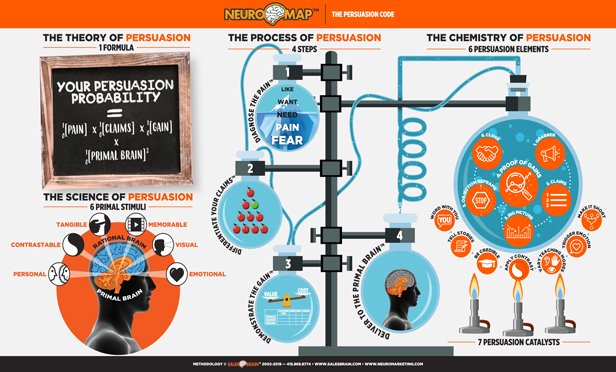
Start your presentation with a “pain dialogue” … then move on to an “emotional cocktail” … An to engage your audience more deeply, emotionally and persuasively says Christophe Morin, co-founder of neuromarketing agency SalesBrain, and author of new book “The Persuasion Code: How Neuromarketing Can Help You Persuade Anyone, Anywhere, Anytime.”
Morin reveals how neuroscience research, measuring brain activity, helps you to target the decision-making part of the brain. It is this, the primal brain, that encourages clients to make faster, better investing choices, he maintains. In the book he lays out specifics for employing brain-science findings to create messages that impact the primal brain and, at the same time, prepare clients to talk about solutions.
There are four steps to being more persuasive, he says
Diagnose the pain
Differentiate your claim
Demonstrate the gain
Deliver to the primal brain
“You need to engage the primal brain — the brain’s fast system; and then address the future with the rational brain — the slow system. Though mostly unconscious, the primal brain — responsible for survival — dominates the persuasion process” he says.
Morin illustrates the primal brain’s purpose with, for instance, this equation: If Cookie + Candy = $1.10, “how much is the candy if the cookie costs $1 more than the candy? Not a dime! If that’s what you thought, blame it on your primal brain’s intuition and speed.”
In his book, “Thinking, Fast and Slow,” Nobel Prize winner Daniel Kahneman describes the tension between the primal brain and the rational brain. Morin takes another spin on this model and confirmed that persuasion has a scientific path in the brain. The idea is to target the decision-making brain — the primal brain.
He says “The primal brain doesn’t understand the future. First, you want to sell motivation in the primal brain. Then, if you’re successful, you get to the rational brain, where you can talk about the future, because by that time, the selling is pretty much done. The primal brain is always on a mission to accelerate decisions. The rational brain is always on a mission to delay decisions.”
Advertising great, the late David Ogilvy said that the only way you can effectively advertise or sell is by lighting a fire under people’s chairs and then presenting the extinguisher. If you talk about financial services to people who haven’t recognized that they’re at risk — by making bad decisions on their own or not having an advisor who’s qualified — they won’t take interest in what you’re saying.
“Make sure you’re speaking about the client’s pain — not just about your business. Be sure to trigger an emotional cocktail. Use the idea of contrasting: This is your life with a financial advisor; life would be risky without one. Make it tangible. Use analogies, which bridge what you already know to something new. Use familiar situations. Make it memorable. Make it visual. And provide concrete evidence to prove what you say.”
Differentiating your claim is about you. “People are buying you, the person. So your claim can be about what’s unique about you as an advisor that would help people trust that you can do a better job with their money than another advisor or themselves on their own.”
The take time to demonstrate the claim, to produce the evidence that proves it. If the primal brain can’t grab, recognise and process that evidence, it will remain suspicious. We’re visual decision-making machines because vision is by far the most dominant of all the senses. Pictures and videos have a much faster and stronger emotional effect.
Finally, delivering your message to the primal brain could take many forms. A killer presentation, an addictive website. Or it could be in the form of a conversation. Props can be part of the delivery; or you can act out a minidrama, where you become the customer in order to reawaken their pain. This creates instant identification, empathy and trust.
“We recommend that people who sell face-to-face use props because objects are concrete and much more primal-brain friendly than words. For example, a financial advisor could use a raw egg to show the fragility of the client’s money and to introduce a dialogue about having a nest egg and protection.” says Morin.
And finally use simple language, never jargon. “Jargon will immediately turn off the primal brain. One thing people are good at is faking paying attention: They don’t want to share that they’re bored to death or that they don’t trust someone. So they’ll act as if everything is cool and at the end, say, “Thank you. Email me whatever information you have” — and then never talk to you again.”
We’re all familiar with the drive for business to do more than make money, to contribute more broadly to society, and take greater responsibility for the world in which they operate.
Business leaders are increasingly pressured by citizens, consumers, and governments to address urgent social and environmental issues. Although some corporate executives remain deaf to such calls, over the last two centuries, a handful of business leaders in America and Britain have attempted to create business organizations that were both profitable and socially responsible.
In a new book The Enlightened Capitalists, James O’Toole (who is a former professor at the University of Southern California Marshall School of Business) explores the complicated history of business people who tried to marry the pursuit of profits with virtuous organizational practices—from British industrialist Robert Owen to American retailer John Cash Penney and jeans maker Levi Strauss to such modern-day entrepreneurs Anita Roddick and Tom Chappell.
He tells the largely forgotten stories of men and women who adopted forward-thinking business practices designed to serve the needs of their employees, customers, communities, and the natural environment. They wanted to prove that executives didn’t have to make trade-offs between profit and virtue.
O’Toole brings life to historical figures like William Lever, the inventor of bar soap who created the most profitable company in Britain and used his money to greatly improve the lives of his workers and their families. Eventually, he lost control of the company to creditors who promptly terminated the enlightened practices he had initiated—the fate of many idealistic capitalists.
He also highlights the journey of Patagonia, which operates as a benefit corporation (a legal structure that allows its leaders to prioritize decisions benefiting society over shareholder interests), and the relentless drive of its founder, Yvon Chouinard.
As a new generation attempts to address social problems through enlightened organizational leadership, O’Toole explores a major question being posed today in Britain and America: Are virtuous corporate practices compatible with shareholder capitalism?
Almost every industry and realm of life is set to be transformed by it, with the estimation that by 2020, 95 per cent of all customer interactions will be carried out by some form of AI. When it comes to business innovation, it is one of the most exciting technologies available, with PwC estimating that it could add $15.7 trillion to the global economy by 2030.
“Everything invented in the past 150 years will be reinvented using AI within the next 15 years,” predicts San Francisco-based Randy Dean, chief business officer at Launchpad.AI.
It is already having a transformative effect in a number of industries. In sales AI can help strengthen pitches by detecting and reacting to consumer emotions. Japanese investment bank, Daiwa Securities, found that customer purchase rate increased by 2.7 times after they implemented AI technology.
UAE even has a government Minister for AI.
In the healthcare and pharmaceutical sectors, AI tools have been built which can sort and accumulate medical knowledge and data on a scale humans could only dream of. At one end of the spectrum sit dosage error deduction and virtual nursing assistants, at the other: genome sequencing. AI has brought the time and cost of sequencing someone’s genome, which is the unique arrangement of their DNA, down to 24 hours and just $1,000 respectively.
AliveCor
Whilst Apple Watch 4 has focused on its new ability to create cardiograms, AliveCor developed the first smartphone-connected electrocardiogram, or EKG, called Kardia, which detects abnormal heart rhythms on a phone in much the same way that an EKG in a hospital records the electrical activity of the heart. This means that patients can check their heart health regularly and find out within 30 seconds whether their results are normal or they should seek medical attention. That’s particularly important for millions of Americans at risk for arrhythmias, which may be symptomless and can result in potentially fatal outcomes like heart failure and stroke.
American Express
American Express processes $1 trillion in transaction and has 110 million AmEx cards in operation. They rely heavily on data analytics and machine learning algorithms to help detect fraud in near real time, therefore saving millions in losses. Additionally, AmEx is leveraging its data flows to develop apps that can connect a cardholder with products or services and special offers. They are also giving merchants online business trend analysis and industry peer benchmarking.
Burberry
When you first think of Burberry, you likely consider its luxury fashion and not first consider them a digital business. However, they have been busy reinventing themselves and use big data and AI to combat counterfeit products and improve sales and customer relationships. The company’s strategy for increasing sales is to nurture deep, personal connections with its customers. As part of that, they have reward and loyalty programs that create data to help them personalize the shopping experience for each customer. In fact, they are making the shopping experience at their brick-and-mortar stores just as innovative as an online experience.
Darktrace
We’re all ultra conscious about the vulnerability of our devices and systems to cyber attack. Darktrace’s Enterprise Immune System (EIS) slows attacks on computing systems by emulating the way humans fend off viruses: The AI-enabled platform embeds in a network, learns what behaviors are normal, and flags anomalies. It became more formidable last April with the launch of Antigena, which automatically stops or slows compromised networks and devices. “Our system is self-running,” says CEO Nicole Eagan, “so [customers] don’t have to touch anything.” When the WannaCry ransomware proliferated last May, Antigena disrupted it in less than 30 seconds. More than 4,000 networks (including the city of Las Vegas) rely on EIS, worth some $300 million in contracts.
Drive.ai
Drive.ai is using artificial intelligence to bring autonomous driving to America’s roads today. The company has on-demand self-driving car services in operation in two American cities. In July 2018, Drive.ai launched in Frisco, Texas, serving its commercial sector. In October, Drive.ai debuted in Arlington, Texas, a generally available shuttle service that operates in between the Cowboys’ AT&T Stadium, The Texas Rangers’ Globe Life Park, the Arlington Convention Center, and many area hotels, among other places.
Grammarly
Grammarly helps people improve their writing. It uses AI to help make people’s communications more clear and successful, recommending improvements like expressing oneself in fewer words and with more impact. In 2018, the company upgraded its Grammarly Editor to continue to help users learn how to write better, including being more inclusive in one’s language. Grammarly also improved its browser extension to work with sites like Medium and Google. The company shares its research into communication and natural language processing in an effort to have its data improve the field overall. More than 15 million users take advantage of Grammarly daily.
HeartFlow
HeartFlow uses deep learning to improve how we test and treat coronary artery disease (CAD). HeartFlow Analysis develops a personal 3-D model of the heart and then uses AI to consider the impact of blockages on blood flow so doctors can devise treatment plans without invasive surgery. In 2018, HeartFlow launched a mobile app for doctors so they had the information they needed to check patient status, and in April, HeartFlow Analysis was selected to be part of NHS England’s Innovation and Technology Payment (ITP) program, to accelerate its adoption across Britain’s healthcare system. In the United States, UnitedHealthcare started covering HeartFlow, meaning that HeartFlow is available under insurance for about 75% of Americans.
Hello Barbie
Using natural language processing, machine learning and advanced analytics, Hello Barbie listens and responds to a child. A microphone on Barbie’s necklace records what is said and transmits it to the servers at ToyTalk. There, the recording is analyzed to determine the appropriate response from 8,000 lines of dialogue. Servers transmit the correct response back to Barbie in under a second so she can respond to the child. Answers to questions such as what their favorite food is are stored so that it can be used in conversation later.
Infervision diagnostics
AI and deep learning is being put to use to save lives by Infervision. In China, where there aren’t enough radiologists to keep up with the demand of reviewing 1.4 billion CT scans each year to look for early signs of lung cancer. Radiologists need to review hundreds of scans each day which is not only tedious, but human fatigue can lead to errors. Infervision trained and taught algorithms to augment the work of radiologists to allow them to diagnose cancer more accurately and efficiently.
https://www.youtube.com/watch?v=2urdvNw_U9Q
Lemonade
Lemonade is reinventing insurance to be instant, easy, and transparent. It offers home insurance powered by artificial intelligence and behavioral economics. By replacing brokers and bureaucracy with bots and machine learning, Lemonade promises zero paperwork and instant everything. And as a Certified B-Corp, where underwriting profits go to nonprofits, Lemonade is remaking insurance for social good, rather than a necessary evil.
Microsoft
Central to everything Microsoft does is leveraging smart machines. Microsoft has Cortana, a virtual assistant; chatbots that run Skype and answer customer service queries or deliver info such as weather or travel updates and the company has rolled out intelligent features within its Office enterprise. Other companies can use the Microsoft AI Platform to create their own intelligent tools. In the future, Microsoft wants to see intelligent machines with generalized AI capabilities that allow them to complete any task.
Netflix
Netflix success story can not be explained without understanding their granular knowledge of their subscriber base and their AI driven focus on personalisation. Netflix not only looks at millions of ratings, searches and “plays” a day, but the entire viewing history of billions of hours of content streamed per month. It took them 6 years to collect enough viewer data to engineer a show that became an worldwide success: House of Cards. Since then, Netflix has increasingly used this formula for content creation achieving success rates of 80% compared to 30%-40% success rates of traditional TV shows.
Nvidia
Nvidia is a maker of graphics processing units (GPUs) for a wide variety of applications, from gaming to artificial intelligence. In 2018, Nvidia debuted the Turing GPU architecture, which enables real-time ray tracing possible for designers, engineers, gamers, and scientists and heightens realism in computer graphics. By interpolating real-time ray tracing, artificial intelligence, simulation, and rasterization, Turing makes photo-realistic cinematic worlds possible, whether it’s for entertainment or even healthcare purposes in visualizing the body in new ways. Other applications include 4K HDR gaming on PCs as well as work in climate change and urban development.
NuTonomy
Whilst Apple and Google, GM and Tesla have dominated the driverless car headlines, autonomy has been quietly making the most progress. Created by former MIT faculty, researchers, and graduates, self-driving car startup nuTonomy has been getting autonomous cars on roads from Boston to Singapore, where it has been providing autonomous taxis since 2016. NuTonomy has also partnered with Group PSA, owner of European car brand Peugeot SA, to bring self-driving SUVs to Singapore. In June 2017, nuTonomy teamed up with Lyft to figure out how autonomous vehicles work in practice, whether they’re put toward ride sharing or personal ownership. The two companies began rolling out the fruits of their labor in late 2017 with a self-driving car pilot in parts of Boston. NuTonomy’s high-profile successes caught the attention of car-part supplier Delphi Automotive, which acquired the startup in October 2017 for $450 million. The move beefs up Delphi’s self-driving car mission and gives nuTonomy more scale through Delphi’s resources and distribution.
Pinterest Lens
Pinterest started as a fun way of sharing images, an online pin board of visual inspiration, founded in 2009 by Ben Silbermann, Evan Sharp, and Paul Sciarra. Covering everything from travel to home renovation projects, it is a unique social platform that gives its users a place to express what they want in the future. Every idea is represented by a “pin” that includes an image, a description, and a link back to the image’s source online where they can learn more about the idea. Pins can then be further organized into “boards,” which sort ideas based on categories. Every month, Pinterest processes hundreds of millions of image searches in its bid to help users find things they’re most interested in. It is increasingly turning to machine learning to surface content that resembles objects its users have already pinned—so if someone pins a picture of, say, a midcentury table, it will automatically recommend that they look at pictures of other furniture from the same era. In 2017, seven years after encouraging users to curate the internet with photos rather than hyperlinks, Silbermann and Sharp unveiled their next act: Pinterest Lens, which enables people to search for information and inspiration simply by aiming their phones’ cameras at objects around them. Advertisers are increasingly embracing Pinterest—2017 revenue was reportedly just shy of $500 million, up 64% from the previous year.
Rare Carat
Rare Carat was launched in 2016 by Ajay Anand who says Rare Carat has the capacity to disrupt the market for the diamonds by bringing greater transparency to an industry that has traditionally relied on opacity. The business does not physically stock and sell diamonds. Its platform offers prospective diamond buyers comparison shopping and price transparency by connecting them to diamond retailers. The platform uses IBM Watson technology to compare the price of diamonds. Rare Carat has also partnered with Everledger, whose technology tracks diamond provenance, on a blockchain-based diamond ledger to verify the certification and transaction history of the diamonds its vendors are offering, as well as ensure they are
BMW and Daimler this week launched a sustainable mobility joint venture including ride-hailing, parking and electric car charging services.
The two companies, previously fierce rivals, will invest more than €1bn to develop their urban mobility businesses and the merger brings together car-sharing services Reach Now and Share Now, charging service Charge Now, ride-hailing service Free Now and parking app Park Now.
Each company will hold a 50 per cent stake in the new joint venture and will remain competitors in their core businesses. “We are shaping future mobility – and striking out in new directions to do so. Our Strategy provides us with a roadmap to a digital and emission-free future,” said Harald Krüger, BMW chairman. “Combining our mobility services as planned will create a unique digital ecosystem. This alliance will make it easier for our customers to discover the emission-free mobility of the future.”
More generally, the rapidly changing world of mobility – cars and planes, buses and trains, trucks and trailers, scooters and bikes; electric and shared, charging and maintaining, subscriptions and cross-payments, hubs and brands, networked and connected – will shape our lives and cities.
New, fast emerging “mobility ecosystems” won’t just set to change how we travel, it’s set to change the world.
As world populations and cities grow, people are looking for transportation solutions that make life easier. Solutions which reduce traffic congestion in our cities and respect the air we breathe. Connected vehicles that integrate seamlessly with our devices while improving safety on our roads. Economical choices that give us pleasure and freedom in driving.
What is the future of mobility?
In Bratislava, Slovakia, I recently met up with Stefan Klein, the former auto designer who is the entrepreneur behind the Aeromobil flying car, a hybrid car and light aircraft that has a top speed of 200km/h and range of 400km. It is a vision driven more by passion than profit, but changing the perception of possibilities.
In Munich, Germany, I got inspired by the team behind Lilium, the world’s first electric vertical take-off and landing jet. They want to change the way we travel by developing a new type of hybrid aircraft, one that has vertical take-off and landing capability. It reminded me of the flying taxi visions of both Google and Uber.
In Karlsruhe, I worked with Bosch, the automotive parts company, that was initially unsure of what role it could take in the future of mobility, and what posture to take – an innovator or follower, shaping and waiting. Now they have a connected services vision, and a clear roadmap to shape the future of mobility.
In Shenzhen, China, I observed the huge scale production of BYD’s electric cars, typically retailing at $8000, a fraction of the price of a Tesla. Now the largest producer in the world it has a very different strategy from Tesla’s premium-driven portfolio and much slower paced growth. Slightly perversely the largest markets for electric cars are Norway and Iceland.
In Los Angeles, USA, Toby Sun talks about the wild growth rate of his Lime electric scooters, which adopted a much more fashion and social media driven approach to market adoption, now plaguing the pavements of many cities around the world. But interesting too how the smallest devices have grown fastest, maybe a springboard to build more integrated offers.
We can be inspired by the entrepreneurs, and enabled by the technology, but perhaps more importantly we should be guided by the market trends that will drive consumer demand, and shape policy and strategies. Greener, safer, cheaper transportation, accessible to everyone, reduced the congestion of our choked cities, improving social connectedness and transport efficiency, and enriching the joy of travel.
He hit the headlines recently with a series of global acquisitions including Cambridge chip designer ARM, virtual worlds startup Improbable and office space provider WeWork (which has now rebranded as the We company).
SoftBank 49% jump in profits is largely driven by a strong performance from SoftBank’s $100 billion Vision Fund, the largest tech fund in the world. It is based in London’s Mayfair, and backed by Saudi Arabia’s Sovereign Wealth Fund and companies like Apple.
Son’s strategy for the fund, which spans agriculture, transport, satellites, payments, computer chips, and ecommerce, is quite simple … AI.
He recently said that he is devoting “97% of my time and brain” to driving the future of AI.
The most powerful man in Silicon Valley
Welcome to Masa World … The Japanese billionaire bases himself just outside Palo Alto in a palatial estate just off the Sands Hill Road.
Startup founders fortunate enough to earn an audience with Son recall being led down a hallway lined with artwork to make the pitch of a lifetime. Some were ushered into a large conference room with an enormous table, spotless marble floors and ornate woodwork. Others found themselves in a small side room illuminated by chandeliers waiting for the meeting to begin. Eventually they met Son in an intimate sitting room where a two-seater couch faces a couple of chairs and a small coffee table.
Under Son’s guidance, the Japanese conglomerate, which he founded in 1981, has repeatedly shaken up entire industries with blockbuster acquisitions of companies like Sprint and prescient investments in startups like Alibaba.
Son capitalised on the rise of personal computing in the 1980s and bet so heavily on the dot-com boom of the 1990s that he is said to have at one point owned 25% of the Internet. He lost billions in the dot-com bust, but sinking $20 million into Alibaba in 2000 helped revive his fortune. Son is now worth about $15 billion — and, remarkably, maintains his tremendous appetite for risk and long-term thinking. At a time when most CEOs look no further ahead than the next quarter, Son forges ahead with a 300-year plan for his company.
At the heart of his plan lies the Vision Fund, a $93 billion pool of money that he intends to use to shape the future for centuries to come.
If that kind of timeline seems odd, well, Son is something of an eccentric. He often quotes Yoda, passionately prepares for the singularity, and has been known to make big bets on companies based upon what he once called his “sense of smell.” He plays an active role in SoftBank’s investment decisions, and Aron recalled being told that Son has “final say” on each Vision Fund deal.
Son has always had a penchant for making deals. As a student studying economics at UC-Berkeley forty years ago, he convinced Forrest Mozer, a professor who had invented a talking calculator for the blind, to join him in building a pocket translator.
“It surprised me,” Mozer told CNN recently. “Here’s this young, little kid coming into my office with a business plan that really made a lot of sense. I went home and told my wife that I just met this guy who is going to own Japan someday. It turned out I was more right than I thought.”
Son sold the device to Sharp in a deal he said netted him “close to $1 million” — an early win for the young entrepreneur. “It was clear if you spent an hour a day with him that his mind was all on business,” Mozer says.
Son returned to Japan after graduating from Berkeley in 1980 and founded SoftBank –the name is short for “bank of software”– in 1981. It focused on distributing software developed by other companies, before branching into computer trade shows and tech magazines. From the start, Son focused on “how he could help change society with technology,” said the longtime SoftBank employee.
By the mid-90s, it seemed clear that answering that question meant investing in online companies. In what could be seen as a precursor to its activities today, SoftBank pumped billions into hundreds of internet startups. Some, like Yahoo and Alibaba, paid off handsomely, helping overshadow losses from notable flops like Kozmo and Webvan. Son bet so heavily on online ventures that people took to calling him “Mr. Internet.”
Son’s net worth soared accordingly, only to collapse when the bubble burst. He is widely reported to have seen his paper wealth fall by $70 billion in 2000. “One year before that, my personal net worth was increasing $10 billion per week. For three days, I became richer than Bill Gates,” Son told Bloomberg TV last year. “Before I told anybody else, our stock started crashing… We almost went bankrupt. Somehow. I survived.”
Son started rebuilding immediately. “When something like that happens he doesn’t sit back and sulk and become inward looking,” the longtime SoftBank employee said. Son looked to new opportunities, including investing in broadband services in the early 2000s, acquiring Sprint for $20 billion in 2013 and buying multiple robotics companies in 2017 — among them Alphabet’s Boston Dynamics, which builds robots that run, jump and climb stairs. More than a decade after the Dot Com bubble burst, SoftBank reaped the financial rewards of the early Alibaba deal. When the Chinese e-commerce company went public in 2014, SoftBank’s $20 million investment was worth nearly $75 billion.
“He likes to joke he has had more failures than anyone else, but has learned from all of them,” says Chris Lane, an analyst with Bernstein who tracks SoftBank. “Most people still admire his track record, and the amazing success he has had despite these setbacks.”
300 year “number one” strategy
Son laid out his investment plan during the shareholder meeting in June 2018. He called it his “cluster of number one strategy”, meaning investing in unicorns that are, or could be, “the number one players in the market.”
Near the top of that list is We, the 8 year old business that provides coworking spaces in 80 cities worldwide. SoftBank invested $4.4 billion in them in 2017, despite the fact the company wasn’t actively seeking funding.
“This company,” he told shareholders, “is ready to become next Alibaba.” explaining the deal which is arguably the signature achievement of his career. But Son’s future as an investor may depend on proving, as he once put it, that his success with Alibaba “was not just one lucky hit.”
It’s been barely a year since the Vision Fund officially launched, but, SoftBank has scored some modest wins with the Vision Fund. It invested $2.5 billion in Flipkart, India’s leading online retailer, in 2017. That investment yielded a 60% return when Walmart bought the company less than a year later in a deal that reportedly pegged SoftBank’s stake at $4 billion. And then there’s Uber, which SoftBank first invested in when the ride-hailing company was valued at $48 billion. Uber is believed to be pursuing a secondary stock sale at a $62 billion valuation — with plans to go public next year.
Son is laying the foundation for a company, and a personal legacy, that endures for centuries.
“In 300 years’ time, we would like to become that company that makes the most contribution to human evolution — the company that has greatest impact on humanity,” he said during a recent shareholder meeting.
To achieve that grandiose goal, Son continues pursuing bold, almost brash, deals designed to keep SoftBank at the center of any trend he believes will fundamentally shape world. In the past, that meant telecoms and internet firms. Today it means big data, biotechnology, robotics, agriculture, ride-hailing and autonomous vehicles. Son likes to say he is preparing for the day when “all sectors of society and industry will be redefined” by super-intelligent machines.
In a conversation with Eric Gundersen, CEO of mapping startup Mapbox, the entrepreneur marveled at how Son was able to discuss ideas that were “multi-decades out” before going back to “specific customers” and industry details in the present. “You can’t have a visionary strategy unless you know the details,” Gundersen said. And he has an idea what Son’s visionary strategy is. “You’re seeing him own the infrastructure for the future.”
Son’s Success Pyramid
Son says he developed his decision-making framework when he was 26 years old. And the 30 years of success is the proof of the validity of it. He continues to revise and improve on it.
His framework is based on Lanchester’s Law (which “specifies the casualties a shooting force will inflict over a period of time, relative to those inflicted by the opposing force”), Sun Tzu’s Art of War, and his own thinking
The framework has five pyramid levels, from top to bottom: Ideology, Vision, Strategy, Leader’s Competence, Tactics. Each level has then five attributes:
Son says all his decisions can be based on those 25 attributes. Let’s consider each of them:
Ideology
Road: Use information revolution to make people happy
This is Softbank’s universal mission. Everyone in the company has heard of it and is familiar with it. It was mentioned several times also during the 30 years plan talk.
Sky: The information Revolution
The sky is for timing. There are unique things to be alive under this sky at this particular time. He gives few example of some of the unique things happening during this time:
Information Big Bang
Microprocessors
Internet
No matter how great of a person you are, if you were born during the wrong timing, your opportunities are limited. The present people are extremely lucky to be living at this time and there is an unique and huge opportunity. Son reminds of the previous revolutions:
Agricultural Revolution
Industrial Revolution
Information Revolution
The Information revolution is likely to be by far the biggest one. They got so lucky to be here during this timing. The opportunity is here and it should be taken advantage of.
Terrain: Terrain advantage: the epicenter of the Internet is Asia.
In the past, the United States had 50% of the world’s internet,
In 2015, Asia will have 50% of world’s internet users.
In the past, you had to be in the US and had to speak English, simply because the users were there. All big internet companies have historically come out of the US.
But the times have changed, the internet is shifting to Asia. Softbank Group has already been making a presence in Asia for a decade, notably by making investments in China such as Alibaba, Renren, etc…
With both this godsend opportunity from the Sky(Timing), and Terrain advantage, there is now no reason why Softbank should not take full advantage of the opportunity.
Leader: In order to succeed, you need to gather great leaders.
Of course the CEO must be a great leader, but he/she must also have at least 10 leaders below him/her. Nothing can be done alone, Softbank needs to accumulate great leaders. Softbank, by looking and picking great ventures to invest in Asia, is also gathering another great leader to join the Softbank family.
*Son actually uses the word General, but I’m translating it as Leader.
Systematisation: Systematisation is needed for continuous innovation
With willpower or luck, you may be able to get one win. But you cannot expect that to continue forever.
In order to keep winning and keep generating innovation, you need to create a system where it will make it happen again and again. Some examples of the systems Softbank has already implemented include:
Accounting is divided by departments
Introduction of new business models
Without the systematisation, it will impossible to execute at a scale.
Vision
Summit: The scenery you see when you have climbed to the top of the mountain
This is vision. The leader must be able to vision that scenery at the top of the mountain. He must be able to choose which mountain to climb. By choosing the correct mountain, you have already won 50% of life’s battle. You must have a great convinction that the mountain is correct be able to have a good idea of what the scenery on the top of that mountain looks like before you climb it. The leaders without a vision are the worst ones of all.
The vision does not come out in a day or two, you must think about it everyday. The vision for his 30 year plan took a whole 1 year of intensive thinking, and input from many many people.
Information: research
“He did research on 40 businesses, and in the end, the pile of papers he had accumulated were 1 meter in hight”
When son graduated from university and came back to Japan, he wanted to start an enterprise. But it took him 1.5 years before he did it. During this period, he was researching and accumulating information. He had came up with 40 businesses. He would create a very thoughtful plan for one business, create the business plan, financials, competitor’s analysis, plan for 10 years, expected revenue etc. And he would think that his was the best business in the world. 2-3 weeks later, he would come up with another business, a business better than the one before. He would then redo the research and create the new plan. He repeated this 40 times, each time with a business better than the one before. And the last one of his business plans turned out into Softbank. He emphasizes the importance of information accumulations (research).
Strategy: Strategy is basically the implementation for the vision.
After the reasearch you may have 40 choices, strategy is when you decide to go with one of them and never look back. Strategy takes a vision into reality.
Seven: The on who fights a battle with 50% winning chance is a fool. The one who fights a battle with 90% winning chance has made his move too late.
The best generals only fight battles they know they are going to win. Son is regarded as an agressive risk-taker but in reality he is very careful. He never risks more than 30% of the business. Even if the business is to fail, he can close it down and the core business can still go on. You must be sure that your math is right.
The leader must close down, make a retreat when that must be done. It is one of the hardest things to do. This is even harder for the next generation of leadership because they will be critisized to be not as good as the previous generation. Needs extreme courage to close a business down, you’ll be criticised by all points of view. When a general has lost 30% of his troops, he should immedialy call for retreat, any other decision is foolish. Not understanding this concept will bring Softbank into ruins.
Fight: The are things that can be seen during the fight
Words are cheap. Execution is hard. There are always competitors. Things change during the fight. No matter how good is the vision, strategy or research, it is all useless if you don’t come down and do the actual execution. He mentions that all companies fought their way into their current position: Toyota, Honda, Ford, Rockefeller, Billl Gates, Steve Jobs. Vision = Execution. Execution = Vision. Why one must fight? In order to make the vision come true.
Strategy
One: Must be by far the number one
Must own the specific market. You only make long-term profits if own the market and are far ahead of number two. If you are ahead by only a littile, it will probably me only a matter of time before you lose all profits. This is even more true in the technology space. Only if you are number one, you will be able to build a platform and define the de facto standard. Examples of platform that he mentions are: Microsoft’s Windows, Intel’s CPU, Google, Amazon, Yahoo.
The company must have a #1 culture. You must always strive to become number one. A culture that starts to become comfortable of not being number one is a very negative culture, it’s very bad. Son says he has always been number one since elementary school. He just can’t sleep if he is not number one.
Wave: Do not go against wave
Don’t go agains the wave. Get the direction right. Which OS should you choose? Of course the one who will become most used. Do not choose a niche.
An enterpreneurs who succeeds in a niche is not a successful entrepreneur. The successful entrepreneur succeeds in the mainstream market, that might as well be an othodox way. Softbank does not invest on niche markets, it invests on markets that will become big in the future. There is no meaning in winning a small market. If you choose to pursue a niche market because you are afraid to fight in the main market, then you are a loser.
Offensive
Sales
Technology
M&A
Development of new businesses
etc. etc.
Must be good in multiple skills.
Defensive
Cash Flow
Cost reductions
Investment Relations
Close down a business
Compliance
Auditing
Media Reputation
etc. etc.
Many ventures today die because of financing. Softbank has a commitment to become zero debt financing in 4 years.
Group: Synergy 5000 companies.
Softbank Group will be compromised of 5000 companies. It will be a multi-brand, multi-business model. This may not be necessary if you want to survive for the next 30 years, but it is must have to survive for the next 300 years. Companies like Microsoft and Intel are struggling today as they have only a single brand.
Leader’s Competence
Knowledge
Critical Thinking
Global negotation
Presentation skills
Technology
Finance
Analytical Skills
etc etc.
The leader must posses multiple skills, and have a good banance of skills. Must be very proficient in one skill so that he can make most out of the specialistz. The leader does not rely on specilists, he/she makes best use of them.
Trust: Mutual voluntary cooperation
Trust and be trusted. Partnerships. If you lose trust, others will not work with you.
Benevolence: For the happiness of people
Recall the vision. For the happiness of people.
Courage
Courage to fight against a big opponent. Courage to shut down a business.
Strictness
Strict with self. Strict with others when necessary. If you truly believe in the vision and the good for everyone, you must become a demon at certain times.
Tactics
Son skips the following are they are already well covered in Sun’s Art of War and other literature. however Sea is a original from Son.
Sea
The fight has ended only when everything has been engulfed and remains only complete silence and peace. As the sea.
I always look forwards to Fast Company’s annual ranking of the World’s Most Innovative Companies. Whilst other sources, most notably Bain and Forbes, also produce rankings, largely analytically based on quantifiable factors like patents and profits, FC’s ranking is more inspiring. It’s about companies with a real vision, who are daring to challenge the norms, to drive fundamental change and progress.
Like the “Gamechangers” who I profile in my books and on this site, they are the shaker-uppers … the ones who see things differently, the ones who dare to challenge the fundamental rules of their sectors, and the ones who can change the world.
You probably haven’t even heard of this year’s top-ranked business. Yet China’s technology entrepreneurs are moving with a different rhythm to their peers in more established western environments. Like the big platforms of Alibaba and Tencent, Baidu and Xiaomi, China also has a huge start-up seen, where new ideas spread and evolve rapidly, where old boundaries are leapfrogged, and ambition is unlimited.
And it’s not just about China. Second in the ranking is Singapore’s Grab, more familiar as a delivery service that goes far beyond the likes of Uber. Maybe an even greater surprise is that the NBA comes in at number three. I was recently exploring the huge potential of digitally-enabled communities with a team of business innovators. Of all the examples we looked at, NBA came out as the most innovative, transforming the participation experience for millions of passionate fans.
I’m also delighted to see StitchFix enter the top 5, founded by a fellow astro-physicist, and now led by CEO Katrina Lake who thrives on disrupting the way in which people can now buy clothes. Apple, by the way, make it onto the list at #17, whilst many of the US’s most familiar giants – Amazon, Google, Microsoft and more – don’t even feature. You can argue the merits of any ranking, and the definitions of being innovative, but most of all, I love the list for his eclectic gathering of inspiring stories.
So here’s the top 5, and the full ranking:
#1: Meituan Dianping
Meituan Dianping is a Chinese company that aspires to be the Amazon of services. Its apps connect consumers with local businesses for food takeout, hotel bookings, and movie tickets, among other services. In 2018, it acquired the bike-sharing company Mobike (since rebrand to Meituan Bike) to offer local transportation services as well. Meituan’s tech platform uses data from its high-frequency applications to suggest its lower-frequency ones and inform users where to go next.
FC says that in the first half of 2018, the Chinese tech platform that expedites the booking and delivery of services such as food, hotel stays, and movie tickets, facilitated 27.7 billion transactions (worth $33.8 billion) for more than 350 million people in 2,800 cities. That’s 1,783 Meituan-enabled services every second of every day, with each customer using it an average of three times a week.
#2: Grab
Anthony Tan, CEO of Grab, grew up the son of one of the largest automobile distributors in Malaysia. Now he’s head of Southeast Asia’s largest ride-hailing service. Grab doesn’t just connect people with rides, it also provides its drivers with digital wallets through Grab Financial, for storing their cash, taking out loans, and even picking up lunch.
FC describes how the Singapore-based ride-hailing company, forced Uber out of the region in 2018 and acquired its local operations. A few months later, it expanded its app to offer its 130 million users not only food delivery and travel booking, but also financial and other services. These efforts helped Grab hit $1 billion in revenue in 2018 and attract more than $3 billion in fresh funding to expand. Later this year, it’ll add healthcare services from Ping An, the Chinese digital health giant.
#3: NBA
The NBA wants to be a global brand, and it’s working. More than a billion people around the world watch a league game every year, and it’s setting in-person attendance records as well. But its big idea is to bring basketball to fans no matter where they are, or on what kind of device they have. The league released the NBA AR App, launched an augmented reality pop-a-shot game, and experimented with the technology using such apps as Snapchat. It’s continued to invest in virtual reality as well, introducing the NextVR Screening Room, which lets fans view NBA League Pass games on a virtual movie theater-size screen.
FC explains how in an age of distraction, the NBA holds people’s attention. Last year, the league broke attendance records for the fourth straight season; its streaming service grew subscribers by 63%; and total revenue increased 25%. One reason: the year-old NBA 2K League, the first extension of pro sports into esports, which has 21 teams and games that stream on Twitch. “It democratizes our sport,” says NBA commissioner Adam Silver.
#4: Disney
Disney is known for its iconic film and television, theme parks, toys, and characters. In 2018, Disney fully embraced the shift in consumer behavior toward personalized, on-demand entertainment. Before any other “traditional” media company, Disney began to remake itself for a direct-to-consumer future. Disney’s collection of premium global brands–Disney, Pixar, Marvel, Lucasfilm, ESPN, and ABC–give it the kind of content that drives consumers to sign up for streaming services.
FC recognises that there are plenty of venerable media empires aspire to be players in the streaming wars. However none is better positioned than Disney, which retooled its organisation to deliver its own video services rather than license content to Netflix. “We’ll do a better job than others,” says direct-to-consumer chief Kevin Mayer. “We know our brands viscerally.”
#5: Stitch Fix
Stitch Fix is an e-commerce company whose users receive boxes, or “Fixes,” of clothing, shoes, and accessories based on their personal style and clothing preferences. This online personal styling service combines Netflix-style algorithms with human intuition and curation provided by more than 3,000 stylists who fine-tune each Fix. Together, they helps Stitch Fix identify which sizes will work best with each customer. When the company went public in 2017, it raised $120 million and was valued at $1.46 billion.
FC reflects how while working on a PhD in astrophysics, Chris Moody used supercomputers to simulate how galaxies crash into each other. For his first nonacademic job, he joined Square as a data scientist in 2013. About a year later, he started talking with some data-scientist friends who were employed at a startup called Stitch Fix, an upstart e-commerce service that delivered boxes of women’s fashion, known as “Fixes,” using a mix of algorithmic and human curation.
In depth stories of all the innovators can be found at FC. There’s also a fantastic breakdown into ranking by selective industry sectors, regions and other random ways of looking at the changing world of innovation. Here’s the full ranking of FC’s World’s 50 Most Innovative Companies 2019: