Elon Musk has been called the Thomas Edison of our times. From his Paypal pay out he invested in daring dreams and radical technologies that were ahead of most other people’s imaginations.
From Tesla to SpaceX, Solar City and Neuralink, Boring Company and Hyperloop, he has driven a relentless, sometimes chaotic, largely uncertain, but ruthlessly determined vision to change our world.
His goals seem incredibly worthy – to save humanity. By creating on alternative civilisation on Mars, and before that, by finding solutions to global warming, take a more responsible attitude to AI before it gets out of hand, and to democratise access to innovation.
However the stories of 100 hour working weeks, a sleeping bed in his Tesla factory, as he focused his visionary mind on trying to solve the mundane challenges of mass production, portrayed him as an entrepreneur in the pains of scale up. Making ideas mainstream.
At the same time we loved his vision. The Hyperloop train connecting cities in minutes at 1250 km/hour. And we marvelled at his progress. The SpaceX’s Falcon Superheavy taking off and launching a Tesla roadster into space, and then returning to Earth, with precision landing.
We marvelled at the breadth of innovation. And we also questioned whether one mind, even an Elon Musk mind, has the capacity to cope with all this simultaneously. As targets were met, and the promises kept being extended, we wondered how many balls he could juggle, for how long.
But then came the thoughtless Tweets. The overconfident financial plans that fell foul of regulators, the podcast smoking that tarnished his shine, the courtroom battles that seemed to be a game of outspoken mavericks. It started to feel like he was losing his mind.
This week, The Times ran a fascinating article comparing Tesla to the Palm Pilot.
“Remember the Palm Pilot? Way back in 1996, the handheld “personal digital assistant” was a revelation. It was the first electronic organiser, complete with a touchscreen and handwriting recognition. It showed Palm’s rivals that customers would pay — and pay handsomely — for a handheld computer, paving the way for BlackBerry and, later, the iPhone.
Yet Palm, the company, met an ignominious end. It was lapped by rivals that took the idea and ran with it. Palm, valued at $50bn on the day it floated in 2000, was passed from one acquirer to another until TCL, a little-known Chinese manufacturer, bought it in 2015 for an undisclosed sum. A plan to revive the brand has gone nowhere.
It is a cautionary tale that Tesla chief executive Elon Musk would do well to heed. His company, which showed the world that drivers would pay — handsomely — for electric cars, is on the ropes. Again. Its stock is down nearly 40% since the start of the year, closing on Friday at $190.63, and it is burning through more than $200m (£157.3m) in cash every month. Sales of the California company’s high-end models have plunged.
Perhaps most importantly, Musk’s rivals have woken up. Nearly 20 electric car models — from BMW, Nissan, Kia, Jaguar and others — have hit the market or will do so in the next year. Musk, who has ploughed a lonely furrow for years, suddenly finds himself facing an all-out assault from Detroit and Frankfurt. The 47-year-old billionaire created the category; now he is at risk of being crowded out. It begs the question: could Tesla become the Palm of electric cars?
More and more investors are asking just that. Dan Ives has long been a Musk believer. Just six months ago he set Tesla’s price target at $440 a share and called it “one of the most dynamic technology innovators over the past 30 years”.
Ives, an analyst at the investment firm Wedbush, last week slashed his price target to $230, saying: “It feels like the walls are caving in.” Meanwhile, in a call with clients, Morgan Stanley’s Adam Jonas said the company had swung rapidly “from a growth story to a distressed credit and restructuring story”.
What’s changed? In a word, credibility.
It was only three weeks ago that Musk raised $2.7bn with shares and convertible loans — money he had spent most of the past year saying he didn’t need. In a call with investors, he said the cash was a “contingency fund”. He added: “We don’t expect to spend this capital.”
It was no secret that the company was losing money, but all seemed under control. At an “autonomy day” just days earlier, Musk — ever the showman — had set out how Tesla would become a $500bn giant thanks to a plan to turn its global fleet into autonomous robo-taxis.
https://www.youtube.com/watch?v=-VcCzKjXs-8
Then everything appeared to change — and with extraordinary speed. In a leaked email Musk sent to employees on May 16, he laid down the law on a “hardcore” cost-cutting plan, writing: “All expenses of any kind anywhere in the world, including parts, salary, travel expenses, rent, literally every payment that leaves our bank account, must be reviewed, confirmed as critical and the top of every page of outgoing payments signed by our chief financial officer. I will personally review and sign every 10th page.”
The extreme measures were for good reason, the chief executive explained. The $2.7bn “contingency fund” had morphed into a lifeline — and a short one at that. Musk wrote that, based on Tesla’s high burn rate, the cash “actually only gives us approximately 10 months”.
He has form for saying one thing, then doing another. Every year since its 2010 float, except for last year, Tesla has tapped investors or banks for more money. Often, the fundraisings have followed Musk’s fervent proclamations of Tesla’s financial strength.
Yet, until recently, investors seemed to be giving him the benefit of the doubt. He was trying to pull off something revolutionary — starting an all-electric car company from a blank sheet of paper. After this month’s fundraising, patience appears to be thinning, principally because the well-publicised “master plan” that Musk laid out is not working as expected.
The key to Tesla’s hopes of turning a profit and breaking the cycle of bailouts is the Model 3 “electric car for the masses”.
In 2017, Tesla made 2,900. Last year, it churned out 180,000. The goal for 2019? At least 250,000, based on production rates from the first few months.
The numbers are impressive — even if the company has been through what Musk has called “production hell” to get there — but the ramp-up is occurring just as Tesla is squeezed by two forces: its own debts and a deluge of new competition.
The company owes about $10bn, with two big chunks falling due soon: a $1.1bn payment by the end of the year, and a further $819m in 2020. At the end of the first quarter, its cash pile sat at $2.8bn.
Factoring in the upcoming debt repayments, and a $200m-plus monthly cash burn, it is clear why Musk is checking his coffee receipts. Breaking into the black, and doing so very soon, is vital. “The debt is a noose around Tesla’s neck,” Ives said. “The math doesn’t lie.”
Brands from Adidas to Allbirds have been experimenting with textile innovations that aim to push the industry towards a greener future.
We are all familiar with the challenges of our fragile earth, from climate change to resource scarcity – the World Wildlife Fund (WWF) estimates that humans are using the equivalent of 1.7 planets’ worth of natural resources.
Such resources, and water specifically, are central to the fashion industry’s supply chain. From planting and irrigating cotton fields, to dyeing and washing fabric – a world without enough water and raw materials spells out an uncertain future.
As a result, fashion is regarded as one of the “dirtiest” industries, having a significant negative net impact on the environment.
Ellen Macarthur’s “Circular Economy” approach challenges every business, to ensure that it takes a net zero from the world, it replaces all the resources or harm which it does – or even better creates a net positive, like Toms shoes for example, in doing some good for the world.

“In the worst case, the fashion industry will face distinct restrictions on one or more of its key input factors, leaving it unable to grow at the projected rate and in the long run unable to continue under its current operating model,” said the Global Fashion Agenda in its The Pulse of The Fashion Industry report.
It’s for that reason, the industry is exploring the circular economy, which takes the traditional, make-use-dispose model in fashion, and rather promotes a closed-loop where items are reused, recycled and reduced.
We’ve seen numerous startups playing in this space for years, experimenting with different natural ingredients and formulas to create textiles ready for market. Today, a number of brands are jumping on board and partnering with such teams in order to replace traditional materials.
Here are nine of the strongest examples…
STELLA MCCARTNEY
Stella McCartney has been championing sustainable fashion since the formation of her namesake label, pushing the envelope of what circular textile innovation means for the industry at large.
One stand-out circular textile from the brand is Re.Verso™, a regenerated cashmere made from post-factory cashmere waste in Italy. According to the brand’s self-implemented Environmental P&L account, using this alternative material reduced its impact by 92%.
EVERLANE

Direct-to-consumer brand Everlane, which pioneered the concept of a transparent supply chain through its “radical transparency” approach, announced its newest sustainable material just this month – a fleece called ReNew, which is made from recycled plastic bottles.
The brand also pledged to replace all materials made of virgin plastic (including polyester and nylon) with material made of plastic water bottles and renewed materials by 2021. It expects to be recycling 100 million water bottles through its supply chain.
ADIDAS X PARLEY

Adidas’ partnership with Parley for the Oceans, a non-profit organization set to remove and recycle waste from the ocean, has been an elemental part of the brand’s sustainability strategy.
In 2015, the two companies teamed up to make a sneaker that was made entirely of yarn recycled from ocean waste and illegal deep-sea gill nets. While the shoe was impressive in both design and sustainability, the partnership really started to come to fruition last year when sneakers like the Parley x Adidas Ultra Boost became more widely available to the public. Eric Liedtke, head of global brands at the company, said each pair of shoes uses the equivalent of 11 plastic bottles, which means that Adidas has recycled some 55 million plastic bottles this year.
ALLBIRDS

In August 2018, direct-to-consumer footwear brand Allbirds announced the launch of “SweetFoam”, a biodegradable and environmentally friendly alternative to petroleum-based materials traditionally used in the manufacturing process of shoe-soles. The first product the brand created with SweetFoam was a range of sustainable flip-flops called Sugar Zeffers.
The new material, which is made up of a sugarcane base, marks an important achievement in the industry, as it is the first ever carbon-neutral green alternative to the traditional EVA foam. To inspire industry-wide change, Allbirds also made this technology open-source and therefore available to everyone.
REEBOK
As part of its Cotton + Corn initiative, sportswear brand Reebok released its first-ever biodegradable sneaker range in August of this year. The product launch was part of the brand’s larger aim to reduce the brand’s environmental footprint with biodegradable products.
The shoe, which is also called the Cotton + Corn sneaker, is made with a cotton top and a bioplastic sole created from a corn-derived alternative material. It is also the first in its category to be certified by the United States Department of Agriculture to consist of 75% bio-based content.
REFORMATION

Los Angeles-based sustainable fashion brand, Reformation, has been making fashion using end-of-roll fabrics for years, but through its newest category, underwear, it’s taking things a step further.
The intimates collection is made using a mixture of sustainable fabrics such as recycled lace, eco mesh (a recycled type of yarn) and Lenzing TENCEL, a patented fabric derived from a wood cellulose material.
ADAY

For its new Plant Bae collection, direct-to-consumer fashion brand, Aday, wanted to trial a new fabric composition using SeaCell, a fiber created from seaweed from the Icelandic coast.
Every four years, the seaweed is harvested and spun into fiber together with lyocell to stabilize. For the Plant Bae collection, it was also enhanced with cellulose and modal to create an additionally soft fabric composition. The innovative material has seen previous incarnations in Falke socks and Lululemon sportswear in its VitaSea collection.
SALVATORE FERRAGAMO

Salvatore Ferragamo created a capsule collection in 2017 made from an innovative new material derived from leftover orange peel. The brand partnered with Italian company, Orange Fiber, to product the silk-feel line, which included apparel such as t-shirts and delicate scarves.
This material is, for now, aplenty: a recent figure from the Italian Agricultural Department revealed that waste from the juice industry resulted in 700,000 tonnes of discarded orange peel on a yearly basis in Italy alone.
HUGO BOSS

German brand Hugo Boss released limited collection footwear in April 2018 using discarded pineapple leaves that imitate the texture of leather. The material, called Piñatex, has been used by smaller footwear brands such as Bourgeois Boheme, although Hugo Boss is one of the first mainstream brands to adopt it.
Piñatex is derived from the leaves of the pineapple plant, a byproduct of the pineapple harvest that has no other use for farmers. The creation of the textile therefore provides local farmers with an additional income.
Today, every business is a digital business. In every industry, traditional business models and processes are being transformed by the spread of new digital technologies and the rise of disruptive threats.
If electricity transformed manufacturing during the Industrial Revolution, the impact of digital technology today is even greater. Digital is changing the constraints under which every business, and every domain of strategy, operates. In order to adapt and thrive, organisations need leaders who can think strategically and harness each wave of digital change to create new value for customers and new opportunities for their business.
Here, some of the world’s top “digital leaders” talk about their journey, their role, and what’s next on their agendas:
Airbnb CEO Brian Chesky on how he’s grown as a CEO, and where Airbnb is going next
Glossier founder and CEO Emily Weiss on the rise on online beauty, and getting physical too:
Spotify’s CEO Daniel Ek on working with music labels, Spotify’s direct-listing IPO, and more:
Stitch Fix CEO Katrina Lake on the growth of her data-driven platform, and tech diversity:
Snap CEO Evan Spiegel on the controversial Snapchat redesign, and Facebook copying
Nike’s Heidi O’Neill is the president of the $9 billion direct-to-consumer business, including Nike.com and Nike retail stores.
Alibaba’s EVP Joe Tsai on how the commerce world has matured and China’s retail platform went global
This week sees the launch of a new Silicon Valley-inspired venture. Not another start-up business, but an entire stock exchange. Eric Ries, author of The Lean Startup, is the innovative mind behind the project.
For many years business has become confused and compromised by a misguided pursuit of economic value. It typically takes time to build huge value, even for the most tech business, and short term profits to please quarterly analysis has become the headache of so many leaders who seek a more strategic approach.
The Long-Term Stock Exchange seeks to reshape the incentives for the next generation of public companies so that they can focus on the long term. And if it is attractive enough to dislodge incumbents like the New York Stock Exchange, then maybe it’s going to reshape how corporations think about their objectives and our approach to capitalism itself.
Regulators this week approved the LTSE to become the nation’s 14th listed exchange, a nine-years-in-the-making accomplishment backed by tech dignatories like Reid Hoffman that is expected to pave the way for it to begin accepting IPO candidates later this year. You might only be on a first-name basis with the NYSE or Nasdaq, but other stock exchanges in places like Chicago and Boston serve as marketplaces for buyers and sellers of company shares, too. And the LTSE wants to be home for companies that find the existing exchanges too misaligned with their thinking.
Ries is behind Silicon Valley’s latest stiff-arm to traditional Wall Street, though he’s more diplomatic than confrontational toward the old guard. And he reflects a new wave of rethinking the old ways of doing business. Spotify’s decision last year to hold a direct listing instead of a traditional IPO was something of an inflection point in tech’s relationship with Wall Street, and now Slack is doing the same. Some other leading voices in Silicon Valley have tried other gambits meant to minimize the big banks’ involvement.
“The IPO is like a wedding. The IPO process is, what kind of wedding planner do you hire? What kind of wedding do you want to have? But being a public company is you’re now married to the public markets for the rest of your life. People have mostly focused on the IPO process — it’s like making the wedding more efficient,” he said. “That’s not the problem. The problem is we have to live like this forever.”
Here’s his big idea: Today’s public companies are too focused on things that revolve around short-term stock price increases — beating quarterly projections by Wall Street analysts, shrinking extraneous budgets for research and development to cut costs, and tangling with activist investors who want to nip and tuck to create extra margins.
This makes becoming a public company less than attractive, and it’s no surprise that a lament in Silicon Valley has become that the fabled IPO isn’t as sexy as it once was. The necessity of going public to raise operating capital isn’t as much of an imperative, either: Tech companies can delay an IPO for longer and longer — raking in the cash from venture capitalists, allowing early employees to trade their shares for real money through private so-called secondary deals, and sometimes even disclosing financials just like public companies do to show their strength and growth — if they so desire.
Indeed, the number of IPOs in the US has fallen sharply over the last two decades.
The downside for the rest of us? Well, public-market investors — especially regular people — don’t have the ability to ride the Silicon Valley growth rocketship.
“That whole complex — of the beat-and-raise game and therefore companies going public later and therefore the public being locked out of growth and all these macro trends that relate to the economy — I think they share common causes. And I’m not grandiose enough to think that this one reform will solve the whole thing,” Ries said.
“But if we’re going to have a capitalism 2.0, it’s going to need a capital market to be listed on.”
Because of regulatory restrictions, Ries can’t spell out exactly what requirements companies will have to adopt to be listed on the exchange. But here are the big ideas behind his proposals in recent years:
Investors are too focused on the short term
A common complaint from aspiring public-company CEOs is that they’ll be forced to deal with day-traders, activist raiders, and other short-term shareholders who are looking for a quick buck and are not actually invested in their company’s long-term value creation.
The IPO of Lyft, for instance, has been bedeviled by short-sellers. Tesla CEO Elon Musk has constantly railed against public-market investors for not believing in the company’s long-term vision — and has frequently insulted them.
To soothe this tension, the LTSE asks both founders and investors to each give a little.
Founders are typically concerned with these Wall Street hijinks that play casino with their babies. Investors are typically concerned that founders are immovable and recalcitrant and don’t want to take their advice.
“A lot of these companies have set themselves up as dictatorial monarchs for life,” Ries says. “There’s got to be a way to have a more constitutional republic vibe to how companies are governed.”
Investors in LTSE-listed firms are asked to commit to the long term — they could disclose to the company that they are planning to be long-term shareholders, so a founder knows during an IPO and afterward which of their stock owners are more interested in its appreciation. Short-selling, or betting that a company would lose value, would still be allowed on the LTSE — and investors won’t have a legal limit on their ability to sell shares at any time. But the idea is that founders would at least have a contract (well, not a contract per se, but at least an understanding) that enough of the company is owned by people willing to stick by them through ups and downs.
Founders are asked, over time, to sacrifice control — that’s the nature of going public. But in return for signaling that these investors are in it for the long run, investors would gain extra voting power. Founders still might not like those terms — after all, they’re the ones that built the damn company, and they tend to believe that they know what’s best for it even once the company goes public.
How exactly the details will pan out will be enshrined in future filings with the SEC. At least one commissioner at the agency thought at first that this arrangement was still too founder-friendly (although his opposition alone wasn’t enough to thwart approval). But Ries maintains that this is a happy middle ground and insists that long-term shareholders and long-term founders actually want to work together.
“There’s got to be some way for power to eventually be shared,” he said. “Let them join you in governing the company together.”
CEOs are too focused on the short term
Part of the reason Ries thinks companies are motivated primarily by short-term incentives is that their executives are motivated by those same short-term incentives. When the leaders of a company get personally wealthy from certain achievements — a certain share price, a certain quarterly performance — the decisions they make tend to follow naturally.
So Ries wants to see executive compensation packages change so they’re not as incentivized by bonuses for beating certain short-term targets but rather through long-term vesting schedules — as long as 10 years. Those are the sort of requirements that companies would have to enshrine to be listed on the LTSE.
The LTSE is also trying to broaden the types of people that CEOs think of as their stakeholders. In Ries’s view, a CEO should be responsible for things beyond just a higher stock price. She or he carries responsibilities to their local communities, to their employees, and to their partners.
So that’s why companies listed on the LTSE are expected to have to have board-wide committees that focus on things like commitments to sustainability or diversity. Corporate boards in Ries’s view are bogged down by boring, menial tasks rather than using their oversight power to force the company to think longer term.
“We want to redirect that power into some things that are more than about audit and compliance,” he said.
The big question: Will it work?
The NYSE and the Nasdaq are dominant for a reason. They have institutional investors that have been trading stocks for decades. They have branding and credibility that bring financing to help founders go through one of the biggest moments in their lives. They have deep relationships with key bankers and lawyers who run Wall Street. And they fiercely compete with one another for clients.
The incumbents are massive: The NYSE has 2,800 companies listed with a market value of $28 trillion. The Nasdaq adds another $10 trillion. The LTSE starts from zero.
For good reason, even Ries isn’t convinced that he can dislodge the incumbents. He says he expects many of the companies that choose to list on the San Francisco-based LTSE to alsoco-list, or trade in multiple places, on one of the traditional exchanges. He’d do the same if he was a startup CEO, he said, for “the psychological sense of safety you get from having one foot in the old and one foot in the new.”
The bearish case for the LTSE is that this is, essentially, a Silicon Valley vanity project for some celebrity tech investors like Marc Andreessen, who are investing time and money in something that will make little real-world impact. The LTSE has had conversations with candidates that are in the IPO pipeline over the next 18 to 24 months, but it’s quite possible that no one wants to agree to these to-be-finalized requirements. Or maybe they’ll just see the idea of listing on an untested exchange as simply too big a risk for a delicate moment like an IPO.
“Will companies do it? I don’t know. But what I do know is that if they do it, it will be a huge deal,” Ries said.
The other challenge will be getting investors to decide this is worth their attention. Retail investors with Fidelity accounts would be able to invest, too, but the real power comes from the undisclosed institutional investors that the LTSE says have signed up for its investor coalition — a sign-up list of supporters — which Ries says count over $3 trillion in assets under management. But even if they appreciate the idealism of this exchange, they’re making no ironclad commitment to actually trade on it or participate in IPOs. Plus, there could be something of a chicken-and-egg problem: If startups don’t choose to go public on the LTSE, the market will collapse before it’s even born.
So this essentially relies on Wall Street buying into the idea. And Wall Street is not exactly known for running toward innovation.
The reason to be bullish, though, is that, to use the Silicon Valley trope, there is a clear product-market fit. The primary roadblock to the LTSE has long been the regulatory hurdles — which Ries seems to have now conquered with the SEC’s approval. There is little question that Silicon Valley has voiced an interest in an exchange like the LTSE for a long time. And maybe — with co-listing — Ries’s idea is not as scary as it might be to nervous new CEOs.
A unicorn is a privately held startup company valued at over $1 billion. The term was coined in 2013 by venture capitalist Aileen Lee, choosing the mythical animal to represent the statistical rarity of such successful ventures.
Airbnb and Uber were part of an early generation of tech start-ups that quickly reached $1 billion in value. The up-and-coming generation is looking very different.
All the early unicorns benefited from the spread of smartphones and cheap cloud computing. Many of these companies built global empires by simply taking existing businesses — like taxis, food delivery and hotels — and making them mobile. Some of the start-ups became giants: Uber, for instance, may reach a $120 billion valuation this year.
Now the easy opportunities for disrupting old-line industries are drying up. Now, many of the up-and-coming start-ups that may become the next unicorns have names like Benchling and Blend. And they largely focus on software for specific industries like farms, banks and life sciences companies.

Whilst most of the early unicorns were American, they have become increasingly global. China’s ByteDance for example is now the world’s largest unicorn, more valuable than Uber or Airbnb.

Sectors such as finance, or fintech to use the parlance, have exploded most rapidly, reflecting the need for disruption in a traditionally-minded industry. Brands like Clover in USA, N26 in Europe and Toss in Asia are reinventing how we use and manage money.

And regions such as Asia have seen the most intensive unicorn growth in recent times, most significantly in China.

Focusing on South Korea as an example of one of many fast growing markets, 6 startups have made it to the list of unicorns, new companies with a valuation of over US$1 billion, according to latest research by global analyst CB Insights.
They include Coupang, Bluehole, Yello Mobile, Woowa Brothers, L&P Cosmetics and Viva Republica. Their combined value, at $23.58 billion, took up 2.2 percent of the 309 unicorns globally.

The latest to join the list are Bluehole, known for its flagship shooting game “Playerunknown’s Battleground,” e-commerce startup Woowa Brothers that operates food delivery app Baedal Minjok and fintech startup Viva Republica that operates domestic money transfer app Toss.
Among the six, Coupang was valued the highest at US$9 billion, followed by Bluehole’s US$5 billion and Yello Mobile at US$4 billion. Viva Republica was the lowest-valued Korean unicorn with US$1.2 billion valuation.
By the volume of total disclosed funding, Coupang topped the list with a combined US$3.84 billion, followed by Woowa Brothers’ US$457.80 million and Viva Republica’s US$242.10 million. L&P Cosmetics’ figure was not made public.
While the unprecedented addition of South Korean fintech startups is remarkable, there is still room for more local private companies to grow, if unfettered by domestic regulations, Startup Alliance Managing Director Lim Jung-wook said.
“Considering the size of South Korea’s economy, we could have at least one on-demand startup that has pan-Asia operations,” the head of the startup advocacy group said.
Lim also noted the local health care industry’s potential, given South Korea’s insurance system that allows affordable medical coverage, but regulations that restrict DNA testing and the use of medical data of individuals is deterring the growth of related startups.
A small, Alpine country that lacks raw materials, Switzerland has had no choice but to continually reinvent itself over the centuries, developing alternative sources of income, such as agriculture, tourism and its service sector. What’s the secret of its success, and how long can it continue?
Well into the 18th century, Switzerland was known primarily for the Alps, cows and sheep. “O learn to know this shepherd people, boy!” wrote Friedrich Schiller in his play “William Tell,” referring to Switzerland.
Today, 200 years later, Switzerland is known for its innovative capacity and strong economy. It tops the major international rankings for innovation.
Patents are another indicator for measuring innovative success. Between 1985 and 2014, the number of patent applications worldwide nearly tripled, to just under 2.7 million annually. Over 43,000 applications were submitted in Switzerland in 2014. In absolute terms, Switzerland ranks eighth in the world; on a per-capita basis, it is number one (source: WIPO).
Lacking natural resources, Switzerland has always been forced to innovate. Given the country’s small and highly fragmented internal market, early on Swiss companies also had to look for foreign markets for their goods, and they had to be productive enough to compete internationally. Since the country was largely spared the ravages of the Second World War, it was in an excellent position, with intact, export-oriented production facilities, to benefit from Europe’s post-war reconstruction. Also helpful were Switzerland’s liberal, stability-oriented economic policy and traditional emphasis on hard work, dedication and education.
Swiss Made
So why has Switzerland – a tiny, landlocked country with few natural advantages – become so successful for so long at so many things? In banking, pharmaceuticals, machinery, even textiles, Swiss companies rank alongside the biggest and most powerful global competitors. How did they get there? Can the Swiss continue to perform in a hyper-competitive global economy?
James Breiding is author ofSwiss Made offers answers to these and many other questions about the country as it describes the origins, structures, and characteristics of the most important Swiss companies:
Innovation Heritage
The zip – Martin Winterhalter (1925). The Americans might have had the idea, but the Swiss perfected what we know today as the zip fastening. The original ‘pre-zip’ was patented in the US in 1851. It required two corresponding rows of hooks to be lined up in order for them to be fastened with a pull. Hardly the easy on/easy off zip that we know and love. Enter a lawyer from St. Gallen. In 1923, Martin Winterhalter was approached by an American who held the patent on the latest version of the ‘pre-zip’. Winterhalter saw room for improvement, zippily investing 10,000 francs to acquire the patent. By 1925, he had perfected the technology and the ‘coil zip’ was born – the interlocking tooth design that is still in use today. Another legend tells how Winterhalter protected his machinery in Germany and Luxembourg from the Nazis by smuggling it into Switzerland…
Velcro® – Georges de Mestral (1941). You could say that the Swiss like things to stick. Does it surprise you that Velcro® was invented, patented and registered in Switzerland? Hunting in the Jura mountains, a Swiss engineer noticed that certain seeds were attaching themselves to his clothes, as well as to his dog –and they were nigh on impossible to remove. On closer inspection, these ‘burrs’ seemed to have tiny hooks, attaching them tightly to fibres and hair. With help from friends in the weaving industry, Georges de Mestral managed to replicate this ‘hook and loop’ fastening method in an invention. He named it velcro, from the French velour and crochet (velvet and hook). Although he marketed it as a ‘zipperless zipper’ in the 1950s, it took an organization like NASA to finally hook the world: in 1969, astronauts used Velcro® to secure things inside the Apollo spaceship. Now, it may take another Swiss to quieten the loud noise that Velcro® makes – as well as to track down the name of the dog that inspired de Mestral.
The Rex vegetable peeler – Alfred Neweczerzal (1947). The Rex vegetable peeler was invented and patented by Alfred Neweczerzal in 1947. Thanks to copycats, it is widely known as the ‘Y peeler’. While one story goes that he came up with the gadget after becoming fed up peeling potato after potato in the military, his design definitely revolutionized kitchens across the world. Crafted from a single piece of aluminum, the original Rex was fast to produce, cheap to buy yet of high quality – and easy to use for left-handers and right-handers alike. Another legend goes that a family asked Alfred’s grandson to replace the original Rex’s non-replaceable blade after sixty years of service! To this day, his grandson continues to produce to the same pattern, but in stainless steel or burnished carbon steel. And this Swiss peeler remains the sharpest.
Nescafé – Max Morgenthaler (1936). In 1929, Brazil ended up with a large surplus of coffee beans as a result of the Wall Street crash. The Brazilian Coffee Institute subsequently approached Swiss firm Nestlé with a mission to save the Brazilian coffee farming industry by creating instant coffee with a delicious taste. At the time, some form of instant, brown-coloured, caffeinated water was available, but it was missing that critical coffee flavour. After five years of failed attempts at preserving the true coffee taste in the form of powder, Nestlé pulled the plug on the experiment. However, a staff chemist secretly kept trying different methods in his own time and at his own expense in his own kitchen near Vevey, Switzerland. In 1936, Max Morgenthaler presented a winning formula to Nestlé. The launch of Nescafé followed on 1 April 1938.
The bobsleigh track – Caspar Badrutt (1870). ‘Eins, zwei, drei…’ Anyone who has seen the 1993 film Cool Runnings knows that the Swiss are the team to beat in the bobsleigh, but they didn’t actually invent the sport. That came courtesy of British tourists in the late 19th century. They were enticed by enterprising hotel owner Caspar Badrutt to try out his spa town of St. Moritz in the winter months. Perplexed at how to occupy themselves in the fledgling winter resort, they adapted delivery boys’ sleds and whizzed about the snow-covered streets. However, it was the entrepreneurial Badrutt who turned the activity into a proper sport. He built a special run – the world’s first natural ice half-pipe track – which hosted the first formal competitions in 1884. Still in operation, the track has hosted two Winter Olympic Games – and countless fast and furious tourists.
The World Wide Web – Tim Berners-Lee at CERN (1989). The combination of British ideas and Swiss practicality seems to be a winner. Just over 100 years after the bobsleigh track, another English man was using the resources available in Geneva to create the World Wide Web. It was while he was working at CERN that Tim Berners-Lee invented the World Wide Web in 1989. Inspired by CERN’s own shared network, but frustrated that each computer stored information with a different login, Berners-Lee created his own version. The first website in the world was based at CERN, on Berners-Lee’s own computer, hosting information about how the web worked. This “NeXT” machine – the original web server – is still at CERN today. In 1993, CERN released the software into the public domain, the World Wide Web was born, and the way we find, browse and share information changed forever.
Cellophane – Jacques E. Brandenberger (1912). And to wrap things up…cellophane! A good glass of wine can often be called upon to get the creative juices flowing, but for Swiss chemist Jacques E. Brandenberger, it was the wine pouring out of the glass that sparked the imagination. Inspired by seeing wine spill onto a tablecloth, he decided to invent a material that could repel liquids rather than absorb them. He started by spraying waterproof coating onto fabrics, but they became stiff and unusable, and the clear coating peeled off. Cue Brandenberger’s next idea – seeing how easily the clear, waterproof coating separated from the fabric, he decided to explore the possibilities of this new substance. He dedicated the next 12 years to perfecting its construction and consistency, and manufactured a machine to produce the film. He named it cellophane, from cellulose and diaphane (French for transparent), and gave us a brand new, hygienic way of sealing leftovers for tomorrow.
20 years ago, back in September 1999, I left the comfort of my corporate job and started a new business. We wanted it to be a wake up call for business, an inspiration for leaders, and enabler of better work. For the last year I had watched the rapid growth of new start-ups harnessing the potential of the internet. I wanted to be one of them. With a colleague, Jonathan Hogg and the backing of PA Consulting Group, Wiley and SAP, we started out. My goal wasn’t to be super rich, or to be a tech head. I was more inspired by a new kind of business that was emerging, a new kind of work, a new kind of life.
My inspiration came from a manifesto published online earlier that year, and later became a book. It was called The Cluetrain Manifesto.
“A powerful global conversation has begun … people are discovering and inventing new ways to share relevant knowledge with blinding speed. As a direct result, markets are getting smarter … and getting smarter faster than most companies.
These markets are conversations. Their members communicate in language that is natural, open, honest, direct, funny and often shocking. Whether explaining or complaining, joking or serious, the human voice is unmistakably genuine. It can’t be faked.
Most corporations, on the other hand, only know how to talk in the soothing, humorless monotone of the mission statement, marketing brochure, and your-call-is-important-to-us busy signal. Same old tone, same old lies. No wonder networked markets have no respect for companies unable or unwilling to speak as they do.
But learning to speak in a human voice is not some trick, nor will corporations convince us they are human with lip service about “listening to customers.” They will only sound human when they empower real human beings to speak on their behalf.
While many such people already work for companies today, most companies ignore their ability to deliver genuine knowledge, opting instead to crank out sterile happytalk that insults the intelligence of markets literally too smart to buy it.
However, employees are getting hyperlinked even as markets are. Companies need to listen carefully to both. Mostly, they need to get out of the way so intranetworked employees can converse directly with internetworked markets.
Corporate firewalls have kept smart employees in and smart markets out. It’s going to cause real pain to tear those walls down. But the result will be a new kind of conversation. And it will be the most exciting conversation business has ever engaged in.”
Manifestos
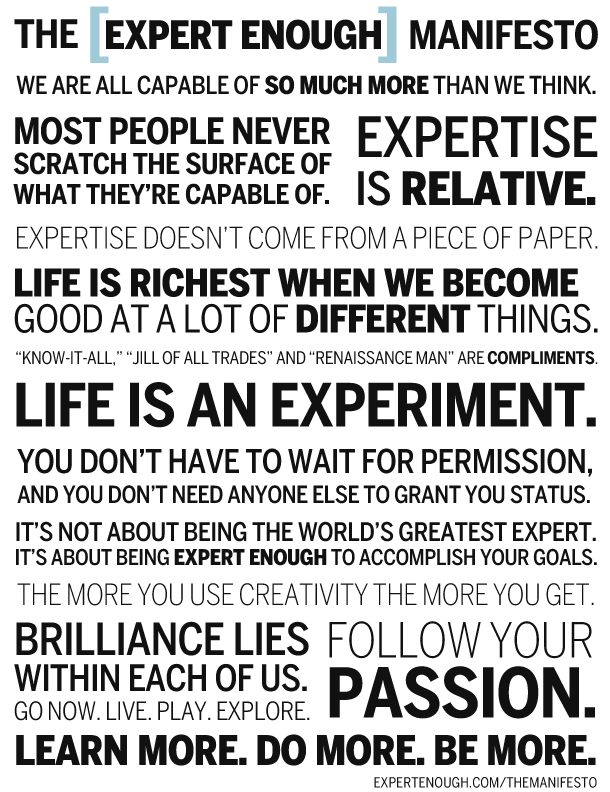
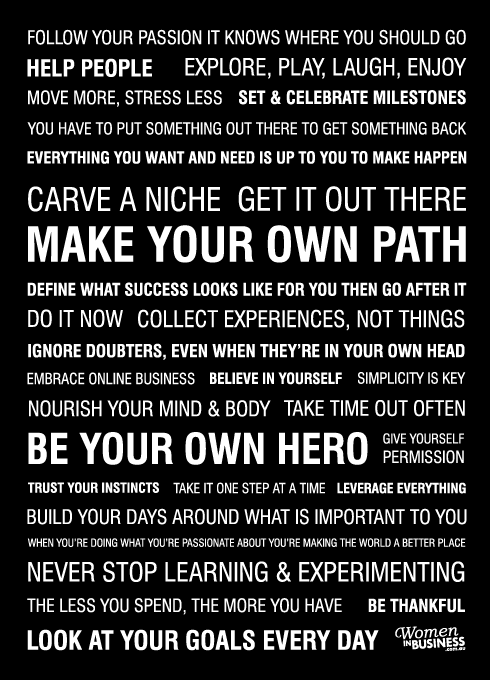
Manifesto’s have continued to inspire me. Much more powerful than the usual mission statements and corporate presentations, a manifesto has belief, passion and intent.
Here are some of my favourites:
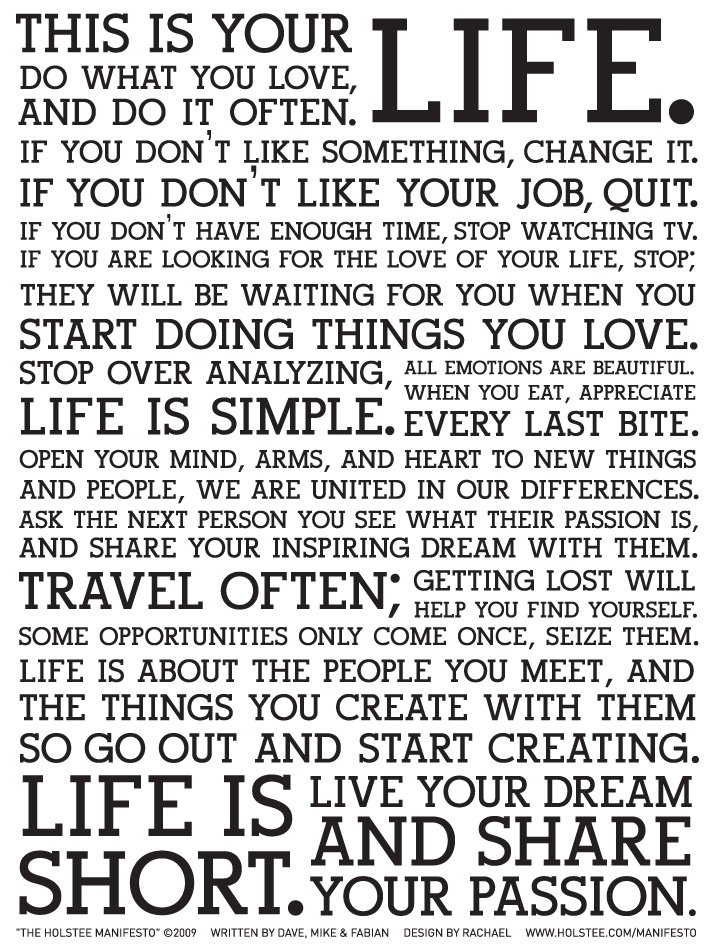
The Holstee Manifesto
In the summer of 2009, brothers Dave and Mike Radparvar decided to quit their jobs in the heat of the recession to go all-in on their passion project — Holstee, a functional and sustainable t-shirt company they had started with their friend Fabian Pfortmüller. Without a business plan or experience in fashion, they reasoned that in the worst-case scenario, it would be the most memorable summer of their lives.

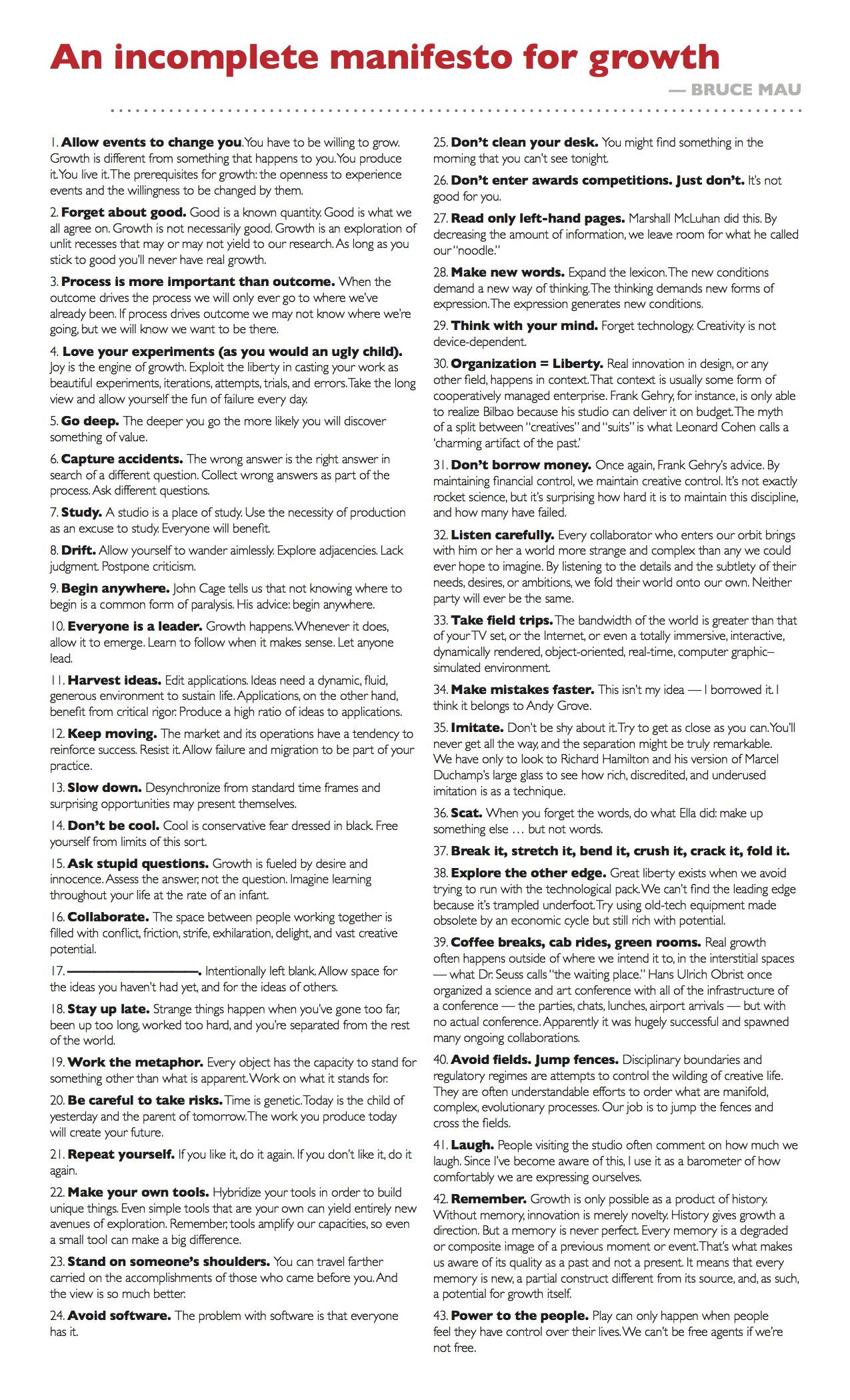
Bruce Mau’s Incomplete Manifesto
In 1998 a little known Canadian designer named Bruce Mau published his Incomplete Manifesto for Growth outlining his beliefs, strategies and motivations. His 43 points spread like wildfire throughout the design industry and are still regularly quoted by design wonks like me.
Oddly, all traces of the manifesto have been removed from Mau’s website, leaving broken links spread across the Interwebs like doors to nowhere. I wonder if he pulled it down because he regrets any of his bold challenges to us as an industry? Perhaps the manifesto isn’t considered relevant nearly 16 years after they were first published? Here is a PDF of the original document.
Nike’s brand manifesto
In 1977 Phil Knight and his young team were business rookies. They went to Japan in search of new manufacturing techniques, and started to build a brand that would become the largest sportswear brand in the world. And whilst they now equip athletes in every sport imaginable, their earliest and personal passion was in running. They were not about shoes, they were about athletes. Runners.

Work is not a job
It’s easy to forget that we spend most of our best years, and the majority of our days in those years, at work. We might be struggling to find the right job, to develop our skills, to raise a family, to pay the mortgage, but actually this is the time of our lives.

Daring Greatly Leadership Manifesto
Brene Brown’s book Daring Greatly is an inspiring read. However her best messages are captured in this short manifesto to leaders. Not just CEOs but she seeks to address teachers, principles, politicians, community leaders and any other decision makers. T0 dare greatly.

Frog Design’s manifesto
Frog is a fabulous design firm. Like many, they appreciate the power of ideas.

279 Days to Overnight Success
Chris Guillebeau started out as a volunteer in West Africa, and then visited every country in the world (193 in total) before his 35th birthday. Since then he has modelled his definition of an entrepreneur: “Someone who will work 24 hours a day for themselves to avoid working one hour a day for someone else.”
Chris’s first book, The Art of Non-Conformity, was translated into more than twenty languages. His second book, The $100 Startup, was a New York Times and Wall Street Journal bestseller, selling more than 500,000 copies worldwide. His third book, The Happiness of Pursuit, was published in September 2014 and was also a New York Times bestseller. His fourth book, Born for This, will help you find the work you were meant to do. His “The Art of Non-Conformity” website is full of inspiration, and this downloadable PDF is no exception.
More manifestos
- Do The Work – Steven Pressfield
- The Checklist Manifesto – Atul Gawande
- The Fire Fly Manifesto – Jonathan Fields
- Great Work Manifestos – Michael Bungay Stanier
- A Lesser Photographer – CJ Chilvers
- The Writer’s Manifesto – Jeff Goins
Everyone’s free (to where sunscreen)
In 1997 Mary Schmich wrote this “Ladies and Gentleman of the Class of ’97” in the Chicago Tribune called “Advice, like youth, probably just wasted on the young”. Baz Luhrman, best known as the director of films like “Strictly Ballroom” and “Moulin Rouge!”, released this song using her lyrics two years later, and the song climbed music charts across the globe. Quirky but brilliant.
Wear sunscreen.
If I could offer you only one tip for the future, sunscreen would be it. Scientists have proven the long-term benefits of sunscreen, whereas the rest of my advice has no basis more reliable than my own meandering experience. I will dispense this advice now.
Enjoy the power and beauty of your youth. Oh, never mind. You will not understand the power and beauty of your youth until they’ve faded. But trust me, in 20 years, you’ll look back at photos of yourself and recall in a way you can’t grasp now how much possibility lay before you and how fabulous you really looked. You are not as fat as you imagine.
Don’t worry about the future. Or worry, but know that worrying is as effective as trying to solve an algebra equation by chewing bubble gum. The real troubles in your life are apt to be things that never crossed your worried mind, the kind that blindside you at 4 p.m. on some idle Tuesday.
Do one thing every day that scares you.
Sing.
Don’t be reckless with other people’s hearts. Don’t put up with people who are reckless with yours.
Floss.
Don’t waste your time on jealousy. Sometimes you’re ahead, sometimes you’re behind. The race is long and, in the end, it’s only with yourself.
Remember compliments you receive. Forget the insults. If you succeed in doing this, tell me how.
Keep your old love letters. Throw away your old bank statements.
Stretch.
Don’t feel guilty if you don’t know what you want to do with your life. The most interesting people I know didn’t know at 22 what they wanted to do with their lives. Some of the most interesting 40-year-olds I know still don’t.
Get plenty of calcium. Be kind to your knees. You’ll miss them when they’re gone.
Maybe you’ll marry, maybe you won’t. Maybe you’ll have children, maybe you won’t. Maybe you’ll divorce at 40, maybe you’ll dance the funky chicken on your 75th wedding anniversary. Whatever you do, don’t congratulate yourself too much, or celebrate yourself either. Your choices are half chance. So are everybody else’s.
Enjoy your body. Don’t be afraid of it or of what other people think of it. It’s the greatest instrument you’ll ever own.
Dance, even if you have nowhere to do it but your living room.
Read the directions, even if you don’t follow them.
Do not read beauty magazines. They will only make you feel ugly.
Get to know your parents. You never know when they’ll be gone for good. Be nice to your siblings. They’re your best link to your past and the people most likely to stick with you in the future.
Understand that friends come and go, but with a precious few you should hold on. Work hard to bridge the gaps in geography and lifestyle, because the older you get, the more you need the people who knew you when you were young.
Live in New York City once, but leave before it makes you hard. Live in Northern California once, but leave before it makes you soft. Travel.
Accept certain inalienable truths: Prices will rise. Politicians will philander. You, too, will get old. And when you do, you’ll fantasize that when you were young, prices were reasonable, politicians were noble, and children respected their elders. Respect your elders.
Don’t expect anyone else to support you. Maybe you have a trust fund. Maybe you’ll have a wealthy spouse. But you never know when either one might run out.
Don’t mess too much with your hair or by the time you’re 40 it will look 85.
Be careful whose advice you buy, but be patient with those who supply it. Advice is a form of nostalgia. Dispensing it is a way of fishing the past from the disposal, wiping it off, painting over the ugly parts and recycling it for more than it is worth.
But trust me on the sunscreen.

The Passive Aggressive Manifesto
Maybe in response to all these good words, Michael Schechter created The Passive Aggressive Manifesto saying “Let’s face it… words, no matter how pretty and sweet they might be, don’t really mean all that much if they don’t make you do anything.”

In an extract from his forthcoming book “Be Extraordinary: Rise up to Lead the Future Business” Peter Fisk profiles LVMH’s CEO Bernard Arnault:
Whilst start-ups have risen on the waves of technological progress, more traditional businesses have had to adapt or reinvent themselves for a changing world. Luxury brands are an extreme example of this, and in particular in the world of fashion. The old world was about brand exclusivity and personal service, a boutique store on the Rue St Honoré in Paris, or Via Montenapoleone in Milan. Today’s luxury fashionistas sit online searching from their homes of Los Angeles or Shanghai. They expect new collections as soon as they are shown in fashion shows and personalised to their tastes. In particular the rapidly growing markets of Asia see luxury brands as a symbol of progress and status.
Bernard Arnault might be a 70-something Frenchman, but he understands this new world. CEO of LVMH, the world’s largest luxury goods business, his personal wealth of almost $100 billion makes him the wealthiest man in Europe, and fourth richest in the world, which is not bad for an engineer who joined his father’s construction company at 22 years old. Within a few years, Arnault already saw the world differently, persuading his father to sell the construction business and move into the real estate market. They created Férinel, a speciality vacation property business, of which he became leader in 1977, just before his thirtieth birthday. During this time, Arnault started to understand the luxury consumer, the power of brands, and how targeting premium niches could be incredibly profitable. In 1984 he spotted an opportunity to acquire a finance company that had lost its way, but still owned some interesting assets including a rather staid and sensible Christian Dior, and department store Le Bon Marche. He quickly set about refocusing the business and reenergising its best assets for a changing world.
The rebirth of Dior fuelled his vision and acquisition power in the luxury fashion world, and within 5 years by working with other investors, he had become the largest shareholder in the recently merged Louis Vuitton and Moet Hennessey, becoming the chairman of LVMH in 1989. The New York Times Magazine hailed Arnault a “superstar who has risen spectacularly to become head of the world’s largest luxury-goods company aged just 40”.
https://www.youtube.com/watch?v=brrmCQlOsI4
In the 30 years that followed, his ambition has turned LVMH into the world’s largest luxury goods business, bringing together over 70 brands, or houses, like Givenchy and Fendi, Donna Karan and Marc Jacobs, retailers like Sephora and DFS, and jewellers Bulgari and TAG Heuer. Newer brands include Chinese red wine Ao Yun, as well as Rihanna’s Fenty Beauty range, whilst the oldest brand is wine producer Château d’Yquem, which dates its origins back to 1590. Arnault has long realised that managing such a large and diverse portfolio requires a delicate balance of financial control and creative independence.
Designers like John Galliano and the late Alexander McQueen demanded freedom to create, whilst brands in the group benefit from the long-term financial approach that can nurture brands over time, and support less profitable ones to grow stronger. He sees LVMH as a family-business, with 4 of his 5 children working in different parts of the organisation, but also seeing all of his employees and brands as part of a long-term relationship. Indeed, his motivation is much less about financial results, and much more about brand legacy, saying he is much less interested in quarterly results than he is in brand health and growth.
During Arnault’s leadership, LVMH has multiplied 20 times in value. With rapid growth in Asia, but fairly stagnant performance in Western markets, he is acutely aware of the changing global marketplace. In recent years he has accelerated online developments of each brand, often partnering with retail platforms and local businesses. He has also driven rapid growth of brand stores in major cities. With a personal fortune similar to Warren Buffett, his personal investments focus on digital businesses like Netflix and global retailers like Carrefour, keeping him tuned into a changing world. The French billionaire likes to tell the story of how “Steve Jobs once asked me for some advice about retail, but I said, I am not sure at all we are in the same business.” However, Jobs famously went on to say, “You know Bernard, I don’t know if in 50 years my iPhone will still be a success but I can tell you, I’m sure everybody will still drink your Dom Pérignon.”
These are familiar words.
“Disruption” has become synonymous with innovation, and particularly the impact of start-ups on traditional markets, and large corporations. From the definition of Clay Christensen which was more about disruptive technologies, and how a seemingly inferior technology can ultimately beat a superior technology, because it is good enough, to the simplicity of advertising guru Jean Marie Dru who said disruption is about upsetting the status quo.
“Pivot” became a cool word in Silicon Valley, as tech start-ups realised that they needed to change direction in order to succeed. Facebook pivoted from Facemash dating site to social network, Instagram pivoted from Burbn meet-up site to photo sharing and messaging. But of course long before that Western Union pivoted from telegrams to money transfer, Shell from retailing to energy. It means transformation, and typically with a new direction.
So when another book comes along saying “Disruption by digital technologies? That’s not a new story. But what is new is the “wise pivot,” a replicable strategy for harnessing disruption to survive, grow, and be relevant to the future. It’s a strategy for perpetual reinvention across the old, now, and new elements of any business” it still doesn’t sound like anything new. But this is a book is good because most businesses still focus on the past, not the future. They need a dramatic shift.
As I say in almost every article I write, the future should be the obsession of every business, and particularly its leaders. Making sense of it. Exploring it. Creating it. Preparing for it. Making it happen. Investors, of course, are all about the future potential of a company, and quantify it in market values. But it still seems smart to say let’s just focus on today. Mindfulness is one thing, and delivery certainly matters, but the future matters most.
Pivot to the future
The new book “Pivot to the Future: Discovering Value and Creating Growth in a Disrupted World” argues that the emergence of a new wave of technologies — including artificial intelligence, virtual and augmented reality, 5G and quantum computing — requires businesses to continuously reinvent themselves using new management and capital-allocation strategies.
The book is written by three Accenture executives and makes the case that successful innovation is a long-term game that requires constant pivots to evolve and change. They call it the “wise pivot” —repeated renewal and reinvention through a series of strategic shifts, where innovation is applied equally in old, current and emerging businesses. They call on leaders to fight the urge to prematurely abandon legacy businesses and to nurture rather than simply exploit today’s “cash cows.” With the additional value they uncover, companies can fuel their future by embracing the start-up mentality of scaling rapidly as new technologies and markets appear, often suddenly.
They also tell the story of Accenture’s own wise pivot, in which the company nearly doubled its market capitalization in five years to more than US$100 billion. Recognizing that professional services and outsourcing were on course to commoditization, in the early 2010s Accenture invested heavily in five then-up-and-coming digital capabilities — interactive, mobile, analytics, cloud and cybersecurity — with the potential to deliver major benefits to clients and high growth to the company.
Here are the book’s key themes:
- The Trapped Value Gap. Continual improvements in digital and related technologies are creating value faster than companies, industries and society can absorb it. This is a kind of potential energy called trapped value. Targeting and releasing trapped value is the beginning of a new approach to strategic planning the authors call the “wise pivot.”
- The Seven Wrong Turns. Before engaging in a wise pivot, it’s important to understand the mistakes that can stop companies from recognizing and releasing trapped value. The authors call these mistakes the seven wrong turns. They include making the company too lean, creating a capital structure built to fail, losing one’s head, managing to Wall Street, relying on luck, serving regulators rather than customers, and anticipating customers who aren’t likely to show up.
- The Seven Winning Strategies. The book explores seven new strategic options with many examples. Some are companies that Accenture has worked with directly. Other examples are from a detailed research study (1,000 companies/12 industries) of the leaders’ winning ways.
- The Wise Pivot. Between late 2014 and 2018, Accenture’s market value doubled, reflecting the creation of $50 billion in new value. Given accelerating disruption and the growth of trapped value, instead of transforming companies must pivot, and do so repeatedly in order to evolve from today’s core business to tomorrow’s, and the one after that.
- The Old, Now and New. The wise pivot requires integration of strategies, specifically, across three different timeframes or business maturities:
- The old — Transforming the core
- The now — Growing the core
- The new — Scaling new innovations
- The Innovation Pivot. A wise innovation pivot requires leaders to review and adjust their portfolios to change the shape, speed, and trajectory of pivots. One of the keys here is to concentrate innovation capabilities under a strong leadership team, with dedicated investment and defined innovation roles and responsibilities. This enables companies to embed innovation into their corporate DNA. Done right, innovation isn’t something they do. It’s something they are.
- The Financial Pivot. No company successfully pivots without a massive investment in the new. This requires changing commitments and allocations to capital assets across three levers: fixed assets, working capital, and human skills. Rather than following the money, companies must put it to work creating a brave new future.
- The People Pivot. For a successful people pivot, organizations must adjust the way they approach hiring and retaining talent. This includes leadership — the people pivot doesn’t just apply to the “troops.” It includes having the right combination of leaders across all three stages, and being open to contributions from talent sources well outside the confines of executives’ own offices. The wild card here is artificial intelligence (AI). The future is likely to be one in which employees and technology work together in new ways. We’ll still need people, albeit with new, different and constantly-evolving skills.
In practice
Rotating to the new requires strong and continual action. It is not a transformation with a set end date; rather, it’s a continual process of getting better through the twin initiatives of core transformation and innovation. There are four key phases to help businesses rotate to the new:
- Transform the core business to release investment capacity. Insurers should apply digital technologies to make the core lower cost, more efficient and more competitive—which, in turn, creates flexibility and frees investment capital for innovation.
- Drive incremental growth in the core business. This is commonly overlooked, but essential for the journey. Some of the investment capacity must be directed at digital Brilliant Basics: initiatives to get closer to the customer and drive growth in the mature, core business. These investments also support the stable foundation that is required to enable agility.
- Scale the new. This is the hard part, and requires an innovation architecture to lift the organization from a perpetual cycle of pilots to identify the winning innovations that will provide the business with future revenue streams. This may involve partnering with start-ups or other partners to determine how to get to mass-market and industrial scale. Notably, this is also a crucial preparatory step before making the shift from the mature business to the new one.
- Pivot wisely. By optimizing investment dollars and capital over time, businesses can align S-curves to enable a transition from the old business to the new one. Timing is critical to identifying when the new initiatives start to become business as usual, and when to shift to the new business. This is a difficult task to pull off—but it is necessary.

In other words, rotating to the new is about nesting two S-curves, and then shifting from one to the other. Businesses today are sitting on the lower, established S-curve. They must start looking at the bottom of the new S-curve with technologies like automation, AI, big data and analytics, and to look at opportunities to engage customers outside the business transaction. The wise pivot is not easy—but done properly, can help insurers not just fend off disruption, but become an agile, innovative organisation that can compete for the long term.
At IE Business School we seek to bring together the world’s most interesting, most powerful, and most useful ideas for business leaders to drive their organisations forwards. I lead the school’s flagship program for senior executives seeking to drive change in their organisations and themselves, to create better futures for their business. We call it the Global AMP.
In today’s world, an important part of that challenge is to understand the role which business plays in society – both as a profitable enterprise that creates useful employment, enables customers to achieve more, and delivers returns to investors – but also as a force for positive impact and progress in society, using its resources and power, to achieve a higher purpose beyond profit, to be good and become great.
We therefore spend a lot of time curating the best ideas for business from around the world, not seeing them as competition but as inspiration to bring together “the best of the best” for our participants. These ideas might come from academics, from think tanks, from practitioners, from authors, from governments, and more. Our challenge is to bring the best together, in a meaningful, coherent and practical way, so that business leaders can embrace and apply them.
In my additional role as Global Director of Thinkers50 I also spend much of my time really understanding what lies behind the books and papers of leading thinkers. Thinkers50 produce a ranking of the top 50 thinkers every two years, which is fantastic, but the real insight lies behind the personalities, and in what new they have to say. Sometimes it quite difficult, indeed some are full of hot air, but in others the messages and models are profound.
One of places we look to is the Aspen Institute which hosts a fabulous Ideas Festival every year. It also celebrates some of the best content and faculty in the world’s business schools with the Ideas Worth Teaching Awards, to “celebrate curricula that bring to life the promise of meaningful work in business.”
The Aspen’s Business and Society initiative is “focused on critical social issues ripped from the headlines—populism, water scarcity and artificial intelligence among them—and illuminate how and why these issues are business issues.” with issues from “How ‘Elites’ Became One of the Nastiest Epithets in American Politics,” to lessons from the last economic downturn, as depicted in popular films like Margin Call (2011).
https://www.youtube.com/watch?v=Y2DqFRsPrns
Aspen’s Claire Preisser leads the BSP and says “at a time when business leaders face intense scrutiny about their role in social issues, these award-winning faculty are bravely challenging the ‘norms’ of what is taught in business school—and creating leaders who can navigate a highly uncertain environment,” she said in a news release announcing the prize winners.
Here’s the alphabetical list of the courses recognised by Aspen, along with the faculty and schools that offer them, with links to the syllabus for the selected course:
Alternative Economic Models
Sandrine Stervinou, Audencia Business School
Business Ethics: Critical Thinking Through Film
Jadranka Skorin-Kapov, Stony Brook University College of Business
Economic Growth, Technology, and Structural Change
Peter Kriesler, UNSW Business School, University of New South Wales
Economic Inequality and Social Mobility
James R. Freeland and R. Edward Freeman; Darden School of Business, University of Virginia
Fault Lines and Foresight
Regina M. Abrami, The Wharton School, University of Pennsylvania
Human Capital Sustainability
Patrick McHugh, School of Business, George Washington University
Impact Investing and Social Finance
Sara Minard, D’Amore-McKim School of Business, Northeastern University
Intrapreneurship: Leading Social Innovation in Organizations
Jerry Davis and Chris White, Ross School of Business, University of Michigan
Issues in CSR
Talia Aharoni, Coller School of Management, Tel-Aviv University
Management of Services: Concepts, Design, and Delivery
Zeynep Ton, Sloan School of Management, Massachusetts Institute of Technology
Peer to Peer Economies
Melissa L. Bradley, McDonough School of Business, Georgetown University
Prospering Over the Long-Term
Tima Bansal, Ivey Business School, Western University
Reimagining Capitalism: Business and Big Problems
Rebecca Henderson and George Serafeim, Harvard Business School, Harvard University
Sustainability & Environmental Accounting
Dror Etzion, Desautels Faculty of Management, McGill University
Sustainability Tools & Processes for New Initiatives
Robert Sroufe, Palumbo Donahue Graduate School of Business, Duquesne University
Sustainable Business In Iceland
Andrew J. Hoffman, Ross School of Business, University of Michigan-Ann Arbor
Technological Change at Work
Adam Seth Litwin, School of Industrial and Labor Relations, Cornell University
The End of Globalization?
David Bach, Yale School of Management, Yale University
Urban and Regional Economics
Jaime Luque, Wisconsin School of Business, University of Wisconsin-Madison
Why Business?
Matthew T. Phillips, James Otteson, and Adam S. Hyde, School of Business, Wake Forest University