Maersk, the Danish shipping business, was another traditional company trying to compete in an increasingly digital and disrupted world. It struggled to understand how to respond to a new generation of shipping innovators, alternative transport providers, and digital disruptors.
And then it thought again.
Last year I interviewed Jim Hagemann Snabe, chairman of Maersk, on stage at the Thinkers50 European Business Forum in Odense. Snabe had recently joined the board after a career largely in technology, with SAP and Siemens, and also as digital advisor to the World Economic Forum.
How would he turn an old shipping line into a digital business, I asked him?
Soon afterwards Maersk started exploring blockchain, and how it could revolutionise the traditional processes of shipping goods around the world – everything from the intensive paperwork required through every port, to tracking just in time goods that need to find their way rapidly around the world to market.
Today AP Moller-Maersk, as it is more formally known, describes itself as an integrated container logistics company, connecting and simplifying trade to help our customers grow and thrive, with a dedicated team of over 76,000, operating in 130 countries, the largest shipping company in the world.
However change is never easy, particularly in a traditional business where most workers have done the same jobs in the same ways for many years. The speed and glamour of Silicon Valley or Shenzhen might seem far removed.
This is it’s way of engaging people, inside and outside Maersk, in its future:
“We are not doing this halfway.
We are going all the way. Challenging ourselves to stay ahead of the curve for our customers. Pushing boundaries to connect and simplify their supply chains.”
https://www.youtube.com/watch?v=DFeeNLElBgU
This is your brain
It is your reptilian brain that holds you back. When new opportunities arise and you want to go all the way. It has been like this for millions of years.
That’s why change is hard.
It’s a neurological fact
Watch professor of psychology, Henrik Høgh-Olesen, explain why the reptilian brain fights change and how to work around it to evolve.
We are going all the way – pushing the boundaries to discover new and valuable connections between people, processes and data to find new paths to growth for our customers.”
https://www.youtube.com/watch?v=1IiJXE0ts9k
Here are three examples of projects within the transformation:
Example 1: Maersk Spot
Imagine if a restaurant was like shipping
You wouldn’t accept complex booking, overbooking nor price uncertainty. So why do it in shipping? Introducing Maersk Spot with loading guarantee, easy online booking and a fixed price at booking.
We believe it’s shipping the way it’s meant to be, and we hope you think the same. Take a closer look and see how to get your cargo moving the simplest way.
The only way the plastic issue can be alleviated is by working all together, contributing with the best of our capabilities and engaging ourselves into groundbreaking solutions. This is the main reason for Maersk to keep supporting The Ocean Cleanup in the relaunch of its upgraded drifting system to the Pacific.
We sail the oceans every day and see the plastic problem growing. At current levels, by 2050 our oceans will contain more plastic than fish. With an estimated 5 trillion pieces of plastic waste littering all major ocean basins. This crucial problem is a high priority on our agenda. That´s the reason why Maersk Supply Services keeps providing offshore project management and vessel operations support to a re-developed offshore cleaning system.
They spent three months at the Pacific Ocean testing and collecting relevant data. Due to a structural malfunctioning of the cleanup system, The Ocean Cleanup took the decision to return to port earlier than planned to -based on findings and data- upgrade the system.
Following six months of onshore work, The Ocean Cleanup is now ready to re-send its upgraded passive drifting system to the Great Pacific Garbage Patch, located roughly midway between California and Hawaii.
In Maersk we believe that, setbacks like this are inevitable when pioneering new technology and we know that, being in port has provided The Ocean Cleanup with the opportunity to make upgrades to a system that it is expected to be back at the Great Pacific Garbage Patch by the end of June 2019.
https://www.youtube.com/watch?v=tdhpYQCWnCw
Example 3: TradeLens
TradeLens is an open and neutral industry platform underpinned by Blockchain technology, supported by major industry players. It is a Maersk and IBM solution formerly known as Global Trade Digitization (GTD), is a trade platform for containerized shipping, connecting the entire supply chain ecosystem. Some of the benefits include:
- An open, neutral, and distributed platform underpinned by Blockchain technology
- Seamless, permissioned document and data sharing with a common access control structure
- Ecosystem participants access the platform through open APIs
The TradeLens platform integrates trade data from industry partners onto a common, secure business network, and will provide real-time, secure access to end-to-end supply chain information to all actors involved in a global shipping transaction. Using the platform, you can publish events related to a consignment (shipment) or transport equipment (container), and set up subscriptions to be notified when events occur that match your subscriptions.
TradeLens allows you to manage the documents involved with a consignment. Submitted documents generate events for your documents. This adds to the complete view of activities involved with your consignment or transport equipment. The TradeLens document functions could be used as part of the process of submitting filings for the import and export of goods by enabling end users to securely submit, stamp, and approve documents.
You can use TradeLens directly through REST APIs, or through the Shipment Manager UI. The Shipment Manager (SM) component provides a web user interface to interact with the platform. You can view the events related to a consignment, and perform operations on documents.
Blockchain addresses the underlying challenges inherent in collaborating across a distributed, fragmented supply chain ecosystem:
- Shared Ledger – Append-only distributed system of record shared across business network
A network of industry participants maintains a distributed, permissioned ledger with copies of document filings, relevant supply chain events, authority approval status, and full audit history; every change results in a new, immutable block - Smart Contract – Shared business logic governing what transactions may be written to the ledger
Cross-organizational business processes, such as import and export clearance, are pre-programmed and built into Blockchain and distributed to and executed on the network, preventing any member from changing the business logic - Privacy – Ensuring appropriate visibility; transactions are secure, authenticated and verifiable
Cryptography enables permissioned access so only the parties participating in a specific consignment can submit, edit or approve related data - Trust – Transactions are endorsed by relevant participants
Information such as documentation filings and authority approvals can only be changed if endorsed by the parties taking part in the consignment; full audit history maintained on the Blockchain
I’ve been running each morning for 40 years now.
Give or take the occasional guilt-ridden absence due to illness or injury, it’s been a streak ever since I joined the school lunchtime running club as a 10 year old. I run in rain or shine, wherever I am in the world, on birthdays and even on my wedding day. Anything from 20 minutes to 2 hours. Sometimes fast, sometimes more relaxed.
I used to run to win, training for competitions on the road and track, to be the fastest around, to steal the glory. As a teenager I was the best miler and cross country runner in the north of England. As I got older, and daily and work life came to the fore, I still ran, but with a slightly different motivation.
Today, it’s about feeling good. To feel fit and lean, to blow out the cobwebs after a late night or long flight. Today, it’s an entirely personal achievement. I don’t race anymore. Although I do still measure distance and time, heartbeat and recovery time. Now it’s about wellness, physical and mental.
And what’s surprising is how many business leaders are runners, or other types of athletes, too. James Dyson still tells of his love of sprinting up sand dunes, Richard Branson swims for an hour every morning (admittedly in the beauty of his Caribbean island). Howard Shultz, Satya Nadella, Mark Benioff, Jim Radcliffe are all runners.
Research even shows that “marathon runners make better CEOs“.
Fitness and the business leader
So what skills are necessary for high performance as a business leader?
What makes someone able to perform successfully under high stress and constant change and to keep doing it over time without breaking down? As it turns out, we have lots of answers to this question, and most focus on the rewards necessary for greatness, the kind of culture that breeds success, and the particular skill sets necessary for peak performance.
But recently, Harvard Business School conducted a different kind of study, one that examined the strategies and habits of winning athletes and whether they could be transferred to apply to business—in essence, whether we could train high-level executives as corporate athletes. It appears that the answer is “yes.” We can indeed apply the wisdom of sport to help ourselves succeed in anything and everything that’s challenging.
As someone who competed as a high-level athlete for over two decades, it has long been clear to me that the skills and mindset I learned as a competitive athlete are what allow me to succeed in every other pursuit in my life, both professionally and personally. It appears that now there’s proof.
Research in the field of sport demonstrates that top athletes succeed in large part because of their ability to perform under stress, and more importantly, to recover after stress has occurred. Recovery is the critical process in which the body and mind not only rest, but also rebuild new strengths and develop resilience, as a muscle does between workouts.
When comparing the careers of athletes and executives however, vast differences exist in the natural opportunities for recovery. Most of an athlete’s time is spent in practice with just a small percentage in actual competition. An executive, however, is in competition every day, all day. An athlete’s high-stress season is usually fairly short with lots of time to recover in the off- season, while a corporate athlete gets a few weeks off per year if she’s lucky (during which time she usually works). And finally, the average top-level athlete’s career lasts less than a decade while an executive’s career spans a lifetime. All that said, an executive, if he is to reap the benefits of the recovery process must find alternative ways to rest and rebuild.
To consistently perform well in high-stress environments, executives must focus not just on the skills needed for their specific field, but more broadly, on creating a mindful and nourishing life, one that feeds them physically, emotionally, mentally, and spiritually. To create excellence at work, a corporate athlete must ultimately create excellence in life.
Becoming a ‘corporate athlete’
Although executives are primarily mentally-focused, the corporate athlete must, nonetheless, pay close attention to the wellbeing of his or her body, not just how it looks but how it is being taken care of. A corporate athlete cannot function at a high level for very long as just a head running around without a body attached. Corporate athletes are inclined to forget about their bodies, and yet, over time this dismissive attitude is a sure-fire recipe for burnout. Attention to diet, exercise, sleep, and a program of physical well-being cannot be excluded when excellence is the goal.
On an emotional level, the corporate athlete must pay close attention to her feeling state. He cannot wait for a strong emotion like anger or frustration to overwhelm him and thus land him on the bench. Just as an athlete might ask herself how she is feeling on a physical level, a corporate athlete must be aware of how she is on an emotional level and also be able to manage strong emotions when they arise. Mindfulness of emotion is thus a critical practice in the creation of excellence.
From a mental perspective, the ability to control our attention is the key ingredient in the ability to perform under and recover from stress. We must be able to focus our attention when it counts, and turn our attention away from negative and distracting thoughts. Meditation is the practice of observing and separating from our thoughts, which protects us from getting caught up and sidelined by the thoughts that destroy performance. As such, meditation is the practice of most importance, mentally, for creating peak performance.
And finally, on a spiritual level, a corporate athlete must discover meaning in his life—why he’s doing what he’s doing, what really matters to him, what values he’s serving. As unrelated as it may seem to the executive mindset, a top-level performer in any field, in order to sustain herself, must consciously contemplate what her life is about. A sense of meaning is, above all else, the antidote to burnout.
Top level executives are athletes—corporate athletes. Excellence is created not just by the obvious skills one’s profession demands, but by nurturing a whole and well human being. To create and maintain high-level performance in stressful environments, we must pay attention to and nourish all areas of our life. As it turns out, self-care is, in fact, the recipe for greatness.
AI has become the predominant technology driver of our time.
The term artificial intelligence (AI) has been used far and wide within the realm of data science and beyond – but what exactly is it and what are its capabilities? The premise behind AI is to mimic a human brain inside a machine, accomplished primarily by an algorithm that is continuously learning.
It has the potential to transform the global economy. PwC estimates that labour productivity improvements will drive initial GDP gains as firms seek to “augment” the productivity of their labour force with AI technologies and to automate some tasks and roles. Their research also suggests that 45% of total economic gains by 2030 will come from product enhancements, stimulating consumer demand. This is because AI will drive greater product variety, with increased personalisation, attractiveness and affordability over time. The greatest economic gains from AI will be in China (26% boost to GDP in 2030) and North America (14.5% boost), equivalent to a total of $10.7 trillion and accounting for almost 70% of the global economic impact.
Yet few people know the real story about where this technology came from and why it suddenly took off.
In “Hello World,” the story of AI’s rise is told in detail for the first time, as journalist Ashlee Vance heads to the unexpected birthplace of the technology, Canada.
Here are 5 of the best books which I have come across exploring the AI-enabled future:
Homo Deus: A Brief History of Tomorrow by Yuval Noah Harari
Following on from his smash hit Sapiens, which explored how the human race evolved, Harari peeks into the not-too-distant future to see what’s in store for the human race. Artificial life is just one part of this envisioned world, and Harari explores a range of other challenges, including immortality.
The Fourth Age: Smart Robots, Conscious Computers, and the Future of Humanity by Byron Reese
This fascinating book argues that AI will have enormous implications for the human race, to the extent that it will redefine what it means to be human. As background, Reese sets out the previous three ages where technology has reshaped humanity and sets up AI and robotics as the fourth age of transformation. In other words, it’s a gripping (and surprisingly optimistic) account of how we got where we are today, and how we should approach the new age that’s upon us.
Life 3.0: Being Human in the Age of Artificial Intelligence by Max Tegmark
One of Barack Obama’s favourite books of 2018 and named Book of the Year by both The Times and The Daily Telegraph, this highly praised book more than lives up to the hype. In it, Tegmark, who is a physicist and cosmologist, sets out to separate AI myths from reality in an approachable and lively way. Impressively, he manages to cover some quite challenging topics and questions (How can we create a more prosperous world through automation? How can we protect AI systems from hacking and nefarious use?) without being too high-brow or dumbing down – and without telling the reader what to think.
AI Superpowers: China, Silicon Valley And The New World Order by Kai-Fu Lee
In one of the most recent books I’ve read (at the time of writing this article), Lee argues that, thanks to China’s astonishing growth in this area, it now rivals the US in AI technology. For both of these superpowers, and indeed the rest of the world, this means dramatic business and societal changes will hit us sooner than anyone could imagine. If global politics really isn’t your thing, don’t be put off. Lee paints a very readable picture of what this increasing AI competition will mean for real people’s jobs.
Human + Machine: Reimagining Work in the Age of AI by Paul Daugherty and James Wilson
Daugherty and Wilson are Accenture’s Chief Technology and Innovation Officer and Managing Director of IT and Business Research, giving this book a laser-like focus on the business implications of AI – or, more specifically, how companies are using AI to innovate and grow. Key to this book is the idea that no business process will be left untouched by AI. Across all areas of business, humans and intelligent machines are working more closely together and changing how companies operate. Indeed, the authors set out six hybrid ‘human + machine’ roles that they believe every business must put in place.
But above, remember that AI is not just automation, or likely to just have the same effects as automation in the past. This time it’s different. Some say that AI is as dumb as the person who created the code. Maybe initially, but it it is the relentless relearning and and processing capability that allows to it go beyond mere machines. The future is incredibly exciting, AI will enhance our capabilities beyond what we know, but we are still human, still driven by imagination, passion, empathy, love and reality.
What does the future look like?
Ubiquitous, mobile supercomputing. Intelligent robots. Self-driving cars. Neuro-technological brain enhancements. Genetic editing. The evidence of dramatic change is all around us and it’s happening at exponential speed. We are at the beginning of a revolution that is fundamentally changing the way we live, work and relate to one another, The Fourth Industrial Revolution.
Previous industrial revolutions liberated humankind from animal power, made mass production possible and brought digital capabilities to billions of people. This Fourth Industrial Revolution is, however, fundamentally different. It is characterized by a range of new technologies that are fusing the physical, digital and biological worlds, impacting all disciplines, economies and industries, and even challenging ideas about what it means to be human.
The resulting shifts and disruptions mean that we live in a time of great promise and great peril. The world has the potential to connect billions more people to digital networks, dramatically improve the efficiency of organizations and even manage assets in ways that can help regenerate the natural environment, potentially undoing the damage of previous industrial revolutions.
However change is about more than technology. Globalization is a phenomenon driven by technology and the movement of ideas, people, and goods. Globalism is an ideology that prioritizes the neoliberal global order over national interests. Nobody can deny that we are living in a globalized world. But whether all of our policies should be “globalist” is highly debatable.
We are shifting from a world order based on common values to a “multiconceptual” world shaped by competing narratives seeking to create a new global architecture. We live in a world with new planetary boundaries for its development. We are entering into a Fourth Industrial Revolution shaped by advanced technologies
from the physical, digital and biological worlds that combine to create innovations at a speed and scale unparalleled
in human history. Collectively, these transformations are changing how individuals, governments and companies relate to each other and the world at large. In short, we are fast approaching a new phase of global cooperation: Globalization 4.0.
So what is the future of work?
Global connectivity, smart machines, and new media are just some of the drivers reshaping how we think about work, what constitutes work, and the skills we will need to be productive contributors in the future.
In 2011 the IFTF, the Institute for the Future, published their seminal research on the Future of Work.
The report Future Work Skills 2020 analyzes key drivers that will reshape the landscape of work and identifies key work skills needed in the next 10 years. It does not consider what will be the jobs of the future. Many studies have tried to predict specific job categories and labor requirements. Consistently over the years, however, it has been shown that such predictions are difficult and many of the past predictions have been proven wrong. Rather than focusing on future jobs, this report looks at future work skills—proficiencies and abilities required across different jobs and work settings.

And here are some of the predictions of the new jobs which will be in demand by 2030. They’re interesting, but so are the reasons behind the suggestions, and what skills will be needed:
1. Trash Engineer
This may be the oddest future job but it’s by far one of the most impactful. Humans produce 2.6 billion pounds of trash annually, and what do we do with it all? Throw it in a landfill. There is no way this practice is sustainable, so we’re going to have to think about something else to do with all of our rubbish. We need a trash engineer who’s solving the earth’s waste problems one wrapper at a time. You could turn our rubbish into clean gas, or use it to construct a new building … Skills Needed: Strong STEM skills, critical thinking and mental elasticity.
2. Energy Consultant
People cannot survive on fossil fuel forever, so alternative energy sources will become key – solar, wind and hydroelectric energy. The question is, which one is right for your home, your community and your city? This is where an Alternative Energy Consultant comes in. You’ll be an expert in all things energy and go from city to city around the world assessing the best sustainable energy source for each place. Skills Needed: Strong STEM background, mental elasticity and people skills
3. Medical Mentor
As machines and robots take over the medical field by diagnosing patients and even performing surgery, a new role in the medical field will emerge: medical mentors. You’ll be in charge of patients after their appointments, surgeries and other medical procedures. You’ll check in on them, make sure they are following their doctor’s (or robot’s) recommendations and help them break through the negative factors that are impeding them from getting (and staying) healthy. Think of yourself as a nutritionist, therapist, exercise counsellor and friend all rolled into one. Skills Needed: Strong STEM background, critical thinking, people and interdisciplinary skills.
Here’s a much longer list
How do we prepare ourselves, and our children for this future?
Jack Ma recently stepped down as CEO of Alibaba, from the company he created, and now a $900bn giant of the technological age. He said that he wants to return to his first love, teaching. But teaching, differently. “If we do not change the way we teach, 30 years from now we’ll be in trouble. The things we teach our children are things from the past 200 years – it’s knowledge-based. And we cannot teach our kids to compete with machines, they are smarter.”
Ma goes on to say that instead, we should be teaching kids values and skills that no machine can possess. Qualities like “independent thinking, teamwork, and care for others” will not just set students apart, they will ensure students can be valuable contributors to society in ways that make them irreplaceable. And how does Jack Ma think we can impart that kind of knowledge? “I think we should teach our kids sports, music, painting – the arts – to make sure that they are different. Everything we teach should make them different from machines.”
He describes how we are shifting from competition for knowledge to competition for creativity. If we continue to learn and behave like machines then we will be replaced by them.
He concludes by saying we need IQ and EQ but more too. We need what he called LQ.
- High IQ – the knowledge to be in the game
- High EQ – the emotional intelligence to drive success
- High LQ – the love to be accepted and respected by other people
The World Economic Forum reports that we need the ten skills listed below to thrive in 2020:
- Complex problem solving.
- Critical thinking.
- Creativity.
- People management.
- Coordinating with others.
- Emotional intelligence.
- Judgement and decision making.
- Service orientation.
- Negotiation.
- Cognitive flexibility.
There’s also a great book called The Rules of Genius which describes four types of work. These are:
- Creative: Unique, imaginative, non-routine, and autonomous.
- Skilled: Standardized, talent-driven, professional, and directed.
- Rote: Interchangeable, routinized, outsourceable, and managed.
- Robotic: Algorithmic, computerized, efficient, and purchased.
Of these, you want to focus on creative work, because that is where you are likely to remain employable. Every professional can be creative in the work she does. When you work your craft, you are creating art. Author Marty Neumeier says “It is important to keep learning. Others cannot duplicate or reproduce your original work. If you want to be original, you have to become an inventor and build the foundation to the structure of your invention from scratch.”
A new report from the McKinsey Global Institute has highlighted how it thinks a range of jobs based on human skills are likely to be affected by AI and automation. The study also emphasizes the top three skill sets McKinsey says workers will need to develop between now and 2030 if they do not want to be “left behind”.
The report places work skills into five distinct categories: physical and manual; basic cognitive; higher cognitive; social and emotional; and technological. Workers use a range of these capabilities across a wide field of jobs. So physical and manual skills encompass tasks that could be performed by relatively unskilled labour, such as drivers and assembly line workers, as well as skilled workers, including nurses, electricians and craftspeople.

Cognitive abilities like basic literacy and numeracy are needed by workers such as cashiers, customer service staff and those involved in low-level data input and processing, such as typists and clerks. But the report says that it is predominantly workers with these two skills sets who are likely to suffer most, although not in every profession. “Skill shifts will play out differently across sectors,” the report notes. “Healthcare, for example, will see a rising need for physical skills, even as demand for them declines in manufacturing and other sectors.”
Demand for higher cognitive skills in the US in 2030 will rise 9% above the 62 billion hours recorded in 2016, and the 78 billion worked in Western Europe would notch-up a further 7% in the same period. Meanwhile, the call for social and emotional skills in the US will rise by 26% above the 52 billion hours seen in 2016, and Western Europe’s would increase by 26% above the 67 billion of two years ago. But it is workers with technological skills who, by 2030, will experience the biggest proportional increase in the demand for their time: a rise of 60% above the 31 billion hours worked in 2016 in the US and a 52% increase on Western Europe’s 42 billion hours.
Alvin Toffler also said “The illiterate of the 21st century will not be those who cannot read and write, but those who cannot learn, unlearn, and relearn.”
In some instances, relearning could be adapting what you know to a new reality. Take cell phones as an example. When they first came out, they were used solely as communications devices. Convergence happened, and now our smartphones are minicomputers. People had to relearn how to use a phone.
So beyond the 10 skills above, we will also need to learn more, most significantly. And this means being able to having an agile mind, to cope with huge amounts and diverse sources of information, being able to make new connections, being able to communicate our ideas clearly and influence others, being able to persist, and have courage to create our own paths, and our own futures.
What will schools look like in the future?
- Download the Holon IQ Education in 2030 Report
Education is reaching a tipping point as the gap widens between the skills delivered by the current system and those required by the digital economy, according to Goldman Sachs Research. This makes education ripe for disruption. “We think we’re right at the cusp of seeing the integration of technology significantly disrupt the way that education is delivered and the cost at which education can be provided,” Katherine Tait of Goldman Sachs explores, in the video below, the changing nature of today’s workforce and the evolution to lifelong learning. “We think that as the rise in automation and technology in the workplace increases, it will also drive an increase in the need to re-skill and up-skill throughout one’s career, shifting that education spend from being so concentrated in the early years of someone’s life across the length of an individual’s career.”
Ex-Googler Max Ventilla has a radical idea for how to make it work more like a social network. Ventilla’s AltSchool is building a highly-personalized education experience that gets better and cheaper as more students use it. In a decade, AltSchool may not have just built some new schools but rather a new school system that all will be able to join. Whilst it has struggled to gain traction in some cities, it is an intriguing new model to learn from.
So, what’s the future of education? Yes it could be online, on your phone, peer to peer, and lifelong. But what if the answer is already in ourselves? The potential to learn in new ways, to develop new skills, and create a better future, is already in all of us. It’s our humanity. The challenge is not about infrastructure and tools, schools and process, the answer is in getting the best out of ourselves. Individually and together.
In summary:
What does the future look like?
- Fast, changing,
- Technological, automated
- Human, innovative, exciting
What skills will do I need?
- Human, artistic, creative skills
- Analytical, scientific, sensemaking skills
- Develop yourself to do things machines can’t
How do I prepare myself?
- Study STEM, but artistic subjects matter even more
- Be curious, interested and participative in the changing world
- Learn to learn better, to relearn and keep learning throughout life
What will education look like?
- Lifelong, not just kids
- Questions, ideas, mind-opening
- On demand, collaborative, accessible, inspiring
Time to start building our own futures. Time to thrive.
Corona launched a cause-driven campaign to celebrate the week of World Oceans Day (June 8 2019), according to a company press release.
As part of its new “Pay With Plastic” program, the beer maker is accepting plastic waste in exchange for beer at retailers and bars in Mexico, Brazil, Italy, Spain and Colombia.
The campaign is a joint effort between Corona and the environmental group Parley for the Oceans. Corona designed a limited-edition can made of upcycled materials, and for every six-pack sold, the organizations will clean up one square meter at a local beach. With the help of 25,000 volunteers, Corona and Parley have already cleaned more than 3 million square meters of beach. This summer, the goal is to pick up another 2 million square meters.
The beach cleaning aspect of the campaign is running through August in nine countries including Mexico, Canada, the U.K., Italy, Spain and Brazil.
https://www.youtube.com/watch?v=6_Cv0uZfv8I
Corona’s campaign taps into many consumers’ concerns about the environment and makes the beer maker the latest brand to embrace cause marketing. The summer effort gives Corona a chance to connect with consumers who are looking for ways to make changes that benefit the environment in their own lives while engaging with brands that share their values. Allowing beer drinkers to trade plastic waste for a new brew, or purchasing a beer that’s sold in recycled materials, lets Corona connect with consumers around an environmental cause and actively clean up beaches during their busiest season.
Purpose-driven marketing is on the rise among brands that want to appeal to consumers’ broader concerns and values. This is particularly appealing to Generation Z (those born after 1995), who studies have shown do not trust businesses to act in the best interests of society. Gen Z is twice as likely as other generations to care more about issues of equality and three times more likely to say that the purpose of business is to “serve communities and society,” according to brand consultancy BBMG and strategy firm GlobeScan.
Corona can engage with older Gen Zers — those who are old enough to buy beer — with a campaign that looks to change the perception around businesses’ mission and position itself as a values-driven and relatable brand. This type of cause-marketing effort could help Corona to build loyalty at an early stage in a beer drinker’s life.
Letting people pay for beer with plastic waste as currency follows Corona’s past efforts to clean trash from oceans and beaches. The beer brand made art out of old plastic collected on beaches and installed these pieces in cities around the globe to build awareness about the growing plastic problem in the ocean. Continued efforts will reinforce Corona’s environmental bona fides, which resonates with its beach-friendly brand identity as summer kicks off.
Whilst Asia is home to the world’s fastest growing markets, it is also where many of the best new ideas for business come from – both what to do, and how to work – applicable to every business leader anywhere. Western business leaders seeking new inspiration should perhaps look east rather than west, as they did centuries ago.
How to embrace the new technologies like Artificial intelligence and robotics? The best examples are probably companies like Alibaba and Samsung. How to engage customers in new and faster ways? Take a look at the incredible stories of Jio Phone or WeChat. How to reorganise your business for smarter and more agile innovation? Be inspired by the likes of Haier or Huawei.
Go shopping in Shanghai, and stores are unlikely to accept your cash or cards, instead expecting you to buzz their QR code with your mobile phone. Sit down in a Dalian Wanda movie theatre and you are invited to immerse yourself in the story with your VR headset. Anything you need at home in Jakarta, just click on Go-Jek, and it will deliver it in minutes. Or Mietuin Dianping, just ranked the world’s most innovative company by FastCompany. Look at the leaders like Jack Ma or Ratan Tata, their business philosophy and leaderships styles are more purposeful, holistic and inspiring.
And of course, many of the West’s best known businesses are now led by Asian leaders too – most noticeably Satya Nadella at Microsoft and Sundar Pichai at Google. Both have brought a very different style and priority to their leadership compared to predecessors Steve Balmer and Sergei Brin.
Whilst Asian companies have been learning management practices from the West for the last 30 years, Western companies could now learn much from Asia. Why? Most significantly because of the environment in which Asian companies are working
- the unique characteristics of Asian markets and customers – fast growth, urban concentrations, large families, huge aspirations, controlled and uncontrolled markets.
- the fierce competition from Asian companies is shaking up every market globally – thirst for technology, leapfrogging infrastructures, incredible work ethic, success focused.
- the private ownership structure of many organisations, built around entrepreneurs who stick with organisations as they grow, and family ownership, enabling longer-term thinking.
- the search for new investment or partners, locally and globally – ecosystem and platform models are normal, recognising the power of collaborations, and desire to be more global.
Read more: 17 Lessons from Asian Business
Here are some of the inspirational leaders, all of which will feature prominently in my new book which I am currently working on “Extraordinary: How to Lead the Future of Business“, which features 40 of the world’s most inspiring business leaders, stepping up to make sense of a changing world, and seize the opportunities of an incredible future for them and their businesses.
Mukash Ambani … make new ideas happen first and faster
https://www.youtube.com/watch?v=eq7hXczkCGU&t=39s
Mukesh Ambani is India’s richest man, and managing director of Reliance Industries, one of India’s most successful companies of the last decade. A turning point in Ambani’s life course came while he was studying for an MBA at Stanford, but decided to drop out before he could finish his studies. He had a good reason. He began working for his father to build Reliance into one of the best companies in the world. The lesson we can draw from this is simple. No matter how good a school is or how good a credential looks on your CV, it will never be as good as a good business opportunity and practical experience.
Reliance, with a value of over $100 billion, has subsidary businesses across India engaged in energy, petrochemicals, textiles, natural resources, retail, and communications. Reliance’s motto “Growth is Life” captures the ever-evolving spirit of innovation and exponential growth. Ambani’s vision has pushed Reliance to achieve global leadership in many of our businesses – including the largest polyester yarn and fibre producer in the world. It has an ethos of converting adversity into opportunity and making the impossible possible by challenging conventional wisdom, with an aim “to touch the lives of people in a positive way”.
As an example of Ambani’s focus on speed and innovation, he commercially launched his JioPhone (low cost, 4G functional phone) in India in September 2016. Within 4 months he had gained 100 million subscribers, the fastest market penetration of any tech device in history.
Anabel Chew … embrace technology to realise your passion
Anabel Chew started her career as a professional flute player, but a love for fitness led her to co-found WeBarre. Barre, a form of exercise which uses the ballet barre and incorporates movements derived from ballet, is one of the fastest growing fitness trends in the world. Born and raised in Singapore, she spent her youth pursuing a passion for music, going on to study in Australia. As much as music is about the art form, it is also rather taxing on the physical body, so she always stayed active through yoga and HIIT classes to stay in shape.
Eventually, this love for fitness also became an unexpected career turn, when she founded WeBarre in 2016. “I love how it’s a happy place for many people – where you throw aside your to-do lists, stress and take time in one’s busy day to feed into your body. There is a shift towards spending time and money to take care of yourself, having some ‘me time’, and working on achieving a healthy body. I’m excited to be part of such an empowering and positive industry.”
Chew is still performing as a professional flutist, and teaches instrumental music at Stamford American International School, albeit on a more flexible arrangement. Following over a year of juggling both running a business as a side hustle and teaching, Anabel decided to resign from Stamford to focus on expanding the business. With such a ambidextrous lifestyle she says it’s important for her to recharge, by being “religious with my sleep. I’m always in bed by 10.30pm”.
Piyush Gupta … transform your industry, before somebody else does
Gupta is CEO of DBS, the Development Bank of Singapore. As a CEO, he has a relatively unorthodox background, having grown up in the technology and operations, parts of the bank. During his previous 27-year Citi banking career, he did 22 jobs in multiple countries, including a one-year stint as a tech entrepreneur running my own dot.com. All these experiences gave him a very broad-based understanding of commercial banking, with a strong digital overlay. DBS is today recognised as a global leader in digital transformation, and by many as the world’s most innovative bank.
However back in 2009 DBS was notorious for our long branch queues. Gupta went to branches incognito to speak to customers and ascertain for himself the cause of our service issues. Few people recognised the CEO then, and he found out that a significant part of the queue was because we had deliberately created a product to make it inconvenient for customers to withdraw cash at ATMs, in the misguided belief that this would help protect the deposit balances. This realisation led to the creation of a Customer Experience Council and Innovation Council — both chaired personally by Gupta.
By 2013, his efforts to improve service delivery by enhancing processes had resulted in more than 240 million hours of customer waiting time being eliminated. In the past few years, he’s also started to embrace customer journey thinking. DBS’s cultural transformation anchored heavily on customer experience has enabled the bank to go from bottom of the class for customer satisfaction to top of the class for the last decade.
Gupta’s leadership hero is Lee Kuan Yew, the architect of Singapore. “I think his bold vision, creating a viable strategy, getting alignment in a multicultural country, creating a non-corrupt culture, making a global city out of a 400 sq km island is a unique story in modern history.”
Noriaki Horikiri … even the oldest traditions need to change
Horikiri is the leader of Kikkoman, one of the world’s oldest companies. The Japanese soy sauce brand can trace its roots back over 350 years to a family business, that made sauce for the Emperor’s palace in Osaka. Over the centuries it has remained the leader of its sector, and recent years has become one of the most recognised symbols of Japanese industry and culture. Yet Horikiri knows that he needs to innovate his traditional business to keep pace with changing markets, consumer tastes and global competition. He challenge is to balance tradition with newness. A little like Coca Cola found, it is dangerous to mess with a long established formula.
In an interview with NHK World he explained more: “I believe that innovation creates tradition. Tradition and innovation appear at first glance to be completely opposing words, but when you look at our company’s history, it’s all about innovation and change. Food culture can be a very conservative area. Yet our company has always challenged the status quo. A consistent track record of challenging conventions and actively innovating is what leads to the establishment of tradition. I want to make Kikkoman soy sauce a global staple. The goal is for it to be on every dining table around the world. Imagine every country, every region, every food tradition enjoying soy sauce. That’s the dream, and what we will continue to strive towards.”
Wang Jianlin … focus on profitability, more importantly than revenue or growth.
Wang Jianlin, sometimes dubbed “the Walt Disney of China” is chairman of Dalian Wanda Group which bought AMC Theatres in the US in 2012 and also has a 20% stake in Atletico Madrid football club. He says that the Chinese entertainment industry is booming at a time when censorship rules are being devolved from central to regional government. 15,000 movie screens were built in China last year alone. “We have the world’s second largest entertainment market”, he says. “Profitability comes first”.
He also believes that sports and healthcare are significant areas of innovation and growth in his home country. Sports events are big sources of capital, and he plans to branch into this area by organising more tournaments in China. It’s still early days, he says. “It’s getting better in China, but we’re not able to compete with Europe just yet”. In addition to entertainment and sports, Wang says he is considering investment in the burgeoning private healthcare system in China. Until recently, healthcare was controlled by the government but private practice has now been permitted. Private hospitals could be an attractive source of new growth as wealth increases in Chinese society.
Wang Jianlin’s book The Wanda Way: The managerial philosophy and values of one of China’s largest companies includes his renowned 2013 ChinaCentral Television Voice interview, his speech to Harvard Business School, and his business philosophy on Wanda’s real estate, resort, and movies.
Tan Le … using new beginnings to think bigger about the future
Le was 4 years old when she fled Vietnam with her mother, seeking a better life. She was rescued with 150 others in an over-crowded refugee boat off the coast of Malaysia, before finally reaching Australia. After a degree from Monash University she qualified as a lawyer, but quickly turned her attention to software engineering, exploring how brainwaves can control digital devices.
In 2011 she founded Emotiv, a bioinformatics company that has developed technology by which you can control a car with your mind using EEG (electroencephalography) headsets. “When the neurons in your brain interact, they emit electrical impulses, which we can then translate into patterns that become commands, by using machine learning” she explains. Le has a passion for democratising the technology, believing that access to affordable devices will accelerate the speed of progress.
She went from being an unnoticed high school student to founding a company at the cutting-edge of technology. After a stint at Australian law firm Freehills, she experimented with tech ideas. The first was an online children’s tutoring company, and the next was a business that made barcode scanners. “I was always attracted to hardware. You know, even as a little girl I loved cars, I never loved dolls, I just loved little cars and robots,” she said. The scanner hardware ended up becoming a software application that helped big companies communicate with customers via text message, a first during the early 2000s. Le and co-founder Nam Do charged clients five Australian cents (3.7 cents) per message and the tech snowballed: they were eventually handling 150 million messages a month.
In 2003, aged 26, she sold the company. “After I sold my first business … I didn’t want to create a widget or another app … I wanted to explore questions of science and venture into a field that would stop me having to pivot every five or so years,” she said. “I wanted to purposely find something that I could really devote my life to that would be a lifelong endeavor, that wouldn’t require me to reinvent myself, it would be a field that would have vast possibility and would allow me to reinvent the way things are done.”
Allan Snyder, a renowned scientist whom Le and Do met on the speaking circuit, helped provide the answer. Over a late-night dinner they got talking about how computers might be able to understand human emotions. “Our idea over dinner was: how can we evolve the next generation of human computer interaction so it becomes far smarter, so that it actually understands not just what you tell it to do, but also how you’re feeling, how you’re responding to things, so AI becomes more intelligent?” she explained in a Wired interview.
Le then launched Emotiv and set about creating an algorithm that could identify emotions from brain data. But human brains are complex, made up of more than 100,000 miles of neurons. Chemical reactions between them emit electrical impulses, which can be measured, but the brain surface is highly folded, as she tells in her TED talk. “Each individual’s cortex is folded differently, very much like a fingerprint. So even though a signal may come from the same functional part of the brain, by the time the structure has been folded, its physical location is very different between individuals, even identical twins. There is no longer any consistency in the surface signals,” she said. Emotiv’s breakthrough was to create an algorithm that “unfolds” the brain’s cortex so the electrical impulses can be mapped.
Tan Hooi Ling … take pride in leaving a legacy for generations to come
Ling co-founded Singapore-based ride hailing app Grab in 2012. Today, it’s valued at $10 billion. Dubbed “the Uber of Southeast Asia”, Grab now operates in 225 cities over 8 countries with over 100 million users, and recently acquired Uber’s local business. She has also launched GrabPay e-wallet, a peer-to-peer paying system and insurance.
In an interview with MarieClaire magazine she said “Don’t be afraid to hear no, and field more questions than your male counterparts. Being in a minority is never an easy path, but take pride in leaving a legacy that makes it easier for generations of women to come. At the same time, never feel you have to do it all alone. Learn to fail and iterate quickly and find good partners who respect you for you.
With Grab, I was fortunate to find a true co-conspirator in my co-founder Anthony Tan. As an introvert, I’ll typically pause, reflect on why I am feeling doubt, and reset so that I can focus on what to do next. I also discuss these doubts with my trusted confidantes to stress-test my assumptions and source ideas on how to approach a situation better. And I intentionally stretch myself beyond my comfort zone. That helps me develop the muscle I’ll need for those inevitable moments of self-doubt.”
Jack Ma … failure is a stepping stone to success
https://www.youtube.com/watch?v=imL1-rxUIa0
Ma began studying English at a young age, spending time talking to English-speaking visitors at the Hangzhou international hotel near his home. He would then ride 70 miles on his bicycle to give tourists guided tours of the area to practice his English. Foreigners nicknamed him “Jack” because they found his Chinese name too difficult to pronounce.
In 1988 he became an English teacher earning just $12 a month, and describing it years later whilst speaking at the 2018 World Economic Forum, as “the best life I had”. From teaching, he soon had ambitions to do more. He applied for 30 different jobs and got rejected by all. He wanted to be a policeman but was told he was too small. He tried his luck at KFC, the first one to arrive in China. Famously he retells the tale “24 people went for the job. 23 were accepted. I was the only guy who wasn’t.” He applied to Harvard Business School, but was rejected 10 times.
He persevered, seeing every step as a learning experience. In 1994, Ma heard about the Internet. One day, when searching online for the different beers of the world, he was surprised to find none from China. The world’s most consumed beer brand, Snow beer, is of course Chinese. So he and a friend launched a simple Chinese language website called China Pages. Within hours investors were on the phone, and within three years he was generating over 5,000,000 Chinese Yuan. Over the next two decades he built Alibaba into a $400 billion organisation. In 2017, to celebrate the internet giant’s 18th birthday, Ma appeared on stage dressed like Michael Jackson, turning the event into a “Thriller” performance. His passion for his company, and for his audience of employees, shone through.
But astronomical success in business was never a forgone conclusion for Ma. For many years he struggled to get a job, later spending a number of years as a humble instructor of English. One of the keys to his success was the help and support he received from one of his mentors, David Morley, an Australian man who spent some time in China. Morley struck up a correspondence when Ma was 12, which improved Ma’s English skills, and even helped Ma secure his first apartment in China. The power of an effective mentor cannot be overstated says Ma.
Zhang Ruimin … build an organisation of empowered entrepreneurs
Ruimin is CEO of the Haier Group, the world’s largest maker of fridges and washing machines. He first took charge of a struggling refrigerator factory in the 1980s and turned it into a global powerhouse of consumer electronics and home appliances. However his first act was to take a sledgehammer to the decrepit old factory, recognising that revolution was needed.
Zhang believes that the company’sRendanheyi model — a concept that encourages entrepreneurship and empowers every department to operate like a micro-enterprise — is a key pillar of its success. Rendanheyi, he says, allows every employee to connect with the end users, understand their needs and create value for them.
In a recent interview at Wharton he said “In the past, Chinese businesses weren’t very mature in terms of management methods. We learned a lot from Panasonic and its president, Konosuke Matsushita’s method of effective management. I read a lot of books by Peter Drucker including The Effective Executive, which talked about what kinds of things an executive should do to make his work effective and what are the ineffective things that should not be done. He said in a well-managed company there shouldn’t be anything too exciting happening because the routine and rules have been established. Whereas, back in China at that time, people thought there should be a lot of exciting things happening, there should be a lot of activity going on. So that struck me as a very distinctive idea.
I have used his idea in our Rendanheyi model, where we encourage members of our team to become entrepreneurial and start their own micro-enterprises. In this process, we eliminated 10,000 middle-level managers who didn’t create value for the users. The micro-enterprises are not about having power or having a high position. They are about creating value for the user. I think this is the most important thing.”
Masayoshi Son … have a bigger vision about how the future will emerge
Masayoshi Son is the billionaire founder of SoftBank. and the man behind the world’s largest technology investment fund. Born in 1957 to a Korean immigrant family in sparsely populated Saga Prefecture, he flew to California when he was 16, and to finish college then study economics at Berkeley. There, he invented an electronic pocket translator he sold to Sharp for ¥100 million which he used to launch his first company on returning to Japan. As a 24-year-old, he launched a software distribution company with two part-time employees in Fukuoka. One morning he stood on a makeshift podium to deliver an impassioned speech to his staff about how the company would eventually grow to be among the world’s giants, counting revenue in the trillions of yen. The two part-timers, thought their boss was out of his mind.
In the dotcom boom of the late 1990s Son lost most of his money, but was fortunate to invest his last $20 million for a 25% in a business that would later become known as Alibaba. Other key moments included buying Sprint Telecom for $22 billion in 2013, and chip designer ARM for $32 billion in 2016, the largest tech acquisition in European history. Softbank has evolved into a global technology conglomerate worth ¥10.8 trillion, and is a legend in Japan, where comic books depict his rags-to-riches story from a poor neighbourhood to the nation’s richest men.
He now leads a $100 billion technology investment fund, SoftBank Vision Fund focusing on emerging technologies like AI, robotics and the internet of things. “I make investments based on a vision,” says Son. In fact he plans to raise an additional $100 billion of funding every year, accelerating the pace of investments and innovation, rapidly turning his future vision into profitable reality.
Zhang Xin … a determination to take risks that can reinvent the world
Growing up in communist China during the Cultural Revolution was not easy for Xin. “The buildings were gray, everyone dressed in grey. We never noticed the sky—there was no notion of blue sky being important for the soul. Nobody was prosperous.” she said in an interview with The Telegraph.
When Zhang and her family moved from Beijing to Hong Kong, she began working 12-hour days on textile factory assembly lines at age 15. Her family had struggled financially, and Zhang says that while the work was hard, it woke her up to a sense of possibility. “I really felt free in Hong Kong, I could buy anything I wanted to buy. I could eat anything I wanted to eat. And I could wear anything I wanted to wear.”
With her factory earnings she flew to England to study at a secretarial college whilst also working at an Oxford fish and chip shop, and then with a scholarship earned an economics degrees from the University of Sussex, studying there at the same time as I did. Having written her masters’ thesis on the privatisation of China, she was recruited by Barings Bank, and then returned to Hong Kong with Goldman Sachs.
In 1995 she set up her own real estate company, which became Soho China, with her future husband Pan Shiyi. They rapidly amassed a multi-billion dollar fortune in particular by refocusing their business model from buying and selling to leasing properties, including the GM Building and Park Avenue Plaza in New York.
“I have always been inspired by the idea that buildings should be art. However, as an office property developer, I have found that many people do not link this type of real-estate development with architecture. When it comes to offices, people tend to think all you need to do is build a “nice” efficient building. But even office buildings will be there for the next 100 years and will make up a permanent part of the city. I believe property developers have a unique opportunity to build the face of the city. Buildings leave a physical legacy, representative of our moment in history, like the pyramids of Egypt, the Great Wall of China, and Paris’s Eiffel tower.” she told Quartz. Today she is often called “the woman who built Beijing,” and with a personal wealth of over $3 billion.
Wang Xing … don’t be afraid to copy good ideas, and make them better
Xing is founder of Meituan Dianping, recently ranked the world’s most innovative company of 2019 by Fast Company. Despite a series of early setbacks, the 39 year old tech entrepreneur has managed to build what is now considered as China’s leading on-demand services platform, with a huge fleet of bikes that will deliver anything anywhere anytime. Inspired by the success of Facebook he was too impatient to study drop out of graduate school and become an entrepreneur. He became known as “the copycat” because of his habit of creating Chinese versions of successful Western businesses.
His initial Facebook-like social networks for students did not take off, until he launched Xiaonei in 2005, which swiftly accumulated tens of thousands of users. However lack of additional funding led him to sell it for $2 million a year later (Renren, its acquirer went on to flat it for $740m). Wang kept trying, launching a Twitter-like network called Fanfou, which translates to “have you eaten”. Within two years, it had accumulated millions of users, but was shut down by the government for highlighting political issues.
In 2010 he and his wife Guo Wanhuai launchedGroupon-inspired group-buying platform Meituan. Backed by internet giant Tencent Holdings, it quickly expanded to become China’s (and the world’s) largest food delivery company. It now operates in 3000 cities across China, and having merged with Dianping, a review and recommendations platform, promises to deliver anything to anyone.
Tadashi Yanai … don’t take it too seriously, you’ll eventually find success
Yanai is founder of Fast Retailing, now the world’s fourth-largest fashion retailer, with over 2,000 stores and a portfolio of brands, most famously Uniqlo, but also including Helmut Lang, Theory, Comptoir des Cotonniers, Princesse tam.tam, J Brand and g.u. Uniqlo alone aims to increase sales to $50 billion by 2020, based largely on expansion in US, China and online.
In 1984, Yanai became president of his father’s clothing chain (which was then just 22 stores) and opened a new store in Hiroshima called the Unique Clothing Warehouse, later shortened to Uniqlo. By 1998, there were more than 300 Uniqlo stores across Japan. He is fond of saying that “Uniqlo is not a fashion company, it’s a technology company.” And indeed, the brand’s approach to making apparel has more in common with the iterative approach to product development embraced by the technology industry than the cyclical, trend-driven rhythm of the fashion industry.
In fact, despite the name of its parent company, it’s a misnomer to call Uniqlo a “fast fashion” company. While Zara has built the world’s largest apparel business based on rapidly responding to fast-changing fashion trends, getting items from factory to store in approximately two weeks, Uniqlo takes the exact opposite approach, planning production of its wardrobe essentials up to a year in advance.
Yanai is as humble as he is ambitious, recently telling Monocle magazine, “I might look successful but I’ve made many mistakes. People take their failures too seriously. You have to be positive and believe you will find success next time.”
Zhang Yimin … founder of Bytedance, the world’s largest unicorn
When Zhang Yiming first shopped the idea of a news aggregation app powered by artificial intelligence six years ago, investors including Sequoia Capital were skeptical. Back then, the question was how a 29-year-old locally trained software engineer could outsmart the numerous news portals operated by the likes of social media behemoth Tencent and extract profit where even Google had failed. Zhang, now 35, proved them wrong. Today his company, Bytedance, is on its way to a more than $US75 billion ($104 billion) valuation — a price tag that surpasses Uber to top the world, according to CB Insights. The latest in a long line of investors who’ve come around is Softbank Group Corp., which is said to be planning to invest about $US1.5 billion. Bytedance now counts KKR & Co., General Atlantic and even Sequoia as backers. Much of its lofty valuation stems from the creation of an internet experience that’s a cross between Google and Facebook.
So what is special about leadership styles from Asia?
A variety of studies point to significant cultural differences. While the predominant leadership traits –such as personal integrity, confidence, future mindset, clear communication, and ability to inspire people – are almost typical everywhere, there are two areas of big difference: creativity and intuition. According to a recent IFTF study:
- 90% of Asian leaders believe creativity is important, compared with just 57% in Europe.
- 85% of Asian leaders think intuition is important, compared to only 54% in Europe.
More generally, emerging market leaders could typically be described as “modernist” with an emphasis on intuition and creativity, and also on coaching, compared to more “traditionalist” leaders.
Of course, Asian leaders are mostly operating in high growth markets, with young consumers and immature competition, which will evolve over time. It is is therefore possible that styles will converge as Asian markets mature.
However given the much faster growth rates of their economies, it might be that leaders in emerging markets are gaining the confidence to stick with their own management approaches, what has been working for them – or that they have the agility to adapt to approaches that prove best suited to their fast-evolving local markets. A Deloitte study on Asian leadership finds that leaders of companies in the region are deliberately blending imported and home-grown management techniques and approaches to create a new “Asian Way” of leading, rather than copying and replacing.
My wife comes from a Chinese family, and getting to know her family has taught me that differences between Asian and Western cultures are often subtle. However some things immediately stand out, both in family and business life. 5 things are particularly distinctive about the behaviours of Asian business leaders:
- Build relationships … communications are about building relationships, while in the West it about efficient exchange of information and getting things done as quickly as possible. Silences and pause are normal. It’s not that Asians are unwilling to share information, but details may not always be immediate. Alternatively, it may be best to approach someone on a one-to-one basis, in private.
- Saving face … Asians will go to great lengths either to save face or to save someone else’s face. Face is about dignity and respect, and a person’s social role. It’s not just about feelings, but about social norms. An old saying is that a person would rather die than lose face. A person can lose face by declining a social or business function on a weak pretext, refusing a present, expressing emotions uncontrollably.
- Decisions take time … Westerners see power in quick decisions and taking action. In Asia this haste for “time is money” could have negative outcomes. Decision making is based on ensuring that the balance of all parties is taken into account. Asians want to be sure that things are thought through before coming to a conclusion. And of course, Asian culture rarely says “no” in a direct manner, so don’s assume otherwise.
- Guanxi is more than networking … It is the platform for social and business activities in Asia, and consists of connections defined by reciprocity, trust and mutual obligations. Build up your guanxi and be aware of the dynamics of guanxi around you before you do anything. It’s an unwritten rule that if someone does not trust you, they are unlikely to do business with you.
- Finding your Taijitu … or harmony (as in the combination of yin and yang). Asians sometimes see an individual standing out from the crowd as showing off, causing disharmony, and is considered poor behaviour. Being the first to come up with an innovative idea in a group setting can have significant social implications. It could be seen as trying to get one over others, and possibly generate envy.
Women are still on a long journey towards equality. Today, just 24% of senior business roles around the world are held by women, but the proportion of female CEOs is on the rise. Awareness is growing that diversity, of all sorts and in any walk of life, leads to better decisions and outcomes. There is increasing evidence that a more diverse workforce correlates with higher sales, business growth, return on invested capital, and return on equity. One recent study from China even finds that having more women on company boards reduces the incidence of fraud. Meanwhile, uniformity of background often yields uniformity of opinion and worse decisions. The pressure is on to make boardrooms and management ranks less “male and pale.”
It has often been claimed that a key way in which business women differ from business men is in their leadership styles, typically more democratic and participative. Studies also show that, as investors, women are more risk-averse and, at the household level, tend to invest a higher proportion of their earnings in their families and communities than men.
Looking across the world, women are more common in senior roles in companies in emerging markets – Eastern Europe, for example, as well as Southeast Asia. More female leaders typically correlates with more openness to using creativity and intuition – and also a higher value placed on the ability to delegate. In any case, these parts of the world, with their higher proportions of women in leadership, have a fair claim to be arriving sooner at the well-blended leadership style of the future.
Decision-making based on analytics may still denominate in big corporate Western markets, and certainly represents progress in many areas where managerial decisions have been made in the past on “gut feel.” But there are still many decisions in business that, either because they relate to future possibilities or because they involve softer trade-offs, can’t be reduced to data and calculations. One could argue that those are the very decisions – the ones requiring creativity and intuition – where leadership is most called for and tested. In a fast-moving, digitally-powered world, creativity and intuition could be the difference between getting ahead, and getting left behind.
Above all, as they say in Chinese … 把握当下 … seize the moment.
Links
- Asian Inspirations, China and India, and far beyond
- The Future is Asian, 30% global economy, 70% of growth
- Asian business leaders are more creative and intuitive
Downloads
- The Global Asian Leader, Local Star to Global CXO
- Learning from Leaders in Asia: The War for Talent
- How Chinese Philosophy applies in today’s business world
Events
- 把握当下 Learning from Asia at Nordea Bank, keynote by Peter Fisk
- Thinkers50 European Business Forum 2019, hosted by Peter Fisk
- IE Business School Global AMP 2019, led by Peter Fisk
Platform businesses have radically disrupted the traditional business landscape. Not only by displacing some of the world’s biggest firms, but also by transforming familiar business processes, consumer behaviour and value creation, and altering the structure of major industries.
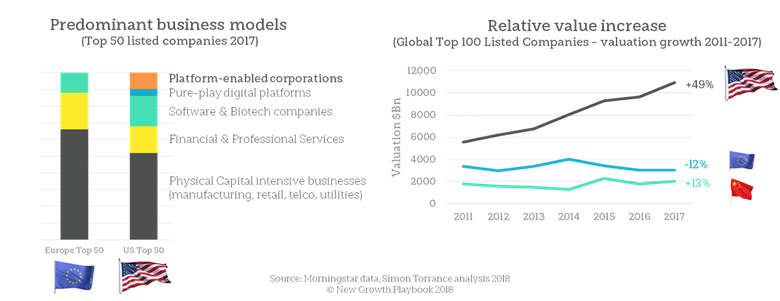
The world’s 6 most valuable companies run platform business models. None are European. 60% of the ‘unicorn’ billion dollar start-ups are platform businesses. Only a small proportion were born in Europe. Europe’s share of the world’s top 100 public companies is declining in both number and value.
- 6 of the world’s 6 most valuable companies run platform business models. None are European.
- 30% of global economic activity is predicted to be mediated by platforms in 10 years’ time.
- 60% of the ‘Unicorn’ billion dollar start-ups are platform businesses.
- 92% of executives believe their current business models are not economically viable through digitization.
- 2% fewer than 2% of incumbents have an effective platform strategy today.
- 85%+of corporate digital investments generate zero/negative EVA.
Seven of the world’s ten most valuable companies are platform businesses. None of them is European. 60% of the ‘Unicorn’ billion dollar start-ups are platform businesses. Only a small proportion were born in Europe.
Europe’s share of the world’s top 100 public companies is declining in both number and value.
Why? The US and China have adopted – faster and at greater scale – advanced digital business models based on ‘platform thinking’. These leverage the full power of software and hyper-connectedness. They work in very different ways to traditional business models and outperform them on all measures of growth and value.
While platforms are commercially very powerful and disruptive, they increasingly have significant socio-economic impact too: on trade flows between companies and countries, on jobs and the nature of employment, and the way they exploit personal data.
From a commercial point of view there is a real danger that Europe falls behind the US and China in preparing for the emergent 4th Industrial Revolution*. Currently we are not translating our lead in scientific research into the same levels of economic value.
At the same time, Europe has an opportunity to take a lead in creating fairer social frameworks in which new digital business models can thrive.
To respond effectively to the opportunities and threats, European business leaders, investors and policy makers across all sectors must quickly understand – in much more detail – the new concepts, technologies and skills underpinning advanced digital business models and platforms and learn how to manage, incorporate, co-exist and/or compete with them.
The most successful companies invest heavily in incorporating platform services into their business models.

Platform businesses outperform all others on growth rates, return on assets, margins and valuation multiples. Europe currently has only a 4% share of this market.

Apple became the world’s first $1 trillion company by investing in a platform-enabled business model

Europe is falling behind in adopting advanced digital models. It’s champions are not increasing value at the same rate as the US and China.
The world’s most dynamic markets today are in Asia.
China is the world’s second largest economy, a huge new and growing consumer market, and home to many of the world’s fastest growing companies. Alibaba to Baidu, BYD and Bytedance, China Mobile to Didi Chuxing, Haier to Huawei, SAIC to Tencent, Dalian Wanda and Xiaomi. China has shifted from imitator to innovator, fundamentally driving new technologies, new applications, and the new agenda for business.
And whilst China is growing at around 5-6%, many other Asian countries will grow even faster through the next decade: India, Bangladesh, Vietnam, Malaysia and the Philippines. Collectively these are known at the 7% club. Indeed we could add another list of great non-Chinese Asian companies like DBS and Grab in Singapore, Samsung and LG in South Korea, Uniqlo and Softbank in Japan, Reliance and Tata in India.
- Read more in my article Taming Tigers: Learning from Asian Business Leaders
Whilst the 19th century belonged to Europe, and the 20th century to America, the 21st century is Asian. In particular, it is the “Eurasian” market axis, connecting Europe and Asia, that is likely to grow most significantly. Bruno Maçães argues in his book “The Dawn of Eurasia” that the distinction between Europe and Asia has disappeared, that China’s new “Silk Road” projects are more important than the G20, and that Europe is missing the boat on the third globalisation.
Meanwhile Parag Kanna says in his recent book “5 billion people, two-thirds of the world’s mega-cities, one-third of the global economy, two-thirds of global economic growth, thirty of the Fortune 100, six of the ten largest banks, eight of the ten largest armies, five nuclear powers, massive technological innovation, the newest crop of top-ranked universities. Asia is also the world’s most ethnically, linguistically and culturally diverse region of the planet, eluding any remotely meaningful generalization beyond the geographic label itself. Even for Asians, Asia is dizzying to navigate.”
- Read more in my article The Future is Asia: 5 billion people is just a starting point
And as we move rapidly towards the 2020s, the amount of change and uncertainty in markets is likely to increase further, challenging the more structured and analytical approaches of the west. Built into Asian culture and religion is a resilience to cope with change, but also an optimism to thrive on change, which is likely to serve them well.
- Read more in my article The I Ching, the oldest guide on how to deal with uncertainty
Yet this is not just about abandoning your local markets and heading East. What is even more relevant to most companies, particularly in Western markets, is that Asian business do thing differently – they innovate, compete and grow in different ways.
25 years ago I met my wife who is half Chinese. Getting to know her family opened my eyes to a very different attitude to life and work. Whilst the following might seem nice words, I can see how they really do instil a very different approach to work, life and success. From the smallest business, to the huge new corporations, they offer us new ideas and inspiration.
17 Lessons from Asia for Europe
So what can we learn from Asian companies, that we can apply back home?
- Values: The Confucian approach is often quoted by Chinese premier Xi Jinping – a philosophy founded on social harmony and collaboration, frugality and hard work, and education – values shared across much of Asia.
- Agility: Taoism is about going with the flow, and adapting to change. The yin and yang symbolise the ability for opposites to co-exist in a positive way, communism and capitalism, centralisation and decentralisation, fast and slow.
- Long game: Private ownership gives Asian companies stability to take a longer term view. Softbank takes a 30 year investment view. Governments work to a 5 year plan, enabling strategic initiatives to thrive.
- State: Whilst this is often seen negatively, government support enables companies to grow with long-term loans, to develop new capabilities together in dedicated zones, and develop shared infrastructure like ports and rail.
- Digital first: A desire to create the future is combined with a willingness to let go of the past, and not be hampered by legacy structures, jumping to the digital world. Look at DBS in Singapore, the world’s best bank.
- Fast and intuitive: Fast decision making is a hallmark of companies like Alibaba, typically leaders in small groups, acting less democratically, and much more of intuition rather than bound by spreadsheets and business cases.
- Research: Huge investments, partly state-funded, go into new science and technologies, in particular fields such as AI, robotics, biotech, and sustainable energy. 3 Chinese electric car companies now outsell Tesla, led by DYB.
- Experimentation: The fast and intuitive approach lends itself to constant experimentation. Companies like Xiaomi continually try new ideas to see what takes off with its huge consumer audiences.
- Scale: The huge size of Asian markets, 5 billion people compared to 1 billion on each other continent, means that even niche ideas have significant audiences, and can then be scaled rapidly though networks and give efficiencies.
- Entrepreneurial: Many western companies struggle with how corporations can be like start-ups. Haier transformed their business into 10,000 micro businesses under one roof, calling it their Rendanheyi model.
- Copying: Another seemingly taboo subject, but still what Chinese companies excel at (as does Apple). Meituan Dianping was recently ranked the world’s most innovative company, yet copies and tweaks business models.
- Ecosystem: Asian businesses are not afraid to openly work together. Alibaba and Tencent are like “Google plus Amazon plus Facebook plus eBay plus payment plus logistics plus wholesale” all in one. Platform models are the norm.
- Relationships: Famously, the Asian concept of “gunxia” plays a huge role in many of these aspects, a relationship based on face and trust, where businesses and individuals commit to collaborate without hussle or strong-armed deals.
- Leadership: We probably know more CEOs of Asian companies than western companies. Why is this? Because trust in companies comes through people, and particularly in ecosystems of employees, partners and customers.
- World view: Many Asian companies see the world, rather than local markets, as their home. Xiaomi for example sees natural affinity and rapid growth across similar emerging markets, from India to Brazil and Mexico.
- Education: Back to the Confucian idea at the beginning, education becomes key to future success. China has 4 times more STEM students than USA, and 33% of all students study engineering compared to 7% in USA.
- Frugal: Whilst rich young Asians have a huge appetite for partying and designer brands, overall they have a frugal attitude and most people save hard. Net household savings in China are 38% compared to 18% in USA and 4% in Europe.
- Hardwork: Jack Ma swears by it: the 996. Which means working long hours 9am to 9pm 6 days every week. Whilst the west have taken life easier, the Asians are working hard.
You may agree or disagree. What else would you add? You may find that the state interventionist approach is not fair, destabilises competition, and that many of these companies would have failed in their infancy but for such support. You may argue that the Asian “heads down” work ethic could easily be supplanted by machines in an emerging world of AI and robotics, and that Europe is better focused on more human, creative and added-value skills and work. As you walk around Shanghai, you may feel uncomfortable that the Chinese police evaluate you with their data-powered AR-enabled dark glasses, or how social credits drive compliant behaviour, and aspects of freedom and human rights are ignored. Yet Asian companies are fascinating, creative and not going away.
- Read my in-depth stories of many of these Asian companies here 100 Gamechanger Case Studies
This year’s Thinkers50 European Business Forum, bringing together the world’s top business thinkers with Europe’s business leaders, focuses on this topic. How can European businesses learn from the approaches of Asian companies. How can we take the best new ideas and apply them to our own companies here in Europe? For two inspiring days in Odense, Denmark – itself a hub of 21st century robotics – we bring together many different perspectives on this challenge.
In the European Business Lecture 2019, Alex Osterwalder gives his view on how Europe’s companies can be invincible. Also Erin Meyer on how they can work better together, top strategist Scott Anthony on innovating in dual transformation, Kjell Nordstrom gets funky again, Irene Yuan Son takes us to Africa, Navi Radjou contrasts India and America, Erica Dhawan gets you more connected, Haiyan Wang learns from China, and Howard Yu helps us leap forwards in new ways.
I will again be hosting the event, and look forward to seeing you at “the Davos of business thinking” on 25-26 September.
- Learn more of the best ideas from Asia at the Thinkers50 European Business Forum 2019
More by Peter Fisk:
- Read my article The Future is Asia: 5 billion people is just a starting point
- Read my article Taming Tigers: Learning from Asian Business Leaders
- Read my article 17 Lessons from Asian Business: What we can learn from Alibaba to Softbank
- Read my article The I Ching, the oldest guide on how to deal with uncertainty
- Come to my event Learning from Asia in Oslo, Norway or in Copenhagen, Denmark
- Come to my event Peter Fisk Live in Seoul, South Korea exploring the future of business
- Download my keynote “Learning from Asia: What can we learn from Alibaba to Bytedance, and 20 more Asian leaders”
On Saturday, 18th May 2019, Apple’s Tim Cook delivered the 2019 commencement speech to graduates of Tulane University in the New Orleans’ Superdome. You can watch the video, and read the transcript, below.
“We forget sometimes that our preexisting beliefs have their own force of gravity. Today, certain algorithms pull toward you the things you already know, believe, or like, and they push away everything else. Push back.”
He encouraged graduates to listen to and have empathy for the viewpoints of others instead of demonising the other side so that real work can be accomplished.
He concluded “You may succeed. You may fail. But make it your life’s work to remake the world because there is nothing more beautiful or more worthwhile than working to leave something better for humanity.”
Hello Tulane! Thank you President Fitts, Provost Forman, distinguished faculty, other faculty [laughs], and the entire Tulane family, including the workers, ushers, [and] volunteers who prepared this beautiful space. And I feel duty-bound to also recognize the hard-working bartenders at The Boot. Though they’re not here with us this morning, I’m sure some of you are reflecting on their contributions as well. [The Boot is a popular college bar right next to Tulane’s campus which has been around for decades.]
And just as many of you have New Orleans in your veins, and perhaps your livers, some of us at Apple have New Orleans in our blood as well. When I was a student at Auburn, the Big Easy was our favorite getaway. It’s amazing how quickly those 363 miles fly by when you’re driving toward a weekend of beignets and beer. And how slowly they go in the opposite direction. Apple’s own Lisa Jackson is a proud Tulane alum. Yes. She brought the Green Wave all the way to Cupertino where she heads our environment and public policy work. We’re thrilled to have her talent and leadership on our team.
OK, enough about us. Let’s talk about you. At moments like this, it always humbles me to watch a community come together to teach, mentor, advise, and finally say with one voice, congratulations to the class of 2019!
Now there’s another very important group: your family and friends. The people who, more than anyone else, loved, supported, and even sacrificed greatly to help you reach this moment. Let’s give them a round of applause. This will be my first piece of advice. You might not appreciate until much later in your life how much this moment means to them. Or how that bond of obligation, love, and duty between you matters more than anything else.
In fact, that’s what I really want to talk to you about today. In a world where we obsessively document our own lives, most of us don’t pay nearly enough attention to what we owe one another. Now this isn’t just about calling your parents more, although I’m sure they’d be grateful if you did that. It’s about recognizing that human civilization began when we realized that we could do more together. That the threats and danger outside the flickering firelight got smaller when we got bigger. And that we could create more — more prosperity, more beauty, more wisdom, and a better life — when we acknowledge certain shared truths and acted collectively.
Maybe I’m biased, but I’ve always thought the South, and the Gulf Coast in particular, have hung on to this wisdom better than most. [Tim Cook grew up in Robertsdale, Alabama, which is about an hour from New Orleans and is similarly close to the Gulf of Mexico.] In this part of the country, your neighbors check up on you if they haven’t heard from you in a while. Good news travels fast because your victories are their victories too. And you can’t make it through someone’s front door before they offer you a home-cooked meal.
Maybe you haven’t thought about it very much, but these values have informed your Tulane education too. Just look at the motto: not for one’s self, but for one’s own.
You’ve been fortunate to live, learn, and grow in a city where human currents blend into something magical and unexpected. Where unmatched beauty, natural beauty, literary beauty, musical beauty, cultural beauty, seem to spring unexpectedly from the bayou. The people of New Orleans use two tools to build this city: the unlikely and the impossible. Wherever you go, don’t forget the lessons of this place. Life will always find lots of ways to tell you no, that you can’t, that you shouldn’t, that you’d be better off if you didn’t try. But New Orleans teaches us there is nothing more beautiful or more worthwhile than trying. Especially when we do it not in the service of one’s self, but one’s own.
For me, it was that search for greater purpose that brought me to Apple in the first place. I had a comfortable job at a company called Compaq that at the time looked like it was going to be on top forever. As it turns out, most of you are probably too young to even remember its name. But in 1998, Steve Jobs convinced me to leave Compaq behind to join a company that was on the verge of bankruptcy. They made computers, but at that moment at least, people weren’t interested in buying them. Steve had a plan to change things. And I wanted to be a part of it.
It wasn’t just about the iMac, or the iPod, or everything that came after. It was about the values that brought these inventions to life. The idea that putting powerful tools in the hands of everyday people helps unleash creativity and move humanity forward. That we can build things that help us imagine a better world and then make it real.
There’s a saying that if you do what you love, you’ll never work a day in your life.
At Apple, I learned that’s a total crock. You’ll work harder than you ever thought possible, but the tools will feel light in your hands. As you go out into the world, don’t waste time on problems that have been solved. Don’t get hung up on what other people say is practical. Instead, steer your ship into the choppy seas. Look for the rough spots, the problems that seem too big, the complexities that other people are content to work around. It’s in those places that you will find your purpose. It’s there that you can make your greatest contribution. Whatever you do, don’t make the mistake of being too cautious. Don’t assume that by staying put, the ground won’t move beneath your feet. The status quo simply won’t last. So get to work on building something better.
In some important ways, my generation has failed you in this regard. We spent too much time debating. We’ve been too focused on the fight and not focused enough on progress. And you don’t need to look far to find an example of that failure. Here today, in this very place, in an arena where thousands once found desperate shelter from a 100-year disaster, the kind that seem to be happening more and more frequently, I don’t think we can talk about who we are as people and what we owe to one another without talking about climate change.
Thank you. Thank you.
This problem doesn’t get any easier based on whose side wins or loses an election. It’s about who has won life’s lottery and has the luxury of ignoring this issue and who stands to lose everything. The coastal communities, including some right here in Louisiana, that are already making plans to leave behind the places they’ve called home for generations and head for higher ground. The fishermen whose nets come up empty. The wildlife preserves with less wildlife to preserve. The marginalized, for whom a natural disaster can mean enduring poverty.
Just ask Tulane’s own Molly Keogh, who’s getting her Ph.D. this weekend. Her important new research shows that rising sea levels are devastating areas of Southern Louisiana more dramatically than anyone expected. Tulane graduates, these are people’s homes. Their livelihoods. The land where their grandparents were born, lived, and died.
When we talk about climate change or any issue with human costs, and there are many, I challenge you to look for those who have the most to lose and find the real, true empathy that comes from something shared. That is really what we owe one another. When you do that, the political noise dies down, and you can feel your feet firmly planted on solid ground. After all, we don’t build monuments to trolls, and we’re not going to start now.
If you find yourself spending more time fighting than getting to work, stop and ask yourself who benefits from all the chaos. There are some who would like you to believe that the only way that you can be strong is by bulldozing those who disagree or never giving them a chance to say their peace in the first place. That the only way you can build your own accomplishments is by tearing down the other side.
We forget sometimes that our preexisting beliefs have their own force of gravity. Today, certain algorithms pull toward you the things you already know, believe, or like, and they push away everything else. Push back. It shouldn’t be this way. But in 2019, opening your eyes and seeing things in a new way can be a revolutionary act. Summon the courage not just to hear but to listen. Not just to act, but to act together.
It can sometimes feel like the odds are stacked against you, that it isn’t worth it, that the critics are too persistent and the problems are too great. But the solutions to our problems begin on a human scale with building a shared understanding of the work ahead and with undertaking it together. At the very least, we owe it to each other to try.
It’s worked before. In 1932, the American economy was in a free-fall. Twelve million people were unemployed, and conventional wisdom said the only thing to do was to ride it out, wait, and hope that things would turn around. But the governor of New York, a rising star named Franklin Roosevelt, refused to wait. He challenged the status quo and called for action. He needed people to stop their rosy thinking, face the facts, pull together, and help themselves out of a jam. He said: “The country demands bold, persistent experimentation. It is common sense to take a method and try it. If it fails, admit it and try another. But above all, try something.”
This was a speech to college students fearful about their future in an uncertain world. He said: “Yours is not the task of making your way in the world, but the task of remaking the world.” The audacious empathy of young people, the spirit that says we should live not just for ourselves, but for our own. That’s the way forward. From climate change to immigration, from criminal justice reform to economic opportunity, be motivated by your duty to build a better world. Young people have changed the course of history time and time again. And now it’s time to change it once more.
I know, I know the urgency of that truth is with you today. Feel big because no one can make you feel strong. Feel brave because the challenges we face are great but you are greater. And feel grateful because someone sacrificed to make this moment possible for you. You have clear eyes and a long life to use them. And here in this stadium, I can feel your courage.
Call upon your grit. Try something. You may succeed. You may fail. But make it your life’s work to remake the world because there is nothing more beautiful or more worthwhile than working to leave something better for humanity.
Thank you very much, and congratulations class of 2019!
40 years ago, my father in law, who had grown up in the countryside north of Hong Kong, just over the border into mainland China, went back to the village of his birth. I remember him telling stories of a simple life, playing in the rice fields, and faded photographs of him riding water buffalo as a young boy.
Having moved to Europe he wanted to retain some presence in the small place. He bought some land, and built a small block of apartments which he hoped might grow in value and some day be a good pension for him and his family.
Over the past 30 years, the fishing village of Shenzhen has been reborn as a futuristic metropolis bursting with factories. It is the heartland of China’s tech revolution, dubbed the Silicon Valley of hardware. Now it is a boom town, the likes of which the world has never seen before.
In 1979, the Chinese government turned it into an experiment to grow capitalism in a test tube, designating it as the country’s first Special Economic Zone. The city is driven by an influx of workers from the countryside who make everything from real iPhones to fake Chanel bags. Shenzhen — and the surrounding Pearl River Delta — has become known as the world’s factory floor.
If you own a smartphone or computer, odds are parts of it came from here. It is now a megacity of over 12 million people. It has also become an incubator for cutting-edge design, a bastion of next-gen urbanism, and a leading cultural capital. Welcome to Shenzhen, the manifestation of China’s economic miracle.
To see why Shenzhen is called a rule-breaking tech hub, wander the endless wholesale kiosks of Huaqiangbei’s malls, where tech entrepreneurs, hackers, and makers gather. You will find every electronic component and gadget imaginable, laid out like so many spices in a bazaar.
This is ground zero for the production of shanzhai — “pirated” goods that are often less knockoffs than remixes, like an Apple Watch that runs on Android, has a removable battery, and is a quarter of the price. Naturally, the West frowns on shanzhai, but experts like David Li, a Taiwanese technologist and cofounder of Shenzhen Open Innovation Lab, argue that these bootlegs drive innovation. Hoverboards, he points out, evolved in the wilds of shanzhai production to become a global hit.
Meanwhile, the Chinese government is using Shenzhen as a showcase for its move from “Made in China” to “Designed in China” — a program to rebrand the country as a place that can invent, not just copy and mass-produce.
Another draw is Shenzhen’s distance from the capital. As the old Chinese saying goes: “The mountains are high and the emperor is far away.” Though the government engineered Shenzhen, its location in the Pearl River Delta, more than 1,300 miles from Beijing, gives it a more relaxed atmosphere. “Freedom is a really big word, but there is a sense of Shenzhen being more open in every way,” says Jason Hilgefort, an American architect and educator who leads the local urbanism academy Future+.
Schenzen is also home to some of China’s leading companies including the world’s leading electric car business BYD, and world’s leading drone maker DJI. And then add Huawei and Tencent.
Chinese tech infrastructure giant Huawei was founded in Schenzen in 1987 by Ren Zhengfei, a former engineer in the People’s Liberation Army. At the time of its establishment, Huawei focused on manufacturing phone switches, but has since expanded its business tremendously. It is the largest telecommunications equipment manufacturer in the world and the second largest smartphone manufacturer after Samsung.
Tencent is another leading business from Schenzen. QQ is a social media platform owned by Tencent with 850 million monthly users. WeChat even has 963 million monthly users. Tencent does not stop at these platforms. Their services include music, web portals, e-commerce, mobile games, internet services, payment systems, smartphones, and multiplayer online games All these services are among the world’s biggest and most successful in their respective categories.
More by Peter Fisk:
- Read my article The Future is Asia: 5 billion people is just a starting point
- Read my article Taming Tigers: Learning from Asian Business Leaders
- Read my article 17 Lessons from Asian Business: What we can learn from Alibaba to Softbank
- Read my article The I Ching, the oldest guide on how to deal with uncertainty
- Come to my event Learning from Asia in Oslo, Norway or in Copenhagen, Denmark
- Come to my event Peter Fisk Live in Seoul, South Korea exploring the future of business
- Come to my event Thinkers50 European Business Forum 2019 all about Learning from Asia
- Download my keynote “Learning from Asia: What can we learn from Alibaba to Bytedance, and 20 more Asian leaders”