Microsoft is all about enabling people to do things they never dreamed they could do.
For Microsoft’s own CVP of Azure Marketing, Julia White, she never imagined she could stand on the stage at this week’s Microsoft Inspire 2019 event in Las Vegas, whilst a life-size hologram of her could simultaneously stand on a stage in Tokyo and talk perfect Japanese.
Like any tech company, Microsoft loves its technology – words like Azure and HoloLens have become part of the lexicon on the company’s Redmond campus. But to the rest of the world, we are still getting used to the potential of artificial intelligence and virtual reality.
Indeed what’s also important is how these capabilities work together … when you add VR to the cloud, and you combine AI with neural speech … maybe in the future adding in a bit of 3D printing and biorobotics too. The point is what they enable you to do, today and tomorrow.
This week in Las Vegas, Julia White was certainly real. And her Japanese speaking clone seemed pretty authentic too. The future is rapidly becoming our reality. The challenge is to bring these capabilities to life in useful, relevant and progressive ways – to make life better, to help us all achieve more.
As for how Microsoft pulled off this remarkable demo, the first step was creating White’s seemingly identical, life-sized hologram. To do that, she visited one of the company’s Mixed Reality capture studios, where she was recorded delivering her presentation in English.
That would be enough to allow anyone wearing one of Microsoft’s HoloLens devices to feel like White was standing in front of them, delivering her speech.
To then make it seem like White was speaking Japanese, Microsoft used its neural text-to-speech technology to create White’s “personalized voice signature.” Once it had that, it could have the hologram say anything, in any language, and the audio would sound like White’s voice.
Of course, an international audience could still benefit from a presentation like White’s even if Microsoft didn’t turn her into a hologram or use AI to replicate her voice — they could watch her on their television or computer screen, and listen along as a human translator repeated White’s words in their native tongue.
But this technology removes so many of those barriers between the speaker and the audience.
Imagine a world leader delivering a speech, and every person across the globe feeling like the leader was in the room with them and speaking the local language. Or a world-class professor giving a lecture that anyone could attend and understand — without leaving their homes and without learning their teacher’s language.
And then there’s the exciting possibility of what might come next. Mixed reality contact lenses that do away with the need for a headset altogether? AI that can translate speech in the native speaker’s voice in real-time?
As White put it at the end of her demo, “All of these technologies exists today. The future is here.”
Microsoft with Philips
https://www.youtube.com/watch?v=loGxO3L7rFE
Microsoft with Bentley
Microsoft with Ford
- Microsoft’s Story Labs
The median wage earner is poorer today than they were in 2007. This is mass impoverishment.
Mark Thomas, a friend and co-author, has just written a fantastic new book, and launched an entire movement no less, to address the inequalities of our rapidly changing world:
“The 99% Organisation exists to help end mass impoverishment. The 99% Organisation is an inclusive grass-roots movement, inspired by the Occupy movement, of people who want to end mass impoverishment using peaceful means. Its members come from all parts of society; they are people like you who are determined to help. If you are young, gifted and black, we want you. If you are male, pale and stale, we want you.
Whether you are a beggar, a barber, a banker or a billionaire, we want you. The 99% Organisation aims to make mass impoverishment a key issue for Government, and to drive serious policy change. We want to build a world in which by 2050, everyone is at least 50% better-off than today.”
Mark is an economist by nature, so it is no surprise that he has meticulously analysed this situation, and strategically thought through what we need to do about it:
- The 99% Fact Pack: The end of market capitalism, and rise of mass impoverishment
- The 99% Argument: Why we need to end mass impoverishment and what to do about it
He argues that if you are part of the 99% – and there is a 99% chance that you are – then you are one of the first generation in living memory who can expect to be poorer than your parents, even as the economy continues to grow.
And you could be quite a lot poorer. If we continue as we are going, the civilisation we enjoy today will not last until 2050. Buying their own house is a distant dream for most young people; their wages are failing to keep pace with inflation; and more and more people are having to rely on food banks. Our age is one of chronic anxiety.
If the economy is doing so well, how can most people not be doing well? If the pie is growing, why aren’t we all getting bigger slices?
Mark’s new book “99%” shows what we, the 99%, can do to end mass impoverishment and build a society worth living in: an age of abundance, in which everyone benefits.
- Buy the book: 99%. How to Create Abundance and Reverse the Rising Tide of Impoverishment
- Join the movement: 99%. Whoever you are, there are a thousand ways you can help
Hugh Pym, BBC Health Editor and former BBC Chief Economics Correspondent says of Mark’s book “If you are concerned about your future but would never dream of reading a book about the economy … you should read this one!” Sten Scheibye, former chairman of Novo Nordisk adds “In the age of Trump, Putin, and Brexit, it is difficult to be an optimist. But 99% opens a route forward – it deserves to be read by all those in a position of influence.”
Mass Impoverishment
Definition: the process in which even as the economy continues to grow richer, many people find themselves getting poorer year after year.
Examples:
1. Mass impoverishment means that we are looking at the first generation in living memory that expects to be poorer than its parents.
2. Many countries suffer from mass impoverishment: the US since 2000 and the UK since 2010.
As Philip Alston, UN Special Rapporteur on Poverty wrote:
“The costs of austerity have fallen disproportionately upon the poor, women, racial and ethnic minorities, children, single parents and people with disabilities. The changes to taxes and benefits since 2010 have been highly regressive, and the policies have taken the highest toll on those least able to bear it.
The government says everyone’s hard work has paid off, but according to the Equalities and Human Rights Commission, while the bottom 20 per cent of earners will have lost on average 10 per cent of their income by 2021/22 as a result of these changes, top earners have actually come out ahead.”
These statistics are powerful, but many people do not relate to numbers alone. Behind the figures for poverty and homelessness are thousands of individual stories. Linking the concepts and data above to these stories will bring them to life and help many people to understand what is happening to them, and why.
Many of the charities active in poverty relief have access to countless such human stories. And these stories are a very important part of the picture – nurses having to visit food banks, parents having to choose between heating the house and feeding the children, et cetera.
But there is an even more widespread problem. Even those who are not at the bottom of the income ladder are struggling. Even those with careers which in previous generations would have been expected to lead to a very comfortable – if not prosperous – life now feel that such expectations are out of reach. In the last week, just in conversation, I have come across:
A successful website designer who, at the age of 43, has found that house prices have always been 10% more than he could afford and who is now worrying about the prospects for his daughter. Aged 14, she is doing extremely well in school and wants to go to university and get a job in London. He is concerned about whether he should burden her with all that debt in a world where a university degree may well not lead to a decently paying job;
A recently-qualified accountant with one of the world’s largest accountancy firms who is thinking of leaving the profession in order to direct pod-casts. When asked why he would abandon his career in this way, he replied, “if I carry on, reasonably successfully, and get the promotions I expect, in three or four years’ time, I will be earning £80,000 a year, and I will be able to borrow £300,000. But I still wouldn’t be able to buy anything in London. I might as well have a life, even if I can’t have a house.”
Mass impoverishment really does affect the vast bulk of people.
B2C and B2B marketing were once easily distinguishable from one another.
Consumer marketing was highly polished, it looked great – it was about people, emotions, big ideas, aspirations, futures, it built engagement, desire, preference and drove intuitive actions – even if you didn’t need one, you wanted one now. Through retail channels, or direct to consumer, you were quickly immersed in a branded experience, seduced to buy, or even be part of a community – the in crowd. It had enormous reach, and could spread across mass markets, albeit as average propositions to average people.
Business marketing was clunky, awkward. It was largely transactional, it focused on logic – most often the logic of the product, its features, its dimensions, its applications – and its price. No wonder it was quickly commoditised. If you didn’t actually need one, you’d never even start to be engaged. But at the same time it had sales people, key account managers, who were human, and could have real, human, one to one relationships in a way that the CRM systems and social media of consumer world only dreamed of.
Now we are see a convergence of B2B and B2C. Business people are human, of course – and also consumers – and their professional expectations are shaped by their consumer experiences. On the other hand, consumers are now doing what they once paid businesses to do: booking their own travel, producing their own collateral and checking out their own groceries. Indeed, this recombination of consumer and business realms is one of the defining memes of the current era, as evidenced in the explosion of start-ups, crowd-sourced micro-businesses and artisanal culinary culture.
While often overshadowed by consumer campaigns, B2B marketing can be just as creative, powerful and engaging:
GE: Ideas are Scary
GE Ideas are Scary says, “we are you and we know the value of an idea.” It’s about people, life and work, not the products GE sells. GE demonstrates citizenship, and creates kinship with viewers with a human touch that crosses platforms. In addition to being seen by millions of people on TV, the spot has taken on a second life online, with more than half a million YouTube shares and countless social media mentions.
IBM Watson: Cognitive Business
https://www.youtube.com/watch?v=N2So4WfY0xk&t=3s
A supercomputer that can analyse the depth and complexity of Bob Dylan’s lyrics. No, it’s not science fiction. It’s IBM Watson. With the launch of its ‘Cognitive Business’ brand platform, IBM is humanises its technology and makes it both relevant and even fun.
It’s not just about how fast Watson thinks, or how much information it can make sense of. It’s about how Watson empowers customers to ‘outthink’ their biggest challenges – everything from cyber-attacks to university attrition rates, from weather to cancer. I love the spirit of the language and, again, the humanity of the content. Years ago, it was Apple telling people to ‘think different’ like Dylan. Now the musical icon is outthinking with IBM.
Volvo Trucks: Sophie
There are lots of ways to say that Volvo Trucks are tough in an ad, but it’s far more difficult to actually show it in an unexpectedly disruptive way. With ‘Sophie’ the goal was to demonstrate the sturdiness and mobility of the Volvo FMX. A sound strategy, but done so in the most compelling, unexpected, delightful way. ’Sophie’ documents a young British schoolgirl who operates a Volvo FMX through an obstacle course via remote control. Surviving the head-on demolition of a house and nearly flipping the truck over an embankment, Sophie clearly enjoys herself and successfully maneuvers the course. A schoolgirl selling the Volvo FMX Truck? On strategy, on message, on point, but done in a most courageous and unexpected way that delights the consumer base.
Adobe Marketing Cloud: The Launch
GE’s recent advertising has been a great example of how business brands can reach beyond their core audience to show how they affect everyone’s lives. But my favourite recent example has been Adobe’s Launch ad for their Marketing Cloud offering. Another great one in the series from Goodby, Silverstein & Partners, it builds on Click Baby Click and Woo Woo?, using comedy to poke fun at some oh-so-familiar marketing pain points. Do you know what your marketing is doing? It would be hard to find an industry that offers up more ripe material for lampooning than the world of marketing. But, let’s not hold that against GS&P. This campaign nails the paralysing fear, doubt, and confusion that engulf those women and men who invest massive amounts of company money in hopes of moving the proverbial needle. And, when it comes to understanding and using the tsunami of current data, who couldn’t use a little help?
GE: What’s the matter with Owen?
GE has done an amazing job of transforming itself into what it terms a ‘digital industrial’ company. Or ‘big iron and big data’ under one roof. Key to its success is the very clever use of integrated content and use of social media, where it has created a very human, and often playful persona. Its recent recruitment campaign titled ‘What’s the Matter With Owen?’ is designed to help reposition themselves and tackle head-on perceptions of them as purely an industrial company. The ads feature a young man called Owen who has just got a job at GE. Problem is none of his friends and family get why this is good news. The awkwardly comic films run across network and cable programming, but importantly also on social media, where Owen himself pops up to talk about his first days on the job.
Most B2B advertising is focused on driving sales. But there’s a talent war looming—particularly for STEM candidates—that B2B can address for corporations. That’s why GE’s ‘What’s the Matter with Owen?’ campaign is a stand-out for me. Traditional brick-and-mortars are in an unenviable position against startups and tech giants in attracting STEM talent. But GE’s ads position the company for a digital future. They inspire candidates with the promise of working on world-changing projects while their peers make passing fads. And the ads bring to life GE’s culture and vision. This is the spirit of brilliant business-to-employee advertising. Others would be wise to catch on.
Cisco: Nextgen Internet
“In the beginning, we saw a glimpse of the future. That future has arrived. We’re connecting the physical world to the Internet. Now, everyday objects become intelligent on the Internet of Everything”. It’s rare that you get a big tech company that makes you laugh, let alone one that connects with the more human side of things. In this video though Cisco has managed to combine cute kids, creative ideas, and its own take on connecting the world to the internet to produce an entertaining and light-hearted look at the future of the connected world. By having a group of five to 11 year-olds presenting their internet of things (IoT) inventions to its chief executive officer, Phil Smith, they have managed to get across this concept in a very simple and common sense manner.
American Express: Small Business Saturday
Small Business Saturday is making a big difference. Not just for American Express and every small biz that’s on board – but also for our society. It’s an idea that’s created real value, value that goes way beyond a B2B campaign. For me, the difference is when the lady in my local furniture shop knows all about the kooky lamp I love – and she cares. In our world of supersize, superstores and supermalls, I love the idea of backing her. To quote Edward de Bono, ‘Companies that solely focus on competition will ultimately die. Those that focus on value creation will thrive.’ American Express has certainly seen that coming.
Jim Hagemann Snabe and Mikael Trolle should know a bit about leadership which delivers results. One is Europe’s leading industrialist, the chairman of Siemens, whilst the other is a world-leading sports coach.
Leaders at every level of business are struggling to grip the new scale of global disruption. Strategic assumptions are being turned on their head, sometimes daily or even hourly. The conformity which qualified leaders for the top in too many ways disqualifies them from embracing the scale of what now has to be understood, embraced then acted upon.
For many, the scale of change needed is beyond the kind of professional challenge they relish or even understand. It is not just uncomfortable: instead the evidence is that it is driving at least anxiety and in reality often deep fear.

Snabe and Trolle’s new book “Dreams and Details” sets out to encourage leaders by urging them to assess frankly their strengths and frailties, then re-define their capacities. In this way, there is a far better chance they will be able to re-invent themselves and survive, instead of being offloaded in summary fashion by a disillusioned board or governing council under pressures from shareholders or stakeholders.
For every leader the new challenge is how to disrupt all their assumptions about what leadership requires these days. It is about re-framing every way in which they assume they have to work. Snabe and Trolle argue that at the moment, too many just ‘paint over the rust’ and hope dark issues will just vaporise. ‘ Apparent success hides a crisis’. Ultimately – as with Kodak, Motorola or Nokia – ‘even the biggest become disrupted and irrelevant’.

In summary it is about ‘Goodbye Business Plan’, say Snabe and Trolle. Plans ‘rarely create the needed change’. So leaders ‘have to undo all they believed was right’. Yes! Business Plans are a conformist distraction.
‘Goodbye Business Plan’ captures their blunt and radical message of a new need for non-orthodoxy. It will be a struggle for most leaders, probably a painful one. Why so? ‘Change is hard – radical change is even harder’, they write. ‘The more detailed plans we make, the more defensive we become.’
Snabe has his background within the IT industry. In 2010 he was appointed co-CEO alongside Bill McDermott. Together they successfully reinvented the software giant SAP from 2010 to 2014. Through his involvement with the World Economic Forum Jim is actively engaged in efforts related to the Digital Transformation of business and society. Jim is now chairman of Maersk and Siemens.
Trolle has a background within coaching sports teams and years of experience as a senior executive to develop a unique expert knowledge on what it takes in High Performance Leadership. His results, leadership experience and his ability to communicate around leadership has made him one of the most recognized leaders in the world of sports.
Here’s an extract from the book:
Chapter 3 – Dreams and Details – A New Leadership Model
On May 25th, 1961, young and newly-elected president, John F. Kennedy, stood before the United Sates Congress and announced that, before the end of the decade, the United States would send a man to the moon and bring him safely back to earth. The following year, on September 12th, 1962, he reiterated it in front of a packed stadium at Rice University in Houston, Texas. “We choose to go to the moon! We choose to go to the Moon in this decade and do the other things, not because they are easy, but because they are hard; because that goal will serve to organize and measure the best of our energies and skills, because that challenge is one that we are willing to accept, one we are unwilling to postpone, and one we intend to win,” said Kennedy to thunderous applause.
President Kennedy could have expressed it in many other ways. He could have said that the United States would become the world’s leading innovator of technology, surpassing the Soviet Union, and set a number of specific goals, such as the number of patents filed, to achieve it. Would that have seemed inspiring? Probably not.
Kennedy admitted in his speech that a large number of necessary conditions for a lunar landing were not yet present. It required metal alloys and techniques that had not been invented at the time. They gradually did though.
The Space Race was not just about saber rattling. It ushered in an era filled with technological advances and new insights, materials and inventions that today are used far beyond spacecraft: memory foam, insulin pumps, insulation materials, ear thermometers and microchips are just a few. Today, NASA owns thousands of patents, and a myriad of private and public companies have emerged based on the knowledge and technology that space research brought with it. And the United States became a leading technology-producing nation.
Seven years after Kennedy’s speech in Houston, Neil Armstrong walked on the face of the moon.
Dreams and Details – And the Platform for Change
President Kennedy did what we advocate for in this book: He translated a logical strategy into an inspiring dream. It was extremely ambitious, but not unattainable. It was inspiring, easy to convey and spoke of a future with lots of unknowns and infinite possibilities; a situation that most of today’s businesses will recognize. The direction was clear – the road was unpredictable, but Kennedy trusted those involved so much that he left them on their own to determine how to best land a man on the Moon and returning him safely to the Earth again.
In the process of reaching the moon and back, there were details – technologies and human performance – which were absolutely crucial. Due to the time pressure, it was also crucial that everyone worked in the same direction, and the framework made it possible to improvise along the way and seize opportunities that arose. The mindset was that security had to be high. The first moon travelers had to make it back in one piece.
Dreams and Details is our recommended leadership model to enable continuous reinvention based on maximizing human performance. The Dreams and Details leadership model advocates for the importance of inspiring people to drive reinvention based on an ambitious dream that points to the opportunities in the future. It involves focusing on the most crucial details and developing the most critical capabilities that enable the dream to come true. And it includes setting the right mindset and framework to unleash human potential and accelerate the transformation of the organization.
Later in the book, we elaborate on each of these individual elements of the leadership model. This chapter is meant as an overall introduction.
In short, the Dream is what we want to achieve. It is derived from the overall purpose and long-term strategy of the organization. A dream sounds elusive, but we chose that word because it indicates the importance of going beyond logic to inspire people to be part of something meaningful and ambitious. For some, leadership has been about setting expectations so low that they can be overachieved. This is the wrong approach if you want to reinvent a company. As leaders we must dare to think big and have ambitious dreams about what the company could become. The dream is developed through outside-in a thorough process to define the role and ambition of the company in future markets. In includes an ambition of how we will succeed in future markets and it translates the ambition into something meaningful and inspiring. The dream defines a relevant direction for the company, but not the plan on how to get there. The dream has to be ambitious enough to inspire the necessary changes and must be so inspiring that it motivates and engages. Direction, ambition and inspiration: That is the dream.
The second part of the model is the Details. The Details define which areas we need to transform and perfect in order to achieve the dream. In other words, the Details define which areas need the biggest change. It is important to emphasize that we are not suggesting to focus on all details, but the few crucial details that need the most radical change to develop the needed capabilities and performance of the organization to achieve the dream.
To connect the Dream and the Details, we need what we call the Platform for change. The Platform includes first of all a common mindset for the organization. The mindset is derived from the Dream and defines what people should have in mind, when they make decisions. As such the mindset enables people in the organization to make the right decisions in line with the strategic priorities. The Platform also includes a common framework for the organization. The framework defines the boundary conditions, structures and rules within which the organization works. The framework allows people to act according to the “rules of the game”. In other words, the Platform enables employees to unleash their potential by allowing decentral decision making based on a mindset defining common priorities for decisions and decentral action based on a Framework defining “how we play together”.
“Dream” is Direction, Ambition and Inspiration
When we first mentioned our ambition to double the revenue of SAP to a colleague in the IT industry, he warned us: “The way to survive as a CEO is to deliver more than you promise, so you don’t want to promise too much.”The concept of under-promise and over-deliver may ensure a CEO’s survival for some time, but it will not enable a reinvention of the company. To reinvent companies, you need to be ambitious. You need an inspiring dream, and the dream needs to have a strategic direction, like Kennedy’s dream to put a man on the moon. Where are we going and where do we see opportunities for future growth? How do we ensure that we are relevant in the future?
In our definition of the dream, the dream contains three elements: direction, ambition and inspiration. Direction and ambition speaks to the brain; it sets the strategic priorities for the company. Inspiration speaks to the emotions; it motivates and engages, which is necessary to increase performance, so the dream can be realized.
It is neither ambitious nor inspiring to live by the under-promise and over-deliver rule. What’s more, it doesn’t set a course for reinvention of the company.
Kennedy said that the United States would send the first human to the moon. That is an inspiring dream with a clear direction. At the same time the dream was very ambitious: “before the end of the decade.” You can be skeptical about whether it can be done, but it is clear and comprehensive communication that everyone involved, from the cafeteria assistant to the top engineer, can relate to and be inspired by. It gives direction and meaning in their world when they are part of an overall dream and contributing to it. Meaning is engaging and motivating. Who wouldn’t want to be part of a mission to send a man through space to land on the moon and make it back safely again?
The Dream is not a Plan
An important point is that the dream is not to be confused with a business plan. The dream must indicate a direction which ensures that the company is also relevant in the future, but if you want to reinvent your company, we believe that you should refrain from trying to plan exactly how to get there. Planning the path to an ambitious dream will, with high likelihood, limit the outcome to the past experiences of the organization. In times of a season change the future is unknown. So the plan will most likely be wrong. Instead, the company needs to define which capabilities are required to be developed in order for the organization to find the best possible path to the dream.
When Kennedy said that the United States would send a man to the moon and back, there was no detailed plan for how it could be done. But the dream motivated employees to develop the needed capabilities to invent the necessary materials, applications and technology to make it happen.
The advantage of being open to new and better solutions and methods in a company is, among other things that it allows for unexpected ideas and gains along the way. Some of the biggest breakthroughs in the world were not planned but were invented because someone discovered a potential opportunity and dared to deviate from the plan.
As an example, penicillin was discovered when the doctor Alexander Fleming was looking for ways to treat bacterial infections in humans. In 1928, returning from a summer holiday, he discovered a forgotten container with a bacterial culture where a fungus had invaded the container and killed a part of the bacteria culture. He found that the fungus attacking the bacteria contained the substance penicillin. The discovery was obviously based on an unwillingly deviation from his normal research and planned procedure. It was never planned that way – but it was a breakthrough innovation. In 1945, he was awarded with the Nobel Prize for his extraordinary discovery, which has saved so many lives.
The Dream has to be Relevant
We argue that a dream needs to be ambitious in order to be motivating. However, it is also important that the dream must be within reach. Like the dream to put a man on the moon, it must fill you with excitement and make you wonder if it is indeed possible. However, it should not seem so unattainable that it is unrealistic. You can formulate an ambition that the Danish men’s national team in volleyball will win the World Cup, but if it’s completely unrealistic, then it is just a demotivating fantasy. The dream has to be within reach for it to be meaningful.
At the same time, it should be relevant. It doesn’t make sense to formulate an ambition for which the company lacks abilities to achieve. An example is the computer company HP, which in 2010 stated that it wanted to becomea software company. While it is correct that growth and profitability in software normally is much higher than in hardware, it is very hard to become something you are not. If you don’t have the skills to go from hardware to software, it can easily be perceived as an irrelevant dream and won’t get the necessary support from the organization.
The Dream must be Ambitious
As mentioned, the dream must be so ambitious that it inspires and engages. If you expect excellence and radical change from your organization, make sure you reach for the stars. Companies that aspire to be number one or two in a given market often attract the best people.
If you are a small-town carpenter, your market should be defined differently than if you are IKEA, but the dream should still be ambitious. It may be that you want to be your region’s chosen carpenter for built-in shelves, or the most popular local repair man of Rococo chairs. It depends on the company’s skills, but you must define your market and challenge your position in it. If you are the only carpenter in a small town, it is neither ambitious nor inspiring to aim to be the best carpenter in town.
The Dream should Enable Growth
What do you do if you are an oil company today? You could continue as though nothing has happened, but that may be shortsighted.
The oil business is still profitable, but it is likely that, at some point in the future, renewable energy sources will dominate the market for energy. So, the question is: When is the right moment to begin the reinvention of a company to stay relevant in a future where sustainable energy may be in abundance. This does not mean that you cannot make money in the oil business for many years to come, but your dream may need to include other elements already now. Maybe you want to become an energy company instead of an oil company and lead the transition of the energy market towards renewables.
While there are many ways to deal with this, we believe it is crucial to challenge your own assumptions about where future growth will be and how to make yourself relevant in the next season. Where is the growth and the profit in the future and how can you leverage your strengths in order to differentiate yourself? Where do you need the biggest change?
Grocery retailing is not exactly a niche market, and competition is tough. Nevertheless, the more than 100-year-old WegmansFood Markets in the USA has managed to gain access to an ever-increasing share of the market, with close to 100 giant supermarkets in the northeastern United States. Wegmans formulated a dream to make a positive difference for customers and their surroundings, and they have differentiated themselves with an ambition to combine an exceptionally high level of service with low prices. The differentiation for their stores is that their food is organic or grown locally. Wegmans demonstrated that it was possible by challenging the classic assumption that high quality cannot be combined with low prices. Wegmans Food Markets is also known for working to reduce food waste, promoting sustainability and contributing to local communities.
Wegmans Food Markets’ corporate values state that if the chain has a choice between profit and the health of its customers and community, then it would pick health. As a result, Wegmans has stopped all sales of tobacco.
Wegmans’ customers are over-the-moon excited to shop in the family-owned chain, which has been named one of the world’s most ethical companies. In a world of tough competitors, often accused of acting cynically, greedy and exploiting their employees, Wegmans stands out as an ethical, but affordable, alternative, which also treats their employees well. The ability to differentiate themselves has secured Wegmans Food Markets, a prominent place on one of the world’s most competitive markets.
The Dream must be Magnetic
Wegmans has remarkably high employee retention. Although Wegmans spends more on their employees than, for example, Walmart – hourly wages are significantly higher, and Wegmans offers employees a wide range of benefits such as health insurance and continuing education – the retailer benefits from employees’ drive to renew and improve individual supermarkets. And they don’t lose money or knowledge associated with replacing employees. Employees stay an average of seven years at Wegmans, as opposed to the industry average of 14 months.
That is a chief characteristic of creating the right dream: It becomes self-recruiting. If the dream is forward thinking, ambitious, relevant and inspiring, and if employees have freedom to innovate and find new and better solutions, then it undoubtedly will draw people who want to engage. As is the case with Wegmans Food Markets, it creates engaged employees, willing to work to make the company even better.
“The thing that bound us together at Apple was the ability to make things that were going to change the world,” said Steve Jobs in 1995 on his time at Apple.
Research has found that an employee’s engagement and sense of meaning has a clear influence on company performance. Engagement and meaning is also one of the most effective ways to increase growth and profitability. This is found in sports as well, as integrated, personal and meaningful motivation by far outweigh external motivation when it comes to performance in individual and team sports. We will return to this idea in chapter four.
Too many companies paint over the rust, so to speak, when they have a large group of employees who find it difficult to find the meaning of it all. The company creates more wellness initiatives, but that is not where the problem lies. When a large portion of employees are unengaged, then there’s something fundamentally wrong, and the company needs to evaluate if its direction is relevant and exciting for employees.
“Details” are Roles, Skills and Collaboration
The ancient Greek poet, Archilochus wrote the words that the American elite Navy SEALs since have adopted: “Under preasure, we don’t rise to the level of our expectations; we fall to the level of our training.”
This is where the other part of our book title comes in: the details. The dream is a prerequisite for the future of the company, but it can’t stand alone. If management designates a strategic direction with corresponding ambition and inspiration, but then leans back and expects it will happen because they said so, it is unlikely that the dream will ever come true.
While working on formulating a dream with direction, ambition and inspiration, leaders should consider what details are crucial for the dream to be realized. The details of the current business are often known and based on best practices. However, in order to reinvent the company, the dream requires that the company is able to perform at a high level in new areas. The list of new capabilities should not contain 20-30 important elements. We are talking two to four indispensable factors. At SAP, we decided to focus on two crucial details, the speed of innovation and the value for customers. In the world of sports, the work with the details is called training. In fact, most of the time in sports is spent on training the crucial details, so the team is ready to win the game. In business, we need to spend more time training the crucial details as well.
The crucial details must be revisited, reviewed and rehearsed continuously to increase performance in future capabilities. Leaders have to look at what roles and skills are needed in the company and how they have to collaborate if the company is to perform at the needed level to achieve the dream.
If everyone knows what their role is, has the right skills and knows how to use them individually and together, they will achieve superior performance needed to achieve the dream.
The first explorers took the same path. They knew which direction they were traveling in – whether their goal was establishing a sea route to India or exploring sub-Saharan Africa. However, they didn’t know what they would encounter on the way. Often their maps were limited and sometimes outright wrong. It would have been meaningless to come up with a detailed plan for navigating an almost unknown ocean, where storms, lack of wind, disease and other highly unpredictable events made it necessary to improvise continuously along the way.
The ships were the best possible technology available at the time. The crew was handpicked and trained in navigation, setting the sails, and so on; and their many competencies were tested continuously. The crew understood what was expected. They knew each other and knew how to create the best conditions for fulfilling the dream. In other words, the right roles, skills, and collaboration were present to find new land and handle the small and large challenges that arose along the way.
The solutions could not be predicted in advance. But they had a good idea of what obstacles a ship and crew could encounter and what they would need to reach their goal. The crucial details were identified and rehearsed. The captain and other officers knew when to intervene.
Similarly, management teams should dare to describe a dream, make sure that employees understand it and allow them to pursue the dream. Management must ensure that the necessary roles are brought together, that each employee has the necessary skills and are trained on how to collaborate in a certain way. And management must be ready to take the lead when the situation requires it.
We don’t recommend a laissez-faire leadership style, where employees are on their own and can do what they want. It is necessary for leaders to create excitement and clarity around the dream and make it clear which details are crucial. Also, management plays a critical role in ensuring that the necessary skills and capabilities are present and trained, and enable employees to master the details and find the right way towards the dream.
In the following chapters, we will explain how to develop the dream and how to select and work with the details. It is like being modern explorers: the course is clear, we know which crew members should be on the team and which capabilities they need to have. What obstacles are lurking on the way to the destination are unknown, but the challenges can be overcome when we focus and train in the crucial details.
This focus and training in the details will unleash human potential and create high performance organizations able to reinvent themselves.
“Platform” is Mindset and Framework
When Louis ‘Lou’ Gerstner joined IBM as CEO and chairman of the board in 1993, the world expected that he would split up the company and sell it off in pieces. The plan was already laid out by his predecessor, and there was a general consensus that the days of the technology giant as a group were over.
At that time, IBM was in the middle of a serious crisis. More than hundred thousand employees had been laid-off and the company was losing money. In fact, IBM had lost more money in 1992 than any other company in the history of the United States. The reason was an inflection point in computer architecture had shifted the market from centralized mainframe computers to smaller servers and personal computers connected via networks. This fundamental change challenged IBM’s core business. Even if IBM was in all the new markets, they struggled to move from the old season to the new. The general assumption was that the best path forward was to split the company up, so each of the individual parts could be optimized and focused.
Louis Gerstner, the first executive in IBM’s history to be recruited from the outside, without a background in computers, challenged the assumption. He believed in an integrated IBM and thought that the company could still be relevant. However, he knew it required a radical change in IBM’s self-image, which he called inward-looking and inbred. Focus had to move from the product and instead directed towards the customers’ needs.
Gerstner launched Operation Bear Hug. Customers were given a big hug, figuratively. Fifty IBM executives were sent out to meet with at least five customers every day, face to face. Their assignment was not to sell anything, but to listen. How did they perceive IBM? What were their issues? How could IBM help them?
It created prompt changes. Top executives’ meetings and subsequent reports made the company more focused on customers’ needs and how to fulfill them and made employees aware of new business opportunities. Their customers were frustrated over the many new computer technologies that didn’t work together. Companies had multiple products from different suppliers, but no one took responsibility for the integration.
IBM’s management realized the unique competitive edge of being a company with an expertise in connecting technologies and building solutions for customers. If Gerstner had listened to the general assumptions, most likely the conclusion would have been to split the company up in smaller parts, each with its own product category. This would allow each part to compete in the new season, but it would not deliver on the biggest need of the customers. Also it would not differentiate IBM.
Lou Gerstner implemented a new mindset to focus the organization on solving the problems of the customers. In parallel he implemented a new framework within the company. He reorganized the company – moving from independent product units to integrated industry solution units. The heavy and closed hardware business became an open and empathic service business, while preserving the core of its expertise. It was the start of a long period of double-digit profit margins and high growth, where the mindset and framework changed the company’s focus from product orientation to customer orientation. IBM’s dream to be a service company was enabled by a platform for change including a new mindset and a new framework.
The Mindset transforms the Dream into Decisions
The mindset in a company reflects what assumptions the company has and what drives decisions. With a vision to create a better everyday life for many people IKEA is based on a mindset that the price of a product must be as low as possible. The mindset is essential to how employees act every day, as the mindset guides day-to-day decisions and concrete action. What is important? What do I need to prioritize as an employee – price, customers, safety, quality, simplicity or complexity? The mindset decides what to prioritize when in doubt. It guides the individual employee. With the right mindset, an employee can make the right decisions by themselves, without involvement from a manager in most cases. A common mindset is crucial for both the quality and timeliness of decisions and actions.
Often the mindset is not formally recognized or even written down. It is a filter that employees use when making decisions. While older employees may not be conscious of it, new employees experience it very intensely as they try to figure out how to navigate within the company.
A mindset often represents a set of unwritten assumptions upon which an organization’s work is based. In sports, the mindset defines how we are going to play the game. But it’s not a plan – it’s a mutual understanding of how we will play within the framework, implementing and unleashing the details in a way so it is possible to reach the ambition and the dream.
In order to lead a reinvention, we believe it is necessary to change some of a company’s biggest assumptions that are not valid in the next season. To do this you need an awareness of the existing mindset of the company – the existing mindset may be an obstacle to change whereas a new mindset could be a catalyst for change. Good intentions based on the dream may collide with the old mindset, if the mindset is not aligned with the dream.
Our experience has shown that it requires strong symbolic actions to change the mindset in a company. An example is the Nordic bank, Danske Bank, which was drastically losing popularity in 2013. The bank was perceived as the elite’s bank. Adding to the negative image, they launched a marketing campaign that failed miserably. Their ‘new normal – new standards’ campaign used the grassroots movement Occupy Wall Street as a symbol that the banking industry needed to change. At the same time, Danske Bank fired employees, closed bank branches, and increased customer fees. The campaign associated with a movement protesting greed in the financial sector contrasted executive decisions and actions.
When Thomas Borgen end of 2013 became the new CEO of Danske Bank, his intention was to transform the bank into a bank for everyone in Denmark, not just the elite. At that time, they had two cafeterias in their Copenhagen headquarters: one for general employees and one specifically for executives. The executives also had chauffeurs. Thomas Borgen abolished both privileges for executives as one of his first decisions.
The change was symbolic, and it was consistent with the dream that Danske Bank was to be a bank for everyone. It showed consistency between what the management said and what they did. It became a signal that management was serious about the intent to challenge the assumption that the bank was only for the elite.
A Framework for Action
With the right mindset, employees are able to make the right decisions, to find the best path towards the dream. However, in order to enable employees to develop and generate high performance, the framework for how the organization works and what is allowed must be well defined. The framework is not just the organizational structure, although organizing the business naturally plays an important role. In the world of sports, the framework is the field we play on or the space in which we develop, train and compete.
If we take the definition from sports and translate it to a company, the framework is, among other things, the organizational structure, governance models, remuneration systems, contracts, working hours, product portfolio, deadlines, economics, etc. These are the elements upon which a company chooses to base their efforts.
Mindset and framework must support and reinforce each other. They are not two separate building blocks in the platform for change, but a bond. The mindset is primarily derived from the dream and enable people to make the right decisions, while the framework relates more to putting the details in play in the right way.
If the mindset is part of the platform that helps us make the right decisions, then the framework is the structure that enables us to carry out the decisions in the best way. It may sound contradictory, but a clear framework can create greater freedom. If you know where the path is, the clarity creates a sense of security since everyone knows what is allowed, and employees can act without fear of taking a wrong step. The framework sets clear boundaries for how the company will take action.
The framework – or the playing field – must be precisely defined so everyone can see where the boundaries or the chalk lines are. The lines can be wide but should not be too wide. Leaders must be ready to involve themselves with those employees who never get chalk on their shirts. And those who do so too often.
The right framework gives the right amount of freedom to allow for creativity in finding the best path towards the dream. Employees have the opportunity to concentrate on practicing, using their skills and working together. Optimal development in a company occurs when everything is calibrated. With the right platform to support the dream and details, employees can bring their full potential into play.
The right Platform Increases Speed
It pays off to define the right platform – to create the right mindset and the right framework. It will save a lot of effort to ensure that the company uses its resources where it makes most sense and in the most productive way.
It is possible to have the right dream and focus on the right details without being successful. If the platform is inconsistent with the dream and the details, the connection will be missing, and it may all seem meaningless. You can have an assignment that employees both can and want to solve, but the company’s framework counteracts it. At some point, employees will resign or find another place to fulfill their potential.
In business, we have all experienced how a framework can get in the way. At SAP, Jim had an experience that exemplified this perfectly:
At one point, an employee from the design department sent me an email that he had some ideas for a new product that he would like to discuss. We set up a meeting and he brought a mockup of the product. We had a talk and he got some good ideas to improve the product.
Shortly after, another employee came by from the technical department, with an idea for a similar type product. I asked if he had spoken with the employee from the design department. The answer was: “No, he is from a different department.” The framework didn’t allow for interaction, and because of this, the value from having different skillsets working on the same product were lost.
I changed the playing field they played on: “You guys will work together. You have three weeks. You can use x amount of money – and it is okay if you reach a conclusion that it is not possible.” The rest was up to them. The new playing field was clear, and they were challenged beyond their own formal responsibility. However, they had clarity and greater freedom to play and better chances of winning.
The framework must support the dream and the work on the details. As a leader, you constantly have to ensure that the playing field is right, so it provides optimal conditions for improving the details and unleashes potential in your organization.
Goodbye Business Plan
Most leaders have all tried to develop business plans to ensure execution of strategy. We suggest that it is better to define the dream, practice the details and define the platform for change.
A business plan allows managers to instruct employees: “You are to do this and that, and here are the results you must achieve within a certain timeframe.” If we want to unleash and develop an organization, we should instead say: “This is the dream we all aspire to achieve, this is the playing field you will play on and the players on your team. These are the details you have to become world class at. Please develop your capabilities so you can perform at a much higher level within the details that matter the most”. We don’t tell what the employee has to do exactly but give them optimal conditions to find the best way themselves.
As a manager, you can give an employee an assignment: “Drive from A to B. The assignment may come with the perfect plan: take exit 42, drive 50 miles per hour all the way and get gas here.” It makes total sense, if the traffic conditions are completely predictable all the way. In that case the plan will most likely be the optimal plan. However, if the traffic conditions are not predictable, the plan may not be the optimal plan. Therefore, it would be better to say: “Drive from A to B as fast as you can without breaking the law. You decide how to do it best.” Here there is a clear direction and ambition but at the same time freedom to use one’s own abilities and judgement within a well-defined framework. This driver has more freedom to use his or her own competences and is more likely to reach B faster than driver number one – especially if traffic conditions are unpredictable.
In a world that is changing with ever-increasing speed and with many unknowns, there is a need to unleash human creativity to find the best solutions and the best path to fulfilling the dream.
As leaders, the more detailed plans we make, the more defensive we become, because we cannot foresee everything and can only plan based on the boundaries of current knowledge.
Instead, we need to unlock the full potential of everyone in our organization by improving their capabilities within the most critical details and inspire talented people to do their best in order to reach a common dream.
Trends can be exciting, inspiring and sometimes even insightful. They spark our imaginations, shape our innovations and confirm our intuition. They help us make sense of the big picture, and where we are going, and how to tune into consumers today. They can drive a business in new directions, to create new markets, develop better solutions, and engage people more deeply.
The problem is that there are so many trends – books, directories, agencies and gurus. In reality most of the so-called trends are not a significant new direction, and a symptom of it. The really big trends are more scarce and enduring. What we really see is a lot of fads and fashions, that are interesting, and may add up to a bigger shift.
As an example, here is a selection of some of the latest “trends” as brought together by The Future Laboratory, one of the best of many trend curating organisations, more of which below:


Some of my favourite “trend” resources include
Canvas8: one of the most thoughtful agencies around – they work at the intersection of commercial understanding, behavioural sciences and popular culture – to better understand and track human behaviour.
Now and Next: the personal site of Richard Watson, the trend mapper who gave the world those incredible tube-map like analysis of all the trends around, and stuck on many boardroom and project room walls (see below).
.png)
Futurism: covers breakthrough technologies and scientific discoveries that will shape humanity’s future. They are particularly strong in technologies such as AI and human interfaces, and the consequences for society.
Cool Business Ideas: Based in Singapore, it’s an inspired round-up of new businesses and opportunities from around the world. It’s a good place to see emerging products and services in a wide variety of industries.
Coolest Gadgets: the world of new stuff and categorize it according to industry, so you can see what is new in your business, and also get ideas from gadgets that are being invented by other industries.
WikiTrends: updated daily by the Avant-Guide Institute. The site collects trends from spotters all over the world and categorizes them into almost a dozen industries.
Cool Hunting: covers the latest in design, technology, style, travel, art and culture. Their content is meant to inform creative designers, but is just as useful to businesspeople looking to see what is new and relevant.

Through history there have been many wonderful futurists, of different sorts, who have presented us with glimpses of the future. Here’s a great list from Ross Dawson of what some of these outstanding people have got right in their visions of the future:
- How Isaac Asimov shaped robotics and space exploration and predicted the Internet
- How Margaret Atwood tries to prevent dystopian futures by writing about them
- How Ray Bradbury‘s Fahnrenheit 451 foretold the social tensions and technology of today
- The big hits and the misses from Arthur C. Clarke’s eccentric and influential predictions
- How Buckminster Fuller anticipated today’s challenges over 50 years ago
- How William Gibson’s Neuromancer shaped our vision of technology
- How Donna Haraway’s Cyborg Manifesto foresaw genetic engineering, bro culture, precision marketing and sex tech
- The predictions of Robert A. Heinlein, from the Cold War to the waterbed
- Ray Kurzweil’s predictions for the future of technology, medicine, and A.I.
- Nikola Tesla and his electrifying predictions
- The uncanny foresight of Alvin and Heidi Toffler from prosumers to same sex marriage
- Uber Eats and 10 other things that John Elfreth Watkins Jr. correctly predicted in 1900
- HG Wells’ spot-on predictions will make you think he really did time travel
And more futurists to check out, including their twitter feeds and websites:
| 1 | Dr. Michio Kaku | michiokaku | mkaku.org | 8.4 | 7.5 | 8 | ||
| 2 | Peter Diamandis | PeterDiamandis | diamandis.com | 0 | 10 | 7 | 7.8 | |
| 3 | Brian Solis | briansolis | www.briansolis.com | 6.3 | 8.8 | 7.1 | 7.7 | |
| 4 | William Gibson | GreatDismal | www.williamgibsonbooks.com/index.asp | 5.9 | 6.4 | 8.6 | 7.6 | |
| 5 | Eric Garland | ericgarland | ericgarland.co | 5 | 5.8 | 9 | 7.6 | |
| 6 | Jan Gordon | janlgordon | curatti.com | 2.1 | 9.4 | 6.7 | 7.6 | |
| 7 | Ramez Naam | ramez | rameznaam.com | 2.2 | 8.3 | 7.4 | 7.5 | |
| 8 | Richard Florida | Richard_Florida | www.creativeclass.com/richard_florida | 5.2 | 8 | 7.3 | 7.5 | |
| 9 | Ross Dawson | rossdawson | rossdawson.com | 4.7 | 8.2 | 6.6 | 7.2 | |
| 10 | Danah Boyd | zephoria | www.danah.org | 5.7 | 8.2 | 6.5 | 7.2 | |
| 11 | Douglas Rushkoff | rushkoff | rushkoff.com | 2.5 | 7.9 | 6.6 | 6.9 | |
| 12 | Joi Ito | Joi | joi.ito.com | 4.4 | 7.5 | 6.6 | 6.9 | |
| 13 | Gerd Leonhard | gleonhard | www.futuristgerd.com | 2.5 | 7.9 | 6.4 | 6.8 | |
| 14 | Daniel Burrus | DanielBurrus | burrus.com | 3.3 | 7.5 | 6.5 | 6.7 | |
| 15 | Ufuk Tarhan | futuristufuk | www.ufuktarhan.com | 2.8 | 6.9 | 7 | 6.7 | |
| 16 | Thomas Frey | ThomasFrey | www.futuristspeaker.com | 1.5 | 8.7 | 5.6 | 6.6 | |
| 17 | Aubrey de Grey | aubreydegrey | www.sens.org | 2.1 | 8.7 | 5.5 | 6.6 | |
| 18 | Don Tapscott | dtapscott | dontapscott.com | 3.9 | 7.2 | 6.4 | 6.6 | |
| 19 | Nilofer Merchant | nilofer | nilofermerchant.com | 2.9 | 6.6 | 6.8 | 6.5 | |
| 20 | Doug Stephens | RetailProphet | www.retailprophet.com | 2 | 7.5 | 6.2 | 6.5 | |
| 21 | John Hagel | jhagel | edgeperspectives.typepad.com | 2.2 | 6.8 | 6.7 | 6.5 | |
| 22 | David Pearce | webmasterdave | www.hedweb.com | 3.9 | 7.8 | 5.6 | 6.4 | |
| 23 | Clay Shirky | cshirky | www.shirky.com | 6.9 | 6.5 | 6.3 | 6.4 | |
| 24 | Marina Gorbis | mgorbis | www.iftf.org | 1.2 | 9 | 4.9 | 6.3 | |
| 25 | Nicolas Nova | nicolasnova | nearfuturelaboratory.com | 1.2 | 7.4 | 5.9 | 6.3 | |
| 26 | Dave Evans | DaveTheFuturist | www.stringify.com | 1.4 | 9.2 | 4.6 | 6.3 | |
| 27 | Nick Bostrom | fhioxford | www.nickbostrom.com | 1.8 | 9.2 | 4.5 | 6.3 | |
| 28 | Peter Fisk | GeniusWorks | thegeniusworks.com | 0.9 | 8.8 | 4.9 | 6.3 | |
| 29 | Anab Jain | Anabjain | www.superflux.in | 1.2 | 7.3 | 5.9 | 6.3 | |
| 30 | Alphan Manas | alphanmanas | alphanmanas.com | 3.6 | 4.7 | 7.6 | 6.3 | |
| 31 | Matt Ward | mattwardio | disruptors.fm | 0.5 | 7.1 | 5.8 | 6 | |
| 32 | Rachel Botsman | rachelbotsman | rachelbotsman.com | 2.6 | 6.5 | 5.9 | 6 | |
| 33 | Rod Falcon | rodfalcon | iftf.org | 0.4 | 9 | 4.3 | 6 | |
| 34 | Brad Templeton | bradtem | ideas.4brad.com | 0.9 | 8.3 | 4.7 | 6 | |
| 35 | MadelineAshby | MadelineAshby | madelineashby.com | 0.9 | 5 | 6.9 | 5.9 | |
| 36 | Felix Bopp | felixbbopp | www.clubofamsterdam.com | 0.4 | 8.6 | 4.3 | 5.8 | |
| 37 | Glen Hiemstra | GlenHiemstra | www.futurist.com | 0.8 | 7 | 5.4 | 5.8 | |
| 38 | Dan Hill | cityofsound | www.cityofsound.com | 1.6 | 5.9 | 6.1 | 5.8 | |
| 39 | Jeremy Gutsche | jeremygutsche | jeremygutsche.com | 3.5 | 6.8 | 5.2 | 5.8 | |
| 40 | Frank Diana | frankdiana | https://frankdiana.net/ | 0.7 | 6.9 | 5.4 | 5.8 | |
| 41 | Helene Lavoix | HLavoix | www.redanalysis.org | 0.6 | 6.1 | 6 | 5.8 | |
| 42 | David A Smith | DavidSmithGFF | www.thegff.com | 0.6 | 6.1 | 5.8 | 5.6 | |
| 43 | Brett King | brettking | brettking.com | 2.9 | 3.9 | 7 | 5.5 | |
| 44 | Cliff Pickover | pickover | pickover.com | 2.2 | 3.4 | 7.3 | 5.5 | |
| 45 | Michell Zappa | michellzappa | www.envisioning.io | 0.7 | 5.8 | 5.6 | 5.5 | |
| 46 | Jeremy Rifkin | JeremyRifkin | foet.org | 0 | 6.1 | 5.4 | 5.4 | |
| 47 | Mike Jackson | shapingtomorrow | www.shapingtomorrow.com | 0.6 | 6.6 | 5 | 5.4 | |
| 48 | Mike Walsh | mikewalsh | www.mike-walsh.com | 1.5 | 7.1 | 4.5 | 5.4 | |
| 49 | Jake Dunagan | dunagan23 | verynice.co | 0.8 | 6.2 | 5.2 | 5.4 | |
| 50 | Maria H. Andersen | busynessgirl | busynessgirl.com | 0.9 | 6 | 5.3 | 5.3 | |
| 51 | Dr. Wendy L. Schultz | wendyinfutures | www.infinitefutures.com | 0.8 | 4.2 | 6.3 | 5.2 | |
| 52 | John Smart | johnmsmart | accelerating.org | 0.9 | 7.3 | 4 | 5.2 | |
| 53 | Andrew Curry | nextwavefutures | thenextwavefutures.wordpress.com | 0.7 | 5.5 | 5.4 | 5.2 | |
| 54 | Gray Scott | grayscott | grayscott.com | 1.3 | 7.3 | 3.9 | 5.2 | |
| 55 | Dr. James Canton | futureguru | www.globalfuturist.com | 3.3 | 5.8 | 4.8 | 5.1 | |
| 56 | Ian Pearson | timeguide | www.futurizon.com | 0.7 | 4.9 | 5.6 | 5.1 | |
| 57 | David Wood | dw2 | dw2blog.com | 1 | 5.5 | 5.1 | 5.1 | |
| 58 | Estelle Metayer | Competia | competia.com | 1.7 | 4.8 | 5.5 | 5 | |
| 59 | Karl Schroeder | KarlSchroeder | kschroeder.com | 0.6 | 4.7 | 5.6 | 5 | |
| 60 | Jeanne Meister | jcmeister | futureworkplace.com/about/jeanne-meister | 2.2 | 5.5 | 4.8 | 5 | |
| 61 | Jim Carroll | jimcarroll | www.jimcarroll.com | 1 | 5.7 | 4.8 | 5 | |
| 62 | Nova Spivack | novaspivack | www.novaspivack.com | 2.3 | 5.3 | 4.9 | 4.9 | |
| 63 | Jamais Cascio | cascio | www.openthefuture.com | 1 | 4.5 | 5.6 | 4.9 | |
| 64 | Maree Conway | MareeConway | thinkingfutures.net | 0.8 | 5.3 | 5 | 4.9 | |
| 65 | Byron Reese | byronreese | byronreese.com | 0.7 | 4.4 | 5.7 | 4.9 | |
| 66 | Faith Popcorn | FaithPopcorn | www.faithpopcorn.com | 1.2 | 5.6 | 4.7 | 4.9 | |
| 67 | Peter Jones | redesign | designdialogues.com | 0.7 | 4.2 | 5.7 | 4.9 | |
| 68 | Elina Hiltunen | elinafuturist | www.whatsnext.fi | 0.9 | 3.5 | 6.2 | 4.8 | |
| 69 | Frank Spencer | frankspencer | www.kedgefutures.com | 0.7 | 4.9 | 5.1 | 4.8 | |
| 70 | John Seely Brown | jseelybrown | johnseelybrown.com | 1.6 | 5.8 | 4.3 | 4.8 | |
| 71 | Robert Scoble | scobleizer | scobleizer.com | 7.6 | 0 | 8 | 4.8 | |
| 72 | Garry Golden | garrygolden | garrygolden.com | 0.7 | 3.3 | 6.2 | 4.8 | |
| 73 | Jack Uldrich | jackuldrich | www.jackuldrich.com | 0.7 | 4.5 | 5.2 | 4.7 | |
| 74 | Chris Dancy | servicesphere | www.chrisdancy.com | 0.3 | 6.7 | 3.6 | 4.7 | |
| 75 | George Dvorsky | dvorsky | sentientdevelopments.com | 1.2 | 5.9 | 4.1 | 4.7 | |
| 76 | Stowe Boyd | stoweboyd | stoweboyd.com | 1.7 | 5.2 | 4.6 | 4.7 | |
| 77 | Lisa Bodell | LisaBodell | futurethink.com/lisa-bodell | 0.9 | 5 | 4.8 | 4.7 | |
| 78 | Mark Anderson | stratnews | www.stratnews.com | 0.4 | 7.5 | 3 | 4.7 | |
| 79 | Adam Jorlen | adamjorlen | adamjorlen.com | 0.4 | 4.8 | 4.9 | 4.6 | |
| 80 | Jesse Stay | jesse | www.staynalive.com | 4.4 | 5.3 | 4.2 | 4.6 | |
| 81 | Tom Cheesewright | bookofthefuture | tomcheesewright.com | 1.4 | 2.8 | 6.2 | 4.6 | |
| 82 | Paul Saffo | psaffo | www.saffo.com | 1.2 | 4.7 | 4.8 | 4.6 | |
| 83 | Anne Lise Kjaer | kjaerglobal | www.kjaer-global.com | 0.7 | 4.3 | 5.1 | 4.5 | |
| 84 | Puruesh Chaudhary | puruesh | www.agahi.org.pk | 0.8 | 4 | 5.2 | 4.5 | |
| 85 | Ajit Jaokar | ajitjaokar | www.opengardensblog.futuretext.com | 1.3 | 5.6 | 4 | 4.5 | |
| 86 | Kevin A. Barnes | KevinABarnes | kevinabarnes.com | 0.4 | 4 | 5.2 | 4.5 | |
| 87 | Andy Hines | futurist_Ahines | andyhinesight.com | 0.8 | 5.6 | 4 | 4.5 | |
| 88 | Emily Empel | localrat | www.ideacouture.com | 0.5 | 7.2 | 2.8 | 4.5 | |
| 89 | Theo Priestley | tprstly | www.theopriestley.com | 1.6 | 1.5 | 6.9 | 4.4 | |
| 90 | Venessa Miemis | VenessaMiemis | emergentbydesign.com | 1.1 | 6.3 | 3.4 | 4.4 | |
| 91 | Mark Pesce | mpesce | markpesce.com | 2.5 | 2.2 | 6.2 | 4.4 | |
| 92 | Craig Rispin | craigrispin | www.futuretrendsgroup.com | 0.5 | 4.9 | 4.4 | 4.4 | |
| 93 | William Eggers | wdeggers | williameggers.com | 1 | 3.6 | 5.2 | 4.4 | |
| 94 | Jerry Michalski | jerrymichalski | therexpedition.com | 1.1 | 3.9 | 5 | 4.4 | |
| 95 | Lidewij Edelkoort | edelkoort | www.edelkoort.com | 1.4 | 5.9 | 3.5 | 4.3 | |
| 96 | Melanie Swan | LaBlogga | melanieswan.com | 0.8 | 6.3 | 3.1 | 4.3 | |
| 97 | Jane McGonigal | avantgame | janemcgonigal.com | 4.6 | 0 | 7.3 | 4.3 | |
| 98 | David Orban | davidorban | davidorban.com | 1.1 | 4 | 4.7 | 4.2 | |
| 99 | Rudy de Waele | mtrends | humanworks.design/rudy-de-waele/ | 1.4 | 4.3 | 4.4 | 4.2 | |
| 100 | Emily Dalton | EmilyK_Dalton | www.emilykdalton.com | 0.3 | 3.6 | 5 | 4.2 |
To explore this theme further, you can engage Peter Fisk as a keynote speaker, for consulting workshops, or for executive development. Email peterfisk@peterfisk.com
Artificial intelligence will radically change our lives, but just not in the ways you might think.
You’ve been made to believe that AI will take your job. The truth is AI will deeply change the nature of work itself and lead to the creation of jobs that don’t exist yet.
Sensationalist media speculates about the “rise of the machines” but fail to see that there’s no real intelligence in AI. It is not an all-seeing master, but rather a functional tool that must combine with the intelligence we possess to be effective.
My colleagues in delivering the Global AMP at IE Business School, Mark Esposito and Terence Tse, have just launched a fascinating new book The AI Republic: Building the Nexus Between Humans and Intelligent Automation … Here is an extract:
In 2015, the New York Times published a quiz designed to illustrate the writing capabilities of artificial intelligence technology.1 Can you tell whether a human or a computer algorithm wrote the following passages?
- “A shallow magnitude 4.7 earthquake was reported Monday morning five miles from Westwood, California, according to the U.S. Geological Survey. The temblor occurred at 6:25 a.m. Pacific time at a depth of 5.0 miles.”
- “Apple’s holiday earnings for 2014 were record shattering. The company earned an $18 billion profit on $74.6 billion in revenue. That profit was more than any company had ever earned in history.”
- “When I in dreams behold thy fairest shade
Whose shade in dreams doth wake the sleeping morn
The daytime shadow of my love betray’d
Lends hideous night to dreaming’s faded form.” - “Benner had a good game at the plate for Hamilton A’s-Forcini. Benner went 2–3, drove in one and scored one run. Benner singled in the third inning and doubled in the fifth inning.”
- “Kitty couldn’t fall asleep for a long time. Her nerves were strained as two tight strings, and even a glass of hot wine, that Vronsky made her drink, did not help her. Lying in bed she kept going over and over that monstrous scene at the meadow.”
- “Tuesday was a great day for W. Roberts, as the junior pitcher threw a perfect game to carry Virginia to a 2–0 victory over George Washington at Davenport Field.”
- “I was laid out sideways on a soft American van seat, several young men still plying me with vodkas that I dutifully drank, because for a Russian it is impolite to refuse.”
- “In truth, I’d love to build some verse for you
To churn such verse a billion times a day
So type a new concept for me to chew
I keep all waiting long, I hope you stay.”
Here are the answers: 1. Computer, 2. Human, 3. Computer, 4. Computer, 5. Computer, 6. Computer, 7. Human, 8. Computer
This Is Not Business As Usual
How did you do? Don’t feel too badly if you failed miserably. Even the most experienced literary scholar would have trouble deciding which of the above examples was written by a flesh and blood human.
The quiz illustrates how much progress machines have made in doing the types of things humans can do. It’s clear that machines can already compose text in a way that is almost indistinguishable from human writing. This simply isn’t business as usual; there is something going on here that is more important than many technological breakthroughs of the past. We’ve never seen such ambiguity between humans and machines.
Or have a look at what modern computers can paint. ING and Microsoft, a global bank and a tech giant, respectively, have recently completed a project called The Next Rembrandt.2 Drawing on the analysis of 346 of the artist’s paintings, a team of engineers used facial recognition technologies to create an original painting of the same name based on the styles and geometric patterns in Rembrandt’s portraits.3
While this is exciting, and maybe a bit alarming, it’s important to remember that even if they can write decent poetry, machines cannot, and never will, completely replace humans. There are in fact many roles machines will never be able to fill. To understand why, we need a better understanding of how AI fits into our world, and how it’s evolving.
Just How Intelligent Is Artificial Intelligence?
People often want to know if computers are becoming more intelligent than humans. This is an understandable, but ultimately unartfully phrased question. The underlying fear behind this question is the idea that AI represents an extraordinary technological development that has the potential to be smarter than we are, to maybe even dominate us. This is how the media, futurists, and science fiction frequently love to portray advances in AI. We have been warned, for instance, that the only way for humans to survive is to merge with machines.4
Undoubtedly, we can no longer dismiss the need to work in close conjunction with machines. But how much of a “merger” is really required hinges on how you define intelligence. It is a basic fallacy to assume that human intelligence is something that AI can ever possibly hope to emulate. This isn’t the goal or end game for AI technology, either. In truth, what machines do isn’t anything close to intelligence: they merely excel in the computational space. In spite of terms such as “machine learning” and “neural network” (which will be discussed in greater detail later), they are only reproducing analytical functions of the human brain, but this is only one part of what our brains are capable of. While this logical and analytical space can be easily replicated, other parts of our brain cannot.
Computers are smart in the sense that they are the most efficient when it comes to complex calculations and raw data processing. Computers will always be better (“smarter”) than we are at that. Even a basic handheld calculator can process numbers at a speed we could never hope to achieve. With enough time (and math ability), you could do the same task, but a calculator will complete it in a nanosecond. In that sense, even a very dumb calculator is much quicker and smarter than we are. But is that intelligence? No, that is speed and raw number-crunching.
Arguably, there are some very advanced computational functions that computers can do now that we would never be able to accomplish as humans. But that is still not intelligence. Machines are grossly incapable of doing these things on their own; setting up the computers to perform a specific task still requires a significant amount of human input. A computer can perform statistical analysis, like calculating standard deviations and p-values, with commendable expediency and accuracy, but it cannot understand the purpose of doing so. The analysis and the resulting output are only meaningful thanks to the humans designing the study, picking the methodology, deciding what data needs to be collected, and calibrating carefully the calculating process. The human is still in the driver’s seat, making the big decisions that will guide them to the results.
It’s also important to remember that there are many things that machines cannot do very well. If you want a computer to help you dress better, for example, you will be out of luck. Achieving a superior sense of style is a far more difficult, subjective task to complete. Your welfare will be much better served by asking your closest fashionable friend for help or by hiring a human personal shopper, if you can afford it.
To us, the term artificial intelligence is misleading at its core, because it assumes a level of intellect that isn’t necessarily there. At this stage, AI has a long way to go before it becomes truly smarter than we are, and it may never get there. Yes, AI can do a lot of impressive things, but can it serve a bigger, broader purpose for our society?
The Challenges To The Rise Of AI
The rate of technological change is accelerating exponentially. How long did it take for the telephone to reach every house in America? It was invented in 1876, and it took more than fifty years for that technology to get into half of American households. It took radio thirty-eight years to reach 50 million listeners. How long did it take Facebook, which was invented in 2004, to reach 6 million users and then later 600 million users? About one and five years, respectively.5 Launched on January 21, 2011, WeChat, a messaging, social media, and mobile payment app developed by China’s tech giant Tencent, reached 50 million users within a year. The number of users exceeded 1 billion some thirty quarters later.6 There is no question that technology is now penetrating the market at a breakneck pace.
That said, some technologies never fully take off or become globally distributed. In Latin America, people still line up outside a bank to perform functions that are completed electronically elsewhere in the world. There are large parts of the world where electronic banking technology may never penetrate due to factors of cost and convenience.
Just like e-banking technologies, the pervasiveness of AI is much lower than what we have been led to believe. Despite the fact that today’s media is filled with news of AI and portrays its widespread adoption in societies and businesses, the reality is very different. The rapid and large-scale deployment of AI is mostly confined to the largest tech corporates. Most entities in other sectors have yet to even consider integrating AI into their operations.
There are several factors that are currently restraining the rise of AI — the biggest one being cost. It’s currently very expensive to design and employ AI systems. Most countries and companies around the world can’t afford this kind of tech and won’t be able to for many years. Right now, the largest players in AI are the United States, Japan, and China. Europe, which by no means is technological backwater, is lagging further and further behind and still has a great deal to catch up in this space.7
From the perspective of companies, AI is not a shelf-ready product; you can’t simply buy a system and plug-and-play it in your business. For AI to work effectively, it needs to be tailored to the individual needs of an organization. It’s a substantive process of integration where software developers and architects meet managers to work together to address specific needs. And this is assuming that the business needs and project objectives have been properly identified. Very often, even that initial assessment or detection of needs demands a lot of work. On many occasions, companies realize the solution to their issue isn’t AI at all; what they need is to digitalize their processes and operations or to upgrade to a more modern infrastructure. Companies need to do plenty of homework before they can begin to dip their toes in the AI pool.
Another factor hindering the widespread use of AI is the hoarding of technology by major firms. Most AI tech that is developed by smaller firms is almost immediately acquired by larger companies like Amazon and Google. Often, leading corporates don’t acquire that tech with the intent of commercializing it and making it widely available. Instead, they use it to improve their own businesses. That technology is now off the market and unavailable for anyone else to use. They become a small, elite group of players in the AI world that have the power and war chests to heavily invest in the technology. They send scouts to smaller companies and quickly buy out useful technology, which then slows down the spread of technology and prohibits collaborative work to improve tech.
Way back in 2011, Marc Andreessen of Netscape fame wrote an article called “Why Software is Eating the World” explaining how prominent startups are “building real, high growth, high margin, highly defensible businesses.”8 In the seven years that followed, these startups, now turned tech giants, have not only created such businesses but also increased their market dominance, often to the level associated with monopolies.9 The result: they are choking smaller rivals with their superior competitive edge.10 These days, with the same tech giants holding a lead in AI technologies, they will most likely monopolize AI technologies and continue to put constraints on growth and developments on any upcoming challengers.
The Enemy Within
The slow-going adoption of AI means it won’t be taking over the world, at least not anytime soon. The media enjoys stoking worries about the “Rise of the Machines” because it gets it plenty of attention and page views. But you don’t need to lose sleep over this. After all, the real threats to society as we know it have been around forever. A huge disruptive scenario on a global level is far more likely to come about due to climate change, war, trade war, or political disruption.
Humans are a far greater threat to humanity than AI could ever hope to be. We should be far less worried about the threat of artificial intelligence and far more worried about the threat of human intelligence. In many ways, our fundamental human characteristics make us bad at making decisions and choosing a course of action. Our minds are tripped up by error and prejudice.11 Adding advanced technology to a volatile social situation is just fuel to the fire. “It isn’t artificial intelligence I’m worried about; it’s human stupidity that concerns me,” said Peter Diamandis, founder of the X Prize Foundation as well as co-founder of Singularity University.12 Historian Yuval Harari, on the other hand, warned that “one thing that history teaches us is that we should never underestimate human stupidity.”13 In the end, it’s not the technology itself that’s going to make or break us. It’s the way we humans implement and use it. The way we tackle ethical and moral implications and apply the tech matters far more than the technologies themselves.
At Home, In The Republic
AI’s threat to humanity has been overplayed, but that doesn’t mean it’s not a major driving force in the technology and business world that is going to irrevocably change the way we live. Even though we may not know what our destination will end up being, we certainly know which directions we are going. And for sure, humans will be working hand-in-hand with machines in an ever-increasing number of activities. The “merger” of man and computers began long ago, the moment we accepted technologies into our lives.
We are using more and more digital devices in day-to-day activities. In fact, in many respects, people have not just welcomed the use of but delegated responsibilities to machines. Just ask yourself how many of us still memorize telephone numbers these days? How many people still resort to reading maps going from point A to point B? We would always prefer to be guided rather than having to figure out the ways ourselves. At the same time, we are becoming more inclined to hand over privacy in exchange for convenience, as we are too happy to take advantage of “free” apps and online services by paying for them in the form of data.
This trend will only go on with improving machine intelligence as it will be able to assume — and automate — more and more important roles that humans have played in the past (think driverless cars). An implication is that our next social and technological developments will be much less dictated by governments, with their power to control diminishing. Instead, our choices will be shaped and informed by the available technologies (created by companies, in particular the tech giants) and how the others use them.14 The number of “likes” or “stars” in rating you get don’t come from the state; they are given by other humans. Twitter is more powerful than tear gas.15
The fact that the choice of how to charge ahead into the future and even the fate of nations lies in how human beings interact with AI — and how human intelligence is best combined with artificial ones — leads us to think that AI is effectively creating a republic. The Oxford Dictionary defines “republic” as “a state in which supreme power is held by the people and their elected representatives, and which has an elected or nominated president rather than a monarch.”16
While we are less concerned with the second part of the definition, we strongly believe that with the rise of intelligent automation, the power of shaping the future is in the building of the nexus between humans and AI. Whether this will represent a force of good or bad really depends on how much we understand and how we use AI technologies. To us, now is the time to seek and deepen such understanding.
This book is written with this in mind. It tries to address AI’s huge transformative potential for businesses and society. It attempts to shed light on the reality of what AI technology can do and what it will be capable of in the future. It will offer explanations of the different terminology and jargon we use to talk about AI. We will also have a deeper discussion on the broader implications of AI’s increasing presence in our lives.
There is a lot of conversation right now on how to reconcile the capabilities of people and machines. While this is an important conversation, it’s not the purpose of this book. This book will skirt the moral and philosophical questions that surround AI and leave that for others to tackle. Instead, we would like to explain the context surrounding these conversations. We will discuss the historical legacy of AI technology, some of which has been around for many years. We will also discuss the triggers that cause this technology to accelerate in capability and use. We would like to help people recognize how and why they might employ AI in their own organization, or city, or country. Drawing on our experiences at Nexus FrontierTech with helping our clients to integrate AI into their business capabilities, we will suggest a few ideas as to how companies can start to put AI into their organizations.
AI is not the answer to all our problems. There are many situations where employing AI could be detrimental to a business. The goal is not to simply replace old for new but to examine how AI can help advance the trajectory of your products or services. It’s a matter of figuring out the things that machines should do and could do better.
In the latter part of the book, we will look at what governments can and should do to take advantage of this technology, and the implications of doing so. Given that all three of us have children, we believe that it is a worthy exercise to examine how parents can help prepare the next generations to fit into the economy of the future.
AI is constantly evolving, and society is being forced to evolve along with it. The ultimate question to ask yourself as you read is this: what are the things you should be doing today to prepare for the world of tomorrow?
To keep reading, pick up your copy of The AI Republic: Building the Nexus Between Humans and Intelligent Automation by Terence C.M. Tse, Mark Esposito, and Danny Goh.
Footnotes
1 New York Times ‘Did A Human Or A Computer Write This?’, Sunday Review, Quiz, 7 Mar. 2015https://www.nytimes.com/interactive/2015/03/08/opinion/sunday/algorithm-human-quiz.html (accessed on 1 October 2018)
3 We have decided not to include the actual picture of The Next Rembrandt here because we cannot tell to whom the copyrights and authorship are due. See Lanza, Emily ‘Who Painted Rembrandt? Copyright And Authorship Of Two Rembrandt Portraits’, The Legal Palette, 21 Feb. 2018 for implications <https://www.thelegalpalette.com/home/2018/2/21/who-painted-rembrandt-copyright-and-authorship-of-two-rembrandt-portraits> (accessed on 26 December 2018)
4 Kharpal, Arjun ‘A.I. Will Be ‘Billions Of Times’ Smarter Than Humans And Man Needs To Merge With It, Expert Says’ 13 Feb. 2018 <https://www.cnbc.com/2018/02/13/a-i-will-be-billions-of-times-smarter-than-humans-man-and-machine-need-to-merge.html> (accessed on 11 October 2018)
5 Dobbs, Richard, Manyika, James and Woetzel, Jonathan No Ordinary Disruption: The Four Global Forces Breaking All the Trends, (New York: PublicAffairs), 2016
6 Statista. ‘Number of monthly active WeChat users from 3rd quarter 2011 to 3rd quarter 2018 (in millions)’, 2018 <https://www.statista.com/statistics/255778/number-of-active-wechat-messenger-accounts> (accessed on 26 November 2018)
7 European Commission Communication From The Commission To The European Parliament, The European Council, The Council, The European Economic And Social Committee And The Committee of the Regions: Artificial Intelligence For Europe, 25 Apr. 2018; Berggruen, Nicolas and Gardels, Nathan ‘A Wakeup Call For Europe’, The WorldPost, 27 September 2018 <https://www.washingtonpost.com/news/theworldpost/wp/2018/09/27/europe/?utm_term=.e984a5543bfa> (accessed on 26 November 2018)
8 Andreessen, Marc ‘Why Software Is Eating The World’, The Wall Street Journal, 20 Aug. 2011 <https://www.wsj.com/articles/SB10001424053111903480904576512250915629460> (accessed on 26 December 2018)
9 Ip, Greg ‘The Antitrust Case Against Facebook, Google and Amazon’, The Wall Street Journal, 16 Jan. 2018 <https://www.wsj.com/articles/the-antitrust-case-against-facebook-google-amazon-and-apple-1516121561>; Brandom, Russell ‘The Monopoly-Busting Case Against Google, Amazon, Uber, And Facebook,’ The Verge, 5 September 2018, <https://www.theverge.com/2018/9/5/17805162/monopoly-antitrust-regulation-google-amazon-uber-facebook> (both accessed on 25 November 2018)
10 Aley, Doug ‘It’s Hard to Compete With Tech Giants Like Google and Amazon — But It Can Be Done’, Entrepreneur Europe, 18 Jul. 2018 <https://www.entrepreneur.com/article/316376> (accessed on 25 November 2018)
11 Kahnemann, Daniel Thinking Fast And Slow, (London: Penguin), 2011
12 Exponential Wisdom Podcast, Episode 33, 31 March 2017, <http://podcast.diamandis.com/2017/03/31/episode-33-evolution-of-humanity-with-ai/> (accessed on 27 December 2018)
13 Huang, Eustance ‘“Never Underestimate Human Stupidity,” Says Historian Whose Fans Include Bill Gates And Barack Obama’, CNBC.com, 15 Jul. 2018 <https://www.cnbc.com/2018/07/13/never-underestimate-human-stupidity-says-historian-and-author.html> (accessed on 18 December 2018)
14 Susskind, Jamie Future Politics: Living Together in a World Transformed by Tech, (Oxford: Oxford University Press), 2018
15 Tufekci, Zeynep Twitter and Tear Gas: The Power and Fragility of Networked Protest, (US: Yale University Press, 2018)
16 Oxford Dictionary. <https://en.oxforddictionaries.com/definition/republic> (accessed on 27 November 2018)
“Take a deep breath, think about where you’re going next, and open your eyes.”
I open my eyes. There’s no one in the room. It is just how I left it.
In fact I’ve just spent the last hour, focusing on my breath, body and the sounds around me. I’m not at the top of an inspiring mountain or at an exotic retreat in Bali. Instead, I’m doing what has become very big business: a bit of mindfulness, meditating with the help of an app called Headspace.
The mindfulness market
Mindfulness is a secularised form of meditation that places an emphasis on focusing on the present and observing the mind. Secularised, popularised and commercialised.
Over the past decade, perceptions around mindfulness have changed and meditation has been adopted around the world from the business to the battlefield – but the trend is most prolific on our smartphones. The “mindfulness” market is now worth well over $1 billion in the USA – its largest market – with more than 1,000 smartphone apps and as many studios and experts creating content and building an audience for its practise all over the world.
The mindfulness market is part of a larger global “wellness economy”. The definition of wellness is blurry at best, including holistic practises (of varying scientific provability) such as diet, exercise, mental and occupational health. These practises often function as supplements to medicine, focusing on optimum “health” rather than prevention and treatment. According to the Global Wellness Institute’s latest statistics, the wellness market was worth $4.2 trillion in 2017. Increasingly, this market is digitalising: bringing a traditionally material product into the distraction-laden world of smart technology.
Of course, there is irony in the fact that smartphone apps asking us to focus our attention away from digital distractions are accessed through those same digital devices. Yet the market for this type of app is growing. Wearables, such as Fitbit and Apple Watch have exploded, with the total market estimated to be worth $25bn by the end of 2019, according to CSS Insight. The broader health technology market was coined a ‘long-term investment supertrend’ by Credit Suisse and is expected to be worth $206bn by 2020.
What is mindfulness?
Mindfulness has evolved as an adaptation of the kind of meditation practiced by Zen Buddhists. Which, itself, is a combination of the rituals and beliefs of Indian Mahayana Buddhism and Chinese Taoism.
The religion focuses on achieving enlightenment through meditation, and was said to have been brought to China during the 6th century by an Indian monk known as “The Blue Eyed Barbarian”. Buddhism would first be introduced to Americans in the 1800s by way of Chinese migrants who arrived in California in search of gold. Even though San Francisco already had Buddhist temples as early as the 1850s, stigma against Asian Americans would keep meditation from spreading to America’s white masses until more than 100 years later.
Meditation and neuroscience
The modern assertion that mindfulness is “based in neuroscience” is dubious at best. Whilst neuroscience has validated the effectiveness of meditation as a tool for reducing stress and depression, those studies haven’t resulted in any effect whatsoever on the way people meditate. Which is to say that neuroscience didn’t make meditation better — it just added modern credibility.
However this shift in mindfulness’ packaging — from something oriental, eastern, and mythic, to something based in modern science — has accelerated its mass adoption more than two decades later.
In 1979, Jon Kabat-Zinn introduced a course in meditation-based stress reduction at the University of Massachusetts. The course was meant to help people with chronic illness and cancer deal with the physical and mental strain of their ailments. The course was meant to help people with chronic illness and cancer deal with pain by taking meditation techniques from Buddhism and giving them a new, more scientific, veneer. And the resultant shift in perception still endures to this day.
In 1979 it was disguised as a way to promote pain relief. Now it is disguised as a way to promote profit.
Entrepreneurial mindfulness
Chade Meng-Tan was the 107th employee of Google. And like all Google employees at the time, Meng was allowed to spend 20% of his time on solving whatever problem he wanted. So he decided to solve world peace.
Thinking about the problem practically, Meng decided that an important condition for world peace would be to create the conditions for inner peace, inner happiness, and compassion on a global scale. And, being Buddhist, decided mediation was the best way he knew to do that.
Like Kabat-Zinn, Meng also came to the conclusion that mindfulness would need to…become a field of science, the same way medicine became a field of science” if it was going to catch on at Google. He didn’t have to change anything about the way people meditated — just the reason they would want to.
It wasn’t long before Meng found the perfect disguise for meditation in the emergent concept of emotional intelligence. But, like Kabat-Zinn before him, Meng quickly realized that meditation wouldn’t catch on at Google until he could find the right positioning. According to Meng, “Everybody knows this [emotional intelligence] thing is good for their career…and every company knows that if their people have EI, they’re gonna make a shitload of money.”
He also knew that helping companies “make a shitload of money” was the only way he’d have any hope of bringing world peace to the Silicon Valley. And so he did. And it worked. The “Search Inside Yourself” course Meng started at Google went on to become the company’s most popular personal development course.
Corporate mindfulness was a sort of trojan horse — presented as a gift of capitalism on the outside and containing world peace on the inside. That compromise is the only reason mindfulness became so popular.
Finding some headspace
“Corporate” mindfulness has became a tool for productivity, allowing people to handle more stress, work longer hours, make better decisions, and more money.
When Tim Ferriss reminds his podcast audience that 80% of the high performers he interviews have a daily meditation practice, it’s likely not because he’s suggesting a link between world peace and financial success. It’s probably because meditation is one of the only ways to deal with the 80 hour weeks necessary to achieve the kind of success that he’s talking about.
As a result the evolution of the mindfulness economy is a masterclass in marketing. Because those making money from mindfulness have the good fortune of selling a product whose audience is, quite literally, everyone.
But those who have been most successful in monetizing meditation have all been able to convince their customers of the same thing:
They’re not selling the magical cure to all problems. They’re selling the cure to your problem.
Mindfulness is big business
A significant leap in the popularity of mindfulness happens every time somebody finds a way to market it to an audience that already exists. The history of the monetisation of mindfulness is really just a map of its various disguises. In 1979 it was as a science-based method of stress reduction. In 2008 it was a transformative self-improvement course.
The next great major revolution would come with mindfulness’ arrival on the app store. Guided meditation apps have seen an incredible amount of success in allowing their users to meditate anywhere at any time. The careful observer will notice that meditation, by its very nature, is easy to do anywhere at any time without the help of technology.
Never the less, the two biggest meditation apps, Headspace and Calm, each make more than $50 million in revenue each year through their guided meditation subscription services. Mindfulness apps take advantage of an angle that’s already established — that meditation is a tool for productivity — and combine it with a fear inherent in new converts — that they’ll somehow do it wrong. What meditation apps sell is the assurance that we are doing it correctly, or even doing it at all
Mindfulness’ next evolution would be to ride on the trends of group workouts like yoga, SoulCycle, and Barry’s Bootcamp. In person meditations, like these other wellness trends, offer a community in which to do something that somebody could just as easily do themselves at home.
In the same way that mindfulness apps don’t see guided meditation, in person meditation studios don’t sell not the space or the opportunity to meditate — they sell the financial commitment to do it. It’s a form of pre commitment that acts as self extortion and keeps our actions in line with our desires. And it’s becoming a big industry.
A 30 minute guided meditation at a trendy studio like MNDFL in New York will run you $18. And they’re just one of more than 2,450 meditation centres in the U.S. that make a collective $659 in revenue selling guided meditation classes and memberships. That’s more than 3 times the size of the revenue for mindfulness apps, online courses, books and DVDs combined.
Perhaps the most genius of all of mindfulness’ disguises blew up by subverting the trend that all the other businesses did. Instead of repackaging mindfulness as something else, the “adult colouring book” trend of 2015 did exactly the opposite — opting instead to repackage coloring as a kind of meditation. Despite what their name suggests, adult coloring books are different to (non-adult) coloring books only in their intention and not in their content.
Johanna Basford capitalized on mindfulness’ built in marketing to create the biggest publishing trend of 2015. The books were so popular that the total number of colouring books sold went from 1 million to 12 million in the space of a year. It even allegedly caused a global pencil shortage. And although the trend was short lived, Basford allegedly sold more than 21 million of them. Whether or not colouring is an act of mindfulness is a matter of semantics more than anything else. Which is the beauty of mindfulness as a trend — almost anything that involves being away from a computer screen can quality.
Which has allowed mindfulness to branch out into a number of unexpected avenues like mindful eating, mindful walking, and even mindful shopping. But this fuzzy definition of mindfulness is being perceived as a dilution by an increasing number of practitioners. Mindfulness’ most effective mutation — its fluidity of form —is creating a counterculture amongst those who see the its chameleonism as a capitalist corruption.
Open your eyes
Anybody who’s has flirted with a meditation practice knows that even relaxation can become an intense competition of how good you are at doing it. And that’s the peril of modern meditation. What can be measured can be improved: How long do you meditate for? Guided or unguided? How relaxed does it make you feel?
The danger is that it becomes a populist fad of its own making. It promises us little more than an escape from a cage of our own creation. The idea promoted by some that it is the most important thing you can do, that it will deliver a better business, and a more successful you, is all wrong. There is much more to success. It is part of creating a better person, a better team, a better business.
Yes it helps. But so does going for a run. Or a glass of wine.
Relax.
Critical thinking will be the number one skill for business in the 21st century (according to the World Economic Forum, Harvard Business School and The Institute for the Future).
Being intensely curious about our changing world, being open minded to explore new possibilities and alternatives, being thoughtful about what the real question is before jumping to the answer .
These are the skills that will enable leaders to move organisations forwards, to think without blinkers or prejudice, to find new opportunities and solutions in an world that is not like it used to be, and to engage others in a collective discussion and ultimately vision of where to go, and what to do.
You could call it a more “Socratic” approach to leadership.
And more generally demanding a more “Socratic” approach to personal development, and executive education, that develops a new generation of leaders to move forwards in new ways.
What is a socratic approach?
We’re familiar with the ancient Greek philosopher Socrates. He holds the key to an essential leadership skill: ask great questions.
The Socratic Method is about asking, and answering, questions collectively.
The challenge is that too few leaders, managers and employees ask great questions. This is a big problem. We look up to our bosses and ask them for the answers. Which means we get lazy at thinking ourselves. Equally as we strive to be that boss, we think we need all the answers too.
Wrong. The best leaders ask questions.
Cultures that embrace a culture of questioning thrive and those that fear it either fail or are doomed to mediocrity.
Better questions lead to better answers.
So how to nurture this Socratic culture? There are 7 basics ingredients to it:
1. Search for better answers
“Remember that your goal is to find the best answer, not to give the best one you have” said Ray Dalio.
Ray Dalio founded Bridgewater, one of the best performing hedge funds in the world. His firm is guided by a set of principles and at the core of those principles is an intense commitment to asking great questions. From how he recruits, to the day to day management, there is a 360 degree culture of asking thought provoking questions.
The key to having a team embrace questioning is see it as a quest for the best answer versus an interrogation. If it is a quest, then everyone has a role to play and different insights to bring to the table. If it feels like an interrogation morale will drop and defensive attitudes will stifle the ability to find the best answer.
2. It’s ok to say you don’t know the answer
You need to check your ego at the door when you go to work. It gets in the way of finding the best answers. Once your ego is checked, you can be humble and admit when you do not know the answer. This returns us to the questing path. If a team member is missing an answer, then the next question to put forth should help them find it. This eliminates any excuses and sets everyone right back on the path to finding the best possible answers.
The sooner we admit we do not have the answer at hand, the sooner we put our energies towards finding the answer.
3. Thrive on questioning, debating, exploring
Most people can handle a few questions before they experience cognitive overload. In other words, their brain freezes and they experience emotional fatigue. Too many questions with too few answers kicks in the flight response. People can shut down. The good news is that people can build up their stamina so that they can handle more questions.
The best way to do this is the work the brain out like a muscle. Think of it as the same as any gym work out. Engage. Rest. Recover. You will get stronger and better at asking questions and engaging in the quest for answers.
4. Encourage your team to ask more questions
Want to unleash the potential of your team? Yes? Then you will have to ask questions and be up for questing for the best answers.
Art Gensler is the founder of the largest design firm in the world. How is he was able to control management at such a large scale? He doesn’t. He applies the power of guiding principles. And he does this through a culture of questions. With so many different sectors, geographies and managers, he says that he encourages people to ask questions. Gensler wants their teams to be curious and to find the best possible answers for their clients. And when you meet Art, you will see that he almost always opens a conversation with a question.
5. Think harder, explore further
If you want good answers, you need to concentrate on getting them. Our brains are splintered by multitasking. Stanford Professor Clifford Nass’s research showcases how multitasking both reduces the speed of decision making as well as the quality of the decisions generated.
Instead, what you want to engage in is what Nobel Laureate Economist Daniel Kahneman calls Systems 2 thinking; which is slow, deliberative and logical. It helps you clear through the rapid, automatic and subconscious default settings that often guide us and pushes us further to get at well thought out decisions.
By both concentrating and engaging in a deeper level of thought, you dramatically increase the prospects of making good decisions.
6. The 3 Ps
The three Ps are: possibilities, probabilities and priorities. These three are sequentially linked. Apply different questions to the different categories. Certain questions generate possibilities. Other questions sharpen the team’s ability to assess the probable outcome of potential decisions. The third set of questions help empower team members to prioritize. While Socrates engaged in philosophical dialogues over long periods of time, you have a venture to run. And that means taking action. Learn to apply different questions to the three P’s; it will help advance your endeavor.
7. Know yourself
Having a Socratic culture is great. It also means everyone should embrace the Socratic ideal to “Know Thyself.”
Before tossing questions in every direction, make sure to ask youself questions first. Get great at thinking through issues. This way you can ask quality questions. It also shows respect to everyone on the team. It demonstrates that you value their time, input and energy because you cared enough to think through the issue at hand prior to enlisting them in a specific quest.
To explore this theme further, you can engage Peter Fisk as a keynote speaker, for consulting workshops, or for executive development. Email peterfisk@peterfisk.com
I spend most of my life travelling around the world to conferences, annual meetings, in-house workshops, and other business events, as a keynote speaker.
I talk about the future of business, and in particular how to lead that future in a way that inspires organisations to rethink and reinvent, to innovate and grow, and be useful and profitable, and make the world better.
To some people that might send incredibly impressive, to others a lot of hot air. So how do you ensure that you really do live up to your hype, have credibility and substance, and become that critical moment during the organiser’s event when people really are inspired. And educated. And entertained?
Of course, there is no such thing as a perfect speech. Every event is different, and so it’s always about tailoring what you say to your audience. And every audience is a mix of many individuals, so pleasing everyone is never easy. And just as important, every speaker is different, so its not about trying to create some perfect clone.
For the last 10 years or so, I’ve been working at finding the right formula, for me and my audiences. Interestingly many top academics are rarely the best speakers, whilst many of the most entertaining speakers have little substance. The reality is that you need both – you are not there to bore, or to be the comedian. It’s a subtle balance. You need to add value – to inspire, educate and entertain – hopefully in an energising and memorable way.
Words matter. But it’s also about your style, your poise, your interaction, your timing, your confidence. Some of that comes with experience, but also by following some simple rules which I have found useful along the way.
After hours of preparation, the moment to deliver your speech has arrived. You’re standing before the podium, all eyes on you, with confidence that no one could take away. Then you begin.
“Hello, everyone. Thank you for having me. My name is ______ _______, and I am going to be speaking to you today about _______. To begin, _______ is important because…”
Immediately people will begin shifting in their seats, checking their phones, reading the program, talking to one another and doing anything but paying attention to you.
Your opening often determines how long the audience will “tune in” to your presentation. If you bore your audience right from the start, there is little chance that your message will effectively get across.
How do you effectively open a speech or presentation to prevent this from happening? Here are seven effective methods to open a speech or presentation:
- The Relevant Quote
Opening with a relevant quote can help set the tone for the rest of your speech. For example, one that I often use to open a presentation dealing with public speaking:
“It usually takes me more than three weeks to prepare a good impromptu speech.” – Mark Twain - The Provocation
Immediately drawing your audience into your speech works wonders. Asking a “what if” question invites the audience to follow your thought process.
“What if we were all blunt? How different would our everyday lives be? What would happen if we said what was on our minds, all day every day?” - The Incredible Future
A similar method, but more relevant for sensational examples. It puts your audience members directly into the presentation by allowing each member to visualize an extraordinary scenario.
“Imagine jumping out of a skydiving plane and discovering your parachute doesn’t work. What memories would flash before you? Now imagine the parachute opened. How differently would you act when you landed?” - The Big Question
Ask a rhetorical or literal question. When someone is posed with a question, whether an answer is called for or not, that person intuitively answers.
“Who wouldn’t want to live on an exotic island?” - The Pause
A pause, whether two seconds or 10 seconds, allows your audience to sit and quiet down. Most audiences expect a speaker to begin immediately. An extra pause brings all the attention right where you should want it – on you. - The Surprising Stat
Use a surprising, powerful, personalized statistic that will resonate with the audience to get your message across right away. It has the potential to trigger the audiences’ emotional appeal.
“Look to your left. Now look to your right. One of your seatmates will ___________.”
“In this room, over 90 percent of us are going to _________.” - The Power Statement
A statement or phrase can catch the audience’s attention by keeping them guessing as to what you’re about to say next. Implementing the silence technique afterwards also adds to the effect.
“We can not win. We can’t win…”
(Pause)
“… That’s what every newspaper in the country is saying.”
Eric Ries has become the world’s guru to start-ups. And large companies too, who want to think and act faster, more creatively, and more dramatically, before they are disrupted by them. His book The Lean Startup has now sold millions of copies since it was first published in 2011, and is translated into 30 languages.
Entrepreneurs everywhere have adopted the Lean Startup vocabulary as well as his methods – hypothesis driven innovation, with more intuitive insights, driving “minimal viable products”, which launch with “test and learn” approaches, and “pivots” to what works better.
The approach complements many of the other big ideas in business right now – from David Kelley’s design thinking, to Alex Osterwalder’s business model canvas – and is perfect to address rapidly changing markets where every company needs to rapidly reinvent itself, rethink how industries and markets work, and where change is relentless and accelerating.
Here’s a 3 minute summary of the book’s key concepts:
In simple terms, I would pull out 5 concepts from the approach, applicable to start-ups and established companies alike, and also to those advising them, business consultants or venture capitalists:
- Build – Measure – Learn … This is a loop, figuring out which ideas work for customers, both in terms of meeting needs and willingness to pay, as quickly as possible. Old companies spent months perfecting ideas which might turn out to be unwanted, so this is the biggest way to reduce risks, and gain rapid customer insight and engagement.
- Everything is an Experiment … Start with a hypothesis, and then test it. Like a good scientist, the hypothesis might be based on imagination or observation, or even data analytics. Design thinking methodologies work here. Then turn your hypothesis into something tangible – a minimum viable product (or proposition), which can be easily tested.
- Different Types of MVPs … you can test you idea in the simplest way – for example, a one page free website that articles the concept, even if it doesn’t exist, then see how many hits it gets; or a video; or a most basic version of the product or service; or a custom hand-made version just for a few customers, to test and then improve.
- Three Growth Engines … in the old world, we just tried to sell things in a linear way, typically through channel partners. In a networked, connected world, we can do it differently. The “stick” growth engine is for established concepts. The “viral” growth engine is social and spreads rapidly. The “paid” engine uses incentives, including discounts for long-term capture.
- Pivot or Persevere … Few winning businesses actually started the way they ended up (think Facebook, Instagram etc). Innovation continues after launch, and knowing when and how to pivot is a key skill. You might pivot customer segment, to reach a different audience; pivot the business model, how you make money; or pivot the growth engine.
Dropbox is a great example of using the lean startup approach. Founder Drew Houston and his team gained 4 million users in just 18 months after launch without any advertising budget. When they started, there already existed lots of competitors, but their products were inferior and hardly known. Dropbox ignored most of the traditional marketing approaches and “best practices” like PR, partnerships and having a “real website”. Instead, they focussed on building an alpha version of their product idea which “worked” and made users happy. They saw that Google AdWords were ineffective because users weren’t actively looking for what they were building. Search engine marketing is only harvesting the demand that is already there. Instead, they encouraged their users to spread the word about Dropbox through referral programs. In 30 days, their users sent 2.8 million direct invites because they believed so much in the product because it solved a pain in the ass problem. Today, it is a $8 billion business.
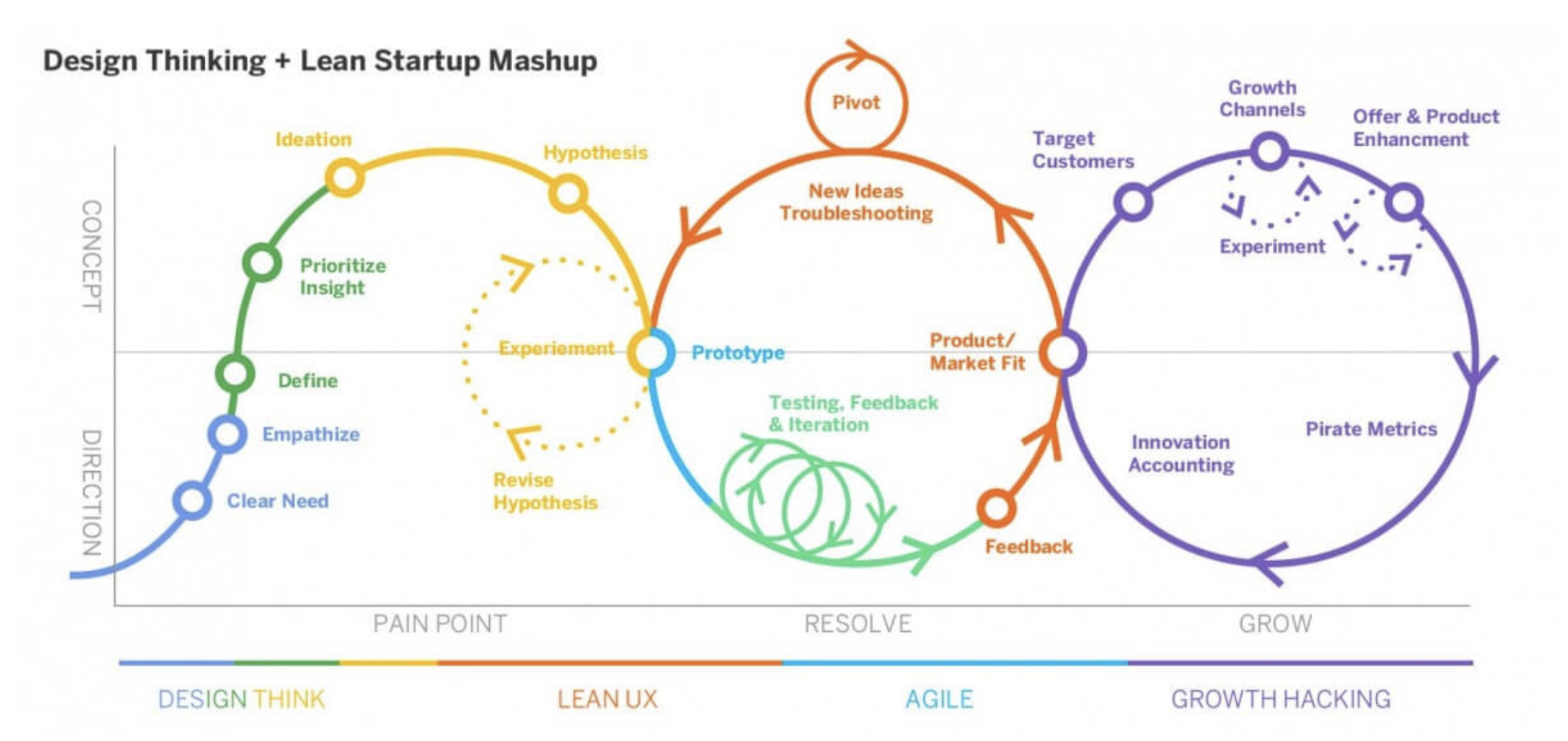
Of course, established companies don’t just have one idea, as many start-ups do. Instead they have existing products and services, which have served them well, and they are eager to protect, even if they know they are not the future. They are therefore much more risk averse, and unwilling to through everything at new ideas.
A more balanced approach prevails – creating a portfolio of existing business (incremental improvements), and a portfolio of future business (more radical ideas, concepts, ventures). Indeed many of these ventures, might be in partnership with actual startups, or other funding partners. This shares risks, but also shares mindset and capability – entrepreneurial and corporate.
Companies across the world have started testing their hypotheses with customers and gauging the success of innovation with relevant accounting measurements beyond revenues and market share.
- Procter & Gamble used the “most viable product” concept to create two new lines of feminine-hygiene products to the consumer market-testing phase in just one year, whereas it used to take them three years. Brand concepts such as Always Pure and Clean emerged.
- GE established its FastWorks innovation program is based on the lean-startup methodology. An example output is GE’s gas turbine business shifted its model from selling upgrades over time to committing to future changes upfront, a customer-friendly approach, with $2 billion inc sales.
- Intuit has become devoted lean-startup practitioner. The tax-and-accounting software maker has used its methods to test different approaches to phone support. Small-user-group tests also sped up Intuit’s development of a new version of QuickBooks for self-employed workers.
- Toyota is a pioneer of lean manufacturing techniques, including small batch sizes, rapid iteration, and seeking input from workers. Now Toyota is using lean-startup tactics to find new approaches to connected-car technology, an area where it lags rivals.
- Citi Ventures, the VC arm of Citi Bank uses “growth boards” to hold periodic “Deal Day” meetings where internal teams can pitch investment ideas and act on them quickly, though only for relatively low-risk, non-needle-moving opportunities.
Established companies have many advantages – established customer bases, channel infrastructures, experienced talent, and capital to invest – so once, they use the “start-up” approach to identify winners, then they can focus resources on these best few, and accelerate their development and scale up most effectively.
- Innovation: alchemists and disruptors, experiences and business models, further and faster
- 10 Types of Innovation: More ways to innovate
- Innovation DNA: How innovative are you?
Here’s a 15 minute version, explaining the ideas in a little more detail:
Steve Blank, the guru who inspired Eric Ries, summarises how “lean” is a fundamentally different approach, and most significantly creates a fast and relentless innovation-driven organisation, where old concepts like Business plans become redundant, and the whole business works in a much more agile way:
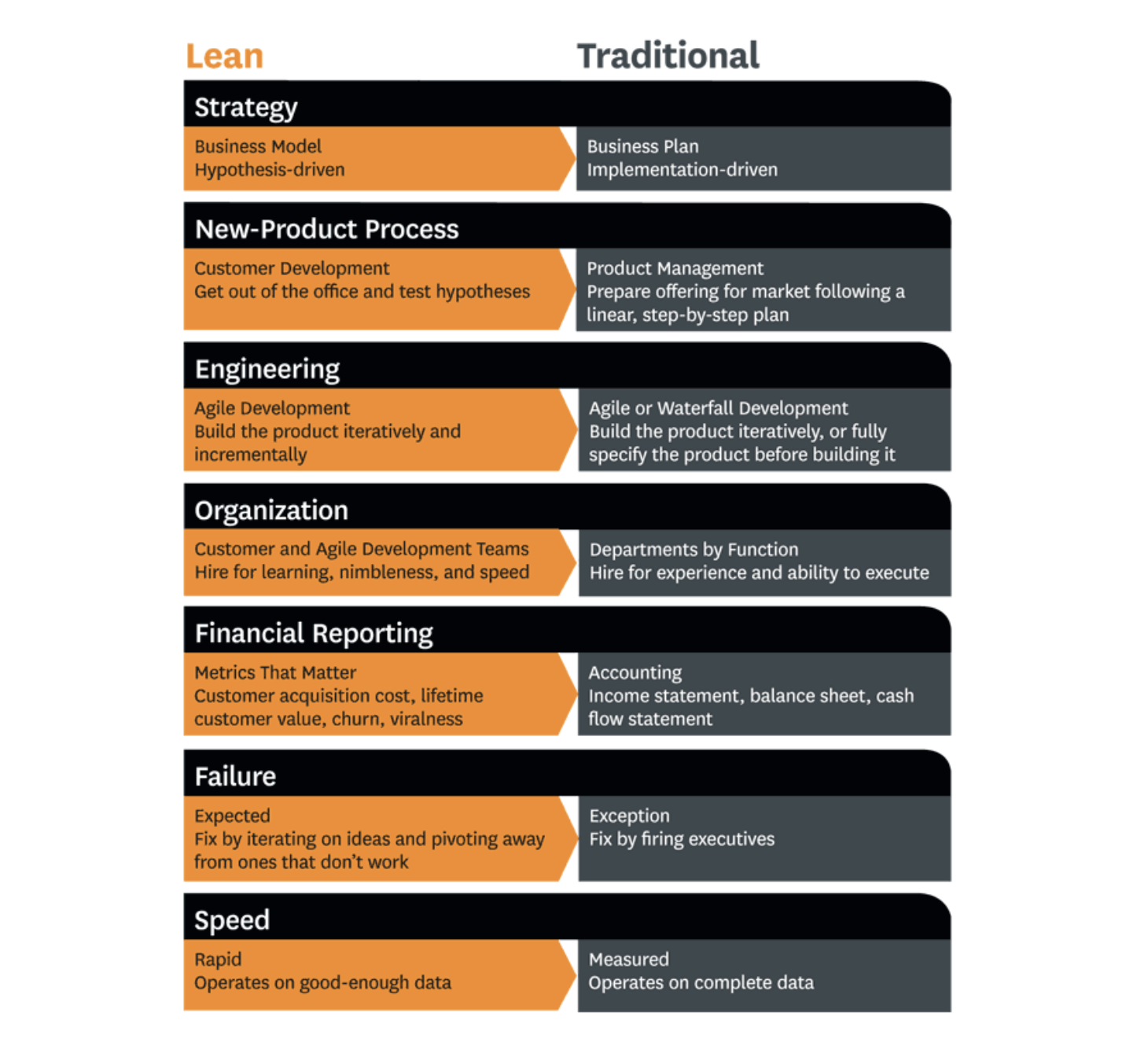
Eric Ries’ more recent book The Startup Way focuses on the challenge for big companies, which in many ways where the bigger opportunities lie. If the laggard incumbents can reimagine how to use their assets, scale and reputations in new ways, many could be great again.
In this edited excerpt, courtesy of publisher Penguin Random House, he recounts how he persuaded managers at GE – a 125-year-old, 300,000-employee behemoth – to embrace a different kind of thinking:
On a summer afternoon, a group of engineers and executives at one of America’s largest companies met in a classroom deep in the heart of their sprawling executive training facility to discuss their multi–$100 million, five-year plan for developing a new diesel and natural-gas engine. Their goal was to enter a new market space; excitement was running high. The engine, named Series X, had broad applications in many industries, from energy generation to locomotive power.
All of this was very clear to those assembled in the room. Except to one person, who had no prior knowledge of engines, energy, or industrial product production and was therefore reduced to asking a series of questions Dr. Seuss might have posed:
“What is this used for again? It’s in a boat? On a plane? By sea and by land? On a train?”
The executives and engineers alike were no doubt wondering, “Who is this guy?”
That guy was me. The company was GE, one of America’s oldest, most venerable organizations. I’m not a corporate executive. My background is not in energy or health care or any of GE’s myriad industrial businesses. I am an entrepreneur.
But GE’s then–chairman and CEO Jeffrey Immelt and then–vice chair Beth Comstock had invited me to Crotonville, N.Y., that day because they were intrigued by an idea proposed in my first book: that the principles of entrepreneurial management could be applied to any industry, size of company, or sector of the economy. And they believed their company needed to start working according to those principles. The goal was to set GE on a path for growth and adaptability, to build a legacy that would allow the company to flourish long term.
My journey to that meeting was an unlikely—not to mention unexpected—one. Early in my career I trained as a software engineer, after which I became an entrepreneur. If you’ve ever pictured a stereotypical tech entrepreneur as a kid, laboring away in their parents’ basement—well, that was me. My first foray into entrepreneurship, during the dotcom bubble, was an abject failure. My first published writing, 1996’s scintillating The Black Art of Java Game Programming, is, last time I checked, available used on Amazon for 99¢. None of these projects seemed like harbingers of future years that would be spent advocating for a new system of management.
After I moved to Silicon Valley, though, I started to see patterns in what was driving both successes and failures. And, along the way, I started to formulate a model for how to make the practice of entrepreneurship more rigorous. Then I began writing about it, first online beginning in 2008, and then in a book, The Lean Startup, published in 2011.
In the book, I made a claim that seemed radical at the time. I argued that a startup should be properly understood as “a human institution designed to create a new product or service under conditions of extreme uncertainty.” This definition was purposefully general. It didn’t specify anything about the size of the organization, the form it took (company, nonprofit, or other), or the industry or sector of which it was a part. According to this broad definition, anyone—no matter the official job title—can be cast unexpectedly into the waters of entrepreneurship. I argued that entrepreneurs are everywhere—in small businesses, mammoth corporations, health care systems, and schools, even inside government agencies. They are anywhere that people are doing the honorable and often unheralded labor of testing a novel idea, creating a better way to work, or serving new customers by extending a product or service into new markets.
That idea helps explain why, for the past five years, I’ve been living a double life. I’ve had plenty of days when I met with the leader of a mammoth, market-leading organization in the morning and then, in the afternoon, spent time with startups—from massive hypergrowth Silicon Valley success stories to tiny seed-stage hopefuls. The questions I’m asked are amazingly consistent:
How do I encourage the people who work for me to think more like entrepreneurs? How can I build new products for new markets without losing my existing customers? How can I create a culture that will balance the needs of existing business with new sources of growth?
Learning from the companies I have been working with, I began to evolve a new body of work about principles that apply beyond the “getting started” phase, particularly in established and even large-scale enterprises. It’s about how traditional management and entrepreneurial management can work together.
It is informed by case studies and wisdom from a variety of sources: iconic multinationals like GE and Toyota; established tech pioneers like Amazon, Intuit, and Facebook; the next generation of hypergrowth startups like Twilio, Dropbox, and Airbnb; and countless emerging startups you haven’t heard of—yet.
Working with them, I have seen that entrepreneurship has the potential to revitalize management thinking in the 21st century. This is no longer just the way people work in one industry. It’s the way people everywhere work—or want to work. I call it the Startup Way.
It was no accident that GE’s leaders had picked Series X as the first project to test. The thinking was that if we could get this huge, multiplatform engine project operating in a new way, there would be no limit to Lean Startup applications companywide, which aligned perfectly with the company’s desire to simplify its way of working across its many businesses.
Hours after my first meeting in Crotonville, I found myself in a business school–type classroom elsewhere in the building, along with engineers representing the businesses involved in the Series X engine development, the CEOs of each of those businesses, plus a small cross-functional group of top-level executives who had orchestrated my visit.
We had gathered to try to answer one of Jeff Immelt’s most persistent questions: “Why is it taking me five years to get a Series X engine?”
I kicked off the workshop by asking the Series X team to walk us through their five-year business plan. My role was to ask questions about what the team actually knew vs. what they had guessed. What do we know about how this product will work? Who are the customers, and how do we know they will want it? What aspects of the timeline are determined by the laws of physics, vs. GE’s internal processes?
The team proceeded to present the currently approved business case for the Series X, including a revenue forecast with graph bars going up and to the right with such velocity that the chart showed this as-yet-unbuilt engine making literally billions of dollars a year as far into the future as 30 years hence. Beth Comstock recalls: “It was like all the business plans we see, with a hockey stick that is going to grow to the moon in five years, and everything is going to be perfect.”
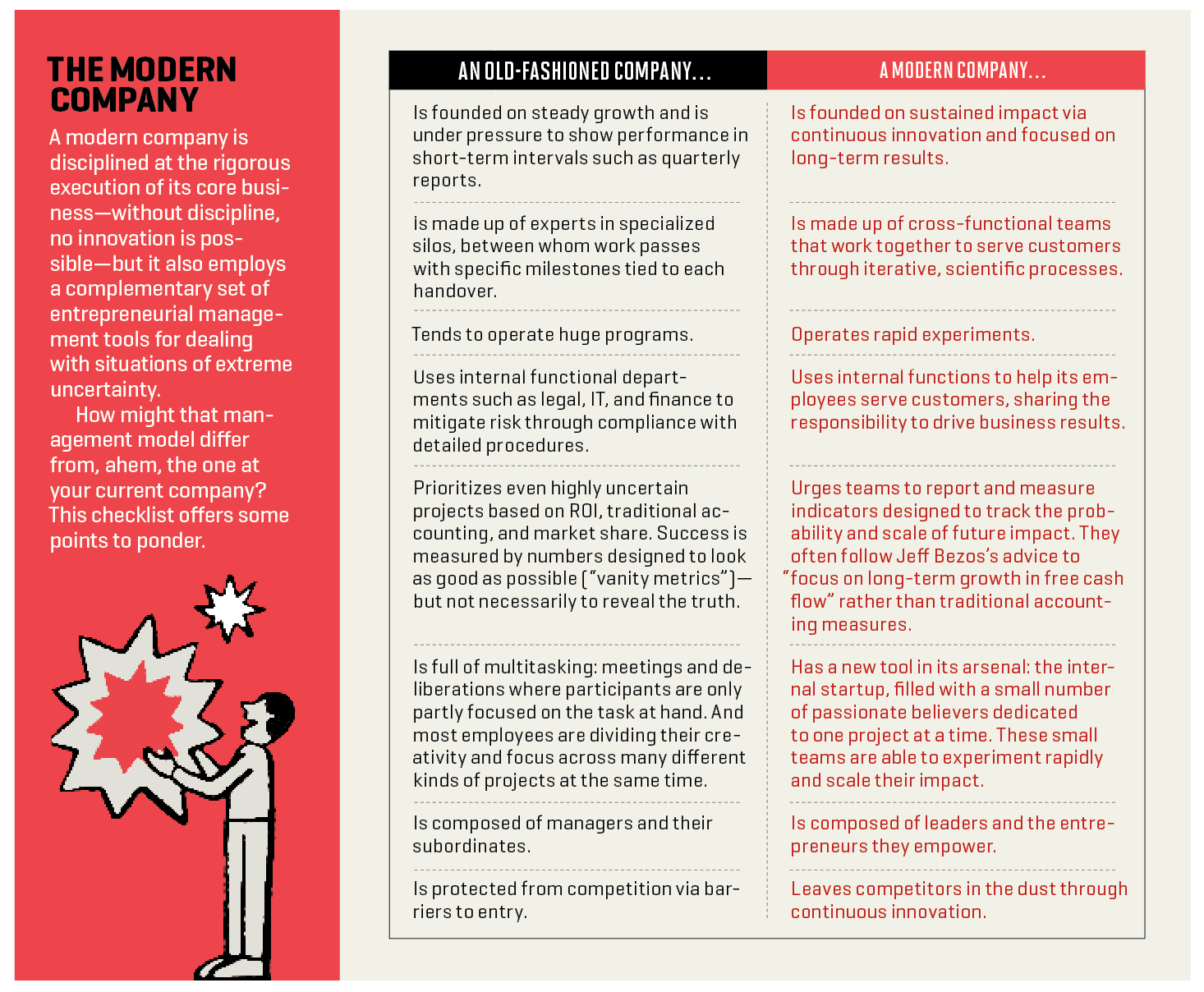
Things got more complicated, of course, as we dug deeper. But the biggest question looming over the room remained: Why does it take so long to build this engine?
I don’t want to undersell the technical challenges involved: The specifications required an audacious engineering effort that combined a difficult set of design parameters with the need for a new mass-production facility and global supply chain. A lot of brilliant people had done real, hard work to ensure that the plan was feasible and technically viable.
But a large part of the technical difficulty was driven by the specifications themselves. Remember that this product had to support multiple distinct uses in very different physical terrains (visualize how different the circumstances are at sea, in stationary drilling, on a train, for power generation, and in mobile fracking). The uses were based on a series of assumptions about the size of the market, competitors’ offerings, and the financial gains to be had by supporting many different customers at once.
These “requirements” had been gathered using traditional market-research techniques. But surveys and focus groups are not experiments. Customers don’t always know what they want, though they are often more than happy to tell you anyway. And just because we can serve multiple customer segments with the same product doesn’t mean we have to. If we could find a way to make the technical requirements easier, maybe we could find a way to shorten the cycle time.
There were also many questions about the plan’s commercial assumptions. One of the executives present, Steve Liguori, then GE’s executive director of global innovation and new models, recalls, “We had a whole list of these leap-of-faith assumptions around the marketplace and the customer. What percentage gains is the customer looking for? Are you going to sell it or lease it or rent it? Are you going to pay for distribution? We had about two dozen of these questions, and it turns out that when we asked the team how many they thought they could answer, it was only two of the 24.” Liguori recalls this as the “aha moment.” The company had been so focused on the technical risks—Can this product be built?—that it hadn’t focused on the marketing and sales-related risks—Should this product be built?
Since the best way to test market assumptions is to get something out to customers, I made what was, to the room, a really radical suggestion: an MVP diesel engine. The MVP, or “minimum viable product,” is a concept I explored in The Lean Startup. An MVP is a product with just enough features to satisfy early customers; producing one quickly, and making it available in a small, controlled way, can generate feedback that guides the next steps in a product’s development.
The Series X team was trying to design a piece of equipment that would work in multiple contexts. As a result, it was caught up in the budgeting and political constraints that accompany such a multifaceted project. What would happen if we decided to target only one use case at first and make the engineering problem easier?
The room went a little wild. The engineers said it couldn’t be done. Then one of them made a joke: “It’s not literally impossible, though. I mean, I could do it by going to our competitor, buying one of their engines, painting over the logo, and putting ours on.” Cue the nervous chuckles.
Of course, they never would have actually done this, but the joke led to a conversation about which of the five uses was the easiest to build. The marine application had to be waterproof. The mobile fracking application needed wheels. Ultimately, the team arrived at a stationary power generator as the simplest technical prospect. One of the engineers thought this could cut their cycle time from five years to two.
“Five years to two is a pretty good improvement,” I said. “But let’s keep going. In this new timeline, how long would it take to build that first engine?” This question seemed to once again cause some irritation in the room. The participants started to painstakingly explain to me the economics of mass production. It’s the same amount of work to set up a factory and supply chain, no matter how many engines you subsequently produce.
I apologized once again: “Forgive my ignorance, but I’m not asking about one line of engines. How long would it take you to produce just one single unit? You must have a testing process, right?” They did, and it required that the first working prototype be done and tested within the first year. When I asked if anyone in the room had a customer who might be interested in buying the first prototype, one of the VPs present suddenly said, “I’ve got someone who comes into my office every month asking for that. I’m pretty sure they’d buy it.”
Now the energy in the room was starting to shift. We’d gone from five years to one year for putting a real product into the hands of a real customer. But the team kept going. “You know, if you just want to sell one engine, to that one specific customer,” said one engineer, “we don’t even need to build anything new. We could modify one of our existing products.” Everyone in the room stared in disbelief. It turned out that there was an engine called the 616 that, with a few adjustments, would meet the specs for just the power generation use.
This new MVP was literally an order of magnitude faster than the original plan: from more than five years to fewer than six months. In the course of just a few hours—by asking a few deceptively simple questions—we had dramatically cut the project’s cycle time and found a way for this team to learn quickly. And, if they decided to pursue this course, we could potentially be on track to save the company millions of dollars. What if it turned out that that first customer didn’t want to buy the MVP? What if the lack of a service and support network was a deal killer? Wouldn’t you want to know that now rather than five years from now?
I’ll be honest: I was getting pretty excited. It seemed like a perfect ending.
Or was it? As the workshop wound to its conclusion, one of the executives in the back of the room couldn’t stand it anymore. “What is the point,” he asked, “of selling just one engine to one customer?” From his point of view, we had just gone from talking about a project potentially worth billions to one worth practically nothing. His objections continued: Even putting aside the futility of selling only one engine, targeting only one customer use effectively lowered the target market for this product by 80%. What would that do to the ROI profile of this investment?
I’ll never forget what happened next. “You’re right,” I said. “If we don’t need to learn anything, if you believe in this plan and its attendant forecast that we looked at a few minutes ago, then what I’m describing is a waste of time. Testing is a distraction from the real work of executing to plan.” I kid you not—this executive looked satisfied.
And that would have been the end of my time at GE, except for the fact that several of his peers objected. The executives themselves started to brainstorm all the things that could go wrong that might be revealed by this MVP: What if the customer’s requirements are different? What if the service and support needs are more difficult than we anticipate? What if the customer’s physical environment is more demanding? What if the customer doesn’t trust our brand in this new market segment?
When the conversation shifted from “What does this outsider think?” to “What do we, ourselves, think?” it was a whole new ball game.
Mark Little, who was then senior vice president and chief technology officer of GE Global Research, was the person the engineers in the room most looked up to, and whose skepticism—voiced quite clearly earlier in the day—had them most worried. He ended our workshop by saying something that stunned the room: “I get it now. I am the problem.” He truly understood that for the company to move faster, he, along with every other leader, had to adapt. The standard processes were holding back growth, and he, as a guardian of process, had to make a change.
“What was really important,” Little recalls, “was that the workshop changed the attitude of the team from one of being really scared about making a mistake to being engaged and thoughtful and willing to take a risk and try stuff, and it got the management team to think more about testing assumptions than creating failures. That was very liberating.”
The Series X team turned into one of the many pilot projects for the GE program we came to call FastWorks. The team got the test engine to market dramatically sooner and immediately got an order for five engines. During the time they would have been doing stealth R&D in the conventional process, waiting for what Mark Little calls “the big bang,” they were gaining market insights and earning revenue from their MVP.
I want to dwell on an important fact. During this workshop—and the months of coaching that followed—no one had to tell these engineers what to do. Not me, not Beth Comstock, not Mark Little, not even Jeff Immelt. Once presented with the right framework for rethinking their assumptions, the engineers came up with the new plan through their own analysis and their own insights. It became obvious to everyone in the room that this method had worked and that the team had arrived at an outcome that the company would not have been able to get to any other way.
The reason GE was able to tackle changes at this level, at this stage, was because the transformation was driven very early on by people completely dedicated to making it happen. I’ve told you this story because it’s one I saw firsthand. But it’s not only a story about GE. It’s about how dedicated founders are the engine that powers entrepreneurship within an organization. Every company has levers that make it run. All it takes to pull them is courage.
The modern company treats talent and energy as a precious resource, the better to harness human creativity. Every organization owes this simple bill of rights to its every member:
- The right to know that the work I do all day is meaningful to someone other than my boss.
- The right to have my idea turned into a minimum viable product and evaluated rigorously and fairly.
- The right to become an entrepreneur at any time, as long as I’m willing to do the hard work to make things happen with limited resources.
- The right to stay involved with my idea as it scales, as long as I am contributing productively to its growth.
- The right to equity ownership in the growth I help to create, no matter my role or job title.
The right to know that the work I do all day is meaningful to someone other than my boss.
The right to have my idea turned into a minimum viable product and evaluated rigorously and fairly.
The right to become an entrepreneur at any time, as long as I’m willing to do the hard work to make things happen with limited resources.
The right to stay involved with my idea as it scales, as long as I am contributing productively to its growth.
The right to equity ownership in the growth I help to create, no matter my role or job title.
More videos:
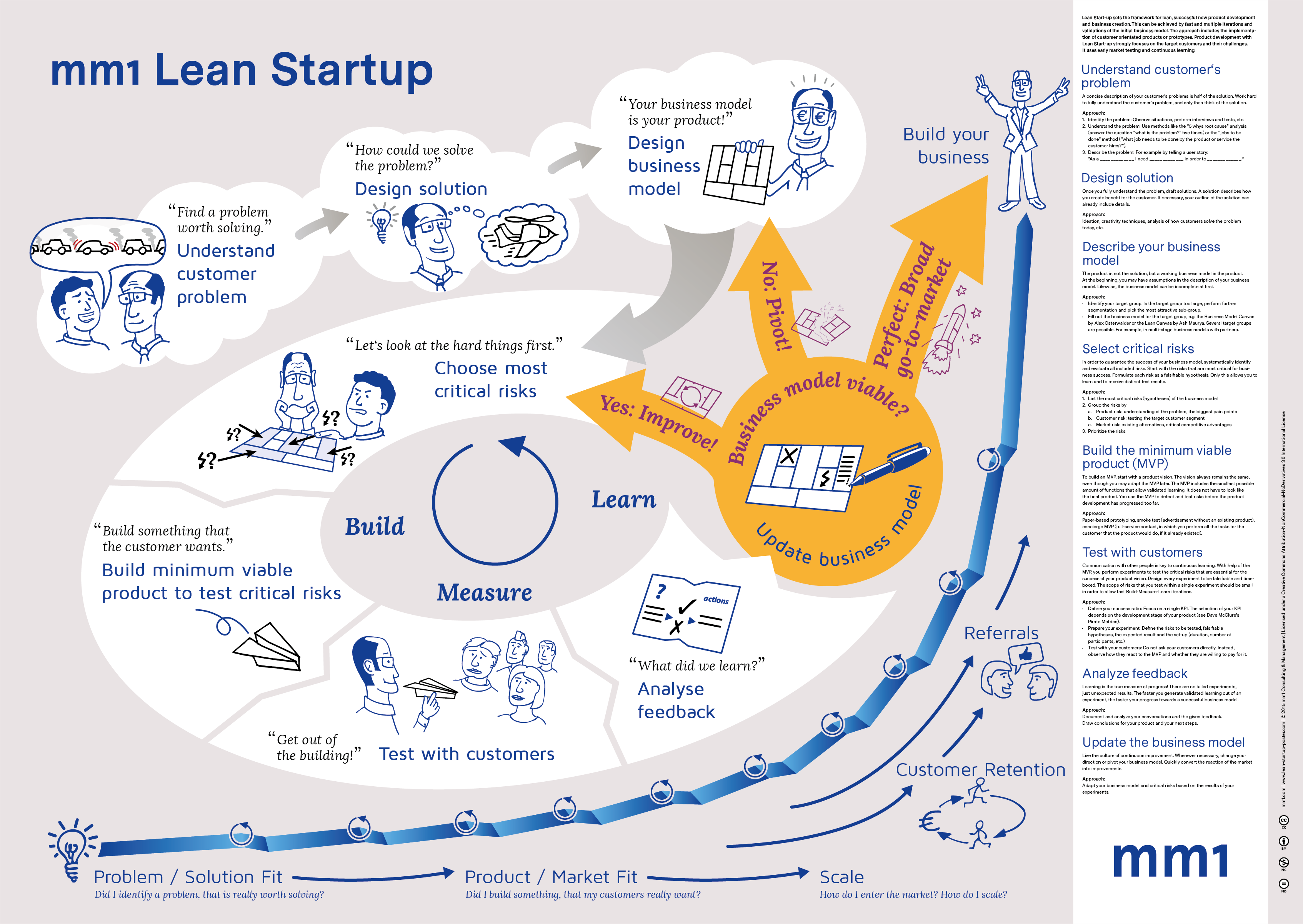
More ideas:
- Leadership tool: “Why the Lean Startup Changes Everything”
- Leadership tool: “Innovation DNA: Evaluating your innovation approach”
- Leadership tool: “10 Types of Innovation”
- Leadership tool: “Innovation Toolbox“
- Leadership tool: “Design Thinking Process Guide from Stanford’s D.School“
- Leadership tool: “IDEO Method Cards“
- Leadership tool: “IDEO Human Centred Design Toolkit“
- Leadership tool: “IDEO Human Centred Design Fieldguide“
- Leadership tool: “27 Creativity Tools“
- Leadership tool: “Intuit’s Leapfrogging Innovation Catalyst“
- Further reading: “Design Thinking” by IDEO’s Tim Brown
- Further reading: “How P&G Tripled its Innovation Success Rate“
- Further reading: “20 Ways to Test your Business Ideas“
- Further reading: “The Customer-Centred Innovation Map“
- Further reading: “8 Essentials of Innovation“
- Further reading: “Disrupted to Disruptor: Reinventing the core“
- Further reading: “The Open Book of Social Innovation“
- Video to watch: “Design Thinking Explained“
- Video to watch: “Innovation Explained“
- Video to watch: “Disruptive Innovation Explained“
- Video to watch: “Business Model Innovation Explained“
- Video to watch: “Business Model Canvas Explained“
- Video to watch: “Minimal Viable Product Explained“
- Video to watch: “Pivot Explained“
- Inside Daimler’s Lab1886 … the Stuttgart innovation hub focused on creating the future of mobility
- Inside Disney’s new iD8 Innovation Studios … where the magic of Mickey Mouse lives on with Buzz and Brainstorms
- Inside Medtronic’s Applied Innovation Lab … a focus on improving patient experiences, services and outcomes
- Inside IKEA’s Future Home innovation incubator … from even better Swedish meatballs to flexible rooms
- Inside Nike’s Research Labs … harnessing the spirit of Bill Bowerman to innovate the future of sports performance
- Inside Shell’s TechWorks innovation lab … where there is freedom to fail and to succeed
- Inside HENRi … Nestle’s global hunt for big ideas, named after the pharmacist founder who invented a baby formula.
- Creating a “Growth Factory” … How P&G tripled its innovation success rate, and how you could too.
- Corporate Innovation Ecosystem … how does innovation thrive in large companies
- Compendium of Innovation Methods … Nesta’s compilation of the best tools and methods for innovation
- Innovation Accelerator: 10 frameworks to accelerate your growth … summaries the most popular frameworks