Haiyan Wang and Anil Gupta are a power couple of business thinking who have come into their own in recent years, with the rise of Asian businesses and the focus of learning on the blitzscaling growth of so many companies, including the likes of Squirrel Learning and Bytedance in China, and Jio and Oyo in India.
I was delighted that they could join me on stage in Odense, Denmark for this year’s Thinkers50 European Business Forum. They gave one of the best session’s of the two insight-intense days exploring Asian business, and how European businesses could learn from their fast-growth peers.
- Download Haiyan Wang’s presentation at Thinkers50 European Business Forum
- Download Anil Gupta’s presentation at Thinkers50 European Business Forum
Haiyan is a lecturer at INSEAD and Managing Partner of the China India Institute, which she runs with her husband Anil Gupta. She is based in Washington, DC, and works as an expert on Chinese business.
Chinese Challengers
Here are some of the best quotes from Haiyan’s keynote:
The number of Fortune 500 companies in China has grown from 4 in 1995 to 119 in 2019.
Waves of Chinese entrepreneurs have evolved from Haier and Huawei – to Tencent, JD.com and Alibaba – to CJI and BYD – to the massive explosion of entrepreneurs in the past 10 years, capitalizing on new technologies such as artificial intelligence. China is not longer the land of the dragon but has become the land of the unicorns.
The Chinese economy is highly digital. People don’t need more products, they buy services now.
Squirrel Learning: An example of a young unicorn, capitalizing on the need for adaptive personalized learning. Smart partnerships with universities have led to its success – by enhancing technology and brand value for parents.
The DNA of successful unicorns include a global vision, a global mindset, and a user-centric product positioning.
Bytedance: By understanding the young, TikTok has gone from 20 to 70 million active users in just a few years.
Simple company values such as “be open and courageous” og “aim for the highest” work well.
Being fast and agile is key. As for Mark Zuckerberg, he probably noticed WeChat a little too late.
In summary “We should all think a bit more like Bezos, who says: “This is still day one. We need to experiment like a mad man.”
1. WeChat: Tencent’s messaging service is far more than WhatsApp
2. Squirrel Learning: AI-powered digital learning platform, shaking up Chinese education
3. Bytedance: the world’s largest “unicorn” is transforming digital media, starting with TikTok
More from Haiyan:
Inspiring India
Anil Gupta has been named by The Economist as one of the world’s “superstars” for research on emerging economies. By 2025, China and India will be two of the world’s four largest economies. By then, economic ties between them should also rank among the 10 most important bilateral ties worldwide. Anil Gupta focuses on this in his writings and his work at The China India Institute.
Here are some of the best quotes from Anil’s keynote:
The number of Fortune 500 companies in China has grown from 4 in 1995 to 119 in 2019.
I see several waves of entrepreneurs.
There are three main indicators of India’s transformation from 2014-2018:
The number of smart phones per 100 persons has grown by five times
Data consumption has gone up 100 times
The monthly data price has gone down by 98 percent
The government has played a key role in the transformation by supporting biometrics, pushing public banks to create open banks, and by de-monetizing the cash notes, which slowed down the economy but galvanized the digitization.
Digitization leads to gifts of information-, financial-, education-, health care-, and gender-inclusion.
Partnerships are an important key to success.
Strategy is about exploration AND exploitation. They are tied together, just like imagination without execution is a Fool’s Paradise.
In summary ” Be unique, bold, disruptive. We need to look at today from the lens of tomorrow, not tomorrow at the lens of today.
He focused on three Indian companies to learn from:
1. Jio: Reliance Industries’ consumer tech giant, from mobile phones leader, to newly launched JioFiber.
2. Paytm: ensuring a grand volume of mobile payment options with Alibaba amongst their investors.
3. Oyo: India’s fast growing global hotel chain, founded by college dropout Ritesh Agarwal.
I quizzed Anil about how can we learn from these examples:
Jio and Paytm are domestic, but OYO is global. They consider foreign countries as a new home market, by including local managers in their team. So the mindset is the limiting factor for many Europeans.
Western leaders need to think a bit more like Jeff Bezos, who bought the Washington Post, which was dying, being eaten up by digital media. He said: Don’t think if the internet as a challenge, think of digitization as a gift. It’s about embracing the new era and exploiting it, instead of being scared by it.
Broadly speaking, India has a lovely relationship with China. There have been wars, and China is a supporter of Pakistan, which is India’s enemy, so there are downsides, but India look at China as their role model, not the USA. For a country that invented yoga, India didn’t really start to stretch before they discovered China.
Kjell Nordstrom is the Swedish academic “funkster” who gave the world the book “Funky Business” 20 years ago. To celebrate 2 decades of funkiness, he joined me back on stage in Odense today to kick off this year’s Thinkers50 European Business Forum.
- Download Kjell Nordstrom’s EBF19 keynote
Here are some of the quotes from his session:
“It’s not only music that goes funky. Politics does too. And so does business in the sense that it doesn’t always follow established principles. Of all the things that are happening now, we never know what will be important in the future.”
“And although the US is important for all of us, you can’t bottle what’s happening in the US and transform it to a European context.”
Nordic insight
“We should ask ourselves: Why are the five tiny countries close to the polar circle so successful? It’s not the oil, the windmills, or the weather. Here are the two reasons:
- Trust … The five countries are examples of high trust societies. Or “tillid” in Scandinavian. We trust our prime minister, our mayor, our banks. We are extreme cases of high trust societies. This results in efficiency, unlike low-trust societies like Russia which result in extreme inefficiency.
- Modernity … What does that mean? Not that we are good, nor that we are bad, but just that we tend to do things one, two, three, four, five years before anyone else do them.”
Some examples of our modernity:
- The disposable diaper was invented here in the Nordic, probably because the women in the 1950’s were working, and there was no one at home to wash textile diapers, and the male engineers certainly didn’t want to wash them. Now everyone wears disposables, including babies in Ethiopia.
- The Tripp Trapp stool is another example. The inventor thought to himself: “Shit as they are, maybe children are human beings. And if they are, they should sit at the table with the grownups and discuss Brexit.”
“So a high trust and ultra-modern society will produce ideas that will later come to London, Berlin and other places on earth. That’s how we’ve created products and multibillion-dollar businesses in the Nordic.
“High trust and modernity in Scandinavia produced ideas, products and services that conquered their respective industries.”
“Our strong Nordic states with super dynamic and well-functioning companies was an interesting perspective for China, when they first opened their doors to the west.”
“The five Nordic countries continue to be extreme in the sense that we are very individualistic, don’t do family (64 % of households in Stockholm are single) – but do have high birth rates, practicing what my friend calls sequential monogamy.”
The matrix
“The situation on Planet Earth remind me of the film The Matrix, because we are 7 billion people, and there are three forces at work that will set the agenda”
- Force 1: Capitalism … We practice capitalism with a dialect. Apart from a language, capitalism is a sorting machine. It can sort the efficient companies from the inefficient ones. It creates two piles – the efficient and the inefficient.
- Force 2: Cities … We will transform this planet to 600 mega cities, accounting for 80 % of the world’s population in 2050. We will live on less than 1,5 % of the landmass. The mayors are becoming more important, the prime ministers stepping back. Paris is not a city in France anymore, Paris is Paris.
“China have a vision of a China that is 19 super mega cities, with 90 % of the Chinese population. The idea behind is that the more people you meet, the more you’ll innovate, invent.”
- Force 3: Digitalisation … Beyond these remarkable cities, the human project will be digitalised. Anything that can be digitised, will be. We now have a collective knowledge base at Planet Earth. Intelligence will be a service you can pay for.
“Whenever we talk about making money, it boils down to monopolies. If you have a monopoly, you make money. I hate IKEA, but I will go there on Saturday – because we need beds for the children, and they have a monopoly. iPhone users shake like alcoholics if you tell them, you’ll get an Android instead.”
In summary:
“In the matrix of cities, capitalism, and digitalisation, we will see a new ball game”
Kjell Nordstrom, author of Funky Business, joined me at the Thinkers50 European Business Forum 2019. With thanks to Jane Thoning Callesen for transcript.
Erin Meyer, INSEAD professor of organisation behaviour, created her “Culture Map” as a way to make sense of those many situations we find ourselves in today, when we work in international, multi-geographical, multi-cultural teams … and for some reason we don’t understand, things come undone, as cultures get crossed.
Today Erin joined me in Odense, Denmark, for the Thinkers50 European Business Forum 2019.
Given the forum’s theme of “Learning from Asia” she focused on the many cultural collusions which emerge as companies increasingly work across the world – most significantly between east and west.

Here are some quotes from her workshop:
The way children address their teachers is a good indicator of a country’s cultural position on power distance.
Korea and China are among the most hierarchical countries. Koreans will say: “I’ll try not to ask my boss a question unless I know for sure that he knows what the answer is”.
In Europe: Vikings managed their tribes by consensus, and that’s why Viking countries have become the most egalitarian in Europe, whereas countries influenced by the Roman empire are more hierarchical.
If you’re leading a global team, you need to think about how people perceive you. We must be flexible enough to adapt our leadership styles to the people we are working with, even if it changes from day to day.
The center of business gravity has shifted from America to China and India, and every single emerging market in the world is now more relationship-based than task-based. Building trust and emotional bonds is more important than ever.
“Small gaps matter, often more than big ones. “
“When you are working internationally, it is most important to be both authentic/comfortable and adapting in your leadership style. Use both legs! Global leadership is to develop both legs, so than you can choose ‘leg’ according to the where you are.”
Anna Rosling first met her father in law when staying over at her boyfriend’s house at the age of 16. Next morning, Ole, her boyfriend now husband’s father, was founded counting shoes and measuring sizes in the hallway, trying to work out who the extra guest was.
Hans Rosling became a sensation of our time. His TED Talk videos transfixed audiences worldwide with his fast and simple statistical analysis of our changing world. His message was that “the world is better than you think”, and that we constantly underestimate how much progress has been made.
Together they wrote the book ‘Factfulness: 10 reasons we’re wrong about the world – and why things are better than you think‘ .
Two years after Hans passed away, daughter in law Anna is continuing the family message. She joined me on stage today, at the Thinkers50 European Business Forum 2019, with an updated view of the world.
She had some news that might surprise you – although life on earth is far from perfect, it is improving at a faster rate than we think. Statistics and facts show that, in many areas, today’s world is performing much better than it gets credit for.
Factfulness plays a little game with their readers, submitting to them 13 questions with multiple-choice answers on issues such as health, literacy, demographics and poverty. The rate of correct answers, even in the case of highly educated people, is staggeringly low, with responses almost always erring on the negativist side.
Anna does not target wilful distortions of the truth so much as the tendency to base opinions on half-truths, negativist assumptions and sheer ignorance. This tendency leads people to give in to a number of what the authors call ‘instincts’, which go against good and sound judgment. She distinguishes 10 of them that distort our perceptions:
- The GAP instinct, which makes us believe that the world is divided into two: ‘them’ (the ‘developing’ world) and ‘us’ (the ‘developed’ world). The authors prefer to talk about four levels of income, which they say give a far better picture.
- The NEGATIVITY instinct: forgetting how the world really was before. It is not because some things are bad today that they cannot be better than they were before! This is a theme often alluded to by the French philosopher Michel Serres.
- The STRAIGHT LINE instinct: the danger of extrapolating from a known variable. There are straight lines of course, but more often lines are curved or S-shaped; this is the case in demographics, for instance.
- The FEAR instinct: some of our ancestral fears, justified at the time when we lived in caves, still haunt us today even though the situation has radically changed. And we have a tendency to grossly exaggerate modern threats such as terrorism, compared to other causes of death.
- The SIZE instinct: the tendency to look at individual figures without putting them in perspective. There are more than four million infant deaths (for 141 million births) per year in the world today, which is staggering and shocking. But in 1950 the number was 14.5 million for 97 million births. We also tend to look at individual victims and forget about the many victims who do not make it on to our TV screens.
- The GENERALISATION instinct: we divide the world into ‘them’ and ‘us’ and then think of the people in these groups as all being the same.
- The DESTINY instinct: best summed up by the phrase “things never change”.
- The SINGLE PERSPECTIVE instinct: thinking that all problems have a single cause.
- The BLAME instinct (could also be called the ‘conspiracy instinct’): it is always intellectually easier to find culprits rather than real causes.
- The URGENCY instinct: pushing people to rush for solutions that are “simple, straightforward and… wrong”, to quote Einstein! Rosling gives a particularly dramatic example of himself giving in to that instinct as a young doctor in Africa, with devastating consequences.
Bill Gates described the book as “one of the most educational books I’ve ever read”. It could be of particular interest to those who have read the works of Steven Pinker, or Nicholas Taleb’s ‘The Black Swan’.
Finally here is a reminder of Hans Rosling, one of the most watched Youtube videos of all time:
Anna Rosling joined me at the Thinkers50 European Business Forum 2019. With thanks to Jane Thoning Callesen for transcript.
Whilst it started out as an insurance company, founded in 1990 and now completely publicly owned, PingAn has used this financial underpinning to support its growth into many other sectors. A little like Warren Buffett’s Berkshire Hathaway, it has built on its financial powerhouse, but in its case by using new technology platform thinking. With a market value of over $200 billion, it is already one of the world’s top 10 largest companies.
Good Doctor is PingAn’s digital healthcare business, established in 2015, and now the world’s largest healthcare platform with 300 million users. It describes its service model as “internet + AI + physicians” which translates as an online app, through which a patient will initially evaluate their health or specific condition using an AI-enabled diagnostic. If required they will then be connected by video call, typically within an hour, to a real doctor, most likely one of 10,000 employed by PingAn sitting in its service hubs.
The doctor can then refer their patient for further diagnosis, treatment or medication. This is when the ecosystem of partners becomes invaluable with a nationwide network of clinicians, hospitals and pharmacies, and even a home delivery service for prescriptions. The platform also offers wellbeing advice for health and wellbeing, for example, supporting new mothers and elderly. A monthly-subscription embraces an insurance fee to cover some costs, whilst a premium service called Private Doctor offers additional services and all-inclusive fees.
Here is the company’s press release:
The world’s leading online healthcare ecosystem platform, Ping An Healthcare and Technology Company Limited (“Ping An Good Doctor“) announced today that the number of registered users on Ping An Good Doctor exceeded 300 million, implying that one in every three Chinese Internet users is a user of Ping An Good Doctor. With the development of online healthcare services in the past few years, people have developed a habit to seek medical care on the Internet. Since its founding five years ago, Ping An Good Doctor has successfully amassed 300 million registered users, which shows the vitality of Ping An Good Doctor and the whole online healthcare industry, and the driving force of the transformation of China’s medical and health service pattern.
Over recent years, residents’ awareness of health management is increasing. Meanwhile, the aging population also drives the continuous growth in demand for quality medical resources. To better meet the medical needs of people, the central and local governments continue to deepen and advance the “Internet + Healthcare” model, launch various policy, guidance and standard for online medical services, and incorporate online consultation and treatment into the social insurance system, thereby encouraging and supporting the development of online healthcare sector. In line with the national policy, Ping An Good Doctor has drastically reduced the restrictions in seeking healthcare services and offered effective support for the tiered consultation and treatment system so as to provide convenient health management services for users.
Becoming the prime choice of the 300 million users is a fitting testament to the premium quality of Ping An Good Doctor’s healthcare services. Pioneering the service model of “Internet + AI + 1000 in-house physicians”, Ping An Good Doctor cooperates with offline pharmacies and hospitals to provide users with 24/7 one-stop medical healthcare services, such as online consultation services, hospital referrals, appointments, inpatient arrangements, second medical opinions and one-hour medicine delivery, aiming to meet the diverse and personalised healthcare needs of users, offer genuine medical services and win the trust of users. As of the end of June 2019, the MAU (monthly active user) of Ping An Good Doctor reached 62.70 million, with the average daily consultation hitting 650,000 for the first half of 2019.
At the same time, by leveraging its mature capability in platform operation and AI medical technological competence, Ping An Good Doctor pioneered the cloud-based Internet hospitals, cloud-based Internet pharmacies, cloud-based Internet clinics and cloud-based Internet village doctors as well as the international “4 + 1” strategy, reducing the burden and increasing the efficiency of hospitals, empowering pharmacies to develop new retail business formats, enhancing the diagnostic efficiency for the grassroots in a holistic manner, undertaking social responsibilities, and building close collaborative ties with local governments to push ahead with the village doctor programme for the continuous improvement of the medical ecosystem.

On this basis, Ping An Good Doctor launched an innovative, strategic product Private Doctor of Ping An Good Doctor in August 2019, signing cooperation agreements with 29 global industry leaders for a total contractual amount of RMB300 million. With the service, users can enjoy one-to-one online consultation service provided by medical specialists, 24/7 medical service, and many other high-quality healthcare services together with an e-health profile and a customised healthcare management plan. The Private Doctor services of Ping An Good Doctor connects the two ends of medical services, like doctors and users, achieving full interaction and greater user loyalty, so that doctors can track the health status of users in the long term and build close relationship and trust with users. Capitalising on this new relationship, users can obtain more precise, consistent and personalized healthcare services.
While the country continues to promote healthcare infrastructure in China and encourage the development of online medical service and innovative family service model, Ping An Good Doctor is leading the industry and has become the first online medical platform with 300 million registered users. This will further reinforce the confidence and determination of its industrial partners in the course of their development and underpin the healthy development of China’s online medical industry.
About Ping An Healthcare and Technology Company Limited
As the world’s leading one-stop healthcare ecosystem platform, Ping An Healthcare and Technology Company Limited (“Ping An Good Doctor“; stock code: 01833.HK) is strive to provide every family with a family doctor, every person with an e-profile and everyone with a healthcare management plan through our “mobile medical + AI technology”. At present, Ping An Good Doctor has established key business segments including online medical services, consumer healthcare, healthcare mall, and health management and wellness interaction.
As of 30 June 2019, our number of registered users reached 289.3 million and the number of monthly active users reached 62.7 million, it has become the largest mobile medical application in China in terms of coverage. Being powered by self-developed AI-assisted diagnosis system, our in-house medical team is strive to provide users with one-stop medical services covering 7/24 online consultation, referral, registration, online drug purchase and one-hour medicine delivery.
In April 2015, the Company received US$400 million private placement from Softbank Vision Fund. On 4 May 2018, Ping An Good Doctor became the No.1 listed internet healthcare company in the world when it joined the Hong Kong Stock Exchange, stock code 01833.HK.


Source: Ping An Healthcare and Technology Company Limited
The Global AMP brings the most important new ideas for business leaders ready to step up to shaping the future to their advantage. Over 4 weeks my challenge is to lead participants from around the world through a journey that explores a world of incredible change, business that face huge challenge and opportunity, and ideas to embrace to survive and thrive.
Today, Im delighted to be working with Mia de Kuijpers who is a senior advisor to Salesforce, and has done everything from scenario planning for the future of oil at Shell, to redefining the world of telecoms and consumer goods.
She starts off in provocative style:
“What do Harry Potter, Harvard, and Hindustan Lever have in common with Facebook, the Commercial Bank of China, and Intel? Why is it so difficult for the mighty Microsoft to catch up with Google in search? How did Apple and its iPod manage to run circles around the music industry?
Does it make sense for the snack company, Frito Lay, and the fashion retailer, Zara, to own lots of manufacturing plants? Why does Coca-Cola earn high returns, when its bottling companies — large, multi-billion dollar enterprises, that absorb the lion’s share of hard work and risks — do not? What sets the winners apart from the losers?
The answer is profit power.”
She explains how she works to develop winning power strategies based around 4 principles:
- Know your power nodes and focus ownership on power nodes
- Adopt new distributed business models
- Fight fiercely in three dimensions
- Exploit powerlaw marketplaces
The 12 power nodes
These power nodes will be the most important sources of profit in the decades to come. Ten of the older nodes are already well-established sources of leverage.
- Brands. Think of the leverage wielded by McDonald’s, Coke, and Intel over their suppliers and partners simply because customers are attached to their names.
- Secret, special, or proprietary ingredients. In 1986, when a private equity firm acquired the antifreeze maker Prestone from Union Carbide, a deal was struck allowing Prestone to purchase ethylene glycol from its previous owner at a confidential low price. Shortly thereafter, the price of this chemical skyrocketed, owing to refinery accidents and increases in feedstock prices. Prestone’s reliable inexpensive supply of ethylene glycol ensured that it retained its profitable position while competitors suffered.
- Regulatory protection. In certain industries, regulators can grant privileges to businesses like hospitals, banks, and nuclear plants; rights to use scarce natural resources like broadcast frequencies or offshore drilling sites; certifications of professions, including those of doctor or electrician; and permits for importing agricultural products and building developments, among many other things. Essentially, the regulations represent a barrier to entry and limit the number of competitors a company can have; as a result, the strongest companies in heavily regulated sectors generally enjoy sustained profitability.
- Focused financial resources. Some companies have innovative means of access to capital that other enterprises cannot duplicate, and that access can be deployed to exert control over the business environment. In rural Indian villages, local banks called creditwallahs provide loans to storekeepers so they can buy items from distant manufacturers. The retailers are dependent because they know this financial lifeline can be severed at the creditwallahs’ discretion.
- A customer base with switching costs. Customers don’t like to pay to switch loyalties. This is what attracted SBC to AT&T. Another example is the personal computer interface; for years, many people have refused to switch from Microsoft-based PCs to Apple computers (or vice versa) because the “look and feel” of the other system seems unnatural to them.
- A proprietary process or modus operandi. Some companies have unique methods and procedures that guide their people, equipment, or systems. FedEx’s delivery network is an example.
- Distribution gateways. The Industrial and Commercial Bank of China (ICBC) relies on its distributed network of 18,000 branches and 150 million customers for cheap deposits and growing revenues — which has helped make it one of the world’s largest banks.
- The dominant position in a layer. A layer is a horizontal slice within a vertical value chain. In the tea industry, only a few global buyers and packagers, such as Lipton and Tetley, are big enough to dictate terms to tea growers and realize significant profits. Meanwhile, the thousands of small to medium-sized plantations that produce tea leaves must make do with relatively slim returns. In 2000, India’s Tata Tea Limited, which owned a number of plantations, bought its way out of the lower rungs of the food chain and into a power node by acquiring the Tetley Group. Tata has been selling off its plantations ever since.
- Increasing mutual utility. The larger the existing base of users, the more attractive the product is to potential new customers. For example, as the number of iPods on the market increased, so did the incentive for music publishers to license songs to iTunes; in turn, the more songs that were available through iTunes, the greater the incentive to get an iPod.
- Filters and brokers. Companies and individuals that could be termed filters or brokers, a group that includes wine experts, art curators, and real estate and jewelry appraisers, have influence in situations in which objective information is hard to obtain or people do not have the time or training to choose adequately on their own.
The 10 power nodes above have been around for a while. But the remaining two power nodes are strikingly novel. They capitalize on a set of dynamics emerging from new communication technologies and information infrastructures, which together have forged a business landscape with remarkable reach and transparency. Anyone with access to media can connect with anyone else instantly and can access information about any product, service, or topic of interest, anywhere, immediately, and essentially at no cost. This unprecedented form of “perfect information” is changing the way that consumers and markets behave, and it makes these new power nodes feasible.
- Aikido assets. This power node is named after the Japanese martial art that exploits the energy of an opposing force. In the current information environment, it is no longer useful to “push” advertising and marketing messages to consumers. Most customers reach out for information they need on their own. If they find a source that they like, they tell other customers. They use search engines, which tend to drive large numbers of people to the most popular sources. The key to aikido assets is being able to perceive and move with the momentum of the network.
Companies whose power node is based on the aikido approach are skilled in new forms of marketing. They “sow seeds,” tossing out many messages at minimal cost; Frito-Lay, for example, continually puts new flavors and packaging in the marketplace. These companies conduct surveillance, continually analyzing their digital media to see which messages are catching on; Procter & Gamble Company has done this with its own websites. And they react very quickly to what they learn from the networks, introducing or discontinuing products almost instantaneously. This may require the rapid retooling of sourcing, manufacturing, and distribution functions as they shift from one product to another.
- Hubs. One of the most effective power nodes imaginable in a transparent economy is the ability to become the beneficiary of self-reinforcing popularity. Hubs are people or products that attract viewers, assignments, clients, buyers, or users in part because others are drawn to them as well. The first of J.K. Rowling’s books, Harry Potter and the Philosopher’s Stone (Bloomsbury Press, 1997), took off rapidly because friends recommended it to friends. It became a hub as others wanted to know what was driving people to read it, and the existence of this hub ensured the popularity of the rest of Rowling’s series. The transparency and immediacy of communications added momentum. Companies that can heighten the allure of their products this way, triggering attachment and emerging as hubs, will have a tremendously valuable power node. When hub dynamics are at work, products or ideas that are ahead stay ahead for a long time. That explains why Microsoft and Yahoo have not been able to catch up with Google in search volume. But because hubs are not a winner-take-all phenomenon, Google’s rivals have sizable numbers of users, leaving some room for market share to eventually turn against Google if a competitor comes up with a product that itself becomes a preferred hub. Microsoft hopes to exploit this opening with Bing, its new search engine.
Power nodes may not all be new, but they have never been as crucial as they are now. For companies to thrive in the current environment of transparent “perfect information,” they must be able to use their power nodes to shape and tap the sources of “profit power” around them. This gives them the upper hand in every partnership or alliance, allowing them to retain the largest share of profits while making sure that other companies get enough to survive and remain committed to the arrangement.
We’re back at the Global AMP at IE Business School.
It’s the school’s flagship program to develop transformational business leaders, people stepping up from functional delivery to organisational leadership, from a focus on today, to creating the future.
Of course there are lots of ideas and theories in business, and equally lots of practical and inspiring stories out in the real world.
Here are some of the basics which we don’t spend time on, but are still the foundations to the new ideas and practices which we do focus on – everything from great thinkers like Jim Collins (Good to Great), Kim and Mauborgne (Blue Ocean Strategy), Clay Christensen (The Innovators Dilemma) and many more.
The Business for Inclusive Growth (B4IG) coalition was launched at the G7 summit in Biarritz on August 23, 2019, with the leadership of Danone’s CEO Emmanuel Faber, and supported by the OECD.
Inclusive growth is economic growth that is distributed fairly across society and creates opportunities for all.
In many OECD countries, inequalities are at their highest levels in 30 years and are widening.
- The top 10% of income earners take home over ten times more pay than the bottom 10%
- Children whose parents did not complete secondary school have four times less chances of making it to university than children who have at least one parent with a university education
Today, 38 multinationals have signed the B4IG Pledge with a common goal: fighting against inequalities.

B4IG’s work is focused on advancing human rights in company value chains, building inclusive workplaces and strengthening inclusion in companies business ecosystems. Underpinning this work is an effort to develop key performance indicators on inclusive growth in business. The OECD is supporting, with its evidence and analysis, all strands of the work. Today, the work and commitment of the companies that compose B4IG is all the more important, given the global crisis, and its asymmetric effects, hitting the most vulnerable harder. The coalition is rapidly adapting these workstreams and accelerating collaboration to respond to the current crisis, the magnitude of which is only beginning to come to light. This collaboration will also become concrete in 2020 through the B4IG incubator which will accelerate 12 inclusive growth projects from B4IG members, advancing the coalition’s collective effort to fight inequality.
20 years ago I was inspired by a book featuring two shaven-head Swedish professors, looking more like punk rockers than academics.
“Funky Business” shook-up my thinking about the world of work. It told me that crazy ideas are not just possible, but essential. It encouraged rule breaking, innovation firestarters, and customer evangelism. As leading businesses at the time, largely western and corporate, struggled to embrace the new Internet, it encouraged a revolution in ideas and action.
Today, I wonder whether business leaders are still feeling funky, or whether we need new inspiration. I suspect that the radical ideas of Kjell Nordstrom and Jonas Ridderstrale are relatively normal today, particularly for more entrepreneurial businesses. So where do we turn to for new insights? What are the best new ideas in business?
Welcome to the future.
Thinkers50 European Business Forum 2019 will take place in the beautiful City of Odense, the birthplace of Hans Christian Andersen and one of Europe’s leading robotics hubs. What better place to explore the new ideas shaping the world of business?
Hosted by Peter Fisk, EBF is known as “the Davos of business thinking”. EBF19 brings together the world’s top business academics and Europe’s business leaders to write the story of the future.
This year we recognise the dramatic ways in which markets all around the world are being shaken up – by new technologies, new consumers, new challenges, and new aspirations. From artificial intelligence to robotics, digital platforms and ecosystems, climate change and millennial workers, new middle classes and polarising politics, entrepreneurs and global giants.
Most significantly, we explore how today’s winning companies are responding to this new world by changing the way they work – dynamic strategies, agile mindsets, living cultures, innovative business models, fluid structures, fast operating systems, inspiring leadership.
Asia is probably the world’s most dynamic market right now, and equally with some of the best new ideas for how to do business. From Beijing to Hyderabad, Shenzhen to Singapore, Jakarta to Tokyo, we see radical innovations in every sector, and exponential growth of companies.
Alibaba’s data-driven self-tuning strategies, Softbank’s $200bn venture funds, Tencent’s gamified WeChat-fuelled ecosystem, Haier’s rendanheyi entrepreneurialism in China, Uniqlo’s fast and slow model from Tokyo, Meituan Dianping’s radical distribution in Shanghai, DBS’s bank reinvention in Singapore, Jio’s dramatic Indian market growth, and more.
And I’m delighted that Kjell Nordstrom will join me to kick off the two-day ideas-fest with a provocative take on what is still “funky” about business 20 year on. Or better, what’s the new Funky Business of 2020?
- The Future is Asian: 5 billion people is just the start
- Timing Tigers: Learning from Asian business leaders
- 17 Lessons from Asian business
- How the I-Ching shapes Asian business culture
What can we learn from these Asian markets, and the new approaches embraced by their most successful companies? And how can European business leaders apply these ideas to their own organisations in relevant and profitable ways?
EBF19 Agenda
Here’s the fabulous line-up of speakers, insights and ideas, for this year’s forum:
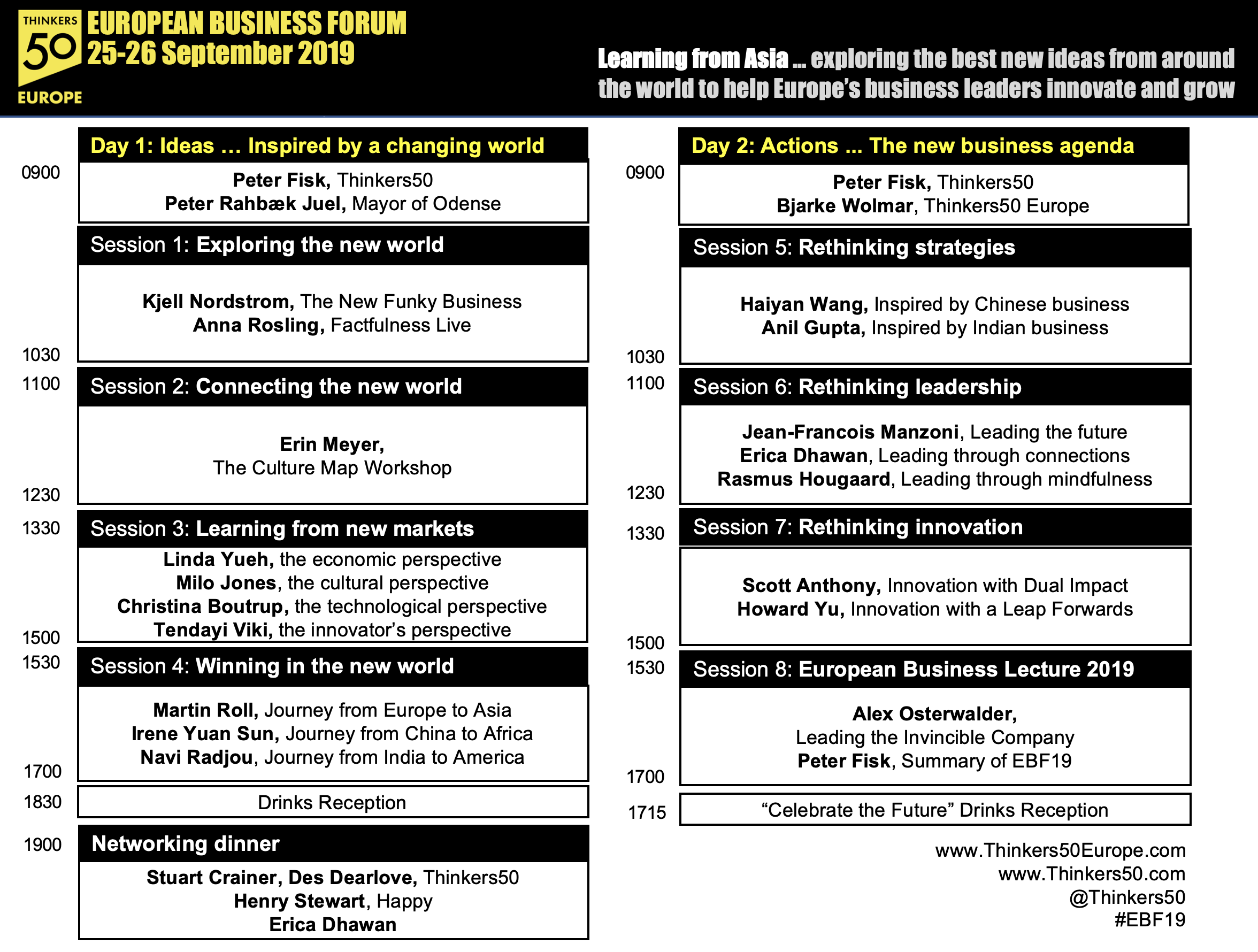
DAY 1 … INSPIRED BY A CHANGING WORLD
0900 Peter Fisk … Welcome to the future
We live in an incredible time. A world of relentless change. More change is going to happen in the next 10 years, than the last 250 years. 7% growth in Asia, 1% in Europe. Asia has 5 billion people, 65% of the world’s megacities, 70% of global growth, 30 of the Fortune 100. Consider these companies: Alibaba’s self-tuning ecosystem, BYD low-cost driverless cars, Bytedance’s intelligent content, DBS’s radical bank, Haier’s corporate entrepreneurship, Samsung’s engineers at drama school, Softbank’s 300 year vision. These businesses are all leaders in their fields. What are their secrets? How can they inspire European business to rise again, in a more enlightened way, to seize the opportunities of an incredible changing world?
Welcome by the Mayor of Odense, Peter Rahbæk Juel.
Session 1: Exploring the new world
Global markets are being transformed at speed. Power shifts are economic, political and culture. Emerging markets dominate mature markets, both in growth and ideas. A new generation of businesses, fuelled by technology and imagination, challenge once-invincible corporations. Influencers build brands through the power of networks and relationships, yet reputations can also fall fast and dramatically. Technology challenges humanity, requiring new regulation and ethics, whilst social and environmental issues beg for new solutions. This is the reality for today’s business leaders.
0915 Kjell Nordstrom… The New Funky Business
20 years ago, the Swede’s book Funky Business took the world by storm. It challenged the management class to wake up to a world of change. It encouraged revolution of change, to embrace “competitiveness as what you know, multiplied by who you know”, and to seize power by empowering people with dreams. So how has the world changed in the last 20 years? Is the funky of 1999 now a normality, demanding new levels of “funkyness” to win in today’s economy? Kjell Nordstrom is back to re-shock and re-inspire your brains. It’s time for business to get funky again.
0945 Anna Rosling… Factfulness Live
How well do you know today’s world? Facts can describe a very different world from what we imagine. Indeed, most of our ideas and opinions are shaped by huge misconceptions about what the world is really like. Anna’s father-in-law Hans Rosling, a global health professor and unintentional YouTube star, changed the way we think about the world through his bubble charts of statistics, with a passion to show that the world is a much better place than we thought. Anna continues this journey, looking at changing markets, with particular focus on the changing nature of consumers and businesses around the world.
1015 Discuss … Why do business leaders need new perspectives? Why should we look to new markets like Asia for better ideas and inspiration, to apply to our businesses in Europe?
1030 – 1100 Break
Session 2: Connecting the new world
Whether you work for a small, local company or a global corporate, today’s ever more global and virtual world requires skills to navigate through cultural differences and decode cultures foreign to your own. When you have Americans who precede anything negative with three nice comments; French, Dutch, Israelis, and Germans who get straight to the point; Latin Americans and Asians who are steeped in hierarchy; Scandinavians who think the best boss is just one of the crowd … the result can be, well, sometimes interesting, even funny, but often disastrous.
1100 Erin Meyer… The Culture Map Workshop
INSEAD’s renowned culture expert Erin Meyer, an American living in Europe, is back at EBF19 as your guide through this subtle, sometimes treacherous terrain where people from starkly different backgrounds are expected to work harmoniously together. In her bestselling book The Culture Mapshe provides a field-tested model for decoding how cultural differences impact international business. She combines a smart analytical framework with practical, actionable advice for succeeding in a global world.
1230 – 1330 Lunch
Session 3: Learning from new markets
What can we learn from those fascinating markets of Asia and beyond? Jack Ma was rejected in the west, but thrived in the east, building Alibaba with the power of imagination and intuition. Indeed, a recent WEF study found that 90% of Asian business leaders believe that creativity is important, compared to 57% in Europe. And whilst Asia was seen as a land of imitation, it is now the leader of innovation, leaping ahead without the legacy of heritage, to seize the opportunities of changing locally and globally. Agree, or not? And if so. what can a European business learn?
1330 The need for new perspectives
1335 Linda Yueh… the economic perspective
Frequent viewers of British television will recognize the face and voice of Linda Yueh, an economist, broadcaster, and writer, who was previously Chief Business Correspondent for BBC News and host of several TV shows about the economy, business, and finance. In her latest book, The Great Economists: How their ideas can help up today, Linda explains the key thoughts of history’s greatest economists, how their lives and times affected their ideas, how our lives have been influenced by their work, and how they could help with the policy changes that we face today.
1350 Milo Jones… the cultural perspective
Milo Jones is an American based in Poland, working at IE Business School, who focuses on the impact of digital technologies on geopolitics, society and business using his experience working with Accenture, Morgan Stanley, and even CIA. Milo focuses on themes from intelligence to finance, geopolitics and cultures. In 2016, Milo also spoke at a special event organized by Harvard Business Review Korea/DBR on his application of intelligence methodologies to business situations.
1405 Christina Boutrup… the technology perspective
Christina Boutrup is a Danish author, and an expert on the Chinese world of technology, hosting radio- and TV-shows about China. She interviewed Alibaba’s founder Jack Ma and closely followed the global expansion of Chinese companies authoring several books about business in China. In her most recent book The Great Tech-revolution – How China Shapes our Future, she underscores why all decision-makers should pay attention to the Chinese tech-revolution and what companies in the West can learn from China.
1420 Tendayi Viki… the innovation perspective
Tendayi Viki, a Harvard and Stanford psychologist, and part of the Strategyzer group, explores how big corporates can act like start-ups, to innovate and grow. He helps large organisations develop their ecosystems so that they can innovate for the future while managing their core business. He was shortlisted for the Thinkers50 Innovation Award and named on the Thinkers50 2018 Radar List of emerging management thinkers to watch. He is the co-author of The Corporate Startup and The Lean Product Lifecycle.
1435 Debate … Which insights and ideas from Asia are most relevant for European business leaders to adopt and adapt in their own businesses?
1500 – 1530 Break
Session 4: Winning in the new world
The average 18-year-old today will live in at least three different countries during their lives, whilst a century ago, our grandparents rarely even left their home towns. Today we are all citizens of a rapidly connecting and changing world. Our cultures and communities are speckled with our desires for exotic tastes and better lives. Our businesses become a global ecosystem of supply and demand. Every business and individual is on a journey in this new world. Our journeys give us new insights and ideas, enabling us to grow as individuals, both personally and professionally.
1530 Martin Roll… My Journey from Europe to Asia
From ad agencies to collaborating with McKinsey, Martin Roll is a Dane who moved to Singapore to specialise in Asian brand strategies, combining the best ideas of east and west. He has lived in Asia for two decades and is now a senior advisor to business leaders, Asian conglomerates and prominent global business families on the most important issues in managing successful global brands and businesses, and exercising great leadership.
1600 Irene Yuan Sun… My Journey from Asia to Africa
Irene Sun was born in China, raised in America, found herself in Africa, later worked with McKinsey, and is author of The Next Factory of the World: How Chinese Investment Is Reshaping Africa. Her book highlights how China has become Africa’s largest trade partner, the largest infrastructure financier, and the fastest-growing source of foreign direct investment. Chinese entrepreneurs are flooding into the continent, investing in long-term assets such as factories and heavy equipment. Irene tells a story about resilient Chinese entrepreneurs now building in Africa what they so recently learned to build in China – a global manufacturing powerhouse.
1630 Navi Radjou… My Journey from Europe to America
Born in India, Navi Radjou is a French-American academic and an author of Frugal Innovation. He is now based in Silicon Valley and writing new books on leadership and sustainability. His TED talk on frugal innovation has garnered over 1.7 million views. Navi’s ideas have been shaped by his eclectic cultural background including his Indian roots, his French education, and his Silicon Valley milieu. He is also a lifelong student of yoga, Ayurveda, and Buddhist meditation.
1700 Summary of day 1
1830 Pre-dinner drinks
1900 Networking Dinner … bringing together business leaders, thinkers and sponsors
An opportunity for local hosts, business leaders, speakers, and sponsors to network, and reflect on the best new ideas in business. This year’s EBF comes in the same month that Facebook opens a huge new datacentre in the City of Odense, a symbol of its rapid redevelopment for the 21st century.
After seating … Stuart Crainer and Des Dearlove, founders of Thinkers50 will give a brief update on the world of business ideas, previewing the 2019 Global Awards that will take place in London in November. Known as “the Oscars of business thinking”, this year’s short lists include a fabulous collection of new thinkers and fresh ideas to stimulate your future.
After starters … Happiness is the big idea of Henry Stewart, CHO of Happy, and author of The Happy Manifesto. In a world of polarising economics and politics, relentless change and innovation, social and environmental tensions, we all need a little more humanity, even humility. Henry is all about being, feeling and leading happy.
After main course … Erica Dhawan, author of Get Big Things Done: The Power of Connectional Intelligence, inspires us with the power of connectedness. Sitting in one of Europe’s leading robotics hubs, connections matter. Here in Odense, surrounded by fellow leaders and thinkers, new connections are possible, and could even help us create new futures. Together all these great ideas and connections could change our futures. Having grown up in India, Erica will also give us a personal insight into how Asia has influenced her as she works around the world.
DAY 2 … NEW AGENDA FOR BUSINESS LEADERS
0900 Bjarke Wolmar… a shared mission
Thinkers50 has a mission to help business make the world a better place through the power of ideas. Ideas drive innovation, but also progress in society, and wealth of nations. In Europe Thinkers50 seeks to help European businesses to find their competitive edge in a world of radical change. The City of Odense has a wonderful history of storytelling, through its famous son Hans Christian Andersen. However, the real story is about the future, and how Odense is playing a leading role in harnessing the power of robotics, from biotech to drones, to be an ideas and innovation hub for Europe.
Session 5: Rethinking strategies
Strategy has become a difficult concept in business. How can you plan for an uncertain future, combining the need for direction in a world of infinite choices, with the need for constant agility? Masayoshi Son talks about his 300 year plan, whilst Mark Zuckerberg continues to “move fast and break things”. The rapid emergence of tech and convergence of sectors means that any business could effectively do anything. Rita McGrath talks about the need to see round corners, whilst BlackRock CEO Larry Fink’s call for “purpose beyond profit” has made investors and leaders re-think what matters.
0905 Haiyan Wang… Inspired by Chinese business
Haiyan Wang is a lecturer at INSEAD and Managing Partner of the China India Institute, which she runs with her husband Anil Gupta. She is based in Washington, DC, and works as an expert on Chinese business. She is a frequent contributor to BusinessWeek, The Wall Street Journal, and carries out research to assist in the creation of business strategies which focus on the rising economies of China and India.
0930 Discuss
What are the best ideas from China for European business? How can business leaders practically adapt and apply them?
0945 Anil Gupta… Inspired by Indian business
Anil Gupta has been named by The Economist as one of the world’s “superstars” for research on emerging economies. By 2025, China and India will be two of the world’s four largest economies. By then, economic ties between them should also rank among the 10 most important bilateral ties worldwide. Anil Gupta focuses on this in his writings and his work at The China India Institute.
1010 Discuss
What are the best ideas from India for European business? How can business leaders practically adapt and apply them?
1030 – 1100 Break
Session 6: Rethinking leadership
Leadership drives the business forwards, amplifying the potential of ideas, people and partners. However, as power shifts from hierarchy to network, as ideas trickle up rather than down, and action is in the hands of everyone, a new approach to leadership is required. Sensemaking, connecting, imagining, changing and implementing. These are the challenges of today’s business leader. At EBF17 Lars Rebien Sorensen inspired us with his passion for action. During EBF18, Jim Hageman Snabe inspired us with his dreams and details. This year at EBF19, we continue to explore what makes a great leader.
1100 Jean-Francois Manzoni… Leading the future
Jean-Francois Manzoni is the French-Canadian President of IMD Business School, where he focuses on high performance leadership and governance. He has lived in 5 countries, including Singapore, and worked in more than 30. Over that time, he’s been struck by how difficult it is for executives to internalise new behaviours; they know more and more about “good leadership practices”, but are less effective at putting it into practice back in the workplace. Closing that “knowing-doing gap” is a must for business leaders facing an ever more challenging world.
1130 Erica Dhawan … Leading through connections
Erica Dhawan has a passion for how people connect. She runs her own business Cotential, and is the coauthor of Get Big Things Done: The Power of Connectional Intelligence. Through speaking, training and consulting, Erica teaches business leaders innovative strategies that increase value for clients, deliver results and ensure competitiveness. She features on the Thinkers50 Radar, one of the emerging management thinkers most likely to shape the future of business.
1200 Rasmus Hougaard… Leading in your mind
Rasmus Hougaard is a Dane based in New York City, and an author of The Mind of the Leader. He leads an initiative that builds on the power of mindfulness within business called the Potential Project.
1230 – 1300 Lunch
Session 7: Rethinking innovation
Innovation is the rocket fuel of progress. In recent times words like disruption, most popularised by Clay Christiansen, has become the mantra, alongside new approaches like design thinking and lean implementation. At the same time, we realise that it is business models and customer experiences where innovation has the most impact. Over 350 “unicorns” have emerged in recent years to shake up every market. They are multi-billion-dollar start-ups, or perhaps we should just call them innovators… How do big companies compete in this world? How do you innovate at speed? How should you rethink the way you rethink?
1330 Scott Anthony and Howard Yu… the innovation champions
Scott Anthony is winner of the Thinker50 Strategy Award 2017, Managing Partner of Innosight, American born, and now based in Singapore. His books include Seeing What’s Next and Dual Transformation.
Howard Yu was born in Hong Kong, and now living in Switzerland. He is the author of Leap: How to thrive in a world where everything can be copied. He is an IMD professor, and has been called “the new Clayton Christiansen”
This session is more like a boxing match. A contest of innovation ideas. There are 5 rounds. Each contender has 5 minutes to make their case, and then the audience have 5 minutes to reflect and vote for the winner.
1345 Round 1 … How did Asia influence you?
Howard grew up in Asia and then came to Europe, whilst Scott chose to move there from America. How has Asia influenced them personally, and in their innovation work?
1400 Round 2 … Who is the better innovator – Singapore or Switzerland?
Comparing the two countries where Scott and Howard are based, which is better placed to drive innovation of the next decade? What is the best environment for innovation, and do governments help or hinder?
1415 Round 3 … How do big companies beat small companies?
Eric Ries’ The Lean Start-Uphas become a bible for modern business innovation, seeking to be more entrepreneurial, fast and experimental. But should large companies try to be like small ones, or should they play their own, better game?
1430 Round 4 … Do short-term priorities make disruptive innovation impossible?
Most businesses are driven by short-term pressures (despite the desire for longer-term thinking, focus on purpose beyond profit etc). Does this preclude disruptive innovation, or can you be just as disruptive quickly?
1445 Round 5 … What is the role of the CEO in innovation?
Steve Jobs v Jeff Bezos v Satya Nadella v AG Lafley v Jack Ma v Mukesh Ambani v Mary Barra v Indra Nooyi v Ma Huateng … these CEOs had very different roles in innovation. How can CEO’s be most useful, and in which types of innovation?
1500 – 1530 Break
Session 8: European Business Lecture 2019
1530 Introduction to the European Business Lecture
The European Business Lecture is a seminal moment in the European business calendar, defining the agenda for business leaders in the years ahead. In previous years, the world top ranked business thinkers have called for a radical rethink by leaders in how they manage their organisations. Michael Porter called for a new approach to strategy based around shared value, extending the economic focus to society. Roger Martin called for a scientific revolution in business thinking, with organisations becoming complex adaptive systems, and the merging of strategy and execution, built around projects.
1535 Alex Osterwalder… Leading the Invincible Company
Alex Osterwalder is the Swiss “strategyzer”, and the outstanding European business thinker of this decade, with books including Business Model Generation and the forthcoming The Invincible Company. Last year at EBF18, he led a fabulous workshop on how to develop a portfolio of business models for today and tomorrow – to exploit and explore – and in doing so create a relentless approach to innovation and growth, and become invincible. This year he returns to EBF19, to give the European Business Lecture with a focus on the role of business leaders in driving his concept of the “invincible” organisation. In particular, he will call for Europe’s business leaders to embrace creativity and innovation, to be more entrepreneurial like their Asian peers, and to be a force for progress in the world.
1635 Q&A with Alex
1650 Summary of EBF19
1715 Celebrate the future.
Here’s what happened at EBF17:
https://www.youtube.com/watch?v=kdCLUbml9q8
Here’s what happened at EBF18:
https://www.youtube.com/watch?v=CzksDkQBB0g&t=32s
Join me at the Thinkers50 European Business Forum, Europe’s premier event for business leaders, on 25-26 September 2019 in Odense, Denmark.
Tickets are limited and available now from www.Thinkers50Europe.com
Previews
Here’s a preview of each of this year’s speakers:
Kjell Nordstrom … Exploring the new world … His book Funky Business shook up the management world 20 years ago, now Kjell is back to reshock and reinspire your brains. It’s time for business to get funky again.
Anna Rosling … Exploring the new world, Factfulness Live … following in the footsteps of her late father in law, Hans Rosling, she will challenge our assumptions and perspectives of a changing world, with particular insight into Asian markets.
Erin Meyer … Connecting the new world, The Culture Map Workshop … The Paris-based American professor at INSEAD is back, this time with a unique workshop for 500 business leaders. 90 minutes to roll up your sleeves and work with Erin to understand how you can better work with different cultures across Asia, and around the world.
Linda Yueh … Learning from new markets, economic perspective … the economist, writer and broadcaster describes an economy that has echoes of history. Here’s a clip from her latest book:
Tendayi Viki … Learning from new markets, entrepreneurial perspective … the Harvard and Stanford psychologist explores how big corporates can act like start-ups, to innovate and grow.
Christina Boutrup … Learning from new markets, technology perspective … Danish author, and an expert on the Chinese world of technology. She knows Jack Ma and Wang Jianlin better than most.
Milo Jones … Learning from new markets, intelligence perspective … the American based in Poland, from Walmart to Accenture, Morgan Stanley to IE Business School, he is also closely connected to the CIA.
Martin Roll … Winning in the new world, from Europe to Asia … from ad agencies to collaborating with McKinsey, the Singapore-based Dane specialises in Asian brand strategies.
Irene Yuan Son … Winning in the new world, from Asia to Africa … born in China, raised in America, from McKinsey, author of The Next Factory of the World: How Chinese Investment Is Reshaping Africa
Navi Radjou … Winning in the new world, from India to America … born in India, the French-American academic is author of Frugal Innovation and is now based in Silicon Valley.
Jean-Francois Manzoni … Rethinking leadership, leading the future … the French Canadian is President of IMD Business School where he focuses on high performance leadership and governance.
Rasmus Hougaard … Rethinking leadership, leading in your mind … author of The Mind of the Leader, the Dane is based in New York City and leads the Potential Project.
Erica Dhawan … Rethinking leadership, leading through connections … She runs he own business Cotential, and is author of Get Big Things Done: The Power of Connectional Intelligence.
Haiyan Wang … Rethinking strategies, inspired by the best ideas from China … Managing Partner of the China India Institute, and lecturer at INSEAD, based in Washington DC and an expert on Chinese business.
Anil Gupta … Rethinking strategies, inspired by the best ideas from India … The world’s leading expert on Indian business, now professor at the University of Maryland.
Scott Anthony … Rethinking innovation, innovating with dual impact … Winner of the Thinker50 Strategy Award 2017, Managing Partner of Innosight, American born, now based in Singapore.
Howard Yu … Rethinking innovation, innovation that leaps forwards … born in Hong Kong now living in Switzerland, author of Leap, the IMD professor has been called “the new Clayton Christiansen”
Alex Osterwalder ... Leading the Invincible Company … the Swiss “strategyzer” is the outstanding business thinker of this decade, from Business Model Generation to The Invincible Company. This year he returns to give the EBL, a highlight of the business year in Europe, focusing on the challenge and opportunities ahead for business leaders.
https://www.youtube.com/watch?v=3YBOMqSMoEE&t=183s
How can you learn from all these thinkers?
All of the above will feature at the Thinkers50 European Business Forum, Europe’s premier event for business leaders, on 25-26 September 2019 in Odense, Denmark.
Tickets are limited and available now from www.Thinkers50Europe.com
For centuries, electricity was thought to be the work of sorcerers.
Magicians left audiences puzzled about where it came from and how it was generated. And although Benjamin Franklin and his contemporaries were well aware of the phenomena when he demonstrated the connection between electricity and lightning, he had difficulty envisioning a practical use for it in 1752. In fact, his most prized invention had more to do with avoiding electricity – the lightning rod.
All new innovations go through a similar evolution: dismissal, avoidance, fear, and perhaps finally acceptance.Almost two hundred years after Franklin’s lightning experiment, we were routinely harnessing electricity, even though we still lacked a deep understanding of its origins. The Lineman’s Handbook of 1928 begins with the line: “What is electricity? – No one knows.” But according to this field guide for early electricians, understanding the make-up wasn’t important. The more significant aspect was knowing how electricity could be generated and safely used for light, heat and power.
AI is the new electricity
Today, too many people view artificial intelligence as another magical technology that’s being put to work with little understanding of how it works. They view AI as special and relegated to experts who have mastered and dazzled us with it. In this environment, AI has taken on an air of mysticism with promises of grandeur, and out of the reach of mere mortals.
The truth, of course, is there is no magic to AI. The term Artificial Intelligence was first coined in 1956 and since then the technology has progressed, disappointed, and re-emerged. As it was with electricity, the path to AI breakthroughs will come with mass experimentation. While many of those experiments will fail, the successful ones will have substantial impact.
That’s where we find ourselves today. As others, like Andrew Ng have suggested, AI is the new electricity. In addition to it becoming ubiquitous and increasingly accessible, AI is enhancing and altering the way business is conducted around the world. It is enabling predictions with supreme accuracy and automating business processes and decision-making. The impact is vast, ranging from greater customer experiences, to intelligent products and more efficient services. And in the end, the result will be economic impact for companies, countries, and society.
To be sure, organizations that drive mass experimentation in AI will win the next decade of market opportunity. To breakdown and help demystify AI, one needs to consider two key elements of the category: the components and the process. In other words, identifying what’s behind it and how it can be adopted.
The Components of AI
Much like electricity was driven by basic components such as resistors, capacitors, diodes, etc., AI is being driven by modern software components:
- A unified, modern data fabric. AI feeds on data, and therefore data must be prepared for AI. A data fabric acts as a logical representation of all data assets, on any cloud. It pre-organizes and labels data across the enterprise. Seamless access to all data is available through virtualization from the firewall to the edge.
- A development environment and engine. A place to build, train, and run AI models. This enables end-to-end deep learning, from input to output. Machine learning models, help find patterns and structures in data that are inferred, rather than explicit. This is when it starts to feel like magic.
- Human features. A mechanism to bring models to life, by connecting models and applications to human features like voice, language, vision, and reasoning.
- AI management and exploitation. This enables you to insert AI into any application or business process, while understanding versions, how to improve impact, what has changed, bias, and variance. This is where your models live for exploitation and enables lifecycle management of all AI. Lastly, it offers proof and explain-ability for decisions made by AI.
The Process of AI
With these components in hand, more organizations are unlocking the value of data. But to fully leverage AI, we must also understand how to adopt and implement the technology. For those planning the move, consider these fundamental steps first:
- Identify the Right Business Opportunities for AI. The potential areas for adoption are vast: customer service, employee/company productivity, manufacturing defects, supply chain spending, and many more. Anything that can be easily described, can be programmed. Once it’s programmed, AI will make it better. The opportunities are endless.
- Prepare the Organization for AI. Organizations will require greater capacity and expertise in data science. Many of today’s repetitive and manual tasks will be automated, which will evolve the role of many employees. It’s rare that an entire role can be done by AI. But it’s also rare that none of the role could be enhanced by AI. All technology is useless without the talent to put it to use, so build a team of experts that will inspire and train others.
- Select Technology & Partners. While it’s unlikely that the CEO will personally select the technology, the implication here is more of a cultural one. An organization should adopt many technologies, comparing, contrasting, and learning through that process. An organization should also choose a handful of partners that have both the skills and technology to deliver AI.
- Accept Failures. If you try 100 AI projects, 50 will probably fail. But, the 50 that work will be more than compensate for the failures. The culture you create must be ready and willing accept failures, learn from them, and move onto the next. Fail-fast, as they say.
AI is becoming as fundamental as electricity, the internet, and mobile as they were born into the mainstream. Of all the technologies reshaping our world right now, AI is likely to have the most impact.