“Splice the mainbrace” is an order given aboard naval vessels to issue the crew with an alcoholic drink. Originally an order for one of the most difficult emergency repair jobs aboard a sailing ship, it became a euphemism for authorised celebratory drinking afterward, and then the name of an order to grant the crew an extra ration of rum.
Mainbrace is also a small fishing village in Cornwall, England, where its small and remote sea coves likely gave good cover for the illicit importing of rum into the country, avoiding the watchful eye of the local customs house.
And it’s also close to the weekend home of David Haigh, who for the last 25 years has devoted his life to building the world’s leading independent brand valuation business, largely a highly analytical financial activity, but with a dash of creativity too. David is a good friend, and always full of entrepreneurial ideas for building brands, enjoying a tipple, and finding ways to be tax efficient whilst doing it.
One technique he has helped many clients to do successfully is to buy and sell old brand names, or trademarks, which might have lost their way, or no longer fit with a company’s portfolio. Having bought an old redundant brand, a new owner can rapidly reenergise it with new designs, concepts and marketing.
Even if you don’t have the expert distilling, packaging, and distribution capabilities to hand, today it is incredibly easy to launch a “virtual” brand, engaging third parties to do each of these tasks for you under license or with a commission.
Search online and you will still come across old, drab bottles of Mainbrace Rum. Mostly out of stock.
Then take a look at the new Mainbrace Rum website and you will find a fresh and revitalised brand, with a beautifully crafted bottle, a flourishing storyline of its origins on the banks of the Demerara River, and a nifty tagline about being “spliced not spiced”.
In fact there is quite a trend in brand folk who spend most of their career advising others, to have a final pre-retirement flourish launching their own brand, typically some form of alcohol. And whilst popular culture is very much into craft beers and exotic gins right now, perhaps rum is the next up and coming drink, particularly mixed as a cocktail.
So congratulations David, it might not yet be the world’s most valuable rum brand, but it’s full of your values and passion.
Here, just as a taster, is an extract from the recreated brand story:
Traditionally crafted with a modern twist, Mainbrace is a unique golden ‘spliced rum’. A premium blend of unaged agricole from Martinique and 2-5 year old rums from 3 different stills in Guyana.
A saying synonymous with celebration, “Splice the Mainbrace” was born from courage, loyalty and teamwork. It embodies the spirit of celebrating a hard-won victory.
Originating in the heart of battle, a brave team of sailors would attempt to ‘”splice the mainbrace” if it was damaged to save the main mast of a ship – a difficult, but vital task. If they succeeded, they would be rewarded with a double ration of rum to celebrate along with a toast to “the Queen – God bless her”. The sweetest victories always come after the hardest of battles.
A blend of fine rum
Traditionally crafted with a modern twist, Mainbrace is a unique golden ‘spliced rum’. A premium blend of unaged agricole from La Favourite Distillerie and 2-5 year old rums from 3 different stills in Guyana. Mainbrace is produced using locally sourced sugar cane as well as traditional pot and column still distillation. The same methods and stills were used to create rum for the British Navy as far back as 1732. We believe our rum speaks for itself and that is why there are no sweeteners or colourings added to our blend.
Guyana
Our blend originates from Guyana near the banks of the Demerara river in 1670, a region that’s home to its own eponymous variety of rum. Ours is crafted with rums aged between 2-5 years from 3 different stills, all bringing their own unique character and natural sweetness to the blend.
The first part of our blend comes from a double wooden pot still in Port Mourant. These stills have been making rum for the navy since the 19th century. The second part is from the wooden Coffey still originally found at the Enmore Sugar Estate. This is the last still of its kind in the world. The final part of our blend comes from an original four column French Savalle still, dating back to the 18th century.
Martinique
The agricole part of our blend comes from La Favorite in Martinique, which was established in 1842 and is well-known for their punchy agricoles even at low abvs. The initial earthy textures you experience when sipping Mainbrace can be attributed to this distillery. The distillery is powered on a closed loop system that uses the excess fibres (bagasse) of sugar cane to fuel its furnaces. These then create the steam to distil their Rhums making the distillery extremely sustainable. In fact, they are the last distillerie in Martinique still working purely from steam.
A brand community is a group of consumers who invest in a brand beyond what is being sold.
Think about some of the great examples of brand communities through which people engage with brands and businesses today, influencing what they buy, who they trust, and how they achieve more. From Lego Ideas to TED Talks, Xbox Ambassadors to Nike’s Run Club, Disney’s D23 Fans to Bayern Munich’s supporter’s club. Here are some of the most famous:
- Harley Owners Group – recognised that owners loved much more than the bike, it was the freedom to ride the roads, the thrill to ride together, to hang out at Ace Cafes, to share their passion for life.
- Glossier – became the world’s fastest growing beauty business, emerging out of a Vogue editor’s blog followers, to become a community where consumers share ideas and advice, but also co-create their products.
- Rapha Cycle Club – a store for premium apparel became a hub for people who love cycling, a place to indulge in experiences, a service point to fix your bike, an online platform, a starting point for rides, all around the world.
- Behance – Adobe’s platform for showcasing and discovering great creative work, a platform of over 10 million users, including exclusive tools and project collaboration spaces.
- Spotify Rockstars – bringing together people who love music, encouraging discussion and recommendations, rewarding and ranking the most active, and also a platform for discovering new talent.
A brand community is a group of consumers who invest in a brand beyond what is being sold. From meaningful consumer retention to new sources of revenue, unfiltered consumer insight and predictable cashflows, branded communities offer many opportunities to drive growth:
- Enhance consumer experiences – how people achieve more, collaborate and recommend, and create new content together.
- Ongoing engagement – how people engage with brands continuously, not just at moments of promotion or purchase.
- Know consumers better – 67% of businesses use communities to gain deeper insights to drive better focus and innovation.
- Increase brand exposure and credibility, making it easier to sell without selling – typically 35% increase in brand awareness.
- Reduce consumer support costs – 49% of businesses with online communities report cost savings of around 25% annually.
- Improve retention and advocacy – improving retention by 42%, tripling cross-selling, and people pay more too.
Building a great brand community has three foundations:
- Consumer, starting with your target audience, with a captivating reason for members to join the “tribe”, be it a shared cause or interest, from hiphop music, to a love of science fiction novels, or a desire to get fit.
- Collaboration, engaging with other people, facilitated by the brand and its community platform, which might take the form of discussions, co-creation and recommendations.
- Content, the glue that makes the community work beyond products. These might take the form of newsletters, events, videos, other products, discussion boards, merchandise, exclusive offers, and much more.
Underpinning this is a business model that ensures that the community adds real value to its members, but also commercially works for the organisation. For members, this means it adds value beyond the brand’s conventional products and services, typically enabling them to use them better, and get more from them. For business, this means having a business model that drives incremental revenue growth. This might be in the form of consumer retention, selling more or different products, but also other types of content, and potentially a subscription to belong.
Communities are one of the most powerful ways a brand can grow, often exponentially.
Examples of brand communities
Here are some great examples of brand communities:
Rapha Cycle Club
Cycling is a sport of connisseurs. They love their coffee, in France they love their pastis, and they love their bikes and gear. Riding in the heart of a Sunday morning pelaton is as much social as physical, and so Rapha designed to create premium cycling gear, and coffee shops – or Cycle Clubs – where enthusiasts can meet.
Walk into a Rapha Cycle Clubs – in London or New York, Sydney or Osaka, and you can see, smell and touch a love of cycling. The business has grown rapidly, building a direct relationship with consumers, through events and online community, as well as its coffee-shop stores. There are also line extensions into luggage, skincare, books and travel. Tour de France and Olympic champion Bradley Wiggins, and his Team Sky wear Rapha, whilst there is a co-branded range with designer and cycling enthusiast Paul Smith.
Rapha is a brand that polarises opinion. For some it has created the ultimate in high performance equipment, dedicated to a sport that breeds passion and perspiration. For others, it is over-priced and over-designed vanity wear for middle-aged men who have taken up weekend cycling in recent years. Whichever your view, it gets talked about. Especially items such as the $450 pair of yak-leather cycling shoes, or the $150 pro-glide coffee tamper, to flatten your coffee like the best baristas after your run.
Adobe’s Behance
In 2012, Adobe acquired an existing online design community platform, Behance. Behance is a network for creative people and is highly-regarded in the design community. It allows people around the world to showcase their own work and discover the creative work of others. So why did Adobe decide to acquire it (for $150 million)?
Adobe makes a considerable profit from selling creative software like Photoshop and Acrobat, and increasingly renting it via Creative Cloud. Therefore, enabling a network like Behance, puts it at the centre of the creative community, bringing together everything from its essential software to professional socialising. It also allows Adobe to bring community features to the creative cloud, creating myriad two-way links between its community and the products that it offers.
Gymshark
Gymshark is one of the fastest growing fitness apparel brands in the world, and their incredible growth is largely fueled by the strong community they have built around their brand. Using their Gymshark Central blog as a hub, they make it easy for new and returning customers alike to dive into their community without having to do any heavy lifting. With articles loaded with tips, tutorials, and recipes, their blog is jam-packed full of health and fitness related information that has clearly positioned them as their members’ go-to source for anything health and fitness related. This makes it easy for customers to decide to purchase their products as a way of strengthening their connection with the fitness community.
Sephora’s Beauty Talk
Sephora has one of the best brand communities both in and outside of the cosmetics industry. Whether you’re a beauty buff or not, they’ve created a consumer experience so unique that you would know you’re in a Sephora (or on their website) even if you stripped away all of their logos and product images.
While their website already has everything you could want to know about their products, how to use them, or anything else beauty related, the real power of their community comes from their rewards program. Beauty Insiders get great perks at every level of the three-tiered program, including exclusive sales and invitations to members only events and meetups. Every tier also has access to the Rewards Bazar, a huge catalogue of products they can get for free by redeeming the points they’ve earned.
By offering incredible rewards at every tier, Sephora has fine-tuned their program so that it’s still motivating enough to keep their community engaged and working towards achieving the next level of luxury. This is what makes their program so attractive to join, and has built them an enormous community of cosmetic and beauty enthusiasts that simply love being Beauty Insiders.
Spotify
This won’t shock to you I’m sure, but Apple sell a lot of smart devices and each one ships with Apple Music already installed. Yet Spotify has roughly twice as many paying subscribers to a very similar service. How? Well, Spotify have a young, engaged and dedicated fan base who will stand by them foreverSpotify’s community solves a number of business challenges, from consumer support to enhancing brand value. It’s a place for music lovers to discuss the industry, suggest ideas to Spotify (in terms of platform improvements), and get user support from the company.
It also enables Spotify’s Rock Star program, which gives users the chance to write helpful posts and answer questions from other users in order to earn points. They can spend the points on merchandise, Spotify Premium and even gig tickets. A nice incentive to encourage user generated content.
Starbucks
The Starbucks brand has been synonymous with community for quite a while, thanks to how well they’ve crafted their brand image. For starters, when you enter a Starbucks cafe you aren’t greeted by mere employees — you’re greeted by Starbucks partners. This is the term Starbucks uses to refer to their baristas, and this small detail helps make inclusion in the brand community something felt by everyone, not just the customers that come in to get a drink.
Outside each cafe’s walls, Starbucks has continued to do an amazing job of strengthening their community with a number of social initiatives to boost member interaction and engagement. One great social impact initiative is the volunteer matching service they created to help partners and community members engage with each other, and help those outside the community that need assistance. Between the annual #redcupcontest holiday cup decorating contest and the countless #psl (pumpkin spice latte) photos customers post every fall, Starbucks has taken full advantage of the power of user-generated content to build community, reposting some of the best tagged customer photos on their corporate social profiles.
However, this all pales in comparison to the crowning jewel of the Starbucks brand community: their Starbucks Rewards program. As a Starbucks Rewards member, customers can earn Stars for making purchases, playing games, and attending bonus point events. They can then cash those Stars in for free products, all in the hopes of achieving the prestigious Gold VIP status. Achieving this honor gets members a personalized gold card that they can show off, creating a tangible connection between themselves and their position in the Starbucks brand community. This small token is an incredibly powerful way that Starbucks has been able to build a community that gets their customers excited to join and stay engaged over time — all for a piece of plastic.
The Giving Keys
As a company that’s branded themselves around the idea of being a “Pay it Forward Company”, it’s no wonder their community is so successful. If you’re not familiar with the Giving Keys, their key shaped jewellery is engraved with motivational words. With a company goal to end homelessness, they employ individuals to help them transition out of it as a way of giving back to their surrounding community. These two ideas alone are enough to get others interested in joining, but they don’t stop there. To help spread the word and get others to join their mission, The Giving Keys have started sharing user-generated content on their own social media pages. Using the #thegivingkeys hashtag on Instagram, customers can create Instagram Stories and other social posts to join The Giving Keys’ conversation. This type of visibility is extremely valuable to many customers, and quickly allows them to feel like a contributing member of the larger community.
Community members can also share their stories with others by submitting their experiences of passing along of a Giving Key to the brand’s website. These stories are then added to an ever-growing list on display, inspiring hope, positivity, and encouragement in every visitor who comes across them. These positive stories easily help establish strong emotional connections with customers from the start, as they see parts of themselves represented in the stories of those who have come before. These storytelling tools are all brought together in their VIP rewards program. With rewards for purchases, social engagement, and customer referrals, The Giving Keys have given ongoing engagement with their brand tangible value that plays into the idea of “paying it forward.” This reciprocal approach to their own customer experience perfectly unites each community member with what they stand for, enticing their community to help keep it growing while also getting them closer to the ultimate goal of ending homelessness.
The Walt Disney Company
When you think about brands that have huge a huge community of followers, one of the first ones you probably think of is the House of Mouse. For a company that was founded nearly 100 years ago, Disney has done everything possible to make their brand not just a media company, but a complete entertainment experience. With beloved characters like Winnie the Pooh and Donald Duck, their films and stories are the perfect vehicle for building lasting emotional relationships with each of their customers, no matter where they are in the world.
Perhaps the most exciting event, however, is the D23 Expo. This annual gathering is sponsored by the Official Disney Fan Club, D23, and welcomes members of the Disney community to come together and celebrate all things Disney. This three day event is the highlight of the year for the most avid Disney community members, and is a fantastic opportunity for new and old fans alike to meet, create more lasting relationships, and share their own experiences with each other.
While each of these experiences are magical in their own right, the pinnacle of a true Disney community experience is physically going to one of their parks. Gathering with a crowd of other wide-eyed enthusiasts to take part in the rides, sights, and sounds of the world of Disney is the ultimate expression of what it means to be a member of this worldwide community.
Lululemon Athletica
Athleisure has become the fastest growing category in sportswear, and few brands have had as much of an impact on this trend than Lululemon. With luxurious yoga gear serving as the heart of their diverse product line, Lululemon’s brand community is built around empowering their customers to lead a healthy, active lifestyle.
One of the ways they do that is by offering accessible, invigorating experiences to their community members. If you’ve never tried yoga before, Lululemon gives you a chance to join them for a free yoga class or for come to one of their other larger festivals and events. At all of these gatherings, community members can sweat, meditate, and retreat together from the chaos of everyday life. For people like me who have never done yoga, this provides huge value to me, as I would get to experience the sport, connect with the Lululemon brand, and connect with others in their community without any risk.Even though these events do a lot to keep members engaged, Lululemon also recognizes that they need advocates to help their community grow. To help draw a crowd to their events, Lululemon has an active ambassador program that features a number of athletes and leaders in fitness, nutrition, and business. As independent brand ambassadors, these leaders evangelize the Lulu brand, serving as a living embodiment of the brand’s values in the real world.
Joining a new community can be intimidating, but Lululemon has done a lot to make the barriers to both their sport and their community as non-existent as possible. Since great brand communities have to be accessible, by embracing the values of both athleticism and leisure, Lululemon has made their brand community easy to try out and join, but still exciting to engage with through their events and ambassadors.
Xbox Ambassadors
This is an example of an advanced brand community. It works for Xbox because this is a brand (and an industry) that tends to have customers that are much more than your average enthusiast. Who, the brand of course has a forum for already.
These people are devotees. Not just anyone can be an Xbox Ambassador. These individuals have to have a minimum Gamescore and an active Xbox Live Gold Membership. Ambassadors provide a huge support network for both gamers and the brand – offering support on the Official Xbox Forums, hosting Twitch shows, creating YouTube videos, and providing product feedback. In return, Ambassadors are rewarded with games, branded merchandise, and other perks that specifically appeal to hardcore gamers.
https://www.youtube.com/watch?v=oEgQN-n1kYY
Getting started

Here is a great resource for help in developing a brand community: Community Canvas

Jensen Huang cofounded NVIDIA in 1993, building more powerful computer chips for video games. The 56 year old Taiwanese American entrepreneur, worth $4.6bn, is now leading the AI revolution, and has just been ranked as “the World’s Best Performing CEO” of 2019.
Huang, actually named Jen-Hsun rather than Jensen graduated from Oregon State University and then gained a masters in electrical engineering from Stanford. His strategy when founding the tech business was to focus on a single niche: building powerful computer chips to create graphics for fast-moving video games. As the company went public in 1999 and grew through the 2000s, video games remained its growth engine, but even back then Huang could see a different path forward.
Data scientists were beginning to ask computers to perform much more sophisticated calculations more quickly, so NVIDIA began spending billions of dollars on R&D to create chips that would support artificial intelligence applications. By the mid-2010s its AI-focused chips had come to dominate this nascent market, showing up inside autonomous vehicles, robots, drone aircraft, and dozens of other high-tech tools.
NVIDIA’s stock market performance shows how this bet has paid off: From late 2015 to late 2018, the company’s stock grew 14-fold—a performance that puts Huang at the top of HBR’s list of best-performing CEOs in the world this year. Huang was previously ranked #2 in 2018 and #3 in 2017.
Here are the top 10 in HBR’s “World’s Best Performing CEO of 2019”:
- Jensen Huang, NVIDIA (USA)
- Marc Benioff, Salesforce.com (USA)
- François-Henri Pinault. Kering (France)
- Richard Templeton, Texas Instruments (USA)
- Ignacio Galán, Iberdrola (Spain)
- Shantanu Narayen, Adobe (USA)
- Ajay Banga, Mastercard (USA)
- Johan Thijs, KBS (Belgium)
- Satya Nadella, Microsoft (USA)
- Bernard Arnault, LVMH (France)
Unlike rankings that are based on subjective evaluations or short-term metrics, it relies on objective performance measures over a chief executive’s entire tenure. It’s no surprise, then, that 65 of last year’s CEOs reappear this year. Last year’s top performer, Pablo Isla, of the Spanish retailer Inditex, moved from CEO to chairman, taking him out of consideration for 2019.
Since 2015 HBR’s ranking has been based not only on financial performance but also on environmental, social, and governance (ESG) ratings. For the past four years they’ve weighted ESG scores to account for 20% of each CEO’s final ranking. This year that became 30%. The shift reflects the fact that a rapidly growing number of funds and individuals now focus on far more than bottom-line metrics when they make investment decisions. One sign of this changing sensibility: In August 2019, 181 U.S. CEOs who are members of the Business Roundtable signed a statement affirming that the purpose of a corporation is to serve not just shareholders but four other groups of stakeholders: employees, customers, suppliers, and communities.
The change in ESG weighting did create one casualty: Amazon CEO Jeff Bezos. On the basis of financial performance alone, Bezos has been the top CEO every year since 2014. However, he failed to make this year’s list owing to Amazon’s relatively low ESG scores. According to Sustainalytics, one of two ESG data firms that assist HBR with its ranking, those scores reflect risks created by working conditions and employment policies, data security, and antitrust issues.
As in past years, women are underrepresented among the 100 leaders. However 4 female CEOs made the ranking this year (all are in the top half), up from three in 2018 and just two in prior years.
It is 2030.
India is among the world’s top three economies. All Indians use the cloud, artificial intelligence and automated learning to either do their job or get their job done.
All Indians have access to quality jobs, better healthcare and skill-based education. Technology and human beings coexist in a mutually beneficial ecosystem.
This reality is possible. It is within reach. With Bridgital.
In this groundbreaking book, the chairman of Tata Sons, Natarajan Chandrasekaran presents a powerful vision for the future. To the coming disruption of artificial intelligence, he proposes an ingenious solution, where India is perfectly positioned to pave a unique path from the rest of the world. Instead of accepting AI as an inevitable replacement for human labour, India can use it as an aid; instead of taking them away, AI can generate jobs.
The book focuses on three transformational requirements —Technology, Talent, and Vision, that create a pathway for governments, businesses, and everyday people. The book suggests a different way for Indians to think about themselves and their nation. India is difficult to pin down because of its idiosyncrasies among more than a billion individuals. The State of Uttar Pradesh has more people than Brazil. The sheer size of India’s challenges is mindboggling but supports the fascinating dynamics and potential of the country. It is the largest technology laboratory in the world.
In this undertaking, the role of Indian women is critical: 120 million of them have a secondary education, but are not part of the workforce. And the women who insist in working encounter obstacles. The criticism of their neighbors and sometimes the shame of their families are poignant because, on both sides, they are profoundly sincere but irreconcilable. In this context, how to address challenges through a reimagining of tasks and processes? How to liberate the insufficient number of doctors and surgeons from the time they spend in administrative duties through technology? Can deficient infrastructures be overcome through digital transformation?
This book is a fascinating and splendidly described journey through the multiple challenges India is facing. Building bridges is not optional: It is a question of survival. As I was finishing reading the book, it occurred to me that the book’s thesis might not only be true for India. The scope, size and diversity of the challenges in India can inspire other countries and regions. Aren’t many societies confronted, mutatis mutandis, with the same challenges of unparallel development? Without bridges, we abandon “the other side,” the less fortunate, rich, or educated. We are responsible for reducing the distance between those who understand, and those who are left behind.
What the book brings to this debate, is the experience of technology and of human realities, to which Chandra and Roopa bring their own views. The future of work will be imagined, designed, tested, and made in countries like India. In a broader sense, the book takes on one of the pivotal questions of our time: how to make technology a companion, rather than an enemy, of mankind.
Chandrasekaran (or Chandra as he is often called) and his co-author, Roopa Purushothaman, survey the country for inspirational stories of resilience and determination, and seek the ideal way to bring Indians closer to their dreams. Through on-ground application of the dynamic technology called ‘Bridgital’, they show how Indians can be connected across the country, creating a network of services to be delivered where they are most required.
This thoughtful solution will address India’s biggest challenges by bridging the huge chasm between rural and urban communities, the different levels of education and medical access, and between aspirations and achievement. From healthcare to education to business, the model can be applied in various sectors, and, by a conservative estimate, it can create and impact 30 million jobs by 2025.
One of the country’s foremost industry leaders and pioneers, Chandrasekaran brings his expertise of over thirty years with the Tata Group to offer a blueprint for building a prosperous India, where everyone is included in the growth story.
Kyle “Bugha” Giersdorf is only 16 years old. His mum would prefer he focused on his school work, rather than playing computer games. But on 28 July this year, Kyle emerged from the Arthur Ashe stadium in New York with $3million in his jeans pocket, winner of the inaugural Fortnite World Cup.
A new report by Goldman Sachs documents the incredible growth of eSports, and what is likely to happen next.
The immense popularity of survival-based games like Fortnite, growing prize pools for eSports tournaments, the rise of live-streaming, and improving infrastructure for pro leagues have all paved the way for eSports to reach audiences similar to NFL or Premier League soccer.
There are 2.2bn people globally who play video games. That is about the same number of sports fans in the world.
In 2019, competitive gaming, or eSports, will have 454 million participants and revenues of $1.1bn, 26% growth. By 2022 the report estimates those figures will be 645 million participants with revenues as high as $3.2bn.
Total esports revenues are likely to reach $1.1bn in 2019 with 454 million active participants, and is forecast to more than triple by 2022, reaching $3.2bn by 2022, with 645 million participants, and with the largest portion coming from sponsorships ($277 million), followed by media rights and streaming advertisements.
This is not just a few geeky kids playing in their bedrooms. This is a generation that is redefining what is sport and what is entertainment.
eSports and competitive gaming have become a way of life for hundreds of millions of young people. It will continue to grow, the only question is by how much and how quickly. The answer lies in the willingness of games publishers, rights holders, brands and eSports companies like Gfinity to think and act differently, and be prepared to adapt their business models in new ways.
A Newzoo report highlights two trends that we have seen emerging that present interesting opportunities for brands wanting to enter this space.
First, the growing importance of giving fans a ‘reason to care’ and be vested in the teams. Teams and eSports professionals increasingly understand this. To date, most teams have tended to lack a brand personality – there is little depth to the relationship between fan and the ‘stars’. For example, the winner of last year’s Overwatch League was London Spitfire, the London team in the Overwatch franchise.
And yet none of the players come from London or the UK and they rarely visit. While London Spitfire has a global fan base it is going to be important that the team builds a core and loyal UK fan community. This will undoubtedly happen. In a world where there is so much content already available, the challenge is to make the pros and the teams they represent engaging in a way that resonates and matters to gamers. Great opportunity for brands.
The other trend is a growing desire to extend beyond just watching tournament play, either live or via a channel. There is an appetite for new types of shows and competition formats, bringing more of an entertainment approach to gaming. More people on the eSports channel Twitch watch live streaming of their heroes playing popular games than watching the ‘best of the best’ in live tournament play.
What’s next? It will be the growing involvement of professional athletes from the worlds of football, NBA and NFL, as well as entertainers from the worlds of television, film and music who love gaming, pulling their game-loving fans into the broader eSports space. This is where the opportunities for new ideas and content are endless – and where the white space exists for brands to play.
Imagine you like playing the Fifa video game and you get the chance to watch one of your favourite Premier League stars like Dele Alli play the same game against his team mates or star players from rival clubs anywhere in the world. Or for that matter a music or entertainment star. The picking of the teams, the banter, the forfeits, innovative gameplay formats and so on. The gameplay is peripheral. The level of engagement, unbeatable. This is where brands can play and add value.
Gaming will continue to redefine how recreation time is spent. New thinking, partnerships and a pioneering mentality are going to take eSports entertainment to greater levels. The wave of innovative formats driven by sports rights holders is already shining a spotlight on what is possible – the inaugural ePremier League and the third season of F1’s eSports series in June are two examples. But this is only scratching the surface. To raise the bar further there needs to be fresh sets of conversations about how to create exclusive entertainment-based content rights that complement professional events while adding millions of new fans to the games. New ideas, new formats, new heroes.
Some brands want to dip their toes, try a small-scale event and evaluate it through a traditional ‘media buy’ lens. Others believe in what is happening and are investing ahead of the curve for the long term.
The winners and losers in this industry will be those who have their fingers on the pulse of the consumer and those that don’t. And while in marketing that is nothing new, the challenge is not to approach this industry by looking back at what has happened in the past, or through the rearview mirror. Foresight is needed. In the gaming world the rules are still being written and models created.
This infographic captures the big trends:

What is Esports?
Esports (also known as electronic sports, e-sports, or eSports) is a form of competition using video games. Another definition describes eSports as:
Competitive gaming at a professional level and in an organized format (a tournament or league) with a specific goal (i.e., winning a champion title or prize money).
Esports experts considered 2018 a landmark year that cemented the industry’s potential as the next billion-dollar industry. Powered by the millennial generation the global eSports industry will only continuing to gain more traction. The number of eSports enthusiasts worldwide is estimated to be ~168 million in 2018, and for total global viewers the forecast for 2019 is ~453 million. The International Olympic Committee has even explored incorporating eSports into future Olympic events. Online streaming media platforms such as Twitch, YouTube, DouYu, and Huya have become central to the growth and promotion of esports competitions.
eSports are commonly PC based; however mobile based eSports is becoming popular in Asia. According to Wikipedia:
The most common video game genres associated with esports are multiplayer online battle arena (MOBA), first-person shooter (FPS), fighting, digital collectible card games, battle royale games and real-time strategy (RTS).
Gamified Growth
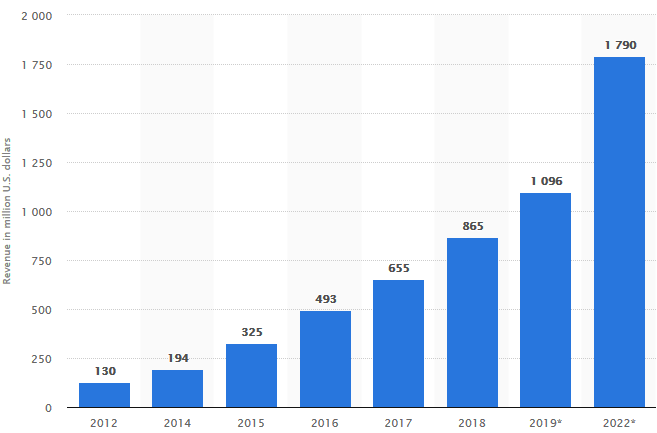
In 2018 the eSports global revenue forecast was ~$865 million (another report has this at $905m as the actual result), and is forecast to pass US$1b in revenue in 2019. By 2022 the global eSports market revenue is forecast to reach US$1.79 billion. This represents a CAGR of 22.3%. Another report has the CAGR from 2016-2021 at 27.4%. North America generates ~38% of the revenue, with China another main player with ~18% of revenues.
eSports global revenue is forecast to grow at a CAGR of 22.3%
eSports competitions
In recent years eSport competitions have become very popular. Some examples are League of Legends, Dota 2, Player Unknown’s Battlegrounds (PUBG), StarCraft, WarCraft, Hearthstone, Overwatch, and Fortnite. King of Glory (Arena of Valor outside of China) is another. Players compete online for huge price pools.
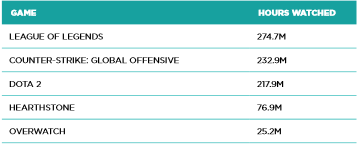
Top 5 eSports games (by eSport hours) watched on Twitch in 2017
Note: Twitch.tv is the leading US live streaming video platform and a subsidiary of Amazon (AMZN).
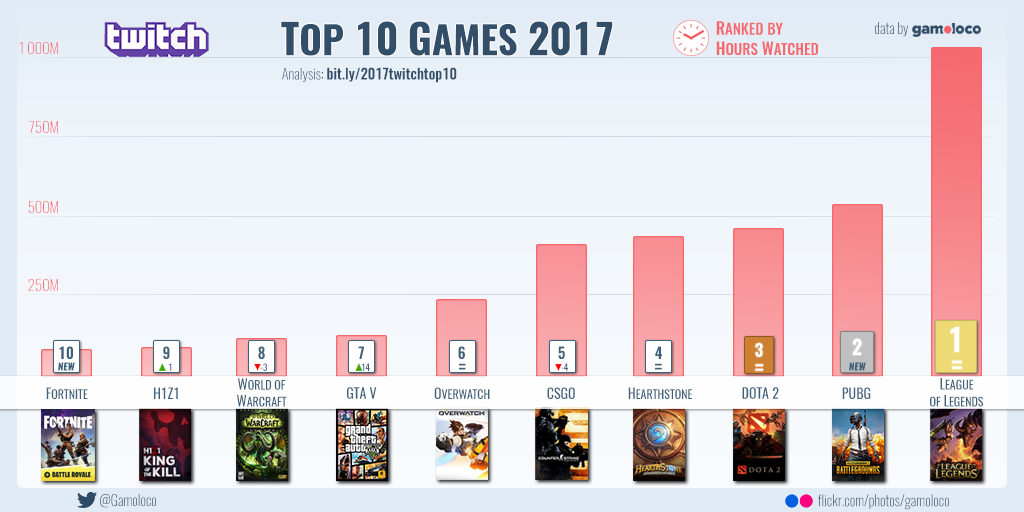
As shown below League of Legends was by far the most popular eSports title in 2017; however others such as PlayerUnknown’s Battlegrounds (PUBG) and DOTA 2 are also doing very well more recently. A common theme with the most popular eSports is battles.
Top ten games as of 2017
The eSports ecosystem
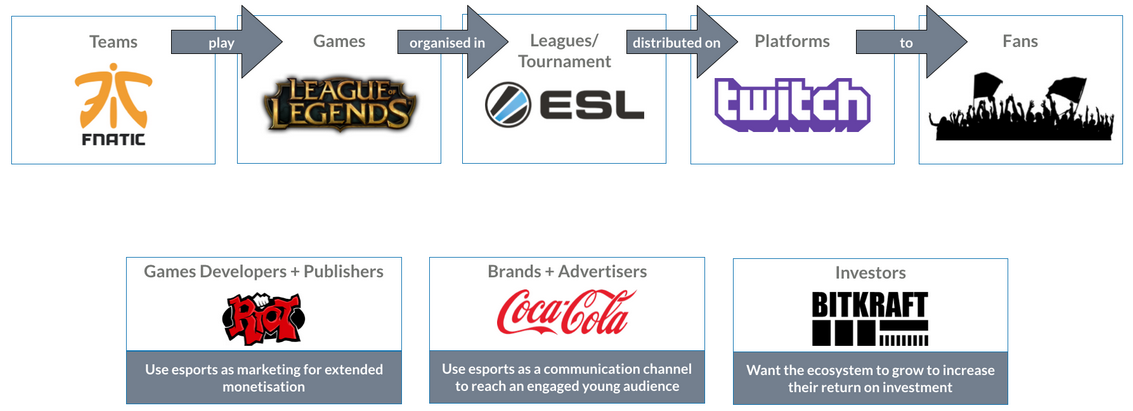
At its core the eSports ecosystem involves the game makers (often also the publishers). They typically make and publish the games. Often they then do the event organization and sell media streaming rights. In other cases they license their games out to external league organizers and streaming platforms. The streaming platforms then make money mostly from advertising. Meanwhile the teams make money from sponsorships.
A simplified view of the eSports ecosystem

How eSports companies make money
Most eSports companies make money via some form of advertising to their audience. eSports companies will typically do some or all of the following to create revenue:
- Sponsorship – Teams attract large sponsorships. Players are usually professional. For example the New York Yankees, Houston Rockets, Robert Kraft, and Magic Johnson have bought teams and/or sponsorships.
- Advertising sales. Done by the teams, the event organizers and the streaming companies.
- Media rights – The event organizers sell TV or streaming broadcast rights to streaming companies such as Twitch, DouYu, Huya, and YouTube Gaming.
- Game publisher fees – The game makers make money from selling publishing fees or rights to use their games to event organizers etc.
- Merchandise and Ticket sales.
2018 global eSports revenue by segment with 2018 growth rates
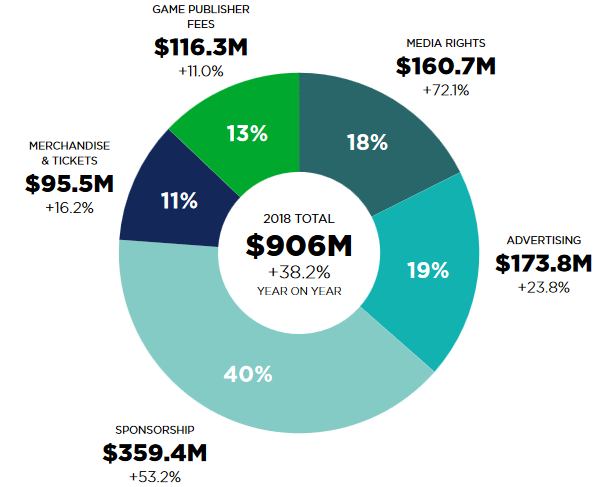
Note: Of the above media rights (streaming) and sponsorship fees are forecast to grow the fastest.
For now eSports is dominated by battle style games; however it is not hard to imagine a popular eSports car racing event that would feature teams from say Volkswagen, Audi, Porsche and so on being sponsored by the car companies. The same can then be said across most industries (sports teams, corporations etc), hence the revenue growth potential is very large.
An example of an eSports competitor and stadium event


eSports audience
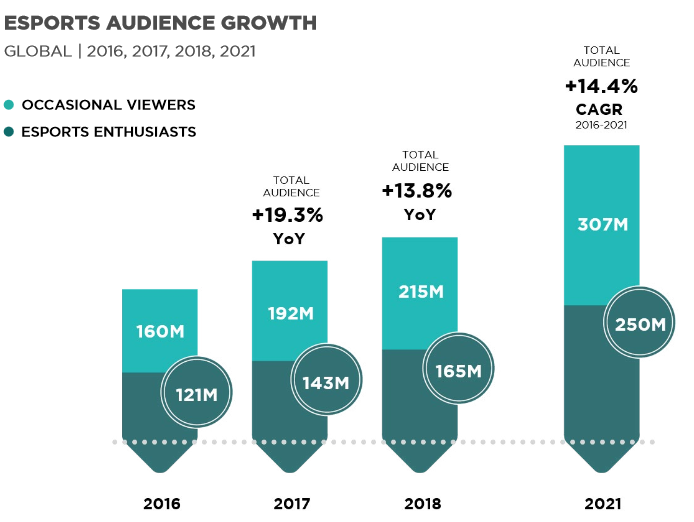
As shown below, eSports audience is also growing rapidly and is forecast to reach 600m by 2020. The chart below has a more conservative a forecast, but shows the rising trend. More audience equates to greater advertising potential.
ESports audience growth and growth forecast to 2021
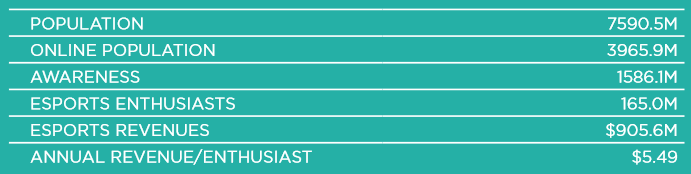
2018 eSports data
An introductory look at the main companies in the eSports industry
The game makers/publishers
Activision Blizzard (ATVI)
Activision Blizzard own the popular Overwatch League as well as World of Warcraft, StarCraft, Diablo, and Hearthstone. Activision Blizzard currently includes five business units: Activision Publishing, Blizzard Entertainment, King, Major League Gaming, and Activision Blizzard Studios. In 2018 Activision Blizzard signed a multiyear deal with Walt Disney to broadcast the Overwatch League. As of March 2018, it is the largest game company in the Americas and Europe in terms of revenue and market capitalization.
Electronic Arts (EA)
Electronic Arts is an American video game company headquartered in California. It is the second-largest gaming company in the Americas and Europe by revenue and market capitalization after Activision Blizzard and ahead of Take-Two Interactive and Ubisoft as of March 2018
Take-Two Interactive Software, Inc. (TTWO)
Take-Two Interactive is an American video game holding company based in New York City. The company owns two major publishing labels, Rockstar Games, and 2K, itself composed of two divisions: 2K Games and 2K Sports, all of which own and operate various game development studios.
Tencent (OTCPK:TCEHY)
Tencent acquired Riot Games and now owns the very popular League of Legends game. Tencent also own King of Glory. Tencent is also the leader in eSports game streaming as you can read below.
Others game making/publishing companies include:
- Bethseda Softworks (private), Gameloft (OTCPK:GLOFY), Netease (NTES), Microsoft (MSFT) (Nintendo), Sony Corporation (SNE) (Playstation), Sega (OTCPK:SGAMY), Ubisoft (OTCPK:UBSFY), and Valve Corporation (private).
The streaming companies
The streaming companies make good money mostly from advertising. China is the world’s largest game streaming market, with approximately 4.9 times the monthly active users of the U.S. market in 2018.
Amazon (AMZN)
The online streaming market in the USA is led by Amazon’s Twitch. Still only a small percentage of Amazon’s massive revenue, but a dominant palyer in the eSports streaming market.
Tencent (eGame, and Tencent backed DouYu)
Tencent dominates the eSports streaming industry in China. Tencent has their own eGame, and are about to IPO DouYu in the USA.
DouYu (DOYU) primarily focuses on the live-streaming of games. DouYu was the largest game-streaming platform by average total MAUs on both mobile and PC. DouYu had 159.2 MAUs in the Q1 2019, representing YoY growth of 25.7%. DouYu’s revenues come from live-streaming through the sale of virtual gifts, accounting for 86.1% of its revenues, with the rest coming from advertising. DouYu is still loss-making and reported a net loss of $127.4 million in 2018, up from $91.33 million in 2017. Revenues jumped 93% to $531.5 million last year. You can read more here.
Huya (HUYA) – spin off from YY Inc.
Huya is known as the “Twitch of China”. Huya mostly works off a gift model. Streamers can receive virtual gifts from their audiences, purchased from Huya. The company then shares a portion of revenue from these gifts with broadcasters and associated talent agencies. The sale of these gifts accounted for roughly 95% of the company’s sales last year, with the remainder coming from advertising.
Alphabet Google (GOOG) (GOOGL)
Alphabet Google’s YouTube Gaming make money via subscription and advertising.
Note: Facebook (FB), Twitter (TWTR), Microsoft (MSFT) Mixer are also into eSports streaming. Alibaba and Baidu are also moving further into streaming and gaming. Smashcast.tv is another well known name in the eSports streaming industry.
The team owners
Team owners are often made up of gaming communities, celebrities or other groups, and are usually not listed companies. For example, aXiomatic (private) owns the number one team “Team Liquid” that has earned over US$24 million in prize money. The number two company Evil Geniuses is a subsidiary of GoodGame Agency, owned by Amazon’s Twitch division.
You can read here about the Top 10 eSports teams, earnings, and salaries.
Some smaller listed eSports and gaming companies
- Axion Ventures Inc. (TSXV: AXV | OTCQX: AXNVF)
- Backstageplay Inc. (TSXV: BP)
- Bragg Gaming Group Inc. (TSXV: BRAG)
- Contagious Gaming Inc. (TSXV: CNS)
- Enthusiast Gaming Holdings Inc. (TSXV: EGLX | OTCQB: EGHIF)
- ePlay Digital Inc. (CSE: EPY)
- Fandom Sports Media Corp. (CSE: FDM)
- Global Gaming Technologies Corp. (CSE: BLOC.U)
- Kuuhubb Inc. (TSX: KUU)
- Mad Catz Interactive Inc. (TSX: MCZ)
- Millennial Esports Corp. (TSXV: GAME | OTCQB: MLLLF)
- The Stars Group Inc. (TSX: TSGI | NASDAQ: TSG)
- Versus Systems Inc. (CSE: VS | OTCQB:VRSSF)
- Victory Square Technologies Inc. (CSE: VST | OTCQX: VSQTF)
Further reading
- Free 2018 global eSports market report
- Esports is on the rise!
- An Introduction to the Esports Ecosystem
- The World’s Most Valuable Esports Companies (most are private, such as number 1 Cloud9)
Risks
- eSports may not continue to grow, as the industry is still in the early stages. Seems very unlikely.
- Competition can be fierce, and costs can run high. The failure of China’s leading streaming company Panda TV highlights this.
- Many companies are private or owned by very large conglomerates such as Tencent.
- Technology change or disruption can occur. For example apps can be a potential threat.
- Government legislation changes or bans as we saw in China recently with some games.
Conclusions
eSports is still at a relatively early stage of growth and is small in comparison to the overall gaming sector. For example, in 2017 eSports revenue was US$696m compared to gaming at US$4,547m, making gaming 6.5x more revenue than eSports. The point is that eSports still has enormous growth potential ahead, and every chance to follow it’s gaming older brother.
As eSports evolves it appears to me most likely that the advertising and streaming platforms (Amazon Twitch, Tencent’s DouYu, Huya, and Alphabet Google YouTube Gaming) will make the most money, as occurred in social media. The most popular game makers such as Activision Blizzard, Electronic Arts, Take-Two Interactive Software, and Tencent should also do well; however competition is fierce. Sponsorship revenues will tend to be via private businesses/teams and harder for most investors to participate in. Those companies that have arenas and multiple teams in multiple leagues should also do well.
When rising complexity pushes corporate hierarchies to their limits, the only meaningful response is a paradigm shift, argues business thinker Frédéric Laloux.
Author of the best-selling book “Reinventing Organizations” Laloux advocates a people-centric approach with radically streamlined structures that facilitate active involvement and self-management.
Laloux’s book considered by many to be the most influential management book of this decade. It has inspired hundreds, probably thousands, of organizations throughout the world to take a radical leap and adopt a whole different set of management principles and practices.
But how does it really work?
Here he explains why the future belongs to self-managing organisations, and describes what he means by ‘wholeness’ and ‘evolutionary purpose’ – and why they represent important breakthroughs:
The way we manage organisations seems increasingly out of date. Survey after survey shows that the vast majority of employees are disengaged at work, while organisational leaders complain that their organisations are too slow, siloed and bureaucratic for today’s world.
In this excerpt Laloux discusses the historical evolution of management thinking, and shares how extraordinary pioneering organisations in very different sectors are already operating from the next stage of management:
Reinventing Organizations tried to answer the question: is it possible to run organizations in a whole new way? I now know the answer to be an emphatic “Yes!”
Since then, a new question emerged: So how do we do it? How do we reinvent an existing organization in such fundamental ways?
Here is a collation of graphic interpretations of Reinventing Organisations seeking to capture the key ideas of the “Teal” organisation, self managing with an evolutionary purpose, described by Laloux:

This becomes more structured as an evolutionary journey, or maybe that should be revolutionary. Most organisations are still stuck in their orange phase or perhaps into the green phase, rather than seeking the opportunities of teal:

These then take the form of diagram used in the book with examples of organisations at each different phase. Examples of teal organisations include Patagonia, Morning Star and Buurtzorg:

Describing the differences between each type in more detail

This map brings together many of the ideas in Reinventing Organisations and overlays 20 attributes/practices discussed in the book on top of Wilber’s four quadrants and demonstrates how they manifest differently in each type of organization (colour).

In summary
- Modern organisations have brought about sensational progress for humanity in less than two centuries―the blink of an eye in the overall timeline of our species. None of the recent advances in human history would have been possible without organisations as vehicles for human collaboration.
- And yet, many people sense that the current way we run organisations has been stretched to its limits. We are increasingly disillusioned by organizational life. For people who toil away at the bottom of the pyramids, surveys consistently report that work is more often than not dread and drudgery, not passion or purpose. That the Dilbert cartoons could become cultural icons says much about the extent to which organisations can make work miserable and pointless.
- Life at the top of the pyramids isn’t much more fulfilling. Behind the façade and the bravado, the lives of powerful corporate leaders are ones of quiet suffering too. Their frantic activity is often a poor cover up for a deep inner sense of emptiness. The power games, the politics, and the infighting end up taking their toll on everybody. At both the top and bottom, organisations are playing fields for unfulfilling pursuits of our egos, inhospitable to the deeper yearnings of our souls
- Could it be that our current worldview limits the way we think about organisations?
- Could we invent a more powerful, more soulful, more meaningful way to work together, if only we change our belief system?
- What do organizations moulded around the next stage of consciousness look and feel like?
- Is it already possible to describe their structures, practices, processes, and cultures (in other words, to conceptualize the organizational model) in useful detail, to help other people set up similar organizations?
- Can we create organizations free of the pathologies that show up all too often in the workplace? Free of politics, bureaucracy, and infighting; free of stress and burnout; free of resignation, resentment, and apathy; free of the posturing at the top and the drudgery at the bottom?
- Is it possible to reinvent organizations, to devise a new model that makes work productive, fulfilling, and meaningful?
- Can we create soulful workplaces―schools, hospitals, businesses, and nonprofits―where our talents can blossom and our callings can be honored?
And here you can download the entire book:
- Download “Reinventing Organisations” text version
- Download “Reinventing Organisations” graphic version
- Watch the 150 “Insights for the Journey” videos
I’m in Turkey this week.
- Download: Leading Change in a Disruptive World
- Download: Creating Innovative Futures
- Download: Business Innovation Workshop
The Turkish economy is struggling badly. Geopolitical uncertainty, trade wars and sanctions, exchange rates, lost confidence and courage. It’s time for Turkish businesses to reawaken their passion and ingenuity. Having worked with the local businesses like Eczacibasi, Koc and Sabanci, Pinar and Yildiz, Garanti and Akbank, I understand the Turkish love of ideas and innovation.
Sometimes the ideas get lost at the commercialisation stage, lacking the most appropriate business model. Sometimes it’s an obsession with technologies, but little real insight into consumers. Sometimes it’s not being able to adapt and embrace the latest technologies fast enough. Sometimes it’s a love to be a leader within the local market, but less interest in international growth. But at the same time there is an immense desire to do better, to make things happen, to drive progress.
First stop today is Bursa, the ancient capital of the Ottoman Empire.
Turkey’s 4th largest city is also home to its largest industry, textile manufacturing. Whilst traditional players have struggled due to relatively high costs that don’t match consumer’s demand for low price fast fashion, others have realised they need to think differently. Take ISKO, the premium denim ingredient brand from Sanko Group, or Aster Textile which I have been working with to help reimagine itself as a design house focused on premium, sustainable fashion.
The TechXtile Start-Up Challenge seeks to catalyse a new generation of Turkish textile innovators, not to produce average fabrics at low prices, but rethinking how to compete in a changing world. This might be in terms of new fabrics – from organic pineapple or mushroom-derived materials, through to smart and digitally-embedded garments. It might equally about building your own brands and selling directly online, rather than using the old distribution paths through high street retailers.
Around the world, from London to Shenzhen, Singapore to Istanbul, start-up ecosystems are thriving, a $3 trillion economy.

Later I was in Istanbul, in the business metropolis of Maslak.
FarkLabs is a creative ventures business of a long-established automotive parts business, Farplus. Whilst the auto market is about to undergo a radical reinvention (electric, autonomous, multi-modal, subscription-based, mobility), FarkLabs brings together the best talent, ideas, investment and innovations for the future. Led by Ahu Serter, they are searching the edge for the best and next business concepts, with a passion to bring together business models and new tech to make the world a better place.
It was a real privilege therefore to be able to deliver a fantastic evening masterclass “Leading Change in a Disruptive World” hosted by Fark Labs, packed out with over 200 of Istanbul’s most digital movers and entrepreneurial shakers. We explored how challenge becomes opportunity in a changing world, fusing digital and physical, tech and humanity, profit and purpose. We explored what the world’s most radical innovators, right now, actually do. We focused on getting started from the future back, the outside in, and with a growth mindset. And we defined “7 leadership codes” to lead the future better.
Ahu Serter was a recent participant in IE Business School’s Global Advanced Management Program, which is the school’s flagship exec development program. As its academic director my vision is to help business leaders to step up to a new world of radical change and incredible opportunity, and to transform their futures, personal and organisational,in ways that had not even imagined. Ahu is clearly well on the way to transforming her world, and hopefully we can help many others to do so too.

Here is a summary of some of my Q&A with Turkish media:
- What are your assessments and predictions for the future of the Turkish economy?
Overall growth in Turkish economy will continue to be slow, and I would expect it to be around 1 to 1.5% in 2020, compared to average global economic growth of around 3%. Economic and political tensions will continue to bring uncertainty, whilst exchange rates and trading confidence will continue to be challenges. However we should always remember that these are averages. There will be some sectors, and in particular individual companies, who will do far better than this, and others worse.
Whilst we live in a volatile and uncertain world, it is also a world of rapid and relentless change, unlocking new markets and opportunities. If we look at the macro nature of economic cycles, what are known as Kondratieff waves, we see that there is a recurring cycle of growth and stagnation.
What is interesting is that innovation follows in an opposing cycle, in that times of stagnation or decline, are the times of greatest innovation. Crisis, downturns and slowdowns, are when markets are shaken up, and when creativity comes to the fore. Now is the time to rethink your business, rethink how your business works, and to rebuild for the future.
- Would you share your observations about Turkish companies, in what topic are they making more mistakes, and what advice would you like to give them?
The challenge as always is to think big and small – to explore the global opportunities beyond Turkey, whilst also being able to look to the best opportunities in local markets. I have worked with many Turkish companies over the last 15 years or so – from multinationals like Koc and Sabanci to Eczacibasi and Turkcell, Akbank and Garanti, Pinar and Ulker.
What I see is great creativity, but also a sense of myopia. A great company like Koc is struggling to reinvent itself in the digital age, as it knows it must. Whilst Ulker has made ambitious strides to become a global player through acquisitions and diversification.
Companies need to think beyond their home market, beyond their core products, beyond their existing business models, beyond their old capabilities, beyond seeking to survive for today.
- What kind of strategies should be followed by companies that want to be innovative?
Strategy used to an evolutionary process, seeking to stretch and sustain the success of the past. Today it is a revolutionary process. Start from the future back, rather than trying to tweak today. See how your industry, your customers, your competitors are changing – both at home and around the world. Learn from other sectors, rather than just imitating the competition. Most importantly, see the future, and shape it, in your own vision rather than others.
Companies like Aster Textile have done this incredibly well. As a textile company they looked beyond fabrics, to see a rapidly changing fashion marketplace, with millennial behaviour and social influencers, the rapid decline of traditional high street retailer and slow business models. They said how can we be part of this new world, and were open to change anything and everything.
- What are your suggestions for advertising, promotion and marketing?
The most important thing is to start with the real customer – not an intermediary brand or distributor – but the consumer. We should be obsessed with how people are behaving, dreaming and changing. What are the trends in the market? How are fashions changing, and what is driving that? What are the ideas in other geographies, other sectors, other segments, that are catching on? What’s happening in the margins not the mainstream. Then work with partners, such as designers or retailers, in order to respond to this changing audience.
However we know that every aspect of marketing has changing.
Advertising no longer works, it is interrupted and average. Instead people turn to their friends, and other influencers, including the social superstars. They want newness and difference, they want to be individual. The mobile phone is the starting point to any transaction, and indeed the old idea of high street buying is disrupted by subscription models, freemium models, community models, and much more. Birchbox to Boohoo. Stitchfix to Threadless are great examples.
- What should companies do in the times of economic crisis, what to do and what to stay away from?
Economic crisis is the time to survive – and thrive. It’s the time to ensure you have sufficient cashflows to keep going, by staying lean and focused. But it’s also the time to experiment and innovate. If its bad for you, its usually also bad for your customers, so they are looking for alternatives, and ways to keep living but in new ways.
Most great innovators were born out of economic crisis. The current crop of creative “hero” brands like Airbnb, Uber, Netflix, and many more, were born out of the economic downturns of 2000-2 or 2008-10. They offered an alternative to the old ways. Sharing models, platform models, personalisation models, subscription models, emerged out of the need to do things differently, and for consumers desire to live better, but in new ways.
- What will be the benefits of TechXtile Challange to the Turkish textile sector in the long run?
Challengers need to look beyond the product. They need to think differently about how textile businesses will succeed in the future.
To me, too many textile business are still product centric. The danger is that you end up competing in price driven markets, trying to sell innovative products to existing brands and retail channels who themselves are in decline. Regardless of your innovation, will most likely be forced to reduce prices, as if you were a price-driven commodity, as the brand or retailer’s own business struggles.
The value added of your creativity is lost. Instead you need to look beyond today, beyond the conventional industry models to see the future.
In a world of fast fashion but also environmental concerns, mobile channels and influencer trends, you need to think different about your whole business. Look to Bolt Threads. Look to Eileen Fisher. Look to Depop. Look to Rapha. Look to Zozo in Japan. See what they do. Take the best bits, combine them, and do them better.
The most innovative businesses see the world differently.
They don’t just seek to imitate the success of others, to compete in the markets of today, to frame themselves by their relative differences to competitors. Instead they play their own game.
I call them “gamechangers”, and here in Dubai, I will be previewing the World Expo 2020, and taking inspirations from companies all around the world who are shaking up markets, embracing radical new ideas, and changing the game.
So what’s the “game”? Well, in simple terms, it’s the market.
These companies go beyond innovating their products and services, their customer experienes and business models. They seek to innovate how their markets work.
Think of it like a sports game. How could you change the game? It could be anything from the pitch dimensions to rules of play, the team composition to the measures of success, the role of the referee to the participation of fans. Even the name of the game.
Now look at today’s most disruptive innovators – 23andMe to Alibaba, Zespri to Zidisha – they reframe, reimagine and redefine the market on their terms – who is it for, why people buy, what they pay and get, and how they work.
I’ve met and profiled over 250 “gamechanger” companies on my travels, in almost every sector, and in every part of the world. Corporate giants and start-ups, from Dubai to Berlin, Colombo to Qingdao.
There is no one way to change the game, but there are definitely some common traits:
- Audacious – Gamechangers are visionary and innovative, but also daring and original; they seek to shape the future to their advantage.
- Purposeful – They seek to make life better, in some relevant and inspiring way; they have a higher motive than just making money.
- Networked – Gamechangers harness the power of networks, digital and physical, both business and customer networks, to exponentially reach further faster.
- Intelligent – They use big data analytics and algorithms, machine learning and AI, to be smart and efficient, personal and predictive.
- Collaborative – Gamechangers work with others, from ecosystems to platforms, social networks and co-creation, to achieve more together.
- Enabling – They focus not on what they do, but what they enable people to do; and thereby redefine their marketspace, find new opportunities and redefine value.
- Commercial – Gamechangers take a longer-term perspective, adopting new business models, and recalibrating the measures of progress and success.
Do you have a future mindset?
Today’s business leaders need a future mindset. That sounds obvious, but isn’t.
Most leaders have a “fixed mindset”. They keep stretching the old models of success. They stay loyal to the model that made them great, seeking to squeeze and tweak it for as long as possible. They seek perfection – to optimise what they currently do – which leads to efficiency and incremental gains.
Instead a “future mindset” is prepared to let go of the past. To explore the future, to experiment with new ways of working and winning. Failure is a way to learn, and innovation becomes the norm. Change is relentless inside, as it is outside. Innovation is their lifeblood. Like Jeff Bezos loves to say “it is always day one”.

With a future mindset, the CEO needs new attributes:
- Sense maker – to interpret a fast and confusing world, to see new patterns and opportunities, what is relevant and not, to shape your own vision.
- Radical optimist – to inspire people with a stretching ambition, positive and distinctive, to be audacious, to see the possibilities when others only see risk.
- Future hacker – they start from the “future back”, with clarity of purpose and intent, encouraging ideas and experiments, leveraging resource and scale.
- Ideas connector – da Vinci said innovation is about making unusual connections; connecting new people, new partners, new capabilities and new ideas.
- Emotionally agile – whilst organisational agility is essential, emotional agility matters even more; to cope with change, to be intuitive in making sense, and making choices.
- Entrepreneur at large – keeping the founders mentality alive, hands-on working with project teams to infuse the mindset, to be the catalyst and coach.
- Having grit – “gamechanger” leaders need to go against the grain, to persist but know when to move on, to have self belief and confidence, guts and resilience.
The future is a better place to start
Start from the “future back”.
Trying to evolve in today’s complex and confused world is unlikely to lead you towards a bright and distinctive future. It will extend your life a little longer, but it will be tough and uninspiring, with diminishing returns.

Instead jump to the future. I tend to start with five years ahead, although it may differ by company. 5 years is long enough to change the world, but close enough to be real. Start by creating a positive, collective and inspiring vision of the future market. What will it be like? What will people want? Why? How? Where? Then consider how to win in this new world.
This is where “moonshot thinking” can be really useful. “Why be 10% better, when you could be 10 times better?” 10 times more profits, more customers, more quality, reduced cost, reduced time. Whatever. By giving yourself a “How could we do it 10x better” challenge you take a new perspective, solve problems in different ways.
Be inspired by ideas from other places.
Explore how ARM or GE, Inditex or Netflix, Glossier or Novo Nordisk have changed their markets. Choose any of my 100+ “gamechanger” companies! How did they do it? How did customers respond? (Remember, they often serve the same customers as you!). You can’t learn much from competitors, but you can learn a lot from relevant parallels.
Copy. Adapt. Paste.
Customer insight also matters. Deep dives and design thinking, exploring the emerging trends and deviant behaviours. This can enhance and validate your ideas, but the problem with most customer insight is that it is filtered by our current world. You need something to disrupt your thinking.
I have a great box of disruptive techniques. Some are really simple – like break then remake the rules, like imagine its free then find a way to make money, like reverse polarities and many more. The point is to disrupt your conventional thinking.
From this, ideas rapidly emerge. You need lots of ideas about the future. But these are fragments of the real answer. The real creativity comes in fusing together into bigger “concepts”. These could be customer solutions, or new ways of working, new revenue streams, or new business models, and new market scenarios.
Once you have a clear and collective ambition for the future, it’s time to work backwards. “If this is how we want to be in 5 years, where do we need to get to in 3 years, and then in 1 year? Therefore what do we need to start doing now?” You develop a “horizon plan” for your business; a strategy roadmap if you like, but developed backwards.
The important thing is that by working backwards, you have jumped out of the morass of today. You’ve avoided the assumptions, limitations, problems and priorities of today’s thinking. You have a more inspiring “gamechanging” future, and have started to map out the steps to get there. Most likely with different priorities in the short-term too.
Of course the steps on this journey might change, but it’s going to be an exciting adventure.
Change the way we think, resolve the conflicts
In today’s busineses, we have created artificial divides in how we think and operate. Digital and physical seem like two different worlds, global and local seem like alternative strategies that cannot combine, many still struggle to align value to customers and shareholders in a mutually reinforcing way, and short and long-termism continues to confuse our priorities.
Our thinking within business, has created separate and apparently conflicting approaches. The opportunity is to make the combination of both approaches world – “fusions” if you like – to be innovative in the way you combine apparent opposites.
Digital and physical are two sides of the same coin.
There is only one world, unless you believe Ray Kurzweil, and it is the real one. It’s human and physical. Digital technologies are incredibly powerful, enabling people to connect, to work, to learn, to play in new ways. From mobile phones to blockchains, 3D printing and augmented reality, digital allows us to do more, do it faster, do things we could never do before. But it’s still about humanity.
Start with people. How can you enable them to achieve more? To live better, to have more fun, to do better for the world. Whatever matters. I work closely with Richard Branson and his Virgin teams. Their mindset is to “start from the outside, and then work in”. Design a better customer experience. Built on your ambition and insight, and then explore how you could deliver it with new and existing capabilities.
Global and local are opportunities for every business.
I love Amazon’s “Treasure Truck” … Most of us have never connected with Amazon beyond the website and the delivery guy. Amazon is huge, global and anonymous. But the Treasure Truck is real. It travels around the country, bringing its pop-up store to local neighbourhoods, fun and games, bargains and demos. For Amazon, it’s a chance to make real connections, listen to people, and to be local.
We can all see a backlash in society against relentless globalisation, huge corporations, and social inequality. We see a lack of trust in brands, and know that authenticity matters. Etsy shows us that even the smallest and most local artisan businesses can also be global. For every business, local and global markets are within reach, however it’s also about combining scale and standardisation, with relevance and individuality.
Ideas and networks should be the core of your business.
Gamechanger businesses need a compelling idea, a core purpose, an inspiring proposition, that can spread fast and contagiously. In a digitally-fuelled world, the most innovative businesses embrace “ideas and networks” to drive exponential impact – like WhatsApp creating $19bn in three years, Airbnb $40bn in 9 years, Alibaba $476bn in 18 years, Amazon $740bn in 23 years.
Think about that concept of “exponential” … The power of networks – be it franchisees, or distributors, or customers and users – lies not in the number of members, but in the connections between them. Networks have a multiplying effect. Exponential. Consider, for example, Rapha, the sportwear brand that brings together people with a passion for cycling, who conveniently meet at their “Cycle Club” stores, and buy their premium gear. A fantastic “ideas and networks” business.
Finally this idea of short-term and long-term being in conflict with each other.
Jeff Bezos never has this problem, nor Elon Musk, nor Richard Branson. They focus on the long-term, recognising it will require some years of investment to get there. They all of course lead privately-owned companies. But every public company has the same ambition to innovate and grow. And so do most of their investors, actually.
The reality is that any company’s stock market performance is based on its future earnings potential, not its past. The better you can engage with equity analysts, journalists and investors themselves to explain why you will deliver a better future worth waiting for, then you get their support. If you don’t engage them in your future vision, plans and innovations, then they will default to looking for short-term evidence. It’s really in our hands, to work together to create a future we want to invest in. And to share the greater risk and rewards.

Time to embrace your future mindset
We live in an incredible time … More change in the next 10 years than in the last 250 years … remember? I know that sounds a little crazy, but think about Hyperloop in 3 years, a tipping point to electric cars in 5 years, Mars missions in 8 years. They are all real, and possible.
Digital platforms connecting buyers and sellers in new ways, blockchain having the potential to transform relationships and trust, 3d printing having the potential to transform value chains to deliver anything personalised and on-demand, AI and robotics giving us the capabilities to be superhuman in our minds and bodies.
These are just some of the fantastic new capabilities that enable us to innovate beyond what we can even imagine today. The future isn’t like the future used to be. We cannot just evolve or extrapolate the past. Today’s future is discontinuous, disruptive, different.
It is imagination that will move us forwards … unlocking the technological possibilities, applying them to real problems and opportunities, to drive innovation and growth in every industry, in every part of our lives.
Imagine a world where you press “print” to get the dress of your dreams, the food of your fantasies, or the spare parts for your car. Instantly, personalised and on demand. Think then what does that mean if we don’t need the huge scale of manufacturing plants, warehousing and transportation. Maybe we will even subscribe to the IP catalogues of brands, rather than buy standard products, in the ways we currently subscribe to Netflix.
Time to embrace your growth mindset … Unlock your Einstein dreams and Picasso passion … Embrace your Mandela courage and Ghandi spirit. Be more curious, be more intuitive, be more human. Ask more questions. Don’t be afraid to have audacious ideas, to challenge the old models of success, and turn future ambitions into practical profitable reality.
How else did Zespri reinvent the Chinese gooseberry as the kiwi fruit? How else will SpaceX reach Mars by 2025? How else did Netflix came to be, or NuTonomy, or Nespresso, or Nyx?
This is why 23andMe’s Anne Wojicki wont give up in her quest to make DNA analysis available to everyone, and to ultimately find a cure for cancer. And it’s why Jack Ma didn’t give up as he rose from $1000-per year English teacher to technological royalty.
The secret is the future mindset.
To realise that the future is malleable. So we need to grab hold of it, and shape it in our own vision. To our advantage.
This is what “gamechangers” do.
More ideas from Peter Fisk …
- Article: Leading the future: The 10x Leader
- Article: Leading the future: Amplifying Potential
- Article: Leading the future: Are you the Einstein or Picasso of Business?
- Article: Leading the future: How to innovate like Leonardo da Vinci
- Blog: Leaders and Loonshots: What are the best new ideas in business?
- Blog: The Age of AI: Smart robots, conscious computers and the future of humanity
- Blog: 17 Lessons from Asian Business: Learning from China, India, Singapore and beyond
- Blog: Do you believe in unicorns? The $1 billion starts have become giants across the world
- Book: “Gamechangers: Are you ready to change the world?“
- Book: “Customer Genius: Becoming a customer centric business“
- Book: “Business Genius: A more inspired approach to strategy and leadership”
- Book: “People Planet Profit: How to embrace sustainability for innovation and growth“
- Keynote: Business Recoded
- Keynote: Leading Change in a Disruptive World
- Keynote: Man and Machine
- Keynote: Business Lessons from Asian Innovators
- Masterclass: Strategic Innovation
- Masterclass: Game Changing Strategies
- Masterclass: Disrupt or be Disrupted
- Masterclass: Hacking Exponential Growth
In the past decade, Spain suffered a significant economic setback with a crippling recession, the bankruptcy of a number of major companies and the highest unemployment rate in the EU (27% at its height). But this didn’t get the Spanish population down, instead, it fueled the birth of one of Europe’s most innovative entrepreneurial climates.
Thankfully, Spain’s economy has now returned to its pre-crisis state and this can be partially attributed to the growth of its vibrant tech scene. In 2018 alone Spanish startups received a record-breaking €1.3 billion in investments. Entrepreneurial hotspots like Barcelona and Madrid are becoming the places to start and scale your business in Europe.
Gik is one example of thinking differently, turning wine blue:
Here are some of the most disruptive and exciting start-ups:
CornerJob
There are a ton of websites where you can find internships, graduate schemes or even executive positions. However, the blue-collar labor sector is often overlooked on these platforms, becoming a bottleneck in the usually fast-hiring market. This is where Cornerjob comes in. It’s a simple application where candidates can register in less than a minute, apply for a job in less than one click and, once the employer has selected them, they can interact through the platform. The application has been a hit, raising over €50 million in less than four years. It now boasts 11 million app downloads and more than 300.000 companies using the platform as their main source for hiring. Cornerjob also gets rid of all hassle for companies, from job post to payslip and fully handles on-demand temp staffing needs.
Glovo
Glovo is a delivery app similar to Deliveroo and UberEATS, except, instead of just food, they can deliver anything that fits in their delivery box. You can order anything within your city; from breakfast, lunch or dinner to medicine from the pharmacy, groceries, or even a package from the post office. The company has seen immense growth in the last three years. Last year alone it launched in one new city every four days bringing it now to a total of 91 cities across 21 countries in EMEA and Latin America. Since its founding in 2015, Glovo App has raised over €148.8 million and is looking to use this new funding to hire 300 new tech engineers from top companies like Uber and Amazon.
TravelPerk
If you take a lot of business trips, or manage them at your company, TravelPerk might just become your new favorite tool. They’re revolutionizing the way organizations budget, book and manage business travel. And what’s even better: they do so for both admins and travelers alike. Users can book flights, trains or hotels directly through their platform, utilizing the world’s largest inventory (with integrations to Booking.com, Expedia, Skyscanner, etc). Meanwhile, travelers can also log in to TravelPerk to view all of their bookings, upcoming itineraries, and reports. Business travelers should be focused on nailing that overseas presentation or making new international partnerships, not about worrying how they’ll get there. TravelPerk offers a simple and powerful tool to help frequent travelers do just that.
Spotahome
With our world becoming more accessible than ever, more people are taking the opportunity to move to a new city, country or even continent. Spotahome is a classic proptech (property technology) company that allows landlords and homeowners to easily list their properties on its user-friendly interface. Rather than facing the stress of landing in a foreign city and spending weeks looking for a home, international renters can take virtual tours of properties, sign contracts and pay their landlords before even leaving their home country. Spotahome now has over 60,000 properties listed across 33 European cities, making it easy to find your next home away from home. In the last two years, they’ve secured €54 million in funding and grew to almost €100 million in GMV.
Worldcoo
The founders of Worldcoo saw the growth and potential of e-commerce as a sales channel and decided to use this trend to help the world fund its social and cooperation projects. They came up with a smart widget that websites can link to their “checkout” or “basket” sections. This makes donations to charitable projects as easy as ticking a box. Last year, they also launched a new and revolutionary channel which allows donations at POS (inside pinpads), allowing customers to round up their final bill and donate the extra cents to social causes. its founding, they’ve managed to sign alliances with UNICEF, UNHCR, International Plan and more than 500 other NGOs. The site has already collected over €1 million but they’re not stopping there. Worldcoo’s objective is to raise up to €5 million for social causes in 2019. With an expected year over year growth of 2,000% by the end of March 2019, we’re confident they’ll get there.
Marc Benioff is best known as founder and CEO of Salesforce. However his passion goes beyond technology, with an inspiring vision for the future of business — one in which everyone is empowered to change the world.
Marc Benioff, Salesforce CEO
Benioff, 55 years old and worth $6.5 billion, grew up in the tech metropolis of Silicon Valley. An early internship at Apple focused on programming led to a job at Oracle in customers service, before going on to lead the sales, marketing and product development functions. In 1999 he founded Salesforce and proclaimed “the end of software”.
Salesforce became a pioneer of cloud computing. A Fortune 500 company with more than 45,000 employees, it has been recognized as the most innovative company by Forbes and the #1 best place to work and 15th most admired company in the world by Fortune. Benioff was named Innovator of the Decade by Forbes, ranked #3 on Fortune’s 2017 Businessperson of the Year list, and recognized as one of the world’s 25 greatest leaders by Fortune and one of the best-performing CEOs by Harvard Business Review. He has won numerous awards for his leadership on equality.
He founded Salesforce not only to develop great products, but also to have a positive impact on the world. On day one, he created the 1-1-1 model of philanthropy, of giving 1% of Salesforce’s equity, product, and employees’ time back to communities around the world. Today, more than 8,500 companies have adopted the 1-1-1 model through the Pledge 1% movement.
His new book, Trailblazer
What’s the secret to business growth and innovation and a purpose-driven career in a world that’s becoming more complicated by the day? According to Benioff, the answer is embracing a culture in which your values permeate everything you do.
In his new book Trailblazer, the tech CEO gives readers a rare behind-the-scenes look at the inner workings of one of the world’s most admired companies. He reveals how Salesforce’s core values — trust, customer success, innovation, and equality — and commitment to giving back have become the company’s greatest competitive advantage and the most powerful engine of its success.
No matter what business you’re in, he argues, values are the bedrock of a resilient company culture that inspires all employees, at every level, to do the best work of their lives. Along the way, he shares insights and best practices for anyone who wants to cultivate a company culture positioned to thrive in the face of the inevitable disruption ahead.
None of us in the business world can afford to sit on the sidelines and ignore what’s going on outside the walls of our workplaces. In the future, profits and progress will no longer be sustainable unless they serve the greater good. Trailblazer argues that anyone can become an agent of change.
Here are some great quotes from his new book:
“Here’s the thing about values: You have to use words to identify them, but they won’t create true value for you unless they turn into consistent behaviors.”
“It’s about how to create a culture where doing well is synonymous with doing good in order to thrive in a world where a company is only as strong as the principles it adopts.”
“Companies, and the people who lead them, can no longer afford to separate business objectives from the social issues surrounding them. They can no longer view their mission as a set of binary choices: growing vs. giving back, making a profit vs. promoting the public good, or innovating vs. making the world a better place.”
“Doing well by doing good is no longer just a competitive advantage. It’s becoming a business imperative.”
“Lots of businesses talk about values, but in turbulent times, when they matter most, executives often forget to operationalize them.”
“Just as CEOs can’t look away when social issues clash with their values, employees can’t pretend that whatever its leadership decides to do is above their pay grade. If leadership won’t act on a company’s values, employees at every level need to hold them accountable.”
“Whether you’re starting a business, managing a team, or running an entire company, trusting your instincts can be essential in bringing a vision or idea to life. I now understand that trusting yourself is only half the story. To be effective as a leader, you need a reservoir of trust to draw from. And once you use it all up, it can take years and years to replenish.”
“As I write this, I know there are countless mysteries about the future of business that we’ve yet to unravel. That’s a process that will never end. When it comes to customer success, however, I have achieved absolute clarity on four points. First, technology will never stop evolving. In the years to come, machine learning and artificial intelligence will probably make or break your business. Success will involve using these tools to understand your customers like never before so that you can deliver more intelligent, personalized experiences. The second point is this: We’ve never had a better set of tools to help meet every possible standard of success, whether it’s finding a better way to match investment opportunities with interested clients, or making customers feel thrilled about the experience of renovating their home. The third point is that customer success depends on every stakeholder. By that I mean employees who feel engaged and responsible and are growing their careers in an environment that allows them to do their best work—and this applies to all employees, from the interns to the CEO. The same goes for partners working to design and implement customer solutions, as well as our communities, which provide the schools, hospitals, parks, and other facilities to support us all. The fourth and most important point is this: The gap between what customers really want from businesses and what’s actually possible is vanishing rapidly. And that’s going to change everything. The future isn’t about learning to be better at doing what we already do, it’s about how far we can stretch the boundaries of our imagination. The ability to produce success stories that weren’t possible a few years ago, to help customers thrive in dramatic new ways—that is going to become a driver of growth for any successful company. I believe we’re entering a new age in which customers will increasingly expect miracles from you. If you don’t value putting the customer at the center of everything you do, then you are going to fall behind. Whether you make cars, solar panels, television programs, or anything else, untold opportunities exist. Every company should invest in helping its customers find new destinations, and in blazing new trails to reach them. To do so, we have to resist the urge to make quick, marginal improvements and spend more time listening deeply to what customers really want, even if they’re not fully aware of it yet. In the end, it’s a matter of accepting that your success is inextricably linked to theirs.”
“There’s no way to put a dollar value on values. And yes, there will be times when prioritizing values, especially trust, will come at the expense of profits. In the short term, that is. But the money your company makes in any given quarter will never be more valuable than the trust you stand to lose over time.”
“A genuine culture built on fundamentals like trust and aimed at the goal of business for good is more than enough, but only if it genuinely outweighs the traditional business motives of driving revenue, growth, and profit.”
“Our public schools need people to show up and care more than they need the donations of benefactors. They need people who can contribute professional expertise mentoring students, assisting teachers, or even applying a fresh coat of paint.”
“But let me be clear: What Indiana ultimately showed me is that no one person is in charge of the moral compass of a business. The phone calls and messages from my employees proved that if the leadership won’t act, they’ll have to face the bayonets poking up from below. Gone are the days when companies can recruit and retain top talent without upholding a commitment to values.”
“The great miscalculation of the age is the idea that businesses have to make a choice: to become profitable, or to become platforms for change. This is not the case.”
Here are 10 details from Benioff’s life, according to Entrepreneur Magazine, that begin to paint a picture of the tech billionaire:
1. He cleaned cases at a jewellery store for his first official paying job.
Benioff asked his parents for permission to work at the jewelry store after school so he could save enough money for his first computer, which he bought at Radio Shack. (He was later fired for using the wrong soap on the floors.)
2. He developed games for Atari as a teenager.
Benioff founded his first company, Liberty Software, at age 15 — the same age he sold his first piece of software (“How to Juggle”) for $75. Benioff then sold several 8-bit games for systems including the Atari 800, including Crypt of the Undead, King Arthur’s Heir, The Nightmare and Escape From Vulcan’s Isle.
3. He was a millionaire by age 25.
Benioff spent 13 years working at database software giant Oracle under then-CEO Larry Ellison. He was one of the company’s youngest executives, and at age 25, his salary put him over the millionaire mark.
4. A sabbatical trip around the world inspired him to start Salesforce.
After about a decade at Oracle, Benioff felt something was missing in his view of success and spoke with Ellison about taking a sabbatical. He spent a few months in Hawaii studying meditation, and had the fundamental idea for Salesforce while swimming with dolphins in the Pacific Ocean. Amazon and eBay had recently emerged, and he asked himself, “Why are we still loading and upgrading software the way we’ve been doing all this time when we can now do it over the internet?” The next leg of Benioff’s trip was India, where a host of spiritual leaders inspired him to prioritize philanthropy.
5. He considered Steve Jobs a mentor.
In 1984, Benioff, then a college student, interned at Apple. He went on to develop a friendship with founder Steve Jobs and often asked him for input in Salesforce’s early stages. “There would be no Salesforce.com without Steve Jobs,” Benioff said at a 2013 conference, crediting Jobs as the guide for many of his early decisions. Jobs, like Benioff, also spent time searching for inspiration in India.
6. He helped invent a $116 billion market.
With Salesforce, Benioff launched a new form of cloud computing: software as a service (SaaS). Through SaaS, individuals and companies can rent software over the internet instead of installing it on physical computers — and its estimated market size for 2018 is upwards of $116 billion.
7. He turned down a $55 billion offer from Microsoft.
Microsoft and Salesforce have a famously volatile relationship — they’ve been both competitors and partners over the years, and a potential merger fell apart in 2015. Microsoft made a bid for Salesforce amounting to roughly $55 billion, but Benioff’s asking price was reportedly $15 billion more. The deal fell through.
8. He developed a new 1-1-1 model for corporate philanthropy.
Benioff dedicated Salesforce to philanthropy at its core: a 1-1-1 model stipulating that the company set aside 1 percent of equity, 1 percent of product and 1 percent of employees’ time for nonprofits and local communities.
9. His net worth is an estimated $6.51 billion.
Benioff’s wealth has increased by about 60 percent since June 2016, according to the Bloomberg Billionaires Index.
10. He and his wife Lynne paid $190 million in cash for Time magazine.
Eight months after the end of TIME Inc., the brand’s namesake publication will change hands in a $190 million deal between the Benioffs and Meredith Corp. The Benioffs announced their acquisition of Time magazine on Sunday. The deal, which is already drawing comparisons to Amazon CEO Jeff Bezos’s purchase of The Washington Post, is expected to close within 30 days. Benioff said he and his wife will have no journalistic input and will not be involved in the magazine’s day-to-day operations.
“The power of Time has always been in its unique storytelling of the people and issues that affect us all and connect us all,” said Benioff in a tweet. “[Time is a] treasure trove of our history and culture. We have deep respect for their organization and [are] honored to be stewards of this iconic brand.”
The global startup economy is worth nearly $3 trillion, a rise of 20% in two years. That’s the size of a not-so-small economy, larger than the GDP of the UK, France, or Brazil. Technology-driven startups aren’t just contributing to economic growth, in many ways, they are economic growth.
The 2019 Global Startup Ecosystem Report (GSER) has just been published by Startup Genome in partnership with the Global Entrepreneurship Network. It is the world’s most comprehensive and widely-read research on startups.
The report ranks the top 30 startup ecosystems around the world.
- The top 5 are: Silicon Valley, New York City, London, Beijing, and Boston.
- Paris cracked the top 10, moving up two spots from 2017 to #9 overall.
- TNW’s host ecosystem, Amsterdam-StartupDelta, had the biggest jump in the top 30, climbing four spots to #15 globally.
- 9 European startup ecosystems are ranked in the top 30: London, Paris, Berlin, Stockholm, Amsterdam-StartupDelta, Lausanne-Bern-Geneva, Munich, and Barcelona.
The report explores how startups are revitalising traditional industry sectors through the application of technology. Based on the data, investors should look into the following sectors:
- The fastest-growing Startup Sub-Sectors in terms of funding, exits, and startup creation are: Advanced Manufacturing & Robotics, Blockchain, Agtech & New Food, and Artificial Intelligence.
- Meanwhile, some sub-sectors have seen falling levels of investment and startup creation, including Edtech, Digital Media, Gaming, and Adtech.

Whilst many of the top locations are familiar to us, there is also tremendous growth taking place everywhere.
- Across the world, there are 25 startup ecosystems with an Ecosystem Value above $10 billion each, adding up to nearly $1 trillion in economic value.
- Additionally, 57 startup ecosystems boast an Ecosystem Value between $1 billion and $10 billion, creating thousands of jobs and billions in economic productivity.
- In fast-growing sub-sectors like AI and Blockchain, small but vibrant ecosystems are rapidly emerging as hotspots:
- In AI, ecosystems to watch include Edmonton, Houston, Greater Helsinki, and Taipei City.
- In Blockchain, up-and-comers include Belgrade and Novi Sad (Serbia) and Vancouver.
- Miami, long known for a vibrant entrepreneurship scene, broke into the top 30 overall ranking for the first time.
Ecosystems
Forbes recently said “Startup ecosystems are popping up all across the country and the world, with varying levels of success. I wanted to talk about the mix of ingredients that are needed to make a startup ecosystem thrive over time. So, leaders in your local communities can have a blueprint with which to follow to propel your startup ecosystem, and hopefully, your own success in the process.”
Here, as an example, is a visualisation of the start-up ecosystem in Sacremento:
The Most Important Ingredients
- Access to Great Ideas. Great ideas turn into great businesses. Think building “platforms” over “features”, or “wisdom” over “widgets”, or “painkillers” over “vitamins”. Startups are hard in all cases, might as well be working on really big ideas.
- Access to Talent. Great entrepreneurs, preferably serial entrepreneurs that have learned from prior mistakes, are ultimately going to dictate the success of their businesses, and in turn, the success of the ecosystem.
- Access to Capital. The best ideas and the best talent are useless without the capital to fund their vision. If that capital is local, great, as investors like to invest close to home. If that capital is located in another city, that is also great, provided investors in those towns are willing to deal with travel (which they often don’t). It is critical that the capital is available to embrace each stage of development, from seed to early to growth stages of your business. Having seed stage, but not Series A or Series B stage, is a recipe for a likely “flame-out” of that startup, when they hit the wall in that level of their growth.
- Access to Customers. To me, this is the most important piece. Customers drive revenues. Revenues impress investors. Investors fund growth. Growth leads to big exits. Big exits leads to a robust ecosystem. This often means tight partnerships between early stage ideas with later stage companies to buy those services (ones who are supportive to helping the local startup community).
https://www.youtube.com/watch?v=tKI-JaTH7Bo
Here, as an example, is a visualisation of the start-up ecosystem in Singapore:
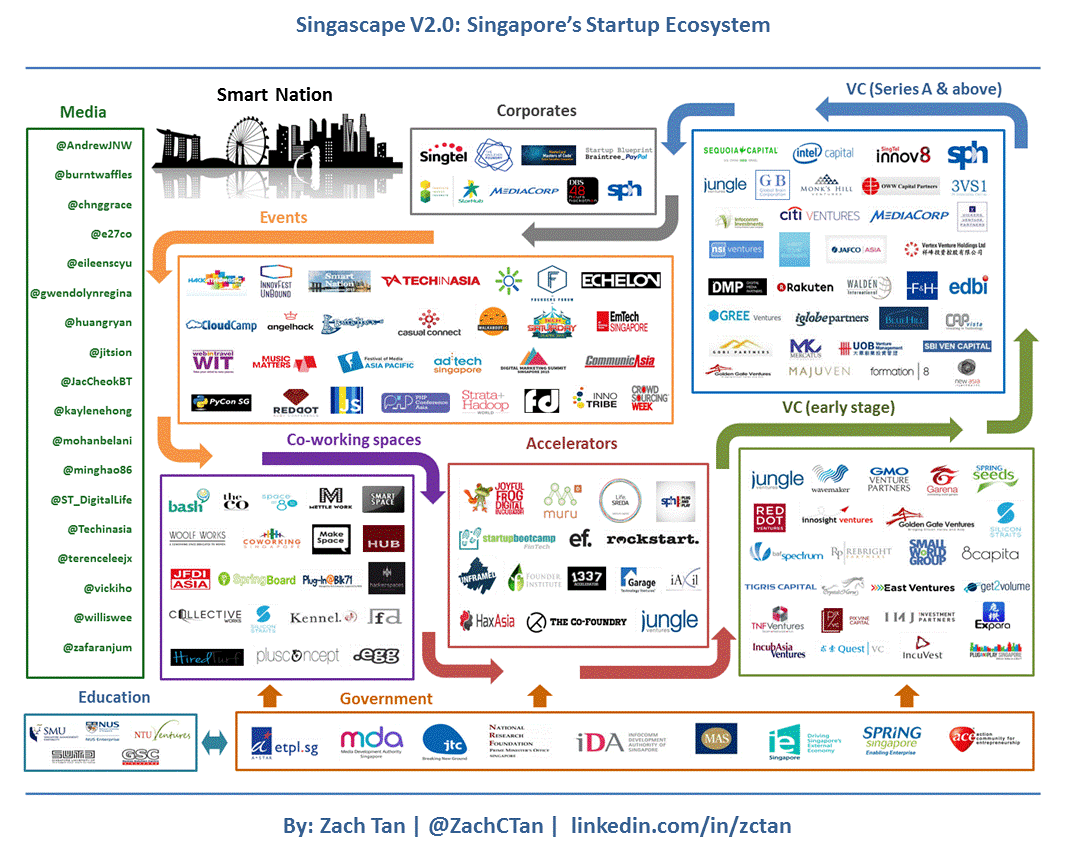
The Key Players
- Entrepreneurs. Duh, you need experienced teams running the startup businesses. With an equal balance of needed skillsets from strategy, to marketing, to technology, etc.
- Mentors. First time entrepreneurs need to be able to ask questions of experienced leaders, to help get them up the learning curve, without making the same mistakes of their predecessors.
- Investors. Whether these are individual angels, organized angel networks, venture capital firms, private equity firms, family offices, corporations or other funding sources doesn’t matter. What matters is the money is flowing from whoever can cut the checks for that stage of a business’s growth.
- Incubators. This category picks up everything from shared office spaces for startups, all the way up to formal startup accelerator programs with formal educational curriculum. The point is, entrepreneurs can learn from each other, when they are in close proximity to each other.
- Universities. A lot of the biggest business ideas are born from the research inside of universities. Having a healthy technology transfer process for these ideas to be monetized by business leaders is key. And, university professors need to know, it is perfectly acceptable to try and monetize their ideas, at the same time they are trying to win a Nobel prize (which many don’t agree with).
- Corporations. The big companies in town help in many ways. They invest through corporate venture capital funds. They become potential customers of new local startups. They have pain points of their own, that a local startup can build and solve for them. They are often the exit for startups that have gotten large in size. You need a really healthy interaction between the startups and corporations working towards a common goal.
- Associations/Events. There are many groups in town that help organize and propel the ecosystem. This could be industry trade associations, venture capital associations, entrepreneur networking groups, chambers of commerce, economic development groups, etc. Leverage these groups of like-minded people at their big annual events or leverage their tools (e.g., job boards on their websites).
- Government. Whether it is at the city, county or state level, your local government can play a very important role. That could include providing tax incentives for startups to launch in their city, tax free profits on any capital gains in a startup (to help stimulate investment), passing ecosystem friendly laws (like free access to the internet), or establishing venture capital funds with a portion of their treasury.
- Service Providers. The lawyers, accountants, bankers, recruiters, agencies, advisors, and consultants in your community all play a role. The more experienced they are with startups, the better advice they will bring to the ecosystem.
Here is an example of the collective start-up ecosystem in the Netherlands:
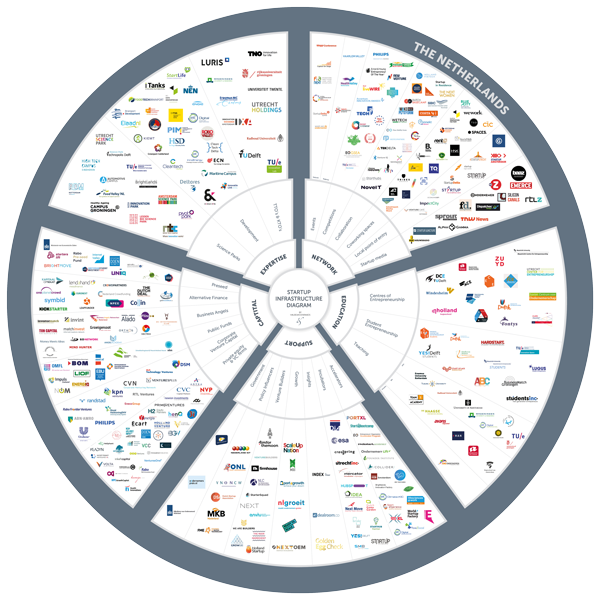
Optimal Ownership & Economics
- Spread Equity Deep. Most entrepreneurs concentrate equity into only a couple people at the top of the organization. It is better to spread equity deep into other employees, as well. Why? Because if employees have a vested interest in the business, they will work harder towards hitting the goal. And, when the company sells for $1BN, it creates hundreds of multi-millions that have new-found funds to start their next startup, powering the ecosystem to the next level.
- Serial Exits. Selling companies for big returns impress investors. But, often times a first time entrepreneur, will see a $50MM sale as “big money”, and sell too early to put some cash in the bank for a rainy day. But, a second or third time entrepreneur has already banked cash from their first exit, and now they are in a position to “roll the dice”, walking from a $50MM sale, in hopes of a $500MM sale down the road.
- Reinvest Returns. Money that simply goes into the bank account, or into safe real estate investments, does not help the ecosystem. The money needs to round trip back into the community. So, if you sell for $100MM, hopefully a good chunk of that is funding other startups in the ecosystem.
- Shoot for the Moon. Many investors are simply too conservative for a startup ecosystem to be successful. Silicon Valley prides itself on “failure as a badge of honor”, as the lessons learned in one bad startup, will apply to the next good startup. If you are too conservative, trying to cross potential “strikeouts” off your list, you are most likely crossing off potential “home runs” at the same time.
In General
- It Takes Leadership. It takes a couple cheerleaders at the top that are going to “plant the flag” and have everyone rally around those goals for the community. Preferably, somebody that can put their money where their mouth is, and can lean on their deep rolodex of key relationships in your region (e.g., the governor, the mayor, the local billionaires).
- Leverage Local Strengths. Figure out what your region does better than others, and focus your efforts around those industries or skills. For example, New York would be a great place for financial startups and Los Angeles would be a great place for entertainment related startups, given the high concentration of experts in those areas.
- It Requires Startup Density. It will be really hard to build a robust community in very small towns. There simply isn’t enough activity, breadth of industries or depth of expertise in any one industry to be effective. So, either live in a town big enough to support an ecosystem, or prepare for a lot of travel between a bunch of smaller regions that have been aggregated into one community.
- Collaborate Across Regions. Don’t think a startup ecosystem is isolated to your city. The best startup ecosystems feed off each other. Think about the collaboration happening between New York and Boston startups, given their close proximity to each. Or, between Detroit and Germany, because they both serve the auto industry, as examples.
- Publicity Helps. The rest of the country needs to know what you are up to. Less about your desire to build an ecosystem. But more about the venture capital flowing into your region, or big exits being realized at big valuations. So, celebrate your successes, and put those success stories locally “on display”, or nationally “on the road”. That will get investors and talent to want to check it out.
- Progress Must Be Measured. Like with any business endeavor, you must have good measurement with which to manage it. Quantify key metrics like the amount capital raised, investor value created, companies formed, jobs created and material exits in your market, and shoot to have those metrics improve year over year.
- It Can’t Be Forced. The community needs to share a common goal. The goal of building a robust community can’t simply be embraced by a few, to be forced on others; it has to be embraced by everybody participating in the community, for it to be successful.
- It Takes Time. Don’t expect miracles overnight. Ecosystems are not built in years, they are built over decades. That is why Silicon Valley’s startup ecosystem is as big as it is; they have literally been working on it since the 1970’s, a fine tuned machine after 40 years of optimization.
Superclusters
However start-up ecosystems should not just be about supporting local start-ups.
Christian Rangen is a leading thinker in developing “innovation superclusters“. He says “As we continue to race into the knowledge-driven economy, with industry 4.0, digital business models, lean startups, large-scale industry shifts; local and national leaders take note.”
“How can we compete globally?”, “How do we create more high-impact, tech jobs?”, “How do we create – and keep – tech scale-ups in our local economies?” are frequent questions discussed at roundtables and conferences.
The best leaders shift that conversation. Instead, they ask and act on strategic questions like, “How can we attract the very best startups and scale-ups to our region?”, “how can we combine our old legacy industries, with new technologies at scale”, “how can we enable and support unprecedented collaboration at scale?” and “how can we accelerate innovation across research, corporates, startup and beyond?”