The neuromorphic chip is a silicon chip designed to mimic the form of the human brain.
This game-changing approach transforms the way our devices process information, moving them closer to the way our brains process information.
Neural networks can now be etched into silicon not unlike the billions of neurons and synapses that form our nervous system and brain.
This means software and data no longer have to be processed on different chips, they can be stored and processed on the same chip—saving significant time, energy and space.
In many ways, it is a great example of how our modern world, already powered by software, is about to change in a really big way.
The first generation of AI was rules-based and emulated classical logic to draw reasoned conclusions within a specific, narrowly defined problem domain. It was well suited to monitoring processes and improving efficiency, for example. The second, current generation is largely concerned with sensing and perception, such as using deep-learning networks to analyze the contents of a video frame.
A coming next generation will extend AI into areas that correspond to human cognition, such as interpretation and autonomous adaptation. This is critical to overcoming the so-called “brittleness” of AI solutions based on neural network training and inference, which depend on literal, deterministic views of events that lack context and commonsense understanding. Next-generation AI must be able to address novel situations and abstraction to automate ordinary human activities.
Fernando Piquer joins me in Munich to make sense of the frenetic, fantastic growth of eSports around the world – from its incredible fan-based communities to its sponsorship-driven business model – and what other industries can learn from it.
For more than 20 years, Fernando Piquer’s professional career has been linked to digital entertainment. Before the creation of the eSports club Movistar Riders, he founded Bitoon Games, the first Spanish “free to play” game company. He was previously a founding partner of Zinkia, where he participated in the creation and exploitation of the animated series “Pocoyo” and was director of the videogames area of this company for more than five years.
Throughout his career he has worked designing digital strategies and products for brands such as Coca-Cola, BBVA, Vodafone or Endesa, among others. In Munich, Piquer joins me to explore the changing e-sports value proposition, the sales channels, the sort of engagement with the audience and the revenue system, among other elements of this new and fast-growing market.
The eSports world
Kyle “Bugha” Giersdorf is only 16 years old. His mum would prefer he focused on his school work, rather than playing computer games. But on 28 July this year, Kyle emerged from the Arthur Ashe stadium in New York with $3million in his jeans pocket, winner of the inaugural Fortnite World Cup.
A new report by Goldman Sachs documents the incredible growth of eSports, and what is likely to happen next.
The immense popularity of survival-based games like Fortnite, growing prize pools for eSports tournaments, the rise of live-streaming, and improving infrastructure for pro leagues have all paved the way for eSports to reach audiences similar to NFL or Premier League soccer.
There are 2.2bn people globally who play video games. That is about the same number of sports fans in the world.
In 2019, competitive gaming, or eSports, will have 454 million participants and revenues of $1.1bn, 26% growth. By 2022 the report estimates those figures will be 645 million participants with revenues as high as $3.2bn.
Total esports revenues are likely to reach $1.1bn in 2019 with 454 million active participants, and is forecast to more than triple by 2022, reaching $3.2bn by 2022, with 645 million participants, and with the largest portion coming from sponsorships ($277 million), followed by media rights and streaming advertisements.
This is not just a few geeky kids playing in their bedrooms. This is a generation that is redefining what is sport and what is entertainment.
eSports and competitive gaming have become a way of life for hundreds of millions of young people. It will continue to grow, the only question is by how much and how quickly. The answer lies in the willingness of games publishers, rights holders, brands and eSports companies like Gfinity to think and act differently, and be prepared to adapt their business models in new ways.
A Newzoo report highlights two trends that we have seen emerging that present interesting opportunities for brands wanting to enter this space.
First, the growing importance of giving fans a ‘reason to care’ and be vested in the teams. Teams and eSports professionals increasingly understand this. To date, most teams have tended to lack a brand personality – there is little depth to the relationship between fan and the ‘stars’. For example, the winner of last year’s Overwatch League was London Spitfire, the London team in the Overwatch franchise.
And yet none of the players come from London or the UK and they rarely visit. While London Spitfire has a global fan base it is going to be important that the team builds a core and loyal UK fan community. This will undoubtedly happen. In a world where there is so much content already available, the challenge is to make the pros and the teams they represent engaging in a way that resonates and matters to gamers. Great opportunity for brands.
The other trend is a growing desire to extend beyond just watching tournament play, either live or via a channel. There is an appetite for new types of shows and competition formats, bringing more of an entertainment approach to gaming. More people on the eSports channel Twitch watch live streaming of their heroes playing popular games than watching the ‘best of the best’ in live tournament play.
What’s next? It will be the growing involvement of professional athletes from the worlds of football, NBA and NFL, as well as entertainers from the worlds of television, film and music who love gaming, pulling their game-loving fans into the broader eSports space. This is where the opportunities for new ideas and content are endless – and where the white space exists for brands to play.
Imagine you like playing the Fifa video game and you get the chance to watch one of your favourite Premier League stars like Dele Alli play the same game against his team mates or star players from rival clubs anywhere in the world. Or for that matter a music or entertainment star. The picking of the teams, the banter, the forfeits, innovative gameplay formats and so on. The gameplay is peripheral. The level of engagement, unbeatable. This is where brands can play and add value.
Gaming will continue to redefine how recreation time is spent. New thinking, partnerships and a pioneering mentality are going to take eSports entertainment to greater levels. The wave of innovative formats driven by sports rights holders is already shining a spotlight on what is possible – the inaugural ePremier League and the third season of F1’s eSports series in June are two examples. But this is only scratching the surface. To raise the bar further there needs to be fresh sets of conversations about how to create exclusive entertainment-based content rights that complement professional events while adding millions of new fans to the games. New ideas, new formats, new heroes.
Some brands want to dip their toes, try a small-scale event and evaluate it through a traditional ‘media buy’ lens. Others believe in what is happening and are investing ahead of the curve for the long term.
The winners and losers in this industry will be those who have their fingers on the pulse of the consumer and those that don’t. And while in marketing that is nothing new, the challenge is not to approach this industry by looking back at what has happened in the past, or through the rearview mirror. Foresight is needed. In the gaming world the rules are still being written and models created.
This infographic captures the big trends:

What is Esports?
Esports (also known as electronic sports, e-sports, or eSports) is a form of competition using video games. Another definition describes eSports as:
Competitive gaming at a professional level and in an organized format (a tournament or league) with a specific goal (i.e., winning a champion title or prize money).
Esports experts considered 2018 a landmark year that cemented the industry’s potential as the next billion-dollar industry. Powered by the millennial generation the global eSports industry will only continuing to gain more traction. The number of eSports enthusiasts worldwide is estimated to be ~168 million in 2018, and for total global viewers the forecast for 2019 is ~453 million. The International Olympic Committee has even explored incorporating eSports into future Olympic events. Online streaming media platforms such as Twitch, YouTube, DouYu, and Huya have become central to the growth and promotion of esports competitions.
eSports are commonly PC based; however mobile based eSports is becoming popular in Asia. According to Wikipedia:
The most common video game genres associated with esports are multiplayer online battle arena (MOBA), first-person shooter (FPS), fighting, digital collectible card games, battle royale games and real-time strategy (RTS).
Gamified Growth
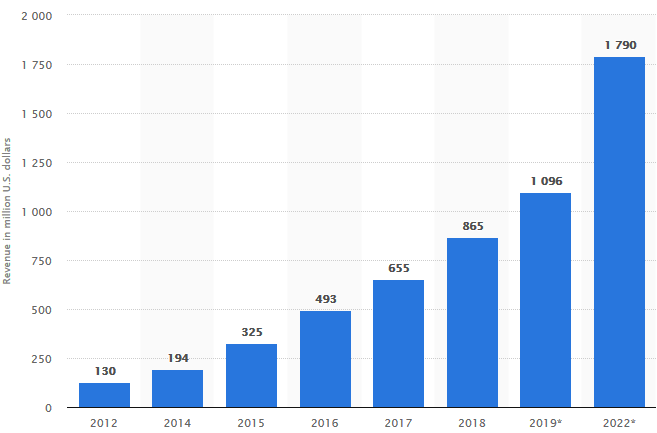
In 2018 the eSports global revenue forecast was ~$865 million (another report has this at $905m as the actual result), and is forecast to pass US$1b in revenue in 2019. By 2022 the global eSports market revenue is forecast to reach US$1.79 billion. This represents a CAGR of 22.3%. Another report has the CAGR from 2016-2021 at 27.4%. North America generates ~38% of the revenue, with China another main player with ~18% of revenues.
eSports global revenue is forecast to grow at a CAGR of 22.3%
eSports competitions
In recent years eSport competitions have become very popular. Some examples are League of Legends, Dota 2, Player Unknown’s Battlegrounds (PUBG), StarCraft, WarCraft, Hearthstone, Overwatch, and Fortnite. King of Glory (Arena of Valor outside of China) is another. Players compete online for huge price pools.
Top 5 eSports games (by eSport hours) watched on Twitch in 2017
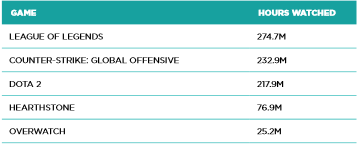
Note: Twitch.tv is the leading US live streaming video platform and a subsidiary of Amazon (AMZN).
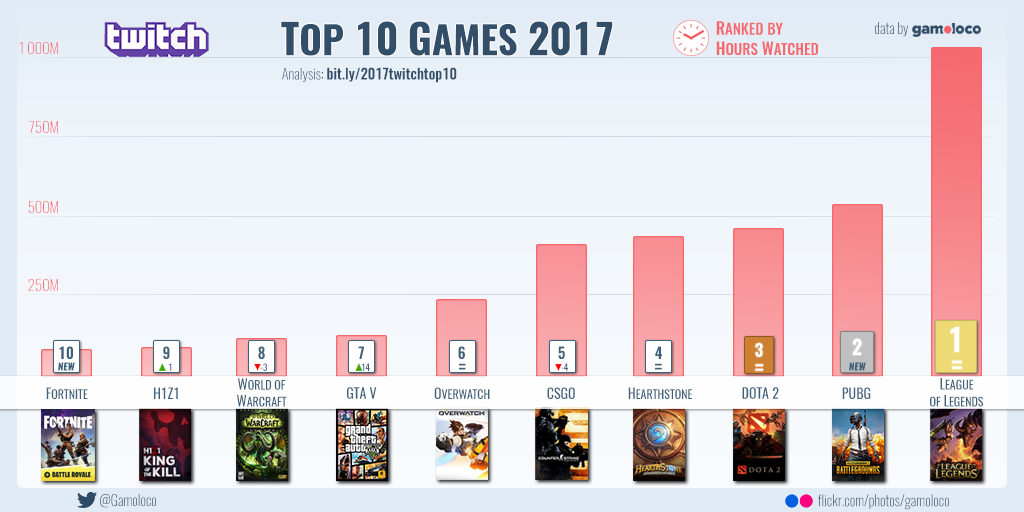
As shown below League of Legends was by far the most popular eSports title in 2017; however others such as PlayerUnknown’s Battlegrounds (PUBG) and DOTA 2 are also doing very well more recently. A common theme with the most popular eSports is battles.
Top ten games as of 2017
The eSports ecosystem
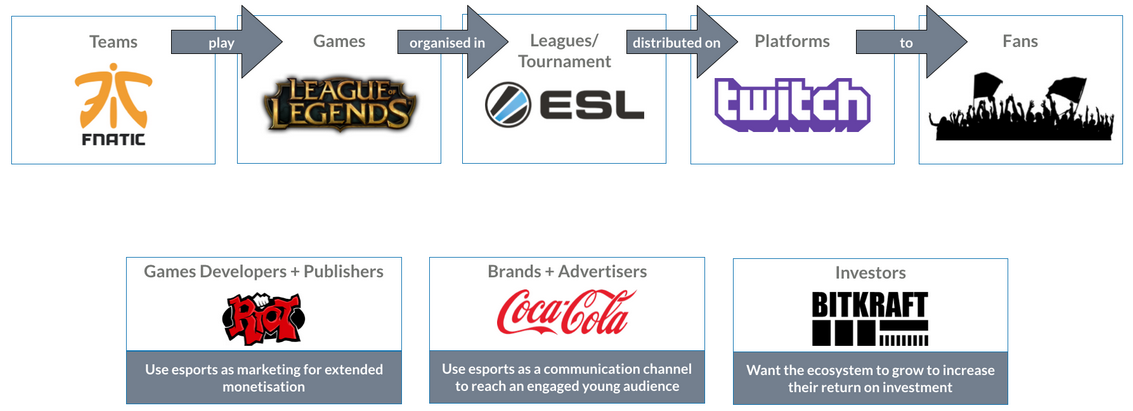
At its core the eSports ecosystem involves the game makers (often also the publishers). They typically make and publish the games. Often they then do the event organization and sell media streaming rights. In other cases they license their games out to external league organizers and streaming platforms. The streaming platforms then make money mostly from advertising. Meanwhile the teams make money from sponsorships.
A simplified view of the eSports ecosystem

How eSports companies make money
Most eSports companies make money via some form of advertising to their audience. eSports companies will typically do some or all of the following to create revenue:
- Sponsorship – Teams attract large sponsorships. Players are usually professional. For example the New York Yankees, Houston Rockets, Robert Kraft, and Magic Johnson have bought teams and/or sponsorships.
- Advertising sales. Done by the teams, the event organizers and the streaming companies.
- Media rights – The event organizers sell TV or streaming broadcast rights to streaming companies such as Twitch, DouYu, Huya, and YouTube Gaming.
- Game publisher fees – The game makers make money from selling publishing fees or rights to use their games to event organizers etc.
- Merchandise and Ticket sales.
2018 global eSports revenue by segment with 2018 growth rates
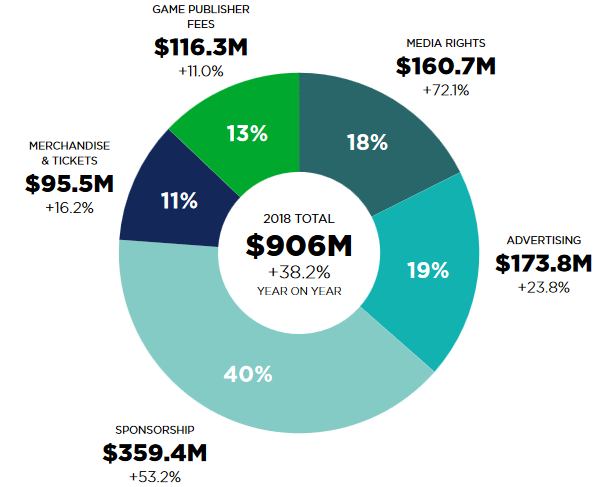
Note: Of the above media rights (streaming) and sponsorship fees are forecast to grow the fastest.
For now eSports is dominated by battle style games; however it is not hard to imagine a popular eSports car racing event that would feature teams from say Volkswagen, Audi, Porsche and so on being sponsored by the car companies. The same can then be said across most industries (sports teams, corporations etc), hence the revenue growth potential is very large.
An example of an eSports competitor and stadium event


eSports audience
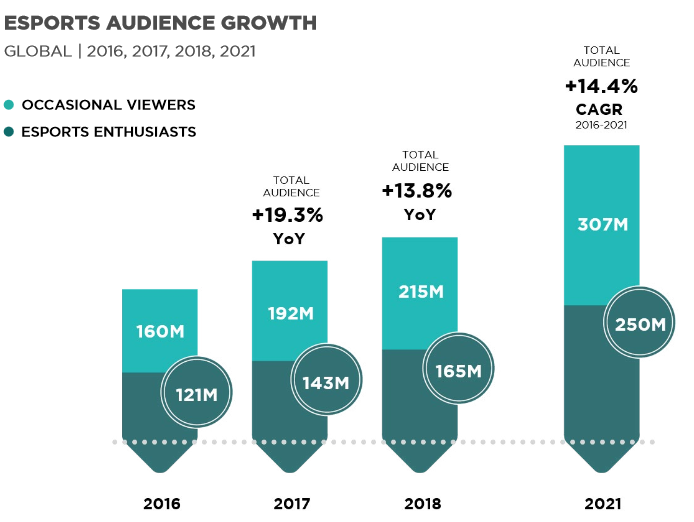
As shown below, eSports audience is also growing rapidly and is forecast to reach 600m by 2020. The chart below has a more conservative a forecast, but shows the rising trend. More audience equates to greater advertising potential.
ESports audience growth and growth forecast to 2021
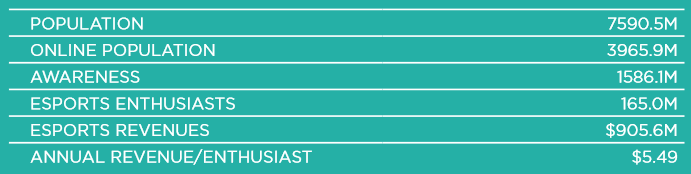
2018 eSports data
An introductory look at the main companies in the eSports industry
The game makers/publishers
Activision Blizzard (ATVI)
Activision Blizzard own the popular Overwatch League as well as World of Warcraft, StarCraft, Diablo, and Hearthstone. Activision Blizzard currently includes five business units: Activision Publishing, Blizzard Entertainment, King, Major League Gaming, and Activision Blizzard Studios. In 2018 Activision Blizzard signed a multiyear deal with Walt Disney to broadcast the Overwatch League. As of March 2018, it is the largest game company in the Americas and Europe in terms of revenue and market capitalization.
Electronic Arts (EA)
Electronic Arts is an American video game company headquartered in California. It is the second-largest gaming company in the Americas and Europe by revenue and market capitalization after Activision Blizzard and ahead of Take-Two Interactive and Ubisoft as of March 2018
Take-Two Interactive Software, Inc. (TTWO)
Take-Two Interactive is an American video game holding company based in New York City. The company owns two major publishing labels, Rockstar Games, and 2K, itself composed of two divisions: 2K Games and 2K Sports, all of which own and operate various game development studios.
Tencent (OTCPK:TCEHY)
Tencent acquired Riot Games and now owns the very popular League of Legends game. Tencent also own King of Glory. Tencent is also the leader in eSports game streaming as you can read below.
Others game making/publishing companies include:
- Bethseda Softworks (private), Gameloft (OTCPK:GLOFY), Netease (NTES), Microsoft (MSFT) (Nintendo), Sony Corporation (SNE) (Playstation), Sega (OTCPK:SGAMY), Ubisoft (OTCPK:UBSFY), and Valve Corporation (private).
The streaming companies
The streaming companies make good money mostly from advertising. China is the world’s largest game streaming market, with approximately 4.9 times the monthly active users of the U.S. market in 2018.
Amazon (AMZN)
The online streaming market in the USA is led by Amazon’s Twitch. Still only a small percentage of Amazon’s massive revenue, but a dominant palyer in the eSports streaming market.
Tencent (eGame, and Tencent backed DouYu)
Tencent dominates the eSports streaming industry in China. Tencent has their own eGame, and are about to IPO DouYu in the USA.
DouYu (DOYU) primarily focuses on the live-streaming of games. DouYu was the largest game-streaming platform by average total MAUs on both mobile and PC. DouYu had 159.2 MAUs in the Q1 2019, representing YoY growth of 25.7%. DouYu’s revenues come from live-streaming through the sale of virtual gifts, accounting for 86.1% of its revenues, with the rest coming from advertising. DouYu is still loss-making and reported a net loss of $127.4 million in 2018, up from $91.33 million in 2017. Revenues jumped 93% to $531.5 million last year. You can read more here.
Huya (HUYA) – spin off from YY Inc.
Huya is known as the “Twitch of China”. Huya mostly works off a gift model. Streamers can receive virtual gifts from their audiences, purchased from Huya. The company then shares a portion of revenue from these gifts with broadcasters and associated talent agencies. The sale of these gifts accounted for roughly 95% of the company’s sales last year, with the remainder coming from advertising.
Alphabet Google (GOOG) (GOOGL)
Alphabet Google’s YouTube Gaming make money via subscription and advertising.
Note: Facebook (FB), Twitter (TWTR), Microsoft (MSFT) Mixer are also into eSports streaming. Alibaba and Baidu are also moving further into streaming and gaming. Smashcast.tv is another well known name in the eSports streaming industry.
The team owners
Team owners are often made up of gaming communities, celebrities or other groups, and are usually not listed companies. For example, aXiomatic (private) owns the number one team “Team Liquid” that has earned over US$24 million in prize money. The number two company Evil Geniuses is a subsidiary of GoodGame Agency, owned by Amazon’s Twitch division.
You can read here about the Top 10 eSports teams, earnings, and salaries.
Some smaller listed eSports and gaming companies
- Axion Ventures Inc. (TSXV: AXV | OTCQX: AXNVF)
- Backstageplay Inc. (TSXV: BP)
- Bragg Gaming Group Inc. (TSXV: BRAG)
- Contagious Gaming Inc. (TSXV: CNS)
- Enthusiast Gaming Holdings Inc. (TSXV: EGLX | OTCQB: EGHIF)
- ePlay Digital Inc. (CSE: EPY)
- Fandom Sports Media Corp. (CSE: FDM)
- Global Gaming Technologies Corp. (CSE: BLOC.U)
- Kuuhubb Inc. (TSX: KUU)
- Mad Catz Interactive Inc. (TSX: MCZ)
- Millennial Esports Corp. (TSXV: GAME | OTCQB: MLLLF)
- The Stars Group Inc. (TSX: TSGI | NASDAQ: TSG)
- Versus Systems Inc. (CSE: VS | OTCQB:VRSSF)
- Victory Square Technologies Inc. (CSE: VST | OTCQX: VSQTF)
Further reading
- Free 2018 global eSports market report
- Esports is on the rise!
- An Introduction to the Esports Ecosystem
- The World’s Most Valuable Esports Companies (most are private, such as number 1 Cloud9)
Risks
- eSports may not continue to grow, as the industry is still in the early stages. Seems very unlikely.
- Competition can be fierce, and costs can run high. The failure of China’s leading streaming company Panda TV highlights this.
- Many companies are private or owned by very large conglomerates such as Tencent.
- Technology change or disruption can occur. For example apps can be a potential threat.
- Government legislation changes or bans as we saw in China recently with some games.
Conclusions
eSports is still at a relatively early stage of growth and is small in comparison to the overall gaming sector. For example, in 2017 eSports revenue was US$696m compared to gaming at US$4,547m, making gaming 6.5x more revenue than eSports. The point is that eSports still has enormous growth potential ahead, and every chance to follow it’s gaming older brother.
As eSports evolves it appears to me most likely that the advertising and streaming platforms (Amazon Twitch, Tencent’s DouYu, Huya, and Alphabet Google YouTube Gaming) will make the most money, as occurred in social media. The most popular game makers such as Activision Blizzard, Electronic Arts, Take-Two Interactive Software, and Tencent should also do well; however competition is fierce. Sponsorship revenues will tend to be via private businesses/teams and harder for most investors to participate in. Those companies that have arenas and multiple teams in multiple leagues should also do well.
The e-Sports club Movistar Riders makes part of a whole experimental program called Readmagine devoted to the work with new sectors in partnership with the publishing organizations.
The Financial Times calls it “The Oscars of Management Thinking.” Every two years, the world’s top business thinkers gather in London for a day of ideas sharing, and night of ego polishing. This was a moment to celebrate the impact of ideas – and the people who articulate and spread them through their business books, academic programs, and also their practical implementation.
- The new best ideas: Leaders and Loonshots, Seeing around Corners
- Best books of 2019: Strategic Inflections and Creative Construction
- Thinkers50 Europe: Inspired by the best ideas from Asia
- Thinkers50 China: Interview with Zhang Ruimin, CEO of Haier
Indeed this year’s top management thinkers represent a changing of the guard. Gone are many of the grand old men of academia – Christiansen and Goldsmith, Peters and Porter, Martin and Mintzberg. In come a fresh generation of thinkers and doers, with a crop of new ideas for the digital world. More youthful, more female, more global and more practical too. An increasing number of corporate executives rub shoulders with academia – from companies like Alibaba, Buurtzorg, Haier and others.
Renee Mauborgne and Chan Kim, co-authors of the Blue Ocean Strategy, ranked as this year’s top thinkers. Mauborgne is the first woman to be named as the world’s most influential thinker, with Kim being the first person from Asia to top the list. The INSEAD professors are also the first representatives from a European business school to earn this honor. Their breakthrough idea of pursuing uncontested markets (blue oceans) in place of highly-competitive ones (red oceans) has become a business school staple over the past 15 years.
Kim and Mauborgne climbed three spots on this year’s Thinkers50 to reach the top spot in a ranking. Previous leader, Roger Martin, architect of integrative thinking, placed 2nd. Amy Edmondson (Harvard’s fearless professor, Alex Osterwalder and Yves Pigneur (of business model canvas fame), and Rita McGrath (seeing around corners) made up the Top 5.
The ranking is designed to identify the “ideas with the power to change the future” through “a clearly articulated theory or philosophy of management”. It is founded on two concepts viability (‘quality and relevance of ideas”) and visibility (“impact of ideas on the world”). This becomes the “4Rs” (relevance, rigor, reach, and resilience) along with criteria like media coverage, academic citations, public affiliations, and communication skills.
The Thinkers50 isn’t just a ranking, but focuses on awards too. Rosabeth Moss, a long-time Harvard Business School professor, earned a Lifetime Achievement Award. Santiago Iñiguez de Onzoño, former dean of IE Business School and current president of IE University received the Founders Award, which recognizes “the architects who lay the foundations for ideas to flourish.” Harvard Business School’s Amy Edmondson collected the Breakthrough Idea Award for her work on creating fear-free business cultures. Dartmouth Tuck’s Vijay Govindarajan took home the Innovation Award, while Harvard Business School’s Francesca Gina nabbed the Talent Award.
Other awards went to the following thought leaders: Marshall Van Alstyne and Geoff Parker (Digital Thinking Award), Jos de Bok (Ideas Into Practice Award), Liz Wiseman (Leadership Award), Sanyin Siang (Marshall Goldsmith Coaching and Mentoring Award), Radar Award (Pim de Morree and Joost Minnaar), and the Strategy Award (Chris Clearfield and Andras Tilcsik).
The Radar Award, in particular, honors “emerging thinkers” who possess the potential to make an impact in management theory and practice. This year’s Radar shortlist includes ten business school professors: Peter Bergman (Columbia MBA), Gabriella Cacciotti (Harvard Business School Professor), Brianna Caza (Manitoba Asper), William Kerry (Harvard Business School), Ben Laker (Henley Business School), Aneeta Rattan (London Business School), David Lewis (London Business School), Alison Reynolds (Ashridge-Hult Business School), Fabrizio Salvador (IE Business School), and Michael Smets (Oxford Said).
Whilst for me there is still too much self-congratulation going on, academic thinkers in their little bubble, this year did show some moments of inspiration. Ideas are the real champions here, not the professors. Ideas that can be embraced in practical ways by normal business folk, in the heat of everyday work, to move their organisations forwards in new and better ways. Some of the best moments were therefore Alex Osterwalder and team explaining how they actually went about creating their canvases, Zhang Ruimin talking about his 30 year journey at Haier, and people like Ming Zeng and Frederic Laloux finally cracking the ranking.
Here is the new Thinkers50 ranking:
| Rank | Name | School | Known For… | Previous Rank |
|---|---|---|---|---|
| 1 | W. Chan Kim and Renee Mauborgne | INSEAD | Authors of The Blue Ocean Strategy | 4 |
| 2 | Roger Martin | University of Toronto (Rotman) | Former Dean (Rotman) and Co-Author of Playing to Win: How Strategy Really Works | 1 |
| 3 | Amy Edmondson | Harvard Business School | Author of The Fearless Organization, Teaming To Innovate and Teaming: How Organizations Learn, Innovate and Compete in the Knowledge Economy | 3 |
| 4 | Alexander Osterwalder and Yves Pigneur | Strategyzer (Osterwalder); University of Lausanne (Pigneur) | Co-Authors of Value Proposition Design: How To Create Products and Services customers Want and Business Model Generation: A Handbook for Visionaries, Gamechangers and Challengers | 7 |
| 5 | Rita McGrath | Columbia Business School | Author of The End of Competitive Advantage: How To Keep Your Strategy Moving As Fast As Your Business | 10 |
| 6 | Daniel Pink | Author | Author of Free Agent Nation: The Future of Working For Yourself and To Sell is Human: The Surprising Truth About Persuading, Convincing and Influencing Others | 11 |
| 7 | Richard D’Aveni | Dartmouth (Tuck) | Author of Strategic Capitalism and The Pre-Industrial Revolution | 9 |
| 8 | Erik Brynjolfsson and Andrew McAfee | MIT (Sloan) | Authors of Rage Against The Machine and The Second Machine Age | 12 |
| 9 | Scott D. Anthony | Innosight (Senior Partner) | Author of seven books and consultant who focuses on capitalizing on disuption (HBS Grad) | 34 |
| 10 | Adam Grant | Wharton | Author of Give and Take: A Revolutionary Approach To Success and Top-Rated Professor at Wharton for Four Consecutive Years | 8 |
| 11 | Simon Sinek | Consultant and Motivational Speaker | Consultant and author of five books on organizational leadership | 18 |
| 12 | Erik Ries | Long-Term Stock Exchange | Pioneer of lean startup methodology | 16 |
| 13 | Lynda Gratton | London Business School | Founder of the Hot Spots Movement; Head of the Future of Work Research Consortium; and Author of Humoan Resource Strategy: Corporate Rhetoric, Individual Reality and Living Strategy, The Democratic Enterprise, and Glow. | 29 |
| 14 | Whitney Johnson | WLJ Advisors (Also teaches in Harvard Business School’s corporate learning program) | Co-Founder of Clayton Christensen’s Investment Fund; Regular Contributor to The Harvard Business Review | 30 |
| 15 | Zhang Ruimin | Haier Group | Chairman and CEO of the Haier Group (Ranked Among the Largest Manufacturers and Most Innovative Companies); Dubbed a | 26 |
| 16 | Hal Gregersen | MIT (Sloan) | Co-author of The Innovator’s DNA: Mastering the Five Skills of Disruptive Innovators and collaborator with Clayton Christensen; Developed | 24 |
| 17 | Liz Wiserman | Wiseman Group | President of the Wiseman Group; Author of Rookie Smarts: Why Learning Beats Knowing in the New Game of Work, Multipliers: How the Best Leaders Make Everyone Smarter, and The Multiplier Effect: Tapping the Genius Inside Our School | 35 |
| 18 | Hermenia Ibarra | London Business School | Author of Working Identity: Unconventional Strategies For Reinventing Your Career; Winner of the Thinkers50 Leadership Award | 20 |
| 19 | Pankaj Ghemawat | New York University (Stern) | Author of World 3.0 and Developer of the DHL Global Connectedness Index | 17 |
| 20 | Martin Lindstrom | Lindstrom Company | Author of Buyology: Truth and Lies About Why We Buy; Named one of the | 36 |
| 21 | Francesca Gino | Harvard Business School | Author and researcher who focuses on how talent can enhance their creativity and productivity. Author of Rebel Talent: Why It Pays to Break the Rules in Work and Life | 49 |
| 22 | Linda Hill | Harvard Business School | Author of Becoming a Manager and Co-Author of Being the Boss: The 3 Imperatives of Becoming a Great Leader | 15 |
| 23 | Steve Blank | Consultant, Author and Speaker (Also teaches at Stanford, UC Berkeley, Columbia, and NYU) | Co-author of The Startup Owner’s Manual and The Four Steps to the Epiphany | 14 |
| 24 | Subhir Chowdhury | ASI Consulting Group | Author of 13 Books, including The Ice Cream Maker and The Power of Six Sigma; Pioneer behind Six Sigma Framework | 27 |
| 25 | Anil Gupta and Haiyan Wang | University of Maryland (Smith) (Note: Haiyan Wang is managing partner of the China India Institute and also a Smith MBA ’95) | Research and writing partners in the rise of China and India. Gupta is also a co-author of Global Strategies for Emerging Asia. | 28 |
| 26 | Morten Hansen | U.C.-Berkeley (Haas) | Co-Author of Great By Choice (with Jim Collins) and Author of Collaboration | 41 |
| 27 | Niolfer Merchant | Author (Also a Santa Clara MBA ’00) | Author of 11 Rules For Creating Value In The #SocialEra and The New How | 22 |
| 28 | Ming Zeng | Alibaba Group | The former action president of Yahoo, Zeng is now the chief strategy officer at Alibaba and author of 2018’s Smart Business. | NR |
| 29 | Michael D. Watkins | IMD | Best-selling author of The First 90 Days, which has sold over a million copies. | NR |
| 30 | Rachel Botsman | Oxford University (Said) | An expert in technology and consumer trust, Botsman is the author of What’s Mine Is Yours and 2017’s Who Can You Trust | 46 |
| 31 | Gary Hamel | Strategos | One of the Originators of | 31 |
| 32 | Erin Meyer | INSEAD | Along with being the author of The Culture Map: Breaking Through the Invisible Boundaries of Global Business, Meyer also authored | 39 |
| 33 | Susan David | Harvard Medical School | A psychologist by trade, David is the author of Emotional Agility – rated as Thinkers50’s Breakthrough Idea of The Year in 2017/ | 40 |
| 34 | Seth Godin | Author (Stanford GSB MBA ’84) | Founder of Squidoo; Pioneered the Six-Month MBA Program; Author of 17 Books, Including Tribes, Linchpin, Purple Cow: Transform Your Business By Being Remarkable; and Poke The Box | 33 |
| 35 | Amy Cuddy | Harvard Business School (Executive Education) | Developed Stereotype and Content Model (SCM); 2012 TedTalk ( | 43 |
| 36 | Marshall Van Alstyne and Geoff Parker | Van Alstyne: Boston University (Questrom); Parker: Dartmouth (Thayer Engineering) | Van Alstyne and Parker are the co-authors of the highly-influential Platform Revolution and the recipients of the Thinkers50 Digital Thinking Award in 2019. | NR |
| 37 | Gianpiero Petriglieri | INSEAD | A psychiatrist, Petriglieri has won an array of awards for his research and teaching, including 2018’s best case in human resources and organizational behavior from The Case Centre. | 47 |
| 38 | Marcus Buckingham | Author and Consultant | Buckingham’s first book — First, Break All The Rules — was a best-seller that ranks among the 100 most influential business books of all time according to researchers Jack Covert and Todd Sattersten. An expert in developing strengths and delivering feedback, Buckingham has authored nine books, including 2019’s Nine Lies About Work. | |
| 39 | Frederic Laloux | Author and Executive Coach (INSEAD MBA ’02) | Laloux is the author of 2014’s Reinventing Organizations, one of the decade’s most influential books, that re-imagines the organization in terms of no hierarchy, inner wholeness, and purpose. | |
| 40 | Gary P. Pisano | Harvard Business School | An HBS faculty member for 30 years, Pisano has authored over 100 influential articles, cases, and books, with his most recent work being 2019’s Creative Construction: The DNA of Sustained Innovation. He was a finalist for the 2019 Thinkers50 Innovation Award. | NR |
| 41 | Jim Collins | Author and Speaker (Stanford GSB MBA ’83) | Author of Good To Great: Why Some Companies Make The Leap, Built To Last: Successful Habits of Visionary Companies, and How The Mighty Fall: Why Some Companies Never Given In. | 31 |
| 42 | Sheena Lyengar | Columbia Business School | Author of Art of Choosing — ranked among the best business books of 2010 by The Financial Times. | NR |
| 43 | Stew Friedman | Wharton School | Founding Director of Wharton’s Leadership Program; Pioneer in Work/Life Balance; and Author of Be a Better Leader, Have a Richer Life | 38 |
| 44 | Sydney Finkelstein | Dartmouth (Tuck) | Author of 17 Books, Including Why Smart Executives Fail and Superbosses | 23 |
| 45 | Julian Birkinshaw | London Business School | Author of Reinventing Management and Becoming a Better Boss | 45 |
| 46 | David Burkus | Author and Speaker | A prolific writer, Dr. Burkus has published three books in the past three years. The most recent is Friend of a Friend, a new way of looking at how to build strategic networks. | 48 |
| 47 | Heidi Grant | Ernst & Young | A neuroscientist by trade, Grant is the director of research and development at EY after heading up research and science at the NeuroLeadership Institute. | 50 |
| 48 | Dorie Clark | Author (Also faculty member for Duke Fuqua and Columbia Business School executive education) | A graduate of Harvard Divinity School, Clark is the author of several books on personal branding, with the most recent being Entrepreneurial You. | 48 |
| 49 | Michael Jacobides | London Business School | A faculty member at LBS since 2007, Jacobides’ research focuses on how innovation spreads across ecosystems. | NR |
| 50 | Tiffani Bova | Salesforce.com | Growth IQ | NR |
Thinkers50 was established almost 20 years ago out of a desire to find the best ideas in business.
Every two years it seeks to rank the thought leaders of business – based on the ideas that have created most resonance in the business world, the most distinctive and communicative, the most practical and impactful.
Previous rankings, every two years, have felt a little like a homage to the grand old men of business academia: Peter Drucker, Michael Porter, CK Prahalad, Clay Christensen, and Roger Martin.
So what are the new ideas to win in today’s fast and dynamic world of Asian renaissance, entrepreneurial supremacy, social conscience and intelligent machines?
Today in London, the Thinkers50 Global Summit and Awards brought together the world’s best thinkers, to explore and recognise the best ideas in the world of business right now.
- Thinkers50 Ranking 2019
- Thinkers50 Award Winners 2019
- Watch the Summit (starting 0930 GMT) and Awards (1930) live online
- Shortlists for each of the Thinkers50 Awards 2019, profiling each nominee
For the first time the ranking is topped by W Chan Kim and Renée Mauborgne. Kim and Mauborgne are professors of strategy at INSEAD and authors of Blue Ocean Shift, and the global bestseller Blue Ocean Strategy.
Mauborgne is the first woman to occupy the number 1 position and Kim is the first from North Asia. It is also the first time professors from a European business school have been named as the world’s most influential management thinkers.
Here are some of the best new ideas emerging in business. Ideas to help you find a new edge in leading your business:
Alive at Work
I visit so many world-leading corporations where I am shocked by the lack of energy, humanity and optimism in the workplace. Leaders and managers worn down by corporate life, even if their companies are shaping markets and driving incredible innovations. So how do you bring work back to life?
Dan Cable’s research focuses on employee engagement and organizational culture. In Alive at Work: The Neuroscience of Helping Your People Love What They Do (HBR Press, 2018) the London Business School professor argues that the reason for unhappiness at work is biological: organisations are shutting off the part of our brain that craves exploration and learning, and he identifies the small changes that can make a meaningful impact and restore zest to work.
The Altruistic Corporation
Start-up companies tend to be a lot more democratic. Even the ones who have grown still have a feeling of adventure, experimentation and freedom. Indeed many authors now talk about reinventing organisations with more soul, purpose, and humanity.
Isaac Getz, a professor at the ESCP Europe School of Business in Paris, is the co-author of Freedom, Inc. (Crown Business, 2010) and author of L’entreprise Altruiste (Albin Michel, 2019). He has conceptualised the notions of the freedom-based company, and the liberating leader – one who believes that a workplace based on respect and freedom is a more natural environment for employees than one based on mistrust and control. His latest thinking champions what he describes as “the altruistic corporation”.
The Big Nine
Every other article you read is talking about AI. And mostly about the relationships between technology and humans. Not just about whether humans be replaced and what will we do, but how they work positively together. Yet so much is in the hands of companies like Alibaba and Amazon, Apple and Google, Facebook and Tencent.
Amy Webb is professor of strategic foresight at New York University’s Stern School of Business, and describes herself as a quantitative futurist. Her latest book The Big Nine: How The Tech Titans and Their Thinking Machines Could Warp Humanity (PublicAffairs, 2019) fires a warning shot about the implications of artificial intelligence, and the overwhelming power of the “big nine” corporations in the US and China that are turning the human-machine relationship on its head.
Blitzscaling
Starting up is easy, scaling up is hard. So many entrepreneurs talk about the challenges of turning a cool idea into a successful commercial business. Scaling can be painful. Do it faster.
Reid Hoffman is co-founder of LinkedIn and partner at Greylock, Hoffman is the author (with Chris Yeh) Blitzscaling: The Lightning-Fast Path to Building Massively Valuable Companies (Crown, 2018), which argues that a speed-to-scale strategy – “blitzscaling” – is the secret to capturing the market. Hoffman offers a specific set of practices for startups to create and manage dizzying growth, by prioritizing speed over efficiency in an environment of uncertainty. He is also co-author of The Start-up of You (with Ben Casnocha, Random House, 2013) and The Alliance (with Ben Casnocha and Chris Yeh, HBR Press, 2014).
Buurtzog
Healthcare is one of the most exciting sectors right now. From Devi Shetty’s incredible reinvention of healthcare in India to Anne Wojcicki’s data-driven future in Silicon Valley, new health thinking is everywhere.
Jos de Blok is the founder of Buurtzog, a pioneering healthcare organization in the Netherlands that has expanded into over 20 countries. The Buurtzorg model is based on revolutionary nurse-empowered holistic care that has the highest client satisfaction in its segment, and employee engagement that far outstrips any Dutch organization of its size. Cost savings to the Dutch health care system have been estimated at 40 percent. Buurtzog scaled quickly, from one to 850 teams in just 10 years, and collaboration has been key to its global success. The self-managed model has applications beyond healthcare.
Creative Construction
Creative destruction has been a popular theme in recent years, building on the disruption bandwagon. Just like Alex Osterwalder and others now focus on the need to sustain progress, the real challenge is how to sustain innovation longer term.
Gary Pisano is the author of Creative Construction: The DNA of Sustained Innovation (Public Affairs, 2019), which examines how larger enterprises can nurture capabilities fortransformative innovation. While innovation is traditionally associated with disruptive startups, Pisano, a Harvard Business School professor, argues, there are ways for larger, established firms to gain advantage by innovation, too.
Detonate
Having explored constructionism we are back to destructing, but this time with a focus on those things we love to worship called best practices. So many people cringe at the idea of best. Surely you can do better, or different?
Too many organizations have developed bad habits, contend Deloitte Consulting duo Steve Goldbach and Geoff Tuff in their incendiary book, Detonate: Why – And How – Corporations Must Blow Up Best Practices (and bring a beginner’s mind) To Survive (Wiley, 2018). They propose concepts such as Shunryu Suzuki’s “beginner’s mind” to create four strategic “detonate” principles, and challenge seven existing best practice beliefs.
Driving Innovation from Within
Innovation is inspired by the future and by customers, it is enabled by technology and partnerships, but its kernel is within the organisation, be it in using assets in new ways, or new ideas and experiments.
Kaihan Krippendorff is the author of Driving Innovation from Within: A Guide for Internal Entrepreneurs (Columbia University Press, 2019), and founder of the consulting firm, Outthinker. Outthinker boasts that the growth strategies and innovations it has created have energized countless organizations, teams, and individuals and generated over $2.5 billion in revenue for Fortune 500 companies.
The Fearless Organization
So many business leaders are paralysed by fear. Worse are the subservient C suiters around them, and eventually it spreads to everyone. The fear of screwing up, of standing out, of not being liked. To make progress, we need to be fearless.
Harvard Business School professor Amy Edmondson is best known for her pioneering work on teaming, innovation and organisation safety. Her latest book The Fearless Organization: Creating Psychological Safety in the Workplace for Learning, Innovation and Growth (Wiley, 2018), explores the link between psychological safety and high performance, and demonstrates the importance of engagement and candour in today’s knowledge economy. Edmondson won the 2017 Thinkers50 Talent Award.
Giving Voice to Values
Business has finally realised that it is about more than making stuff and making money. Purpose, meaning, ethics, beliefs, culture … these are the big value-driven words of today’s organisations.
Mary Gentile, a professor at the University of Virginia’s Darden School of Business, is the founder and director of Giving Voice to Values, which has been piloted in over 995 business schools and organizations worldwide. The curriculum offers practical tools for putting values into practice in the workplace. She is also author of the award-winning book Giving Voice to Values: How to Speak Your Mind When You Know What’s Right (YUP, 2010).
Growth IQ
Growth is obvious. It’s the number one priority of most businesses. You want it to be profitable, but you can rarely shrink your way to greatness. Yet so many executives lose site of growth. It’s the only frame to lead.
Tiffani Bova is the growth and innovation evangelist at the US cloud-based software company Salesforce. Her breakthrough concept (and debut book), Growth IQ: Get Smarter About the Choices that Will Make or Break Your Business (Portfolio, 2018), contends there are ten simple paths to growth. She demonstrates the opportunities and pitfalls of each one, and shows that a successful growth strategy relies on choosing the right sequence and combination
Human+Machine
Back to that theme of people and technology again, this time putting the human first, and how to create better organisations, better jobs, and better solutions.
Paul Daugherty and James Wilson for are at the cutting edge of AI research and development at the global consulting firm Accenture. In Human+Machine: Reimagining Work in the Age of AI (HBR Press, 2018), they demonstrate that the essence of the AI paradigm shift is the transformation of all business processes within an organization, and they provide a leader’s guide to success in the new age of AI.
Hypercompetition
Icon showed us how to print a new house for $4000 in 24 hours, be they as disaster relief shelters or just because you fancy a change. 3D printing will rapidly transform every business, on demand, personal, and fast.
A professor at the Tuck Business School, Richard D’Aveni won the 2017 Thinkers50 Strategy Award. He coined the term “hypercompetition” and is the author of a series of books which have shaped modern strategy. D’Aveni’s 2018 book, The Pan-Industrial Revolution: How New Manufacturing Titans Will Transform the World (Houghton Mifflin Harcourt, 2018), describes the rise of 3D printing technology, and the dramatic effect it will have on business, the world economy, and the way we live.
Innovation Capital
Innovation needs to quantified to matter. Ideas are the starting point, creativity to the fuel, but innovations by definition need to solve a problem at a profit. A relevant problem, and with relevant value.
Jeff Dyer, Nathan Furr and Curtis Lefrandt are the authors of Innovation Capital: How to Compete – and Win – Like the World’s Most Innovative Leaders (HBR Press, 2019). Dyer, a Wharton and Brigham Young professor, Furr, a professor at INSEAD, and Lefrandt, co-founder of the innovation consulting firm Innovators’ DNA, contend that successful innovation is about more than creativity – an idea needs to be “commercialized” – and outline the techniques and tools for developing “innovation capital”.
The Leader’s Mindset
The mindset is much more than a direction, an attitude, a belief. It gives business an alignment of purpose and approach, to achieve progress together.
Terence Mauri is entrepreneur in residence at London Business School, and is the author of The Leader’s Mindset: How To Win in The Age of Disruption (Morgan James Publishing, 2016). An expert on the future of leadership, he coined the term Mindset 2.0, which he describes as “a future-proof leadership mindset and set of behaviours, that turn disruptors into opportunities”. Future leadership, he says, is the ability to reinvent the future today, and embrace early trends and weak signals as opportunities.
Leap
Copying is so often seen as bad. We like to be original, different, and inventive. But if something already exists somewhere, then why not embrace, enhance and adopt it in a relative, authentic way?
Howard Yu is professor of strategic management and innovation at IMD in Switzerland, where he specializes in technological innovation, with a focus on how established firms can transform themselves to sustain new growth. He is the author of Leap: How to Thrive in a World Where Everything Can Be Copied (Hatchette, 2018). In it, Yu explains how companies can and should avoid copycat competition.
The Long-Term Stock Exchange
Many people in business are confused by the pursuit of value. Shareholders or stakeholders, profit or purpose, value or values. Of course its not one or the other, they can all align and co-exist in a long-term pursuit.
Eric Ries is best known for his highly influential lean startup methodology, Ries has continued his mission to help companies thrive in the 21st century by creating the Long-Term Stock Exchange (LTSE). Designed to provide modern companies with the tools and investment for long-term success, the LTSE aims to disrupt US stock exchanges, and blaze a new trail for companies to build their businesses and generate value for decades to come.
Loonshots
We all know about moonshots, as popularised by Google’s innovation factory, Google X. Now we have loonshots which are kind of the same but collectively achieved.
Safi Bahcall is a trained physicist and former CEO of a biotech company, Bahcall’s work provides a completely new and previously unexplored take on innovation through the lens of physics. In Loonshots: How to Nurture the Crazy Ideas That Win Wars, Cure Diseases, and Transform Industries (St. Martin’s Press, 2019) he sets out new ways of thinking – and a new kind of science – around group behaviour.
New Power
Power has fundamentally shifted – from the few to the many, protected by secrecy to accessed with authenticity. You see it in everything from political protest to crowdsourcing ideas.
Jeremy Heimans and Henry Timms’ book, New Power: How Anyone Can Persuade, Mobilize and Succeed in Our Chaotic, Connected Age (Macmillan, 2018) confronts the changing nature of power, as it moves from being leader-driven, self-protected, and inaccessible, to open, participatory, and peer driven. Heimans, co-founder and CEO of Purpose, a public-benefit corporation and Timms, president of New York’s Lincoln Center, argue that the battle between new and old power is determining every aspect of our lives in an age of ubiquitous participation.
Platform Revolution
The world’s largest media company owns now content, the largest accommodation company owns no real estate, the largest taxi company owns no cars … A young British guy called Tom Goodwin first said that. He was talking about platforms.
Marshall van Alstyne and Geoff Parker originated the concept of the inverted firm which argues that value is increasingly created outside rather than inside the firm. They are also the authors (with Sangeet Paul Choudary) of the international bestseller Platform Revolution: How Networked Markets are Transforming the Economy (WW Norton, 2016). Along with a number of influential HBR articles, the book provides a comprehensive analysis of the platform-driven, multi-sided marketplace, and guidance on how businesses can thrive in the era of platform technology.
Pivot to the Future
Pivot is one of the those cool start-up words, which we like to throw into conversations. Instagram, Facebook, Linkedin, they all had their pivots to better ideas and business models. But so can every business, big and small.
Authors of Pivot to the Future: Discovering Value and Creating Growth in a Disrupted World (Public Affairs 2019), Omar Abbosh, Paul Nunes and Larry Downes use insights from a two-year Accenture study to introduce the concept of the “wise pivot” – a replicable strategy for perpetual reinvention. Based on Accenture’s own experience of reinvention in the face of disruption in its markets, they offer a new methodology to unlock trapped value.
Prediction Machines
Code breaker Alan Turing coined the phrase the prediction machine when talking about his vision for the future of computing and AI.
In their book Prediction Machines: The Simple Economics of Artificial Intelligence (HBR Press, 2018), Joshua Gans, Ajay Agrawal & Avi Goldfarb address the mystery and hype surrounding the impact of AI on business. By framing AI as a simple commodity – prediction – they show how basic economic tools can be applied to reveal the enormous potential of AI, and how that potential can be harnessed.
The Prosperity Paradox
Clay Christensen is famed for his work on disruptive innovation. What’s wonderful is that he has chosen to apply that work, not just to making businesses richer, but the world better.
In their book The Prosperity Paradox: How Innovation Can Lift Nations Out of Poverty (HarperBusiness, 2019), Harvard professor Clay Christensen and his co-authors Karen Dillon and Efosa Ojomo tackle the vexing problem of global poverty and reveal why so many investments in economic development fail to generate sustainable prosperity. They identify the limits of common economic development models, which tend to be top-down efforts, and offer a new framework for economic growth based on entrepreneurship and market-creating innovation.
Seeing Around Corners
Strategy used to be about setting out a vision and plan to get there. Today strategy and innovation fuse together, and strategy becomes much more active, progressive and discovery based.
Rita McGrath is a globally recognized expert on strategy, innovation, and entrepreneurship. On the faculty at Columbia Business School, she champions the harnessing of disruptive influences for competitive advantage. Her latest book Seeing Around Corners: How to Spot Inflection Points in Business Before They Happen (Horton, Mifflin and Harcourt, 2019), examines the “overnight” shifts that disrupt a market – and reveals how smart leaders can learn to anticipate them.
The Serendipity Factor
Christian Busch is co-founder of Leaders on Purpose, an organization convening high-impact leaders, and Sandbox Network, a global community of young innovators active in over 20 countries. Busch’s upcoming book, The Serendipity Factor (Penguin, 2020) looks at how individuals and organizations can help facilitate serendipity. Busch argues there are tangible ways to develop the conditions for serendipity to occur, and he provides a science-based framework to help trigger, and then leverage, positive accidents.
The Silk Road Rediscovered
Marco Polo set out to discover the riches of the East. In fact, it was Kublai Khan and other Asian travellers who were much more interested in trading with the West. It became the Silk Road. And so it is today.
Anil Gupta, a professor at the University of Maryland and Haiyan Wang, managing partner at the China India Institute, are the co-authors of The Quest for Global Dominance; Getting China Right (Wiley, 2008), and The Silk Road Rediscovered (Wiley, 2014). Their work focuses on the transformational rise of emerging markets, in particular China and India. Their current research looks at Asia’s digital future and digital protectionism
Smart Business
How does Alibaba do business? At the heart of this ecosystem business is data, and how to use it to serve customers individually, focus businesses more intelligently, and self tune the future strategy.
Ming Zeng is the author of Smart Business: What Alibaba’s Success Reveals About the Future of Strategy (HBR Press, 2019). Chief Strategy Officer at Alibaba, he provides insights from the strategies and tools used by leaders at the Chinese digital giant and other firms to provide a framework to guide strategy formulation and execution. The book explains the revolutionary practices he developed at Alibaba to meet the challenges of today’s data-rich and highly interactive environment. He was previously a professor of strategy at the Cheung Kong School of Business in Beijing and a faculty member at INSEAD.
The Three Boxes
We can learn much from Asian culture. Some if it is disarmingly simple. Like the three boxes which build on the ideas of innovating from the bottom up, rather than top down.
Vijay Govindarajan has been innovating his way out of problems since he was a child in India. The Coxe Distinguished Professor at Dartmouth College’s Tuck School of Business, he introduced the concept of “reverse innovation”, where an innovation is adopted first in the developing world and then brought into developed countries. HBR selected reverse innovation as one of the Great Moments in Management in the Last Century. He is the author of The Three Box Solution (HBR Press, 2016) and the forthcoming The Three Box Solution Playbook (with Manish Tangri, HBR Press, 2020).
The Quantum Economy
I trained as a nuclear physicist. Making sense of the sub-atomic world gives us such a great new lexicon for explaining the larger world around us. Zhang Ruimin, CEO of Haier, is similarly a physicist and using analogies such as quantum theory and particle physics to explain the changing nature of organisations.
Anders Indset argues that if we want to understand society, we must rethink the economy, and create a post-materialist, holistic “quantum economy”, or “Q economy”. Taking its name from quantum physics, where every subatomic particle is at the same time both energy and matter, the Q economy, he says, overcomes the opposition between material and immaterial.
Questions are the Answer
In my introduction to IE Business School’s flagship program for the next C-suite leaders, I talk about a pivot point where executives shift from expert specialists with all the answers, to leading generalists who ask questions.
Catalytic questioner and global innovator, MIT-based Hal Gregersen explores how asking the right questions builds leadership and innovation, and drives purposeful change. Developer of the “question burst” methodology, an alternative to traditional brainstorming, his latest book is Questions are the Answer: A Breakthrough Approach to Your Most Vexing Problems at Work and in Life (HarperCollins, 2018). Gregersen was the winner of the Thinkers50 Leadership Award in 2017.
What to Do When Machines Do Everything
The idea of having “code halos” conceptually spinning around every human being was a great metaphor, and the team at this tech firm have evolved that idea further in a world of AI and more.
Malcom Frank, Paul Roehrig & Ben Pring are the authors of What to Do When Machines Do Everything: How to Get Ahead in a World of AI, Algorithms, Bots, and Big Data (Wiley & Sons, 2017). Consultants and researchers at the technology firm Cognizant, they outline the way forward for organizations at a time when new technologies are changing the future of work.
When
Dan Pink and Malcolm Gladwell are two business literary greats, each searching for the seminal hit of the era. Like the tipping point by Gladwell, Pink hopes that “when” will become the frame of our times.
Dan Pink is the author of six provocative books, including When: The Scientific Secrets of Perfect Timing (Canongate, 2018), in which he argues that the “when” is just as important as the “why” and the “what”, when we make decisions. Former journalist and recognized expert on the science of motivation, timing, and the business zeitgeist, Pink writes and creates at the intersection of work, psychology, and society.
Who Can You Trust
Edelman’s trust barometer plummets further every year – corporate reputations, brand loyalty, respect for authority – it seems to be in perpetual decline. But we trust our friends, social networks, people like us.
Recognized for her work on how trust is built, lost, and restored in the digital age, Rachel Botman’s Who Can You Trust: How Technology Brought Us Together and Why it Might Drive Us Apart (Public Affairs, 2017) examines why, on the one hand, trust is collapsing across different institutions, while at the same time, the rise of new technologies is enabling “distributed trust” across networks of people, organizations, and intelligent machines
Zyrobotics
There are a huge number of great organisations out there doing amazing things, both commercially, and for society – particularly in health and education. I try to cover many of them in my Gamechangers project.
A former senior robotics researcher at NASA, Ayanna Howard is the Linda J. and Mark C. Smith professor and chair of the School of Interactive Computing at the Georgia Institute of Technology. An award-winning innovator and engineer, she is founder and Chief Technology Officer of Zyrobotics, an education technology startup that designs artificial intelligence-powered STEM (science, technology, engineering, and mathematics) tools and learning games for early childhood education.
Peter Fisk’s new keynote speech, and one-day workshop, entitled “The 50 Best Ideas for Business Leaders” is now available for conferences and in-house events. Email peterfisk@peterfisk.com
More ideas from Peter Fisk …
- Article: Leading the future: The 10x Leader
- Article: Leading the future: Amplifying Potential
- Article: Leading the future: Are you the Einstein or Picasso of Business?
- Article: Leading the future: How to innovate like Leonardo da Vinci
- Blog: Leaders and Loonshots: What are the best new ideas in business?
- Blog: The Age of AI: Smart robots, conscious computers and the future of humanity
- Blog: 17 Lessons from Asian Business: Learning from China, India, Singapore and beyond
- Blog: Do you believe in unicorns? The $1 billion starts have become giants across the world
- Book: “Gamechangers: Are you ready to change the world?“
- Book: “Customer Genius: Becoming a customer centric business“
- Book: “Business Genius: A more inspired approach to strategy and leadership”
- Book: “People Planet Profit: How to embrace sustainability for innovation and growth“
Yvon Chouinard, founder of Patagonia, is a great purpose-driven leader. He is a dedicated nature lover who, in the late 1950s, started building climbing gear for a few people in the Yosemite mountains.
Today, Patagonia is a $200 million dollar company, widely recognized as a leader in environmental sustainability. The company’s success is particularly noteworthy in light of some of the purpose-driven decisions Chouinard made along the way. Early in Patagonia’s history, the company stopped making pitons, the metal spikes climbers hammered into rocks–and a mainstay in the business at the time– because they damaged the environment.
Some years later Chouinard took a significant risk by switching his company’s clothes to an organic cotton line. This required sourcing new products, building a new supply chain, and raising the cost of his clothing. Both moves were good for the planet and aligned the company’s work with Chouinard’s own sense of purpose, but had he been only driven by the bottom line, Chouinard likely would not have made these choices. They were costly in the short run, but they helped Patagonia thrive in the long run.
Purpose or Mission
However many people are still confused between mission and purpose. A mission is the what you’re trying to accomplish, and a purpose is the why.
Toms’ founder Blake Mycoskie says the company’s mission is to sell shoes, but his purpose is to provide free footwear to people in need. Apple’s mission centres on being a leading computer company, but Steve Jobs’s purpose was to create beautifully designed, innovative tech products. The why and the what are two different things.
Bill Damon, author of Path to Purpose defines purpose as “a long-term, forward-looking intention to accomplish aims that are both meaningful to the self and of consequence to the world beyond the self.” Purposeful leaders act in ways that are personally meaningful and socially beneficial.
Social benefit might come in many forms. It could be about addressing fundamental challenges like climate change and protecting the natural environment, like Natura or Patagonia, even BP and Tesla. But it could also come in some more personal way, such as enriching people’s lives through confidence or happiness, such as Dove or Coca Cola, Netflix or Nike.
Andrew Edgecliffe-Johnson wrote in the Financial Times Beyond the bottom line: should business put purpose before profit? “I have seen companies such as Merck and Johnson & Johnson remind investors that their pre-Friedman founders believed profits would only flow if they attended to other priorities first; and I have heard Unilever’s outgoing CEO Paul Polman ask provocatively: ‘Why should the citizens of this world keep companies around whose sole purpose is the enrichment of a few people?’”
Profit and Purpose
Yale Insights says “Impact-driven businesses are trendy, offering both social good and profit.”
But is a purpose-driven business model the same as having a CSR plan? No.
The problem you wish to solve is the purpose of the business, and a profitable business model is then built around the solution to ensure it can solve the problem in a sustainable way. However with CSR, the business is not necessarily driven by a cause, but simply gives away a small % of its earnings to do some good. The former has a stronger and more transformative impact.
Profit enables purpose.
What we want to create is profitable purpose-driven businesses, where profit ensures that the business has capability to deliver and extend the reach of its impact. Whilst most social enterprises tend to be nonprofits, they still need to operate in a way that sustains enough funding to achieve their goals. Businesses offer a huge platform to do good – using the power of their brands, desirable products created in better ways, and loyal consumers who desire them – to make money, and also transform society.
Start with Why
As Simon Sinek says in Start with Why, most people know what an organisation does, but few know why they do it. In other words, most purpose-driven leaders can articulate their mission, but many mission-driven leaders cannot articulate their purpose.
Leaders focused on what, but not the why, are more likely to quickly get lost in a world where you could do anything. They get distracted by fads and trends, to give up when the going gets tough, to be viewed as opportunistic by customers and employees, and to avoid taking risks that can lead to innovation. Purpose gives them a North Star, a philosophical guide to make better choices.
Today’s business leaders are under constant pressure, from the demands of every stakeholder, to do more and better, to do more and do it faster. It is not easy to pause to connect with why you are doing it, but it is during those reflective moments that purpose-driven leaders find reason in the madness, and often make their wisest and best long term choices.
Ask yourself: Why did you start or join this company? What were you hoping to accomplish? What was your purpose? What values and beliefs support that purpose. How do those values influence the way you lead at work? The way you live at home? How could you do better?
Microsoft under Bill Gates was a pioneer of the internet age, visionary and entrepreneurial, redefining how the world works and plays. Microsoft under Steve Balmer was a relentless product-driven engine, focused on the dogged efficiency and sales optimisation of its pipelines. Microsoft under Satya Nadella is inspiring again.
Having worked with Microsoft over the last 18 months, I have experienced a culture that is enlightened by a leader who believes in being more – every individual, and every customer. Since Nadella stepped up to the CEO office 5 years ago, the tech giant has been on a profound cultural journey. A reawakening you could say.
Growth mindset
Talking about the journey at Stanford GSB last month, Nadella says it was a shift from “know-it-alls to learn-it-alls” … from a culture of arrogant product-driven perfectionism, to one of empowered customer-centric discovery.
Most simply, it is a “growth mindset”.
The term originates from Carol Dweck, and is founded on a genuine openness to trying, failing, learning and embracing the endless possibilities of growth. It is a learning culture, one that values humility and diversity, questioning and discovery.
It is also linked to what Microsoft describes as its mission statement, but what is actually more an enduring purpose for why the company exists … “To empower every person and every organisation on the planet to achieve more.”
Those words are important. Because the story is no longer about Microsoft, or its products – it is about the customer, and what Microsoft’s products and services enable them to do which they could not have achieved otherwise.
For Nadella it also became a new “North Star” to make bolder decisions – like the shift from the highly successful client server business to the cloud computing business which at the time looked like a business one quarter the size of the existing business. But it worked, and was transformational.
It is a journey which this year saw the 44 year tech giant regain its position as the world’s most valuable company, reaching a groundbreaking $1 trillion in market capitalisation. Not only that, but as it has built its B2B business (its sometime surprising to think of Microsoft as previously, largely a B2C company) it has outmanoeuvred Seattle neighbour Amazon in many recent contract negotiations.
My role has been to work with Microsoft Services and their B2B sales organisation, helping sales and marketing people make the shift from product-driven to a customer-centric approach – or more simply, solving problems rather than selling products. The implication is that Microsoft’s people become strategic advisor, with a language of growth and innovation, rather than clouds and subscriptions.
Developing “Gamechanger” programs (using a set of toolkits based on my book) is a big challenge for people used to shifting products, but the opportunity is huge. Every consulting company can talk about growth strategies, and every tech company can bamboozle people with tech. Microsoft can do both. Which means they can help business leaders to explore what is possible, as well as work with them to choose and implement what is right. Which is a far more strategic, valuable and profitable role.
Purpose-driven transformation
Kathleen Hogan, Chief People Officer, says “The senior leadership team were quite clear from the start that they would have to work on the organisation’s culture every day. When it comes to culture you are never done. It’s a destination we are always striving for, and we are not there yet.”
Hogan was particularly passionate about creating “an every day, every employee experience” as the aspiration. For people to think in a new way, become more inclusive and open-minded and connect with each other and the customer more empathetically, there must be work conditions and experiences that facilitate a focus on and yearning for growth and change every single day.

Microsoft’s 5Ps
The 5Ps work follow the logic of Maslow’s hierarchy of needs. By fulfilling the basic needs of an employee first, you can then explore the true impact of higher self-actualization needs. Here’s how Microsoft describes their 5Ps:
- Pay. When it comes to work, human behavior is multi-motivated, but pay is a foundational need. Employees want a fair, market-driven wage that recognizes their contributions, and they want opportunity to progress to achieve greater compensation as their scope and impact increases.
- Perks. We’ve been on a journey to improve, enhance, and broaden our benefits to ensure they reflect our culture, including the expansion of our parental and caregiver leave policies. Building off solid protection benefits addressing health, life and retirement and extending into family benefits and beyond, we strive to offer benefits that empower both our employees and their families to live life well. And while perks and pay are critically important to satisfaction and can be very attractive to employees, we recognize there is more we can do to encourage people to not only join our ranks – but to stay.
- People. People are at the heart of every company, and this could not be any truer for Microsoft. Last year, I shared some of the stories of a few of the employees who inspire me, and those stories just scratch the surface. The people with whom you work, the teams that achieve great innovation, the colleagues who become close friends combined with a culture that encourages you to grow and be your authentic self provides a lot of joy and inspiration every day. Deep connections with one another, combined with a sense of inclusion and belonging (and fun!) is a force multiplier for the first 2 Ps.
- Pride. From our Autism hiring program, to AI for good, to employees going above and beyond to help their communities through our giving and volunteering program, I am proud of what we stand for. But it’s equally as important that our employees feel the same. Being proud of the organization for which you work and being proud of the work you do are primary drivers of motivation and satisfaction. Just as our pay and perks work to provide the foundational support for our employees, we are working hard to ensure each employee feels a deep sense of belonging and pride in our company, and what they do every day.
- Purpose. Each day, our employees show up to contribute to our ambitious mission of empowering every person and organization on the planet, and ultimately making a difference in the world. As a result, we focus on fostering a workplace where everyone can use the power of the Microsoft platform to pursue their passions, fulfill their purpose, and empower others. It’s core to our mission as well as our culture. When your culture is paired with a purpose-driven mission, employees use your company platform to realize their own aspirations and passions and find deep meaning in what they do – and solutions for some of the world’s biggest challenges result. A deep sense of Purpose combined with Pay, Perks, People and Pride, is where the magic happens.
These 5Ps can apply to any organization, and we are working hard to deliver on all five layers. For me personally –as I reflect on why I am still here after 15 years– I certainly appreciate the pay as a single mom providing for my son. I’m grateful for our incredible benefits that I leverage every year, and I’ve experienced the full extent of those benefits while fighting cancer. I love the people and a culture where I can be myself. I am proud to say I work for a company that stands for what we believe in. And I find deep purpose empowering the people at Microsoft who do amazing things to empower others.
Hogan reflects on the 5P model saying “The ability to offer employees all 5Ps is why I love what I do, and it’s my aspiration for everyone.”
“I was trying to articulate my own experience in terms of what kept me at the company, where I spent 15 years and, yet, I’m more engaged than ever. As I started doing that and continued talking with employees to figure out what kept some and why others left, this sense of Maslow’s hierarchy of needs started emerging.”
“People want to provide for their families, and as a single mom, I want to be able to provide for my son. You must couple that with perks, which I see as benefits that help people live a healthy life and give them the time they need, because, life happens. If we can layer on those two dimensions, the other three—a sense that the culture allows you to be your authentic self and you love the people you work with, being proud to tell others where you work because the company takes its stand on important issues and then, ultimately, feeling a sense of purpose—you have a universal experience.”
Unlocking The 5Ps
As an interdependent set of key enablers, no single P can alone spur growth. Organizations (and people, too) sometimes mistakenly rely on pay, loyalty and/or some other component to fulfill a need for evolution. But, an imbalanced approach spawns work-related dysfunctions—creating the deeply disengaged workforce of our time. Moreover, if companies end up focusing on the highest P, purpose, without giving the required attention to pay, perks, people and pride, purpose can ultimately backfire.
Hogan says that delivering on the 5Ps at Microsoft has launched a variety of programs and actions: “We’ve implemented a whole culture transformation strategy, and we are very intentional on what matters to our employees. We try to break old models and we continue evolving on inclusion. When it comes to groups that are in the minority or have unique needs, we try to understand how we can deliver on all five Ps. Things like investing in manager training, mentorship, sponsorship and ally-ship programs, to adding an inclusion priority to our review process, to holding senior leaders accountable for creating an inclusive culture, the opportunity is real.”
https://www.youtube.com/watch?v=S5Qbq3CT1pA
Purpose To Purpose
Microsoft’s new culture aims to create a strong customer focus, genuine diversity and inclusion and ONE Microsoft—all in service of making a difference. It is this intentionality applied to purpose that’s kept their senior leadership team focused on the organisation’s own transformation process. For example, for the past four years, the weekly SLT’s meeting has started with a different senior leader sharing his/her “Research of the Amazing” — a story about an individual, team or group in their organisation who’s made a real difference using that growth mindset Microsoft is so bent on nurturing.
As the growth mindset Microsoft values today implies that nobody knows it all—not even leadership—the company has steadily sought to learn more from employees and other stakeholders. Take the intern program. While in the past Microsoft might simply implement initiatives they thought would resonate with students who join the organization for the summer, last year Hogan and her team decided to, instead, ask the company’s interns. It was at that point that “one group came up with this concept of learning lunches and hosting leaders…it was them organizing it and saying this is what we want…” It’s that sort of active listening and open thinking that can help organizations like Microsoft create opportunities for different stakeholders to learn from each other and devise more honest and engaging ways of fostering internal and external growth.
The dialogue Microsoft is trying to promote internally is critical, especially for a company of its size and complexity. In an organization with thousands of employees and hundreds of processes and systems implemented daily, the question of driving real change poses a unique leadership challenge, which is why applying purpose to purpose can make all the difference. As Hogan noted: “Sometimes, leadership is hard. But having that sense that what you are doing is something you deeply care about, that’s what I lean on when I have days when I think ‘we are not delivering.’ Coming back to that purpose and why this work matters, that is key to propelling you forward in your journey as a leader.”
Estonia topped a poll of the most digitally advanced nations this year, according to research conducted by global community network InterNations. They praised Estonia for offering expats and digital nomads the ability to live a more connected life, and hence a better work-life balance.
Comparatively, the UK did not make it into the top 10, despite the fact that UK tech firms have received record-breaking investment over the last year, according to Tech Nation. Meanwhile, the rest of the world is looking up at Estonia, a small country of just 1.3 million people, to provide digital solutions. The country is home to more tech unicorns – private companies valued at $1bn or more – per capita (more than any other small nation in the world).
The e-Residency programme, a government initiative introduced in 2014 that encourages non-Estonian entrepreneurs to start businesses in Estonia (and by extension the EU), is just one part of the Estonia’s digital strategy. European countries are currently faced with technology developing far beyond the capabilities of their infrastructure, but Estonia, being a small country with a digitally forward-thinking government, welcomes the change.
Although we could look back to Estonia’s declaration regarding internet access being a human right as the beginning of our journey to becoming the most advanced digital nation, we have to consider the nation’s history as a country that fought for its independence from the soviet bloc, to ascertain why such rapid development took place.
According to Ott Jalakas, the COO and co-founder of Estonian tech company Lingvist, the lack of investment in technology during the Soviet era meant that by the time they began to modernise in the 1990s, their base infrastructure was more advanced than that of other countries. This meant that subsequent innovation has been based off of much more modern systems – databases in the UK and other countries are based off of 1980s architecture, whereas everything began in the 1990s for Estonia so they skipped over the tech that was deployed back in the 80s.
Fast-forward to 2014, Estonia introduced an e-Residency programme, which tells the tale of its digital rise. E-Residency is a government-issued digital identity and status that provides access to Estonia’s e-services and a transparent business environment for companies and micro-businesses to work over the internet as part of the EU.
Now nearing its five-year anniversary, e-Residency has grown to become a community of nearly 60,000 digitally empowered citizens from around the globe. Over 6,000 business have been started as a result of the initiative, and millions of pounds have been contributed to the Estonian economy, demonstrating how being digitally advanced has opened doors for Estonia to become more self-sufficient and make a name for itself amongst some of the other European power-houses.
It’s initiatives like this that will give people more freedom in the years to come. Borderless and flexible working will be far easier with a digital ID that permits people to work anywhere, and thanks to Estonia leading the charge and bringing this digital ID program to the world stage, companies and organisations have the chance to give their employees more flexibility, which will no doubt lead to more productivity and success for their respective workforces. With 89% of businesses and employees finding flexible working a big motivator for their productivity, giving workforces more access to this type of working will be crucial going forward.
Estonia has already seen the beneficial economic impact of introducing the e-Residency programme. As e-Residents often work across borders, they have also been great in spreading Estonia’s cultural values to the wider world, and have been instrumental in the rise in e-Residents we’ve observed worldwide. Estonian President Kersti Kaljulaid has now also unveiled a roadmap for “e-Residency 2.0”, which will further improve the offering for entrepreneurs, and include more ways for e-Residents to enjoy Estonian culture.
Other governments are following suit , learning lessons from the Estonian success story. Recently Dubai unveiled its 50-year charter which includes plans to create virtual economic zones where people elsewhere in the world can obtain digital identities, much like the Estonian e-Residency model. Lithuania have also announced a similar programme, with intentions to give people from overseas access to Lithuania’s public and commercial services.
A universal desire for a more connected world can bring countries together by promoting borderless working through programmes such as e-Residency, serving a unified rather than divided global mission. It’s only a matter of time until the UK offers its own version of e-Residency in order to export its business environment and culture – and ultimately make more friends around the world.
An ode to the rankings, Estonia could not simply leave the programme as it was created. Development and indulgence in new tech and digital entities is what makes this nation a front runner and a nation to be exemplified, which is why Estonia will continue to innovate and transform the way businesses and individuals around the world operate.
An inflection point in business is something that changes, usually in the environment, that causes the assumptions underlying the way business works to change in some meaningful way.
If you think about it, any business is born at a particular historical moment in time. And there are certain things that are possible at that moment which guide the way that that business develops. And what predicts its success. So if you’ve been with a business for a long, long time, it becomes second nature. You don’t even think about it.
An inflection point is where all those assumptions get shifted, and it feels like a very different world. The good thing about inflection points is it’s a bit like the old line from the Hemingway novel, “gradually, then suddenly” when asked about how you went bankrupt.
If you’re paying attention, you can see the oncoming inflection points way before they happen.
Consider a traditional power company, let’s say, your whole business model is premised on centralized generation of power of some kind and then distribution through a grid. Your only customer is essentially the regulator. Everybody else is a user. And so your job, literally, is to keep the lights on, and all the metrics that you use have to do with that central megawatt generating power model. Once you start to have renewables, distributed power, smart grids, that number, that metric, becomes less meaningful. And so now, you’ve got to really rethink your whole business in order to accommodate that post-inflection point world. So an inflection point changes the metrics that you use to predict success in a business.

How do you spot them?
You have to go out to the edges of your organisation to see the early warnings of where things are starting to emerge. Andy Grove, who wrote a very famous book about inflection points back in the 90s called “Only the Paranoid Survive”, had a great phrase which Rita McGrath retells as “snow melts from the edges”.
As an executive, how do you get out to the edges of your organization, of your industry, of your context to make sure that you’re picking up those early warnings that things may be about to shift?
There are many reasons why people miss inflection points when they’re happening.
The first is that you just get so used to the way things are that you’re not really paying attention. So it’s not so much heads in the sand as just heads, like, looking straight ahead, you know, and looking up, not looking down, not looking around at all.
The second is acknowledging that things could be really different can be very scary. And everything you do, every bit of success you’ve had, is premised on a certain model for how things work and if you start to pick up early warnings that that model may be changing, that could be very threatening. And so there’s a very human response to not want to take that in.
The third reason is people spend so much time being busy that it’s very hard for them to take a big step back and ask what could be changing in our environment? What assumptions do we need to challenge? I think the last thing is, you know, we tend to surround ourselves with people who are a lot like us. And so we’re with people who have the same world view.
- Predicting broad economic change requires knowing why people typically fail to.
- Pay attention to where talent is going and you’ll get a sense for where the market is headed.
- It’s why business graduates have ditched Wall Street to go and work at Amazon.
- Why are companies like Apple on top of the world while others like Blackberry have been relegated to a minor market share?
- Why is Netflix king and Blockbuster extinct? Netflix spotted a strategic inflection point and capitalized on it
- Digital has rendered many older business models less relevant. Because of this, many established companies are undergoing fundamental restructuring so that they are better “pivoted” for the future.
- The higher-ups at companies are constantly looking for ways to take advantage of trapped value — where there’s something you can do that adds more value for your customers or that allows you to respond in a way that your competitors can’t match.
- When it comes to effective restructuring, it’s important to stay attuned to the changing behaviors of your customers.
Rita McGrath’s fabulous new book “Seeing around Corners” is out now.
“Paradigmatic shifts in the business landscape, known as inflection points, can either create new, entrepreneurial opportunities (see Amazon and Netflix) or they can lead to devastating consequences (e.g., Blockbuster and Toys R Us). Only those leaders who can “see around corners” – that is, spot the disruptive inflection points developing before they hit – are poised to succeed in this market.”
McGrath says that inflection points, though they may seem sudden, are not random. Every seemingly overnight shift is the final stage of a process that has been subtly building for some time. Armed with the right strategies and tools, smart businesses can see these inflection points coming and use them to gain a competitive advantage.
“Hello Tomorrow” proclaimed the bold advertising of Emirates. Indeed the airline has soared ahead of its global challengers in recent years, focusing on a strategy not just to compete, but to change the world of travel.
Arabic businesses and brands are on the rise. They now have the ambition and resources to be the best in the world. Al Jazzeera gives the world a different view of what’s happening, Emaar astounds the world with the scale of its constructions, and Etisalat is building a global network of partners. Jumeirah extends its hospitality to new destinations, Zain recognises that technology has the power to do more than connect people, whilst Savola extends its food brands in response to changing culture and taste.
Next year’s World Expo 2020 is a fabulous opportunity to showcase for the most creative Middle Eastern brands and businesses, the ideas and innovations of a region on the rise.
I have worked extensively across the Middle East from Egypt and Lebanon to Kuwait and Saudi Arabia, and most often in the UAE – and in many different businesses – food and banking, telecoms and tech, retail and travel, start-ups and stock exchanges. Over the last decade I have seen a huge change in both capability and action. Projects have included developing new insights and business strategies, brand extensions and marketing communications, embedding creativity and accelerating innovation, designing new products and business models, rethinking pricing and channels, and inspiring business leaders to go further and faster.
The world keeps moving forward. Change is relentless, accelerated by technology and globalisation, with new experiences and expectations. In the last 25 years, the Arabic marketplace has changed dramatically. Local businesses face challenges from new start-ups and new competitors, new technologies and new business models. However the best ideas to compete and innovate are already out there – banking learning from hospitality, pharma from food, airlines from gaming – and from the new entrepreneurial hubs of Hyderabad, Schenzen, or even Nairobi.
“Gamechangers” are the new breed of businesses who play a different game. They don’t believe that success is achieved through heritage and scale, they imagine new possibilities through creativity and partnerships. They are uninhibited by the old conventions of business, and have little respect for the established boundaries of markets and nations. They embrace digital, fused with physical, to explore new ways of working, of engaging customers, and driving growth – embracing social networks, collaboration and customisation, franchising and syndication, advocacy and branded movements. They win through imagination and ideas, by out-thinking the competition.
“Gamechangers” can be big or small, start-ups or established giants, with the attitude and confidence to win in this incredibly exciting new business world. The opportunity is to think bigger, see further, and shape the future in your own vision.
Let’s take a look at some of the Middle East’s most innovative companies right now:
Anghami
Anghami is the biggest music streaming platform in the Middle East and North Africa. The service licenses music from big Arabic labels such as Platinum Records, Mazzika, and Melody, which it features alongside international hits. Its catalog comprises more than 30 million songs available for over 70 million users. The company also serves as a social network in a region where few concerts are held, experimenting with ways for fans to share music with each other and discover artists as a community.
Careem
Ride-sharing company Careem operates in over 120 cities from Morocco to Pakistan in the Middle East. The company became the region’s first ever unicorn by treating ride hailing as a highly local enterprise, adding features like extra security measures for women and a different compensation system for women drivers as well as giving customers the option of paying in cash to accommodate the fact that the Middle East is one of the least banked regions in the world, and few people have credit cards. Month-over-month growth has been as high as 30%. In March 2019, Uber acquired Careem for $3.1 Billion.
ECOncrete
Econcrete partners with cement makers to produce modified concrete whose composition, texture and design fosters the growth of native plants and animals. This year, the company worked with the Rotterdam Authority to build 16 tide pools on the Calandkanaal, turning them into miniature ecosystems. The Israeli company has also worked on projects in New York, Georgia, Florida, and London.
Fetchr
Dubai-based international courier service Fetchr taps into the GPS location on your phone and uses cutting-edge tracking and delivery systems to deliver parcels directly to you, wherever you are. The company provides a solution to a problem particularly prevalent in the Middle East: Many people live in places where there are no street names or house numbers.
https://www.youtube.com/watch?v=PSITBE5Fu5A
Innoviz Technologies
Innoviz Technologies makes high-performance, low-cost 3D sensors that let autonomous cars see their surroundings with the goal of enabling the mass commercialization of autonomous vehicles. Their silicon-based design is made up of three easily assembled chips, and their technological breakthrough means that the chips cost a few hundred dollars instead of tens of thousands per device. The company has formed partnerships with Tier 1 solution providers including Magna International, Aptiv, Samsung, and HiRain Technologies.
Jamalon
Amman-based Jamalon is the largest online bookseller in the Middle East. Readers in the region often find it difficult to obtain books, and many are forced to wait for yearly book fairs to purchase them directly from publishers. In addition to making it easier for Middle Easterners to find Arab books they want to read, the company introduced a print-on-demand service for Arabic authors who cannot find a publisher.
The Modist
The Modist is a luxury e-commerce platform devoted to the kind of clothes that founder Ghizlan Guenez and the women in her family like to wear: high fashion, just with “long sleeves, long hems, no high slits, not too much lace,” she says. Her e-commerce site showcases everything from floral silk dresses to fitted sequin jumpsuits from more than 100 designers and has already attracted shoppers in 65 countries. It reflects the concerns of a growing group of women who, for reasons both cultural and personal, want full-coverage clothing that doesn’t forgo style. Muslim shoppers, the largest demographic active in the modest fashion space, are expected to spend $368 billion on apparel by 2021, according to the recent State of the Global Islamic Economy Report from Thomson Reuters. This year, The Modist entered into a partnership with global fashion retailer Farfetch.
Sight Diagnostics
Sight Diagnostics developed an AI-driven platform for blood analysis and infectious disease diagnostics. In 2018, the company launched OLO, an AI-based blood diagnostics platform that offers lab-quality Complete Blood Count tests from finger-prick samples at the point-of-care, currently undergoing clinical trials in the U.S. Sight’s technology was first deployed in 2014 to detect malaria using AI and digital fluorescent microscopy. Sight’s malaria system currently diagnoses malaria accurately and consistently in 25 countries, with over 600,000 tests sold.
https://www.youtube.com/watch?v=cVerGPuvdqI
Qatar Airways
Qatar Airways is one of the Middle East’s largest network airlines, operating an extensive network of international services to 140 destinations in the Middle East, Africa, Asia Pacific, Europe, Latin America and North America. The carrier’s investments include a 49% stake in Meridiana, 20% stake in the International Airlines Group (IAG), 10% stake in LATAM, and 10% stake in Cathay Pacific. Qatar Airways is also a member of oneworld. It is now bringing a private jet experience to their business-class passengers. The “Qsuite” experience provides restaurant-style food ordering and lets passengers create a cabin-within-a-cabin for extra privacy.
Vayyar
Vayyar produces low-cost 3D imaging technology used across a wide variety of industries, including automotive, smart home, agriculture, robotics, medicine, and more. Their sensors can see through materials, differentiate between objects and people, and map any environment in real-time.
https://www.youtube.com/watch?v=VB2fLHVEhjs
As a business author, I love books. Not because I particularly enjoy the process of delivering 80,000 word manuscripts to my publishers (I’m half way through my next book right now). But because writing, and indeed reading, makes me think. It is the best way in which I take a step back, and inspire myself to move forwards – to find new ways to help companies grow, leaders to learn – and through my keynotes and workshops, books and projects, to add more value to the business world.
That’s why every year I look forwards to the the November edition of Strategy+Business, which brings together their view of the year’s best books – not just the titles and authors – but what the ideas really mean, why they matter to business right now, and how they connect to build on each other. S+B starts with an interesting thought:
How do you get to the commanding heights?
It is rare to hear modern business using a phrase straight from the mouth of Vladimir Ilyich Lenin. The Soviet Russian dictator used it to refer to the group of key industries that make the economy function. Whoever dominates them, Lenin argued, calls the shots. But there’s another, more useful definition of the evocative term. Perched at a great height with a 360-degree view of the territory you have the most effective defence against disruptive invaders. In a world of relentless change, disruption and newness – whether we work in business, politics or sport – we should all aspire to the commanding heights.
Which is why business books are such a great inspiration, to elevate us above the pressure and priorities of everyday tasks, and the focus on delivery of projects and performance. Instead, step back and take time to reflect, reenergise and rethink.
My favourite book of 2019 is Rita McGrath’s, but there are many other fabulous ideas and inspirations too:
The Best Books on Strategy in 2019
Seeing Around Corners: How to Spot Inflection Points in Business Before They Happen by Rita McGrath … on how leaders can spot inflection points and then set up their businesses to benefit when the change comes and new markets materialise. The secret is to take a broader view of the “arenas” customers play in, rather than being limited by the products they buy. I remember Rita at the European Business Forum talking with me about how “snow melts from the edges”, by which she meant that we need to look to the edges of markets for change, change that is initially slow, but can then have a big impact.
Creative Construction: The DNA of Sustained Innovation by Gary Pisano … tilts against the conventional wisdom that scale is an impediment to innovation. Rather than wait for creative destruction to upend their businesses, leaders can create capabilities for transformative innovation. “Construction” is a refreshing word, particularly when there has been so much overuse of words like disruption and destruction in recent years. The real point is for big businesses to seize their advantages, to keep riding their S curves, keep moving forwards, rather than resting on old models of success.
Connected Strategy: Building Continuous Customer Relationships for Competitive Advantage by Nicolaj Siggelkow and Christian Terwiesch … moves away from transactions and services and towards building strong relationships with customers, by seeking to help customers achieve an outcome they’re passionate about, often with the help of technology. My own example of this is with Nike+ which is the suite of digital services and devices which Nike has evolved over the last decade. I love my Apple Watch fused with Nike Run Club, and inspires me daily on my morning runs. The strategy has been key to their “direct to consumer” strategy too, which now accounts for over 30% of revenues.
The Best Books on Innovation in 2019
Loonshots: How to Nurture the Crazy Ideas That Win Wars, Cure Diseases, and Transform Industries by Safi Bahcall … a loonshot is an attempt to take on a problem that is, as Polaroid founder Edwin Land put it, “manifestly important and nearly impossible” to achieve. These are the kinds of problems that we want companies to go after, but are difficult to achieve. We’ve all heard of Google’s moonshots, the approach to thinking bigger, 10x rather than 10%. Safi has brought together great examples of what this means in practice, in every kind of business.
A Human’s Guide to Machine Intelligence: How Algorithms Are Shaping Our Lives and How We Can Stay in Control by Kartik Hosanagar … as much about human behaviour and psychology as it is about technology, because it’s human behaviour that AI algorithms seek to alter, and human psychology that drives our response to the concerns they provoke. Working with Microsoft over the last 18 months, I’ve been struck by how absolutely core AI is to future innovations, but also the huge responsibility which we in business have to ensure that it is used in ethical and positive ways.
Coders: The Making of a New Tribe and the Remaking of the World by Clive Thompson… the kind of people who write and devise the algorithms that are coming to govern so much of our lives are not, at the moment, necessarily the kind of people who care all that much about their negative effects. So building on the Microsoft example, it’s time for technologies in general, Silicon Valley culture in particular, to become more human. Last year we saw the Copenhagen Letter published, a manifesto for tech to think more about people, and to harness the power of humanity.
The Best Books on Marketing in 2019
Unlocking the Customer Value Chain: How Decoupling Drives Consumer Disruption by Thales Teixeira … is a thought-provoking look at what’s really leading to all this innovation. And, no, it’s not technology. That’s just an enabler. It is a new approach to digital disruption, one rooted in the disciplines of marketing and consumer behaviour. “Decoupling” is a great way of rethinking what matters, and equally recoupling in new and better ways. Generally though, it is fantastic to read some new thinking on customer centricity, to move the discussion beyond service and experiences!
The Age of Intent: Using Artificial Intelligence to Deliver a Superior Customer Experience by P.V. Kannan … describes intent as “the fundamental unit of interaction for a virtual agent system.” The first step in activating such a system is defining a list of intents — such as finding a store or scheduling a technician visit — that a virtual agent can respond to quickly. Do you love chatbots? No. But they are shaping the way in which we interact with brands. Directly, interactively, personally, instantly. I think they need some more development before I warm to them, and Kannan describes how.
Agency Mania: Harnessing the Madness of Client/Agency Relationships for High-Impact Results by Bruno Gralpois … a comprehensive manual detailing virtually every aspect of the client/agency relationship, to be kept on the office bookshelf (or iPad) and pulled out (or tapped on) as needed. Having worked in the marketing world for the last three decades (I used to be CEO of the world’s largest professional network of marketers!), I’ve always been a proponent to marketers in companies to think more themselves, not to outsource their creativity to agencies. Agencies need to add more value in new ways.
The Best Books on Leadership in 2019
Why Do So Many Incompetent Men Become Leaders? (And How to Fix It) by Tomas Chamorro-Premuzic … Inept leadership has become epidemic despite the widespread recognition that organisations can survive only if they retain, engage, and motivate talent. Given that most leadership positions are still occupied by men, is this the reason? I’m currently working with the Danish Diversity Council, and specifically with many of Denmark’s female leaders. What they always say is that its not about the sex quota, much more about the values and attitudes which leaders have. Time for us all to get more female.
The Fearless Organization: Creating Psychological Safety in the Workplace for Learning, Innovation, and Growthby Amy Edmondson … interest in creating psychological safety in organisations has exploded in the wake of Google’s Project Aristotle which sought to determine what common factors distinguished its most effective internal teams. Amy’s passion for this subject is incredible. On a panel at a Thinkers50 Gala with her, I loved how she championed the role of teams, and now the importance of creating safe spaces in organisations so that people really can be human, creative, and find personal and organisational growth that is not limited by politics and prejudices.
Imagine It Forward: Courage, Creativity, and the Power of Change by Beth Comstock … tells her personal story of how she flourished for nearly three decades within GE, sharing that company’s exceptional highs and lows between 1986 and 2017, and why she believes leaders need to work harder on having the courage to imagine and create the future. Whilst this is Beth’s story, I think it is much more. GE of course is a great case study in what has gone right and wrong with innovation over recent decades. The real message is for leaders to look forwards not back, to have the courage to create better futures for us all.
Time to shape the future
Time to find your commanding heights. How will you embrace the best ideas of a changing world? How will you take inspiring concepts and turn them from book pages into business practice?
My own work is this month focused on a recoding of business – exploring the DNA of the 21st century businesses that are succeeding, compared to the 20th century laggards who largely still dominate – and the DNA of a new generation of business leaders who will take them forwards. This is not just based an academic ideas, but on a huge survey of business leaders in partnership with IE Business School, and deep dives into some of the world’s most exciting and innovative businesses right now.
The new book is currently in its research phase, and half written. Next year it will emerge, with new keynotes and business school programs too. It will bring together the best new ideas for business leaders to make sense of our changing world, to innovate and grow in ways that could not have been contemplated a decade ago, and to with more positive impact for society too.
It will be Business Recoded.