The 2020s will be a decade of transformation.
When I start my keynotes saying “there will be more change in the next 10 years than the last 250 years” I can feel shuffling of seats. I understand that it sounds like one of those big cliches, full of hyperbole, irrelevant to our day to day jobs.
Yet when I sat down over recent weeks to bring together a huge amount of data, seeking to map out the trends for the next decade, I started to see real meaning in my own words – the changes in technology, and as a result in business and society, will be rapid, dramatic and profound.
“Megatrends 2020-2030“ will change every business, every community, every life.
The challenges are significant, but so are the opportunities. It’s an incredibly exciting time, harnessing the power of new capabilities and platforms to address the wrongs in our world, and create new rights. As Bloomberg said in exploring the year, and decade, ahead “If all the world’s a stage, then the next decade promises to be an epic multipart drama.”
The emerging themes are about changing societies, driven and accelerated by new technology:
1. Power, redistributed
Rapid urbanisation is redefining our world, the nature of markets and power of nations. PwC calculates that 1.5 million more people live in cities every week. This process is driving a global economic power shift from West to East, and placing ever-greater stress on the natural world.
By 2025, Asia will be home to 33 of the world’s 49 megacities. In fact China expects to have 200 cities with a population of over one million people by 2025. To tackle overcrowding in Beijing, China is building a new city – Xiongan New Area – from scratch 100km southwest of the capital, expected to be of similar size within 5 years.
In India, Dheli despite its chronic air pollution problems is predicted to expand its population by 10 million people over the next decade to 39 million, and displace Tokyo as the world’s largest city. In economic terms, all 10 of the world’s fastest-growing cities by GDP growth are in India, with the Gujarati port city of Surat topping a new ranking by Oxford Economics.
The economic advance of China and India is fuelling the rise of a new global middle class, which by 2020 will grow to 3.2 billion people (from 1.8 billion in 2009), and by the end of the decade will reach 5.3 billion, and become the largest segment of the global population, according to World Data Lab.
2. Consumption, reimagined
Environmental threats are intensifying, questioning the durability of existing business models, with the public and private sectors facing ever greater pressure to act. A new age of increased accountability will challenge the balance of short-term priorities with long-term sustainability.
Individuals and businesses are adopting more resource-efficient behaviours, from eco-friendly transportat to bike-sharing and electric vehicles to water conservation and material recycling. Social and environmental considerations have become critical drivers of decision-making, with 66% of consumers across 60 countries saying they will pay more for environmentally-friendly products, rising to 73% among millennials.
In November F1 motorsport pledged to become carbon-neutral by 2030. The racing group also plans to adopt policies that will make all grand prix fully sustainable by 2025. For a sport that produces 225,000 tonnes of CO2 each season, and transports 10 teams and equipment to 21 races around the globe, this is a huge shift and demonstrates a broader shift in social priorities.
3. Technology, enhanced
The cities of the future will be smarter, exploiting technology to be cleaner and more efficient in their use of resources. Copenhagen, for example, has pledged to become the world’s first carbon-neutral city by 2025. Overall, the global smart cities market is expected to grow to $717 billion by 2023, up from $308 billion in 2018.
The global population is on course to top 8 billion by 2030, mostly in the developing world. Developed countries must adapt to aging populations, and their consequent implications for healthcare costs. Changing work patterns might help: PwC estimates that the OECD could gain more than $3.5 trillion by raising the employment rates of older people to levels found in New Zealand and Iceland (where 56% of those over 65 still work).
Technology will fuse with humanity in new ways. Connective technology means that by 2020 there will be 7 times as many connected devices on the planet as people, according to Cisco. The global smart home tech market will be worth $53 billion by 2025, predicts Zion, as consumers demand smart fridges that advise them when food is expiring, smart mattresses that monitor sleep patterns and smart baths that emit relaxing aromatherapy.
4. Business, redefined
The average age of a company listed on S&P 500 has fallen from almost 60 years in the 1950s to less than 20 years today. Analysis of Fortune 500 companies tells a similar tale; only 60 companies on the list in 1955 appear on the list in 2017, fewer than 12%. The rest have either gone bankrupt, been acquired, or declined. The rate of churn is only expected to increase, propelled by new technology, growing complexity and global entrepreneurship.
A trust deficit in society – declining faith in politicians, institutions and even religion, as illustrated by the latest Edelman Trust Barometer – means that people are turning to businesses to show leadership. Businesses are expected to show a lead in address big issues, and embracing new technologies and desirable brands to innovate in more responsible ways – solving big social problems at the same time as making money. Today’s CEOs are increasingly expected to speak out, to challenge injustices, and to give new direction.
A recent Harvard Business Review report identified the ability to adapt as the most important skill for business employees, more important than technical knowledge, communication skills or customer-focused problem-solving. Adaptability should be in everyone’s job description. The inability of individuals to adapt is magnified in a large organisation, because every person who doesn’t adapt to change is a drag on the overall change efforts, making it less flexible and responsive to competitors.
Indra Nooyi, the former CEO of PepsiCo for 12 years says that ‘there is a leadership vacuum today that CEOs are expected to step into” – as politics is no longer the respected force it was, as religion has become less relevant to many people, and as traditional family-based social structures have fragmented, the world is crying out for new leadership.
CEOs used to be cheerleaders of sales performance, rallying the troops from their corner office, to do better year after year. The economic crisis of 2008 onwards was a sudden wake-up call to many, that doing the same thing year after year, hoping the model of past success will serve you into the future, doesn’t work. And whilst the world’s economies have largely followed a positive path over the last decade, the role of the CEO has been changing significantly.
Globalization has been complicated by a wave of nationalism, which has sparked trade wars and new fears of immigration and racialism. CEOs are increasingly expected to take stands on issues ranging from civil rights to climate change. Artificial intelligence, big data and cybersecurity have gone from buzzwords to legitimate challenges facing the modern business leader, according to an analysis of PwC’s annual survey of CEOs.
“The game has picked up its pace a bit, and the consequences of screwing up have gotten worse,” says Noel Tichy, a professor at the University of Michigan’s Ross School of Business. Tichy says the basic job of a leader hasn’t changed much since he ran GE’s leadership-training centre in the 1980s, but today’s exec faces “more complexity, more technology change and competitors that are faster, stronger and bigger.”
The past decade has made giants of companies like Amazon whose size and muscle have forced many business leaders to change tack or be wiped off the map. As Silicon Valley startups have followed in Amazon’s wake, industries spanning entertainment to transportation to big-box retailers have been forced to seek blockbuster mergers or pursue radically different agendas.
Social media has heightened the pressure on CEOs to make the right move on big strategy issues. It also intensifies the spotlight on day-to-day decision making.
Facebook’s mishandling of privacy issues has turned Mark Zuckerberg from a celebrated entrepreneur to a CEO whom lawmakers and analysts routinely criticise. Boeing’s grounding of the troubled 737 Max earlier this year shows how the speed and efficacy of a response to crisis can make or break a leader.
CEOs as social warriors
Indra Nooyi says CEOs have a “bully pulpit” now more than ever. As political leaders are increasingly seen as overly partisan and willing to take divisive stands, she says, shareholders, employees, customers and suppliers are expecting top executives to use their position to help unite people behind social issues that—at times—may offend some customers, employees or other constituents. “There is a leadership vacuum today that CEOs are expected to step into and fill,” says Nooyi. “It’s because others are failing at the job.”
In 2019, the annual Trust Barometer from communications firm Edelman showed a sharp rebound in the public’s confidence in businesses from the beginning of the decade, with respondents ranking corporations as more trustworthy than the government, media and nongovernmental organizations. Three-quarters of those surveyed, however, say CEOs need to show leadership by supporting equal pay, standing against discrimination, caring about the environment and confronting sexual harassment. Back in 2010, respondents were far more likely to expect that behaviour from elected officials, academics, analysts, regulators and those running NGOs.
The new work contract
As the act of hiring has gone from feast to famine in recent years, CEOs are realizing they need to do more to attract and reward the workers needed to keep the business afloat. In survey after survey, employees—especially highly skilled younger ones—say they need to feel proud of where they work and see ample room for growth.
“The old CEO tendency would be to say, ‘I’m just going to pay them more,’ ” says Mat Ishbia, CEO of United Shore Mortgage, the No. 1 wholesale mortgage lender in terms of loan production volume. This old-school thinking was based on the belief that “a job is what you do only to make enough money to feed your family.”
It was great to meet Chan Kim last month as he rose to the top of the world’s business guru elite, as Thinkers50 new Global #1 Business Thinker. He and his INSEAD colleague, Renee Mauborgne, are familiar to most of us for their book Blue Ocean Strategy, which has become a last favourite of business and market strategists over the last decade.
Now they have a new book, applying the same idea to leadership.
Kim and Mauborgne describes Blue Ocean Leadership as “Releasing the ocean of untapped talent and energy of employees is something few companies can afford not to do. Visualising blue ocean leadership in comparison to conventional leadership practices will help you with implementation.”
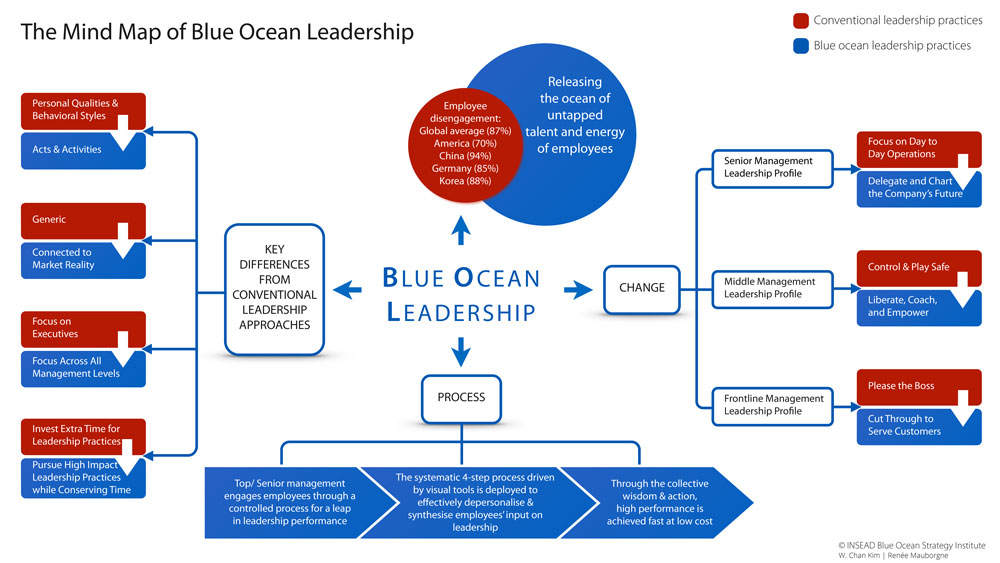
They say blue ocean leadership can help organisations realise oceans of employee potential, and stop leaders from wasting their time. The step-by-step process we’ve outlined gives organisations and leaders a clear roadmap to approach the implementation of blue ocean leadership.
Looking at the mind map above, we start at the top, realising that there is a wide gulf in organisations between the potential and realised talent within. According to Gallup’s State of the Global Workplace report the majority of employees in most companies are disengaged, just doing what it takes to get by, or actively disengaged and acting out their discontent in unproductive ways. To take the analogy of blue ocean strategy, these disengaged employees are effectively the non-customers of leadership.
What’s new?
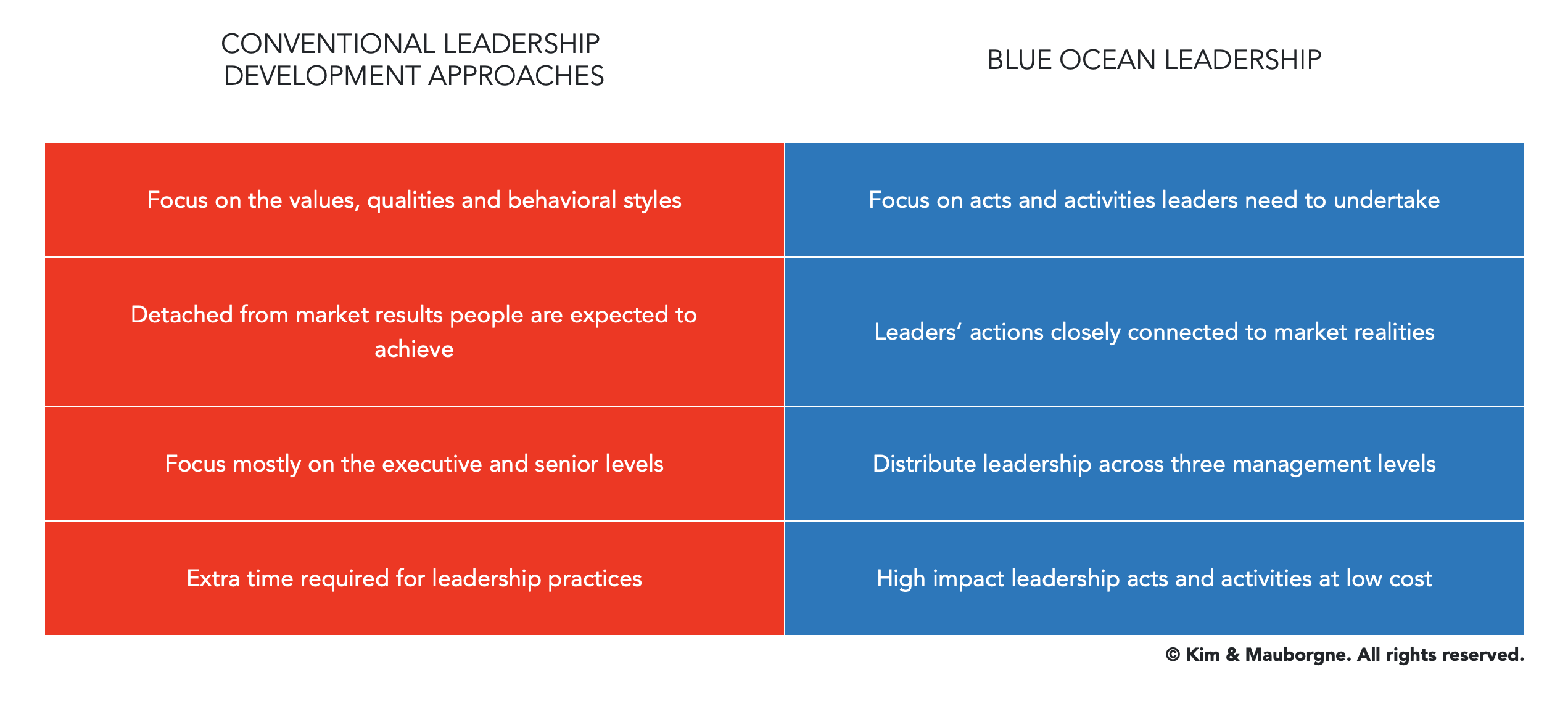
Kim and Mauborgne say that whilst these leaders don’t intentionally leave untapped talent and employee potential on the table, their understanding of this issue is key to turning the situation around. To do that, it’s important that leaders and HR directors start by understanding the principles underlying blue ocean leadership. These are: that leadership should be connected to market realities; be focused on acts and activities that have a direct and measurable impact on performance; be distributed across the organisation; and, to be achievable, should focus as much on what leaders should eliminate and reduce in what they do as on what acts and activities they should raise and create to achieve a step change in leadership strength. Without eliminating and reducing to create room on leaders’ plates, few have the time to up their game even if they wanted to (the left of the diagram).
As they illustrate, this is different from conventional leadership approaches (or what they have called red oceans). We have observed that leadership approaches used in firms are often focused on personal qualities and behavioral styles that are hard to change and are detached from what firms stand for in the eyes of customers and from the market results employees are expected to achieve. Using blue ocean leadership to connect to the market, the people who face market realities every day are asked for their direct input on the acts and activities of their leaders, and what they need from their leaders to effectively serve customers.
Getting started
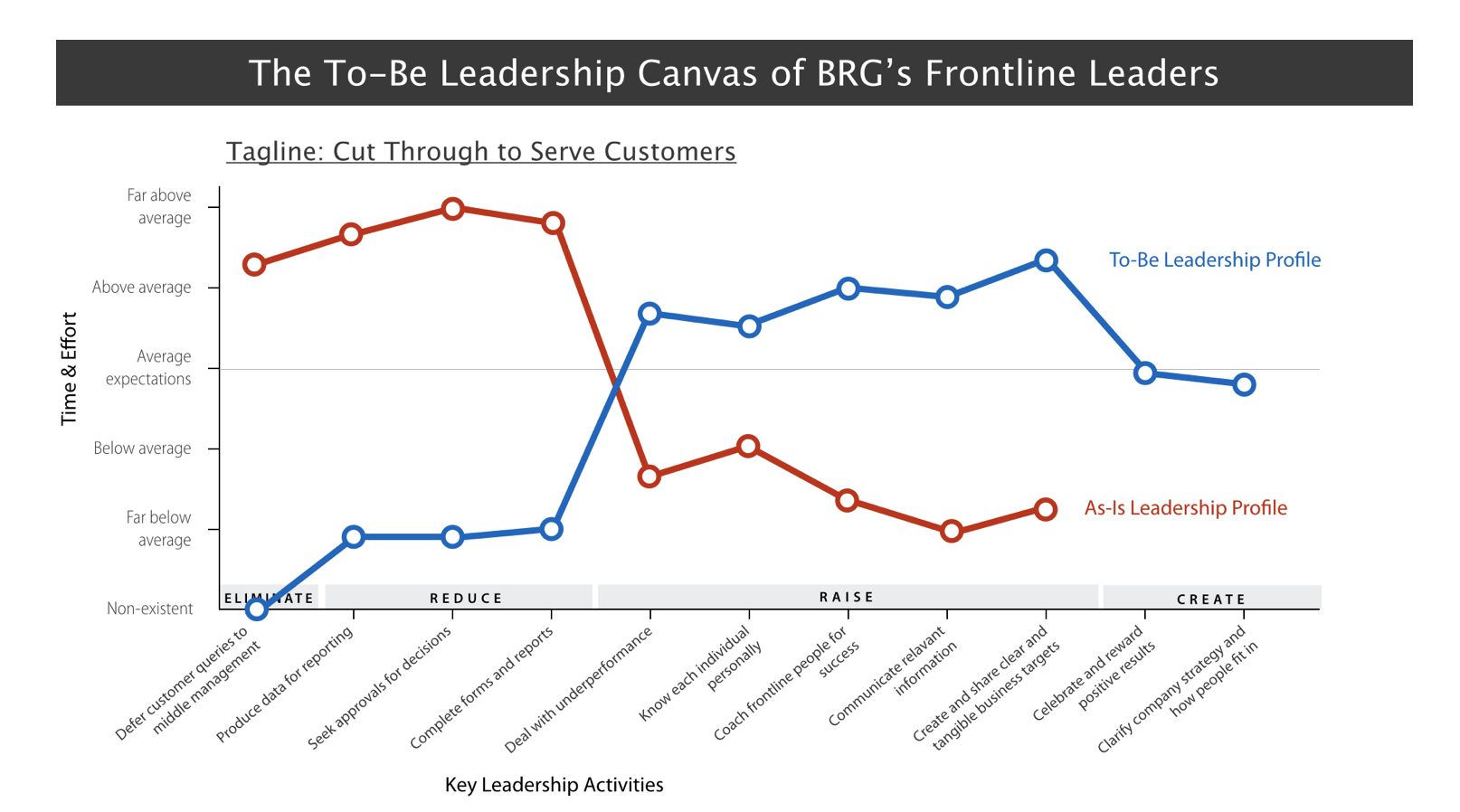
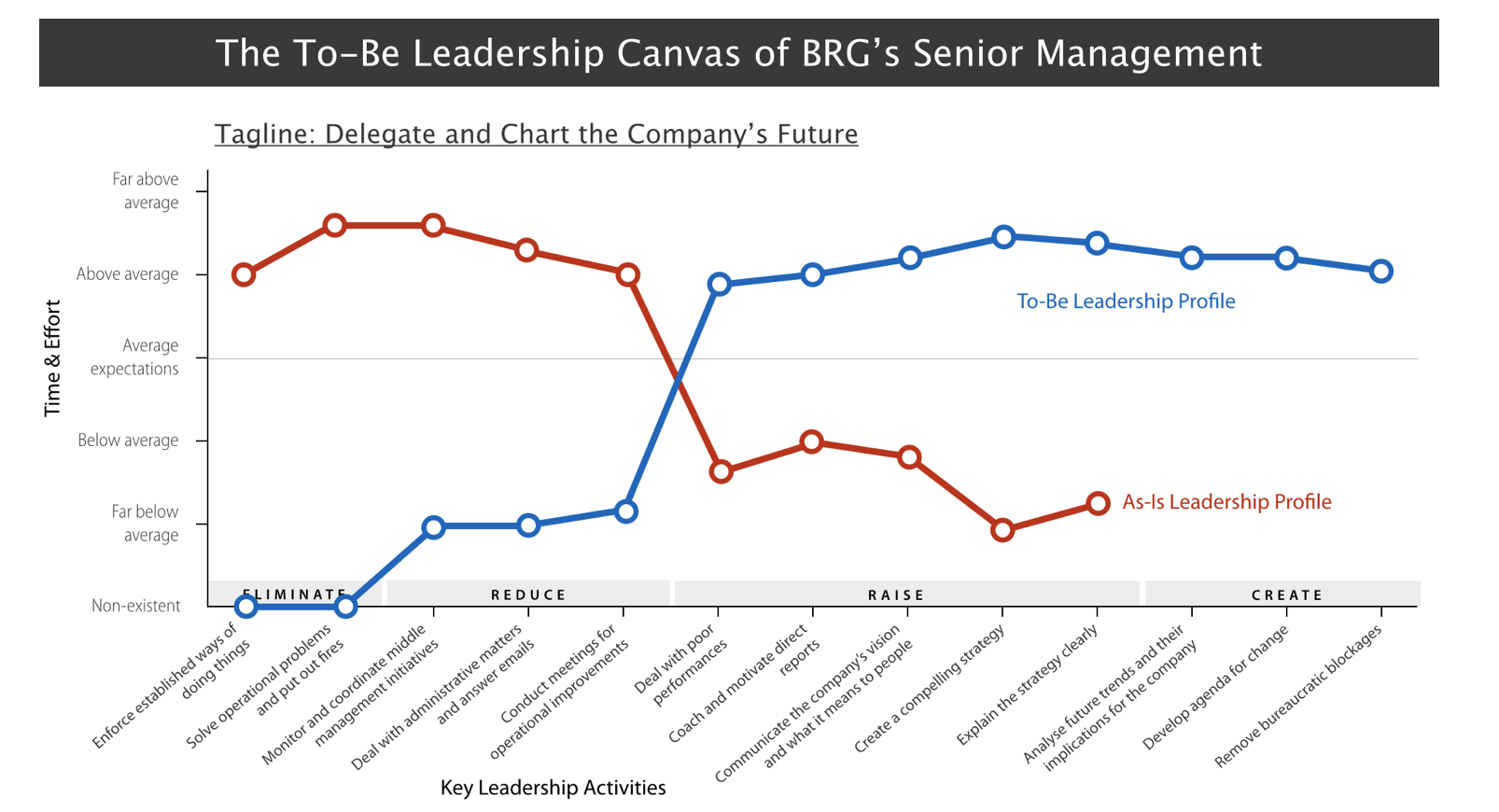
Blue ocean leadership is based on a four-step process. Before making changes in leadership, it is important for the organisation to understand where leadership stands today and where it is falling short. This is done by creating the “As-Is Leadership Canvas”, which creates a company-wide conversation on what actions actually absorb leaders’ time at each level. From there, organisations should:
- Apply the blue ocean leadership grid to determine which activities should be eliminated, reduced, raised or created.
- Develop alternative “To-Be Leadership Profiles”
- Present To-Be Leadership Canvases at a “Leadership Fair”
- Select “To-Be Leadership Profiles”
The bottom of the diagram provides a high level understanding of how the four-step process is executed, who drives the process, and how it achieves high performance fast and at low cost while gaining employees’ commitment for change.
Making the change
The development of To-Be Leadership Profiles will have given organisations the ability to see the changes needed. Once the leadership reality is realised, a case for change can be made (right side of the diagram).
Operating on the blue ocean leadership foundation, the leadership actions of frontline and middle managers will be reset, giving senior leaders the ability to delegate more and spend more time charting the company’s future rather than focusing on day-to-day operations.
It will also liberate, coach and empower middle management, making them less controlling and nervous of acting alone. The frontline managers will spend less time trying to please the boss and more time serving customers.
While leadership is by no means an exact science, rethinking the acts and activities of senior managers can free them from forms, reporting and dealing with day-to-day operational issues to focus on strategy and communication. With more empowerment, frontline managers can make decisions and spend less time reporting upwards on all aspects of the day-to-day. Together, this can unlock high performance at the top and unleash an ocean of unrealised talent and energy on the front lines.
Growth is shifting, innovation is relentless, disruption is accelerating, expectations are high, and social tensions are rising. Making sense, and making use, of these dramatic forces of change will help you to make better strategic choices, shape markets to your advantage, and create a brighter future.
Everyone talks about “megatrends” … so what are the most significant forces of change?
I spent some time comparing the many different approaches to tracking and articulating these patterns of change, to find out which trends are the most common, and the most significant.
Isn’t it obvious? Technology is shaping everything? Yes, but its the implications of that, which matter.
As McKinsey says “the trend is your friend” … It’s the oldest adage in investing, and it applies to projecting future business performance too. Their analysis shows that riding the right waves of change, created by industry and geographic trends, is the most important contributor to business results … a company benefiting from such tailwinds is 4-8 times more likely to rise to the top of future performers.
So what is a “megatrend“? Trends are an emerging pattern of change likely to impact how we live and work. Megatrends are large, social, economic, political, environmental or technological change that are slow to form, but once in place can influence a wide range of activities, processes and perceptions, possibly for decades. They are the underlying forces that drive change in global markets, and our everyday lives.
Download a summary of the keynote and workshop Megatrends 2020-2030 by Peter Fisk

Megatrend 1: Shifting economic power
Population growth is at the heart of the shift in economic power. The influence of emerging and developing economies will mean huge changes for business, society and the way we invest.
1. Emerging economies are now the growth markets
In less than a generation, developing economies have gone from being producers of goods for developed countries, to becoming an important destination for consumer goods and services in their own right. They now account for nearly 80 percent of global economic growth, and 85 percent of growth in global consumption – more than double their share in the 1990s.
2. China will be the new global superpower
Two centuries ago Napoléon Bonaparte said, “China is a sleeping giant… when she wakes, she will move the world.” How right he was. Only 15 years ago, China’s economy was one tenth the size of the US economy. If it continues to grow as predicted, it will be bigger than the US economy by the late 2020s.
As a result, China expects to have 200 cities with a population of over one million people by 2025. To tackle overcrowding in Beijing, China is building a new city – Xiongan New Area – from scratch 100km southwest of the capital. Initially it will be double the size of Manhattan and is expected to become twice the size of New York and Singapore.
3. Global demographics will change
In 2016, Asia’s population was estimated at 4.4 billion, having quadrupled in size during the 20th century. It is now forecast to grow to over 5 billion people by 2050. Asia benefits from a wealth of resources, and has an ecological variety which makes it well-placed to support this growth. As a result, we can expect to see further economic growth across this region.
Implications
Despite some challenges for the Chinese economy driven by debt levels and property market valuations, the potential long term growth of the Chinese economy relative to the US and Europe looks likely. China is already on a path to replace the US as the world’s leading superpower. When it does, political agendas, global trade and the sphere of influence are likely to shift towards Beijing from Washington.
2. Chinese business growth is relentless
China now boasts at least 100 unicorns (private companies with a $1 billion valuation), and by the end of 2019 it is forecast to be the largest user of the international patent system. It currently lies in second behind the U.S. An impressive six million enterprises were registered in China last year, up from 2.5m in 2013. The fastest growing sectors included science and technology, entertainment, sport and finance, whilst the number of mining, electricity and gas companies showed a slight decline.
The best ideas, the best partners, the best practices are increasingly from the east rather than the west. American institutions and corporate leadership is declining. Look at the number of Indian CEOs in Silicon Valley. The continuing liberalisation of the Chinese economy means the assumption that the world speaks English will likely become a thing of the past.

Megatrend 2: Resource scarcity
The impact of global warming is all around us. Rising temperatures could eventually have a significant impact on crop yields, causing food prices to surge, which in turn could impact poorer communities. At the same time, coastal areas will be increasingly susceptible to regular flooding as sea levels rise.
The global population is expanding rapidly and becoming increasingly prosperous. This is leading to significant demand for energy, water and food, which is putting a strain on the traditional, finite resources of the planet. According to The United Nations Food and Agriculture Organization (FAO), the global population will surpass 9.1 billion by 2050, at which point they predict the world’s agricultural systems will not be able to supply enough food for everyone. And the UN projects that the global demand for fresh water will exceed supply by 40% in 2030, with some cities, like Cape Town, already suffering from ‘water stress’.
The average surface temperature of the planet has been on an upward path since the late 19th century and this trend looks set to continue. The burning of fossil fuels is the primary cause of global warming. Carbon dioxide and other gases are released and trapped within the atmosphere, which in turn means heat can’t escape. Atmospheric carbon dioxide levels have rocketed since the time of the industrial revolution and show no sign of abating.
The graph shows CO2 levels during the last three glacial cycles:

Average temperatures are forecast to rise by more than two degrees before 2100, creating significant and irreversible damage and increasing strain on global resources. A study by Pricewaterhouse Coopers (PwC) estimates that this two-degree threshold could be reached as early as 2036.
Implications
In order to meet the increased food demands of the future, the agricultural industry will need to continue to innovate to become more productive with less resources and inputs. Technology is playing a key role via the rising adoption of precision agriculture. Precision variable rate technologies such as one that can detect weeds with sensors and spot sprays could slash herbicide usage by up to 95%. McKinsey says that with a 20-40% adoption rate for precision, agriculture yields could be boosted by 10-15% globally by 2025.
2. Shift from oil to clean energy
Sustainable energy sources are increasing in importance as the rhetoric condemning fossil fuels continues and changes in commodity consumption occur. But change is also about using energy more efficiently in everything we do.
As tariffs are placed on internal combustion engine vehicles, experts predict that by 2040 we will all be driving electric vehicles.11 And while the idea of driverless cars still feels like science fiction, the UK Government has set a target of having the first autonomous cars on the road by 2021, with companies such as Daimler planning ‘full production of autonomous vehicles by the early 2020s’.

Megatrend 3: Technological breakthrough
“We’re in the midst of a fourth industrial revolution, which will become known as the digital revolution.” says Klaus Schwab. The rapid advancement of technology, especially that of artificial intelligence and machine learning, is arguably at the centre of all megatrends.
1. The pace of change is exponential, not linear
The extent and pace of technological change is likely to have wide-reaching implications across almost all industries. People may be replaced with machines, and machines, robotics and AI may learn faster than humans. Think about linear growth compared to exponential growth – its impact multiplies at every year.
2. Data is the new oil
Data is the key enabler of this fourth industrial revolution. Indeed, it’s hard to imagine how powerful it could become. Jack Ma, the founder and executive chairman of Alibaba, likens data to the discovery of electricity. He said, “The world is going to be data. I think this is just the beginning of the data period.” The total amount of global data is expected to increase tenfold by 2025, the majority of which will be created and managed by business.
3. Automation of humanity
60% of all occupations could see at least 30% of their component activities automated. Many repetitive jobs can already be done by a machine, but with the rise of Artificial Intelligence, human expertise can now be learned and mastered by a system. Yes, this means that certain jobs will be replaced by machines, but it also means that the potential for new and emerging industries and opportunities is greater than ever before.
Implications
1. IOT drives connected living
By the year 2020, our world will be even more connected to the internet. Our cars, coffee machines, fridges and central heating will all be controlled from our tablets and smartphones. To put this into context, Gartner estimates that in 2014 there were 7 billion ‘things’ connected by the internet. By 2020, that will rise to 26 billion.
As robots and artificial intelligence take on more jobs, costs should decrease, and more people will be able to afford better products. At the same time, dramatic improvements could be made to infrastructure, and transport costs might plummet.
People will live longer and better lives, as healthcare technology improves patient outcomes and eradicates certain diseases. This will mitigate some of the issues of long-term care we discussed in the previous chapter.

Megatrend 4: Social change
There are already more over-65s in Asia than there are people in USA. By 2042 there will be more over-65s in Asia than the populations of the Eurozone and North America combined. Changes in global demographics (world population, density, ethnicity, education level and other aspects of the human population) will bring about significant social change, and therefore challenges and opportunities, for both government and business.
According to the UN, the global population is forecast to increase by over 1 billion by 2030, with most of this growth coming from the emerging markets. By 2050, the UN estimates that 80% of the global population over the age of 60 will be in countries that are currently deemed to be ‘less developed’.
In Japan 30% of the population is over the age of 60. Today in China, 29 million over 80 years old; by 2050, there will be 120 million. The UN’s latest demographics report forecasts that, by 2050, this will be the case in 55 countries. People will be living longer in retirement, which will result in the need for large-scale changes in government policy. This will also create a strain on healthcare services and providers, with many nations enforcing laws to ensure the elderly are properly cared for.
We’re having fewer children – particularly in wealthier and educated sections of society. This potentially has far-reaching consequences for business, including lower productivity, less labour-force participation, and less investment growth. Younger generations will be increasingly burdened with the expectation of looking after the elderly, which in turn could further reduce productivity.
Implications
In the US alone, healthcare spending is set to rise by 8% of GDP each year between now and 2040. That’s around $3,400 billion every year. According to analysis by the World Economic Forum, the retirement savings gap across eight major economies is growing by $28 billion every 24 hours and could reach $400 trillion by 2050 – around five times the size of the global economy today. There will be a renewed focus on saving for retirement and finding effective ways of drawing an income when people retire. As a result, there could be a greater need for financial help, and the rise of robo-advice solutions.
As populations age, it becomes increasingly likely that businesses will use technology to plug the shortfall in labour supply. Robots are more productive (they don’t sleep, get sick or need performance reviews, although they may have technical problems). As a result, there will be a greater need for skilled jobs such as data scientists.
Consumers are increasingly focussed on what they eat, how they are eating it and how it is produced; creating significant changes in the food supply chain. For instance, organic foods sales in the US has risen 224% from 2005 to 2016. Fresh food is being preferred over processed foods and products with specific health related benefits, such as avocadoes and berries, have seen outsized growth. Consumers want their food to be more convenient, resulting in more online delivery, meal-kit solutions and convenient snacking options at supermarkets.

Megatrend 5: Rapid Urbanisation
More than half of the world’s population now lives in towns and cities, and by 2030 this number will swell to about 5 billion. Much of this urbanization will unfold in Africa and Asia, bringing huge social, economic and environmental transformations.
In 1990 there were only 10 cities in the world with a population exceeding 10 million – the so-called ‘megacities’. Today the number of worldwide megacities has nearly tripled to 28. Populations are increasingly concentrating themselves in cities and large urban areas. This will further drive technological advancement and impact climate change, having its own influence on other megatrends.
These large-scale shifts in population lead to both opportunities and challenges for society. The requirements of future urban populations will be remarkably different to the cities of today, with citizens demanding connectivity to everything – every device, every entity and every object. Wireless connectivity will be paramount to improving quality of life in cities.
Globally, more people live in urban than rural areas, and as the graph below shows, that trend looks set to continue. In 1950, 30% of the world’s population lived in urban areas, and that’s forecast to increase to 66% by 2050.2

In the US, the patient-to-primary care physician ratio in rural areas is 39.8 physicians per 100,000 people, compared with 53.3 physicians per 100,000 in urban areas. This uneven distribution of physicians has proven to have an impact on the health of the population. With better healthcare outcomes likely, urban populations consequently grow faster than rural populations organically (without migration) as people are motivated to migrate towards them.
At the same time, urban areas tend to have better employment opportunities, better education and better access to social and cultural activities. This makes them more attractive places to live and makes it easier for businesses to flourish. In China, for example, the urban per capita income is more than double the rural figure.
Implications
Cities will emerge, driven by modern urban populations that embrace technology to improve the efficiency of infrastructure and services. Mass migration will mean the need for new infrastructure and services. Transport infrastructure and networks will require upgrades due to the dominance of autonomous vehicles and the greater concentration of people.
2. Healthcare and security
As population density grows to unprecedented levels, existing healthcare systems will need to be radically overhauled to deal with this influx. Traditional hospitals will come under significant strain if they do not utilise new technologies available to them. With higher crime rates in cities than rural areas, governments will employ elevated levels of surveillance on citizens in cities, increasing connectivity means that every activity is logged and monitored.
3. Consumer behaviours change
In concentrated urban environments, the traditional symbols of progress will change – a car, a garage, a bigger house. Instead different priorities will emerge as we live in apartments. Products will need to be smaller, requiring less space or storage. Food deliveries and food replenishment will be fast. Traditional communities will not emerge like in villages, and so social lives will be less related to location and neighbours. Resources will be shared, from energy suppliers to mobility solutions. Group behaviour will dominate in new ways.

Sources: With thanks to Accenture, Blackrock, Deloitte, IFTF, PwC, WEF and World Bank for data in support of this report.
Contact: peterfisk@peterfisk.com for more information on the Megatrends 2030 Workshops and Blueprint Programs.
Francesca Gino is a behavioural scientist who I recently met at the Thinkers50 Global Summit in London, the biennial celebration of the best ideas for business leaders, and awards that are dubbed the Oscars of business thinking. She won the “talent” award, for the best idea about people in business, and how to nurture their potential.
She loves to tell anecdotal stories. For example, the one about the coloured milk at home.
Each morning when she wakes up, she pours milk into a cereal bowl and squeezes in a few drops of food colouring. The Harvard Business School professor has tried green, blue, and red, but her favourite colour is yellow.
This ritual began when Gino’s five-year-old son asked her and her husband one morning why they don’t use food colouring in milk (they had recently used it to paint Easter eggs). She was struck by her husband’s response: “We just don’t do that.” This set her thinking. Why shouldn’t the milk be pink, or any colour?
And then, she realized something: her son’s determination to break the breakfast rules was intimately connected to her research on innovation.
Curiosity and insistence on questioning the status quo—why can’t cereal milk change colors?—are among the qualities Gino has discovered separate good leaders from great ones, and the people who can’t wait to get to work from the ones who count the minutes until they can leave. These qualities are part of an instinct to rebel against what feels comfortable. And adopting those qualities may be key to, as Gino puts it, creativity, productivity, and making work suck less
Rebel Talent
Gino’s new book is Rebel Talent: Why It Pays to Break the Rules in Work and in Life.
She has spent much of her career studying non-conformists – specifically, people who break the rules, and end up in trouble. But now, she wonders whether letting go of norms and traditions can lead to the most sublime examples of creative thinking. “I think we really need to shift our thinking,” she says. “Rebels are people who break rules that should be broken. They break rules that hold them and others back, and their way of rule breaking is constructive rather than destructive. It creates positive change.”
Gino also tells the story of the time when she was browsing the shelves at a bookstore when she came across an unusual-looking book in the cooking section: Never Trust a Skinny Italian Chef by Massimo Bottura. The recipes in it were playful, quirky — and improbable. Snails were paired with coffee sauce, veal tongue with charcoal powder. Francesca, who is Italian, says remixing classic recipes like this is a kind of heresy in Italian cooking. “We really cherish the old way,” she says. But this chef, one of the most influential in the world, couldn’t resist circling back to one, big question: Why do we have to follow these rules?
Another story is Gino’s 2013 study on “the red sneakers effect,” which finds that deviating from social norms about dress codes can boost your status in the eyes of strangers.
The psychology of rebels
“Rebels have a bad reputation”, says Gino in the new book.
“We think of them as troublemakers, outcasts, contrarians: those colleagues, friends, and family members who complicate seemingly straightforward decisions, create chaos, and disagree when everyone else is in agreement. But in truth, rebels are also those among us who change the world for the better with their unconventional outlooks. Instead of clinging to what is safe and familiar, and falling back on routines and tradition, rebels defy the status quo. They are masters of innovation and reinvention, and they have a lot to teach us.”
Gino has spent more than a decade studying rebels at organizations around the world, from high-end boutiques in Italy’s fashion capital, to the world’s best restaurant, to a thriving fast food chain, to an award-winning computer animation studio. In her work, she has identified leaders and employees who exemplify “rebel talent,” and whose examples we can all learn to embrace.
She argues that the future belongs to the rebel — and that there’s a rebel in each of us. We live in turbulent times, when competition is fierce, reputations are easily tarnished on social media, and the world is more divided than ever before. In this cutthroat environment, cultivating rebel talent is what allows businesses to evolve and to prosper. And rebellion has an added benefit beyond the workplace: it leads to a more vital, engaged, and fulfilling life.
Whether you want to inspire others to action, build a business, or build more meaningful relationships, Rebel Talent will show you how to succeed by breaking all the rules.
What kind of rebel are you?
Rebels come in many varieties. They behave in different ways, and need different approaches to develop their talent. To determine which rebel ingredients come most naturally to you, and where you have the most room to grow, you can complete this free assessment. Becoming more aware of your own rebel profile will help you become more comfortable with the uncomfortable. After taking the test, you’ll receive concrete tips based on the habits and strategies rebels rely on regularly.
Take the rebel test … to learn which type of rebel, out of four possibilities, you tend to be. You’ll receive a short explanation of your type and a few tips on how you can further deploy and develop your talents. Call to mind the thoughts and feelings you typically have regarding your job or in your personal life. You will be asked to consider 30 pairs of statements. For each pair, choose whether “A” or “B” is most characteristic of your behavior.
Faster ideas drive better innovation
Speed is important for innovation in part because first-mover advantages can translate to market-share dominance. But in an increasingly digital world, speed isn’t merely nice to have, it’s an imperative. Companies that can’t keep pace with fast-changing technologies and consumer expectations run the risk of falling behind nimble competitors. Innovative CEOs prioritize speed in innovation. Their ideas range from not waiting for a “bolt from the blue” to pursue innovation, to moving at “double time” using a test-and-learn approach that enables quick direction changes, to partnering with other organizations to acquire expertise that might take too long to develop internally.
Don’t wait for a “bolt from the blue” says HANS VESTBERG, VERIZON
“Real innovation is usually not a ‘bolt from the blue’ event. The real source of most innovation is iteration—the process of building upon earlier ideas. In fact, I’d say 80% of innovation comes from incremental gains on already begun processes, while 20% comes from wholly new ideas. If you throw away or discount that 80%, you undermine the very foundations of innovation itself.”
Lift and shift the best ideas says JAMES QUINCEY, THE COCA-COLA CO.
“We use a test-and-learn approach that allows us to respond to ever-changing consumer preferences. When we commit to a new product, we quickly move to scale. Our market teams are empowered to innovate based on local preferences, and we work to lift and shift the best ideas across the world.”
Welcome outsiders to accelerate new thinking says MICHAEL SCHLEIN, ACCION
“We have worked hard to become a magnet for innovation from around the world. Our global team finds, supports, and learns from local innovators solving problems that prevent people from realizing their potential. We foster innovation by advising, investing, influencing, and partnering—holistically—to drive progress. We continuously bring on and benefit from new talent who expand and improve our work.”
Smart decisions drive better innovation
Companies can go fast but get nowhere if they don’t have a roadmap to guide them. For many companies, that roadmap is built on data, although intuitive choices are becoming more important too, particularly when looking ahead amidst change and uncertainty. Innovative CEOS put great stock in using data to drive decisions around their innovation initiatives. Many actively seek to capitalize on the latest technology. They use data to better understand their customers—and to measure results. Yet for all their reliance on data, they remain cognizant of the fact that it’s not the only source of innovation insights.
Take smart risks says JAMES QUINCEY, THE COCA-COLA CO.
“Our task is to take a 133-year-old company and position it for the digital future. Data is the key to knowing our consumers— their preferences, their behaviors, and how they want to interact with us. The way we engage a consumer in one zip code may be completely different from our approach in the next one. We are using data to take smart risks, accelerate how long it takes us to go to market, and constantly put the customer at the center of everything we do. We must do all this while also being responsible stewards of their data and respecting everyone’s right to privacy.”
Kill the “zombies” says JAMES QUINCEY, THE COCA-COLA CO.
“We have a formal stages-and-gates process that helps drive our innovation efforts. We’ve also developed a disciplined approach to innovation that includes a leader-challenger- explorer framework, as well as something I like to call ‘killing zombies.’ Killing zombies means getting rid of stuff that’s not working. We analyzed about 2,000 of our beverage product launches over five years and found that 30% contributed only 1% in volume. In 2018, we killed more than 700 zombie products, which allows us to redeploy resources in areas where we see more growth opportunities.”
Don’t forget ethics says MARC BENIOFF, SALESFORCE
“Preserving trust is a prerequisite for innovation. As we’ve innovated with artificial intelligence (AI), we’ve learned that we must guard against the unintended consequences of deploying powerful technologies—such as introducing bias into AI-powered decisions or products that could be used in harmful ways. We realize that the ethical and humane use of technology, especially within the context of the Fourth Industrial Revolution, must be clearly addressed, not only by us, but by our entire industry. We have to make sure that technology strengthens our societies instead of weakening them, and that technology is applied to improving the human condition. To address this concern, we established the first-ever Office of Ethical and Humane Use of Technology, which merges law, policy, and ethics to develop and implement a strategic framework for the ethical and humane use of technology across Salesforce.”
Remember, the customer isn’t a packet of ones and zeros says HANS VESTBERG, VERIZON
“Companies can obviously gain a great deal from a data-driven approach to decision making on innovation. We are trying all the time to sharpen our use of data to improve our understandings of the customer. But we must never lose sight of the fact that the customer is a human being, not a packet of ones and zeros. As we improve our mastery of data, it is imperative that we retain our humility about just how much—and how little—data can actually tell us. That may be especially important in an industry like telecommunications, which is so tightly woven into people’s lives. Our products and services influence how people play, work, flirt, learn, mobilize, and seek help. It’s a uniquely human industry in that regard, and while we should always seek to learn from data, we should never let data fully supplant our own human understandings of how best to serve our customers across an ever-evolving range of needs and expectations.”
Top commitment drives better innovation
An explicit commitment to innovation can go a long way toward making it a reality. Innovative CEOs demonstrate their commitment to innovation in ways that would be hard for their employees to miss, from providing tangible rewards for innovative behaviors to expressly voicing the idea that failure, within boundaries, is not a loss but a learning opportunity.
Lead for today, think for tomorrow says DR. RUTH BROWNE, RONALD MCDONALD HOUSE NEW YORK
“As chief executives, it’s our job to lead and develop senior staff through a process of thinking about innovation—while also keeping our fingers on the pulse of what’s happening internally and externally. My own approach has been to take stock of, and account for, what is required to keep the organization delivering on its current obligations—while also building and institutionalizing the infrastructure that will allow us to get to next steps. We chalk out the future by asking strategic questions. Where does Ronald McDonald House New York live in the future? And personally as CEO, I am building our vision with an intentional eye to the future—and leveraging the talent and technology that can take us and keep us there.
Seek audacity says MICHAEL SCHLEIN, ACCION
“The magnitude of the problem that we’re trying to solve— helping nearly half of the planet left out of or poorly served by the formal financial sector—is immense and humbling. We’re just one organization, and it will take a global effort to create a financially inclusive world. Since the beginning, we’ve attracted people with the audacity to think they can make a difference.”
Go further with fewer says JOHN DONAHOE, SERVICENOW
“As a company that is rooted in innovation, we run the risk of trying to do too much at once. That’s why I push my team to sharpen priorities to focus on what I call the ‘critical few’—and go further with fewer.”
Seize on ideas that scale says GINNI ROMETTY, IBM
“Like many technology companies, IBM has wrestled with finding or creating sufficient skilled workers for in-demand careers. As we approached this challenge, our focus was twofold: Create programs that work and that scale easily. That second part is crucial. There have been many classroom proofs of concept supported by well-known technology companies, but we know from our role as a global innovation company that the efforts withthegreatestimpactarethosethatcanbereplicatedatscale.”
Entrepreneurial spirit drives better innovation
Culture, the saying goes, beats strategy. Having a culture that embraces change, diversity of opinion, and risk-taking can go
a long way toward facilitating innovation. By contrast, a culture wedded to old ways of doing things and leery of experimentation is almost certain not to excel. Innovative CEOs take culture seriously. They prize diversity in the workforce because they know that looking at challenges from different angles and backgrounds can yield ideas and insights that otherwise might be missed. They encourage continuous learning and the sharing of information, both within the enterprise and with external partners. And they know they can’t let their organizations become so rooted in the past that they miss the future.
Reframe innovation as business as usual says MICHAEL CORBAT, CITIGROUP
“For Citi, innovation is business as usual, both in the here and now and looking ahead. We make innovation central to every aspect of what we do and how we do it. By looking at technological advances, regulatory changes, and social and behavioral shifts, our goal is to pinpoint the irreversible, accelerating trends that convey the clearest picture of where the market is heading.”
Break rituals says HANS VESTBERG, VERIZON
“A company as big and successful as ours is inevitably going to build up a lot of habits and rituals and assumptions about what works. Most of those are quite handy. We wouldn’t be a Fortune 20 company if we didn’t have a track record of success and sound practices. But there’s a real risk that such success can make it harder to make the changes we need to make in order to compete in a constantly evolving marketplace. We need to be willing to break rituals, do things differently, and approach our competitive challenges with a mindset that is fundamentally different from what we’ve used in the past.”
Treasure “wild ducks” says GINNI ROMETTY, IBM
“There’s a saying at IBM: Treasure ‘wild ducks’—the independent thinkers. Half a century ago, Tom Watson Jr., our second CEO and the son of IBM’s founder, said, ‘Every business needs its wild ducks, and at IBM we try not to tame ours.’ It means that we are receptive to new and radical ideas—even if we don’t always agree with them.”
Stay hungry, stay humble says JOHN DONAHOE, SERVICENOW
“I ask all of our employees to stay hungry and humble, and to think about being open to learning new things and embracing change, fostering collaboration, learning from failure, and creating an environment that celebrates diversity, inclusion, and belonging. The key to innovation is getting everyone, not just leadership, aligned and committed to our purpose.”
Look afar for potential disruptors says HANS VESTBERG, VERIZON
“The primary competitive challenge Verizon faces is not from any of the other big-name telecom companies. It’s from the next creator of a technology or process that radically upends our entire industry, our entire business model. If anything, the waves of disruption and innovation are becoming stronger and stronger all the time—and our company’s innovation efforts are all about preparing Verizon to ride those waves successfully.”
And what makes an innovative CEO?
“Megatrends” are powerful, transformative forces that can change the trajectory of the global economy by shifting the priorities of societies, driving innovation and redefining business models. They have a meaningful impact not just on how we live and how prioritise, but also on government policies and corporate strategies.
Five megatrends shaping our future, shifting the way we live and work.
- T … Technological breakthrough
Technology is driving exponential progress in the tech sector and far beyond. 125 billion internet-connected devices are expected to be in market by 2030, up from 17 billion in 2017. - S … Social and demographic change
Longer lifespans and modern lifestyles will change medicine and consumer habits. 45% increase in the 60+ population worldwide is projected to take place as soon as 2030. - U … Rapid urbanisation
Mass migration to cities will require new business models and infrastructure. 2/3rds of the world’s population will reside in cities by 2050, double the percentage from 1950. - R … Resource limits and climate change
Demand for a clean, green tomorrow will advance energy and conservation. 50% of the world’s energy is predicted to come from solar and wind by 2050, up from just 7% in 2015. - P … Shifting economic power
Newly affluent consumers will expand in Asia and across emerging markets. Emerging market economies today are predicted to represent 6 out of the 7 largest economies by 2050.
Here, from LSN are some of the new narratives emerging out of these fast-approaching and colliding forces, and the implications they have for our everyday lives:


Black Friday may seem like a big event, but it its dwarfed by the scale of Alibaba’s Global Shopping Festival 11:11, also known as Singles’ Day, which racked up $38bn of sales in 24 hours, earlier this month. That’s 10 times more than the likely combined sales of all retailers on Black Friday last year.
Let’s turn the clock back two weeks to a night in Hangzhou, one of China’s fastest growing cities, and home of Alibaba.
When the clock struck midnight on 11 November, so began the world’s biggest shopping spree. Singles’ Day or, as its officially called, the Global Shopping Festival 11:11, is like combining the Olympics and the World Cup into one event for Chinese ecommerce giant Alibaba. A bit like Boxing Day sales, mixed with Black Friday plus a bit of Eurovision kitsch.
Singles’ Day started in the 1990s when young single people used it as an excuse to get together. Then in 1999 Alibaba co-opted it and turned it into a shopping event. Now it’s not just a single day, it’s a 20-day shopping festival, the biggest event in retail and ecommerce in the world and an orgy of consumption.
This year’s event smashed the previous year’s record by racking up sales of 268.4 billion yuan ($38.3 billion), just under a 26% rise from the figure posted last year. That’s a slower growth rate than the 27% seen on last year’s Singles Day.
The day got off to a strong start for new Alibaba CEO Daniel Zhang, who took over from the retiring Jack Ma earlier this year.
Sales hit $12.01 billion in the first hour. Within an hour and a half, Alibaba’s sales exceeded the total reached on Singles Day in 2016. Alibaba also set a world record for most payment transactions with Alipay, its online payment platform, processing 256,000 payment transactions per second. The number of delivery orders surpassed 1 billion. In just one day.
The sales figures dwarf the revenue for Amazon’s Prime Day sale – this year estimated to be $4bn (£3.1bn) across 17 countries. Alibaba’s Singles’ Day volume again outpaced US online sales on Black Friday and Cyber Monday combined.
This should not be a surprise given that Alibaba’s mobile monthly user figure is almost 700 million – almost the population of the USA and Europe combined. However, Alibaba is less of an ecommerce retailer than Amazon; its business includes a marketplace, a cloud business, a financial services business, food delivery apps, supermarkets and even film production.
The run-up to this year’s 11/11 had lots of “countdown events”, including an interactive, live-streamed four-hour fashion show broadcast across 10 Alibaba platforms.
Why is 11:11 such a success?
To understand Singles’ Day, you have to understand three things about Chin. Firstly, China went straight to mobile so the majority of the population is on mobile phones. In China, people now conduct their daily life without a wallet, cash or credit cards. There’s no need for that. All you need is your mobile phone, and you can use it for hiring a taxi, ordering food for lunch, booking travel, rating a restaurant, shopping, watching TV, paying your bills.
The second thing to know is the concept of city ‘Tiers’. There are Tier 1, Tier 2, Tier 3 and Tier 4 cities in China. Tier 1 cities are the likes of Beijing, Shanghai and Guangzhou – essentially sophisticated and affluent mega-cities. Tier 2 cities are places such as Chengdu or Dalian: still big cities with 16 million+ people, generally made up of provincial capitals but still fast growing and with consumer behaviour similar to Tier 1 trends.
Tier 3 and 4 cities might be found in mountainous areas and are usually home to up to 5 million people. There may not be the same infrastructure as elsewhere, but everyone has a mobile phone and you can reach people across the nation through the mobile network. Again, the scale thing: there are about 130 Tier 3 cities and 400 Tier 4 cities!
What is hard to understand is that such consumerism is part and parcel of the everyday experience in China as the country’s middle class grows exponentially.
The final thing to understand is the scale and influence Tencent and Alibaba have in China. The vast majority of web activity in the country happens through proprietary applications run by Tencent and Alibaba. The two dominate digital life in China and are an effective duopoly. Alibaba is known globally for it B2B ecommerce platform, Alibaba.com, as well as the Tmall and Taobao brands (think eBay, Paypal and Amazon combined, with TMall for consumers, and Taobao for consumer to consumer).
Alibaba’s rival Tencent owns WeChat, which has 1 billion+ users, as well as its older messaging app QQ. WeChat is like Facebook, Twitter, Spotify, WhatsApp, Paypal and YouTube, as well as gaming and reading, coming together in one ‘superapp’. Both platforms are a way of life; WeChat was recently called the ‘operating system of China’.
For marketers, these internet giants increasingly control the interfaces to consumers across multiple touchpoints. And they own the data that comes as a result of those interactions. The proposition to marketers who wish to access customers in China is dead simple: deal with us directly if you want to reach your audience; make it on mobile and you can deal with the whole country.
Who is taking part in 11:11?
Almost half (46%) of Singles’ Day consumers were born in the 1990s, not surprising given that 28% per cent of China’s 800 million online population are aged between 20 and 29. What is hard to understand is that such consumerism is part and parcel of the everyday experience in China as the country’s middle class grows exponentially.
These consumers are also less concerned about privacy: data from Alipay shows that during this year’s online shopping spree, 60% of total payments were done by users scanning their fingerprints and faces.
For brands, Singles’ Day provides a platform for new product launches. 11:11 has such significance that brands start planning nine months out, with some integrating the event into three-year strategic plans.
More than 180,000 brands took part in the Singles’ Day event, with more than 40% of consumers making purchases from international brands. Japan, the US, South Korea, Australia and Germany are the top five countries selling to China while more than 60,000 international brands including Adidas, Bose, La Mer, L’Oréal, Mac, Mattel, Mondelez, Nike, P&G, Shiseido, Siemens, Unilever, Uniqlo, Wyeth and Zara took part.
What can we learn from 11:11?
1. Creating a new retail experience
The 11:11 Global Shopping Festival provides insights for the rest of retail in how to build excitement and engagement with today’s consumers. Alibaba sees normal high street retail as dull and Singles’ Day is part of a shift by Alibaba from transactional selling to experiential shopping.
Consumers don’t just watch and buy, they take part via Alibaba’s Taobao or the Tmall app on their phone. Audience and viewers are asked to vote, and shake their phones to earn credits and reveal deals. The blend of retail and entertainment, innovation and raw commercial options is quite different to anything in the west.
2. The blurring of online and offline
Jack Ma, the founder of Alibaba, coined the phrase “new retail“ to depict the increasingly blurring boundaries between the online and offline shopping world. The company put this into action with the purchase of the Hema supermarket chain (now called Freshippo) and is now rapidly expanding it.
Alibaba set up 60 new retail-powered pop-up stores across 12 cities and 52 shopping malls in China to trial an augmented reality lipstick. And 100,00 stores in 334 cities were converted into “smart stores” to bring a range of new retail experiences such as facial recognition payment.
3. Integrating services seamlessly
Alibaba has made Singles’ Day total integrated. It uses Tmall, Taobao, services platform Ele.me, Rural Taobao (for rural areas), Ling Shou Tong – the Alibaba platform for convenience stores in China – all hosted in AliCloud and using the Cainiao Logistics network.
4. Big data insights
Alibaba supplies data and insights to brands to help create new products and packaging expressly for Singles’ Day and get access to the data from their sales to be mined for the other 11 months of the year. As an added bonus, Alibaba uses real-time data visualisation in the media centre at the Singles Day Gala Event to show sales results.
5. Gamification
Whilst Amazon, and most other retailers, will bombard you with discounts – for the consumer 20% or 30%, 60% or 70% – does it really make a psychological difference? (although it does to the bottom line for the retailer), Alibaba plays a different engagement game. Gamification is key, and viral. There are interactive treasure hunts and augmented reality games. Play a game to find a black cat (Alibaba’s logo for 11:11), or even better a red envelope, and you unlock discounts. Hard earned discounts which you are much more likely to redeem.
Beyond the hype
Of course, you could ask, do we really need such a frenzied festival of consumerism, in a world increasingly fragile with environmental stresses and inequality. Probably not. From a business perspective, the Chinese market is booming particularly in the young middle classes, and the Chinese businesses who serve them are leaping ahead in techniques for engaging consumers and growing business. However at the same time, we need to ensure that brands and consumer appetites are embraced as a positive force, to achieve personal progress and for a better world.
Zhang Ruimin is Chairman and CEO of Haier, the world’s leading white goods business.
From his base in Qingdao, Haier has revolutionised the world of refrigerators, washing machines, air conditioning, and many other home appliances. Not just in China, but increasingly as a global brand. Zhang has become a world-renowned entrepreneur, creating a unique, innovative, evolving business model that fuses management philosophies of east and west.
In 1984 Zhang became director of the Qingdao Refrigerator Factory, the predecessor of Haier. Over 30 years, he turned a small, collectively-owned factory with a 1.47 milion yuan loss into a global enterprise, with a turnover of 188.7 billion yuan (2015). In 2016, he sealed a $5.4 billion deal with GE to buy GE Appliances (GEA).
Zhang’s innovative management philosophy blends the essence of traditional Chinese culture with modern western business concepts. Once a devotee of the “six sigma” approach, Zhang has developed his own management ideology: rendanheyi. By dividing a company up into micro-enterprises on an open platform and dismantling the traditional “empire” system of management, rendanheyi creates “zero distance” between employee and the needs of the customer.
At the heart of rendanheyi is the cultivation of entrepreneurship – by removing the costly level of middle management (Zhang famously eliminated the positions of 10,000 employees), you encourage innovation, flexibility and risk-taking.
The physics of business
Today we’re in London for the Thinkers50 Global Summit, a meeting of enlightened mind, celebrating the best ideas in business thinking, including the biennial ranking of the top 50 gurus. Zhang was the winner of the 2015 “Ideas into Action” award, and has now risen to 15th in the global ranking. He also hosts Thinkers50 regional hub in China, as a way to help encourage more entrepreneurs, more new thinking, and more innovation across Asia.
I’ve met Zhang before, but I hadn’t previously had the opportunity to explore our common background, both as physicists. I was curious about how he had embraced the ideas of physical science into his vision of how Haier should work as an organisation. He was delighted, and quickly got into a passionate, and somewhat technical discussions about atomic structure and wave theory. Whilst I’m not sure atomic physics would be many business people’s ideal topic, I was intrigued.
Atomic theory and self-organising teams
Zhang Ruimin: “When I first studied physics I was amazed by the perpetual motion of sub atomic particles. Electrons and protons coexist in a dynamic equilibrium, created by their equal and opposite charges. This sustains a continual existence, it enables atoms to come together in many different formats as molecules, each with their own unique properties, and within these atomic structures is huge amounts of energy”.
The application to business becomes clear, and also much of the founding ideas behind why and how he has developed his rendanheyi model of entrepreneurial micro businesses.
Zhang Ruimin: “Applying this idea from physics to business, small teams of people with different backgrounds, skills, and ideas, can co-exist incredibly effectively. It is the ability to create small diverse teams where ideas and actions are equally dynamic, that enables a business to sustain over time. They become self-organising and mutually enabling. Ideas, innovation and implementation are continuous. And they can easily link with other teams, like atoms coming together as molecules, for collaborative projects and to create new solutions.”
As a result, he challenges the old supremacy of shareholders in the value equation, putting a premium on employees, and the value created by them and for them. However at the same time, he recognises the need to empower employees to be more customer intimate. As a result the rate of growth has risen from 8% to 30% in recent years.
Zhang Ruimin: “People are not a means to an end, but an end in themselves. We took away all of our middle management. Now things are working much better. Zero signature, zero approval. Now we have only one supervisor, which is the customer.”
Wave theory and entrepreneurial brands
Zhang Ruimin: “Additionally as we think more about quantum physics, it is wave theory that is responsible for how energy is transmitted – in forms such as light or heat, magnetism or sound. The idea of waves being a relentless force of progress, which can be reinforced when two waves come together and resonate with more than double their impact. The Doppler effect. Waves can be sustained over great distances, and with different frequencies, into what we know for example as pitch and volume”.
In this example the analogy to business can be taken in multiple ways, both in how organisations build a culture and sustain momentum, but also how innovations and brands are sustained in markets.
Zhang Ruimin: “First think of waves inside organisations. They are like ideas that spread between people and teams. Ideas that resonate together can be more powerful, and in time they characterise a culture, a common way of thinking and doing things. Haier is many businesses but one brand. In the same way, in the market, innovations can spread rapidly, and be reinforced by matching with customer needs, particularly as was create more products to improve people’s lives more holistically. As we do this, we create resonance with people, the solutions become more important, and the brand becomes more powerful.”
As a result, brands form a different type of relationship with organisations and brands, rather than transactional, they come relational or even partners.
Zhang Ruimin: “Sales used to be the end of the relationship. Now sales is the beginning of the relationship. We now work in a more connected way, with connected products, and connected partners, and connected customers. It is an ecosystem. ”

Technological innovation that improve people’s lives
Haier’s evolution has been rapid and relentless, as Zhang has driven the company from an old refridgerator factory – where indiscipline and poor quality was so rife that he took to shock tactics, taking a sledge hammer to some of the products to demonstrate that such mediocrity was no longer acceptable – to a pioneer of digital tech.
Zhang Ruimin: “We quickly realised in the early days, that high quality was very important. Approaches like six sigma were very important at the time, and we were one of the first Chinese companies to embrace such techniques. We didn’t just want to compete, we wanted to be the best company. And we needed to be if we were to build a brand recognised globally.”
Whilst Haier in the 1990’s was focused on the Chinese market, building a portfolio of high quality standardised products, the 2000’s was about internationalisation, reaching across the world but with localisation, and customisation. The 2010’s have been all about digitalisation, embracing the power of automation and data, to the point where Haier is now one of the world’s leading producers of “smart” products, embedded with IOT, and connected intelligently.
However the implications are profound. Today it is no longer about standardisation, and creating the best product. Haier’s brand purpose is all about making people’s lives better. Therefore Haier is looking beyond products to services, and how it can do more to help people live in their everyday lives, with a focus on the intelligent home.
Zhang Ruimin: “In a digital world of globalization, connectivity and personalization, there is no such thing as a perfect product. People will buy scenarios, or concepts, where the products might be free and just enablers of services. Haier’s products embrace the internet of things to ensure that they connect with other devices, with other partners in our ecosystems, and with people and their homes. In the future, maybe the product will be free, and people will pay for services – from food delivery, to home entertainment, security or maintenance.”
The ecosystem model is now core to Haier’s future, arguing that Haier is the first true ecosystem brand.
Zhang Ruimin: “We want to create a rainforest of perpetual life”.
From Aristotle’s philosophies to Asian leadership
Zhang is clearly an incredibly thoughtful and well-read leader. His ideas are regularly interspersed with quotes from Aristotle and Plato, Kant and Hemingway, Mintzberg and Drucker, and many others too. His desire to embrace western management techniques marked him out as a thought leader amongst Chinese leaders.
Zhang Ruimin: “I read two books every week, or more. Easy year more than a 100 books. I pay special attention to cutting edge ideas. I read philosophy books.”
Having spent much of my last year exploring Asian businesses and their leadership behaviours, I was intrigued by how far Zhang thought Asia had now come. Is Asia still learning from the west, or do the ideas now come from the east? Certainly, my experience in organising this year’s Thinkers50 European Business Forum, was that the best ideas, new innovations, and leadership inspiration come from Asia, rather than Europe or America.
Zhang Ruimin: “A true leader enables ordinary people to achieve extraordinary things.”
So finally an inspiration from Chinese culture, or Lao Tzu to be more precise. He went on.
Zhang Ruimin: “I believe everybody can learn from everywhere. Yes, Asian companies and their leaders have embraced new ways of working, and responding to their fast growth markets. I admire many of my Asian peers. But I also still admire other companies all around the world, and particularly in the applications of technology. For me it is about taking the best ideas from everybody, and combining them in the right way for your business, your market and your people.”
Higher, further, and faster …
You can read more of this interview, and “the physics of business”, in my forthcoming book, Business Recoded.
It was great to meet Safi Bahcall this week at the Thinkers50 Global Summit in London.
We sat next to each other by accident, but quickly discovered a shared early career in physics, and specifically in the area of superconductivity. Whilst I tinkered with barium based materials cooled down to almost absolute zero, to explore how their atomic structures behaved differently at such low temperatures, I suspect that Safi’s research was more profound. Indeed he grew up with both parents as astrophysicists. Whilst neither of us embraced superconductivity in our future careers, the curiosity to understand the world around us, to make sense of complexity, to hypothesise what will drive the future, has stuck with us.
Safi’s new book “Loonshots: How to Nurture the Crazy Ideas That Win Wars, Cure Diseases, and Transform Industries” is everywhere right now. Not least because Bill Gates recently recommended it as a must read. Talk about engaging the right influencers. It was also chosen by Malcolm Gladwell, Susan Cain, Dan Pink, and Adam Grant as one of the “most groundbreaking new non-fiction reads of the season”. Beyond all those endorsements, I too can confirm that it’s a great, inspiring read!
He seemed genuinely surprised, maybe a little embarrassed, by the success of his first book – and a little uncertain of his environment surrounded by the great business thinkers of our time. Names like Alex Osterwalder, Roger Martin, Rita McGrath meant very little to him, although he was quickly keen to learn and embrace their ideas. His reasonable excuse is that he’s spent most of his career in the real world, and had little time for the rather sheltered world of business academia.
After his physics PhD at Stanford, he worked for three years as a consultant for McKinsey, and then co-founded a Boston-based biotech company, Synta Pharmaceuticals, which specialised in new drugs to treat cancer and chronic inflammatory diseases. He led its IPO and became its CEO for 13 years. In 2008, he was named E&Y New England Biotechnology Entrepreneur of the Year. In 2011, he worked with the President Obama’s council of science advisors (PCAST) on the future of national research.
Quite a background, but an incredibly unassuming, friendly and thoughtful guy too.
So, as his book begins, what do James Bond and Lipitor have in common? What can we learn about human nature and world history from a glass of water?
“Loonshots” says the book blurb “reveals a surprising new way of thinking about the mysteries of group behavior that challenges everything we thought we knew about nurturing radical breakthroughs.”
Drawing on the science of phase transitions, it shows why teams, companies, or any group with a mission will suddenly change from embracing wild new ideas to rigidly rejecting them, just as flowing water will suddenly change into brittle ice. Mountains of print have been written about culture. Loonshots identifies the small shifts in structure that control this transition, the same way that temperature controls the change from water to ice.
Using examples that range from the spread of fires in forests to the hunt for terrorists online, and stories of thieves and geniuses and kings, he shows how this new kind of science helps us understand the behavior of companies and the fate of empires.
Over the past decade, researchers have been applying the tools and techniques of phase transitions to understand how birds flock, fish swim, brains work, people vote, criminals behave, ideas spread, diseases erupt, and ecosystems collapse. If twentieth-century science was shaped by the search for fundamental laws, like quantum mechanics and gravity, the twenty-first will be shaped by this new kind of science. Loonshots is the first to apply these tools to help all of us unlock our potential to create and nurture the crazy ideas that change the world.
In the above clip, an interview at Goldman Sachs, Safi tells a great story about the emergence of statins.
“35 million people in the United States take the statin drug. It’s probably one of the most important medical breakthroughs of the 20th century. It saved millions of lives, but when the scientist that invented it, Akira Endo, was starting on this project, he had some early trials of lowering cholesterol that all failed. Most of the industry said, “You can’t do this, and here’s why. Every cell in your body has cholesterol, so working on a drug that targets cholesterol is absurd. Everybody should stop what they’re doing.” Akira Endo persisted, convincing his superiors that he should go ahead and develop a drug. He got to the stage where he tested in animal models. The models you typically use are beta mice or rats. He tested it and saw nothing. It was good in the lab, but when he tested in the animals: zero. At that point, everybody gives up.
He persisted, and what happened is years later, people understood that the statin drugs only lower bad cholesterol called the LDL cholesterol. As it turns out, rats do not have LDL cholesterol. They only have HDL, the good cholesterol, so the drug had no effect on the rats. If you had been following the mantra of “fail fast and pivot,” you would have been off to the next thing. It’s important to persist through a number of these failures to really spend the time to investigate failure if you want to achieve it.”