A. The purpose of a company is to engage all its stakeholders in shared and sustained value creation. In creating such value, a company serves not only its shareholders, but all its stakeholders – employees, customers, suppliers, local communities and society at large. The best way to understand and harmonize the divergent interests of all stakeholders is through a shared commitment to policies and decisions that strengthen the long-term prosperity of a company.
Get ready for more change in the next 10 years than we have seen in the last 250 years.
If that sounds like yet more sci-fi hyperbole, then think again. Each of these innovations are currently well advanced in their development, and recently reported on by BBC Science and others, and ready to scale up over the next few years, changing markets and lives:
1. Xenobots: living micro-robots
Tiny hybrid robots made using stem cells from frog embryos could one day be used to swim around human bodies to specific areas requiring medicine, or to gather microplastic in the oceans. “These are novel living machines,” said Joshua Bongard, a computer scientist and robotics expert at the University of Vermont, who co-developed the millimetre-wide bots, known as xenobots. “They’re neither a traditional robot nor a known species of animal. It’s a new class of artefact: a living, programmable organism.
2. Concrete that heals
Scientists have developed what they call living concrete by using sand, gel and bacteria. Researchers said this building material has structural load-bearing function, is capable of self-healing and is more environmentally friendly than concrete – which is the second most-consumed material on Earth after water. The team from the University of Colorado Boulder believe their work paves the way for future building structures that could “heal their own cracks, suck up dangerous toxins from the air or even glow on command”.
3. Touchable virtual reality
Researchers from Northwestern University have developed a prototype device which aims to put touch within VR’s reach, using a flexible material fitted with tiny vibrating components that can be attached to skin. The system, known as epidermal VR, could be useful in other cases as well, from a child touching a display relaying the gesture to a family member located elsewhere, to helping people with amputations renew their sense of touch. In gaming, it could alert players when a strike occurs on the corresponding body part of the game character.
The team’s design features 32 vibrating actuators on a thin 15cm by 15cm silicone polymer which sticks on to the skin without tape or straps and is free of large batteries and wires. It uses near-field communication (NFC) technology – which is used in many smartphones for mobile payment today – to transfer the data. “The result is a thin, lightweight system that can be worn and used without constraint indefinitely,” says Professor John A Rogers, who worked on the project. Scientists hope that the technology could eventually find its way into clothing, allowing people with prosthetics to wear VR shirts that communicate touch through their fingertips.
4. Limitless Wifi
We can’t seem to live without the internet but still only around half the world’s population is connected. There are many reasons for this, including economic and social reasons, but for some the internet just isn’t accessible because they have no connection. Google is slowly trying to solve the problem using helium balloons to beam the internet to inaccessible areas, while Facebook has abandoned plans to do the same using drones, which means companies like Hiber are stealing a march. They have taken a different approach by launching their own network of shoebox-sized microsatellites into low Earth orbit, which wake up a modem plugged into your computer or device when it flies over and delivers your data. Their satellites orbit the Earth 16 times a day and are already being used by organisations like The British Antarctic Survey to provide internet access to very extreme of our planet.
5. Superfast trains
Imagine your train carriage hurtling down a tunnel at the same speed as a commercial jet airliner. That’s the dream of PayPal, Tesla and SpaceX founder Elon Musk. His Hyperloop system would see ‘train’ passengers travel at up to 760mph through a vacuum tube, propelled by compressed air and induction motors. A site has been chosen with the goal of starting test runs in two years. Once built, the loop will ferry passengers between San Francisco and LA in 35 minutes, compared to 7.5 hours by train.
6. Remote sensing T-shirt
Wearable sports bands that measure your heart rate are nothing new, but as numerous studies have shown, the accuracy can vary wildly (especially if you rely on them to count calories). In general, that’s fine if you just want an idea of how hard you’re working out, but for professionals, accuracy is everything. Using a single lead ECG printed into the fabric, this new t-shirt from smart materials company KYMIRA will accurately measure heart beats and upload them to the cloud via Bluetooth. Once there, algorithms process the data to accurately detect irregular heartbeats such as arrhythmia heart beats, which could prove life saving. And it’s not just athletes who could benefit. “The possibilities this product offers both sportspeople and the general public is astonishing,” says Tim Brownstone, CEO and founder of KYMIRA. “We envisage developing this product to be used for clinical applications to allow those who may already suffer with heart conditions enough warning of a heart attack.”
7. Coffee power
London’s coffee industry creates over 200,000 tonnes of waste every year, so what do we do with it? Entrepreneur Arthur Kay’s big idea is to use his company, bio-bean, to turn 85 per cent of coffee waste into biofuels for heating buildings and powering transport.
8. Acoustic fire fighters
Forest fires could one day be dealt with by drones that would direct loud noises at the trees below. Since sound is made up of pressure waves, it can be used to disrupt the air surrounding a fire, essentially cutting off the supply of oxygen to the fuel. At the right frequency, the fire simply dies out, as researchers at George Mason University in Virginia recently demonstrated with their sonic extinguisher. Apparently, bass frequencies work best.
9. AI scientists
Cut off a flatworm’s head, and it’ll grow a new one. Cut it in half, and you’ll have two new worms. Fire some radiation at it, and it’ll repair itself. Scientists have wanted to work out the mechanisms involved for some time, but the secret has eluded them. Enter an AI coded at Tufts University, Massachusetts. By analysing and simulating countless scenarios, the computer was able to solve the mystery of the flatworm’s regeneration in just 42 hours. In the end it produced a comprehensive model of how the flatworm’s genes allow it to regenerate. Although humans still need to feed the AI with information, the machine in this experiment was able to create a new, abstract theory independently – a huge step towards the development of a conscious computer, and potentially a landmark step in the way we carry out research.
10. Space balloons
If you want to take a trip into space, your quickest bet might be to take a balloon. The company World View Enterprises wants to send tourists into the stratosphere, 32km above Earth, on hot air balloons. Technically ‘space’ is defined as 100km above sea level, but 32km is high enough to witness the curvature of the Earth, just as Felix Baumgartner did on his space jump. The balloon flew its first successful test flight in June, and the company will start selling tickets in 2016 – at the bargain price of just £75,000 per person!
11. Cancer-busting ‘smart needles’
A “smart needle” has been developed by scientists in the UK which could speed up cancer detection and diagnosis times. Researchers believe the technology could be particularly helpful in diagnosing lymphoma, reducing patient anxiety as they await their results. At present, people with suspected lymphoma often have to provide a sample of cells, followed by a biopsy of the node to be carried out for a full diagnosis, a process which can be time consuming. The new device uses a technique known as Raman spectroscopy to shine a low-power laser into the part of the body being inspected, with the potential to spot concerns within seconds, scientists from the University of Exeter say. “The Raman smart needle can measure the molecular changes associated with disease in tissues and cells at the end of the needle,” said professor Nick Stone, project lead, from the University of Exeter. “Provided we can reach a lump or bump of interest with the needle tip, we should be able to assess if it is healthy or not.”
12. Cars that breathalyse you
The US National Highway Traffic Safety Administration has developed devices that can monitor alcohol levels by sniffing a driver’s breath or scanning the blood in their fingertips via the steering wheel, immobilising the car if levels are too high. Drivers using the system could be offered lower insurance premiums.
13. Crowd antibiotics
Swallowing seawater is part of surfing. But now the scientists behind a new initiative called Beach Bums want to swab the rectums of surfers, to see if this water contains the key to developing new antibiotics. They’re searching for antibiotic resistant bacteria known as superbugs: by studying the samples from the surfers, they hope to learn more about these potentially dangerous organisms in the hope of producing new drugs to combat them.
14. 10 minute car charging
Fast-charging of electric vehicles is seen as key to their take-up, so motorists can stop at a service station and fully charge their car in the time it takes to get a coffee and use the toilet – taking no longer than a conventional break. But rapid charging of lithium-ion batteries can degrade the batteries, researchers at Penn State University in the US say. This is because the flow of lithium particles known as ions from one electrode to another to charge the unit and hold the energy ready for use does not happen smoothly with rapid charging at lower temperatures. However, they have now found that if the batteries could heat to 60°C for just 10 minutes and then rapidly cool again to ambient temperatures, lithium spikes would not form and heat damage would be avoided. The battery design they have come up with is self-heating, using a thin nickel foil which creates an electrical circuit that heats in less than 30 seconds to warm the inside of the battery. The rapid cooling that would be needed after the battery is charged would be done using the cooling system designed into the car. Their study, published in the journal Joule, showed they could fully charge an electrical vehicle in 10 minutes.
15. Smart food labels
UK homes throw away 30 to 50 per cent of what we buy from supermarkets, says a 2013 report by the Institution of Mechanical Engineers. The report claimed we’re guided by ‘use by’ and ‘best before’ dates on food packaging, which are kept conservative because they are driven by shops’ desire to avoid legal action. An invention called ‘Bump Mark’ could change all that. Originally developed for blind people, it’s a label that starts out smooth to the touch but gets bumpier as food decays. And since it decays at the same rate as any protein-based food within, it’s far more accurate than printed dates.
16. Self-driving trucks
We’ve almost got used to the idea of driverless cars before we’ve even seen one on the roads. The truth is, you might well see a lot more driverless trucks – after all, logistics make the world go round. They’ll be cheaper to run than regular rigs, driving more smoothly and so using less fuel. Computers never get tired or need comfort breaks, so they’ll run longer routes. And they could drive in convoys, nose-to-tail, to minimise wind resistance.
Companies like Mercedes and Peloton are already exploring these possibilities, and if the promised gains materialise, freight companies could upgrade entire fleets overnight. On the downside, it could put drivers instantly out of work, and even staff at the truck stops set up to service them, but many companies have said the trucks will still need a human passenger to ensure their cargo is safe.
17. Easy tattoo removal
Got a tattoo that you now regret? There may soon be a gentler, cheaper alternative to laser removal. PhD student Alec Falkenham in the US has worked out how to harness a property of your body’s own immune system. He’s developed a cream that delivers drugs to white blood cells called ‘macrophages’ (Greek for ‘big eaters’), causing them to release the ink they took up in order to protect your skin during the tattooing process.
18. Artificial neurons on chips
Scientists have found a way to attach artificial neurons onto silicon chips, mimicking the neurons in our nervous system and copying their electrical properties. “Until now neurons have been like black boxes, but we have managed to open the black box and peer inside,” said Professor Alain Nogaret, from the University of Bath, who led the project. “Our work is paradigm-changing because it provides a robust method to reproduce the electrical properties of real neurons in minute detail. “But it’s wider than that, because our neurons only need 140 nanowatts of power. That’s a billionth the power requirement of a microprocessor, which other attempts to make synthetic neurons have used. Researchers hope their work could be used in medical implants to treat conditions such as heart failure and Alzheimer’s as it requires so little power.
19. Floating farms
The UN predicts there will be two billion more people in the world by 2050, creating a demand for 70 per cent more food. By that time, 80 per cent of us will be living in cities, and most food we eat in urban areas is brought in. So farms moored on the sea or inland lakes close to cities would certainly reduce food miles. But how would they work? A new design by architect Javier Ponce of Forward Thinking Architecture shows a 24m-tall, three-tiered structure with solar panels on top to provide energy. The middle tier grows a variety of veg over an area of 51,000m2, using not soil but nutrients in liquid. These nutrients and plant matter would drop into the bottom layer to feed fish, which are farmed in an enclosed space. A single Smart Floating Farm measuring 350 x 200m would produce an estimated 8.1 tonnes of vegetables and 1.7 tonnes of fish a year. The units are designed to bolt together, which is handy since we’ll need a lot of them: Dubai, for instance, imports 11,000 tonnes of fruit and veg every day.
20. The four-day working week
It turns out working less might mean more work gets done. A raft of studies have shown that with less time to work, less time is wasted – there’s less absenteeism and, in most cases, greater productivity. A more compact working week has also been shown to encourage employees to stay with companies for longer, and works as a recruitment tool. A shorter working week could even reduce global carbon emissions, with fewer commuters clogging the roads on certain days.
Explore more
- The 2020s will be a decade of transformation: Exploring the mega trends that will shape the next 10 years
- Man and Machine: From flying cars to smart cities: Innovation will increasingly fuse nature and technology
- Business Recoded: Have the courage to create a better future : My new book is published in June 2020.
Kraft Heinz’ market cap has fallen by around 50% over the past 12 months, turnover in the executive ranks has increased, and the company’s inability to keep pace with changing consumer tastes is largely to blame. In a briefing with investors, Kraft Heinz CEO Miguel Patricio observed that “we’ve been too focused on the present, and literally on firefighting. We need to focus on our competencies for the future.”
Yet a newly-released survey of over 200 major companies reveals Kraft Heinz is not alone. While most firms believe they’re “picking up on signals of change” that might disrupt their lines of business, fewer than half (42%) admit that they’re unable to act on those signals.
“At least 40% of all businesses will die in the next 10 years… if they don’t figure out how to change their entire company to accommodate new technologies” says Cisco Chairman, John Chambers.
Here are 75 facts about innovation, a snapshot of what companies are doing, and not:
1. A corporate innovation leader will spend, on average, 3.2 years in their position.
2. On average, a corporate innovation leader’s career will last 18.6 years.
3. Over the next 10 years, around 50% of the companies currently on the Fortune 500 list will be replaced. The life expectancy of large companies is rapidly declining as startups enter the market at a rapid pace.
4. Considering the importance of innovation in the survival of a company, it is surprising that only 43% of business managers agree that innovation is a competitive essential for their organization.
5. 93% of business executives believe that organic growth with the help of innovation will contribute to greater revenue growth.
6. According to the UNESCO Institute for Statistics, 80% of the worldwide spending on R&D is split between 10 countries, reaching an astounding high of $1.7 trillion dollars. In order of amount spent, the countries are as follows: USA, China, Japan, Germany, Korea, France, India, UK, Brazil, and the Russian Federation.
7. In 2018, IBM was the most innovative company in the world with 9,100 patent grants, among them are patents for artificial intelligence, blockchain, cloud computing, and quantum computing.
8. According to Futurum, a staggering 70% of corporations believe that the CEO of the company has a practical and above-average understanding of new technologies. Let’s hope that’s true!
9. Worldwide R&D spending among the world’s 1000 largest corporate R&D spenders increased by 11.4 percent in 2018 to $782 billion! That’s a hell of a lot.
10. The UK business sector spent £34.8 billion on R&D in 2017, an increase of 4.8% from the year prior.
11. 30 European regions exceeded the 2020 target of three percent R&D expenditure in 2014! Way ahead of schedule.
12. According to Statista, Amazon tops the list of the 20 companies with the highest spending in R&D at $22.6bil. That is 41% more than in 2016.
13. We can expect to see more partnerships and collaborations taking place between corporations and startups as 80% of corporates are interested in knowing more about startups and pursuing a professional relationship.
14. 56.9% of corporate innovation leaders face the challenge of encouraging an internal culture of experimentation and innovation.
15. 3M employees are required to spend 15% of their time on innovative ideas after working hours!
16. Google’s innovation lab, the X lab, is named after a failed project.
17. The commonwealth’s innovation lab in Australia is 10,000 square feet, and cost $3 million to build.
18. 84% of customers feel that it is very important that the company they buy from is innovative.
19. 9 out of 10 customers say that brand innovation should have an impact on society.
20. McKinsey published a report in which they found that 80% of business executives believe that their current businesses models are at risk. A further 84% think that innovation is a crucial factor of their growth strategy, and only 6% are satisfied with their innovation performance.
21. 80% of innovations are created by someone outside the field where the innovation occurred.
22. According to PR Agency, Edelman, 9 out of 10 customers agree on the fact that brand innovation needs to impact society.
23. PWC’s annual Global innovation 1000 report found no statistical evidence to prove a correlation between money spent on R&D and financial performance. A logical conclusion would be that it is how you spend the money, rather than how much you spend that is important.
24. A huge percentage of business executives, 93% to be exact, think that innovation driven by organic growth will increase their revenue
25. In a survey by PWC, over half of business executives (54%) said that they find it difficult to align their businesses and innovation strategies.
26. “Over 83% of customers would pay more for innovation in electronics with 15% of these willing to pay over 40% more.” – Customer Think
27. 61% of survey respondents (1,200 executives in 44 countries) are embracing open innovation to generate new ideas.
28. In a 2017 survey on innovation benchmarks, PWC found that sales growth is the top metric for innovation.
29. More collaborative operating models outpace traditional R&D, because of higher quality and quantity of innovation as well as improve financial performance. – PWC
30. “54% of companies say customer engagement strategy helps define innovation from early ideation” – PWC
31. “35% of companies say customers are their most important innovation partners” – PWC
32. The mega-corporations Apple and Stanley Black and Decker, according to a report by PWC, are the only two companies over a five year period that “qualify as high-leverage innovators”.
33. According to PWC, companies that re-invest 15% or more of their revenue are more likely to create breakthrough innovations.
34. While tensions grow between the two powers, Asia looks to the U.S. for inspiration as 34% of business executives see America as an innovation champion. A further 64% hold this belief in China.
35. “60% of innovations over the last five years have not resulted in a positive impact on the bottom line.” – Edelman Intelligence
36. “IT, customer care, and marketing departments tend to score better than other departments when it comes to their ability to adapt to technological change.” – Futurum
37. “Conversely, HR, Legal, and Manufacturing are most likely to be considered slow to adapt to technological change.” – Futurum
38. Only 50.4% of companies express a positive outlook when asked about technology disruption.
39. “For the last 3 years, 50.4% of companies report that technology disruption has had a positive impact on their business, while 30.7% report that the impact of technology disruption had a negative impact on their business. 18.9% reported no noticeable change.” – Futurum
40. 88% of the Fortune 500 companies from 1955 are no longer in operation.
41. Although many of the companies that were listed in the 1955 Fortune 500 list no longer remain, there are some companies that are still in operation. Among them are Boeing, Campbell Soup, Colgate-Palmolive, Deere, General Motors, IBM, Kellogg, Procter and Gamble, and Whirlpool.
42. The fortune 500 companies employ over 28.2 million and make up two-thirds of U.S. GDP.
43. The Bank of New York Mellon, founded by Alexander Hamilton, if the oldest company to remain on the Fortune 500 list. The company was created in 1784.
44. Revenue and profits have long been the metric used to measure the success of a company. But as the interests of investors’ shift toward low-overhead and high-market-cap, the measurement is leading more to market capitalization.
45. While Amazon’s profit and revenue are comparatively smaller than Walmarts (around a third less), their market capitalization is three times the size.
46. The four most valuable enterprises from Fortune 500 are tech firms.
47. According to PWC, more than one-quarter of companies see themselves as innovation leaders.
48. There are over 456 corporate innovation centers in North America and they are showing no signs of stopping any time soon.
49. The top five innovative companies of 2018 were Apple, Google, Microsoft, Amazon, and Samsung.
50. Instagram would be worth more than 100 billion dollars if it were it’s own company and not a Facebook division – it is 100 times more valuable than it was when Facebook bought it.
51. Against popular opinion, Facebook has no hand in the success of Instagram. Facebook did, however, provide the social media company with more servers. “Facebook has nothing to do with Instagram’s success.
52. The Garage was opened by Google to encourage employee out-of-the-box thinking.
53. Originally ‘’innovation’’ was not a compliment. In fact, it was an accusation. In 16th century Europe, for innovations against the church, you could go to prison for life or your ears would be cut off. Ouch.
54. The top five innovative companies in the world, by the number of patent grants, claimed in the U.S. in 2018 are IBM (9100), Samsung (5850), Canon (3056), Intel (2753), and LG (2474).
55. The top seven companies with the highest spending on R&D in 2018 (in billion U.S. dollars) are Amazon (22.6), Alphabet (16.2), Volkswagen (15.8), Samsung (15.3), Intel Co (13.1), Microsoft (12.3), and Apple (11.6).
56. In 2014 Apple earned $406,481 per employee.
57. According to a report on the State of Startup and Corporate Collaboration, 82% of responding corporations believe that it is somewhat important to work with startups in order to innovate.
58. Corporate innovation centers have greatly contributed to North America’s strong positions in the global investment arena. The number will continue to rise in the future.
59. Facebook’s current market cap stands at $507.39 billion (June 2019)! At its peak, it hit a market cap of 627.97 billion in July 2018.
60. 20 percent of large companies take more than six months to start a deal stifling the chance of success – 500
61. Who are the fastest adopters of technology? According to the Digitial Transformation Report, those in IT, marketing, and customer care are the quickest to adopt technological change.
62. More than three-fifths of those in a senior executive position believe that the CEO is not leading the company from the front. They also feel as though their CEO lacks the passion and vision needed to drive innovation.
63. “Emerging markets such as Poland, South Africa, Malaysia and Saudi Arabia are experiencing the greatest increase in challenges.” – Edelman Intelligence
64. A McKinsey report found that 94% of senior executives believe that corporate culture and the team are the most important drivers of innovation.
65. In the late 1950s, government labs primarily drove R&D. Only later did large corporations take over this role.
67. “Twitter could have been a scary competitor today going toe-to-toe with Facebook if they’d bought Instagram.” – Forbes
68. Apple and Stanley Black & Decker have become the two most innovative companies in the past 15 years.
69. “HR, legal, and manufacturing are considered to be the slowest adopters of technological change.” – Futurum
70. While there is overlap between innovation strategy and business strategy, the two only work when they align.
71. “When you are trying to design and implement a new way of working, you really need a feedback loop. And that feedback needs to come from all the people involved, and not just what senior management thinks is the right thing to do. This helps to foster a culture of innovation.” – Eddie Copeland, Director of Government Innovation, NESTA
72. 80% of executives think their current business models are at risk. Only very few know what the problem is and how to change.
73. “In 2018, fully testing new products and solutions before bringing them to market emerges as a preferred strategy, rather than charging ahead with minimum viable products.” – Edelman Intelligence
74. “Failing fast without losing a customer is better than spending three hundred million dollars on a project that you take all the way out for a year or two.” – Sue Siegel, CEO, GE Ventures
75. According to the BCG survey in 2015, the top obstacles for innovation performance were:
Too long development time (42%)
Selecting the right idea (32%)
Risk-averse culture (31%)
Lack of coordination (25%)
Not enough ideas (22%)
Marketing innovations (20%)
i. A company serves its customers by providing a value proposition that best meets their needs. It accepts and supports fair competition and a level playing field. It has zero tolerance for corruption. It keeps the digital ecosystem in which it operates reliable and trustworthy. It makes customers fully aware of the functionality of its products and services, including adverse implications or negative externalities.
ii. A company treats its people with dignity and respect. It honours diversity and strives for continuous improvements in working conditions and employee well-being. In a world of rapid change, a company fosters continued employability through ongoing upskilling and reskilling.
iii. A company considers its suppliers as true partners in value creation. It provides a fair chance to new market entrants. It integrates respect for human rights into the entire supply chain.
iv. A company serves society at large through its activities, supports the communities in which it works, and pays its fair share of taxes. It ensures the safe, ethical and efficient use of data. It acts as a steward of the environmental and material universe for future generations. It consciously protects our biosphere and champions a circular, shared and regenerative economy. It continuously expands the frontiers of knowledge, innovation and technology to improve people’s well-being.
v. A company provides its shareholders with a return on investment that takes into account the incurred entrepreneurial risks and the need for continuous innovation and sustained investments. It responsibly manages near-term, medium-term and long-term value creation in pursuit of sustainable shareholder returns that do not sacrifice the future for the present.
B. A company is more than an economic unit generating wealth. It fulfils human and societal aspirations as part of the broader social system. Performance must be measured not only on the return to shareholders, but also on how it achieves its environmental, social and good governance objectives. Executive remuneration should reflect stakeholder responsibility.
C. A company that has a multinational scope of activities not only serves all those stakeholders who are directly engaged, but acts itself as a stakeholder – together with governments and civil society – of our global future. Corporate global citizenship requires a company to harness its core competencies, its entrepreneurship, skills and relevant resources in collaborative efforts with other companies and stakeholders to improve the state of the world.
For the last few years I have watched the growth of Alibaba’s 11:11 (aka Singles Day) Shopping Festival in awe … the numbers of participants, and their spending, are just staggering.
Last year, $30 billion (213 billion Yuan) sales in 24 hours, rising to $38.3 billion (268 billion Yuan) when all transactions were completed … that’s a 26% increase on last year … and 10 times more than the entire USA retail spend on Black Friday, traditionally America’s biggest shopping day.
However this is no usual online shopping program. It’s more like a 24 hour online entertainment event too, with many celebrity appearances, music and dance, and much more too.
Most significantly it’s the gamified user experience that struck me.
Think of most online sales – on Amazon to Zalando – and it essentially a mark-down fest of 20% 30% 40% discounting. Same instore. It’s all price driven.
At Alibaba you play games to win prizes, or in most cases, to unlock the discounts. You play games – in particular searching for black cats and red envelopes, both lucky in Chinese culture, and in them are various levels of discount.
https://www.youtube.com/watch?v=ojf7Ww2UKyM
It also helps that most people access the shopping through social platforms, like WeChat, which means that the gamification spreads rapidly between friends, or indeed the games and discounts can be played and shared together.
Not surprisingly, there is a simply psychology at play – if you win a discount, rather than just being offered a multitude of discounts – you are more likely to use it. The conversion rate is far greater (Alibaba doesn’t release these stats, but says so).
Gamified experiences
Gamification has more generally become a hugely effective way to engage consumers in all kinds of interactions, from retail to sports, entertainment and education.
As any parent will tell you, turning an activity into a game is a great way to get them to participate in important tasks. Eating food, tidying up, doing homework. Adding a reward makes the game even more effective.
Gamification is now found wherever someone needs to be motivated to perform an action, not least by brand marketers, and in particular those targeting younger generations with mobile-centric experiences.
According to Forbes, 80% of smartphone users play mobile games on their device, and nearly 50% play games every day. Additionally, mobile game apps are used equally by both men and women. While more teens play mobile games than adults, 62% of adults do use these apps.
Today, many of the game mechanics used to engage mobile gamers, such as badges and rewards are now finding their way into non-gaming activities such as education, fitness, banking, and more. Here are seven examples of good gamification marketing programs, and what made them work.
The most common game mechanics are:
- achievements (experience points, levels, bonuses)
- exercises (challenges, discoveries)
- community (leaderboards, collaboration)
- result (experience bars, continuous feedback)
- time (countdown, speed)
- luck (lottery, random outcomes)
Here are some great examples
Nike Fuel
Nike’s Fuelband was an early fitness tracker, launched about 8 years ago, creating a currency of fitness, “fuel”, which was earned through workouts, and could be shared as achievements, and spent in many ways, including at its online stores.
The fuel concept extended into events, such as parkour racing, gym classes, and home workouts. Sharing your progress bar creates a community around the brand, with users integrating the app into their everyday lives.
While the Fuel Band device was superseded by a new generation of smart watches, most significantly the Apple Watch, the fuel concept was a great early example of gamification.
Starbucks Rewards
Coffee shop loyalty programs are not new, but Starbucks took the concept further with their Starbucks Rewards app to become one of the most successful rewards programs ever. The program works on a completion system, where customers earn points towards bigger and bigger prizes whenever they make purchases.
Starbucks attributed most of its 2019 revenue growth of $2.65 billion to the scheme. In 2 years membership has grown more than 25%, loyal customers use Starbucks’ membership program (16 million members) for about 40% of sales at the company’s US stores. Revenue rose 4.6% to $6.31 billion during the quarter from the previous year. It has also been key in shifting consumers to the online app for purchasing and payment, reducing queue times.
Duolingo
The learning app has changed the way people approach learning a new language for an all-in approach at making learning a language fun. Duolingo realised that learning a whole new language can be a challenging task, so they associated language classes with game-like tasks to help users truly retain information.
Gamifying the entire learning experience with points, badges, learning streaks, social functions, rewards and more, helps build momentum and motivation for users in their studies.
Headspace
Headspace’s meditation app has become widely successful in a frantic, uncertain, anxious world. Access, usage, and tracking your regularity of use are all gamified, for example using the concept of streaks.
Headspace’s app is careful to tap into the areas of meaning, accomplishment, empowerment, social influence, ownership, avoidance, unpredictability and scarcity.
M&M’s Eye-Spy Pretzel
Users are tasked with finding a pretzel hidden within an image full of M&M’s. This straightforward puzzle brought in 25,000 new likes for the company on Facebook and around 6,000 shares.
Such simple “advergames” can be used to increase brand exposure, brand engagement time, or even the frequency of interactions with a brand.
https://www.youtube.com/watch?v=GNeFBSuVWvA
Pinduoduo
One of my favourites is Pinduoduo, which combines many of the different ideas we have seen on sites from Alibaba to Groupon, Spotify to Uber. You can read my full case study here.
Pinduoduo is now China’s second largest shopping platform and the world’s fastest growing tech company. It provides buyers with value-for-money merchandise and a fun and interactive shopping experience. The Pinduoduo mobile platform offers a comprehensive selection of attractively priced merchandise, featuring a dynamic social shopping experience that leverages social networks effectively.
More gamified life and work
The applications are everywhere – from encouraging certain types of social behaviours to better working habits. One extreme example is China’s Social Credits model, by which citizens receive points based on good bahaviour, and lose them for less good actions.
Points levels enable citizens to access superior experiences, such as to send their children to better schools, to access better jobs in companies, to receive preferential loan rates from banks, or to go on foreign travel.
Some examples of where gamification is being used at work for business improvement or environmental change:
- At Google, engineers have been able to spend an in-house currency called ‘Goobles’ on server time — often a scarce resource at Google.
- SAP created a game to encourage workers to carpool in order to reduce the company’s carbon footprint.
- DirecTV introduced a gamification portal to encourage knowledge sharing through “lunch and learn” presentations.
- Foldit engages users in a collective for querying and analysing data to solve scientific problems
- DevHub applied gamification techniques by giving rewards to participants who completed certain tasks on the site. They increased user engagement by 70%
- Deloitte training programs using Gamification took 50% less time to complete and kept more students involved than ever before (source: Huffington Post)
- Marketo layered Badgeville games on their community and achieved 67% more engagement, 51% more active members and 10% more engagements per member
- Recycle Bank and Opowerl increased recycling by 20% and reduced carbon emissions
- Engine Yard increased the response rate for its customer service representatives by 40% after posting response-time leaders for employees to see (source: Society for Human Resource Management)
- JOIZ, a Swiss television network, increased sharing by 100% and social referral traffic by 54% with social infrastructure and gamification technology (source: Gigya)
- Spotify and Living Social replaced annual reviews with a mobile, gamified solution. Over 90% of employees participated voluntarily (source: Huffington Post)
- Halton Borough Council has introduced RFID tags on bins to provide accurate tracking of the recycling efforts of each household. Points are awarded based on the weight of recycled products. The points can be redeemed at local businesses for goods and services.
Tinker Hatfield joined Nike in 1981, having started out as a pole vaulter and then trained as an architect, and rapidly became its lead shoe designer. He realised that his architectural skills could be applied to shoes, and is credited with designing the “cross-trainer” as a multi-sport shoe when he realised people at his Oregon gym brought various shoes with them for different activities.
He first made a name for himself, working alongside basketball legend, Michael Jordan, to create the Air Jordan boots that set Nike on a path to global brand success. In 1987, Hatfield designed the Nike Air Max running shoe after visiting the Centre Georges Pompidou high famously included a window in the shoe’s midsole to see the air cushion.
At 67 he is now Nike’s Vice President for Design and Special Projects, and overseas Nike’s Innovation Kitchen. A profile of Hatfield in 1 Granary magazine, said “To make an impact, whether that’s in science, poetry or design, you need out of the box thinking. Unexpected ideas. The type of epiphanies that extend beyond the traditional confinement of your field. People who can produce them are rare, but once they find their creative outlet, true magic happens.”

You have quite an alternative background. What can fashion learn from other design fields?
There are two parts to my background that help me do what I do. I was an athlete at college level, and even professional level for a little bit. I also went to architecture school, and became an architect. I learned about performance and sport, but I also learned about the design process in school. That was a fortunate combination, so that when I was ultimately asked to design sneakers at Nike, I had the perfect background .
I know you like to go looking for inspiration in things that have nothing to do with shoes. Why is that?
I always felt that designing sneakers was utilitarian ‒ making sneakers perform better for a unique or particular sport ‒ and that no one had really explored that sneakers could be an art form. In order to make them more hip and cool, just in my own mind, I wanted to bring other storylines into the design process. I would look at interesting buildings, and talk to architects. I’m also really into music, and talk to singers. I’ve personally been very active, surfing, skating, mountain biking and motorcycling,… all those things add to my experience as a designer. When I sit down to design, I don’t run out of ideas easily.
What is something you’ve seen and thought, “Damn, I wish I designed that!”
I’ve been fortunate to work for a company that not only has given me opportunities to design different products, because I’ve done apparel as well, but also do it on a large scale, so a lot of people see my work. But, do I ever wish I had designed a car or two, or some of the motorcycles? Yes, definitely! I’m working on designing a motorcycle.
Still related to movement then!
I guess you’re right! I think that’s the way my life is, I’m always on the move, so it makes sense.
Designing for such an iconic brand, I can imagine it involves a lot of rule breaking. Was there ever conflict defending your designs?
Every time! I think that’s the natural part of being a more advanced, innovative designer. People sometimes struggle with new ideas. In the end, they’re trying to judge the product through the eyes of a retailer, and maybe a particular type of consumer. My point of view was always that new and cutting-edge ideas are what drive the fashion business. There are fashion designers that are trying new ideas with materials and silhouettes, makeup, runway shows… We might not do that, but we can try new ideas around sport performance, and then bring in new material and new colours, and still work within that performance framework. Blending the fashion business with the sports business. I was the first one to do that, many years ago.
Has it gotten easier over the years? Is sportswear more open to new disruptive ideas?
No, it’s a constant battle. I think change is difficult for most business people, because the risk makes them nervous. One way to deal with that is to work with influencers. That might be a famous athlete, like Michael Jordan. It helps people become less nervous. Now, of course, there are rappers and other entertainers that work the way athletes have done before. They make things acceptable for other people simply by wearing it. It gets a bit of the guesswork and the nervousness out of it on the business side.
What do you look for in a designer?
We don’t look for shoe designers or car designers or industrial designers in general, we look for talent. Someone who knows the design process can be taught to focus on shoes and apparel in the sports world. So, a lot of our designers come from other fields.
You manage a big team of designers, how do you guide them?
It’s part of an organisation’s job to create new talent, to hire new talent and help them develop. One of the messages I give out to designers is to go outside. Don’t just sit in your studio and think you’ll come up with the next greatest idea. You can be inspired by anything. It doesn’t matter what the content is, it just matters that you expose yourself to something new. That’s a message we pass along to our designers all the time. A lot of designers think they can just sketch their way through, and they end up doing the same thing everybody else is doing. If you go to an exhibit on African art, you might see something that triggers how a shoe can be redesigned. Basket weaving, a very old and ancient process, is really the idea behind our Flyknit.
So never stick to the product you’re designing?
Yes! The last thing a shoe designer should do is enter a shoe store.
You’re working with a product that is inherently practical. Is that ever limiting to you?
Let’s look at Alexander McQueen. He is one of my favourites. I saw a retrospective of his work in New York and I was blown away by how creative he was. He had incredible storylines behind his collections. He was also unrestrained by practicality. It’s hard to get to that level of creativity when things have to perform in a particular environment. But, even if I was designing like him, in a more artistic sense, I don’t think I could ever surpass what he did. I’m very impressed. Since he passed away, it’s almost like he’s appreciated even more. I’m hopefully doing the best I can, it seems to be working okay.
I think we don’t always appreciate designers because fashion is so cyclical, there isn’t time to stand still at how amazing someone’s work is. Is that similar in sportswear, this constant pressure to renew?
I don’t know how to answer that other than that we’re judged in different ways. The work is judged through the eyes of sports performance people, but the large majority of people who buy Nike or Jordan products buy it because they want to make a statement about their personal style in fashion. That’s a different set of criteria. I guess we’re just fortunate that we’re able to accommodate both sides. It’s tricky, but maybe it helps us be unique in the sense that we’re fashionable because it works.
https://www.youtube.com/watch?v=NqIV4nheKXU
At the core of an innovative and capable leader is the ability to ask catalytic questions that uncover false assumptions and lead them down productive, new paths. The Leader’s Dilemma suggests that leaders inherently are shielded from the information they need to do this effectively.
“The important and difficult job is never to find the right answers, it is to find the right question. For there are few things as useless, if not dangerous, as the right answer to the wrong question.” said Peter Drucker.
Drucker’s insight has long been an inspiration for Hal Gregersen. An innovation and leadership guru, Hal is Executive Director of the MIT Leadership Center and Senior Lecturer at the MIT Sloan School of Management. While Hal’s expertise expands across all areas of innovative leadership, asking the right questions cuts deeply across all of his work. He challenges organizations and individuals to question the way we think and act to build a better, more creative world.
Questions are the Answer
To grasp how leaders find and ask the right questions – ones that disrupt the world – Hal’s new book, “Questions are the Answer: A Breakthrough Approach to Your Most Vexing Problems at Work and In Life” (Harper Collins, coming out later this year), builds on 200+ interviews with renowned business, technology, education, government, social enterprise, and artistic leaders.
This question-centric project surfaces crucial insights into how leaders build better questions to unlock game-changing solutions. The first article from the project -“Bursting the CEO Bubble: Why Executives Should Talk Less and Ask More” (March/April 2017 Harvard Business Review) – explores how senior leaders can ask better questions to unlock what they don’t know they don’t know – before it’s too late.
The second article from the project – “Better Brainstorming: Focus on Questions, Not Answers, for Breakthrough Insights” (March/April 2018 Harvard Business Review) – outlines how his unique Question Burst™ method can help anyone solve problems faster and better by asking nothing but questions about a vexing challenge for four fast and furious minutes.
Hal is also founder of The 4-24 Project, an initiative dedicated to rekindling the provocative power of asking the right questions in adults so they can pass this crucial creativity skill onto the next generation
Question Bursts
The best and most innovative leaders, though, engage a set of tactics and habits to change the world in ways others rarely see. By employing the unique Question Burst methodology – an alternative to traditional brainstorming – individuals and leaders can drive purposeful change in their lives, workplaces, homes and communities.
However, you don’t need to be an executive of a Fortune 50 to benefit from the Question Burst™ approach to creating a catalytic question. The process simply allows one to concentrate on a problem—no matter how big or small—and examine alternative vantage points so they can arrive at a new and innovative solution. It takes just three simple steps, as an individual or a team:
- Set the Stage – Select a challenge you care deeply about. Invite a few people to help you consider that challenge from fresh angles. Ideally, choose people who have no direct experience with the problem and whose worldview is starkly different from yours. In two minutes or less, share your problem with your partners.
- Brainstorm the questions – Set a timer and spend the next four minutes collectively generating as many questions as possible about the challenge. Follow two key rules: Don’t answer any of the questions and don’t explain why you’re asking the questions. Go for at least 15-20 questions in four fast minutes. Write all the questions down verbatim, word for word as you hear them.
- Identify a quest – and commit to it – Study the questions and select a few “catalytic” questions from the list, ones that hold the most potential for disrupting the status quo. Commit to pursuing at least one new pathway you’ve glimpsed – and do something about it as a truth seeker. Get to work and find some better answers.
Leadership is not what it used to be.
The definition of leadership is shifting from what you could call the Steve Jobs model, the recognition of a singular individual who is founder and CEO, to a definition that has almost nothing to do with your title or place in a hierarchy.
“We start with a fundamental premise: that leadership is an action,” says Jeff Klein from Wharton. “Leadership can be contributed by any member of a team or an organization. It’s that set of actions that will align, excite, or propel a group toward a common goal. It’s not the sole responsibility nor the sole right of those in positions that carry authority.”
In other words, you’re a leader if you’re good at spurring successful collaborations. Simple as that. To explain the difference between old-school leadership and new-school leadership, Klein borrows a metaphor from the Harvard Business Review article “Understanding ‘New Power'” by Jeremy Heimans and Henry Timms.
As the authors describe it, old power is like a currency. Held by few. Jealously guarded. Closed, inaccessible, and leader-driven. By contrast, new power is like a current. Made by many. Open, participatory, and peer-driven. Like water or electricity, it’s most forceful when it surges. The goal with new power is not to hoard it but to channel it.
“Leadership, if you really think about it, has nothing to do with titles and org charts and everything to do with the ability to influence people,” adds Harry Kraemer Jr., clinical professor of strategy at Northwestern University’s Kellogg School of Management and former CEO of Baxter International, a $12 billion global health care company. Kraemer believes that a leader with an understanding of new power will have an edge when it comes to retaining young talent. “The younger generation of employees have the desire and need to feel part of something–and to know what they’re doing is worthwhile,” he says. “They won’t stick around if they don’t think the right things are happening.”
Where does all of that leave you, if you’re a leader with old power but you want to helm an organization that embraces new power? Klein suggests you alter your thinking about hiring, talent assessment, and leadership development. Instead of focusing so much on an employee’s individual talents, evaluate the way your employees collaborate with others–especially across departments and hierarchical strata. Also, consider which employees always seem to be a part of successful teams and projects. Who are the teammates everyone else wants to work with? Those are your organisation’s leaders, regardless of what their titles are.
Here are 7 of the most popular books on leadership, presented in comic-strip animations:
The 21 Irrefutable Laws Of Leadership
What would happen if a top expert with more than thirty years of leadership experience was willing to distill everything he had learned about leadership into a handful of life-changing principles just for you? It would change your life! John Maxwell has done exactly that in “21 Irrefutable Laws of Leadership”. He has combined insights learned from his thirty-plus years of leadership successes and occasional mistakes with observations from the worlds of business, politics, sports, religion, and military conflict.
Mindset
World-renowned Stanford University psychologist Carol Dweck, in decades of research on achievement and success, has discovered a truly groundbreaking idea-the power of our mindset.
Dweck explains why it’s not just our abilities and talent that bring us success-but whether we approach them with a fixed or growth mindset. She makes clear why praising intelligence and ability doesn’t foster self-esteem and lead to accomplishment, but may actually jeopardize success.
With the right mindset, we can motivate our kids and help them to raise their grades, as well as reach our own goals-personal and professional. Dweck reveals what all great parents, teachers, CEOs, and athletes already know: how a simple idea about the brain can create a love of learning and a resilience that is the basis of great accomplishment in every area.
The 15 Invaluable Laws of Growth
Are there tried and true principles that are always certain to help a person grow? John Maxwell says the answer is yes. He has been passionate about personal development for over fifty years, and for the first time, he teaches everything he has gleaned about what it takes to reach our potential.
- The Law of Intentionality: You don’t just grow “accidentally”, you must be intentional and deliberate about it.
- The Law of Awareness: You cannot improve if you don’t know yourself: where you stand and where you need to work the most.
- The Law of the Mirror: To effectively work on yourself, you must first believe you are worth the effort. That means getting rid of limiting self beliefs and developing a high self esteem.
- The Law of Reflection: Do take and schedule time to reflect on yourself, your lessons learned and your next steps.
- The Law of Consistency: What will really make you grow in the long run is consistency.
- The Law of Environment: The people and the environment around you are major contributors (or detractors) of your growth. Make sure the people and the environment around you are not pulling you down but helping you up.
- The Law of Design: You must look at self growth seriously. Look at it as a mission and design your plans to make it happen.
- The Law of Pain: No pain, no gain. Maxwell says that it’s good management of bad experiences that leads to the biggest growth. Or as Ray Dalio said: pain + reflection = growth.
- The Law of the Ladder: Everything you built rests on the foundations of your character, who you are. If you go very high without a solid personal character, you’re on shakier and shakier foundations.
- The Law of the Rubber Band: If you’re not stretching yourself, you aren’t growing. Look for change, look for the next growth opportunities.
- The Law of the Trade Offs: To achieve your full potential you must be willing to sacrifice something.
- The Law of Curiosity: Growth is fuelled by questions and curiosity. To keep growing, you need to be thirsty about knowing more and more.
- The Law of Modelling: Find a mentor and look for a coach who has already been where you are going.
- The Law of Expansion: Don’t think there’s ever a limit to your growth and expansion. It doesn’t matter what you’ve done or achieved, you can always do more.
- The Law of Contribution: The greatest joy in life is in contribution. As you grow yourself, help others to grow as well.
The Effective Executive
The measure of the executive, Peter Drucker reminds us, is the ability to ‘get the right things done’. Usually this involves doing what other people have overlooked, as well as avoiding what is unproductive.
He identifies five talents as essential to effectiveness, and these can be learned; in fact, they must be learned just as scales must be mastered by every piano student regardless of his natural gifts. Intelligence, imagination and knowledge may all be wasted in an executive job without the acquired habits of mind that convert these into results.
One of the talents is the management of time. Another is choosing what to contribute to the particular organization. A third is knowing where and how to apply your strength to best effect. Fourth is setting up the right priorities. And all of them must be knitted together by effective decision-making.
Strengths based Leadership
“StrengthsFinder 2.0” has become a landmark study of great leaders, teams, and the reasons why people follow.
Nearly a decade ago, Gallup unveiled the results of a landmark 30-year research project that ignited a global conversation on the topic of strengths. More than 3 million people have since taken Gallup’s StrengthsFinder assessment, which forms the core of several books on this topic, including the number 1 international bestseller “StrengthsFinder 2.0.”
In recent years, while continuing to learn more about strengths, Gallup scientists have also been poring over decades of data on the topic of leadership. They surveyed a million work teams, conducted more than 50,000 in-depth interviews with leaders, and even interviewed 20,000 followers around the world to ask exactly why they followed the most important leader in their life.
In “Strengths Based Leadership”, bestselling author Tom Rath and renowned leadership consultant Barry Conchie reveal the results of this research.
10 Leadership Contracts
Joe Currier’s book is a practical guide to help ambitious, upwardly mobile individuals to build credible leadership. While the “contracts” are grounded in traditional strategic initiatives to advance one’s career and elevate the business “bottom-line”, the principles also offer valuable suggestions to establish other partner-relationships, including spousal and parental opportunities.
“The 10 Leadership Contracts” are not rigid, legally-binding agreements. They are concrete action-steps to produce passionate partnerships grounded in trust, respect, and excellence. The 5th Contract may exemplify the healthy tension embedded in “power teams”: “My partners are my competition AND my responsibility”.
Start with Why
Here’s a favourite to finish, and to get started.
Why are some people and organisations more inventive, pioneering and successful than others? And why are they able to repeat their success again and again? In business, it doesn’t matter what you do, it matters WHY you do it.
Start with Why analyses leaders like Martin Luther King Jr and Steve Jobs and discovers that they all think in the same way – they all started with why. Simon Sinek explains the framework needed for businesses to move past knowing what they do to how they do it, and then to ask the more important question-WHY?
Why do we do what we do? Why do we exist? Learning to ask these questions can unlock the secret to inspirational business. Sinek explains what it truly takes to lead and inspire and how anyone can learn how to do it.
“Character Strengths and Virtues” is a fascinating psychology handbook that brings together the work of many different projects to create a classification system for widely valued positive traits in people. The aim is to present a measure of humanist ideals of virtue in an empirical and scientific way.
Whilst it offers a theoretical framework in the field of positive psychology practitioners, it is directly practical to the challenge of developing business leaders. It builds effectively on similar “strengths” approaches to leadership such as that promoted by the likes of Marcus Buckingham and the Gallup StrengthsFinder assessment model.
I also particularly like the LeaderDNA diagnostic tool created by MTD. Try it free!
Of course there are limits to just focusing on strengths – if the strengths don’t align with the business need, if the strengths are overdone they can become weaknesses, and indeed weaknesses are not something to hide.
The positive aspect to the strengths approach is immediately apparent in the lack of any mention of weaknesses. Of course we all have strengths and weaknesses, yet perhaps spend too much time trying to make our failings better, rather than our best attributes even better.
There are 6 classes of virtues that are made up of 24 character strengths:
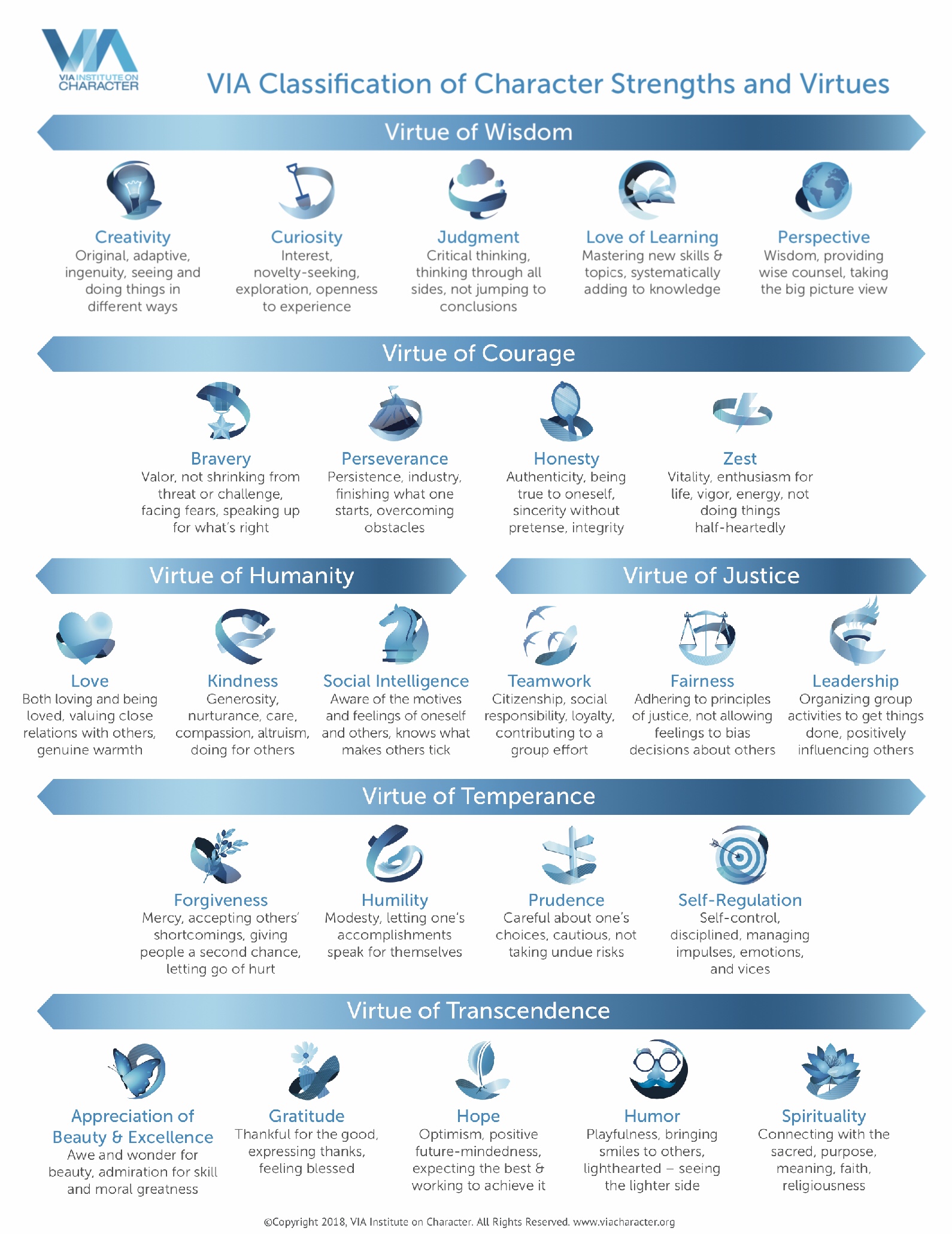
Researchers approached the measurement of “good character” based on the strengths of authenticity, persistence, kindness, gratitude, hope, humour, and more.
What makes us strong?
Cultures around the world have valued the study of human strength and virtue. Psychologists have a particular interest in it as they work to encourage individuals to develop these traits. While all cultures value human virtues, different cultures express or act on virtues in different ways based on differing societal values and norms.
Martin Seligman and his colleagues studied all major religions and philosophical traditions and found that the same six virtues (courage, humanity, justice, etc) were shared in virtually all cultures.
Since these virtues are considered too abstract to be studied scientifically, positive psychology practitioners focused their attention on the strengths of character created by virtues, and created tools for their measurement.
The 24 Strengths
The CSV Handbook delves into each of these six traits:
1. Virtue of Wisdom
The more curious and creative we allow ourselves to become, the more we gain perspective and wisdom and will, in turn, love what we are learning. This is developing the virtue of wisdom and knowledge.
Strengths that accompany this virtue involve acquiring and using knowledge:
- Creativity (e.g. Albert Einstein’s creativity led him to acquire knowledge and wisdom about the universe)
- Curiosity
- Open-mindedness
- Love of Learning
- Perspective and Wisdom (Fun fact: many studies have found that adults’ self-ratings of perspective and wisdom do not depend on age, which contrasts the popular idea that our wisdom increases with age).
2. Virtue of Courage
The braver and more persistent we become, the more our integrity will increase because we will reach a state of feeling vital, and this results in being more courageous in character.
Strengths that accompany this virtue involve accomplishing goals in the face of things that oppose it:
- Bravery
- Persistence
- Integrity
- Vitality
3. Virtue of Humanity
There is a reason why Oprah Winfrey is seen as a symbol of virtue for humanitarians: on every show, she approaches her guests with respect, appreciation, and interest (social intelligence), she practices kindness through her charity work, and she shows her love to her friends and family.
Strengths that accompany this virtue include caring and befriending others:
- Love
- Kindness
- Social intelligence
4. Virtue of Justice
Mahatma Gandhi was the leader of the Indian independence movement in British-ruled India. He led India to independence and helped created movements for civil rights and freedom by being an active citizen in nonviolent disobedience. His work has been applied worldwide for its universality.
Strengths that accompany this virtue include those that build a healthy and stable community:
- Being an active citizen who is socially responsible, loyal, and a team member.
- Fairness
- Leadership
5. Virtue of Temperance
Being forgiving, merciful, humble, prudent, and in control of our behaviors and instincts prevents us from being arrogant, selfish, or any other trait that is excessive or unbalanced.
Strengths that are included in this virtue are those that protect against excess:
- Forgiveness and mercy
- Humility and modesty
- Prudence
- Self-Regulation and Self-control
6. Virtue of Transcendence
The Dalai Lama is a transcendent being who speaks openly why he never loses hope in humanity’s potential. He also appreciates nature in its perfection and lives according to what he believes is his intended purpose.
Strengths that accompany this virtue include those that forge connections to the larger universe and provide meaning:
- Appreciation of beauty and excellence
- Gratitude
- Hope
- Humor and playfulness
- Spirituality, or a sense of purpose
Female strengths
There’s an interest in identifying dominant character strengths in genders and how it is developed. As Martin Seligman and his colleagues studied all major religions and philosophical traditions to find universal virtues, much of the research on gender and character strengths have been cross-cultural also. In a study by Brdar, Anic, & Rijavec on gender differences and character strengths, women scored highest on the strengths of honesty, kindness, love, gratitude, and fairness.
Life satisfaction for women was predicted by zest, gratitude, hope, appreciation of beauty/excellence, and love for other women. A recent study by Mann showed that women tend to score higher on gratitude than men. Alex Linley and colleagues reported in a UK study that women not only scored higher in interpersonal strengths, such as love and kindness, but on social intelligence, too.
In a cross-cultural study in Spain by Ovejero and Cardenal, they found that femininity was positively correlated with love, social intelligence, appreciation of beauty, love of learning, forgiveness, spirituality, and creativity. The more masculine a man was, the more he correlated negatively with these character strengths.
Male strengths
Brdar, Anic & Rijavac reported that men score highest on honesty, hope, humor, gratitude, and curiosity. Their life satisfaction was predicted by creativity, perspective, fairness, and humor. Alex Linley and colleagues study showed that men scored higher than females on creativity.
Miljković and Rijavec’s study found sex differences in a sample of college students. Men not only scored higher in creativity, but also leadership, self-control, and zest. These findings are congruent with gender stereotypes, as the study by Ovejero and Cardenal in Spain showed that men did not equate typical masculine strengths with love, forgiveness, love of learning, and so on.
In a Croatian sample, Brdar and colleagues found that men viewed cognitive strengths as a greater predictor for life satisfaction. Men saw strengths such as teamwork, kindness, perspective, and courage to be a stronger connection to life satisfaction than other strengths. There is an important limitation to this sample population, as most of the participants were women.
What can we learn?
While there are differences in character strengths between men and women, there are many that they share. Both genders saw gratitude, hope, and zest as being related to higher life satisfaction, as well as the tendency to live in accordance with the strengths that are valued in their particular culture.
Studies confirm that there is a duality between genders, but only when both genders identify strongly with gender stereotypes. It makes one wonder if men and women are inherently born with certain strengths, or if the cultural influence of certain traits prioritizes different traits based on gender norms.

Learn more about strengths and weaknesses tests here.
Zingerman’s is a gourmet food business group based in Ann Arbor, Michigan, USA. The original business and still the flagship store is Zingerman’s Delicatessen in the town.
Starting from the original deli, Zingerman’s Community of Businesses (ZCoB) has expanded to nine Ann Arbor based businesses with over 500 total employees. Each business has shared ownership between original founders Paul Saginaw and Ari Weinzweig, and the managing partners who started each business. Each business has its own organizational structure but they carry out the same standards and commit to the company’s values.
What better than for them to tell their own story:
It started with a small deli but it has obviously grown way beyond that. For nearly 30 years now our emphasis on education, flavour, tradition, and the integrity of ingredients has helped create a living culinary laboratory where customers can experience everything from corned beef and noodle kugel to estate-bottled Tuscan olive oil to terrific grits from South Carolina.
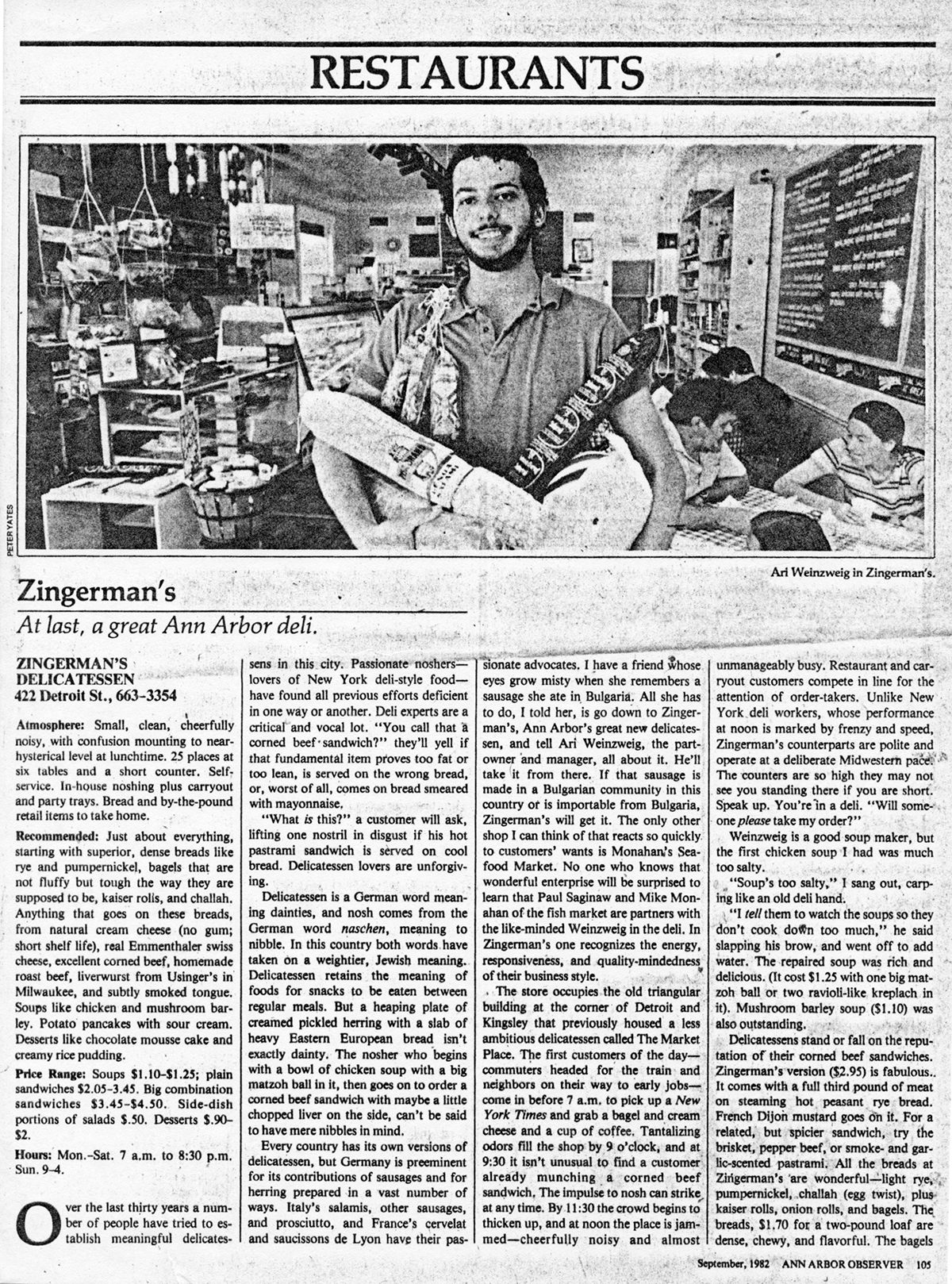 Finding food is hardly all we do here. From the start, it’s been our sincere hope that Zingerman’s will always be a place where people will leave having had a rewarding and really positive experience. The kind of spot where folks who’ve never heard of hundred-year-old balsamic vinegar, Nashville hot (as in super-spicy) fried chicken, chess pie, rye, or handmade harissa can come and taste these things for themselves. An organization in which new staff members can relatively quickly become veritable experts. Whether it’s hot corned beef, home-cooked chicken broth, well-aged wheels of mountain Gruyere, or really good loaves of hearth-baked French mountain bread, we want to bring as much traditional food to as many people as we possibly can.
Given all the good press we’ve had and the number of visitors for whom we’ve become a destination, I guess it’s safe to say that Zingerman’s has become an Ann Arbor institution. Our local customers come in regularly—many every day. People who’ve moved away make return trips just for the Zingerman’s experience. Many who’ve left Michigan will still make meals out of our food by using our catalog-based mail order business or website. Others come back to take classes at BAKE!, or to learn about business approaches in our ZingTrain seminars. Our guests tell us that most anywhere they go, once they tell people they’re from Ann Arbor the odds are that the person will respond by talking about one of two landmarks: either the University of Michigan or Zingerman’s.
The initial idea
The initial idea for what started as Zingerman’s Delicatessen came up in casual conversation with my now-partner Paul Saginaw. We were probably out having a beer after work one night — Paul Saginaw was the general manager of a restaurant where I was washing dishes back in the spring of 1978. Despite the fact that any HR expert would have called us a mismatch because we occupied opposite ends of the org chart when we met, we were actually sort of a match made in the world of food business idealism. We spent many an evening discussing what we would do if we had our own place and weren’t weighed down by the less than super-high standards set by the folks for whom we were working. We talked regularly about how we could build a business that would bring potato pancakes, chicken soup, goat cheese, smoked salmon, and other very special foods to a town that really didn’t have much of that sort of thing. And of how we could do it in a way that was unique to us, something special.
In 1979 Paul left the restaurant where we worked and, along with a partner, Mike Monahan, opened a fish market inside a converted feed and seed store (Kerrytown Market & Shops) beside the Ann Arbor Farmer’s Market. He and I continued to share a pretty wide range of food and business fantasies, but the one idea that stuck with us more than any other was to start a delicatessen. We’d both grown up eating Jewish food—he in Detroit, me in Chicago—and we’d been accustomed to enjoying a good corned beef sandwich when we wanted one. I’m sure we were hardly the only ones to have the idea. And for a long while, it was just that. Meanwhile, I kept on in my mainstream management position. It certainly wasn’t a bad job, but it was becoming increasingly clear to me that I was giving my all in an organization of folks with more modest visions and values of food and management.
By the time the students came back to campus in the fall of 1981, I knew I was ready to leave the corporate food world. I really didn’t know what I was going to do, but I didn’t have any kids, I didn’t owe any money, and there really wasn’t any reason I could think of to stick with a job that felt less and less rewarding with each passing day. So, without a real plan in mind, two days before my 25th birthday, I gave a couple months’ notice to the restaurant’s general manager and started preparing myself for some unknown, but hopefully exciting future.
Then, in one of those interesting coincidences, Paul came by a couple of days after I’d announced that I was leaving. Opportunity, he believed, was beckoning; a smallish, two-story, red brick building around the corner from the fish market was coming open, and he thought maybe it was time to open the deli he and I had discussed for so long. The opportunity turned out to be a pretty good birthday gift for me. We started meeting regularly to review menus, business plans, pro-forma financials, and everything else we thought might be relevant.
Deli’s are back
On March 15, 1982, a ridiculously short four-and-a-half months after Paul called to tell me the building had become available, we opened. When we let the first customer in that first morning we had just two employees on the payroll—one part-time and one full-time. We also had a lot of loyal friends who were willing to make coffee and clear tables while they waited for us to put their sandwiches together. (Two of them—Frank Carollo and Maggie Bayless—have long since moved into more prominent roles as managing partners of the Bakehouse and ZingTrain, respectively!) We had five tile-topped square tables with four seats at each, and four stainless steel stools covered in not-very-cool-looking forest green vinyl anchored into the floor at a counter that ran across the big front window.

Back when we opened we offered a small but meaningful selection of made-to-order deli sandwiches (25 to be exact); a solid selection of much-loved Jewish specialties like chopped liver and chicken soup; a couple of refrigerated cases filled with cured meats, traditionally made cheeses, and smoked fish. Up at the register, we stacked loaves of bread and pastries from various local bakeries. The smoked salmon, salami, corned beef, and pastrami that got us going remain pretty prominent, though we’ve added a much wider and more interesting selection of traditional kinds of pasta, jams, kinds of honey, bottles of vinegar, and other great tasting stuff from around the world.
Like every new business, we made lots of mistakes and worked hard to correct them as quickly as we could. Fortunately, we were able to make things right more often than not. Lo and behold, we actually did pretty well. I’m sure my mother was more than a bit miffed, but next to deli classics like corned beef, herring, chopped liver, rye bread, and Swiss cheese we stocked cheap cigarettes and then-neighborhood favorites like ham hocks, pork rinds, and big bunches of collard greens. In those early years, we used to let people light up in the store, and each of the tables had a black plastic ashtray on it. I clearly remember our long-time customer, Larry, sputtering with anger that he was never coming back when we decided in the late ’80s to remove the ashtrays and limit the smoking to sausage and salmon.
Start small
While what we do probably sounds huge, it’s important to note that it all started in 1300 oddly shaped (I think it’s a “rhomboid”) square feet of space. Having heard about us through food-loving friends and all the positive press we’ve received, people in other cities almost inevitably imagine the Deli to be some massive Midwestern version of Harrod’s food halls. Boy, are they surprised the first time they visit. I can’t keep track of how many times I’ve heard something along the lines of, “Wow, it’s really a lot smaller than I thought!” Which is fine with us. We never wanted to be one of the biggest, only one of the best.

If you come to town, you’ll still find the Deli on its original site at the intersection of Detroit and Kingsley streets, across from the Farmer’s Market and about two blocks up from the old train station. The parking is still bad, the location still hard to find, but the neighborhood is now considered a great place to live. The two-story, orange brick, main building, with its mere thousand square feet of selling space, has been in the food business its whole life: it was built as a grocery in 1902. Although our European customers can’t quite conceive of something so new being considered of historical significance, the building is on the historic register.
In 1986, when the building was practically bursting at the seams, we added an additional 700 square feet onto the main building. This gave us space to make more sandwiches and to redo much of the building’s rapidly aging infrastructure. But, this still wasn’t enough room for us to do what we wanted to do. So in 1991 we renovated the 19th-century wood-frame house next door and added an additional 60 or so seats, along with space where we could make espresso, brew pots of specialty coffees and teas, and offer a much-expanded selection of sweets. This space is now known affectionately as Zingerman’s Next Door.
It’s all kind of whacked, but somehow it works. If you get into what we do, it’s a wonderfully weird and one-of-a-kind experience. As we said in our original vision, there are many delis but there’s still only one Zingerman’s.
The Zing Train
With the founding of ZingTrain in 1994, the company began to formally share their approach to business through seminars and workshops, books and digital learning. Here are some of the themes:
Business visioning: creating a vision of greatness
When Inc. Magazine called Zingerman’s “the coolest small company in America,” they said that the “grand plan” the Zingerman’s founding partners came up with for the future of their business was “far better than anything a management-consulting firm could have devised for them.”
At Zingerman’s they call the “grand plan” a Vision. They’ve been visioning for nearly 20 years now. They use it all the time and at every scale – for really small ideas like moving the office copy machine to really large ones like where the Zingerman’s Community of Businesses will be in the year 2020. Just about every one of our staff members and partners would tell you that Visioning is the key to our unique and uniquely successful community.
Ari Weinzweig, co-founding partner of Zingerman’s and author of several books, even has a Vision for Visioning: “10 years from now, visioning is an intrinsic part of the way that thousands of progressive organizations around the world do their work … And my vision is that Ann Arbor is one of the capitals of visioning work.”
Customer service: treat your customers like royalty
Some of the best businesses in the world have come to ZingTrain to learn about and adopt (or adapt) Zingerman’s approach to customer service. Held in Saveur magazine’s highest regard for its service, Zingerman’s has taken its national accolades into the world of training and consulting with ZingTrain.
Great service is a cornerstone of Zingerman’s success. Zingerman’s has earned its reputation for great service by intentionally creating an organizational culture that nurtures great service and by teaching each and every one of its employees the recipes that the organization has developed for great service – namely the 3 steps to giving great service and the 5 steps to effectively handling customer complaints.
Open book management: bringing finance to the frontline
Open Book Management is a radical approach to running a business, Open Book management is about empowering every single employee in your business with the tools, education and data they need to act (and take responsibility) like owners.
The Denison’s 2010 survey said that:
- Companies that use Open Book Management consistently rank in the top 10% of all companies surveyed.
- Zingerman’s was in the top 10% amongst companies that practiced Open Book.
Open Book is not a spectator sport – it’s not just about showing people all the numbers.
Transparency is great but this is about actually taking charge, not just taking time to look at some financial spreadsheets that management was nice enough to share with you. Open Book is about everyone participating in running the business – it’s about people understanding how the whole organization works and their role in it, it’s about accountability, collaboration, and taking initiative. It’s about looking forward and working together to win.
It’s more fun, it’s more interesting, and the bottom line is it just plain works.
Leadership development: how to grow your management skill
You get 494 million hits when you Google the phrase “Leadership.” It drops to a significantly more manageable 128 million when you change the phrase to “Leadership Development.” A good few of them probably have something worth learning or adopting.
Ultimately though, you become aware that what you choose to adopt and disregard is based on your answer to the question: What kind of leader do I want to be? What kind of leaders do we want in our organization?
At Zingerman’s, over the course of over 30 years of growing and thriving, they’ve created a clear vision of what our idea of great Leadership is. It’s based on Robert Greenleaf’s idea of Servant Leadership. The basic belief of Servant Leadership is that we, as leaders, are here – first and foremost – to serve our organizations. We’ve also developed a teachable and effective system for it. And we think it works. Here’s why:
Elaine Steig, Zingerman’s Service Steward, 2012 says this: “It is a true gift to be a leader within Zingerman’s Community of Businesses; to have the freedom to be a true leader and be true to yourself. Not that there isn’t pressure, but the pressure is largely self-imposed to live up to the expectations we have set for ourselves and our organization. In my 25-plus-year career, I have never felt more appreciated, engaged, challenged, and rewarded.”
Training and systems: Great performance through clear expectations and training
Zingerman’s are big believers in systems. Consequently, and not surprisingly, they’re also big believers in training, because effective training is how we teach all of our staff what our systems are. Being a food business, we sometimes call our systems recipes. They have recipes for giving great service, recipes for creating organizational change, recipes for great performance reviews, recipes for effective on-shift training, we even have a recipe for how to create a great recipe! They call it Bottom-Line Training and they believe in it deeply enough to have trademarked the phrase!
Here’s an excerpt from the Zingerman’s Staff Guide:
Systems: Our systems are set up in order to help deliver the most effective bottom line results possible while staying true to our Guiding Principles. In choosing to work here, we make a commitment to work according to those systems, or to work constructively to change and improve them.
The 2-day seminars they teach are a distillation of some of our most effective systems from Service to the entire Employment Experience. And in the Bottom-Line Training seminar they teach you how to design effective systems of your own, that serve your bottom lines.
An Anarchist’s Refreshing Approach to Running a Business
Here’s an extract from a recent Forbes article on Ari:
Ari Weinzweig believes aspiring leaders should never sacrifice their core beliefs in order to achieve success. On the contrary, they should embrace and celebrate these beliefs, then use them to ignite their organizations.
After all, how can entrepreneurs expect to make an impact if they simply trudge down the same path blazed many times before? Not only has it already been done—it’s also missing authenticity. Ari believes there’s a better way to do business, and that’s by being yourself—completely.
The co-owner and co-founder of Zingerman’s Community of Businesses, Ari is also the author of books including the Zingerman’s Guide to Good Leading series and the Zingerman’s Guide to Good Eating, a contributor to magazines like Fine Cooking and Food and Wine, a recipient of a Lifetime Achievement Award from Bon Appetit, a mentor, a noted speaker and so much more.
However, a quick conversation proves Ari’s success has never gone to his head. Casually peppering his words with profound insights from his favorite anarchist authors or leadership lessons, Ari’s perspective is refreshingly honest, down to earth and transparent. He’s also proof that running a business your own way can work—we just need to be courageous enough to defy the status quo.
“Most of us continue to do every day what we’ve been trained to do,” Ari says, “until one day, we realize there’s another way to do it.”
Ari didn’t always have entrepreneurial ambition. In fact, after graduating from the University of Michigan in Ann Arbor, Ari just wanted to pay the bills so he could avoid moving home to Chicago. That’s what led him to take a job as a dishwasher at a local restaurant.
As he learned the inner-workings of the food industry, Ari started making his way up the ladder, eventually landing a managerial position. He also met Paul Saginaw, who would later become Ari’s partner at Zingerman’s.
For several years, Paul and Ari traded ideas about someday opening up a place of their own. Then, after space in a historic building opened up, they decided to grasp the opportunity.
In 1982, Ari and Paul opened the doors of Zingerman’s Deli with two employees. With a steadfast commitment to extraordinary ingredients, a strong tie to the local community and a creative-minded culture, Zingerman’s was instantly a resounding success.
Since then, Zingerman’s expanded not by replicating the deli, but by integrating their mission and guiding principles into entirely new local businesses including a coffee house, bake shop, catering company, training center, creamery and more. They named it the Zingerman’s Community of Businesses.
Over 35 years and 700 employees later, the Zingerman’s Community of Businesses continues to thrive and currently boasts over $65 million in annual revenue.
Ari Weinzweig loves anarchy. He’s spent countless hours browsing the University of Michigan’s Joseph A. Labadie Collection of anarchist literature—one of the nation’s largest—and applies his gained wisdom to his life and his business practices.
But don’t confuse his brand of anarchic ideology with any preconceived notions involving chaos, destruction or tearing down the government. Instead, his brand of anarchy is about all about equality, community and refusing to “follow the rule because it’s the rule … I don’t think anybody really likes being told what to do,” says Ari.
Still, when it comes to the corporate world, aspiring entrepreneurs often conform quickly to expectations, as if giving up their past ideals is the necessary price of achieving success. Ari wholeheartedly rejects this mindset for himself, for others and for his organization.
“[There’s] this weird incongruity between like, it’s good to be a free thinker and you should make your own decisions—but not that one,” says Ari. “It’s no different [at Zingerman’s]. We want people to develop, grow and pursue their dreams.”
He supports his employees’ individual freedom, even if that means openly discussing a future path that leads away from the company. “Sometimes their dream is to leave, which I’m okay with,” he says. “It’s not necessarily what I wanted—but ultimately it is what I wanted.”
“What you believe alters what you see or experience,” says Ari. From personal relationships to corporate leadership, our beliefs influence everything in our lives. What we believe not only affects our own choices, but the actions and emotions of everyone around us. Positive beliefs create positive outcomes, while negative beliefs create the exact opposite.
For example, if an anxious new hire believes their manager dislikes her—and the manager’s neutral or negative attitude does little to convince her otherwise—the new hire will assume the lack of positive feedback means those assumptions are correct.
Maybe there’s validity behind the new hire’s concerns. Maybe there’s none. Either way, she’s going to internalize those feelings. Those feelings will manifest as action. As the stress mounts, her demeanor flounders and work suffers. Whether or not the manager actually had negative feelings becomes irrelevant, since the new hire’s reaction hinders her performance regardless.
Ari calls this a self-fulfilling belief cycle.
“The self-fulfilling belief cycle is just what it sounds like,” Ari says. “We self-fulfill into creating much of our reality. I’m not saying we create all the problems, but a lot of the things that are going on in our lives start with our own beliefs, not with other people’s behaviors.
“Part of that is realizing that we all filter information based on what we believe. We filter out all the information that doesn’t support our beliefs … or you actually go seek out information that supports our beliefs.”
Sure, positive thinking on the new hire’s part could’ve changed the cycle. But if the manager instilled more positivity, everything would’ve changed as well. After all, isn’t it the leader’s role to inspire?
Let’s be the leaders that set our people up for success. By confidently believing in them, they’ll believe in themselves as well.
The Creativity of Better Businesses
“If people looked at their lives and their organizations like they were creating art, they would start to notice a lot more. They would probably be a lot more mindful of what they do.”
There’s a divide between the arts and the corporate world. Many leaders believe in the already defined structures that keep companies running, and think that creativity is a skill best reserved for the weekends.
But what if thinking so rigidly keeps us from seeing the whole picture? By following the same rules and same routines, are we too hyper-focused on getting things done instead of doing them better? What if creativity is what makes a good business great?
Ari believes all business leaders can learn from artists. That’s not to say all CEOs should necessarily sign up for painting classes. Instead, think about your organization as an elaborate song with countless tiny, yet essential, parts. If one note is flat, the piece falters. If every note is flat, the song turns into a disaster.
“A painting isn’t this instantaneous creation. It’s an enormous amount of work over an extended period of time. A song doesn’t just doesn’t emerge finished … they’re still paying enormous attention to what all of those little things are.”
“People who go into [business] only for the money rarely create great art,” says Ari, and it’s usually true. Leaders need to tap into the joy of building something for the love of it—not just for status or wealth. And wouldn’t leadership be more interesting—and more fun—if tasks were treated as creative exercises, rather than just obligations waiting to be checked off a list?
The best creatives trust their instincts and they trust themselves. “My strong belief is that everybody in their hearts [knows what] what they want,” says Ari. It’s a mentality he holds as dearly today as he did as a young anarchist in 1982, and it’s not going anywhere.
Legacy is one of the most motivating topics for business leaders. What will you leave behind? What is your purposeful contribution to others that follow you?
In James Kerr’s book Legacy he explains how the methods of the All Blacks rugby team have developed an extraordinary high-performance culture and provide an inspiring and effective model for leaders in other fields.
Here are some of the best quotes :
- “A collection of talented individuals without personal discipline will ultimately and inevitably fail.”
- “Character triumphs over talent.”
- “A sense of inclusion means individuals are more willing to give themselves to a common cause.”
- “The first stage of learning is silence, the second stage is listening.”
- “High-performing teams promote a culture of honesty, authenticity and safe conflict.”
- “If we’re going to lead a life, if we’re going to lead anything, we should surely know where we are going, and why.”
- “Be more concerned with your character than your reputation, because your character is what you really are, while your reputation is merely what others think you are.”
15 lessons for business leaders:
- Character – never be too big to do the small things that need to be done.
- Character begins with humility. Performance = Capability + Behavior. A values- based, purpose-driven culture is a foundation of the All Blacks’ approach and sustained success.
- Adapt – when you’re on top of your game, change your game. Make a case for change, provide a compelling picture of the future, sustain the capability to change, and create a credible plan to execute.
- Purpose – ask ‘Why?’ Create an environment that stimulates others and influences them to want to take part in it.
- Responsibility – leaders create leaders by passing on responsibility, creating ownership, accountability and trust.
- Learn – leaders are teachers and learners. Create an environment that delivers the opportunity for personal growth and professional development.
- Whanau – follow the spearhead. A flock of birds flying in formation is 70 percent more efficient than flying solo. One of the first steps in developing a high performance culture is to select on character.
- Expectations – aim for the highest cloud. We learn best – and change – from hearing aspirational stories that resonate with us.
- Preparation – practice under pressure to enable self-trust and enable the abilities to maintain clarity, situational awareness, accurate analysis, and good decision-making. Pressure – control your attention. Bad decisions are not made through a lack of skill or innate judgment. They are made because of an inability to handle pressure at the pivotal moment.
- Authenticity – keep it real through a strong identity and trust in the sense of safe vulnerability while exercising honesty and integrity.
- Sacrifice – find something you would die for and giver your life to it.
Language – sing your world into existence. We are meaning making machines, interpreting and reinterpreting a sequence of events into a narrative form and reassembling at will. - Ritual – create a culture. Ritualize to actualize by telling your story, involving your people, and creating a legacy while making the intangible real.
- Whakapapa – plant trees you’ll never see by being a good ancestor.
- Legacy – this is your time to make a purposeful contribution.
