This is an extract from Fast Leader magazine, May 2020.
OYO Rooms, also known as OYO Hotels & Homes, is the world’s fastest-growing hospitality chain of leased and franchised hotels, homes and living spaces. The Indian brand was founded in 2013 by Ritesh Agarwal.
OYO’s portfolio combines fully operated real estate comprising more than 43,000 hotels with over 1 million rooms. Through its vacation homes business, the company offers travellers and city dwellers access to over 130,000 homes around the world. It operates in over 800 cities in 80 countries.
“What is OYO’s secret sauce?”, asks its website. “We offer tasteful spaces, whenever you need them, at unbeatable prices.”
On your own
At the age of 13, Ritesh Agarwal started selling SIM cards on the streets of Titilagarh in India, and moved to Delhi in 2011 to study at college, but soon dropped out.
In 2012, as an 18 year old, he launched Oravel Stays to enable listing and booking of budget accommodations, and was helped by $100k grant from Peter Thiel. A year later, he rebranded as OYO in 2013. OYO is said to mean “on your own”, based on how Agarwal experienced life travelling alone as a young man.
In 2018-19 OYO raised a $2.5 billion in funding, including from Softbank, and $2 billion through Agarwal’s own investments. In 2020 the company is said to be worth around $10 billion, and 26 year old Agarwal worth $1.1 billion, making him the world’s youngest self-made billionaire after Kylie Jenner.
OYO’s portfolio
OYO now partners with hotels to create a branded guest experience across cities, licensing its brand, and providing distribution and credibility in return for a royalty fee, and ensuring of common standards. The business currently has over 17,000 employees globally, of which approximately 8000 are in India and South Asia, whilst generating around a million job opportunities in the licensed partners. It has also set up 26 training institutes for hospitality enthusiasts across India
OYO Hotels & Homes has a multi-brand approach. These include:
- OYO Townhouse which is promoted as the neighbourhood hotel is in the midscale segment targeted at millennial travellers.
- OYO Home, which OYO claims is India’s maiden Home Management System that offers private homes in different locations and are fully managed by OYO.
- OYO Vacation Homes which claims to be the world’s 3rd largest vacation home brand with vacation rental management brands Belvilla, Danland, and DanCenter along with Germany-based Traum-Ferienwohnungen.
- SilverKey launched in April 2018, caters to the needs of the corporate travellers undertaking business trips for a short or long duration.
- Capital O offers hotel booking services.
- Palette offers the perfectly curated staycation for those in search of an intuitive experience at competitive prices, an upper-end leisure resorts category.
- Collection O offers booking and renting services to business travelers.
- OYO LIFE, targeted at millennials and young professionals in search of fully managed homes on long-term rentals, at affordable prices.
OYO Townhouse
These operate as 25% Hotel, 25% Home, 25% Cafe and 25% Store, and seek to become to the social hotspot of their neighbourhood. Every single element – from the breakfast menu to the booking process – has been re-engineered to deliver higher quality and better value. Also, unlike the lego-brick approach of traditional hotel chains, every OYO Townhouse is designed to complement its neighbourhood. The tastefully done properties are staffed with highly trained managers to deliver world-class and modern hospitality specially designed for millennials.
OYO says there are six features that make those Townhouses different from the other products, and “improves over the old hotel formula”: Smarter Rooms, Smarter Spaces, Smarter Menus, Smarter Buildings, Smarter Service, and Smarter Locations.
Creating the experience
The process of standardisation of the experience starts with what OYO calls a “150 point checklist” that goes from the booking experience to the support centre and the on-ground Cluster Managers, ready to solve any problem it might arise during the experience of guests.
OYO also brought Uber-style booking and “dynamic” pricing to hotels, and saw its operations grow 20-fold in just two years, from roughly 50,000 rooms in December 2017 to over 1 million in October 2019.
Controversy and change
However in early 2020 OYO started to run into some trouble, initially due to a range of complaints about hotel standards, and controversies about the ethics of its business practices. You can listen some of these problems, issues and allegations in the video below. It subsequently announced a significant number of job losses which it said was set to refocus its strategy.
This all happened at the same time as another Softbank investment, WeWork was exposed as having being overhyped and over valued prior to its IPO which was abandoned. Whether these are the “growing pains” of a 7 year old start-up, or a business which is in serious trouble because it has over stretched itself, grown too big and too fast, remains to be seen.
Have you noticed how many of the once maverick start-ups are becoming remarkably similar to the companies which they set out to disrupt?
Airbnb is becoming more corporate by the day … almost 25% of its 7 million listed properties are now operated by rental companies, rather than individuals rented our a room or home. Whilst its properties are still vastly more eclectic and interesting than the dire conformity of chain hotel rooms, they are not quite the quirky boutique homes from home which the ads still suggest. Airbnb has also diversified somewhat, into Experiences for example, adding more travel packages and adventures, but with limited success so far. Airbnb anticipates an IPO later this year, valuing it around $40 billion.
Netflix is now one of many streaming entertainment options … instead of being the disruptor of terrestrial and cable TV, many other streaming services – from Amazon to Disney, Snap and Youtube – have joined the market. Each is investing huge amounts in content development, buying rights to sports and shows, with low subscription packages. The quantity, and even quality, of many shows is good, but is it sustainable? But as we end up subscribing to many of them, its not so cheap anymore. Bundlers, looking a lot like cable companies, will soon emerge.
Uber is becoming more like a taxi company every day too … those companies which it worked so hard to disrupt. In some markets, you can now call an operator to organise a car, the prices have gone up by around 25%, and drivers can even charge what they want for some rides. As cities have demanded that gig workers be given full employment benefits, Uber has sought ways to reduce increase revenues, and find profits. At the same time it has splashed its investors’ $25bn on many crazy ideas, from self driving cars to robocopters, but with limited successes beyond its original act.
The challenge then is to keep innovating. Yet too many of these companies find that the only way to convert their start-up excess into corporate profitability, is to become more like the companies they disrupted. Too many of these companies have survived on hyped up brand PR, rather than sustainable business models. Airbnb made a $322m loss last year. WeWork was exposed as a far worse over-hyped charlatan.
Instead these companies need to renew their entrepreneurial flair, rekindle that burning desire to champion the consumer, to find better ways of serving people, to keep raising the bar. They need to challenge themselves, with the mind of a disruptor, not just to evolve further, but to find a new crusade, create a new revolution. They need to rise the S-curves of market change, from one to the next, and develop a portfolio of innovations, a balance of evolutionary enhancements and revolutionary breakthroughs.
Apple, Facebook, Google have had the same challenge for some time. Microsoft is one company that has managed to rekindle its fire. They need the disciplined leadership that can continue to look forwards, whilst also deliver today. They need to keep dreaming big, but also delivering on the detail. Become an ambidextrous company, with ambidextrous leaders.
The logistics business might not seem a natural place for disruption – its physical, process-driven and regulated (ships, rail, trucks, air). Yet there is a huge reluctance amongst big companies to change – most live in the past, both in terms of technology and mindset, protecting the margins made through the frictions and inadequences of the existing ways of working.
Think about the potential of new technology platforms (like Uber), new smart systems (like Amazon), new technology capabilities (mobile, cloud, big data, AI, drones, robotics, and more), and new business models (like crowd-based funding).
In short, it’s a perfect industry for disruption.
“Industry 4.0” explores the convergence of man and machines, and in particular the potential for AI, robotics and much more to drive fundamental innovation:
Major players like DB Schenker have then created their own visions, showing how they plan to shape the industry to their own advantage:
In Asia, the dramatic growth in industrial production and consumerisation is driving logistics companies to “jump to the future” in embracing smart systems:
Whilst DHL has been creative in exploring new delivery concepts, in this case inspired by the emerging Hyperloop designs being explored across the world:
Here then is a summary of some of the more interesting start-ups, innovators and real “gamechangers” emerging in the world of logistics:
Transport systems
Matternet
Matternet is a transportation system made up of Unmanned Aerial Vehicles (UAVs), landing stations and routing software. The system aims to transform the way we move goods locally, starting with the pharmaceutical delivery market in areas inaccessible by traditional infrastructure.
Freight rates
Freightos
A website – and a network of freight forwarders – that provides automated freight quotes and a contract management system for shippers.
Transporteca
A website giving shippers and consignees a much-needed tool to easily compare shipping and transportation prices from freight forwarders. The startup is Copenhagen-based and so far they focus only on moves from Asia to Denmark. But the service is rock-solid, and will hopefully include all locations soon.
iContainers
An end-to-end pricing tool and freight forwarding service offering best available prices for ocean and sea freight as well as international moves. With iContainers you can get a quote online instantly from multiple carriers.
Freight Filter
An easy-to-use service to help you find the best shipping options. It’s divided into three simple steps – get the price, book it, and ship.
Xeneta
A service that ads transparency to the shipping industry by enabling companies to benchmark their ocean freight rates. Useful for both importers, exporters and freight forwarders, e.g. for understanding the market and when negotiating prices.
Shippo
Shippo is “shipping made easy”. With the Shippo API and apps you can get discounted shipping rates and labels within minutes. Shippo is basically selling discounted labels when connecting shopping cart apps with carriers such as DHL, FedEx and UPS – making things easier and cheaper for those who want to ship.
ShipHawk
ShipHawk is a software solution that businesses can integrate into their shopping carts to provide buyers with the best option to ship any sized item, packed or unpacked. With ShipHawk, businesses and their customers access instant rate quotes for real items without having to figure out all of the details (traditional shipping solutions only provide estimates).
Veritread
Veritread is a heavy haul (transportation of oversized cargo) marketplace through which shippers can connect with and get bids from trusted (verified) carriers in this highly specialised field.
Logistitrade
An independent online platform where shippers can request quotes from a long list of freight forwarders. Once the quotes are in, shippers can compare, manage and book the shipments, ultimately helping them optimise their supply chain.
OpenSea
OpenSea is the first marketplace for ship chartering, enabling shippers to find the best matching vessels and cargoes at the best price – in effect connecting shippers and shipowners.
CargoHound
CargoHound is an online marketplace for international freight. Their tool connects exporters and importers with reliable freight forwarders and carriers – with the aim to reduce the time, cost and risk of shipping products internationally.
Cargobase
A platform for ad hoc freight where companies buy and manage freight services from pre-screened providers. It operates as a global network of providers that gives companies access to air freight services.
Shipwaves
Shipwaves is an end-to-end online ocean logistics platform catering to the needs of importers and exporters from India and globally in the near future. Shipwaves enables you to compare ocean freight rates and book your shipment online.
Containers
Staxxon
Has developed a shipping container folding/nesting technology that removes the air from empty shipping containers so you can move 5 empty shipping containers in the same space as 1.
Holland Container Innovations
As Staxxon, also folding containers. But focused on the 40 foot containers instead of the 20 foot product market.
Crowd shipping
PiggyBee
A crowd shipping service. PiggyBee connects people who want to get or ship something with travelers.
Friendshippr
A crowd shipping app focused on getting friends to ship for you when they travel.
Nimber
A crowd shipping service enabling you to either send or bring stuff locally. So far there’s more than 50.000 Nimbers and counting. Nimber – previously Easybring – is based in Norway and so far operates in Northern Europe, incl. the UK.
UberCARGO
User’s first stab at a global logistics service – so far only available in Hong Kong. With UberCARGO, a van arrives wherever you want it to be in minutes. You can load your items in the back of the van yourself or request the driver’s assistance. Deliveries can be tracked in real-time through the app, the item’s location can be shared with the recipient and, if you want to, you can choose to ride along with your goods.
Roadie
Roadie is a neighbour-to-neighbour shipping network. Users create a ‘gig’, i.e. a shipment or delivery, which is then matched with another Roadie user headed in the right direction. Or as they say: “It’s like carpooling for cargo. Simple, safe and fun!”
End-to-end shipping
Shyp
A mobile app and service aiming to ease up the on-demand shipping experience. A ‘Shyp Hero’ comes to you, collects your items, then takes them away to be professionally packed and shipped to their destination.
ShipBob
“ShipBob is shipping made uber simple.” After you’ve scheduled a pickup a Ship Captain will pick up your item in less than 30 minutes. ShipBob will then – for a pickup and packaging fee of 5 USD – package and ship the item using the lowest cost option.
Flexport
Flexport is an end-to-end freight forwarding solution in the form of an online dashboard. Here, you can request a freight quote, compare your options, book your shipment as well as track and manage your shipments. Flexport’s services include air freight, ocean freight, trucking, fulfillment, and cargo insurance. The startup has been backed by leading angel investors such as Google Ventures, Bloomberg BETA and First Round Capital.
3PL
Shipwire
An enterprise logistics platform from which you can handle all your logistics needs in the cloud, incl. warehousing, processing, shipping and sales channels.
Cloud Fulfillment
Cloud Fulfilment is a UK-based storage outsourcing solution for smaller businesses. Cloud Fulfilment also handles order processing and delivery requirements.
Shotput
Shotput is a freight, inventory and customer order platform in one place – with the clear goal to simplify fulfillment. Users connect their e-commerce site to Shotput who then picks them up at the factory and delivers to the end-customers.
Fleet Management
Local Motion
A car fleet management system for companies making it easy to share vehicles and monitor the fleet after installation of an onboard module.
MuniRent
MuniRent brings the sharing economy to government by enabling heavy duty equipment sharing between public agencies, e.g. the sharing of excavators, street sweepers etc. between cities. MuniRent’s solution can be used for both internal sharing (within large cities) and regional sharing (between cities).
Local delivery
Boxc
Boxc offers cheap 3-5 day international shipping to US buyers, and accept returns at a US address. Boxc achieves this by aggregating shipments, and choosing the optimal carrier for each leg of the journey.
Postmates
A crowd based local delivery app. Get your groceries delivered by a real person.
DoorDash
A local, on-demand FedEx in the SF Bay area, starting with restaurant food delivery, incl. areas where most restaurants didn’t deliver.
Deliv
An on-demand US delivery service, much like Zipments and Postmates. Deliv connects retailers, shoppers and drivers and provides same-day delivery of customers’ online orders.
Rickshaw
A local delivery solution for businesses in San Francisco. Rickshaw relies on a flexible delivery fleet through which businesses get their ‘own’ branded couriers at an affordable price. Among other things, Rickshaw is used for delivery of laundry, gifts, meal subscriptions, and produce boxes.
Parcel
Hand-delivery of packages in New York for those who don’t have a doorman. Instead of shipping to their home address, users ship to Parcel who then delivers when they’re actually home (usually in the evening).
Storage
Lockitron
A remote controlled lock and mobile app enabling users to store locally instead of using warehouses.
MakeSpace
An on-demand storage solution. MakeSpace provides pickup, urban storage, and on-demand retrieval.
ShareMyStorage
On sharemystorage.com people are brought together to provide a common sense self-storage solution – using space such as the attic, garage, basement, or spare room in the back-office. On the website you can either find or add storage space.
Keycafe
Store your keys securely at the local cafe and exchange them remotely with your home-rental guests via the app. Keycafe is not classic ‘storage’ but about managing access to your home remotely.
Swapbox
Shop online and ship your packages to a Swapbox located nearby. It’s a modern, always-open postoffice. You get notified via email and/or text message when your packages arrive.
Trucking
Cargomatic
A platform that provides shippers with instant access and real-time visibility to trucks around them via mobile app and cloud-based software.
TruckTrack
A cloud app for trucking business management, giving instant insight into business KPIs, fleet and human resources. The app also provides you business optimization recommendations.
KeepTruckin
A mobile app for drivers to track their driving logs. And for dispatchers to manage their drivers.
Youtruckme.com
A social network dedicated to truck drivers. On the platform they can do everything from locating their colleagues on the road, plan their trips, and sell, buy and find loads.
uShip
An online international shipping marketplace where transporters compete for your shipments. You can ship anything – standard shipments, household goods, vehicles etc. According to uShip, their model means savings of up to 80% on national and international transport. Transporters also benefit by getting more business. And it’s a more sustainable solution too as it helps fill empty trucks.
Transfix
Transfix is an app for interstate truck drivers, allowing them to plan their trip, manage their loads, and get paid. The platform acts as a freight marketplace matching truckers with shippers.
Got Freight
A mobile app that enables customers and carriers to submit and track deliveries in real time. With the app you can see your truck delivery from pickup to drop off. Also, you can leave carrier feedback.
Truckin
A platform that connects freight forwarders with local carriers to improve freight forwards local network and flexibility while providing local carriers with additional volume.
TrucksOnTheMap
A UK-based startup aiming to reduce empty freight runs by providing transparency. TrucksOnTheMap have created a “TimeMachine” to look for empty trucks at any time, anywhere on a online map. TrucksOnTheMap is the first truck-availability-map which visualises all your and your haulier’s free trucks in the future, for a much quicker and more efficient truck booking.
Moving
Ghostruck
Ghostruck is a mobile app that matches you with a Ghostruck-approved mover. You can move almost anything, only using your smart phone. Take a photo of your stuff, describe what you need, and Ghostruck will find a driver – a professional mover – going your way.
Bellhops
Bellhops is a moving company made up of 8,000+ students in 121 US cities. In other words: Instead of hiring an expensive, inflexible moving company, you book on-demand through Bellhops and a number of local (affordable) students will come help you.
Lugg
Lugg is an app-based on-demand moving company in the Bay Area. Set up the pick-up location using the map and add a photo of what you want to move, then Lugg promises to have two movers and a truck en route instantly.
Schlep
Schlep is an on-demand moving service connecting users in need of moving assistance with a reliable, local “Schlepper.” Schlep maintains a network of movers serving the Chicago metropolitan area. A user simply requests a Schlep, submits some preliminary information (day, time, number and size of items, pick-up and drop-off destinations, etc.), and waits for the schlepper to arrive (with coffee, if desired). The cost of a Schlep generally ranges from $50 to $150.
Monitoring
CargoBeacon
CargoBeacon an affordable and easy-to-use logger device connected to an app and a portal. It enables you to monitor how your valuable cargo is doing. Simply place the logger with your cargo before you ship. The logger then communicates with your mobile device and to the globally available CargoBeacon Portal.
Latest reports
Fast Company‘s annual World’s Most Innovative Companies ranking includes the 10 Most Innovative in Logistics including
- Attabotics … for saving thousands of square feet in warehouse space using vertical 3D robotic systems
- Footprint … for making compostable, recycled packaging solutions for everything from TVs to frozen dinners
- Target … for using retail stores to make same-day delivery its most appealing (and profitable) online-shopping option
StartUs Insights have just produced a great report: Top 10 Logistics Industry Trends & Innovations: 2020 & Beyond
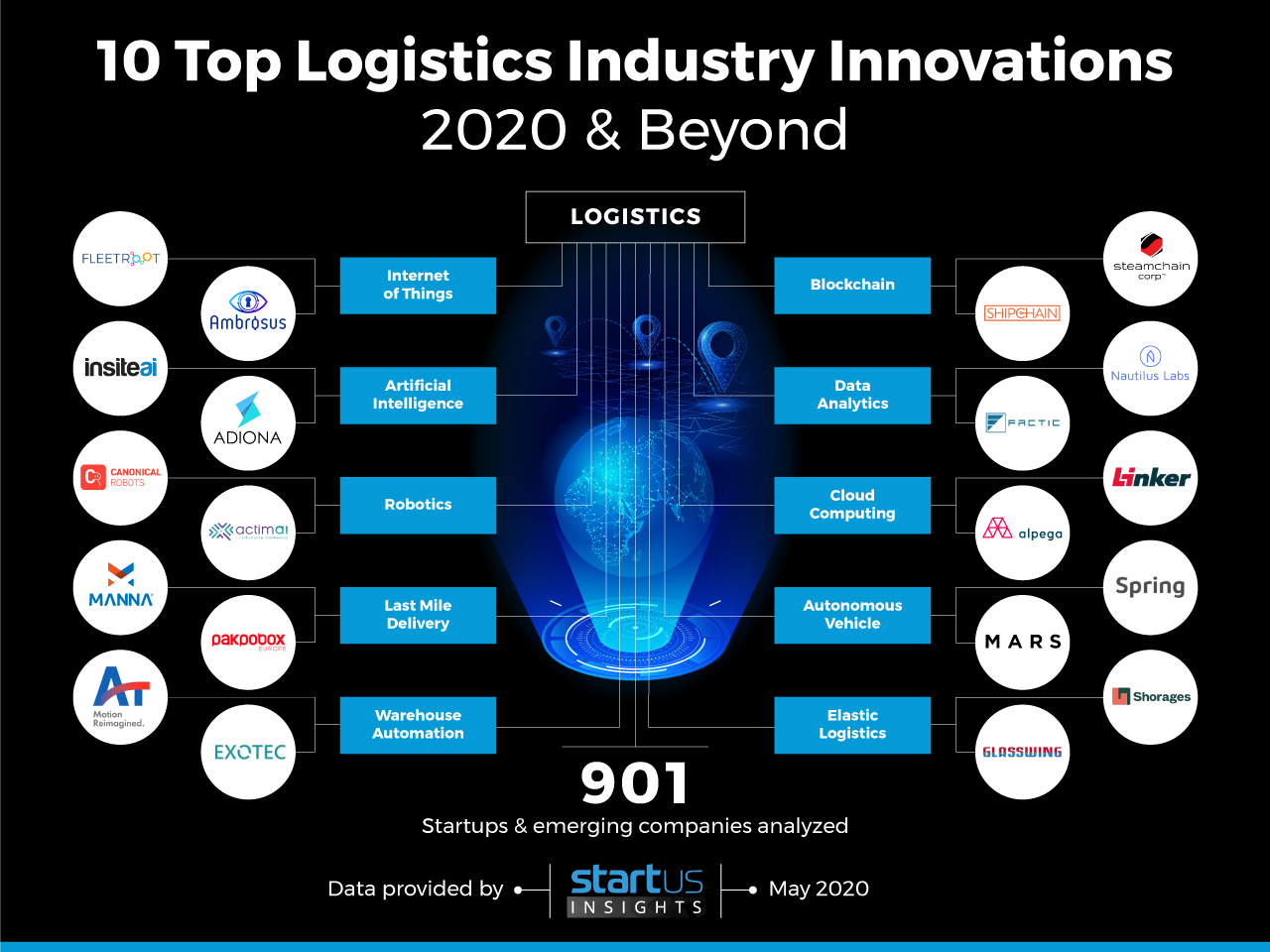
Transmetrics have produced a similar report: Top 10 Supply Chain and Logistics Technology Trends in 2020
Remember Crocs?
A lot of people dismissed them as really ugly.
People who love to hate Crocs had cause to celebrate in 2008, when investors were writing the company off as a passing fad. Crocs lost over $185 million that year and cut 2,000 jobs. The stock plunged to just over $1 a share from a high of about $69 a year earlier.
But over the next decade, Crocs would go on to sell 700 million pairs of shoes worldwide.
Recently, the clogs have have been strutting down runways at luxury fashion shows. Celebrities like Justin Bieber, Ariana Grande and Post Malone are wearing the shoes. It’s a top brand among Gen Z. And limited edition Crocs are selling for up to $1,000 on the resale market. Crocs have become a collector’s item.
The wild, wacky and wonderful clogs were born in 2002 by three innovators: Scott Seamans, Lyndon Hanson, and George Boedbecker Jr. Boedbecker brought them all together as he knew Hanson in high school and they both attended the University of Colorado. Furthermore, Seamans knew Boedbecker through their shared love of sailing. So unsurprisingly, whilst all three were sailing in the Caribbean they came across a new boating clog made by the Canadian Company: Foam Creations. They were using a new material called Croslite. They discussed improvements and on returning home they quickly acquired the rights to foam creations manufacturing process. It wasn’t until 2004 Crocs completely secured exclusive rights to the Croslite technology.
The three were a compatible trio, with Seamans tweaking the design, Boedbecker became CEO and lined up investors whilst Hanson oversaw the operations. Through this process they made a really, really, really comfortable shoe. The first Crocs style they launched was named ‘the Beach’. Whilst the outrageous clog may have been created on a sailing trip, it wasn’t just boaters who wanted the bold, comfy brand on their feet. Soon millions of people were buying them!
It didn’t take long for a women’s style to be introduced in 2003 named the ‘Nile’. Then in October 2006, they also purchased Jibbitz, a manufacturer of popular accessories that snap into the holes of Crocs shoes. Afterwards Crocs continued to acquire various other companies in the footwear and fashion industry to increase its brand and product range. These included a women’s wedge range and some very funky trainers. Just because they are a relatively young brand does not mean they have neglected social responsibility. No, in fact the total opposite. In the past years Crocs have donated one pair of Crocs shoes every minute. This is through the programme called ‘Crocs Cares’, in which three million shoes have been donated to countries such as Kenya, Afghanistan, Cost Rica, Fiji and many less economically developed countries.
Crocs are also very environmentally aware, having recently changed their packaging to save nearly 640,000 lbs of landfill waste. That is more than 900,000 crocs saved in waste. Furthermore, it only takes 1.6kwh of energy to make one pair of croc shoes.
So, the phenomenal Crocs seem unstoppable as just before their tenth anniversary they had sold more than 200 million pairs in more than 90 countries, reaching sales revenues of $1 billion. Consequently, it seems the love and hate relationship of Crocs is here to stay as they continue expanding and developing their range of clogs, sandals, shoes and boots.
Our potential is what lies ahead … how we can be more, do more, achieve more.
Yet we spend too much time looking backwards, not enough time looking forwards. And as a result our future defaults to an extrapolation of what we have done, not what we could do. In a world of turbulent change, a future based on the past, can be quite limiting, and with diminishing returns.
Of course, we take comfort from looking backwards. It is much easier to define, to evaluate.
As an individual, when was the last time you went for a new job? You most likely tried to demonstrate your future potential by describing what you’ve done in the past. You proudly laid out your resume, eloquently describing your past experiences, impressive qualifications and previous achievements. It’s probably impressive, but it’s an old story.
As a business, you probably do the same. Daily schedules, meetings and reports, are spent pouring over the past. Performance is all about what we have done, last quarter, last year, and compared to previous years. Strategy is too often based on what we have done, our capabilities and assets, and how can we use them to go forwards.
Yet we all know that what got us here, is unlikely to be what gets us to where we want to go.
As individuals, and as organisations, we know it is not what we have done that matters, but what we can do, could do, next. Yet what we do next is most likely to be a repeat of what we’ve done, unless we change something. What is that change, that will unlock more than was previously possible? What is the key to our future potential?
Think of some of the great people who have changed to realise their potential:
- JK Rowling was a secretary at a publishing firm. On her way to and from work, she used to dream of writing a novel, sketching out plots in her head. As a secretary, her potential was conventionally limited to roles in administrative support. But then she threw in her job, took the bold step to write her first manuscript, and her potential was transformed.
- Eliud Kipchoge was a very good runner. He was one of the hundreds of African endurance athletes who competed around the world, picking up medals at major events. But then, realising that his career was drawing to a close, he wanted to leave more of a mark. He switched to the marathon. Olympic champion, world record holder. The first man under 2 hours.
“Future potential” is the desire and ability to be more.
Individually and organisationally, it is typically driven by three factors:
- Future courage … Do we dare to be more than we currently are? Future Potential demands personal ambition and drive to go beyond your current world, to let go of what you know, to go further, to enter the unknown.
- Future scope … Do we know where we are heading, and is it the right direction? Future Potential demands more opportunity space, more fertile ground to support new growth, to stretch further and wider ahead.
- Future capacity … Do we have the talent, creativity and resources to get there? Future Potential demands that we become more, dig deeper into ourselves, to develop new mindsets and future-relevant capabilities.
I work with many organisations, and it is quickly apparent which have the greater “future potential”.
The organisations who do, typically see the future beyond the frames of today, they look to go beyond their sector, innovate new business models, disrupt the current game. Disney, for example, with the recent launch of Disney+ has redefined its future potential, by opening up an entirely new space in content distribution for innovative growth. Orsted, was a Danish coal-based electricity generator, but within 10 years has transformed entirely to renewables, with huge growth potential.
The ones who don’t, essentially compete within their existing space, seek improved products and operational efficiencies, but are essentially happy to play the old game. Vodafone, for example, is obsessed with being a telecoms business, focused on handsets and tariff plans, whilst the rest of the world is more interested in convergent platforms and the content on them. Or Ford, battling to survive in an auto sector, that is quickly been redefined by new forms of mobility.
Similarly for individuals, it is quickly apparent who has the greater “future potential”.
People who seek to be more than they currently are – not just ambitions to climb corporate hierarchies and attain greater positions, more power – but the ones who are constantly learning, curious and creative, they want to improve themselves, searching for new ideas, new initiatives, new ways to move forwards. As leaders, their own future potential has a huge influence on their organisation’s future potential. Without the right leaders, organisations are stuck in today.
“Future potential” is closely aligned with change, and with growth.
An organisation is unlikely to achieve significant change, unless people are prepared to change too. Most significantly, its leaders. Change in mindset, in activities, in capabilities. And as a result of that, organisations are unlikely to achieve significant growth, beyond just working harder-type of growth, unless they see personal growth as a prerequisite.
How much “future potential” do you have?
- How farsighted are you, to dare to look beyond the horizons of today?
- What proportion of time do you spend looking forwards, compared to looking back?
- Is your business purpose a limiting or liberating definition of why you exist?
- Does most of your innovation exploit the core, or seek to explore the edges of your current world?
- Is your business largely defined by your current products, and your existing competitors?
- Do you typically think more in terms of probabilities, or possibilities?
- Are performance metrics driven by what you have done, rather than what you could do?
- Is your market value a true reflection of what you could do, or just an extension of what you have done?
- Do you have leaders with the potential to unlock your future potential?
Finding your future potential requires a shift in your business, a more forwards orientation, a growth mindset, a reframing of where you are going and what is possible. And it requires a stretch to make the mental and physical shift. It needs a catalyst to open minds, it needs energy to break out of today, and it needs courageous leadership to take it to a place you don’t yet know.
Without “future potential” you and your business are unlikely to find a better future.
© Peter Fisk 2020. Extract from my next book, Business Recoded, out in September.
More
- Forbes: To Unleash Your Full Potential, Do These 3 Things
- Wikihow: How to Realise Your True Potential
- Psychology Today: Eight Ways to Realise Your Full Potential
Emmanuel Faber, CEO of Danone, believes that people want to have a vote in the world they live in.
“Each time people choose a brand they exercise their right to vote. They want that brand to be transparent, meaningful and responsible. Still, they also want the brands they choose to be playful, innovative, relatable, emotional and engaging. As a result, there is a new paradigm at play today: brands only exist through the power of people” he says.
Danone is a $25 billion food business, founded in Barcelona and now based in Paris, and serving 120 markets. It has transformed itself in recent years with a purpose “bringing health through food to as many people as possible” and has also become a Certified B Corporation, challenging itself, and the world, to do better. It says, “we expect more from our food”.
The food (health) business has been transformed under Faber’s leadership, putting sustainability at the core of its strategy and innovation. As a result, “how” the business works, matters as much as “what” it does. This includes how its leaders lead, Faber saying breakthrough results can only be achieved when people dare to express and demonstrate their leadership potential.
Danone describes its unique style of leadership using “CODES” which describes the five behaviours that shape everything in its culture, from recruitment to development, performance and rewards:
- C … Create a meaningful future: challenge the status quo and generate breakthrough ideas, every day can be a fresh adventure, full of new possibilities and real excitement, demanding a sense of purpose for yourself, team and colleagues.
- O … Open connections inside and out: open to new thinking and fresh perspective, developing networks inside and outside, interacting at all levels and building trust to understand all stakeholders, and design products of the future.
- D … Drive for sustainable results: a culture of speed and agility, where individuals are free and express their talents, anticipating and driving progress in a way that sustains value creation for the business, consumers and the community.
- E … Empower yourself and diverse teams: leadership not micromanagement, releasing the power of the team with the right mix of support and freedom, enabling people to express their uniqueness and foster collective performance.
- S … Self-aware: being aware of your own strengths and development needs is essential to learn and grow, maintaining self-balance at work by recognising when to step back and when to reach out to others.
Danone wants to change the way the entire food system works, to “nourish lives and build a healthier world”. It believes that the health of people and the health of the planet are interconnected. It issues a call to action for all consumers and everyone who has a stake in food to join “the food revolution”, a movement aimed at nurturing the adoption of healthier, more sustainable eating and drinking habits.
Danone’s “manifesto brands” are the means by which the business practically goes about this. Each brand – like Activia, Delice, Gervais, Volvic – is guided by a framework which defines and activates a specific cause, aligned with the company’s overall purpose. This starts with a focus on people, identifying the tension between a relevant consumer insight and the current reality, defining a legitimate gap to close, or paradox to resolve.
As a result, each brand has a strong point of view, a purpose, that justifies its existence in the world and relevancy for people, supported by a commitment to help improve the health of people, as well as to help protect our planet. With over 40 manifesto-driven brands in its portfolio, Danone sees this as a more engaging and sustainable model to driving profitable growth, that is aligned with broader society and environment.
This is an extract from my forthcoming book, Business Recoded, out in September 2020.
More on Danone and Emmanuel Faber:
- QZ interview December 2019
- Business Insider interview September 2019
- Leading the Business for Inclusive Growth (B4IG) Platform
Business can be a platform for good. Probably the best way to solve many of the world’s environmental and social challenges – many which are becoming all too obvious, in a world shaken-up by the current shocks – is to harness the power of business, its assets and infrastructure, brands and customer bases, innovators and imagination.
Fast Company’s “World Changing Ideas” awards explore the products and concepts, companies and policies, that are pursuing innovation for the good of society and the planet. The 2020 awards looks at everything from large companies’ sustainability initiatives to clever consumer products to ground-breaking government policies. Here are some of the winners:
A digital identity for every product
Niall Murphy, the Swiss-based co-founder of EVRYTHNG, is on a mission to give every physical object a digital identity. Once products are IoT tagged – food, clothes, phones, cars – then you can “activate, authenticate, amplify” them – enabling companies to better manage supply chains, customers to learn about products, buy or reorder them, and get additional services.
Norwegian seafood company Mowi, the world’s largest salmon and trout farmer, enables consumers to see the sustainability certification of the exact fish they’re buying, when it came out of the water, and how it arrived at the supermarket.
Murphy is working with 30 top brand companies – from Coca Cola to Ralph Lauren and Unilever – to give each product they produce a “digital twin”, a digital identity, manged by its Product Cloud. He is also collaborating with GS1, the world’s standards organization for bar codes, to develop a system that allows for a standardised, open format for tagging.
3D-printed houses in Latin America
In southern Mexico, 50 homeless families have just moved into a 3D-printed housing community, their homes each built in 24 hours, and at a cost of around $4000, by a massive 3D-printer made by Icon. The 15m long printer squirts out layers of Lavacrete, a customised mix of resilient, fluid-like cement, guided by the architect’s digital design, and also includes plumbing and electrical wiring.
Jason Ballard, CEO of Icon, says that the fast construction is ideal for disaster recovery, after earthquakes or hurricanes, but also to improve the standard of housing across the world.
Icon is partnering with New Story, a non-profit seeking affordable housing in emerging countries. In Mexico, they are building homes for some of the poorest residents in a rural area near the city of Nacajuca. The homes will be donated to families who are currently living in makeshift shacks that flood every time there’s heavy rain.
Sustainable air conditioning in Asia
Singapore’s humidity averages 84% all year round, so keeping living and work spaces cool is vital, but comes at huge expense, in particular to the environment. That’s why Phononic, a global innovator of thermoelectric solutions, has developed a new cooling platform which seeks to replace traditional compressor-based, HVAC cooling systems. Tony Atti, CEO, says Singapore is the ideal test, with its sweltering heat, and high sustainability awareness.
Phononic, part funded by Singapore’s sovereign wealth fund, Temasek, is the only company currently developing outdoor thermoelectric cooling, so essentially creating a new market.
It is testing its new bladeless fans, in busy outdoor locations: restaurants, parking garages, and waterparks. The OACIS platform is an iteration of Phononic’s semiconductor technology originally developed for medical fridges, and allows it to pull heat and humidity out of a particular area and transfer it to another – known as the Peltier effect. The thermoelectric cooling system can be accurately controlled and doesn’t require toxic liquid refrigerants.
Solar pay-as-you-go fridges in Africa
More than 500 million people don’t have access to electricity in Africa. No electricity makes life more difficult in any number of ways, one is the lack of a refrigerator, which means people
cannot store perishable food or medicines. To address this need Youmma, a brand of the Brazilian company Nidec Global Appliances, has developed small fridge that’s efficient enough to run on a single solar panel, and a pay-as-you-go business model that makes it affordable to families on the most limited budgets in Kenya and Uganda.
“Having access to a refrigerator has ripple effects”, says André Morriesen of Youmma. “Food lasts longer and less is wasted, and medication that needs refrigeration, such as insulin, can be safely stored. But a fridge also starts bringing some gender equality. Women, who typically still handle food shopping and preparation, may spend hours walking back and forth to markets and additional hours cooking; with a refrigerator, it’s suddenly possible to buy more food at once and save leftovers. It saves huge amounts of time and money.”
Youmma partnered with M-Kopa (Swahili for borrow), a Kenyan solar energy company, to offer the fridges as part of a solar home system that includes two LED light bulbs, two strip lights, and two phone chargingcables. After customers sign up, a solar panel is installed on their roof and begins charging the solar fridge’s battery; the battery manages power consumption and can keep the fridge running for a day and a half without sunlight. The refrigerator itself, with a unique compressor, uses little energy. Customers pay a small amount via their mobile phones each day, and each credit keeps the fridge running until the system is fully paid off.
A great new book by Alex Lazarow explores how the best ideas come from beyond America, and the best new start-ups come from beyond Silicon Valley. In the United States, many startups, such as Tesla, Apple, and Amazon, have become household names. The economic value of startups has doubled since 1992 and is projected to double again in the next fifteen years.
For decades, the melting pot of this phenomenon has been Silicon Valley. This is changing fast. Thanks to technology, startups are now taking root everywhere, from Delhi to Detroit to Nairobi to Sao Paulo.
Yet despite this globalization of startup activity, our knowledge of how to build successful startups is still drawn primarily from Silicon Valley. As venture capitalist Alexandre Lazarow shows this Silicon Valley “gospel” is due for a refresh – and it comes from what he calls the “frontier,” the growing constellation of startup ecosystems, outside of the Valley and other major economic centres, that now stretches across the globe.
Here to illustrate the global spread of start-ups, is WEF’s latest map of the world’s unicorn businesses, (393 at end of 2019, according to CB Insights):

The frontier is a truly different world where startups often must cope with political or economic instability and lack of infrastructure, and where there might be little or no access to angel investors, venture capitalists, or experienced employee pools.
Under such conditions, entrepreneurs must be creators who build industries rather than disruptors who change them because there are few existing businesses to disrupt. The companies they create must be global from birth because local markets are too small. They focus on resiliency and sustainability rather than unicorn-style growth at any cost. With rich and wide-ranging stories of “frontier innovators” from around the world, the book explores why and how they emerge.
Here’s a short extract:
One of the hardest decisions for any entrepreneur to make is when, and if, it is time to start their own company. The decision can cause so much anxiety that, for some, the time never comes.
Many would-be entrepreneurs dream of success but never start, because they have no idea how to succeed and are intimidated by the likelihood of failure. This critical decision rests on myriad factors, including individual sensitivities to risk, about which much has been written in the academic theater.
In many markets, failure can be a lifelong black mark on careers. As the New York Times once wrote about Europe’s entrepreneurial ecosystem, “Failure is regarded as a personal tragedy.”[2] Failure is much more financially and personally painful at the Frontier. Accordingly, it is not flaunted as a battle scar, but hidden as a blemish.
One explanation is that many entrepreneurs around the world simply have much more to lose. Outside of the bubble of Silicon Valley, or other major startup ecosystems, in a place we call “the Frontier,” the cost of failure for founders is considerably greater from a social, psychological, and financial perspective. Starting a business in an emerging ecosystem tends to require an assumption of great personal risk.
It can take many years for a company to gain access to venture capital funding, and, in the meantime, salaries don’t come in and fees pile up. In many markets, debts are not forgiven in bankruptcy and can follow you for the rest of your life. In other places, bankruptcy can even be illegal.[1]
Unlike Silicon Valley, there is a limited safety net for founders at the Frontier. If things don’t go well, the company likely won’t get absorbed by a larger player; that’s because the culture of “acquihires” (acquiring a company only for its team, giving founders a face-saving exit and an attractive stock option package in the new host company) is much less prevalent. Failing often means really failing—firing all the employees, killing the product, and going bankrupt.
In some countries, founders even have to worry about success. The entrepreneurial culture needs in North Korea, for example, are completely different from those anywhere else on earth. One of the founders there, Geoffrey See, explained, “In many markets, the risks to starting a business overwhelm the dream of the potential of the business. In North Korea, paradoxically, success can also be a big risk. Entrepreneurs are worried that the business will get confiscated. Therefore, in the past, they were motivated to take cash out of it and not reinvest in growth.”[3]
However, times are changing, and those on the front lines of that change are entrepreneurs themselves, who are helping to shift the psychology and narrative of risk.
Geoffrey See is an extreme example. Over the last nine years, he has offered targeted workshops to teach business, economic policy, and law in North Korea. Of course, given the political situation in North Korea, Choson, the company he started, operates in narrow segments. It provides critical training for a burgeoning market-oriented system where households engage in trade activities and small business. Choson Exchange focuses on training young entrepreneurs and has already trained hundreds of men and women, and established the country’s first startup incubator. He partnered with North Korea’s State Academy of Sciences (SAS) and attracted over 20,000 researchers who are interested in commercializing their ideas.
Yet this movement to help ease the culture of fear of failure and teach the next generation of entrepreneurs how to stare down risk is on the rise. In Mexico, for example, where the startup culture has a distinct aversion to failure, a small group of founders led by Pepe Villatoro found themselves discussing past business mistakes and defeats over a few bottles of mescal. Each of them came to understand that, by communicating openly about failure, they left energized to imagine their next companies, and the group began to meet monthly for honest discussions about risk and failure.
The idea went viral, and so “F*ckup Nights” (FUN) was born. Pepe and his friends created a platform for others to replicate similar events in their own startup communities. The objective was for participants to share stories of their professional or personal failures, all while creating a culture that accepts risk taking and the failure that may ensue. Over the next few years, FUN organically and unpredictably turned into a global platform for entrepreneurs to share their stories of defeat and reflect on what they had learned, thereby helping others learn to avoid the same mistakes. FUN redeemed failed projects and startups by putting their stories to use.
Later, FUN launched the Failure Institute, which collects and analyzes data on entrepreneurial failures in cities, tracking rates of failure by location, industry, and startup type and calculating trends in the development of resilience in entrepreneurial communities. FUN recently launched academic chapters to de-stigmatize failure in the education system and is working with more than 200 corporate partners to help change their cultures and mindsets.[4] FUN has scaled rapidly around the world. Its events have been hosted in more than 330 cities in 90 countries. More than 10,000 people have told their stories to more than 1 million people.[5] It has become a leading distributed entrepreneurial social movement.
Like Pepe and his friends, these Frontier Innovators shape cultural perceptions of risk. They may also impact regulations (e.g., punitive bankruptcy laws), decreasing the real costs of failure. Over time, Frontier Innovators can foster a culture that accepts entrepreneurship as a viable profession, supports entrepreneurs in taking risks as they scale their businesses, and enables them to commit fully to one venture.
Of course, these changes will take time. The shift in attitudes will be further catalyzed by the creation of successful role models. As Chris Rogers, an investor with Lumia Capital and co-founder of Nextel Communications, reflects on the recent sale of Careem to Uber for over $3 billion dollars, the largest exit of its kind in the Middle East, “As the region’s first unicorn and now its first multi-billion-dollar exit and largest acquisition by over a factor of five, […] Careem’s exit is sure to motivate top talent in the region to more aggressively pursue entrepreneurial endeavors. Already we see Careem alumni building the next generation of exciting regional startups.”[6] The direct and indirect impacts of this enormous exit are predicted to have an incredibly far-reaching impact in the region.[7]
Acceptance and celebration of failure is a time-honored Silicon Valley tradition. However, entrepreneurship is on the rise outside of California. Startup ecosystems are popping up all over the world, with more than 480 hubs worldwide, from Detroit to Bangalore to Puerto Rico to Nairobi to Sao Paulo.[8]
Success will be amplified by entrepreneurs—usually scarred veteran founders—who help change the culture and mindset around risk and failure at the Frontier, to lower the mental hurdles and inspire the next generation of entrepreneurs.
Today I bought my 100th pair of Nike Pegasus running shoes. Now in its 37th design generation, the Pegasus model has come a long way, and endures at the heart of the Nike range. I’ve been running for over 40 years now, incredibly (but of course I don’t feel that old because I’m a runner!), and I’ve stayed loyal to this shoe in all that time, though its many design interpretations.
I bought my first pair of Pegasus in 1983. I actually remember the day. Living in the north east of England, I was immersed in a region of great running heritage. As a 9 year old, I had started running with a pair of Nike Wally Waffles, a kids version of the early waffle trainer, and inspired by the recently retired Brendan Foster, who had brought the Nike brand to England.
By 1983, when I was 16 and winning north of England 1500m championships myself, the global force in athletics was another Tyneside athlete, Steve Cram. 1983 was a big year for Cram, winning the World Championships 1500m, and stepping up to superstardom. Nike had latched onto Cram, like they had years earlier with Michael Jordan, creating a Cram range of clothing and shoes in his distinctive black and yellow colour scheme. And Pegasus shoes too.
Every shoe brand creates a wide range of shoes, from cheaper to expensive, with a wide range of applications (indeed in the last 12 months I have bought a pair of Pegasus Turbo for fast workouts, and Pegasus Trail for the mountains). But Pegasus has always been a mid-range shoe – you can train in, and race in – not cheap, but it’s not expensive either (actually less that half the price of Nike’s most premium shoes, like the AlphaFlys, of Kipchoge marathon fame).
These days I live in Teddington, just outside London, a town full of runners who cross paths on their daily runs in the nearby royal parks, Bushy and Richmond, and along the River Thames. It’s home to four times Olympic champion Mo Farah too, another Nike sponsored athlete. Of course, he could have any running shoe he wanted, and even gets them customised with his name and logo. But look closely, and you will see that he also most often chooses the Pegasus to churn out the miles.
I’m never quite sure when brands update a trusted model. Will the next version be as good as this one, can it be, do they really need to change it? So when Nike said the Pegasus 37 was coming soon, I quickly bought up some remaining 36’s, just in case. And now the 37 is here. I needn’t have worried, the Pegasus has evolved, but always stayed true to itself, and each version has always been a step forwards.
https://www.youtube.com/watch?v=dMx-A37yKAo
Oh, and here is how Nike remembers it’s most enduring shoe too.
Nike introduced the Pegasus, intended to be the shoe for every runner, in 1983. It was designed to be half air (similar to the winged half-horse it was named after) to represent movement, quickness and the allure of flying. In its 35 years of life, it has undergone major technology shifts and supported training efforts of countless everyday runners and even some of the world’s best distance runners. But it wasn’t always Nike’s golden running shoe:
1. It’s Nike’s all-time best-selling running shoe.
2. NIKE, Inc. Chairman, President and CEO, Mark Parker, was part of the team credited with making the first Peg. At the time, he was the manager of advanced product designs and the director of design concepts and engineering.
3. The Pegasus was the first shoe to feature an Air Wedge, a heel-only Air unit that, according to an October 1982 Nike catalog, “improves shock absorption by 12 percent over an EVA wedge” (which it replaced). In fact, it’s why the shoe was originally called the Air Wedge Trainer.
4. A children’s model became part of the line-up in 1987.
5. Visible Air was introduced to the shoe in 1996.
6. NIKE, Inc. founder, Phil Knight, may be wearing a Pegasus (in black) right now. He’s been spotted in Peg at black-tie events, public speaking appearances and between meetings at Nike’s World Campus in Beaverton, Oregon.
7. The franchise was temporarily dropped from the line in 1997. In 1998, it was renamed the Arma, and the technology (essentially) remained in the line. It made its official return to the line in 2000 as the Air Pegasus 2000, which was designed by Air Max Plus designer Sean McDowell as part of the newly created Bowerman Series (a collection dedicated to making consistent, dependable footwear for runners by runners).
8. In 2004 and for the first time in Pegasus history, the women’s version was adapted specifically for the anatomy of the female foot. The women’s saddle was made more “curvaceous,” and the medial support was increased. It wasn’t until 2006 that it became completely gender specific. And for 2018, if offers responsive Cushlon foam specifically tuned for women for the first time.
9. It’s the first non-basketball shoe to feature Nike FlyEase.
10. The 2018 Peg takes inspiration from the Zoom Vaporfly 4%, and for the first time offers a full-length articulated Zoom Airbag. (To prove an Airbag could be curved similarly to the way the 4%’s carbon-fibre plate was, the designer heated an Airbag in his microwave then wrapped it around a beer mug).
The Business for Inclusive Growth (B4IG) coalition was launched in 2019, led by Emmanuel Faber, CEO of Danone, and supported by OECD. Today, 38 multinationals have signed the B4IG Pledge with a common goal: fighting against inequalities. B4IG’s work is focused on advancing human rights in company value chains, building inclusive workplaces and strengthening inclusion in companies business ecosystems.
Faber says to business needs to “rethink economic models, curbing the inequalities that have been rising for decades, and magnified by crisis”.
Covid-19 as a catalyst for “Inclusive Growth”
The OECD’s analyses confirm that the global health crisis comes with unprecedented financial, economic and social repercussions in the 21st century. COVID-19 is a crisis taking a toll on human lives, but it has also sparked the largest financial, economic and social crisis that many people will see in their lifetimes. With the evidence of broadening inequalities, the OECD is urging governments and businesses, in confronting the health crisis and its economic fallout, to make choices that enable individuals, families, and communities not only to regain health, but to emerge from the crisis onto solid economic and social ground. For the first time, people are looking almost equally at government (63%) and business (62%) to act, according to the 2020 Edelman Spring Trust Barometer. B4IG members are responding to this call, both through concrete actions and by calling on the public and private sectors to embrace steps towards an inclusive recovery.
€38bn euros of business support
The context of this major crisis gives B4IG even more relevance and meaning. In response, B4IG companies have dedicated over €38bn euros in relief plans or support of their employees, communities, clients and suppliers.
In cooperation with governments, banks in the B4IG coalition will support financial relief efforts for more than €35bn. Other B4IG companies committed €1.9 bn to support their ecosystem of consumers and suppliers. They spent more than €885m in donations since the start of the outbreak and provided medical protective equipment up to 120 million units.
These contributions supported actions corresponding to the coalition’s commitments and echo the priority needs identified by OECD member states to promote a people-centered response to the crisis:
- Donations (funds or products): €885 million
- Companies financial commitments to their ecosystem: €1.9 billion
- Financial institutions funds made available in relief efforts: €35.5 billion
- Units of Protective & medical equipment: 120 million units
Examples of Covid-19 initiatives
- Providing essential financial assistance, loans and liquidity to vulnerable businesses, clients and suppliers. Financial institutions are very active: Goldman Sachs provided more than €460m as emergency loans to small businesses, Legal & General €297m in pension de-risking transfers. In Italy, its second domestic market, Credit Agricole rolled out a €10bn relief programme made of business loans, treasury facilities, and a moratorium on loan payments for SMEs and retail banking customers. In the food industry, €300m has been made available by Danone to support 15,000 of its small and medium business partners.
- Providing direct assistance to vulnerable groups to cope with the social and economic crisis by providing food or essential goods and services. For example, Unilever is providing soap and hand sanitizer worth €50m to the COVID Action Platform of the World Economic Forum, as well as another €50m for campaigns, education and products to support handwashing through associations and partners. Sodexo continues to provide students access to food by distributing 300,000 meals a day.
- Helping to overcome the health crisis by funding healthcare centers, hospitals or research institutes working to find a cure or treatment, providing emergency medical supplies and other critical health- related essentials. For example, Johnson & Johnson has announced a lead vaccine candidate for COVID- 19 and has committed to supply one billion vaccines worldwide for emergency pandemic use.
- Supporting employees’ earnings and jobs through securing wages during the crisis, appropriate re- arrangements of work schedules together with relevant public interventions. For example, to help put people back to work quickly in areas of new opportunity, Accenture created a virtual B2B initiative to connect companies that urgently need people with those that have people available.
- Ensuring the continuity of supply and provisions of essentials – such as water, food and energy. For example, Engie has refunded low-income families for 2 months of energy fees, reaching 600,000 households.
Emmanuel Faber, Danone CEO and chairman of B4IG Board “At the time we launched this coalition last August, no one could imagine we’ll be facing a situation such as the Covid-19. With this sanitary crisis comes the economic one and if we are not collectively softening its effects, an unprecedented social crisis will follow. The role of the private sector in responding to this crisis and driving an inclusive and green recovery is fundamental. But no company can face global issues alone. Collaboration has never been as critical. The members of B4IG have shown real leadership to date; I am convinced that by working together and with governments, we can go much further. We must capitalize on this moment to build the companies – and societies – of the future.”
Examples of B4IG projects in companies
Accenture – Work+People Project : A B2B project to connect companies who have experienced layoffs with thosehavingsurgingdemand. WithunemploymentsurpassingrecordhighsasaresultofCOVID-19,Accenture created People + Work Connect in just 14 business days to enable companies, at no cost, to connect directly and review their workforce needs together. The effort, geared towards both sides of the jobs equation, allows companies to rapidly share the locations and skills of their laid-off or furloughed workforces, and connect with other companies that are rapidly hiring to meet demand. At zero cost for employers to join and participate, the initiative is designed to shorten the complex, lengthy cycle of unemployment.
Designed by CHROs from Accenture, Lincoln Financial Group, ServiceNow and Verizon, People + Work Connect is powered by an analytics-driven B2B platform built by Accenture. Global and cross-industry, it pools non- confidential and aggregated workforce information by categories such as location and experience. It enables companies to see talent needs across a country, providing a city-by-city view into the demand for talent—for example, what companies that are hiring are looking for, and what types of jobs they have available and when. Employers can also dig deeper to filter by industries, the amount of job experience required, job titles and who to contact to ensure direct facilitations and smooth transitions of workforces. In the UK, our pro bono support helped migrate the entire National Health Service to Microsoft Teams—enabling virtual, real-time communications for 1.2 million healthcare professionals—in just one week.
Julie Sweet, Accenture CEO “The success of this program is the shared success of all companies who are participating and the incredible organizations and associations who are helping us rapidly scale participation. This program is about leaders who are committed to only two outcomes, putting people back to work and helping companies, and eventually governments, who need to hire people to provide the essential services on which we all rely.”
AXA – Telemedicine : Rapid access to doctors for all, everywhere, while respecting the rules of social distancing. Facing Covid19, AXA has expanded its telemedicine service to provide broader access notably in France, Belgium, Italy. Telemedecine has ensured a quick and reliable diagnosis when the emergency services in hospital were saturated and city doctors not prepared to receive highly contagious patient. AXA is also deploying this service for emerging customers (low income to mass market segments in emerging countries), who are the more vulnerable in this crisis (first to lose revenues, with difficult access to care networks and medical treatment). Often bundled with simple and affordable insurance products, the solutions include access to Covid19 symptom checker and free teleconsultation with certified doctors, to reach 1 million people. Already deployed in Indonesia, Malaysia, Mexico, The Philippines, Thailand, United Arab Emirates, similar initiatives are being prepared for India and Egypt. This is a response to covid 19 but beyond the sanitary crisis, it is a way to provide to these vulnerable populations, with difficult access to health, accurate medical information and treatment in the long term.
Thomas Buberl , AXA CEO “The covid19 crisis is exacerbating inequalities and making our collective effort within the B4IG coalition even more relevant. Inclusiveness will be essential to rebuild a more resilient and fairer post-covid economy. Customers, employees, suppliers, partners… protecting our most vulnerable stakeholders by securing access to affordable basics products and services matters more than ever when confronted to such a socio-economic shock. In particular, insurance plays a key role in providing a safety net for the communities around the world. ”
BASF – “Helping Hands” Initiative. To help overcome the pandemic, BASF has launched the “Helping Hands” initiative. At selected sites across the world, we are producing around 175,000 liters of disinfectants per week which are distributed free of charge to hospitals and other public healthcare facilities. In addition, BASF provides protective equipment and financial support. In Germany, BASF has donated more than 100 million protectivemasks to the Federal Government. All in all, BASF is committing approximately €100 million worldwide to fighting the pandemic.
Martin Brudermüller, CEO “In August 2019, we pledged to play our part in the fight for a more inclusive economy. Today, with countries and societies all around the world being confronted with unprecedented challenges, we want to play our part, too, and help fight this pandemic. We do not only ensure that our 120,000 employees work under safe conditions, we support the societies we operate in as a responsible company. We have bundled our contribution in the “Helping Hands” initiative. In addition to many local BASF activities worldwide, we donated more than 100 million protective masks to the Federal Republic of Germany. Globally, we currently produce around 175,000 liters of hand sanitizer per week free of charge for hospitals and other public healthcare facilities. For us, this is a matter of solidarity. »
Caisse des Dépôts – Supporting strategic sectors – especially those that are key in making sure we can fight off large-scale pandemics – by strengthening the resources invested in specific market funds. CDC is setting up and investing alongside major insurance companies close to €2bn, in an equity and debt investment package targeting strategic small and mid-cap companies, through the Novi-Novo-Nova funds and through new funds dedicated to the health sector.
Eric Lombard, Caisse des Dépôts Group (CDC Group) CEO : “ CDC Group is fully mobilized to support the French economy, in line with the measures taken by the government to limit as much as possible the social and economic impacts of the current health crisis. By lending support to the real economy, notably through the State-guaranteed lending scheme operated by our joint-venture with the State Bpifrance, we are taking the necessary steps to ensure that French companies come out of this crisis as unscathed as possible. Support is also needed at social level : in the early stages of the crisis, CDC provided an additional €20bn liquidity support to secure the funds of French social security organizations as they are undergoing a fall in social contributions due to the contraction of economic activities. Some of our main subsidiaries have remained active throughout the pandemic to deliver essential public services on a daily basis : mail delivery (La Poste), electricity supply (French electricity transport system operator, RTE) or local public transport (Transdev).”
Crédit Agricole SA – Engagements to society, corporates and personal customers. Credit Agricole is supporting society through €70m in donations to solidarity funds including a €20m solidarity fund for the protection of seniors, creation of a solidarity fund in Morocco and a donation to the Red Cross in Italy.
Crédit Agricole has deployed financial facilities comprising new loans (including State-Guaranteed), deferrals, moratorium and insurance, for more than €33bn, including funding in connection with public authorities including deferrals on 335,000 loans representing €3.4bn and a €10bn programme in Italy for loans and moratorium on loan payments. To personal customers there is an option to defer or shift maturities with no special attention paid to most vulnerable customers.
Credit Agricole Philippe Brassac, Chief Executive Officer of Crédit Agricole S.A., said : « Faced with this unpredictable global health crisis, it is our responsibility to protect not only the people but also the economic and social fabric of our society. In addition to its support to the economy, Crédit Agricole has reaffirmed its societal commitment, which underpins its raison d’être: “Working every day in the interest of our customers and society”. In total, more than €70 million were donated via solidarity funds to healthcare workers, elderly people and other vulnerable populations as well as research. In support of our customers, the Group is mobilising its human and financial resources for SMEs, small businesses, farmers as well as individuals. For example, a €210-million cooperative support mechanism has been set up to help professionals facing business interruption. All of these measures demonstrate the Group’s commitment to helping society weather the crisis.”
Danone – Supporting vulnerable business ecosystem : Danone is supporting small and medium sized companies in its ecosystem that are experiencing a direct impact of the COVID-19 outbreak. Danone’s objective is to maintain strong relationships with their suppliers and help them overcome this unprecedented crisis. Danone committed to a financial support of EUR 300M , financed by its cash flow, to the 15,000 small businesses in its global ecosystem (farmers, suppliers, service providers), to the entrepreneurs of Danone Manifesto Ventures’ portfolio, and to the communities of Danone Ecosystem.
Edelman – To help companies and organizations better understand current best practices for communications, Edelman set out to learn where people were getting their information, how much they believed it, and their expectations for business. The Edelman Trust Barometer Special Report. Edelman formed a COVID-19 advisory team supporting businesses and organizations and they are also providing solutions that can help minimize the impact of COVID-19.
“This is now a moment of reckoning for business, which must deliver on the promise and viability of a stakeholder approach to capitalism,” said Richard Edelman, CEO of Edelman. “We must use the Return to Work as a moment of responsibility and implement the appropriate measures to ensure the health and safety of employees and customers, the inclusion of small business in supply chain and the retraining of workers.”
Goldman Sachs – Small Business Resources – Goldman Sachs is marshalling our resources to support small businesses struggling with the economic fallout of COVID-19. As part of Goldman Sachs’ Global Small Business Stimulus Package we have committed $500 million to provide emergency loans to small businesses deployed by Community Development Financial Institutions (CDFIs), Minority Depository Institutions, and other mission- driven lenders. Goldman will also provide $25 million in grants to CDFIs and other mission-driven lenders to ensure they have the necessary capacity to underwrite and deliver loans to small businesses as soon as possible
GINGroup: Donations to support front line workers in Mexico. GINgroup made a donation in kind of surgical uniforms to the National Institute of Respiratory Diseases (INER) for one of the hospitals indicated by the Federal Government for case care by COVID-19 .
Raúl Beyruti, Gingroup CEO : “Gingroup’s most important objective is to detect, develop and retain talent. This is possible with living wages and inclusive jobs. In the face of the health, economic and social crisis, we are even more committed to achieving the most vulnerable sectors, obtaining a living wage through training and teamwork with governments and academia. Digitization will play a key role in achieving successful businesses and happy workers. We have to invest in the education of the most disadvantaged, but what we do together the world of our children we have no opportunities. The B4IG initiative is a great example of how the private sector, governments and civil society must reinvent ourselves and work together for the benefit of all. Our actions will be those that define the world that received our children. Let’s fight for an inclusive ecosystem.”
Henkel – A comprehensive global solidarity program to support employees, customers and affected communities facing the global COVID-19 pandemic. The program consists of a donation of 2 million euros to different funds and organizations, of which one million euros will be donated directly to the COVID-19 Solidarity Response Fund launched by the WHO and the United Nations Foundation. Henkel will also donate 5 million units of personal and household hygiene products globally, and has converted a production facility within just one week to produce hand disinfectants to be donated to hospitals and public institutions. Since the onset of the crisis, Henkel has addressed the situation proactively through its crisis management teams. The primary objective is to do everything possible to ensure the safety of employees, customers and business partners and to maintain operations under these challenging circumstances.
Carsten Knobel, Chief Executive Officer of Henkel. “At Henkel, we are committed to help addressing this unprecedented challenge. We stand united in our fight against the pandemic, striving to protect our employees and their jobs, serving our customers and supporting the communities in which we operate. In line with our values, we have launched a comprehensive global solidarity program. This includes financial and product donations to international and local organizations as well as specific support initiatives for our communities, customers and business partners.”
Johnson & Johnson – Partnership to develop a not-for-profit vaccine. – Johnson & Johnson has announced investigational COVID-19 vaccine candidate and preparation for vaccine production. Additionally, Johnson & Johnson Co-Founds the Pandemic Action Network alongside the Bill & Melinda Gates Foundation, to ignite a global movement to help accelerate an end to the COVID-19 pandemic and enhance our preparedness to stop future pandemics.
JPMorgan Chase has made an initial $200 million global business and philanthropic commitment to support vulnerable and underrepresented communities, existing nonprofit partners and underserved small businesses. This includes low-cost capital to help underserved small businesses and nonprofits and $50 million in philanthropic capital to help address the immediate humanitarian crisis, as well as the long-term economic challenges facing the most vulnerable people and communities.
JPMorgan Chase Chairman and CEO Jamie Dimon “This crisis is exacerbating the challenges facing the most vulnerable in society. At times like this, it is even more important that business, government and community leaders work together on solutions that help provide immediate relief to those hit hardest by the pandemic and ensure the recovery is inclusive,” said JPMorgan Chase Chairman and CEO Jamie Dimon.
Kering – The Balenciaga and Saint Laurent Houses have reorganized their workshops to produce 15,000 surgical masks a week. These are distributed to medical staff in Paris hospitals.
Keurig Dr Pepper – Keurig Dr Pepper has taken extraordinary steps to keep its employees safe and healthy, deliver for its customers and consumers and provide for its communities during this unprecedented time. The Company’s Fueling the Frontline initiative has outfitted thousands of break rooms in more than 350 hospitals with the donation of Keurig brewers and a total of over two million cups of coffee and other beverages for healthcare workers in need. The Company also recognized its own frontline employees, who continue to make, distribute and restock retail shelves, with financial incentives and enhanced benefits, as well as a free Keurig brewer and coffee as a gesture of appreciation for their dedication during this crisis. In addition, the Company enabled its office employees to gift a Keurig brewer and coffee to an essential worker of their choosing. In otherrelief efforts, Keurig Dr Pepper donated $250,000 to the National Restaurant Associations’ Employee Relief Fund to provide cash grants to U.S. restaurant workers financially impacted by the COVID-19 crisis and 5,000 meals to the Together Without Hunger campaign – a Panera, Feeding America and DKMS initiative.
L’Oréal – Supporting needs of healthcare and businesses ecosystem through operations: Production and delivery of hydro-alcoholic gels (more than 40M units) to support the needs of health authorities worldwide. The Group also offered expertise to authorities to help source medical supplies. L’Oréal is also working actively to support its suppliers, especially the hard-hit ones. In particular, the group has shortened the payment delays of 9 000 suppliers and froze the payments of 100 000 clients (hair salons, small perfume shops) until their businesses resume.
Jean-Paul Agon L’Oréal CEO “In this unprecedented context, L’Oréal’s absolute priority has been to ensure the health of its employees worldwide and maintain jobs and salaries for all L’Oréal employees worldwide. The Group has also been providing support to health authorities and has taken a large numberofsolidaritymeasuresforitscustomersandpartnerstohelp ineverypossibleway.Assuch,the multifaceted solidarity programme that we implemented all over the world included both sanitary, economic and corporate citizenship measures. In particular, the prompt turnover of 70% of our plants allowed for the production and delivery of more than 40M units of hydro-alcoholic gels; but we also shortened the payment delays of 9 000 suppliers and froze the debt of 100 000 clients; offered our expertise to authorities to help source medical supplies, and finally partnered with non-profit organizations, to help the most vulnerable members of society now more than ever. Through these actions, L’Oréal wanted to express its recognition, support and solidarity towards those who are demonstrating extraordinary courage and selflessness in their efforts to combat this pandemic.”
Mars – is providing cash and in-kind donation of $20 million to support the people, pets and communities most affected by COVID-19. This includes, a $5 million donation to support CARE for critical supplies and expertise that will be deployed in the developing world, to women, children and refugee populations; $2 million donation to the United Nation’s World Food Programme (WFP) to aid in the transport and delivery of critical supplies for all United Nations agencies as they respond to the pandemic; and $1 million donation to Humane Society International (HSI) to help cats and dogs that have been abandoned, left behind or surrendered to shelters due to their owners falling ill or no longer having the financial means to care for them.
Ricoh – Ricoh has designed new face shields with improved comfort and which offer a re-usable solution to reduce costs. They are producing more than 40,000 a week for health workers in the UK and Japan and are also supporting production in Italy, New Zealand, Guatemala and Argentina.
Jake Yamashita, President and CEO of Ricoh “ Looking at the numbers of people working from home or holding meetings remotely demonstrates how coronavirus has accelerated a shift to new ways of working. This shift is also supporting increased diversity in the workforce as many can now fulfil their roles from anywhere. Ricoh, as a digital services company, is supporting organizations of all sizes to make this transition seamless, including over 2,300 small and medium business customers for the last three months in Japan, whilst ensuring we play a positive role in society.
Schneider Electric – Tomorrow Rising Fund : A fund dedicated to emergency and longer-term reconstruction actions related to crisis recovery in the territories where Schneider Electric operates. Through initiative and dedication, Schneider Electric is working with customers, partners and its communities to mitigate the impact of the crisis on the way people live and work. The Schneider Electric Foundation, and specifically the Tomorrow Rising Fund, will respond to emergency today for affected communities all over the world, and support recovery tomorrow for education and professional training of vulnerable youth. Schneider donates time, knowledge and funds to support those most impacted as economic activity slows down. Today, 57 countries where Schneider Electric operates have contributed to these actions through 37 projects, with an impact on 265,000 people, thanks to the commitment of Schneider Electric Country Presidents and the network of the Foundation Delegates.
Jean-Pascal Tricoire, Schneider Electric CEO, “We need to learn from this crisis. About both the value of digital to bring greater resilience, and the importance of trust. We have founded the Tomorrow Rising Fund to support communities around us, business and non business, and to prepare a more resilient future with clean technology.”
Sodexo – Employee Support Programme – Sodexo established a global Sodexo Employee Relief Program for its employees facing layoffs due to site closures. This €30 million global program is being administered locally according to the specific needs of each country and support provided will depend on various factors, including the existence of government social protection programs. It is being funded by the senior executives and the company as follows: Sodexo Chairwoman Sophie Bellon and CEO Denis Machuel waive 50% of their fixed remuneration and the top 200 Senior Executives including the CEO give up on their variable remuneration.
Unilever – Helping to protect lives and livelihoods from the Covid-19 pandemic. Unilever contributes more than €100m to continue helping people affected around the world. The company’s actions are designed to help protect the lives and livelihoods of its multiple stakeholders – including its consumers and communities, its customers and suppliers, and its workforce.
Alan Jope, Unilever CEO “The world is facing its greatest trial in decades. Unilever’s actions are guided by our multi-stakeholder model and are designed to protect lives and safeguard livelihoods. Together with other B4IG companies, we want to drive solutions that mitigate the impact of the pandemic, and also help to create a more equal and sustainable future for all.