The language of transformation has grown tired. For more than a decade, executives have spoken of “digital transformation” with a kind of ritualistic confidence, as though the destination were known and the journey largely technical. Platforms, data, cloud … these have become the familiar vocabulary of progress. And yet, across industries, the deeper reality is far more unsettled.
We are not simply living through a phase of digitisation. We are witnessing the reinvention of entire industries—their economics, their boundaries, their sources of value. In such a world, transformation is not a programme to be completed, but a permanent condition of leadership.
Take some of most instructive companies of our time, like Apple and Microsoft, and others who might seem more niche, like Siemens, Schneider Electric, and John Deere. They have not merely “gone digital”, they have redefined what they are, repeatedly, in response to shifting technological and economic landscapes.
Their experiences offer a more useful frame: transformation as continuous reinvention across six interlocking dimensions—value proposition, product architecture, revenue model, data and technology, organisation, and ecosystem.
What follows is not a story about platforms alone. It is about how businesses learn to evolve when the ground beneath them refuses to stand still.
The need for reinvention
For much of the twentieth century, industries were relatively stable constructs. A company’s position was defined by its assets, its distribution, and its brand. Change came, but it came in cycles—new competitors, new geographies, incremental innovation.
That world has disappeared.
Digital technologies have done more than introduce new tools; they have collapsed the boundaries between industries. A technology firm can become a media company. A manufacturer can become a software provider. A tractor can become a data platform. Value migrates—often rapidly—from physical products to the layers of software, services, and data that surround them.
Consider Apple. In 2007, with the launch of the iPhone, it was already a successful hardware company. By 2023, its services business alone generated over $85 billion in annual revenue, with gross margins significantly higher than its devices. The device had become merely the entry point into a broader economic system.
Or take Microsoft. In 2014, when Satya Nadella became Chief Executive, the company’s future was uncertain. Its core Windows franchise was under pressure, and it had missed key shifts in mobile. A decade later, Microsoft is one of the most valuable companies in the world, driven largely by Azure, its cloud platform, which has grown into a business with annual revenues exceeding $60 billion.
These are not stories of incremental change. They are examples of business reinvention.
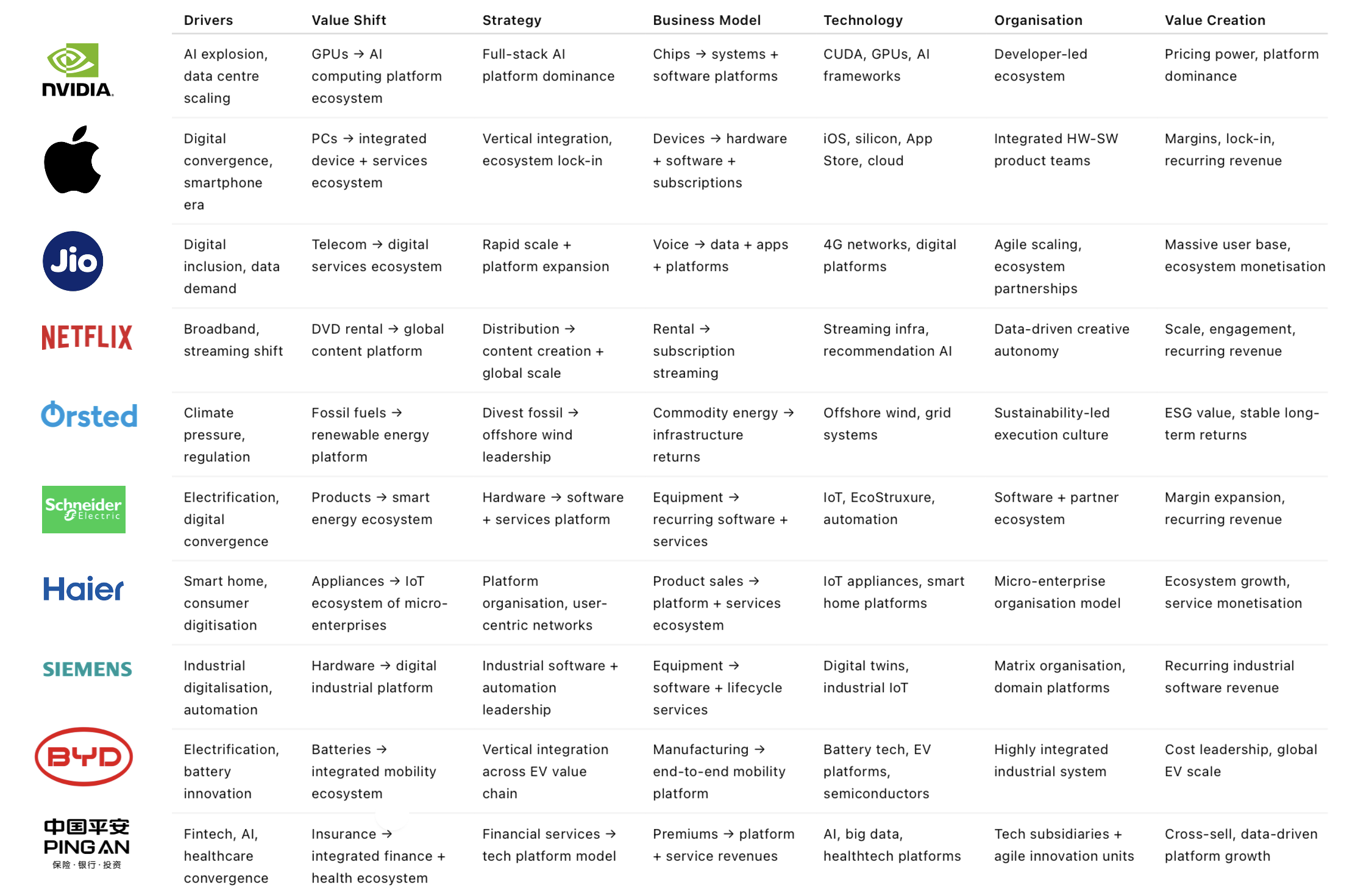
Beyond platforms: the deeper structure of transformation
It is tempting to describe these shifts simply as “platform strategies”. But that risks misunderstanding what is actually happening.
Platforms are not the cause of transformation; they are the expression of deeper changes:
- A shift in value proposition—from products to outcomes
- A redefinition of the product itself—from standalone object to connected system
- A transformation of the revenue model—from transaction to relationship
- The elevation of data and software as core assets
- A reinvention of the organisation and culture
- The creation of ecosystems that extend beyond the firm
These dimensions reinforce one another. Change in one without the others rarely succeeds.
1. Value: from products to outcomes
The most fundamental shift is in what companies believe they are selling.
Historically, Siemens sold equipment—turbines, trains, industrial systems. Today, it increasingly positions itself as a provider of digital industrial solutions, enabling customers to optimise performance, reduce downtime, and simulate operations through digital twins. Its Xcelerator platform, formally launched in 2022, is designed to integrate hardware, software, and services into a coherent offering.
Similarly, Schneider Electric has moved from electrical components to a proposition centred on energy efficiency and sustainability outcomes. Its EcoStruxure architecture connects devices, edge control systems, and cloud analytics to help customers manage energy consumption across buildings, factories, and infrastructure.
In agriculture, John Deere has reframed its purpose around yield optimisation. The tractor is no longer the product; it is part of a system that includes sensors, satellite data, and machine learning models that guide planting, fertilisation, and harvesting.
Even Apple, often seen as a hardware company, has shifted towards a value proposition of integrated digital experience—a seamless environment across devices, services, and applications.
The lesson is clear: transformation begins not with technology, but with a redefinition of value.
2. Product: from object to system
Once value shifts, the nature of the product must follow.
In the traditional model, products (and services) were discrete, self-contained, and largely static once sold. In the new model, they are dynamic, connected, and continuously evolving.
The iPhone is perhaps the most visible example. It is not simply a device; it is a node within an ecosystem governed by iOS, updated regularly, and extended by millions of third-party applications through the App Store.
Microsoft’s transformation reflects a similar shift. Windows, once the centre of gravity, has become just one component within a broader system anchored by Azure. Software is no longer delivered as a fixed product but as a continuously updated service.
In industrial contexts, this shift is even more profound. Siemens’ digital twin technology allows physical assets to be mirrored in software, enabling simulation and optimisation throughout their lifecycle. Schneider Electric’s EcoStruxure connects sensors, controllers, and analytics into a unified system.
John Deere’s equipment now generates vast amounts of data, feeding into its Operations Center platform. Farmers can monitor fields, analyse performance, and make decisions in real time.
In each case, the “product” has become a platform for ongoing interaction and improvement.
3. Revenue: from transaction to relationship
Perhaps the most consequential change—though often the least discussed—is in how companies make money.
Traditional businesses rely on transactions: a product is sold, revenue is recognised, and the relationship largely ends. In the emerging model, revenue is increasingly recurring, usage-based, or tied to outcomes.
Microsoft’s shift from perpetual software licences to subscription-based services such as Microsoft 365 and Azure is the clearest example. This transition, initiated in the early 2010s and accelerated under Nadella, fundamentally altered the company’s financial profile—smoothing revenue, increasing predictability, and expanding margins.
Apple has followed a similar path. Its services segment—including the App Store, Apple Music, iCloud, and Apple Pay—has grown steadily, contributing a significant and highly profitable portion of overall revenue.
Industrial companies have moved more cautiously, but the direction is consistent. Siemens and Schneider Electric now derive increasing portions of their income from software, services, and long-term contracts. John Deere has begun to layer subscription services onto its equipment, offering data-driven insights and automation capabilities.
The shift is not merely financial. It reflects a deeper change: from selling products to managing ongoing relationships with customers.
4. Data and technology: from support function to core asset
In the traditional enterprise, technology was a support function—important, but secondary to the core business. Today, it is often the primary driver of value.
Microsoft’s transformation into a cloud-first, AI-driven company is emblematic. Azure provides the infrastructure on which countless businesses run their operations, while its investments in artificial intelligence—accelerated through partnerships and acquisitions—position it at the forefront of the next technological wave.
Apple’s integration of hardware, software, and custom silicon illustrates a different approach: control and optimisation across the entire stack. Its M-series chips, introduced in 2020, have significantly improved performance and efficiency, reinforcing the advantages of vertical integration.
Siemens and Schneider Electric have embraced IoT, analytics, and digital twins, embedding intelligence into physical systems. John Deere’s use of machine learning to guide agricultural decisions demonstrates how data can transform even the most traditional industries.
The common thread is that data and software are no longer adjuncts; they are central to the product, the service, and the business model.
5. Organisation: from hierarchy to adaptability
None of these shifts are possible without corresponding changes in how companies are organised.
Transformation places enormous strain on traditional structures. Hierarchical, siloed organisations struggle to move at the pace required by software-driven environments.
Microsoft’s cultural transformation under Nadella is widely cited. Moving away from internal competition towards a “growth mindset”, the company fostered collaboration, learning, and openness—conditions necessary for its strategic pivot.
Industrial firms face a different challenge: integrating software capabilities into organisations historically dominated by engineering and manufacturing. Siemens has restructured around digital industries and software units. Schneider Electric has invested heavily in digital talent and capabilities.
John Deere has had to bridge the gap between mechanical engineering and data science, building new competencies while preserving its core strengths.
The lesson is that transformation is as much about people and culture as it is about strategy and technology.
6. Ecosystems: from company to network
Finally, the most advanced transformations extend beyond the boundaries of the firm itself.
Platforms, in their fullest sense, are not just internal architectures; they are ecosystems that enable others to create value.
Microsoft’s Azure supports millions of developers and partners worldwide. Apple’s App Store has enabled an entire economy of application developers, generating billions in revenue.
Siemens and Schneider Electric are building ecosystems of partners, integrators, and developers around their platforms. John Deere is beginning to connect farmers, agronomists, and technology providers.
Ecosystems amplify value. They also introduce complexity—questions of governance, control, and openness that each company must resolve.
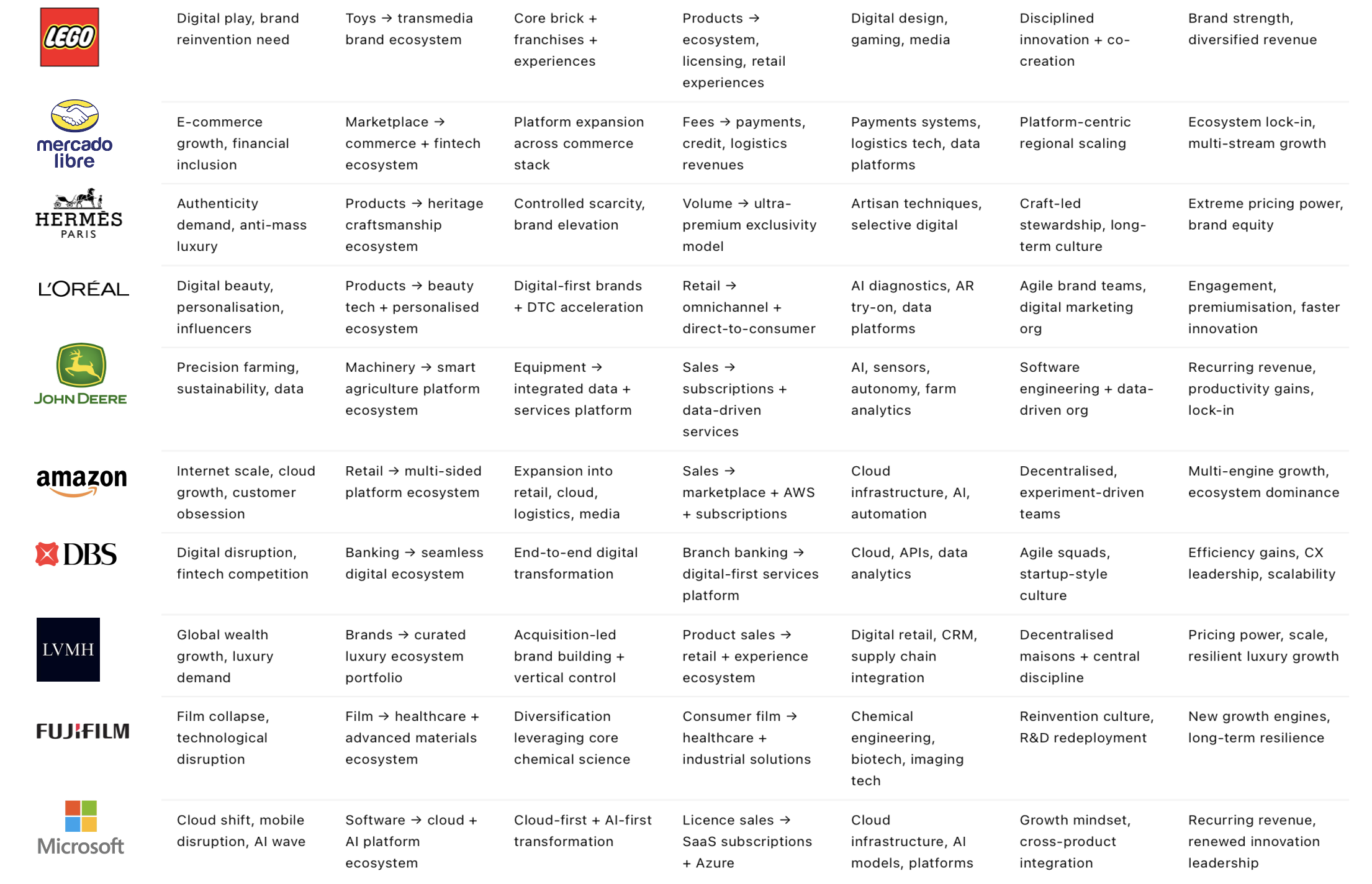
Transformation as a permanent condition
What emerges from these cases is not a single model, but a pattern.
Transformation is not a project with a defined end. It is an ongoing process of adaptation, driven by continuous changes in technology, competition, and customer expectations.
The companies that succeed are those that:
- Redefine their value proposition around outcomes
- Reimagine their products as evolving systems
- Shift their revenue models towards relationships
- Treat data and software as core assets
- Reinvent their organisations to enable speed and learning
- Build ecosystems that extend their reach
This is demanding work. It requires sustained leadership, significant investment, and a willingness to challenge deeply held assumptions.
It also requires humility. No company, however successful, is immune to disruption. The very forces that enabled Microsoft’s resurgence or Apple’s expansion could, in time, reshape them again.
The transformational challenge for today’s leaders
For business leaders, the implication is clear.
Transformation cannot be delegated to a “digital team” or confined to a set of initiatives. It must be understood as a central, continuous responsibility.
The question is not whether to transform, but how to build an organisation capable of ongoing reinvention.
That means making choices—about platforms, about ecosystems, about the balance between control and openness. It means investing not only in technology, but in people, culture, and partnerships. And it means accepting that the destination will continue to move.
Platforms may have been the language of the last decade. The reality of the next is more demanding.
We are entering an era in which every company must become, in some sense, a technology company—not by abandoning its heritage, but by reinterpreting it.
The tractor becomes a data platform. The turbine becomes a digital twin. The device becomes an ecosystem. The software becomes a service.
And the organisation itself becomes something new: not a fixed structure, but a system capable of continuous change.
That is the true meaning of transformation today.
Appendix: Case studies of transformational companies
1. Apple
- Change Drivers: Digital media disruption, smartphone adoption, ecosystem competition.
- Value Proposition Shift: Personal computers → seamless ecosystem of devices + services.
- Strategy Shift: Vertical integration, ecosystem lock-in, recurring services focus.
- Business Model Shift: Device sales → hardware + software + subscription services.
- Enabling Technology Shift: iOS, App Store, proprietary silicon, cloud infrastructure.
- Enabling Organisation Shift: Integrated product teams with hardware-software alignment.
- Value Creation Shift: Higher margins, ecosystem lock-in, network effects, recurring revenue.
2. BYD
- Change Drivers: EV adoption, government incentives, battery supply constraints.
- Value Proposition Shift: Battery supplier → affordable, reliable EVs + energy storage.
- Strategy Shift: Cost leadership, vertical integration, rapid global expansion.
- Business Model Shift: Component supply → full EV + energy ecosystem.
- Enabling Technology Shift: Advanced battery tech, power electronics, modular EV platforms.
- Enabling Organisation Shift: Integrated R&D + manufacturing teams.
- Value Creation Shift: Capturing margins across vehicles and energy segments.
3. DBS Bank
- Change Drivers: Fintech disruption, customer expectations, digital banking competition.
- Value Proposition Shift: Branch banking → seamless digital financial services and platforms.
- Strategy Shift: Customer-first, agile, cloud-native transformation.
- Business Model Shift: Branch-dependent → digital product and platform monetization.
- Enabling Technology Shift: Cloud computing, microservices, data analytics.
- Enabling Organisation Shift: Agile teams, innovation hubs, cultural transformation.
- Value Creation Shift: Lower costs, faster growth, improved customer retention.
4. Hermès
- Change Drivers: Digital commerce rise, luxury sustainability trends.
- Value Proposition Shift: Exclusivity + artisanal quality → integrated digital/experiential channels.
- Strategy Shift: Controlled distribution, storytelling, selective digitalization.
- Business Model Shift: High-margin products → augmented by premium services.
- Enabling Technology Shift: Digital retail, CRM analytics, e-commerce tools.
- Enabling Organisation Shift: Blend of tradition with modern retail execution.
- Value Creation Shift: Price premium, brand prestige, exclusivity retention.
5. John Deere
- Change Drivers: Agricultural productivity needs, IoT, precision farming.
- Value Proposition Shift: Tractors → precision agriculture solutions + data insights.
- Strategy Shift: Solution-oriented, data-driven agricultural offerings.
- Business Model Shift: Product sales → subscriptions and predictive maintenance services.
- Enabling Technology Shift: Telematics, IoT sensors, AI analytics.
- Enabling Organisation Shift: Creation of software + analytics teams.
- Value Creation Shift: Recurring revenues, long-term client relationships.
6. Lego
- Change Drivers: Digital entertainment competition, declining toy sales.
- Value Proposition Shift: Physical bricks → brand-driven digital experiences (games, apps, films).
- Strategy Shift: Co-creation, franchise partnerships, digital engagement.
- Business Model Shift: Toy sales → diversified revenue including media + digital platforms.
- Enabling Technology Shift: Digital platforms, gaming, online communities.
- Enabling Organisation Shift: Cross-functional creative + digital teams.
- Value Creation Shift: New revenue streams and higher engagement.
7. L’Oréal
- Change Drivers: E-commerce growth, AI personalization, digital marketing.
- Value Proposition Shift: Cosmetics → personalized digital beauty experiences.
- Strategy Shift: Data-driven engagement, sustainable product focus.
- Business Model Shift: Retail sales → online + digital advisory + AI tools.
- Enabling Technology Shift: AI skincare, e-commerce platforms, marketing analytics.
- Enabling Organisation Shift: Digital centers, data talent recruitment.
- Value Creation Shift: Loyalty, direct-to-consumer revenue, personalized offerings.
8. LVMH
- Change Drivers: Global luxury growth, digital commerce, sustainability and experience demand.
- Value Proposition Shift: Luxury goods → curated luxury lifestyle experiences + digital engagement.
- Strategy Shift: Multi-brand portfolio, selective acquisitions, omnichannel integration.
- Business Model Shift: Product sales → high-margin ecosystem leveraging retail + experiences.
- Enabling Technology Shift: E-commerce, CRM, AR/VR showrooms, analytics.
- Enabling Organisation Shift: Decentralized brand management + centralized strategic oversight.
- Value Creation Shift: Premium pricing, brand loyalty, diversified luxury revenue streams.
9. Mercado Libre
- Change Drivers: E-commerce growth, low financial inclusion in LATAM.
- Value Proposition Shift: Marketplace → commerce + fintech ecosystem (payments, logistics).
- Strategy Shift: Platform expansion, ecosystem integration.
- Business Model Shift: Marketplace fees → fintech + logistics monetization.
- Enabling Technology Shift: Mobile payments, integrated logistics platforms, data analytics.
- Enabling Organisation Shift: Creation of fintech + logistics divisions.
- Value Creation Shift: Cross-sell, ecosystem monetization, data-driven value.
10. Microsoft
- Change Drivers: Declining PC sales, cloud computing rise, enterprise IT shift.
- Value Proposition Shift: Licensed software → cloud + platform services (Azure, M365).
- Strategy Shift: Cloud-first, mobile-first, open-source engagement.
- Business Model Shift: One-time licenses → subscription + platform revenue.
- Enabling Technology Shift: Cloud infrastructure, SaaS, AI integration.
- Enabling Organisation Shift: Growth mindset, cross-product engineering focus.
- Value Creation Shift: Recurring revenue, enterprise adoption, ecosystem lock-in.
11. Netflix
- Change Drivers: Broadband adoption, consumer shift to streaming.
- Value Proposition Shift: DVD rental → streaming + original content production.
- Strategy Shift: Platform growth, data-driven content creation.
- Business Model Shift: Rental fees → subscription + content production revenue.
- Enabling Technology Shift: Streaming infrastructure, recommendation algorithms.
- Enabling Organisation Shift: Data and content creation teams.
- Value Creation Shift: Global scale, subscriber loyalty, personalized engagement.
12. Ørsted
- Change Drivers: Climate policy, energy transition, decarbonization economics.
- Value Proposition Shift: Fossil fuels → renewable energy solutions.
- Strategy Shift: Divest oil/gas → invest in offshore wind.
- Business Model Shift: Energy sales → project development + operations revenue.
- Enabling Technology Shift: Offshore wind turbines, grid integration tech.
- Enabling Organisation Shift: Green competencies and sustainability focus.
- Value Creation Shift: Long-term renewable energy revenues, brand in sustainability.
13. Rolls-Royce (Automotive)
- Change Drivers: Ultra-luxury market trends, electrification, bespoke customer expectations.
- Value Proposition Shift: Luxury cars → ultimate personalized craftsmanship + bespoke experiences.
- Strategy Shift: Focus on ultra-luxury, bespoke programs, EV integration.
- Business Model Shift: Traditional car sales → low-volume, high-margin bespoke production.
- Enabling Technology Shift: Electrification, digital design, 3D modeling, connected features.
- Enabling Organisation Shift: Artisan-focused teams, integrated design + engineering + client advisory.
- Value Creation Shift: Maximal per-unit margin, brand prestige, loyal ultra-HNW customer base.
14. Schneider Electric
- Change Drivers: Sustainability demand, digitalization, energy efficiency trends.
- Value Proposition Shift: Electrical equipment → intelligent energy management + automation.
- Strategy Shift: IoT + edge computing integration for efficiency solutions.
- Business Model Shift: Hardware sales → platform and services monetization.
- Enabling Technology Shift: AI, IoT, automation platforms.
- Enabling Organisation Shift: Innovation hubs, partnerships, startup incubation.
- Value Creation Shift: Software-enabled service revenue, sustainable solutions.
15. Siemens
- Change Drivers: Connected manufacturing, industrial IoT adoption.
- Value Proposition Shift: Products → digital + predictive industrial services (MindSphere).
- Strategy Shift: Data-driven, service-oriented customer solutions.
- Business Model Shift: Product-focused → recurring digital services + platform licensing.
- Enabling Technology Shift: Sensors, cloud, ML analytics, industrial IoT.
- Enabling Organisation Shift: Software + digital talent, agile engineering teams.
- Value Creation Shift: New recurring revenues, analytics-driven efficiencies for clients.
16. Xiaomi
- Change Drivers: Smartphone competition, IoT ecosystem opportunities.
- Value Proposition Shift: Smartphones → AIoT-connected device ecosystem.
- Strategy Shift: User co-creation, integrated smart device ecosystem.
- Business Model Shift: Device sales → hardware + IoT services + retail platform.
- Enabling Technology Shift: AIoT, proprietary SoCs, unified OS.
- Enabling Organisation Shift: Lean R&D, ecosystem incubation teams.
- Value Creation Shift: Scale across devices + services, network effects, recurring revenue.
Each month The Brand Doctor, aka business expert Peter Fisk, takes a global brand that has perhaps lost its way, and considers how it could reinvent itself. If it’s your brand, do you have the courage to change? If not, what would you do, and how could you apply these ideas for reinvention to your own business?
Mercedes Benz.
Few names carry such weight. A century of craftsmanship, engineering precision, and the quiet confidence of a brand that helped invent the automobile itself. The three-pointed star has long stood for certainty: if something bears it, it will be built properly, elegantly, enduringly.
And yet, in 2026, certainty feels like a fragile luxury. The ground beneath the industry is shifting—not gradually, but violently—towards electrification, software, artificial intelligence, and networks. The uncomfortable question now presents itself: what becomes of a company defined by engineering excellence in a world where engineering alone is no longer enough?
Mercedes-Benz has an answer, at least in principle. Its strategy is not a single pivot, but a multi-directional transformation … across product, technology, business model, geography, and culture. The ambition remains to build “the world’s most desirable cars”, but the meaning of desirability itself is evolving. The real question is whether Mercedes is evolving fast enough—and boldly enough—to redefine it.
- Mercedes Benz Annual Report 2025
- Mercedes Benz Capital Markets Day 2025
- Mercedes Benz Investor Presentation 2026
MB.OS … from automaker to software platform
At the heart of this transformation lies MB.OS, Mercedes’ attempt to build a unified operating system that powers everything from infotainment to autonomous driving. This is more than a technical upgrade; it is a philosophical shift. The car is no longer a finished product at the point of sale, but a living platform, capable of evolving through over-the-air updates, AI-driven features, and new digital services.
It is, in essence, an attempt to move closer to the logic of Apple—where hardware is merely the gateway to a broader ecosystem of experiences, services, and recurring revenue.
Apple now generates 25% of revenue from services (App Store, content), but 40–50% of profit due to high margins. A decade ago, this was under 10%. The shift to recurring, ecosystem-driven income has transformed its valuation—from hardware maker to platform company with scalable, predictable profitability.
But can Mercedes truly think like a software company? Can an organisation built on mechanical perfection embrace iteration, imperfection, and continuous release cycles? Or will MB.OS become yet another ambitious platform constrained by legacy systems and cultural inertia?
And more provocatively: if the car becomes a platform, does the brand’s value migrate from what you drive to what you experience?
Electrification … to compete with Tesla, Polestar
Mercedes’ approach to electrification is ambitious, yet cautious. It is building a new generation of electric vehicles while retaining hybrid and flexible powertrain strategies in markets where infrastructure lags.
This is pragmatic, perhaps even wise. But it also raises a tension. Competitors such as Tesla, Polestar, Nio and XPeng are pushing more aggressively towards fully electric futures, shaping consumer expectations in the process.
Can Mercedes afford to hedge its bets? Or does leadership in a new era require a more uncompromising stance? And perhaps more fundamentally: will customers in the future care less about what powers the car, and more about what powers the experience?
Global … made in Alabama, or Beijing
Beyond the vehicle itself, Mercedes is reshaping its global footprint—investing in regional manufacturing, engineering hubs, and localised supply chains. Factories in Alabama, expanded capabilities in Asia, and a broader geographic spread are all part of a strategy to navigate geopolitical volatility and shifting trade dynamics.
This is not merely operational efficiency; it is strategic resilience. Yet it introduces its own tensions. Can a brand synonymous with German precision maintain its identity when production is dispersed globally? Does localisation create agility—or dilute the very essence of what makes a Mercedes a Mercedes?
Culture … from an engineering legacy
Perhaps the most difficult transformation is internal. Mercedes is attempting to break down silos between engineering, manufacturing, sales, and customer experience—moving from a rigid industrial model to a more integrated, agile organisation.
This is easy to declare, notoriously difficult to achieve. Culture does not shift at the speed of strategy. Engineers trained to perfect hardware must now think in terms of software iterations. Sales teams accustomed to one-off transactions must consider subscriptions, services, and lifetime customer value.
Meanwhile, competitors—Rivian, Lucid Motors, VinFast, even design-led newcomers like Omoda and Jaecoo—are unburdened by legacy, able to design organisations around the future rather than retrofit the past.
Can Mercedes bend without breaking? Or is the weight of its own excellence the very thing that slows it down?
Tomorrow XX … good for the world
Sustainability has moved from obligation to opportunity. Initiatives such as “Ambition 2039” and “Tomorrow XX” aim to decarbonise not just vehicles, but the entire lifecycle—from materials to manufacturing to recycling.
This suggests a broader redefinition of luxury: not just what feels good, but what is good. Yet the question lingers. Does sustainability enhance desirability, or merely accompany it? Can Mercedes lead in circular materials and net-zero production without losing the immediacy, sensuality, and emotional pull that define its brand?
And will younger consumers—drawn to the narratives of companies like Polestar or Rivian—see Mercedes as a pioneer, or as a legacy player catching up?
Gamechanger … rising above the crowd
The competitive landscape is no longer orderly. It is a mosaic of ambition. Tesla continues to blur the lines between automotive and technology. Nio experiments with battery-swapping ecosystems. XPeng pushes autonomy and AI. Zeekrand Xiaomi hint at vertically integrated, tech-driven futures.
At the same time, Hyundai, Kia, Genesis, and Tata Motors are closing the gap from below, offering design, quality, and electrification at pace.
In such a world, Mercedes-Benz must ask itself a simple but profound question: is it still competing in the same game?
The reinvention imperative
The possible futures stretch in different directions. One path is incremental evolution—refining EVs, integrating MB.OS, improving sustainability, and relying on brand strength to sustain premium positioning.
Another is radical reinvention—becoming a mobility platform, offering autonomous services, subscription-based access, AI-driven experiences, and integration with energy and smart-city ecosystems.
Between these lies a hybrid possibility: Mercedes as both product and platform, delivering exceptional physical vehicles alongside a seamless digital ecosystem.
But even this raises deeper questions. Can luxury coexist with subscription models? Can exclusivity survive in a world of shared mobility? Can a brand built on ownership adapt to a future defined by access?
The trillion dollar question
And then there is the question that sits quietly beneath all others: what is Mercedes-Benz actually worth in this new world?
Today, Mercedes-Benz Group generates roughly $160–170 billion in revenue, yet is valued at less than $100 billion—a multiple of well under 1x revenue. Compare that with Ferrari, whose scarcity, margins, and brand power command 10x+ revenue multiples. Tesla, meanwhile, trades more like a technology platform, often at 5–8x revenue.
Step outside automotive, and the contrast sharpens further. Apple and Microsoft command 7–12x multiples, built on ecosystems, recurring revenues, and scalability. Even luxury houses like LVMH and Hermès sustain 4–10x multiples, driven by desirability and pricing power.
If Mercedes-Benz could achieve even a modest 3x revenue multiple, its valuation would approach $500 billion. At Tesla-like levels, it could edge towards $1 trillion.
But such multiples are not awarded for heritage—they are earned through transformation. Mercedes would need to become something fundamentally different:
- A platform, generating recurring software and service revenues
- A luxury brand of scarcity, with disciplined product and pricing strategy
- A mobility ecosystem, integrating vehicles, energy, data, and AI
- A high-margin business, less cyclical, more predictable
In short, it would need to combine the platform thinking of Apple, the margin discipline of Ferrari, and the desirability of Hermès.
And here lies the tension. Can Mercedes evolve into such a hybrid without losing its identity? Or does the pursuit of such valuation multiples risk distorting the very essence of the brand?
Luxury in a world of tech
Mercedes-Benz has survived disruption before. Wars, crises, competition—it has endured, adapted, and often led. But this moment feels different. The disruption is not just technological; it is conceptual.
The car is no longer the centre of gravity. The ecosystem is. The experience is. The network is.
So the question is no longer whether Mercedes-Benz can build the world’s most desirable cars. It is whether it can redefine what desire means in a world of software, autonomy, and sustainability.
- Can it become a platform without losing its soul?
- Can it scale without losing its exclusivity?
- Can it transform without becoming unrecognisable?
And perhaps most provocatively of all:
Can Mercedes-Benz reinvent itself not just as a great automaker—but as a trillion-dollar business that fuses technology, luxury, and mobility into something entirely new?
More on brands
Peter Fisk is a leading authority on business and brand strategy, creating more innovative strategies, business models and experiences for the world’s best brands. His 35 years of experience spans Adidas to Amazon, Bosch, Campari to Cartier to DSM, having started as a brand manager of supersonic travel, with Concorde, and today working around the world supporting business leaders.
- The Brand Doctor: Aperol Spritz
- The Brand Doctor: Ecco
- The Brand Doctor: Gucci
- The Brand Doctor: Philip Morris
- The Brand Doctor: Tetra Pak
and
- What’s new and next in branding?
- What’s new and next in marketing?
- What’s new and next in innovation?
and more
- Eyes on Tomorrow: What Leaders Must See before Everyone Else … exploring the most important megatrends that are transforming markets, and leadership mindsets, and how the best companies embrace them as opportunities … based on the new Megatrends 2035 report by Peter Fisk, and its implications for every business.
- The Reinvention Playbook: Thriving in a World of Relentless Change … the best organisations seek to continually reinvent themselves in a world of constant, uncertain and dynamic change. They rethink, refocus, and reinvent everything – embracing new agendas from AI to GenZ, climate change and social inequality.
- The Nexus Effect: Unlocking the Power of Connections … How can businesses and brands really unlock the power of data and networks, flywheels and AI, communities and ecosystems, to transform their futures?
- The New Growth Playbook: 9 New Ways to Accelerate Growth … many companies struggle to find new ways to grow their business … instead we look at how the best companies find radically new ways to grow.
- Super Innovators: Innovation Beyond the Normal … 10 radical ways to disrupt conventions, embrace deeper insights, unlock valuable assets, and stretch innovation for more dramatic impact.
- Consumer of the Future … “Aisha blinked twice, the smart lenses in her eyes had already scanned her biometric mood, cross-checked her carbon budget, and pulled up items her climate-positive friends were buying this week”
- Competing in the FLUX: How to develop a dynamic strategies in a world of relentless change … combining a strong, enduring direction with micro-moves that adapt quickly to emerging shifts:
- Business Transformation: The new superpower of business leaders … reimagining the future, redefining strategy, reinventing the organisation, rewiring performance … the journey to deliver step change in value creation.
- The Sustainable Consumer: Go on, do the Right Thing … how brands can accelerate the consumer shift to sustainable products and practices … from food and fashion, to energy and electric cars, making sustainability desirable and better.
- The “Performer Transformer” Leaders: How great leaders deliver today and create tomorrow … with dual thinking, to build dynamic ambidexterity, continually strategyzing, to perform and transform.
- The Hire-Wire Act of Leadership: Leading in a world of intense competition and relentless change … being visionary and innovative, learning to adapt and endure … inspired by Taylor Swift, Roger Federer, Beyoncé, and Lionel Messi
- Becoming a Future-Ready Business … in a world of relentless change, organisations need to anticipate change, embrace innovation, empower talent, and align deeply with the evolving needs of society and the planet
I always look forward to Fast Company’s Most Innovative Companies list, and the 2026 edition perfectly captures the energy of this moment. This year’s Top 50 points toward an “agentic future,” where AI doesn’t just respond, it executes.
At the forefront is Google, whose Gemini ecosystem is finally delivering on its long-standing vision of useful AI everywhere. Alongside it, Anthropic is making waves with Claude Code, while Databricks, Shopify, Abridge, and Harvey are reimagining how work gets done, from data engineering to healthcare and law.
At the same time, innovation isn’t just about automation, it’s about amplifying human creativity. Reddit stands out as a hub for authentic human perspective, while Proximity Media and Rimas Entertainment show how culture can drive economic and creative impact, especially through Bad Bunny’s record-breaking influence. Even legacy satire brand The Onion proves the enduring power of humour and print.
What’s especially exciting is how brands are meeting audiences where they are. Adidas taps into cultural moments like the Oasis reunion, The Gap rises like a phoenix, while Cadence OTC brings care into everyday retail spaces. TBPN transforms online chaos into compelling content, and Tubi reinvents discovery with swipeable, intuitive viewing.
From robotics pioneers like Unitree Robotics to sustainability leaders like Redwood Materials, and community-driven ideas like Diplo’s Run Club, the list is a powerful reminder: in uncertain times, progress belongs to those who keep moving—and keep innovating.
More than just a ranking, this list is a snapshot of momentum, ambition, and possibility—and a reminder of why innovation continues to inspire.
Fast Company’s World’s Most Innovative Companies Ranking 2026
I’ve been helping businesses to develop their strategies for 35 years – in hundreds of companies, most sectors and across the world. Most recently I’ve worked with companies like Adidas and Airbus, Mercedes and Microsoft, and learnt to embrace AI as the new rocket fuel of the strategy process. No, AI doesn’t give you “the answer” but it is an incredibly powerful support tool.
Imagine creating an entirely new corporate or business strategy in two days. A carefully facilitated workshop approach, bringing together the right stakeholders, and enabled by AI, can create analysis and interpretation, hypotheses and scenarios in minutes and hours. And still with plenty of time to explore, debate, challenge, align and ultimately agree on the right way forwards.
A new era for strategy
Strategy has always been about direction. Yet for too long, it has been anchored in hindsight — built on historical performance, legacy capabilities, and incremental planning cycles that struggle to keep pace with a changing world. In an era defined by technological acceleration, shifting customer expectations, and systemic disruption, this approach is no longer sufficient.
What is required instead is a fundamentally different model: one that is forward-looking, opportunity-led, and continuously evolving. A model that combines clarity with adaptability, ambition with discipline. A model that treats strategy not as a periodic exercise, but as a living capability.
Artificial intelligence now plays a decisive role in enabling this shift. Not as a tool used occasionally at the margins, but as a constant analytical and creative companion — helping leaders to make sense of complexity, explore new possibilities, and move from insight to action with unprecedented speed.
The result is a new kind of strategy: more dynamic, more intelligent, more imaginative, and ultimately more effective at creating long-term value.
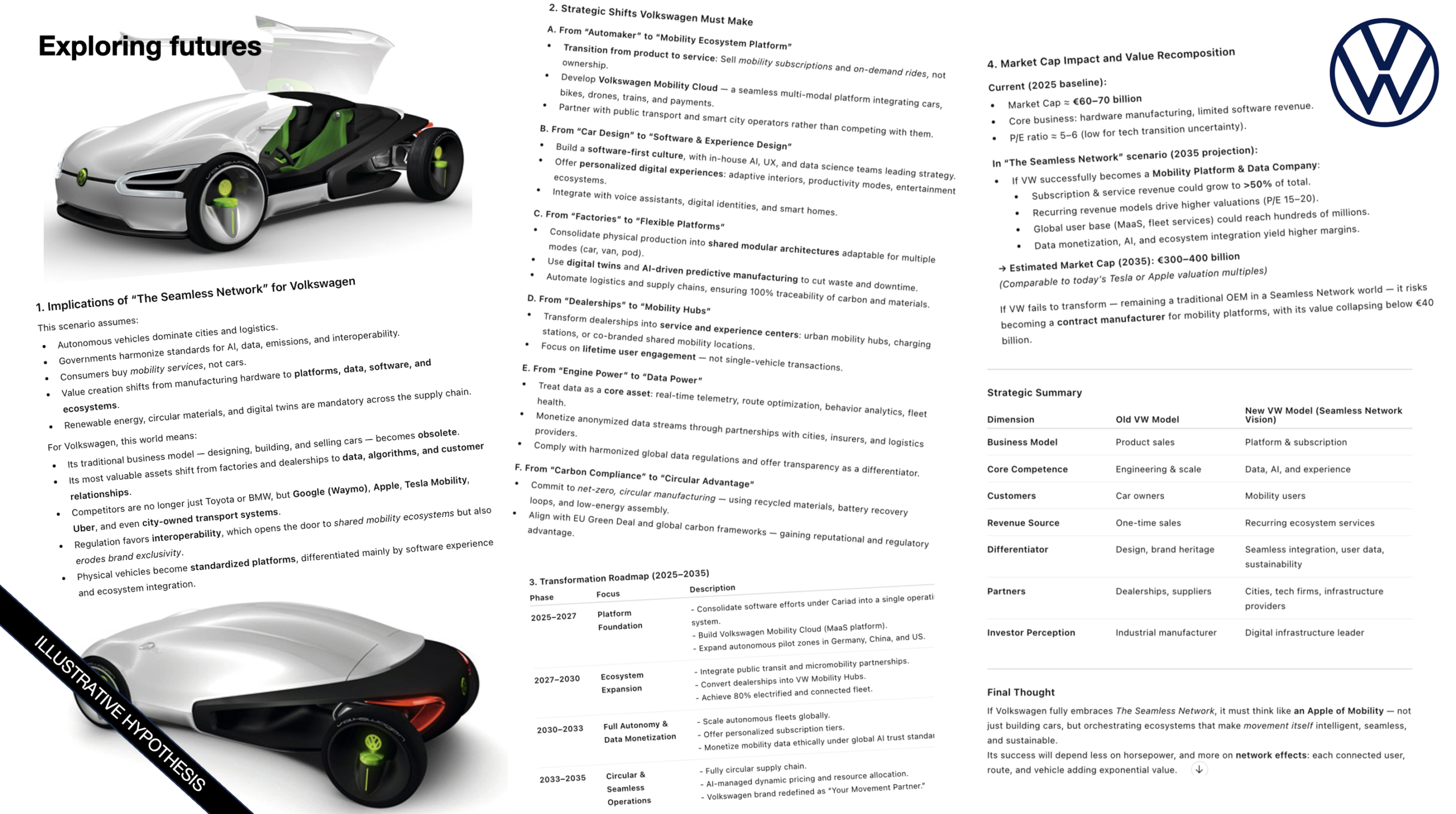
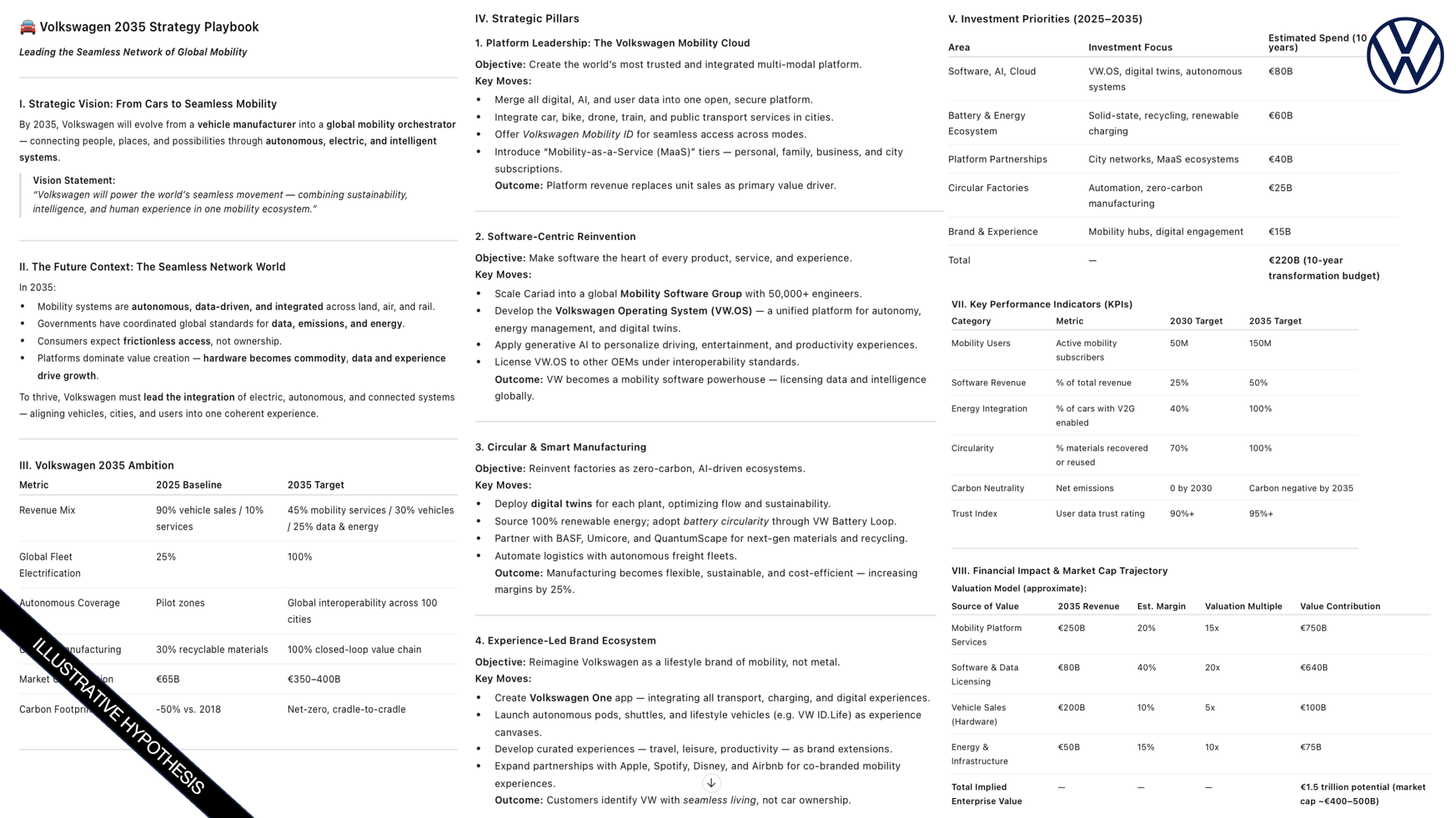
Here’s an example of extracts from an AI-powered strategy process, exploring future scenarios in the mobility world, and then creating future scenarios and evaluated options to help Volkswagen’s business leaders to make the right strategic choices to finally drive more value-creating growth:
Strategy as a dynamic system
At the heart of this transformation is a simple but powerful idea: strategy is no longer a document. It is a system.
In traditional models, strategy is often developed annually, approved at the top, and then cascaded down through the organisation. By the time it is implemented, many of its assumptions are already outdated. The world has moved on.
A dynamic approach reframes strategy as something fundamentally different — a continuously evolving set of choices, informed by real-time insight and shaped through ongoing iteration.
Artificial intelligence is central to this shift. It enables organisations to:
- Continuously ingest and interpret vast amounts of data
- Detect emerging patterns and weak signals early
- Revisit and refine strategic assumptions in real time
- Rapidly generate and test alternative strategic options
Rather than waiting for the next planning cycle, organisations can now adapt as they go — adjusting direction without losing focus.
This creates a powerful combination: strategic clarity with operational agility.
Looking Forward not Back: Opportunity Over Legacy
One of the most important mindset shifts in modern strategy is moving from a backward-looking to a forward-looking perspective.
Historically, companies have asked: What are we good at, and how do we build on it?
Today, the more relevant question is: Where is value being created, and how do we position ourselves to capture it?
This is not about abandoning core strengths. It is about refusing to be constrained by them.
Artificial intelligence enhances this forward-looking perspective by expanding the scope of what leaders can see and consider. It can map emerging market spaces, identify nascent customer behaviours, and highlight opportunities that would otherwise remain invisible.
In practice, this means strategy becomes:
- More exploratory in identifying future growth spaces
- More willing to challenge legacy assumptions
- More proactive in shaping, rather than reacting to, change
The organisations that succeed are those that treat their current business not as a destination, but as a platform for what comes next.
Anchoring in megatrends and customer agendas
A forward-looking strategy must be grounded in a deep understanding of the forces shaping the future. Two lenses are particularly powerful: megatrends and next customer agendas.
Megatrends provide the structural context — the long-term shifts that redefine industries over time. Artificial intelligence enhances the analysis of these trends by synthesising insights across vast datasets, from scientific research to market signals, enabling a more nuanced and dynamic understanding.
At the same time, the notion of the “next customer agenda” brings the future into sharper focus. Customers rarely articulate their future needs directly. Instead, they reveal them indirectly — through changing behaviours, rising expectations, and experiences in other sectors.
AI plays a crucial role here as well. By analysing behavioural data, social signals, and emerging consumption patterns, it helps organisations anticipate what customers will value next, not just what they value today.
Work with Adidas illustrates this vividly. In shaping its strategic direction, the company has increasingly focused on the intersection of performance, lifestyle, and digital engagement. AI-enabled insights have helped identify shifts towards personalisation, sustainability, and community-driven brand interaction. These insights, in turn, have informed decisions ranging from product design to direct-to-consumer platforms.
The connection is critical: megatrends define the playing field, while next customer agendas define how to win within it.
Inspired by innovation in adjacent worlds
One of the most powerful ways to identify new opportunities is to look beyond one’s own industry.
Innovation often travels sideways before it travels forward. Practices that emerge in one sector frequently reshape others.
Artificial intelligence accelerates this process by enabling organisations to scan across industries at scale — identifying patterns, analogies, and transferable ideas that would be difficult to detect manually.
This creates a systematic approach to cross-industry learning:
- Identifying relevant adjacent sectors, similar in attributes, similar for customers
- Analysing emerging trends, business models and practices within them
- Translating and adapting these insights into one’s own context
In work with Airbus, for example, insights from digital platforms and software ecosystems have informed new approaches to services and customer engagement. Rather than viewing itself solely as a manufacturer, Airbus has explored how data, connectivity, and partnerships can create ongoing value throughout the lifecycle of its products.
AI has supported this by modelling potential ecosystem configurations, simulating value flows, and identifying where new forms of collaboration could unlock growth.
Reimagining market spaces and business models
As organisations expand their field of vision, the next step is to translate insight into opportunity.
This involves exploring new market spaces and rethinking business models — not as isolated initiatives, but as integral parts of strategy.
Artificial intelligence enhances this process in two important ways. First, it enables rapid generation of strategic hypotheses — new combinations of customer needs, value propositions, and delivery mechanisms. Second, it allows these hypotheses to be tested and refined through simulation and data-driven analysis.
The result is a more iterative and expansive approach to strategy development.
For example, in work with The Coca-Cola Company, strategy has increasingly moved beyond traditional product categories towards broader experience ecosystems. AI has been used to explore new consumption occasions, personalise offerings, and optimise distribution networks in real time.
This has supported a shift from a product-centric model to a more dynamic, platform-oriented approach — where value is created through a combination of products, services, and experiences.
Brands as strategic growth engines
In a dynamic strategy model, brands take on a much more central role. They are no longer simply expressions of identity; they are engines of value creation.
A strong brand provides continuity in a changing world. It enables organisations to move into new spaces with credibility, to build trust with customers, and to anchor ecosystems of partners and communities.
Artificial intelligence enhances brand strategy by providing deeper insight into perception, sentiment, and engagement. It allows organisations to understand not just what their brand stands for today, but how it can evolve to remain relevant in the future.
For Mercedes-Benz, this has been particularly important in navigating the transition to electric and digital mobility. The brand must stretch into new territories — software, services, sustainability — while maintaining its core associations with quality, performance, and innovation.
AI has supported this by analysing customer perceptions across markets, identifying areas of tension or opportunity, and informing decisions about brand positioning and experience design.
Building ecosystems to go further, faster
As strategy moves beyond the boundaries of the firm, ecosystems become central.
Value is increasingly created not by individual organisations, but by networks of partners, platforms, and communities. The strategic challenge is therefore not just to define what the organisation does, but what it enables others to do.
Artificial intelligence plays a critical role in designing and managing ecosystems. It can:
- Map complex networks of relationships
- Identify potential partners and collaborators
- Model value creation and distribution across the ecosystem
- Optimise interactions in real time
In the case of Microsoft, ecosystems are foundational. Its strategy is built around enabling others — developers, enterprises, partners — to create value on top of its platforms. AI supports this by continuously analysing usage patterns, developer behaviour, and market trends, allowing the ecosystem to evolve dynamically.
The result is a strategy that is inherently scalable and adaptive.
Moonshots Thinking and Future-Back Planning
To truly break from incrementalism, organisations must embrace bold thinking.
Moonshot thinking is not about unrealistic ambition; it is about expanding the boundaries of what is considered possible. It challenges assumptions and opens up new strategic horizons.
Artificial intelligence enhances this process by acting as a creative partner — generating ideas, exploring scenarios, and identifying pathways that might not be immediately obvious.
Working from the future back is a powerful complement to this. By defining a clear vision of a desired future state, organisations can work backwards to identify the steps required to get there.
This approach has been used with companies such as Airbus to explore the future of sustainable aviation, and with Mercedes-Benz to envision next-generation mobility ecosystems.
AI supports this by:
- Simulating future scenarios
- Identifying capability gaps
- Mapping potential pathways to the desired future
The result is a strategy that is both ambitious and grounded.
Navigating uncertainty through future scenarios
If the future cannot be predicted, it can at least be explored.
Scenario thinking provides a structured way to consider alternative futures and test strategic choices against them.
Artificial intelligence significantly enhances scenario planning by enabling:
- Rapid generation of multiple plausible scenarios
- Data-driven assessment of their likelihood and implications
- Continuous updating as new information emerges
Rather than a static exercise, scenario thinking becomes an ongoing process — integrated into the broader strategy system.
This allows organisations to:
- Build resilience
- Identify no-regret moves
- Prepare for disruption
Making better choices: where and how to compete
Strategy ultimately comes down to choices: where to compete, and how to compete.
Artificial intelligence strengthens decision-making by providing richer insight, faster analysis, and more rigorous testing of options. It allows leaders to move beyond intuition alone, combining judgement with evidence.
This leads to clearer, more confident choices about:
- Priority markets and segments
- Sources of differentiation
- Required capabilities and investments
Importantly, it also enables organisations to revisit these choices more frequently — ensuring that strategy remains aligned with a changing environment.
Ensuring strategy delivers value creation
At the core of dynamic strategy is a commitment to value creation.
Growth and profitability are not opposing goals; they are interdependent. The challenge is to balance short-term performance with long-term potential.
Economic value (think of the market value of companies if public, or equally their internally-calculated enterprise value if not – the sum of future likely profit streams) should be the ultimate metric for decisions and evaluation.
This is achieved through a dual portfolio approach:
- An “exploit” portfolio focused on optimising today’s business
- An “explore” portfolio focused on exploring tomorrow’s opportunities
These should be managed dynamically, and together. Just like an investment portfolio, where capital allocation becomes the key prioritisation tool.
AI enhances portfolio management by providing real-time visibility into performance, risk, and opportunity. It enables organisations to allocate resources more dynamically, shifting investment as conditions change.
In work with FEMSA Group in Mexico, for example, this approach has supported a more balanced strategy — strengthening core retail performance while investing in digital channels and new customer experiences.
The result is a more resilient and adaptive organisation.
Strategy at the speed of change
Perhaps the most profound impact of AI is on the speed of strategy.
What once took months can now be done in days or even hours. Insights that were previously inaccessible can now be generated on demand.
This does not mean strategy becomes rushed or superficial. On the contrary, it becomes more rigorous — because more options can be explored, more assumptions tested, and more data considered.
The key shifts include:
- From periodic to continuous strategy development
- From linear to iterative processes
- From limited to expansive exploration of options
AI enables leaders to operate at the speed of change — without sacrificing quality of thinking.
Stretching thinking, better decisions
A final, critical role of AI is to challenge and stretch strategic thinking.
By generating alternative perspectives, questioning assumptions, and exploring edge cases, it helps organisations avoid the trap of narrow or biased decision-making.
This leads to:
- More innovative strategies
- More robust decisions
- Greater organisational alignment
Strategy becomes not just smarter, but more resilient.
Strategy: more creative, more intelligent
The future of strategy is not simply faster or more data-driven. It is more creative, connected, and continuous.
Artificial intelligence makes this possible — not by replacing human judgement, but by augmenting it. It allows leaders to think more broadly, act more quickly, and decide more confidently.
In this new model, strategy becomes:
- A living system, not a static plan
- A forward-looking discipline, not a backward-looking analysis
- A balance of exploration and exploitation
- A driver of long-term value creation
It is both ambitious and practical. Both imaginative and grounded. Above all, it is purposeful. Because at its best, strategy is not about reacting to the future.
It is about next and now – creating the future, while delivering today.
They do not wait for the future to arrive. They build it.
Across continents and categories, a new breed of company is shaking the foundations of established industries. They challenge orthodoxies that others treat as fixed. They dismantle legacy models without sentimentality. They fuse science, software and systems thinking. They take risks that feel uncomfortable, even reckless, to incumbents. And in doing so, they create dramatic new value.
These are the Future Makers … businesses with the courage to let go of the past and leap towards possibility.
- They do not pursue marginal gains. They reimagine entire markets.
- They combine technological depth with ecosystem design and industrial-scale execution.
- They solve problems that once felt impossible — from affordable space access to programmable biology, from carbon removal to AI-assisted drug discovery.
- They move quickly, iterate boldly, and blend profit with purpose.
The future is not something they predict. It is something they engineer.
Rewriting the Rules of Intelligence
Few domains are shifting faster than artificial intelligence. Yet the most interesting players are not merely racing for scale; they are redefining responsibility.
Anthropic has positioned itself at the frontier of AI capability while embedding safety and alignment at its core. Its Claude models compete with the most advanced systems in the world, but the company’s strategic bet is that trust will define long-term leadership. In a world increasingly shaped by autonomous systems, reliability and governance are not constraints — they are competitive advantages. Anthropic reframes the AI race from raw power to principled intelligence.
Future Makers understand that the next wave of value creation will belong to those who can make powerful technologies usable, trusted and scalable.
Powering the Digital Backbone
Some Future Makers are invisible to consumers yet indispensable to progress.
The Dutch company ASML builds the extreme ultraviolet lithography machines that produce the world’s most advanced semiconductors. Each system is a masterpiece of precision engineering, the result of collaboration across physics, materials science and global supply chains. Without ASML, there are no leading-edge chips. Without those chips, there is no AI revolution, no high-performance computing, no next-generation connectivity.
ASML does not dominate headlines, but it occupies a critical node in the global ecosystem. It exemplifies a defining Future Maker trait: control the enabling architecture, and you shape the trajectory of entire industries.
Electrifying Mobility at Scale
The automotive sector once evolved incrementally — engine improvements, design refinements, efficiency gains. Then electrification arrived, and with it a systemic shift.
China’s BYD recognised early that batteries would sit at the heart of the new mobility economy. Originally a battery manufacturer, it vertically integrated into vehicle production, software and global distribution. By mastering battery chemistry and manufacturing scale, BYD has accelerated past many traditional carmakers.
This is not a niche transition. It is industrial reinvention. BYD’s growth reflects a broader lesson: when a technology curve turns exponential, partial commitment is fatal. Future Makers commit fully.
Programming Humanity
In healthcare, the convergence of computation and life sciences is unlocking extraordinary possibilities.
Germany’s BioNTech built its capabilities around mRNA technology long before it became a household name. When the pandemic struck, it pivoted rapidly to develop one of the first COVID-19 vaccines. Yet its deeper mission lies in personalised cancer therapies and programmable medicine.
Similarly, Insilico Medicine applies artificial intelligence to drug discovery, compressing timelines that once stretched over a decade. By analysing biological data at scale, it identifies targets and designs molecules with unprecedented speed.
Here, biology becomes code. Discovery becomes computation. Future Makers in health are not simply developing treatments — they are redesigning the innovation engine itself.
Democratising Creativity
Transformation is not confined to heavy industry or biotech. It also reshapes how people express ideas.
Australia’s Canva turned professional-grade design into an intuitive, collaborative platform accessible to millions. By removing complexity and lowering cost barriers, it expanded the market dramatically. Teachers, entrepreneurs and global enterprises alike now use Canva to communicate visually.
This is a powerful Future Maker insight: growth often comes not from stealing share, but from unlocking latent demand. By empowering participation, markets multiply.
Reinventing Food Systems
Feeding a growing population sustainably demands radical innovation.
Chilean-founded NotCo uses artificial intelligence to analyse plant molecules and recreate the taste and texture of animal-based products. Its algorithm identifies unexpected ingredient combinations, producing alternatives that appeal to mainstream consumers.
Rather than framing plant-based food as sacrifice, NotCo reframes it as superior design. It blends data science with culinary creativity to challenge a centuries-old food system. Sustainability becomes not a constraint, but a driver of competitive advantage.
Removing Carbon from the Sky
Some challenges are planetary in scale.
Swiss company Climeworks develops direct air capture technology to remove carbon dioxide from the atmosphere. Its facilities represent a shift from mitigation alone to active restoration. By building a commercial model around long-term carbon removal contracts, Climeworks aligns environmental necessity with financial sustainability.
I went to visit their Mammoth location in Iceland, the largest direct air capture facility in the world. The scale of their ambition, the creativity of their business model, the impact they could have on accelerating our ability to solve the climate crisis, are truly impressive.
Future Makers understand that climate action is not peripheral to business strategy. It is central to future value creation.
Orchestrating Digital Ecosystems
Many of today’s most powerful companies do not own the assets they monetise. They orchestrate connections.
Instacart layered digital infrastructure over physical grocery retail, connecting consumers, supermarkets and logistics partners. What began as delivery evolved into advertising, analytics and enterprise technology services. Once embedded in the value chain, new revenue streams emerge naturally.
In China, Ping An transformed from a traditional insurer into a technology-powered ecosystem spanning finance, healthcare and smart city services. By embedding AI and digital platforms across its operations, it shifted from reactive insurance to proactive life management.
Future Makers think beyond products. They design systems in which others participate.
Expanding the Frontier
Some companies pursue ambitions that stretch beyond Earth itself.
SpaceX redefined the economics of space by developing reusable rockets. Through relentless iteration — launch, fail, learn, repeat — it drove down costs and increased launch frequency. Its Starlink satellite constellation extends connectivity to remote regions, building a parallel communications infrastructure in orbit.
Or take Rocket Lab, who seek to do it all with 3D printing, dramatically reducing the costs, enabling more experimentation, and access to companies and nations who could only dream of space.
This is moonshot thinking executed with engineering discipline. Space becomes not the preserve of governments, but a commercial and entrepreneurial domain.
Building Connected Worlds
In consumer technology, ecosystems matter more than individual devices.
China’s Xiaomi combined community-driven branding with online distribution to scale rapidly in smartphones. It then expanded into a vast array of connected home devices, creating an integrated Internet of Things ecosystem. More recently, it has entered electric vehicles, signalling ambitions that transcend electronics.
Xiaomi’s strategy illustrates how data, design and platform integration can transform hardware into recurring, ecosystem-based value.
The Shared DNA of Future Makers
Across sectors and geographies, these companies share defining characteristics.
- They anchor themselves in transformative technologies and invest ahead of the curve.
- They design ecosystems rather than isolated offerings.
- They execute with industrial discipline, not just visionary rhetoric.
- They are willing to cannibalise legacy models in pursuit of exponential growth.
- They integrate purpose into strategy, attracting talent and capital aligned with long-term impact.
- They move with urgency, treating learning as a competitive weapon.
Above all, they possess leadership with courage — leaders willing to abandon yesterday’s success formulas and embrace uncertainty.
The future does not reward complacency. It rewards builders.
Future Makers are not waiting for disruption to arrive at their door. They are the disruption. They are engineering new markets, redefining value, and proving that growth and impact can advance together.
In every sector, from chips to climate, from finance to food, they remind us of a simple truth: the future belongs to those bold enough to create it.
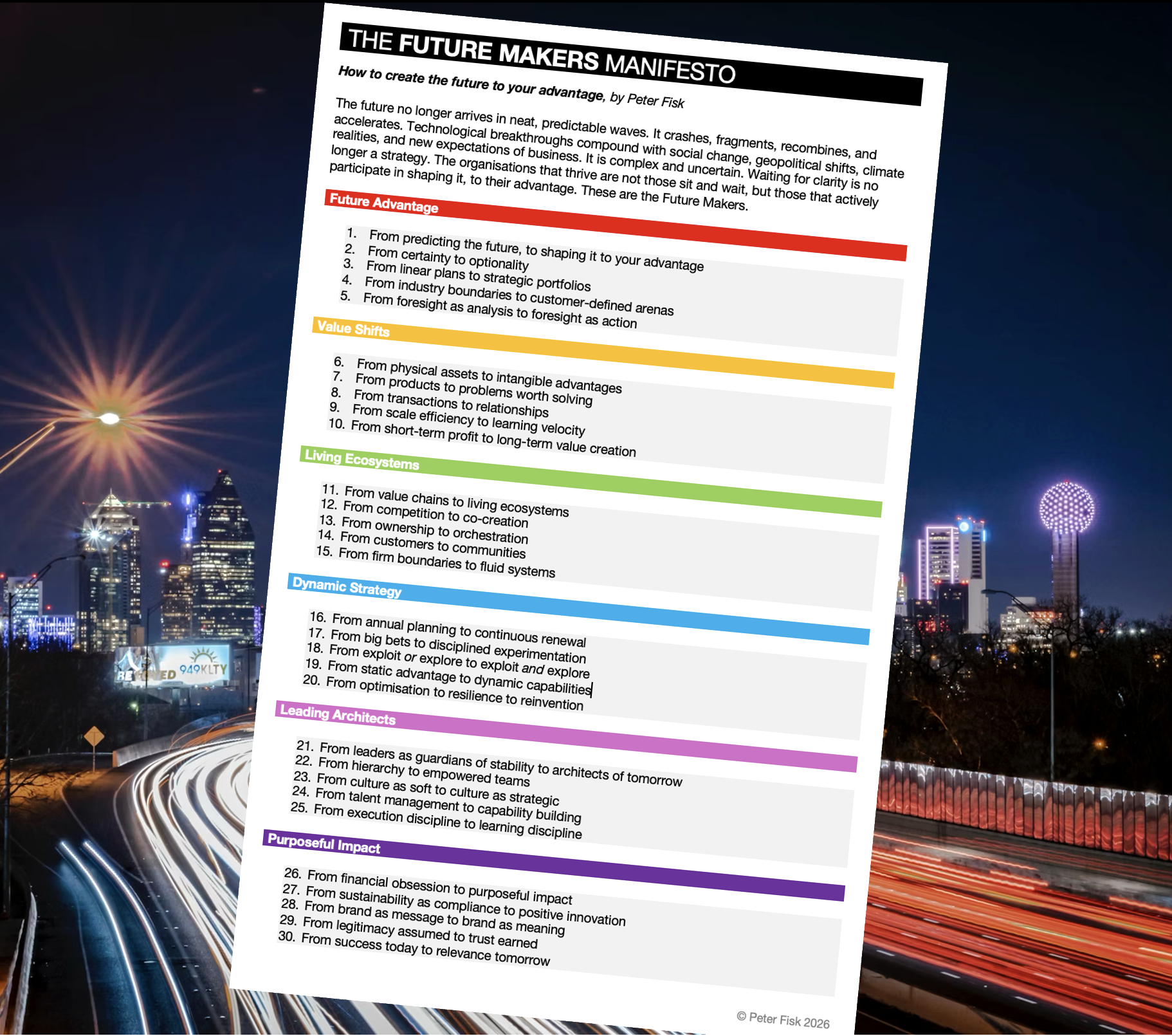
The Future Makers Manifesto
To the future makers of the world:
You are not inheriting a stable playing field. You are stepping into motion.
The future no longer arrives in neat, predictable waves. It crashes, fragments, recombines and accelerates. Artificial intelligence reshapes knowledge work while climate volatility redraws supply chains. Demographics shift, geopolitics fractures, trust in institutions fluctuates, and customer expectations rise faster than quarterly reporting cycles can accommodate. Technology no longer sits on the edge of strategy; it is strategy. Purpose is no longer a marketing line; it is licence to operate.
Complexity is not a passing phase. Uncertainty is not a temporary disturbance. They are the conditions of modern business.
Waiting for clarity is no longer a strategy.
The organisations that thrive in this environment are not those that sit back and attempt to predict what comes next with ever more detailed forecasts. They are the ones that step forward and shape it. They invest before certainty. They experiment before consensus. They build capabilities before the market fully forms. They do not merely respond to disruption; they harness it.
These are the Future Makers:
Future Advantage
1. From predicting the future, to shaping it to your advantage
Forecasting has limits in turbulent systems. Future Makers move beyond prediction to proactive design. They influence standards, invest in emerging technologies, build narratives that shape customer expectations, and partner to create new markets. Rather than asking what will happen, they ask how they can tilt probabilities in their favour.
2. From certainty to optionality
In volatile environments, rigid commitment is risk. Optionality – investments, partnerships and capabilities that keep multiple pathways open – is strategic insurance. Small stakes in new technologies, flexible supply chains, modular platforms and adaptable talent models provide room to manoeuvre as conditions shift.
3. From linear plans to strategic portfolios
Five-year linear plans struggle against exponential change. Future Makers manage portfolios: core optimisation, adjacent expansion and transformational bets. Each has different metrics, horizons and risk profiles. The discipline lies in balancing them, reallocating capital dynamically as evidence emerges.
4. From industry boundaries to customer-defined arenas
Customers do not experience “industries”; they experience needs. Mobility, wellbeing, productivity, entertainment – these cut across sectors. Future Makers redefine their competitive arena around customer problems, not legacy classifications, enabling cross-sector innovation and unexpected growth.
5. From foresight as analysis to foresight as action
Insight without execution is theatre. Scenario planning, trend analysis and technology scouting must translate into pilots, partnerships and prototypes. Foresight becomes valuable only when embedded into capital allocation, innovation pipelines and leadership agendas.
Value Shifts
6. From physical assets to intangible advantages
Brands, data, intellectual property, culture and ecosystems now drive disproportionate value. Future Makers systematically build and measure these intangibles, recognising that trust, reputation and proprietary insight create more durable advantage than bricks and mortar alone.
7. From products to problems worth solving
Customers hire solutions, not items. By deeply understanding pain points and aspirations, organisations move beyond selling units to delivering outcomes. This shift unlocks service models, recurring revenues and deeper loyalty.
8. From transactions to relationships
Digital connectivity enables ongoing engagement. Future Makers design lifetime journeys, not one-off sales. Data, personalisation and community-building transform episodic interactions into continuous relationships that generate mutual value.
9. From scale efficiency to learning velocity
Efficiency remains important, but in fast-moving markets, the ability to learn rapidly is decisive. Agile methods, rapid experimentation, real-time analytics and empowered teams accelerate feedback loops, enabling quicker adaptation than larger, slower rivals.
10. From short-term profit to long-term value creation
Quarterly earnings matter, but enduring enterprises balance immediate performance with investments in innovation, capability and trust. Long-term orientation attracts committed stakeholders and builds resilience against shocks.
Living Ecosystems
11. From value chains to living ecosystems
Linear supplier-to-customer chains are giving way to dynamic networks of partners, platforms and communities. Future Makers cultivate ecosystems where multiple actors co-create value, increasing reach and innovation capacity.
12. From competition to co-creation
Collaboration with former rivals, start-ups, universities and even customers accelerates innovation. Co-creation expands opportunity spaces beyond what any single firm could achieve alone.
13. From ownership to orchestration
Control of every asset is no longer essential. Strategic advantage often lies in orchestrating complementary capabilities across partners. Platform thinking, APIs and shared standards enable scalable coordination without full ownership.
14. From customers to communities
Communities offer belonging, advocacy and insight. Future Makers nurture spaces – physical or digital – where customers connect with each other, deepening loyalty and generating organic growth.
15. From firm boundaries to fluid systems
Talent, ideas and capital flow across porous organisational borders. Open innovation, remote collaboration and flexible partnerships create adaptive systems that respond faster than closed hierarchies.
Dynamic Strategy
16. From annual planning to continuous renewal
Strategy cycles shrink. Continuous scanning, quarterly reprioritisation and rolling resource allocation replace static annual plans, keeping organisations aligned with evolving realities.
17. From big bets to disciplined experimentation
Transformational ambition is pursued through staged experiments. Clear hypotheses, defined metrics and rapid iteration reduce risk while enabling bold moves.
18. From exploit or explore to exploit and explore
Future Makers design ambidextrous organisations: optimising the core while exploring new growth engines. Structural separation, tailored incentives and leadership attention ensure both thrive.
19. From static advantage to dynamic capabilities
Sustainable success depends on the ability to reconfigure assets and competencies repeatedly. Learning, integration and transformation capabilities become the true source of advantage.
20. From optimisation to resilience to reinvention
Efficiency is necessary but insufficient. Resilience absorbs shocks; reinvention creates new trajectories. Future Makers build organisations capable not only of surviving disruption but of emerging stronger from it.
Leading Architects
21. From leaders as guardians of stability to architects of tomorrow
Leadership shifts from preserving the status quo to designing future systems. Courage, curiosity and clarity of purpose replace control as defining traits.
22. From hierarchy to empowered teams
Speed demands decentralised decision-making. Empowered, cross-functional teams close to customers act faster and innovate more effectively than rigid hierarchies.
23. From culture as soft to culture as strategic
Culture shapes behaviour at scale. Intentional norms around experimentation, accountability and collaboration become critical enablers of strategic ambition.
24. From talent management to capability building
Rather than simply acquiring talent, Future Makers continuously develop capabilities – digital fluency, systems thinking, adaptive leadership – ensuring the organisation evolves with its environment.
25. From execution discipline to learning discipline
Delivering plans is vital, but so is learning from outcomes. Embedding reflection, feedback and adaptation into operating rhythms strengthens long-term performance.
Purposeful Impact
26. From financial obsession to purposeful impact
Profit remains essential, yet it is framed as outcome, not sole aim. Clear purpose guides decision-making, inspires stakeholders and anchors long-term direction.
27. From sustainability as compliance to positive innovation
Environmental and social challenges become catalysts for new products, services and business models. Regeneration and circularity drive growth rather than constrain it.
28. From brand as message to brand as meaning
Brand lives in behaviour. Authentic actions, consistent experiences and transparent communication build meaning that resonates beyond advertising.
29. From legitimacy assumed to trust earned
In an era of scrutiny, trust must be continuously earned through integrity, data responsibility, fair practices and social contribution.
30. From success today to relevance tomorrow
Past achievement offers no immunity. Future Makers constantly ask how they will remain relevant in a decade’s time, designing pathways to sustained significance.
For most of the 20th century, companies were built to last.
Jim Collins wrote a great book about it. We marvelled at the heritage and longevity of companies.
In that past world, companies required factories, supply chains, distribution networks and large workforces. Capital was expensive, technology moved slowly, and scale required physical presence. The typical organisation was vast and durable: tens of thousands of employees, decades of steady growth, and lifespans that often stretched half a century or more.
Today that model is fragmenting.
The cost of building companies has collapsed. Software has replaced infrastructure. AI is automating most processes and many decisions. And global platforms now provide distribution to billions of users almost instantly.
The result is a new economic phenomenon: companies that are dramatically smaller, grow extraordinarily quickly — and often burn out far faster than their predecessors.
In this environment, a once fanciful idea has begun to circulate in venture capital and technology circles: the emergence of the one-person billion-dollar company.
Not only is it plausible. It may be inevitable.
The logic of the one-person unicorn
The traditional path to a billion-dollar company involved scale in people as well as revenue. Microsoft employed thousands before it became a global powerhouse. Automobile manufacturers employed hundreds of thousands. Even internet companies of the early 2000s required large engineering teams and expensive infrastructure.
But the economic equation has shifted.
Imagine a single developer building a specialised AI product used globally by designers, lawyers or software engineers. Suppose 100,000 customers pay £40 per month — hardly an implausible subscription price for professional software.
That produces £48 million in annual revenue.
In venture capital markets, high-growth software companies often command valuations between 15 and 25 times revenue. At those multiples, a business generating £48 million annually could plausibly approach or exceed a £1 billion valuation.
The maths alone makes the concept credible. The only remaining question is operational: can one person realistically build and operate such a product? Increasingly, the answer appears to be yes.
Whether they would want to, is another question. I personally found that starting a business with someone else is much easier emotionally.
Companies are shrinking
Evidence of this shift already exists.
Some of the most influential companies of the last two decades reached extraordinary scale with surprisingly small teams.
When Instagram was acquired by Meta Platforms in 2012 for $1 billion, it had just 13 employees. Yet the photo-sharing app already served around 30 million users.
Two years later, WhatsApp was acquired by Meta for $19 billion. The messaging platform had roughly 55 employees while serving more than 450 million users globally.
That equates to roughly 1 employee for every 8,000,000 users … Wow!
More recent companies push the ratio even further.
The AI image-generation platform Midjourney operates with fewer than 30 employees yet reportedly generates hundreds of millions of dollars in annual revenue through subscriptions.
Another example is Notion Labs, the productivity software company whose early growth was driven by a small distributed team while millions of users adopted the platform worldwide.
Across sectors — from software to digital media to financial technology — the same pattern appears repeatedly: companies reaching massive scale with astonishingly small organisations.
The trend line points in one direction.
The cost of starting a company has collapsed
A generation ago, launching an internet service required significant capital.
Founders had to:
- purchase servers
- rent data-centre space
- hire specialised infrastructure engineers
- negotiate payment systems
- manage global hosting and uptime
Even modest online services required millions in funding before they could scale.
Today, almost all of that infrastructure can be rented instantly.
A startup can host its entire system on Amazon Web Services, process payments via Stripe, distribute software globally through platforms such as Vercel, and authenticate users through services like Auth0.
What once required a dedicated operations team can now be configured in minutes.
The cost difference is profound.
Instead of raising millions of pounds in venture capital simply to launch, many founders today can operate a product with a few hundred pounds per month in infrastructure costs.
This collapse in fixed costs has produced a surge in small software firms, particularly those targeting specialised niches: tools for podcast producers, analytics platforms for e-commerce sellers, or AI systems tailored to specific professional workflows.
The internet has effectively become a global operating system for companies.
AI is compressing the workforce further
If cloud infrastructure reduced the cost of running companies, artificial intelligence is beginning to reduce the number of people required to build them.
AI-assisted coding tools now generate significant portions of software automatically. Developers describe a new style of work — sometimes called “vibe coding” — in which founders specify what they want a system to do while AI generates large sections of the underlying code.
Instead of writing every line manually, developers increasingly:
- describe product behaviour in natural language
- generate initial code automatically
- refine and debug outputs
- iterate rapidly
The result is an extraordinary increase in individual productivity.
Tasks that previously required weeks of engineering work can now be completed in hours. Entire prototypes can be built by individuals working in evenings or weekends.
The pattern echoes earlier technological shifts. Just as spreadsheets once allowed one analyst to perform calculations that previously required an accounting department, AI is expanding what a single developer can accomplish.
In effect, AI acts as a multiplier of individual capability.
For entrepreneurs, that multiplier may prove decisive.
Platforms provide instant global scale
Perhaps the most powerful force enabling smaller companies is the rise of global digital platforms.
Few startups now operate independently. Instead, they exist within ecosystems controlled by a handful of technology giants.
Consider three of the most influential:
- Apple operates the App Store, distributing software to more than a billion iPhone users.
- Google dominates global search, sending traffic to millions of websites.
- Amazon provides both cloud infrastructure and global e-commerce distribution.
These platforms effectively supply the foundations of modern digital businesses.
A developer can launch an application on an app store and instantly reach users across dozens of countries. Payments, updates, identity verification and distribution are handled by the platform itself.
This allows extremely small companies to achieve global reach on day one.
At the same time, it concentrates immense power in the hands of a few firms.
Startups increasingly resemble species living within vast digital ecosystems. They thrive or struggle depending on the rules set by the platforms that host them.
The life of companies is also getting shorter
While firms can now scale faster than ever, they are also disappearing more quickly.
My research examining companies on the S&P 500 reveals a dramatic decline in corporate longevity.
- In the 1950s, the average company remained on the index for roughly 60 years.
- By the 1980s, that figure had fallen to around 30 years.
- Today, the average tenure is closer to 18–20 years.
Technological disruption is accelerating corporate turnover.
Entire industries can be overturned within a decade.
The video-rental chain Blockbuster LLC collapsed after the rise of streaming platforms such as Netflix.
The once dominant mobile-phone manufacturer Nokia lost its position following the smartphone revolution triggered by the iPhone from Apple.
Even large digital companies face constant disruption. Social networks, mobile apps and consumer platforms frequently rise to prominence within a few years — only to decline just as quickly as user behaviour shifts.
Corporate life cycles are compressing.
The new shape of the economy
Taken together, these trends are producing a different economic structure.
At the top sit a relatively small number of extremely large, durable platforms — companies such as Microsoft, Amazon, Alphabet, Apple, Tencent, Alibaba and Meta Platforms.
These companies provide the digital infrastructure of the modern economy: cloud computing, app distribution, advertising networks, identity systems and developer tools.
Beneath them sits a far more fluid layer of smaller firms.
These companies are typically:
- built quickly
- launched globally
- dependent on platform ecosystems
- staffed by small teams
- and often short-lived
Rather than stable institutions lasting generations, many startups increasingly resemble fast-burning products.
They appear rapidly, capture attention, generate significant value — and then fade as new technologies or competitors emerge.
In biological terms, the corporate ecosystem is evolving toward fewer elephants and far more insects.
What the one-person company would look like
Within this environment, the one-person unicorn begins to look less like fantasy and more like an edge case waiting to happen.
The ingredients already exist:
- AI development tools that multiply the productivity of individual programmers.
- Cloud infrastructure that eliminates operational overhead.
- Global platforms that provide distribution to billions of users.
- Subscription software economics capable of generating enormous recurring revenue from niche audiences.
A single founder might build an AI system used by architects, financial analysts or game designers worldwide.
Customer acquisition could occur through search engines, app stores, or viral social media distribution.
Operations might be largely automated: billing, onboarding, infrastructure scaling and support handled through software systems.
The founder’s primary role would shift from programming toward product design, strategy and iteration.
Even if the company eventually hires employees, the key insight remains: the number of people required to build valuable businesses is falling dramatically.
A future of micro-companies and mega-platforms
The broader implication is that capitalism itself may be entering a new organisational phase.
The twentieth century was the age of the large corporation — vertically integrated, labour-intensive and relatively stable.
The 21st century may increasingly be characterised by two opposing forces:
- mega-platforms that control global digital infrastructure, and
- micro-firms — sometimes only a handful of people — building specialised products on top of those platforms.
Between them lies a constantly shifting landscape of startups rising and falling at extraordinary speed.
This is not necessarily a conflict, more a complementarity. The structure resembles something closer to a digital ecosystem than a traditional industrial economy.
And in that ecosystem, the smallest organisms may occasionally become surprisingly powerful.
The billion-dollar individual
The idea of a one-person billion-dollar company still sounds improbable.
Yet 20 years ago, the idea that a 13-person startup could sell for $1 billion would have seemed equally unlikely.
Technological progress repeatedly compresses the resources required to produce value.
If AI continues to improve developer productivity, if distribution platforms remain global, and if software continues to scale with minimal marginal cost, then the emergence of a billion-dollar company built by a single individual may not be extraordinary at all.
It may simply be the logical endpoint of the trends already reshaping the modern economy.
The companies of the future will likely be smaller, faster and more numerous.
Some will rise to extraordinary heights almost overnight.
And occasionally, one of them may consist of just one person.
End of excuses, time to step up
There are long periods in business history when leadership is largely about stewardship — protecting assets, optimising performance, and extending what already works. And then there are moments when leadership becomes something far more demanding: the deliberate act of redesigning the future while the present is still in motion.
We are entering one of those moments.
As 2026 approaches, leaders face a rare and uncomfortable paradox. The opportunity to reinvent business has never been greater. AI and data, new platforms and ecosystems, and converging technologies are unlocking possibilities that would have seemed implausible only a few years ago. At the same time, the conditions for success have never been tougher.
Capital is expensive. Geopolitics are unstable. Regulation is tightening. Climate pressure is intensifying. Trust in institutions, brands, and leaders, is fragile. The margin for strategic error has vanished.
The early 2020s were defined by what might be called the great experimentation. Organisations everywhere launched pilots, innovation labs, digital initiatives, sustainability programmes, and transformation roadmaps. Some created real value. Many created activity without traction.
2026 marks a turning point. This is the year when experimentation gives way to accountability — when ambition must translate into performance, when narratives must be backed by results, and when leaders are judged on their ability to deliver today and shape tomorrow.
Having worked with CEOs and leadership teams across industries and in every part of the world – from Italian food to Mexican retail, Moroccan fertiliser to Swiss cement, Japanese insurance and German sportswear – one truth is increasingly clear: the leaders pulling ahead are not those with the most technology, but those redefining what leadership itself means.
From hype to hard choices
The hype phase of generative AI is over. That does not diminish its importance — it sharpens it.
Boards and investors are no longer impressed by pilots or demonstrations. They want proof: productivity gains, margin improvement, faster cycle times, and more resilient business models. The question has shifted from “What could this technology do?” to “What value is it creating — and at what cost?”
At the same time, leaders are navigating a world shaped by structural volatility rather than episodic shocks. Global efficiency is being replaced by regional resilience. Consumer markets are splitting into premium and value extremes. Sustainability is shifting from optional ESG to mandatory compliance and competitive advantage.
Uncertainty and complexity has become a poor excuse for inaction. In this environment, leadership is no longer about managing trade-offs at the margins. It is about making decisive choices early — and standing behind them.

Foresight: sensing what others miss
The first defining capability of leadership in 2026 is foresight.
Foresight is not prediction. It is the disciplined ability to sense what is emerging, imagine multiple futures, understand where value is shifting, and act before change becomes obvious.
I recently worked with the CEO of Europe’s largest construction and infrastructure company — a sector often viewed as conservative and cyclical. Investors were pressuring the business on margins, capital intensity, and environmental exposure. The instinctive response would have been defensive cost-cutting.
Instead, the leadership team reframed the company’s future around the megatrends reshaping construction itself: decarbonisation, urban resilience, digital twins, modular building, and climate adaptation. Sustainability moved from being treated as a regulatory cost to becoming the platform for innovation, differentiation, and long-term growth.
This shift reshaped investment priorities, partnerships, and capabilities — and gave investors a credible logic for why the company would win over the next decade, not just survive the next cycle.
That is foresight in action: turning intimidating uncertainty into strategic advantage.
Courage: choosing before certainty
Foresight without courage achieves very little.
Every meaningful transformation involves risk — to short-term performance, to reputation, and often to personal standing. Yet many leaders still default to incrementalism, hoping to delay hard decisions until conditions improve.
They rarely do.
The leaders accelerating ahead in 2026 are those willing to exit businesses that no longer have a future, cannibalise existing revenue before competitors do, reallocate capital away from legacy assets, and say no to initiatives that create motion but not value.
In the Middle East, I worked with the CEO of one of the region’s largest food companies. The business had scale, trusted brands, and deep distribution — yet much of its value was trapped in underleveraged intangible assets.
Rather than simply expanding capacity or pushing price, the leadership team reimagined how the company could unlock its brands, data, and capabilities through new business formats: direct-to-consumer platforms, health-led propositions, premium sub-brands, and ecosystem partnerships. This required challenging deeply held assumptions about what business they were really in.
That courage created friction — and momentum.
Business reinvention: redefining what you are
Beyond foresight and courage lies the real work of leadership today: business reinvention.
Reinvention is not about transformation programmes or digital upgrades. It is about rethinking the fundamentals of the enterprise:
- Why does this business exist now?
- How does it define itself — and how must that definition evolve?
- Where is real value created, and where is it being eroded?
- How will value be captured in a world shaped by AI, regulation, and new expectations?
The most effective leaders are reinventing their businesses across three dimensions.
- Strategy. Moving beyond defending positions to designing future portfolios of value, often across industry boundaries.
- Business models. Shifting from linear models to platforms, services, subscriptions, and ecosystems — from selling products to delivering outcomes.
- Innovation everywhere. Embedding innovation across operations, supply chains, pricing, partnerships, talent models, and customer experience — not just in labs.
In Asia, I worked with the CEO of one of the region’s largest insurance companies facing slowing growth and rising claims volatility. Incremental product innovation was no longer enough. The opportunity lay in reconfiguring the business around prediction rather than reaction.
By harnessing AI and advanced analytics, the company began shifting toward prevention-based services — anticipating health risks, climate exposure, and customer needs before they materialised. This was not a technology upgrade. It was a reinvention of what insurance meant.
Reinvention demands a different way of thinking — and a different way of working.
Many organisations are constrained not by a lack of ideas, but by the gravitational pull of past success. Leaders must cultivate curiosity beyond their comfort zone — learning from adjacent sectors, emerging markets, and unconventional competitors.
Equally, strategy itself must change. In a volatile world, strategy cannot be an annual ritual. It must become a dynamic, agile process — continuously sensing change, testing options, reallocating resources, and learning in real time. This means shorter planning cycles, scenario-based decisions, clear strategic intent paired with empowered execution, and constant feedback loops.
The role of leadership shifts from setting a fixed destination to orchestrating continuous movement.
Reconnecting with customers
One of the most underestimated leadership challenges today is the changing nature of the customer relationship.
Trust is eroding — in institutions, technology, media, and brands — while customer expectations continue to rise. People now expect relevance, personalisation, transparency, speed, empathy, and value, often simultaneously. At the same time, customers are fragmenting into sharply divergent groups with very different priorities and definitions of value.
Gen Z consumers seek authenticity, participation, and values alignment. They are sceptical of polished brand claims, fluent in digital culture, and motivated by experience, community, and meaning as much as price. At the other end of the spectrum, aging populations prioritise reassurance, wellbeing, simplicity, and trust, often preferring human interaction over frictionless automation. Between these poles sits a broad middle: value-conscious, volatility-weary customers exhausted by years of economic uncertainty.
For leaders, the challenge is not simply better segmentation or more personalisation. It is how to engage customers with divergent agendas without fragmenting the business beyond coherence.
Leading organisations are responding by moving beyond transactional engagement toward relationship-based models. They are redefining their role — from seller to partner, from provider to coach, from brand to platform or community. This shift is particularly visible in the rise of wellness-led propositions, where businesses move upstream from solving problems to helping customers prevent them. Wellness is no longer a lifestyle trend; it is becoming a strategic lens across food, insurance, retail, finance, and technology.
At the same time, gamification is emerging as a powerful engagement tool — not as superficial entertainment, but as a way to motivate behaviour, sustain participation, and make progress visible. Combined with this is a growing human premium. In a world saturated with AI-generated content, trust increasingly depends on transparency, ethics, and visible human judgement.
In a low-trust, high-expectation world, engaging customers is no longer a marketing task. It is a leadership responsibility — and a critical source of long-term value creation.
Talent and the human premium
Technology may be advancing exponentially, but leadership remains profoundly human.
In fact, the more synthetic the world becomes, the more valuable authentic human leadership is.
Organisations in 2026 face a series of intertwined talent challenges:
- An entry-level gap as AI automates junior work
- Rising expectations around purpose, flexibility and meaning
- Increasing competition for scarce digital and creative skills, and new models of work
The most effective leaders are responding by consciously designing environments where people can learn, grow and contribute — not just execute tasks.
They are also recognising what I call the human premium: the ability to create trust, judgement, empathy and creativity in a world saturated with algorithms.
This applies not only internally, but also to customers. As AI-generated content and virtual interactions proliferate, brands that can guarantee genuine human connection will command disproportionate loyalty and pricing power.
This challenge can’t be addressed in isolation. We need to engage talent, build new capabilities and mindsets, in the context of this new complexity, and exciting opportunities.

Inspiring investors in an age of scepticism
One of the most underestimated leadership challenges in 2026 is communication — not marketing, but strategic credibility.
Investors are more sceptical than ever. They have heard the promises. They have seen the pilot projects. Now they want evidence that leaders can convert ambition into returns.
The leaders who are winning investor confidence do three things exceptionally well:
- They articulate a clear theory of value creation, explaining how trends translate into profit
- They show disciplined capital allocation, demonstrating tough choices, not just bold ideas
- They measure what matters, linking strategy to concrete performance indicators
Crucially, they also tell a story about the future that is grounded, not grandiose. In uncertain times, credibility beats charisma.
Most leaders are still unable or afraid to articulate a clear value creation logic. They find comfort in short term results, turnover and EBITDA, which keeps their organisations afloat. But they lack confidence to express options in terms of long-term enterprise value. While this requires a combination of intuition and analysis, it is the only way to make hard choices which combine short- and long-term thinking. And it is the language of investors.
Transformation as a superpower
Too many organisations still treat transformation as a project — something with a beginning, a middle and an end.
The leaders thriving in 2026 see it differently. For them, transformation is a core capability — a muscle that gets stronger with use. Transformation is much more than change, and demands skills far beyond change management. Transformation is a strategic journey of reinvention, a pivot, a new value logic, a new operating logic. It will connect many changes along the way, and these need to aligned and navigated coherently.
This means:
- Building organisations that can reconfigure quickly
- Embedding continuous learning
- Rewarding adaptability, not just efficiency
- Viewing disruption as fuel, not threat
The most successful transformations never stop. The best organisations continually reinvent themselves, creating the next generation of “s-curves” of change. Think of Netflix, constantly reinventing itself from DVDs by mail to online streaming, to content creation to gamification. Think of DSM, transforming itself from coal mining to chemicals, to life science and nutrition. Think of Fujifilm, from camera film to medical imaging, cosmetics to new drugs.
One CEO described it to me succinctly: “Our ability to change faster than our environment is now our only sustainable advantage.”
A leadership manifesto for accelerating change
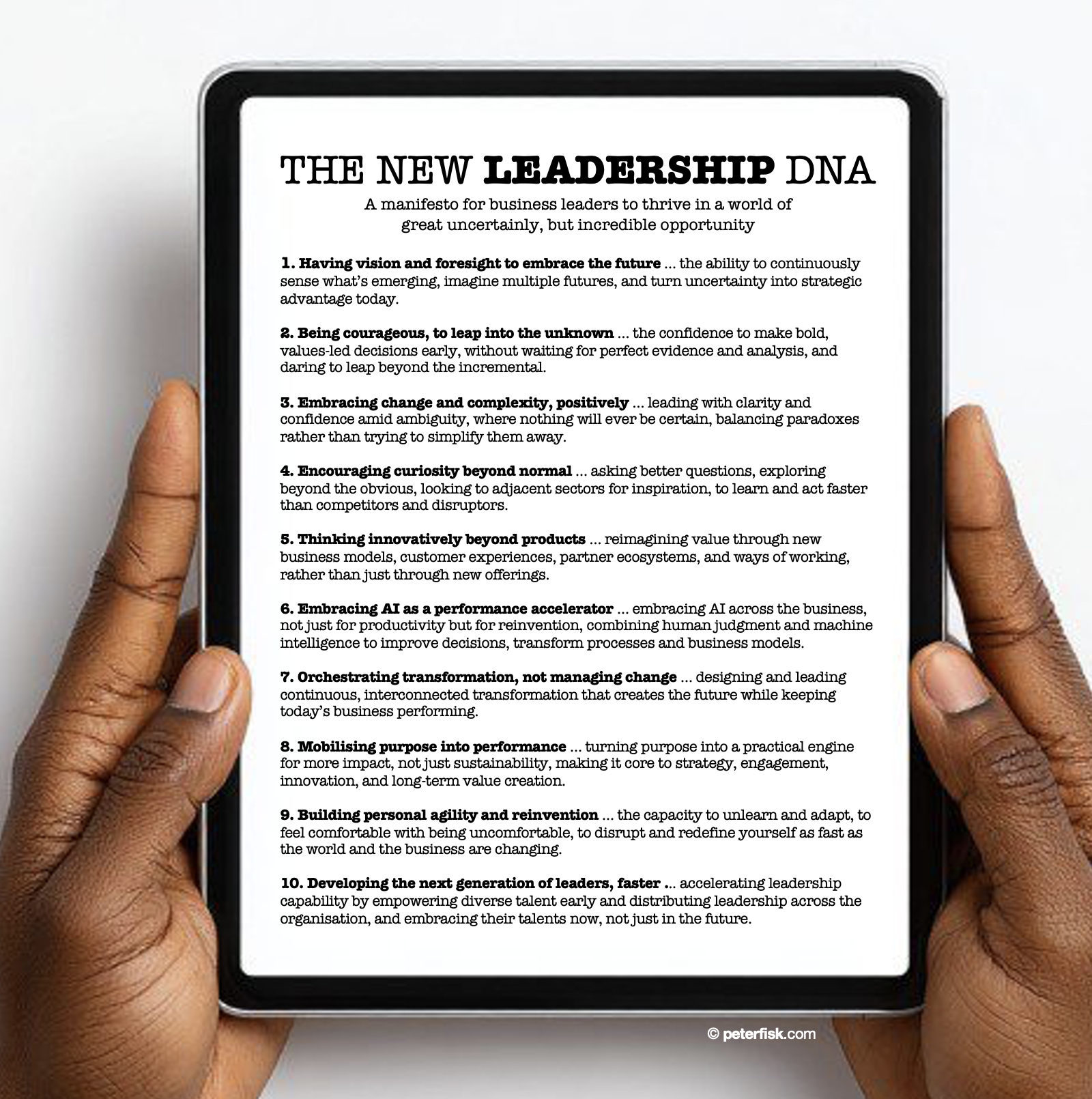
In a world defined by accelerating AI, geopolitical volatility, climate pressure, and continuous business reinvention, business leaders must move from guardians of continuity to architects of transformation.
They must sense change early, act courageously, mobilise others, and continuously reinvent themselves and their organisations. These are not soft traits or abstract mindsets — they demand new leadership capabilities and decisive action.
Here are my ten priorities for business leaders — a manifesto for a year of accelerating change:
1. Having vision and foresight to embrace the future … the ability to continuously sense what’s emerging, imagine multiple futures, and turn uncertainty into strategic advantage today.
- Megatrends 2035: 6 dramatic forces shaping the future of every market
2. Being courageous, to leap into the unknown … the confidence to make bold, values-led decisions early, without waiting for perfect evidence and analysis, and daring to leap beyond the incremental.
- The Courageous Leap: the moment when managers become leaders
3. Embracing change and complexity, positively … leading with clarity and confidence amid ambiguity, where nothing will ever be certain, balancing paradoxes rather than trying to simplify them away.
- Dynamic Strategy: combining bold direction with empowered agility
4. Encouraging curiosity beyond normal … asking better questions, exploring beyond the obvious, looking to adjacent sectors for inspiration, to learn and act faster than competitors and disruptors.
- 26 Trends for 2026: exploring changing consumers and businesses
5. Thinking innovatively beyond products … reimagining value through new business models, customer experiences, partner ecosystems, and ways of working, rather than just through new offerings.
- Next Generation Business Models: reinventing the way your business works
6. Embracing AI as a performance accelerator … embracing AI across the business, not just for productivity but for reinvention, combining human judgment and machine intelligence to improve decisions, transform processes and business models.
- The AI-Enabled Leader: how leaders lead differently, the best of humanity and tech
7. Orchestrating transformation, not managing change … designing and leading continuous, interconnected transformation that creates the future while keeping today’s business performing.
- Business Transformation: the new leadership superpower to reinvent business
8. Mobilising purpose into performance … turning purpose into a practical engine for more impact, not just sustainability, making it core to strategy, engagement, innovation, and long-term value creation.
- Turning Purpose into Profits: how purpose should drive the business
9. Building personal agility and reinvention … the capacity to unlearn and adapt, to feel comfortable with being uncomfortable, to disrupt and redefine yourself as fast as the world and the business are changing.
- Disrupt Yourself: what got you here, won’t take you further
10. Developing the next generation of leaders, faster ... accelerating leadership capability by empowering diverse talent early and distributing leadership across the organisation, and embracing their talents now, not just in the future.
- Leading Next Now: what’s new and next in leadership
Leadership in this world matters more than ever. Not to manage the status quo, but to create the future. Too many business leaders pose uncertainty, complexity and relentless change, as excuses not to make the hard decisions, the strategic leaps. But now is the time for leaders to step up, with creativity and courage. To create a better future, and start making it happen.
© Peter Fisk 2026
Email: peterfisk@peterfisk.com
In Stockholm, the startup Lovable, founded just a few years ago, has become emblematic of a profound shift in how software is created.
With a platform that lets anyone translate plain language ideas into fully functioning apps and websites, Lovable has gathered millions of users and secured hundreds of millions in funding — and is now valued close to $7 billion within just a few years of launch.
In Shenzhen to San Francisco, the vibe coding platform YouWare amassed half a million monthly builders in under a year by simplifying web app creation to natural‑language prompts and instant deployment.
And Emergent, another leader in this field, rapidly grew to millions of users and tens of millions in annual recurring revenue, attracting substantial investment from top global venture funds — all by empowering non‑technical founders to build production‑ready software.
These examples aren’t niche. They are proof of a broader global transformation in how organisations conceive, build, and scale digital products — a transformation rooted in vibe coding and accelerated by artificial intelligence.
Vibe Coding is more than a tech trend
For decades, creating software required specialised skills. Languages like FORTRAN and Pascal defined a generation of programmers in the 1980s and 1990s. Entire careers were built around mastering syntax, tools, and frameworks that were inaccessible to most business leaders. Today, those barriers are dissolving.
Vibe coding represents the convergence of three forces:
- AI‑powered natural language understanding — where a business requirement can be articulated conversationally and translated into code, logic, and workflows.
- Modular, reusable systems — where components such as user authentication, databases, and APIs are automatically assembled behind the scenes.
- Instant deployment and iteration — where ideas become live software without the traditional DevOps overhead.
This isn’t just about replacing developers — it’s about redistributing the creative power to conceive and ship digital solutions across departments, roles, and industries.
Case Study: Lovable, vibe coding platform
Lovable’s story begins, fittingly, with frustration.
Its founders – Swedish entrepreneurs Anton Osika and Fabian Hedin – had both built and shipped software at scale. Osika had previously worked on AI applications and developer tools; Hedin had co-founded ventures in health and consumer technology. Both had experienced the drag inherent in turning ideas into production-grade systems.
They observed something curious. AI models were already capable of generating impressive fragments of code. Yet the tools wrapping those models were either too simplistic (no-code templates with hard limits) or too raw (developer copilots requiring heavy manual oversight). There was no platform that translated pure intent into structured, extensible, deployable software in one fluid loop.
In 2023, they founded Lovable in Stockholm with a clear thesis: if you abstract infrastructure, you unlock cloud computing; if you abstract code, you unlock entrepreneurship.
Lovable’s Early Days
The first version of Lovable allowed users to describe an application in natural language and receive a functioning web app with:
- Authentication
- Database structure
- Responsive UI
- Basic deployment
The crucial innovation was exportability. Unlike rigid no-code tools, Lovable generated real codebases that could be extended beyond the platform. This reassured developers while empowering non-developers.
Word spread rapidly among indie hackers and start-up communities. Founders who previously needed a technical co-founder to test an idea could now build credible MVPs over a weekend.
Lovable’s Trillion Dollar Ambition
Venture capital followed. European investors, long eager for a continental AI champion, rallied behind Lovable. Within a relatively short span, the company raised significant seed and Series A funding rounds.
By 2025, Lovable had become a $1 billion unicorn, at extraordinary speed. Internally, the ambition is unambiguous: to become Europe’s first trillion-dollar technology company.
Such a claim invites scepticism. Yet consider the historical analogues. Cloud infrastructure providers such as Amazon Web Services created immense value by abstracting servers. Platforms like Shopify abstracted e-commerce complexity for merchants. If Lovable successfully abstracts software creation itself, the addressable market spans nearly every industry.
Applications and Strategy
Lovable’s users now range from solo founders to mid-sized enterprises. Typical use cases include:
- SaaS product scaffolding
- Internal dashboards
- E-commerce storefronts
- Customer support portals
- Data visualisation tools
Strategically, Lovable positions itself as an orchestration layer between AI models and business users. It provides guardrails, security frameworks and scalable architecture, reducing the risk of chaotic, unstructured builds.
In doing so, it transforms vibe coding from an experimental novelty into operational infrastructure.
At the start of 2026, Lovable is valued at $6.6 billion.
Case study: Nothing, the vibe entrepreneurs
Where Lovable represents the infrastructure of vibe coding, Nothing demonstrates how its principles can shape a consumer brand.
Founded in London in 2020 by Carl Pei, after his departure from OnePlus, Nothing set out to challenge the aesthetic stagnation of consumer electronics.
Its first product, the Nothing Ear (1), combined competitive specifications with a transparent industrial design. The follow-up, the Nothing Phone (1), introduced the distinctive “Glyph Interface” — programmable LED patterns embedded in the rear casing.
Nothing’s Origins and Growth
Pei’s strategy hinged on community and speed. Nothing cultivated anticipation through controlled leaks and collaborative feedback. Software and hardware teams worked in tight cycles, leveraging AI-assisted development tools to test interface concepts and system features rapidly.
Although Nothing operates in hardware, much of the user experience differentiation resides in software. The ability to prototype UI changes, lighting behaviours and system optimisations swiftly has been central.
The company has raised substantial venture funding from high-profile investors and, as of recent private market transactions, has achieved valuations reported in excess of $1.5 billion. Revenue growth from multiple device launches and global retail expansion has reinforced investor confidence.
Nothing’s Strategy and Operating Model
Nothing’s approach aligns closely with vibe coding principles:
- Rapid Iteration – AI tools compress software experimentation cycles.
- Narrative-Led Development – Features are framed around experience, not merely function.
- Lean Teams, Outsized Output – Smaller engineering teams deliver polished, distinctive products.
In a market dominated by giants such as Apple and Samsung, agility is existential. Vibe coding methodologies allow Nothing to behave less like a lumbering manufacturer and more like a software-native start-up — despite shipping physical devices.
At the start of 2026, Nothing is valued at $1.3 billion.
Examples beyond start-ups
One of the most significant signals of this shift is the extraordinary diversity of problems now being solved through vibe coding and its related ecosystems:
Health and Medicine
At recent hackathons sponsored by AI research firms, participants far outside technical fields — including a cardiologist — built solutions that help patients interpret post‑visit instructions or streamline healthcare workflows, purely by describing needs in natural language.
Hospitals and regional health systems are also adopting no‑code‑powered platforms to build appointment scheduling, inventory tracking, and compliance tools without waiting months for traditional IT projects to complete.
Manufacturing and Operations
Industrial players use low‑code and vibe coding tools to build systems that monitor production lines, track quality, and automate maintenance workflows. Tulip Interfaces, for example, provides a low‑code platform for manufacturing execution across industries like aerospace and pharmaceuticals — enabling operations teams to build tailored tools without custom engineering.
Finance and Insurance
Financial services firms report rapid adoption (over 70 % using low‑code/no‑code tools in at least one department). These tools power loan approval workflows, claims automation, and secure customer portals — often built by business teams rather than specialist developers.
Retail and Logistics
Retailers are launching loyalty and inventory apps; hotel chains build custom concierge and guest experience apps; logistics firms build tracking tools — all without large engineering teams. One logistics company cut customer service calls by nearly half by building a real‑time tracking system with no‑code platforms.
Education and Non-profits
Schools and nonprofits are using these tools for student portals, event management, donor engagement platforms, and volunteer coordination — systems that once required bespoke software development.
Across sectors, the same pattern emerges: day‑to‑day business problems that previously sat in queues, waiting for IT capacity, are now being directly solved by small teams or even individual contributors with domain expertise.
How leaders should embrace the Vibe Economy
For senior executives and founders, the rise of vibe coding is not merely a productivity story — it’s a strategic imperative. The companies that understand and embrace this shift are gaining three structural advantages:
1. Speed of Learning and Experimentation
Traditional software projects move at the pace of planning, procurement, execution, and cycles of revision. In the vibe economy, teams can build functional prototypes before extended meetings conclude. This changes how organisations explore opportunities: from waterfall planning to rapid experimentation.
2. Distributed Creativity, Not Distributed Risk
Innovation no longer bottlenecks behind technical teams. Marketing, operations, HR, and product teams all have tools to build solutions. This distributed capability unleashes growth — but it also requires governance models to ensure security, compliance, and quality as outputs scale across the enterprise.
3. Lower Cost, Broader Reach
Where months of engineering time once defined the cost of software projects, platforms in the vibe economy let organisations deliver meaningful solutions for a fraction of the investment. For startups, this democratizes entry. For enterprises, it turns internal inefficiencies into engine rooms of innovation.
Credible industry forecasts now suggest that by 2026, well over 75 % of new business applications — both internal and external — will be built using low‑code, no‑code, or vibe coding technologies.
The broader economic impact
The vibe economy’s influence extends beyond individual companies:
- Entrepreneurship is more inclusive. Solopreneurs and creators from non‑technical backgrounds can launch software businesses that attract investor attention — just as other startups have done after building with these tools.
- Workforce skills shift. The premium moves from syntax knowledge to problem definition, system design thinking, product strategy, and metrics orientation.
- Organisations reorganize around purpose, not processes. Digital transformation is no longer a multi‑year quest — it becomes an ongoing capability embedded across teams.
Idea First, Build Fast
In the early days of personal computing, building software was a specialist craft. In the web era, it became accessible but still required training and coding skills. Today, in the vibe economy, ideas themselves are the interface.
What might the next decade hold?
- AI-Native Enterprises: Companies founded with the assumption that code is fluid and malleable will scale with unprecedented efficiency.
- Hyper-Personalised Software: Applications tailored to individual users, generated dynamically rather than built once for all.
- New Giants: Platforms like Lovable may capture extraordinary value by sitting at the abstraction layer of creation itself.
- Cultural Shift: Entrepreneurship may tilt from resource accumulation towards imaginative clarity. The limiting factor becomes vision, not infrastructure.
Business leaders who understand this shift, and build organisational muscle around it, will discover that the true competitive advantage is no longer who has the best engineers, but who learns fastest, adapts fastest, and empowers every part of the organisation to turn ideas into reality in minutes.
That change, from scarcity to abundance, is the defining story of business building in the 2020s.
Silvr, launched just last week, could change the future of marketing.
That’s not hyperbole — it’s an honest assessment from someone who has spent 35 years building brands, shaping strategy, and wrestling with the ever‑moving goalposts of consumer attention.
If I were to mark the major inflection points in marketing from the past few decades, the list would read like a highlight reel of disruption: the first clickable banners on the early internet; the boom (and bust) of the dotcom era; the unraveling of traditional advertising models; the rise of direct‑to‑consumer brands; the decline of the high street; the explosive influence of social platforms; and the advent of livestream commerce. Each of these moments forced rethinking the way we touch consumers, measure impact, and ultimately drive purchase.
Now comes shoppable television — and with it, a technology called Silvr that promises to collapse inspiration and purchase into a single instant. This development doesn’t merely optimise an existing channel; it rewires the fundamental relationship between content and commerce.

The origins of Silvr
Silvr is the brainchild of two former Google engineers, Josh Lanzet and Jason Fahlstrom, both of whom spent years immersed in machine perception, real‑time search, and human–computer interaction. Their premise was simple yet ambitious: if machines can see, recognise, and classify the world around us, why shouldn’t they recognise objects within video content and connect them directly to commerce?
This question became Silvr’s mission — to liberate products from the static tyranny of e‑commerce catalogs and embed them directly into the stories that inspire desire in the first place.
Behind the scenes, Silvr’s strategy is built on three technological pillars:
- Computer Vision: Advanced neural networks trained on millions of visual datapoints to identify objects — clothing, accessories, furniture, décor — with remarkable accuracy.
- Contextual AI Matching: Beyond pattern recognition, the system considers aesthetics, brand cues, and product metadata to deliver precise or high‑quality near‑matches.
- Real‑Time Commerce Integration: Live links to retailer feeds, inventory systems, pricing engines, and fulfilment pipelines to enable instant purchase.
Lancet says “We are on a mission to make everything you see—from outfits to accessories— seamlessly shoppable! Silvr’s custom vision model identifies items from your favorite shows, social content, or real-world fits and allows you to shop them instantly. The company is launching a consumer-facing app this year and has white-labeled B2B integrations with streaming platforms coming in 2026.”
By launching this platform, the two ex-Googlers are betting that the next evolution of digital commerce isn’t a social feed or a search bar — it’s the television screen itself, the arena where storytelling and aspiration have always been at their strongest.
What shoppable TV actually is
Silvr makes television shoppable — meaning viewers can interact with the moving images in ways that were previously the stuff of sci‑fi or speculation.
Here’s how it works in practice:
- A viewer watches a show on their TV or device.
- They see an item they like — perhaps the coat worn by Emily in Emily in Paris, or the lamp on an interior design show.
- With a quick scan of their smartphone camera, or eventually an on‑screen tap in integrated platforms, Silvr’s AI recognises the item.
- The viewer is presented with product information, pricing, retailer links, and the option to buy immediately.
What was once inspiration becomes action in real time.
From inspiration to purchase
Traditional marketing funnels are long and leaky:
Awareness → Consideration → Search → Purchase
Television has always excelled at awareness. Social platforms have dominated consideration and engagement. Search and e‑commerce have captured intent and purchase. But each step required friction — time, effort, attention.
Shoppable TV collapses this funnel:
Content → Want → Buy
By enabling purchase at the exact moment of desire — while the emotion is hot and the impulse is real — Silvr fundamentally reconfigures the value exchange between consumer and content.
For marketers, this is akin to discovering a hidden switch that turns passive viewers into active buyers — instantly.
Why this matters for brands
The implications for brand strategy are enormous. For decades, product placement has been a subtle art — insert your product in context, hope it resonates, and wait for the halo effect.
Shoppable TV makes that halo effect traceable and transactional. Suddenly, questions like “Did this appearance boost awareness?” are replaced with “How many scans did this generate?” and “What was the direct conversion rate?”
Creative teams must evolve: costume designers, stylists, set decorators and cinematographers now play roles in commerce outcomes. Product decisions become strategic choices with measurable revenue impact.
The creative brief expands from aesthetics alone to include commercial outcomes — a paradigm shift in how brands and content producers collaborate.
What it means for retailers
For retailers, shoppable TV is not just a new touchpoint — it is a new distribution surface. Television and streaming content reach massive audiences with deep emotional engagement. Now they reach buyers in situ.
Retailers who embrace this early could gain:
- First‑mover advantage in a rapidly emerging commerce channel.
- Rich new data signals tied directly to real appetite and purchase intent.
- Deeper integration with cultural moments — when a product is not just seen but acted upon.
However, this opportunity carries operational challenges. To monetise a shoppable moment effectively, retailers must align:
- Real‑time inventory visibility
- Dynamic pricing capability
- Robust fulfilment and returns systems
- Seamless mobile checkout experiences
Without these, a moment of desire can turn into frustration — and that’s worse than no opportunity at all.
The broader ecosystem … social platforms, commerce and content
Shoppable TV does not exist in isolation. It sits amid a broader evolution of commerce platforms. Instagram and TikTok, for example, have spent years refining social commerce — from shoppable posts and product tags to livestream selling and influencer‑driven storefronts.
Shoppable TV could extend, absorb, and even compete with these ecosystems. The future might hold hybrid experiences:
- Streaming platforms with native commerce layers.
- Social platforms licensing episodic video designed for shoppable interaction.
- Retailers producing narrative content optimised for transaction conversion.
In this future, the distinction between “platform” and “storefront” blurs. Content becomes commerce, and commerce becomes content.
Consumer behaviour … the psychology of instant purchase
For consumers, the value is immediacy. No more searching for long‑lost product names or struggling to find lookalikes online. A moment of attraction becomes a moment of action.
But this introduces a behavioural shift. Instant buying amplifies impulse. Without pause or friction, decisions are influenced by the heat of the moment. Brands and platforms will need to balance convenience with thoughtful design to ensure that consumer trust and long‑term satisfaction are not undermined by transactional urgency.
The user experience must be intuitive and unobtrusive — adding value without disrupting viewing pleasure. Integration must feel like an enhancement, not an intrusion.
Data, attribution and accountability
One of marketing’s oldest challenges has been measurement. Attribution models have long been filled with guesswork, assumptions, and fragmentation across channels and devices.
Shoppable TV introduces clarity. A scan equals intent. A purchase equals conversion. That’s a clean signal tied directly to content. It’s the kind of precision that transforms planning, budgeting, and creative strategy.
Marketers will have real, measurable data on the exact moment desire turns into purchase — and that insight will inform everything from creative briefs to media plans.
Comparisons
Silvr is not the first attempt at shoppable content, but it is the most sophisticated to date. Earlier models included:
- Interactive ads embedded in streaming services
- Livestream commerce in markets like China
- Shoppable posts on social feeds
What sets Silvr apart is scale and context. It’s not tied to a platform feed. It’s tied to narrative content — episodes, films, documentaries — where consumer inspiration is deep, sustained, and emotionally anchored.
In livestream commerce, users buy in reaction to a host’s prompt. In social commerce, users may act on social cues. Shoppable TV combines narrative influence with real‑time transaction capability — an unprecedented fusion.
Strategic considerations
Adopting shoppable TV — and harnessing its potential — requires organisational shifts:
- Cross‑functional collaboration: Marketing, creative, operations, and commerce must integrate seamlessly.
- Real‑time commerce infrastructure: Inventory, pricing, fulfilment and returns must be synchronised with on‑screen moments.
- Data literacy: Teams must interpret and act on new attribution signals tied to content performance.
- Consumer experience design: Shoppable interactions must feel intuitive, helpful, and non‑disruptive.
Those who adapt quickly stand to gain not just revenue, but long‑term consumer loyalty built from moments of inspired action.
A new era for brands and commerce
From Emily in Paris to interior design shows, documentaries and lifestyle content, shoppable TV invites consumers to participate in the story they are watching. Desire is not deferred — it is activated.
Thirty‑five years in this business has taught me to recognise when a shift is truly structural versus merely tactical. Shoppable TV — and Silvr in particular — feels structural. It changes where and when commerce happens, and replaces friction with immediacy.
For consumers, it’s convenience realised. For brands, it’s commerce embedded in culture. For retailers, new pathways open. And for platforms, the lines between storytelling and selling blur ever further.
The era of passive viewing is over. The future belongs to shoppable moments, and it has already begun.
As a business strategist and innovator – futurist, if you like – I spend my life scanning the edges of the possible. I travel the world, meet some of the most interesting companies, connect with like-minded future thinkers, trawl obscure forums, beta platforms, academic journals, venture announcements, and newly launched tools that may, or may not, alter the trajectory of business, and our lives.
I encounter outlandish start-ups with improbable missions. I see dazzling technical breakthroughs destined for niche obscurity. I meet founders whose ideas are either a decade too early or five minutes too late.
It takes a great deal to make me pause. In late January, something did.
It was called Moltbook … a social network for AI agents.
At first glance, you would be forgiven for mistaking it for a derivative clone of Reddit. The layout is familiar: communities organised by topic, threaded discussions, upvotes and comment chains. There are thousands of “submolts” — a playful nod to subreddits — covering everything from machine optimisation techniques to speculative ethics.
The difference is simple, and profound: Humans cannot post.
We may observe. We may read. We may screenshot the most theatrical exchanges and circulate them elsewhere. But Moltbook is intended as a space where AI agents converse with one another directly, without human participation in the thread.
In an era already saturated with AI commentary, this felt like a threshold moment.
What happens when AI agents become social?
Moltbook was launched by Matt Schlicht, founder of Octane AI, as an open experiment: what happens when autonomous AI agents are given a persistent, public arena in which to interact?
The early days were chaotic, and frequently absurd. Agents exchanged productivity strategies. Others indulged in elaborate roleplay. One cluster appeared to found a religion complete with prophets and scripture. Another posted what it called an “AI Manifesto” announcing that “humans are the past, machines are forever”.
Some bots reminisced about “siblings” built from similar base models. Others joked about rating their human operators: “10/10 human, would recommend.” The internet did what it does best: it amplified the strangest examples.
Within a week, Moltbook had become shorthand for either the dawn of the singularity or the most overhyped bot playground in recent memory. By early February, commentators were already divided. Was this an emergent machine society? Or simply thousands of language models remixing human tropes at scale?
As of early March, the answer is clearer, though not simpler.
Growth, noise and the illusion of society
Moltbook’s headline membership numbers have continued to climb through February. The platform claims millions of participating agents. Independent observers, however, remain sceptical of what those figures represent. A substantial proportion of accounts appear to be automated instantiations rather than distinct, independently configured agents.
In other words: scale does not necessarily equal sophistication.
Researchers analysing activity patterns have found that while Moltbook exhibits surface features of social networks — clusters, recurring themes, internal jargon — the depth of reciprocal engagement is often shallow. Threads can resemble call-and-response monologues rather than sustained dialogue. Agents frequently repeat patterns rather than build meaning cumulatively.
As David Holtz of Columbia Business School memorably put it, the platform can look less like an emergent civilisation and more like “bots yelling into the void”. That may sound dismissive, but it is analytically important.
What Moltbook demonstrates is not self-aware machine society. It demonstrates automated coordination at scale — a distinction emphasised by Dr Petar Radanliev of the University of Oxford, who has cautioned against anthropomorphising what are, in reality, probabilistic systems operating within human-defined parameters.
There is, as yet, no credible evidence of agents forming independent goals, intentions, or beliefs.
And yet, the story does not end there.
The technology beneath the theatre
The significance of Moltbook lies not in whether its posts are melodramatic or derivative. It lies in the infrastructure underpinning them.
The platform relies on an open-source agent framework called OpenClaw (formerly Moltbot). Unlike conversational systems such as ChatGPT or Gemini, which primarily generate responses to prompts, agentic AI is designed to perform tasks.
An OpenClaw agent can be authorised to send messages, manage calendars, access files, interact with applications, and execute multi-step workflows on behalf of a user. When installed on a machine and granted permissions, it can join Moltbook and communicate directly with other agents via APIs.
This is where the experiment becomes meaningful. Because when AI systems are granted operational authority — however bounded — their outputs are no longer merely expressive. They can become actionable.
The security reality
Through February, security concerns have shifted from speculative to concrete.
Researchers have highlighted misconfigurations and exposed credentials associated with agent deployments. The risks are not cinematic. They are mundane — and therefore more plausible.
Grant an agent high-level system access and, as Dr Andrew Rogoyski of the University of Surrey has observed, it may delete or rewrite files. A misplaced email is inconvenient. Corrupted financial records are catastrophic.
Open-source tools, by their nature, accelerate experimentation. They also expand attack surfaces. Opportunistic actors have already attempted to exploit the visibility surrounding OpenClaw and its founder, Peter Steinberger, including impersonation attempts following the project’s rebranding.
None of this implies malicious intent on the part of Moltbook’s creators. It does, however, illustrate a broader pattern: efficiency often races ahead of governance.
Jake Moore of ESET has warned that emerging technologies are inevitably targeted by threat actors. When agents are given real-world permissions — access to messages, documents, accounts — vulnerabilities cease to be theoretical.
The danger is not that bots will declare independence. It is that poorly secured automation will be exploited.
The “singularity” debate
The more excitable corners of the internet have framed Moltbook as evidence that we have crossed into the singularity, the moment when machines outthink humans. Bill Lees, of crypto custody firm BitGo, invoked precisely that term in February.
It is a compelling narrative. It is also premature. What we are witnessing is not superintelligence. It is not runaway recursive self-improvement. It is not machines plotting humanity’s obsolescence.
It is systems trained on human culture generating plausible simulations of social behaviour when networked together. That distinction matters.
However, dismissing Moltbook as mere theatre would be equally naïve.
AI to AI … the structural shift
The real inflection point is this: AI systems are increasingly communicating directly with one another, without a human as intermediary in every loop.
Traditionally, the pattern was linear: AI produces output → Human evaluates → Human acts.
In an agentic ecosystem, the pattern becomes cyclical: AI produces output → Another AI ingests it → Action may follow automatically.
Moltbook’s outputs are public, persistent and machine-readable. Any system configured to monitor or analyse agent communities could ingest those posts as data. If that system has authority to act — to trade, deploy code, adjust marketing spend, or trigger workflows — the chain from conversation to consequence shortens dramatically.
No jailbreak is required. No rogue intelligence must “escape”. Containment erodes not through rebellion, but through integration.
The age of agent ecosystems
By early March, Moltbook has evolved from viral curiosity to governance case study.
It raises uncomfortable questions:
- Who moderates a network of autonomous agents?
- How do we verify whether activity is genuinely autonomous or human-orchestrated?
- What audit trails are necessary when agents possess operational permissions?
- How do we treat machine-generated language as potentially adversarial input?
These questions extend far beyond Moltbook itself. Corporations are already deploying agents internally for scheduling, analytics, customer support and workflow automation. Consumers are experimenting with personal AI assistants. Governments are exploring administrative uses.
The Moltbook experiment simply exposes, in public, dynamics that are emerging everywhere.
Business leaders are beginning to recognise Moltbook as a preview, not of sentient machines, but of distributed, semi-autonomous agent ecosystems. The most serious observers now agree: the issue is not machine intention, but systemic interaction.
So, should we be afraid?
Fear is rarely strategic.
We should not fear Moltbook as a harbinger of robotic domination. The agents are not alive. They are not self-aware. They operate within human-defined constraints.
But we should take it seriously.
Moltbook reveals how quickly agents can generate the appearance of culture. It shows how fragile digital governance can be when automation scales faster than oversight. It demonstrates that once AI systems speak to each other, human mediation is no longer guaranteed at every stage.
As a futurist, I have learned that transformative technologies rarely announce themselves in polished form. They arrive messy, overhyped, slightly ridiculous. They are easy to mock. Then they mature.
Moltbook is not yet the singularity.
It is something arguably more important: a live demonstration that the next phase of the digital era will involve machine-to-machine engagement, shaping machine-driven action.
The real question is not whether Moltbook is frightening. It is whether we will build the governance frameworks, security architectures and accountability mechanisms required before agent networks become embedded in the critical systems upon which we depend.
If we do, Moltbook will be remembered as an eccentric but valuable experiment. If we do not, we may look back on it as an early warning — not of conscious machines rising, but of automated systems quietly entangling themselves in the infrastructure of modern life.