Most wearable technology started with a simple idea: measure what people do. Count their steps. Record their runs. Measure their heart rate. Track their calories.
Oura started somewhere different.
What if the more valuable information was what your body was doing when you weren’t doing anything at all? Sleep. Recovery. Stress. Temperature. Heart-rate variability. The subtle signals that reveal whether the body is recovering, adapting or struggling.
That insight has helped transform Oura from a small Finnish start-up into the company that largely created the modern smart-ring category. More importantly, it is now attempting another reinvention: from wearable device to personal health-intelligence platform.
By 2026, Oura had sold more than 5.5 million rings, was approaching five million paid members and was available through more than 4,600 retail locations. Revenue exceeded $500 million in 2024 and the company said in late 2025 that it expected to surpass $1 billion that year. An October 2025 funding round of more than $900 million valued the privately held business at approximately $11 billion.
Yet Oura’s most interesting achievement isn’t selling millions of rings. It is changing what millions of people think a wearable is for.
Born in Oulu, Finland
Oura began in 2013 in Oulu, northern Finland, a city with a rich engineering heritage created partly around Nokia and the country’s telecommunications industry.
The original founders were Petteri Lahtela, Kari Kivelä and Markku Koskela. They brought experience in engineering, software, product development and research from Oulu’s technology ecosystem, including companies such as Nokia and Polar.
Their insight was that sleep and recovery were fundamental to human performance and health, yet were surprisingly difficult for ordinary people to understand.
The wrist wasn’t necessarily the best place to measure them. A finger offers strong physiological signals while a ring can be small enough to wear continuously, particularly during sleep. The founders envisaged something very different from the increasingly screen-dominated smartwatch: a device that could quietly observe the body without continually demanding the user’s attention.
The company was originally called Jouzen, combining a reference to joutsen, the Finnish word for swan, with the idea of Zen-like balance. It subsequently became Oura Health.
The first Oura Ring was launched through Kickstarter in 2015. It was considerably bulkier than today’s product, but the underlying proposition was already clear: understand how your body recovers so you can make better decisions about how you live. It was a subtle but important reframing of wearable technology.
From activity to readiness
Fitbit had popularised step counting. Garmin had built sophisticated tools for athletes. Apple was progressively turning the watch into a powerful health and communications device.
Oura chose not to compete directly. Instead, it focused on readiness.
The ring measures signals including heart rate, heart-rate variability, temperature, sleep and movement. Oura then translates a complex stream of physiological data into three simple concepts: Sleep, Activity and Readiness.
The innovation is not merely sensing. It is interpretation.
A resting heart rate of 54 beats per minute tells most people relatively little. But if your resting heart rate is elevated relative to your normal baseline, your heart-rate variability has fallen, your temperature has shifted and your sleep quality has deteriorated, something more meaningful may be happening. You might need recovery rather than another intense workout. You might be under unusual stress. You might be becoming ill.
The product therefore moves from asking “What did you do?” towards “How are you?” That is a much bigger market.
Making invisible signals visible
The second-generation Oura Ring, launched at Slush in Helsinki in 2017, was smaller and more wearable. By August 2019, more than 100,000 Gen2 rings had been purchased across more than 100 countries.
Then Covid accelerated awareness of Oura’s potential.
Researchers became interested in whether changes in temperature and other physiological signals might help identify illness before people recognised symptoms themselves. More than 65,000 Oura users contributed data to the University of California San Francisco’s Tempredict study.
Suddenly, the ring wasn’t simply about sleeping better. It was demonstrating the potential of continuous longitudinal health data. That distinction is important.
A conventional medical test provides a snapshot. Your blood pressure, temperature or heart rate is measured at a particular moment. Oura progressively builds something different: a personal baseline. The most important question therefore becomes less “Is this measurement normal for the population?” and more “Is this normal for you?”
That moves healthcare towards something much more personalised.
From wearable to daily health practice
Oura’s strategic ambition has expanded accordingly. Its stated mission today is to “make health a daily practice.” That is a fascinating choice of words. The company doesn’t say its mission is to make the world’s best smart ring.
A ring is a product. A daily health practice is a behaviour.
This is classic Market Maker thinking. Companies that define themselves around products tend to optimise products. Companies that define themselves around behaviours can imagine much larger opportunities.
If Oura defines its market as smart rings, Samsung, Ultrahuman and other hardware manufacturers become its obvious competitors.
If it defines itself around personal health intelligence, the opportunity expands towards preventive healthcare, women’s health, metabolic health, stress management, ageing, chronic-condition management and connections between consumers and clinicians.
The ring becomes the interface rather than the market. The subscription changes the economics
Oura also made an important and initially controversial business-model decision. Beginning with Oura Ring Gen3 in 2021, the company increasingly combined hardware with a paid membership providing ongoing insights and features. Consumers weren’t simply buying a ring. They were subscribing to understanding themselves. That creates a fundamentally different economic relationship.
Hardware businesses traditionally have to persuade customers to buy another device every few years. Subscription businesses can create recurring revenue while continually improving the service surrounding the hardware. More importantly, it forces Oura to keep creating value after the purchase.
By May 2026, Oura said it was approaching five million paid members, with membership having grown more than fourfold in two years. More than 80% of members renewed after their first year.
The strategic asset is therefore not simply millions of rings on fingers. It is millions of ongoing relationships.
Women create a new growth market
One of Oura’s most interesting growth stories emerged around women’s health.
Continuous temperature sensing creates possibilities around menstrual-cycle insights and reproductive health. Oura’s integration with Natural Cycles, a regulated digital birth-control application, demonstrated how wearable data could connect with other healthcare services.
This helped broaden the audience beyond the performance-oriented, male-skewed early-adopter market associated with many wearables. CEO Tom Hale has identified women’s health capabilities as an important contributor to Oura’s growth.
It also demonstrates how Market Makers grow. They don’t simply sell more of the same product to more people. They discover new jobs the underlying capability can perform.
Temperature sensing wasn’t invented for women’s health. But once Oura had reliable continuous temperature data, new possibilities emerged. The capability created the market.
From device to ecosystem
Oura is now extending that logic further.
The company has built relationships across healthcare, research, sports, employers and wellness. By 2026 it reported partnerships with more than 1,200 organisations. (
Its partnership with glucose-monitoring specialist Dexcom points towards metabolic health, connecting continuous glucose information with sleep, activity and recovery data.
Acquisitions have expanded the possibility space too. Oura has acquired companies including Veri, the Finnish metabolic-health start-up, and Sparta Science, which works with musculoskeletal health data.
In 2026, it acquired Doublepoint’s team and technology to explore AI, biometrics and new forms of human-computer interaction. It also acquired technology and talent from Galen AI, whose platform brings together medical records, laboratory results, medications and wearable information.
The direction is becoming clearer.
Oura is moving from: measuring the body → interpreting the body → connecting health information → anticipating what the individual might need next.
That is a significant reinvention.
AI as a personal health companion
This could become Oura’s biggest opportunity.
Generative AI creates the possibility of turning vast quantities of physiological data into something more conversational and useful.
Imagine asking: Why am I tired today? The answer could potentially draw upon your sleep, heart-rate variability, recent activity, temperature, stress patterns, glucose, medical history and long-term personal baseline. Or: Should I run hard today? Why has my sleep deteriorated this month? What changed after I started this medication?
The goal isn’t merely to provide more data. It is to create understanding.
Oura’s 2026 acquisition of Galen AI makes this ambition particularly explicit: the company says it wants to connect medical records, laboratory results, medications and wearable data into more personalised health intelligence.
The smart ring could therefore become something much more powerful: a quiet interface to a personal health AI.
The leadership shift
The company itself has had to evolve as its ambitions expanded.
The founders created the technology and initial vision, while subsequent leaders professionalised and globalised the business. Harpreet Singh Rai became CEO in 2018 and helped Oura move from start-up towards a significant consumer-health company.
Tom Hale became CEO in April 2022. Hale brought a different kind of experience. His career included leadership roles at Adobe, Macromedia, HomeAway, Linden Lab and Momentive. His expertise spans software, digital products, consumer technology and recurring-revenue business models. Under Hale, Oura has accelerated retail distribution, subscriptions, partnerships, acquisitions and its expansion from wellness towards preventive health.
Its corporate structure is changing too. In February 2026, Hale announced that Oura planned to establish a US parent company, reflecting the fact that the majority of its revenue and investors are now American, while stressing that its Finnish operations, heritage and data protections would remain.
It is another sign of the journey from Oulu start-up to global health business.
Lessons from Oura
Oura’s journey suggests six wider lessons for leaders.
- Find the neglected problem. The wearables market obsessed over activity. Oura focused on recovery, creating differentiation by looking where others weren’t.
- Turn data into meaning. More information isn’t necessarily more valuable. Sleep and Readiness scores simplify enormous complexity into decisions people can actually use.
- Design technology to disappear. Oura’s small, screenless form factor makes sophisticated sensing compatible with everyday life rather than demanding constant attention.
- Build recurring relationships rather than transactions. Membership transforms a hardware sale into an ongoing service and creates incentives for continuous innovation.
- Follow capabilities into new markets. Temperature sensing led towards women’s health; continuous biometrics towards metabolic and preventive health; AI could lead towards personalised health guidance.
- Define your market around human outcomes. “Smart rings” is a category. “Making health a daily practice” is a possibility space.
From wearable to health intelligence
Oura began in Oulu with three Finnish technologists trying to understand something largely invisible: how well the human body recovers. They put sensors into a ring. The ring generated data. Data became insight. Insight became behaviour. Behaviour became a daily relationship. And that relationship is now becoming a platform for something potentially much bigger.
The enduring strategic asset isn’t the ring itself. Competitors can make rings. The greater advantage lies in trust, longitudinal personal data, science, algorithms, membership relationships and the ability to translate invisible physiological signals into meaningful everyday decisions.
That is where Oura connects Future Brands, Market Makers and reinvention.
- A Future Brand doesn’t simply make a product desirable. It becomes increasingly relevant to how people want to live.
- A Market Maker doesn’t merely take share from an existing category. It changes how people think about the problem and expands what they believe is possible.
And reinvention happens when a company understands that the product which created its success doesn’t have to define its future. Oura started by asking: How well did you sleep? Its future could be built around a much more powerful question: What is your body trying to tell you — and what should you do about it?
That’s no longer a smart-ring proposition. It’s the beginning of personal health intelligence.
© Peter Fisk 2026
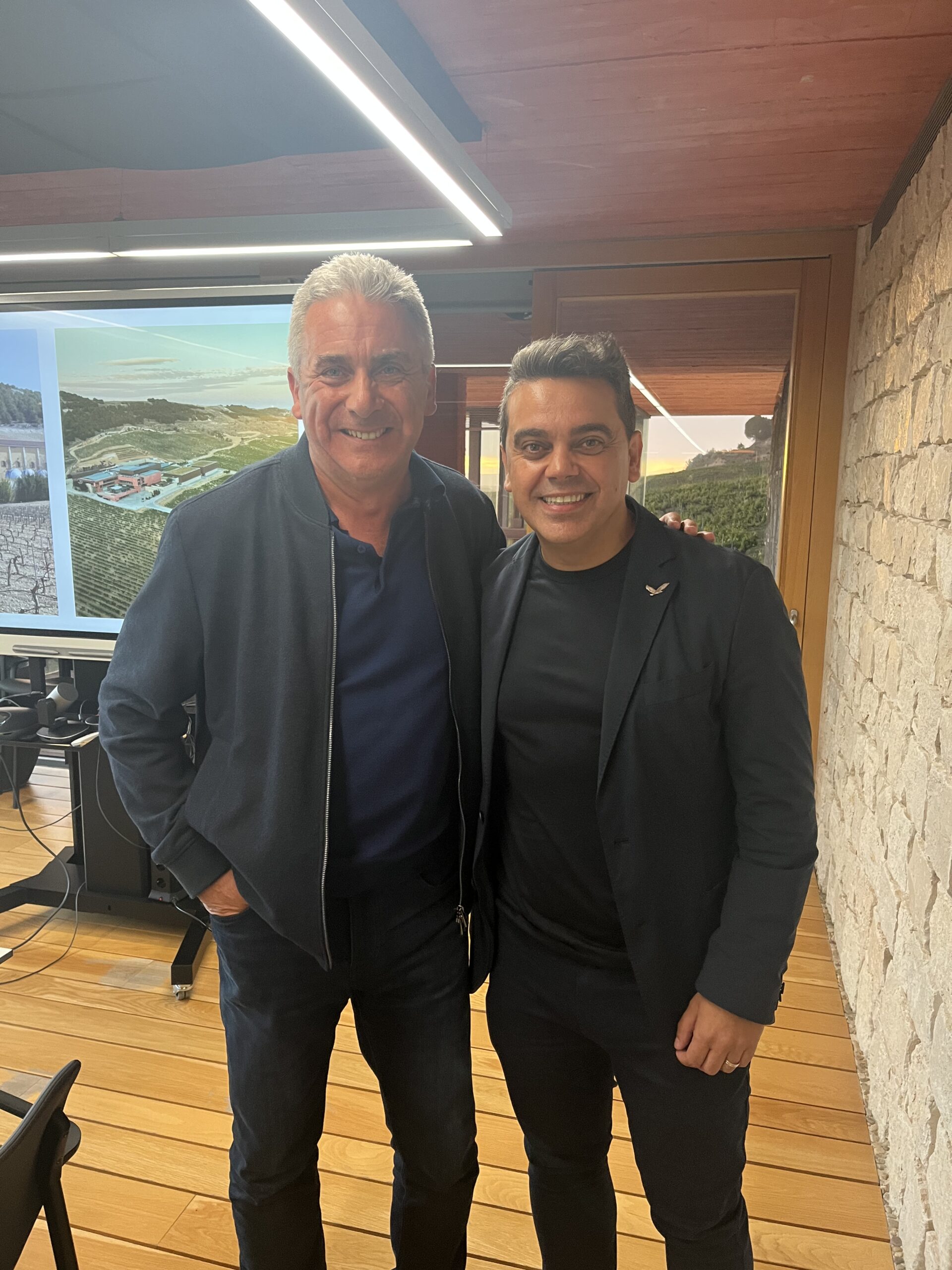
The road out of the beautiful, historic Spanish city of Segovia rises gently up to the Castilian plateau, a landscape shaped as much by time as by terrain. Vineyards stretch across the horizon, their geometry softened by wind and season, their roots digging into centuries of agricultural memory. It was here, that I found myself in conversation with one of Europe’s most compelling next-generation business leaders, an encounter that felt less like a business meeting and more like an inspirational manifesto for building something driven by purpose and passion, something that lasts.
Alma Carraovejas is a leading Spanish wine group founded in 1987 with the creation of Pago de Carraovejas in Ribera del Duero. It has evolved into a multi-winery ecosystem including Ossian Vides y Vinos (old-vine Verdejo), Milsetentayseis (high-altitude Ribera wines), and Aiurri in Rioja Alavesa. The family-owned group is known for meticulous vineyard management, combining heritage and innovation, with gravity-fed wineries, and a strong commitment to sustainability, including organic practices and ecosystem restoration.
It was great to meet Pedro Ruiz Aragoneses, to share his story, business and vision. He stepped up to become CEO of Alma Carraovejas in 2007 as a 24-year-old next-generation leader, transforming the business from a single estate into a diversified, premium wine company. Today his wines sell from €30 to €150 a bottle, and his Michelin-starred restaurant at the vineyard offers a €350–750 tasting menu. He emphasises long-term value creation through a love of great wines, innovation in viticulture, and experiential wine tourism.
Under his leadership, the wine group has expanded production, embraced the latest data analytics and technology, strengthened its international presence, become a B Corporation, and built a reputation for consistently high-quality wines, while maintaining a deep respect for heritage and community.

The power of family business
Standing in those vineyards, one is struck by a paradox. In a world obsessed with venture capital, unicorn valuations, and quarterly earnings calls, some of the most resilient, innovative, and quietly successful businesses are those owned and shaped by families.
They rarely dominate headlines. They seldom chase hype cycles. They do not pivot every six months in pursuit of growth at any cost. And yet, collectively, they represent one of the most powerful forces in the global economy.
Family businesses account for more than 70% of global GDP and employ the majority of the world’s workforce. In Europe, they form the backbone of industrial strength—particularly in Germany’s Mittelstand, Italy’s manufacturing clusters, and Spain’s agricultural and hospitality sectors. In emerging markets, they are often even more dominant, acting as anchors of stability in volatile economic environments.
And yet, they are often misunderstood.
In the dominant narrative of modern capitalism, success is framed through the lens of scale, speed, and disruption. Start-ups are celebrated for their agility and ambition. Corporates are judged by their efficiency and shareholder returns. Family businesses, by contrast, are frequently seen as conservative, slow-moving, or even outdated.
The reality, as Alma Carraovejas illustrates so vividly, is far more nuanced—and far more interesting.

Time as a strategic advantage
The most fundamental difference between family businesses and other organisational forms is their relationship with time.
Public companies are governed by quarterly reporting cycles. Private equity-backed firms operate within defined investment horizons. Start-ups often live or die by the speed at which they can achieve product-market fit and scale.
Family businesses, at their best, operate on a completely different timeline.
They think in decades, not quarters. In generations, not funding rounds.
This long-term orientation creates profound strategic advantages. It allows for:
- Patient capital, investments that may take years to mature
- Consistency of purpose, a clear sense of identity that endures beyond leadership transitions
- Resilience, the ability to weather downturns without panic-driven decision-making
In wine, this is almost self-evident. Vines take years to mature. Soil health evolves over decades. Reputation is built over generations. But the same principle applies across industries.
Consider Mars, Incorporated, one of the world’s largest privately held companies. Owned by the Mars family for over a century, it has consistently prioritised long-term brand building, supply chain control, and product quality over short-term financial engineering. Its expansion into pet care, for example, was not a quick diversification play but a decades-long strategic evolution.
Or LVMH, controlled by the Arnault family, which has mastered the art of nurturing heritage brands while scaling them globally. Luxury, by definition, depends on time—craftsmanship, storytelling, and scarcity cannot be rushed.
In each case, time is not a constraint. It is an asset.
Identity, purpose, and emotional capital
Another defining feature of family businesses is the depth of their identity.
Where many corporations rely on mission statements crafted by consultants, family businesses often embody a lived purpose—one that is deeply personal and culturally embedded.
At Alma Carraovejas, this is evident in the way Pedro Ruiz speaks about wine not as a product, but as an expression of land, history, and human care. The business is not simply about revenue growth; it is about stewardship.
This sense of purpose creates what might be called emotional capital—a powerful, intangible asset that influences decision-making, employee engagement, and customer loyalty.
Employees in family businesses often feel part of something more meaningful than a transactional employer relationship. Customers perceive authenticity and continuity. Communities see a long-term partner rather than a transient investor.
This does not mean family businesses are inherently virtuous. But when they are well-led, they can align economic success with social and environmental responsibility in ways that are difficult for other organisational forms to replicate.

Innovation without the noise
There is a persistent myth that family businesses are less innovative than start-ups or corporates. In reality, they often innovate differently—and sometimes more effectively.
Start-ups tend to pursue disruptive innovation, seeking to overturn existing markets. Corporates focus on incremental innovation, optimising existing operations. Family businesses frequently excel at sustained innovation—a continuous process of improvement and reinvention anchored in deep domain expertise.
At Alma Carraovejas, innovation is not about chasing trends. It is about enhancing quality and experience:
- Precision viticulture using data analytics
- Gravity-fed winery design to preserve grape integrity
- Biodiversity and ecosystem restoration
- Integration of hospitality and wine tourism
These are not headline-grabbing breakthroughs. But collectively, they create a distinctive competitive advantage.
Similarly, many of the world’s most innovative industrial firms—particularly in Europe—are family-owned. Their innovation is often quiet, technical, and deeply embedded in craft and process.
The challenge of succession
Of course, family businesses are not without their challenges. The most obvious—and often most perilous, is succession.
The transition from one generation to the next is a moment of both opportunity and risk. It raises difficult questions:
- Should leadership remain within the family?
- How do you balance tradition with renewal?
- What happens when family dynamics interfere with business decisions?
The story of Pedro Ruiz stepping into the CEO role at 24 is a reminder that succession can be a catalyst for transformation. But it requires careful preparation, governance, and, often, humility.
Many successful family businesses adopt hybrid models, combining family ownership with professional management. This allows them to retain long-term vision while benefiting from external expertise.
In fact, some of the most enduring family enterprises have formalised structures such as:
- Independent boards with non-family directors
- Clear governance frameworks separating ownership and management
- Leadership development programmes for next-generation members
Without these, the risks are real. Poor succession planning is one of the leading causes of failure in family businesses.

Growth without losing the soul
Another tension lies in growth.
Family businesses often begin with a strong, distinctive identity. As they expand—geographically, operationally, or through acquisition—they risk diluting that identity.
The challenge is to scale without losing the essence that made the business successful in the first place.
LVMH offers one model: a federation of brands, each with its own identity, supported by shared capabilities in distribution, marketing, and finance. Mars offers another: a tightly integrated organisation built around a set of enduring principles.
Alma Carraovejas is still on its journey, but its expansion into multiple wineries suggests a deliberate strategy: grow by deepening expertise and extending into adjacent terroirs, rather than pursuing indiscriminate scale.
This kind of growth is slower, more deliberate, and often more sustainable.
The global significance of family businesses
Zooming out, the importance of family businesses becomes even clearer.
They are not a niche phenomenon. They are the dominant form of enterprise globally.
From small, local firms to multinational giants, family ownership shapes industries as diverse as agriculture, manufacturing, retail, and luxury. In many countries, they are critical to economic stability, job creation, and regional development.
They also tend to outperform in certain dimensions:
- Longevity — many survive for generations
- Resilience — stronger during economic downturns
- Trust — higher levels of stakeholder confidence
This is not universal, of course. But the pattern is consistent enough to challenge the prevailing narrative that innovation and success are primarily driven by venture-backed start-ups or publicly listed corporations.
The darker side
To present family businesses as a panacea would be naïve.
They can suffer from:
- Nepotism — leadership based on lineage rather than merit
- Resistance to change — an overemphasis on tradition
- Governance challenges — blurred boundaries between family and business
- Conflict — personal relationships spilling into professional decisions
In some cases, these issues can be fatal.
The very qualities that make family businesses strong—identity, continuity, emotional investment—can also become sources of rigidity and conflict.
The key, therefore, is not simply family ownership, but how that ownership is exercised.

A different model of capitalism
What emerges from all this is the outline of a different model of capitalism—one that sits somewhere between the extremes of hyper-growth start-ups and short-termist public markets.
Family businesses, at their best, embody a form of stewardship capitalism:
- They see themselves as custodians rather than owners
- They balance profit with purpose
- They invest in relationships and reputation
- They think in generations
This does not mean they reject growth or innovation. On the contrary, the most successful are highly ambitious. But their ambition is tempered by a longer view of value.
In a world facing profound challenges—from climate change to social inequality—this perspective may be more relevant than ever.
Lessons for every business
As I reflect on my time at Alma Carraovejas, a few lessons stand out. Not just for family businesses, but for all organisations navigating an increasingly complex world.
1. Rediscover time
The obsession with speed has its limits. Some forms of value can only be created over time.
2. Build with purpose
Authenticity is not a branding exercise. It comes from deeply held beliefs and consistent actions.
3. Innovate from within
Not all innovation needs to be disruptive. Continuous, thoughtful improvement can be just as powerful.
4. Balance continuity and change
The past is a foundation, not a constraint. The challenge is to honour it while evolving.
5. Invest in people and governance
Sustainable success requires both emotional commitment and professional discipline.

Back to the vineyard
As the sun sets over Ribera del Duero, the vineyards take on a different character. The heat of the day gives way to a cooler stillness. The pace slows. Time stretches.
It is tempting to romanticise this scene—to see it as a refuge from the pressures of modern business. But that would miss the point.
Alma Carraovejas is not an escape from the future. It is a different way of engaging with it.
It embraces technology, data, and global markets. It innovates and grows. But it does so with a sense of continuity and care that is increasingly rare.
In a business world obsessed with what’s next, perhaps the real advantage lies in understanding what endures.
And that, ultimately, may be the quiet power of family businesses: not just their ability to survive change, but to shape it … patiently, purposefully, and over generations.

I don’t really like Elon Musk as a human being, his behaviour in public and as described in private, and I wouldn’t suggest leaders should emulate his style or conduct. Yet I do admire the sheer visionary engineering genius behind what he has built – Tesla, SpaceX, and the wider system of companies and ambitions that stretch across industries and even into space.
That tension is precisely why the phenomenon is worth examining: how can someone so controversial personally also be so consequential in shaping the technological frontier? I’m less interested in Musk as a role model, and more curious about what his impact reveals about the changing nature of business, leadership, and power in a world where technology, capital, and infrastructure are increasingly intertwined, and where individual leaders and founders can still bend entire industries, and perhaps even societies, to their vision
The new, provocative book Muskism: A Guide for the Perplexed by Quinn Slobodian and Ben Tarnoff is not another biography of Elon Musk, nor is it a conventional business case study. Instead, it is something more ambitious—and more contentious. The authors attempt to define “Muskism” as a coherent ideology, a system of thought that extends far beyond one individual and into the deeper structures of contemporary capitalism, governance, and technological power.
This is a book less concerned with what Musk has built than with what his worldview represents, and what it might mean for the future of society.
“Muskism”
Here are the 7 most important ideas which I took, and what they mean for business leaders, now and next:
- Elon Musk represents a broader ideology … putting aside his personal behaviours, Muskism reflects systemic shifts in technology, capitalism, and power structures, not just individual leadership.
- Technology promises autonomy … energy, mobility, communication—but creates dependence on privately owned platforms controlling access, infrastructure, and future possibilities.
- Power shifts from products to infrastructure … control of broader ecosystems like energy, transport, and networks defines competitive advantage in modern capitalism.
- Engineering thinking extends to society … complex human systems are treated as technical problems, prioritising optimisation over democratic debate and social nuance.
- Muskism claims decentralisation, yet concentrates power … platforms appear open but are tightly controlled, reinforcing dependency on centralised decision-makers.
- Speed becomes strategy … aggressive timelines and rapid iteration accelerate innovation, but risk instability, errors, and significant human or organisational cost.
- Corporations act like sovereign powers … controlling infrastructure, influencing policy, and shaping markets, blurring boundaries between business, government, and society.
Lets explore the concept in more detail:
Reframing Musk: from individual to ideology
One of the book’s most important moves is to de-centre Musk himself. The authors argue that focusing on Musk as a singular genius—whether admired or criticised—misses the bigger picture. Musk is better understood as an avatar of a broader ideological formation, a set of beliefs that have been incubating for decades in Silicon Valley, libertarian thought, and global capitalism.
This reframing is powerful. It shifts the conversation away from personality and towards systems of power. Musk becomes less a heroic innovator (or erratic disruptor) and more a symptom of deeper currents—economic, political, and technological.
In this sense, the book echoes earlier efforts to define eras of capitalism through dominant figures or paradigms—Fordism with Henry Ford, or Taylorism with Frederick Taylor. “Muskism,” the authors suggest, may represent a similarly defining logic for the 21st century.
The core of Muskism, sovereignty through technology
At the heart of the book is a compelling and unsettling thesis: Muskism is built on the promise of sovereignty through technology.
Across Musk’s ventures—electric vehicles, rockets, satellites, neural interfaces, and social media—the underlying narrative is one of self-sufficiency and escape from constraint:
- Escape from fossil fuels through electrification
- Escape from planetary limits through space colonisation
- Escape from cognitive limitations through brain–machine interfaces
- Escape from institutional control through decentralised platforms
On the surface, this appears liberating. It resonates with deeply held modern aspirations: autonomy, progress, and mastery over environment. But the authors turn this promise on its head.
They argue that instead of creating genuine independence, these technologies often produce new forms of dependence—on privately owned infrastructures controlled by a small number of actors. Starlink satellites, proprietary EV ecosystems, platform-based communication networks: these are not neutral tools, but systems of control embedded in technological form.
The paradox of Muskism, then, is stark:
It promises decentralisation, but delivers concentration.
Infrastructure as power
A key insight of the book is the shift from products to infrastructure as the primary locus of power. Musk’s companies do not simply sell goods or services; they build foundational systems:
- Transport networks
- Energy systems
- Communication platforms
- Space access
Historically, such infrastructures have been the domain of states or heavily regulated monopolies. Under Muskism, they are increasingly privatised and vertically integrated, concentrated within corporate entities that operate with significant autonomy from traditional governance structures.
This has profound implications. Control over infrastructure means control over:
- Economic activity
- Information flows
- Strategic capabilities
The authors suggest that Muskism represents a form of “infrastructural capitalism”, where power derives less from market share and more from ownership of the systems on which markets depend.
The engineering mindset, applied to society
Another central theme is the extension of an engineering mindset into domains traditionally governed by politics, ethics, and social negotiation.
Musk is known for “first principles thinking”—breaking problems down to their fundamental components and rebuilding solutions from scratch. This approach has delivered extraordinary results in engineering contexts, particularly in aerospace and manufacturing.
But Slobodian and Tarnoff argue that Muskism applies this logic more broadly:
- Society becomes a system to be optimised
- Governance becomes a problem of design
- Politics becomes a form of debugging
This leads to a technocratic worldview in which complex social issues are treated as technical challenges with technical solutions. The messy realities of democracy—compromise, pluralism, dissent—are seen as inefficiencies rather than essential features.
The danger, the authors suggest, is that this mindset can justify centralised decision-making and reduced accountability, particularly when combined with the scale and reach of modern technology.
Historical and ideological roots
One of the book’s more original contributions is its attempt to trace the intellectual lineage of Muskism.
The authors locate its roots in several overlapping traditions:
- Libertarianism, with its emphasis on minimal state intervention and individual freedom
- Neoliberalism, particularly its focus on market-based solutions and global integration
- Techno-utopianism, the belief that technology can solve fundamental human problems
- Elements of a “frontier mentality”, shaped in part by Musk’s upbringing in apartheid-era South Africa
These influences combine into a worldview that prioritises:
- Autonomy over collective governance
- Innovation over regulation
- Speed over deliberation
- Control through design rather than consensus
The result is not a coherent philosophical system in the traditional sense, but a pragmatic, hybrid ideology—one that is flexible, adaptive, and deeply embedded in the practices of contemporary tech capitalism.
Anecdotes
While the book is conceptual rather than narrative-driven, it draws on a number of well-known episodes from Musk’s career to illustrate its arguments.
The 2008 Crisis
During the financial crisis, both Tesla and SpaceX were on the brink of collapse. Musk reportedly split his remaining personal funds between the two companies, effectively betting everything on their survival.
For many, this is a story of extraordinary risk-taking and conviction. The authors reinterpret it as an example of high-stakes, centralised decision-making, where the fate of entire organisations—and their employees—hinges on the judgement of a single individual.
SpaceX and Rocket Failures
Early SpaceX launches were marked by repeated failures, with rockets exploding on the launchpad or shortly after take-off. These failures were embraced as part of a rapid iteration process.
This anecdote highlights both the strengths and risks of Muskism:
- Strength: a willingness to fail fast and learn quickly
- Risk: a tolerance for failure that may not translate well beyond engineering contexts
When applied to social systems, the costs of “failure” can be far more diffuse and harder to contain.
Acquisition and Transformation of X (Twitter)
Musk’s takeover of the platform now known as X is another revealing episode. His rapid changes—layoffs, policy shifts, product redesigns—reflect a belief in decisive, top-down intervention.
The platform becomes a laboratory for Muskist principles:
- Free speech framed as minimal moderation
- Algorithmic governance replacing institutional oversight
- A single owner exerting outsized influence over a global communication network
For the authors, this is Muskism in action: the application of engineering logic and private control to public infrastructure.
Contradictions at the heart of Muskism
One of the most compelling aspects of the book is its exploration of the internal contradictions within Muskism.
Freedom vs Control
Musk positions his ventures as enabling freedom—freedom from fossil fuels, from planetary limits, from censorship. Yet these freedoms are mediated through systems that are tightly controlled and proprietary.
Decentralisation vs Concentration
Technologies like blockchain and distributed networks promise decentralisation. But in practice, many Musk-led systems are highly centralised, with decision-making concentrated at the top.
Innovation vs Inequality
Musk’s innovations have accelerated progress in multiple industries. But they also raise questions about:
- Who benefits from these advances
- Who bears the risks
- How value is distributed
Speed vs Stability
The emphasis on rapid iteration and disruption can drive breakthroughs. But it can also undermine stability, particularly in systems that require trust and continuity.
Muskism as a model of capitalism
Perhaps the book’s most ambitious claim is that Muskism represents a new phase of capitalism.
If Fordism was defined by mass production and standardisation, Muskism is defined by:
- Platform-based ecosystems
- Vertical integration of complex systems
- Control over infrastructure rather than products
- Narrative-driven value creation
In this model, companies are not just economic actors—they are quasi-sovereign entities, shaping the conditions under which markets and societies operate.
This raises profound questions about the future of:
- Regulation
- Competition
- Democracy
It is important to emphasise that Muskism is not a neutral analysis. The tone is critical, sometimes sharply so. Slobodian and Tarnoff are clearly sceptical of the concentration of power they describe, and they challenge the assumption that technological progress is inherently beneficial.
For readers expecting a balanced “both sides” account, this may feel one-sided. But the authors are explicit in their intent: to interrogate the ideological underpinnings and societal consequences of Musk’s approach.
In doing so, they provide a necessary counterpoint to the more celebratory narratives that dominate business media.
Implications for business leaders
For business leaders, the value of the book lies not in its critique alone, but in the questions it raises.
1. What Is the Role of Infrastructure?
Companies are increasingly moving beyond products into ecosystems and platforms. The book challenges leaders to consider:
- What responsibilities come with this shift?
- How should power be governed?
2. How Should Technology Shape Society?
The engineering mindset is powerful, but not universally applicable. Leaders must balance:
- Efficiency with inclusivity
- Innovation with accountability
3. Who Owns the Future?
As companies take on roles traditionally held by states, questions of legitimacy and control become central. Muskism highlights the need for new models of:
- Governance
- Collaboration
- Oversight
4. What Is the Cost of Speed?
The relentless pace of innovation can create value—but also risk. Leaders must decide:
- Where speed is essential
- Where deliberation is necessary
Worth reading?
Muskism: A Guide for the Perplexed is a bold and thought-provoking attempt to make sense of one of the most influential figures of our time—not by analysing the man, but by decoding the ideology he represents.
Its central contribution is to reframe Musk from:
- A visionary entrepreneur
to - A symbol of a new techno-economic order
Whether one agrees with its critique or not, the book succeeds in expanding the conversation. It forces readers to confront uncomfortable questions about power, technology, and the future of capitalism.
For business leaders, it offers a valuable lens:
Not just to understand Musk, but to understand the forces shaping the next era of competition, innovation, and control.
In a world increasingly defined by platforms, systems, and exponential technologies, Muskism may not be an anomaly. It may be a preview.
And that, ultimately, is what makes this book worth reading.
Shenzhen
From the upper floors of the Ping An Finance Centre, Shenzhen feels less like a city and more like a living experiment. Tower cranes mark tomorrow’s skyline, not yesterday’s. Entire districts appear to have been imagined, financed and built within a single strategic cycle. It is a place defined not by legacy, but by intent—a city that has grown by asking not what is, but what could be next.
It is from here that Ping An Insurance has shaped one of the most ambitious corporate transformations of the modern era. To understand Ping An, it helps to understand Shenzhen: restless, adaptive, impatient with boundaries, and fundamentally optimistic about the future.
Ping An did not set out to become a technology-led ecosystem. It set out, in 1988, to sell insurance.
Ping An, beyond insurance
Founded by Ma Mingzhe, Ping An emerged at a moment when China itself was undergoing profound change. Economic reforms were opening markets, encouraging private enterprise, and creating entirely new forms of demand. Insurance, in that context, was both necessary and unfamiliar—a product that required not just distribution, but trust.
Ping An grew by building that trust. It expanded methodically across life insurance, property and casualty, and then into banking and asset management. By the early 2000s, it had become one of China’s leading financial institutions, a formidable presence in a sector defined by scale, regulation, and capital intensity.
For many organisations, that would have been enough. Consolidate, optimise, defend.
Ping An chose a different path.
From products to life services
By the late 2000s, the world around Ping An was changing faster than its industry. China’s consumers were becoming digital-first. Mobile platforms were reshaping behaviour. Companies such as Alibaba Group and Tencent were redefining how people shopped, paid, communicated and lived.
Financial services, once a clearly bounded sector, were dissolving into these broader digital ecosystems.
Inside Ping An, a new line of thinking began to take hold. Among its most influential advocates was Jessica Tan, who joined the group in 2013 and would become one of the key architects of its transformation.
Her insight was both simple and radical: financial services are not destinations; they are enablers. People do not wake up wanting insurance or loans—they want health, mobility, homes, security, opportunity. Finance sits behind these needs, not at their centre.
If Ping An could move closer to those needs—into the fabric of everyday life—it could redefine its role entirely.
This was the pivot: from a financial conglomerate to a life services ecosystem.
Designing the ecosystem
Ping An’s diversification beyond finance was not opportunistic. It was structured around a clear strategic logic: follow the customer journey into the domains that matter most.
Four areas emerged as priorities:
- Healthcare
- Mobility
- Housing and real estate
- Urban infrastructure and smart cities
Each represents a fundamental human need. Each is vast in scale. And each connects naturally back to Ping An’s core capabilities in risk, capital, and data.
Insurance, traditionally, sits at the end of these journeys—protecting a car, a home, a life. By moving upstream, Ping An could engage earlier, more frequently, and more meaningfully. It could become not just a provider of protection, but a partner in living.
This required a different kind of organisation—one built not around products, but around platforms.
The technology engine
To make this vision real, Ping An invested heavily in technology. Not as a support function, but as a strategic core.
Billions were directed into artificial intelligence, data analytics, blockchain, and cloud infrastructure. Large internal teams of engineers and scientists were assembled. Over time, Ping An became one of China’s most significant investors in applied technology.
This was not about digitising existing processes. It was about creating entirely new capabilities: diagnosing disease through AI, predicting risk with greater precision, connecting fragmented systems into unified platforms.
Technology, in Ping An’s model, is the glue that binds ecosystems together.
Healthcare reimagined: the rise of Good Doctor
Nowhere is this more evident than in Ping An’s healthcare ambitions, and particularly in the platform known as Ping An Good Doctor.
Launched in 2014, Good Doctor was born out of a recognition that China’s healthcare system faced deep structural challenges. Hospitals were overcrowded, access to quality care was uneven, and primary care infrastructure was underdeveloped. For millions, navigating the system was complex and frustrating.
Ping An approached this not as a constraint, but as an opportunity to redesign the experience.
Good Doctor created a digital front door to healthcare. Through a smartphone, users could consult doctors, receive guidance on symptoms, access health management tools, and be directed to appropriate offline services when necessary. Behind this interface lay a vast network of medical professionals, partner hospitals, pharmacies, and data systems.
The platform scaled with remarkable speed. Within a few years, it had attracted hundreds of millions of users, becoming one of the largest online healthcare platforms globally. At its peak, it was facilitating vast volumes of daily consultations, effectively extending the reach of medical expertise across the country.
In its early phase, growth was prioritised over profitability. Services were often free or subsidised, designed to build trust and engagement. Over time, monetisation followed—through subscriptions, corporate health programmes, insurance integration, and pharmaceutical services.
Yet the deeper significance of Good Doctor lies in its role within a broader ecosystem. It connects patients, providers, insurers, and data into a continuous loop. It improves outcomes, reduces inefficiencies, and strengthens relationships. And crucially, it enhances the value of Ping An’s core insurance business by increasing customer engagement and lifetime value.
- 50,000 doctors (in-house + contracted network)
- 5,000+ hospitals partnered (including top-tier hospitals in China)
- 240,000 pharmacies integrated into the network
- 106,000 health service providers connected
- 1,300+ medical institutions overseas (35 countries)
Healthcare, in this model, is not an adjunct. It is a central growth engine.
In many ways, Ping An Insurance has evolved in the same way. What began in 1988 as a modest insurer has become one of the most ambitious experiments in corporate reinvention anywhere in the world. But its latest chapter is perhaps the most interesting yet, not because it is expanding further, but because it is becoming more focused, more integrated, and more purposeful.
Ping An is no longer simply building businesses. It is learning how to enable life systems.
The Origins: Trust, Scale, and the First S-Curve
The story begins with Ma Mingzhe, who founded Ping An at a time when China’s private economy was still in its infancy. Insurance itself was unfamiliar to most consumers. Selling it required more than distribution; it required belief.
Ping An’s early decades were therefore grounded in something deceptively simple: trust. It built credibility step by step—first in life insurance, then property and casualty, and later in banking and asset management. By the early 2000s, it had become one of China’s most significant financial institutions.
In another era, that might have been enough. Scale the core. Optimise efficiency. Defend margins.
But China was not standing still. Nor, crucially, was Ping An.
The Big Leap: From Financial Services to Life Platforms
The real inflection point came in the 2010s, shaped in part by leaders such as Jessica Tan. The strategic question shifted in a subtle but profound way.
Not: How do we sell more financial products?
But: What do people actually need across their lives—and where does finance fit within that?
The answer disrupted the organisation’s logic. Customers do not live in categories like “insurance” or “banking”. They live through experiences—health, mobility, housing, family, ageing. Finance is embedded within those journeys, not separate from them.
From that insight emerged one of the boldest transformations in modern business: Ping An set out to build ecosystems across the domains that shape everyday life.
Healthcare. Mobility. Housing. Smart cities.
The ambition was not diversification in the traditional sense. It was integration—connecting fragmented systems through technology, data, and financial services.
Good Doctor: From App to Healthcare Infrastructure
Nowhere was this more visible than in healthcare, and particularly in the creation of Ping An Good Doctor.
Launched in 2014, Good Doctor began with a relatively straightforward proposition: allow users to consult doctors online. At the time, China’s healthcare system was under immense strain—overcrowded hospitals, uneven access to primary care, and long waiting times.
The early product solved a clear problem: access.
Users could input symptoms, receive AI-assisted triage, and connect to a doctor remotely. It was fast, convenient, and scalable. Adoption surged.
But Ping An quickly realised that consultation was only the entry point. The real opportunity lay in orchestrating the entire healthcare journey.
Over time, Good Doctor expanded into a far more sophisticated system:
- Front-end access: AI-driven symptom checking and 24/7 online consultations
- Care navigation: Intelligent referrals into offline hospital networks
- Pharmaceutical integration: E-prescriptions, home delivery, and pharmacy services
- Chronic disease management: Ongoing monitoring and personalised care plans
- Post-treatment support: Rehabilitation, follow-ups, and health coaching
What emerged was not just a telemedicine platform, but a closed-loop healthcare ecosystem—one that connects patients, providers, insurers, and pharmacies into a continuous, data-driven system.
At scale, it has served hundreds of millions of users. More importantly, it has reshaped the role Ping An plays in healthcare.
The company is no longer simply financing health risks. It is helping to manage health outcomes.
From Platform to Enabler: A Deeper Shift
In its early ecosystem phase, Ping An often looked like a platform company—building marketplaces, aggregating services, connecting users.
Today, it is moving beyond even that model.
The shift is subtle, but significant.
Platforms connect.
Enablers orchestrate outcomes.
In healthcare, this means:
- Guiding patients through complex care journeys
- Integrating financial and medical decision-making
- Using data to predict and prevent risk
- Aligning incentives across the entire system
Good Doctor, now more deeply integrated into Ping An’s broader health strategy, is central to this evolution. It is no longer just a standalone business. It is an enabling layer—linking insurance, care delivery, and long-term health management.
The Strategic Refocus: Healthcare and Ageing
After a decade of rapid expansion across multiple ecosystems, Ping An has entered a more disciplined phase.
The question is no longer how many ecosystems it can build.
It is where it can create the most meaningful, defensible value.
The answer increasingly centres on two powerful forces:
- Healthcare
- Senior care
China’s demographic shift is dramatic. An ageing population, rising life expectancy, and increasing prevalence of chronic diseases are reshaping demand at every level.
Ping An sees this not just as a challenge, but as the next great S-curve.
Senior care, in particular, represents a convergence of capabilities:
- Medical services
- Financial planning and insurance
- Assisted living and community infrastructure
- Lifestyle and wellbeing support
It is, in effect, a system of systems—exactly the type of opportunity Ping An is uniquely positioned to enable.
Technology: From Capability to Invisible Infrastructure
Technology has always been at the heart of Ping An’s strategy. The company has invested heavily in AI, cloud computing, and data science, building one of the largest proprietary technology capabilities in the corporate world.
But the role of technology is evolving.
In the past, it was about building platforms and scaling services.
Now, it is about embedding intelligence into every interaction.
- AI triages patients before they see a doctor
- Algorithms guide treatment pathways
- Data models refine insurance underwriting
- Predictive systems identify risks before they materialise
The goal is not technological visibility, but seamless enablement.
The best systems are the ones you do not notice—because they simply work.
From Expansion to Integration
If the last decade was about building, the current one is about integrating.
Ping An is shifting:
- From breadth to depth
- From experimentation to execution
- From standalone platforms to interconnected systems
This means:
- Fewer priorities, pursued more intensively
- Greater alignment between healthcare and financial services
- Stronger focus on profitability and return on capital
- Deeper integration of data across the organisation
It is a natural evolution—and a necessary one.
Building ecosystems is difficult. Making them work together is harder still.
A Portfolio of S-Curves
What makes Ping An particularly instructive is how it balances the present and the future.
At any given moment, it operates across multiple horizons:
- Core businesses: Insurance and financial services continue to generate substantial profits
- Scaling platforms: Healthcare ecosystems are moving towards sustainable profitability
- Future bets: Senior care and integrated life services are still emerging
This portfolio approach allows Ping An to invest in the future without undermining the present.
It also reflects a broader truth: reinvention is not a single leap, but a sequence of transitions.
Financial Logic: Value Beyond the Obvious
On the surface, Ping An remains a financial powerhouse, generating significant revenues and profits from its core operations.
But beneath that, a quieter transformation is underway.
Healthcare platforms such as Good Doctor are becoming increasingly efficient and commercially viable. More importantly, they create value across the entire group:
- Improving customer retention
- Increasing lifetime value
- Enhancing underwriting accuracy
- Reducing claims through prevention
In this sense, they are not just businesses. They are value multipliers.
Their impact is systemic, not isolated.
Leadership and the Next Phase
Transformations of this scale do not happen by accident. They require leadership that is willing to challenge orthodoxy and embrace uncertainty.
Jessica Tan has been central to this shift. Her approach combines strategic clarity with cultural change. She has emphasised openness, diversity of thinking, and a willingness to experiment. She has encouraged the organisation to look beyond its traditional boundaries, to partner where necessary, and to invest for the long term.
Under her influence, Ping An has evolved from a hierarchical financial institution into a more agile, platform-oriented organisation. It has learned to operate in multiple domains simultaneously, balancing scale with innovation.
Tan recently left Ping An, and is now President of Sun Life Canada, based in Toronto, seeking to apply similar thinking in a more mature Western market, particularly around health-led financial services and integrated life ecosystems.
The departure of Jessica Tan marked the end of one era and the beginning of another.
Her tenure helped define Ping An’s expansion into ecosystems and technology platforms. The current phase builds on that foundation, but with greater focus and discipline.
The mindset remains ambitious. But the execution is sharper.
- Fewer, bigger priorities
- Greater emphasis on returns
- Stronger integration across businesses
This is often the most critical stage of transformation—not imagining the future, but delivering it.
Ping An and the Future of Business
Ping An’s evolution points to a broader shift in the nature of the firm.
For decades, companies have competed as:
- Product providers
- Service organisations
- Platform businesses
But a new model is emerging.
The enabler.
An enabling business:
- Understands complex human needs
- Connects fragmented systems
- Integrates physical and digital experiences
- Creates value across entire life journeys
It is less visible than traditional companies—but far more embedded in everyday life.
Beyond Reinvention
From above Shenzhen, Ping An no longer looks like a company expanding into adjacent markets.
It looks like infrastructure, quietly shaping how life works.
Its future will not be defined by how many products it sells, or even how many platforms it builds.
It will be defined by how effectively it enables better outcomes:
- Healthier lives
- Longer lifespans
- More secure futures
And perhaps most importantly, it offers an optimistic lesson for other organisations.
That it is possible to:
- Build from a strong core
- Explore bold new opportunities
- Refocus on what matters most
- And integrate everything into a coherent whole
Not as a one-off transformation, but as a continuous process.
In that sense, Ping An is not just reinventing itself.
It is helping to redefine what a company can be in the next era of business.
The story of modern Turkish innovation can be told through many lenses, but few are as powerful, or as emblematic, as the rise of Trendyol.
Trendyol, the Turkish superapp
It began, as many transformative stories do, with a bold return.
In 2010, Demet Mutlu left a promising path in the United States, including time at Harvard Business School, to build something in Turkey that did not yet exist: a world-class digital commerce platform. At the time, e-commerce penetration was low, logistics were fragmented, and consumer trust in online retail was still forming. Yet Mutlu saw something others did not—a young, urban, digitally curious population ready to leap forward.
Trendyol started as a fashion retailer. But to describe it that way today is to miss the point entirely.
What Mutlu and her team built, especially following the strategic investment from Alibaba Group, was not simply an online store, but an evolving ecosystem. Fashion quickly expanded into electronics, home goods, groceries, and beyond. Logistics became a core capability through the creation of proprietary delivery networks. Data became a strategic asset. Technology became the backbone. And increasingly, finance, AI, and services have become integral layers of the platform.
Today, Trendyol is best understood not as a retailer, but as a super-app in the making, a multi-dimensional platform connecting consumers, merchants, logistics providers, and financial services into a seamless digital experience. It is Turkey’s answer to Alibaba or Amazon, but shaped by its own context: faster-moving, more adaptive, and deeply attuned to the rhythms of emerging markets.
What fascinates me most about Trendyol is not just its scale, but its mindset. It never stood still. It continuously asked: what’s next? From marketplace to logistics, from domestic champion to international player, from commerce to ecosystem—each phase has been a deliberate act of reinvention.
And that, in many ways, is the defining characteristic of Turkish innovation.
An appetite for innovation
Turkey has something rare: a natural appetite for leading-edge ideas. This is not driven by theory, but by lived reality.
A young, connected population – digitally native, globally aware, and culturally dynamic – creates relentless demand for better, faster, more engaging experiences. At the same time, economic volatility and competitive intensity create urgency. Businesses cannot afford to wait. They must move, experiment, adapt.
The result is a distinctive innovation model:
- Fast adoption of new ideas
- Rapid scaling of proven concepts
- Continuous pivoting and reinvention
- A bias towards execution over theory
Innovation here is not a function. It is a mindset.
Learning from Turkish leaders
Over recent years, I have had the privilege of working with many of Turkey’s leading companies – from Abdi İbrahim in pharma to Aster in textiles, Eczacıbaşı in materials to Enerjisa in energy, Garanti in banking to Koç in engineering, Pınar in dairy and Ülker in snacking, Tofaş in mobility to Turkcell in telecoms, and many more.
These are not startups. They are established, often iconic businesses—deeply embedded in the fabric of the Turkish economy. Yet what has consistently impressed me is their willingness to innovate, to challenge themselves, and to evolve.
Each, in its own way, has undergone significant transformation:
- Abdi İbrahim has expanded beyond traditional pharmaceuticals into biotechnology, digital health, and global partnerships—seeking to redefine its role in a rapidly changing healthcare landscape.
- Aster is a symbol of Turkey’s thriving textile industry, shifting from an old commodity mindset, to now being an innovator of some of the most innovative, high performance fabrics, as used by Hugo Boss to Zegna.
- Eczacıbaşı has combined industrial strength with design thinking, sustainability, and international expansion, particularly in building materials, consumer and healthcare products.
- Enerjisa is shifting from traditional energy supply to smarter, more distributed, and customer-centric energy solutions. Mobility is just a start, energy powers life in so many more ways.
- Garanti BBVA has been a pioneer in digital banking, embedding technology into every aspect of the customer experience and organisational model, and now seeking to do likewise with AI.
- Koç Holding continues to evolve its vast industrial portfolio, integrating advanced engineering, digital capabilities, and perhaps most impressively perhaps, global partnerships across sectors.
- Pınar and Ülker have modernised their food brands and portfolios, embracing health, wellness, and new consumer channels while maintaining scale, in particular Ulker, which iconically acquired Godiva.
- Turkcell has moved far beyond telecoms, building digital services, platforms, and ecosystems that extend into finance, media, and beyond.
These companies have not stood still. They have innovated—sometimes incrementally, sometimes boldly. They have adopted new technologies, entered new markets, and reimagined their offerings.
And yet, despite all this progress, they now face a new, more profound challenge.
The next wave: reinvention, not just innovation
The world has changed. Innovation is no longer episodic, it is continuous. The pace of technological change, the convergence of industries, and the shifting expectations of customers mean that even the most innovative companies must now reinvent themselves again.
This is where the lessons from companies like Trendyol become particularly relevant.
Because Trendyol did not just innovate within its category—it redefined its category. It moved from product to platform, from transaction to ecosystem, from national player to international contender.
The question for Turkey’s established leaders is similar:
- How do you move from sector to ecosystem?
- From products to platforms?
- From efficiency to experience?
- From incremental improvement to transformational growth?
In my work with these companies, I see a growing recognition of this shift. The conversations are changing. The ambition is rising. There is a desire not just to compete—but to lead.
Getir and Dream Games
Alongside Trendyol, other Turkish innovators reinforce this narrative of bold thinking and rapid evolution.
Getir, for example, did not simply improve grocery delivery—it reinvented it. The idea of receiving groceries in minutes rather than days or hours fundamentally changed consumer expectations. It required a completely new operating model: dense networks, predictive analytics, and seamless digital interfaces.
Its rapid international expansion—and subsequent strategic refocusing—illustrates another hallmark of Turkish innovation: the willingness to experiment at scale, and to adapt quickly when conditions change.
Meanwhile, Dream Games represents a different but equally powerful trajectory. Rather than building physical infrastructure or complex ecosystems, it focuses on pure digital creativity—developing globally successful games that reach millions of users worldwide.
Here, innovation is about:
- Product excellence, understanding design and technology, and adopting new possibilities first
- User engagement, having a consumer-centric mindset, to anticipate emerging needs and aspirations
- Global scalability from day one, no longer limiting mindsets to home markets first, and as limits
Together, these companies show the breadth of Turkey’s innovation capability—from logistics to platforms to digital entertainment.
A distinctive model of innovation
What emerges from all these examples, startups and corporates alike, is a distinctive Turkish model of innovation. It is:
- Ambitious: aiming not just to compete locally, but to win globally
- Adaptive: shaped by volatility and uncertainty
- Pragmatic: focused on execution and results
- Ecosystem-oriented: increasingly moving beyond traditional boundaries
But perhaps most importantly, it is human. It is driven by people with ambition, resilience, and a belief that the future can be different—and better.
The opportunity ahead
For Turkey’s leading companies, the opportunity now is immense.
They have:
- Strong brands
- Deep capabilities
- Established market positions
What they need is the next layer of transformation:
- Building platforms and ecosystems
- Leveraging data and AI at scale
- Expanding into adjacent markets
- Creating new business models
In other words, they need to combine their industrial strength with the entrepreneurial energy of companies like Trendyol, Getir, and Dream Games.
From appetite to leadership
As I reflect on my work across Turkey, one thing stands out above all: the appetite is already there.
- The willingness to innovate.
- The openness to new ideas.
- The ambition to grow and lead.
The challenge—and the opportunity—is to channel that appetite into continuous reinvention.
Because in today’s world, success is not defined by what you have built, but by how quickly you can build what comes next.
Reinventing the future
Trendyol’s journey—from a fashion startup to a super-app ecosystem—is not just a company story. It is a metaphor for Turkey itself: dynamic, ambitious, and constantly evolving.
The same spirit can be seen in Getir’s category creation, in Dream Games’ global creativity, and in the ongoing transformation of the country’s leading industrial and service companies.
From Abdi İbrahim in pharma to Aster in textiles, Eczacıbaşı in materials to Enerjisa in energy, Garanti in banking to Koç in engineering, Pınar in dairy and Ülker in snacking, Tofaş in mobility to Turkcell in telecoms, and many more—I have seen firsthand the depth of capability and the hunger to innovate.
Now, the next chapter begins.
Not just innovation. But reinvention. Again, and again.
And if the trajectory so far is any indication, Turkey’s innovators will not just adapt to the future, they will help to create it.
Yesterday, 16 April 2026, one of the most unlikely reinventions in modern business unfolded in real time.
Allbirds, the San Francisco-based maker of wool trainers once valued at more than $4 billion, had just sold its core operating business (its brand, inventory, and intellectual property) for around $39 million to American Exchange Group, after its shares had collapsed by more than 99%t since its 2021 Nasdaq flotation. What remained was effectively a listed shell.
Then came the twist. In filings ahead of a shareholder vote scheduled for 18 May, the company revealed plans to reinvent itself as an AI infrastructure provider, rebranding as “NewBird AI”, pivoting into the acquisition and monetisation of high-performance GPUs.
The market reaction was immediate and extraordinary. Within hours, the stock surged by 774%, briefly giving the newly hollowed-out company a valuation approaching $180 million. Almost overnight, Allbirds had transformed from a footwear brand, love by main for its comfort and sustainability) into what seemed like a “meme stock”, its value driven not by what it was, but by what it now claimed it might become.
It was a declaration of intent to abandon one industry entirely and attempt to enter another—one of the most complex, capital-intensive, and strategically contested sectors in the global economy. In doing so, Allbirds placed itself at the centre of one of the defining dynamics of modern capitalism: the power of narrative, particularly when aligned with a technological wave as dominant as artificial intelligence.
To understand whether this pivot makes sense—strategically, operationally, and financially—it is necessary to begin with the company’s origins, its rise, and its decline.
Allbirds: a brand built on simplicity, sustainability, and Silicon Valley
Allbirds was founded in 2015 by Tim Brown, a former New Zealand footballer, and Joey Zwillinger, a biotechnology entrepreneur. Their ambition was to create a different kind of footwear company—one that combined comfort, simplicity, and environmental responsibility.
The product was distinctive. Shoes made from merino wool, later supplemented by materials such as eucalyptus fibre and sugarcane-based foam, offered a soft, minimalist aesthetic. The brand avoided overt logos, embraced neutral tones, and positioned itself as an antidote to the excesses of mainstream fashion.
The timing was perfect. The rise of direct-to-consumer brands, combined with growing consumer awareness of environmental issues, created fertile ground. Allbirds became the unofficial uniform of Silicon Valley, worn by technology executives, venture capitalists, and entrepreneurs. Its appeal lay not only in the product but in what it represented: a quieter, more thoughtful form of consumption.
By 2021, the company had achieved “unicorn” status and went public with a valuation of several billion dollars. It was widely seen as a model for purpose-driven business, embedding sustainability into both its products and its narrative.
Yet beneath this success were structural vulnerabilities.
The footwear market is intensely competitive. Differentiation is difficult to sustain. Brand relevance is fragile. Allbirds’ early success depended heavily on a specific cultural moment—one that proved hard to extend.
Decline: from cultural icon to commercial struggle
From 2022 onwards, cracks began to appear. Growth slowed, then reversed. Product extensions into apparel failed to resonate. The brand’s distinctive aesthetic became commonplace, reducing its uniqueness.
At the same time, consumer expectations evolved. Competitors improved their sustainability credentials. Fast fashion brands incorporated similar materials and messaging. What had once been a differentiator became table stakes.
Operational challenges compounded the problem. Retail expansion increased costs without delivering proportional returns. Questions emerged about product durability and pricing. The company found itself squeezed between premium competitors and lower-cost alternatives.
By 2026, the situation had deteriorated sharply. The company had lost approximately 99% of its market value since its IPO. Stores were being closed. Revenues were declining. In a decisive move, Allbirds sold significant parts of its core business—its brand, intellectual property, and inventory—for a reported $39 million.
What remained was effectively a listed shell: a corporate structure with limited operating activity but with access to public markets.
It is at this moment—when the original business had effectively run out of road—that the pivot to AI must be understood.
April 2026: the announcement that changed everything
The announcement came in April 2026. Allbirds would rebrand as “NewBird AI” and pivot entirely into artificial intelligence infrastructure.
The new strategy, as outlined to investors, was clear in its ambition if not in its detail. The company would raise approximately $50 million in capital. It would use this to acquire high-performance GPUs—the specialised processors that power modern AI systems. These assets would then be leased to customers, generating revenue through a “GPU-as-a-Service” model. Over time, the company would build a broader platform offering cloud-based AI services.
In essence, Allbirds proposed to transform itself from a consumer brand into a provider of computational infrastructure—the “picks and shovels” of the AI revolution.
The logic presented was straightforward. Demand for AI compute is surging, driven by the rapid adoption of large language models and generative AI applications. Supply, particularly of high-end GPUs, remains constrained. This creates an opportunity for new entrants to provide capacity.
Moreover, infrastructure is where value accumulates. Rather than competing in crowded application markets, the company would position itself upstream, supplying the essential resources that underpin the entire ecosystem.
At a conceptual level, this is not an absurd idea. The AI infrastructure market is real, growing rapidly, and potentially highly profitable.
But the question is not whether the market exists. It is whether Allbirds can credibly participate in it.
The market reaction: $150m leap in value, drive by storytelling
Investors responded with enthusiasm. The company’s share price surged dramatically, rising by several hundred per cent in a single day. Market capitalisation increased from tens of millions to well over $100 million, at times approaching a $150 million uplift.
This reaction reflects a broader phenomenon: the power of the AI narrative.
In recent years, companies associated with artificial intelligence have attracted significant investor interest. Valuations have been driven not only by current performance but by expectations of future growth. The scarcity of publicly listed “pure play” AI companies has amplified this effect, creating a premium for any business that can plausibly position itself within the sector.
Allbirds’ pivot tapped directly into this dynamic. By rebranding itself as an AI company, it accessed a different valuation framework—one based on potential rather than performance.
This is what might be described as narrative arbitrage: the ability to capture value by aligning with a dominant story.
But narratives are not the same as strategies.
From sneakers to servers: the transformation challenge
To move from footwear to AI infrastructure is not a simple pivot. It is a transformation that spans multiple dimensions.
First, there is the question of capital. High-performance GPUs are expensive, and competition for them is intense. Building a meaningful infrastructure business requires significant investment, not only in hardware but in facilities, networking, and operations.
Second, there is the issue of capability. AI infrastructure is a technically complex field, requiring expertise in hardware optimisation, software integration, and systems engineering. Allbirds has no history in this domain.
Third, there is the challenge of market entry. The sector is dominated by established players with deep resources and strong customer relationships. Companies such as Microsoft, Amazon, and Google have invested tens of billions of dollars in building global cloud platforms.
Against this backdrop, Allbirds’ proposed entry appears ambitious at best.
The company’s plan can be understood in three phases.
In the initial phase, it seeks to acquire assets—specifically GPUs—and deploy them in a leasing model. This is the simplest form of participation, requiring capital but limited differentiation.
In the second phase, it aims to build relationships with customers, establishing utilisation and generating revenue.
In the third phase, it aspires to develop a broader platform, offering additional services and potentially moving up the value chain.
Each step introduces additional complexity and risk.
Implications: a complete redefinition of the business
The implications of this pivot are profound.
For consumers, the change is absolute. Allbirds is no longer a brand that sells products. It becomes an invisible infrastructure provider, operating behind the scenes.
For the brand itself, the shift is equally dramatic. The identity built around sustainability, simplicity, and lifestyle is effectively abandoned. The new direction—focused on energy-intensive data centres—sits uneasily with the company’s previous positioning.
For technology, the move represents an entry into one of the most demanding sectors in the economy. Success requires not only capital but deep expertise.
For leadership, the challenge is transformative. Managing a consumer brand is fundamentally different from building a technology infrastructure company. The skills, culture, and decision-making processes required are entirely distinct.
For investors, the proposition becomes one of high risk and high uncertainty. The potential upside is significant, but so too is the likelihood of failure.
Lessons from history, Long Island Iced Tea to Long Blockchain
Allbirds is not alone in attempting such a transformation.
One of the most frequently cited examples is Long Blockchain Corp. In 2017, the company, then known as Long Island Iced Tea, announced a pivot to blockchain technology. Its share price surged by over 300% in a matter of days. However, the lack of underlying capability became apparent, and the company ultimately collapsed.
Another example is Riot Platforms, which transitioned from biotechnology to cryptocurrency mining. While initially driven by narrative, the company eventually built a real operational business, though with significant volatility.
These cases illustrate the spectrum of outcomes. Some narrative-driven pivots fail entirely. Others evolve into substantive businesses, albeit with considerable risk.
More instructive are examples of companies that have successfully integrated new technologies without abandoning their core.
Microsoft, under the leadership of Satya Nadella, has embedded AI across its cloud and software offerings, building on existing strengths.
Similarly, Shopify has incorporated AI into its ecosystem, enhancing the capabilities of its merchants.
In both cases, the transformation is grounded in capability. The companies extend into new areas from positions of strength. Allbirds, by contrast, is attempting to leap from a position of weakness into an entirely new domain.
Does it make sense?
From one perspective, the pivot is understandable. The original business was failing. The company needed a new direction. AI represents one of the most attractive opportunities in the market.
In this sense, the move can be seen as a rational response to existential threat.
But strategy is not only about identifying opportunities. It is about the ability to capture them.
The gap between Allbirds’ current capabilities and the requirements of the AI infrastructure market is substantial. Bridging this gap will require not only capital but time, expertise, and execution.
Moreover, the timing of the pivot—at a moment of peak enthusiasm for AI—raises questions about motivation. It suggests that the move may be driven as much by the desire to capture investor attention as by a carefully considered long-term strategy.
Is it worth $150 million?
The valuation increase is difficult to justify on traditional grounds.
There has been no change in the company’s underlying assets or revenues. The new strategy remains unproven. The risks are significant.
What the market is pricing is not reality but possibility.
Investors are effectively assigning value to the option that Allbirds might successfully reinvent itself in a high-growth sector.
This reflects a broader shift in how markets operate. In an environment characterised by rapid technological change, narratives can have a powerful influence on valuation.
But narratives are inherently unstable. They can change quickly, and when they do, valuations can adjust just as rapidly.
Will it work?
Despite the scepticism, there are reasons why the pivot could, in principle, succeed.
- The AI infrastructure market is growing rapidly, and demand for compute continues to exceed supply.
- The initial model—leasing GPUs—does not require deep technological innovation. It is, at least in theory, accessible to new entrants.
- The company retains access to capital markets, providing a potential source of funding.
- And history shows that extreme reinventions, while rare, are not impossible.
The risks, however, are substantial.
- The most obvious is the lack of capability. Building an AI infrastructure business requires expertise that Allbirds does not currently possess.
- Competition is intense, with established players enjoying significant advantages.
- Credibility is another issue. Customers may be reluctant to entrust critical workloads to a newly rebranded entrant.
- Finally, there is the possibility that the pivot is primarily narrative-driven—a temporary alignment with market sentiment rather than a durable strategy.
An open question
The unfolding story of Allbirds’ pivot “from sneakers to servers” is, in many ways, a story about the nature of modern business.
It highlights the power of narrative, the speed of market reactions, and the challenges of transformation in a rapidly changing world. Whether this particular reinvention will succeed remains uncertain.
It could become a remarkable example of radical transformation—a company that escaped decline by embracing a new technological frontier. Or it could follow the path of earlier narrative-driven pivots, capturing attention briefly before fading away.
For now, the question remains open. What is clear is that Allbirds has moved from selling products to selling possibilities. And, at least for the moment, the market has chosen to believe.
There are moments in economic history when the structure of competition changes so profoundly that the language which the business community uses to describe strategy begins to lag reality. We are in one of those moments now.
AI is widely discussed as a productivity tool, a new wave of automation, or a technology upgrade layered onto existing systems. Yet this framing is increasingly misleading. What AI is actually doing is not improving the current model of business—it is dissolving the assumptions that underpin it. It is changing how decisions are made, how products are designed, how interfaces are experienced, and ultimately how organisations themselves are constituted.
The most important shift is not technological but structural. Companies are moving—unevenly and at very different speeds—from being static entities that execute predefined processes to becoming adaptive systems that continuously learn from data and reconfigure themselves in response. This transition is not incremental. It is not another chapter in digital transformation. It is a phase change in the nature of enterprise, in which intelligence becomes embedded into the fabric of operations rather than layered on top of it. In this new environment, the primary constraint on performance is no longer access to technology, which is increasingly commoditised, but the ability to redesign the organisation around continuous learning and adaptation.
What makes this moment particularly disruptive is that the tools required to build such systems are widely available. Large language models, machine learning platforms, and AI infrastructure are accessible to firms of all sizes. Yet the outcomes are becoming sharply unequal. A small number of organisations are using AI to rewire their core capabilities, while many others remain stuck in experimentation cycles that never fundamentally alter how value is created. This divergence is producing a widening performance gap that is not linear but compounding. The more AI is embedded into feedback loops, the faster the organisation learns; and the faster it learns, the more difficult it becomes for competitors to catch up.
This is the beginning of what might be called the reinvention economy.
AI: from optimisation to reinvention
For most of modern business history, competitive advantage has been built on incremental improvement. Firms refined supply chains, improved efficiency, reduced costs, and introduced better tools for decision-making. Even the digital transformation era largely followed this logic. Enterprises digitised analog processes, automated manual workflows, and shifted infrastructure to the cloud. The underlying assumption remained intact: that the core structure of the organisation would remain stable, and technology would enhance its performance.
AI breaks this assumption. It does so because it does not merely automate tasks; it alters the locus of cognition within the organisation. Decisions that were previously made through hierarchical deliberation or human analysis can now be delegated to systems that continuously process data, generate predictions, and recommend or execute actions in real time. This changes not just efficiency but architecture. It enables organisations to redesign themselves around continuous feedback loops rather than periodic planning cycles.
Research themes consistently highlighted by long-term technology frameworks such as ARK Invest’s innovation models reinforce this point. Their work emphasises that transformative technologies tend to create convergence across sectors, collapsing boundaries between industries and generating non-linear productivity gains. Similarly, scenario-based foresight approaches advocated by the Future Today Institute argue that traditional forecasting is becoming inadequate because the rate of technological change exceeds the planning horizon of most organisations. Both perspectives converge on a single insight: the future of competition is not about predicting outcomes more accurately, but about building systems that adapt continuously to changing conditions.
- Global AI adoption: Around 78% of companies use AI in at least one function, and most now use generative AI, showing AI has moved from experimentation into core business operations.
- WeBank: China’s AI-native WeBank uses AI to run banking without branches, continuously updating credit scoring, fraud detection, and lending decisions in real time, turning banking into a fully digital predictive system.
- Insilico Medicine: uses AI to design drugs and predict biological outcomes, significantly accelerating early-stage drug discovery and shifting pharmaceutical R&D from slow laboratory experimentation to fast computational simulation.
- ByteDance: TikTok uses AI recommendation systems to decide what users see, replacing search and choice with prediction, turning media consumption into a real-time algorithmically curated experience.
- Schneider Electric: The French energy company applies AI to optimise energy use in buildings and industry, enabling systems to automatically adjust performance, reduce waste, and operate more efficiently in real time.
In this environment, optimisation becomes insufficient. The firms that will define the next decade are not those that run existing systems better, but those that redesign what systems exist in the first place.
Insilico Medicine and the reinvention of discovery
One of the clearest illustrations of this shift can be found in biotechnology, where the traditional model of innovation has been extraordinarily slow, capital-intensive, and uncertain. Drug discovery has historically relied on years of laboratory experimentation, iterative testing, and high rates of failure across clinical trials. It is a model defined by scarcity—scarcity of time, scarcity of insight, and scarcity of successful outcomes.
This model is being challenged by organisations such as Insilico Medicine, which are reconstructing the discovery process around artificial intelligence. Rather than treating biology as a system that must be observed experimentally over long periods, Insilico treats it as a computational space that can be modelled, simulated, and explored. Generative AI systems identify potential disease targets, design molecular structures, and predict biological interactions before physical experiments are conducted. In doing so, they shift the locus of discovery from the laboratory to the algorithm.
The implications of this are profound. First, the temporal structure of innovation collapses. What once took years can now be explored in months or even weeks. Second, the cost structure of experimentation changes fundamentally, as digital simulation replaces large portions of physical trial-and-error. Third, and perhaps most importantly, the nature of scientific reasoning itself begins to shift. Hypothesis generation becomes partially automated, meaning that machines are no longer simply tools for validation but participants in the creative process of scientific inquiry.
This is not simply a faster version of pharmaceutical research. It is a different model of knowledge production.
NotCo and the algorithmisation of consumption
If Insilico represents the reinvention of scientific discovery, NotCo represents the reinvention of consumption itself. The company uses machine learning systems to decode the underlying structure of food—mapping flavour, texture, and sensory experience into computational representations. Its AI system effectively learns the relationship between molecular composition and human taste perception, enabling it to generate plant-based alternatives to animal products that closely replicate the original experience.
What makes this significant is not simply the creation of alternative food products, but the transformation of food design into an algorithmic process. Recipes are no longer fixed sets of instructions developed through culinary tradition; they become dynamic outputs of a learning system optimised for sensory fidelity and nutritional constraints. Taste itself becomes something that can be modelled, tuned, and iterated.
This represents a broader shift in consumer industries. Products are no longer static artefacts designed once and distributed at scale. They become adaptive systems continuously refined through user feedback and data-driven optimisation. In this model, consumption and production are no longer separate stages of value creation but part of a continuous loop.
TikTok and the disappearance of the interface
Perhaps the most visible manifestation of AI-driven reinvention in consumer technology is the rise of algorithmic media platforms such as those operated by ByteDance. TikTok, in particular, represents a fundamental break from traditional interface design. In earlier generations of digital media, users actively navigated structured environments: they searched for content, selected items, and made explicit choices. The interface mediated access to information.
TikTok removes much of this mediation. The system predicts what users will find engaging and delivers it directly, continuously refining its predictions based on behavioural feedback. The result is a shift from navigation-based interaction to prediction-based experience. Users no longer browse; they are guided through an adaptive stream of content shaped by algorithmic inference.
This has two important consequences. First, the interface becomes increasingly invisible, as the system itself takes over the role of curation. Second, user behaviour becomes both input and output in a continuous learning loop, allowing the system to improve its predictive accuracy over time. In effect, the platform becomes a behavioural intelligence engine rather than a content repository.
The broader implication extends far beyond social media. Any industry that relies on structured user decision-making—retail, entertainment, education, even enterprise software—faces similar pressures to shift from explicit interaction models to predictive systems that anticipate user intent.
WeBank and the reinvention of financial infrastructure
The transformation of financial services provides another instructive example. Traditional banking systems are built around periodic assessment, static credit models, and institution-heavy processes that rely on layered human decision-making. In contrast, organisations such as WeBank in China are demonstrating what a fully AI-enabled financial system looks like.
WeBank operates without physical branches and uses data-driven models to assess credit risk, detect fraud, and manage lending decisions in real time. Instead of relying on periodic credit evaluations, it continuously updates risk assessments based on behavioural and transactional data. This allows the system to adapt dynamically to changes in customer behaviour and macroeconomic conditions.
What emerges is a fundamentally different conception of banking. Financial services become less about institutional judgement and more about continuous predictive modelling. Risk is no longer assessed at discrete intervals; it is monitored and recalculated continuously. This transforms banking into a real-time intelligence system for financial behaviour.
Reliance and the emergence of AI-native infrastructure at scale
At the level of national infrastructure, organisations such as Reliance Industries Limited illustrate how AI is beginning to reshape not just industries but entire economic ecosystems. Through its integrated digital platforms spanning telecommunications, retail, and consumer services, Reliance is embedding AI into large-scale infrastructure systems that operate across hundreds of millions of users.
The strategic significance lies not in any single application of AI, but in the creation of a connected ecosystem in which data flows continuously across services. Telecommunications networks, retail platforms, and digital services become interlinked, allowing for real-time optimisation of customer engagement, network performance, and service delivery.
In this model, infrastructure becomes adaptive. The organisation is no longer simply operating systems at scale; it is continuously refining them based on behavioural and operational feedback across an entire digital economy.
Schneider Electric and the rise of self-optimising industrial systems
In industrial and energy systems, companies such as Schneider Electric SE demonstrate how AI is transforming physical infrastructure. Through the use of digital twins, predictive analytics, and real-time optimisation, energy systems and industrial environments are becoming increasingly self-regulating.
Buildings, factories, and grids are no longer static assets designed for long-term efficiency. They are dynamic systems that continuously adjust energy consumption, operational load, and maintenance cycles based on real-time data. This shifts infrastructure from being engineered once to being continuously optimised throughout its lifecycle.
The significance of this shift is that physical systems begin to exhibit behaviours traditionally associated with digital systems: adaptability, learning, and self-correction.
The new structure of competitive advantage
Across these examples, a consistent pattern emerges. The source of competitive advantage is moving away from traditional factors such as scale, capital intensity, or brand strength, and toward a more dynamic capability: the ability to learn faster than competitors and translate that learning into continuous system redesign.
This creates a compounding advantage loop. Organisations that integrate AI deeply into their operations generate more data, which improves model performance, which enhances decision quality, which accelerates further learning. Over time, this feedback loop becomes self-reinforcing and increasingly difficult to replicate.
The result is a structural divergence in organisational capability. Some firms become adaptive intelligence systems. Others remain static process executors.
The AI Reinvention Machine
The defining transformation of the AI era is not the introduction of new tools, but the emergence of a new organisational form. Companies are gradually evolving from hierarchical structures designed for execution into distributed systems designed for continuous learning and adaptation.
In this new paradigm, interfaces become invisible, products become adaptive, decisions become automated, and organisations become increasingly indistinguishable from the intelligence systems that operate within them.
This leads to a final and uncomfortable conclusion. The question facing executives is no longer whether AI will improve their business. It already will. The question is whether their organisation is structurally capable of being continuously reinvented by it.
Because in the emerging economy, advantage will not belong to the largest, the oldest, or even the most efficient organisations.
It will belong to those that can become something more radical: not companies that use intelligence, but companies that are intelligence—continuously learning, continuously adapting, and continuously reinventing what they are.
12-Point Manifesto for AI-Driven Business Reinvention
If the main body of this argument is about what is changing, this manifesto is about what leading organisations are choosing to do differently in response. It is not a checklist for incremental improvement, nor a framework for digitising existing processes. It is a set of guiding principles for organisations that are attempting something more radical: becoming systems that continuously reinvent themselves through artificial intelligence.
These principles are drawn from patterns visible across AI-native companies in sectors such as biotechnology, consumer platforms, financial services, industrial infrastructure, and software. While the contexts differ, the underlying logic is remarkably consistent.
1. Compete on learning velocity, not operational efficiency
The primary determinant of advantage is no longer how efficiently a company executes known processes, but how quickly it learns from data and converts that learning into action. Organisations must therefore design systems that shorten feedback loops between observation, insight, and execution.
2. Focus AI on economic leverage points, not scattered use cases
AI value is not evenly distributed. It concentrates in specific parts of the business where small improvements create disproportionate financial impact. Reinventing organisations requires identifying these leverage points and concentrating capability there, rather than diffusing effort across dozens of isolated pilots.
3. Redesign core processes, do not automate existing ones
Automation of legacy workflows produces incremental gains. Reinvention requires rethinking the workflow itself. Leading organisations ask not “how do we make this process faster?” but “would this process exist at all if we designed it today with AI?”
4. Value data as a compounding asset, not an operational by-product
Data is no longer a reporting function. It is the foundation of organisational intelligence. High-performing firms treat data as a product: curated, structured, continuously improved, and designed for reuse across multiple AI systems.
5. Build AI into the architecture of the business, not the interface layer
AI should not sit at the edges of the organisation as a feature layer. It must be embedded into core systems of decision-making, customer interaction, forecasting, and operations. The objective is not “AI-enabled functions” but AI-native architecture.
6. Compress the distance between insight and execution
In traditional organisations, insights travel slowly through layers of approval and interpretation. In AI-driven organisations, insight must trigger action rapidly—sometimes automatically. Reducing decision latency becomes a central design principle of the operating model.
7. Design for autonomy, not just assistance
The first wave of AI was assistive; the next is agentic. Leading organisations are building systems that can plan, execute, and adapt within defined constraints. Human roles shift from task execution to goal setting, constraint design, and oversight.
8. Redefine roles around outcomes, not tasks
As AI takes over executional work, organisational design must shift. Teams are no longer structured around activities (“marketing,” “operations,” “analysis”) but around outcomes (“customer acquisition,” “risk reduction,” “product optimisation”).
9. Develop small, high-density teams with deep technical fluency
AI-native organisations consistently move away from large, low-skill operational layers toward smaller, highly capable teams. These teams combine domain expertise with technical literacy and are responsible for end-to-end outcomes rather than narrow functions.
10. Build platforms strategic, not infrastructural
Technology platforms are no longer back-office utilities. They are strategic assets that determine how quickly an organisation can build, deploy, and scale AI capabilities. Leading firms treat platforms as evolving products with dedicated ownership and investment.
11. Design trust, safety, and governance into the system itself
AI cannot scale without trust. Governance, explainability, security, and regulatory compliance must be embedded into architecture rather than applied retrospectively. Without this, systems may be powerful but not deployable at scale.
12. Embed continuous learning at every level of leadership
The half-life of knowledge is shrinking. Organisations that outperform consistently are those whose leaders continuously update their understanding of technology, markets, and operating models. Reinvention is not episodic; it becomes a permanent organisational capability.
And together …
Taken together, these twelve principles describe a shift from managing organisations as fixed structures to orchestrating them as evolving intelligence systems. The implication is uncomfortable but increasingly unavoidable: The future belongs not to companies that use AI well, but to those that are capable of being continuously rewritten by it.
The construction industry has always been paradoxical.
It is both ancient and essential, rooted in craft yet responsible for shaping the most modern expressions of civilisation. Cathedrals, railways, motorways, data centres, each era leaves behind its physical signature. And yet, for all its centrality to economic life, construction has remained stubbornly resistant to transformation. Productivity growth has lagged behind nearly every other major sector. Margins are thin, risk is routinely mispriced, and fragmentation persists as the defining characteristic of the value chain.
But something is shifting.
Across real estate, data centres, industrial facilities, and infrastructure megaprojects, a new model is beginning to emerge—one defined by speed, quality, industrialisation, and integration. This is not merely a technological evolution; it is a structural reconfiguration of where value is created, who captures it, and how companies must position themselves to survive and thrive.
The future of construction will not be built solely on concrete and steel. It will be built on systems, platforms, capital discipline, and ecosystems. And for incumbents, the uncomfortable truth is this: the greatest risk is not disruption from within, but irrelevance from without.
From Projects to Products
At the heart of construction’s transformation lies a deceptively simple shift: from projects to products.
Traditional construction is project-based. Each building, each bridge, each facility is treated as a one-off endeavour. Designs are bespoke, supply chains are reassembled each time, and learning is rarely institutionalised. The result is inefficiency at scale.
The emerging paradigm is fundamentally different. Buildings are becoming repeatable, configurable products—manufactured rather than constructed.
In residential real estate, this is already visible in modular housing and platform-based design systems. In industrial and logistics facilities, standardised layouts and prefabricated components are reducing delivery times dramatically. In data centres, the shift is even more pronounced: hyperscale operators demand rapid, repeatable deployment of highly standardised assets, often measured in months rather than years.
The implication is profound. Value migrates upstream—from on-site labour to design systems, intellectual property, and manufacturing capability. Companies that control the “kit of parts” and the underlying design logic begin to capture disproportionate returns.
For a typical construction company, this raises an existential question: are you building projects, or are you building products?
The Industrialisation Imperative
Industrialised construction is no longer a niche. It is becoming the default for high-performance segments of the market.
Off-site manufacturing, digital fabrication, robotics, and advanced materials are converging to create a new production model. Instead of chaotic, weather-dependent sites, we see controlled factory environments producing high-quality components with precision and consistency.
Speed is the most visible benefit. Projects that once took years can now be delivered in a fraction of the time. But speed is only the beginning. Industrialisation also enables:
- Quality assurance through repeatable processes
- Safety improvements by reducing on-site risk
- Cost predictability through standardisation
- Sustainability gains via reduced waste and optimised materials
Yet adoption remains uneven. Many firms experiment at the margins—pilots, innovation labs, isolated modular projects—without committing to full-scale transformation. This hesitation is understandable. Industrialisation requires capital investment, organisational redesign, and a willingness to abandon familiar ways of working.
But the cost of inaction is rising. As clients increasingly prioritise certainty, speed, and performance, industrialised players will outcompete traditional contractors—not just on cost, but on reliability.
The Integration of Design, Delivery, Finance, and Operation
Perhaps the most significant shift is not technological, but structural: the integration of the entire asset lifecycle.
Historically, construction has been fragmented across phases—design, build, finance, operate—each managed by different entities with misaligned incentives. This fragmentation creates inefficiency, disputes, and suboptimal outcomes.
The future belongs to integrated players who can orchestrate the entire lifecycle.
Consider infrastructure megaprojects. Increasingly, governments and asset owners are turning to models that bundle design, construction, financing, and long-term operation into a single contract. The rationale is clear: align incentives, transfer risk, and ensure accountability over decades, not just delivery.
In real estate, developers are evolving into platform operators—combining development expertise with asset management, data analytics, and customer experience. In data centres, operators are effectively end-to-end providers, from site selection to design, build, and ongoing operations.
This integration shifts value in two ways:
- Upstream, to those who control design and capital
- Downstream, to those who capture operational revenues over time
Construction firms that remain confined to the “build” phase risk being squeezed—bearing execution risk without participating in long-term value creation.
The strategic imperative is clear: move beyond contracting into orchestration.
New Business Models: From Margins to Multipliers
Traditional construction is a low-margin business. Profitability depends on winning bids, managing risk, and delivering projects efficiently. Growth is linear—more projects require more resources.
The new models are fundamentally different. They are designed for scalability and recurring value.
1. Platform-Based Construction
Companies develop standardised design platforms that can be deployed across multiple projects. Revenue is generated not just from construction, but from licensing, design services, and ongoing updates.
2. Manufacturing-Led Models
Firms invest in off-site production facilities, turning construction into a manufacturing business. Margins improve through efficiency, while capacity can be scaled more predictably.
3. Developer-Operator Hybrids
Construction firms move into development and asset ownership, capturing value across the lifecycle. This requires capital, but offers higher and more stable returns.
4. Construction-as-a-Service
A more radical model: offering integrated solutions where clients pay for outcomes—such as uptime, energy efficiency, or occupancy—rather than the asset itself.
5. Data-Driven Services
As buildings become digitised, construction firms can monetise data—optimising performance, predicting maintenance, and enhancing user experience.
Each of these models requires a different mindset. They demand investment in capabilities beyond traditional construction—software, analytics, finance, and customer engagement.
Ecosystems, Not Supply Chains
The linear supply chain is giving way to ecosystems.
In the traditional model, construction firms assemble a network of subcontractors and suppliers for each project. Relationships are transactional and often adversarial.
In the emerging model, value is created through long-term partnerships—integrated ecosystems where participants collaborate, share data, and co-innovate.
These ecosystems may include:
- Technology providers (software, digital twins, AI)
- Manufacturing partners (modular components, materials)
- Financial institutions (project finance, infrastructure funds)
- Operators (facility management, energy services)
- Clients (developers, governments, corporates)
The role of the construction firm evolves from coordinator to orchestrator.
This shift is not optional. As projects become more complex—particularly in areas like energy transition, digital infrastructure, and urban regeneration—no single company can deliver alone.
The winners will be those who can build and lead ecosystems, not just manage contracts.
The Rise of Disruptive Entrants
Construction’s inertia has created an opportunity—and new entrants are seizing it.
Technology companies are entering the space with software platforms that redefine how projects are designed and managed. Manufacturing firms are moving downstream, offering integrated building solutions. Private equity-backed startups are scaling modular construction models at pace.
Perhaps most disruptive are companies from adjacent industries:
- Data centre operators who build faster and more efficiently than traditional contractors
- Logistics giants applying supply chain expertise to construction delivery
- Energy companies developing integrated solutions for renewable infrastructure
- Tech firms embedding digital twins and AI into the built environment
These entrants are not constrained by legacy processes or cultural inertia. They approach construction as a system to be optimised, not a tradition to be preserved.
For incumbents, this is both a threat and an opportunity. Collaboration can unlock new capabilities, but competition will intensify.
Overcoming Inertia, Embracing Reinvention
Despite clear signals, the industry has been slow to embrace change. The reasons are structural, not merely cultural.
- Fragmentation makes coordinated transformation difficult
- Risk allocation discourages innovation (no one wants to be the first to try something new)
- Thin margins limit investment capacity
- Regulation can constrain new methods and materials
- Cultural conservatism reinforces established practices
There is also a deeper issue: construction has historically been rewarded for managing complexity, not eliminating it. Complexity creates opportunities for margin—through variation orders, claims, and risk pricing.
Industrialisation and integration threaten this model. They reduce complexity, increase transparency, and shift value to those who can deliver predictability.
Change, therefore, is not just operational—it is existential.
Sustainability as a Catalyst, Not a Constraint
Sustainability is often framed as a compliance challenge. In reality, it is a transformative force.
The built environment is responsible for a significant share of global carbon emissions. Decarbonising construction is not optional—it is imperative.
This creates both pressure and opportunity.
Low-carbon materials, circular construction, energy-efficient design, and renewable integration are reshaping the industry. Clients increasingly demand not just buildings, but sustainable assets that perform over time.
Industrialised construction plays a critical role here. It enables precise material usage, reduces waste, and facilitates recycling. Digital tools allow for lifecycle analysis and optimisation.
But sustainability also drives new business models—particularly in infrastructure and energy, where long-term performance is central to value creation.
The companies that lead in sustainability will not merely comply; they will differentiate.
Reinventing the Construction Company
So what does transformation look like for a typical construction firm?
It is not a matter of incremental improvement. It requires reinvention across multiple dimensions.
1. Strategic Positioning
Decide where to play in the value chain. Will you remain a contractor, or move into development, manufacturing, or operations?
2. Capability Building
Invest in new capabilities—digital, manufacturing, finance, and systems integration. Talent becomes a critical differentiator.
3. Operating Model Redesign
Shift from project-centric to platform-centric operations. Standardise where possible, customise where necessary.
4. Capital Allocation
Industrialisation and integration require investment. Firms must rethink their balance sheets and access to capital.
5. Ecosystem Development
Build long-term partnerships. Move from transactional relationships to collaborative networks.
6. Cultural Transformation
Perhaps the hardest change. Embrace innovation, accept calculated risk, and challenge entrenched ways of working.
Helping Clients Reinvent Themselves
The transformation is not limited to construction companies. Clients—developers, governments, corporates—must also evolve.
They must move from procuring assets to procuring outcomes. From fragmented contracts to integrated partnerships. From short-term cost focus to lifecycle value.
Construction firms that can guide clients through this transition will create new forms of value. They become advisors, partners, and co-investors—not just builders.
This is where the real opportunity lies.
The End of Construction as We Know It
It is tempting to view these changes as evolution. In truth, they may represent something closer to extinction—of the traditional model.
In the future, we may not speak of “construction companies” at all. Instead, we will see:
- Built environment platforms
- Infrastructure integrators
- Asset lifecycle orchestrators
- Digital-physical hybrid firms
The boundaries between industries will blur. The distinction between building and operating will dissolve.
And the measure of success will change—not how well you deliver a project, but how effectively you create and capture value over time.
Building the Builders of the Future
The future of construction is not preordained. It will be shaped by those willing to act—to invest, to experiment, to collaborate, and to lead.
The industry stands at a crossroads. One path leads to continued fragmentation, low productivity, and declining relevance. The other leads to integration, innovation, and sustainable profitability.
The choice is not theoretical. It is strategic, immediate, and unavoidable.
For those prepared to reinvent themselves—and to help their clients do the same—the rewards will be substantial. Not just in financial terms, but in shaping the physical and economic landscape of the future.
After all, construction has always been about building the world around us.
Now, it must learn to rebuild itself.
Eric Ries’ new book, Incorruptible: Why Good Companies Go Bad and How Great Companies Stay Great, represents a significant evolution in his thinking.
While The Lean Startup was concerned with how entrepreneurs create successful new ventures, Incorruptible asks a much bigger question: why do so many successful organisations lose their way over time? Why do companies founded with a powerful purpose, admired cultures, and innovative spirit so often become bureaucratic, cynical, and disconnected from the people they were created to serve?
The book is, in many ways, a study of institutional decay.
Ries argues that the greatest threat to a company is often not competition, technological disruption, or economic recession. Rather, it is the gradual corruption of its mission. Not corruption in the criminal sense, but corruption in the broader sense of becoming detached from its original purpose. Over time, organisations that once existed to solve problems, delight customers, or improve society can become focused primarily on protecting power, extracting value, or satisfying short-term financial expectations.
What makes the book particularly compelling is that Ries does not believe this happens because leaders are greedy or malicious. In fact, one of his central arguments is that most organisational failures occur despite the good intentions of the people involved. Instead, he argues that companies operate within systems that create powerful incentives. Those incentives gradually shape behaviour, often pushing organisations away from their founding mission regardless of the values of individual leaders.
Escaping financial gravity
The concept that ties the entire book together is what Ries calls “financial gravity.” Just as physical gravity constantly pulls objects towards the earth, financial gravity exerts a relentless pull on organisations. It encourages executives to optimise quarterly results rather than long-term value. It pushes boards towards decisions that maximise short-term shareholder returns. It rewards cost-cutting even when it undermines quality, innovation, or trust. Over time, this gravitational force becomes so powerful that many organisations lose sight of why they existed in the first place.
Ries argues that this is not merely an issue of leadership but of institutional design. Most organisations, he suggests, are built to be vulnerable to financial gravity. They may have inspiring mission statements and strong cultures, but they lack mechanisms capable of protecting those ideals when pressure mounts. The result is a pattern that repeats itself across industries and decades. A company begins with a compelling purpose. It creates products customers love. It develops a distinctive culture. Then, as it grows, external pressures intensify. Investors demand faster growth. Markets become more competitive. Costs increase. Gradually, decisions begin to favour short-term financial outcomes over long-term mission. Eventually, the organisation may still be profitable, but it is no longer the company it once was.
Whole Foods beyond culture
One of the recurring themes throughout the book is that culture alone is not enough. Modern business literature often emphasises the importance of values, purpose, and leadership. Ries agrees these things matter, but he argues that they are insufficient on their own. If an organisation’s mission can be abandoned the moment financial pressure increases, then that mission was never adequately protected in the first place.
This insight is illustrated through several historical examples. One of the most striking is Whole Foods. Ries portrays Whole Foods as a company genuinely committed to conscious capitalism. Under founder John Mackey, the organisation championed employee wellbeing, customer health, environmental responsibility, and a broader view of business success. Yet despite these ideals, the company eventually found itself vulnerable to activist investors and market pressures that culminated in its acquisition by Amazon. Ries does not present this as a story of villains and heroes. Instead, he sees it as evidence that even deeply purpose-driven organisations can struggle to preserve their mission when governance structures fail to provide protection.
Another story that appears prominently in the book is that of Polaroid and its legendary founder Edwin Land. Ries admires Land as one of history’s great innovators, a figure who inspired Steve Jobs and demonstrated how scientific imagination could be transformed into commercial success. Yet Polaroid’s decline reveals how fragile innovative cultures can be. Once leadership changed and financial priorities began to dominate, the organisation gradually lost the qualities that had made it extraordinary. Ries uses the example to illustrate how difficult it is to preserve an institution’s founding spirit after its original creators depart.
Cadbury provides a similar lesson. For generations, the company embodied a distinctive philosophy of business. It combined commercial success with social responsibility, employee welfare, and community development. Yet over time, ownership changes and financial pressures eroded many of these characteristics. Again, Ries’ point is not that any particular decision was necessarily wrong. Rather, he asks why there were no institutional safeguards capable of protecting the company’s purpose when circumstances changed.
Purpose beyond profits
One of the most provocative arguments in the book concerns founders themselves. Entrepreneurs often assume that success will give them greater freedom to pursue their mission. Ries suggests the opposite is often true. Success attracts investors, shareholders, regulators, analysts, and competitors. As companies grow, founders frequently lose control. Ownership becomes diluted, governance becomes more complex, and external stakeholders gain influence. Ironically, the moment an organisation becomes successful enough to achieve its mission is often the moment that mission becomes most vulnerable.
This leads Ries to one of the book’s central conclusions: if purpose matters, it must be embedded structurally. It cannot depend solely on the goodwill of leaders. It cannot rely on organisational culture alone. It requires governance systems that make mission durable.
The concept Ries proposes as an alternative to shareholder primacy is mission primacy. For decades, mainstream business thinking has largely assumed that the primary responsibility of a corporation is maximising shareholder value. Ries argues that this doctrine has become increasingly problematic. In his view, companies should exist to pursue a mission. Profit remains essential, but it becomes a means rather than an end. Financial success should support the mission rather than replace it.
This distinction may sound subtle, but it has profound implications. Under shareholder primacy, difficult decisions are typically evaluated according to their impact on shareholder returns. Under mission primacy, decisions are evaluated according to whether they advance the organisation’s purpose. Financial considerations remain important, but they are no longer the sole measure of success.
Anthropic vs OpenAI
Perhaps the most compelling contemporary example in the book is Anthropic. Ries has worked closely with the founders and presents the company as an attempt to design a more resilient institutional model from the outset. The founders were concerned that AI could become one of the most consequential technologies in history. They therefore wanted governance structures capable of protecting their mission even under enormous commercial pressure.
To achieve this, Anthropic created a Long-Term Benefit Trust. Unlike traditional investors, the trust exists primarily to safeguard the company’s mission rather than maximise financial returns. Ries views this as one of the most important governance innovations of recent years because it acknowledges a simple reality: good intentions are not enough. If a mission is truly important, it requires institutional protection.
The contrast with the governance challenges faced by OpenAI is impossible to ignore. Although Ries discusses OpenAI with care and nuance, the broader lesson is clear. As organisations become increasingly successful and influential, governance matters. Questions that seem abstract during the startup phase become critically important when billions of dollars, strategic influence, and global impact are at stake.
Harder becomes easier
Another important thread throughout the book is the idea that trust is one of the most valuable assets any organisation possesses. Ries repeatedly returns to examples where companies chose the harder path in the short term but ultimately benefited from doing so. He calls this principle “harder is easier.” Organisations that invest in quality, transparency, customer relationships, and ethical behaviour often face higher short-term costs. However, these investments create trust. Over time, trust reduces friction, strengthens loyalty, and improves resilience.
The example of Cloudflare illustrates this point. By providing free SSL encryption to help make the internet more secure, the company made a decision that appeared commercially irrational in the short term. Yet the move reinforced its mission and strengthened trust among customers and stakeholders. According to Ries, these kinds of decisions reveal the difference between organisations focused on creating value and those focused primarily on extracting value.
The distinction between value creation and value extraction becomes another central theme. Ries argues that many companies begin by creating genuine value for customers. Over time, however, some shift towards extracting value through hidden fees, declining quality, manipulative practices, or reduced investment in innovation. While such strategies may improve short-term financial performance, they often erode trust and weaken the organisation’s long-term prospects.
The invisible leader
One of the more intellectually interesting sections of the book draws on the work of management thinker Mary Parker Follett. Ries is particularly attracted to her idea that leadership should not be centred on individuals but on shared purpose. He develops this into the concept of the “invisible leader.” In great organisations, the mission itself becomes the leader. Employees understand what the organisation stands for and use that understanding to guide decisions. Rather than relying on charismatic executives, the institution develops a self-sustaining sense of direction.
This emphasis on institutional design reflects Ries’ broader conviction that modern capitalism requires innovation not only in products and technologies but also in governance. Just as entrepreneurs experiment with new business models, he believes society should experiment with new organisational forms. Public Benefit Corporations, mission trusts, stewardship structures, and alternative ownership models are all examples of attempts to align incentives more closely with long-term purpose.
Long-term value creation
The book’s most personal passages relate to Ries’ own experience creating the Long-Term Stock Exchange.
Through this initiative, he sought to encourage public companies to focus on long-term value creation rather than quarterly earnings pressure.
The journey exposed him to many of the forces he describes throughout the book. He encountered pressure to compromise, incentives that rewarded short-term thinking, and resistance from those invested in existing systems. These experiences appear to have reinforced his belief that meaningful change requires structural solutions rather than individual heroics.
Incorruptible
Ultimately, Incorruptible is a book about stewardship. Ries argues that business leaders should think of themselves not simply as managers or owners but as stewards of institutions that may outlive them. The goal is not merely to build successful companies but to build organisations capable of remaining true to their purpose across generations.
The book’s most powerful question lingers long after the final page: How do we create institutions that can be trusted decades from now? In an era when public trust in corporations, governments, and institutions has been declining, Ries believes this question is becoming increasingly important.
If The Lean Startup was about learning how to innovate under conditions of uncertainty, Incorruptible is about learning how to preserve integrity under conditions of success. It shifts the conversation from entrepreneurship to institution-building, from innovation to stewardship, and from growth to enduring purpose. For leaders concerned with reinvention, culture, governance, intangible assets, and long-term value creation, it may prove to be Eric Ries’ most important and ambitious work yet.