As the world changes, organisations need to change too.
But in a world of relentless, revolutionary reinvention, it is not easy for organisations to keep pace. They need something more radical, more continuous, and more inspiring, if they are to thrive in today’s dynamic markets.
“Living companies” are what I call this new breed of enterprise.
They are inspired by a higher purpose than financial returns, they work like vibrant communities, they recognise people and ideas as their key assets, they act like entrepreneurial start-ups but also with the benefits of scale, to deliver further and faster, with more impact.
Haier‘s “rendanheyi” model has become a great example. Meeting with founder Zhang Ruimin a few years ago, he talked with passion about building high-energy, quantum-like, organisations. Look elsewhere, and Ben and Jerry’s and Patagonia are great examples of organisations inspired by more purpose. And there’s Handelsbanken from Sweden, Handu in China, and Haufe in Germany’s Black Forest.
Gary Hamel has been an evangelical voice for “Humanocracy” which he describes as “creating organisations as amazing as the people inside them” in his book with Michele Zamini. “Humans are adaptable, but organisations are (mostly) not. Humans are creative, but organisations are (mostly) not. Humans are passionate, but organisations are (mostly) not”, he says.
And now Bayer, the old German drug giant, is trying to do the same.
In January 2024, the 160 year old, 100,000 person company launched a new operating model called “Dynamic Shared Ownership” (DSO) worldwide, which will reduce hierarchies, eliminate bureaucracy, streamline structures and accelerate decision-making processes. The aim of the new operating model is to make the company much more agile and significantly improve its operational performance.
“Imagine a workplace where 95% of decisions are made by those on the ground, where managers become coaches, and innovation cycles are as quick as 90 days. We’re redesigning our entire operating model to put our mission – Health for all, Hunger for none – at the forefront of everything we do.”
Bill Anderson, a 58 year old Texan from Genentech and Roche, joined the German company as new CEO in June 2023. Within 6 months he was ready to introduce the new vision and ways of working. It’s a story of future proofing, but also of survival. His immediate challenge is to turnaround the ailing giant, which is seen as too big, too slow, and too old. Here’s his investment case.
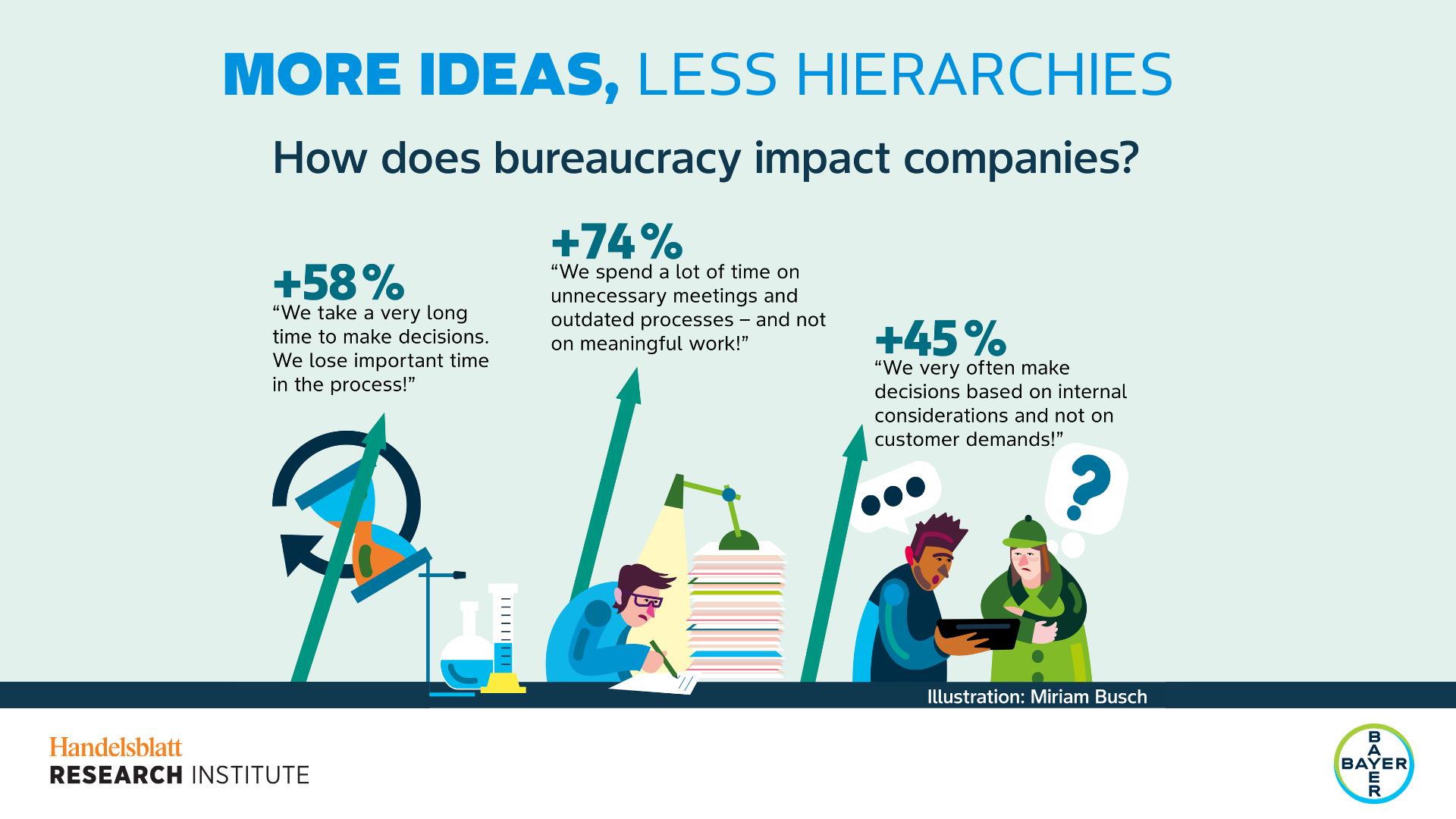
According to Bayer’s employee research by the Handelsblatt Research Institute, employees in very hierarchical companies in particular feel held back by bureaucracy and long approval processes. The study shows that companies with flatter hierarchies are more open to innovation, more productive and faster – and employees are more satisfied with their job if they can work independently and take on responsibility.
Michael Lurie, Bayer’s chief catalyst, says “Instead of designing the organisation despite what it means to be human, you design the organisation around what it means to be human.”
It’s about creating value across three dimensions:
- For customers: World-leading innovation in products and services
- For employees: Growth, meaning, and entrepreneurship
- For investors: Superior financial performance
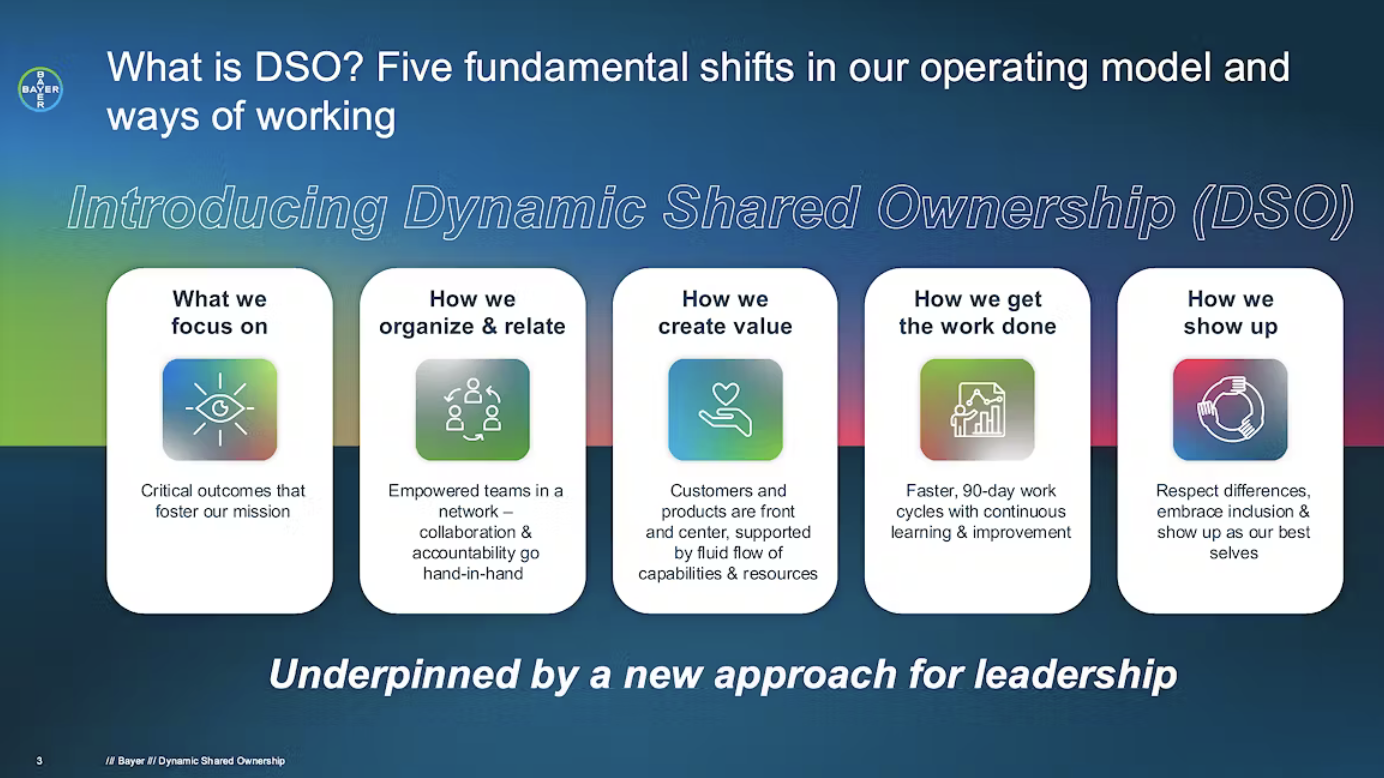
Dynamic Shared Ownership (DSO) consists of five fundamental shifts in how the organisation operates
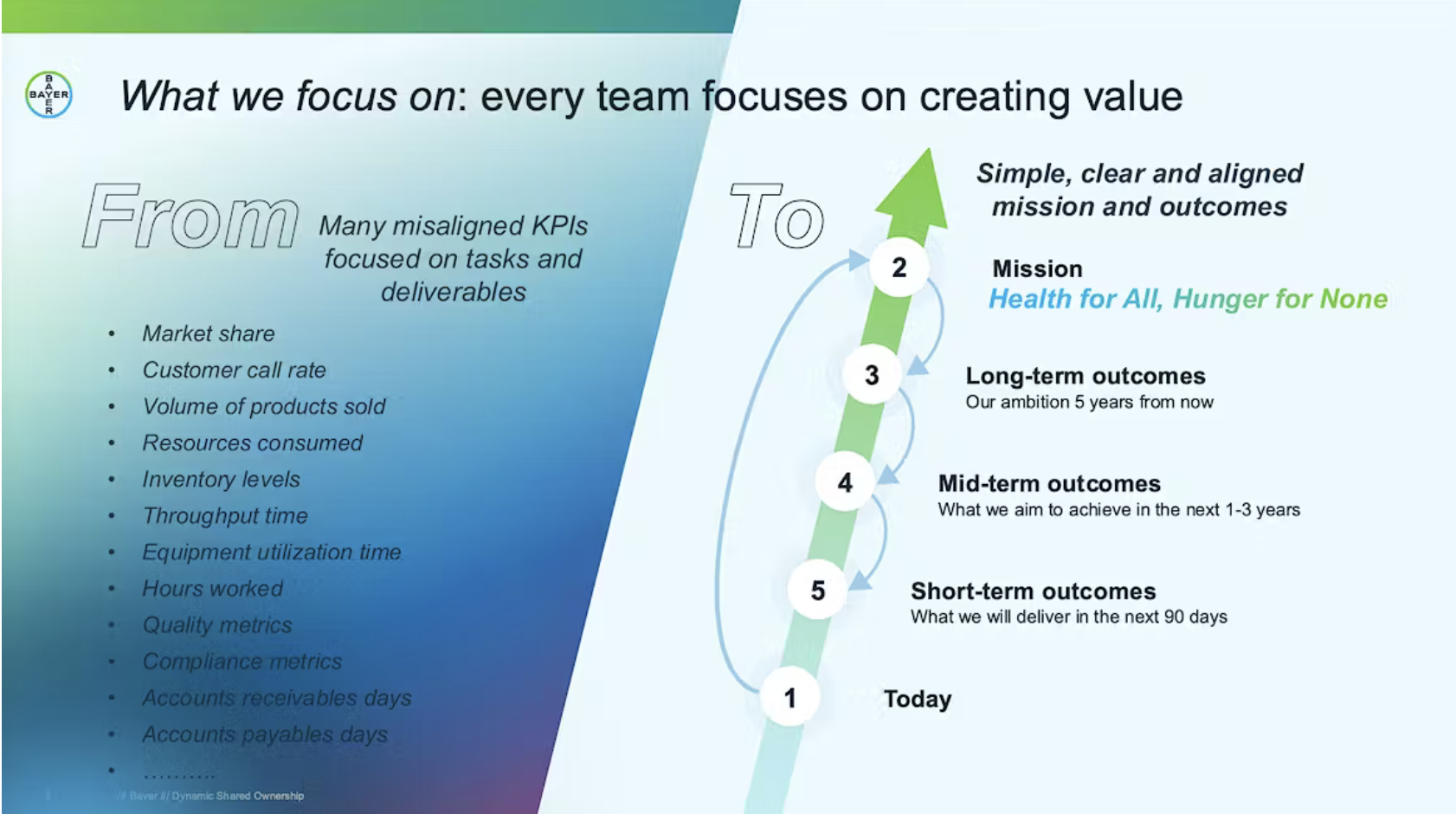
Shift 1: From shareholder value to mission and outcomes
Measuring outputs rather than inputs is not new, but while most organisations develop grandiose purpose statements, they are far more interested in quarterly results. DSO is about working towards a meaningful mission “Health for all, Hunger for None”. One oncology team was launching a life-saving drug. Instead of going through endless approval layers, they asked a simple question: “What actually helps get this drug to patients faster?”
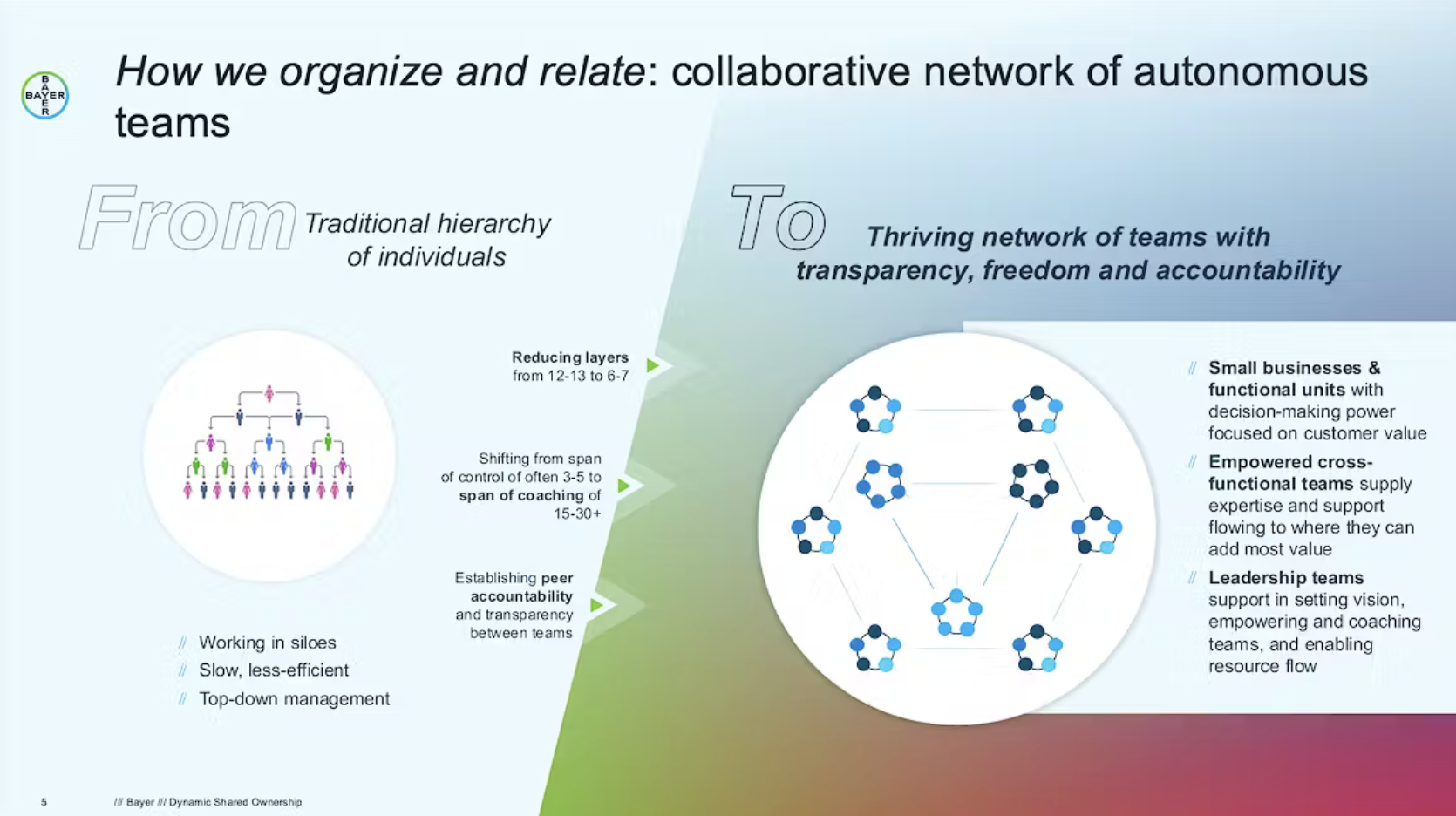
Shift 2: From hierarchy to a network of autonomous teams
Traditionally, teams in large organisations are focused on things like annual budget requests. Bayer says it is redesigning teams around what customers need today and tomorrow. By the end of 2024, for example, the Crop Science division will have 450 customer teams up and running. Early reports indicate a 20-minute increase in time spent with customers per day.
Anderson says “Team Bayer is full of ideas on how to help farmers, patients, and consumers. We want to turn these ideas into solutions, faster. Our Consumer Health division advanced the launch of a new supplement for couples wishing to conceive by more than one year.”
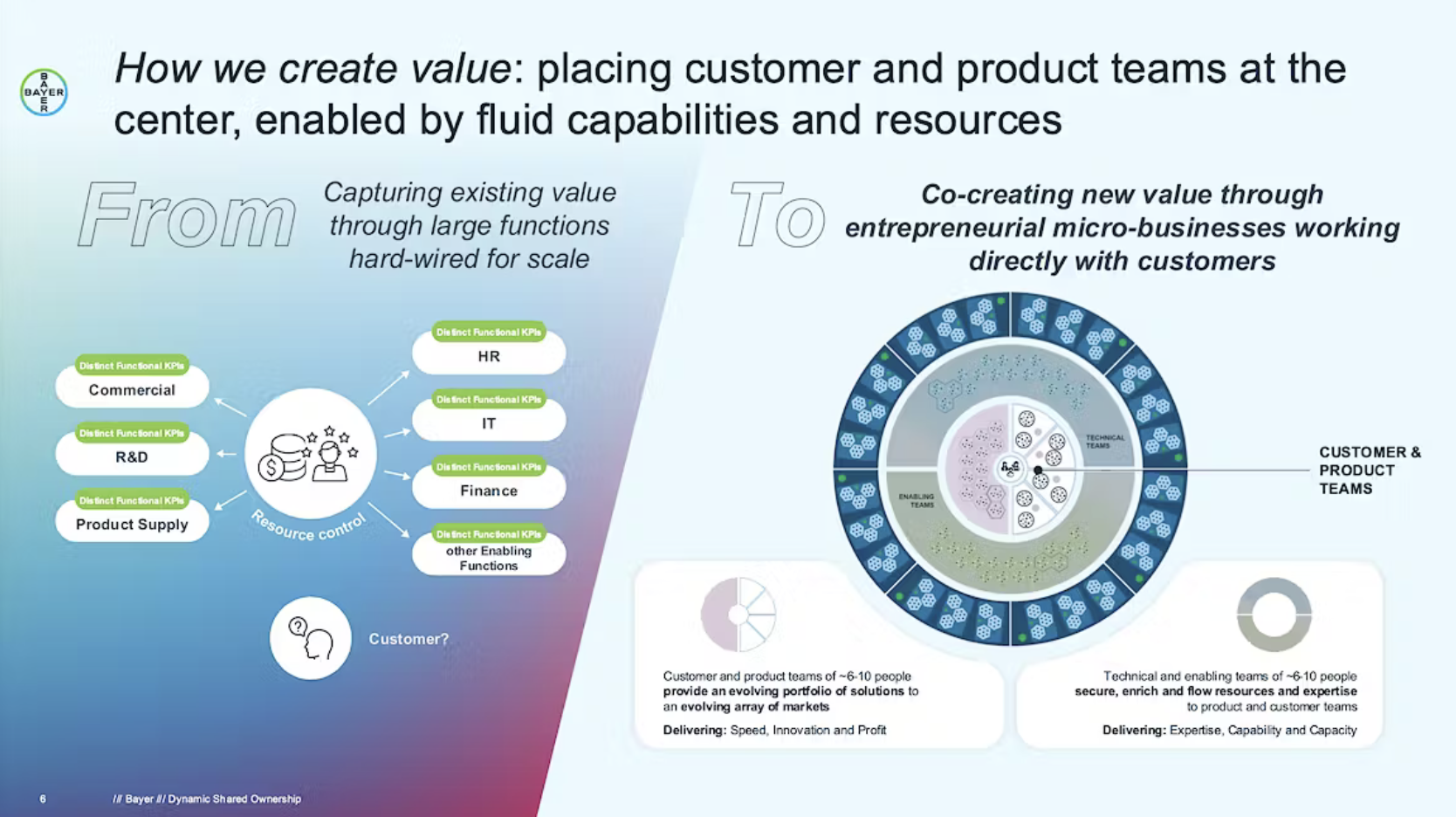
Shift 3: From functions to value creation
DSO creates four types of teams focused on value creation:
- Customer teams: Deep in the trenches with farmers, patients, and consumers
- Product teams: Developing solutions that actually solve problems
- Technical teams: Building killer capabilities in R&D, supply chain, and commercial
- Enabling teams: Providing resources and support where needed
Shift 4: From annual planning to rapid cycles
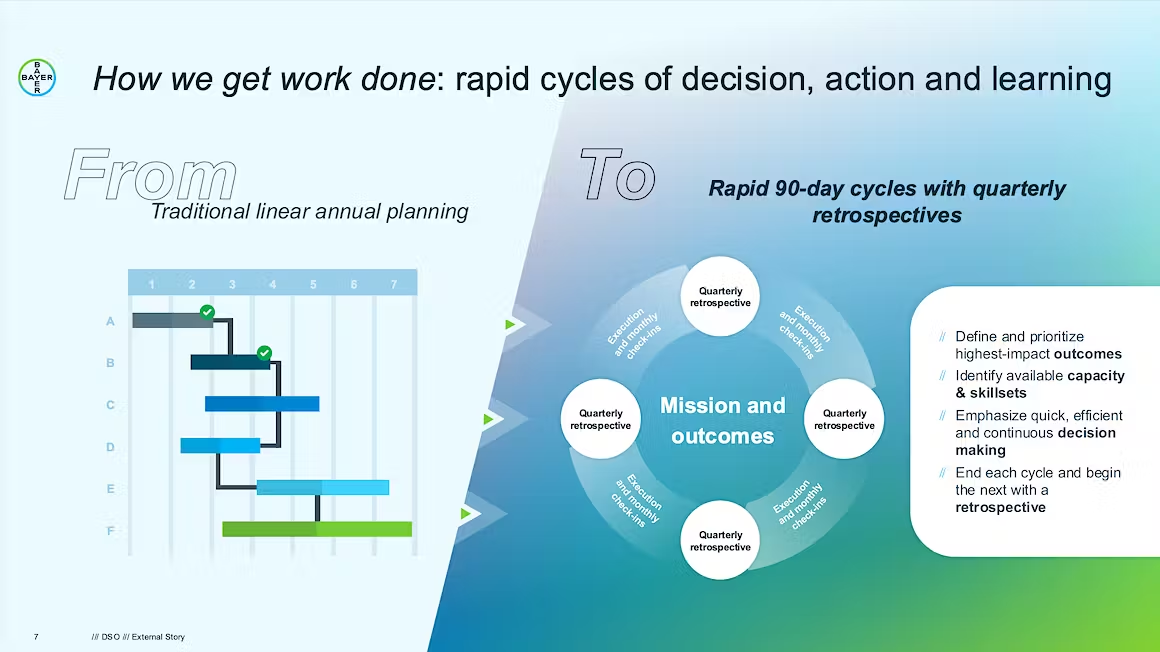
DSO moves from annual planning to 90-day cycles where teams set clear outcomes, test solutions, learn fast, and adapt. It includes a “brand marketplace” where people allocate themselves to priorities every 90 days based on where they can add the most value.
The pharmaceuticals division advanced its pipeline with eight Investigational New Drug (IND) applications in 2023. They see the potential to accelerate our biggest projects by working in three-month rhythms, assessing progress and reallocating resources along the way.
Shift 5: From reactive to creative mindset
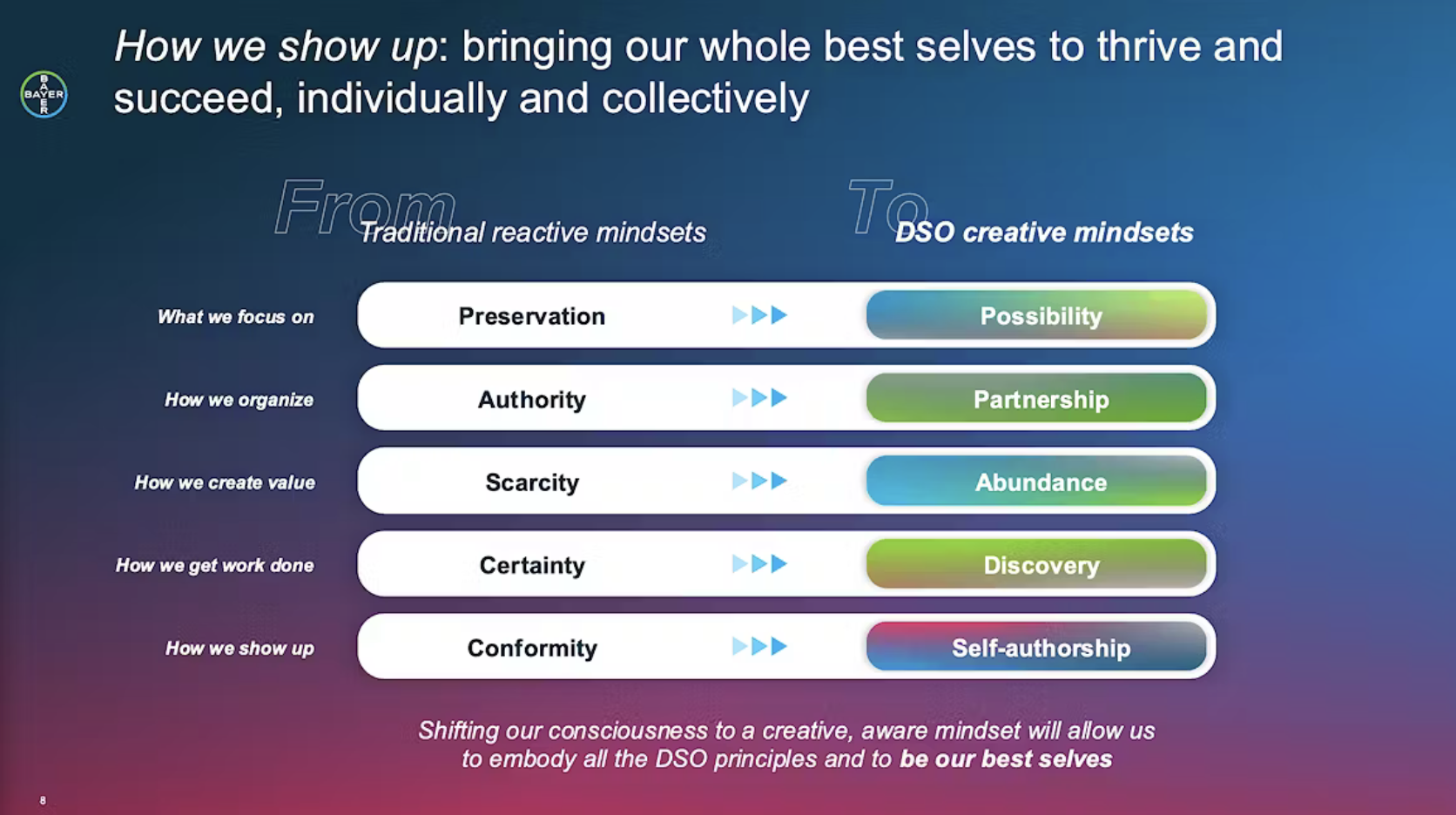
Changing structures and processes is one thing, ensuring people to truly thrive requires a totally different mindset. Bayer is challenging five deeply ingrained mindsets:
- From preservation to possibility
- From authority to partnership
- From scarcity to abundance
- From certainty to discovery
- From conformity to self-authorship
This all requires one additional shift, specifically for leaders …
Shift 6: From traditional management to thriving leadership
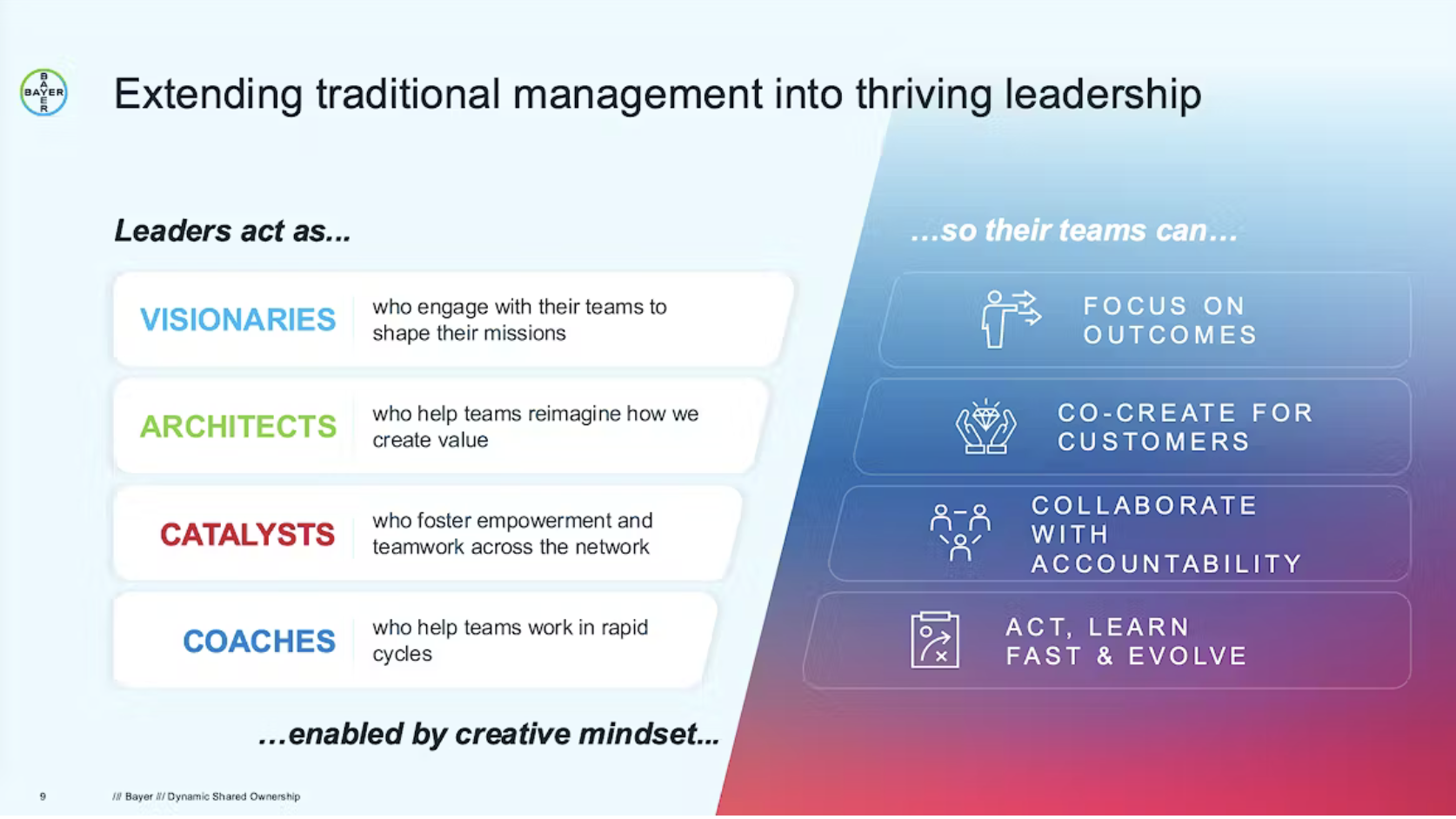
Bayer is transforming leaders from commanders into enablers, with four distinct roles:
- Visionaries: Engage with teams to shape meaningful missions. No more handing down objectives from on high—leaders work with teams to craft purposes that matter.
- Architects: Help teams reimagine how they create value. Instead of dictating processes, leaders help teams design better ways to serve customers.
- Catalysts: Foster empowerment and teamwork across the network. Rather than managing through hierarchy, leaders break down silos and enable collaboration.
- Coaches: Support teams in working through rapid cycles. Instead of annual reviews, leaders help teams learn fast and evolve continuously.
Of course change is never easy. Just like Haier’s reinvention years ago, Bayer is also hugely reducing its layers of management, and significant number of management jobs too. Many of the new teams are not yet in place, or operating in new ways. And while there have been quick wins in many aspects of innovation, it is taking some time for the financial results to follow, as the market value fell during 2024. But Anderson reminds us that this is a three year journey, with pain before the gains.
Anderson says “Our teams are adapting quickly to the new working model. By the end of 2024, our new system will touch every corner of TeamBayer. Through this change, we’re aiming for a more productive and fulfilled workforce; world-leading, faster-to-market innovations; and superior financial performance. ”
Luxury has evolved significantly in recent times, from traditional notions of exclusivity and opulence to embrace a wider range of values, experiences, and innovations.
The concept of luxury has shifted from being solely about status symbols, material wealth, to encompassing a broader range of values and experiences. Today, luxury is defined not just by the price tag or rarity of a product, but by the deeper meanings consumers attach to it, such as personalisation, sustainability, and immersive experiences.
Luxury is less what, more how; less product, more person; less price, more impact.
Recent years have seen a significant shift in audiences for many luxury brands. The rise of new markets, particularly Asia, and the accessibility of online retail, has meant that for many brands, their largest audiences have pivoted from old, western to young, Asian consumers. At the same time, older consumers are a booming market, with money and time on their hands.
As luxury has become more accessible – online stores are less exclusive or intimidating than traditional boutiques, ranges are more diffused with lower entry prices, and young people prioritise luxury brands despite their less affluence.
The largest luxury brand groups like LVMH and Kering have also chosen to grow their businesses in different ways. LVMH has a huge portfolio of over 75 luxury brands from Dior to Louis Vuitton, Fendi to Givency, Bulgaria and TAG Heuer, and also some slightly more accessible brands like Tiffany and Sephora. Kering is more dominated by one brand, Gucci.
Most recently LVMH has soared while Kering has struggled. Louis Vuitton was a star of the recent Paris Olympics, and the medals themselves came from Chaumet, another LVMH brand. Some analysts feel that Gucci has become overly fashionable, with constantly diversifying and changing products and versions. Other luxury brands, like Hermes, seek to remain timeless.
Luxury Brand Trends 2025
In 2025, the luxury industry is expected to be shaped by a number of evolving trends that blend innovation with deep shifts in consumer behaviour, sustainability, and technology:
1. Experiential Luxury
As luxury consumers seek more than just products, luxury brands are doubling down on offering exclusive experiences that go beyond the typical shopping trip. This includes everything from private viewings to bespoke travel experiences and high-end, personalized events.
- Example: Ritz-Carlton and Bulgari
Both Ritz-Carlton and Bulgari have made luxury travel a core offering. In 2025, more luxury brands, including Louis Vuitton (through its luxury travel experiences) and Aston Martin, are expected to deepen their involvement in high-end, curated experiences that combine hospitality with luxury products—think private jets, custom-made adventure trips, or designer travel accessories designed for experiential journeys. - Example: Chanel
Chanel has been known for its private, invitation-only fashion shows, and this trend will likely expand in 2025, with a focus on creating more personalized, exclusive experiences that allow customers to deeply engage with the brand’s artistry and heritage. These experiences could include one-on-one tours of ateliers or private fittings with designers.
2. Technology Integration and Digitalization
The integration of technology into the luxury experience is not just about e-commerce. Luxury brands are incorporating cutting-edge tech to offer personalized services, virtual experiences, and even digital products (such as NFTs) to enrich the customer experience.
- Example: Balenciaga
Balenciaga has embraced the digital future by creating digital-only fashion collections and hosting virtual fashion shows. In 2025, expect more luxury houses to experiment with virtual clothing that can be worn in the digital realm, especially as the metaverse gains more traction. Balenciaga’s use of gaming partnerships and digital avatars will likely evolve into fully immersive experiences for luxury consumers. - Example: Prada
Prada has been actively investing in augmented reality (AR) and artificial intelligence (AI) to offer personalized shopping experiences. Their Prada 360 app and virtual fitting rooms have been a step toward creating seamless digital and physical experiences. In 2025, expect more brands to leverage AI for personalized recommendations and virtual try-ons that integrate seamlessly into physical retail.
3. Hyper-Personalization
Luxury brands are increasingly moving towards hyper-personalization, where consumers not only want products tailored to their specific preferences but also expect experiences that align with their lifestyles, values, and identities.
- Example: Hermès
Hermès has been at the forefront of personalized luxury, offering bespoke services for their leather goods, silk scarves, and more. In 2025, expect to see even more emphasis on offering highly personalized options through AI-driven customization platforms, where customers can design their own luxury products from start to finish, whether it’s a tailored handbag or a custom pair of shoes. - Example: Rolls-Royce
Rolls-Royce’s Bespoke program offers ultra-personalized vehicles, and in 2025, the brand is expected to deepen its customization services with digital tools that allow customers to collaborate with designers in real-time to create one-of-a-kind cars. This includes bespoke interiors, personalized paint jobs, and other high-end custom features.
4. Wellness and Self-Care in Luxury
Consumers are increasingly seeking products and services that contribute to their overall wellness, mental health, and personal well-being. Luxury brands are beginning to incorporate these values into their offerings.
- Example: La Mer
The luxury skincare brand La Mer, owned by Estée Lauder, is set to expand its focus on wellness in 2025 with new lines of products aimed at boosting not just external beauty but also mental well-being. Expect more luxury skincare brands to pivot toward holistic offerings that combine high-performance formulas with mindfulness and wellness elements. - Example: Tiffany & Co.
Tiffany has been exploring the intersection of luxury jewellery and mental well-being. Through collaborations and marketing campaigns focused on mindfulness and self-love, the brand is likely to push forward with new collections designed to evoke positivity and mental wellness, helping to position jewelry as a tool for emotional self-expression and personal growth.
5. Sustainability and Ethical Luxury
Sustainability has transitioned from a niche concern to a central focus in the luxury sector. As consumers increasingly demand transparency and environmental responsibility, luxury brands are adopting more sustainable practices and aligning themselves with environmental, social, and governance (ESG) standards.
- Example: Gucci
Gucci has made a significant push toward sustainability through its Gucci Equilibrium platform, which focuses on promoting positive change through initiatives in materials sourcing, circular design, and social sustainability. In 2025, Gucci will likely continue to innovate with regenerative farming practices, carbon neutrality, and alternative materials for products like shoes and bags. - Example: LVMH
LVMH, the parent company of brands like Louis Vuitton and Dior, has committed to reducing its carbon footprint and improving the sustainability of its supply chains. The conglomerate has been accelerating its use of innovative, low-impact materials and has pioneered circular initiatives, such as the launch of “LVMH’s LIFE 360”sustainability program. Expect to see more eco-friendly fashion and packaging innovations in 2025.
6. New Market Expansion
Emerging markets, especially in Asia and the Middle East, are set to drive growth for luxury brands in 2025. As wealth in these regions continues to rise, luxury brands will be adapting their strategies to cater to the local tastes, cultures, and preferences.
- Example: Louis Vuitton
Louis Vuitton is already deeply entrenched in China, but it is likely to expand further into secondary cities and diversify its offerings to appeal to a younger, tech-savvy generation of consumers. Expect the brand to continue collaborating with local artists and influencers to engage with these new markets. - Example: Fendi
Fendi has made strategic inroads into the Middle East and is likely to expand its presence in the region with localized offerings, including products tailored to the tastes of local consumers. The brand’s boutique in Dubai, as well as regional influencer partnerships, will continue to drive demand in 2025.
7. Luxury on Demand
On-demand luxury is a growing trend, where consumers can access high-end products and experiences without committing to long-term ownership. This trend is powered by subscription models, rental services, and even temporary ownership options.
- Example: Rent the Runway
Luxury rental platforms like Rent the Runway are making luxury fashion more accessible on a temporary basis, and we can expect this to expand with an increasing focus on high-end accessories, jewelry, and limited-edition pieces available for short-term rentals. - Example: Porsche and Ferrari
Both Porsche and Ferrari are looking into luxury car subscription services, where customers can enjoy the experience of driving a high-end vehicle without the long-term commitment. In 2025, expect to see more high-end automakers offering flexible subscription plans that allow consumers to access the latest models on demand.
I’ve written 10 business books, selling over 100,000 copies, won a few awards along the way, and seen them translated into 35 languages. I’ve hosted the Future Book Forum for the last 10 years, bringing together many of the world’s top publishers and partners. I’ve launched a digital startup with Wiley focused on the practical application of books. And I’ve worked with Thinkers50 over the last decade, celebrating the best ideas from around the world, and making them more accessible for business leaders to apply through events, articles and workshops.
So I’m definitely into books, or at least business books. And particularly those which are fresh, thoughtful, practical, and inspiring.
Here’s my shortlist of the best business books from 2024:
The Algebra of Wealth by Scott Galloway
Scott Galloway, or Prof G as he likes to call himself, is a populist business school professor. Insightful and irreverent, his podcasts and newsletters have a huge following. This is his practical guidebook to winning today’s wealth game.
Today’s workers have more opportunities and mobility than any previous generation. They also face unprecedented challenges, including inflation, labour and housing shortages, and climate volatility. Even the notion of ‘retirement’ is undergoing a profound rethink, as our lifespans extend and our relationship with work evolves. In this environment, the tried-and-true financial advice our parents followed no longer applies. He lays bare the rules of financial success in today’s economy. He explains you what you need to know in order to improve your chances of achieving economic security no matter what.
Galloway says there are 4 factors of wealth building, that financial success boils down to a simple algebraic formula:
- Focus: Picking a clear goal and dedicating sustained effort toward it.
- Discipline: Consistently making decisions that contribute to long-term wealth, like saving, investing, and avoiding bad financial habits.
- Serendipity: Creating opportunities for good fortune through hard work and networking.
- Luck: Acknowledging the uncontrollable role of timing and chance while maximizing your odds through preparation.
He advises you to invest in their professional skills and career development to ensure higher earning potential over the long term. He emphasises industries with strong growth prospects, like technology and healthcare. He highlights that wealth often comes faster through ownership than wages, encouraging readers to consider entrepreneurial ventures or acquiring equity stakes.
He stresses the importance of living below your means, avoiding unnecessary debt, and establishing an investment strategy. Galloway provides insights into effective money management practices. He explores how relationships and a network of supportive people can contribute to your personal and professional success. And he links overall happiness and quality of life with financial independence. He emphasizes maintaining good health and investing in oneself as critical components of success.
“The Art of Uncertainty” by David Spiegelhalter
We live in a world where uncertainty is inevitable. How should we deal with what we don’t know? And what role do chance, luck and coincidence play in our lives?
David Spiegelhalter has spent his career dissecting data in order to understand risks and assess the chances of what might happen in the future. He’s been described as “probably the UK’s greatest living statistician”.
In engaging, crystal-clear prose, he takes us through the principles of probability, showing how it can help us think more analytically about everything from medical advice to pandemics and climate change forecasts, and explores how we can update our beliefs about the future in the face of constantly changing experience.
Along the way, he explains why roughly 40% of football results come down to luck rather than talent, how the National Risk Register assesses near-term risks to the UK, and why we can be so confident that two properly shuffled packs of cards have never, ever been in the exact same order.
“Growth: A Reckoning” by David Susskind
Over the past two centuries, economic growth has freed billions from poverty and made our lives far healthier and longer. As a result, the unfettered pursuit of growth defines economic life around the world. Yet this prosperity has come at an enormous price: deepening inequalities, destabilizing technologies, environmental destruction and climate change.
Confusion reigns. For many, in our era of anaemic economic progress, the worry is slowing growth – in the UK, Europe, China and elsewhere. Others understandably claim, given its costs, that the only way forward is through ‘degrowth’, deliberating shrinking our economies.
At this time of uncertainty about growth and its value, economist Daniel Susskind provides an essential reckoning. In a sweeping analysis full of historical insight, he argues that we cannot abandon growth but shows instead how we must redirect it, making it better reflect what we truly value. He explores what really drives growth, and offers original ideas for combatting our economic slowdown.
Susskind argues that while economic growth has historically improved health and reduced poverty, it has also led to significant issues like environmental destruction and climate change.
He critiques the notion of ‘degrowth’—deliberately shrinking economies to address these problems—as impractical and potentially harmful, suggesting that abandoning growth could reverse progress and confine millions to poverty. Instead, Susskind advocates for redirecting growth to better reflect societal values, emphasizing the need for increased investment in research and development (R&D) and the adoption of new technologies.
He underscores the importance of managing intellectual property rights to incentivize innovation and calls for government policies that encourage technological progress. He also highlights the necessity of ethical considerations in shaping economic policies, suggesting that decisions about growth should balance improvements in living standards with the mitigation of negative consequences.
“Fusion Strategy” by Vijay Govindarajan and Venkat Venkatraman
How will real-time data and AI radically transform physical products, and the companies that make them?
Tech giants like Facebook, Amazon, and Google can collect real-time data from billions of users. For companies that design and manufacture physical products, that type of fluid, data-rich information used to be a pipe dream. Now, with the rise of cheap and powerful sensors, supercomputing, and artificial intelligence, things are changing—fast.
In Fusion Strategy, innovation guru Vijay Govindarajan and digital strategy expert Venkat Venkatraman offer a first-of-its-kind playbook that will help industrial companies combine what they do best—create physical products—with what digitals do best—use algorithms and AI to parse expansive, interconnected datasets—to make strategic connections that would otherwise be impossible.
The laws of competitive advantage are changing, rewarding those who have the most robust, data-driven insights rather than the most valuable assets. To compete in the new digital age, companies need to use real-time data to turbocharge their products, strategies, and customer relationships. Those that don’t risk falling on the wrong side of the next great digital divide.
- Integration of Real-Time Data and AI: The book emphasizes the importance of integrating real-time data and AI into the core of business operations to drive innovation and efficiency. This fusion is seen as a fundamental shift that redefines competitive advantage.
- Creating Strategic Connections: By combining the strengths of physical product creation with the capabilities of algorithms and AI, companies can make strategic connections that were previously impossible.
- Data-Driven Insights: The authors argue that robust, real-time insights are becoming more valuable than traditional assets. Companies need to use real-time data to turbocharge their products, strategies, and customer relationships.
- Organizational and Cultural Changes: Implementing a fusion strategy requires fostering a data-driven culture where decisions are guided by real-time insights rather than intuition or tradition. This involves investing in data literacy training, promoting cross-functional collaboration, and encouraging a continuous improvement mindset.
- Ethical and Societal Implications: The book highlights the importance of addressing ethical and societal challenges related to privacy, security, and job displacement. Businesses have a responsibility to ensure that their fusion strategies align with broader societal values.
- Leadership Role: Effective leadership is crucial for driving the adoption of fusion strategies. Leaders must champion the integration of real-time data and AI and create an environment that supports innovation and responsible use of technology.
“Supremacy” by Parmy Olsen
In November of 2022 – a webpage was posted online with a simple text box. It was an AI chatbot called ChatGPT, and was unlike any app people had used before. It was more human than a customer service agent, more convenient than a Google search. Behind the scenes, battles for control and prestige between the world’s two leading AI firms, OpenAI and DeepMind, who now steers Google’s AI efforts, has remained elusive.
It was never meant to be this way. The founders of the two companies behind the most advanced AIs in existence – Open AI (ChatGPT) and DeepMind (Bard) – started their journeys determined to solve humanity’s greatest problems. But they couldn’t develop their technologies without huge amounts of money – money that Microsoft and Google were more than happy to give them, in exchange for the most powerful seats at the table.
Supremacy is the behind-the-scenes story of the battle between two AI companies, their struggles to use their tech for good, and the dangerous direction that they’re now going in. Featuring a cast of larger-than-life characters, including Elon Musk, Larry Page, Sergey Brin and Peter Thiel, Supremacyis a story of manipulation, exploitation, secrecy and of ruthless, relentless human progress – progress that will impact all of us for years to come.
She states “The real threat of artificial intelligence that its top creators are ignoring: the profit-driven spread of flawed and biased technology into industries, education, media and more”.
Consumer AI has arrived. And with it, inescapable upheaval as we grapple with what it means for our jobs, lives and the future of humanity.
Cutting through the noise of AI evangelists and AI doom-mongers, Wharton professor Ethan Mollick has become one of the most prominent and provocative explainers of AI, focusing on the practical aspects of how these new tools for thought can transform our world. In Co-Intelligence, he urges us to engage with AI as co-worker, co-teacher and coach. Wide ranging, hugely thought-provoking and optimistic, Co-Intelligence reveals the promise and power of this new era.
Here are some of the main takeaways:
- Always Invite AI to the Table: Mollick emphasizes the importance of integrating AI into decision-making processes and workflows. By leveraging AI’s strengths, we can improve efficiency and innovation.
- Be the Human in the Loop: It’s crucial to maintain human oversight and validation of AI outputs. This ensures that AI-generated results are accurate and reliable.
- Treat AI Like a Person: Mollick suggests treating AI as a collaborative partner by providing clear context and instructions. This helps AI generate more useful and relevant outputs.
- Assume This is the Worst AI You’ll Ever Use: By acknowledging that AI technology will continue to advance, we can prepare for future improvements and avoid complacency.
- Start Tasks with AI: Mollick introduces the concept of “The Button,” encouraging users to begin tasks with AI and then refine the results as needed.
- Ethical and Cautious Deployment: The book highlights the importance of deploying AI ethically and cautiously to avoid potential misuse and ensure societal benefits.
A Peruvian family building a soft drink giant during an active terrorist conflict, a Syrian family business starting afresh in a neighboring country after their assets were seized following a military coup, and an iconic Haitian family hotel prevailing through earthquake, crime, and economic collapse.
Family businesses thrive in some of the world’s toughest environments, providing vital lessons for businesses everywhere.
The bulk of the world’s growth in population and economic activity in the foreseeable future will be generated in the developing world. This is precisely where enterprising families dominate, operating very differently than their peers in more stable and affluent nations. These businesses not only survive but actually thrive in turbulent times, enduring wars, lawlessness, market failures, environmental disasters, and more. The world’s most advanced economies will increasingly experience these types of structural shocks and chronic uncertainties in the years ahead. The question is, what can they do about it?
The book explores the lives of families operating in emerging and frontier economies who rely on a unique portfolio of stabilizing strategies to create islands of trust, resilience, and prosperity amidst persistent turmoil. Yet these tactics can also be deployed by any business coping with extended periods of volatility or building a more systematic approach to managing risk.
Warren Buffet’s success relied on a simple idea: invest in undervalued businesses with a history of strong and stable earnings. Forget about shiny startups, ecommerce, and drop-shipping. Instead, invest in a plumber, construction firm, cleaner, or electrician—the kind of businesses that are easily overlooked by white colour workers—to access reliable cash-flow.
Codie Sanchez’s book is a little flamboyant but refreshing in two ways. First, it concentrates on small “boring” businesses. Second, it serves up a recipe to bypass the challenges of a founder by creatively financing smart deals. Most people look for wealth in all the wrong places. From dropshipping and startups to grinding for promotions, you might believe you have to trade your life to be one of the few who win. But the truly rich know these paths are paved with delusion and false promises.
Sanchez explores a different path. Instead of risking it all with little chance of success, she shows you how to acquire cash-flowing businesses that are winning right now. Sanchez, one of the world’s leading small business experts, reveals the dealmaking framework she’s taught to tens of thousands, and that she’s used to build her own 9-figure holding company. Her secret? She acquires overlooked “Main Street” businesses, or small businesses available to us all on the high street. We’re talking about the unsexy but reliably profitable industries ― like plumbing, construction, cleaning, electrical ― that white collar workers have overlooked.
“How to Become Famous” by Cass Sunstein
This is quite a bold title. As is the subtitle “Lost Einsteins, Forgotten Superstars, and How the Beatles Came to Be.”
Fame is like lightning. Taylor Swift, Bob Dylan, Leonardo da Vinci, Jane Austen, Oprah Winfrey—all of them were struck. Why? What if they hadn’t been?
Consider the most famous music group in history. What would the world be like if the Beatles never existed? This was the question posed by the playful, thought-provoking, 2019 film Yesterday, in which a young, completely unknown singer starts performing Beatles hits to a world that has never heard them. Would the Fab Four’s songs be as phenomenally popular as they are in our own Beatle-infused world? The movie asserts that they would, but is that true? Was the success of the Beatles inevitable due to their amazing, matchless talent?
Maybe. It’s hard to imagine our world without its stars, icons, and celebrities. They are part of our culture and history, seeming permanent and preordained. But as Harvard law professor (and passionate Beatles fan) Cass Sunstein shows in this startling book, that is far from the case. Focusing on both famous and forgotten (or simply overlooked) artists and luminaries in music, literature, business, science, politics, and other fields, he explores why some individuals become famous and others don’t and offers a new understanding of the roles played by greatness, luck, and contingency in the achievement of fame.
Here are my main takeaways:
- The Social Dynamics of Fame: Fame isn’t purely about talent or hard work but is often dictated by social dynamics, including exposure, timing, and influential networks. Social media and the internet amplify the processes of becoming famous, creating more opportunities but also risks for individuals seeking public recognition.
- The Role of Social Norms: Sunstein emphasises the critical role of social norms in shaping fame. What society values at a given time—whether beauty, innovation, or charisma—significantly impacts who becomes famous. Fame is often self-reinforcing: once someone is famous, their influence on shaping norms can perpetuate their status.
- The Attention Economy: Fame thrives on attention, which is finite and competes with other demands. Strategies for becoming famous often involve figuring out how to capture and sustain attention in a crowded media landscape. Shock value, humor, and emotional resonance are common tools for breaking through the noise.
- Luck and Serendipity: While strategic planning and ambition are factors, Sunstein acknowledges the role of luck and timing in the pursuit of fame. Being in the right place at the right time can be as important as skill or strategy.
- The Double-Edged Sword of Fame: Fame can bring immense rewards—money, influence, and opportunities—but it also has drawbacks, including loss of privacy, constant scrutiny, and the pressure to maintain public relevance. The book discusses the psychological impacts of fame, such as identity crises and the fragility of public image.
- Fame in the Digital Age: The internet has democratised fame, enabling ordinary individuals to gain massive followings without traditional gatekeepers like publishers, producers, or industry insiders. However, this democratization has also led to challenges, including fleeting attention spans and the potential for “cancel culture.”
- Ethics and Responsibility: Sunstein reflects on the ethical aspects of fame-seeking behavior and the responsibility that comes with public influence. The famous often wield significant cultural and political power, which can shape public discourse.
“The Whole Story” by John Mackey
Adventures in love, life, and capitalism. Whole Foods Market’s cofounder and CEO for forty-four years, John Mackey offers an intimate and provocative account of the rise of this iconic company and the personal and spiritual journey that inspired its remarkable impact.
The Whole Story invites listeners on the adventure of building Whole Foods Market: the colorful cast of idealists and foodies who formed the company’s DNA, the many breakthroughs and missteps, the camaraderie and the conflict, and the narrowly avoided disasters. Mackey takes us inside some of the most consequential decisions he had to make and honestly shares his regrets looking back.
Beyond the Whole Foods story, Mackey also dives into his spiritual journey from Christianity to New Age mysticism, Eastern wisdom, and life-changing awakenings through psychedelics. Political and intellectual development: from countercultural co-op dweller to libertarian and Conscious Capitalist. Philosophical and ethical awakenings: especially with regard to animal welfare and the tension between his personal values and industry practices. Personal passions: most notably, his love of long-distance, ultra-light backpacking on the great trails of our country and planet.
“Red Helicopter” by James Rhee
In kindergarten, James Rhee received a toy red helicopter in gratitude for a simple act of generosity—sharing his lunch. Decades later, the lesson from that small gift led him to develop a human-centered framework for business and personal achievement that helped him overcome seemingly insurmountable hurdles and find unprecedented success.
Rhee was a high school teacher turned private equity investor when he unexpectedly took the helm of Ashley Stewart, an iconic company predominantly employing and serving Black women. Inspired by the values his dying Korean immigrant parents instilled in him, he knew that a radically different—yet familiar—approach was required to lead this twice-bankrupt company from certain liquidation to true transcendence.
Is it possible to be successful and kind? To lead with precision and compassion? To honour who we are in all areas of our lives?
The entire world bet against him and Ashley, but Rhee trusted his instincts to identify, measure, and leverage the intangible goodwill at the company’s core, a decision which ultimately multiplied its fortunes several times over. Anyone can combine the clarity and imagination we had as children with fundamental business metrics. Anyone can apply this refreshingly intuitive approach to lead change at work and at home.
“The Upside of Disruption” by Terence Mauri
Terence Mauri is a good friend. From a career in brands and advertising he has reinvented himself in the innovation space, and what it means for leaders.
He explores why so many of us continually overestimate the risks of bold decisions while underestimating the downsides of standing still for too long in an increasingly complex and volatile world. The upside of disruption is about turning challenge and threat, uncertainty and complexity, into a tailwind for laser-like focus and strategic courage.
He introduces the DARE framework, focusing on four critical areas:
- Data: Leading with AI. He emphasizes the transformative impact of artificial intelligence (AI) on industries and business models. He advocates for a human-centric approach to AI, suggesting that as organizations become more digital, they should prioritize human elements to empower people rather than replace them. This involves fostering a culture where employees are energized to use AI as a co-pilot for value-creating work, reducing time spent on bureaucratic tasks.
- Agility: The Importance of Unlearning. The book highlights the necessity for leaders to unlearn outdated practices and mindsets. Mauri defines unlearning as the capacity to reflect (humility), rethink (agility), and renew (growth). This proactive approach helps organizations adapt to changing circumstances, avoid stagnation, and embrace new opportunities for growth.
- Risk: Cultivating a Courageous Mindset. He discusses the importance of adopting a contrarian mindset to navigate disruption effectively. He suggests that leaders should have the courage to challenge conventional business wisdom, which can lead to identifying new growth opportunities and staying ahead of the curve. This involves balancing courage with humility, as overthinking can lead to risk aversion.
- Evolution: Building Trust-Based Cultures. The book underscores the significance of trust in organizational growth. Mauri introduces the Trust Mindset, focusing on identity (who we are), agility (how we work), and scalability (how we grow). He argues that leaders should create environments where values are clear, empowerment is genuine, and growth stories are compelling, enabling individuals to feel included and take ownership of the future.
“Make your Own Rules” by Andrew Huang
YouTuber Andrew Huang offers practical tips and hard-won advice for creatives seeking financial stability while staying authentic.
How does a musician with acute hearing loss, a refusal to perform live, and no industry connections carve a path to millions of followers and lucrative royalty checks? In Make Your Own Rules, Andrew Huang shares stories from his two decades as a music industry misfit and offers advice on both the artistic and business sides of working as a creator in our digital era.
Beginning with auctioning his songwriting skills on eBay as a teenager, Andrew continuously found new ways to thrive in a music career over the last twenty-plus years. His storied career and hard-won wisdom can help aspiring digital creatives find success as well. Organized by sections on building your creative foundations, growing an audience in the digital age, making money, and staying true to yourself, he book pairs personal anecdotes with concrete advice applicable to any freelance digital creator.
You’ll learn how Andrew became an early adopter of sharing music online—for free!—and how he leveraged social media to grow an organic following and amass millions of song streams and video views. Additional chapters provide insight into his designing an online course and music production tools that have been used by tens of thousands of people, and how he created revenue streams for himself that didn’t exist previously.
With open-minded perseverance, Andrew made up his own rules for life. His unlikely journey will inspire creators to find opportunity, financial stability, and fun in their pursuits.
Seaweed is amazing!
Seaweed, and other microscopic algae, are amongst the fastest growing organisms on the planet (the giant kelp Macrocystis Pyrifera, can grow nearly a metre a day, attaining lengths in excess of 50m) .
Seaweed outnumbers land-based plants 9 times, absorbs minerals directly from the water around it and is thought to be
the single most nutritious foods that you eat (rich in trace elements and vitamins, it typically contains more protein than meat and more calcium). It also contributes around 90% of the world’s oxygen.
There are over 12,000 seaweed species.
Seaweed is an algae, not a plant. It has no roots, leaves or stems to transport water or nutrients. Instead each cell derives what it needs directly from the seawater around it. The only similarity between seaweed and land plants is that both rely on sunlight to create energy through photosynthesis. In fact seaweed could be an incredible source of sustainable energy.
Not only is seaweed a potentially great source of energy, it can reduce the amount of carbon in our atmosphere too. Having a seaweed forest covering 9% of the ocean would absorb more CO2 than human activities produce.
Ancient Greeks used seaweed for healing purposes. Long before we were putting seaweed in our skincare products, they were using it in their heated baths to draw out toxins from the body and rejuvenate their skin. Known as Thalassotherapy (thalasso is Greek for ‘sea’) they believed it could restore good health and cure illness.
And it tastes like bacon. This has opened doors in the vegan and vegetarian market. Seaweed-based bacon is not just vegan-friendly, but also gluten-free, low carbohydrate, organic, and sustainable. A seaweed diet is linked to an increased life expectancy, Japanese Okinawa diet (low salt, high seaweed).
You can read more about seaweed here, but let’s focus on its potential as a great source of sustainable energy:
Seaweed as biofuel
Kelp, a type of seaweed, is a promising source of biofuels, if sustainably produced and used.
Compared with, for example soya, which is also used for the production of biofuels, growing seaweed is faster, more space-efficient and does not require the use of fresh water or the addition of fertilizer. Furthermore, seaweed does not compete for land area. On the contrary, seaweed can be grown in exactly the area we have the most of: the sea.
Europe today meets 90% of its renewable transport target with land-based biofuels, which in many cases are at least as bad as fossil fuels. Meanwhile, climate science shows that fighting climate change will necessarily involve bioenergy, though the sustainable scale remains one of climate science’s most unsure areas.
As a source of sustainable energy, seaweed has some key benefits:
- Available: Though seaweed is plentiful, it is an under-used source of biomass. The sea covers almost three-quarters of the world and half of the world’s biomass grows here. However, we only get 2% of our energy from food that comes directly from the sea.
- Scalable: Seaweed can be grown on straight or circular ropes, horizontally and/or vertically, (ideally) down to 10m depth to retain optimal sunlight conditions. There are also integrated solutions to growing seaweed that make best possible use of
the available space. For example, seaweed could be grown in circular systems, like Integrated Multi-Trophic Aquaculture that brings together other sea production, like fish farming and offshore energy. This makes the involved industries both more sustainable and cheaper as, amongst other benefits, it’s easier to recycle nutrients, seaweed grows better when it can use waste nutrients from fish farming, and sharing infrastructure minimises costs. - Suitable: Between 85 and 90% of seaweed is water, which means seaweed is very suitable for biofuel-making methods like anaerobic digestion to make biogas and fermentation to make ethanol. In addition, many seaweed species, like sugar kelp, have high carbohydrate and low lignin content that is perfect for making bioethanol.
- Efficient: especially in absorbing nutrients like phosphorous and nitrogen. Because seaweed grows very fast, it can absorb a lot of CO2, in fact up to 66 tonnes CO2 per hectare, which can help tackle ocean acidification. Fast growth also means CO2 emissions from for instance seaweed biofuel are quickly reabsorbed by new growth. In addition, seaweed doesn’t need fresh water or fertilising.
- Productive: growing about 26 tonnes dry weight per hectare, compared to 2.3 tonnes soya and 5.1 tonnes corn.
With an effective business model for the harvesting of seaweed as a sustainable energy source, it has the potential to deliver huge benefits. The model will need to address issues such as ocean conservation, development of production facilities on land, and the costs. These factors will be important to address in order to ensure that seaweed becomes a net zero, or even net positive, future source of energy.
This week I got to visit the world’s largest carbon capture and storage facility in Iceland, operated by Swiss company Climeworks.
At Climeworks’ new “Mammoth” DAC facility, the CO₂ is permanently removed from the air by capturing and geologically storing it for thousands of years with Climeworks’ storage partner Carbfix.
The newly opened site is around 30km from Reykjavik, Iceland’s capital.
The ambition is certainly impressive. Approaching, I see the billowing steam of the huge On geothermal power plant, surrounded by a landscape of snow covered solidified lava, and distant volcanoes. Abundant geothermal energy is the main reason why Climeworks has come to Iceland.
And then I see the distinctive V-shaped suction “capture containers” of Mammoth. In some ways it looks like the world’s largest air conditioning unit, but its impact is exactly the opposite. These containers suck carbon dioxide out of the air, and filters it of its carbon in a heated chemical process.
Mammoth is the world’s largest carbon capture and storage plant, with over 200 engineers working there. It has a lifetime of around 25 years, and will be at full capacity by 2025 with 72 collector containers, and with a capture capacity of 36,000 tonnes.
Surrounding the Climeworks site are small white domes, where the captured carbon is pumped 700m underground, and mineralised into rock. They are operated by Climeworks’ local partner Carbfix, an Icelandic company that dissolves the carbon in water, then injects it into the basalt rock below.
Climeworks business model is to seek funding from business and individuals, who then fund the process. It has already sold a third of Mammoth’s lifetime capacity (to companies including Microsoft, JP Morgan, Stripe, BCG and PwC, plus individuals like Bill Gates, and the band Coldplay).
Climeworks empowers people and companies to fight global warming by offering carbon dioxide removal as a service via direct air capture (DAC) technology.
Climeworks was founded in 2009 by the mechanical engineers Jan Wurzbacher and Christoph Gebald. During their PhDs at the ETH Zurich, the two founders conducted research on direct air capture technology to remove carbon dioxide from the air. Based on that scientific research, Climeworks was founded as a spin-off from ETH Zurich, the 150 year old Swiss science and engineering university.
Climeworks is on a journey to deliver climate impact at scale. To do so, the company strives to inspire 1 billion people to act and remove CO₂ from the air. Since 2009 it has developed 15 DAC facilities around the world, including 6 locations in Switzerland, plus the UK, Germany, Austria and Belgium, operated by 500 “Climeworkers” .
Here’s how Climeworks works:
- Direct Air Capture (DAC): Climeworks employs direct air capture technology, which captures CO₂ directly from the atmosphere. Their modular and scalable DAC plants use air collectors to draw in carbon and trap it on specialized filters.
- Mammoth Facility: Their new Mammoth facility in Hellisheidi, Iceland, is a game-changer. It can capture 36,000 tons of CO₂ annually at peak capacity—about 10 times larger than their existing Orca plant.
- Patented Technology: Climeworks intends to capture a megaton of CO₂ by 2030 and an astounding gigaton by 2050 using their patented technology. This commitment is crucial for achieving net-zero emissions globally.
- Global Recognition: Carbon removal has transitioned from a niche concept to a globally recognized solution. The U.S. Department of Energy even awarded funding to Climeworks and its partners to build the country’s first large-scale direct air capture facilities.
- Underground Storage: Climeworks combines DAC with permanent underground storage (DAC+S). They inject the captured CO₂ deep underground, where it reacts with basalt rock, transforming into stone and remaining safely stored for over 10,000 years. This ensures it no longer contributes to global warming.
- International Expansion: While Iceland offers ideal conditions, Climeworks is expanding globally. They’re exploring projects in the U.S., Canada, Norway, and Kenya to remove CO₂ on a megaton and gigaton scale.
By actively removing CO₂, Climeworks plays a vital role in our fight against climate change.
A few photos from my recent visit to the Icelandic site …
Approach the site, the nearby On geothermal power station provides huge amounts of clean, free energy to power the DAC process:

Climeworks’ new Mammoth plant is far larger than its initial Orca test facility, and is distinctive for its V shaped wings:

Up closer, the vents open, sucking carbon dioxide from the air, recognising the challenge is not just to reduce emissions but to clean up historic emissions:

Iceland was chosen as the location for the Swiss company’s plant as it is not only an excellent source of geothermal energy, but also to store the carbon underground, in partnership with Carbfix:

The “Mammoth” DAC facility, is currently the largest in the world, and was opened in April 2024, and now in full production:

Thank you to Climeworks, and the University of St Gallen, for enabling such a rare and fascinating insight into the frontiers of fighting climate change, and creating a cleaner future.
Two questions for you …
- In the next 10 years, do you see the world as getting better or worse?
- How capable do you feel of personally affecting the future?
Think about it. We live in a world of relentless change.
Superfast-gaming chips and fat-busting superdrugs, asteroid-chasing rockets and carbon-capturing technologies, 4 day working weeks and chess reinvented as a reality TV game, health-enhancing fashions and the rebirth of the hairy mammoth. Nvidia is transforming tech, while Novo Nordisk innovates healthcare, KinetX changes the space race, while Climeworks eliminates carbon.
We used to marvel at innovations with a leap of imagination. Ideas and technologies that promised to transform our world, but seemed a little out of reach. Now, science fiction has collided with practical reality, powered by mind-boggling technologies that are evolving at incredible speed, but also rapid social and cultural change, accelerating human possibilities into practice.
Some people find this super exciting, full of possibility and opportunity. Others find it incredibly scary, threatening and challenging.
- Where are you? Where are your team colleagues?
- What drives these feelings and perceptions, in you and others?
- How could you shift position to enable less stress, or achieve more?
The Polak Game was created by Dutch sociologist Frederik Polak, regarded as one of the founding fathers of future studies. In his 1961 book “The Image of the Future” he developed approaches to imagine alternative futures, and introduced this tool to test our view of the future.
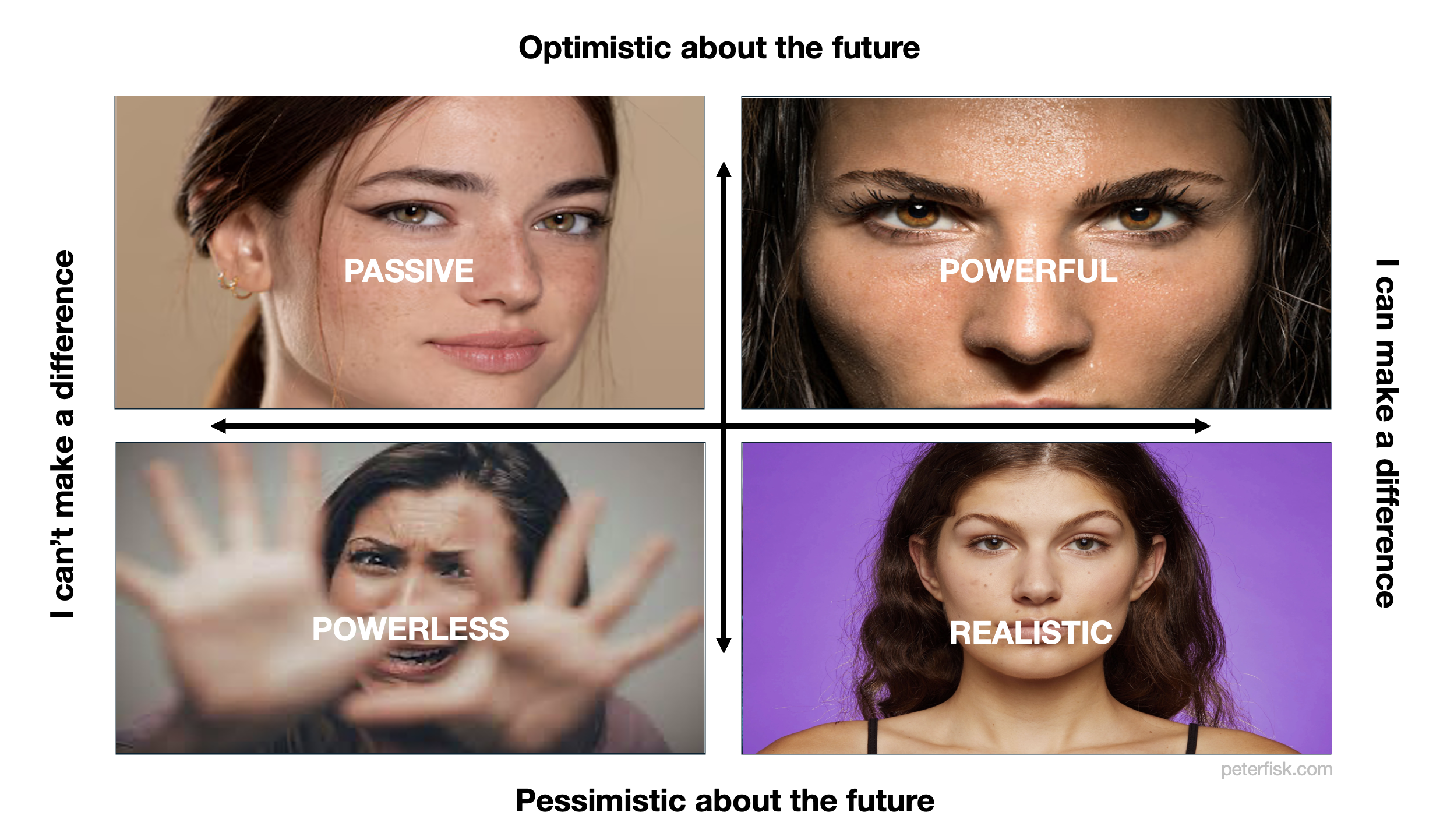
You could apply this to a 10 year perspective, but to a much shorter timeframe too. You can frame it in the context of the changing world generally, or of your more specific situation, your local market or organisation. You can do it as a team, then explore how different mindsets are creating barriers, tensions or slowing you down.
So which category do you most closely associate with?
- Powerful: You acknowledge that things are good and believe that they can get better. You are confident in your ability to act and create a better future.
- Passive: Though your vision of the future is positive; you tend to be more of an observant than an active change agent. You expect those in power to make the call; you’ll adapt and play along.
- Powerless: Not only your perception of the present is negative, but you also feel that things will get worse. That perception makes you feel free. As there’s nothing you can do about it, you don’t feel responsible if things get even worse.
- Realistic: Your vision of the future is not positive, but you still believe in your ability to influence the outcome. However, this duality creates some mixed feelings. You think it’s worth trying but are not so confident about how much of a difference you can create.
There is no right or wrong. These feelings are all entirely natural, and largely driven by our context – how much we know about the changes happening, our personal experiences of their impacts, and how able we currently feel able to address them in a positive way.
Much of my work with business leaders is focused on helping them to make sense of the changing world, and then to develop new directions for innovation and growth. This is not easy for many. We have grown accustomed to what we know, to building on the past rather than exploring the future, to plan with certainty and numeric precision.
Today’s world, and tomorrow’s world, is much more turbulent, evolving faster than ever, and with new capabilities to address the big challenges and seize even bigger opportunities like never before.
Geopolitical change, economic turbulence, climate crisis, exponential technologies can all feel intimidating, and bewildering, at first. But as you start to make sense of these changes, they feel more manageable.
Once you get a better grasp of the drivers of change, you start to feel more comfortable. Once you start to explore the opportunities of change, you feel more positive. Once you learn how people and companies around the world are seizing these opportunities, you get excited.
Change is our opportunity. Our future is full of incredible opportunities. Time to be the optimist. Time to seize the change.
It was US naval Rear Admiral Grace Hopper who first, famously suggested to his teams “ask for forgiveness, not permission” as a way to move faster, and overcome the frictions of organisational hierarchy.
“Permissionless” organisational structures refer to systems where individuals or teams can act, experiment, and innovate without needing constant approval from hierarchical authorities. This concept, borrowed from decentralized networks like blockchain, is increasingly relevant in the shift from traditional mass-production models to more agile, digital, personalized, and asset-light paradigms.
Here’s how “permissionless” structures support organisational change:
1. They are fast and adaptive
In the age of mass production, success depended on scale, efficiency, and standardization — characteristics well-suited to hierarchical command-and-control systems. But in today’s environment, where products and services are often digital, data-driven, and rapidly evolving, success hinges on speed, responsiveness, and constant iteration.
Permissionless structures empower individuals and teams to act without waiting for executive sign-off. This reduces bottlenecks, accelerates decision-making, and encourages continuous adaptation. Teams can respond directly to customer feedback, market shifts, and technological opportunities — a critical capability in a world of short product cycles and fast-changing user needs.
2. They empower local innovation
Asset-light, platform-based businesses (like Uber, Airbnb, or Shopify) thrive by leveraging ecosystems rather than owning infrastructure. Similarly, permissionless organizations shift innovation to the edges — empowering teams closest to customers, data, and context to drive change.
Instead of top-down directives, employees are trusted to test ideas, launch pilots, and iterate fast. This decentralised innovation model taps into the collective intelligence of the organisation, enabling many small bets rather than a few big ones.
3. They align with digital modular workflows
Digital business models are inherently modular and composable — built on APIs, microservices, and low-code/no-code tools. Organizational structures are evolving to match. In a permissionless system, cross-functional squads can self-assemble around projects, plug into shared resources, and build value without bureaucracy.
This mirrors how modern tech platforms operate — permissionless innovation has powered everything from open-source software to decentralized finance. When applied to internal teams, it unlocks experimentation, reduces dependency on rigid roles, and fosters a maker mindset.
4. They redefine leadership and accountability
In permissionless structures, leadership shifts from control to enablement. Leaders create guardrails, principles, and shared goals — but don’t micromanage execution. Accountability becomes peer-driven, with a strong emphasis on transparency, outcomes, and data.
This is particularly effective in purpose-driven or knowledge-based environments, where motivation is intrinsic, and alignment is achieved through shared vision rather than rules. It’s how companies like GitLab, Haier, and Valve operate — with radical transparency, open decision-making, and distributed authority.
5. They are more resilient and adaptive
Legacy structures were built for predictability. But the digital era is defined by uncertainty, complexity, and exponential change. Permissionless models are antifragile — they allow organizations to evolve organically, learn from failure, and reinvent continuously.
Companies like Amazon (with its “two-pizza teams”) and Tesla (with flat, engineering-led teams) show how decentralization fuels reinvention. As industries become more fluid and boundaries blur, the ability to pivot fast becomes a competitive advantage — and permissionless systems make that possible.
Here are some of the best known examples of “permissionless” organisations adopting such principles:
Haier, the world’s largest home appliances company
- What: Rendanheyi – thousands of micro-enterprises
- How: Haier dismantled its traditional hierarchy and reorganized into over 4,000 self-managed “micro-enterprises.” Each team operates like a startup with P&L responsibility, direct customer engagement, and freedom to choose partners and projects — even from outside Haier. Leadership serves as a platform, not a command center.
- Why: This structure has enabled rapid innovation, closer customer relationships, and the incubation of entirely new business models. Haier’s transformation has made it a global role model for decentralized organization.
GitLab, the digital open management platform
- What: Radical transparency and asynchronous workflows
- How: GitLab is a fully remote company where anyone can contribute ideas and improvements across the entire business. Its company handbook — over 2,000 pages — is open to the public, and employees are encouraged to self-serve, propose changes, and take initiative without waiting for top-down approval.
- Why: GitLab scaled from a small open-source project to a billion-dollar company with thousands of employees and customers — all while embracing autonomy, transparency, and continuous iteration.
Valve, the American video gaming publisher
- What: No formal hierarchy, team self-selection
- How: Valve famously has no bosses. Employees choose which projects to work on, and teams form organically. Desks are even on wheels so people can move to new teams physically. The company trusts its people to decide how to create the most value.
- Why: Valve has produced massively successful, disruptive games (e.g. Half-Life, Portal, Dota 2) and the Steam platform — innovations that emerged from bottom-up initiative rather than strategic mandates.
Amazon, the everything store with two-pizza teams
- What: Autonomous teams with modular infrastructure
- How: Jeff Bezos’s “two-pizza rule” mandates that teams should be small enough to be fed with two pizzas and operate autonomously. Amazon also requires all teams to expose their capabilities via internal APIs — meaning teams can build independently, integrate quickly, and iterate fast.
- Why: This structure enabled Amazon to build AWS, Alexa, and Prime as distinct, customer-focused innovations that could scale without centralized bottlenecks.
37Signals, aka Basecamp, the US software company
- What: Flat, asynchronous, low-intervention management
- How: 37signals intentionally resists hierarchy, meetings, and busywork. Teams self-organize around six-week cycles, build autonomously, and release independently. The leadership provides direction, but not constant oversight.
- Why: They’ve sustained profitability, simplicity, and loyal users for over 20 years — showing that permissionless, calm cultures can thrive in digital environments.
Uniswap & DAOs, decentralised code-based organisations
- What: Protocols, smart contracts, and token-based governance
- How: Uniswap (a decentralized crypto exchange) operates via smart contracts — users can build, transact, or innovate on the protocol without needing permission from a central authority. DAOs (Decentralized Autonomous Organizations) take this further, enabling decentralized governance where anyone with a token can propose or vote on changes.
- Why: While experimental, these models offer a glimpse into how permissionless structures might evolve in future digital-native enterprises — blending code, community, and autonomy.
These organisations span industries — manufacturing, tech, gaming, finance — yet all show that removing barriers to action and decentralising authority enables faster learning, deeper engagement, and greater adaptability.
It’s time to reinvent the rules, operating paradigms, and business mindsets of the past. Prioritising human performance can help organisations make the leap to the future, to embrace the opportunities of change, and shape a better future for their organisations and themselves.
We live in a world where business is no longer defined by sectors or geographies, organisations are not limited by physical resource or existing capability, and performance is not about financial results alone. Work is no longer defined by jobs, the workplace is no longer defined by location, many workers are not conventional employees, and HR is no longer a defined function. These old boundaries have become constraints, and acknowledged as irrelevant,
Business leaders, from board members to team coordinators, are the driving force of not just a change in practice, but also attitudes and behaviours that can imagine new possibilities, and deliver practical realities.
- Global Human Capital Trends 2024 by Deloitte
- Workforce 2.0: Unlocking Human Potential by Mercer
- A New Future of Work by McKinsey
- The Human Capital Era by Forbes
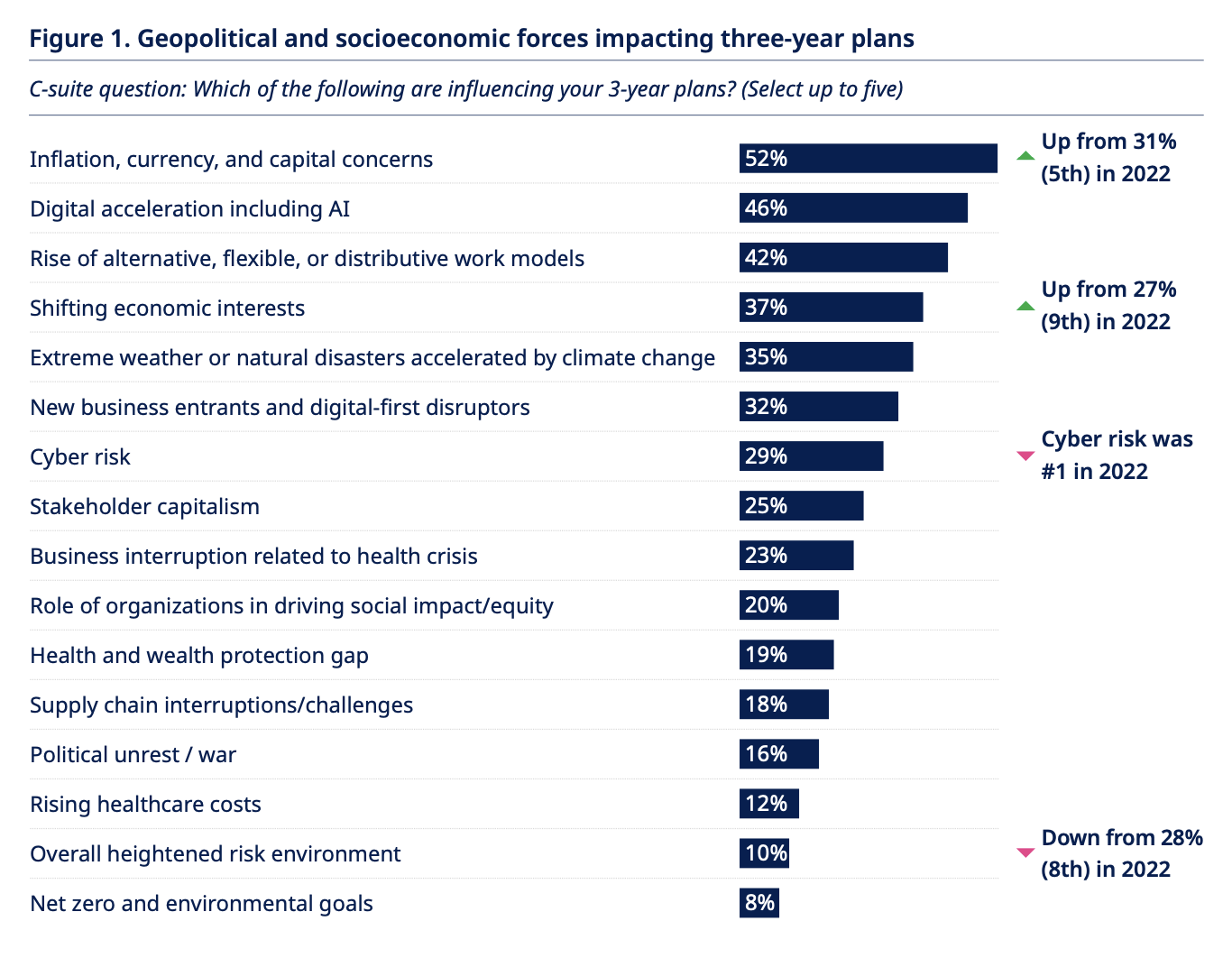
According to the excellent Workforce 2.0 report, based on research with 12,000 global C-level executives, the rise of new work models is almost as significant to the future of organisations as digital tech and AI, and more important that shifting economies, and climate change:
So what are some of the big themes and emerging trends in human capital, and how it drives both public and private organisations forwards?
- Future Ready: Does your organisation have the mindset, talent, capabilities to envision a better future, and to deliver the transformational projects and practices to make that happen?
- Thriving Beyond Boundaries: Organisations are moving beyond traditional boundaries, both physical and organizational, to create more flexible and inclusive work environments. Example: NEOM in Saudi Arabia is developing a cognitive city that aims to be sustainable and hyper-connected.
- From Function to Discipline: HR is evolving from a siloed function to a boundaryless discipline that integrates with the people, businesses, and communities it serves. Example: Deloitte is focusing on human performance and creating value for all people connected to the organization.
- Reskilling Revolution: Upskilling and reskilling the workforce to meet the demands of a rapidly changing job market. Example: Amazon has invested heavily in training programs to help employees transition to new roles within the company.
- The Great Reevaluation: Redefining the employee value proposition to attract and retain top talent. Example: Google offers a range of benefits and perks, including flexible work arrangements and wellness programs, to keep employees engaged and satisfied.
- The Algorithmic Advantage: Leveraging technology, such as AI and data analytics, to enhance workforce management and decision-making. Example: IBM uses AI-driven tools to help HR professionals make data-informed decisions about talent acquisition and management.
- Microcultures: Enabling a “culture of cultures” tailored to the needs of local teams while aligning with organization-wide values. Example: Microsoft supports diverse teams and encourages local cultural practices within its global offices.
- Play and Experimentation: Creating digital playgrounds where employees can experiment and innovate in a safe space. Example: IDEO encourages employees to engage in creative workshops and brainstorming sessions to foster innovation.
- Human Sustainability: Prioritizing human sustainability by creating value for employees and ensuring their well-being. Example: Patagonia focuses on sustainability and employee well-being, offering programs like on-site childcare and environmental initiatives.
- Platforms of Talent: Instead of thinking of organisations as platforms for development and delivery of products and services, ecosystems connecting with suppliers and customers, think of them as platforms that bring together unique, diverse and unlimited talent. How can that deliver more?
And we know what this demands in terms of people. To thrive in the future, businesses will need to adopt new mindsets, develop key capabilities, and nurture specific talents:
Mindsets
- Growth Mindset: Embracing challenges, learning from failures, and persisting in the face of obstacles.
- Customer-Centric Mindset: Prioritizing customer needs and experiences in all business decisions.
- Sustainability Mindset: Integrating sustainable practices into business operations to ensure long-term success.
- Innovation Mindset: Encouraging creativity and experimentation to drive continuous improvement and new solutions.
Capabilities
- Digital Literacy: Proficiency in using digital tools and platforms to enhance business processes and decision-making.
- Agility: The ability to quickly adapt to changing market conditions and customer demands.
- Data Analytics: Leveraging data to gain insights, make informed decisions, and predict future trends.
- Collaboration: Working effectively across teams and departments to achieve common goals.
- Cybersecurity: Protecting sensitive information and systems from cyber threats.
Talents
- Critical Thinking: Analyzing information objectively and making reasoned conclusions.
- Emotional Intelligence: Understanding and managing emotions, both one’s own and those of others.
- Leadership: Inspiring and guiding teams to achieve their best performance.
- Communication: Clearly conveying ideas and information to diverse audiences.
- Problem-Solving: Identifying issues and developing effective solutions.
Syzygy has its origins in the Greek word suzugia, meaning yoked or paired, and became popular in 18th century Latin and English. More generally is means a conjunction or alignment. Synergy is a more modern word derived from it.
What does it take to transform your business effectively?
Consider how these organisations have reinvented themselves:
- Berkshire Hathaway started as a merger of the Berkshire Spinning Association and Hathaway textile mill. Warren Buffett transformed it into an investment powerhouse.
- Domino’s Pizza stands out amongst today’s fast food retailers, reinventing itself to offer a digitally-centric brand experience that people will pay more for.
- National Geographical grew famous through print. Then it started exploring more instant and immersive media, becoming the most popular brand on Instagram.
- Nintendo was founded in 1889 by Fusajiro Yamauchi as a playing card company, transformed over the last 60 years his grandson Hiroshi into a digital gaming empire.
- Shell was a London shop specialising in exotic shells from Asia before becoming the world’s largest oil company, and now seek to transform itself into clean energy.
- Western Union, once a network of early telegraph companies in the American outback, reinvented itself as the world’s largest money transfer service.
- Wipro started in 1945 selling vegetable oil, before diversifying into other products. It is now one of the world’s largest IT outsourcers and software engineers.
- American Express’s Ken Chenault says, “successful transform demands unchanging change”, requiring constant values but relentless reinvention.
Business Transformation
Sometimes it’s a financial crisis, sometimes it’s the threat from a disruptive competitor, sometimes growth stagnates as markets mature or decline, sometimes it’s the opportunity to ride a new global megatrend, and sometimes it’s the result of proactive strategic planning.
To better understand the dynamics of why and how transformation happens, Innosight’s “Transformation 20” study evaluated the strategic change efforts of many companies, seeking to identify best practices across industries and geographies. The ranking is based on three factors: finding new growth (% of revenue beyond core), repositioning the core (giving the legacy business new life), financial growth (revenue, profit and economic value over the transformation).
Scott Anthony describes the essence of this kind of transformation: “What businesses are doing here is fundamentally changing in form or substance. A piece, if not the essence, of the old remains, but what emerges is clearly different in material ways. It is a liquid becoming a gas. Lead turning into gold. A caterpillar becoming a butterfly.”
Here are some examples of such transformations:
- Adobe … transformed from product to service, from document software into digital experiences, marketing, commerce platforms and analytics
- Amazon … transformed its own infrastructure into “Amazon Web Services” which enables other organisations to operate their online businesses.
- DBS … transformed itself from a regional bank to a global digital platform, a “27,000-person start-up” and crowned “Best Bank in the World.”
- Microsoft … transformed from a business model based primarily on selling product licenses (IP), to a cloud-based platform-as-a-service business.
- Netflix … shifted from DVDs by mail into the leading streaming video content service and now a top original content provider.
- Ping An … transformed itself from insurance into a cloud tech business providing fintech and AI-based medical imaging & diagnostics.
- Tencent … transformed from social and gaming business to a platform embracing entertainment, autonomous vehicle, cloud computing, and finance.
Transformation is about significant, lasting, non-reversible change to the way in which the company operates and creates value, typically where at least 25% of total revenues comes from new business units or business models. It can take time, 10 years as demonstrated by Orsted, but also sets the business on a new course for a better future.
Whilst digital technologies are a significant enabler of transformation, companies should beware of the term “digital transformation” which is often used to describe the automation of business functions, seeking more efficiency and speed, or broader applications of technology. Similarly, “culture change” is not the same as business transformation. In both cases it is only transformative if it is accompanying by a more holistic reinvention of the business, including its strategy and business models, propositions and performance.
Pivot to a new space
The destination of any transformation might be quite different from how it was initially envisioned. Many projects, and even businesses, find that they reach a point where they need to significantly change direction, based on what they have learnt. This is a “pivot”, and has been a feature of many start-up journeys in recent years.
- Instagram initially known as Burbn started out as an online discussion forum developed by Kevin Systrom whilst learning how to program, but now has 1 billion users simply sharing images.
- Slack started as a game called Glitch, developed by Stewart Butterfield after he sold Flickr. The game didn’t take off, but its platform evolved to become Slack, a place for collaborative working.
- Twitter was previously known as Odeo, a podcasting platform before podcasts took off. Jack Dorsey decided to shift to microblogging as he called, it, rebranding it as Twitter, and a leader in short posts and status updates.
- YouTube originated as a dating site, encouraging people to upload videos of themselves. Few people embraced the concept, but when the site opened up to anyone who wanted to share a video, over 2 billion people signed up.
For larger organisation, they need to learn to pivot as part of their evolution, and as a sequence of transformations.
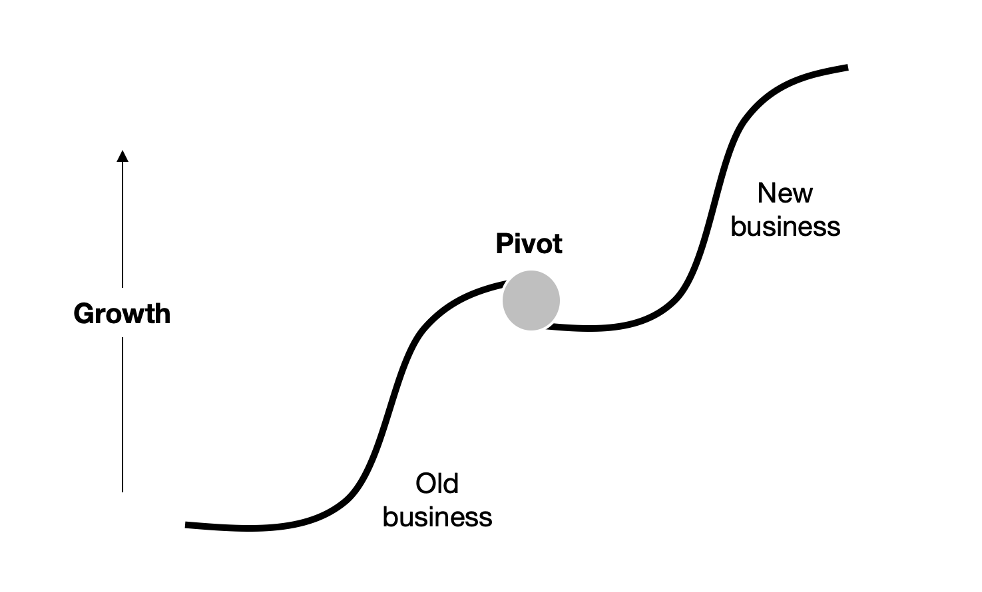
As they ride the “S curves” of market change, they accelerate as new ideas take off, but then slow as ideas mature. Eventually, without change, the old business declines, as the market moves in new directions, and a new S Curve takes off. The challenge of transformation is to ride the S Curves, jumping to the new curve whilst still thriving on the old curve, transforming before you need to.
Evolve to revolve
Transformation does not have to be a sudden shift from one state to another, and can be more evolutionary. Indeed a persistent, focused approach to incremental change, not simply on efficiency but on improved competitive performance, can sometimes have just as much transformational impact.
I first learnt about “marginal gains” whilst watching cycling. Dave Brailsford was the new performance director of Team GB, who in recent years have come to dominate the sport. Marginal gains was said to be his secret to superior performance.
Brailsford and his coaches began by making small adjustments you might expect from a professional cycling team. They redesigned the bike seats to make them more comfortable and rubbed alcohol on the tires for a better grip. They asked riders to wear electrically heated overshorts to maintain ideal muscle temperature while riding and used biofeedback sensors to monitor how each athlete responded to a particular workout. The team tested various fabrics in a wind tunnel and had their outdoor riders switch to indoor racing suits, which proved to be lighter and more aerodynamic.
Then they went further. They tested different types of massage gels to see which one led to the fastest muscle recovery. They hired a surgeon to teach each rider the best way to wash their hands to reduce the chances of catching a cold. They determined the type of pillow and mattress that led to the best night’s sleep for each rider. They even painted the inside of the team truck white, which helped them spot little bits of dust that would normally slip by unnoticed but could degrade the performance of the finely tuned bikes.
1% became the team mantra, and led to phenomenal success, including six Tour de France victories in seven years, and multiple Olympic gold medals. Whilst some have become concerned that the search for an edge can take sports to blurred ethical practices, Brailsford has always maintained that every gain was scientific and legal.
Indeed, in 2018, Brailsford was the technical mastermind behind Eliud Kipchoge’s first sub 2 hour marathon, focusing on every marginal gain from the surface and camber of the road, to the weather temperature and humidity, pace making and shoe design.
From cycling to marathon running, cyber security to car manufacturing, organisations have found that 1% improvement can make a big difference. Lots of small changes can add up to more than one big change. Concentrate on making many 1% improvements and you’ll find the compound effect is huge, without putting all your eggs in one basket of transformational change.
Exploit and Explore
I spent much of 1999 working with Philips. I remember it well, largely because of the regular short flight from London to Eindhoven. Even the earliest flight, often delayed by fog, meant that I rarely arrived at the head office before 1100 because of the time difference. In Holland, lunch is at 1130, and always a cheese roll and carton of milk. They grow tall on their dairy intake. As we ate, change was always the topic of conversation.
Philips was founded back in 1891 by Gerard Philips who bought an empty factory in Eindhoven, where the company started the production of carbon-filament lamps.
Over the next century the company started to extend into other electronics businesses such as vacuum tubes, electric shavers, radios (and even a radio station). Televisions followed, which evolved into a battle of formats for video cassettes and laser discs. Toothbrushes too. Throughout this time, the core lighting business had continued, evolving from filament bulbs into new formats such as LEDs, supported by its semiconductor business.
In the early 2000s, Philips symbolically shifted its head offices from Eindhoven to Amsterdam, and started to acquire a number of healthcare companies, from diagnostic scanners to surgical devices. It’s core started to shift away from electronics. In 2018 it formally divested its lighting business, which was renamed as Signify, although continuing to use the Philips brand on its products under license. Healthcare became the new core business.
Transform for today and tomorrow
How can you create the future, whilst at the same time deliver today?
Janus was a Roman god with two sets of eyes, one pair focused on what lay behind, the other on what lay ahead.
Change unlocks new opportunities to create new markets. It is the moment when a business typically needs to protect and improve its current activities, but also seize the opportunities of tomorrow, to explore and create new businesses.
Like Janus, business needs to be ambidextrous, to simultaneously think and work in the short and long-term. Short-term sales earn the cash, but also the permission, to create a better future. However, this is not a sequential challenge, nor a parallel challenge. The organisation shouldn’t delay tomorrow in order to win today or work separately on both.
The trick is to ensure that today leads to tomorrow, short-term actions lead to long-term progress. Too many leaders become obsessed by the short-term, and lose sight of the bigger goals. Of course, a heads-down focus on grinding out results looks good, often sub-servient to the perceived impatience of investment analysts. But this misses the point. Investors are most interested in future success, today is just a guide to it.
Dual Transformation
Scott Anthony, in his book “Dual Transformation”, describes this shift as three components.
- Transformation A: repositioning and improving the core business to maximise resilience (eg Adobe moving from packaged software to SaaS).
- Transformation B: creating a new growth engine (eg Amazon adding cloud computing services, and streaming content on top of ecommerce).
- Capabilities C: the best way to share assets and resources, brand and scale, and managing the interface between the core and the new.
Transformation A involves accepting changed circumstances, devising new metrics, and bringing in fresh talent experienced in emerging work environments. Transformation B requires understanding of future opportunities, changing consumers, and value patterns. This helps develop new business models through iterative experimentation and willingness to pivot. This may involve acquiring other companies and forging new partnerships, depending on expectations of impact periods.
Anthony likens the capability link to an airlock in a spaceship or submarine. This team includes savvy veterans and diplomatic managers, but the business leader will need to drive hard decisions on which core skills are relevant during transformation, and arbitrate during the inevitable arguments and turf wars. Tough calls will need to be made regarding speed of operation, pricing options, and assessing some of the inevitable failures along the way. Other challenges in dual transformation are balancing attention and assets, and protecting traditional income streams while also growing new sources in a slow and experimental manner.
Shifting the core
As businesses evolve, their centre of gravity moves.
We see this in the evolution of IBM, which grew famous as the innovator of mainframe computers. As the market shifted, driven by technological evolution, from mainframe to desktop to laptop, IBM found many more competitors.
For some time it moved with the trend, developing its own desk and laptops, whilst also exploring new business areas, particularly in services like consulting. Eventually it recognised that its strength was no longer in making any type of computers, but in the advice it could offer, and shifted to become a consulting business at its core.
The shit in the core can be seen in three stages:
- Focus on the core: clearly define your core business, strengthen it and seek to drive growth through it in existing and new markets
- Beyond the core: extend into adjacent markets, that can leverage off the core like IBM into services, with their own revenue streams
- Redefine the core: as markets evolve, the old core business may start to decline, before which is the time to shift to consolidate the new core
Whilst this shift might seem a fundamental transformation of the business, as we saw with Philips, it might simply be about following the same purpose, but interpreting how to deliver on that purpose in new and evolving ways. The shift might equally be represented by a more intangible asset, such as brand or capability, which can be deployed with partners in new industries, as in the shift of Ping An.
Outside in, Inside out
DBS is regarded by many as the world’s most innovative bank. The Singapore-based bank seeks to deliver a new kind of banking experience that is so simple, seamless and invisible, that customers have more time to spend on the things they care about.
CEO Piyush Gupta calls it “the invisible bank” where financial transactions are embedded deep within the activities of everyday life – from travel to shopping, eating to entertainment. No longer do people need to think of banking as a separate activity, it is part of everything.
Whilst much of DBS’ transformation from a very average regional bank to become a global leader, has been about digital technologies, Gupta says that it is not about the technology.
“If we just tried to apply technology to the existing banking model, we would just end up being an efficient bank” he says, which he sees as ok, but not exactly ambitious. What he really wanted to do was transform the concept of banking so that it can make people’s lives better.
Every child in Singapore, for example, now wears a DBS fitness bank, which is supplied free of charge by schools. The device enables kids to gamify their fitness, comparing how many steps they have made each day, to improve health. However it also has a GPS whereabouts app, so parents know where their kids are, for safety. And an electronic payment app for school travel and meals.
To achieve this transformation, Gupta realised that he had to create a customer-centric business first, before he could digitalise it. This required a fundamental change in culture and processes, products and services, Over three years he worked tirelessly to get people to see what they did from a customer perspective, using high energy “hackathons” in the business, to engage people and generate new ideas.
Only when he was satisfied that the business had a new mindset, and had at least started on a transformation to true customer-centricity, did he begin to explore the potential of new technologies to facilitate and accelerate the transformation.
“This is not putting customers at the centre of banking” he says “but about embedding banking into people’s everyday lives”.
Outside in
In my book “Customer Genius” I describe the transformational journey to become a customer-centric business. From a vision about making life better to deep insights about what matters most to your customers, through problem solving and value propositions, customer experiences and relationships, I defined a business built around people not around products.
Transforming your business from the outside in starts with:
- Customers: who do you want to serve, why and how?
- Insight: what do they really want, and what matters most?
- Experience: how to develop solutions to deliver the benefits?
- Engagement: why they will be attracted to the proposition?
- Delivery: how to deliver it, in a distinctive, profitable way?
Customer-centric businesses thrive on a passion for service, to “go the extra mile” for their customers, to build retention and loyalty as a more certain future streams of profits. It is a simple, human, motivating way to think about why you are in business.
Most companies have been trying to develop a “customer-centric” culture for at least 25 years. Being in tune with the customer enables companies to be more responsive to markets, to retain customers through better service, to differentiate from competitors, but also be more aligned with the changing outside world.
Inside Out
But then I hit an ideological barrier. An alternative perspective is that business should change from the “inside out”. Shouldn’t you start with the values and virtues of your organisation, and then make them strong and attractive? “Steve Jobs never asked customers what they wanted, and customers don’t really know anyway” they would say. Or to quote Richard Branson “employees come first, customers come second”.
Transforming your business from the inside out starts with:
- People: what do we do, what are we motivated by?
- Capability: what are our skills, our distinctive strengths?
- Products: which products to develop, quality and cost?
- Process: how to deliver it in a fast and efficient way?
- Sales: how many can we sell, to ensure our profitability?
There is logic in this approach too. Whilst the old adage that a business should “focus on your core competences” is outdated – maybe true in a steady state world, but not one of relentless changing opportunities and partnerships – the real strength of thinking inside out is to build on your culture. If organisations are defined by people, then cultures, and the beliefs and behaviours which they drive, are sources of strength and differentiation.
You could say that this is semantics, but for many leaders it can be confusing. “Inside out” is guided by doing what you do better, the more efficient use of resources and new applications of capabilities. “Outside in” is driven by doing what customers want, innovation and agility in response to change.
I remember this “outside in vs. inside out” debate as I discussed growth strategy with an executive team of a Silicon Valley company. They were a technology company, in fact almost every person was a trained software engineer. To them the most important document was the “product roadmap”. This guided their progress through subsequent releases of products, as their products got better – in their case, faster, smaller, cheaper.
I questioned whether this is what customers really wanted. Shouldn’t we be guided by what matters most to customers, and when they want it, and how we can enhance the product through additional products, services, and experiences? Yes maybe. But the product, to them was the king. It took at least 18 months of culture change before I eventually got them to begrudgingly respect the “customer roadmap.”
Transforming with purpose
The answer, as in the story of DBS’s transformation, is that you need both of course. The best starting actually is neither outside or inside, but with your purpose. Why do you exist? What is the contribution which you seek to make to the world, to society, to people?
A purpose is ultimately an “outside in” statement. It is based on what you enable people to do, rather than what you do. However a purpose is “inside out” in the sense that it becomes the guiding principle of the whole business, its culture, its strategic choices, and motivation for why we come to work each morning.
Transformation goes beyond what do customers want, or what capabilities do we have. It needs to start at a higher level. You might not currently have the right customers, or even be in the right market. As Steve Jobs said, they might not be able to articulate what they want, although I suggest he was actually bringing a customer mindset into play for them.
In a world where you can do anything, be guided by your purpose. Create a business that succeeds by doing more for the world, bringing together the inspiration of the outside, and imagination of the inside.
Brené Brown, research professor at the University of Houston known for her pioneering work on vulnerability, shame, and empathy, wrote Atlas of the Heart: Mapping Meaningful Connection and the Language of Human Experience to help people better understand and articulate the full spectrum of human emotions. Brown argues that our ability to name, distinguish, and communicate feelings is central to cultivating deeper connections, resilience, and well-being. She calls this process “emotional granularity”—the precision with which we identify and express emotions—and believes that without this skill, relationships and personal growth remain stunted.
The book is both guidebook and map. Brown organizes more than 80 emotions and experiences into distinct groups, exploring their nuances, common misconceptions, and how they show up in our lives. Using storytelling, research, and cultural references, she illuminates the often-overlooked differences between related emotions and why those differences matter for human connection.
Why Language of Emotions Matters
Brown opens with the premise that we cannot connect meaningfully without language. When people lack the words to describe their feelings, they tend to shut down, lash out, or misinterpret others. For example, confusing “stress” with “overwhelm,” or “envy” with “jealousy,” can lead to misunderstandings and fractured relationships. By expanding our emotional vocabulary, we expand our capacity for empathy, curiosity, and compassion.
Brown draws on research from psychology, neuroscience, and linguistics to show that language shapes emotional experience. People who can precisely identify their emotions are more adaptive, make better decisions, and navigate conflict with greater skill.
Mapping Emotions: The Main Categories
Brown organizes emotions into thematic chapters, each grouping together related feelings and experiences. Some of the most significant clusters include:
1. Places We Go When Things Are Uncertain or Too Much
This section explores stress, overwhelm, anxiety, worry, avoidance, and excitement. Brown highlights the importance of distinguishing between stress (an external pressure) and overwhelm (a state of being unable to function due to too many inputs). Anxiety is described as persistent uncertainty coupled with fear, whereas worry is the cognitive process of replaying possible bad outcomes.
Excitement is an important counterpoint: physiologically similar to anxiety, but framed with a positive outlook. Recognizing this difference helps us reframe fear-inducing situations into opportunities.
2. Places We Go When We Compare
Here Brown explores comparison, envy, jealousy, resentment, and admiration. She stresses that comparison is an almost automatic human process, but its impact depends on context: it can motivate growth or fuel shame.
Envy (wanting what others have) is distinct from jealousy (fear of losing something we already have). Brown also reframes resentment as unmet expectations poorly communicated, not just bitterness. By untangling these emotions, we can turn comparison into self-awareness rather than self-destruction.
3. Places We Go When Things Don’t Go as Planned
Disappointment, expectations, regret, discouragement, resignation, and frustration belong here. Brown describes disappointment as unmet expectations with an emotional punch, while regret is tied to personal responsibility for choices. Frustration emerges when obstacles block progress, while discouragement occurs when setbacks feel insurmountable.
This cluster underscores the human need to balance realistic expectations with hope, and to practice resilience when things fall apart.
4. Places We Go When It’s Beyond Us
This chapter focuses on awe, wonder, confusion, curiosity, and interest. Brown distinguishes awe (a mix of reverence and fear in the face of vastness) from wonder (an openness to mystery and possibility). Curiosity is portrayed as a superpower—driving learning, creativity, and connection—while confusion is reframed as a productive state, signaling that growth is possible.
5. Places We Go When Things Aren’t What They Seem
Surprise, expectations, disappointment, and curiosity appear here. Brown emphasizes the role of storytelling in how we make sense of surprises—whether delightful or disruptive. Our expectations shape whether a surprise feels like betrayal or discovery.
6. Places We Go When We’re Hurting
This section covers anguish, grief, despair, sadness, and hopelessness. Brown insists on normalizing grief as a natural process, not something to “get over.” She distinguishes grief (a multifaceted response to loss) from sadness (a more general emotional state). Hopelessness, she argues, is one of the most dangerous feelings because it robs people of agency and perspective.
7. Places We Go With Others
Here Brown explores compassion, empathy, pity, and sympathy. Empathy is defined as connecting with the emotions of another, without judgment or problem-solving, while compassion adds the motivation to alleviate suffering. Pity, by contrast, creates distance and hierarchy. Brown emphasizes empathy as foundational for trust and belonging.
8. Places We Go When We’re in Struggle
Vulnerability, shame, guilt, humiliation, and embarrassment reside here. Brown draws on her earlier research, showing that vulnerability is not weakness but courage—the birthplace of creativity, love, and belonging.
She carefully distinguishes shame (“I am bad”) from guilt (“I did something bad”), with shame being corrosive to identity and belonging, while guilt can be constructive in prompting change. Humiliation differs from shame in that it is undeserved and externally imposed, while embarrassment is fleeting and socially recoverable.
9. Places We Go When We Feel Connection
Belonging, fitting in, connection, disconnection, trust, and love form this cluster. Brown argues that true belonging requires authenticity—being accepted for who we are—whereas fitting in demands conformity. Trust is described as built in small, consistent moments, and love as a practice more than a feeling.
She emphasizes that connection is the essence of human life, and the lack of it leads to isolation, fear, and shame.
10. Places We Go When the Heart is Open
Love, joy, calm, gratitude, contentment, and hope live here. Brown stresses that joy is the most vulnerable emotion because it carries the fear of loss. Gratitude, however, is the antidote to that fear—anchoring us in the present. Hope is redefined not as a passive wish but as a cognitive process built on goals, pathways, and agency.
Key Themes
-
Emotional Vocabulary as Power
Brown argues that many conflicts and breakdowns in relationships stem from an inability to name emotions accurately. Expanding our vocabulary increases empathy, clarity, and resilience. -
Connection Requires Vulnerability
The courage to express what we truly feel is the foundation of meaningful relationships. Avoidance, numbing, or pretending block intimacy and growth. -
Nuance Matters
Distinguishing between similar emotions (like envy vs. jealousy, stress vs. overwhelm) creates new possibilities for understanding ourselves and others. -
The Role of Storytelling
Brown emphasizes that humans are “meaning-making machines.” We constantly craft stories around emotions, often with incomplete information. Becoming aware of these narratives—and challenging them—frees us from distortions. -
Language Shapes Identity
Naming emotions gives us agency. Without words, experiences feel chaotic or overwhelming; with them, we can process, communicate, and make choices.
Practical Applications
Brown offers tools and reflective prompts throughout the book, encouraging readers to:
-
Build a shared language of emotions within families, workplaces, and communities.
-
Practice curiosity instead of judgment when emotions surface.
-
Create space for grief, regret, and vulnerability rather than suppressing them.
-
Use gratitude practices to counterbalance fear of joy’s impermanence.
-
Foster empathy and compassion through precise listening and recognition of others’ feelings.
The book is both deeply personal and highly practical, inviting readers to navigate their emotional landscapes with courage and precision.
Atlas of the Heart
Atlas of the Heart is ultimately about reclaiming the power of language to deepen human connection. By mapping 87 emotions and experiences, Brené Brown provides a toolkit for living with greater clarity, authenticity, and compassion. She challenges us to embrace vulnerability, expand our emotional vocabulary, and engage with others from a place of empathy and courage.
Brown’s central message is simple but profound: if we want to build meaningful connections, we must first learn to accurately name and share what we feel. This is the true atlas of the heart—a map that guides us toward belonging, understanding, and love.