What do business leaders need, or indeed want? Not another executive education course.
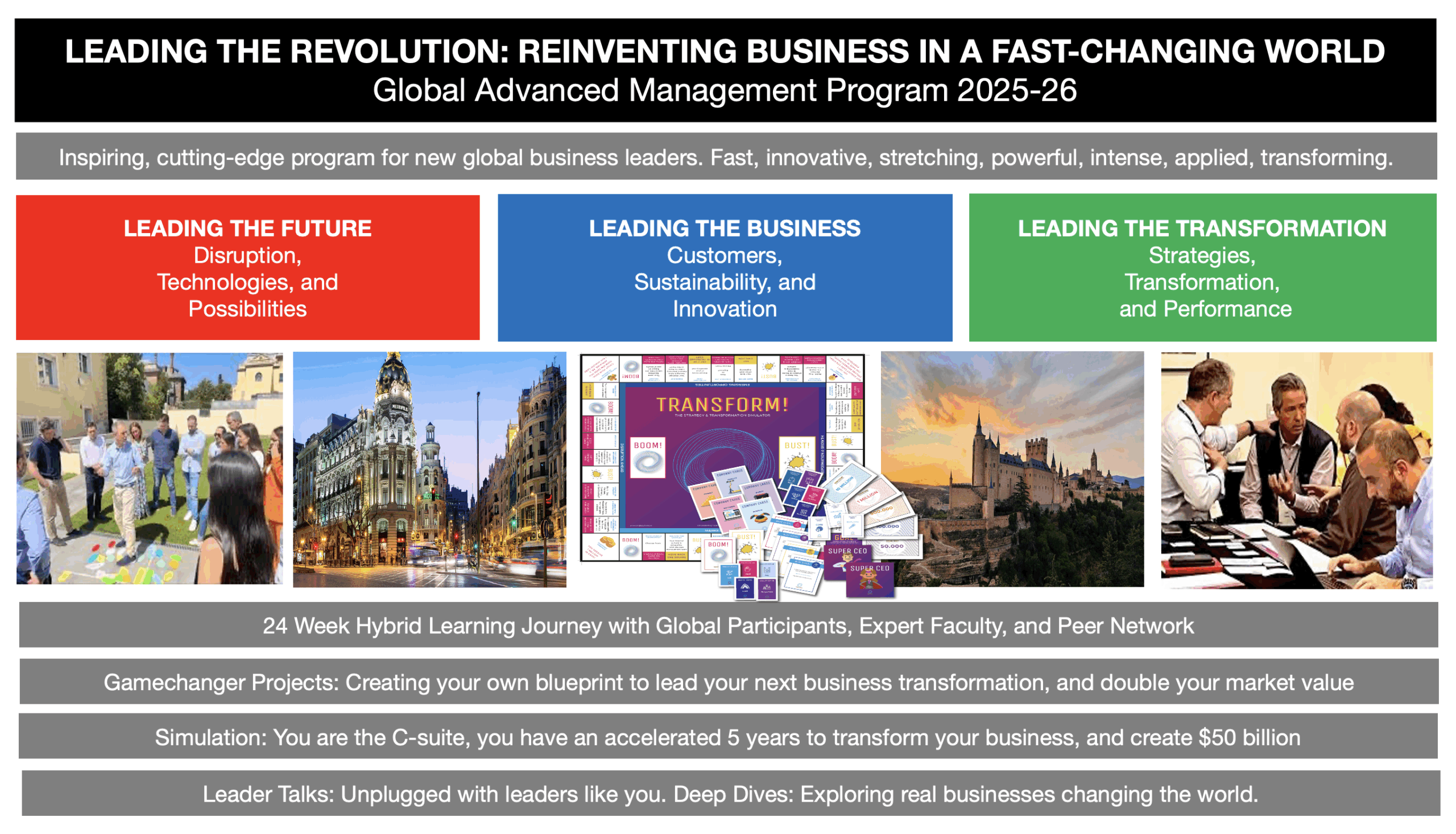
What they seek is a strategic reawakening. Because the future is here, yet much of its potential is still unrealised. It is a program that helps you to reinvent yourself, and your business, for a radically different world. It is an immersive, boundary-breaking program designed for senior business leaders who refuse to stand still. In a world of relentless change, exponential technologies, and the rise of next-generation companies, this is where transformation begins.
Why? Because today’s playbooks are broken. Global business is no longer about scale, but about speed. It’s no longer about optimization, but reinvention. It’s about thriving in an uncertain, complex world with new technologies and possibilities which demand new capabilities and mindsets. Market leaders today are agile, tech-native, purpose-driven, and constantly evolving. Are you ready to lead a business that can outpace disruption — and shape the future?
Who? Leaders who are ready to reinvent themselves, and their organisations. This is a program for current and aspiring C-level executives. And boards too. Heads of innovation, digital, strategy, sustainability. And more. People stepping up to explore new possibilities, ready to lead their business beyond, and shape a better future.
Reinventing business, reinventing yourself
In a world defined by relentless change and rising complexity, a new breed of businesses is emerging—ambitious, restless, and unapologetically visionary.
These companies are addicted to possibility, obsessed with the edges of tomorrow, and committed to turning what’s possible into what’s next. They don’t just chase trends—they shape the future, pioneering radical innovations that reinvent markets, solve global challenges, and unlock extraordinary value.
Moonshot thinking—once the realm of sci-fi dreamers and NASA engineers—is now the strategic DNA of the most disruptive and admired companies. Alphabet’s X (formerly Google X), Tesla, OpenAI, SpaceX, DeepMind, Moderna, and ambitious upstarts like Anduril, Neuralink, and Twelve are bold exemplars of this mindset.
These businesses are defined by their drive to achieve 10x improvements over 10% gains. They ask “Why not?” instead of “What if?”, and challenge the limits of what’s considered feasible—whether by launching reusable rockets, eradicating disease, creating human-AI symbiosis, or designing carbon-negative fuels.
A unique leadership journey
The Global AMP is an executive program that goes beyond text books, MBAs and conventional practice. It becomes a stretching immersion into the next world of business, starting in the future, then evolving to today. In particular it focuses on transformation – the radically reinvention of business, and of yourself as a leader. What got you here is unlikely to take you further. It requires disruption, imagination and change. In fact business transformation is probably the superpower of today’s most successful leaders.
- How will the markets of the future, be shaped by the best innovators of today?
- What are the best ways to imagine your future markets, and plot your strategies from the future back?
- How do you engage your people, your board, your investors, and other stakeholders?
- What are the critical assets, capabilities and resources that will be most important in the transformation?
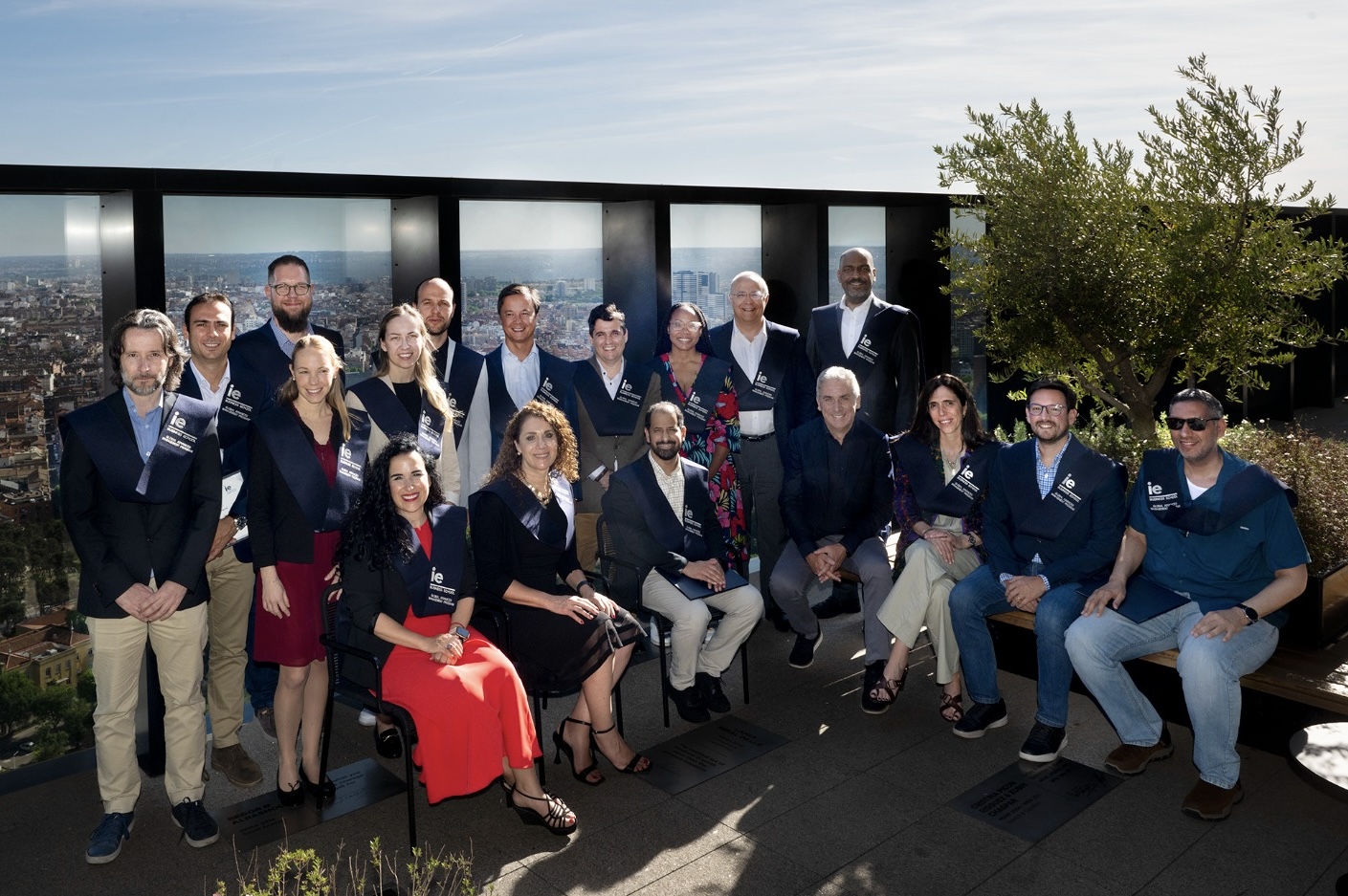
Each year, for the last 7 years, we have brought together 24-30 business leaders from around the world – different countries, different sectors, different backgrounds. But with an aspiration to lead the future of their organisations. Some are from large corporates, some from start-ups. Everyone is stepping up, to think different, to create and deliver innovation, to lead.

Building your new toolkit
Here are some of the most influential and emerging ideas in business, each reflecting the complex, fast-changing, and interconnected business landscape. These ideas go beyond traditional models to embrace uncertainty, systemic thinking, and value creation across new dimensions:
1. Ambidextrous Organizations
Key Idea: Winning firms are both efficient and innovative—exploiting existing capabilities while exploring new opportunities.
Thinkers: Charles O’Reilly & Michael Tushman
Application: IBM structuring separate units to run legacy systems vs. cloud/AI innovation; Amazon Web Services run autonomously from core retail.
Strategic Impact: Provides a model for structural balance, managing today’s business (exploit) while building the future (explore), and a double portfolio to optimise the two approaches.
2. Strategic Foresight
Key Idea: Strategy is no longer just based on forecasts, but on cultivating multiple future scenarios and building resilience, optionality, and adaptability.
Thinkers: Pierre Wack (Shell), Amy Webb (Future Today Institute)
Application: Shell’s scenario planning since the 1970s; LEGO’s Futures Lab building new play concepts.
Strategic Impact: Embeds uncertainty and weak signal detection into strategic planning.
3. Extreme Options
Key Idea: Balance between two extremes—hyper-conservative and hyper-risk-taking—to remain resilient in volatile environments.
Thinkers: Nassim Nicholas Taleb
Application: Amazon betting big on Alexa and AWS while optimizing retail margins; asset managers combining safe bonds with speculative crypto.
Strategic Impact: Helps organizations survive shocks while capturing upside from high-risk innovations.
4. Dynamic Capabilities
Key Idea: Competitive advantage lies not in static assets, but in a company’s ability to adapt, reconfigure, and innovate repeatedly in response to fast-changing environments.
Thinkers: David Teece, Gary Pisano
Application: Apple’s ability to transition from computers to music, phones, and services; Amazon continuously adapting its logistics and cloud strategy.
Strategic Impact: Shifts the focus of strategy from long-term planning to continuous renewal, learning, and responsiveness.
5. Ecosystem Building
Key Idea: Value creation happens within interdependent systems of organizations that co-evolve—success depends on aligning with partners, not just beating competitors.
Thinkers: Ron Adner (The Wide Lens), James Moore
Application: Tesla’s ecosystem of electric cars, charging infrastructure, energy storage, and solar tech.
Strategic Impact: Encourages companies to think systemically, innovate with others, and solve coordination challenges that affect adoption.
6. Ethical Foresight
Key Idea: Business strategy must include ethical foresight, not just profits—asking, “What kind of future are we enabling or preventing?”
Thinkers: Amartya Sen, Rebecca Henderson
Application: Microsoft refusing to sell facial recognition to law enforcement; Patagonia suing the US government over environmental policy.
Strategic Impact: Anchors strategy in values and systems thinking, especially amid rising stakeholder scrutiny.
7. Exponential Growth
Key Idea: Many technologies evolve on exponential curves—winning companies anticipate these curves, disrupt themselves, and scale rapidly.
Thinkers: Ray Kurzweil, Salim Ismail (Exponential Organizations)
Application: SpaceX’s 10x cost reduction in launches; OpenAI’s pursuit of general intelligence.
Strategic Impact: Encourages moonshot thinking, agile scaling, and bold bets—especially in tech-heavy industries.
8. Intangible Assets
Key Idea: The drivers of value today are mostly intangible—brands, data, IP, culture, trust—and require new methods to develop and manage.
Thinkers: Jonathan Haskel & Stian Westlake (Capitalism without Capital), Baruch Lev
Application: Apple’s brand ecosystem; Google’s AI algorithms; Salesforce’s customer success culture.
Strategic Impact: Reframes strategic advantage around invisible capabilities—and calls for better ways to measure value creation.
9. Strategic AI
Key Idea: Strategy is increasingly co-designed with intelligent systems—for pattern detection, simulations, and complex decision-making.
Thinkers: Rita McGrath, BCG Henderson Institute
Application: McKinsey using AI to analyze M&A patterns; Ocado leveraging AI for warehouse optimization.
Strategic Impact: Enhances human judgment with scalable, data-driven insights and scenario modeling.
10. Platform Strategies
Key Idea: Rather than controlling value chains, firms create value by enabling exchanges between users, producers, and partners through platforms.
Thinkers: Geoffrey Parker, Marshall Van Alstyne, Sangeet Paul Choudary
Application: Amazon Marketplace, Google Ads, Airbnb, and TikTok all succeed by leveraging two-sided (or multi-sided) networks.
Strategic Impact: Prioritizes network effects, user experience, and ecosystem orchestration over traditional supply chain control.
11. Polarity Management
Key Idea: Strategic tensions (e.g., scale vs. intimacy, speed vs. stability) are not problems to solve but polarities to manage dynamically.
Thinkers: Barry Johnson
Application: Netflix managing centralization of platform with decentralization of content creation.
Strategic Impact: Moves leaders beyond binary trade-offs to dynamic balance.
12. Purposeful Business
Key Idea: Companies with a clear and authentic purpose outperform over the long term, gaining trust, talent, and resilience.
Thinkers: Paul Polman, Rebecca Henderson (Reimagining Capitalism)
Application: Unilever’s Sustainable Living Plan; Patagonia’s mission “We’re in business to save our home planet.”
Strategic Impact: Aligns strategy with values, attracts stakeholders, and drives differentiation in crowded markets.
13. Regenerative Business
Key Idea: Move beyond sustainability and circularity to become net-positive—restoring and regenerating natural, social, and economic systems.
Thinkers: John Elkington, Carol Sanford
Application: Interface and Patagonia embedding regeneration into core strategy—not just reducing harm but creating system-level value.
Strategic Impact: Encourages long-termism, stakeholder capitalism, and a shift from extractive to generative business models.
14. Strategic Narratives
Key Idea: Strategy is not just logic—it’s storytelling that aligns people around vision, values, and purpose to drive collective action.
Thinkers: Steve Denning, Simon Sinek
Application: Microsoft’s “empower every person” purpose under Satya Nadella; Airbnb’s “belong anywhere” narrative.
Strategic Impact: Builds emotional commitment, brand resonance, and internal alignment.
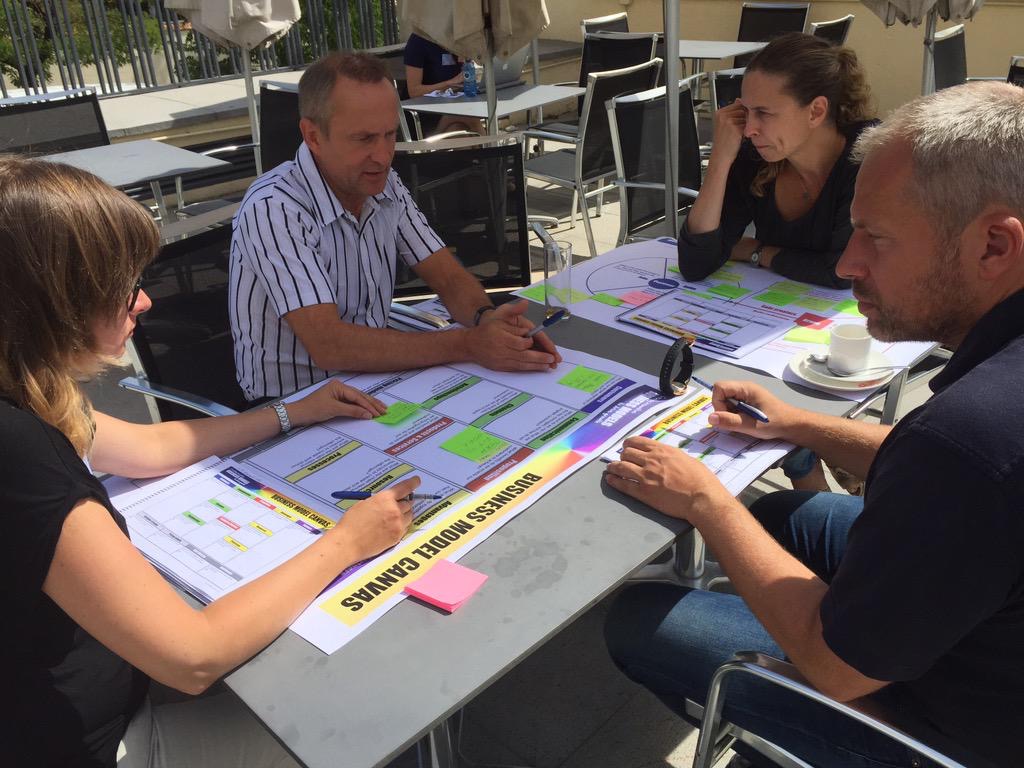
The Global AMP program is for hungry business leaders, typically aged 35-50 years old, currently working 1-2 levels below the C-suite, who are ready to create a better future – for their business, and themselves.
Each year the group of 24-30 participants come from across the world, and across sectors – from Argentina and Algeria, Belgium and Brazil, Canada and Colombia, Germany and Guatemala, Jordan and Japan, Nigeria and Netherlands, Switzerland and Spain, UAE and USA – construction and chemicals, energy and education, finance and fashion, pharmaceuticals and payments, telecoms and tech.
“So honored to be part of this program, and having gone through this learning journey with such a courageous, talented and inspiring group of leaders – now friends – from all over the world. It gave us a unique space to step out of our comfort zones, think about the future, transform our businesses and ourselves. Here’s to our futures!” Alexandra Miranda Bao, COO, Citi, Costa Rica.
“An amazing experience with an amazing group of friends, together we have completed a fantastic learning journey, by graduating last week from one of the best executive programs, the Global AMP in Madrid after presenting the gamechanger projects, showcasing disruptive models to reshape the business world in many industries. our new resolution is to embark ourselves and our organizations on a constant transformational journey by leading from the future.” Omar Korshid, Technical Director, Heidelberg Cement, Egypt.
Perform and transform, exploit and explore, great gamechanger projects and amazing last week in Madrid. The best, the amazing people and good friends met along the program. Finally the Global Advance Management Program is over but a brilliant future is ahead of us.” Manuel Gariddo Gellado, Corporate Sales Director, GRI Renewables, Spain.
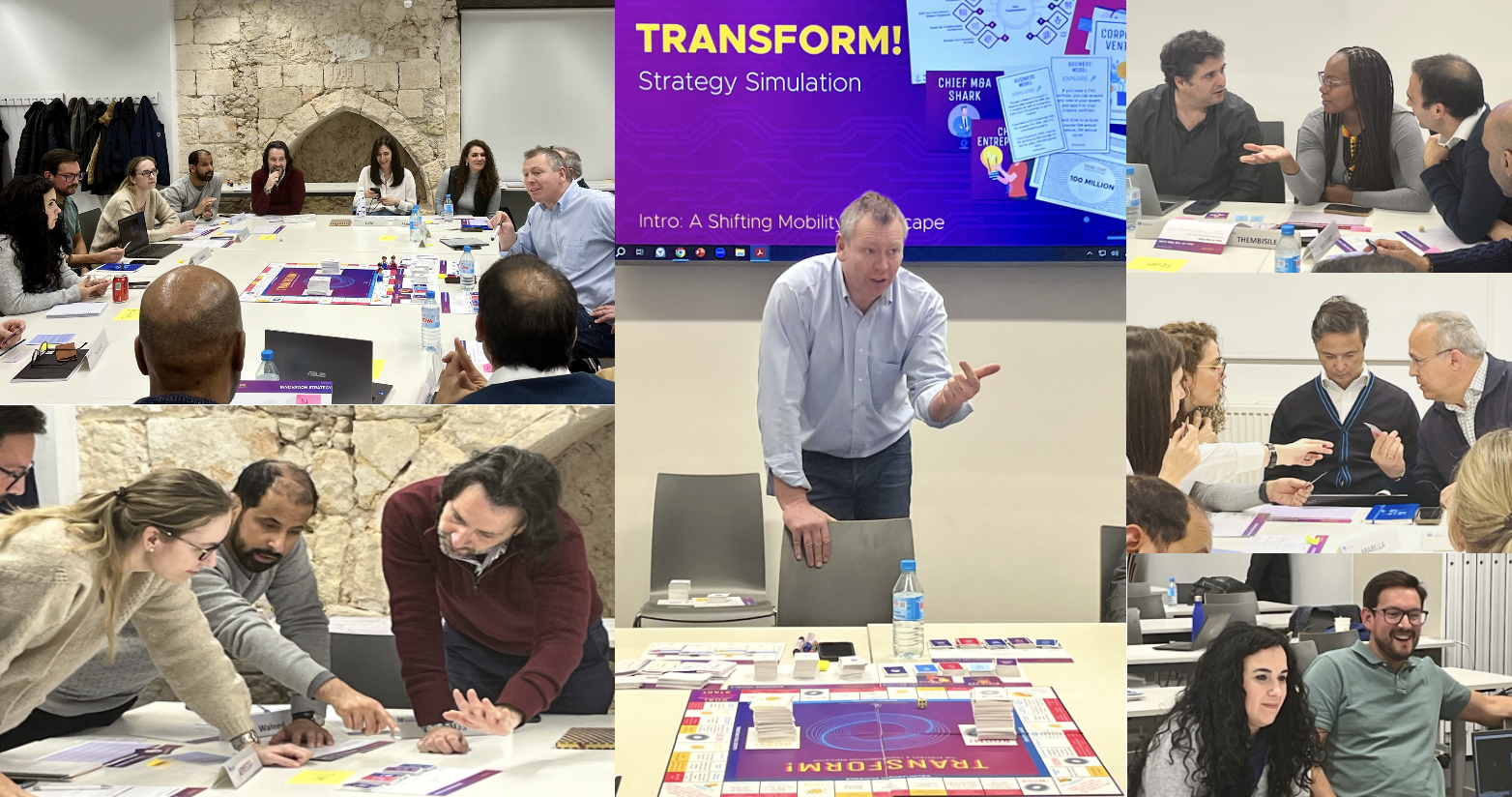
Business transformation is at the centre of the program – creating a blueprint for their future business, that seizes then opportunities of change, that reinvents externally and internally, exploits now and explores next, and has the potential to create a step change in value creation.
We could, of course, simply explore this in a series of topical modules, with theoretical frameworks and inspiring case studies. But we wanted to do more: to prepare participants for the future, explore new market spaces, innovative strategies and business models, address inevitable shocks and disruptions, and perhaps most importantly to work as an effective C-level team.
The Transform! business simulation is challenging and demanding, interactive and fun, and itself transformational.
Let’s imagine the future of the automotive industry – or mobility, as you could reframe it. In 4-5 teams, they appoint their CEOs, CFOs, and more. How will their team outthink the others? Who will develop the most effective business models? How will they manage strategy, start-ups, finance, acquisitions, boards, people, and more?
Business transformation, of course, is typically a multi-year journey. To reinvent the business, to double or maybe triple its market value. So how can you simulate this? We created a hybrid journey, starting face to face, then moving online, and back together. Years became weeks. Demanding fast decisions, and fast learning. How to create a P&L, brief analysts, acquire a business, address the unions, invest in a new technology, right now?
Having explored future megatrends, emerging technologies, new approaches to strategy, and innovative business models, with expert faculty, the Transform! simulation put it all into action. Fast, furious and fun!
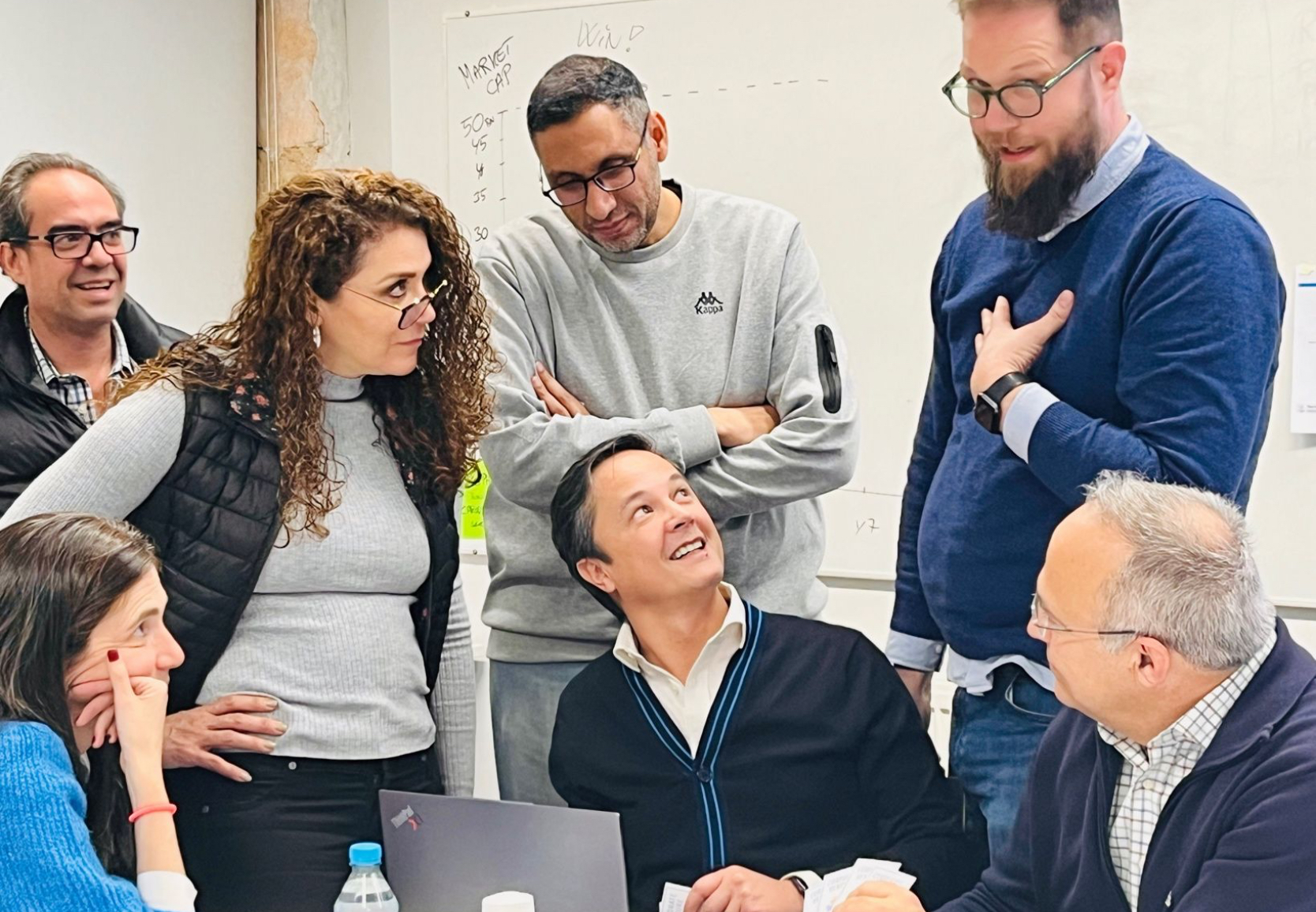
Which company could transform itself, capture the new markets, and create $60 billion market cap first?
With coaching and collaboration, the teams found their ways to survive and thrive in a future world, which could be theirs in reality very soon. The conceptual ideas of previous months learning modules became real and relevant. They explored the different roles of leadership, and also learnt much about themselves.
As the 6 month learning journey came to a close the simulation was seen as a pivotal moment in how participants saw the future, and their potential in it. Their minds were opened to new possibilities, they were shaken out of their comfort zones, they appreciated what it takes to create and lead transformation. And they grew incredibly bonded as a team.
However this program is not just about theory or simulation, it’s about the real world, your real business, and your future.
The Gamechanger Projects are individual project work that run through the 6 month duration of the program, with coaching and support, applying all the best ideas practically to your own potential future. How do you see the future of your industry? How would you take your business beyond its current strategy, maybe beyond the minds of its current leaders? What is your practical blueprint for vision and transformation that you can take back to your business (or new business) and use it as a confident platform to start making your future happen.
Some of this year’s Gamechanger projects included:
In the Netherlands, the national Dutch Lottery has become increasingly concerned about gambling addiction. As a responsible gaming platform, the project seeks to shift towards skills-based games that attract new audiences, demand more expertise, and are also more profitable. This will be based around a Skills Arena, a new gaming environment to engage the best gamers.
Aramark, based in USA, is one of the world’s leading facilities management companies offering services from catering to cleaning to the world’s offices, malls, schools, hospitals and more. Technology, and in particular AI, creates the opportunity to radically reinvent the business – enhancing humanity, anticipating customer needs, and transforming user experiences. In this way the business can transform its role from cost-driven service provider to added-value enabler.
Digital technologies have dehumanised crafts. With a background in the craftsmanship of luxury brands, this Open Crafts from Spain project seeks to create a modern School of Crafts – from artisans to architects, designers and dressmakers – how to create a renaissance in crafts through a platform that combines education and training, with inspiration and practices, and a new marketplace.
South Africa‘s leading bank, Standard Bank, care about much more than just money. It’s purpose is to transform African society, including though enabling Africa’s energy transition. The project specifically focuses on creating new opportunities for small businesses to adopt clean energy through new funding and payment models, and linking to other services too.
Peru‘s leading machinery supplier Grupo Maquinarias has a fundamental challenge in reinventing strategy, particularly in a family business. Cheap imported brands have disrupted the market, and decimated margins. This project is about reimagining the future of mobility and devices, creating a platform for suppliers and customers, with subscription based rentals.
Sleep is a luxury for any parent with new babies. Swedish business Nurtured Sleep is a start-up born from sleepless nights, initially as a coaching service to new parents. However sleep technologies have proliferated, demanding an ecosystem that brings together all the best science, devices, support and analytics. It becomes the Strava of sleep, doubling your sleep, and dramatically improving parenthood.
Join us next year!
Books have always been more than words on a page. They are vessels of knowledge, stories, and imagination — cultural markers that have shaped societies for centuries. Yet in an age of artificial intelligence, streaming platforms, and digital ecosystems, the book is being reimagined in profound ways.
The future of books is not just about format — over recent years, about print to e-book to audiobook, but potentially much more — and about how creation, delivery, and engagement are being reinvented. The book is evolving from a static object into a living, adaptive, and interconnected experience.
A new creative canvas
The first wave of digital transformation in publishing was about format. The e-book made texts portable, searchable, and convenient. Audiobooks brought literature into our commutes and workouts. But these were incremental steps — they digitised the book, but did not fundamentally change its essence.
The next wave, enabled by AI and new media, is reshaping what a book can be. Text will no longer be static. Books may update in real time, incorporating new research, live data, or contemporary examples. They may adapt to the reader, offering simplified explanations for a novice, deeper analysis for an expert, or even tailoring cultural references for different markets. Instead of one-size-fits-all, we will see personalised editions, dynamically generated while preserving the author’s voice.
Books are also becoming multimodal. Words will increasingly be woven with interactive graphics, video, simulations, or immersive audio layers. Fiction can become explorable worlds in augmented or virtual reality, while nonfiction may offer dynamic visualisations or AI-generated case studies. The book becomes less of a finished artifact and more of a creative canvas — one that can expand, evolve, and respond.
My experience as an author
I started writing books 20 years ago. My first book, Marketing Genius, was a bestseller in 35 languages. I remember piles of books everywhere I went, signing copies in bookstores and more. My publisher, John Wiley, loved it, because it sold many thousands of copies, with profitable margins.
20 years later, my latest book Business Recoded, is hardly ever seen as a physical item. Instead it’s a video, a workshop, a conference, a toolkit, and much more. For Wiley, this looked less successful, it did fairly well, but nothing like the old days. For me, it was far more effective, and the core of my working life.
As an author, I have now become the orchestrator of an ecosystem. Creating, or often co-creating, a canvas for many more people to engage across multiple formats. I’d love the publisher to play a key part in this, but they seem wedded to their old mindsets and business models, and are reluctant to engage.
So how did we get here?
Books are now dynamic ecosystems
A single book today rarely stands alone. The most successful publishing projects are parts of wider ecosystems: a business book connected to a podcast series, a novel that spawns a Netflix show, a self-help title extended into workshops and online communities.
Digital technologies amplify this. Publishing platforms are becoming gateways into broader experiences. A reader might finish a chapter and be invited into a discussion forum, a virtual event, or an interactive workshop. Authors and publishers are no longer only distributors of texts — they are orchestrators of communities.
Consider how Brandon Sanderson’s fantasy novels have grown into role-playing games, fan-funded spin-offs, and multimillion-dollar crowdfunding campaigns on Kickstarter. Michelle Obama’s memoir Becoming was not just a book but a multi-channel project: a stadium tour, a Netflix documentary, and an online movement.
In Asia, Japanese publishers like Kadokawa have pioneered “media mix” strategies, where a single story becomes a manga, an anime, a light novel, a game, and merchandise. The book is not the end point — it is the seed of a transmedia ecosystem.
New business models
This shift is also reshaping the economics of publishing.
- Subscriptions and platforms: Services like Scribd, Audible, and Kindle Unlimited are the “Spotify for books.” In China, apps like China Literature or iQiyi allow serialized fiction to be read chapter by chapter, monetized by micro-payments. AI-powered recommendation engines keep readers hooked, turning books into endless, evolving entertainment.
- On-demand and real-time publishing: Print-on-demand (used by Amazon’s KDP, IngramSpark, or Lulu) already reduces waste and inventory costs. The next frontier is real-time updating — textbooks that reflect the latest research, business books that refresh examples automatically. Pearson and Elsevier are already experimenting with digital textbooks as subscription services rather than static editions.
- Atomic content: Books may be decomposed into modules — chapters, frameworks, or stories — that can be licensed, remixed, or sold individually. This is already common in education publishing, where platforms like VitalSource or Kortext allow universities to assemble customised textbooks.
- Ecosystem revenues: Increasingly, the book itself is the entry ticket, not the profit engine. Authors build revenue around extensions: live events, consulting, courses, merchandise, and brand partnerships. Think of the way Jamie Oliver’s cookbooks feed into TV shows, restaurants, and product lines. The book is a node in a larger commercial web.
The disruption of AI
Artificial intelligence is perhaps the most radical force reshaping books.
For authors, AI is both assistant and co-author. Tools like Sudowrite, Jasper, and Claude help brainstorm plot lines, suggest alternative phrasings, or generate first drafts. Translation is being revolutionised: DeepL and Google Translate allow instant multi-language editions, opening global markets overnight. AI also enables “style transfer,” allowing texts to be adapted into new tones or registers for different audiences.
For readers, AI opens entirely new possibilities. Imagine reading a history book with an embedded AI companion: ask it questions, get contextual explanations, or explore counter-arguments. AI could quiz students, highlight patterns, or generate personalised case studies. Each reader’s book becomes an interactive dialogue rather than a one-way transmission.
In education, companies like Kortext in the UK and Byju’s in India are embedding AI tutors directly into digital textbooks. In nonfiction, startups like Inkitt or Wattpad use AI analytics to predict which stories will resonate with readers, reshaping acquisition decisions.
The most innovative publishers
Around the world, publishers are experimenting with innovative business and publishing models:
- Penguin Random House (global): Still the largest trade publisher, PRH has invested in audio, multimedia adaptations, and global rights partnerships. Its Storyglass studio develops podcasts based on book IP, while its children’s division builds interactive apps.
- Hachette Livre (France): Pioneering in hybrid models, Hachette has invested in immersive nonfiction experiences and partnered with start-ups to embed multimedia in textbooks.
- HarperCollins (US/UK): Experimenting with AI-enabled translations, HarperCollins India has focused on rapid digital editions and regional language growth.
- China Literature (Tencent): A digital-first publisher with over 200 million monthly users, monetising serialized fiction through micro-payments, licensing stories into TV dramas and games. It shows how books can be the seed of entertainment universes.
- Wattpad (Canada): Now owned by Naver (Korea), Wattpad built a platform for social reading where communities help shape stories. Its “Wattpad Studios” arm turns the most popular stories into published books, films, or TV series — a bottom-up model of publishing.
- Elsevier & Pearson (Netherlands/UK): Reinventing education publishing through digital subscriptions, real-time updates, and learning analytics. Pearson Plus offers all its textbooks as a Netflix-style bundle, changing the revenue model from ownership to access.
- Shueisha (Japan): Publisher of Shonen Jump, Shueisha pioneered transmedia storytelling, where manga series expand into anime, movies, games, and global franchises like Naruto or One Piece.
These cases show that the most innovative publishers are no longer thinking in terms of a book as a single product. They are thinking in terms of IP ecosystems, community platforms, and services.
Changing roles in publishing
As books evolve, so too do the roles of the players who create, produce, and distribute them.
- The author: From solitary writer to ecosystem orchestrator. They are expected to maintain social presence, host events, interact with communities, and sometimes co-create with fans. Their authority rests not only in writing but in sustaining engagement.
- The publisher: From printer/distributor to multi-channel brand manager. Publishers act like venture studios for intellectual property — testing, scaling, and monetising stories across books, films, podcasts, and courses.
- The printer: Physical books remain, but focus shifts toward quality, collectability, and personalisation. Short-run print, special editions, and print-on-demand replace mass overproduction. Printers become agile service providers.
- The bookseller: Surviving bookstores reinvent as cultural hubs. Many independents now host author talks, workshops, reading groups, even cafés and coworking spaces. Chains like Waterstones in the UK emphasise community events and curated experiences. In Japan, Tsutaya Books reinvented itself as a lifestyle destination where books, coffee, art, and design merge.
- The reader: From passive consumer to active participant. Readers shape storylines (as on Wattpad), join fan communities, support authors directly through Patreon or Substack, and expect interactive and immersive experiences.
What’s the future of books?
This table summarises how roles, processes, business models and technology shift as publishing moves from a product-centred model to an ecosystem and AI-driven model.
| Traditional Publishing Ecosystem | Future Publishing Ecosystem | |
| Author | Sole creator; writes manuscript, limited direct audience interaction; reliant on advance and royalty model. | Ecosystem orchestrator; co-creates with AI and communities; builds IP across formats and revenue streams; continuous engagement. |
| Publisher | Gatekeeper and financier; handles editing, production, distribution, rights. Focus on single products (books). | IP studio & platform operator; manages multi-format rights, data, communities, and partnerships (audio, video, courses, events). Acts like a VC/accelerator for projects. |
| Editor | Manuscript editor focused on craft and line-editing. | Strategic editor and product manager: shapes transmedia arcs, audience segmentation, and monetisation design. |
| Printer | Mass production; economy of scale; inventory-heavy. | On-demand and short-run production; high-quality special editions and bespoke personalization. Printers as agile service partners. |
| Retailer | Bookstores and chains focused on point-of-sale transactions; discoverability via displays and reviews. | Community hubs & experience venues; hybrid retail (events, cafés, subscriptions); integrated online/offline discovery. |
| Reader | Passive consumer buying a finished product. | Active participant: co-creator, community member, subscriber, and data contributor; expects interactive, personalised experiences. |
| Format | Print, e-book, audiobook as discrete products. | Multimodal, dynamic formats—living text, audio companions, AR/VR experiences, interactive data, modular chapters. |
| Distribution | Channel-based (retail, wholesalers, libraries); rights negotiated per territory/format. | Platform-first distribution; direct-to-reader channels, API-driven syndication, global instant localization and micro-payments. |
| Business Model | Unit sales, advances + royalties, library copies. | Subscriptions, micro-payments, licensing of modular content, ecosystem revenue (events, courses, consulting), revenue-sharing partnerships. |
| Product Lifecycle | Static editions with periodic new printings/editions. | Continuous update model eg real-time corrections, living editions, iterative content releases and serialisation. |
| Creation Tools | Word processors, manual research, human-only workflows. | AI-assisted research, drafting, localisation, and style adaptation; analytics-driven editorial decisions. |
| Marketing | Frontlist marketing, media reviews, author tours, bookstore placement. | Data-driven personalised discovery, platform algorithms, community seeding, creator partnerships, serialised funnels. |
| Licensing | Rights managed by publishers and agents; often complex territory-by-territory deals. | Rights treated as modular IP: cross-platform licensing, tokenised ownership possibilities, dynamic rights marketplaces. |
| Quality | Editorial gatekeeping ensures quality; curated lists and awards guide discovery. | Hybrid curation: editorial selection + algorithmic recommendation; community validation and micro-influencers. |
| Education | Textbooks and academic works republished in new editions; long publishing cycles. | Adaptive learning platforms, cloud-textbooks with analytics, personalised curricula, pay-as-you-go chapter access. |
| Analytics | Limited sales data; publisher-centric reporting. | Rich, real-time reader analytics: engagement, learning outcomes, A/B tests, and monetisation signals used to iterate products. |
| Community | Author signings, mailing lists, occasional reader clubs. | Ongoing communities: forums, Patreon/Substack models, live events, co-creation spaces, fan-driven content. |
| Regulation | Traditional copyright enforcement and publisher liability. | New challenges: AI provenance, synthetic text provenance, licensing of AI-trained models, ethical curation. |
| Ecosystem | Printers, distributors, retailers, literary agents. | Also includes tech platforms (AI, AR/VR), learning platforms, studios (TV/film), game companies, brands, and infrastructure partners. |
.
Books are not dying. They are multiplying into new forms. The physical book will remain as a cultural artifact — treasured, collected, and gifted. At the same time, digital and AI-driven formats will explode the possibilities of what a book can be: a living document, a personalised tutor, a community platform, a gateway into immersive experiences.
The future of books is hybrid. Part artifact, part ecosystem. Part static text, part dynamic conversation. The challenge for authors, publishers, and readers alike is to embrace this expanded horizon.
The book has always been about the transmission of ideas across time and space. That mission remains. But the means of doing so — the ways we write, publish, share, and experience books — is undergoing a profound reinvention. And like all great stories, the future of the book will be written collaboratively.
Peter Fisk will again be hosting and speaking at the Future Book Forum on 12-13 November 2025 at the Canon Experience Center, in Munich, Germany. Bringing together publishers and partners from across the world, this year’s forum will focus on ecosystems.
He may stride onto conference stages in a £7,000 leather jacket and bring traffic to a standstill in Taipei, prompting Mark Zuckerberg to joke that he is “the Taylor Swift of tech.”
Yet the mythology around Jensen Huang misses the far more interesting truth: NVIDIA’s rise is not a story of glamour, but of grit. It is the story of an immigrant who arrived in America with little, discovered computers through late-night gaming sessions, and built one of the most valuable companies in history from a fast-food table in Sunnyvale.
Huang’s background is central to NVIDIA’s character. Born in Taiwan, raised partly in Thailand, and later sent to the United States as a teenager, he grew up navigating uncertainty. At Stanford he was an engineering student obsessed with graphics, simulations and video games—an unusual passion at a time when computing was still dominated by spreadsheets and mainframes. In 1993, at a Wendy’s on El Camino Real, he met Chris Malachowsky and Curtis Priem. Over burgers and napkins they sketched a simple but audacious idea: to build hardware powerful enough to make graphics—and eventually computation itself—come alive.
It would take more than thirty years for that idea to mature into a company now valued above $4.5 trillion. Along the way NVIDIA nearly ran out of money, nearly collapsed during the dot-com crash, and was dismissed for years as a niche specialist making toys for gamers. But Huang had a worldview shaped not by comfort but by vulnerability. His now-famous mantra—“we are always 30 days from going out of business”—is less paranoia than a disciplined refusal to become complacent. That mindset gave NVIDIA the courage to bet nearly $10 billion on CUDA, a programming environment that nobody wanted and few believed in. Wall Street punished the company. Analysts openly mocked the strategy. Yet Huang pushed through the humiliation, insisting that general-purpose GPU computing would one day become essential.
Intel had more PhDs, more capital and more prestige. But it was trapped by its own legacy architectures. NVIDIA, built on outsider mentality and immigrant resilience, was not. CUDA became the gateway not just to better graphics but to modern artificial intelligence. And that is how NVIDIA now frames itself—not as a chip company, but as the “engine of AI,” a platform for the next industrial revolution. In this positioning lies another lesson: the refusal to let the past define the future.
The texture of Huang’s leadership remains distinctive. He reads more than a hundred employee emails each morning. He keeps sixty direct reports—an organisational structure most management theorists would consider impossible. He avoids one-to-one meetings because he wants ideas unfiltered, not softened on their journey up the hierarchy. Engineers speak of late-night replies arriving at weekends, often short, precise and typed with a glass of whisky beside him. In a world thick with hierarchy, Huawei has created the anti-hierarchy: leadership as direct signal detection.
And then there is Satya Nadella—another immigrant, another outsider in his own way, but a man whose leadership philosophy took shape through a completely different path. Nadella was not a founder; he rose through Microsoft during its most lumbering years, working across cloud, enterprise software and research. Where Huang’s leadership is fuelled by vigilant paranoia, Nadella’s is grounded in trust, humility and what he calls a “growth mindset.” The son of an Indian civil servant, educated in Hyderabad, he entered Microsoft in 1992 with little fanfare. But he possessed something the company desperately needed: the ability to listen, learn, empower and redirect an ageing giant toward a new frontier.
Nadella delegated more than three-quarters of Microsoft’s commercial machinery, freeing himself to focus on culture, cloud architecture, data infrastructure and long-term opportunity. His genius is orchestration rather than intensity—building a system so strong and so distributed that no single leader needs to sit at the centre of every decision. Under his watch Microsoft rediscovered curiosity, collaboration and moral seriousness. Azure blossomed. The company regained its technical edge. And today Microsoft, too, sits in the three-to-five-trillion-dollar stratosphere.
The contrast between the two men is striking. Huang, the founder-immigrant, operating with a hunter’s paranoia, immersing himself in the granular details of engineering and organisational flow. Nadella, the immigrant-insider, shaping culture through empowerment, trust and distributed leadership. Both approaches work. Both have reshaped the modern technological landscape. But they succeed for opposite reasons.
Leadership is often presented as a universal formula, a set of best practices waiting to be copied. NVIDIA and Microsoft reveal something more interesting: great leadership is not imitation but alignment. It aligns the leader’s temperament with the organisation’s stage of maturity, with the context of competition, and with the demands of the era. For NVIDIA, that meant a founder who still behaves like a scrappy outsider, even at $4.5 trillion. For Microsoft, it meant a cultural architect who could coax a sleeping giant into a new age.
The question, then, is not which leader is “better,” but which operating model matches your wiring—and which the moment requires. In an age of accelerating change, geopolitical tension and technological upheaval, success belongs not to those who copy, but to those who design themselves.
Walking into the Château de la Muette, the former Parisian residence of the Baron Henri de Rothschild, but now the headquarters of the OECD, I could feel the inertia. A temple to international policy, a haven for multinational interns. And a self-serving home to intellectual inaction.
For the last three years, I have been bringing together some of the senior leaders from many different international organisations – to help them rethink their purpose and direction, and how they as leaders can reinvent these institutions, and drive innovative actions for a different future.
International organisations were conceived in moments of post-war rebuilding and global optimism. Here are some of the bets known:
-
United Nations (UN) – peace, security, development, human rights.
-
World Trade Organization (WTO) – rules of global trade.
-
World Health Organization (WHO) – global health.
-
International Labour Organization (ILO) – labour rights and standards.
-
World Intellectual Property Organization (WIPO) – IP rights and innovation.
-
UNESCO – education, science, and culture.
-
UNICEF – children’s rights and humanitarian aid.
-
International Monetary Fund (IMF) – monetary stability, lending, economic policy.
-
World Bank Group (IBRD, IDA, IFC, MIGA) – development financing and poverty reduction.
-
Organisation for Economic Co-operation and Development (OECD) – economic policy, data, and best practices.
-
Inter-American Development Bank (IDB) – Latin America and the Caribbean.
-
Asian Development Bank (ADB) – Asia-Pacific.
-
African Development Bank (AfDB) – Africa.
-
European Bank for Reconstruction and Development (EBRD) – transition economies of Eastern Europe, Central Asia, Southern and Eastern Mediterranean.
-
Islamic Development Bank (IsDB) – development financing in member countries.
-
New Development Bank (NDB, or BRICS Bank) – founded by Brazil, Russia, India, China, South Africa.
-
Asian Infrastructure Investment Bank (AIIB) – infrastructure in Asia.
Their missions—peace, prosperity, development, and cooperation—were grounded in the assumption that globalisation would deepen, nations would collaborate, and shared challenges could be met through collective action.
But the world of the 2020s looks very different. Instead of convergence, we see fragmentation: trade blocs fracturing, great-power competition intensifying, regional conflicts spilling over borders, and nations prioritising short-term sovereignty over shared long-term solutions. Added to this are climate breakdown, biodiversity loss, widening inequality, migration pressures, cyber insecurity, and the disruptive march of new technologies like AI and biotechnology.
This creates a paradox. On the one hand, global challenges require stronger collaboration than ever. On the other hand, the political legitimacy and effectiveness of international organisations are under strain. To remain relevant—and indeed to fulfil their founding missions—such organisations must reinvent themselves.
Challenges of a changing world
1. Polarisation and nationalism.
Rising populism and political nationalism have made countries less willing to cede sovereignty or submit to international rules. The UN Security Council has become paralysed on key issues because of great-power rivalries. IMF reform to give more voice to emerging economies has stalled.
2. Legitimacy crisis.
Many international organisations are seen as elitist, slow-moving, or dominated by powerful states. Developing nations often argue that the governance of the IMF, World Bank, or OECD reflects outdated economic balances. Citizens in both North and South often see international bodies as “remote bureaucracies” detached from real impact.
3. Desk-bound inertia.
Despite their technical expertise, many organisations are trapped in a culture of reports, declarations, and frameworks. Policy papers pile up, but practical outcomes are scarce. The 17 UN Sustainable Development Goals (SDGs), though visionary, risk becoming a checklist rather than a driver of tangible innovation.
4. Complexity of challenges.
Today’s crises are systemic, crossing borders and silos. Climate change interacts with migration; pandemics with supply chains; cybercrime with terrorism. Traditional organisational structures—sectoral, hierarchical, and nation-based—are ill-equipped to deal with such entangled realities.
Opportunities to innovate with impact
Yet within this turbulence lies opportunity. International organisations still command convening power, technical knowledge, financial resources, and global legitimacy that few other institutions can match. Reinvention would mean harnessing these assets differently—less as top-down authorities and more as enablers of collaborative, bottom-up action.
Some key opportunities:
-
From policy to platforms. Moving from publishing recommendations to building practical platforms where nations, entrepreneurs, and communities can co-create solutions.
-
From state-centric to multi-stakeholder. Broadening engagement beyond governments to include businesses, NGOs, cities, universities, and innovators.
-
From bureaucracy to agility. Adopting innovation mindsets, iterative experiments, and digital-first operations.
-
From guardians of order to catalysts of change. Seeing themselves less as defenders of the status quo, and more as laboratories for new forms of governance, finance, and collaboration.
Pathways to transformation
1. Addressing the SDGs in practical, innovative ways
The 17 SDGs provide a shared blueprint—but their implementation remains patchy. International organisations can reframe their role not as monitors of progress, but as enablers of scalable innovation. For example:
-
Climate action (SDG 13). The UN or ADB could incubate “climate venture studios” that partner with entrepreneurs to scale carbon capture, clean mobility, or regenerative agriculture.
-
Education (SDG 4). The OECD could create a global EdTech accelerator, linking policymakers with startups delivering AI-enabled personalised learning to underserved communities.
-
Health (SDG 3). IDB could support a cross-border digital health passport system, enabling continuity of care for migrants and refugees.
The principle is not more reports, but more pilots, prototypes, and proof points—building innovation portfolios across the SDGs.
2. Empowering entrepreneurs and local innovators
Economic growth and job creation are increasingly driven by entrepreneurs and small enterprises rather than state-led megaprojects. International organisations can reinvent their support models by:
-
Creating innovation sandboxes. IMF and World Bank could collaborate with regulators to create safe spaces for fintech, green finance, and inclusive banking to be tested across borders.
-
Financing ecosystems, not just projects. Instead of top-down loans, provide catalytic capital for venture funds, incubators, and networks that empower local startups.
-
Bridging knowledge gaps. OECD could democratise access to its world-class data and analysis, offering open APIs that entrepreneurs in Lagos or Lima can build on.
By becoming champions of entrepreneurship, these organisations align with the future of growth—distributed, digital, and bottom-up.
3. Building platforms for collective responses
International organisations are uniquely placed to create platforms for collaboration—shared infrastructures where governments, companies, and citizens can coordinate.
-
Digital platforms. Imagine a UN-backed climate risk marketplace where insurers, cities, and communities exchange data and solutions in real time.
-
Supply chain resilience hubs. ADB could convene Asia-Pacific economies and firms into regional platforms mapping supply chain risks and alternative sourcing.
-
Conflict mediation networks. UN could establish “peace tech” platforms where grassroots mediators, journalists, and civil society share early-warning data and conflict-resolution tools.
In an era of digital ecosystems, being a platform architect may be the most impactful role for global bodies.
4. Fostering understanding and collaboration
At their best, international organisations are “interpreters of complexity.” Yet in an age of misinformation, mistrust, and polarisation, their communication must be reinvented.
-
Radical transparency. Simplifying complex economic or climate data into visual, open dashboards accessible to all citizens, not just policymakers.
-
Narratives of shared progress. Shifting language from technocratic jargon to human stories—how an IMF-supported digital currency reform helps a mother send remittances, or how an IDB green bond finances a community forest.
-
Facilitating dialogues. Moving from grand annual conferences to ongoing, participatory online forums that connect mayors, scientists, activists, and entrepreneurs.
5. New mindsets and cultures
Perhaps the deepest reinvention is cultural. Most international organisations are still hierarchical, diplomatic, and risk-averse. Reinvention requires a new DNA:
-
Experimentation over perfection. Launching pilot projects quickly, learning, and scaling what works.
-
Collaboration over competition. Breaking silos between UN agencies or between IMF and regional development banks.
-
Diversity of voices. Ensuring young leaders, women, indigenous peoples, and entrepreneurs are not just consulted but integrated into decision-making.
-
Purpose-driven identity. Reconnecting to founding missions—peace, development, cooperation—but expressed in contemporary challenges like AI ethics or planetary health.
6. Reinventing business models and governance
Finally, international organisations must rethink their own structures. Many still rely on rigid voting systems and funding formulas from the mid-20th century. Options for reinvention include:
-
Polycentric governance. Creating flexible coalitions of willing actors within larger organisations—“mini-laterals” that move faster while still linked to global frameworks.
-
Outcome-based financing. Linking budgets not to inputs (how much spent) but to measurable outcomes (how many children educated, how much carbon reduced).
-
Crowdsourced legitimacy. Allowing citizens to engage directly, for example through participatory budgeting of development funds or citizen assemblies on global issues.
-
Partnership-driven models. Opening their doors to co-investment and co-creation with private sector, philanthropy, and civil society.
Such changes would not only improve effectiveness but rebuild legitimacy and trust.
Lessons from IO innovations
Some international organisations are already experimenting:
-
World Health Organization (WHO). During COVID-19, WHO partnered with tech firms to counter misinformation, moving beyond traditional medical guidance.
-
IDB Lab. The innovation arm of the IDB has begun acting like a venture investor, seeding startups tackling climate, inclusion, and digitalisation across Latin America.
-
OECD Observatory of Public Sector Innovation. A small but promising initiative that prototypes new governance methods and policy experiments.
-
UNDP Accelerator Labs. With over 90 labs worldwide, they use grassroots experimentation to tackle issues from plastic waste to renewable energy.
These show that reinvention is possible—but needs to be scaled and mainstreamed.
The IO reinvention imperative
In an age of fragmenting globalisation, climate emergency, and political polarisation, international organisations stand at a crossroads. They can either fade into irrelevance—ossified bureaucracies remembered for lofty declarations—or they can reinvent themselves as catalysts of practical action, inclusive collaboration, and transformative innovation.
The path forward is not easy. It demands humility from institutions long used to authority, flexibility in structures designed for stability, and courage to experiment when legitimacy is fragile. But the rewards are immense: renewed trust, real-world impact, and a chance to make global cooperation meaningful again.
In practical terms, reinvention means:
-
Shifting from policy inertia to practical action.
-
Moving from state-centric diplomacy to multi-stakeholder ecosystems.
-
Transforming from bureaucratic hierarchies to agile innovation cultures.
-
Redesigning from outdated governance models to polycentric, participatory, and outcome-based ones.
The world still needs global cooperation. Indeed, it needs it more than ever. But cooperation must look different: dynamic, inclusive, entrepreneurial, and adaptive. Reinvented international organisations could become the platforms where humanity confronts its crises together and designs its shared future.
A year ago I was sitting in the Stade de France, in Paris. The sun blazed hot, and I was in my seat a good two hours before competition began. The crowd buzzed with anticipation. Tonight it was the 1500m final, the blue ribbon athletics events of the Summer Olympics.
As a Brit, I was rooting for Josh Kerr, but he was up against a stacked field – including the Norwegian champion Jakob Ingebrigstsen, and Americans Cole Hocker and Yared Nuguse.
But imagine, a year later … and instead of elite athletes taking to the track for the Olympic 1500m final, it’s a different kind of gladiator.
These are eight of the world’s most dynamic business leaders—visionaries, technologists, empire builders—preparing to race not just for gold, but for global influence. Welcome to the Business Olympics, where CEOs and founders test their leadership like athletes test their bodies: through preparation, precision, resilience and heart.
The 1500m is a perfect metaphor. It demands both speed and stamina, tactics and nerve. And in this race, the competitors aren’t running for medals—they’re racing toward the future.
The Line-Up: 8 of the world’s best leaders
The Olympics brings together the best from around the world. Who will take victory on the day, in one race that can define a lifetime?
I’ve been a great admirer of Satya Nadella over the last decade, but Sam Altman seems to be shaking up the world of AI. Australia’s superstar Melanie Perkins is also one of the new generation of leaders. And then there are people like Lei Jun, the magician of Shanghai, the Steve Jobs of today’s technology world.
1. Satya Nadella (Microsoft)
The reigning champion of transformation. Calm, composed, and relentlessly human in his approach, Nadella has turned Microsoft into an innovation powerhouse—balancing cloud, AI, and a growth mindset culture with elegance.
2. Sam Altman (OpenAI)
The bold strategist and startup tactician. Altman runs with wild intensity, combining futurist vision with the pacing of someone who knows every twist in the track. But will he peak too soon?
3. Melanie Perkins (Canva)
Creative and confident, Perkins enters the race with disruptive energy. She doesn’t follow the old rules—she rewrites them, designing intuitive solutions at scale. Underestimate her at your peril.
4. Mary Barra (GM)
A veteran of tough terrain. Barra runs with the steady power of someone who has rebuilt an industrial giant for a post-petrol world. Electrified, resilient, and still accelerating.
5. Tobi Lütke (Shopify)
Quiet and composed, Lütke is a long-distance strategist. He focuses on empowering others—building platforms, not empires. His race is subtle, but don’t mistake that for weakness.
6. Lisa Su (AMD)
Focused, formidable, and fiercely competitive. Su has redefined performance, outpacing competitors with relentless precision. Her strength lies in mastering complexity while staying calm under pressure.
7. Jessica Tan (Ping An)
The hybrid leader—half technologist, half reformer. Tan blends speed with intelligence, innovating within legacy systems. She races with data, AI, and purpose in perfect stride.
8. Lei Jun (Xiaomi)
The master of efficiency and explosive growth. Jun runs light and fast, executing at scale while staying close to consumers. He’s hungry, unpredictable, and ready to break away.
Race Tactics: Innovation vs Endurance
The 1500m isn’t a sprint or a marathon—it’s the most psychological race on the track. These leaders must balance pace with positioning, intuition with preparation. The parallels with business are uncanny.
-
Early surge: Altman breaks early, pushing the pace with an aggressive move—just like his moonshot approach to AI. But the field doesn’t panic.
-
Smart control: Nadella and Su hold steady, conserving energy while tracking every move. It’s classic systems thinking: don’t chase, just stay sharp.
-
Positioning: Perkins slips into third, light on her feet, watching the chaos unfold ahead. She knows when to strike.
-
Acceleration from the middle: Tan and Jun exchange places, each using a different playbook—Tan with precision, Jun with hustle.
-
Unexpected move: With 400m to go, Barra powers up. She’s playing the long game, but she knows exactly when to shift gears.
Who’s your money on? It has the endurance, the courage, and the inspiration to step up when it matters most? Altman looks spent. Nadella is relaxed, a slight smile. Su focused. Perkins looks cool.
The Final Lap: Pressure Makes Performance
Now the race hits boiling point. There’s no hiding. This is where leaders show what they’re really made of. Not in earnings reports or speeches—but in resilience, grit, and instinct.
-
Nadella stays calm, calculating the perfect moment to launch. His stride lengthens.
-
Su is on his shoulder, surgical and focused, ready to match him move for move.
-
Perkins finds another gear—creative thinking becomes pure momentum.
-
Barra grits her teeth, driven by purpose and pressure-tested leadership.
-
Tan surges too—quietly powerful, elegantly efficient.
Neck and neck. The final drive. The Microsoft leader has created $3 trillion in shareholder value growth over the last 10, so analysts clearly have confidence in his ability to deliver.
The Podium: Who takes the glory?
Gold: Satya Nadella
A masterclass in composed leadership. He wins through timing, empathy, and a relentless ability to align innovation with culture and clarity.
Silver: Lisa Su
Unflinching and technically brilliant. Su doesn’t just race—she engineers a performance. A true operator who has led AMD into the future with grace and grit.
Bronze: Melanie Perkins
Youthful, bold, and unstoppable. Perkins proves that imagination and accessibility can change the game. She earns her medal with elegance and courage.
Close behind:
-
Jessica Tan – sharp, steady, and incredibly strategic. Her time is coming.
-
Tobi Lütke – consistent, humble, but perhaps a little too modest in a noisy race.
-
Mary Barra – the comeback queen, just shy of the medals but hugely respected.
-
Sam Altman – brilliant but burned too much energy too early.
-
Lei Jun – fast and fierce, but the final lap exposed his lack of endurance.
What a great race. Maybe the result was not such a surprise. Nadella, has after all, created over $3 trillion of value growth during his 10 years as CEO of Microsoft. His focus on growth mindset, of relentless innovation, and bringing the tech business back to global leadership is admired universally. I know he can play cricket, I’m not sure how far he can run?
So what can business leaders learn from Olympic athletes?
Of course, business leaders typically have different physical talents to the world’s top Olympic athletes. But maybe, in their pursuit of high performance, to be the best in the world, they share some common traits:
-
Discipline fuels creativity: Athletes don’t just train for fun—they train to win. High-performance leaders create space for innovation by mastering fundamentals.
-
It’s a team sport: Behind every elite athlete is a team—coaches, trainers, analysts. Behind every great CEO is a culture, a board, and a customer community.
-
You can’t peak every day: Smart leaders know when to push and when to recover. Resilience comes not from always going full pace, but knowing when to hold back.
-
Success is a long race: In the 1500m, as in business, it’s not about one burst of brilliance. It’s about knowing the track, adapting mid-race, and executing at the right moment.
-
Character is the final advantage: Champions are forged in adversity. The winners here didn’t just have good strategies—they had courage, humility, and the will to lead others.
This was one race. But the track is always open. New competitors rise. Technologies shift. Conditions change. The leaders who train, evolve, and inspire will always be in contention. Because in the end, high performance is not just about being the fastest—it’s about knowing why you’re running, and bringing others with you.
Each month The Brand Doctor, business expert Peter Fisk, takes a global brand that has lost its way, and considers how it could reinvent itself. If it’s your brand, do you have the courage to change? If not, what would you do, and how could you apply these ideas for reinvention to your own business?
Philip Morris International
PMI is a company of contradictions. It is the largest publicly listed international tobacco company, with 2024 revenues of around $35 billion, and market cap of $250 billion.
For over a century, PMI has made billions selling products universally recognised as harmful. Marlboro, Virginia Slims, Benson and Hedges, and other iconic brands are woven into the social fabric of countless nations, a shorthand for glamour, rebellion, and ritualised indulgence.
Yet, the world has changed. Smoking rates are declining in developed markets, regulations are tightening, and public health narratives are increasingly uncompromising.
PMI’s declared goal of a “smoke-free future” is ambitious, even necessary—but it raises questions few executives dare to ask: can a tobacco company truly reinvent itself as a health and wellness organisation? Can it persuade its loyal consumers to follow it on that journey?
Smoke-free future
Jacek Olczak, CEO of PMI, has articulated a clear vision for the company’s future: to transition from a traditional tobacco company to a health and wellness enterprise. This transformation is encapsulated in PMI’s commitment to achieving a “smoke-free future,” aiming to replace cigarettes with scientifically substantiated, reduced-risk alternatives.
Since his appointment as CEO in May 2021, Olczak has consistently emphasised PMI’s commitment to transitioning away from traditional cigarettes and focusing on smoke-free alternatives. He has emphasised that PMI is not merely diversifying its product portfolio but is fundamentally reimagining its business model. The acquisition of Vectura, a UK-based inhaler business, underscores this shift towards health-oriented products. By investing in inhalation technologies and respiratory therapies, PMI seeks to leverage its expertise in nicotine delivery systems to address broader health concerns.
PMI aims to generate more than two-thirds of its revenue from smoke-free products by 2030 and continues to reduce its combustible cigarette shipment volume.
However, this strategic pivot is not without its complexities. The challenge lies in reconciling the company’s legacy as a leading tobacco producer with its aspirations in the health sector. The Marlboro brand, synonymous with smoking, presents a particular hurdle. While PMI has introduced IQOS, a heated tobacco product, and other smoke-free alternatives, the question remains: can these products, and the brands associated with them, be redefined in the public’s perception as health-conscious choices?
Current progress … 41% smoke-free
As of mid 2025, PMI reported that approximately 41% of its total global net revenues were derived from smoke-free products. This marks a significant increase from previous years, reflecting the company’s successful expansion into alternative nicotine products. Notably, in 25 markets, smoke-free products now account for more than 50% of total net revenues, indicating strong consumer adoption in these regions.
IQOS, PMI’s flagship heated tobacco product, continues to drive growth in the smoke-free segment. By the end of 2023, IQOS had approximately 28.6 million users, with an estimated 73% having switched from traditional cigarettes. This user base is expected to have grown further in 2024 and 2025, contributing significantly to the company’s revenue.
In the first quarter of 2025, smoke-free products accounted for 44% of PMI’s total gross profit. This indicates not only strong revenue growth but also improved profitability in the smoke-free segment. The company’s ability to achieve higher margins in this area is a positive sign for the sustainability of its transformation strategy.
Brand evolution … from Marlboro to wellness
Reimagining brands
The Marlboro brand, with its deep-rooted association with smoking, presents both an opportunity and a challenge in PMI’s transformation. While the brand’s recognition and loyalty among consumers are undeniable, its legacy may hinder its repositioning in the health and wellness sector.
One potential strategy is to introduce sub-brands or product lines under the Marlboro umbrella that are explicitly aligned with health and wellness. For instance, PMI could develop nicotine-free inhalers or wellness-focused products under the Marlboro brand, thereby leveraging its existing consumer base while signaling a shift towards healthier alternatives.
Alternatively, PMI could consider retiring the Marlboro brand in certain markets and launching new brands that are more congruent with the company’s health-oriented vision. This approach would allow for a clean break from the past but may risk alienating existing customers who identify with the Marlboro brand.
Evolving with consumers
Maintaining the loyalty of existing consumers during this transition is crucial. PMI must ensure that new products not only meet the health and wellness criteria but also resonate with the lifestyle and identity of its current customer base. This could involve offering products that replicate the sensory experience of smoking, such as nicotine-free inhalers that mimic the hand-to-mouth action, or creating wellness experiences that align with the social aspects of smoking.
Additionally, PMI could implement loyalty programs that reward consumers for transitioning to smoke-free products, thereby incentivizing the shift and reinforcing brand loyalty.
Strategic options for the future of PMI
The challenge is not merely to stop selling cigarettes, but to decide what to sell instead — and, more importantly, what role it wants to play in people’s lives. Having built its empire on habit and desire, PMI must now build one on health and hope. Its transformation could unfold along three broad, but profoundly different, strategic trajectories.
Option 1. The Nicotine Science Company … Owning the Transition
The first path is evolutionary: to remain within the nicotine ecosystem but reformulate it as a legitimate, controlled, and increasingly medicalised category. Here, PMI becomes the science company of inhalation — moving from combustion to clean aerosol delivery, from dependency to harm reduction, from mass addiction to precision pharmacology. This is the world of IQOS, Zyn, and the acquisition of Vectura, the British maker of respiratory therapies.
In this scenario, PMI’s credibility depends on evidence. It must build trust through clinical trials, transparent data, and partnerships with healthcare systems. The brand would shift from swagger to science — from cowboy cool to clinical competence. The Marlboro Man gives way to the laboratory coat. PMI could evolve into something resembling a cross between AstraZeneca and Dyson: a research-driven company engineering controlled inhalation for health, focus, or relaxation.
The advantage is continuity: PMI already understands the biology of nicotine and the psychology of ritual. But the danger is moral dissonance. Can a company that made billions from lung disease credibly claim to cure it? Investors might applaud the margins; society may not applaud the motive. Its success would depend on radical transparency, humility, and perhaps new brands free from the taint of tobacco.
The challenge for Philip Morris International is not merely to stop selling cigarettes, but to decide what to sell instead — and, more importantly, what role it wants to play in people’s lives. Having built its empire on habit and desire, PMI must now build one on health and hope. Its transformation could unfold along three broad, but profoundly different, strategic trajectories.
Option 2. The Lifestyle Energy Company … Owning the Moment
A more audacious option is to leave nicotine behind entirely and reinvent PMI as a consumer vitality company: selling focus, calm, pleasure, and recovery — not as chemicals, but as experiences. Think of it as “owning the moment” rather than the molecule. PMI could pivot from the science of addiction to the design of wellbeing: creating a portfolio of lifestyle products that meet the same emotional needs as cigarettes once did — ritual, release, and reward — but through healthier forms.
Imagine Marlboro reborn as an energy and recovery brand — drinks, teas, or natural stimulants positioned around clarity and control, not chaos and compulsion. Or IQOS reinterpreted as a personal wellness device — a “digital inhaler” for mindfulness, aromatherapy, or performance breathing. The idea is not to moralise away the cigarette, but to reimagine its essence: that fleeting pause, the sensory focus, the social connection — delivered in ways that heal rather than harm.
The risk, of course, is credibility. Can a nicotine company become a wellbeing icon? It might, if it embraces design, psychology, and culture as fluently as it once mastered chemistry. The lesson from brewers who created alcohol-free beers, or confectioners who made protein snacks, is that reinvention succeeds when it enhances — not denies — human pleasure. PMI could yet become a brand of modern calm: sophisticated, sensory, and sustainable.
Option 3. The Human Sustainability Company … Owning the Purpose
The boldest path is to transcend nicotine, energy, and consumer goods altogether — and reinvent PMI as a human sustainability company. This is not about selling products at all, but about enabling people to live longer, breathe better, and experience wellbeing as a right, not a purchase. It would mean harnessing PMI’s scientific, logistical, and commercial muscle to pioneer clean air, respiratory diagnostics, or preventative health technologies.
The company’s future purpose could be nothing less than to undo the harm of its past — to become a net contributor to global health. It could fund urban air quality initiatives, develop home purification systems, or commercialise respiratory monitoring platforms. Its Vectura and OtiTopic acquisitions give it a credible start in respiratory technology; its global supply chain could deliver access to health solutions at scale.
The advantage of this vision is moral clarity: it positions PMI not as a repentant smoker, but as an active reformer. It could become the corporate equivalent of the ex-addict who now mentors others — credible precisely because of its history. The disadvantage is strategic dislocation: it would require abandoning most of its existing brands and customer base, and building a new identity almost from scratch. But then again, great reinventions rarely come from comfort zones.
Which to choose? … continuity, credibility, and connection
Each path offers different value to shareholders — and a different story to society. The nicotine-science route promises margins and defensibility, but risks moral backlash. The lifestyle-energy route taps into culture and consumer engagement, but tests credibility. The human-sustainability route wins reputation and purpose, but demands reinvention at an almost existential scale.
In truth, PMI’s future may blend all three. It could continue its nicotine-science journey in the short term, evolve toward lifestyle vitality as a medium-term play, and ultimately redefine itself as a sustainability-driven wellness conglomerate. The secret will be coherence — ensuring that each step feels like evolution, not opportunism; progress, not public relations.
The company that once sold escape must now sell endurance. It must move from habit to health, from addiction to agency. And if it succeeds, PMI could offer not just a smoke-free future, but a lesson in corporate redemption: that even the darkest legacies can breathe new life — if they are willing to change what they mean to the world.
Reinventing brands … from addiction to aspiration
If the technology of PMI’s reinvention lies in IQOS and inhalable science, the psychology lies in its brands. Marlboro, Parliament, and L&M remain among the most recognisable consumer names on Earth — shorthand for freedom, rebellion, and the cool detachment of twentieth-century modernity. Yet they also carry the stigma of death, addiction, and manipulation. The central brand question is therefore existential: can a company so defined by its past ever detoxify its identity?
There are two strategic routes available. The first is evolution: to reinterpret existing brands for a new era, just as Dunhill transformed from cigarettes into luxury fashion and leather goods, and Davidoff evolved into a lifestyle marque spanning fragrances, watches, and spirits. Those brands carried the elegance and poise of the smoker’s ritual into broader realms of pleasure and sophistication. Marlboro, with its deep emotional equity, could in theory follow a similar path — re-imagined not as a tobacco brand but as a symbol of personal freedom, relaxation, or social vitality. In a world that values mindfulness and balance over hedonism, the “Marlboro Moment” could evolve from lighting a cigarette to taking a breath — of clean air, of calm, of focus.
The second route is reinvention: to start afresh with new names, audiences, and propositions. This path might be more credible to regulators and new consumers, particularly younger generations who associate legacy tobacco brands with manipulation and harm. PMI has already hinted at this with its VEEV and Zyn labels — names that sound more like wellness tech than vice. A future PMI might manage a portfolio more akin to Unilever or L’Oréal: a stable of purpose-driven brands across wellbeing, mental focus, respiratory health, and lifestyle performance. In that context, the PMI name itself might fade into the background, serving as a holding company for a constellation of new identities that express vitality rather than dependence.
Ultimately, brand evolution will determine whether PMI’s transformation feels authentic or opportunistic. Consumers are not naïve; they can accept change, but not hypocrisy. The challenge is to preserve emotional connection while re-anchoring meaning. To move from the freedom to smoke towards the freedom to live well. Some legacy brands may make that leap; others may need to be retired gracefully. The courage will lie not only in technological innovation, but in brand reinvention — in building trust, desire, and relevance for a generation that has never known the Marlboro Man.
Lessons from parallel markets
There is precedent for such radical change. Across consumer markets, established players have learned to turn existential threats into engines of renewal. The non-alcoholic beverage industry, for instance, has grown from niche abstinence to mainstream aspiration, as companies like Heineken, Guinness, and Diageo redefined their purpose from selling alcohol to selling social experiences — from intoxication to inclusion. By investing in flavour innovation, lifestyle marketing, and wellness credentials, they created a new growth curve that complemented, rather than replaced, their heritage brands.
Likewise, the food industry’s pivot to meat-free proteins shows how a legacy sector can reimagine its contribution to health and sustainability. Nestlé’s Garden Gourmet and Unilever’s The Vegetarian Butcher have leveraged deep R&D capabilities and consumer trust to enter markets once dismissed as fringe. These companies prove that disruption can be harnessed rather than feared — that existing consumer bases can be guided towards new habits if the experience feels authentic and the benefit personal.
Fashion offers another parallel. Luxury houses once built on exclusivity and excess — from Stella McCartney to Gucci — are now repositioning sustainability as the new status symbol. Circular design, resale platforms, and regenerative materials have turned environmental responsibility into a creative and commercial opportunity. The most successful transformations have not disowned their origins; they have reinterpreted them.
For PMI, these examples are instructive. The company cannot erase its history, but it can rewrite its meaning. Just as the brewers sold “moderation,” the food giants sold “better choices,” and the fashion leaders sold “sustainable beauty,” PMI could sell wellbeing and empowerment through nicotine innovation, clean inhalation, or respiratory health. Its challenge is not to abandon consumers, but to take them on a journey — to convert habit into health, ritual into responsibility. Investors will judge not just the scale of this ambition, but its sincerity.
Investor perspectives
For investors, Philip Morris International’s reinvention is both a story of conviction and contradiction. Markets admire its audacity: to pivot one of the world’s most notorious cigarette makers towards a future in which its own past becomes obsolete. The numbers, too, lend credibility. In mid-2025, around 41 per cent of PMI’s global revenues were derived from smoke-free products — primarily IQOS and Zyn — a figure expected to surpass the 50 per cent mark by 2026. Analysts at Stifel and Barclays praise the firm’s operational discipline and consistent earnings growth, noting that the company has “delivered on the smoke-free promise more convincingly than any rival.” PMI’s share price has risen steadily as investors reward the company for higher margins in reduced-risk products, strong cash flow, and a clear strategic direction.
Yet beneath the enthusiasm sits an unmistakable tension. Around 60 per cent of revenues still depend on combustible cigarettes, meaning the transformation is incomplete and exposed to the decline of traditional tobacco. Fitch recently revised PMI’s outlook to Negative, citing high leverage and execution risk. Regulators remain unpredictable, and the company’s reputation — a cigarette giant reborn as a wellness brand — invites scepticism. Some analysts fear the valuation already reflects much of the good news; others believe the pivot could take longer and cost more than expected. The consensus, in other words, is cautiously optimistic: PMI is praised for being bold, but it must now prove it can be both smoke-free and sustainably profitable.
Still, investors recognise that few companies in any sector attempt a metamorphosis of such magnitude — one that demands not only new technologies but new moral legitimacy. If PMI succeeds, it will not just have changed its products; it will have changed its social contract.
Choosing a better future
Philip Morris International stands at a pivotal juncture in its history. The company’s commitment to a smoke-free future is commendable, but the path to achieving this vision is fraught with challenges. The Marlboro brand, while iconic, may not seamlessly transition into the health and wellness sector without careful rebranding and strategic alignment.
To successfully navigate this transformation, PMI must prioritize consumer education, transparent communication, and innovative product development. By understanding and addressing the needs and concerns of its existing customer base, PMI can foster loyalty and facilitate a smoother transition to smoke-free alternatives.
Ultimately, PMI’s success in becoming a health and wellness company will depend on its ability to authentically align its products and brand with the values and expectations of today’s health-conscious consumers. This requires a bold vision, unwavering commitment, and a willingness to challenge the status quo.
More from Peter Fisk
- What’s New and Next in Branding? Brands capture an irresistible idea, compelling and intuitive, engaging and inspiring people in ways that companies and products cannot. They build platforms and connections through which customers and business can achieve more.
- Eyes on Tomorrow: What Leaders Must See before Everyone Else … exploring the most important megatrends that are transforming markets, and leadership mindsets, and how the best companies embrace them as opportunities … based on the new Megatrends 2035 report by Peter Fisk, and its implications for every business.
- The Reinvention Playbook: Thriving in a World of Relentless Change … the best organisations seek to continually reinvent themselves in a world of constant, uncertain and dynamic change. They rethink, refocus, and reinvent everything – embracing new agendas from AI to GenZ, climate change and social inequality.
- The Nexus Effect: Unlocking the Power of Connections … How can businesses and brands really unlock the power of data and networks, flywheels and AI, communities and ecosystems, to transform their futures?
- The New Growth Playbook: 9 New Ways to Accelerate Growth … many companies struggle to find new ways to grow their business … instead we look at how the best companies find radically new ways to grow.
- Super Innovators: Innovation Beyond the Normal … 10 radical ways to disrupt conventions, embrace deeper insights, unlock valuable assets, and stretch innovation for more dramatic impact.
- Consumer of the Future … “Aisha blinked twice, the smart lenses in her eyes had already scanned her biometric mood, cross-checked her carbon budget, and pulled up items her climate-positive friends were buying this week”
- Competing in the FLUX: How to develop a dynamic strategies in a world of relentless change … combining a strong, enduring direction with micro-moves that adapt quickly to emerging shifts:
- Business Transformation: The new superpower of business leaders … reimagining the future, redefining strategy, reinventing the organisation, rewiring performance … the journey to deliver step change in value creation.
- The Sustainable Consumer: Go on, do the Right Thing … how brands can accelerate the consumer shift to sustainable products and practices … from food and fashion, to energy and electric cars, making sustainability desirable and better.
- The “Performer Transformer” Leaders: How great leaders deliver today and create tomorrow … with dual thinking, to build dynamic ambidexterity, continually strategyzing, to perform and transform.
- The Hire-Wire Act of Leadership: Leading in a world of intense competition and relentless change … being visionary and innovative, learning to adapt and endure … inspired by Taylor Swift, Roger Federer, Beyoncé, and Lionel Messi
- Becoming a Future-Ready Business … in a world of relentless change, organisations need to anticipate change, embrace innovation, empower talent, and align deeply with the evolving needs of society and the planet
In a world defined by relentless change and rising complexity, a new breed of businesses is emerging—ambitious, restless, and unapologetically visionary.
These are the Future Junkies—companies addicted to possibility, obsessed with the edges of tomorrow, and committed to turning what’s possible into what’s next. They don’t just chase trends—they shape the future, pioneering radical innovations that reinvent markets, solve global challenges, and unlock extraordinary value.
Moonshot thinking—once the realm of sci-fi dreamers and NASA engineers—is now the strategic DNA of the most disruptive and admired companies. Alphabet’s X (formerly Google X), Tesla, OpenAI, SpaceX, DeepMind, Moderna, and ambitious upstarts like Anduril, Neuralink, and Twelve are bold exemplars of this mindset.
These businesses are defined by their drive to achieve 10x improvements over 10% gains. They ask “Why not?” instead of “What if?”, and challenge the limits of what’s considered feasible—whether by launching reusable rockets, eradicating disease, creating human-AI symbiosis, or designing carbon-negative fuels.
Anatomy of a “Future Junkie”
1. Purpose-driven, possibility-fuelled: At the heart of a moonshot business lies an audacious purpose—a conviction that business can, and must, solve humanity’s greatest challenges. From reversing climate change to decoding the brain, these companies fuse commercial ambition with mission-driven resolve. For example, DeepMind’s stated goal is to “solve intelligence, and then use that to solve everything else.” It’s not simply about building AI; it’s about unlocking a better future for all.
2. Embracing tech intelligence and convergence: Future Junkies thrive at the intersection of exponential technologies. They don’t just use AI or robotics or biotech in isolation—they combine them to unlock nonlinear breakthroughs. Tesla merges batteries, software, and machine learning to redefine transport. Moderna fused genomics, nanotech, and cloud computing to accelerate vaccine development during the COVID-19 pandemic. And companies like Commonwealth Fusion Systems are betting on fusion energy by blending superconductors, quantum simulations, and advanced manufacturing.
3. Designing for disruption, powered by relentless reinvention: These companies aren’t looking to compete within existing frameworks—they aim to destroy and reframe them. They ask, “If we started from scratch, how would we design this system today?” Stripe reinvented online payments by creating infrastructure for the internet economy. Neuralink seeks to rewire the human brain to interface directly with machines. Future Junkies don’t improve—they revolutionize.

Cultures that stretch reality
The culture within these moonshot organizations is unlike traditional companies. It is deliberately engineered to foster imagination, experimentation, and fearless execution.
Curiosity over conformity: Moonshot companies are led by polymaths, futurists, and mavericks. They actively seek out iconoclasts who ask different questions, often valuing science fiction and philosophy as much as engineering and economics. At X, failure is not punished—it’s celebrated, so long as it’s in pursuit of learning. By embracing failure as a learning tool, they remove the fear that stifles innovation in legacy firms.
Speed as a strategy: These companies move fast not just to be first, but to collapse time-to-impact. Speed accelerates learning, iterates feedback loops, and forces prioritization. SpaceX’s rapid launch failures enabled it to outpace entrenched aerospace competitors. Future Junkies embrace minimum viable products, parallel experimentation, and agile structures that privilege movement over perfection.
Ambidextrous structures: They often build “dual-speed” organisations—balancing core operations with moonshot explorations. Alphabet’s core business of ads and search fuels long-term bets via X, CapitalG, and GV. Similarly, Amazon built AWS and Alexa while still refining its retail model. This duality allows exploration without destabilizing execution.

Why the best leaders are Future Junkies
We live in a world of relentless acceleration. Every day brings fresh disruption, new breakthroughs, and rising uncertainty. Technologies evolve exponentially. Markets shift in moments. Social and environmental challenges grow more complex and urgent. In this high-velocity world, the old playbooks no longer work. Yesterday’s logic breaks under tomorrow’s pressure.
Enter the Future Junkie: a new breed of business leader obsessed with what comes next. Future Junkies aren’t content to merely adapt to change; they crave it. They are restless, curious, and deeply committed to crafting better futures. They are not defined by their industry, geography, or age, but by their mindset. They see opportunity in challenge, imagination in ambiguity, and purpose in uncertainty.
This book explores the ideas, strategies, and leadership practices of Future Junkies across the world. It’s a guide for anyone who wants to stop reacting to change and start shaping it. You’ll meet bold entrepreneurs, visionary CEOs, and pioneering innovators—people like Elon Musk, Satya Nadella, Melanie Perkins, Lei Jun, and Jessica Jackley—who are rewriting the rules of business. And you’ll explore tools and frameworks to help you build your own futurecrafting discipline.
Future Junkies are not reckless optimists. They are rigorous visionaries. They don’t just dream—they build. They transform ideas into experiments, and experiments into progress. They challenge convention, embrace ambiguity, and mobilise communities. And they never stop asking: what’s next?
This is not just a book about trends. It’s about transformation. It’s about designing businesses, cultures, and strategies for the future—on purpose. Because in an age of uncertainty, the greatest risk is to do nothing.
Welcome to the movement. Welcome to the age of the Future Junkie.
Always what’s next
Future Junkies see the world differently. While most leaders focus on optimising the present, they are already building what comes after. This mindset—what we might call strategic impatience—fuels their actions. The horizon is not a distant place; it is a current project.
Why do they think this way? Because they know that stability is an illusion. The businesses that dominated the last century—built on scale, control, and efficiency—are being displaced by those driven by ideas, ecosystems, and adaptability. In this context, the ability to see, shape, and seize the future is the ultimate competitive edge.
Consider Elon Musk, perhaps the most high-profile Future Junkie. His companies aren’t built to maintain the status quo; they exist to bend the arc of possibility. Tesla didn’t just build electric cars—it redefined the automotive sector. SpaceX didn’t just launch rockets—it made space travel a public-private ambition. Musk’s obsession with the future isn’t an eccentric trait; it’s a strategic advantage.
But you don’t have to be Musk to think this way. Jessica Jackley saw a broken financial system and created Kiva, enabling peer-to-peer microloans that reimagined access to capital for underserved communities. Lei Jun built Xiaomi not as a hardware company, but as an ecosystem of digital experiences, combining affordability with community-driven innovation. Satya Nadella turned Microsoft from a product-centric behemoth into a purpose-led platform company focused on cloud, AI, and empowering others.
What these leaders share is an ability to see cracks in the present and design businesses that can grow through and beyond them.
Future Junkies are not content with best practices. They pursue next practices. They don’t just scale what works; they explore what could work better. This doesn’t mean they ignore reality—it means they redefine it.
They ask different questions:
-
What is the change no one sees coming?
-
How might we reinvent this from the ground up?
-
Who else could we create this future with?
-
What would make this 10x better, not just 10%?
They also operate across time horizons. They manage the present while experimenting with the future. They set bold visions but iterate quickly. They are system thinkers and story builders. And they are deeply driven by purpose: not just what they want to achieve, but why it matters.
Future Junkies share three key traits:
-
Curiosity – They actively seek emerging signals, question assumptions, and explore the unknown. They are information omnivores, constantly scanning for what’s next in technology, design, society, and culture.
-
Imagination – They don’t simply accept the future—they create it. They visualise what could be, and then work backward to make it possible. They blend storytelling with strategic insight to generate momentum.
-
Courage – They make bold moves. They are not afraid to invest in moonshots, challenge orthodoxy, or commit to paths with uncertain outcomes. They understand that progress demands risk.
This is your invitation to shift your lens. Don’t just ask, “How do we compete today?” Ask, “What future do we want to lead?” Because the best way to predict the future is no longer to forecast it. It’s to build it.

Leaders with a future mindset
Sam Altman thrives on long bets. Whether through Y Combinator, OpenAI, or Worldcoin, his work revolves around scaling what others don’t yet understand. His drive? To make sure the future of AI is a collective good. He pushes boundaries while deeply engaging with ethics, society, and policy. Yet at the same time, he recognises that commercial organisations can do this best, sustained innovation requires serious investment, and demands the best talent, but can ultimately create value for all stakeholders, including the progress of society. Altman believes leadership is responsibility at scale — a future junkie with deep moral inquiry and bold execution.
Jessica Jackley didn’t start with money — she started with stories. After witnessing the economic challenges of Ugandan entrepreneurs, she reimagined finance as a tool for dignity. That idea became Kiva, a peer-to-peer microlending platform that turned charity into collaboration. Jackley’s boldness came from a deep belief: that ordinary people could fuel extraordinary impact. She made finance personal and emotional, blending social justice, tech, and storytelling. Kiva wasn’t built to disrupt banking; it was built to restore humanity to capital. Jackley proves that future junkies don’t always chase the latest tech — they build new paradigms that reshape human relationships.
Jensen Huang’s future obsession began with gaming but exploded into AI. At Nvidia he reimagined graphics chips as general-purpose processors for deep learning, a gamble that made it the most valuable chipmaker in the world. Huang is both visionary and grounded — he sees 10 years ahead, then builds it piece by piece. He invests in ecosystems, not just products, and runs the company like a lab: bold hypotheses, fast iteration, relentless feedback. He leads with an engineer’s mind and a philosopher’s soul — constantly asking how can this solve bigger problems?
Melanie Perkins started with a frustration — how hard it was for students to design simple yearbooks — and turned it into a multi-billion-dollar vision. Driven by the idea that creativity should be accessible to everyone, she relentlessly simplified design and built Canva into a global visual storytelling platform. Her boldness is quiet but fierce — rooted in purpose, trust in her team, and a commitment to long-term impact. With each product, she asks: How does this empower people? Perkins is a future junkie with humility — showing that visionary leadership doesn’t require loudness, just clarity and resolve.
Lei Jun built Xiaomi not just as a smartphone company, but as a fast-moving innovation ecosystem. Inspired by Steve Jobs, he fused bold design, open feedback loops, and community co-creation. What makes Lei a future junkie is his obsession with speed, simplicity, and scale — releasing new products in weeks, gathering real-time user input, and launching ecosystem businesses from air purifiers to electric cars. His “Internet thinking” approach disrupted the hardware world by treating everything as software — iterative, responsive, and user-driven. Driven by a belief in accessible innovation for all, he made cutting-edge tech radically affordable and scaled Xiaomi into a global tech powerhouse in under a decade.
Future Junkies as business leaders share some common traits:
- A personal spark … Frustration, curiosity, loss, or ambition triggers a bigger vision
- Systems thinking … They see connections others don’t — across industries, ideas, and time
- Bold simplicity … They make complex things usable, human, and scalable
- Purpose-led ambition … Their ideas are tied to solving real problems, not just making money
- Future-back mindset … They start with what’s possible, then build the path toward it
- Action-oriented culture … They foster environments that move fast, test ideas, and evolve constantly

Funding the future
Moonshots are expensive, risky, and often unprofitable for years. But Future Junkies are backed by patient capital and bold investors who understand that asymmetric returns lie in outsized ambition. Venture capital is now complemented by venture studios, corporate incubators, sovereign wealth funds, and mission-driven capitalists.
Jeff Bezos invested billions into Blue Origin with a 100-year vision. Sam Altman raised the OpenAI Startup Fund to build AGI-ready businesses. Bill Gates’ Breakthrough Energy Ventures backs science-heavy companies with decade-long timelines. This kind of capital understands that real value isn’t always immediate, but compounding.
Moreover, some companies develop self-funding loops—where today’s products generate cash to fund tomorrow’s bets. Apple’s dominance in devices allows investment in spatial computing and health diagnostics. Elon Musk’s approach is to build vertically integrated ecosystems that compound capability across ventures—from solar energy to AI-driven robots.

Accelerating progress
The most compelling moonshots aren’t just profitable—they’re regenerative. They solve systemic problems with business solutions. Climeworks is capturing carbon directly from the air. Twelve is turning CO₂ into jet fuel. Planet Labs is using satellite imagery to track deforestation, crop yields, and disaster response. These businesses embody what John Elkington calls “Green Swans”—innovations that deliver exponential positive impact.
Moonshot businesses also have the potential to tackle societal inequities. Zipline is transforming medical delivery in remote regions using autonomous drones. Khan Academy, Coursera, and OpenAI are redefining access to world-class education. These efforts not only open new markets but foster resilience, health, and empowerment on a global scale.
Risks and realism
Yet the road to the future is fraught with danger. Not every moonshot lands. Many explode on the launchpad—financially, ethically, or reputationally. Theranos promised too much, too fast, with too little scrutiny. WeWork imploded under the weight of its own hype.
Moonshot companies walk a fine line between bold and blind. They must navigate regulatory uncertainty, societal backlash, technical failure, and ethical ambiguity. Responsible future builders integrate ethics, equity, and transparency into their design from day one—because building the future requires more than speed; it requires trust.

Future Junkies in action
So who are visionary companies—and the leaders behind them—who demonstrate the energy, ambition, and imagination of a Future Junkie mindset? They stretch the edges of possibility and redefine what business can be:
1. BioNTech (Germany)
Leaders: Uğur Şahin and Özlem Türeci
Moonshot Activity: mRNA vaccines for cancer and infectious disease
Why It Matters: In partnership with Pfizer, BioNTech developed one of the first COVID-19 vaccines using mRNA. Now they’re targeting personalized cancer therapies.
2. Climeworks (Switzerland)
Leaders: Christoph Gebald and Jan Wurzbacher
Moonshot Activity: Direct Air Capture (DAC) of CO₂
Why It Matters: Climeworks has built the world’s first commercial DAC plant, removing carbon from the atmosphere and storing it underground—turning climate change into a solvable challenge.
3. Commonwealth Fusion Systems (USA)
Leader: Bob Mumgaard
Moonshot Activity: Commercial nuclear fusion energy
Why It Matters: CFS, a spinoff from MIT, is racing to make fusion viable by 2030 using high-temperature superconductors—potentially delivering limitless clean energy.
4. DeepMind (UK)
Leader: Demis Hassabis
Moonshot Activity: Artificial General Intelligence (AGI), health breakthroughs
Why It Matters: DeepMind’s AlphaFold solved protein folding—considered one of biology’s grandest challenges—with profound implications for medicine and drug discovery. Its broader goal is to solve intelligence and use it for global good.
5. Graphcore (UK)
Leader: Nigel Toon
Moonshot Activity: AI-specific processing units
Why It Matters: Graphcore’s IPUs (Intelligence Processing Units) are designed for next-gen AI workloads, making AI faster, more efficient, and scalable.
6. Liquid Death (USA)
Leader: Mike Cessario
Moonshot Activity: Reinventing water as a countercultural brand
Why It Matters: A surprising example—Liquid Death turned canned water into a $1B brand by wrapping sustainability in bold, punk rock branding, reshaping consumer behavior.
7. NotCo (Chile)
Leader: Matias Muchnick
Moonshot Activity: AI-designed plant-based foods
Why It Matters: NotCo uses a proprietary AI platform (“Giuseppe”) to replicate animal products with plants, revolutionizing food sustainability and expanding into the US and Europe.
8. OpenAI (USA)
Leaders: Sam Altman
Moonshot Activity: Artificial General Intelligence for humanity’s benefit
Why It Matters: OpenAI is building large language models (like ChatGPT) to enhance productivity, creativity, and global access to intelligence—while navigating ethics and safety in AI.
9. Ping An Tech (China)
Leader: Jessica Tan (Co-CEO of Ping An Group)
Moonshot Activity: AI-driven health, finance, and smart city services
Why It Matters: Ping An uses AI, blockchain, and big data to transform insurance, telemedicine, and fintech in China—making services faster and more inclusive.
10. Reliance Jio (India)
Leader: Mukesh Ambani
Moonshot Activity: National digital infrastructure and super-app ambitions
Why It Matters: Jio redefined connectivity in India by offering ultra-cheap mobile data, catalyzing digital inclusion for over a billion people. Its super-app ambitions (JioMart, JioHealth, JioFinance) aim to dominate the digital ecosystem.
11. Rivian (USA)
Leader: RJ Scaringe
Moonshot Activity: Electrifying adventure vehicles and commercial fleets
Why It Matters: Rivian is building electric trucks and vans (including a deal with Amazon), aiming to green transportation beyond cities.
12. Tokamak Energ (UK)
Leader: Chris Kelsall
Moonshot Activity: Compact nuclear fusion reactors
Why It Matters: Another frontrunner in fusion energy, Tokamak Energy is using spherical reactor design to accelerate the clean energy transition.
13. Twelve (USA)
Leader: Nicholas Flanders
Moonshot Activity: Transforming CO₂ into industrial materials and jet fuel
Why It Matters: Twelve’s technology converts carbon dioxide into critical chemicals and fuels, enabling a fossil-free future and circular carbon economy.
14. X (Alphabet’s Moonshot Factory, USA)
Leader: Astro Teller
Moonshot Activity: Radical solutions to global challenges—from internet balloons (Project Loon) to AI agriculture and autonomous robots
Why It Matters: X is Alphabet’s in-house innovation lab for building “10x” improvements in key areas like energy, transportation, and connectivity.
15. Zipline (USA/Rwanda)
Leaders: Keller Rinaudo Cliffton
Moonshot Activity: Drone delivery of medicine and essential supplies
Why It Matters: Zipline’s autonomous drones have transformed logistics in hard-to-reach regions, particularly in Rwanda and Ghana, showing how technology can leapfrog infrastructure gaps in global health.

Lessons for every business
You don’t have to be SpaceX or DeepMind to think like a Future Junkie. Every business can stretch its ambition and act with greater intent.
-
Adopt a 10x mindset: Set bold goals that force new thinking. Ask what it would take to improve your core offering by an order of magnitude—not incrementally.
-
Create a portfolio of futures: Balance near-term optimization with long-term exploration. Dedicate resources to “what’s next” even as you manage “what’s now.”
-
Build future-capable teams: Hire people who are curious, experimental, and interdisciplinary. Develop a culture that encourages bold questions and fast learning.
-
Partner for progress: Many moonshots are ecosystem plays. Collaborate with startups, universities, public agencies, and impact investors to amplify your reach.
-
Align purpose with profit: The most sustainable moonshots address real-world problems—climate, health, equity, energy. These challenges are not only moral imperatives but massive market opportunities.
Future crafting
To be a Future Junkie is to commit to a kind of beautiful madness – a willingness to bet on breakthroughs, to sprint into uncertainty, and to create what doesn’t yet exist.
But there is method in this madness: future crafting. Future-oriented companies believe the world’s biggest problems are also the world’s biggest business opportunities. They embrace new technologies as their tools, and new agendas, like sustainability or geopolitical shifts, as their pathways. It is an approach that has process and discipline – balances risk and reward, delivers for today and tomorrow – and clearly delivers superior value creation, and impact.
Future Crafting is a strategic and creative mindset that combines bold ambition with grounded execution, imagination with intention, and innovation with purpose. It is about building better futures, not just better profits.
- Stretching ambition built on imagination and purpose
- Practical strategies built on vision and foresight
- Radical innovations built on new possibilities and experimentation
- Inspiring brands built on culture and communities
- Vibrant organisations built on talent and creativity
- Accelerated performance built on long-term value and impact
At its core, Future Crafting starts with stretching ambition. It invites leaders to look beyond incremental improvements and short-term wins, to ask: “What if?” and “What’s next?” It’s powered by imagination—the ability to see future possibilities that don’t yet exist—and guided by purpose, a deeper understanding of why the organisation exists and who it serves. Purpose ensures that progress isn’t just fast, but meaningful. It’s the compass in a landscape where the map is constantly being redrawn.
But imagination without action is fantasy. That’s why Future Crafting requires practical strategy rooted in foresight. It embraces long-term thinking, scenario planning, and emerging trends to design resilient paths forward. It aligns vision with capabilities, and foresight with focus, enabling organisations to move from insight to innovation. Strategic experimentation becomes central—not gambling, but learning through pilots, prototypes, and creative exploration.
Innovation in this context is expansive. It’s not just about new products or technologies, but new possibilities—new business models, services, experiences, and ecosystems. Future Crafting welcomes experimentation as a habit, not a project. It celebrates curiosity, diversity of thought, and the courage to challenge conventions. Crucially, it doesn’t wait for the future to arrive—it builds it, test by test, idea by idea.
Brands play a powerful role in this vision. In the age of Future Crafting, brands are no longer just marketing tools—they are cultural platforms. They are built on values, stories, and communities, and they shape identity and belonging. Future-crafted brands don’t just sell; they connect, convene, and catalyse. They create movements and meaning, embedding themselves in people’s lives and aspirations.
Organisations, too, are reimagined. Future Crafting requires organisations that are designed for agility, creativity, and collaboration. These are human-centred enterprises where talent is empowered, diverse perspectives are welcomed, and innovation flows across boundaries. Organisational design becomes more fluid and adaptive. Leadership becomes more inclusive and visionary. Culture becomes the invisible architecture that drives performance.
Finally, performance itself is redefined. Instead of chasing short-term gains or shareholder returns alone, Future Crafting aims for long-term value and societal impact. It aligns growth with sustainability, profit with purpose, and innovation with inclusion. It asks not just “How much did we make?” but “What did we change? What did we improve?” Future Crafting is the bridge between what is and what could be.
In short, Future Crafting is not a blueprint but a belief system—a way of seeing the future as something we can shape. It’s an invitation to build boldly, act wisely, and lead with imagination and integrity.
In summary, we are at the edge of a new era – where AI designs new drugs, carbon becomes fuel, and the human brain is no longer biologically constrained. The companies that win will not be those who adapt to the future, but those who create it.
The Future Junkies are already there. Are you one of them?
Banking is one of the oldest industries in human civilization, yet today it stands at a profound inflection point. For centuries, banks have played the same roles: safeguarding money, enabling transactions, and allocating capital. Their architecture—branches, balance sheets, bureaucracies—has endured revolutions, wars, and crises. But in today’s world of rapid and relentless change, banks face pressures unlike any in their history.
This change is being driven by megatrends—deep, structural forces that reshape economies and societies over decades. Megatrends are not fads or short-term shifts; they are global, transformative, and unavoidable. Among the most powerful are digitization, democratization, personalization, and sustainability. Together, they are redefining markets, reshaping customer aspirations, and opening the door to radical new business models. For banks, they pose a stark question: are you fit for the future, or destined for irrelevance?
Megatrends shaking up every market
Megatrends are already disrupting industries once thought stable:
-
Digitization has transformed music from physical products (vinyl, CDs) into streaming experiences. Spotify doesn’t sell songs; it sells moods, discovery, and personalization. Banking too will move from rigid products to seamless financial experiences.
-
Democratization has reshaped retail. Platforms like Shopify and TikTok empower anyone to become a merchant or influencer. The power is shifting from institutions to individuals. In finance, democratization means fintech apps that let people invest, trade, and borrow without a traditional bank.
-
Personalization has redefined travel. Airbnb offers not just rooms but customized experiences, curated through data and algorithms. For banking, personalization means moving beyond one-size-fits-all products to services tailored to individual life goals.
-
Sustainability is transforming professional services. Leading consultancies and law firms now advise on ESG, inclusion, and climate strategy, recognizing clients expect impact beyond profit. For banks, sustainability will define lending portfolios, risk models, and purpose.
These examples reveal a profound truth: markets are no longer about selling standardized products within rigid sectors. They are becoming customer-centric spaces—health, mobility, wealth, learning—where solutions are fluid, integrated, and often invisible.
Why banks are not fit for the future
Traditional banks struggle to adapt to this new reality. Their weaknesses are structural:
-
They are product-centric—mortgages, credit cards, savings accounts—rather than customer-centric.
-
They are bound by legacy IT systems and compliance-heavy cultures that slow down innovation.
-
They are focused on risk avoidance rather than value creation.
Worse, banks face a deeper existential problem: their core functions—moving money, safeguarding deposits, assessing risk, and allocating capital—can now be done by algorithms, platforms, and protocols. AI can underwrite credit instantly. Blockchain can move assets across borders in seconds. Platforms like Revolut or Nubank deliver financial services without the bureaucracy of traditional banks.
Just as music labels lost control to streaming platforms, or travel agents vanished in the age of Expedia and Airbnb, banks face the risk of becoming irrelevant intermediaries—utilities in the background of ecosystems they no longer control.
Thinking differently
Banks have traditionally looked inward for inspiration—benchmarking peers, regulators, or fintechs. But to truly reinvent themselves, they should look to unexpected innovators in culture and technology.
Take Taylor Swift. She has reinvented herself repeatedly across genres and eras, owning her narrative and deepening emotional bonds with fans. The “Eras Tour” is more than music; it’s an immersive experience and community. For banks, the lesson is that reinvention is not just about products—it’s about storytelling, transparency, and belonging. Just as Swift re-recorded her masters to reclaim ownership, banks could help customers reclaim ownership of their data and financial future, turning dry transactions into empowering journeys.
Or consider Roblox, the gaming platform where users create, trade, and interact in virtual worlds. It thrives on co-creation and ecosystems, not top-down control. Banking could move from closed systems to open, participatory platforms where customers, fintechs, and even communities co-create value—whether in the metaverse, through programmable money, or shared investment spaces.
Other inspiring parallels abound. Lego rebuilt itself by listening to fans, opening its innovation process, and turning into a collaborative platform for creativity. Banks could follow, letting customers shape services, from personalized savings “quests” to community-driven lending. Patagonia shows how purpose-led reinvention can build trust and resilience; banks could embed sustainability and ethical finance at the core, not the periphery.
The common thread? These innovators put people, participation, and purpose at the heart of reinvention. They treat audiences as collaborators, not passive consumers. If banks could learn to think like a pop star, a gaming platform, or a purpose-driven brand, they could transform themselves from bureaucratic utilities into living, adaptive, customer-centric ecosystems.
Reimagining banks
The AI Money OS
Imagine an AI-driven personal financial operating system—a Money OS—that sits on your phone or wearable, not inside a bank. Instead of opening different accounts, credit cards, or apps, you’d have a single intelligent assistant managing everything: payments, savings, investments, insurance, taxes, even philanthropy. This AI doesn’t just process transactions; it learns your life goals, risk appetite, and preferences, then proactively optimizes your financial world.
Need to save for a house? The AI automatically reallocates spending, negotiates better mortgage rates across providers, and locks in your best option. Planning a holiday? It bundles travel insurance, hedges currency risk, and smooths cash flow—all invisibly. It could even plug into your health data to lower premiums or carbon footprint to channel money into greener investments. In this model, the “bank” disappears into the background, while the Money OS becomes your financial brain.
Embedded and Invisible Finance
Beyond AI, we are already seeing banking dissolve into everyday experiences. Buying a Tesla with built-in financing, paying via Uber or Amazon without noticing, or insuring your iPhone at checkout—these are signals of a world where finance is embedded in ecosystems. In the future, mortgages could come bundled with your home purchase, investment products could sit inside your favorite social platform, and wealth advice might be delivered via your gaming avatar.
Community and Tokenized Banking
Decentralized finance (DeFi) points to another radical model: community-driven, tokenized banking. Imagine local or interest-based communities issuing their own tokens, raising capital, and funding shared projects without traditional banks. These tokens could represent not just money, but identity, loyalty, and belonging. Banks might survive as custodians of trust and compliance, but the economic value creation shifts into networks and communities.
Bank as API, not Institution
Some banks may embrace radical reinvention by becoming financial infrastructure providers. Rather than competing on products, they supply regulated rails—identity verification, settlement, compliance—as “banking-as-a-service” for fintechs, platforms, and enterprises. In this future, customers may never see the bank brand at all; it becomes invisible plumbing, like electricity or internet protocols.
Inspired by pioneering peers
Some organizations already glimpse the future:
-
DBS talks about “invisible banking”—embedding finance seamlessly into life’s moments.
-
Nubank disrupted Latin America by offering simplicity, transparency, and fairness to customers exploited by traditional banks.
-
Revolut is building a financial super-app: payments, crypto, insurance, investments, all in one interface.
-
WeBank, the Tencent-backed digital-only bank with no branches, focusing on micro-lending and SME finance powered by AI and data from WeChat.
-
KakaoBank is a mobile-only bank leveraging South Korea’s super-app culture; profitable and massively popular among younger customers.
- Apple shows how non-banks can dominate finance by leveraging trust, design, and integration. Millions use Apple Pay and Apple Card without thinking of them as “banking.”
The lesson is clear: the most transformative financial services may not come from banks at all.
The big shifts
Are banks doomed? Not if they are willing to reinvent themselves radically. Reinvention requires:
-
Shifting from products to platforms: Don’t just sell loans or cards—curate ecosystems like “housing journeys” or “mobility solutions” that integrate finance with life goals.
-
Owning the trust layer: In a world of AI and decentralized systems, banks could reposition as the guarantors of security, ethics, and fairness. Trust may be their last—and greatest—asset.
-
Partnering with big tech and fintechs: Rather than fighting Apple or Amazon, banks can provide the regulated backbone while tech partners deliver user experiences.
-
Radical transparency and purpose: Future customers will demand values-driven finance—carbon-neutral, inclusive, fair. Reinvention means putting purpose at the heart of business models.
-
Becoming AI-powered organisms: Banks must evolve from bureaucracies into intelligent systems that learn, adapt, and anticipate customer needs.
Leading the change
Leadership is the critical differentiator. To reinvent, leaders must shift their mindset:
-
From ownership to orchestration: Banking’s future is about co-creating ecosystems, not controlling customers.
-
From safety to experimentation: Standing still is now the riskiest strategy. Leaders must embrace experimentation and fast learning.
-
From scarcity to abundance: In digital finance, value comes not from scarcity but from personalization, trust, and insight.
-
From institutions to intelligence: Reimagine banks as intelligent, adaptive systems that think and act in real time for customers.
-
From sectors to spaces: Stop defining banking as a narrow sector. Instead, think about wealth, health, mobility, or learning as integrated customer spaces where finance plays an enabling role.
Reinvention or irrelevance
The megatrends of digitization, democratization, personalization, and sustainability are shaking every market—and banking is no exception. The question is not whether finance will change, but whether banks will be part of that change.
The future of banking may not be about banks at all. It may be about AI Money OS systems, embedded finance meshes, or decentralized wealth commons. It may be about fintech super-apps or tech giants embedding finance invisibly into daily life.
Traditional banks still have assets—scale, regulation, and trust—but they must reinvent radically to stay relevant. They must move beyond products to experiences, from intermediaries to platforms, from risk-averse bureaucracies to adaptive, intelligent systems.
The winners will not be those who protect the past, but those who embrace the future—who recognize that the world doesn’t need “banks” so much as it needs better ways to enable people to live, thrive, and achieve their aspirations.
For leaders, the choice is stark: reinvent or disappear.
Few companies in modern history have undergone as many profound transformations as DSM. Born in the soot and struggle of Europe’s early industrial age, DSM has travelled further, over more decades, across more sectors, and with more reinvention than almost any other global business. Its journey from Dutch State Mines to a world leader in life sciences and materials is a story of strategic courage, long-term stewardship, and an ability to escape the gravitational pull of one’s past.
This is not just a tale of diversification or repositioning. It is a case study in how an organisation repeatedly sheds its skin, anticipates change, confronts the realities of its environment, and—perhaps most importantly—chooses purposefully what it will stop doing as well as what it will grow. DSM shows how to move from the harsh economics of commodities to the superior dynamics of high-value, science-based markets. Few firms begin their lives digging coal from the ground and end up developing nutrition formulas for infants, enzymes for animal health, coatings for electronics, low-carbon materials for mobility, and biology-based solutions to global challenges.
This long arc of reinvention offers inspiration and instruction for any business seeking to escape commoditisation, create a new strategic identity, or build a future rooted in knowledge, innovation, and societal value.
Born in the Age of Coal
DSM began in 1902 as a state-owned coal mining company. Its purpose was simple: secure the Netherlands’ domestic energy supply. Coal was the backbone of industrial progress, fuelling factories, transport, and the modern state. For decades, DSM’s mines powered Dutch development. Thousands of workers descended into the shafts each day, and DSM became a symbol of national resilience.
But coal was a brutal, low-margin, high-labour industry. It was cyclical, politically charged, and increasingly threatened by technological change. By the 1950s and 60s, it was clear that coal was losing its primacy to oil and gas. The geology of Dutch coal was challenging, and costs were rising. DSM’s leaders faced a stark question: if the nation no longer needed coal, what was DSM for?
That question would become the defining theme of DSM’s next century.
Reinvention One: From Coal to Chemicals
Most state-owned industrial giants cling to their origins. They double down, defend their turf, and decline. DSM did the opposite. In the 1960s, it embarked on its first great metamorphosis: a deliberate, disciplined pivot from mining to chemicals.
This was not an intuitive shift. Chemicals required new skills, new assets, new technologies, and new markets. DSM knew little about the field. But it was pragmatic: chemistry was adjacent to energy; it made use of by-products; and it aligned with broader industrialisation trends. The company closed its mines and invested the cash into petrochemicals, fertiliser plants, and industrial chemicals.
The closure of the last DSM coal mine in 1974 symbolised the end of one industrial era and the birth of another. But this transition also taught DSM three important lessons:
-
You cannot begin a transformation until you stop defending the past.
-
Reinvention requires building new capabilities before the old ones fade.
-
Purpose must evolve with the world, not against it.
This shift gave DSM economic resilience and placed it into sectors with higher technological intensity, but chemicals too were competitive and cyclical. The company had moved up the value chain—but not far enough.
Reinvention Two: From Petrochemicals to Performance Materials
By the 1980s and 90s, DSM recognised a second threat: petrochemicals, like coal, were commoditising. Global supply was rising. Prices were unstable. New producers from Asia and the Middle East were emerging.
Again, DSM chose the harder road: move to higher value. It began shedding commodity assets and reinvesting in performance materials—engineering plastics, resins, coatings, and high-strength fibres. These were areas where specialised chemistry, application know-how, and long-term collaboration with customers created barriers to entry and pricing power.
Products such as Dyneema—one of the world’s strongest fibres—became emblematic of this new DSM: innovative, highly engineered, premium, global.
This shift marked DSM’s transition from an industrial giant to a knowledge-based enterprise. No longer just a producer of molecules, DSM became a developer of solutions.
Key strategic traits emerged:
- A willingness to prune the portfolio:
DSM exited commodity products even when they were still profitable, understanding that strategic coherence and future value matter more than short-term earnings. - A commitment to R&D:
DSM invested heavily in science, linking research to customer problems and market trends. - Building through partnerships:
Rather than invent everything itself, DSM forged alliances in technology, universities, start-ups, and industry. - Shaping markets, not just serving them:
DSM helped define emerging categories in performance materials, positioning itself as a thought leader rather than a follower.
Yet the company wasn’t finished. Another, even more radical shift lay ahead.
Reinvention Three: Into Life Sciences and Nutrition
In the late 1990s and early 2000s, DSM made its boldest strategic jump: from chemicals and materials into life sciences, nutrition, health, and biological solutions. This was not adjacency. This was reinvention at DNA level.
Why such a leap?
Several forces converged:
-
The global push for healthier food and better nutrition.
-
A need for sustainable agriculture and animal health.
-
Scientific advances in biology, enzymes, and fermentation.
-
Higher margins and stronger growth in nutrition markets.
-
A belief that the world’s biggest challenges would be biological, not industrial.
DSM embarked on a series of transformative acquisitions—vitamins, enzymes, food ingredients, and human and animal nutrition businesses. It created a global platform spanning food fortification, dietary supplements, animal feed, infant formula, personal care ingredients, and biotechnological innovations.
The company redefined itself as a “life sciences and materials sciences” business, eventually dropping materials entirely to focus on nutrition, health, and bioscience.
This reinvention was grounded in a new strategic mindset:
- From selling products to solving human problems:
Malnutrition, animal productivity, sustainable proteins, healthy ageing. - From industrial chemistry to biological science:
Enzymes that reduced waste, fermentation processes that replaced chemicals, bio-based ingredients for global brands. - From resource extraction to knowledge creation:
DSM’s value now lay not in what it mined, but what it understood, developed, and designed.
Reinvention Four: DSM-Firmenich and the Era of Bio-innovation
DSM’s most recent transformation was its merger with Firmenich, the Swiss fragrances, taste, and ingredients leader. This created a company at the frontier of nutrition, wellness, and sensory experience.
This move did several things:
-
It reinforced DSM’s exit from industrial chemicals.
-
It placed the business in premium consumer-linked categories.
-
It fused bioscience with creativity—biology with design, molecules with experience.
-
It created a platform for sustainable proteins, biotech-based foods, and next-generation nutrition.
The merger signalled DSM’s belief that the future of food, wellness, beauty, and consumption will be shaped by biology, digital science, and experiential chemistry. Consumers will demand healthier, more sustainable, more personalised products—and DSM-Firmenich wants to be at the heart of those supply chains.
Secrets of DSM’s Success … How to Reinvent Again and Again
DSM’s story is not luck or accident. It is methodical reinvention built on seven deep capabilities that other companies can learn from.
1. The Courage to Let Go
Most organisations fail to transform not because they can’t imagine the future, but because they can’t leave the past. Every DSM transformation began with decisive exits:
-
Closing mines.
-
Selling petrochemicals.
-
Exiting commodity materials.
-
Shrinking exposure to low-value categories.
These choices freed capital, talent, and organisational attention. DSM understood that you must dismantle the old business architecture to build the new one.
The courage to let go is a leadership quality as much as a strategy.
2. Reinvention as a Continuous Discipline
DSM did not transform once; it transformed repeatedly. Reinvention was not an event but a capability. The company built muscles for change:
-
Early detection of decline in sectors.
-
Willingness to pivot years before crises forced it.
-
Leaders who embraced disruption rather than resisted it.
-
Talent systems that valued learning and cross-disciplinary skills.
DSM institutionalised transformation so deeply that reinvention became its identity. Where other companies feared change, DSM treated it as a source of advantage.
3. A North Star: Solving Societal Needs with Science
At every strategic pivot, DSM aligned itself to emerging societal challenges:
-
Energy security (coal).
-
Industrial modernisation (chemicals).
-
Advanced manufacturing (materials).
-
Human and animal health (nutrition).
-
Sustainable food systems (bioscience).
-
Wellness and sensory experiences (DSM-Firmenich).
This tethering to global needs gave DSM relevance, resilience, and legitimacy. It was never a business searching for markets; it was a business responding to the world’s next set of problems.
This purpose-driven approach galvanised employees, attracted partners, and offered a long-term compass for strategic decisions.
4. Science as the Ultimate Differentiator
DSM understood that science—not scale—would be the basis for competitive advantage. It invested in laboratories, universities, research networks, and long-term technological bets.
Unlike commodity industries, where competition is driven by cost, logistics, and pricing, science-based sectors reward knowledge, patents, formulation expertise, and customer collaboration. Science allowed DSM to move into categories with higher margins, lower cyclicality, and greater loyalty.
And crucially: science-based businesses are harder to replicate. They create defensible moats.
5. Strategic M&A and Portfolio Management
DSM became a master of buying and selling businesses to shape its strategic direction. It did not diversify randomly. Every acquisition or divestment was part of a coherent migration up the value chain.
When DSM entered nutrition, it bought capabilities it didn’t possess and sold assets that no longer fit. It was unsentimental and analytical—but also long-term and patient.
Many companies acquire for scale; DSM acquired for transformation.
6. Partnership Ecosystems Rather Than Vertical Integration
DSM did not try to build everything. It partnered—with universities, start-ups, NGOs, food companies, energy firms, and governments. These partnerships accelerated innovation, reduced risk, and enabled entry into new sectors.
Partnerships also positioned DSM as a collaborator in solving global challenges, not merely a supplier.
7. Culture That Balances Purpose and Performance
DSM cultivated an internal culture of responsibility, sustainability, and curiosity. Staff believed they were working on meaningful challenges: malnutrition, climate change, healthy living. This engagement created loyalty, pride, and motivation.
At the same time, DSM maintained disciplined financial governance, operational excellence, and strategic clarity. Purpose was not a substitute for performance, but a driver of it.
What DSM’s transformations achieved
DSM’s reinventions generated several long-term impacts that offer lessons to others:
- Escape from Commodity Traps. Moving away from volatile markets improved margins, stability, and valuations.
- Creation of a High-Value Identity. DSM became associated with innovation, life sciences, and sustainability—not coal or chemicals.
- Global Relevance. By aligning to nutrition, wellness, and biology, DSM integrated itself into global supply chains serving billions.
- Talent Transformation. DSM attracted scientists, technologists, and innovators, creating a flywheel of capability development.
- Resilience Through Diversity. The business evolved so far from its origins that macrotrends in energy or basic chemicals no longer constrained it.
- Social Legitimacy and Brand Strength. DSM became known for sustainability, public responsibility, and ethical governance—traits that enhanced its ability to operate globally.
Lessons for companies seeking to add value
Any organisation wishing to emulate DSM’s journey—whether in mining, fertilisers, materials, energy, or industrial sectors—can learn from these strategic principles.
Reinvention Starts with Letting Go of Legacy
You cannot become a premium, high-value company if your systems, culture, and capital are tied up in low-margin industries. Strategic exits are essential to strategic growth.
Define the Future by Problems, Not Products
Rather than asking, “What can we sell?”, ask: “What global problems are we uniquely positioned to help solve?” This reframes strategy around value creation, not volume.
Build Capability Stacks, Not Just Categories
DSM moved from chemistry to materials to biology—not by switching sectors, but by building the capabilities that connected them. The real engine of transformation is capability development.
Make Science and Innovation the Heart of Advantage
To escape commoditisation, a company must create knowledge that others cannot easily replicate. This requires sustained investment in R&D and the courage to build expertise for the long term.
Use M&A to Accelerate Reinvention, Not Patch Gaps
Acquisitions should be used to build the future, not protect the past. Sell businesses that limit strategic coherence. Buy businesses that expand your innovation frontier.
Become a Platform, Not Merely a Producer
Companies that offer ecosystems—knowledge, tools, solutions, partnerships—gain deeper customer intimacy and stickiness. This makes margins sustainable and positions the company as indispensable.
Anchor Transformation in Purpose
Purpose gives direction in moments of uncertainty. DSM’s purpose evolved, but always focused on societal betterment. Purpose made tough decisions easier and gave reinvention moral legitimacy.
Transformation Must Be Continuous, Not Episodic
True reinvention is not a one-off strategic project. It is a continuous capability, supported by talent, governance, innovation, and organisational culture.
DSM’s example of a blueprint for reinvention
DSM’s journey shows that transformation is not about prediction but about readiness. The company did not know in 1902 that biology would be its future, nor in the 1960s that nutrition would become a global megatrend. But DSM constantly prepared itself for opportunity by:
-
watching the world carefully,
-
identifying shifts early,
-
discarding fading businesses,
-
investing in knowledge,
-
building relationships in emerging sectors,
-
betting on science,
-
and embedding a culture that welcomed change.
This is the real secret of DSM: it became a company that is more afraid of standing still than moving forward.
The Reinvention Imperative
DSM stands as one of the most remarkable transformation stories in modern business—a company that has reinvented its purpose, portfolio, and identity again and again. Its journey offers a beacon for companies locked in commodity markets, squeezed by competition, or seeking relevance in a volatile world.
The DSM story teaches that transformation is neither linear nor comfortable. It demands courage, clarity, and a willingness to sacrifice familiar assets for future potential. But it also shows that the rewards—strategic freedom, premium margins, global impact, and societal value—are profound.
DSM began life in the darkness of deep coal mines. Today, it operates in the light of biological science, nutrition, and health—industries that enrich and sustain life.
Its century-long journey demonstrates that, with vision and resolve, any company can escape its past, reinvent its future, and become something radically new.
“The future of music is access, not ownership” says Daniel Ek, founder and CEO of Spotify. “We no longer compete for shelf space, we compete for attention” adds Lucian Grainge, the CEO of Universal Music Group.
TikTok has become the new radio. It’s the primary platform for launching new music. Or YouTube, or Fortnite, or QQ. Artists now have to think like startups. It’s no longer just about the song, but the story, the brand, the community.
The music industry has undergone one of the most radical transformations of any creative sector in the past two decades.
From vinyl and CDs to downloads and now streaming, it has shifted not just in how music is distributed and consumed, but in how value is created, shared, and monetised. At the heart of this reinvention lies ecosystem thinking—a strategic mindset where companies co-create value by building interconnected platforms, partnerships, and services rather than operating as isolated entities.
Ecosystem thinking
Ecosystem thinking transformed the music industry from a linear value chain—where record labels controlled production, distribution, and promotion—into a dynamic, digital-first network of platforms, creators, tech companies, rights holders, fans, and brand partners. This reinvention enabled new business models, global scale, personalised experiences, and powerful feedback loops of data and innovation.
Before the digital era, the music industry operated under a vertically integrated model. Artists signed to labels who controlled recording, marketing, manufacturing, and distribution. Revenues flowed primarily through physical sales. This model was lucrative but rigid, and power was concentrated in the hands of a few major players.
The rise of file-sharing platforms like Napster in the late 1990s exposed the vulnerability of this model. While illegal, peer-to-peer sharing revealed the latent consumer demand for digital access, personalization, and convenience. The industry’s initial response was defensive—lawsuits and DRM restrictions—rather than innovative.
This fragmentation of control marked the beginning of a new phase: reinvention through ecosystems.

Phase 1: The rise of platform ecosystems
The true shift began with Apple’s iTunes in 2001, which offered a legal alternative to piracy by unbundling albums into single tracks, priced affordably. iTunes created a platform ecosystem in which Apple aggregated content from labels and delivered it through proprietary devices like the iPod. The key shift was toward access over ownership—users didn’t need CDs, they just needed a device and a store.
Apple’s model integrated hardware, software, and content. The success of iTunes proved that digital music could be monetized at scale—but the model still emphasised downloads, a one-time transactional economy.

Phase 2: Streaming and the subscription ecosystem
The next leap came with Spotify (founded in 2006, launched in 2008), which championed streaming as a service. Instead of buying individual tracks, users could subscribe and gain access to an entire music library. This was not just a new revenue model—it was an entirely new ecosystem logic:
-
Platform-centric: Spotify didn’t own the content but created a platform where listeners, artists, labels, curators, advertisers, and developers could interact.
-
Data-driven: Personalization engines like “Discover Weekly” used listening behavior to recommend new music, creating a virtuous cycle of engagement.
-
Global reach: Spotify scaled rapidly by partnering with mobile operators and telecoms in emerging markets.
-
Multi-sided revenue: Free users brought in ad revenue; premium users brought subscription income; artists and labels got new promotional and monetization tools.
This shift made continuous access, algorithmic discovery, and social sharing central features of music consumption.
“Streaming didn’t just change the format; it changed the business model, the marketing, and the global flow of culture” says Rob Stringer, Chairman, Sony Music Group
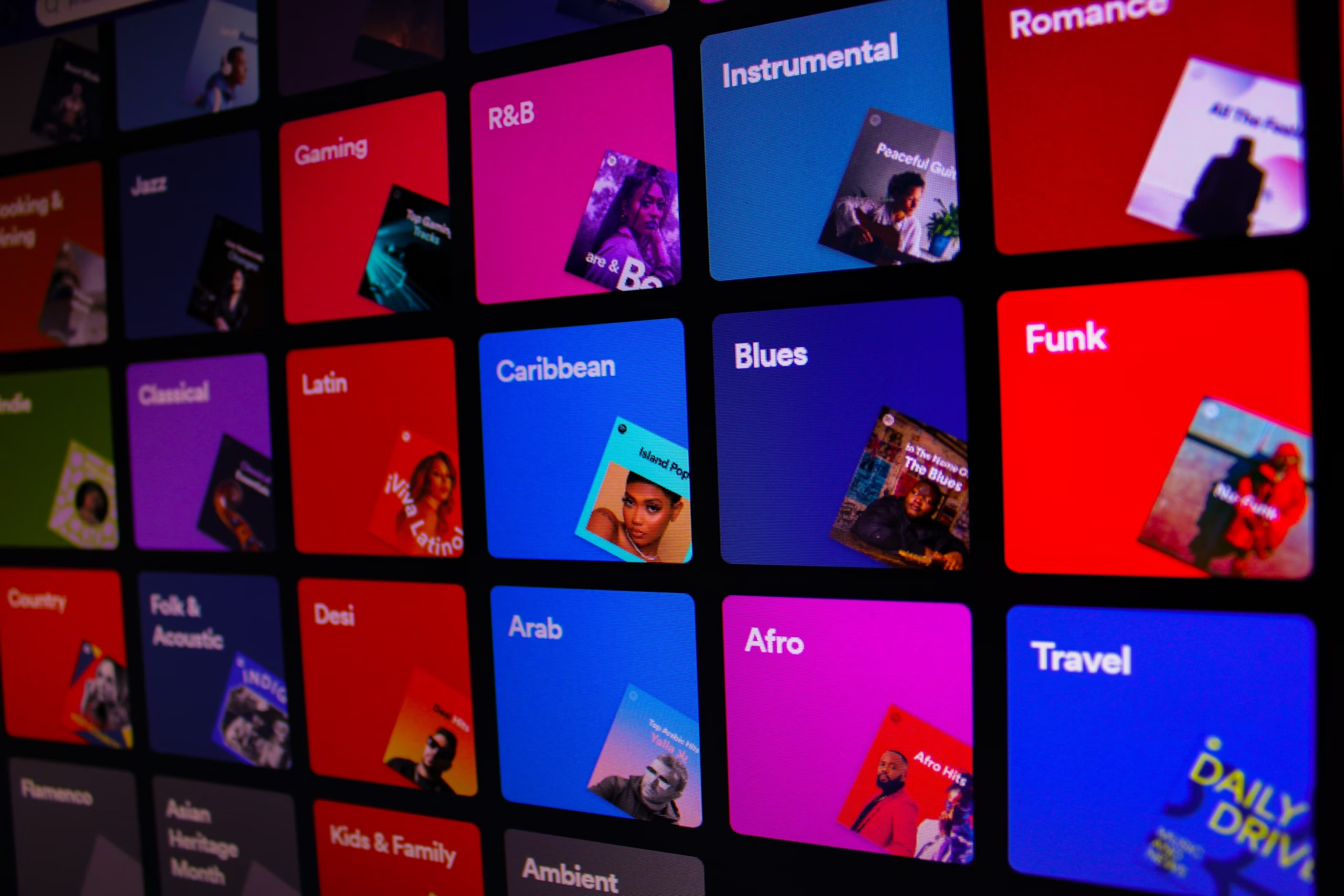
Ecosystem value creation
Spotify and competitors like Apple Music, YouTube Music, Amazon Music, and TikTok now function as platform orchestrators—connecting and enabling a vast range of ecosystem participants:
-
Artists: Self-publishing tools (e.g. Spotify for Artists, SoundCloud) allow artists to release and promote music directly, monitor analytics, and monetize streams—democratizing entry.
-
Fans: Personalized playlists, AI-generated recommendations, and social features deepen emotional connections and increase engagement.
-
Labels & Rights Holders: Gain access to real-time data on performance, regional preferences, and virality—transforming strategy.
-
Advertisers & Brands: Can target specific audiences through audio ads, branded playlists, and partnerships with artists.
-
Third-party Developers: Build integrations via APIs for DJ tools, fitness apps (e.g., Peloton), or AI-music analysis platforms.
In this model, value is co-created through the interplay of multiple participants. The platform becomes more than a distributor; it is a marketplace, a promoter, a data provider, and a collaboration space.

Ecosystem reinvention beyond streaming
The reinvention of the music industry didn’t stop at streaming. It extended into a broader creative and commercial ecosystem, with music integrated into:
-
Social media platforms like TikTok, where music clips go viral, sparking new hits and reviving old ones.
-
Gaming environments such as Fortnite or Roblox, where artists hold virtual concerts, selling digital merchandise and building new fan experiences.
-
Brand partnerships, where companies use music and artists to tell stories, build cultural relevance, and reach new audiences.
-
Fitness and wellness, through collaborations with apps like Calm, Strava, or Apple Fitness+.
Artists now think in ecosystems too—launching podcasts, virtual experiences, NFTs, fashion collaborations, and exclusive fan clubs (like Patreon or Discord communities).
Monetization and new value pools
Through ecosystem thinking, the music industry has found new monetization streams:
-
Subscriptions (Spotify, Apple Music)
-
Ad revenues (YouTube, free-tier platforms)
-
Live-streamed events and virtual concerts
-
Digital merchandise, NFTs, and metaverse performances
-
Brand partnerships and sync deals
-
Fan subscriptions and exclusives
In some cases, artists make more from social integrations or brand deals than from streams alone. The rise of “middle class” musicians—who don’t top charts but thrive within niche ecosystems—is enabled by direct fan relationships and alternative monetization.

Ecosystem enablers: data, AI, and open APIs
Data is the nervous system of the modern music ecosystem. Spotify’s discovery algorithms, YouTube’s content ID, and TikTok’s trend monitoring all use AI to connect artists to fans more efficiently than ever before. APIs allow innovation at the edges, enabling third parties to build remix apps, lyric tools, visualizations, and fan engagement features.
Moreover, open data helps drive artist-centric tools like Songkick for tours, Chartmetric for insights, and LANDR for mastering and promotion—extending the value chain horizontally.

Winning in an ecosystem world
Reinvention through ecosystems has required a new kind of leadership in music:
-
Orchestrators like Spotify or TikTok balance the needs of creators, users, brands, and regulators.
-
Labels now operate more like venture capitalists—investing in artist development, building brands, and managing rights across platforms.
-
Artists act as entrepreneurs—developing personal brands, multi-platform presence, and diverse revenue streams.
Ecosystem thinking is strategic, collaborative, and adaptive. Success is no longer about controlling assets, but enabling others to create value with them.
Despite its many successes, the music ecosystem still faces challenges, and need for further business model reinvention:
-
Artist compensation remains a hot topic—many argue that streaming revenues are too low.
-
Market concentration is a risk, with a few platforms controlling discovery and monetization.
-
Algorithmic influence shapes not just consumption, but what gets created—potentially narrowing diversity.
-
Copyright management across platforms and countries remains complex.
Nonetheless, the industry continues to innovate, exploring AI-generated music, blockchain-based rights tracking, immersive virtual experiences, and deeper fan personalisation.

Music as a living ecosystem
The reinvention of the music industry through ecosystem thinking has redefined how music is made, discovered, shared, and monetized. It has turned passive listeners into active participants, centralized players into enablers, and static catalogues into living, evolving digital experiences.
More than a technological shift, this transformation reflects a deeper change in business philosophy: from ownership to access, from control to coordination, and from isolated value chains to dynamic, networked ecosystems.
As platforms, creators, fans, and brands continue to co-evolve, the music industry stands as a powerful example of how ecosystem thinking can unlock growth, resilience, and creativity in a digital world.
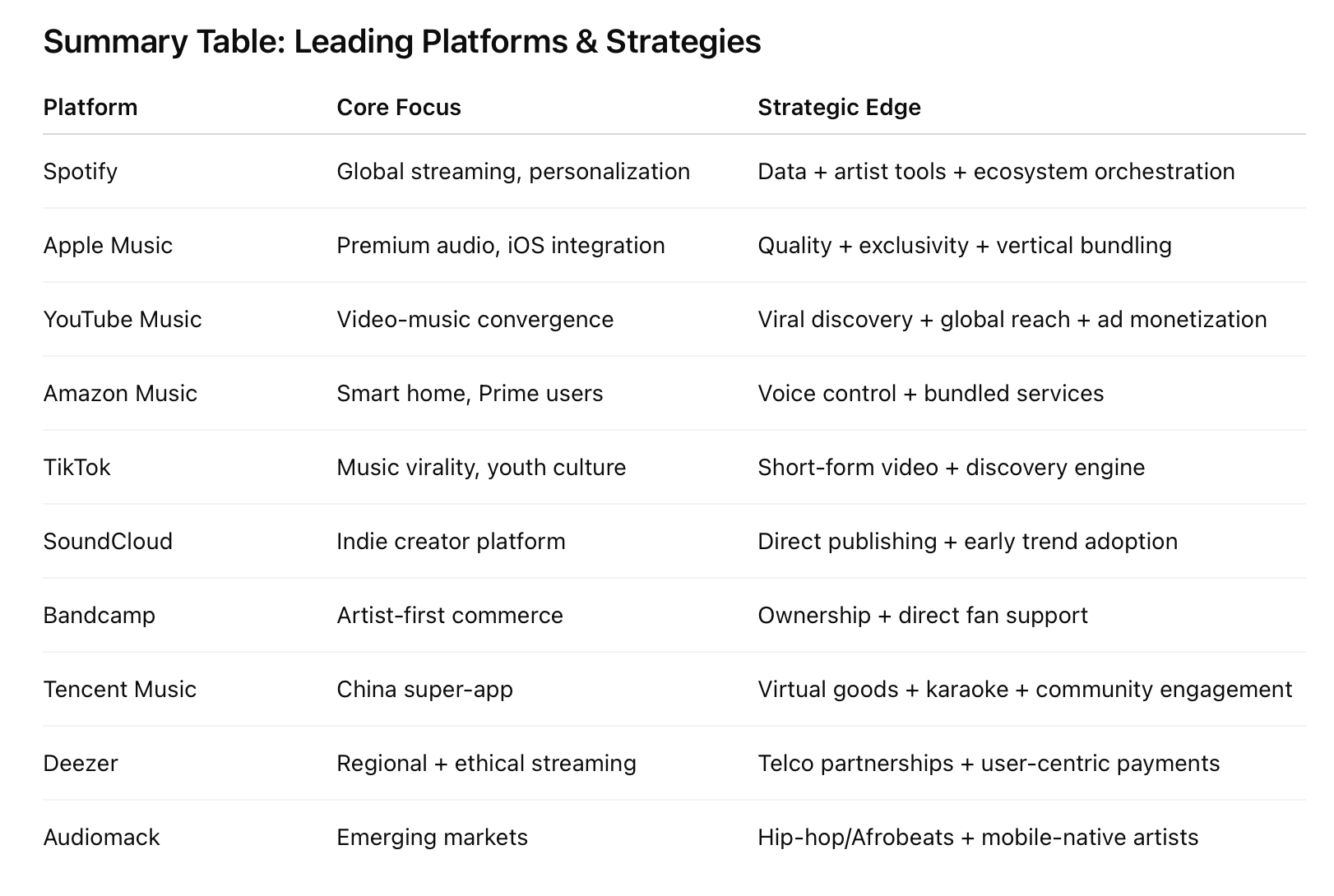
Here are profiles of the leading digital music platforms and how each has strategically positioned itself within the new music ecosystem:
1. Spotify
Founded: 2006 (Sweden)
Business Model: Freemium streaming (ad-supported + subscription)
Strategy: Ecosystem Orchestrator + Data Innovator
Spotify is the world’s largest music streaming platform by users, with over 600 million monthly active users and around 236 million premium subscribers (as of 2025). Its core strength lies in data-driven personalization, with features like Discover Weekly, Release Radar, and Wrapped. Spotify positions itself as a neutral platform between creators and listeners, offering artist tools (Spotify for Artists), podcasts, and an expanding AI stack (e.g. AI DJs, real-time lyric translation). It has made strategic acquisitions in podcasting (e.g. Anchor, Gimlet) and is moving into audiobooks, aiming to become the “audio home” across formats.
2. Apple Music
Founded: 2015 (USA)
Business Model: Subscription-only streaming
Strategy: Premium Experience + Vertical Integration
Apple Music leverages the Apple ecosystem (iOS, AirPods, Apple Watch) to deliver a high-quality, seamless user experience. It emphasizes exclusive content, artist-led shows (e.g., Elton John’s Rocket Hour), and higher-quality audio (lossless, Dolby Atmos). Unlike Spotify, Apple focuses less on social discovery and more on curation and integrationwith user lifestyles, including fitness, spatial audio, and live radio (e.g. Apple Music 1). Apple uses music as a value-added feature to retain subscribers within its larger services bundle.
3. YouTube Music
Founded: 2015 (USA)
Business Model: Freemium streaming + integrated with YouTube Premium
Strategy: Video-Music Integration + Global Reach
Owned by Google, YouTube Music benefits from deep integration with YouTube, the world’s most-used platform for music videos. It excels in global accessibility and virality, especially in emerging markets and among Gen Z. Its ecosystem strength lies in combining video, audio, user-generated content, and fan engagement. Many music trends now begin on YouTube Shorts. Google’s AI also helps power personalized recommendations and smart playlists, while its advertising infrastructure supports monetization for both majors and independents.
4. Amazon Music
Founded: 2007 (as Amazon MP3), rebranded in 2016
Business Model: Bundled with Prime + stand-alone subscriptions
Strategy: Ecosystem Bundle + Smart Devices
Amazon Music leverages its Prime ecosystem and Alexa-enabled smart devices to build frictionless music experiences. Its strategy emphasizes access through voice, integration with shopping and home automation, and bundling music with Prime subscriptions. While it has less cultural influence than Spotify or YouTube, it is strong in households and among passive users. It also offers high-definition and spatial audio options to compete on quality.
5. TikTok (ByteDance)
Founded: 2016 (China)
Business Model: Ad-based + e-commerce + music licensing
Strategy: Viral Discovery + Creator-Driven Ecosystem
TikTok has emerged as the most powerful music discovery platform for younger audiences. Songs often go viral on TikTok before reaching traditional charts. The platform’s short-form video format and algorithmic feed prioritize engagement and shareability. TikTok is building a deeper music ecosystem through SoundOn (artist distribution platform), licensing deals with major labels, and partnerships with streaming services. It doesn’t replace music platforms but acts as a catalyst for discovery and culture, influencing everything from Spotify playlists to brand campaigns.
6. SoundCloud
Founded: 2007 (Germany)
Business Model: Freemium streaming + creator subscriptions
Strategy: Independent Artist Hub + Creator Monetization
SoundCloud pioneered open music sharing and remains a go-to platform for independent and experimental artists. Its strategic focus is on creator empowerment—offering tools for publishing, monetizing, and analyzing tracks. It allows artists to control rights and monetize directly through SoundCloud Premier, Repost, and fan-powered royalties. The platform is a testing ground for trends, subcultures, and new genres, often ahead of mainstream platforms.
7. Bandcamp
Founded: 2008 (USA)
Business Model: Direct artist-to-fan sales
Strategy: Ethical Commerce + Artist Control
Bandcamp offers an alternative model centered around ownership and direct support. Fans can buy digital downloads, vinyl, merch, and more, with a majority of revenues going directly to artists. Bandcamp Fridays (fee-free sales days) have become a cultural event. It fosters niche and indie communities by emphasizing transparency and artist-first ethics. While small in scale, it has loyal users and is often used by creators as a primary income source.
8. Tencent Music Entertainment (TME)
Founded: 2016 (China)
Business Model: Freemium streaming + virtual gifts + karaoke + social
Strategy: Super App Ecosystem + Monetization Variety
TME operates QQ Music, Kugou, and Kuwo, dominating China’s streaming space. Its strategy blends music, social interaction, gaming, and virtual gifts, making music part of a broader entertainment super-app. Revenue comes not just from ads or subscriptions, but also from microtransactions, digital merchandise, and fan-driven economies. TME is a case study in ecosystem monetization diversity, with an emphasis on engagement and community.
9. Deezer
Founded: 2007 (France)
Business Model: Freemium streaming
Strategy: Open Partnerships + Local Curation
Deezer positions itself through localization, openness, and integration. It has partnered with telcos, hardware makers, and brands to expand globally. It also advocates for user-centric payment models, aiming to create fairer revenue shares. Deezer emphasizes editorial curation and regional content, particularly in Europe and Latin America.
10. Audiomack
Founded: 2012 (USA)
Business Model: Freemium streaming
Strategy: Emerging Market Focus + Hip-Hop & Afrobeats Culture
Audiomack is a fast-growing player in Africa, the Caribbean, and the U.S. urban music scene. Its strategy centers on youth culture, mobile-first consumption, and direct artist uploading. It builds local ecosystems by investing in emerging artists and providing tools for real-time metrics and monetization.

Ecosystems Inc … examples of how to reinvent every industry
The reinvention of the music industry offers powerful lessons for other sectors. Once dominated by physical sales and industry gatekeepers, music has evolved into a dynamic, digital-first ecosystem led by platforms like Spotify, YouTube, and TikTok. These platforms don’t just distribute content—they connect creators, fans, advertisers, developers, and data in ways that continually generate value and innovation.
Other industries—from healthcare to fashion, education to finance—can learn from music’s transformation by embracing ecosystem thinking. This means shifting from linear, siloed value chains to multi-sided platforms where different actors co-create value. Key characteristics include:
-
Connectivity: Linking diverse stakeholders through digital platforms.
-
Personalization: Using data to tailor experiences in real-time.
-
Continuous value creation: Delivering ongoing services rather than one-off transactions.
-
Network effects: Gaining value as more users, creators, and partners join.
-
Open architecture: Allowing integration, innovation, and adaptation over time.
The result is not just a better product, but a more responsive, scalable, and future-ready business model. Just as music moved from ownership to access, so can many other industries—from selling to streaming, from control to collaboration.
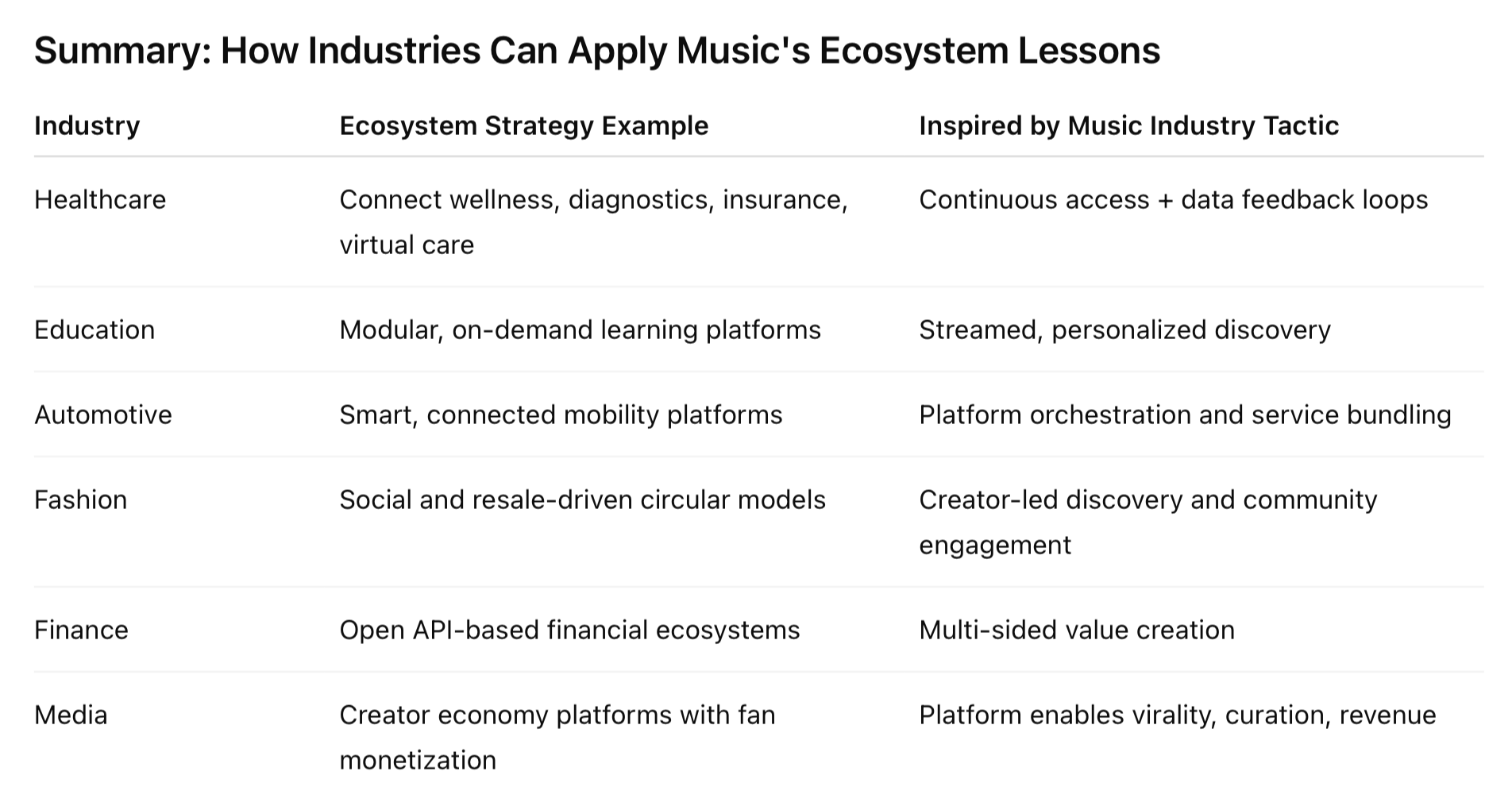
1. Healthcare … from treatments to health ecosystems
Old Model: Siloed providers offering one-off services (e.g. hospitals, insurers, pharmacies).
Ecosystem Model: Platforms like CVS Health, Ping An Good Doctor, or Babylon Health connect care, diagnostics, insurance, wearables, and virtual consultations into integrated health ecosystems.
-
Personalization: Just like Spotify recommends music, health ecosystems can use AI to personalize treatment plans or preventive care.
-
Platform Strategy: Connect patients, doctors, insurers, pharmacies, and digital health startups.
-
Value Creation: Continuity of care, lower costs, and better outcomes through real-time data sharing.
Ping An Good Doctor, launched by Ping An Insurance, is China’s largest digital health platform. With over 400 million registered users, it offers online consultations, diagnostics, health checkups, medicine delivery, and AI-powered triage — all in one app.
-
Platform Orchestration: Connects patients, doctors (both in-house and external), hospitals, pharmacies, and insurers.
-
AI-Driven Personalization: Uses AI to provide initial diagnoses, route patients to the right doctor, and suggest health plans.
-
Vertical Integration: Builds offline “One-Minute Clinics” (smart booths) across Chinese cities to bridge physical-digital care.
Ping An’s ecosystem model has reduced friction, increased access to care, and allowed rapid scaling. Like Spotify’s hybrid model of human + algorithmic curation, it blends AI with professional expertise.
2. Education … from institutions to learning ecosystems
Old Model: Universities and schools as gatekeepers of learning.
Ecosystem Model: Platforms like Coursera, Khan Academy, and Duolingo offer modular, lifelong learning through content, tools, and community.
-
Access over Ownership: Just as music moved from CDs to streaming, learning is shifting from degrees to continuous, on-demand content.
-
Ecosystem Design: Involve content creators (e.g. professors), learners, employers, edtech tools, and credentialing bodies.
-
Feedback Loops: Learning paths are continuously updated based on learner performance and job market needs.
Coursera, founded in 2012 by Stanford professors, is a global online learning platform with over 140 million users and partnerships with 300+ top universities and companies.
-
Multi-Sided Platform: Connects learners, educators, institutions, and employers — creating a rich, interconnected education ecosystem.
-
Modular Learning: Offers flexible, stackable credentials (courses, certificates, degrees), much like how Spotify unbundled albums into playlists and songs.
-
Personalization & AI: Suggests learning paths based on skills, career goals, and usage patterns. Uses AI to tailor content recommendations, mirroring music algorithms.
-
Corporate & Government Partnerships: Offers Coursera for Business, Government, and Campus — embedding education into workforce systems.
Coursera has become a leading force in democratizing education globally, moving from a content library to a full ecosystem of skills, credentials, and career pathways. Like Spotify, it redefined access and empowered both creators (educators) and consumers (learners).
3. Automotive … from selling cars to mobility-as-a-service
Old Model: Buy or lease a vehicle from a dealership.
Ecosystem Model: Platforms like Tesla, Uber, and MaaS apps like Bolt connect cars, ride-hailing, energy, insurance, and smart city infrastructure.
-
Platform Logic: Tesla connects software, EV charging, insurance, and over-the-air updates.
-
Network Effects: Uber builds an ecosystem of drivers, riders, restaurants, and logistics.
-
Data as Asset: Predictive maintenance, usage-based insurance, route optimization—all fed by real-time data.
Tesla is not just a car company — it’s an integrated mobility, energy, and software platform. Its success lies in treating the car as a node in a broader ecosystem, not just a product.
-
Vertical Integration: Controls everything from battery production to software, energy services (Powerwall, Solar Roof), and even insurance.
-
Continuous Upgrades: Like Spotify’s streaming updates, Tesla delivers over-the-air software updates to improve vehicle performance and add features post-purchase.
-
Network Effects: Connects Tesla vehicles into shared systems — from autonomous driving data learning to Supercharger networks.
-
AI + Data Loop: Uses real-time driving data for autopilot training and fleet optimization, akin to music platforms using listening data for personalization.
Tesla’s integrated model offers a seamless user experience while continuously expanding into adjacent spaces (robotaxis, energy storage, grid services). This mirrors how platforms like Apple Music or YouTube built adjacent services around core content.
4. Fashion … from product-driven to creator-driven ecosystems
Old Model: Seasonal collections pushed by fashion houses to retailers.
Ecosystem Model: Platforms like Instagram, Depop, and StockX empower creators, resellers, and consumers to co-create and trade fashion in real time.
-
Creators as Brands: Influencers and micro-brands gain traction without traditional backing.
-
Circular Economy: Secondhand marketplaces and upcycling apps form part of the fashion loop.
-
Digital Goods: Virtual fashion in gaming and the metaverse (e.g. Balenciaga in Fortnite).
StockX launched in 2016 as a “stock market of things,” enabling users to buy and sell sneakers, streetwear, and luxury items with price transparency, authentication, and real-time demand signals. It now processes billions in GMV annually and has become a cultural hub for sneakerheads and collectors.
- Two-Sided Marketplace: Connects sellers (resellers, retailers, individuals) and buyers (enthusiasts, investors) in a transparent pricing environment, like Spotify connects artists and fans.
-
Data as Currency: Provides real-time pricing charts, historical trends, and volume data — turning fashion into a speculative, dynamic asset class.
-
Trust Infrastructure: Builds authentication, condition grading, and transaction security — key to ecosystem health and stickiness.
-
Cultural Integration: Acts as a hub for sneaker culture, drops, and community-driven demand, leveraging scarcity and social influence like viral hits in music.
StockX transformed secondhand goods into financial assets. Much like how Spotify allowed obscure tracks to gain global traction, StockX gave niche fashion products global visibility and liquidity. The company monetizes not just transactions but the data, culture, and community around them.
5. Finance … from products to financial wellness ecosystems
Old Model: Banks offering siloed services—checking, loans, investing.
Ecosystem Model: Platforms like Revolut, Alipay, and Plaid connect personal finance, investing, insurance, crypto, and rewards.
-
API-driven Ecosystems: Fintechs connect to banks, credit bureaus, payroll providers, and e-commerce platforms.
-
User Control: Like artists using Spotify for Artists, customers can manage their financial data and insights in one place.
-
Embedded Finance: Financial services appear within non-financial platforms (e.g. BNPL in retail).
Revolut started in 2015 as a travel-focused money app and evolved into a financial super app, offering banking, crypto, stock trading, budgeting, and more to 40+ million users worldwide.
-
All-in-One Platform: Combines checking, saving, FX, trading, lending, and insurance — turning financial services into a continuous engagement experience, like Spotify’s audio ecosystem.
-
Personalized Insights: AI-driven notifications and budgeting tools help users manage money better, mirroring personalized recommendations in music apps.
-
APIs + Open Banking: Connects with third-party fintechs, creating a modular system where users can plug in services.
-
Gamified UX: Rewards, challenges, and community engagement drive usage, similar to TikTok’s engagement mechanics.
Revolut is redefining consumer expectations in banking — focusing on UX, real-time updates, and financial control. Like Spotify gave users control over what and how they consume music, Revolut puts customers in control of their financial lives.
6. Media and Entertainment … from channels to content ecosystems
Old Model: Studios create, control, and distribute content through owned channels.
Ecosystem Model: Platforms like Netflix, YouTube, and Twitch enable content creation, distribution, monetization, and fan engagement across communities.
-
Creator Economy: Anyone can be a content creator, and monetization is built into the ecosystem (ads, subscriptions, donations).
-
Personalization: AI-driven recommendations akin to Spotify’s playlists.
-
Community-Driven Discovery: Fans co-create culture, memes, remixes—similar to how TikTok shapes music.
Netflix, founded in 1997 as a DVD rental company, became the first major streaming service in 2007. Today it’s a global media powerhouse, with 270+ million subscribers in 190+ countries, and a leader in both content production and delivery.
-
Vertical Control of Value Chain: Produces, distributes, and curates content end-to-end — like Apple in music or Tesla in mobility.
-
Data-Driven Personalization: Uses viewer data to drive algorithmic recommendations, content commissioning, and global rollouts (e.g. “House of Cards” was greenlit based on viewer preferences).
-
Global Localism: Builds region-specific content ecosystems (e.g. K-dramas, Spanish thrillers) that scale globally, turning local hits into global phenomena (à la “Squid Game”).
-
Multi-Stakeholder Platform: Connects creators, audiences, advertisers (in ad-tier), and now game developers — extending the platform into new media.
Netflix reshaped how content is consumed, produced, and monetized. Like Spotify, it removed traditional industry gatekeepers and used algorithms and audience feedback to shape creative direction. It turned entertainment into a dynamic, participatory, data-led experience.
Explore more
- Next Generation Business Models: Redefining value, ownership, scale, and trust by Peter Fisk
- Reinventing business ecosystems for more profitable growth by Peter Fisk
- Building a Butterfly Brand: How “branded ecosystems” achieve more in a world of relentless change by Peter Fisk
- Has Apple become more or less innovative in recent years? by Peter Fisk
- Cross Industry Innovation for Future Business Ecosystems by Z Punkt
- Ecosystem Strategy Map by Julian Kawohl
- How do you Design a Business Ecosystem by BCG Henderson