Coca-Cola’s Y3000 initiative showcases how AI can drive both product innovation and consumer engagement. Using AI to analyze global preferences and emotions, the company created a futuristic limited-edition flavor, Y3000 Zero Sugar, designed to resonate with forward-looking consumers. The initiative also includes the AI-powered Y3000 CAM, an augmented reality feature that lets users scan packaging to unlock personalized visual experiences, deepening brand connection. Launched in select global markets, Y3000 positions Coca-Cola as a leader in integrating AI into product development and marketing, blending creativity, technology, and strategic market insight.
In a business world now defined by rapid technological change, shifting consumer behaviour, and global uncertainty, businesses are navigating a landscape more complex and interconnected than ever before. The forces shaping markets today are not isolated trends—they are converging, accelerating, and creating unprecedented opportunities and risks. To thrive, leaders need a comprehensive understanding of these dynamics, their relative economic impact, and the strategic choices they demand.
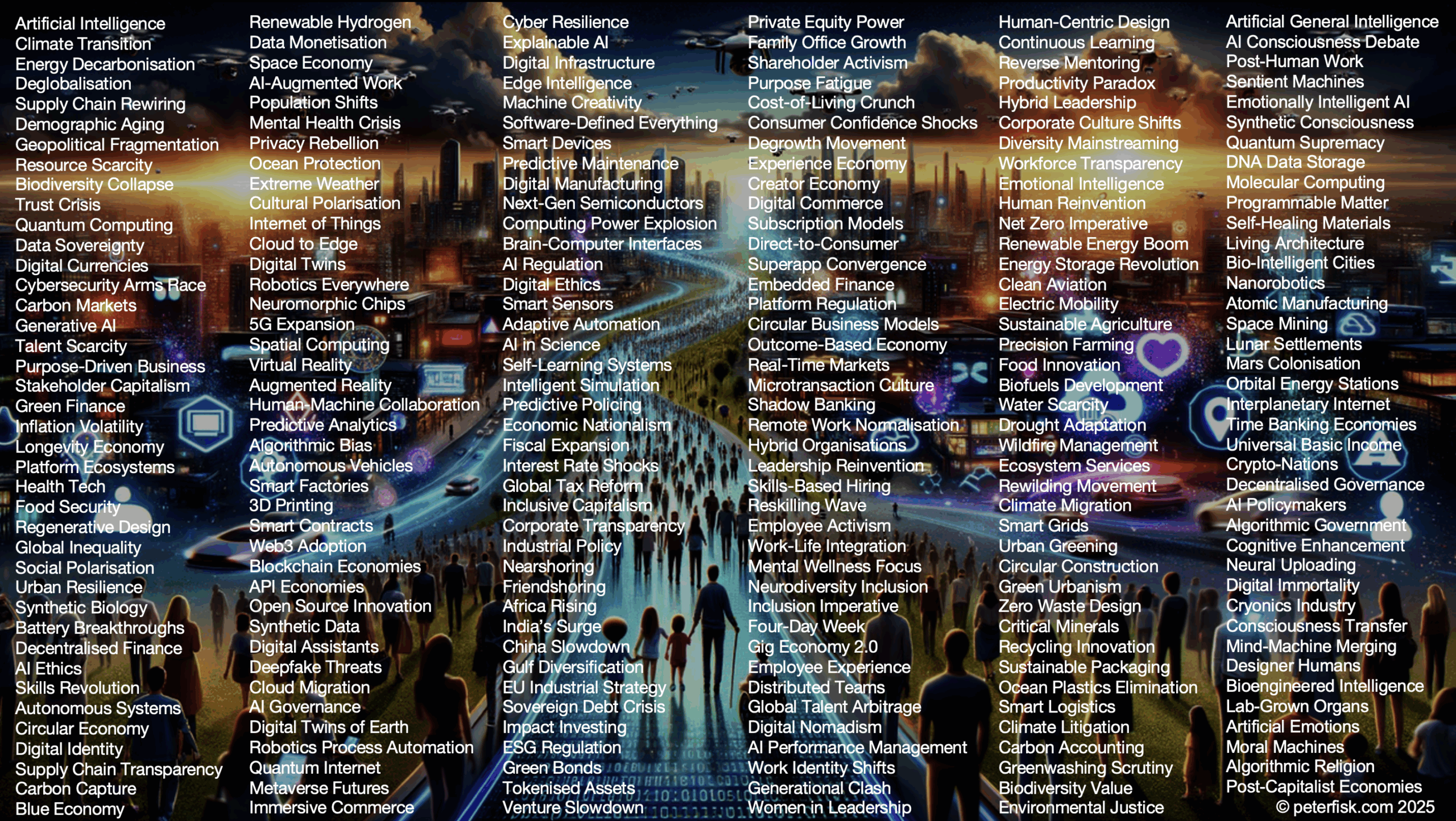
This list of 250 megatrends is designed to serve as a blueprint for business leaders, strategists, and innovators. Each trend has been carefully ranked by its relative economic influence, reflecting the potential to transform industries, generate revenue, disrupt markets, and reshape value creation. From the transformative power of artificial intelligence and cloud computing to the growing imperatives of sustainability, renewable energy, and circular economies, this compilation offers a panoramic view of the forces shaping the present—and the future.
What makes this list particularly powerful is its diversity. It encompasses high-impact technological revolutions like generative AI, autonomous vehicles, and quantum computing, alongside societal shifts such as aging populations, urbanization, and remote work transformations. Environmental challenges, from climate change adaptation to water scarcity solutions, sit alongside innovations in food tech, biotech, and personalized healthcare. It includes financial and business model revolutions—fintech, blockchain, subscription economies—as well as emerging industrial innovations like advanced robotics, smart manufacturing, and next-generation materials. Each trend is accompanied by a concise description, highlighting not just what it is, but why it matters and the opportunities or challenges it presents.
For executives and decision-makers, the implications are clear: these trends are interconnected. The adoption of AI in logistics, for example, is enhanced by IoT-enabled smart grids and autonomous transport, while renewable energy innovations create new opportunities in electric vehicles, hydrogen, and circular manufacturing. Similarly, social and demographic shifts, such as mental health awareness and urban mobility demands, intersect with technology-enabled solutions, presenting novel market opportunities for businesses agile enough to respond.
Understanding the economic weight of each trend allows leaders to prioritize strategic initiatives, identify high-value opportunities, and anticipate disruptive risks. The ranking provides a lens through which to assess not only what is “trending,” but what truly matters in terms of revenue potential, market transformation, and long-term sustainability.
In short, this compilation is more than a list—it is a navigational tool. It equips leaders to think broadly and act decisively, connecting innovation with strategy, technology with society, and sustainability with growth. Whether your organization is a global powerhouse, a nimble startup, or a regional player, these 250 megatrends reveal the forces reshaping every industry, every business model, and every leadership agenda today.
1. AI and Machine Learning
Artificial intelligence and machine learning are revolutionizing industries, enabling predictive analytics, automation, personalized services, and faster decision-making, transforming productivity, costs, and innovation across sectors globally.
2. Cloud Computing
Cloud infrastructure drives scalability, cost efficiency, and global access to software and data, enabling businesses to operate virtually, integrate AI, and compete in a rapidly digitalizing economy.
3. Globalization and Trade Networks
Complex supply chains, international markets, and global capital flows create economic interdependencies, offering growth opportunities while exposing businesses to geopolitical, regulatory, and logistical risks.
4. Digital Transformation
Organizations adopt digital tools, AI, and data-driven strategies to reinvent operations, customer experiences, and business models, fundamentally reshaping competitiveness and industry structure worldwide.
5. E-Commerce Expansion
Online retail growth, accelerated by changing consumer behavior, drives direct-to-consumer models, global reach, and data-driven personalization, disrupting traditional brick-and-mortar retail.
6. Renewable Energy
Solar, wind, and other renewables reduce reliance on fossil fuels, drive innovation, create jobs, and transform the energy landscape amid global climate commitments.
7. Electric Vehicles
The shift from internal combustion engines to EVs accelerates decarbonization, creates new industrial ecosystems, and reshapes automotive supply chains.
8. Autonomous Vehicles
Self-driving technology revolutionizes transportation, logistics, and mobility services, impacting infrastructure, insurance, and urban planning.
9. 5G Connectivity
Ultra-fast, low-latency 5G networks enable real-time communication, IoT expansion, AI applications, and transformative changes in healthcare, manufacturing, and smart cities.
10. AI in Healthcare
AI-driven diagnostics, personalized medicine, and predictive analytics enhance patient outcomes, reduce costs, and create new opportunities for biotech and pharmaceutical industries.
11. Genomics and CRISPR
Gene editing and sequencing technologies transform healthcare, agriculture, and synthetic biology, enabling targeted therapies, disease prevention, and bioengineering innovations.
12. Cybersecurity Threats
Rising cyberattacks force businesses to invest in protective measures, shaping technology development, risk management, and regulatory frameworks globally.
13. Digital Payments
Cashless economies, fintech platforms, and blockchain-based transactions improve efficiency, financial inclusion, and cross-border commerce.
14. AI-Driven Automation
Robotics and AI automate repetitive and complex tasks, increasing productivity, reducing labor costs, and reshaping industrial operations.
15. Sustainability and ESG
Environmental, social, and governance considerations drive investor focus, regulatory compliance, and operational strategies, redefining corporate accountability.
16. Climate Change Adaptation
Rising global temperatures and extreme weather force businesses to rethink supply chains, risk management, and infrastructure resilience.
17. Circular Economy
Resource efficiency, recycling, and waste reduction reshape manufacturing, packaging, and consumer goods, enabling sustainable growth.
18. Urbanization
Rapid city growth increases demand for infrastructure, smart technology, housing, and urban services, creating opportunities and congestion challenges.
19. Aging Populations
Demographic shifts in developed nations drive healthcare, retirement, and workforce planning innovation.
20. Emerging Market Growth
Rapid development in Asia, Africa, and Latin America expands consumer bases, industrial investment, and global trade opportunities.
21. Biotechnology Innovation
Synthetic biology, therapeutics, and agricultural biotech accelerate health and food sector transformation.
22. Space Economy
Commercial space ventures, satellite internet, and space tourism open new markets and technological frontiers.
23. AI Ethics and Regulation
The ethical deployment of AI and associated regulations shape innovation, corporate responsibility, and public trust.
24. Robotics in Manufacturing
Advanced robotics drive efficiency, precision, and scalability in production, reshaping traditional industries.
25. Quantum Computing
Emerging quantum technologies promise unprecedented computational power, disrupting finance, logistics, cryptography, and scientific research.
26. Digital Twins
Virtual modeling of real-world systems enhances predictive maintenance, urban planning, and industrial design.
27. Edge Computing
Processing data closer to devices improves real-time decision-making, IoT functionality, and low-latency applications.
28. Advanced Batteries
Energy storage innovations accelerate EV adoption, renewable integration, and grid stability.
29. Hydrogen Economy
Hydrogen as an energy source transforms transport, industry, and decarbonization strategies globally.
30. Internet of Things (IoT)
Connected devices across industries drive efficiency, predictive maintenance, smart cities, and consumer convenience.
31. AI-Generated Content
Generative AI transforms marketing, media, design, and entertainment, creating new workflows and content strategies.
32. Social Media Evolution
Social platforms influence consumer behavior, brand strategy, political influence, and digital commerce.
33. Fintech Innovation
Blockchain, neobanks, lending platforms, and AI-driven finance disrupt traditional banking and democratize financial services.
34. Cryptocurrency & Blockchain
Digital currencies and blockchain systems reshape finance, contracts, and digital ownership frameworks globally.
35. Personalized Medicine
Tailored treatment plans using genomics and AI improve outcomes and drive new healthcare business models.
36. Smart Cities
Urban planning leverages IoT, AI, and sustainable design to improve infrastructure, mobility, and services.
37. Remote Work Transformation
Hybrid and remote work models reshape real estate, corporate culture, and productivity metrics.
38. Digital Identity
Secure online identification systems are critical for e-commerce, banking, healthcare, and governance.
39. AI-Powered Supply Chains
Predictive analytics, automation, and IoT optimize logistics, reduce costs, and improve resilience.
40. Cloud AI Integration
Cloud platforms combining AI and big data enable scalable enterprise solutions and innovation acceleration.
41. Food Tech Innovation
Plant-based foods, lab-grown meat, and AI-driven production transform agriculture and consumer nutrition.
42. Advanced Materials
Nanomaterials, smart polymers, and composites enable stronger, lighter, and more sustainable products.
43. GenAI for Business
Generative AI enhances R&D, design, marketing, and personalized experiences across industries.
44. Water Scarcity Solutions
Innovations in water management, desalination, and recycling address critical global resource challenges.
45. Mental Health Awareness
Increased focus on workplace and societal mental health drives services, apps, and corporate policies.
46. Mobility-as-a-Service
Integrated transportation platforms offer on-demand, multimodal urban mobility solutions.
47. Circular Fashion
Clothing brands adopt recycling, upcycling, and sustainable materials to reduce environmental impact.
48. AI Regulation
Global governments develop frameworks to manage AI risks, ensuring safety, ethics, and fair competition.
49. Edge AI
Local AI processing accelerates real-time applications in vehicles, manufacturing, and robotics.
50. Carbon Capture & Storage
Technologies remove CO₂ from the atmosphere, helping industries meet climate goals and sustainability mandates.
51. Electric Aviation
Emerging electric and hybrid aircraft reduce carbon emissions, lower operational costs, and revolutionize regional air transport, urban air mobility, and sustainable logistics across global aviation markets.
52. Digital Health Platforms
Telemedicine, AI diagnostics, and remote monitoring platforms enhance healthcare access, reduce costs, and enable patient-centric, data-driven treatment models in global healthcare systems.
53. E-Learning & EdTech
Digital education platforms, AI tutors, and adaptive learning systems expand access, personalize curricula, and reshape traditional schooling, upskilling, and corporate training programs.
54. AI-Driven Marketing
Machine learning optimizes targeting, content creation, predictive consumer behavior, and ROI measurement, transforming how brands reach and engage customers worldwide.
55. Biodegradable Materials
Eco-friendly alternatives to plastics, packaging, and industrial materials reduce environmental impact, meet regulatory demands, and support sustainability-led brand strategies.
56. Voice & Conversational AI
Voice recognition and conversational agents enhance customer service, productivity tools, and smart devices, creating more intuitive human-machine interaction.
57. Smart Manufacturing
IoT sensors, AI monitoring, and robotics optimize production efficiency, reduce downtime, and lower costs, driving Industry 4.0 adoption.
58. Predictive Analytics
Data-driven forecasting in finance, logistics, marketing, and operations enables proactive decision-making, risk reduction, and revenue optimization.
59. Autonomous Drones
Unmanned aerial vehicles enhance delivery, surveillance, mapping, and industrial operations, reshaping logistics, agriculture, and defense sectors.
60. Sustainable Agriculture
AI, IoT, and precision farming technologies increase yields, reduce resource use, and address climate and population pressures in global food production.
61. AI in LegalTech
Automation and predictive analytics streamline legal research, contract review, and compliance, transforming law practice efficiency and corporate governance.
62. Biometric Security
Fingerprint, facial recognition, and other biometrics improve cybersecurity, fraud prevention, and secure access for financial, corporate, and government systems.
63. Personalized Retail
Data-driven recommendations, virtual try-ons, and AI-enhanced customer journeys create hyper-personalized shopping experiences, increasing engagement and sales.
64. Space Mining
Asteroid and planetary resource extraction opens long-term opportunities in rare materials, minerals, and space-based industrial ventures.
65. Next-Gen Batteries
Solid-state, lithium-sulfur, and other advanced batteries increase energy density, charging speed, and longevity for EVs and renewable storage.
66. AI in Finance
Algorithmic trading, fraud detection, and personalized investment platforms enhance efficiency, risk management, and profitability in banking and capital markets.
67. Smart Homes
Connected devices, AI assistants, and energy management systems improve comfort, convenience, and energy efficiency in residential environments.
68. Urban Air Mobility
Flying taxis, drones, and urban aerial transport networks reduce congestion, improve mobility, and create new urban transportation markets.
69. Low-Code/No-Code Platforms
Simplified software development empowers businesses to rapidly deploy apps, automate workflows, and reduce IT costs without heavy coding expertise.
70. Green Hydrogen
Sustainable hydrogen production supports clean energy strategies, industrial decarbonization, and new fuel markets globally.
71. AI-Powered Customer Service
Chatbots and virtual agents enhance efficiency, reduce costs, and improve satisfaction across industries, from retail to financial services.
72. Wearable Technology
Health monitoring, fitness tracking, and augmented reality devices enable real-time insights, personalization, and new consumer and healthcare applications.
73. Direct-to-Consumer Models
Brands bypass intermediaries to control pricing, customer engagement, data, and loyalty, disrupting traditional retail channels.
74. Advanced Robotics
Collaborative robots, AI-guided arms, and autonomous machinery enhance productivity in manufacturing, logistics, and healthcare.
75. AI Ethics
Companies adopt frameworks to ensure responsible, transparent AI deployment, addressing bias, privacy, and societal impact.
76. Food Supply Chain Transparency
Blockchain and IoT ensure traceability, reduce fraud, and meet consumer demand for ethically sourced products.
77. Subscription Economy
Recurring revenue models drive customer loyalty, predictable cash flow, and data-driven service optimization across industries.
78. Digital Twins in Infrastructure
Virtual replicas of buildings, factories, and cities optimize design, maintenance, and operational efficiency, reducing costs and risks.
79. Connected Cars
Automotive IoT enables vehicle-to-vehicle and vehicle-to-infrastructure communication, enhancing safety, efficiency, and autonomous driving capabilities.
80. Global Talent Mobility
Remote work, gig economy, and international recruitment expand access to skilled talent, driving productivity and innovation.
81. AI in Energy Management
Smart grids, predictive analytics, and automation optimize energy use, reduce costs, and integrate renewables efficiently.
82. Cyber-Physical Systems
Integration of computation, networking, and physical processes transforms manufacturing, logistics, and industrial operations.
83. Digital Advertising Evolution
Programmatic ads, AI optimization, and multi-channel strategies redefine consumer engagement and media monetization.
84. Generative Design
AI-driven design optimizes product performance, materials usage, and manufacturing efficiency across engineering and architecture.
85. Mixed Reality
AR/VR applications enhance education, entertainment, training, and remote collaboration, reshaping immersive experiences.
86. Smart Logistics
IoT sensors, AI forecasting, and autonomous vehicles improve supply chain efficiency, transparency, and cost-effectiveness.
87. AI-Enhanced Drug Discovery
Machine learning accelerates identification of molecules, reduces R&D costs, and shortens time-to-market for new therapies.
88. Blockchain for Enterprise
Decentralized ledgers streamline contracts, transactions, and supply chains, enhancing security, transparency, and operational efficiency.
89. Digital Nomad Economy
Remote work policies, global connectivity, and flexible living reshape talent retention, corporate culture, and real estate demand.
90. AI Governance
Regulations and frameworks ensure ethical, safe, and accountable AI adoption across industries.
91. Edge Analytics
Real-time data processing at the edge reduces latency, enhances IoT functionality, and supports autonomous systems.
92. Eco-Tourism
Sustainable travel trends reshape hospitality, conservation, and local economic development.
93. Data Sovereignty
National and regional data regulations influence cloud strategy, cross-border commerce, and technology deployment.
94. Climate Finance
Investments in low-carbon projects and green bonds shape capital allocation and corporate sustainability strategies.
95. Shared Mobility
Ride-sharing, car-sharing, and micro-mobility solutions reduce congestion, pollution, and personal transport costs.
96. AI-Powered Creativity
Generative tools support advertising, media, and design innovation, transforming workflows and ideation processes.
97. Circular Electronics
Recycling and sustainable design in electronics reduce waste, recover rare materials, and extend product lifecycle.
98. AI-Enhanced Security
Machine learning improves threat detection, cybersecurity, and fraud prevention across sectors.
99. Sustainable Packaging
Innovations in materials, design, and logistics reduce environmental impact and enhance brand value.
100. Smart Retail
AI, IoT, and omnichannel integration personalize experiences, optimize inventory, and increase operational efficiency.
151. AI in Predictive Maintenance
Machine learning anticipates equipment failures, reduces downtime, optimizes repair schedules, and saves costs across manufacturing, energy, and transportation industries, enhancing operational efficiency and reliability.
152. Smart Waste Management
IoT sensors, AI sorting, and automated recycling improve efficiency, reduce landfill dependency, and optimize resource recovery in cities and industrial operations.
153. AI-Driven Retail Analytics
Predictive insights into customer behavior, inventory trends, and sales performance enable targeted marketing, dynamic pricing, and optimized product offerings.
154. AI-Enabled Drug Repurposing
Machine learning identifies new uses for existing pharmaceuticals, accelerating R&D, reducing development costs, and shortening time-to-market for therapies.
155. Digital Twins in Healthcare
Virtual models of patients, organs, and treatment plans enable personalized medicine, surgical planning, and optimized care delivery.
156. AI in Fraud Detection
Advanced algorithms monitor financial transactions, detect anomalies, and prevent cybercrime, protecting businesses and consumers globally.
157. Renewable Aviation Fuels
Sustainable jet fuels reduce carbon emissions in aviation, supporting decarbonization goals and regulatory compliance.
158. AI-Optimized Advertising
Real-time ad placement, targeting, and creative content generation improve campaign efficiency and ROI for digital marketing platforms.
159. AI in Drug Discovery
Generative and predictive algorithms accelerate molecule identification, optimize trials, and improve therapeutic success rates.
160. Smart Buildings
AI-enabled HVAC, lighting, and security systems enhance energy efficiency, occupant comfort, and operational savings in commercial and residential spaces.
161. AI-Powered Investment Platforms
Machine learning supports portfolio management, risk assessment, and automated trading, democratizing access to sophisticated financial strategies.
162. Smart Grid Cybersecurity
Protecting energy networks with AI and IoT ensures reliable, secure, and efficient power distribution amid increasing digitalization.
163. AI in Agriculture Yield Prediction
Predictive models optimize planting schedules, fertilizer use, and irrigation, improving crop output and reducing environmental impact.
164. Smart Ports and Logistics Hubs
Automated cargo handling, predictive scheduling, and AI analytics enhance efficiency, reduce bottlenecks, and optimize global shipping.
165. AI-Powered Fraud Prevention
Real-time monitoring of banking, e-commerce, and insurance transactions reduces financial risk, enhances compliance, and protects consumers.
166. AI-Assisted Clinical Trials
Predictive patient selection, trial simulations, and data analysis accelerate drug development while reducing costs and improving success rates.
167. AI in Energy Forecasting
Machine learning predicts energy demand, optimizes generation, and improves integration of renewables for grid stability.
168. Circular Consumer Electronics
Reuse, repair, and recycling programs reduce e-waste, recover critical materials, and support sustainability initiatives.
169. AI in Urban Traffic Management
Predictive traffic flows, adaptive signaling, and autonomous systems reduce congestion, emissions, and commute times.
170. Smart Factories
IoT, robotics, and AI integration enable real-time monitoring, predictive maintenance, and adaptive production, improving efficiency and scalability.
171. AI-Powered Credit Scoring
Machine learning enhances financial inclusion, improves risk assessment, and personalizes lending products in global markets.
172. Sustainable Shipping
Electric, hydrogen, and wind-assisted vessels reduce emissions, optimize fuel use, and meet regulatory sustainability requirements.
173. AI in Insurance Claims
Automated processing, predictive fraud detection, and analytics enhance customer experience, efficiency, and risk management.
174. AI-Driven Personalized Learning
Adaptive education platforms use machine learning to tailor curricula, improve engagement, and optimize learning outcomes for students and corporate learners.
175. Next-Generation Semiconductors
Advanced chips, neuromorphic computing, and AI accelerators drive high-performance computing, AI applications, and next-gen electronics.
176. AI-Enhanced Energy Management
Smart grids, predictive maintenance, and automation optimize generation, distribution, and consumption for cost savings and sustainability.
177. Blockchain in Logistics
Distributed ledgers provide transparency, traceability, and efficiency in supply chains, reducing fraud and operational costs.
178. AI-Assisted Translation
Real-time multilingual translation enables global collaboration, remote work, and cross-border commerce with improved communication accuracy.
179. Sustainable Packaging Innovations
Compostable, reusable, and reduced-material packaging reduces environmental impact, regulatory risk, and enhances brand reputation.
180. AI-Enhanced Retail Inventory
Predictive stock management, automated ordering, and demand forecasting minimize waste, reduce costs, and improve customer satisfaction.
181. AI-Driven Weather Prediction
High-resolution climate modeling supports agriculture, energy planning, disaster mitigation, and supply chain optimization.
182. AI in Fraud Analytics
Pattern recognition and predictive modeling detect financial anomalies, cybersecurity threats, and operational irregularities in real-time.
183. Smart Farming Sensors
IoT-enabled soil, water, and crop sensors optimize inputs, improve yield, and reduce environmental footprint.
184. AI in Traffic Flow Optimization
Machine learning predicts congestion, coordinates autonomous vehicles, and manages urban transportation for efficiency and reduced emissions.
185. AI in Predictive Policing
Data-driven analytics enhance crime prevention, resource allocation, and community safety while raising ethical and privacy considerations.
186. AI-Powered Recruitment Analytics
Predictive tools analyze candidate performance, cultural fit, and retention risk, improving hiring outcomes.
187. Smart Metering
IoT-enabled energy and water meters provide real-time consumption data, improve efficiency, and enable sustainable resource management.
188. AI-Assisted R&D
Machine learning accelerates product development, simulation, and innovation in pharmaceuticals, materials, and technology.
189. AI in Customer Insights
Predictive models analyze behavior, sentiment, and trends to optimize marketing, product design, and engagement strategies.
190. Carbon-Neutral Supply Chains
Decarbonization strategies, renewable integration, and AI optimization reduce emissions and meet ESG targets.
191. AI-Powered Legal Drafting
Automation in contract creation, compliance, and research reduces time, costs, and human error.
192. AI-Driven Investment Insights
Machine learning identifies trends, predicts risks, and supports strategic capital allocation for investors and corporations.
193. Precision Livestock Farming
Sensors, AI, and monitoring improve animal health, productivity, and sustainability in agriculture.
194. AI-Enhanced Fraud Risk Management
Predictive analytics reduce operational and financial risk across industries, enhancing regulatory compliance.
195. Smart Urban Mobility
Connected transport systems integrate shared vehicles, autonomous fleets, and micro-mobility solutions to improve efficiency and sustainability.
196. AI-Powered Market Research
Natural language processing and predictive analytics generate insights faster, cheaper, and with higher accuracy for strategic decisions.
197. Digital Asset Management
Blockchain, NFTs, and tokenization enable secure ownership, trade, and monetization of digital content.
198. AI in Climate Risk Assessment
Predictive modeling identifies vulnerabilities in infrastructure, agriculture, and finance, supporting adaptation and mitigation strategies.
199. AI-Enhanced Cyber Insurance
Data-driven underwriting and risk modeling improve pricing, coverage, and claims handling for cyber threats.
200. Smart Waste-to-Energy
Converting waste into electricity or fuel reduces landfill usage, supports renewable energy, and creates circular economic value.
201. AI-Powered Climate Modeling
Machine learning predicts temperature, precipitation, and extreme weather patterns, enabling governments, businesses, and communities to plan mitigation, adaptation, and investment strategies effectively.
202. Smart Water Recycling
IoT sensors and AI optimize industrial and municipal water reuse, reducing consumption, lowering costs, and supporting sustainability goals.
203. AI-Driven Logistics Forecasting
Predictive analytics improve inventory management, route planning, and demand forecasting, reducing costs, emissions, and delivery times in global supply chains.
204. AI-Powered Customer Experience
Intelligent chatbots, recommendation engines, and sentiment analysis personalize interactions, increase satisfaction, and drive revenue growth across industries.
205. Vertical Urban Mobility
Elevators, drones, and aerial transport integrate into urban infrastructure, enabling efficient, space-saving mobility solutions.
206. AI-Assisted Manufacturing Quality Control
Machine vision and predictive analytics detect defects, optimize processes, and reduce waste in production environments.
207. AI-Powered Risk Management
Algorithms identify financial, operational, and environmental risks, improving decision-making and strategic planning across industries.
208. Sustainable Real Estate Development
Energy-efficient buildings, green certifications, and smart technology reduce operational costs and environmental impact.
209. Smart Agriculture AI
Machine learning analyzes weather, soil, and crop data to optimize planting, irrigation, and fertilization, improving yields and reducing environmental impact.
210. Digital Health Records
Blockchain and cloud integration enable secure, accessible, and interoperable patient data for better healthcare delivery.
211. AI-Powered Predictive Marketing
Analytics forecast customer preferences, optimize campaigns, and enhance conversion rates for targeted, cost-effective advertising.
212. AI-Driven Financial Auditing
Automated transaction analysis detects anomalies, ensures regulatory compliance, and reduces audit costs.
213. Renewable Heating & Cooling
Geothermal, solar thermal, and heat pump technologies reduce carbon emissions in commercial and residential buildings.
214. Smart Grid Demand Response
AI and IoT optimize energy consumption in real-time, reducing peak loads and supporting renewable integration.
215. AI-Powered Drug Formulation
Machine learning accelerates development of safer, more effective pharmaceuticals while lowering R&D costs and time-to-market.
216. AI-Enhanced Fraud Analytics
Real-time pattern recognition and anomaly detection prevent financial crime across banking, insurance, and e-commerce.
217. Predictive Traffic Management
Data-driven solutions reduce congestion, optimize public transport, and improve urban mobility.
218. AI in Predictive Maintenance for Utilities
Sensors and machine learning anticipate equipment failures, minimize downtime, and reduce operational costs for energy and water networks.
219. Digital Twin Cities
Virtual city models support urban planning, resource allocation, infrastructure monitoring, and sustainability initiatives.
220. AI-Driven Investment Risk Analysis
Algorithms forecast market trends, assess asset risk, and optimize portfolio strategies for investors and corporations.
221. Smart Waste Sorting
Automation and AI improve recycling efficiency, resource recovery, and sustainability in industrial and municipal operations.
222. AI-Assisted Legal Analytics
Predictive tools streamline litigation strategy, case evaluation, and compliance, reducing time and cost in law practices.
223. AI-Powered Renewable Forecasting
Machine learning predicts solar, wind, and hydro output to optimize energy trading and grid integration.
224. AI-Enhanced Transportation Safety
Predictive analytics, vehicle sensors, and autonomous systems reduce accidents, improve routing, and enhance mobility safety.
225. AI in Predictive Maintenance for Manufacturing
Real-time monitoring and machine learning minimize downtime, improve efficiency, and reduce costs in industrial operations.
226. Smart Healthcare Devices
Connected wearables monitor vitals, provide predictive insights, and support remote care for personalized health management.
227. AI-Powered Talent Analytics
Predictive tools assess workforce performance, retention risk, and engagement to optimize HR strategy and development programs.
228. Smart Grid Storage Integration
AI and advanced storage solutions improve renewable energy utilization, grid stability, and operational efficiency.
229. AI-Driven Fraud Risk Scoring
Predictive models detect anomalies and evaluate risk in financial transactions, protecting institutions and customers.
230. AI-Powered Marketing Optimization
Machine learning identifies audience segments, predicts behavior, and optimizes campaigns for improved engagement and ROI.
231. AI-Enhanced Renewable Energy Management
Predictive maintenance, load balancing, and optimization algorithms increase reliability and efficiency in solar, wind, and hydro power.
232. AI-Powered Healthcare Decision Support
Machine learning assists clinicians with diagnosis, treatment planning, and risk assessment, improving patient outcomes.
233. AI in Supply Chain Resilience
Predictive analytics optimize sourcing, logistics, and inventory to mitigate disruptions and improve operational efficiency.
234. AI-Assisted Drug Targeting
Algorithms identify potential molecular targets, accelerating therapeutic development and personalized medicine solutions.
235. AI-Powered Insurance Underwriting
Machine learning assesses risk, optimizes premiums, and streamlines policy issuance, improving efficiency and accuracy.
236. AI-Driven Climate Risk Analytics
Predictive models guide corporate strategy, insurance pricing, and investment decisions based on environmental risks.
237. AI-Enhanced Customer Insights
Data-driven models analyze behavior, sentiment, and trends to improve engagement, product design, and marketing strategies.
238. AI-Powered Predictive Maintenance in Transportation
Real-time monitoring and machine learning prevent breakdowns, optimize fleet utilization, and reduce operational costs.
239. AI in Smart Retail Operations
Automation, predictive analytics, and inventory optimization improve efficiency, reduce costs, and enhance customer experience.
240. AI-Enhanced Urban Planning
Predictive modeling supports sustainable infrastructure, traffic management, and resource allocation in rapidly growing cities.
241. AI in Predictive Healthcare Analytics
Machine learning forecasts patient needs, disease outbreaks, and resource allocation for improved healthcare delivery.
242. AI-Powered E-Commerce Recommendations
Algorithms analyze browsing, purchasing, and preference data to increase engagement, sales, and personalization in online retail.
243. AI-Driven Renewable Energy Trading
Predictive analytics optimize buying, selling, and storage of renewable electricity for profitability and grid efficiency.
244. AI-Powered Fraud Prevention in E-Commerce
Real-time monitoring and machine learning detect payment anomalies, prevent fraud, and protect businesses and customers.
245. AI in Personalized Education
Adaptive learning platforms use data and AI to tailor teaching methods, improving outcomes for students and employees.
246. AI-Assisted Clinical Decision Making
Machine learning supports diagnosis, treatment planning, and predictive risk assessment in medical care.
247. Smart Microgrids for Industry
Localized, AI-optimized energy networks reduce costs, improve resilience, and integrate renewable energy for manufacturing and industrial facilities.
248. AI-Powered Risk Assessment in Finance
Algorithms analyze market trends, credit risk, and operational threats, improving investment decisions and compliance.
249. AI in Smart Transportation Systems
Connected vehicles, traffic prediction, and autonomous systems improve efficiency, safety, and sustainability in urban mobility.
250. Circular Economy Platforms
Digital marketplaces and AI optimize reuse, recycling, and resource sharing, reducing waste, lowering costs, and supporting sustainable business models globally.
Turning trends into actions
Recognising and understanding the 250 megatrends shaping the global business landscape is only the first step. The real challenge—and opportunity—lies in translating insight into action. These trends represent both disruption and possibility, and the organisations that succeed will be those capable of connecting strategic vision with operational execution, leveraging technology, data, and human talent in concert.
For today’s leaders, the message is clear: no business operates in isolation. The convergence of technological innovation, demographic shifts, environmental imperatives, and evolving social norms creates a dynamic environment where agility, foresight, and experimentation are critical. Companies that integrate AI, automation, and advanced analytics into their core operations can unlock new efficiencies and capabilities, while those embracing sustainability and circular economy principles can differentiate themselves in an increasingly conscientious market. Similarly, businesses that leverage digital platforms, fintech solutions, and new business models like subscription services or direct-to-consumer strategies can create stronger customer engagement, resilient revenue streams, and a competitive edge.
The diversity of these trends underscores the necessity for cross-disciplinary thinking. Innovations in biotech, genomics, and personalized healthcare intersect with AI and big data, transforming not only medical outcomes but also the business models and regulatory landscapes of healthcare providers. In manufacturing, smart factories, robotics, and IoT integration reduce costs, enhance productivity, and enable predictive operations, while circular design and sustainable materials drive environmental and reputational value. In consumer-facing sectors, trends in digital retail, immersive experiences, and smart mobility reshape how products and services are delivered, monetized, and consumed.
Effective action requires prioritization. The ranking by economic impact provides a roadmap for identifying which trends offer the most immediate influence on growth, disruption, and profitability. Organizations should evaluate each trend not in isolation, but in the context of their industry, market position, and long-term strategic goals. Scenario planning, pilot projects, and ecosystem partnerships are practical approaches to test, validate, and scale innovations while mitigating risks.
Leadership is the differentiator. In a world of accelerating change, executives must combine vision with courage, balancing short-term performance with long-term transformation. Building a culture that encourages experimentation, continuous learning, and collaboration across technology, sustainability, and social responsibility domains ensures that companies are not just reacting to trends—they are shaping them.
Ultimately, these 250 megatrends offer a lens into the forces that will define success in the coming decade. They highlight the challenges businesses must confront, from climate risk to cybersecurity threats, while illuminating the extraordinary opportunities available to those willing to innovate, adapt, and lead. By synthesizing knowledge, prioritizing strategically, and acting decisively, companies can convert insight into impact, turning global trends into tangible advantage.
In short, the future belongs to those who see these forces not as distant possibilities, but as immediate imperatives, who transform complexity into clarity, disruption into opportunity, and insight into action.
For years, Europe has carried a reputation for economic maturity rather than dynamism—steady, but slow. The narrative often cast Silicon Valley as the engine of global innovation, while Europe seemed weighed down by regulation, fragmentation, and tradition.
Yet in 2024–2025, something remarkable is happening. Europe’s largest companies are not just holding their ground; they are creating value on par with America’s technology titans—albeit in their own, distinctive way.
The clearest proof comes from the so-called “GRANOLAS”—a group of 11 European companies named by Goldman Sachs: GSK, Roche, ASML, Nestlé, Novartis, Novo Nordisk, L’Oréal, LVMH, AstraZeneca, SAP, and Sanofi.Collectively, these firms have grown into a bloc with the same weight in Europe as the “Magnificent 7″—Apple, Amazon, Alphabet, Microsoft, Meta, Nvidia, and Tesla—have in the USA.
While the American stars dazzled investors with exponential growth, Europe’s GRANOLAS, rooted in health, luxury, and industrial technology, have steadily accumulated market power, revenues, and global relevance.
Europe’s distinct path to growth
The difference is not simply in sector focus, but in strategy. U.S. giants thrive on digital scale, winner-takes-all platforms, and consumer lock-in. Europe’s leaders, by contrast, win through reinvention of traditional strengths—science, engineering, design, and culture—infused with new technologies and global reach. They are creating extraordinary value in areas where Europe’s competitive edge has long been underestimated:
-
Health and biotech breakthroughs (Novo Nordisk, Roche, AstraZeneca)
-
Luxury and cultural capital (LVMH, L’Oréal, Hermès)
-
Deep tech and industrial innovation (ASML, SAP, Schneider Electric)
This is not Silicon Valley disruption. It is what one might call “La Renaissance of Growth” … rooted in heritage, yet alive with reinvention. Here are 9 stories of that renaissance, and the reinvention drivers that have accelerated new growth:
Adyen
Founded in 2006 by Pieter van der Does and Arnout Schuijff, Adyen emerged from the Dutch tech scene with a vision to streamline global payments. Recognizing the inefficiencies in the fragmented payments landscape, they aimed to build a unified platform that could handle all payment methods seamlessly.
-
Revenue: €2.01 billion (23.91% YoY growth)
-
EBITDA: €543.7 million (50% margin)
-
Market Cap: $52.81 billion
Adyen’s robust growth in 2024 underscores its position as a leading global payments platform, despite challenges from geopolitical factors.
Reinvention Drivers:
-
Unified Technology Stack: Adyen’s in-house developed platform integrates payment processing, risk management, and financial services, reducing reliance on third-party vendors and enhancing control over the payment experience.
-
Global Expansion: The company has expanded its services to over 150 countries, catering to international merchants and enabling them to accept payments in multiple currencies.
-
Focus on Enterprise Clients: By targeting large-scale enterprises like Uber and Spotify, Adyen has positioned itself as a trusted partner for businesses with complex payment needs.
-
Adaptation to Market Trends: The company continuously evolves its offerings to include emerging payment methods, such as cryptocurrency transactions, ensuring it stays ahead of industry trends.
ASML
ASML, another Dutch business, was established in 1984 as a joint venture between Philips and Advanced Semiconductor Materials International. Over the decades, it has grown into a pivotal player in the semiconductor industry, specialising in photolithography systems essential for chip manufacturing.
-
Revenue: €28.3 billion
-
Net Income: €7.6 billion
-
Gross Margin: 51.3%
-
Market Cap: $297.72 billion
ASML’s dominance in the semiconductor equipment sector is reflected in its strong financial performance, driven by high demand for advanced lithography systems.
Reinvention Drivers:
-
Technological Innovation: ASML’s development of extreme ultraviolet (EUV) lithography has revolutionized chip production, enabling the creation of smaller and more powerful semiconductors.
-
Strategic Partnerships: Collaborations with major semiconductor manufacturers like TSMC and Intel have bolstered ASML’s position in the market.
-
Investment in Research and Development: Continuous R&D efforts ensure that ASML remains at the forefront of technological advancements in semiconductor manufacturing.
-
Supply Chain Optimization: Streamlining its supply chain processes has allowed ASML to meet the growing demand for its advanced lithography systems.
AstraZeneca
AstraZeneca was formed in 1999 through the merger of Sweden’s Astra AB and the UK’s Zeneca Group PLC. It is a global biopharmaceutical company focused on the discovery, development, and commercialization of prescription medicines.
-
Revenue: $54.07 billion (18.03% YoY growth)
-
Net Profit: Not specified
-
Market Cap: $246.41 billion
AstraZeneca’s strong performance in oncology and rare disease treatments has driven significant revenue growth, reflecting its commitment to innovation.
Reinvention Drivers:
-
Focus on Oncology and Rare Diseases: AstraZeneca has concentrated its research and development efforts on oncology and rare diseases, areas with high unmet medical needs and potential for significant impact.
-
Strategic Acquisitions: The acquisition of Alexion Pharmaceuticals has bolstered AstraZeneca’s presence in the rare disease market, expanding its product portfolio.
-
Innovation in Drug Development: The company has invested in innovative drug development platforms and technologies, accelerating the delivery of new treatments to patients.
-
Global Expansion: AstraZeneca has expanded its operations in emerging markets, increasing access to its medicines and driving growth in these regions.
Hermès
Founded in 1837 by Thierry Hermès as a harness workshop in Paris, Hermès has evolved into a global luxury brand renowned for its craftsmanship and timeless designs.
-
Revenue: €15.2 billion
-
Recurring Operating Income: €6.2 billion (40.5% margin)
-
Net Profit: €4.6 billion (30.3% margin)
-
Market Cap: $254.86 billion
Hermès continues to exemplify luxury and exclusivity, achieving significant profitability through its commitment to craftsmanship and selective distribution.
Reinvention Drivers:
-
Commitment to Craftsmanship: Hermès maintains a strong focus on artisanal skills, with many of its products handcrafted by skilled artisans, ensuring high-quality standards.
-
Selective Distribution: The brand controls its distribution channels, selling primarily through its own boutiques, which helps maintain exclusivity and brand integrity.
-
Limited Production: By producing limited quantities of certain items, such as the iconic Birkin bag, Hermès creates a sense of scarcity and desirability among consumers.
-
Sustainable Practices: The company has increasingly adopted sustainable practices in sourcing materials and manufacturing processes, aligning with growing consumer demand for ethical products.
LVMH
LVMH was formed in 1987 through the merger of Moët Hennessy and Louis Vuitton. Under the leadership of Bernard Arnault, it has become the world’s largest luxury goods conglomerate.
-
Revenue: €88.12 billion
-
Operating Income: €19.6 billion (23.1% margin)
-
Net Profit: €12.6 billion
-
Market Cap: $276.23 billion
LVMH’s diverse brand portfolio and strategic acquisitions have solidified its position as a leader in the global luxury market.
Reinvention Drivers:
-
Brand Portfolio Diversification: LVMH has expanded its portfolio to include a wide range of luxury brands across various sectors, including fashion, cosmetics, and beverages.
-
Strategic Acquisitions: The company has acquired several prestigious brands, such as Fendi and Bulgari, enhancing its market presence and product offerings.
-
Innovation in Marketing: LVMH invests heavily in innovative marketing strategies, including collaborations with artists and designers, to keep its brands relevant and appealing to consumers.
-
Global Expansion: The company has expanded its retail presence globally, tapping into emerging markets and increasing its customer base.
Revolut
Founded in 2015 by Nik Storonsky and Vlad Yatsenko and based in the UK, Revolut began as a digital banking alternative offering currency exchange and international money transfers without hidden fees.
-
Revenue: £3.1 billion (72% YoY growth)
-
Net Profit: £790 million
-
Market Cap: Not specified
Revolut’s expansion into various financial services has driven substantial growth, positioning it as a prominent fintech player in Europe, with superapp ambitions.
Reinvention Drivers:
-
Product Diversification: Revolut has expanded its services to include cryptocurrency trading, stock trading, insurance, and budgeting tools, transforming into a comprehensive financial platform.
-
Technological Integration: The company leverages advanced technologies like artificial intelligence and machine learning to offer personalized financial services and enhance user experience.
-
Global Reach: Revolut has expanded its services to multiple countries, catering to a diverse customer base and facilitating international transactions.
-
Regulatory Compliance: The company has worked towards obtaining necessary licenses and complying with financial regulations in various jurisdictions, ensuring trust and reliability among users.
Schneider Electric
Established in 1836, Schneider Electric began as a steel manufacturer before transitioning into electrical equipment and automation solutions. Today, it is a global leader in energy management and industrial automation.
-
Revenue: €39.7 billion
-
Net Profit: Not specified
-
Market Cap: $144.64 billion
Schneider Electric’s focus on energy management and automation solutions has contributed to steady revenue growth, reinforcing its market presence.
Reinvention Drivers:
-
Digital Transformation: Schneider Electric has embraced digital technologies, offering IoT-enabled solutions like EcoStruxure to optimize energy usage and improve operational efficiency.
-
Sustainability Initiatives: The company has committed to sustainability, aiming to achieve carbon neutrality and helping its customers reduce their carbon footprint.
-
Strategic Acquisitions: Acquiring companies like Aveva has expanded Schneider Electric’s capabilities in software and digital solutions, enhancing its value proposition.
-
Customer-Centric Approach: By focusing on customer needs and providing tailored solutions, Schneider Electric has strengthened its market position and customer loyalty.
Spotify
Launched in 2008 by Sweden’s Daniel Ek and Martin Lorentzon, Spotify revolutionized music consumption by offering a streaming platform with a vast library of songs accessible on-demand.
-
Revenue: €15.6 billion (17.9% YoY growth)
-
Net Profit: €1.1 billion
-
Market Cap: $150.48 billion
Spotify’s investment in diverse content offerings and premium services has enhanced its profitability and market valuation.
Reinvention Drivers:
-
Expansion into Podcasts and Audiobooks: Spotify has diversified its content offerings by investing in podcasts and audiobooks, attracting a broader audience and increasing user engagement.
-
Personalized Recommendations: The platform utilizes advanced algorithms to provide personalized playlists and recommendations, enhancing user experience and retention.
-
Creator Partnerships: Collaborations with artists and creators have enriched Spotify’s content library and attracted exclusive content, differentiating it from competitors.
-
Monetization Strategies: The company has introduced various monetization avenues, including premium subscriptions, advertising, and partnerships, to drive revenue growth.
(Data in these cases is to end of 2024, where appropriate)
Europe’s Growth Rankings
This ranking is based on value growth (Growth in market cap, derived from Morningstar data capturing the percentage growth in market capitalisation for Europe’s largest companies between November 30, 2013 and November 30, 2023)
- ASML +735% … Exclusive provider of EUV lithography; massive demand from AI-chip boom
- Novo Nordisk +495% … Ozempic/Wegovy obesity treatments creating blockbuster revenue and valuation.
- LVMH +424% … Luxury dominance across its ‘Maisons’ and resilient affluent demand.
- Astra Zeneca +256% … New drug launches and strong global pharma execution.
- SAP +143% … Cloud and SaaS transformation driving investor confidence and re-rating.
- Nestle +69% … Strong consumer staples brand resilience.
- Shell +113% … Energy price cycles and integrated oil and gas operations.
- Total Energies +51% … Energy diversification into renewables and hydrocarbons.
- Novartis +35% … Steady pharma player with diversified portfolio.
- Roche +19% … Diagnostics and oncology strength under market volatility.
What’s their growth formula?
What can we learn from these companies? And indeed others across Europe who are growing at almost similar pace – companies like Adyen, the Dutch payments system, Delivery Hero, Germany’s food delivery network, or France’s Mistral AI?
A number of strategic characteristics stand out:
-
Own a bottleneck or platform.
Be it EUV systems, multi-product fintech, AI infrastructure, embedded payments, or defence tech—these companies control what others depend on. -
Compound via multiple engines.
Hardware + services (ASML); subscriptions + ads (Spotify); payments + embedded finance (Adyen); delivery + monetization (Delivery Hero). -
Operational rigour meets strategic flexibility.
Each scales shipping cadence, cost structure, or deployment speed in ways that rival incumbents can’t easily mirror. -
Monetise installed scale.
From software upgrades to cross-sell within platforms or continued use monetization, they squeeze more value from existing channels. -
Transparent, credible growth guidance.
Rather than overpromising, they maintain investor trust through disciplined forecasting, even as they push boundaries.
Europe’s growth story is not a straight headline, it’s a tapestry of reinvention across sectors, where established players and rising stars alike rewrite the rules of scale. Whether through embedded finance, sovereign AI, or infrastructure tooling, these companies prove that growth, and credible value creation, are not mutually exclusive.
In a landscape often written off as slow, that’s the kind of quiet revolution worth paying attention to.
Most companies have been valued on their ability to do one thing exceptionally well. Industrial companies built scale advantages. Consumer giants built brands and distribution. Technology companies built platforms and ecosystems. Competitive advantage was largely about protecting what you had created.
That logic is increasingly obsolete.
In a world defined by relentless change – the exponential rise of AI, geopolitical volatility, demographic change, climate disruption and shifting consumer expectations, the greatest strategic risk is not poor execution. It is becoming trapped by yesterday’s success.
The companies creating the greatest long-term value today are not simply those with the strongest current businesses. They are those with the demonstrated ability to repeatedly create new businesses before their existing ones decline.
This is the new corporate advantage: reinvention capability.
The question investors, boardrooms and business leaders should increasingly ask is not “How strong is this business today?” but “How confident are we that this company can become something equally valuable tomorrow?”
That confidence is what creates what I call the “reinvention premium”, the additional market value investors assign to companies that are perceived to have the capability, culture and strategic agility to continuously reinvent themselves.
From transformation to reinvention
Transformation has traditionally been understood as a response to disruption. A company changes because something external forces it to: a competitor emerges, technology shifts, margins decline or customer behaviour changes.
Reinvention is different.
- Transformation is about improving the existing organisation. It asks “how do we become better at what we do?”
- Reinvention is about creating the next organisation. It asks “what should we become when what we do is no longer enough?”
The distinction explains why some companies survive disruption while others create entirely new futures.
Microsoft did not simply improve its software business. It reinvented itself from a packaged software company into a cloud and artificial intelligence platform company. Nvidia did not merely optimise its semiconductor business. It transformed its identity from a graphics chip manufacturer into the foundational infrastructure provider of the AI economy. Amazon did not remain an online retailer; it became a global technology, logistics and cloud services ecosystem.
| Company | Original business | Reinvention move | Value creation impact |
|---|---|---|---|
| Apple | Computer manufacturer | From devices to an ecosystem of hardware, software and services | Became one of the world’s first $3 trillion companies |
| Microsoft | Software licensing | Cloud, AI, platforms and ecosystem transformation | Market value expanded by trillions of dollars |
| Nvidia | Graphics chips | AI infrastructure and accelerated computing platform | Created one of the fastest value creation stories in corporate history |
| Netflix | DVD rental | Streaming platform and content ecosystem | Transformed entertainment economics |
| Adobe | Software licences | Subscription cloud ecosystem | Rebuilt its revenue model and investor proposition |
| Fujifilm | Film photography | Healthcare, materials science and technology solutions | Survived the collapse of its original industry |
| LVMH | Luxury goods portfolio | Experience ecosystems, brand platforms and cultural relevance | Became Europe’s most valuable luxury company |
These companies did not merely improve their existing businesses. They changed what business they were in.
These companies did not win because they predicted the future perfectly. They won because they built organisations capable of continuously adapting to futures they could not fully predict.
Transformation is not enough
Many companies have become skilled at transformation. They launch digital programmes, restructure operations, implement new technologies and improve productivity. But transformation is usually reactive. It begins with a problem – declining growth, changing customer behaviour, competitive pressure, technological disruption. Reinvention begins earlier.
It asks a different question “if we were starting again today, knowing what we know about the future, what business would we create?”
The difference can be summarised:
| Change | Innovation | Transformation | Reinvention | |
| Purpose | Improve what exists | Create something new | Adapt the organisation | Redefine the organisation |
| Time horizon | Today | Tomorrow | Next phase | Next era |
| Starting point | Current business | New opportunity | Current challenge | Future possibility |
| Mindset | Optimisation | Experimentation | Adaptation | Creation |
| Outcome | Better performance | New products | New capabilities | New sources of value |
Reinvention is not a project. It is a permanent capability.
Introducing the Reinvention Index
The Reinvention Index measures a company’s capacity to repeatedly renew its growth engines.
The principle is simple: companies that continuously reinvent combine multiple capabilities that reinforce each other. A brilliant innovation team without strategic courage will not reinvent. A visionary strategy without execution capability will not reinvent. Technology without human adaptability will not reinvent.
The Reinvention Index can therefore be expressed conceptually as a combination of:
RI = f(Foresight × Leadership × Strategy × Innovation × Adaptability × Tech × Execution x Impact)
We evaluate companies based on eight dimensions, giving them a score for each, and then averaging it for the RI:
- Future intelligence: the ability to anticipate emerging opportunities and threats before they become obvious.
- Leadership fluidity: the willingness of leaders to challenge their own assumptions and abandon yesterday’s success formulas.
- Strategic adaptability: the ability to continuously reshape portfolios, business models and competitive positions.
- Innovation velocity: the speed at which ideas become experiments, products and new growth platforms.
- Human adaptability: whether the organisation can learn, reskill and change faster than the environment around it.
- Intelligent tech leverage: the ability to use AI, data, ecosystems and technology as multipliers of human capability.
- Positive impact: the capacity to align commercial growth with changing societal expectations.
- Execution excellence: the discipline to scale reinvention into measurable financial outcomes.
Let’s consider these in more detail. Together, these capabilities determine whether a company is simply responding to change or actively shaping the future.
1. Future Shaping: Can the company see what others cannot?
Reinventors are future-oriented organisations. They invest in foresight, scenario planning and weak-signal detection. They do not ask only, “What is happening?” They ask, “What could happen next, and how could we shape it?” Companies such as Nvidia, Tesla and SpaceX have built advantage by imagining futures before markets existed. The first dimension of reinvention is therefore imagination.
Question: Does the company actively create future scenarios and strategic options?
2. Strategic Fluidity: Can the company change direction quickly?
Traditional strategy assumes stability. Reinvention requires strategic agility. The most valuable companies operate with a “living strategy” — a dynamic portfolio of opportunities where resources continuously move towards emerging growth areas. Amazon provides a powerful example. It has repeatedly entered new markets — cloud computing, logistics, entertainment, healthcare and artificial intelligence — while maintaining a coherent strategic logic.
Question: Can resources move faster than markets change?
3. Business Model Innovation: Can the company reinvent how value is created?
Products have shorter lifecycles. Business models create enduring advantage. The greatest reinventions often come from changing the economics of an industry: Netflix shifted entertainment from ownership to access. Apple shifted technology from products to ecosystems. Salesforce shifted software from licences to cloud subscriptions. Airbnb shifted hospitality from hotels to networks.
Question: Is the company creating new value equations?
4. Tech Multiplier: Can the company turn technology into advantage?
Technology alone creates little value. The winners are companies that combine technology with imagination, customer insight and business model innovation. AI will create the largest reinvention wave in business history. But the advantage will not belong simply to those who adopt AI. It will belong to those who redesign their organisations around intelligence.
Question: Is technology improving existing processes, or enabling entirely new possibilities?
5. Human Advantage: Can the company unleash human creativity?
Reinvention is ultimately a human capability. Companies need cultures that encourage curiosity, experimentation and constructive challenge. The future organisation will combine human imagination with machine intelligence.
Question: Does the culture encourage people to reinvent rather than protect the status quo?
6. Ecosystem Thinking: Can the company create value beyond its boundaries?
Many of the most successful companies no longer compete through products alone. They compete through ecosystems. Apple’s developer ecosystem, Nvidia’s AI ecosystem, Alibaba’s commerce ecosystem and Mercado Libre’s financial services ecosystem demonstrate how networks multiply value.
Question: Does the company orchestrate communities, platforms and partnerships?
7. Positive Impact: Can purpose become performance?
The next generation of reinvention will increasingly connect commercial success with societal progress. Companies that solve major human challenges — energy transition, healthcare access, food security, sustainable materials — will create some of the largest markets of the future. Purpose is no longer a communications strategy. It is a growth strategy.
Question: Is the company aligned with the biggest opportunities of the future?
8. Leadership Ambition: Does the company have the courage to reinvent itself?
Ultimately, reinvention is a leadership choice.
Many companies fail not because they lack resources, technology or talent, but because they become prisoners of past success.
The hardest decision for leaders is often cannibalising today’s business to create tomorrow’s.
Question: Are leaders protecting the past or designing the future?
The World’s Most Reinventive Companies
A comparison of leading global companies reveals a striking pattern. The highest-value businesses are not always those with the strongest current position; they are those with the strongest history of renewal.
| Company | Reinvention Index | The Reinvention Story |
|---|---|---|
| Microsoft | 96 | From software licensing to cloud, AI and enterprise platforms |
| Nvidia | 95 | From graphics processors to the AI infrastructure economy |
| Amazon | 94 | From ecommerce retailer to technology and logistics ecosystem |
| Apple | 93 | From computers to music, mobile, services and spatial computing |
| LVMH | 91 | From luxury products to global experience ecosystems |
| Tesla | 90 | From electric vehicles to software, energy and autonomy |
| Adobe | 89 | From packaged software to subscription cloud platforms |
| Netflix | 88 | From DVD distribution to global entertainment ecosystem |
| ASML | 87 | From specialist equipment maker to strategic semiconductor enabler |
| Nike | 81 | From sports products to communities, platforms and digital experiences |
These companies differ dramatically in sector, geography and business model. Their common characteristic is not what they sell; it is their ability to repeatedly redefine why they matter.
The Reinvention Premium: how markets reward future creation
Traditional valuation models focus primarily on current financial performance: revenues, margins, cash flows and market position. But investors increasingly value something harder to measure: the probability of future reinvention. This creates a valuation gap.
A mature company with a declining business may still generate significant profits today, but investors discount its future. A company with proven reinvention capability may command a valuation, a market cap, far beyond the economics of its current business because the market believes it will create entirely new growth engines.
This difference is the Reinvention Premium.
The greater the confidence that a company can repeatedly create new businesses, the greater the premium investors are willing to pay.
The billion-dollar value of reinvention
Consider Nvidia.
A decade ago, the company was primarily understood as a graphics processing company serving gamers. Today, investors view it as the critical infrastructure provider of AI. The value creation did not come from selling more of the same product. It came from redefining the company’s strategic identity.
Microsoft provides another example. In 2014, many investors saw Microsoft as a mature tech player constrained by its legacy businesses, selling software licenses. The reinvention around cloud computing, open ecosystems and artificial intelligence fundamentally changed market expectations.
Netflix demonstrated perhaps the clearest reinvention capability. It destroyed its own profitable DVD business before competitors could destroy it. It moved into streaming, then original content, then advertising and gaming. Its competitive advantage became not its catalogue, but its ability to repeatedly reinvent the catalogue, the platform and the business model.
The market rewarded these companies because investors were not simply buying today’s earnings. They were buying tomorrow’s possibilities.
RI, the new boardroom metric
Boards traditionally monitor performance indicators such as revenue growth, margins, productivity, market share and customer satisfaction. Those metrics measure operational health.
The next generation of boards will also need to measure reinvention health. Questions will include:
- What percentage of revenue comes from businesses created in the last five years?
- How many emerging opportunities are being actively explored?
- How quickly can the organisation move resources from declining businesses to emerging ones?
- How much of leadership attention is focused on creating the future rather than defending the past?
- Does the culture reward experimentation or simply operational efficiency?
The most dangerous companies are not those facing disruption. They are those that are successful enough to ignore it. They hang on to their old success formulae for too long. We all know those companies – GE, Kodak, Nokia.
The ultimate business advantage
The industrial age rewarded companies that could build scale. The digital age rewarded companies that could build speed. The AI age will reward companies that can build reinvention capability.
The greatest companies of the future will not be those that discover a single winning formula. They will be those that repeatedly abandon yesterday’s formula in search of tomorrow’s.
The ultimate corporate advantage is no longer the ability to build a great business. It is the ability to continuously create one.
That is what the Reinvention Index measures, and what the Reinvention Premium rewards.
© Peter Fisk 2026
Extract from The Reinvention Playbook, the new book from Peter Fisk
Aisha blinked twice, and the shelves around her re-arranged in mid-air. The smart lenses in her eyes had already scanned her biometric mood, cross-checked her carbon budget, and pulled up items her climate-positive friends were buying this week. Somewhere in the background, her AI assistant was bidding for the best delivery slot — one that would arrive by drone before dinner, bundled with her neighbour’s order to save emissions. In the plaza outside, a live-streamed launch of limited-edition sneakers was gathering thousands of avatars, their purchases instantly minted as proof-of-belonging tokens in their social tribes. Aisha didn’t think of herself as shopping. She was signalling — to herself, to her circles, and to the world — exactly who she was, what she valued, and which futures she wanted to support.
- Megatrends 2035: the 6 dramatic forces shaking up every market
- What’s New and Next for Customers: exploring the next customer agendas
- Talk Human to Me: how brands need to use the voice of the consumer
- Customer Genius: Peter Fisk’s bestselling book on building a customer-centric business
The next 10 years will not simply see people shopping through new channels or switching brands more often. The consumer of the future will be far more fluid, far more discerning, and far more driven by values and lived experience than any previous generation. They will vote with their attention, their time, and their data. Loyalty will have to be re-earned continuously.
It’s tempting to believe the forces shaping tomorrow’s purchasing decisions are the same ones we know today — climate change, digital convenience, social influence, economic pressure. And they are. But they’re combining in new ways, at new speeds, with new cultural overlays that will change the meaning of preference, trust, and brand loyalty in every sector and every market.

Trust will be earned in public
If there’s one currency more precious than money in the next decade, it will be trust. Future consumers won’t just be swayed by polished brand stories; they’ll demand proof — independent audits, behind-the-scenes access, even raw disclosure of mistakes and how they’re being fixed. Brands that are open about their shortcomings, and show how they’re improving, will be seen as more trustworthy than those who maintain an immaculate but opaque façade.
Openness will extend to data practices too. Customers will want clear control over what they share, and they’ll reward companies that treat their information with respect. In this sense, privacy and transparency will be twin pillars of brand credibility.
Life orchestration
We’ve already seen how digital tools can make buying faster and easier. But for the consumer of the 2030s, convenience will be about more than speed — it will be about orchestration. Brands will compete to integrate seamlessly into people’s lives, anticipating needs before the customer even realises them. This might mean predictive replenishment of household essentials, health and finance services bundled into a mobility subscription, or cross-brand integrations that smooth the edges between separate parts of life.
The early blueprint for this is visible in Asia’s superapps, where payments, messaging, ride-hailing, food delivery, and entertainment sit side by side. Elsewhere, brands will achieve similar integration through partnerships and open data ecosystems.
Beyond green
For decades, brands could get away with sprinkling their advertising with images of greenery and vague commitments to sustainability. That era is ending. For the consumer of the 2030s, environmental action must be tangible, verifiable, and built into the core of the product or service. Carbon neutrality claims will be interrogated, supply chains will be scrutinised, and “circular” will mean more than just a recycling logo — it will mean repair programmes, resale markets, and longer-lasting products. Regeneration. And social issues will matter equally, often with more emotional impact.
The motivations differ by generation. Younger consumers will demand systemic change and radical transparency, calling out companies that fail to deliver. Older cohorts may be less activist in tone, but they will still demand proof that sustainability also delivers practical benefits: cost savings, health improvements, durability. In every case, brands that can show measurable impact — rather than just talk about it — will win loyalty.
Belonging to a tribe
Increasingly, buying is not just about the product — it’s about the tribe. The internet has made it easy to find communities centred around hyper-specific passions, aesthetics, or causes, from sneaker culture to wellness rituals to political activism. Within these micro-tribes, purchases are badges of belonging. A limited-edition drop, a co-created collection, or even a second-hand vintage find can become a kind of membership card.
This fragmentation of loyalty means brands can’t expect to dominate the mass market in the old way. The most successful will act more like community hosts than advertisers: creating spaces for members to connect, offering exclusive content or experiences, and recognising customers not just as buyers but as contributors.
The game is on
Shopping will increasingly resemble entertainment. Live-streamed product launches, play-to-earn loyalty schemes, in-app games, augmented reality try-ons, and even virtual goods will all play a role in winning attention and deepening engagement. These are not gimmicks — in markets like China, they already generate higher conversion rates than traditional e-commerce. Gamification makes purchasing social, immediate, and fun, collapsing the gap between browsing and buying.
Value beyond price
Economic pressures — from inflation to inequality — will ensure that value remains a deciding factor. But value won’t be measured only in pounds or dollars. Consumers will weigh time saved, convenience, product lifespan, ethical sourcing, and even the social capital of owning a brand. In this environment, “premium” will have to be earned not just through quality, but through relevance and meaning.
Generations, regions, and realities
Different age groups will navigate this future in different ways. And why a “generational” classification is not perfect, because everyone is different, it does illustrate some of the different attitudes and
Gen Z (mid-teens to mid-20s)
-
Drivers: identity expression, social justice, fast cultural cycles, creator economy.
-
Behaviour: fluid brand allegiances; rapid experimentation; high adoption of social commerce, short-form video shopping and in-app payments; preference for brands that co-create and provide platforms for self-expression.
-
What matters: authenticity, shareability, cause alignment, and seamless mobile experiences.
Millennials (late 20s to early 40s)
-
Drivers: life-stage (family, home), career, health and sustainability balanced with convenience.
-
Behaviour: hybrid — value experiences and sustainability but also convenience and time-saving services; open to subscriptions and premiumization if clearly useful.
-
What matters: trust, quality, value-for-time, and brands that help them manage complex lives.
Gen X and Boomers (mid 40s and onwards)
-
Drivers: reliability, simplicity, value, health and security.
-
Behaviour: slower to adopt new channels but rapidly embrace useful tech (telehealth, online banking) when it’s simple and demonstrably secure; brand loyalty persists when performance is consistent.
-
What matters: clear communication, customer service, product reliability and safety.
Regional context will matter enormously.
Asia
-
Early signals: live commerce, superapps, rapid payments infrastructure, AR/virtual try-on in fashion and beauty, and gamified marketing. Mobile-first behaviours create low friction for impulse purchases and community-driven commerce.
-
Result: higher conversion rates from entertainment-led shopping; brands must master short-form video, influencers who double as sellers, and integrated payment ecosystems.
North America, Europe
-
Early signals: heightened scrutiny on privacy and sustainability, regulatory pressure, growth of subscription and “as-a-service” models, increased importance of direct-to-consumer (DTC) relationships and first-party data.
-
Result: brands will need to prove both ethical standing and provide differentiated experiences to command loyalty.
Africa, Latin America
-
Early signals: mobile-first economies with strong peer-to-peer commerce (WhatsApp, social marketplaces); trust often built through personal networks; value-driven purchasing is dominant but aspirational segments seek premium global brands.
-
Result: localised distribution strategies, strong social selling and affordability innovations (microfinance, modular payment).
We already see some examples:
-
Live streaming commerce and short-form video fueling impulse and community purchases, especially in parts of Asia where commerce and entertainment are fused.
-
Gamified brand experiences: brands creating play-like environments (virtual stores, in-game goods) to capture attention and sell limited editions.
-
Virtual goods and brand extensions in metaverse-like environments acting as status markers — from digital sneakers to fashion NFTs used for social signalling.
-
Brands experimenting with circular models: buy-back, repair services, resale marketplaces to keep customers within their ecosystem.
-
Brands embedding into life through subscription and orchestration services: replenishment, connected services (insurance with purchase), and bundled ecosystems.
Every sector is shaken-up
Every sector will be shaken up in different ways, both those who typically engage directly with consumers (B2C), but also every other (B2B) business who ultimately has an end consumer. Technology is usually seen as the great disruptor, but it’s actually consumer behaviour, and how it will embrace these technologies that matter more. New market models of engagement will emerge (C2C, services, leasing, for example), and new business models including a shift to more branded ecosystems, and communities, will be important.
Food and drinks
-
Move from novelty to provenance: plant-based and regenerative labels win where taste, price and convenience align. Subscription meal kits, direct-to-consumer brands and local micro-food suppliers will grow.
-
Early brand moves: small challenger brands using transparency and community recipes; established players reworking supply chains to show measurable impact.
Fashion and retail
-
Circularity, rental and resale will become core. Gamified drops and virtual fashion (digital wearables) will create new status economies.
-
Early brand moves: launches of resale platforms, digital-only collections, and in-app try-ons linked to short-form live commerce.
Mobility and energy
-
Consumers buying mobility-as-a-service and valuing integrated, low-carbon travel. Ownership declines in dense cities; subscriptions and shared models increase.
-
Early brand moves: auto companies offering subscription bundles, energy companies offering home-as-a-service.
Financial services
-
Trust and convenience will shape fintech adoption. Embedded finance, contextual lending (BNPL) and personalized financial tooling will be decisive.
-
Early brand moves: banks partnering with platforms, productizing financial wellness and credential-based lending.
Healthcare and wellness
-
Preventive, personalized services bundled into daily life (wearables + telemedicine + medication subscriptions).
-
Early brand moves: integration of health data into platforms, wellness memberships offering predictive care.
Preparing for the decade ahead
Aisha is not a distant fiction. Many of her influences and behaviours are already here. Of course, it might not be with an AR headset, but it will be hugely influenced by AI, personal data, digital access, and the new possibilities which this technologies bring with them. Brands that want to thrive with the consumer of the future will need to make some fundamental shifts.
-
Design for proof: publish measurable impact metrics, make supply chains auditable, and let customers validate claims (blockchain provenance, third-party seals).
-
Host communities, don’t just target audiences: enable co-creation, reward contributors, and design for long-term social value — community members should feel ownership.
-
Treat loyalty as an experience stack: combine utility (discounts, early access), recognition (status badges, visible contribution), and play (events, gamified quests).
-
Invest in orchestration capabilities: APIs, partnerships and data systems that allow your brand to be part of people’s routines without being intrusive.
-
Regionalise and localise: what works in one mobile-first market won’t map directly onto another. Build local experimentation squads and partnerships with local platforms.
-
Design products for longevity and circularity: guarantee repairability, modular upgrades and secondary markets — these will be demanded by climate-conscious consumers and those seeking value.
Above all, brands must accept that the next decade’s consumer will not be one archetype but many. Loyalty will be fluid, trust will be hard-won, and every purchase will carry layers of meaning — about values, belonging, and personal identity. Commerce will not just be a transaction; it will be a moment of community, entertainment, and self-expression.
The brands that understand this will not just follow the consumer into the future — they will help shape the very way the future consumer sees the world.
More from Peter Fisk
- Eyes on Tomorrow: What Leaders Must See before Everyone Else … exploring the most important megatrends that are transforming markets, and leadership mindsets, and how the best companies embrace them as opportunities … based on the new Megatrends 2035 report by Peter Fisk, and its implications for every business.
- The Reinvention Playbook: Thriving in a World of Relentless Change … the best organisations seek to continually reinvent themselves in a world of constant, uncertain and dynamic change. They rethink, refocus, and reinvent everything – embracing new agendas from AI to GenZ, climate change and social inequality.
- The Nexus Effect: Unlocking the Power of Connections … How can businesses and brands really unlock the power of data and networks, flywheels and AI, communities and ecosystems, to transform their futures?
- The New Growth Playbook: 9 New Ways to Accelerate Growth … many companies struggle to find new ways to grow their business … instead we look at how the best companies find radically new ways to grow.
- Super Innovators: Innovation Beyond the Normal … 10 radical ways to disrupt conventions, embrace deeper insights, unlock valuable assets, and stretch innovation for more dramatic impact.
- Consumer of the Future … “Aisha blinked twice, the smart lenses in her eyes had already scanned her biometric mood, cross-checked her carbon budget, and pulled up items her climate-positive friends were buying this week”
- Competing in the FLUX: How to develop a dynamic strategies in a world of relentless change … combining a strong, enduring direction with micro-moves that adapt quickly to emerging shifts:
- Business Transformation: The new superpower of business leaders … reimagining the future, redefining strategy, reinventing the organisation, rewiring performance … the journey to deliver step change in value creation.
- The Sustainable Consumer: Go on, do the Right Thing … how brands can accelerate the consumer shift to sustainable products and practices … from food and fashion, to energy and electric cars, making sustainability desirable and better.
- The “Performer Transformer” Leaders: How great leaders deliver today and create tomorrow … with dual thinking, to build dynamic ambidexterity, continually strategyzing, to perform and transform.
- The Hire-Wire Act of Leadership: Leading in a world of intense competition and relentless change … being visionary and innovative, learning to adapt and endure … inspired by Taylor Swift, Roger Federer, Beyoncé, and Lionel Messi
- Becoming a Future-Ready Business … in a world of relentless change, organisations need to anticipate change, embrace innovation, empower talent, and align deeply with the evolving needs of society and the planet
The next decade will be defined not by incremental progress but by seismic shifts in how the world works. Megatrends aren’t background noise; they’re the blueprint for what’s next. From AI to aging populations, climate collapse to geopolitical fracture, companies that thrive will be those that reinvent themselves in response to the tectonic forces reshaping society.
These are the “megatrends”, the dramatic forces shaping industries and economies, societies and lives.
In my new Megatrends 2035 report I focus on these super-pathways to the future, and how they are disrupting, shaping and reinventing every industry. There are 6 megatrends:
- Exponential Intelligence … by 2035, tech convergence will have dramatic impacts – AI, blockchain, genomics, robotics, and energy storage could together drive over $200 trillion in new market value.
- Generational Remix … by 2035, one in six people worldwide will be aged 60 or over, rising to nearly 1.5 billion by 2035, over-65s are growing twice as fast as the under-18s.
- Asian Century … by 2035 emerging Asia will contribute about two-thirds of global growth, China and India will together exceed $78 trillion GDP – larger than the US and Europe combined.
- Regenerative Systems … only 6.9% of materials are reused globally, by 2035 the share of regenerated or recycled inputs in global supply chains is forecast to quadruple.
- Multipolar World … by 2035 regional supply-chain investment will triple as companies localise production, while cross-regional trade could shrink by up to 70%.
- Humanity Rising … by 2035, tech and green transitions will create with 170 million new roles – mostly in people-centred sectors; purpose-driven companies show 30% higher productivity and growth.
Each of these shifts will also profoundly impact the development of cities of the future … why they exist, how they are designed, who lives there, how they are built, what they do, and how we live in them.
Megatrends and the Future of Cities
Across the globe, governments, developers, and planners are attempting the audacious: to build cities for the next century — not just functional, but intelligent, sustainable, inclusive, and resilient.
By 2035, urban landscapes will be:
-
Intelligent: Real-time responsive infrastructure, autonomous transport, and predictive services.
-
Inclusive: Serving multiple generations, cultures, and lifestyles with equity and accessibility.
-
Regenerative: Low-carbon, circular, and restorative to ecosystems.
-
Globally Connected: Interlinked trade, technology, and talent networks, yet locally resilient.
-
Human-Centred: Prioritising well-being, creativity, participation, and culture.
The boundary between technology and life will blur; cities will no longer simply house people, but amplify human potential. They will be ecosystems, laboratories, and communities rolled into one.
From the ambitious King Abdullah Economic City (KAEC) in Saudi Arabia to Woven City in Japan, from the digital-first Songdo in South Korea to the historic yet adaptive streets of Barcelona, urban life is being reimagined.
Megatrend 1: Exponential Intelligence … Cities at the Speed of Thought
The fusion of artificial intelligence, robotics, blockchain, and smart infrastructure is creating urban environments capable of responding in real time. Exponential Intelligence is not merely a technological advantage; it is a transformational framework for planning, living, and governing cities.
In Songdo, a master-planned smart city in South Korea, sensors monitor traffic, waste, energy use, and public safety, creating a city that knows itself intimately. Woven City, Toyota’s experimental city in Japan, is designed from the ground up as a living laboratory for autonomous mobility, robotics, and sustainable energy systems. And in KAEC, smart grids and intelligent logistics corridors aim to combine efficiency with economic growth.
Opportunities:
-
Predictive Infrastructure: AI can anticipate traffic congestion, energy peaks, and water demands, enabling cities to operate more efficiently.
-
Dynamic Services: Autonomous vehicles, drone delivery, and real-time public transport adjustments respond to citizen behaviour and needs.
-
Innovation Ecosystems: Technology districts and incubators become the lifeblood of urban economies, attracting global talent and capital.
Challenges:
-
The risk of technological obsolescence requires cities to adopt modular, upgradeable systems.
-
Data privacy and cybersecurity are critical; a city that collects real-time information must also protect it.
-
High upfront investment can strain budgets, demanding long-term strategic vision and partnerships.
By 2035, every successful city will be part machine, part human, harnessing technology to amplify human potential while reducing inefficiency and waste.
Megatrend 2: Generational Remix … Cities for Every Age and Culture
The global population is ageing even as urbanisation continues at pace. By 2035, the over-65 population will outnumber children under 18 in many countries, and urban residents will increasingly demand inclusive, adaptable, and culturally sensitive environments.
Cities like Amsterdam, Copenhagen, and Barcelona are already rethinking urban mobility, housing, and public spaces to accommodate older populations, while simultaneously catering to vibrant young communities. Multi-generational design — accessible transport, mixed-use housing, intergenerational recreation — is no longer a luxury; it is essential.
Opportunities:
-
Inclusive Design: Walkable streets, flexible public spaces, and universal access make cities functional for all ages.
-
Cultural Diversity: Urban planners can embrace multiculturalism, integrating food, festivals, and public spaces that celebrate difference.
-
Adaptable Infrastructure: Buildings, transport, and public spaces must evolve as demographics shift, from families to retirees to solo urban professionals.
Challenges:
-
Competing demands between older residents seeking stability and younger, mobile populations seeking dynamism.
-
The need for lifelong learning infrastructure, from libraries to digital hubs, that supports an ever-changing skillset.
Cities that succeed will be those that design for longevity and adaptability, balancing continuity with constant evolution. Navi Mumbai, India’s fast-growing urban development, illustrates the potential: it seeks to accommodate a diverse population with a mix of affordable housing, commercial districts, and transport links that anticipate decades of growth.
Megatrend 3: Asian Century … Economic Power Shifting East
The twenty-first century is witnessing a dramatic shift in economic gravity towards Asia. Cities in China, India, and Southeast Asia are not merely growing; they are innovating, exporting, and redefining urban life.
Shenzhen, once a small fishing village, now thrives as a high-tech manufacturing and innovation hub. In India, Navi Mumbai is designed as a planned city to accommodate the country’s surging urban population while linking to Mumbai’s financial and commercial sectors. Trade corridors, global connectivity, and technology clusters position these cities at the heart of the next global economy.
Opportunities:
-
Global Investment Hubs: By 2035, cities can attract foreign capital by combining infrastructure with regulatory and lifestyle incentives.
-
Talent Magnet: Education, innovation districts, and cultural vibrancy draw skilled workers from across the region and world.
-
Trade Gateways: Ports, airports, and logistics hubs convert geographic location into economic advantage.
Challenges:
-
Intense competition for talent, capital, and innovation between regional hubs.
-
Regulatory and policy volatility can affect investment confidence.
Cities that integrate global outlooks with local culture and governance will thrive. Singapore exemplifies this: decades of strategic urban planning, efficient governance, and technology adoption make it one of the most resilient and attractive cities in the world.
Megatrend 4: Regenerative Systems … Cities That Restore
Sustainability has evolved from a buzzword into an existential imperative. New cities must embrace regenerative systems, where energy, water, and waste cycles restore rather than deplete ecosystems.
Masdar City in the UAE has pioneered this approach with net-zero energy buildings, renewable power, and car-free districts. KAEC integrates green corridors, low-carbon construction, and sustainable logistics. Even in established cities, Copenhagen and Amsterdam are demonstrating how urban planning can combine density, mobility, and green spaces to reduce carbon footprints.
Opportunities:
-
Circular Infrastructure: Water recycling, renewable energy, and waste-to-resource systems.
-
Biodiversity in Cities: Parks, green roofs, and urban forests enhance resilience and citizen well-being.
-
Health and Happiness: Cleaner air, walkable streets, and access to nature improve quality of life.
Challenges:
-
High initial costs of sustainable infrastructure.
-
Integration of traditional building practices with modern regenerative systems.
-
Balancing density and green space in rapidly growing urban areas.
The cities that prioritise regenerative thinking will not only survive environmental shocks but attract residents and businesses that value sustainable living. Barcelona, with its commitment to green urbanism and energy efficiency, exemplifies how older cities can retrofit sustainability into historic fabric.
Megatrend 5: Multipolar World … Resilient and Adaptive Cities
The world is shifting from a unipolar order to a multipolar, fragmented system. Trade tensions, geopolitical volatility, and regional power shifts demand that cities become resilient, adaptable, and less dependent on distant markets.
Opportunities:
-
Local Self-Sufficiency: Cities can generate energy, produce food, and recycle materials to reduce exposure to global shocks.
-
Regional Hubs: By aligning with multiple economic blocs, cities can maintain trade, investment, and talent flows.
-
Economic Diversification: Beyond a single industry or export, cities develop a multi-layered economy.
Challenges:
-
Vulnerability to sanctions, tariffs, and political instability.
-
Rapid shifts in global investment flows require adaptable strategies.
Dubai demonstrates the potential: once reliant on oil, it has diversified into finance, tourism, and trade. Its resilience is reflected in infrastructure capable of supporting business continuity, tourism, and innovation simultaneously. Cities that embrace modular growth, decentralised systems, and diversified economies will be better equipped to navigate geopolitical uncertainty.
Megatrend 6: Humanity Rising … Cities for People, Not Just Machines
Perhaps the most profound transformation is the human-centred renaissance. People want cities that foster well-being, purpose, connection, and creativity.
Opportunities:
-
Livable Neighbourhoods: Walkable streets, parks, cultural spaces, and sports facilities enhance quality of life.
-
Participatory Planning: Residents co-create urban services and spaces through digital platforms and community forums.
-
Purposeful Cities: Cities can cultivate identity, culture, and meaning — not just efficiency.
Challenges:
-
Balancing economic growth with human needs.
-
Preventing social inequality and urban exclusion.
Singapore, Copenhagen, and Amsterdam illustrate how human-centred urban design enhances resilience and prosperity. From abundant green spaces to cycling infrastructure and civic participation, these cities show that quality of life is inseparable from urban success.
Global Lessons from Emerging and Established Cities
A comparison of new and established cities highlights the interplay of megatrends:
-
Songdo, South Korea: Entirely sensor-driven, smart-grid city; efficiency is maximised but human adoption and culture remain challenges.
-
Woven City, Japan: Living laboratory for robotics, autonomous vehicles, and AI; human-centred experimentation from day one.
-
Masdar City, UAE: Net-zero ambitions and renewable focus; lessons in scaling regenerative systems.
-
KAEC, Saudi Arabia: Integration of trade, industry, and livable urban design; poised to capture economic growth in the region.
-
Navi Mumbai, India: Planned for population growth; balancing rapid expansion with sustainability.
-
Shenzhen, China: Innovation, global trade, and economic dynamism; demonstrates the power of regional policy and investment.
-
Singapore: Long-term planning, global connectivity, technology adoption; a model for efficiency, inclusion, and resilience.
-
Amsterdam and Copenhagen: Established cities retrofitting sustainability, mobility, and inclusivity; human experience at the centre.
-
Barcelona: Cultural vibrancy combined with green urbanism; blending history with regenerative modernity.
-
Dubai: Rapid diversification, multipolar adaptability, and infrastructure resilience; thriving in a volatile world.
The overarching lesson: cities that integrate technology, sustainability, human-centred design, and global-local agility will thrive.
Strategic Agenda for Cities of 2035
So what matters most, for city developers with a “megatrend” mindset, seeking to vision into reality, but also to future proof their ideas, so that they will thrive in the changing world?
-
Embed Intelligence: Smart infrastructure, predictive analytics, and AI integration should be foundational.
-
Design for Diversity: Mixed-use neighbourhoods, intergenerational amenities, and cultural inclusivity must be central.
-
Adopt Regenerative Systems: Energy, water, and waste cycles should be circular, restorative, and climate-positive.
-
Balance Global-Local Connectivity: Attract talent, investment, and trade while maintaining local resilience.
-
Prioritise Well-being: Parks, cultural hubs, and civic participation enhance human experience.
-
Plan for Resilience: Modular infrastructure, economic diversification, and risk-aware strategies ensure longevity.
By integrating these principles, cities can become living systems, capable of adapting to demographic, technological, environmental, and geopolitical shifts.
Vision to Reality
Neom is a tale of ambition and caution. The city was launched as a bold vision for a futuristic, $500 billion‑plus megacity on Saudi Arabia’s Red Sea coast — featuring “The Line” — a 170‑km linear city, smart infrastructure, renewable energy, and a global innovation hub. The scale of ambition drew global attention.
However, reality is proving far harder than the dream. The project, according to the FT, is now under a “comprehensive review” amid budget pressures and falling oil revenue, with several components being scaled back. The ultra‑ambitious plans for The Line have been pared down significantly. Leadership changes and cost overruns flag the fact that vision alone no longer suffices; execution is proving the toughest challenge.
The challenge of building future cities is immense, yet the opportunity is unparalleled. Each new development — whether KAEC, Masdar, Woven City, or Navi Mumbai — is an experiment in combining intelligence, sustainability, inclusivity, and humanity. Established cities like Singapore, Amsterdam, Copenhagen, and Barcelona show that adaptation and reinvention are possible even with deep historical roots.
The cities that succeed will not only move people and goods efficiently, but also connect hearts, minds, and aspirations. They will foster innovation, purpose, and collective progress, creating urban life that is economically vibrant, environmentally regenerative, socially inclusive, and humanly inspiring.
By 2035, cities will be more than settlements: they will be manifestations of the future we choose to create, shaped by foresight, imagination, and the courage to design life at scale.
The next decade will be defined not by incremental progress but by seismic shifts in how the world works. Megatrends aren’t background noise; they’re the blueprint for what’s next. From AI to aging populations, climate collapse to geopolitical fracture, companies that thrive will be those that reinvent themselves in response to the tectonic forces reshaping society.
These are the “megatrends”, the dramatic forces shaping industries and economies, societies and lives.
In my new Megatrends 2035 report I focus on these super-pathways to the future, and how they are disrupting, shaping and reinventing every industry. There are 6 megatrends:
- Exponential Intelligence … by 2035, tech convergence will have dramatic impacts – AI, blockchain, genomics, robotics, and energy storage could together drive over $200 trillion in new market value.
- Generational Remix … by 2035, one in six people worldwide will be aged 60 or over, rising to nearly 1.5 billion by 2035, over-65s are growing twice as fast as the under-18s.
- Asian Century … by 2035 emerging Asia will contribute about two-thirds of global growth, China and India will together exceed $78 trillion GDP – larger than the US and Europe combined.
- Regenerative Systems … only 6.9% of materials are reused globally, by 2035 the share of regenerated or recycled inputs in global supply chains is forecast to quadruple.
- Multipolar World … by 2035 regional supply-chain investment will triple as companies localise production, while cross-regional trade could shrink by up to 70%.
- Humanity Rising … by 2035, tech and green transitions will create with 170 million new roles – mostly in people-centred sectors; purpose-driven companies show 30% higher productivity and growth.
Each of these shifts will also profoundly impact the world of book publishing — not just how books are made and sold, but what they mean, how they are experienced, and who controls their stories. The next decade will redefine publishing as a living, intelligent, and regenerative ecosystem — one that combines technology and humanity in entirely new ways.
-
Evolve from products to ecosystems … shifting from selling books to building connected knowledge experiences – combining print, digital, audio, events, courses, and communities – forming partnerships with tech, education, entertainment, and creator platforms to extend reach and relevance.
-
Harness intelligent technologies … using AI for content creation, discovery, translation, and personalisation, but guided by strong human editorial oversight – adopting blockchain for transparent rights, royalties, and provenance management.
-
Reinvent the reader relationship … moving beyond distribution to direct, data-driven engagement — using communities, subscriptions, and micro-learning formats – thinking of every reader as a lifetime learner, not a one-time buyer.
-
Embrace sustainability as strategy … making print-on-demand the default, powered by regional production networks – embedding regenerative principles in materials, logistics, and brand proposition – promoting books and publishing as net positive.
-
Localise globally … building regional hubs that adapt content for local languages, values, and education systems – partnering with Asian, African, and Latin American ecosystems to access fast-growing audiences.
-
Champion human creativity and purpose … more authentic voices, storytelling, and ideas that matter — a premium in the age of AI content saturation – redefining publishing as an engine of human progress, not just entertainment or information.
Megatrend 1: Exponential Intelligence … business at the Speed of Thought
Artificial intelligence, blockchain, genomics, and clean energy are converging into a wave of exponential intelligencethat is transforming every industry — including publishing. By 2035, AI alone could add more than $200 trillion in new market value globally.
For publishers, this means a fundamental reimagining of creativity, production, and distribution. Generative AI tools can already write, translate, and design content in seconds. Machine learning algorithms identify what readers want before they know it themselves. Blockchain is enabling smart contracts that ensure transparent royalties, protect intellectual property, and track provenance across global supply chains.
The role of the publisher will shift from managing products to orchestrating intelligent content ecosystems — curating, verifying, and amplifying ideas in ways that humans and algorithms together could not achieve alone.
Who’s Leading the Change?
Companies like Storytel, Wattpad, and Radish have already redefined storytelling with algorithmic recommendations and serialized, data-driven content. Springer Nature and Elsevier are using AI to summarise complex research for faster scientific discovery. Amazon and Apple Books continue to push the boundaries of predictive personalisation.
By 2035, every publisher will need to integrate intelligent systems — not just to compete, but to remain visible in a world where content is infinite and attention is scarce.
Megatrend 2: Generational Remix … Older, Urban, More Different, More Personal
The world’s population is ageing and diversifying. By 2035, there will be more people over 65 than under 18 for the first time in history. Urban populations will account for 70% of humanity. New generations will live longer, learn differently, and demand more inclusive and personalised forms of content.
For publishers, this means embracing a world of multi-generational, multi-format storytelling. Older readers are seeking meaning, purpose, and lifelong learning. Younger audiences want interactivity, speed, and social connection. Successful publishers will create ecosystems that bridge both — blending the emotional depth of books with the dynamic, shareable nature of digital culture.
Who’s Leading the Change?
Penguin Random House’s Audio division is booming as audiobook listening crosses age and cultural lines. Platforms like Spotify and Audible have made audio a new frontier of publishing. Meanwhile, Blinkist, Headway, and Shortformcater to time-poor readers who want insights in minutes rather than hours.
At the same time, Wattpad Webtoon Studios has created a community where Gen Z writers and readers co-create stories, with thousands of fan-fictions evolving into published books, films, and series. The generational remix is not a threat — it’s a creative opportunity to reinvent storytelling for every stage of life.
Megatrend 3: Asian Century … Economic Power Shifting East
By 2035, Asia will generate nearly two-thirds of global growth, led by China, India, and Southeast Asia. These regions are not just new markets — they are becoming the cultural and technological engines of the global publishing industry.
Asian readers are digital-first and multilingual. Education spending is soaring, while mobile and online learning platforms are booming. The global centre of gravity for publishing will shift eastward, driven by innovation and scale.
Who’s Leading the Change?
In China, China Literature (owned by Tencent) has over 200 million active users generating billions of online reading hours each month. In India, Byju’s and UpGrad are blending education, content, and community into powerful learning ecosystems. Japan’s Kadokawa Corporation is turning manga, anime, and gaming into global storytelling franchises.
Western publishers are beginning to collaborate — Pearson, for example, is building partnerships with Asian education providers; Oxford University Press and Cambridge University Press are localising content for regional languages and curricula.
By 2035, success in publishing will depend on global-local agility — the ability to adapt content to cultural nuance while tapping into global platforms and technologies.
Megatrend 4: Regenerative Systems … From Climate Crisis to Net Positive Impact
Sustainability is no longer optional — it’s existential. The publishing industry, long reliant on resource-intensive printing and global logistics, faces mounting pressure to become regenerative by design.
By 2035, circular business models and net-zero commitments will define the leaders. Print-on-demand will be standard. Digital-first workflows will eliminate waste. Transparent supply chains will ensure every book is traceable from source to shelf. The rise of eco-conscious readers will create a competitive advantage for publishers who can demonstrate true impact.
Who’s Leading the Change?
HP’s Indigo presses and Ingram’s Lightning Source are revolutionising local print-on-demand networks, drastically cutting waste and emissions. Hachette Livre and HarperCollins are experimenting with carbon-neutral printing and greener materials. Independent houses like Patagonia Books and Chelsea Green Publishing have made sustainability part of their identity — aligning editorial purpose with planetary ethics.
In the future, publishing will be as much about responsible stewardship as creative storytelling. The industry’s transformation will be measured not just in books sold, but in resources saved, ecosystems preserved, and values shared.
Megatrend 5: Multipolar World … The End of Globalisation as We Knew It
The next decade will be defined by fragmentation and reconfiguration. Globalisation is being replaced by a multipolar order — one of competing blocs, localised supply chains, and divergent cultural narratives.
For publishers, this means rethinking scale and resilience. Global operations built on efficiency will need to become modular, adaptive, and regional. Data, censorship, and trade restrictions will make agility critical. Meanwhile, cultural sovereignty will rise — readers will demand content that reflects their values and context.
Who’s Leading the Change?
Pan Macmillan, Bertelsmann, and Hachette Livre are increasingly decentralising decision-making to regional hubs. Kobo Rakuten, a Japanese-Canadian hybrid, demonstrates how regional strength can coexist with global presence. African publishers such as Cassava Republic Press and Narrative Landscape are amplifying local voices for global audiences, while Latin American networks like Planeta and Penguin Random House Grupo Editorial are expanding bilingual publishing.
By 2035, the global industry may look less like a few giants and more like a federation of regional creative ecosystems— interconnected but locally grounded.
Megatrend 6: Humanity Rising … More Purposeful, Human and Collective Progress
Perhaps the most profound megatrend is the rediscovery of humanity itself. As technology accelerates, people are searching for meaning, belonging, and well-being. The “human economy” — built on care, creativity, empathy, and purpose — is becoming the foundation of progress.
For publishers, this marks a cultural renaissance. Books and ideas remain one of the most powerful tools for reflection, empathy, and transformation. The rise of mindfulness, activism, and social consciousness creates new audiences hungry for ideas that inspire, heal, and connect.
Who’s Leading the Change?
Hay House and Sounds True have built thriving businesses around personal growth and conscious living. The School of Life Press publishes philosophy and psychology for the modern age. Unbound, a crowdfunded platform, has shown how communities can collectively support books that challenge convention and celebrate authenticity.
By 2035, the most successful publishers will be those that help people not just learn more, but live better — amplifying the voices, values, and visions that move humanity forward.
Strategic Imperatives for Publishers
To thrive in this new world, publishers must think bigger — beyond the book, beyond the author, beyond the industry. The next decade calls for strategic reinvention across six dimensions:
-
From Products to Ecosystems
Publishers must evolve from producing books to building connected ecosystems of knowledge. Books become entry points to learning journeys, events, and digital communities. Partnerships with edtechs, streaming platforms, and cultural institutions will be key to staying relevant. -
From Efficiency to Intelligence
AI, automation, and data analytics will underpin competitive advantage — from predictive acquisition to real-time marketing. The winners will be those who use technology not to replace creativity, but to amplify human insight. -
From Distribution to Relationships
Direct-to-reader models, subscriptions, and communities will replace anonymous sales with ongoing engagement. Publishers will need to own their audiences, building emotional and informational connections that transcend single purchases. -
From Growth to Regeneration
Sustainability will move from compliance to strategy. Leaders will integrate environmental impact into every decision — creating business models that restore rather than exploit. -
From Globalisation to Localisation
The new publishing map will be polycentric — global reach built on local resonance. Translating across cultures, not just languages, will define the next generation of bestsellers. -
From Content to Meaning
In a world flooded with information, the greatest value will come from curation, credibility, and conscience. Publishers become trusted guides — helping readers navigate truth, complexity, and hope.
The Publishing World in 2035
By 2035, the global publishing industry will be larger, more digital, and more diverse than ever — but also fundamentally different in shape and form.
-
Size: Global revenues could grow from around $150 billion in 2025 to $230–250 billion by 2035, driven by growth in Asia, digital learning, and new content ecosystems.
-
Shape: Over 70% of reading will occur digitally — across e-books, audiobooks, and immersive formats. Education, business, and lifestyle learning will dominate over traditional fiction.
-
Form: The “book” will no longer be a static object, but a dynamic experience — interactive, adaptive, and participatory. AI and AR will enable personalised learning journeys; readers will co-create with authors and communities.
Independent creators, micro-publishers, and communities will flourish alongside major global players. The barriers to entry will fall — but so too will the barriers to discovery, making curation and authenticity more valuable than ever.
From Books to Living Systems of Knowledge
By 2035, publishing will not simply be about creating and selling books — it will be about amplifying ideas, empowering voices, and enriching lives.
The future belongs to publishers that think of themselves as stewards of meaning — combining technology with humanity to nurture learning, empathy, and imagination. The great publishing houses of the future will not just distribute stories; they will curate the collective intelligence of humanity.
The next decade offers the most profound opportunity for reinvention since the invention of the printing press. The convergence of intelligence, diversity, purpose, and sustainability will reshape what publishing means and why it matters.
Those who cling to the old model — of mass printing, narrow audiences, and one-way storytelling — will fade. Those who embrace the new — open, intelligent, regenerative, and human — will thrive.
Because in 2035, publishing will no longer be about the business of books.
It will be about the art of progress — helping people and ideas move the world forward.
More …
- The Infinite Page: how AI is reinventing publishing
- The Wisdom of Nature, Learning from Ecosystems
- Ecosystems Inc, from Music to Publishing
- The Spotify of Books, the Gelato Story
- The Nexus Effect, The Power of Connections
Running is undergoing a quiet revolution.
Once a solitary, performance-driven pursuit defined by stopwatch times and shoe design, it is becoming something far broader — a social, digital, and emotional ecosystem that touches every part of life. In the next decade, the companies that lead this transformation will not be the traditional shoe brands that once defined the category, but those that can connect running into wider systems of wellbeing, community, data, and purpose.
The changing rhythm of running … from stopwatch to state of mind
Twenty years ago, running was largely the same the world over. You laced up a pair of shoes, went out the door, and sought to run faster or further. Success was measured by the stopwatch or the finish line. Yet over the past two decades, running has exploded — not only in numbers, but in meaning. More than 400 million people now run regularly worldwide, twice as many as at the turn of the millennium. The motivations, settings, and cultures of running have diversified just as dramatically.
For some, it is still a test of human endurance. For others, it is a form of therapy, a mindful escape, or a daily ritual of self-care. The marathon runner chasing a sub-three-hour finish now coexists with the park jogger seeking twenty minutes of calm before work, the city crew running through neon-lit streets to a DJ soundtrack, and the remote worker breaking up their day with a 5K for mental clarity.
The rise of everyday running — inclusive, adaptive, creative — is redefining what the sport means. It has shifted from an activity towards a lifestyle, from a performance metric to a cultural identity, and from a product market to a full-spectrum ecosystem.
A more diverse and purposeful movement … new faces, new feelings
The modern running landscape is shaped by participation that is more diverse than ever. Women now represent close to half of all recreational runners worldwide, compared to barely a third in the early 2000s. New life stages are entering the fold — retirees who run for longevity, parents seeking energy and resilience, teenagers drawn by digital challenges and social belonging.
The motivations have fragmented and multiplied. In London, the fastest-growing demographic of runners are over forty, using running to manage stress and health. In Lagos and Nairobi, social running clubs have become new status symbols of ambition and connectedness. In Tokyo, night running is booming among younger workers as a counterweight to long office hours. Across cities from Berlin to Buenos Aires, women-led crews are redefining safety and confidence through visibility — turning running into a form of quiet activism.
The “why” of running has changed as much as the “who.” What was once about achievement is now about alignment — the pursuit of balance, vitality, and purpose. For many, running has become a means of self-expression rather than self-competition.
As the world changes, running changes … reshaping how and why we run
Running does not exist in a vacuum; it mirrors the world’s larger forces. Climate change is already influencing when, where, and how people run. In hotter regions, early morning and indoor running are replacing midday outings. Cities from Singapore to Barcelona are introducing shaded “runable corridors” to protect citizens from heat stress. Shoe brands like On and HOKA are exploring breathable, heat-adaptive materials.
Meanwhile, air quality and environmental awareness are pushing runners towards greener routes, trails, and nature-based experiences. Trail running — once a niche sport — is now one of the fastest-growing segments globally, not only for its physical challenge but its restorative power. Yet even here, new tensions emerge: the impact of mass trail events on fragile ecosystems, and the growing need for climate-resilient recreation.
Technology is another shaping force. Data, wearables, and digital communities have transformed running into a connected experience. A decade ago, the idea of a virtual marathon was unthinkable. Today, digital races on Strava, Garmin, or Zwift connect runners across continents. AI coaching, once reserved for elites, is being democratised through platforms like Runna, NURVV, and Nike Run Club.
Urban design, too, is playing its part. The most progressive cities now view running not as sport but as public health infrastructure. Paris, Copenhagen, and Melbourne are weaving running routes into their green mobility networks. In this sense, the future of running is not only on our feet but in our cities.
The Rise of “Soft Performance”
The old gospel of running was “faster, further, harder.”
The new one is “smarter, steadier, kinder.”
For decades, the culture of running revolved around personal bests. Progress was measured in numbers — faster times, longer distances, higher VO₂ max scores. But there is a growing rebellion against this relentless quantification. The new generation of runners is less obsessed with speed and more concerned with sustainability — both personal and environmental.
The idea of “soft performance” is taking hold. It values consistency over competition, recovery over strain, and enjoyment over exhaustion. The best run, for many, is not the hardest, but the one that feels best — a run that fits into a balanced, emotionally intelligent lifestyle.
This philosophy is being reflected in training methods, recovery tools, and even shoe design. Biomechanics is moving from maximising output to preventing injury. Companies such as ASICS are developing gait-optimised shoes that adapt to runners’ form and fatigue. Recovery is becoming an active domain — with brands like Therabody, Hyperice, and WHOOP turning rest and regeneration into science.
The “future runner” may not be the fastest, but the most adaptable: someone who runs with awareness, recovers intelligently, and integrates running into a long and healthy life.
The age of intelligent running … data gets personal and emotional
Technology’s next wave is not about tracking more data, but about making it more meaningful. Today’s runners can measure everything from cadence to heart rate variability, yet the real innovation lies in turning those insights into personalised, actionable guidance.
AI coaching systems are already learning from individual physiology and behaviour. Imagine an algorithm that knows not just how you run, but why — adjusting your plan when you’ve had a stressful day, slept badly, or need a boost of motivation. These systems are evolving into companions rather than monitors.
The next frontier will be integrated intelligence — where devices, clothing, and shoes talk to one another in real time. Shoes could detect imbalance and adjust cushioning mid-run; a smartwatch might signal an adaptive cool-down when stress hormones rise. Data could sync seamlessly with nutrition, sleep, and emotional tracking to create a complete picture of wellbeing.
Yet with this progress comes a critical question: who owns the runner’s data? As the value of personal performance data rises, the power may shift from brands to platforms — from Nike and Adidas to Apple, Strava, and healthtech ecosystems like Garmin Connect or Fitbit. The competition is no longer for market share in footwear, but for the digital relationship with the runner’s life.
By 2035, personalisation could go even further. We may see modular, 3D-printed shoes built to a runner’s gait and muscle composition, with replaceable elements to extend life and reduce waste. Sustainability and precision will merge — creating a new generation of “smart shoes” that are less about fashion and more about personal optimisation.
The Psychology of the New Runner … mirror of the modern psyche
Behind every data point is a human story. Runners today are motivated by deeper psychological needs than in the past — autonomy, belonging, recovery, and meaning. For Generation Z in particular, running is a form of identity — not just a hobby but a signal of values: authenticity, community, and care for self and planet.
Social media has amplified this. Platforms like Strava have become digital town squares where runners share routes, moods, and milestones. Yet the same technology can also breed comparison anxiety. The pendulum is swinging toward more mindful, private, and sensory experiences.
The “soft performance” mindset embodies this shift. Progress might mean running without headphones, noticing the rhythm of breath, or using the run to process emotions. These are not measurable outputs, but qualitative ones — reflected in mood, confidence, and consistency.
At the same time, the psychology of running is being reshaped by health trends like GLP-1 drugs, which are changing attitudes to body image and weight. The challenge for the running ecosystem will be to stay anchored in intrinsic motivation — movement as joy and vitality — rather than as a response to pharmacological quick fixes.
Running as culture and community … crews and collectives
Running is no longer just a sport; it is a cultural language. Across the world, running communities are expressing creativity, identity, and social connection in ways that transcend competition.
In New York, Black Roses NYC turned night running into a cultural movement blending street fashion, hip-hop, and rebellion. In Paris, the Run Dem Crew inspired an entire generation of urban runners who value self-expression over split times. In Mexico City, crews like Aire Libre blend running with indigenous spirituality and eco-awareness.
These communities are shaping the social architecture of running’s future. They are fluid, diverse, often non-hierarchical — reflecting the values of younger generations. Some gather weekly in local parks; others connect through global challenges and digital races. The formats are hybrid: hyper-local but globally visible.
Women-led running groups are perhaps the most transformative force. Crews like Adidas Runners Women in Berlin, She Runs It in Johannesburg, and Tokyo’s Women’s Run Collective are redefining what it means to feel safe and seen. These spaces are about belonging first, running second — yet they are expanding participation more effectively than any marketing campaign.
For brands, these communities are the new frontiers of engagement. They exist outside traditional sponsorships or product launches, but they are shaping cultural relevance and loyalty in ways advertising never could.
The call of the wild … climate, travel, and the outdoors
As the climate crisis intensifies, running is being redefined by geography and ecology. Warmer climates are pushing runners toward morning and evening slots; poor air quality is driving the rise of indoor running and treadmill communities. Companies like Peloton and Zwift have turned indoor running into social, gamified environments.
Meanwhile, trail running is booming — part of a wider shift toward nature, adventure, and reconnection. Brands such as Salomon and The North Face are thriving in this space, but so too are wellness brands offering “run retreats” that blend mindfulness, nature, and community. In Iceland, trail running festivals draw thousands of participants combining fitness with environmental awareness. In Japan, the tradition of forest bathing has merged with slow running — a mindful immersion in nature rather than a race against it.
Climate-resilient running will demand new gear, new routes, and new attitudes. Shoes made from plant-based foams, breathable recycled materials, and circular production will become standard. Smart apparel will monitor hydration and UV exposure. But the greater change will be philosophical: a realisation that running is not apart from nature, but part of it.
The future ecosystem … from product to platforms, brands to ecosystems
The greatest shift now underway is structural. For half a century, running’s ecosystem revolved around the shoe companies. Nike, Adidas, ASICS, New Balance, and others designed products, sponsored athletes, and orchestrated the culture. They built the marketing narratives, the race partnerships, the visual identities of running itself.
But that era is fading. The running ecosystem is now too broad, too interconnected, to be controlled by any single category. The power is moving from product to platform — from objects to systems.
Apple, Strava, Garmin, and WHOOP are increasingly the orchestrators of running’s digital lives. Lululemon, once an apparel brand, now occupies the intersection of yoga, mindfulness, and running — representing a more holistic expression of health. Even healthcare providers and insurers are entering the space, rewarding runners for activity as part of preventative health programmes.
In this new landscape, running is less about what you wear and more about what you connect to. It is a network of devices, communities, experiences, and values — a system that stretches from footwear to food, from yoga to recovery, from data to design.
Traditional footwear brands still matter, but their roles are changing. They can no longer simply sell shoes; they must create ecosystems of experience. Nike’s move into digital coaching, community apps, and sustainable materials is a start. On’s partnership with Strava, and its experiments with subscription footwear, hint at new models. Yet the real opportunity lies in integration: connecting running with sleep, nutrition, mindfulness, and longevity.
The next great orchestrator of running may not be a shoe brand at all, but a health platform that unites all these threads — a company that sees running as one element of a longer, healthier, more meaningful life.
Defining the next decade … future tensions and scenarios
The evolution of running will not be linear. It will be defined by a series of tensions — between performance and pleasure, data and intuition, solitude and community.
Some runners will embrace the quantified self, using AI and biometrics to perfect every stride. Others will seek liberation from metrics, embracing “barefoot data” — the art of running by feel. Urban runners will weave through city parks with smart headphones that guide their route and rhythm, while others will disappear into forests with nothing but breath and soil.
By 2035, four scenarios could emerge:
- Integrated Health Ecosystem will see running merge with healthcare, insurance, and digital wellness — a core pillar of preventative medicine.
- Tech-Augmented Athlete will live within a full feedback loop of integrated data and technology, sensors and AI.
- Nature Revival will drive a counterculture of digital minimalism, eco-running, and slowness.
- Community Renaissance will transform running crews into micro-brands and social enterprises that shape local culture.
Each of these futures will coexist, offering different expressions of what running means in modern life.
Beyond the finish line … bold bets and blind spots
The boldest prediction for the next decade is that the running industry will no longer be led by footwear brands. Instead, it will be absorbed into a trillion-dollar personal wellbeing ecosystem — one that spans health, data, mobility, and lifestyle. The companies that thrive will not be those who design the best shoes, but those who orchestrate the richest systems.
The greatest blind spot today lies in emotion. Running is ultimately a feeling — a rhythm of body and mind. As technology and data multiply, the human experience risks being lost. The brands that succeed will be those that design for emotion as much as function — crafting experiences that make people feel alive, connected, and grounded.
Shoe brands have dominated the running market for a century – because running is essentially the simplest form of sports – all you need is a decent pair of shoes. But that could easily change. As the aspiration becomes more than the run, the brands who can capture a bigger idea, connect the system, and do more for people, is the brand they will trust most. These brands will become the new ecosystem orchestrators
It is about reweaving movement into the fabric of everyday life — as medicine, as mindfulness, as connection. The future of running belongs to those who can move beyond shoes to systems, beyond performance to purpose, and beyond sport to something more elemental: the ongoing reinvention of what it means to be human in motion.
Each month The Brand Doctor, business expert Peter Fisk, takes a global brand that has lost its way, and considers how it could reinvent itself. If it’s your brand, do you have the courage to change? If not, what would you do, and how could you apply these ideas for reinvention to your own business?
Beyond the Spritz
In the golden light of a European summer, the cheerful orange-hued glass of a Aperol Spritz has become nothing less than an icon of modern lifestyle drinking. It signals sundowners, friendship, sociability, the terrace hour, the turn from work to leisure. Yet, today this icon finds itself at a crossroads. For the parent company, Campari Group, Aperol is a financial powerhouse—accounting for roughly a quarter of global revenues. But that very success brings pressure: growth needs to come not just from more Spritzes in more bars, but from reinvention—into new geographies, new formats, new occasions and even new brand extensions.
We explore the history of Aperol, its pivotal role within the Campari Group, the strategic challenges it faces, and the bold opportunities ahead. It ends with a recommendation of where the most significant financial prize lies—both in terms of sales growth, profitability and value creation—and how Campari should mobilise the brand to capture it.
From regional aperitif to global cultural moment
Aperol’s story begins in Padua, in 1919. Conceived by the Barbieri brothers, it was designed as a light-alcohol bittersweet aperitif, made with sweet and bitter oranges, gentian, rhubarb and cinchona bark. From those humble Veneto roots, the brand lingered in northern Italian cafés for decades before the modern explosion of the “Aperol Spritz” serve—Aperol plus prosecco plus soda—emerged in the 1950s and onward. Over time, that serve developed from a regional ritual into an international lifestyle emblem.
When Campari Group acquired Aperol in 2003, the brand entered a new phase. With a conscious globalisation strategy, the company turned the cocktail into a cultural export: think sunset terraces, orange-glow glasses, summers in Europe, photos on Instagram. Underpinned by that visual identity and the simplicity of the serve, Aperol rode two intersecting consumer trends: the rise of lighter, more social drinking (it has only 11 % ABV) and the urban, experience-driven shift in cocktails and aperitivo culture.
By 2019, the brand had achieved annual growth of around 16.5 % (pre-pandemic) and had become the group’s key engine of growth—the “spritz” moment made it a phenomenon. Today, Aperol constitutes approximately 24 % of Campari Group’s global sales, making it the single largest brand in the portfolio. To meet that scale, in 2024 Campari announced a €75 million investment to double Aperol’s production capacity in its Novi Ligure plant, adding 100 million bottle units of capacity via a new bottling line.
Aperol transformed from a local aperitif into a global lifestyle brand, and the Spritz become shorthand for “early evening, convivial social time”. It delivered serious growth, and for Campari, became the crown jewel brand.
Current situation: strength and strain
Insta perfect
Aperol brings a number of powerful advantages to the Campari portfolio. It is recognisable, rooted in a strong narrative (Italian aperitivo culture), visually compelling (its distinctive orange hue), and aligned with major social drinking trends (lighter ABV, shareable serve, Instagrammable moment). It has successfully moved beyond Italy and is present in dozens of markets worldwide. In many geographies Aperol contributes disproportionately to Campari’s headline numbers—for instance, growth of the brand helped the UK business post 19 % sales growth in the UK in 2018.
With that leverage, Campari has invested in capacity, branding, and infrastructure accordingly—reflecting a belief that Aperol remains the group’s long-term growth lever.
Changing markets
However, the current state is not without its warning signs. First, the growth story is increasingly one of “more of the same” rather than radical new levers. The Spritz serve is well penetrated in Europe, and any brand that becomes iconic risks plateauing. In a 2021 interview Campari flagged that while Aperol still had “huge opportunity ahead of us” there was a recognition that in its home market of Italy the brand may have already saturated many of the core aperitivo households.
Second, structural dependence is an issue: Aperol is the aperitif brand, but the key serve—the Spritz—requires sparkling wine (or at least sparkling beverage) + soda + ice + orange garnish. Campari controls Aperol, but not the wine or soda component. This limits the brand’s margin control, and consumer experience can vary by how the serve is executed by bars or home hosts. That dilution of control is a strategic constraint.
Third, the global drinks sector is shifting. Health, moderation, and low-/no-alcohol trends are accelerating, and while Aperol’s 11 % ABV is lower than many spirits, it is still an alcoholic drink. On-trade channel dynamics are evolving (home consumption, RTD formats, regulatory scrutiny), and the explosion of RTD spritz-type cocktails and competitor brands (rosé spritzes, flavour variants) threaten to dilute Aperol’s exclusivity.
Fourth, geographic expansion remains challenging. While the brand is strong in Europe, growth in Asia, Latin America and other under-penetrated markets requires overcoming local consumption cultures, regulatory frameworks, and distribution logistics. Campari’s recent results indicate that overall growth is moderating: for example, the full-year 2024 net sales of Campari Group were €3.07 billion with only 2.4% organic growth.
Campari’s financial dependence
From a financial perspective, Aperol’s importance cannot be overstated. As noted, it is roughly one-quarter of group sales. The company’s investment in capacity underscores the expectation of further growth. The doubling of the bottling line suggests an expectation of significant volume increase. Its growth rate (historically double-digit) has driven margin expansion, high returns on invested capital, and contributed materially to the premiumisation narrative of the group. With Aperol considered “high margin” within the portfolio, the brand has delivered above-average profitability.
Aperol is the growth engine in the Campari Group portfolio—big, powerful, and relatively premium. But the model that got it here—Spritz + sunset terraces + friendly social hour—is reaching maturity. The next phase of growth must come from reinvention rather than reliance.
Options for reinvention
Given the backdrop of both opportunity and saturation, the question for Campari is: how can Aperol evolve? What are the strategic pathways open to the brand? Below we explore several major themes—each carries distinct implications for sales growth, profitability and value creation.
New geographies
The first frontier is geographic expansion. While Europe remains the stronghold, there is considerable scope in Asia, Latin America, Africa and parts of North America. For Campari Group, the Asia-Pacific region currently accounts for only around 7-8% of group sales—a relatively small base for future growth.
In those markets, Aperol can be positioned as a globally aspirational lifestyle brand—a European tradition brought to vibrant, fast-growing urban hospitality scenes. In Asia especially, there is growing appetite for premium imported brands, experiential drinking, rooftop bars, and social occasions that mirror Western aperitivo culture.
However, entry will require adaptation: local consumer tastes (perhaps preferring less bitterness, more sweetness), climate considerations (very warm regions mean faster ice-melting, more soda dilution), distribution/logistics, import duties and regulatory complexity. It may also require local partnerships (with sparkling wine producers, soda producers, local bar chains) and heavy investment in on-trade activation to educate consumers about the spritz ritual.
Geographic expansion offers pure volume growth: if Aperol can penetrate new markets, the brand can move from being a European success to a truly global brand. The logic for value: large volume + premium price + high margin = significant incremental profitability. The multiplier effect is clear because incremental volume tends to yield incremental margin and also benefit from scale in marketing and bottling.
Format innovation
Second, format innovation offers another lever. The original Spritz serve is simple and strong—but times have changed. Consumer behaviour now includes more at-home consumption, more convenience, more RTD (ready-to-drink) formats, and more drive towards lower-alcohol, convenient serve solutions.
Some possible format directions:
-
RTD cans and bottles: Pre-mixed Aperol Spritz in a can or bottle for home, outdoor, picnic or festival consumption. This extends the brand beyond bars and restaurants into retail, convenience and leisure. For Campari, this means capturing incremental channel share in off-trade and perhaps improving margin (depending on cost/packaging).
-
Bar tap and on-premise dispense solution: Imagine a dedicated “Aperol Spritz on tap” solution for bars and clubs: a chilled keg or cartridge system where Aperol + sparkling wine + soda is dosed automatically, ensuring consistency of serve and speed of service. This would give bar operators an easy route, and Aperol further brand visibility. However it may dilute premium perception if the serve becomes “cheap, easy, high-volume”.
-
Home kits and accessories: Branded home-entertaining kits (bottle of Aperol + branded glassware + garnish + instructions), or portable versions for outdoor/holiday use. These reinforce the lifestyle positioning of the brand and drive premium margins.
-
Low/no-alcohol variant: While the current Aperol is 11 % ABV, there is growing demand for moderation and social drinking without over-intoxication. A “Aperol Light” (eg ~6 % ABV) or “Aperol 0.0” (non-alcoholic version) could open new segments—drivers, health-conscious, younger consumers.
-
Flavour variants: Extensions such as “Aperol Citrus Twist”, “Aperol Berry Spritz”, or region-specific flavours (e.g., Asian variant using lychee, yuzu) can inject freshness. Each variant refreshes interest, stimulates trade and builds “spritz franchise” rather than single product.
Format innovation brings both margin upside and channel extension. RTD and kits can improve margin if priced premium and sold in growing channels; low-/no-alcohol variants open new consumer segments and help future-proof the brand; bar-tap solutions provide on-trade advantage. The key is to manage complexity, protect core brand positioning and avoid cannibalisation of the classic serve.
Occasion expansion
Third, one of the most compelling opportunities lies in occasion expansion—that is, going beyond the pre-dinner aperitif moment into new social rituals and times of day. Historically, Aperol Spritz has been associated with early evening, pre-dinner ritual—the terrace hour, the end of the workday. But consumer living patterns are changing: brunch, rooftop poolside, day-drinking, home entertaining, outdoor lifestyle, and even the “after-dinner digestif/long-drink” moment are becoming important.
Possible new occasions:
-
Brunch or late-morning social sip: Position Aperol Spritz as the daylight social drink for city-brunch, weekend terrace, poolside lunch. The lighter ABV and refreshment factor suit daytime.
-
Home-entertaining and social gathering: Strengthen the narrative of Aperol being the host’s friend—easy serve, fun flavour, social sharing. Home entertainment has grown in importance, especially post-pandemic.
-
Outdoor leisure and holiday lifestyle: Insert Aperol into beach-bars, pool-side resorts, rooftop terraces, picnic kits—turn it into a holiday symbol beyond the city bar.
-
After-dinner or night-out transition drink: Perhaps less intuitive, but positioning a variant of Aperol as the “end of the evening” drink—lighter than heavy cocktails, still social, a way to prolong the night rather than start it.
-
Non-alcoholic social sip and driver inclusion: With moderation rising, there is opportunity for Aperol-branded mock-spritz alternatives for non-drinkers/ drivers/social inclusivity.
Occasion expansion is powerful because it increases frequency of consumption and penetration of contexts. If the same consumer could have an Aperol moment not just once after work but again at brunch, at home, on holiday, the brand’s share of occasion rises. For profitability, this means incremental volume against existing infrastructure, higher utilisation of capacity, and improved return on marketing investment. From value-creation perspective, building the brand into “the social sip of multiple moments” enhances brand equity and resilience.
Lifestyle ecosystems and brand experience
Fourth, going beyond bottle to experience offers a premium layer of value creation—turning Aperol into more than a product, but a lifestyle ecosystem. Brands such as Fever‑Tree (premium mixers), Red Bull (energy lifestyle) and even hospitality offshoots (e.g., branded cafés, bars) show how brand can move into service and space.
For Aperol, this might mean:
-
Branded Aperol Spritz Bars in major global cities (London, New York, Shanghai, Sydney) with signature décor, Spritz flight menus, curated music, perhaps even sunset-only opening hours. This builds brand visibility and premium feel.
-
Pop-up activations: rooftop terrace events, beach clubs, festival lounges targeting the social-media generation.
-
Branded glassware and home accessories: limited-edition glass sets, ice buckets, portable cooler bags, all reinforcing the ritual.
-
Partnerships with hotel rooftop bars, cruise lines, airline lounges—places where lifestyle meets affordably premium.
While this is more capex-intensive (or partner-intensive) than a pure-product play, it carries brand-equity upside. A stronger lifestyle brand commands premium pricing, better margins, and is more insulated from commoditisation. It also helps protect against dilution from competitive “spritz” knock-offs by embedding the brand into place and experience.
Channel and value-chain control
Finally, an often-overlooked dimension: capturing more of the spritz value chain. As mentioned, Aperol is the aperitif component—but the spritz serve also relies on sparkling wine and soda. Campari may look to secure more control of these adjacent elements. Possible steps: co-brand or partner with a premium sparkling wine (prosecco or equivalent) under the Aperol banner; create pre-mixed bottles where Aperol is blended with sparkling wine and soda; create experiential kits that include all components and branded service.
This move would allow Campari to capture more margin, improve reliability of consumer experience, reduce reliance on third-party sparkling wine performance, and fortify the brand’s proprietary position in the spritz habit. The trade-off is complexity—wine is a different business, distribution varies, margins may differ—but the upside is strong if managed carefully.
Which opportunity is the most significant financially?
Given all the above, where lies the most significant financial opportunity for Aperol and Campari Group? What will drive the largest incremental sales growth, margin expansion, and value creation?
Although each of these levers is important, the occasional expansion combined with format innovation emerges as the biggest prize. Here’s why:
-
Occasion expansion broadens the frequency of consumption and lifts utilisation of existing brand equity and infrastructure. For example, convincing consumers to drink Aperol not just at pre-dinner but at brunch, poolside, or at home means more servings per person per year. It leans on the brand’s already-strong identity but stretches it into adjacent moments.
-
Format innovation enables channel expansion (RTD, home kits, low/zero-alcohol variants) which opens incremental volume in off-trade, outdoor/leisure settings, and reaches consumers who may never go to the bar. Off-trade margins can be higher (or at least stable), and home consumption is a rising trend globally.
-
Combined, these two levers allow expansion without the full cost and complexity of geographic frontier expansion or owning hospitality venues. They have shorter lead-times, can be scaled relatively quickly, and leverage current consumer behavioural shifts.
Moreover, from a profitability standpoint: once marketing infrastructure and brand equity are in place, additional formats and occasions tend to provide incremental margin more quickly than opening new countries (which require high distribution/education costs) or opening branded venues (which require capex and operational risk). In other words: frequency + new formats = margin leverage.
From a value-creation perspective: the brand becomes more resilient, less tied to one moment (the pre-dinner drink) or one geography (Europe), more relevant to multiple consumer moments, and thus commands higher brand equity. That in turn justifies premium pricing, stronger margin, and greater sustainability of growth—transforming Aperol from a “single-serve icon” into a “global lifestyle brand”.
Therefore my recommendation is: Campari must prioritise the occasion × format axis as the fastest, highest-leverage growth pathway for Aperol. Other levers (geography, service ecosystems, value-chain control) should run in parallel, but the immediate focus and investment should target capturing more drinking occasions and developing new formats that allow the consumer to integrate Aperol into more moments, more channels, more frequently.
Potential roadmap for growth
To operationalise this, here is a five-year strategic roadmap for Aperol, emphasising milestones, investment focus, and expected financial outcomes.
Year 1–2 (Short-Term):
-
Launch a premium RTD Aperol Spritz can/bottle in priority markets (UK, US, Australia) with high visibility support.
-
Release a limited-edition flavour variant (e.g., “Aperol Citrus Twist”) in summer season, with bar activations and influencer campaigns.
-
Run the “Spritz Brunch” campaign across major cities (London, Milan, Sydney) to establish Aperol as the brunch-day social sip.
-
Develop and launch a home-entertaining kit (Aperol bottle + branded glass + garnish + instructions) for travel-retail and premium supermarkets.
-
Audit on-trade execution standards globally: ensure glassware, ratio, garnish, ice quality to protect brand experience.
Year 3–4 (Medium-Term):
-
Introduce a “Aperol Light” (approx. 6 % ABV) and test a “Aperol 0.0” non-alcoholic version in select markets with strong moderation trends (Nordics, Australia).
-
Expand RTD footprint into leisure occasions (festivals, beach bars, rooftop events) and seasonal variants (holiday edition, winter spiced).
-
Establish two flagship Aperol Spritz Bars—one in Asia (e.g., Singapore or Shanghai) and one in North America (e.g., Miami or LA)—as experiential anchors.
-
Explore co-branded sparkling wine or “Aperol Spritz Prosecco” kit in one market (e.g., UK) to pilot value-chain extension.
-
Expand “Spritz at Home” e-commerce and DTC bundles, coupled with digital community building (social content, user-generated serve ideas, home-entertaining clubs).
Year 5 (Longer-Term):
-
Scale geographical frontier markets (Asia-Pacific, Latin America) with tailored Aperol moment activations—local flavour variants, tropical serve adaptation, local on-trade partnerships.
-
Launch global “Spritz Hour” partnership with major hotel brands or bar chains, embedding Aperol into global hospitality systems.
-
Review and scale value-chain integration globally if pilot succeeds: co-brand sparkling wine, streamlined supply chain.
-
Refresh brand visual identity subtly if needed, and launch new “Aperol lifestyle” merchandise line (glasses, chic bags, limited-edition bottles) to deepen premium credentials.
Expected financial outcomes
By focusing on occasion × format, Campari can target incremental volume growth of say 8–10 % per annum for Aperol globally, even as some European growth moderates. Off-trade and home consumption channels may yield higher margin than traditional on-trade. If the RTD, low-ABV and home kits become 20-30 % of Aperol’s volume by Year 5, margin expansion becomes significant. With production capacity already being expanded (100 million bottle units via Novi Ligure plant upgrade), the infrastructure is in place to support higher volume without proportional cost increases—which drives operating leverage and incremental profit uplift.
As Aperol’s volume grows, the brand’s share of total Campari revenues increases, thus raising Campari’s group profitability. Given Aperol is one of the higher margin brands within the portfolio, its growth disproportionately benefits group margin and return on invested capital. From a value-creation lens, a resilient, multi-occasion, multi-format global Aperol brand commands higher brand equity, which supports premium pricing, protects margin erosion, and offers a buffer against competitive encroachment.
Risks and mitigation
Of course, ambitious though it is, this strategy has its risks. It’s worth flagging them along with mitigation approaches.
-
Brand dilution risk: If Aperol spreads across too many occasions, formats or variants, it may lose its “signature moment” status. Mitigation: maintain the original “Classico Spritz” as anchor, limit number of variants per year (2–3 max), and ensure every new launch connects back to Aperol’s brand essence (Italian aperitivo, conviviality, orange glow).
-
Cannibalisation risk: The new formats (RTD, home kits, low-ABV) may cannibalise classic bottle sales. Mitigation: price differentiation, channel segmentation (e.g., RTD in off-trade, variants in speciality retail, classic serve in on-trade), and clear messaging about how formats differ.
-
Operational complexity: New formats, new occasions, new geographies all increase complexity in production, logistics, marketing. Mitigation: Use phased implementation, focus on priority markets first, partner with experienced distributors, and capitalise on scalable marketing templates.
-
Competitive encroachment: As “spritz” becomes a category, other brands will launch competing flavours, cheaper serves, or local variants. Mitigation: Campari must defend Aperol through brand experience, premiumisation, and by remaining first-mover in innovations (RTD, low-ABV, occasion expansion).
-
Macro headwinds: Global economic slowdown, regulatory changes (alcohol taxes, trade tariffs), moderation trends. Mitigation: The low-ABV strategy helps; geographic diversification reduces dependence on any one market; operational discipline protects margin.
Orange Glow
In the pantheon of beverage brands, Aperol occupies a rare space. It is both a distinctive product and a cultural symbol—the Spritz glass with its orange glow, the terrace at sunset, the convivial moment when life turns from day to night. For the Campari Group, Aperol is not just another brand—it is the engine of growth, the largest contributor to revenue, and the premium asset around which much of the company’s future value is built.
Yet, size brings its own challenge. The “easy” growth story—just sell more Spritzes in more bars—won’t carry the brand as far as it must go. The world’s drinking occasions are fragmenting, consumer attitudes are shifting, and competition is encroaching. What Aperol needs is to evolve: to become less a niche pre-dinner ritual and more a global, multi-occasion, multi-format lifestyle brand.
In doing so, Campari must focus its efforts where the financial leverage is greatest: expanding occasions and innovating formats. By creating new opportunities to drink Aperol—at brunch, at home, poolside, in cans, as low-ABV variants—the brand can increase frequency and channel breadth, capture higher margin formats, and deepen its lifestyle credentials. Geographical expansion, experience venues and value-chain integration are important second levers but should support—not overshadow—the core priority of spectrum expansion.
If the roadmap is followed, Aperol can continue to grow at double-digit rates globally, shift more volume into higher-margin formats, and become less dependent on any one serve or market. The profitability uplift will come from incremental volume over existing capacity (thanks to production expansion), superior margins in new formats, and the premium brand positioning that supports higher pricing and resilience. In turn, the Campari Group’s overall margin and return on investment will improve, underpinned by the strongest brand in the portfolio.
Aperol has earned its iconic status. Now it must earn its future status. If Campari executes the strategy with boldness, clarity and discipline, Aperol will not just remain a “Spritz brand” but become the globally dominant brand of social sipping—a brand built for many moments, many occasions, many geographies, not just one. The financial prize is significant—and it awaits.
More from Peter Fisk
- What’s New and Next in Branding? Brands capture an irresistible idea, compelling and intuitive, engaging and inspiring people in ways that companies and products cannot. They build platforms and connections through which customers and business can achieve more.
- Eyes on Tomorrow: What Leaders Must See before Everyone Else … exploring the most important megatrends that are transforming markets, and leadership mindsets, and how the best companies embrace them as opportunities … based on the new Megatrends 2035 report by Peter Fisk, and its implications for every business.
- The Reinvention Playbook: Thriving in a World of Relentless Change … the best organisations seek to continually reinvent themselves in a world of constant, uncertain and dynamic change. They rethink, refocus, and reinvent everything – embracing new agendas from AI to GenZ, climate change and social inequality.
- The Nexus Effect: Unlocking the Power of Connections … How can businesses and brands really unlock the power of data and networks, flywheels and AI, communities and ecosystems, to transform their futures?
- The New Growth Playbook: 9 New Ways to Accelerate Growth … many companies struggle to find new ways to grow their business … instead we look at how the best companies find radically new ways to grow.
- Super Innovators: Innovation Beyond the Normal … 10 radical ways to disrupt conventions, embrace deeper insights, unlock valuable assets, and stretch innovation for more dramatic impact.
- Consumer of the Future … “Aisha blinked twice, the smart lenses in her eyes had already scanned her biometric mood, cross-checked her carbon budget, and pulled up items her climate-positive friends were buying this week”
- Competing in the FLUX: How to develop a dynamic strategies in a world of relentless change … combining a strong, enduring direction with micro-moves that adapt quickly to emerging shifts:
- Business Transformation: The new superpower of business leaders … reimagining the future, redefining strategy, reinventing the organisation, rewiring performance … the journey to deliver step change in value creation.
- The Sustainable Consumer: Go on, do the Right Thing … how brands can accelerate the consumer shift to sustainable products and practices … from food and fashion, to energy and electric cars, making sustainability desirable and better.
- The “Performer Transformer” Leaders: How great leaders deliver today and create tomorrow … with dual thinking, to build dynamic ambidexterity, continually strategyzing, to perform and transform.
- The Hire-Wire Act of Leadership: Leading in a world of intense competition and relentless change … being visionary and innovative, learning to adapt and endure … inspired by Taylor Swift, Roger Federer, Beyoncé, and Lionel Messi
- Becoming a Future-Ready Business … in a world of relentless change, organisations need to anticipate change, embrace innovation, empower talent, and align deeply with the evolving needs of society and the planet
AI is no longer an experiment running in the backrooms of tech companies. Over the last two year it has become the new operating system for business — rewiring how organisations create, deliver, and capture value.
There are plenty of excited tech articles that will bamboozle you with complex terminology and mind-boggling systems. There are also plenty of dystopian societal views that will focus on ethics and regulation. The reality is that it’s here, rapidly accelerating, and we should be using it. Practically, usefully, creatively, now.
What’s striking is not just the speed of adoption but the variety of ways it’s being applied. Across industries, AI is creating five big shifts that are transforming customer experiences, business models, and ultimately performance.
-
AI-driven personalisation: Making every interaction smarter, faster, and more human, at scale.
-
AI-driven intelligence: Turning supply chains, stores, and logistics into living, adaptive systems.
-
AI-driven discovery: Unlocking ideas and innovations that humans alone could not find.
-
AI-driven ecosystems: Expanding the boundaries of what businesses can do by orchestrating services across industries.
-
AI-driven sustainability: Tackling the planet’s toughest challenges while improving efficiency and resilience.
Let’s dive into 10 companies who illustrate these shifts in action — from TikTok to Coca-Cola, Insilico to DBS — to see how AI is reshaping the future of business.
Shift 1: AI-driven personalisation
The future belongs to businesses that know customers better than they know themselves. AI-driven personalization uses deep learning to decode individual behaviors, predict needs, and serve up hyper-relevant experiences in real time.
TikTok: The algorithm that became culture
TikTok isn’t just an app, it’s a cultural engine. Its meteoric rise — to over 1.7 billion monthly active users by 2024 — is powered by a recommendation system that feels uncannily personal. Unlike platforms that depend on who you follow, TikTok’s For You Page uses AI to predict what you want to see next, based on every swipe, pause, replay, and share.
The scale of this intelligence is staggering: TikTok reportedly processes billions of data points daily, and its machine learning models can identify emerging trends in hours, not weeks. That’s why songs, memes, or micro-trends can go viral globally within a day.
The business impact? In 2023, TikTok’s ad revenue hit $20 billion, rivalling Meta’s Instagram. Brands are drawn to its ability to micro-target audiences not by demographics but by behavior — a 15-year-old sneakerhead in São Paulo and a 45-year-old fashion fan in Seoul might both see the same dance trend, personalized in context.
TikTok has shown that personalisation is no longer about segments of one, it’s about moments of one. And that redefines how consumer businesses think about engagement.
L’Oréal: Personalised beauty at scale
L’Oréal, the world’s largest beauty company, has turned AI into a makeover machine. For decades, beauty marketing was about broad categories: oily vs. dry skin, blonde vs. brunette hair. Today, L’Oréal uses AI to personalize beauty for millions of consumers worldwide.
Through its acquisitions of AI startups like ModiFace, L’Oréal enables customers to virtually try on lipstick shades, experiment with hair colors, and even simulate skincare outcomes. In 2022, over 1 billion consumers used its virtual try-on tools, either online or in stores.
Beyond front-end experiences, L’Oréal applies AI to product recommendations. Its “Perso” device, powered by machine learning, analyzes local environmental conditions (like humidity or pollution) and personal skin data to dispense customized skincare formulas at home.
The result? L’Oréal’s e-commerce sales have surged to 28% of total revenue (over €12 billion in 2023), with personalization tools shown to increase conversion rates by up to 30%. In a $600 billion beauty market, AI isn’t just a gimmick — it’s a profit driver.

Shift 2: AI-driven intelligence
AI is turning operations into self-optimizing systems that respond to demand in real time. This isn’t just efficiency — it’s agility at scale.
Inditex: From fast fashion to smart fashion
Inditex, the parent of Zara, has long been admired for its “fast fashion” supply chain. Now it’s becoming “smart fashion.” The company uses AI to analyze real-time sales, social media trends, and store data to predict demand and optimize inventory.
For instance, AI models suggest which designs to push to which regions, ensuring that stock is continuously aligned with hyper-local tastes. Store managers input feedback daily into handheld devices, which feeds back to headquarters and AI systems. The turnaround from insight to action can be measured in days, not months.
Financially, this intelligence pays off: Inditex posted record revenues of €35.9 billion in 2023, with net profit margins rising to over 14%, outperforming rivals like H&M. AI-driven operational efficiency is part of why Zara can keep offering new products twice a week without drowning in unsold stock.
Amazon: The machine behind the marketplace
Amazon’s obsession with customers is powered by an equally intense obsession with AI. From the moment a shopper clicks “buy,” an invisible army of algorithms takes over: predicting what products to stock, where to place them, and how to ship them in the fastest and cheapest way.
The company uses machine learning for demand forecasting, robotics in warehouses, and AI-driven routing systemsthat save millions of miles in delivery journeys. In AWS, Amazon even sells its operational AI expertise to other firms.
The impact is measurable. Amazon’s logistics network can deliver over 20 billion packages annually, and its same-day or next-day delivery promise is only viable because AI makes fulfillment hyper-efficient. In 2023, despite rising costs, Amazon’s operating income rebounded to $36 billion, showing how AI-driven intelligence can protect margins in low-margin businesses.

Shift 3: AI-driven discovery
AI doesn’t just optimise — it creates. By simulating, predicting, and experimenting at digital speed, AI unlocks new possibilities for innovation – ideas, communication, experiences and product development.
Insilico Medicine: AI as a drug hunter
Drug discovery is notoriously slow and expensive — often costing over $2 billion per drug and taking more than a decade. Insilico Medicine is flipping that script with AI.
The company’s AI platform, Pharma.AI, generates novel drug candidates by predicting how molecules will behave in the human body. In 2021, Insilico announced it had designed a new fibrosis drug in just 18 months at a cost of $2.6 million— a fraction of industry norms.
As of 2024, Insilico has 30+ drugs in its pipeline, with several in clinical trials. If successful, the approach could dramatically reduce healthcare costs and bring treatments to patients faster. Investors believe: Insilico has raised over $400 million and is valued above $1.5 billion.
Nestlé: Smart flavours and healthier foods
Food giants are also leaning on AI to innovate. Nestlé, the world’s largest food and beverage company, uses AI to develop new recipes, optimize flavors, and improve nutrition profiles.
For example, Nestlé’s AI systems analyze massive datasets of consumer taste preferences, ingredient interactions, and health outcomes to design products that are both delicious and healthier. One success was the reformulation of its popular chocolate bars, where AI suggested new combinations to cut sugar by 30% without altering taste.
AI also accelerates R&D. Nestlé’s R&D centers now use machine learning to predict consumer acceptance of new products before they hit the shelves, cutting months from the traditional product cycle. In 2023, the company posted revenues of CHF 93 billion, with innovation cited as a key growth driver in categories like plant-based foods and beverages.

Shift 4: AI-driven ecosystems
The most ambitious use of AI is not within a single business but across ecosystems — creating new markets and redefining industries.
Ping An: From insurer to super-app
China’s Ping An began as an insurance company. Today, it’s a $180 billion market cap giant that runs one of the world’s most diverse financial ecosystems. AI is its glue.
Ping An’s platforms — from Good Doctor (healthcare) to Lufax (wealth management) — serve over 225 million customers. Its AI systems process 1.5 billion financial transactions daily and enable services like instant loan approvals, facial recognition-based insurance claims, and AI-powered medical consultations.
By using AI to orchestrate an ecosystem of adjacent services, Ping An has reduced churn, increased cross-selling, and positioned itself as a daily-life companion for millions. Its net profits hit $17 billion in 2023, a testament to the power of AI to scale ecosystems.
DBS Bank: Creating the invisible bank
Singapore’s DBS Bank, once seen as a bureaucratic state-owned lender, has been ranked as the world’s best bank for the last 6 years. AI is central to this transformation. DBS’ strategy, driven by CEO and former CTO Piyush Gupta, is to help people “live better, bank less”. What does this mean? Embedding banking into an ecosystem of life – travel, entertainment, retail and more.
AI has been critical to this transformation. DBS uses machine learning for fraud detection, personalized financial advice, and credit risk assessment. More radically, it embeds banking into customer journeys — from travel booking to ride-hailing — through ecosystem partnerships.
DBS’s digibank in India and Indonesia is almost fully AI-driven, serving millions of customers with minimal human intervention. Its efficiency has helped DBS achieve ROE above 15%, among the best in global banking, while market cap has more than doubled since 2015.

Shift 5: AI-driven sustainability
AI is also emerging as a force for good — making it possible to tackle environmental challenges while improving performance.
Enel: Smarter, cleaner energy
Italian utility giant Enel operates in over 30 countries, managing one of the world’s largest renewable energy portfolios. AI helps it balance supply and demand, optimize grid performance, and reduce carbon emissions.
Enel’s AI systems forecast energy demand in real time and adjust renewable energy inputs, ensuring grid stability. Predictive maintenance powered by AI reduces downtime in wind and solar farms, saving millions annually.
Financially, Enel’s embrace of AI-enabled renewables has driven strong growth: it invested €12 billion in digital and AI upgrades as part of its decarbonization plan, while maintaining EBITDA margins above 30%.
Coca-Cola: Smarter Packaging and Supply Chains
Coca-Cola may sell a 100-year-old product, but it’s using AI to reinvent sustainability. The company uses AI to design lighter bottles, optimize recycling systems, and reduce its carbon footprint. For example, Coca-Cola’s AI-driven demand forecasting reduces overproduction, saving on both costs and emissions. Its collaboration with AI startup Circularity Informatics helps analyze recycling streams, increasing plastic recovery rates.
In 2024, Coca-Cola reported over $45 billion in revenues and highlighted digital and AI-driven efficiencies as a contributor to improved operating margins. By aligning sustainability with profitability, Coca-Cola shows how AI can make doing good, good for business.

AI-driven business reinvention
Across industries, AI is no longer about efficiency or novelty. It’s about reinvention.
These five shifts show how businesses can:
-
Build intimacy with customers at massive scale (personalization).
-
Run operations that adapt in real time (operational Intelligence).
-
Create products that leapfrog human imagination (new discovery).
-
Expand into ecosystems that reshape industries (ecosystem reinvention).
-
Drive sustainability as both purpose and profit (sustainability acceleration).
Here’s a summary:
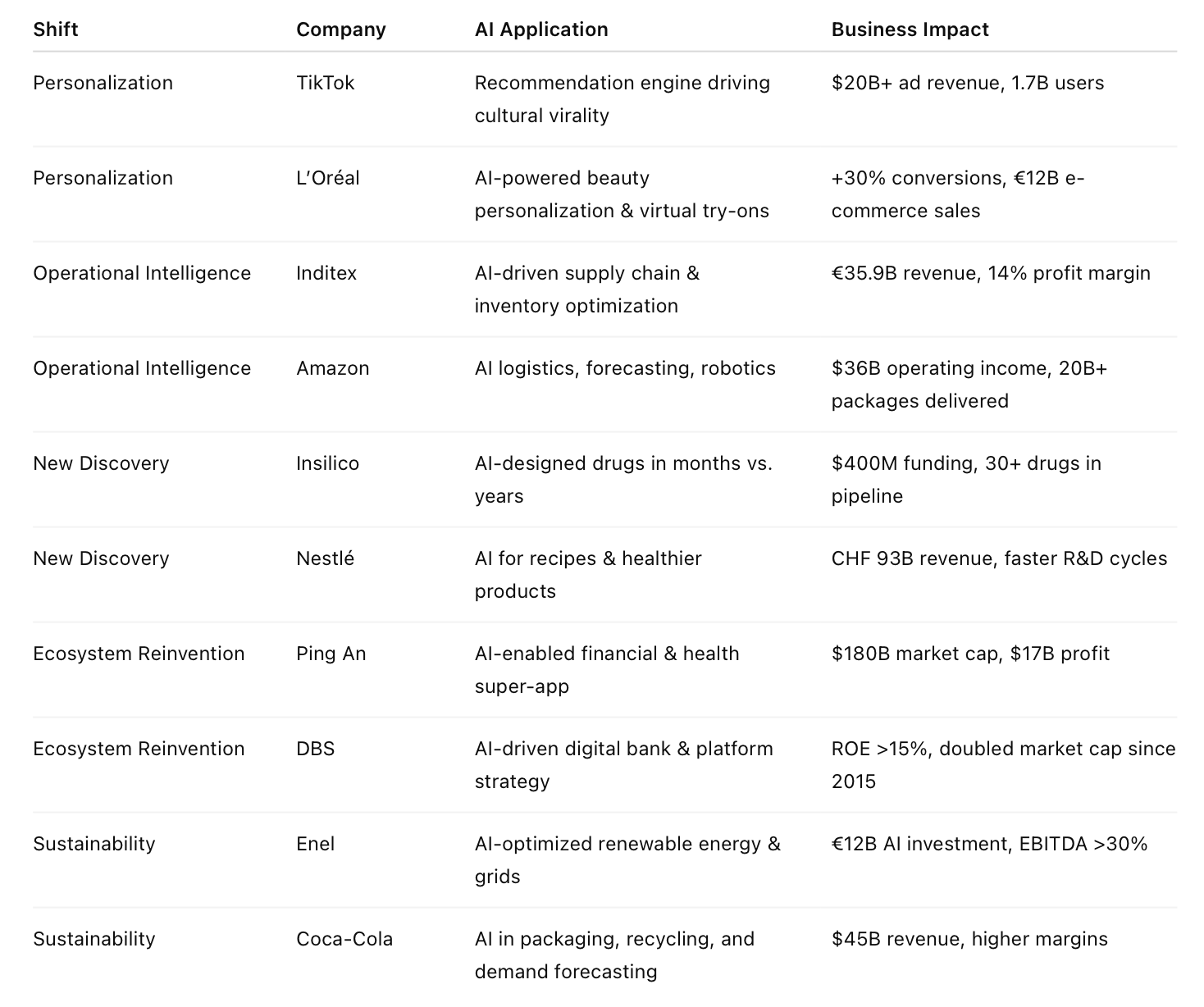
The companies leading these shifts are already reaping the rewards in profitability, market cap, and cultural relevance. The question for leaders everywhere is not whether to adopt AI — but whether they are bold enough to reinvent their business with it.
Denmark has long been a quiet superpower of innovation. A small nation with just under six million people, it has repeatedly reshaped global markets — from wind energy and shipping to enzymes, toys and pharmaceuticals. Its innovation model is distinctive: science-based, purpose-driven, and built on a culture of trust and collaboration.
Yet even Denmark’s biggest innovators face headwinds. Global competition, rising costs, political scrutiny and market over-expectation have taken their toll on stock prices and confidence. But innovation is not just about smooth growth curves; it is also about reinvention, resilience and staying ahead of the curve.
Having worked with the leaders of many Danish companies, I have a huge imagination for the country, and their quiet, thoughtful approach. At the same time, there is a need to step up and see a changing international marketplace. In a small country, they need to think creatively about how to grow beyond geography, to compete and collaborate in new ways on the global stage.
Today, Danish innovation can be seen in two waves: the established giants who remain global leaders despite near-term financial pressures, and a new generation of challengers who are reimagining markets with digital, circular and climate-tech models.
Danish Giants: Innovators under pressure
Novo Nordisk
The pharmaceutical giant has been the face of Denmark’s economic success, leading the global revolution in diabetes and obesity care through its GLP-1 drugs (Ozempic, Wegovy). Recently, its share price fell sharply after cutting guidance and announcing job cuts. But the underlying science remains transformative. Novo is investing in next-generation treatments — including oral obesity drugs and powerful combination therapies like CagriSema. Demand for obesity and metabolic health solutions is massive and growing, and Novo’s science, scale and pipeline will keep it central to the health innovation story for years to come.
Ørsted
Once a fossil-fuel utility, Ørsted reinvented itself as the world leader in offshore wind. Recent financial results have disappointed, with high interest rates, supply-chain pressures and intense competition hitting its margins. But the world still needs Ørsted’s expertise in building, operating and financing massive offshore energy systems. It is piloting hybrid parks that combine wind, solar and storage, while investing in green hydrogen. Ørsted remains at the heart of the clean-energy transition, even if near-term profitability is volatile.
Vestas
Vestas continues to be the largest pure-play wind turbine manufacturer globally. Like Ørsted, it has been squeezed by supply-chain inflation and policy delays, but it is investing heavily in digitalization and predictive maintenance to make wind energy more reliable and efficient. Its ability to combine cutting-edge turbine design with global service networks keeps it central to renewable energy innovation.
Mærsk
Shipping giant AP Moller-Maersk has embarked on an ambitious journey to decarbonize global trade. It is pioneering methanol-powered vessels, building partnerships to scale green fuels, and developing digital logistics platforms. The company’s profits have been hit by freight volatility and high decarbonization costs, but Maersk’s commitment to transforming a carbon-intensive sector remains one of the boldest industrial bets in the world.
Lego
Lego is one of Denmark’s most beloved brands and a global cultural icon. Financially, it has faced the challenge of slowing growth in toy markets, but it continues to push innovation in digital play, education, and most notably, sustainable materials. Its experiments in bio-based plastics and circular reuse models could redefine how consumer brands tackle sustainability, proving that play and purpose can coexist.
Bang & Olufsen
Bang & Olufsen is Denmark’s iconic luxury audio and design company, renowned for combining high-fidelity sound with striking industrial design. Despite recent financial challenges and volatile sales due to competition from mainstream electronics brands, B&O continues to innovate with premium product lines and strategic collaborations with Ferrari, HP, and lifestyle brands. Its focus on craftsmanship, sustainability in materials, and direct-to-consumer digital channels helps maintain brand relevance. While the company operates in a niche market, its commitment to design excellence, sound quality, and experiential innovation ensures B&O remains a global symbol of Danish luxury and creative ingenuity.
Danfoss
Danfoss is a global leader in industrial technology, specializing in heating, cooling, electrification, and energy-efficient solutions. It plays a critical role in decarbonizing industry and buildings, with advanced R&D in energy optimization and automation. Though global cost pressures and energy price volatility have affected margins, Danfoss continues to expand into electrification and renewable solutions. Its innovation strategy emphasizes digital controls, IoT integration, and sustainable engineering. With a strong international footprint and commitment to solving complex energy challenges, Danfoss exemplifies how Danish industrial firms combine engineering expertise, sustainability, and innovation to maintain global leadership in evolving markets.
Danish Challengers: Next generation innovators
Pleo
Pleo is reimagining business finance through smart expense-management tools. Its cards, software and analytics give companies of all sizes transparency and control over spending. It has scaled rapidly across Europe and continues to add features that integrate with accounting systems and automate admin. Pleo shows how Danish fintech can take a human-centered problem — messy expense reports — and solve it with design simplicity and tech agility.
Too Good To Go
This food-waste marketplace is now one of Denmark’s most visible global startups. The app connects consumers with surplus food from restaurants and retailers, creating a simple, win-win solution. It has scaled across Europe and the U.S., saving hundreds of millions of meals. Too Good To Go is proof of Denmark’s ability to combine social impact with commercial scale, addressing one of the world’s most urgent sustainability problems.
Ganni
Ganni is a Copenhagen-based fashion brand disrupting traditional apparel markets through sustainability, digital-first strategy, and circular business models. The company has grown rapidly via direct-to-consumer sales, global collaborations, and seasonal “drop” campaigns, creating a loyal, socially conscious audience. Circular initiatives, resale programs, and eco-friendly production differentiate Ganni from traditional fast fashion, appealing to consumers seeking style with purpose. Despite operating in a highly competitive global fashion market, Ganni leverages digital engagement, strong branding, and agile supply chains to scale internationally. Its success illustrates Denmark’s strength in creative industries and sustainable, mission-driven business innovation.
Universal Robots
Universal Robots, a pioneer in collaborative robots (cobots), makes industrial automation accessible to small and medium-sized enterprises. Their flexible, easy-to-program robots help manufacturers increase productivity, reduce labor costs, and improve safety. Owned by Teradyne, Universal Robots has maintained strong growth (~20% YoY), expanding adoption across automotive, electronics, and general manufacturing. Continuous innovation in software, AI integration, and user-friendly interfaces allows it to remain competitive while democratizing automation. By fostering Denmark’s robotics cluster and exporting advanced industrial solutions worldwide, Universal Robots exemplifies how Danish engineering, innovation, and design thinking can transform manufacturing on a global scale.
Trustpilot
Founded in Copenhagen, Trustpilot has become a global platform for online reviews. Its challenge is ensuring trust and combating fake reviews — but that is also where its innovation lies. By combining moderation systems, machine learning and transparency standards, Trustpilot is redefining how reputation is built online. In an era of declining trust, Denmark’s ethos of openness and fairness finds expression in this platform.
Haldor Topsøe
Topsoe is Denmark’s hidden industrial hero, developing catalysts and process technologies that enable cleaner fuels, green hydrogen and e-methanol. It recently invested in scaling solid-oxide electrolyzers for industrial hydrogen production, a technology with game-changing efficiency potential. While less visible than consumer apps, Topsoe’s breakthroughs are vital for decarbonising heavy industry.
Seaborg Technologies
Alongside these more mature players, Denmark is seeding a new crop of startups. One standout is Seaborg Technologies, developing compact molten-salt nuclear reactors designed to provide safe, modular and carbon-free power. It is still pre-commercial, but it reflects Denmark’s willingness to explore bold technologies at the frontier of climate solutions.
Denmark’s Innovation DNA
Looking across these companies, five strengths stand out:
-
Science-to-scale capability. Denmark excels at translating deep science — in biology, chemistry, engineering — into scalable products, from Novo Nordisk’s pharmaceuticals to Topsoe’s catalysts.
-
Systems thinking. Giants like Ørsted and Maersk tackle problems end-to-end, designing integrated systems rather than isolated fixes.
-
Trust and social purpose. Companies like Too Good To Go and Trustpilot reflect a cultural focus on fairness, sustainability and transparency.
-
Global from day one. With a small home market, Danish firms are export-oriented and internationally ambitious.
-
Policy support for green and social innovation. Danish government policies have nurtured early adoption in wind energy, biotech and sustainability, giving firms a platform to scale globally.
Denmark’s innovation landscape today is not without challenges. Novo Nordisk and Ørsted have seen share prices wobble; Maersk and Vestas face cost pressures; Lego must reinvent materials at scale. Yet their capacity to adapt and reinvest in the future keeps them at the center of global innovation.
At the same time, a new wave of challengers — digital, circular, climate-tech startups — is pushing into new spaces with agility and mission-driven zeal. Together, they show why Denmark remains one of the world’s most innovative economies: a place where science meets design, and where business is inseparable from purpose.