Haier, now the world’s largest white goods business, recently celebrated 10 years of its rendanheyi (or win-win) business model. CEO Zhang Rhuimin sees the approach as a way to stay small and focused – maintaining the entrepreneurship, intimacy and speed of a start-up – despite now being a $32 billion multinational with 70,000 employees. Haier is actually a family of 200 micro-businesses, each largely autonomous, and 70% of them with revenues exceeding $20 million last year.
The Qingdao-based company has stretched far beyond its refrigerator origins of 1984, now on the cutting edge of robotics and connected home devices. Just this year it launched Coton, a pocked-size washing machine, ready for any emergency. Haier is a shareholder in each of its micro-business, alongside all of its employees, who share in their own profits. Rhuimin, who has seen Rendanheyi deliver 28% annual growth for the last 10 years, and profits grow by 1200%, is now looking to co-creation as the next phases in his journey, and for Haier to become leading player in the sharing economy.
Read more about The Haier Road to Growth

https://www.youtube.com/watch?v=ysPtIplTN5o
Haier is recognised in this year’s Thinkers 50 Awards, the bi-annual ranking of business gurus, often called the “Oscars of management thinkers”. Founded by British journalists Des Dearlove and Stuart Crainer, the list is the one that every business academic or author wants to be on. Indeed the shortlists of thinkers, ideas, books and businesses, are certainly worth looking to for inspiration, and will culminate in a day-long festival of business brainpower in London next month.
Robin Chase, the co-founder of Zipcar (with a new book Peers Inc) will be up against the Queen of Collaborative Consumption, Rachel Botsman (who wrote What’s Mine is Yours). Whitney Johnson, the investment analyst who set up a fund tracking disruptive innovations with Clay Christensen, will be encouraging you to Disrupt Yourself (her new book), whilst Korean strategist W Chan Kim is still searching for Blue Oceans (uncontested markets). Al Gore’s former speechwriter and Whole New Brain thinker Dan Pink will be neurologically matched with Denmark’s very own “buyologist” (and neuromarketer) Martin Lindstrom.
Join me at the Thinkers50 Awards in London on the 9 November 2015. Check out the new rankings – and their big new ideas for business – at Thinkers50.com.
Italian eyewear giant Luxottica, which controls over 80% of the world’s leading eyewear brands, has never been shy about experimentation. It was early into the trend of using aerospace materials to make frames lighter and is now trying out 3-D printed frames in its factories. These new Ray-Bans come in denim, leather, wood and velvet. Luxottica’s Oakley brand is working with computer-chip maker Intel on a new line of smart eyewear due within the next year.
Luxottica had revenues of €7.3 billion last year and produced over 77 million pairs of sunglasses and optical frames. Over half a billion people wear Luxottica glasses and the company has single handedly turned a once boring eyewear market into high fashion. Their proprietary brands (68% of their total sales of frames) include two of the top sunglass brands in the world Ray-Ban and Oakley, as well as Vogue Eyewear, Persol, Oliver Peoples, Alain Mikli and Arnette. The Italian company also produces eyewear under license for every luxury brand you can think of, from Gucci and Prada to Stella McCartney and Tiffany & Co.
Competition comes from other manufacturers, but also online retailer like Warby Parker who have gone from zero to $100 million companies in only a few years. However, Luxottica holds the cards in brick-and-mortar retail: when competitors get too large, Luxottica can simply cut them out of their popular distribution channels. That’s exactly how they treated then-independent competitor Oakley in the early 2000′s. Luxottica caused Oakley’s stock to plummet simply by carrying fewer of their sunglasses through Sunglass Hut, eventually leaving Oakley with no choice but to merge with Luxottica in 2007.
How small businesses can grow faster and further through new types of partnerships
- Why are pilot fish successful in the natural world?
- Learning from “pilot fish” like Intel and Goretex, Hella and YKK
- Finding the right “shark” partner to take you further and faster
- How can you develop a “pilot fish strategy” for your business?
Every manager with any ambition wants to grow their business into new markets. But how? Business models that work well at home are rarely the right ones in international markets. Yet there is a new breed of small companies who have learnt to thrive internationally without excessive cost or risk. They are “pilot fish” companies.
In nature, pilot fish swim with the sharks, doing the things the big fish can’t or don’t want to do, whilst being protected and sustained in return. In business, “pilot fish“ work with strategic partners providing a small number of specialist ingredients, but with huge potential scale. The Pilot Fish keynote is an inspirational introduction to the new concept with practical examples that can be applied rapidly by the audience to their business. We explore the 4 phases of Pilot Fish strategies:
- How to find a unique capability or activity within your current business, for which there is a high demand internationally, and then find a potential shark to help you get there
- How to find the right Shark company who needs your uniqueness to compliment its own offering, and develop a mutually rewarding business model.
- How to maintain and manage the lucrative partnership, how to grow in the target markets together, and how to manage risks within it.
- How to realise the full value of your strategy either by selling the business to the shark or moving upstream and becoming a shark on your own.
Watch video clips of Peter Fisk’s “Pilot Fish” keynote
Example of the one day “Pilot Fish” program
09:00 Introduction – Blue Oceans and Pilot Fish
We kick off the workshop with an inspirational half an hour keynote presentation about Pilot Fish concept, strategic framework, the process and insights into successful Pilot Fish companies. We fish out the most potential Pilot Fish companies from your market and bring them to you. At the end of the session attendees will see a spectacular video about the Pilot Fish and Sharks on blue oceans, their relationship so similar to what Pilot Fish companies have with their giant partners.
10:00 Step 1 – Find your unique strength
This session will start by redefining greatness, with attendees brainstorming what uniqueness is. With a shared understanding, we consider existing and potential examples of unique positioning, differentiation, value propositions, patents, core competences, client relationships, knowledge and skills, brand image, and other properties that set some businesses far beyond the rest. And not just differentiated – but also valuable to others. Now we are ready to brainstorm what is your company’s valuable uniqueness? Or your own? What can you do better than the rest? In what are you the best in the world? What valuable is there in the history of your company and relationships? After breaking up the answers the session ends with an interview with the CEO of a successful Pilot Fish company.
11:00 Break
11:30 Step 2 – Find a Shark company
If you were lucky enough to find anything unique in your company or yourself and have not escaped during the coffee break, we now explore the world of sharks, and why do “shark companies“ use Pilot Fish companies. How do they meet their new partners? What qualities do they look for in their smaller partners? How will they decide whether to work with a Pilot Fish company or not? This introduces the next practical challenge. No matter how hands-on the attendees are in their daily business, this is a stretching exercise: knowing your unique strength and using all the resources available within the workshop location, put together a list of three potential shark companies that would benefit from your strengths. After considering the outputs, we explore the most efficient ways to search and find Shark companies. So before lunch, we are half way there. The session ends with a video interview of another CEO of a successful Pilot Fish company.
13:00 Lunch
14:00 Step 3 – Managing the Pilot Fish relationship
It would be nice to take it easy after lunch … but no. In real life, this is the “make or break” moment, and demands full attention. Not all the Sharks are friendly and supportive to their small partners. Some might seduce you then rip you off: your knowledge, patents, concepts … In the beginning of this session we cover the threats and risks in Pilot Fish relationships and the legal and non-legal ways to manage those risks. When the heat is taken off with the checklist of what attendees themselves need to watch out the most when entering Pilot Fish relationship, we take a tour on a softer side of managing your company within the framework of Pilot Fish partnership. When you have one or two huge clients, what is different in the way you manage? Or if the Pilot Fish unit is a spin-off from larger entity, how the management styles and culture work out with the “old” company? What do you need to change in a way you market your products? What changes in R&D? What is different about the people you need? And how to take all these changes to your people? This gives attendees a blueprint to start working as a Pilot Fish company. And some more tips by video from another Pilot Fish CEO.
15:30 Break
16:00 Step 4 – Exiting or moving upstream
Can you think of any large successful companies that started out as Pilot Fish? Or others that have been absorbed into larger companies, their Sharks? This session considers some of today’s great Pilot Fish, and others who have used the Pilot Fish strategy to achieve greatness, as worldwide brands in their own right, or sold to Sharks, and the owners walked away rich. Then we’ll do some joint thinking about when is the Pilot Fish company ready for that kind of choice? What are the pros and cons of both? What strategies to use if you wish to pursuit as a sole brand? How to prepare your company, and your shark company, for an exit? As this step is far in the future for the attendees, it is difficult to outline clear strategies. But attendees will take away the possible scenarios with their strengths and weaknesses, and gain inspiration from those Pilot Fish who learnt to swim with the sharks, or grow into one. The session will end with the thought provoking video about the highlights of the day. Or even better, let’s all get naked and go swim the blue oceans and party with the sharks.
The best brands define themselves based on customers not themselves. Whilst branding started as a label of ownership (about me), today it seeks to capture relevance and aspiration (about you).
Along these lines, Interbrand recently came up with a new concept – the mecosytem. Before diving for the bucket, and objecting to business jargon, think what’s behind the concept.
A mecosystem is “a select set of brands that create customised experiences around a single individual, where every brand in consideration slots in seamlessly, and where the most valuable micro moments are curated, connected, and choreographed.”
In their Best Global Brands 2015 report, Interbrand argues that “the most successful brands – the ones with the most presence in a person’s life – often stand out by blending in, because people measure the entire experience by how much it adds to their lives and how little it disrupts it. They empathise with an individual’s priorities, figuring out how to meet people exactly where they are, and when they want it, and tailor to how people move through their worlds.”
Why is this new and different? Because “droves of digital data, refined analytics, and real-time, multi-platform interactions help brands discover what people want – even before they do – and cater to them quickly, reorganizing around these insights, because, in the Age of You, people are the bottom line.”
We all know that “a new breed of customers and consumers that are more than just co-creators, but editors and producers.” Trendwatching.com’s 2016 Trend Report builds on this, exploring “crowdfunding platforms where people are more than shoppers, but instead members of a like-minded community of supporters,” we’re “presumers.” We dwell in “The Youniverse,” where “sophisticated technologies will offer a powerful dual benefit: not just customized products and services, but a deeper understanding of the true (often hidden) self …”
What does this mean in the real world? Back in 2010, Burger King in Brazil offered “customised” products by printing images of customers on burger wrappers. In 2016, clothing retailer Uniqlo offers a “Mood machine” that “lets consumers find the right t-shirt for their mood.” This is more like the mecosystem, or as Trendwatching encapsulates it, “a more evolved knowledge of exactly who I am? In a world that increasingly values individuality and self-expression, that might just be the ultimate consumerism has to offer in 2016.” Of course, we could go in – in particular explore how the economy becomes the wecosystem – but in reality, its just the new business world.

Here is Interbrand’s introduction to the Mecosystem:
In tech terms, an ecosystem is a complex network or interconnected system in which devices interact. The Mecosystem is a refinement and reorientation of this model, putting you at the center and reorganizing integrated experiences around you. Informed by your data, the Mecosystem considers the “real-life” contexts surrounding you and seeks synergies across experiences, ensuring more relevant services and products.
Already working to close the gap between the business and the end user, many brands are grappling with the challenges of integrating disparate products and services and developing experience strategies that truly sync up with our needs and preferences. In the Age of You, the Mecosystem will help calibrate brand experiences that are becoming increasingly social and multi-sensory, including the interfaces we tap and speak to, the hardware that we hold, the software that recognizes us, and the data that helps customize our immediate surroundings.
Within the Mecosystem paradigm, you are at the nexus of the system. Consider these 4Ps:
 People: From linking us to new friends on the basis of shared interests to helping us tap into our direct networks for quick, relevant answers, sensing technologies will allow us to harness collective intelligence and make the most of our personal connections.
Places: Now that mobile systems can sense their physical environment and adapt their behavior accordingly, content will be increasingly tied to context. Giving new meaning to instant gratification, context-aware technology will help us find what we want-wherever we are, at any time-based on our location and history of activity.
Passion: Our hearts-from literal BPMs to the throes of dating-will be worn on our virtual sleeves. Massive datasets about ourselves (AKA the “quantified self”) will become a route to self-discovery, giving us new ways to approach fitness, healthcare, and even romance.
Profit: As people reclaim the rights to their personal data assets, and greater transparency becomes de facto for the data economy at large, people will set up personal data stores that could truly unlock the power of the Age of You.
Healthcare is a category being disrupted incredibly quickly – with the convergence of adjacent sectors, shifts in power and expectation – all fuelled by technology. I’ve probably done more work in healthcare than any sector in recent years, from Apotex in Canada to Almirall in Spain, and many others. Chronic disease is soaring, whilst aging puts new pressures on budgets, there is a shift to payment by outcomes, and demand for more personalised treatments.
https://www.youtube.com/watch?v=r1JmetcwMQc
It’s easy to get excited by the proliferation of digital platforms, from Apple to Epocrates, Mango and Scanadu, the future is about more than apps. Organova leads the world in the 3D printing of human organs, whilst Second Sight has found a way to give vision to the blind. Cleveland Clinic is an icon of patient-centric care, whilst recently launched Zoom+ wellbeing stores include doctors, dentists and more. Not all solutions are sophisticated. Look at the recent Cannes Health Grand Prix winner, where a charity created the lucky “Iron Fish” for rural Vietnamese to throw into their cooking pots, a simple cure for iron deficiency.
https://www.youtube.com/watch?v=sMsN8fUuncI
Roche is a great example of big pharma’s attempts to “change the game”. The Swiss giant’s first disruptive move was to acquire biotech firms Genentech, which specialises in personalised therapies, and Japan’s Chugai. Most recently Roche collaborated with 23andMe, the DNA profiling business that will read your body’s future for $99, and PatientsLikeMe, the social network where patients share experiences with others like them. With the big data to focus on truly personal and predictive wellbeing, and the specialist products to respond, Roche is ready to engage the intelligent patient who is now in control.
Here’s how Cleveland Clinic articulate their “patient-centric” vision:
https://youtu.be/p2A1GsC-wFc
Read more about Futurehealth including 10 “gamechanger” case studies in healthcare.
Download a summary of my Futurehealth 2020 keynote presentation.
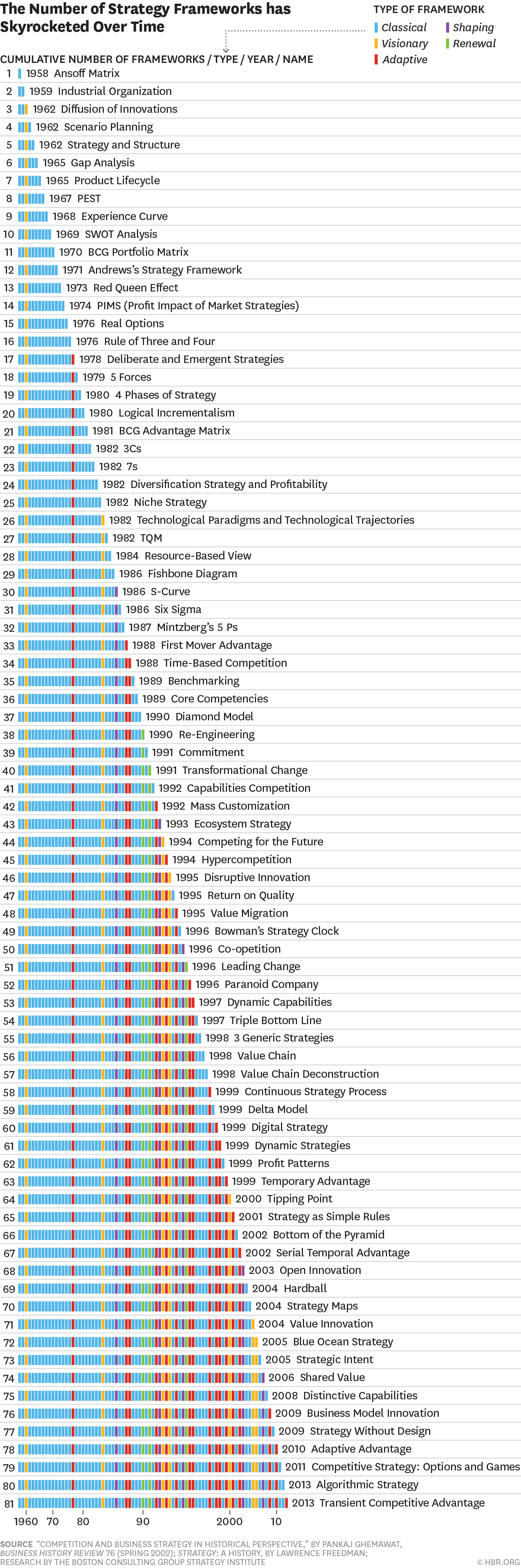
A new HBR article explores the rapid proliferation of strategy frameworks over recent years.
From Ansoff (1958) and Scenario Planning (1962) to 5 Forces (1979) and McKinsey 7S (1982), S-Curves (1986) and Mass Customisation (1992) to Profit Patterns (1999) and Value Innovation (2004), Business Models (2009) and Adaptive Advantage (2010) to Algorithmic Strategy (2013) and Transient Competitive Advantage (2013).
The article “Navigating the Dozens of Different Strategy Options” categorises these different approaches, and which are most appropriate for your business.
Business environments differ along three easily discernible dimensions: Predictability (can you forecast it?), malleability (can you, either alone or in collaboration with others, shape it?), and harshness (can you survive it?). Combining these dimensions into a matrix reveals five distinct environments, each of which requires a distinct approach to strategy and execution.
• Classical: Be big.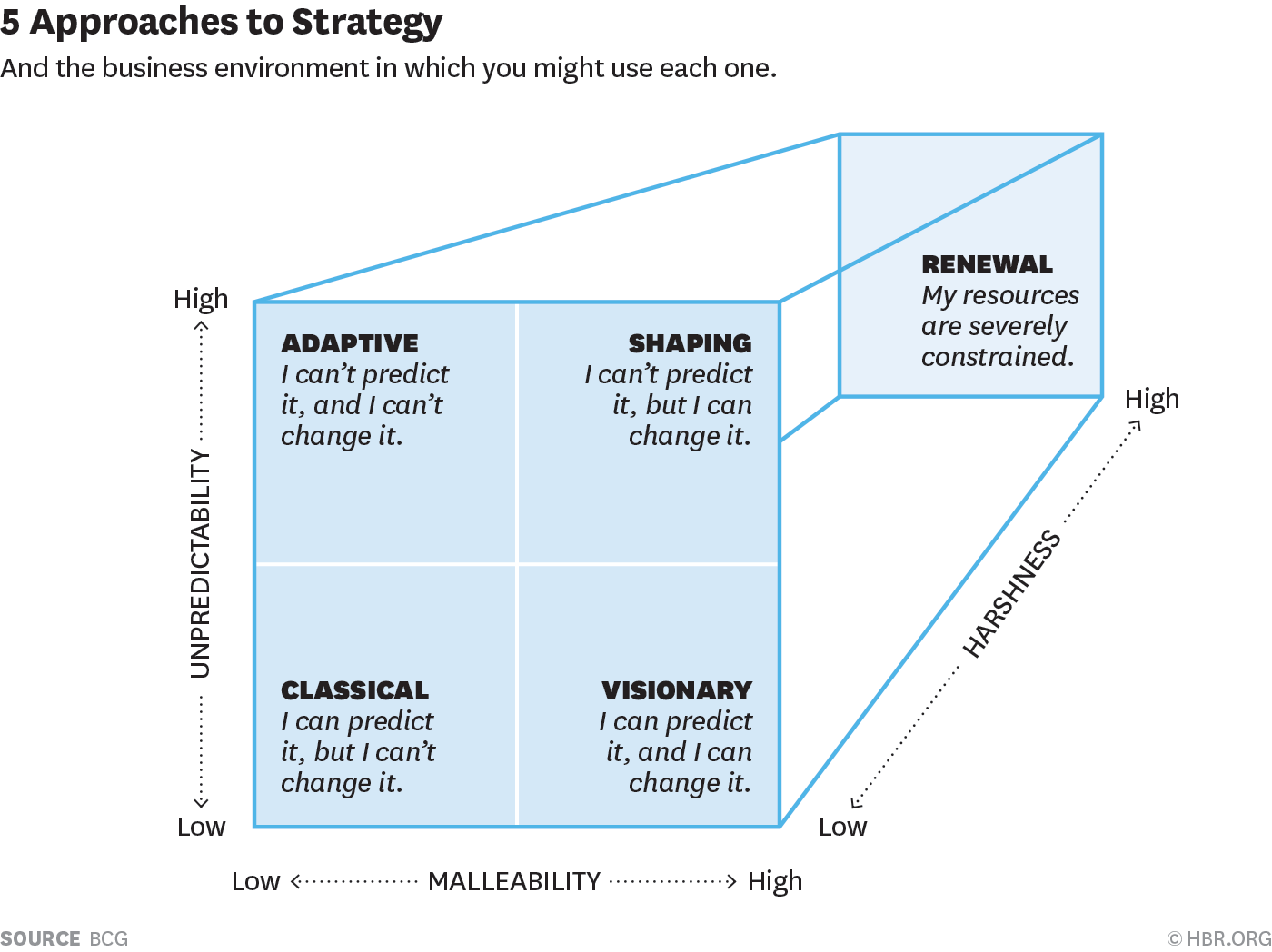
• Adaptive: Be fast.
• Visionary: Be first.
• Shaping: Be the orchestrator.
• Renewal: Be viable.
So before you jump into your next strategy process, consider your environment, and which approach to strategy is best for you.
Find out more about how we can help you in Consulting
“Ich bin ein Gamechanger” … New German edition of my book is just published.
Free download of the first 25 pages.
Revolutionäre neue Strategien für Unternehmen und Marken. Lektionen von Leuten, die das Spiel gewinnen. Was machen Amazon, Spotify, Airbnb und Uber besser als andere? Was macht sie besser?
Gamechangers sind Firmen, die die Geschäftswelt völlig umkrempeln.
Beispiele dafür sind
– Airbnb für die Hotelbranche,
– Uber für Taxiunternehmen und
– Spotify für die Musikwelt.
Gamechangers denken innovativ und disruptiv. Für sie sind die Märkte ein Kaleidoskop unendlicher Chancen. Gamechangers agieren schneller, dynamischer und radikaler als ihre Wettbewerber und fokussieren sich auf Wachstumsmärkte.

Peter Fisk ist einer von ihnen. Der renommierte Unternehmensberater untersucht den Erfolg der Gamechangers in hundert Beispielen quer durch alle führenden Branchen. Noch wertvoller: Er legt die Denke dieser neuartigen Unternehmenslenker offen – eine Denke, die unsere Zukunft bestimmen wird. Dieses Buch ist ein praxisorientierter Leitfaden mit smartem »Handwerkszeug« für diese Zukunft.

The innovative sportswear brand has launched a $15 million ad campaign—its largest-ever aimed at women, which speaks to those who refuse to accept limits put on them by others. The “I Will What I Want” series began a year ago with an inspiring video of American Ballet Theatre’s Misty Copeland that has racked up 9 million views on YouTube. Copeland, who started ballet at 13, was told she was too old and curvy, and not of the right race to be a prima ballerina. Now she solos to rave reviews.
https://www.youtube.com/watch?v=ZY0cdXr_1MA
The campaign which also stars Giselle Brudchen, won the Grand Prix for digital advertising at this year’s Cannes Lions Festival of Creativity. The judges said it exemplified what digital marketing should be. “It’s an entry that demonstrates how a powerful brand narrative is enabled through technology and how this narrative can live and grow in a modern, multi-screen digital environment. It’s social by nature and real-time by design. It demonstrated how a well-crafted digital experience can create uplifting impact, from the point of engagement to the point of transaction.”
Chinese electronics business Xiaomi is an exponential business, having grown to a $67 billion valuation since launching its first “MiPhone” 4 years ago, an Android smartphone that looks remarkably like the iPhone. CEO Lei Jun says that “xiao” is about starting small the thinking big … “a single grain of rice of a Buddhist, is as great as a mountain” (“mi” stands for mobile internet). Xiaomi has been a sensation, recently selling a record 2.1 million handsets in a 24 hour flash sale (a marketing tactic that dominates in urban China), and becoming the world’s third largest smartphone maker. Jun is targeting emerging markets, having focused this year on launching into India and Brazil. Next year he launches a laptop, whilst investing heavily in content, from local language apps to TV.
One other Xiaomi product, launched last month, could actually change the world. The $15 MiBand fitness tracker does everything a Fitbit and Jawbone can do, but at a fraction of the cost. We already know (from Apple Watch) how wellbeing can engage new consumers in technology. Imagine the consumer base that MiBand could reach with such a low price point, the flow of personalized data that results from usage, and subsequent desire to connect to other devices. It might even be the “tipping point” for the internet of things, as well as Xiaomi’s grain of rice that turns it into the next Apple or Google, or both.
Delivering the keynote speech at the launch of a $100m digital bank project, I listened to the strategy to target “millennials”. First up were a range of new savings products, and then a new mortgage proposition … Errrr … do we really think that this new generation have the same needs and aspirations as existing customers (average age 47 years old)? Are we really customer-driven, or just planning the same old thing with a new digital platform?
Millennials – defined as those born between 1980 and 1997 – also known as Gen Y, Gen We, and Digital Natives – are by no means a homogenous tribe, but their attitudes and aspirations are quite distinctive. We recognize many of their traits – passionate and caring, life before work, spontaneity not planning, transient not permanent, global not local, social more than individual. They expect speed and simplicity but with limited patience – everything should work, instantly and intuitively. Especially online. Meaning, mobile.
New research by Goldman Sachs explores millennials as consumers. Everything revolves around them and their friends. Connected by their smartphones and networks. Consumption is driven by time and place, and influenced by others who they trust – advocacy. They prefer access over ownership – renting cars and homes – the collaborative economy. And they live active lives – casual fashion, wellness and sport. They also expect to live in at least 3 different countries during their lives, and likely to move through 7 distinct phases of career.
Additional research by Deloitte focuses on their demands as employees. They want to work for businesses that care, 75% believing companies are too focused on their own agendas. They want more challenging roles, and not to be at the bottom of an age or experience based “hierarchy”. They want to shape business for people like them (although they should remember there are many other audiences to engage too!). They, and particularly in emerging markets, prefer the energy of smaller and more entrepreneurial companies, rather than big global corporations limited by culture, process and size.
Millennials are big on advocacy. When trust in brands is at its lowest ebb, yet trust in peers (friends, colleagues, people like you) is sky high (according to Edelman’s Trust Barometer), advocacy matters more than ever. This is not just a shift from measuring satisfaction to recommendation (or Net Promoter Score), but fundamentally redesigning communications, channels, relationships, and in particular (outdated) loyalty programs. If people trust people, not brands, then their loyalty is to each other, facilitated by the brand. Their impulse to buy is not advertising, but the encouragement of peers, and their preferences and choices are based on stories and experiences of others. Indeed they are more likely to want to share than buy – to share their possessions through rental (Zilok) or repurchase (Bepop), to share their passions through communities and activities. Far beyond a Facebook page, need to innovate marketing to enable people to connect and collaborate and do more.