“How can I recognise an industry that’s ready to be disrupted?” If the question were straightforward, every business would enter the market and automatically catapult to the top. So, it’s not a question you can ask if you’re looking for a straightforward or simple answer. With that being said, here are a few general signs that a market is ready for change.
1. Market Complacency
Complacency in the marketplace is one of the biggest telltale signs that something needs to change. For existing businesses in the industry, complacency should be viewed as a troubling indicator that disruption is approaching. After all, it’s once businesses begin coasting – as opposed to innovating – that markets become stagnant.
You could argue that the cable industry has become complacent in recent years, and it appears that this mistake is going to cost them dearly in the coming months. Cable providers have consistently introduced price hikes without adding any real value to their service offerings. Meanwhile, standalone streaming services like Netflix, Hulu, and HBO Go have come in and taken a healthy share of the marketplace.
2. Customer Frustration
The second telltale sign of impending disruption is chronic customer frustration. As customers become frustrated with products and services, they voice their opinions, tighten their wallets, and look for alternatives. This is where savvy entrepreneurs recognize an issue and create an alternative solution.
One example of a company that’s recently recognized consumer frustration and capitalized on it is MedPro. The medical waste industry is relatively top heavy – meaning much of the market is controlled by a single player, Stericycle. However, over the years, small, independent doctors and physicians have become frustrated with the hefty costs of their services.
That’s when MedPro’s founder, George Shanine, recognized an opportunity to create a cost-effective alternative. By driving cost savings of 30-40 percent, Shanine has been able to disrupt the industry and take away a sizeable share from Stericycle and other competitors.
3. Tension Points
According to Luke Williams, author of Disrupt: Think The Unthinkable to Spark Transformation in Your Business, the key to identifying markets that are ripe for disruption is to look for tension points, instead of massive pain points.
What’s the difference, you may ask? Williams says tension points are much more subtle. They aren’t typically big enough to be considered major problems, which means most businesses aren’t paying attention to them. However, once a solution is developed, it’s obvious that fixing the underlying issue offers an excellent opportunity to penetrate the industry.
Williams claims there are four specific types of tension points: workarounds, values, inertia, and shoulds versus wants.
Markets That Will Soon Be Disrupted
Now that you understand the telltale signs of markets that are ready for disruption, it’s important that we take a practical, real-world look at some markets that are bound to be disrupted in 2016.
- Air travel industry. Is there any industry that has people more frustrated than air travel? Airlines are renowned for poor customer service, long waits, outrageous fees and charges, cancelations, delays, overbookings, and everything in between. It’s time for a new player to enter the market and disrupt the status quo. Unfortunately, the barriers to entry are extremely high in this industry, meaning a disruption will require a very calculated effort.
- Public education industry. It’s becoming clear that this country’s public education system is struggling to move into the 21st century. There’s a lack of confidence in educators, subpar technology, high costs for higher education, and a general distaste for the stagnant system. Moving forward, we’ll likely see some businesses – both for-profit and non-profit – attempt to disrupt this failing, yet important sector of the economy.
- Student loan industry. Speaking of higher education, the student loan industry is obviously in need of some change. As the cost of tuition rises and the median salary for new graduates remains relatively low, students are drowning in student loan debts. While there’s certainly an argument to be made for the fact that not everyone needs to go to college, there’s ample opportunity for alternative student loan systems to be developed.
- Real estate industry. As the real estate market improves in the wake of the financial recession, the need for a disruption becomes obvious. One good example of a business that’s caused noticeable disruption is PivotDesk. The entrepreneurs behind this company have developed a tool that allows companies and landlords to rent out extra office space that isn’t being used. In an age where expensive leases can cripple companies, PivotDesk has developed a unique solution.
- Consumer banking industry. Finally, let’s consider the banking industry. While there have been a lot of disruptions in this space over the past couple decades, it would be foolish to think things are about to settle down. In fact, we’re likely to see some even bigger shakeups in the coming months as businesses realize that there’s very little need for physical bank locations. What will the next big development in online banking be? We’ll just have to wait and see.
These are just a handful of industries that are ripe for disruption. If you study any industry long enough, you’ll realize that opportunities for disruption are all around you. By leveraging the tips above and signs – and studying what other businesses have done in the past – you can learn to identify even more markets with additional opportunities.
Putting It All Together
For an entrepreneur, disrupting an existing industry is a very challenging proposition. It can’t be done without first having a clear understanding of what it is you’re looking for; first thing being market complacency. Industries that have stopped innovating are almost always due for a shakeup.
The second thing to examine is the presence of customer frustrations. When customers are no longer satisfied with the existing product and service offerings in an industry, there’s ample opportunity for another business to come in and cause a disruption.
Finally, you have to look for tension points. As mentioned, these are much smaller and more discreet than obvious pain points, but the solutions to these issues can fuel significant change.
We all know that consumers are changing rapidly in their attitudes and behaviours, loves and hates, diversity and commonality.
Brands need to change too.
Forget brands as names and logos, symbols of ownership and ego. Instead think of them in the consumers mind. About what they do for people, mean to people, with relevance and aspiration.
Here are some great thought provokers …
“Robot Makers” focus on the most exciting growth markets of robotics and drones.
Whilst it might seem a long time since the golden C-3PO and cute R2D2 appeared in the first Star Wars movie back in 1977, the technical capabilities, intelligence and applications of robotics are about to explode into every day life. These include the much-hyped role of drones, supporting everything from unmanned combat to Amazon parcel deliveries.
Like other “Market Makers” these Robot Makers create and shape markets in their own vision.
They are not content to play the game of marginal gains – competing on small differences or price discounts, in mature and stagnant markets. They see the future world, they look for the new growth markets, and in particular those which are still emerging, which they can shape to their own advantage. They are “gamechangers” in the biggest sense, in that they create new games (markets), with new audiences (customers and needs), new rules (process and behaviours), and new possibilities (perceived value and profit potential) for business success.
Here are some of the most phenomenal Robot Makers who are creating and shaping the fast-emerging robotics markets to their advantage. Whilst there are many others developing sophisticated AI and robotics, these are examples of companies who are already out there, making money and shaping the attitudes and behaviours of customers right now:
Anki
Smart toys are just the beginning
Anki Drive, debuted during an Apple press conference back in 2013, lives up to the hype. Rather than using a Scaletrix-type track, Anki embeds cameras and IR sensors into the toys, and lets them steer themselves. Even the human-controlled racers smooth out user input, turning commands into more precise on-track movements. Anki toys have clocked up more than 800,000 miles. If this sounds like a lot of tech just for a little racing game, Anki CEO and cofounder Boris Sofman says “We want to eventually leave entertainment, to go into other areas where these approaches would apply, like the home or sports or even transportation.”
Bossa Nova Robotics
Making home a better place
Bossa Nova is developing a fulling autonomous mobile robot that could transform everyday tasks in the home. Their 2016 launch, developed at Carnegie Mellon University, seeks to create emotional connections so that tasks become intuitive and empathic- seeking to add value in new ways, rather than just automate the mundane.
Daewoo Shipbuilding
Exoskeletons as giant industrial workers
https://www.youtube.com/watch?v=f6RTp6UefPg
One of most promising players in the growing field of wearable robotics is also the most unexpected. DSME, the shipbuilding arm of the South Korean Daewoo Group is developing exoskeletons for use in its sprawling shipyards, to help workers carry heavy loads by hand. The hydraulic, battery-powered systems deployed in a successful pilot test could run for three hours at a time and lift 66 pounds on their own. The company’s current goal, however, is nothing short of superhuman—effortless handling of loads weighing roughly 220 pounds.
DJI
The world’s largest maker of consumer drones.
The Shenzhen-based company is opening a Silicon Valley research and development center in hopes of harnessing the wealth of robotics talent in the area, and identifying potential new partners and investment targets. The Phantom range of consumer drones have captured the world’s imagination – for everything from mapping landscapes to herding sheep. Phantoms are relatively inexpensive (about $1,300) remote-control quad-copters that are made for filming, some with stabilized HD cameras built in. The small and light drones are fairly user-friendly and extremely high-performance. They fly at speeds of up to 35 miles an hour and up to 400 feet. They also have GPS and stabilizing sensors to idiot-proof them as much as possible, with features that allow them to automatically return to where they launched should they lose contact with their remote. The company was founded in 2006, but in just the last three years, its sales have grown by a factor of 150, making it the fastest-growing drone manufacturer in the world.
Gamma 2 Robotics
Intelligent and autonomous security
https://www.youtube.com/watch?v=jYDDDqOosts
G2R have developed the “Cybernetic Brain” – artificial intelligence that enables the robot to operate independently whilst detecting and making judgement relating to any “invaders” – fire, water, or suspicious objects. The robots learns about its environment, becoming fast and accurate in diagnosis, and ultimately more reliable and lower risk than humans.
Matternet
Autonomous drone delivery
https://www.youtube.com/watch?v=nl9DviYWRs8
Matternet One is the first smart transport drone – in particularly focused on the challenge of “last mile” logistics to homes. The company is building an automated delivery network for goods based on a fleet of autonomous UAVs/drones. Initial tests with Swiss Post delivering parcels to areas which were difficult to reach by traditional methods (everything from mountain tops, to apartment blocks, and remote islands).
ReWalk Robotics
Exoskeletons that will replace expired limbs and wheelchairs.
The ReWalk Personal System is the first exoskeleton to be cleared by the FDA for use at home and in the community. No longer stuck in laboratories or rehab facilities, these robotic devices can now help users move about the world, restoring some of the lower-limb mobility lost to injury or disease. ReWalk Robotics’ model essentially walks for its wearer, balancing and adjusting its gait as it steps forward, and proving a first glimpse of a future where exoskeletons are as commonplace as wheelchairs
More ideas
I am currently working with Odense, Denmark which has become Europe’s “robot city” and seeks to change the game in the way in which it works with start-ups and corporates in accelerating the technical development and market growth of robotics and drones.
I am also currently researching my next book about Market Makers:
- Gamechangers … introduction to my recent book on disruptive innovation
- Market Makers … new strategies for creating and shaping markets
- Innolab … fast and collaborative strategic innovation process
If you’d like to suggest ideas for inclusion in my next book, please email me at peterfisk@peterfisk.com
“Market Makers” create and shape markets in their own vision.
They are not content to play the game of marginal gains – competing on small differences or price discounts, in mature and stagnant markets. They see the future world, they look for the new growth markets, and in particular those which are still emerging, which they can shape to their own advantage. They are “gamechangers” in the biggest sense, in that they create new games (markets), with new audiences (customers and needs), new rules (process and behaviours), and new possibilities (perceived value and profit potential) for business success.
“Space Makers” focus on the most exciting growth markets of space.
Whilst it might seem a long time since Neil Armstrong stood on the Moon, or even since NASA’s Space Shuttle made its final flight, the commercial opportunities for space are real and now – be it for scientific research into new medicines, satellites that can connect the world, or hypersonic travel to replace aeroplanes.
Here are 3 of the most phenomenal “Space Makers” who are creating and shaping the fast-emerging space markets to their advantage:
OneWeb
Providing global internet access via satellite
Airbus, Bharti, Coca-Cola and Virgin are just some of the investors who have together pledged over $500m to create the world’s first global satellite-based internet service. OneWeb is building a network of 700 satellites to take broadband access to every corner of our planet – including cars, aircraft, and homes in the most remote locations. SpaceX and O3B are also developing similar concepts. Read more about OneWeb
Planetary Resources
Asteroid mining for precious metals and water
Explorer James Cameron is one of the entrepreneurs behind the asteroid mining company that plans low cost robotic space exploration to find commercially viable asteroids near Earth. From these, they hope to extract precious metals and water (which can be converted to rocket fuel and oxygen). It launched its first rocket from the ISS in 2015, and also sees a huge market in space refuelling. Similar companies include Deep Space Industries and Moon Express. Read more about Planetary Resources
Space X
Private space travel and the mission to create life on Mars
Elon Musk’s $1.2bn space business is even more exciting than his Tesla cars, and is already proving a commercial success having won the contract from NASA to transport satellites into space, and transport cargo to and from the ISS. Musk has bigger ambitions, specifically to colonise Mars. His reusable space craft is rapidly bringing down the cost of space travel, and creating an ecosystem of services and providers, including Solar City, his solar power business that could sustain life on Musk’s Mars. Other space companies include BlueOrigin and Virgin Galactic.
Space Elevator
Potentially the most practical form of space travel
The Space Elevator is the most promising Space Transportation system on the drawing boards today, combining scalability, low cost, qualify of ride, and safety to deliver truly commercial-grade space access – practically comparable to a train ride to space. Rocket-based space launch systems are inherently limited by the physics of rocket propulsion. More than 90% of the rocket’s weight is propellant, and the rest is split between the weight of the fuel tank and the payload. It is very difficult (if not impossible) to make such a vehicle safe or low cost. A target cost of $1,000 US per kg is proving to be impossible to reach. In comparison, airliners charge us about $1 per pound, and train transportation is in cents per pound. Find out more at the International Space Elevator Consortium (ISEC) which is composed of individuals and organizations from around the world who share a vision of humanity in space.
More ideas
Other “Space Makers” include
- Accion Systems: electric propulsion systems for small satellites developed at MIT, removing the risk of blow ups.
- Bagaveev: designing and testing 3D printed Aerospace rocket engines and nano satellites into low-Earth orbits.
- PlanetLabs: satellite imaging based on a network of over 100 small satellites to document and monitor life on Earth.
- SpacePharma: providing micro-gravity environments for scientific research, from agrochemicals to new vaccines.
- WorldView: building relatively cheap high-altitude balloon travel for leisure, research and education.
I am currently researching my next book about Market Makers:
- Gamechangers … introduction to my recent book on disruptive innovation
- Market Makers … new strategies for creating and shaping markets
- Innolab … fast and collaborative strategic innovation process
If you’d like to suggest ideas for inclusion in my next book, please email me at peterfisk@peterfisk.com
Here in Las Vegas, the world’s technology leaders and entrepreneurs are back for CES – the Consumer Electronics Show – the annual showcase of all things digital that could change the lives of consumers. From Samsung to Xiaomi, entrepreneurs and investors – innovators from across the world will show off their new product concepts, whilst behind-the-scenes, deals will done to create the next big thing.
There is something a little surreal about it all – driven by tech possibility, rather than human need. The vast majority of exhibitors are tech junkies who clearly have an overtuned passion for possibilities, and limited interest in real people. For most of them, they hope their business will be snapped up by Google, Facebook or the like, before the crunch comes, and consumers have to actually pay money for their creations. This makes the relentless hype a little overbearing. At the same time, newness is created in the margins, so I’m intrigued by what will take off, what will engage the sceptical consumer, and maybe even make our lives better.
Here are 10 ideas from CES 2016:
August – turning smartphones into smartkeys
https://www.youtube.com/watch?v=BVxUqstUuWU
August is a maker of smart home security products including a smart lock and smart doorbell camera. Recently the company partnered with several on-demand services including AirBnB, Handy, and Fetch to help gain distribution and marketing for its products. The company continues to expand its partnerships and product offerings, which we can expect to see more of at CES.
Formlabs – the worlds most advanced 3D printer
Formlabs is a desktop 3D-printer that prints using stereolithography (printing made with resin). The company recently released the “Form 2,” and will is showing off the abilities of its new machine at CES.
iDevices – controlling the connected home
iDevices develops apps and internet-connected home products that connect wirelessly within the Apple and Android ecosystems. The company has made a suite of connected devices, including a grill, a cooking thermometer, and more recently a thermostat and on/off switch, using Apple’s HomeKit technology.
Kidoz – safe content for kids on phones
Kidoz provides a safe way for children to discover content on mobile that’s appropriate to their age group. The company provides three offerings, a Kidoz SDK that helps developers increase engagement with kid-friendly apps, a Kidoz mode for kids to explore offerings themselves, and the Kidoz network which promotes kid-friendly content.
Leap Motion – simulating your hand movements
Leap Motion is a motion-control software and hardware company developing a sensitive 3-D motion-control and motion-sensing technology. This technology has been shown to work as a controller in AR and VR environments, as well as regular Mac and PCs.
MDLive – see a doctor anytime anywhere
https://www.youtube.com/watch?v=VrEk9Gc4H3g
MDLive offers online and on-demand health care through a B2B2C model. The company partnered with Microsoft earlier this year to provide digital health services for providers through the Skype for Business platform, and is also partnered with Walgreens in their 20-state expansion of of telehealth services for pharmacy customers.
Ninebot – the new Segway personal transporter
Ninebot is the Segway reborn (literally, since the company acquired Segway and the related patents earlier this year). The company offers a variety of personal transportation vehicles that utilize the same technology that originally brought the Segway to fame.
Novasentis – next generation of haptic sensors
Novasentis is changing consumer electronics by creating tools that provide haptic feedback. The firm produces a film that is able to bend and change shape, allowing a device to respond to input with something resembling the sensation of touch. This has wide application in wearables, health technology, and any device that would benefit from increased sensory feedback.
Razer Technologies – next generation gear for gaming
Razer is one of the top gaming hardware companies, creating products in every category including laptops, mouse devices, accessories, and more recently — wearables. The company is already a unicorn, and we can expect them to unveil some of their newer gadgets at the showcase.
Virtuix – virtual reality gaming
https://www.youtube.com/watch?v=4UfZ_0yCBxM
Virtuix has created a “motion platform” for virtual reality, a kind of step machine with motion trackers that allows people to explore virtual worlds without the side effect of motion sickness. The company sells a suite of products around the platform and focuses on the gaming space. The company raised more than $1M through their Kickstarter campaign.
What does this tell us?
So there you go – maybe a lot of fads and gimmicks, but maybe also some new clues to the future. Most likely these innovations will evolve and connect into better solutions. What is clear is that 2016 is the year of the convergence of gaming, wearables and robotics … when virtual reality and intelligent sensors, entertainment and productivity, big data and intuitive behaviour, start to converge into something truly transformational.
Don’t judge CES by the concepts themselves, but the futures which they allow us to imagine, and start to innovate.
1. The world’s largest taxi company (Uber) owns no taxis
In just a few short years, Uber has grown to become a ubiquitous app in cities around the world that allows consumers to order a taxi at the tap of their smartphone screen. Despite local battles with city councils and taxi unions around the world, it is estimated that Uber will generate $10bn in revenues by the end of 2015. The San Francisco-headquartered company is estimated to be worth between $40bn and $50bn. If valued at $40bn, that values Uber at 1.5 times the capitalisation of Twitter and gives it the same capitalisation as Salesforce.com, Delta Airlines and Kraft Foods. In July, it emerged that Uber is to create 300 new jobs in Limerick at a Centre of Excellence focused on next-generation services. While traditional taxi unions might rebel against the idea, services like Uber and Hailo are actually helping individual drivers catch business they might otherwise have missed.
2. The world’s largest accommodation provider (Airbnb) owns no real estate
Established in a San Franciso apartment by a group of friends who had the idea of creating a B&B using their only asset, an air mattress, Airbnb has taken the accommodation world by storm by enabling house and apartment owners to generate additional income by renting out their properties for nights and weekends. The idea has skyrocketed and Airbnb is now a popular alternative to staying in hotels. Valued at $25.5bn, Airbnb is estimated to be worth more than hotel giants Marriott ($20.90bn), Starwood ($14bn), and Wyndham ($10.01bn). Hilton Worldwide is valued at $27.7bn. Ireland has benefited enormously from Airbnb’s decision to locate its international headquarters in Dublin. Airbnb is expanding its Irish operation with the hiring of 200 people and the leasing of a new 40,000 sq ft office at Hanover Quay.
3. The largest communications companies (Skype, WhatsApp, Facebook Messenger, Viber) own no infrastructure
The most contentious battle yet in the telecoms space has to be the fact that while traditional fixed and mobile operators have invested in the underlying infrastructure to make broadband over computers and smartphones almost ubiquitous, the reality is consumers are using this infrastructure to make calls and send messages using services from Facebook, WhatsApp and others.
Known as over-the-top (OTT) platform providers, services like Facebook Messenger, WhatsApp and Skype are eating the lunch of telecoms providers all over the world who are struggling with the digital disruption that they laid the groundwork for. Skype was acquired by Microsoft two years ago for more than $8.5bn and Facebook acquired WhatsApp for $19bn. These services effectively allow consumers to make voice and video calls for free. As of September 2015, WhatsApp had over 900m users while Skype has over 660m users. Meanwhile, voice and SMS revenues that were a pot of gold for telecoms operators are steadily declining.
4. The world’s most valuable retailer (Alibaba) has no inventory
Alibaba can be considered China’s answer to Amazon. It was set up in 1999 by a former school teacher called Jack Ma, originally as a business-to-business portal.
By 2012, the site was handling more than $170bn worth of sales and by last year, when the company went public on the New York Stock Exchange, it netted $25bn in the biggest IPO in history. Unlike traditional retails chains, Alibaba doesn’t have retail premises and nor does it carry any inventory, rather it simply facilitates the exchange of goods for money.
5. The most popular media platform (Facebook) creates no content
That’s right. Facebook, which was established in a Harvard University dorm just 10 years ago by Mark Zuckerberg, is pretty much the front-page newspaper for some 1.5bn people around the world. Modelled on a hacker culture with coding at its heart, Facebook doesn’t create content but allows you – the user – to post content and any media outlet worth its salt is using it to encourage people to share content and drive traffic. In the company’s recent third quarter it reported revenues of $4.5bn, with the majority of this ($3.4bn) coming from mobile advertising. Every day, more than 8bn people are watching videos on Facebook. There are 900m people using WhatsApp every month, 700m using Facebook Messenger every month and 400m people on Instagram each month. Facebook doesn’t create content because you, dear reader, are the product.
6. The fastest-growing banks actually have no money
With the onset of services from Kickstarter (crowdfunding) to Apple Pay (mobile wallets) and society’s increasing use of e-commerce, the very notion of carrying cash is heading towards obsolescence. Among the many fintech trends emerging fast is the rise of peer-to-peer lending, where companies like Australian set-up SocietyOne allow savvy investors to connect with credit-worthy borrowers in a way that is cheaper, faster and more efficient for digital natives. In the UK, the first peer-to-peer loan provider was Zopa, which has so far issued loans to the amount of £500m to more than 500,000 customers. Assetz Capital, which started lending in 2013, has made the largest peer-to-peer loan in the UK to date, having made a £1.5m loan available for the development of student accommodation in Nottingham. Another player, Funding Circle, offers loans to small businesses from investors via its platform and has lent more than £200m so far.
7. The world’s largest movie house (Netflix) owns no cinemas
The old format of linear TV has been turned on its head by the onset of services like Netflix, Sky Go and YouTube – and lets factor in Facebook too – and even music has been transformed by streaming services like Spotify and Pandora and lately Apple Music. Netflix, which began as a postal DVD service, has developed into a fully-fledged streaming service with over 69.1m subscribers worldwide, including more than 43m in the US. This has led to a culture of binge-watching, where fans of popular movie series or boxsets watch one show after another. This is threatening the very foundations of the traditional TV business as well as movie rental businesses on the high street. For example, last week, Xtra-vision announced it is to close 28 of its stores in Ireland because of the continued decline in rental DVDs.
8. The largest software vendors don’t write the apps (Apple, Google, Facebook)
The onset of the iPhone in 2007 sparked the very revolution that the independent software industry had been waiting for and, just a year later with the launch of the App Store, software creators of games and productivity apps to name a few found a whole new revenue model had opened up for them. By 2014, Apple, which still makes its own operating systems for Mac, iOS and WatchOS, as well as proprietary apps and technologies, had become the single biggest economy for independent software makers and by 2014 revealed it had paid out $15bn to developers.
As of 2014, the App Store contained more than 1.2m apps, some 75bn apps had been downloaded and 300m people visit the App Store every week. To give you a picture of the impact of the Apple economy in Europe alone, an economic study last year revealed that the Apple economy is responsible for 629,000 jobs across Europe, including app developers and suppliers and people in retail. Apple pointed out at the time that 50pc of all direct and indirect app economy jobs in the EU28 can be attributed to iOS and said the app revolution has added nearly 500,000 iOS jobs to the economy in Europesince the introduction of the App Store in 2008.
Trends are emerging patterns in customer behaviour that have direction and enduring impact. Whilst lots of people jump into future forecasting at the turn of a year, most trends are already established – in the margins rather than the mainstreams, in specialist niches and emerging or parallel markets. It is not about grabbing the latest idea and giving it a game, but looking for the patterns which matter. It is also about starting with the customer. Most trends are about market change, which businesses can then respond to, rather than the latest technology or business concept which can be pushed out to uninterested customers. The trick is to find the flow of markets, then flow with them, or even accelerate those flows to your advantage.
Last year I spent 45 out of 52 weeks travelling to over 50 countries, meeting around 2 million people, in at least 20 different categories … I wanted to bring what I learnt together. I call it a kaleidoscope, because (just like that great toy I had as a child!), every time you look, the different trends combine in new ways, with new opportunities and impacts. Indeed, the creativity comes in how to apply the combination of trends. Of course you can read all the funky trend reports too, which are listed down at the bottom (or just take some time off and enjoy the end of year!). But here are the 7 trends that I have developed based on pattern recognition, of changing customers and markets, and therefore what the most successful brands are likely to be doing in 2016:
Trend 1: Space Time … The two biggest priorities for the majority of people today are space and time. Every brand needs to think about how does it address these two challenges. Not just to reduce time, but to enhance the value of time. Not just to make it smaller, but to make smaller better. The power of your mobile phone lies in the ability not just to talk, but to work, play and learn on the move, anywhere, anytime. The value of a retail store is to do more than just showcase products you can equally see online, but to interact with people and for them to do interact with each other. Space and time also become a currency – people will pay more for faster (like Amazon Prime) and smaller (like BMW Mini). For marketers its also about being realtime – forget average ad campaigns, planned months in advance, pushed to everyone when they prefer to watch the movie on TV. Think about engaging people at the right moment, at the right place – connecting with topical issues right now, or using iBeacons in stores to customise offers to each person, here and now.
Trend 2: Millennial normality … We hear so much today about how “millennials”, the new generation of youthful consumers, are different. Everything about them challenges the way we think – they are digital natives, they are more global, more caring and reject the conventional practices of the mainstream. Has there ever been a new generation who didn’t? Remember back on the 60s, the hippies would change the world, and now that they are the boomers, and business leaders, they seem incredibly normal. Add to this, don’t we tell ourselves not to apply stereotypes, and to segment customers not by demographics? The reality is that Gen Y and Gen Z are really quite normal. If anything, Gen Z are quite conservative – they like security, they want families, they drink less, they work out more. Like all of us they want to make the world a better place, and work from home. Stop being obsessed by millennials, and remember that older people have most of the money to spend!
Trend 3: Digital gets real … We’ve become addicted to digital. Nothing else is cool. We need an app for everything. But we live in the physical world. Mobile phone connect real people in real places, online shopping allows us to buy physical things with practical applications. The challenge is to connect the two, not to see them as separate channels. To find ways in which digital makes physical experiences better, and vice versa. Nike+ helps you run faster and connect with others. Amazon Dash helps you manage your home. Lego connects you with other builders to help you share your genius, and inspire you to do better (and buy more). 23&Me profiles your DNA for $99 and enables you to directly change your lifestyle and wellbeing. Don’t be blinkered by sexy technology, the marketing challenge is to make it useful, practical and human.
Trend 4: Simply better … Simplicity has been described as “the ultimate sophistication” and is certainly not easy. Most things are complex because we are lazy – lazy designers and marketers. We don’t make the effort to really understand what people want and don’t, and to decide who we are for, and who not. Instead we try to meet the needs of everyone, or even the average of nobody, and therefore create complexity. Similarly we don’t make the effort to make sense of new technologies and processes, to really think about how they can be useful and engaging, and to improve people’s lives. “Design thinking” can be a really powerful approach to uncover the deep and emotional needs of customers, to understand the right problem, and a better way to solve it. It is not research, but much more. Brands like Aldi to Swatch have discovered the magic of simplicity.
Trend 5: Customers together … Marketers have spent the last 20 years trying to force customers to have a relationship with them. But most don’t want one. They don’t trust you, and you’re not relevant to them. Forget CRM! What customers are interested in is what your products do for them – not the running shoes, but running faster; not the kitchen machine, but cooking great food. And they are also interested in other people like them, who share their passions. The opportunity is for brands to connect people – to facilitate C2C relationships, between not with customers. If your brand reflects their passion – for running, for cooking – then they will use it like a platform to come together. This might be a physical or virtual “community”. Collaboration then becomes much easier, because they want to co-create, to share, to achieve more about what they love together.
Trend 6: Automation gets serious … Machines, robotics and artificial intelligence have been developing for a long time. But now they really are taking over many of our traditional processes. Look at any sophisticated factory today – cars are made entirely by robots. Look at the best customer service centres – 95% of questions can be answered better through algorithms and intelligent programs. “Machine learning” is making this ability of machines to learn and become more intelligent, even intuitive, a reality. Drone deliveries of mail and parcels is only a few years away. This creates speed and efficiency, convenience and personalisation like never before. It also challenges us to find more useful jobs for the people who used to do these things, to find ways in which human beings add more emotional and irreplaceable value.
Trend 7: China is everywhere … Whilst western economies struggle to grow at 1 or 2%, China is still growing at 7%, and has by far the largest market of new customers who are discovering brands, and non-essential aspirations, for the first time. The opportunity is to reach out to this huge market, but also to recognise the growth of Chinese companies too. Haier, for example, is now the world’s largest white goods company, and probably the most innovative too – just look at their Coda pocket washing machine. Tom Cruise’s latest Mission Impossible move is entirely funded by Chinese investors. Therefore we can all learn from Chinese innovation, partner with Chinese companies even locally, and also seek their investment to allow us to grow our own businesses faster and further.
Things to help you win in 2016
- Gamechangers Leadership Program … three days for leaders to rethink strategy in the new business world
- Design Thinking and New Business Models … how to drive customer-centric innovation and growth
- 100 Inspiring Gamechanger Case Studies … Alibaba to Zappos, the most innovative companies, right now
- Around the World in 80 Marketing Ideas … crowdsourcing the best marketing ideas to apply in your business
- Gamechangers Labs … 16 Practical Action Canvases for developing strategies, brands, and innovation
Explore more trends in 2016:
- Marketing in Europe in 2016 … from healthy chocolate to digital cosmetics and millennial vlogging
- Marketing in Asia Pacific in 2016 … from flying shrimp to Aussie farmers and intelligent chopsticks
- Marketing in The Americas in 2016 … from cool carrots to cardboard 3D headsets and superhero supplies
- Marketing in Africa and Middle East in 2016 … from farms in boxes to walking a marathon for water
And more:
- Ericsson 10 Hot Consumer Trends 2016
- JWT Intelligence Future 100 Trends Report
- Mintel Europe 16 Consumer Trends Report
- PSFK 2017 Forecast Defining the Future
- Trendwatching 5 for 2016 Trends Report
Three Chinese technology businesses are battling to shape the future of business in China, and far beyond. In many ways, Alibaba, Baidu and Tencent are set to shape the next decade in a similar way to which Amazon, Facebook and Google shaped the last. Whilst Alibaba is more retail, Tencent social, and Baidu search, the difference is that they all combine the components of social media, online retail, search and payment. They are also all searching to extend beyond the internet, and beyond China too. The rapid evolution of technology and new business models on the back of China’s economic revolution is fascinating, and in particular, the explosion of O2O businesses.
In Istanbul last week, whilst chairing the Global Marketing Summit 2015, I had the great pleasure to meet Kaiser Kuo who is the Chinese-American International Communications Director of Baidu, based in Beijing. He’s a fascinating character – having grown up in US, he is back in China shaping the tech brand, and also playing lead guitar for one of the nation’s most popular heavy metal bands. But more than that he brings an insight into where technology is going next, and how we can all be part of that journey.

Below you will find the full text of Kaiser Kuo’s keynote when he joined me in Istanbul:
Next year will mark my 20th continuous year living in Beijing—a city which, for all its faults, also does have quite delicious food on offer everywhere. I was born and raised in the US, but in my teens I took a very keen interest in what was happening in China, and realizing that I had an opportunity to witness up close the sweeping transformation of a full fifth of humanity, in college I shifted the focus of my study toward China, and spent a year living in Beijing after graduating. I then plunged into the study of modern Chinese history as a graduate student, and in all the time since, my fascination for history hasn’t diminished. Long ago I recognized that studying the history of one people or one nation is woefully inadequate to gaining any real, useful understanding: Comparative studies are really the only way to recognize patterns, to grasp their significance, and begin to comprehend the underlying reasons for divergence. For students of modern China, one of the touchstones for comparison has always been the Ottoman Empire and the emergence of modern Turkey, and I’m grateful finally to experience the sights and sounds of this place I’ve been reading about for so many years. I’m deeply impressed at the obvious success that Turkey has had in creating such a vibrant, cosmopolitan, and truly modern society that’s still deeply and meaningfully connected to tradition and history.
But with China, and the Chinese Internet in particular, I’m very fortunate to have witnessed its development up close and in person, first as one of the early, frustrated users of the Internet—I think my family was among the first few thousand Internet subscribers in China, from early 1996—then as someone working in an Internet startup, then later as China bureau chief for a US technology magazine, and finally working in communications for leading Chinese Internet companies. In the time I’ve been involved in the Internet, the number of users has soared from under a million in 1999 to close to 700 million today. I’ve been privileged to watch as the Internet in China became really the crucible of contemporary culture, developing its own quite unique culture and becoming, at least for a while, a de facto public sphere in Chinese life—something that really had never existed previously at any scale. And I’ve had the opportunity to meet and get to know many remarkable entrepreneurs, some of whom now lead multibillion-dollar companies.
So this afternoon, as I share some observations about major trends in digital technology in China today and speak a bit about China’s rise as a digital superpower over the last 15 years or so, I hope that you’ll find in some relevant points of comparison with your own home markets—whether here in the region or further afield. I want to focus on two major developments that are already reshaping the digital landscape in China, and in ways that are arguably ahead of what’s happening even in the U.S. and may be of some interest here in Turkey.
One isn’t unique to China: It’s the Big Data Revolution that you’ve doubtless heard so much about, but in particular I want to give some examples about how Baidu is using big data and artificial intelligence to transform our business.

O2O: Online to Offline
The other will I think be of even greater interest: What we in China call O2O—a name actually coined in the U.S., meaning “Online to Offline.” In the U.S. and in other markets, people refer to it as “on-demand services,” but I think “O2O” really gets at it better. Of course those of you from here in Turkey know Yemeksepeti.com, which was acquired by Delivery Hero for 589 million dollars earlier this year. It’s exactly the kind of O2O play I’m talking about, leveraging the power of networked smartphones to connect people with services, and it’s the marketing treasure from China (where there are many, many such companies) that I’m most keen to share with you. It’s fascinating because it offers a way to truly unlock the local layer, and unlock services—things that really weren’t possible to nearly this extent before—and because it promises to liberate Internet companies from their almost total dependence on advertising revenues. It’s also interesting in a comparative sense, as it is not something that has developed to the same extent in the U.S. and represents, in a way, the kind of “leapfrog” effect we’ve seen now at work a few times now in China.
A comparative approach to understanding the development of tech ecosystems has a lot in common, I think, with a comparative approach to understanding the emergence of institutional, legal, intellectual and political features—and at a deep level the two are certainly related. Bringing people together at conferences like this, held I think very significantly at the historic juncture of Asia and the West, is a great opportunity to take in the enormous diversity and to learn from where each market seems to excel. I’m quite sure that historians in the future will find it as challenging and complex to explain the uneven development of digital technologies globally in the late 20th and 21st centuries as they do today in explaining the disparate forms of government or governing institutions, of rule of law, of different socio-political norms across different cultures and countries. It’s no easier to grasp why certain geographies have become leading centers of tech innovation and others have not than it is to understand precisely why the European Enlightenment centered on France, or why 800 years before it there was an age of enlightenment led by Persian and Turkic scholars in the great medieval Central Asian cities of Bukhara and Samarkand, or why England led the way in the Industrial Revolution.
When it comes to comparative approaches to Internet markets, probably the U.S. and China is a more meaningful comparison than, say, China and Turkey. These are after all countries and markets on a completely different scale: Turkey’s Internet penetration is about 47%, at about the same level as China’s (which is 49%), but that still gives China almost 20 times the number of Internet users. China’s enormous scale is among many factors that have made it possible for China to develop a quite different Internet ecosystem than most of the rest of the world, which with few exceptions is dominated by US-based Internet companies. In search, in e-commerce, in social networking, in microblogging, in online video and in just about every other sector of the Internet China’s market leaders are its own companies and not, say, Google, Amazon, Facebook, Twitter, and YouTube. And yet China’s Internet companies have been astonishingly poor at establishing any meaningful markets outside of China. Beyond a small community of Chinese living here in Istanbul, I wouldn’t think any of you who are from Turkey are particularly familiar with the Chinese category leaders in all of these areas.
For that reason I’ll take a few minutes to point out some of the salient features on the map of digital China. I suppose that there’s one that everyone’s aware of: The Great Firewall of China. That’s a metaphor that people understandably find completely irresistible. But its sheer ubiquity has led to some fundamental misunderstandings about the Internet in China. First and foremost, it has become in the minds of many a kind of “Iron Curtain 2.0,”to borrow a phrase. Here in this room, where everyone is doubtless aware of just how well-developed the Chinese Internet is, it might not be the case; but you’d be surprised how many people I meet who, because they equate the Great Firewall and the Iron Curtain, imagine a situation in China more or less like Eastern Europe before the collapse of Soviet communism: They perhaps envision people standing in virtual bread lines, clicking on boring state propaganda sites and nothing else. Then of course they’re shocked to hear that one single company, Alibaba, racked up $14.3 billion in e-commerce sales on “Singles Day,” November 11—compared to only $3 billion for all e-commerce in the entire US on Cyber Monday, 19 days later. They’re surprised at the incredibly vibrancy of Internet culture in China, and shocked to learn that four of the top 10 largest global Internet companies by market cap are Chinese: Alibaba, Tencent, Baidu, and JD.com.
Has censorship conferred competitive advantages on Chinese Internet companies? Yes—but probably not to the extent that you imagine. If you look at the period before the major US-based Web properties like Google, Facebook, Twitter and YouTube were blocked, actually they were all quite far behind their Chinese counterparts in terms of market share: Google, at the time that it announced it would no longer censor in accordance with Chinese law, had about 17% while Baidu had 80%; Facebook was a distant also-ran behind Renren.com, 51.com, and a site called Kaixin001. Twitter was far behind Fanfou.com and other Chinese microblogs, and YouTube was probably the 7th or 8th place video site in China behind a slew of video sites.
It’s probably beyond today’s scope to delve into all the reasons why China achieved what it did, but I think a few are worth noting: First, there was the relatively enlightened policies of the government, which spent when it needed to on infrastructure, was quite liberal in its interpretation of rules that would have barred foreign investment in media companies; and who deliberately courted US-educated technical talent and encouraged overseas Chinese to come back and get in on the opportunity. I think people are so used to thinking that the Chinese government is somehow “opposed to” the Internet that they forget how much has been done under each administration since Jiang Zemin to advance its development.
Kind of like the formation of planets, once pieces started falling into place together it exerted a kind of gravity. So with infrastructure and tech talent, you also attracted venture capital, and managerial talent, and all the other things that are necessary for a strong tech ecosystem to develop. The presence beginning in the mid-2000s of all that manufacturing, and especially if the high-end OEMs and ODMs, meant fast iteration of new hardware ideas and a lot of incentive for software companies to match and test the limits of hardware innovation. Of course there were attitudinal and cultural ingredients that were needed, too, and in the case of China a spirit of entrepreneurship was not lacking, the kind of acceptance of failure—the ability to wear failure as a proud badge, as you see in Silicon Valley—didn’t take root easily in a society still so wedded to saving face. Now, though, it really does seem to have taken root, and China now boasts a tech ecosystem that may yet rival Silicon Valley’s.
I would be wary of anyone who tells you breathlessly that China is flat-out more innovative in Internet (or, as you’re more likely to hear, even in mobile Internet) technologies than the U.S. But I would be even more wary of people who disparage Chinese tech companies and dismiss their innovation. The fact is, in mobile especially there really are some areas where the world can really learn from China. The fact is also that many of the opportunities for this kind of innovation arose, ironically, from what might be called backwardness: The relatively low rate of fixed-line Internet and PC penetration was an opportunity for mobile to leapfrog, as we’ll doubtless see happen in much of the rest of the developing world. The relative underdevelopment of China’s services sector, which is quite fragmented and has low rates of Internet penetration, has allowed for O2O—what the Americans call “on-demand services”—to really take off in China.
One of the things that I believe was really responsible for the extensive innovation we’ve seen in the mobile Internet in China is the absence of Google Mobile Services, the agreement with Android handset makers in most of the rest of the world requiring them to use Google’s own properties like search and maps on Android phones. In much of the world, mobile maps simply means Google or Apple Maps. Here in Turkey I understand that the Russian search giant Yandex has done a good job with maps, and it’s great to see you have choices, at least as long as their fighter planes stay out of Turkish airspace, but this level of choice is the exception for most of the world. In China, when Google withdrew many of its services in 2010, and when remaining mobile services became mostly inaccessible for Google a few years later, there was a great opportunity for other platform-level apps—and especially maps, which are fundamental to O2O services. Baidu wasn’t the only map provider in China, either: AutoNavi, which was acquired by Alibaba last year, is another major map provider, and Tencent—the third of China’s trifecta of major Internet powerhouses—has its own mapping service as well.
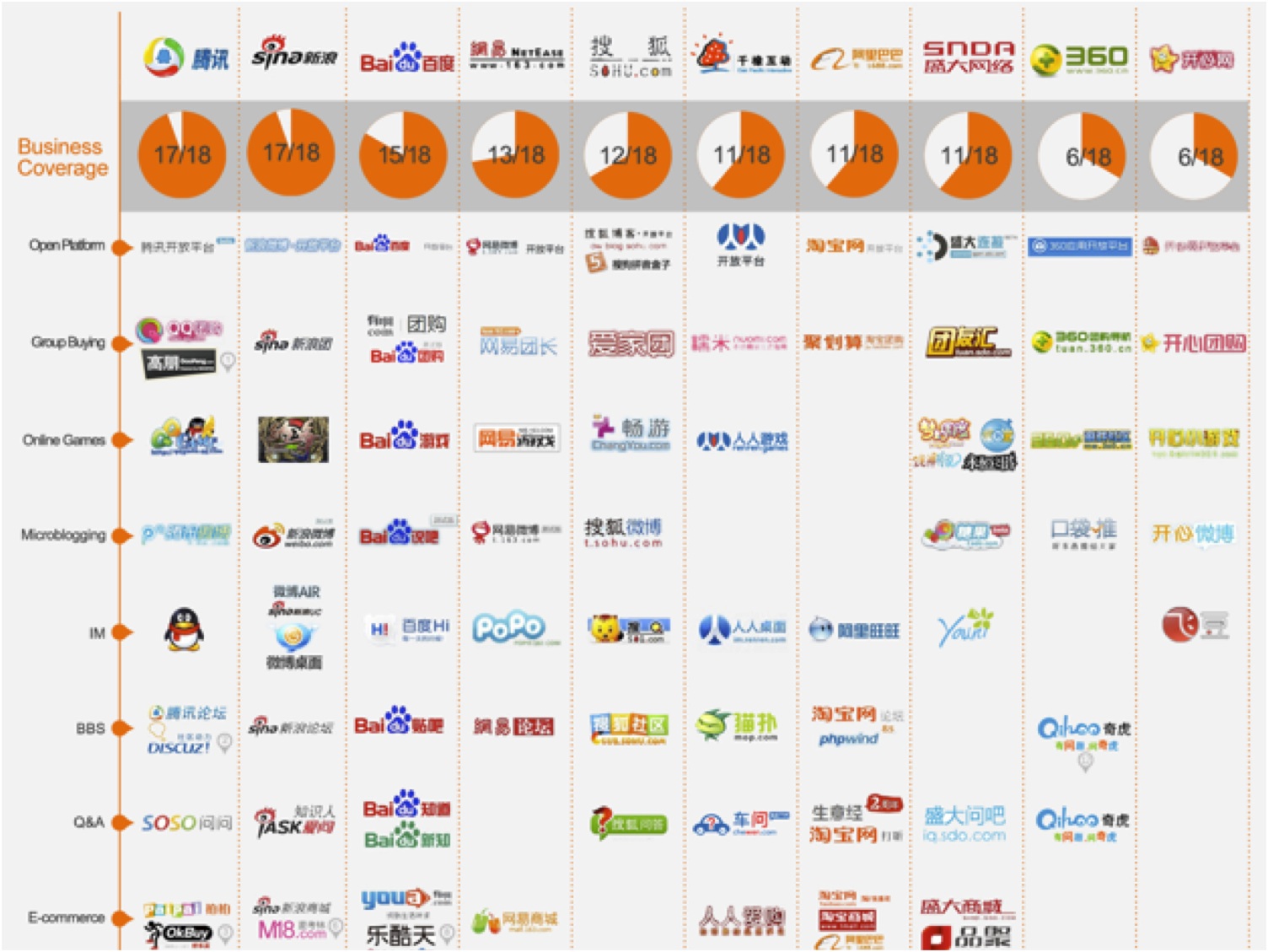
Anyone with even a glancing familiarity with the Internet landscape in China knows these three major Chinese Internet players, with a combined market cap of about 450 billion dollars. The three are known by the shorthand BAT: Baidu, Alibaba, and Tencent. Back in the days of the PC-centric Internet, sure, the three had a bit of overlap and certainly competed to an extent, but for the most part, Baidu as a search engine was mainly about connecting people with information, Alibaba as the giant on the e-commerce scene was about connecting people with products and with merchants, and Tencent, as the most powerful social player, was about connecting people with other people.Things changed rather dramatically beginning in 2012, though, when smartphone penetration began to increase dramatically and mobile Internet use became the norm. Suddenly, China’s Internet giants—as well as a slew of other companies—recognized the opportunity to connect people with services, and direct competition really heated up.
The transition from being PC-centric to mobile-first companies happened fast for China’s major Internet players. Baidu was criticized in some quarters for having started the transition a bit late, but even if that was once true, we’ve certainly made up for lost time. We quickly came to dominate in mobile search, in mobile maps, and in mobile app distribution. And in Q3, our last reported quarter, mobile accounted for about two-thirds of Baidu’s total search traffic, and about 56% of our total revenue.
Our position in mobile was never just about more ad revenue, though. It was about escaping, finally, that dependence on advertising that is the curse of so many Internet companies all over the world. Even Alibaba,which operates China’s largest online marketplaces, surprisingly derives more than half of its revenue from advertising. The upshot is that most Internet companies are competing for a rather small slice of the pie—a slice that’s called “online marketing budget.” And while that’s been sufficient to nourish a good-sized ecosystem to date, and while online advertising (and in our case, performance-based search marketing) will continue to be effective for the customer, useful for the consumer, and vital for us, we believe that our position in mobile opens up a huge new opportunity that we’re now investing very heavily in—the opportunity in services. Where search is terrific for lead-generation and creating brand awareness, what we can now do is close the loop from discovery to payment. We broaden the scope of what we do, then, extending from the familiar search model to include a transactional, commission-based model. In other words, we now want to be dipping our ladle directly in the revenue stream of the customers we’re driving business to.
We’ve long known that the majority of consumption is local, and the majority of consumption is services. This is true not just for China, but for every major market I’ve looked at. But the local and services layers have been notoriously difficult to unlock. IP address-based geo-targeting was always inaccurate and clumsy. Local businesses and services need to target by actual proximity, and need to reach people—and be discoverable by people—at the right moment, when they have that propensity to consume. A truly usable mobile Internet, with affordable devices that are location-aware and always on, has made this possible. It has already begun to transform life for consumers and for merchants alike in Chinese cities, and I believe that there are many parts of the world—and Turkey is very, very promising—where O2O will do the same.
Just how big is this opportunity? Well, if we’re only talking about vertical areas of services we’re now involved in directly—travel, hotel, restaurants, takeout delivery, entertainment (like movie theater tickets)—we’re talking a market of about $1.6 trillion dollars in 2015, likely to double in 4–5 years. And it’s a very under-penetrated market right now: Only 4 or 5% of restaurants in China are making use of the Internet now to reach customers.The more heavily penetrated segments, like movie theater ticketing, are already hugely promising. Some 60% of all movie theater tickets sold now in China are sold online, mostly via mobile devices. For consumers, the convenience and the savings are incredible. In literally under 30 seconds you can find the movie you want to see, find the closet theaters where that film is showing, deep discounts on tickets through Baidu or another provider, select your seats and buy your tickets. No one I know pays full price at the theater. For theater owners this is great: They fill their empty seats and generate much better revenue even if they’re offering deep discounts. A similar revolution is happening in dining, where restaurateurs are all getting on board with O2O platforms both to fill seats in their restaurants and to soak up excess kitchen capacity by offering takeout delivery—companies like you Yemeksepeti. A restaurant owner doesn’t need to create a website, or pay for bandwidth or rack space in an Internet Data Center. In fact a restaurateur doesn’t need to have a storefront: Many are doing great business now through delivery-only models, with just a kitchen and a partnership with an O2O food delivery provider like Baidu. O2O also presents tremendous opportunities to build CRM, real relationships with customers, through stored-value and VIP membership cards for instance.

Why is this happening on steroids in China, and what was so different about China? Part of this, it must be said, is the relative backwardness of the Chinese service sector.While in the developed West, a large percentage of hotels and restaurants are chains, with multiple outlets and back office staff and Internet-savvy marketing teams, China’s services are much more fragmented and don’t have the resources or the skills to leverage digital marketing on their own. Baidu and other companies who’ve led the way in the O2O space are in a great position, then, to work with these local services. And the rebalancing of the Chinese economy from investment-led to consumption-led growth, especially in services, augurs well for O2O’s prospects.
China’s large number of migrant workers, who move to the cities by the millions each year, can find great work, for instance, as a takeout delivery guy: They can make a good wage just following the pickup and drop-off instructions on their phones, just like Uber drivers—only unlike Uber drivers, they only need an electric bike, easily available for $300, and don’t need a drivers license. In America and in other developed markets, the high cost of delivery, and at least in the US case, the disturbing willingness with which Americans will get in their cars and drive even very short distances to their favorite restaurants, is a significant inhibitor to the development of O2O.
Of course if you’ve been following the development of the on-demand or O2O sector in China, you’re aware that there are a lot of subsidies being paid out—by Uber, in which Baidu is an investor, by Baidu Nuomi, our services-oriented e-commerce platform, by Baidu Takeout Delivery, and of course by all of our competitors. It’s true that we’re deploying substantial resources to win market share and to shape consumer behavior. We’re confident that we’ve already profoundly reshaped the market, and not just Baidu but the whole O2O sector still has tremendous momentum. All the subsidies we’ve paid out, the couponing that we’ve done, is really a small price to pay to open up a huge new market opportunity not just for us but for local businesses and services across the country. And as long as we’re spending that money to train core competencies—for example, the very sophisticated real-time, multipoint-to-multipoint logistics system for on-demand food delivery we’ve developed for Baidu Takeout Delivery—and to really create a compelling value proposition for merchants, we believe it’s money well spent.
So this is the great Chinese marketing treasure I wanted chiefly to share with you today—a way to unlock the riches of the local and services layer through O2O services. Here in Istanbul, as my wife and I have explored the city over the last five days, we’ve seen no real impediments to this happening here, too: You have here an enormous, populous city with one of the highest restaurants-per-capita I’ve seen, if my gut is correct. You have a huge, high-quality, but also quite fragmented services sector. In tourism alone the opportunities are enormous. Yemeksepeti is great, from what I can tell, and my hat’s off to the entrepreneurs who created and sold it. But imagine an app that would allow you from a single interface to book the right hotel, hire a driver, a tour guide who speaks your native language, recommend restaurants ranked highly among trusted people in your social network, offer you great nightlife options and more. If you were a hotel operator, a tour operator, a restaurateur or a nightclub owner, you couldn’t afford not to be using such a platform. This already exists in China: If you read Chinese and you visit any Chinese city, you can already do pretty much all these things and more directly from search or from maps.
Services means of course more than just restaurants, food delivery, travel, and movie theater ticketing. The really big prizes are in major verticals like financial services including insurance, like healthcare, and education—and these are all areas into which the major Chinese Internet companies have made very aggressive moves. And in these areas, it’s not just the power of mobile, and maps, and location-awareness that Internet companies are able to effectively leverage. It’s the power of big data.

Rocket Fuel for Technology
Search engines like Google and Baidu were of course dealing in “big data” long before anyone started using that already rather shopworn phrase. But it’s only been in more recent years that we’ve seen real breakthroughs in artificial intelligence. Whether you realize it or not, AI now touches the daily lives of many people, and will do so more and more. Since he joined Baidu in May of 2014 I’ve gotten quite close to Andrew Ng, Baidu’s chief scientist. Andrew is one of the major luminaries in AI right now, and particularly in one specific approach to AI called Deep Learning, which uses very large scale Deep Neural Networks to allow machines to actually learn. Some of the significant uses to which this has already been put include speech recognition and computer vision, but it’s going to revolutionize semantic intelligence and therefore machine translation, and bring about unforeseen changes in our abilities to process and extract insight from data.
If you’ve followed the AI field in recent years, you’ll see how hot deep learning is now, and you’ll also see that the world’s great deep learning talent has amassed at major Internet companies. Without going into too much detail, deep learning’s basic ideas have actually been around for decades—at least since the late 1980s and early 90s. But it’s been two things that have enabled the kind of breakthrough we’ve seen just in the very recent years: The rise of high-performance computing that has allowed us to build very large neural networks; and the massive availability of data. Andrew Ng, who headed the Stanford AI Lab and founded the Google Brain project, as well as co-founding the massive open online course platform Coursera, has led very impressive work in the time since he joined Baidu. He likens the AI systems themselves—the deep neural nets and the deep learning algorithms—to “rockets,” and the oceanic amounts of data to “rocket fuel.” Neither is much good without the other. It’s the large Internet companies—Google, Facebook, Baidu, Apple, Microsoft—who have both the rockets and the rocket fuel: They have combination of financial resources, hardware resources, and data resources that AI scientists really need. And we’re really achieving lift-off—with an impact that will really change the world.
As Andrew likes to point out, the great thing about deep learning as an approach to AI is that the bigger the neural networks—the more neural connections—the better the performance. Size actually matters. And the more data you put through a system, the better it performs too. With very little modification, we’ve been able to use a deep learning system we call Deep Speech to recognize speech in both English and in Mandarin, by feeding it thousands of hours of transcribed speech in both languages.
Artificial Intelligence in Marketing
Marketing is probably the most obvious application of AI, and it’s one we worked on right away. A deep learning system can figure out pretty quickly the likelihood of a given search ad being clicked on, and this ability to predict click-through rate obviously makes not only for better ROI for the advertiser but also a better user experience and better revenues for the search provider. We’re already also using deep learning to add images to text ads, automatically finding relevant images from the customer’s website, cropping and resizing to generate optimal click-through—and that’s already creating significant value for us and for our advertisers. AI plays a significant role in recommendation across many of our products, including O2O platforms: We can pick out interesting and non-obvious correlations that show up consistently in the data, and use those to make better recommendations.Who would have known, for instance, that Chinese men who drive Audis are far less likely to eat western for than Chinese men of the same age who drive BMWs?
Besides smarter ad serving, recommendations, computer vision and speech recognition, there are other surprising applications of deep learning that we discovered when we turned our deep learning system into a platform for engineers across the company to access. “Platformization” is a really important concept at Baidu. It’s something of an obsession for Jeff Bezos, CEO of Amazon, and you may have heard him talk about it. We agree, and it’s something we implement aggressively.
Let me give you an example of “platformization” at work. At Baidu we created something called PADDLE: it stands for Parallel Distributed Deep Learning platform.Basically, it allowed R&D personnel from across the whole company to make use of our deep learning engine by giving them relatively easy APIs to use. In very short order we started seeing deep learning applied to a wide range of things: Our Infrastructure team used deep learning to predict crashes of hard disks in our data centers, so that with 85% accuracy they could identify disks that were going to crash 24 hours before they did. This actually saves us about millions of renminbi per day. Another team used deep learning to develop a cloud-based antivirus system that could detect malware before it had actually been observed and defined by traditional antivirus companies, with rather effectiveness and so far a vanishingly small percentage of “false positives.” We’re using it now in healthcare, too—for diagnosis from just a layman’s description of symptoms.

The Straddler’s Advantage
I want to finish today by talking about one final thought on lessons from the Chinese Internet, one last idea that I think will be of value to people here in Turkey as you look to take your own valuable treasures out into the world.
When you work at a technology company—whether it’s in the Silicon Valley or Shenzhen, in Austin or Boston, in Beijing or Bangalore—it’s easy to get caught up in the obsessive culture of innovation: To be focused constantly on that next dazzling piece of tech, that thing you hope is going to catch fire with the elusive early adopters. We spend most of our workday interacting with educated, tech-savvy young people, and those of us in our forties—if you’re anything like me—are always worried that we’re out of touch with those young digital natives and their fickle, fast-changing habits. We train our sights too often on them, focusing on the shiny tech, not realizing that the treasures that sparkle brightest aren’t always the most valuable.
Living in a country like China, or anywhere else in the developing world, can remind you that there’s a whole lot more that should be driving innovation—that we shouldn’t be thinking just about putting the next wow-factor gadget or app into the hands of tech influencers. Technology ought to be put to work eliminating inefficiencies, democratizing access and putting the means of production and creation into the hands of the many, freeing us all from drudgery. And in China all around you you see examples of how those jobs are far from finished.
I believe that technology companies should be dedicated to solving these problems—at serving underserved people, and putting the information and the services they need within their reach—but not just because it’s the right thing to do. It is, of course, the right thing to do, and I do lament that it’s something that Silicon Valley seems to have moved away from a bit. So many of the hot new startups seem to me to be solving problems mainly for other affluent and educated people living in the first world.
In China, it’s different, and that’s good—because I also believe focusing on serving the underserved is the smartthing to do: Serving the underserved is an impetus to innovation. I’ve come to realize that Chinese technology companies enjoy what I call The Straddler’s Advantage—the advantage of standing astride two very different markets: One that’s very much like the developed world, and one that still resembles the developing world. I believe that Turkey is in a similar situation.
The first tier cities, cities like Beijing, Shanghai, Guangzhou and Shenzhen, all have very high rates of Internet penetration—close to or even higher than the national average of OECD countries. There are sophisticated users, sophisticated customers, and the tech companies themselves are very much current when it comes to technology: They keep up, despite what you may have heard about China having an almost separate “Intranet,” with all the new companies and all the new technologies coming out of Silicon Valley and everywhere other innovative geography.
Outside of the major cities, it’s a different story entirely:Not only is Internet penetration much lower, but the level of sophistication of users is much lower as well. There are many impediments to using technology. Strong regional dialects or even different Chinese languages are spoken, and while the written languages may be almost identical, input method based on standard Mandarin pronunciation is difficult for some to master. People are more sensitive to bandwidth costs.
It’s not just a urban-rural divide, either: There’s a major age divide that has created a large underserved population in China, among people who never learned the romanization system that’s been taught in Chinese schools since the 70s and that the overwhelming majority of people now use to input Chinese characters on digital devices. A great many people in China over, say, 60, never learned that system, called pinyin, so simply entering text on a device becomes very difficult.
What’s needed, clearly, are simpler and more intuitive interfaces. But serving users like these isn’t a simple matter of taking existing technology and just “dumbing it down.” To solve problems of access you need to go smarter, in fact. It actually places even greater demand on you as a technology provider. Graphic User Interfaces opened up computing to billions of people who might never have mastered DOS. The touchscreen interfaces on our iOS and Android devices are so incredibly intuitive that I’m sure many of you with children or younger relatives remember seeing two- and three-year-olds familiar with those smartphones and iPads going up to framed photos and trying to expand them with their fingers. There’s still a need for more intuitive, more naturalistic interfaces. For inputting Chinese, it was really revolutionary when smartphones allowed writing of Chinese characters, and those systems have developed very well—though they’re hardly very efficient still, and much slower than someone who knows pinyin well. To me, the most natural, most intuitive interfaces are perfectly obvious: Voice and visual.
We’re doing some very exciting work in our Silicon Valley AI Lab in something we call Deep Speech, which I mentioned earlier: Using Deep Learning algorithms in very large neural networks to process huge amounts of recorded speech, so that the system can actually learn to recognize words spoken all sorts of different ways—in noisy environments, with all the hesitation sounds and the pause words and the false starts, stammers, and repetition that vex most of the current systems that have been deployed. We’ve gotten truly amazing results in both English and Mandarin.
But even assuming that we can get speech essentially solved, and solve it in multiple languages, we still have to make actual sense of what’s being said: We need to derive intent from the commands that are given, and for that we need real semantic intelligence. After all, it’s not truly intuitive to have to use Boolean algebra with excluder and connector words for all the search commands we read into a smartphone. No, instead, we need to think of the way your older parents or grandparents use search: They’ll type in full sentences, like “I wonder whether they still have that $1.99 breakfast special down at the International House of Pancakes.”
It means better computer vision—the ability to actually extract meaning from images. After all, all of our smartphones now come equipped with quite good cameras. There’s a little camera icon in the search bar on Baidu’s search app that will let you snap pictures of things and do searches based on inputs. Point it at a QR code and it will resolve to the corresponding page. Take a photo of a book cover and it’ll take you to online reviews and online book stores. Same basic thing if you point it at a CD. But then it gets really cool: Point it at a dress, a blouse, a shirt, a sweater, a jacket someone’s wearing or a handbag they’re carrying and it does a pretty good job of finding matching items for sale on China’s myriad e-commerce sites. Point it at a movie poster and it’ll show you nearest theaters showing that film, and let you pick your seats and buy your tickets in a couple of clicks. And of course you can find similar images to photos you take or upload. When you do that, the results you get aren’t just images with visually similar patterns and shapes and colors: We actually extract semantic information from pictures and give you results based on those. So if you upload, as I recently did, a photo of the Sultan Ahmed Mosque, results don’t just include pictures of the same mosque, but pictures from areas where it’s located, perhaps of the Hagia Sophia museum, and pictures of other Islamic religious architecture which may look completely different. There’s Deep Learning at work here, too.
Speech recognition, natural language processing or semantic intelligence, and visual search are all areas that we think are making the world of information and services much more accessible for ordinary Internet users—and they’re all driving really serious innovation and require significant R&D effort. These are just a few examples: There are surely many, many others.
Internet companies understand that real innovation in technology is about simplifying the lives of users—not complicating them. I think the next great challenge to technology companies will be serving the next billion—really, the next four billion—in the countries of sub-Saharan Africa, Latin America, the Middle East, Western and Central Asia, and South and Southeast Asia. This is where the real user growth will be happening, as Antonella Mei-Pochtler from BCG pointed out in her talk yesterday, but we’ll all have to be smarter if we’re going to capture opportunities in areas that are under penetrated at present, but are seeing fast economic growth. They’re going to have access to the devices: That’s almost a given. Smartphones created by Chinese companies like Xiaomi are full-featured handsets that are ounce for ounce just about everything you’d get in an iPhone 6, for only $200; a perfectly serviceable smartphone now sets you back less than $150.
We can assume that this Next Billion, or Next Two, or Three, or Four billion, will face economic constraints that will mean we need to deliver smarter, more efficient products and services.. But beyond that, there are few generalizations you can safely make: The desires, the habits, the behaviors, the obstacles to access—these will, you can bet your bottom dollar, be very different in different geographies. Companies who come in with a one-size-fits-all mentality, whether they’re marketers or Internet companies, are going to lose out to competitors who understand that serving these markets requires great flexibility, a mentality that embraces hyper-localization. Great innovative potential stands to be unleashed we get out of their comfort zones to better understand the needs of users in the developing world.
- Kaiser Kuo joined me at the Global Marketing Summit 2015 in Istanbul.
- His speech is reproduced with permission.
- Find out more about the best ideas for Marketing in Asia
What are best new ideas for brands and marketing in 2016? … How can you apply the ideas to your own business?
I was recently in Odense, the heart of Denmark, the birthplace of Hans Christian Andersen, and the modern global centre of research and development for robotics and drones. I was looking for the best new ideas in business across Europe, and maybe that combination of storytelling and future technological capabilities is the secret to success in a changing world.
Europe has increasingly focused east rather than west in its worldview, be it in attracting tourism, where to vacation, finding the best markets for exports, or where to look for inward investment. It has also realised that success is no longer achieved through being big, but by being smart. We live in an ideas world, and it is the companies that are built on ideas – artistic, design, entertainment, knowledge and technological innovation – that are succeeding in Europe.
Take ARM for example, the microprocessor company from UK. It makes nothing, but it designs the “brains” of most of the world’s smartphones, tablets and wearables, which are then made in an ecosystem of partners for Apple, Samsung and every other brand. Compare their strategy to Intel, which has the huge capital costs of making things, and you see a vast difference in revenues and share price over the last 5 years. Similarly, look to industries like gaming – particularly in the Nordic countries – with brands like Supercell and Rovio. Or even look at Estonia, birthplace of Skype, which now offers E-Estonia virtual citizenship to encourage entrepreneurs to use the nation as a platform for future success.

Here are some of the best ideas from the European region, to help inspire your brand and marketing thinking:
Airbus Double Seating
How do you fit more people into an airplane without cutting into passengers’ already squeezed personal space? Airbus wants to seat people on top of each other. The French-based company Airbus filed a patent recently for a “mezzanine seating” design that will take advantage of the “substantially unused” upper areas of aircraft cabins. “It is very important from an economic point of view to make optimum use of the available space,” the patent reads, though the company doesn’t think customers have to suffer in the process—the upper-level seating could recline 180 degrees and be “suitable” for business class, says Wired Magazine. “It would therefore be desirable to provide a passenger seat arrangement that permits optimum use of the space in a passenger cabinet…but still provides a high level of comfort for the passengers.”
How can you apply this idea to your own business? Constantly rethinking the conventions of your industry, seeking to optimise the use of assets, and also using new ideas to be the industry thought leader.
Banksy’s Dismaland
Dismaland was a temporary art project organised by street artist Banksy, constructed in the seaside resort town of Weston Super Mare in south west England. Prepared in secret, the pop-up theme park and art expo was staged at the Tropican, an old and disused swimming pool complex, and presented as “a sinister twist on Disneyland”. Banksy described it as a “family theme park unsuitable for children.” Banksy created ten new works and funded the construction of the exhibition himself. The show featured 58 artists invited to participate by the street artist. After being open over the British summer, it has now been packed up to be taken on a roadshow around the world.
How can you apply this idea to your own business? Counter-intuitive thinking … be the antidote to what others do!
Brewdog
Brewdog is a beer from Scotland. With attitude. it produces about 2.2m bottles and 400k cans per month. It was founded in Edinburgh in 2007 by James Watt and Martin Dickiem whilst the main brewing moved to nearby Ellon in 2012. Take a whirlwind tour around Brew HQ … Check out the hop canon, used to fire hops at warp speed into the beer, the centrifuge which was specially commissioned to avoid harsh filtration, and see the business that is funded by 16,000 dedicated craft beer crusaders, consumers, who invested in Equity for Punks.
How can you apply this idea to your own business? Have attitude and personality. Connect with your consumers.
Ego Boost Chocolate
Eat yourself beautiful! This chocolate bar contains a daily dose of skin firming collagen, an essential protein for building up, moisturising and tightening the skin. And of course, this 50g bar tastes delicious! It’s got a slight “forest-berries-dipped-in-chocolate” flavour, and comes in a thick, chunky bar. To further protect your skin and your health, it contains Chaga, one of the strongest anti-oxidants around, guaranteed to protect you from free radical damage and assist cellular repair throughout the body. Dark chocolate also reduces “bad” cholesterol and increases “good”, and has been known to improve brain function. As if you needed any other reasons to indulge in this yummy treat!
How can you apply this idea to your own business? Be naughty and nice … product that do good, and taste good.
https://www.youtube.com/watch?v=ePmHxTj-5VM
L’Oreal Makeup Genius
L’Oréal’s tech lab launched its first product, an app called Makeup Genius. Hold your smartphone up to your face like a mirror, and the face looking back might have deep red lips and dark eyes for the red carpet, or subtle shades for the office, depending on what products you choose. Even if you move around, the virtual makeup stays in the right places, like looking in a real mirror. Whilst L’Oreal focused on European consumers, China has been a massive market for the app, bringing 4.7 million of its total 14 million downloads. “Girls in China can be shy to apply makeup if they are at the counter or if they are going out with friends — they don’t want to put on very dark lipstick, very dark eye shadow,” said Asmita Dubey, chief marketing officer for L’Oréal China.
How can you apply this idea to your own business? Combine physical and virtual experiences to do more for people.
One Fine Stay
Greg Marsh launched this premium version of Airbnb in London 5 years ago, renting out private luxury homes. Today the company lists homes in London, New York, Paris and Los Angeles, and “already six times larger than the inventory of The Ritz, The Plaza, Hotel George V and Hotel Bel-Air combined”. Like Airbnb, Marsh found that stunning photography and building a community of referrals were key to engaging people and their trust. The customer experience is premium all the way, and includes thoughtful additions such as private drivers available from the airport on request, and a free fully-paid smartphone for use whilst you are staying.
How can you apply this idea to your own business? Make somebody else’s idea better.
https://www.youtube.com/watch?v=RmU0Ht3TUoM
Park Run
10 years ago, a small group of 13 runners met in Bushy Park, near Teddington, for a timed 5km run. Unlike most running events, there were no entry processes, no numbers, and no fees. Just a few volunteers to mark out the course, and your time at the finish line. It became a regular event, runners measuring their progress over the weeks and years. 10 years later, 1.3 million runners take part every week in Park Runs that take place in 775 locations across the world. All free. All 5km. And all recorded in one global database. The Park Run organisation now has a full-time team of professionals running the global network, paid for by a range of sponsors, and supported by an army of local volunteers. The grassroots movement has now become the world’s largest weekly running event.
How can you apply this idea to your own business? Start a business from the grassroots – and new business model.
Rapha Cycle Club
Rapha was launched in 2004 with one mission: to create the finest cycling clothing and accessories in the world. Ideal for the wealthy, Lycra-clad, 50-something year olds who take to the roads of Europe each weekend. But Rapha is about far more than products, it is about the love of cycling, and brings together its community through its stores, known as Cycle Clubs in cities across the world. Sit down at the kitchen table, have a coffee and croissant, watch a video of the recent Tour, marvel at the gear actually word by the great riders, meet people with the same passion as you, get your bike fixed, and even go for a ride. It even has a travel business, and rapidly growing range of publications.
How can you apply this idea to your own business? Brands are about people not products, about their passions.
Rapha is one of the 100 brands featured in my new Gamechangers book. Read the case study.
Raspberry Pi
Raspberry Pi is a range of credit-card sized single-board computers developed in Cambridge to promote the teaching of basic computing skills in schools and to young kids. A community of followers quickly developed online, served by a fanzine called MagPi. Physical events quickly followed, initially called Raspberry Jams … and then a global network of local clubs focused on helping young people in schools and local communities, and even older people too, to explore their own potential for what they can do, starting with a simple $30 computer.
How can you apply this idea to your own business? Simplicity. But also creating a movement.
Raspberry Pi is one of the 100 brands featured in my new Gamechangers book. Read the case study.
This Girl Can
This Girl Can is a national campaign developed by Sport England and a wide range of partnership organisations. It’s a celebration of active women up and down the country who are doing their thing no matter how well they do it, how they look or even how red their face gets. The campaign doesn’t hold back in trying to encourage women to beat their barriers. “Sweating like a pig, feeling like a fox” and “I kick balls, deal with it” are among the hard-hitting lines used in the campaign to prompt a change in attitudes and help boost women’s confidence. 13 million people have now viewed the flagship This Girl Can film online.
How can you apply this idea to your own business? Challenge the perceived wisdom, and find attitudes that really connect with your audience inside.
Volvo Life Paint
Volvo Cars developed Life Paint as “the best way to survive a crash, is not to crash”. Life Paint is a unique reflective safety spray, invisible by daylight, it shines brightly in the glare of car headlights. The reflective spray was actually created by ad agency Grey London which won two Grand Prix awards at this year’s Cannes Lions festival, is now being distributed in Volvo dealerships around the world, challenging criticism that the product was just a marketing stunt. LifePaint, when applied to bikes and clothes, increases the visibility of cyclists to cars. It was created as part of a range of products produced by Grey (with others) to promote different aspects of Volvo’s cars and brand (in this case, its commitment to safety via its IntelliSafe system). But whereas some of the concepts – including Swedish Air, an inhaler that offered visitors to Volvo showrooms a lungful of fresh air – disappeared without trace, LifePaint captured the imagination of the press and the public and received wide coverage across the media.
How can you apply this idea to your own business? Random ideas can have radical impact.
https://www.youtube.com/watch?v=AJjbmFMz_l0
Zoella
Zoe Sugg, aka Zoella, is one of the world’s leading millennial vloggers … “a self confessed beauty junkie, I chat through my favourites, share my beauty purchases, tips, tricks and a few poopy attempts at applying makeup for your viewing pleasure”. She’s a 25-year old YouTube celebrity, blogger, author and beauty guru who currently lives in Brighton, England With her boyfriend Alfie Deyes (aka Pointlessblog) She currently has over 8 million subscribers. Her schedule is usually a video every Sunday, but it varies. Her bestselling book is called Girl Online. As well as being an author, beauty guru and world famous YouTuber she was also featured on popular British baking show, Great British Bakeoff.
How can you apply this idea to your own business? People trust people. Using the power of influencers to build your brand in more social, collaborative and human ways.
https://www.youtube.com/watch?v=26SySrPnJDY
Around the World in 80 Marketing Ideas
This is part of a larger project to find the best marketing ideas from around the world, real and practical solutions which work in one place – and (with relevant adaption) could work in your market too … Copy Adapt Paste! They were sourced through my personal travel experiences (I visited around 50 countries in 2015 as a keynote speaker and expert consultant), through a crowdsourcing program and with the help of two friends, Anouk Pappers and Maarten Shaeffer. You can download all 80 marketing ideas in the presentation below:
http://www.slideshare.net/geniusworks/80-great-marketing-ideas-for-2016
Read more about
- Kaleidoscope 2016 … the 7 big ideas that will shape customers and markets, drive brands and innovation
- Marketing in Europe in 2016 … from healthy chocolate to digital cosmetics and millennial vlogging
- Marketing in Asia Pacific in 2016 … from flying shrimp to Aussie farmers and intelligent chopsticks
- Marketing in The Americas in 2016 … from cool carrots to cardboard 3D headsets and superhero supplies.
- Marketing in Africa and Middle East in 2016 … from farms in boxes to walking a marathon for water.
I get asked to do a lot of interviews. It’s great to share new ideas and inspirations with people in local markets. Here is a selection of some Q&As from the last month, for publications ranging from Australia and Belgium to India and Indonesia:
Question. What’s your big idea?
“Game-changing” is about market innovation. Most people focus on innovating their products and services. But these are quickly copied, and give little advantage. Instead focus on rethinking how your market works – the “game” – think how you can change the game (perceptions, behaviours, expectations), rather than just play the same game as everyone else (same products, competing on price). Then innovate the business – especially the business model and customer experience – in response to this new vision of how you want your market to work. To your advantage. Read more about my new book “Gamechangers.”
Question. You started as a scientist, then became a marketer. What did you learn from this?
The most important mindset for marketers today is to be able to combine “left brain” (logical, analytical, focused) with “right brain” (intuitive, connected, exploratory) thinking. We need right-brain thinking to see the bigger picture, of the changing world, the emerging trends, and new opportunities. It is built on imagination, making new connections, creating hypothesis, and forming opinions. We need left-brain thinking to see the detail. It is built on intelligence, to interpret the big data, to connect customer and financial data, to make choices about where to focus and where not. We need to zoom out (right brain) and zoom in (left brain). Strategy requires this approach. Innovation requires this approach. It is about combining left and right brain thinking. Creativity is the combination of both.
Physics is about making sense of the world, and creating detailed interpretations of why things happen. It is quite logical. After studying physics at university, I got bored. I wanted to be intuitive too. I started working in marketing. By 28 years old, I had my best ever job, managing the Concorde brand. It was about understanding people and their aspirations. It was about building a brand, emotionally and intuitive. But it was also about making money. I soon realised that to be a successful marketer – or even business leader – you need to combine left brain and right brain thinking. Today, more so than ever. Actually if you look at all the great “gamechangers” they use both sides of their brain. Einstein started with his right-side, creating hypothesise to try to explain his new observations, and then his left-side to prove them mathematically. In this way he was able to find the theory of relativity and more. Picasso started with his right-side, using the geometry and perspective that he learnt from his father, a maths professor. He then went crazy with his right-brain, intuitive and interpretative. The combination enabled him to create a new genre of cubism.
It is this “connected thinking” that helps us to make sense of a changing world, and to create a better one
Question. You say that “the best marketers are disruptive innovators” … Why?
The best opportunities for businesses to win – to find new growth, to engage customers more deeply, to stand out from the crowd, to improve their profitability – is by seizing the opportunities of changing markets. The best way to seize these changes is by innovating – not just innovating the product, or even the business itself, but by innovating the market.
Today’s most successful businesses – from Airbnb to Tesla, Apple to Uber – innovate the market – what it is, how it works. Most businesses accept the market as given – the status quo – and compete within it. With slightly different products and services, or most usually by competing on price. Most new products are quickly imitating, leading to declining margins and commoditisation. Marketers, instead of having their heads down, playing this game of diminishing returns – simply trying to build awareness, with tactical promotions, social media gimmicks and price discounts a should have their heads up – fining the best new market opportunities, then thinking how to innovate the market, and then the business.
Marketers are the best people to do this – to change the game, not just play the game – they are the “Gamechangers” … To innovate their market, and then to innovate their business – like Whatsapp creating $19bn in three years, Uber $40bn in 5 years … These companies harness the power of ideas and networks to create exponential impact.
Question. In the time since your Gamechangers book was published, what are some notable new innovators you have come across?
The biggest story that isn’t in the book is Uber, the taxi business that embraces a digital platform to connect drivers and passengers in a simple and addictive way. In five years they have created $40 billion value. They’ve just launched UberEats, already the world’s largest food home delivery network. Some of the other brands, innovations and stories which I see as new and interesting right now include:
- Editas – transforming healthcare with gene editing
- Fan Duel – fantasy American football, baseball, any sport
- Mellow cabs – cool and responsible taxis in South Africa
- Modern Meadow – biofabrication of food, like synthetic meat
- OneWeb – creating global internet access for everyone
- Planetary Resources – asteroid mining for precious minerals
- Rent the Runway – designer fashions available for everyone
- Slack – collaborative software, changing the way we work
- Starbucks Reserve – rethinking the premium coffee experience
- Theranos – blood testing, more personal and positive wellbeing
- WeWork – shared workspaces, building entrepreneurial hubs
- Zoom – Patient-centric healthcare, mobile apps and modern clinics
Question. What are the typical challenges entrepreneurs face as they scale up their innovation from a startup to a large company?
Today’s entrepreneurial mindset is to start fast, make mistakes and learn … and then as you gain more insight and experience, “pivot” your business to where you really see the best opportunity. As examples, Pinterest started life as Tote, helping people to explore online retailers and sending them updates about prices and availability. It realised users were mainly using the site to build and share ideas lists, and soon shifted course to focus on “pinning”. Groupon began as a platform for social action called The Point, before reinventing itself in the crowd-based local coupon business. Ushahida started as an African elections monitoring service, before growing into a crowdsourced new aggregator. Twitter emerged out of a mediocre podcasting concept called Odeo that was outshone by iTunes.
Question. How should innovators strike that delicate balance between ‘Stick to your vision’ and ‘Adapt to a changed world’?
It’s like climbing a mountain, set out your vision – the mountain peak you want to get to – and then choose your path. However you may well have to change your path depending on what its like, the weather conditions, and much more. You might sometimes even want to aim for a different peak, when you realise that the initial one is no longer appropriate.
Question. Who are some of the entrepreneurs you admire the most today?
- Jack Ma – the Chinese school teacher, who created Alibaba and then keeps growing it to the next level – now the world’s largest retailer, yet owns no inventory!
- Stefan Klein – the 60 year old Slovakian entrepreneur, former car engineer with a passion for flight, who created Aeromobil, the flying car.
- Elon Musk – the American entrepreneur, dreaming big and audacious ideas, investing in lots of different businesses, and staying true to his vision.
- Donna Karan – she does business on passion, and in recent years has realised that beauty is more inside than outside, more Urban Zen than DKNY.
- Tony Hsieh – the American CEO of Zappos, who has taken it upon himself to rejuvenate the inner cities of America, as a part time job whilst still running Zappos.
- Zoe Sugg – the youngster has built a multi-million dollar fortune vlogging from her bedroom about make-up and fashion, followed by a number of blockbuster books, and her own cosmetics range.
Question. It’s one thing to fail with a product, and a bigger dimension to fail with a company. How should founders regroup in these two situations?
2 out of every 3 products will fail. Accept, expect it. The trick is to identify failures as early as possible, and to back the winners quickly too. Failing companies is harder. But its all experience. Great experience. Move on. Learn everything you can. Come back and do better. We shouldn’t call it failure. It just didn’t work out yet.
Question. Is there such a thing as the ‘ideal age’ for an innovator, or can the creativity bug strike you at any time? How should people keep themselves open for adopting an innovative career later in life?
Innovation has nothing to do with age. Younger people bring energy and fresh thinking, uninhibited by the past. Older people bring experience, wisdom and personal discipline. One thing that does help is diversity – having a mixture of backgrounds, -and experiences. Teams always beat the lone genius!
Question. How should innovators evaluate weak signals and anecdotal evidence which seem to contradict quantitative market trends?
Most market research focuses on the mainstream – the questions are defined based on current knowledge, and limit the possibilities – the answers, particularly in quantitative research are averaged and so represent nobody particular. Newness typically occurs in the margins not the mainstream – the deviant behaviour, the new needs and aspirations – it is better to find these qualitatively, using a small sample, using observation and discussion. Then to develop them collaboratively with these customers, learning together and shaping the right solutions. It might be, of course, that there is no longer a “mainstream” as markets increasingly fragment, as people are more different. In which case there are lots of different margins, lots of different experiments. See which ones win!
Question. How can social entrepreneurs and non-profit organisations make use of your Gamechanger framework model? Are there some examples you can cite in this regard?
Exactly the same – there are lots of examples in the book – companies like Toms (the Argentina-inspired footwear company who give “one for one” to good causes), Raspberry Pi (educating kids about technology), Narayana Hospitals (with a dual business model, where health tourism subsidises free healthcare locally), and many more. The simplest way to explore ways to change the game in any market, is in the “gamechanger compass” – change the who, change the why, change the what, change the how.
Question. In 2011 Time Magazine identified the Sharing Economy as one of the ten megatrends that will change the world. What do you think about it? What do you predict?
The Sharing Economy is a broad concept with many components … everything from collaboration and co-creation, to subscription and rental models, shared ownership to shared use, exchanges and communities.Together it is probably the biggest trend in business, particular in terms of shaping markets and consumer behaviour.
Question. A survey conducted for the German magazine Spiegel in 2014 reveals that 77% of the people asked think that share economy is a sustainability-based approach to protect the environment we live in and a good way to save up resources and money. Why do you think is the concept of share economy being received so well?
Most consumers do not share driven by social or environmental issues, although sustainability may well have been the initial motivation of many innovators. The majority of consumers see the benefits of the sharing economy as reducing costs, and increasing convenience (for example, I stay in an Airbnb because it is more interesting than a standard chain hotel), or convenience (I know where to find a 3D printer when I need one, but want to buy one), or access to better (for example, I cannot afford to buy a Porsche but a can rent a Zipcar for the weekend!). Of course it also means that we make and consumer less resources, less emissions, etc which is good for the world, so there is a clear sustainability benefit. But its not what turns most people on!
Question. The American economist Jeremy Rifkin looks at the technological progress of the past years, especially the developments in 3D-printing, and anticipates a future where marginal costs tend toward zero, so that capitalist forms nearly die out, being replaced by a super-internet of things. What is your opinion about it?
The ‘frictional economy” was a lazy way to make money. It took money where people found pain. As these frictions are eliminated, companies recognize they need to make money by adding value – meeting the new needs and aspirations of consumers, more emotional and aesthetic. Its more about adding perceived value, than reducing cost.
Question. What are the best examples you have come across of governments innovating successfully?
- Estonia … E-Estonia was recently launched giving anybody who wants to apply (from anywhere in the world) the ability to become a virtual citizen, and to establish a business in Latvia (with local government support and taxation)
- Kazakhstan … the huge and barren country has one of the best broadband infrastructure, enabling it to offer digital services such as e-education, e-health as well as jumping into the digital world of retail and entertainment.
- UAE … pooling resources with an ambition to become “the worlds most innovative nation by 2020” when it will host the Dubai World Expo 2020 … learning in particular from Singapore, to build a knowledge economy.
- New Zealand … building a powerful national brand around “100% pure” which then inspires tourism and inward investment, but also pride and confidence in local people and local businesses.
Question. As one of the worlds leading marketing and innovation guru … What are your tips?
Here are my 10 tips …
Tip 1: Business is about people … creating what customers really want, and then employees working together to deliver it. We are all experts on people. There is no PhD for common sense. What you need is the confidence to think like a human being, to be intuitive and emotional, to challenge the old conventions, and use your imagination. All the tools and techniques of business will help, but the starting point is to be human.
Tip 2: Listen to customers … When did you last spend a whole day observing, listening and talking to your clients or consumers. Design thinking is all about diving deeper into the world of the customer. Don’t just ask them to tick boxes in a questionnaire. Try to work out what their real problems are, their dreams, their frustrations. Do it every week. Really. You are never “too busy”. And harness the the right insights.
Tip 3: The best ideas are out there … probably not in your own geographical market, or business sector, but in other categories and countries. Don’t just sit there trying to be slightly better, slightly cheaper than your competitors. Instead look to other places, where ideas are already being used (its like a free research lab), and which you can take and apply to your own business.
Tip 4: Make new connections … that is how Leonardo da Vinci described innovations. Therefore look for things which don’t forget – which seem like opposites, even a paradox, then find a way to resolve it. For example, take the Airbnb model of sharing and apply it to your business, what do you get? Or the subscription model of Zipcars, or the freemium model of Spotify. Take two different products are try combining them together.
Tip 5. Together is better … the power of a team will always triumph over lone genius. Its amazing how we still think we can do better alone. Use the power of diversity to achieve more, even each person only has part of the answer, it is the diversity of their knowledge and experiences that beats any one person. Facilitate this carefully (this is a real skill), to bring out the best in everyone, to integrate and shape it together.
Tip 6. Networks are exponential … Businesses don’t need all the capabilities themselves, its about finding the right partners to do each task better, and to bring all the partners together as an ecosystem. It is then about reaching markets through networks – social, chains, licensing. Networks can multiply your business much further and faster – exponentially.
Tip 7. The power of one page … the one page strategy, the one page business case, the one page project pitch, the one page marketing strategy. People are incredibly busy, and attention is scarce, so being able to bring things together in one page is incredibly powerful (maybe its one page of text, or an infographic, or a rich picture, or even a poster). It is also a great discipline, to get you to focus on what matters, and articulate it clearly.
Tip 8. Be the Gamechanger … The big idea of my new book “Gamechangers” is to not simply innovate the product or service (because it will be copied before you launch it!) but to innovate the market (the “game” – how it works, the price points, the channels, the rules), and then innovate the business (especially the “business model” – how you will work to make money in the new game). Start from the market, then work inwards.
Tip 9. Don’t be afraid … I often start a consulting project having no idea what the solution might be, or exactly how to get there. The skill is to have the confidence to get started, and to adapt as you learn more about the problem, and your solution develops. Build a prototype early – a picture, a cardboard model, or a real quick solution – which allows people to focus on something and make it better.
Tip 10. “10x not 10%” … what I learnt from Google’s X Labs is the power of thinking bigger. Being audacious. Most of us keep looking for the 10% improvement ( to make products 10% better, to drive 10% more sales than last year). Incrementalism makes us lazy, and we always seek to squeeze a little more out of the old, out-dated thinking. Instead think from the future back, with bigger and bolder ideas, then work towards them.
Question. What is your next book going to be about?
I’m working on two concepts. I am using the “lean start-up” methodology to develop them quickly and test them with audiences, and then to decide which one is the better concept to turn into a book. This is important because in reality a book becomes a whole service offering – events, masterclass, consulting, toolkits etc. Maybe your own readers can tell me which of these two concepts they prefer (email me your views!)
- “Superhuman Business” … people can do amazing things, when their environment and support, motivation and rewards, are all in alignment. We take our insights from cultural situations – for example, the Greek age of knowledge, where the collective wisdom of many scholars was able to push each other to new levels; or the Terrahumara Indians of Mexico who are able to run for 24 hours over amazing distances because that is their culture; or in the business world the impact of innovation clusters like Silicon Valley, Espoo in Finland, or Hyderabad, where technology drives ideas in an amplified way. The questions is how to apply this to the world of business – if you want to deliver fantastic customer service in a call centre, or if you want to drive amazing innovation in products.
- “Exponential Brands” … we live in a world where the world’s largest accommodation business owns no property, where the world’s largest retailer own no inventory, the world’s largest media company owns no content. Airbnb, Alibaba and Facebook play by new rules – ideas and networks. The impact can be incredible – Whats App has created $19bn of value in 3 years, Uber $40bn in 5 years. Exponential! But most of think in linear ways. Linear thinking is not enough (imagine moving forwards one step every year … 1, 2, 3, 4, 5), whereas exponential thinking is dramatic (imagining moving forward like this … 1, 2, 4, 16, 256). So how can your business harness the power of ideas and networks to drive exponential business models, with exponential impact?
Tell me which you think I should focus on?!