Odense, Denmark’s third largest city, is perhaps best known as the home of Hans Christian Andersen. That’s all about to change as its focus on technology, and in particular drones, is about to create new fame across the world. From the Southern Denmark University, to the Robotics Institute, a vibrant start-up culture, and a 21st century urban redevelopment, Odense is become Drone Central.
How big is the drone market?
Drones have taken off in recent months … no longer restricted to military activities and intelligence gathering, they are now the must-have toys and essential photographic accessories … as well as delivery washing powder to your door, planting crops over hostile terrain, and repairing the tallest buildings.
Here are some recent 2015/16 statistics:
700,000 drones shipped in 2015, 63% increase on previous year
$3.3bn estimated value of the drone market, rising to $90bn by 2025
594 times drones spotted on flightpath of aircraft, and 28 reported incidents
Who are the drone innovators?
Companies as old and as successful as drone producer DJI might be content to rest on their laurels, but over the last decade, the Chinese company has continued to iterate on its consumer drones, consistently introducing genre-defining technology for a growing audience of professional and amateur users. In the last few months of 2015 alone, DJI released a new drone designed for agricultural needs; introduced a 4K-capable version of its best-selling Phantom drone; developed geofencing software that keeps users compliant with federal airspace regulations; opened a flagship store in Shenzhen, China; and released Osmo, the world’s most advanced ”selfie stick.” Competition is closing in from all sides, but few other companies offer devices or technology on par with DJI’s innovations. For now, there’s no toppling this world-class company.
The recent Most Innovative Companies 2016 report by Fast Company, ranked the most innovative drones companies in the world, topped by DJI and also including:
Ehang … using virtual reality to give everyone wings
3D Robotics … bringing programmable UAVs to the classroom
Skywatch … being a building contractor’s eyes in the sky
Last week, I took to the stage with Odense’s ground-breaking mayor, Anker Boye, to launch Odense as “the City of Gamechangers.” With an audience of around 1000 business leaders, entrepreneurs and students, the ambition to shape the future of drones is tangible. The municipality’s business development arm, Odense & Co, are launching an exciting new strategy to attract the world’s robotic and drone innovators to cluster around the city, and for other related disruptive technologies to join in too.
Dan Pink’s great book Drive explains why the use of rewards and punishments to influence our employees’ performance is an antiquated way of managing people. To maximize their engagement and effectiveness in the 21st century work, we need to upgrade our thinking.
When it comes to motivation, there’s a gap between what science knows and what business does. Our current business operating system–which is built around external, carrot-and-stick motivators–doesn’t work and often does harm. We need an upgrade. And the science shows the way. This new approach has three essential elements:
Autonomy– the desire to direct our own lives.
Mastery— the urge to get better and better at something that matters.
Purpose — the yearning to do what we do in the service of something larger than ourselves.
Here’s a great video to explain:
https://www.youtube.com/watch?v=Ayqpp-FuKjc
Here’s a summary of the book:
A new operating system
Societies, like computers have operating systems – sets of assumptions and protocols about how the world works and how humans behave that run beneath our laws, economic arrangements and business practices. There are three:
Motivation 1.0 – presumed that humans were biological creatures, struggling to obtain our basic needs for food, security and sex.
Motivation 2.0 – presumed that humans also responded to rewards and punishments. That worked fine for routine tasks but incompatible with how we organize what we do, how we think about what we do, and how we do what we do. We need an upgrade.
Motivation 3.0 – the upgrade we now need, presumes that humans also have a drive to learn, to create, and to better the world.
Tasks can be divided into two categories
Algorithmic – a task which follows a set of established instructions down a single pathway to one conclusion
Heuristic – a task that has no algorithm, you have to experiment with possibilities and devise a novel solution.
In the U.S., only 30% of job growth comes from algorithmic work, while 70% comes from heuristic work. A key reason: Routine work can be outsourced or automated; artistic, empathic, non-routine work generally cannot. External rewards and punishments can work nicely for algorithmic tasks but they can be devastating for heuristic ones. Solving novel problems depends heavily on the intrinsic motivation principle of creativity.
7 reasons why carrots and sticks don’t work
The starting point for any discussion of motivation in the workplace is a simple fact of life: People have to earn a living. If employee compensation isn’t adequate or equitable, the focus will be on the unfairness of the situation. Without fairness in baseline compensation you’ll get very little motivation at all.
But once we’re past that threshold, carrots and sticks can achieve precisely the opposite of their intended aims. Rewards can transform an interesting task into a drudge. They can turn play into work. Traditional “if-then” rewards can give us less of what we want. They can:
Extinguish intrinsic motivation,
Diminish performance,
Crush creativity, and
Crowd out good behavior .
Encourage cheating, shortcuts and unethical behavior
Become addictive, and
Foster short-term thinking.
These are the bugs in our current operating system. For those driven by intrinsic motivation – the drive to do something because it is interesting, challenging, and absorbing – is essential for high levels of creativity.
Goals that people set for themselves and that are devoted to attaining mastery are usually healthy. But goals imposed by others – sales targets, quarterly returns, standardized test scores, etc. – can sometimes have dangerous side effects.
The problem with making an extrinsic reward the only destination that matters is that some people will choose the quickest route there, even if it means taking the low road.
In contrast, when the reward is the activity itself – deepening learning, delighting customers, doing one’s best – there are no shortcuts. The only route to the destination is the high road.
Although occasionally they still do
Carrots and sticks aren’t all bad. They can be effective for rule-based routine tasks – because there’s little intrinsic motivation to undermine and not much creativity to crush. You’ll increase your chances of success using rewards for routine tasks if you:
Offer rationale for why the task is necessary. A job that is not inherently interesting can become more meaningful if it’s a part of a larger purpose.
Acknowledge that the task is boring.
Allow people to complete the task their own way (autonomy).
For non-routine conceptual tasks, rewards are more perilous – particularly those of the “if-then” variety.
But “now that” rewards – non-contingent rewards given after the task is complete – can sometimes be okay for more creative work. If tangible rewards are given unexpectedly to people after they have finished a task, the rewards are less likely to be experienced as the reason for doing the task and are thus less likely to be detrimental to intrinsic motivation.
You’ll do even better for rewarding non-routine, creative work if you follow two more guidelines:
Consider non-tangible rewards. Praise and positive feedback are much less corrosive than cash and trophies.
Provide useful information. Give people meaningful information about their work. The more feedback focuses on specifics and the more praise is about effort and strategy rather than about achieving a particular outcome – the more effective it can be.
Type I and Type X
Motivation 2.0 depended on and fostered Type X (Extrinsic) behavior – behavior fueled more by extrinsic desires than intrinsic ones and concerned less with the inherent satisfaction of an activity and more with the external rewards to which an activity leads.Self-Determination theory argues that we have three innate psychological needs – competence, autonomy and relatedness. When those needs are satisfied, we’re motivated, productive and happy. When they’re thwarted, our motivation, productivity, and happiness plummet. Therefore we should focus our efforts on creating environments for our innate psychological needs to flourish.
Motivation 3.0, the upgrade that’s necessary for the smooth functioning of twenty-first century business, depends on and fosters Type I (Intrinsic) behavior. Type I behavior concerns itself less with the external rewards and activity brings and more with the inherent satisfaction of the activity itself.
Motivation 3.0, the upgrade that’s necessary for the smooth functioning of twenty-first century business, depends on and fosters Type I (Intrinsic) behavior. Type I behavior concerns itself less with the external rewards and activity brings and more with the inherent satisfaction of the activity itself.
For Type X’s the main motivator is external rewards; any deeper satisfaction is welcome but secondary.
For Type I’s, the main motivator is the freedom, challenge, and purpose of the undertaking itself; any other gains are welcome, but mainly as a bonus.
Type I behavior is made, not born. These behavior patterns aren’t fixed traits. Any Type X can become a Type I.
For Type X’s, money is the motivation for doing the work. As long as a Type I’s compensation is perceived to be fair, money is secondary.
Type I’s almost always outperform Type X’s in the long run. Intrinsically motivated people usually achieve more than their reward-seeking counterparts.
Type I behavior promotes greater physical and mental well-being. They have higher self-esteem, better interpersonal relationships, and greater general well-being than those who are extrinsically motivated.For professional success and personal fulfillment, we need to move ourselves and our colleagues from Type X to Type I. Type I behavior leads to stronger performance, greater health, and higher overall well-being.
Element 1: Autonomy
Our “default setting” is to be autonomous and self-directed. Unfortunately, circumstances – including outdated notions of “management” – often conspire to change that default setting and turn us from Type I to Type X.
ROWE- Results-Only Work Environment – people don’t have schedules. They show up when they want. They don’t have to be in the office at a certain time – or any time for that matter. They just have to get their work done. How they do it, when they do it and where they do it is up to them.
Autonomy is different from independence. It means acting with choice – which means we can be both autonomous and happily interdependent with others.
A sense of autonomy has a powerful effect on individual performance and attitude. A Cornell University study on workers autonomy at 320 small businesses discovered that businesses that offered autonomy grew at four times the rate of the control-oriented firms and had one-third the turnover.
To encourage Type I behavior, and the high performance it enables, the first requirement is autonomy. People need autonomy over:
Task – What they do,
Time – When they do it,
Team – Who they do it with and
Technique – How they do it.Encouraging autonomy doesn’t mean discouraging accountability. People must be accountable for their work.
Motivation 3.0 presumes that people want to be accountable and having control over their task, time, team and technique is a pathway to that destination.
Companies that offer autonomy generally outperform their competitors. 3M’s president and chairman in the 1930s and 1940s summarized it best: “Hire good people, and leave them alone.”
Element 2: Mastery
While Motivation 2.0 (control) required compliance, Motivation 3.0 (autonomy) demands engagement. Only engagement can produce mastery – becoming better at something that matters. Solving complex problems requires an inquiring mind and the willingness to experiment one’s way to a fresh solution. The pursuit of mastery has become essential to making one’s way in the economy.
Mastery begins with “flow” – optimal experiences when the challenges we face are exquisitely matched to our abilities. In flow,
Goals become crystal clear and efforts to achieve them are very black and white.
People live so deeply engaged, that their sense of time, place and even self melt away.Flow is essential to mastery; but flow doesn’t guarantee mastery. Flow happens in a moment; mastery unfolds over months, years, sometimes decades.Mastery abides by three peculiar rules:
Mastery is a mindset: It requires the capacity to see your abilities not as finite, but as infinitely improvable. Type I behavior has an incremental theory of intelligence, prizes learning goals over performance goals and welcomes effort as a way to improve at something that matters.
Mastery is pain: It demands effort, grit and deliberate practice. As wonderful as flow is, the path to mastery – becoming ever better at something you care about – is a difficult process over a long period of time.
Mastery is an asymptote: It’s impossible to fully realize, which makes it simultaneously frustrating and alluring.
Element 3: Purpose
The first two legs of the Type I tripod, autonomy and mastery, are essential. But for property balance we need a third leg – purpose, which provides a context for its two mates.
The most deeply motivated people hitch their desires to a cause greater and more enduring than themselves. Traditional businesses have long considered purpose ornamental – a perfectly nice accessory, so long as it didn’t get in the way of making a profit. As an emotional catalyst, wealth maximization lacks the power to fully mobilize human energies.
In Motivation 3.0, purpose maximization is taking its place alongside profit maximization as an inspiration and a guiding principle. The new “purpose motive” is expressing itself in three ways:
In goals that use profits to reach purpose. Giving employees control over how the organization gives back to the community might do more to improve their overall satisfaction than one more “if-then” financial incentive.
In words that emphasize more than self-interest; and
In policies that allow people to pursue purpose on their own terms.
One cannot lead a life that is truly excellent without feeling that one belongs to something greater and more permanent than oneself.People who are very high in extrinsic goals for wealth are more likely to attain that wealth, but they’re still unhappy. Satisfaction depends on not merely having goals, but on having the right goals – goals that are greater than their own self- interest.Motivation 3.0 doesn’t reject profits, but it places equal emphasis on purpose maximization. This move to accompany profit maximization with purpose has the potential to rejuvenate our businesses and remake our world.
I recently did an interview for a great initiative, The Legacy Project, which set out to go deep and long to see how high performers and achievers, across the globe, would answer personal questions around life, legacy, performance, happiness, legacy, achievement and success. They have completed over 825 of these Legacy Interviews with all types of high-performers, across 28 countries.
I had no idea what I wanted to do when I grew up. As a school kid, living in the rural hills of northern England I had one passion – running. I loved kicking on my Nike trainers and running over the hills. I was free, working my body hard, and running like the wind. I was inspired by athletes across the world. From Brendan Foster to Henry Rono, Steve Cram and Said Aouita. World record breakers. Olympic champions. People who seemed like super humans.
At school I was good at understanding logical things – maths and science. But also creative – playing jazz, doing drama, playing sport. At University I studied Physics, but also European Studies. I wanted to keep my options open. And I wanted to travel, to explore new places, meet people. I ended up in a PhD nuclear physics lab in Freiburg, Germany. Fascinating stuff. But boring. I loved doing human things much more.
Time to break free. So my first real job was with British Airways. I did lots of different roles, particularly in brands and marketing. The one thing I really hated was being put in a box – “you’ve got a scientific background, so you can do the spreadsheets” kind of thinking. I loved being creative as well as analytical … intelligent and imaginative, left brain and right brain (which would become the theme of my first book 15 years later!).
In fact my best job ever was when I was 27 years old, managing the Concorde brand.Supersonic travel for the jet set. 3 hours London to New York. Champagne all the way. I then worked in other companies – AmericanExpress, Microsoft, Virgin, and then as a consultant with over 250 companies. Get a real job first gets you to learn real things, and how to work with people. Then be a consultant, to learn the best practices and get more experiences fast. Then do your own things.
Steve Jobs, in that most incredible Stanford speech, just before he died, said it’s all about “connecting the dots”. It’s hard to connect the dots when you are young, but easier when you are older and look back. My dots did not seem logical – science, running, music, travel, brands, people – but they do now. Every experience you have is useful. You never know what the future holds, but you can shape it in your own vision.
But as a young person. Don’t panic. Don’t try to create a master plan. And certainly don’t live a boring life. Whilst your parents might want you to get every qualification, go to the best schools, study abroad, get more qualified, do what they did and dreamed of. You also need to live. Hang out. To experience things for yourself. Spend time with interesting people, doing unusual things, being a bit different. So be a bit crazy. Find time to discover what you love in life.
If anybody ever asks you “What will you do when you grow up?” … just laugh. It’s fine to say you don’t know. Its probably best. Over time, you’ll work it out. You’ll probably try lots of things, have some great successes and spectacular failures. I had both. They are all good. All part of the journey. By the time you are 30, or 40, or 50, you will start to work it out.
The best advice I ever got came from Richard Branson. I was interviewing him at a big event, and sitting together off stage, just talking about his life and mine. He told me about his three circles – What are you passionate about? What are you good at? What makes money? The secret of success, he said, is to find a way to do all three together – to make money by doing what you love. Think about it … draw out the three circles now, then explore how it could apply to yourself.
Following your passion is hard. Because most of us think that work and personal lives are different. How can you possibly make money out of listening to music, shopping for clothes, running over hills? In fact, it’s easier than ever today. Just look at Zoe Suggs, the teen vlogger, who makes $5 million a year out of being incredibly normal, chatting about fashion and cosmetics, and men, on her weekly YouTube channel. Or Mark Zuckerberg, who was only really interested in looking at hot girls online, but then FaceMash become Facebook, and the billions followed.
In the past, we used to do one thing all our lives – follow one career path. Some people even worked for one company all their lives. That’s not likely, or particularly healthy today. A 20-year-old today is likely to have 7 different careers, and to work for many more companies over time. As the world changes rapidly, industries and skills will change. Most 40-year-olds are now thinking of going back to school. Many 60-year-olds too.
The Future of Work Study by the IFTF says that the top job of 2030 will be the Data Scientist. More like 2020. In a world of rapidly emerging artificial intelligence, driverless cars, space travel, and genetic engineering, the world’s job market will change incredible fast. But remember that we are human – emotional, aesthetic, collective – and therefore the best jobs will be creative and human too.
Whilst you can follow the futurologist’s advice, or your parents, my advice is to do what you love. To find a way to be different, and better, and successful, at doing what you love.
For me, I realised I love inspiring people. Giving them ideas, insight and inspiration to do incredible things. In the business world, its all about trying to be better (a bit like running faster), making sense of the world (a bit like scientific discovery), and then achieving peak performance (like flying on Concorde). I started writing books to share this passion. In my new book “Gamechangers: Are you ready to change the world?” I got to interview 100 of the world’s most innovative companies right now. How cool is that. But most of all, I did it, because I wanted to share it.
Today I have an incredible life. I get to travel around the world – typically working with around 50 companies a year, meeting around 500,000 people, discovering new brands, each one giving me new stories and ideas to share. Best of all I enjoy working with real people to solve real problems, and seize new opportunities – future strategies for business and brands, innovating new products and experiences – from the Berlin to Buenos Aires, Istanbul to Shanghai.
I love me job, and my life. When I’m not travelling, I get to be at home. To read something new. Go somewhere different. I love running for an hour through the local parks. Yes it can be hard work, but there is nothing like pushing yourself to go further and faster, feeling the pain and sweat, and then afterwards feeling so much better. Its when I have my best ideas too. When things connect.
And I love to inspire friends and family too. In particular my two teenage daughters, growing up rapidly in today’s incredible world. Yes they go to the local school, do most of their homework, and hopefully do well at exams. But life is more than that. It’s also about friends, sports, parties, shopping. Discovering themselves. Whilst they might think the world revolves around Snapchat and Instagram, that’s ok for now. Maybe the 10,000 followers will be useful some day? All part of their journey. For you, its about taking the time to create your own dots, through interesting and diverse experiences, and then over time finding your own ways to connect your dots. In our digital and connected world, there are so many incredible opportunities to do whatever you want, and ways to do it.
Some of us never grow up. That’s good, in some ways. Some of us never stop growing, learning and exploring. There are no limits. As Steve Jobs also said in that Stanford speech “Your time is limited, don’t spend it living someone else’s life. Have the courage to follow your heart”.
Odense, Denmark’s third largest city, is probably most famous as the birthplace of Hans Christian Andersen. However in the 21st Century Odense is telling a new story – thinking differently about how to engage its citizens, to attract business and tourism, and to create a better future.
Odense wants to be a City of Gamechangers … which is where I come in.
Gamechangers are disruptive and innovative, start-ups and corporates, in every sector and region, reshaping our world. They are more ambitious, with stretching vision and enlightened purpose. They see markets as kaleidoscopes of infinite possibilities, assembling and defining them to their advantage. They find their own space, then shape it in their own vision.
They think about making things 10 times better, not just 10%.
Most of all they have great ideas. They out-think their competition, thinking bigger and different. They don’t play the game, they change the game. They create their own space, innovating markets first, the way they work, what people want, and who they compete against – and then innovate their on business, on their own terms. They create their future.
Odense has already made a good start. Beyond the charming old houses, and quirky statues of their most famous son, there is a revolution happening. Here are just a few symbols of its “disruptive innovation” ..
Cycle down the transforming main street, Thomas B Thrives Street
Odense has transformed its prospects by making itself a desirable place to live and invest. At the heart of this change is an extraordinary commitment to getting the whole city cycling. Thomas B Thrives Street was built in the 1960s as a solution to growing car congestion: a fast-moving, four-lane road laid like a curved ribbon across the middle of the city. That ribbon was first trimmed 18 months ago when a central section of the street was closed to vehicles. More is to come as the rest of the road is transformed into a new heart for Odense, reserved for bikes and pedestrians, and lined with shops, cafes and homes. It is the centrepiece of a hugely ambitious, and initially controversial, near-£3bn makeover for Denmark’s third-biggest city, which is attempting to revive itself from slightly struggling post-industrial area to a hi-tech hub for education and industry. And at the centre of this transformation is the thing Odense boasts it does as well as anywhere in Europe: liveability.
https://youtu.be/8M37nWAhsJE
Odense has become Europe’s “robot city” with a thriving high-tech cluster
Odense has become a world-class technology centre, with a unique cluster of companies and research institutes specializing in robotics and automation. Together, they create an ecosystem that fosters innovation from creative conception to industrial production. This environment offers ambitious technology companies prime conditions for growth.
25 years ago the city started on its robot journey, when Odense Steel Shipyard, Lindø, began developing robots and robot applications in collaboration with the University of Southern Denmark. Five years later, Mærsk McKinney Møller Institute, a high-tech center of excellence for intelligent autonomous systems, set up in Odense, as part of SDU. Following this, the Danish Technological Institute decided to establish their center for robotics in Odense. To date, the robotic and automation sector in Odense has grown exponentially, including 70 companies and 1,800 jobs.
Today’s robotic ecosystem established, enables companies and research institutions to contribute to each other’s growth and make each other stronger. These collaborative relationships have created a unique robot cluster, and advanced Odense Robotics to the forefront in several areas, with a particular strength in collaborative robots, drones and food automation.
Changing the game in sports too … they don’t run around in circles in this town!
The athletics facility at the University of Southern Denmark in Odense has embarked on redefining the normal world of sport. Its running track, and sports facilities take on an unusual look within a rolling terrain with grass, lupines and trees. The classic races, throws and jumps are combined with unconventional obstacles along the way. Students jump over the sandy slope and run around in the steep running bowl. The Department of Sports Science and Clinical Biomechanics use the facility as an outdoor laboratory and they have testing equipment, crossfit elements and an instruction room. It is also an open sports playground for the townspeople and passers-by. The daring grapple with the obstacle course’s 12 challenges, while roller skaters let the light guide them in the dark.
The “Athletics Exploratorium” is one more inspiring symbol of how Odense is intent on changing the game, becoming a 21st century city, a “City of Gamechangers” …
On 28 January 2016, I will be in Odense to explore the future …
How can we all be Gamechangers?
1000 – 1200 : Gamechanger Leaders … Are you ready to change the world?
(CEO event, by invitation only)
Winning in a kaleidoscope world – Asia to Americas, young and old, genetics and robotics
What do the world’s 100 most innovative companies do – Alibaba to Amazon, Space X and Xiaomi
How can you change the game – 10 ways to rethink your business
Heads up … How will you change the world? … Bold, brave, brilliant
Q&A
1400 – 1600 : Gamechanger Innovators … The Future of Disruptive Innovation
(free event, sign up below)
Winning in a kaleidoscope world – Asia to Americas, young and old, genetics and robotics
What do the world’s 100 most innovative companies do – Alibaba to Amazon, Space X and Xiaomi
How can you change the game – 10 ways to rethink your business
Heads up … How will you change the world? … Bold, brave, brilliant
The events will be stretching and inspiring, challenging you to see the world differently, embrace the best ideas of the world’s 100 most innovative companies, and think how could you disrupt your industry, and create a better future in your own vision.
Maeil Business News is South Korea’s leading daily business newspaper, based in Seoul, and with a circulation of 900,000. To start the new year, it did a feature interview with Peter Fisk to explore what it takes to be a “gamechanger” business today, and how leaders can drive more profitable and sustained growth through better innovation in fast-changing markets.
Question 1: First off, everyone has ideas to making innovation and changing the world, but not everyone becomes a “gamechanger”. What do you think is the essential difference between those who simply have good ideas and those who become a game changer?
The best opportunities for business – to find new growth, to engage customers more deeply, to stand out from the crowd, to improve their profitability – is by seizing the opportunities of changing markets. The best way to seize these changes is by innovating – not just innovating the product, or even the business itself, but by innovating the market.
Today’s most successful businesses – from Airbnb to Tesla, Apple to Uber – innovate the market – what it is, and how it works. Most businesses accept the market as a given – the status quo – and compete within it, with slightly different products and services, or most usually by competing on price. Most new products are quickly imitated, leading to declining margins and commoditisation. This is not a route to long-term success in a rapidly changing world.
Fast-changing markets demand fast-changing businesses … Winning in this new world requires a bigger ambition – to change the game, not just play the game.
“Gamechangers” innovate their market, and then innovate their business – Like WhatsApp creating $19bn in three years, Uber $50bn in 5 years … These companies harness the power of ideas and networks to create exponential business impact.
It all starts with an idea – indeed, you could say we now live in an “ideas economy”. Gamechangers typically have really big ideas – not ones that can be quickly copied by others. Most ideas are incremental, and most ideas in business are usually around product functionality. Gamechangers are more audacious … They think about making things 10 times better, not just 10% better … They think beyond the product, to the service and channel, the business model and customer experience. And ultimately how the market works.
And of course, ideas are not enough. You need to make them happen. That can also be a creative process. In particular the ways in which you collaborate with customers and business partners to make new ideas happen – using concepts such as design thinking to explore deeper, lean innovation to implement faster, co-creation to engage people more closely, and new business models to ensure they generate superior returns.
Question 2. One of the characteristics of a game changer is that the person or a company seizes the opportunity for a change. How do businesses (businesspeople) determine when is the right time to change the world? If the opportunity fails, how can businesses mend the failure in order to reach a game-changing opportunity the next time?
There is no right or wrong time. Markets are in a constant state of change. The trick is to make a change that is in tune with the changing attitudes and aspirations of customers, with the capabilities of technology, and to do it before the competitors do.
Think about electric cars, for example. The challenge for Tesla as an innovator is not simply to create a great electric car, but to create the market for the car too. This means creating demand, competition, and infrastructure. Tesla works hard to create a vision that engages people emotionally in the benefits of electric, as well as the love for their brand. They started with a high-end niche roadster to build aspiration, and are now introduced mid and lower-end models for the mass market. They gave away much of their IP to encourage competitors to grow the market with them, and with their sister business Solar City, they are creating the world’s largest electric charging network.
Of course, Tesla could just have waited for somebody else to do this. But they wanted to create a new “game” which they could shape. They wanted to create the future of automotive in their own vision, and to define the rules (the infrastructure, the standards, the expectations) to their own advantage.
Question 3. Gamechangers attempt to making innovations in four ‘areas’: why (changing the game by changing business purpose), who (changing the game by changing the target), what (changing the game by changing customer experience, products), how (changing the game by changing business models, service methods). Of the four, which is the ‘area’ that most companies attempt to go for? Why?
Most companies like to focus on the “what” (the product, service and experience). This is where they have conventionally succeeded. They seek to innovate within the existing game. Most of their solutions are similar to competitors – small differences to design and functionality, and small differences in prices. Eventually, focus on the what, leads us to sameness – to commoditization, to price discounting and diminishing profits. By first thinking about the “why” and then the “how”, you can “reframe” what you are about – to redefine the market, on your own terms.
This is what Apple did with the personal computer market. This is what Dyson did with the home cleaning market. Or Supercell did in the gaming market. Or Desigual in the fashion market … They stopped to think, to think bigger and smarter. Right now you can see the next generation of game changers doing the same … 23andMe in healthcare, SpaceX in space travel, OneWeb in global internet. DJI in drones.
Competitive advantage in today’s fast and crowded markets is not about being slightly better, or slightly cheaper, it is about having a better vision, a better view of the market, and how you can make people’s lives better. They “out-think” the competition. This is what makes the great business leaders stand out – Akio Morita, Steve Jobs, Richard Branson – they are visionaries, but also revolutionaries – to challenge, to disrupt, to create – in order to leap forwards.
Question 4. In some cases, innovators (gamechangers) don’t get recognized immediately (right after the release of an innovative product). Similarly, some products don’t become a game changing product until sometime later. Why do you think this happens?
A little like few artists become rich during their own lifetime?
I don’t think this is really true. In today’s celebrity business world, we like to celebrate the entrepreneurs and innovators, the ones who dare to change the world – and do.
Let’s not confuse inventors and innovators – it is the people, or companies, who make ideas and inventions happen successfully that become successful – they innovate. The genius of Steve Jobs was to imagine a new way in which we could buy, listen and store music – he then brought together all the components, existing inventions, to change the industry. He changed the game.
Similarly it is the innovators who make new ideas happen, with a direct impact on our everyday lives that become famous. Elon Musk is on the front cover of every business magazine right now. Or Jeff Bezos at Amazon, or Jack Ma at Alibaba, or Lei Jun at Xiaomi.
Question 5. After an innovation is recognized widely by the public, people have high expectations for the next products. How can innovators (or companies) overcome this kind of burden and successfully release the next innovation as they did before? If there is a real-life person or a company who continuously make innovative products, what do you think is the secret to it? Please explain in detail.
Changing the game is not about launching one product. It is about redefining the market, creating a new audience and new demand. Once you have redefined how they market works, then you are in a position to create a long series of products to succeed in it.
Apple is the obvious example. By creating a new market model, supported by a new business model, it was able to create multiple successes. In the beginning, iTunes was the real innovation, more than iPod. This changing the market, and was difficult to copy. Similarly, iPad and iPhone have become so successful, because of the App Store. Again, difficult to copy.
At the same time, there is a brand story that keeps moving. For Apple, this is about humanizing technology, combining the emotion of great design, with simplicity of intuitive technologies. Building a brand that people trust, and ultimately where all the products work together and become something much bigger. This is perhaps where Asian technology companies have been less successful so far.
You can see the same approach at Nike, at Pixar, at Tesla. It is all about “horizon planning”, whereby you create a bold and audacious “vision” working from the future back, and then plan how the journey will unfold. It is hard and soft – yin and yang, if you like. It is a functional journey of technology and functionality, but also an emotional journey of trust and desire.
Question 6. A gamechanger is patient and persistent in accomplishing innovation and changing the world. Yet, there must be at times when they get tired of waiting. How does a game changer motivate oneself even at times of despair to accomplish his or her goals?
Gamechangers don’t just create one product, and then wait for the world to adopt it. They are constantly working to listen and learn, to change and shape their solutions and their markets. It is about constant attention, insight and innovation. Adapting and improving.
At a product level, this means constant experimentation. James Dyson, who created the bagless vacuum cleaner, spent 15 years developing 5126 versions of his Dual Cyclone cleaner, before being satisfied. Within a year he had launched an updated version, and so on. Indeed the lean innovation methodology is all about continual prototyping and improvement – listen, test, learn, listen, test, learn.
Today’s entrepreneurial mindset is to start fast, make mistakes and learn … and then as you gain more insight and experience, “pivot” your business to where you really see the best opportunity. As examples, Pinterest started life as Tote, helping people to explore online retailers and sending them updates about prices and availability. It realised users were mainly using the site to build and share ideas lists, and soon shifted course to focus on “pinning”. Groupon began as a platform for social action called The Point, before reinventing itself in the crowd-based local coupon business. Ushahida started as an African elections monitoring service, before growing into a crowdsourced new aggregator. Twitter emerged out of a mediocre podcasting concept called Odeo that was outshone by iTunes.
Question 7. In order to accomplish innovation and become a game changer, creativity is important. How do game changers develop their creativity? Also, some game changer’s creative idea may not be approved by executives because they don’t think the public isn’t ready for such innovation. In this case, how can game changers persuade the executives that it’s the right time to show the world such a product?
“Gamechanging” is a strategic challenge – for the whole business. It requires the full engagement of business leaders, as well as people with expertise and imagination in all parts of the business. It requires creativity, to develop new ideas, but also courage and commitment to make them happen in smart and profitable ways.
The best three sources of creativity are
Customer Insight – “Deep diving” to understand the needs and aspirations of customers more deeply – not just for existing products, but for making their lives better. This means spending more time with people, exploring their worlds one by one, solving real problems in new ways. This is far more insightful than the old ways of doing mass-market customer research that was limited by the questions asked, and the statistical analysis of which resulted in average solutions for average people. The new approach to is to be more selective, more intuitive and exploratory. It is based on “Design Thinking” which we lead on in my programs at IE.
“Parallel” Worlds – Most good ideas are already out there, but often in different places. The same consumer who buys your sports shoes, also buys food, cars, phones, games, travel and much more. Look at other “parallel” markets to see how the same people are responding to ideas in other sectors. If they sign-up to annual contracts for their phones, maybe they would do similarly for sports shoes. Or pay for the gym and get the shoes free, like in banking. Or pay per use, or by subscription, like in gaming. Don’t be obsessed with competitors, look to what your consumers are doing, and liking, in other places, then bring that to your own business.
“Future Back” Imagination – We each have years and years of stored experiences, dreams and frustrations, of our specific areas of work. Its time to unlock all of this, in a creative and facilitated way. Multiply this by all the other people in the organization, and you suddenly have an incredible source of ideas. Facilitated diversity brings together different perspectives, and by clearly defining the problem or the goal, we can focus our own experiences to be incredibly creative. The best way to do this is using “future back” technique, which starts with an uninhibited vision of the future and then works backwards to connect it to the real opportunities of today.
The innovation process is about creativity (divergence) and commercialization (convergence). These creative techniques are particular useful in opening up our range of thinking. My Innolab methodology is a fast and facilitated way of achieving that in corporate teams.
Question 8. In your book ‘Gamechangers,’ you wrote that a gamechanger has contradicting personalities. For instance, they are imaginative yet they are also the first ones to recognize the limit to their imagination when it comes to making it a real product. Also, they focus and concentrate on their work but is ‘childish’ in some sense. Could you elaborate on this idea? How do other people perceive these contradicting personalities of gamechangers? How do these personalities help gamechangers work with the others in other to achieve innovation together?
Gamechangers are rarely individuals within large companies – they are teams, built around leadership and with diverse capabilities, experiences and characters. Few Gamechangers are really one individual. With teams you can bring together opposites, who challenge and stretch, and connect in new ways. They are the yins and yangs if you like. For example:
Logic and Magic – Rational, analytical, functional (and typically more male) approaches are important to make sense of complexity to give focus, make choices and ensure discipline. Emotional, intuitive, human (and typically more female) approaches are equally important, to see things differently, imagine possibilities make new connections. Creativity requires both.
Old and New – Older (typically more senior) people bring lots of experience, having worked for many years in the business, knowing the market, and also how to get things done. Younger (typically more junior) people bring freshness, energy, and new perspectives. In today’s world, both matter, and both are equally important.
Big and Small – Big thinking is about exploring 2020, how the world is changing, the macro trends and new possibilities, and what this means for your markets and business. Small thinking is about the detail, individual customers and product details, price points and channel selection. It is the combination of big and small that creates the future and delivers today.
Gamechanging also requires agility – the ability to act quickly, be prepared to change direction, and to live without certainty. It’s like climbing a mountain, set out your vision – the mountain peak you want to get to – and then choose your path. However you may well have to change your path depending on what its like, the weather conditions, and much more. You might sometimes even want to aim for a different peak, when you realise that the initial one is no longer appropriate.
Question 9. Do you think employees can be trained to become a gamechanger? If yes, with what specific training methods can companies lead employees to become a game changer?
Gamechanging is not simply about learning a set of skills, or following a step by step methodology, it requires you to think – in structured and imaginative ways. The Gamechanger Programs which we run at IE Business School are a combination of thinking, learning, training and creating. We challenge and inspire people to see their world differently. We also explore a range of new techniques to help shape a better future, and we apply that practically to your own markets and business.
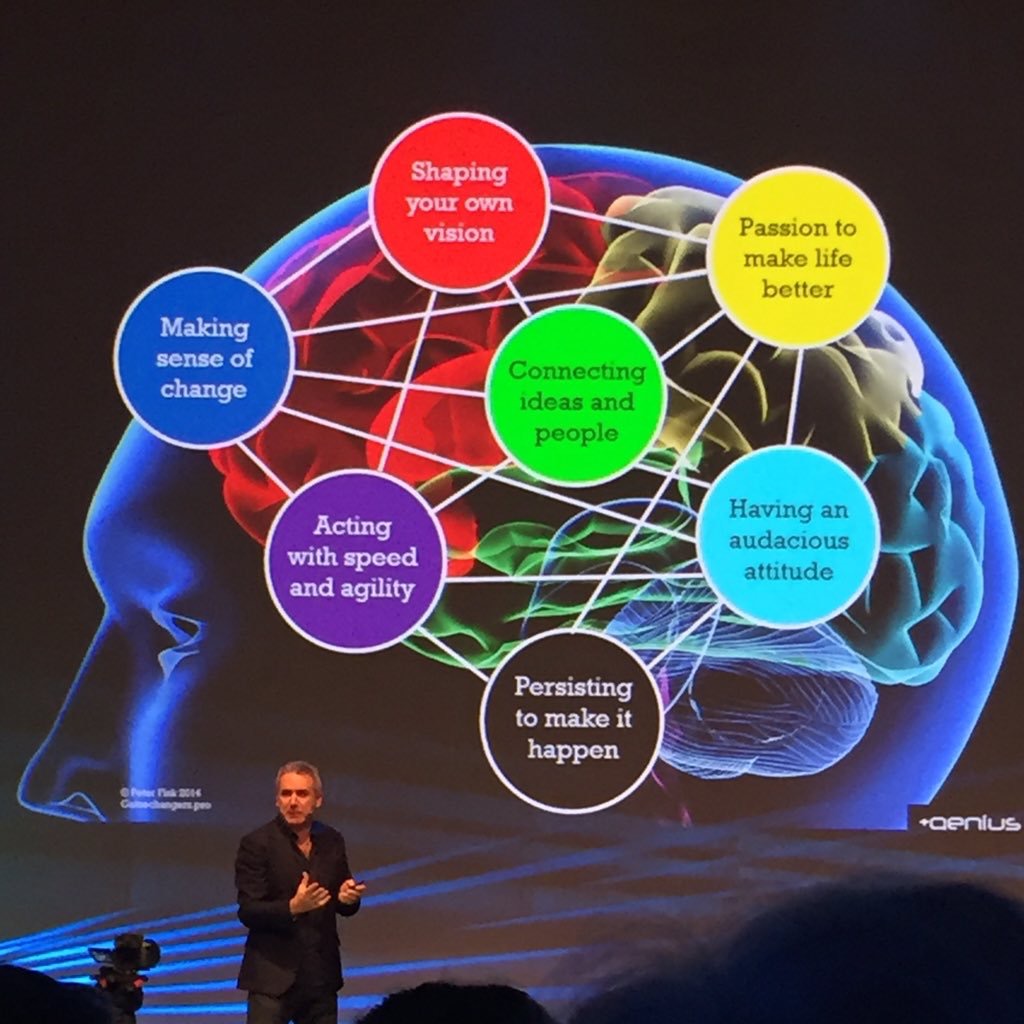
They big traits of “Gamechangers” are these:
Making sense of change – We are faced by an incredible, fast-changing world with a vast diversity of new challenges and opportunities. Sense making is about seeing the drivers, the connections, the potential, and the implications for your own business. From emerging markets to emerging technologies, changing consumers and business models, it is about seeing things differently, and thinking different things.
Having a better vision – Developing a better view of your own future, how your market will change or could change, how your business wants to change, and how you can therefore shape the market to your own advantage. This is the highest level of strategy, its about market strategy, and is the bit most companies miss. They spend their time adapting internally to external change, but very little time sensing and shaping it.
Changing the game – Think of it like a sports game. How could you rethink the game of soccer – maybe a different pitch, maybe different rules, maybe different teams, maybe different scores. Similarly how can you change your market, reframing the definition of your competitive space, and then how customers and competitors operate in this space. This is the heart of your Gamechanger Strategy.
Design thinking – Being truly immersive in the world of existing and potential customers to understand their problems, opportunities and aspirations. It is about gaining deep insights, and then translating these into new concepts, prototypes and solutions. It is a combination of function and form, hard and soft, business and human. There are many variants on this approach, but it can be incredibly powerful.
Business innovation – Applying innovation to every aspect of your business – and in particular the three techniques of value propositions, business models and customer experiences. New business models lie at the heart of making your Gamechanger Strategy different and more relevant, practical and profitable. We run a fantastic program dedicated to designing and delivering New Business Models.
Making it Happen – Having the focus, discipline and commitment to make the change. This takes time and effort. Typically it is about using Horizon Planning, to do it in phases, to tell the new story, and move people (customers and employees) from the old to new worlds. Making it Happen is where most companies fail – great ideas, but poor implementation. It is about relentless determination, but also agility to change and refocus as you progress.
Question 10. Relating to the prior question, how can leaders recognize someone who has the potential to become a gamechanger? If there is a real-life example of a leader who recognized and sought out an employee who later became a gamechanger, please share it in detail.
Leaders should start with themselves. Gamechanging requires leadership. Not the old style of hierarchical leadership, where companies succeeded through consistency and adherence, and the leaders used command and control (2C) to make things happen.
Gamechanger Leaders need to do all of the above – to make sense of change, to have a better vision, etc. But they also then need to engage their people, to embrace the ideas and talents of everybody in their organisations. They use a new set of behaviours to achieve this. They use the 4Cs:
Catalyst – they spark new thinking, they ask difficult questions, they introduce new directions
Connector – they bring people together, link up with new companies, fusing the unconnected
Communicator – they articulate vision, they summarise and simplify, they tell the new story
Coach – they support and develop their people, helping them to do better, and work together
Question 11. Who are the upcoming gamechangers that you are paying the closest attention to? Why do you think this person or a company is going to contribute into changing the world?
The biggest story that isn’t in the book is Uber, the taxi business that embraces a digital platform to connect drivers and passengers in a simple and addictive way. In five years they have created $450 billion value. They’ve just launched UberEats, already the world’s largest food home delivery network. Some of the other brands, innovations and stories that I see as new and interesting right now include:
Editas – transforming healthcare with gene editing
Fan Duel – fantasy American football, baseball, any sport
Modern Meadow – biofabrication of food, like synthetic meat
OneWeb – creating global internet access for everyone
Planetary Resources – asteroid mining for precious minerals
Slack – collaborative software, changing the way we work
Starbucks Reserve – rethinking the premium coffee experience
Theranos – blood testing, more personal and positive wellbeing
WeWork – shared workspaces, building entrepreneurial hubs
Question 12. What is the ultimate goal of a gamechanger?
To make the world a better place.
Start with this … Find a meaningful, inspiring purpose. How can your company or brand make the world better in some particular and relevant way? Everything else, from great products, to profitable growth, will follow if you can find a purpose that is bold and distinctive, relevant and important.
Stick with this … A purpose is not some strapline to lead your strategy document, or marketing brochure. It should be the ongoing, inspiring direction of your business, investors, employees, partners and customers. Keep searching to do it better. But also make it core to your performance scorecard, developing a relevant set of metrics and rewards to stay focused on why you exist.
Question 13. What are the big trends you see shaping business in 2016 and beyond?
Trends are emerging patterns in customer behaviour that have direction and enduring impact. Whilst lots of people jump into future forecasting at the turn of a year, most trends are already established – in the margins rather than the mainstreams, in specialist niches and emerging or parallel markets. It is not about grabbing the latest idea and giving it a game, but looking for the patterns which matter. It is also about starting with the customer. Most trends are about market change, which businesses can then respond to, rather than the latest technology or business concept which can be pushed out to uninterested customers. The trick is to find the flow of markets, then flow with them, or even accelerate those flows to your advantage.
Last year I spent 45 out of 52 weeks travelling to over 50 countries, meeting around 2 million people, in at least 20 different categories … I wanted to bring what I learnt together. I call it a kaleidoscope, because (just like that great toy I had as a child!), every time you look, the different trends combine in new ways, with new opportunities and impacts. Indeed, the creativity comes in how to apply the combination of trends. Of course you can read all the funky trend reports too, which are listed down at the bottom (or just take some time off and enjoy the end of year!). But here are the 7 trends that I have developed based on pattern recognition, of changing customers and markets, and therefore what the most successful brands are likely to be doing in 2016:
Trend 1: Space Time… The two biggest priorities for the majority of people today are space and time. Every brand needs to think about how does it address these two challenges. Not just to reduce time, but to enhance the value of time. Not just to make it smaller, but to make smaller better. The power of your mobile phone lies in the ability not just to talk, but to work, play and learn on the move, anywhere, anytime. The value of a retail store is to do more than just showcase products you can equally see online, but to interact with people and for them to do interact with each other. Space and time also become a currency – people will pay more for faster (like Amazon Prime) and smaller (like BMW Mini). For marketers its also about being realtime – forget average ad campaigns, planned months in advance, pushed to everyone when they prefer to watch the movie on TV. Think about engaging people at the right moment, at the right place – connecting with topical issues right now, or using iBeacons in stores to customise offers to each person, here and now.
Trend 2: Millennial normality … We hear so much today about how “millennials”, the new generation of youthful consumers, are different. Everything about them challenges the way we think – they are digital natives, they are more global, more caring and reject the conventional practices of the mainstream. Has there ever been a new generation who didn’t? Remember back on the 60s, the hippies would change the world, and now that they are the boomers, and business leaders, they seem incredibly normal. Add to this, don’t we tell ourselves not to apply stereotypes, and to segment customers not by demographics? The reality is that Gen Y and Gen Z are really quite normal. If anything, Gen Z are quite conservative – they like security, they want families, they drink less, they work out more. Like all of us they want to make the world a better place, and work from home. Stop being obsessed by millennials, and remember that older people have most of the money to spend!
Trend 3: Digital gets real… We’ve become addicted to digital. Nothing else is cool. We need an app for everything. But we live in the physical world. Mobile phone connect real people in real places, online shopping allows us to buy physical things with practical applications. The challenge is to connect the two, not to see them as separate channels. To find ways in which digital makes physical experiences better, and vice versa. Nike+ helps you run faster and connect with others. Amazon Dash helps you manage your home. Lego connects you with other builders to help you share your genius, and inspire you to do better (and buy more). 23&Me profiles your DNA for $99 and enables you to directly change your lifestyle and wellbeing. Don’t be blinkered by sexy technology, the marketing challenge is to make it useful, practical and human.
Trend 4: Simply better … Simplicity has been described as “the ultimate sophistication” and is certainly not easy. Most things are complex because we are lazy – lazy designers and marketers. We don’t make the effort to really understand what people want and don’t, and to decide who we are for, and who not. Instead we try to meet the needs of everyone, or even the average of nobody, and therefore create complexity. Similarly we don’t make the effort to make sense of new technologies and processes, to really think about how they can be useful and engaging, and to improve people’s lives. “Design thinking” can be a really powerful approach to uncover the deep and emotional needs of customers, to understand the right problem, and a better way to solve it. It is not research, but much more. Brands like Aldi to Swatch have discovered the magic of simplicity.
Trend 5: Customers together … Marketers have spent the last 20 years trying to force customers to have a relationship with them. But most don’t want one. They don’t trust you, and you’re not relevant to them. Forget CRM! What customers are interested in is what your products do for them – not the running shoes, but running faster; not the kitchen machine, but cooking great food. And they are also interested in other people like them, who share their passions. The opportunity is for brands to connect people – to facilitate C2C relationships, between not with customers. If your brand reflects their passion – for running, for cooking – then they will use it like a platform to come together. This might be a physical or virtual “community”. Collaboration then becomes much easier, because they want to co-create, to share, to achieve more about what they love together.
Trend 6: Automation gets serious … Machines, robotics and artificial intelligence have been developing for a long time. But now they really are taking over many of our traditional processes. Look at any sophisticated factory today – cars are made entirely by robots. Look at the best customer service centres – 95% of questions can be answered better through algorithms and intelligent programs. “Machine learning” is making this ability of machines to learn and become more intelligent, even intuitive, a reality. Drone deliveries of mail and parcels is only a few years away. This creates speed and efficiency, convenience and personalisation like never before. It also challenges us to find more useful jobs for the people who used to do these things, to find ways in which human beings add more emotional and irreplaceable value.
Trend 7: China is everywhere … Whilst western economies struggle to grow at 1 or 2%, China is still growing at 7%, and has by far the largest market of new customers who are discovering brands, and non-essential aspirations, for the first time. The opportunity is to reach out to this huge market, but also to recognise the growth of Chinese companies too. Haier, for example, is now the world’s largest white goods company, and probably the most innovative too – just look at their Coda pocket washing machine. Tom Cruise’s latest Mission Impossible move is entirely funded by Chinese investors. Therefore we can all learn from Chinese innovation, partner with Chinese companies even locally, and also seek their investment to allow us to grow our own businesses faster and further.
Question 14. What are your tips for anyone seeking to innovate and grow their business?
Tip 1: Business is about people… creating what customers really want, and then employees working together to deliver it. We are all experts on people. There is no PhD for common sense. What you need is the confidence to think like a human being, to be intuitive and emotional, to challenge the old conventions, and use your imagination. All the tools and techniques of business will help, but the starting point is to be human.
Tip 2: Listen to customers… When did you last spend a whole day observing, listening and talking to your clients or consumers. Design thinking is all about diving deeper into the world of the customer. Don’t just ask them to tick boxes in a questionnaire. Try to work out what their real problems are, their dreams, their frustrations. Do it every week. Really. You are never “too busy”. And harness the the right insights.
Tip 3: The best ideas are out there … probably not in your own geographical market, or business sector, but in other categories and countries. Don’t just sit there trying to be slightly better, slightly cheaper than your competitors. Instead look to other places, where ideas are already being used (its like a free research lab), and which you can take and apply to your own business.
Tip 4: Make new connections … that is how Leonardo da Vinci described innovations. Therefore look for things which don’t forget – which seem like opposites, even a paradox, then find a way to resolve it. For example, take the Airbnb model of sharing and apply it to your business, what do you get? Or the subscription model of Zipcars, or the freemium model of Spotify. Take two different products are try combining them together.
Tip 5. Together is better … the power of a team will always triumph over lone genius. Its amazing how we still think we can do better alone. Use the power of diversity to achieve more, even each person only has part of the answer, it is the diversity of their knowledge and experiences that beats any one person. Facilitate this carefully (this is a real skill), to bring out the best in everyone, to integrate and shape it together.
Tip 6. Networks are exponential … Businesses don’t need all the capabilities themselves, its about finding the right partners to do each task better, and to bring all the partners together as an ecosystem. It is then about reaching markets through networks – social, chains, licensing. Networks can multiply your business much further and faster – exponentially.
Tip 7.The power of one page … the one page strategy, the one page business case, the one page project pitch, the one page marketing strategy. People are incredibly busy, and attention is scarce, so being able to bring things together in one page is incredibly powerful (maybe its one page of text, or an infographic, or a rich picture, or even a poster). It is also a great discipline, to get you to focus on what matters, and articulate it clearly.
Tip 8. Be the Gamechanger … The big idea of my new book “Gamechangers” is to not simply innovate the product or service (because it will be copied before you launch it!) but to innovate the market (the “game” – how it works, the price points, the channels, the rules), and then innovate the business (especially the “business model” – how you will work to make money in the new game). Start from the market, then work inwards.
Tip 9. Don’t be afraid… I often start a consulting project having no idea what the solution might be, or exactly how to get there. The skill is to have the confidence to get started, and to adapt as you learn more about the problem, and your solution develops. Build a prototype early – a picture, a cardboard model, or a real quick solution – which allows people to focus on something and make it better.
Tip 10. “10x not 10%” … what I learnt from Google’s X Labs is the power of thinking bigger. Being audacious. Most of us keep looking for the 10% improvement ( to make products 10% better, to drive 10% more sales than last year). Incrementalism makes us lazy, and we always seek to squeeze a little more out of the old, out-dated thinking. Instead think from the future back, with bigger and bolder ideas, then work towards them.
Question 15. What is your next book going to be about?
I’m working on three concepts. I am using the “lean start-up” methodology to develop them quickly and test them with audiences, and then to decide which one is the better concept to turn into a book. This is important because in reality a book becomes a whole service offering – events, masterclass, consulting, toolkits etc. Maybe your own readers can tell me which of these concepts they prefer (email me your views!)
“Market Makers” … this is specifically about how to create and shape markets to your advantage. It is therefore about strategy that starts outside, by developing a better vision of your future market and how you can make it happen, rather than most strategies which start inside, based on what assets you have, or what you have always done, and how to do it better. There are three types of Market Makers – first, companies who seek to reframe their market (Time Warner, as an example, who redefined themselves in the entertainment rather than communications market); second, companies who connect markets together (Beauty’In from Brazil, as an example, which connects the markets of cosmetics and food); third, companies who create completely new markets (like Planetary Resources, for example, who are a asteroid mining company). They are create and shape markets in their own vision, to their own advantage – a more exciting, innovative, and distinctive strategy for success.
“Superhuman Business”… people can do amazing things, when their environment and support, motivation and rewards, are all in alignment. That’s more important than ever in a technological world, where automation is easy, and people add more value, in more human ways. We take our insights from cultural situations – for example, the Greek age of knowledge, where the collective wisdom of many scholars was able to push each other to new levels; or the Terrahumara Indians of Mexico who are able to run for 24 hours over amazing distances because that is their culture; or in the business world the impact of innovation clusters like Silicon Valley, Espoo in Finland, or Hyderabad, where technology drives ideas in an amplified way. The questions is how to apply this to the world of business – to be a great business leader, if you want to deliver fantastic customer service in a call centre, or if you want to drive amazing innovation in products.
“Exponential Brands”… we live in a world where the world’s largest accommodation business owns no property, where the world’s largest retailer own no inventory, the world’s largest media company owns no content. Airbnb, Alibaba and Facebook play by new rules – ideas and networks. The impact can be incredible – Whats App has created $19bn of value in 3 years, Uber $50bn in 5 years, Alibaba $200bn in 14 years. Exponential! But most of think in linear ways. Linear thinking is not enough (imagine moving forwards one step every year … 1, 2, 3, 4, 5), whereas exponential thinking is dramatic (imagining moving forward like this … 1, 2, 4, 16, 256). So how can your business harness the power of ideas and networks to drive exponential business models, with exponential impact?
Peter Fisk is a professor of strategy, innovation and marketing at IE Business School in Madrid and CEO of the GeniusWorks. He is author of “Gamechangers”, and a global thought leader in making sense of a changing world, and how to lead smarter innovation and sustain profitable growth.
To find out about the Gamechangers Program for business leaders, or to explore more of Peter Fisk’s ideas, read more about these companies, watch videos, and download articles and case studies, go to www.peterfisk.com
Psychology Today magazine recently published an article exploring the traits of “extraordinary ordinary” people. I love the term extra-ordinary. Going beyond normal. Doing more. Being special in some very human, relevant and personal way. Yes, of course we could describe supreme athletes as extraordinary, alongside those many great people who do incredible caring or daring things for others. They are extraordinary, but so could you be too. Here is an extract:
Being extraordinary isn’t reserved for the rich, the famous, the powerful, or the privileged. Extraordinary people exist within even the most seemingly ordinary lives.
They are the ones with the knack for living genuinely and who inspire us to attempt the same.
We can all name extraordinary people who have touched us—a teacher who made us feel seen, a relative who helped us believe in our dreams, a friend who created a circle of acceptance wide enough for all. Those we deem extraordinary can’t be narrowed to a single profile, but their lives are likely to include five vital ingredients:
1. A focus on the things that matter
Evolution has set us up to feel that we must accumulate more—more money, more things, more sexual partners. But evolution never promised us those things would make us happy. And, indeed, studies show they don’t. Even money goes only so far. While we certainly feel less anxiety with economic stability, abundance can backfire, affecting our ability to appreciate everyday pleasures. (By the way, the optimum number of sexual partners for happiness? Research puts it at one.)
The extraordinary person knows it’s the intrinsic qualities that bring true satisfaction—those that satisfy our needs for emotional intimacy and personal growth. Focusing on extrinsicgoals, by contrast—things such as physical attractiveness, wealth and fame—not only doesn’t satisfy us, it can damage our well-being by setting us up to feel that what we have is never enough. The extraordinary ordinary people seem to know instinctively the folly of joining the crowd on the hamster wheel. Instead, they are content to keep their focus on “being” rather than “having.”
2. Kindness
Not long ago, I read a news article about a school crossing guard whom a whole community had honored. Why? Because he was kind. He knew the kids by name. He talked to them about their days. If one walked through his crosswalk with birthday balloons one year he remembered their birthday the next. We all know people like this. They are special because they have the gift of making others feel special. And the nice thing about kindness is it works both ways. It’s lovely to be on the receiving end, but multiple studiesconfirm it feels even nicer to do kind things for others.
3. A willingness to be seen as imperfect
It’s not that extraordinary people never fail; but they’re the ones who put themselves out there despite their failures. Noted author and lecturer Brené Brown, PhD, writes eloquently of this in her book Daring Greatly:
“When we spend our lives waiting until we’re perfect or bulletproof before we walk into the arena, we ultimately sacrifice relationships and opportunities that may not be recoverable, we squander our precious time, and we turn our backs on our gifts, those unique contributions that only we can make.”
Those who are willing to reach for the extraordinary understand that criticism and rejection are the price we sometimes pay for trying, that we all have fear, and that defeat doesn’t equal unworthiness. This willingness to be vulnerable gives them the freedom to pursue their dreams and tap into their creative powers. By extension, this mindset creates a safe place for those in their orbit, so that they can feel inspired to give it their best shot, too.
4. An ability to connect
A famous research project called the Grant Study has followed every aspect of the lives of 268 men from the 1930s to this day. A few years ago, the longtime director of the study, George Vaillant, was asked what he had learned from the mountains of data. His response? “That the only thing that really matters in life are your relationships to other people.”
Extraordinary people understand this; that’s why they make others a priority. They are the ones who remember our names, ask us questions and care about the answers, and leave us feeling heard and valued. Extraordinary people also connect with themselves, paying attention to their feelings and respecting their needs, just as they do for those around them.
https://www.youtube.com/watch?v=ToIn45cjaDg
5. Joyfulness
We spend our lives aiming for happiness, but how many of us really let it in when it arrives? Instead, we temper our joy, feeling we somehow don’t deserve it, or that it won’t last, or that we are somehow jinxing ourselves by acknowledging it. If you’ve ever felt your heart swell with joy as you look at a loved one only to instantly imagine tragedy befalling them, or received a promotion only to worry that your company’s faith has been misplaced, you know what I mean.
The antidote for this reaction is gratitude, as the extraordinary ones among us know. They aren’t fooling themselves; they know that joy ebbs and flows, but they welcome what they get, allow themselves to feel worthy of their share, and seek it in the most ordinary moments—where it is most often found.
Below are more than sixty fun free team building activities that can improve teamwork, develop trust, and enhance problem solving skills and the best part is, the majority of these team challenges can be delivered anywhere, by anyone and with limited or no equipment.
All you have to do is click on the link of one of the team building activities and you will be taken to an information page containing: challenge description, equipment requirements and suggested learning outcomes.
The group stand in an outward facing circle with their backs to one another. As a team they have to count as high as they can out loud with only one person saying a number at a time. This is a guessing game that focuses on listening skills and strategy.
Here are a selection of quick and easy to deliver blindfold team building challenges. These blindfold activities can be delivered in less than 20 minutes and only require a blindfold and a rope. Great for developing communication skills, especially active listening and they are also good fun!
Blindfolded participants are given a route by their partners, and then tasked with retracing their steps without any instruction to try and end up as close to the start point as possible.
In this fun and challenging blindfold activity, the group is split into smaller sub-teams and must compete against each other to try and retrieve an object. One person is blindfolded in each team and directed by their team-mates using simple commands to try and find the object before the other team.
Blindfolded and under pressure, the group have to work together in a race against the clock to put up a tent. Blindfold tent build is a great challenge for developing communication and leadership skills.
One person is selected to stand in the middle of the circle wearing a blindfold, the objective of the challenge is for the rest of the group to pass a selected object (such a tin with marbles in) around the circle without making any noise.
Working as a team, blindfolded participants follow a rope and try to navigate their way round a series of obstacles. Trust, support, leadership and communication is essential for this challenge.
The objective of this fun blindfold activity is for smaller sub-teams to work together and communicate effectively to retrieve a bomb before the other teams. This challenge focusses on communication, trust and cooperation.
In smaller teams, blindfolded team members must be guided into a pen by the shepherd giving them verbal commands. The team that pens the most amount of sheep in the quickest time, wins the challenge.
One at a time, blindfolded team members are guided by their team mates through an obstacle course to the finish line. They must rely heavily on trust and communication to complete the challenge.
Working in pairs, blindfolded participants are led on a walk around the surrounding area or a course by their partners. This is great activity for focusing on communication skills and developing trust.
All aboard is easy to run and effective team based challenge, where the group have to fit inside a defined space (using either a rope or a tarpaulin). Once the group has achieved this, the size of the area decreases, becoming smaller and smaller over time.
Working in pairs, one person must describe a shape without naming it, whilst their partner must try to draw the shape they are describing to try and get as close the original shape as possible. This activity focusses heavily on verbal communication and listening skills.
The team is tasked with creating balloon sculptures that reflect how they view the team. This activity works well with participants that are of different job levels and allows everyone to show creativity and make connections.
Participants line up in a straight line side-by-side. They are then asked to get in order by their birthdays (month and day, year isn’t necessary), however they are not allowed to talk. You can also get them to get in order by height, shoe size, favourite colour etc.
In this activity, the team has to instruct their “artist” to draw an item. They have to describe their chosen item without revealing what it is and they are not able to see what the “artist” is drawing.
This is a quick initiative exercise using lateral thinking. Before you begin, use the sticks to create the shape of a wine glass with a fly placed in it (see below). Introduce the challenge and explain that they must recreate the wine glass without the fly in it. To complete the challenge, they are only allowed to move just two sticks.
The group stand in an inward facing circle and are asked to throw juggling balls amongst the group in a specific order. As the activity develops more juggling balls are introduced and the pressure to work well as a group increases.
The objective of this challenge is for the team to work together to navigate a ball around a tarpaulin for as long as possible without the ball falling through a hole or off the tarp completely.
Starting in a circle, participants connect hands with two others people in the group to form the human knot. As a team they must then try to unravel the “human knot” by untangling themselves without breaking the chain of hands.
Pairs are connected using the infinite loops, their challenge is to become disconnected from their partner, without removing their hands from the loops or untying the knots.
The team stand in a circle and hold hands. Start one hula-hoop hanging (or bungee) over one pair of joined hands. Each person in the circle must pass the hoop/loop over him/herself and on to the next person whilst staying connected at all times.
Teams are given a magic cane (also known as helium stick) which they must lower to the ground, using just their index fingers. All participants must remain in contact with it at all times – what seems like a simple task, can become incredibly frustrating and funny for all involved.
The aim of the challenge is for the whole group to step across the line at exactly the same time. If one person is out of sync, then they must start over again. This activity involves planning, communication, timing and resilience
Using the shoes available to their team, they must construct the tallest tower. The team with the tallest tower at the end of the time wins the challenge.
One person is selected and stands in the centre of the circle. They allow themselves to relax, and fall backwards, safe in the knowledge that their team will catch them and then ‘bounce’ them gently round the circle.
One person in the team is selected to be ‘the willow’ and stands in an upright and rigid position in the center of a circle. On your instruction, the person in the centre of the circle (the willow) is gently passed around the circle in any direction by the spotters. The willow must keep their feet absolutely still at all times and put their trust in the rest of the team.
Whilst on a sailing holiday, an accident causes the boat to set on fire, with just enough time to grab a few items at hand – the team have to decide which items are top priority. Working together the team have to use their decision making skills and cooperation to prioritize the ten items listed.
In this fun activity, the team has to build a road for a toy car using only the provided materials. The team whose car travels the furthest wins the game.
In this activity, the team is tasked with the challenge of immersing an inflated balloon underwater for at least 5 seconds, using only the materials provided.
Using the materials provided, two teams must work together to build a bridge, with each sub-team constructing half the bridge each. During the challenge, teams cannot see each other and must rely on their communication skills to build an identical design. This is an excellent activity for developing communication skills, problem solving and creative thinking.
Team members are spread out in a line, consisting of several sections. The first person is shown an picture by the facilitator and must then pass tell the next person what it is, this continues until the last person receives the description and they must then attempt to recreate the picture.
Teams work together to complete a puzzle as quickly as possible. Initially the teams will be divided and given separate bags of puzzle pieces, they will think that they are competing against each other and then come to realise that they have no way of completing the puzzle unless they work together.
Team’s race against the clock to try and retrieve a ping pong ball placed at the bottom of a leaky pipe. To do this they are provided with a bucket of water and several cups. Teams are required to use good teamwork and problem solving skills to complete the challenge.
The team have come to a battle field that has been laid with mines. One person at a time must attempt to cross the battlefield without stepping on a mine. Once a team member steps on a mine, they must return back to the start.
The aim of this problem solving challenge is for for the team to lay the rope over nine cones that are laid out in a square grid. so that the rope passes over the middle of every cone in the grid. The rope may only bend through an angle of no more than ninety degrees three times at most.
The aim of the challenge is for each group to try and build an exact copy of a pre-built sculpture – the catch is only one person in each group can look at the model at a time and for only ten seconds.
Traffic Jam is a real, ‘Brain Buster’ that requires a lot thinking and communication. This challenge is very similar to a human chess game. The group is split in 2, with both sides working together to complete the challenge.
The team is tasked with putting together a story from a set of sequential images. Each person is given an image but is not permitted to show it to anyone else. Together, the team has to figure out the correct sequence.
In this fun team challenge, groups are required to work together to do complete a simple task. The problem is, that they are tied together by their wrists. Problem solving, teamwork and communication are essential for this challenge.
The team are lost in a bamboo forest, the only way of survival is by catching the attention of the people in the local village. To get their attention, the teams must build two free-standing structures, each 6m high.
The aim of the challenge is for the entire team to cross from one side of the fence to the other without touching the fence line. There are two variations of this challenge a more basic version and the more advanced one, both are great for developing teamwork and trust.
The objective of this challenge is to lift a ball of the ground and place it into the cup on top of a Giant Matchstick, using only the broom handles provided to touch the ball and aid completion of the task.
Working together, each team member must travel through a hole in space without touching it. If anyone touches the outside of the square, the activity is restarted. This activity is ideal for those looking for a quick team builder and for those with limited space and resources available.
A container marked Toxic Waste is put in the middle of an exclusion zone. Using a limited range of equipment the team have to lift the container and place it in a ‘safe’ zone.
The team are stranded on a sand bank, they have just 30 minutes before the tide comes in. In order to survive they have to build a structure that holds the entire team off the ground.
The objective of the activity is to get all team members safely across the lava flow. Participants cannot touch the lava and therefore must use platforms provided to cross to safety.
Marble Tube is a fun team challenge activity, where participants have to work together to get the marble(s) from the start to the finish line without touching the floor and only using the piping to touch the marble.
The group has to construct two missile launchers that can launch a missile over a target 10 metres away. After 30 minutes the teams are allowed two practice shots (using golf balls) after which they can review their designs before they make their final shot with an egg.
In this activity, the team is tasked with moving 15 ping pong balls from Table #1 to Table #4 without directly touching or lifting the balls, and using only the materials provided.
The objective of the challenge is for the group to retrieve a bucket containing deadly radioactive isotope and tip the contents into a second bucket in a defined safety zone.
The objective of this challenge is to get the entire team from one side of the web to the other without using the same gap twice and without touching any of the web.
The team is presented with the challenge of organising a stack of tyres in a set order but on a different post. There are a total of three posts and five tyres, moving just one tyre at a time, transfer the tyres from the post they are currently on to another set post.
Equipped with just 2 ropes, the group must work out how to transport a bucket of ‘Toxic Waste’ and return it back to the safe zone without tipping over the contents. This fun team building challenge can also be known as ‘Bomb Removal’. This is an excellent team challenge for highlighting the importance of teamwork, problem solving and leadership.
The team have been stranded on three separate islands, the objective of the challenge is to figure out how to get three essential items to each island to survive until they are rescued.
With all members standing on a sheet of plastic, the group has to slowly flip the sheet to the other side without anyone stepping off it. This activity is great for small groups, and helps to promote cooperation, trust and communication.
The aim of this challenge is for the team to try and retrieve 10 cups full of water from around the room and place on a tray without spilling any of it. During the task, each person is only allowed to use, just one hand and one leg to complete the task.
Standing in a circle, participants hold onto a looped rope with both hands at waist-level. The trainer will then call out different shapes, and the team has to form those shapes without letting go of the rope.
In this activity, the group is tasked with creating a mock-newspaper with headlines based on what they think the department/company will achieve in the near future.
The aim of the challenge is for teams to compete against each other and try win a lucrative contract for the commercial production of an airship. To win the contract, each team will have to design and build a fully operational prototype, within budget and on time, that meets a detailed specification.
During this fun twenty minute challenge, teams are tasked with building a structure using the resources provided in just ten minutes. The structure must be big enough so a team member can completely pass under it in less than one minute. Creative thinking, cooperation and time management are essential in this challenge.
The group are split into smaller teams and must work together to create their own problem solving challenge. Once they have come up with the ideas they must work together to finalise the challenge and then present back to the other groups.
Groups work together to tackle the challenge of firing an egg onto a landing area without breaking it. They must present, design and build their rocket before competing against other teams. The team that lands their egg closest to the landing area, wins the challenge.
A firm favourite with corporate groups and my own personal favourite, teams are challenged to write and produce their very own 5 minute cinematic masterpiece. After picking a genre of film at random, teams stretch their creativity and race against the clock to have their final cut ready before the big premiere.
Each team is provided with two pieces of flip chart paper and a roll of sellotape and are tasked with creating two marble movers to keep a marble rolling as long as possible. After creating their builds, all teams come together to test their marble movers. The team that has the longest combined time, wins the challenge.
Teams are tasked with transporting as many balls as possible from the start line to the end line and over No-Man’s Land in ten minutes using just the resources provided.
Participants must work together in smaller teams to create and perform their own radio play – this means no acting is necessary. Once they have planned and prepared their play, they must then perform it in front of the other teams.
Scrapheap Challenge involves a whole heap of scrap and lots of creative thinking. In this challenge, teams are tasked with building a product made of scrap to protect an egg when dropped from a height.
Teams compete to build the highest tower that holds a weighted object off the ground for a minimum of ten seconds. Careful planning and creative thinking are essential for this fun team exercise.
In this team building activity, the group has to devise a way to move as many “flying” cotton balls as possible into the “landing zone” indicated in front of them, using only the materials provided.
Working in smaller teams, each team must record all the items listed on the scavenger hunt list within a set time period using a video camera.
Team building activities are a great for developing communication, increasing the success of a team, motivating participants and keeping everyone a lot happier.
Disruption was not invented in Silicon Valley. In fact, according to veteran French advertising guru Jean–Marie Dru, the word “disruption” was created in 1992 by himself. Since then his global advertising agency, TBWA, has used their Disruptionmethodology to help companies generate some of the most creative ideas.
Typical ad speak, but stick with it.
Jean–Marie Dru’s new book “The Ways to New: 15 ways to drive disruption” focuses on how Disruptioncan help marketing executives drive innovation. Most companies, and in particular pre-digital companies, suffer from slow innovation and, as a consequence, from slow growth. Dru shows how to steer organizations toward continuous innovation, creativity, growth, and success.
Dru’s original book focused on the three steps to disruption:
The Ways to New explains 15 proven paths to disruption that have driven growth in companies around the world. It is illustrated with case studies from companies such as L′Oréal, Salesforce, Xiaomi, Alibaba, Haier, Airbnb, and Burberry, which are illustrations of the glaring differences between disruptive innovation and stagnation.
Here are the 15 paths:
One thing that does annoy me about Dru, is his continual reference to advertising as some distinct topic from marketing, and from brands, and PR. In a world where most companies have shifted the majority of marketing spend away from advertising, to digital and social media, then its about time ad people saw themselves as more integrated in the marketing, let alone the business model.
There is nothing particularly new in the book, although the 15 ways are a useful checklist. If you read Dru’s original book, you know the simple concept already. In the time since the, others like Clay Christensen and Kevin Roberts, and many many more have taken the subject forwards. TBWA actually trademarked the word disruption, but it has become a everyday part of business language.
Whatever the book lacks in new ideas there are still some useful case studies to spark your thinking – as well as the usual suspects, he also tells the stories of brands like Allianz, Big Bazaar, Darpa, Darty, Dupont, Lafarge, Medissimo, NeoLucida, Roosegaarde, SNCF, Wibbitz, and Zipdial.
https://www.youtube.com/watch?v=UClI25l-vnU
This is how Campaign magazine previewed the book:
It’s been nearly 20 years since Jean-Marie Dru, then co-founder and chairman of French advertising agency BDDP Group, published his first book about disruption — or stratégie de rupture — as a business concept.
That book, Disruption: Overturning Conventions and Shaking up the Marketplace, quickly became an industry must-read, particularly for strategists and media planners. Later, the term “disruption” became enshrined as the signature methodology (or shtick, depending whom you ask) of TBWA Worldwide, the Omnicom network Dru now oversees as chairman.
But it wasn’t until Silicon Valley got a hold of the term in recent years that it became a recurring feature of the everyday business lexicon. Today, “disruption” is the preferred buzzword of the global startup culture, used to describe companies from Uber to Airbnb to Washio, a drycleaning app.
This week, Dru released his latest book on the topic and his sixth overall: The Ways to New: 15 Paths for Disruptive Innovation. To celebrate, TBWA threw him a book party at its New York headquarters, and Campaign US took the opportunity to sit down with Dru to discuss the evolution of “disruption,” the state of the industry and what he calls in his book the “innovation deficit.”
“It seems strange to talk about an innovation deficit when you have Google, Amazon, the startups, the biotechnology, the nanotechnology and all that,” he said. But “you have to know that all these industries that are high-tech oriented, they represent 20% of the worldwide economy, no more than 20%. What about the other 80%?”
The remaining 80% of companies are “transformed by digital,” he said, “but that doesn’t mean they’re becoming more innovative. And in fact there is a lack of innovation, which is one of the reasons why there is not a sufficient growth rate in many companies.”
As for the term he coined, “disruption” has indeed become overused, he said, though its current meaning often bears little resemblance to the one he intended when he started using it in the early ’90s.
“It’s a very specific thing,” he said. “You should not use the word ‘disruption,’ ‘disruptive’ or ‘disrupts’ for everything, but there’s nothing I can do against the whole world.”
To Dru, disruption was a method for brands to reach consumers by defying conventions in their category: Spic and Span’s “Clean Enough for Babies,” or Virgin Megastore promoting its retail outlets as a hangout spot for French teenagers.
But for digital entrepreneurs, “disruption is the result of someone who’s destroyed a marketplace,” he said. “For us, it’s not a description of what is. For us, it’s a methodology to say what could be. It’s about what you can do with a brand in the future.”
The term has taken on a new meaning for ad agencies like TBWA, as well, with newer entrants to the market siphoning off parts of the business that just a decade ago would have been considered an agency’s birthright. Asked to imagine TBWA several decades from now, Dru said he expected TBWA’s Digital Arts Network would become the dominant force in the company.
“DAN will, from the inside, have swallowed TBWA,” rendering it “a 100% digital company,” he said.
“But, you know,” it could be that “I’m an old guy and I don’t see the future,” he said. “But I still believe that 20 years from now, clients will come to us to build their brands.”
“Health Makers” focus on the exciting growth markets of healthcare, biotech and medicine.
We all recognise the challenges for healthcare. Growing and ageing population, the speed at which contagious diseases can spread, the cost of new drugs and treatments, of unhealthy food and sedentary lifestyles, and the aspiration of the best level of care for each person. We also see the opportunities of living a long healthy life. New science and technologies allow us to predict futures health conditions so we can adapt or mitigate them, monitor our bodies in realtime to respond quickly, overcome the most difficult conditions such as blindness, and fight the most terrible diseases. Digital technologies have empowered doctors, and more fundamentally, patients like never. Pharma companies, doctors, insurers, and pharmacists are all seeking to innovate patient-centric experiences.
Like other “Market Makers” these Health Makers create and shape markets in their own vision.
They are not content to play the game of marginal gains – competing on small differences or price discounts, in mature and stagnant markets. They see the future world, they look for the new growth markets, and in particular those which are still emerging, which they can shape to their own advantage. They are “gamechangers” in the biggest sense, in that they create new games (markets), with new audiences (customers and needs), new rules (process and behaviours), and new possibilities (perceived value and profit potential) for business success.
Here are some of the most phenomenal Health Makers who are creating and shaping the fast-emerging robotics markets to their advantage. Whilst there are many others developing sophisticated drugs and therapies, these are examples of companies who are already out there, making money and shaping the attitudes and behaviours of customers right now:
23andMe can transform our attitudes to health, diet and mortality … but also entire industries, drugs driven by future needs, healthcare refocused on prevention, insurance premiums to reflecting new risks. Pharma companies believe that genetic data could be instrumental in creating better, more targeted treatments for diseases. Genentech is working with 23andMe to learn if genetic factors influence a person’s response to the cancer drug Avastin, whilst Amgen recently bought DeCode, a company that explores the link between genes and diseases, for $415 million. Read the Gamechangers case study of 23andMe
Cue, a revolutionary device for tracking health information at the molecular level. For the first time, users can track 5 key health and lifestyle indicators: inflammation, vitamin D, fertility, influenza, and testosterone in just minutes, at home. Cue sends the data via Bluetooth 4.0 to the user’s smartphone, where the free Cue app reveals the interplay of activity, food, and sleep shaping the user at a molecular level.
Editas was founded in 2013 with $43 million in Series A venture capital financing led by leading health care venture capital firms. The company’s mission is to translate its genome editing technology into a novel class of human therapeutics that enable precise and corrective molecular modification to treat the underlying cause of a broad range of diseases at the genetic level. Interesting Forbes article on gene editing
Today people in need of bone replacement — whether because of disease, defect or injury — can turn to synthetic replacements or they can have another bone in their body cut down so as to supply material for the missing bone. In either case the procedure is extremely painful and not without risk of failure. Epibone is attempting to disrupt this process by growing human bone from stem cells.
Intuitive Surgical manufactures robotic surgical systems, most notably the da Vinci system that allows surgery to be performed using robotic manipulators. Almost every heart surgeon now uses the system, sitting in a corner of the operating theatre (or anywhere potentially), operating remotely with a video camera and joystick. The operation is much more accurate, and because of the smaller incision, recovery is much faster.
See the Intuitive Surgical case study in the Gamechangers book.
Imagine the long wait for a kidney, lung or even heart transplant – the years of anguish waiting for a suitable donor, and then to see whether the match works. Instead you can just press print. Organovo designs and creates multi-cellular, dynamic and functional human tissues for use in drug discovery and medical research. The proprietary 3D bioprinting technology enables the creation of tissues that mimic key aspects of native tissues.
See the Organova case study in the Gamechangers book.
When Walter De Brouwer puts his head to something, he can produce single-handedly what usually takes several hospital machines and labs. His single hand, it should be said, holds a small and promising device with which Mr. De Brouwer, the co-founder and CEO of Scanadu hopes to remake medicine. With initial crowdfunding on Indiegogo and more recently $35m from Chinese tech giant Tencent, Star Trek devices are now a reality. The Scout device is a small, disc-shaped gadget that has its own tiny operating system inside, as well as gyroscopes, electrodes, reflective light-emitting diodes, accelerometers and other sensors. The Scanadu Scout is meant to be pressed against the side of a user’s head, near the temple.
See the Scanadu case study in the Gamechangers book.
In 2015 Allen Zderad was able to see his wife of 45 years for the first time in a decade. The Minnesota man seemed to burst into simultaneous laughter and tears as he caught a glimpse of her with his new “bionic eye.” Zderad, who is 68, has retinitis pigmentosa, a degenerative eye disease that began to progress at a rapid pace 20 years ago. The disease causes deterioration of the part of the retina that turns light into vision, and eventually leads to total blindness.
Thync recently launched its mood-altering headset, letting you find a state of calm or boost your energy with controls on your smartphone. Thync’s gadget is more of a module than a headset. It’s small, plastic, and contains a Bluetooth radio for connecting to your phone. You attach it to a disposable adhesive strip, which you apply to your temple and neck. The device is aimed at those who want to zap their brains with calming or energizing vibes. With so many wearables coming out to track physical health, Thync’s goal was to create a device that created a kind of emotional or mental health.
More
You can read more about my ideas, research and experiences on Future Health, including keynotes, workshops and consulting projects to drive more patient-centric innovation and growth, at:
I am also currently researching my next book about Market Makers:
Gamechangers … introduction to my recent book on disruptive innovation
Market Makers … new strategies for creating and shaping markets
Innolab … fast and collaborative strategic innovation process
If you’d like to suggest ideas for inclusion in my next book, please email me at peterfisk@peterfisk.com
Jean-Claude Biver is known as the man who saved the mechanical watch, putting a philosophical imprint on the Swiss watch industry which has been as profound as his business success through the years
Very few individuals can be said to have truly conquered their chosen arena, and fewer still can boast of having saved it from the brink of collapse and transformed it into an intractable industry, come rain or recession. For these reasons, and many more, Jean-Claude Biver is a living legend, so much so that his name has become synonymous with haute horlogerie. Although in his mid-sixties, and rumoured to have considered retirement a couple of years ago, Biver is as prolific as ever; his voice in the market for Swiss watches remains prominent and powerful, perhaps more so than ever before. “His impact on the industry has no limit. He is a big reason why we currently have such a successful industry at all. Without his intervention at that critical crossroads, I would not like to think of where we would be”, said Stephan Heller, CEO and founder of Watchmaster.com, a leading online retailer for Swiss watches.
Biver’s enthusiasm for the art of Swiss watches is as famous as his intuitive marketing talent and tendency towards the unconventional. As such, after pioneering the incredible success of Blancpain, Omega and Hublot, Biver was named the new president of the watch division for LVMH in 2014. This focal position within the industry sees Biver oversee Hublot and Zenith, while also acting as CEO of TAG Heuer.
Learning his craft
Following the completion of a business degree at the University of Lausanne, it was the time that Luxembourg-born Biver spent in Joux Valley, a small town known as the ‘cradle of watchmaking’, that had the most pivotal impact on his life. Indeed, this period saw the beginning of his career-long love affair with the art. In 1975, Biver started training under the guidance of Audemars Piguet, during which time he gained a deep understanding about watchmaking, as well as various aspects of sales and marketing in the industry. After rising through the ranks to become the company’s sales manager for the European market, Biver moved on to Omega, where he held the role of gold products manager.
Although Biver’s time at Omega was instrumental for his future success as the head of an international corporation, his nostalgia for Joux Valley was too great a draw. So, in 1982, Biver bought the name Blancpain, together with his friend Jacques Piguet. Although it is the industry’s oldest brand, Blancpain had been dormant since the 1960s as a result of the quartz revolution, which had threatened to eradicate the tradition of mechanical watches completely.
To many, it would have seemed peculiar for Biver to abandon a sure thing with Omega for such a gamble – not only had Blancpain been relegated to the pages of history, but the art of mechanical movements and the centuries-old industry which surrounded them was on course to follow the same fate. However, Biver had an inkling that a revival was possible, and there was still a large space in the market for the beauty and precision of traditionally made Swiss timepieces.
Moreover, bringing life back to Blancpain did not have to involve bowing to the trend of the day. As Biver himself put it: “Since 1735, there has never been a quartz Blancpain watch. And there never will be.” This has since become a motto for the company. To say that Biver turned Blancpain around is something of an understatement – under his and Piguet’s leadership, the firm’s turnover exploded to €46m and the brand once again competed with the industry’s most illustrious names.
In 1992, Biver sold Blancpain to the Swatch Group (then called SMH Group), which paved the way for a position on the group’s board. While at the Swatch Group, Biver returned to Omega to undertake the task of turning business around for the brand, which was also failing to hit the mark at the time. Biver once again put his marketing genius to work, reviving sales by using the likes of Cindy Crawford and Michael Schumacher for celebrity endorsements, as well as product placements, both of which were still novel at the time. One notable example is his idea for Omega’s now-famous James Bond campaign – a marketing technique that captivated the sophistication of Omega timepieces, and elevated the brand to a new status around the world.
Hublet’s art of fusion
Not satisfied with riding the wave once success had been earned, Biver turned his sights to the then-ailing Hublot. He again worked his magic, and between 2004 and 2007, he increased sales fivefold. His strategy came in the form of creating exclusivity, something that had also worked with Blancpain, whereby he restricted supply in order to create an allure for the timepieces, which in turn increased demand substantially.
With Hublot, Biver created a new concept, known as the ‘art of fusion’, producing the first watch that merged different materials through a unique fusion of gold and rubber. Then in 2005, at BaselWorld, the world’s leading trade show for the watch and jewellery industry, he unveiled Hublot’s iconic Big Bang range. The unconventional design and a completely new type of case construction sent shockwaves through the industry, creating a buzz around the collection that cemented Hublot’s brand revitalisation. A decade on, the Big Bang collection is still a huge success, selling around 44,000 pieces in 2014.
Biver also used the sports industry to successfully carve a new young and global fan base for Hublot through sponsorships with Manchester United, Juventus, Bayern Munich and the LA Lakers, among others. Hublot has also been the official watchmaker for Formula One, and was official timekeeper for the 2010 and 2014 FIFA World Cups, enabling it to broadcast the brand to a worldwide audience. Hublot’s sponsorship of Ferrari, its latest and biggest by far, has already been hugely successful, enabling the two brands to work closely together to reach new markets.
Winning in the age of smartwatches
With TAG Heuer, Biver may not have the task of brand resuscitation, but along with increasing sales within an ever-competitive industry, this time there is a new challenge on his hands – that of smart watches, a new technology that once again threatens to bring the Swiss watch industry to its knees. Yet, with Biver at the helm, such an outcome does not seem likely. “The Swiss have maintained quality, service, innovation, R&D, investments, and strong distribution and marketing networks. Thanks to these cumulative efforts, they have been able to increase the importance and dominance of the ‘Swiss Made’ label in the upper price segments”, Biver noted.
“They don’t have to worry as long as their products are made for eternity, which means that the watch will be repairable forever”, he added.
Biver wrote in his recent autobiography, The Man Who Saved the Mechanical Watch: “When you produce technology, you are producing obsolescence. Technology is necessarily overtaken every year as new inventions appear. Unlike technology, art never becomes obsolete. A painting by Matisse or Renoir may not be liked by the new generation but it can never be obsolete.” Biver’s point alludes to the very appeal of Swiss watches: although expensive and reliant on old technology, they are still as desirable as ever, if not more so.
“I think that again we have reached a moment where watches are no longer just a commodity, but are something to be cherished and appreciated, but at the same time very functional with a strong connection to their wearer. In addition, over the past years we have all seen that the world is getting smaller, borders and oceans no longer divide us”, Heller explained. “Not only has the world become smaller, but the luxury market for watches is now obtainable for all. It is no longer for a few well-placed shops, but for aficionados around the world.”
The midas of the luxury watch market
Only when reviewing Biver’s career in detail can one can truly understand the impact he has had on the Swiss watch industry. Not only did he save the traditional art from the quartz movement, an incredible feat in itself, but he has also directly shaped some of the biggest names around today. One by one, he breathed life back into Blancpain, Omega and Hublot, forging in them all a solid foundation and making their products hugely desirable once more. “He is the Midas of the luxury watch market”, Heller claimed. “The mark he has made, well, we cannot pay him back, we can only thank him.”
Biver has achieved the incredible, and what was at times deemed the impossible, through an undeniable passion for his industry and a natural affinity for marketing. His success can also be attributed to his deep understanding of the relevance of tradition, while simultaneously appreciating the necessity of change and of reinvention – a successful juxtaposition of old and new that is almost unheard of in most industries. Biver used techniques such as celebrity endorsements, exclusivity and product placement to make people want his products. But along with this, he understood the significance of quality over profit margins when it comes to luxury goods. Maintaining the element of art and finesse, while also responding to novel trends and the desires of new generations, is a rare talent, and one that could be applied elsewhere, should Biver ever decide to turn his attention away from Swiss watches and towards selling the artisan cheese he produces each year.