“In short, the human body is incredibily adaptive … There might be limits, but there is no indications we have reached them yet.”
“Peak” by Anders Ericsson and Robert Pool is one of the most interesting books both on the science and on the actual methods and training for peak performance.
“The reason that most people don’t possess these extraordinary physical capabilities isn’t because they don’t have the capacity for them, but because they’re satisfied to live in the comfortable rut of homeostasis and never do the work that is required to get out of it. They live in the world of “good enough.” The same thing is true for all the mental activities we engage in.”
In summary
Innate talent might be part of the performance equation, but most of the variance comes from training
How willing people are to train might be, at least in part, governed by our genes
The best training is focused, get instant feedback, and works around plateaus
Naive Practice: The Wrong Way Of Training
Naive practice looks like this:
“Just do it”
Not knowing whether or not you’re doing it correctly
Not having a specific goal
Many people believe that the more you do something, the more you learn.
And they train with simple repetition.
The truth is that simply repeating something won’t make you better, and if you repeating the same actions and behavior in “automation mode” (ie.: driving) without working on your weaknesses and without operating at the edge of your abilities, then chances are that you actually get worse over time.
So the person who’s been driving for 20 years or baking the same pie for 5 years is not getting better at riving or baking pies unless they switch gears and challenge themselves.
Purposeful Practice: A Step Forward
Purposeful practice is a step forward and goes in the right direction.
Purposeful practice:
Has specific, well-defined goals (or you have no way to get feedback and measure success)
For example: “play the piece through, at the proper speed, without mistakes, 3 times in a row”.
Get feedback to work on your weaknesses
Leverages coaches and trainers for the feedback
Breaks tasks into smaller pieces
Says the author: “purposeful practice is all about putting a bunch of baby steps together to reach a long term goal”.
Goes outside of your comfort zone
Getting out of your comfort zone means trying to do something that you couldn’t do before. If it’s easy, you keep going. If you can’t, finding ways around it is one of the hallmarks of purposeful practice.
Attacks plateaus by trying different approaches
Gives full attention to the task at hand
Monitors the progress
To keep improving with purposeful practice you need motivation. Purposeful practice is much harder than naive training or playing for fun of course, and it can be the case that you will not enjoy it.
Indeed as soon as we feel like “we’re good enough” and we slow down, we move out of purposeful practice and we will likely not improve any further, no matter how often you keep playing or “training”.
Deliberate Practice: The Gold Standard Of Training
Deliberate practice is what makes the champions and what we think are geniuses.
The elements of deliberate practice are:
Find a good teacher
A good teacher is not necessarily someone who’s good at the craft
Find a teacher who’s good for your level of skills
He must help you develop your own mental representations so you can feedback yourself
He must give you exercises you can practice at home
Don’t be afraid of changing teacher when you’re too good for him or when he’s not helping anymore
Operate at your outermost level of skills
Define specific goals
Be fully present and attentive in your trainings
Train at home: the best training is lone training
Work on your weaknesses and mistakes with constant feedback
Choose a developed field, otherwise, you must pave the way to peak performance
Fields With No Codified Training
If you are engaged in pursuits with no clear experts and no well-developed training methods, then do the following:
Find out the best performers
Reverse-engineers what makes them top performers
Most of all, find out what type of training they engage in
Copy what they and train as they do. Then seek to improve upon it
If you can’t find a teacher you can always focus on the “3 Fs”:
Focus
Feedback
Fix it
Try to break your work down into smaller components that you can analyze and repeat. Then determine your weaknesses and train to eliminate them.
What if everything we think we know about how the world works – our ideas of love, education, spirituality, work, happiness, and love – are based on “brules” (bullsh*t rules) that get passed from generation to generation and are long past their expiry date?
The Code of the Extraordinary Mind is a new book by Vishen Lakhiani, founder of Mindvalley, and offers a blueprint of laws to break us free from the shackles of an ordinary life.
It makes a case that everything we know about the world is shaped by conditioning and habit. And thus, most people live their lives based on limiting rules and outdated beliefs about pretty much everything—love, work, money, parenting, sex, health, and more—which they inherit and pass on from generation to generation.
But what if you could remove these outdated ideas and start anew? What would your life look like if you could forget the rules of the past, and redefine what happiness, purpose, and success mean for you?
As a summary of the book we will look at each of the 4 progressive levels of awareness, before explaining briefly how to put it all together.
How you were shaped by the world around you
Our “culturescape” is the cumulative rules, beliefs and norms that shape how we feel we should live. This section is about learning to recognize and question these rules.
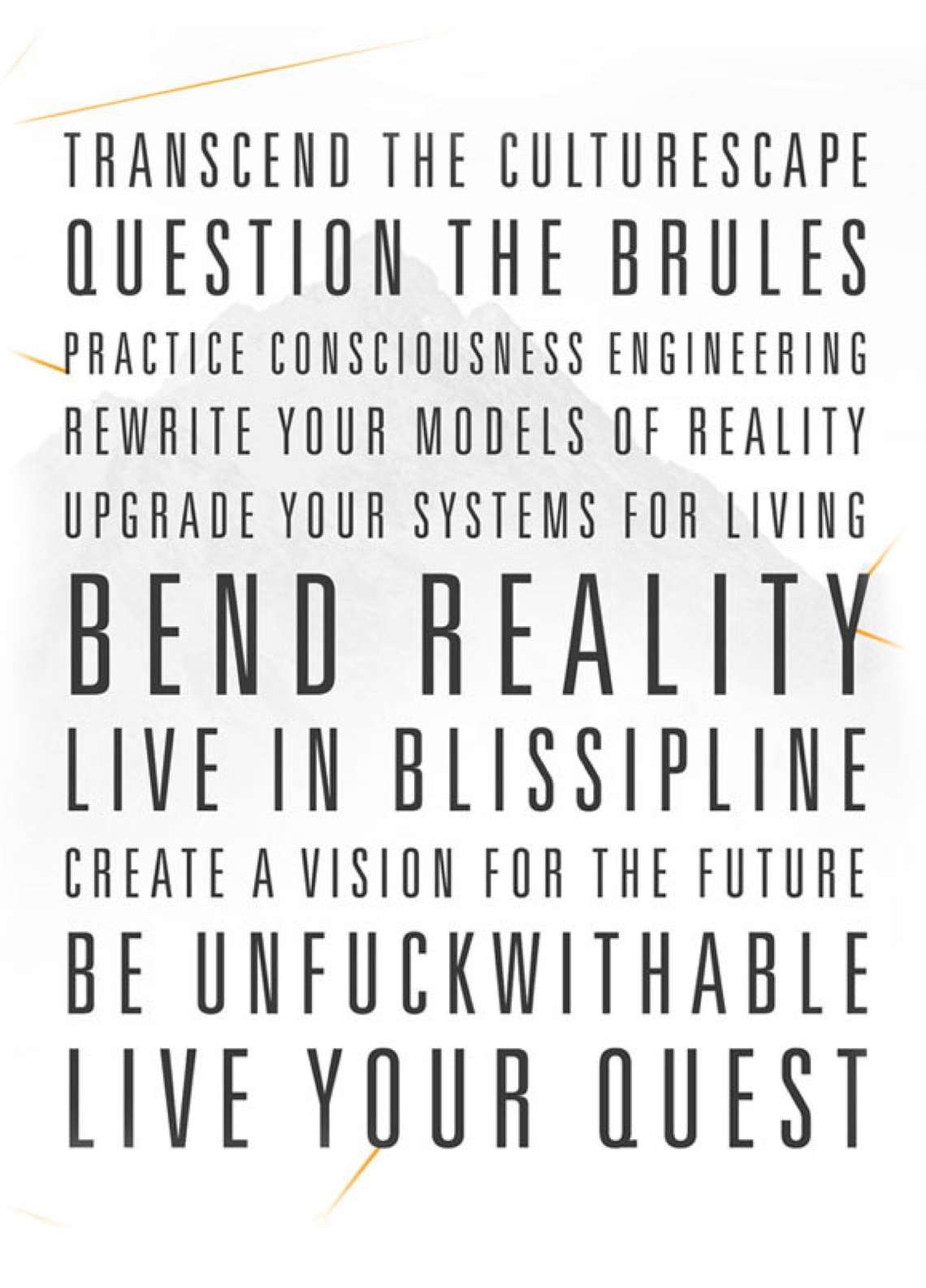
• Law 1: Transcend the Culturescape. Transcending the culturescape is about stepping outside your perceived world, so you can start to recognize the relative truths that can be changed, and thereby free yourself.
• Law 2: Question the Brules. A Brule is basically a bullsh**t rule. For example, most of us have been taught that to be happy and successful, we must work hard, have good grades, a good career, a happy family and save for retirement. These are all Brules. In the book Lakhiani shares how such Brules are outdated and should be broken. He also explains the 5 main sources of Brules, and the Brules he has busted in his life (e.g. the Religion Brule, and the Hard Work Brule).
The Power to Choose Your Version of the World
Now that you can recognize and filter out the Brules in your culturescape, you’re ready to create your own rules, models and systems. Lakhiani calls this “consciousness engineering”, and the next 3 rules are related to this concept.
• Law 3: Practice Consciousness Engineering. Most of us update and upgrade our electronic gadgets and computer systems regularly, yet we don’t do the same for our beliefs and habits. Consciousness engineering is basically updating the operating system for your brain, in 2 parts: (a) Your hardware (Models of Reality, or beliefs) and (b) your software (Systems for Living, or habits). You can replace both your beliefs and habits, like how you replace parts of your computer hardware and software to optimize it.
• Law 4: Rewrite your Models of Reality. This law is about becoming replacing your disempowering beliefs with healthier and more empowering ones. In the book Lakhiani shares many examples of how specific incidents shifted his beliefs to deliver massive results, from relationships to business profits.
• Law 5: Upgrade your Systems for Living. This law is about consistently growing & innovating through new habits and practices. The “Discover-Improve-Measure” approach seeks to enhance your systems for living.
Transforming your Inner World
Next, we move on to discovering what makes you happy, and identifying your vision and goals for a fulfilling life. The next 3 laws are about “Reality Bending“.
• Law 6: Bending Reality. In 2008, Lakhiani discovered a simple switch which transformed his business profitability. He basically stopped pegging his happiness to his goals. Instead, he focused on being happy in the present, while working concurrently on his vision. He calls this “bending reality”–In this state, you love what you do, ideas flow to you intuitively, you attract the right people and opportunities, and things just fall in place. There are 2 elements: (a) be happy in the now, and (b) have an exciting vision for the future, and let this vision pull you forward.
• Law 7: Live in Blissipline. “Blissipline” is the discipline of daily bliss, or being happy in the now. In the book you explore the 3 sources of happiness, and 3 happiness hacks you can use immediately.
• Law 8: Create a Vision for your Future. Your heart-felt goals and vision provide the “forward momentum” to pull you ahead. Lakhini explains the difference between end-goals vs mean-goals, the 12 key types of end goals, and the 3 Most Important Questions to crystallize your end-goals.
Changing the World
Being spiritual doesn’t mean you have to drop all goals and ambitions, or shun wealth. Extraordinary people shape their paths and their environment, changing things around them and leaving their mark on this world, by mastering the last 2 laws.
• Law 9: Be unfuckwithable. When you’re unfuckwithable, you’re so fully in touch and at peace with yourself, that you’re no longer bothered by what others say or do. You’re not afraid to dream, take bold actions, and fail, knowing you can always learn and try again. You can love and give fully, without fearing the potential loss of any person/goal/thing.
• Law 10: Embrace your Quest. At this phase, you’re ready to serve your higher calling or your quest, and make your contribution to mankind. If you’re living all the previous rules, your quest will naturally come knocking. All you need to do is to listen and take action. Even if you’re unsure what to do, just take any baby step—this expresses your intent, and allows the Universe to guide you forward.
Lakhiani ends the book with a 6-Phase practice to enhance 6 skills that are crucial for reality bending. You can get more resources online at the Codex website.
Andy Dunn, CEO of Bonobos (a subsidiary of Walmart), wrote an interesting post on Medium last week, all about brands that are “born online”, with a mindset that puts the consumer at the centre of everything, and therefore the channel and product become one. He called them “DNVBs”, and since then, the world seems to be agog with some new breed of business, not least because they are “millennial” businesses.
Personally, it seemed a little obvious – its just one particular business model, where you develop your digital platform as the core of your business (that’s pretty sensible today), choosing to distribute directly (as its easy), and building a monolithic brand (where the product and service become an experience). Don’t we already spend our lives talking about that as a model for success?
Anyway, some people seem to like making obvious thing complex, and certainly they like new buzzwords.
Here’s Andy’s post, so you can decide …
What is a DNVB?
I have spent the last ten years of my life figuring that out. I don’t know everything about it, but here is what I know:
It’s primary means of interacting, transacting, and story-telling to consumers is via the web. The digitally native vertical brand (DNVB), is born on the internet. It is aimed squarely at millennials and digital natives. It doesn’t have to adapt to the future, it is the future. It doesn’t need to get younger customers. It starts with younger customers. When we launched Bonobos in 2007, somebody asked me who had done this before. I said no one. The history of innovation is the story of ideas that seemed dumb at the time.
The DNVB is a brand, and that brand is vertical. The name of the brand is on both the physical product and on the website. The DNVB requires the commercialization of an e-commerce channel, but that channel is an enablement layer — it’s not the core asset. VC’s sometimes think these should be valued like technology companies. Some of the valuations still reflect this misguided notion. These are retailers, not tech companies. They cannot spend 10% of sales on technology and 30% of sales on marketing forever.
The profit losing nature and small scale of the DNVBs leads most traditional retailers to ignore or underestimate these little tadpoles. Then Unilever bought Dollar Shave Club for $1 billion. Smart people woke up. The reality is the brand of the future is a DNVB, but the future is not here yet. It’s in the corner. Give it a couple decades to take over the room.
Some big companies now believe they can make these brands themselves. There is some hubris to this notion, though it probably will happen in some exceptional cases. The general rule is that entrepreneurs need the fear of their brand’s demise to make it magic. It is too safe to do it as a corporate subsidiary. Unless that corporation treats the DNVB upstart like a start-up in terms of staffing and resources. That is hard to do.
It is not e-commerce, it’s vertical commerce. The product gross margins are at least double that of e-commerce (e.g. 65% versus 30%). The contribution margins can be 4–5x higher (e.g. 40–50% versus 10%). This radically transforms the economics of the vertical commerce compared to e-commerce. Vertical commerce can make money. E-commerce, not so much. Bonobos is now a breakeven business. It took us a decade. I am not proud of that, it takes a fair amount of scale, a wonderful team, and lots of learnings along the way to turn the corner. “Pioneers get the arrows, settlers get the gold.” Turns out it takes ten years to build a brand.
The digitally-native vertical brand is maniacally focused on the customer experience. There is no precedent for this in most categories, as these are bundles of two businesses that normally standalone. When we started Bonobos, our first angel deck said this is Ralph Lauren x Zappos. It’s a physical products brand and strong service experience at the same time.
The digitally-native vertical brand drives a lot more customer intimacy than it’s competition. The data is better because every transaction and interaction is captured. You don’t have to combine data across businesses, because it’s all one business. You are not blind to your wholesale business, because you don’t have a big wholesale business. It’s one CRM. It’s one store, where everybody knows your name.
Here is what most DNVB entrepreneurs get wrong. The world doesn’t care about your DNVB if you aren’t delivering a better product and service bundle than traditional competition. The world doesn’t need your DNVB — unless your product as foundation is differentiated. For Bonobos, fit personalization. For Warby Parker, price and cool factor of the lowest price. For Dollar Shave Club, price and convenience of subscription. The product, web/mobile experience, and customer service collectively become the brand in the consumer’s imagination. Deeper data on the consumer drives enables the DNVB to stay closer to the customer than its brick and mortar driven peers, and the ownership of the brand end-to-end fuels more affinity for a vertical commerce brand than even the best e-commerce experiences.
While born digitally, the DNVB need not end up digital-only. This means the brand can extend offline. Usually its offline incarnation is through its own experiential physical retail, or pop-up strategy, or highly selective partnerships. In nearly all cases of partnerships with third parties, the brand controls its external distribution versus being controlled by it. Any offline retail is not about warehousing product, it’s about marketing the brand and delivering great one to one customer service. It may be pop-ups. It may be permanent locations. It may be installs at existing retailers. You know who figured this out first? Steve Jobs. The Apple Store was the first scalable, experiential vertical retail concept. Lululemon isn’t bad either, though with inventory, the spirit of it is different.
Too often the DNVB is compared to a typical e-commerce company. If a typical e-commerce company is a frog, at birth the DNVB does look a lot like a tadpole. But it doesn’t end up as a frog. The difference is profound, and it requires an appreciation the role brand plays in inspiring people, speaking to them, shaping their choices, and a sharp understanding of how different the economics and growth trajectories are.
It requires investors to look more closely at the downstream math of a DNVB versus an third-party e-commerce purveyor. That differences in the unit economics and the contribution margin cohorts are profound — apples to oranges. Cohort analysis is only part of the story. Brand matters. These brands have a soul that is not easy to quantify at first. The e-commerce stories are flashier at first on the top-line (more brands!), but the long run winning strategy may well be DNVB (cult brand monotheism). The e-commerce businesses are often commodities that rise and fall (Fab); the dream for the vertical brands is to endure for a century or more (Bonobos, Warby Parker).
The e-commerce company is a channel; the DNVB is a brand. The e-commerce company has low margins; the DNVB has high margins. The e-commerce company can grow unbelievably fast; the DNVB can’t grow as fast, but it’s more valuable in the long run because it’s about more than just price.
While third-party e-commerce requires you to compete against a grizzly bear called Amazon, creating a DNVB gives you an opportunity to combine the growth of being an e-commerce company with the margins of being a brand, and with proprietary merchandise where you control distribution and your own destiny. When done right, when there is some differentiation in the core physical product itself made possible by the vertical commerce nature of the model, as the DNVB can provide a better overall bundle of product and service than the competition.
The DNVBs are just getting started; only recently are people beginning to realize how big they might be at scale. Their strategy creates a brand loyalty impossible to create in the commoditized world of channel, and as traditional vertical retail dies a slow death, the DNVBs rise to take their place.
In the history of DNVBs, it’s incredibly early. The net promoter scores are off the charts. There is still a lot to prove still on profitability. We are in the first decade of a century long shift where retail is re-organizing from the automobile (the 20th century) to the smartphone (the 21st century). Vertical brands were a huge part of the brick and mortar driven era of retail (Zara, Ikea, Trader Joe’s), and their digital reincarnations become the driving story in the future of retail.
He then followed with an “encyclopaedia of DNVBs” …
Today’s young business leaders are poised to outperform their more established counterparts – and that’s not just the usual energy and naivety of youth talking.
Today’s young leaders are emerging at a time when forces have converged to broaden people’s expectations of business. This generation contains some of the savviest and most connected consumers in history. Many of them have seen their parents work in, and potentially be let go from, uninspiring business environments. They’ve grown up in an era when corporate scandal was frequent and corporate responsibility became a department.
On the other hand, they’ve also seen the extraordinary rise of social enterprises and start-ups that answer the question: “What problem are we trying to solve?” long before they ask: “What’s the next big money maker?”
And now they’re setting the bar higher.
Don’t get me wrong. Up-and-coming leaders need and love profitability just as much as their predecessors, but they’re savvy enough to see profit as the end, not the means. The big differentiator will be that successful leaders of the future will tap into the extraordinary value and competitive advantage that comes when their companies’ missions – their core reasons for being – draw others in. They will hard-wire their operations to work effectively with others across society to deliver those missions and leverage resources in entirely new ways – and outperform the market as a result.
Here’s what the new generation of CEOs will do differently.
Young leaders know why they’re in business in the first place
For the next generation of game-changers, the payday (and what a payday it will be) grows out of setting ambitious missions that people actually care about. It seems so obvious, doesn’t it? After all, a mission statement is your most important declaration to the world about why your business even exists. But take a look at most company missions and you’ll find things like relevance and purpose woefully lacking.
Here are three red flags to look out for:
Uninspired mission statements are chronically narcissistic. This business of “we’re going to be the #1” or “the industry leader” raises exactly one question: besides shareholders, who cares? Many up-and-coming leaders are starting to better understand that if consumers, employees, communities and even governments don’t care about their company’s mission, they’ll be in dire straits fairly quickly.
Uninspired mission statements focus on the business model. A business model is not a mission and it never will be. Worse yet, elevating the business model to the level of mission makes a company far less capable of pivoting when market changes demand that their model evolves. Our future CEOs have grown up in an environment where the most agile businesses have been best at weathering storms.
Uninspired mission statements talk about how a company will behave. I’m reminded of a retail chain that seeks to “please customers and treat employees well”. Since when did the bare minimum of behaviour constitute a mission?
Successful leaders of the future will understand the bigger picture. They will recognize the interplay between society’s most pressing issues and the ability of their industries and companies to simultaneously solve those issues and thrive. They will recognize that major problems, left unchecked, will eventually block their business objectives.
Think about it. Nike won’t survive if the world continues to become less physically active. Neither will ESPN. Banks lose relevance if the majority of a population can barely afford everyday expenses. An energy company doesn’t stand a chance if it runs out of product. The theory holds true for pretty much any company of any size in any industry.
Put simply, future leaders will embrace missions that are visionary and describe what their companies will deliver to the world. And those missions will matter to a much larger group than just shareholders.
Young leaders see untapped value that’s there for the taking
By now our new mainstream corporate heroes are solving massive problems during the course of daily business. This has huge implications.
First, they’ll need to learn how to play really well with others. Corporations are famous for creating and then operating inside safe and controlled corporate bubbles. The new vanguard is about to burst that bubble. Truly ambitious missions require other people’s participation – governments, non-profits, academics, to name just a few. Future leaders will need to define new ways to work with these groups more authentically and systemically than typical efforts seen today. If they get this right, our young leaders will start to experience a level of broad-based support from unlikely actors who actually want their companies to win. It will create a tailwind experienced by very few in the corporate sector so far, and illuminate the ridiculous amount of untapped value being left on the table today.
When a more broadly supported corporate mission is delivered authentically and consistently, companies can realize surprising cost savings and fewer barriers to business. The PR crises, risk-mitigation headaches, employee-retention or productivity issues that drain valuable dollars – they can all dissipate dramatically, freeing up resources for innovation and more strategic reinvestment. Imagine an employee base so proud of what they are working towards that they consistently over-deliver with great products, services and efficiency savings. If your own employees or others want you to win because you stand for something worth fighting for, they’ll do whatever they can to help you.
Finally, missions that create shared purpose expand available market opportunity. Driving towards a mission that means something (and delivering on it) inherently expands the size of the pie versus an exhaustive and expensive effort to expand the size of an arbitrary slice. Because these companies are fundamentally solving a bigger problem, there’s a bigger portion of the population to innovate for and a broader base of business opportunities to expand into legitimately over time.
There are some established companies we can look to for inspiration. Take Google, for example. Its mission is to “organize the world’s information and make it universally accessible and useful”. Democratizing access to information everywhere? That’s world-changing. And it shows up in a ton of different ways, from emergency alerts that are the product of government partnerships to a re-imagined ISP experience (currently being tested in a few US cities) that provides connection speeds that are faster, cheaper and more reliable than anything people have experienced before. In an industry fraught with political challenges and sensitivities, Google is finding new ways to work across sectors. The result is expanded market opportunity and a roster of essential and valuable new supporters.
Indeed, those who lead the way will have big challenges pioneering how to get things done across the traditionally well-defined tri-sector territories. But they’ll also be poised to extract significant business value (and profitability) that has been left on the table for a very long time.
Young leaders will stay off the Titanic
The vast majority of businesses currently operate within a system that puts shareholders first and incentivizes quarterly returns over sustainable growth. You could argue that deeply embedded corporate norms and a very powerful establishment will continue to stand in the way of progress, but I don’t buy it. We’re now talking about a century-old corporate financing legacy system whose time has come and gone. Young leaders don’t have to put up with that, and many of the world’s bravest CEOs today are already showing the way.
As an example, take a look at Tesla’s eight-year, infinite-mile warranty. This was a bold move in a world where three-year, 36,000-mile warranties have long been the norm. Then Tesla did the unthinkable and extended its warranty to existing owners as well. CEO Elon Musk addressed investors and acknowledged the likely negative impact on short-term earnings. And then he went ahead and extended the warranties anyway. That’s a clear signal that Tesla puts the interests of its customers and faith in its product ahead of any arbitrary, short-term KPI. It bucks the system in a big way, and it will also pay off far more in the long run.
Today, however, we’re seeing new leaders buck the system entirely. They’re finding alternate forms of capital, demanding new structures and resisting arbitrary corporate norms that have existed for decades.
I can’t wait to see the group of revolutionaries who have the courage to go after missions that are bigger than themselves in the mainstream corporate world. And really, while the next generation may be pre-wired for this, real shifts will occur as the most established leaders of today make this seismic shift. These leaders will chart new territory for sure: resisting the creation of internal corporate bubbles and rewiring organizations for authentic multisector relationships – possible because they will lead business missions that unite, rather than separate.
From what I’ve seen so far, plenty of young people (and even a few current CEOs) have the guts to take this on. And if that’s the sense of entitlement this generation is supposed to have, then I say bring it on.
The future is not technology, the future is how technology enables us to achieve more. Robots will not replace us, there is no imminent “singularity”, instead new possibilities are enhanced by our extra-human potential.
We are all familiar with the tsunami of technological innovation which is changing (and more significantly, will) change our lives. From genetics to robotics, informatics and nanotech, internet of things and big data, we are inspired (and often overwhelmed) by the speed and potential of the new possibilities. Ray Kurzweil even talks about reaching a point of “singularity” by 2045, when technological capability and intelligence will surpass and subsume humanity. I see the future differently.
Superhumanis about using technologies to enhance our human potential.
Digital technologies enable us to reach and interact like never before, social networks enable us to connect and collaborate like never before, big data enables us to know and personalise like never before,nanotech gives us the power to exist and effect like never before, robotics enable us to support and serve like never before, internet of things gives us the freedom to live and act in realtime, genetics gives us the power to be like never before. The “innovation” (not the technical invention, but the practical application) of these technologies is not how they replace humanity, but how they enable us to achieve more.
Technology enables us to be more human … To do things we could never do before, individually and together.
The fourth industrial revolution is here. Klaus Schwab, founder of the World Economic Forum recently declared it the most significant step forward for business in a generation. Previous industrial revolutions drove a transformation in our worlds. From machines to automation, computers and digital connectivity. Now we are entering an age where robotics and artificial intelligence will rival the current practices of human beings. The revolution is not how robots displace people, but how the two work together to achieve more.
Business is being transformed … But technology is not the transformation, it is just one of the enablers of future growth and prosperity.
In a world of scientific business – big data analytics and behavioural economics, predictive targeting and search optimisation, supply chain automation and social networks, customer co-creation and community building, 3d printing and lean delivery – it is easy to forget people, humanity, emotions and life. These are the things that still matter. The change in business over the last 150 years has been dramatic – Business 1.0 was about automation. 2.0 was about mobilisation. 3.0 was about digitalisation. Like the fourth industrial revolution, “Business 4.0” is about connecting the new science and technology with the power of humanity to engage people, develop solutions, drive sales, build relationships in better ways than ever before. It requires new thinking, and new actions.
Business 4.0 changes the game … It is about having a bigger vision, to harness the new possibilities, and to deliver superhuman impact.
In my “Gamechangers” book, I call it the ideas economy … where it is the power of ideas by which you win or lose … And everything else can be done by technology of partners. Therefore it’s about using deeper insight and richer imagination to create nigger and better ideas … That engage and enable people to do more … And so out-thinking the competition, inspiring customers and turning intangible assets into financial success … Look at Periscope $100m before launch, WhatsApp $19bn in 3 years, Uber $50bn in 5 years! How? By thinking bigger, smarter and better … outthinking the competition … and being human!
What do you think?
The FT recently launched a series of videos called “Living with Robots” exploring our emerging interdependence with technology.
Peter Fisk delivers a range of keynotes and workshops on the theme of Superhaman
I’m in Cambridge today, home of some of history’s great science and technologists, but more recently home of ARM, the company that has out-thought Intel in recent years to be “architects of the digital world.”
ARM designs the chips inside most of the world’s smartphones, and increasingly other devices, creating an ecosystem of research and innovation with its partners, and most of the world’s device brands as licensee customers.
Invisible to most of us, ARM is the 20 year old software design company from Cambridge, UK, that is responsible for many of the components inside our tablets and mobile phones. From Apple iPads to Nike Fuelbands, cars and washing machines, ARM technology is at the heart of many of the digital products on the market.
What is unique about ARM’s business model is that it doesn’t actually make anything.
Ian Drew, ARM’s executive vice president for marketing and business development, described it “we make the knitting patterns for technology manufacturers”. From the iPhone to Nintendo games consoles, companies choose ARM designs because they result in better performance, with less energy consumption. “Partnerships are at the heart of ARMs business model, or ecosystem as we prefer to call it. It’s about innovating together, and making money together” says Drew “We’re in 95% of smartphones, 70% of laptops … and even in the new Nike Fuelband.”
The model works for ARM and its customers like Apple and Nokia. Investing, over a third of revenues on R&D with an expert team of 1200 chip designers, ARM is able to keep pushing the boundaries of chip design forward and the intellectual property that will drive the next generation of products. ARM licenses these reference designs to manufacturers through a combination of up-front payments to use the design and ongoing royalty fees. The whole industry therefore shares in relatively low-cost R&D, whilst ARM has sustainable revenue streams.
The business specialises in low power consumption processors, chips better suited to phones than high-powered computers, claiming that over 90% of all chips used in mobile phones originate on the drawing boards of Cambridge. However ARM also aims to be in 50% of all tablets and laptops by 2015.
Drew says “The internet of things – switching motors on and off, smart metering, healthcare, gaming and toys are all opportunities … things can make a big difference, like how our partner Enlighten which controls street lighting will be able to save millions of tonnes of CO2 because of our intelligence inside”. He sees ARM playing a major role in reducing the cost of devices. ARM-based chips for PCs will likely cost a bit more than the $20 for a chip, compared to $80 to $200 for Intel’s Core line of PC processors.
Drew argues that ARM is different from Intel in every way “We don’t go around saying ‘You have to build a product that looks like this.’ It’s our partners who come to us and say, ‘This is what we want to do, how can we work together’. That is radically different than Intel”. As part of this collaboration, ARM established Linaro, a not-for-profit network of over 120 engineers from the world’s leading tech companies. They work together on improving open source software for the ARM architecture, everything from power management to multimedia interfaces. Plans and progress are open to everyone on developer wikis, seeking to provide the best software foundations to everyone, and to reduce costly low level fragmentation.
The company, originally called Advanced RISC Machines was founded in 1990 as a joint venture between Acorn computers and VLSI Technology, with the Apple Newton, a forerunner to the iPad as one of its first collaborative projects with Apple who also took a stake in the business. 8 years later it restructured as ARM.
In recent years, investors have recognised the value in ARM Holding’s business model.
ARM is riding the wave of a smartphone market growing at around 20% per year. At the same time smartphones keep getting smarter, requiring more chips to support increased functionality, and premium chips that do more, faster, and with higher royalties to ARM.
The co-founders of New York City’s e-commerce startup Harry’s are taking an unconventional path to category disruption–purchasing a nearly century-old factory in Germany.
The smell of dying unicorns is in the air on a gray February day in downtown Manhattan. The Nasdaq has just fallen to a 15-month low, and e-commerce company Gilt Groupe, once valued at more than a billion dollars, was recently unloaded in a fire sale for $250 million. Jeff Raider, co-founder of online shaving startup Harry’s, is trying to diffuse the jitters permeating his company’s loft space. “Last year was the year of the unicorn,” he says to the room of mostly twentysomething employees. “This,” he adds, “is the year of the cockroach.”
Harry’s, Raider argues, is better prepared than most for a future of less magical, and more earthly, stamina. “Times are about to get harder for e-commerce companies,” he says. “But I think it’s helpful to be aware of the fact that we have a real business. We are making real money.” Plus, the 35-year-old reminds them, “we have a factory.”
Behind this fact lies an unlikely story of disruption that pairs blue-collar craftsmanship with a VC-fueled business model. Four thousand miles from the Harry’s loft in SoHo is a sleepy German village called Eisfeld, population 5,600. A three-hour drive from Frankfurt, the hamlet is best known for its medieval castle. But what’s put Eisfeld on the map is Feintechnik, a factory that’s been churning out double-edge razor blades since 1920.
Eisfeld has had it particularly rough since World War II ended, when the Soviets drew the Iron Curtain along its southern boundary, leaving the town trapped on the wrong side of history and the factory in the hands of East Germany. The new communist regime threw Feintechnik’s founder, charged with being a “brutal, capital-hungry businessman,” into a prison camp. Following unification, the factory was bought by an Italian entrepreneur in 1991. In 2007, it was sold to two European private equity firms. By then, Feintechnik had become the behind-the-scenes razor-blade maker for dozens of mostly European retailers and distributors.
Raider and his Harry’s co-founder, Andy Katz-Mayfield, first heard about Feintechnik in late 2011. At the time, the two MBAs were gearing up to launch an online shaving club that could mount an assault on the razor duopolists, Gillette and Schick, which had a century-old grip on the $17 billion men’s grooming category. Dollar Shave Club was already trying to knock the incumbents off balance by igniting a price war. But Raider and Katz-Mayfield wanted to seize a different angle–creating a better-designed razor and shaving experience for a reasonable price. So the longtime buddies ordered high-end razor blades made everywhere from Egypt to Japan and holed up in their respective bathrooms, using their faces as their lab. “It was physically and emotionally scarring,” half-teases Katz- Mayfield, recalling their nicked-up jawlines.
Dissatisfied, they finally tried to track down the Croma, an elusive European blade they had read about on shaving blogs. “We started Googling around and discovered it was produced by this factory in Germany called Feintechnik,” says Raider. It was one of the few places in the world that had mastered a technique called the gothic arch cut, which sharpens the steel on both sides into a parabolic edge, giving the blade both remarkable sharpness and strength. When they called the factory, it became clear this wasn’t Berlin or Munich–barely anyone spoke English. But when the Cromas finally arrived, they knew immediately they had found their future supplier.
Within weeks, the two boarded a flight to Germany to persuade the then 91-year-old manufacturer to produce the blades for their upstart, which at the time was little more than an idea. There they met with Feintechnik CEO Heinz Dieter Becker and his factory associates, and tried to impress them with their business school-charged vision. Raider even played what he thought was their most valuable card–he co-founded the hot American eyewear startup Warby Parker.
But their pitch was met with Teutonic indifference. Raider’s Warby cachet–which would have easily seduced venture capitalists back home–proved useless. Becker had never even heard of Warby Parker. To the Germans, they were just another web startup looking for razors to sell, with one major exception. The Harry’s co-founders didn’t want Croma knockoffs; they wanted customized cartridges with their own unique flex and pivot. “I think they were pleasantly amused by us,” says Katz-Mayfield.
For the next five months, Raider and Katz-Mayfield continued to court the Germans, finally landing a supplier deal in May 2012. But what would come next was an unexpected turn, one that belies the conventional wisdom of most startups today. In recent years, direct-to-consumer e-commerce startups like Harry’s have emerged across virtually every product category. From panties (MeUndies) to mattresses (Casper) to hair dye (eSalon), these companies pitch themselves as legitimate threats to business as usual, able to provide a better-designed, higher-quality product and customer experience for a fraction of the cost. The allure for entrepreneurs and their investors is high growth and low overhead, in part because these e-commerce players are more resellers than producers.
“People ask, why’d you raise so much money?” says Raider. “It’s all for this. You’re looking at it.”
But once Raider and Katz-Mayfield got inside that model, they realized it didn’t work for razor blades. To win the shaving wars, they would need to make an incredibly expensive bet: Harry’s couldn’t just contract a factory to make its razors. It would need to actually buy the factory. For $100 million.
Jeff Raider can be maddeningly agreeable. While Dollar Shave Club founder Michael Dubin boasts how “f—ing great” his blades are–as he did in his company’s 2012 viral video–Raider wants to know what you think of his. No matter how a question is lobbed at him about his competitors, he won’t disparage Gillette’s charge-the-moon pricing model or DSC’s outsource-everything production model. “We respect everyone in the industry,” he says like a politician, when pressed. The 33-year-old Katz-Mayfield, the quieter of the two, is more willing to play bad cop, when necessary. “We joke about negotiating,” he says. “I’m a little bit more calculating.” As is the case with many co-founders, their contrasting personalities–Raider with his affinity for the softer sides of business, like branding and customer experience, and Katz-Mayfield with his analytical, keep-the-trains running attitude–work in their favor. “It’s like a marriage,” says Katz-Mayfield. “He can finish my sentences. I can finish his.”
Raider started his first company in 2009. He was getting his MBA at Wharton, when he and three of his buddies started riffing on the injustices of the monopolistic eyewear industry. The four would soon hatch Warby Parker, now valued at $1.2 billion.
Meanwhile, Katz-Mayfield was living in Santa Monica, California, working for a startup after getting his MBA at Stanford. One afternoon in 2011, he stopped by a drugstore to pick up razor blades and shaving cream, and was struck by the absurdity of the experience. First, he had to track down a store clerk to unlock the case where the razors were kept. Then at the register, he had to shell out a small fortune. “It was like $25 for a four-pack of razor blades and shaving cream. I was like, ‘How did I just spend that kind of money?'” recalls Katz-Mayfield. “I can remember the emotion. You know as a consumer when you are getting taken advantage of.”
Overnight, his outrage morphed into an opportunistic idea: There must be a way to create a new kind of razor-blade-customer experience. He thought about Warby Parker, which was challenging a single dominant manufacturer–Italy’s Luxottica–with a high-quality, far cheaper alternative. Razors, dominated by two corporations, couldn’t be all that different from glasses. It just so happened Katz-Mayfield had a direct line to Raider, whom he had worked with at Bain & Company a decade earlier, and then at Charlesbank Capital Partners. Katz-Mayfield called his old buddy and Raider immediately agreed that someone had to Warby Gillette. “Why not us?” Katz-Mayfield interrupted. Says Raider, “I thought, here we go again. I sat back in my chair and it felt like day one at Warby Parker.”
By the early fall of 2012, the duo had quit their jobs, and Katz-Mayfield moved back to New York City. They had done their razor reconnaissance, and after that first trip to Eisfeld, Katz-Mayfield wooed Feintechnik, traveling regularly to Germany to meet with CEO Becker, whose direct German business style melded well with Katz-Mayfield’s data-oriented tendencies.
Back in New York, Raider was developing the Harry’s offering: Unlike DSC, which had already established itself as the razor company for bro Millennials looking for a deal, Harry’s would feel like a well-designed masculine experience. The brand would have a heavy whiff of Warby, with vintage-named shaving kits including the “Truman Set” and the “Winston Set.” It would offer multiple options–ranging from an $8 cartridge pack to a $39 kit with aftershave balm–all of which could be purchased with a plan or à la carte.
Raider managed to raise $4 million in seed funding led by New York venture firm Thrive Capital. Then, two months after Harry’s launched in March 2013, Raider and Katz-Mayfield encountered the best worst-case scenario for a startup. Initial shaving kit sales, boosted by an email campaign and strong word-of-mouth referrals, outperformed expectations. In two weeks, they sold all of their inventory, plus 12 weeks’ worth of backup stock. “We were blowing through projections,” says Raider.
The co-founders suddenly realized that if they were going to build an enduring company, they needed to transform the business. They asked Becker if Feintechnik would co-invest in a production line dedicated to Harry’s blades. He demurred. “He said they weren’t structured that way, that they didn’t have the capital,” says Raider. That’s when it hit the co-founders: Our two-month-old company runs the risk of outgrowing our 93-year-old supplier.
The only way to properly scale would be something nearly unheard of–to own the entire supply chain out of the gate. It meant the company’s biggest spending priorities wouldn’t be on code, but on steel, machinery, and workers. Forrester analyst Sucharita Mulpuru says there’s a simple reason it’s so rare for a startup to make this kind of bet. “It’s an enormous capital cost,” she says. “It’s literally putting the cart before the horse.”
“We were not looking for a buyer when they approached us,” recalls Martin Spirig, a partner at Invision Private Equity, the Swiss firm that purchased Feintechnik, along with Austrian-based Alpine Equity Management, in 2007. The firm had already invested millions in the gothic arch machinery, boosting Feintechnik’s sales and profitability. Still, Spirig was intrigued enough to meet with the Americans. “I appreciated their enthusiasm,” says Spirig, who, unlike Becker, was impressed by Raider’s Warby Parker pedigree. Additionally, he found he had something in common with the co-founders. “I’m also an ex-Bainee,” he says.
But Raider and Katz-Mayfield didn’t yet have the cash to be serious bidders. “That’s when I had to take off my startup-founder hat and put on my private equity hat,” says Katz-Mayfield, who had done leveraged buyouts with Raider at Charlesbank. According to their calculations, they would have to raise a staggering $100 million, something most investors wouldn’t entrust to a startup in its infancy.
So Raider began working his network. At Warby, one of his co-founders, Neil Blumenthal, had always been the face of the company, while Raider remained in the shadows. (He left Warby Parker in mid-2010, but is still on its board.) Now Raider had his chance to be the frontman. He contacted a Warby Parker board member and top executive at Tiger Global whom he often went to for advice and he and Katz-Mayfield presented their rationale for why the New York City-based hedge fund should get in on such an expensive endeavor. Even though Harry’s appeared to mimic the Warby Parker model, they explained, there was something fundamentally different between razors and glasses: The engineering required for high-end blades was much more specialized. Like most in the direct-to-consumer space, Warby was an outsourcer, designing the products and sourcing the materials–but then contracting them out to a manufacturer.
There’s a simple reason it’s so rare for a startup to make this kind of bet. “It’s an enormous capital cost,” says one analyst.
The main competition that Harry’s faced, Dollar Shave Club, was doing even less–purchasing already designed razors from Seoul-based Dorco, and then reselling them. That meant DSC’s product was not just a commodity; it was also subject to the whims of its supplier. In 2012, Dorco actually became a direct competitor when it began a North American push of its SXA 1000–a product nearly identical to DSC’s top-of-the-line Executive. If Harry’s was vertically integrated, it could avoid getting Dorco’d. This would also create a valuable feedback loop between its customers and its engineering team that would enable the company to perpetually improve its existing products and develop new ones. Under Harry’s, Feintechnik would continue to function as the white-label producer for dozens of other retail brands, giving Harry’s built-in operating profit from day one.
Tiger Global called the co-founders a week after their pitch. “They said, ‘We’re in. Let’s do it,'” says Katz-Mayfield. By the end of the year, he and Raider had also gotten their seed backer, Thrive Capital, along with five other investors, to help raise $122.5 million, including $35 million in debt.
On January 22, 2014, Katz-Mayfield and Raider officially became Feintechnik’s new owners. “In this industry,” says Invision’s Spirig, “you can gain expertise only through experience, by manufacturing millions and millions of blades.” Ten-month-old Harry’s paid its way to inheriting 94 years’ worth of experience. Now the real work would begin.
On a Friday evening in September, hundreds of Eisfeld locals assemble at Feintechnik’s grounds in a packed party tent. Sausages and hamburger patties sizzle on the grill, while children get their faces painted by a clown. Most of the townsfolk cannot understand a word the Harry’s co-founders say, but some show up with a gift–a bottle of schnapps. Then a German politician bestows on Eisfeld’s newest power brokers a $5.2 million development grant, declaring, “The time is now!” for this new American-German axis to knock out Gillette and Schick.
When news of the Harry’s deal first broke almost two years earlier, German magazine Der Spiegel called it “a curious combination of U.S. entrepreneurial spirit and German engineering.” The Harry’s co-founders had gone from managing a 35-person e-commerce startup to running an intercontinental manufacturing operation with more than 400 employees and customers in 40 countries. To ease the learning curve, Raider and Katz-Mayfield had spent the six months leading up to the acquisition immersing themselves in every part of Feintechnik’s business, from machinery to German labor laws. To help with the transition, they persuaded Becker to stay on for four years and then hired two Germans in Eisfeld–one a manufacturing expert, and the other to lead sales and marketing. But nothing at Wharton or Stanford could have prepared them for the task of bridging the cultural differences they would encounter.
The first time Raider and Katz-Mayfield arrived at Feintechnik as the new bosses, it must have felt like a diplomatic mission. They were concerned that its most highly skilled workers, used to steady, reliable growth, would not want to work for two young startup guys with a bold plan for disruption and no manufacturing experience. It didn’t help that neither of them could speak a lick of German. “I was standing on wooden crates looking out at hundreds of people and all of a sudden, I was like, ‘Man, we better make this work,'” says Raider. Feintechnik was Eisfeld’s biggest employer. Beyond their investors, he realized, “there’s a whole town depending on us.”
So he and Katz-Mayfield began the transition slowly, taking a measured approach to communicating their vision to the Eisfeld team. But integration dragged out for nearly two years, something, Raider says now, he wishes he had wrapped up in months. Then there were the micro-collisions that emerged almost weekly–things like the Americans inundating their Eisfeld counterparts with a dozen one-line emails during the course of the day, rather than sending a single, comprehensive to-do missive, which the Germans preferred. In an effort to align the two cultures, now nearly every week a team from New York–distribution, product development, supply chain, IT–flies to Germany to work side by side with the Eisfeld team, and vice versa. “I don’t want to sugarcoat things,” says Raider. “Changing the mindsets of some of the people who’ve worked here for 15 years is really hard. It’s a process of finding champions.”
Yet even with a bumpy cultural transition, two years into purchasing Feintechnik, the Harry’s co-founders say they have proof their gambit is working. “Gen 2,” as its referred to internally, is the company’s newest product, which is set to debut this summer. According to early designs, it’s a razor cartridge that will pack five double-edge blades, a sixth rear-edge “trimmer blade,” and a cartridge head that pivots at greater angles. Gen 2 was jointly designed by product development teams in New York and Eisfeld and crafted by German engineers, with each feature influenced by Harry’s customers. While the Gen 2 is not revolutionary for the industry, Harry’s believes that its product-development model–beginning with its customer-experience team and ending on the factory floor–will be. “This was 100 percent enabled by being vertically integrated,” says Katz-Mayfield.
The more Gen 2s Harry’s sells, the co-founders argue, the more customer feedback the company will have to develop the next iteration, or another breakthrough product. Gillette, historically the most innovative of the razor companies, has released, on average, a couple of unique product lines every decade. It took Harry’s only two years to turn all of its customer data into a new release. The hope is to speed past Gillette in the next decade.
Already, the largest competitors of Harry’s are showing signs of being flustered. “The advent of Dollar Shave Club and Harry’s has got to be the most significant disruption to this space since the electric razor,” says Ken Cassar, an e-commerce analyst at Slice Intelligence, noting that online shaving clubs are the fastest-growing segment in men’s grooming, some 10 percent of the $3.3 billion U.S. market. While, according to Slice, DSC is the top online subscription shaving club, last year Harry’s grew more than twice as fast as the entire online market, even outpacing DSC. Gillette, whose profits have been flat in recent years, has sued both Harry’s and DSC for patent infringement. (In 2013, it filed the charges against Harry’s, and then dropped the suit a week later.) Last summer, the corporation joined the online wars with its own rip-off, Gillette Shaving Club.
“I don’t want to sugarcoat things,” says Raider. “Changing the mindsets of some of the people who’ve worked here for 15 years is really hard.”
Harry’s is now gearing up for more growth. The co-founders project that revenue will top $200 million by year-end, with sales from Harry’s itself accounting for a bit more than half. By 2018, the company plans to double its production capacity to two billion blades per year. To do that is incredibly expensive. Harry’s has since raised another $171 million, over $100 million more than what DSC has raised. It’s also built a second production facility–which is slated to double in size–and is expanding the original factory. With nearly 100 positions to fill in the next two years, Raider and Katz-Mayfield are scrambling to find talent who not only understand complex manufacturing, but are also willing to relocate to this German backwater. If they can’t, Raider says, it “will impede our growth, for sure. We can buy all the machinery we want, but we’d have nobody to run it.”
For all the change under way in Eisfeld, Raider and Katz-Mayfield have no intention of putting down local roots to manage it. When they visit, they still prefer to live out of a suitcase, staying at a hotel 20 minutes down the road. Katz-Mayfield spends at least one week a month here, but he has yet to learn German. It’s for reasons like this that a German documentarian named Ulli Wendelmann, known for hard-hitting exposés on the German prison system and Russia’s oligarchy, recently filmed a documentary examining the oddball marriage between the New York startup and the former East German factory. The Harry’s co-founders understand the scrutiny. “It’s not like we are 60-year-old German industrialists who’ve come here,” Raider says. “We have to build credibility with the people.” For now, at least according to Wendelmann, they seem to be doing all right. “The feeling for the two New York cowboys is very good,” he says.
The bigger picture
A new breed of startup is betting that the key to toppling an industry is to do just about everything yourself. It may sound counterintuitive in this golden age of “light” business models–contracting workers, scaling with software, outsourcing production–but Chris Dixon, general partner at Andreessen Horowitz, encourages select companies to pursue this model, dubbing them “full-stack startups.”
If you develop a new technology, says Dixon, rather than selling or licensing it to the existing companies in that industry, consider building “a complete, end-to-end product or service that bypasses” them–from design to distribution.
The potential upsides are huge, but so are the financial risks. It also requires an incredibly agile entrepreneur–“a special kind of founder,” says Dixon. Here are three ways companies are stacking up.
1. Harry’s: Own the manufacturing
For Harry’s, vertical integration was driven by one crucial factor: There are only a few manufacturers in the world that can make what it sells–high-end razor blades–at scale. It’s better to own such rare know-how outright, the co-founders concluded. But Harry’s doesn’t advise everyone to shell out $100 million for a factory. “For others, it might be a really bad idea,” says Harry’s co-founder Jeff Raider. His advice: Own the production only if it creates a distinct competitive advantage.
2. Nest Labs: Master design
Not all full-stackers own every piece of the supply chain. Sometimes, they just own the parts that count. Nest Labs, founded by former Apple designers, creates its own hardware–smart thermostats, smoke and carbon monoxide detectors, and home-surveillance cameras–and the software that runs it, which gives the company much more control of the user experience and future product innovation.
3. Tesla: Invent a new supply chain
To establish a market for its electric cars, Tesla has completely reimagined the supply chain by owning everything from the factory to the showroom to the charging stations. It’s an expensive gamble, but it will be incredibly hard for incumbents to do the same and catch up.
Forbes Magazine today publishes its own list of Global Gamechangers … focusing on the individual leaders behind some of the world’s most disruptive innovators. The list complements well with my own ranking of Gamechanger companies which you can explore in more detail here.
In particular its great to see some fabulous female leaders on this list, women like Sara Blakely of Spanx and Katrine Bosley of Editas. What Sara can do for your body shape and confidence, Katrine can do for your future health and wellbeing
Together these Gamechangers are great leaders and innovators – leveraging technology, finance and sheer brainpower to upend entire sectors and transform the everyday lives of billions. To compile their list, Forbes started by screening hundreds of companies for growth, innovation and global presence. They only considered for-profit entities with a market value of more than $1 billion, although we all recognise that smaller, focused business can be incredibly disruptive too. Although they sought balance in terms of industries and geography, inclusion was mostly determined, in the end, by the brilliance of their ideas and the audacity of their ambition.
Here’s the list, in alphabetical order:
Marc Benioff, 51
Founder, CEO, Salesforce.com
United States
Cloud-computing pioneer
has upended the software business with its ubiquitous customer relationship software. Revenues, which were $6.7 billion in 2015, continue to grow at 30% annual clip.
“What we’re using today will be obsolete in a few years. The past is never the future.” Aug. 8, 2011
Jeff Bezos, 52
Founder, CEO, Amazon.com
United States
First books, then retail. Now movies and data farms. Next: drones and grocery delivery. Bezos seems to remake an industry nearly every year, and Amazon has global sales of nearly $110 billion.
“We are comfortable planting seeds and waiting for them to grow into trees.” Apr. 23, 2012
Brought the discount airline model to the developing world, supersized it and made it profitable. IndiGo is now India’s largest and most profitable carrier, with 29 million passengers in 2015, or 2 in 5 domestic fliers. Recently expanded to Dubai, Singapore, Bangkok, Kathmandu and Muscat.
“We keep asking ourselves: What other cost can we remove without losing a single customer? This is our religion, and it serves us well.” Oct. 20, 2014
Sara Blakely, 45
Founder, Spanx
United States
In just over a decade Spanx has become a byword for shapewear in the same way Kleenex is for tissues, spawning dozens of competitors and copycats. Blakely still owns 100% of the brand, which had estimated sales of $400 million last year, ships to 61 countries and is rolling out its own brick-and-mortar network (14 stores and counting).
“I’m game for anything. The company has to pull me back.” Mar. 26, 2012
Katrine Bosley, 47
CEO, Editas Medicine
United States
Bosley is spearheading the push to turn CRISPR, a revolutionary gene-editing technology that has been called a word processor for DNA because of its low cost and ease of use, into new medicines. Its first treatment, soon to be tested in humans, is for Leber’s congenital amaurosis, a rare inherited eye disease. It is also developing cancer-killing cells with Juno Therapeutics of Seattle, Wash. After a successful IPO earlier this year, the company is already worth some $1.5 billion.
Brian Chesky, 34
Cofounder, CEO, Airbnb
United States
The first smash hit of the share economy, Airbnb has provided beds for more than
60 million since 2008. The company offers accommodations in 34,000 cities in 190 countries, including Cuba.
“People providing these services in many ways are entrepreneurs or micro-entrepreneurs. They’re more independent, more liberated, a little more economically empowered.”
Feb. 11, 2013
Daniel Ek, 33
coFounder, CEO, Spotify
Sweden
After Napster nearly destroyed the music business, Ek found a way to put Humpty Dumpty back together again, offering up millions of tunes and splitting the revenue (from a combo of subscriptions and ads) with the artists and labels. His service is available in 59 nations and has 75 million monthly active users.
“It disturbed me that the music industry had gone down the drain, even though people were listening to more music than ever and from a greater diversity of artists.” Jan. 16, 2012
Jay Flatley, 63
CEO, Illumina
United States
Not long ago it cost $200,000 to sequence one person’s genome. Now, thanks to Illumina, the cost is around $1,000 per person, opening up the possibility of truly individualized medicine. Sales increased 19% to $2.2 billion in 2015, and profits went up 21% to $490 million. Flatley has even greater ambitions: A new subsidiary, Grail, is working on inventing a simple blood test that can catch cancer in its earliest stages.
“If we remain the leader in sequencing we can grow our company with a much more fantastic return on investment than anything else.” Sept. 8, 2014
Ilene Gordon, 62
CEO, Ingredion
United States
High-fructose corn syrup is cheap, plentiful and terrible for you. The stuff is still a part of Ingredion’s core business, but Gordon is focused on turning corn (and berries, fruits and potatoes) into ingredients for organic, gluten-free and non-GMO foods. It’s working. Specialty sales, which include gluten-free ingredients, have gone from 5% of revenue to 25% on Gordon’s watch, and could hit 30%, or more than $2 billion, by 2019.
Terry Gou, 65
Founder,
Hon Hai Precision Industry Co. (Foxconn)
Taiwan
Without Gou you probably couldn’t afford that iPhone in your pocket. Marrying a low-cost workforce with high-precision assembly has transformed Foxconn from a small plastics supplier into the largest electronics maker in the world. Its most famous customer is Apple: It has made about 80% of all iPhones on the planet. Over the past five years revenues have increased 20% to $141.2 billion, and profits have grown to $4.6 billion. The company recently agreed to buy Sharp, the venerable Japanese consumer-electronics concern.
Reed Hastings, 55
Cofounder, CEO, Netflix
United States
Whether you want your entertainment delivered in the mail on a DVD or prefer to stream it on your phone, Netflix is there for you. Having conquered distribution, Hastings’ company is now gunning for network status, producing critically acclaimed binge-watchable blockbusters like House of Cards and Orange Is the New Black. In January Netflix made its service available in 130 more countries, effectively doubling its footprint. The number of subscribers has expanded by 30% since 2014.
Jen-Hsun Huang, 53
Cofounder, CEO, Nvidia
United States
Nvidia is best-known for making the high-end graphics chips used by gamers to soup up their PCs. Its single-minded pursuit of creating better-looking aliens has also led the company to a slew of related technological advances. Some of the fastest supercomputers in the world run on its Tesla chips, and the firm has a portfolio of 7,300 patents used in virtual reality, artificial intelligence and autonomous driving.
“The more content there is, the more visual interest there can be, the more processing horsepower people need.” Jan. 7, 2008
Wang Jianlin, 61
founder, Dalian Wanda Group, China
Wang became China’s richest man by shrewdly playing the high-stakes Beijing real estate market. Now he is making an equally shrewd move to hedge his bets by diversifying globally. Most recently he purchased the AMC movie theater chain for $2.6 billion in 2012 and earlier this year spent $3.5 billion for Legendary Entertainment, maker of Godzilla and Straight Outta Compton. Group revenue was up 19% in 2015 to $44 billion.
“Legendary is a gateway to cultural and financial alignment between the Hollywood moviemaking world and the rapidly expanding Chinese marketplace.” Feb. 29, 2016
Travis Kalanick, 39
Cofounder, CEO, Uber
United States
Hailing a taxi often used to mean overpaying for a ride in a dirty jalopy. No more. Uber’s rides are affordable, clean and, because of its rating system for both drivers and passengers, nearly always pleasant. Uber is available in 405 cities around the world and in some markets is also available for food and other deliveries. The company has raised more than $10 billion, valuing it above $62 billion.
Alexander Karp, 48
Cofounder, CEO, Palantir Technologies
United States
Big brother meets big data. Karp’s secretive firm is the go-to partner for central governments, law enforcement agencies and multinationals trying to glean actionable intelligence from massive data sets. Palantir has helped capture terrorists, thwarted sex traffickers and identified rogue traders. The CIA was an early investor (and client), but customers now include foreign governments, the NYPD, JPMorgan and Hershey. Its last round of funding, in December 2015, valued the company at $20.5 billion.
“The only time I’m not thinking about Palantir is when I’m swimming, practicing Qigong or during sexual activity.” Sept. 2, 2013
Osman Kibar, 45
Founder, CEO, Samumed
United States
The new biotech billionaire is backed by a deep purse of international money that has raised $270 million from investors gambling that the Turkish-American scientist has discovered a real fountain of youth (read the full story).
Bom Kim, 37
Founder, CEO, Coupang
South Korea
The Harvard-trained Kim is beating Jeff Bezos at his own game in South Korea (read the full story).
Jorge Paulo Lemann, 76
CoFounder, 3G Capital
United States
With the backing of Warren Buffett, Brazil’s richest man (whose firm is headquartered in New York City) has become the undisputed master of the megadeal, transforming mature brands–from Budweiser and Burger King to Heinz ketchup and Jell-O–into gigantic profit centers. The secret is razor-sharp cost-cutting implemented by forcing managers to justify every single number on their budgets, every single year. Anheuser-Busch InBev's 32% operating margin is now the envy of the industry, and it wants to spread the gospel by spending more than $100 billion to buy global rival SABMiller.
Jack Ma, 51
Founder, Alibaba
China
The biggest Internet company in China is a one-stop e-commerce shop, combining the functions of Amazon, eBay and PayPal under the same roof. Now it’s pushing deeper into financial services through Ant Financial and opening new offices in places like London and Milan. In 2014 Alibaba raised $25 billion in the largest initial public offering of all time. The company has been clocking sales growth in the range of 50% per year, with 2015 revenues at $12.3 billion and profit margins of around 45%.
John Milligan, 55
CEO, Gilead Sciences
United States
By diving more deeply into the science of viruses than any other company, Gilead has managed to create meds that put HIV in check and cure hepatitis C 95% of the time. Harvoni, its hep C drug, is already one of the world’s bestselling, and the market could even be bigger: The disease still afflicts 150 million people and kills 500,000 every year. Annual sales have tripled to $33 billion in three years.
Elon Musk, 44
Cofounder, CEO,
Tesla Motors, SpaceX
United States
The world’s most innovative businessman has stratospheric ambitions: He’s reimagining the electric car as more of a rocket ship than a golf cart and reimagining the rocket ship as more of a car (i.e., reusable). Tesla’s newest car, the more affordable Model 3, booked $7.5 billion in preorders the first day it was offered, and the vertically integrated company has a three-year sales growth rate of 114%. Tesla’s “Gigafactory” in Nevada will soon produce more lithium batteries than all the other factories in the world.
“Life sucked in the old days. People knew very little, and you were likely to die at a young age of some horrible disease. You’d probably have no teeth by now.”
Apr. 9, 2012
Peder Holk Nielsen, 60
CEO, Novozymes
Denmark
Novozymes’ enzymes replace nasty chemicals in places like refineries and food factories, making the industrial world run cleaner and more efficiently. The company’s products could save 100 million tons of carbon dioxide by 2020. Research is a religion at the company: Scientists spend 10% of their time pursuing personal projects.
Larry Page, 43
Cofounder, CEO, Alphabet (Google)
United States
Not content with just being the Ma Bell of the Internet, the parent company of the world’s most knowing search engine is busy pursuing dozens of “moon shots.” These high-risk, high-reward (and often high-minded) projects include self-driving cars, computers that create original art and a network of balloons that deliver high-speed Internet access to rural areas in the developing world. Google, far and away the largest subsidiary of Alphabet, raked in $74.5 billion in revenues in 2015, up from $65.7 billion in 2014 and $10.6 billion a decade ago.
India
The world’s largest vaccine-maker by volume produces 1.3 billion doses annually, which have immunized close to two-thirds of the world’s children. Serum’s revenues, estimated to be some $620 million, have been growing at about 30% compounded and profits about 40%. It supplies low-cost vaccines to 140 countries through agencies such as UNICEF and the Pan American HealthOrganization. New vaccines are being developed for diarrhea, cervical cancer, pneumonia and tuberculosis.
Hakan Samuelsson, 65
CEO, Volvo Cars
Sweden
Safety-first Volvo has publicly pledged that no one should die or be seriously injured in its cars by 2020. Now owned by China’s Geely Holding Group, Volvo tripled its operating profit to $780 million in 2015 on revenues of $20 billion. Worldwide, Volvo sold 503,127 vehicles last year, the highest in the company’s 89-year history.
Howard Schultz, 62
CEO, Starbucks
United States
Schultz has turned a commodity product into a high-margin lifestyle brand that represents everything from digital savvy and green living to progressive politics. The coffee-shop social experiment resonates on a global scale: Starbucks now has more than 24,000 stores in 70 countries, 6,000 opened in the last five years. Sales grew 17% to $19.2 billion in 2015.
“We can elevate citizenship and humanity.” Mar. 21, 2016
Sunny Varkey, 59
Founder, GEMS Education
United Arab Emirates
He never went to college, but Varkey is building the largest network of private K?12 schools in the world, many focused on providing education to girls in places where they would otherwise have no access. GEMS has 250,000 students enrolled in 240 schools in 17 countries across the globe. Over the next four years Varkey plans to invest $200 million in expanding in Africa and his native India.
“We adopted the airline model of economy, business and first class to make top-notch education available based on what families could afford.” Apr. 14, 2014
Frank Wang, 35
Founder, CEO, DJi, China
Chances are if you own a drone, it was made by Wang’s company: His Shenzhen-based DJI has an estimated 70% share of the consumer drone market. And unlike most Chinese tech companies, which tend to be fast followers of their Western counterparts, DJI is blazing the trail in this entirely new electronic category. Nearly 1,500 of its 4,000 employees are focused on R&D. It doubled its sales to an estimated $1 billion last year, evenly distributed among Asia, North America and Europe.
“All you need to do is to be smarter than others–there needs to be a distance from
the masses. If you can create that distance, you will be
successful.” May 25, 2015
Japan
In a business where choking on inventory is commonplace, Yanai’s flagship, trendy Uniqlo, is a master of speed-to-market. In-store sales are tracked obsessively, and slow-selling products are yanked and replaced by new ones. In addition to Uniqlo’s 1,700 stores spread across 17 countries, Fast Retailing runs the denim-focused J Brand and, in February, introduced a popular line of clothing for Muslim women in America. Revenues are up 15% annually over the last five years.
Mark Zuckerberg, 31
Cofounder, CEO, Facebook
United States
Five words: one billion active daily users. That’s roughly one out of every seven humans alive today and nearly a third of all people who have Internet access. Eighty-four percent of Facebook’s users hail from outside the U.S., and sales have grown at an average annual rate of 49% over the past five years to $18 billion, generating 2015 profits of $3.7 billion. Zuckerberg is leveraging that financial success to buy his way into hot new markets. In 2014 he acquired the pioneering virtual-reality firm Oculus for $2 billion and messaging giant WhatsApp for $22 billion.
From Amazon Dash to Aussie Farmers, … through branded boutiques and online marketplaces, digital walls and mobile marketing, big data and personalised promotions … what is the future of retailing, in general, and for your business in Portugal?
Walking around the Burberry flagship store on London’s Regent Street, with its beautifully arranged clothes, it magic mirrors that superimpose your image in the clothes of your fantasy, and place of your choice, and the VVIP room on the top floor, it is a world of imagination, where emotions not rational desire prevails. It is the work of designer Christopher Bailey who has overseen the rejuvenation of the brand from its “chav” ubiquity to its super premium status. The $100,000 limited edition, white alligator skin jacket, not to everyones taste, perhaps demonstrates this stretch. It is a brand that is truly global, more Asian than European if measured by its custom, and more digital then physical, based on the focus of its innovations. Burberry shocases the future of retail – as a niche focused, premium branded, hybrid experience.
Fast and Easy: Amazon is rethinking every aspect of retail, from Alexa to Go, OneClick and Prime, private labels and physical stores.
Smart shoppers, smart stores
Online retail has grown rapidly over the last decade, from a marginal bolt-on, to major revenue stream in a multi-channel model. In the US, it has grown by around 18% per year, and now accounts for 8% of all sales. But digital is more that this, it is not just another way, but a fundamental capability that can enhance every channel. Search on your phone, buy online, pick up in store. Go to store, use your phone to buy, delivered to your home. Retail innovation is about hybrids, combing physical and digital activities and options in a more experiential and valuable way.
https://www.youtube.com/watch?v=CbeyqHkCzY8
Rapha Cycle Club: More than a store for premium cycle gear, this is a community where people meet, drink coffee, share their passion, watch Le Tour, go for a ride, its their spiritual home.
Retail purpose, formats and incentives all change – whilst loyalty cards originally drove behaviour through points, people soon became wise that the rewards were trivial compared to special offers in store. Whilst stores have enhanced their shopper experiences, markets have fragmented with more space for discounters. In Turkey for example, BIM has taken around 40% of the food market with low price, small outlets across cities. At the same time, online players have morphed into credible alternatives, where Amazon sells wines and eBay replaces physical outlet stores. More emotionally, technologies such as Synqera from Russia can “mind-read” a shoppers emotions, judging how to best engage them as they shop, and how to make them smile.
https://www.youtube.com/watch?v=pHi4_bRiIHA
Aisle One from Aussie Farmers Direct: making fresh food delivered from farm to your doorstep. Not only fast and easy, but human and authentic too.
Digital hybrids, data and mobile
Mobile is already a huge factor: at upmarket fashion retailer Gilt, 50% of shoppers, and 30% of sales is by mobile. It is the glue that brings together online and offline, creating more personal experiences, from individual promotion geo-targeted, for in-store research and navigation, price checks and comparisons, as well as fast and safe payment. As newspapers are replaced by digital news, TV is on demand, and online retailers never close their doors, the ways retailers engage and serve consumers changes. We expect 24 hour access, we don’t tolerate stock outs, compare prices instantly, shop beyond our borders, and demand delivery in 24 hours.
Fishpeople: Scrumptious and sustainable fish, using big data and internet of things to track provenance and authenticity in fresh food.
Big data, the huge quantitites of transacational data, mashed with other sources of personal and behavioural data through complex algorithms, means that marketing is highly personalised. Around 35% of all Amazon purchases and 75% of Netflix movie choices are based on recommendations. Of course these suggestions compete with the much more trusted recommmendations of friends and peers on social media, often valued around 10 times more highly than anything from a brand. A brand therefore needs to think laterally, about how to influence communities, and give them the abilities and incentives to influence each other. Consumers also become much less tolerant of failures, unavailable products or poor service, they expect free and easy returns, and they immediately tweet their feelings, particularly the negative ones, to thousands of people like them.
Together, our gamechangers show how the variety of innovations build a future vision of retail. The demand side is led by the engaging, personal experiences – driven by the passion of Zappos, collaboration of Threadless, affinities of Greenbox or latest desires of Zao Zao. On the supply side, this is about the efficiency and speed of Amazon, the reach and richness of Aramex or Etsy, and the transparency of Positive Luxury. In between is the ability to match niche segments with lifestyle store experiences, and whilst the Aberchrombie brand portfolio is not without challenges, it knows how to connect.
The future of retail
“FutureStore” is part of the Gamechangers project, exploring the future of retail, the fast-changing needs of consumers and the best new ideas from retailers across the world. You can explore FutureStore online with in-depth case studies, downloadable tools and videos, but also through keynotes, workshops and practical fast consulting support for your business. To think of new possibilities. To learn from the best ideas around the world, and even from other sectors. And by applying new approaches from design thinking to gamechanger strategies, new business models to lean innovation, consider how you can innovate and grow.
Take a sheet of paper, ordinary A4 size (letter size if you’re in the USA), and fold it into half.
Fold it a second time, and a third time. It’s about as thick as your finger nail. Continue folding if you can. At 7 folds it is as thick as a notebook. If you would have been able to fold it 10 times, it would be as thick as the width of your hand. Unfortunately, it isn’t possible to do so more than about 12 times.
Try it for yourself. At seventeen folds it would be taller than your average house.
Three more folds and that sheet of paper is a quarter way up the Sears tower. Ten more folds and it has crossed the outer limits of the atmosphere. Another twenty and it has reached the sun from the earth.
At sixty folds it has the diameter of the solar system. At 100 folds it has the radius of the universe.
“I don’t believe you!” you shout. That is what I thought till I started calculating the thickness myself. If you do not want to pull out your trusty calculator here is a table that contains what I have described above.
n
2**n
km (0.1*10**-6 * 2**n)
Comment
0
1
0.1 x 10**-6
1
2
0.2 x 10**-6
2
4
0.4 x 10**-6
3
8
0.8 x 10**-6
finger nail thickness
4
16
1.6 x 10**-6
5
32
3.2 x 10**-6
6
64
6.4 x 10**-6
7
128
12.8 x 10**-6
thickness of a notebook
8
256
25.6 x 10**-6
9
512
51.2 x 10**-6
10
1024
0.1 x 10**-3
width of a hand (incl. thumb)
11
2048
0.2 x 10**-3
12
4096
0.4 x 10**-3
0.4m height of a stool
13
8192
0.8 x 10**-3
14
16384
1.6 x 10**-3
1.6m: an average person’s height (yeah, a short guy)
15
32768
3.3 x 10**-3
16
65536
6.6 x 10**-3
17
131072
13.1 x 10**-3
13m height of a two story house
18
262144
26.2 x 10**-3
19
524288
52.4 x 10**-3
20
1048576
104.9 x 10**-3
quarter of the Sears tower (440m)
…
….
….
….
25
33554432
3.4 x 10**0
past the Matterhorn
30
1073741824
107.4 x 10**0
outer limits of the atmosphere
35
34359738368
3.4 x 10**3
40
1099511627776
109.9 x 10**3
45
35184372088832
3.5 x 10**6
50
1125899906842624
112.5 x 10**6
~ distance to the sun (95 million miles)
55
36028797018963968
3.6 x 10**9
60
1152921504606846976
115.3 x 10**9
size of the solar system?
65
36893488147419103232
3.7 x 10**12
one-third of a light year
70
1180591620717411303424
118.1 x 10**12
11 light years
75
37778931862957161709568
3.8 x 10**15
377 light years
80
1208925819614629174706176
120.9 x 10**15
12,000 light years
85
38685626227668133590597632
3.9 x 10**18
4x the diameter of our galaxy
90
1237940039285380274899124224
123.8 x 10**18
12 million light years
95
39614081257132168796771975168
4.0 x 10**21
100
1267650600228229401496703205376
126.8 x 10**21
(12 billion light years) approx. radius of the known universe?
Note:
A sheet of paper is about 0.1 mm thick. I use the common 80gm/m2 variety.
I have represented the exponentiation operator with **.
The idea for this article and, indeed, the paper-folding analogy came from an issue of the Economist. According to Ozgur Ince it was in the 15 July 1995 issue and was titled The End of the Line.
If anyone detects a factual mistake in the table, please contact me with the correction. It is possible that I have got some numbers wrong while typing this in.
This table should convince anyone about the rapidity of exponential growth. In this example, it does double at every step; usual growth is just a few percentage points but the core idea is the same.
Hand-made noodles
As a different example, take this extract from Philip & Phylis Morrison’s book “The Ring of Truth” …
A fascinating advance in that direction – to be sure, without atoms at all in mind- has long been practiced in the high art of the professional Chinese chef. We dropped in on such a virtuoso splitter of matter.
Chef Mark kneaded high-gluten white flour carefully along with the other ingredients of noodle dough in correct proportions: three cups of flour, half as much water, one-quarter teaspoon each of salt and baking soda. He vigorously swung and stretched the lump of dough out into a heavy single strand the length of his full two-arm span. Then he folded that long thick strand in half, and pulled the dough out again into its original length, so that two thinner strands now passed from one hand to the other. Repeat, repeat, repeat…
Chef Mark: “Hello, everybody. I am the chef of the Dragon House in Wildwood, New Jersey. Today I will make the kind of noodles called so. Make the dough strong and smooth, keep the dough smooth and strong, and you will have noodles on the table.”
Fold one time: the dough becomes two noodles. Two times, and it becomes four noodles. Three, four times…ten, eleven, now twelve doublings, or four thousand and ninety-six noodles.
Wow! Almost five feet long, they are called dragon’s beard noodles -very fine, like a human hair. In two minutes, Chef Mark had drawn out four miles of fine noodles. (They were really two or three times as thick as human hair.) Legendary chefs of the past have gone to thirteen doublings, while experienced home noodle makers can complete eight or ten. But consider that if Chef Mark had continued the doubling, it would take only thirty-five more steps of doubling, six minutes’ work, before he would have reached what we know as atomic size. Of course, the actual procedure would fail long before that idealized atomic limit is reached.
The tantalizing nature of the doubling process is that the subdivision is so rapid. Some forty-six doublings would make noodles of true atomic fineness, in principle. But note that such an incredible feat would produce not a mere few miles of dragon’s beard, but noodles long enough to stretch to Pluto and beyond!
Doubling rice grains
And this story, which is often told in India …
Once upon a time, long ago there was a king who ruled a prosperous land. Poverty was unknown there and every person was gainfully employed. Hence the sight of a beggar making his way along Main Street caused quite a stir in the capital of the land. The king demanded to see this strange man. When brought to him the beggar revealed that he indeed did not have any possessions nor any money for the purchase of food. The king magnanimously offered all-you-can-eat meals for the rest of the week and clean clothes so that the beggar could continue his journey to the next land. Surprisingly, the beggar declined the royal offer and asked for a modest favor. The king demanded to know what the wish was. The beggar humbly requested a grain of rice for the first day, two on the second, four on the third day and so on – doubling the previous days contribution.
The king looked through the window at the overflowing granaries and almost accepted it when his grand vizier, remembering something that he had learnt in Elements of Numbers (Math 201 at the local University) advised his highness that he should reconsider. To calculate the implication of the wish he pulled out a dusty abacus to perform exponential calculations. He fumbled with it for a while but could not express the magnitude of the numbers involved because he ran out of beads. The king getting impatient with his vizier on such a simple wish from a poor man, officially granted the beggar the wish. Little did he know that he had sounded the death knell of his reign.
The next day the beggar came to claim his grain of rice. The townsfolk laughed at the beggar and said that he should have taken the king’s kind offer for a full meal instead of the measly grain of rice. On the second day he was back for the two grains. A week later, he brought a teaspoon for the 128 grains that was due to him. In two weeks it was a non-negligible amount of half a kilo. At the end of the month it had grown to a whopping 35 tons. A few days later the king had to declare bankruptcy. That is how long it was needed to bring down the kingdom.
For the pedantic ones I assumed that a grain of rice weighs 0.033 grams. By the way, I used whole rice and hence your mileage might vary.
A variation of this story comes from China where the beggar requested a grain for the first square on a chess board, two for the second square and so on for each square. The king would be bankrupt long before the beggar got to the sixty-fourth square on the chess board.