We all know that people have fundamentally changed the way they consume information. In the business world, the speed and impact of digital technologies is most obvious. Who wants to read a 300-page book of 80,000 words when you could watch a TED Talk in 20 minutes, or search through an endless array of Youtubes and more? And surely its easy to download an ebook, then have piles of heavy hardbacks?
Or are books still valuable? Immersing ourselves in the detail of ideas, gaining new insights and instruction through narrative, methodologies and diagrams, case studies and anecdotal stories?
Publishers have struggled to extricate themselves from their old ways of working. The slow process of turning long manuscripts into text-heavy books, printed with long-runs and then quickly forgotten as the world moves on. Some have begun to see the opportunity to get more practical (like the Lean Start-Up), turn content into tools (like the Business Model Canvas), or even set up a speaker agency (most authors can make as much from a 45 min keynote, as the entire royalties from a book). But in general, publishers have struggled to let go of the old, and explore the new world.
In 2010, the world’s leading design agency IDEO embarked on a project to create the future of books:
“Meet Nelson, Coupland, and Alice — the faces of tomorrow’s book” went the introduction. “What new experiences might be created by linking diverse discussions, what additional value could be created by connected readers to one another, and what innovative ways we might use to tell our favorite stories and build community around books?” they asked of the open innovation project.
As more people consume pages in pixels, IDEO designers wondered why we continue to discover and consume the written word through the old analog, page-turning model. We asked: what happens when the reading experience catches up with new technologies?
The team looked at how digital and analog books currently are being read, shared and collected, as well as at trends, business models and consumer behavior within related fields. We identified three distinct opportunities—new narratives, social reading with richer context, and providing tools for critical thinking—and developed a design concept around each one.
The first concept, “Alice,” turns storytelling on its head by making narratives non-linear and participatory. With Alice, the story world starts bleeding into the everyday life of the reader. Real-world challenges, like acting on a phone call from the lead character, or participating in photo based scavenger hunts, unlock new aspects of the story, and turn other readers into collaborators or competitors. Alice is a platform for authors to experiment with narratives, to allow their stories to transcend media, and to engage fans in the storytelling process.
The second concept, “Coupland,” makes book discovery a social activity by allowing readers to build shared libraries and hear about additional texts through existing networks. Coupland makes it easy for busy professionals to stay on top of industry must-reads. Businesses can assign book budgets to their employees and build collective libraries through a group-licensing model. Personal recommendations, aggregation of reading patterns, and the ability to follow inspiring individuals and groups help ensure that Coupland users always are tapped into the latest essential content within and outside of the organization.
The third concept, “Nelson,” connects books to commentary, critique, and contextual information, letting readers explore a topic from multiple perspectives. Nelson reinforces the role of books as carriers of knowledge and insight. Readers can explore polarizing material and see whose word currently has the greatest impact on popular opinion and debate. Layers of connected commentary, news, and fact-checking augment the core book content—providing greater context and encouraging debate and scrutiny.
Each concept features a simple, accessible storytelling format and a particular look and feel. We believe that digital technology creates possibilities, so our solutions truly adapt to the new environment, rather than emulate analog qualities onscreen. For example, we resisted any temptation to move books closer to the bite-sized character of other digital media, because longhand writing encourages immersion (deep reading) and reflection.
https://www.youtube.com/watch?v=4_z2v9GhmWQ
At this year’s Future Book Forum in Munich, on 2-4 November, we will be taking this concept further.
Here is a summary of last year’s Future Book Forum 2015
We’ll build on the last three year’s forums where we have created a vision, manifesto and roadmap for the future of book publishing. This year, at the largest gathering of the world’s book publishers, I’ll set them a challenge – to reinvent the book – in one day. I will again be leading the event, which will kick off the previous evening with inspiration from the world’s most exciting “gamechanger” companies who are shaking up every sector. Who will be the gamechangers of publishing, and what will the future book look like – starting with business books?
Next morning “the publisher” (ok, an audience of 250 publishing industry leaders, working together as one!) will receive their manuscript. This is not a usual one, it will actually be a compilation of exclusive new ideas from Thinkers50, the world’s community of the very top business gurus. The challenge is then what to do (just reformat it into 300 pages of text, or make it more visually appealing, or make it all digital, or some combination). And then how to make it happen (what imprint, book name, cover design, price point, or even pricing model as it could be free, channels to market, incentives, follow-ups, links to other activities).
We’ll work through three highly accelerated phases of innovation using the best approaches from design thinking, business model innovation and concept blueprinting. During each phase, we’ll also be gaining insights from some of the best content publishing concepts around (think Disney, Lego, Monocle). The three phases are
- Ideas Lab – this phases is about divergent ideas, exploring the possibilities, stretching imaginations
- Design Studio – focusing in, connecting and shaping the best ideas, driven from a consumer perspective
- Future Blueprint – what will it look like, how will it be used, bought, priced, a roadmap for action
Thinkers50 founders Des Dearlove and Stuart Crainer will be joining us as “editors” for the project, along with the collective “star alliance” of publishers (imagine a book published by all the top imprints, together?!), and supported by Canon (leaders in digital book printing) will then seek to make the book happen. A book of the world’s best business ideas, turned into a radical new concept instantly, and then available to the world. It will be launched in the way the team decides, and will be showcased at the Thinkers50 European Business Summit 2017 in Odense.
Here are some more insights on the future of books:
- The Economist: From Papyrus to Pixels
- BBC Future: Are paper books really disappearing?
- Quartz: The future of books looks a lot like the past
- The Bookseller: A manifesto to reinvent the book market
- HBR: Tronc vs. the right way for publisher to compete
- Buzzfeed: The future of the future of books
And an interesting infographic:

More details about this year’s Future Book Forum will be available soon. If you’d like to be part of the day, please get in touch!
A short history of Pokémon
Pokémon games take place in a world populated by exotic, powerful monsters. They can look like rats, snakes, dragons, dinosaurs, birds, eggs, trees, and even swords. In this world, people called “trainers” travel around the globe to tame these creatures and, in an ethically questionable manner, use them to fight against each other.
Bug catching is a popular hobby in Japan, and this is where the games originated. The goal in every game, from the original Pokémon Red and Blue to the most recent Pokémon Sun and Moon, is to collect all of these virtual creatures. The first generation of Pokémon games began with 151 creatures, but the family has since expanded to over 700.
The games took the world by storm in the late 1990s. Pokémania was born. The original handheld games came out in 1998 in USA, followed by spin offs such as trading cards, merchandise, TV shows and movies.
But since the games came out for Nintendo’s handheld consoles, fans all around the world have shared a dream: What if Pokémon weren’t limited to the games’ world? What if they were real and inhabited our world? But Pokémon aren’t real, at least not yet.
However technology has evolved to be able to simulate a world in which Pokémon are real. That’s essentially what Pokémon Go attempts to do: By using your phone’s ability to track the time and your location, the game imitates what it would be like if Pokémon really were roaming around you at all times, ready to be caught and collected. And given that many original Pokémon fans are now adults, this idea has the extra benefit of playing to their nostalgia, and boosting its popularity.
Update 31 August 2016
What went well, and what didn’t … learning from Pokemon’s adventure into AR:
Design Thinking is a methodology used by business innovators of all types – product designers, technologists, customer service managers, marketers – to solve complex problems, and find desirable solutions for customers. A design mindset is not problem-focused, it’s solution focused and action oriented towards creating a preferred future.
Thinking like a designer can transform the way organisations develop products, services, processes, and strategy. This approach, which IDEO first called “design thinking”, brings together what is desirable from a human point of view with what is technologically feasible and economically viable:
Design thinking started at IDEO, from their deep dives into customer worlds:
Design thinking is now everywhere, sometimes done well, sometimes not:
Even in complex B2B business situations, it can be just as effective, like in GE:
Iceland’s unlikely journey to the quarter-finals of Euro 2016 has undoubtedly been one the stories of the tournament.
With a population of 330,000 people, the Scandinavians’s lion slaying exploits and excitable commentators have inspired the rest of Europe to adopt the nation as their second team.
Along the way to an unlikely knockout game with France, Iceland inflicted a humiliating defeat on England. But despite the damage they’ve inflicted on the morale of English football, Europe has fallen in love with Iceland.
And arguably their greatest legacy will be the – now iconic – ‘Thunder clap’ celebration that is guaranteed to make an appearance in the Premier League next season.
Although Lars Lagerback’s side eventually succumbed to hosts France in the quarter-final, thousands of people gathering in the Reykjavik fanzone to show their support with a final ‘Viking’ war chant that, along with the team’s achievements, has caught public attention around the world in recent weeks.
The celebration has become a common practice for victorious teams at Euro 2016, but where did the song come from?
The intimidating slow chant, accompanied with a unanimous single clap, first drew attention following Iceland’s last-gasp goal against Austria, which secured qualification for the last 16.
The claps and chants become increasingly quicker before culminating in one final clap, accompanied by a cry of ‘huh!’
The celebration has proved so popular that it has been adopted by other European nations at the tournament. Wales followed up their quarter-final win over Belgium with an impromptu version of the Icelandic celebration.
Hosts France decided to mark their semi-final victory over Germany with a rendition of the chant.
The celebration has been described as a ‘Viking war chant,’ and most people assume the song comes from an ancient pre-battle ritual.
However, according to Icelandic publication Morgunbladid, the song was adopted by Icelandic club Stjarnan on a trip to Scottish side, Motherwell.
Fans of the Reykjavik-based side were first introduced to the terrifying terrace chant in a Europa League game with Scottish Premier League side, Motherwell.Motherwell’s slow-cap then evolves into the club’s trademark song, ‘Since I Was Young.’
Despite eventually being knocked out of the Europe League by Inter Milan, fans of the Icelandic club introduced the clap to their national side.
Here’s the original version in all its glory:
53% of British people voted to leave the European Union. 47% want to be part of Europe. The vote was unexpected and unnecessary. It was not supported by any of the major political parties, and had not been predicted in opinion polls. It was strongly opposed in London, where the majority of the nations wealth is created. It was particularly strongly opposed by young people whose futures are most influenced by the decision, and almost totally opposed in Scotland which now might well seek a more independent future. It leaves the United Kingdom confused and divided, cut adrift from its own continent, leaderless in where next, and facing years of uncertain economic and social progress.
I love being part of Europe. As part of the continent, albeit an island, British history is dominated by our relationship with Anglos and Saxons, Romans and Vikings. In more recent times many of our grandparents gave their lives to protect Europe in two world wars, a sacrifice surely not in vain. in today’s world, most trade happens between UK and other countries, most vacations are to other European countries, most children learn a second or third European language, and many British live across Europe, as well as Europeans leave in Britain. Of course the institutions and politicians of Brussels and Strasburg have their failings like most, but they strengthen our geographic and cultural integration, and in particular our economies and safety. To not be part of Europe is sad and stupid.
So why did people (and frustratingly only a small majority), vote to leave?
- Simple messages – both campaigns struggled to get their message across, and as a result narrowed down their arguments to soundbites – leave because of immigrants, stay because of the economy. As a result the great many people had little broader understanding of what they were voting for, and even the consequences for them.
- Emotion over logic – linked to this was the ability to engage people in the fear of immigrants taking their jobs, the nostalgia for a British empire long gone and unlikely to be rebuilt, and electioneering of the ridiculously confused Boris Johnson and nasty Nigel Farage, which despite its messages was more engaging than the logic of Prime Minister David Cameron and George Osborne.
- An aversion to change – whilst the capitals of most European cities will fly EU flags alongside their own, you would never see the blue and starred flag of Europe alongside the Union Jack in London. Whilst the Euro became popular across Europe as a convenience for travel, Brits would never give up the pound. People, particularly older and less educated, really dislike change.
https://www.youtube.com/watch?v=lczHlVNwIUs&t=1s
The really frustrating thing for me, is the number of people who within hours of the result started saying “if I’d known, Brexit would win, then I wouldn’t have voted for it” suggesting that in reality they just wanted to make a protest about everyday life (not perfect, but not too bad). Many others didn’t understand any of the consequences of their votes (so this means we will need to spend the next 10 years, rewriting almost every law, UK citizens living in Spain might not be able to say, students won’t be able to study freely across Europe like I did).
Of course there were some die-hard types who just hate others, or live in a bygone age, but some of the reasons why people did vote to leave were farcical (“I don’t like my Lithuanian cleaner making so much money” or “Indian restaurants are good, but I don’t like Polish shops”). Many even said they would vote differently if asked to do again. And Scotland said it wants independence to stay in the EU.
It stunned the world. It scared Europe. It brought down a prime minister. It was a referendum that was never actually necessary (part of a last minute deal for support in the previous election, that was never actually needed). Referendums are usually bad ideas, because people vote at whim for issues that are unrelated, unclear, or dominate in the short-term.
Across Europe we see the same rise of nationalism and populism, anti-establishment and fearful of change and progress. Maybe in the USA, the same will happen in months to come?
Governments and politicians, and equally business and brands, need to rethink what matters in this world if we are going to keep moving forwards together, to harness the positive opportunities of connected technologies and a connected world, both in policies, and also in the way they engage people in them.
https://www.youtube.com/watch?v=iwP2c0bvXK8
Do you sometimes feel a little overwhelmed by the future, the speed of change, the possibilities of tech tomorrow? We haven’t even started yet.
Hyper Reality is a short film by Keiichi Matsuda. It depicts a person living in Medillin, Colombia, doing everyday activities – riding on a bus, going to the supermarket, crossing the road. The twist is that everything she sees is enhanced with computer graphics, social network updates, games, adverts and other digital ephemera. Think Google Glass on steroids.
The whole story is filmed from one woman’s point-of-view, wearing a pair of (fictional) “augmented reality” glasses – and as her day in the city progresses, it soon becomes clear that all is not quite right:
While the world Matsuda has created is from his own imagination, it is rooted in the new technologies of virtual reality currently being developed by everyone from Google to Facebook, Samsung and Apple. However Matsuda wanted to paint a less corporate vision of what this augmented future might look like. “You get a lot of tech-utopian videos coming out from the big tech companies,” he says. “They all feel a little sterile; they don’t feel very real. They don’t encapsulate the everyday frustrations that I go through life living with technology.”
As a result, the vision he has created is both inspiring and claustrophobic – and it’s impossible to absorb everything going on in only one viewing.
The reality for people like you and me, is that we need to learn to stay calm, to cope, and find new ways to process information, and everything else that bombards us. This is partly about being comfortable with not knowing everything, and knowing we don’t need to. But it is also about seeing a bigger picture, being able to synthesise and simplify the things that matter most. And still have time to breathe, laugh and thrive.
Agile innovation methods have revolutionised the way business works – including IT, organisation structures, and innovation projects. Over the past 25 to 30 years they have greatly increased success rates in software development, improved quality and speed to market, and boosted the motivation and productivity of teams.
Now agile methodologies—which involve new values, principles, practices, and benefits and are a radical alternative to command-and-control-style management—are spreading across a broad range of industries and functions and even into the C-suite. National Public Radio employs agile methods to create new programming. John Deere uses them to develop new machines, and Saab to produce new fighter jets. Intronis, a leader in cloud backup services, uses them in marketing. C.H. Robinson, a global third-party logistics provider, applies them in human resources. Mission Bell Winery uses them for everything from wine production to warehousing to running its senior leadership group. And GE relies on them to speed a much-publicized transition from 20th-century conglomerate to 21st-century “digital industrial company.” By taking people out of their functional silos and putting them in self-managed and customer-focused multidisciplinary teams, the agile approach is not only accelerating profitable growth but also helping to create a new generation of skilled general managers.
https://www.youtube.com/watch?v=O7px8KhWRUk
The spread of agile raises intriguing possibilities. What if a company could achieve positive returns with 50% more of its new-product introductions? What if marketing programs could generate 40% more customer inquiries? What if human resources could recruit 60% more of its highest-priority targets? What if twice as many workers were emotionally engaged in their jobs? Agile has brought these levels of improvement to projects. The opportunity in other parts of the company is substantial.
This week I’m back in Odense, Europe’s robotics hub, birthplace of Hans Christian Andersen, and a Danish city that is creating an inspiring vision for future lifestyles and business. I’m here to launch Thinkers50Europe, and to start writing the 21st century story of business …
I’ve been working with Odense & Co, the local authority’s development agency, for some time now, helping them to develop a new strategy for growth – to attract the world’s best companies to Odense, and to help them and existing businesses to grow. Instead of following the usual path of tax incentives and subsidies to persuade companies to locate here, we recognised that the world has changed. Geography is irrelevant, and reduced costs does not deliver growth. Instead we saw Odense as a 21st century business hub – a great place to live, think and work – but also a great place, through its connections, partnerships and support, to grow your business globally.
To do this we created a new strategy – the 3Os …
- O Thinking is all about making Odense a great place to live, think and work, bringing together people with the best ideas, and new inspirations from across the world, to be a bit like Davos for business thinking
- O City is all about creating a support infrastructure, which ranges from the very best resources in areas such as new technologies (robots, drones, and artificial intelligence), through to leading edge eduction in aspects such as design thinking, business models and more in a virtual business school
- O World is all about building a global network, so that being part of Odense gives you direct connections to global partners like MIT, and access to a network of sales platforms that allow your business to reach across the world … Come to Odense, to grow further and faster.

To help to achieve this Thinkers50, the world’s leading knowledge network, bringing together the world’s top business gurus and best ideas for business, has agreed to locate its European hub in the city (see the full press release below). Thinkers50Europe will be much more than a physical location, it a virtual platform to bring together the best ideas, events, education and more for business leaders across Europe. To be “the Davos of business thinking.” It will work with local businesses – in Denmark, like the nearby Lego, and Novo Nordisk, which is led by the world’s “best performing CEO – and across Europe to help share the best local ideas globally. And similarly make the best global ideas local, practical and accessible. Kicking off this will be a regular Odense Lecture Series featuring the world’s top business gurus, and the first European Business Forum in Odense next spring.
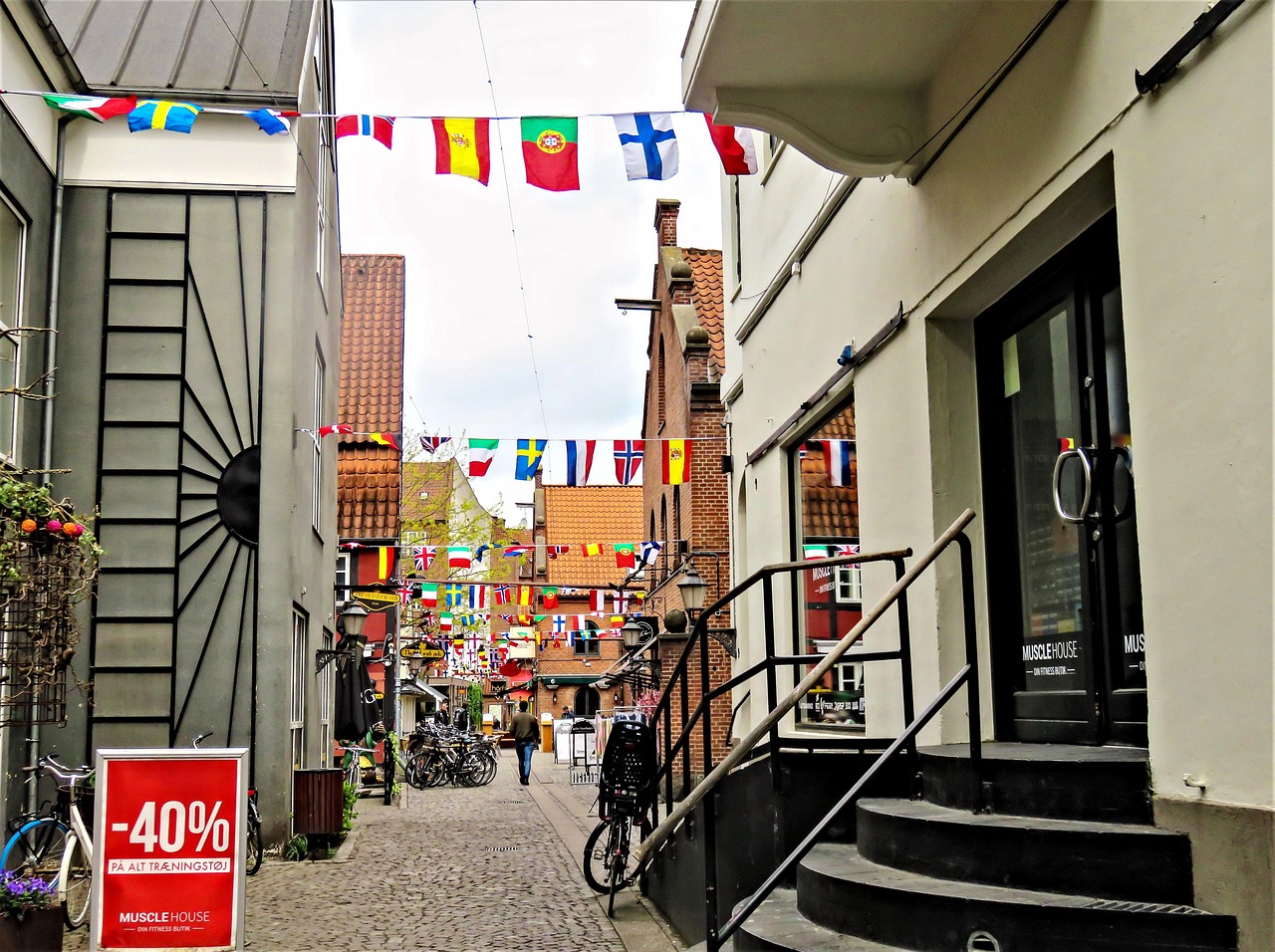
The city is certainly ambitious. As we stood in the new Knowledge City to launch Thinkers50 Europe, I looked out at the nearby campus of the Southern Denmark University. Whilst the robotics engineers inside are hard at work, a new Athletics Exploratorium has been created outside. It’s like an athletics track but different, but built-in hills to extend your workout, human gyroscopes and more. This was partly to test the exo-skeletal designs under research (to help injured people walk again, or workers to carry ultra loads), but has also been recognised by the IAAF and International Olympic Committee as one of the world’s most innovative sporting facilities. Out of another window I can see a new SuperHospital being built for the whole region, bringing together all the best expertise in one place, and on the roads into the city centre, a new high-tech transport system is being installed as the city becomes pedestrianised. On the social calendar is a bewildering choice of entertainment, from classical concerts to rock festivals and gaming fests. If you haven’t heard of Odense, you soon will!

Here is the full press release for the launch of Thinkers50Europe:
Thinkers50, the global platform for management thinking, today announces a groundbreaking new partnership with the city of Odense in Denmark. Thinkers50 Europe will be based in the city, the third biggest in Denmark, and play an important role in Odense’s transformation into a knowledge hub.
“Odense is committed to building its future around knowledge and that really resonated with the objectives of the Thinkers50. We believe in the power of ideas to make the world a better place. We look forward to bringing some of the best ideas in the business world to Odense and also taking some of the most exciting innovations, leaders, thinkers and entrepreneurs in Odense to the world,” says Thinkers50 cofounder Des Dearlove.
Anker Boye, the Mayor of Odense, heralds the launch of Thinkers50 Europe as a major step forward in the city’s development. “We are building a city for the future. We are delighted to welcome the world’s business leaders to Odense, to share the best ideas that will allow local and global businesses to innovate and grow.”
Thinkers50 Europe will bring some of the world’s leading business thinkers to Odense with regular events. It will also serve as a center for the development of new business insights. Thinkers50 research will look at best practice within the Odense region, one of the world’s foremost clusters of knowledge in the field of robotics.
Thinkers50 Europe is a long-term commitment from the city of Odense and represents the first partnership of its kind for the city and Thinkers50. “In the same way as Davos has become a meeting place for world leaders, we would like to imagine Odense could do the same for business thinkers and business leaders. We see it as a potential gamechanger for the city and for Thinkers50,” says leading business author Peter Fisk who has helped the city to develop a new strategy.
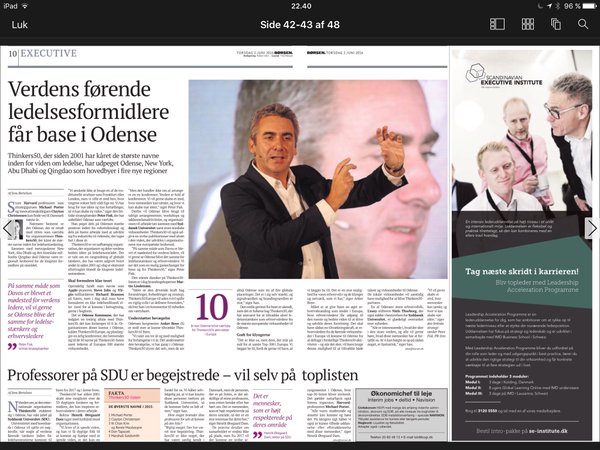
With a population of 190,000 Odense is situated at the heart of Denmark. The city has a long tradition at being at the forefront of ideas. An English Benedictine monk, Aelnoth, based at the city’s St. Knud’s Monastery wrote Denmark’s first literary work in 1100 and, in 1482, a German printer, Johan Snell, printed the first two books in Denmark at the invitation of Odense’s clergy. The city is still best known as the birthplace of Hans Christian Andersen.
Today, the University of Southern Denmark, the broadcaster TV2, and more than 80 innovative companies in the robotic, component, integration and automation sectors are based in Odense, now the world’s third largest hub in the robotics industry. Over the next 10 to 15 years, it is planned that investments totaling 3.2 billion euros will transform Odense into an internationally renowned city of knowledge.

What the world’s business gurus say
Some of the leading business thinkers in the world have commented on the launch of Thinkers50 Europe:
“A city which champions the latest management ideas is unique and groundbreaking. Thinkers50 Europe might well re-invent how we create and access business knowledge.”
Amy C Edmondson, Novartis Professor of Leadership and Management, Harvard Business School
“This is exciting. Ideas need to be at the top of the business agenda. Thinkers50 Europe can help achieve just that.”
Don Tapscott

“At a time when a decent lifestyle seems beyond the aspirations of many, the Danish city of Odense is having none of it. With long-term thinking, integrated plans for infrastructure and development and long-term leadership, Odense has made quality of life the centerpiece of its development philosophy. Next up, a move to becoming a hub for innovation, which is already paying off in its leading position in the robotics industry – just in time for the Internet of Things. Keep an eye on developments from this surprising, intriguing place.”
Rita McGrath, Professor, Columbia Business School, author The End of Competitive Advantage.
“Ideas are the driving force of change, improvement and strategy. Thinkers50 Europe will without any doubt play an important role in how to shape what will come to define the future.”
Martin Lindstrom, author of Buyology and Small Data.
“Odense, Denmark. Haven’t heard of it? You will. With Thinkers50 Europe now headquartered there, it’s about to become the Davos of business ideas.”
Whitney Johnson, author of Disrupt Yourself.
“What Got You Here Won’t Get You There is not only a book title and a concept that applies to leaders, it also applies to cities, nations and regions. Odense is, in many ways, creating the city of the future. It is in the process of transforming from a great city today into an even greater city tomorrow. A dynamic future depends upon the flow of creative, new ideas. Thinkers50 Europe will be a source of thought leadership that can help shape the future of the city and the region. I believe that Thinkers50 Europe will be a huge success. I am looking forward to being both a contributor and learner in this exciting process.”
Marshall Goldsmith, author of What Got You Here Won’t Get You There, winner of the Thinkers50 Leadership award 2015.
Luxury brands need to respond smartly to new key market forces and raise their game when serving the evolving expectations of the luxury consumer, says a new report. With two Swiss companies in the Top 10 – Richemont and Swatch Group – and a total of eleven in the Top 100 ranking, Switzerland confirms its leading role in the global luxury goods industry and especially in the watch industry.
The world’s 100 largest luxury goods companies globally generated sales of $222 billion in the financial year 2014, a 3.6% increase compared to a year before. China, France, Italy, Spain, Switzerland, the UK and the US together are represented by 84% of the Top 100 luxury goods companies and 90% of Top 100 global luxury goods sales in 2014. Last year’s leading country, China/Hong Kong, experienced a decline in sales of 6.8% in 2014, compared to 33.4% growth in 2013. This was due to the ending of the ‘gold rush’ effect that had boosted jewellers’ sales in the years before.
Switzerland ranking high thanks to luxury watches
Switzerland’s luxury good sales are dominated by their top three players: Richemont, Swatch Group, and Rolex, which together account for the large majority of Swiss luxury goods. Richemont retained its #2 position, Swatch regained the #5 position, and Rolex went up one position to #11. Sales growth in luxury goods in Switzerland in 2014 was in line with the global average of the Top 100, at 3.6%, down from 5.4% the year before.
Switzerland remains second to none in luxury watch-making. Nine out of the eleven Swiss companies in the global Top 100 are watchmakers. “The strength of the Swiss brands can be seen in their presence in jewellers and other distribution outlets for luxury watches around the world, as well as in their own growing store networks,” said Karine Szeged of Deloitte.
Decade of change in luxury goods
The luxury goods sector has now passed the mid-point of the ‘decade of change’. The first half was characterized by the Chinese consumer and the explosion in the use of digital technology. The second half of the decade is expected to be characterised by discipline. The external environment is likely to change in a number of crucial areas: an evolution in consumer buying behaviors; the merging of channels and business model complexity; an increase in international travel; the growing importance of the millennial consumer; and the continued impact of the global economy. All of these factors create opportunities for the luxury goods sector.
There is a shift in the luxury path-to-purchase. Empowered by social networks and digital devices, luxury goods consumers are dictating increasingly when, where and how they engage with luxury brands. They have become both critics and creators, demanding a more personalized luxury experience, and expect to be given the opportunity to shape the products and services they consume.
This diagram illustrates the new consumer’s “digitalised” path to purchase:

Useful reports:
Disciplined innovation of luxury brands, Deloitte 2016
Luxury goods worldwide market study, Bain 2016
Engaging the new luxury consumer, Deloitte 2015
I live in the United Kingdom, and spend more time in other parts of Europe than anywhere else. My descendants came from across Europe (a bit Viking and a bit French), my language and culture is European (Anglo Saxon), my grandparents fought to liberate Europe, I spent time living and studying across Europe (mainly in Germany), and most of my business today is across Europe (from Denmark to Italy, Poland to Portugal, and I’m a professor at a Spanish business school).
The UK has always been part of Europe, geographical and cultural, political and economic, a major influence on its history and future. Millions of people died over the last century in the cause of freedom and security across Europe, and a set of common institutions were established to avoid another splintering into chaos. Yet some incredibly small-minded people think that this small island just off the mainland is better off on its own – that it can have more influence and more success in an ever more complex and challenging world. Surely we live in a world where success is achieved through collaboration and partnerships.

Talk to any farmer who depends on EU support for his dairy cows, or small communities who benefit from new EU funded infrastructure, or students who can exchange universities freely with Erasmus, or zero-rated VAT making business easy between EU companies, or reciprocal healthcare whenever I travel anywhere in the EU, or travellers who can choose the faster EU immigration lines at airports, or the many friends and colleagues from other EU countries who live and work in my community, or the expert doctors and builders from other EU countries who have helped me, or the many EU brands and retailers which I favour every day.
Of course nothing is perfect, and the bureaucratic inefficiencies of European institutions are well recognised, not dissimilar from any other big governmental organisation. But they do provide the systems to provide huge benefits too. Some people complain about the billions paid into the European pot, and how they seemingly get little in return. I disagree. They are wrong. But first, there are some principles of how we live together. Any community is about giving and taking in different ways (we all pay taxes, providing schools for those with children, hospitals for those who are sick, support for those who are old, roads for those with cars), supporting those in need, just like we do in our own families and locality.
The EU has a positive influence on everybody’s lives in the UK everyday. To the above examples (of studying, working, travelling etc), add more intangible factors such as economic stability and regional security. London has become Europe’s leading financial centre, generating huge amounts of employment and tax revenues which can be spent on making the UK a better place for its citizens. And of course, whilst migration has become a hugely emotive issue (largely because its confused with other non-EU migration), net migration from EU to UK is relatively small (think how many UK citizens choose to live in other parts of EU), and shown to be a net contributor to the UK economy (i.e. migrants ultimately pay in more than they take out).
Even Scotland becomes a factor. There is a clear scenario where if the majority of UK citizens living in Scotland vote to stay in the EU (maybe they see the benefits more clearly with those long lonely EU subsidised roads across the Highlands!), and the UK overall doesn’t, then the Scots would seek to leave the UK. Leaving an even smaller England (plus the mountains of Wales, and a corner of Ireland) adrift on its own.
So, should the United Kingdom, that little island off the coast of the European mainland cut its ties with the rest of its continent? Should it hope that it can somehow regain its colonial influence across the world, and be stronger alone? Here are some of the quoted statistics favouring being part of EU:
- More jobs … Over 3 million UK jobs are directly linked to exports to the EU, the UK’s largest trading partner – that’s one in every ten UK jobs. Source: HM Treasury
- Lower prices … Being in Europe means lower prices in UK shops, saving the average UK household over £350 a year. If we left Europe, your weekly shop could cost more. Source: London School of Economics
- More growth … Over 200,000 UK businesses trade with the EU, reaching our closest international customers, fast and easily, and helping them create jobs here in the UK. Source: HMRC
- More investment … The UK gets £66 million of investment every day from EU countries – that’s more than we pay to be a member of the EU. Source: Office for National Statistics
- More services … Research shows being in Europe adds up to £91 billion a year to our economy, meaning more money to invest in public services like education and healthcare (Source: Confederation of British Industry).
- More influence … As a leading member of the EU, UK can better influence global policies on security, employment, environment, human rights and much more; with the resulting benefits to all of us. (Source: WEF, BBC)
Every sane mind, particularly those who can see the bigger picture, are in favour of UK in EU. Entrepreneurs like Branson, celebrities like Beckham, politicians like Obama have all gone out of their way to support “remain”. In the US president’s case, he reminded people what their forefathers gave for a better Europe, that we now live in a inter-connected world where influence is stronger and success greater together, and where the US sees Europe as more important than any part.
And watch the financial markets too – every time, there is an opinion poll that suggest an exit, stock exchanges and currency rates plummet, and every time it favours remain, then stocks and sterling soar – UK in EU is good, UK out of EU is bad.
The whole idea, by some narrow-minded, empire-reminiscing, out-of-touch British people that they can prosper alone in today’s world is stupid. Whilst the debate is interesting (for example, the whole notion of where Europe is going, an ever closer union in some eyes, but staying as it is for others), it is also farcical and scary. Every major political party is recommending UK stay in Europe, and almost every business leader, almost every economist, almost every environmentalist, almost every open-minded person, and every sensible piece of logic says the same.
UK leaving the EU is scary and stupid … I hope they come to their senses!
https://www.youtube.com/watch?v=SSnyseu9SMk
https://www.youtube.com/watch?v=MSICM-WDHTY