Elon, if you were 22 today, what would the five problems that you would think about working on be?
“I think if somebody is doing something that is useful to the rest of society, I think that’s a good thing. Like, it doesn’t have to change the world. If you make something that has high value to people… And frankly, even if it’s something, if it’s like just a little game or some improvement in photo sharing or something, if it has a small amount of good for a large number of people, I think that’s fine. Stuff doesn’t need to change the world just to be good. But in terms of things that I think are most like to affect the future of humanity, I think AI is probably the single biggest item in the near-term that’s likely to affect humanity.
So, it’s very important that we have the advent of AI in a good way. It’s something that, if you could look into the crystal ball and to the future, you would like that outcome because it is something that could go wrong, as we’ve talked about many times. And so, we really need to make sure it goes right. So that’s AI, working on AI and making sure it’s great future. That’s the most important thing, I think, right now, the most pressing item. Then, I would say anything to do with genetics. If you can actually solve genetic diseases, if you can prevent dementia or Alzheimer’s or something like that with genetic reprograming, that would be wonderful. So I think genetics might be the sort of second most important item.
And then, I think, having a high-bandwidth interface to the brain. We’re currently bandwidth-limited. We have a digital tertiary self in the form of out email capabilities, our computers, phones, applications. We’re practically superhuman. But we’re extremely bandwidth-constrained in that interface between the cortex and that tertiary digital form of yourself. And helping solve that bandwidth constraint would be, I think, very important in the future as well. Yeah!”
On 20 July 2016, Musk wrote a letter to the world … He called it his Masterplan (Part 2). It followed a similar letter 10 years ago, a vision of the future, but also a plan for action:
Master Plan, Part Deux
Elon Musk 20 July 2016
The first master plan that I wrote 10 years ago is now in the final stages of completion. It wasn’t all that complicated and basically consisted of:
Create a low volume car, which would necessarily be expensive
Use that money to develop a medium volume car at a lower price
Use that money to create an affordable, high volume car
And…
Provide solar power. No kidding, this has literally been on our website for 10 years.
The reason we had to start off with step 1 was that it was all I could afford to do with what I made from PayPal. I thought our chances of success were so low that I didn’t want to risk anyone’s funds in the beginning but my own. The list of successful car company startups is short. As of 2016, the number of American car companies that haven’t gone bankrupt is a grand total of two: Ford and Tesla. Starting a car company is idiotic and an electric car company is idiocy squared.
Also, a low volume car means a much smaller, simpler factory, albeit with most things done by hand. Without economies of scale, anything we built would be expensive, whether it was an economy sedan or a sports car. While at least some people would be prepared to pay a high price for a sports car, no one was going to pay $100k for an electric Honda Civic, no matter how cool it looked.
Part of the reason I wrote the first master plan was to defend against the inevitable attacks Tesla would face accusing us of just caring about making cars for rich people, implying that we felt there was a shortage of sports car companies or some other bizarre rationale. Unfortunately, the blog didn’t stop countless attack articles on exactly these grounds, so it pretty much completely failed that objective.
However, the main reason was to explain how our actions fit into a larger picture, so that they would seem less random. The point of all this was, and remains, accelerating the advent of sustainable energy, so that we can imagine far into the future and life is still good. That’s what “sustainable” means. It’s not some silly, hippy thing — it matters for everyone.
By definition, we must at some point achieve a sustainable energy economy or we will run out of fossil fuels to burn and civilization will collapse. Given that we must get off fossil fuels anyway and that virtually all scientists agree that dramatically increasing atmospheric and oceanic carbon levels is insane, the faster we achieve sustainability, the better.
Here is what we plan to do to make that day come sooner:
Integrate Energy Generation and Storage
Create a smoothly integrated and beautiful solar-roof-with-battery product that just works, empowering the individual as their own utility, and then scale that throughout the world. One ordering experience, one installation, one service contact, one phone app.
We can’t do this well if Tesla and SolarCity are different companies, which is why we need to combine and break down the barriers inherent to being separate companies. That they are separate at all, despite similar origins and pursuit of the same overarching goal of sustainable energy, is largely an accident of history. Now that Tesla is ready to scale Powerwall and SolarCity is ready to provide highly differentiated solar, the time has come to bring them together.
Expand to Cover the Major Forms of Terrestrial Transport
Today, Tesla addresses two relatively small segments of premium sedans and SUVs. With the Model 3, a future compact SUV and a new kind of pickup truck, we plan to address most of the consumer market. A lower cost vehicle than the Model 3 is unlikely to be necessary, because of the third part of the plan described below.
What really matters to accelerate a sustainable future is being able to scale up production volume as quickly as possible. That is why Tesla engineering has transitioned to focus heavily on designing the machine that makes the machine — turning the factory itself into a product. A first principles physics analysis of automotive production suggests that somewhere between a 5 to 10 fold improvement is achievable by version 3 on a roughly 2 year iteration cycle. The first Model 3 factory machine should be thought of as version 0.5, with version 1.0 probably in 2018.
In addition to consumer vehicles, there are two other types of electric vehicle needed: heavy-duty trucks and high passenger-density urban transport. Both are in the early stages of development at Tesla and should be ready for unveiling next year. We believe the Tesla Semi will deliver a substantial reduction in the cost of cargo transport, while increasing safety and making it really fun to operate.
With the advent of autonomy, it will probably make sense to shrink the size of buses and transition the role of bus driver to that of fleet manager. Traffic congestion would improve due to increased passenger areal density by eliminating the center aisle and putting seats where there are currently entryways, and matching acceleration and braking to other vehicles, thus avoiding the inertial impedance to smooth traffic flow of traditional heavy buses. It would also take people all the way to their destination. Fixed summon buttons at existing bus stops would serve those who don’t have a phone. Design accommodates wheelchairs, strollers and bikes.
Autonomy
As the technology matures, all Tesla vehicles will have the hardware necessary to be fully self-driving with fail-operational capability, meaning that any given system in the car could break and your car will still drive itself safely. It is important to emphasize that refinement and validation of the software will take much longer than putting in place the cameras, radar, sonar and computing hardware.
Even once the software is highly refined and far better than the average human driver, there will still be a significant time gap, varying widely by jurisdiction, before true self-driving is approved by regulators. We expect that worldwide regulatory approval will require something on the order of 6 billion miles (10 billion km). Current fleet learning is happening at just over 3 million miles (5 million km) per day.
I should add a note here to explain why Tesla is deploying partial autonomy now, rather than waiting until some point in the future. The most important reason is that, when used correctly, it is already significantly safer than a person driving by themselves and it would therefore be morally reprehensible to delay release simply for fear of bad press or some mercantile calculation of legal liability.
According to the recently released 2015 NHTSA report, automotive fatalities increased by 8% to one death every 89 million miles. Autopilot miles will soon exceed twice that number and the system gets better every day. It would no more make sense to disable Tesla’s Autopilot, as some have called for, than it would to disable autopilot in aircraft, after which our system is named.
It is also important to explain why we refer to Autopilot as “beta”. This is not beta software in any normal sense of the word. Every release goes through extensive internal validation before it reaches any customers. It is called beta in order to decrease complacency and indicate that it will continue to improve (Autopilot is always off by default). Once we get to the point where Autopilot is approximately 10 times safer than the US vehicle average, the beta label will be removed.
Sharing
When true self-driving is approved by regulators, it will mean that you will be able to summon your Tesla from pretty much anywhere. Once it picks you up, you will be able to sleep, read or do anything else enroute to your destination.
You will also be able to add your car to the Tesla shared fleet just by tapping a button on the Tesla phone app and have it generate income for you while you’re at work or on vacation, significantly offsetting and at times potentially exceeding the monthly loan or lease cost. This dramatically lowers the true cost of ownership to the point where almost anyone could own a Tesla. Since most cars are only in use by their owner for 5% to 10% of the day, the fundamental economic utility of a true self-driving car is likely to be several times that of a car which is not.
In cities where demand exceeds the supply of customer-owned cars, Tesla will operate its own fleet, ensuring you can always hail a ride from us no matter where you are.
So, in short, Master Plan, Part Deux is:
Create stunning solar roofs with seamlessly integrated battery storage
Expand the electric vehicle product line to address all major segments
Develop a self-driving capability that is 10X safer than manual via massive fleet learning
Enable your car to make money for you when you aren’t using it
Exponential thinking is not just about thinking big, it is about the steps to go from small to big. If I were to take 30 linear steps, I’d end up 30 metres away. But if I said to you take 30 exponential steps, one, two, four, eight, sixteen, thirty-two and said where would you end up? The answer is a billion metres away, or twenty-six times around the planet.
The term is often associated with Peter Diamandis, author of Abundance and Bold and founder of the X Prize. In 2008, he co-founded Singularity University.
Diamandis says “We’re heading towards a world of perfect knowledge. With a trillion sensors gathering data everywhere (autonomous cars, satellite systems, drones, wearables, cameras), you’ll be able to know anything you want, anytime, anywhere, and query that data for answers and insights.”
In 2025 he believes that we’ll see an acceleration in the rate of change as we move closer to a world of true abundance. Here are eight areas where we’ll see extraordinary transformation in the next decade:
The $1000 Human Brain … in 2025, $1,000 should buy you a computer able to calculate at 10^16 cycles per second (10,000 trillion cycles per second), the equivalent processing speed of the human brain.
1 Trillion Sensors … by 2025 the internet of things will exceed 100 billion connected devices, each with a dozen or more seniors collecting data. This will lead to a data revolution, with $19 trillion value (Cisco).
Perfect knowledge … with a trillion sensors gathering data everywhere (autonomous cars, satellite systems, drones, wearables, cameras), you’ll be able to know anything you want, anytime, anywhere.
Hyper-connected Earth … Facebook (Internet.org), SpaceX, Google (Loon), Qualcomm and Virgin (OneWeb) will provide global connectivity to every human on Earth at speeds exceeding 1MB/second. We will grow from three to eight billion connected humans, adding five billion new consumers into the global economy. They represent tens of trillions of new dollars flowing into the global economy. And they are not coming online like we did 20 years ago with a 9600 modem on AOL. They’re coming online with a 1 Mbps connection and access to the world’s information on Google, cloud 3D printing, Amazon Web Services, artificial intelligence with Watson, crowdfunding, crowdsourcing, and more.
Disputed healthcare ... Existing healthcare institutions will be crushed as new business models with better and more efficient care emerge. Thousands of startups, as well as today’s data giants (Google, Apple, Microsoft, SAP, IBM, etc.) will all enter this lucrative $3.8 trillion healthcare industry with new business models that dematerialize, demonetize and democratize today’s bureaucratic and inefficient system. Biometric sensing (wearables) and AI will make each of us the CEOs of our own health. Large-scale genomic sequencing and machine learning will allow us to understand the root cause of cancer, heart disease and neurodegenerative disease and what to do about it. Robotic surgeons can carry out an autonomous surgical procedure perfectly (every time) for pennies on the dollar. Each of us will be able to regrow a heart, liver, lung or kidney when we need it, instead of waiting for the donor to die
Augmented and virtual reality ... Billions of dollars invested by Facebook (Oculus), Google (Magic Leap), Microsoft (Hololens), Sony, Qualcomm, HTC and others will lead to a new generation of displays and user interfaces. The screen as we know it — on your phone, your computer and your TV — will disappear and be replaced by eyewear. Not the geeky Google Glass, but stylish equivalents to what the well-dressed fashionistas are wearing today. The result will be a massive disruption in a number of industries ranging from consumer retail, to real estate, education, travel, entertainment, and the fundamental ways we operate as humans.
Early days of JARVIS … Artificial intelligence research will make strides in the next decade. If you think Siri is useful now, the next decade’s generation of Siri will be much more like JARVIS from Iron Man, with expanded capabilities to understand and answer. Companies like IBM Watson, DeepMind and Vicarious continue to hunker down and develop next-generation AI systems. In a decade, it will be normal for you to give your AI access to listen to all of your conversations, read your emails and scan your biometric data because the upside and convenience will be so immense
Blockchain … If you haven’t heard of the blockchain, I highly recommend you read up on it. You might have heard of bitcoin, which is the decentralized (global), democratized, highly secure cryptocurrency based on the blockchain. But the real innovation is the blockchain itself, a protocol that allows for secure, direct (without a middleman), digital transfers of value and assets (think money, contracts, stocks, IP). Investors like Marc Andreesen have poured tens of millions into the development and believe this is as important of an opportunity as the creation of the Internet itself.
So what should you do?
Explore more exponential thinking with Peter Fisk … inspiring keynotes, practical workshops, and accelerated strategy and innovation consulting to help your business growth further and faster.
More blog posts:
Exponential Business … how to grow faster with ideas, accelerators and multipliers
Exponential thinking is not just about thinking big, it is about the steps to go from small to big. If I were to take 30 linear steps, I’d end up 30 paces or 30 meters away. But if I said to you take 30 exponential steps, one, two, four, eight, sixteen, thirty-two and said where would you end up? The answer is a billion meters away, or twenty-six times around the planet.
The term exponential is often often associated with Ray Kurzweil, an expert in artificial intelligence and director of engineering at Google. Inc Magazine ranked him #8 among the “most fascinating” entrepreneurs in the USA today, and called him “Edison’s rightful heir”.
Kurzweil argues that as humans, we are biased to think linearly. As entrepreneurs, we need to think exponentially. He often talk about the 6D’s of exponential thinking … Most of us can’t see the things Ray sees because the initial growth stages of exponential, DIGITIZED technologies are DECEPTIVE. Before we know it, they are DISRUPTIVE—just look at the massive companies that have been disrupted by technological advances in AI, virtual reality, robotics, internet technology, mobile phones, OCR, translation software, and voice control technology. Each of these technologies DEMATERIALIZED, DEMONETIZED, and DEMOCRATIZED access to services and products that used to be linear and non-scalable.
https://www.youtube.com/watch?v=DIIUNtUVDPI
In 1990 (25 years ago), he predicted that a computer would defeat a world chess champion by 1998. Then in 1997, IBM’s Deep Blue defeated Garry Kasparov. He also said that PCs would be capable of answering queries by accessing information wirelessly via the Internet by 2010. He was right, to say the least. And that by the early 2000s, exoskeletal limbs would let the disabled walk. Companies like Ekso Bionics and others now have technology that does just this, and much more.
In 1999, he predicted that people would be able talk to their computer to give commands by 2009. While still in the early days in 2009, natural language interfaces like Apple’s Siri and Google Now have come a long way. I rarely use my keyboard anymore; instead I dictate texts and emails. He also envisioned that computer displays would be built into eyeglasses for augmented reality by 2009. Labs and teams were building head mounted displays well before 2009, but Google started experimenting with Google Glass prototypes in 2011. Now, we are seeing an explosion of augmented and virtual reality solutions and HMDs. Microsoft just released the Hololens, and Magic Leap is working on some amazing technology, to name two.
In 2005, he predicted that by the 2010s, virtual solutions would be able to do real-time language translation in which words spoken in a foreign language would be translated into text that would appear as subtitles to a user wearing the glasses. Well, Microsoft (via Skype Translate), Google (Translate), and others have done this and beyond. One app called Word Lens actually uses your camera to find and translate text imagery in real time.
Here are Kurzweil’s predictions for the next 30 years:
By the late 2010s, glasses will beam images directly onto the retina. Ten terabytes of computing power (roughly the same as the human brain) will cost about $1,000.
By the 2020s, most diseases will go away as nanobots become smarter than current medical technology. Normal human eating can be replaced by nanosystems. The Turing test begins to be passable. Self-driving cars begin to take over the roads, and people won’t be allowed to drive on highways.
By the 2030s, virtual reality will begin to feel 100% real. We will be able to upload our mind/consciousness by the end of the decade.
By the 2040s, non-biological intelligence will be a billion times more capable than biological intelligence (us). Nanotech foglets will be able to make food out of thin air and create any object in physical world at a whim.
By 2045, we will multiply our intelligence a billionfold by linking wirelessly from our neocortex to a synthetic neocortex in the cloud.
Explore more exponential thinking with Peter Fisk … inspiring keynotes, practical workshops, and accelerated strategy and innovation consulting to help your business growth further and faster.
More blog posts:
Exponential Business … how to grow faster with ideas, accelerators and multipliers
Fortunately, businesspeople and psychologists have developed useful frameworks that describe the main ways that people lead. When you understand these frameworks, you can develop your own approach to leadership, and become a more effective leader as a result.
In this article and video, we’ll highlight some of the common approaches to leadership that you can use. We’ll also look at some specific styles of leadership, and we’ll explore the advantages and disadvantages of each.
Useful Leadership Style Frameworks
So, let’s look at some useful approaches – shown mainly in the order they appeared – that you can use to become a more effective leader. Your own, personal approach is likely to be a blend of these, depending on your own preferences, your people’s needs, and the situation you’re in.
Lewin’s Leadership Styles
Psychologist Kurt Lewin developed his framework in the 1930s, and it provided the foundation of many of the approaches that followed afterwards. He argued that there are three major styles of leadership:
Autocratic leaders make decisions without consulting their team members, even if their input would be useful. This can be appropriate when you need to make decisions quickly, when there’s no need for team input, and when team agreement isn’t necessary for a successful outcome. However, this style can be demoralizing, and it can lead to high levels of absenteeism and staff turnover.
Democratic leaders make the final decisions, but they include team members in the decision-making process. They encourage creativity, and people are often highly engaged in projects and decisions. As a result, team members tend to have high job satisfaction and high productivity. This is not always an effective style to use, though, when you need to make a quick decision.
Laissez-faire leaders give their team members a lot of freedom in how they do their work, and how they set their deadlines. They provide support with resources and advice if needed, but otherwise they don’t get involved. This autonomy can lead to high job satisfaction, but it can be damaging if team members don’t manage their time well, or if they don’t have the knowledge, skills, or self motivation to do their work effectively. (Laissez-faire leadership can also occur when managers don’t have control over their work and their people.)
Lewin’s framework is popular and useful, because it encourages managers to be less autocratic than they might instinctively be.
The Blake-Mouton Managerial Grid
The Blake-Mouton Managerial Grid was published in 1964, and it highlights the most appropriate style to use, based on your concern for your people and your concern for production/tasks.
With a people-oriented style, you focus on organizing, supporting, and developing your team members. This participatory style encourages good teamwork and creative collaboration.
With task-oriented leadership, you focus on getting the job done. You define the work and the roles required, put structures in place, and plan, organize, and monitor work.
According to this model, the best style to use is one that has both a high concern for people and a high concern for the task – it argues that you should aim for both, rather than trying to offset one against the other. Clearly, this is an important idea!
Path-Goal Theory
You may also have to think about what your team members want and need. This is where Path-Goal Theory – published in 1971 – is useful.
For example, highly-capable people, who are assigned to a complex task, will need a different leadership approach from people with low ability, who are assigned to an ambiguous task. (The former will want a participative approach, while the latter need to be told what to do.)
With Path-Goal Theory, you can identify the best leadership approach to use, based on your people’s needs, the task that they’re doing, and the environment that they’re working in.
Six Emotional Leadership Styles
Daniel Goleman, Richard Boyatzis, and Annie McKee detailed their Six Emotional Leadership Styles theory in their 2002 book, “Primal Leadership.”
The theory highlights the strengths and weaknesses of six common styles – Visionary, Coaching, Affiliative, Democratic, Pacesetting, and Commanding. It also shows how each style can affect the emotions of your team members.
Flamholtz and Randle’s Leadership Style Matrix
First published in 2007, Flamholtz and Randle’s Leadership Style Matrix shows you the best style to use, based on how capable people are of working autonomously, and how creative or “programmable” the task is.
The matrix is divided into four quadrants – each quadrant identifies two possible styles that will be effective for a given situation, ranging from “autocratic/benevolent autocratic” to “consensus/laissez-faire.”
Transformational Leadership
The leadership frameworks discussed so far are all useful in different situations, however, in business, “transformational leadership” is often the most effective style to use. (This was first published in 1978, and was then further developed in 1985.)
Transformational leaders have integrity and high emotional intelligence. They motivate people with a shared vision of the future, and they communicate well. They’re also typically self-aware, authentic, empathetic, and humble.
Transformational leaders inspire their team members because they expect the best from everyone, and they hold themselves accountable for their actions. They set clear goals, and they have good conflict-resolution skills. This leads to high productivity and engagement.
However, leadership is not a “one size fits all” thing; often, you must adapt your approach to fit the situation. This is why it’s useful to develop a thorough understanding of other leadership frameworks and styles; after all, the more approaches you’re familiar with, the more flexible you can be.
Specific Leadership Styles
As well as understanding the frameworks that you can use to be a more effective leader, and knowing what it takes to be a transformational leader, it’s also useful to learn about more general styles, and the advantages and disadvantages of each one.
Let’s take a look at some other styles of leadership that are interesting, but don’t fit with any of the frameworks above.
Bureaucratic Leadership
Bureaucratic leaders follow rules rigorously, and ensure that their people follow procedures precisely.
This is appropriate for work involving serious safety risks (such as working with machinery, with toxic substances, or at dangerous heights), or with large sums of money. Bureaucratic leadership is also useful for managing employees who perform routine tasks.
This style is much less effective in teams and organizations that rely on flexibility, creativity, or innovation.
Charismatic Leadership
Charismatic leadership resembles transformational leadership: both types of leaders inspire and motivate their team members.
The difference lies in their intent. Transformational leaders want to transform their teams and organizations, while leaders who rely on charisma often focus on themselves and their own ambitions, and they may not want to change anything.
Charismatic leaders might believe that they can do no wrong, even when others warn them about the path that they’re on. This feeling of invincibility can severely damage a team or an organization, as was shown in the 2008 financial crisis.
Servant Leadership
A “servant leader” is someone, regardless of level, who leads simply by meeting the needs of the team. The term sometimes describes a person without formal recognition as a leader.
These people often lead by example. They have high integrity and lead with generosity. Their approach can create a positive corporate culture, and it can lead to high morale among team members.
Supporters of the servant leadership model suggest that it’s a good way to move ahead in a world where values are increasingly important, and where servant leaders can achieve power because of their values, ideals, and ethics.
However, others believe that people who practice servant leadership can find themselves “left behind” by other leaders, particularly in competitive situations.
This style also takes time to apply correctly: it’s ill-suited to situations where you have to make quick decisions or meet tight deadlines.
Transactional Leadership
This style starts with the idea that team members agree to obey their leader when they accept a job. The “transaction” usually involves the organization paying team members in return for their effort and compliance on a short-term task. The leader has a right to “punish” team members if their work doesn’t meet an appropriate standard.
Transactional leadership is present in many business leadership situations, and it does offer some benefits. For example, it clarifies everyone’s roles and responsibilities. And, because transactional leadership judges team members on performance, people who are ambitious or who are motivated by external rewards – including compensation – often thrive.
The downside of this style is that, on its own, it can be chilling and amoral, and it can lead to high staff turnover. It also has serious limitations for knowledge-based or creative work.
As a result, team members can often do little to improve their job satisfaction.
Summary
In business, transformational leadership is often the best leadership style to use.
However, no one style of leadership fits all situations, so it’s useful to understand different leadership frameworks and styles. You can then adapt your approach to fit your situation.
Nest, the brand of cool thermostats seeking to do for the home, what the iPod did for music recognises the emotion associated with making the home a smarter, better place to love …
“We love home. It’s the best place in the world. But not everything inside our homes is lovable. There are things that beep at us; fail without warning; keep us in the dark. There are things we’ve learned to ignore. We think they should do more. Nest is focused on making simple, human, delightful things. That’s how we’re creating the thoughtful home: A home that takes care of the people inside it and the world around it”.
It almost sounds like Apple, but then Nest founder Tony Fadell is the man who created the iPod back in his days alongside Steve Jobs. Of course the Nest Labs, maker of the learning thermometer, smoke detectors and security systems, was acquired by Google for $3.2bn in 2014, and has since gone on to create a wide range of home tech devices.
Startups are transforming homes with products such as smart locks, doorbells, lighting, along with products to kit out homes for pets and babies, and much more.
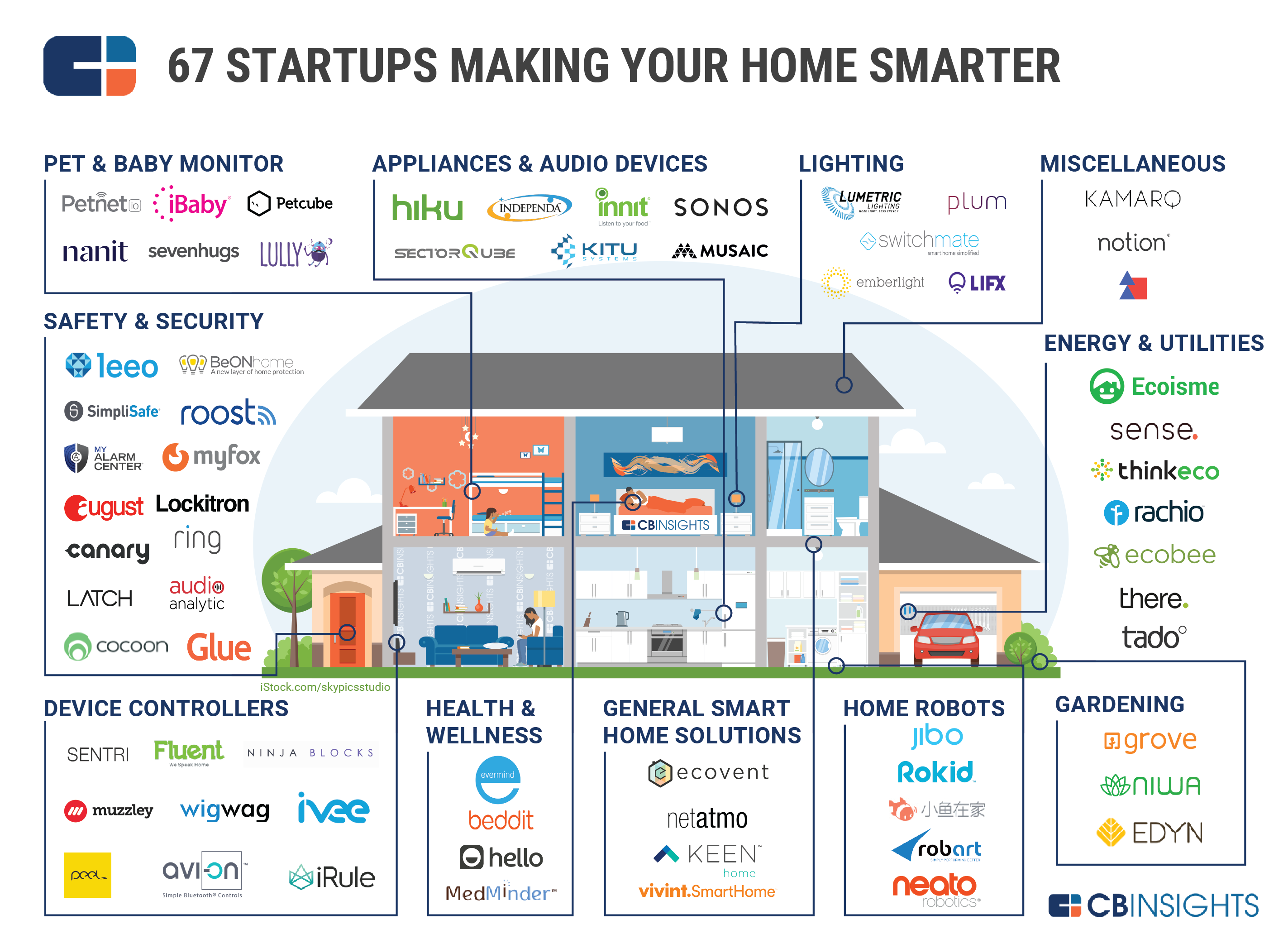
My friends at CB Insights have a particular interest in the amount of start-up activity, and investment, focused on the smart home. This includes companies producing consumer-facing products that replace or augment existing home products such as appliances, with the requirement that they be connected to a smartphone or the internet, or integrate sensors and digital interfaces. Here is their map:
The map explores innovators in the following categories:
Appliances & Audio Devices: These include household products that function as a conventional appliance or device, yet offer advantages through connectivity, such as Sectorqube‘s MAID Oven and Sonos‘ smart home speakers. Sonos is the most well-funded smart home startup in terms of equity financing.
Device Controllers: While most startups produce individual smart home products, these companies produce the devices controlling them. Examples are Peel‘s universal remote and Ivee‘s personal voice assistant, advertised as “Siri for the home.” Both of these companies have received VC funding from Lightspeed Venture Partners and Foundry Group. Most of these products are able to control smart home products from other companies such as Philips and Nest.
Energy & Utilities: These are companies that utilize sensors, monitoring tech, and data to conserve water and energy. Ecobee and Rachio, for instance, develop products that monitor and control AC and water sprinkler systems respectively, to help make consumption more efficient. Interestingly, several startups in this category have received funding from corporations and corporate venture capital firms, such as Carrier Corporation, which backed Ecobee, and Amazon’s Alexa Fund, which backed Rachio.
Gardening: These companies focus on producing smart products for watering and monitoring household yards, gardens, and plants. This is one of the smaller categories in terms of number of companies. The most well-funded startup in this category is Edyn, which recently raised a $2M Series A round.
General Smart Home Solutions: Instead of producing a single smart gadget, these companies build or distribute multi-device systems that automate several parts of your home, such as ecoVent‘s custom vent/sensor system or Vivint‘s third-party device bundles. Vivint, specifically, has secured $145M in equity funding — second in smart homes only to Sonos.
Health & Wellness: These are products that assist home occupants in maintaining their health and lifestyle, such as MedMinder Systems‘ smart medicine containers and Beddit‘s under-the-bed health sensor. A notable deal in this category is Hello‘s $40M Series A round last year, which made it the most well-funded smart home startup in health & wellness, with over $50M in equity funding.
Home Robots: This category is home to companies that produce robots specifically for maintenance and assistance in a home environment. These include robotic assistant Jibo, whose total equity funding is currently at $52M, and home cleaning robot Neato.
Lighting: Taking cues from products such as the Philips Hue, companies like Sequioa Capital-backed LIFX are coming up with their own app-controlled lightbulbs. Others such as Switchmate are going beyond the bulb and building app-controllable light switches.
Pet/Baby Monitors: These companies focus on producing video monitors and sensors to monitor pets and babies through the comfort of a smartphone. Most startups in this space, such as Y Combinator alumni Lully and Petcube, are young and still in their early stages of funding.
Safety & Security: These companies utilize the internet and home automation technologies to help protect you and your home with monitors, internet-enabled locks, smart smoke detectors, and more. This is one of the larger and more well-funded categories, as companies in this space include Ring, Simplisafe, August Home, and Canary, which have all received over $40M in equity funding.
Miscellaneous: Startups in this category have particularly unique offerings, such as Electric Objects‘ dynamic art display, Kamarq‘s sound table, and Notion‘s universal sensor.
Self-driving cars have been much talked about over the last 12 months, but for most of us it still seemed like science fiction. Distracted by the sleek electric vision of Tesla, self-driving seemed like a step beyond in terms of industry change, but has now suddenly become a reality.
In Singapore, today. The world’s first self-driving taxis were launched, not by Google, Tesla or Uber … but by nuTonomy … Simply download the app, hail the taxi, and its free. Well, at least the trial phase is. And just for reassurance, there’s actually still somebody in the driving seat, to monitor performance and as a back-up.
nuTonomy is a US-based start-up developer of software for self-driving cars. The company was founded in 2013 by two world-renowned experts in robotics and intelligent vehicle technology, Drs. Karl Iagnemma and Emilio Frazzoli of MIT. The company has offices both in the US and in Singapore. Earlier this year, nuTonomy was the first company to get permission from the Singapore government to test self-driving cars, in a small area of the town. It’s now progressed to taking passengers.
Whilst many people looked to the conventional car manufacturer brands to shape the future, it was always more likely that those with adjacent capabilities (like software, or charging, or marketing – Google, Better Place, or Uber) would “change the game” – redefine customer aspirations, business models, and the way the industry works.
nuTonomy is not a car manufacturer, so don’t expect sic-fi-looking cars to start navigating that Orchard Road traffic today. Instead a range of Renault and Mitsubishi electric vehicles have been equipped with the company’s complex system of cameras and lasers that operate like a radar to monitor the car’s surrounding. Which is certainly a step up from autonomy’s initial trial vehicles, which were electric golf carts.
The taxis will run in a limited 4 sq km area in the west of Singapore, with designated pick-up and drop-off spots so you can’t yet get on or off wherever you prefer.
The choice Singapore as a start-up location is important. It is already a taxi heaven. Owning your own car is mind-bogglingly expensive and many people take taxis on a regular basis. Cab rides are cheap and there’s a very high demand. Add the rather disciplined and organised approach to traffic. When Singaporeans talks about a traffic jam, all they mean are a few cars more than usual at a traffic light!
nuTonomy’s goal is to expand it to a fully self-driving taxi fleet in Singapore by 2018.
Of course nuTonomy is not only company with a self-driving vision. Uber seeks to launch its own service on the streets of Pittsburgh USA over the next few weeks. Google was one of the first to openly declare its vision, and seeks to have been testing driverless cars at its GoogleX Moonshot Factory for years now. Tesla too, has a bold vision. Not just of driverless cars, but driverless car sharing was a corner stone of Elon Musk’s new strategy launched last month.
So remember today as one of those pivotal moments in the fast-changing world of automotive. Like every industry, the game is changing at incredible speed. As a like to start my keynotes, we will see more change in the next 15 years, than the last 300 years.
Who will be the nuTonomy of your market? How could it to be you? Time to shape the future in your own vision.
Growth Champions is a global research project seeking to track and interpret the best ideas for growth.
20 global companies were studied in detail, each having successfully built a culture and strategy that delivers growth and beats the competition. The companies included Apple, Google, Amazon, Samsung, Rolls-Royce, Procter & Gamble, Shell and Lego. While many share some common traits and ambitions, they differ in how they formulate and execute their strategies, how they engage people, how they build their growth culture, and how they develop and use distinctive competencies to keep them ahead of the pack.
The research shows that success is not just down to the nature of the firm, nor is it due to the decisions that are taken in terms of how, where, and why to play in different fields. Success is driven by the unification of culture and strategy around the growth ambition and then linked to the competences and capabilities available to the company. The profiles and analysis all point to sustained growth being an integrated outcome of these two very different issues into a coherent and well-focused whole. The key lessons can be summarised into six groups:
Leadership
Passionate leadership really matters, even in a mature business. A leader who is prepared to challenge conventional wisdoms, internally and externally, and put an aspirational stake in the ground gives the organization focus.
Having the CEO as champion and lead, not just sponsor, the growth agenda engages everyone and can bring about fundamental change in the business and its performance.
Succession planning is important and promoting from within provides continuity and a leadership who understands the culture and shares the values of the organization.
Clarity of Ambition
Growth aspirations need to both inspire and be specific enough to create focus – ideally they engage the rational and the emotional side in a coherent mix.
Ambition needs to be reflected in the day-to-day business activities and made tangible though clear targets and believable principles.
Shared Values
Aligned leadership, ambition, and values driven from the top are key to inspiring exceptional performance from within the organization and forming deep relationships with external stakeholders.
Clear ambitions that fit with the organizational values enable all employees to believe that they are doing something worthwhile.
Organizational Confidence
Companies need to have an acute understanding of their distinctive competences and areas of weakness and then build an organization that amplifies those competences and addresses the weaknesses.
A clear ambition grounded in proven capability and genuine aspiration builds the confidence that an organization is making the right decisions and moving forward with its eyes open.
Innovation in the DNA
Successful growth comes from relentless focus on innovation across the board. From core products and services to internal processes and new business models, multifaceted innovation is critical.
Innovation should be anchored in the company’s ambition, so it has both context and is a sustainable part of the corporate fabric.
Talking about innovation is easy but you must support what you say with what you can see in the organization – the structures and systems that support and reward innovation are balanced with creativity and autonomy – and this translates into what you do and how you do things.
Neither R&D investment nor media messaging can be taken as the sole indicators of how innovative a company is. Growth does not come from a single activity but rather from a flexible combination of many factors.
Foresight and Insight
Growth Champions have demonstrated the ability to understand the insights and implications for their industry and business and turn that into actions that result in innovation and exceptional growth.
Companies that understand the forces and trends shaping their markets and the implications combined with the insights from today are better positioned to lead in emerging opportunities. In an increasingly turbulent world this capability will become more valuable and will often distinguish winners from losers.
This capability must be an integral part of a company’s strategic planning: foresight and insight alone do not deliver growth – they have to inform and drive action.
Return of the Conglomerate
Diversified and somewhat integrated conglomerates can work and be highly competitive against more focused peers.
No single conglomerate model guarantees success but the chosen model should be aligned with the organizational culture, capabilities, and leadership’s ambition.
Conglomerates enable in-house knowledge transfer and capability building across different sectors.
10 characteristics of growth champions
From this project, it is clear that not only is growth still a universally attractive ambition, but that its manifestation is highly varied. From the insights it is evident that any company wishing to successfully grow needs to pay attention to a number of core points. Although there is no master to-do list for growth, from all the analysis and discussions, we can see the unmistakable ingredients that support success, not only in the companies profiled, but also in others that were part of the wider analysis that informed this project. We see ten core implications for the future of successful and sustained growth.
1. Clear Ambition
Growth Champions know what and where is the prize. They know whether there is a ‘gap in the market and a market in the gap’ and also have a clear view on how to create a new market that will be a sustained growth platform. The leaders in their fields know what will differentiate a company from tomorrow’s competition just as much as today’s and in making full use of this have a clear, succinct and individual ambition that employees, customers and wider stakeholder all understand.
2. Distinctive Competence
While many organizations have identified capabilities and competences that enable them to operate and deliver products and services to their customers, few seem to have distinctive competences. Although the associated thinking has been around for many years, surprisingly few firms are yet to be clear about their real and defendable USP, what advantage it gives you and for how long. The Growth Champions by contrast do know and even those that don’t yet possess a truly future-proof distinctive competence, recognize what it should be and how they can most effectively build and develop it.
3. Innovation Priority
Successful companies not only innovate better than their peers, but they also have clear priority. They know where to most effectively innovate to put clear blue water between themselves and the competition. They use multiple innovation across product, service and business model to create a complete innovation ecosystem, and they recognize what will be the future priority and why.
4. Unique Insight
While many organizations have access to ever better insights, many are buying them off the shelf using the same suppliers as their peers. The Growth Champions really know what is it that is needed next ahead of their peers. They have experience and informed gut feel, but they also have evidence from bespoke research. The organizations that win by placing informed bets do so because they have unique insight.
5. Organizational Confidence
All the companies profiled have self-belief in what they are doing and why. They are all confident that they can deliver their respective ambitions. Partly this is based on a track record of exceptional delivery and both understanding and nurturing their distinctive competencies. However, it is also very much seeding in a conviction that they are sure that they are doing the right thing and that you can do it well – and better than anyone else.
6. Risk Appetite
The interplay between success and failure is a well-debated issue. While some companies favor processes to reduce failure, others permit creativity and experimentation. However, the Growth Champions all have a proportionate appetite for risk: Some will gives things a go, even before they are 100% defined, and are confident that they can learn quickly from mistakes and manage the upside. Others keep everything internal and obsessively experiment within the tent so that what gets delivered is as close to perfect as they can make it. However both extremes are comfortable with risk and see it as an essential ingredient.
7. Innovation Balance
Linked to but distinct from the above, the successful growth companies of the past few years have the right balance between systematic innovation and creativity. Within their organizations, the culture and structure is in place to enable both to co-exist and work together. Whether as part of a planned portfolio of activities or as a core element for every growth platform, they balance the level of innovation as much as the type. Incremental and disruptive products, services and business models are emerging simultaneously from within single organizations as part of a coherent strategy.
8. Disruptive Innovation
Conventional thinking has it that disruption usually happens when small companies want to take on big ones and introduce change into a market. What is clear from many of the companies profiled is that disruption is no longer the sole property of startups – the growth champions clearly show that disruptive innovation can be nurtured and thrive within large corporations to deliver transformational growth. Some have done it, some are doing it and others are getting ready to do it. But for all, disruptive innovation is no longer something just done to them but can also be a source of major growth as well.
9. Aligned Investment
After years of analysis, it is clear to the majority that innovation pays dividends but requires support. Whether solely focused to organic growth or including the targeted acquisition of new capabilities, the investments being made on delivering the future growth platforms is evidently aligned with the growth strategy. Access to lower cost capital than peers is critical for many and, whether from internal or external sources, is increasingly being well used. The high return on innovation achieved by the Growth Champions relies equally on innovation impact as it does on well-focused investment where it matters most.
10. Acting at Speed
Lastly, we come to speed. Across virtually all of the examples, being fast to market – either as a leader or a follower has been a critical commonality. Whether exploiting new technologies and business models ahead of peers, or doing a better job soon after their first move, Growth champions operate at a speed that eclipses the competition. These companies have accelerated cycle times and in many cases halved their industry’s established clock speed. They deliver the core incremental changes better and faster than the competition while also creating the next big thing that disrupts the market.
What consumers truly value can be difficult to pin down and psychologically complicated. But universal building blocks of value do exist, creating opportunities for companies to improve their performance in existing markets or break into new markets. In the right combinations, the authors’ of a fabulous article in this month’s HBR describe how those elements will pay off in stronger customer loyalty, greater consumer willingness to try a particular brand, and sustained revenue growth.
Three decades of experience doing consumer research and observation for corporate clients led the authors—all with Bain & Company—to identify 30 “elements of value.” Their model traces its conceptual roots to Abraham Maslow’s “hierarchy of needs” and extends his insights by focusing on people as consumers: describing their behavior around products and services. They arrange the elements in a pyramid according to four kinds of needs, with “functional” at the bottom, followed by “emotional,” “life changing,” and then “social impact” at the peak.
The article includes real-world examples to demonstrate how companies have used the elements to grow revenue, refine product design to better meet customers’ needs, identify where customers perceive strengths and weaknesses, and cross-sell services.
There are a lot of ordinary companies run by average leaders. And then there are extraordinary visionaries like Elon Musk, who set revolutionary ideas into motion and convince people to believe in big, important visions. Musk’s otherworldly ambition, divine purpose, defiance of the status quo and fierce commitment to his work is sacred and deeply personal. While we don’t all have the means to launch groundbreaking moonshots like Musk, he offers important principles that entrepreneurs can learn from.
The five leadership traits outlined below will help you hone your leadership chops and be the force behind an extraordinary company.
1. Be obsessed and obsessive.
Many leaders share the mindset to “just get it done” or accept it’s good enough even when it’s not. This kind of thinking makes many companies mediocre. Musk is the opposite. He isn’t just passionate about what he does, he’s obsessed with it. His work is his oxygen. The hustle is real. He’s admitted to devoting nearly every waking hour to shaping his ideas and executing them. He’s obsessed with the tiniest of details and sets extremely high expectations for himself, his products and his team. He’s been accused of being uncompromising and unreasonable, of tearing things apart and starting over, of criticizing the poor performers around him and of pushing beyond limits. By having a relentless work ethic, striving for excellence and not settling on mediocrity, you’ll set yourself apart from everyone else who’s willing to play safe and accept good enough.
2. Love the brand like a religion.
From his inspirational TED talks to his veracious vision for a sustainable future, Musk’s personal love of Tesla and his other companies is undeniably contagious. His work is highly personal to him. It’s born from the heart, nurtured into existence, fiercely guarded and passionately loved. This conviction fuels trust, adoration and even worship. As a leader, you teach others how to treat your brand by how you treat your brand. If you want others to love it,you have to love it. If you want the brand to run through their veins, it has to run through yours first. The consumer-made “Fireflies” video below demonstrates how passionate Tesla’s fans are. The video depicts a future devoid of fossil fuels with Tesla at the forefront of a clean energy revolution. More effective than any paid campaign, user-generated content is a symbol of love and loyalty. By pouring your heart into your work and inviting people to participate in your vision, you can attract swarms of dazzled fans willing to show you their love and respect.
3. Transform your industry by doing the impossible.
In the words of Muhammad Ali, “Impossible is just a word thrown around by small men who find it easier to live in the world they’ve been given than to explore the power they have to change it. Impossible is not a fact. It’s an opinion. Impossible is potential. Impossible is temporary. Impossible is nothing.” Musk’s enormous ambition to do what everyone says can’t be done far exceeds everyone around him. Doing the impossible starts with having a grand, albeit crazy, vision. Most organizations have vision statements, but few are truly visionary. Leaders who lack vision cannot inspire teams, motivate performance or create anything of real value. Poor vision, narrow vision or non-existent vision causes leaders and companies to fail. By having an inspiring vision and communicating the value of the vision, you show the way forward for your team and audience.
4. Ignore the vision stealers and dream crushers.
Musk has spent his entire life proving people wrong. He has effectively built an army of people that believe in his mission and support his every move. Musk isn’t swayed by those who doubt him. Despite considerable amounts of skepticism, he continues to fight for his beliefs and challenge the naysayers. Take his response to the Model S erupting in fire. This self-authored post on the Tesla blog explains the technical crash details and discusses the car’s safety measures, ending with “For consumers concerned about fire risk, there should be absolutely zero doubt that it is safer to power a car with a battery than a large tank of highly flammable liquid.” By approaching all crises and doubts head on and using true facts to defend your position and company, you’ll tell a story that’s much more effective than any marketing claim could ever be.
5. Be a rare breed in your industry.
Just like the world doesn’t need another restaurant that serves frozen fried chicken fingers, it doesn’t need more “me-too” companies and brands. Don’t be just another company — be a rare breed. Tesla is anti-ordinary. Its online marketplace is a destination for potential buyers with interactive product specs and video testimonials that far outshine in an industry known for being aggressively “salesy.” A recent survey by Pied Piper suggest Tesla’s sales people were not so good. And that’s exactly what Musk intended. He said of his salespeople, “Their goal and the sole metric of their success is to have you enjoy the experience of visiting so much that you look forward to returning again.” By leading a company that doesn’t look, feel and sound like the rest of the market, you’ll set your brand up for success.
There is no denying that businesses with magnetic leaders can ignite change, impact customer perceptions and drastically affect the success of their businesses. You don’t have to be Elon Musk to make extraordinary things happen, but it does require ambitious, exploratory and ground-breaking ideas that aim for breakthroughs instead of incremental improvements.
https://www.youtube.com/watch?v=IFA6DLT1jBA
Steve Jobs and Elon Musk
A new book called Smart Cuts by Shaun Snow also looks at Musk’s leadership style, and compares it to that other magician of the 21st century, the late Steve jobs. Both were unique, innovative leaders. Snow focuses on their ability to be passionate believers, but also open to change.
Here is an extract from his recent article in Fast Company:
A friend of mine recently left Tesla, the renowned electric car maker, saying both, “It was incredible,” and “I’d never work there again.”
His sentiment echoed that of several former employees of another of today’s most celebrated companies, SpaceX, when I interviewed them for my 2014 book on innovation. Direct quotes include, “We were in the presence of brilliance” and, “It scared me.”
These two companies share much in common. Aside from the billion-dollar valuations and ambitious technology they produce, they share a chief executive: the infamous Elon Musk, a polymathic self-made billionaire who also founded Zip2 and PayPal and currently chairs the energy company SolarCity. If anyone in our generation has the chance of being remembered 200 years from now for his or her work, it’s probably Musk. Ironically, the thing that makes his companies and inventions so impactful is also the thing that makes him frustrating to work with.
One former employee told me that for example an engineer might spend nine months working 100 hours a week on something because Musk has pushed him to, and then out of nowhere Musk will change his mind and scrap the project.
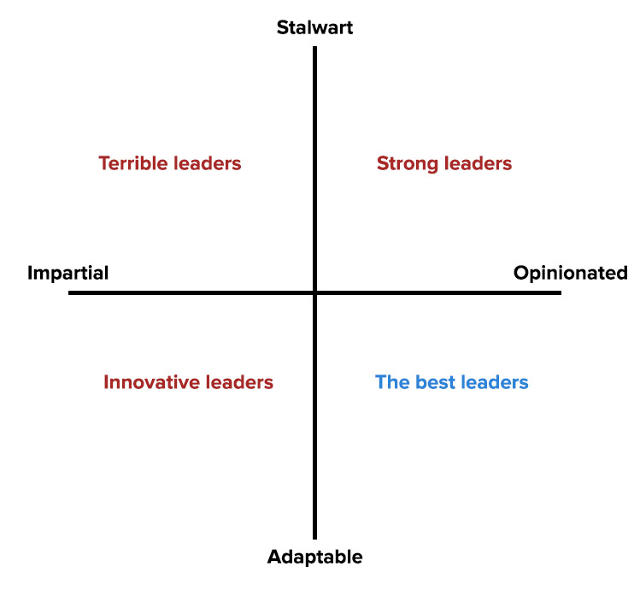
A good leader needs to be extremely persuasive to get people to follow her, and to push people hard to stretch what’s possible. That persuasion comes with expressing strong opinions. Think of the best leaders in history—Mandela, Churchill, King, etc.—and you’ll see a pattern: they tell great stories, with boldness, absolutely convinced that they are right. They both inspire and grab attention.
Says Dolly Singh, former HR head at SpaceX: “The thing that makes Elon Elon is his ability to make people believe in his vision.” Jim Cantrell, SpaceX’s first engineer, adds, “The guy is pure ambition. He’s three or four steps ahead … Most of us can’t conceive these things working; he can’t conceive it failing. Period.” This is the hallmark of an opinionated leader.
Jason Fried, the founder of Basecamp, put the power of opinionated leadership well: “Some people love us, and some people hate us. But very few people ignore us.”
The problem with opinionated leaders is that even the smartest people get things wrong, and many leaders fear changing course once they’ve expressed an opinion for fear of appearing weak.
And yet, the hallmark of innovative thinking is the ability to be open and adaptable. Continuing on a path just because you’ve committed to it is not a formula for success (or happiness, for that matter). And as I documented in Smartcuts, the fastest-climbing people and companies are willing to deviate from their original business or career plan. Whereas a strong leader needs to be resolute and persuasive, an innovative leader needs to be open to changing her mind.
The best leaders in the world are both:
Employees at SpaceX said people would follow their CEO into the sun. And yet the high-speed turns required to get there often lead to burnout.
Apple’s Steve Jobs, like Musk, lived in the bottom right quadrant. He was fiercely opinionated in his vision, highly charismatic in his delivery, and often abrasive with those who didn’t agree. But when he changed his mind about something, he became fiercely opinionated in the opposite direction.
Most of us are not Steve Jobs. We should be humble enough to admit that we’re not right about everything. But most leaders who invoke Jobs when passing down orders forget that he was humble enough to change his mind. Being strong-willed alone didn’t make Apple successful. Only when the company combined a strong point of view with the willingness to change did it succeed—after years of middling performance in the ‘90s.
It’s for this reason I’m convinced that one of the best things we can do for children is sign them up for debate class. Debate trains you to be opinionated and persuasive about a topic, and then to turn right around and be just as opinionated on the other side of that topic. It trains you to let go of ego and jump into deep water with both feet.
There’s stigma associated with leaders who change their minds. Yet the best presidents of the United States were the ones who changed their minds (and their careers) the most. We forget that Hillary Clinton was a staunch conservative before she was a zealous Democrat (and Ronald Reagan in the other direction). We forget that Nokia used to be a paper mill and Twitter was a podcast company before it about-faced and went all in on social networking. If my own company hadn’t shifted its business model and jumped into a new pool with both feet, we wouldn’t have 1/10th of the impact we have today.
You need an open mind to invent, and a strong will to execute. We don’t have to be insufferable to make that happen (it is possible to be opinionated, adaptable, and tactful), but innovation does require both elements.
So perhaps we shouldn’t be so quick to dismiss flip-floppers. They’re the ones, it turns out, who change the world.
Sitting in the back of a taxi with Gary Vaynerchuk, stuck in the late evening Istanbul traffic, I was struck by how little he had to say. Here was the guy who a few hours earlier had joined me on stage, who had been ripping into every established idea in business, and with more f*** words than full stops. He had been full of himself, loud and arrogant, strident and dismissive.
Now here is was quiet, polite and thoughtful. Talking about how for all his blogging, speaking, writing and movie making, what he really likes is to spend time with close friends. And a good bottle of wine.
On stage, on video, I didn’t warm to him. But now he seemed more engaged, and engaging.
He’s built two $100 million per year businesses, and he’s probably the only person to become “Internet famous” through dispensing business advice alone.
His current business, VaynerMedia, is a digital advertising agency that has quickly grown to $100 million in revenue, an incredible trajectory for a business that traditionally takes a very long time to scale up.
Here are a sample few pieces of advice from Gary on how to succeed as an entrepreneur.
Keep your head in the clouds
This is all about keeping your eye on the 30,000 foot view in your business, and making sure that you have a set of principles that guide every action and decision.
Gary tells us that if you religiously follow the few core business philosophies that mean the most to you and spend all of your time there, everything else will fall into place.
You should have your own, but here are Gary’s commandments to help get your juices flowing:
Bring value to the customer.
Provide 51% of the value in a relationship, whether it’s with an employee, a client, or a stranger.
Always play the long game of lifetime value.
Smart work will never replace hard work; it only supplements it
People are your most important commodity.
Never be romantic about how you make your money
Try to put yourself out of business daily
Some of these will only make sense if you follow Gary’s work. For instance, he doesn’t mean literally putting yourself out of business, but for always looking for ways to innovate on “what’s next” – so that you are never beaten to the punch by a new or existing competitor.
Keep your nose in the dirt
While you keep your head in the clouds, you also need to keep your nose in the dirt. The dirt is the execution side of your business.
Here’s an example from Gary in order to make this point. Almost all marketing agency CEOs will make sure their account teams are suggesting that their clients get on Instagram and Pinterest, but will have never used the services themselves.
In Gary’s business, knowing the details is knowing there is a 15-person limit to an Instagram chat and that infographics are the way to get attention on Pinterest.
He understands these details by immersing himself in them. He is a world-class practitioner at the “stuff” his business produces. This way, Gary says, he can sit down with a potential client and tell them that they are working with the best social media practitioner at the best social agency in the country.
Understanding and executing on the details in your business is a great differentiator.
So how should you split your time between the clouds and the dirt? This is a personal decision and will depend on the circumstances, but you should probably swing no more wildly than a 70/30 split in either direction at any one time.
One thing that you can never take your eye off on the dirt side of the equation is cash flow. As Gary says, cash is like oxygen to your business. Dropping the ball on customer service or company culture is huge mistake, but no mistake will ever hurt more than getting your cash flow wrong. You cannot, ever, run of cash.
Hustle, Hustle, Hustle
One of the things that Gary is known for is hustling. While he’s always talked a big game about being one of the hardest working people on the planet, he recently started a video blog chronicling his day-to-day life to prove it. He is basically in “go” mode from sunrise until late at night, often getting home from his last meeting at midnight.
And he’s not only working hard, he’s doing his best to work smart.
He defines hustle as maximizing the energy you put into your business, and it’s about making every minute count.
While most of the world is busy complaining about our “always on” culture, Gary views it as his competitive advantage. Every entrepreneur worth their salt, he says, is grateful as hell that the Internet allows us to hustle while every one else is playing video games and watching Netflix.
Working harder is the easiest thing you can do as an entrepreneur to succeed. How much time are you spending every day mindlessly scrolling through Facebook or watching TV? Cut out that hour or two and work. It might not seem like a big deal for that day, or that week, but over time those hours could be the difference between massive success, or massive failure.
It’s simple – if you want to grow your business, hustle every single day until there isn’t a single drop of juice left. Then get up and do it again tomorrow.
Create great content
Dan Pink tells us that we are all in sales now, and Gary tells us that we are all media producers now. It’s old news that we’ve shifted away from the days where television, radio and print were the only ways a company could tell their stories to massive audiences. But the one thing that hasn’t changed was how to create great content.
According to Gary, there are a few simple rules around how to create quality content. First, it needs to appeal to the heart. As always, emotion trumps logic. You need to create content that connects to your audience on an emotional level. Second, it needs to be shareable. Unless you are a massive corporation with an ad budget of tens of millions of dollars, the only way you are going to reach a large audience is for your audience to share it. Third, it needs to be native to the platform on which it appears. For the traditional media channels, it’s easy to see why you need to make the content native to the platform. For instance, you wouldn’t just take a 30 second television spot and use that for a radio ad, would you? So don’t make the same mistake on different social platforms.
Fourth, it needs to break through the noise. The best way to do this is to “respect your audience.” For instance, if you wanted to sell wine, you would attract a lot more attention with a blog post about “Five Bottles Under $10 That Help You Get Through the Day When You Have 8-Year-Old Kids” than you would with “Five Reasons My Wine Is The Best!”
Engage with your community
Now that you have great content that is useful or entertaining to your audience, the hard work begins. This is where some of that extra time you freed up by not watching Netflix is going to come in. This is when you start engaging with the audience you are trying to reach.
Unless you are fortunate enough to already be a celebrity, the formula for success is to put out quality content every single day, and engage around it. As Gary says, it really is that simple and difficult.
How do you engage with your audience? You can do what Gary did when he first started out using social media for his wine business. He would fire up Twitter search, look for people asking questions about wine, and he would answer them. Those people would check out his profile, which linked back to his site, who would eventually start buying wine from his online store.
Is engaging a lot of work? Of course it is. But as we already discussed, that’s just part of the game these days.
Interestingly, even after creating and scaling two businesses to $100 million a year in revenue, Gary is still the one sending all of his tweets, Instagram posts and Snapchat videos. So if it’s good enough for Gary, it’s probably good enough for us too.
Be self-aware
Self-awareness in business is critical. There are a couple of things you need to do in order to make it work for you.
The first thing you need to do is create an environment where those around you can tell you like it is – what you are good at, and what you are not so good at. You want your employees to feel safe doing this, or it will never happen. This means sometimes hearing things that you disagree with or even upset you. Your job is to listen to the feedback, and thank them for bringing it to you.
Once you have listened to the feedback, it’s time to start focussing your energy on the things that you are good at, and delegating the things that you’re not so good at.
You’ve heard this advice before, most notably in Now Discover Your Strengths. But it bears repeating.
Here’s a concrete example from Gary’s own journey. It’s a poorly held secret that Gary – a guy who has written 4 NY Times best-selling books, isn’t a great writer.
He realized early on that if he was going to create content that was compelling to his audience, he would have to do it by video. So instead of focussing his attention on trying to become a better writer so he could create a “good” blog, he poured all of his energy into creating the best video content he could.
So when it comes time to write – including the 4 business books he’s written and any blog posts he creates for his blog – he sits down and expresses himself verbally. He leaves the writing to his staff, who simply helps him turn his message into the written word.
Similarly, when it comes to your own business, you should be spending all of your time focussed on where you can add the most value to your business, which will almost always be where your talents are the greatest.
But how do you know what things you should be delegating, either to another person at your company or outsourcing to another? As Gary points out, it’s an easy decision when you need A-level work and you’re an F. It’s a lot harder to make that call when you are a B.
If you make an honest assessment of the situation and determine that there’s no way you can execute on that area at an A-level, even if you spend time improving, delegate it.