Exponential thinking is not just about thinking big, it is about the steps to go from small to big. If I were to take 30 linear steps, I’d end up 30 metres away. But if I said to you take 30 exponential steps, one, two, four, eight, sixteen, thirty-two and said where would you end up? The answer is a billion metres away, or twenty-six times around the planet.
Think about our changing attitudes to the future:
Think about today’s fast growth businesses …
Most eye-catching are the unicorns, the billion dollar start-ups who are disrupting almost every industry … Companies like taxi to food delivery platform Uber ($68bn), China’s electronics giant Xiaomi ($46bn) and car-sharing firm Didi Chuxing ($34bn), and peer to peer accomodation with Airbnb ($30bn). Most recently, add examples like millennial news channel Vice Media ($4bn), online educator Udacity ($2bn) and local delivery bikers Deliveroo ($1bn). Way back in history, 10 years ago, none of them existed.
So what has driven their exponential growth?
My next book explores the three distinctive ingredients of exponential growth companies:
- Addictive ideas: the core idea has purpose and passion, it meets a new need and makes life better. It is built on a better vision of the future, making sense of change, and engaging people’s hopes and fears in following it. It must be distinctively articulated, often simple and bold, and powerfully resonates with its primary audience. In many cases this audience is millennial, but it might also be fast-rising demographics of emerging markets, or simply, the poorly served. People with a desire to rise up, to make things better and fairer, to capture and realise a dream. We live in an ideas economy. Ideas becomes additive, cool and social, precious and valuable, multiplying as contagions.
- Innovation accelerators: innovation is not about technology, but the tsunami of new possibilities in every field from genetics to robotics, informatics and nanotechnology. Technologies enable incredible innovation. Innovation is what moves us forwards, the practical solution to big problems. And opportunities. Accelerators are new ways to innovate – new aspirations, speed, intelligent design – and new ways to implement – new business models, ecosystem partners, and intelligent platforms. This is where the entrepreneurial mind, meets the experience and persistence of execution – how to make bold ideas happen faster, to sustain and grow them further.
- Market multipliers: the biggest impact of “digital” is the connectivity of physical and virtual worlds. Metcalfe’s law (network power is proportional to the square of the nodes), rather than Moore’s law (computing power doubles every 18 months), is what allows markets to multiply. Think in terms of peer-to-peer networks (most commonly social media, but also licensing or pyramid selling too!), where a contagion is amplified by collaboration, co-creation, and sustained by community with purpose. Compare this to the old world of linear, transactional thinking – you make a product, and sell it – you count the sales and go home. Instead, it’s about making connections connect, and networks work. Realising the benefits of collective ownership, participation and achievement. This is when exponential takes off.
Of course, most of the obvious examples are digital start-ups. The effects are most obvious and easily implemented here. Think of WhatsApp for example. The free messaging service rising to $19bn of value over 3 years with only 17 employees. In just a short time, its instant messaging has replaced not just phone calls but email too. It’s value of course, lies more in how Facebook can link it to its existing social networks in order to achieve more commercial impact, rather than to its intrinsic self. But that’s where we start to see the potential for larger, more physical companies, to grow exponentially too.
However most people struggle with exponential thinking and the huge difference between linear and non-linear change. So do most businesses and even whole industries. Look at the publishing and music industries now and a decade ago. Businesses now live or die based on their understanding of exponentials. If you don’t want to be the next Blockbuster or Blackberry or conversely, if you want to be the next Amazon or Google, you need deep immersion in the wonderful world of exponentials.
The starting point, then, is to see the future better. To think about how you can harness the power of addictive ideas, innovation accelerators and market multipliers.
To rethink your business exponentially, from the future back …
Read more of my blog posts on exponential thinking
- Exponential Business … how to grow faster with ideas, accelerators and multipliers
- 2025 “exponential” vision … $1000 brains and 8 billion hyper-connected people
- 6Ds of “exponential” … digitised, deceptive, disruptive, dematerialised, demonetised, democratised
- “Exponential” Marketing Summit … addictive ideas and intelligent networks = superfast growth
Explore more exponential thinking with Peter Fisk … inspiring keynotes, practical workshops, and accelerated strategy and innovation consulting to help your business growth further and faster.
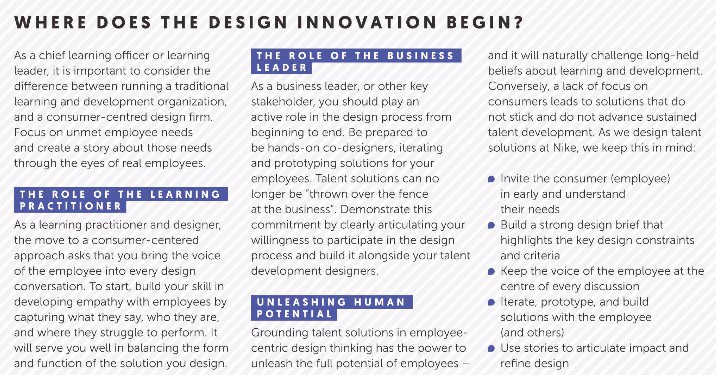
Andre Martin is Nike’s chief learning officer and vice president of talent development, whilst Drew Fifield is leadership development manager. Here, they describe how Nike seeks to unleash its human potential.
Great design thinking should be applied to developing your people, as well as your products.
At Nike, product design and innovation are at the core of the creative process, and our business is centred around putting ourselves in the shoes of our consumers. At its best, design is the perfect balance of form and function that “captivates at first glance”, as John Hoke, Nike’s vice president – global design, puts it. In an effort to extend Nike’s design aesthetic, we’ve applied a designer’s mindset to the execution of our talent development strategy. We’ve asked ourselves, what could it mean to put the employee at the centre as we design talent solutions in service of unleashing their full potential? As we approached this challenge, we focused on three big shifts in traditional learning and development thinking that are critical in developing leaders of growth…
Shift 1 From employees as workers, to employees as consumers
Nike’s mission – to bring inspiration and innovation to every athlete (if you have a body, you are an athlete) in the world – begins with employees. Our team is the spark behind innovation that shapes the future of sport, and our talent strategy centres around building global, capable diverse talent to fuel growth. That’s why we put employees and their needs at the centre of our talent strategy. This consumer mindset demands that we develop a deeper understanding of the employees we serve, to truly know what motivates and engages them. It is our north star – it reminds us that every effort we take to invest in our talent is to unleash their full potential.
Shift 2 From instructional designers to product and experience designers
As talent product and experience designers, we build empathy with our consumers – employees – to better understand their unmet needs; whether they are a financial analyst on their first day in a field office, a tenured retail manager eager to advance, or an executive transitioning into a complex and challenging role. We use this understanding as the fuel for a design brief that maps consumer insights with ideas. From there, prototyping and iterating solutions alongside the consumer begins by enrolling employees as co-designers. Inviting them into the process early not only builds a better product, it ensures we have champions who can demonstrate the value of the programme, from day one.
Shift 3 From programme evaluation to rapid prototyping
Gone are the days of smile sheets, post-programme surveys, and a narrow view of participant satisfaction as the sole evaluator of success. At Nike, we use a co-design evaluation process that is built to encourage deeper learning from the employees we serve. We mine the insights we receive and work with employees to create better experiences for those who will come next. We do this by collecting rich stories from our employees and comparing that narrative with what we learned from them earlier in the process. In practice, does their experience match our intent for them? These stories are used as a frame of reference as we meet with stakeholders and leaders to assess the impact of our design. From that, new outcomes or consumer needs emerge, and we begin the design process once again.
Cardigan is a small town of 4,000 good people, set on the wild and windy coastline of west Wales. 400 of them used to make jeans. They made 35,000 pairs a week. For three decades. Then one day the factory closed. It left town. But all that skill and knowhow remained. Without any way of showing the world what they could do.
That’s why David Hieatt started The Hiut Denim Company. To bring manufacturing back home. To use all that skill on his doorstep. And to breathe new life into his home town. As one of the Grand Masters said to him: “This is what I know how to do. This is what I do best.” He just sat there thinking he had to make it work. Cardigan is making jeans again. Incredibly good – designer, expensive – jeans.
From advertising to reality
Jeans making was not David’s first profession. His career started with that famous ad agency Saatchi & Saatchi based in London. And then on a whim he decided to change his path and move back to his hometown. Once there he created a (rather good, very cool) clothing company called Howies, producing eco-friendly t-shirts, jeans and sportswear, later selling it to Timberland.
Now that he knew what he was doing, he wasted no time in setting up his next business, Hiut. It has become a great success, a niche premium brand with a fantastically loyal following.
Having learnt much, and realising that there are so many other small business (and bigger ones too!) who lack the confidence to get on and make a difference, he established The DO Lectures. Each year they invite a set of creatives to gives lectures about their business or ideas in general, which inspires others to go out and follow their passion. A kind of farmyard TED, and probably a bit more practical too.
Tales from the Chicken Shed
David set out to bring the DO-ers of the world together – the movers and shakers, the disrupters and the change-makers – and ask them to tell their stories. All from his little farmhouse on the Welsh coast. Under star lit skies, in a bind with nature, they inspire others to go out into the world and DO, too. “The intent was that pure, the motivation honest” he says, with the authenticity of an adman.
In 2008, The DO Lectures were born, in a slightly bizarre fusion of hippy festival and corporate seminar. There were no name badges, no bad coffee and impersonal lecture halls. Instead, an intimate number of speakers and attendees gathered under canvas in a Welsh field and shared the whole three day experience as a community. They ate together, camped together, shared a beer around a fire as the sun went down together. “That intangible but very real spirit is kinda what makes us different from everything else. The sodality of it all” says David (yes very adman, but I believe him anyway!).
Every year since, DO has stuck to the same formula … ideas + energy = change.
Inspiring speakers, an engaged class of attendees and a beautiful location. It’s a potent cocktail, and one that works. Year in, year out, people arrive with their tents and their dreams and leave three days later with a shift so profound it’s been said that DO changed their lives.
On stage with former Apple creative Ken Segal recently, he raved about the best event he had ever been too. About the small town of jeans makers, the grit of ideas without powerpoint, and playing drums until sunrise with a very drunk guy who used to be an agency planner too.
Another American attendee, Duke Stump felt such an affinity with the essence of DO that after speaking in Wales in 2009, he took it home with him to Hopland, California, and an old Hop Barn surrounded by the beautiful vineyards of Campovida. DO USA is now organising their fourth event and they get better every year. The same thing happened for Mel Jacobson who took the concept to Australia.
As David said “They come, get inspired, go home and gather their teams, assembled their sponsors and put on their own versions of the event inspiring more people. They have the DO-er in them, that gnawing hunger and relentless drive to get things Done.”
https://www.youtube.com/watch?v=B1Z_ttYHCyI
For all of the DO family – from Wales, to USA, to Australia, and even DO Books – the beating heart of this thing still remains as pure as that tiny seed they started from. DO was born as, and will always remain, a labour of love for everyone involved. They don’t do it for profit, in fact, any profit they make goes straight back in to making the next DO even better, and towards inspiring more people.
As David says “We do it for the look on someone’s face when a speaker’s words hit them. Right between the eyes. And their focus alters, just enough to show them the path they’re supposed to follow from that point on. That moment is unquantifiably awesome. Watching the fire in the pit of their stomach spit and flare to life. It’s the inspiration business; it may not be financially lucrative, but man do we love it.”

What’s your future story? Your strategic script that engages people in your vision and strategy? Your business narrative that connects the many different voices, messages and activities of your company?
Together with Thinkers50 founders, authors and journalists, Des Dearlove and Stuart Crainer, we have created a methodology, that can be practically applied to your business.
It brings together
- the story of your future (including your past, but focuses on your purpose, potential and path)
- aligning all the narratives (vision, strategy, brand, values, culture, leaders)
- engaging, enabling and evolving (all stakeholders, calls to action, keeps moving)
- and then an ongoing thread for communication (PR, thought leadership etc)
DSM, the Dutch chemical company, is a great example of using storytelling to engage employees and customers in the relaunch of their brand, seeking to reposition their business as a future creator, a sustainable innovator, human and passionate.
They created a film called “Bright Now”, which was originally shown to 22,000 employees in movie theaters around the world, 48 hours before they officially launched their new brand about “Bright Science. Brighter Living.”
The Business Storyteller is built on established processes, tools and ways of working together. It is delivered through any combination of
- 3 day “storytelling lab” as a business school program, but also delivered in your business
- consulting to CEOs, strategy directors, brand, marketing and communication directors
- coaching support to leaders, prior to major speeches, or in formulating new ideas
- framework to design and script big corporate events, and component speakers
It brings together a wide range of academic, creative and practical approaches from the worlds of business and beyond:
- defining business purpose, “outside in” and “future back” (typically part of strategy workshops)
- “strategic horizons”, road maps to strategy implementation (simplifying the phases of change)
- brand strategy, “liquid and linked” communication planning, and customer value propositions
- “culture web”, using symbols and structure (soft and hard) to drive culture change
- the SCQA of “pyramid thinking” (driven by the change curve of human emotions)
- the 16 story models and Pixar methodologies as defined in Creative Genius.
Thinkers50 has also recently established a Storytelling Lab in the birthplace of Hans Christian Andersen, in Odense, Denmark. However the approach can also be customised to your individual needs, and delivered anywhere in the world.
To find out more contact peterfisk@peterfisk.com
Every industry talks about the impact of big data. Yet few business leaders are clear on how big data can really give their business a commercial and competitive advantage. Maybe this is because of its complexity and expert analysis required to harness it, the language and granularity, which tends to be the preserve of IT teams and consultants, rather than common language in the C suite.
Here are 20 facts about big data to get you thinking:
- The data volumes are exploding, more data has been created in the past two years than in the entire previous history of the human race.
- Data is growing faster than ever before and by the year 2020, about 1.7 megabytes of new information will be created every second for every human being on the planet.
- By then, our accumulated digital universe of data will grow from 4.4 zettabyets today to around 44 zettabytes, or 44 trillion gigabytes.
- Every second we create new data. For example, we perform 40,000 search queries every second (on Google alone), which makes it 3.5 searches per day and 1.2 trillion searches per year.
- In August 2015, over 1 billion people used Facebook FB +1.25% in a single day.
- Facebook users send on average 31.25 million messages and view 2.77 million videos every minute.
- We are seeing a massive growth in video and photo data, where every minute up to 300 hours of video are uploaded to YouTube alone.
- In 2015, a staggering 1 trillion photos will be taken and billions of them will be shared online. By 2017, nearly 80% of photos will be taken on smart phones.
- This year, over 1.4 billion smart phones will be shipped – all packed with sensors capable of collecting all kinds of data, not to mention the data the users create themselves.
- By 2020, we will have over 6.1 billion smartphone users globally (overtaking basic fixed phone subscriptions).
- Within five years there will be over 50 billion smart connected devices in the world, all developed to collect, analyze and share data.
- By 2020, at least a third of all data will pass through the cloud (a network of servers connected over the Internet).
- Distributed computing (performing computing tasks using a network of computers in the cloud) is very real. Google GOOGL +1.28% uses it every day to involve about 1,000 computers in answering a single search query, which takes no more than 0.2 seconds to complete.
- The Hadoop (open source software for distributed computing) market is forecast to grow at a compound annual growth rate 58% surpassing $1 billion by 2020.
- Estimates suggest that by better integrating big data, healthcare could save as much as $300 billion a year — that’s equal to reducing costs by $1000 a year for every man, woman, and child.
- The White House has already invested more than $200 million in big data projects.
- For a typical Fortune 1000 company, just a 10% increase in data accessibility will result in more than $65 million additional net income.
- Retailers who leverage the full power of big data could increase their operating margins by as much as 60%.
- 73% of organizations have already invested or plan to invest in big data by 2016
- And one of my favourite facts: At the moment less than 0.5% of all data is ever analysed and used, just imagine the potential here.

Better data analysis enables companies to optimize everything in the value chain, from recruiting people to innovating products, managing operations to precision selling, building loyalty and maximising profitability.
Here are 6 real examples of the business impact of big data in action:
Innovation: better solutions, faster to market at Bristol Myers Squibb
Introducing new products or services involves many life cycle stages. Pharma companies have been using clinical trial simulations to speed learning, reduce costs, and limit unnecessary burdens on patients participating in the trials. Big data simulations receive time for trials from weeks to hours, and reduce participants – increase speed, reduce risk, and save lives.
Bristol Myers Squibb reduced the time it takes to run clinical trial simulations by 98% by extending its internally hosted grid environment into the Amazon Web Services Cloud. The company has also been able to optimize dosing levels, make drugs safer, and require fewer blood samples from clinical trial patients.
Talent: recruiting and retaining better people at Xerox
HR departments are using talent analytics and big data to reduce costs and effectively manage employee base. The data allows them to select new recruits that are a better fit for the company, reduce employee turnover, understand the skills and output of the existing workforce, and determine the talent the company needs moving forward.
Xerox, used big data to reduce the attrition rate in call centres by 20%. To do that, it had to understand what was causing the turnover, and determine ways to improve employee engagement.
Sales: targeted and intelligent selling at Kroger
Slight modifications to sales and marketing strategies can have a profound effect on the bottom line, especially when informed by big data.
Imagine a direct mail campaign with a coupon return rate of more 70% within six weeks of the mailing. According to DMA the average direct mail return rate is 3.7%. US grocery chain Kroger does this by personalising its direct mailings based on the shopping history of the individual customer.
Kroger also has a loyalty card program that is rated the industry leader. More than 90% of its customers use its loyalty card when they purchase products. Although there are many factors that have collectively enabled Kroger’s financial performance, at least part of its continued growth over 45 consecutive quarters has been attributed to its customer loyalty programs.
Operations: minimizing disruption at Pratt & Whitney
Businesses want to avoid unnecessary disruption. Now that sensors are being embedded into just about everything, companies are using the data to determine when maintenance is required for planes, trains, automobiles, and even household appliances. Ideally, when an issue has arisen, companies want to understand the issue, what caused it, and how it can be resolved, preferably before a maintenance professional or crew is dispatched.
Pratt &Whitney is attempting to reduce unplanned aircraft engine maintenance. Today’s engines collect about 100 parameters in multiple snapshots while a plane is in flight. By comparison, a new-generation engine is able to collect about 5,000 parameters continuously in flight. The process generates about 2 petabytes of data. Using the data, Pratt & Whitney and its partner IBM are trying to enable proactive maintenance.
Marketing: improving customer retention at Avis Budget
Today’s empowered customers are more demanding than ever. Satisfaction and retention demands that brands understand as much as possible about their customers, continually improve their products and services, and be willing to adapt their business models to reflect the actual needs of their customers.
Avis Budget has committed to doing all of this in the car rental business. It implemented an integrated strategy to performance, which has yielded hundreds of millions of dollars in additional revenue. The initiative involved determining the value of customers, segmenting them, and offering tiered incentives to improve customer loyalty. To do this, it applied a model that predicts lifetime value to its customer database, and then validated it using a multichannel marketing campaign and accompanying analytics.
The customer valuation data is now combined with other data, including rental history, service issues, demographics, corporate affiliation, and customer feedback. Avis Budget is also collecting and analysing social media data. It has a team of social media specialists who respond to brand mentions.
Finance: reducing risks and driving growth with IBM
Finance teams are moving beyond periodic reporting, using big data to reduce risks and costs, identify opportunities, and improve the accuracy of forecasts. Specifically, they’re using data to identify risky customers, monitor suppliers, thwart fraud, pinpoint revenue leaks, and inform new or more efficient business models.
A recent partnership between IBM and the Weather Company will allow companies to better manage the impact of weather on business performance. According to The Weather Company, weather has an economic impact of half a trillion dollars annually in the US alone. 100,000 weather sensors feed data, combined with other sources to create 2.2 billion unique forecast points, and an average of more than 10 billion forecasts on an active weather day.
More:
Download a summary of my keynote Big Data + Big Ideas = Big Impact in Antibes, September 2016
Read more How companies are using big data and analytics by McKinsey, April 2016
Read more Industry 4.0: Building the Digital Enterprise by PwC, June 2016
You’re standing under the hot shower, or in the middle of a long run, or lying on a beautiful beach … and suddenly that great idea flows forward in your mind.
If you’ve ever had that sensation of your brain creating space unexpectedly to allow new ideas to form, and wish you could trigger the same ability on demand, you now know that you need Liminal Thinking.
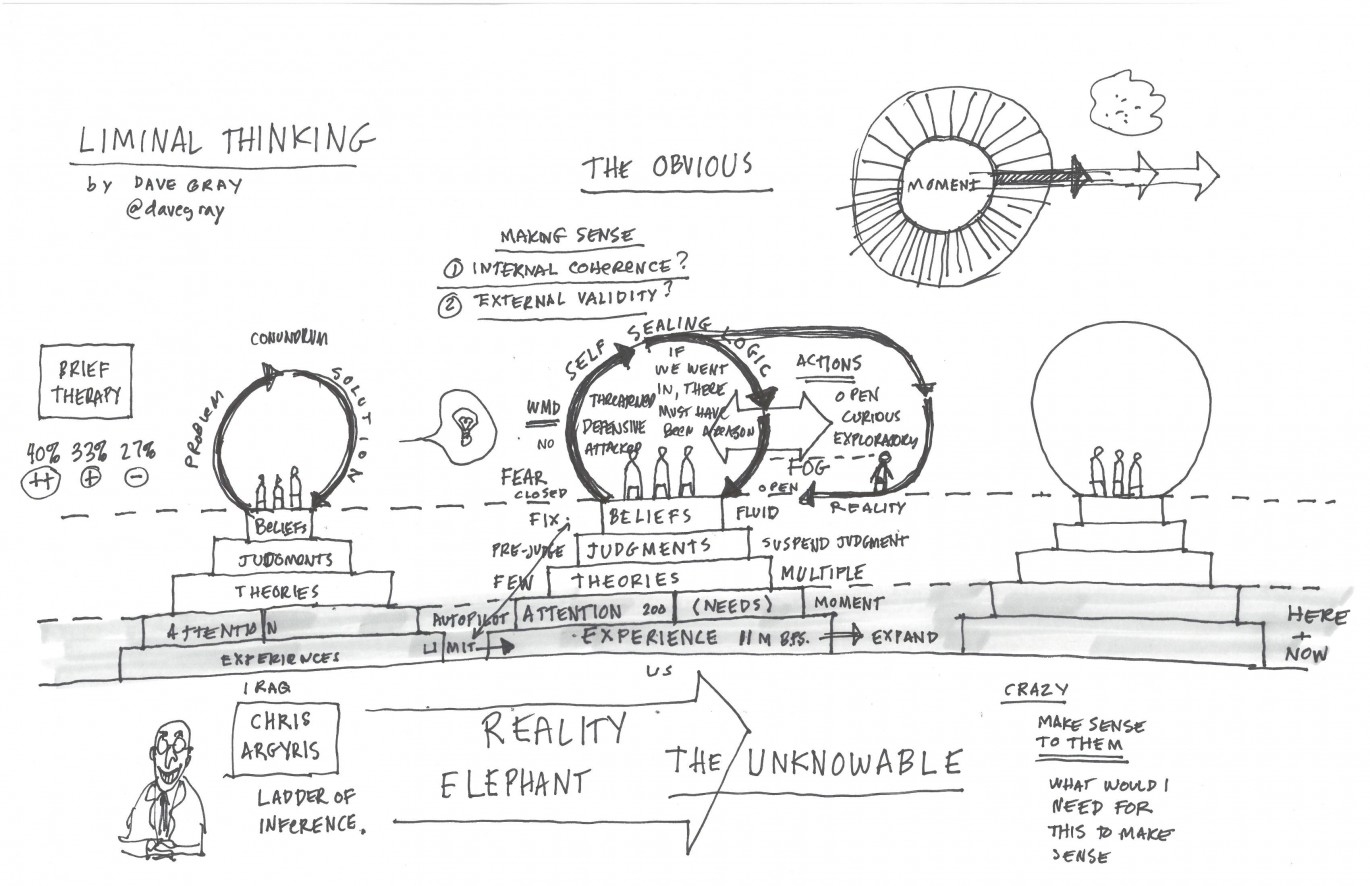
Author Dave Gray defines it as “a practice you can use to find and create new doorways to possibilities, doorways that are invisible to others.”
Gray is founder of the fabulous visual thinking company Xplane.com, and also author of books like Gamestorming and The Connected company.
Here are some great extracts from Liminal Thinking:
New Thinking Comes Only When We Are Open To Changing Our Beliefs
“… beliefs are often the main things standing in the way of change”
Change thinking starts with a willingness to accept that a different outcome or reality is possible. This means being open to changing your viewpoint or beliefs about life as you know it, or the things you believe to be true, which is not easy for many of us. Gray emphasizes that new “doors of opportunity” are around us all the time, but they are invisible to people who aren’t looking for them or are unwilling to see them.
We often create boundaries, whether real or imaginary, to help us cope with change. We decide that our perceived ideas about “how things work here” are rigid, and keep us from being open to new ideas. It’s when we’re willing to push past these limits that we can create change. As Gray notes, “change happens at the boundaries of things: the boundary between the known and unknown, the familiar and the different, between the old way and the new way, the past and the future.”
Liminal Thinking is a type of “psychological agility” that allows you see and pursue opportunities, particularly where others might not. But first, we need to understand the beliefs shaping the boundaries that can hold us back.
Your Beliefs Aren’t Reality
“Beliefs are not reality. They are not facts. They are constructions. You construct your beliefs, even though for most people this is an unconscious process. By beliefs, I mean everything you know. ”
While we may develop our belief system unconsciously, our beliefs restrict us from developing new ideas, regardless of intention and whether or not they are true. Once we can see these limits and consciously begin to rethink them, new ideas can emerge. Gray outlines six principles of Liminal Thinking which structure our belief system and can ultimately hold us back, even if these beliefs we hold dear are proven to be untrue.
Even the process of intentionally thinking about how your belief structure is built and maintained starts to change your thinking. As you question whether something you believe is based on truth or only your perception of truth, your mind becomes open to new possibilities.
Having this awareness of how beliefs are developed is also key as you consider how best to influence the thoughts of others. In situations where you need someone to be open-minded or be ready to share new ideas, you may first need to help them explore which areas of their current reality may no longer be true.
Changing Your Beliefs Takes Practice
“To change the world, you must be willing to change yourself.”
It’s easy to say “they” don’t understand, or “they” will never change. As I tell the leaders I coach, the only person you can control in any situation is yourself. You need to be willing to do the work, and in turn, the skills you build become tools you can use for helping others change their thinking as well.
Gray provides a set of practices, such as bringing awareness of your lack of objectivity, asking new questions and gaining additional information, and disrupting your routines, as ways to open your mind to new possibilities and ways of thinking. Some of these practices take time, but are designed to change your thinking and become more open.
After reading this book, I tried a few of these exercises, and was amazed at the new things I noticed in my environment as a result. I spent two weeks disrupting my routines, and realized how much I was missing by moving through certain situations on autopilot. Simple things, like driving home a different way, or taking a new trail while mountain biking, created a new sense of energy and sparks of creativity I hadn’t expected.
Anyway. As always … bullshit or brilliant … you decide!
Download free chapter: Practice 8: Make Sense with Stories
Levi’s Stadium is about 40 miles south of San Francisco in Santa Clara, California. It seats more than 65,000 spectators in two bowl-like structures. The logistics are daunting for a stadium that big. Consider the issues involved with getting thousands of fans to their seats quickly and securely in time to enjoy the game.
- Parking—Purchasing parking passes digitally and providing turn-by-turn directions to the visitor’s assigned lot
- Navigation—Helping fans quickly and easily find their seats
- Security—Mitigating risks and enabling fans to be the eyes and ears of the stadium and report any security issues that may occur.
- Refreshments—Ensuring fans get the food and beverages they want, when they want them.
Digital technologies such as beacons, IoT sensors and sophisticated mobile apps have elevated the experience for 49ers fans and changed the game for venue operators.
In an interview for The Future of Business and Tech, 49ers chief operating officer, Al Guido, shared how Levi’s Stadium creates an elite mobile experience for fans.
How is Levi’s Stadium changing the way fans think about the stadium experience?
The Bay Area is a consistent leader in innovation. As an organization, we felt that if we were going to deliver a premiere outdoor sports and entertainment venue befitting of this region then we had to incorporate groundbreaking in-stadium technology. We focused on designing a stadium that combines the the comforts of home while providing a forum to connect around 70,000 people in real time. Levi’s Stadium utilizes the best technology found in Silicon Valley to enable our fans to create their own experience for any event at the venue.
What tech feature has been a fan favorite in the stadium so far?
The technological element of Levi’s Stadium that has most enhanced the experience of every guest who has visited the venue is its Internet infrastructure. It is the most extensive in all of professional sports, featuring an Internet bandwidth four times the NFL standard; it is the backbone on which the Levi’s Stadium App delivers fan services like no other venue. The Levi’s Stadium App enables all event goers to use their phone as their ticket and parking pass, to pre-order food and beverages for delivery or express pick-up and to watch multi-angle replays on their personal mobile device.
What is the infrastructure for delivering wireless to fans in a stadium the size of Levi’s?
The Levi’s Stadium network infrastructure features over 400 miles of data and more than 12,000 physical network ports. Levi’s Stadium truly became an innovator among professional sports venues when the decision was made to make the stadium the first in the world to install Internet access-points under seats throughout the venue—a total of more than 1,200, or one for every 100 seats. The 49ers IT team and a host of partners designed the unique network infrastructure, and those same groups continue to work together on-site to monitor and manage the system on a daily basis, not just event days.
Are you making any changes to be ready to host next year’s Super Bowl?
Our team of IT professionals and partners are the best in the business at building and refining Internet infrastructures, something they’ve proven over the course of our first year of operation at Levi’s Stadium. We are continually making enhancements to our Wi-Fi and cellular network systems inside the venue, and we’ll certainly have Super Bowl 50 in mind during those efforts the rest of this year. That said, an event like WrestleMania 31 setting a stadium Wi-Fi record by offloading 4.5 terabytes of data provides confidence that our network will also succesfully handle the network needs of Super Bowl 50.
Levi’s Stadium isn’t just a venue for football. How does the wireless network accommodate the different mobile communications needs of various events, such as concerts?
Every event we host at Levi’s Stadium will have some unique elements, and the way our wireless network is used is no different. Our guests will always make up the majority of wireless users and we have to always deliver for their needs. Whether it’s being able to quickly send and receive text messages while among nearly 70,000 fellow spectators, or using the revolutionary Levi’s Stadium App to order food and beverage to your seat anywhere in the stadium, the stadium’s Internet bandwidth of 40 Gigabits per second enhances fan experience like no other venue in the world.
How does the wireless network support new technologies such as LTE Advanced or others that will be introduced into the marketplace soon?
Instead of focusing on outfitting Levi’s Stadium with expensive hardware that will become obsolete over time, our decision was to leverage the brilliant companies who create the personal mobile devices like tablets and smartphones that our customers use to manage their busy lives. The hardware that we have installed in the stadium—cable, network ports and access points—can be upgraded and enhanced to support any new technological advances and new products that our fans might use to maximize their experience at Levi’s Stadium.
How does energy-efficient infrastructure play a role in Levi’s Stadium?
It was crucial that the technology in Levi’s Stadium be functional and not at all ornamental. To ensure that, we implemented impactful innovations within the venue. We focused on the areas of fan experience and sustainable design. Levi’s Stadium was the first stadium in North America designed to be net nuetral to the power grid. That means that—thanks to the 1,162 photovoltaic panels incoporated into the design of the venue—the 10 regularly scheduled 49ers home games each year are powered by the sun. It was important to us to try to be leaders in sustainable design.
Mobile application features
A robust wireless infrastructure is key for providing other features that ensure the ultimate fan experience. Todd Landry, corporate vice president of product and market strategy at JMA Wireless tells us more about a few more available features at Levi’s Stadium are:
- Access to tickets purchased for games.
- Guide fans to the parking lot entrance closest to their seats and then to the exact location of their seats.
- Watch up to four replays during the game or read about interesting stats or other information related to the game.
- Direct fans to the closest restroom or concession stands with the shortest lines.
- Participate in Faithful 49, a fan engagement program where fans are rewarded with free food, merchandise or special 49ers experiences.
Connectivity beyond the venue
Levi’s Stadium is already the most connected sports venue in the NFL. However, wireless technologies are being expanded even further in preparation for Super Bowl 50, which will be held at Levi’s. Now fans in the surrounding area outside the stadium will enjoy powerful cellular connectivity thanks to a dedicated DAS. Many of these fans will never enter the stadium at game time, but will still be able to enjoy the powerful experience of the big game day.
This month’s HBR features a useful article on how the combination of new technologies and new business models can transform markets. Here’s a summary:
A business model that can link a new technology to an emerging market need is the key to industry transformation. When Apple coupled the iPod with iTunes, it revolutionized the audio devices market. But most attempts to introduce a new business model fail. Analysis of companies that had launched new business models indicated six recurring features in the best models:
- Personalised product or service at competitive price
- Closed loop (circular) processes, less waste, more reuse
- Asset sharing, partnering to collaborative consumption
- Usage-based pricing, from renting to pay as you go
- Collaborative ecosystem, reducing risk and supply costs
- Agile organisations, realtime and responsive to change.
Whilst no model, even the likes of Airbnb, displayed all of these factors, having a higher number correlated with a greater chance of success at transformation. The diagram below shows how these 6 characteristics of business models connect technology and market trends, enabling transformation of the industry – or “gamechanging” strategies – to emerge:

On the market side, demand has grown across emerging and developed markets, with people more different and discerning, costs have rise and regulators seek to keep control of changing markets. On the technology side, sensors that allow cheaper and broader data capture; big data, artificial intelligence, and machine learning enable companies to turn enormous amounts of unstructured data into rules and decisions; connected devices (the internet of things) and cloud technology allow broad data manipulation and analysis; whilst nanotechnology and 3-D printing open up new models of micro-production and selling.
Uber ticks 5 of the 6 boxes. Its business model is built on asset sharing where drivers use their own cars, and a collaborative ecosystem in which the driver assumes the risk of winning rides, while the platform helps minimize that risk through the application of big data. The platform creates agility through an internal decision-making system that responds to market changes in real time, allowing usage-based pricing and direct drivers to locations where the probability of finding a fare is high, and customers rate drivers encouraging drivers to offer clean cars and quality service, and some personalisation allowing choice of car based on location and ranking.
Creating a better business model
In the “Gamechangers” book we explore many examples of innovators who have changed their markets through business model innovation. You can also explore 100s of live case studies, how companies are shaking up markets right now, and judge for your self whether they are likely to succeed.
Also, you can download a series of practical templates – or canvases – for developing your future strategy, value proposition, business model and much more, in the Gamechanger Labs. There are also a series of practical video tutorials to get you started.
Most practically, you can sign up for the Business Innovation Program. This puts business model innovation at the heart of your future thinking, and practical 3 day program, customised at and for your business, and also with me at IE Business School and in partnership with Nordic Executive Academy.
“The hard truth about business model innovation” is Clay Christiansen’s theme in a great article published by MIT Sloan’s Management Review. Whilst there is no doubting the Harvard professor as the uber-guru of innovation (and indeed, business models sit at the heart of his theory of disruptive innovation, although taken from a technology perspective), I can’t help but feel that he gets a little irritated by the popularity of Alex Osterwalder’s far more simplistic (yet practical) canvas for rethinking the way your business works.
Christiansen contrasts two business models, the failure of Google+ and success of BMW’s Car2Go, suggesting that many others have also failed because of poor analysis and discipline. To change that, executives need to understand how business models develop through predictable stages over time — and then apply that understanding to key decisions about new business models.
His starting point is to be clear on definitions. Too many people throw around the business model phrase without really knowing what they mean, and certainly without consistency of meaning. He focuses on a 4-box framework – proposition and profit formula (the priorities), resources and processes (the capabilities). This is not really different from Osterwalder’s model (although I see many users confusing proposition with product, whereas it is of course much more about the job to be done, what you ultimately seek to enable the user to achieve).

The real difference in approach lies in the journey – this focuses on the interplay between the four boxes, and how this progresses over time, as the business and market transform. This journey becomes predictable, although its speed will differ. It typically starts with the creation of the new business unit, and business model, then shifting to sustaining and growing the business unit, and ultimately moving to wringing efficiency from it. Each stage of the journey supports a specific type of innovation, interplay of factors, and outcomes. Successful business models make the whole journey, and the article examines in detail how.

The key message is “to achieve successful business model innovation, focus on creating new business models, rather than changing existing ones.”
To illustrate this Christiansen compares two attempted business model innovations:
Google saw Google+ as an extension of its search business and chose to integrate Google+ into its existing products and business. Google+ accounts were integrated into other Google products, and the business saw the incorporation of information from users’ social networks as a way to generate improved, tailored search results. Google hoped a social network would allow the business to generate greater revenue and profitability by better targeting advertisements and delivering more advertisements through increased usage of its product platform. Consumers (including me!) didn’t see the value from combining search and social networking; to the consumer, the jobs are very different and arise in different circumstances in their lives.
Daimler, meanwhile recognised that Car2Go was a very different business and established it far afield from the home office and existing business. It started as an experiment tested by its employees working in Ulm. It housed the business in a corporate incubator that does not report to the existing consumer automotive businesses and designed it from the outset to fulfill Daimler’s core job of providing mobility, but without the need to convince consumers to purchase vehicles. Recognizing that the priorities of a business that rents cars by the minute are very different from those involved in selling luxury vehicles, Daimler has kept car2go separate and allowed it to develop a unique business model capable of fulfilling its job profitably. However, car2go benefits from Daimler’s ownership by using corporate resources where appropriate — for example, Car2Go rents only vehicles in the Daimler portfolio, principally the Smart Fortwo.
Creating a better business model
In the “Gamechangers” book we explore many examples of innovators who have changed their markets through business model innovation. You can also explore 100s of live case studies, how companies are shaking up markets right now, and judge for your self whether they are likely to succeed. Also, you can download a series of practical templates – or canvases – for developing your future strategy, value proposition, business model and much more, in the Gamechanger Labs. There are also a series of practical video tutorials to get you started. Most practically, you can sign up for the Business Innovation Program. This puts business model innovation at the heart of your future thinking, and practical 3 day program, customised at and for your business, and also with me at IE Business School and in partnership with Nordic Executive Academy.
The role of the chief marketing officer (CMO), and indeed of marketing itself, has been under debate for years. Is it more art or more science? Does it warrant a seat at the top table or is it just a sales-support function? Is it a strategic role or is it ultimately just about advertising and communications, or colouring in, as many have put it? Marketing and its leaders have been suffering from a crisis of identity for years, but it seems that’s now coming to an end.
Consider the collision of forces hitting organisations over recent years. Rapid advancements in digital technology, fragmentation of channels and media, industry and category disruptions, an explosion of data, and growing political and economic turbulence. In the face of this perfect storm of uncertainty, the portfolio of capabilities and skillsets within a marketing function has had to expand significantly.
Jeff Dodds, TalkTalk’s managing director for mobile and former CMO of Virgin Media, says: “If you go back five to ten years, for most organisations marketing tended to mean advertising, branding and design, marketing leaders tended to come from a creative path, and marketing rarely sat on the main operating board. Marketing leadership of today is more akin to that of a chief operating officer of a few years ago. It’s a much broader remit, often sits on the main operating board and, with the range of accountabilities in it, is a much more commercially relevant role.”
Today’s CMO needs to be as comfortable with data science, technology, econometrics and analytics as they are with agencies and creatives. They’re as likely to be accountable for go-to-market campaigns as they are proposition development, product and pricing, customer experience and customer strategy, churn management and loyalty, digital transformation, and developing innovation pipelines.
Dodds adds: “It’s not that marketing has changed; if you go back to the original definition of marketing being about the seven Ps [product, price, place, promotion, people, process and physical evidence], that’s fundamentally what a CMO is grappling with today, it’s just taken a while for organisations to catch up and place all of those responsibilities under one leadership role, and that’s the CMO of today.”
Freddie Hospedales, global head of marketing at ERM, says: “I see the biggest challenge for a CMO as the demonstration of value to warrant appropriate investment. There’s still a perception that marketing is too difficult to quantify, hence it can be seen as less valuable than other functions. The priority not just next year, but continuously, is recognition of the strategic value marketing and brand management have on enterprise value.”
Mark Evans, CMO at Direct Line Group: “In a world of exponential change it is increasingly difficult to know ‘what’ will be required to win over a typical two to five-year planning horizon. As a result, there needs to be an increasing emphasis upon the ‘how’. By that I mean developing an agile innovation capability in order to respond to whatever the ‘what’ is.
“CMOs need to figure out how to bring agile principles into the DNA of a cross-functional business. It’s all very well deploying agile in carve-out innovation labs, but the greater challenge and arguably bigger prize is to break free from traditional waterfall ways of working in the core business, and I believe this is the emerging challenge for CMOs to champion.”
If a typical adult spends 9.83 hours a day consuming media … how can marketers engage them better?
Here is an example of the new world of marketing in practice, where everything is media, and advertising is everything. Forget the old world of television ad campaigns, designed by agencies, pushed at passive consumers. We live in a new world, and be it communication or pricing, strategy or channels, segmentation or performance metrics, we need to think differently …

Explore The New Rules of Marketing
Download The Future CMO Report