I was sitting in the lobby of Hong Kong’s Shangri La Hotel, ready to do an executive workshop for Time Warner’s top global leaders. Sitting down next to me, the CFO started to chat. Creating value is easy he said, you just have to think smarter. He then explained how the simple act of recasting Time Warner as an entertainment business rather than a communications business, where the average p/e ratios are almost double, had the biggest impact ever on the organisation’s market cap.
It demonstrated the value of content over pipes. In today’s digitally connected world, anybody can build a network. It is the content that flows through them, and it how it amplifies that content, that creates value for people, and ultimately for investors too.
Last week we saw the same effect in action. AT&T had become desperate, recognising that being a telecoms, or even comms, business, just isn’t special. It agreed to acquire media business Time Warner in one of the largest acquisitions of all time, bringing together Time Warner’s content brands including HBO, CNN and Warner Bros with AT&T’s portfolio of mobile, broadband and satellite TV services. AT&T is the USA’s second largest wireless telecommunications company, and has more than 130 million mobile phone customers and 25 million pay-TV subscribers through DirecTV.
AT&T’s CEO Randall Stephenson said the deal would enable the two companies to move quicker and operate better in a world where people increasingly access content on their mobile devices. “The world of distribution and content is converging, and we need to move fast, and if we want to do something truly unique, begin to curate content differently, begin to format content differently for these mobile environments, and this is all about mobility,” he said.
Gartner analyst Akshay Sharma said the deal was about AT&T trying to become smarter. “Instead of being a dumb pipe provider, now it’s all about content and user experience,” he said.

So what does it mean for consumers?
The business model
A key concern is whether the newly merged company might use its huge distribution network (the customers of DirecTV and its wireless and broadband services) to give an unfair advantage to its own content, delivering it in a way that is faster or more accessible than competitor content. This would, of course, violate the law of net neutrality, whereby internet service providers should not favor or block any particular products or websites.
AT&T has form for this. It already offers AT&T wireless customers the ability to watch DirecT without it counting against their data plan. This “zero-rating” strategy means it’s cheaper to stream DirecTV than it is to use other services. Following the Time Warner deal, AT&T could extend this zero rating to Game of Thrones, Harry Potter movies or NFL football on TNT. That’s good news for AT&T customers but could be seen to give its own service an unfair advantage over competitors such as Dish Network’s Sling TV or on-demand services such as Netflix and Hulu, unless they pay AT&T to have their own zero-rating deal.
“Whether it’s channel position or recommendations on your home screen, the distributor certainly has the technical capability to give their own content more visibility than their competitors if they are left to do so,” said analyst Jim Nail of Forrester Research.
The end result is that it becomes harder for other content providers to compete for end users’ attention. In the long run this could mean less competition altogether, which could lead to higher prices.
Not everyone agrees. “In reality, regulatory constraints mean that it is almost impossible to use vertically owned content to the advantage of distribution, and it is equally impossible to use captive distribution to the advantage of vertically owned content,” analyst Craig Moffett said.
An integrated experience
This type of deal should allow AT&T to create a better user experience as they access content across multiple devices, whether that’s their cellphone, tablet or TV – an experience that has traditionally been clunky and painful for users.
“They can connect the dots as the content flows from the big screen to the laptop to smartphone or tablet,” Sharma said. AT&T will be able to data mine a person’s location, devices and behaviour in order to provide the right content at the right time in a more efficient way.
“It makes for a more holistic user experience that could lead to consumer-friendly innovations.”
Targeted marketing
Like it or not, advertising helps fund most of the content we consume. The merger of AT&T and Time Warner could mean more granularity to ad targeting. AT&T has already launched addressable TV advertising, where different households watching the same program will see different commercials, through DirecTV. This approach could be extended throughout all of the new company’s offerings and across platforms.
“I know ads are painful to watch sometimes, but it’s necessary because it pays the bills. More contextual advertising means the doctor might get the ad for Mercedes or BMW while the child might see Pepsi, Coca-Cola or video game ads,” Sharma said.
Whilst it is AT&T who has the deep pockets, it is Time Warner who has the valuable brands. Telecoms are companies are just dumb pipes, and technology companies should remember that it is how you bring them to life for people that creates value. The merger also demonstrates again the borderless nature of the digital world, where sector boundaries are meaningless, and value is in the fusions. Ultimately it also reminds us that, with the power of Harry Potter and even Tweety Pie, we live in a human world.
In the time Usain Bolt clocked up 9 Olympic gold medals he has become an icon of sports, and of sports sponsorship. Since those record-breaking Olympic victories in Beijing 2008, when Bolt’s only sponsors were Puma and Jamaican mobile phone company Digital, things have changed rapidly – 8 years of incredible sporting performance, global fame and branded impact.
Gatorade, Hublot and Virgin Media quickly snapped up the world’s fastest man to pitch their wares. Gatorade introduced Gatorade Bolt, a new lemon ice-flavored drink. Visa linked him to a deal and used him in ad campaigns extensively in Europe, where athletics has a much higher profile than in the USA. His current endorsement portfolio now includes 10 global partners, ranging in value from $1-4 million annually with Puma being in a class by itself at eight-figures (he also has seven regional partners). Bolt even has his own character in the Temple Run gaming franchise. The game has been downloaded more than one billion times.
Bolt has also been busy off the track in 2016 leading up to the Rio Olympics. He signed deals at the beginning of the year with Japan’s ANA airline and Australian phone company Optus. He signed a deal with Enertor to be the face of the upstart sports insole brand, receiving an equity stake in the business. Bolt launched his new shaving company, Champion Shave, a week ahead of the opening ceremonies. And then he sprinted to immortality – the triple, double Olympic champion.
https://www.youtube.com/watch?v=oOu1-0o-eUA
Sports are like nothing else. The unreserved passion of athletes competing, and fans supporting. The unprecedented performances of human speed, strength and spectacle. There is rarely a better way to add passion and performance to your brand attributes, than to connect with sports.
However, with so many investment opportunities – from sports teams to individuals, sports events and activities, stadia and media programs – to choose from, how do brands ensure their sponsorship portfolio enables them to reach the right people within their target markets for the most effective investment?
The traditional starting point is to look at how many people can be reached. This is where the plan can go wrong.
In effect sponsors get obsessed with maximising logo awareness, and then having a good time in the corporate hospitality tent. Yet we all know that simply seeing a brand’s image, or having a good time, is no longer enough to cut-through the proliferation of marketing messages, and to engage the right clients or consumers in an impactful way.
Instead, the starting points should be the audience:
- Who is the target audience we really want to engage, and what matters most to them?
- How is our brand relevant, and how does it add value to what the audience cares about?
- What associations do we seek to make between our brand and the sponsored entity?
- How is this different and better than before? What is the change we seek to achieve?
- What new innovations or activities do we seek to introduce to the market alongside it?
- How can the audience help to amplify the impact, peer to peer, as brand ambassadors?
- What is the strategic plan, to sustain the story, and the relationship, over time?
- How will this drive incremental, profitable business for the brand short and longer-term?
Sport sponsorship can be an incredibly effective marketing tool – strategically in building brands and launching innovations, and building deeper relationships with target audiences – and also in driving sales promotional activity, in more topical and relevant ways.
My experience is diverse – from helping brands like Coca Cola and Visa to use their mega-sponsorships of the Olympic Games and FIFA World Cup to transform perceptions of their brand and engage target business partners and consumers in a vision of the future – through to brands like VB Beer, P&G and Tata to embrace the values of sports affiliation to create a brand personality and empathy that resonates with its target drinkers.
With a range of masterclasses and consulting projects, I help brands to connect in the right way with sports, and more importantly the right audiences. To create win wins. To create new levels of passion and performance for your brand, and the sport too.
Here are the key modules, which are customisable in content and duration to your needs and aspiration:
- The Brand: Why are we doing this, how the best companies build brands more successfully, by embracing sponsorship to engage their target audiences in deeper, more relevant, more topical and more effective ways.
- The Audience: Who the audience for sponsorship really is, business or consumer, employee or partner, and what they want. Tapping into their passions so that the brand adds relevance and enhances what they love.
- The Activation: How to bring brands and sponsorship programs in highly creative, practical and profitable ways. Thinking long before, during and beyond the engagement, to build relationships and community.
- The Impact: What is the real impact of sponsorship – in changing attitudes and behaviours towards the brand, exploring new innovations and solutions, driving trial and purchase – the business case, the metrics ROI, and impact on brand value.
And some useful background articles:
Online streaming of music grew by 80% last year, whilst overall revenues from music are stagnant, and the amount back to artists is falling. Piracy and arguments about IP are rife. As technology continues to disrupt the industry, several artists are turning to blockchain to find a new business model.
Blockchain was first talked about 2008 as the technology that underpins Bitcoin, the cryptocurrency. It operates as a shared ledger, which continuously records transactions or information. Its database structure, where there is a timestamp on each entry and information linking it to previous blocks, makes it not only transparent but exceptionally difficult to tamper with.
Whilst Bitcoin has grabbed the headlines, blockchain is making a much bigger impact elsewhere. Banks, insurance companies, even retailers, are already experimenting with it. One of blockchain’s most vocal advocates is the Grammy Award-winning UK singer, songwriter and producer Imogen Heap.
“Blockchain is completely enabling us to rethink the basic, core structure of how monetary distribution works in the music industry,” she says. “It can be used to build a united platform and create an ecosystem, but most importantly builds innovation under the standards that make sense for artists.”
A report by the Blockchain for Creative Industries at Middlesex University identified 4 areas where using blockchain could be a genuine asset to the music industry. Alongside aiding “fast, frictionless royalty payments”, blockchain can also help to create a networked database for music copyright information, enhance “transparency through the value chain” and enable access to alternative sources of capital.
Last October, Imogen Heap released her song Tiny Human attached to a smart contract on Ujo Music, which is built on the blockchain run by the decentralised application platform Ethereal.
For Heap it is all about creating fair value for the exchange between artists and listeners. By cutting out the middle men, there is a sense of getting back to the more intimate direct exchange between artist and listener. A bit like Kickstarter, it is also about democratising the creative process. It can offer her listeners a deeper insight into how she actually creates music, and can be the vehicle through which the people who work on her tracks get the credit they deserve too.
Transforming the relationship between consumers and brands
Whilst Heap’s story might sound peripheral, and easily ignored because it sounds too technical, it is an example of how the relationship between brands and consumers can be transformed. Some believe that blockchain will be the most significant step forward in the way technology supports brands and marketing since the birth of the internet.
The technology creates a new way of working, which transforms distribution and payments, and back office. But it could also fundamentally transform the engagement of consumers with brands. At a time when many consumers feel disenfranchised, and brands struggling to build re-engage them, blockchain could create a revolution in marketing.
Here is an extract from a great article by Jean-Paul Edwards:
At its simplest, relevant sections of personal data held in the blockchain can be shared with the right brands. The brands you trust would be held on the blockchain. This could see major household purchases such as a vehicle, or a dishwasher, being shared with your trusted brands that can let you know about associated services and goods that are right for you, from insurance to cleaning tablets, while you – the consumer – remain anonymous and in control.
Several big institutions are looking into the blockchain; the Bank of England is investigating the technology and IBM is looking at how the blockchain can manage the huge array of connected devices that we are likely to see in the connected home of the 2020s eradicating the need to remember passwords for to 200 devices.
In fact it’s set to benefit marketers the most in helping them realise the age of ‘intelligent value’ that’s set to define how we use technology over the next ten years – not only in monetary value but reputations, social interactions, experiences and memories, relevancy to tastes and ambitions.
For example, the blockchain might be applied to the use and management of a car. The blockchain would underpin apps that monitor petrol consumption, realise when it’s running low, match this with information around where the driver is most likely to go at any given time then suggest a fill-up at a cheap station. The car would also link driving behaviour with insurance provider details enabling automatic insurance cover based on driving performance. All these elements could combine to tailor the advertising shown on a mobile or home TV. The blockchain provides a secure, distributed platform for all this data.
Similarly, in the FMCG world, the blockchain might see consumers buy their household products direct from P&G or Unilever rather than through a supermarket. As ecommerce, powered by optimisation algorithms, becomes the norm, consumers may question the value that retail intermediaries provide over and above the products themselves. Sidestepping the middle man would reduce the cost to consumers considerably.
Supermarkets might react by providing new and innovative Artificial Intelligence services to customers. These services, utilising personal data from the blockchain, could include managing health goals with a service linked to health data collected from a smartwatch. In fact consumers will gravitate towards brands that provide most value to them and will quickly reject those that don’t satisfy their needs.
But in my view the technology will have even wider ramifications. I believe the blockchain will transform ownership as we know it and have a profound effect on business and society in general.
Consumers will begin to borrow or hire products, rather than buy them outright. Storj is a company spearheading a data hire solution of this sort. It allows people to use the blockchain to rent out unused parts of their hard drive to other people completely securely, a sort of Airbnb for data. The company claims to reduce storage costs by a factor of ten.
The potential removal of the middle man, the increased expectations of consumers around value, and new models of ownership that the blockchain affords, will transform the role of brands. Marketers need to work out how they fit into this new world and think hard about how they might use the blockchain to enhance their value proposition to customers.
For too long, people have pretended that business is linear, and predictable. For too long have they tried to ignore and remove uncertainty, with little effect. Designers have always lived with uncertainty, and know how to turn it into an ally. In today’s world, to be successful, you need to think like a designer.
That’s the opening provocation from the authors of a new book “Design a Better Business“.
The author team, better known as the Dutch company Business Model Inc, have pulled together a great book, full of ideas, creative tools and practical insights. In fact , it joins a small family of titles – including my own “Gamechangers” book, and “Business Model Generation” by Alex Osterwalder – all published in the same landscape format by Wiley.
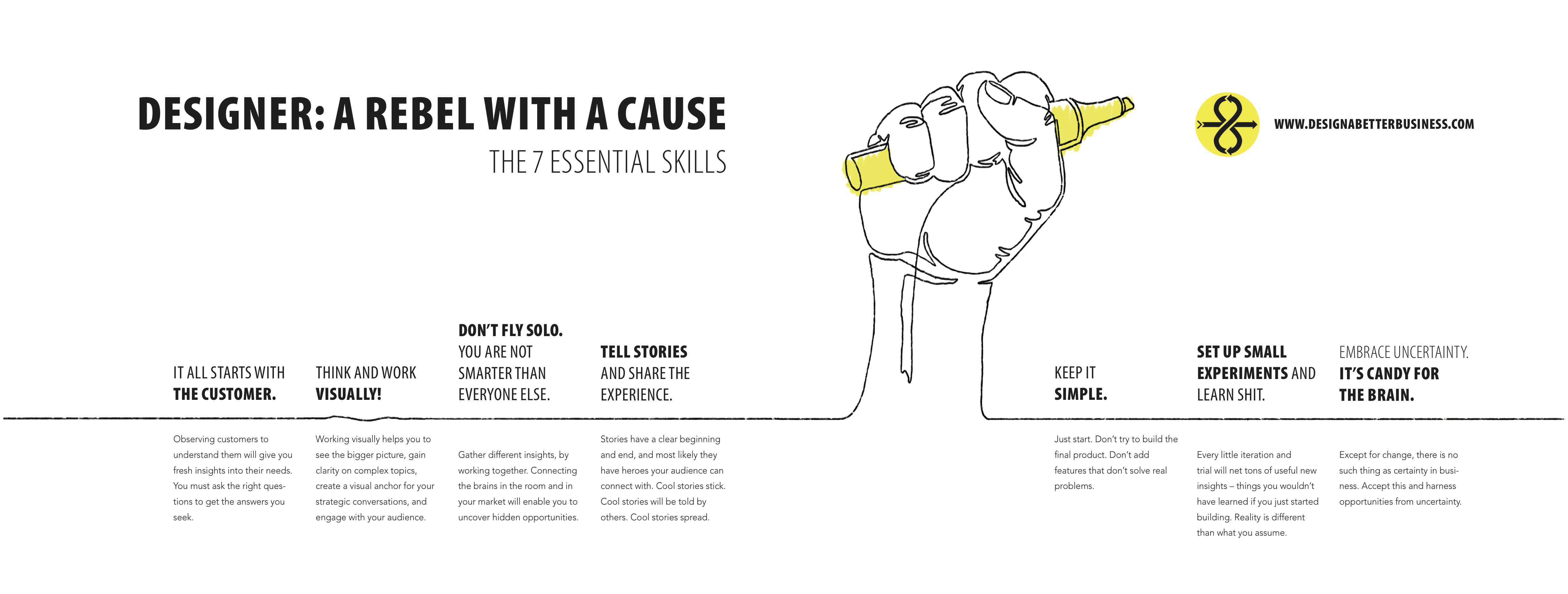
Here’s a great extract:
Every design journey starts somewhere. Design of a new concept, design of a brand new company or a new direction for your company to stay ahead of the competition. In every case, the journey you take will start with a point of view. But how do you design one?
Whether it is about a market, or a customer, or a new product or service, or even a competitor, we all have a point of view. Being at the center of the design journey, your point of view if your most valuable asset. It provides the litmus test for what’s real and what’s just a mirage. As a designer you are responsible for actively shaping your point of view based on what you learn along the way. So how you do that?
The first step is the hardest
Developing new business ideas from scratch can seem like a daunting task. When you’re a startup, you have hope in your heart that your company will become the big thing. You work hard at developing and selling your product – but often, the harder you work, the farther away your away dreams seem to be. When you’re an established business, you’ve been driving the same executional strategy for many, many years. Your shareholders enjoy the fruits of your labor in the form of increasing share prices and dividends, and your board looks to past growth for future strategy. However these past successes may become a burden as you try to steer your company into new waters.
To create change, you must start with your point of view, even when the odds seemed stacked against you. Maybe you’re thinking, “But it’s just my point of view! What changes could I possibly make based on what I think?!” You wouldn’t be wrong – or the first person – to think this. However, when you pair your point of view with specific tools, skills, and a mindset to match, you can absolutely create the change you’re looking for.
Be a rebel
If you’re looking to influence someone, especially someone you need on your team to turn your point of view into a successful strategy, it may sound counterintuitive to say that you should be a rebel. But, it’s precisely the rebel, and the points of view that she brings with her, that will serve as the catalyst for change. Being a rebel does not mean you must go against everything that your company or leadership stand for. RATHER, BEING A REBEL IS ABOUT COMING TO THE TABLE WITH A STRONG POINT OF VIEW TOWARD THE FUTURE. You do not need to buck the establishment – but you do need to question the establishment and bring to the table those big ideas that you feel in your gut are worth exploring.
Let your vision guide you
A strong point of view will serve as your catalyst for change. It is your vision for the future that will serve as the roadmap leading to the change you seek to make. People argue their points of view over beers. Visions set direction (maybe so that you can buy even more beer with the money you’ll make in the future!). Our definition of “vision” is different than what you’ll find in other books or articles. IT’S NOT JUST A STATEMENT; IT’S A RALLY CRY.
The concept of vision is all-encompassing; it includes the supporting factors that make the vision real, the steps you need to take to realize the vision, and the challenges and opportunities that you’ll face on your way to achieving your vision. To make your vision tangible and useful, the chapter POINT OF VIEW lays out co-creative tools that you can – and should – use with your team.
Design your story
When you enter that boardroom, or strategy meeting, or VC pitch, what are you going to say? How will you sway people to your point of view, or at least convince them to explore with you? This is where stories make a big difference. Ever notice how the best speakers, whether giving a TED talk, presenting in a conference room, or holding court in a bar, use anecdotes and stories to convey the points they are making? Though naturally talented speakers may do this somewhat instinctively, anyone who does this well is deliberate about what stories they tell, how, when, and to whom. To make your mark and gain the buy-in you’ll need to explore your point of view. In other words, you’ll need to design your story!
Design a Better Business Toolbox
Design Council Leading Business by Design
Markets have fundamentally changed.
A new generation of businesses (new technologies, new business models, new leadership) is emerging to address a new generation of customers (new audiences, new geographies, new aspirations). Marketing exists to connect businesses and customers, in relevant and profitable ways.
A new approach to marketing is therefore required. Some of the new approaches, and maybe the language, will be familiar. But not all, and not joined up as a fundamental approach to driving business performance. Together, some call it Marketing 4.0 or Exponential Marketing, but whichever labels you apply, it involves a seismic shift in philosophy and practice.
It fundamentally challenges every marketer who still turns first to their strategic plan. And then to their advertising agency, or even their web developer. It is fundamentally digital in mindset, but human as well as technological. It demands analytical thinking, content and networks, but also vision and creativity. It requires new types of leaders, and a new mindset for every marketer. It is built around 7 transformations.
These are the new rules of marketing:
- Growth Hacking … Forget strategic planning that is slow, structured and stable – instead think of strategy like a portfolio of fast and relentless experiments, seizing and shaping the best opportunities for growth. It still needs direction and choices – a vision still matters, making sense of change, having a clarity purpose, and a defined context in which to hack. Strategy becomes agile and creative, outside in, big ideas and small experiments, driven by changing markets and customer aspirations, rather than fixed by your own capabilities and products.
- Customer Analytics … Forget mass-market segmentation, whether geographic, demographic or anything else. People are individual, and don’t want standardised solutions. The power of big data, connecting and interpreting, automating and exploiting – together with more qualitative and creative insights through customer immersion and “design thinking” – is used to focus, engage, customise, deliver, support, enable the right customers over time. Linking to the hack culture, is the ability to keep learning, about people, about yourself, and what works.
- Platform Innovation … Forget innovation around a product, or even a service. Think strategically about how you can shape the market, in particular the platform that engages buyers and sellers, suppliers and distributors. Business model innovation, channel innovation, price innovation, then follow. Innovation is about shaping the market and all its dynamics to your advantage, whilst also personalised for each individual through micro-innovation – collaborative and customised solutions and experiences.
- Brand Storytelling … Forget brands built around who you are – brand logos, slogans and ownership. People engage with brands about them, brands that reflect their aspirations, and brands that connect them with other people who share their values and aspirations. Brand stories are living fables, encouraged by the company, but interpreted and spread by people to people. Content must be realtime and relevant, and keep moving forwards. Encouraged but not controlled. Inspiring, human and memorable.
- Social Influencers … Forget advertising, whether a TV campaign with 30 second slots, or even personalised mailings – people are not listening, and they don’t trust you. Instead they trust people like them, friends and peers. Word of mouth in a digital world, PR and celebrity endorsement is replaced by Instagramers or Youtubers who they trust. Brand stories, advocates, and community building help to guide and shape this influence.
- Enabling Experiences … Forget customer experiences as a semi-automated series of incentivised touchpoints built around the “sale”, think instead from a customer’s perspective. Think about the experience they have – the outcomes, not the inputs, what they do not what you do. Which is usually more about how they use, apply and exploit the products and services which they buy, rather than the purchase itself. Use their language, think about their experience, and how they use, store, apply and even dispose of products and services. Enable them to achieve more.
- Exponential Growth … Forget an obsession with sales volumes, even revenues, which are the short-term measure of sales people. Marketers should be focused on growing the business – profitably and sustainably – creating a better business future, and a long-term platform and guide for customers. Think profitably. Think growth. Think economic value creation. Exponential growth is now the expectation of investor, achieved by harnessing the power of branded networks, social influence and agile business models. Fast, exciting and rewarding.
These new rules of marketing, and specifically the 7 transformations, are the cornerstones of my next book and also of a new range of inspiring keynotes and practical workshops. We explore each mantra in detail, with detailed case studies together with the tools and partners for action.
Whilst of course, every market and every business is different, the 7 mantras are a provocative challenge for change. Of course, solutions are not black and white. Every business still has a mix of structured and hacked strategy, uses a box of earned and paid media, and has a balance of push and pull. But it is a rapidly changing area, a revolution.
Marketing is the driving force of business – it moves the business forwards, shapes the future, engages the customer and aligns the organisation to deliver. It is the growth engine, the innovation catalyst and customer champion. Markets are changing at incredible speed, requiring new agility and new capability.
There has never been a more exciting time for marketing, or to be a marketer.
Here are some useful videos:
https://www.youtube.com/watch?v=CGdAP_SmS9E
Here are some useful articles:
- Ryan Holiday’s Introduction to Growth Hacking
- Neil Patel and Bronson Taylor’s Definitive Guide to Growth Hacking
- CMI’s Complete Guide to Influencer Marketing
- Chief Marketer’s The Power of Influencers
- Danny Brown and Sam Fiorello’s Influence Marketing
- Marketo’s The Path to 2020 Marketers Seize the Customer Experience
- HubSpot’s The Future of Marketing 2017
- Salim Ismail and Yuri Van Geest’s Exponential Organisations
More of my recent blogs, insights and ideas:
- Exponential Business … how to grow faster with ideas, accelerators and multipliers
- Paper and Pixels … What’s the future of the business book?
- Changing the Game of Beauty … 3d printed Adore, vlogging Ipsy and wearable Vitaya
- Superhuman … will robots replace us, or make us better?
- Blockchain … from geeky Bitcoin technology, to a revolution in everyday processes
- Tesla’s Tipping Point … the clever strategy to drive growth in electric cars
- The New Rules of Marketing … growth hacking to social influencers and exponentials
- Learning for the 100 Year Life … nanodegrees in VR design and self-driving car engineering
- Accelerating Growth through Brand Innovation … Airbnb to Burberry, Xiaomi to Zara
- The Business Case for Big Data … 20 mind-changing facts and 6 practical stories
- The Pivot … the agility to change direction, from mediocrity to magic
- Business Agenda 2016 … 6 ideas to shape markets and drive innovation
And a bit more from me:
- Explore my 7 books, including my new book Gamechangers.
- Watch my latest videos, keynote speeches and interviews.
- Get inspired by 100 case studies, shaking up markets right now.
- Download 16 practical canvases, to help you make stuff happen.
- Book me as a keynote speaker, with insightful and inspiring talks..
- Download my recent presentations, leading innovation to being superhuman.
- Join one of the workshops, executive programs, or customised for your team.
- Hire me as a consultant, to stretch your thinking and facilitate your team.
- Read my latest blog updates, insights and ideas to inspire your thinking.
- Check out my next events, keynotes and workshops around the world
- Or simply contact me directly with any questions or to book me, right now!
It’s a simple game … “Imagine creating an Uber-type of business model for …”
Entrepreneurs love it, and in particular see the home as a great place to innovate the way in which services can be delivered on-demand.
CB Insights, the research firm, identified dozens of startups aiming to offer convenient, on-demand options for everything from lawn mowing to plumbing to TV repair. Many of these startups operate within the 1099 or gig economy, relying on independent contractors rather than employees. In addition, some go further on the services side and position themselves as ways for non-professionals to earn extra money by completing short-term projects on their own schedules. All are hoping to make the home services process as seamless for the consumer as other types of online shopping.
Their infographic brings together start-ups that leverage an on-demand business model, that is they enable users to book services instantly online, and receive the service within a few hours or, for larger projects like home renovations, within a compressed timeline.

Construction & renovation – Startups such as Boston-based Renoviso ($5M in funding) provide on-demand quotes and booking for large-scale home construction and renovation projects.
General services marketplaces – These startups aim to connect people who have short-term, non-professional home improvement projects (and other tasks) to people willing to do the work, in real-time. The most well-funded is Thumbtack, which lets users post project proposals and receive instant bids to complete them; the company has raised $274M in funding from investors including Sequoia and Google Capital and joined our Unicorn Tracker in 2015. Another high-profile company in the category is “Uber for services” app Taskrabbit, which has raised nearly $38M.
House cleaning – Handy, with $109M in funding, and other startups offer on-demand home cleaning, with appointments generally available same-day as well as by subscription, and bookable online.
House painting – The New York-based Paintzen ($12M in disclosed funding) and others offer on-demand house painting services.
Interior design – These startups provide on-demand access to interior design professionals. Havenly, with $13M in funding, connects users virtually to interior design experts who help in creating design themes, by building online visualizations, making personalized shopping lists, and obtaining and ordering desired items. Cocontest lets users submit project proposals and receive personalized bids from interior design professionals, while Homee offers text message-based on-demand design advice.
Laundry – A crowded category, on-demand laundry startups generally promise to pick up users’ clothing, handle the laundering, and then deliver the finished bundles back to users’ doors. Despite several recent laundry startup deaths, such as Washio, we still see a good deal of companies offering similar services around the world, including Lenet ($6M in funding) in Japan, Edaixi ($123M) in China, Laundrapp ($14M) in the UK, and Rinse ($10M) in the US.
Lawn care – Led by TaskEasy, with $22M in funding, these startups offer on-demand lawn mowing and landscaping services, bookable online.
Moving services – Startups like the Seattle-based Dolly ($10M in funding) and Tennessee-based Bellhops ($20M in funding) provide on-demand services for moving homes or apartments.
Professional contractor marketplaces – Platforms like Houzz, Porch, and Australia’s HiPages help users search for and connect with professional contractors for a wide variety of household improvement projects. These websites focus on professional contractors, in contrast to startups in the General Services Marketplaces category (above) which offer more amateur and peer-to-peer help. Houzz earned a spot on our Unicorn Tracker in 2014, and is currently valued at $2.3B.
Repair services – Startups like Serviz ($31M in disclosed funding) offer on-demand repair for large appliances, such as ovens and refrigerators, and plumbing issues. These startups focus specifically on repairs, while some of the broader home service marketplaces included in other categories of this market map may offer repairs alongside other services.
Storage – These companies offer on-demand help with item pickup and storage. Full-service storage startup Clutter, based in CA, leads the pack with $32M in funding.
Subscription home management – HappyHome ($18M in funding) and other startups offer subscription plans for overall home management. Subscribers receive on-demand access to a variety of home maintenance and repair services, all handled through their single subscription and personal home managers.
Tech support – HelloTech ($22M in disclosed funding) and Cellsavers ($18M in disclosed funding) promise to send on-demand tech support specialists to customers’ doors to fix their computers and smartphones within a few hours.
Spain is a land of diverse cultures that drives incredible creativity. From the humanistic forms of Antoni Gaudi and cubist renaissance of Picasso, to great cities like Barcelona and the rejuvenated Bilbao, the ready-baked clothes of Amancio Ortega to the cork-popping of Friexenet, the Spanish are natural lovers of innovation, and of life.
Bilbao … the city brand reinvented with a little help from Guggenheim
Camper … quirky shoes inspired by the peasant farmers of Majorca
Carto … enabling you to explore the insights underlying location data
https://www.youtube.com/watch?v=P6cabBvm5xQ
Chupa Chups … Picasso branded lollipops sold in local bakeries
https://www.youtube.com/watch?v=-HbOZeFvk0Q
Desigual … bright distinctive clothing, but with naked days
eDreams … the online travel agency with a high destination
Ferrovial … managing complex projects and customer experiences
Iberdrola … the world’s leading wind energy business
Inditex … fast fashion in multiple brands, Mango to Zara
LA Organic … Philippe Starck helps to rejuvenate Spanish olive oil
https://www.youtube.com/watch?v=sRWfqfpEz78
Lolea … fabulously branded, sangria packaged for wherever you are
https://www.youtube.com/watch?v=HzpeTI8JqsQ
Loewe … luxury clothing and accessories, party of LMVH
Moritz Factory … gourmet tapas and beer at affordable prices
Privalia … online fashion outlet with flash sales for members only
Wallapop … the mobile flea market, a Craigslist for millennials
Find out more about my programs at IE Business School in Madrid on strategy, innovation and marketing in Spain – inspired by local and global insights and ideas to lead your business for more profitable growth.
More of my recent blogs, insights and ideas:
- Exponential Business … how to grow faster with ideas, accelerators and multipliers
- Paper and Pixels … What’s the future of the business book?
- Changing the Game of Beauty … 3d printed Adore, vlogging Ipsy and wearable Vitaya
- Superhuman … will robots replace us, or make us better?
- Blockchain … from geeky Bitcoin technology, to a revolution in everyday processes
- Tesla’s Tipping Point … the clever strategy to drive growth in electric cars
- The New Rules of Marketing … growth hacking to social influencers and exponentials
- Learning for the 100 Year Life … nanodegrees in VR design and self-driving car engineering
- Accelerating Growth through Brand Innovation … Airbnb to Burberry, Xiaomi to Zara
- The Business Case for Big Data … 20 mind-changing facts and 6 practical stories
- The Pivot … the agility to change direction, from mediocrity to magic
And a bit more from me:
- Explore my 7 books, including my new book Gamechangers.
- Watch my latest videos, keynote speeches and interviews.
- Get inspired by 100 case studies, shaking up markets right now.
- Download 16 practical canvases, to help you make stuff happen.
- Book me as a keynote speaker, with insightful and inspiring talks..
- Download my recent presentations, leading innovation to being superhuman.
- Join one of the workshops, executive programs, or customised for your team.
- Hire me as a consultant, to stretch your thinking and facilitate your team.
- Read my latest blog updates, insights and ideas to inspire your thinking.
- Check out my next events, keynotes and workshops around the world
- Or simply contact me directly with any questions or to book me, right now!
Tata, Airtel, Reliance Industries, HDFC Bank and LIC are India’s most valuable brands according to the latest Best Indian Brands Report 2016.
Whilst multi-faceted Tata still leads the way, HDFC has risen from 6th place in 2014, to rank 4th with a 15% rise in brand value. Reliance Industries and Airtel have swapped the number 2 and 3 spots with a 3% and 8% growth in revenue respectively. The fastest rising brand is Maruti Suzuki with a 16% increase in brand value, driven by moves into new segments and moving up the value chain. The brand value of HDFC Bank also grew by 15%, primarily supported by its focus on new solutions and digital channels. Other big risers were Mahindra (14%), Idea (12%), Infosys (12%) and Dabur (12%.)
Given the legacy of conglomerate-thinking, diversified businesses and financial services account for the two most significant sector in this year’s league table. While diversified businesses make up 37% of the total brand value of the table, financial services forms 27% of the value. Telecom, auto and tech are the other significant contributors to the value, accounting for 9%, 7.5% and 7% respectively.
At the launch event in Mumbai, the reports authors Interbrand said “Indian brands must accelerate their growth to compete globally. These businesses grew from industries to conglomerates. The conglomerates are now trying to grow global by transcending domains, reinventing around purpose, waking up to strategic issues like sustainability. This shift is marked by industry-driven brands transforming to fast moving consumer-centric brands, customer-centric innovations and digital pervasiveness. Historically, diversified and finance sectors have dominated the Indian market. Technology, telecom and auto are the emerging growth sectors. More importantly, healthcare, e-commerce, fashion, luxury and sports are the next big opportunities.”
“Indian businesses and brands will need to be the global frontrunners in designing lives and creating better experiences, at the speed of life. This needs the Indian brands to reinterpret themselves in the context of a global role and purpose. Simply because today its all about people – B2H (business to human) as against B2B or B2C. And people today are more interested in what we make happen rather than what we make. Thus aligning themselves to a purpose creates an inspiring brand-led culture on the inside, which in turn anchors the multiple micro-experiences for the customer on the outside. This is really the way Indian brands can lead and grow their businesses global.”

Another report, by BrandZ (WPP Kantar Millward Brown), calculates that the total value of India’s most valuable brands has risen by 30% over the last three years, with the Top 50 brands now worth $90.5 billion. According to this report, and their alternative valuation methodology, HDFC bank is number one for a third consecutive year with a brand value of $14.4 billion following a 15% growth over the past year. (Quite how they calculate this, given Interbrand’s analysis of the bank, is puzzling!)
https://www.youtube.com/watch?v=15xIetebtzI
Brand valuation is a dubious game, based on judgement and remote estimations. Of course, its the business strategy and business value that matter more, brand being one of the important value drivers in delivering growth and profitability. Whilst Interbrand’s reports always give useful insight and commentary on changing markets, and the opportunities for brands, most rigorous is actually the report by Brand Finance (see below). However the real challenge is to understand the changing nature of India’s global and local markets, to build a business and brand strategy to seize the best opportunities for growth, to engage the best customers most effectively, and turn great ideas into profitable results.
https://www.youtube.com/watch?v=bTMYlf6bkFQ
- Download the Interbrand report Best Indian Brands 2016
- Download the Brand Finance report Global 500 Brands 2016
- Read more Gamechanger case studies Narayana Healthcare
A red clay brick designed and sold by skateboarding brand Supreme is selling on eBay for $1,000, after originally selling out in a single day.
The item, part of the Supreme skateboarding brand’s accessories line that has previously included a hammer, calculator and fire extinguisher, is branded with Supreme’s logo and has been highly anticipated by fashion gurus since its preview last month.
It sold out at its original price of $30 within minutes, and has since appeared online with extremely high price tags.
While it is unclear whether the brick was released as a statement, a joke or as part of a secret endorsement, some have speculated that Supreme might be playing on the term “bricking a fit” – to put together a failed outfit.
“I don’t know why, I just think having a Supreme brick would be funny. I’d also like to store it in this lucite box,” Max Berlinger, GQ style editor, said in August.
One Reddit user has also taken the time to point out that it would cost millions of dollars to buy enough Supreme bricks to build an actual house. “So I did the maths and calculated how many bricks it’d take to build a 2,400-square-foot home, which is 117,600 bricks. I then just took the cost of the Supreme brick, I made it $40 to include the shipping and such. So, 117,600 x 40 = $4,704,000. Thank you.”
Another user commented: “That’s just for a bare ass house. No insulation, no electric wiring, no cable wiring, no internet wiring. That doesn’t event account for floors. Either you’d spend extra money to have brick floors, or it would just be dirt. I know exposed brick drives up the price of living spaces, especially in apartments in New York … I wonder if the resell price for bricks would affect the Supreme brick housing market? I mean, you’d figure that a brick could very well go for like $60-70 resale if it’s extremely hyped. That would make your house worth a little over $7m at $60 per brick. This might be a good business investment.”
Digital learning platform Udacity has launched some eye-catching new programs in recent weeks – be it the VR Developer nanodegree in partnership with Google, or the Self-Driving Car Engineer with Mercedes-Benz.
Business education is changing rapidly, as technology disrupts not just products and services, but also the skills and jobs required to deliver them. From the 100 year life (most of us will live to at least 100, with 4-5 different careers during that time, and retirement a thing of the past) to the reinvention of business schools (the average age of executive education has shifted from 25 to 50 as executives need to rethink, refocus and retrain). But it is the online platforms (also known as MOOCs – massive open online courses) like Coursera, EdX and Udacity which can be most disruptive. Making free or low-cost programs in a whole portfolio of new work and lifeskills, accessible to anyone on the planet with an internet connection.
Founded in 2011 by Sebastian Thrun, a computer scientist and former head of Google’s “moonshot” Google X program, Udacity is big business, and has raised more than $160 million in VC funding, to date. The company celebrated 5 years in business earlier this year and claims that 11,000 people are currently enrolled in its nanodegree programs, while in excess of four million people have checked into one of Udacity’s free courses.
A Nanodegree program is an innovative curriculum path that is outcome-based and career-oriented. Every program has a clear end-goal, and the ideal path to get you there. Courses are built with industry leaders like Google, AT&T, and Facebook, and are taught by leading subject matter experts. Students benefit from personalized mentoring and project-review throughout, and have regular access to instructors and course managers through moderated forums.
Graduates earn an industry-recognized credential and benefit from extensive career support. The ultimate goal of a Nanodegree program is to teach the skills you need, for the career you want, so you can build the life you deserve.
What’s becoming increasingly clear is that Udacity is setting out to offer courses in areas where it anticipates great demand in the coming years. The latest programs are in a long line of courses offered through the partnership between Udacity and Google. The duo have previously launched programs covering Android fundamentals, cloud fundamentals, UX fundamentals, and web performance.
Last year, they also linked up to offer a tech entrepreneur nanodegree, followed by a deep learning course. And, back in June, they introduced a new Android Basics nano degree aimed at those with little or no programming experience. The course went on to become Udacity’s biggest-ever nanodegree launch, with 1,500 students enrolling in the $199/month course in the first week alone.
With the VR Developer Nanodegree, students will delve into 3D environments and learn how to make the VR experience immersive on both mobile phones and desktops. They’ll work on game engines, design and user interaction, performance and ergonomics, and more.
The program costs $199 per month, with 50 percent refunded upon successful completion. It was developed in conjunction with Google, HTC, and Upload, who will each contribute to the curriculum and have mentors on hand to give coaching and feedback to students. By default, all students will work with a Google Cardboard headset, which admittedly isn’t strictly “VR,” but which is an accessible and affordable option for viewing immersive content. Alternatively, those with access to a real VR headset, such as an Oculus Rift or an HTC Vive, will be able to pursue an extra track called “High Immersion VR.”
The Self-Driving Car Nanodegree program in partnership with Mercedes Benz, Nvidia, Otto (Google’s self-driving trucks) and DiDi (Chinese car-sharing service) consists of three terms of 12 weeks each. It takes nine months to complete. Each term costs $800, paid in advance. Scholarships are available for students who qualify. At the end of the 9 month program, Udacity predicts that you will get a self-driving car engineering job with a salary of around $138,000. You can even pay a little more, and make the job certain, and money back if you don’t.
Students who enroll in this program will master technologies that are going to shape the future. Through interactive projects in computer vision, robotic controls, localization, path planning, and more, you’ll prepare yourself for a key role in this incredible field.
As Sebastian Thrun says “If your goal is to build the future, then your future begins here.”