I keep saying it. It sounds dramatic, a nice sound bite, but it’s true. And here is evidence … the next 5 years will see more change in our world, than we have seen in the last 250 years. So more dramatic than the impacts of industrialisation and globalisation?
On 12 September 2016, there was a momentary realignment in global business. For the first time, the five largest public corporations in the world by market cap were all technology companies: Apple, Alphabet, Microsoft, Amazon, and Facebook. It only lasted seven weeks, because of the rise in oil prices and natural rhythms of the stock market, which eventually drove ExxonMobil and Berkshire Hathaway past Facebook and Amazon. But it’s easy to conclude that a portal had opened briefly to the future, a future in which technology matters most.
Like so much of 2016, the moment surprised many. But while it was a bad year for pollsters, it was a very good year for high tech. If you put aside exploding Samsung smartphones, the massive hacks at Yahoo!, fake news on Facebook, and all the business implications of a Trump presidency, the tech industry produced some astounding results in 2016—and not just of the financial variety.
In January, the Alphabet division DeepMind announced it had developed a computer program capable of beating the best human players in the intricate Chinese board game Go. In April, after repeated failures, SpaceX successfully landed an unmanned rocket on a drone ship floating in the Atlantic Ocean. In August, Uber’s self-driving cars hit the road in Pittsburgh; two months later, Microsoft said computers were transcribing speech as quickly and accurately as humans. And in December, Amazon announced it had conducted its first commercial delivery via drone, sending a set-top box and some popcorn to a customer near Cambridge, England.
But look beyond that, and you will see the next generation of innovations zooming rapidly towards us. was an incredible year for technology, and potentially for humanity. 2016 was an exponential year of technological breakthroughs that are likely to transform all of our future lives.
Working with the Singularity University, here’s an incredible list of what’s happened over the last year, and ready to accelerate in 2017:
1. Drone World … global connectivity, communication and delivery.
In 2010, 1.8 billion people were connected. Today, that number is about 3 billion, and by 2022 – 2025, that number will expand to include every human on the planet, approaching 8 billion humans.
Unlike when I was connected 20 years ago at 9,600 baud via AOL, the world today is coming online at one megabit per second or greater, with access to the world’s information on Google, access to the world’s products on Amazon, access to massive computing power on AWS and artificial intelligence with Watson… not to mention crowdfunding for capital and crowdsourcing for expertise.
Looking back at 2016, you can feel the acceleration. Here are seven stories that highlight the major advances in our race for global connectivity:
Google’s 5G Solar Drones Internet Service: Project Skybender is Google’s secretive 5G Internet drone initiative. News broke this year that they have been testing these solar-powered drones at Spaceport America in New Mexico to explore ways to deliver high-speed Internet from the air. Their purported millimeter wave technology could deliver data from drones up to 40 times faster than 4G.
Facebook’s Solar Drone Internet Service: Even before Google, Facebook has been experimenting with a solar-powered drone, also for the express purpose of providing Internet to billions. The drone has the wingspan of an airliner and flies with roughly the power of three blowdryers.
ViaSat Plans 1 Terabit Internet Service: ViaSat, a U.S.-based satellite company, has teamed up with Boeing to launch three satellites to provide 1 terabit-per-second Internet connections to remote areas, aircraft and maritime vehicles. ViaSat is scheduled to launch its satellite ViaSat2 in early 2017.
OneWeb Raises $1.2B for 900 Satellite Constellation: An ambitious low-Earth orbit satellite system proposed by my friends Greg Wyler, Paul Jacobs and Richard Branson just closed $1.2 billion in financing. This 900-satellite system will offer global internet services as soon as 2019.
Musk Announces 4,425 Internet Satellite System: Perhaps the most ambitious plan for global internet domination was proposed this year by SpaceX founder Elon Musk, with plans for SpaceX to deploy a 4,425 low-Earth orbit satellite system to blanket the entire planet in broadband.
2. Clean Power … renewables are now cheaper than coal
We’ve just exceeded a historic inflection point. 2016 was the year solar and renewable energy became cheaper than coal. In December, the World Economic Forum reported that solar and wind energy is now the same price or cheaper than new fossil fuel capacity in more than 30 countries. “As prices for solar and wind power continue their precipitous fall, two-thirds of all nations will reach the point known as ‘grid parity’ within a few years, even without subsidies,” they added. This is one of the most important developments in the history of humanity, and this year marked a number of major milestones for renewable energy. Here are 10 stories to illustrate the historic nature of this 2016 achievement.
25 percent of the World’s Power Comes From Renewables: REN21, a global renewable energy policy network, published a report showing that a quarter of the world’s power now comes from renewable energy. International investment in renewable energy reached $286 billion last year (with solar accounting for over $160b of this), and it’s accelerating.
The UK Is Generating More Energy From Solar Than Coal: For the first time in history, this year the U.K. has produced an estimated 6,964 GWh of electricity from solar cells, 10% higher than the 6,342 GWh generated by coal.
Coal Will Never Recover: The coal industry, once the backbone of U.S. energy, is fading fast on account of renewables like solar and wind. Official and expert reports now state that it will never recover (e.g., coal power generation in Texas is down from 39% in early 2015 to 24.8% in May 2016).
Tesla’s Gigafactory: Tesla’s $5 billion structure in Nevada will produce 500,000 lithium ion batteries annually and Tesla’s Model III vehicle. It is now over 30 percent complete… the 10 million square foot structure is set to be done by 2020. Musk projected that a total of 100 Gigafactories could provide enough storage capacity to run the entire planet on renewables.
3. Health Hopes … the end of cancer and disease
Though it may seem hard to believe, the end of cancer and disease is near. Scientists and researchers have been working diligently to find novel approaches to combating these diseases, and 2016 saw some extraordinary progress in this regard. Here are 10 advancess that demonstrate our abilities to cure cancer and most diseases:
Cancer Immunotherapy Makes Strides (Extraordinary Results): Immunotherapy involves using a patient’s own immune system (in this case, T cells) to fight cancer. Doctors remove immune cells from patients, tag them with “receptor” molecules that target the specific cancer, and then infuse the cells back in the body. During the study, 94% of patients with acute lymphoblastic leukemia (ALL) saw symptoms vanish completely. Patients with other blood cancers had response rates greater than 80%, and more than half experienced complete remission.
In China, CRISPR/Cas9 used in First Human Trial: A team of scientists in China (Sichuan University) became the first to treat a human patient with an aggressive form of lung cancer with the groundbreaking CRISPR-Cas9 gene-editing technique.
NIH Approves Human Trials Using CRISPR: A team of physicians at the University of Pennsylvania’s School of Medicine had their project of modifying the immune cells of 18 different cancer patients with the CRISPR-Cas9 system approved by the National Institute of Health. Results are TBD.
Giant Leap in Treatment of Diabetes from Harvard: For the first time, Harvard stem cell researchers created “insulin producing” islet cells to cure diabetes in mice. This offers a promising cure in humans as well.
HIV Genes Cut Out of Live Animals Using CRISPR: Scientists at the Comprehensive NeuroAIDS Center at Temple University were able to successfully cut out the HIV genes from live animals, and they had over a 50% success rate.
New Treatment Causes HIV Infected Cells to Vanish: A team of scientists in the U.K. discovered a new treatment for HIV. The patient was treated with vaccines that helped the body recognize the HIV-infected cells. Then, the drug Vorinostat was administered to activate the dormant cells so they could be spotted by the immune system.
CRISPR Cures Mice of Sickle Cell Disease: CRISPR was used to completely cure sickle cell by editing the errant DNA sequence in mice. The treatment may soon be used to cure this disease, which affects about 100,000 Americans.
Eradicating Measles (in the U.S.): The World Health Organization (WHO) announced that after 50 years, they have successfully eradicated measles in the U.S. This is one of the most contagious diseases around the world.
New Ebola Vaccine Proved to be 100% Effective: None of the nearly 6,000 individuals vaccinated with rVSV-ZEBOV in Guinea, a country with more than 3,000 confirmed cases of Ebola, showed any signs of contracting the disease.
Eradicating Polio: The World Health Organization has announced that it expects to fully eradicate polio worldwide by Early 2017.
4. Living Longer … 100 is the new 60
We are on the verge of significantly impacting human longevity. At a minimum, making “100 years old the new 60,” as we say at Human Longevity Inc. This year, hundreds of millions of dollars were poured into research initiatives and companies focused on extending life. Here are five of the top stories from 2016 in longevity research:
500-Year-Old Shark Discovered: A Greenland shark that could have been over 500 years old was discovered this year, making the species the longest-lived vertebrate in the world.
Genetically Reversing Aging: With an experiment that replicated stem cell-like conditions, Salk Institute researchers made human skin cells in a dish look and behave young again, and mice with premature aging disease were rejuvenated with a 30% increase in lifespan. The Salk Institute expects to see this work in human trials in less than 10 years.
25% Life Extension Based on Removal of Senescent Cells: Published in the medical journal Nature, cell biologists Darren Baker and Jan van Deursen have found that systematically removing a category of living, stagnant cells can extend the life of mice by 25 percent.
Funding for Anti-Aging Startups: Jeff Bezos and the Mayo Clinic-backed Anti-Aging Startup Unity Biotechnology with $116 million. The company will focus on medicines to slow the effects of age-related diseases by removing senescent cells (as mentioned in the article above).
Young Blood Experiments Show Promising Results for Longevity: Sakura Minami and her colleagues at Alkahest, a company specializing in blood-derived therapies for neurodegenerative diseases, have found that simply injecting older mice with the plasma of young humans twice a week improved the mice’s cognitive functions as well as their physical performance. This practice has seen a 30% increase in lifespan, and increase in muscle tissue and cognitive function.
5. Stem Cells … rebuilding the human body
We’ve increasingly become confident and passionate about stem cells, the regenerative engine of the body, to help cure disease and extend the healthy human lifespan. I previously wrote about stem cells and the incredible work from Dr. Robert (Bob) Hariri here. Below are three stories demonstrating the incredible research and implications for stem cells in 2016:
Stem Cells Able to Grow New Human Eyes: Biologists led by Kohji Nishida at Osaka University in Japan have discovered a new way to nurture and grow the tissues that make up the human eyeball. The scientists are able to grow retinas, corneas, the eye’s lens, and more using only a small sample of adult skin.
Stem Cell Injections Help Stroke Victims Walk Again: In a study out of Stanford, of 18 stroke victims who agreed to stem cells treatments, seven of them showed remarkable motor function improvements. This treatment could work for other neurodegenerative conditions such as Alzheimer’s disease, Parkinson’s and Lou Gehrig’s disease.
Stem Cells Help Paralyzed Victim Gain Use of Arms: Doctors from the USC Neurorestoration Center and Keck Medicine of USC injected stem cells into the damaged cervical spine of a recently paralyzed 21-year-old man. Three months later, he showed dramatic improvement in sensation and movement of both arms.
6. Self Driving … Tesla, trucks and transforming transport
2016 was definitely “the year of the autonomous vehicle.” As Google, Tesla and Uber lead the charge, almost every major car company is investing heavily in autonomy. This will be one of the defining technology developments of the decade — soon we may well look back in shock that we ever let humans drive cars on their own. Here are the top developments in self-driving cars from the last 12 months:
Autonomous Uber Operational in Pittsburgh: Uber’s self-driving autonomous cars began picking up passengers in Pittsburgh this year. They also attempted a rollout in San Francisco.
Every Tesla Will Be Fully Autonomous in 2017: Elon Musk announced that all new Tesla cars will have the hardware for Level 5 autonomy. Next steps toward fully autonomous driving on public roads include refining the software and gaining regulatory approval.
GM’s First Fully Autonomous Car: The company plans to bring its fully electric self-driving cars to the masses by launching its first driverless cars on Lyft.
Autonomy Will Kill Car Ownership: A former Tesla and BMW exec said that self-driving cars would start to kill car ownership in just five years. John Zimmer, the cofounder and president of Lyft, said in September that car ownership would “all but end” in cities by 2025.
Self-Driving Tractors Hit Farms: The self-driving tractors can deliver faster, more precise results than their human-controlled counterparts.
7. Flying Cars … no longer a fantasy
Quadcopters and multicopters big and small made huge strides in 2016. We are headed towards a world where autonomous drones will image the world at millimeter resolution, deliver products and packages, and transport humans to remote areas that were previously inaccessible by roads. Here were the top six drone and “flying car” developments this year:
Amazon Prime Air Made Its First Delivery: Amazon’s drone delivery program “Prime Air” made its first delivery in Cambridge UK this year. Expect a much bigger rollout in 2017.
Mercedes Commits $500M to Drone Delivery: Mercedes-Benz vans and drone tech startup Matternet have created a concept car called a Vision Van. The van’s rooftop serves as a launch and landing pad for Matternet’s new M2 drones.
Larry Page Funding Flying Cars: Reports this year suggest Google cofounder Larry Page has been personally funding a pair of startups devoted to creating flying cars. He has purportedly put over $100 million into the ventures.
1,000 Organ Transplant Deliveries from Drone Ordered: Last year we saw Chinese company eHang announce the first human-carrying drone. Recently, United Therapeutics CEO Martine Rothblatt announced a deal to fund 1,000 retrofitted eHang drones to provide organ deliveries to transplant patients, as part of Rothblatt’s Manufactured Organ Transport Helicopter (MOTH) system.
Uber Launched Its Elevate Program: Global transportation giant Uber announced its plans to enter the “flying car” service arena by publishing a massive whitepaper this year detailing its plan to launch an “on demand aviation” service called Uber Elevate.
8. Brain Power … the importance of artificial intelligence
Artificial Intelligence (AI) is the most important technology humanity will ever develop. I believe AI is a massive opportunity for humanity, not a threat. Broadly, AI is the ability of a computer to understand your question, to search its vast memory banks, and to give you the best, most accurate answer. AI will also help humanity fundamentally solve its grandest challenges. You may think of early versions of AI as Siri on your iPhone, or IBM’s Watson supercomputer, but what is coming is truly awesome. Here are 10 of the most important stories for the past year:
NVIDIA Revealed a Deep-Learning Computer Chipset: The Tesla P100, Nvidia’s newly announced 15-billion-transistor chip, is designed specifically for deep-learning A.I. technology. Hardware advances like this are rapidly accelerating AI developments.
$5M IBM Watson AI XPRIZE: The XPRIZE Foundation and IBM Watson, in partnership with TED, announced a $5M purse for the team able to develop an AI that can collaborate with humans to solve grand challenges. The top three teams will compete on the TED stage in the spring of 2020.
AIs Can Read Your Lips: A new AI lip reader out of Oxford called LipNet was built to process whole sentences at a time. LipNet was 1.78 times more accurate than human lip readers in translating the same sentences.
AI’s Predict Election Better Than Humans: MogIA, an AI system developed by an Indian startup, correctly predicted the outcome of this year’s elections. It based its analysis on 20 million data points from platforms such as Google, Twitter and YouTube.
AI System Beats 500-to-1 Odds, Predicts the Kentucky Derby Trifecta: A startup called Unanimous AI built a swarm system in which individuals within a group influence each other’s decision making. The swarm correctly predicted the top four finishers—known as a superfecta—beating 540 to 1 odds.
Microsoft Speech Recognition Tech Scores Better Than Humans: Microsoft’s new speech recognition technology is able to transcribe conversational speech as well as (or even better than) humans. The technology scored a word error rate (WER) of 5.9%.
AI-Written Novel Passes 1st Round of Literary Award: Titled ‘The Day A Computer Writes A Novel,’ the short story was a team effort between human authors, led by Hitoshi Matsubara from the Future University Hakodate, and, well, a computer.
AI Saves Woman’s Life: Reports assert that Japanese doctors have, for the first time in history, used artificial intelligence from IBM’s Watson system to detect a rare type of leukemia, helping to save a patient’s life.
AIs Beat Human Pilot in Air Combat: Retired United States Air Force Colonel Gene Lee recently went up against ALPHA, an artificial intelligence developed by a University of Cincinnati doctoral graduate in a high-fidelity air combat simulator. The colonel lost to the AI.
Deep Mind Beats World’s Go Champion: The Go-playing AI “AlphaGo” from Google’s DeepMind beat the reigning Go world champion, winning the five-game series 4-1 overall. This is a major achievement in the field of AI and deep learning.
9. Next Frontiers … physics and the universe
This year saw a number of fundamental achievements in physics, as well as a number of notable discoveries in our quest to explore the cosmos. Here are the top three stories for your consideration:
Gravitational Waves Confirmed: After decades of searching, scientists have succeeded in detecting gravitational waves from the violent merger of two massive black holes.
Evidence Found for Planet Nine: This year, more evidence arose suggesting there is, in fact, another giant, icy planet circling at the edges of our solar system.
Earth-Size Planet Around Proxima Centauri: A new planet that bears striking similarities to our own planet prompts remarkable inroads into the study of space. This also brings a new area to search for the possibility of extraterrestrial life.
10. Space Race … faster and further
We are living during the birth of the commercial space era, driven by passionate billionaire backers. Companies like SpaceX, Blue Origin, Planetary Resources and various teams competing for the Google Lunar XPRIZE are building commercial rockets and spacecraft to explore the cosmos. It is an incredibly exciting time for commercial space—here are the top four developments from the past 12 months.
Bezos Announced ‘New Glenn’: Jeff Bezos announced a massive new reusable rocket family in development for his private spaceflight company Blue Origin. The rocket, called New Glenn, will be used to launch satellites and people into space, according to Bezos.
Four Companies Sign Private Contracts to Fly to Moon In 2017: The teams are competing to win the $20 million Google Lunar XPRIZE to become to the first private team to land a spacecraft on the moon. The companies are: Moon Express, SpaceIL, Synergy Moon and Team-Indus.
Musk Announces Mars Plans: SpaceX founder Elon Musk said he will put a person on Mars by 2025. There are four key things we will need to get there: full reusability, refueling in orbit, propellant production on Mars, and a propellant that works.
Breakthrough Starshot Project Targets Interstellar Travel: Theoretical physicist Stephen Hawking and Russian billionaire Yuri Milner announced their collaborative venture “Breakthrough Starshot” — a $100 million attempt to make an interstellar starship.
Thanks to the Singularity team for an incredible list. Let’s see where these, and many more innovations take us in 2017!
“Private labels” (store brands) are a retailer’s own branded versions of popular products, used to be seen as cheap and generic, sometimes as low-priced imitators of classic brands.
That old mindset has changed. Supermarkets now offer their own gourmet food ranges as good as restaurants, or even better when you can assemble them at home. They can bring together “solutions” from multiples categories under the same brand. They can offer services, such as purchase advice or after-sales support, complimentary services and more. And just like Netflix is able to use its deep knowledge of people and their behaviours to personalise its movies and suggestions, so retailers can leverage loyalty card data and instore tracking to offer more relevant and personal solutions.
Compare this to classic brands – like Kellogg’s or Heinz – they never get to meet their consumers, or have data on their individual behaviours. They cannot create branded in-store environments that allow human engagement, or extend beyond their branded packaging. Yes they have brands of heritage and expertise, available n multiple places, and supported by blockbuster advertising. However the difference in quality is little, and many brand owners even make the private label alternatives too.
“Private labels” have become more effective than classic brands – and with a little nurturing have the opportunity to innovate and grow in ways that their previously esteemed rivals cannot. They can also be much more profitable, flexible and value-creating for their owners, the retailers.
So what are some advantages of private label?
They can focus more on the needs of the target consumer, leveraging the intelligence of the store to understand consumer behaviours and preferences.
They enable direct contact with manufacturers and suppliers, reducing the distance “field to fork”, and improving transparency and traceability.
They promote the retailer brand in tangible and innovative ways, enhancing the relevance, the value and reputation of the retailer.
The ability to avoid or climate competition means there is less focus on price battles, and also price matching by consumers across stores.
There is more control and flexibility, to get new ideas to market faster, to adapt pricing to changing situations, and learn quickly from consumer response.
They can be complimented by additional products, for example in adjacent categories, or services that enhance the consumer’s experience.
The overall cost is cheaper, less intermediaries and commissions, economies of scale and as a result potentially higher margins.
Amazon is significantly expanding its usage of private labels. According to the Wall Street Journal Amazon will soon be promoting and selling brands like Happy Belly (nuts, trail mix, tea), Presto! (household goods), and Mama Bear (baby items). Meanwhile, the company already has been stealthily selling at least seven in-house apparel brands that many customers probably have no idea are clothes made exclusively for the site.
The Charlotte-based department store has 22 private label brands … For major department store retailers like Belk, private label brands are critical: They fill in market gaps left open by national brands. (Are Southern women craving brightly colored T-shirts with preppy anchor logos at a modest price? Belk will make them, if no one else is.) Retail analysts say companies like Belk keep more of the sales dollars from private label brands because national-brand middlemen are eliminated, and stores can choose how and when to mark down items.
Kroger and some other grocery retailers are seeing a growing share of sales come from these private-label products, and shoppers should expect to keep seeing new items and private brands pop up on store shelves. Private-label sales took off in the penny-pinching Great Recession, but today the private-label products you see will increasingly be high-end, with gourmet ingredients, or will be found on the store perimeter, where health-conscious shoppers are hunting for fresh produce and meat.
.
Read more:
Amazon: 25 years of innovation now including own label fashion, food and more
Rackuten Ichiba: retailing the Japanese way, selling everything from crabs to kimonos
Sonae: the Portuguese retailer taking its own label products to other stores
Futurestore: how the retail sector is changing, and the most disruptive innovators
As director of Thinkers50, the global ranking of the world’s best management thinkers, I spend a lot of time scanning, curating and making sense of the best ideas in business. Of course it doesn’t follow that the top academics will produce the best new ideas.
As Chip and Dan Heath say in their book Made to Stick, good ideas need to be something that is distinctive, practical and contagious. Or in their “SUCCESS” model – simple, unexpected, concrete, credible, emotional, stories.
Many of the ideas that stood out this year fall into two categories: 1. streams of management research that gathered momentum or brought new data to an old debate and 2. management thinking applied outside the sphere of what we ordinarily think of as management to help make sense of global risks, political choices, and economic, social, and technological shifts.
The list below, coming from Harvard Business Review, shows that good, principled, innovative management can help us solve our way out of even the most difficult problems:
Finally, here are the most popular articles of the year in eight of the most important topics HBR covers. I highly recommend saving and reading any you haven’t already read!
Digital marketing is many things. Whilst everyone wants to create their app, pull on their VR helmut and Snapchat their brand, it is much more than that – sometimes much more boring, but also much more profound and connected too.
In simple terms all marketing is digital today. Digital is not technology, it is a mindset. It is about harnessing the power of ideas and data, platforms and networks, to engage people, build brands, and drive business growth further and faster than ever before.
So what are the core digital marketing techniques?
Big Data (including market and customer insight and predictive analytics)
Content marketing Communities (Branded niche or vertical communities)
Display (Banners on publishers, ad networks social media including retargeting and programmatic)
Internet of Things (IoT) marketing applications
Marketing Automation (incl CRM, behavioural Email marketing and web personalisation)
Mobile marketing (Mobile advertising, site development and apps)
Paid search marketing, e.g. Google AdWords Pay Per Click
Online PR (including influencer outreach)
Partnerships including affiliate and co-marketing
Search Engine Optimisation (SEO or organic search)
Social media marketing including Social CRM and Social Customer Care
Wearables (e.g. Apple Watch, activity trackers, augmented reality)
A deep dive into the most significant tactics and marketing technology within each of these are starts to reveal how each component is powerful, but when integrated into a marketing strategy, and comprehensive approach with customers, then its impact is much greater. So, in collaboration with our friends from Smart Insights, let’s explore the components:
1. Content marketing trends
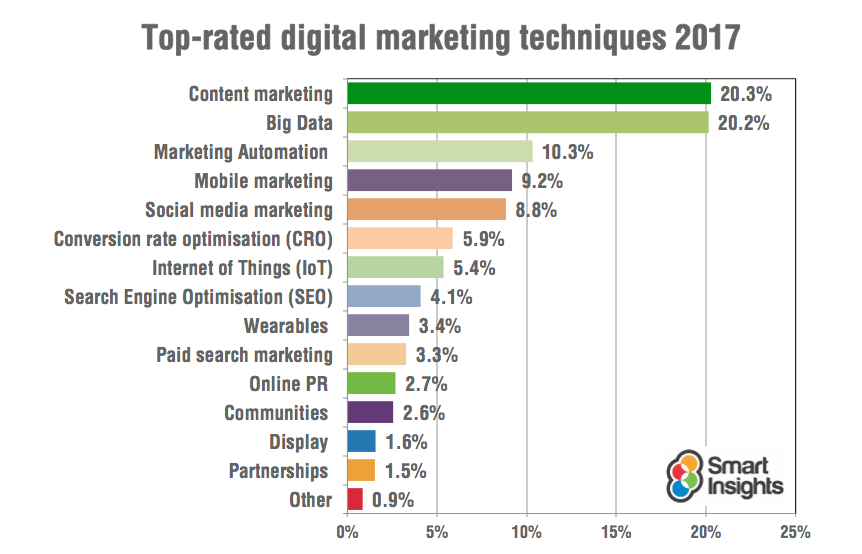
Content marketing has been in the top 3 for the last 3 years we have run this post, so we focus a lot on how to create an integrated content marketing strategy through advice in our content marketing toolkit.
Our research with HubSpot, illustrated in the Competing on Content infographic, shows that more businesses are now using a strategic approach (40%), so this is a trend we can expect to see continuing in 2017. We can also expect that there will be more focus on Measuring Content Marketing ROI as the cost and competition within content marketing increases.
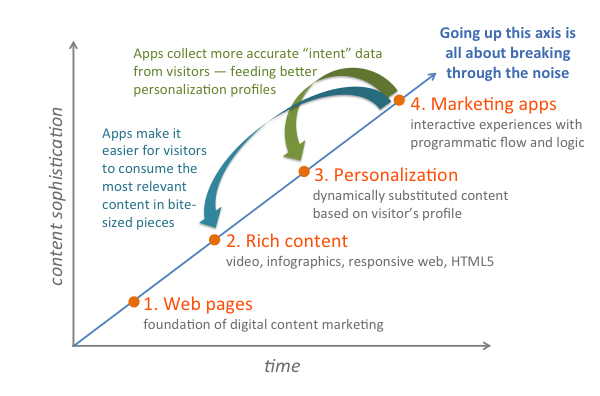
At a practical level, Martech Guru Scott Brinker has talked about the 4th Wave of Content Marketing and I’m seeing more and more examples of interactive marketing apps – like our capability graders and also personalisation tools recommending content. Read his article, introducing it, a great read and you can check out the ionInteractive examples of interactive content marketing.
2. Big Data
As defined in our question, Big Data marketing applications include market and customer insight and predictive analytics.
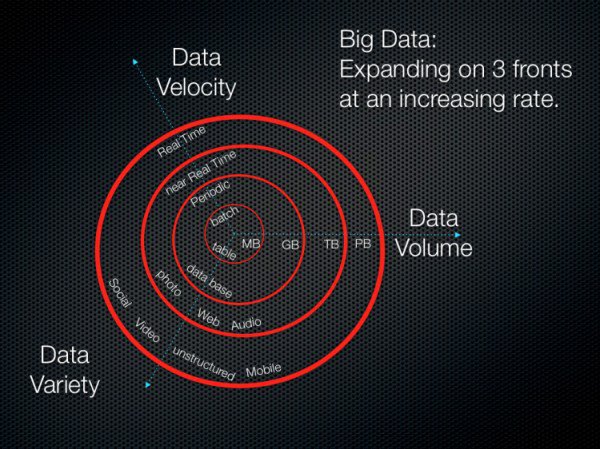
The 3Vs of Big Data show why this is a key trend selected by many, who have experienced the increase in volume, real-time data and data formats in their business and want to exploit the value to increase sales through personalisation on websites and through email marketing through predictive analytics – a topic we have covered many times on our blog. It’s also closely tied into machine learning where Big Data is mined to identify propensity to convert given different customer characteristics and behaviour.
Marketing Automation (including CRM, behavioural email marketing and web personalisation)
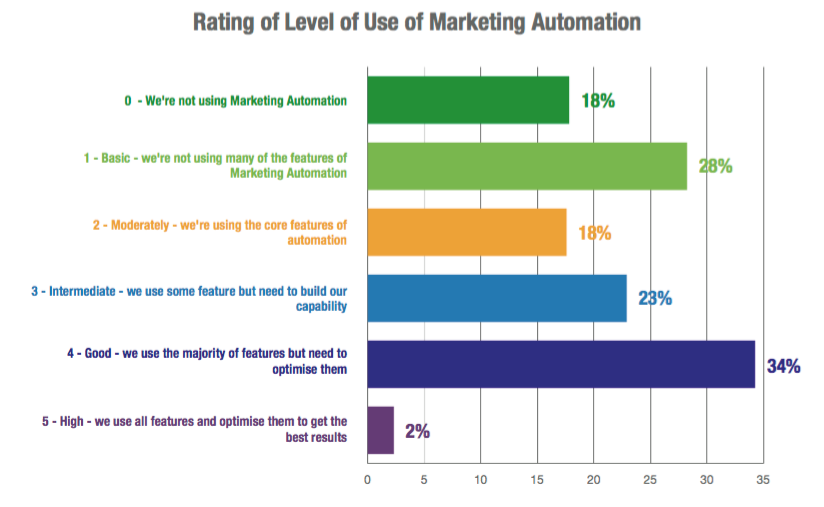
Like content marketing, marketing automation has been in the top 3 for the last 5 years we have asked this question. Many businesses still have potential for improving their automation as our research on the State of Marketing Automation shows.
To help with this knowledge gap, I think I have given more webinars and talks on Marketing Automation than on any other topic in 2016. The most common questions at the end are ‘where do we start’ and ‘how do we get to the next level’. These questions are answered in our Email marketing and marketing automation toolkit which includes a free interactive capability review to score your use of email marketing automation. As businesses progress up the learning curve I expect more businesses to be putting lead scoring in place, or refining it and learning the best places on the journey to feature content through predictive analytics.
4. Mobile marketing (Mobile advertising, site development and apps)
Mobile was in the top 3 three years ago, but as more companies have adopted mobile responsive web design and email templates they have seen less need to focus on it, or at least there are fewer opportunities for growth.
Mobile also has a large impact on search marketing as Google vigorously follows its mobile first mantra. To me, it’s a somewhat misleading mantra, since the reality is that many web users are still using desktop, laptop and tablet devices and there is a danger with mobile responsive designs that conversion on higher resolution screens may fall if mobile optimised. Instead, leading companies are looking at adaptive mobile design approaches which have the benefit of serving more relevant, contextual content and CTAs for users and reducing load times.
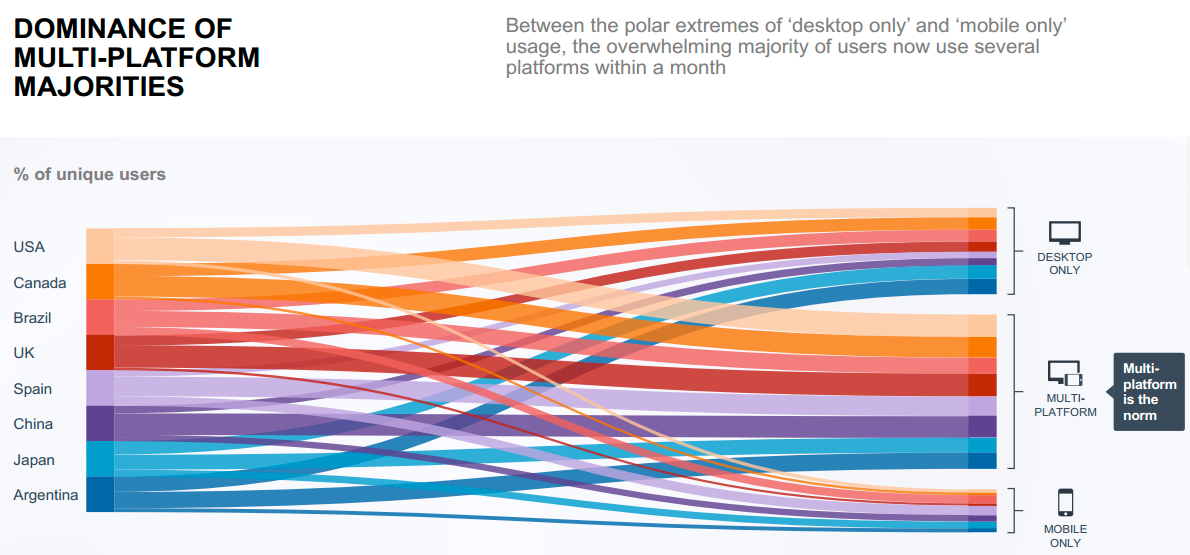
‘Mobile first’ is also misleading if we look at the overall customer journey since often different devices may be involved at different points. So a better vision for mobile strategy is treating it as part of a multiplatform or multichannel strategy. As this data from comScore highlighted in our mobile marketing statistics research shows, the multiplatform ribbons for all countries are much broader than users who are mobile only or desktop only.
5. Social media marketing including Social CRM and Social Customer Care
When I meet marketers at events and training I find there is still huge interest in social media, thanks to its reach and options to engage audiences and encourage advocacy or ‘social media amplification’ to give it the full treatment.
Our social media research statistics summary shows continued growth in social media usage overall, but with reduced popularity of some social networks in some countries. For example Twitter and Facebook are in decline or plateauing in many western markets while Snapchat, Instagram and Pinterest are still growing in usage.
Trends in social media marketing are often controlled by the efforts of the social networks to monetise and this has seen Facebook and Instagram, in particular make changes such that businesses now need to ‘pay to play’ to get the reach needed to have an impact. They have continued to innovate in their targeting and remarketing options. Jason DeMeyers has these interesting views on social media trends for 2017.
This is the technique I selected a year ago as the way Smart Insights would see the most growth from in the year ahead. It’s higher in popularity than previous years, but I still wonder whether many businesses are missing out on a more data-driven approach to increase leads and sales from their websites.
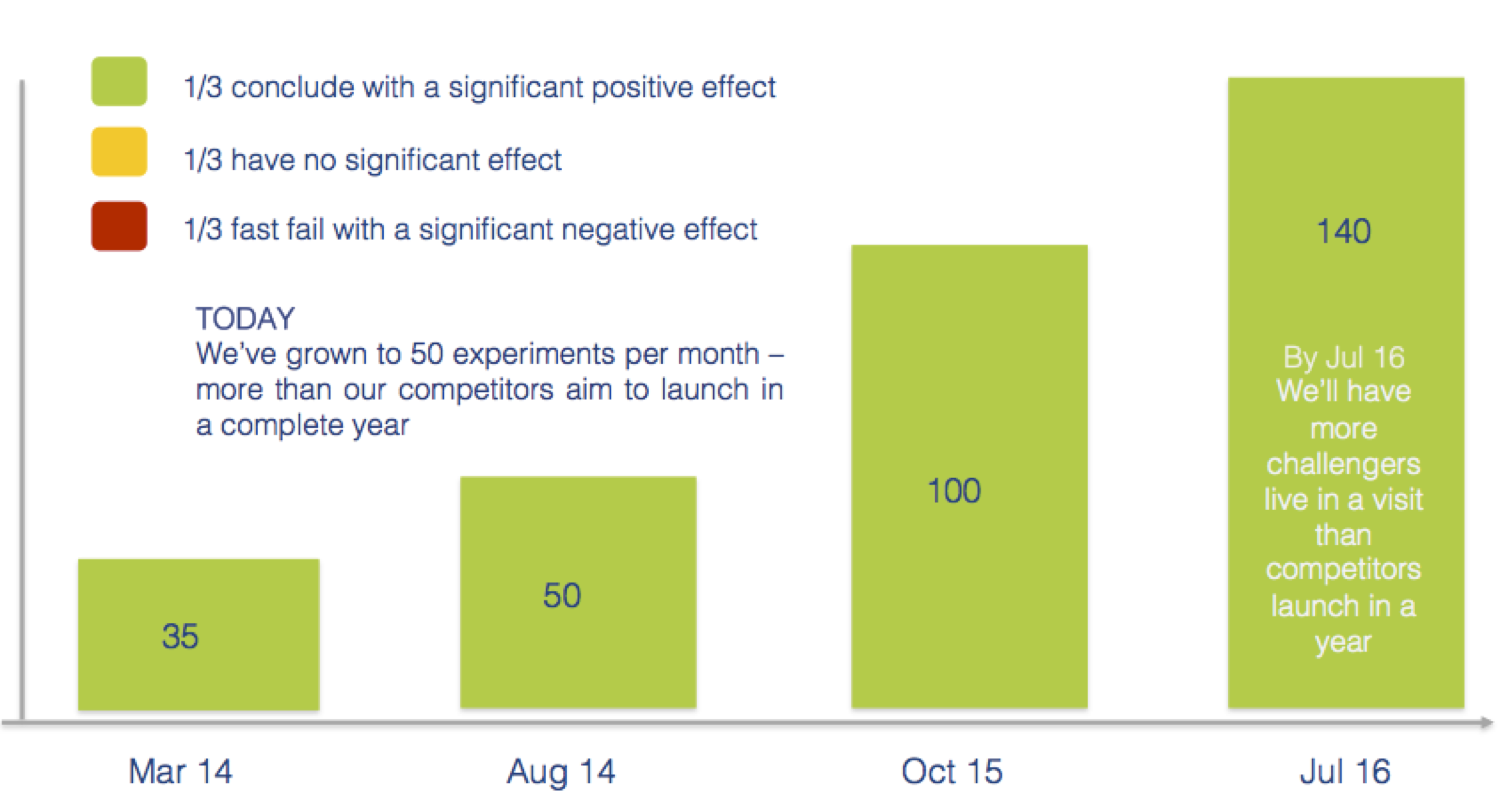
I saw this chart of the volume of structured tests presented by a major multichannel retailer who wanted to scale the number of tests they were running. It a great way to show the need to test extensively since only a third have a positive test. It also shows how competitors may be getting ahead if they are testing more extensively.
7. Internet of Things (IoT) marketing applications
IoT is one of the most important marketing technology applications of the last 2-3 years, but it is of most relevance to devices makers and retailers, so it is relatively high-up in this ranking of priorities.
There are expected to be 75 billion connected devices by 2020, meaning there will be ten times as many devices able to talk to one another as there will be people on the planet! The implications are huge and far ranging. All this sharing of data will transform the way we live our lives.
8. Search Engine Optimisation (SEO or organic search)
Mobile marketing SEO techniques will be particularly important in 2017 with Google’s recent announcements about the mobile index and AMP. We have seen huge increases in AMP smartphone traffic since September 2016 when Google rolled AMPs out beyond Google News. AMPs are targeted at publishers, but should be considered by businesses with an active blog too in my opinion.
We have been covering these announcements and improvements in our other alert posts:
Wearables are one of the hottest consumer consumable commodities (e.g. Apple Watch, activity trackers, augmented reality)
10. Paid search marketing
Google AdWords is the most important form of Pay Per Click and here Google has been pursuing their ‘Mobile-first’ strategy by building out these features.
11. Online PR (including influencer outreach)
Online PR today is inextricably linked with Content marketing, SEO and Social media, or it should be. But this doesn’t get a top rating since the others are important.
12. Communities
These are branded niche or vertical communities.
13. Display advertising
This includes banners on publishers, ad networks social media including retargeting and programmatic.
14. Partnerships including affiliate and co-marketing
A neglected aspect of digital marketing, perhaps unsurprisingly unsexy.
Other trends
This is an interesting category since readers can tell us what we’re missing. Suggestions here include:
Account Based Marketing (ABM) – relevant for B2B marketers targeting large accounts we have a new guide in our B2B toolkit on this early in the new year.
Digital OOH (Out-of-home) – A surprising one for the number one technique
Employee advocacy and feedback – interesting to see the internal marketing perspective – again surprising to see as the main growth point
Machine Learning – as mentioned at the top of the article
Omnichannel and multichannel attribution – both good for reminding us that it is the way that these channels work together to support each other that is often most important – the reason why many members are looking for advice on an integrated marketing strategy
Nike has launched Breaking2 part of the NXT Generation Research Project at the Nike Sport Research Lab, seeking to break one of sport’s most formidable barriers, the two-hour marathon.
After more than two years of research, preparation and testing, three top distance runners— Olympic champion Eliud Kipchoge from Kenya, supported by Lelisa Desisa of Ethiopia and Zersenay Tadese – have officially started their Nike-backed build-up toward a sub-two-hour attempt sometime in the spring, the exact timing and location of which have yet to be finalised.
Kipchoge, in particular is a master practitioner, having matured from a world champion track athlete to become the world’s best marathoner – just missing the world record in London this year, whilst running the perfect tactical race for Rio Gold. At his training camp near Iten in Kenya he lives a spartan life, running three times a day, eating ugali meals, and sleeping. Preparing himself for his next superhuman effort.
The Breaking2 team’s goal is to run 1:59:59 or faster, a pace of 4:34 per mile for 26.2 miles. Nobody has come close to that; the current world record is 2:02:57, by Kenya’s Dennis Kimetto set in 2014. That’s 4:41 per mile—a stunning pace that nonetheless left Kimetto more than a half-mile from the finish line at the two-hour mark. At the same time, running 58-59 minutes for the half-marathon has become quite normal now for elite runners, therefore it is not impossible to sustain an aerobic pace.
Breaking2 is a 20-person team, based at Nike Campus in Beaverton, Oregon, including shoe designers, biomechanics engineers, distance coaches, psychologists and physiologists. As well as coaching the athletes to peak performance, they will search the world for the perfect course, the right conditions, the optimal nutrition, the right pacing and support, as well of course, the best shoes.
https://www.youtube.com/watch?v=Ubv8zgYJW9c
Nike’s announcement will undoubtedly raise eyebrows. Just two years ago, in a data-driven investigation by Runners World magazine of what it would take, they concluded that the barrier would be broken in 2075. That admittedly pessimistic prediction was based on the assumption that the record would continue to be shaved down by small margins, in keeping with previous trends.
But Nike is instead looking to carve a full three minutes, or about 2.5 percent, off the record—an unusual, though not entirely unprecedented, leap. Paula Radcliffe lowered the women’s marathon record twice for a total improvement of almost exactly 2.5 percent over the previous record; her record of 2:15:25, set in 2003, still stands.
Still, “reverse-engineering” such a big breakthrough requires a different approach from the incremental gains that Nike researchers have been pursuing for the last 40 years. “We know that we need to break the two-hour marathon. That’s a defined outcome,” says Brad Wilkins, the director of NXT Generation Research in the Nike Sport Research Lab. “So now let’s take a step back. What do we need to understand scientifically? What are the problems that we need to solve?”
Nike isn’t alone in believing that the barrier is nearly ready to fall. In late 2014, Yannis Pitsiladis, a professor of sports and exercise science at the University of Brighton in Britain, launched his Sub2Hr Project with an initial goal of breaking the barrier within five years. While Pitsiladis’s initiative has struggled to raise the $30 million he estimates will be needed, he is already working with Ethiopia’s Kenenisa Bekele who ran 2:03:03 in Berlin in September to become the second-fastest marathoner in history.
Adidas have also set up a sub 2 project, including current record holder Kimetto, and likely to be based around the Berlin Marathon which it sponsors, and has been the setting for a number of recent records.
Of course, Nike and Adidas have operated in an increasingly competitive market, not only for sports marketing influence but in sales of sportswear. The rise of so-called athleisure has brought new competitors like UnderArmour to Lululemon into the mix and sales of casual, fashion-forward shoes have risen faster than performance-oriented sneakers.
Those conditions have put more pressure on the likes of Nike and Adidas to reignite sales of performance gear. “A pendulum swing in fashion preference from performance towards lifestyle fashion athletic footwear has contributed to a bearish sentiment on Nike,” said analysts recently, following a stock market slide of around 30% of its value during 2016.
A sub-2-hour marathon is considered something of a last frontier in running, since the four-minute mile was shattered decades ago. At that time, runners including Roger Bannister in England and John Landy in Australia raced weekly to try to become the first to shatter the elusive barrier. Once it was broken by Bannister, it seemed far easier, and Landy went on to beat it by several seconds. At the time though, it was a battle that focused the sporting world. The topic is often debated but experts are skeptical that the barrier will be broken in the near term.
Nike is keeping much of the Breaking2 plan under wraps for now, and many of the details are still being finalized. It is unlikely the quest will take place during a traditional, open marathon; rather, it will be held on a closed course, at a time and place believed optimal by Nike. It’s unclear whether the record, if achieved, will be sanctioned by the IAAF.
“The sub-two-hour marathon is one of those epic barriers that people bust through,” Nike’s VP of Footwear Innovation, Tony Bignell, told us. “It’s like breaking 10 seconds for the 100 meters or 4 minutes for the mile. At the end of the day, we just want to show it can be done. We want to show that it’s within the capability of human physiology.”
Trend reports are everywhere at this time of year. What matters is the underlying patterns. Futurists are all about pattern recognition, and being able to decipher the important, emergent signals amidst the fads and fashions, and all the trend talk. Why does this matter? Well, because as hyped as it might sound, we will see more change in the next 5 years than we have in the last 250 years. The pace, and scale of change is dramatic, relentless, daunting and exciting.
The old approaches to strategy, innovation and marketing, just don’t work. We’re finally learning that we cannot extrapolate the future based on the past, treat markets as geographic averages, and that the success models which have made us great, will not secure our continued success (we cannot just add 10% to last year’s plan!).
In recent months, I have done some amazing “growth hacking” projects recently. These are a combination of “future back” strategic visioning, and then horizon planning around a series of experimental trajectories to explore and win in the future. This new approach to strategy, innovation and marketing challenges our old ways of working. They are driven more ideas and insights, but using a scientific method. Trends give us the codes, words and inspirations to move forwards.
Consumer Trends 2017 (with inputs from Trendwatching)
Trend 1: Virtual Experiences … Kevin Kelly observed that the maturing of VR, AR and mixed reality technologies heralds a fundamental shift: from an internet in which information is the basic unit of currency, to one in which experiences are. These digital experiences will quickly come to carry a status-weight equal to ‘real’ experiences, if not become more sought-after and prized. And yes, we know that’s a bold statement given most executives still consider digital experiences as more diverting than.
Examples: 2016’s Singles’ Day saw Alibaba launch Buy+, a virtual reality shopping experience. The demo video shows how Chinese shoppers could be transported to – and shop in – Macy’s in New York. The platform also launched an augmented reality shopping game “Catch a Cat” or its TMall platform, similar to Pokémon Go. Experiences are also about creating – Google’s Tilt Brush is an app for the HTC Vive VR headset. The app allows the user to ‘paint’ in three dimensions, using a simple handheld control as the brush. And can transform industries – ABBA, one band that resisted the temptation to reform, have just announced their 2018 virtual tour dates.
Trend 2: World’s Apart … Brexit. Trump. Duterte. Le Pen, the attempted coup in Turkey … 2016 saw the economic, social and cultural impacts of globalisation thrown into sharp relief. This time, the narrative is framed by immigration, job automation, depressed wages, a deeply uneven recovery from the economic crisis, generational and racial divides, terrorism fears, the ongoing refugee crisis. One direction for brands wanting actionable ideas about how to actually respond to this trend in 2017: purposeful brands will find renewed opportunities in helping people understand their changing relationship to home – be that their nation, city or neighbourhood. People, and similarly brands, will turn outwards (more global), or inwards (more local). Its hard to be both. And that’s the polarisation.
Examples: In June 2016, Copenhagen-based travel website Momondo posted a video that highlighted the hidden racial diversity that exists in all individuals, called The DNA Journey, showing people talking about their national pride, and then revealing to them their true multi-ethnic make up. Tiger Beer recently set up a pop-up store in New York’s Chinatown, seeking to redefine Asian stereotypes. The Tiger Trading Company store showcased products from the worlds of art, fashion, technology and design, representing over 700 artists from Asia.
Trend 3: Incognito Individuals … Anonymity makes a comeback. Brands recognise non-traditional yet more authentic demographic segments (last month, 17-year-old makeup artist James Charles became the first male face of Covergirl); at the same time new volumes and sources of data are also taking many businesses closer to the nirvana of catering to a ‘segment of one’ at a mass scale (think Spotify’s Discover Weekly, which sees over 40 million users receive a unique playlist every Monday). While customers will welcome the greater relevance that comes with both these approaches, true flexibility and fluidity means there will still be moments where everyone wants to break out and explore. Without any prejudice, constraints or repercussions. As customers hand over more control to algorithms (or perhaps as they become increasingly aware of just how much their lives are already being shaped by these invisible and unquestionable forces – witness the Facebook news ‘filter bubble’ awakening), the urge to step outside one’s personal data-straightjacket will only grow
Examples: Interviewing.io is a platform for engineers to practice technical job interviews, announced a feature that disguises both the interviewer’s and candidate’s voices. Using Twilio’s cloud communications technology and proprietary voice software, the service alters voices to sound androgynous, add synthetic elements or sound like animals to eliminate interview bias. Users can reveal their identities should they want the interview process to continue. Antipersona simulates the experience of being signed into Twitter as another person. Users can choose to simulate any Twitter account, and see the same timeline and notifications – for follows, mentions and retweets – as that Twitter user for 24 hours.
Trend 4: Capacity Capture … The eco-friendliness of your products is now assumed. Meanwhile the sharing economy, peer-to-peer consumerism and the rise of access-over-ownership business models have radically recalibrated consumer expectations around utilization and waste. When you can pay to use cars by the minute, offices by the hour, eat food cooked by neighbours, then ‘traditional’ business processes suddenly start to look even more wasteful. Which is why smart brands will broaden their thinking around sustainability and turn their attention to finding and unlocking exciting new sources of value, or finding creative new ways to eliminate any wasted resource.
Examples:Nissan launched a scheme allowing UK-based owners of the Nissan LEAF car and e-NV200 electric van models to sell back their vehicle battery’s stored energy to the National Grid. Created in partnership with power company Enel, the Vehicle-2-Grid (V2G) system will be available at 100 charging units across the country, where the transactions can take place. São Paulo-based food bank Banco de Alimentos launched Reverse Delivery, to harness the power of the thousands of delivery drivers that return empty-handed after dropping off food. Participating restaurants (there are currently more than 35 signed up) ask the customer if they want to donate any food. The driver then collects the items from the customer when they deliver the meal and takes it back to the restaurant, where it is picked up by Banco de Alimentos and distributed to those in need.
https://vimeo.com/165630321
Trend 5: Big Brother Brands … Convenience. Seamlessness. Relevance. Customer expectations of basic factors will reach new heights in 2017. And while in George Orwell’s 1984 Big Brother was a dystopian overlord, the relentless desire for magical levels of personalised service will meet new intelligent technologies and lead to a new generation of brands. But now we’ll willingly be watched. First, voice will replace touch as the primary interface. Baidu’s voice technology is now (three times) faster and more accurate than typing on a smartphone keyboard. Second, these intuitive interactions will converge with the rapidly improving capabilities of artificially intelligent assistants. One signal: users of digital virtual assistants are set to rise from 390 million in 2015 to 1.8 billion worldwide by 2021.
Examples: Google Home is a voice-activated speaker powered by Google Assistant. Once permission is granted, the USD 129 ‘always-on’ device connects to the user’s Google accounts and scan emails, calendars and files and photos uploaded to Google to check appointments, create lists, add items to a shopping list and more. Beijing-based tech firm Roobo unveiled Domgy in June 2016: a canine-like home robot that uses proprietary AI and facial recognition to recognize family members, play their preferred entertainment, alert the family to intruders, and more. Domgy rolls around and can navigate normal obstacles in a home and shallow steps, and automatically goes back to its charging station when the battery is getting low.
AI art — Today’s artists are using emerging artificial intelligence technologies to create, curate and collaborate in ways that were impossible just a few years ago.
Augmented reality evolves — The surprise success of Pokémon Go has put augmented reality (AR) in the pockets of millions. As Apple and others plan AR initiatives, retailers and marketers are looking at the technology with fresh eyes.
Halal tourism — The tourism industry is waking up to the growing spending power of Muslim travelers, who represent a $220 billion market.
(Dis)ability advertising — Nearly one in five adults, or over 53 million people, in the United States have a disability, and that ratio is expected to grow. Advertising is finally starting to reflect that reality.
Marijuana: The new rosé? — Marijuana may be on its way to overtaking wine as the hip indulgence of choice for women, as accessories get high-end redesigns and more women go into cannabusiness.
Second skin — Researchers are uncovering new materials that create a “second skin” to restore natural elasticity and a youthful appearance.
Sleep renaissance — We’re in the midst of a soporific renaissance as innovators respond to our culture’s chronic undervaluation of sleep, and the “sleep space” gets the Silicon Valley treatment.
Artificial nature — Luxury hospitality brands are creating sophisticated manmade natural environments where guests can not only experience five-star service, but also enjoy an environment that would otherwise be unavailable.
“Dark social” … Brands should prepare for all-in-one messaging apps … the emergence of a private chat functionality which has gone beyond simple sharing of messages and pictures, and the challenge of marketers to tap into the wealth of data available.
Digital Effectiveness … Three ways to balance reach and precision … the rise of social media and big data in creating opportunities to develop highly personalised marketing campaigns, and how, more recently, advertisers are starting to question whether precise targeting through digital channels is really more valuable than good ‘old-fashioned’ mass marketing.
VR and AR .. Brands need user testing to assess the value of VR and AR … how VR and AR’s usage is still in its infancy as a marketing tool, and must be adapted to fit the optimal user experience.
Video and Social … The way we think about video is changing … how brands need to understand how video fits into the broader customer journey, such as the transition from social to ecommerce, and how this journey from social to store allows brands to bring together data on what customers think and feel through social and connect this with purchasing behaviour.
DTC and The Internet of Things … In search of a strategy for the IoT … how consumer goods brands continue to experiment with both direct-to-consumer and internet-enabled products, and how the challenges are now to learn from these tactical activities and evolve them into sustainable value-generating initiatives.
Artificial Intelligence … The measure of intelligence is the ability to change … the use of AI as a mainstream experience aligned to customers’ expectations, and how organisations will need to understand when personalisation is reducing the power of their brand and in what situations a human is much better for the job.
Technology Trends 2017 by Gartner
Trend 1: Intelligent: Artificial intelligence and machine learning have reached a critical tipping point and will increasingly augment and extend virtually every technology enabled service, thing or application. Creating intelligent systems that learn, adapt and potentially act autonomously rather than simply execute predefined instructions is primary battleground for technology vendors through at least 2020. Key trends: AI, machine learning, intelligent apps, intelligent things.
Trend 2: Digital: The lines between the digital and physical world continue to blur creating new opportunities for digital businesses. Look for the digital world to be an increasingly detailed reflection of the physical world and the digital world to appear as part of the physical world creating fertile ground for new business models and digitally enabled ecosystems. Key trends: VR and AR, digital twin, blockchain.
Trend 3: Mesh: The mesh refers to the dynamic connection of people, processes, things and services supporting intelligent digital ecosystems. As the mesh evolves, the user experience fundamentally changes and the supporting technology and security architectures and platforms must change as well. Key trends: Conversational systems, mesh app and service architecture, digital platforms, adaptive security architecture.
And here are a few more trend reports in the smorgasbord of words, ideas, gimmicks and patterns that define the turning of every year:
The nanodegrees launched this week by Udacity in subjects ranging from driverless car engineer to virtual reality headset designer.
Each course typically requires 3 x 2 months of study, for a fee of around $250 per term, which is refunded if you don’t find a job at the end. That’s unlikely because each course is sponsored all the interested employers, and focus on topics where there is high demand for new skills.
Udacity is now the world’s largest business school, set up by ex-GoogleX Sebastian Thrun, a spin-off from Stanford University, and one of a number of MOOCs, (massive open online courses), others including Coursera and EdX. The web-based delivery of much of these programs enables incredible economies of scale, whilst also giving access to billions of people who never could afford, have time, or needed to access the education before.
Global connectivity, smart machines, and new media are just some of the drivers reshaping how we think about work, what constitutes work, and how we learn and develop the skills to work in the future. The concept of a “100 year life” becoming the norm, and the majority of that spent studying and working, means that learning will be a lot more important, and different, for the next generations. Most people will have at least 6 different careers, requiring fundamental reeducating, whilst the relentless speed of innovation will constantly demand new skills and knowledge to keep pace, let alone an edge.
Educationalists debate the many ways in which the content of education – at all levels – and the process of learning, will need to change over the years ahead. Disruptive innovation guru Clay Christiansen, for example, points to the dramatic unbundling of education from its current forms so that it can be personalised, repackaging, peer to peer and continuous. Whether it is classroom or workplace, online or offline, structured or unstructured, taught or learnt, standardised or not, certificated or not, then learning is likely to break free from our old mindsets in the coming years.
Among the many discussions, innovations and general shifts in the world of learning – from school children to business executive – there are 9 trends that stand out:
Diverse time and place. Students will have more opportunities to learn at different times in different places. eLearning tools facilitate opportunities for remote, self-paced learning. Classrooms will be flipped, which means the theoretical part is learned outside the classroom, whereas the practical part shall be taught face to face, interactively.
Personalized learning. Students will learn with study tools that adapt to the capabilities of a student. This means above average students shall be challenged with harder tasks and questions when a certain level is achieved. Students who experience difficulties with a subject will get the opportunity to practice more until they reach the required level. Students will be positively reinforced during their individual learning processes. This can result in to positive learning experiences and will diminish the amount of students losing confidence about their academic abilities. Furthermore, teachers will be able to see clearly which students need help in which areas.
Free choice. Though every subject that is taught aims for the same destination, the road leading towards that destination can vary per student. Similarly to the personalized learning experience, students will be able to modify their learning process with tools they feel are necessary for them. Students will learn with different devices, different programs and techniques based on their own preference. Blended learning, flipped classrooms and BYOD (Bring Your Own Device) form important terminology within this change.
Project based. As careers are adapting to the future freelance economy, students of today will adapt to project based learning and working. This means they have to learn how to apply their skills in shorter terms to a variety of situations. Students should already get acquainted with project based learning in high school. This is when organizational, collaborative, and time management skills can be taught as basics that every student can use in their further academic careers.
Field experience. Because technology can facilitate more efficiency in certain domains, curricula will make room for skills that solely require human knowledge and face-to-face interaction. Thus, experience in ‘the field’ will be emphasized within courses. Schools will provide more opportunities for students to obtain real-world skills that are representative to their jobs. This means curricula will create more room for students to fulfill internships, mentoring projects and collaboration projects (e.g.).
Data interpretation. Though mathematics is considered one of three literacies, it is without a doubt that the manual part of this literacy will become irrelevant in the near future. Computers will soon take care of every statistical analysis, and describe and analyse data and predict future trends. Therefore, the human interpretation of these data will become a much more important part of the future curricula. Applying the theoretical knowledge to numbers, and using human reasoning to infer logic and trends from these data will become a fundamental new aspect of this literacy.
Exams will change completely. As courseware platforms will assess students capabilities at each step, measuring their competencies through Q&A might become irrelevant, or might not suffice. Many argue that exams are now designed in such a way, that students cram their materials, and forget the next day. Educators worry that exams might not validly measure what students should be capable of when they enter their first job. As the factual knowledge of a student can be measured during their learning process, the application of their knowledge is best tested when they work on projects in the field.
Student ownership. Students will become more and more involved in forming their curricula. Maintaining a curriculum that is contemporary, up-to-date and useful is only realistic when professionals as well as ‘youngsters’ are involved. Critical input from students on the content and durability of their courses is a must for an all-embracing study program.
Mentoring will become more important. In 20 years, students will incorporate so much independence in to their learning process, that mentoring will become fundamental to student success. Teachers will form a central point in the jungle of information that our students will be paving their way through. Though the future of education seems remote, the teacher and educational institution are vital to academic performance.
These are exciting, provocative and potentially far-reaching challenges. For individuals and society, new educational tools and resources hold the promise of empowering individuals to develop a fuller array of competencies, skills and knowledge and of unleashing their creative potential.
Indeed, many of the changes underway call to mind the evocative words of Irish poet William Butler Yeats that, “Education is not about filling a bucket but lighting a fire.”
Technology has become integrated into virtually every aspect of work. And because we spend so much time working, work really is the place where we most directly feel the impact of developing technologies. From collaboration to productivity; from new ways of approaching workspace design to the increasing ability to work from virtually anywhere; and from hiring and recruitment to new skill sets—it is a time of experimentation for companies and organizations as trends in technology converge to change what it means to work.
Here is a selection of Q&As from recent media interviews …
Your big theme right now is “exponential” … What does it mean, and why does it matter to business leaders?
“Exponential” … is all about how business can harness the power of ideas and networks to drive exponential growth. Think about WhatsApp which grew $19bn in 3 years, or Uber’s $60bn growth in 5 years, or Alibaba’s $130bn value created over 11 years.
These companies deliver exponential growth. Exponential is non-linear. Every year you get a multiplied effect. Instead of 1, 2, 3, 4, 5 … they grow 1, 4, 16, 64, 256 …
In many ways, exponential is the new expectation and aspiration of both customers and investors. Once they experience from some companies, they expect it from you too. The winning companies are “ideas and networks” companies … Here is my new success formula:
It starts with a powerful idea. Ideas are typically built on a new insight. For example, that people prefer to stay in real homes, like Airbnb. Or people want to share their lives online, like Snapchat. The best are human, simple and social – that makes they addictive.
Then they need to be spread. Ideas become contagious through networks. Unlike linear models, traditional suppliers or retailers, networks connect people together. It’s the connections between people, rather than with companies, that creates their power – the ability to multiply their impact very quicky.
The new technologies – everything from social media to internet of things, blockchain to 3D printing – are natural multipliers, they create many connections very quickly. But it also takes a new mindset – the ability to rethink business around customers rather than products, to develop new business models that generate revenues in new ways, and to embrace collaboration over capability, community over relationship.
Any industry can be transformed exponentially. The starting point is a new mindset. To let go of the old ways of winning, and to embrace the future.
Will the “Uber effect” be a ongoing feature of markets?
Yes we will see many more markets “Uberfied” in the coming few years.
At the heart of Uber’s model is a “collaboration platform” – it connects large networks of independent suppliers together with large networks of customers. We see the impact in the taxi market, both with Uber and many imitators, but it can be applied to many other places. Blow Beauty connects freelance beauticians with networks of customers. Coyote Logistics for examples connects a shipper with 50000 independent haulage companies. Even Uber has gone, further. Uber Eats is now the world’s largest food delivery brand.
Exponential growth has a number of phases, which can be achieved in different ways for different companies, even in the same market. The “Uber” model is one way.
Exponential growth typically involves
Digitalisation – turning a business model into a virtual format, that can be replicated many times, and specifically not limited by physicality. Licensing is a non-tech example of this, enabling Starbucks or even Mavi Jeans to spread quickly across the world through partnerships.
Disruption – breaking the rules. Uber has challenged the rules of a traditional market – taxi companies traditionally had comfortable monopolies, with established practices, and often inflated prices. Whilst disruption is rarely welcomed by everyone, it has shaken up the ways of working, made traditional companies realise how inefficient they are, and given consumers more choice.
Dematerialisation – Making businesses less physical. Think photography – most of us never even print a photo today – taking, storing and viewing them, on digital devices. Machines are increasingly miniturised, and we don’t need the traditional structures to support old behaviours. At work we don’t need offices, desks, canteens – all we need is a laptop and a lunchbox, or even just a coffee shop.
Demonitisation – Companies use to charge for the inefficiencies of markets – like delivery or support services, for example. In more efficient markets, we don’t need to pay for the old things. Therefore many of the basic services, like communication are increasingly free. We therefore need new business models, to win in new ways, creating new revenue streams based on things people now valiue.
Democratisation – This shift ultimately leads to lower prices, and greater access for more people. Half the world now walks around with a supercomputer in their hand. Integrating huge numbers of old products – from cameras to computers, encyclopedias to entertainment. With innovations like Udacity, anybody can go to business school, with Netfliz, endless movies are cheap and instantly on demand.
You predict that 50 billion devices will talk to each other in 5 or 10 years. Will there be differences between how companies will approach this?
The best brands will be based on the activities which add most value to people, in a way that builds their trust, brings them together, and monetizes that added value.
Brands will therefore be less about products and more about the benefits they enable, less about companies and more about the customers and what they seek to achieve.
Take a physical company like Nike. When I interviewed CEO Mark Parker for my new Gamechangers book he made a profound comment … “Nike is a sports company, not a sportswear company” … Think about, Nike exists not to make shoes and clothing, but to enable people to do more sport, to run faster, to achieve more. Nike+ therefore is the most important innovation stream of Nike. It enables people to do more of what they want, with everything from smartwatches and apps, organized events and online communities, to enable that.
Similarly Tesla’s CEO, Elon Musk said that the future of the car industry is not the car but the network. That’s why he is investing so much money rolling out the Supercharger network. In July he shared his new 10 year vision. By 2021 he sees that most car travel will be network based – people subscribing to a network (like we already do for mobile phones!) – where we will lease cars, share cars, use driverless cars, charge cars, and more – by a trusted brand. He wants this brand to be Tesla.
The future of business with robots provokes much discussion. But you suggest that AI and robotics are an opportunity for humanity?
Technology enables us to be more human – or even “superhuman”!
Big data enhances our ability to understand markets, customers, and activities like never before. To bring an incredibly scientific approach to everything from targeting customers as individuals, to localizing pricing, to predicting demand, to anticipating needs. Remote diagnostics of aircraft whilst in the air reduces turnaround times, health tracking enables early identification of illness and better treatment.
Automation frees us from manual job activities so that people can be redeployed in more human, service-based, activities. This might well require new skills. But rethinking, retraining, and reinventing ourselves will become normal. The top jobs of 2021 will be human jobs – using critical problem solving and emotional intelligence.
Robotics and artificial intelligence go further – but still have the ability to make us more human in remarkable ways. Look at how exoskeletons are enable people to carry incredible loads, for example in shipyards or military. I do not believe in the singularity, that robots will rule the world. Because they genuinely cant think creatively. To explore emotion. And newness. Human intelligence is still largely untapped. Robots and AI will enhance us.
Which business innovations have caught your attention recently?
Just look at the last 4 months
Pokemon Go dominated the summer months, with young people across the world embracing augmented reality gaming as the new normal.
Alibaba’s $28bn Singles Day retail bonanza redefined the rules of retailing with new types of virtual stores, digital incentives, and group behavior.
AT&T paid $85bn for Time Warner’s content and brands – recognizing that “dumb” pipes will not create value in the future.
Snapchat Spectacles beat Google to smart glasses, connecting it to their instant video sharing, and the ultimate new gadget for $130
NuTonomy became the world’s first commercial driverless car in September, starting in the early-adopting Singapore market.
Ava Winery in California have perfected a method of making great-tasting wine synthetically. You can buy their best Moet and Chandon champagne for 30% of the “real” price.
HyperloopOne announced plans to implement suction-tube travel across the world – 15 mins from Dubai to Abu Dhabi, 25 mins Istanbul to Ankara, 35 mins San Francisco to LA.
We live in the most incredible time … We will see more change in the next 5 years than we have in the last 250 years.
What kind of problems do the corporates or start-ups face while innovating? How should we change the way we lead and innovate?
The biggest problem is old mindsets. But new approaches, learnt from the best start-ups can revolutionise the way in which entrepreneurs and corporates innovate. I am particularly focused on techniques such as
Growth Hacking – the old approaches to strategy are dead, where companies try to predict the next five years and plan in detail. Instead start from the future then work back, developing horizons towards a vision, but with agility to change
Design Thinking – stop looking at average research data, and instead go spend time with a small number of real people. Dive deeper to understand their real problems and aspirations. Then develop protoypes to help shape ideas together.
Social Influencers – advertising doesn’t work anymore. It is average, interruptive, not trusted and made for average people. Instead people trust people like them. Look at Michelle Phan the world’s top Youtuber, and her influence over young women.
Lean Action – make things happen fast, don’t wait to perfect something – get out and try to make things better with customers. Then keep learning, adapting and improving. GE reduced their time to market from 30 to 3 months.
There are more – business model redesign to find new ways of working, ecosystem collaboration to work in new ways, and having the ability to “pivot” to a new business rather than hanging into an old idea … and then exponential tools as described above.
This is the new playbook. CEOs, managers, and students need to get it.
What will be the business trends of 2017? What should we do
10 of the most interesting business trends for 2017 will be:
Growth hacking – more agile and expeditionary strategy and innovation
Centennials – born after 1997, they are now shopping and shaping markets
Design thinking – forget research, go deep diving for insights
Customer collaboration – work together to personalize and perfect
Mobile centric – every business is digital, and mobile – even when physical
Small beats big – people trust smaller brands, speedboats not supertankers
Social influence – people trust people, not advertising or incentives
Visual storytelling – fewer words, more images, videos and events
Community building – people coming together to share their passion
New generation of leaders – experience matters, but new mindsets matter more
You can read more on my website www.theGeniusWorks.com
Or email me peterfisk@peterfisk.com
Amazon today launches a grocery store without lines or checkout counters. Amazon Go is a 1800-square-foot retail concept store in the company’s hometown of Seattle. It redefines the notion of a convenience store – faster, simpler, easier than ever. The embedding of one-click style technologies within a physical store, enables shopper to grab the items they want and leave; the order gets charged to their Amazon account afterwards.
Amazon Go works by using computer vision and sensors to detect what items you’re taking out of the store. You start by scanning an app as you enter the Amazon Go shop. You do your normal shopping, and the sensors throughout the store identify the items in your cart and charge them to your account when you walk out the door. It could feel like shoplifting, except you’re actually being watched by more cameras than you can imagine.
The shop will stock most items you’d find in a local convenience store: snacks, drinks, premade food like salads and sandwiches, and grocery essentials like bread and milk. It will also sell Blue Apron-like meal kits that let you cook your own dinners for two.
On the consumer level, the benefits are obvious — no waiting in a queue or fussing around with self-checking machines. But for Amazon, the company could potentially track you and your phone as you browse the store to track items you buy. By looking at your movements in the store as you shop, Amazon could analyze items you may have noticed or were potentially interested in buying (i.e., picking something up off a shelf and putting it back down.) Combine this with your online Amazon browsing activities and the company could gear up to serve even more recommended products wherever you’re online.
The store is currently open in beta to Amazon employees only. A public opening is scheduled for early 2017, with 20 stores to roll out during the next 12 months.
This week we’re exploring the power of “exponential thinking” with three days of fantastic workshops and events by the GeniusWorks, and some of the world’s leading business gurus are joining us too.
Peter Diamandis has probably done more than anyone to establish “exponential thinking” in business. He was born of Greek immigrant parents in 1961 in the Bronx, New York. He attended the Massachusetts Institute of Technology, where he received his undergraduate degree in molecular genetics and graduate degree in aerospace engineering. After MIT, he attended Harvard Medical School, where he received an M.D. and in 2005 he was awarded an honorary Doctorate from the International Space University.
Diamandis is considered to be a key figure in the development of the personal spaceflight industry. He is the Founder and Chairman of the X-Prize Foundation – an educational non-profit institute, focused on developing large incentive prizes to bring about radical breakthroughs for the benefit of humanity in fields such as Genomics, Automotive, Education, Medicine, Energy and Commercial Space Exploration.
He is also the co-Founder and Managing Director of Space Adventures – the only private company to send private citizens to the International Space Station aboard the Russian Soyuz Spaceship, and the CEO and co-founder of Zero Gravity Corporation, which offers parabolic weightless flights to the general public.
A self-admitted nine-year-old child-space-enthusiast, Dr. Diamandis is a visionary who dreams big and has the resume to prove that “the best way to predict the future is to create it yourself.”