This month the strategy team from McKinsey have come up with a fabulous article that helps to make sense of the global forces reshaping our world, and explores how to develop a better future for your business. Here is an extract:
“The trend is your friend” is the oldest adage in investing, and it applies to corporate performance, too. We’ve found through our work on the empirics of strategy that capturing tailwinds created by industry and geographic trends is a pivotal contributor to business results: a company benefiting from such tailwinds is four to eight times more likely to rise to the top of the economic-profit performance charts than one that is facing headwinds.
It’s easy, however, to lose sight of long-term trends amid short-term gyrations, and there are moments when the nature and direction of those trends become less clear. Today, for example, technology is delivering astounding advances, and more people are healthy, reading, and entering the global middle class than at any period in human history. At the same time, the post–Cold War narrative of progress fueled by competitive markets, globalization, and innovation has lost some luster.
Those contradictions are showing up in politics, and the long-term trends underlying them are reshaping the business environment. Corporate leaders today need to rethink where and how they compete, and also must cooperate in the crafting of a new societal deal that helps individuals cope with disruptive technological change.
That broad narrative of intensifying competition, as well as the growing need for cooperation, contains challenges, but also great opportunity. We hear about the challenges every day in our conversations with global business leaders: How long can their traditional sources of competitive advantage survive in the face of technological shifts? How will changing consumer and societal expectations affect their business models? What does it mean to be a global company when the benefits of international integration are under intense scrutiny?
All good questions. But they should not distract from the extraordinary opportunities available to leaders who understand the changes under way and who convert them into positive momentum for their businesses. Our hope in this article is to help leaders spot those opportunities by clarifying nine major global forces and their interactions. Significant tension runs through each of them, so much that we’d characterize them as “crucibles,” or spaces in which concentrated forces interact and where the direction of the reactions under way is unclear. These crucibles, therefore, are spaces to watch, in which innovation “temperature” is high.
The first three crucibles reflect today’s global growth shifts. The globalization of digital products and services is surging, but traditional trade and financial flows have stalled, moving us beyond globalization. We’re also seeing new growth dynamics, with the mental model of BRIC (Brazil, Russia, India, and China) countries giving way to a regional emphasis on ICASA(India, China, Africa, and Southeast Asia). Finally, the world’s natural-resource equation is changing as technology boosts resource productivity, new bottlenecks emerge, and fresh questions arise about “resources (un)limited?”
The next three tensions highlight accelerating industry disruption. Digitization, machine learning, and the life sciences are advancing and combining with one another to redefine what companies do and where industry boundaries lie. We’re not just being invaded by a few technologies, in other words, but rather are experiencing a combinatorial technology explosion. Customers are reaping some of the rewards, and our notions of value delivery are changing. In the words of Alibaba’s Jack Ma, B2C is becoming “C2B,” as customers enjoy “free” goods and services, personalization, and variety. And the terms of competition are changing: as interconnected networks of partners, platforms, customers, and suppliers become more important, we are experiencing a business ecosystem revolution.
The final three forces underscore the need for cooperation to strike a new societal deal in many countries. We must cooperate to safeguard ourselves against a “dark side” of malevolent actors, including cybercriminals and terrorists. Collaboration between business and government also will be critical to spur middle-class progress and to undertake the economic experiments needed to accelerate growth. This is not just a developed-market issue; many countries must strive for a “next deal” to sustain progress.
These tensions seem acute today because of fast-moving political events and social unease. But earlier times of transition provide encouraging precedents: the Industrial Revolution gave rise to social-insurance programs in Western Europe and the Progressive movement in the United States, for example. Progress has won out over most of the past two centuries—indeed, at an accelerating rate since World War II, which has seen global growth rates more than double the average of the preceding 125 years. As business leaders strive to compete and cooperate in new ways, they should take heart: if history is any guide, we’re operating in crucibles of progress that can help create an exciting tomorrow.
Global growth shifts
No developed country has recaptured the growth momentum we expected before the financial crisis of 2008–09. World GDP as a whole, while ahead of some long-term historical trends, remains below what we had thought to be our economic potential. Moderated growth has challenged individuals, and it has also made it more important for companies to take a granular approach to identifying opportunities, placing bets, and backing them with sufficient resources. The opportunities are large, particularly for leaders who understand how the dynamics of global growth are shifting as the nature of globalization changes, the largest emerging markets grow in importance, and technology reshapes our resource trade-offs.
Beyond globalization
Globalization is still progressing, but also facing powerful headwinds. “Anti-globalization” sentiments are growing, and governments are responding: the United Kingdom is moving ahead with Brexit implementation; the United States has already stepped back from the Trans-Pacific Partnership (TPP) and may now have changes to the North American Free Trade Agreement (NAFTA) in its sights. Meanwhile, traditional globalization metrics are slowing. The growth of trade compared with the growth of GDP in this decade has been half of that in the late 1990s and early 2000s, while global capital flows as a percentage of GDP have dropped precipitously since the 2008–09 financial crisis and have not returned to pre-crisis levels.
At the same time, there is evidence that other facets of globalization continue to advance, rapidly and at scale (Exhibit 1). Cross-border data flows are increasing at rates approaching 50 times those of last decade. Almost a billion social-networking users have at least one foreign connection, while 2.5 billion people have email accounts, and 200 billion emails are exchanged every day. About 250 million people are currently living outside of their home country, and more than 350 million people are cross-border e-commerce shoppers—expanding opportunities for small and medium-sized enterprises to become “micro-multinationals.”
Exhibit 1
Operating in tandem with these crosscurrents are calls for localization and recognition of pronounced differences in local tastes, which are making it more costly and complicated to compete globally. Multinational companies need, in the words of GE’s Jeff Immelt, “a local capability inside a global footprint.” Many companies are trying to compete with the increasing number of world-class local players by carefully recognizing subtle differences in local taste and custom. Some fast-food chains, for example have global, iconic brands but also local menu options that are distinct. Estée Lauder in 2012 introduced Osiao, its first China-specific beauty brand, which it developed at the company’s Shanghai R&D center. At the end of 2016, Hyundai announced it would be producing several new models in China to compete with local brands.
Globalization was never an unstoppable, monolithic force, as Pankaj Ghemawat of NYU has long said. As globalization’s complexities have become increasingly evident, the importance of competing with local precision at international scale continues to grow.
ICASA: The force of billion-person markets
It was more than 15 years ago that Goldman Sachs economist Jim O’Neil popularized the term “BRIC” in reference to the growth prospects of Brazil, Russia, India, and China. Since then, Brazil and Russia have sometimes faltered, while other emerging markets, particularly in Africa and Southeast Asia, have grown in importance. Although there will be more ups and downs in the years ahead, it’s important not to get distracted and lose sight of the numbers. There are three geographic entities—India, China, and Africa—in which urbanization is empowering populations that exceed one billion people, and a fourth, Southeast Asia, with more than half a billion. Together, these enormous “ICASA” (India, China, Africa, and Southeast Asia) markets hold the potential for significant continued expansion (Exhibit 2). They also pose some of the biggest risks to global growth as they confront internal obstacles:
In India, challenges include transitioning to more sustainable urbanization; building a manufacturing base in India, for India; substantially increasing women’s participation in the general economy; and fully exploiting the country’s technical brainpower to move up the value chain.
China’s growth rate has begun to taper, and despite substantial institutional changes over the past decade, the country needs to do more to complete its transition from an investment-led growth model to a productivity-led one. The demographic headwinds China will soon be facing amplify the need for this transition.
Africa, whose working-age population is projected to top that of China and India before 2040, has the most unfilled potential. It also faces the greatest challenges: mobilizing its domestic resources, aggressively diversifying individual state economies, increasing sustainable urbanization, accelerating cross-border infrastructure development, and deepening regional integration. Failing to achieve any one of these could stall growth.
Southeast Asia’s impressive past growth has been driven by an expanding labor force and a shift of workers from agriculture to manufacturing. To continue growing as these factors fade, the region needs substantial investment in infrastructure that supports digitization and urbanization.
Exhibit 2
Economic power generates geopolitical power, as China’s success has most recently confirmed. The more these markets overcome their unique challenges, the more central their role will be on the global stage. How these players assert that new power may not conform to approaches followed by OECD countries.1Institutions reflecting these markets’ new clout, such as the Asian Infrastructure Investment Bank, are already emerging So are economic arrangements that align with their interests, such as China’s One Belt, One Road initiative, which seeks to connect, through maritime links and physical roads, more than half the world’s population and roughly a quarter of the goods and services that move around the globe.
The opportunity remains enormous: we expect more than roughly half of global growth over the next ten years to come from these geographies. Whether a company is from one of these markets and already capturing regional growth or is seeking to enter one or more of them, its ability to reallocate resources, realign its footprint, and react to unexpected dips will shape whether it can successfully compete in the rebalancing global economy.
Resources (un)limited?
A modern-day Malthus might wring his hands at our world’s ability to sustain billions more people emerging from poverty, eating more protein, driving carbon-emitting automobiles, and enjoying a fuller basket of other consumer goods. There is, however, a counterforce at work today, as technological advances change the resource equation in a variety of ways:
Advances in analytics, automation, and the Internet of Things, along with innovations in areas such as materials science, are already showing great promise at reducing resource consumption. Cement-grinding plants can cut energy consumption by 5 percent or more with customized controls that predict peak demand. Algorithms that optimize robotic movements can reduce a manufacturing plant’s energy consumption by as much as 30 percent. And smart lighting and intuitive thermostats are significantly reducing electricity consumption in businesses as well as homes.
Technology is transforming resource production. Gas and oil output has increased significantly because of advances in fracking, deepwater drilling, and enhanced oil recovery. Seawater desalination currently contributes hundreds of millions of cubic meters per year to Israel’s water supply (up from less than 50 million in 2005), and the country now gets 55 percent of its domestic water from desalination.
Technologies are combining in new ways, with the potential to reduce resource intensity dramatically (Exhibit 3). Vehicle electrification, ride sharing, driverless cars, vehicle-to-vehicle communications, and the use of new materials are rapidly coming together to reduce automobile weight, change driving patterns, and improve the utilization of cars and of road capacity. In fact, analysis by our colleagues suggests that global demand for oil could flatten by around 2025 under plausible scenarios regarding the adoption of light-vehicle technologies and slowing plastics consumption.
Technology isn’t a panacea, of course; technological solutions come with external consequences. Fertilizers, for example, helped trigger a boom in agriculture, but fertilizer runoff polluted many water supplies. Fossil fuels lifted the standard of living for billions of people but have led to deteriorating air quality, oil spills, and carbon dangers that are ecologically existential and drivers of investment to meet regulations and arrangements (such as the Paris Agreement) aimed at slowing the impact of climate change.
Exhibit 3
But there is also opportunity. While companies are working through the implications of resource constraints for their business models, they will generate new ideas—creating less resource-intensive processes, turning waste into raw materials, and building a more circular economy. We can expect an accelerating resource-innovation cycle: growth will strain supplies, technology will yield solutions, externalities will arise, and further ideas will emerge in response.
As technology continues to progress and data flows reveal efficiency opportunities across operations, companies should have more influence over their cost structure, and resource prices should be less correlated to one another and to macroeconomic growth than they were in the past. McKinsey research suggests, for example, that iron-ore demand could decline over the next two decades as a result of softening demand for steel and increased recycling, but copper demand could jump, given its role in a wide range of electronics and consumer goods. Resource-related business opportunities will turn up in unexpected places, and there’s room for a multitude of new products and services. An example is new carbon-based materials that are lighter, cheaper, and conduct electricity with limited heat loss. They could transform entire industries, including automobiles, aviation, and electronics. Business leaders will have more opportunities to seize the initiative as they stretch their thinking about the changing nature of resource constraints.
Accelerating industry disruption
“Disruption” isn’t just one of the most overused words in management writing; it’s also one of the most imprecisely used. When we say industry disruption is accelerating, we mean that in many sectors, critical foundations of industry structure—the economic fundamentals, the power balance between buyers and sellers, the role of assets, the types of competitors, even the borders of industries—are rapidly shifting. While that degree of change can be uncomfortable or even destructive, it can also contain the seeds of opportunity.
Our work on digitization highlights both sides of the coin. By reducing economic friction, digitization is enabling competition that pressures revenue and profit growth. It also is creating fresh opportunities to improve performance through supply-chain, product, process, and service improvements. Ensuring alignment between a company’s digital and its corporate strategy appears to be one of the factors differentiating winners and losers—a useful reminder that leading today requires tough choices about big, disruptive forces.
Combinatorial-technology explosion
The most radical technological advances have not come from linear improvements within a single subject or expertise, but from the combination of seemingly disparate inventions and disciplines. As W. Brian Arthur has noted, “The overall collection of technologies bootstraps itself upward from the few to the many and from the simple to the complex.”2
For example, consider how increased online connectivity (Exhibit 4), cryptography, and advanced analytics have combined to create a distributed, global database for transactions called blockchain. It’s potentially a game changer, because transaction costs represent a substantial share of the world’s commercial costs. In fact, the desire to avoid transaction costs such as the negotiating and writing of contracts helps explain why firms exist, according to Nobel laureate Ronald Coase. Since blockchains can process transactions without intermediaries, their potential impact on costs and competition is profound.
Exhibit 4
Or consider machine learning, whose potential we have barely begun to tap. It is starting to combine with other technologies in a variety of unexpected ways. Recently, a team from Houston Methodist Hospital developed an algorithm that translates text from the hospital’s patient charts into a prediction of breast-cancer risk 30 times as fast as a human can.
Combinatorial effects are revolutionizing many aspects of biological technologies. Low-cost genetic sequencing enabled by massive computing power is laying a foundation for developing “precision medicine” and providing people with facts that can influence life choices. Advances in materials science have allowed the development of stents (widely used to expand clogged arteries) that naturally dissolve after their job is done, potentially freeing patients from longer-term medications. Wearable and ingestible sensors, meanwhile, are being developed to increase the effectiveness of drug therapies by helping ensure medications are taken and physiological responses monitored.
The effects of technology combining can go beyond the products or services a company provides to alter the very definition of what a company does. The automotive industry, for example, isn’t just about building cars anymore. As artificial intelligence and computational power merge with advanced automobiles and consumer products, companies are thinking about how they can provide “mobility solutions,” or even utility solutions, given the size of batteries in electric cars. This is disruption writ large.
And everything is accelerating. Arthur’s combinatorial effects are compounding the impact of Moore’s law, creating more scope to innovate and to conceive new businesses. Leaders with imagination and foresight who can keep up with the pace of change have unprecedented opportunities.
C2B: Customer in the driver’s seat
Digitization has brought consumers an ever-expanding menu of goods and services to choose from, some of which are free. Many goods and services consumers once paid for are now available online at a swipe or a click. Wikipedia’s English-language pages alone would fill the equivalent of more than 2,300 encyclopedias if printed. Skype, which allows users to make free video and audio calls to other Skype users, provides over two billion minutes of calls every day. And infinite variety means that just about any taste or preference is being catered to. Think of detergents on Amazon, where customers can find a selection of strawberry-scented washing powders exclusively meant for black clothes.
In an environment where so much costs so little and proliferating variety fragments markets, customers are capturing more of the surplus. In the United States alone, the Internet provides consumers with an estimated unpaid annual welfare gain of $100 billion. Take, for example, global mobile-data traffic and revenues: from 2008 to 2020, mobile data are expected to expand by more than 900-fold, while revenues from the data are forecast to grow by a factor of only 3.25 (Exhibit 5).
Exhibit 5
Customers also are taking the driver’s seat in steering the products that companies develop. They are able to communicate with companies directly and in large numbers for the first time. What they want is more variety, more specificity, and greater self-expression. Google is renowned for its practice of rapidly incorporating direct customer feedback in product design. Chinese mobile-phone maker Xiaomi engages directly with consumers in person or online. Adidas has even built robot-operated “SpeedFactories,” which create sneakers designed by individual consumers, while Doob Group enables consumers to scan their bodies and create unique, 3-D-printed figurines.
It remains to be seen how the willingness of customers to pay a premium will evolve. Right now, as Ray Kurzweil, the futurist and now a director of engineering at Google, recently noted, “There is an open-source market with millions of free products, but people still spend money to read Harry Potter, see the latest blockbuster, or buy music from their favorite artist.” Those examples may seem like outliers, but as Kurzweil pointed out, “coexistence of a free open-source market and a proprietary market” is also “the direction we’re moving in with clothing.”3In such a world, it won’t be just customers who have more choices; companies, too, have more decisions to make about their business models and how they create value.
Ecosystem revolution
In a classic 1960 Harvard Business Review article, Theodore Levitt asked readers to consider, “What business are you really in?” Because of digitization and the blurring of industry boundaries, Levitt’s question needs an addendum: “And what’s your ecosystem?” Businesses can broadly be grouped into three categories, with ecosystems emerging as both a powerful source of value creation and a heated competitive arena:
Linear value chains, which dominated for most of the 20th century, comprise a series of value-adding steps with the goal of producing and selling products: think automotive assembly.
Horizontal platforms, which gained prominence with the rise of personal computing and the Internet, cut across value chains. Companies operating under this model own hard assets and sophisticated architecture, typically built around value-adding software and technology stacks.
“Any-to-any” ecosystems, such as those of Uber and Airbnb, have emerged most recently. These companies also operate at the center of platforms, but they are distinctly asset-light.
The horizontal platforms of players such as Google, Amazon, and Facebook have been creating value for years and currently account for five of the ten largest US companies by market cap (Exhibit 6). And horizontal plays aren’t just digital. Companies of all stripes still ship their designs to Taiwan Semiconductor Manufacturing Company (TSMC), which relies on its sophisticated semiconductor factories to turn brilliant designs into high-performance chips.
Exhibit 6
Leading horizontal platforms have shifted value pools quickly and unpredictably. The shrinkage of the compact-disc industry from $17 billion in US sales in 2001 to $2 billion a dozen years later, as sales from music downloads, subscriptions, and synchronizations have soared, is one well-known example of how disruptors “destroy billions to create millions.” So far, many of the traditional industries that have endured these disruptions still exist, but their structure, and the players capturing most of the value, are often unrecognizable relative to the pre-platform era.
Now any-to-any models have taken the fore. These companies are at the center of platform-based ecosystems, and unlike horizontal players, they are distinctly asset-light. Alibaba is the world’s largest retailer measured by gross merchandise volume, and it does not own any warehouses. The world’s largest accommodation provider, Airbnb, does not own rooms; the world’s largest taxi company, Uber, does not own cars—and neither company existed ten years ago. That’s disruption, although the staying power of any-to-any models remains to be seen, given the low barriers to creating software-based platforms.
The lines of demarcation between categories are beginning to blur as value chains, platforms, and ecosystems open, expand, and combine. Linear value chains aren’t immune: Under Armour, a leader in sports apparel and accessories, has announced plans to build the biggest connected fitness platform in the world.
In today’s rapidly evolving landscape, leaders face a continuum of possibilities: build an ecosystem, use someone else’s platform, stick to one’s linear-value-chain knitting, or fashion some combination of the above. Navigating this crucible ultimately comes down to asking hard questions about a company’s sources of differentiation and positional advantage, and placing all options on the table, even if that means disrupting or cannibalizing one’s own business.
A new societal deal
The biggest opportunity of all—and arguably the biggest need—transcends companies and competition. If private-, public-, and social-sector leaders can cooperate to create a new societal deal, they will forge a brighter future for individuals and for a wide range of institutions. Collaboration will be critical to overcome forces undermining openness, to drive middle-class progress, and to encourage experimentation that recharges growth and redresses income inequality.
Business leaders typically spend about 30 percent of their time on external engagement, but by their own assessment, few do so effectively. For more business leaders to “step up to the plate” and “play a key role in driving solutions,” as Unilever CEO Paul Polman says, they will need to do more to embed society’s concerns in their business priorities, to make external engagement an integral part of their strategy, and to adopt a long-term mind-set.
The dark side
Progress thrives on openness, and openness almost by definition means exposure. The Internet, for example, has brought critical dangers even as it has unleashed a business and social miracle. Everyday acts, such as connecting your phone to your car via Bluetooth, create vulnerabilities most of us do not yet consciously consider. The costs of fighting cyberthreats are rising into the trillions. Meanwhile, rogue states continue to frustrate the global community, and the strains from combating terrorism are reverberating worldwide. The number of terrorist incidents and casualties remains relatively small but has been rising; global terrorism death levels by the end of 2015 were more than five times higher than they were in 2001.
Sometimes, international cooperation can counteract destructive power that is concentrated in the hands of a few. Consider how multiple states came together to beat back pirates in the Somali basin beginning in 2010, saving the world economy about $18 billion per year (Exhibit 7).
Exhibit 7
The achievement of digital resilience also requires collaboration. At a minimum, more collaboration is needed between the broad cross-functional leaders responsible for security-related decisions within a business. In an interconnected world, companies may also need to explore shared platforms and data sharing about cybersecurity threats across the boundaries of their own businesses and industries. As leaders figure out how to strike the right balance between competing effectively, guarding the corporate ramparts, and cooperating in self-defense, they will be helping to redefine what it means to live together, safely, in our interdependent world.
Middle-class progress
The rising tide of progress has not lifted all boats equally. Globalization and automation are polarizing the labor market, with more on the way as expanding machine-learning capabilities increase the automatability of a wide range of tasks in developed and emerging markets alike (Exhibit 8). As middle-wage workers are displaced, many are forced to “trade down,” reducing their income and putting pressure on existing lower-wage workers. There is also widening earnings disparity. Workers with advanced degrees have generally seen their earnings rise, while wages for those with only high-school diplomas have stagnated, and wages for those who do not hold a high-school diploma have declined. Youth unemployment has reached 50 percent or more in several major developed economies.
Exhibit 8
Demographic trends are exacerbating matters. The number of workers earning income for each dependent is falling as populations age, making it harder for society to support the young and the old. Entitlement programs such as pension plans are woefully underfunded.
Trust has fallen among the threatened middle class. Significant segments within Western democracies now have a negative view toward immigration and blame their governments for failed policies. Globally, 60 percent of working-age, college-educated, upper-income individuals express trust in business, government, media, and nongovernmental organizations (NGOs). Yet only 45 percent of the remaining population do so. This trust gap is largest in France, the United Kingdom, and the United States, and overall trust throughout scores of countries has declined to the lowest levels in more than five years.
A central part of the narrative behind the “Leave” campaign in the United Kingdom and the Trump campaign in the United States was that the leaders of major institutions had forgotten about the middle class. Business leaders can help rebuild that trust. In fact, citizens expect this from them. In a 2015 survey,4more than 80 percent of employees agreed that a business can “take specific actions that both increase profits and improve the economic and social conditions in the community where it operates.”
The need for middle-class progress isn’t just a developed-markets issue. As the emerging world’s new consuming class comes to the fore, it is striving for opportunity beyond entry-level roles, and observing the income polarization that often accompanies industrialization. Some of the ICASA balancing acts previously described, such as China’s transition from an investment-led to a productivity-led growth model, will determine the success of the middle classes in those markets.
Economic-growth experiments
While running for president in 1932 during the depths of the Great Depression, Franklin Roosevelt remarked, “The country needs and, unless I mistake its temper, the country demands, bold, persistent experimentation.” We are on the cusp of a new wave of experimentation today, because there are no clear answers to some of the challenges looming before us.
Exhibit one is growth. There is no consensus as to why it has been stuck in lower gear for years, or where it is headed. Northwestern University economist Robert Gordon argued in his 2016 book, The Rise and Fall of American Growth, that the productivity slowdown that started in 1970 is likely to continue and hamper growth. Other researchers, including our colleagues at the McKinsey Global Institute, argue that automation enabled by artificial intelligence, robotics, and other advances will likely raise productivity—which would increase growth, provided that those productivity gains go hand-in-hand with jobs and demand for goods and services, as they have in the past. Will they?
One thing that does seem clear is that many growth policy tools have reached their limits. Central banks and governments in the developed world responded to the financial crisis by slashing interest rates (Exhibit 9), creating innovative facilities to try to keep the credit flowing, and in some cases bailing out financial and nonfinancial players. Different mixes of austerity and structural reforms also were tried. When these proved insufficient to restart growth, leaders around the world turned to new, sometimes overlapping policy experiments, in search of a more effective solution. And they continue to debate alternatives, some as yet untried. The combined list is long and includes quantitative easing (QE), helicopter money (also called “the people’s QE”), debt mutualization (Europe), debt monetization (Japan), guaranteed minimum income (Brazil), and massive stimulus programs combined with a regulatory rethink (the United States).
Exhibit 9
We’re entering uncharted territory in other areas, too. As the world ages, new approaches will be needed to support retirees who haven’t saved enough or are counting on pension and healthcare benefits that seem unsustainable without placing crushing burdens on the workers of today and tomorrow. Or consider infrastructure spending. The McKinsey Global Institute (MGI) finds that the world will need to spend $3.3 trillion annually between 2016 and 2030 to keep up with projected growth—nearly $1 trillion more than we have been spending annually. MGI research also suggests that infrastructure spending can be cut by as much as 40 percent through better project design and execution—areas ripe for public–private experimentation.
The results of experimentation—with respect to growth, aging, infrastructure, income inequality, and more—will have dramatic implications for our world, for the business environment, and for corporate performance. Analysis by our colleagues suggests that 30 percent of corporate profits can be traced to social and regulatory issues, and that shares of companies that connect effectively with allstakeholders outperform their competitors’ by more than 2 percent per year on average. Employees, too, will reward companies that are part of the experiments ahead. About 85 percent of employees working at companies engaged in societal issues said they are committed to achieving their leadership’s strategy, motivated to perform and have confidence in the future of their company—some 20 percent more in each case than employees of companies not engaged.5
Growth shifts. Accelerating disruption. A new societal deal. These are powerful forces that demand thoughtful responses and contain the seeds of extraordinary opportunity. Leaders reaching for these opportunities will need to question their own assumptions and imagine new possibilities. Those who do will compete more effectively; they also will be better able to contribute to broader solutions, and ultimately to a new and more inclusive narrative of progress.
What is the basis of competitive advantage in today’s business landscape? Many observers say it is the power to harness information. The firms that succeed in the new, fast evolving information age are characterised by decisive action allied to emotional conviction. According to success formula can be summarised as “fast/forward”:
Fastmeans alert, agile, experimental, capable of decisive action.
Forwardmeans proactive and searching, and it also means seeking to create an emotional connection with others.
These twin themes represent the core message in a great new book by Julian Birkinshaw and Jonas Ridderstrale. The two authors are a great contrast. Julian is the thoughtful business strategist from London Business School, whilst Jonas is the irreverent Swedish provocateur most famous for co-writing the modern classic Funky Business.
Fast/Forward does not fit neatly into the usual business categories. It is about “strategy,” but also organisation, management, and leadership. If you want to create a company that is ft for the future, you need to work across these levels. The lines are blurring, and we’re not that interested in maintaining them for the sake of appellation. To put it slightly diferently, fast/forward is a state of mind— it is a way of making sense, a lens through which to see more clearly. If you get the basic design right, we would argue, you can tap people across the from to take responsibility for adaptability and as a collective make your company fit to face your own paradoxes. Are you ready to let go of the wheel or, rather, hold it with all of your workforce? Let’s see.
Businesses need to adopt a “Fast/Forward” approach if they are to succeed in a rapidly moving world, say Birkinshaw and Ridderstrale. Here is a sample of their thinking:
Authors Erik Brynjolfsson and Andrew McAfee argue we are entering the Second Machine Age, with information technology as the engine of human progress. The McKinsey Global Institute has called big data the “next frontier for innovation, competition and productivity”.
We take a different view. We believe the case for big data and advanced analytics is overstated. These will of course continue to be important techniques for staying in the race, but as information becomes ever more ubiquitous and search costs trend to zero, their capacity to provide any modern organisation with a leading edge is diminishing.
That’s not the only problem. Information overload at the individual level leads to distractedness, confusion, and poor decision-making. At a corporate level, we end up with analysis paralysis, endless debate, and a bias toward rational, scientific evidence at the expense of intuition or gut feel. As a result, many companies end up standing still, even as the world around them is speeding up.
Decisive action, emotional conviction
So what is the alternative to Slow-Motion Inc.? Thoughtful executives understand both the potential and the pitfalls of information. They recognise that the notion of competitive advantage is more fleeting than it used to be. They adopt what we call a “fast/forward” approach to business: they emphasise decisive action ahead of detailed analysis, and they are comfortable relying on emotional conviction alongside rational judgments.
For example, Amazon’s phenomenal growth defies all the established rules about firms focusing on their core competencies. Its success is built on deep insight into the needs of its customers and an assumption that if you create value for customers, growth and profits will follow. Jeff Bezos, the company’s cerebral founder, started his career developing mathematical models for a hedge fund, and is a great believer in systematic analysis. But at the same time, he is known for what Fast Company called “harrowing leaps of faith”. His most important decisions are not based on studies or spreadsheets; they are “nervy gambles on ideas that are just too big to try out reliably in small-scale tests”.
In other words, rather than getting bogged down in analysis and introspection, fast/forward companies are open-minded, and they have operating cultures that promote action and experimentation. Their leaders know when to listen to the data and when to be decisive. As Jeff Bezos says, “There are decisions that can be made by analysis. These are the best kinds of decisions! They’re fact-based decisions. Unfortunately, there’s this whole other set of decisions that you can’t ultimately boil down to a math problem,” namely the big bets on new businesses like the Kindle or Amazon Web Services.
We suggest that, in future, two strategic imperatives will dominate. It won’t be the firms with the greatest processing power or the smartest data scientists that come out ahead. Instead, it will be the ones that move forward faster than the others by developing the capacity for decisive action – the ability to address opportunities as they emerge, to experiment with new offerings and to make big bets when called for.
But action without direction is a dangerous commodity. To channel it in an effective way, firms also need to develop emotional conviction – to listen to their own intuitive reasoning, and to create meaning for their employees and their customers. A single-minded emphasis on logical-mathematical type knowledge helps firms to create clever and unique offerings, but with a risk that beauty, joy, surprise, spontaneity and individuality are driven out.
In every industry, there is a battle between the more ‘technical’ brands (think Samsung or Toyota) and the ‘emotional’ brands (think Apple or BMW). While both can be successful, it is the latter group that captures the imagination and typically get the higher margins as well.
The twin imperatives of decisive action and emotional conviction have consequences at multiple levels of analysis:
Strategy
The classic approach to strategy was to think of a cascade of decisions: what do we want to achieve, where will we play, how will we win? This logic was reasonably effective in a stable environment, but in a complex, fast-changing world it is too slow and too formulaic. So, we need to turn this approach on its head. Insights based on interactions with customers drive the reflection and sense-making process, which ultimately informs the big-picture strategy.
Organisation
The default management model of the industrial age was the bureaucracy – where coordination of activities occurs through standardised rules and procedures, and an individual’s formal hierarchical position is what matters. In today’s information age we typically favour the meritocracy – where coordination of activities occurs through the mutual adjustment of self-interested parties and an individual’s knowledge and expertise is what matters. The emerging model that we believe is now required is the adhocracy – where coordination of activities occurs around external opportunities and an individual’s action is what matters, particularly when it is backed by emotional conviction.
One example: ING, the Amsterdam-based banking giant with 52,000 employees around the world. Over the last decade, its executives have embarked on an ambitious transformation program, first of all a cleaning up and simplification of internal processes, then a strategic push into digital banking. Now, over the two years it has reorganized its 3,500 HQ employees according to “agile” principles, with everyone working in nine-person “squads” focused on servicing specific user needs with freedom to shape their own workflow and physical space. It is action-focused, flexible and fast-paced, and it is already paying dividends in terms of customer satisfaction, employee engagement and cost/income ratio.
Leadership
When using bureaucratic or meritocratic ways of working, leaders could afford to work in traditional, top-down styles. But if your business is built on decisive action and emotional conviction, you need to make sure people across the organisation have the means, motive and opportunity to be entrepreneurial – to pursue opportunities wherever they arise.
This puts a big burden on leaders to do their job properly – to articulate a clear, overall sense of direction, to build a safe working environment where people have the space to try out their ideas and to provide the resources where needed to support these individuals. Of course, these have always been elements of a leader’s job, but they become even more vital in today’s fast-paced business world. Essentially, leaders have to become ambidextrous – they need to be able to deliver on results today, to get efficiency out of existing operations, while also scouting and investing in whatever is coming along next.
Many of these ideas will be familiar to you, but don’t be fooled into thinking they are easy to implement. Our hope is that by pulling these strands of thinking together – across the worlds of strategy, management, organisation and leadership—it will become easier to develop the language and methodologies of a fast/forward approach to business.
Free samples – usually given out in shops, at events and on the streets – are nothing new but exploiting consumers social networks to distribute free samples is. Newcastle-based entrepreneur, Jonathan Grubin spotted this opportunity and conceived SoPost, which neatly combines the world of free samples, social media advocacy, publicity, customer acquisition and loyalty in one simple process.
Brands come to SoPost to create a campaign, which allows users to click on a link to redeem their free sample. That campaign is then pushed out to the brand’s social channels whose advocates pick it up and share with their friends. Their friends in turn click on the link, provide their contact details to receive their free sample (and can opt-in to receive further information from the brand), and hopefully then go on to be fully fledged customers.
Formed in 2012, SoPost works with some of the largest brands in the world, including L’Oreal, Mondelez, PepsiCo and Benefit Cosmetics. An example of a campaign is with Mondelez, for which So Post created the #CadburySnowball Christmas Campaign. Twitter users were able to “hit” each other with a #CadburySnowball Tweet and when the recipient input their postal details, they received a free gift pack of Cadbury’s seasonal Snow Bites treats.
The company is privately owned, and backed by a number of angel investors as well as the Newcastle-based Northstar Ventures. So Post is currently expanding into new markets, working with its clients and brands. “SoPost is going from strength to strength and we’re excited to be expanding into the US market,” said Grubin.
Beauty blogger Laurensaid this of her SoPost experience:
One of my friends who is into comping and hunting out free things sent me a link a while back and said if I went on it I could get a free beauty sample, and could send her one back in return. I wasn’t really sure what she was talking about, but check out the link and the company and saw that it was a beauty sample offer from So Post, a company that connects brands with people. So I decided I was happy to give it a go, applied, and sent the offer back to Vicky.
At this point I was still a bit sceptical about what I’d get back, thinking it would just be a sachet with a tiny little drop of product in it, so I was quite surprised to receive a mini tube of Benefit Primer in the post – very usable, and lasted a little while too – a win all round.
I’m not sure where these free samples that are sent via So Post are advertised – whether the brands market these samples, or there’s exclusive deals with freebie sites – I’ve only ever seen them promoted on one freebie page I joined – but since receiving the primer I have received some other bits and pieces all of which I have liked and enjoyed using (apart from the Max Factor lipstick which I gifted to my sister as the colour didn’t suit me).
To me this is how sampling should be – you get enough product to make a judgement on the colour, scent, whether it suits your skin tone/type – and then you talk about it on social media/to your friends – and maybe buy a full size product as well. Much better than a foil sachet with barely anything in it. I realise that some brands may not have the resources for this – but if the ones that do produce a limited number of samples – which people are claiming for themselves – sending to friends and thus spreading the word – and talking about it afterwards – then there is value in offering free samples in this way.
I think my favourite of the samples I have been lucky enough to receive is the YSL Touche Éclat Foundation – I got to choose a shade I wanted to try and it arrived in a box with another bottle which was one shade warmer – I didn’t expect that! I’m trying to make the samples last and not use them every day as I really like the coverage/finish and the colours are ideal for me – there’s quite a lot in each little bottle though, and they were colour matching in store as well so I managed to grab an extra sample. The only low point is the price – a full size bottle is around £32.50 – still it could me one of those make-up items worth the investment.
Have you received any great samples or freebies lately? If not then the Facebook group and website Latest Free Stuff is a good place to go to see what offers are around. Getting some free beauty samples has definitely been fun!
So why use SoPost? This is what they said:
SoPost is a more effective way of product sampling. Our platform removes the limitations associated with traditional forms of sampling and makes the process easier and more efficient. We help our clients drive sales and deliver a high return on investment whilst also capturing valuable data and analytics. What makes SoPost special?
Targeting
SoPost helps brands reach the right consumers. Ensuring that samples reach suitable people reduces waste and improves ROI. This can be difficult to achieve with other methods of product sampling which do not allow the same level of targeting.
Data
SoPost collects high quality information, opt-in preferences and genuine reviews from those who have received samples. This gives our clients enormous on-going CRM benefits, and a significant amount of user generated content. It makes sure that a campaign’s impact extends far beyond the activity itself.
Analytics
Every campaign that we conduct is monitored and benchmarked against previous campaigns to make sure that it is the best it possibly can be. This includes measuring its impact. For instance, calculating the amount of recipients who had an intent to purchase.
Scale
We’ve built SoPost to power major product sampling campaigns for global brands. Our infrastructure – from servers to fulfilment – scales. This gives our clients a huge amount of flexibility and makes sure that the consumer experience is never compromised.
Fulfilment
We have in-house fulfilment capabilities and can look after the physical distribution of samples. A global distribution network is in place and ensures that this final getting products into hands is smooth and painless. We can also develop bespoke packaging, making sure that everything sent to consumers is delivered on brand, on message and on budget.
Millions of hearts around the world beat with the help of a pacemaker. Candles are lit with the help of safety matches. Ball bearings make our machines work smoothly, whilst we instantly recognise Samuelson’s iconic Coke bottle design. We depend on Bluetooth to connect our devices, and innumerable lives have been saved with the help of the three-point seatbelt …
Just a few Swedish inventions.
Billions of home are furnished with IKEA designs. Millennials flock to buy the latest designer collaborations in H&M. Skype has become a key player in the communications world, Skanska makes the world’s most eco-friendly buildings, and TetraPak is responsible for the shape of the drinks cartons on our table. We ask ourself, why pay for iTunes when we could stream with Spotify, whilst becoming addicted to games like Candy Crush and Minecraft.
All Swedish innovations.
Of course, we all know the story of IKEA … It began in 1931, when five-year-old Ingvar Kamprad started selling matches to his neighbours, for a profit. Just twelve years later, he founded a company that he decided to call IKEA, based on his own initials plus the first letters of Elmtaryd and Agunnaryd, the farm and village where he grew up. Six decades later, the company had developed from an entrepreneurial idea in the woods of southern Sweden to a major furniture retail brand present in 48 countries around the world. IKEA has even just launched veggie meatballs for your mid-store snack, brilliant!
Today, both the EU and WEF rank Sweden as Europe’s leading country for innovation. Reasons for this include a historic tradition of inventors, a commitment to gender equality, and a strong belief in the individual. Close collaboration between research institutes and the private and public sectors is another key factor, setting the foundation for global Swedish companies like AstraZeneca, Ericsson, and Volvo.
Innovation is closely linked to research and development. Sweden is one of Europe’s top three spenders in this area, investing 3.6 per cent of GDP in R&D in 2009. Compare this with the EU-wide target of 3 per cent GDP investment by 2020, and it’s clear that Sweden is ahead of the game.
What next?
This week I’m in Sweden to explore the next generation of Swedish innovation, those who continue to shake up markets today. Here are just a few of the contenders for Gamechangers Sweden. Some are big whilst others are small, some well known whilst others slightly off-beat. All are inspiring, and offer ideas which we can all learn from:
1. Electrolux … shaping the future of home design
While people instantly recognise the name Electrolux on their kitchen appliances, many may not know that this Swedish company is the world’s second largest home appliances manufacturer. Started in 1919, the company originally sold Lux vacuum cleaners, and later added refrigerators, washing machines, dishwashers and a variety of other appliances to its product line. So where next? The Electrolux Ideas Lab global competition to find the best new ideas for innovative application, encouraging innovators but also its own design thinking, collaborations, responsible innovation, and future growth.
2. H&M … minimalist fashion across the world
Bringing Sweden’s quintessential minimalist yet chic style of fashion to the world is Hennes and Mauritz, now simply H&M. Started in 1947 as a women’s clothing store called Hennes in Västerås, founder Erling Persson later bought hunting and fishing equipment store Mauritz Widforss, officially changed its name to Hennes & Mauritz, and added men’s and children’s clothing in 1968. Since then, H&M has expanded to over 2,500 stores around the world selling trendy clothes and accessories at affordable prices. To stay fresh and topical, H&M continue to lead the way in in retail collaborations with rockstars and designers.
https://www.youtube.com/watch?v=KVg9Fj0QVg4
3. Hövding Bike Helmet … the first “invisible” airbag for bikers
Hövding started out in 2005 as a master’s thesis by Anna Haupt and Terese Alstin. The idea of developing a new type of cycle helmet was a response to the introduction of a law on mandatory helmet use for children up to the age of 15 in Sweden, which triggered a debate on whether cycle helmets should be mandatory for adults too. Why did they not wear them, they investigated? Because it gave you bad hair! They about developing a pop-up helmet, like a car airbag, but for most of the time not ruining your hair.
4. Micro IP … shrinking the internet protocol
Tiny gadgets such as car keys and credit cards can now communicate with one another, thanks to an interface called uIP, or micro IP. By shrinking the internet protocol he was able to simplify the ability to make connections between very small devices, enabling the “internet of things” to work. Scientist Adam Dunkers is recognised by the US university MIT’s Technology Review as one of the top 35 young inventors in the world, and is the man behind the software that makes this interface possible.
5. Peepoople … the single use toilet “in a bag”
Swedish company Peepoople is combatting one of the world’s biggest problems, sanitation, with its ingeniously named Peepoo toilet. The United Nations says roughly 2.6 billion people lack access to basic sanitation. Peepoo is a self-sanitising single-use and fully biodegradable portable toilet in the form of a bag. Once used, Peepoo remains odour-free for 24 hours, kills bacteria and viruses within two to four weeks, breaks down into carbon dioxide, water and biomass, and can be turned into fertiliser for growing crops.
6. Sensus Guitar … the complete rock concert in your hands
Dubbed the world’s first ‘smart guitar’, this instrument uses buttons and motion sensors as well as traditional strings to create a range of different sounds including drum beats and echo effects. All sounds and modulations can be obtained without the help of any accessory or computer. You can connect the guitar to the internet and link up with social networks, allowing you to create and perform virtual concerts that can be seen all over the world.
7. Solvatten … portable water treatment
A child dies every 15 seconds as a result of contaminated water, according to UK-based charity WaterAid. Solvatten’s pioneering portable water treatment unit allows households to heat up and treat contaminated water using solar energy. Sold and distributed as 11-litre containers, the Solvatten unit is placed in the sun for two to six hours to sterilise the water, which can then be used for drinking, cooking and other daily hygiene-related tasks.
8. Spotify … streaming music that challenged the industry
Spotify grew out of deviant behaviour – imitating the actions of illegal downloaders to find a legal business model which combines free access with the ability to also make money as a business, and for artists and publishers. The brand is contagious, driven by consumer collaboration, and staying topical. Much of Spotify’s success is due to increasingly sophisticated data collection, which allows it to keep releasing new products that captivate its users around a particular mood or moment in time rather than offering the same tired genres.
9. Swish … mobile payment making Sweden the world’s most cashless society
Swedes mainly use debit cards (PIN usually required, unlike in many countries) and our new favourite mobile payment app, Swish. So many people are ‘swishing’ now that the app is credited for the reduction of cash circulating in Sweden, according to a study by KTH Royal Institute of Technology.
https://www.youtube.com/watch?v=-ftiaRrB-u4
10. Volumental Body Scanning … everything personalised to you
You know that feeling when you go shopping, find the perfect pair of shoes in just your size…and then try them on and they don’t fit? Swedish firm Volumental, one of the world’s leading scanner companies has created a 3D machine that scans different parts of your body to create clothing that is perfect for your shape. So in the future you could find yourself wearing not only custom-made shoes but also sunglasses and even headphones.
Why Sweden?
Each year, Harvard Business School compiles the National Innovation Capacity Index, a study of different countries’ innovation potential. In 2010, Sweden was ranked eighth among 173 countries. In terms of the number of trained engineers per capita, Sweden was ranked second, close behind Japan. The study also notes that in the past 15 years, Sweden has had the second-fastest growth rate in the number of patents per capita.vYou can read the study in its entirety here.
INSEAD Business School’s Global Innovation Index ranks Sweden in second place once again. The index measures the degree to which countries have an infrastructure that enhances a creative environment and allows for innovation, as well as actual output. Sweden has strengths in terms of both output and input. Strong output is demonstrated in many new published research and technical papers, and many registered patents. Sweden is also seen to have a good input basis, with a stable political climate and relevant, high-quality education.
Biotech priority
The Swedish government has chosen to focus strategic investments on three key areas: medicine and bioscience, technology, and climate.
Sweden is particularly strong in biotechnology. Pharmaceuticals are a key export, and Swedish medical innovations include the asthma medicines Bricanyl and Pulmicort; the growth hormone Genotropin; and the stomach ulcer drug Losec, one of the world’s best-selling drugs.
Research is not confined to giants such as AstraZeneca and Pfizer-Pharmacia; many small biotechnology companies conduct their own research. A key area of interest is healthcare. Rapidly growing markets include medical devices such as imaging equipment, orthopaedic implants, dialysis equipment, heart-lung machines, and ECG equipment, as well as laboratory studies of medicines.
Microelectronics is another growth market. Sweden is at the forefront of research into silicon-based components, high-speed electronics, organic electronics, photonics and systems design.
Development partners
In order to encourage young people’s interest in technology and entrepreneurship, Swedish schools are working with a variety of organisations. Here are three examples:
Finn upp combines an inventing-based teaching method for schools, and Sweden’s largest inventors’ competition for young people in grades 6-9. Held every three years, the competition aims to stimulate the power of young ideas and inspire a new generation of inventors, innovators and entrepreneurs. Finn upp was founded in 1979 by the engineering interest group Ingenjörsamfundet.
The non-profit organisation Ung Företagsamhet (‘young entrepreneurship’) works in partnership with Swedish schools. Older students, aged 16-20, have the opportunity to run their own company during the school year as part of their upper secondary (high school) studies. A 2010 survey shows that 8 out of 10 participants felt they learned about running a business. They also indicated that they had developed more self-confidence and a greater ability to take decisions, solve problems, and work with others.
The non-profit association Snilleblixtarna (‘flashes of genius’) is geared to schoolchildren from preschool to fifth grade. The goal is to encourage children’s interest in technology, the natural sciences and entrepreneurship. Snilleblixtarna provides teachers and educators with tools and a working model to stimulate children’s curiosity, desire to learn and ability to think critically.
There is an extensive network of organisations and companies, in the public and private sectors, working with academic bodies in Sweden. They aim to develop new products, services and processes that will make long-term contributions to sustainable growth. To name just a few:
The Knowledge Foundation (KK-stiftelsen) aims to stimulate competitiveness by creating conditions for innovation and creativity, and by strength-ening the links between academia and industry.
The Swedish Foundation for Strategic Research (SSF) is an independent organisation that supports research in the natural sciences, engineering and medicine.
The Swedish Governmental Agency for Innovation Systems (Vinnova) focuses on innovations linked to research and development; particularly information and communication technology (ICT), biotechnology, working life, materials, transportation and bringing products to production.
The Swedish Agency for Economic and Regional Growth (Tillväxtverket) is a government body that aims to foster greater enterprise growth and sustainable, competitive business and industry throughout Sweden.
In HBR’s 2015 report, “The Business Case for Purpose,” 80 percent of CEOs declared that purpose is important for their organizations but fewer than 50 percent of those organizations leverage purpose in an impactful way. The problem is that few leaders know how to think about purpose in a clear and focused way or how to help their companies act on it effectively. Some see purpose as an individual concern and talk about in terms of directing people toward a meaningful life or meaningful work. Others view it as an organizational challenge, and link it to an altruistic or philanthropic agenda (the new Corporate Social Responsibility) or as a way to connect to employees and customers.
A select few organizations, however, are using purpose in a very distinct but deliberate way.
First, they define purpose as their company’s unique ability to have an impact on meaningful challenges faced by customers in their market or within society or even globally. Second, they are using that purpose as a core driver of their business rather than as a merely altruistic exercise.
The articulation of purpose shifts their orientation from current internal concerns and problems to urgent, emerging or future challenges and needs of customers, society, or the world. The pursuit of that purpose helps them drive innovations that improve or disrupt products, services and strategies and either change the game in existing markets or create entirely new markets. As a result, these companies engage more directly and meaningfully with customers, achieve growth that is directed toward filling more significant or meaningful needs, and distinguish themselves from competitors in a way that is difficult to emulate.
A Different Approach to Doing Business
A number of contemporary high-growth tech companies have been very clear and upfront about their organizational purpose. Some, such as Google, Groupon, and Facebook, famously included founder’s letters in their IPO prospectuses to declare their focus on long-term purpose over short-term profit.
Purpose-driven innovation applies to every company. For example, the Food & Beverage sector may not initially strike observers as innovative or purpose-driven in any meaningful way. Yet, the five largest global companies in the industry, Danone, PepsiCo, Nestle, Unilever, and Mondelez, have pointedly shifted the way they do business to align their purpose more closely with their growth algorithm and strategy.
Paris-based Danone is at the forefront of this change. It has linked itself to health and nutrition from its founding in 1919 with its mission to achieve “health through food” by encouraging healthier eating habits and sourcing practices. Since 1972, Danone has been deliberately applying that ideal to shape its approach to doing business. Specifically, Danone develops, markets and sells products in collaboration with local stakeholders and in consideration of local needs, cultures, and economic circumstances. This helps Danone advance its purpose to reduce world hunger and improve nutrition and sourcing while also achieving growth and market share.
The approach still plays out decades later. In 2006, GrameenBank founder, Muhammed Yunus, partnered with Danone to develop a Bangladesh-based enterprise, Grameen Danone, launched to develop nutritious yogurt that local populations could afford. The company leveraged local saleswomen to sell an inexpensive product on commission and build interest before developing local production facilities to meet demand. That strategy aligned purpose (reduce malnutrition and poverty) with practice (a workable business model that helped Danone enter and establish growth in a new market). As a result, Grameen Danone has developed new products and approaches that are hard for other companies to compete with or copy. The pursuit of purpose, in other words, has helped the company develop and scale an appealing product that not only meets the market need for taste and affordability and improves health and nutrition but also boxes out competitors.
Danone isn’t alone on this. Unilever, a company that shuns short-term profitability over long-term growth objectives especially in emerging markets, tries to develop brands linked to distinct social causes. It’s found that those brands grow at twice the speed of brands without a clear purpose. Nestle has organized its business around 39 commitments with social value, in areas such as nutrition (e.g., reduce salt and sugar in products), rural development (e.g., implement responsible sourcing), water (e.g., increase efficient use and sustainability), the environment (e.g., improve packaging), and human rights (e.g., eliminate child labor). Rather than limit themselves to one purpose, this approach aligns them to many different purposes that impact the world. PepsiCo has shaped its growth strategy around its “Performance with Purpose” outlook, and is investing in sustainable agriculture and environmental practices that serve their purpose and profitability goals. Mondelez, reliant on innovation and talent to win market share in a highly competitive environment, has essentially outsourced its innovation function to a network of startups and retailers to develop new consumer offerings, linking those products more closely to customer needs.
Corporations in the Food & Beverage industry may be predisposed to “purpose” because they are vulnerable to consumer and environmental criticism, and closely linked to health, nutrition, and sourcing issues. Yet, their purpose-led innovations and strategies are not being implemented merely to tick the box on a public-relations oriented CSR effort. They are about achieving growth, profitability, and competitive advantage in pursuit of purpose.
Aligning Purpose to Your Strategic Compass
As the examples from the Food & Beverage industry also show, the level of idealism and impact inherent in a particular purpose varies. Some are more global and altruistic (make the world a better place) while others are more concerned with immediate customers and market pressures (delight customers with better products). This does not indicate a defect or flaw in one premise and a virtue or strength in another. Rather, the difference is an indication of where that company is strategically focused.
Christos Tsolkas and his team recently explored the relationship between purpose, strategy and innovation as a way of clarifying the purpose of our own unit, they decided to look at a wide range of companies over the past 15 years and how they have operationalized or directed themselves according to their declared or understood purpose.
First, Tsolkas looked at 8 robust sectors ranging from Food & Beverage to Motor Vehicles and Telecoms, and selected the top three to five representatives of those sectors according to the Fortune Global 500. They analyzed their mission statements and their focus on problems or needs that were linked with their purpose, and assessed how clearly their business model was aligned with having a sector, societal or global impact.
Then, for comparison, Tsolkas also looked at a number of small or emergent startups with particularly clear or compelling purpose-orientation.
They quickly discovered a number of nuances.
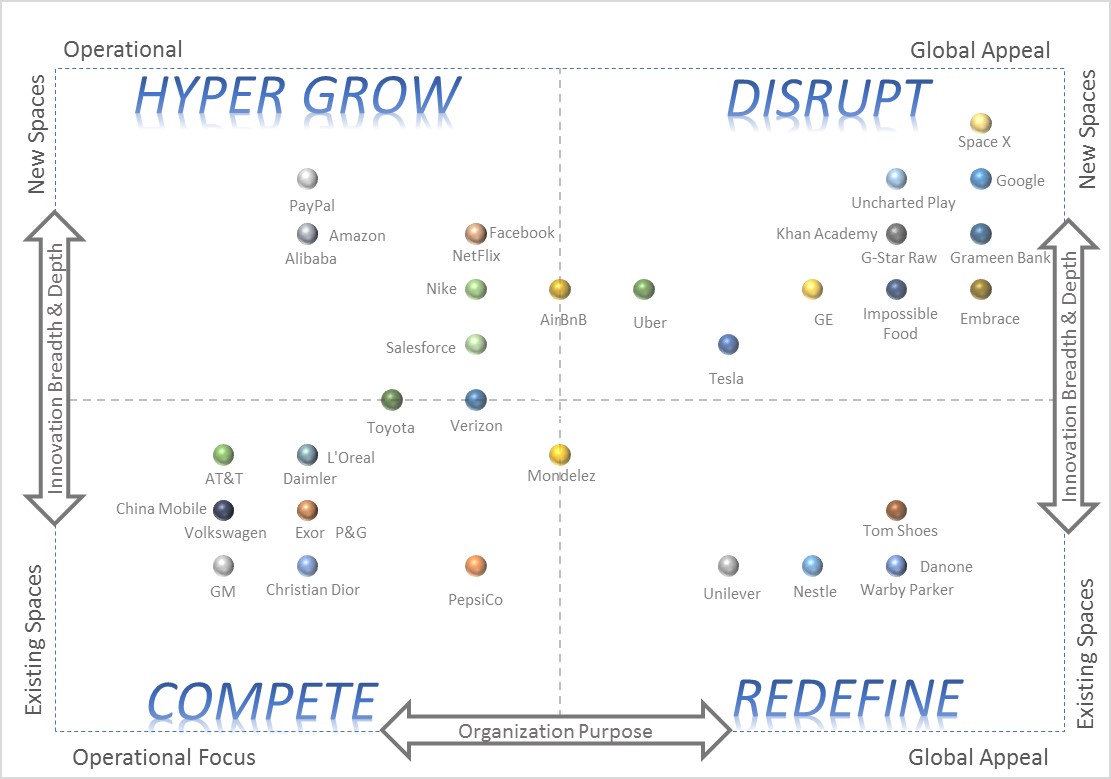
Some purpose-driven companies are operationally focused (better products, diverse talent) while others are focused on broader needs that are more societal (economic inequality or injustice) or global (world hunger or environmental sustainability). We called this span our x-axis.
Some purpose–driven companies are focused on current sectors and markets (existing spaces) and others are focused on new or emerging sectors and markets (white spaces). We called this orientation our y-axis.
Incumbents and startups are equally capable of capitalizing on purpose, though they may be playing in different quadrants.
Next, Tsolkas ranked each company’s “purpose-business model” on a scale from 1 to 10, depending on whether a particular company has a purpose that is largely operationally focused (1) or largely globally focused (10). They similarly scored these companies against their innovation focus to compare their level of attention to existing spaces over white spaces.
Finally, they plotted the results onto a matrix.
While this analysis was largely subjective and interpretative, it did allow us to see these companies in interesting and insightful ways with some surprises.
Compete = Operational Focus + Existing Space
These companies are in intense traditional competition in crowded markets. Most of the organizations we found in this quadrant were large and established with high market capitalization. A sense of purpose gave them some but not a lot of clarity and distinction between competitors and in the eyes of customers, but mostly led to innovations tied to internal performance levels and incremental improvements in products. For example, PepsiCo focuses on procuring talent that is diverse and ethical and using sourcing practices that are sustainable and efficient, and it leverages that to improve its competitiveness.
Hyper-Growth = Operational Focus + White Space
These companies are trying to outpace competitors by expanding the narrow definition of a traditional market to satisfy unmet needs or pain points often through new technology. They grow explosively by bringing those innovations to scale for an established market of consumers. Netflix famously came to dominate the home video market by introducing DVD delivery by mail and later through streaming services in line with its purpose to provide entertainment anytime and anywhere. We found that most but not all these companies were startups or recent ventures.
Redefine = Global Focus + Existing Space
These companies broaden their purpose beyond traditional operational concerns to more global concerns, yet they compete in traditional markets. They try to make a difference in that area of global concern by leveraging their business model. So, for example, Tom’s Shoes tries to alleviate the problem of shoelessness in the developing world through a business model in which each pair of shoes that is purchased means another pair of shoes is gifted. In a crowded market, this gives Tom’s Shoes distinct appeal for consumers who want to do more to help the world with their money. In a sense, those customers engage with Tom’s Shoes to help solve a global problem. The success of Tom’s Shoes as a traditional company fuels that capability, redefines market expectations, and distinguishes them from competitors. This group included a mix of new and established businesses.
Disrupt= Global Focus + White Space
These companies are focused on global needs in areas that are not being served by businesses or with technologies and approaches that are not being applied to those problems. They are disruptive in the sense that they are driving innovations that haven’t been seen before while also bringing benefits beyond the boundaries of their sectors or markets. We found a mix of startups and established companies, though the established companies had internal startup engines driving innovations. Success for these companies means disruptive growth that also creates improvements in global problems.
Older or newer companies, irrespective of size or sector, can be found in any quadrant, though there are some tendencies and clusters. Traditional established companies, for example tend to innovate on operationally focused purposes within their existing markets to beat competitors; while it’s easier for startups to be idealistic while trying to win in new markets.
Our initial conclusion was that it is easier and better for a company in one quadrant to define and align its business model with a purpose that suits that quadrant. So, for example, GM or AT&T are beholden to shareholders and customers with established expectations, and it would create misalignment and confusion to suddenly adopt a purpose that was focused on alleviating global problems either in existing or new markets. Similarly, a startup with an operationally-focused purpose would face strong headwinds in an established market but have more potential for competitive advantage in a new market or by aligning itself with a more societally or globally appealing purpose.
However, as we reflected on the potential for purpose-driven innovationsto either drive growth or improve competitiveness, we quickly saw an advantage for established companies to move up and to the right on the matrix.
We also soon saw examples of companies that were innovating in exactly this way. IBM distinguishes itself as a technological solutions provider by leveraging a focus on global problems – smarter planet, smarter cities, smarter healthcare. Nestle and Unilever have done the same.
In the past year, the big auto manufacturers, Toyota, Volkswagen, and General Motors have partnered with Uber, Gettand Lyft respectively, as a way of moving into white space markets while also improving their capacity to develop self-driving technology that reduces accidents and improves efficiency.
Where does your company currently exist, and how can you move further up or right by focusing on purpose-driven innovation?
Reverse-Engineering Purpose
Purpose can seem so intangible or idealistic in nature that many may find it difficult to imagine how they can leverage purpose to actually innovate and solve business challenges. However, we’ve seen models for doing so that provide a clear path to follow.
Muhammed Yunus, mentioned in the GrameenDanone example, was a banker who wanted to alleviate poverty in Bangladesh (a purpose with global need). Yunus observed the impact that small loans could have on helping launch and support small businesses. By offering micro-loans to female entrepreneurs specifically, Yunus’ GrameenBank hit multiple objectives: it funded new business growth, alleviated family poverty, and saw a return on its investment.
Elon Musk is widely seen as a visionary, but he’s also a great example of an innovator who is purpose-driven. Consider how deliberately he focused both Tesla and SpaceX on a clear purpose and how systematically he has worked backward to overcome barriers and challenges with business solutions and innovations. Tesla, for example, is the outcome not the initiator for solving an overwhelming global problem – climate change. Musk recognized that climate change was driven primarily by CO2 levels in the atmosphere. The dominant culprit was fossil fuels. The answer is to switch to solar power. But how do you affect that sort of massive change in global power consumption?
The most significant user of fossil fuels is petroleum-powered vehicles. Musk’s approach was to apply business thinking and solutions to break the problem down into manageable challenges and solve each one in turn.
Purpose (global) – to reduce CO2 emission levels and help save the planet
How – by (replacing) transitioning energy use from fossil fuels to solar power
Through – increasing use of electric vehicles and making it easier to use solar power in homes
Obstacle – widespread reliance on fossil-fuel powered automobile
Solution – build high-performance electric vehicle
Obstacle – current battery performance levels poor
Solution – bring in the best engineers to substantially build a better battery
Obstacle – customers don’t see electric vehicles as appealing
Solution – focus on speed, style, and brand to increase high-end demand
Obstacle – to scale and achieve mass consumption, lower cost models are required
Solution – build successively cheaper versions and cut out middle man (dealers) to reduce costs
Obstacle – need competition to spur demand for electric vehicles and associated services. Need open platform to scale
Solution – release all patents for electric-vehicle technology
Obstacle – need to stimulate broad demand for solar power
Solution – build battery pack for home use to allow solar power customers to store and efficiently use that energy
Musk pressed on through many obstacles and maintained focus on the fundamental problem because of the importance of the purpose in his sights. If he succeeds, he will have changed the world and achieved a level of significance comparable to Thomas Edison, Henry Ford and John D. Rockefeller combined.
Purpose is the New Leadership
Deciding on a purpose and striving through barriers and business challenges to achieve it is not enough. It takes a special kind of leader and an aligned organization to develop that vision, organize effectively, create innovative solutions, and attract the necessary backing and talent. It requires a new leadership.
Throughout the past 100 years, leadership has evolved to meet the business needs of the time. In the early manufacturing period, there was a need for massive efficiencies (think Kaizen or Lean). In the Mad Men era, there was a war for differentiation through mass marketing (remember Coca Cola or Campbell’s Soup). From the ‘70s through ‘80s the frequency of crisis and confusion led to the paradigm of the competent and confident persona (Jack Welch). This ideal changed again in the mid-1990s with the emergence of flattened hierarchies, entrepreneurial innovation, and the focus on scale over profit. Our very ideals of leadership, in other words, have evolved considerably over time.
Since skills and knowledge can be outsourced cheaply, what’s left for leaders to provide? Excitement and enthusiasm, the spark of the new and the impactful, and a sense of meaning and direction… i.e., purpose.
Leaders today must be driven by their own purpose and the purpose of their organizations to truly motivate and align their people and customers around the needs of the world. [Tweet “They are in business for a bigger reason than business”], and this excites and motivates others. In an economic climate under constant siege from competitors, new technology and changing customer expectations, there is no better way to steer straight to a destination and arrive first.
This trend is not going away. Millennial employees are more motivated by work within organizations that are purpose-driven and innovative, rather than hierarchical, status-quo and purely profit driven. Similarly, millennial customers are more interested in buying products and services from companies that have values aligned to their own, or do some good in the world.
Finally, some may argue that there are not that many purposes of magnitude to pursue for all companies to adopt one. Not true. As the companies discussed in this article indicate, there are a wide range and limitless number of purposes that can be leveraged.
Fortunately (or unfortunately) there are countless societal or world-saving problems out there for companies to drive their innovation and growth to solve.
Thanks to Christos Tsolkas.
Future Health is a big topic for me, and I work with many of the top healthcare companies in seeking to explore the future, to drive more patient-centric innovation, the shift to prevention and wellness and harnessing the incredible array of new technologies from DNA profiling to gene editing, patient communities and self-diagnostics and treatment.
The Institute for the Future, working with Vitality Institute have developed a fascinating map exploring the technological drivers of change, and opportunities for innovation and growth. Of course “connected healthcare” is much more than creating new apps, devices and platforms. It is about transforming industry models, empowering patients, and radically improving outcomes.
In the coming decades we have the opportunity to create a culture of health, transforming the art and science of health promotion and chronic disease prevention by strategically engaging with technology. The social and economic environment is ripe to put health at the center of human and economic vitality. And dynamic alliances of scientists, health professionals, entrepreneurs and neighborhoods are poised to lead the charge towards this culture of health.
The map includes:
Five future forces that will reshape how new solutions in health promotion and chronic disease prevention can emerge. They frame forecasts with how stakeholders across private and social sectors will align during the coming decades.
Ten forecasts that anticipate how health promotion and chronic disease prevention will become central to human and economic vitality.
Signals supporting each forecast with trends and technology advancements that show the future today.
Eight technology catalysts that have the potential to change how we interact with prevention and promotion in our daily lives and lay the groundwork for these interactive and immersive solutions.
Four key tensions we will need to navigate to ensure that human and economic vitality are accessible to all.
Five recommendations from the Vitality Institute’s Commission on Health Promotion and the Prevention of Chronic Disease in Working-Age Americans.
You can read more about my ideas, research and experiences on Future Health, including keynotes, workshops and consulting projects to drive more patient-centric innovation and growth, at:
Insurance has lagged behind banking in embracing the new digital world. Whilst they have brought their products online, the result has largely been a huge commoditisation of brands through comparison sites. What is there to choose between insurance products apart from the price?
The market is still dominated by large brands relying on the same old business model.
Now a new breed of start-ups are transforming the sector – making is easier, incorporating it into social media conversations and adapting it to suit the needs of a younger generation.
Some have embraced new business models (e.g. concierge roles, pooling premiums between friends), new price concepts (e.g. reducing car insurance premiums for better driving, health insurance if you are fitter), and new propositions (much more consumer-centric, focused on enabling you to do what you want to do better, rather than just covering the cost of things going wrong) targeted at niche audiences.
I still think they could go much further.
In particular, by integrating themselves within the brands that support everyday activities (e.g. Samsonite offering lifetime travel insurance with its new luggage), through business models that more significantly encourage more positive (lower risk) behaviours, by aligning themselves with target communities (e.g. Police Mutual for everyone working in the police force, or even other public services), and to be on the customers side (I still love Progressive USA, with it’s network of bikers who are first to a car accident, and sort everything out for you instantly).
One that particularly caught my eye (not just because of the name!) is Lemonade:
Here 15 companies are changing the industry as we know it:
BetterView is an American Insurtech startup that marries insurance with innovative engineering. Using drones to capture aerial images, the company flags up potential problems for properties and then files a report for their clients. This means that clients know exactly what issues could affect them in the future, and can choose an insurance policy to address this. Again, the business model is about treating customers individually using specific data.
Bought by Many is a British insurance startup that offers cover for pets, homes, gadgets and private health. The service is free, and offers specific insurance for unconventional items — like French bulldogs. Bought by Many challenges consumers to reject the insurance production line by joining a site that respects individual financial needs. With over 240,000 members, their approach seems to be working.
Brolly is your free personal insurance concierge, powered by AI, and available through our mobile app. Brolly is being built to make it incredibly easy for you to understand, manage and buy the insurance you need. Their goal is to ensure you waste no more time shopping around, losing track of your documents, spending more than you should, or buying the wrong cover.
Carpe Data provides risk assessment for P&C (Property and Casualty) and Life insurers. Using information extracted from social media, online content, wearables and connected devices, the company aims to predict the outcome of introducing new products. Despite recent debate about data protection, Carpe Data states that 85% of individuals will share information for insurance incentives.
Cover is growing fast in the USA, built an app that quotes insurance for any personal property (jewelry, car, house, drones, etc.) based on a picture of the object. The app currently routes customers to a broker, but Cover will be licensed in the next few months to provide an end-to-end in-app solution. It’s a compelling solution that lets consumers interact with insurance in a very different way.
CoVi Analytics aims to simplify compliance to insurance regulations, as well as reducing the costs associated with it via data insights and automation. The UK insurance market has already spent billions of pounds preparing their businesses for Solvency II, an EU directive for insurers. Through CoVi Analytics, insurance companies can apply software called cmile to consolidate their fulfilment of fragmented regulations.
US start-up helps people support the charities that matter to them by leveraging their choice of insurance provider. GiveSurance is a funding platform that enables charity supporters to make recurring donations through their existing insurance payment systems toward charity organisations.
Guevara is a web-based platform that enables its users to pool their car insurance premiums online to save money. At Guevara you join a group with other drivers. By pooling part of your premiums together, your group can save up to 50% when you keep claims low.
Insure A Thing protects the things you love — without the fine print, without the tricks. Unlike traditional insurers, they are no longer incentivised to refrain from paying out claims to customers. The actual coverage is provided by a community of like minded people who are collectively rewarded for playing fair.
League is a Canadian digital health platform that connects people to a comprehensive network of health services and benefits, giving them choice, convenience and savings. It claims to become the new digital alternative to traditional health insurance that allows you to use your employee benefits to live your best life by providing unparalleled choice, convenience and value.
Lemonade is a property insurance company that offers an on-demand mobile service with affordable monthly subscription charges. Using the company’s AI bot, it takes just 90 seconds to get insured. The service is available on iOS, Android and for desktop. At the moment they only serve New York state, but plan to expand across the country. They raised $13 million in seed funding in 2015.
Simply Business is the UK’s largest online insurance company. They began as an online quote comparison service with a focus on serving SMEs, including policies from Aviva, Hiscox, QBE and Zurich. In keeping with the theme of digitalised finance, they offer tailored insurance that can be applied for in minutes.
So-sure is a phone insurance company that allows its users and their friends to connect and receive money back annually. So-sure is ‘social insurance’, a new insurance concept which can actually provide real peace of mind. Better still, you can connect to your friends and receive up to 80% money back, every year, just as long as none of you breaks, loses or has their phone stolen.
As you can probably guess from the name, Spixii.ai uses Artificial Intelligence and machine learning techniques to offer insurance policies. Via a conversation with an automated insurance agent (AKA a chatbot), the startup aims to provide an easy, personalised experience for their customers.
Trov is a Insurtech firm that aims to reinvent insurance for the mobile generation, offering an alternative solution for people who are reluctant to take out complicated insurance policies. Through the Trov app, users can access an on-demand insurance platform that generates real-time prices for different insurable items.
When I want to cook a great dinner at home, I head straight to Marks & Spencer’s food store. M&S’s Cook range of premium quality, organically farmed self-assembly dishes makes entertaining easy. Not only do they bring together all the ingredients, fresh and locally sourced, but there is an instore tasting kitchen and even a cafe where I can try a full meal if I have time.
For packaged goods, I always trust Waitrose, anything with their brand has to be good. Whether its the low-priced essentials, or the premium treats, they have everything I need and often with more variety and change too. Same with Trader Joes in USA, which is a great community store. Fabulously designed products, usually with a twist on conventional themes, and delivered with fantastic human and fun service.
What amazes me is why so many retailers associate the phrase “private label” with low-cost and low-quality store-branded substitutes for the real thing.
Private labels started in a big way in Germany. They reinvented the shopping experience around everyday accessible stores, as an alternative to the department store food halls which preceded them. But thinking of them as “discounters” and their products as cheap imitations is completely wrong.
When I want great bread my first stop is Lidl’s instore bakery, fantastic wholegrain bread, and you can watch it being made. If I want to cater on a big scale, I can head to Metro, a large cash and carry network, which has developed the finest range of made-to-order gourmet food, perfect for events and parties. I also like browsing in Aldi, the see their latest offers on all kinds of lifestyle goods, things I never imagined I needed. But love. Same with Tchibo (just opened in UAE), and the coffee’s perfect too.
Time to rethink the potential of private labels
“Private labels” are typically a retailer’s own branded version of popular products. They used to be seen as cheap and generic, sometimes as low-priced imitators of classic brands. That old mindset has changed.
Supermarkets now offer their own gourmet food ranges as good as restaurants, or even better when you can assemble them at home. They can bring together “solutions” from multiples categories under the same brand. They can offer services, such as purchase advice or after-sales support, complimentary services and more. And just like Netflix is able to use its deep knowledge of people and their behaviours to personalise its movies and suggestions, so retailers can leverage loyalty card data and instore tracking to offer more relevant and personal solutions.
Compare this to classic brands – like Kellogg’s or Heinz – they never get to meet their consumers, or have data on their individual behaviours. They cannot create branded in-store environments that allow human engagement, or extend beyond their branded packaging. Yes they have brands of heritage and expertise, available n multiple places, and supported by blockbuster advertising. However the difference in quality is little, and many brand owners even make the private label alternatives too.
“Private labels” have become more effective than classic brands – and with a little nurturing have the opportunity to innovate and grow in ways that their previously esteemed rivals cannot. They can also be much more profitable, flexible and value-creating for their owners, the retailers.
How private labels can drive innovation and accelerate growth
So what are some advantages of private labels over classic brands?
They can focus more on the needs of the target consumer, leveraging the intelligence of the store’s loyalty cards and transactional data to understand consumer behaviours and preferences. Classic brands have none of this insights, desperately trying to buy retailer data to help them.
They can be more sustainable and trusted. They enable direct contact with manufacturers and suppliers, reducing the distance “field to fork”, and improving transparency and traceability. Whole Food Markets are a great example with its partner farms and kitchens.
They promote the retailer brand in tangible and innovative ways, enhancing the relevance, the value and reputation of the retailer. Retail brands have transformed in recent years to be much more human, relevant and engaging.
They can be more profitable. The ability to avoid comparison of prices with the same products in other retailers means less focus on price battles, and also price matching by consumers across stores.
They are faster and easier to manage. There is more speed, control and flexibility, to get new ideas to market faster, to adapt pricing to changing situations, and learn quickly from consumer response.
They can form more comprehensive “solutions”. They can be complimented by additional products, for example in adjacent categories – this might be all the ingredients for a great meal, or dinner party, or even a complete home, like IKEA.
Stores have transformed their customer service levels, allowing them often in partnership to add all kinds of own-label services to enhance their own-label products. Consider Boots’ opticians or CVS Health’s instant clinics.
They can help retailers grow beyond their stores. Sonae, Portugal’s leading retailer, sells it own label range through a wide variety of other stores in other markets – an instant portfolio for other retailers to share in the benefits.
They can be more profitable – lower costs due to fewer intermediaries and commissions, economies of scale and as a result potentially higher margins. They might even be simply better, and you should charge more.
Amazon is significantly expanding its usage of private labels. According to the Wall Street Journal Amazon will soon be promoting and selling brands like Happy Belly (nuts, trail mix, tea), Presto! (household goods), and Mama Bear (baby items). Meanwhile, the company already has been stealthily selling at least seven in-house apparel brands that many customers probably have no idea are clothes made exclusively for the site.
The Charlotte-based department store has 22 private label brands … For major department store retailers like Belk, private label brands are critical: They fill in market gaps left open by national brands. (Are Southern women craving brightly colored T-shirts with preppy anchor logos at a modest price? Belk will make them, if no one else is.) Retail analysts say companies like Belk keep more of the sales dollars from private label brands because national-brand middlemen are eliminated, and stores can choose how and when to mark down items.
Kroger and some other grocery retailers are seeing a growing share of sales come from these private-label products, and shoppers should expect to keep seeing new items and private brands pop up on store shelves. Private-label sales took off in the penny-pinching Great Recession, but today the private-label products you see will increasingly be high-end, with gourmet ingredients, or will be found on the store perimeter, where health-conscious shoppers are hunting for fresh produce and meat.
Read more:
Amazon: 25 years of innovation now including own label fashion, food and more
Rackuten Ichiba: retailing the Japanese way, selling everything from crabs to kimonos
Sonae: the Portuguese retailer taking its own label products to other stores
Futurestore: how the retail sector is changing, and the most disruptive innovators
I love it when people who talk about ideas, actually go ahead and make them happen. A couple of years ago a friend of mine, Brett King, an Aussie consultant who wrote the seminal book Bank 2.0 on the digitisation of banking, went off to NYC and made his vision happen, with an incredible start-up called Moven.
Now, Nils Leonard, a high-flying creative from the world of advertising has thrown in his prestigious job as chairman and chief creative officer of Grey London, to launch a new brand, Halo.
He enters the gourmet coffee business, with the first fully compostable coffee capsule (how long have we loved Nespresso, but complained about the non-recyclable pod?). In typical advertising gusto, he frames it as “the world’s best coffee in a way that’s best for the world.”
Nils is a guy with passion – for better coffee, for sustainability, and of course, for brands. What better way than to find an anomaly in a premium market, and close it.
Looking up on your way home in Euston station tonight, you might even catch the brand’s first ad on the station’s giant digital screens. The work graphically illustrates the startling fact that 13,500 capsules are put into landfill every minute. An online version expands on the message.
“The best brands are the ones you can imagine launching any product and you would know how it would feel – like if Audi launched a vacuum cleaner. We wanted Halo to feel good. It’s super simple and behaves like a premium brand. After 20 years of looking after everyone else’s brand, it’s terrifying creating your own.”
Already the Halo team is looking ahead to other possible coffee-related product innovations, including more energy-efficient coffee machines, which are based on technology that is over 20 years old. Nils added that future Halo branded products might not necessarily be coffee-related.
He said, “In advertising, there is a lot of talk about IP, but it tends to mean thinking up a new product that people wouldn’t give a s**t about. In our game we get close to clients and we see what’s needed. There wasn’t an amazing coffee capsule, and [existing capsules] are killing the planet. We’ve solved those problems.”
Halo capsules are compatible with popular Nespresso coffee machines, but at $12 for 10, they cost up to three times as much as their mainstream rival. The premium prices reflect the premium coffee they contain, including Kopi Luwak Diamond beans, which have not previously been available in capsule form.
Nils met his Halo co-founders, David Foster and Richard Hardwick, through a former colleague at Grey. He said, “They were making the most amazing coffee at events, and they showed me an early version of the Halo. I’d read about the problem and we worked together to innovate on the pod.”
The fourth partner in Halo is Andrew Richardson, who was previously a business director at Nespresso. The four men are backed by a small group of investors.
Halo has signed deals with three hotel chains, and is available to buy online at halo.coffee, either as a single purchase or on a subscription model. It can be shipped anywhere in the world, and there is also a K-Cup version ready for the USA.
A couple of years ago, I spent the day with Sir Richard Branson. I wanted to know what drives one of the world’s most famous entrepreneurs, and to learn a bit about what he is really like as a person. He’s very down to earth, self-deprecating and maybe slightly embarrassed by his high profile.
One thing he did tell me was that he loves ways to capture ideas short and simply – a poem beats a long novel, a diagram beats a detailed report, and inspiration is always better than information. He told me that his favourite author is Dr Suess, the creator of the cat in the hat, green eggs and ham, and all that.
So here is a poem Branson has just written, straight from his Neckar Island hammock:
The road to success is paved with tests,
So you’ve got to believe in yourself above the rest.
Dream big, and let your passion shine,
If you don’t, you won’t end up with a dime.
Challenge the status quo, disrupt the market and say YES!
And remember that innovation is an endless quest.
Don’t forget to change business for good,
If you want to change the world then you should.
If you think with your head and listen to your heart,
I promise you’ll get off to a flying start.
Make bold moves, but always play fair,
Always say please and thank you – it’s cool to care.
Do what you love and love what you do,
This advice is nothing new.
Now, stop worrying about whether your business will be a hit,
Rise to the challenge and say ‘screw it, let’s do it!’
Actually, this is not Branson’s first attempt at poetry. At the age of 16, a time when he left school and launched his first venture Student magazine, he wrote this poem to his first girlfriend, a Dutch girl. For some reason she seemed to make him feel old:
I am getting old now
and this but my seventeenth year,
holding in a wrinkled, thoughtful head
memories of an age.
Now-without you
out of step with time
as my pen scratches paper
and the clamy grip of censure settles on my hand.
Through all my friends growing quickly younger as I
so fear
this coming and passing of year upon year
without you
You recall, before our parting, little Dutch girl
the time
we exchanged our love and rode along streams together
innumerable streams
on the backs of mountains, and our separate fates
black as smoke waiting above us?
Now-
how changed, so changed our days – not my fair thoughts