Many books have been written about the Internet and other emerging technologies as a force for good, yet it can also amplify evil says Mike Dover, author of the bestseller Wikibrands. His new book Dante’s Infinite Monkeys: Technology Meets The Seven Deadly Sins, is about how “the Internet, and technology in general, have provided new ways for wrath, lust, gluttony, sloth, pride, envy, and greed to insert themselves into our lives.” He dives deeply into the worst of humanity that technology can serve up.
Chunka Mui recently met up with Mike for an interview with Forbes magazine , to discuss how technology is amplifying evil, and the implications for consumers, inventors, innovators and policy makers.
Mui: Why write a book about evil?
Dover: I’ve spent a significant part of my career working at a think tank that mostly studied the impact of technology on business and society. Generally our sponsors were interested in how they could leverage technology to improve profits or in the case of governments how to improve life for citizens. While our clients were interested in dangers and pitfalls, most of what we produced focused on the positives. This project gave me some balance and license to really dig into the dark stuff.
Mui: Your book offers compelling evidence that bad actors are harnessing technology to commit every deadly sin. From a personal standpoint, what dangers that could directly affect you and your loved ones worry you the most?
Dover: Greed will directly impact regular people in the developed world. The division between rich and poor will grow as more jobs get automated. Even with a guaranteed minimum income, a society with a small trillionaire elite and a massive underclass will be devastating to our idea of society. In the case that a guaranteed income, emboldened by laboratory created protein, inexpensive 3-D printed goods and rich immersive entertainment made life carefree, many people in our society require a vocation to feel useful.
Mui: What do you do to safeguard yourselves against those dangers?
Dover: A combination of things: Look for work that is less susceptible to robot replacement and constantly retrain and reinvent yourself. Also, build parts of your identity that are not reliant on your profession. Write poetry, even if it is bad poetry.
Mui: You write that technological change can alter ethics and morality. Give us examples of things that we might consider “evil” today but acceptable in the future.
Dover: I point out in the book (although I am far from the first person to address it) that sexuality drives technological innovation. Beta was a better format than VHS but the latter thrived because it embraced pornography. Same deal with video steaming, online payments, etc. Sex with robots enhanced with AI and customized pharmaceuticals will be viewed as recreation rather than perversion.
Mui: Some evils, however, are inherently evil. From a long-term, societal standpoint, what keeps you up at night?
Dover: Wrath—not as manifested through online bullying (although that certainly is troubling) but via technology-infused warfare. Biological weaponry at a molecular level can be incredibly devastating and does not require the resources of a superpower to develop. At the same time, using robots and AI as soldiers will have a huge ethical and philosophical impact.
Mui: Is there anything individuals can do against these broad threats, other than hunker down and hope that it doesn’t happen?
Dover: I touch on that in the final paragraph of each chapter, but some threats are easier to address than others. Certainly, people should realize that Wikileaks and its ilk can publish everything you type and criminals will become more sophisticated at stealing from you. You need to more critical and more careful.
Mui: How should inventors of new technologies and applications think about the potential evil uses of their inventions?
Dover: Absolutely they should, although sometimes curiosity and human innovation can turn benign inventions evil. If a terrorist loaded up twenty drones with plastic explosives and flew them into a packed football stadium at least some of them would detonate causing massive injury and loss of life. It’s hard to blame that on people who develop drone technology.
Mui: How should companies that can choose to commercialize such technologies, or not, think about the ethical implications of their business decisions?
Dover: Technology producers should operate ethically. As much as possible, they should think of safety and safeguards and work with authorities (where that makes sense) to address bad actors.
Mui: What is the proper trade-off between forestalling evil before it is enabled versus, potentially, stifling innovation?
Dover: This is tricky because there is no trade-off that is acceptable to everyone and the concept of evil (and certainly content standards) varies widely across jurisdictions. What is considered obscene by one culture is laughably innocuous in another.
Mui: What is the role of policy makers and regulators?
Dover: Two ways that policy makers can improve is to move faster and include a greater breadth of voices. If it takes a year to write legislation about mobile surveillance or the chemical composition of bath salts, then it will be obsolete before it can be enacted. And, please…if a Supreme Court justice has never used email, have his or her grandchild give a tutorial before ruling on online privacy.
Mui: Can you offer any hopeful parting thoughts?
Dover: Even in the face of evil, we can still be good. Technology offers great benefits and knowing about evil can help us combat it.
Founded in 2014 by serial entrepreneur Chris Olshan and his wife, Kristy Olshan, Surly Penguin & The Distillery was a dream forged by hard work with a kiss from luck and fate.
As in the case of many great inventions, the business was born out of an unsuccessful experiment. Chris’ wife Kristy loves citrus fragrances. Chris determined to create, as a Valentine’s Day gift for Kristy, a citrus body oil and accidentally infused the oil with alcohol. Lightning struck. And the Surly Penguin Grapefruit Cordial was born.
Rave reviews from friends who tasted Surly Penguin Grapefruit Cordial inspired Chris to dream of opening a distillery.
After searching for over a year they finally found the perfect property.
The distillery is situated on 17 acres of private forest reserve filled with thousands of raspberry bushes which supplied the first locally grown fruit for the business.
A brand new bank barn had been constructed on the property which was quickly converted into a working distillery.
They harvested the raspberries by hand, juiced them and added them to the infused alcohol creating their first artisanal spirit.
 |
| 100% uncompromising |
| Surly Penguin is changing the way people enjoy and consume artisanally-crafted distilled spirits by creating products that are designed to be as delicious as the fresh fruits we use. Every cordial Surly Penguin creates is made with hand-picked, hand-juiced fruits and ultra-pure spirits that are six-times distilled, GMO free and organic. |
| Unique Flavors and Natural Ingredients |
| The Surly Penguin Distillery is creating hand crafted cordials and bespoke liqueurs. Sourcing fruits, herbs and spices from local farms, our new 26-flavor liquor brand delivers premium quality products. |
| Crafted in the USA |
| From the stills we use, to the fruits we hand-juice, to our bottles and labels, every step of the Surly Penguin process happens right here in the USA. |
| The Surly Penguin Principles |
|

Danes love to innovate. They love to create and play, to appreciate design and newness. From your earliest childhood memories with Lego bricks, to the compulsion of Movie Star Planet, the dream of sinking into your BoConcept chair and turning up your Bang & Olufsen sounds, Danish brands have spread with simplicity and sophistication across the world. The EU ranks Denmark as Europe’s second most innovative nation, behind Sweden, whilst the WEF ranks Denmark globally at eighth.
I have been working in partnership with the City of Odense (birthplace of Hans Christian Andersen, Europe’s new robotics hub, and the home of Thinkers50 in Europe) and wanted to explore which Danish companies are changing the game. Over the last 18 months I have run a series of Business Innovation Labs for Danish business leaders, and learnt much of what they do best, and what inspires them.
I’m looking for companies that are shaping markets in their own vision, through big ideas, radical innovation and creative delivery. Globally we always talk about the likes of Apple and Tesla, Nespresso and Xiaomi, but who are the more local companies who are equally good at rethinking local, and global, markets. Here are the current nominations for Danish “Gamechangers”:

1. Arla Foods
Arla Foods is the seventh largest dairy company in the world, and the third largest cooperative, formed through the merger of Sweden’s Arla and Denmark’s MD Foods in 2000. The Aarhus-based company has 19,000 employees across 30 countries and 12,700 dairy farmer owners in Denmark, Sweden, United Kingdom, Germany, Belgium, Luxembourg and the Netherlands. It is most famous for brands like Lurpak (owned by the Danish Dairy Board), and for its innovative range of milks, cheese and yogurts.
2. Bjarke Ingels Group
From a power station topped with a ski slope, to a flood-defence park in Manhattan – there’s no such thing as can’t for architect Bjarke Ingels and his team. “Architecture is like a sort of gentleman’s sport where you only really get to do it when you’re old,” says the 41 year old Dane. He takes pleasure in pointing out that his current West 57 project in New York has a larger budget than Avatar, the most expensive movie ever made. His company is called BIG, a reference also to his work which is characterised by big ideas, big gestures and, increasingly, big scale and big ambition.
3. Coloplast
Founded in 1957, Coloplast develops, manufactures and markets medical devices and services related to ostomy, urology, continence and wound care. Ranked #33 in the Forbes’ list of the world’s most innovative companies, it supplies products to hospitals and institutions as well as wholesalers and retailers. In selected markets, Coloplast is a direct supplier to consumers.
4. Coisbo Beer
5. Danfoss
Founded in 1933 by Mads Clausen, Danfoss is a global producer of products and services used in areas such as cooling food, air conditioning, heating buildings, controlling electric motors, compressors, drives and powering mobile machinery. Danfoss, with 24000 employees and based in Nordborg, is also active in the field of solar and wind power as well as district heating and cooling infrastructure that targets entire cities and urban communities.
6. Flying Tiger Copenhagen
Tiger (now known as Flying Tiger, after a trademark dispute with Japanese brand Asics Tiger) is a great place to browse, and walk away with something you never expected you needed. It describes itself as a variety store, with low priced every-day items from notebooks to kitchen utensils, games and liquorice. Lennart Lajboschitz opened the first store at Islands Brygge in Copenhagen in 1995 and now has 630 stores across the world. It takes its name from how the Danish pronunciation of the animal name, tiger, sounds roughly the same as the Danish word tier, used to denote a ten kroner coin.
7. Just Eat
Jesper Buch founded Just Eat in Denmark in 2000, an online food order and delivery service that acts as an intermediary between independent restaurants/take-aways and customers. The platform allows customers to search for local take-out restaurants to place orders online, and to choose from pick-up or delivery options. In 2006, he moved to London and set up a team headed by sales director David Buttress, and now operates in 13 countries in Europe, Asia, Oceania, and the Americas. In December 2016, Just Eat announced that it was acquiring HungryHouse from its biggest competitor, DeliveryHero. The delivery business’ global revenues now exceed Euro 500 million.
https://www.youtube.com/watch?v=SLWkSTWLDMU
8. Joe and the Juice
Joe and the Juice recently launched in New York offering coffee (or juice), wholesome sandwiches and a side of “edgy”. Plus a liberal dose of Danish furnishings, dark ambient lighting and the good music. The brand started out as a little privately owned juice-bar inside an expensive furniture shop in central Copenhagen. The founder Kasper Basse is a former karate champion, with a goal to create some healthy take-away place, that in the end could be as big as Starbucks. He grew the business across Denmark, making good profits, and after around 10 years sold part of the company to a Swedish bank, and now working with him to drive global growth.
9. Lego Boost
We all know the Danish toymaker. The Billund-based company has just launched a new platform called Lego Boost, a hybrid building and coding set that the company says combines the play experience of a traditional Lego set with an app-based coding play experience. Lego Boost, developed for children aged 7 or older. It comes with building instructions and coding commands to create five possible Lego creations, including a robot and a cat. The app also includes more than 60 activities related to building and coding. The bricks also come with built-in sensors that can detect color.
10. Momondo
Momondo was founded in Denmark in 2006 and is headquartered in Copenhagen. It is a metasearch engine for global travel – flights, hotels, cars – and distinctively provides inspirational blogs, stories and tip for its travellers. But its marketing looks beyond the logistics of just getting there. It focuses on why. “Let’s Open Our World” is an invitation to travel across boundaries, embrace our differences and open our world. In 2016 Momondo asked 67 people from all over the world to take a DNA test, and it turns out they have much more in common with other nationalities than they would ever have thought.
11. Novozymes
Ranked in the world’s 100 most innovative companies by Forbes in 2016, Novzymes is the world’s leading producer of industrial enzymes, creating the first enzyme solution to be stabilized in laundry bars. Easyzyme gives consumers around the world the opportunity to hand-wash clothes with less effort, less need to rewash, and less use of water. A great example of sustainable innovation.
12. Pandora
Pandora’s contemporary jewellery is sold in more than 100 countries through 8,900 points of sale, including more than 1,900 concept stores. Founded in 1982 , the Copenhagen-based company employs more 17,800 people worldwide of whom approximately 12,000 are located at Pandora’s manufacturing centre in Gemopolis, Thailand. Selling modular and addictive jewellery solutions, the brand has engaged its consumers in an ongoing relationship, buying and gifting, customising the items for them and their occasion.
https://www.youtube.com/watch?v=fBm5AyPdc-w
13. Universal Robots
UR is dedicated to bringing safe, flexible and easy to use 6 axis industrial robotic arms to business of every size, all over the world. Based in Odense, they develop industrial collaborative robot arms that automate and streamline repetitive industrial processes. This approach enables production departments to assign their staff members more enjoyable tasks – creating jobs that provide them with new challenges that add value to the company.
14. Vipp
Vipp produces everyday products like rubbish bins and toilet brushes that are rarely seen as interesting. That’s until they got Lady Gaga’s costume designer to create evening dresses for trash. In 2015 Vipp created a “plug and play getaway” home, a prefab home made of fifty thousand pounds of glass and steel. It can be built in 3 days using just bolts for the modules and 9,000 screws. It can house 4 people: 2 on a daybed and 2 in a loft bedroom.
15. WeFood
Denmark’s new supermarket WeFood sells produce no other stores will sell due to damaged packaging, wrong labels and food nearing their expiration dates. “Wefood receives goods from supermarkets and shopkeepers who do not want to sell them anymore–mainly because they have passed the “best before” date,” says Jutta Weinkouff from DanChurchAid, the nonprofit running the new store. All of its products are still legal and safe to sell to consumers and cost roughly 30 to 50% cheaper than regular supermarkets. Food waste is a major issue for our world with 795 million people undernourished, and cost of global food waste roughly $1 trillion per year.
Who do you think are the best Danish innovators? .
My “Gamechangers” book is now available in Danish, from Eidos Books and sponsored by Thinkers50 Europe. You can download a free sample here.
Join me for Gamechangers Denmark about smarter innovation and faster growth at the Odense Entrepreneurs Day at Nordea in Odense on 8 May 2017.
Join me for Thinkers50 European Business Forum which I will be hosting and featuring many of the world’s top business gurus in Odense on 9-10 May 2017.
For more information contact me.
Mottainai is a Japanese term conveying a sense of regret concerning waste.
The expression “Mottainai!” can be uttered as an exclamation when something useful, such as food or even our time, is wasted, meaning roughly “what a waste!”
Everyday usage of mottainai is directly tied to the Buddhist concept of regret over squandering or misusing material objects or other resources. But it’s actually had various meanings over the years, stemming from the words mottai (勿体), which indicates an air of importance or sanctity, and nai (無い), meaning a lack of something.
An ancient Japanese meaning of the word conveys a feeling of gratitude combined with shame from receiving something—or a favor—from a superior that is far greater than one deserves. In essence, Bill and Ted’s popular catchphrase, “We’re not worthy!” comes to mind. This particular usage may be outdated, but it clearly conveys an ideal of humility that survives to this day.
Don’t waste what we have
In November 2002, the English-language, Japan-based magazine Look Japan ran a cover story entitled “Restyling Japan: Revival of the ‘Mottainai’ Spirit”, documenting the motivation amongst volunteers in a “toy hospital” in Japan to “develop in children the habit of looking after their possessions”, the re-emergence of repair shops specializing in repairing household appliances or children’s clothes, the recycling of plastic bottles and other materials, the collection of waste edible oil, and more generally the efforts to stop the trend of throwing away everything that can no longer be used, i.e. the efforts of reviving “the spirit of mottainai“.
In that context, Hitoshi Chiba, the author, described mottainai …
“We often hear in Japan the expression ‘mottainai’, which loosely means ‘wasteful’ but in its full sense conveys a feeling of awe and appreciation for the gifts of nature or the sincere conduct of other people. There is a trait among Japanese people to try to use something for its entire effective life or continue to use it by repairing it. In this caring culture, people will endeavor to find new homes for possessions they no longer need. The ‘mottainai’ principle extends to the dinner table, where many consider it rude to leave even a single grain of rice in the bowl. The concern is that this traditional trait may be lost.”
And mottainai doesn’t just refer to food. Nanbu saki-ori, as seen in the video, is a traditional style of weaving created by residents in the southern part of Iwate Prefecture. They tear or cut apart used and worn fabrics and weave them into new clothes, furniture, accessories or other items along with strips of hemp or cotton. This eco-friendly practice not only creates beautiful new pieces of fabric, but ones with hints of nostalgia threaded in each unique pattern.
Protect our world
Now, if you’ve ever heard the word mottainai outside of Japan, chances are it’s thanks to the influence of Kenyan environmentalist Wangari Maathai. Showing off a T-shirt imprinted with the word, she introduced the term at a United Nations session as a slogan for environmental protection. Thanks to her tireless advocacy of the effective use of limited resources—the spirit of mottainai—she was awarded the 2004 Nobel Peace Prize, making her the first African woman to win the prestigious prize.
If you click below, you can find a video below of her promoting the Green Belt Movement, which she founded in the 1970s in an effort to plant trees in Kenya while simultaneously training women in the areas of forestry, food processing and other sustainable and income-generating activities.
Too good
Finally, mottainai can also be used to describe another situation: when something or someone is too good for you. It’s essentially another way to say, “What a waste!” Let’s hope you never hear your partner say you’re mottainai for them!
Today Jeff Bezos sent his annual letter to his shareholders. It went like this:
“Jeff, what does Day 2 look like?”
That’s a question I just got at our most recent all-hands meeting. I’ve been reminding people that it’s Day 1 for a couple of decades. I work in an Amazon building named Day 1, and when I moved buildings, I took the name with me. I spend time thinking about this topic.
“Day 2 is stasis. Followed by irrelevance. Followed by excruciating, painful decline. Followed by death. And that is why it is always Day 1.”
To be sure, this kind of decline would happen in extreme slow motion. An established company might harvest Day 2 for decades, but the final result would still come.
I’m interested in the question, how do you fend off Day 2? What are the techniques and tactics? How do you keep the vitality of Day 1, even inside a large organization?
Such a question can’t have a simple answer. There will be many elements, multiple paths, and many traps. I don’t know the whole answer, but I may know bits of it. Here’s a starter pack of essentials for Day 1 defense: customer obsession, a skeptical view of proxies, the eager adoption of external trends, and high-velocity decision making.
True Customer Obsession
There are many ways to center a business. You can be competitor focused, you can be product focused, you can be technology focused, you can be business model focused, and there are more. But in my view, obsessive customer focus is by far the most protective of Day 1 vitality.
Why? There are many advantages to a customer-centric approach, but here’s the big one: customers are always beautifully, wonderfully dissatisfied, even when they report being happy and business is great. Even when they don’t yet know it, customers want something better, and your desire to delight customers will drive you to invent on their behalf. No customer ever asked Amazon to create the Prime membership program, but it sure turns out they wanted it, and I could give you many such examples.
Staying in Day 1 requires you to experiment patiently, accept failures, plant seeds, protect saplings, and double down when you see customer delight. A customer-obsessed culture best creates the conditions where all of that can happen.
Resist Proxies
As companies get larger and more complex, there’s a tendency to manage to proxies. This comes in many shapes and sizes, and it’s dangerous, subtle, and very Day 2.
A common example is process as proxy. Good process serves you so you can serve customers. But if you’re not watchful, the process can become the thing. This can happen very easily in large organizations. The process becomes the proxy for the result you want. You stop looking at outcomes and just make sure you’re doing the process right. Gulp. It’s not that rare to hear a junior leader defend a bad outcome with something like, “Well, we followed the process.” A more experienced leader will use it as an opportunity to investigate and improve the process. The process is not the thing. It’s always worth asking, do we own the process or does the process own us? In a Day 2 company, you might find it’s the second.
Another example: market research and customer surveys can become proxies for customers – something that’s especially dangerous when you’re inventing and designing products. “Fifty-five percent of beta testers report being satisfied with this feature. That is up from 47% in the first survey.” That’s hard to interpret and could unintentionally mislead.
Good inventors and designers deeply understand their customer. They spend tremendous energy developing that intuition. They study and understand many anecdotes rather than only the averages you’ll find on surveys. They live with the design.
I’m not against beta testing or surveys. But you, the product or service owner, must understand the customer, have a vision, and love the offering. Then, beta testing and research can help you find your blind spots. A remarkable customer experience starts with heart, intuition, curiosity, play, guts, taste. You won’t find any of it in a survey.
Embrace External Trends
The outside world can push you into Day 2 if you won’t or can’t embrace powerful trends quickly. If you fight them, you’re probably fighting the future. Embrace them and you have a tailwind.
These big trends are not that hard to spot (they get talked and written about a lot), but they can be strangely hard for large organizations to embrace. We’re in the middle of an obvious one right now: machine learning and artificial intelligence.
Over the past decades computers have broadly automated tasks that programmers could describe with clear rules and algorithms. Modern machine learning techniques now allow us to do the same for tasks where describing the precise rules is much harder.
At Amazon, we’ve been engaged in the practical application of machine learning for many years now. Some of this work is highly visible: our autonomous Prime Air delivery drones; the Amazon Go convenience store that uses machine vision to eliminate checkout lines; and Alexa,1 our cloud-based AI assistant. (We still struggle to keep Echo in stock, despite our best efforts. A high-quality problem, but a problem. We’re working on it.)
But much of what we do with machine learning happens beneath the surface. Machine learning drives our algorithms for demand forecasting, product search ranking, product and deals recommendations, merchandising placements, fraud detection, translations, and much more. Though less visible, much of the impact of machine learning will be of this type – quietly but meaningfully improving core operations.
Inside AWS, we’re excited to lower the costs and barriers to machine learning and AI so organizations of all sizes can take advantage of these advanced techniques.
Using our pre-packaged versions of popular deep learning frameworks running on P2 compute instances (optimized for this workload), customers are already developing powerful systems ranging everywhere from early disease detection to increasing crop yields. And we’ve also made Amazon’s higher level services available in a convenient form. Amazon Lex (what’s inside Alexa), Amazon Polly, and Amazon Rekognition remove the heavy lifting from natural language understanding, speech generation, and image analysis. They can be accessed with simple API calls – no machine learning expertise required. Watch this space. Much more to come.
High-Velocity Decision Making
Day 2 companies make high-quality decisions, but they make high-quality decisions slowly. To keep the energy and dynamism of Day 1, you have to somehow make high-quality, high-velocity decisions. Easy for start-ups and very challenging for large organizations. The senior team at Amazon is determined to keep our decision-making velocity high. Speed matters in business – plus a high-velocity decision making environment is more fun too. We don’t know all the answers, but here are some thoughts.
First, never use a one-size-fits-all decision-making process. Many decisions are reversible, two-way doors. Those decisions can use a light-weight process. For those, so what if you’re wrong? I wrote about this in more detail in last year’s letter.
Second, most decisions should probably be made with somewhere around 70% of the information you wish you had. If you wait for 90%, in most cases, you’re probably being slow. Plus, either way, you need to be good at quickly recognizing and correcting bad decisions. If you’re good at course correcting, being wrong may be less costly than you think, whereas being slow is going to be expensive for sure.
Third, use the phrase “disagree and commit.” This phrase will save a lot of time. If you have conviction on a particular direction even though there’s no consensus, it’s helpful to say, “Look, I know we disagree on this but will you gamble with me on it? Disagree and commit?” By the time you’re at this point, no one can know the answer for sure, and you’ll probably get a quick yes.
This isn’t one way. If you’re the boss, you should do this too. I disagree and commit all the time. We recently greenlit a particular Amazon Studios original. I told the team my view: debatable whether it would be interesting enough, complicated to produce, the business terms aren’t that good, and we have lots of other opportunities. They had a completely different opinion and wanted to go ahead. I wrote back right away with “I disagree and commit and hope it becomes the most watched thing we’ve ever made.” Consider how much slower this decision cycle would have been if the team had actually had to convinceme rather than simply get my commitment.
Note what this example is not: it’s not me thinking to myself “well, these guys are wrong and missing the point, but this isn’t worth me chasing.” It’s a genuine disagreement of opinion, a candid expression of my view, a chance for the team to weigh my view, and a quick, sincere commitment to go their way. And given that this team has already brought home 11 Emmys, 6 Golden Globes, and 3 Oscars, I’m just glad they let me in the room at all!
Fourth, recognize true misalignment issues early and escalate them immediately. Sometimes teams have different objectives and fundamentally different views. They are not aligned. No amount of discussion, no number of meetings will resolve that deep misalignment. Without escalation, the default dispute resolution mechanism for this scenario is exhaustion. Whoever has more stamina carries the decision.
I’ve seen many examples of sincere misalignment at Amazon over the years. When we decided to invite third party sellers to compete directly against us on our own product detail pages – that was a big one. Many smart, well-intentioned Amazonians were simply not at all aligned with the direction. The big decision set up hundreds of smaller decisions, many of which needed to be escalated to the senior team.
“You’ve worn me down” is an awful decision-making process. It’s slow and de-energizing. Go for quick escalation instead – it’s better.
So, have you settled only for decision quality, or are you mindful of decision velocity too? Are the world’s trends tailwinds for you? Are you falling prey to proxies, or do they serve you? And most important of all, are you delighting customers? We can have the scope and capabilities of a large company and the spirit and heart of a small one. But we have to choose it.
A huge thank you to each and every customer for allowing us to serve you, to our shareowners for your support, and to Amazonians everywhere for your hard work, your ingenuity, and your passion.
As always, I attach a copy of our original 1997 letter. It remains Day 1.
Sincerely,
Jeff
Jeffrey P. Bezos
Founder and Chief Executive Officer
Amazon.com, Inc.
1 For something amusing, try asking, “Alexa, what is sixty factorial?”
Thinkers50’s European Business Forum brings together Europe’s business leaders with the very best new ideas in business – including from the world’s #1 business thinker, #1 business leader, and #1 business coach.
Markets of relentless change, exponential technologies, social and political uncertainty, challenge every business leader.
Ideas can change the world, but making sense of this change, and making new strategies happen is not easy. In fact, everything you learn’t at business school has probably changed.
That’s why, even the busiest CEO, the most qualified and experienced leader, still needs to take time out to think, to make new connections, and to explore “where next” and “how better.”
Change your brain, to change your game!
Download summary of Peter Fisk’s European Business Forum Preview
Odense in the heart of Denmark, birthplace of Hans Christian Andersen and now Europe’s leading robotics hub, is a perfect place to explore the future – to write the 21st century story of business. I will be hosting the event, and helping you to explore the best new thinking, bringing together academic theory and practical insights, global and local, to help you win.
In designing the agenda for the European Business Forum, we’ve tried to bring the best ideas, new perspectives, stretching but also very practical applications. We’ve also developed co-creation sessions where every delegate can share new insights and ideas from their own businesses, that will be captured and shared globally. High energy, no bullshit, stretching and inspiring, practical and useful.
Here are 15 big ideas that we will explore with the world’s best business gurus:
1. “Martin Luther King had a dream, not a five year business plan” … Advantage is typically a temporary monopoly. In the past it was based on location, and then on innovation. But in today’s world everybody can create a a world-class product, so how do you stand out? Jonas Ridderstrale, Sweden’s most provocative business thinker shakes it all up, exploring the big new ideas for business in a high-tech high-touch world. Author of global bestseller Funky Business, Jonas has featured in Thinkers50 rankings three times, and is back with preview of his next book, and a big idea to get you thinking, challenged and inspired. Get ready to be funked, and to be funky.
2. “Populism and protectionism are big issues for business” … With elections sweeping across Europe, and the world still trying to come to terms with Brexit and Trump, businesses need to address new hope and fears, anxieties and aspirations of their audiences. Alexander Betts achieved fame with his TED talk “Our refugee system is failing; here’s how we can fix it” and became a leading commentator on the rise of populism across Europe, and offers new solutions to a global problem. He is Professor of Forced Migration and International Affairs at Oxford University, and a Young Global Leader by the World Economic Forum.
3. “Women offer better solutions for a changing world” … Emerging markets are rapidly taking their new place in the world order, outgrowing established markets or even leapfrogging them with new ambitions and new solutions. The drive for innovation in today’s Middle East is astounding, but can sit uncomfortably alongside traditions and old attitudes. Mona Hammami Hijazi is director at the Office of Strategic Affairs, Abu Dhabi Crown Prince Court. Her new book The Giving World offers a new approach to the many significant social and economic challenges faced by the developing world. These include tackling poverty and disease, reducing crime, and creating the infrastructure and security to foster economic prosperity
4. “We need a bullshit-free approach to innovation” … We face an incredible but uncertain future, with robotics challenging humans, and intelligence out of our minds, yet most innovation is restrained by old thinking, conventions and language. Alf Rehn is a Finnish academic with a lifelong love of trashy popular culture. Based at the Åbo Akademi University in Turku, he is author of Dangerous Minds. He is also the funniest and most outrageous thinker you will ever meet, exploring issues of new technologies, power, exclusion, creativity and innovation, using counter-intuitive analyses of core assumptions within business.
5. “Forget competitors, focus on where you are going” … Most businesses get obsessed about being slightly different, slightly cheaper than their competitors. They lose sight of a changing world, of what matters most to consumers, and where the future opportunities lie. Strategy needs to be different in a fast-moving markets, with the ability to stretch and flex as the world keeps changing. Rita Gunther McGrath is an expert on strategic business growth in uncertain environments. She is strategy professor at Columbia University in New York, ranks at #9 on the Thinkers50 global list. Her most recent book, The End of Competitive Advantage: How to Keep Your Strategy Moving as Fast as Your Business sounds the death knell for competitive advantage.
6. “Growth is everywhere, but we miss most of the opportunities” … Markets are full of new opportunities for growth, particularly in the grass roots, with new needs and expectations, new challenges like sustainability and new opportunities like robotics. We need to look deeper and think smarter to find the best growth. Mark Esposito is a Harvard professor specializing in strategy for business, government and society. He is co-leader of Harvard’s microeconomics of competitiveness program, and is also a tenured professor at Grenoble School of Management in France. He advises the European Parliament on the EU systemic crisis, works with the World Economic Forum on innovation driven entrepreneurship and collaborative innovation.
https://www.youtube.com/watch?v=Ctmr5tTljcQ
7. “Find what makes you special, then make the most of it” … Leaders are overly concerned about playing to the norms, trying to address their weakness and eliminate imperfections. Instead they should focus on their advantages, what makes them different and special, and how can they use this even more to stand out, and be better. To find their “spike”. Rene Carayol is joined by some of the world’s leading CEOs to make sense of this new world, the new priorities, and what business needs to do differently to innovate, grow and win. Rene is a leadership expert, professor at Cass Business School, TV and radio presenter, CEO of Inspired Leaders Network, and author of a new book Spike!
https://www.youtube.com/watch?v=YiNCdeksUtM
8. “The best new organisations are 10x better, 10x faster, 10x cheaper than yours” … WhatsApp created $19bn in 3 years, Uber $60bn in 5 years. They are exponential organisations. They think and work in new ways, harnessing the power of ideas and networks to amplify their impact, further and faster … multiplying exponentially. Yuri van Geest is co-author of the bestselling book Exponential Organisations and fellow of the Singularity University leads a highly practical workshop, specifically for C-level participants. Yuri explores the fundamentally new ways startups and corporates are organized internally and externally to deal with disruption, exponential technologies and accelerated change.
9. “Winning as a global business depends on how well you understand different cultures” … Most organisations work across cultures – either in selling their products and services across the world’s markets, or working in diverse teams and partnerships. Understanding how to engage and influence different cultures has become one of the biggest factors driving success in organisations and global business. Erin Meyer is an INSEAD professor and author of The Culture Map, on how people from different cultures work best together, and why they sometimes don’t. She focuses on how the world’s most successful managers navigate the complexities of cultural differences in a global environment.
10. “Business is a portfolio of projects, we are all project managers” … Everything from new products to new market entry, digital transformation to a new marketing campaign, can be thought of as a project. Yet most managers don’t manage them, or the overall combination of them, in the way effective projects are managed. Doing so could transform efficient delivery, speed and impact. Antonio Nieto-Rodriguez is the world’s leading project management guru. He is the creator of the concept Projects Inc., which argues that project management is the lingua franca of the business. He is Director of Program Management at GSK Vaccines. He is author of the The Focused Organization.
https://www.youtube.com/watch?v=F3peGiQvnxw
11. “Leaders need to be the pivot of a changing organisation” … What is the role of the leader in a transforming organisation? Whilst it might seem like they should be frenetically busy and changing themselves, the most effective leaders of change are quite still – a constant in the midst of turbulence – a pivot around which to leverage a better future. Deborah Rowland helps leaders to drive large complex change – in quicker and more effortless ways. She has led change in major global organizations including Shell, Gucci Group, BBC Worldwide and PepsiCo. She also founded and grew a consulting firm that pioneered original research in the field, the latest efforts of which were accepted as a paper at the 2016 Academy of Management. Her latest book is Still Moving: How to Lead Mindful Change
12. “Product and process change is easy, organisation and culture change is harder” … Market and industry change drives internal change. Product and process change is relatively easy, organisation and culture change is much harder. How can you turn around a supertanker. The starting point is to align a top team with a new set of mental models, and eliminating the old ones. This then drives a corporate story, that highlights the burning platform, and the better future which will make change worthwhile. Peter Terium is CEO of the German energy giant, innogy SE (formerly, CEO RWE AG). The Dutchman initially trained as an accountant, then worked in roles with the Dutch Ministry of Finance and KMPG, before becoming CEO of Essent and then RWE. He will tell the story of a three-year change.
13. “People like to do exciting things. They like to be part of a journey”… The Scandinavian approach to business leadership is highly consensual. However what is most important is not just finding agreement, but in engaging and energising people, motivating and mobilising them to come with you on a journey, to a better future where change and hard work are worth fighting for … Lars Rebien Sorensen is the “world best performing CEO” according to Harvard Business Review in 2015 and 2016, when he was President and CEO of Novo Nordisk. In one of his first appearances since his retirement, the Dane reflects on 40 years of corporate life, working across the world, and what he has learnt works and doesn’t work as a business leader. He also offers advice for the next generation of leaders, seeking to navigate an ever more complicated world.
14. “The ‘trigger’, or the key variable in behavioral change in any aspect of life, is you” … We spend most of our time waiting for something to happen, or somebody else to take the first step, to change how they work, to speak the unspeakable, to do the unthinkable. So what are you waiting for? Marshall Goldsmith is regarded as the world’s leading leadership coach. He is a pioneer in helping successful leaders achieve positive, lasting change in behaviours. His success is built upon a very practical, no-nonsense approach to leadership. He is the New York Times bestselling author of MOJO, What Got You Here Won’t Get You There and Triggers: Creating behavior that lasts – becoming the person you want to be. He features at #5 on the Thinkers50 Global Ranking.
15. “Economic growth is not enough, social progress is what matters” … Michael Porter is Harvard Professor of Strategy, #1 on the Thinkers50 Global Ranking, will define a new agenda for business in Europe. He will reflect on his early ideas about competitive advantage, and most significantly on his new ones on social progress. Regarded as the father of modern business strategy, Porter’s influence has been immense. His Five Forces framework was the definitive approach for decades and is still taught in every business school in the world. His more recent theory of Shared Value has led the way in a re-evaluation of the role and expectations of capitalism, including how smart, connected products are creating a technological revolution that will transform competition and have profound implications for society.
16. “Ideas can change the world” … In a world of abundance, fast and imitating, automated and technologies, we need to think bigger and different. Ideas are the most important asset in a business. Ideas are what break the algorithms. Ideas inspire, engage and move is forwards. And when harnessed by the brands, resources and reach of business, can have profound impact. Des Dearlove and Stuart Crainer founded Thinkers50 as the global ranking of business gurus, because of their desire to find and share the world’s best ideas for business. Ideas that move us forwards, that change people’s minds and possibilities, and that create solutions that make life better. Thinkers50 is therefore a celebration of ideas, the new and older ideas, local and global ideas, personal and shared ideas. Thinkers50 Europe seeks to be the Davos of business thinking, based in the beautiful Danish city of Odense. We believe ideas matter, and can change the world.
https://www.youtube.com/watch?v=O_mgmqDjPt8
Join me for Thinkers50 European Business Forum which I will be hosting and featuring many of the world’s top business gurus in Odense on 9-10 May 2017
Tickets are available click here.
As an exclusive offer to my subscribers, I have a limited number of tickets available at 50% discount. They’re likely to go quickly, so contact me now.
To see the full agenda, 9-10 May, click here

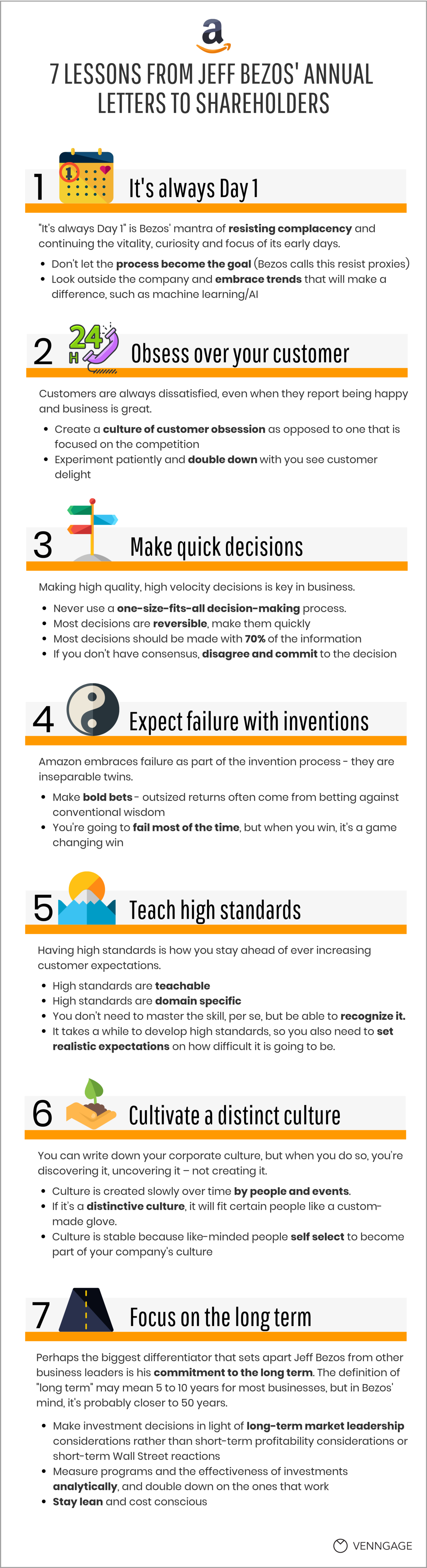
“Obsess over the customer. Resist proxies. Embrace powerful, external trends. And make high-quality and high-velocity decisions.”
These are some of the ways a company can avoid becoming a “Day 2” organization, according to Jeff Bezos. At Amazon, it is always “Day 1”.
He went on: “Customers are always beautifully, wonderfully dissatisfied, even when they report being happy and business is great. Even when they don’t yet know it, customers want something better.”
Amazon’s founder published his annual letter to shareholders this week and gave a detailed answer to a question he recently received at a company all-hands meeting:
“Jeff, what does Day 2 look like?”
That’s a question I just got at our most recent all-hands meeting. I’ve been reminding people that it’s Day 1 for a couple of decades. I work in an Amazon building named Day 1, and when I moved buildings, I took the name with me. I spend time thinking about this topic.
“Day 2 is stasis. Followed by irrelevance. Followed by excruciating, painful decline. Followed by death. And that is why it is always Day 1.”
To be sure, this kind of decline would happen in extreme slow motion. An established company might harvest Day 2 for decades, but the final result would still come.
I’m interested in the question, how do you fend off Day 2? What are the techniques and tactics? How do you keep the vitality of Day 1, even inside a large organization?
Such a question can’t have a simple answer. There will be many elements, multiple paths, and many traps. I don’t know the whole answer, but I may know bits of it. Here’s a starter pack of essentials for Day 1 defense: customer obsession, a skeptical view of proxies, the eager adoption of external trends, and high-velocity decision making.
True Customer Obsession
There are many ways to center a business. You can be competitor focused, you can be product focused, you can be technology focused, you can be business model focused, and there are more. But in my view, obsessive customer focus is by far the most protective of Day 1 vitality.
Why? There are many advantages to a customer-centric approach, but here’s the big one: customers are always beautifully, wonderfully dissatisfied, even when they report being happy and business is great. Even when they don’t yet know it, customers want something better, and your desire to delight customers will drive you to invent on their behalf. No customer ever asked Amazon to create the Prime membership program, but it sure turns out they wanted it, and I could give you many such examples.
Staying in Day 1 requires you to experiment patiently, accept failures, plant seeds, protect saplings, and double down when you see customer delight. A customer-obsessed culture best creates the conditions where all of that can happen.
Resist Proxies
As companies get larger and more complex, there’s a tendency to manage to proxies. This comes in many shapes and sizes, and it’s dangerous, subtle, and very Day 2.
A common example is process as proxy. Good process serves you so you can serve customers. But if you’re not watchful, the process can become the thing. This can happen very easily in large organizations. The process becomes the proxy for the result you want. You stop looking at outcomes and just make sure you’re doing the process right. Gulp. It’s not that rare to hear a junior leader defend a bad outcome with something like, “Well, we followed the process.” A more experienced leader will use it as an opportunity to investigate and improve the process. The process is not the thing. It’s always worth asking, do we own the process or does the process own us? In a Day 2 company, you might find it’s the second.
Another example: market research and customer surveys can become proxies for customers – something that’s especially dangerous when you’re inventing and designing products. “Fifty-five percent of beta testers report being satisfied with this feature. That is up from 47% in the first survey.” That’s hard to interpret and could unintentionally mislead.
Good inventors and designers deeply understand their customer. They spend tremendous energy developing that intuition. They study and understand many anecdotes rather than only the averages you’ll find on surveys. They live with the design.
I’m not against beta testing or surveys. But you, the product or service owner, must understand the customer, have a vision, and love the offering. Then, beta testing and research can help you find your blind spots. A remarkable customer experience starts with heart, intuition, curiosity, play, guts, taste. You won’t find any of it in a survey.
Embrace External Trends
The outside world can push you into Day 2 if you won’t or can’t embrace powerful trends quickly. If you fight them, you’re probably fighting the future. Embrace them and you have a tailwind.
These big trends are not that hard to spot (they get talked and written about a lot), but they can be strangely hard for large organizations to embrace. We’re in the middle of an obvious one right now: machine learning and artificial intelligence.
Over the past decades computers have broadly automated tasks that programmers could describe with clear rules and algorithms. Modern machine learning techniques now allow us to do the same for tasks where describing the precise rules is much harder.
At Amazon, we’ve been engaged in the practical application of machine learning for many years now. Some of this work is highly visible: our autonomous Prime Air delivery drones; the Amazon Go convenience store that uses machine vision to eliminate checkout lines; and Alexa,1 our cloud-based AI assistant. (We still struggle to keep Echo in stock, despite our best efforts. A high-quality problem, but a problem. We’re working on it.)
But much of what we do with machine learning happens beneath the surface. Machine learning drives our algorithms for demand forecasting, product search ranking, product and deals recommendations, merchandising placements, fraud detection, translations, and much more. Though less visible, much of the impact of machine learning will be of this type – quietly but meaningfully improving core operations.
Inside AWS, we’re excited to lower the costs and barriers to machine learning and AI so organizations of all sizes can take advantage of these advanced techniques.
Using our pre-packaged versions of popular deep learning frameworks running on P2 compute instances (optimized for this workload), customers are already developing powerful systems ranging everywhere from early disease detection to increasing crop yields. And we’ve also made Amazon’s higher level services available in a convenient form. Amazon Lex (what’s inside Alexa), Amazon Polly, and Amazon Rekognition remove the heavy lifting from natural language understanding, speech generation, and image analysis. They can be accessed with simple API calls – no machine learning expertise required. Watch this space. Much more to come.
High-Velocity Decision Making
Day 2 companies make high-quality decisions, but they make high-quality decisions slowly. To keep the energy and dynamism of Day 1, you have to somehow make high-quality, high-velocity decisions. Easy for start-ups and very challenging for large organizations. The senior team at Amazon is determined to keep our decision-making velocity high. Speed matters in business – plus a high-velocity decision making environment is more fun too. We don’t know all the answers, but here are some thoughts.
First, never use a one-size-fits-all decision-making process. Many decisions are reversible, two-way doors. Those decisions can use a light-weight process. For those, so what if you’re wrong? I wrote about this in more detail in last year’s letter.
Second, most decisions should probably be made with somewhere around 70% of the information you wish you had. If you wait for 90%, in most cases, you’re probably being slow. Plus, either way, you need to be good at quickly recognizing and correcting bad decisions. If you’re good at course correcting, being wrong may be less costly than you think, whereas being slow is going to be expensive for sure.
Third, use the phrase “disagree and commit.” This phrase will save a lot of time. If you have conviction on a particular direction even though there’s no consensus, it’s helpful to say, “Look, I know we disagree on this but will you gamble with me on it? Disagree and commit?” By the time you’re at this point, no one can know the answer for sure, and you’ll probably get a quick yes.
This isn’t one way. If you’re the boss, you should do this too. I disagree and commit all the time. We recently greenlit a particular Amazon Studios original. I told the team my view: debatable whether it would be interesting enough, complicated to produce, the business terms aren’t that good, and we have lots of other opportunities. They had a completely different opinion and wanted to go ahead. I wrote back right away with “I disagree and commit and hope it becomes the most watched thing we’ve ever made.” Consider how much slower this decision cycle would have been if the team had actually had to convince me rather than simply get my commitment.
Note what this example is not: it’s not me thinking to myself “well, these guys are wrong and missing the point, but this isn’t worth me chasing.” It’s a genuine disagreement of opinion, a candid expression of my view, a chance for the team to weigh my view, and a quick, sincere commitment to go their way. And given that this team has already brought home 11 Emmys, 6 Golden Globes, and 3 Oscars, I’m just glad they let me in the room at all!
Fourth, recognize true misalignment issues early and escalate them immediately. Sometimes teams have different objectives and fundamentally different views. They are not aligned. No amount of discussion, no number of meetings will resolve that deep misalignment. Without escalation, the default dispute resolution mechanism for this scenario is exhaustion. Whoever has more stamina carries the decision.
I’ve seen many examples of sincere misalignment at Amazon over the years. When we decided to invite third party sellers to compete directly against us on our own product detail pages – that was a big one. Many smart, well-intentioned Amazonians were simply not at all aligned with the direction. The big decision set up hundreds of smaller decisions, many of which needed to be escalated to the senior team.
“You’ve worn me down” is an awful decision-making process. It’s slow and de-energizing. Go for quick escalation instead – it’s better.
So, have you settled only for decision quality, or are you mindful of decision velocity too? Are the world’s trends tailwinds for you? Are you falling prey to proxies, or do they serve you? And most important of all, are you delighting customers? We can have the scope and capabilities of a large company and the spirit and heart of a small one. But we have to choose it.
A huge thank you to each and every customer for allowing us to serve you, to our shareowners for your support, and to Amazonians everywhere for your hard work, your ingenuity, and your passion.
As always, I attach a copy of our original 1997 letter. It remains Day 1.
Sincerely,
Jeff

Jeffrey P. Bezos
Founder and Chief Executive Officer
Amazon.com, Inc.
It’s tempting to keep doing what works. It’s particularly tempting to hang on to a business model that achieved success, that enabled you to innovate and grow, to become the market leader of today.
But what got you here, is unlikely to get you to the next place.
Your business formula – strategy, business model, capabilities, value propositions, products and services, metrics and more – that delivered success in 2010, is unlikely to ensure success in 2020.
Change is relentless. It’s the new normal.
That sounds like a cliche, but in a world where there is no longer a “steady state”, nor a fairly steady state with regular change, business leaders need to adjust to a world of relentless change.
Change is the driving force of opportunity. It comes in 5 dimensions:
- the incredible tsunami of new technologies, intelligent and connected (bio to nanotech, robotics and AI)
- convergence of geographies and sectors (cultural meshing and the fusion of traditional industries)
- new opportunities in emerging and fragmenting markets (Asia, Africa, niches and personalisation)
- challenge of startups and global competitors (irrelevance of size and location), and most significantly,
- the changing expectations and aspirations of customers (I want more/better/faster, and I want it now).
It might sound ridiculous, but we will see more change in the next 5 years than we have in the last 250 years.
Compare Nokia’s failure, to Amazon’s success
Nokia failed because of a strategic complacency that lost sight of change. It sought to dominate its market (mobile telephony) based on its current success model (for example, a stubborn belief in creating its own operating system) and arrogance over alternatives. It employed a hierarchical model that lost the ability to keep changing, to listen to customer aspirations, and to adapt to new markets. It got used to looking backwards and sideways, celebrating its evolution and watching its peers trying to imitate, rather than looking ahead. It became “out thought” by next generation disruptors from Apple to Samsung, who rethought how markets work (the iPhone isn’t even a phone at its core), and the business models to make them profitable, as well as the new technologies that supported this.
Amazon succeeded because it stayed focused on its own vision, informed by an ever changing customer mindset, and acquiring or partnering with others to bring together the best solutions. It’s focus was on customer and innovation, rather than product and competitor (indeed it even created a marketplace to sell competitors too, if that made life better for its customers). It has embraced technology from everywhere, and also been astute enough to know when to drop an idea (e.g. phones, and maybe even tired brands like Zappos). It has constantly redefined what it is (unafraid to sell competitors products, to open physical stores). Bezos as a leader is both head up and down, inspired vision but also practical delivery.
Relentless innovation
Every business talks about innovation. But most try to achieve is from an outdated perspective – from an analogue world. Analogue business was linear, built on a value chain, dominated by a product, focused on a point of sale.
Digital is not just a set of technologies, but a platform for constant reinvention. It has infinite reach, unlimited in size or activity, with any number of formats and interactions, supported by any number of partners. Boundaries are forgotten, frictions are removed, and markets can be redefined any way you want. As Elon Musk likes to say, it is a space limited only by imagination. It is a better starting point for relentless innovation.
So what does it take to transform from analogue to digital?
Companies like GE, Netflix, Lego, FedEx, Inditex, are all examples of fundamental change as the world has changed. Such companies recognise that digital is much more than a technology, or even an adjunct to the mainstream. It is the world in which we now live, a fast and connected environment, enabled by a whole array of networked and intelligent technologies.
Yet many companies struggle to interpret this new world.
Take financial services, as an example. It has one of the biggest challenges, largely because of their obsession with their product, and arrogance that they know best about their own world.
Whilst they are increasingly open to new technologies – mobile banks, blockchain transactions, peer to peer lending – they are still incredibly poor at rethinking their worlds (why has the whole “fintech” industry emerged separately – other sectors haven’t felt the need for “retailtech” or “traveltech”, they understand it is the creative application of tech that matters more). They also think in a vacuum, only of money, rather than enabling people to use it better. They think only of their existing marketspace, rather than thinking how they could add more value in new ways.
Financial services could probably learn a lot more from other industries (how would Spotify or Netflix design a bank?!) than there own.
However there are also great inspirations within financial services – both in traditional banks who have evolved digitally and physically, as well as a wide range of other players from payments to insurance and more. My FutureBank project, as part of Gamechangers explores this in more detail. Specific insights come from the likes of CommBank and Umpqua, Moven and Zopa, TransferWise and Zidisha and many more.
So what do winners do?
Many business leaders I talk to seem proud to boast that they are growing their business by 5-10% this year. That seems reasonable in comparison to overall markets of 1-3% growth. But the best companies are in a different league (think about Snap’s $20bn in 3 years, Tesla’s $50bn in 5 years, Alibaba’s $130bn in 11 years) of “exponential” growth. Indeed growing at 10% is a bit like standing still in today’s world.
We need to think differently:
1. Future back (Don’t look sideways or backwards) … Winners develop a vision of the future they want to create, to make sense if it better than others, to shape it to their advantage. GE, Tesla, Apple, for example, adopt a “future back” approach to strategy. They use “horizon planning” that is driven by a forwards radar, whilst providing the strategic flexibility to choose different paths as the context keeps changing. They are not worried by competitors, being more concerned with being relevant than different. This contrast with the old incremental approach, that tries to hang on to past success- where companies took a steady state approach to strategy, ideally an extrapolation of the past, satisfied to be slightly better or cheaper than competitors, or even avoid change if things still seem to work.
2. Outside in (Think like a customer, solve real problems) … It sounds obvious, but winners start from the customer perspective – rethinking the problem to solve, the opportunity to seize – rather than just of a product or service – enable them to do what they want to do better. Not just the customers of today, but looking for the outliers who are adopting new behaviours, thinking differently. These might be next generation demographically, or extreme users who need something more advanced than the mainstream. You don’t learn about these customers through average quantitative research, but through deep dives to find new insights and emergent behaviour. Amazon, P&G, Nike are all driven by what they enable, not by what they do. They embrace deep insight (design thinking, collaboration etc) to develop solutions that are more human (empathetic design), more relevant (personalised, applied) and more inspiring (clear narrative).
3. Change the game (Disrupt markets, innovate the model) … Winners don’t limit themselves to “the game” as it is currently played (market definition, audiences, rules, roles, conventions, behaviours etc). Instead they rethink markets in their own vision – they focus on “market innovation” if you like. Again this is not a one-off shift, but an ongoing task. Markets become morphous, as customer expectations and aspirations grow through peer to peer influence and cross-border experiences. Change the name of your market, fuse the best of different sectors together, and acquire and adapt the best ideas from anywhere. Airbnb and Uber are the obvious examples, although Netflix is better. They combine the vision and customer thinking (“how can we make life better”) with then commercial and practical implications (“how can we achieve this profitably”) to redefine, reinvent and reengage markets in new ways.
4. Embrace networks (Be digital. Work the multipliers) … Winners harness the power of networks to work in non-linear ways, to embrace the big data and personal insights within them, and to unlock the potential multiplying impact of network-based business models (from peer to peer communities and social networks, to franchised and distributed models, influencer marketing and subscription revenues). Networks more than anything challenge the linear thinking, and transactional mindset of old. Of course short-term revenues are an obsession of most investors and leaders, so it takes the strong leader, or enlightened investor, to see things differently, to rethink the business model, and make the business case for driving more effective success, but in a different way. Alibaba, Spotify, FedEx are all examples, thinking in “multiplier” ways to drive more exponential growth potential.
5. Be relentless (Don’t stop reinventing. Be fast and agile) … Winners build innovation into their business as usual (core skills but also dedicated teams), they build organisations strategically (directional but flexible, with metrics that drive and reward change), structurally (adaptive process, fluid organisation), culturally (in particular through the leadership mindset) that are highly adaptive, with a “growth mindset” and approach to markets (like Red Bull, or Coty Beauty, or Virgin). They combine the “lean” entrepreneurship and speed of a startup, with the discipline and impact of a larger company. Ecosystems of supply and distribution partners enhance this flexibility and credibility. Better still is to create an organisation of start-ups like Haier, the world’s leading white goods maker, who combines 10000 micro businesses all working entrepreneurially under one brand. They become “growth hackers” in the sense of constantly experimenting within the frame of a collective directions (inspired by purpose, but guided strategically). Growth is not a destination, but an enduring discipline.
Never stop reinventing … never stop thinking, never stop listening, never stop exploring, never stop changing, never stop innovating, never stop growing. Never stop succeeding.
The RSA Animate series was conceived as an innovative, accessible and unique way of illustrating and sharing the world-changing ideas from the RSA’s free public events programme. With millions of views and thousands of comments, fans and subscribers, RSA Animates have revolutionised the field of knowledge visualisation whilst spreading the most important ideas of our time.
RSA Animates are created in collaboration with Cognitive. Andrew Park, the illustrator behind the series discusses their appeal and success in his blog ‘Talk to the Hand’.
Firstly, Matthew Taylor explores the meaning of 21st century enlightenment, how the idea might help us meet the challenges we face today.
Ever wondered why kids say they’re bored at school, or why they stop trying when the work gets harder? Educationalist Carol Dweck explains how the wrong kind of praise actually harms young people. This short video is essential viewing for everyone, from teachers and education workers to relatives and friends , and will totally revolutionise the way you interact with children.
Are we really as altruistic as we might like to think? Steven Levitt and Stephen Dubner’s case for re-evaluating the evidence.
How can we get people more engaged, more productive, and happier at work? Is technology part of the problem – and could it also be part of the solution? Dave Coplin, Chief Envisioning Officer at Microsoft, imagines what might be possible if more organisations embraced the full, empowering potential of technology and encouraged a truly open, collaborative and flexible working culture.
Professor Renata Salecl explores the paralysing anxiety and dissatisfaction surrounding limitless choice. Does the freedom to be the architects of our own lives actually hinder rather than help us? Does our preoccupation with choosing and consuming actually obstruct social change?
We explore how brain and behaviour research is increasingly being incorporated into political and policy debate.
Renowned psychiatrist and writer Iain McGilchrist explains how our ‘divided brain’ has profoundly altered human behaviour, culture and society.
This lively RSA Animate, adapted from Dan Pink’s talk at the RSA, illustrates the hidden truths behind what really motivates us at home and in the workplace. View Dan Pink’s full talk here.
Manuel Lima explores the power of network visualisation to navigate our complex modern world. The senior UX design lead at Microsoft Bing, explores the power of network visualisation to help navigate our complex modern world.
‘Economics is for everyone’, argues legendary economist Ha-Joon Chang in our latest mind-blowing RSA Animate. This is the video economists don’t want you to see! Chang explains why every single person can and should get their head around basic economics. He pulls back the curtain on the often mystifying language of derivatives and quantitative easing, and explains how easily economic myths and assumptions become gospel.
Millennials are the “we” generation. They spend their lives connected to each other – Snapchatting and Instagramming, sharing everything from homes to cars, music and clothes. They don’t trust the old forms of brand communication – advertising, direct mail, even online ads – they trust each other.
Of the potential audiences, students are the most frequent target for brands. They are at easy to identify, hang out together in large groups, incredibly contagious, and at that moment in their lives when they form attitudes and behaviours towards life, but also brands.
So how do you engage the millennials in your brand? Here are three new examples – online retailer ASOS focused on participation, Spotify focuses on campus representation, and Red Bull just has a party.
ASOS Blank Canvas campaign asked students to design a tote bag, with the winning designs in 2 of the 6 territories receiving over 80,000 votes. You can view the full presentation here.
Spotify training up their amazing Spotify Student Brand Managers and getting them ready for another amazing year of being the face of Spotify on 60 campuses across the UK:
Red Bull started its Wings sampling program in Austria in 1987 and now has over 3,000 Wings winning the hearts and minds of our consumers through highly personalized interactions aka parties.
Of course, there is nothing new about targeting students (I remember when I was at Uni, every bank wanted to get your custom – with all sorts of enticing freebies – and even though your finances were typically not too healthy at the time).
What is interesting are the ways of achieving it in today’s digitally- centred world. These three examples demonstrate the power of peer-to-peer (social, and particularly in a physical sense), of participation (unleashing the creativity and competitiveness), and about empowering them with “their” brand.