Exponential growth is the rate of change measured over a given number of equal time intervals. Basically, when a business grows by 100% (or doubles) over multiple time intervals, each increase of 100% is added to the starting value, resulting in compounding and an environment of exponential growth.
This means that even if you grow 100% per year, it is not necessarily exponential growth. But if you grow 100% every year over many years, you would begin to experience hypergrowth.
Exponential Growth Formula
The formula for exponential growth begins by taking the starting value of whatever metric you are measuring—for example, revenue or number of users. Then you evaluate the percent increase over a given duration of time.
The final component in the formula for exponential growth is the exponent itself. The exponent, in this case, is the number of equal time intervals being measured. Here is the formula for you mathematically inclined folks out there:
Xt = X0(1+r)t
X0 = the starting value
r = rate of increase (or decrease if measuring exponential decay)
t = time in equal intervals expressed as an integer
Exponential Growth Example
Let’s take your app as an example.
We will compare a 10% growth rate to a 100% growth rate.
In the first year, your app acquired 500 users. In year two, the number of customers increased by 10%, adding 50 new users for a total of 550 users at year’s end. If this growth continues, how many users do you think you will have after five years?
500(1+0.1)5
Xt = 805 users
A mere 805 users.
But how different would this number be if you achieved exponential growth of 100% year over year for that same five year period?
500(1+1)5
Xt = 16,000 users
As you can see, achieving exponential growth makes a huge difference. In this case, that difference would be 15,195 users—to be annoyingly precise.
What Spurs Exponential Growth?
One of the biggest facilitators of exponential growth in marketing is the idea of viral coefficients. Sometimes used interchangeably with going “viral,” the viral coefficient takes advantage of word-of-mouth marketing.
If every single customer invites 10 people within their network to use a product or company, exponential growth is all but inevitable.
Then the network effect takes over. This is where the product becomes more useful as more people use it. Instagram, for example, would not be very interesting if only a handful of people posted pictures.
As increasingly more people join and post their pictures, they bring with them their friends, families, and fans.
Examples of Exponential Growth in Business
You’ve heard of them, you’ve probably used them, and you’ve probably told your friends about them.
That’s right. You could be partially responsible for the exponential growth of companies like Facebook, Instagram, Uber, and Airbnb—or Snapchat if you are Gen Z.
Facebook
Probably the best example of exponential growth is Facebook’s monthly active users (MAU). At the end of 2004, Facebook had 1 million MAUs and at the end of 2018 that number had risen to 2.32 billion.1
This is a 231,900% increase over the 14 year period.
Facebook’s revenue growth from 2004 is an even more impressive percentage. Revenue in 2004 was a dismal $400,000. But in 2005, revenue grew to $9 million, a 2,150% increase. Fast forward to 2018 where Facebook brought in $55 billion in revenue.2
This is a mind-blowing 13,753,150% increase over the same 14 year period.
DiDi
Okay, you might not have heard, used, or told anyone about this next example but if you want to talk about exponential growth, you can’t avoid China.
DiDi is China’s ride-hailing Uber alternative. Although it was started in 2012 and is likely a casualty of China’s complete disregard for Silicon Valley’s intellectual property, DiDi has grown to eclipse Uber’s usage statistics.
Let’s start with some Uber usage stats. Founded in 2009, Uber has 75 million users, employs 3 million drivers, and completes more than 15 million rides per day. Not bad for a 10-year-old company.
DiDi, on the other hand, has 550 million users, employs 21 million drivers, and completes 30 million rides per day. Impressive when you consider Uber had almost a 3-year head start.3
Samsung was once the challenger brand loved by millennials across the world. Then the batteries of its new phones, the Galaxy Note 7, started exploding impulsively and were banned from flights across the world. Soon after Samsung’s top executive Jay Y Lee was thrown in prison for corruption. Consumers no longer trusted the products, but also the company that makes them.
Not long after that, the one-time hero of the sharing economy, Uber was on the rails for abusing the rights of their drivers, refusing to pay tax or insurances, but also for the abusive treatment of employees, for hindering police enquiries, and much worse. At first it seemed like Uber was simply challenging the old world order, but now it seems their way of doing it was reckless and irresponsible.
Weeks later, an innocent passenger was seen around the world being beaten up and dragged off a United Airlines plane because of the the company’s over-zealous overbooking policy, and the highly-aggressive removal by staff. This is the airline which says “Come fly the friendly skies”. Hours later, CEO Oscar Munoz appeared on TV defending his staff, and saying they were just following standard procedures.
No wonder people don’t trust business.
Of course, this has been a trend for more than a decade. Most significantly it has been a decline in trust in governments, brought on by the transparency of always-on media where publics could now see a small elite of decision-makers out of touch with the vast and diverse needs and opinions of their peoples. In a world where anybody can communicate anything, people felt left out, and began to use their new found voice. They expressed their likes and dislikes on Facebook and Twitter and soon their opinions influences millions of others, and the impact was quickly amplified.
Then the economic crisis brought a real hatred (I don’t like the word, but it expresses the anger, the dislike and distrust which people developed) of banks in particular. The greedy deals that led to a west-coast sub-prime crisis that engulfed the world’s financial markets. And to see these same bankers bailed out, and rise again because governments couldn’t live without them, just made the distrust in both banks and governments a million times worse.
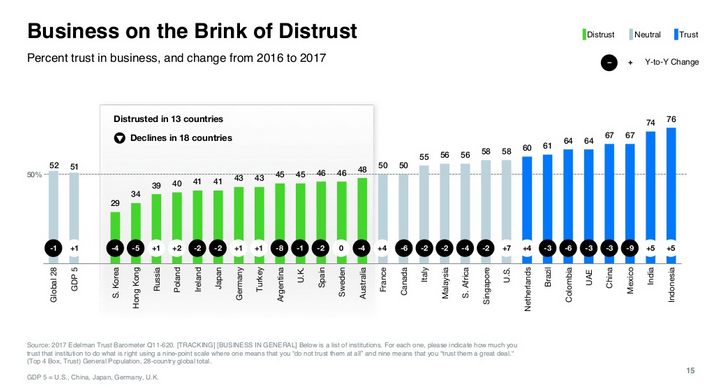
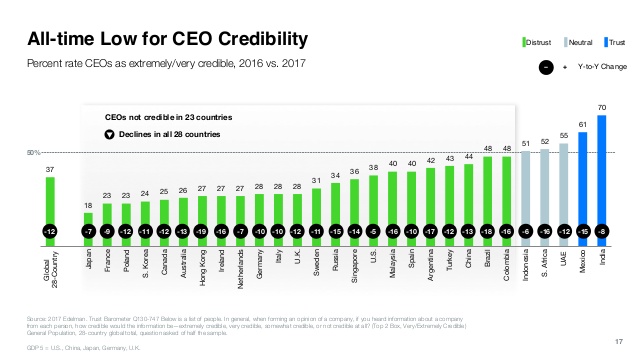
The general population’s trust in all four key institutions — business, government, NGOs, and media — has declined broadly, a phenomenon not reported since Edelman began tracking trust among this segment in 2012. Institutions such as governments and media are distrusted significantly more than business, but all are in decline. And the figure heads of communication, leaders and spokespeople, are typically distrusted more than anybody else (trust in CEO’s is at an all-time low).
With the fall of trust, the majority of respondents now lack full belief that the overall system is working for them. In this climate, people’s societal and economic concerns, including globalization, the pace of innovation and eroding social values, turn into fears, spurring the rise of populist actions now playing out in several Western-style democracies. Trump, Brexit and much more, are some of the consequences.
To rebuild trust and restore faith in the system, institutions must step outside of their traditional roles and work toward a new, more integrated operating model that puts people — and the addressing of their fears — at the center of everything they do.
Business, and in particular their brands, can play a significant role in regaining this trust, recreating a positive vision for the world and locally, and to reengage people in a new way of working between institutions and people. Consumers, for example, have taken to trusting friends of “people like me”, much more than any business message pushed at them. PatientsLikeMe.com is a great example of how people turn to each, enabled by social media, to be guided by each other, rather than brands or experts. Brands therefore need to work with these new dynamics to be able to add value, and at least influence again.
Richard Edelman shares insight on the 2017 Edelman Trust Barometer, which revealed that two-thirds of the countries surveyed are now “distrusters”.
The report reveals the largest-ever drop in trust across the institutions of government, business, media and NGOs. Trust in media (43 percent) fell precipitously and is at all-time lows in 17 countries, while trust levels in government (41 percent) dropped in 14 markets and is the least trusted institution in half of the 28 countries surveyed. The credibility of leaders also is in peril: CEO credibility dropped 12 points globally to an all-time low of 37 percent, plummeting in every country studied, while government leaders (29 percent) remain least credible.
The Trust Barometer found that 53 percent of respondents believe the current overall system has failed them—it is unfair and offers little hope for the future—while only 15 percent believe it is working, and approximately one-third are uncertain. Even the elites have a lack of faith in the system, with 48 percent of the top quartile in income, 49 percent of the college-educated and a majority of the well-informed (51 percent) saying the system has failed.
The gap between the trust held by the informed public and that of the mass population has widened to 15 points, with the biggest disparities in the U.S. (21 points), U.K. (19 points) and France (18 points). The mass population in 20 countries distrusts their institutions, compared to only six for the informed public.
“The implications of the global trust crisis are deep and wide-ranging,” said Richard Edelman, president and CEO of Edelman. “It began with the Great Recession of 2008, but like the second and third waves of a tsunami, globalization and technological change have further weakened people’s trust in global institutions. The consequence is virulent populism and nationalism as the mass population has taken control away from the elites.”
Current populist movements are fueled by a lack of trust in the system and economic and societal fears, including corruption (40 percent), immigration (28 percent), globalization (27 percent), eroding social values (25 percent) and the pace of innovation (22 percent). Countries coupling a lack of faith in the system with deep fears, such as the U.S., U.K. and Italy have seen the election of Donald Trump, the Brexit vote and the failed Italian referendum.
The cycle of distrust is magnified by the emergence of a media echo chamber that reinforces personal beliefs while shutting out opposing points of view. Respondents favor search engines (59 percent) over human editors (41 percent) and are nearly four times more likely to ignore information that supports a position they do not believe in.
“People now view media as part of the elite,” said Edelman. “The result is a proclivity for self-referential media and reliance on peers. The lack of trust in media has also given rise to the fake news phenomenon and politicians speaking directly to the masses. Media outlets must take a more local and social approach.”
There is evidence of even further dispersion of authority. A person like yourself (60 percent) is now just as credible a source of information about a company as is a technical (60 percent) or academic (60 percent) expert, and far more credible than a CEO (37 percent) and government official (29 percent).
Of the four institutions, business is viewed as the only one that can make a difference. Three out of four respondents agree a company can take actions to both increase profits and improve economic and social conditions in the community where it operates. Moreover, among those who are uncertain about whether the system is working for them, it is business (58 percent) that they trust most.
Yet business finds itself on the brink of distrust, and perhaps most concerning for business is the perceived role the public sees it playing in stoking their fears. A majority of the global population surveyed worries about losing their jobs due to the impacts of globalization (60 percent), lack of training or skills (60 percent), immigrants who work for less (58 percent), jobs moving to cheaper markets (55 percent) and automation (54 percent).
“Business is the last retaining wall for trust,” said Kathryn Beiser, global chair of Edelman’s Corporate practice. “Its leaders must step up on the issues that matter for society. It has done a masterful job of illustrating the benefits of innovation but has done little to discuss the impact those advances will have on people’s jobs. Business must also focus on paying employees fairly, while providing better benefits and job training.”
Other key findings from the 2017 Edelman Trust Barometer include:
Trust in business (52 percent) dropped in 18 countries, while NGOs (53 percent) saw drop-offs as high as 10 points across 21 countries.
Employees, on average, are trusted 16 points more than CEOs on messaging around employee/customer relations (53 percent), financial earnings (38 percent), crises (37 percent), innovation (33 percent), industry issues (32 percent) or programs addressing societal issues (30 percent).
Half of the countries surveyed have lost faith in the system, led by France (72 percent) and Italy (72 percent), Mexico (67 percent), South Africa (67 percent) and Spain (67 percent).
Trust in traditional media fell 5 points to 57 percent, the steepest decline among platforms since 2012, followed by social media (41 percent), which dropped three points. By contrast, online-only media (51 percent) received the biggest bump in trust at five points.
“Leading the Future” is a series of white papers by Peter Fisk exploring the challenges and opportunities to drive smarter innovation and accelerate growth in today’s incredible world.
You can explore and download each of the white papers here:
Leadership, Change and Development
The 10x Leader … “Today’s ambitious business leaders think 10x not 10% … enabling them to reframe opportunities, to solve problems in new ways, and to drive more innovative growth.”
Amplifying Potential …“Leading in a connected world is about amplifying the potential of other people – of their ideas and assets, activities and partners, and of the brand and business – and is achieved through the “4Cs” of leadership.”
Are you the Einstein or Picasso of Business? … “Business leaders need to combine four “fusions” to create a winning business … to drive innovation and growth in more intelligent and stretching, engaging and practical ways … and with a touch of genius.”
Moonshot Thinking … “We live in an incredible time, with more change in the next 5 years than the last 250 years. New tech, new markets, new possibilities. How will you focus, compete and win in this exponential world?”
Never Stop Reinventing … “What does it take to win in today’s world of relentless change and innovation? How can business sustain a continual flow of innovation to beat competitors, and delight the ever more expectant consumer?”
What will you do when you grow up? … “Young people have opportunities like never before … But growing up can be daunting – academic study, future jobs, social media, peers and parents … What would you advise your son or daughter to do?”
Futures, Innovation and Growth
Better World … “How can a business connect purpose and profit, to drive innovation that has a positive social and environmental impact, to create a business that makes life better, and delivers sustainable growth?
Change the Game … “Today’s market leaders don’t just play the game – they redefine the markets in which they compete, the rules by which they play – and shape the future to their advantage.”
Eureka Moments … “Airbnb started with an air mattress, Red Bull’s inspiration was a waitress in Bangkok, WhatsApp was the vision of a penniless Ukrainian. How do great brands find their best opportunities to accelerate growth?”
Finding your Magic … “Learning through fast and lean experimentation and innovation … then having the boldness and agility to “pivot”, to change strategy and direction … to move from mediocrity to magic.”
Innovate like Leonardo Da Vinci … “Leonardo da Vinci offers a more inspired approach to innovation in today’s business world … How can you apply his seven principles to explore new ideas, make new connections, and create the future?”
Innovative Business models … “Business models come in many different forms … Think beyond “make and sell” to explore licensing, subscriptions, reversals, one for ones, and more … Redesign your whole business to accelerate growth.”
Market Makers … “Innovate your market, then innovate your business … Aeromobil and Tesla, Nespresso and ARM are great examples of reframing, reimagining and redefining your market and how it works … shaping the market in your own vision.”
Customers, Brands and Marketing
Bolder Braver Brands … “Airbnb’s fight for equality, Starbuck’s home for refugees and Zuckerberg’s future vision … Brands who want to engage people need to have an attitude and personality, to be bold and brave in a polarising world.”
Building Brands like Pixar make Movies … “Pixar is an amazing business. Built on imagination and creativity, harnessing digital technologies to create the most engaging characters. What can brands learn from their ideas, process and storytellers?”
Customer Experiences that Enable More … “Brands need to think beyond the touchpoints that their customers “experience”, to helping them to achieve what they really want – to be the enabler of dreams and success.”
The New Luxury … “How has the meaning of luxury changed in a world of abundance, digital platforms and millennial mindsets? What do people really value now? How can luxury brands win in this new world?”
Roadmap to Customer Centricity … “Becoming a customer-centric business is not easy. It is much more than good products and great service. It requires a new cultural mindset, organisation alignment, and relentless innovation.”
The New Rules of Marketing … “Marketing has fundamentally changed … Growth hacking, platform innovation, social influencers, enabling experiences and exponential results … there has never been a more exciting time for marketers.”
Winning Private Labels … “Retailer’s own-label brands can be more powerful and profitable than classic brands … enabling richer experiences for consumers, and faster and better growth.”
Workshops … stretching ideas and practical action
“Growth Strategy: exploring the future, shaping your vision, making smart choices”
We live in an unprecedented time – more change in the next 10 years than the last 250 years. Scary but incredible. Anyone in business still trying to hang onto the old models which made them successful is a fool.
We need innovation just to stand still. Looking forwards is not easy. Unlimited possibilities, complex and uncertain, infinite choices. Is it possible to forecast the future in such a volatile environment? Does strategy still matter? How do you make the right choices? What should you do today?
Step back and think about yourself. Two big questions today – at what age do I want to retire, and how long will I live for? A few decades ago, there was nothing daunting about those questions. You’d retire when you were 60-65, and look forward to another 10-20 years of gentle cruising.
Not anymore … Average life expectancy heading for 100, declared a recent Daily Telegraph headline, whilst Scientific American added that “aging is reversible” based on lab experiments on mice. Alibaba founder, Jack Ma wondered if, a couple of centuries from now, we might need to legislate the caps on lifespan. Yet we are embarking on a period of rapid innovation, with likely breakthroughs that we can’t even imagine today – be it colonization of space or self-aware artificial intelligence.
On the other hand, climate scientists warn of the devastating effect global warming might have on human civilization if we are unable or unwilling to reduce greenhouse emissions in time. Even if some of our western global leaders don’t want to believe it yet. Potentially catastrophic risks abound and could, quite possibly, thwart the positive development trajectory.
The McKinsey Global Institute estimated that “half of today’s work activities could be automated by 2055”, and, then, the Economist magazine explored the fast emerging world of quantum computers quoting Google as saying that “such machines are only five years from commercial exploitability.” Will quantum computers turn everything upside down yet again? “Such computers will be able to chomp their way through calculations that would take today’s best supercomputers millennia,” the Economist explained. What effect will this have on jobs or any other facets of human experience is difficult, if not impossible, to forecast.
Every business, market and stock market, is being turned upside down by these new dynamics. Start-ups and large corporates have just as much chance as winning in this future – supertankers with scale versus speedboats with agility. The churn in the Fortune 500 index speaks for itself, and while we can’t easily forecast which tech startups will succeed and which will fail, what we can say with confidence is that the index turnover is going to accelerate.
Much of the uncertainty, about, basically, everything, originates in the phenomenon described by Mike Lee, who argues that “The next double-century (2000-2200) promises no fewer than 150 breakthrough innovations on par with the steam engine, antibiotics and the airplane.” Tech-fuelled growth has doubled every 200 years since 1400. And whilst that might seem big, what would put this in perspective is the fact that we’ve achieved about half as much during the last 5 millennia.
The creation of the telegraph, the internet, and the smartphone reshaped the world for every generation that witnessed them. If inventions of such magnitude emerge twice per decade instead of once in a century, forecasting will be futile, you could say.
This isn’t about knowing which big breakthroughs are about to disrupt our economic models or change the way we live, it’s the interplay and layering of these inventions. As policy-makers, business leaders, and engineers brainstorm applications for, say, blockchain technology, reaching comprehensive conclusions will be just as difficult as it would have been to predict that the smartphone might soon be able to outdo a physician in diagnosing an illness.
You cannot extrapolate the future based on the past, so what do you do?
Many businesses are seeking new mindsets – an entrepreneurial culture, corporate venturing and elevating the innovation imperative to the level of existential priority. Strategy matters more (the need to have some direction, when anything is possible, and framework to make choices), but also needs to be done differently (less incremental, less numeric, less operational). Strategic foresight and scenario planning are useful methodologies for business to adapt and adopt to the ever-changing competitive environment.
Of course wild speculation about accelerating technological process is hardly a novel trend. The news of self-driven carriages must have terrified horse owners; and those pundits who witnessed automation of factory jobs predicted sustained mass-scale unemployment. Every time we attempt to predict the future with the contextual awareness of today, we struggle with the failure of imagination or, perhaps, we discount the notion that unknown unknowns are unknowable by definition.
When cars replaced horses as the primary means for transportation, the world didn’t come to an end. The preceding industrial revolutions pushed a number of vocations into oblivion, but plenty of new jobs have been created in their stead.
If the post-forecasting era is indeed upon us, what does it mean for the mere mortals (a term that we might have to revisit by 2200) and how should we cope? We must begin by accepting uncertainty as a given; stay openminded about technological progress; and, bitcoin had just surpassed the value of gold, Dubai is planning to introduce autonomous flying taxi service, and Airbus has unveiled a drone car concept.
But it also means not giving up on strategy.
Leaders need to be the sense makers, the future guides, as well as the decision makers.
We need strategy that can stretch to the future, and then define vision and pathways from the “future back”, with creativity and agility. We need strategy that can help us make more complex choices, to make the big bets and guide our everyday actions “now forwards”. We need strategy to bring us together, with confidence and for greater collective impact.
Time to rethink strategy. Be the sense makers, the future guide – to create and shape the future to your advantage.
Keynotes on the future, innovative strategies, and how to win.
We have all heard, and yawned, at the mission (purpose, vision, direction) statement that seeks to be the best in the industry, love every stakeholder, and make the world better.
We have all glazed over at the list of values (organisational, cultural, brand) … quality, excellence, professionalism, customer first, great service, efficiency, trust, honesty and respect.
Do organisations really think that these old “truths” will really achieve something better and more distinctive than every other company which repeats them?
What organisation wouldn’t seek, and doesnt need to have these traits? The real problem is they have no impact, they are mediocre words, they are lack passion and personality. In short, they sound like corporate bullshit!
So what are the statements and values that really stand out?
And how do these organisations use them to energise their people, to galvanise their operations, to spark their creativity, to bring to life their distinctive brand, and accelerate their growth?
I’m not a great fan of list of values. I’m even less fond of organisations who seem to think that organisational values, leadership values, brand values, and the like – should all be different. What I do like is a small number (say 3!) of truly meaningful, highly distinctive, and positively inspiring words that can capture the essence of the organisation, the direction and the difference.
From these we can frame an inspiring purpose, from that we can develop a strong and focused strategy, from that we can shape and energise an organisation on the inside, that delivers an authentic and distinctive brand experience on the outside, and achieves this through a shared desire to innovate, perform and grow.
Here are a few examples, good in different ways:
Transferwise
4 values define everything:
Customers > Team > Ego
We get it done
No drama, good karma
This isn’t just a job, it’s a revolution
TransferWise was inspired by the personal experiences of founders Taavet Hinrikus, Skype’s first employee, and financial consultant Kristo Käärmann. As Estonians working between their home and the UK head office, they had personal experience of the “pain of international money transfer” due to bank charges and time. For an idea to evolve into a fast growing business the key is to focus on fast.What kind of culture and organisation do you need to be fastest? In a disruptive business, speed is what sets you apart from the competitors. Empowerment and autonomy are key to that. When it works, it means you move fast. But you need to watch out for how this structure evolves as the business grows. When it doesn’t work, it feels like chaos and there’s no real movement at all. It’s obvious that teams that are closest to customers and closest to code know most and can make the best decisions of what needs to happen. That means it’s key that they are empowered to do so.
Zappos
10 core values:
1. Deliver WOW Through Service 2. Embrace and Drive Change 3. Create Fun and a Little Weirdness 4. Be Adventurous, Creative, and Open-Minded 5. Pursue Growth and Learning 6. Build Open and Honest Relationships with Communication 7. Build a Positive Team and Family Spirit 8. Do More with Less 9. Be Passionate and Determined 10. Be Humble
Employees at the online retailer Zappos.com aren’t expected to memorize the company’s 10 core values, which were incorporated in 2006 based on a list of 100 character traits circulated by CEO Tony Hsieh. But they are expected to embody those values in their personalities—and not just at work. “The best employee is the person who can be the same person at home that they are at work,” says Jamie Naughton chief of staff for the Las Vegas-based company. When they are hired, employees sign contracts saying they understand the values, agree to be reviewed based on them, and understand that they can be fired if they fail to live up to them. This commitment makes the values “a living breathing thing, more than just a plaque on our lobby wall,” says Naughton, and it fuels the company’s reputation as a place where employees are happy and motivated.
Build-a-Bear Workshop
Core Values:
Reach
Learn
Di-bear-sity
Colla-bear-ate
Give
Cele-bear-ate
Build-A-Bear Workshop takes teddy bears very seriously, and “bear-isms” are front and center throughout the corporate culture, including at the corporate “bearquarters” in St. Louis. The company’s six core values are internally-facing—they’re not posted at retail stores. But within the company, they are important tools for bringing employees together across every level of the business. In fact, “Di-bear-sity,” the most recent value to be added to the statement, was named through a 2012 company-wide contest. And at quarterly corporate meetings, managers from individual stores can nominate employees for “Atta Bears” awards, citing excellent performance in one of the core values areas. Sharon John, Build-A-Bear’s CEO, says the core values were not on the list of things she wanted to change when she came to the company in a “turnaround situation” in 2013. “These are life values as well as company values,” she says, “They are unifying for our organization.”
Twitter
Mission statement:
“To give everyone the power to create and share ideas and information instantly, without barriers.”
The social networking site’s mission statement, characteristically, is fewer than 140 characters, a move that helps the statement embody the company’s identity in both form and content. The company’s 3,600 employees—2,000 of whom are based in Twitter’s San Francisco headquarters, are encouraged to understand the mission statement as a defining corporate philosophy. “Our mission statement puts our users first and defines our clear purpose—to give everyone the ability to be heard, seen, and share their thoughts and experiences as they happen,” says Brian Schipper, vice president of human resources, “It is our compass when we’re building the platform and developing new products and policies. We want to empower individuals and be a force for good in the world.”
Whole Foods Markets
Higher Purpose Statement:
“With great courage, integrity and love—we embrace our responsibility to co-create a world where each of us, our communities, and our planet can flourish. All the while, celebrating the sheer love and joy of food.”
“I don’t think a lot of companies talk about love in the workplace,” says Mark Ehrnstein, global vice president of team member services at Whole Foods Market’s Austin headquarters, “but we do.” The grocery chain’s higher purpose statement is meant to reinforce that passionate outlook to customers, suppliers, stockholders, and employees alike. Ehrnstein adds that the statement is part of what helps keep the various stakeholders connected in a business that needs to be open to change. “We have to continually evolve our thinking and embrace change,” he says, “We have to do that while staying true to who we are, and staying true to the core of the company.”
Airbnb
6 early start-up values:
Be a host
Champion the mission
Every frame matters
Be a cereal entrepreneur*
Simplify
Embrace the adventure
Airbnb’s values are more of an homage to their early beginnings, and one more reason to crush on the company. Back when founders Brian Chesky and Joe Gebbla were just getting started with then-named Air Bed and Breakfast, they launched a creative cereal* campaign in an attempt to alleviate the $40k in credit card debt they’d racked up trying to launch their startup.
But then as they grew up they realised they needed to get smarter about how they communicate this across a global business, and balance their irreverent youthfulness with the need to build a respected corporate image. Jonathan Mildenhall’s great work on values-driven purpose created the fabulous line “Belong Anywhere” which connected to the millennial travel lust, and a higher purpose inside and outside their business. It was captured further in 4 simple words together which become their new value equation:
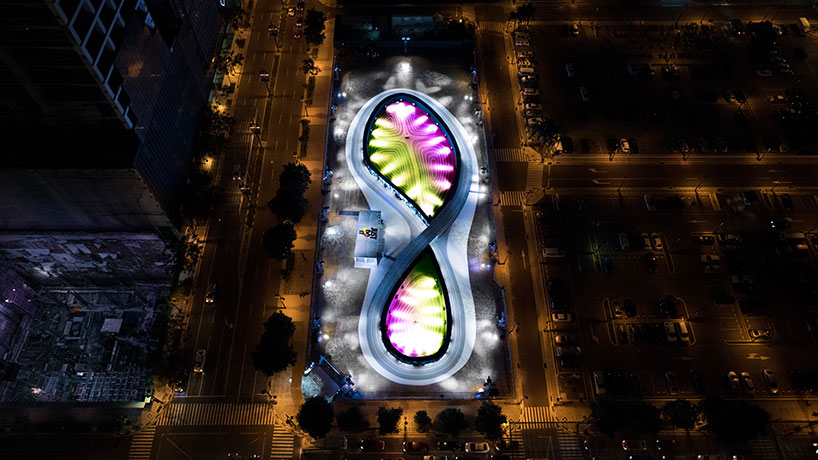
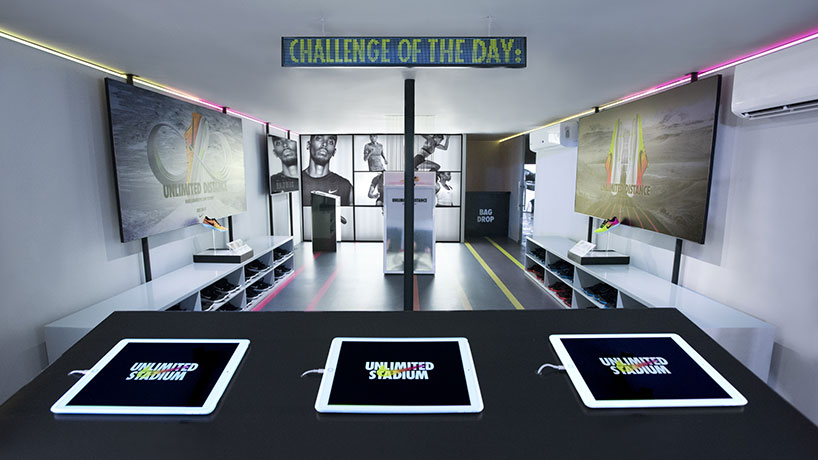
In the centre of Manila, Nike has constructed a pop-up arena that has been dubbed the world’s first full-size LED running track.
Taking over an entire city block, the layout of ‘unlimited stadium’ is derived from the footprint of Nike’s LunarEpic running shoe. the 200 meter-track, which takes the form of a figure-eight, is lined with LED screens, where up to 30 runners can take part in a virtual race against themselves.
The project takes over an entire city block in central manila, and from above, takes the shape of the sole of the Nike Epic running shoe. Hyper accurate RFID tracks your first lap time – on the next lap, your avatar appears, running your previous time. beat it, and it runs your new best time, challenging you to keep bettering your best.
Design thinking is a process for creative problem solving
Design thinking is a term coined by David Kelley, founder of IDEO and the Stanford d.school. It utilises elements from the designer’s toolkit like empathy and experimentation to arrive at innovative solutions. By using design thinking, you make decisions based on what future customers really want instead of relying only on historical data or making risky bets based on instinct instead of evidence.
“Design thinking is a human-centered approach to innovation that draws from the designer’s toolkit to integrate the needs of people, the possibilities of technology, and the requirements for business success.” says Tim Brown who is now CEO at IDEO.
Thinking like a designer can transform the way organizations develop products, services, processes, and strategy. This approach, which has become known as design thinking, brings together what is desirable from a human point of view with what is technologically feasible and economically viable. It also allows people who aren’t trained as designers to use creative tools to address a vast range of challenges.
Thomas Jefferson University, University of Michigan, University of Minnesota, University of Montreal – Design Thinking Success Stories at University Hospitals
Phil Knight always wanted to be a sub-4 minute miler. In the late sixties he trained with the elite athletes at the University of Oregon under Bill Bowerman, the unorthodox coach who would try anything (like moulding his athletes rubber shoes with a waffle iron) to find an edge.
Eventually Knight resigned himself to being not quite good enough as a runner, and so started selling running shoes from the back of his van at track meets. He started importing new lightweight shoes from Japan, made by Tiger (now Asics), ripping off the stripes and replacing them with a swoosh (drawn by his girlfriend for $35). Despite studying accountancy, he showed a remarkable creative streak.
Blue Ribbon Sports emerged as a business, in which coach Bowerman joined him. Searching for constant innovation, ways to grow a business, and tap into the just emerging running boom. BRS became Nike, the largest sports company in the world. I remember buying my first pair of Waffle trainers in the mid-seventies – from the then small, cult brand – and have worn Nikes ever since.
Knight recently launched his biography “Shoe Dog” retelling his story, and the most important things he thinks matters in running a successful business:
1. Use your 20s to learn and explore
After graduating from college and grad school, and spending a year in the Navy, 24-year old Phil Knight decided he wanted to make a trip around the world. He asked his parents for money — it was the early ‘60s, and travel was still exotic and expensive — and boarded a plane to Hawaii.
In the months that followed, Knight continued his world travel and visited Japan, Hong Kong, Vietnam, the Philippines, India, Kenya, Egypt, Turkey, Germany, France, England, and a handful of others countries. Many of the historical, cultural, and economic lessons he learned on his travels, he would remember and apply for life.
2. Believe in what you do
Knight’s first job (in Hawaii) was to sell encyclopedias. His second one was to sell securities. He was terrible at that first job, and mediocre at his second. It occurred to him that as an introvert, perhaps he was just not cut out to be a salesman. But when he went on to sell shoes, much to his own surprise he turned out to be a master salesman almost from day one.
Why? Because this time he believed in what he did. When Knight was in college at the University of Oregon, he had been a track athlete in the college team. He ran because he was good at it, he liked it, and he wanted to win. It made him a credible shoe salesman down the road. This was a product he believed in, and it was a sport he believed in.
3. Just do it
When travelling around the world, Knight had a “crazy idea” of setting up American distribution for a Japanese apparel company. In his mid-20s, with no cash, no company, and no successes as a salesman, Knight nevertheless boarded a train from Tokyo to Kobe, and arranged a meeting with executives from Onitsuka, the Japanese company known for its Tiger shoes.
When he was asked whether he represented a company, he said yes (even though he in fact didn’t have company). A few years later, he again made his partner believe he had an East coast office, when in fact he did not, and he also pledged to buy a number of shoes he could not afford to pre-finance.
In each of the cases, though, he did follow through on his words: He set up a company (Blue Ribbon, later rebranded Nike), he set up an East Coast office (In Wellesley, Massachusetts), and he did find financing for his order. He just did it.
4. Find trustworthy partners, on the job and in your personal life
From early on, Knight built his company with the help of a few loyal employees: former athletes from his college or competing teams, his former coach, a few trusted accountants and lawyers and so on. He trusted them.
And vice versa: The parents of one of his first employees even gave him their last savings, when his company was in need of cash. They did it because “If you can’t trust the company your son works for, who can you trust?”
He started dating his wife Penny around age 30, and her impact was equally profound. She was not a girlfriend, he said, but a partner. At first, she helped out Blue Ribbon as the company’s first accountant. Later, she would become the bedrock of her and Knight’s family. From his memoir, it is clear he sees those early employees, business and life partners, as crucial in his later success.
5. Don’t be reckless, but when you go all-in, go all-in
Knight worked full-time jobs as accountant and assistant professor for several years, while working nights and weekends on Blue Ribbon. Only a few years in, he quit his day job to dedicate all of his time to his company.
The reason for doing so was partly because he wasn’t sure his startup company would succeed, and partly because he needed a stable income to pay his personal bills. But when he did decide to go all in with Blue Ribbon, there was no way back. He almost literally bet the house, by pledging his house as guarantee for a business loan.
6. Make sure you know what you want, and say it
Over the years, Knight learned to negotiate business deals, including ones on financing, manufacturing, distribution, and work contracts. Crucial in this regard, he said, is to know going into a negotiation what it is you want, and to say it up front.
To one financing partner, for example, he said upfront he would not accept the company to take any equity in Blue Ribbon — they’d only be allowed to give a loan. To one of his early suppliers, he laid out how important timely delivery was. Being clear about his objectives avoided misunderstandings about them later.
7. Always have a plan B
One of Knight’s most important lessons came when he learned that his sole shoe supplier, Onitsuka, was going behind his back to cut him off and work with other US distributors. As soon as he found out, he started working on a plan B: to produce his own line of shoes.
When a year or so later his supplier indeed cut him off, “Nike” was already in stores. It was a shoe with quality issues at the very beginning, but at least he had it. It allowed him and his 30 employees to hit the ground running, and continue the operations and sales of Blue Ribbon. Had Knight a year earlier not been as prescient, the end of the Onitsuka contract would have almost certainly meant the end of his company.
8. Keep control of your own business
On several occasions, Knight deliberately kept control of his own company, refusing a buy-out from his Japanese supplier, and refusing to give some (but not all) of his early employees a share in the company’s equity. That may sound hard, but as founder, he deemed it necessary to keep a controlling stake in his company.
It was only after more than a decade of being in business that Knight finally came around to the idea of an IPO, to sell a large number of shares to the public. But once again, he did so on his own terms: Public shareholders would only access so-called “B”-shares, which gave dividends, but not equal voting rights, to the new shareholders. As majority “A”-shareholder, he once again kept control of the company himself.
9. Offer your teammates hope and a cause to believe in
When Blue Ribbon/Nike was left to fend for itself, the atmosphere at the company was at first all doom and gloom. It was, after all, the Onitsuka shoe that had made the company a success, and now that same company had just cut them off.
To lift his employees’ spirits, Knight offered a tale of hope, optimism, and self-confidence. It wasn’t the Onitsuka shoe that made our success, he told them. It was your hard work. If anything, the breakup meant that Blue Ribbon could finally do things its own way, with better time deliveries and a product fully tailored to the US market. The story had its effect: It lifted the Blue Ribbon employees’ spirits.
10. Always keep the fighting spirit — but know when enough is enough
Throughout the first 15 years or so of Nike’s existence, Knight went through an almost never-ending series of ups and downs, which he could only get through by continuously fighting for survival. He fought for credit lines, he fought a legal battle with his former supplier, Onitsuka, he even fought the US government for charging him unfair import taxes.
He always gave it his all, as if his company’s survival was on the line (as very often, it actually was). But when push came to shove, and the time came to make a deal, he knew when to stop. He settled out of court with Onitsuka, getting half the money he initially wanted, and he settled with the US government, paying them a third of the money they initially told him he owed them. That must have cost him some of is pride, but it did allow him to move on. He knew when enough was enough.
Half a century after his first trip to Japan, Phil Knight is no longer the inexperienced, adventurous, daring new kid on the block. He is the founder and chairman emeritus of Nike, the largest sports company in the world, with a market valuation of about $85 billion. Just like an athlete might “just” run a gold medal-winning Olympic race, he had to put in tens of thousands of hours of practice to get there. In “Shoe Dog,” he shared all his lessons he learned along the way. If you read only one business memoir this year, let it be this one.
Today I woke at 04.45 to watch a Twitter livestream from Monza’s F1 track in Italy. Three of the world’s best long-distance runners lined up in the dark to challenge one of sport’s biggest barriers – to break two hours for the marathon.
The Breaking2 project was the brainchild of Nike, and in particular Sandy Bodecker, its VP of Special Projects. For 12 months the team have applied every piece of science to find the optimal conditions for maximum performance. You can read the whole story here.
The three runners included Eliud Kipchoge, the Olympic champion, and a Nike-sponsored athlete. They searched the world for the best location, the best surface, the best date, weather conditions, time of day. They deployed a Tesla electric car programmed to drive at exactly 2 hour pace, with a clock showing predicted time. They brought together 100s of Nike’s athletes together to act as pacemakers, taking turns with peloton-style drafting. And they created a new shoe, the VaporFly Elite, which promised a 4% advantage, exactly the amount required to knock 3 mins off the world record. Even the Twitter livestream and collaborative feed was innovative. Everything was ready. Nike CEO Mark Parker was also on hand with his camera ready to capture history.
Of course, all of this is stage managed. Some would argue it is against the purist principles of human sport. How can it compare to a real race, in a city centre, where the wind blows unpredictably, and there is no perfect Tesla to pace you? Indeed it won’t count as a world record, because it wasn’t a real race. But it was about pushing boundaries, exploring possibilities, and moving the marathon world forwards. As a brand Nike should be applauded for putting so much effort into the pursuit of progress, rather than just selling products. And as a marketing promotion, it was an incredibly cost effective way of communicating a brand’s essence.
This is what brands are about. Breaking2 was brand innovation at its best. More than a product, or even an experience, but a fundamentally big idea that move people. As Nike founder Bill Bowerman said “The real purpose of running isn’t to win a race, it’s to test the limits of the human heart.”
Here is how the “moonshot marathon” unfolded, as retold by Athletics Weekly magazine:
Showing remarkable strength both in body and mind, Eliud Kipchoge proved on Saturday morning that a sub-two-hour marathon might be a lot closer than some may have originally thought.
Clocking 2:00:25 for 26.2 miles in a controversial Breaking2 event organised by sportswear giant Nike in an attempt to breach the barrier, the Olympic champion further reinforced his position as arguably the finest marathon runner of all time.
While Kipchoge’s time, set on a Formula One track in Monza in Italy, won’t count as an official world record, it does go some way to further proving what the human body is capable of.
The 32-year-old Kenyan has an official marathon PB of 2:03:05, set when winning his second London Marathon title last year. The fact that the sub-two-hour attempt included the use of pacers being subbed in and out is among the reasons why his new best time isn’t eligible for record purposes but it is an incredible two minutes and 32 seconds faster than the official world record mark set by Kipchoge’s countryman Dennis Kimetto in Berlin in 2014.
“I feel good. I am a happy man to run a marathon in two hours,” said Kipchoge. “Now, it’s just 25 seconds.
“I believe in good preparation and good planning. If you have that then those 25 seconds will come.”
Every element of the attempt had been meticulously planned, from the time of day the run took place (05:45 local time) to the 2.4km loop course and the team of runners, which also included Eritrea’s Zersenay Tadese and Ethiopia’s Lelisa Desisa as well as the army of pacers.
Then there’s the shoes – the new Nike Zoom Vaporfly Elite worn by athletes during the attempt. The footwear features a full-length plate “to increase stiffness and provide a propulsion sensation”. ‘Breaking2’ had generated mixed reaction in the lead-up and while there was certainly a corporate feel to it, nothing can be taken away from Kipchoge’s impressive achievement.
Starting out toward the back of an arrow formation of pacers, Kipchoge was joined by world half-marathon record-holder Tadese and two-time Boston Marathon winner Desisa.
Their first 5km split was timed at 14:14 as they aimed for 14:10, but the group picked up the pace soon afterwards and there was a projected finish time of 1:59:56 at that point.
They went through 10km in 28:21, 15km in 42:34 and 20km in 56:49, before the halfway point was reached in 59:57.
Not long after this, the attempt relied on Kipchoge alone, with Desisa having dropped off the pace just after 15km and Tadese losing touch after 21km.
Kipchoge and the pacers remained on track for a sub-two-hour time through 25km in 71:03, and with 85:20 on the clock at 30km the projected finish time was exactly 2:00:00.
The 35km mark was passed in 1:39:37 and 40km in 1:54:04.
Kipchoge averaged around 4:36 per mile, with around 4:34.5 needed to dip under two hours.
Both Tadese and Desisa battled on to finish, clocking 2:06:51 and 2:14:10 respectively.
As USA’s Olympic medallist Shalane Flanagan expressed with the end of the attempt in sight: “With each step Eliud Kipchoge is taking, he is making history.”
On the day that marked the 63rd anniversary of Sir Roger Bannister’s first ever sub-four-minute mile, this was a barrier that could not be broken, but it remains a target for another time.
“I can say it is possible for a human to run under the two-hour mark,” said Kipchoge. “This journey has been good. It has been hard. It has taken seven good months of preparation but I am happy to have done that. I think this is history.”
Nike’s Breaking2 project was brand innovation at its best. Beyond the product, beyond the business. It was about what the brand is really about – its purpose, its difference, and its personality … For Nike it has always been about challenging barriers – exploring new possibilities, enabling people to achieve more, moving the world forwards in its own relevant way. As Nike’s CEO Mark Parker said afterwards, “whilst we didn’t quite break 2 hours today, we brought the barrier much closer, and the world now knows that it is possible”.
The Thinkers50 European Business Forum takes place next week on 9-10 May in Denmark’s fairytale city of Odense. It brings together many of the world’s top business thinkers and Europe’s business leaders.
Why does it matter?
European business leaders faces low growth, high change … typically 1.5% GDP growth across Europe, compared to 3% in USA and 6% in China … but in a period of unprecedented disruption and uncertainty … huge changes technologically (digital, robotic), socially (migration, nationalism), and politically (elections, Brexit) and globally (Trump, Russia, China).
The big question is how todrive innovation and growth … in this uncertain environment? To focus on the traditional industries and protect jobs, or invest in the future economies (in particular industry 4.0, and to emerging markets). What does this mean in terms of the ways of doing business (new strategies, new business models), and talent (new skills, education)?
The forum seeks to define a new agenda for European business … by bringing together the best new ideas of global academics (its probably 25 years since most leaders went to business school!) and European business leaders to collaboratively explore the biggest issues and ideas, together with the practical solutions and priorities for the next 5 years.
Thinkers50 recently established its European hub in Odense … with a belief that “ideas can change the world” … It brings the world’s best academics and leaders together in Hans Christian Andersen’s fairytale city to write the 21st century story of business … and fittingly, in one of Europe’s new robotics hubs, to explore how business can thrive in a tech future.
What will we learn?
Professor Michael Porter from Harvard Business School … will set out a new vision for business, where “making money is not enough, social progress matters more.” He will explain why this matters now for European business, and what to do. Recognised as the world’s top business guru, he will receive the Thinkers50 Lifetime Achievement Award during the forum.
Lars Rebien Sorensen and Marshall Goldsmith … will join Porter (the first time, the world’s #1 business leader, #1 business thinker, and #1 business coach, all together) to explore the challenges for business leaders today and in the future. What can we learn from the Nordic model of consensual leadership, and how does that work in today’s global economy?
Also
Professor Rita McGrath from Colombia Business School … the world’s leading growth expert will explore new approaches to strategy and says “forget competitors, focus on where you are going”.
Yuri Van Geest from Singularity University … author of Exponential Organisations says “ The best new organisations are 10x better, 10 faster, 10 cheaper than yours”.
Professor Erin Meyer from INSEAD Business School … will introduce her Culture Map, helping business leader to align different cultures inside their organisations, and in their markets.
Deborah Rowland will join Peter Terium, CEO of Germany’s largest energy company Innogy SE, to explain how “leaders need to be the pivot of changing organisations – being still to create movement”.
Rene Carayol will bring together a CEO panel including Jamaica’s Garry Sinclair, UK’s Rita Clifton and France’s Phillippe Maso to define a blueprint for the future of business.
Jonas Ridderstrale, author of Funky Business, is Sweden’s provocative academic and will deliver the Odense Moonshot, saying “I have a dream” is better than “I have a 5 year plan”.
Mark Esposito, Harvard strategy professor, on entrepreneurship and innovation, says that “we are missing most of the new opportunities for growth, in new markets and new technologies”
Antonio Nieto-Rodriguez, head of GSK vaccines, and the world’s top project management expert claims “the CEO is the ultimate project manager”, managing a portfolio of complex projects.
Mona Hammami Hijazi, director at the Office of Strategic Affairs, Abu Dhabi and author of The Giving World says “We get more by giving than taking” and that women understand this better.
Alexander Betts, understanding the changing world, from Oxford University reflects on the wave of migration and nationalism across Europe, and what this means for business.
Alf Rehn, Finnish academic disrupting our world view with humor and vision, says that we are all obsessed with the wrong thing: innovation is more than innovation, and we need to get real.
They will be joined by many more speakers, and the whole audience will collaborate in a number of “big talks” to explore and connect the best ideas from local and global participants. There are also events for entrepreneurs and students, and a robotics expo.