RocketLab’s launch of a 3D-printed battery-powered into space this week heralds a new era in the space business. It symbolises a new generation of space entrepreneurs developing small, reusable rockets launching commercial payloads into space with costs tumbling from $50m to $5m.
Rocket Lab is a US-based aerospace company with a New Zealand assistive base. The 3D printed rocket, dubbed Electron, was successfully launched after three failed attempts due to bad weather. Although the rocket failed to reach orbit, CEO of RocketLab, Peter Beck, hailed the launch as a success. “It was a great flight. We had a great first stage burn, stage separation, second stage ignition and fairing separation. We didn’t quite reach orbit and we’ll be investigating why, however reaching space in our first test puts us in an incredibly strong position to accelerate the commercial phase of our programme, deliver our customers to orbit and make space open for business,”said Beck.
The Electron rocket is the first rocket the company has fully engineered. The 17-meter-tall rocket is designed to carry a payload of about 150kg. This lightweight design supplies enough payload capacity to provide surveillance and deliver internet services.
The company aims to open up the aerospace industry by providing cheap and frequent launches for satellites into space. Currently, a typical rocket launch will set you back an easy $50 million. Once RocketLab is running as anticipated this price will drop to just $5 million, making rocket launches much more accessible to a broader market.
The eleven-year-old company plans two more rocket launch tests in 2017 before it becomes officially commercially operational. Backed by the likes of Lockheed Martin, Rocket Lab’s future clientele is tipped to include NASA and earth-mapping company Planet.
RocketLab uses 3D printing technology to fabricate engine parts. The company uses a method of 3D printing called electron beam melting which works by melting metal powder layer by layer using an electric beam. This method can result in high strength but low weight engine parts. The 3D printed rocket Electron also takes advantage of battery power to reduce weight and increase efficiency.
Opening up the aerospace industry for cheaper and more frequent rocket launches raises fears of a looming space junk catastrophe. Thousands of pieces of space junk are currently being monitored by U.S space authorities. This number is expected to grow as satellites become decommissioned and are replaced by their upgraded counterparts. Space is in an under-regulated market with little laws pertaining to the monitoring and extraction of unused satellites.
The rocket was launched from the South Island of New Zealand on the Mahia Peninsula. The launch added New Zealand to the small group of nations that have the ability for space launches. The New Zealand government hopes to increase its profile among the space industry by creating specific legislation in anticipation of the creation of the New Zealand Space Agency. New Zealand is an ideal location for space launches due to its uncrowded airspace and low population.
Read more in Space Makers
How do you make sense of a colliding world? From migration to a new populism, a new machine age with a social purpose, the rapid growth of robotics and biotech, the fusion of geographies and sectors, cultures and religions, what are the consequences and opportunities for business? This “debate-style” session brings together three experts to explore what matters most, and what business should do next?
At the recent European Business Forum – held in the transforming city of Odense, Denmark – I hosted an incredible series of sessions with some of the world’s top business thinkers (including the world’s #1 business leaders, world’s #1 business guru, and world’s #1 business coach) and an audience of many of Europe’s CEOs.
We kicked off by exploring the new “context” for business … what is the environment in which leaders should be thinking about how to innovate and where to grow? What are the big issues that should be driving their strategic planning, issues that go beyond their normal product and service discussions, but shape the way they work and impact they deliver?
I brought three of the world’s top thinkers together, with very different perspectives. Through a series of “fast-thinking, idea-stretching, priority-defining” debates, emerged a fascinating set of insights that connect together, and provided great provocation to debate further, and to continue in the boardrooms and innovation labs of every business.
Here are the three big insights:
Insight 1 … Business must take responsibility for our future.
“We will see more change in the next 10 years than in the last 250 years. But these new opportunities come with new responsibilities, to address in new ways.”
Mona Hammami, from Abu Dhabi’s Crown Prince’s Court, gave a global perspective on the biggest challenge for business:
- Global change is accelerating in speed and scale. More crowded, older, migrant and urban, putting huge demand on scarce resources.
- Public and private sector need to collaborate to find the $2.5 trillion investment required to fund the UN’s 17 sustainable development goals.
- How can we all act as global citizens to solve these problems? In particular, how can business contribute to society in smarter, more strategic ways?
https://www.youtube.com/watch?v=tdRI1VFJx3A
Insight 2 … Globalisation is undemocratic.
“Globalisation has been promoted and enabled by business, but society is not comfortable with many of its consequences. We need to rethink how it works.”
Professor Alexander Betts, leading thinker on refugees and migration, sees the fault in our progress, and the problem with globalisation:
- Globalisation is fundamentally undemocratic. Citizens lose influence, decisions are compromises, the strongest nations dominate.
- We need to rethink the nature of work, including the important role of migration in this, as well as the fast emerging role of AI and robotics.
- Social impacts should be a major discussion in the boardroom. CSR is not a peripheral issue. It should be core to the business model.
https://www.youtube.com/watch?v=ELFssNK1Xto
Insight 3 … Innovation needs more ambition.
“Innovation needs to refocus on what matters most, harnessing the potential of new technologies to enable business to have more impact, to make life better.”
Irreverent Finn, Alf Rehn, reflected on these challenges, saying that innovation needs to refocus in order that business can have more impact:
- Together we spend around $3 trillion each year on innovation. That’s about 22 “moonshots” (the Apollo mission cost $137bn). Most of it is misused.
- Most innovation is frivolous, wasted on things like smart socks, rather a positive force for progress. Instead it should focus on the big challenges in our world.
- Time to use your brain, to reclaim innovation with ambition, get serious about exponential technologies, and unleash our cognitive surplus.
Denmark’s fairytale city of Odense was a perfect place to write the future story of business. Birthplace of Hans Christian Andersen, and now one of Europe’s leading robotics hubs, and rapidly becoming “the Davos of business thinking”.
It is a city in the midst of rapid change – social and technological. €5.5 billion investment will create a smart city, local businesses like Universal Robotics are growing rapidly, drones dominate the local airport, it has the world’s most innovative sports track, one of Northern Europe’s top music festivals, and Facebook has just announced a huge local investment.
On 9-10 May 2017, Odense hosted this year’s Thinkers50 European Business Forum, bringing together the world’s top business thinkers with Europe’s business leaders. I had the privilege of hosting this incredible event, probably the highest quality business forum in the world this year.
Watch the best moments at the European Business Forum 2017
Download all the best ideas from the European Business Forum 2017
To celebrate International Women’s Day 2017, McCann partnered with State Street Global Advisors to introduce the Fearless Girl to the world — a statue of a daring young girl, standing strong on Wall Street. Why? Because companies with women in leadership perform better. The Fearless Girl was dropped on Wall Street in the middle of the night and became a global phenomenon within 24 hours.
The Fearless Girl is a defiant symbol of female leadership, ambition and strength in response to the imbalance of men and women in leadership roles – 5.4% of Fortune 500 CEOs are women while only around a fifth of US cabinet positions are held by women. The sculpture was created by McCann New York for State Street Global Advisors as part of a campaign to get financial companies to add more women to their boards.
“We had to take a look at Wall Street and find a way to get people to rethink what leadership should be,” said Tali Gumbiner from McCann. “It’s been so historically male, and people – subconsciously or consciously – view male leaders as the backbone of successful financial companies. We couldn’t just do a print ad for the brief like that.” As well as going viral on social media, the campaign scooped up 18 Cannes Lions Festival of Creativity, making the Fearless Girl one of the most decorated campaigns in the history of the Festival.
A storyboard is a sequence of illustrations which aim is to visualise the critical moments of a whole story. That isn’t a new tool in animation. Indeed storyboarding has been popularized by Walt Disney Studios during the 1930s.
Storyboarding is critical in animation as it enables to develop the broader story. Indeed, the developers of content would use storyboarding as an inexpensive way to build content to see if it worked before doing the full production.
Thus, storyboarding, as used in animation, has a few key elements that made it so useful:
- An inexpensive way to visualize a story before it got developed in full
- Visualise a whole story with a minimum amount of information
- A quick and dynamic approach to visualize an entire story
- The ability to capture the critical emotions at each sequence
- A way to present and pitch a story before it could get produced
Storyboarding, which has become a best practice and process in the movie industry, is now becoming also an essential process in business, let me show you why.
- Uncover customer experience
- Align on a longer-term vision
- Pitch a broader project idea
- And more
Consider how Airbnb has been using storyboarding to uncover hidden patterns for its customers that enabled the further platform scale.
Empathise with your customers
As Nathan Blecharczyk, co-founder and CSO at Airbnb pointed out “Creating a great customer experience is the highest priority at Airbnb and something that we’ve made a big part of our culture.”
Storyboarding then helped Airbnb executives and employees to understand its customers deeply. Empathy and being able to feel the emotions and moods of customers throughout travel experienced enabled Airbnb to map it at best.
Map the customer journey
One thing that’s really helped is a storyboard we created that depicts the different steps someone goes through from the time she first hears about Airbnb to the time she leaves post-visit feedback. We have 15 pictures that cover the guest journey and 15 more that show the journey for the host.
Nathan Blecharczyk also pointed out how this storyboarding process needs to be done from end-to-end. Since the customer first hears about your product and service, up to the time she/he has consumed it.
Understand where you’re missing out
What the storyboard made clear is that we were missing a big part of the picture—the offline experience—that’s an even more meaningful part of using Airbnb than booking a property.
Thus, this process enables the company to uncover steps you were missing out. Each of those steps you were not covering or providing value for will become an essential ingredient for great customer experience.
However, it is important not to get bogged down in too many details.
Select only the meaningful moments
We started brainstorming what our storyboard would look like. We started with a list of many, many moments, grouped like ones together and refined them down into a concise set. If you have too many moments on your storyboard, it’s worthless. Fifteen seemed comprehensive yet manageable.
As pointed out by Nathan Blecharczyk on the Sequoia blog, it is crucial to map at first only the most significant moments. That makes the process manageable and actionable. For instance, Airbnb had mapped fifteen key moments in its storyboards.
Build a roadmap around those key moments
We then had a roadmap for figuring out what a customer expects in each of those situations, what we were doing to meet those expectations and where we had an opportunity to create a “wow” moment.
Once those key moments get uncovered, it’s time to offer a great customer experience by providing value to your customers in those faces. Airbnb likes to define those moments when the value is provided at best as a “wow” moment.
Thus, it has to be turned into a product roadmap.
Uncover the gaps and fill them up with a “wow” experience
We noticed a lot of gaps. It became our number one priority to fix those areas where we weren’t doing what the customer expected of us.
What’s a valuable, “wow” moment? Imagine in Airbnb‘s case the case of a guest arriving at a host’s house and without even knocking the door finding the guest with a bottle of champagne to celebrate the arrival of the guest (this is an exaggerated example as some people might not like this welcome).
But the point is the storyboard enables you to develop a deeper bond with a customer, to improve the experience at each potential step.
Airbnb neighborhood guides case study
One example of one of the projects that Airbnb has implemented as a consequence of using storyboards is the “neighborhoods guides” section available on the platform.

With storyboards, Airbnb understood all the questions travellers had before, during and after traveling. Therefore, Airbnb, came up with the neighborhoods guides:

So that for each city people could find answers to questions related to the things to do in the city.

And also look at all the possible things to do in each neighborhood.
This helped Airbnb guests to find all the travel-related answers they might have before reserving the trip.
Those guides are so granular to unlock key information for each neighborhood, almost like you had a local, giving you all the suggestions you needed to have a great trip:

In summary
- Storyboards were popularised by Disney in the 1930s to develop stories before the production of movies
- Storyboards became a best practice in the movie industry world as a way to craft compelling stories before producing expensive movies
- Now storyboards get used in business for several purposes. Airbnb used it to enhance customers’ experience
- During Christmas vacation back in 2011, Chesky, Airbnb co-founder found out about the storyboarding technique, and he implemented it within the company to map the three key processes (host, guest, and hiring process) for Airbnb.
- Those storyboards got transformed in actions within the service. One example is the “neighborhood guides” that Airbnb developed to give all travel-related answers to its users
My interview with a leading South American newspaper this week:
Describe your path to what you’re doing now. What led you to become who you are?
I started with a passion to understand the world. At school I loved sciences, the path of discovery, making sense, and exploring possibilities. I went on to study nuclear physics, the potential of the invisible world, and harnessing the smallest particles to innovate everything from nanotech healthcare to superfast travel.
But I wanted to progress faster. So I joined the world’s largest airline, entering the much more creative and human world of marketing, and by 28 years old I had my dream job – managing the supersonic Concorde brand. I went on to work with all types of companies, with innovative brands and in markets all around the world.
Years later, when I wrote my first book, I wanted to find something personal to write about. When I started in business, people always gave me the analytical jobs because of my scientific background. But I loved people and the excitement of creativity much more. Then I realised the best people can do both – they have a left and right brain – they can be Einstein and Picasso at the same time.
I called it “genius” – to be creative and analytical, to be local and global, the yin and the yang, to create the future whilst also delivering today. My first book “Marketing Genius” was translated into 35 languages, and about how Einstein and Picasso would do business today. Since then I’ve written 7 books, most recently “Gamechangers”, about how you can think bigger and different, and have the potential to change your world.
What interests you outside your professional work and why?
My passion is running. I have run almost every day since I was 10 years old. I was inspired by the challenge of testing myself to run further and faster, but also by the love of feeling fit and healthy, and to run through the countryside or cities of the world and see everything at high speed.
I was inspired by the world’s great athletes, but also be legendary feats of endurance, like the Tarahumara Indians of Mexico who are able to run hundreds of miles everyday. Today I can’t run quite as fast for the mile or marathon as I could in my youth. But I still love the freedom, the friendships and the feeling of wellness and achievement by starting each day with a run.
What is your current field of research in innovation?
We live in the most incredible time. We will see more change in the next 10 years than we have in the last 30 years. Innovations like we could never imagine and at superfast speed. From autonomous cars to robotic pills that you can swallow to operate on your heart or brain in minutes.
Yet most of our innovation is wasted. The world spends around 3 trillion dollars on innovation every year. That’s equivalent to 30 “moonshots” (the Apollo space mission cost $137bn). Yet most of the innovation is focused on creating frivolous games like Pokemon Go, or smart socks that don’t smell.
We need to ensure that innovation is focused on the big challenges for our society – solving the big problems of poverty, environment, security and healthcare. Business should be a force for good, to create value that has a positive impact for customers and shareholders, but also society. This is a great incentive for bigger thinking in innovation.
As part of this I’m particularly interested in what drives “exponential” growth – why some companies can grow incredibly fast like WhatsApp $19bn in 3 years, Uber $60bn in 5 years, Alibaba $130bn in 11 years. At the heart of their success is that they think differently about business – they don’t believe in linear, transactional ways of making and selling, instead they think about two things – ideas and networks.
That’s really the secret of the most innovative businesses today – ideas that spread rapidly, because they are powerful, human and contagious – and networks that spread these ideas rapidly, with a multiplying impact.
Is being a game changer a gift with which you’re born or is it a skill that can be developed through experience?
Everybody has a brain. Anybody can challenge the status quo. You need to be bold and brace to do it. No, it’s not a gift you are born with, it’s a mindset. And increasingly it’s the smallest companies, with a youthful irreverence, and ambition to make life better that drive the most successful innovations. Immigrants trying to find their place in new countries, emerging markets where they want to find simple but better solutions.
Like Mahatma Ghandi said “be the change”, or as my book says “Be the Gamechanger”.
What is the essential difference between those who simply have good ideas and those who become game changers?
Gamechangers … change the game!
It sounds obvious, but what does it mean: well, what’s the game? In simple terms, your game is your market – you are in the game of fashion retailing, or online gaming, or fresh food delivered to your door. So how can you change your market?
Most innovation focuses on products and services. But these improvements tend to be incremental, they are based on the same assumptions as before, and they are quickly copied by others. Better innovation looks beyond the product – to the channel, the pricing, the way it is made, the ongoing support to customers. Best of all it innovating your market.
Change the way your market works. That’s what Gamechangers do. Or better still, create the future in your own vision. Don’t live in somebody else’s shadow, define the future you want to have, and shape it to your advantage.
Gamechangers think differently:
- Future back (Don’t look sideways or backwards) … Winners develop a vision of the future they want to create, to make sense if it better than others, to shape it to their advantage. GE, Tesla, Apple, for example, adopt a “future back” approach to strategy. They use “horizon planning” that is driven by a forward radar, whilst providing the strategic flexibility to choose different paths as the context keeps changing. They are not worried by competitors, being more concerned with being relevant than different. This contrast with the old incremental approach, that tries to hang on to past success- where companies took a steady state approach to strategy, ideally an extrapolation of the past, satisfied to be slightly better or cheaper than competitors, or even avoid change if things still seem to work.
- Outside in (Think like a customer, solve real problems) … It sounds obvious, but winners start from the customer perspective – rethinking the problem to solve, the opportunity to seize – rather than just of a product or service – enable them to do what they want to do better. Not just the customers of today, but looking for the outliers who are adopting new behaviours, thinking differently. These might be next generation demographically, or extreme users who need something more advanced than the mainstream. You don’t learn about these customers through average quantitative research, but through deep dives to find new insights and emergent behaviour. Amazon, P&G, Nike are all driven by what they enable, not by what they do. They embrace deep insight (design thinking, collaboration etc) to develop solutions that are more human (empathetic design), more relevant (personalised, applied) and more inspiring (clear narrative).
- Change the game (Disrupt markets, innovate the model) … Winners don’t limit themselves to “the game” as it is currently played (market definition, audiences, rules, roles, conventions, behaviours etc). Instead they rethink markets in their own vision – they focus on “market innovation” if you like. Again this is not a one-off shift, but an ongoing task. Markets become morphous, as customer expectations and aspirations grow through peer to peer influence and cross-border experiences. Change the name of your market, fuse the best of different sectors together, and acquire and adapt the best ideas from anywhere. Airbnb and Uber are the obvious examples, although Netflix is better. They combine the vision and customer thinking (“how can we make life better”) with then commercial and practical implications (“how can we achieve this profitably”) to redefine, reinvent and reengage markets in new ways.
- Embrace networks (Be digital. Work the multipliers) … Winners harness the power of networks to work in non-linear ways, to embrace the big data and personal insights within them, and to unlock the potential multiplying impact of network-based business models (from peer to peer communities and social networks, to franchised and distributed models, influencer marketing and subscription revenues). Networks more than anything challenge the linear thinking, and transactional mindset of old. Of course short-term revenues are an obsession of most investors and leaders, so it takes the strong leader, or enlightened investor, to see things differently, to rethink the business model, and make the business case for driving more effective success, but in a different way. Alibaba, Spotify, FedEx are all examples, thinking in “multiplier” ways to drive more exponential growth potential.
- Be relentless (Don’t stop reinventing. Be fast and agile) … Winners build innovation into their business as usual (core skills but also dedicated teams), they build organisations strategically (directional but flexible, with metrics that drive and reward change), structurally (adaptive process, fluid organisation), culturally (in particular through the leadership mindset) that are highly adaptive, with a “growth mindset” and approach to markets (like Red Bull, or Coty Beauty, or Virgin). They combine the “lean” entrepreneurship and speed of a startup, with the discipline and impact of a larger company. Ecosystems of supply and distribution partners enhance this flexibility and credibility. Better still is to create an organisation of start-ups like Haier, the world’s leading white goods maker, who combines 10000 micro businesses all working entrepreneurially under one brand. They become “growth hackers” in the sense of constantly experimenting within the frame of a collective directions (inspired by purpose, but guided strategically). Growth is not a destination, but an enduring discipline.
Do you consider yourself a risk taker? What is the biggest risk you have taken in your career?
Everybody takes risks. The moment they ride a bike, travel to a new place, choose to learn a new subject, start a new job. We move forwards by doing new things, exploring new opportunities, things which are uncertain and we don’t know if they will work. We take risks throughout our lives.
But in business, we typically see risk as a negative thing. If we don’t take risks, we don’t progress. Too many businesses like to hang on to the model which made them successful, to keep stretching the old models of success. The challenge, is to let go of the old ways, and to create the new. What got you to where you, is unlikely to get you where you want to go.
So yes, I’m constantly taking risks. But I try to make them risks that a smart – things that I want, that I believe I can achieve, and am determined to find a way to make them succeed. The biggest one for me personally? Probably leaving the world of big companies, with the security of a job with insurance and pension, and starting my own business. But for me, and many, it’s the best risk you could take, because it enables you to progress, to achieve more, and go for your dream.
You say we should always expect failure in anything we do. What’s one point in your career when you failed and how did you move past it?
You cannot do everything you want, I learnt, despite how logical and committed you might be. Around 15 years ago I was CEO of a small company with around 500 employees. I deeply cared for its future, wanted to move it forwards, with new services, new locations and a new image. As a team, we were certain of our strategy, that it was right and that we could make a real difference to our world by delivering it.
But a group of stakeholders didn’t want to change. They liked the comfort of their existing, the benefits of their own positions, and preferred to keep things how they used to be. For almost two years we worked hard to engage, influence and work with them. On top of this, I discovered many financial irregularities in the old business that I inherited, and many of the same stakeholders were to blame. We had to fix the business, and also try to move it forwards.
I tried to create the future. But this was clearly not the place to do it. Eventually I decided that I had done all I could, that this job wasn’t for me, and I could put my time and passions to work better elsewhere. I left the challenge to other people, giving them my continued support and good wishes. Whilst for me, I found a better vocation, easier and faster to make a difference, both for me, and for the people I cared about most.
How do you motivate yourself to accomplish your goals even at times of despair?
Go for a run. Be with friends. Have a glass of wine. Smile. Remember what is good in the world. Then keep trying to make it better, for you and others.
What is your ultimate goal as a game changer?
I’m not really the Gamechanger … you are, or could be!
My goal is to help the billions of students, entrepreneurs and business leaders who are striving to create a better business, achieve their goal. And the best way I can help them is to think bigger, think bigger and to find smarter ways to make their ideas happen.
What would you want to be remembered for?
Inspiring people.
What is your life insight?
“Whatever you can do, or think you can do, begin it.
Because boldness has power, genius and magic in it.”
Which companies are your personal favorite game changers?
Wow … there are so many.
23andMe’s DNA profiling for $99 to transform your future health, Aeromobil’s flying cars from Slovakia now selling for $1.25m, Amazon’s relentless innovations of the last 25 years to transform so many industries, ARM outthinking and outperforming Intel with virtual microprocessor design, OneWeb soon to give the whole world free wifi, and Vice Media which talks in the language of millennials.
In emerging markets, you see even more dramatic change: and you see even more Ctrip the world’s fastest growing travel company from China, Janicki Bioenergy turning human waste into drinking water, Dalian Wanda is the Walt Disney of Shanghai and the biggest investor in Hollywood, Ouarzazate solar power station creating anough energy to power a continent in Morocco, and Xiaomi which is the new Apple for the new world.
Just three examples of incredible businesses who are changing the world right now:
- Hyperloop: From Elon Musk’s concept, Hyperloop One (H1) pounced on the opportunity for next-gen transit using vacuum tubes. H1’s first commercial project is a 99-mile system between Dubai and Abu Dhabi, aiming to reduce the two hour trip to a mere 12 minutes. Recently, a key investment from DP World Group, the world’s 3rd largest ports operator, points to high-speed cargo distribution, in addition to passenger transit.
- Magic Leap: Wired Magazine describes it as the world’s hottest (and most secretive) start-up”. Their mind-bending “mixed reality” technology uses photonic wafer chips to manipulate light. It superimposes 3D generated images over real world objects, by projecting a digital light field into the user’s eye. Founder Rony Abovitz says “the best way to describe it, is like dreaming”, has attracted $1.4bn funding from Alibaba and Google, and is currently signed up contracts with leading movie studios and game makers.
- AvaWinery: Mardonn Chua and Alex Lee claim they can “turn water into wine” in just 15 minutes, without using grapes. The San Francisco startup aims to disrupt high-end wines by offering bottles of chemically identical wine cheaper and more sustainably (lab-grown wine uses 50 to 100 times less water than traditional).
Actually, I have around 250 favourites – you can find them, and case studies of how they changed their games on my website – www.theGeniusWorks.com
Even more importantly, I want to learn about the best Gamechangers in Ecuador, and from across South America. I will be holding an online competition to discover, share and celebrate the best innovations of an incredibly exciting part of the world.
What are the big trends you see shaping business in 2017 and beyond?
I’m not a big fan of “trends” because they assume that the world is still a largely average and predictable place. It’s not. The drivers of change in one sector, the opportunities for growth, and the aspirations of customers, change by sector, geography and even individual. There is not algorithm for future success. Its about creating your own path. That comes by defining and redefining your own world, in your own vision, taking insights from your customers, and inspiration from other places.
https://www.youtube.com/watch?v=-HcKRBKlilg
If I was to try to capture some of the biggest themes of reinvention, they would be
- Virtual Experiences … Kevin Kelly observed that the maturing of VR, AR and mixed reality technologies heralds a fundamental shift: from an internet in which information is the basic unit of currency, to one in which experiences are. These digital experiences will quickly come to carry a status-weight equal to ‘real’ experiences, if not become more sought-after and prized. And yes, we know that’s a bold statement given most executives still consider digital experiences as more diverting than. Examples: 2016’s Singles’ Day saw Alibaba launch Buy+, a virtual reality shopping experience. The demo video shows how Chinese shoppers could be transported to – and shop in – Macy’s in New York. The platform also launched an augmented reality shopping game “Catch a Cat” or its TMall platform, similar to Pokémon Go. Experiences are also about creating – Google’s Tilt Brush is an app for the HTC Vive VR headset. The app allows the user to ‘paint’ in three dimensions, using a simple handheld control as the brush. And can transform industries – ABBA, one band that resisted the temptation to reform, have just announced their 2018 virtual tour dates.
- World’s Apart … Trump, Brexit, Syria, North Korea … we see the economic, social and cultural impacts of globalisation thrown into sharp relief. This time, the narrative is framed by immigration, job automation, depressed wages, a deeply uneven recovery from the economic crisis, generational and racial divides, terrorism fears, the ongoing refugee crisis. One direction for brands wanting actionable ideas about how to actually respond to this trend in 2017: purposeful brands will find renewed opportunities in helping people understand their changing relationship to home – be that their nation, city or neighbourhood. People, and similarly brands, will turn outwards (more global), or inwards (more local). Its hard to be both. And that’s the polarisation. Examples: In June 2016, Copenhagen-based travel website Momondo posted a video that highlighted the hidden racial diversity that exists in all individuals, called The DNA Journey, showing people talking about their national pride, and then revealing to them their true multi-ethnic make up. Tiger Beer recently set up a pop-up store in New York’s Chinatown, seeking to redefine Asian stereotypes. The Tiger Trading Company store showcased products from the worlds of art, fashion, technology and design, representing over 700 artists from Asia.
- Incognito Individuals … Anonymity makes a comeback. Brands recognise non-traditional yet more authentic demographic segments (last month, 17-year-old makeup artist James Charles became the first male face of Covergirl); at the same time new volumes and sources of data are also taking many businesses closer to the nirvana of catering to a ‘segment of one’ at a mass scale (think Spotify’s Discover Weekly, which sees over 40 million users receive a unique playlist every Monday). While customers will welcome the greater relevance that comes with both these approaches, true flexibility and fluidity means there will still be moments where everyone wants to break out and explore. Without any prejudice, constraints or repercussions. As customers hand over more control to algorithms (or perhaps as they become increasingly aware of just how much their lives are already being shaped by these invisible and unquestionable forces – witness the Facebook news ‘filter bubble’ awakening), the urge to step outside one’s personal data-straightjacket will only grow. Examples: Interviewing.io is a platform for engineers to practice technical job interviews, announced a feature that disguises both the interviewer’s and candidate’s voices. Using Twilio’s cloud communications technology and proprietary voice software, the service alters voices to sound androgynous, add synthetic elements or sound like animals to eliminate interview bias. Users can reveal their identities should they want the interview process to continue. Antipersona simulates the experience of being signed into Twitter as another person. Users can choose to simulate any Twitter account, and see the same timeline and notifications – for follows, mentions and retweets – as that Twitter user for 24 hours.
- Capacity Capture … The eco-friendliness of your products is now assumed. Meanwhile the sharing economy, peer-to-peer consumerism and the rise of access-over-ownership business models have radically recalibrated consumer expectations around utilization and waste. When you can pay to use cars by the minute, offices by the hour, eat food cooked by neighbours, then ‘traditional’ business processes suddenly start to look even more wasteful. Which is why smart brands will broaden their thinking around sustainability and turn their attention to finding and unlocking exciting new sources of value, or finding creative new ways to eliminate any wasted resource. Examples: Nissan launched a scheme allowing UK-based owners of the Nissan LEAF car and e-NV200 electric van models to sell back their vehicle battery’s stored energy to the National Grid. Created in partnership with power company Enel, the Vehicle-2-Grid (V2G) system will be available at 100 charging units across the country, where the transactions can take place. São Paulo-based food bank Banco de Alimentos launched Reverse Delivery, to harness the power of the thousands of delivery drivers that return empty-handed after dropping off food. Participating restaurants (there are currently more than 35 signed up) ask the customer if they want to donate any food. The driver then collects the items from the customer when they deliver the meal and takes it back to the restaurant, where it is picked up by Banco de Alimentos and distributed to those in need.
- Big Brother Brands … Convenience. Seamlessness. Relevance. Customer expectations of basic factors will reach new heights in 2017. And while in George Orwell’s 1984 Big Brother was a dystopian overlord, the relentless desire for magical levels of personalised service will meet new intelligent technologies and lead to a new generation of brands. But now we’ll willingly be watched. First, voice will replace touch as the primary interface. Baidu’s voice technology is now (three times) faster and more accurate than typing on a smartphone keyboard. Second, these intuitive interactions will converge with the rapidly improving capabilities of artificially intelligent assistants. One signal: users of digital virtual assistants are set to rise from 390 million in 2015 to 1.8 billion worldwide by 2021. Examples: Google Home is a voice-activated speaker powered by Google Assistant. Once permission is granted, the USD 129 ‘always-on’ device connects to the user’s Google accounts and scan emails, calendars and files and photos uploaded to Google to check appointments, create lists, add items to a shopping list and more. Beijing-based tech firm Roobo unveiled Domgy in June 2016: a canine-like home robot that uses proprietary AI and facial recognition to recognize family members, play their preferred entertainment, alert the family to intruders, and more. Domgy rolls around and can navigate normal obstacles in a home and shallow steps, and automatically goes back to its charging station when the battery is getting low.
What are your tips for anyone seeking to innovate and grow their business?
Go and spend time with your customers. Real people. Don’t ask them what they need or want. Ask them about their lives, how they work, what they are trying to do, how they want to be different, what stops them, and what they dream of. Then make it happen for them.
Most importantly, remember that we live in the most incredible time – more change in the next 10 years than the last 250 years. So how is your business changing? How are you?
Never stop reinventing … never stop thinking, never stop listening, never stop exploring, never stop changing, never stop innovating, never stop growing. Never stop believing in your own limitless potential.
The world of beauty is being transformed rapidly. New consumers, and new aspirations of existing consumers through their experiences in other sectors, have fuelled the opportunities to embrace the potential of digital platforms, new business models, and a radical rethink of products, devices and services.
Look at the cult success of Dollar Shave Club with 3 million subscribers. Millennial consumers have different priorities and new heroes. Look at the demand for Urban Decay amongst fast-grown-up teens. Brands are no longer built through advertising, but through the peer to peer influence of Instagrammers and vloggers. Look at Michelle Phan’s weekly Youtube audience, and her Ipsy brand. Trust and influence is not about advertising dollars and retail counters anymore, but is built socially and rapidly.

Investment analysts recently reviewed the beauty sector, clustering it into the following categories, and highlighting the starts-ups, fast growth brands, and new retail platforms that are attracting most interest, and shaping the industry:
- Beauty e-commerce platforms – Brazil-based BelezaNaWeb ($40.7M in disclosed funding) and other startups provide e-commerce platforms focused solely on beauty and cosmetics, selling selections of products from different brands.
- Booking platforms – Startups such as SF-based StyleSeat, which raised $40.67M from Lightspeed Venture Partners and others, provide Yelp-type platforms to browse and instantly book beauty appointments.
- Brick-and-mortar salons – These startups have launched new brick-and-mortar salon chains. Drybar, which offers a limited menu of hair blowout options in its 70+ locations, leads in funding with over $97M raised.
- Fragrance – Phlur ($4.5M) and other startups have launched new fragrance brands.
- Hair care – These startups have launched hair care brands, including direct-to-consumer hair coloring startups Madison Reed ($45M) and eSalon ($22.3M), and customized shampoo/conditioner startup Function of Beauty ($9.6M).
- Men’s shaving & grooming – This segment boasts the largest acquisition to date in the sector: Dollar Shave Club, which was acquired by Unilever in 2016 for $1B. Among private shaving startups today, razor brand Harry’s leads in funding with $287.1M. Walker & Co., which sells direct-to-consumer razors geared toward people of color, has raised $33.3M.
- Multi-category cosmetics – This segment contains startups creating new makeup & cosmetic brands, and offering a range of products including foundation, mascara, lipstick, and more. Notable in the segment, Glossier ($35.4M) pairs its cosmetics brand with an online media platform.
- On-demand beauty – Startups such as GlamSquad ($25.5M) send stylists directly to people’s homes or offices for makeovers, hair styling, manicures, etc.
- Salon & stylist aids – These startups, such as Paris-based FlexyBeauty, provide software for salon management or to help individual stylists learn and promote themselves.
- Skin care – Many startups are using all-natural or plant-based ingredients in new skin care products. For example, SF-based Yes To($17.5M) offers lines based on tomatoes, carrots, and other plants, while TULA, which recently raised $8.46M from L Catterton, has launched a line of probiotic skin care products.
- Subscription boxes – Led in funding by Ipsy ($103.4M) and Birchbox ($86.9M), these startups focus on subscription boxes with curated selections of numerous brands’ products. Scentbird offers sample-sized perfumes. We Are Onyx focuses on women of color.

In every industry, new start-ups and established brands are turning to new business models in order to engage new consumers, to find new revenue streams, and to reinvent themselves in a way that is disruptive and distinctive, profitable and practical.
There are an infinite range of business models to explore. Often it is practical to understand what works (often with the same consumers!) in other sectors, and then consider how they can be adopted and adapted for your own sector. Whilst new business models have become common in areas such as banking, entertainment and retail, they are new to beauty. Therefore there are huge opportunities to do it first, to do it better, in a way that “changes the game” to your advantage!
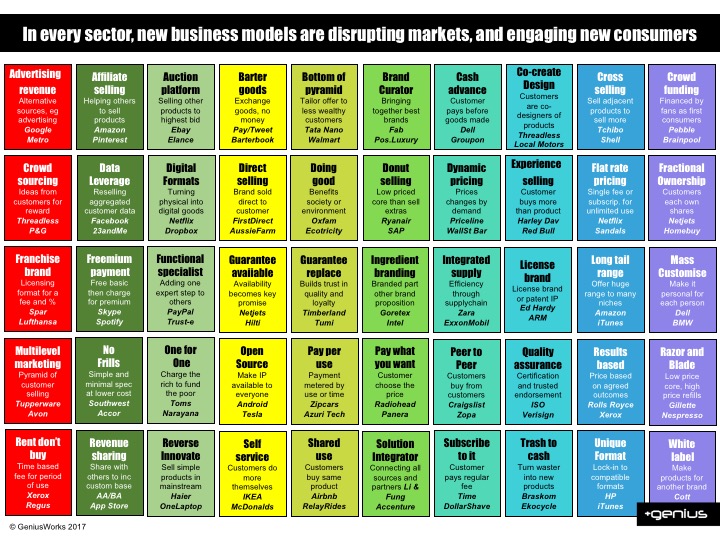
In my business school executive program on new business models we explore in detail what makes the different business models work, and how to apply them appropriately. Typically they embrace a combination of physical and digital business models, transactional and enduring revenue streams, partnering and licensing, personalisation and influencing, relationship and community building. In food and drink think about Beer52 and Graze, Ava Wines and Nespresso. In media and entertainment think about Skype and Instagram, Netflix and Spotify. In hotels and travel think about Airbnb and BeMyGuest, Surfair and Emirates. In retail and luxury think about Inditex and Farfetch, Burberry and 1Atelier. In cars and taxis think about Tesla and Nutonomy, Uber and Zipcars. And on, and on.
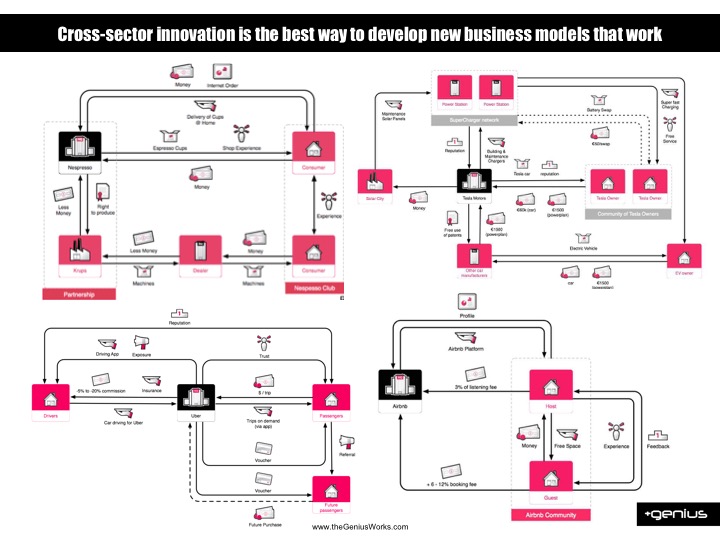
Of course, a business model is not the total solution. It starts with understanding who is the target consumer, new and or existing, and then what drives and inspires them, typically with some form of design thinking to find relevant insights. From this we develop appropriate and creative value propositions, from which the business model can then be shaped as the method of delivery.
- Explore more in “Changing the game of beauty“
- Explore more in “Call the Glamsquad, visit the Drybar“
- Explore more in “Glossier: Gamechanger Case Study“
- Explore more in “Business Innovation Lab”
Denmark’s fairytale city of Odense is a perfect place to write the future story of business. Birthplace of Hans Christian Andersen, and now one of Europe’s leading robotics hubs, it seeks to become “the Davos of business thinking”.
Odense is a city in the midst of rapid change. €5.5 billion investment will create a smart city, local businesses like Universal Robotics are growing rapidly, drones dominate the local airport, it has the world’s most innovative sports track, one of Northern Europe’s top music festivals, and Facebook has just announced a huge local investment.
On 9-10 May, Odense hosted the first Thinkers50 European Business Forum, bringing together the world’s top business thinkers with Europe’s business leaders. I had the privilege of hosting this incredible event, probably the highest quality business forum in the world this year. This is what happened (click links to download presentations and find out more):
The Odense Moonshot. Sweden’s funky academic, Jonas Ridderstråle, set out the challenge for Europe in provocative fashion:
- Creative destruction should be the #1 priority for every business leader. Do it now, do it fast. Before somebody else does it to you.
- The starting point to creating a better future is to take new perspectives. You cannot go forwards with the same mindset and pathway as today.
- Europe needs to find its creative edge. To succeed through the power of ideas, and to add a creative premium to its brands, innovations and business models.
https://www.youtube.com/watch?v=rMdJn3etc_k&feature=youtu.be
Global Remix 1. Mona Hammami, from Abu Dhabi’s Crown Prince’s Court, gave a global perspective on the biggest challenge for business:
- Global change is accelerating in speed and scale. More crowded, older, migrant and urban, putting huge demand on scarce resources.
- Public and private sector need to collaborate to find the $2.5 trillion investment required to fund the UN’s 17 sustainable development goals.
- How can we all act as global citizens to solve these problems? In particular, how can business contribute to society in smarter, more strategic ways?
https://www.youtube.com/watch?v=tdRI1VFJx3A&feature=youtu.be
Global Remix 2. Professor Alexander Betts, leading thinker on refugees and migration, sees the fault in our progress, and the problem with globalisation:
- Globalisation is fundamentally undemocratic. Citizens lose influence, decisions are compromises, the strongest nations dominate.
- We need to rethink the nature of work, including the important role of migration in this, as well as the fast emerging role of AI and robotics.
- Social impacts should be a major discussion in the boardroom. CSR is not a peripheral issue. It should be core to the business model.
https://www.youtube.com/watch?v=ELFssNK1Xto
Global Remix 3. Irreverent Finn, Alf Rehn, reflected on these challenges, saying that innovation needs to refocus in order that business can have more impact:
- Together we spend around $3 trillion each year on innovation. That’s about 22 “moonshots” (the Apollo mission cost $137bn). Most of it is misused.
- Most innovation is frivolous, wasted on things like smart socks, rather a positive force for progress. Instead it should focus on the big challenges in our world.
- Time to use your brain, to reclaim innovation with ambition, get serious about exponential technologies, and unleash our cognitive surplus.
Finding New Growth 1. Professor Rita McGrath, the world’s leading growth expert, challenged us to rethink our business strategies in fast-changing markets:
- We need strategy more than ever. Whilst speed and uncertainty make strategy harder, we have more infinite opportunities, requiring more strategic choices.
- Companies spend too much time thinking about competitors. They should spend more time looking ahead, and seeing the challenge from beyond their own sectors.
- The best opportunities for growth lie in resolving the inefficiencies of current market models, and moving from products and services to experiences.
https://www.youtube.com/watch?v=tRUbqexuWow&feature=youtu.be
Finding New Growth 2. Harvard’s Canadian judo-playing professor from Grenoble, Mark Esposito, took us to a different place, the future:
- Strategy starts by making sense of the future. Understanding the megatrends and how they will shape your markets, customers and business.
- Quantify the changes with DRIVE … D = demographics, R = resource scarcity, I = inequalities, V = volatility, E = enterprise dynamics.
- The best opportunities for growth lie in a combination future possibilities and change drivers – finding the painpoints and new certainties.
https://www.youtube.com/watch?v=Fk8s_QFnYMM
Letters to the CEO. Thinkers50 asked 50 gurus to write a letter to the world’s CEO, spelling out the top priority for business leaders right now. It is captured in a new book called “Dear CEO“:
- CEOs are focused on globalisation, change, complexity and technology. They need to decide with speed and decision, engage with impact, adapt proactively, and deliver reliably.
- The most popular theme from the 50 letters was “think people not data”, to be human and engaging, embrace foresight and meaning, and to make good judgement.
- Other themes included rethinking what success looks like (organisation and self), opening up (stretch and potential). less is more, asking courageous questions, and being the future.
Big Talk 1 (co-creation by Europe’s CEOs). What is the new agenda for Europe? The first co-creation session saw CEOs sharing their biggest challenges and opportunities, and then agreeing what mattered most in the next 1-5 years for business in Europe:
- CEOs’ topics were diverse, including fast change and slow growth, ageing, unemployment, lack of talent, fragmented society, digitalised everything, how to embrace AI and robotics, fat cats, risk avoidance, and problem fatigue.
- The biggest challenges for European business are complacency (too comfortable, backward looking, rigid society, lazy and unable to change), and talent (new education to deliver new skills and entrepreneurial mindsets).
- The biggest opportunities for European business are social innovation (enhancing business-enabled social, welfare and green solutions), and then capturing these innovations as a global export.
Future Business. Business leaders from across the world then came together with leadership coach Rene Carayol to explore what the future looks like:
- We live in a two-speed world, we can have dynamic engagement (global, connected) or splendid isolation (local, isolationist).
- Nobody is average in this changing world. However everybody wants something relevant to belong to, and something relevant to believe in.
- As business leaders we face the relentless challenge of quarterly results, but we must also rise above this to drive change, and create a better future.
https://www.youtube.com/watch?v=2rdvhIXFQsI&feature=youtu.be
Exponential Lab. Dutchman Yuri van Geest is author of the bestselling Exponential Organisations, from Singularity University, focused on the power of new technologies for fast growth:
- The best vision of the future is peripheral vision. Corporate life expectancy from 67 (1920) to 12 years. Business competency from 30 (1980) to 5 years.
- Exponential organisations – driven by abundance, millennial mindsets and exponential (typically, network-based) technologies – have dispropotionate (e.g. 10x) more impact.
- They harness 10 scale drivers – interfaces, dashboards, experiments, autonomy, social, gig work, community, algorithms, leveraged assets, and engagement.
Faster Better Results 1 (the soft stuff). INSEAD’s American professor in Paris, Erin Meyer has created “the Culture Map”, an indispensable tool for every business today:
- Global organisations need to learn how cultures work together – understanding the different attitudes to time, influence, trust, agreement, leadership etc.
- Example: multi-culture teams need low context processes (explicit/simple, like in USA or Germany, rather than implicit/nuanced, like in Russia or China).
- This can be applied to internal teams, but also in aligning internal/external (organisation/brand) cultures, and in marketing/selling around the world.
https://www.youtube.com/watch?v=LawQ4WWSms4&feature=youtu.be
Faster Better Results 2 (the hard stuff). How do you make change happen? Spain’s Antonio Nieto-Rodriguez is the world’s leading project guru, and also VP of GSK Vaccines business:
- Business ratio of “stable:change” (i.e. operations:projects) is rapidly shifting from 90:10 to 30:70 … which means projects increasingly dominate.
- Agile organisations are project driven, cross-functional, less hierarchy, more speed. Even customers want projects not products (e.g. to run a marathon).
- CEOs are the ultimate project managers, or more likely, portfolio managers. This requires focus and prioritisation, engagement and collaboration.
https://www.youtube.com/watch?v=_b9L1osiuvg&feature=youtu.be
Leading Change (case study). CEO Peter Terium described his transformation of Germany’s largest energy company, Innogy SE, with his coach Deborah Rowland:
- Business change starts with leadership. But leaders must also change. Start with the being (mental change), then the doing (physical change).
- The “being” skills of change leaders are: seeing the bigger picture, being curious and responsive, staying present, and tuning into the system.
- The “doing” skills of change leaders are: the pull of an inspiring purpose, creating tension to create disrupt, channeling energy, and changing the now.
Big Talk 2 (co-creation by Europe’s CEOs). What is the new agenda for Europe? The second co-creation session saw CEOs discussing how to overcome the many obstacles, and then defining their priorities for delivery, now and in the mid to longer-term:
- CEOs concurred that it was time for action – moving forwards through a new mindset, where ambition conquers fear, longer-term vision beats short-term continuity, embracing cultural and societal progress.
- The top priorities for European business were seen as clarity of direction, and making this future happen smarter and faster. Competing on ideas, design and creativity to embrace human and social progress, with a creative premium.
- What does this mean Europe’s leaders need to do differently? They need bolder vision, to inspire and engage talent and society. They need agility and collaboration to deliver, to be distinctive globally and relevant locally.
The Winning CEO. So what makes an effective business leader? We brought the world’s #1 business leader, Lars Rebien Sorensen of Novo Nordisk, together with the world’s #1 business coach, Marshall Goldsmith:
- The CEO’s responsibility is to deliver a long term strategy, not just quarterly results. Business also needs a bigger purpose, to make the world better.
- Leadership is a lot about luck. Most leaders have most of the right ingredients. They need the right organisations, markets and teams to win.
- What are the most important attributes of a winning CEO? Courage, humility and discipline.
The European Business Lecture. Harvard’s Professor Michael Porter is the world’s #1 business thinker. His five forces have powered the world’s businesses for too long. So what is his vision for the future of business?
- Business is about more than capitalism. Competition should have a net positive impact. Social value is the best starting point for business strategy.
- Social needs represent the largest unserved market opportunities. How can your business make a useful contribution to society, and the future?
- Creating shared value (CSV) is the evolution of philanthropy and CSR. It is the strategic business process of making the world better, profitably
https://www.youtube.com/watch?v=gt4lw8feBbQ&feature=youtu.be
The future story of business: Defining a new agenda for European business leaders.
So did we create the future story of business for Europe, and probably beyond? A clear thread emerged through the Odense forum. Not by pre-planned design, but a natural flow of insights and inspiration. Stories, like Hans Christian Andersen reminds us, are a powerful way to spread ideas. Stories of the future are particularly important for business, as they give direction, shape progress and give hope.
A simple framework which I use for articulating stories (visions, strategies, propositions, reports, speeches, and more, in business) is built on SCQA (which stands for situation, complication, question, answer). So here it is, the new agenda for European business:
S. Fast change has left business out of touch with people. Globalisation feels undemocratic, AI and robotics have created fear. Short-termism creates a blinkered obsession with financial gain rather than value creation that supports financial and social progress, that makes the world a better place. As new markets surge forwards, with lower costs, bolder ambitions, and fast action, Europe is squeezed and left behind.
C. Leaders are complacent, and innovation is wasted. Companies have grown lazy and arrogant through stability and success. They live on the success models of the past, rather than creating new. They avoid risk, big ideas are mocked (except Elon Musk’s), leaders avoid real change. Innovation is trivialised, incremental not exponential, not focused on the big challenges and opportunities that move the world forwards.
Q. How can European business rediscover its place in the world? How can fast change be the catalyst for accelerating growth? How can our assets, from geography to capability, cultural diversity and social beliefs, be creatively applied to industry 4.0? How can we harness creativity, intangible assets, for more value? What do business leaders themselves need to do better? How can Europe lead and win the future?
A. Business should be a force for positive progress. It should drive social innovation, harnessing the potential of new technologies, from digital to robotics, to make life better. Tech should not threaten us, but enhance our lives. It must be profitable too, a premium to invest and share. Social innovation – welfare, green and cultural – are embedded in Europe’s make-up, and can be its advantage, its export and its future.
Ideas that spread further: How Thinkers50 moves the business world forwards.
Porter described the European Business Forum as “an important milestone in reenergising the world’s management thinkers”, and connecting the best academic thinking with the most important issues and opportunities for business leaders.
At the end of the forum he was awarded the Thinkers50 Lifetime Achievement Award by founders Stuart Crainer and Des Dearlove, which he said was “one of the most important honours he had every received, because it was the acknowledgement of his peers, the best thinkers in the business world”.
The world’s #1 leader, #1 thinker and #1 coach together for the first time, perfectly captured the magic of an incredible, exhilarating (and exhausting) two days, that also included events for 500 local entrepreneurs, 1500 business students and the local public.
I remember sitting down a year ago with Anker Boye, Odense’s transformational mayor, and Bjarke Wolmar, local organiser and VP of Odense & Co, the city’s investment agency. We wondered whether any of this was possible. Yes it was, and much more. The excellence in content, energy of the interaction, and electric atmosphere created an incredible event.
As director of Thinkers50, I will be working with my colleagues, Stuart, Des and Cosimo Turroturro to build on this momentum, both locally and globally. In Odense, we are putting in place an ongoing program of smaller events, virtual content and supporting resources, throughout the year, building to next year’s EBF18. We are building a community of business leaders across Europe, with local satellite networks, who will come together in Odense each year.
Globally, we are looking to replicate the format with our partners in each region. Next stop China, where Haier is our partner in Qingdao, and then onwards to the Middle East, South and North America. The combination of leaders and thinkers, digital content and physical experience, definitive and defining, is what makes this format distinctive.
Ideas to change the world.
Download a summary of all the best ideas
Luxury, as defined by the Oxford dictionary, used to be “a state of great comfort or elegance, especially when involving great expense.”
Today’s luxuries are no less scarce, but more emotional than physical, and they don’t necessarily come at great expense.
A more recent definition from Webster’s says “Luxury is the unusual intellectual or emotional pleasure or comfort derived from some specific thing, something producing such pleasure or comfort, and of course, the use and enjoyment of the best and the most costly things that offer the most physical comfort and satisfaction.”
In a world of abundance, where material possessions are no longer a measure of success, and the tech-fuelled pressures of work and life, give us few moments to be ourselves, the concept of luxury has changed. Luxury is more a state of mind, more an emotional than physical concept, more an experience than an object, and capturing the most valuable aspirations of people today.
Luxury brands – from Cartier to Louis Vuitton, Gucci to Moet & Chandon – are struggling to come to terms with this changing mindset. So what are the drivers of change?
- New consumers… China will be the world’s largest luxury goods market by 2020, with different aspirations and values. India and Indonesia follow rapidly. Like in the new western markets, people with self-made wealth have different values to those with an inherited starting point. Luxury is still an important psychological marker of social progress, moving from extrovert to introvert adoption.
- New aspirations … Consumers have dreams conditioned by every walk of life, conditioned across many different sectors – their favourite restaurant, vacation, celebrity – and as a result, their choices are more diverse. They don’t trust institutions or worship heroes, rather they are influenced by their peers, and their value equation is much more than product and price.
- New technologies … Digital platforms have transformed the accessibility of luxury brands, both in exposure and ability to purchase. Gone are the days when a luxury boutique was the embodiment of the dream, the living brand, and unique purchase experience. Luxury brand experiences are most likely to start with a mobile phone … content-rich, co-creating, community-building, and more.
Indeed the luxury brands of today could vary greatly from those classic names. Apple fulfils the criteria for many, particularly in the democratising world of “massclusivity”. Airbnb offers amazing places to stay, often preferable to the predictable chintz of chain hotels. Nespresso creates the best coffee, embodied by George Clooney’s style, and captured in a capsule of great taste in your home. Tesla offers speed with a conscience, more progressive, less polluting and faster than a Ferrari.
So what is the new luxury … and how can luxury brands, classic and new, embrace the new traits of luxury as perceived by today’s consumers? How are they valued, and what do they look like?
- The luxury of time … How can you create precious time for people, time when you are alone, or with the people who matter most, the special moments, captured in time? Surfair’s new executive jet service launched across Europe ($2500 per month unlimited travel) saves you time, but also creates special time to enjoy, or precious time to do more.
- The luxury of individuality … Exclusivity is not just a brand, but the ability to personalise it, to make it more distinctive and relevant. Coach’s new leather workshops within flagship stores go beyond adding your name to a handbag, but co-designing the bag with craftsmen – size and shape, colour and stitching. The achievement is not just in ownership, but in your own creativity too.
- The luxury of authenticity … Authentic is not just a heritage, selling the story of your past and your craft, or avoiding counterfeits on eBay or imitations by H&M. It is also about being real. Luxury Brands were one of the slowest to embrace sustainability – from ethical materials to labour practices. Authentic is also about being human, local, genuine, trustworthy and responsible.
- The luxury of belonging … In a world without border, where people move across geographies, and have little connection to their locality, we need new ways to belong. Belonging is about shared values and aspirations, and brands beyond their products can capture these. Bringing people together, with same camaraderie of VW Beetle drivers, but in a relevant luxury branded context.
- The luxury of experiences … Whilst experiences might be extreme, like parachute jumps and spiritual retreats, they can equally be educational or about wellbeing. Starbucks will take you trekking across Peruvian jungles in search of the best coffee, Donna Karan’s Urban Zen retreats in NYC are an antidote to the fast lifestyles which most fashion brands induce.
Burberry is a great example of a luxury brand responding to this new world. CEO Angela Ahrendts and her team tripled the business performance, in revenue and profit, over a 5 year period, making millennials and China became their new passion. The brand had lost its way, outdated and increasingly ubiquitous. Burberry embraced digital technologies in every aspect of their transformation. Their innovations were less about products, and far more about how people engaged with the brand, the sales experience and beyond it. They uses icons and symbols to redefine the meaning of Burberry, and how it is luxurious.
Ahrendts, now at Apple, made the trench coat her brand’s icon. Focusing on “the art of the trench”, how it can be worn in infinite ways, occasions and for different audiences. Product customisation, digital applications, and social media were all key components. Flagship stores were transformed with LCD screens, with movies and fashion show livestreaming, engaging communities in realtime dreams and purchase. Magic mirrors that change your clothes as you stand and watch, or curate selections for you, share with friends for approval, or save for later on your phone. And much more. And then campaigns like Burberry Kisses, harnessing the power of occasions to engage people more deeply, so that the brand does more beyond the product, relevant and enabling.
Read my blog post: Luxury brands must innovate to engage new consumers
https://www.youtube.com/watch?v=LRiZMVEIhas
Other brands who are seeking to capture this new luxury, in distinctive ways, include Shang Xia, the Hermes-owned Chinese brand. It has even been called the first superbrand from the East. It captures the authenticity of traditional Chinese art and culture, manifest in fashion and lifestyle accessories. This brand is less about digital, and more about culture. Stepping into Shang Xia’s Paris boutique, is like entering a different world.
Jean-Claude Biver is a timeless piece of the Swiss watchmaking industry. But he advocates revolution in his watches, personified by the yin-yang designs of Hublot watches. He combines modern art with classic craftsmanship, new synthetic materials with precious metals, and irreverent advertising with a classic brand heritage. Not everybody loves Hublot, but then that’s the point of a brand – to have an attitude, to have an opinion, and sometimes to polarise people.
Read my blog post: The man who saved the luxury Swiss watch industry
1Atelier is reinventing bespoke luxury accessories for the 21st century, helping consumers to create exquisitely handcrafted handbags, and more. The NYC startup is redefining bespoke fashion for the digital age, combining old-fashioned craftsmanship and modern technology in ways that could signal the future of customisation. 1Atelier enables consumers to design and receive their perfect bag within 21 days.
Read my case study: 1Atelier, where personalisation becomes the new luxury
Start-ups are embracing digital technologies in luxury ways too. LVMH for example successfully run an innovation competition each year, the winning businesses being embraced by LVMH Labs, an incubator, with the ability to leverage the start-up IP into the core business, and for the start-up to leverage the expertise and scale of LVMH. Other fast-growing digital luxury brands like Vinaya, led by the fabulous Kate Unsworth, are creating their own space in the market. For Vitaya, this is about focusing trends like wellbeing, and creating a luxury version of the fitness trackers and other devices.
Read my case study: The millennial entrepreneur who thinks human first, tech second
“The Future of Luxury” is the theme of my new keynote, one-day workshop and fast and practical consulting process. In it, we explore the changing world of luxury, combining the best insights and ideas from the outside world, with the heritage and vision of your own business. Future vision, design thinking, horizon planning, brand reframing, lean innovation, concept generation, platform marketing, social influence, and much more. It is about thinking in a creative way about how to embrace the power of luxury brands in this new context, to win with the new audiences, new aspirations and new technological possibilities.
- Example of a client workshop: Innovation of the Cartier brand
- Download a summary: Innovation. Creating the future of luxury
- Find out more by emailing me at peterfisk@peterfisk.com
Other relevant links
- Article: The New Luxury: How can luxury brands win in the new world?
- Blog post: The Leica story, from humble heritage to luxury brand
- Blog post: Design thinking with Fortnum and Mason, the beautiful reinvention of a British retail icon
- Case study: 77 Diamonds, diamonds are the the real thing, even for online retailers
- Case study: Positive Luxury, the butterfly mark of brands you can trust
https://www.slideshare.net/geniusworks/innovation-the-future-of-luxury-brands
Rightmove, the UK’s home-buying portal with more property listings than any other platform in that country, has just been recognised as the most innovative growth company, according to Forbes Magazine’s annual ranking.
The London-based company was a first mover in online real estate listings, and it has capitalised on “network effects”, the idea that a platform grows more valuable with every additional user. Its CEO Peter Brooks-Johnson dislikes process and hierarchy and encourages employees to share ideas early, before they’ve spent so much time on them that others will be less likely to point out their flaws.
Network effects are especially powerful for platforms that connect sellers and buyers — as eBay has done with auctions, Airbnb with accommodation, and Uber with taxi services. As a platform for home buyers, and sellers, Rightmove is a textbook network-effects business. Having established itself as the tool to use because it’s the tool that most people use, it continues to grow at such a torrid pace that, once again, it tops the list. Rightmove established this prominent position because it moved quickly and staked out its turf when the World Wide Web was young. Back in 2000, its founders, acting on behalf of four intense competitors — the UK’s top four property finder companies — came up with plans for a shared portal for their listings that would give real-estate buyers a “one stop shop” to discover what was available. Rightmove was in the right place at the right time.
Brooks-Johnson’s first answer, at the same time, sells short what Rightmove has done consistently to remain king of the hill. As professors, we have researched high-impact innovation for almost 20 years, and have seen plenty of companies with early, seemingly unassailable, advantages manage to mess things up. So we decided to dive deep into the practices that help Rightmove sustain its innovation premium edge.
“I think we’ve managed to have a culture which is both restless and focused,” Brooks-Johnson says. The “focus” part is that “we know what we do, and we don’t go chasing other dreams.” Rightmove exists to operate a two-sided model serving, on one side, a vast “audience” for property listings and, on the other side, some 20,000 advertisers of available properties. The “restless” part is that “at no point do we think we’ve ever, sort of, got there. We’re always on a journey to be better.” On both sides of the platform, the company constantly expands its offerings and features to better meet existing customer needs or to do a totally new job for them. Every year has brought increases in its average revenue per advertiser (ARPA) as it expands the repertoire of advertising products and packages available to customers to increase their brand exposure.
How does a management team keep fueling the engine of innovation? What works best, Brooks-Johnson is convinced, is not to impose common processes upon a fast-growing organization, but to encourage common behaviors within it. In fact, the company has outlined the specific behaviors it thinks give Rightmove a cultural competitive advantage (Brooks-Johnson credits Herbert Simon’s classic Administrative Behavior for providing a starting point on this line of thinking) and this list of behaviors provides the organizational backbone of its orientation, management training, and leadership development programs.
As an example, Brooks-Johnson talks about the behavioral impulse to “dare to do something.” This isn’t something that can be dictated by process; it has to be encouraged at a more fundamental level. Rightmove wants people to “be bold, do something, and don’t be afraid to make a mistake as long as you learn from it. Don’t spend forever talking about it.” That behavior might not be prudent in every kind of company, but, as Brooks-Johnson emphasizes, “in the world in which we operate, we’re so fortunate that we can experiment relatively cheaply with very little risk.” It makes more sense for innovation teams just to try something, then use the feedback to iterate quickly toward something better — rather than holing up in committee rooms “thinking for years and years and years …”
The same faith in iterative innovation shows up in another favorite Rightmove behavior: “share early and share honestly.” Brooks-Johnson says the point of this one is to urge people, as soon as they have an idea, to “share a sketch” of what they’re thinking with the people around them — a virtual prototype of the idea. That allows those others to contribute to it, and build on it, while it’s still in a formative stage. Too often, innovators hold off putting an idea in front of others until they have crystallized their thinking about it, and perhaps even prepared a beautifully written business case for it. But by then, Brooks-Johnson notes, “you’ve invested a lot in that thing,” and taken it past the point where others feel they can provide input. “Everyone you show it to is going to be a little bit intimidated, because clearly … you have more knowledge about that thing.”
And then there is the behavior that Brooks-Johnson seems to love best of all, so much so that he calls it the most important driver of Rightmove’s sustained innovation. “For me,” he says, “the magic ingredient is inquisitive listening.” By this he means something more than just being attentive when someone else is speaking. It is a habit of going through your day with the expectation that people have vital information to convey, which they might not be able or particularly motivated to make sure you understand. Brooks-Johnson offers a recent example of tuning in more closely to a customer. The customer’s company should have been a perfect fit for a certain product Rightmove sells, but the customer commented off-handedly that it was “the safe decision” for him not to buy it. Brooks-Johnson was there to do other business, but the comment piqued his curiosity. By probing further he gathered valuable input for the product team, who quickly made adjustments that fixed the problem.
Technology and healthcare dominate this year’s list: Most Innovative Growth Companies
Technology has had a significant, rapid and often random impact on every industry. Publishing is no exception.
Depending on your perspective, it might feel like you or your business is being bounced around at random. But from a different perspective, that the same experience could be entertaining, even exhilarating. Often it is confusing knowing whether the ball being bounced about is you personally, your company, or your organization’s products or services. Are you driving the game, or are you simply at the control of the various factors that influence your environment? This feeling could apply if you are an executive at a publishing house, a librarian in an institution, or a developer at a technology provider serving our community.
At the Future Book Forum, which I host each year in Munich, enabled by Canon, we explore the rapid changes disrupting the world of publishing – and also the opportunities to shape and innovate the future in practical and profitable ways. Three years ago we developed a manifesto for the future, how publishers needed to rethink the business case for change (not around cost efficiencies, but by innovating for new growth). Two years ago we focused on the consumer perspective (being driven by their changing ways of learning, working, entertaining, buying and more, rather than the technological or business perspectives). Last year we created the future book in two days – a high speed, exhilarating prices of design thinking, rapid innovation, and future market shaping.
This year at the Future Book Forum we will take that further, defining the Smart Book concept in detail, and in particular its application to the education market.
To help in preparing for this, we explored big trends shaping this new world, specifically for education. STM (scientific, technological and medical) is the leading global trade association for academic and professional publishers. It has over 120 members in 21 countries who each year collectively publish nearly 66% of all journal articles and tens of thousands of monographs and reference works.
Their new report Tech Trends 2021 has just been published:

The Pinball Machine metaphor is inspired by Heinz Pagels’ 1982 book The Cosmic Code: Quantum Physics as the Language of Nature. Pagel says “The world changed from having the determinism of a clock to having the contingency of a pinball machine.” STM’s Future Lab envisioned the new publishing environment as a giant pinball machine, with different components ricocheting the “ball” of value around the field of play, buffeted by bumpers, and potentially high-scoring opportunities in service of various areas. The value of serving the customer is bounced among various bumpers and targets where points can be scored and value added, but risks remain; where value can be lost and one can end up losing the game.
The ball in this visual metaphor is launched through innovation onto the playing board, with the ball representing value for all of scholarly communications, including researchers, libraries, and publishers. The flippers that keep the ball in play are Human and AI assisted technologies that support the value chain process. Additional support propelling the ball is provided by institutions, both libraries and other institutional support infrastructures, as well as funding organizations.
The overall board is divided into several sections around the key themes of integrity and trust. These core values are critical elements of what it means to provide scholarly information, that is vetted, reviewed and that people can rely on. This can be delivered through a focus on the four core elements, which extend outward from the center of the playing field, which are foundational elements of the value creation at the center of the experience. These components are Accuracy and Curation, Serving Individual Scientists, Sharing and Collaboration, and Smart Services. Around each of these sections are various elements or trends that are related to those elements.
The segment that deals with accuracy and curation includes the elements related to the editorial process. It is envisioned that there are significant bonus points to be earned through editorial process innovation. The value-ball can bounce between the elements on trust in peer review, reproducibility, or automated integrity checks. Other important elements in this segment are validation tools, plagiarism detection, image manipulation detection, statistical validation, quality control automation, digital workflow optimization, data curation, metadata creation for all outputs. There is also an opportunity here to “relaunch the ball” via implementing successful digital strategies.
A second segment highlights opportunities to build value with the potential for smart services. In this part of the playing field, the most obvious points to be gained are the provisioning of text and data mining services. In this area, potential developments related to the Internet of Things, and Block Chain, as well as machine learning, and other big data applications. Here too automated integrity checks, computer assisted recommended reading lists, knowledge graphs, and linked open data are all potential services publishers could build value upon. Mobile device optimization and the voice as a machine integration service as also important features. Further developments are also possible with automation of peer review, or the provision of things as services could also impact our experience in the years to come.
The third component of this landscape is focused on the potential to serve individual researchers, not simply serving large communities of users. Here, it was envisioned that the most bonus points resided in the application of large-scale user data to personalize services. Of course, balancing this are concerns about user data privacy, the new General Data Protection Guidelines in the EU, the ability of users to opt out, and how individual user behavior can be tracked. Other elements of this have to do with access and authentication, and recommendation services. This also fits into the broader issues around, the social challenges of all this change, the recognition and credit elements, as well as how new impact measures are being formulated. These elements touch on the lifelong learning trends, as well as the continued developments related to MOOCs.
The final board segment includes the increasing amount of collaboration and sharing taking place. How well search and sharing is integrated with other services is seen as the biggest opportunity for added value. Within this space, the expansion of preprint servers, and social sharing networks are dominant feature. Other elements of these sharing networks include the sharing of data, streaming lab data, remote lab environments. Collaboration incudes a variety of other elements as well, including the portability and sharing of manuscripts, open annotation, collaborative expert services, and editorial services, even collaborative writing.
STM’s previous report, Tech Trends 2020 used a different metaphor – publishers being tossed around in a stormy sea. It emphasised how the growth in computer power will continue steadily over the coming decade. Computer power combined with big data and a wide variety of digital objects, will create huge new opportunities for information providers. Researchers are likely to share more in open science environments, from text to non- text such as data or multimedia, social collaboration networks will spark new information relationships and publishers can deliver more targeted precision information to users via dynamic publishing.
