Alibaba’s chief creative officer Chris Tung was in Cannes this week unveiling “uni marketing” a new suite of marketing data tools for brands and agencies to better use Alibaba’s consumer data.
Over the last 12 months, Alibaba has worked with global marketers like P&G, Unilever, and L’Oreal to develop a system called Uni Marketing, a data-driven marketing engine. “We have a unique data pool that represents more than 500 million active shoppers on our platform in a multidimensional way,” says Tung.
Alibaba v Amazon
“Alibaba today is an ecosystem, it’s not just a marketplace. There are video sites, social media like the Chinese version of Twitter called Weibo, there’s location-based service that’s like Google Maps, we have pretty much everything. So from a data standpoint, it’s very interesting.”
Often, especially in Western press, Alibaba is dubbed “the Chinese Amazon.” But with the consumer-to-consumer marketplace Taobao, the business-to-consumer T-Mall, and Alibaba’s business-to-business, plus the social media, maps, Laiwang messaging, a cloud computing service, it’s a bit more far reaching than that.
“It’s very different from the Amazon model,” says Tung. “We don’t buy products from brands, we don’t buy and sell and take a margin, as a channel. We service as a marketplace, a bridge between the seller and the buyer, through data. A lot of transactions happen on our platform–$550 billion US worth of gross merchandise value a year. The largest commerce platform on Earth. It’s bigger than Walmart. Much bigger than Amazon.”
If you want to make analogies, Tung says think of Alibaba as a combination of Google, Facebook, and Amazon, in one. Brands set up and operate their own e-commerce flagship stores on the Alibaba platform. And global brands have flocked to it, including Nike, Apple, Coke, Uniqlo, Zara, and L’Oreal.
Uni Marketing
Now, Alibaba has launched a powerful new suite of marketing services that leverages data collected from the company’s 450 million active users to deliver a level of targeting and reach not yet seen in the China market to brands selling on its e-commerce platforms.
Alibaba has been touting the power of the data thrown off by the consumers shopping, engaging with brands and consuming content on Taobao Marketplace and Tmall, as well as entertainment sites such as Youku and even local services such as Koubei. By tracking users across those sites with what the company calls a “unified ID,” Alibaba is able to not only tailor product recommendations to individual users, but also personalize the storefronts they visit according to their browsing and buying habits.

Now, the Hangzhou, China-based company has created a set of tools that aggregates and analyzes that data so brands can better identify, target, reach and retain their customers. Alibaba calls it “Uni Marketing,” based on the unified IDs that make this customized tracking possible.
“Uni Marketing differentiates itself from other marketing tools by using the entire Alibaba ecosystem to inform businesses about their consumers, allowing them to target more effectively,” said Alibaba Chief Marketing Officer Chris Tung in a statement. Tung made the announcement during the Cannes Lions event this week.
“By combining its massive data assets, businesses can identify, segment and build tailored content for the best results,” Tung said. “By revolutionizing data-driven marketing, Alibaba is evolving into a more strategic and sustainable brand-building platform.”
Alibaba first teased the launch of Uni Marketing at its Investor Day summit earlier this month. During a presentation to about 400 analysts and investors at the company’s Xixi headquarters, Tung showed how data could be used to manage relationships with consumers from the time they first become aware of a brand to the point when they become loyal customers. Moreover, the data allows for the segmentation of consumers into highly specific groups, giving brands the opportunity to personalize their marketing campaigns and therefore convert more customers.
“We will be able to manage the relationship between a customer and a brand throughout the life cycle of a product, from awareness to interest, to purchase, to loyalty, and know exactly how to look after your customer at different phases,” Tung said at the investors’ summit.
Chief among the Uni Marketing tools that Alibaba will offer is what the company calls its “Brand Databank.” It’s an online dashboard that shows brands how many consumers are interested in their products and where they are in that product life cycle. The Brand Data Bank will also track the success of the different campaigns offered by Alibaba, whether they are the 11.11 Global Shopping Festival, Super Brand Days, live-streaming broadcasts or advertising placed on different sites in the company’s ecosystem. By analyzing this information, brands will know what works when they attempt to reach consumers. Then they can act on that information to generate new, more accurate marketing campaigns in the future.

Brand Databank’s Dashboard
Tung used a skincare brand as an example to show how it would work. For example, if the brand launched its flagship store on Tmall, it could use that data to engage anyone who had previously purchased the company’s products on Alibaba’s e-commerce platforms. If out of 9 million consumers, 2 million of them were inactive, the brand could target that group with specific promotions in order to bring them back to the brand.
The brand might also choose to live stream from a lavender field to highlight its lavender essential oil, or run advertisements on Youku retargeting those viewers who had already engaged with its promotions on the streaming site. The brand could also synchronize its loyalty club information with Tmall to deliver the same brand membership program across all of its retail touch points, both online and offline.

The Applications of Brand Databank
For brands, all of the information needed to make these decisions, and tools they can use to enhance their marketing campaigns, will be available through the Brand Databank app.
The launch came in tandem with global communications and marketing agency Publicis’s announcement that it had partnered with Alibaba to leverage Uni Marketing, as one of the tools in the suite, Uni-Desk, allows agencies to access a brand’s data bank account—with permission—to better serve them. In a statement issued Sunday, Publicis said it would work with Alibaba to further develop Uni-Desk to grow the number of media-planning features available to agencies, in addition to leveraging other elements of Uni Marketing, such as data-driven content creation and event-based marketing campaigns.
Besides Brand Databank and Uni-Desk (which sits under the Uni Communication segment), Alibaba announced its Uni Marketing suite would include Uni Strategy to enable brands to segment consumers across a numerous different “touch points,” or points of engagement with the brand, as well as through various channels to provide a complete picture of consumer behavior. There is also Uni Operation, which allows brands to create and deliver personalized content and manage consumer relationships across those touch points.

The Four Key Parts of Uni Marketing
In its statement Monday, Alibaba said Uni Marketing would “transform the way businesses do marketing” and help to address “critical challenges around customer targeting, relevant communication and return on investment.”
“Brand relationships will change, with consumers becoming more aware and more interested, which will transform into purchase and ultimately, loyalty,” the company said.
We live in an incredible time.
More change in the next 10 years than in the last 250 years.
Combine the printing press and steam engine, light bulb and jet aircraft, automated production and space travel, microprocessors and the Internet, cell phones and driverless cars, and much more … and you still can’t imagine the impact of what is emerging right now.
For leaders there are huge questions:
- How will you win in an age of digital technologies and intelligent robotics? The tsunami of new technologies can be overwhelming. The speed of change, the complexity of connectedness, and the fear of irrelevance. How can you embrace the future, and use these technologies, to move the world forwards, to drive innovation and growth?
- What can big companies learn from youthful entrepreneurs and small businesses? It often feels like young start-ups have the advantage, but large organisations have unique assets too. They have more to lose, but to do nothing is the bigger risk. How can they embrace the future in relevant and audacious ways?
- Why will human ingenuity triumph over machines and robots? Many fear that robots will take our jobs, and AI will outthink our brains. Not if we think different, and smarter. Humanity has unique assets that will never be matched, by what some see as “the point of singularity”. Instead we can harness the power and intelligence of technology to our advantage, to achieve more.
Ingenuity is about finding your magic.
The magic of humanity, of human creativity, to think and act beyond what has already been done.
In yourself as a leader. In your people as your unique asset. And in your customers and the wider communities in which your business has an impact.
“ingenuity” … the quality of being clever, original, and inventive … the ability to solve difficult problems, often in original, clever, and inventive ways. Ingenuousness.
Ingenuity is ultimately about inspirational leadership, relentless innovation and accelerating growth.
“The one who follows the crowd will go no further than the crowd. The one who walks alone is likely to find himself in places no one has ever been before …”
Analytics and optimisation, big data and automation, AI and robots, will take you where you know. Humanity, intuition and creativity will take you further.

There are 7 themes to my new book:
Future Leadership … Progress is about creating a better future for people, enabled by a better future for your business. As a business leader, how are you embracing these incredible changes in our world to create a better future? We can either wait for the future to arrive, or we can shape it to our advantage. Which will you choose?
- What is the future of business?
- Why business leaders desperately need a new perspective
- The unlimited potential of human ingenuity
Rocket Fuel … Making sense of these incredible new technologies enables us to harness their potential in smarter ways. By grasping their essence we can adapt and apply their incredible capabilities to suit our needs, to support us. The alternative is to be fearful of our jobs, our society, and our future.
- Every business is digital. Data, devices and globally distributed.
- The 4th industrial revolution. Machine learning to 3D printing.
- Beyond the singularity. Living with intelligent robots.
Super Human … Being more human in a technological world is about embracing it to make us better – harnessing big data to make smarter decisions, utilising robotics to give us super strength. Humans have the advantages of imagination, emotion, creativity, empathy, sensing, engaging and more.
- Why humans will beat machines
- Augmenting reality, enabling people to do more
- Smart power – the 7 unique qualities of humanity
Finding Magic … So how will you win in his incredible changing, technologically rampant, superhuman future? Where are the best opportunities to be remarkable, to innovate and grow? The best approach is to think from the future back, and as a result, you will choose different priorities for today.
- Future back, fast forwards
- Attitude and altitude, fusion and focus
- Horizon planning for innovation and growth
Ingenuity Lab … How do you turn the best ideas into fast practical action? Connecting the power of design thinking, lean execution, and agile delivery, we shape a new development path. It is like an incubator – collaborative and facilitated, building on what you know, to do more, faster and better.
- Level 1 … Creative Amplifiers
- Level 2 … Innovation Accelerators
- Level 3 … Market Multipliers
Corporate Reinvention … Today’s winning companies are built on audacious ideas and contagious networks. They are global and local, big and small, physical and virtual – capturing the 800 million new consumers, engaging millennial minds, harnessing China’s new belt and roads.
- Ideas and networks: Ideas that inspire and enable, networks that spread further and faster
- Entrepreneurs inside: dreaming and delivering, fast and flexible, teams together
- Innovative outside: social and sharing, human and collaborative, communal and exponential
Tomorrow Today … What does it take to be remarkable in this new world? Will you be a slave to technology, or harness its potential? Will you jump ahead, mentally and competitively, to shape the next incredible 10 years to your advantage? How will you sustain it?
- Heads up, not down. Forwards, not sideways. Growth, not survival.
- Finding the magic in you, your team and your people.
- Creating the future, whilst delivering today.
“You have to, in some ways, trust in the human spirit and in human ingenuity.”
This is a first draft of the concept … the title, subtitle and themes within the book … to develop, shape and enhance.
What do you think?
The book is ultimately for (visionary, inspirational) leaders, and how they mobilise their organisations to drive (smarter, relentless) innovation and (faster, future) growth.
It’s context is the fast-changing technological world. We all know it is digital, but beyond that is the rapid disruption of other technologies such as robotics and AI. Many people focus on that as a threat, but this book is about the opportunity. And in particular how technology can enable people to be better, organisations to be smarter, to do more. Connecting this to the broader ideas of social innovation creates a bigger human purpose for future business.
It is about the power and potential of people.
Of course many of these technologies are being harnessed by small, fast and entrepreneurial businesses. Therefore the big opportunity is also for the (big, old, lazy) existing companies to reinvent themselves, to be inspired and learn from the (small, new, fast) start-ups, and leverage their assets (brands, scale, people) in new ways. This is particularly crucial in mature markets, where automation eliminates the routine, and therefore people need to add value in more valuable and distinctive ways – to find a new creative premium.
Alternative titles:


There has been much talk, particularly in business books, about how technology will take over humanity, how robots will replace almost any job, and after “the point of singularity” artificial intelligence will outthink and outwit the human brain.
This seems wrong to me. As Manuela Veloso from Carnegie Mellon University said “Just as humans like you and I are not able to do everything and don’t know about everything, robots will always have limitations.”
To me there is a huge opportunity. To harness the power of these incredible new technologies – to enhance, enable and exploit our human potential. We already know that our brains have untapped capabilities – for example, to read a 300 page book in minutes, if only our eyes could read and hands turn the pages fast enough.
Big data has the ability to enable us to make far smarter decisions than we could ever before – more complex, more focused, more predictive. It enhances our judgement. Similarly robotics enhance our physicality, whether it be releasing people from boring manual processes, or exoskeletons enhancing our physical strength in warehouses, on the docks or in the battlefield.
Business, and in particular business writers, and indeed the broader media, seem to be shy of this future potential. Maybe because we like to live in the short-term, rather than imagine the future. Maybe because we like to look for negatives rather than positives. Maybe we simply don’t understand the new possibilities.
I was particular inspired by a recent article by Nick Heath called Humans 2.0. It starts like this … The year is 2025. You’re sitting in a surgery watching your doctor carefully insert the tips of her fingertips into black thimble-like actuators.
A screen in front of the doctor flashes with the image of a glistening tunnel of flesh and, as she huddles over the controls, you feel a stirring in your bowels.
The gelatinous mass you feel coming to life inside you found its way into your body 24 hours earlier, when you swallowed a pill that looked unremarkable, save for its bulk.
That pill was actually a package of edible electronics, a miniature robot that will allow the doctor to feel inside your body without making a single incision.
This is the coming world of augmented humans, where technology gifts people senses, skills, and strengths never before available.
The swallowable robot is only one scenario that researchers in Bristol in the west of England are working to make a reality, as part of research that seeks to use bots to enhance, rather than replace people.
Other projects include work to allow surgeons to operate on people located miles away with superhuman precision, and managers to split their day between offices situated on opposite sides of the world.
The conversation about robots today so often revolves around fears of how they will replace us, rather than help us.
Yet as the research taking place at Bristol shows, robotics is “more about augmenting people than it is about making them obsolete,” says Professor Anthony Pipe, deputy director of Bristol Robotics Laboratory.
He sees this research as reflecting a future where robots and humans enjoy a more symbiotic relationship—where robots work alongside people, enhancing their capabilities.
“There are lots of areas where robots could help humans do things,” said Pipe. “That’s really one of the big new areas. So as opposed to replacing humans, helping humans will be a large area for growth.”
Pipe talks about “human-robot teams” working together. “We’re not saying the robot suddenly becomes a simulacrum of a human being—it’s still a robot doing the dumb things and being instructed by a human being—but it may be able to do more useful and skillful things than robots have been used to do so far.”
He is not alone in his assessment that robots will routinely collaborate with people. At Carnegie, Veloso has built CoBots, wheeled bots that automatically escort people through the university building but ask people for help when needed—or instance, to call the elevator for them.
Just as bots can help people, so they will likely always need humans, Veloso said—whether it’s an automated car that needs a person to take the wheel during snowy weather or a robotic warehouse picker that can’t get a grip on a slippery object.
“Just as humans like you and I are not able to do everything and don’t know about everything, robots will always have limitations,” said Veloso. “The thing would be to continue developing algorithms in which the robots themselves are useful but capable of asking for help.”
The swallowable robot—called the MuBot—has been the focus of researcher Ben Winstone’s work at Bristol Robotics Lab in the west of England.
In effect, the device would transplant the tips of the doctor’s fingers onto its exterior, so when the robot pushes against the inside of the intestinal tract, the doctor would feel the sensation as if his or her own fingers were pressing the flesh. Using this device, doctors of the future could feel for the telltale outline of tumors and other cancerous growths in patients.
“Medical practitioners have spent years developing a highly enhanced sense of touch to allow them to carefully palpate tissue and recognise suspect lumps and bumps,” said Winstone.
“If you could take their hands and put it inside the body without opening the body up, then they can start to feel around and have an idea what’s going on,” he said.
Allowing clinicians to feel at a distance required Winstone and his collaborators to build an electromechanical fingertip on the outside of the robot. Inside the bot are an array of pins that replicate the biological features found on the internal surface of human skin. It is these pins that stimulate the receptors responsible for letting our fingertips feel. When we detect the shapes of objects, we use the Meissner’s Corpuscle, a mechanoreceptor that sits close to the surface of the skin and measures how it deforms when pressed. Similarly, when we detect how rough a surface is we rely on the Pacinian corpuscle, which acts a bit like a microphone in sensing the vibrations upon touch.
When the soft-skinned bot presses against the intestinal wall, these pins are pushed inwards and vibrate in much the same way receptors do inside our fingertips.
Attaching sensors to each of these pins would require electronics that were too complex, power-hungry and delicate. So instead the bot relies on a camera that captures the pins’ stirrings and relays the footage to a computer that calculates what touching that gut wall would feel like based on the movement of the pins.
The bot isn’t static but remote-controlled. Using a live feed from the bot’s video camera, the clinician can guide the tiny craft through the patient’s gut, pressing up against areas of interest. As a way of moving the robot, Winstone is drawing on biology for inspiration and examining how worms propel themselves forward by flexing the muscles along the length of their body, something called peristaltic motion.
“We’re looking at using peristaltic locomotion because it complements a soft bodied robot that can comply with the twists, turns and contractions of the gut as it is moving along and it doesn’t obstruct,” he said.
The sensation of touch then needs to be transferred to the doctor. For this task, a wearable haptic ‘fingertip’ is used, again lined with pins. Using the data harvested from the bot a computer arranges these pins into a 3D model of the intestinal wall. In this way, the doctor can feel what it would be like to be exploring the inside of the intestine with his fingers. Another benefit is that once the shape of the intestinal wall has been captured, the doctor or a colleague can rerun the recording and probe the intestine as many times as needed.
“There’s no way to look around deep inside the body without opening people up, so it’s a really interesting and exciting opportunity to see what can be done,” said Winstone. “You could save money on medical procedures if you discover you don’t need to take it further because you know the situation is safe, or you could help people sooner and more effectively by identifying something more quickly.”
Winstone also believes that people would be more inclined to get symptoms checked if resolving them meant “swallowing a slightly large pill” instead of invasive surgery.
Of course, that “slightly large pill” is in reality a robot and the thought of stuffing a machine down your gullet is understandably alarming.
The difference is that this pill is what is referred to as a soft robot, said Winstone.
“There’s often the idea that robots are hard, tin men. There’s a whole field of robotics made out of metal but a new approach to robotics is being realised that uses smart soft materials for both sensing and actuating,” he said. “It is more natural and more suitable for interacting with living beings, so it is much safer.”
In the case of the robot pill, Winstone has been experimenting with encapsulating the camera and pin-based tactile sensor in gel surrounded by a rubber exterior.
Then there’s the thorny issue of how to power the bot. Winstone had the problem of the bot either needing batteries that were too bulky to swallow or too feeble to last the required time. As a solution, he is looking into wirelessly transmitting the power to the bot through the patient using MRI.
“I’m looking at magnetic resonance induction to power the robots inside the body. That means you’re not dependent on batteries and you have the opportunity to charge. Essentially it means you have power for as long as you need it.”
Winstone estimates that he’ll have a “relatively good proof of concept” by next year and that, if everything goes to plan, there could be a system that patients could use within about 10 years.
Science fiction is full of stories where people live vicariously, sitting in virtual reality pods from where they control robotic avatars that can perform seemingly impossible tasks safe in the knowledge that any damage—or even death—is virtual.
The system that Dr. Paul Bremner is making may be a long way from letting us live these second lives, but perhaps is a first step. At the lab in Bristol, Bremner is making a rig that allows someone to control a robot in a different room and maybe eventually, from a different city or even country.
It’s a system that works today. Visit Bremner at the lab and you can strap an Oculus Rift virtual reality headset to your face and look through the eyes of a robot.
The robot in question is an Aldebaran Robotics Nao, a not-especially-imposing android standing at just under two feet tall with a permanently surprised look on its face. While this robotic avatar may view the world from the perspective of a toddler, the system still offers an out-of-body experience. Turn your head and so does the Nao, lift your arm and—thanks to tracking by a Microsoft Kinect—so does the Nao.
Gazing at the world through the bot’s eyes—actually two stereo 720p cameras—is at once peculiar and engaging, particularly turning your head to see yourself standing next to you.
One application Bremner can eventually see for the remote robotics technology is giving managers the ability to drop into offices situated hundreds or even thousands of miles apart—all without leaving their houses.
“That’s nominally one of the things that you want to be doing with it. Rather than having a Skype conversation, you have the conversation with the robot as your avatar,” said Bremner.
Of course, taking the boss seriously when he’s made of white plastic and only comes up to your knee would be tricky, but Nao’s limited stature shouldn’t be a problem. Bremner should be able to take the system he develops for Nao and transfer it to a bigger, more relatable bot.
There’s a long way to go in getting a bot to capture the subtleties of body language—the narrowing of the eyes, the pursing of the lips, the opening of the palms. In contrast Nao can open and close its hands and wears a single expression of open-mouthed wonder.
That’s why Bremner is looking at other robots such as the 3D printed Poppy, who is twice the height of Nao, as well as the more expressive rob-thespian, whose facial features can be modified using backprojection. For more expressive gestures, Bremner is considering fitting a bot with custom hands that can make a greater range of shapes.
While robots with their stiff joints and fixed faces may lack the expressiveness of a human, their ability to gaze at someone and reproduce limited arm gestures is a step up from telepresence robots today, said Bremner.
“The issue, I think, with those systems is they’re basically just Skype on wheels,” he said.
Lots of the subtle cues of face-to-face interaction are lost as a result, Bremner added. You don’t know exactly who the person is focusing on and it’s harder to keep people’s attention when you’re a screen on a pole.
Bremner’s robots could also replace some of the feedback lost by not speaking to someone face-to-face, through superimposing messages on your vision to tell you how it gauges the conversation is going.
“We could overlay that on your vision so you can have a better idea of how the interaction is going and what changes you need to make,” he said.
The bot could even go beyond reproducing your arm and head movements to exaggerating the bot’s motions to help you get on with the person you’re talking to.
“We want to be able to add some semi-autonomy to the robot control,” said Bremner, “so that if you’re interacting with someone who is themselves an extrovert, when you do a gesture, the robot does a large gesture.”
Similarly, Bremner’s partners at Queen Mary University of London are studying how to tailor the robot’s gestures to suit the mood suggested by the speaker’s voice or to stress a particular point.
Bremner is particularly interested in how people’s reaction to someone changes when they are embodied by a robot, and whether people would still respect and listen to their boss as a bot.
“What effect does that have on people’s personality perception, group interaction, and that kind of stuff,” he said.
At present the system is far away from any practical use. Bremner is currently using it to study how people react when interacting with someone’s robotic avatar and thus laying the groundwork for future interactions between, remote-controlled and autonomous, robots and humans.
Bremner said, “The idea is to gather a lot of information on how people behave when they are controlling the robot and how the interaction is successful, so we can build up this domain of knowledge for an expert system.”
A major technical hurdle facing Bremner is how to remove the wires between the bot and the PC that currently processes some of the images. Once that is achieved, the robot will be able to be mobile, rather than stationary.
Once cracked, Bremner wants the robot to roll before it can walk and expects the first movable bot will be wheeled, with people controlling it using a Segway-like motion where they lean in the direction they want it to travel.
The remote robots will get their first real-world test soon, with Bremner planning to see how people react to the bot in team-building exercises, such as desert island survival tasks.
Getting participants shouldn’t be a problem. When Bremner has shown it off the reaction has been one of excitement.
“Most people are really like, ‘Wow, this is something really exceptional’,” he said.
But hands have their limitations, particularly when attempting to carry out precision work such as laparoscopic surgery, where doctors operate using a few small incisions rather than a large open one.
This minimally invasive surgery causes less blood loss and residual pain in patients and means that procedures that used to require patients to stay weeks in hospital can be recovered from far more quickly. However, such work not only requires a steady hand but the use of multiple tools and assistants.
https://www.youtube.com/watch?v=GH3vVUUQDT4
Today robotic systems such as the daVinci surgical systems give surgeons the ability to carry out such operations with improved precision and less bleeding. These robotic systems offer these improvements by allowing the surgeon to remotely-control robot hands capable of far more exact movements than humans.
Although such systems are now becoming commonplace when carrying out the delicate task of removing a prostate, for example, there is room for improvement in certain areas.
One such area is training. Typically it takes surgeons about 2,000 hours to become proficient with da Vinci robots, according to doctoral researcher Antonia Tzemanaki, something that can take between a year and five years for a doctor to accumulate.
To help such systems become more dextrous and intuitive to use, Tzemanaki and her colleagues at Bristol are developing a robotic system that, when compared to the “pliers” and “scissors” of the da Vinci machine, more closely mimics the movements of a human hand.
The team is building what looks like a robot claw with three digits. Each digit can hold one of 13 specialist instruments for different operations.
The surgeon puts their hand inside an exoskeleton with magnetic sensors that measure the hand’s position. The exoskeleton then relays the hand’s movements to the robotic hand and maps the movement of the surgeon’s fingers to each of the robotic digits with their attached instruments. If the surgeon moves their thumb, index finger, or middle finger then those movements will be reproduced by the robotic hand’s thumb, index or middle finger.
By closely mimicking the movement of the doctor’s hands, the team believes the instrument will be more straightforward to learn how to use.
For example, in an operation to remove a gall bladder, a surgeon would generally require an assistant to hold the gall bladder out of the way while the surgeon cuts tissue.
With the robotic hand, the surgeon can instead use an instrument attached to one of the digits to hold the gall bladder up, while using instruments attached to another robotic hand to apply traction and cut.
“The instrument shrinks down the surgeon’s hand and lets them operate with a superhuman level of precision,” said Tzemanaki. “Their movements will be miniaturised and filtered to make them more accurate. So there’s no tremor, there’s more precision and of course at the end of these digits there can be different instruments.”
Each robot hand has three instruments, mimicking a partial human hand. The first two instruments—the forefinger and thumb—act as grippers. The remaining “middle finger” can house any number of tools, with a blade, hook, irrigation device, and coagulation device among the many options.
Together, the two robot hands give the surgeon up to six instruments to use simultaneously and allow the doctor to mix and match the instruments they need. For example, on one hand the index and thumb could be needle holders, while acting as forceps on another—with each hand allowing for one person to operate three different instruments at the same time.
“Whatever the surgeon is doing is reproduced in the instrument but better,” said Tzemanaki.
By mirroring the pinches and grips a human hand is capable of, the system improves on the dexterity and usability of current state-of-the art robots for carrying out laparoscopic operations, such as the da Vinci Surgical System, she said.
If such robotic systems become commonplace, then there will also be an opportunity to overlay information from medical scans onto the video feed showing the patient, giving the surgeon more information to aid them in carrying out the operation.
Looking further into the future, such a system could benefit from the research Winstone is doing to allow doctors to remotely experience a sense of touch.
“In my PhD we’re talking about kinematics, the designing of intelligent instruments,” said Tzemanaki. “But then the absolute next and crucial step is to give a sense of touch. [The point is to make it] as natural and as close as possible to the movement of the human hand.”
As with all medical projects, the raft of regulatory approvals needed before the technology could be released means it is likely many years from being made available, perhaps as many as 20, said Tzemanaki.
The way robotic technologies can and will augment human abilities is sometimes lost amid concerns people will be unable to compete in a world of smart machines.
And while the impact of fast-approaching automation, drones, and robots on industries such as haulage, delivery, and retail is yet to be felt, the projects at Bristol demonstrate ways that people and robots can achieve more by working together rather than in competition.
Professor Erik Brynjolfsson from MIT warns of the impact of robots in the jobs market, and calls this symbiotic relationship between humans and computers “Racing with machines.”
A powerful demonstration of the concept could soon be realised by the robotic exoskeletons being made by the likes of Ekso Bionics and ReWalk. While two-legged robots currently struggle to stay upright by themselves, a human in a robotic exoskeleton promises to combine the strength of a machine with the balance of a person and may one day allow the injured and infirm to walk with ease and help construction workers and soldiers carry back-breaking loads.
In the immediate future, bots are likely to continue to suffer from significant limitations. Today, robots have difficulty with manual tasks that we find simple, such as picking items from cluttered warehouse shelves .But use a robotic system to enhance a person’s capabilities and let humans fill the gaps in the bots skills, and the result could be something far greater than the sum of its parts.
For Dr Peter Ledochowitsch, scientist at the Allen Institute for Brain Science, it is a reflection of how biological and synthetic systems complement each other’s strengths, as demonstrated by a remote controlled cyborg beetle, which can fly far longer than any similar sized electronic device.
“As we make technological progress, people will find jobs that before were inconceivable.” he says.
By combining the strongest elements of natural and man-made creations, he believes we can continue to transcend the limits we face as humans.
“I adhere to the idea that as we make technological progress, people will find jobs that before were inconceivable,” said Ledochowitsch.
It’s a notion that father of robotics, the late Joseph Engelberger, would have agreed with. The founder of one of the world’s first robot manufacturers, he was a staunch opponent of the idea that bots would diminish human existence by taking away jobs.
To the contrary, he saw robots as freeing people from humdrum busywork and empowering them to achieve more.
Robots don’t destroy employment, they “take away subhuman jobs which we assign to people” and in doing so give them the time and the tools to be better humans – or “superhumans”.

Scott Galloway is described as “honest, outrageous and provocative” … he’s a marketing professor at NYU Stern School of Business where he teaches brand strategy and digital marketing to second-year MBA students and is the author of the Digital IQ Index, a global ranking of prestige brands’ digital competence. He’s also the founder of L2, a subscription business intelligence firm serving prestige brands; and Prophet, a global brand strategy consultancy.
His new book is The Four: The Hidden DNA of Amazon, Apple, Facebook and Google
Instead of buying the myths these companies broadcast, Galloway asks fundamental questions. How did the Four infiltrate our lives so completely that they’re almost impossible to avoid (or boycott)? Why does the stock market forgive them for sins that would destroy other firms? And as they race to become the world’s first trillion-dollar company, can anyone challenge them?
In the same irreverent style that has made him one of the great provocateurs of our time, Galloway deconstructs the strategies of the Four that lurk beneath their shiny veneers. He shows how they manipulate the fundamental emotional needs that have driven us since our ancestors lived in caves, at a speed and scope others can’t match. And he reveals how you can apply the lessons of their ascent to your own business or career.
Winners and Losers
In this keynote session from Amazon Professional Sellers’ Summit NYC 2017, Galloway explains how Amazon is changing the future of retail and which brands are ruling and will continue to shape the face of the digital marketing space:
What do winning companies have in common? They don’t just have a lot of users – they also glean data about those users’ behavior and use it to improve the consumer experience. The biggest winner here: Amazon, which could soon be the first trillion-dollar company. The site’s algorithm constantly looks at what you’re shopping for and displays the most relevant products, in addition to ensuring that prices are the most competitive on the Internet. A loser: Snapchat. While the platform is innovative, they’re not using their algorithm to personalize the experience. Another surprising loser: Apple. The company’s music algorithm has changed little since the early days of iTunes, opening the door for Pandora and Spotify.
Winner or loser? Tesla, which is trading at almost six times revenue. The brand’s biggest innovation is not its electric engine, but its proximity to the consumer. Winner: Brands mining data about users’ digital behavior to create physical products. Based on data gleaned from their apps, Airbnb just launched a print magazine and transit app Citymapper is launching its own bus service. Winner: Apple, the first company in the US to cross an $800 billion market capitalization. Here’s what Apple should do with all that cash. Loser: Every apparel brand blaming Amazon for its woes. Fast fashion is just as responsible for retail’s decline.
Loser: ESPN, as subscribers flock to streaming platforms and ad revenue declines. Winner or Loser? Nike, for its $1 billion deal with Cristiano Ronaldo. Winner: Salespeople. With influencers losing trust, brands are now recruiting “expert” salespeople to rep their products. Winner: Students turning to GoFundMe to cover the cost of their college educations
Winner: Niche brands, which are grabbing share from established CPG enterprises. Winner: Zola, a startup that disrupted the wedding registry industry by getting digital right. Loser: Remote workers. IBM will no longer let staff telecommute, following in the footsteps of Bank of America and Aetna.
Loser: Facebook, which is rapidly being eclipsed by Instagram. Winner or loser? About.com, the failed content farm trying to reinvent itself as a collection of niche sites called Dotdash. Loser: Millennials missing the boat on investing. As many as 80% are not investing in the stock market.
It took 13 years to sequence the human genome for the first time, achieved back in 2003. Now it takes 1 hour. For $99 the genetics profiling company 23andMe will analyse everything about you, to understand where you come from, and where you are likely to go.
The age of big data has, apparently, finally arrived (90% of all the data in the world has been created within the past two years, says IBM). Which means that the ubiquitous and scarily powerful artificial intelligence can’t be too far behind. The first is the raw material for the second — and the numbers are staggering.
That data explosion, driven largely by smartphones and other connected devices, has coincided with such dramatic advances in storage and computing power that this sea of bits and bytes can be used, for the first time, to “train” AI systems on a large scale.
Whether it is a program that tags people in photos, recommends films or interprets facial expressions in a video job interview, any AI requires vast amounts of data to get to the point where it becomes useful. The more data it crunches, the smarter it gets at separating the signal from the noise. A system for driverless cars that has seen 30m images of humans will be far better at detecting you at a zebra crossing than one that has seen 1,000. That principle can be applied to virtually everything.
Andrew Ng, former chief scientist at Baidu (China’s answer to Google) and a professor at Stanford University, recently gave a speech in which he dubbed AI “the new electricity”. He said: “By replacing steam-powered machines with those using electricity, we transformed transportation, manufacturing, agriculture, healthcare and so on. Now, AI is poised to start an equally large transformation on many industries.”
Not everyone is celebrating the impending revolution. Elon Musk is its most vociferous detractor. The Tesla and SpaceX billionaire has said the rise of machines smarter than us may pose humanity’s “biggest existential threat”, warning of an army of Terminator-style robots that could exterminate us pesky humans. “With artificial intelligence, we are summoning the demon,” he said.
Even discounting a robot apocalypse, the digitisation of our lives, and the use of that information to train algorithms, raises thorny issues, from speeding the onslaught of automation to privacy.
The revolution starts in the internet’s plumbing: data centres, processors and connections. Until recently — the past few years — it was simply too expensive to store the amount of data necessary to train AI systems, and computing power was not up to the task.
Those bottlenecks are fast disappearing. Pure Storage, the sponsor of Snoop Dogg’s performance on the pier, has created flash storage hardware that can handle 125 times the workload of traditional hard disks, and at dramatically faster speeds. Moore’s law, which states that computing power doubles every two years, continues to be proven. What do such advances mean, in practical terms? Researchers can now sequence a human genome in one hour. The first genome took 13 years to crack.
The next step is using AI to pick out from that genome the faintest indications of disease that the best doctor in the world could not detect, and treat them before they become a serious health problem. The same principle can be applied across virtually every industry, from helping self-driving cars avoid collisions to suggesting repairs on a 747’s turbine before a part breaks. Par Botes, an executive at Pure, said: “We’re doing things that make things better for humanity. It’s pretty cool.”
Predictably, calling yourself an “AI” company has become a bit like adding “dotcom” to your name in 2000. “It’s another hype cycle,” said Babak Hodjat, the founder of AI company Sentient Technologies.
Hodjat has been through a few himself. He was part of the team that developed the technology that became Siri, the voice recognition system bought by Apple. He said the emergence of super-cheap computing and storage power was “tantamount” to the rise of a new generation that promises to deliver where previous iterations fell short.
But it takes a lot to make AI truly useful. These systems go beyond simple algorithms, which are step-by-step guides, not unlike cooking recipes. AI consists of algorithms that evolve, or “learn”, the more data is thrown at them.
For example, Sentient last year rolled out an AI-based financial trading system. It is unlike quantitative hedge funds, which employ highly paid PhDs to design algorithms that they constantly tweak.
Sentient’s AI in effect wrote its own code. The program took months to develop its first “trader”, which manages the personal cash of some of its managers and venture capital backers. Why so long? Because before settling on a format that would best meet the desired criteria, the AI cycled through an unthinkable number of permutations: 10 to the power of 58. “That’s bigger than any number you could imagine,” said Hodjat. Sentient has turned its AI on other problems, from detecting sepsis (a leading cause of in-hospital deaths) before it becomes acute, to making tastier basil by tweaking its growing conditions in a food lab.
Hodjat added: “The idea with AI is that you task it with a problem, and it comes back with something you weren’t expecting and it’s constantly evolving. But that’s scary to a lot of people. All you need is a naive AI trading operator to lose $10m in a day for people to shut this thing down and say we’re not going to use it any more.”
Such concerns are the tip of the iceberg. The Electronic Privacy Information Center (Epic), a Washington non-profit research organisation, filed a complaint last month with the Federal Trade Commission against a company called Universal Tennis.
The company, Epic said, uses a “secret algorithm” to rank hundreds of thousands of amateur and aspiring tennis players, including children, on a scale from 1 to 16. The system creates its ratings based on millions of match results.
Epic said the scores “define the status of young athletes in all tennis-related activity” and “impact opportunities for scholarship, education and employment”. They may also, it argued, “in the future provide the basis for ‘social scoring’ and government rating of citizens”.
It is not hard to imagine that, as AI grows smarter, its decisions will have far greater impact than simply meaning you miss out on a scholarship due to your weak second serve. Which is what scares Musk and the rest of the AI doom-mongers. Because AI systems evolve and change, it is unclear how much even their creators understand what makes them tick. Hodjat said: “The turn-off is that it is always going to be seen as a black box approach.”
Eric Burgener of research firm IDC expects this debate increasingly to be played out in the courts. “AI clearly raises issues that fall outside the boundaries of any existing laws,” he said. “There will be more lawsuits to force the courts to start defining things.”
“Design thinking” is obvious isn’t it?
You spend some time with customers, and then from those insights, you come back and quickly mock-up a prototype, which you can test and evolve practically, until you find a winning solution.
Yes. But when most companies start with customer insight, they commission huge research studies, to ask the questions which they already think are important. They average out the data, and after much procrastinating, they slowly develop something average or slightly better. When perfect, at least in their eyes, they launch it to the world, usually with limited success.
“Design thinking” has become one of those addictive concepts, which sounds cool and creative, but in reality is the clever packaging of a number of simple ideas which require careful facilitation, and are crucial to business today:
Inspiration: Finding new insights … Every business wants to be driven by customers, but one of the hardest challenge is to get them to explain what they don’t know they want. To find the real problem to solve, and the bigger needs and emergent behaviours. This takes time to uncover, to dig deeper into the customer’s world, and to explore new and unusual customers (newness tends to occur in the margins not the mainstream!). This requires a mix of open-minded observation and conversations, to go beyond what we already know, and to uninhabited by our current assumptions and frame of thinking. Indeed you often gain better, deeper insights by understanding a few people deeply, rather than hundreds superficially. What works really well is including senior decision-makers in this process, and facilitating it carefully – so they are open, observe and question in a smart way, and then capture the learning as genuine insights.
Ideation: Turning insights into ideas … This is the hard bit, because it requires a creative leap to turn insights into ideas … or to put it another way, the “pains and gains” of customers into “pain relievers and gain creators” in the form of products and services. This is for three reasons, one is that we lose momentum between the insight generation and the idea development – maybe because of different people, or intervening discussions and misdirection. The second, is that we again fall into the trap of applying our existing assumptions, we try to use new insights to justify our own pre-existing ideas. Third is that we get carried away with science and technology, we want to create products and services that are technically incredible, rather than solving the real problem of human beings. I find that bringing the process together, fast, with the same people involved, and smartly facilitated overcomes much of this.
Iteration: Making innovation happen faster … every business wants to achieve this. Design thinking turns conceptual ideas into practical prototypes (or drawings and trials, if its more of a service concept) quickly. Something more tangible acts as a point to build on, to challenge and test, to improve and extend. Rapid testing of the idea with customers (even if it is only partially finished – best is to start with a limited but still meaningful version – and then add more of the concept later), allows rapid feedback to cut out the bad ideas, and accelerate the best. GE for example, developed Fast Works which cuts time to market from 3 years to 3 months, even for complex industrial concepts. Saving time also means a dramatic reduction in cost, and risk. It also creates the “concept in use” business case rather than projecting possibilities in financial models. Once tested and adapted, enhanced and proven, the concept can be scaled quickly and with confidence. Again the facilitation of this process is key.
Overall I bring this all together for business teams as the “InnoLab” … design thinking, into smart ideas, into fast innovation.

Design thinking as a concept started in California.
Brothers David and Tom Kelley are the founders of IDEO, a leading San Francisco based design agency. They took years of practical experience in designing better solutions, and applied some academic rigour to it. They embraced emerging concepts in design, business and human behaviour to shape the way we solve problems and create better solutions. They worked closely with Stanford University, nearby, where funding from Hasso Plattner, founder of SAP, allowed them to develop the D-School at Stanford. Here is an introduction to IDEO:
Design thinking emerged from the “deep dive” process, championed by IDEO a decade ago. Most famous, is it’s one-week team process to develop a new shopping trolley. This ABC documentary transformed thinking across the business world, as to how to best find new insights, and turn them quickly into practical ideas and commercial innovations. Here’s a flashback to almost 20 years ago, featuring the Kelley brothers facilitating the process:
Design thinking as a concept has spread rapidly. Many people talk about it, although still money fall into the traps of closing down too quickly and mis-defining the problem, or becoming obsessed with the superior technology-enabled product, rather than the right solution. The secret lies in the experienced and nurturing facilitation process, building momentum in a cross-functional team including decision makers, and in focusing energy on the things that really matter. Here’s a summary:
https://www.youtube.com/watch?v=pXtN4y3O35M
IBM’s approach in complex markets and big organisations is useful, as many people think design thinking works in simple consumer products but is not applicable in more complex or B2B environments. This is not true, in many cases it is even easier, and the results more dramatic. Key is to understand the customer’s world – on one side this is their own strategies and goals for innovation and growth – on the other side, it is about partnering with them to address the “customer’s customer” in design thinking ways:
https://www.youtube.com/watch?v=psLjEBUOnVs&app=desktop
Christoph Meinel and Larry Leifer, of the HPI-Stanford Design Thinking Program, laid out four principles for the successful implementation of design thinking:
- The human rule, which states that all design activity is ultimately social in nature, and any social innovation will bring us back to the ‘human-centric point of view’.
- The ambiguity rule, in which design thinkers must preserve ambiguity by experimenting at the limits of their knowledge and ability, enabling the freedom to see things differently.
- The re-design rule, where all design is re-design; this comes as a result of changing technology and social circumstances but previously solved, unchanged human needs.
- The tangibility rule; the concept that making ideas tangible always facilitates communication and allows designers to treat prototypes as ‘communication media’.

Design thinking is especially useful when addressing what Horst Rittel called “wicked problems” … ill-defined or tricky. With ill-defined problems, both the problem and the solution are unknown at the outset of the problem-solving exercise. This is as opposed to “tame” or “well-defined” problems where the problem is clear, and the solution is available through some technical knowledge.
For wicked problems, the general thrust of the problem may be clear, however considerable time and effort is spent in order to clarify the requirements. A large part of the problem solving activity, then, consists of problem definition and problem shaping.
The “a-ha moment” is the moment (I hate the phrase, but you get the idea!) where there is suddenly a clear forward path. It is the point in the cycle where synthesis and divergent thinking, analysis and convergent thinking, and the nature of the problem all come together and an appropriate resolution has been captured. Prior to this point, the process may seem nebulous, hazy and inexact. At this point, the path forward is so obvious that in retrospect it seems odd that it took so long to recognize it. After this point, the focus becomes more and more clear as the final product is constructed.
Design methods and design process are often used interchangeably, but there are significant differences between the two. Methods are techniques, rules, or ways of doing things that someone uses within a design discipline. Methods for design thinking include interviewing, user personas, looking at other existing solutions, creating prototypes, mind mapping, asking questions like asking 5 whys, and situational analysis.
Because of design thinking’s parallel nature, there are many different paths through the phases. This is part of the reason design thinking may seem to be “fuzzy” or “ambiguous” when compared to more analytical methods of science and engineering.
Some early design processes stemmed from soft systems methodology in the 1960s. Koberg and Bagnall wrote The All New Universal Traveller in 1972 and presented a circular, seven-step process to problem-solving. These seven steps could be done lineally or in feed-back loops. Stanford’s D-school developed an updated seven step process in 2007.Other expressions of design processes have been proposed, including a three-step simplified triangular process (or the six-part, less simplified pyramid) by Bryan Lawson. Hugh Dubberly’s free e-book How Do You Design: A Compendium of Models summarizes a large number of design process models.
For keynote speaking, practical workshops and consulting process on design thinking, contact me, peterfisk@peterfisk.com
Science parks, innovation hubs, tech cities … are springing up in urban capitals across the world, seeking to be a creative focus for entrepreneurs and start-ups, scientific and technological research, to attract inward investment and to help local economies to grow.
Newcastle upon Tyne is one such city, formerly a thriving industrial giant of coal production and ship building, the fortunes of Newcastle have been less impressive in recent years. However, now a new vision, a new space, and a new community is emerging to create the future of the city, and help local business create innovate and grow.
Originally the Elswick Colliery, and later the production centre for Newcastle Brown Ale, Newcastle Science Central is a £250m centre for urban innovation where investors, businesses, entrepreneurs, students, scientists and members of the public can collaborate, innovate and develop solutions for tomorrow’s cities.
The project is being delivered through the Science City Partnership, a collaboration between Newcastle City Council and Newcastle University .

Designed with urban sustainability at its heart, The Core building spans seven floors and offers over 29,000 sq ft of flexible office space.
It also houses a number of major academic and industry research partnerships, including the Cloud Innovation Centre, designed help businesses and the public sector take advantage of cloud computing to improve competitiveness, make new products and up-skill the region.
Businesses based there benefit from access to a network of experts, helping them develop, collaborate, innovate and grow.
Toby Hyam, managing director of property management company Creative Space Management, said: “When we helped establish The Core at Newcastle’s Science Central, our objective was to attract and help ambitious young businesses to develop their products and services all over the globe.
https://www.youtube.com/watch?v=13a0iiQ28c4
https://www.youtube.com/watch?v=FBilql37_ec
A seismic change is happening in consumer demand as global population surges to 7.4 billion by 2021. This will include 800 million new consumers, with newly disposable income, and even bigger dreams and aspirations. Most of them in India and China. At the same time, demographics will have a profound effect with Over 60s growing from 900m today, to 2 billion within 4 years. And then add attitudinal changes, millennials who are driven by fairness and collectivism, women liberated to assert their own influence and power, and social strivers everywhere in search of the new symbols of progress and achievement.
I see this every time I travel. Sitting in Frankfurt airport the other day, I was surrounded by youthful Chinese travellers who spoke perfect English and wore and carried every designer brand imaginable. Leading a workshop for a luxury hotel chain in the Maldives recently, we realised that the future consumer was more likely to come from the East not the West ,with very different needs and wants from a vacation. Working for a car brand, we realised that more consumers were female than male, but most of the images and aspects of advertising and sales, were still far more masculine than feminine.
This doesn’t just mean obvious changes, it means thinking in new ways, exploring new opportunities, and making smarter choices. Add technology to the fray, and the choices become even more significant. By 2020 there will be 6.1bn smartphones on the planet, not just requiring a mobile-centric approach to communication, but meaning that people will expect fast and personal engagement, anywhere and anytime. Forget the old idea of one-size fits all brochures, or websites. This is a very different world, a very different market for every kind of business.
HSBC has just launched a new global report The Future of Consumer Demand:
https://www.youtube.com/watch?v=SozmVi0Uigw&sns=em
Global consumption and consumerism is changing, driven by a rapid increase in the number of people who can afford to choose what they buy and how they buy it. Understanding these changes, and recognising what will in uence consumers in the future, will become increasingly important for businesses.
The report explores three macro trends contributing to signifcant changes in consumption behaviours around the world and international trade.
- Growing consumer class … the number of people considered ‘consumers’ will exceed 90% of the global population by 2020 as the numbers of those living on subsistence incomes declines. Once a consumer’s basic needs are met, they can think about purchasing a wider range of goods and services.
- Technology and power of data … advances in digital technology, increasing smartphone ownership and growth in the number of Internet users have revolutionised the way people access, choose and pay for goods and services. People now have greater choice, and greater access to information, so they can be more discerning. Data is supporting greater levels of business insight into their needs, preferences and loyalties.
- Transparency of business … with greater choice and access to information, the digital revolution is also allowing consumers to make choices based on their personal values and to use social media to put business ethics in the spotlight. Trust is also essential to the growing sharing economy – where people choose to exchange goods or pay for temporary access rather than owning something permanently.
https://www.youtube.com/watch?v=IWTqJIW8SzA
https://www.youtube.com/watch?v=eSOMNM7ZiUw
Read more articles
- The Future of Luxury
- Growth is shifting, innovation is accelerating
- Fast Forwards … New approaches to strategy
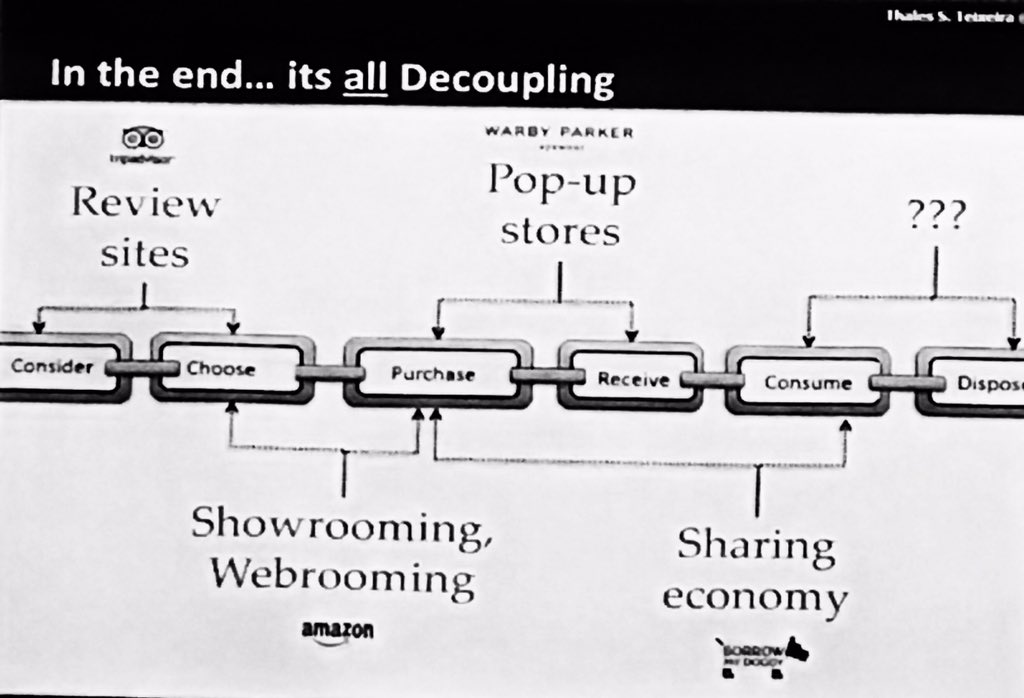
Watching TV used to be endlessly frustrated by those disruptive ads. Then along came Tivo to decouple the watching of content from the advertising that funded it. Similarly Amazon separated trying from buying, Skype separated talking from connecting, Zynga separated playing from buying games.
Having studied disruption patterns across industries, from unbundling to disintermediation, Harvard’s Thales Teixeira has an interesting view on the emerging new wave of technology-enabled disruption: decoupling.
The first wave of Internet disruption enabled purely digital products to be sold and delivered online. New digital players grabbed the opportunity to distribute news, music, movies, and so on online and deliver only what people wanted to consume, even if that meant just a portion of the full content. In recent years, a new wave of digital disruption has been taking over the web.
This second wave is characterized by the separation of consumption activities that traditionally went together, hand-in-hand, such as TV shows and advertising. The authors term this process of separating jointly consumed activities as “decoupling.” Decoupling is the breaking of links between consumer activities that have traditionally been done together.
Teixeira’s full article “the decoupling effect of digital disruptors” first identifies value-creating activities and non-value creating ones in a wide range of consumption activities. The authors then examine how a variety of firms, both incumbents and startups, are using technology to break the bonds between what activities consumers want to do and what they previously had to do. The article closes with a framework for analyzing which businesses are likely to be threatened by decoupling and the two strategies they can use to respond to this threat. Key concepts include:
- The most successful approach to defending a business from the risk posed by decoupling is to preemptively decouple the activities being offered.
- Competitors will try to insert themselves into every step in the process between a value-creating activity (e.g., browsing) to a value-capturing activity (buying), and so make sure to claim value every time you create it.
In summary, Teixeira says “the Internet’s first wave of disruption was marked by the unbundling of digital content, the second wave, decoupling, promises to generate more casualties in an even broader array of industries. Digital start-ups are disrupting traditional businesses by inserting themselves at every juncture in the customer’s consumption chain. By decoupling—the act of separating activities that people are used to co-consuming—new digital businesses are disrupting retailing, telecom and other industries. Decoupling allows consumers to benefit from the value created at a lower cost or effort compared to what is delivered by traditional businesses. For those companies, the only solutions are to either recouple activities or rebalance to create and capture value (i.e., revenues) from both activities separately. Here, digital technologies can be seen as an instrument that will both disrupt traditional business models and potentially preserve them.”
Read the article The decoupling effect of digital disruptors
View the presentation The third wave of digital disruption
Since I started exploring and ranking the world’s “Gamechangers” many others have either adopted the word, or concept in annual rankings and showcases. Disruptive businesses are interesting and inspiring. Many are start-ups, although the don’t have to be small. Or digital. For big companies they represent the source of new ideas, and also threats to their future. Many say such small businesses do not have scale, and so can never have impact. How wrong they are.
The whole point of disruptive businesses are that they create discontinuities – rethinking, reframing, reinventing – that spread like fault lines in markets, or contagions between consumers, shaking up expectations and aspirations, whilst also providing a more interesting friend for investors and influences. They also have business models, working in ecosystems of production and distribution through which they use networks to amplify their impact, far beyond their own size and location.
UK-based publication Marketing Week have got together with Econsultancy to produce another of these lists. Here are a few of their featured disruptors:
Aloha
https://www.youtube.com/watch?v=7oZDu_vBkIw
Plant-based nutrition brand Aloha was launched in 2014 by extreme sports enthusiast Constantin Bisanz. The meditation and yoga fan learned from Ayurvedic practitioners in India and those principles underpin the health and wellness brand. Aloha demonstrates its commitment to Hawaii, which inspired its name, by partnering with the Hawaiian Islands Land Trust and Maui Cultural Lands.
Head of marketing Molly Breiner says: “Consumers are looking to include more sustainable products in their diet without sacrificing on nutrition, taste and convenience. Above all, we’re aiming to help consumers live happier and healthier lives.” The company had raised $4.5m (£3.5m) from two funding rounds by 2014. Aloha products are available at grocery and natural food retailers across the US including Target and Stop&Shop, and are also available online
Awaytomars
Claiming to be the world’s 100% user-created fashion brand, Awaytomars is based on sharing economy principles and crowdfunding. Launched in 2015, it outsources the initial stages of the creative process to the general public and then using its community it iterates them into designs that can make it to the prototype and eventually production stage. A different sales model rewards collaboration and profits are shared between the original designers and any community members who provided significant input. The company distributes 30% of its profits to the community, 20% to the designer and a further 10% to contributors.
Luxury and fashion management consultant Alfredo Orobio has garnered 10,000 active users in his community from 90 countries and has attracted the attention of industry experts, being named Fast Tech Pioneer at the Centre for Fashion Enterprise, the University of Arts London. He has a ‘creative commons’ approach to his concept, with WGSN Insider reporting “I want people to copy [the idea]. That will be so much more interesting for the future of design”.
Babylon Health
https://www.youtube.com/watch?v=CMD6B8h6Pzg
The Babylon Health app lets users book face-to-face consultations with doctors via a smartphone or desktop computer. They can also check symptoms using artificial intelligence (AI), ask medical questions, monitor overall health indicators (including pulse, stress and blood pressure), carry out health tests and keep clinical records in one password protected, secure location.
“The majority of digital healthcare companies simply connect people to doctors through a mobile phone. Our next-generation app will harness the powers of AI and machine learning to not only prevent ill health, but also predict it and intervene when necessary,” says Dr Ali Parsa, CEO and founder of Babylon. Prior to Babylon, Parsa founded Circle, Europe’s largest partnership of clinicians with £200m of revenue, 3,000 employees and a successful IPO. Babylon currently has more than one million downloads, 800,000 registered users worldwide and is free to 220,000 employees on benefit schemes at 120 companies.
Bevel
“No one wants to fund ecommerce companies any more,” Bevel founder and CEO Tristan Walker told Recode in March 2017, three years after the brand’s launch. They might not want to fund retail companies but they clearly have no problem with tech-driven commerce platforms for innovative consumer products. Bevel’s shaving products, specifically tailored to the grooming issues experienced by people of colour, are sold at a higher price point than mainstream competitors such as Gillette and typically by subscription. The opportunity to reduce skin irritation is clearly chiming with consumers as the company claims 95% of customers renew after the first three months.
Bevel’s parent company, Walker & Company, has raised $33m (£25.7m) in venture capital funding and its shaving products are sold in major US retailers like Target. After success with its predominantly male-oriented products, the company plans to launch further extensions such as an electric trimmer and a women’s range.
Casper
https://www.youtube.com/watch?v=Lkp5_v1vIxc
Casper launched in 2014 with a view to providing perfect mattresses direct to consumers. The twist is that the company sells only a single type of mattress, delivered in a small, manageable box. The company has now decided it can afford to diversify, launching a single type of ‘perfect’ pillow and sheets. Speaking to The New York Times, founder and CEO Philip Krim said: “When you check into a hotel, they don’t ask you do you need medium, firm, plush-firm or plush soft? There’s one mattress.”
Reportedly one of the fastest growing consumer brands of all time, it earned $100m (£78m) in revenues in its first full calendar year, 2015. At present, foam beds make up 20% of a £1bn UK mattress retail market but less than 10% of sales happen online. Casper’s five founders, whose backgrounds include product engineering, design and ecommerce, have received funding from a number of venture capital sources totalling $69.95m (£54m).
Curve
Curve allows customers to combine their credit and debit cards into a single physical payment card that is accepted anywhere, uses just one PIN, and means they don’t have to change their bank or behaviour. The Curve card is supported by a mobile app, available on Android and iOS, which means users have visibility of all their spending and charges in a single place. “We transform the existing fragmented financial world into somewhere crystal clear, designed for the user,” says CEO Shachar Bialick.
Curve has raised $5m (£3.86m) across three funding rounds from investors including the Mayor of London’s London Co-Investment Fund, as well as Connect Ventures and Seedcamp. The company claims to have processed £15m of spending across 80 currencies. In early 2017, it added a rewards programme offering instant cashback of between 2.5% and 5% on purchases when spending with one of more than 50 major UK merchants.
The full list of 100 disruptive brands
Further articles:
Disruption to Dominance, how start-ups become global brands
Healthcare disruptors treating patients like demanding consumers