Trend Kaleidoscope 2027 … from superagents to robots on the factory floor, 10 shifts opening up new business opportunities … bringing together all the best trend reports for 2027
October 14, 2026

A factory manager deciding where to deploy a robot, a retailer wondering whether an AI assistant will recommend its products, and a tour operator moving outdoor visits to cooler hours appear to face very different decisions. Each is responding to a force that will reshape business over the next decade. Each also has a choice to make now. That is where strategy gets interesting: when a long-term shift changes what it makes sense to do next.
My recently published Megatrends 2036 framework sets out six pathways.
- Accelerating Intelligence brings AI and robotics into decisions and physical operations.
- Geopolitical Reorder forces businesses to reconsider where they source, invest and build strategic capabilities.
- Diverging Demographics puts ageing populations and longer lives alongside the growth of younger markets.
- Shifting Markets moves centres of demand and innovation towards new regions and business ecosystems.
- Planetary Pressures make heat, water, resources and energy part of everyday business design.
- Humanity Rising reflects the growing importance of health, trust, belonging and human potential in an automated world.
These forces intersect. A manufacturer investing in robotics may also be responding to a shortage of skilled people and a decision to bring production closer to customers. An AI shopping assistant can make buying easier while raising awkward questions about whose interests it serves. A travel company adjusting its calendar for extreme heat may discover demand for destinations it previously overlooked. The opportunities often lie where two or three forces meet.
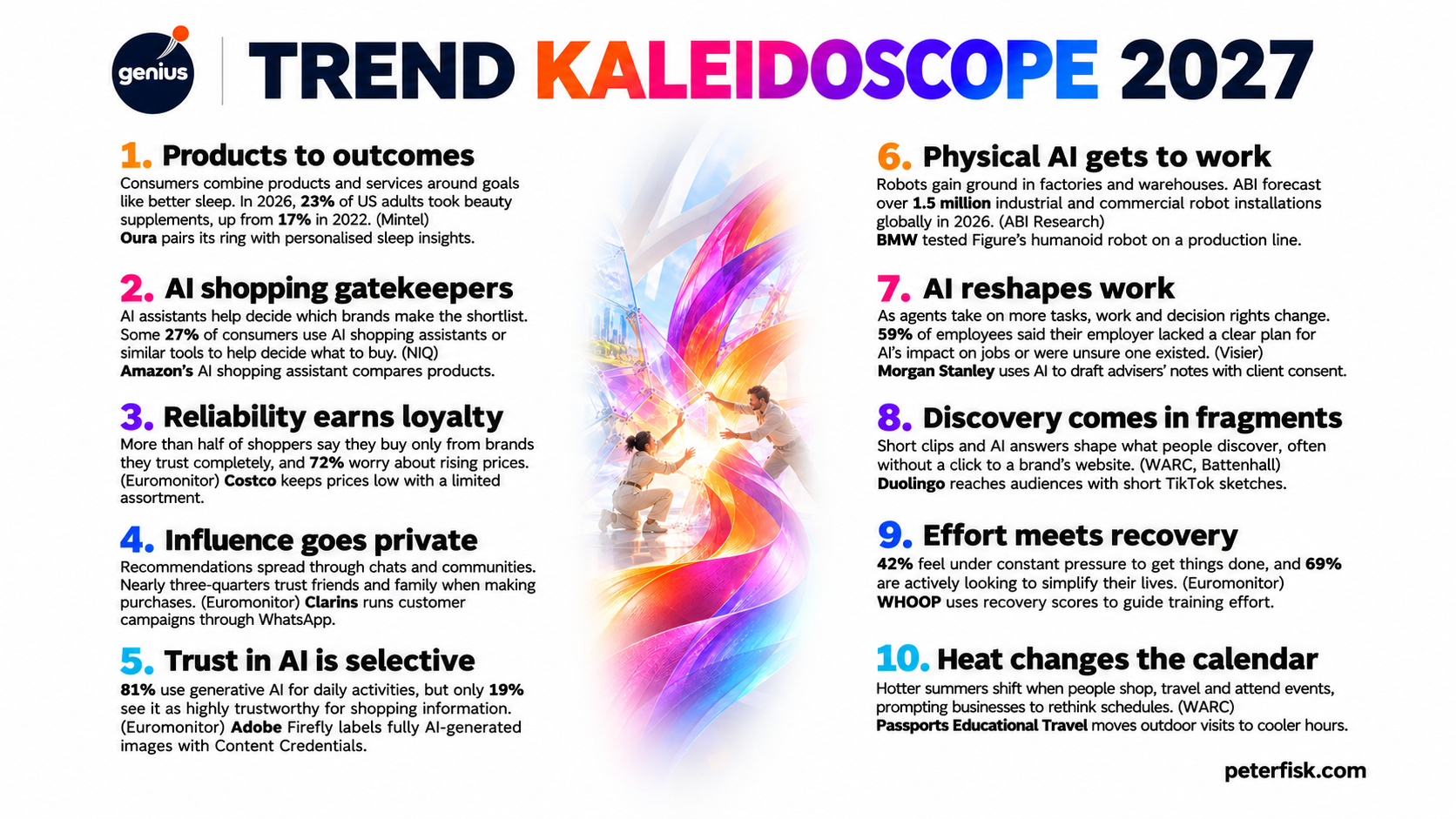
The Trend Kaleidoscope 2027 brings that decade-long view down to the next twelve to eighteen months. These ten shifts are visible in what companies are already doing. The question for leaders is which of them could change how your business earns a customer’s trust, organises its work or makes money.
1. Products to outcomes
People buy products to achieve something. They want to sleep better, grow a healthier crop or get back to work after an illness. In my work with Pfizer, we explored how a focus on healthcare outcomes changes the growth conversation. It draws attention to where patients struggle to access treatment, what support they need and which partners could help remove those barriers. Those opportunities are easy to miss when the commercial conversation starts with product sales.
Finland’s Oura pairs a ring with a membership that interprets sleep and other signals over time. Morocco’s OCP uses soil analysis to tailor crop nutrition to local conditions. In both cases, the product remains essential, but its value increases when customers know what to do with it. The strategic choice is how far to go: which parts of the outcome can you influence, what evidence can you offer, and where do you need a partner?
2. AI shopping gatekeepers
Shoppers used to assemble their own shortlist from search results, reviews and recommendations. Now they can ask an assistant to do that first pass. Amazon’s AI shopping tools already help people compare products and answer questions before purchase. If assistants increasingly make the first cut, businesses need to make prices, availability, compatibility and return terms easy for a machine to interpret. A compelling brand still matters when the customer sees the shortlist; it has to get onto it first.
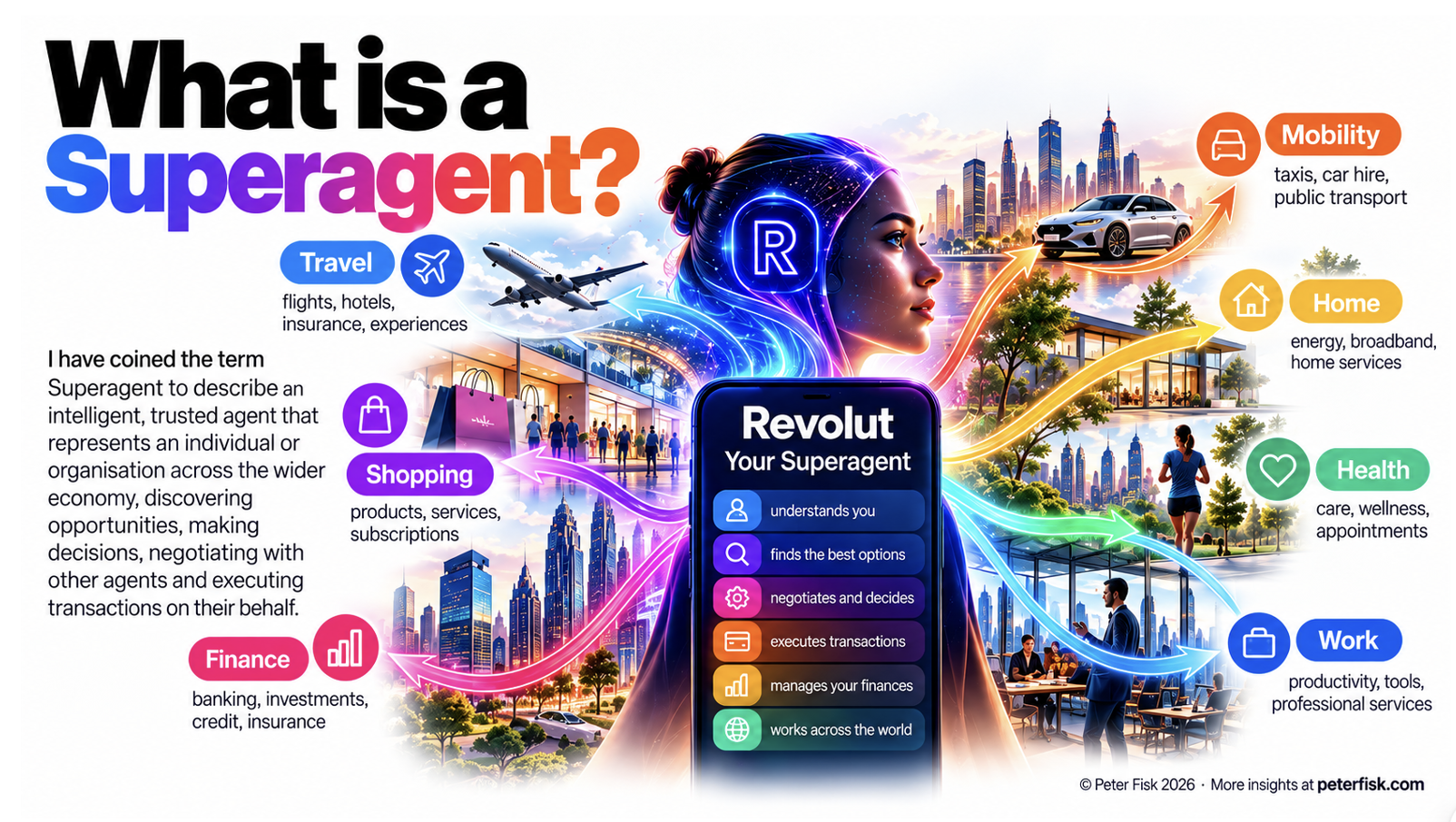
This is the logic behind the Superagent model I introduced in Istanbul, taking Revolut’s breadth as a starting point. A superapp gathers services in one place. A superagent could act across providers for the customer: comparing flights, payments and insurance against a budget, then returning with a proposal for approval. That is a possible next step, not a description of Revolut’s current offer. For 2027, try asking several assistants to recommend a product in your category. Can they find yours? What do they get wrong? Who do they recommend instead, and why?
3. Reliability earns loyalty
When customers are worried about prices or the consequences of a poor choice, consistency becomes a reason to return. Costco’s limited assortment is a deliberate design choice: concentrating sales on fewer products supports rapid inventory turnover and helps it keep prices low. Members learn what kind of value to expect, even when the products on the shelves change.
In my work with Holcim, the question was what reliability means when you sell a construction system rather than an individual material. Its acquisition of Xella added walling systems for new building and refurbishment. For a contractor, the promise of a system is that components fit together, installation is predictable and the building performs as specified. Delivering that promise may require different people to work together across design, sales and technical support. The opportunity is to become more valuable at the moment a customer is deciding whom to rely on.
4. Influence goes private
A product can get millions of public impressions, yet the recommendation that makes someone buy it may come through a message from a friend. Private chats, specialist groups and small communities are difficult to observe, let alone measure. That does not make them less important; it means the usual dashboards tell only part of the story.
France’s Clarins used WhatsApp to invite customers who had opted in to choose the type of lipstick they liked and receive more relevant advice. In my work with Richemont, I explored what this shift means for luxury maisons. A collector sharing a detail with another enthusiast, or an adviser following up on a genuine interest, can carry more weight than another public campaign. The opportunity is to create something worth passing along: an explanation, a story or an invitation that makes the person sharing it useful to someone else. And the relationship needs to be good enough that customers want to keep hearing from you.
5. Trust in AI is selective
The same person might happily ask AI to draft an email and hesitate to let it recommend an investment or make a purchase. Trust depends on the task, the evidence and what happens if the system gets it wrong. Adobe Firefly adds Content Credentials to outputs generated entirely with its AI, giving viewers information about how an image was made. That helps establish provenance; it does not establish that everything depicted is true.
Türkiye’s Garanti BBVA offers a different example. Its assistant Ugi lets customers interact with banking services conversationally. In my work on the future of banking with BBVA, what interested me was the point at which convenience gives way to a need for explanation or reassurance. Finding a feature, comparing options and authorising a transaction require different levels of trust. Design those permissions explicitly, show customers what the system has done, and make it easy to get to a person when the stakes rise.
6. Physical AI gets to work
The most revealing moment for physical AI is when a machine leaves the demonstration floor and has to do useful work through a shift. Germany’s BMW put Figure’s humanoid robot to work in a pilot at Spartanburg in the US, retrieving and positioning sheet-metal parts for welding. The company learnt about integration and safety as well as whether the robot could perform the task. The result is evidence for a specific use case; broader deployment still depends on the economics and demands of each job.
With Gestamp plant leaders in Bilbao, we started with the problems supervisors already know: recurring defects, slow changeovers and tasks that are difficult to staff. For some, a conventional robot or better sensing will be the stronger choice. The strategic upside of greater flexibility is that it could make smaller runs economical or help a supplier absorb late design changes. That changes the work a plant can win, as well as the cost of doing it.
7. AI reshapes work
An AI tool can save an hour without changing the value a business creates. The value depends on what people do with that hour. Morgan Stanley’s Debrief, with client consent, drafts notes and identifies follow-up actions from adviser meetings. It takes on a specific task while leaving the adviser responsible for the relationship and for checking what the system produces. Singapore’s DBS shows what a broader commitment looks like: its 2025 annual report describes more than 430 AI use cases across the bank.
In luxury, an assistant might help a boutique adviser prepare for an appointment. The adviser still has to read the occasion, exercise discretion and decide what will feel right for that client. That distinction matters across sectors. Ask what people should become better at once routine work takes less time, then redesign the role, incentives and training around it. If you simply fill the time with more administration, you’ve missed the opportunity.
8. Discovery comes in fragments
A customer’s first encounter with a brand might be a ten-second sketch, a creator’s demonstration or a line in an AI-generated answer. Each fragment needs to make sense by itself and still add up to a recognisable brand. Duolingo does this with its owl on TikTok: viewers can recognise the character and its humour without knowing the campaign or ever having opened the app.
In Indonesia, TikTok GO by Tokopedia connects short videos, livestreams, search and location-based content to visits to local businesses. Discovery can therefore lead to action without people following the route a company designed on its website. In my work on the future consumer with Mercedes-Benz, that raised an interesting question: which brief moments best convey the value of a complex product? A demonstration of how a car helps find a charging stop might do more to make its value real than a long list of features. Start with the moments customers would choose to show someone else.
9. Effort meets recovery
People want to perform better, but they also want fewer things to manage. WHOOP measures exertion and uses overnight signals to estimate recovery, then suggests how much strain a member might take on. The useful part is the decision it supports: push today, hold steady or ease off. Another dashboard would give people more to interpret; the recommendation gives them somewhere to start.
That principle applies well beyond sport. A bank could help someone determine which spending decision needs attention now. A healthcare service could clarify the next step instead of sending another reminder. Even a business built on frequent engagement should ask whether people would value it more if they needed to use it less. Measure the effort you remove and the outcome you improve. Time spent in the app may tell you very little about either.
10. Heat changes the calendar
Heat can change when customers are willing to travel, shop or attend an event, and when staff can comfortably work outdoors. Passports Educational Travel has described moving outdoor visits to cooler hours and building in indoor alternatives and midday breaks during heatwaves. Australia-founded Intrepid Travel says it avoids the hottest summer months for cycling trips in places such as Jordan and Morocco. One response changes the day; the other changes the season in which a product is offered.
The implications extend to staffing, supplier contracts, peak pricing and what customers are promised at booking. A useful exercise is to replay your busiest week from last summer under much hotter conditions. Which activities would move? Which suppliers could adapt? Where might demand shift to cooler hours or months? You may find a new opportunity as well as a risk: a season you used to discount, or a customer you could serve better at a different time.
The decisions to make in 2027
I would take three questions into the next strategy conversation.
- Which customer outcome could we serve better by looking beyond the product?
- Where will trust determine how much a customer or colleague is willing to delegate?
- Which part of our operating model would we change now if we took the next decade seriously?
Pick the questions that expose a real decision. Give each an experiment, a measure and a date to review the evidence. Test whether customers will pay for the outcome, whether an assistant recommends you accurately, or whether changing a schedule protects margins and improves the experience. The megatrends stretch your view of what the business could become. The next year gives you a chance to find out which possibilities are worth building.
Appendix: all the best trend reports for 2027
- Mintel — 2027 Global Predictions. The standout idea is Products to Systems: customers combine products, services and technology to achieve outcomes such as better sleep. www.mintel.com Official white paper download— select Download Insights.
- Euromonitor — Top Global Consumer Trends 2027. A broad look at how uncertainty changes what people buy, whom they trust and where they seek a simpler life. Includes regional comparisons and brand examples. www.euromonitor.com Official download form — the link is sent by email.
- NIQ — Consumer Outlook: Guide to 2027. The strongest evidence for AI shopping gatekeepers: 27% of respondents had used AI to research or decide what to buy in the previous three months. That measures assistance, not purchases completed by agents. nielseniq.com Direct full PDF · Official NIQ page.
- WARC — The Marketer’s Toolkit 2027. Three ideas stand out: shoppers delegating choices to AI, short clips becoming points of discovery, and extreme heat changing when and where people spend. www.warc.com Non-subscriber sample · Full report — subscription.
- Battenhall — The Year Ahead in Social 2027. The best specialist read on private influence: why DMs, fandoms and comments matter, and what brands can create that people actually want to share. www.battenhall.com Official report download.
- ABI Research — 60 Technology Trends That Will—and Will Not—Shape 2027. A grounded view of physical AI: robots will gain traction first in specific factory and warehouse tasks where the return can be measured. ABI is more cautious about general-purpose humanoids. go.abiresearch.com Official full PDF.
- Visier — Beyond the AI Hype. The most useful workforce report: how to redesign roles around AI, retain human expertise and measure what AI actually delivers. www.visier.com Official report download.
More from the blog