Super Innovators … A24 to Anthropic, Canva and Crazy Maple, Swiggy to SpaceX, Xiaomi and Xylem … How to reinvent a market, and your business, in a world of relentless change
November 10, 2026

The cliffhanger arrives before the lift reaches your floor. You have watched a whole episode of a drama, and you already want the next one. That sliver of time, which a film studio would rarely have thought of as a viewing occasion, is where Crazy Maple Studio built ReelShort.
ReelShort’s vertical dramas run in episodes as short as a minute or two. That changes how a story is written, where it is discovered, when it is watched and how a viewer decides to pay. A clip can introduce the plot in a social feed. The app takes the viewer into the series. The cliffhanger makes the next episode an immediate decision. Media Partners Asia estimates that ReelShort’s revenue rose from $97 million in 2023 to $785 million in 2025, including growth of roughly 96% in 2025 alone.
The radical move was to see a different market inside an existing one. Crazy Maple found a viewing occasion, gave it a format and built a business around it. In doing so, it stretched the boundaries of entertainment. A studio could compete for the time people spend scrolling. A short clip could do the work of a trailer and start the story. A series could be designed around dozens of decisions to keep watching. The value lay in how those choices worked together.
When change compounds
Relentless change puts pressure on every business to improve. The bigger opportunity comes when several changes make a different business possible. Mobile video, social discovery and in-app payments each mattered to ReelShort. Together they made a new kind of studio viable. The strategic question is what becomes possible at the intersection of changes that your company still discusses separately.
Exponential technologies widen that opening. As capabilities improve and the cost of using them falls, work that once required scarce specialists or substantial capital can become accessible to many more people. AI is extending that shift from access to information into the ability to act on it. Anthropic’s Claude Code can navigate a codebase, edit files and run tests. For an experienced engineer, that changes how a project can be delegated and reviewed. For a small team, it changes the scale of project it can attempt. As more teams can build software, the demand for what software can do may change as well.
Digital platforms can multiply the effect in several ways. A business can distribute an idea across markets, use customer behaviour to improve it and let partners extend it into uses it could never serve alone. These mechanisms can reinforce one another. A more useful platform attracts more participants. Their activity reveals more about what works. Better decisions make the next offer more relevant. Distribution, learning and participation can compound together, provided the economics improve as the system grows.
That is the difference between a better product, a different business model and market reinvention. The first improves what people buy. The second changes how value is delivered and paid for. Market reinvention goes further. It can change who participates, which problems people expect to be solved and where the money flows. For the innovator, that may require redesigning the entire business, from the skills it hires to the partners it works with and the measures that determine where it invests.
What distinguishes super innovators is their ability to make that leap while the rest of the market is still adjusting to the last one. Ten themes explain how they do it.
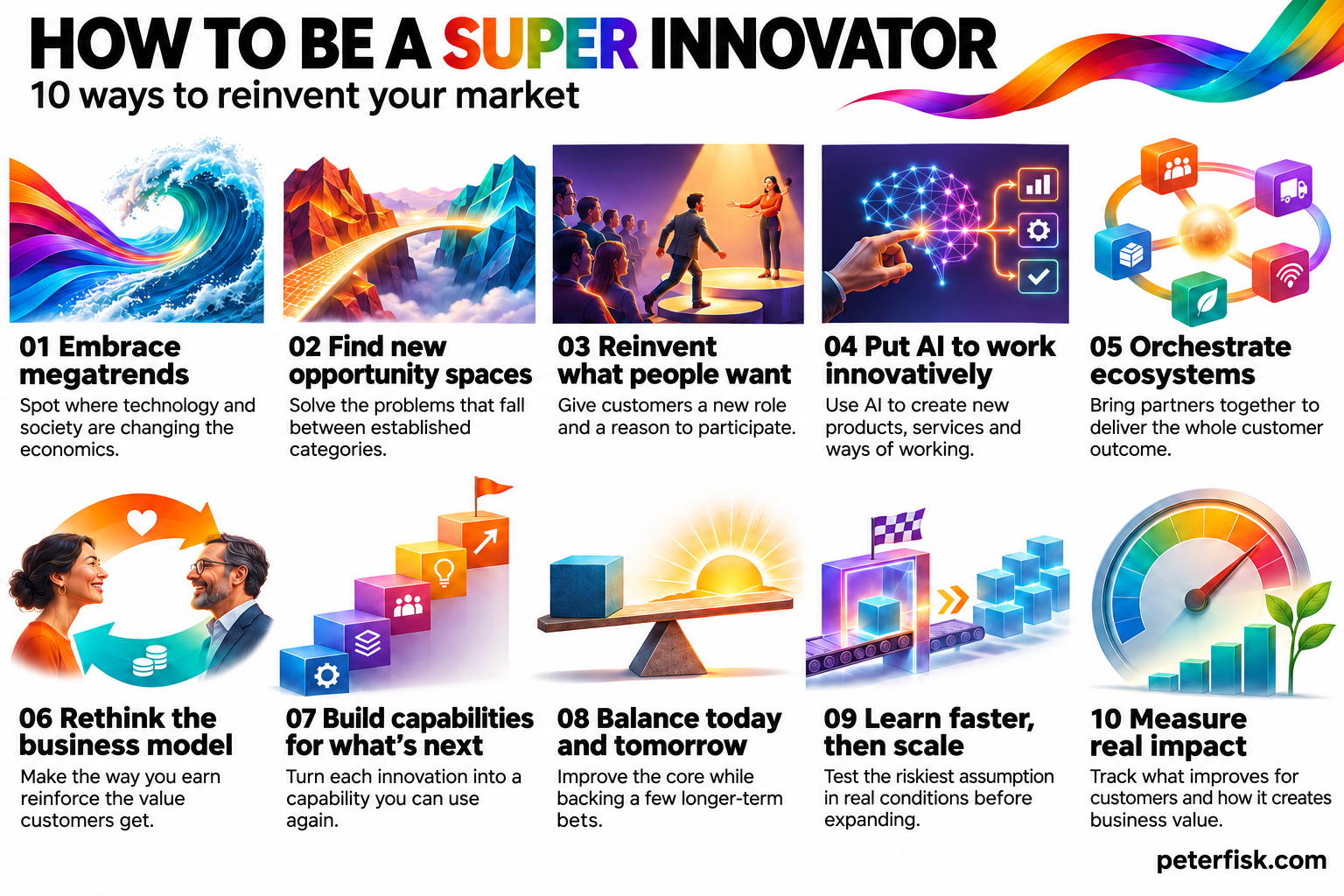
1. Embrace megatrends
A megatrend earns its place in strategy when you can explain whose economics it changes. Electrification, for example, makes battery performance part of a vehicle’s appeal and a determinant of how it can be priced. BYD’s battery expertise gave it a capability it could build vehicles around. For a smaller supplier, the same trend might create a focused opportunity in diagnostics, repair or second-life use.
Ask what is becoming cheaper, what is becoming scarce and who gains an advantage as a result. Look for a decision you can make today, such as building a skill or securing access to a partner, whose value rises as the trend advances.
2. Find new opportunity spaces
Hyrox found room between gym training, competitive sport and live events. It turned familiar exercises into a standardised race, giving participants something to train for and a result they could compare. The opening was visible to anyone who understood how people trained. It became a business when somebody connected the pieces into an experience people would travel and pay to join.
Watch customers move between providers and improvise their own solutions. What are they trying to accomplish across those boundaries? A new opportunity often begins with a task people already care about and an experience no one takes responsibility for from start to finish.
3. Reinvent what people want
Some demand only becomes visible after people are given a new role. Canva made it possible for someone who would previously have written a design brief to create and share the design themselves. A24’s membership gives film fans a relationship with the studio between releases. In one case the customer becomes a creator. In the other, a viewer becomes a member. Both expand the reasons to engage.
Ask what customers would do if they had more confidence, control or a stronger sense of belonging. What they choose to make, share or return for tells you more about new demand than asking them to rate an improved version of today’s offer.
4. Put AI to work innovatively
Harvey brings AI into legal workflows such as transaction due diligence, connecting the documents lawyers review with the tools they use to analyse and draft. The strategic opportunity goes beyond reviewing the same documents in fewer hours. A firm could imagine a service that keeps a client informed as a deal evolves, highlights emerging issues and calls in a lawyer at points that require judgement. That would change what the firm offers and when the client turns to it.
Begin with a service customers rarely get because it is too costly or difficult to deliver. Design what AI can make newly feasible, where expertise must guide the work and who is accountable for the outcome.
5. Orchestrate ecosystems
Mercado Libre connects commerce, payments, credit and fulfilment. A merchant’s ability to sell depends on more than attracting a buyer. Payment has to work, stock must be available and the parcel has to arrive. When those capabilities work together, a merchant can reach customers previously beyond its practical reach. Each participant has a reason to make the overall system work.
Start with the outcome nobody can deliver alone. Decide what you should own, what partners can do better and how they benefit as the system grows. A small firm can bring an ecosystem together around a sharply defined problem if it understands the handovers better than anyone else.
6. Rethink the business model
Discovery’s Vitality links insurance with incentives for healthier behaviour. It gives members a reason to engage between renewal and claim, and it makes prevention part of the proposition. The innovation is in the alignment. Members have something to gain from changing habits, and the insurer has a reason to support that change over time.
Examine what your current way of earning rewards. Does it encourage you to sell more units, resolve more incidents or help customers avoid the incident in the first place? A new model is strongest when the value the customer experiences and the value the business captures can grow together.
7. Build capabilities for what’s next
Swiggy’s expansion from restaurant delivery into groceries shows how one business can create a starting point for another. Customer relationships, the app and delivery experience gave it something to build on. Groceries still required inventory and fulfilment capabilities suited to a different proposition. The judgement lay in knowing what would transfer and what had to be built afresh.
Ask what each innovation will enable you to do next. A new distribution channel, a way to learn about demand faster or a partner relationship that opens another market can make the second opportunity easier to pursue than the first.
8. Balance today and tomorrow
A business can improve this year’s performance while building options for the years ahead. The difficulty comes when both are judged on the same timetable. An established operation can be assessed on margins and retention. A promising adjacency might first need evidence of repeat demand. A longer-term bet might hinge on a technical milestone or a partner’s commitment.
Give each horizon a budget, an owner and a standard of evidence appropriate to its stage. A small business may be able to support only one meaningful bet alongside the core. Make it a deliberate one. The aim is to create room to act before the current source of growth is under pressure.
9. Learn faster, then scale
Waymo’s driverless ride-hailing service has to work as a system. The vehicle needs to navigate, passengers need a predictable experience and operations must handle exceptions. Commercial deployment puts those parts together under real conditions. It also shows which capabilities can transfer to a new place and which depend on local circumstances.
Find the assumption that would most undermine your idea if it were wrong. Test it where real customers, colleagues or partners have something at stake. Decide in advance what would justify expansion. Speed comes from resolving consequential uncertainties early, so that when you commit resources you know which parts of the model deserve to be repeated.
10. Measure real impact
Zipline’s drone deliveries can be counted as flights. A clinic experiences their value as the ability to get critical supplies in time to use them. That second measure points to where the service could change how clinics stock supplies, what they can offer and how a health system might organise distribution.
Choose a measure from the customer’s world and pair it with a measure of economic viability. Look for changes that persist with repeated use. If customers start changing their routines because they trust the new service will work, you may be seeing the beginnings of a new market expectation.
Make the leap tangible
An established company can begin with an advantage it has accumulated over decades, such as customer trust, infrastructure, specialist knowledge or distribution. A start-up can begin with the freedom to design for people the industry overlooks. Both can start with the same question. What would our customers take for granted if this market worked fundamentally better?
Work back from that future expectation. Identify the capabilities and partnerships it would require. Decide which part you can prove now, on a scale where the result matters and where you can afford to learn. Then look for what will multiply the effect. It could be a platform that opens distribution, a partner that extends the offer or a feedback loop that improves the next version every time someone uses it.
Crazy Maple found its opening in the minute or two that traditional entertainment rarely designed for. What mattered was how far it was prepared to follow the implication. It redesigned the story, the viewing experience and the economics around that moment. The opening for your business may be equally easy to overlook. Find the moment your market takes for granted, imagine what it could become, then build enough of that future for people to choose it.
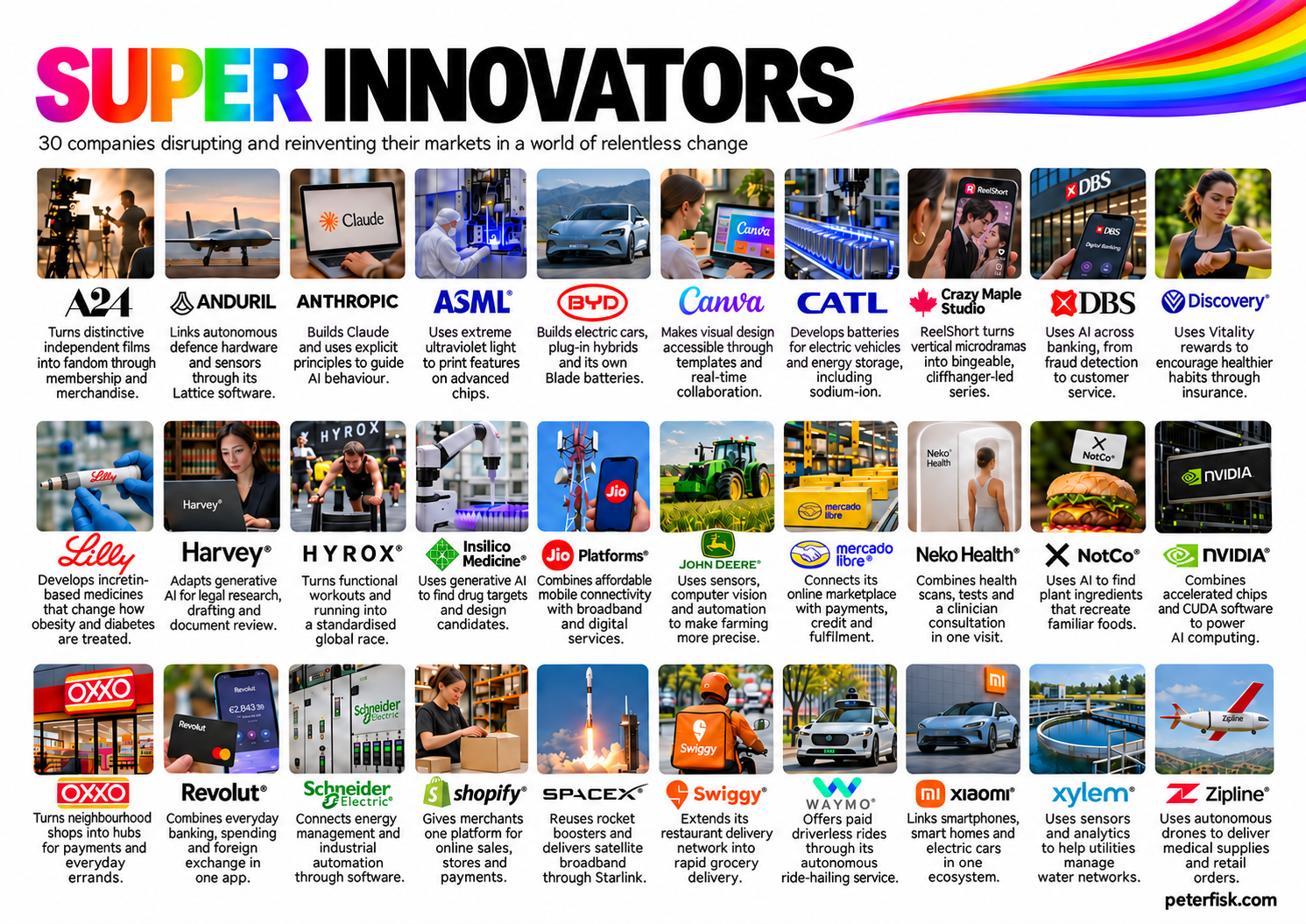
Here are my short profiles of the 30 super innovators:
1. A24
Daniel Katz, David Fenkel and John Hodges founded A24 in New York in 2012 as an independent film distributor. It grew into a film and television studio whose name itself attracts audiences, with projects such as Everything Everywhere All at Once. A24 gives distinctive filmmakers a route to market and extends the audience relationship through merchandise, publishing and its AAA24 membership. That creates reasons to engage between releases and gives individual films a longer cultural life. By 2026, its growth was visible in the scale of its projects, including the planned Elden Ring adaptation, alongside its independent slate.
2. Anduril
Palmer Luckey, Brian Schimpf, Trae Stephens, Matt Grimm and Joseph Chen founded Anduril in Orange County, California, in 2017. It develops autonomous aircraft, surveillance systems and other defence equipment connected through its Lattice software. The distinctive move is to integrate sensors, vehicles and operator interfaces around a common software platform. Anduril also invests in developing products ahead of some procurement decisions, assuming more upfront risk in exchange for greater control over development. The company said revenue more than doubled to US$2.2 billion in 2025. In May 2026 it raised US$5 billion at a US$61 billion valuation.
3. Anthropic
Dario and Daniela Amodei and fellow former OpenAI colleagues founded Anthropic in San Francisco in 2021. It develops Claude, a family of AI models and applications used for writing, analysis, software development and enterprise workflows. Its Constitutional AI approach uses explicit principles to guide model behaviour, and its research examines how models can be interpreted and controlled. Commercially, Anthropic reaches customers through its own products, APIs and cloud partners. Reuters reported that its annualised revenue run rate exceeded US$65 billion by the end of July 2026. That measures the pace of sales at that point in time.
4. ASML
Philips and ASM International created ASML in Eindhoven in 1984 to commercialise lithography equipment. Now based in Veldhoven, it makes the machines that print circuit patterns onto silicon wafers. Its breakthrough was commercialising extreme ultraviolet lithography, which enables chipmakers to produce finer features at scale. ASML integrates specialised optics, light sources, precision engineering and software from a network of suppliers, then works closely with chipmakers to bring successive machine generations into production. It recorded €32.7 billion in net sales in 2025, up from €28.3 billion in 2024, as advanced logic and memory investment supported demand.
5. BYD
Wang Chuanfu built BYD in Shenzhen in the mid-1990s as a rechargeable-battery manufacturer. It entered carmaking in 2003 and now sells battery-electric vehicles and plug-in hybrids alongside businesses in batteries, electronics and transport. Its Blade Battery and dual-mode hybrid systems reflect a strategy of developing key components and vehicles together. This gives BYD control over costs, packaging and how quickly new technology reaches different models. The company reported RMB804 billion in revenue and 4.6 million new-energy vehicle sales in 2025. By April 2026 its new-energy vehicles were available in more than 120 countries and regions.
6. Canva
Melanie Perkins, Cliff Obrecht and Cameron Adams launched Canva in Sydney in 2013, building on Perkins and Obrecht’s online school yearbook business in Perth. Canva made visual design accessible through browser-based editing, templates and drag-and-drop tools. Its distinctive approach is to let individuals start for free and give teams reasons to pay as they need brand controls, shared assets and collaboration. AI tools extend the same approach into generating and adapting content. Canva reported about 260 million monthly users in 2025, and its co-founder told TechCrunch that annual recurring revenue reached US$4 billion by year-end.
7. CATL
Robin Zeng, also known as Zeng Yuqun, and colleagues founded Contemporary Amperex Technology in Ningde, Fujian, in 2011, drawing on experience in consumer electronics batteries. CATL supplies batteries for electric vehicles and stationary energy storage. It works with vehicle manufacturers to integrate batteries into their platforms and develops multiple chemistries and pack designs for different needs. Its Naxtra sodium-ion technology illustrates how it explores alternatives alongside lithium-ion, while its recycling business brings recovered materials back into the supply chain. In 2025, revenue rose 17% to RMB423.7 billion, and lithium-ion battery sales by capacity increased 39% to 661 GWh.
8. Crazy Maple Studio
Joey Jia founded Crazy Maple Studio in San Francisco in 2016, and it began operating in 2017. It developed interactive fiction through Chapters and romance publishing through Kiss, then launched ReelShort in 2022. ReelShort makes live-action dramas for vertical phone screens, using minute-long episodes, frequent cliffhangers and paid unlocks to turn spare moments into binge viewing. The studio can draw on stories and audience insights from its reading and gaming apps when developing new series. ReelShort’s gross revenue reached RMB5.72 billion in 2025, up about 97% year on year, according to figures reported from investor COL Group’s filings.
9. DBS
Singapore’s government established the Development Bank of Singapore in 1968 to support industrial development. DBS became a major Asian retail, corporate and wealth bank, then rebuilt many services around digital customer journeys. Its approach combines a shared data platform with teams that redesign banking workflows and deploy AI where it can improve decisions or service. DBS reported approximately S$1 billion in economic value from data analytics and AI in 2025, across more than 430 use cases. In the third quarter of 2026, it recorded S$2.81 billion in net profit, while wealth assets under management reached S$544 billion.
9. Discovery
Adrian Gore founded Discovery in Johannesburg in 1992 as a health insurance business. It subsequently expanded into life insurance, banking and international partnerships. Its signature innovation, Vitality, uses rewards to encourage behaviours such as physical activity and preventive health checks. Partners make those rewards useful in everyday life, giving members reasons to engage between renewals or claims. Discovery has taken the model into other markets through relationships with insurers, extending its reach beyond businesses it owns and operates. In the financial year to June 2026, Discovery reported normalised operating profit of R17.75 billion, up 17%.
10. Eli Lilly · United States
Colonel Eli Lilly founded the pharmaceutical company in Indianapolis in 1876. Its early work helped bring insulin into commercial production, and it now develops medicines across diabetes, obesity, oncology, immunology and neuroscience. Tirzepatide, marketed under brands including Mounjaro and Zepbound, illustrates how research into related biological pathways can support products for several indications, subject to clinical evidence and approvals. Lilly’s operating challenge is to scale manufacturing alongside discovery, trials and distribution, especially when demand rises rapidly. Revenue reached US$65.2 billion in 2025, up about 45%, with Mounjaro and Zepbound major contributors to the increase.
12. Harvey
Former lawyer Winston Weinberg and AI researcher Gabriel Pereyra founded Harvey in 2022, building the company in San Francisco. Harvey adapts generative AI to work such as legal research, drafting, document review and due diligence. Its approach brings together models, legal sources, firm knowledge and repeatable workflows so professionals can use AI on substantial assignments and review the results in context. Early work with major law firms helped shape the platform around demanding professional users. In September 2026 Harvey announced a US$550 million funding round at a US$15.5 billion valuation, following an earlier round valued at US$11 billion.
13. Hyrox
Christian Toetzke, Olympic hockey champion Moritz Fürste and marketing specialist Michael Trautmann created HYROX in Hamburg, where it launched in 2017. Its format alternates eight one-kilometre runs with eight functional workout stations. A common course makes results comparable across cities and gives participants a reason to train for another event. Gyms can build programmes around the format, while spectators, sponsors and equipment partners extend the business beyond race entries. By 2026 HYROX had grown into an international event series. In September, its founders regained majority ownership with investors led by L Catterton, a milestone in the business’s expansion.
14. Insilico Medicine
Alex Zhavoronkov founded Insilico Medicine in 2014, with early roots in Baltimore and subsequent operations across the US, Asia and the Middle East. The clinical-stage biotech uses AI to identify biological targets, design molecules and prioritise drug candidates for testing. Its distinctive model combines proprietary software, its own drug pipeline and collaborations with pharmaceutical companies. This gives it several ways to earn returns from discovery, including licensing and milestone payments. It is listed in Hong Kong. First-half 2026 revenue exceeded US$100 million, around four times the prior-year level, with collaborations and milestones contributing to the increase.
15. Jio Platforms
Reliance Industries, led by Mukesh Ambani, established Mumbai-based Jio Platforms in 2019 as the holding company for its digital businesses. The underlying Reliance Jio mobile service launched commercially in 2016. Low-cost mobile data helped bring consumers online, creating a base for fibre broadband, digital applications, enterprise technology and 5G services. Its advantage comes from linking network infrastructure, devices and services, with distribution through the wider Reliance group. That gives it several ways to deepen engagement after acquiring a subscriber. In the financial year to March 2026, revenue from operations rose 14.6% to ₹146,885 crore, while EBITDA grew 18.8%.
16. John Deere
Blacksmith John Deere developed a self-scouring steel plough in Grand Detour, Illinois, in 1837. The company, now based in Moline, makes agricultural and construction machinery and has added software, sensors and automation to its equipment. See & Spray uses cameras and computer vision to identify weeds and apply herbicide selectively. Deere’s advantage is the combination of machines already used in the field, dealer support and digital tools that help farmers make better decisions across seasons. After a weaker fiscal 2025, worldwide net sales and revenues rose 5% year on year to US$12.6 billion in fiscal Q3 2026.
17. Mercado Libre
Marcos Galperin founded Mercado Libre in Buenos Aires in 1999 to build an online marketplace for Latin America. As the business grew, it addressed barriers that held back transactions, developing Mercado Pago for payments and financial services and Mercado Envíos for logistics. The result is an ecosystem in which better delivery and payment options encourage more shopping, while more transactions make the platform more valuable to sellers. Credit and advertising give it further ways to serve merchants. In the third quarter of 2026, revenue reached US$10.75 billion, up 45% year on year, as the commerce and fintech businesses expanded.
18. Neko Health
Engineer Hjalmar Nilsonne and Spotify co-founder Daniel Ek founded Neko Health in Stockholm in 2018. Its clinics combine skin imaging, cardiovascular measurements, blood tests and a clinician consultation in one preventive health visit. Neko develops the scanning technology and designs the clinic experience together, giving it control over how data is collected and explained. A consistent set of measurements also gives returning customers a basis for tracking changes over time. After expanding from Sweden into the UK, Neko raised US$700 million in July 2026 and opened its first US clinic in New York in September.
19. NotCo
Matías Muchnick, Karim Pichara and Pablo Zamora founded NotCo in Santiago in 2015. The company built a plant-based food business around Giuseppe, an AI system that suggests ingredient combinations to recreate qualities such as flavour, texture or functionality. Food scientists then test and refine those suggestions. Its distinctive move has been to turn a capability built for its own products into a service for other food companies, broadening the opportunity beyond plant-based retail products. Alongside its work with Kraft Heinz, NotCo announced a partnership with Barry Callebaut in November 2025 to explore AI-assisted chocolate recipe development.
20. Nvidia
Jensen Huang, Chris Malachowsky and Curtis Priem founded Nvidia in Silicon Valley in 1993 to bring 3D graphics to gaming and multimedia. The company expanded the use of its graphics processors through CUDA, which lets developers apply parallel computing to other tasks. It now combines processors, networking, systems and software for AI, scientific computing and industrial applications. The developer ecosystem is central to how Nvidia works. Tools and libraries help customers put the hardware to use and give them a reason to stay with the platform. Revenue reached US$215.9 billion in fiscal 2026, up 65%.
21. OXXO
FEMSA’s retail operation opened the first OXXO in Monterrey in 1978. The chain grew from a convenience outlet into a neighbourhood hub for snacks, everyday goods, bill payments and financial transactions. Its dense network of small shops is valuable because customers can carry out several errands on a single visit, including transactions that involve cash. The same locations give financial and service partners broad physical distribution. FEMSA’s 2026 reporting separated OXXO Mexico from Americas & Mobility, which includes OXXO operations in Brazil, Colombia, Chile, Peru and the US. That footprint shows how far the format has travelled from Monterrey.
22. Revolut
Nikolay Storonsky and Vlad Yatsenko founded Revolut in London in 2015 around low-cost foreign exchange and a travel card. It expanded into accounts, payments, savings, investments and services for businesses, with availability varying by market. Its operating model uses a common app and technology platform, while adding products, licences and local capabilities as it expands. A customer can join for one frequent problem, such as spending abroad, then move more of their financial life into the app. In 2025, revenue rose 46% to £4.5 billion and pre-tax profit reached £1.7 billion.
23. Schneider Electric
Brothers Adolphe and Joseph-Eugène Schneider took over the Le Creusot foundry in Burgundy in 1836. The business evolved from heavy industry into a global specialist in electrification, energy management and industrial automation. Its EcoStruxure architecture links equipment, controls and software so customers can monitor and improve performance across factories, buildings and data centres. Schneider works through a network of integrators, distributors and technology partners, combining its own equipment with capabilities customers already use. Revenue crossed €40 billion in 2025, up 9% organically. In the third quarter of 2026, it reached €11.5 billion, up 17% organically, with data centres a major contributor.
24. Shopify
Tobias Lütke, Daniel Weinand and Scott Lake launched Shopify in Ottawa in 2006 after building software for their own online snowboard shop. It gives merchants tools to run storefronts, process payments and sell online and in person. Its distinctive model combines subscriptions with services that grow as merchants sell more. A network of app developers, agencies and partners extends what the platform can do, while merchants retain their own brands and storefronts. This allows Shopify to serve businesses from first sale to enterprise scale. In the second quarter of 2026, revenue grew 34%, with an 18% free cash flow margin.
25. SpaceX
Elon Musk founded SpaceX in California in 2002 to reduce the cost of reaching space. The company developed the Falcon launch family, Dragon spacecraft and Starlink satellite broadband. Recovering and reusing Falcon 9 first stages supports a higher launch cadence. Starlink gives SpaceX its own source of launch demand and turns orbital infrastructure into an ongoing subscription business. The company’s approach links engineering, manufacturing, launch operations and satellite services, letting improvements in one part support the others. Its second-quarter 2026 filing reported 92% year-on-year group revenue growth, with satellite connectivity and AI among the contributors.
26. Swiggy
Sriharsha Majety, Nandan Reddy and Rahul Jaimini founded Swiggy in Bengaluru in 2014. It built a food delivery marketplace around a managed delivery network, then extended into groceries through Instamart and into services such as dining discovery. Its advantage comes from combining customer demand, restaurant and retail partners, delivery operations and, for quick commerce, neighbourhood fulfilment sites. Shared customer access helps new services gain traction, while each has distinct operating economics. In fiscal Q4 2026, group revenue rose 45% to ₹6,383 crore, and food delivery gross order value grew 22.6% year on year.
27. Waymo
Waymo began in 2009 as Google’s self-driving car project in California, with Sebastian Thrun leading the early effort. It became a separate Alphabet company in 2016. Its Waymo Driver combines sensors, software and computing, and the company operates a commercial ride-hailing service with no driver behind the wheel. Waymo learns through simulation, road testing and passenger operations, then extends the service market by market. That operating model makes local deployment and fleet management as important as the vehicle technology. By October 2026, Waymo said it had launched service in its 15th US city, following a US$16 billion equity round earlier that year.
28. Xiaomi
Lei Jun and a group of co-founders established Xiaomi in Beijing in 2010. It built its early following through smartphone software, direct online sales and competitively priced hardware. Xiaomi expanded into wearables, home appliances and electric vehicles, linking categories through its HyperOS software and connected-device strategy. A broad product portfolio gives customers several entry points, while compatibility gives them a reason to buy across categories. Xiaomi also works with partner businesses to extend its device ecosystem. In 2025, group revenue reached RMB457.3 billion, up from RMB365.9 billion in 2024, as its established device businesses and newer EV operations contributed to growth.
29. Xylem
Xylem became an independent company in 2011 when ITT spun off its water equipment and services businesses in White Plains, New York. It supplies pumps, meters, treatment equipment, analytics and services to utilities, industrial customers and buildings. Its distinctive move is to connect physical infrastructure with monitoring and decision tools. A utility can use those capabilities to detect leaks, track asset condition or plan maintenance. The acquisition of Evoqua added treatment capabilities and service reach, broadening the problems Xylem can address across the water cycle. In 2025, revenue reached US$9.04 billion, about 6% higher than the previous year.
30. Zipline
Keller Rinaudo Cliffton, Keenan Wyrobek and Will Hetzler co-founded Zipline in California in 2014. Its first commercial operations in Rwanda used autonomous aircraft to deliver blood and medical supplies, making rapid delivery possible without every clinic carrying the same inventory. Zipline designs, manufactures and operates its own systems, then integrates them with healthcare and retail partners. Its newer delivery platform extends the model into neighbourhood deliveries. Zipline passed two million commercial deliveries by January 2026. In November it raised US$1.5 billion to expand US manufacturing and build out its delivery network, including a planned rollout with Walmart.
More from the blog